Short-answer questions

State, give, name and identify questions worth one or two marks. 196 questions.

Other types: Calculation questions · Show that questions · Explain and describe questions · Definition questions · Graph and diagram questions · Six-mark QER questions · Practical questions

June 2025 · Component 1 · Q1(b) 2 marks AO1=2 Short answer kinematics
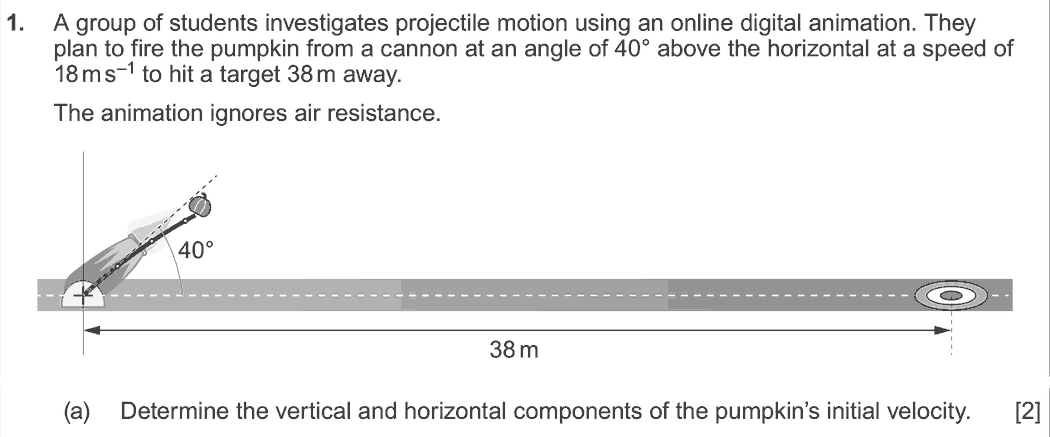
Earlier part of question 1 that this part usesEarlier part of June 2025 Component 1 question 1
(b) Describe the vertical and horizontal motion of the pumpkin during its flight. [2]
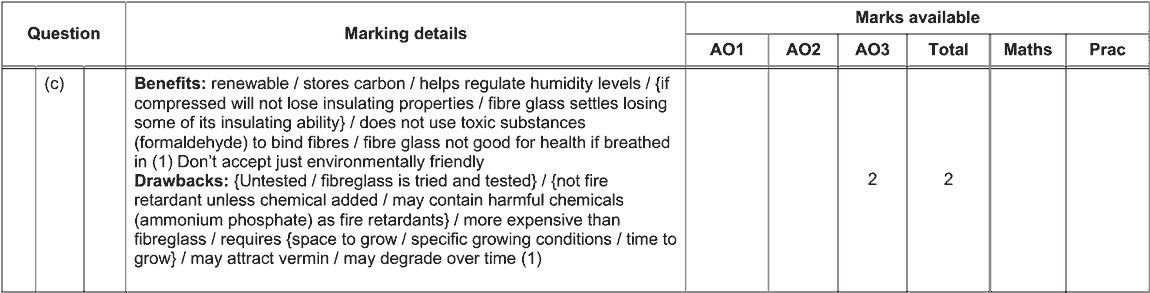
June 2025 · Component 1 · Q7(c) 2 marks AO3=2 Short answer thermal physics
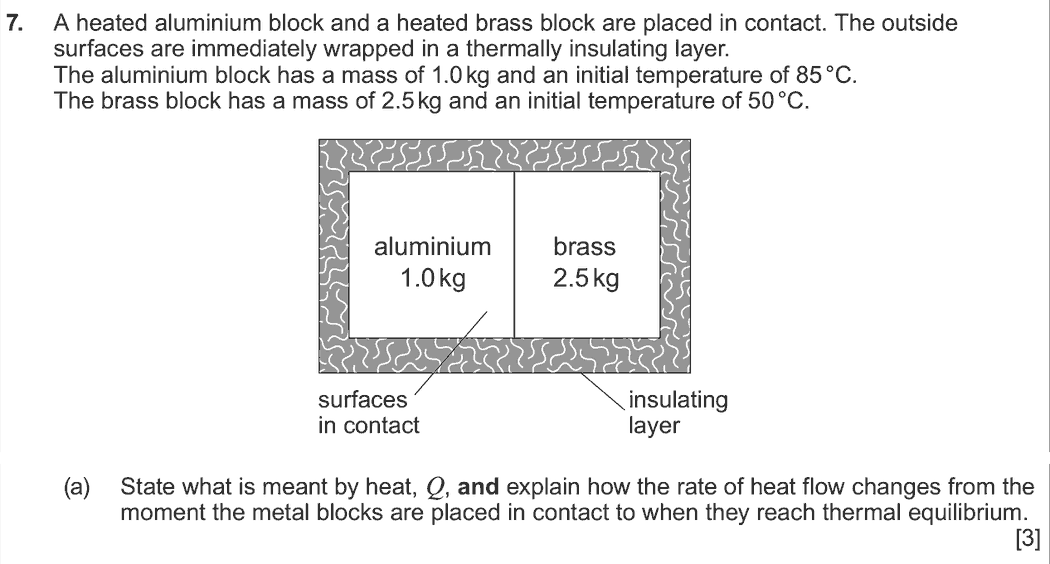
Earlier part of question 7 that this part usesEarlier part of June 2025 Component 1 question 7
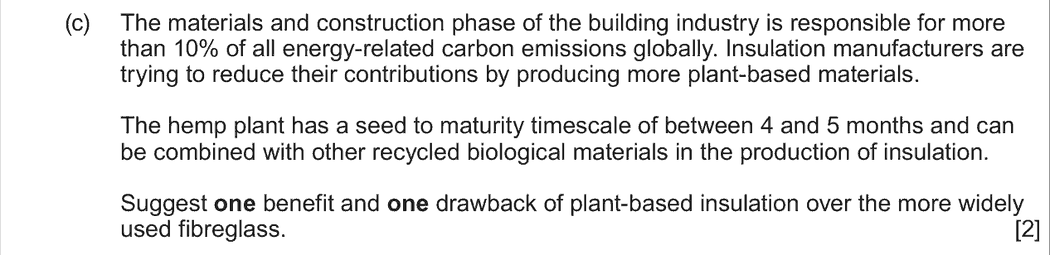
(c) The materials and construction phase of the building industry is responsible for more than 10% of all energy-related carbon emissions globally. Insulation manufacturers are trying to reduce their contributions by producing more plant-based materials. The hemp plant has a seed to maturity timescale of between 4 and 5 months and can be combined with other recycled biological materials in the production of insulation. Suggest one benefit and one drawback of plant-based insulation over the more widely used fibreglass. [2]
June 2025 · Component 2 · Q1(a)(i) 1 mark AO1=1 Short answer conduction of electricity
1. (a) (i) ‘Copper is an electrical conductor.’ Explain what this statement means. [1]
June 2025 · Component 2 · Q2(b) 1 mark AO2=1 Short answer resistance
Earlier part of question 2 that this part usesEarlier part of June 2025 Component 2 question 2
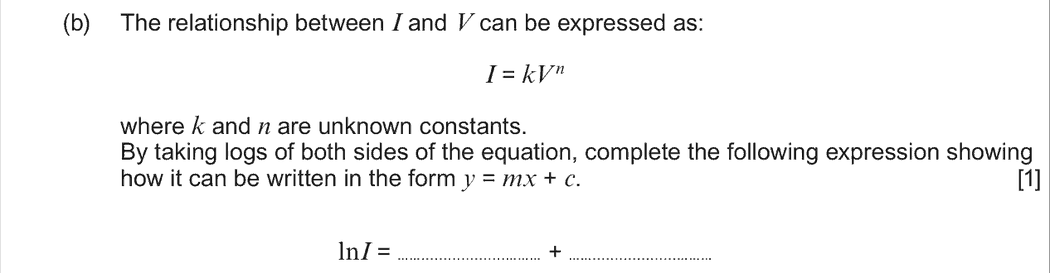
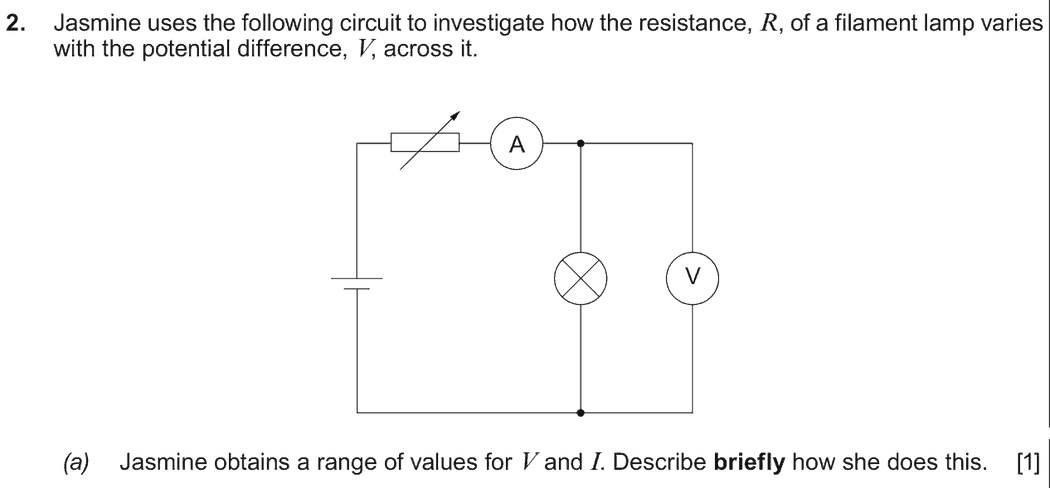
(b) The relationship between I and V can be expressed as: I = kV n where k and n are unknown constants. By taking logs of both sides of the equation, complete the following expression showing how it can be written in the form y = mx + c. [1] lnI = + …………… ……………
June 2025 · Component 2 · Q8(b)(ii) 2 marks AO3=2 Short answer radiation and stars
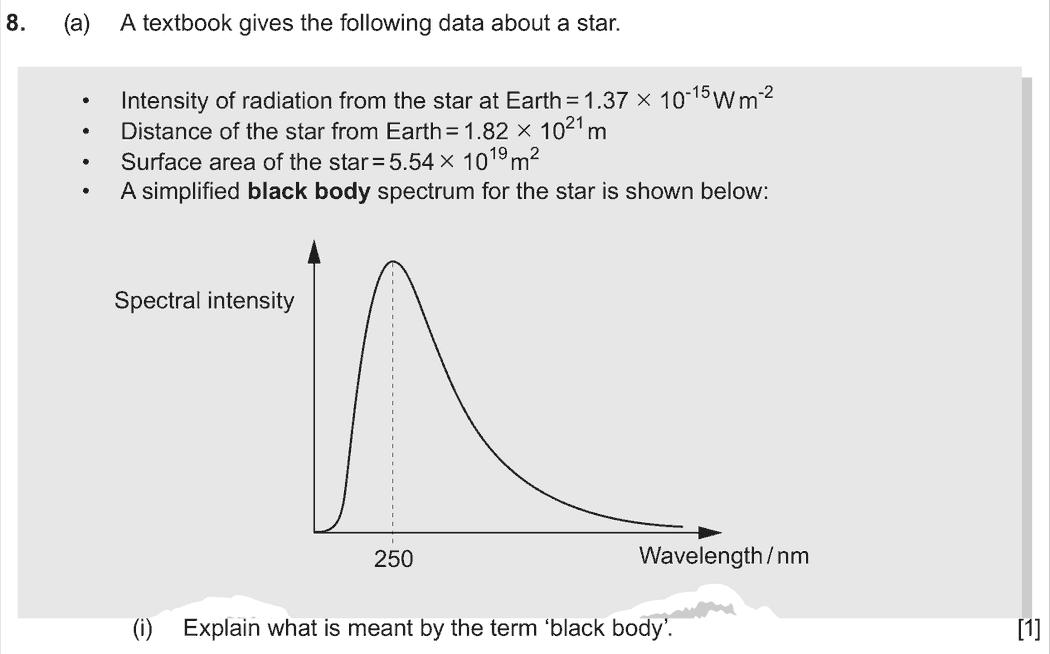
Earlier parts of question 8 that this part usesEarlier part of June 2025 Component 2 question 8Earlier part of June 2025 Component 2 question 8
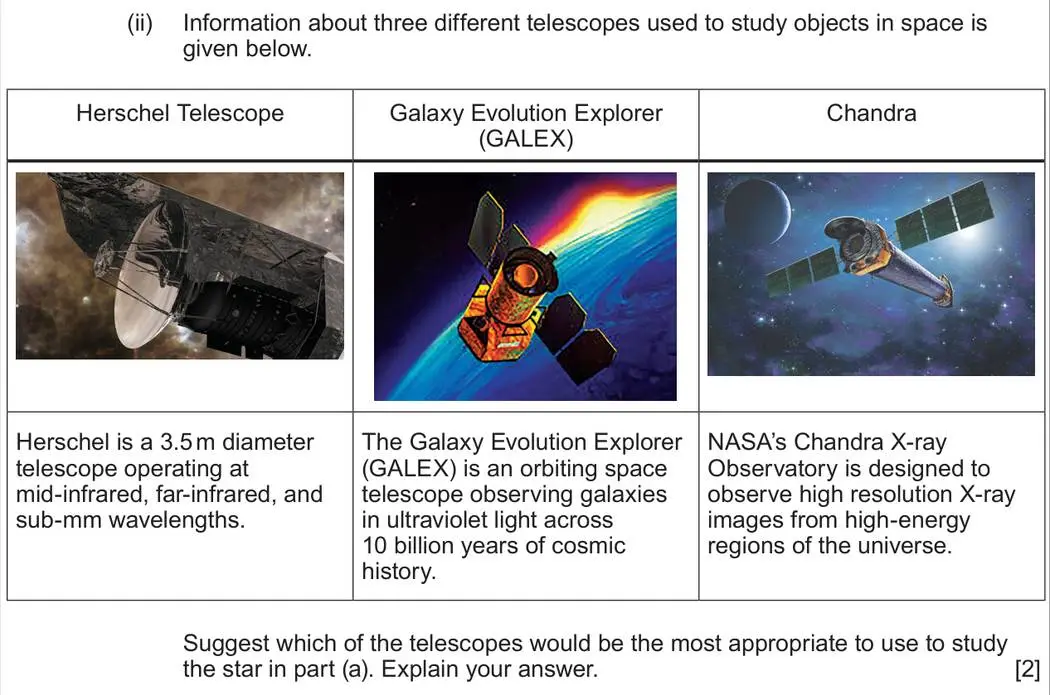
(ii) Information about three different telescopes used to study objects in space is given below. Herschel Telescope Galaxy Evolution Explorer Chandra (GALEX) Herschel is a 3.5 m diameter The Galaxy Evolution Explorer NASA’s Chandra X-ray telescope operating at (GALEX) is an orbiting space Observatory is designed to mid-infrared, far-infrared, and telescope observing galaxies observe high resolution X-ray sub-mm wavelengths. in ultraviolet light across images from high-energy 10 billion years of cosmic regions of the universe. history. Suggest which of the telescopes would be the most appropriate to use to study the star in part (a). Explain your answer. [2]
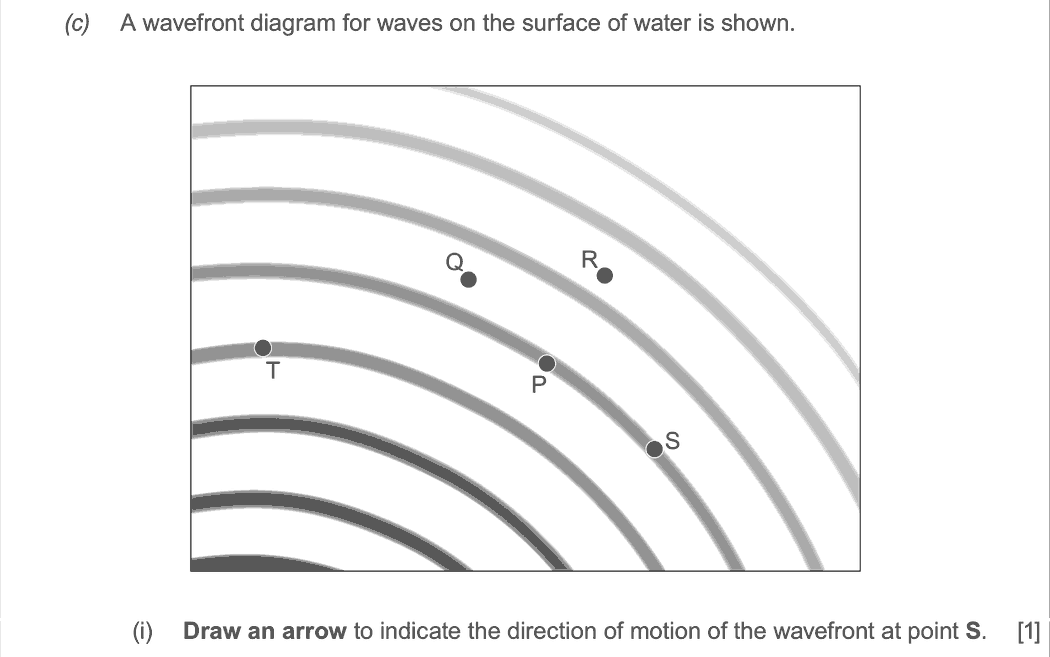
June 2025 · Component 3 · Q1(b)(iii) 1 mark AO1=1 Short answer nature of waves
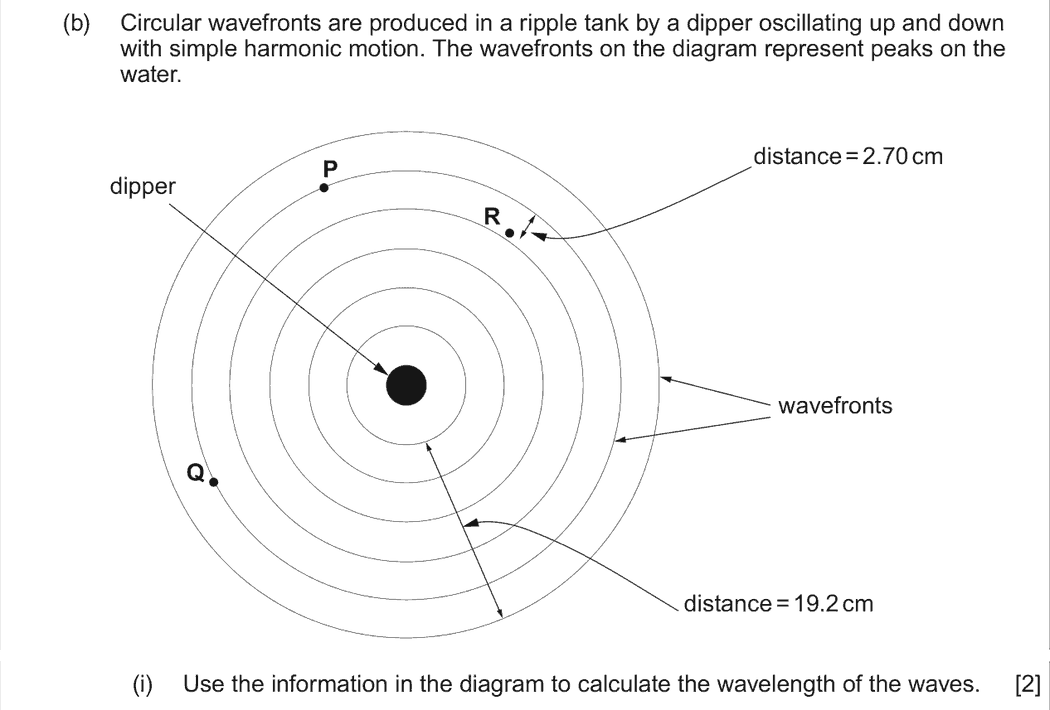
Earlier parts of question 1 that this part usesEarlier part of June 2025 Component 3 question 1Earlier part of June 2025 Component 3 question 1
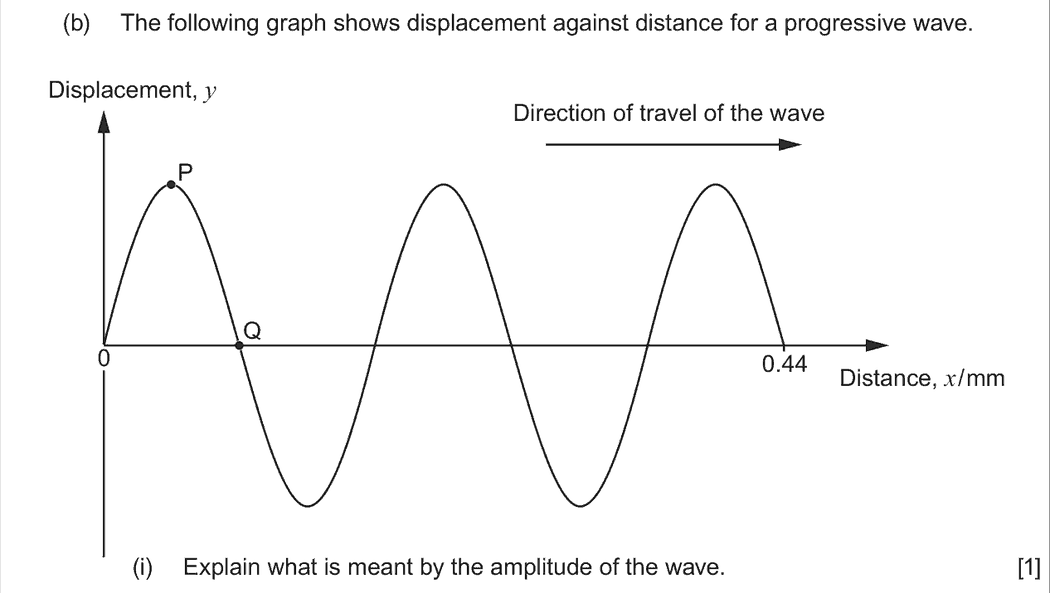
(iii) State the phase of point P relative to point Q. [1]
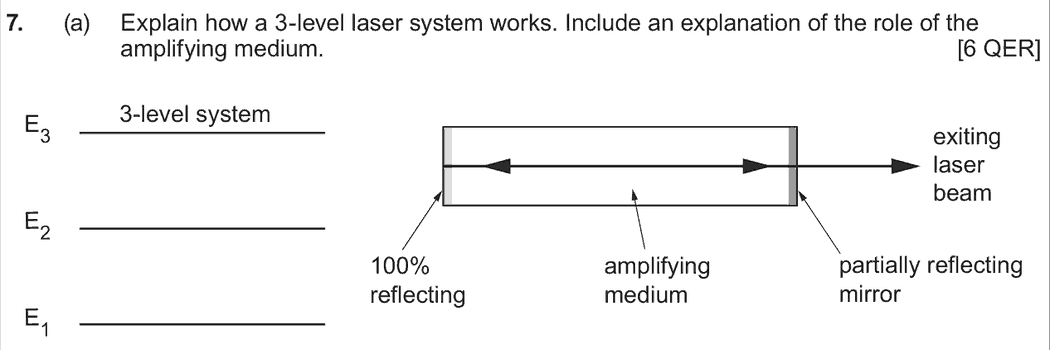
June 2025 · Component 3 · Q7(b) 2 marks AO1=2 Short answer lasers
Earlier part of question 7 that this part usesEarlier part of June 2025 Component 3 question 7
(b) Semiconductor lasers are used in many applications because they are far more efficient than gas lasers. State one use and another advantage of semiconductor lasers. [2]
June 2025 · Component 3 · Q8(e) 2 marks AO3=2 Short answer particles and nuclear structure
Earlier part of question 8 that this part usesEarlier part of June 2025 Component 3 question 8
(e) On 10 August 2023, it was announced in a seminar that the magnetic moment of muons does not fit the standard model of particles. The magnetic moment of a muon should be exactly 2 but it has been measured as 2.002331841. Explain briefly how the scientific community should proceed. [2]
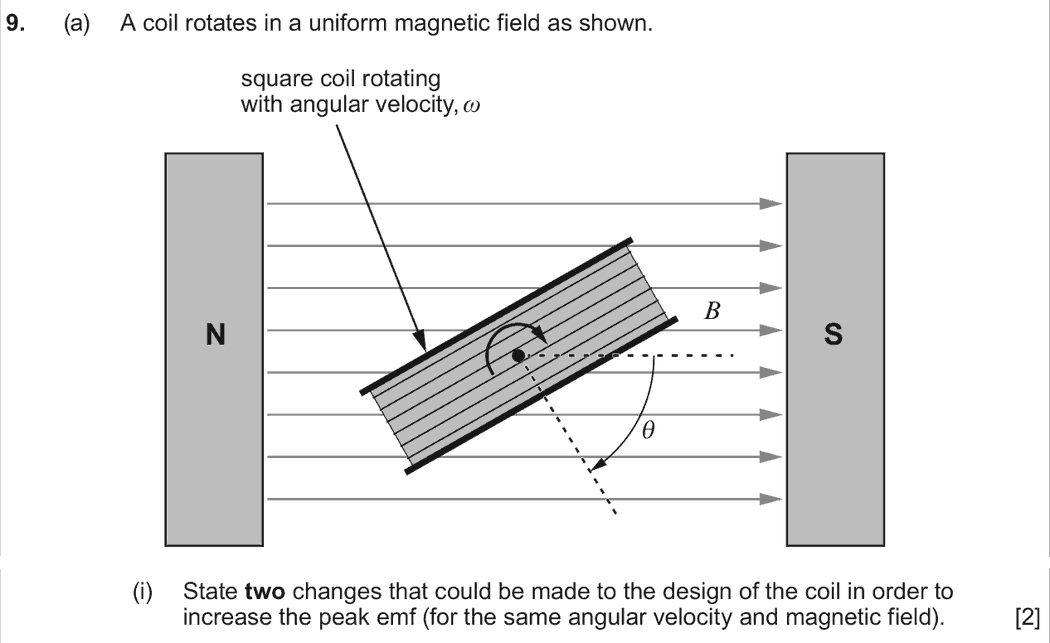
June 2025 · Component 3 · Q9(a)(i) 2 marks AO2=2 Short answer alternating currents
9. (a) A coil rotates in a uniform magnetic field as shown. square coil rotating with angular velocity, ω B N S θ (i) State two changes that could be made to the design of the coil in order to increase the peak emf (for the same angular velocity and magnetic field). [2]
June 2025 · Component 3 · Q9(a)(ii) 1 mark AO1=1 Short answer alternating currents
Earlier part of question 9 that this part usesEarlier part of June 2025 Component 3 question 9
(ii) Write an equation for the peak emf induced in a rotating coil. [1]
June 2025 · Component 3 · Q9(c)(i) 1 mark AO1=1 Short answer alternating currents
Earlier parts of question 9 that this part usesEarlier part of June 2025 Component 3 question 9Earlier part of June 2025 Component 3 question 9Earlier part of June 2025 Component 3 question 9
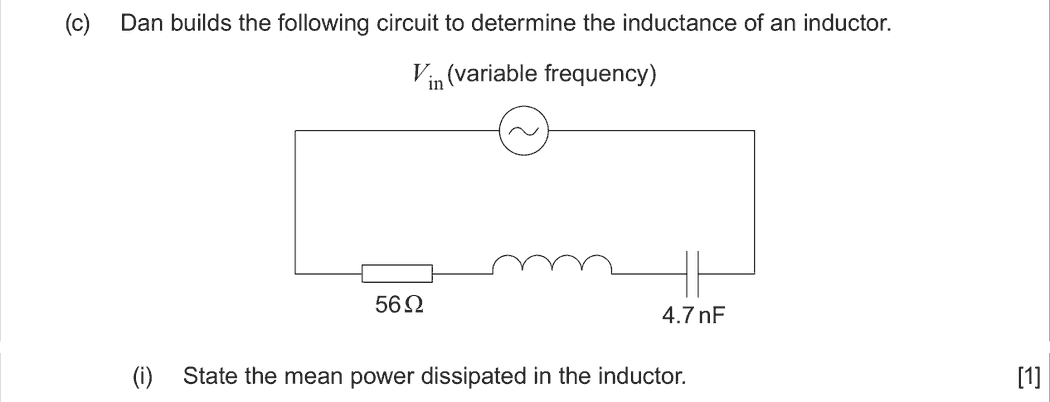
(c) Dan builds the following circuit to determine the inductance of an inductor. Vin (variable frequency) 56 Ω 4.7 nF (i) State the mean power dissipated in the inductor. [1]
June 2025 · Component 3 · Q9(c)(iv) 1 mark AO1=1 Short answer alternating currents
Earlier parts of question 9 that this part usesEarlier part of June 2025 Component 3 question 9Earlier part of June 2025 Component 3 question 9Earlier part of June 2025 Component 3 question 9Earlier part of June 2025 Component 3 question 9
(iv) State the effect of increasing the Q factor on the resonance curve. [1]
June 2025 · Component 3 · Q12(d)(i) 1 mark AO1=1 Short answer energy and the environment
Earlier parts of question 12 that this part usesEarlier part of June 2025 Component 3 question 12Earlier part of June 2025 Component 3 question 12
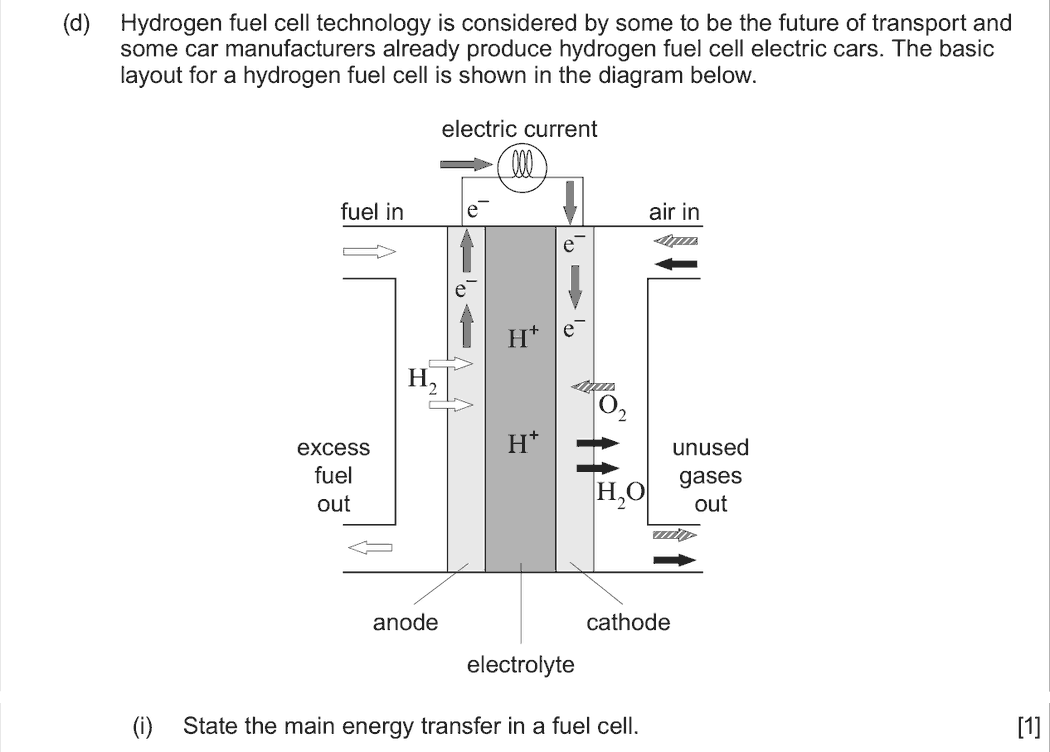
(d) Hydrogen fuel cell technology is considered by some to be the future of transport and some car manufacturers already produce hydrogen fuel cell electric cars. The basic layout for a hydrogen fuel cell is shown in the diagram below. electric current e– fuel in air in e– e– e– H+ H2 O2 H+ excess unused fuel gases H2O out out anode cathode electrolyte (i) State the main energy transfer in a fuel cell. [1]
June 2025 · Component 3 · Q12(d)(ii) 1 mark AO1=1 Short answer energy and the environment
Earlier parts of question 12 that this part usesEarlier part of June 2025 Component 3 question 12Earlier part of June 2025 Component 3 question 12Earlier part of June 2025 Component 3 question 12
(ii) Explain the purpose of the electrolyte. [1]
June 2025 · Component 3 · Q12(d)(iii) 1 mark AO1=1 Short answer energy and the environment
Earlier parts of question 12 that this part usesEarlier part of June 2025 Component 3 question 12Earlier part of June 2025 Component 3 question 12Earlier part of June 2025 Component 3 question 12
(iii) State the waste product. [1]
June 2025 · AS Component 1 · Q1(a) 1 mark AO1=1 Short answer basic physics
1. (a) State the difference between a vector and a scalar quantity. [1]
June 2025 · AS Component 1 · Q3(c)(iii) 2 marks AO1=1, AO2=1 Short answer energy concepts
Earlier parts of question 3 that this part usesEarlier part of June 2025 Component 1 question 3Earlier part of June 2025 Component 1 question 3
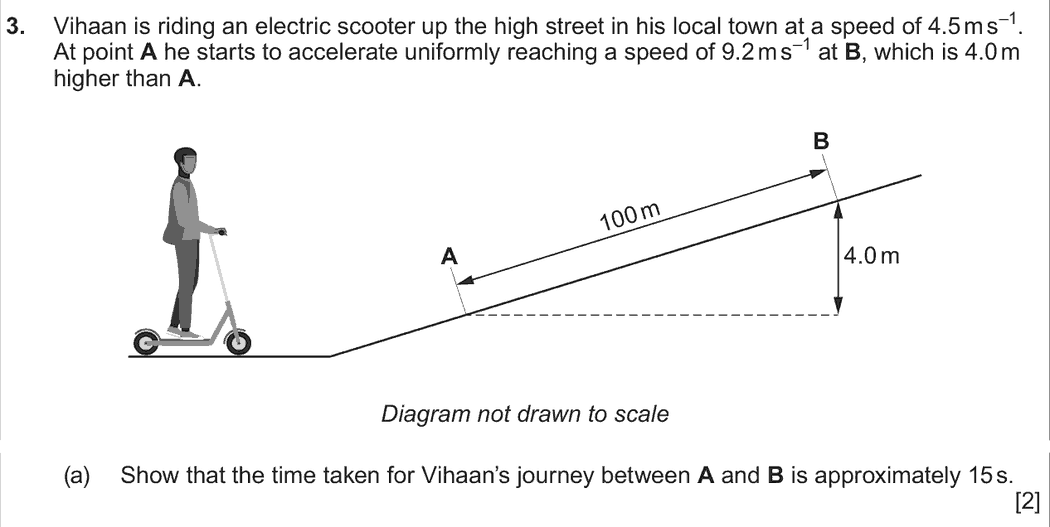
(iii) Resistive forces will affect the motion of the scooter. Identify these forces and where they act. [2]
June 2025 · AS Component 1 · Q5(c)(i) 1 mark AO2=1 Short answer kinematics
Earlier part of question 5 that this part usesEarlier part of June 2025 Component 1 question 5
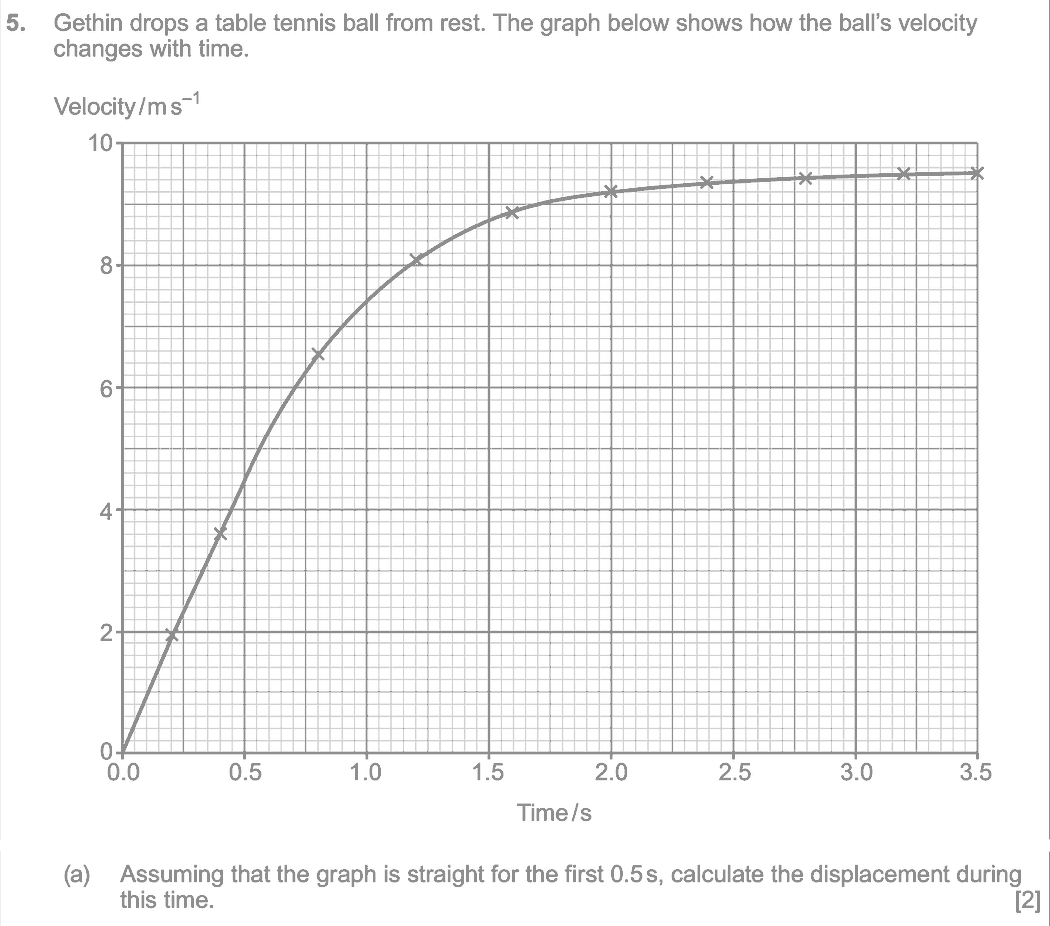
(c) The ball eventually reaches terminal velocity. (i) State the terminal velocity of the ball. [1]
June 2025 · AS Component 1 · Q6(a) 6 marks AO1=2, AO2=4 Short answer particles and nuclear structure
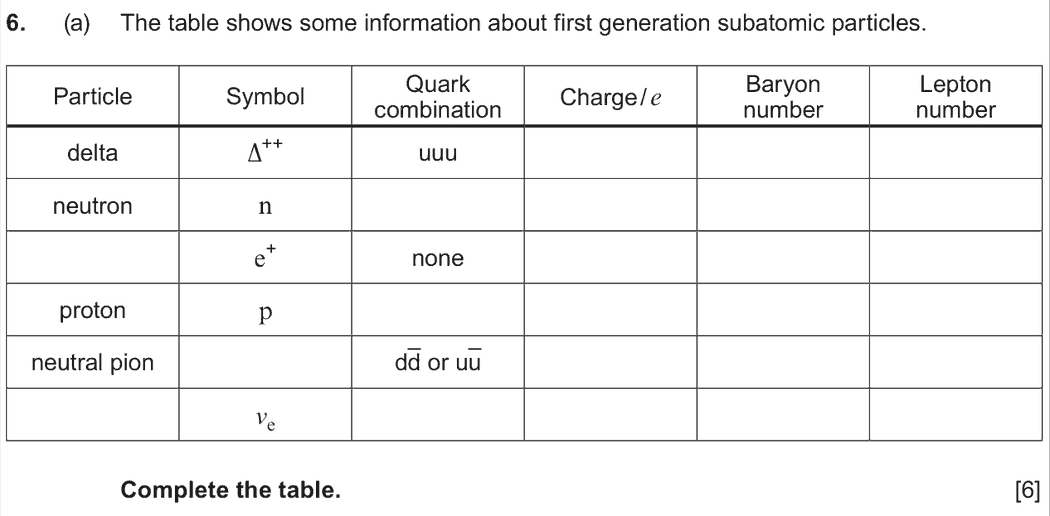
6. (a) The table shows some information about first generation subatomic particles. Quark Baryon Lepton Particle Symbol Charge / e combination number number delta Δ++ uuu neutron n e+ none proton p neutral pion dd or uu ve Complete the table. [6]
June 2025 · AS Component 1 · Q6(b)(ii) 2 marks AO3=2 Short answer particles and nuclear structure
Earlier parts of question 6 that this part usesEarlier part of June 2025 Component 1 question 6Earlier part of June 2025 Component 1 question 6
(ii) Determine which force is responsible for this decay. Explain your answer. [2]
June 2025 · AS Component 1 · Q7(b)(i) 1 mark AO3=1 Short answer radiation and stars
Earlier part of question 7 that this part usesEarlier part of June 2025 Component 1 question 7
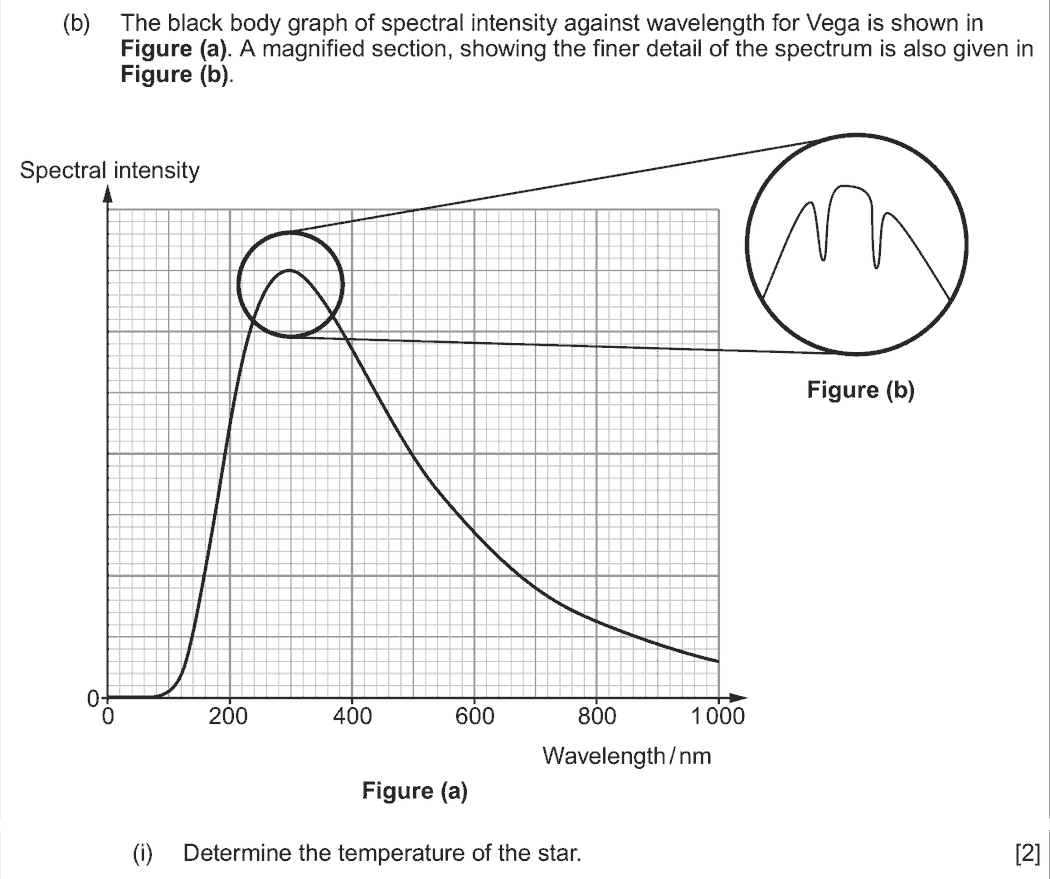
(b) (i) The maximum intensity of Betelgeuse occurs at a wavelength of 700 nm. Justify whether this is consistent with Betelgeuse being described as a red star. [1]
June 2025 · AS Component 2 · Q2(c)(ii) 1 mark AO1=1 Short answer radiation and stars
Earlier parts of question 2 that this part usesEarlier part of June 2025 Component 2 question 2Earlier part of June 2025 Component 2 question 2
(ii) Explain why multiwavelength observations are useful in modern astronomy. [1]
June 2025 · AS Component 2 · Q3(c)(ii) 3 marks AO1=1, AO2=2 Short answer resistance
Earlier parts of question 3 that this part usesEarlier part of June 2025 Component 2 question 3Earlier part of June 2025 Component 2 question 3
(ii) State one example of an application of a superconductor. Give an advantage and a disadvantage of using a superconductor instead of a conventional conductor, such as aluminium. [3]
June 2025 · AS Component 2 · Q6(b) 2 marks AO3=2 Short answer resistance
Earlier part of question 6 that this part usesEarlier part of June 2025 Component 2 question 6
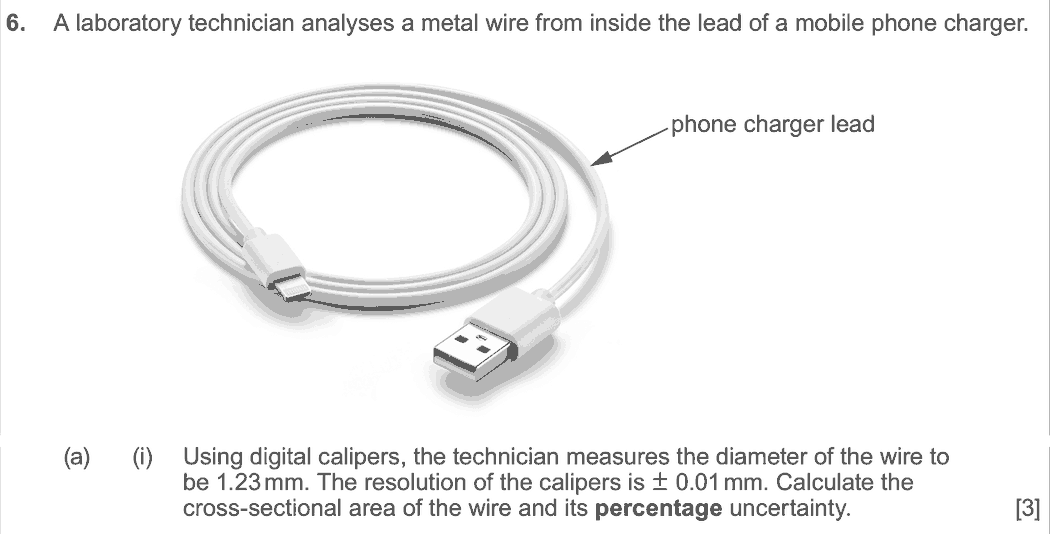
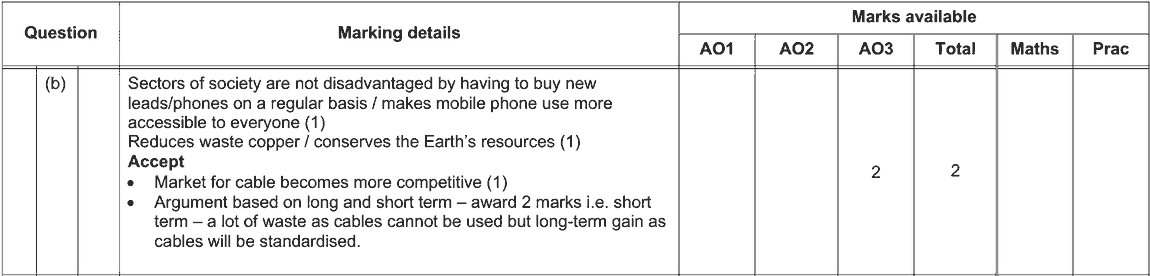
(b) A mobile phone company used to change the type of connector for use on its charging cables every five years. Following new regulations, all mobile phone companies must now use the same connector type. Discuss the implications of the new regulations. [2]
June 2024 · Component 1 · Q2(c) 2 marks AO3=2 Short answer Easy kinematics
Earlier part of question 2 that this part usesEarlier part of June 2024 Component 1 question 2
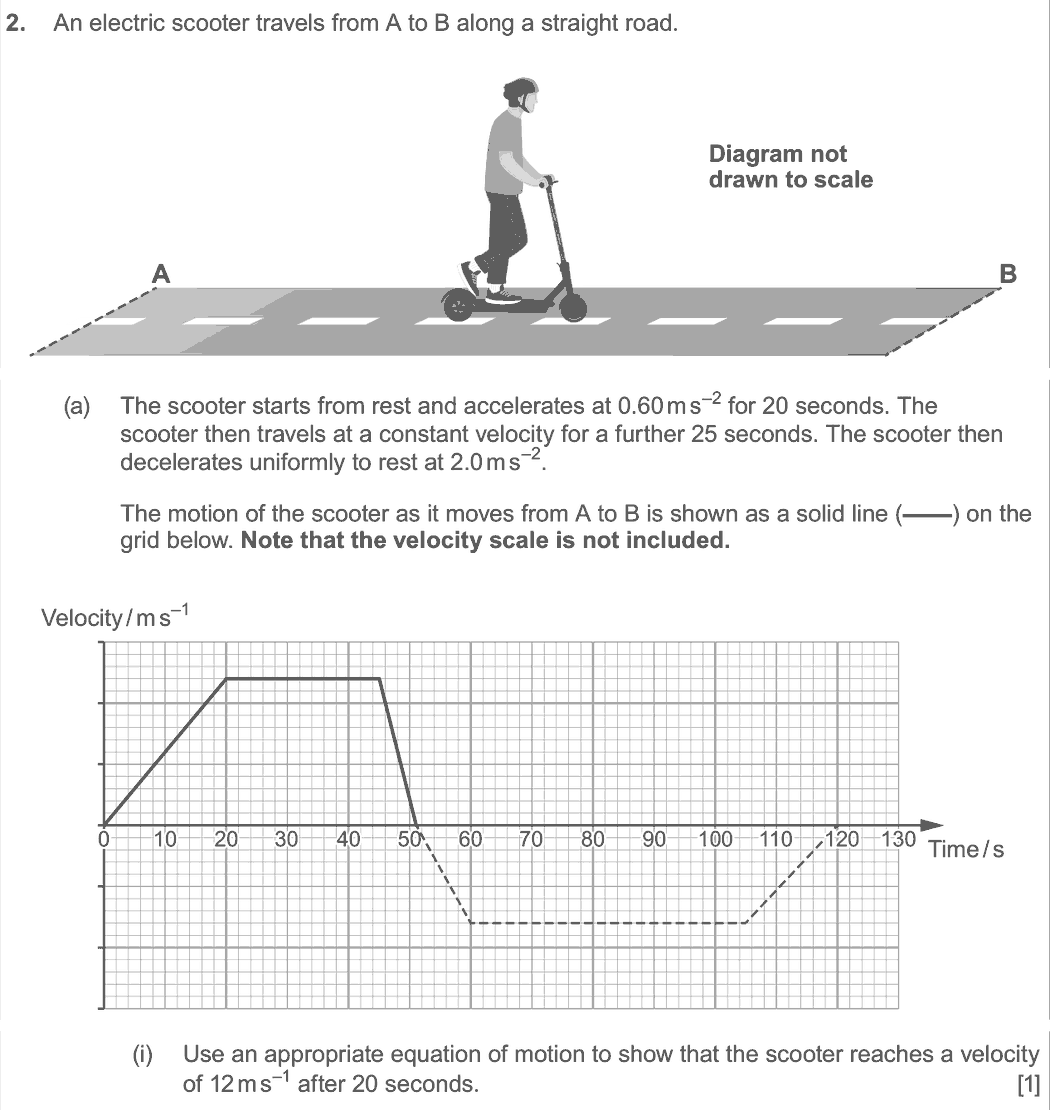
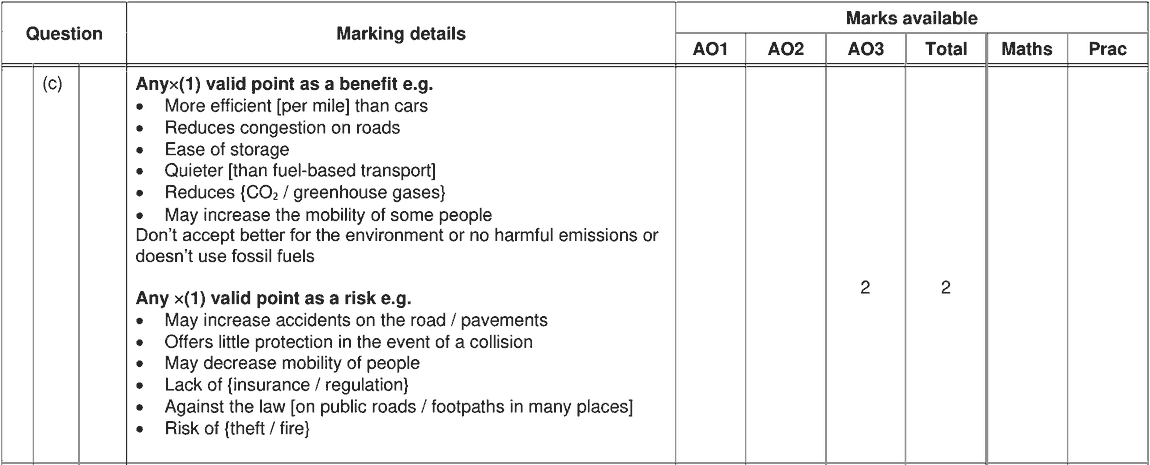
(c) The development of the technology of electric scooters has seen them becoming more common on some city roads in the UK. State one benefit and one risk of using this form of transport. [2]
June 2024 · Component 1 · Q4(b)(iii)I 1 mark AO2=1 Short answer Easy circular motion
Earlier parts of question 4 that this part usesEarlier part of June 2024 Component 1 question 4Earlier part of June 2024 Component 1 question 4Earlier part of June 2024 Component 1 question 4
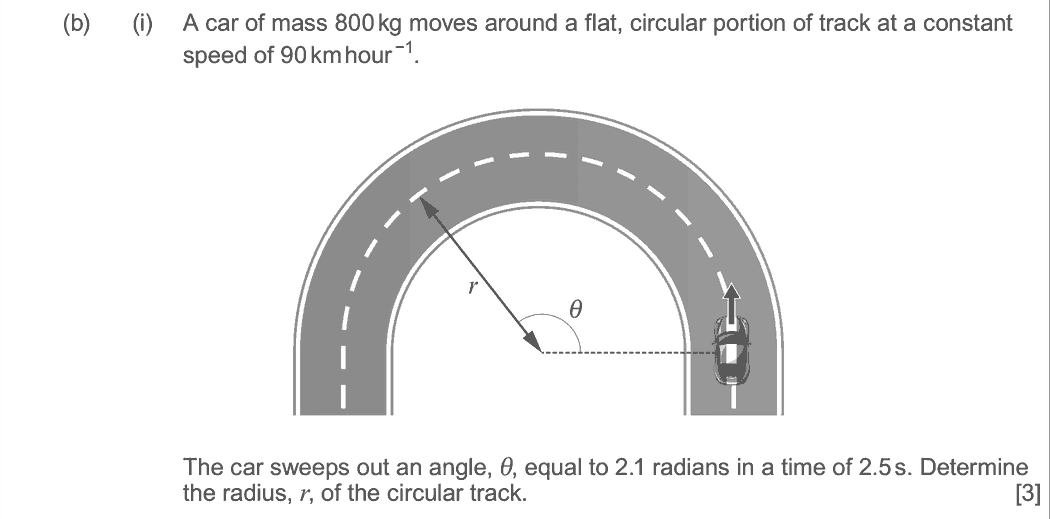
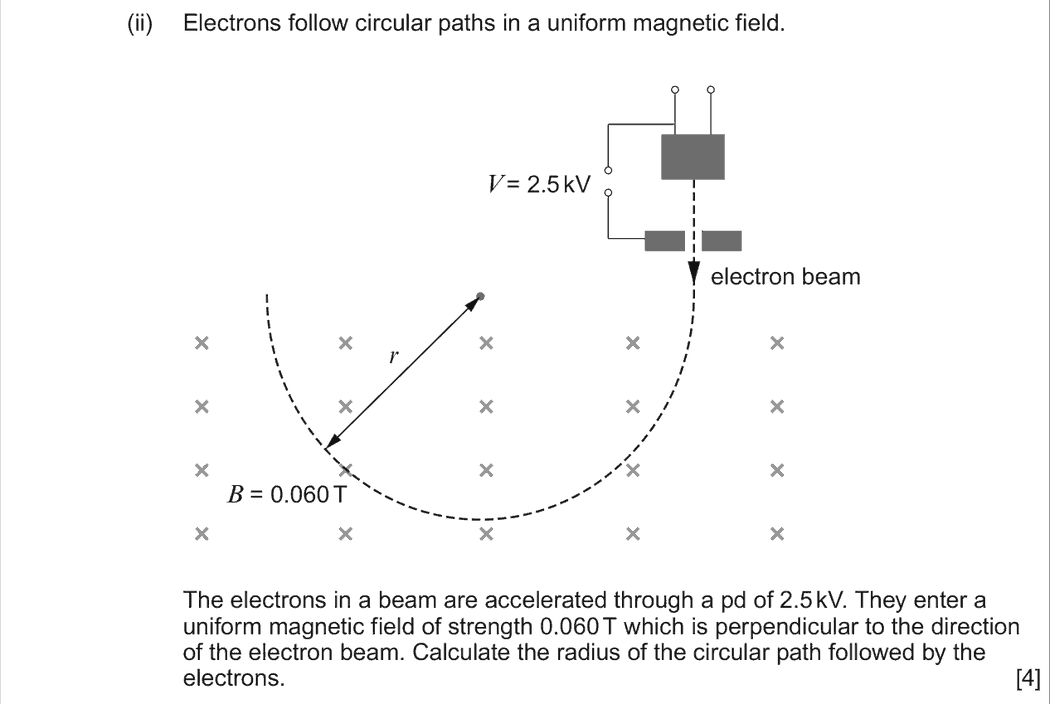
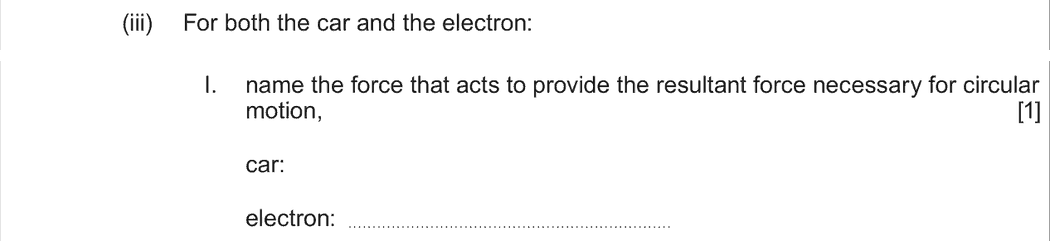
(iii) For both the car and the electron: I. name the force that acts to provide the resultant force necessary for circular motion, [1] car: electron:
June 2024 · Component 1 · Q8(a)(ii) 1 mark AO2=1 Short answer wave propertiescomprehension
Earlier part of question 8 that this part usesEarlier part of June 2024 Component 1 question 8
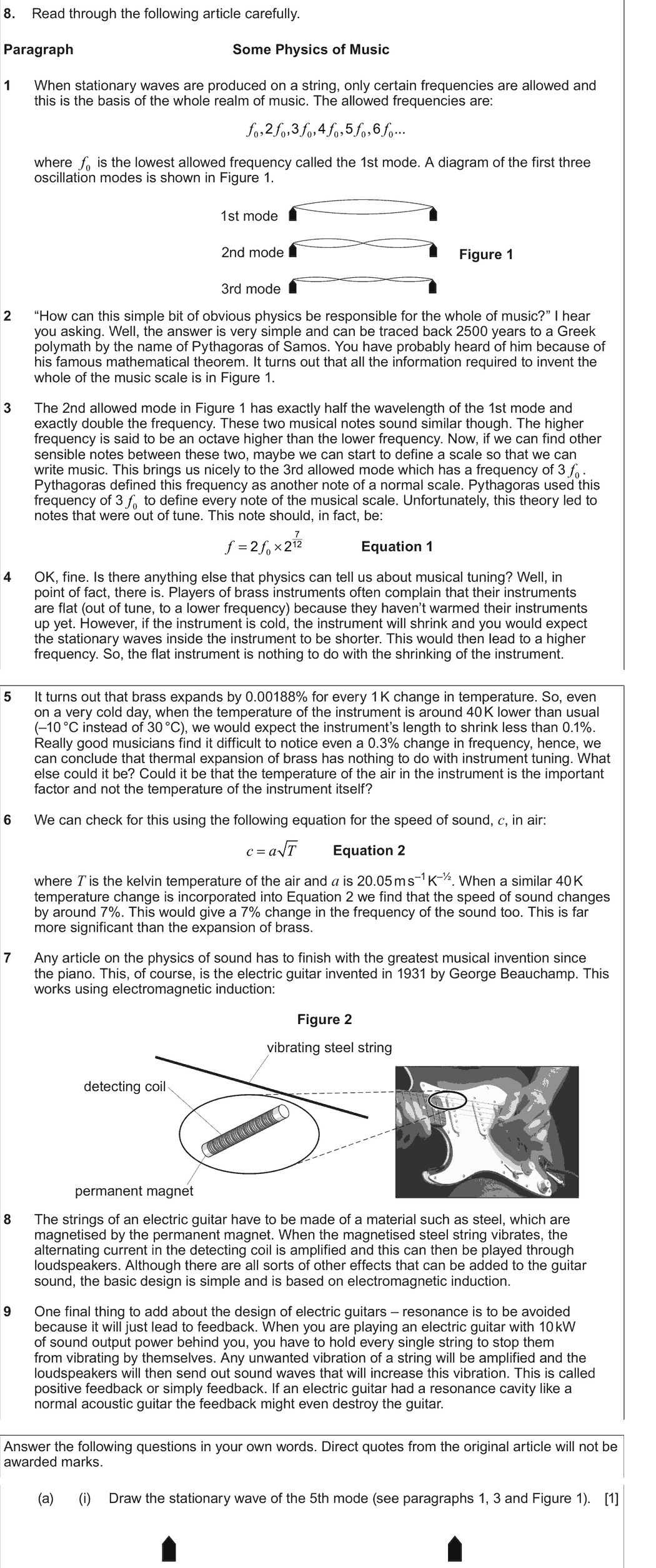
(ii) If the wavelength of the first mode is λ0, state the wavelength of the 5th mode (see paragraph 1 and Figure 1). [1]
June 2024 · Component 2 · Q7(d) 2 marks AO3=2 Short answer orbits and the wider universe
Earlier parts of question 7 that this part usesEarlier part of June 2024 Component 2 question 7Earlier part of June 2024 Component 2 question 7Earlier part of June 2024 Component 2 question 7
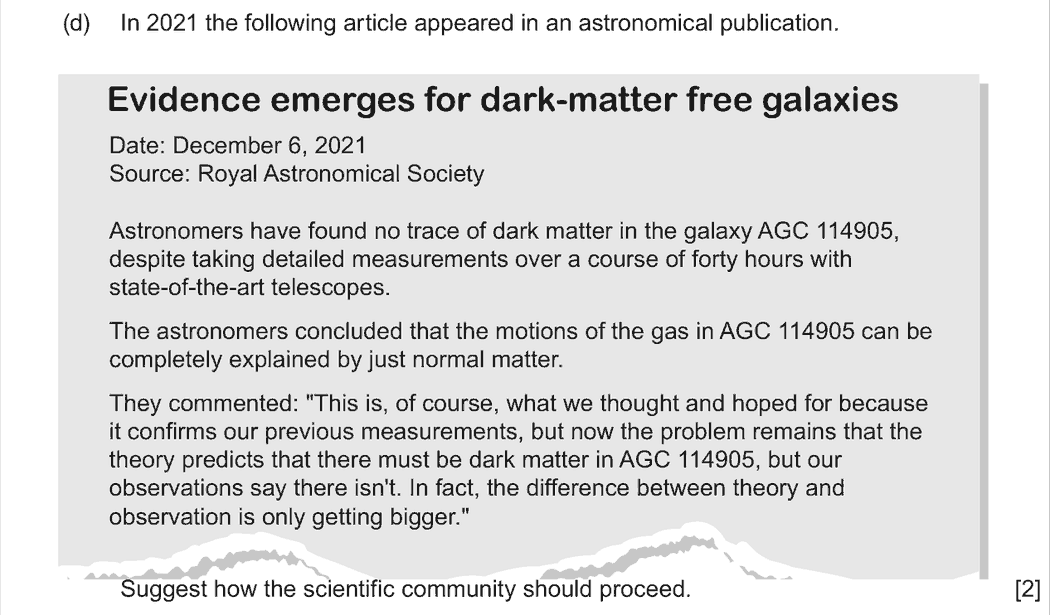
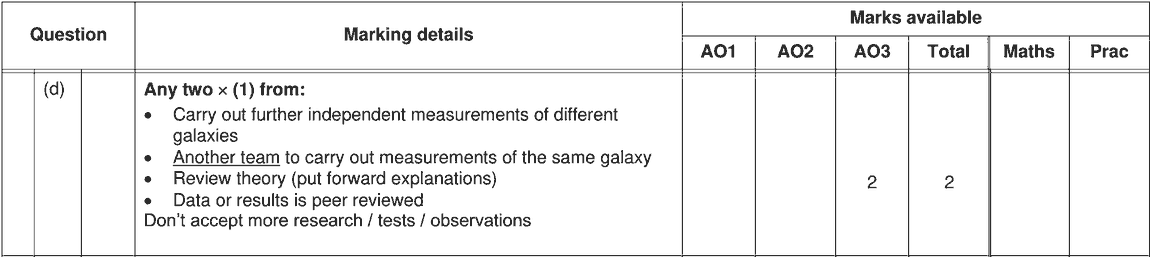
(d) In 2021 the following article appeared in an astronomical publication. Date: December 6, 2021 Source: Royal Astronomical Society Astronomers have found no trace of dark matter in the galaxy AGC 114905, despite taking detailed measurements over a course of forty hours with state-of-the-art telescopes. The astronomers concluded that the motions of the gas in AGC 114905 can be completely explained by just normal matter. They commented: "This is, of course, what we thought and hoped for because it confirms our previous measurements, but now the problem remains that the theory predicts that there must be dark matter in AGC 114905, but our observations say there isn't. In fact, the difference between theory and observation is only getting bigger." Suggest how the scientific community should proceed. [2]
June 2024 · Component 3 · Q4(b) 2 marks AO3=2 Short answer photons
Earlier part of question 4 that this part usesEarlier part of June 2024 Component 3 question 4
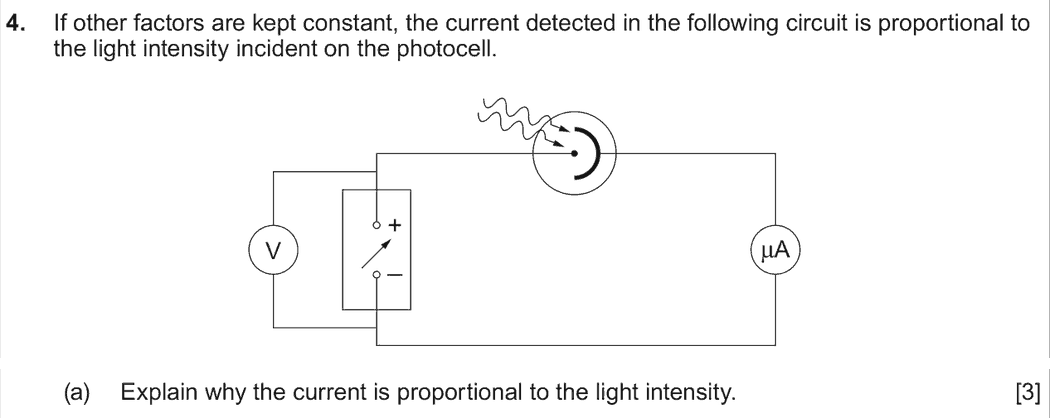
(b) State the two factors that should be kept constant for the current to be proportional to the light intensity for this photocell. [2]
June 2024 · Component 3 · Q9(b) 1 mark AO3=1 Short answer alternating currents
Earlier part of question 9 that this part usesEarlier part of June 2024 Component 3 question 9
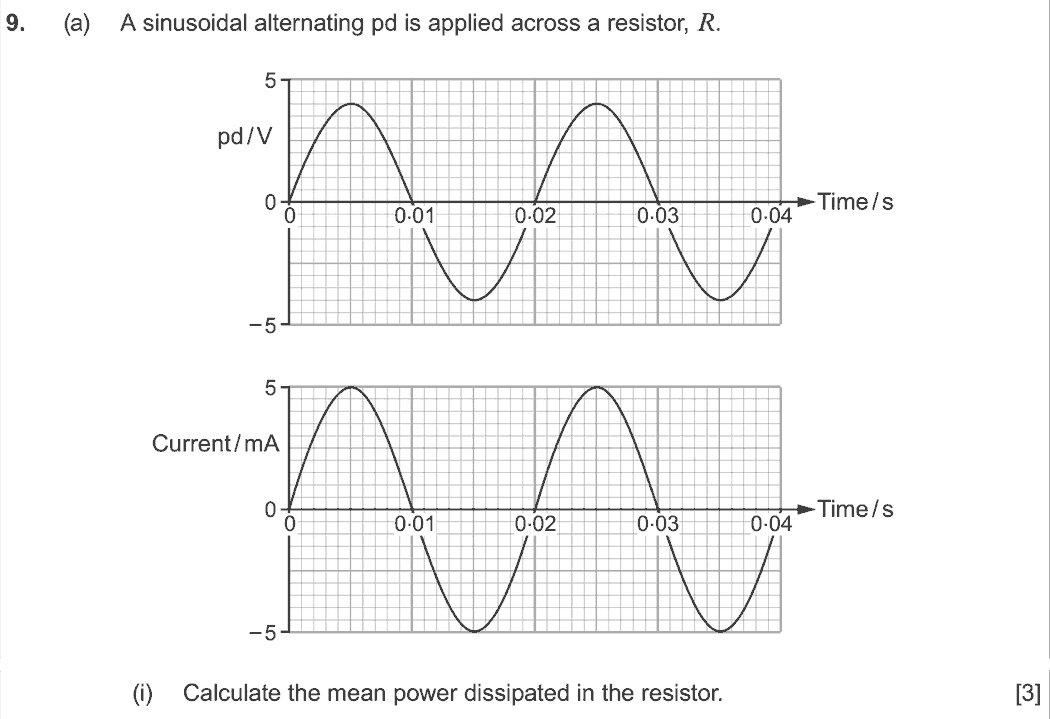
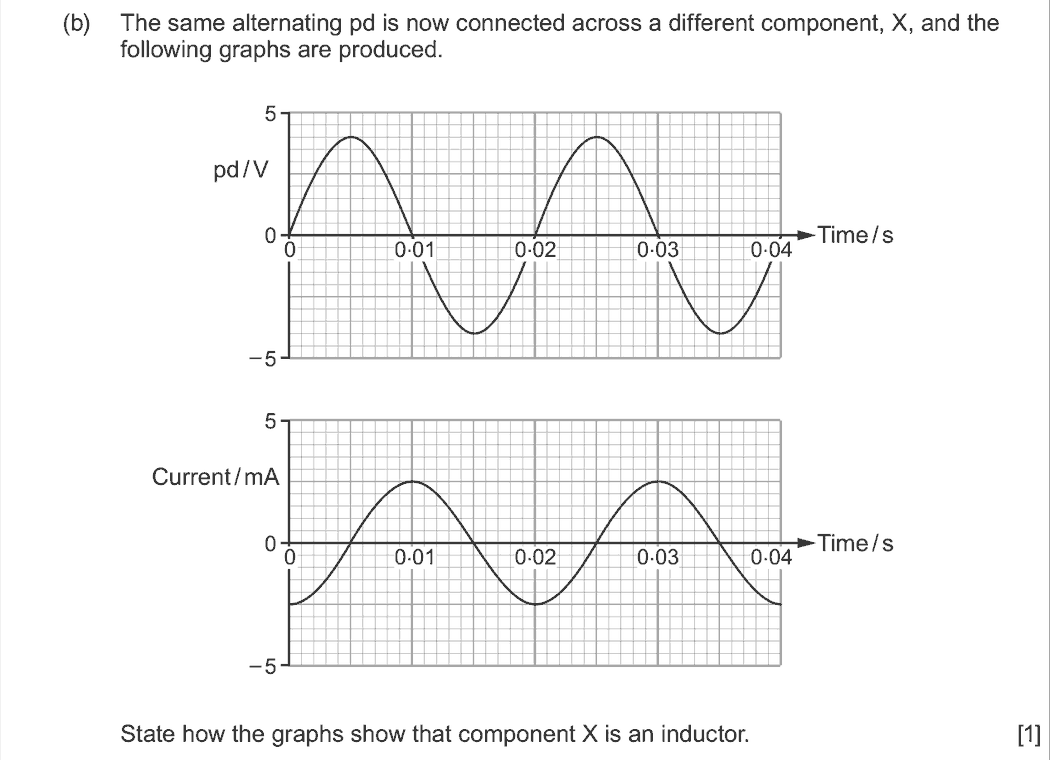
(b) The same alternating pd is now connected across a different component, X, and the following graphs are produced. 5 pd / V 0 Time / s 0 0.01 0.02 0.03 0.04 – 5 5 Current / mA 0 Time / s 0 0.01 0.02 0.03 0.04 – 5 State how the graphs show that component X is an inductor. [1]
June 2024 · Component 3 · Q11(a)(i) 2 marks AO1=2 Short answer physics of sports
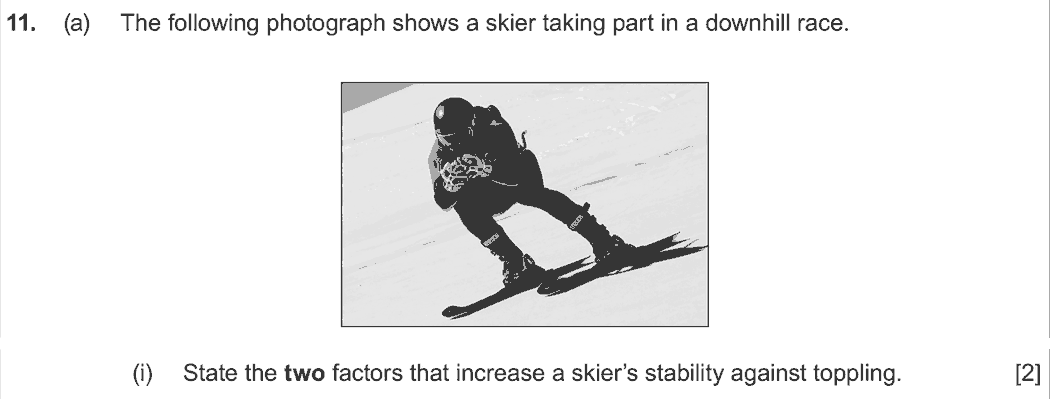
11. (a) The following photograph shows a skier taking part in a downhill race. (i) State the two factors that increase a skier’s stability against toppling. [2]
June 2024 · AS Component 1 · Q1(a)(i) 2 marks AO1=2 Short answer basic physics
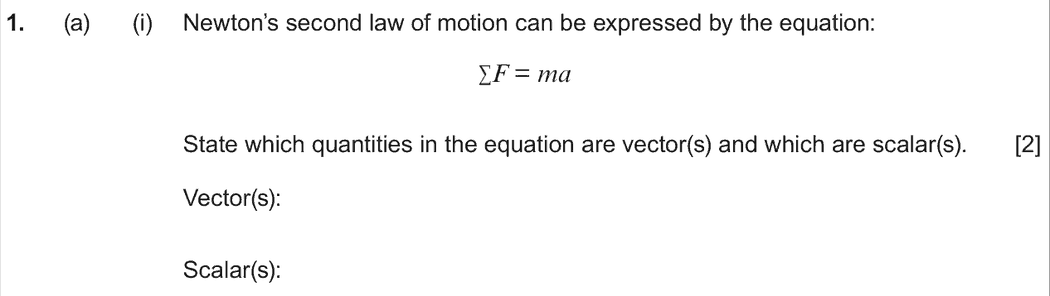
1. (a) (i) Newton’s second law of motion can be expressed by the equation: ∑F = ma State which quantities in the equation are vector(s) and which are scalar(s). [2] Vector(s): Scalar(s):
June 2024 · AS Component 1 · Q1(a)(ii) 2 marks AO1=2 Short answer basic physics
Earlier part of question 1 that this part usesEarlier part of June 2024 Component 1 question 1
(ii) State the difference between vectors and scalars. Give one further example of each. [2]
June 2024 · AS Component 1 · Q1(b)(ii) 2 marks AO2=2 Short answer basic physicsdynamics
Earlier parts of question 1 that this part usesEarlier part of June 2024 Component 1 question 1Earlier part of June 2024 Component 1 question 1
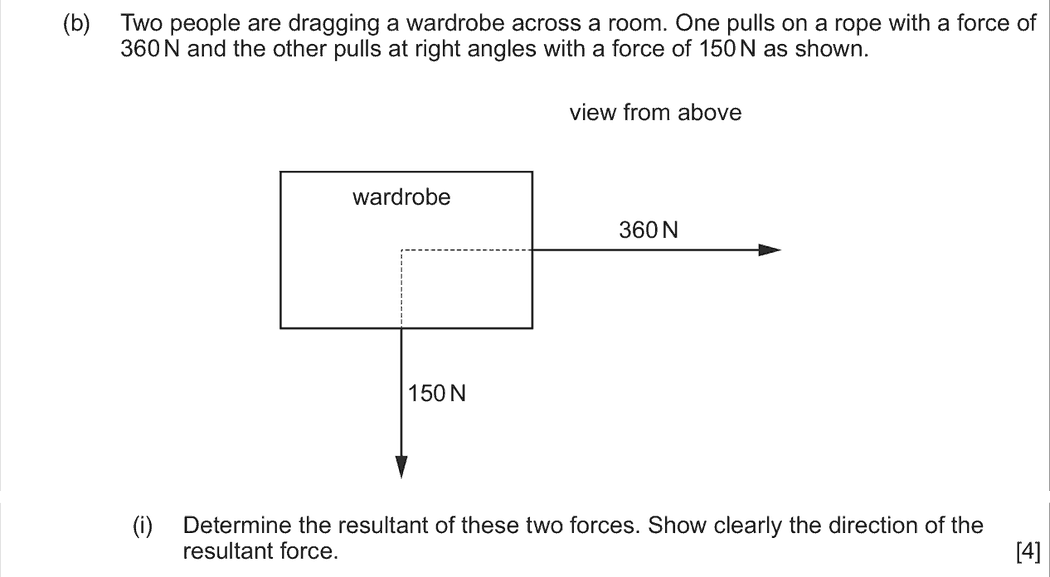
(ii) Determine the force of friction acting on the wardrobe when it is moving at a constant velocity. [2]
June 2024 · AS Component 1 · Q3(c) 2 marks AO3=2 Short answer energy concepts
Earlier part of question 3 that this part usesEarlier part of June 2024 Component 1 question 3
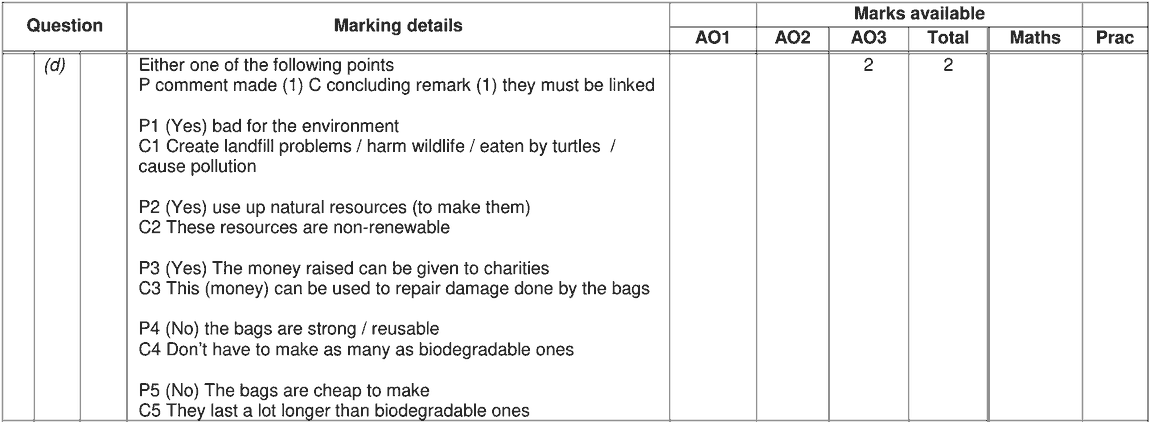
(c) Some people think electric scooters should be banned from using pavements and pedestrian areas. Explain, giving your reasons, whether you agree or disagree. [2]
June 2024 · AS Component 1 · Q4(a)(ii) 2 marks AO1=2 Short answer solids under stress
Earlier part of question 4 that this part usesEarlier part of June 2024 Component 1 question 4
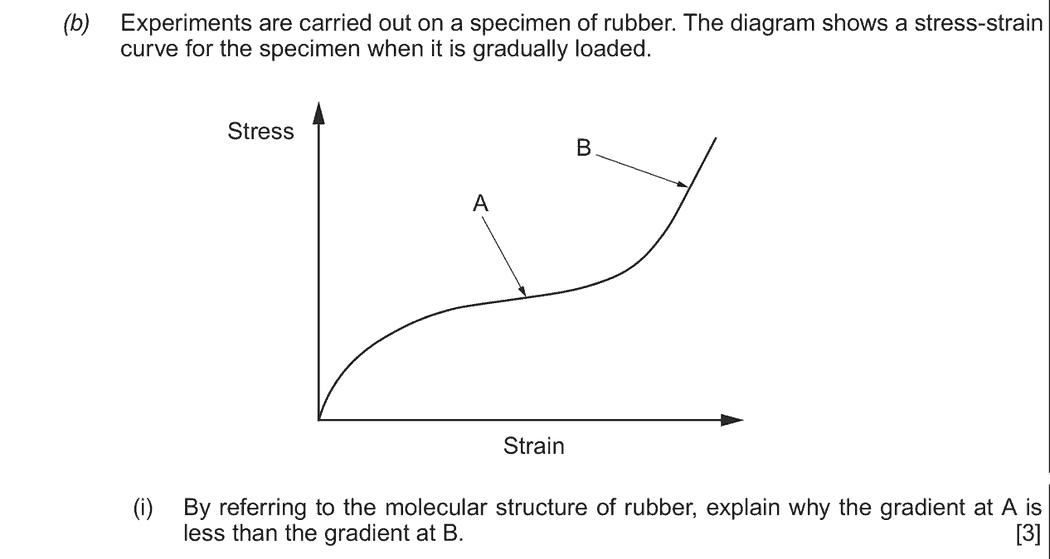
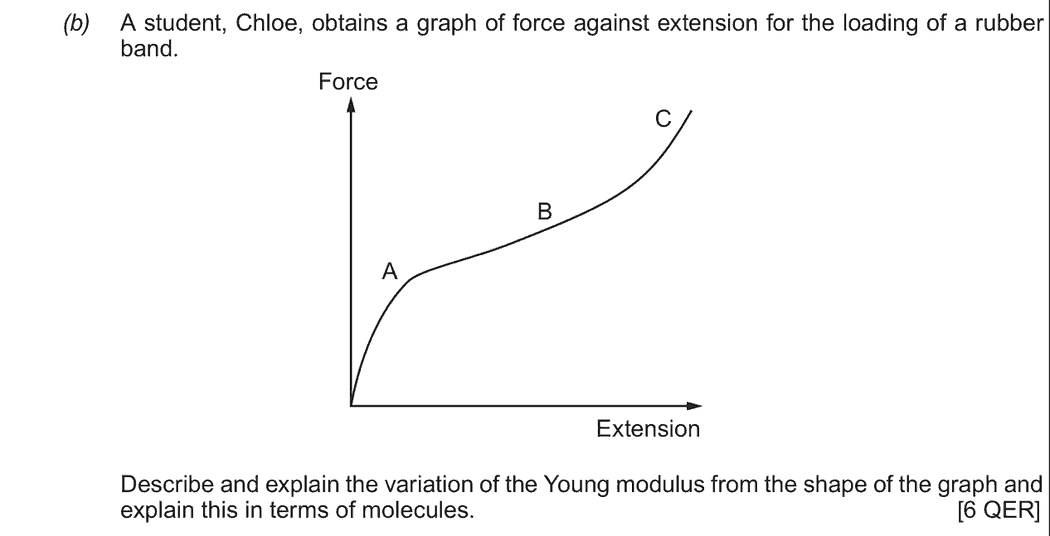
(ii) Rubber is a polymer. Describe its structure on a molecular scale. [2]
June 2024 · AS Component 1 · Q7(b)(ii) 1 mark AO1=1 Short answer radiation and stars
Earlier parts of question 7 that this part usesEarlier part of June 2024 Component 1 question 7Earlier part of June 2024 Component 1 question 7
(ii) State which part of the electromagnetic spectrum this radiation belongs to. [1]
June 2024 · AS Component 2 · Q1(c) 2 marks AO2=2 Short answer nature of waves
Earlier parts of question 1 that this part usesEarlier part of June 2024 Component 2 question 1Earlier part of June 2024 Component 2 question 1
(c) Determine the phase difference between points labelled P and Q and state which point is leading. [2]
June 2024 · AS Component 2 · Q3(c)(i) 1 mark AO1=1 Short answer photons
Earlier part of question 3 that this part usesEarlier part of June 2024 Component 2 question 3
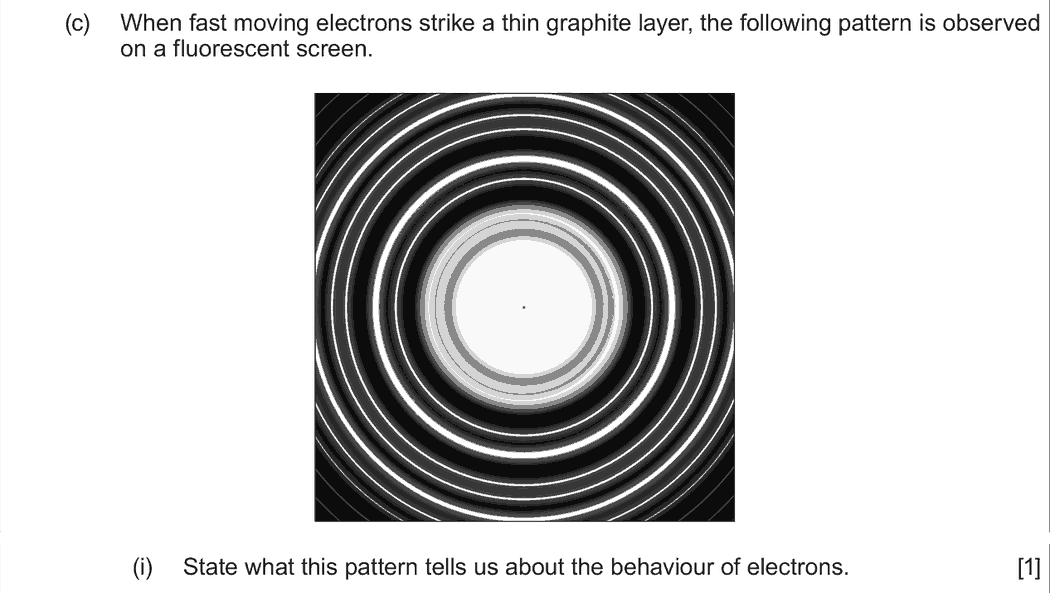
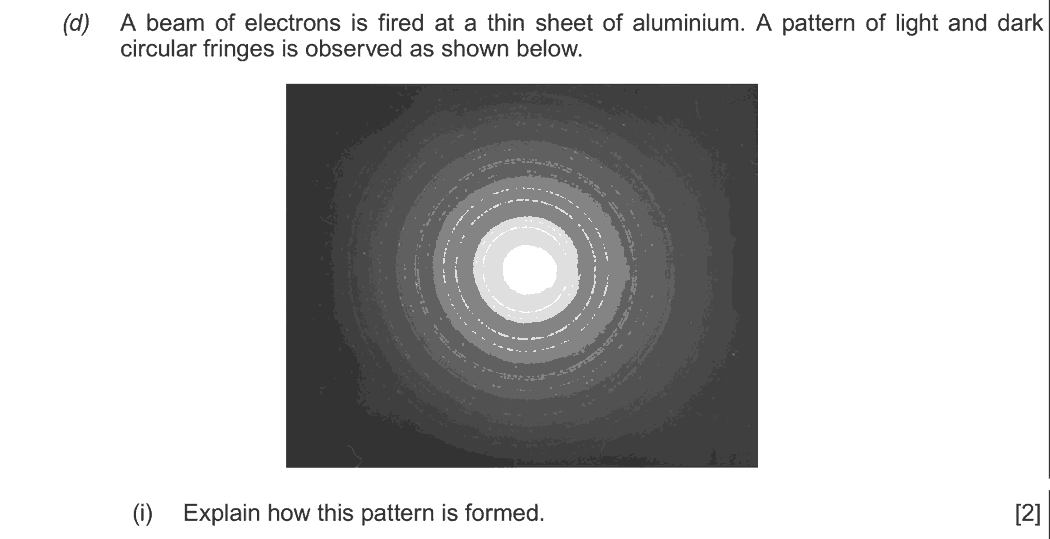
(c) When fast moving electrons strike a thin graphite layer, the following pattern is observed on a fluorescent screen. (i) State what this pattern tells us about the behaviour of electrons. [1]
June 2024 · AS Component 2 · Q4(b)(ii) 2 marks AO3=2 Short answer nature of waves
Earlier parts of question 4 that this part usesEarlier part of June 2024 Component 2 question 4Earlier part of June 2024 Component 2 question 4
(ii) Japan and Mexico have developed an earthquake early warning system costing billions of pounds. Discuss whether all countries should develop such a system. [2]
June 2024 · AS Component 2 · Q5(a)(i) 1 mark AO2=1 Short answer lasers
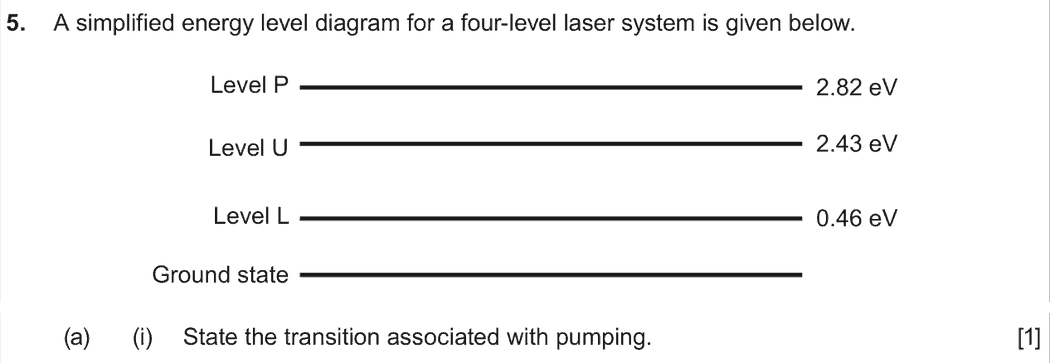
5. A simplified energy level diagram for a four-level laser system is given below. Level P 2.82 eV Level U 2.43 eV Level L 0.46 eV Ground state (a) (i) State the transition associated with pumping. [1]
June 2024 · AS Component 2 · Q7(a)(i) 1 mark AO2=1 Short answer dc circuits
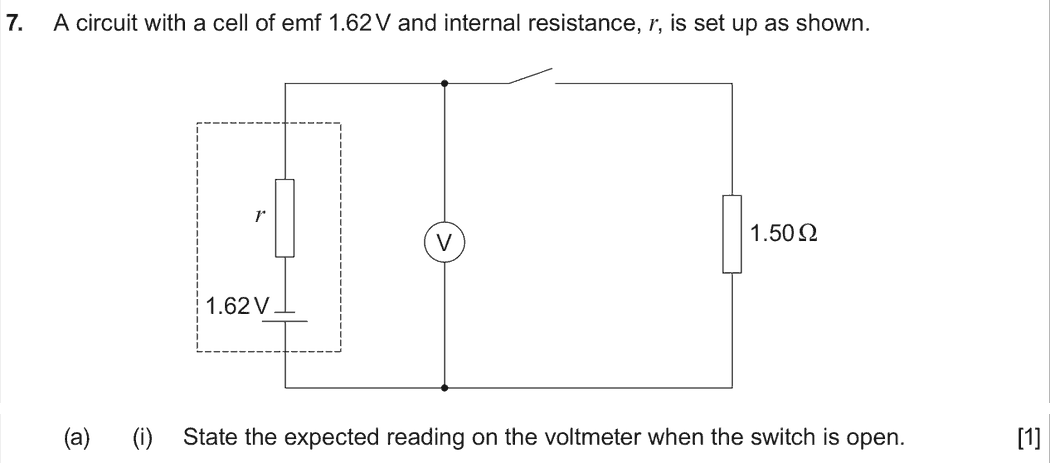
7. A circuit with a cell of emf 1.62 V and internal resistance, r, is set up as shown. r 1.50 Ω V 1.62 V (a) (i) State the expected reading on the voltmeter when the switch is open. [1]
June 2023 · Component 1 · Q8(a) 2 marks AO1=2 Short answer orbits and the wider universecomprehension
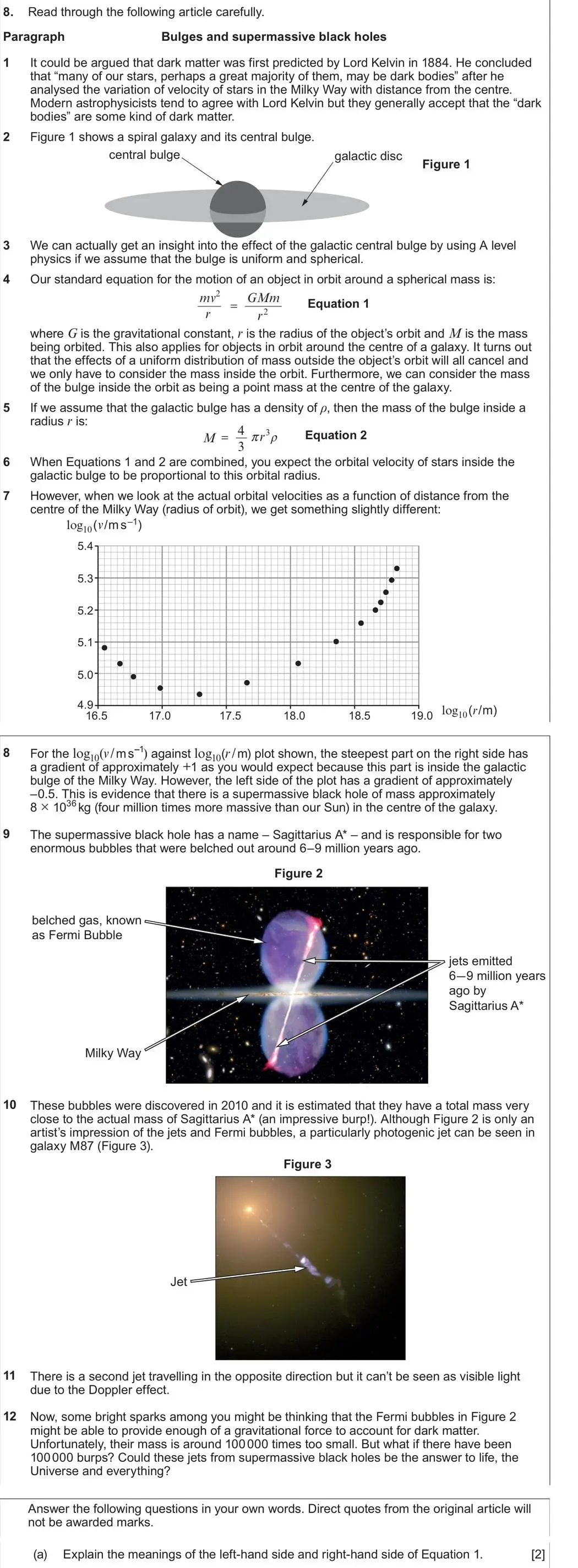
8. Read through the following article carefully. Paragraph Bulges and supermassive black holes 1 It could be argued that dark matter was first predicted by Lord Kelvin in 1884. He concluded that “many of our stars, perhaps a great majority of them, may be dark bodies” after he analysed the variation of velocity of stars in the Milky Way with distance from the centre. Modern astrophysicists tend to agree with Lord Kelvin but they generally accept that the “dark bodies” are some kind of dark matter. 2 Figure 1 shows a spiral galaxy and its central bulge. central bulge galactic disc Figure 1 3 We can actually get an insight into the effect of the galactic central bulge by using A level physics if we assume that the bulge is uniform and spherical. 4 Our standard equation for the motion of an object in orbit around a spherical mass is: mv2 GMm = Equation 1 r r 2 where G is the gravitational constant, r is the radius of the object’s orbit and M is the mass being orbited. This also applies for objects in orbit around the centre of a galaxy. It turns out that the effects of a uniform distribution of mass outside the object’s orbit will all cancel and we only have to consider the mass inside the orbit. Furthermore, we can consider the mass of the bulge inside the orbit as being a point mass at the centre of the galaxy. 5 If we assume that the galactic bulge has a density of ρ, then the mass of the bulge inside a radius r is: 4 M = π r 3 ρ Equation 2 3 6 When Equations 1 and 2 are combined, you expect the orbital velocity of stars inside the galactic bulge to be proportional to this orbital radius. 7 However, when we look at the actual orbital velocities as a function of distance from the centre of the Milky Way (radius of orbit), we get something slightly different: log10 (v / m s –1) 5.4 5.3 5.2 5.1 5.0 4.9 log10 (r / m) 16.5 17.0 17.5 18.0 18.5 19.0 8 For the log10(v / m s–1) against log10(r / m) plot shown, the steepest part on the right side has a gradient of approximately +1 as you would expect because this part is inside the galactic bulge of the Milky Way. However, the left side of the plot has a gradient of approximately –0.5. This is evidence that there is a supermassive black hole of mass approximately 8 × 1036 kg (four million times more massive than our Sun) in the centre of the galaxy. 9 The supermassive black hole has a name – Sagittarius A* – and is responsible for two enormous bubbles that were belched out around 6–9 million years ago. Figure 2 belched gas, known as Fermi Bubble jets emitted 6 – 9 million years ago by Sagittarius A* Milky Way 10 These bubbles were discovered in 2010 and it is estimated that they have a total mass very close to the actual mass of Sagittarius A* (an impressive burp!). Although Figure 2 is only an artist’s impression of the jets and Fermi bubbles, a particularly photogenic jet can be seen in galaxy M87 (Figure 3). Figure 3 Jet 11 There is a second jet travelling in the opposite direction but it can’t be seen as visible light due to the Doppler effect. 12 Now, some bright sparks among you might be thinking that the Fermi bubbles in Figure 2 might be able to provide enough of a gravitational force to account for dark matter. Unfortunately, their mass is around 100 000 times too small. But what if there have been 100 000 burps? Could these jets from supermassive black holes be the answer to life, the Universe and everything? Answer the following questions in your own words. Direct quotes from the original article will not be awarded marks. (a) Explain the meanings of the left-hand side and right-hand side of Equation 1. [2]



June 2023 · Component 2 · Q2(a) 1 mark AO1=1 Short answer resistance
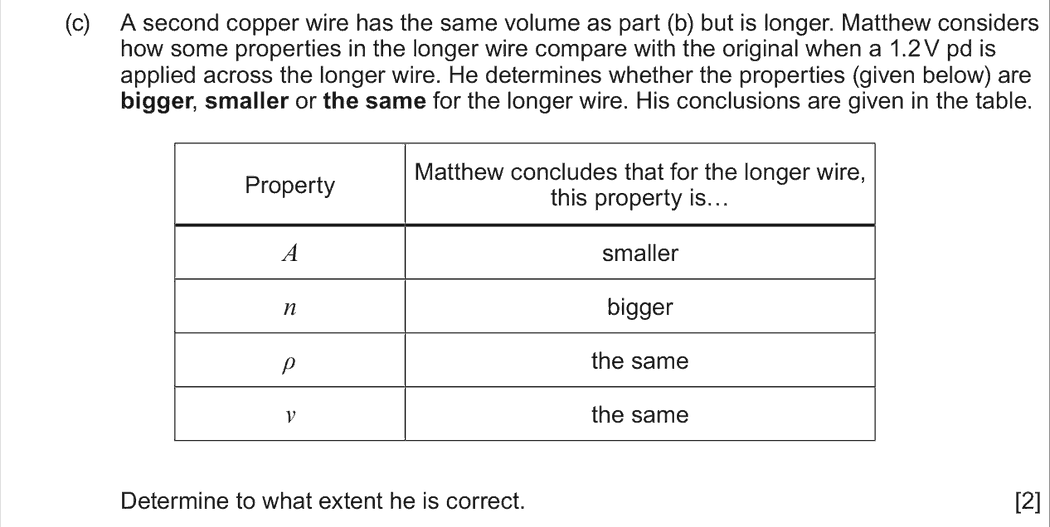
2. (a) The size of a current in a wire, for a given pd, depends on its resistance. State, in terms of free electrons, how this resistance arises. [1]
June 2023 · Component 2 · Q2(d) 2 marks AO3=2 Short answer resistance
Earlier parts of question 2 that this part usesEarlier part of June 2023 Component 2 question 2Earlier part of June 2023 Component 2 question 2
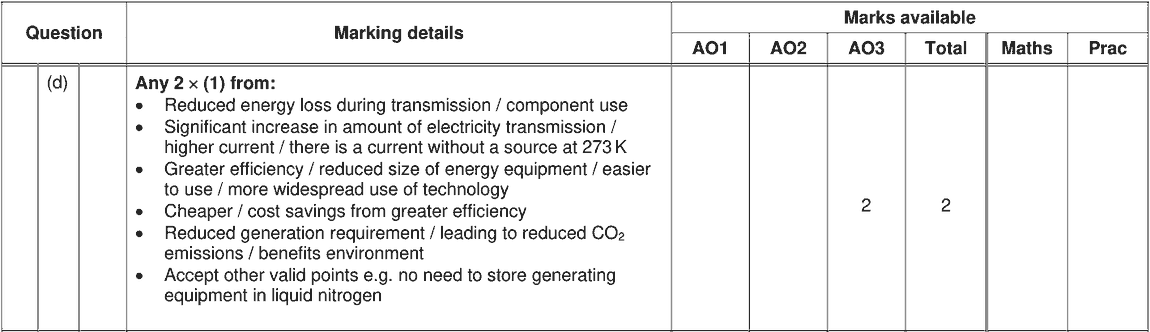
(d) Many scientists from around the world are searching for a superconducting material which has a critical temperature above 273 K. Discuss the benefits to society if this were achieved. [2]
June 2023 · Component 2 · Q4(b)(i) 1 mark AO2=1 Short answer solids under stress
Earlier part of question 4 that this part usesEarlier part of June 2023 Component 2 question 4
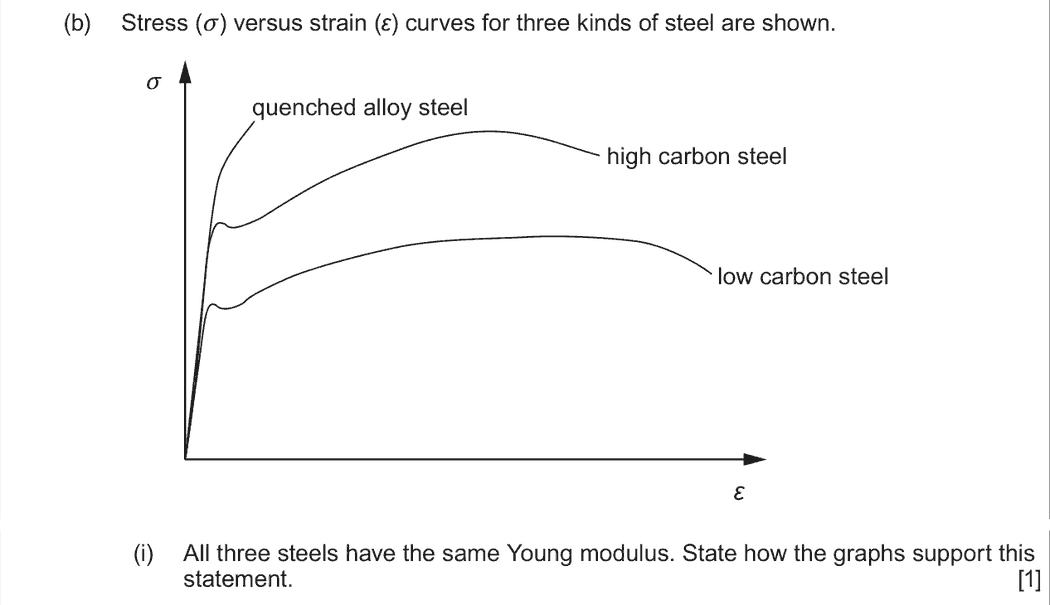
(b) Stress σ versus strain (ε) curves for three kinds of steel are shown. quenched alloy steel high carbon steel low carbon steel ε (i) All three steels have the same Young modulus. State how the graphs support this statement. [1]
June 2023 · Component 3 · Q3(a)(i) 1 mark AO2=1 Short answer refraction of light
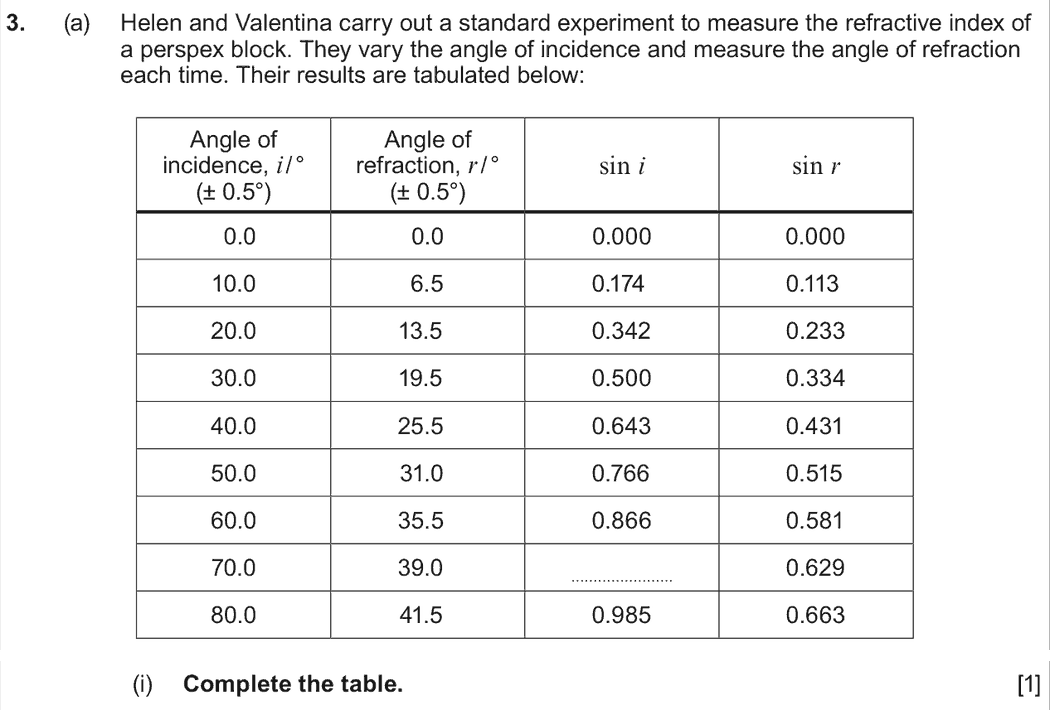
3. (a) Helen and Valentina carry out a standard experiment to measure the refractive index of a perspex block. They vary the angle of incidence and measure the angle of refraction each time. Their results are tabulated below: Angle of Angle of incidence, i / ° refraction, r / ° sin i sin r (± 0.5°) (± 0.5°) 0.0 0.0 0.000 0.000 10.0 6.5 0.174 0.113 20.0 13.5 0.342 0.233 30.0 19.5 0.500 0.334 40.0 25.5 0.643 0.431 50.0 31.0 0.766 0.515 60.0 35.5 0.866 0.581 70.0 39.0 0.629 80.0 41.5 0.985 0.663 (i) Complete the table. [1]
June 2023 · Component 3 · Q4(a)(i) 1 mark AO1=1 Short answer photons
4. (a) State a typical value for the wavelength of: (i) microwave radiation [1]
June 2023 · Component 3 · Q4(a)(ii) 1 mark AO1=1 Short answer photons
Earlier part of question 4 that this part usesEarlier part of June 2023 Component 3 question 4
(ii) ultraviolet radiation. [1]
June 2023 · Component 3 · Q7(a)(i) 2 marks AO2=2 Short answer nuclear decay
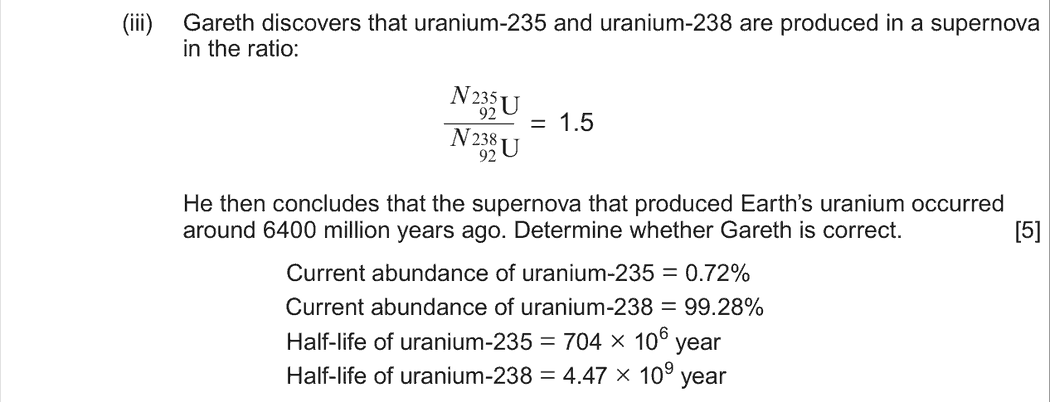
7. (a) Naturally occurring uranium is composed of 99.28% of 238 92U and 0.72% of 235 92U. The lighter of the 2 isotopes (235 92U) decays via a chain of 7 alpha decays and 4 beta decays to an isotope of lead (Pb). (i) Calculate the proton number and nucleon number of the lead (Pb) isotope into which the uranium-235 decays. [2]
June 2023 · Component 3 · Q7(b) 3 marks AO3=3 Short answer nuclear decay
Earlier parts of question 7 that this part usesEarlier part of June 2023 Component 3 question 7Earlier part of June 2023 Component 3 question 7
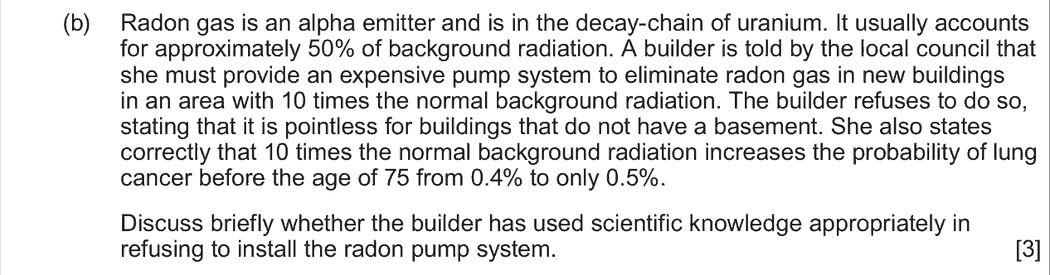
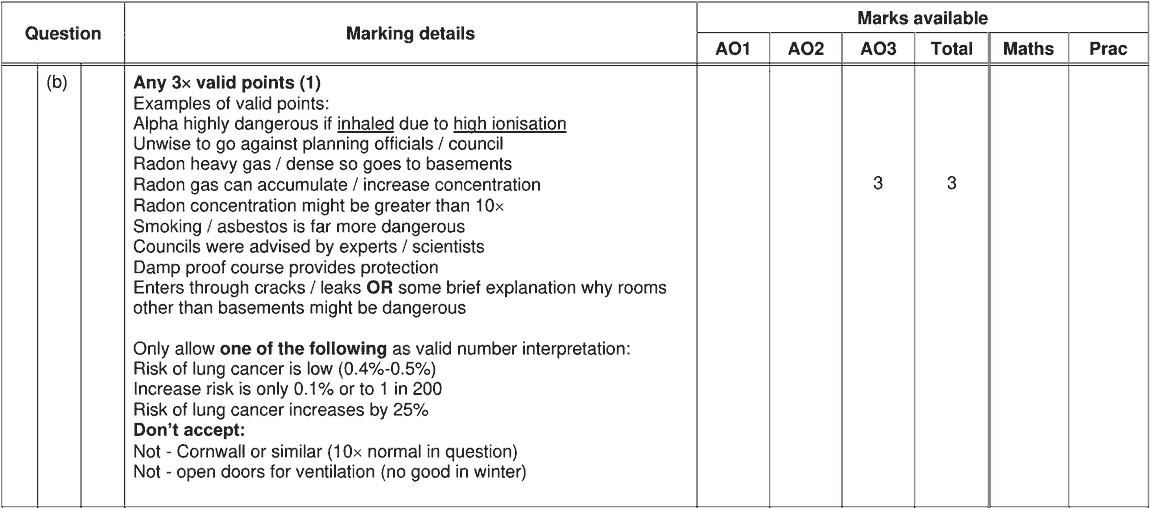
(b) Radon gas is an alpha emitter and is in the decay-chain of uranium. It usually accounts for approximately 50% of background radiation. A builder is told by the local council that she must provide an expensive pump system to eliminate radon gas in new buildings in an area with 10 times the normal background radiation. The builder refuses to do so, stating that it is pointless for buildings that do not have a basement. She also states correctly that 10 times the normal background radiation increases the probability of lung cancer before the age of 75 from 0.4% to only 0.5%. Discuss briefly whether the builder has used scientific knowledge appropriately in refusing to install the radon pump system. [3]
June 2023 · Component 3 · Q9(a) 2 marks AO1=1, AO2=1 Short answer magnetic fields
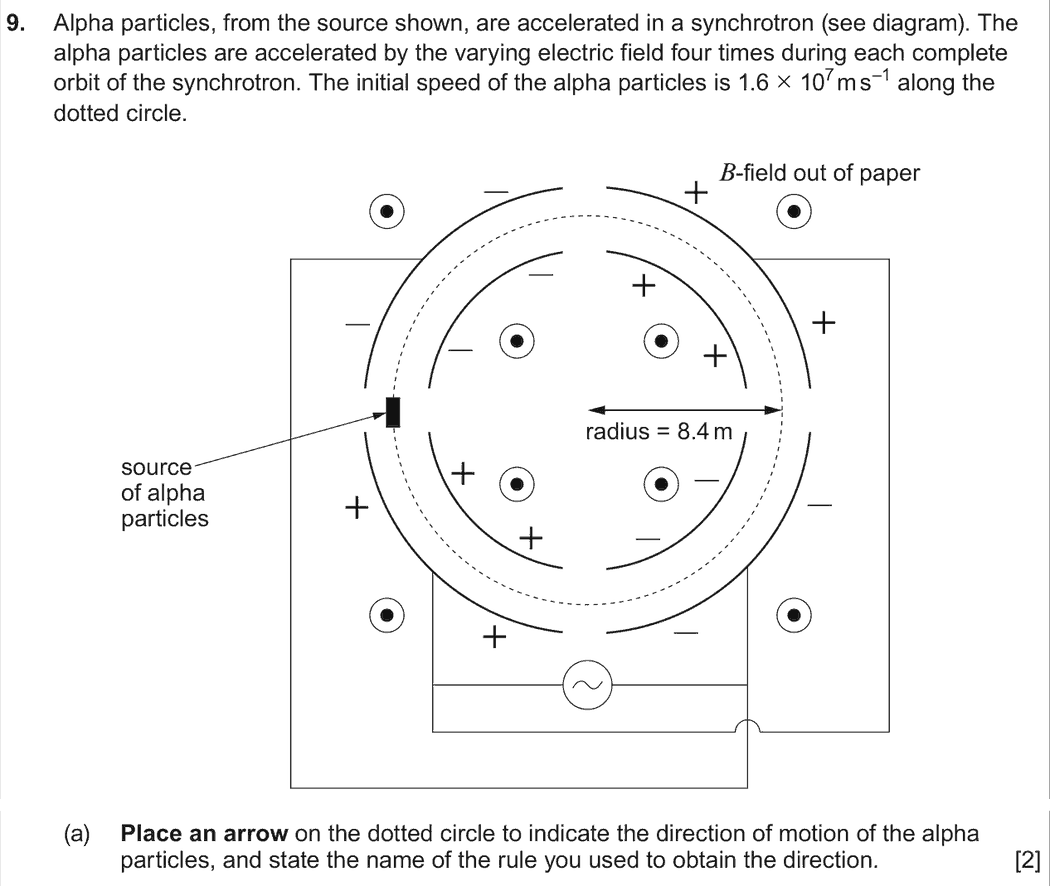
9. Alpha particles, from the source shown, are accelerated in a synchrotron (see diagram). The alpha particles are accelerated by the varying electric field four times during each complete orbit of the synchrotron. The initial speed of the alpha particles is 1.6 × 10⁷ m s–1 along the dotted circle. – B-field out of paper + – + – + – + radius = 8.4 m source + – of alpha – + particles – + – + (a) Place an arrow on the dotted circle to indicate the direction of motion of the alpha particles, and state the name of the rule you used to obtain the direction. [2]
June 2023 · AS Component 1 · Q1(a)(i) 1 mark AO1=1 Short answer basic physics
1. (a) (i) State the difference between a vector and a scalar quantity. [1]
June 2023 · AS Component 1 · Q1(a)(ii) 2 marks AO1=2 Short answer basic physics
Earlier part of question 1 that this part usesEarlier part of June 2023 Component 1 question 1
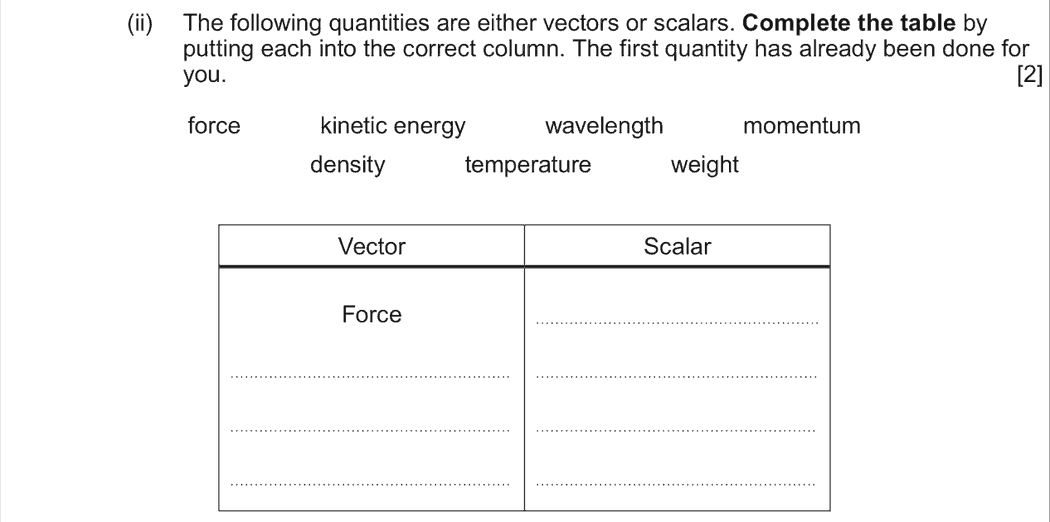
(ii) The following quantities are either vectors or scalars. Complete the table by putting each into the correct column. The first quantity has already been done for you. [2] force kinetic energy wavelength momentum density temperature weight Vector Scalar Force


June 2023 · AS Component 1 · Q1(b)(ii) 2 marks AO2=2 Short answer basic physics
Earlier parts of question 1 that this part usesEarlier part of June 2023 Component 1 question 1Earlier part of June 2023 Component 1 question 1Earlier part of June 2023 Component 1 question 1
(ii) If the car moves at a constant velocity, state the magnitude and direction of the resistive force acting against the car. [2]
June 2023 · AS Component 1 · Q2(c) 3 marks AO1=1, AO2=2 Short answer basic physics
Earlier part of question 2 that this part usesEarlier part of June 2023 Component 1 question 2
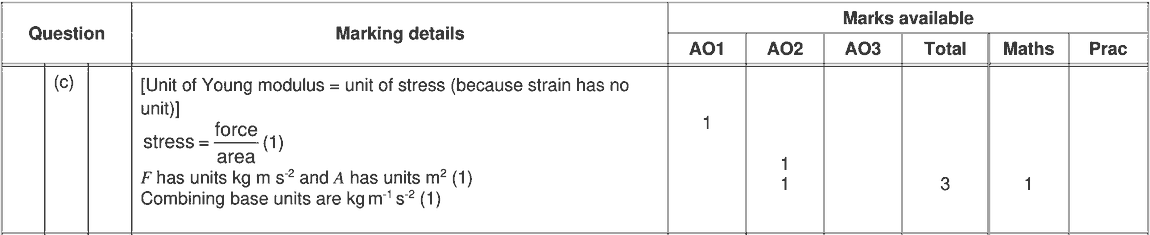
(c) The usual unit for Young modulus is the Pascal (Pa). Express this in terms of SI base units. [3]
June 2023 · AS Component 1 · Q6(a) 4 marks AO1=4 Short answer particles and nuclear structure
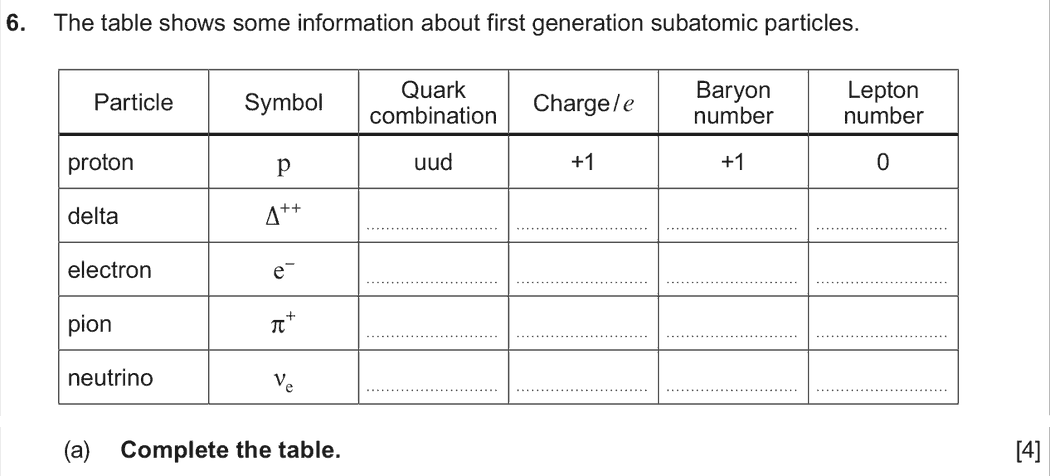
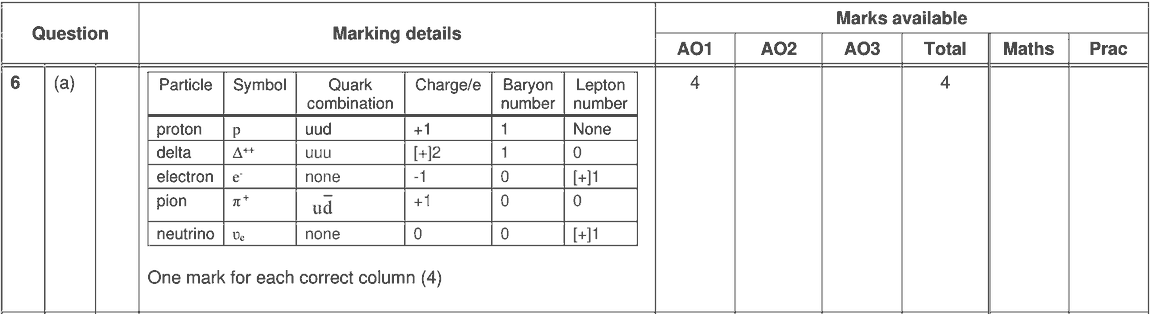
6. The table shows some information about first generation subatomic particles. Quark Baryon Lepton Particle Symbol Charge / e combination number number proton p uud +1 +1 0 delta Δ++ electron e– pion π+ neutrino νe (a) Complete the table. [4]
June 2023 · AS Component 1 · Q6(b)(ii) 2 marks AO2=2 Short answer particles and nuclear structure
Earlier parts of question 6 that this part usesEarlier part of June 2023 Component 1 question 6Earlier part of June 2023 Component 1 question 6
(ii) State which force is responsible for this decay. Explain your answer. [2]
June 2023 · AS Component 1 · Q7(b)(ii) 1 mark AO3=1 Short answer radiation and stars
Earlier parts of question 7 that this part usesEarlier part of June 2023 Component 1 question 7Earlier part of June 2023 Component 1 question 7
(ii) Describe the colour of the star. [1]
June 2022 · Component 1 · Q4(b)(iii)I 1 mark AO2=1 Short answer circular motion
Earlier parts of question 4 that this part usesEarlier part of June 2022 Component 1 question 4Earlier part of June 2022 Component 1 question 4
(iii) I. State an assumption that you have made (or factor that you have ignored) in your calculation for part (b)(ii). [1]
June 2022 · Component 1 · Q6(c)(ii) 2 marks AO1=2 Short answer kinetic theory
Earlier parts of question 6 that this part usesEarlier part of June 2022 Component 1 question 6Earlier part of June 2022 Component 1 question 6
(ii) State two reasons why the ideal gas kinetic theory is not likely to give accurate results in this case. [2]
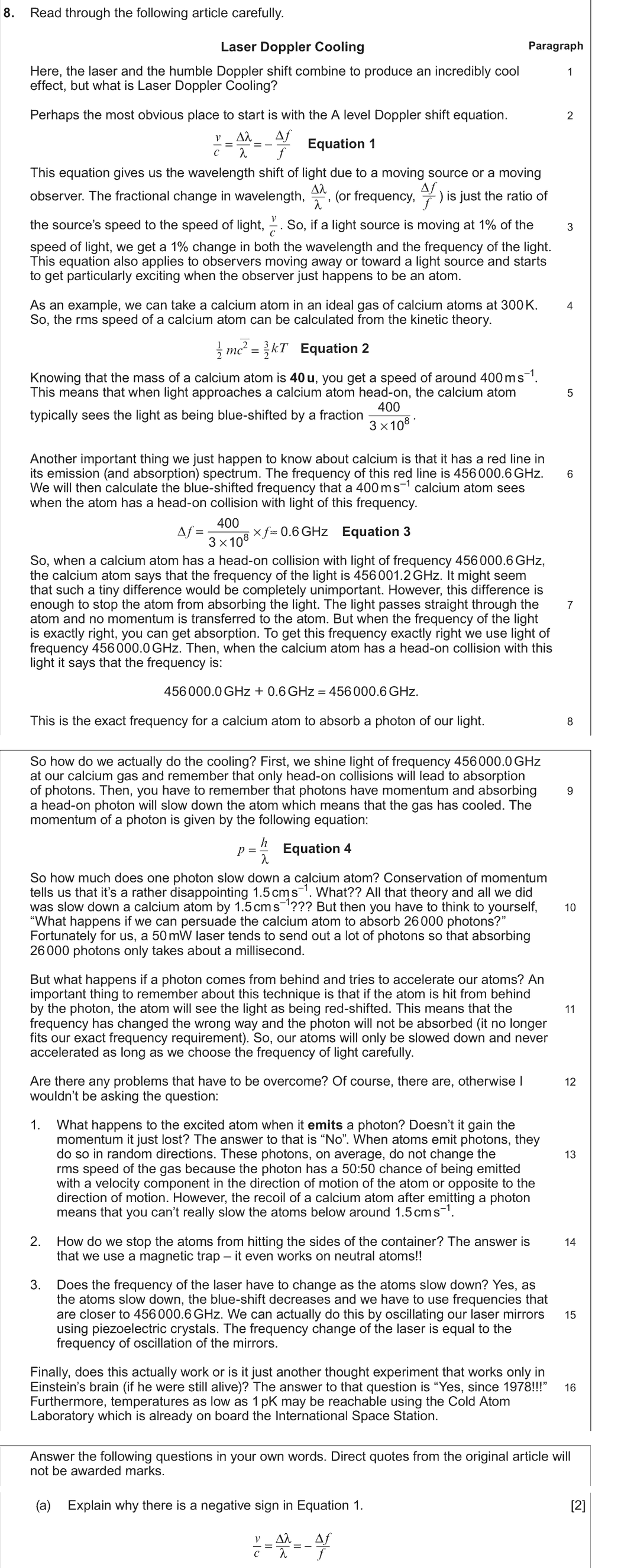
June 2022 · Component 1 · Q8(b)(ii) 1 mark AO2=1 Short answer orbits and the wider universephotonscomprehension
Earlier parts of question 8 that this part usesEarlier part of June 2022 Component 1 question 8Earlier part of June 2022 Component 1 question 8
(ii) Explain why a calcium atom travelling at 400 m s–1 will not absorb a 456 000.0 GHz photon if the photon and atom are moving in the same direction (see paragraphs 6–8 and 11). [1]
June 2022 · Component 1 · Q8(b)(iii) 1 mark AO2=1 Short answer photonscomprehension
Earlier parts of question 8 that this part usesEarlier part of June 2022 Component 1 question 8Earlier part of June 2022 Component 1 question 8
(iii) Hence, explain very briefly how calcium atoms can be cooled using light of this frequency (see paragraphs 6–11). [1]
June 2022 · Component 2 · Q1(a)(i) 1 mark AO2=1 Short answer dc circuits
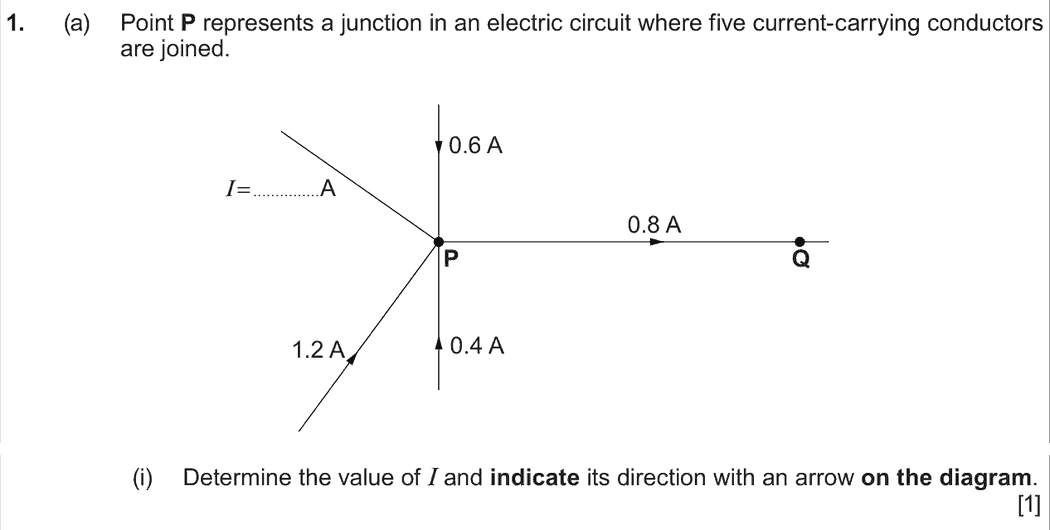
1. (a) Point P represents a junction in an electric circuit where five current-carrying conductors are joined. 0.6 A I= A 0.8 A P Q 1.2 A 0.4 A (i) Determine the value of I and indicate its direction with an arrow on the diagram. [1]
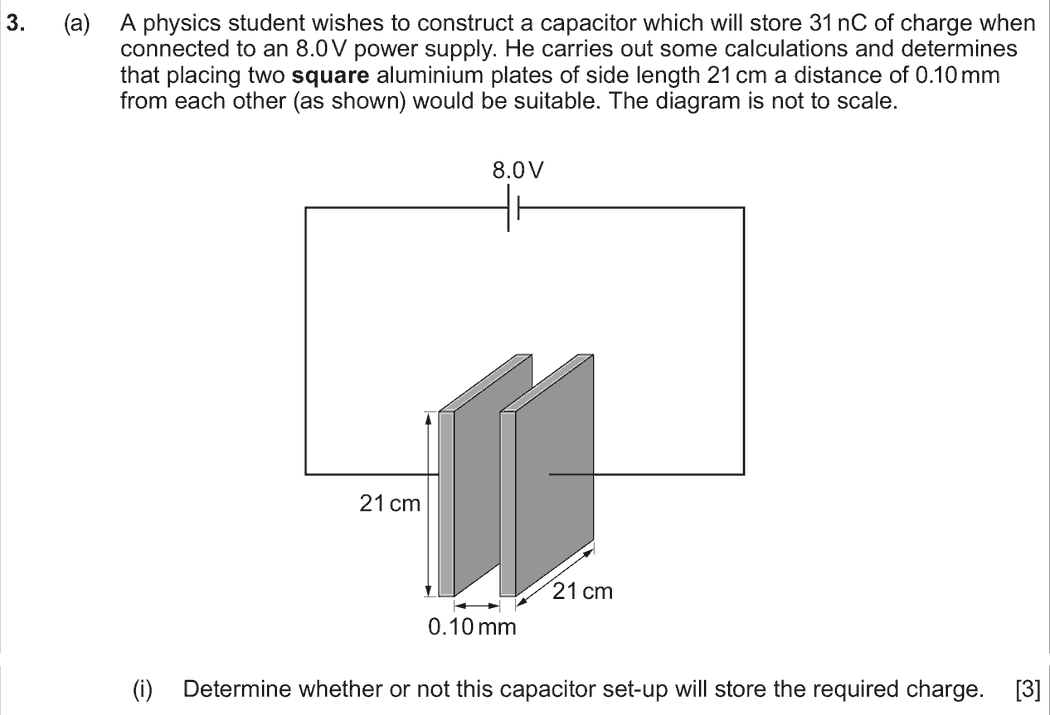
June 2022 · Component 2 · Q3(a)(ii) 1 mark AO1=1 Short answer capacitance
Earlier part of question 3 that this part usesEarlier part of June 2022 Component 2 question 3
(ii) State how the student could increase the charge stored without changing any of the dimensions of the capacitor, or the power supply to it. [1]
June 2022 · Component 2 · Q5(c)(i) 1 mark AO1=1 Short answer magnetic fields
Earlier parts of question 5 that this part usesEarlier part of June 2022 Component 2 question 5Earlier part of June 2022 Component 2 question 5
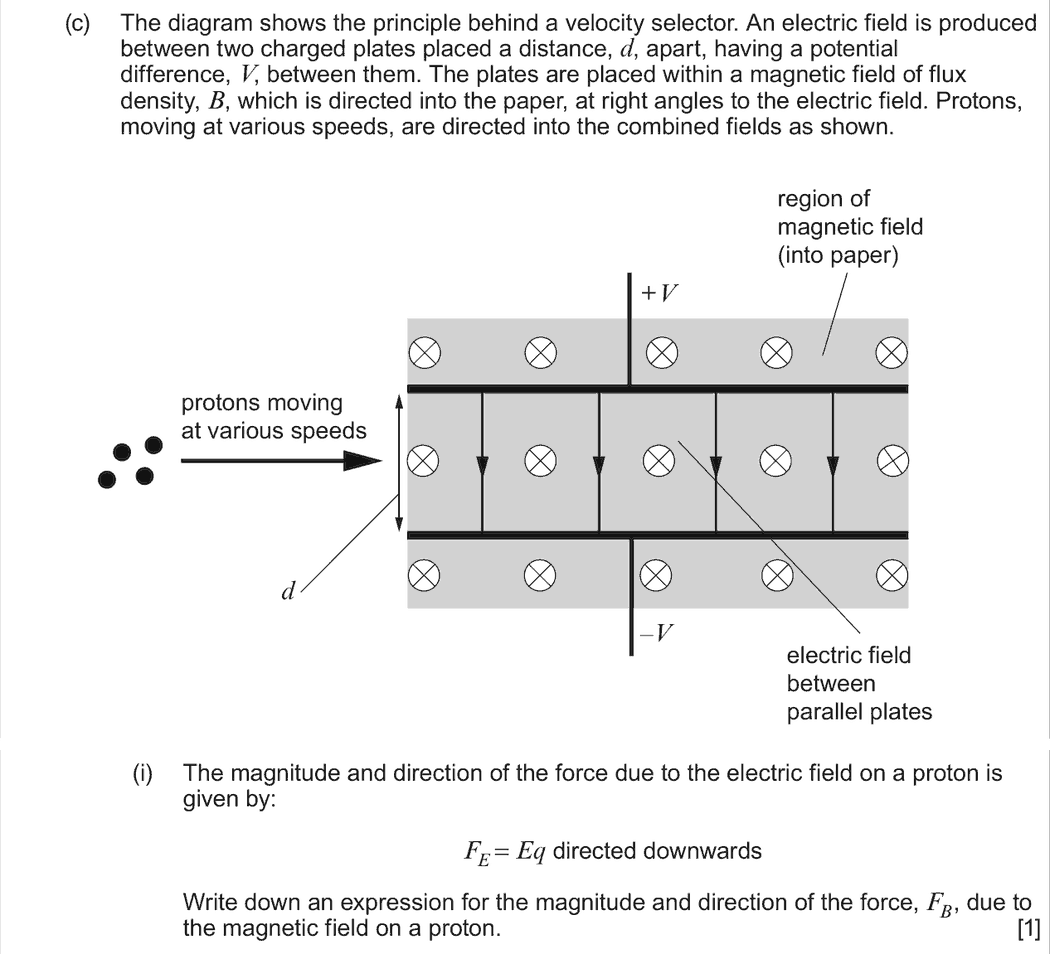
(c) The diagram shows the principle behind a velocity selector. An electric field is produced between two charged plates placed a distance, d, apart, having a potential difference, V, between them. The plates are placed within a magnetic field of flux density, B, which is directed into the paper, at right angles to the electric field. Protons, moving at various speeds, are directed into the combined fields as shown. region of magnetic field (into paper) +V protons moving at various speeds d –V electric field between parallel plates (i) The magnitude and direction of the force due to the electric field on a proton is given by: FE = Eq directed downwards Write down an expression for the magnitude and direction of the force, FB , due to the magnetic field on a proton. [1]
June 2022 · Component 2 · Q6(c) 2 marks AO3=2 Short answer radiation and stars
Earlier part of question 6 that this part usesEarlier part of June 2022 Component 2 question 6
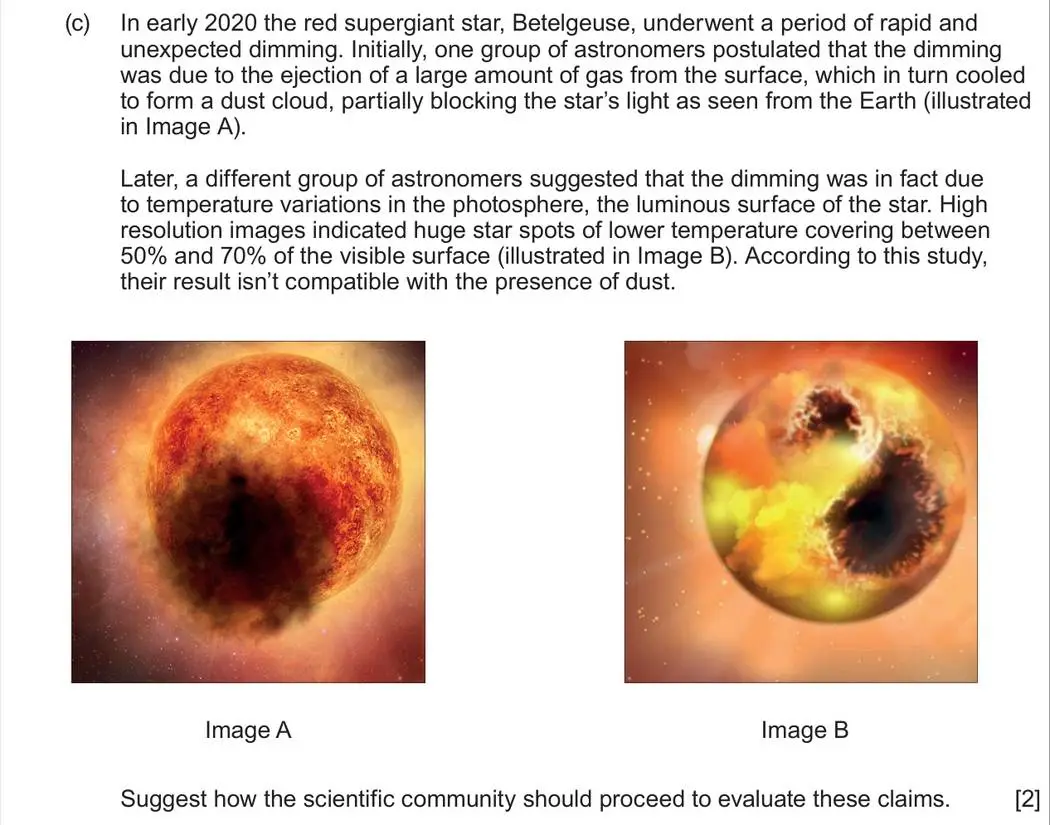
(c) In early 2020 the red supergiant star, Betelgeuse, underwent a period of rapid and unexpected dimming. Initially, one group of astronomers postulated that the dimming was due to the ejection of a large amount of gas from the surface, which in turn cooled to form a dust cloud, partially blocking the star’s light as seen from the Earth (illustrated in Image A). Later, a different group of astronomers suggested that the dimming was in fact due to temperature variations in the photosphere, the luminous surface of the star. High resolution images indicated huge star spots of lower temperature covering between 50% and 70% of the visible surface (illustrated in Image B). According to this study, their result isn’t compatible with the presence of dust. Image A Image B Suggest how the scientific community should proceed to evaluate these claims. [2]
June 2022 · Component 3 · Q1(a)(i) 1 mark AO1=1 Short answer nature of waves
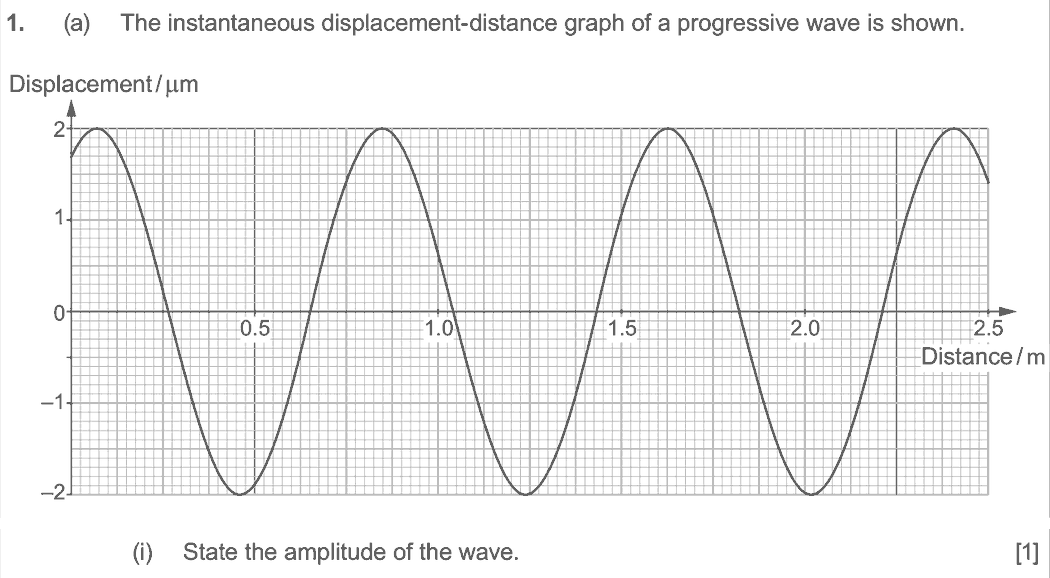
1. (a) The instantaneous displacement-distance graph of a progressive wave is shown. Displacement / μm 2 1 0 0.5 1.0 1.5 2.0 2.5 Distance / m –1 –2 (i) State the amplitude of the wave. [1]
June 2022 · Component 3 · Q3(c) 1 mark AO3=1 Short answer wave properties
Earlier parts of question 3 that this part usesEarlier part of June 2022 Component 3 question 3Earlier part of June 2022 Component 3 question 3
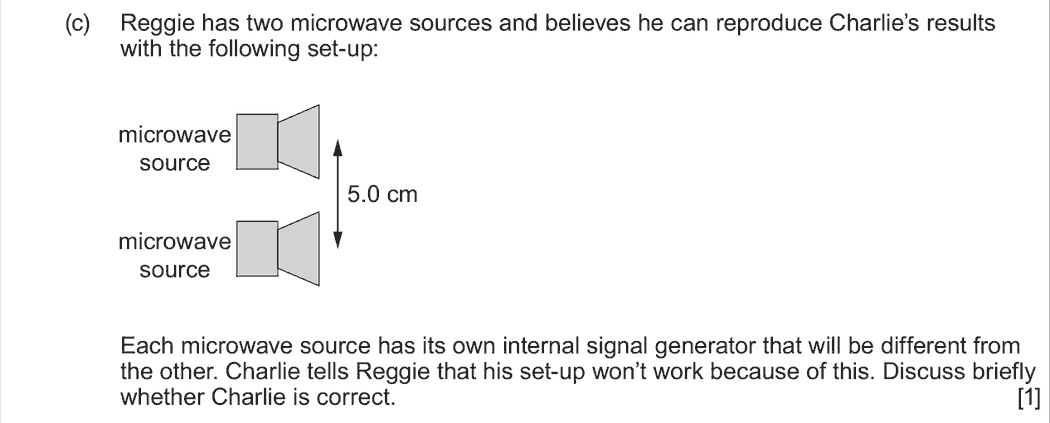
(c) Reggie has two microwave sources and believes he can reproduce Charlie’s results with the following set-up: microwave source 5.0 cm microwave source Each microwave source has its own internal signal generator that will be different from the other. Charlie tells Reggie that his set-up won’t work because of this. Discuss briefly whether Charlie is correct. [1]
June 2022 · Component 3 · Q7(a)(i) 3 marks AO1=2, AO2=1 Short answer nuclear decay
7. (a) (i) A 3 1 H nucleus is unstable and decays by emission of a β– particle to helium. Complete the decay equation. [3] 3 H + + 1
June 2022 · Component 3 · Q10(a)(i) 2 marks AO1=2 Short answer alternating currents
10. (a) (i) Describe how, if at all, the reactance of an inductor and the resistance of a resistor vary with frequency. [2]
June 2022 · Component 3 · Q10(a)(ii)II 1 mark AO2=1 Short answer alternating currents
Earlier parts of question 10 that this part usesEarlier part of June 2022 Component 3 question 10Earlier part of June 2022 Component 3 question 10
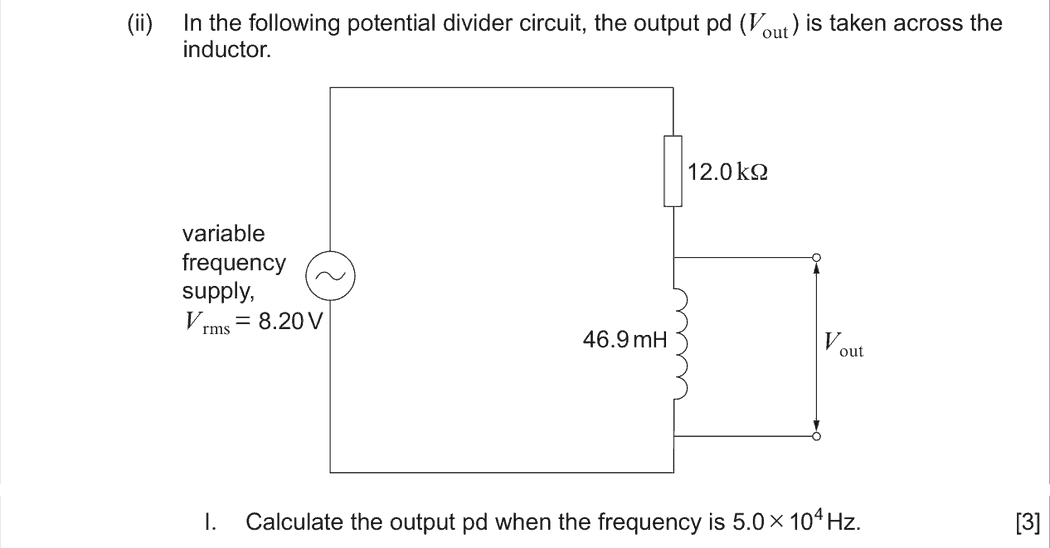
II. State what happens to the output pd when the frequency is increased above 5.0 × 104 Hz. [1]
June 2022 · Component 3 · Q11(c) 2 marks AO1=2 Short answer medical physics
Earlier part of question 11 that this part usesEarlier part of June 2022 Component 3 question 11
(c) A radionuclide such as iodine-131 or iodine-123 can be used to investigate kidney function. Give two important properties of any radionuclide that is used as a tracer. [2]
June 2022 · AS Component 1 · Q1(a)(i) 1 mark AO1=1 Short answer basic physics
1. (a) (i) State the difference between vector and scalar quantities. [1]
June 2022 · AS Component 1 · Q1(a)(ii) 2 marks AO1=2 Short answer basic physics
Earlier part of question 1 that this part usesEarlier part of June 2022 Component 1 question 1
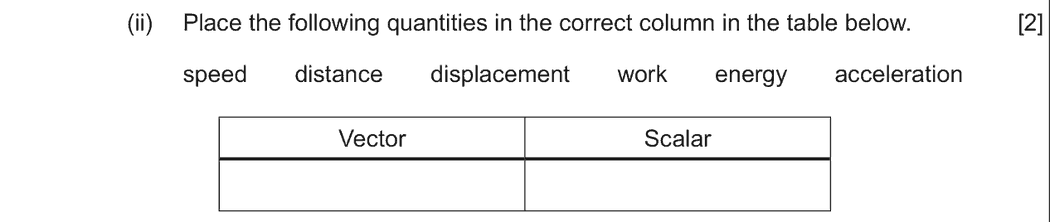
(ii) Place the following quantities in the correct column in the table below. [2] speed distance displacement work energy acceleration Vector Scalar
June 2022 · AS Component 1 · Q2(c)(ii) 2 marks AO2=2 Short answer kinematics
Earlier parts of question 2 that this part usesEarlier part of June 2022 Component 1 question 2Earlier part of June 2022 Component 1 question 2
(ii) At which point during the flight is air resistance at its minimum? Give a reason for your answer. [2]
June 2022 · AS Component 1 · Q4(b)(i) 1 mark AO2=1 Short answer solids under stress
Earlier part of question 4 that this part usesEarlier part of June 2022 Component 1 question 4
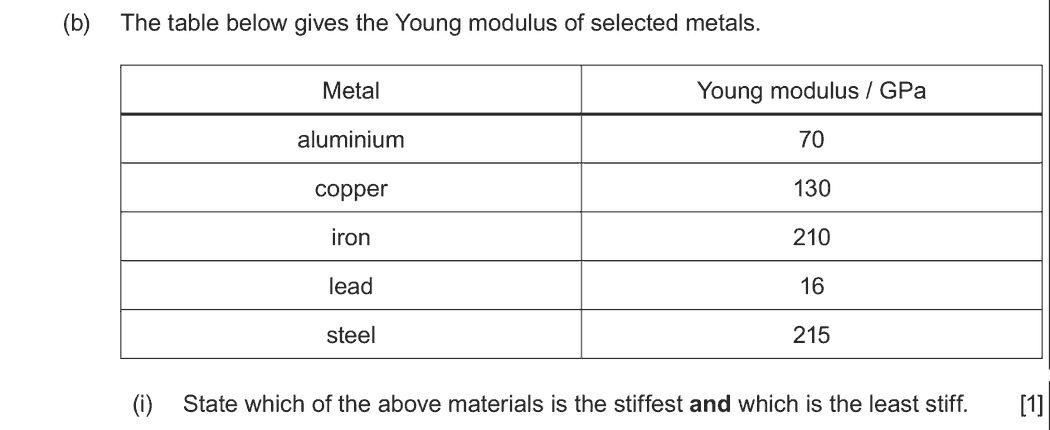
(b) The table below gives the Young modulus of selected metals. Metal Young modulus / GPa aluminium 70 copper 130 iron 210 lead 16 steel 215 (i) State which of the above materials is the stiffest and which is the least stiff. [1]
June 2022 · AS Component 1 · Q5(c) 2 marks AO3=2 Short answer solids under stress
Earlier parts of question 5 that this part usesEarlier part of June 2022 Component 1 question 5Earlier part of June 2022 Component 1 question 5
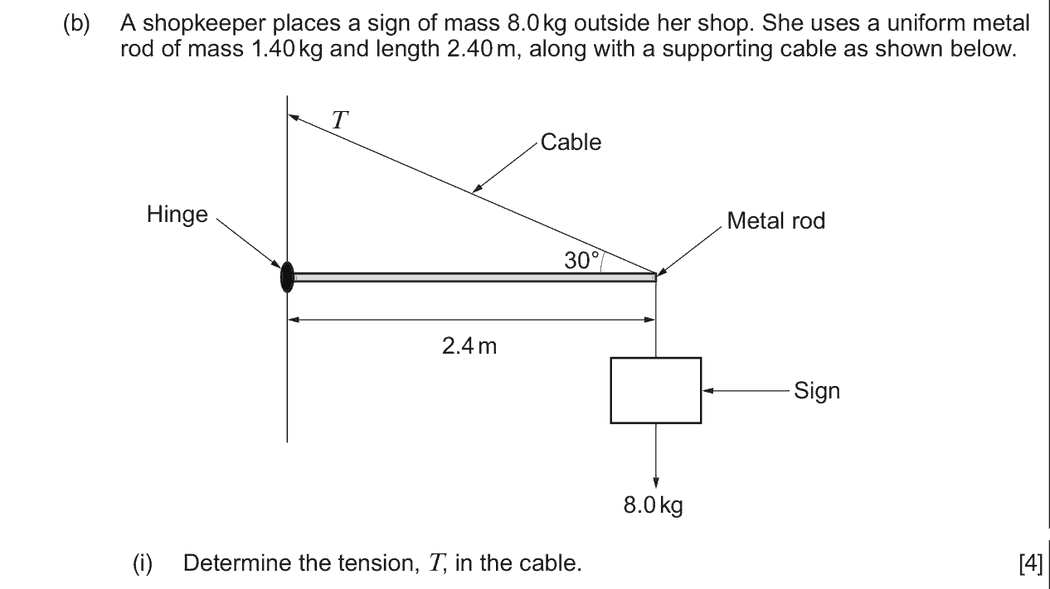
(c) Discuss whether or not the shopkeeper should be allowed to erect the sign without consulting the local council planning department or a qualified engineer. [2]
June 2022 · AS Component 1 · Q6(a)(i) 4 marks AO1=4 Short answer particles and nuclear structure
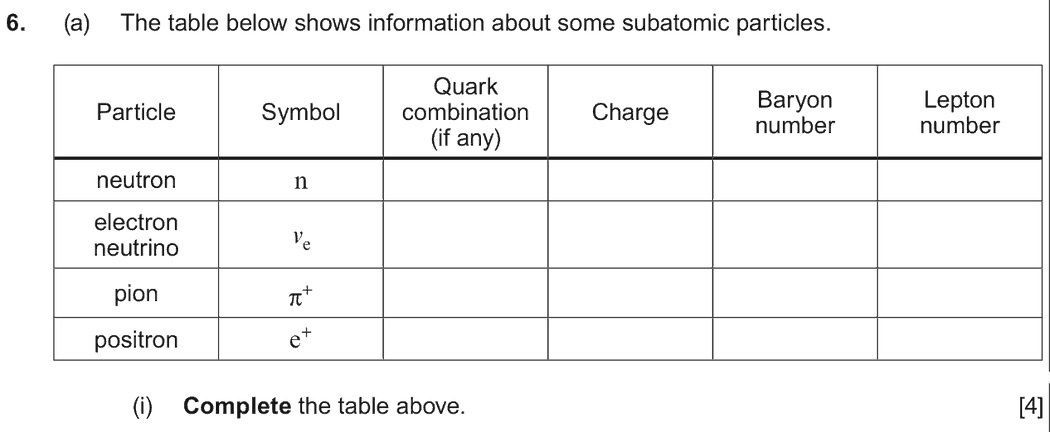
6. (a) The table below shows information about some subatomic particles. Quark Baryon Lepton Particle Symbol combination Charge number number (if any) neutron n electron ve neutrino pion π+ positron e+ (i) Complete the table above. [4]
June 2022 · AS Component 1 · Q6(a)(ii) 1 mark AO1=1 Short answer particles and nuclear structure
Earlier part of question 6 that this part usesEarlier part of June 2022 Component 1 question 6
(ii) State which one of the above particles is usually classed as an antiparticle. [1]
June 2022 · AS Component 1 · Q6(a)(iii) 1 mark AO1=1 Short answer particles and nuclear structure
Earlier part of question 6 that this part usesEarlier part of June 2022 Component 1 question 6
(iii) State one difference and one similarity between a charged particle and its antiparticle. [1]
June 2022 · AS Component 2 · Q1(b)(ii) 2 marks AO2=2 Short answer nature of waves
Earlier parts of question 1 that this part usesEarlier part of June 2022 Component 2 question 1Earlier part of June 2022 Component 2 question 1
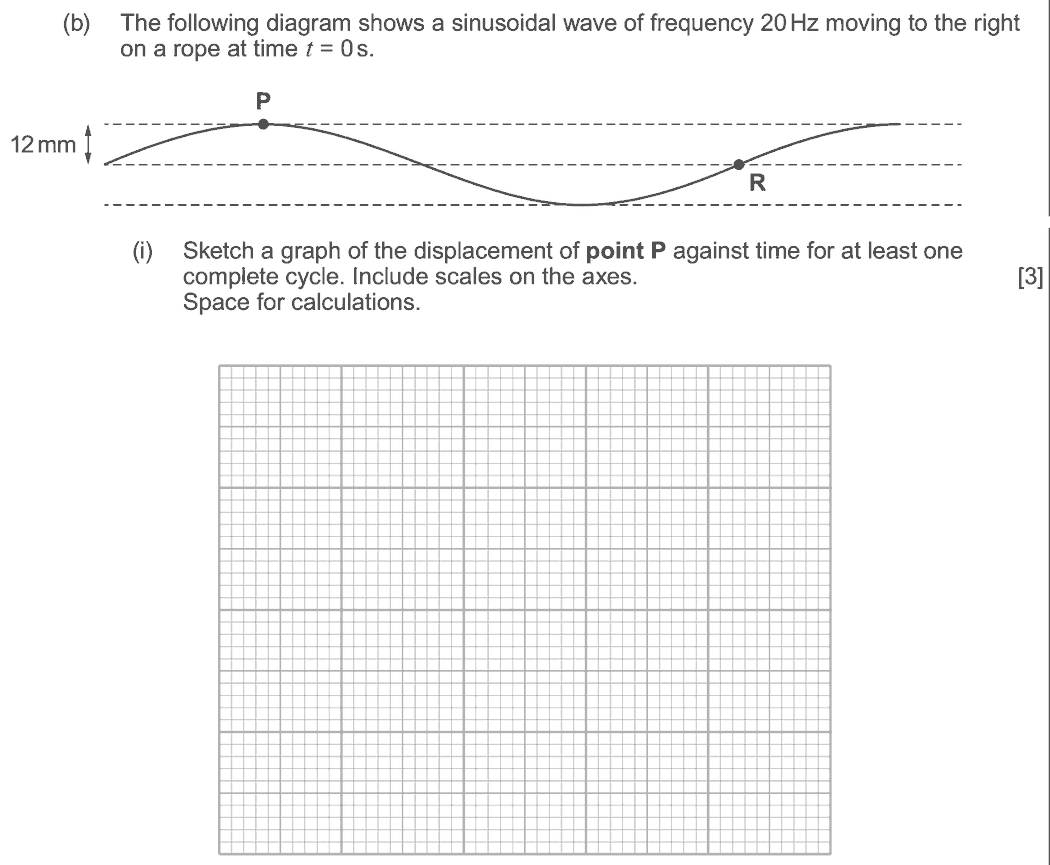
(ii) Compare the motions of points P and R on the rope. [2]
June 2022 · AS Component 2 · Q4(a) 2 marks AO1=2 Short answer photons
4. (a) Catherine uses a diffraction grating to observe the first order emission spectrum from a lamp containing gas atoms. Describe what she observes. [2]
June 2022 · AS Component 2 · Q5(d) 1 mark AO1=1 Short answer resistance
Earlier parts of question 5 that this part usesEarlier part of June 2022 Component 2 question 5Earlier part of June 2022 Component 2 question 5
(d) Explain why superconductors cannot be used as temperature sensors at very low temperatures. [1]
October 2021 · Component 1 · Q1(a) 2 marks AO1=2 Short answer basic physics
1. (a) State the conditions needed for a body to be in equilibrium. [2]
October 2021 · Component 1 · Q4(b)(i) 1 mark AO1=1 Short answer circular motion
Earlier part of question 4 that this part usesEarlier part of October 2021 Component 1 question 4
(b) In special circumstances an electron has been made to orbit a nucleus in a circular orbit of radius 0.37 mm. (i) Comment on the radius of this atomic orbit. [1]
October 2021 · Component 1 · Q5(b)(i) 2 marks AO1=2 Short answer vibrations
Earlier part of question 5 that this part usesEarlier part of October 2021 Component 1 question 5
(b) The mass-spring system of part (a) is made to perform forced oscillations. (i) State the difference between forced oscillations and natural oscillations. [2]
October 2021 · Component 1 · Q6(b)(i) 2 marks AO1=2 Short answer kinetic theory
Earlier part of question 6 that this part usesEarlier part of October 2021 Component 1 question 6
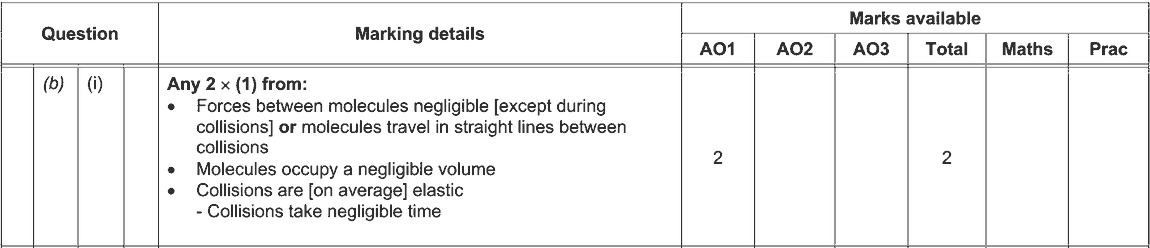
(b) (i) One assumption of the kinetic theory of ideal gases is that a gas consists of particles (molecules) in rapid random, translational, motion. State two other assumptions of the ideal gas theory. [2]
October 2021 · Component 1 · Q8(g) 2 marks AO1=2 Short answer vibrationscomprehension
Earlier parts of question 8 that this part usesEarlier part of October 2021 Component 1 question 8Earlier part of October 2021 Component 1 question 8
(g) State and explain the type of damping that should be provided so that the pointer provides the correct reading quickly (see paragraph 10). [2]
October 2021 · Component 2 · Q1(a) 1 mark AO2=1 Short answer dc circuits
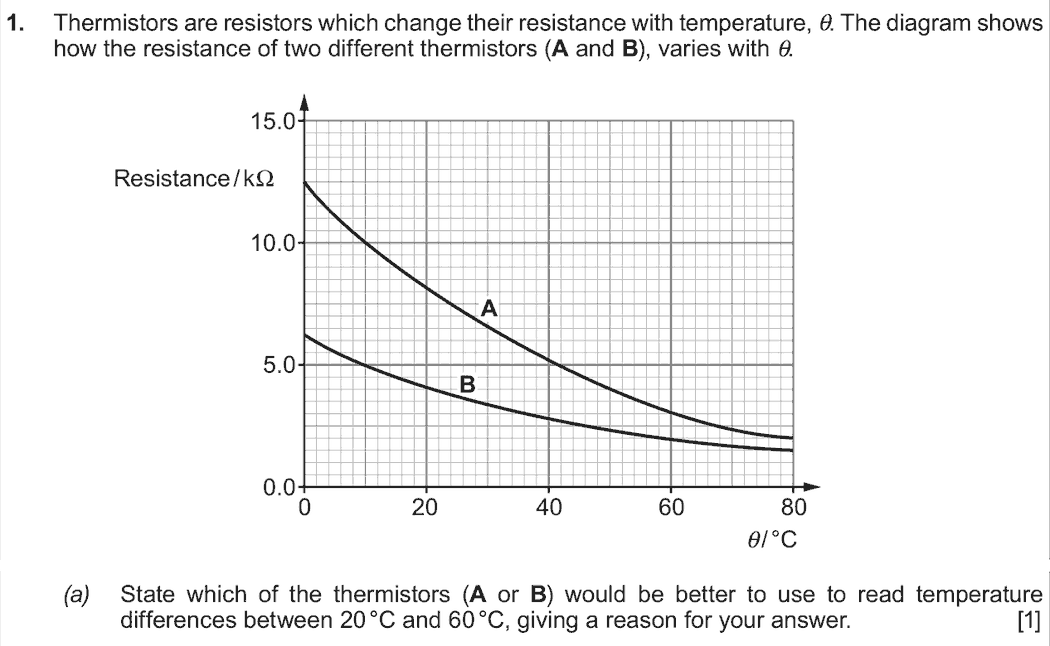
1. Thermistors are resistors which change their resistance with temperature, θ. The diagram shows how the resistance of two different thermistors (A and B), varies with θ. 15.0 Resistance / kΩ 10.0 A 5.0 B 0.0 0 20 40 60 80 θ / °C (a) State which of the thermistors (A or B) would be better to use to read temperature differences between 20 °C and 60 °C, giving a reason for your answer. [1]
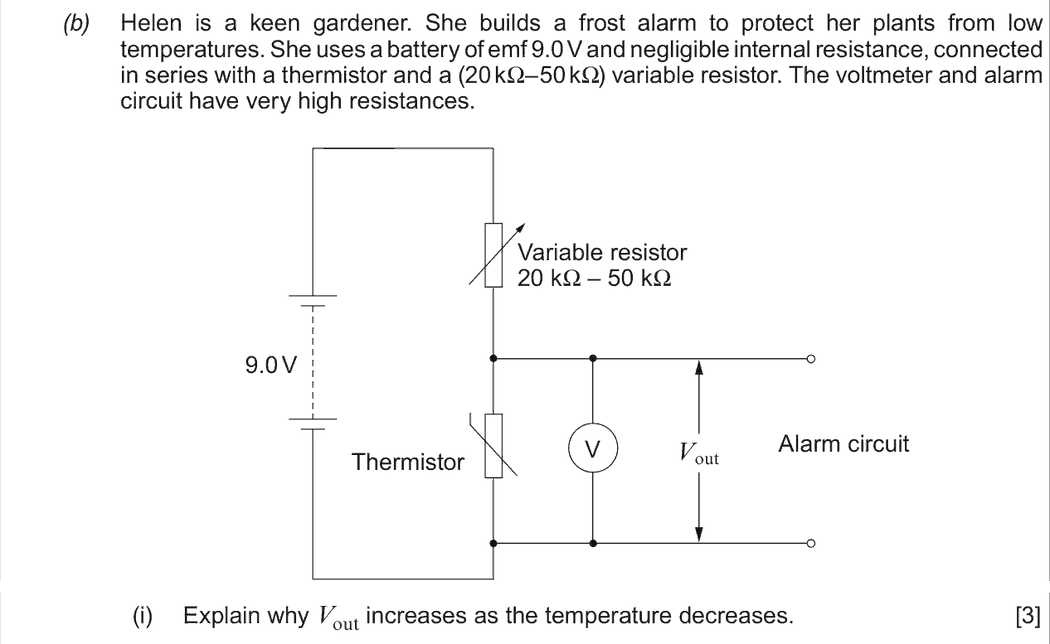
October 2021 · Component 2 · Q1(b)(iv) 1 mark AO3=1 Short answer resistance
Earlier parts of question 1 that this part usesEarlier part of October 2021 Component 2 question 1Earlier part of October 2021 Component 2 question 1
(iv) When deciding where to locate the circuit, Helen places the variable resistor a few mm away from the thermistor. Comment on this decision in light of your answer to part (iii). [1]
October 2021 · Component 2 · Q5(b)(ii) 2 marks AO1=2 Short answer dynamicselectrostatic and gravitational fields
Earlier parts of question 5 that this part usesEarlier part of October 2021 Component 2 question 5Earlier part of October 2021 Component 2 question 5
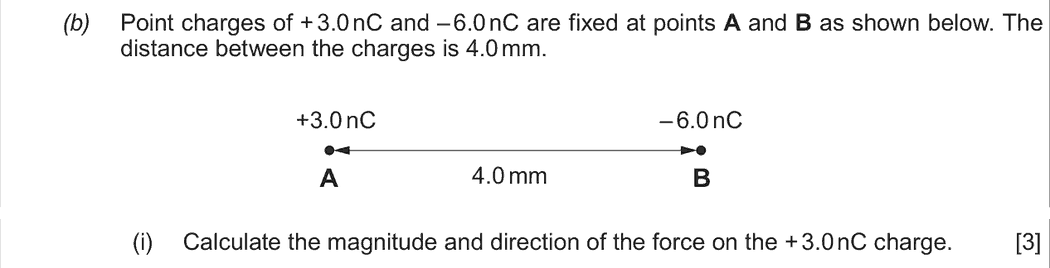
(ii) Without further calculation, state the force on the – 6.0 nC charge, giving a reason for your answer. [2]
October 2021 · Component 2 · Q7(a)(i) 1 mark AO2=1 Short answer orbits and the wider universe
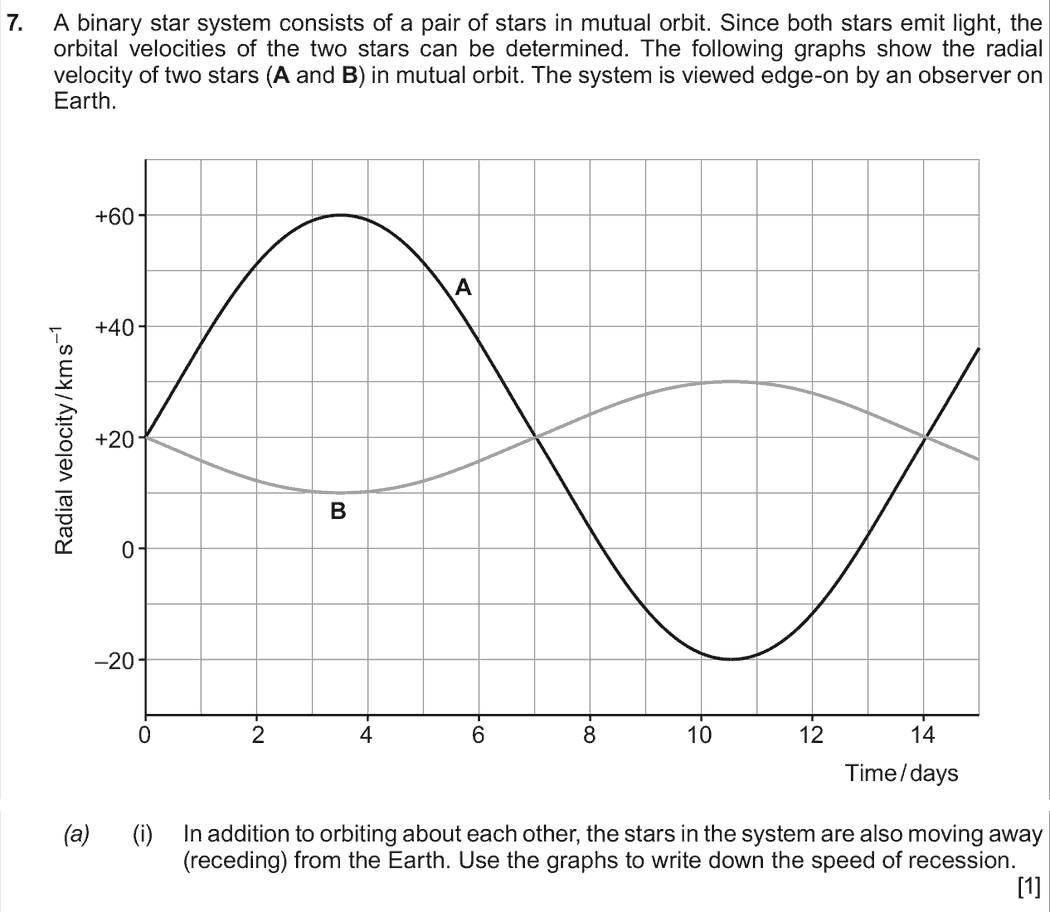
7. A binary star system consists of a pair of stars in mutual orbit. Since both stars emit light, the orbital velocities of the two stars can be determined. The following graphs show the radial velocity of two stars (A and B) in mutual orbit. The system is viewed edge-on by an observer on Earth. +60 A +40 velocity / km s–1 +20 Radial B 0 –20 0 2 4 6 8 10 12 14 Time / days (a) (i) In addition to orbiting about each other, the stars in the system are also moving away (receding) from the Earth. Use the graphs to write down the speed of recession. [1]
October 2021 · Component 3 · Q4(a)(ii) 1 mark AO1=1 Short answer magnetic fields
Earlier part of question 4 that this part usesEarlier part of October 2021 Component 3 question 4
(ii) The left pole of the magnet is a north pole. Explain how this is consistent with the information above, naming the rule that you used. [1]
October 2021 · Component 3 · Q7(b) 1 mark AO1=1 Short answer particles and nuclear structure
Earlier part of question 7 that this part usesEarlier part of October 2021 Component 3 question 7
(b) The electron neutrino indicates that this is a weak force interaction. State another clear indicator that this reaction is a weak force interaction. [1]
October 2021 · Component 3 · Q9(a)(i) 2 marks AO1=2 Short answer alternating currents
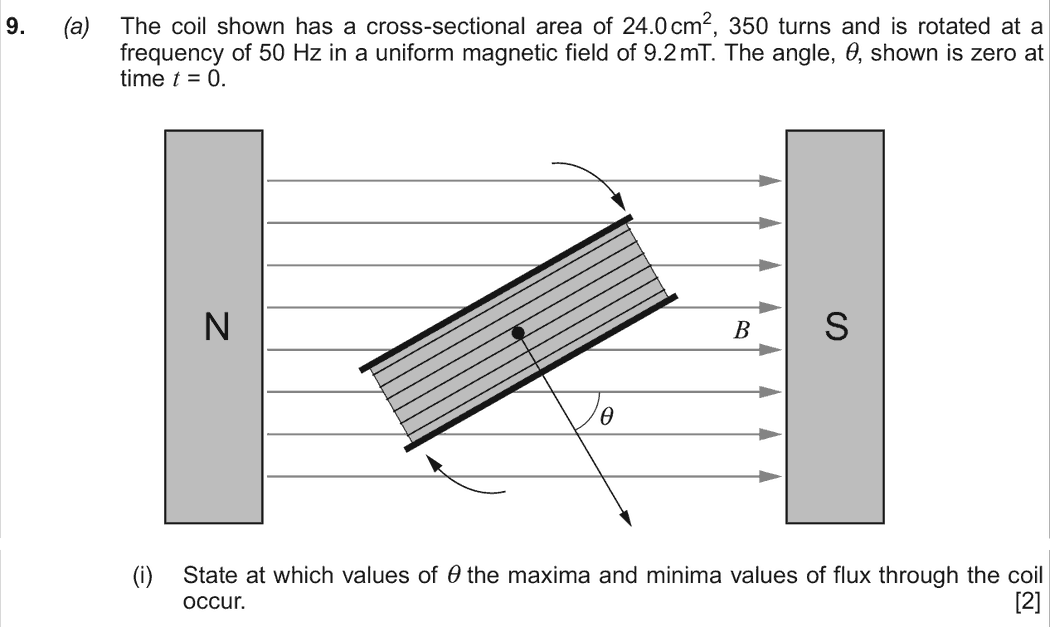
9. (a) The coil shown has a cross-sectional area of 24.0 cm2, 350 turns and is rotated at a frequency of 50 Hz in a uniform magnetic field of 9.2 mT. The angle, θ, shown is zero at time t = 0. N S B θ (i) State at which values of θ the maxima and minima values of flux through the coil occur. [2]
October 2021 · Component 3 · Q9(b)(ii) 1 mark AO2=1 Short answer alternating currents
Earlier parts of question 9 that this part usesEarlier part of October 2021 Component 3 question 9Earlier part of October 2021 Component 3 question 9
(ii) Explain why the maximum rms current is approximately 50 mA. [1]
October 2021 · Component 3 · Q12(d)(iii) 1 mark AO2=1 Short answer energy and the environment
Earlier parts of question 12 that this part usesEarlier part of October 2021 Component 3 question 12Earlier part of October 2021 Component 3 question 12Earlier part of October 2021 Component 3 question 12Earlier part of October 2021 Component 3 question 12
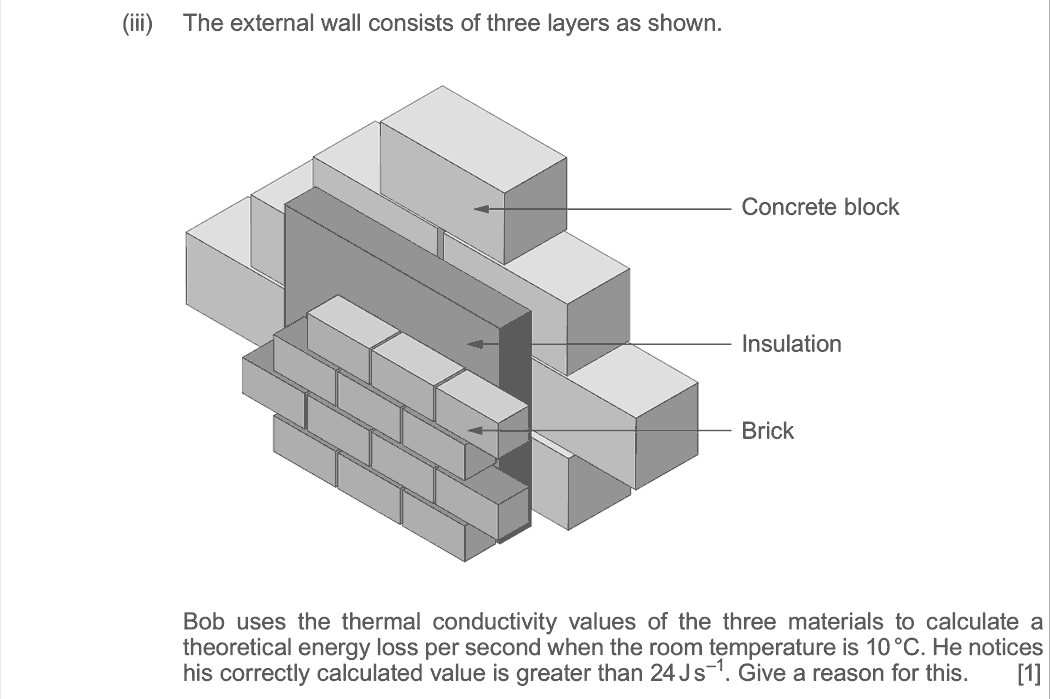
(iii) The external wall consists of three layers as shown. Concrete block Insulation Brick Bob uses the thermal conductivity values of the three materials to calculate a theoretical energy loss per second when the room temperature is 10 °C. He notices his correctly calculated value is greater than 24 J s–1. Give a reason for this. [1]
October 2020 · Component 1 · Q3(a)(i) 2 marks AO1=2 Short answer vibrations
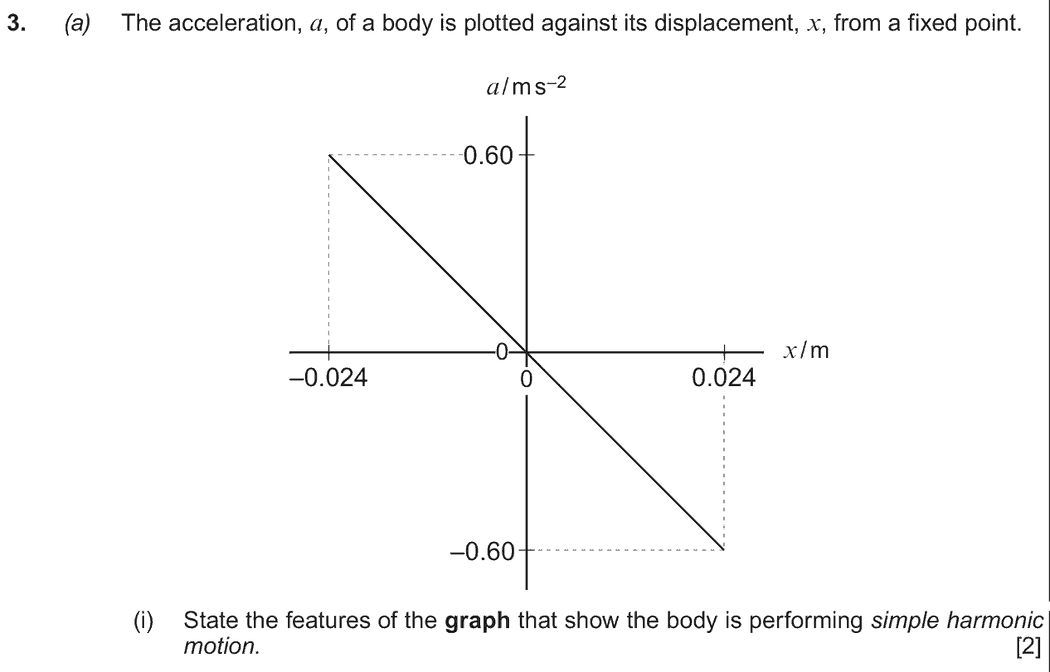
3. (a) The acceleration, a, of a body is plotted against its displacement, x, from a fixed point. a / m s–2 0.60 0 x / m –0.024 0 0.024 –0.60 (i) State the features of the graph that show the body is performing simple harmonic motion. [2]
October 2020 · Component 1 · Q3(a)(ii) 1 mark AO1=1 Short answer vibrations
Earlier part of question 3 that this part usesEarlier part of October 2020 Component 1 question 3
(ii) Determine the amplitude of the motion. [1]
October 2020 · Component 1 · Q3(c)(i) 1 mark AO1=1 Short answer vibrations
Earlier parts of question 3 that this part usesEarlier part of October 2020 Component 1 question 3Earlier part of October 2020 Component 1 question 3
(c) A tennis ball attached by a spring to a fixed point is displaced vertically from its equilibrium position and released. It performs damped oscillations. (i) What observed feature of the oscillations shows them to be damped? [1]
October 2020 · Component 1 · Q5(b)(iv) 1 mark AO1=1 Short answer dynamics
Earlier parts of question 5 that this part usesEarlier part of October 2020 Component 1 question 5Earlier part of October 2020 Component 1 question 5
(iv) Explain how Newton’s 3rd law applies to the collision. [1]
October 2020 · Component 1 · Q6(a)(ii) 1 mark AO1=1 Short answer thermal physics
Earlier part of question 6 that this part usesEarlier part of October 2020 Component 1 question 6
(ii) State the significance, in terms of molecules, of the absolute zero of temperature. [1]
October 2020 · Component 1 · Q8(c)(i) 1 mark AO1=1 Short answer basic physicscomprehension
Earlier part of question 8 that this part usesEarlier part of October 2020 Component 1 question 8
(c) (i) The author has made a mistake in the table and the graph with one of the units. Identify the mistake. [1]
October 2020 · Component 2 · Q4(b)(ii)I 2 marks AO1=2 Short answer solids under stress
Earlier parts of question 4 that this part usesEarlier part of October 2020 Component 2 question 4Earlier part of October 2020 Component 2 question 4
(ii) When the specimen is gradually unloaded, it is noted that the curve for unloading is different from the curve for loading. I. Name this phenomenon and account for it in terms of energy. [2]
October 2020 · Component 2 · Q6(a) 2 marks AO1=2 Short answer radiation and stars
6. (a) Describe the main features of the spectrum of a star and state where in the star they arise. [2]
October 2020 · Component 2 · Q6(b)(i) 3 marks AO3=3 Short answer radiation and stars
Earlier part of question 6 that this part usesEarlier part of October 2020 Component 2 question 6
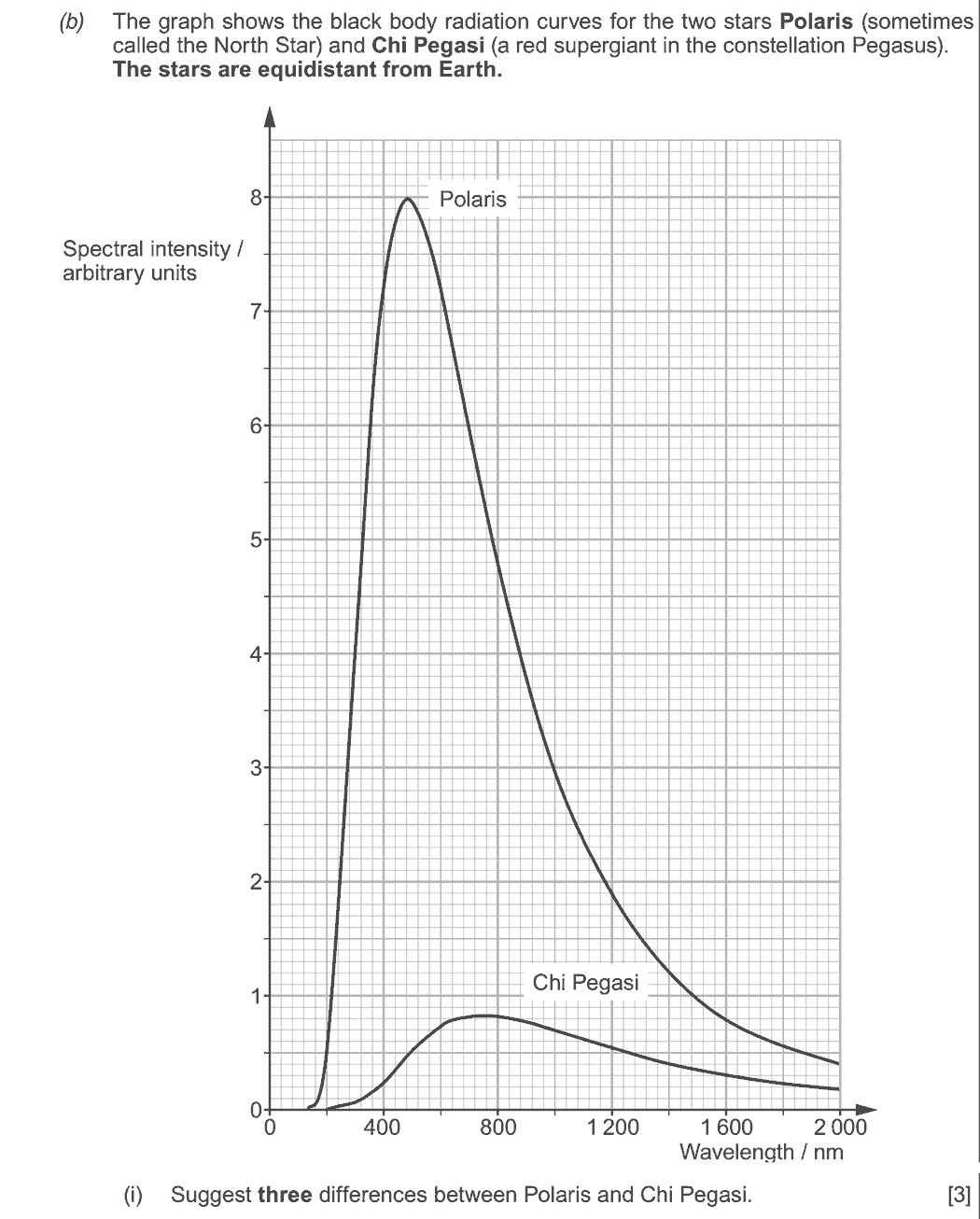
(b) The graph shows the black body radiation curves for the two stars Polaris (sometimes called the North Star) and Chi Pegasi (a red supergiant in the constellation Pegasus). The stars are equidistant from Earth. 8 Polaris Spectral intensity / arbitrary units 7 6 5 4 3 2 Chi Pegasi 1 0 0 400 800 1 200 1 600 2 000 Wavelength / nm (i) Suggest three differences between Polaris and Chi Pegasi. [3]
October 2020 · Component 2 · Q7(c)(iii) 1 mark AO2=1 Short answer electrostatic and gravitational fields
Earlier parts of question 7 that this part usesEarlier part of October 2020 Component 2 question 7Earlier part of October 2020 Component 2 question 7
(iii) Explain why it is not possible to use the equation ∆Ep = mg∆h when determining the change in the gravitational potential energy of the probe as it moves between these orbits. [1]
October 2020 · Component 3 · Q1(b)(ii) 1 mark AO1=1 Short answer photons
Earlier parts of question 1 that this part usesEarlier part of October 2020 Component 3 question 1Earlier part of October 2020 Component 3 question 1
(ii) State or calculate a typical photon energy of visible light. [1]
October 2020 · Component 3 · Q1(b)(iii) 1 mark AO2=1 Short answer photons
Earlier parts of question 1 that this part usesEarlier part of October 2020 Component 3 question 1Earlier part of October 2020 Component 3 question 1
(iii) Explain whether or not a microwave photon has a greater or smaller energy than a visible photon. [1]
October 2020 · Component 3 · Q4(b) 2 marks AO1=2 Short answer lasers
Earlier part of question 4 that this part usesEarlier part of October 2020 Component 3 question 4
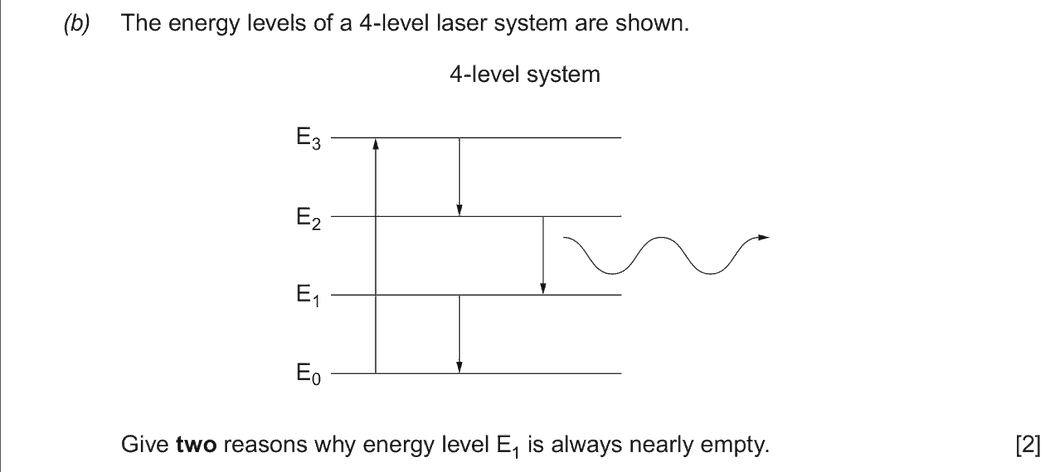
(b) The energy levels of a 4-level laser system are shown. 4-level system E3 E2 E1 E0 Give two reasons why energy level E1 is always nearly empty. [2]
October 2020 · Component 3 · Q5(b) 1 mark AO1=1 Short answer nuclear decay
Earlier parts of question 5 that this part usesEarlier part of October 2020 Component 3 question 5Earlier part of October 2020 Component 3 question 5
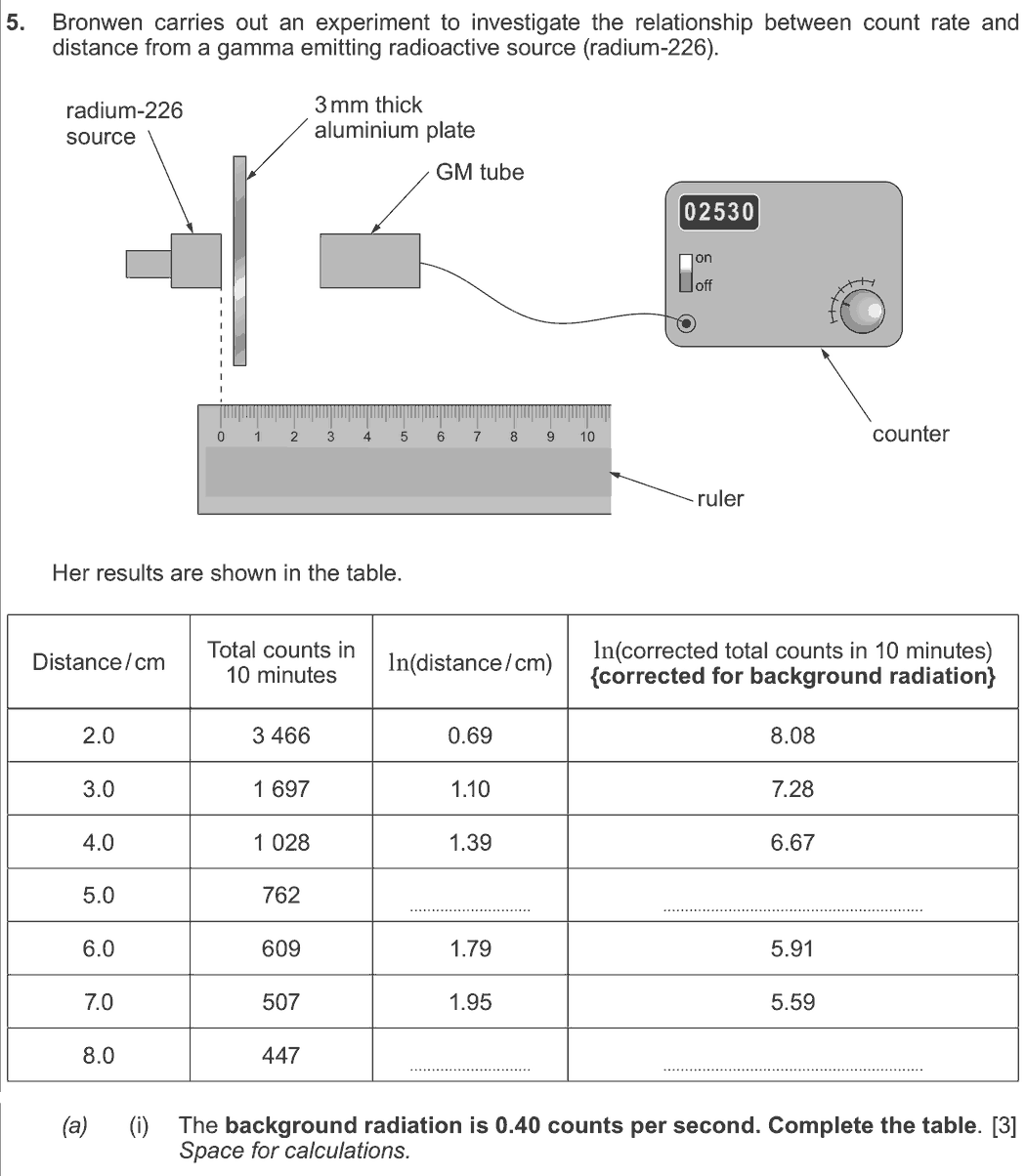
(b) Radium-226 also emits other radiation. Suggest a reason for using a 3 mm aluminium plate between the source and the GM tube. [1]
October 2020 · Component 3 · Q7(a) 2 marks AO1=1, AO2=1 Short answer nuclear decay
7. (a) The bismuth isotope ( 209 Bi) decays by alpha decay to an isotope of thallium (Tl). Fill in 83 the missing numbers for this decay. [2] 209 Bi Tl + He 83
October 2020 · Component 3 · Q10(a)(iii) 1 mark AO1=1 Short answer magnetic fields
Earlier part of question 10 that this part usesEarlier part of October 2020 Component 3 question 10
(iii) State how the strength of the magnetic field produced by this solenoid can be increased greatly without increasing the current or changing the dimensions of the solenoid. [1]
October 2020 · Component 3 · Q11(b)(iii) 1 mark AO2=1 Short answer alternating currents
Earlier parts of question 11 that this part usesEarlier part of October 2020 Component 3 question 11Earlier part of October 2020 Component 3 question 11
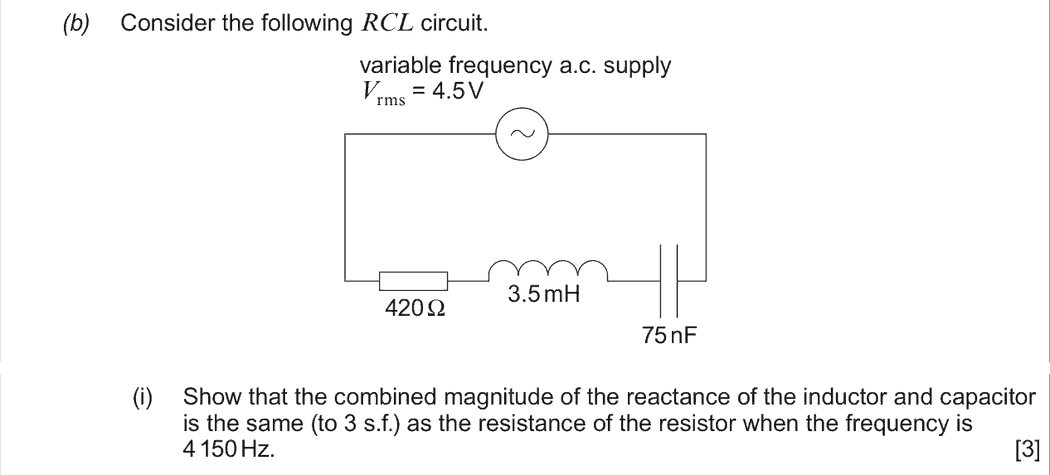
(iii) Calculate (or state) the phase angle between the applied pd and the current when the frequency is 4 150 Hz. [1]
October 2020 · Component 3 · Q12(a)(iv) 1 mark AO2=1 Short answer medical physics
Earlier part of question 12 that this part usesEarlier part of October 2020 Component 3 question 12
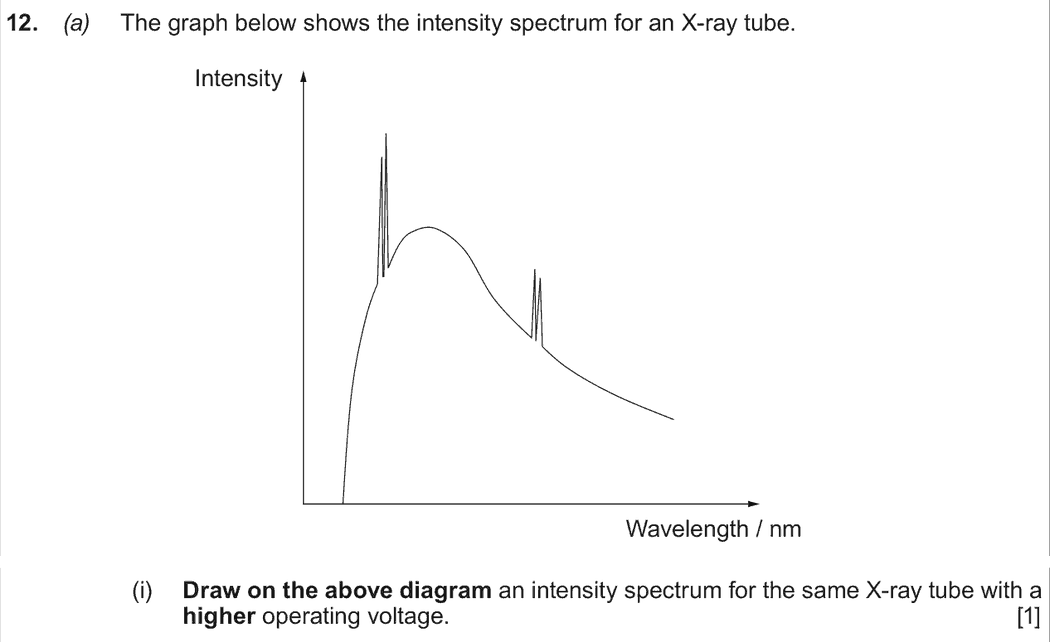
(iv) Explain whether it would be possible to reduce the minimum wavelength to zero. [1]
June 2019 · Component 1 · Q8(a) 1 mark AO2=1 Short answer comprehension
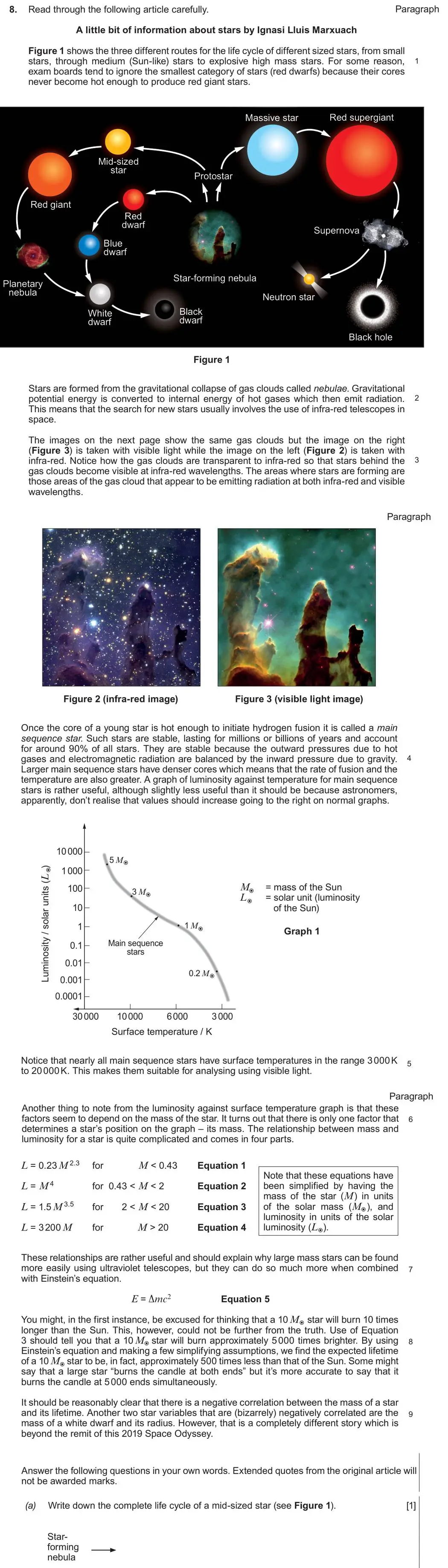
8. Read through the following article carefully. Paragraph A little bit of information about stars by Ignasi Lluis Marxuach Figure 1 shows the three different routes for the life cycle of different sized stars, from small stars, through medium (Sun-like) stars to explosive high mass stars. For some reason, 1 exam boards tend to ignore the smallest category of stars (red dwarfs) because their cores never become hot enough to produce red giant stars. Massive star Red supergiant Mid-sized star Protostar Red giant Red dwarf Supernova Blue dwarf Star-forming nebula Planetary nebula Neutron star White Black dwarf dwarf Black hole Figure 1 Stars are formed from the gravitational collapse of gas clouds called nebulae. Gravitational potential energy is converted to internal energy of hot gases which then emit radiation. 2 This means that the search for new stars usually involves the use of infra-red telescopes in space. The images on the next page show the same gas clouds but the image on the right (Figure 3) is taken with visible light while the image on the left (Figure 2) is taken with infra-red. Notice how the gas clouds are transparent to infra-red so that stars behind the 3 gas clouds become visible at infra-red wavelengths. The areas where stars are forming are those areas of the gas cloud that appear to be emitting radiation at both infra-red and visible wavelengths. Paragraph Figure 2 (infra-red image) Figure 3 (visible light image) Once the core of a young star is hot enough to initiate hydrogen fusion it is called a main sequence star. Such stars are stable, lasting for millions or billions of years and account for around 90% of all stars. They are stable because the outward pressures due to hot gases and electromagnetic radiation are balanced by the inward pressure due to gravity. 4 Larger main sequence stars have denser cores which means that the rate of fusion and the temperature are also greater. A graph of luminosity against temperature for main sequence stars is rather useful, although slightly less useful than it should be because astronomers, apparently, don’t realise that values should increase going to the right on normal graphs. 10 000 5 M ) 1 000 (L 100 M = mass of the Sun units 3 M L = solar unit (luminosity 10 of the Sun) solar 1 1 M Graph 1 / Luminosity 0.1 Main sequence stars 0.01 0.2 M 0.001 0.0001 30 000 10 000 6 000 3 000 Surface temperature / K Notice that nearly all main sequence stars have surface temperatures in the range 3 000 K 5 to 20 000 K. This makes them suitable for analysing using visible light. Paragraph Another thing to note from the luminosity against surface temperature graph is that these factors seem to depend on the mass of the star. It turns out that there is only one factor that 6 determines a star’s position on the graph – its mass. The relationship between mass and luminosity for a star is quite complicated and comes in four parts. L = 0.23 M 2.3 for M < 0.43 Equation 1 Note that these equations have L = M 4 for 0.43 < M < 2 Equation 2 been simplified by having the mass of the star (M) in units L = 1.5 M 3.5 for 2 < M < 20 Equation 3 of the solar mass (M ), and luminosity in units of the solar L = 3 200 M for M > 20 Equation 4 luminosity (L ). These relationships are rather useful and should explain why large mass stars can be found more easily using ultraviolet telescopes, but they can do so much more when combined 7 with Einstein’s equation. E = ∆mc2 Equation 5 You might, in the first instance, be excused for thinking that a 10 M star will burn 10 times longer than the Sun. This, however, could not be further from the truth. Use of Equation 3 should tell you that a 10 M star will burn approximately 5 000 times brighter. By using 8 Einstein’s equation and making a few simplifying assumptions, we find the expected lifetime of a 10 M star to be, in fact, approximately 500 times less than that of the Sun. Some might say that a large star “burns the candle at both ends” but it’s more accurate to say that it burns the candle at 5 000 ends simultaneously. It should be reasonably clear that there is a negative correlation between the mass of a star and its lifetime. Another two star variables that are (bizarrely) negatively correlated are the 9 mass of a white dwarf and its radius. However, that is a completely different story which is beyond the remit of this 2019 Space Odyssey. Answer the following questions in your own words. Extended quotes from the original article will not be awarded marks. (a) Write down the complete life cycle of a mid-sized star (see Figure 1). [1] Star- forming nebula
June 2019 · Component 1 · Q8(b) 1 mark AO3=1 Short answer radiation and starscomprehension
Earlier part of question 8 that this part usesEarlier part of June 2019 Component 1 question 8
(b) Suggest an advantage of placing telescopes in space to observe new stars (see Paragraph 2). [1]
June 2019 · Component 1 · Q8(c) 1 mark AO2=1 Short answer radiation and starscomprehension
Earlier part of question 8 that this part usesEarlier part of June 2019 Component 1 question 8
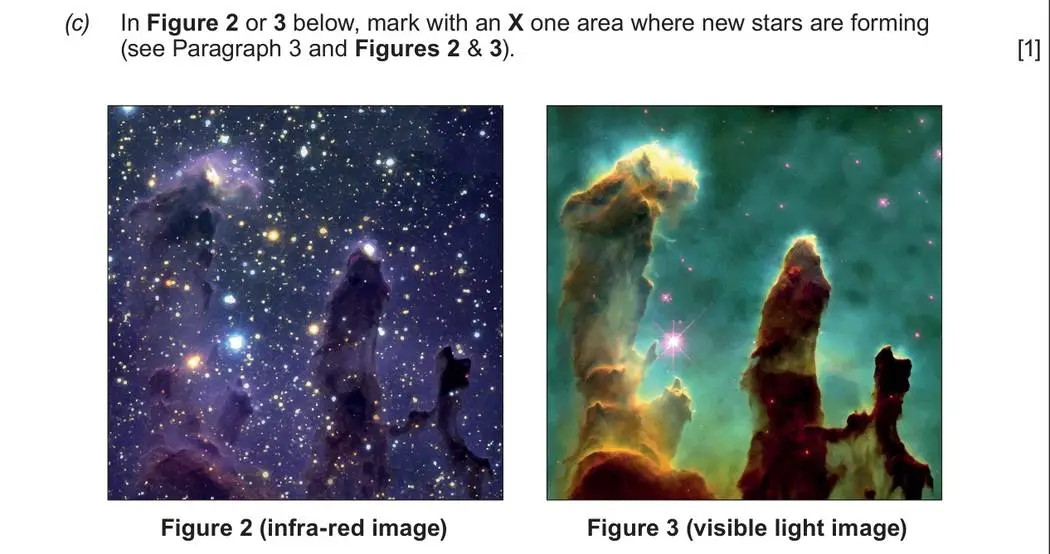
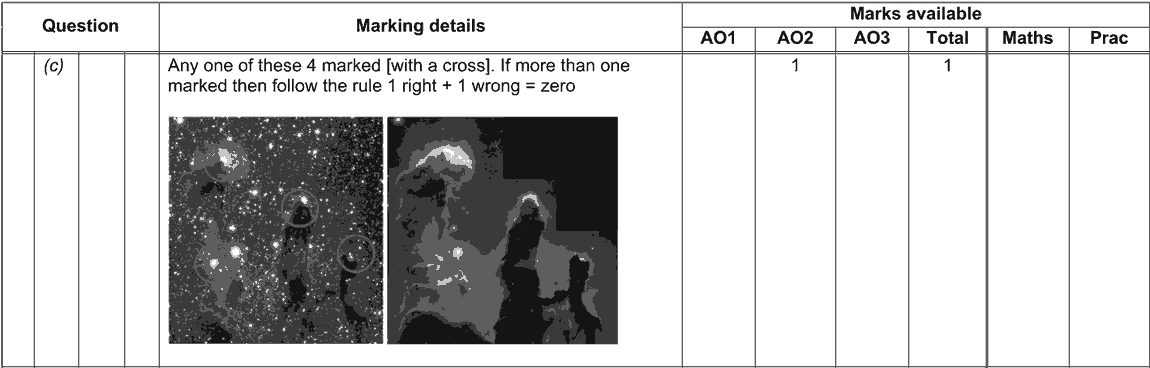
(c) In Figure 2 or 3 below, mark with an X one area where new stars are forming (see Paragraph 3 and Figures 2 & 3). [1] Figure 2 (infra-red image) Figure 3 (visible light image)
June 2019 · Component 1 · Q8(i) 1 mark AO1=1 Short answer comprehension
Earlier parts of question 8 that this part usesEarlier part of June 2019 Component 1 question 8Earlier part of June 2019 Component 1 question 8
(i) Explain briefly what the author means when he states that a white dwarf’s mass and radius are negatively correlated (see Paragraph 9). [1]
June 2019 · Component 2 · Q2(e)(ii) 1 mark AO1=1 Short answer resistance
Earlier parts of question 2 that this part usesEarlier part of June 2019 Component 2 question 2Earlier part of June 2019 Component 2 question 2Earlier part of June 2019 Component 2 question 2Earlier part of June 2019 Component 2 question 2
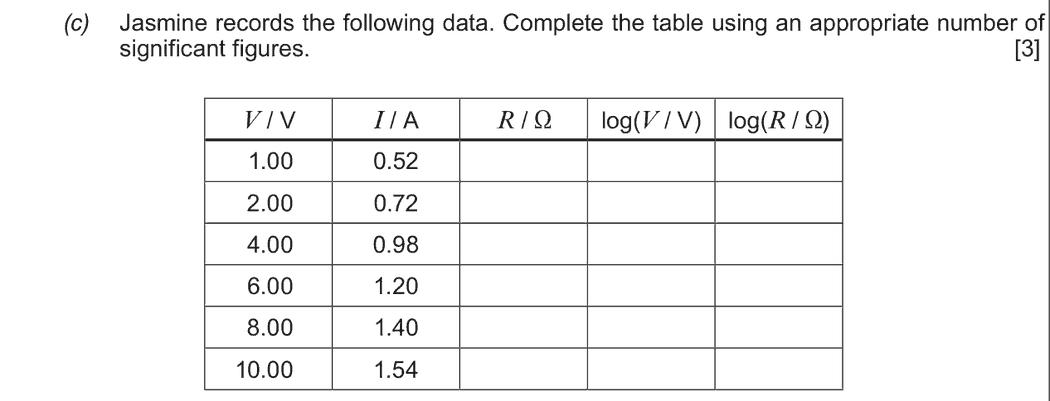
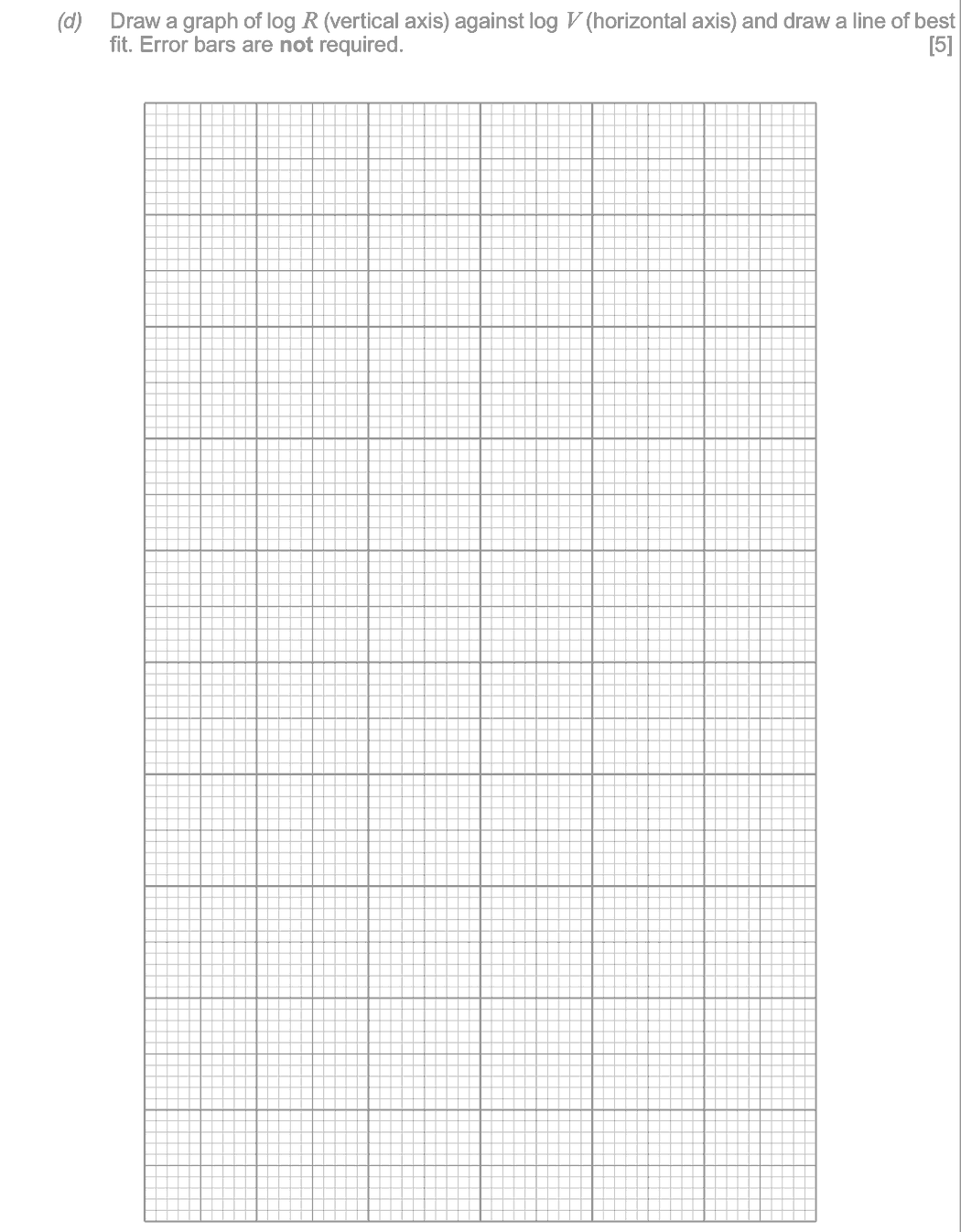
(ii) Hence, write down an equation showing the relationship between R and V for this filament lamp. [1]
June 2019 · Component 2 · Q3(a) 2 marks AO1=2 Short answer capacitance
3. (a) Two parallel plate capacitors, X and Y, have equal plate areas. The capacitance of X is greater than the capacitance of Y. Suggest two possible reasons for the difference. [2]
June 2019 · Component 2 · Q4(b) 3 marks AO3=3 Short answer resistance
Earlier part of question 4 that this part usesEarlier part of June 2019 Component 2 question 4
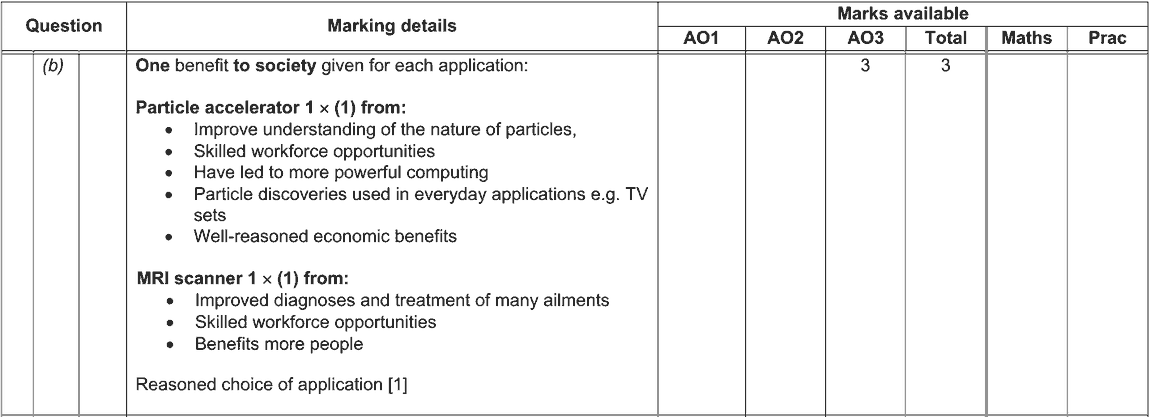
(b) Superconductors are used in MRI scanners and particle accelerators. Consider which of these two applications has been of greater benefit to society. [3]
June 2019 · Component 2 · Q7(c) 1 mark AO3=1 Short answer orbits and the wider universe
Earlier part of question 7 that this part usesEarlier part of June 2019 Component 2 question 7
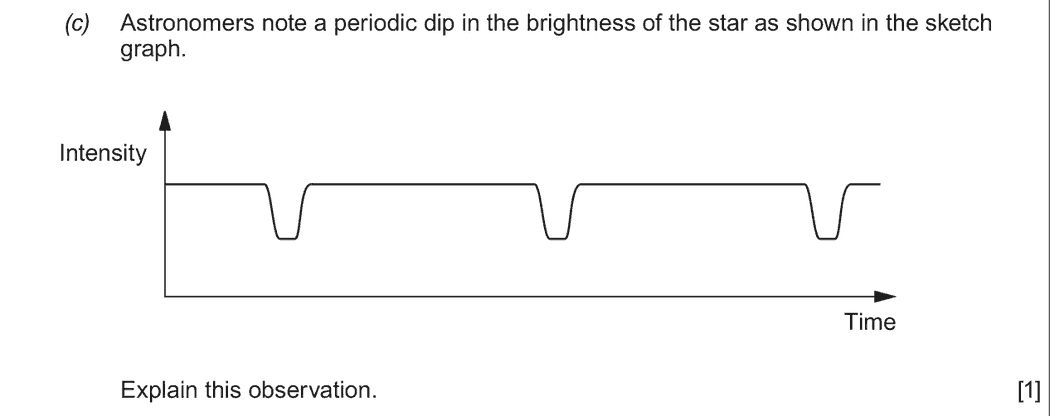
(c) Astronomers note a periodic dip in the brightness of the star as shown in the sketch graph. Intensity Time Explain this observation. [1]
June 2019 · Component 2 · Q8(a) 2 marks AO1=2 Short answer electrostatic and gravitational fields
8. (a) State one similarity and one difference between gravitational and electric fields. [2]
June 2019 · Component 3 · Q1(b)(i) 1 mark AO1=1 Short answer nature of waves
Earlier part of question 1 that this part usesEarlier part of June 2019 Component 3 question 1
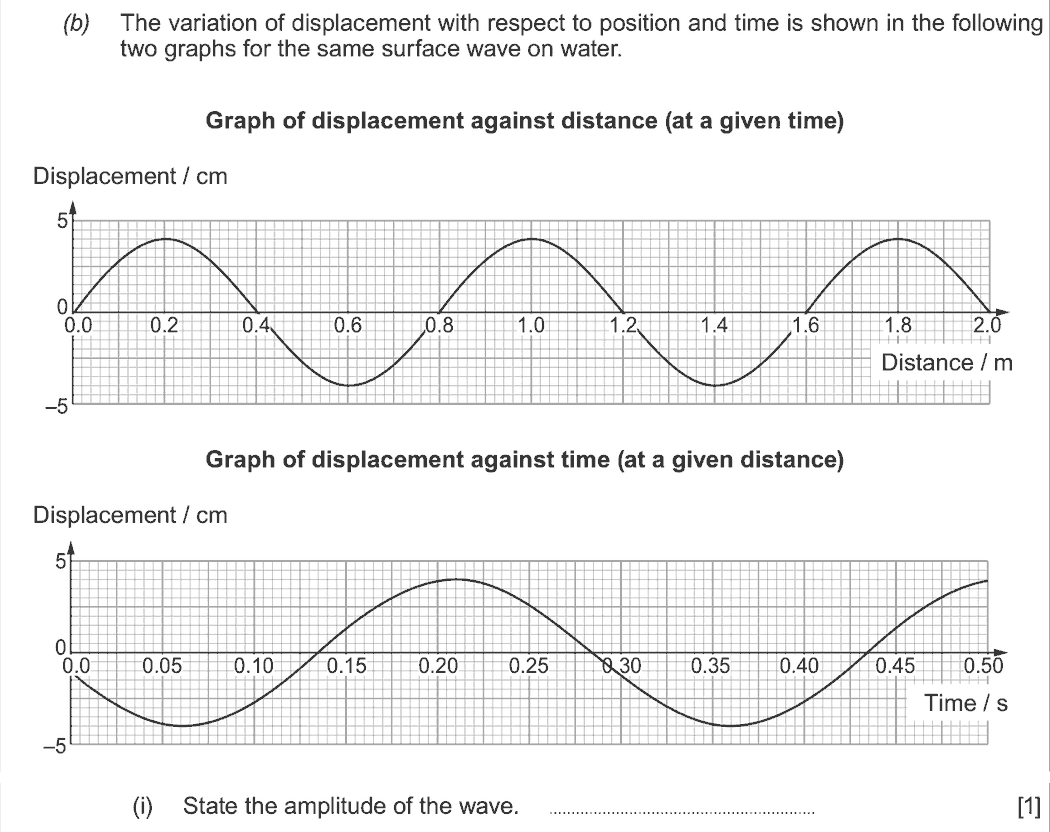
(b) The variation of displacement with respect to position and time is shown in the following two graphs for the same surface wave on water. Graph of displacement against distance (at a given time) Displacement / cm 5 0 0.0 0.2 0.4 0.6 0.8 1.0 1.2 1.4 1.6 1.8 2.0 Distance / m –5 Graph of displacement against time (at a given distance) Displacement / cm 5 0 0.0 0.05 0.10 0.15 0.20 0.25 0.30 0.35 0.40 0.45 0.50 Time / s –5 (i) State the amplitude of the wave. [1]
June 2019 · Component 3 · Q1(b)(ii) 1 mark AO1=1 Short answer nature of waves
Earlier parts of question 1 that this part usesEarlier part of June 2019 Component 3 question 1Earlier part of June 2019 Component 3 question 1
(ii) State the wavelength of the wave. [1]
June 2019 · Component 3 · Q1(c)(ii) 1 mark AO1=1 Short answer nature of waves
Earlier parts of question 1 that this part usesEarlier part of June 2019 Component 3 question 1Earlier part of June 2019 Component 3 question 1Earlier part of June 2019 Component 3 question 1
(ii) State the point(s) oscillating in phase with point P. [1]
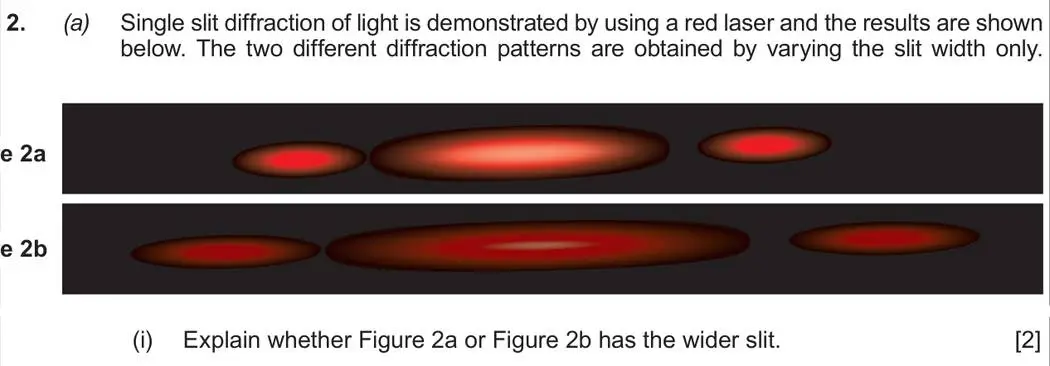
June 2019 · Component 3 · Q2(a)(ii) 1 mark AO1=1 Short answer wave properties
Earlier part of question 2 that this part usesEarlier part of June 2019 Component 3 question 2
(ii) State what can be done to the single slit to obtain the greatest amount of diffraction. [1]
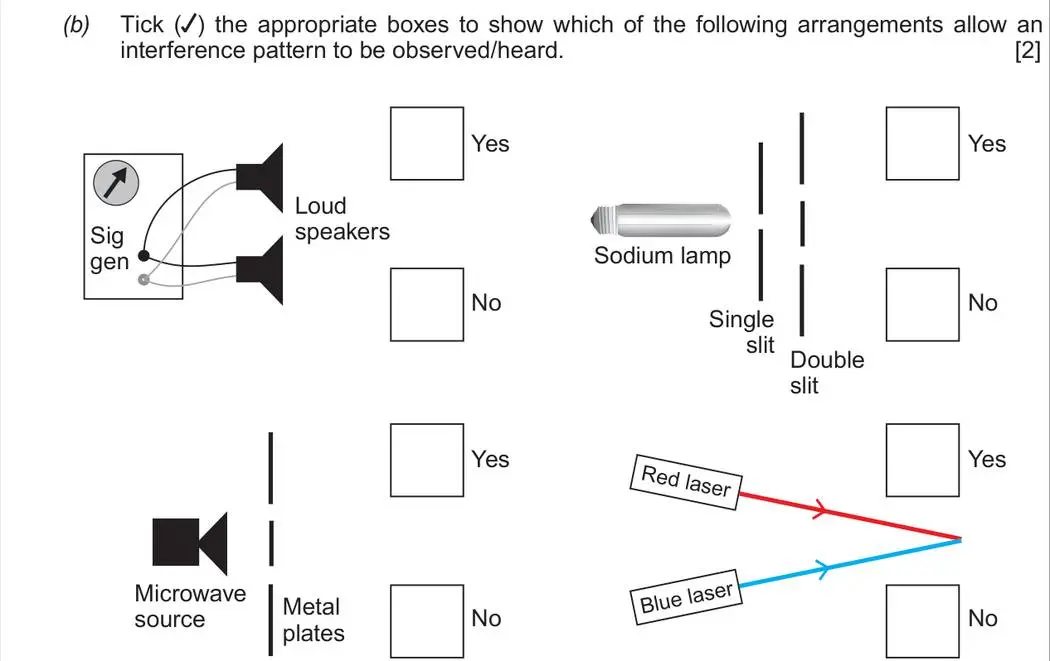
June 2019 · Component 3 · Q2(b) 2 marks AO2=2 Short answer wave properties
Earlier part of question 2 that this part usesEarlier part of June 2019 Component 3 question 2
(b) Tick (√) the appropriate boxes to show which of the following arrangements allow an interference pattern to be observed/heard. [2] Yes Yes Loud Sig speakers gen Sodium lamp No No Single slit Double slit Yes Yes Red laser Microwave laser Metal Blue source No No plates
June 2019 · Component 3 · Q3(a)(ii) 2 marks AO1=2 Short answer lasers
Earlier part of question 3 that this part usesEarlier part of June 2019 Component 3 question 3
(ii) State an advantage of semiconductor lasers and an example of their use. [2]
June 2019 · Component 3 · Q6(b) 2 marks AO3=2 Short answer particles and nuclear structure
Earlier part of question 6 that this part usesEarlier part of June 2019 Component 3 question 6
(b) The anti-∆++ has a lifetime of approximately 6 × 10–24 s and decays into a π meson and another anti-baryon. Deduce the quark make-up of the π meson and the anti-baryon and name them. [2]
June 2019 · Component 3 · Q6(c) 2 marks AO3=2 Short answer particles and nuclear structure
Earlier part of question 6 that this part usesEarlier part of June 2019 Component 3 question 6
(c) State which force is responsible for the decay of the anti-∆++ into a π meson and anti- baryon, giving a reason for your answer. [2]
June 2019 · Component 3 · Q14(c)(iii) 1 mark AO1=1 Short answer energy and the environment
Earlier parts of question 14 that this part usesEarlier part of June 2019 Component 3 question 14Earlier part of June 2019 Component 3 question 14Earlier part of June 2019 Component 3 question 14Earlier part of June 2019 Component 3 question 14
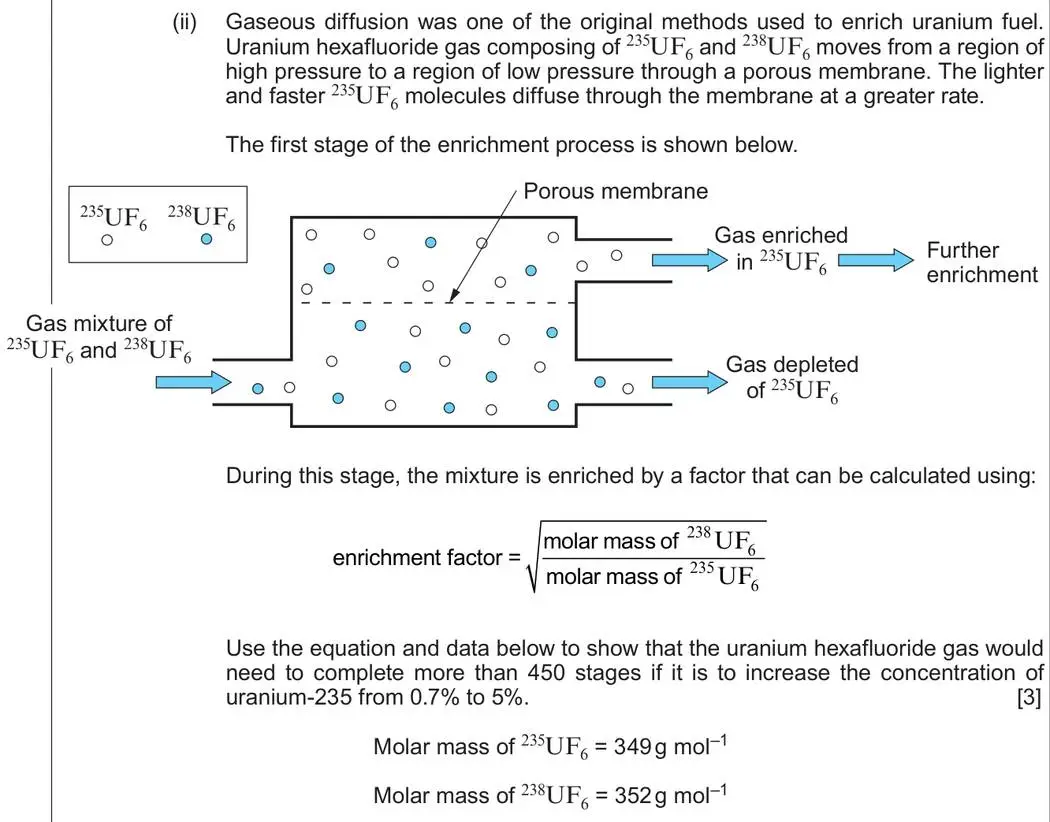
(iii) State an alternative method for the enrichment of uranium. [1]
June 2019 · AS Component 1 · Q1(a)(ii) 3 marks AO1=1, AO2=2 Short answer basic physicssolids under stress
Earlier part of question 1 that this part usesEarlier part of June 2019 Component 1 question 1
(ii) Express the unit of the Young modulus in terms of S.I. base units. [3]
June 2019 · AS Component 1 · Q2(d) 2 marks AO3=2 Short answer dynamics
Earlier parts of question 2 that this part usesEarlier part of June 2019 Component 1 question 2Earlier part of June 2019 Component 1 question 2
(d) Discuss whether you feel it would be appropriate for a Physics teacher to carry out this experiment in school with a group of sixth form students. [2]
June 2019 · AS Component 1 · Q6(a)(ii) 2 marks AO3=2 Short answer dynamics
Earlier part of question 6 that this part usesEarlier part of June 2019 Component 1 question 6
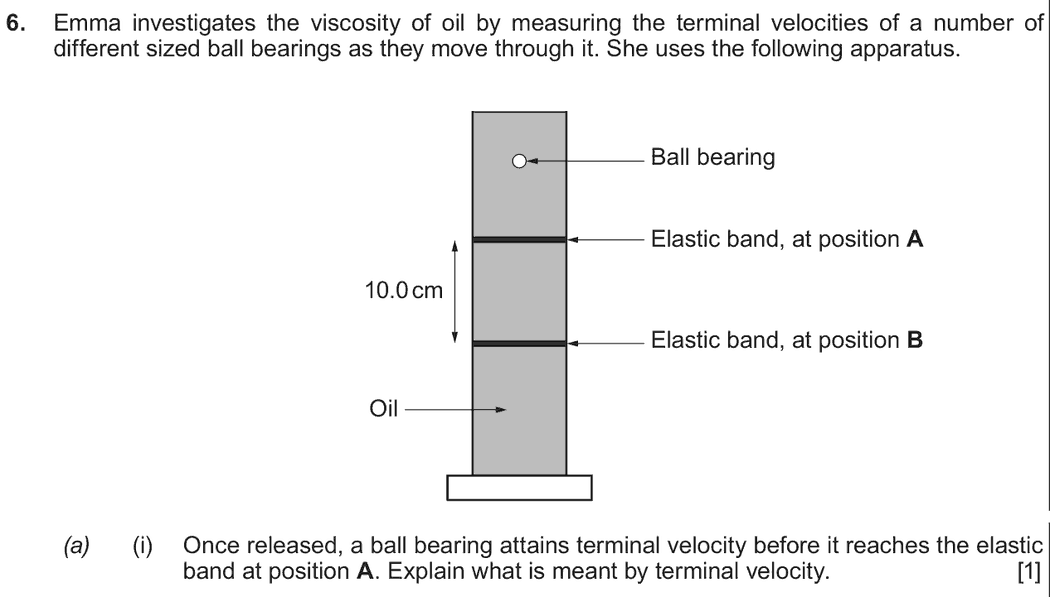
(ii) At terminal velocity the two main forces acting on the ball bearing are its weight and the drag of the oil. According to Newton’s third law, for each of these forces there is a corresponding equal and opposite force. Identify each of these forces and the body upon which it acts. [2]
June 2019 · AS Component 1 · Q7(b)(i) 2 marks AO1=2 Short answer particles and nuclear structure
Earlier part of question 7 that this part usesEarlier part of June 2019 Component 1 question 7
(b) (i) State why it is that electron neutrinos are very difficult to detect. [2]
June 2019 · AS Component 1 · Q7(c) 2 marks AO2=1, AO3=1 Short answer particles and nuclear structure
Earlier part of question 7 that this part usesEarlier part of June 2019 Component 1 question 7
(c) When a positron and an electron meet they annihilate to produce two gamma ray photons. e+ + e– → γ + γ State which force is responsible for this interaction, giving your reasoning. [2]
June 2019 · AS Component 2 · Q2(b) 3 marks AO3=3 Short answer nature of waves
Earlier part of question 2 that this part usesEarlier part of June 2019 Component 2 question 2
(b) The polarisation of light is used in Liquid Crystal Display TVs. These have been developed from research into new organic materials. Discuss the importance of research and development into new materials, in general, by giving a benefit and an issue that may arise from using new materials. [3]
June 2019 · AS Component 2 · Q6(a) 1 mark AO1=1 Short answer photons
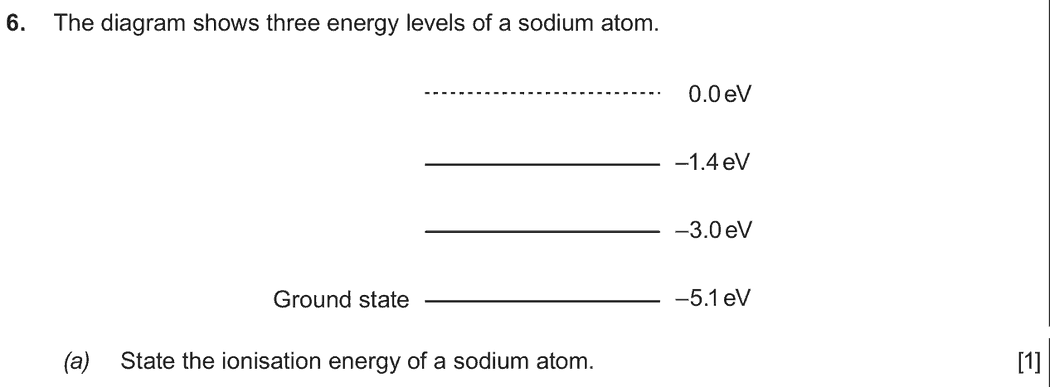
6. The diagram shows three energy levels of a sodium atom. 0.0 eV –1.4 eV –3.0 eV Ground state –5.1 eV (a) State the ionisation energy of a sodium atom. [1]
June 2018 · Component 1 · Q3(b)(iii) 1 mark AO1=1 Short answer Easy kinematics
Earlier parts of question 3 that this part usesEarlier part of June 2018 Component 1 question 3Earlier part of June 2018 Component 1 question 3
(iii) State the magnitude of the force of air resistance on the body when it has reached its terminal velocity. [1]
June 2018 · Component 1 · Q5(a)(ii)IV 1 mark AO2=1 Short answer vibrations
Earlier parts of question 5 that this part usesEarlier part of June 2018 Component 1 question 5Earlier part of June 2018 Component 1 question 5
IV. State the next time at which the sphere has the same velocity. [1]
June 2018 · Component 1 · Q7(a) 2 marks AO1=2 Short answer kinetic theory
7. (a) State two assumptions that must be made about the molecules of an ideal gas in order to derive the kinetic theory equation: [2] p = 1 ρ c2 3
June 2018 · Component 1 · Q7(b)(ii)II 1 mark AO2=1 Short answer kinetic theory
Earlier parts of question 7 that this part usesEarlier part of June 2018 Component 1 question 7Earlier part of June 2018 Component 1 question 7Earlier part of June 2018 Component 1 question 7
II. Explain briefly whether or not your answer to (b) (ii) I. would still apply if some gas escaped from the cylinder while the temperature was being raised. [1]
June 2018 · Component 1 · Q9(h) 2 marks AO2=2 Short answer resistancecomprehension
Earlier part of question 9 that this part usesEarlier part of June 2018 Component 1 question 9
(h) State and explain what charge you would expect a lattice vibration to carry (see paragraph 9). [2]
June 2018 · Component 2 · Q4(b)(i) 1 mark AO1=1 Short answer orbits and the wider universe
Earlier part of question 4 that this part usesEarlier part of June 2018 Component 2 question 4
(b) Astronomers analysing the wavelengths of the dark lines from the line spectrum of a distant galaxy note that they are increased by 16 % compared with their normal wavelengths. (i) State why there is an increase in wavelength. [1]
June 2018 · Component 2 · Q6(b)(i) 3 marks AO1=3 Short answer capacitance
Earlier part of question 6 that this part usesEarlier part of June 2018 Component 2 question 6
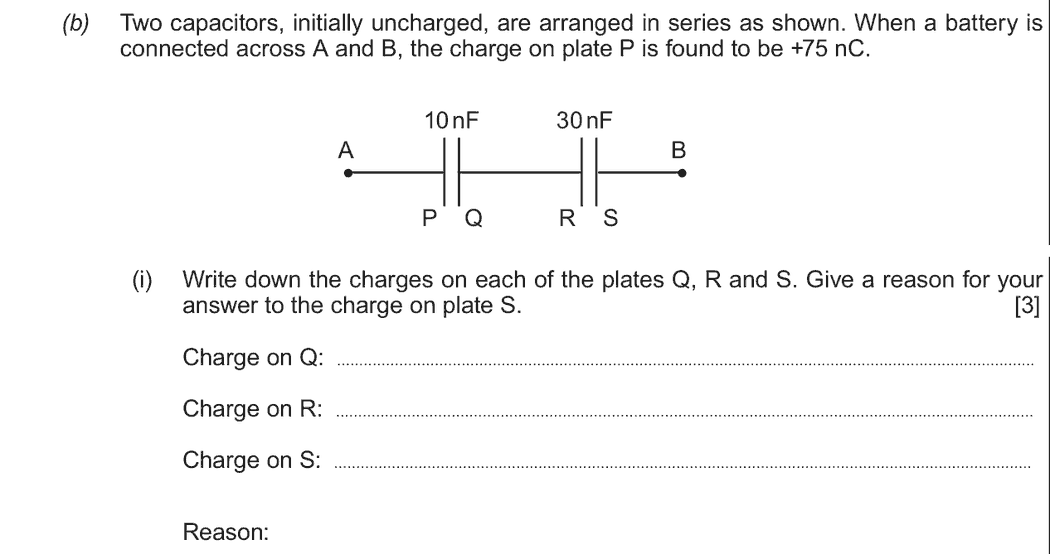
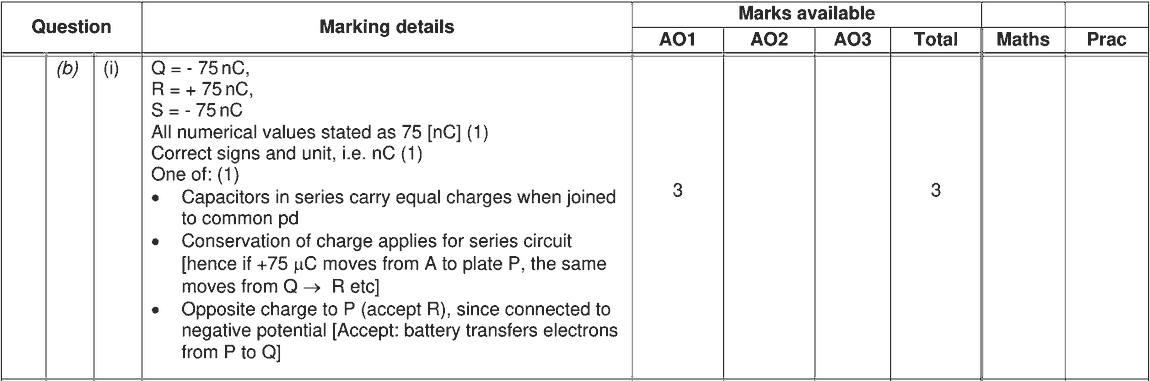
(b) Two capacitors, initially uncharged, are arranged in series as shown. When a battery is connected across A and B, the charge on plate P is found to be +75 nC. 10 nF 30 nF A B P Q R S (i) Write down the charges on each of the plates Q, R and S. Give a reason for your answer to the charge on plate S. [3] Charge on Q: Charge on R: Charge on S: Reason:
June 2018 · Component 2 · Q8(c) 2 marks AO3=2 Short answer radiation and stars
Earlier part of question 8 that this part usesEarlier part of June 2018 Component 2 question 8
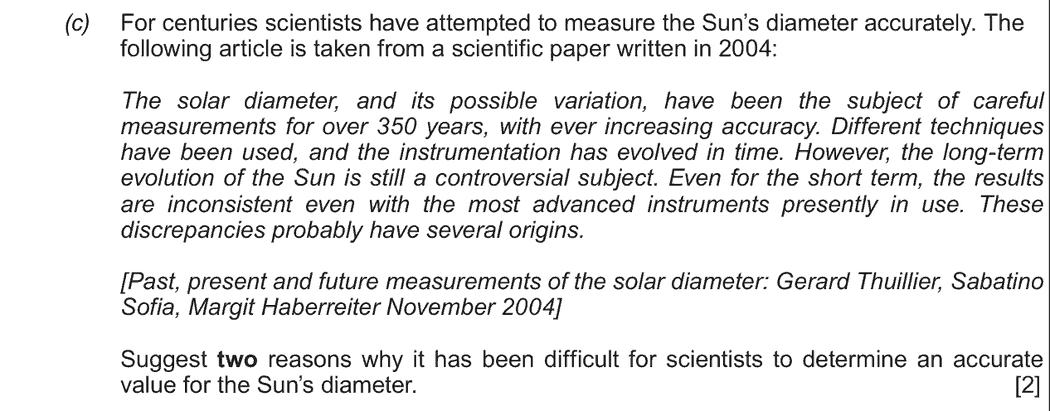
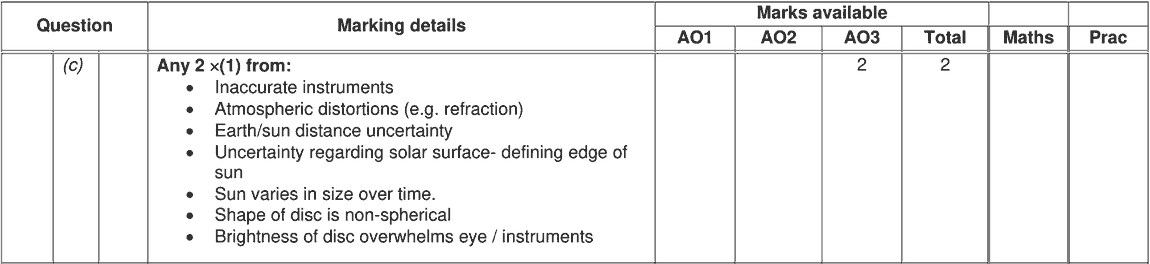
(c) For centuries scientists have attempted to measure the Sun’s diameter accurately. The following article is taken from a scientific paper written in 2004: The solar diameter, and its possible variation, have been the subject of careful measurements for over 350 years, with ever increasing accuracy. Different techniques have been used, and the instrumentation has evolved in time. However, the long-term evolution of the Sun is still a controversial subject. Even for the short term, the results are inconsistent even with the most advanced instruments presently in use. These discrepancies probably have several origins. [Past, present and future measurements of the solar diameter: Gerard Thuillier, Sabatino Sofia, Margit Haberreiter November 2004] Suggest two reasons why it has been difficult for scientists to determine an accurate value for the Sun’s diameter. [2]
June 2018 · Component 3 · Q5(e) 3 marks AO3=3 Short answer
Earlier parts of question 5 that this part usesEarlier part of June 2018 Component 3 question 5Earlier part of June 2018 Component 3 question 5
(e) A car company is fined £15 billion for excessive NO2 emissions of its diesel engines. However, there is little or no reliable evidence that NO2 produces any detrimental health effects at the concentration levels present in the atmosphere. Discuss whether or not the car company or pedestrians have been treated unfairly. [3]
June 2018 · Component 3 · Q6(a) 2 marks AO2=2 Short answer nuclear decay
6. (a) A radioactive isotope of thorium decays to a stable lead nucleus ( 208 Pb) via 6 alpha 82 decays and 4 beta decays. Complete the equation below. [2] 208 Th Pb + 6 He + 4 e– 82
June 2018 · Component 3 · Q12(d)(i) 1 mark AO1=1 Short answer medical physics
Earlier part of question 12 that this part usesEarlier part of June 2018 Component 3 question 12
(d) (i) Radioactive tracers can be used to measure the volume of blood in a patient. Describe one other use of radioactive tracers naming the part of the body they are diagnosing. [1]
June 2018 · Component 3 · Q13(a) 1 mark AO1=1 Short answer physics of sports
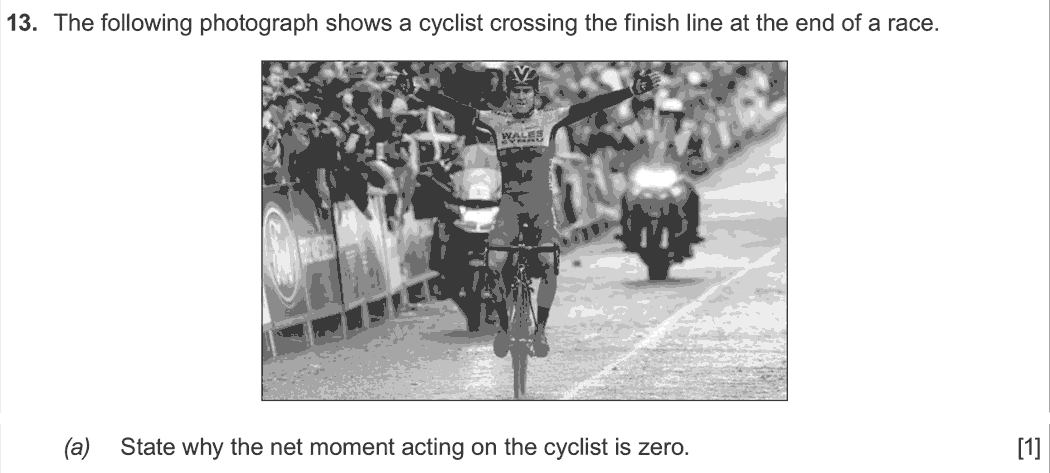
13. The following photograph shows a cyclist crossing the finish line at the end of a race. (a) State why the net moment acting on the cyclist is zero. [1]
June 2018 · Component 3 · Q14(b)(iv) 1 mark AO3=1 Short answer energy and the environment
Earlier parts of question 14 that this part usesEarlier part of June 2018 Component 3 question 14Earlier part of June 2018 Component 3 question 14
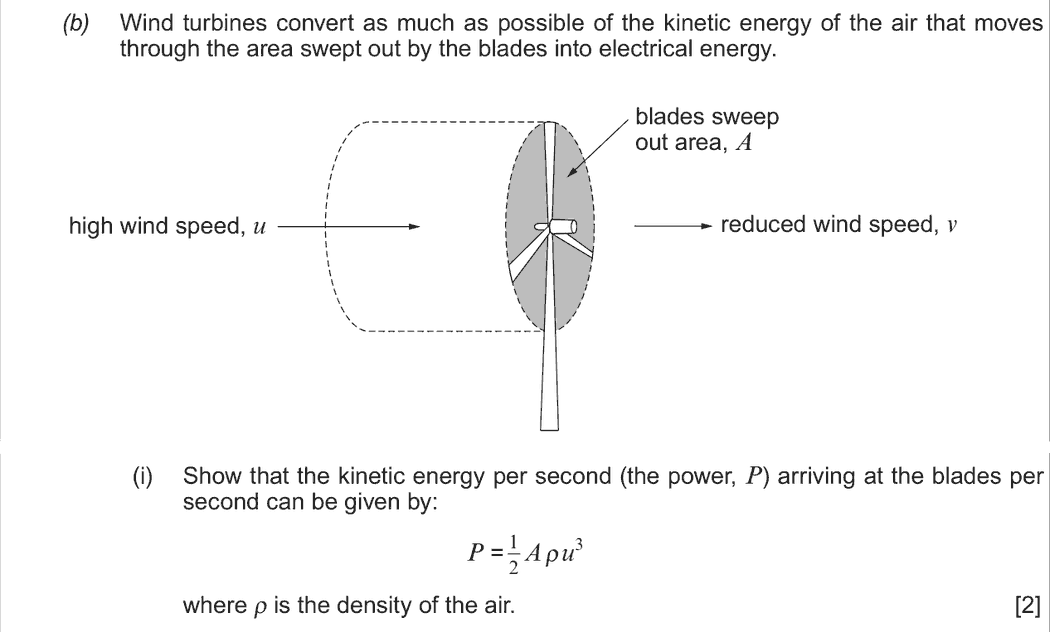
(iv) Explain why the actual efficiency of the turbine is less than your answer to (b)(iii). [1]
June 2018 · AS Component 1 · Q3(c)(iii) 2 marks AO1=2 Short answer energy concepts
Earlier parts of question 3 that this part usesEarlier part of June 2018 Component 1 question 3Earlier part of June 2018 Component 1 question 3
(iii) In practice resistive forces will act. Identify these forces and where they act. [2]
June 2018 · AS Component 1 · Q4(b)(ii) 1 mark AO3=1 Short answer radiation and stars
Earlier parts of question 4 that this part usesEarlier part of June 2018 Component 1 question 4Earlier part of June 2018 Component 1 question 4
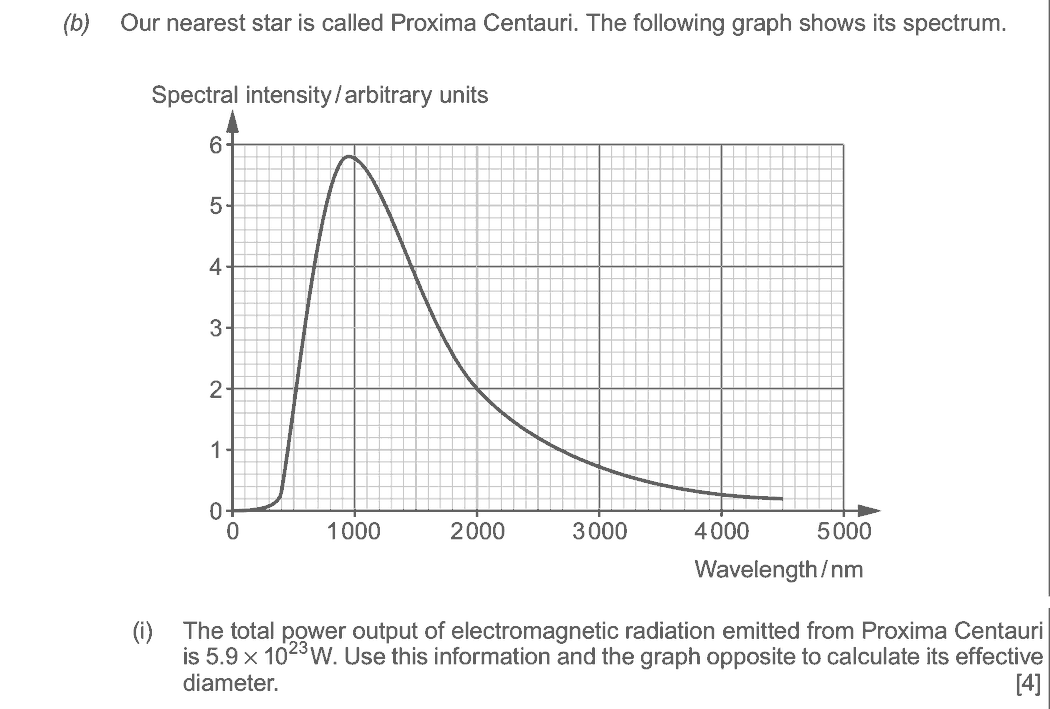
(ii) State what colour you would expect Proxima Centauri to appear and name the region of the electromagnetic spectrum in which most of the star’s power is radiated. [1]
June 2018 · AS Component 1 · Q5(b)(ii) 1 mark AO2=1 Short answer particles and nuclear structure
Earlier parts of question 5 that this part usesEarlier part of June 2018 Component 1 question 5Earlier part of June 2018 Component 1 question 5
(ii) Describe the change in quark flavour during electron capture. [1]
June 2018 · AS Component 1 · Q5(b)(iii) 1 mark AO1=1 Short answer particles and nuclear structure
Earlier parts of question 5 that this part usesEarlier part of June 2018 Component 1 question 5Earlier part of June 2018 Component 1 question 5
(iii) State and explain which interaction is responsible for this decay. [1]
June 2018 · AS Component 1 · Q6(b)(iii) 2 marks AO1=2 Short answer basic physics
Earlier parts of question 6 that this part usesEarlier part of June 2018 Component 1 question 6Earlier part of June 2018 Component 1 question 6
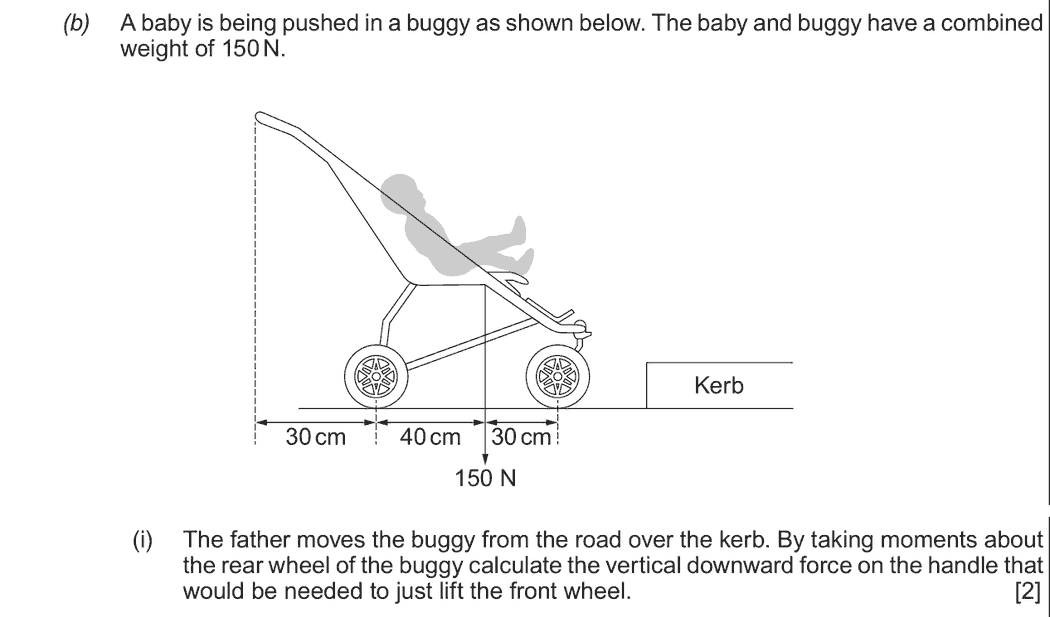
(iii) Describe two ways in which you could alter the design of the buggy in order to make it more stable. [2]
June 2018 · AS Component 1 · Q7(a) 2 marks AO1=2 Short answer kinematics
7. (a) Ignoring the effects of air resistance, describe how, if at all, the vertical and horizontal components of a projectile’s velocity change during flight on Earth. [2]
June 2018 · AS Component 2 · Q1(b)(i) 2 marks AO2=2 Short answer nature of waves
Earlier part of question 1 that this part usesEarlier part of June 2018 Component 2 question 1
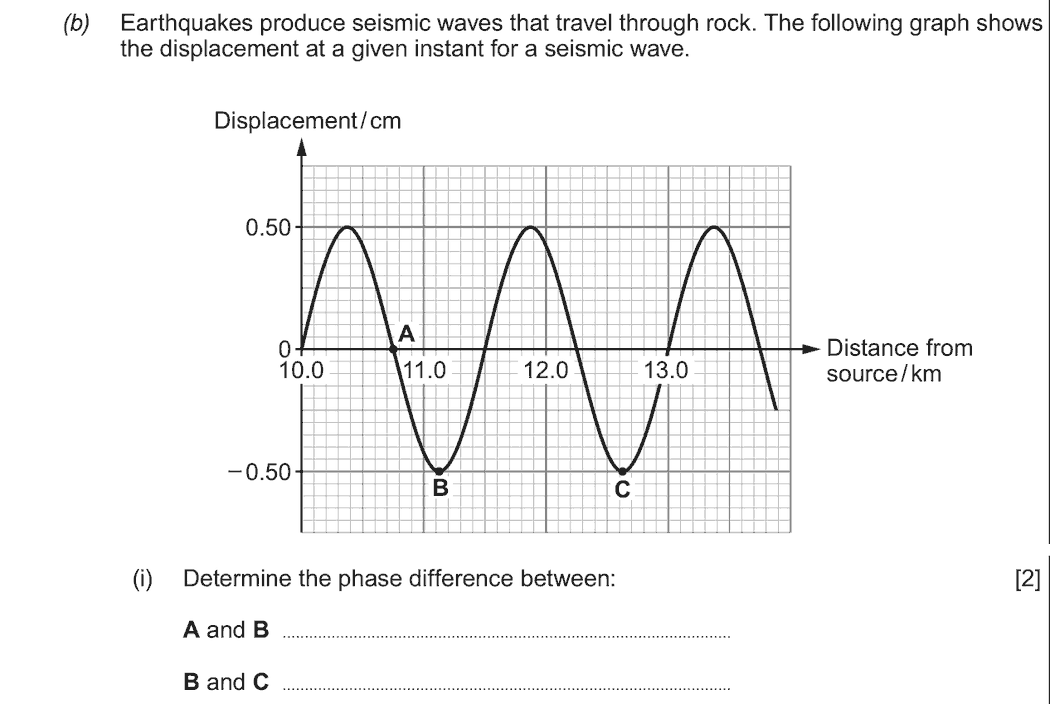
(b) Earthquakes produce seismic waves that travel through rock. The following graph shows the displacement at a given instant for a seismic wave. Displacement / cm 0.50 A 0 Distance from 10.0 11.0 12.0 13.0 source / km – 0.50 B C (i) Determine the phase difference between: [2] A and B B and C
June 2018 · AS Component 2 · Q1(d) 2 marks AO3=2 Short answer nature of waves
Earlier parts of question 1 that this part usesEarlier part of June 2018 Component 2 question 1Earlier part of June 2018 Component 2 question 1
(d) Explain how data obtained by geologists about earthquakes from various monitoring stations can benefit society. [2]
June 2018 · AS Component 2 · Q6(c)(i) 1 mark AO1=1 Short answer refraction of light
Earlier part of question 6 that this part usesEarlier part of June 2018 Component 2 question 6
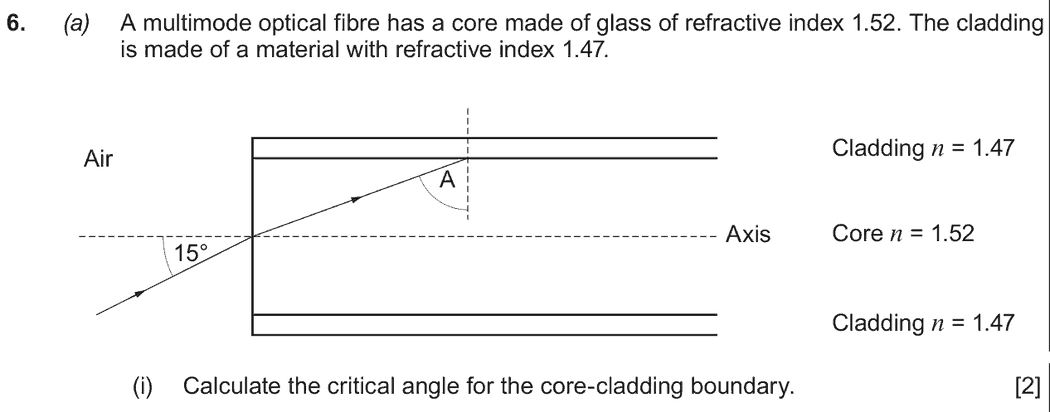
(c) (i) State how the paths of light in monomode and multimode optical fibres differ. [1]
June 2017 · Component 1 · Q4(a) 2 marks AO1=2 Short answer vibrations
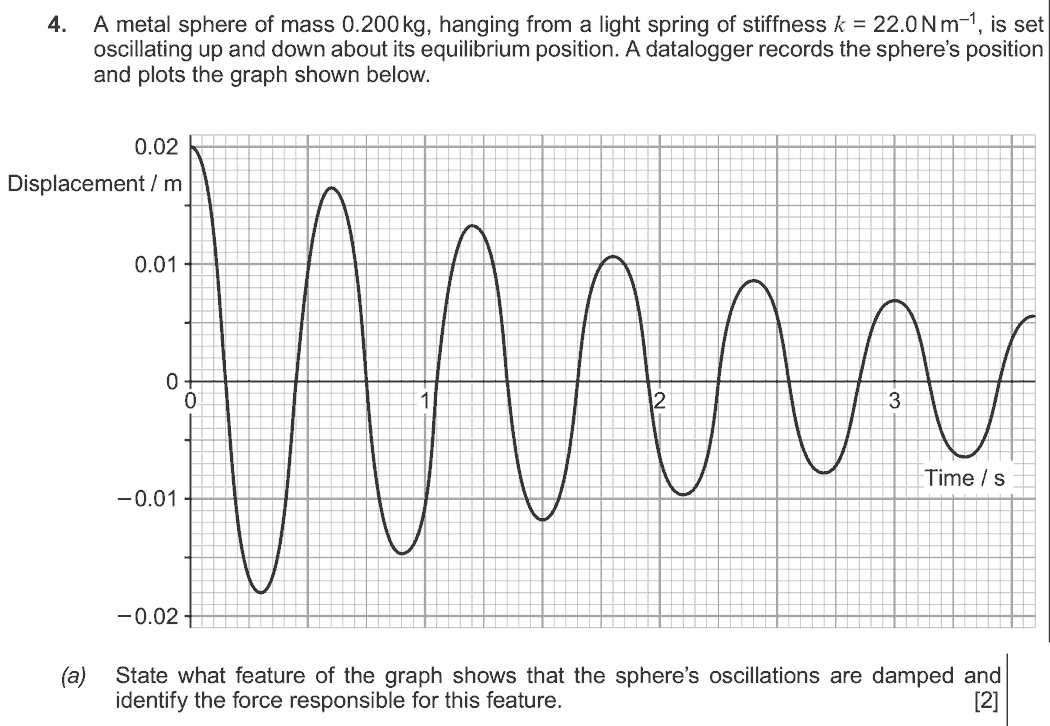
4. A metal sphere of mass 0.200 kg, hanging from a light spring of stiffness k = 22.0 N m–1, is set oscillating up and down about its equilibrium position. A datalogger records the sphere’s position and plots the graph shown below. 0.02 Displacement / m 0.01 0 0 21 2 3 Time / s _ 0.01 _ 0.02 (a) State what feature of the graph shows that the sphere’s oscillations are damped and identify the force responsible for this feature. [2]
June 2017 · Component 2 · Q2(a)(ii) 2 marks AO2=2 Short answer resistancedc circuits
Earlier part of question 2 that this part usesEarlier part of June 2017 Component 2 question 2
(ii) Draw a circle around the resistor which dissipates the greatest power when a pd is applied across the arrangement. Explain your answer. [2]
June 2017 · Component 2 · Q2(c)(ii) 3 marks AO1=2, AO2=1 Short answer conduction of electricitydc circuits
Earlier parts of question 2 that this part usesEarlier part of June 2017 Component 2 question 2Earlier part of June 2017 Component 2 question 2Earlier part of June 2017 Component 2 question 2
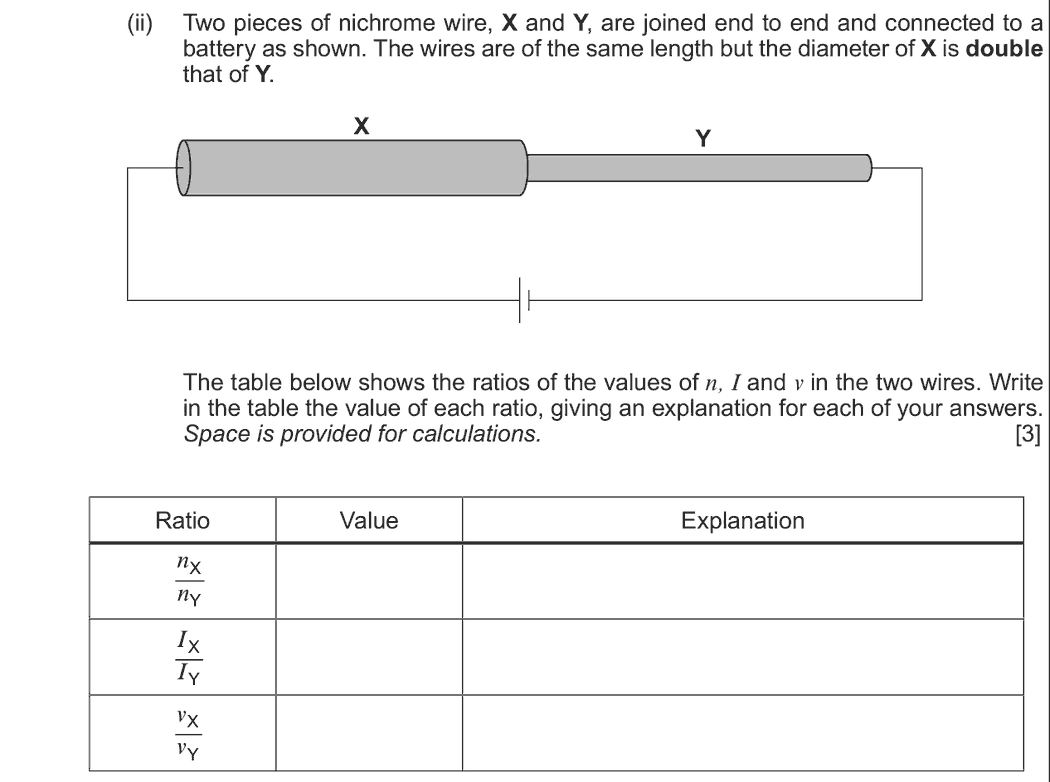
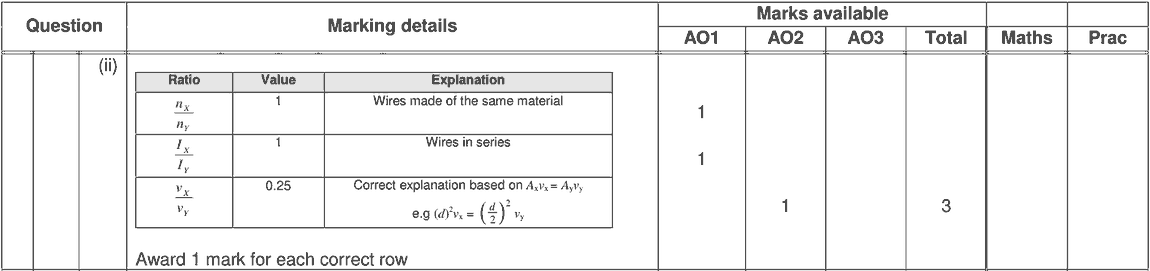
(ii) Two pieces of nichrome wire, X and Y, are joined end to end and connected to a battery as shown. The wires are of the same length but the diameter of X is double that of Y. X Y The table below shows the ratios of the values of n, I and v in the two wires. Write in the table the value of each ratio, giving an explanation for each of your answers. Space is provided for calculations. [3] Ratio Value Explanation n X n Y I X I Y v X v Y
June 2017 · Component 2 · Q7(a)(ii)I 2 marks AO1=2 Short answer electrostatic and gravitational fields
Earlier part of question 7 that this part usesEarlier part of June 2017 Component 2 question 7
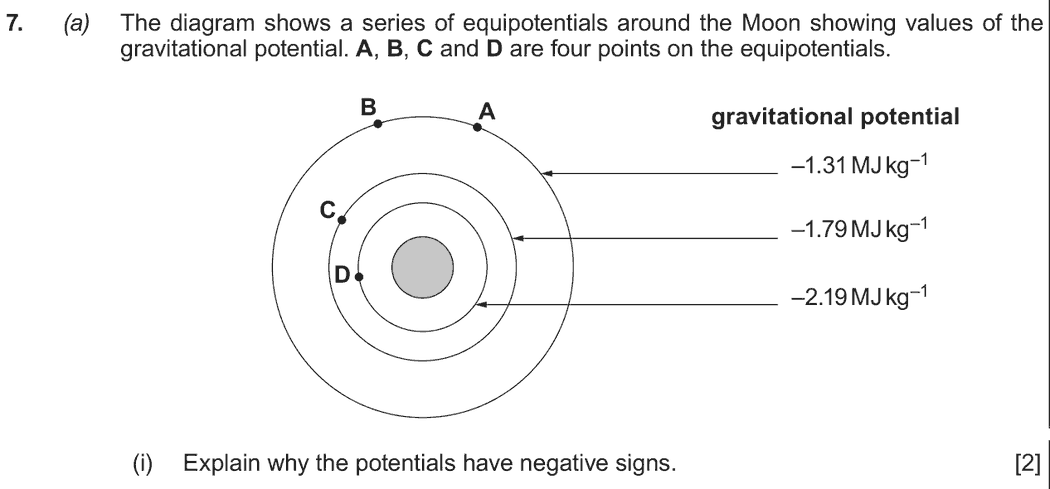
(ii) A spacecraft of mass 300 kg orbits the Moon. Determine, showing your reasoning, the changes in the gravitational potential energy of the spacecraft when it moves from: I. A to B; [2]
June 2017 · Component 2 · Q7(b) 2 marks AO3=2 Short answer electrostatic and gravitational fields
Earlier part of question 7 that this part usesEarlier part of June 2017 Component 2 question 7
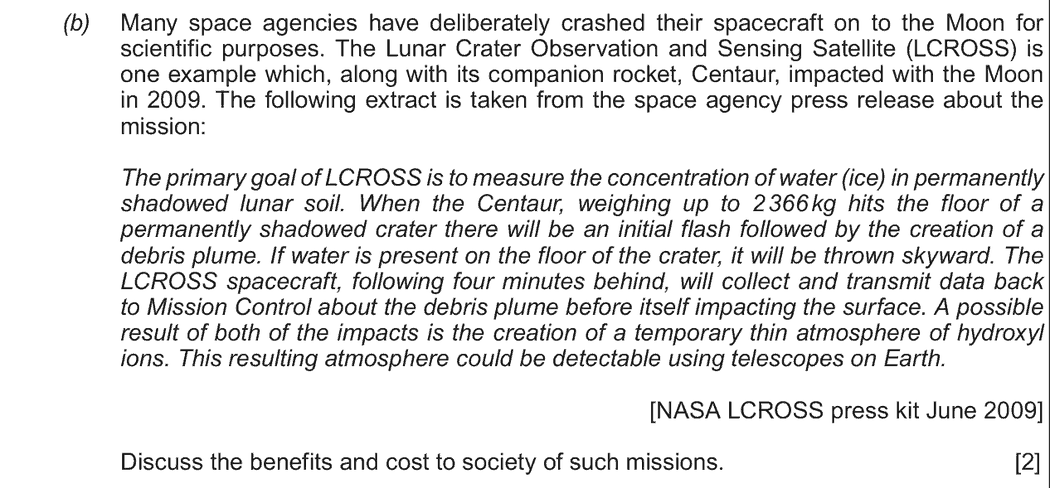
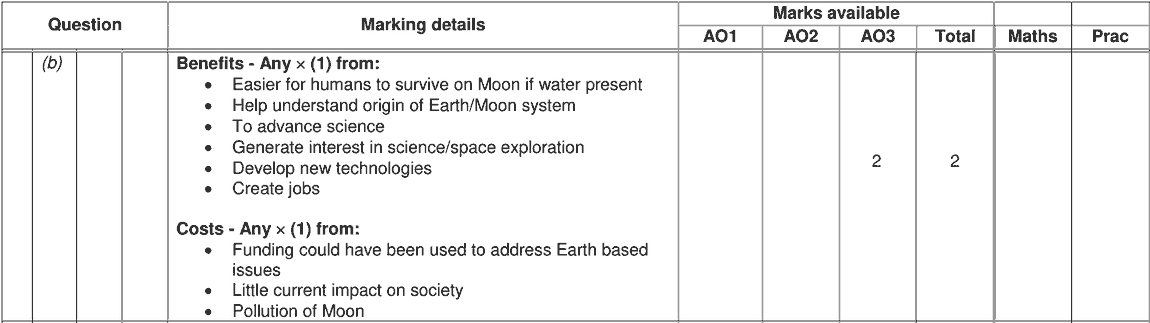
(b) Many space agencies have deliberately crashed their spacecraft on to the Moon for scientific purposes. The Lunar Crater Observation and Sensing Satellite (LCROSS) is one example which, along with its companion rocket, Centaur, impacted with the Moon in 2009. The following extract is taken from the space agency press release about the mission: The primary goal of LCROSS is to measure the concentration of water (ice) in permanently shadowed lunar soil. When the Centaur, weighing up to 2 366 kg hits the floor of a permanently shadowed crater there will be an initial flash followed by the creation of a debris plume. If water is present on the floor of the crater, it will be thrown skyward. The LCROSS spacecraft, following four minutes behind, will collect and transmit data back to Mission Control about the debris plume before itself impacting the surface. A possible result of both of the impacts is the creation of a temporary thin atmosphere of hydroxyl ions. This resulting atmosphere could be detectable using telescopes on Earth. [NASA LCROSS press kit June 2009] Discuss the benefits and cost to society of such missions. [2]
June 2017 · Component 3 · Q1(a) 2 marks AO1=2 Short answer lasers
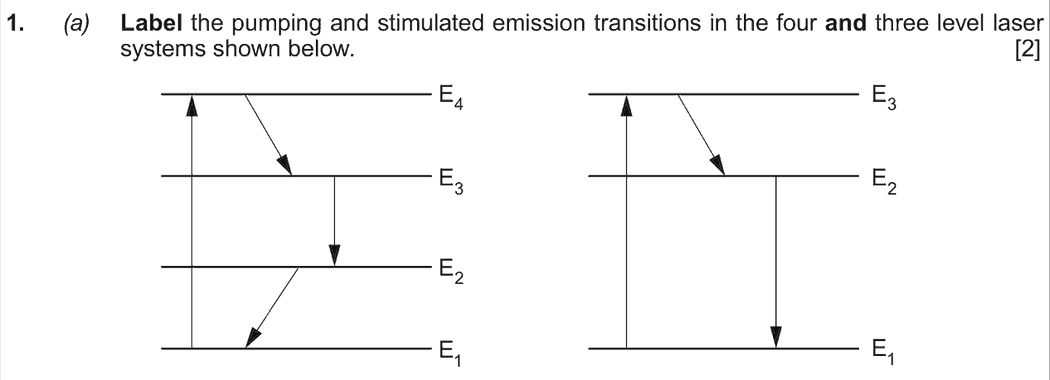
1. (a) Label the pumping and stimulated emission transitions in the four and three level laser systems shown below. [2] E4 E3 E3 E2 E2 E1 E1
June 2017 · Component 3 · Q2(a)(i) 3 marks AO2=3 Short answer particles and nuclear structure
2. (a) A carbon-14 nucleus decays as shown: 14 C 14 N + e– + ve 6 7 (i) Show how charge, baryon number and lepton number are conserved in this decay. [3]
June 2017 · Component 3 · Q2(a)(ii) 2 marks AO2=2 Short answer particles and nuclear structure
Earlier part of question 2 that this part usesEarlier part of June 2017 Component 3 question 2
(ii) Give two reasons why this must be a weak nuclear force interaction. [2]
June 2017 · Component 3 · Q2(c) 3 marks AO2=1, AO3=2 Short answer nuclear decayparticles and nuclear structure
Earlier part of question 2 that this part usesEarlier part of June 2017 Component 3 question 2
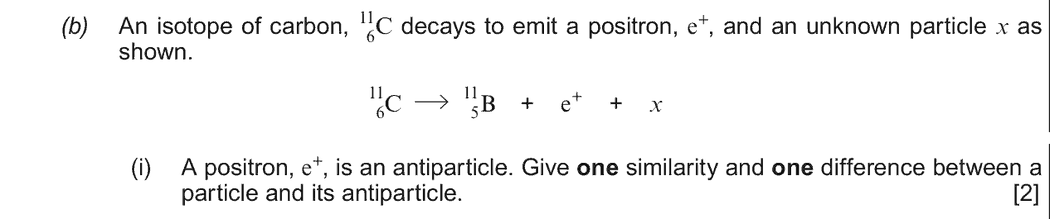
(c) Carbon-11 (11 C) is proton rich and undergoes positron decay to a stable isotope of boron 6 (B). Complete the following decay equation for carbon-11. Space is provided should you require analysis of lepton number, baryon number and charge. [3] 11 C 6
June 2017 · Component 3 · Q11(a) 2 marks AO1=2 Short answer medical physics
11. (a) Describe briefly how X-rays are produced in an X-ray tube. [2]
June 2017 · Component 3 · Q13(a)(ii)I 3 marks Short answer energy and the environment
Earlier part of question 13 that this part usesEarlier part of June 2017 Component 3 question 13
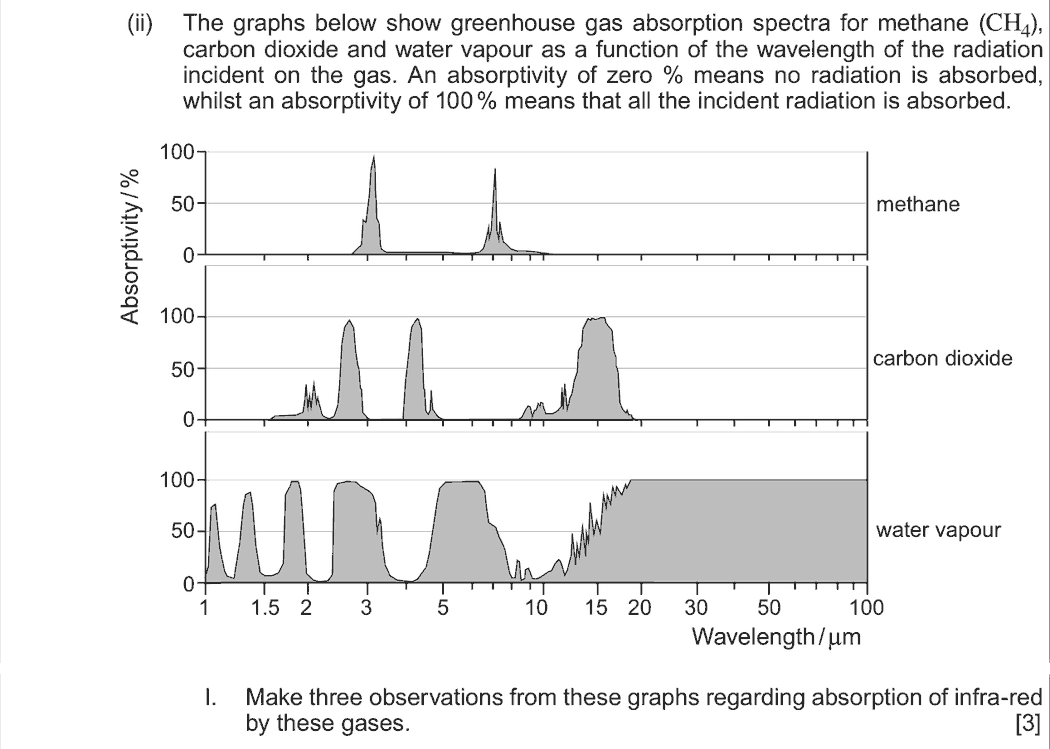
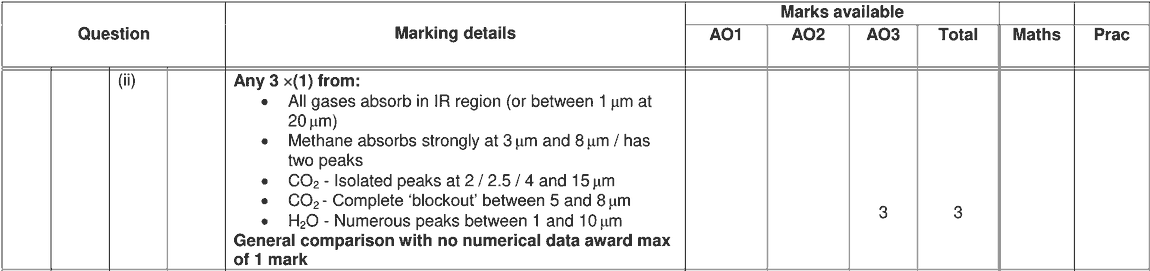
(ii) The graphs below show greenhouse gas absorption spectra for methane (CH4), carbon dioxide and water vapour as a function of the wavelength of the radiation incident on the gas. An absorptivity of zero % means no radiation is absorbed, whilst an absorptivity of 100 % means that all the incident radiation is absorbed. 100 Absorptivity / % 50 methane 0 100 carbon dioxide 50 0 100 50 water vapour 0 1 1.5 2 3 5 10 15 20 30 50 100 Wavelength / μm I. Make three observations from these graphs regarding absorption of infra-red by these gases. [3]
June 2017 · Component 3 · Q13(a)(ii)II 2 marks Short answer energy and the environment
Earlier parts of question 13 that this part usesEarlier part of June 2017 Component 3 question 13Earlier part of June 2017 Component 3 question 13
II. Studies show that the concentration levels of these gases in the atmosphere continue to increase. Choose two of these gases and give one reason as to why the concentration level is increasing for each of your choices. [2]
June 2017 · Component 3 · Q13(b)(iii) 1 mark AO1=1 Short answer energy and the environment
Earlier parts of question 13 that this part usesEarlier part of June 2017 Component 3 question 13Earlier part of June 2017 Component 3 question 13Earlier part of June 2017 Component 3 question 13
(iii) Without considering energy losses, give one reason why this power station would not be able to produce significantly more than 240 GWh of energy per year. [1]
June 2017 · AS Component 1 · Q1(a) 3 marks AO1=3 Short answer solids under stress
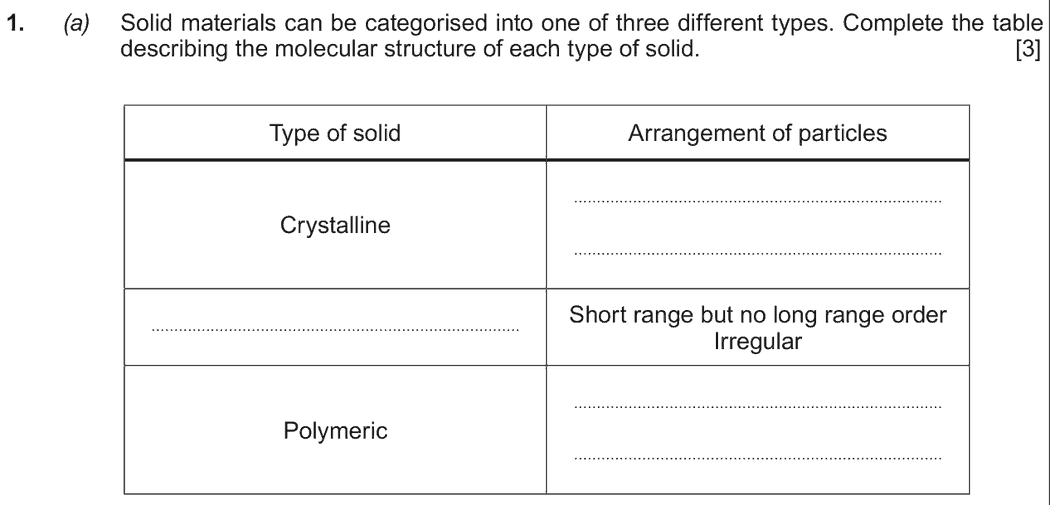
1. (a) Solid materials can be categorised into one of three different types. Complete the table describing the molecular structure of each type of solid. [3] Type of solid Arrangement of particles Crystalline Short range but no long range order Irregular Polymeric
June 2017 · AS Component 1 · Q2(a)(ii) 2 marks AO2=2 Short answer kinematicsbasic physics
Earlier part of question 2 that this part usesEarlier part of June 2017 Component 1 question 2
(ii) Give an example of a situation where an object has: [2] I. a changing velocity but a constant speed; II. acceleration in the opposite direction to velocity.
June 2017 · AS Component 1 · Q2(b)(iii) 1 mark AO2=1 Short answer kinematics
Earlier parts of question 2 that this part usesEarlier part of June 2017 Component 1 question 2Earlier part of June 2017 Component 1 question 2
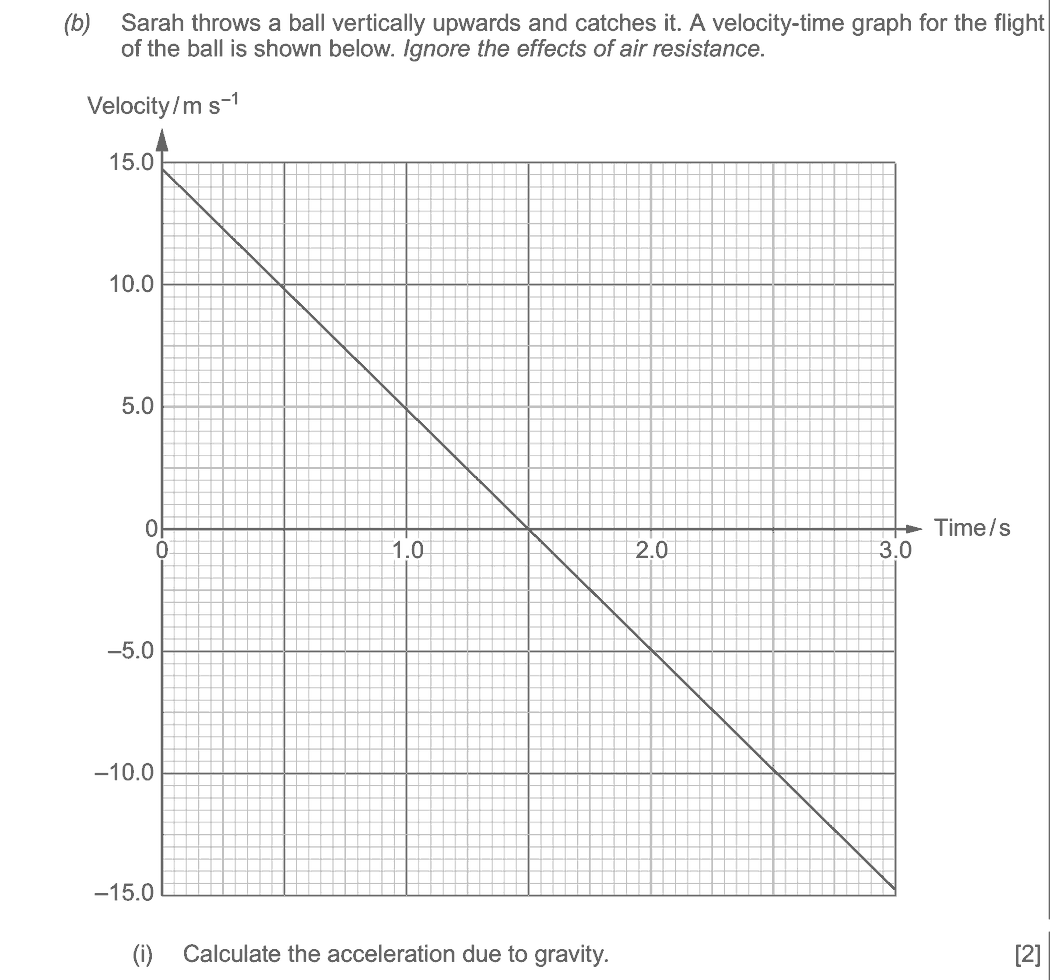
(iii) State the displacement of the ball from Sarah’s hand after 3 seconds. [1]
June 2017 · AS Component 1 · Q3(b) 2 marks AO1=2 Short answer particles and nuclear structure
Earlier part of question 3 that this part usesEarlier part of June 2017 Component 1 question 3
(b) State which force is responsible for this interaction. Give your reasoning. [2]
June 2017 · AS Component 1 · Q3(c) 2 marks AO1=2 Short answer particles and nuclear structure
Earlier part of question 3 that this part usesEarlier part of June 2017 Component 1 question 3
(c) State which of the above particles can be classed as: [2] (i) a baryon; (ii) an antiparticle.
June 2017 · AS Component 2 · Q1(b) 1 mark AO1=1 Short answer nature of waves
Earlier part of question 1 that this part usesEarlier part of June 2017 Component 2 question 1
(b) Determine the amplitude of the signal shown. [1]
June 2017 · AS Component 2 · Q5(d)(ii) 2 marks AO1=1, AO3=1 Short answer photonswave properties
Earlier parts of question 5 that this part usesEarlier part of June 2017 Component 2 question 5Earlier part of June 2017 Component 2 question 5
(ii) The thin sheet of aluminium is replaced with a foil of copper. The distance between the copper atoms is smaller than in aluminium. Describe how you expect the pattern to change. [2]
June 2017 · AS Component 2 · Q6(b) 2 marks AO3=2 Short answer photons
Earlier part of question 6 that this part usesEarlier part of June 2017 Component 2 question 6
(b) A university research group uses a new experimental method to determine a value for the Planck constant that is higher than the accepted value of 6.63 × 10⁻³⁴J s. Explain how other scientists would attempt to confirm this result. [2]
June 2016 · AS Component 1 · Q1(a) 2 marks AO1=2 Short answer basic physics
1. (a) State the conditions necessary for a body to remain in equilibrium. [2]
June 2016 · AS Component 1 · Q1(b)(iii) 1 mark AO3=1 Short answer basic physics
Earlier parts of question 1 that this part usesEarlier part of June 2016 Component 1 question 1Earlier part of June 2016 Component 1 question 1
(iii) If the man near end A moves a small distance towards end B what will happen to the size of the force exerted by each man? [1]
June 2016 · AS Component 1 · Q1(b)(iv) 1 mark AO3=1 Short answer basic physics
Earlier parts of question 1 that this part usesEarlier part of June 2016 Component 1 question 1Earlier part of June 2016 Component 1 question 1
(iv) Where would the man near end A have to support the plank to exert the same force as the man near end B? [1]
June 2016 · AS Component 1 · Q2(a) 2 marks AO1=2 Short answer basic physics
2. (a) State the difference between vector and scalar quantities, giving one example of each. [2]
June 2016 · AS Component 1 · Q5(a)(i) 2 marks AO1=2 Short answer particles and nuclear structure
5. (a) Most subatomic particles can be divided up into two groups – hadrons and leptons. (i) State one difference between the two groups and give an example of a particle in each group. [2]
June 2016 · AS Component 1 · Q5(a)(ii) 1 mark AO1=1 Short answer particles and nuclear structure
Earlier part of question 5 that this part usesEarlier part of June 2016 Component 1 question 5
(ii) Hadrons can be further divided into two groups – baryons and mesons. Describe the quark make-up of each. [1]
June 2016 · AS Component 1 · Q5(b)(i) 2 marks AO1=2 Short answer particles and nuclear structure
Earlier part of question 5 that this part usesEarlier part of June 2016 Component 1 question 5
(b) An isotope of carbon, 11 C decays to emit a positron, e+, and an unknown particle x as 6 shown. 11 C 11 B + e+ + x 6 5 (i) A positron, e+, is an antiparticle. Give one similarity and one difference between a particle and its antiparticle. [2]
June 2016 · AS Component 1 · Q5(b)(iii) 1 mark AO3=1 Short answer particles and nuclear structure
Earlier parts of question 5 that this part usesEarlier part of June 2016 Component 1 question 5Earlier part of June 2016 Component 1 question 5
(iii) Which interaction is responsible for this decay? Give a reason for your answer. [1]
June 2016 · AS Component 1 · Q6(b)(i) 2 marks AO1=1, AO3=1 Short answer radiation and stars
Earlier part of question 6 that this part usesEarlier part of June 2016 Component 1 question 6
(b) (i) Name the region of the electromagnetic spectrum that contains this peak spectral intensity and use your answer to explain whether or not the Greek astronomer Ptolemy was correct when he described Sirius as red in appearance. [2]
June 2016 · AS Component 1 · Q7(d) 2 marks AO3=2 Short answer solids under stress
Earlier parts of question 7 that this part usesEarlier part of June 2016 Component 1 question 7Earlier part of June 2016 Component 1 question 7
(d) Some plastic shopping bags are made of non-biodegradable polymers. Discuss whether or not there should be a charge for using non-biodegradable plastic bags. [2]
June 2016 · AS Component 2 · Q3(a) 1 mark AO1=1 Short answer resistance
3. The following graph shows how resistance varies with temperature for a thermistor. Resistance / kΩ 6.0 5.0 4.0 3.0 2.0 1.0 0 0 10 20 30 40 50 60 Temperature / °C (a) Explain how the graph shows that the thermistor is not a metal. [1]
June 2016 · AS Component 2 · Q7(c) 2 marks AO3=2 Short answer
Earlier parts of question 7 that this part usesEarlier part of June 2016 Component 2 question 7Earlier part of June 2016 Component 2 question 7
(c) Discuss any ethical issues that can arise from continuing to develop satellite technology and space exploration in general by referring to the following information. [2] Expenditure on space exploration as a share of GDP USA Russia China India Germany Share of GDP UK Brazil Ireland Greece Sweden 0 0.1 0.2 0.3 0.4 / % Data Source – OECD 2009 GDP means Gross Domestic Product which in simple terms is a measure of a country’s economy.

Work with an Eduqas physics tutor

Dropping marks on calculations, specified practicals or the six-mark QER questions? Book a trial session with a specialist Eduqas physics tutor.

Prefer email? Send an enquiry

If you are under 18, please include a parent's contact details. Enquiries go to enquiries@physicsaleveltutor.com and are deleted once handled. All tutoring is online.