Examiner's comment
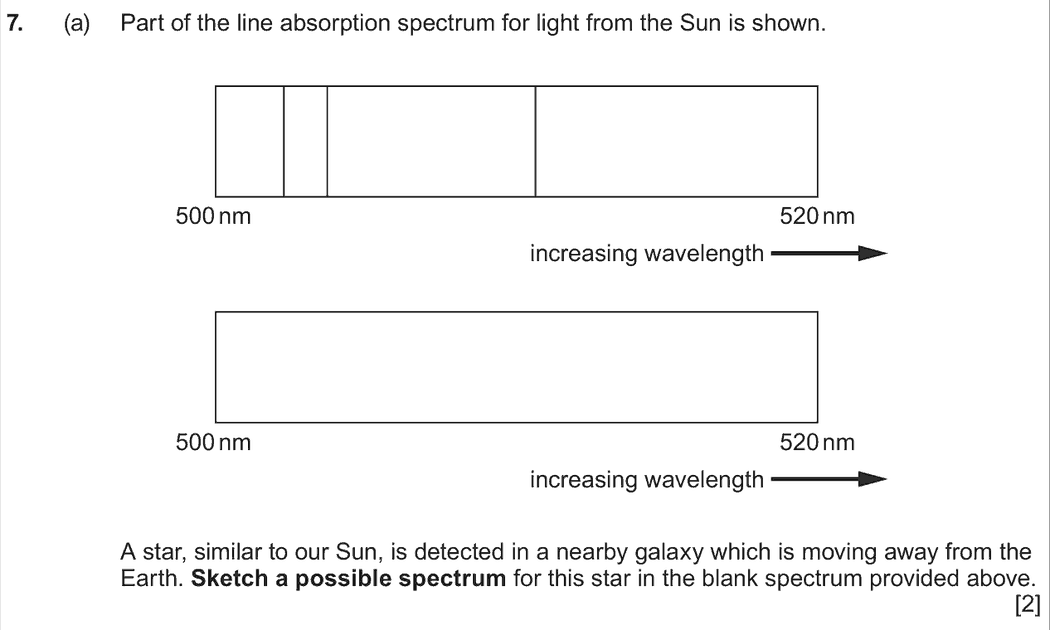
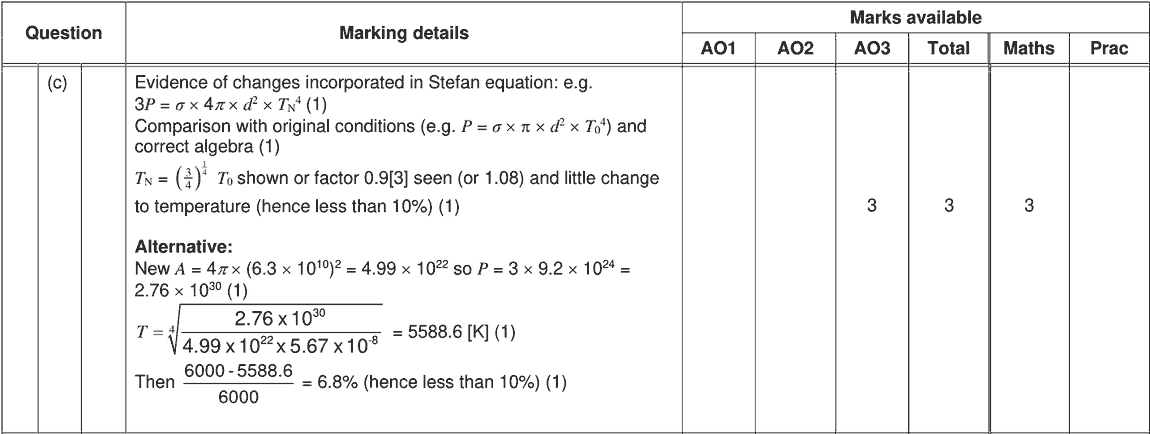
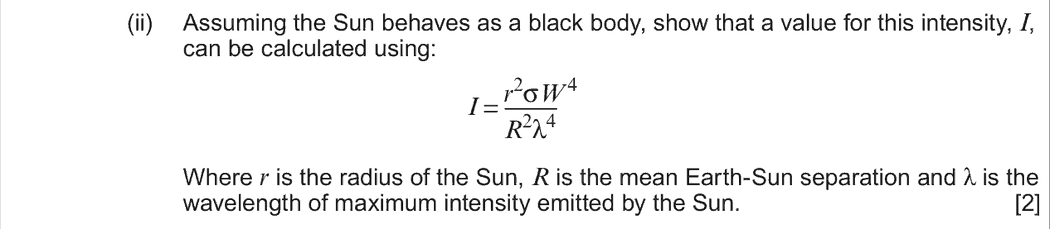
Many candidates were successful in sketching an appropriate spectrum in (a) with nearly all gaining at least one mark for drawing the same pattern as the one given in the question. Most candidates showed a ‘shift to the right’ as required, however a few candidates showed a shift to the left, which was not credited. In (b)(i) nearly all candidates were successful in using Wien’s law to calculate the required wavelength, with most stating that the wavelength lies in the visible or ‘blue’ part of the spectrum. Unlike previous sittings of this paper, it was encouraging to note that many candidates used Stefan’s law correctly by including the formula for surface area of a sphere (4πr2), rather than the cross-sectional area of a sphere. A few candidates did not gain the second mark for giving an incorrect unit for luminosity or for omitting it altogether. It was expected that only high achieving candidates might be able to access part (c) as it required a consideration of the impact of two changes to the properties of the star on its temperature in comparison to the star’s initial conditions. Responses however were very encouraging, indicating that candidates from a broad range of abilities were able to confidently manipulate the data given to confirm the decrease in temperature required in the question. As with other AO3 style questions of this nature, many approaches are possible. Many candidates chose an algebraic approach, comparing initial and final conditions for the star, usually ending with a factor √3 decrease in temperature. Others chose to take a numerical approach, showing that the decrease in stellar temperature amounted to about 440 K, a decrease of less than 10% as required.