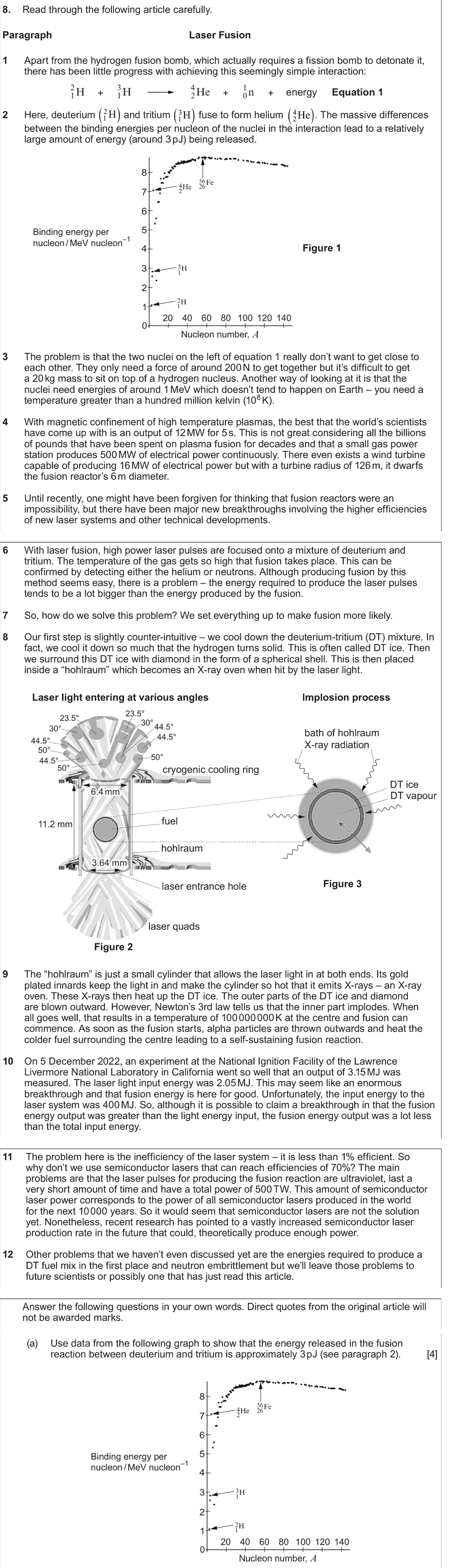
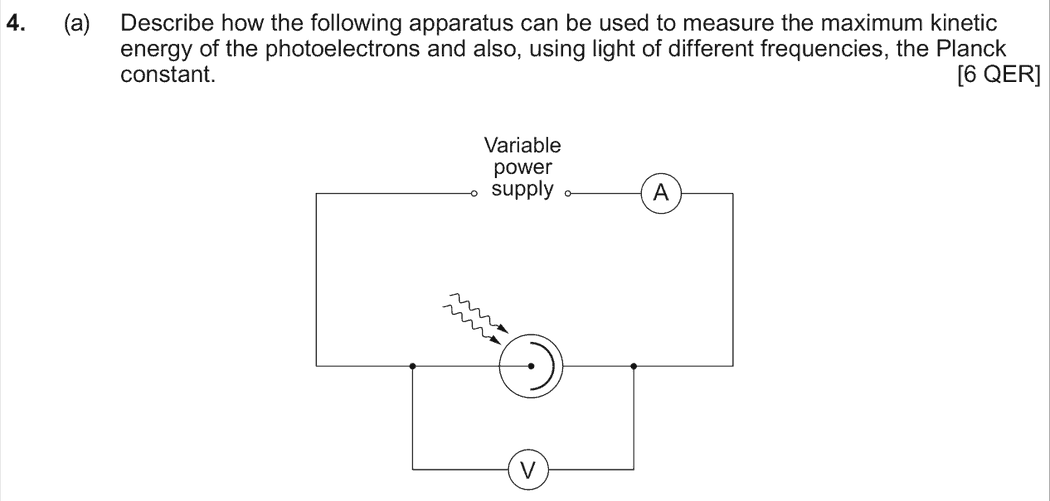
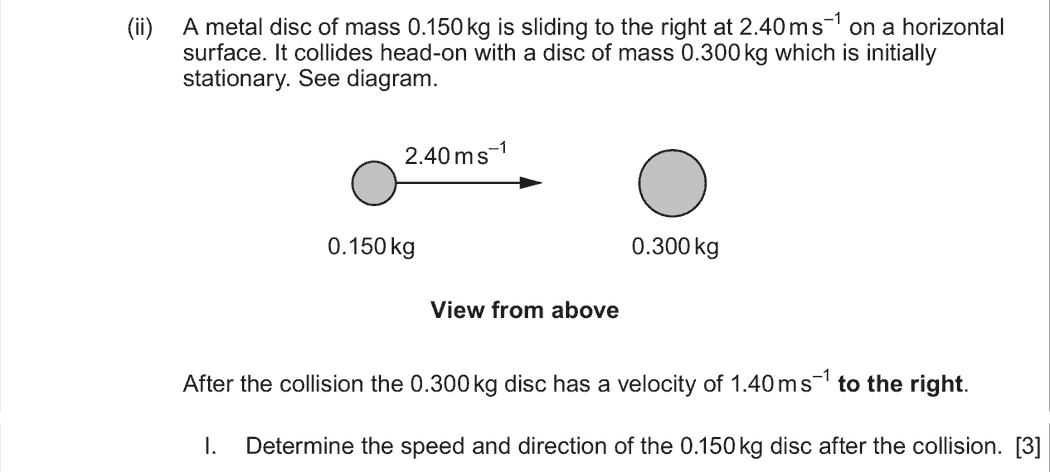
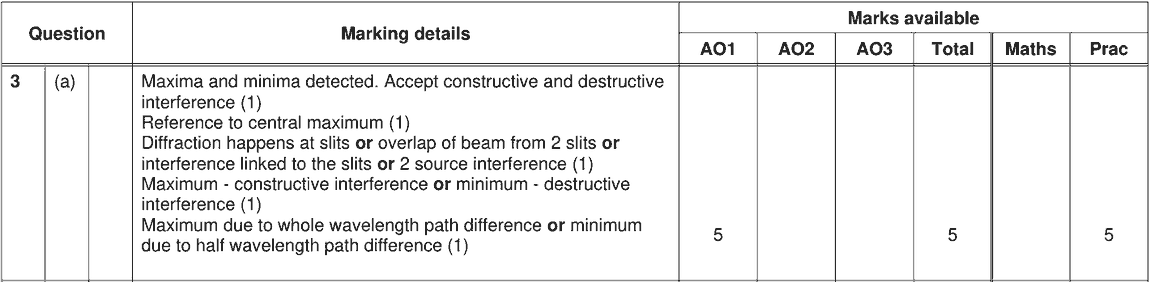
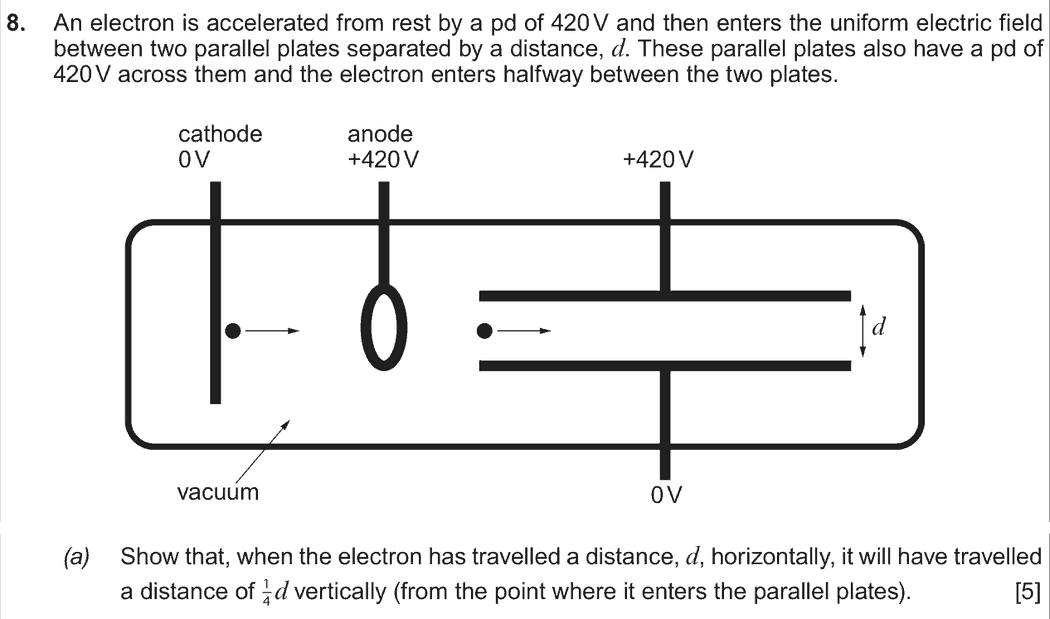
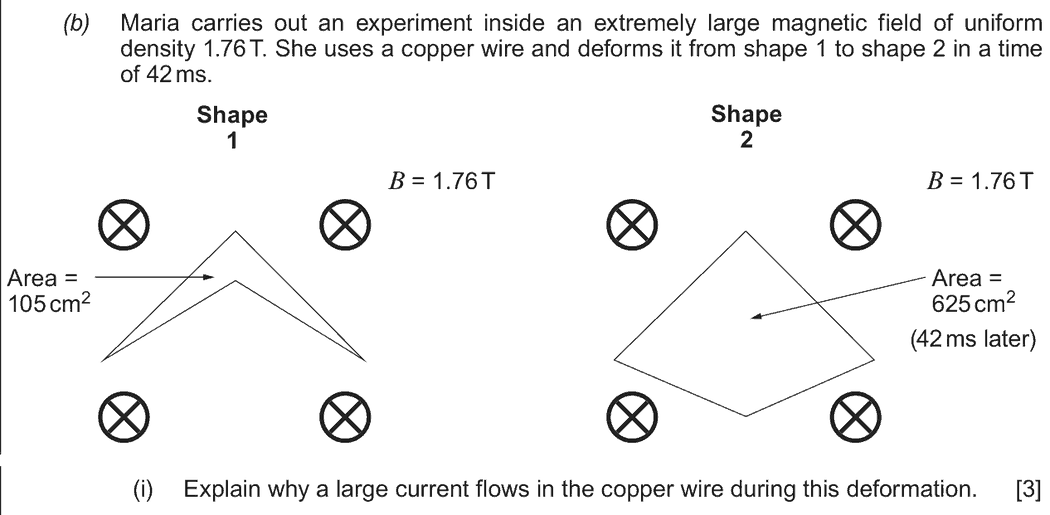
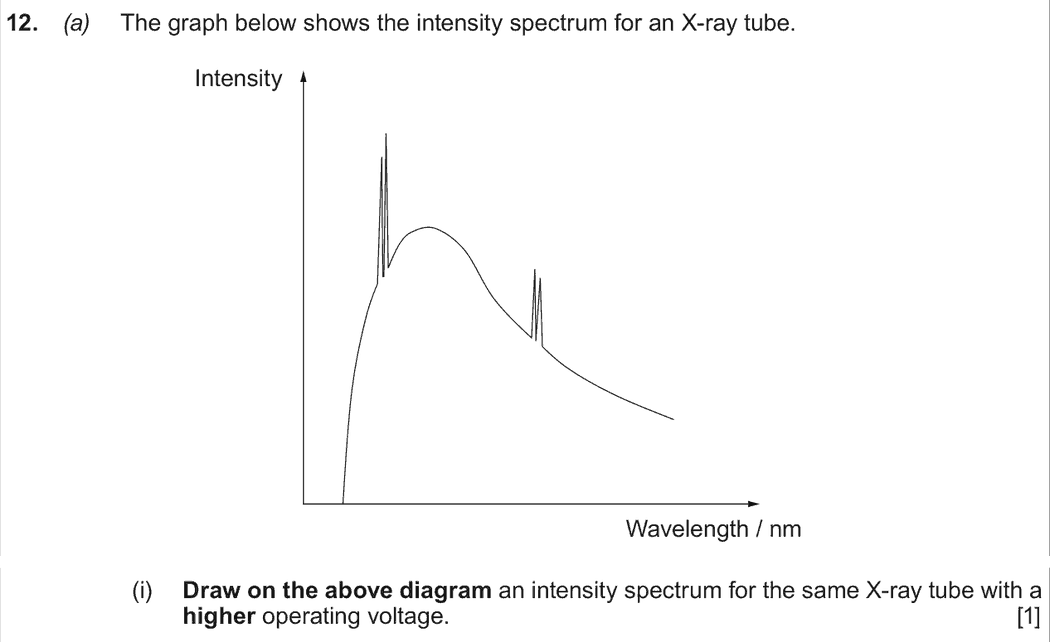
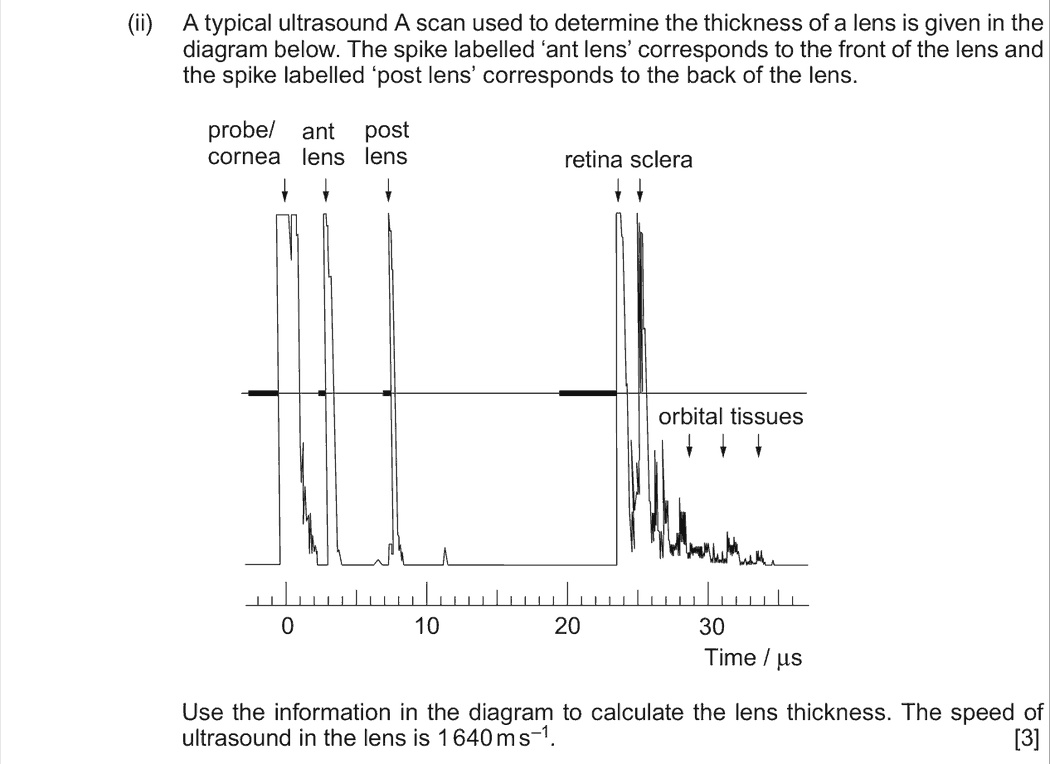
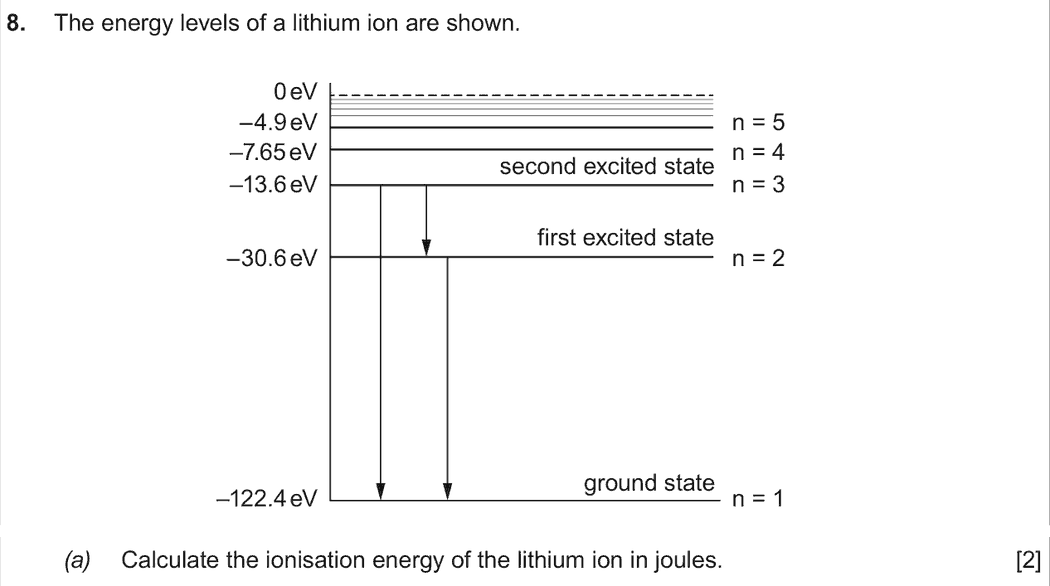
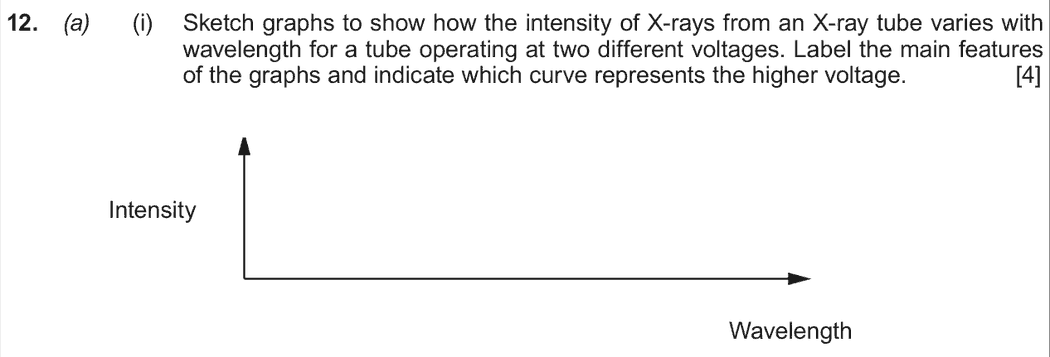
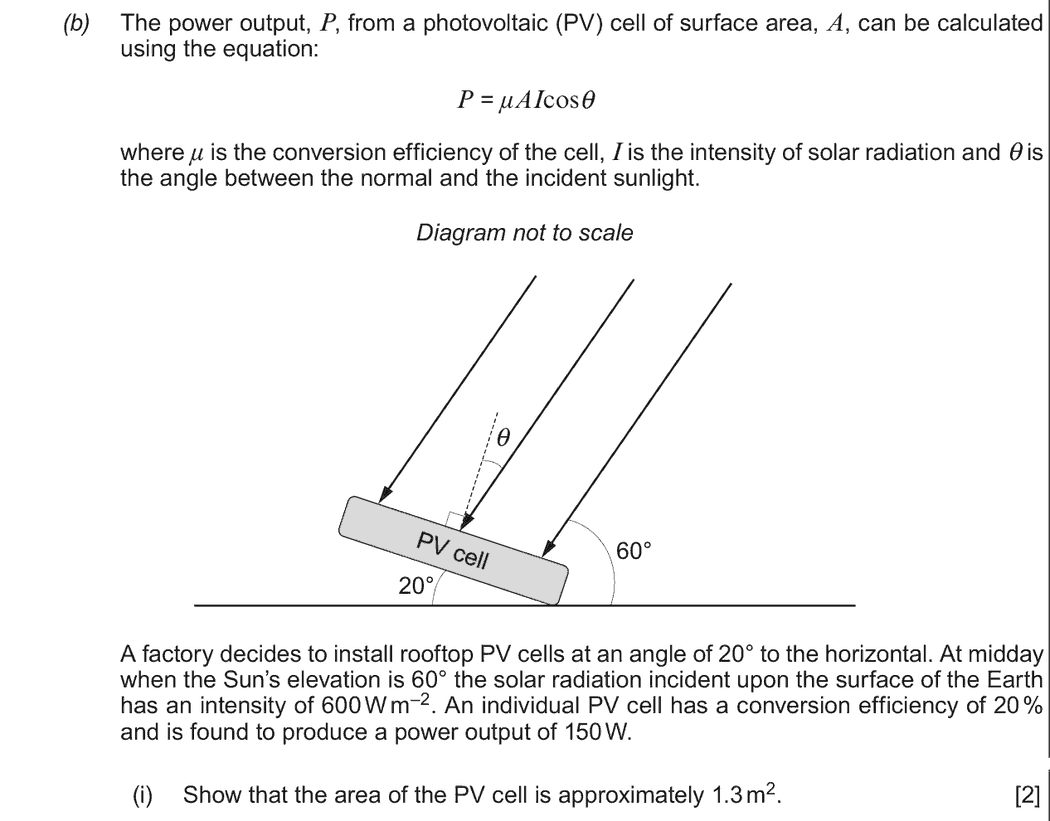
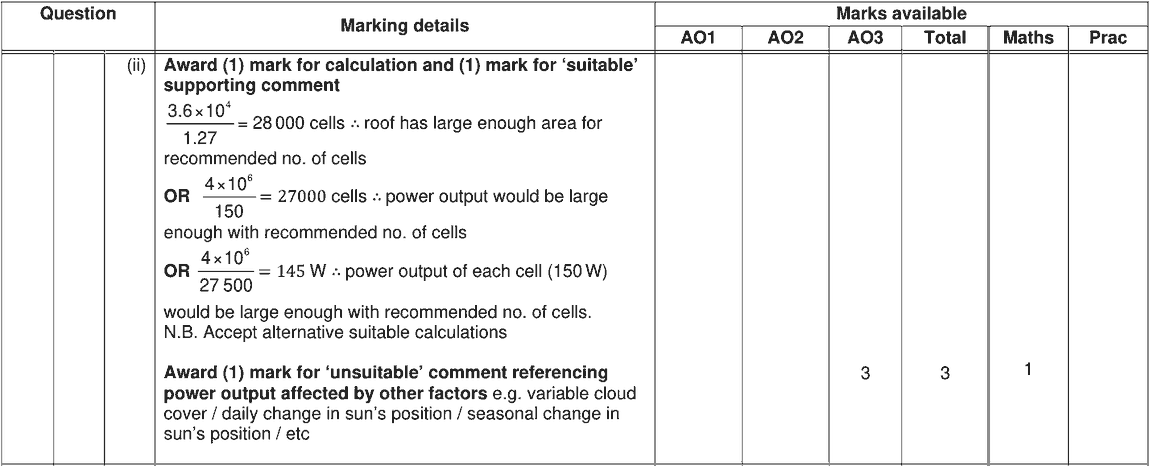
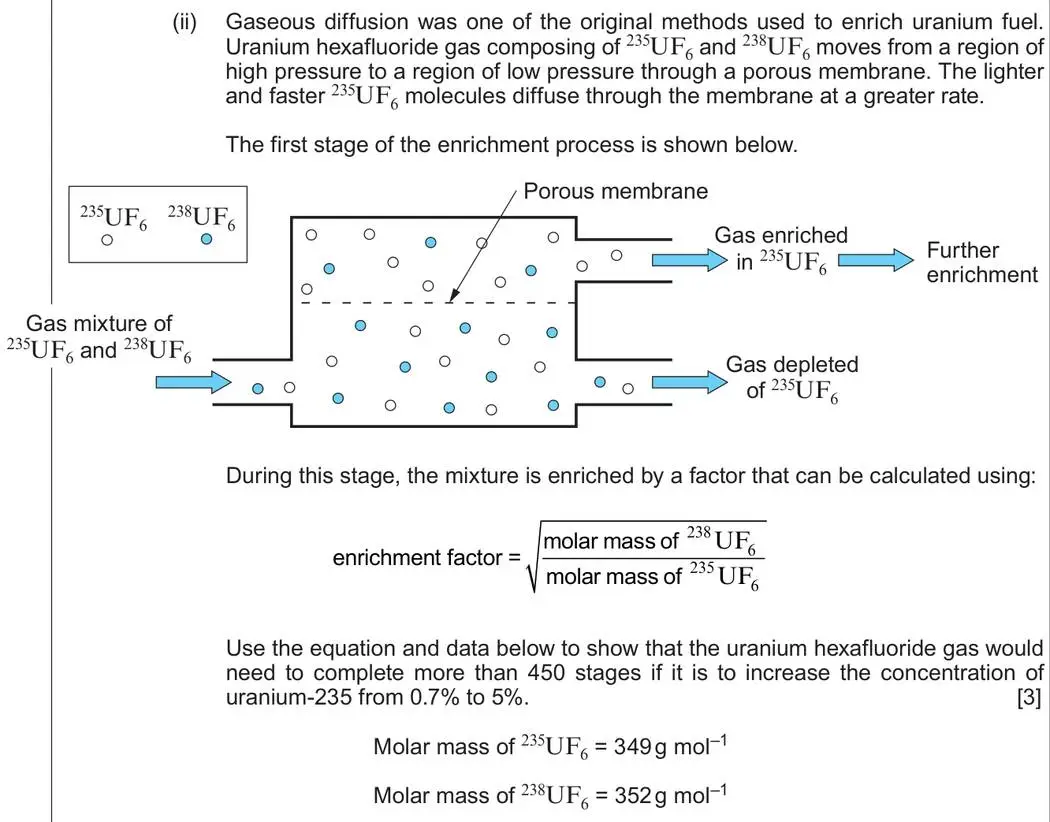
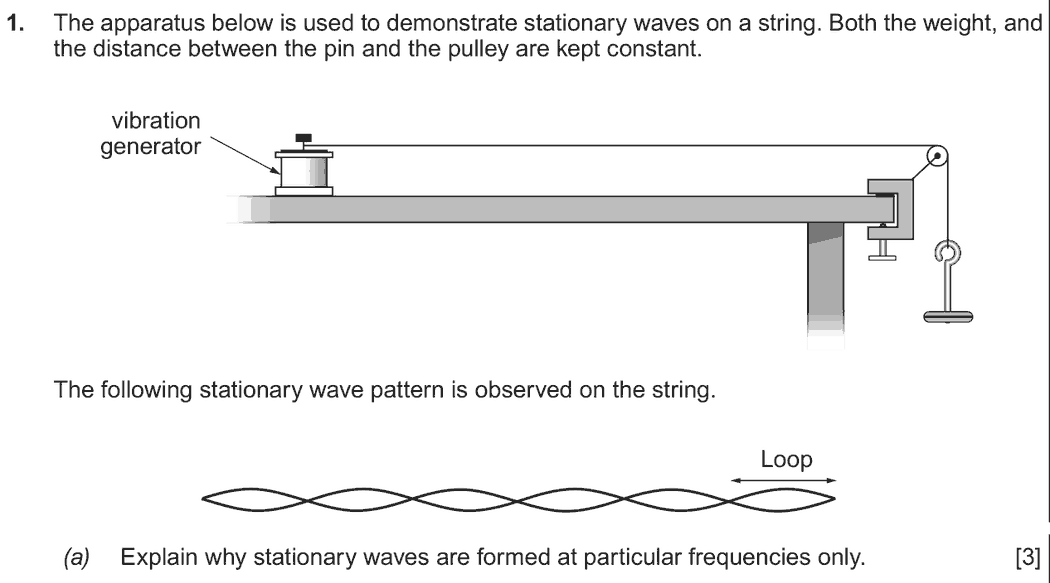
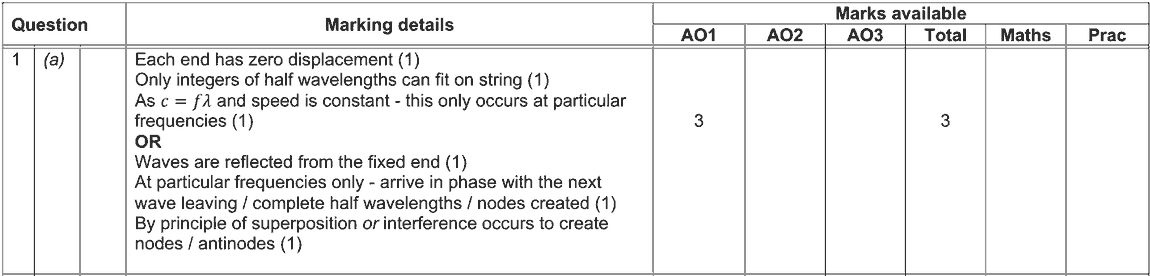
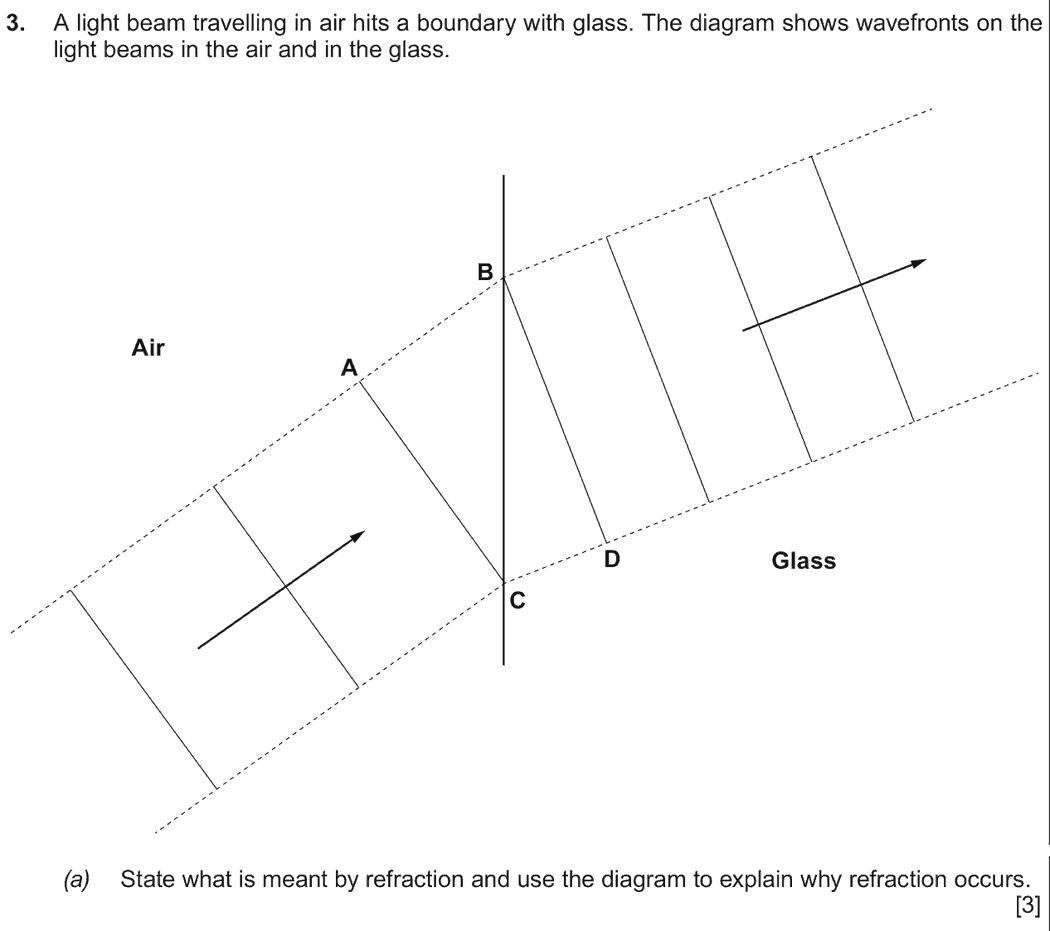
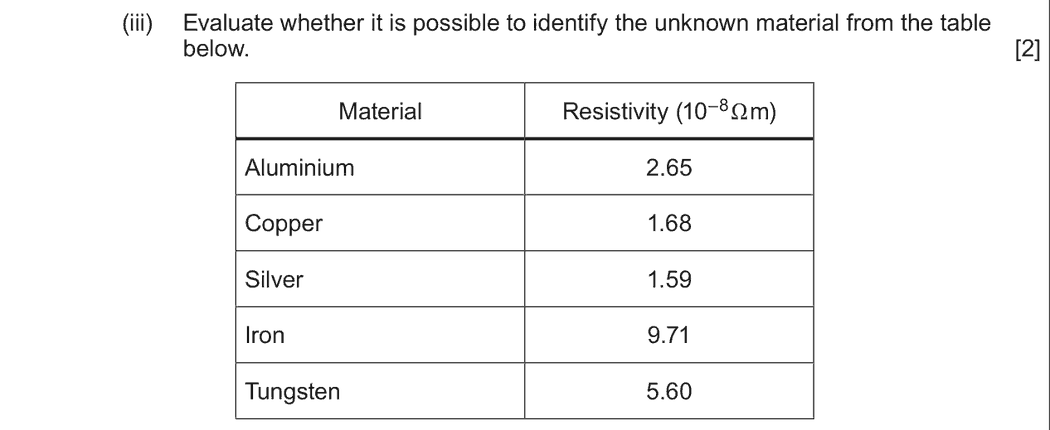
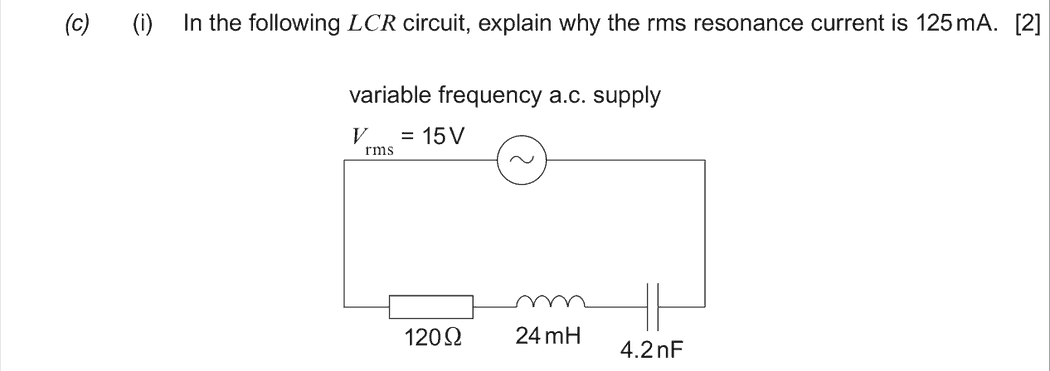
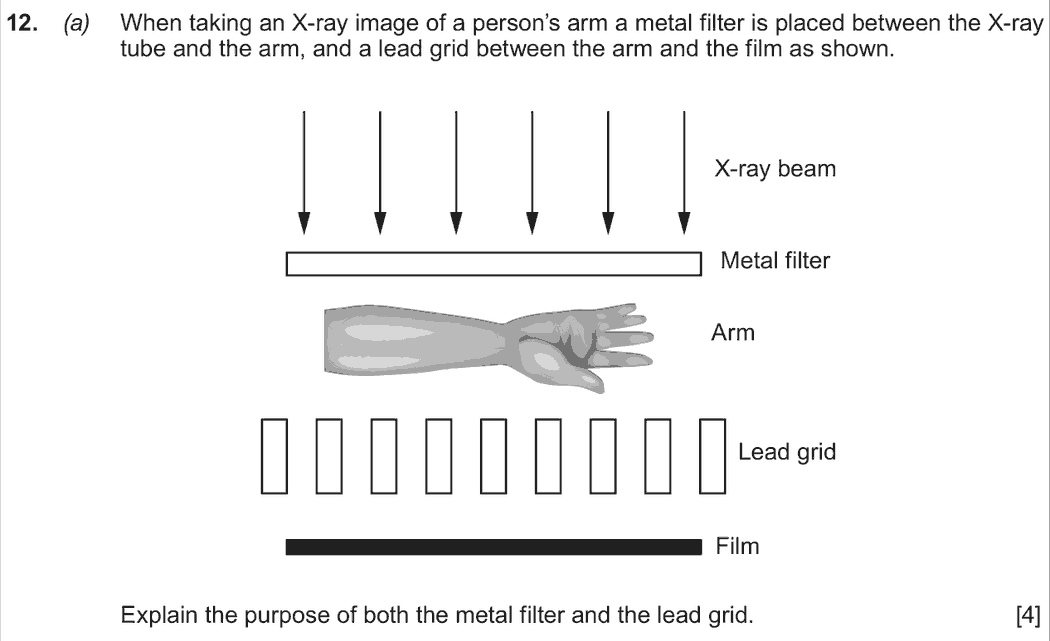
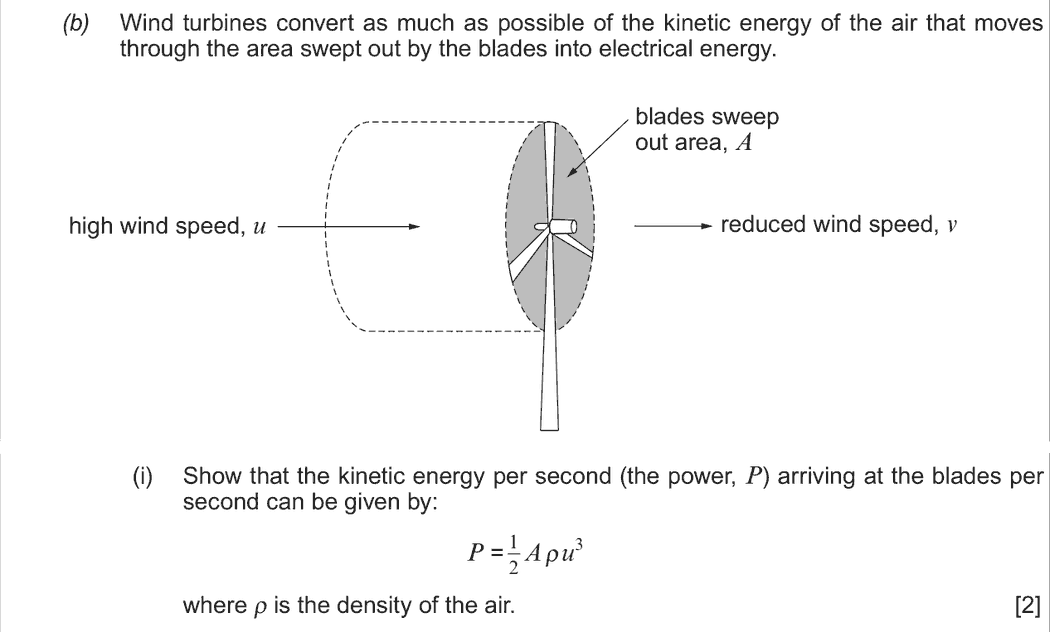
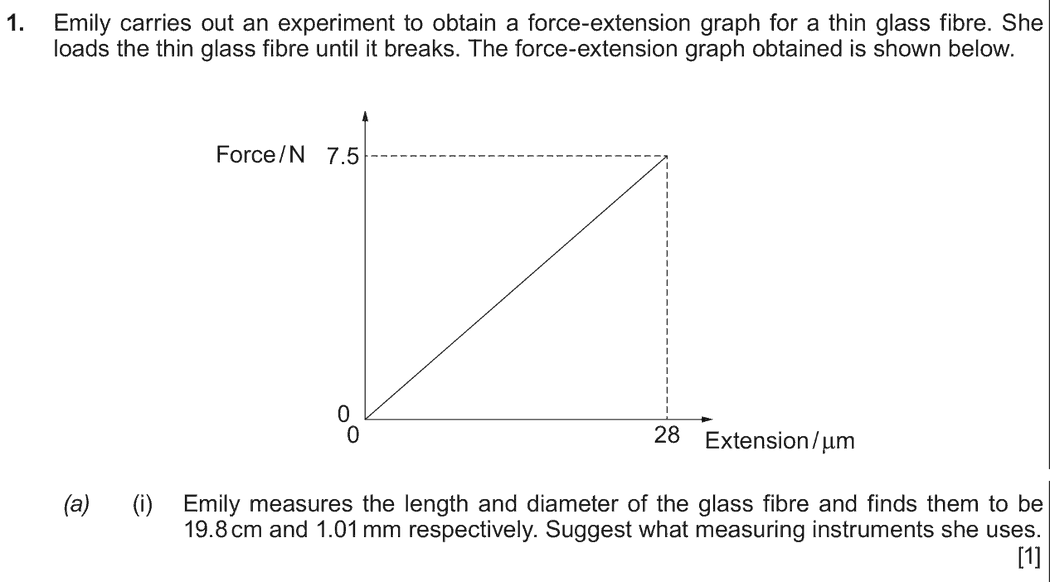
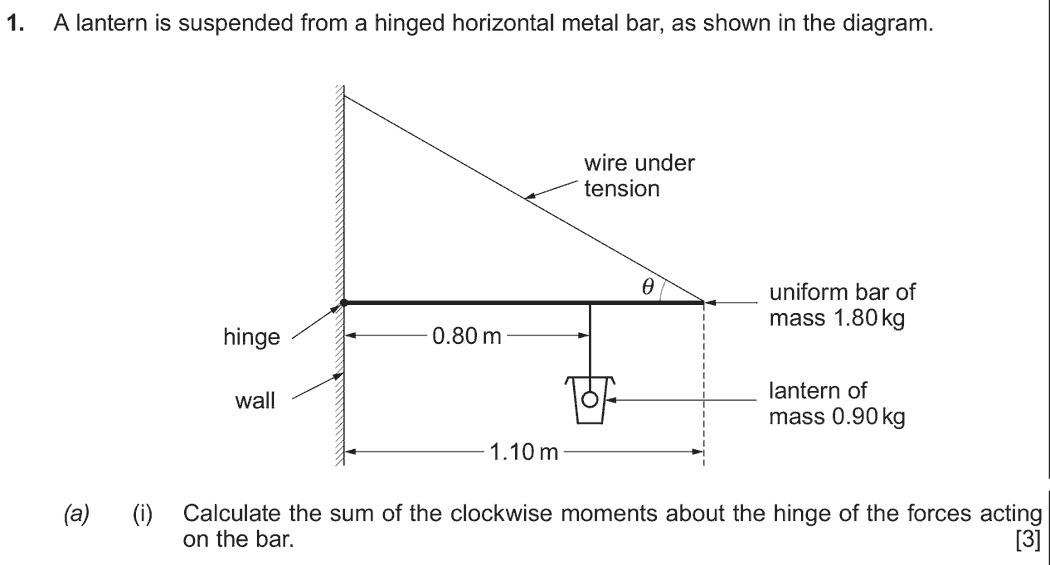
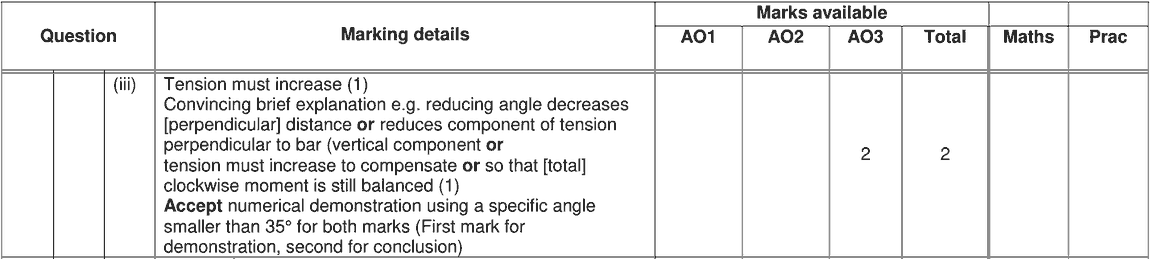
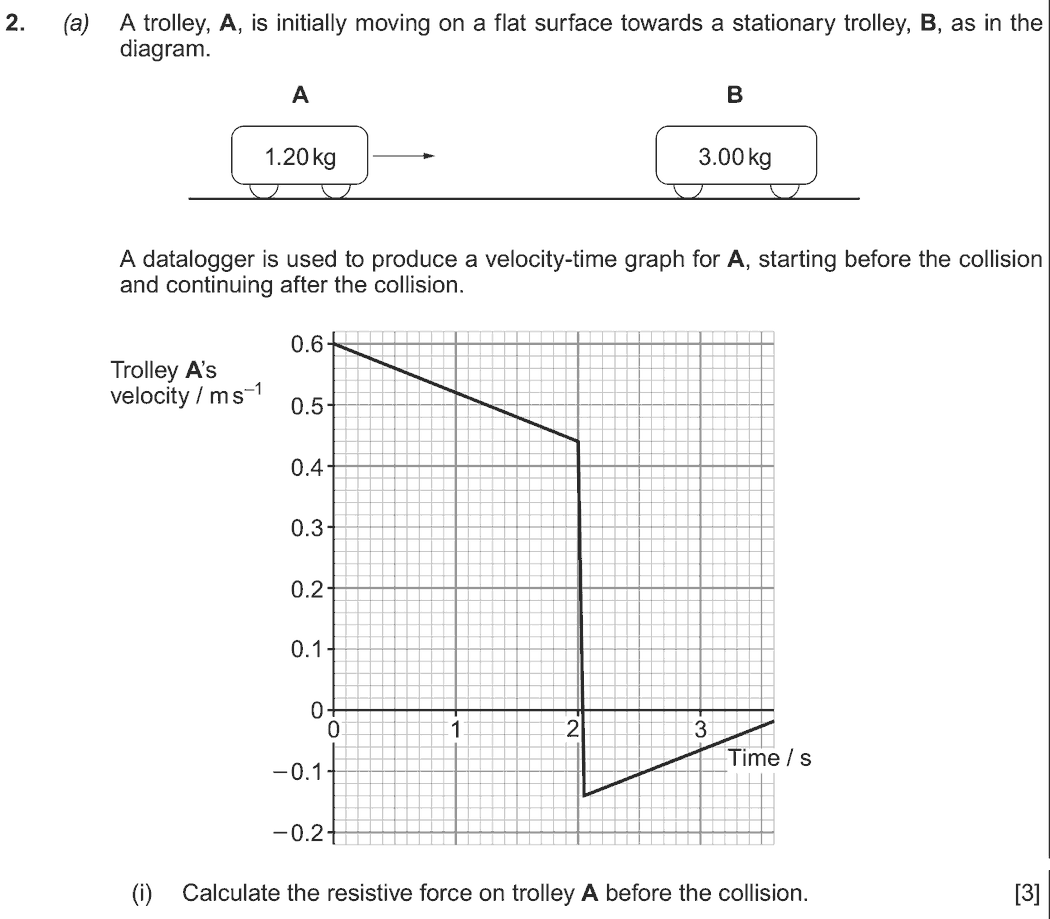
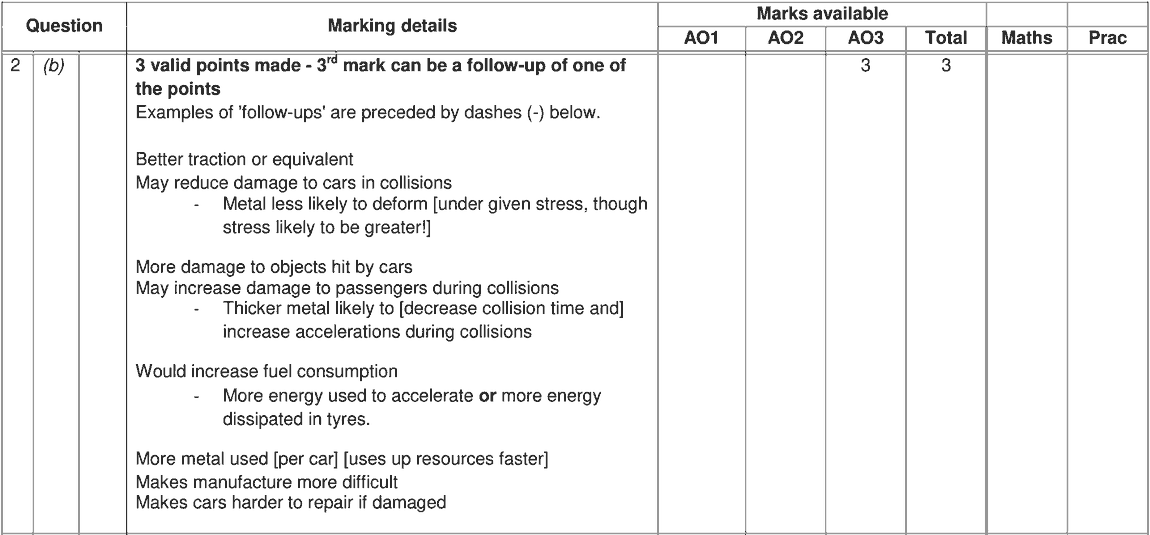
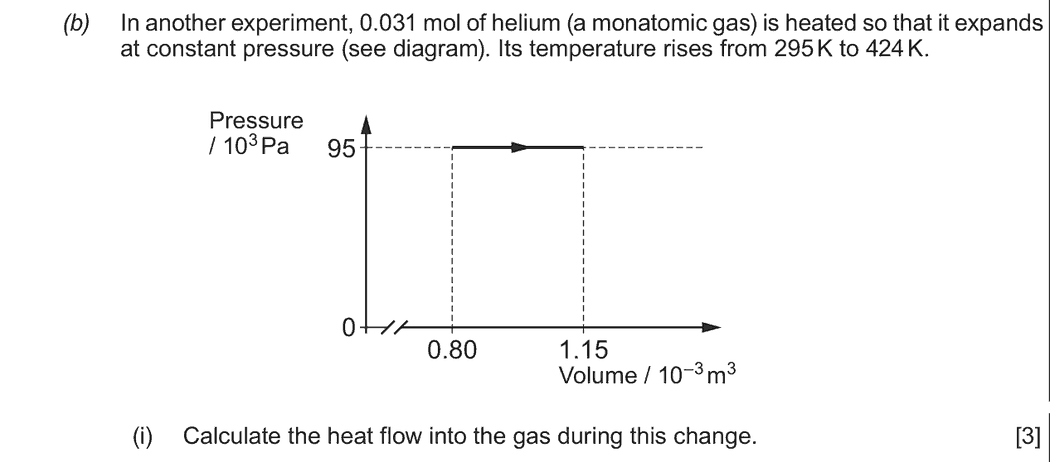
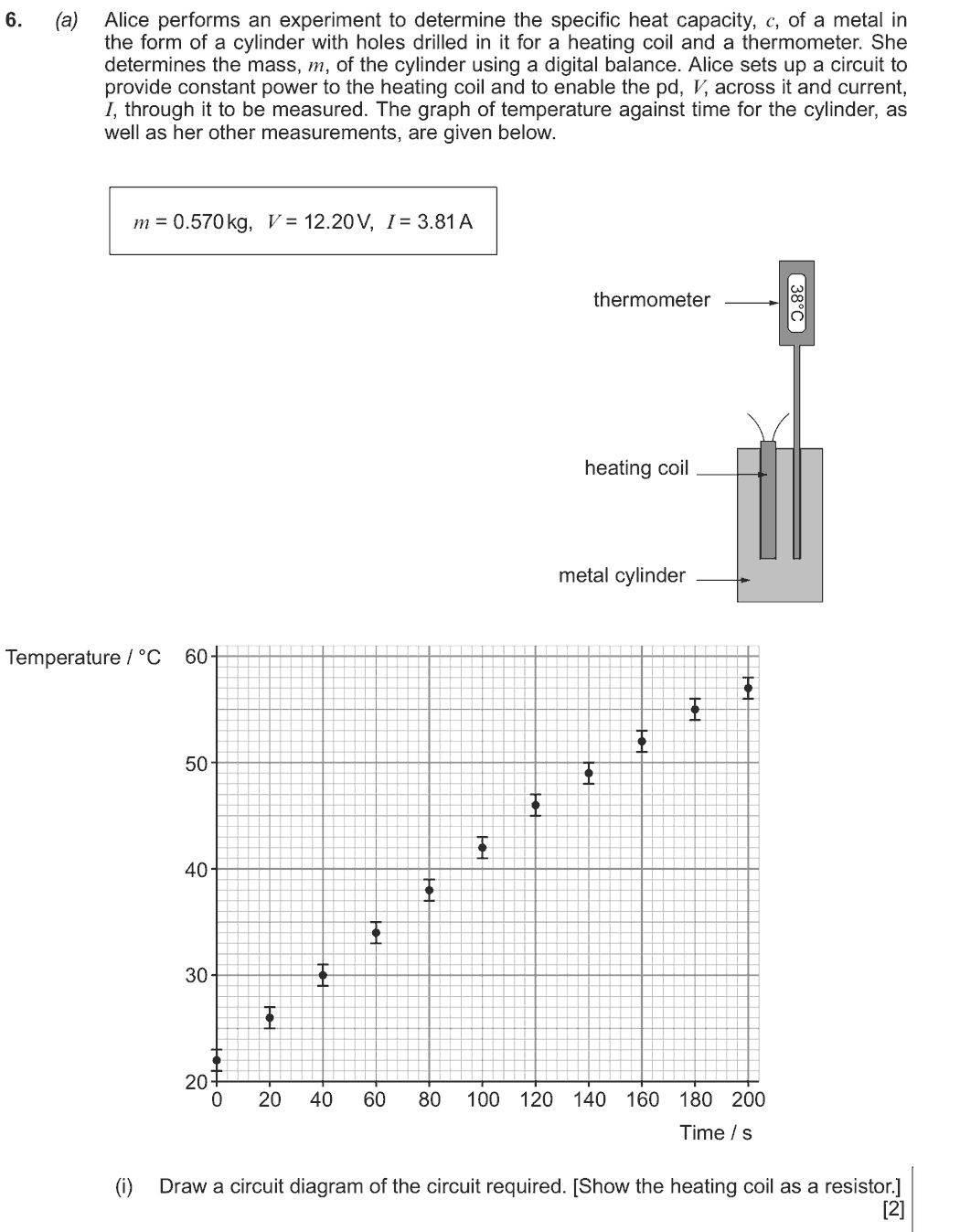
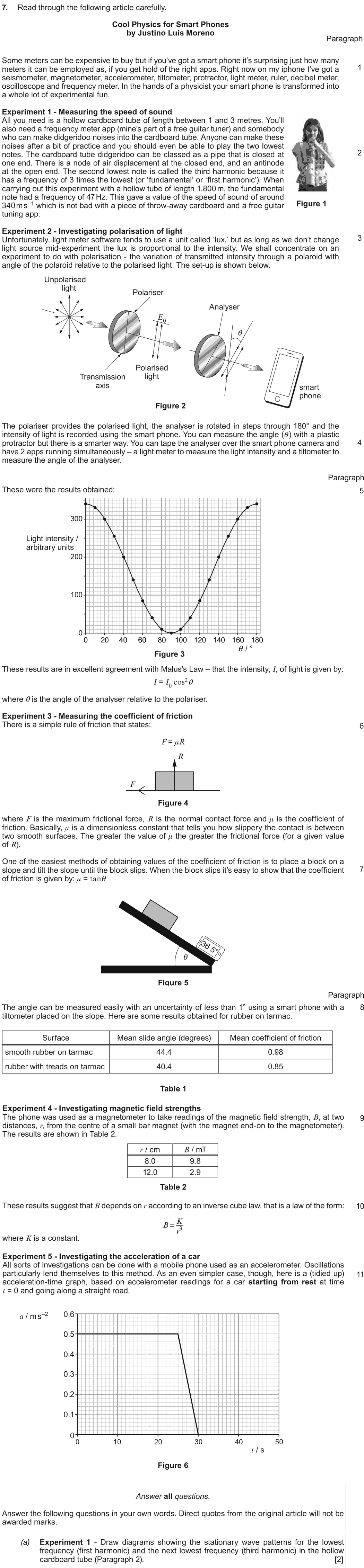
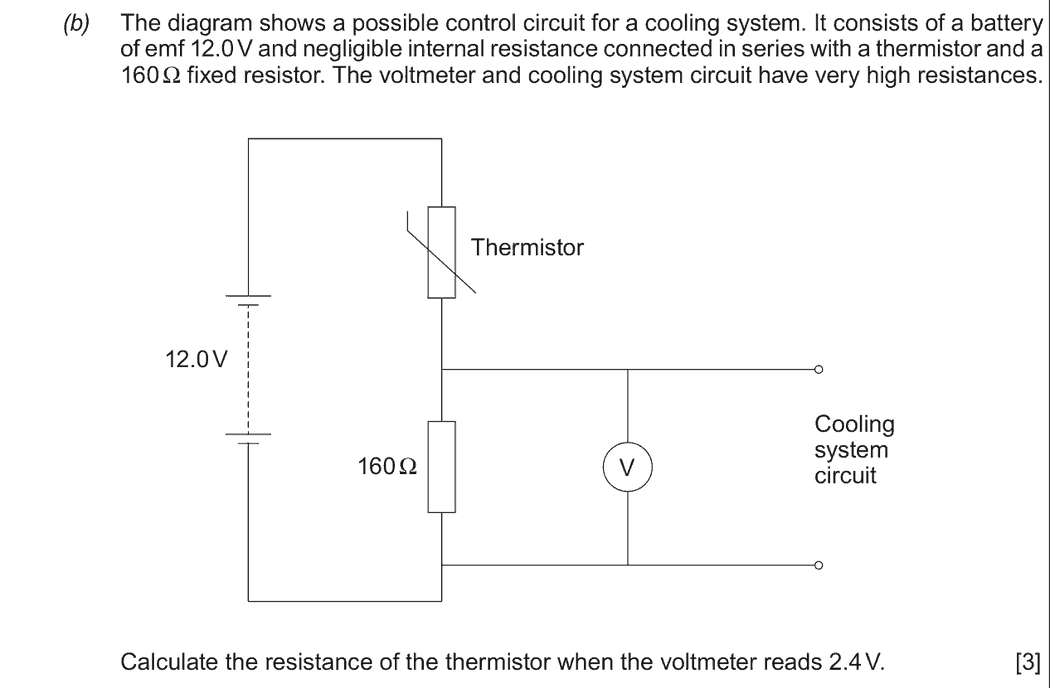
Explain and describe questions

Explain, describe and discuss questions worth two to four marks. Each mark is a separate physics point, so plan one point per mark. 339 questions.

Other types: Calculation questions · Show that questions · Definition questions · Graph and diagram questions · Six-mark QER questions · Practical questions · Short-answer questions

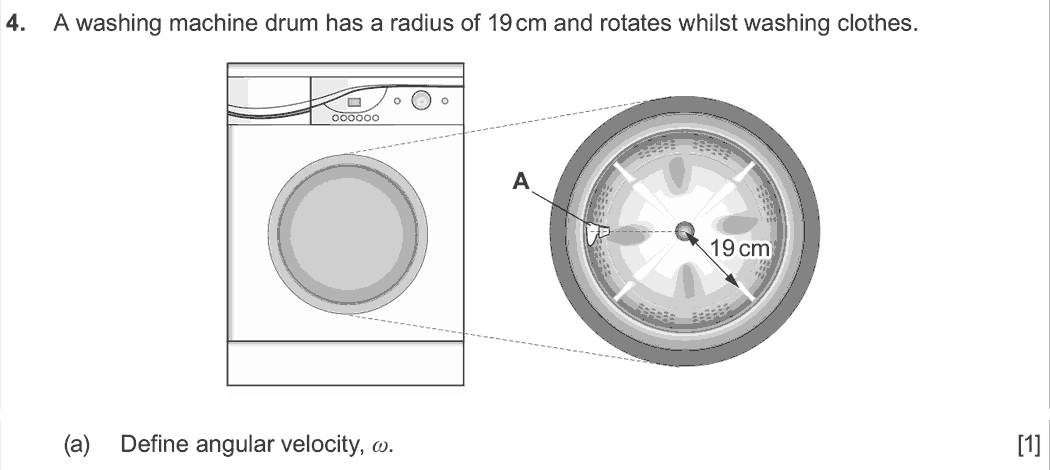
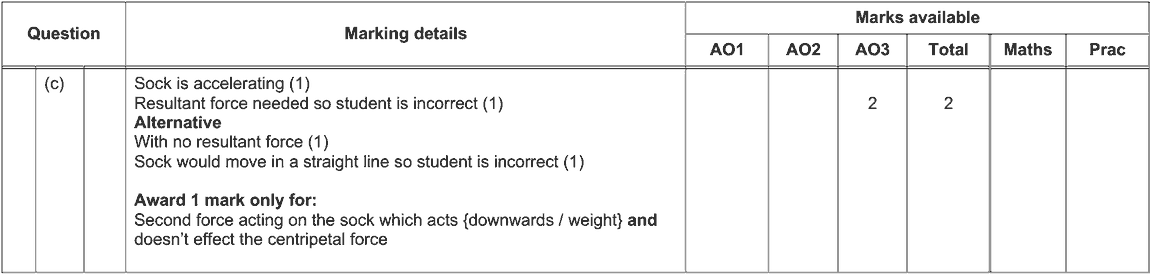
June 2025 · Component 1 · Q4(c) 2 marks AO3=2 Explanation circular motion
Earlier part of question 4 that this part usesEarlier part of June 2025 Component 1 question 4
(c) A student considers the forces acting on the wet sock at position A. The student states, “There is a second force, acting outwards on the sock, to balance the centripetal force.” Explain whether the student is correct. [2]
June 2025 · Component 1 · Q6(c) 3 marks AO2=3 Explanation kinetic theory
Earlier part of question 6 that this part usesEarlier part of June 2025 Component 1 question 6
(c) Neon has a relative molecular mass of 20. Without further calculations, compare the following properties of neon with that of argon at 20 °C: • mean molecular kinetic energy • rms speed of molecules. [3]
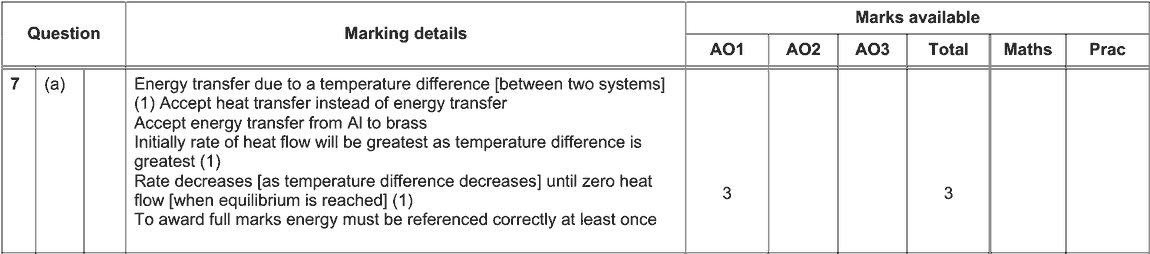
June 2025 · Component 1 · Q7(a) 3 marks AO1=3 Explanation thermal physics
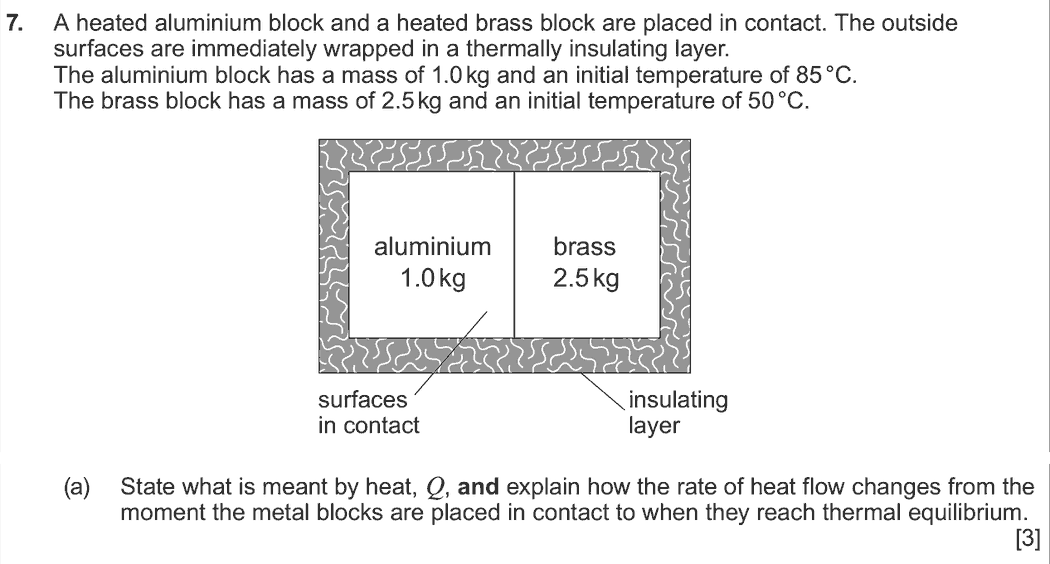
7. A heated aluminium block and a heated brass block are placed in contact. The outside surfaces are immediately wrapped in a thermally insulating layer. The aluminium block has a mass of 1.0 kg and an initial temperature of 85 °C. The brass block has a mass of 2.5 kg and an initial temperature of 50 °C. aluminium brass 1.0 kg 2.5 kg surfaces insulating in contact layer (a) State what is meant by heat, Q, and explain how the rate of heat flow changes from the moment the metal blocks are placed in contact to when they reach thermal equilibrium. [3]

June 2025 · Component 1 · Q8(e) 2 marks AO2=2 Explanation dynamicscomprehension
Earlier part of question 8 that this part usesEarlier part of June 2025 Component 1 question 8
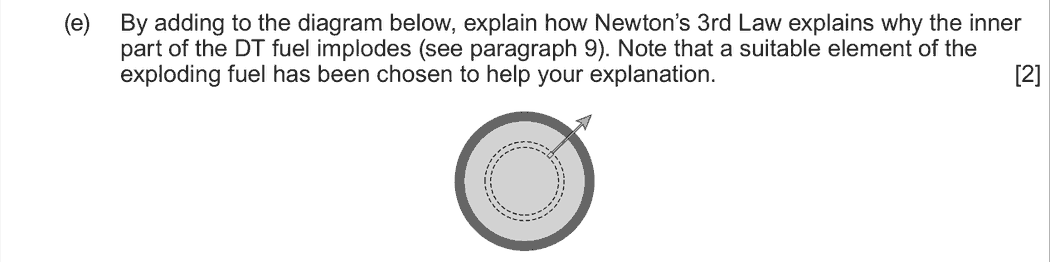
(e) By adding to the diagram below, explain how Newton’s 3rd Law explains why the inner part of the DT fuel implodes (see paragraph 9). Note that a suitable element of the exploding fuel has been chosen to help your explanation. [2]
June 2025 · Component 2 · Q1(a)(ii) 4 marks AO1=4 Explanation conduction of electricity
Earlier part of question 1 that this part usesEarlier part of June 2025 Component 2 question 1
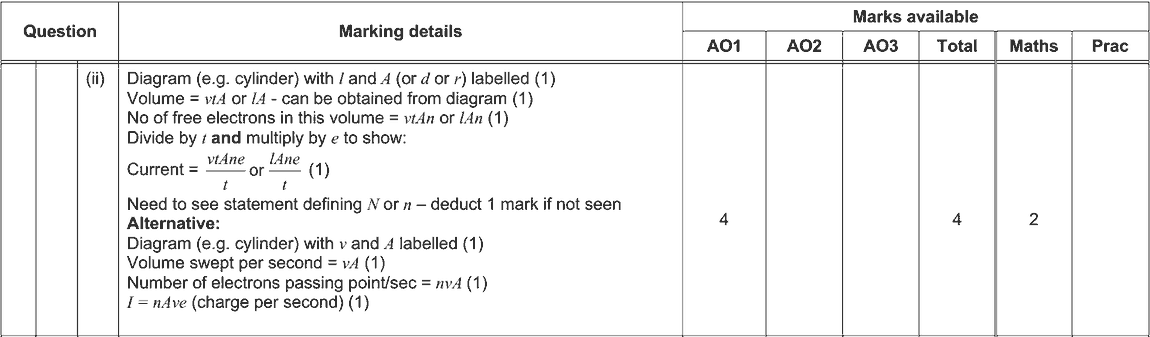
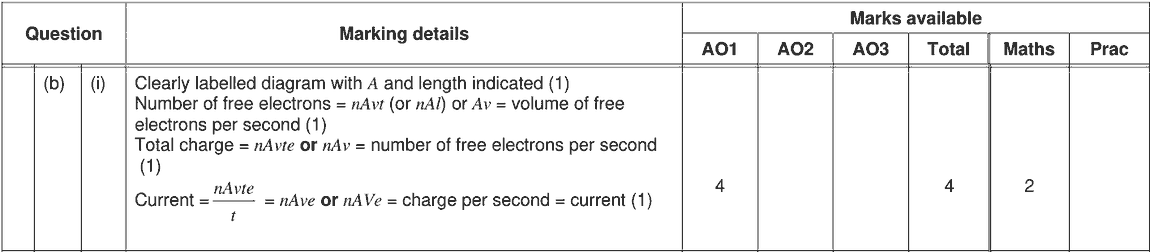
(ii) Derive the equation I = nAve for the current in a wire when the drift velocity of the free electrons is v. Include a clearly labelled diagram. [4]
June 2025 · Component 2 · Q5(b)(ii) 2 marks AO1=2 Explanation solids under stress
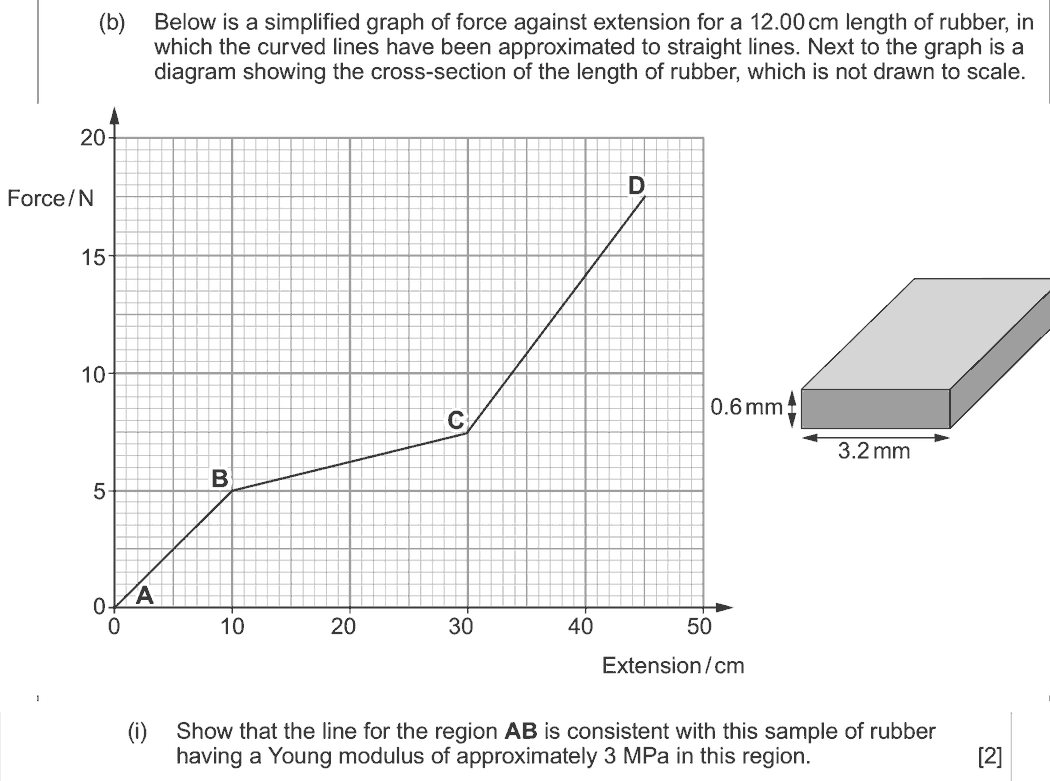
Earlier parts of question 5 that this part usesEarlier part of June 2025 Component 2 question 5Earlier part of June 2025 Component 2 question 5
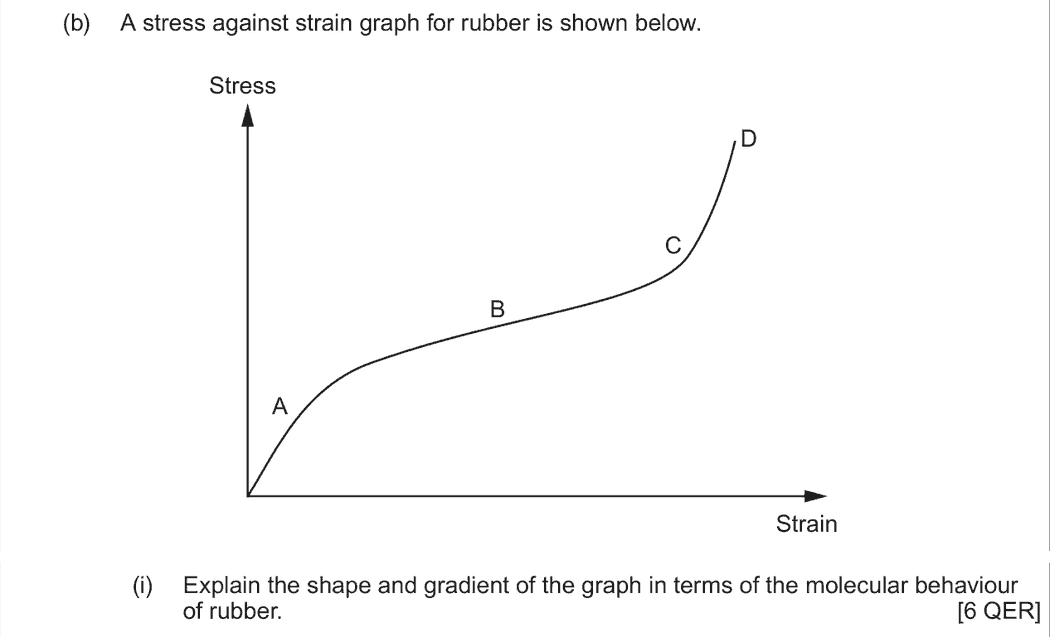
(ii) Briefly explain the changes in the molecular arrangement in the regions BC and CD. [2]
June 2025 · Component 2 · Q5(c) 3 marks AO3=3 Explanation solids under stress
Earlier parts of question 5 that this part usesEarlier part of June 2025 Component 2 question 5Earlier part of June 2025 Component 2 question 5
(c) Explain how a car tyre manufacturer might use the term ‘hysteresis’ to advise drivers that driving with under-inflated tyres (tyres below the recommended pressure) is a bad idea. [3]
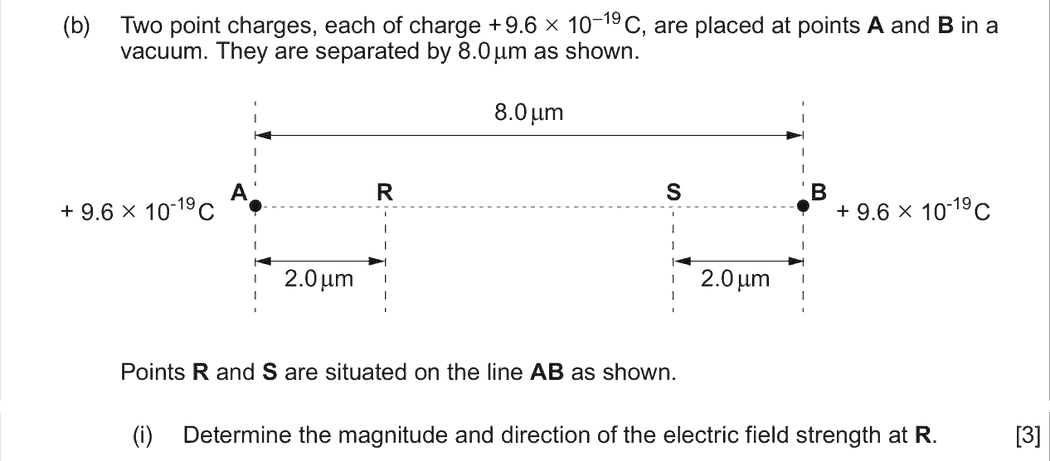
June 2025 · Component 2 · Q6(b)(ii) 2 marks AO2=2 Explanation electrostatic and gravitational fields
Earlier parts of question 6 that this part usesEarlier part of June 2025 Component 2 question 6Earlier part of June 2025 Component 2 question 6
(ii) A teacher states: “When a small test charge is moved between R and S, the net work done is zero.” Explain, without calculation, why the teacher is correct. [2]
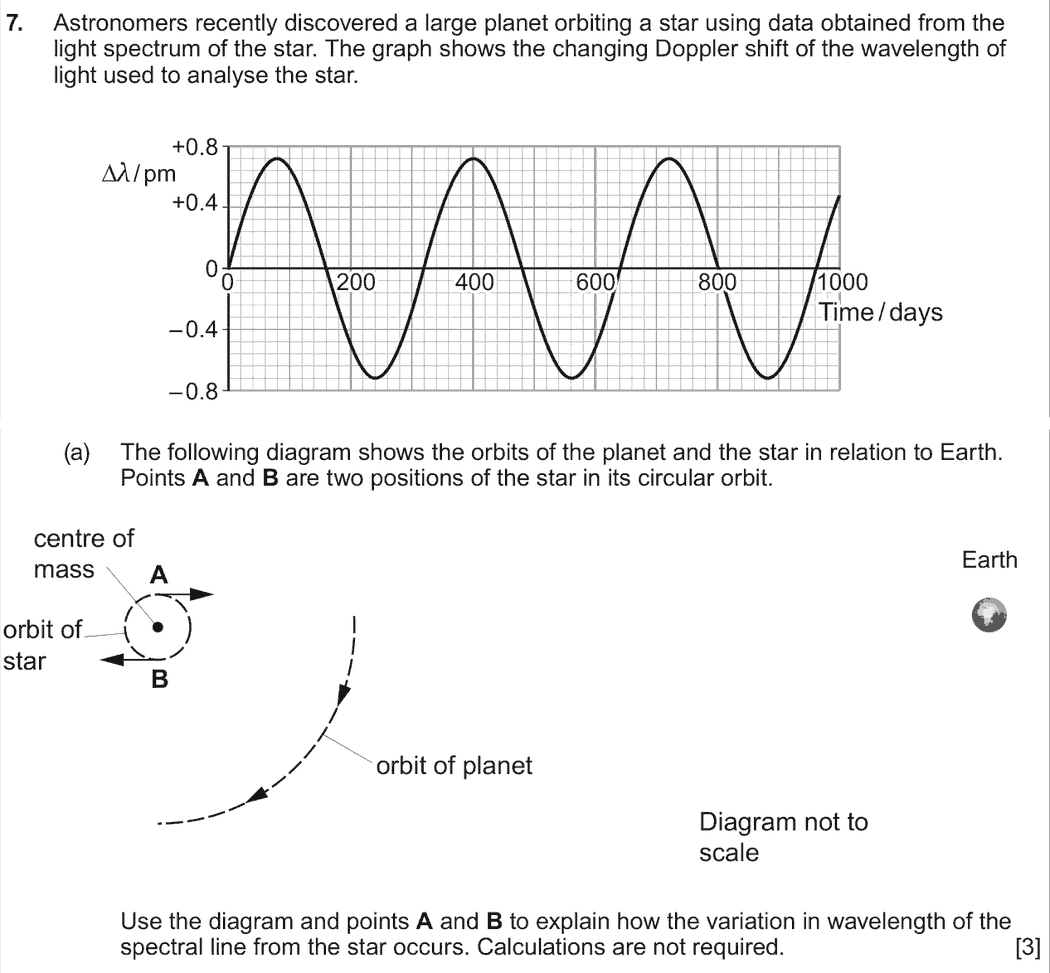
June 2025 · Component 2 · Q7(a) 3 marks AO1=1, AO2=2 Explanation orbits and the wider universe
7. Astronomers recently discovered a large planet orbiting a star using data obtained from the light spectrum of the star. The graph shows the changing Doppler shift of the wavelength of light used to analyse the star. +0.8 ∆λ / pm +0.4 0 20 200 200 400 400 600 600 800 800 1000 1000 Time Time/ / days days – 0.4 – 0.8 (a) The following diagram shows the orbits of the planet and the star in relation to Earth. Points A and B are two positions of the star in its circular orbit. centre of Earth mass A orbit of star B orbit of planet Diagram not to scale Use the diagram and points A and B to explain how the variation in wavelength of the spectral line from the star occurs. Calculations are not required. [3]
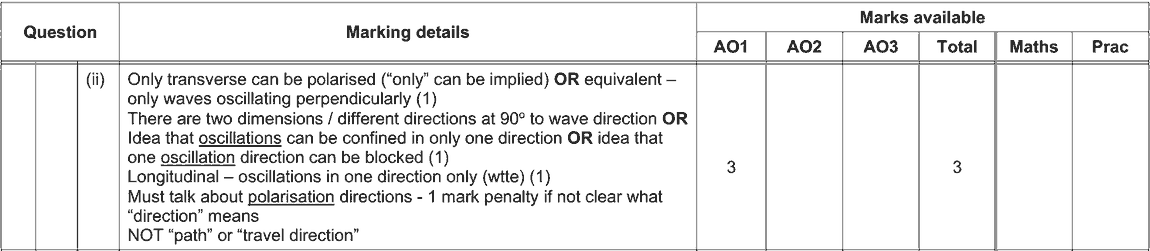
June 2025 · Component 3 · Q1(a)(ii) 3 marks AO1=3 Explanation nature of waves
Earlier part of question 1 that this part usesEarlier part of June 2025 Component 3 question 1
(ii) Explain why only one of these two types of waves can be polarised and the other type cannot be polarised. [3]
June 2025 · Component 3 · Q2(a)(i) 2 marks AO2=2 Explanation wave properties
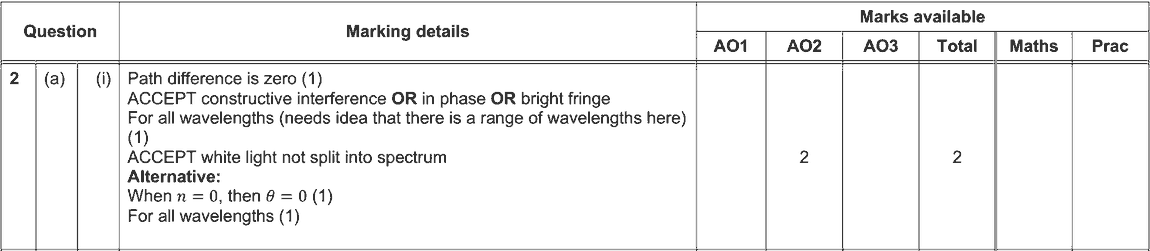
2. A beam of white light is shone normally on a diffraction grating. The n = 0 order beam produces a bright white dot on a screen but the n = 1 order beam produces a spectrum of light. (a) (i) Explain why the n = 0 order beam produces a bright white dot. [2]
June 2025 · Component 3 · Q2(a)(ii) 2 marks AO2=2 Explanation wave properties
Earlier part of question 2 that this part usesEarlier part of June 2025 Component 3 question 2
(ii) Explain why the n = 1 order beam produces a spectrum. [2]
June 2025 · Component 3 · Q3(b) 4 marks AO1=2, AO2=2 Explanation refraction of light
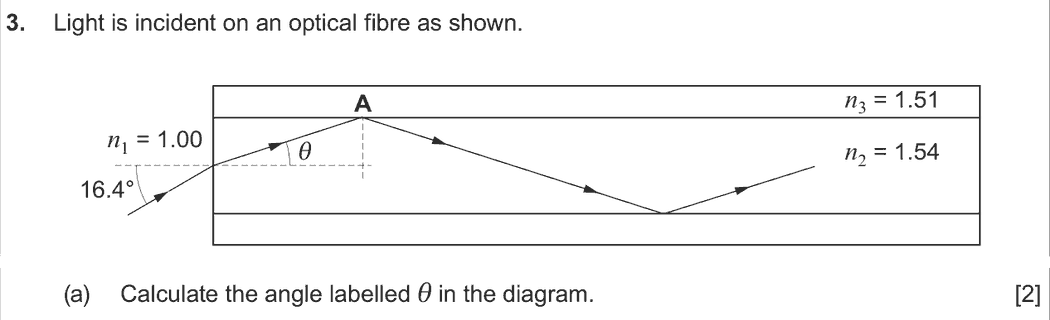
Earlier part of question 3 that this part usesEarlier part of June 2025 Component 3 question 3
(b) Explain why total internal reflection occurs at A. Use calculations to support your answer. [4]
June 2025 · Component 3 · Q6(b)(i) 4 marks AO2=4 Explanation electromagnetic induction
Earlier part of question 6 that this part usesEarlier part of June 2025 Component 3 question 6
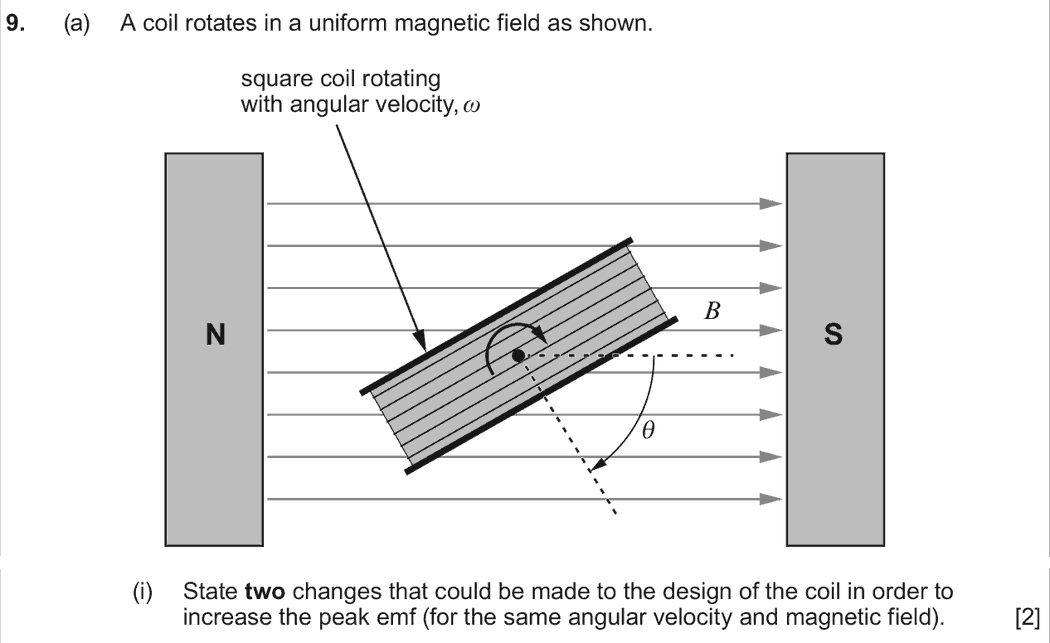
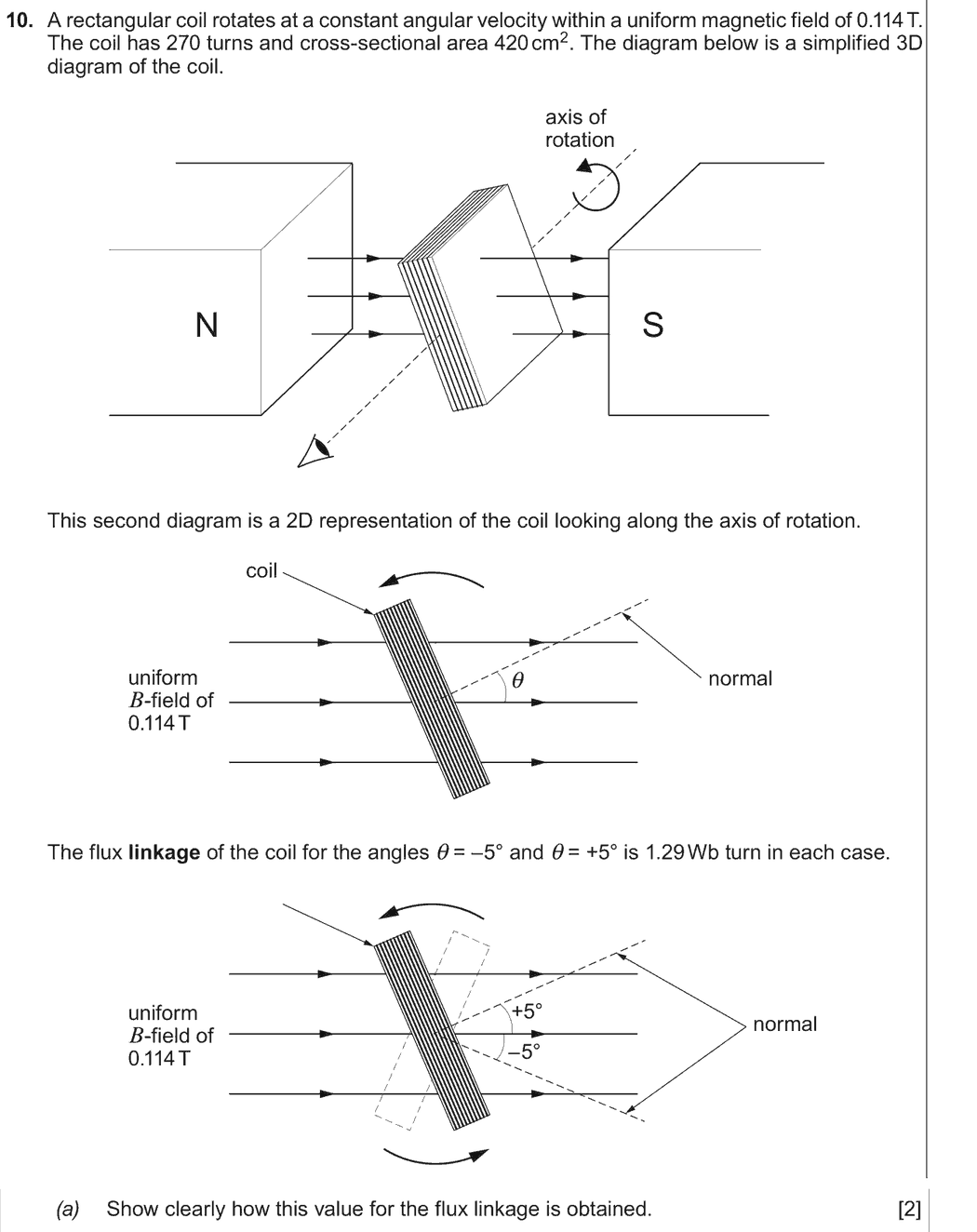
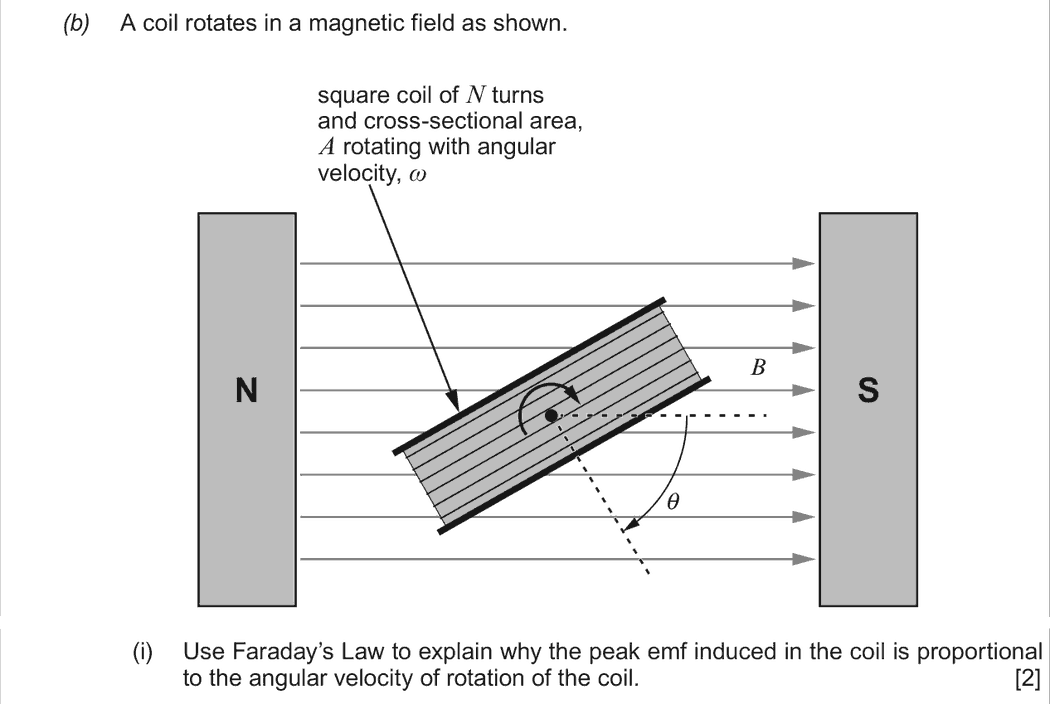
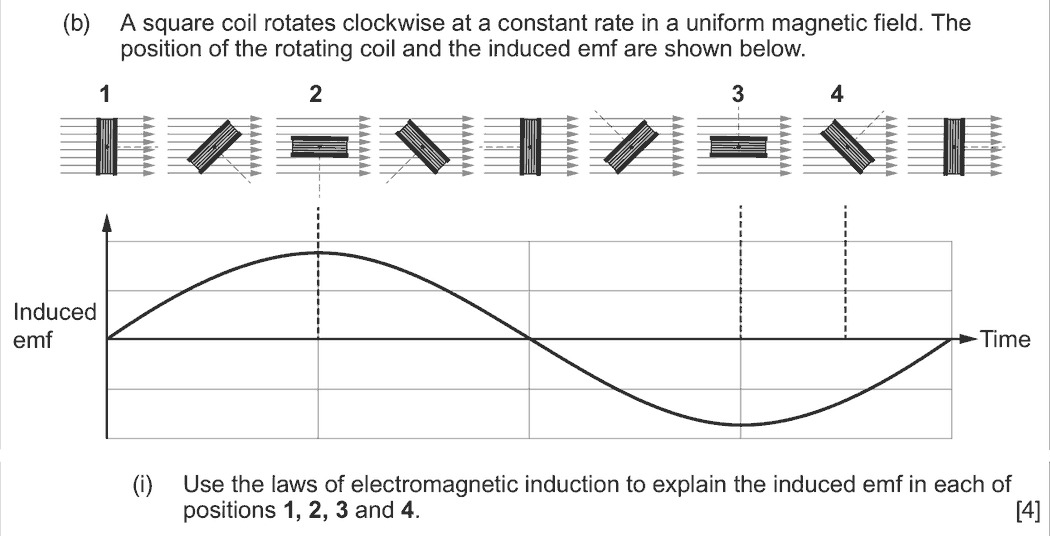
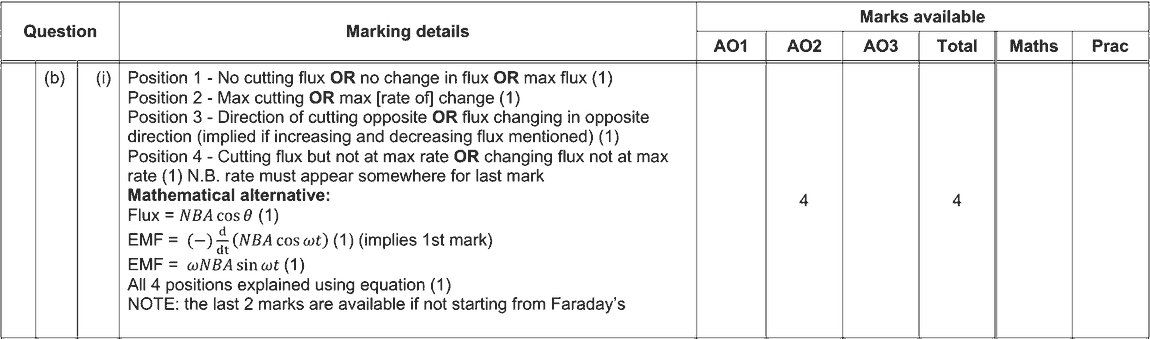
(b) A square coil rotates clockwise at a constant rate in a uniform magnetic field. The position of the rotating coil and the induced emf are shown below. 1 2 3 4 Induced emf Time (i) Use the laws of electromagnetic induction to explain the induced emf in each of positions 1, 2, 3 and 4. [4]
June 2025 · Component 3 · Q6(b)(ii) 2 marks AO2=2 Explanation electromagnetic induction
Earlier parts of question 6 that this part usesEarlier part of June 2025 Component 3 question 6Earlier part of June 2025 Component 3 question 6
(ii) Use the laws of electromagnetic induction to explain how the graph would change if the rotation rate were doubled. [2]
June 2025 · Component 3 · Q8(a) 4 marks AO2=4 Explanation particles and nuclear structure
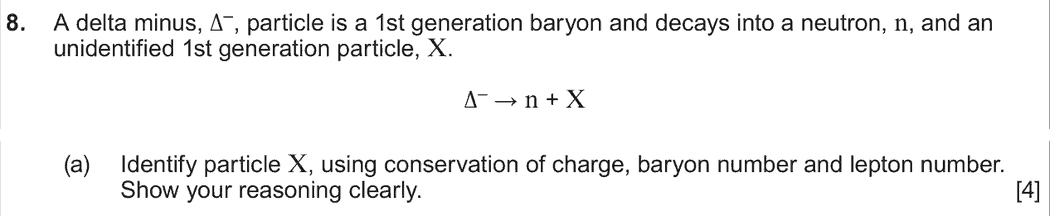
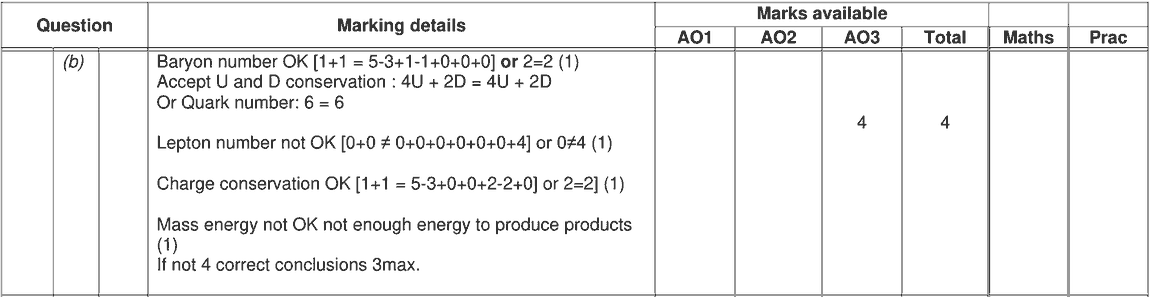
8. A delta minus, ∆–, particle is a 1st generation baryon and decays into a neutron, n, and an unidentified 1st generation particle, X. ∆– → n + X (a) Identify particle X, using conservation of charge, baryon number and lepton number. Show your reasoning clearly. [4]
June 2025 · Component 3 · Q8(c) 2 marks AO1=1, AO2=1 Explanation particles and nuclear structure
Earlier part of question 8 that this part usesEarlier part of June 2025 Component 3 question 8
(c) Determine whether up and down quark numbers are conserved in this decay. [2]
June 2025 · Component 3 · Q9(b) 3 marks AO1=1, AO3=2 Explanation alternating currents
Earlier parts of question 9 that this part usesEarlier part of June 2025 Component 3 question 9Earlier part of June 2025 Component 3 question 9
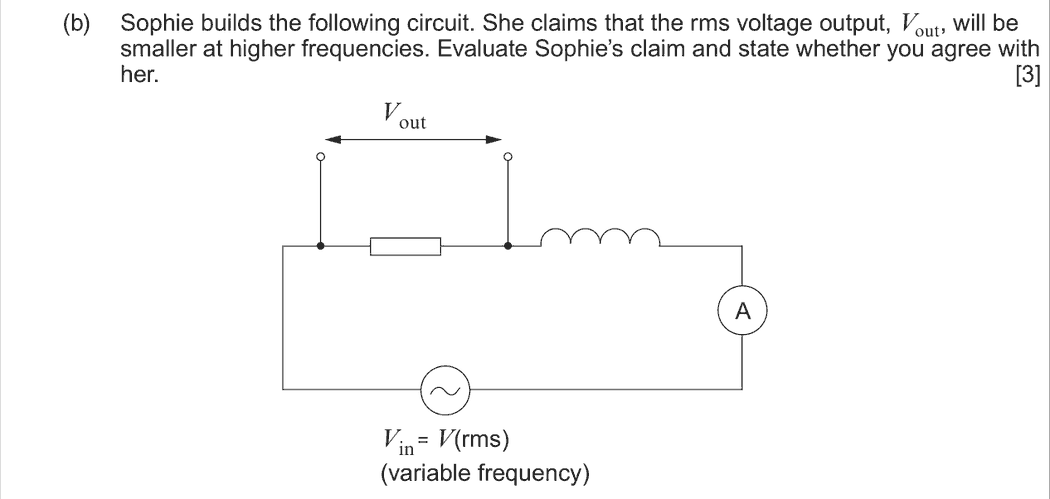
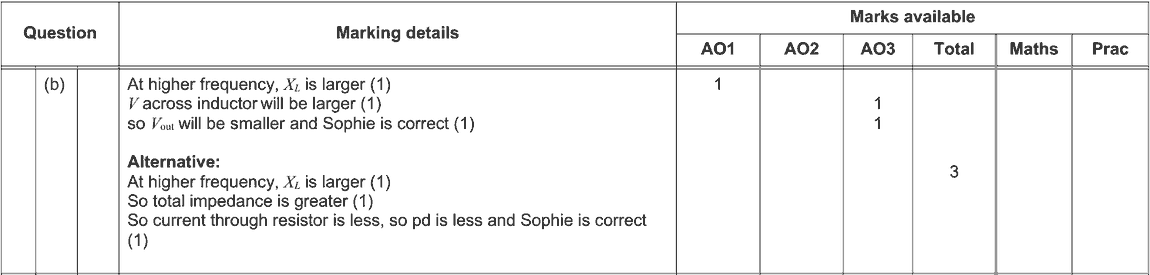
(b) Sophie builds the following circuit. She claims that the rms voltage output, Vout, will be smaller at higher frequencies. Evaluate Sophie’s claim and state whether you agree with her. [3] Vout A Vin = V(rms) (variable frequency)
June 2025 · Component 3 · Q10(b) 5 marks AO3=5 Explanation medical physics
Earlier part of question 10 that this part usesEarlier part of June 2025 Component 3 question 10
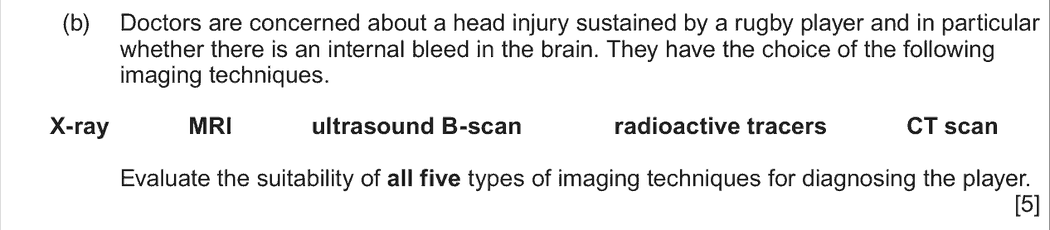
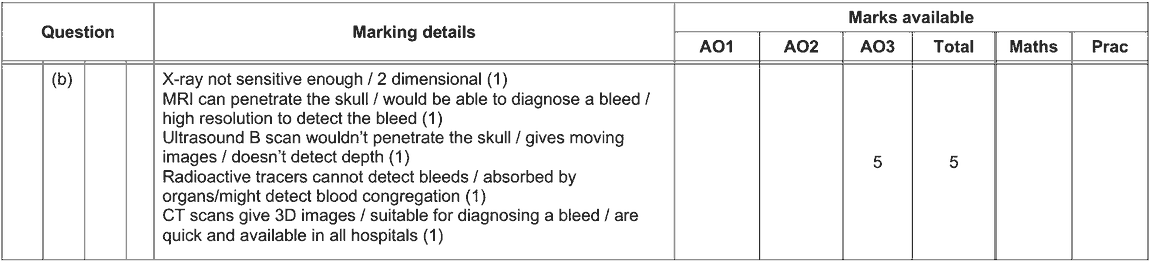
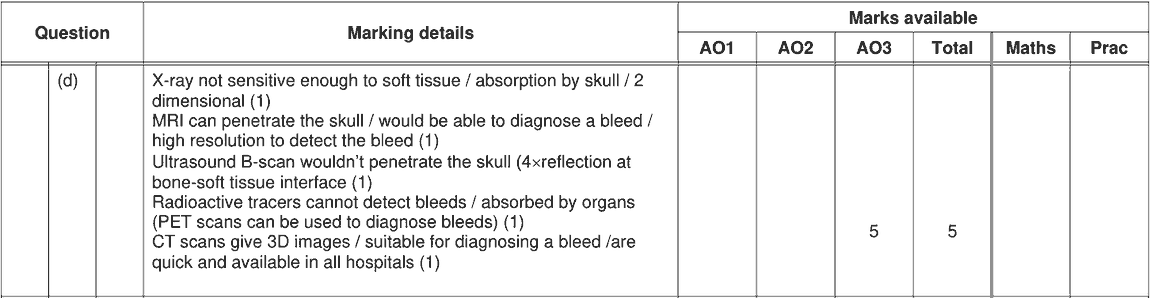
(b) Doctors are concerned about a head injury sustained by a rugby player and in particular whether there is an internal bleed in the brain. They have the choice of the following imaging techniques. X-ray MRI ultrasound B-scan radioactive tracers CT scan Evaluate the suitability of all five types of imaging techniques for diagnosing the player. [5]
June 2025 · Component 3 · Q10(c)(i) 3 marks AO1=3 Explanation medical physics
Earlier part of question 10 that this part usesEarlier part of June 2025 Component 3 question 10
(c) (i) Explain how a gamma camera detects the gamma rays given off by a technetium-99m source. [3]
June 2025 · Component 3 · Q11(a)(i) 2 marks AO1=1, AO2=1 Explanation physics of sports
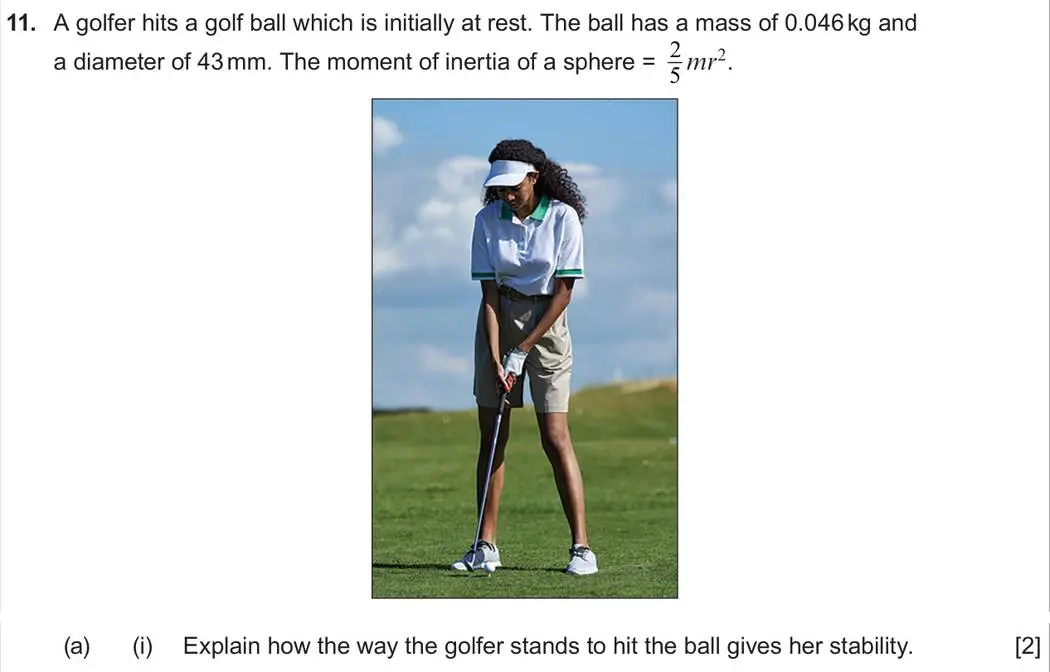
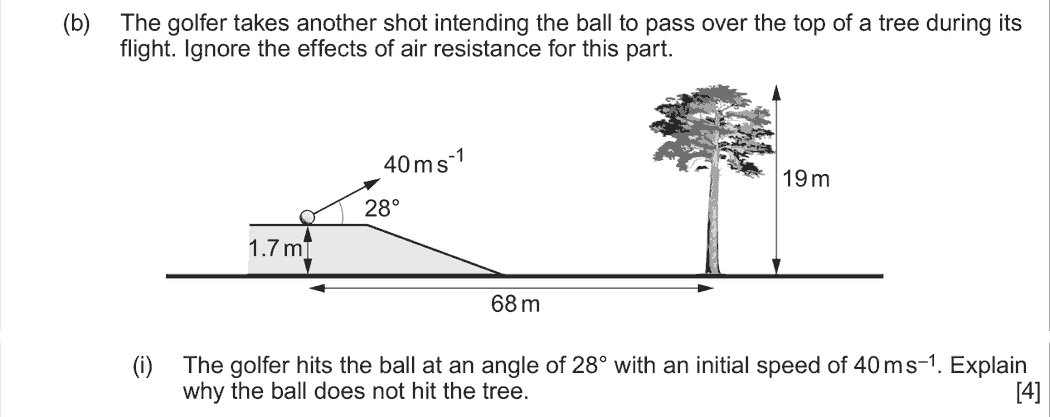
11. A golfer hits a golf ball which is initially at rest. The ball has a mass of 0.046 kg and 2 a diameter of 43 mm. The moment of inertia of a sphere = mr2. 5 (a) (i) Explain how the way the golfer stands to hit the ball gives her stability. [2]
June 2025 · Component 3 · Q11(a)(iv) 2 marks AO3=2 Explanation physics of sports
Earlier part of question 11 that this part usesEarlier part of June 2025 Component 3 question 11
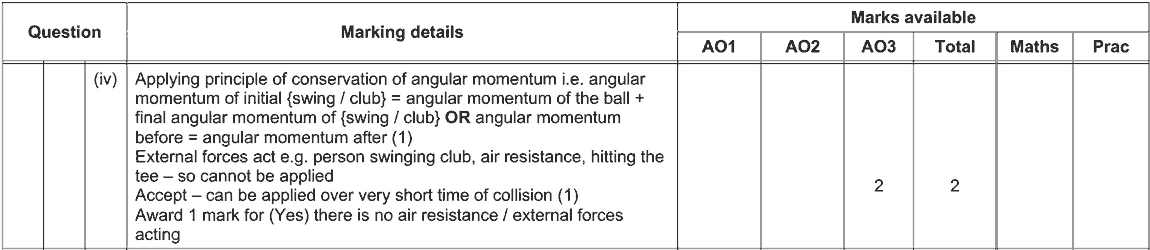
(iv) Discuss whether the principle of conservation of angular momentum can be applied to the system of the ball and the club when the golfer hits the ball. [2]
June 2025 · Component 3 · Q11(c) 4 marks AO1=2, AO2=2 Explanation physics of sports
Earlier parts of question 11 that this part usesEarlier part of June 2025 Component 3 question 11Earlier part of June 2025 Component 3 question 11
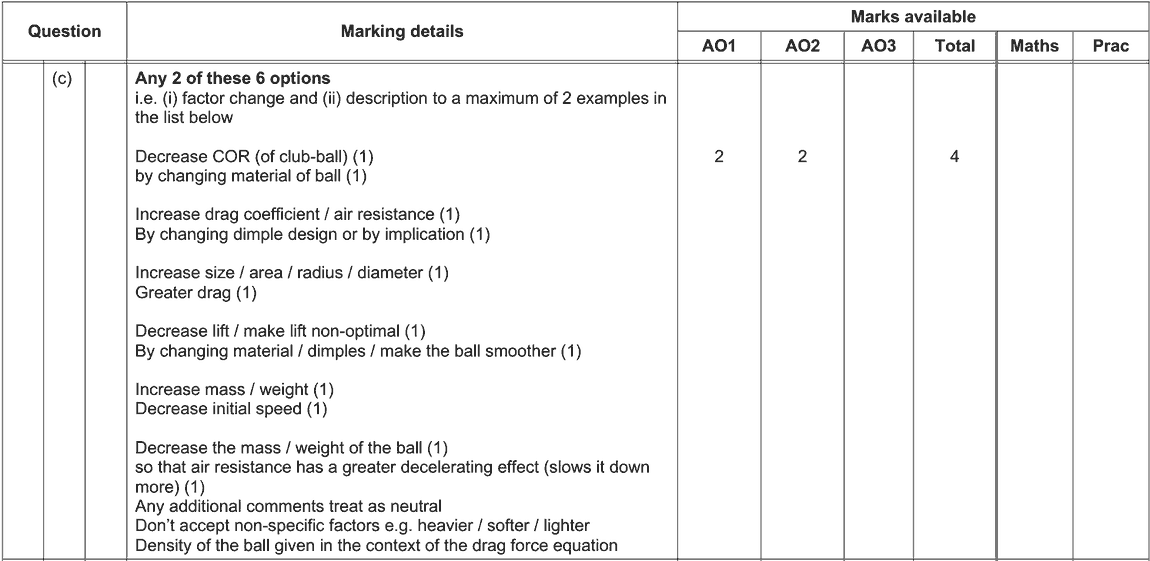
(c) Modern golf equipment leads to golf balls flying further. This means that many old golf courses are now too short. It has been proposed that the design of golf balls be changed to reduce their flight distance. Use physics to explain some changes that can be made to golf ball design to decrease their flight distance. [4]
June 2025 · Component 3 · Q12(d)(iv) 3 marks AO3=3 Explanation energy and the environment
Earlier parts of question 12 that this part usesEarlier part of June 2025 Component 3 question 12Earlier part of June 2025 Component 3 question 12Earlier part of June 2025 Component 3 question 12
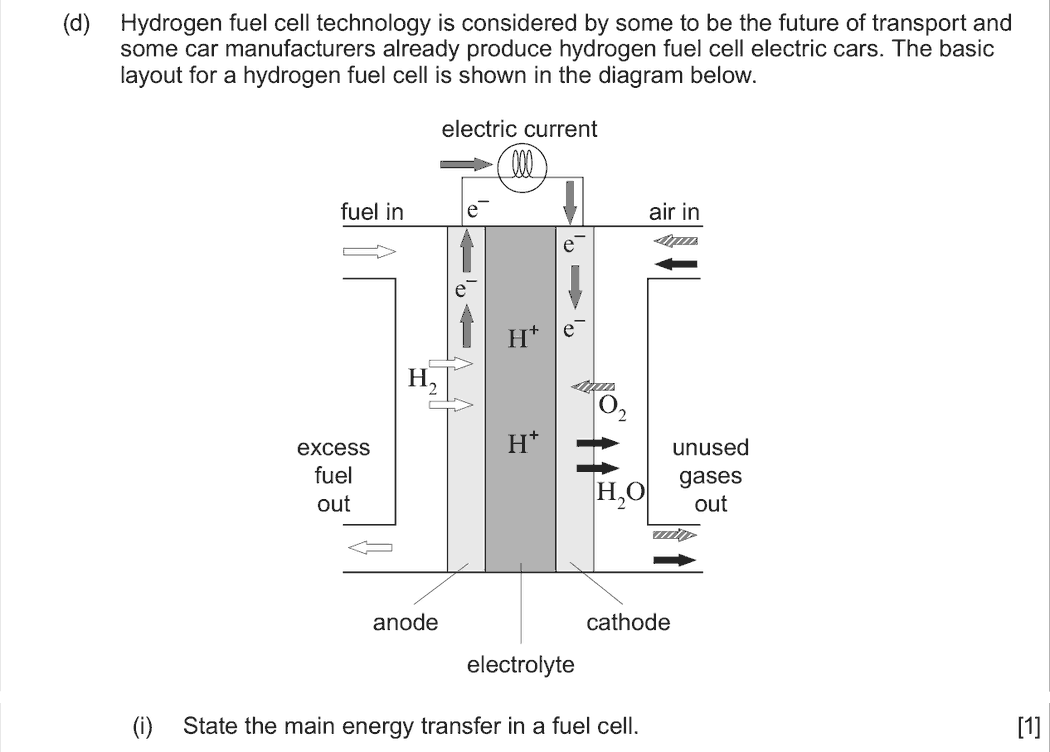
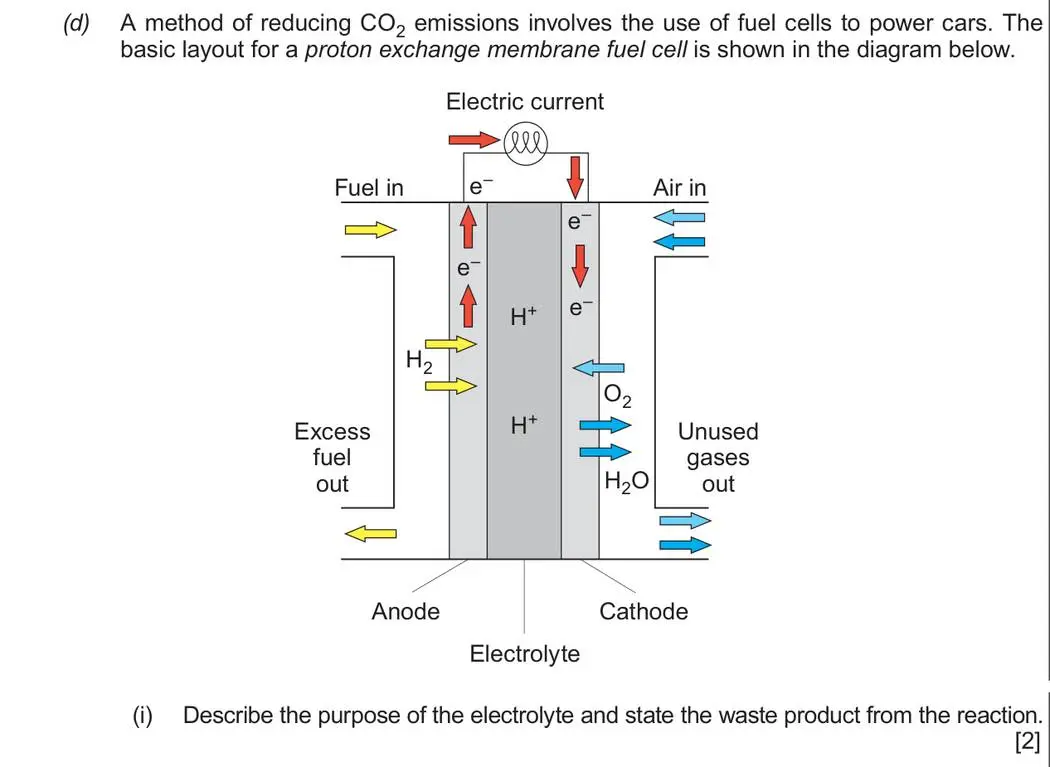
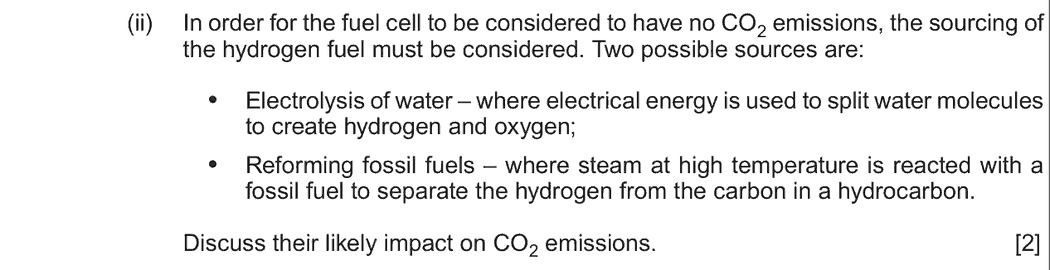
(iv) Some car manufacturers claim that the use of hydrogen fuel cells will not contribute any CO2 to the atmosphere. Evaluate this claim. [3]
June 2025 · AS Component 1 · Q1(b)(iii) 3 marks AO2=3 Explanation basic physics
Earlier parts of question 1 that this part usesEarlier part of June 2025 Component 1 question 1Earlier part of June 2025 Component 1 question 1
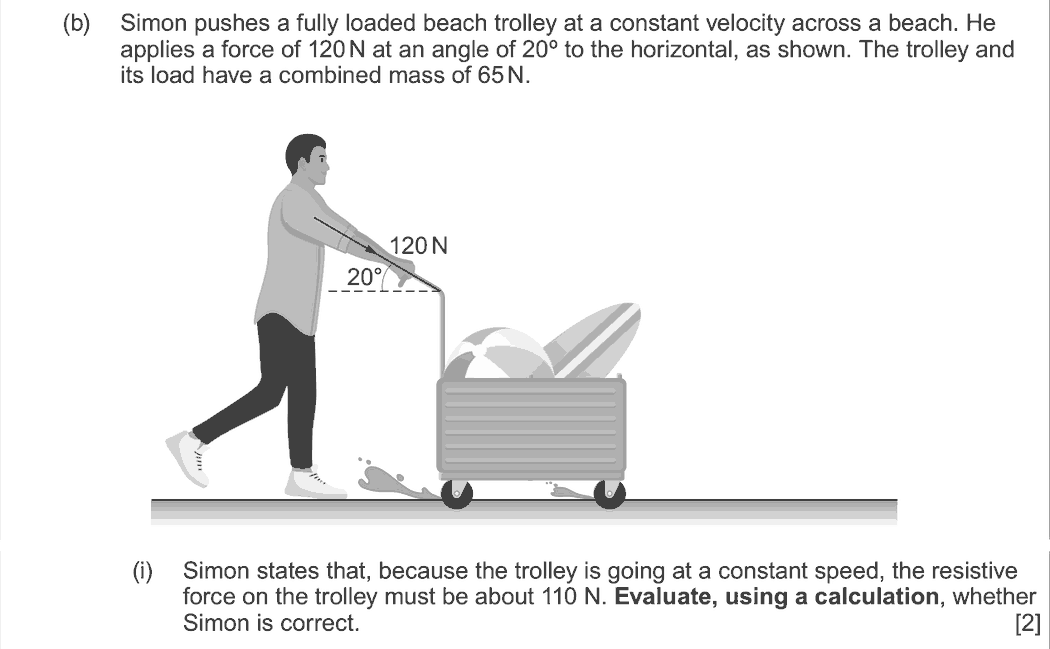
(iii) Explain whether it would require a larger or a smaller force to pull the trolley at the same angle to the horizontal, than to push it. Hint: consider the extent to which the trolley’s wheels sink into the sand. [3]
June 2025 · AS Component 1 · Q2(b)(ii) 2 marks AO3=2 Explanation basic physics
Earlier parts of question 2 that this part usesEarlier part of June 2025 Component 1 question 2Earlier part of June 2025 Component 1 question 2
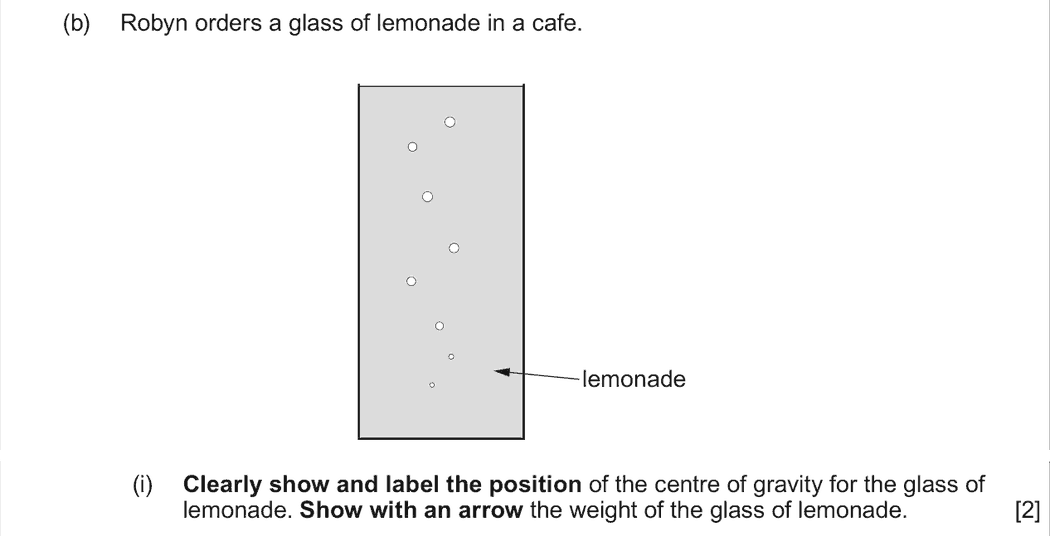
(ii) Robyn accidently knocks the glass of lemonade over. Her friend Mali claims that the glass would have been more stable if it had been half empty rather than full of lemonade. Evaluate this claim. [2]
June 2025 · AS Component 1 · Q2(b)(iii) 3 marks AO2=3 Explanation basic physics
Earlier parts of question 2 that this part usesEarlier part of June 2025 Component 1 question 2Earlier part of June 2025 Component 1 question 2
(iii) The cafe owner notices the accident and decides to order some new, more stable glasses. State what features the glasses should have and explain how they increase the stability. [3]
June 2025 · AS Component 1 · Q5(c)(ii) 2 marks AO1=2 Explanation kinematics
Earlier parts of question 5 that this part usesEarlier part of June 2025 Component 1 question 5Earlier part of June 2025 Component 1 question 5
(ii) Explain, in terms of forces, why the ball eventually reaches terminal velocity. [2]
June 2025 · AS Component 1 · Q6(b)(i) 3 marks AO3=3 Explanation particles and nuclear structure
Earlier part of question 6 that this part usesEarlier part of June 2025 Component 1 question 6
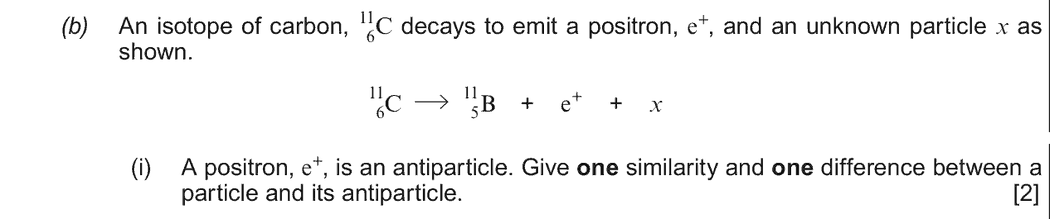
(b) (i) The following reaction shows the decay of a neutron, n. Identify particle X, giving your reasoning in terms of conservation laws. [3] n p + –e + X
June 2025 · AS Component 1 · Q7(c) 2 marks AO3=2 Explanation radiation and stars
Earlier part of question 7 that this part usesEarlier part of June 2025 Component 1 question 7
(c) The James Webb Space Telescope was launched in 2022 at a cost of 10 billion dollars, funded by the U.S.A., Canada and Europe. Explain whether you feel this is a good use of resources. [2]
June 2025 · AS Component 2 · Q1(a)(ii) 2 marks AO1=2 Explanation nature of waves
Earlier part of question 1 that this part usesEarlier part of June 2025 Component 2 question 1
(ii) Progressive waves can be transverse or longitudinal. Explain the difference between these two types of waves. [2]
June 2025 · AS Component 2 · Q2(a)(i) 2 marks AO1=2 Explanation wave properties
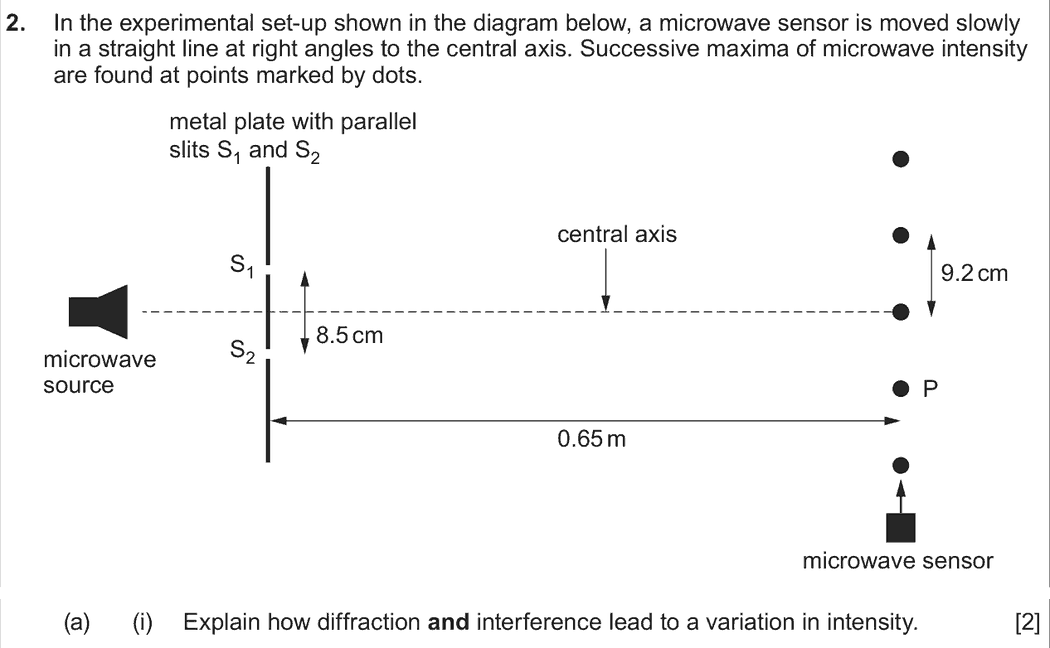
2. In the experimental set-up shown in the diagram below, a microwave sensor is moved slowly in a straight line at right angles to the central axis. Successive maxima of microwave intensity are found at points marked by dots. metal plate with parallel slits S1 and S2 central axis S1 9.2 cm 8.5 cm S2 microwave source P 0.65 m microwave sensor (a) (i) Explain how diffraction and interference lead to a variation in intensity. [2]
June 2025 · AS Component 2 · Q2(a)(ii) 2 marks AO1=1, AO2=1 Explanation wave properties
Earlier part of question 2 that this part usesEarlier part of June 2025 Component 2 question 2
(ii) The slits S1 and S2 act as sources that are in phase with each other. Explain how the diagram confirms that S1 and S2 are in phase. [2]
June 2025 · AS Component 2 · Q2(b)(i) 2 marks AO2=2 Explanation wave properties
Earlier part of question 2 that this part usesEarlier part of June 2025 Component 2 question 2
(b) (i) Explain the phase relationship between waves from S1 and S2 when they arrive at point P. [2]
June 2025 · AS Component 2 · Q7(a)(ii) 2 marks AO1=1, AO2=1 Explanation photons
Earlier part of question 7 that this part usesEarlier part of June 2025 Component 2 question 7
(ii) Explain why the number of photons per second will be less if a laser with the same power output is used that emits blue light. [2]
June 2024 · Component 1 · Q2(b) 3 marks AO3=3 Explanation Easy kinematics
Earlier part of question 2 that this part usesEarlier part of June 2024 Component 1 question 2
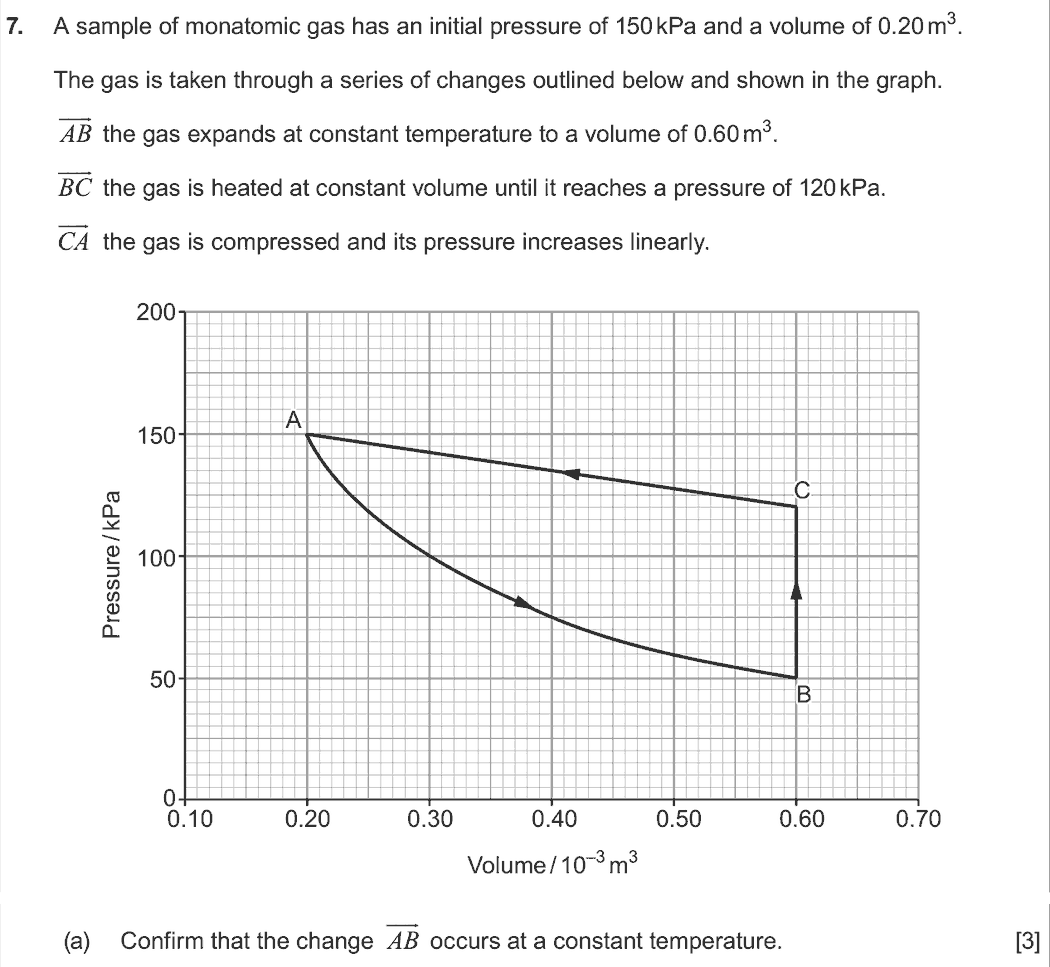
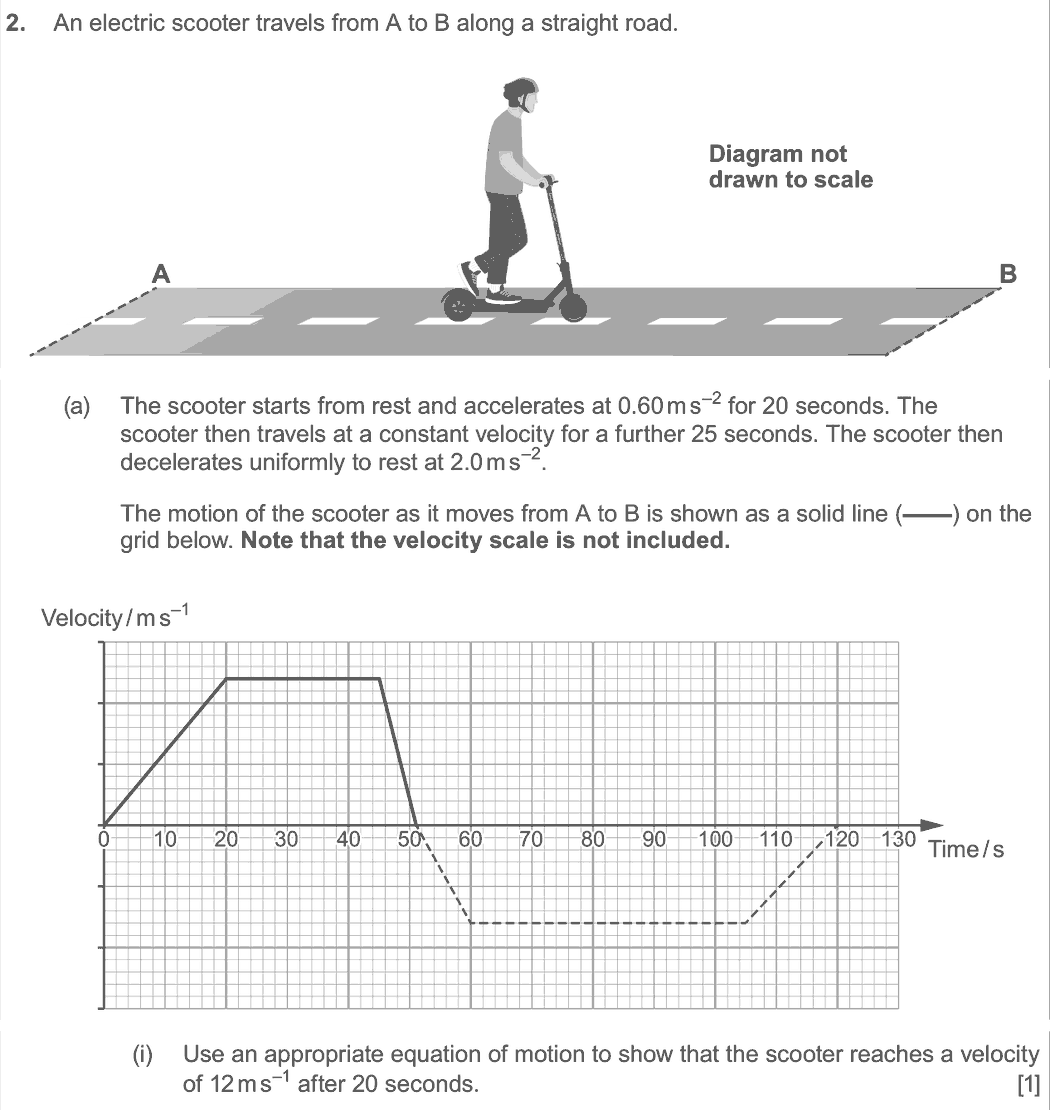
(b) The dashed line ( ) on the grid represents the return journey from B to A. Charlie and Lola analyse the electric scooter’s motion over the entire journey (from A to B and back again). Charlie states that the mean speed is 9 m s–1. Lola states that the mean velocity is 0 m s–1. Discuss the validity of both these statements. [3]
June 2024 · Component 1 · Q7(b)(iii) 4 marks AO2=4 Explanation kinetic theory
Earlier parts of question 7 that this part usesEarlier part of June 2024 Component 1 question 7Earlier part of June 2024 Component 1 question 7
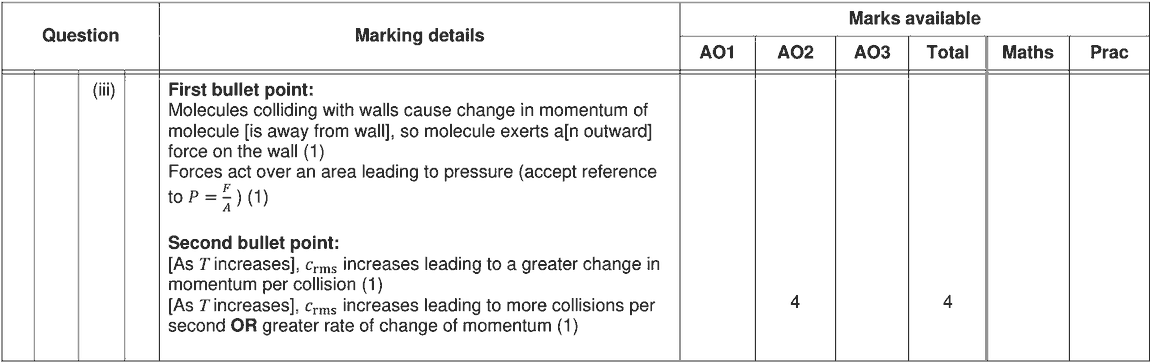
(iii) By considering the motion of the gas molecules, explain: • how a gas exerts a pressure on the walls of its container • why the pressure increases as temperature increases between B and C. [4]
June 2024 · Component 1 · Q7(c) 3 marks AO2=3 Explanation thermal physics
Earlier part of question 7 that this part usesEarlier part of June 2024 Component 1 question 7
 (c) For the whole cycle, ABCA , explain using the first law of thermodynamics, whether or not there is a net flow of heat into the system. [3]
June 2024 · Component 1 · Q8(d) 4 marks AO1=1, AO2=3 Explanation nature of wavescomprehension
Earlier part of question 8 that this part usesEarlier part of June 2024 Component 1 question 8
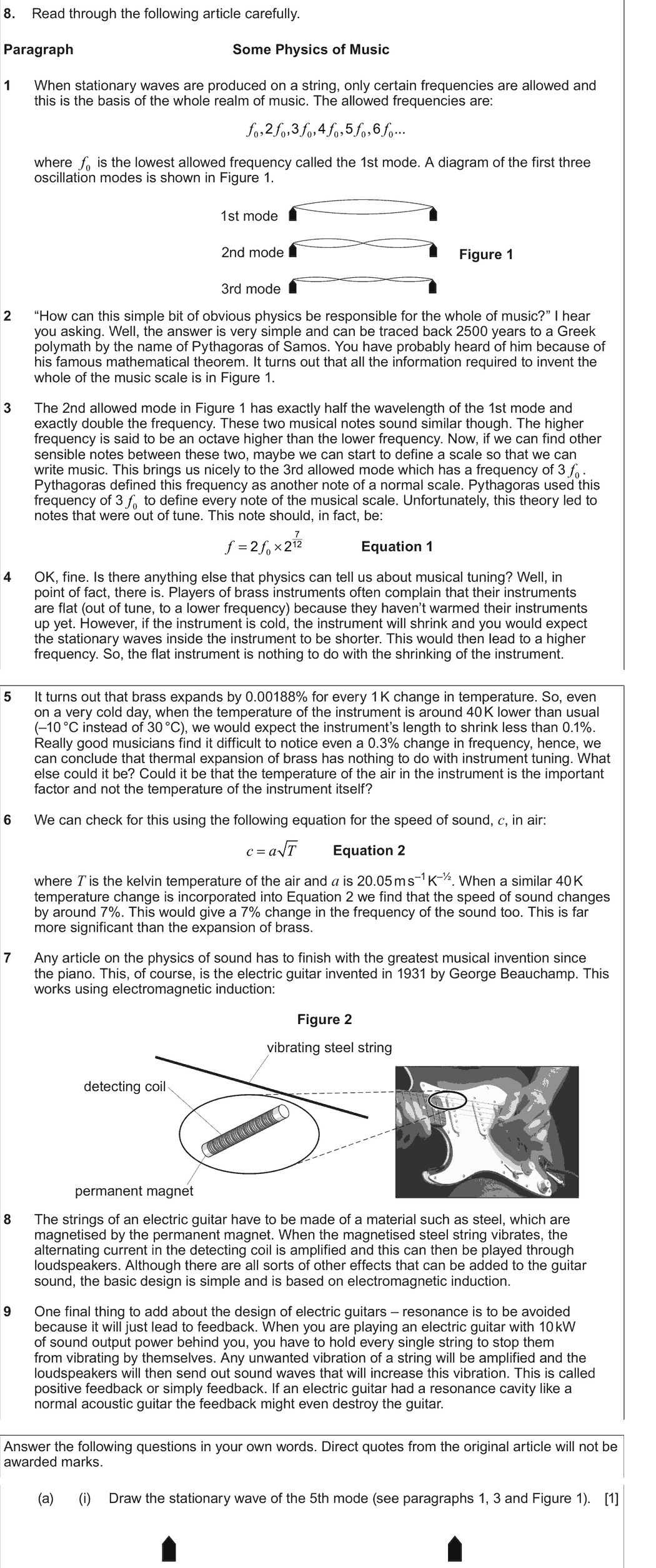
(d) Explain, in your own words, why the frequency produced by a brass instrument increases as temperature increases (see paragraphs 4–6 and Equation 2). [4]
June 2024 · Component 1 · Q8(f) 5 marks AO1=1, AO2=4 Explanation electromagnetic inductioncomprehension
Earlier part of question 8 that this part usesEarlier part of June 2024 Component 1 question 8
(f) Explain, in your own words, how an electric guitar produces a sound (see paragraphs 7–9 and Figure 2). [5]
June 2024 · Component 1 · Q8(g) 2 marks AO3=2 Explanation electromagnetic inductioncomprehension
Earlier part of question 8 that this part usesEarlier part of June 2024 Component 1 question 8
(g) Explain why an electric guitar will not work well with copper strings (see paragraphs 7–9 and Figure 2). [2]
June 2024 · Component 2 · Q1(b)(i) 2 marks AO3=2 Explanation resistance
Earlier part of question 1 that this part usesEarlier part of June 2024 Component 2 question 1
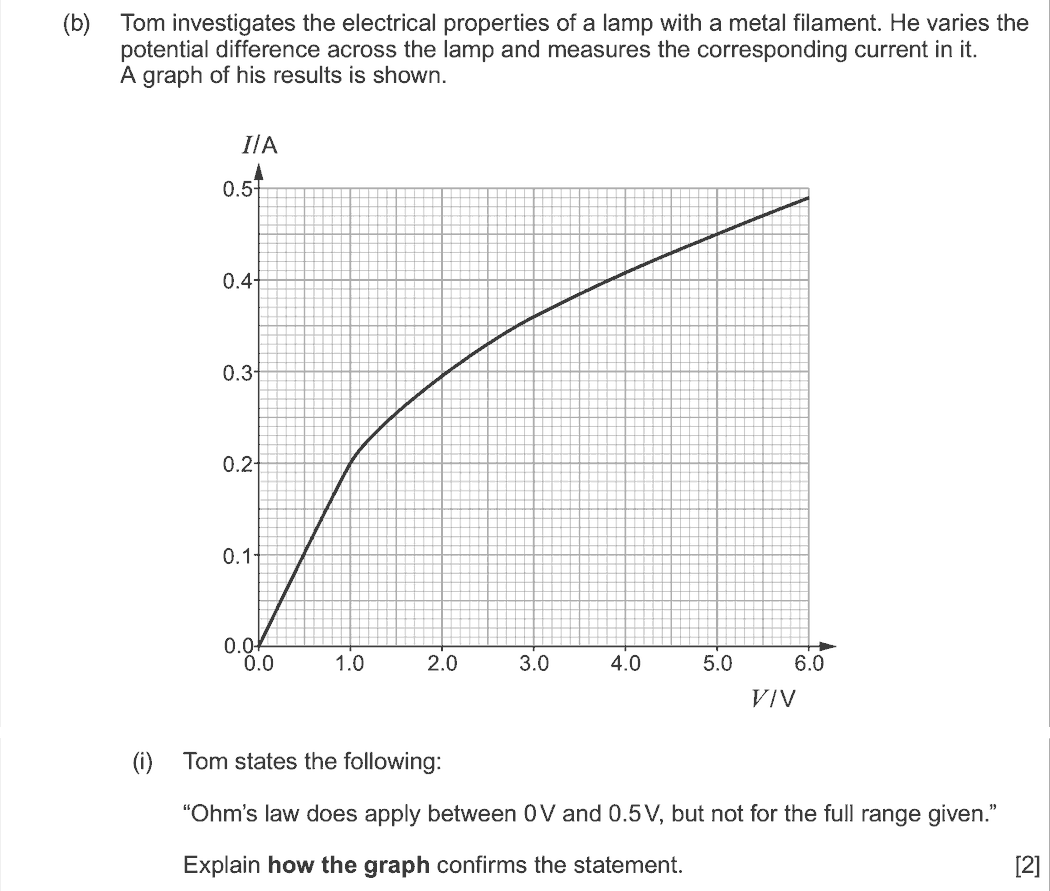
(b) Tom investigates the electrical properties of a lamp with a metal filament. He varies the potential difference across the lamp and measures the corresponding current in it. A graph of his results is shown. I / A 0.5 0.4 0.3 0.2 0.1 0.0 0.0 1.0 2.0 3.0 4.0 5.0 6.0 V / V (i) Tom states the following: “Ohm’s law does apply between 0 V and 0.5 V, but not for the full range given.” Explain how the graph confirms the statement. [2]
June 2024 · Component 2 · Q1(b)(ii) 5 marks AO1=3, AO2=2 Explanation resistance
Earlier parts of question 1 that this part usesEarlier part of June 2024 Component 2 question 1Earlier part of June 2024 Component 2 question 1
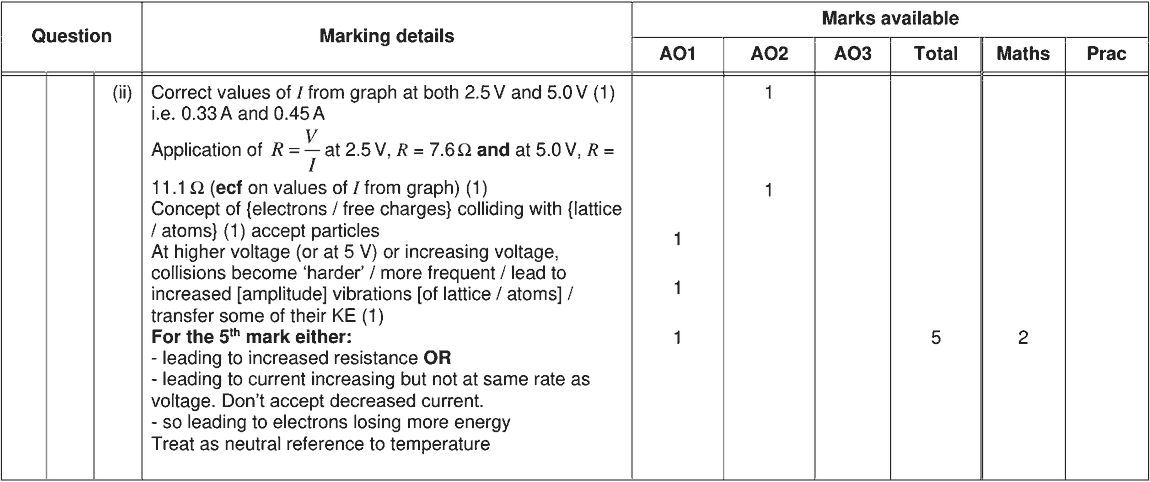
(ii) Show by calculation, that the resistance of the lamp is different when the pd across it is 2.5 V and when it is 5.0 V, and explain, in terms of particles, why this is to be expected. [5]
June 2024 · Component 2 · Q2(b)(iii) 2 marks AO3=2 Explanation dc circuits
Earlier parts of question 2 that this part usesEarlier part of June 2024 Component 2 question 2Earlier part of June 2024 Component 2 question 2
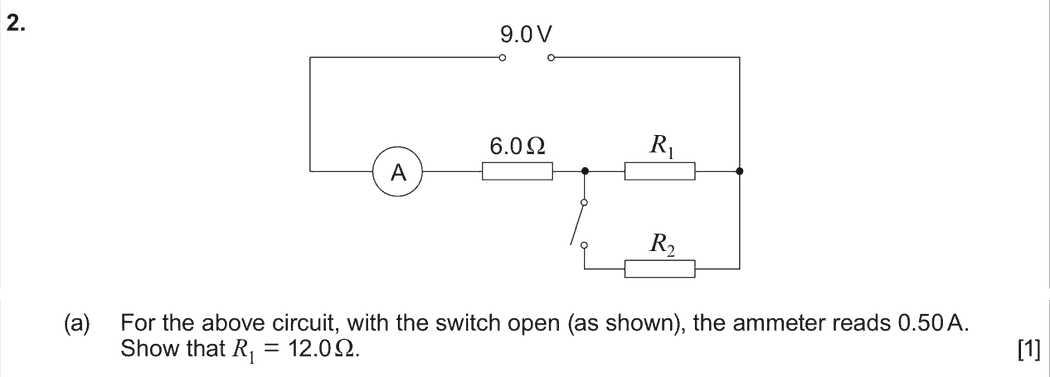
(iii) A student makes the following comment: “No matter how many resistors are added in parallel with R1 and R2, the reading on the ammeter will not go above a certain value.” Discuss the validity of this statement. [2]
June 2024 · Component 2 · Q6(a)(ii) 2 marks AO1=2 Explanation solids under stress
Earlier part of question 6 that this part usesEarlier part of June 2024 Component 2 question 6
(ii) Explain, in terms of stress, why the metal fractures at this point. [2]
June 2024 · Component 2 · Q6(b)(iii) 2 marks AO3=2 Explanation solids under stress
Earlier parts of question 6 that this part usesEarlier part of June 2024 Component 2 question 6Earlier part of June 2024 Component 2 question 6
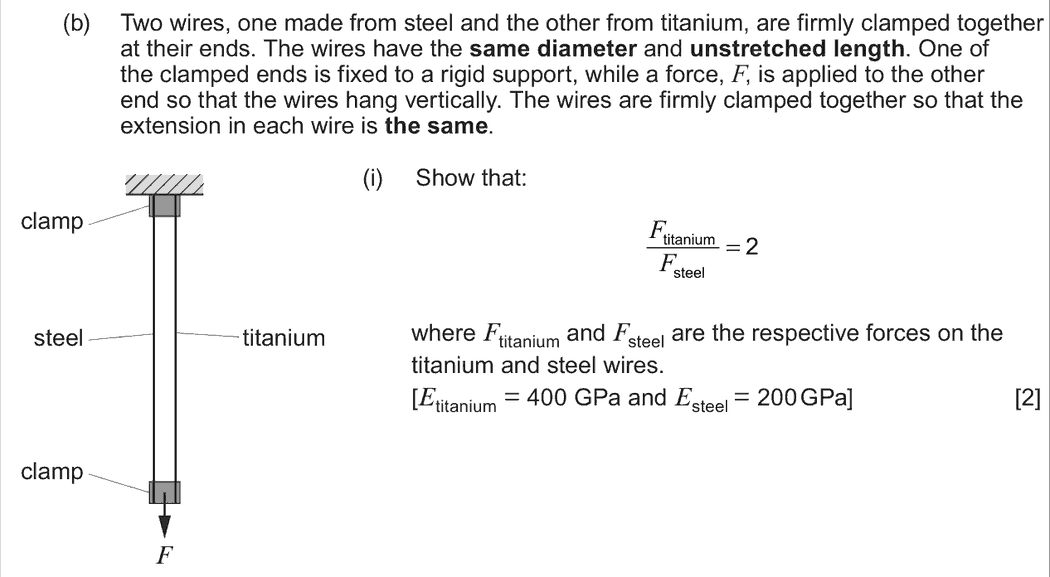
(iii) A physics student assumes that, since the wires extend by the same amount, they must possess the same amount of elastic potential energy. Determine whether the student’s assumption is correct. [2]
June 2024 · Component 2 · Q7(a)(ii) 2 marks AO1=2 Explanation orbits and the wider universe
Earlier part of question 7 that this part usesEarlier part of June 2024 Component 2 question 7
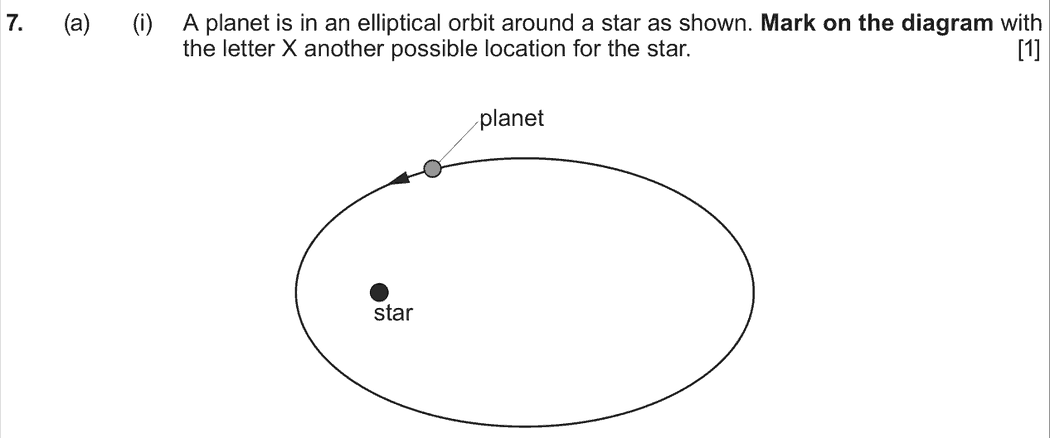
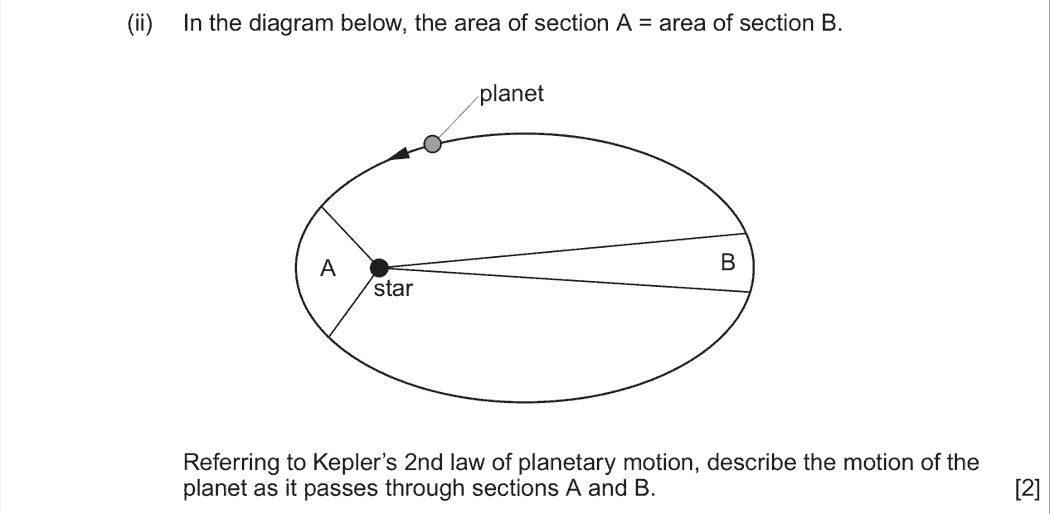
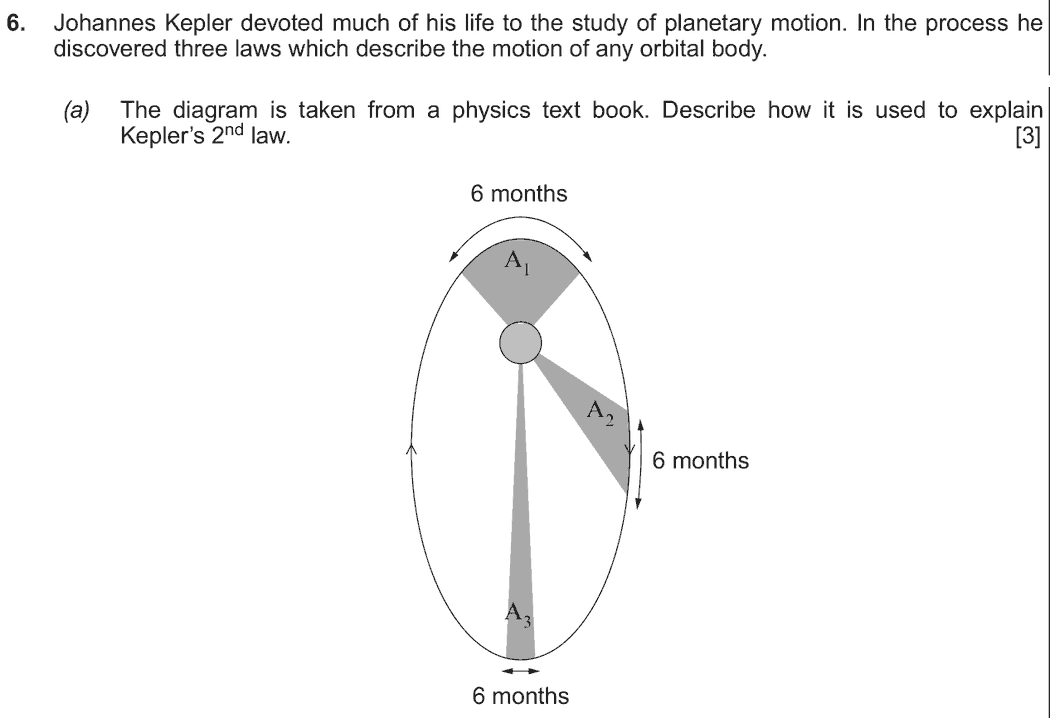
(ii) In the diagram below, the area of section A = area of section B. planet A B star Referring to Kepler’s 2nd law of planetary motion, describe the motion of the planet as it passes through sections A and B. [2]
June 2024 · Component 2 · Q7(c)(ii) 3 marks AO2=3 Explanation orbits and the wider universe
Earlier parts of question 7 that this part usesEarlier part of June 2024 Component 2 question 7Earlier part of June 2024 Component 2 question 7Earlier part of June 2024 Component 2 question 7
(ii) The observed velocity is greater than the calculated velocity. Explain how the Higgs boson was thought by some to be responsible for the difference in the velocities. [3]
June 2024 · Component 3 · Q1(a) 4 marks AO3=4 Explanation wave propertiesnature of waves
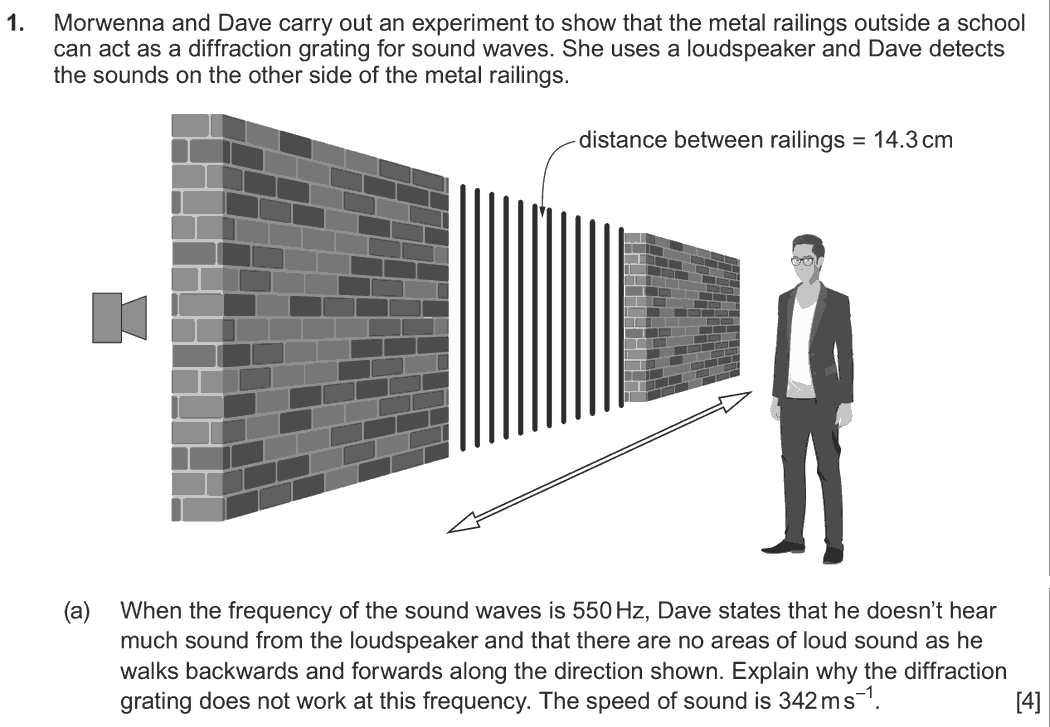
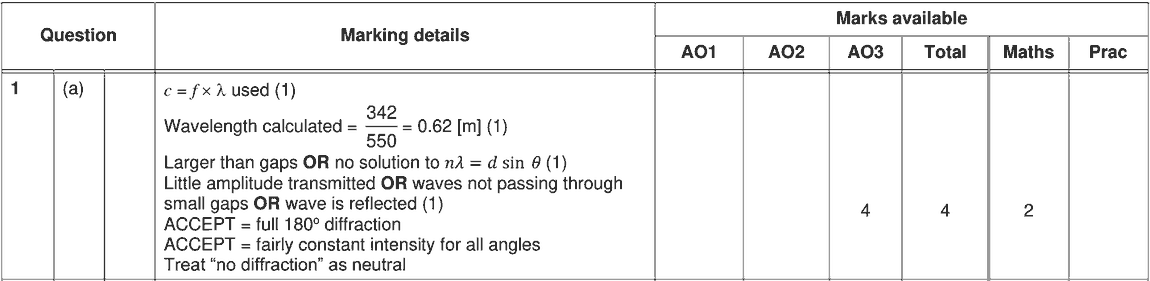
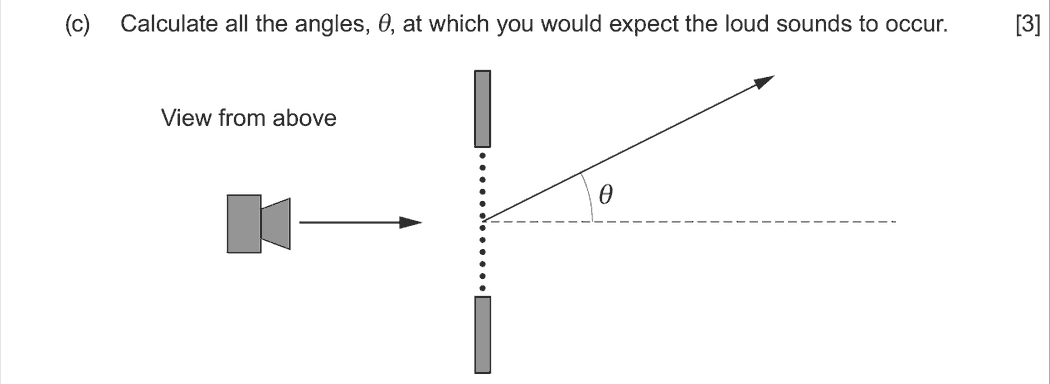
1. Morwenna and Dave carry out an experiment to show that the metal railings outside a school can act as a diffraction grating for sound waves. She uses a loudspeaker and Dave detects the sounds on the other side of the metal railings. distance between railings = 14.3 cm (a) When the frequency of the sound waves is 550 Hz, Dave states that he doesn’t hear much sound from the loudspeaker and that there are no areas of loud sound as he walks backwards and forwards along the direction shown. Explain why the diffraction grating does not work at this frequency. The speed of sound is 342 m s–1. [4]
June 2024 · Component 3 · Q1(d) 3 marks AO3=3 Explanation nature of waves
Earlier parts of question 1 that this part usesEarlier part of June 2024 Component 3 question 1Earlier part of June 2024 Component 3 question 1
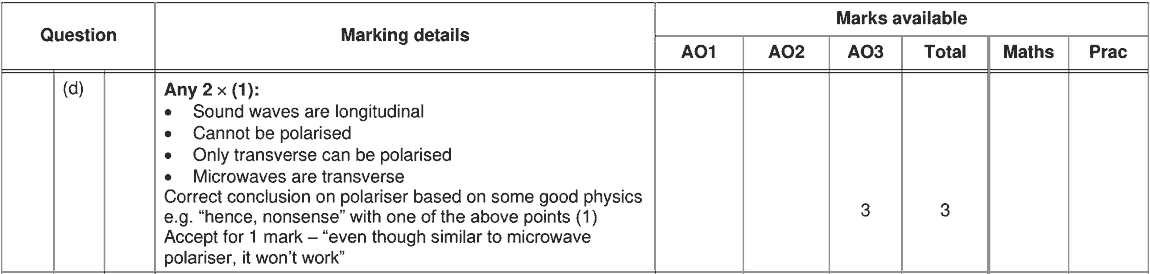
(d) Dave states, “The metal railings are very similar to a polariser for microwaves so the sound waves I’m detecting must be polarised.” Determine to what extent Dave’s statement is correct. [3]
June 2024 · Component 3 · Q2(a) 3 marks AO2=3 Explanation wave properties
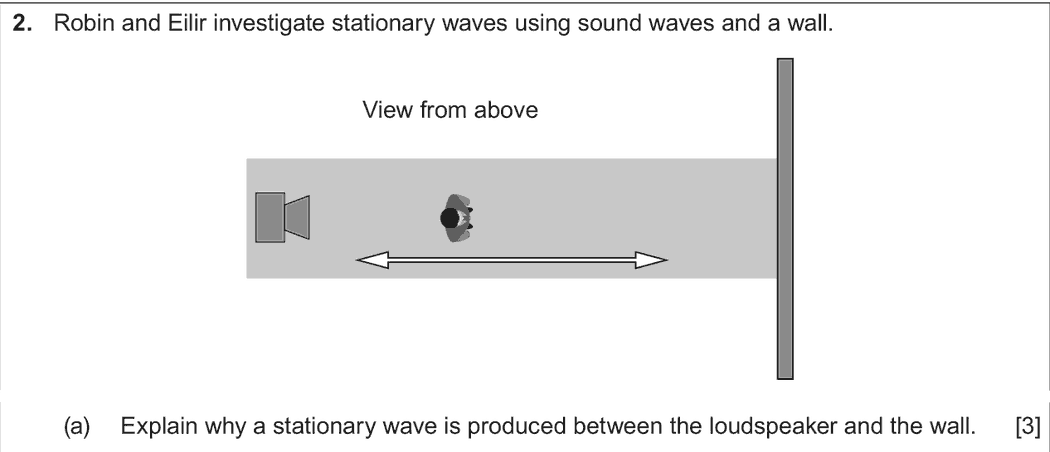
2. Robin and Eilir investigate stationary waves using sound waves and a wall. View from above (a) Explain why a stationary wave is produced between the loudspeaker and the wall. [3]
June 2024 · Component 3 · Q3(b)(ii) 3 marks AO1=3 Explanation refraction of light
Earlier parts of question 3 that this part usesEarlier part of June 2024 Component 3 question 3Earlier part of June 2024 Component 3 question 3
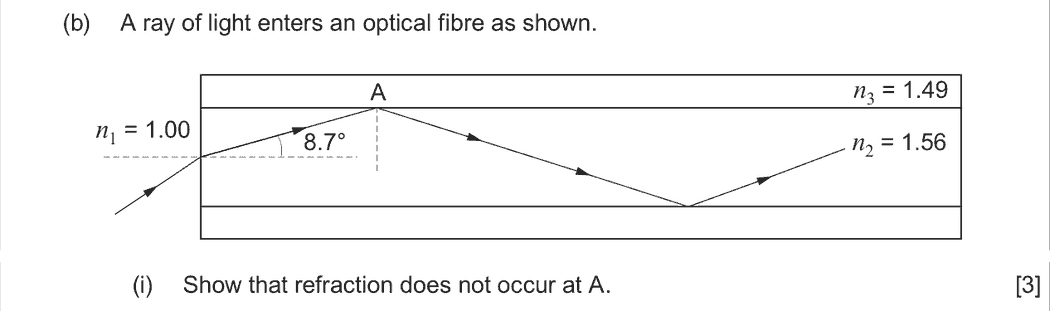
(ii) Explain how ‘multimode dispersion’ arises and outline the problem that it causes. [3]
June 2024 · Component 3 · Q3(b)(iii) 2 marks AO1=2 Explanation refraction of light
Earlier parts of question 3 that this part usesEarlier part of June 2024 Component 3 question 3Earlier part of June 2024 Component 3 question 3
(iii) Explain how the problem of ‘multimode dispersion’ is solved in practice. [2]
June 2024 · Component 3 · Q4(a) 3 marks AO1=1, AO2=2 Explanation photons
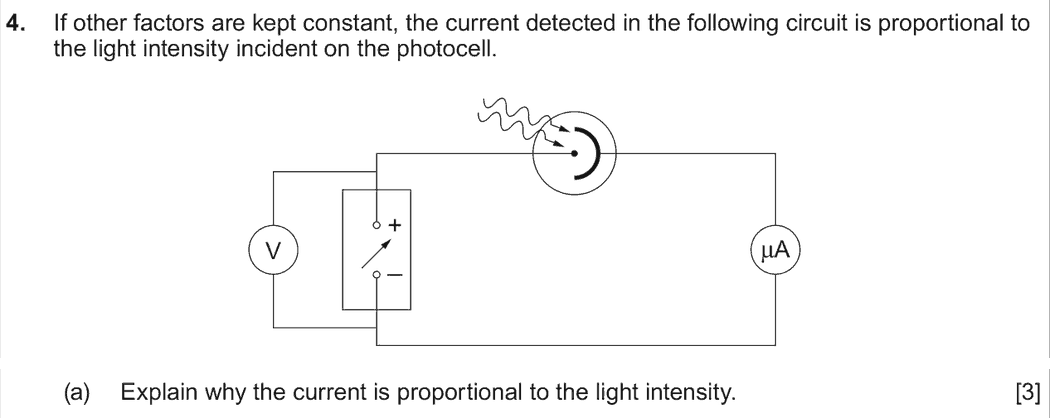
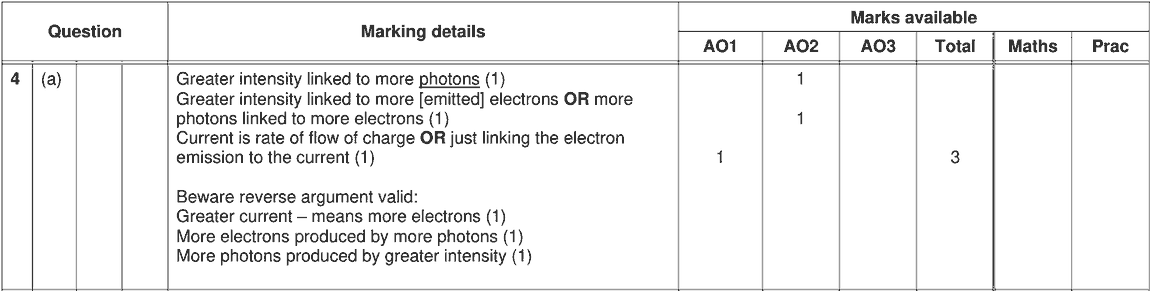
4. If other factors are kept constant, the current detected in the following circuit is proportional to the light intensity incident on the photocell. + V μA _ (a) Explain why the current is proportional to the light intensity. [3]
June 2024 · Component 3 · Q4(d) 3 marks AO3=3 Explanation photons
Earlier part of question 4 that this part usesEarlier part of June 2024 Component 3 question 4
(d) The photoelectric effect is evidence of light behaving like particles. In 1802, Thomas Young carried out an experiment that was evidence of light behaving like a wave. In 1704, Newton had argued that light was made of particles whose size varied with colour. Explain how the scientific community has decided which of these theories to adopt. [3]
June 2024 · Component 3 · Q6 5 marks AO2=5 Explanation particles and nuclear structure
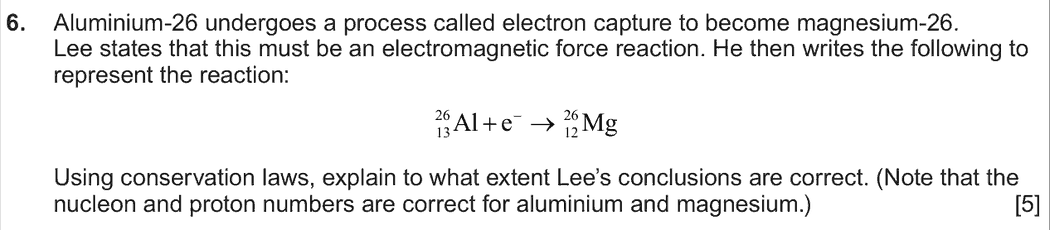
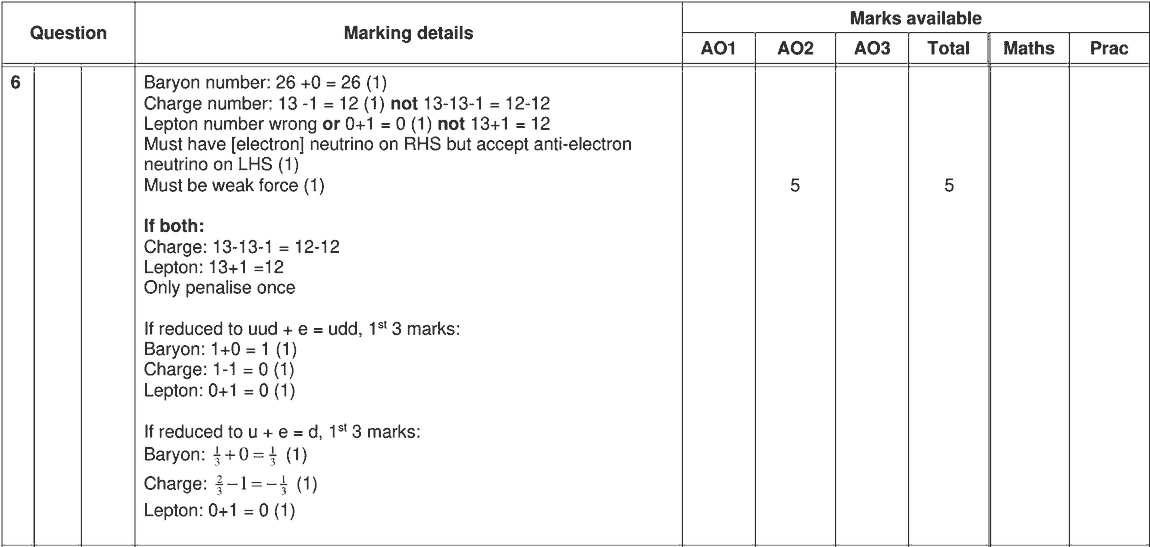
6. Aluminium-26 undergoes a process called electron capture to become magnesium-26. Lee states that this must be an electromagnetic force reaction. He then writes the following to represent the reaction: 26 Al  e   26 Mg 13 12 Using conservation laws, explain to what extent Lee’s conclusions are correct. (Note that the nucleon and proton numbers are correct for aluminium and magnesium.) [5]
June 2024 · Component 3 · Q7(b)(i) 3 marks AO1=3 Explanation magnetic fields
Earlier part of question 7 that this part usesEarlier part of June 2024 Component 3 question 7
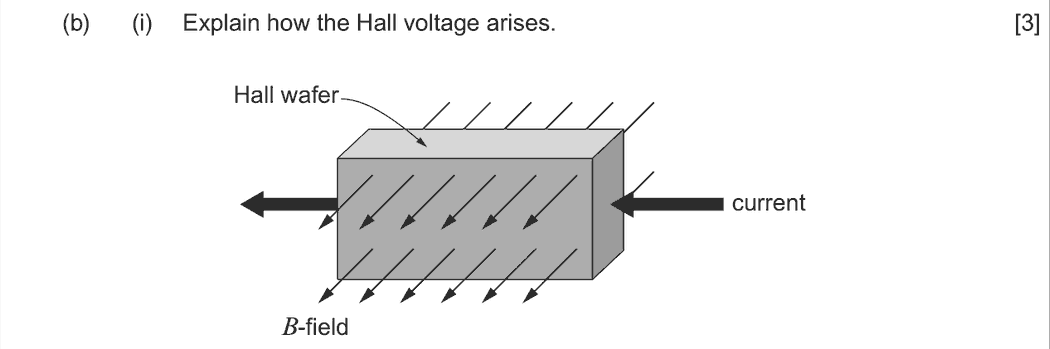
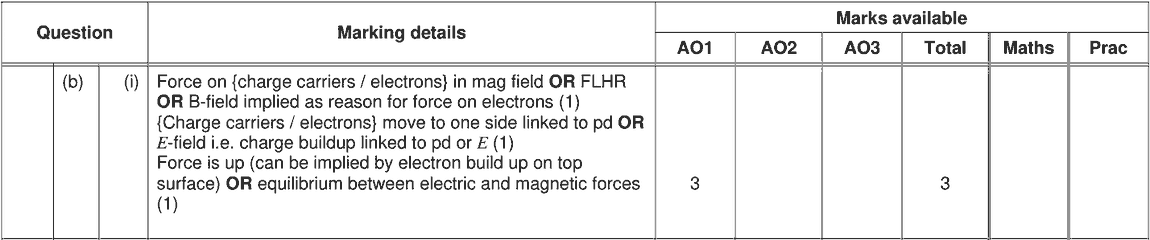
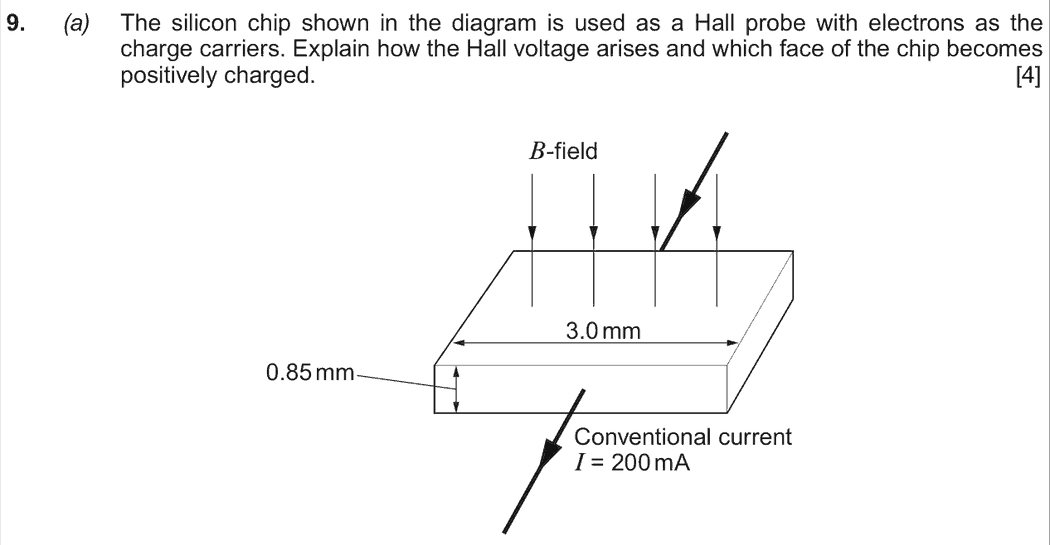
(b) (i) Explain how the Hall voltage arises. [3] Hall wafer current B-field
June 2024 · Component 3 · Q8(a) 5 marks AO2=5 Explanation electromagnetic induction
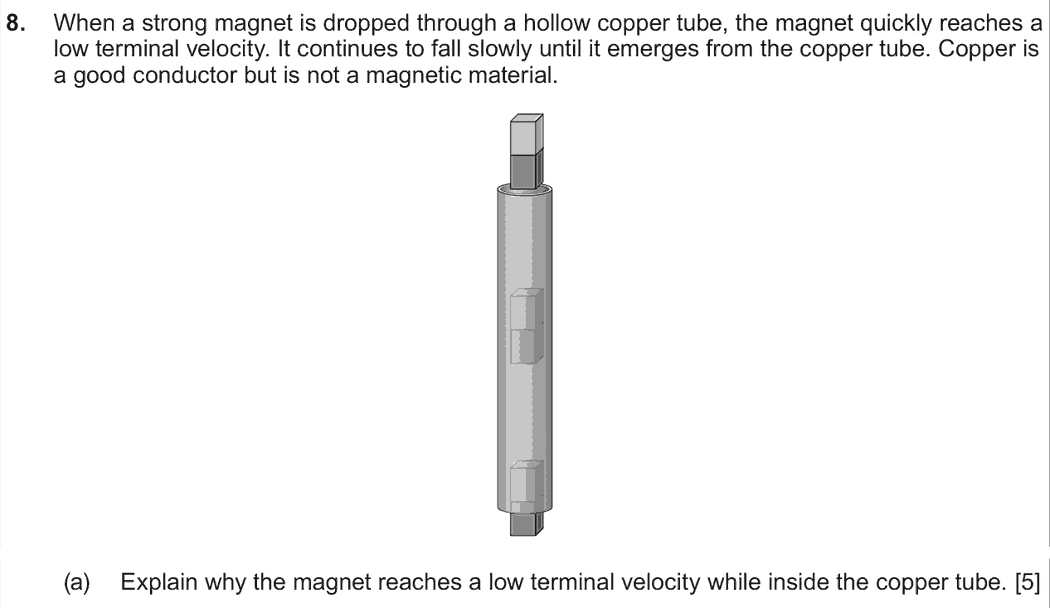
8. When a strong magnet is dropped through a hollow copper tube, the magnet quickly reaches a low terminal velocity. It continues to fall slowly until it emerges from the copper tube. Copper is a good conductor but is not a magnetic material. (a) Explain why the magnet reaches a low terminal velocity while inside the copper tube. [5]
June 2024 · Component 3 · Q9(c)(ii) 4 marks AO3=4 Explanation alternating currents
Earlier parts of question 9 that this part usesEarlier part of June 2024 Component 3 question 9Earlier part of June 2024 Component 3 question 9Earlier part of June 2024 Component 3 question 9
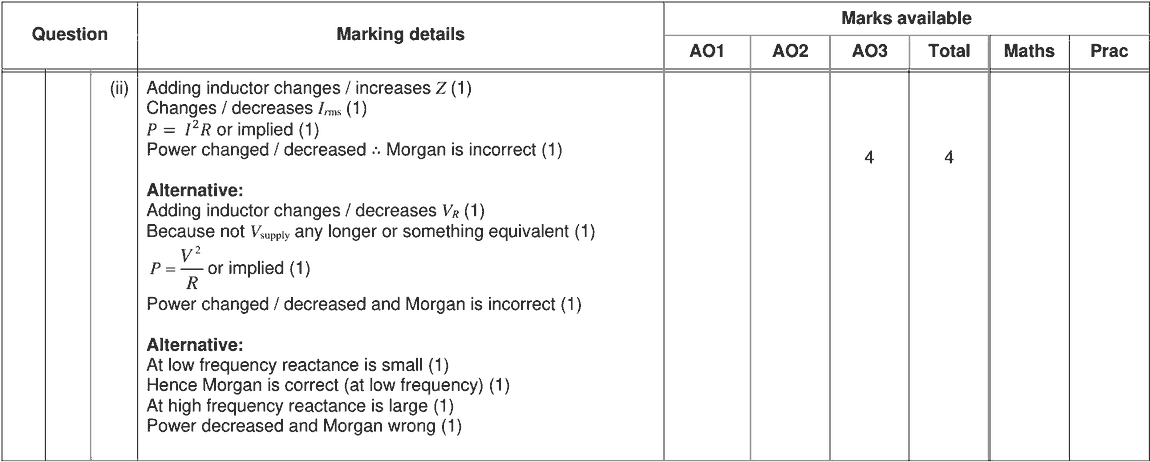
(ii) Morgan knows that no power is dissipated in an inductor with zero resistance. He therefore claims that adding the inductor will not affect the mean power dissipated in the circuit. Determine whether Morgan is correct. [4]
June 2024 · Component 3 · Q10(a)(i) 3 marks AO1=3 Explanation medical physics
10. (a) Electrons are accelerated in an X-ray tube. (i) Describe the energy changes that occur inside an X-ray tube. [3]
June 2024 · Component 3 · Q10(b) 5 marks AO3=5 Explanation medical physics
Earlier part of question 10 that this part usesEarlier part of June 2024 Component 3 question 10
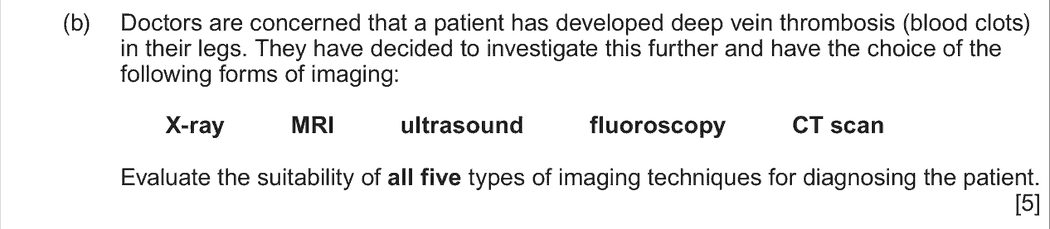
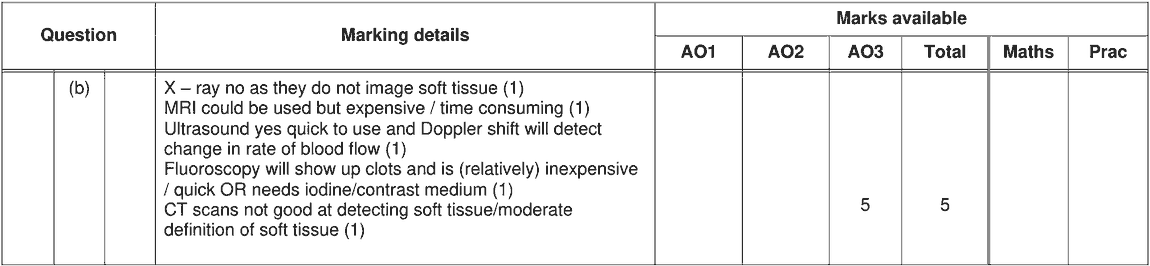
(b) Doctors are concerned that a patient has developed deep vein thrombosis (blood clots) in their legs. They have decided to investigate this further and have the choice of the following forms of imaging: X-ray MRI ultrasound fluoroscopy CT scan Evaluate the suitability of all five types of imaging techniques for diagnosing the patient. [5]
June 2024 · Component 3 · Q11(c) 4 marks AO1=1, AO2=3 Explanation physics of sports
Earlier parts of question 11 that this part usesEarlier part of June 2024 Component 3 question 11Earlier part of June 2024 Component 3 question 11Earlier part of June 2024 Component 3 question 11
(c) An ice skater is rotating with both arms outstretched. His arms are now pulled in. Explain why the rate of rotation of the skater will increase. [4]
June 2024 · Component 3 · Q12(b)(ii) 2 marks AO2=2 Explanation energy and the environment
Earlier parts of question 12 that this part usesEarlier part of June 2024 Component 3 question 12Earlier part of June 2024 Component 3 question 12
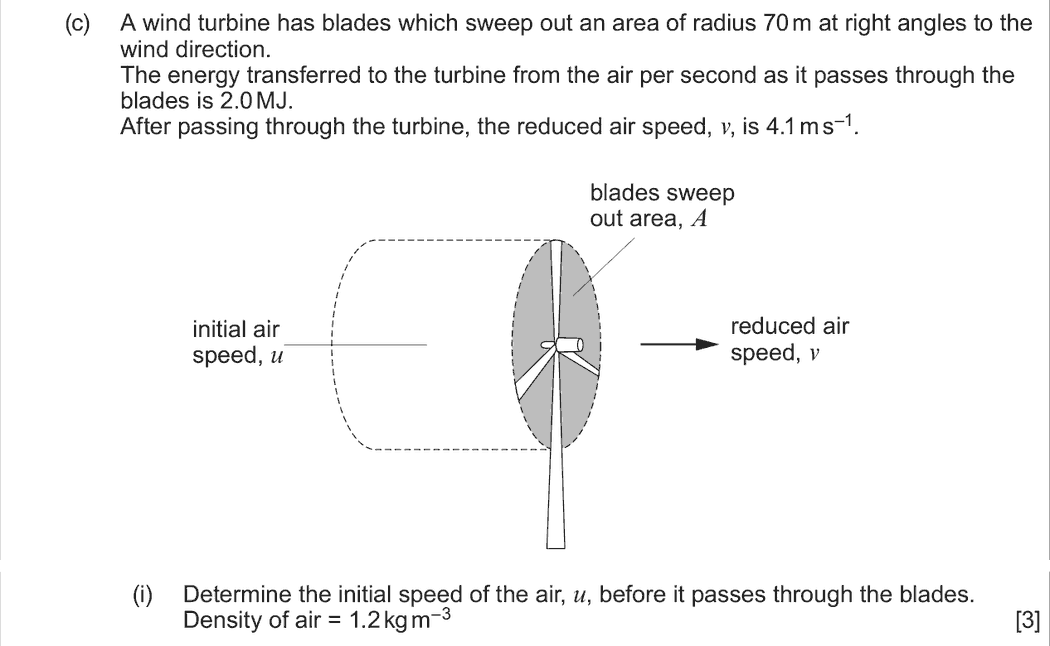
(ii) Account for the low efficiency in transferring the maximum power from the wind to electrical power. [2]
June 2024 · Component 3 · Q12(b)(iv) 3 marks AO1=3 Explanation energy and the environment
Earlier parts of question 12 that this part usesEarlier part of June 2024 Component 3 question 12Earlier part of June 2024 Component 3 question 12
(iv) Explain briefly the difficulties associated with producing sustained nuclear fusion power. [3]
June 2024 · AS Component 1 · Q4(b)(iii) 2 marks AO2=2 Explanation solids under stress
Earlier parts of question 4 that this part usesEarlier part of June 2024 Component 1 question 4Earlier part of June 2024 Component 1 question 4
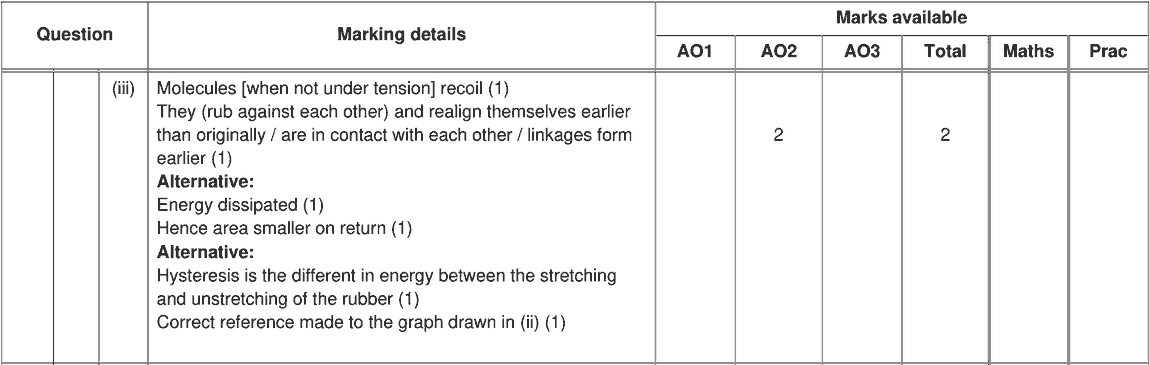
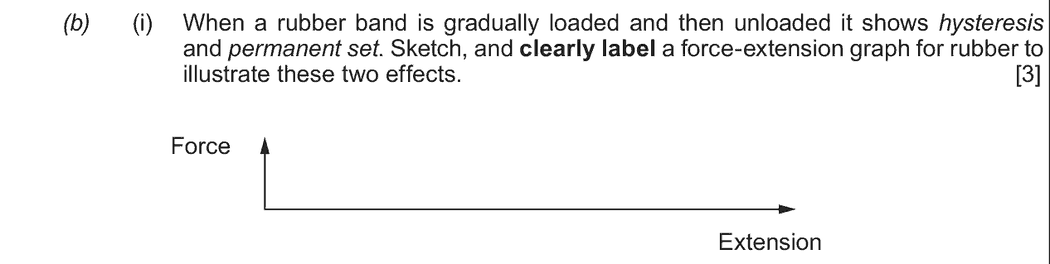
(iii) Explain why hysteresis occurs. [2]
June 2024 · AS Component 1 · Q5(a) 4 marks AO1=4 Explanation particles and nuclear structure
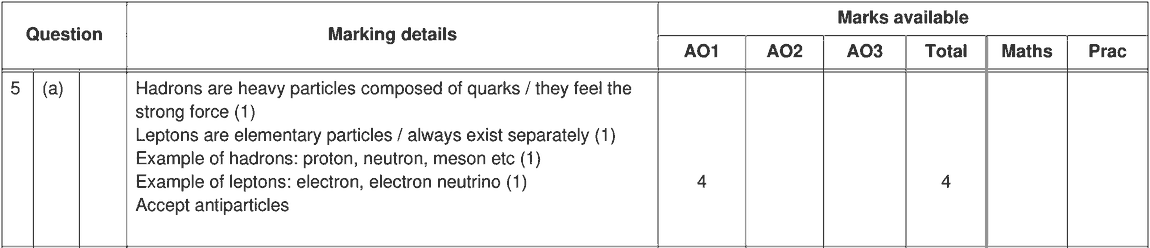
5. (a) Explain how hadrons and leptons differ from each other. Give one example of each. [4]
June 2024 · AS Component 1 · Q5(b)(i) 4 marks AO3=4 Explanation particles and nuclear structure
Earlier part of question 5 that this part usesEarlier part of June 2024 Component 1 question 5
(b) (i) Scientists at CERN observed the following reaction, where x is an unidentified particle. ve + n = p + x Identify particle x. Give your reasoning. [4]
June 2024 · AS Component 1 · Q5(b)(ii) 2 marks AO3=2 Explanation particles and nuclear structure
Earlier parts of question 5 that this part usesEarlier part of June 2024 Component 1 question 5Earlier part of June 2024 Component 1 question 5
(ii) Doug believes this to be a strong force interaction. Determine whether Doug is correct. [2]
June 2024 · AS Component 1 · Q6(a) 2 marks AO1=2 Explanation kinematics
6. (a) A ball bearing quickly reaches terminal velocity when falling through oil. Explain in terms of forces why a terminal velocity is reached. [2]
June 2024 · AS Component 2 · Q2(a) 4 marks AO1=4 Explanation wave properties
2. A beam of monochromatic light is incident normally (at right angles) on a diffraction grating. (a) Explain in clear steps why bright beams emerge from the grating at angles, θ, to the normal given by the equation: [4] nλ = dsinθ
June 2024 · AS Component 2 · Q3(b)(iii) 3 marks AO3=3 Explanation photons
Earlier parts of question 3 that this part usesEarlier part of June 2024 Component 2 question 3Earlier part of June 2024 Component 2 question 3
(iii) The intensity of the radiation is increased by moving the radiation source closer to the sodium surface. Ronald states the minimum pd will also increase. Explain whether Ronald is correct. [3]
June 2024 · AS Component 2 · Q3(c)(ii) 2 marks AO2=2 Explanation photons
Earlier parts of question 3 that this part usesEarlier part of June 2024 Component 2 question 3Earlier part of June 2024 Component 2 question 3
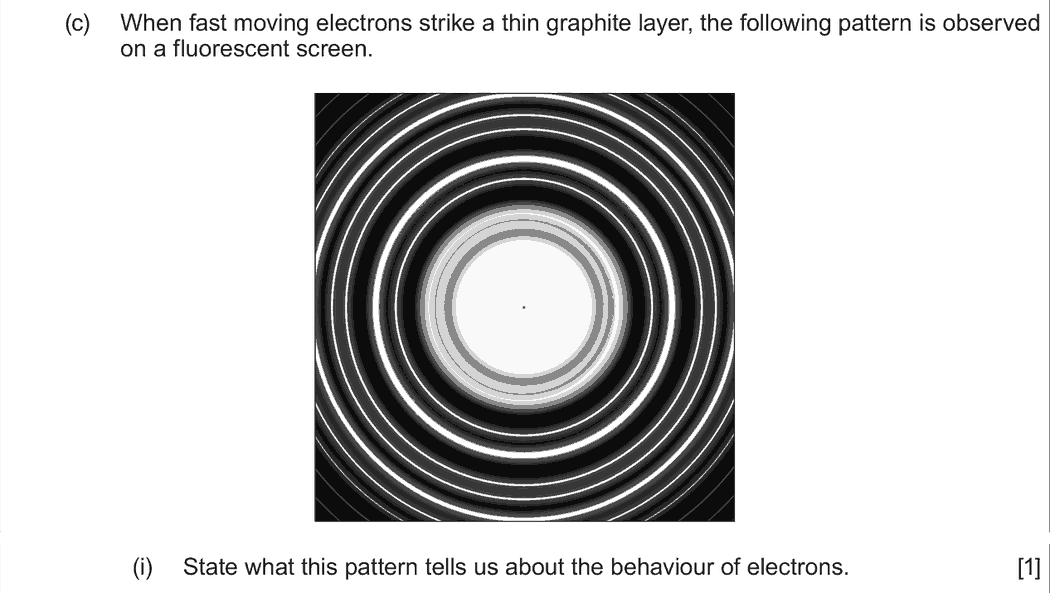
(ii) Explain how this pattern is formed. [2]
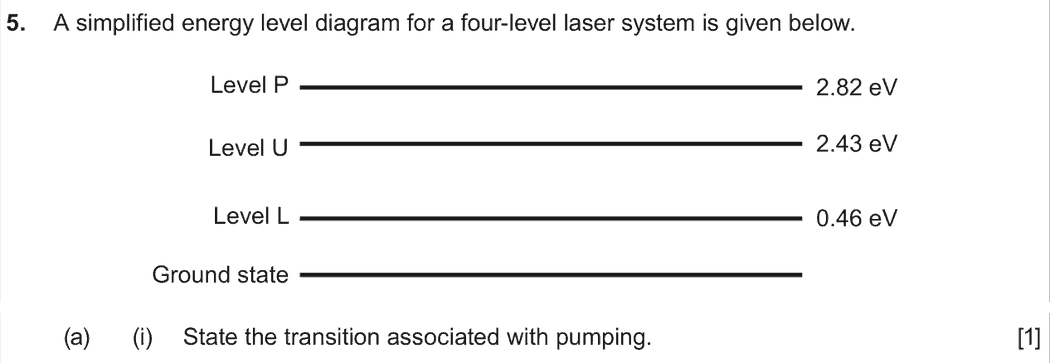
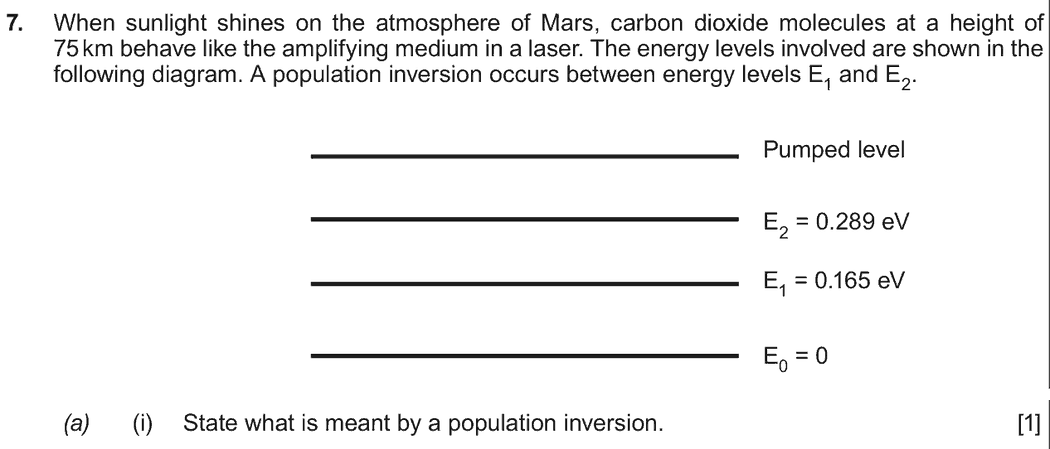
June 2024 · AS Component 2 · Q5(a)(ii) 3 marks AO1=3 Explanation lasers
Earlier part of question 5 that this part usesEarlier part of June 2024 Component 2 question 5
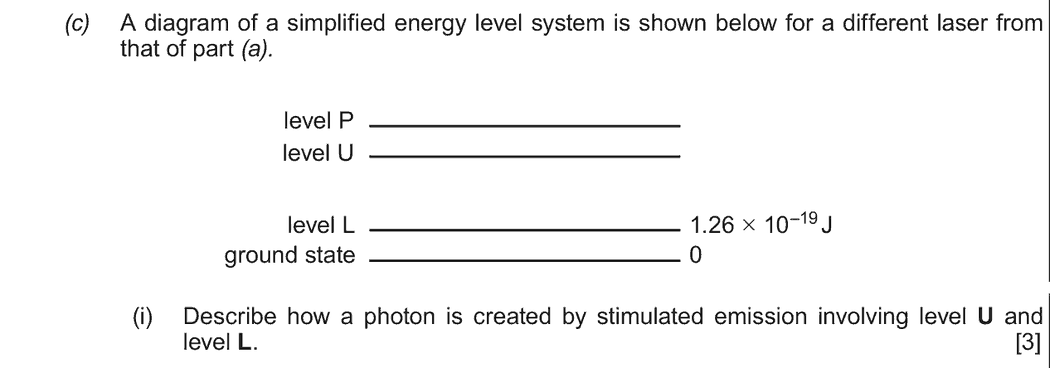
(ii) Explain why a population inversion is required for a laser to work. [3]
June 2023 · Component 1 · Q3(a) 3 marks AO2=3 Explanation kinematics
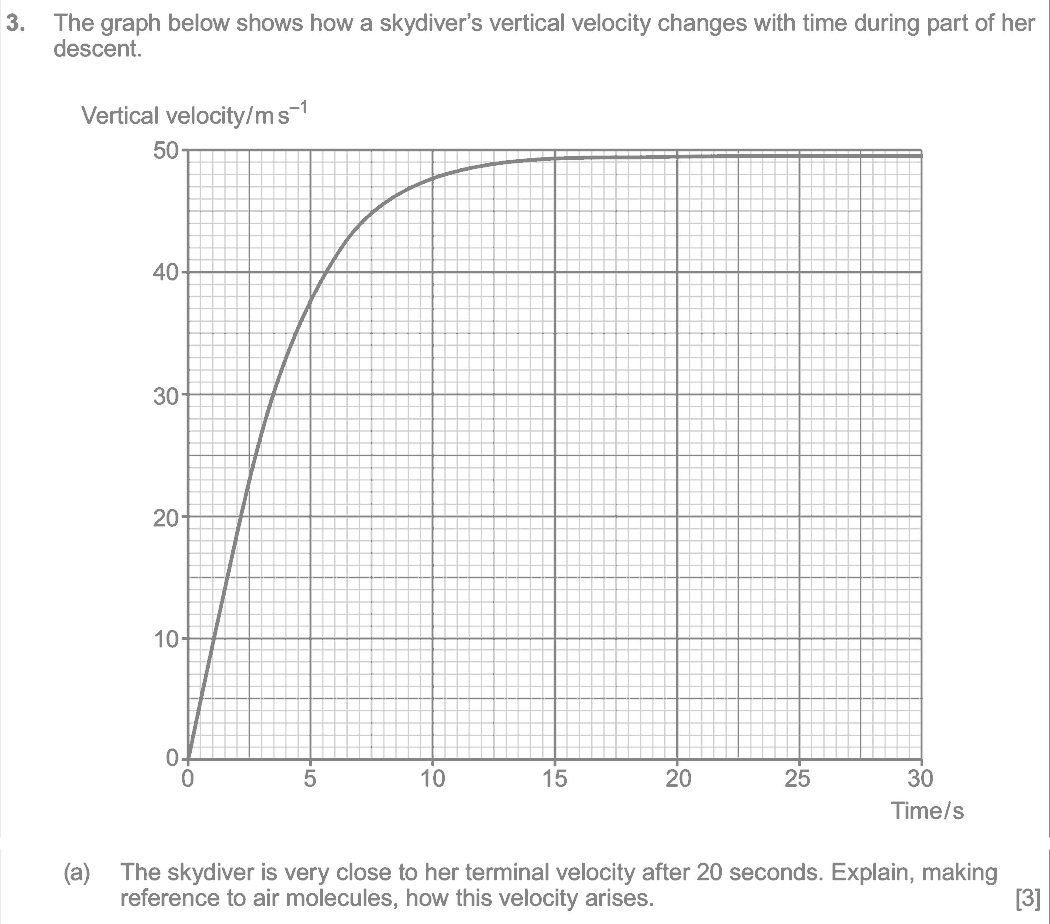
3. The graph below shows how a skydiver’s vertical velocity changes with time during part of her descent. Vertical velocity / m s–1 50 40 30 20 10 0 0 5 10 15 20 25 30 Time / s (a) The skydiver is very close to her terminal velocity after 20 seconds. Explain, making reference to air molecules, how this velocity arises. [3]
June 2023 · Component 1 · Q3(c) 2 marks AO3=2 Explanation kinematics
Earlier part of question 3 that this part usesEarlier part of June 2023 Component 1 question 3
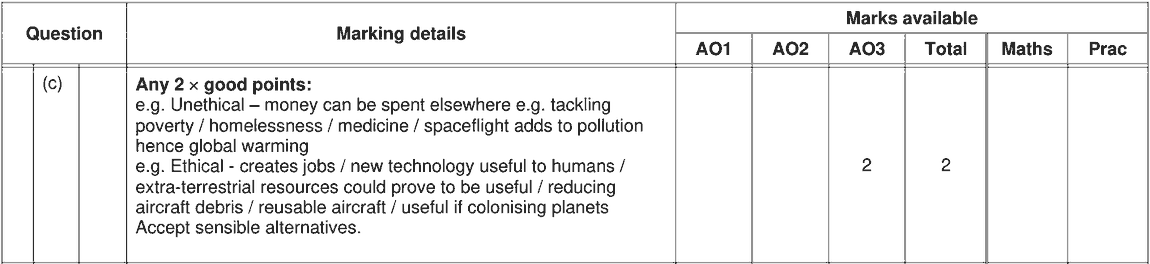
(c) NASA, funded by the American government, has developed parachutes that will safely land spacecraft on other planets. It has also been involved in the development of parachutes that can safely return a light aircraft to Earth in the event of a fault in flight. Discuss whether you believe this to be an ethical use of the money. [2]
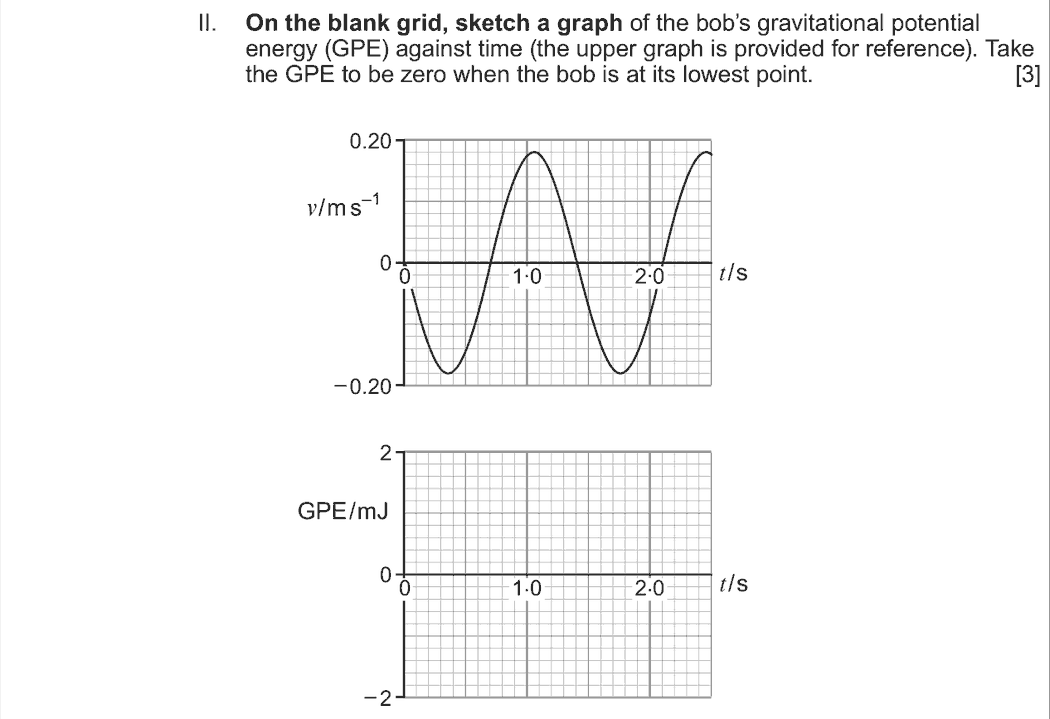
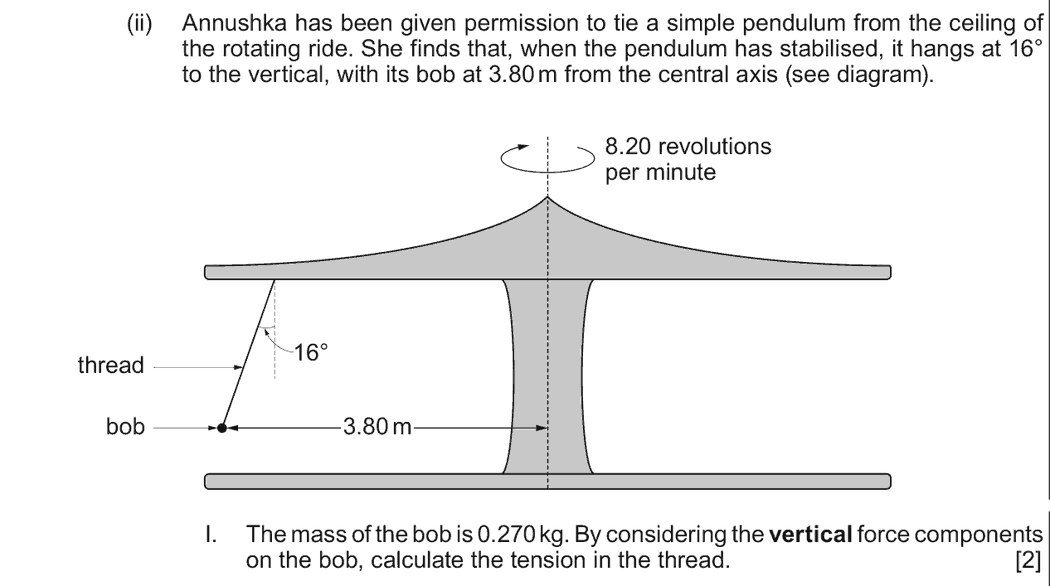
June 2023 · Component 1 · Q6(b)(iii)II 2 marks AO1=1, AO2=1 Explanation circular motion
Earlier parts of question 6 that this part usesEarlier part of June 2023 Component 1 question 6Earlier part of June 2023 Component 1 question 6Earlier part of June 2023 Component 1 question 6Earlier part of June 2023 Component 1 question 6
II. At the bottom of the swing the tension in the thread is greater than the weight of the bob. Explain why this is so. [2]
June 2023 · Component 1 · Q7(a) 3 marks AO1=3 Explanation kinetic theory
7. (a) Explain why, according to the kinetic theory, a gas exerts a pressure on the walls of its container. You will need to use the idea of momentum as well as that of pressure. [3]
June 2023 · Component 1 · Q8(b) 2 marks AO2=2 Explanation electrostatic and gravitational fieldscomprehension
Earlier part of question 8 that this part usesEarlier part of June 2023 Component 1 question 8
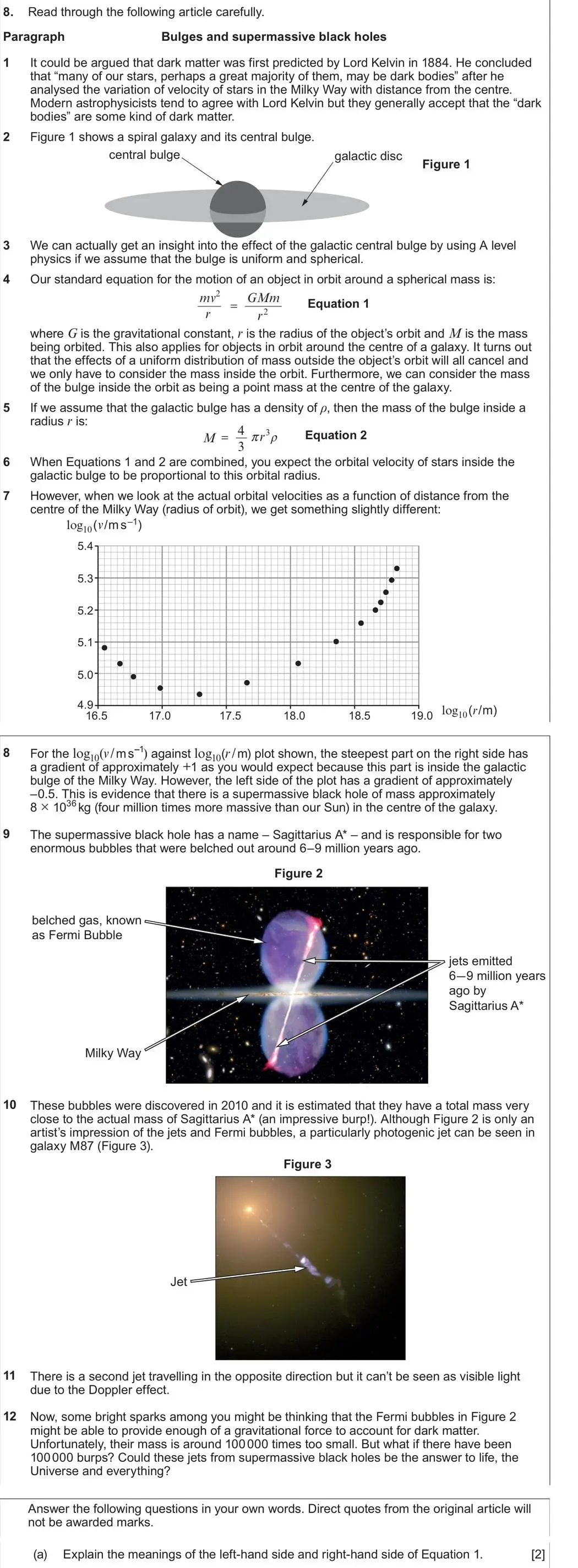
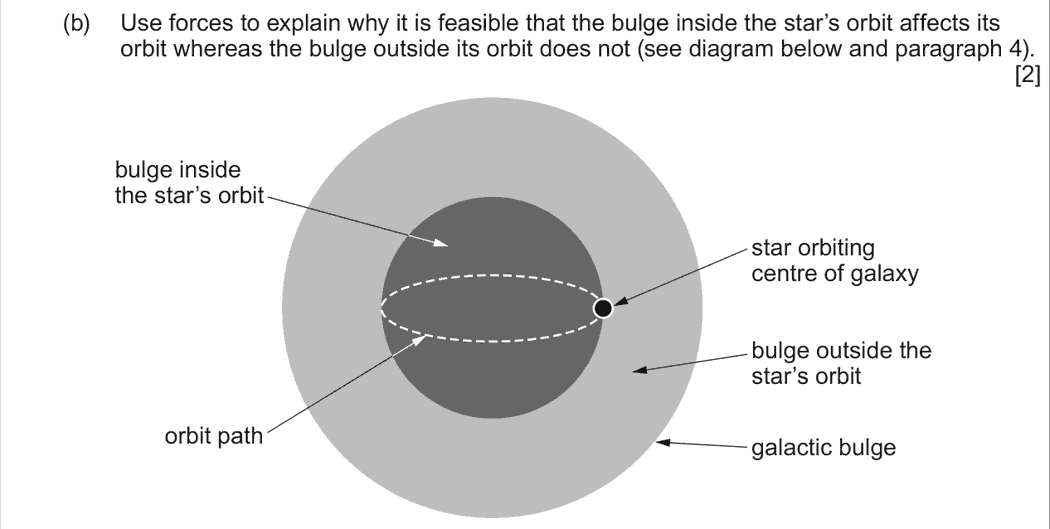
(b) Use forces to explain why it is feasible that the bulge inside the star’s orbit affects its orbit whereas the bulge outside its orbit does not (see diagram below and paragraph 4). [2] bulge inside the star’s orbit star orbiting centre of galaxy bulge outside the star’s orbit orbit path galactic bulge
June 2023 · Component 1 · Q8(d)(i) 3 marks AO2=3 Explanation orbits and the wider universecomprehension
Earlier parts of question 8 that this part usesEarlier part of June 2023 Component 1 question 8Earlier part of June 2023 Component 1 question 8
(d) (i) Explain why you would expect the gradient of the left side of the graph to be –0.5. (See paragraph 8 and hint: you should explain why using the GM equation v  is valid.) [3] r
June 2023 · Component 1 · Q8(f) 2 marks AO2=2 Explanation orbits and the wider universecomprehension
Earlier parts of question 8 that this part usesEarlier part of June 2023 Component 1 question 8Earlier part of June 2023 Component 1 question 8
(f) In your own words, explain why the 2nd jet from galaxy M87 can’t be seen (see paragraph 11). [2]
June 2023 · Component 1 · Q8(g) 2 marks AO3=2 Explanation orbits and the wider universecomprehension
Earlier parts of question 8 that this part usesEarlier part of June 2023 Component 1 question 8Earlier part of June 2023 Component 1 question 8
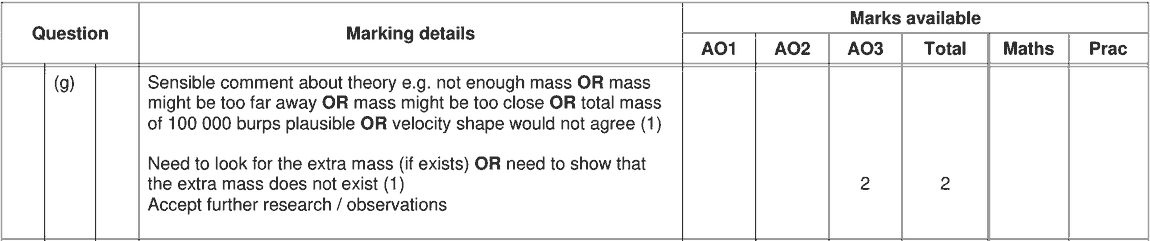
(g) In the last paragraph, the author suggests that Fermi bubbles and gas ejected from supermassive black holes might account for dark matter. Comment on whether you think this is feasible and what steps might be taken to prove / disprove this theory. [2]
June 2023 · Component 2 · Q1(b)(i) 3 marks AO2=3 Explanation dc circuits
Earlier part of question 1 that this part usesEarlier part of June 2023 Component 2 question 1
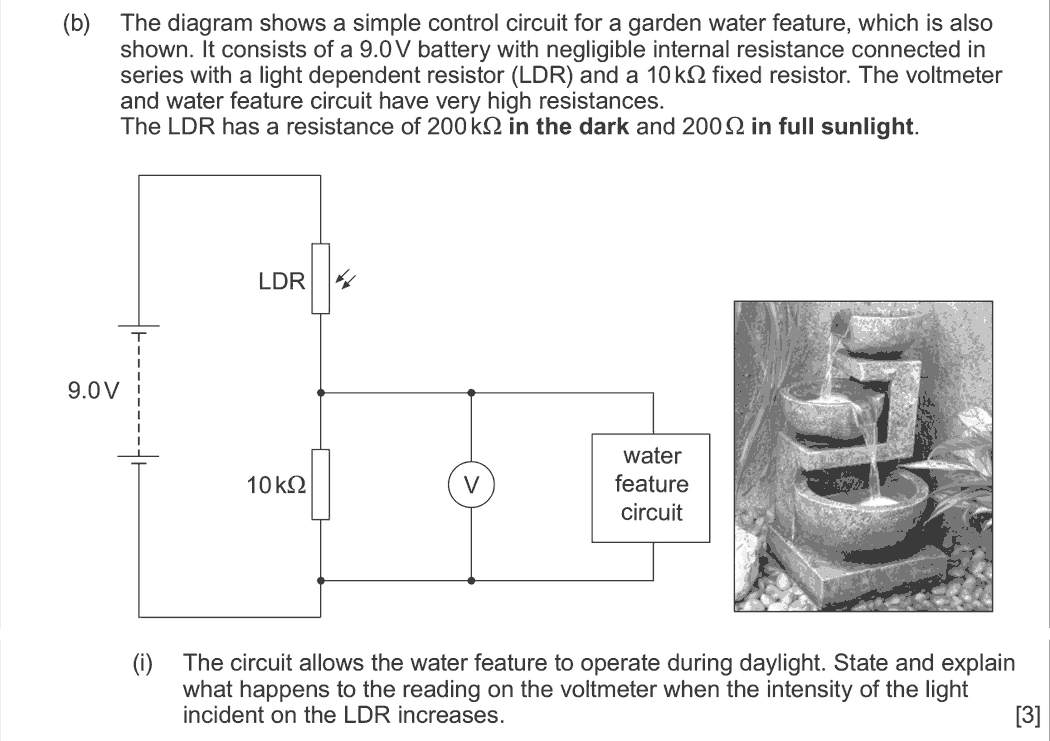
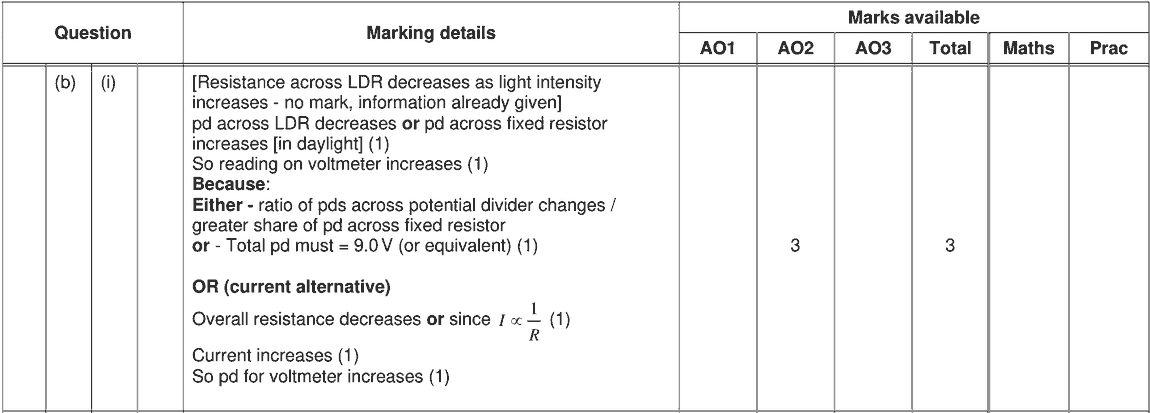
(b) The diagram shows a simple control circuit for a garden water feature, which is also shown. It consists of a 9.0 V battery with negligible internal resistance connected in series with a light dependent resistor (LDR) and a 10 kΩ fixed resistor. The voltmeter and water feature circuit have very high resistances. The LDR has a resistance of 200 kΩ in the dark and 200 Ω in full sunlight. LDR 9.0 V water 10 kΩ V feature circuit (i) The circuit allows the water feature to operate during daylight. State and explain what happens to the reading on the voltmeter when the intensity of the light incident on the LDR increases. [3]
June 2023 · Component 2 · Q2(c) 2 marks AO3=2 Explanation conduction of electricityresistance
Earlier part of question 2 that this part usesEarlier part of June 2023 Component 2 question 2
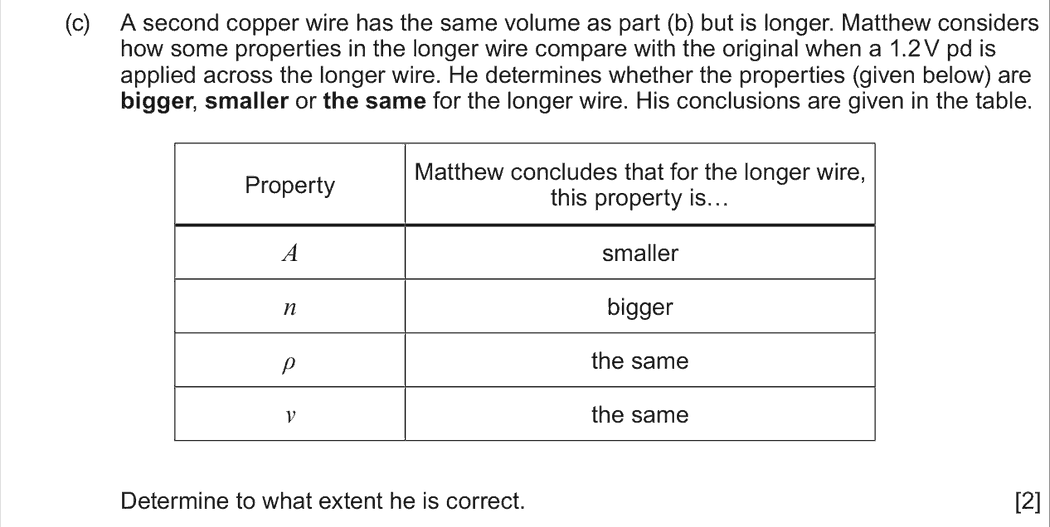
(c) A second copper wire has the same volume as part (b) but is longer. Matthew considers how some properties in the longer wire compare with the original when a 1.2 V pd is applied across the longer wire. He determines whether the properties (given below) are bigger, smaller or the same for the longer wire. His conclusions are given in the table. Matthew concludes that for the longer wire, Property this property is… A smaller n bigger ρ the same v the same Determine to what extent he is correct. [2]
June 2023 · Component 2 · Q4(a)(ii) 2 marks AO1=2 Explanation solids under stress
Earlier part of question 4 that this part usesEarlier part of June 2023 Component 2 question 4
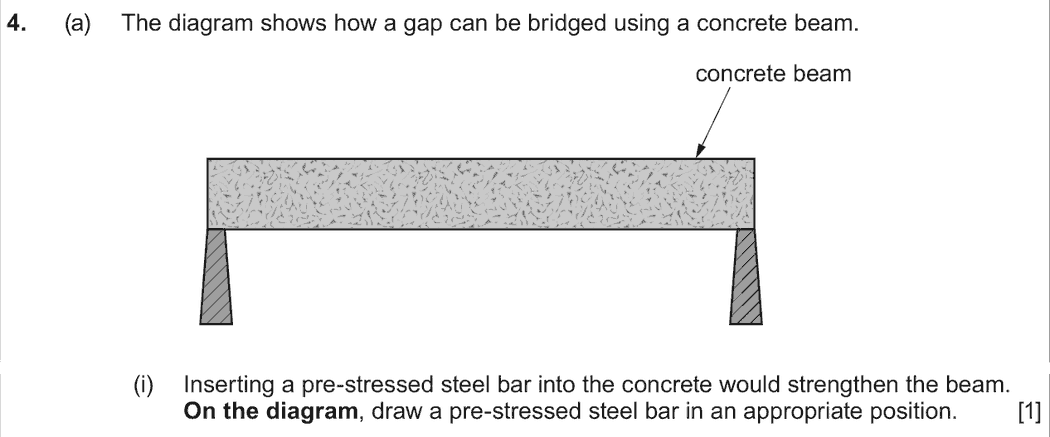
(ii) Explain how the steel bar strengthens the beam. [2] (σ )
June 2023 · Component 2 · Q4(b)(ii) 3 marks AO1=2, AO2=1 Explanation solids under stress
Earlier parts of question 4 that this part usesEarlier part of June 2023 Component 2 question 4Earlier part of June 2023 Component 2 question 4
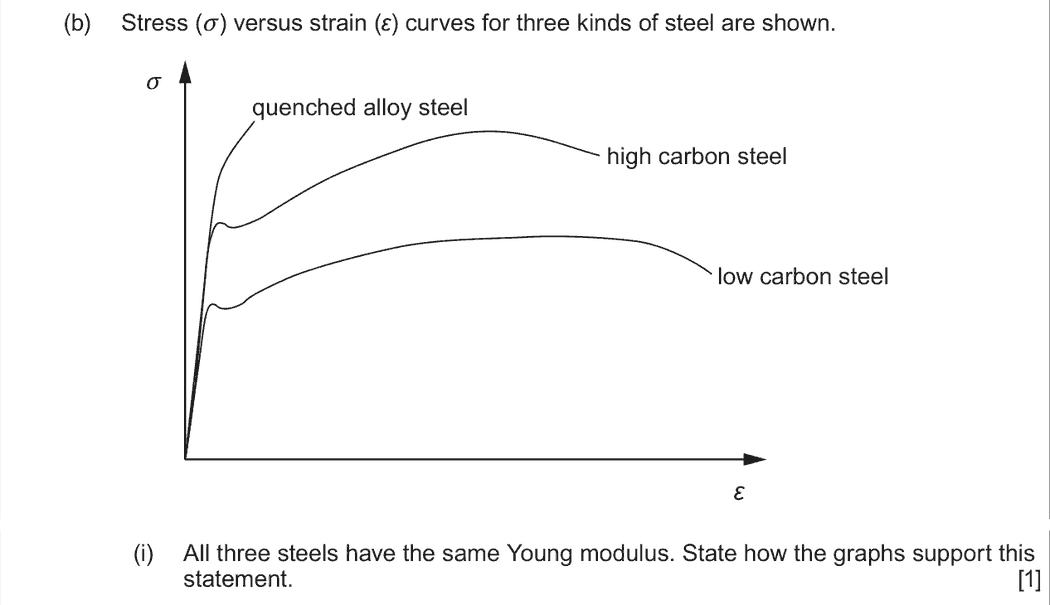
(ii) Compare the physical properties of high carbon steel with low carbon steel and explain these properties in terms of their molecular structure. [3]
June 2023 · Component 2 · Q4(c)(iii) 2 marks AO3=2 Explanation solids under stress
Earlier parts of question 4 that this part usesEarlier part of June 2023 Component 2 question 4Earlier part of June 2023 Component 2 question 4Earlier part of June 2023 Component 2 question 4
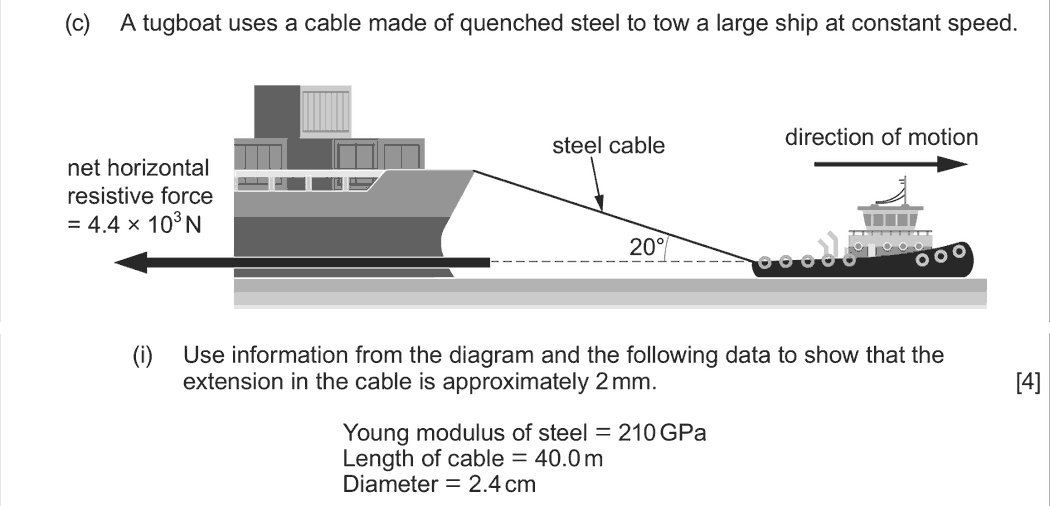
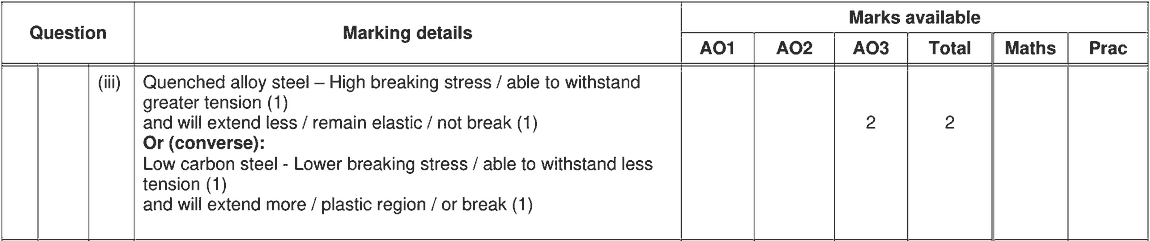
(iii) The tugboat operator decides to replace the quenched steel cable with a cable made from low carbon steel of the same length and diameter. Using the graphs in part (b) as guides, suggest why this may be a mistake. (No further calculations are required.) [2]
June 2023 · Component 2 · Q8(c) 2 marks AO1=1, AO2=1 Explanation radiation and stars
Earlier part of question 8 that this part usesEarlier part of June 2023 Component 2 question 8
(c) The Hubble space telescope can detect a portion of the infra-red and ultraviolet spectrum, as well as the visible spectrum. It has been used to study the Comet galaxy. Explain why it is more useful to use the Hubble telescope than to attempt to study the galaxy using telescopes sensitive only to visible light. [2]
June 2023 · Component 3 · Q1(b)(i) 2 marks AO1=2 Explanation nature of waves
Earlier part of question 1 that this part usesEarlier part of June 2023 Component 3 question 1
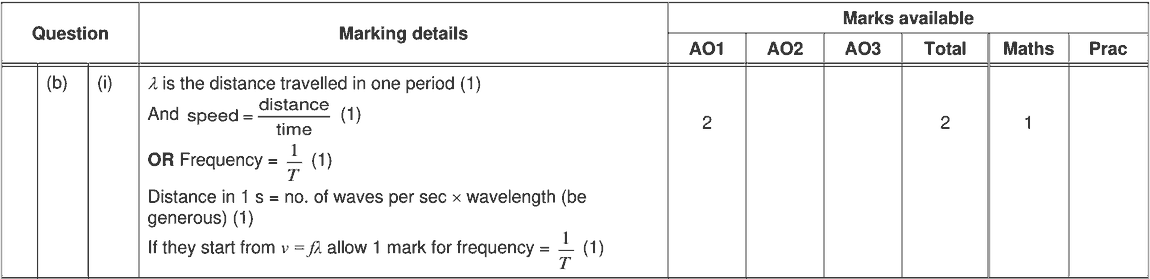
(b) (i) Explain clearly why the speed, c, of a wave is given by: λ c = T where λ is the wavelength of the wave and T its period. [2]
June 2023 · Component 3 · Q1(b)(iv) 3 marks AO3=3 Explanation nature of waves
Earlier parts of question 1 that this part usesEarlier part of June 2023 Component 3 question 1Earlier part of June 2023 Component 3 question 1
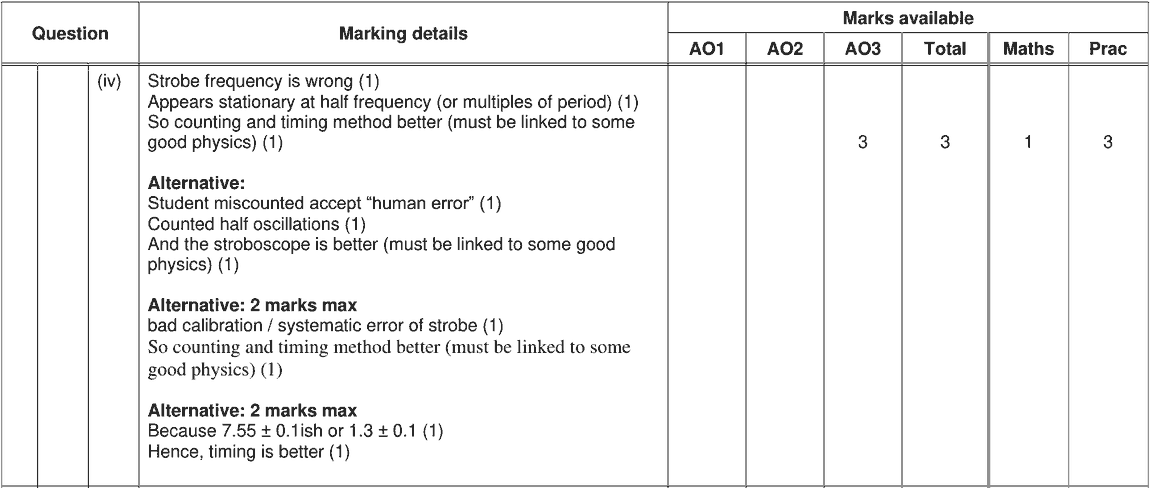
(iv) The student uses a stroboscope to check the frequency of oscillation of the loudspeaker. She concludes that the frequency of the loudspeaker is 1.3 Hz because the loudspeaker appears stationary when the stroboscope flashes short pulses of light at a frequency of 1.3 Hz. Explain whether this method or that of part (iii) has produced the more accurate value of frequency on this occasion. [3]
June 2023 · Component 3 · Q2(b) 2 marks AO2=2 Explanation wave properties
Earlier part of question 2 that this part usesEarlier part of June 2023 Component 3 question 2
(b) It is often stated that a diffraction grating should be called an interference grating because the pattern produced is usually called an interference pattern. Explain briefly the importance of diffraction in producing this interference pattern. [2]
June 2023 · Component 3 · Q2(d) 3 marks AO3=3 Explanation wave properties
Earlier parts of question 2 that this part usesEarlier part of June 2023 Component 3 question 2Earlier part of June 2023 Component 3 question 2
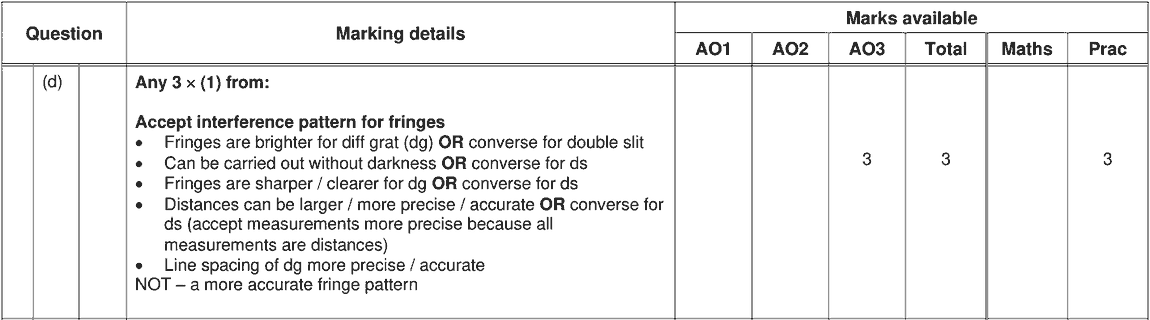
(d) The unknown wavelength of a laser can be measured using a diffraction grating or a double slit. Kevin states that it is better to use a diffraction grating. Evaluate to what extent Kevin is correct. [3]
June 2023 · Component 3 · Q6(c) 3 marks AO1=2, AO2=1 Explanation lasers
Earlier part of question 6 that this part usesEarlier part of June 2023 Component 3 question 6
(c) Hence, explain why it is desirable for the metastable state in a laser system to have a long half-life. [3]
June 2023 · Component 3 · Q8(a) 4 marks AO2=4 Explanation particles and nuclear structure
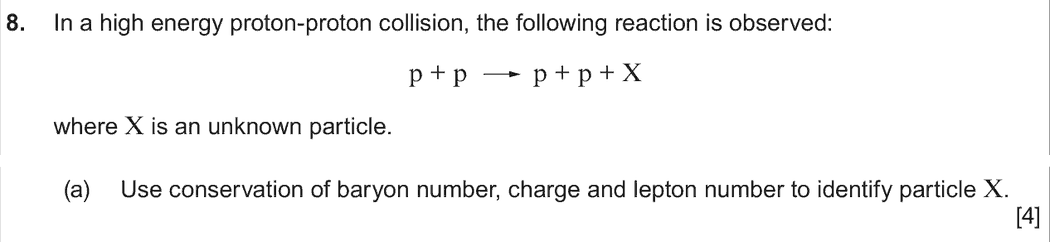
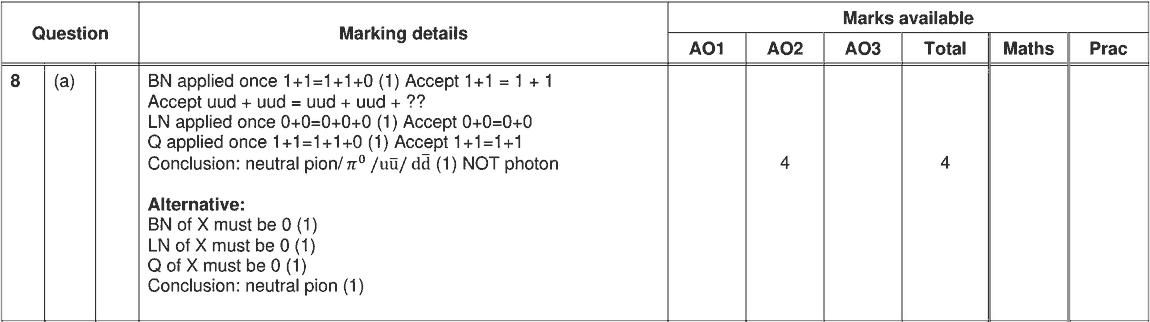
8. In a high energy proton-proton collision, the following reaction is observed: p + p p + p + X where X is an unknown particle. (a) Use conservation of baryon number, charge and lepton number to identify particle X. [4]
June 2023 · Component 3 · Q9(d) 3 marks AO1=1, AO2=2 Explanation magnetic fieldsenergy concepts
Earlier part of question 9 that this part usesEarlier part of June 2023 Component 3 question 9
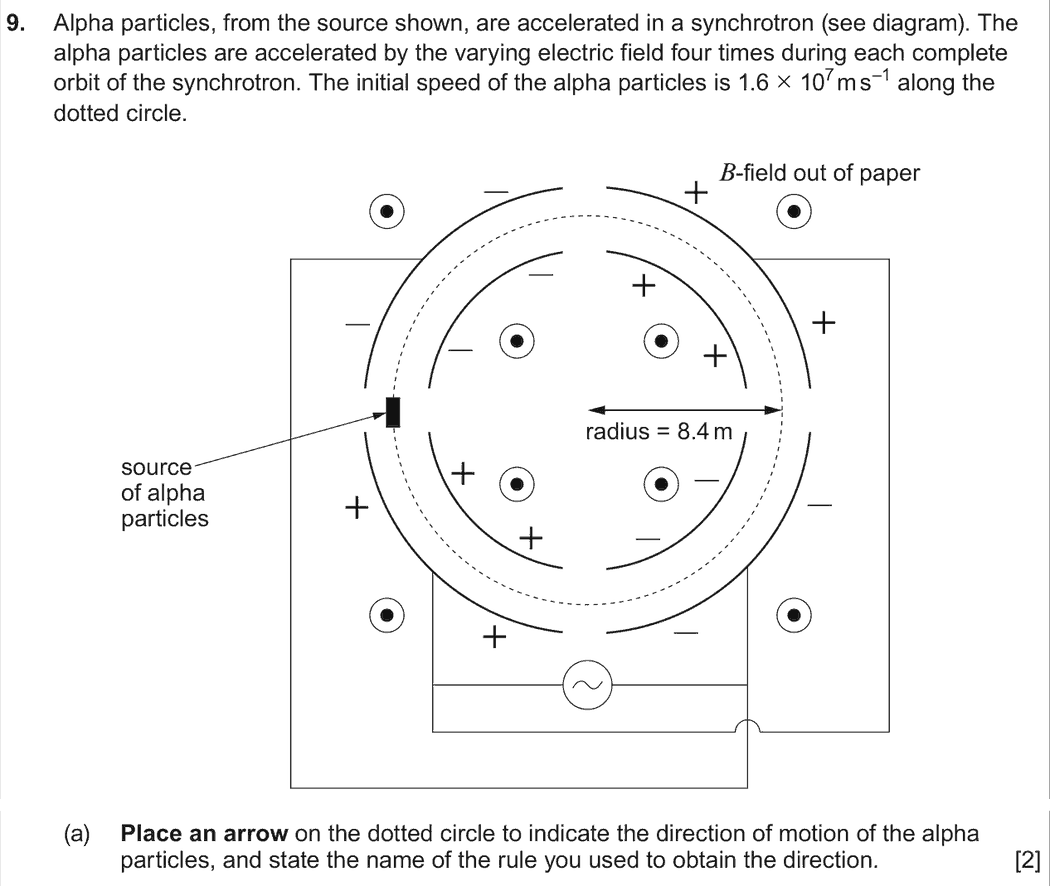
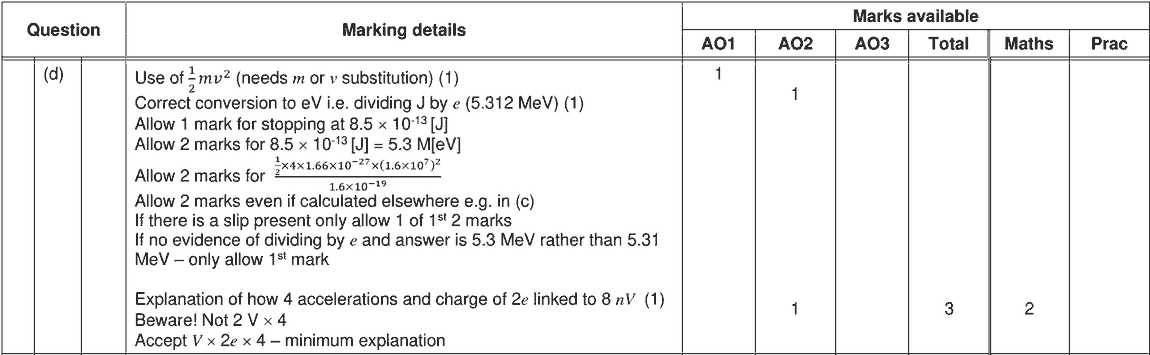
(d) Explain why the kinetic energy (in eV) of the alpha particles in the synchrotron is: kinetic energy (in eV) = 5.3 × 10⁶ + (8 × n × V) where n is the number of orbits completed by the alpha particles and V is the pd of the synchrotron (in volt). [3]
June 2023 · Component 3 · Q10(a)(i) 1 mark AO2=1 Explanation electromagnetic induction
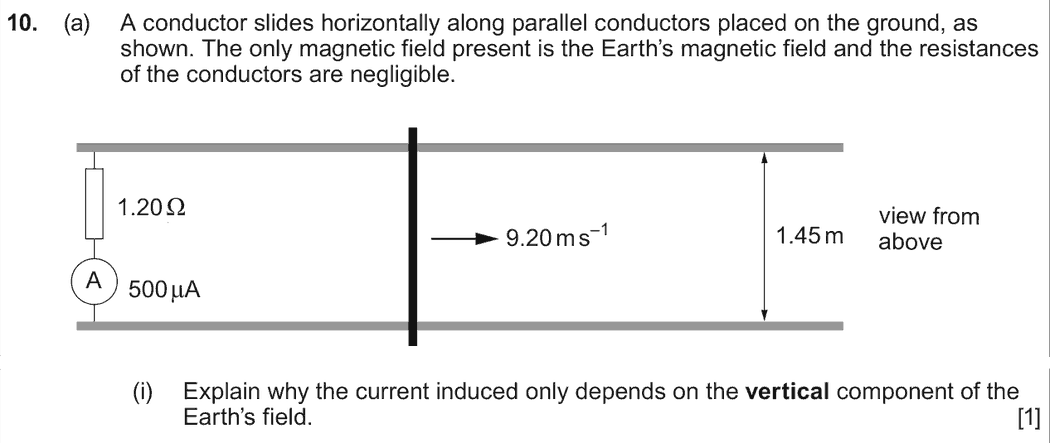
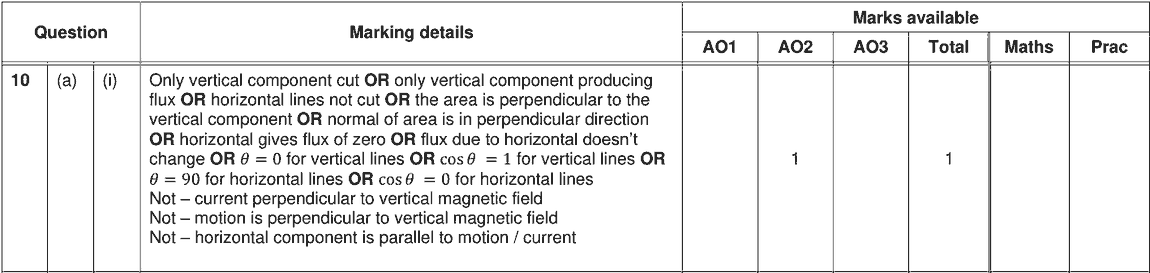
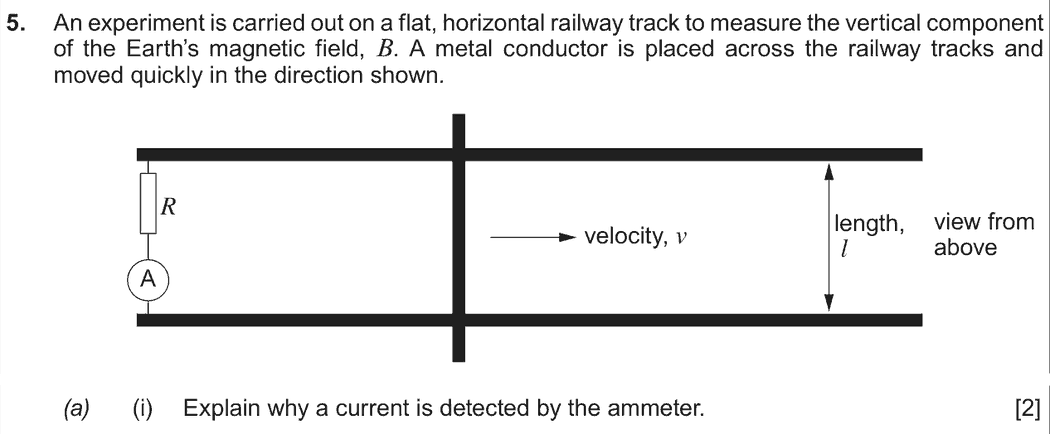
10. (a) A conductor slides horizontally along parallel conductors placed on the ground, as shown. The only magnetic field present is the Earth’s magnetic field and the resistances of the conductors are negligible. 1.20 Ω view from 9.20 m s–1 1.45 m above A 500 μA (i) Explain why the current induced only depends on the vertical component of the Earth’s field. [1]
June 2023 · Component 3 · Q10(a)(ii) 2 marks AO1=1, AO2=1 Explanation electromagnetic induction
Earlier part of question 10 that this part usesEarlier part of June 2023 Component 3 question 10
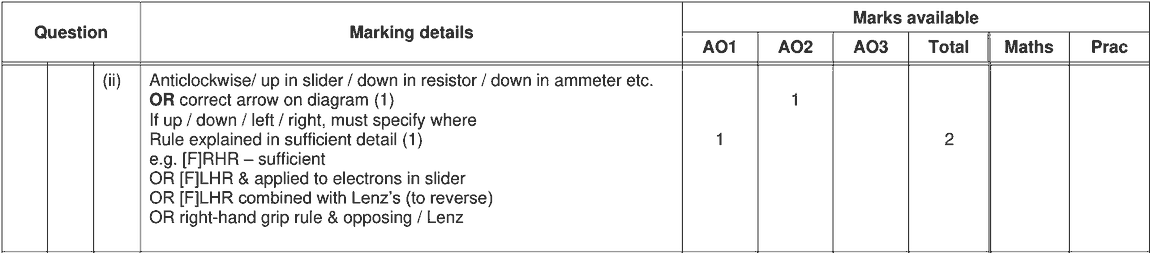
(ii) In the northern hemisphere, the vertical component of the Earth’s field is downwards. Explain the direction of the induced current in the circuit. [2]
June 2023 · Component 3 · Q10(b) 2 marks AO3=2 Explanation electromagnetic induction
Earlier part of question 10 that this part usesEarlier part of June 2023 Component 3 question 10
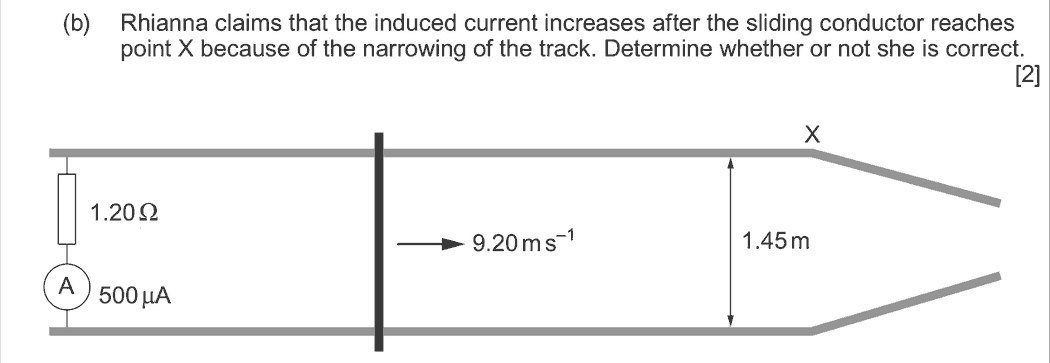
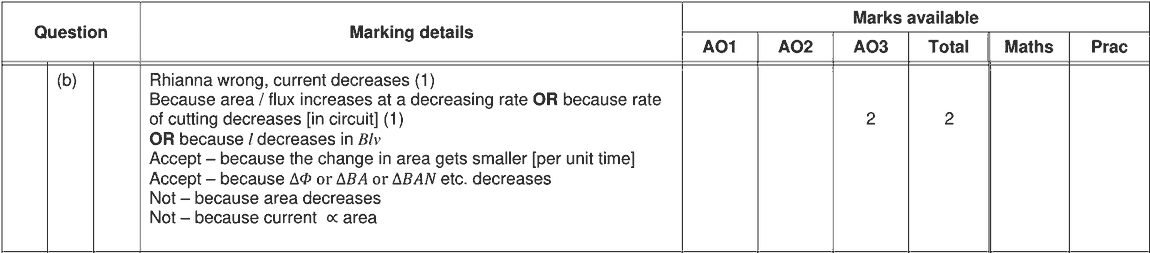
(b) Rhianna claims that the induced current increases after the sliding conductor reaches point X because of the narrowing of the track. Determine whether or not she is correct. [2] X 1.20 Ω 9.20 m s–1 1.45 m A 500 μA
June 2023 · Component 3 · Q11(a)(iii) 2 marks AO1=1, AO2=1 Explanation alternating currents
Earlier part of question 11 that this part usesEarlier part of June 2023 Component 3 question 11
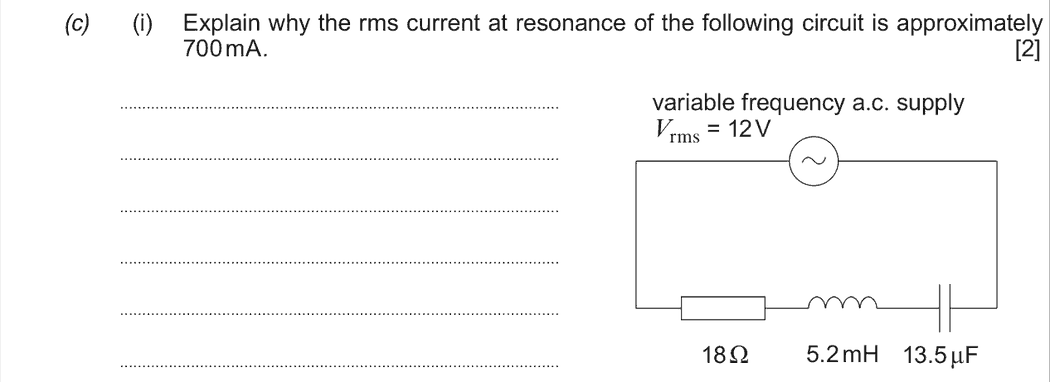
(iii) Explain why the maximum rms current in this circuit is approximately 5 A. [2]
June 2023 · Component 3 · Q11(b)(iv) 3 marks AO1=1, AO2=2 Explanation alternating currents
Earlier parts of question 11 that this part usesEarlier part of June 2023 Component 3 question 11Earlier part of June 2023 Component 3 question 11Earlier part of June 2023 Component 3 question 11
(iv) While carrying out the investigation, Daniel notices that the pd across the resistor, VR, is small at low frequencies and approaches the supply pd at high frequencies. Explain why this happens. [3]
June 2023 · Component 3 · Q12(a)(iv) 2 marks AO2=2 Explanation medical physics
Earlier parts of question 12 that this part usesEarlier part of June 2023 Component 3 question 12Earlier part of June 2023 Component 3 question 12
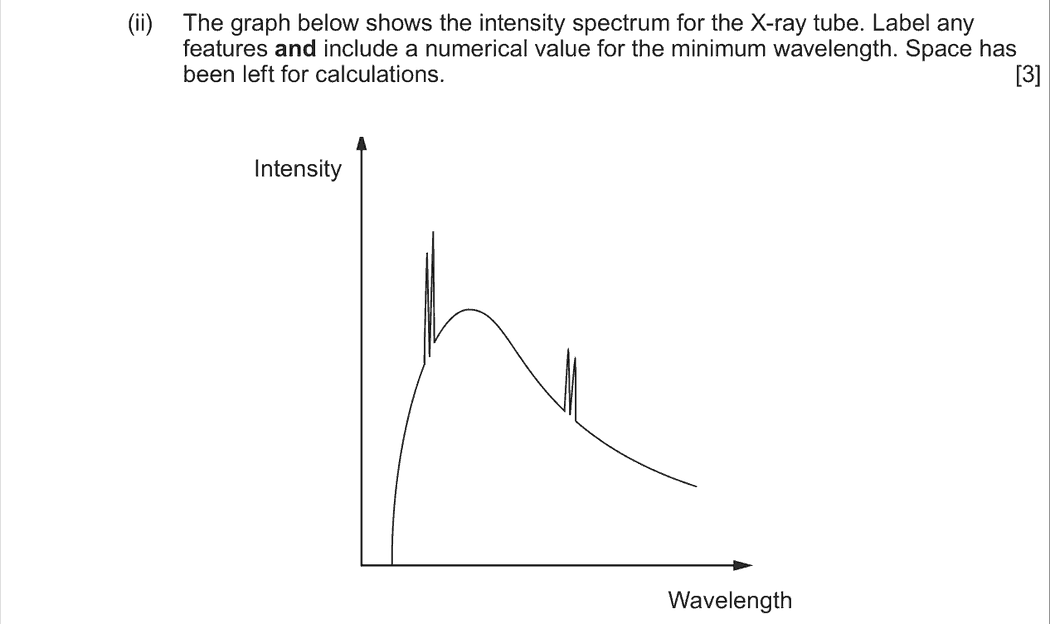
(iv) Discuss if it would be possible to reduce the minimum wavelength to zero. [2]
June 2023 · Component 3 · Q12(b) 5 marks AO3=5 Explanation medical physics
Earlier parts of question 12 that this part usesEarlier part of June 2023 Component 3 question 12Earlier part of June 2023 Component 3 question 12
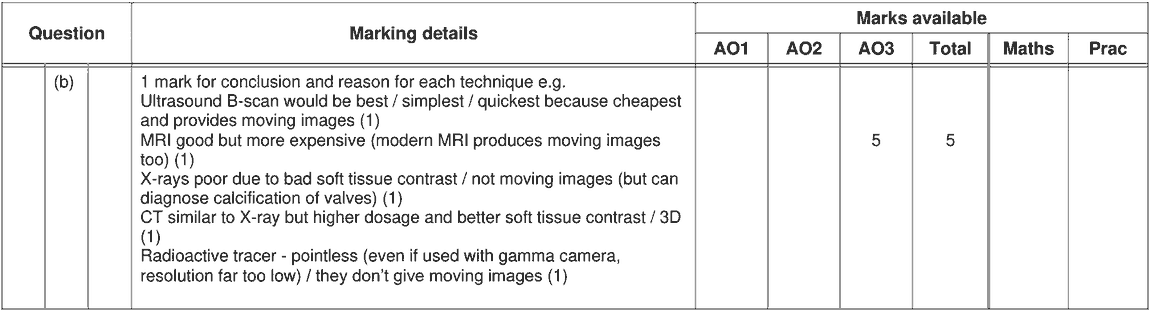
(b) Doctors are concerned that there is a faulty aortic valve in a patient’s heart. They have decided to investigate this further and have the choice of the following: X-ray MRI ultrasound B-scan radioactive tracers CT scan Evaluate the suitability of all five types of imaging techniques for diagnosing the patient. [5]
June 2023 · Component 3 · Q12(d) 3 marks AO1=3 Explanation medical physics
Earlier parts of question 12 that this part usesEarlier part of June 2023 Component 3 question 12Earlier part of June 2023 Component 3 question 12
(d) Explain the operation of PET scans; include which part of the electromagnetic spectrum they detect. [3]
June 2023 · Component 3 · Q13(d)(iii) 2 marks AO2=2 Explanation physics of sports
Earlier parts of question 13 that this part usesEarlier part of June 2023 Component 3 question 13Earlier part of June 2023 Component 3 question 13Earlier part of June 2023 Component 3 question 13
(iii) Explain briefly what effect these forces have on the position where the ball lands. [2]
June 2023 · Component 3 · Q14(a)(ii) 2 marks AO1=2 Explanation energy and the environment
Earlier part of question 14 that this part usesEarlier part of June 2023 Component 3 question 14
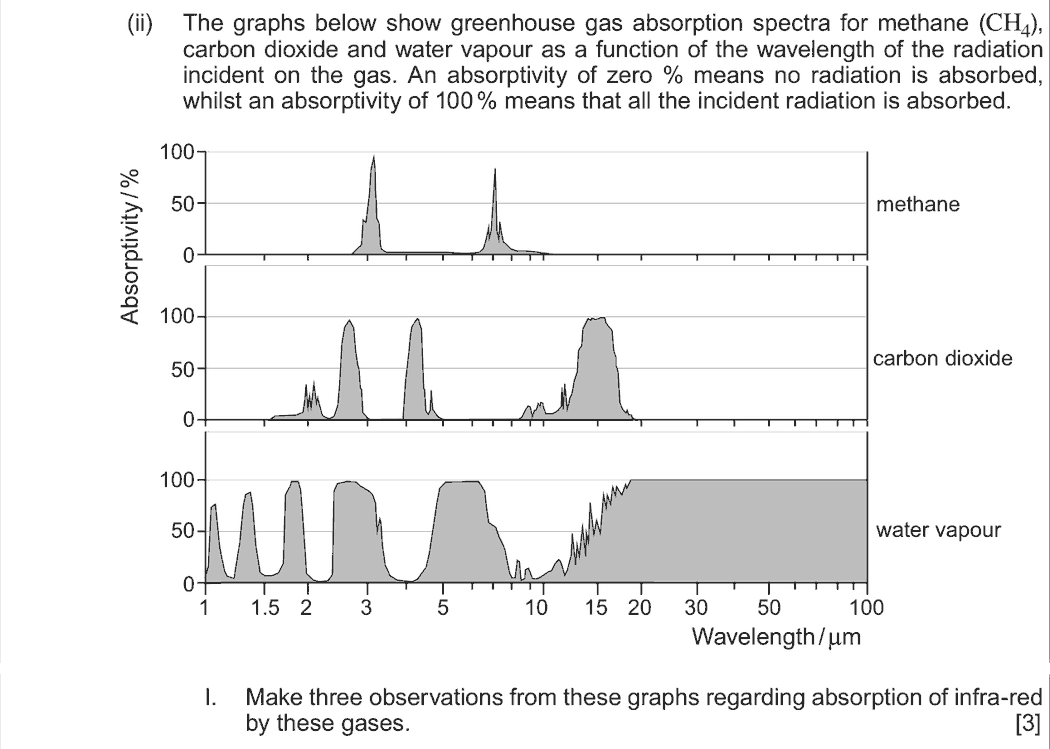
(ii) State what is meant by the greenhouse effect. [2]
June 2023 · Component 3 · Q14(a)(iii)I 3 marks AO2=3 Explanation energy and the environment
Earlier part of question 14 that this part usesEarlier part of June 2023 Component 3 question 14
(iii) The Earth system emits 240 W m–2 of infra-red radiation into space. This is less than the solar radiation that is absorbed and has caused the temperature of the Earth system to increase. Researchers state this imbalance has approximately doubled since 2005. I. Explain how human activities are contributing to this change. [3]
June 2023 · Component 3 · Q14(a)(iii)II 2 marks AO2=2 Explanation energy and the environment
Earlier parts of question 14 that this part usesEarlier part of June 2023 Component 3 question 14Earlier part of June 2023 Component 3 question 14
II. Describe how an increase in the temperature of the Earth system may lead to further increases in this imbalance. [2]
June 2023 · AS Component 1 · Q6(b)(i) 3 marks AO3=3 Explanation particles and nuclear structure
Earlier part of question 6 that this part usesEarlier part of June 2023 Component 1 question 6
(b) (i) The following reaction shows the beta decay of a beryllium nucleus. Using conservation laws, identify particle X. [3] 10Be → 10B + e−+ X 4 5
June 2023 · AS Component 1 · Q6(c)(ii) 2 marks AO3=2 Explanation particles and nuclear structure
Earlier parts of question 6 that this part usesEarlier part of June 2023 Component 1 question 6Earlier part of June 2023 Component 1 question 6
(ii) Given the significance of CERN to the scientific community consider whether every country in the world should be contributing to its funding. Explain your answer. [2]
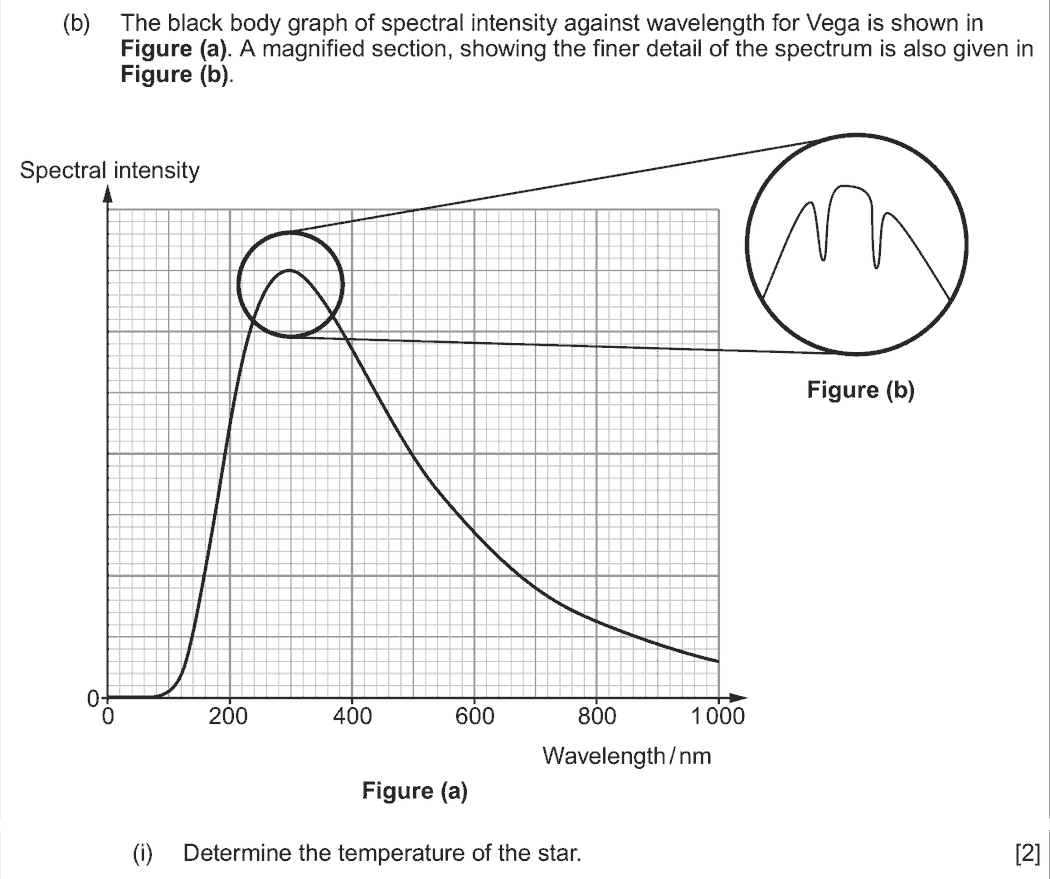
June 2023 · AS Component 1 · Q7(c)(i) 3 marks AO1=3 Explanation radiation and stars
Earlier parts of question 7 that this part usesEarlier part of June 2023 Component 1 question 7Earlier part of June 2023 Component 1 question 7
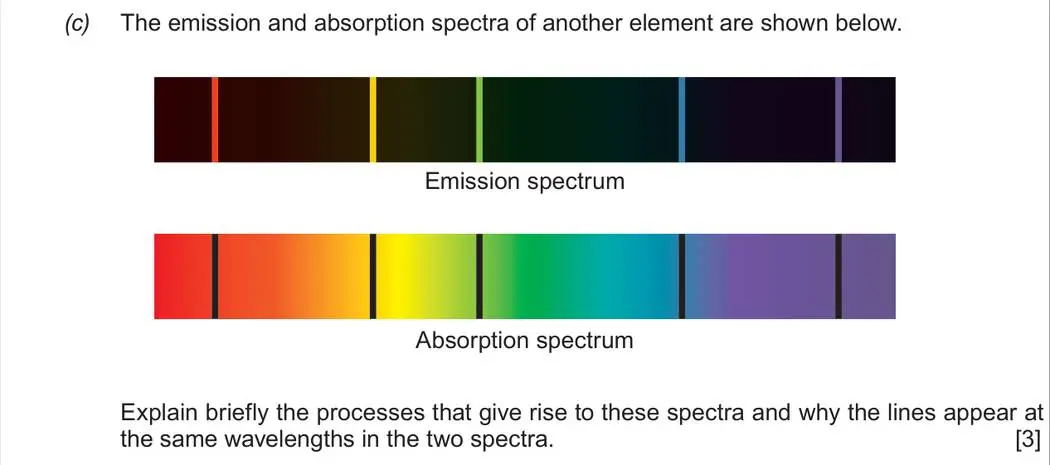
(c) (i) The dips in intensity in the spectrum (see Figure (b)), can be used to determine the elements making up the outer region of Vega. Explain how these dips arise. [3]
June 2023 · AS Component 2 · Q1(b) 3 marks AO3=3 Explanation nature of waves
Earlier part of question 1 that this part usesEarlier part of June 2023 Component 2 question 1
(b) Declan states that it is not possible to determine whether the wave can be polarised based on these two graphs. Evaluate whether Declan is correct. [3]
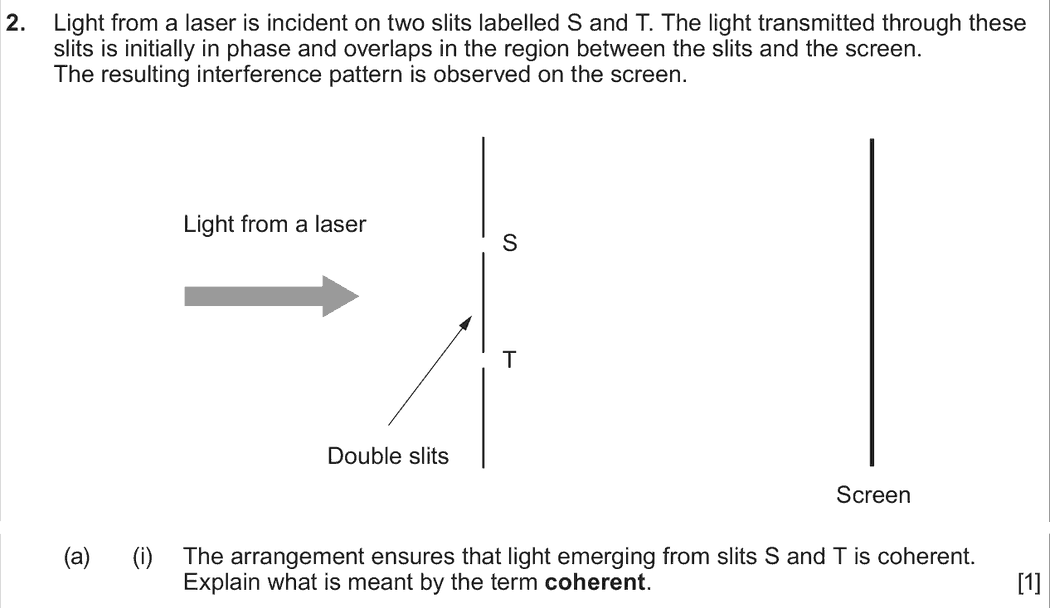
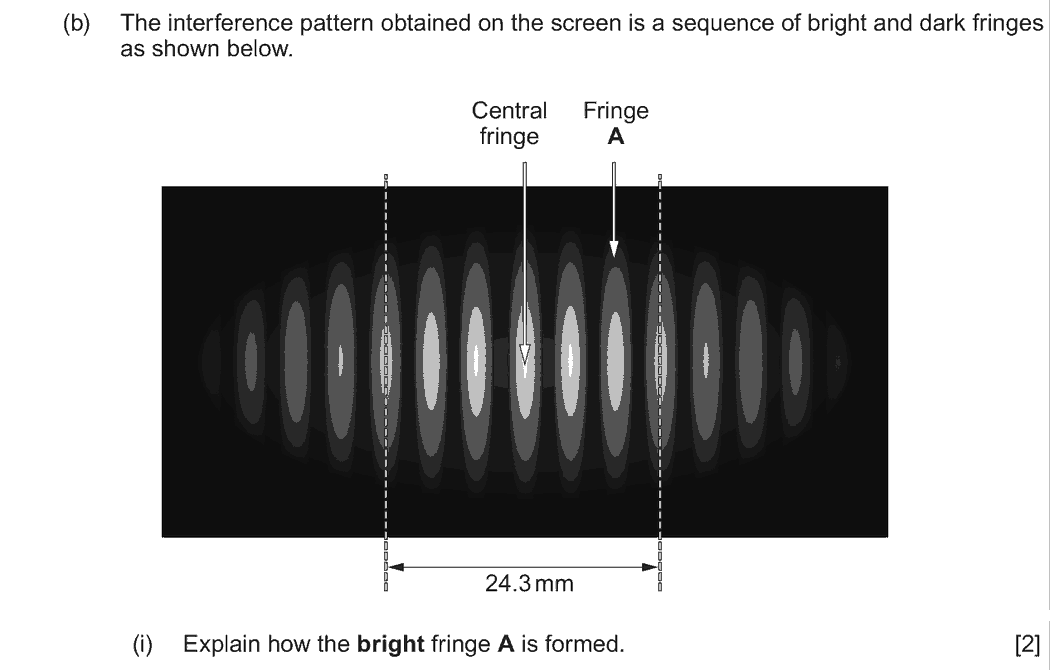
June 2023 · AS Component 2 · Q2(b)(i) 2 marks AO1=2 Explanation wave properties
Earlier part of question 2 that this part usesEarlier part of June 2023 Component 2 question 2
(b) The interference pattern obtained on the screen is a sequence of bright and dark fringes as shown below. Central Fringe fringe A 24.3 mm (i) Explain how the bright fringe A is formed. [2]
June 2023 · AS Component 2 · Q4(b) 2 marks AO3=2 Explanation photons
Earlier part of question 4 that this part usesEarlier part of June 2023 Component 2 question 4
(b) Describe briefly how Einstein’s explanation of the photoelectric effect has benefited society. [2]
June 2023 · AS Component 2 · Q5(b)(i) 4 marks AO1=4 Explanation conduction of electricity
Earlier part of question 5 that this part usesEarlier part of June 2023 Component 2 question 5
(b) The current, I, in a wire of cross-sectional area, A, is given by the equation: I = nAve (i) Derive the equation giving a clearly labelled diagram. [4]
June 2023 · AS Component 2 · Q5(c)(i) 3 marks AO3=3 Explanation resistanceconduction of electricity
Earlier part of question 5 that this part usesEarlier part of June 2023 Component 2 question 5
(c) Alexander applies a constant potential difference across a piece of aluminium wire. The temperature of the wire increases. (i) Alexander states that the drift velocity of the electrons in the piece of wire does not depend on the temperature of the wire. Evaluate whether this statement is correct in terms of the motion of the particles. [3]
June 2023 · AS Component 2 · Q5(c)(ii) 2 marks AO3=2 Explanation resistance
Earlier parts of question 5 that this part usesEarlier part of June 2023 Component 2 question 5Earlier part of June 2023 Component 2 question 5
(ii) He then states that the resistance of the aluminium wire does not depend on the temperature of the wire. Evaluate whether this statement is correct and state your reasoning clearly. [2]
June 2022 · Component 1 · Q3(a)(ii)III 2 marks AO1=2 Explanation energy concepts
Earlier parts of question 3 that this part usesEarlier part of June 2022 Component 1 question 3Earlier part of June 2022 Component 1 question 3
III. Explain how the principle of conservation of energy applies to this collision. [2]
June 2022 · Component 1 · Q4(a) 2 marks AO1=2 Explanation circular motion
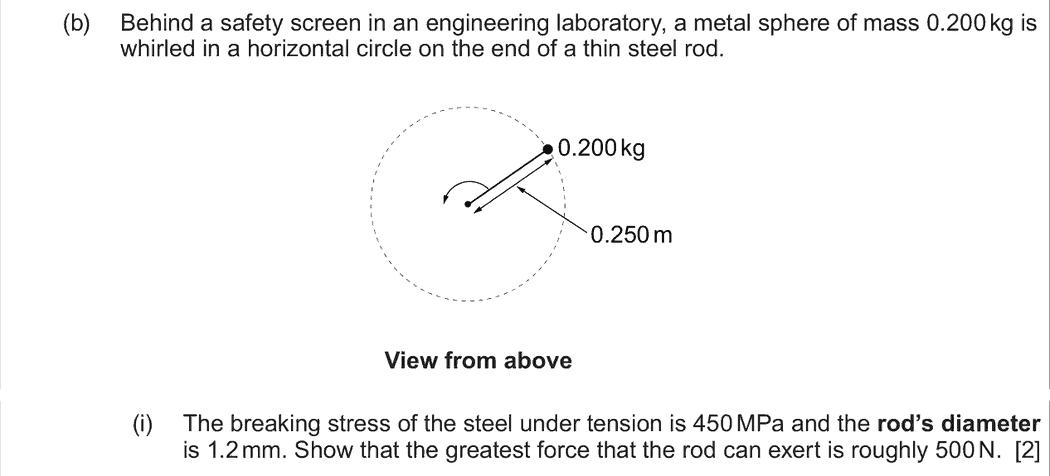
4. (a) Explain why an object moving in a circular path requires a resultant force to act on it, even when it is travelling at constant speed. [2]
June 2022 · Component 1 · Q4(b)(iii)II 1 mark AO3=1 Explanation circular motion
Earlier parts of question 4 that this part usesEarlier part of June 2022 Component 1 question 4Earlier part of June 2022 Component 1 question 4Earlier part of June 2022 Component 1 question 4
II. Bearing in mind your previous answer, will the greatest rotation frequency before the rod breaks be larger or smaller than your calculated value? Justify your answer briefly. [1]
June 2022 · Component 1 · Q5(b)(iv) 2 marks AO3=2 Explanation vibrations
Earlier parts of question 5 that this part usesEarlier part of June 2022 Component 1 question 5Earlier part of June 2022 Component 1 question 5Earlier part of June 2022 Component 1 question 5
(iv) Ursula thinks that the kinetic energy of the mass varies at a frequency of 1.67 Hz. Evaluate this claim. [2]
June 2022 · Component 1 · Q5(d) 3 marks AO3=3 Explanation vibrations
Earlier parts of question 5 that this part usesEarlier part of June 2022 Component 1 question 5Earlier part of June 2022 Component 1 question 5
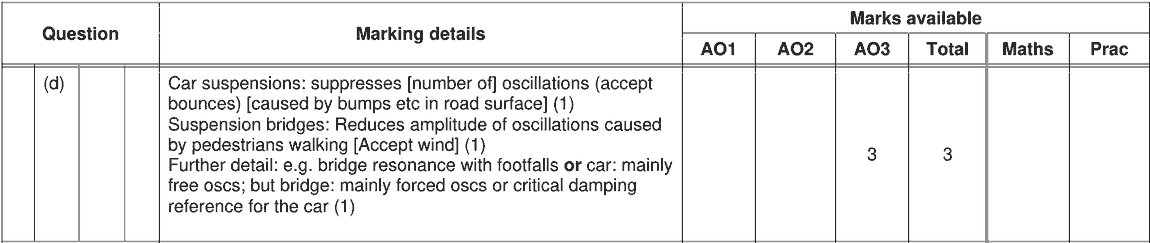
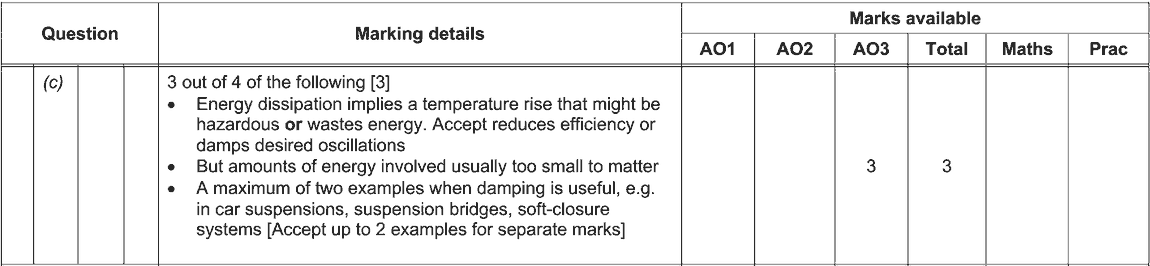
(d) The physics of damping has been used in designing car suspensions and suspension bridges for pedestrians. Compare the purposes that damping serves in these two cases. [3]
June 2022 · Component 1 · Q6(b)(i) 2 marks AO2=2 Explanation kinetic theory
Earlier part of question 6 that this part usesEarlier part of June 2022 Component 1 question 6
(b) A sealed canister contains 0.200 mol of oxygen (relative molecular mass: 32.0). An identical canister contains 0.200 mol of nitrogen (relative molecular mass: 28.0) at the same temperature. Giving your reasoning, determine these ratios: pressure of oxygen (i) [2] pressure of nitrogen
June 2022 · Component 1 · Q8(a) 2 marks AO2=2 Explanation nature of wavescomprehension
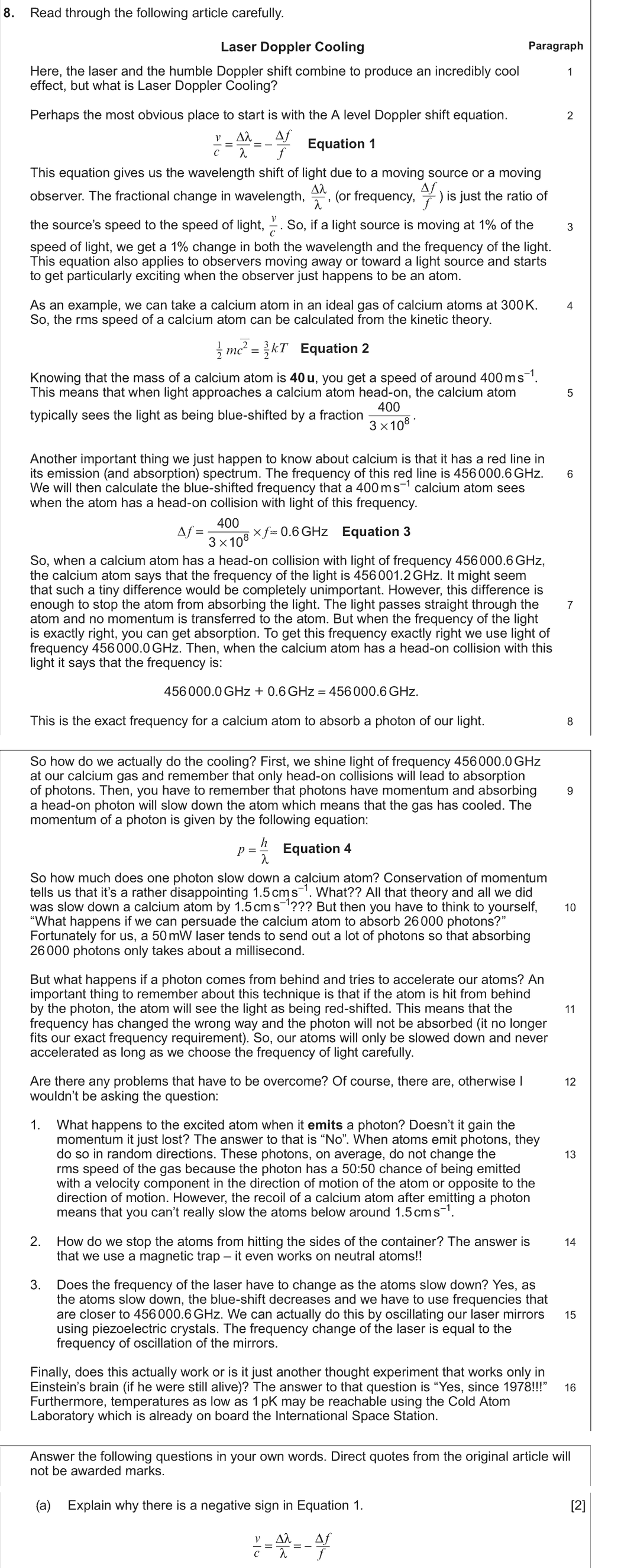
8. Read through the following article carefully. Laser Doppler Cooling Paragraph Here, the laser and the humble Doppler shift combine to produce an incredibly cool 1 effect, but what is Laser Doppler Cooling? Perhaps the most obvious place to start is with the A level Doppler shift equation. 2 v Δλ Δ f = = _ Equation 1 c λ f This equation gives us the wavelength shift of light due to a moving source or a moving Δλ Δ f observer. The fractional change in wavelength, , (or frequency, ) is just the ratio of λ f v the source’s speed to the speed of light, . So, if a light source is moving at 1% of the 3 c speed of light, we get a 1% change in both the wavelength and the frequency of the light. This equation also applies to observers moving away or toward a light source and starts to get particularly exciting when the observer just happens to be an atom. As an example, we can take a calcium atom in an ideal gas of calcium atoms at 300 K. 4 So, the rms speed of a calcium atom can be calculated from the kinetic theory. 1 mc2 = 3 kT Equation 2 2 2 Knowing that the mass of a calcium atom is 40 u, you get a speed of around 400 m s–1. This means that when light approaches a calcium atom head-on, the calcium atom 5 400 typically sees the light as being blue-shifted by a fraction . 3 × 10⁸ Another important thing we just happen to know about calcium is that it has a red line in its emission (and absorption) spectrum. The frequency of this red line is 456 000.6 GHz. 6 We will then calculate the blue-shifted frequency that a 400 m s–1 calcium atom sees when the atom has a head-on collision with light of this frequency. 400 Δ f = × f ≈ 0.6 GHz Equation 3 3 × 10⁸ So, when a calcium atom has a head-on collision with light of frequency 456 000.6 GHz, the calcium atom says that the frequency of the light is 456 001.2 GHz. It might seem that such a tiny difference would be completely unimportant. However, this difference is enough to stop the atom from absorbing the light. The light passes straight through the 7 atom and no momentum is transferred to the atom. But when the frequency of the light is exactly right, you can get absorption. To get this frequency exactly right we use light of frequency 456 000.0 GHz. Then, when the calcium atom has a head-on collision with this light it says that the frequency is: 456 000.0 GHz + 0.6 GHz = 456 000.6 GHz. This is the exact frequency for a calcium atom to absorb a photon of our light. 8 So how do we actually do the cooling? First, we shine light of frequency 456 000.0 GHz at our calcium gas and remember that only head-on collisions will lead to absorption of photons. Then, you have to remember that photons have momentum and absorbing 9 a head-on photon will slow down the atom which means that the gas has cooled. The momentum of a photon is given by the following equation: h p = Equation 4 λ So how much does one photon slow down a calcium atom? Conservation of momentum tells us that it’s a rather disappointing 1.5 cm s–1. What?? All that theory and all we did was slow down a calcium atom by 1.5 cm s–1??? But then you have to think to yourself, 10 “What happens if we can persuade the calcium atom to absorb 26 000 photons?” Fortunately for us, a 50 mW laser tends to send out a lot of photons so that absorbing 26 000 photons only takes about a millisecond. But what happens if a photon comes from behind and tries to accelerate our atoms? An important thing to remember about this technique is that if the atom is hit from behind by the photon, the atom will see the light as being red-shifted. This means that the 11 frequency has changed the wrong way and the photon will not be absorbed (it no longer fits our exact frequency requirement). So, our atoms will only be slowed down and never accelerated as long as we choose the frequency of light carefully. Are there any problems that have to be overcome? Of course, there are, otherwise I 12 wouldn’t be asking the question: 1. What happens to the excited atom when it emits a photon? Doesn’t it gain the momentum it just lost? The answer to that is “No”. When atoms emit photons, they do so in random directions. These photons, on average, do not change the 13 rms speed of the gas because the photon has a 50:50 chance of being emitted with a velocity component in the direction of motion of the atom or opposite to the direction of motion. However, the recoil of a calcium atom after emitting a photon means that you can’t really slow the atoms below around 1.5 cm s–1. 2. How do we stop the atoms from hitting the sides of the container? The answer is 14 that we use a magnetic trap – it even works on neutral atoms!! 3. Does the frequency of the laser have to change as the atoms slow down? Yes, as the atoms slow down, the blue-shift decreases and we have to use frequencies that are closer to 456 000.6 GHz. We can actually do this by oscillating our laser mirrors 15 using piezoelectric crystals. The frequency change of the laser is equal to the frequency of oscillation of the mirrors. Finally, does this actually work or is it just another thought experiment that works only in Einstein’s brain (if he were still alive)? The answer to that question is “Yes, since 1978!!!” 16 Furthermore, temperatures as low as 1 pK may be reachable using the Cold Atom Laboratory which is already on board the International Space Station. Answer the following questions in your own words. Direct quotes from the original article will not be awarded marks. (a) Explain why there is a negative sign in Equation 1. [2] v Δλ _ Δ f = = c λ f
June 2022 · Component 1 · Q8(b)(i) 2 marks AO2=2 Explanation orbits and the wider universephotonscomprehension
Earlier part of question 8 that this part usesEarlier part of June 2022 Component 1 question 8
(b) (i) Explain why a calcium atom travelling at 400 m s–1 will absorb a photon coming directly toward it when the frequency of the photon is 456 000.0 GHz (see paragraphs 6–8). [2]
June 2022 · Component 2 · Q4(a) 2 marks AO1=2 Explanation solids under stress
4. (a) In the production of steel alloy, atoms of carbon are added to iron. The resulting alloy is less ductile than pure iron. State the meaning of the term ductile, and describe, on an atomic scale, why the addition of carbon atoms can make steel less ductile than iron. [2]
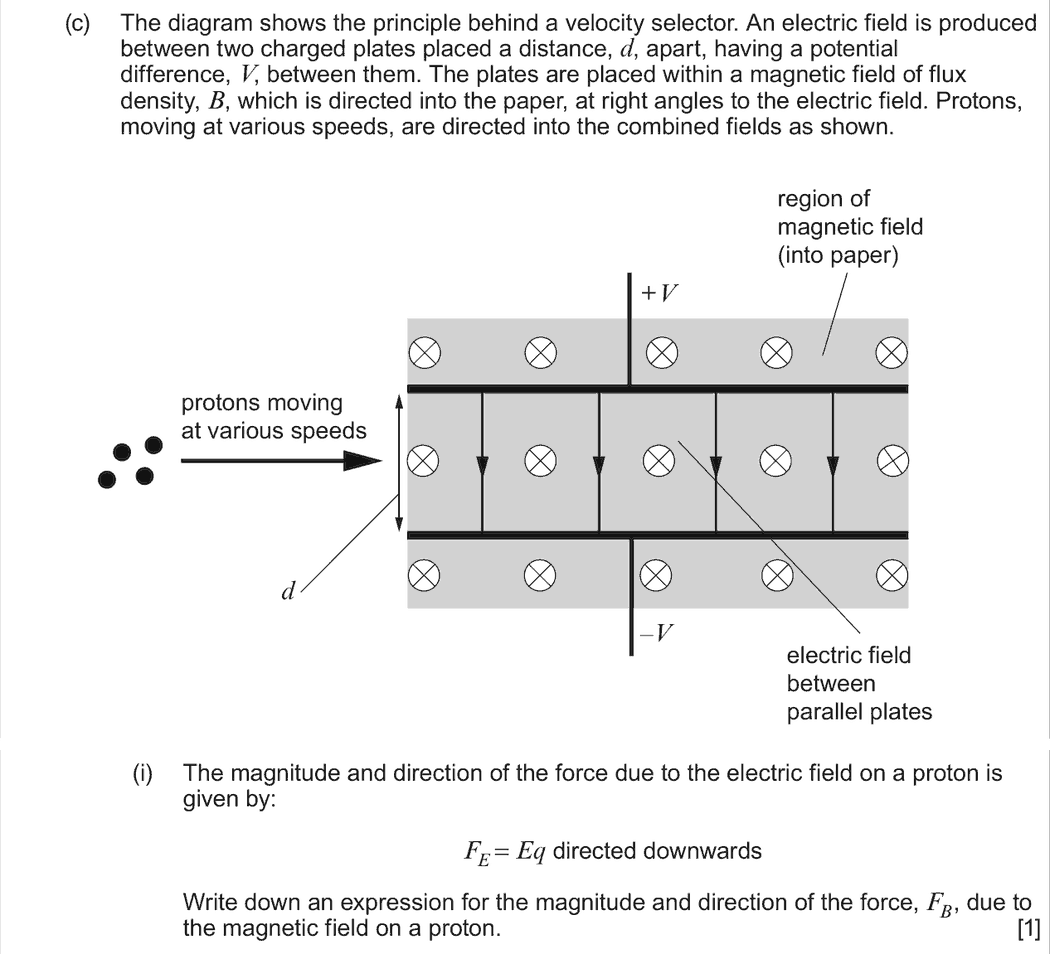
June 2022 · Component 2 · Q5(c)(iv) 2 marks AO2=2 Explanation magnetic fields
Earlier parts of question 5 that this part usesEarlier part of June 2022 Component 2 question 5Earlier part of June 2022 Component 2 question 5Earlier part of June 2022 Component 2 question 5
(iv) Describe and explain the motion of a proton travelling at less than 6.0 × 106 m s–1 through these fields. [2]
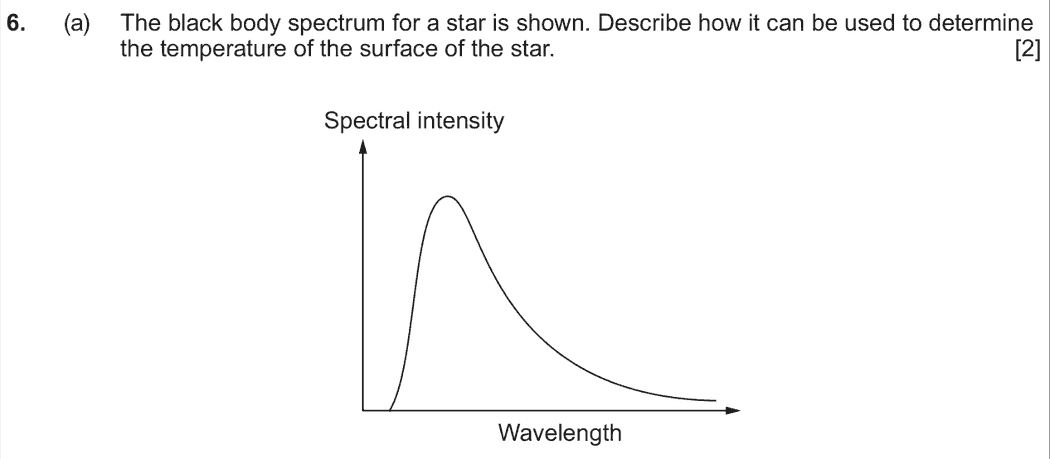
June 2022 · Component 2 · Q6(a) 2 marks AO1=2 Explanation radiation and stars
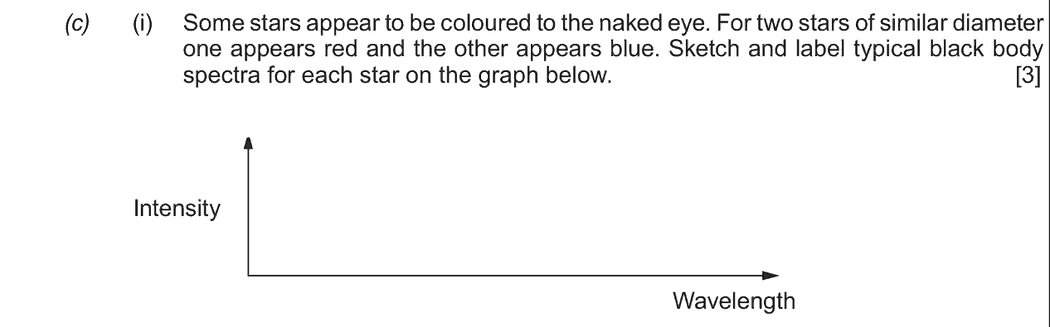
6. (a) The black body spectrum for a star is shown. Describe how it can be used to determine the temperature of the surface of the star. [2] Spectral intensity Wavelength
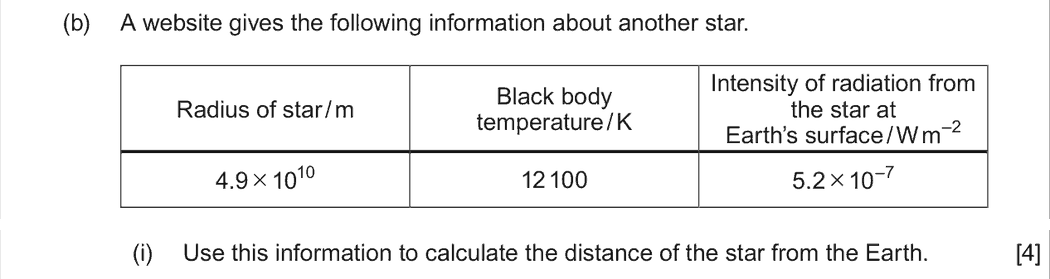
June 2022 · Component 2 · Q6(b)(ii) 2 marks AO3=2 Explanation radiation and stars
Earlier parts of question 6 that this part usesEarlier part of June 2022 Component 2 question 6Earlier part of June 2022 Component 2 question 6
(ii) The star is observed to be blue. Explain how the data supports this observation. [2]
June 2022 · Component 2 · Q7(b)(ii) 2 marks AO1=2 Explanation orbits and the wider universe
Earlier parts of question 7 that this part usesEarlier part of June 2022 Component 2 question 7Earlier part of June 2022 Component 2 question 7
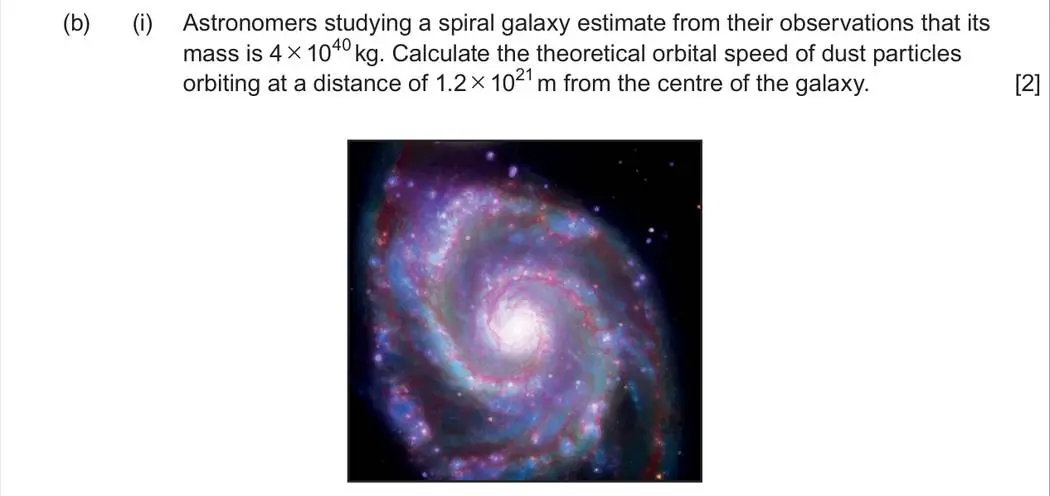
(ii) The measured velocity of the dust particles is found to be greater than the theoretical value calculated in (b)(i). Explain how astronomers account for this discrepancy. [2]
June 2022 · Component 2 · Q8(c)(ii) 2 marks AO3=2 Explanation kinetic theory
Earlier parts of question 8 that this part usesEarlier part of June 2022 Component 2 question 8Earlier part of June 2022 Component 2 question 8
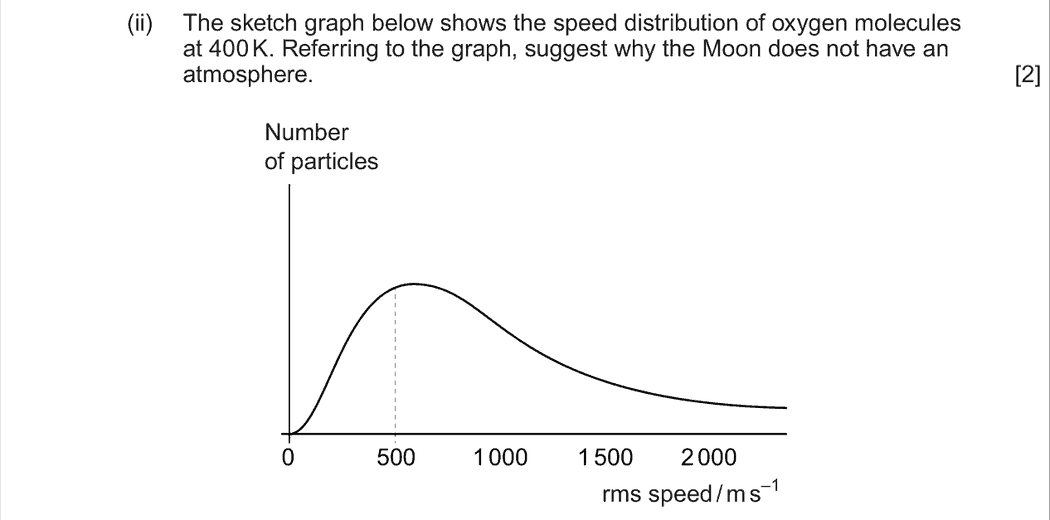
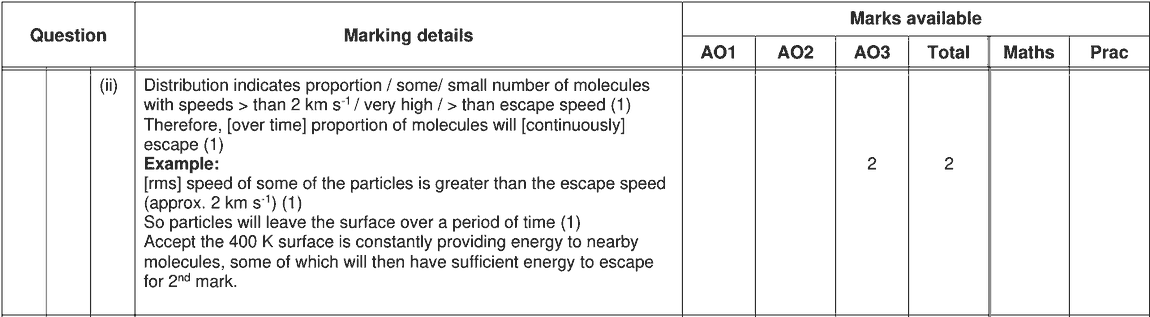
(ii) The sketch graph below shows the speed distribution of oxygen molecules at 400 K. Referring to the graph, suggest why the Moon does not have an atmosphere. [2] Number of particles 0 500 1 000 1 500 2 000 rms speed / m s–1
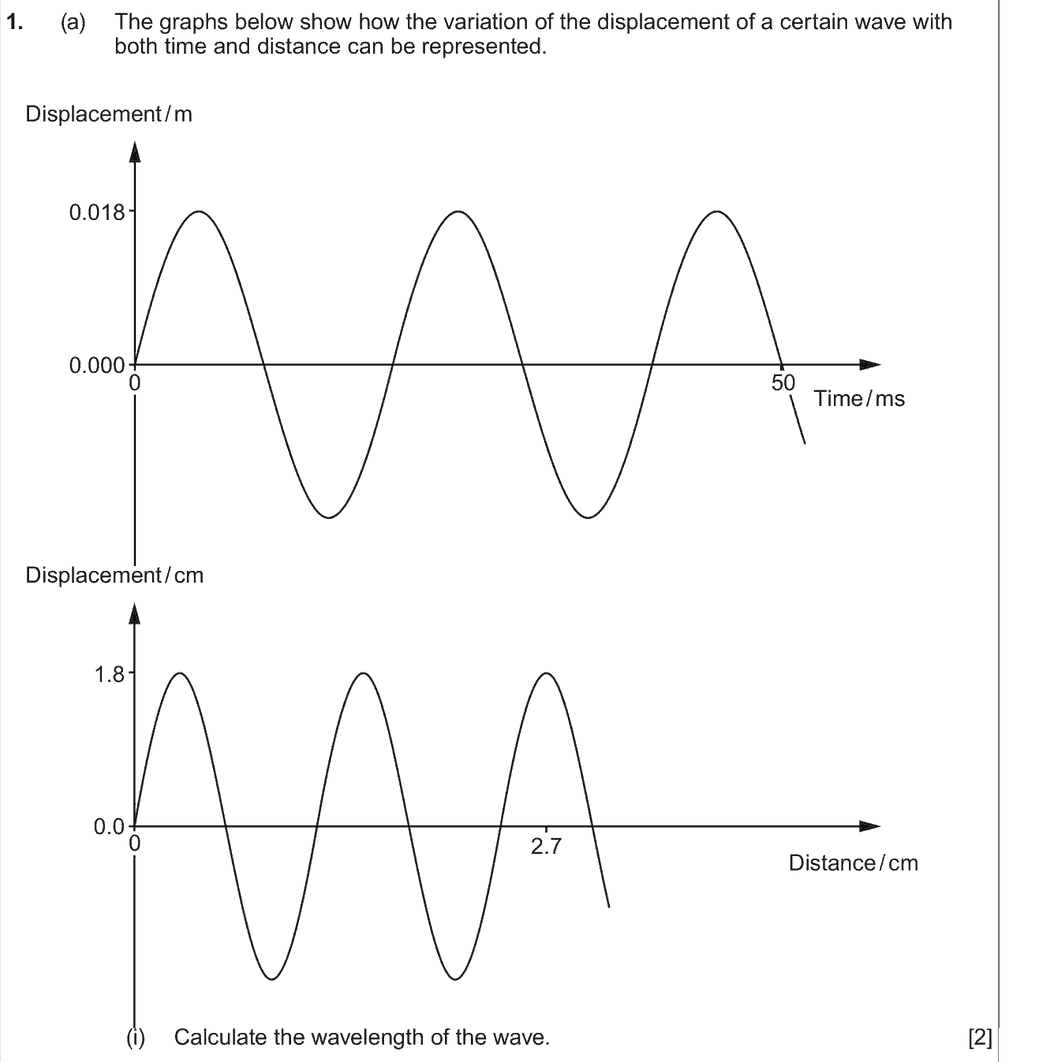
June 2022 · Component 3 · Q1(a)(iii) 4 marks AO1=4 Explanation nature of waves
Earlier part of question 1 that this part usesEarlier part of June 2022 Component 3 question 1
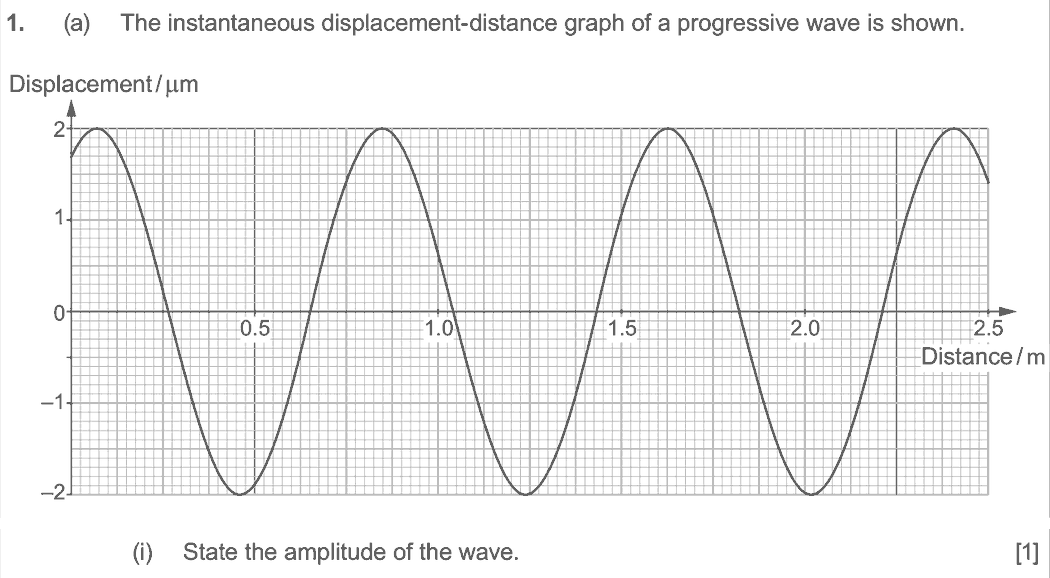
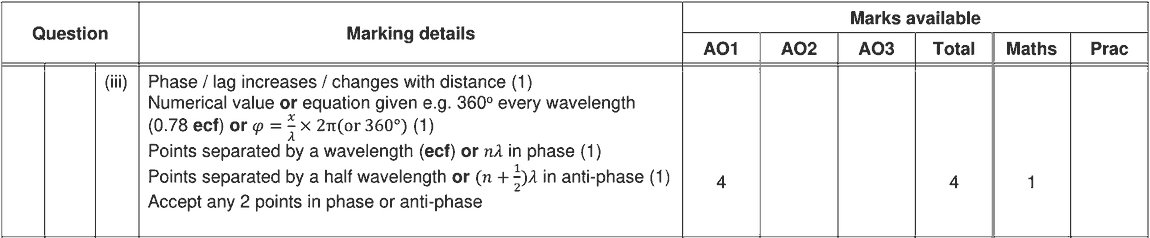
(iii) Use the graph to explain how the phase of the wave varies with distance. In your explanation you should include the terms “in phase” and “in anti-phase”. [4]
June 2022 · Component 3 · Q1(b)(ii) 2 marks AO2=2 Explanation nature of waves
Earlier parts of question 1 that this part usesEarlier part of June 2022 Component 3 question 1Earlier part of June 2022 Component 3 question 1
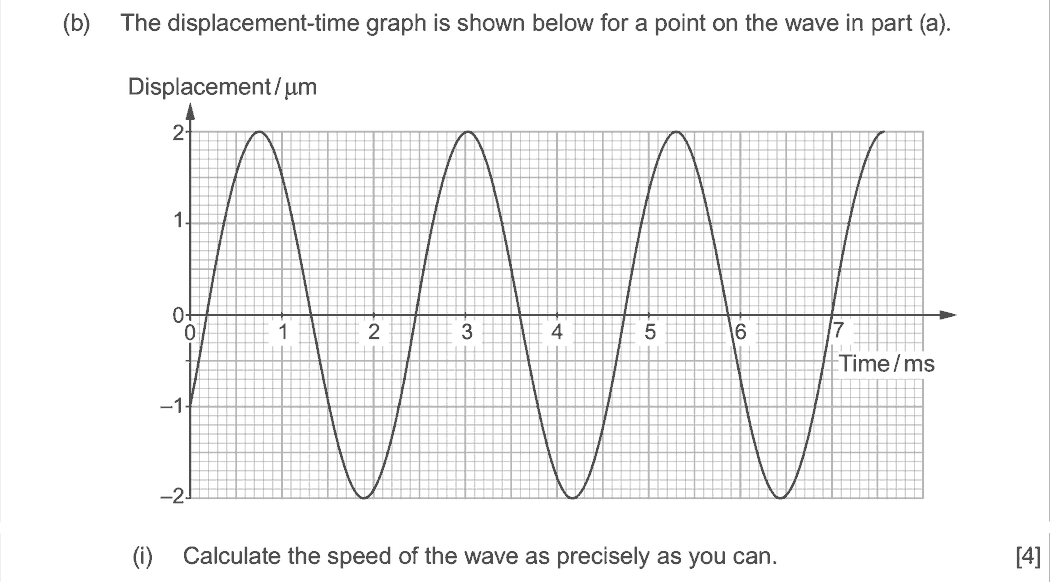
(ii) Explain the value of the displacement when the time is 8.7 ms. [2]
June 2022 · Component 3 · Q2(a) 2 marks AO1=2 Explanation wave properties
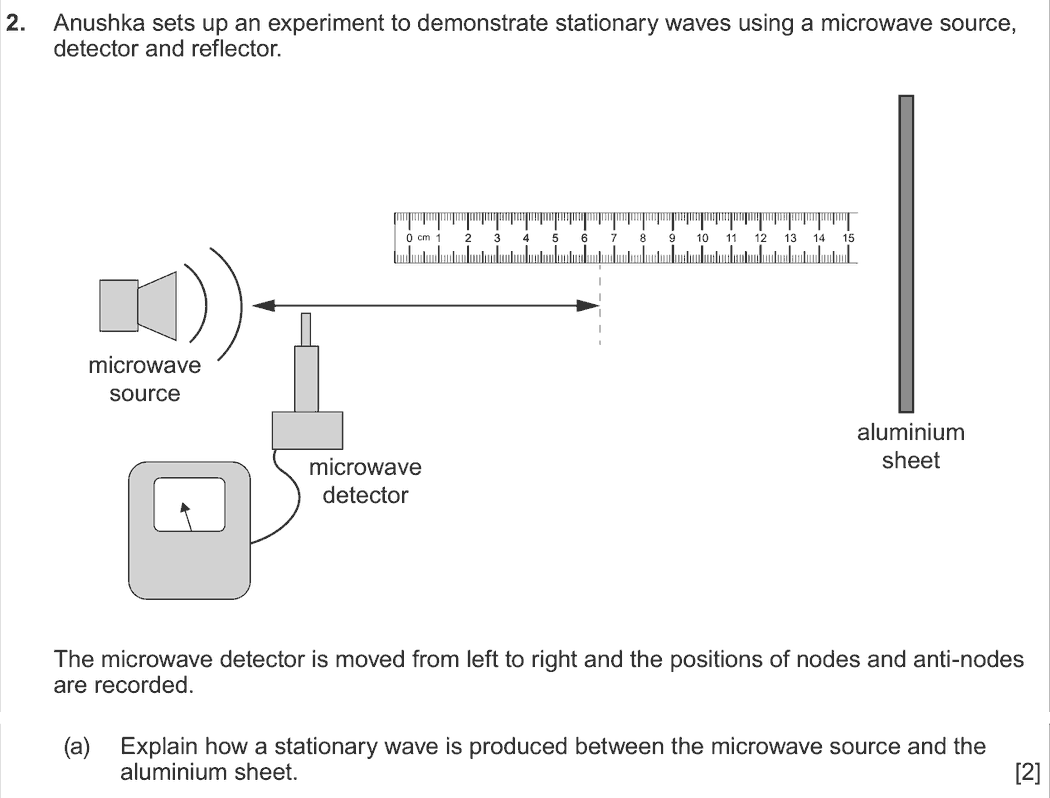
2. Anushka sets up an experiment to demonstrate stationary waves using a microwave source, detector and reflector. 0 cm 1 2 2 3 3 4 4 5 5 6 6 7 8 9 10 11 12 13 14 15 microwave source aluminium microwave sheet detector The microwave detector is moved from left to right and the positions of nodes and anti-nodes are recorded. (a) Explain how a stationary wave is produced between the microwave source and the aluminium sheet. [2]
June 2022 · Component 3 · Q3(a) 5 marks AO1=5 Explanation wave properties
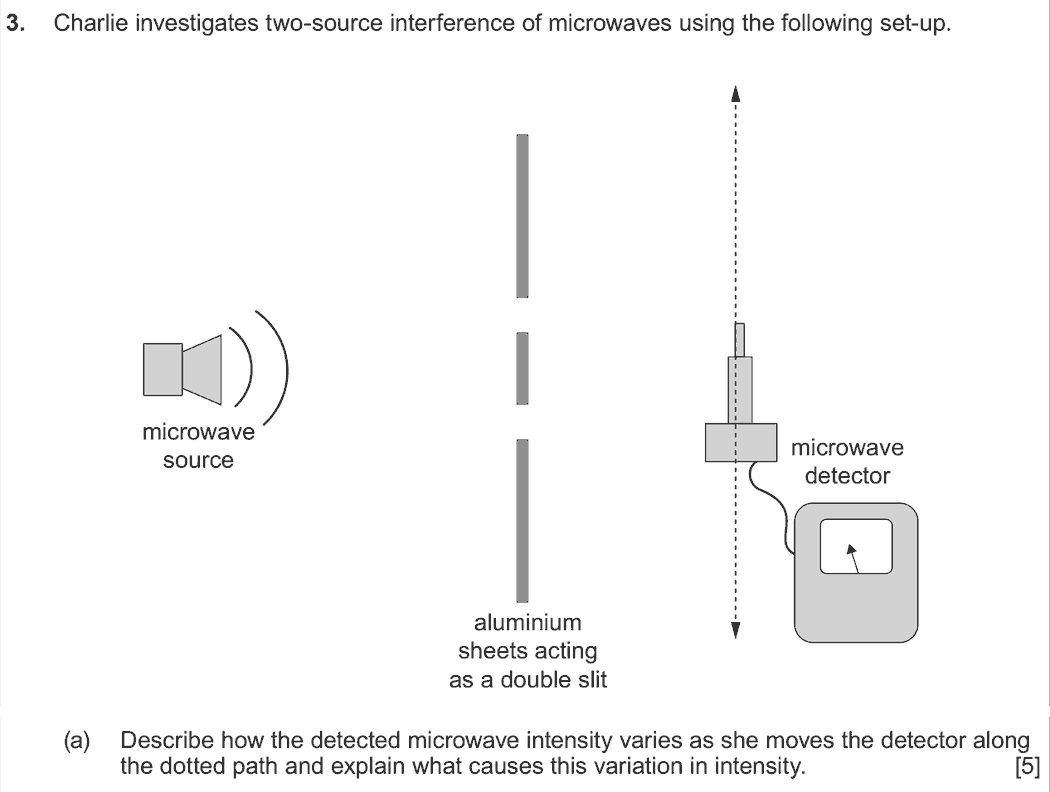
3. Charlie investigates two-source interference of microwaves using the following set-up. microwave microwave source detector aluminium sheets acting as a double slit (a) Describe how the detected microwave intensity varies as she moves the detector along the dotted path and explain what causes this variation in intensity. [5]
June 2022 · Component 3 · Q4(a)(i) 2 marks AO1=2 Explanation lasers
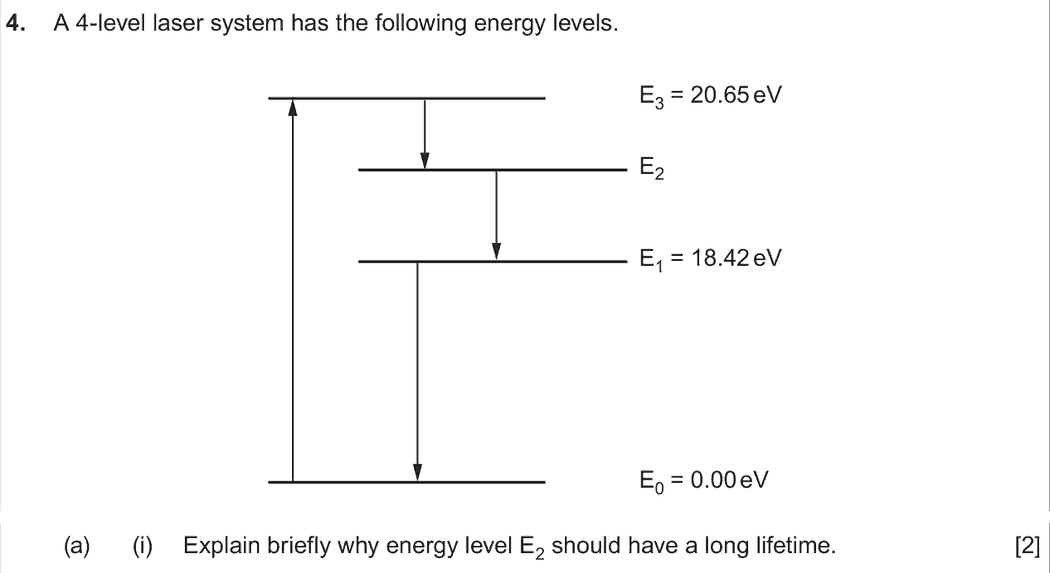
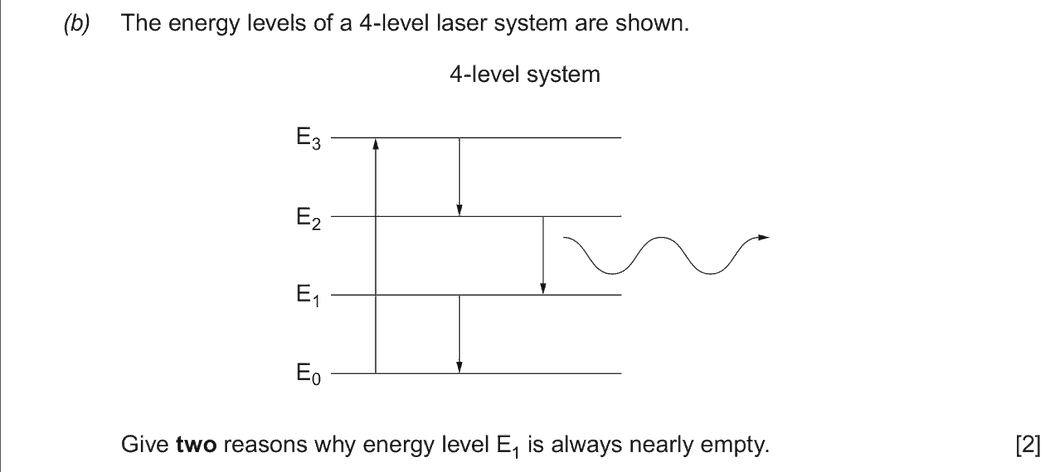
4. A 4-level laser system has the following energy levels. E3 = 20.65 eV E2 E1 = 18.42 eV E0 = 0.00 eV (a) (i) Explain briefly why energy level E2 should have a long lifetime. [2]
June 2022 · Component 3 · Q4(b)(ii)I 2 marks AO1=1, AO2=1 Explanation refraction of light
Earlier parts of question 4 that this part usesEarlier part of June 2022 Component 3 question 4Earlier part of June 2022 Component 3 question 4
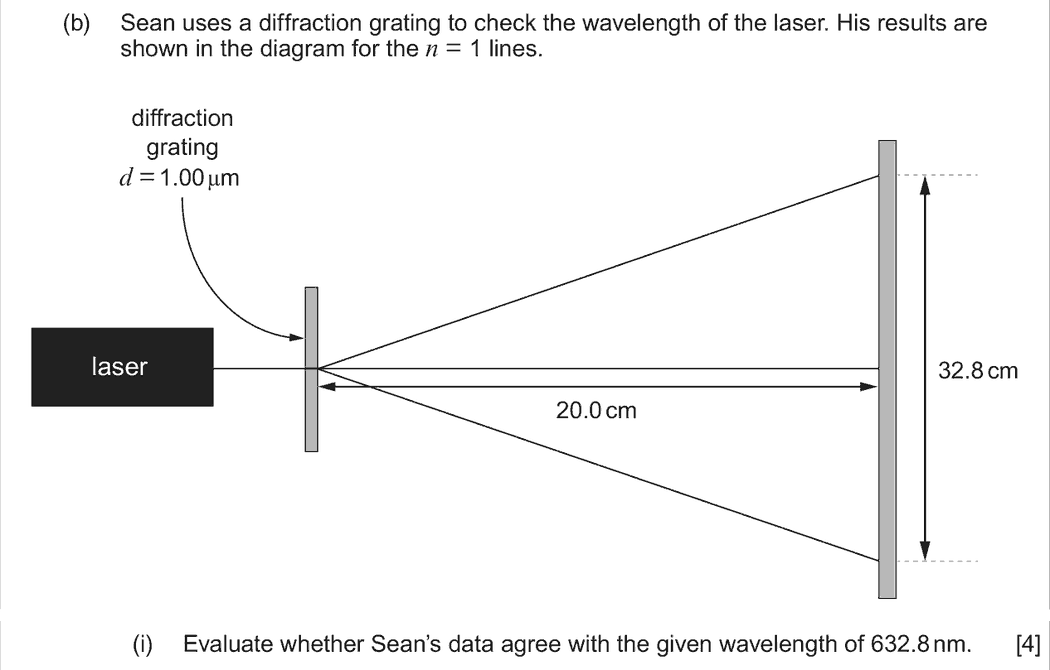
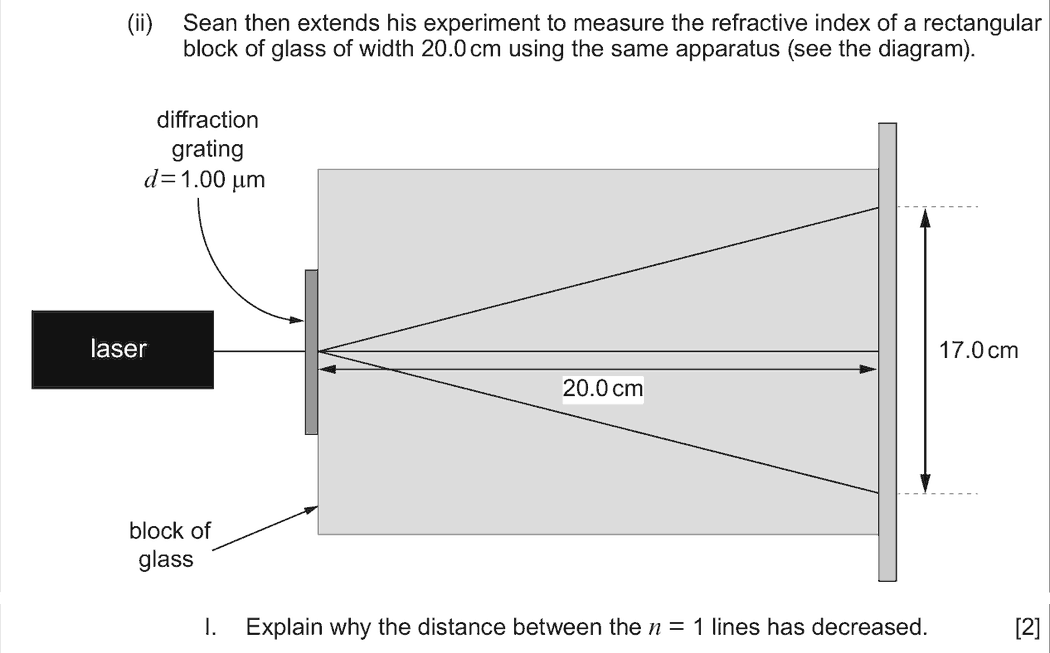
(ii) Sean then extends his experiment to measure the refractive index of a rectangular block of glass of width 20.0 cm using the same apparatus (see the diagram). diffraction grating d = 1.00 μm laser 17.0 cm 20.0 cm block of glass I. Explain why the distance between the n = 1 lines has decreased. [2]
June 2022 · Component 3 · Q5(a) 2 marks AO1=2 Explanation photons
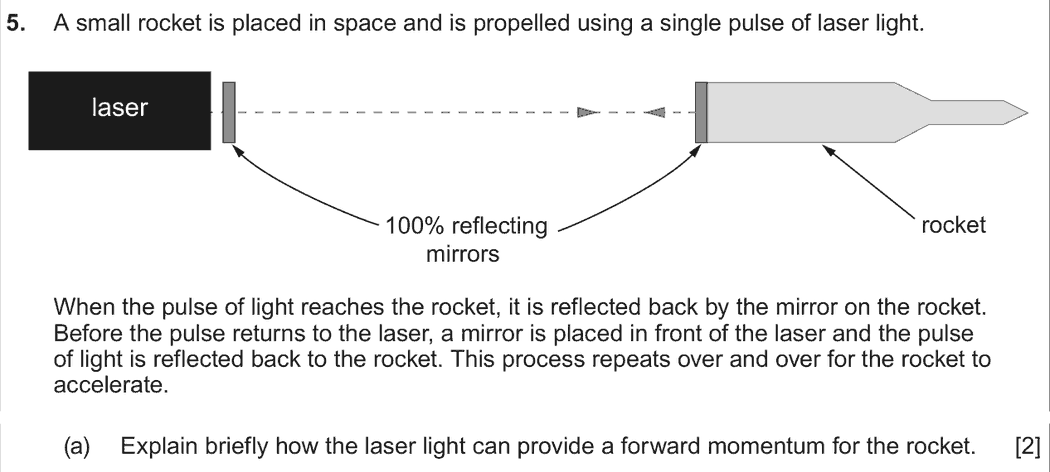
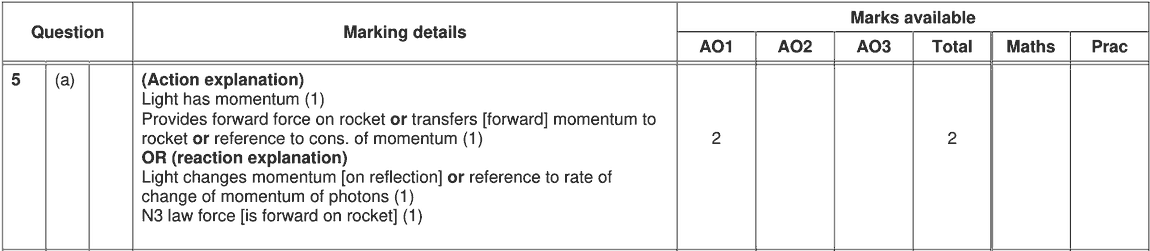
5. A small rocket is placed in space and is propelled using a single pulse of laser light. laser 100% reflecting rocket mirrors When the pulse of light reaches the rocket, it is reflected back by the mirror on the rocket. Before the pulse returns to the laser, a mirror is placed in front of the laser and the pulse of light is reflected back to the rocket. This process repeats over and over for the rocket to accelerate. (a) Explain briefly how the laser light can provide a forward momentum for the rocket. [2]
June 2022 · Component 3 · Q5(b)(iv) 3 marks AO3=3 Explanation photons
Earlier parts of question 5 that this part usesEarlier part of June 2022 Component 3 question 5Earlier part of June 2022 Component 3 question 5
(iv) By discussing kinetic energy and light energy, determine whether this rocket disobeys a fundamental law of physics. [3]
June 2022 · Component 3 · Q6(b) 2 marks AO2=2 Explanation nuclear energy
Earlier part of question 6 that this part usesEarlier part of June 2022 Component 3 question 6
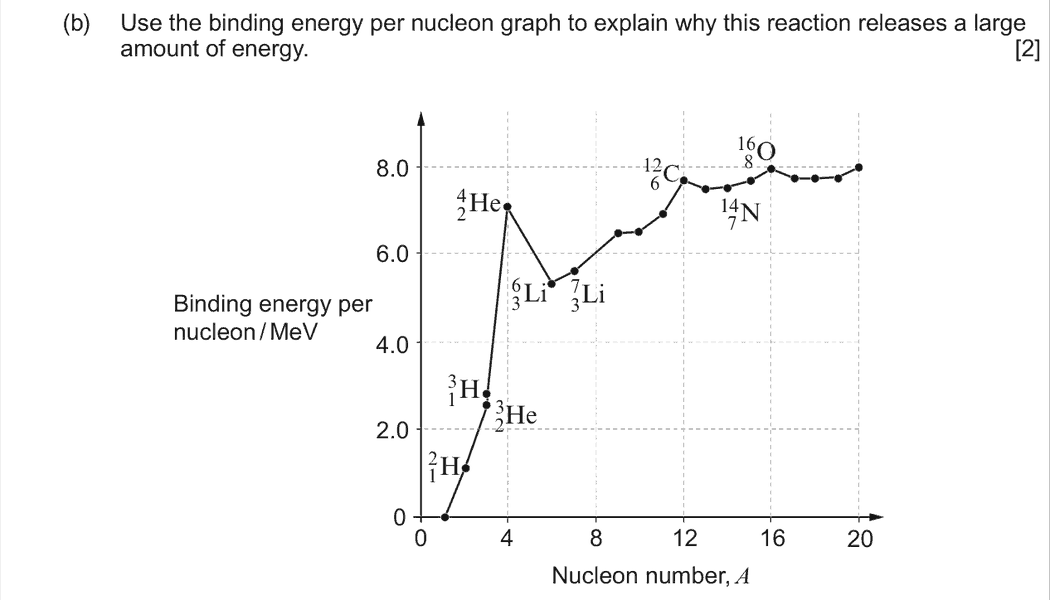
(b) Use the binding energy per nucleon graph to explain why this reaction releases a large amount of energy. [2] 16 O 8.0 12 8 C 6 4 He 14 N 2 7 6.0 6 Li 7 Li Binding energy per 3 3 nucleon / MeV 4.0 3 H 1 3 He 2.0 2 2 H 1 0 0 4 8 12 16 20 Nucleon number, A
June 2022 · Component 3 · Q6(c) 3 marks AO3=3 Explanation nuclear energy
Earlier parts of question 6 that this part usesEarlier part of June 2022 Component 3 question 6Earlier part of June 2022 Component 3 question 6
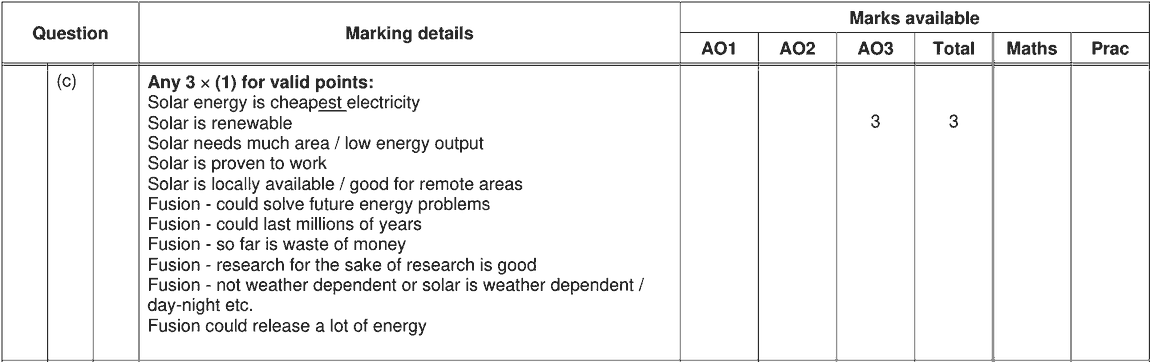
(c) For many years, research has been carried out on this hydrogen fusion reaction. A fusion reactor project called ITER (International Thermonuclear Experimental Reactor) has cost around £20 billion and has produced no electricity. If the ITER project is successful, the next fusion project will cost another £20 billion and might produce a demonstration fusion reactor by the year 2050. Many people believe this to be a complete waste of money and that this money would be better spent harnessing existing cheap solar power. Discuss whether spending money on fusion power or solar power is the better solution. [3]
June 2022 · Component 3 · Q9(a) 3 marks AO2=3 Explanation electromagnetic induction
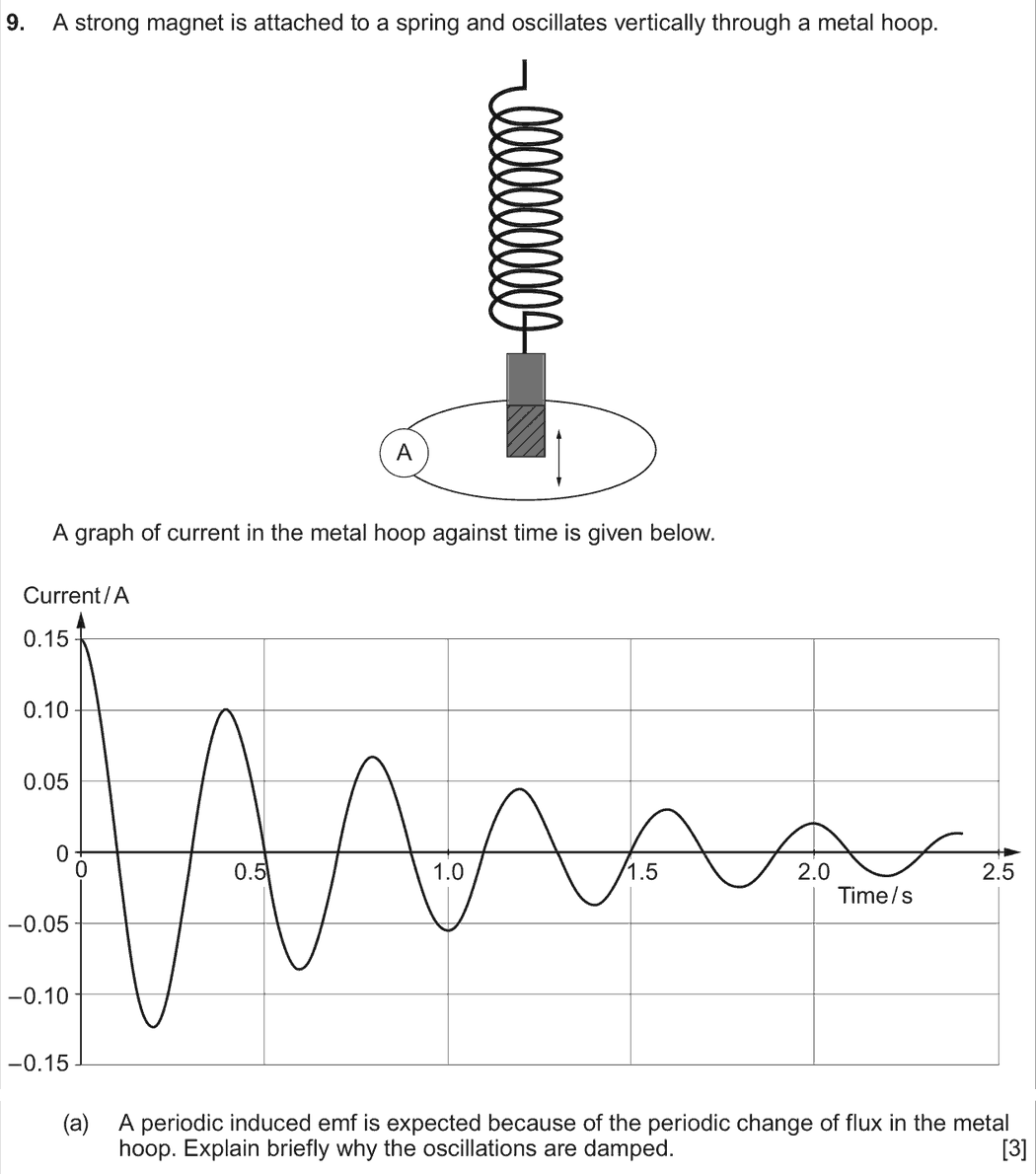
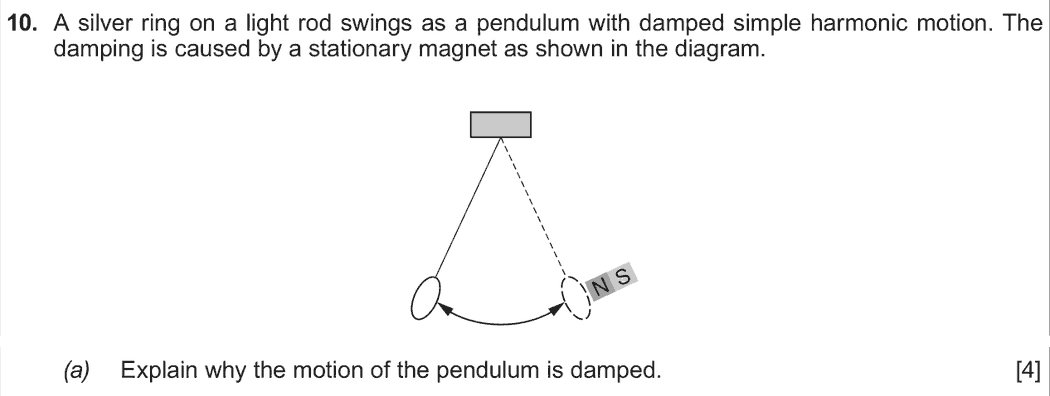
9. A strong magnet is attached to a spring and oscillates vertically through a metal hoop. A A graph of current in the metal hoop against time is given below. Current / A 0.15 0.10 0.05 0 0 0.5 1.0 1.5 2.0 2.5 Time / s – 0.05 – 0.10 – 0.15 (a) A periodic induced emf is expected because of the periodic change of flux in the metal hoop. Explain briefly why the oscillations are damped. [3]
June 2022 · Component 3 · Q10(a)(iii)II 2 marks AO1=1, AO2=1 Explanation alternating currents
Earlier parts of question 10 that this part usesEarlier part of June 2022 Component 3 question 10Earlier part of June 2022 Component 3 question 10Earlier part of June 2022 Component 3 question 10
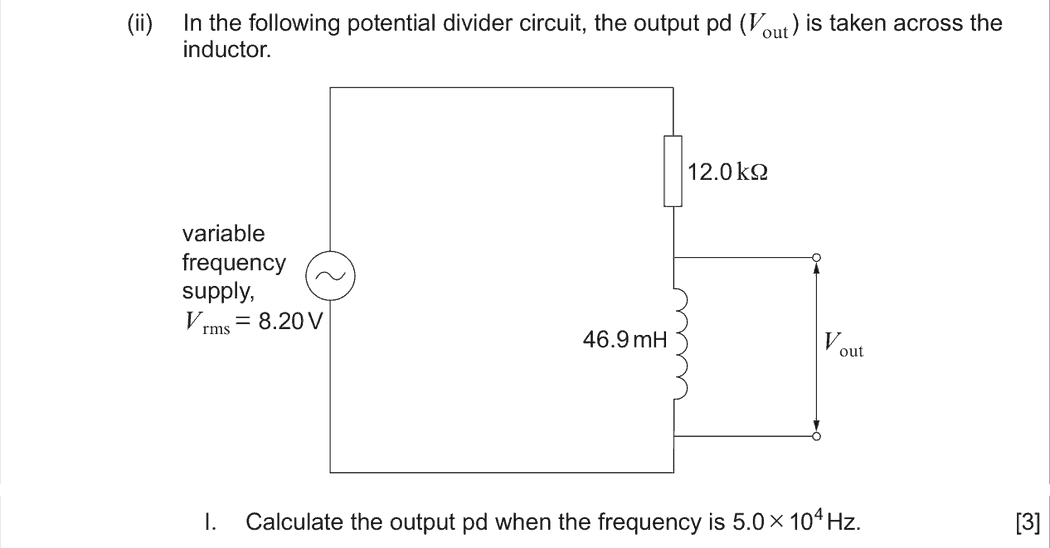
II. Explain why the output pd decreases with frequency. [2]
June 2022 · Component 3 · Q10(a)(iv) 2 marks AO1=1, AO2=1 Explanation alternating currents
Earlier parts of question 10 that this part usesEarlier part of June 2022 Component 3 question 10Earlier part of June 2022 Component 3 question 10Earlier part of June 2022 Component 3 question 10
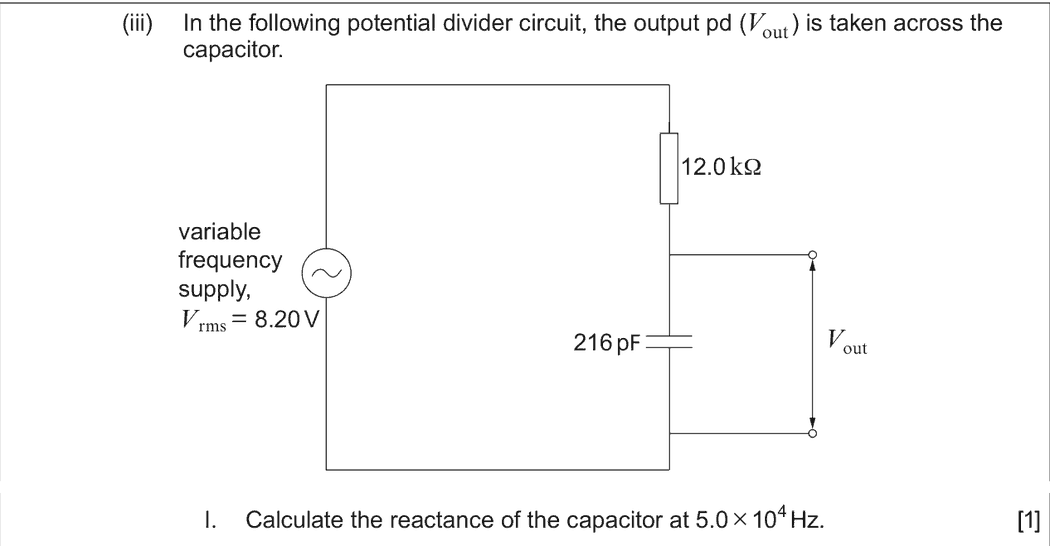
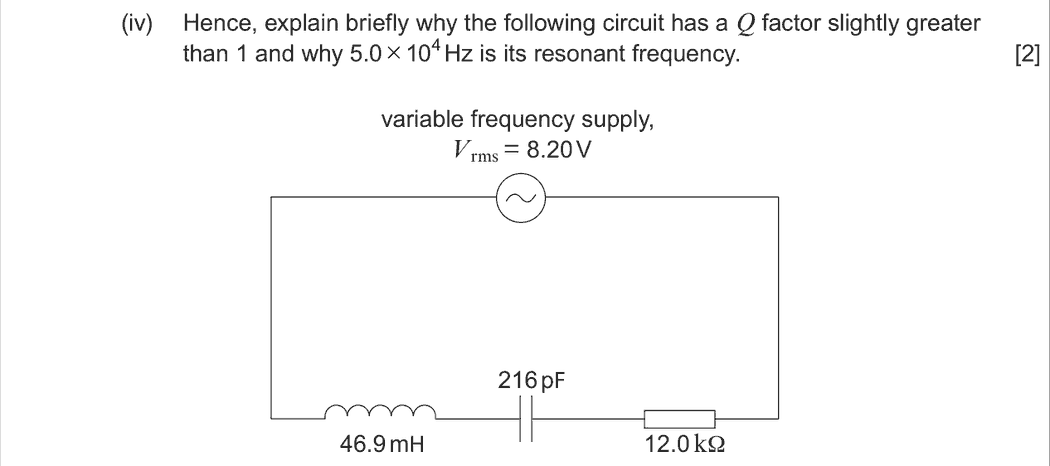
(iv) Hence, explain briefly why the following circuit has a Q factor slightly greater than 1 and why 5.0 × 104 Hz is its resonant frequency. [2] variable frequency supply, V = 8.20 V rms 216 pF 46.9 mH 12.0 kΩ
June 2022 · Component 3 · Q11(b)(i) 2 marks AO1=2 Explanation medical physics
Earlier part of question 11 that this part usesEarlier part of June 2022 Component 3 question 11
(b) (i) Explain briefly the role played by radio waves in the process of MRI scans. [2]
June 2022 · Component 3 · Q11(d) 5 marks AO3=5 Explanation medical physics
Earlier part of question 11 that this part usesEarlier part of June 2022 Component 3 question 11
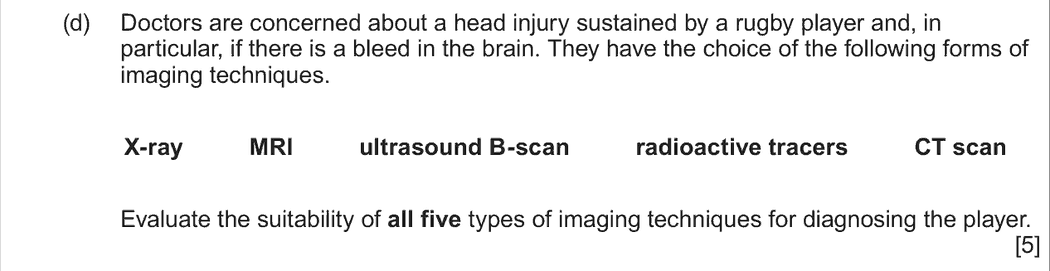
(d) Doctors are concerned about a head injury sustained by a rugby player and, in particular, if there is a bleed in the brain. They have the choice of the following forms of imaging techniques. X-ray MRI ultrasound B-scan radioactive tracers CT scan Evaluate the suitability of all five types of imaging techniques for diagnosing the player. [5]
June 2022 · Component 3 · Q12(a) 2 marks AO1=1, AO2=1 Explanation physics of sports
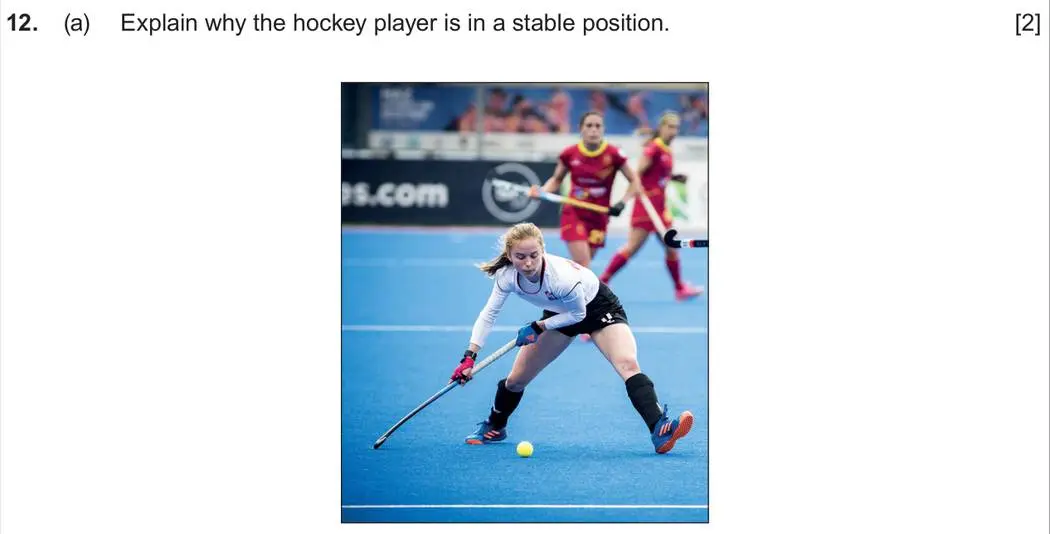
12. (a) Explain why the hockey player is in a stable position. [2]
June 2022 · Component 3 · Q12(b) 2 marks AO3=2 Explanation physics of sports
Earlier part of question 12 that this part usesEarlier part of June 2022 Component 3 question 12
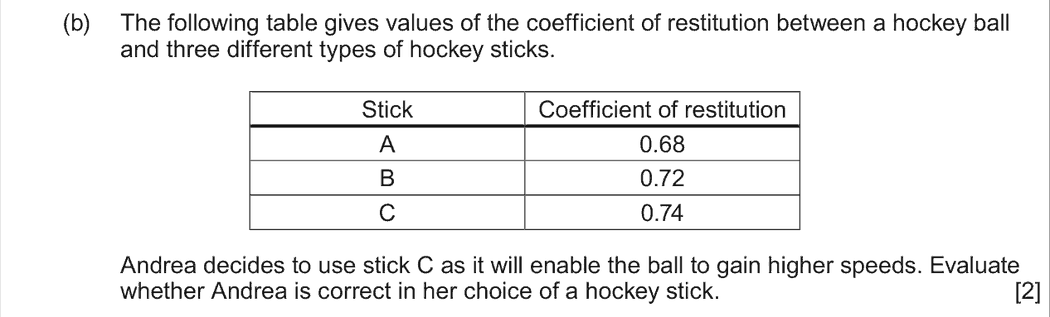
(b) The following table gives values of the coefficient of restitution between a hockey ball and three different types of hockey sticks. Stick Coefficient of restitution A 0.68 B 0.72 C 0.74 Andrea decides to use stick C as it will enable the ball to gain higher speeds. Evaluate whether Andrea is correct in her choice of a hockey stick. [2]
June 2022 · Component 3 · Q13(b)(ii) 3 marks AO2=3 Explanation energy and the environment
Earlier parts of question 13 that this part usesEarlier part of June 2022 Component 3 question 13Earlier part of June 2022 Component 3 question 13
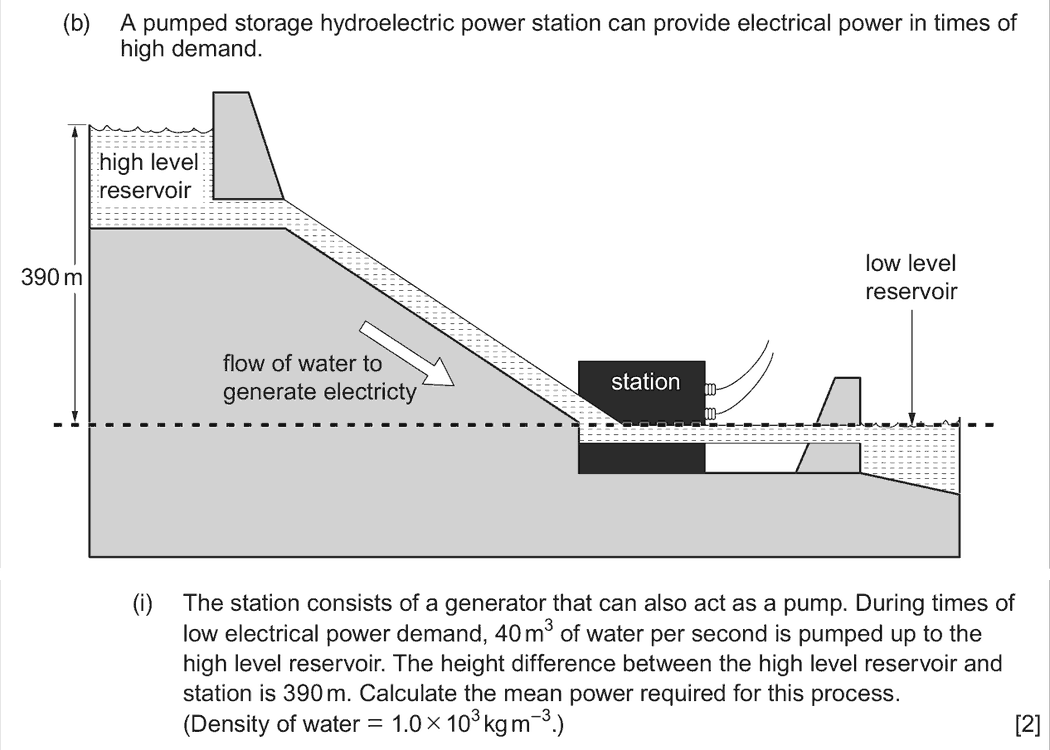
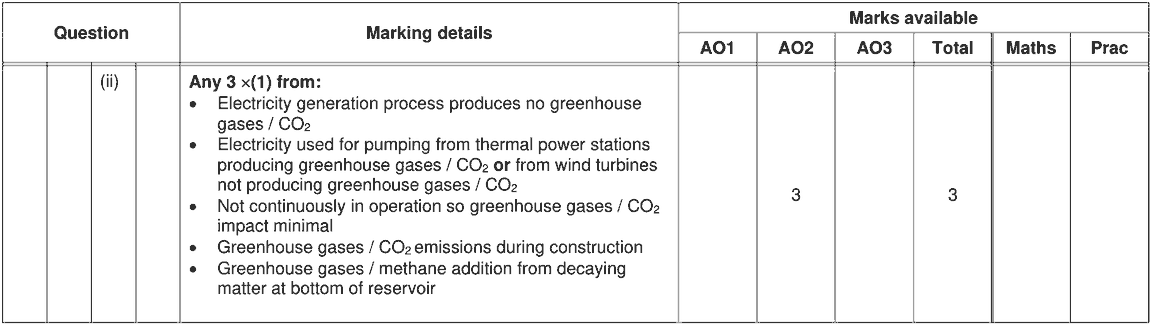
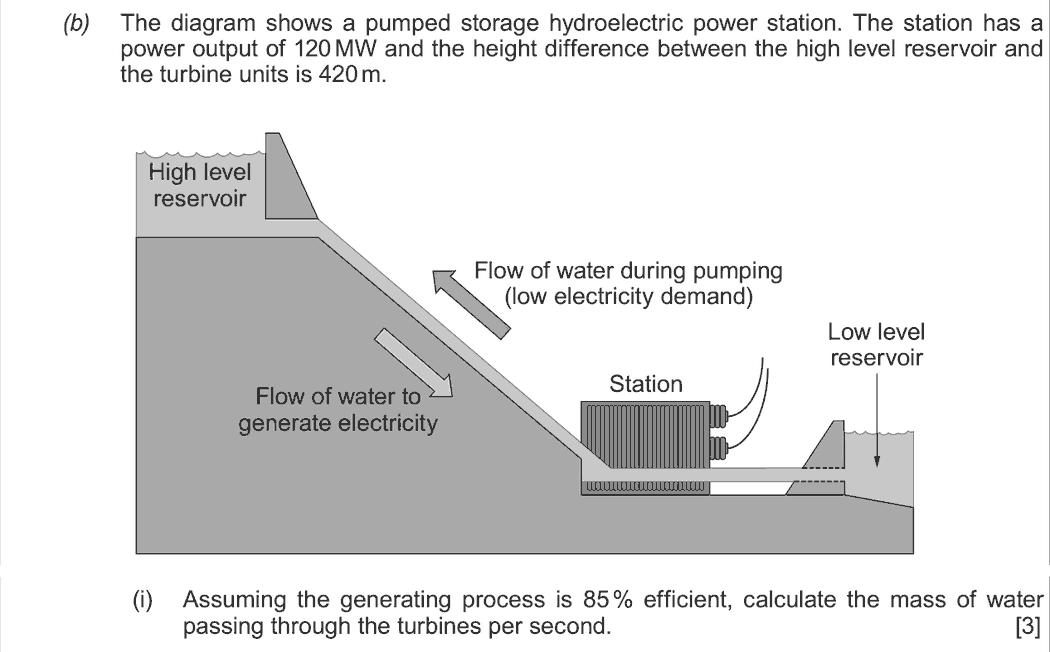
(ii) Discuss the impact that pumped storage hydroelectric power stations have on greenhouse gas emissions. [3]
June 2022 · AS Component 1 · Q2(c)(i) 2 marks AO3=2 Explanation kinematics
Earlier part of question 2 that this part usesEarlier part of June 2022 Component 1 question 2
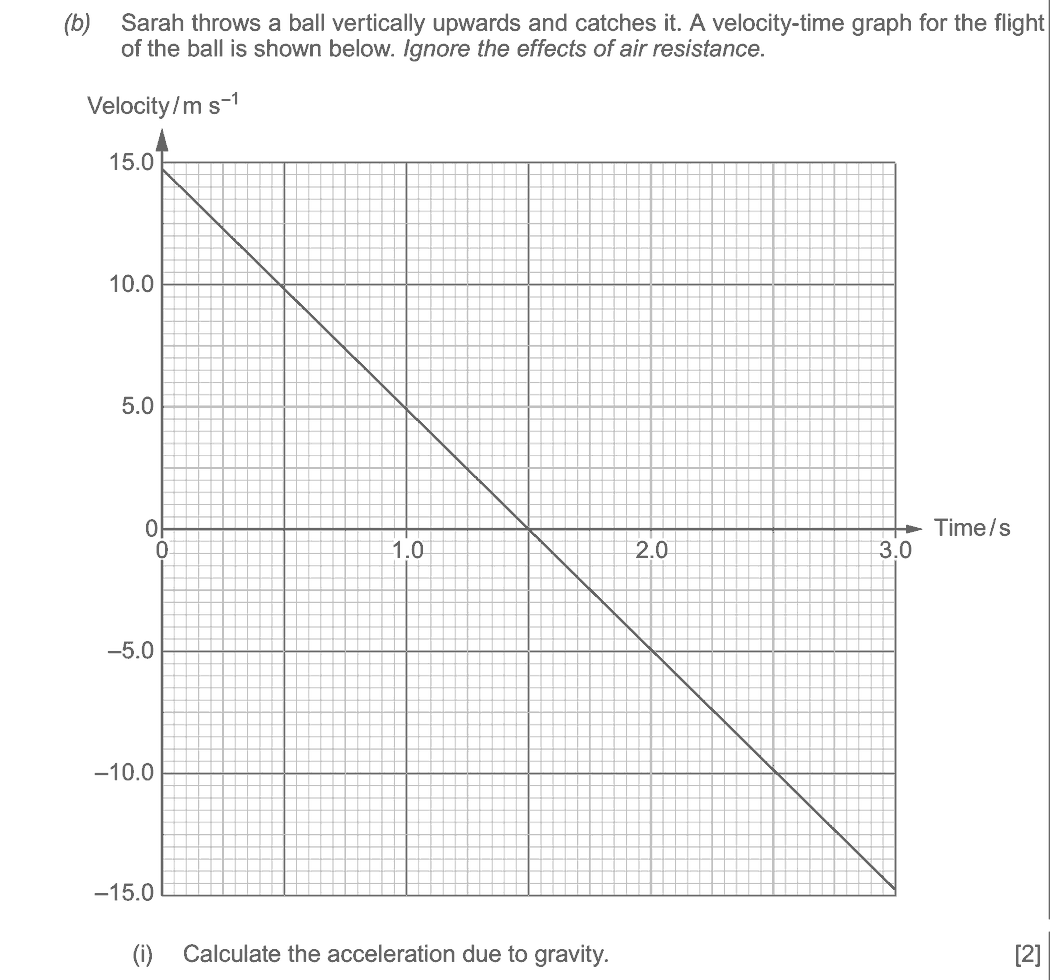
(c) (i) A team-mate of the cricketer says the ball will take longer to complete the upward part of the journey than the downward part. Discuss if he is correct. [2]
June 2022 · AS Component 1 · Q3(d) 2 marks AO3=2 Explanation dynamics
Earlier part of question 3 that this part usesEarlier part of June 2022 Component 1 question 3
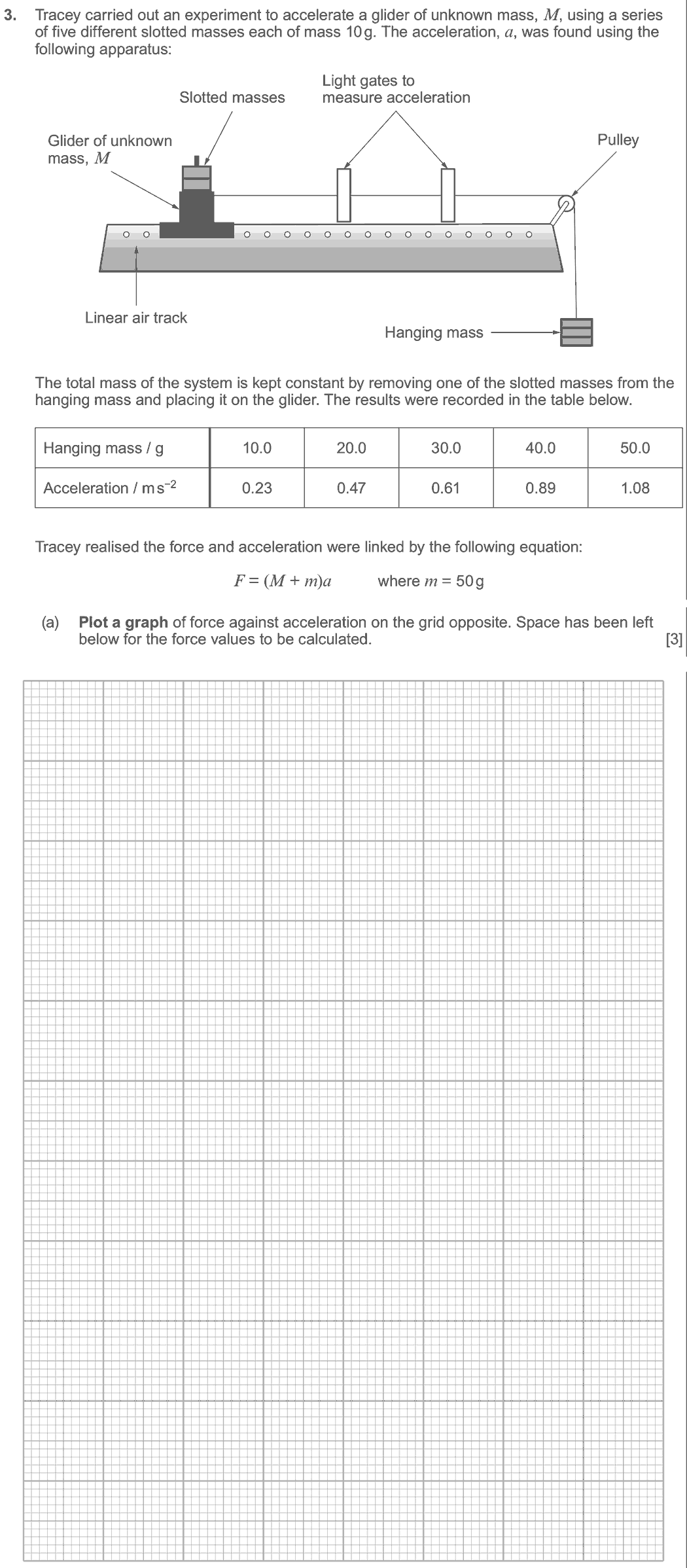
(d) Tracey predicts that the glider will continue with the same acceleration after the masses have hit the floor, evaluate if she is correct. [2]
June 2022 · AS Component 1 · Q6(b)(i) 3 marks AO1=1, AO3=2 Explanation particles and nuclear structure
Earlier part of question 6 that this part usesEarlier part of June 2022 Component 1 question 6
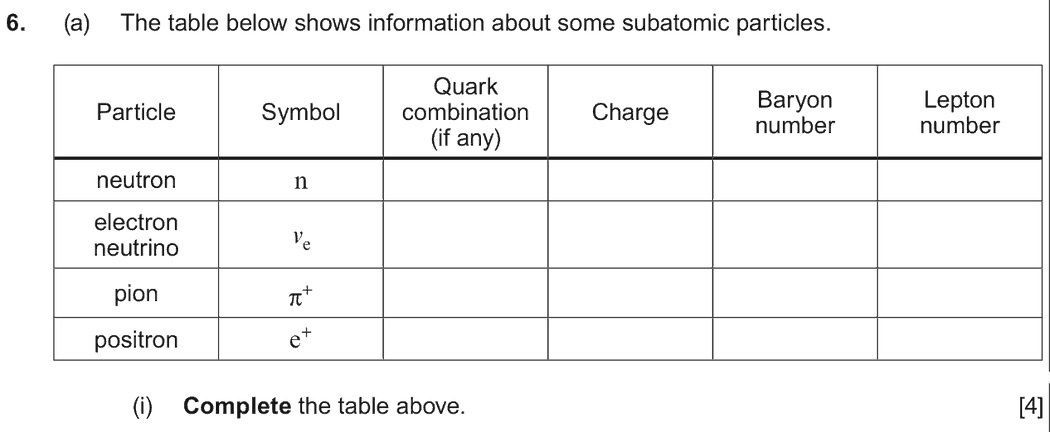
(b) (i) The following reaction has been observed in the large hadron collider at CERN. e− + p → Δ++ + x + π− where Δ++ is a first generation baryon. Identify particle x. Justify your answer using the conservation laws. [3]
June 2022 · AS Component 1 · Q6(b)(ii) 2 marks AO3=2 Explanation particles and nuclear structure
Earlier parts of question 6 that this part usesEarlier part of June 2022 Component 1 question 6Earlier part of June 2022 Component 1 question 6
(ii) Deduce which force is responsible for the interaction, giving a reason for your answer. [2]
June 2022 · AS Component 1 · Q7(a) 3 marks AO1=3 Explanation radiation and stars
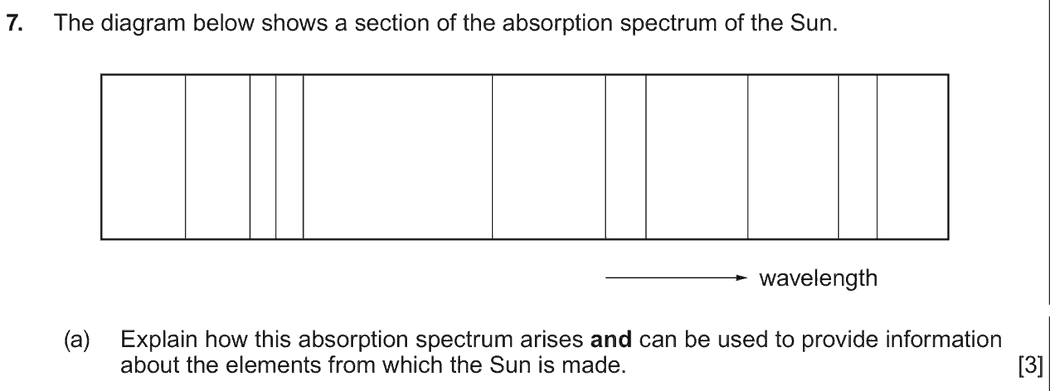
7. The diagram below shows a section of the absorption spectrum of the Sun. wavelength (a) Explain how this absorption spectrum arises and can be used to provide information about the elements from which the Sun is made. [3]
June 2022 · AS Component 2 · Q1(a) 3 marks AO1=3 Explanation nature of waves
1. (a) Waves may be described as being either transverse or longitudinal. Explain the difference between the two types of waves. [3]
June 2022 · AS Component 2 · Q4(c) 4 marks AO1=4 Explanation lasers
Earlier part of question 4 that this part usesEarlier part of June 2022 Component 2 question 4
(c) Explain why a population inversion, metastable state and stimulated emission are required for a laser to work. [4]
June 2022 · AS Component 2 · Q4(e) 2 marks AO3=2 Explanation photons
Earlier part of question 4 that this part usesEarlier part of June 2022 Component 2 question 4
(e) Evaluate the benefits for scientists and engineers of determining the value of physical constants such as the Plank constant and numbers such as π to a high degree of accuracy. [2]
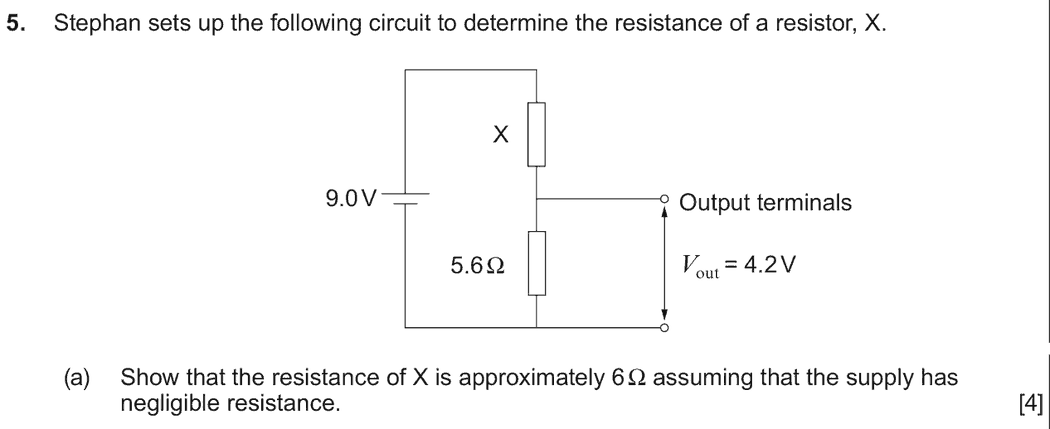
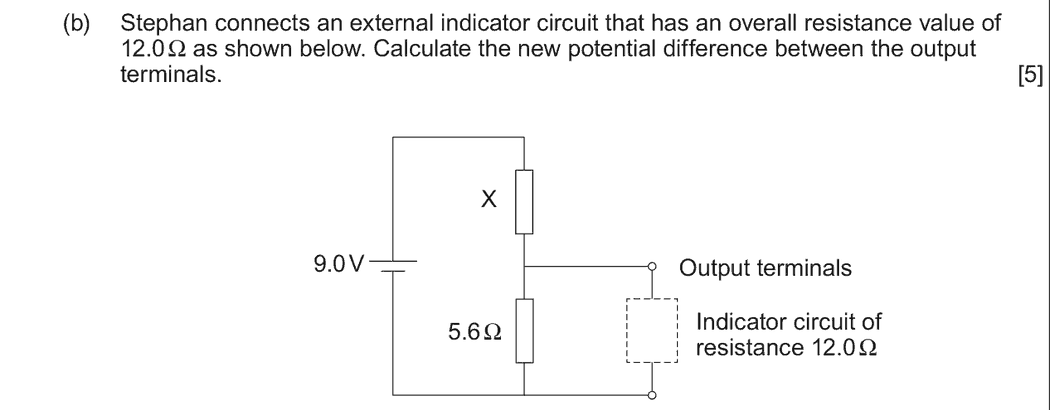
June 2022 · AS Component 2 · Q5(c) 2 marks AO2=2 Explanation dc circuitsresistance
Earlier parts of question 5 that this part usesEarlier part of June 2022 Component 2 question 5Earlier part of June 2022 Component 2 question 5
(c) Bruno suggests that Stephan replaces resistor X with a thermistor that changes its resistance from 10 kΩ at 0 °C to 8.7 kΩ at 30 °C. Explain why the circuit cannot be used as a temperature sensor if the indicator circuit requires a minimum current of 10 mA to operate. [2]
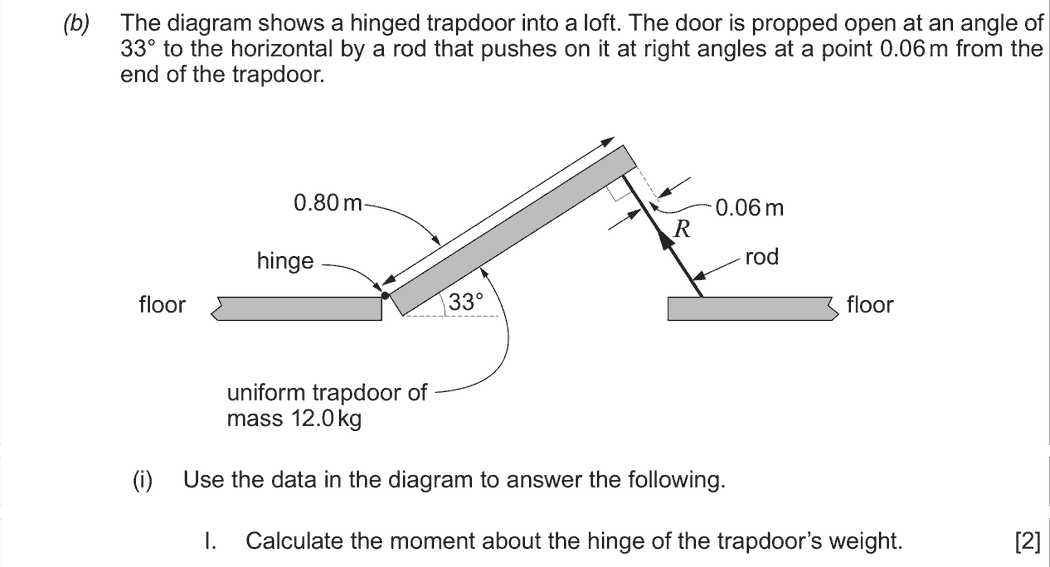
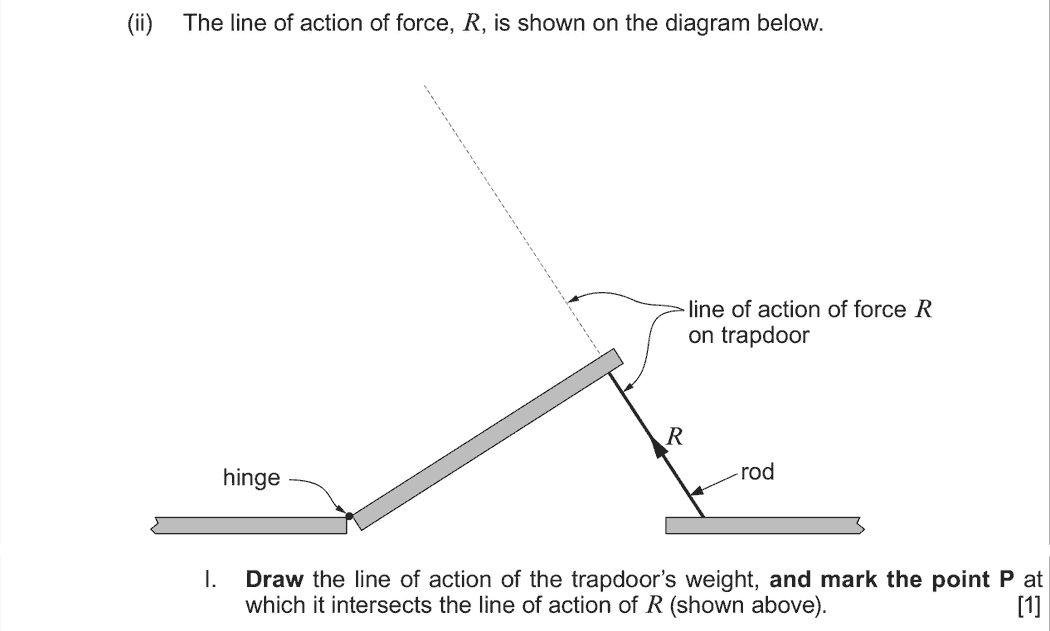
October 2021 · Component 1 · Q1(b)(ii)II 2 marks AO3=2 Explanation basic physics
Earlier parts of question 1 that this part usesEarlier part of October 2021 Component 1 question 1Earlier part of October 2021 Component 1 question 1Earlier part of October 2021 Component 1 question 1
II. Darren claims that, according to the principle of moments, the line of action of the force exerted on the trapdoor by the hinge must also pass through point P. Evaluate this claim. [2]
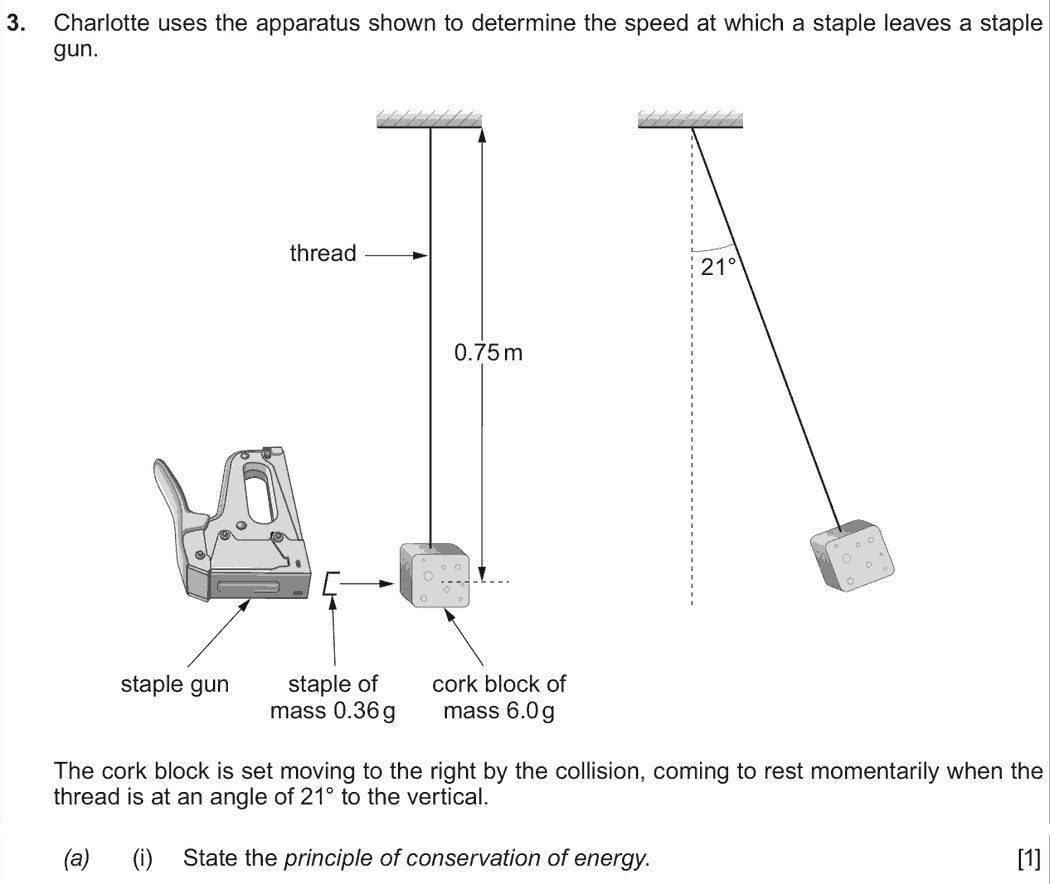
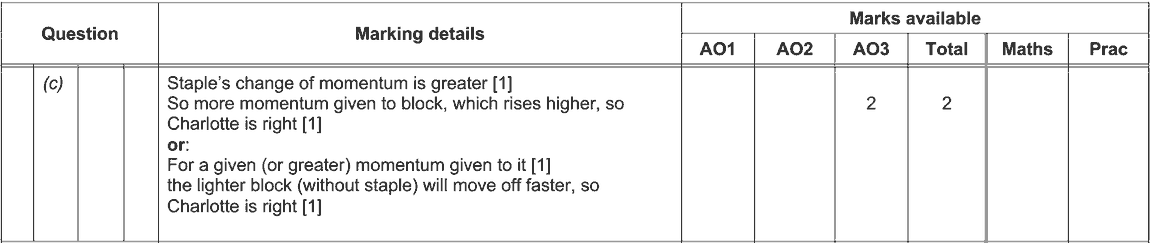
October 2021 · Component 1 · Q3(c) 2 marks AO3=2 Explanation dynamics
Earlier part of question 3 that this part usesEarlier part of October 2021 Component 1 question 3
(c) Charlotte claims that the block would have swung higher if the staple had bounced back off the block instead of embedding itself. Evaluate this claim. [2]
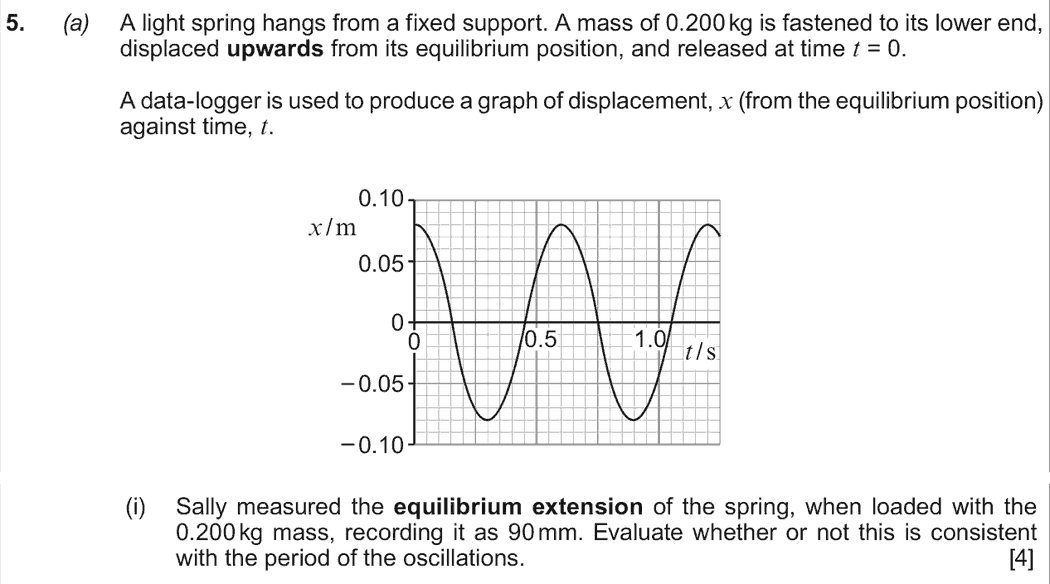
October 2021 · Component 1 · Q5(a)(iii)II 2 marks AO2=2 Explanation vibrationsenergy concepts
Earlier parts of question 5 that this part usesEarlier part of October 2021 Component 1 question 5Earlier part of October 2021 Component 1 question 5
II. Between t = 0 and t = 0.15 s, the mass gains kinetic energy and loses gravitational potential energy. Without further calculation, explain why the gain in kinetic energy is considerably less than the loss of gravitational potential energy. [2]
October 2021 · Component 1 · Q5(c) 3 marks AO3=3 Explanation vibrations
Earlier part of question 5 that this part usesEarlier part of October 2021 Component 1 question 5
(c) Sally says “Damping should always be avoided because it involves energy dissipation”. Evaluate this claim. [3]
October 2021 · Component 1 · Q6(b)(ii)II 4 marks AO3=4 Explanation kinetic theory
Earlier parts of question 6 that this part usesEarlier part of October 2021 Component 1 question 6Earlier part of October 2021 Component 1 question 6Earlier part of October 2021 Component 1 question 6
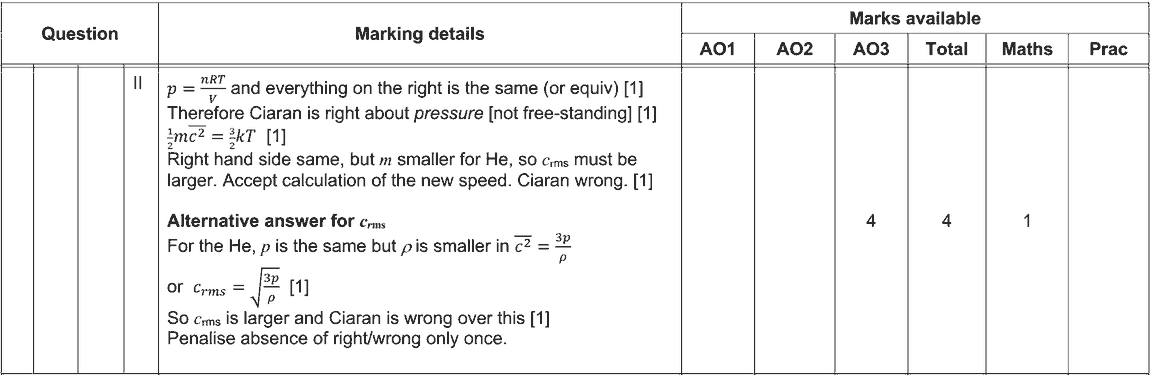
II. The oxygen in the cylinder is now replaced by 20.0 mol of helium [relative molecular mass = 4.0] at the same temperature. Ciaran claims that both the pressure and the rms speed of the molecules will be the same as in the previous part. Evaluate both of these claims. [4]
October 2021 · Component 1 · Q7(c) 2 marks AO2=2 Explanation thermal physics
Earlier part of question 7 that this part usesEarlier part of October 2021 Component 1 question 7
(c) Use the first law of thermodynamics to explain why a fall of temperature is to be expected over AB. [2]
October 2021 · Component 1 · Q8(a) 2 marks AO1=2 Explanation resistancecomprehension
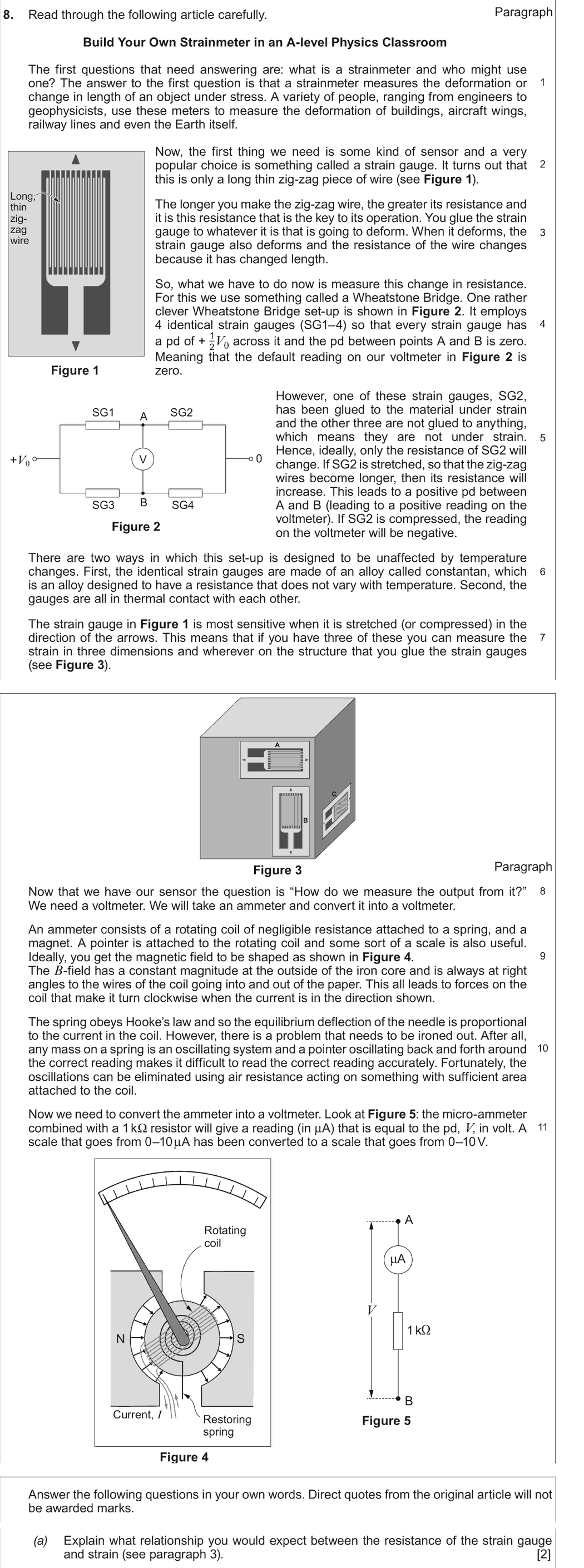
8. Read through the following article carefully. Paragraph Build Your Own Strainmeter in an A-level Physics Classroom The first questions that need answering are: what is a strainmeter and who might use one? The answer to the first question is that a strainmeter measures the deformation or 1 change in length of an object under stress. A variety of people, ranging from engineers to geophysicists, use these meters to measure the deformation of buildings, aircraft wings, railway lines and even the Earth itself. Now, the first thing we need is some kind of sensor and a very popular choice is something called a strain gauge. It turns out that 2 this is only a long thin zig-zag piece of wire (see Figure 1). Long, The longer you make the zig-zag wire, the greater its resistance and thin zig- it is this resistance that is the key to its operation. You glue the strain zag gauge to whatever it is that is going to deform. When it deforms, the 3 wire strain gauge also deforms and the resistance of the wire changes because it has changed length. So, what we have to do now is measure this change in resistance. For this we use something called a Wheatstone Bridge. One rather clever Wheatstone Bridge set-up is shown in Figure 2. It employs 4 identical strain gauges (SG1–4) so that every strain gauge has 4 a pd of + 1 2V0 across it and the pd between points A and B is zero. Meaning that the default reading on our voltmeter in Figure 2 is Figure 1 zero. However, one of these strain gauges, SG2, has been glued to the material under strain SG1 SG2 A and the other three are not glued to anything, which means they are not under strain. 5 Hence, ideally, only the resistance of SG2 will +V0 V 0 change. If SG2 is stretched, so that the zig-zag wires become longer, then its resistance will increase. This leads to a positive pd between SG3 B SG4 A and B (leading to a positive reading on the voltmeter). If SG2 is compressed, the reading Figure 2 on the voltmeter will be negative. There are two ways in which this set-up is designed to be unaffected by temperature changes. First, the identical strain gauges are made of an alloy called constantan, which 6 is an alloy designed to have a resistance that does not vary with temperature. Second, the gauges are all in thermal contact with each other. The strain gauge in Figure 1 is most sensitive when it is stretched (or compressed) in the direction of the arrows. This means that if you have three of these you can measure the 7 strain in three dimensions and wherever on the structure that you glue the strain gauges (see Figure 3). A C B Figure 3 Paragraph Now that we have our sensor the question is “How do we measure the output from it?” 8 We need a voltmeter. We will take an ammeter and convert it into a voltmeter. An ammeter consists of a rotating coil of negligible resistance attached to a spring, and a magnet. A pointer is attached to the rotating coil and some sort of a scale is also useful. Ideally, you get the magnetic field to be shaped as shown in Figure 4. 9 The B-field has a constant magnitude at the outside of the iron core and is always at right angles to the wires of the coil going into and out of the paper. This all leads to forces on the coil that make it turn clockwise when the current is in the direction shown. The spring obeys Hooke’s law and so the equilibrium deflection of the needle is proportional to the current in the coil. However, there is a problem that needs to be ironed out. After all, any mass on a spring is an oscillating system and a pointer oscillating back and forth around 10 the correct reading makes it difficult to read the correct reading accurately. Fortunately, the oscillations can be eliminated using air resistance acting on something with sufficient area attached to the coil. Now we need to convert the ammeter into a voltmeter. Look at Figure 5: the micro-ammeter combined with a 1 kΩ resistor will give a reading (in µA) that is equal to the pd, V, in volt. A 11 scale that goes from 0–10 µA has been converted to a scale that goes from 0–10 V. A Rotating coil μA V 1 kΩ N S B Current, I Restoring Figure 5 spring Figure 4 Answer the following questions in your own words. Direct quotes from the original article will not be awarded marks. (a) Explain what relationship you would expect between the resistance of the strain gauge and strain (see paragraph 3). [2]
October 2021 · Component 1 · Q8(b) 3 marks AO1=1, AO2=2 Explanation dc circuitsresistancecomprehension
Earlier part of question 8 that this part usesEarlier part of October 2021 Component 1 question 8
(b) Explain why the voltmeter reading is negative when strain gauge 2 (SG2) is compressed (see paragraphs 4 and 5 and Figure 2). [3]
October 2021 · Component 1 · Q8(c) 2 marks AO3=2 Explanation resistancecomprehension
Earlier part of question 8 that this part usesEarlier part of October 2021 Component 1 question 8
(c) Explain the advantage of making all 4 strain gauges in Figure 2 from constantan (see also paragraphs 4, 5 and 6). [2]
October 2021 · Component 1 · Q8(d) 3 marks AO2=3 Explanation resistancecomprehension
Earlier part of question 8 that this part usesEarlier part of October 2021 Component 1 question 8
(d) The structure in Figure 3 is put under compression in the vertical direction. Explain what happens to the resistance of the 3 strain gauges A, B, C. [3]
October 2021 · Component 1 · Q8(e) 3 marks AO1=1, AO2=2 Explanation magnetic fieldscomprehension
Earlier part of question 8 that this part usesEarlier part of October 2021 Component 1 question 8
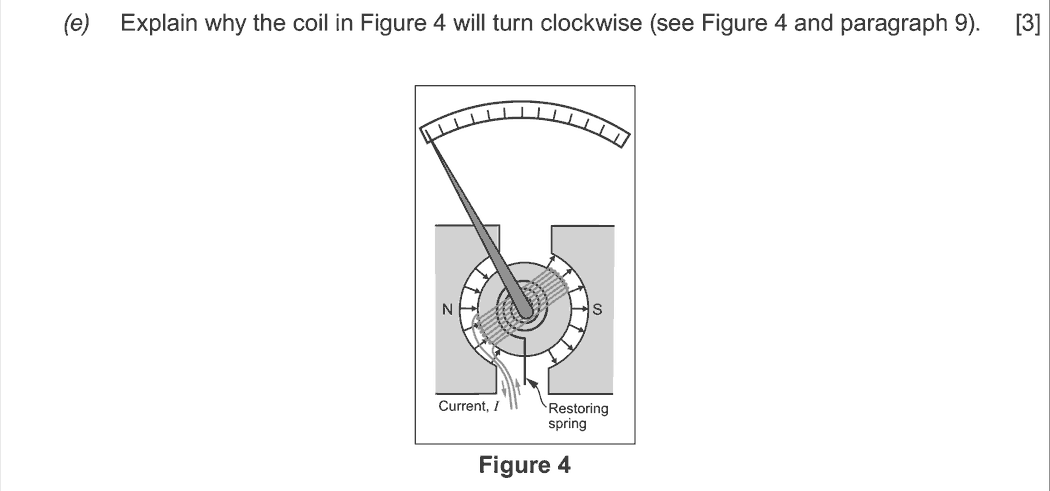
(e) Explain why the coil in Figure 4 will turn clockwise (see Figure 4 and paragraph 9). [3] N S Current, I Restoring spring Figure 4
October 2021 · Component 1 · Q8(f) 3 marks AO1=1, AO2=2 Explanation magnetic fieldssolids under stresscomprehension
Earlier parts of question 8 that this part usesEarlier part of October 2021 Component 1 question 8Earlier part of October 2021 Component 1 question 8
(f) Explain why the deflection of the pointer is proportional to the current (you will need to refer to a magnetic force equation in your answer, see paragraph 10). [3]
October 2021 · Component 2 · Q1(b)(i) 3 marks AO1=1, AO2=2 Explanation dc circuits
Earlier part of question 1 that this part usesEarlier part of October 2021 Component 2 question 1
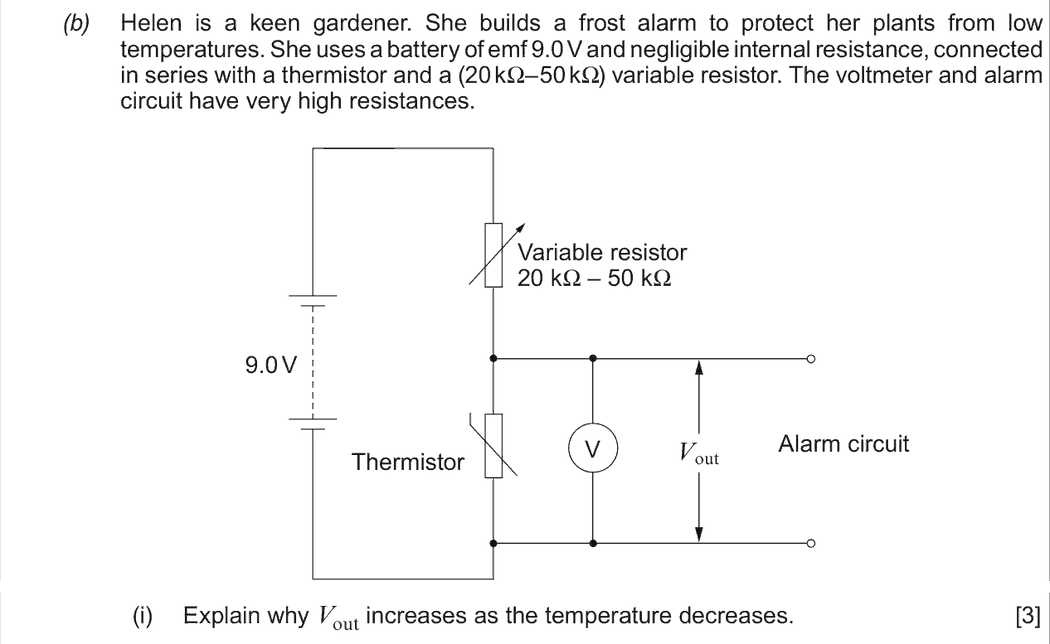
(b) Helen is a keen gardener. She builds a frost alarm to protect her plants from low temperatures. She uses a battery of emf 9.0 V and negligible internal resistance, connected in series with a thermistor and a (20 kΩ–50 kΩ) variable resistor. The voltmeter and alarm circuit have very high resistances. Variable resistor 20 kΩ – 50 kΩ 9.0 V V Alarm circuit Vout Thermistor (i) Explain why Vout increases as the temperature decreases. [3]
October 2021 · Component 2 · Q4(a)(i) 2 marks AO1=2 Explanation solids under stress
4. (a) (i) Glass is a brittle material. Briefly describe the process by which glass fractures. [2]
October 2021 · Component 2 · Q4(a)(ii) 2 marks AO1=2 Explanation solids under stress
Earlier part of question 4 that this part usesEarlier part of October 2021 Component 2 question 4
(ii) Car windscreens are made from pre-stressed glass. During production, jets of air cool the hot glass which causes the outside to contract and harden while the inside remains soft. Later, the inside cools and contracts, putting the outside surface under greater compression. Explain how this process makes the windscreen less likely to fracture. [2]
October 2021 · Component 2 · Q5(d) 3 marks AO1=3 Explanation electrostatic and gravitational fields
Earlier part of question 5 that this part usesEarlier part of October 2021 Component 2 question 5
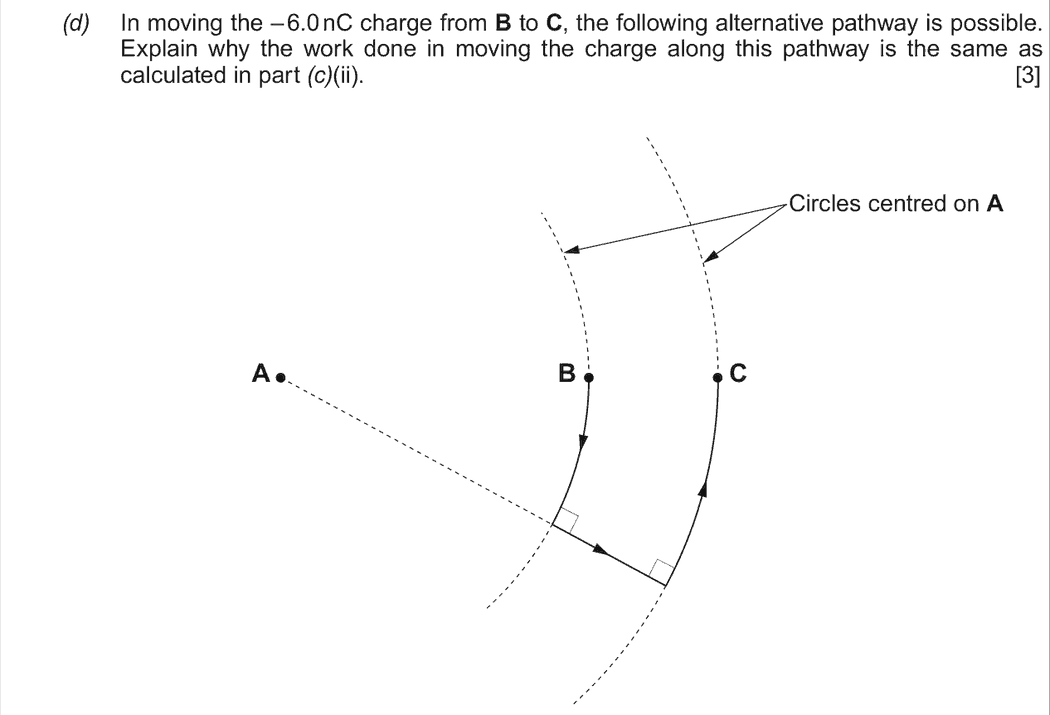
(d) In moving the – 6.0 nC charge from B to C, the following alternative pathway is possible. Explain why the work done in moving the charge along this pathway is the same as calculated in part (c)(ii). [3] Circles centred on A A B C
October 2021 · Component 2 · Q8(b)(i) 2 marks AO1=2 Explanation orbits and the wider universe
Earlier part of question 8 that this part usesEarlier part of October 2021 Component 2 question 8
(b) The Virgo cluster contains roughly 1 300 galaxies. NGC 4152 is one galaxy in this cluster. Astronomers measure the wavelength of a specific spectral line from NGC 4152 to be 399.4 nm. The laboratory wavelength is 396.8 nm. (i) Explain what the astronomers can deduce about the galaxy’s movement in relation to the Earth. [No calculations are required]. [2]
October 2021 · Component 2 · Q8(c) 3 marks AO3=3 Explanation orbits and the wider universe
Earlier part of question 8 that this part usesEarlier part of October 2021 Component 2 question 8
(c) The table shows data from two other galaxies in the cluster, obtained from Wikipedia. Distance from Earth / Galaxy Speed of recession / km s–1 million light years NGC 4216 131 55 NGC 4293 893 54 Discuss whether or not scientists can use this data to disprove Hubble’s Law. [3]
October 2021 · Component 3 · Q1(a)(ii) 2 marks AO2=2 Explanation nature of waves
Earlier part of question 1 that this part usesEarlier part of October 2021 Component 3 question 1
(ii) She now examines light from a source which is partially polarised (a mixture of polarised and unpolarised light) by rotating a single polarising filter. Describe and explain how her observations differ from those of part (a)(i). [2]
October 2021 · Component 3 · Q1(b) 3 marks AO2=3 Explanation wave properties
Earlier part of question 1 that this part usesEarlier part of October 2021 Component 3 question 1
(b) In the following Young’s double slit set-up, the laser emits unpolarised light. Two polarising filters are placed after the double slits so that the light from the top slit is vertically polarised whereas the light from the bottom slit is horizontally polarised. Evaluate whether or not this set-up can produce the usual equally spaced fringes. [3] Double slits Vertically aligned polaroid LASER Horizontally aligned polaroid
October 2021 · Component 3 · Q4(a)(i) 2 marks AO3=2 Explanation dynamics
4. Greg uses the following set-up to investigate the force on a current-carrying wire in a magnetic field and to determine the magnetic flux density. Wire Y Magnet X Electronic balance The portion XY of the wire which is in the magnetic field, has been placed carefully so that the current is from X to Y at 90° to the direction of the magnetic field. While there is no current, the balance is reset to display 00.00 g. When there is a current in the direction shown, the electromagnetic force results in a negative reading on the display of the balance. This signifies an upward force on the magnet and a downward force on the wire. (a) (i) Greg states that the forces on the wire and the magnet are a Newton’s third law pair of forces. Explain briefly why Greg is correct. [2]
October 2021 · Component 3 · Q7(d) 2 marks AO3=2 Explanation particles and nuclear structure
Earlier part of question 7 that this part usesEarlier part of October 2021 Component 3 question 7
(d) Another more common nuclear reaction for 3 2 He in stars is: 3He + 3He 4He + 21 1H 2 2 2 Sophie claims that this is a strong nuclear force reaction. Determine whether or not Sophie is correct. [2]
October 2021 · Component 3 · Q8(b)(i) 2 marks AO2=2 Explanation electromagnetic induction
Earlier part of question 8 that this part usesEarlier part of October 2021 Component 3 question 8
(b) (i) Varying magnetic, B, fields can lead to heating effects. Explain why the metal ring becomes hot in the set-up shown below. [2] Thin metal ring Rapidly changing B-field
October 2021 · Component 3 · Q8(c) 3 marks AO3=3 Explanation photons
Earlier parts of question 8 that this part usesEarlier part of October 2021 Component 3 question 8Earlier part of October 2021 Component 3 question 8
(c) The rapidly changing electromagnetic fields of microwaves are known to cause heating effects but are also thought, by some, to cause cancer. The Devon town of Totnes has banned the modern mobile phone network 5G even though this network is limited to an intensity of 10 W m–2, the same as all other microwave mobile networks. The intensity of electromagnetic radiation from the Sun on Totnes is around 1 000 W m–2. Discuss whether Totnes Council has used scientific information wisely in their decision making. [3]
October 2021 · Component 3 · Q9(a)(ii) 2 marks AO1=2 Explanation alternating currents
Earlier part of question 9 that this part usesEarlier part of October 2021 Component 3 question 9
(ii) Explain at which value of θ the maximum induced emf occurs. [2]
October 2021 · Component 3 · Q10(c)(i) 2 marks AO1=2 Explanation medical physics
Earlier parts of question 10 that this part usesEarlier part of October 2021 Component 3 question 10Earlier part of October 2021 Component 3 question 10
(c) (i) A magnetic resonance image (MRI) scanner can be used to detect tumours in a patient’s body. Describe the effect a strong magnetic field has on hydrogen and how the hydrogen absorbs and emits radio waves. [2]
October 2021 · Component 3 · Q10(d) 3 marks AO1=3 Explanation medical physics
Earlier parts of question 10 that this part usesEarlier part of October 2021 Component 3 question 10Earlier part of October 2021 Component 3 question 10
(d) Explain how PET scanners work. [3]
October 2021 · Component 3 · Q10(e) 5 marks AO3=5 Explanation medical physics
Earlier parts of question 10 that this part usesEarlier part of October 2021 Component 3 question 10Earlier part of October 2021 Component 3 question 10
(e) Doctors are concerned that a patient, who has a pacemaker fitted, has developed deep vein thrombosis (DVT) – blood clots in the leg leading to slow blood flow. They have the choice of the following techniques to diagnose this. X-ray MRI ultrasound CT scan radioactive tracers Evaluate the suitability of all five types of imaging techniques for detecting blood clots in the leg. [5]
October 2021 · Component 3 · Q11(a)(i) 2 marks AO1=2 Explanation physics of sports
11. (a) (i) Explain which player, A or B, is in a more stable position. [2] Player A Player B
October 2021 · Component 3 · Q11(b)(i) 3 marks AO3=3 Explanation physics of sports
Earlier part of question 11 that this part usesEarlier part of October 2021 Component 3 question 11
(b) (i) In a practice match a player applies spin to the ball when passing to a team-mate. A spectator suggests that applying spin has no effect on the flight of the ball. Explain whether the spectator is correct. [3]
October 2021 · Component 3 · Q12(a) 3 marks AO1=1, AO2=2 Explanation energy and the environment
12. (a) The graph below shows the radiation received from the Sun at the top of the Earth’s atmosphere as a function of wavelength. Spectral intensity 0 500 1 000 1 500 2 000 2 500 Wavelength / nm Describe how a graph of the radiation emitted from the Earth detected by a satellite outside the atmosphere would be different from the graph shown. [3]
October 2021 · Component 3 · Q12(b)(iii) 2 marks AO3=2 Explanation energy and the environment
Earlier parts of question 12 that this part usesEarlier part of October 2021 Component 3 question 12Earlier part of October 2021 Component 3 question 12
(iii) The block of ice is left to melt. Harry says the ice melting will dilute the saltwater, decreasing its density. He suggests that adding an identical cube of ice would now increase the measuring cylinder reading by more than 100 cm3. Evaluate whether or not Harry is correct. [2]
October 2020 · Component 1 · Q1(b) 3 marks AO3=3 Explanation kinematics
Earlier part of question 1 that this part usesEarlier part of October 2020 Component 1 question 1
(b) Marks, called ‘chevrons’, are painted at 40 m intervals on the road surface along a few stretches of motorway in the U.K. 40 m 40 m 40 m Large notices say “Keep apart 2 chevrons”. Using the information in part (a), discuss whether the use of chevrons is likely to help prevent accidents on motorways. You may consider whether the scheme has disadvantages and whether it could be improved. [3]
October 2020 · Component 1 · Q2(c) 2 marks AO3=2 Explanation circular motiondynamics
Earlier parts of question 2 that this part usesEarlier part of October 2020 Component 1 question 2Earlier part of October 2020 Component 1 question 2
(c) Two students discuss the mean force on a proton over one revolution ABCA. Adam says that the mean force is the same as the force at B, because the force is the same all the way round. Brian says that the mean force is zero. Evaluate these opinions. [2]
October 2020 · Component 1 · Q3(c)(ii) 2 marks AO1=2 Explanation vibrationsenergy concepts
Earlier parts of question 3 that this part usesEarlier part of October 2020 Component 1 question 3Earlier part of October 2020 Component 1 question 3Earlier part of October 2020 Component 1 question 3
(ii) Explain in terms of forces how the damping comes about. [2]
October 2020 · Component 1 · Q3(d) 3 marks AO1=3 Explanation vibrations
Earlier parts of question 3 that this part usesEarlier part of October 2020 Component 1 question 3Earlier part of October 2020 Component 1 question 3
(d) Explain what is meant by critical damping, and state one application of critical damping (or of damping that is close to critical). [3]
October 2020 · Component 1 · Q5(b)(i) 3 marks AO2=3 Explanation kinetic theory
Earlier part of question 5 that this part usesEarlier part of October 2020 Component 1 question 5
(b) A sodium molecule moving at 6.40 km s–1 to the East collides with an almost stationary sodium molecule. 6.40 km s-1 3.82 × 10 –26 kg 3.82 × 10 –26 kg (i) Discuss whether a molecule with a speed of 6.40 km s–1 could be present at some instant in sodium gas at 1 500 K and, if so, how it could have acquired this speed. [3]
October 2020 · Component 1 · Q8(a) 3 marks AO1=3 Explanation dynamicscomprehension
8. Read through the following article carefully. ROCKET PHYSICS Paragraph (including extracts from REAL WORLD PHYSICS PROBLEMS) Picture of Saturn V Launch for Apollo 15 Mission. Source: NASA Rocket physics, in the most basic sense, involves the application of Newton’s laws to a system with variable 1 mass. A rocket has variable mass because its mass decreases over time, as a result of its fuel (propellant) burning off. A rocket obtains thrust by the principle of action and reaction (Newton’s 3rd law). As the rocket propellant ignites, it experiences a very large acceleration and exits the back of the rocket (as exhaust) at a very high velocity. This backwards acceleration of the exhaust 2 exerts a “push” force on the rocket in the opposite direction, causing the rocket to accelerate forward. This is the essential principle behind the physics of rockets, and how rockets work. Rockets tend to burn fuel at a steady rate and with a constant exhaust speed which produces a constant thrust. However, rocket science is a little more complicated than normal A level physics motion because this does not lead to a constant acceleration. This 3 is due to the decreasing mass of a rocket as it burns its fuel (as stated previously). The usual equation of motion for a rocket is: Δm ma = u Equation 1 Δt where m is the instantaneous mass of the rocket, a its acceleration, u the velocity of the Δm exhaust gases relative to the rocket and the rate at which the mass of the rocket is 4 Δt decreasing. This is a simple application of Newton’s 2nd and 3rd laws of motion. If the mass of the rocket is much greater than that of the rocket fuel, we can assume that the acceleration is constant. We can also burn the fuel slowly and then the acceleration will be 5 nice and small so that we can carry out an experiment on an air track to check Equation 1. light gate rocket distance 1.400 m glider electromagnet for release and air track timing circuit Paragraph In the set-up opposite, the rocket is attached to a glider and released from rest using the electromagnet. The timer is started automatically and the time is then recorded for the 6 rocket to travel the 1.400 m to the light gate. This process is repeated for a series of glider masses. Mass of glider Time / s Corrected time, t2 / s and rocket / g t / s 150 0.328 0.308 0.095 250 0.418 0.398 0.158 350 0.490 0.470 0.221 450 0.558 0.538 0.289 550 0.614 0.594 0.353 650 0.663 0.643 0.413 t2 / s 0.500 0.400 0.300 0.200 0.100 0.000 0 100 200 300 400 500 600 700 Mass / g The graph shows a constant acceleration, in excellent agreement with theory. Moreover, the rate of mass loss for the rocket was measured as 1.10 × 10⁻² kg s–1. The exhaust gas speed was 402 m s–1 as measured using the Doppler shift of light emitted by the exhaust 7 gases. These measurements provide a theoretical value of around 4.4 N for the rocket thrust and this is in excellent agreement with the graph too. Answer the following questions in your own words. Direct quotes from the original article will not be awarded marks. (a) Explain how Equation 1 is an application of Newton’s 2nd and 3rd laws of motion (see paragraphs 2 and 4). [3]
October 2020 · Component 1 · Q8(b) 3 marks AO2=3 Explanation dynamicscomprehension
Earlier part of question 8 that this part usesEarlier part of October 2020 Component 1 question 8
(b) The author states in paragraph 5 that the acceleration is “constant” and “nice and small”. Explain why this is true (see paragraphs 3 and 5). [3]
October 2020 · Component 1 · Q8(d) 3 marks AO2=3 Explanation kinematicsdynamicscomprehension
Earlier part of question 8 that this part usesEarlier part of October 2020 Component 1 question 8
(d) Use equations of uniformly accelerated motion to explain why a graph of t2 against mass 2.80 was plotted and why the gradient of this graph is expected to be (where F is the F resultant force in newtons acting on the glider and rocket). [3]
October 2020 · Component 1 · Q8(g)(ii) 3 marks AO3=3 Explanation orbits and the wider universecomprehension
Earlier parts of question 8 that this part usesEarlier part of October 2020 Component 1 question 8Earlier part of October 2020 Component 1 question 8
(ii) Describe how the exhaust gas speed might be measured “using the Doppler shift of light emitted by the exhaust gases” (see paragraph 7). [3]
October 2020 · Component 2 · Q1(a) 3 marks AO1=3 Explanation conduction of electricity
1. (a) Compare the movement of free electrons in a metal before and after a pd is applied to the metal. [3]
October 2020 · Component 2 · Q4(a) 3 marks AO1=3 Explanation solids under stress
4. (a) Materials can be classified as being crystalline, amorphous or polymeric. Making reference to their microscopic structures explain what is meant by each of these terms. Give one example of each type of material. [3]
October 2020 · Component 2 · Q4(b)(i) 3 marks AO1=2, AO2=1 Explanation solids under stress
Earlier part of question 4 that this part usesEarlier part of October 2020 Component 2 question 4
(b) Experiments are carried out on a specimen of rubber. The diagram shows a stress-strain curve for the specimen when it is gradually loaded. Stress B A Strain (i) By referring to the molecular structure of rubber, explain why the gradient at A is less than the gradient at B. [3]
October 2020 · Component 2 · Q5(a)(ii) 3 marks AO3=3 Explanation solids under stress
Earlier part of question 5 that this part usesEarlier part of October 2020 Component 2 question 5
(ii) Simon believes that this maximum extension (1.25 mm) of the steel wire depends on the radius of the wire. Natalie disagrees. Discuss who is correct, explaining carefully how you arrive at your answer. [3]
October 2020 · Component 2 · Q6(c) 3 marks AO3=3 Explanation radiation and stars
Earlier parts of question 6 that this part usesEarlier part of October 2020 Component 2 question 6Earlier part of October 2020 Component 2 question 6
(c) The image below is of the whirlpool galaxy, M51 (or NGC 5194). This is one of the first images of the galaxy taken by astronomers. Optical 450-750 nm 6 000 K Subsequent images of the same galaxy are shown below. Ultraviolet X-ray Radio Infra-red 400-200 nm 100-10 nm 60 000 nm 1200-800 nm (10-3.6 µm) 10 000 K 10 000 000 K 600 K 4 500 K Describe how these developments in observational astronomy have advanced the study of the whirlpool galaxy. [3]
October 2020 · Component 3 · Q1(a) 2 marks AO3=2 Explanation nature of waves
1. (a) Bruce throws a lump of coal towards Dani which she catches. Bruce claims that, because chemical energy is being transferred from himself to Dani, the lump of coal is a wave. Explain whether or not Bruce is correct. [2]
October 2020 · Component 3 · Q1(b)(i) 3 marks AO1=2, AO2=1 Explanation wave properties
Earlier part of question 1 that this part usesEarlier part of October 2020 Component 3 question 1
(b) The door of a microwave oven has a metal grille and this grille has holes in it of diameter 2 mm so that the food can be seen within the oven. (i) Explain why the food can be seen through the door while the user is safe from dangerous microwaves of wavelength 12 cm. [3]
October 2020 · Component 3 · Q2(b) 3 marks AO1=2, AO2=1 Explanation photons
Earlier part of question 2 that this part usesEarlier part of October 2020 Component 3 question 2
(b) Explain how electrons can be used in a laboratory to produce a diffraction pattern and the effect of increasing the pd on the diffraction pattern. [3]
October 2020 · Component 3 · Q4(c) 3 marks AO3=3 Explanation lasers
Earlier parts of question 4 that this part usesEarlier part of October 2020 Component 3 question 4Earlier part of October 2020 Component 3 question 4
(c) Victoria claims that when the laser system shown below is in equilibrium, the amplifying medium provides only a 0.5 % increase in intensity of the beam each time it travels across the cavity. Her research partner, David, insists that the exponential increase in light intensity provided by the amplifying medium means that the beam intensity is increased by a factor of thousands for each pass even when the laser is in equilibrium. Discuss whether Victoria or David is correct. [3] exiting laser beam 99.0 % 100 % reflecting laser beam amplifying medium reflecting mirror mirror (laser cavity)
October 2020 · Component 3 · Q5(c) 3 marks AO3=3 Explanation nuclear decay
Earlier parts of question 5 that this part usesEarlier part of October 2020 Component 3 question 5Earlier part of October 2020 Component 3 question 5
(c) In 1896, G. Brandes reported that large intensities of high energy X-rays produced a “blue-grey” glow within the eye. This was later confirmed by Willhelm Röntgen and other scientists. The mechanism for this “blue-grey” glow is still not fully understood. Discuss the ethics of reproducing this experiment to understand it better. [3]
October 2020 · Component 3 · Q8(b) 2 marks AO3=2 Explanation magnetic fields
Earlier part of question 8 that this part usesEarlier part of October 2020 Component 3 question 8
(b) Explain whether or not an oxygen ion with charge –2e accelerated from rest in the above set-up instead of an electron would pass through the same point. [2]
October 2020 · Component 3 · Q9(a) 5 marks AO1=2, AO2=3 Explanation photons
9. (a) A sphere made of caesium is placed in space and illuminated by ultraviolet radiation of photon energy 10.3 eV. The work function of caesium is 2.1 eV. Explain in clear steps, using Einstein’s photoelectric equation (and other physics), why the maximum potential attainable by the caesium sphere is +8.2 V. [5]
October 2020 · Component 3 · Q10(b)(i) 3 marks AO2=3 Explanation electromagnetic induction
Earlier part of question 10 that this part usesEarlier part of October 2020 Component 3 question 10
(b) Maria carries out an experiment inside an extremely large magnetic field of uniform density 1.76 T. She uses a copper wire and deforms it from shape 1 to shape 2 in a time of 42 ms. Shape Shape 1 2 B = 1.76 T B = 1.76 T Area = Area = 105 cm2 625 cm2 (42 ms later) (i) Explain why a large current flows in the copper wire during this deformation. [3]
October 2020 · Component 3 · Q10(b)(ii) 2 marks AO1=1, AO2=1 Explanation electromagnetic induction
Earlier parts of question 10 that this part usesEarlier part of October 2020 Component 3 question 10Earlier part of October 2020 Component 3 question 10
(ii) Explain how you can deduce that this current flows anticlockwise. [2]
October 2020 · Component 3 · Q11(a) 3 marks AO1=3 Explanation alternating currents
11. (a) With the aid of a phasor diagram, explain why the impedance of an RCL circuit is given by: [3] ( ) 2 Z = XL −XC + R2
October 2020 · Component 3 · Q12(b)(i) 2 marks AO1=2 Explanation medical physics
Earlier part of question 12 that this part usesEarlier part of October 2020 Component 3 question 12
(b) (i) An ultrasound probe (A scan) can be used to determine the thickness of a lens in the human eye. Explain how a piezoelectric transducer can be used to produce ultrasound. [2]
October 2020 · Component 3 · Q12(c)(i) 3 marks AO3=3 Explanation medical physics
Earlier parts of question 12 that this part usesEarlier part of October 2020 Component 3 question 12Earlier part of October 2020 Component 3 question 12
(c) You have the choice of the following forms of medical imaging: X-ray ultrasound A scan radioactive tracer CT scan Justifying the reasons for your answer, state which of the above you would use to detect the following: (i) A cerebral haemorrhage (bleed in the brain). [3]
October 2020 · Component 3 · Q12(c)(ii) 2 marks AO3=2 Explanation medical physics
Earlier parts of question 12 that this part usesEarlier part of October 2020 Component 3 question 12Earlier part of October 2020 Component 3 question 12Earlier part of October 2020 Component 3 question 12
(ii) An underactive thyroid gland. [2]
October 2020 · Component 3 · Q13(b)(ii) 2 marks AO2=2 Explanation physics of sports
Earlier parts of question 13 that this part usesEarlier part of October 2020 Component 3 question 13Earlier part of October 2020 Component 3 question 13
(ii) Explain why a fielder will move his hands in the direction of motion of the cricket ball when catching. [2]
October 2020 · Component 3 · Q13(c)(i) 3 marks AO1=3 Explanation physics of sports
Earlier parts of question 13 that this part usesEarlier part of October 2020 Component 3 question 13Earlier part of October 2020 Component 3 question 13
(c) For this part of the question, the interactions between the ball and the air need to be taken into account. (i) Explain why a spinning cricket ball will change direction when moving through the air. Your answer should include the forces acting on the ball during the flight and a diagram may be included. [3]
October 2020 · Component 3 · Q14(a)(iii) 3 marks AO2=3 Explanation energy and the environment
Earlier part of question 14 that this part usesEarlier part of October 2020 Component 3 question 14
(iii) The actual mean surface temperature of the Earth is 287 K. Without calculation, account for this difference in temperature and explain how human activity has further contributed to this. [3]
October 2020 · Component 3 · Q14(b)(i) 3 marks AO1=3 Explanation energy and the environment
Earlier part of question 14 that this part usesEarlier part of October 2020 Component 3 question 14
(b) (i) State and explain the three conditions that are simultaneously required to produce a sustainable fusion reaction. [3]
June 2019 · Component 1 · Q1(a)(i) 2 marks AO1=2 Explanation kinematics
1. (a) In an investigation of projectile motion, a student throws a stone. It is moving horizontally when it leaves his hand (at point P). It reaches the ground at point Q. NOT TO SCALE P path of stone 2.2 m 6.0 m Q (i) By analysing a video of the stone’s flight, its horizontal velocity component, vh, is found to be almost constant. Discuss whether or not this is to be expected. [2]
June 2019 · Component 1 · Q2(a) 1 mark AO2=1 Explanation basic physics
2. The diagram shows the dwarf planet, Eris, at one point in its orbit. 2.00 × 10¹² m B A 64° 2.15 × 10¹⁶ N Sun (a) Explain why the moment (about the centre of the Sun) of the Sun’s force on Eris is zero. [1]
June 2019 · Component 1 · Q4(b) 3 marks AO3=3 Explanation circular motion
Earlier parts of question 4 that this part usesEarlier part of June 2019 Component 1 question 4Earlier part of June 2019 Component 1 question 4
(b) Discuss one way in which our knowledge of the magnitude of centripetal force has been applied in the design of roads or railways or a domestic appliance. [3]
June 2019 · Component 1 · Q6(b)(i)II 2 marks AO1=1, AO3=1 Explanation kinetic theory
Earlier parts of question 6 that this part usesEarlier part of June 2019 Component 1 question 6Earlier part of June 2019 Component 1 question 6
II. When asked why there are far fewer gas molecules per m3 than atoms per m3 in the copper block, a student replies, “Each molecule of the gas takes up much more space.” Discuss whether or not he is right. [2]
June 2019 · Component 1 · Q8(d) 3 marks AO1=2, AO2=1 Explanation photonscomprehension
Earlier parts of question 8 that this part usesEarlier part of June 2019 Component 1 question 8Earlier part of June 2019 Component 1 question 8
(d) Explain, using Newton’s 2nd law, how electromagnetic radiation exerts pressure inside a main sequence star (see Paragraph 4). [3]
June 2019 · Component 1 · Q8(e) 3 marks AO2=3 Explanation nuclear energyelectrostatic and gravitational fieldscomprehension
Earlier parts of question 8 that this part usesEarlier part of June 2019 Component 1 question 8Earlier part of June 2019 Component 1 question 8
(e) Explain why a more massive star has a higher density in its core and why this leads to a higher temperature (see Paragraph 4). [3]
June 2019 · Component 1 · Q8(f)(ii) 2 marks AO3=2 Explanation radiation and starsphotonscomprehension
Earlier parts of question 8 that this part usesEarlier part of June 2019 Component 1 question 8Earlier part of June 2019 Component 1 question 8Earlier part of June 2019 Component 1 question 8
(ii) Discuss whether or not it is appropriate to analyse the hottest main sequence stars using visible light when their wavelength of maximum emission is 150 nm (see Paragraph 5). [2]
June 2019 · Component 1 · Q8(h) 4 marks AO2=4 Explanation nuclear energyenergy conceptscomprehension
Earlier parts of question 8 that this part usesEarlier part of June 2019 Component 1 question 8Earlier part of June 2019 Component 1 question 8
(h) Explain why a 10 M star has a lifetime that is 500 times shorter than that of the Sun, including any simplifying assumptions (see Paragraph 8 and Equations 1–5). [4]
June 2019 · Component 2 · Q1(a) 4 marks AO1=4 Explanation dc circuits
1. The following circuit shows a cell of emf, E, and internal resistance, r, connected to a resistor of resistance, R. E r I V A R (a) An equation which can be applied to the above circuit is: V = E – Ir Explain this equation in terms of energy. [4]
June 2019 · Component 2 · Q3(b)(ii) 2 marks AO1=1, AO2=1 Explanation capacitance
Earlier parts of question 3 that this part usesEarlier part of June 2019 Component 2 question 3Earlier part of June 2019 Component 2 question 3
(ii) Explain why: pd across C2 = 1.5 × pd across C3. [2]
June 2019 · Component 2 · Q5(b)(ii) 2 marks AO1=2 Explanation solids under stress
Earlier parts of question 5 that this part usesEarlier part of June 2019 Component 2 question 5Earlier part of June 2019 Component 2 question 5Earlier part of June 2019 Component 2 question 5
(ii) Explain the term brittle fracture as it applies to glass and give a reason why very thin fibres have a greater breaking stress than thicker ones. [2]
June 2019 · Component 3 · Q2(a)(i) 2 marks AO1=2 Explanation wave properties
2. (a) Single slit diffraction of light is demonstrated by using a red laser and the results are shown below. The two different diffraction patterns are obtained by varying the slit width only. Figure 2a Figure 2b (i) Explain whether Figure 2a or Figure 2b has the wider slit. [2]
June 2019 · Component 3 · Q3(a)(i) 2 marks AO1=2 Explanation lasers
3. (a) (i) Explain why a population inversion is not usually possible with a 2-level energy system pumped using light. [2]
June 2019 · Component 3 · Q4(a) 3 marks AO1=1, AO2=2 Explanation nuclear decay
4. (a) It is possible to distinguish between α, β and γ radiation by their different absorption properties. Explain briefly one other method of differentiating between α, β and γ radiation. [3] Space for diagram
June 2019 · Component 3 · Q5(b) 2 marks AO2=2 Explanation nuclear energy
Earlier part of question 5 that this part usesEarlier part of June 2019 Component 3 question 5
(b) The actual energy of the incident gamma photon is 1.03 MeV. Assuming that the kinetic energy of the nucleus after the interaction is negligible, explain briefly why the kinetic energies of the positron and electron are approximately 0.005 MeV each. [2]
June 2019 · Component 3 · Q6(a) 1 mark AO2=1 Explanation particles and nuclear structure
6. (a) The anti-∆++ is an anti-baryon and a first-generation particle which has a charge of –2e. Explain why the only possible quark make-up of the anti-∆++ is ūūū. [1]
June 2019 · Component 3 · Q6(d) 3 marks AO3=3 Explanation particles and nuclear structure
Earlier part of question 6 that this part usesEarlier part of June 2019 Component 3 question 6
(d) In 2011, a highly respected international research collaboration reported that they had measured neutrinos travelling at speeds greater than that of light. This report was met by caution from the scientific community and then the result was disproved. Explain briefly why the result was met with caution and how the results might have been disproved. [3]
June 2019 · Component 3 · Q7(d)(ii) 3 marks AO1=2, AO2=1 Explanation photons
Earlier parts of question 7 that this part usesEarlier part of June 2019 Component 3 question 7Earlier part of June 2019 Component 3 question 7Earlier part of June 2019 Component 3 question 7
(ii) Determine a value of the work function of calcium and explain why no data points are possible below a frequency of 6.9 × 10¹⁴ Hz. [3]
June 2019 · Component 3 · Q8(c) 3 marks AO2=3 Explanation photons
Earlier part of question 8 that this part usesEarlier part of June 2019 Component 3 question 8
(c) The emission and absorption spectra of another element are shown below. Emission spectrum Absorption spectrum Explain briefly the processes that give rise to these spectra and why the lines appear at the same wavelengths in the two spectra. [3]
June 2019 · Component 3 · Q9(a) 4 marks AO1=4 Explanation magnetic fields
9. (a) The silicon chip shown in the diagram is used as a Hall probe with electrons as the charge carriers. Explain how the Hall voltage arises and which face of the chip becomes positively charged. [4] B-field 3.0 mm 0.85 mm Conventional current I = 200 mA
June 2019 · Component 3 · Q10(b) 1 mark AO2=1 Explanation electromagnetic induction
Earlier part of question 10 that this part usesEarlier part of June 2019 Component 3 question 10
(b) Explain why the induced emf is zero when θ = 0. [1]
June 2019 · Component 3 · Q12(b)(i) 2 marks AO3=2 Explanation medical physics
Earlier part of question 12 that this part usesEarlier part of June 2019 Component 3 question 12
(b) (i) Ultrasound can be used to carry out either an amplitude scan (A-scan) or a brightness scan (B-scan). Explain which of these two methods you would use to determine the depth of the tumour. Justify your answer. [2]
June 2019 · Component 3 · Q12(c)(i) 2 marks AO1=2 Explanation medical physics
Earlier part of question 12 that this part usesEarlier part of June 2019 Component 3 question 12
(c) (i) Explain two properties of a radioactive isotope used as a tracer in medicine. [2]
June 2019 · Component 3 · Q14(b)(ii) 3 marks AO3=3 Explanation energy and the environment
Earlier parts of question 14 that this part usesEarlier part of June 2019 Component 3 question 14Earlier part of June 2019 Component 3 question 14
(ii) The factory roof covers an area of 3.6 × 10⁴ m2 and the factory owner plans for the installation to produce a mean power output of 4.0 MW. It is suggested that the company should install 27 500 of these PV cells. Discuss whether or not you believe this to be suitable. [3]
June 2019 · Component 3 · Q14(c)(i) 2 marks AO1=2 Explanation energy and the environment
Earlier parts of question 14 that this part usesEarlier part of June 2019 Component 3 question 14Earlier part of June 2019 Component 3 question 14
(c) (i) Describe what is meant by the enrichment of uranium and explain why it is necessary. [2]
June 2019 · Component 3 · Q14(d)(i) 2 marks AO1=2 Explanation energy and the environment
Earlier parts of question 14 that this part usesEarlier part of June 2019 Component 3 question 14Earlier part of June 2019 Component 3 question 14Earlier part of June 2019 Component 3 question 14
(d) A method of reducing CO2 emissions involves the use of fuel cells to power cars. The basic layout for a proton exchange membrane fuel cell is shown in the diagram below. Electric current Fuel in e– Air in e– e– e– H+ H2 O2 H+ Excess Unused fuel gases out H2O out Anode Cathode Electrolyte (i) Describe the purpose of the electrolyte and state the waste product from the reaction. [2]
June 2019 · Component 3 · Q14(d)(ii) 2 marks AO3=2 Explanation energy and the environment
Earlier parts of question 14 that this part usesEarlier part of June 2019 Component 3 question 14Earlier part of June 2019 Component 3 question 14Earlier part of June 2019 Component 3 question 14Earlier part of June 2019 Component 3 question 14
(ii) In order for the fuel cell to be considered to have no CO2 emissions, the sourcing of the hydrogen fuel must be considered. Two possible sources are: • Electrolysis of water – where electrical energy is used to split water molecules to create hydrogen and oxygen; • Reforming fossil fuels – where steam at high temperature is reacted with a fossil fuel to separate the hydrogen from the carbon in a hydrocarbon. Discuss their likely impact on CO2 emissions. [2]
June 2019 · AS Component 1 · Q1(b)(ii) 2 marks AO2=2 Explanation solids under stress
Earlier parts of question 1 that this part usesEarlier part of June 2019 Component 1 question 1Earlier part of June 2019 Component 1 question 1
(ii) Considering the molecular structure of rubber explain why it has a much lower value of Young modulus than that of a metal. [2]
June 2019 · AS Component 1 · Q1(b)(iii) 2 marks AO1=2 Explanation solids under stress
Earlier parts of question 1 that this part usesEarlier part of June 2019 Component 1 question 1Earlier part of June 2019 Component 1 question 1
(iii) What is the effect on the Young modulus of rubber when its temperature rises? Explain your answer. [2]
June 2019 · AS Component 1 · Q4(c)(ii) 2 marks AO3=2 Explanation radiation and stars
Earlier parts of question 4 that this part usesEarlier part of June 2019 Component 1 question 4Earlier part of June 2019 Component 1 question 4
(ii) Suggest why it is that no stars appear to be green in colour. [2]
June 2019 · AS Component 1 · Q7(a) 2 marks AO1=2 Explanation particles and nuclear structure
7. (a) Quarks and electron neutrinos are fundamental particles whereas protons and neutrons are not. Explain this statement. [2]
June 2019 · AS Component 1 · Q7(b)(ii) 3 marks AO2=2, AO3=1 Explanation particles and nuclear structure
Earlier parts of question 7 that this part usesEarlier part of June 2019 Component 1 question 7Earlier part of June 2019 Component 1 question 7
2 H, (ii) Electron neutrinos can be detected when they interact with deuterium nuclei, 1 that are present in heavy water. The following reaction is observed. ve + 2 H → p + p + x 1 Identify particle x and justify your answer using the conservation laws. [3]
June 2019 · AS Component 2 · Q1(a) 3 marks AO1=3 Explanation wave properties
1. The apparatus below is used to demonstrate stationary waves on a string. Both the weight, and the distance between the pin and the pulley are kept constant. vibration generator The following stationary wave pattern is observed on the string. Loop (a) Explain why stationary waves are formed at particular frequencies only. [3]
June 2019 · AS Component 2 · Q3(a) 3 marks AO1=2, AO2=1 Explanation refraction of light
3. A light beam travelling in air hits a boundary with glass. The diagram shows wavefronts on the light beams in the air and in the glass. B Air A D Glass C (a) State what is meant by refraction and use the diagram to explain why refraction occurs. [3]
June 2019 · AS Component 2 · Q4(b)(i) 4 marks AO1=4 Explanation resistanceconduction of electricity
Earlier parts of question 4 that this part usesEarlier part of June 2019 Component 2 question 4Earlier part of June 2019 Component 2 question 4
(b) Anika applies a fixed potential difference of 6.0 V across a different piece of metal wire. At a temperature of 0 °C the current is found to be 0.30 A. At 50 °C the current is 0.24 A. (i) Explain in terms of electrons why the current is smaller at 50 °C than at 0 °C. [4]
June 2019 · AS Component 2 · Q5(b)(i) 6 marks AO1=2, AO2=4 Explanation dc circuits
Earlier part of question 5 that this part usesEarlier part of June 2019 Component 2 question 5
A4 – E4 (b) (i) Zhang Li uses the spreadsheet formula = to determine the internal D4 resistance in cell F4. Explain in terms of energy why this is a valid method. [6]
June 2019 · AS Component 2 · Q6(b) 3 marks AO1=3 Explanation photons
Earlier part of question 6 that this part usesEarlier part of June 2019 Component 2 question 6
(b) White light passes through a cloud of sodium atoms. The light which emerges is found to have the continuous spectrum of white light but with dark lines crossing the spectrum. State briefly how the dark lines are caused and what happens to the atoms in the process. [3]
June 2019 · AS Component 2 · Q7(b)(ii)III 2 marks AO2=2 Explanation photons
Earlier parts of question 7 that this part usesEarlier part of June 2019 Component 2 question 7Earlier part of June 2019 Component 2 question 7Earlier part of June 2019 Component 2 question 7
III. The rate at which light falls on to the sodium surface is increased from 2.5 × 10–10 J s–1 to 3.0 × 10–10 J s–1. Explain clearly why the graph would not change. [2]
June 2018 · Component 1 · Q2(b)(ii) 2 marks AO2=2 Explanation orbits and the wider universecircular motion
Earlier parts of question 2 that this part usesEarlier part of June 2018 Component 1 question 2Earlier part of June 2018 Component 1 question 2
(ii) Explain whether or not a moon of twice the mass of Deimos, but in a circular orbit of the same radius about Mars, would have the same speed as Deimos. [2]
June 2018 · Component 1 · Q7(b)(ii)I 2 marks AO1=1, AO2=1 Explanation kinetic theory
Earlier parts of question 7 that this part usesEarlier part of June 2018 Component 1 question 7Earlier part of June 2018 Component 1 question 7
(ii) I. State what would happen to the rms speed if the kelvin temperature of the gas in the cylinder were doubled, justifying your answer. [2]
June 2018 · Component 1 · Q8(a)(iii) 2 marks AO3=2 Explanation thermal physics
Earlier part of question 8 that this part usesEarlier part of June 2018 Component 1 question 8
(iii) Rini claims that the work done by the gas results in an equal amount of internal energy being lost by the gas. Give the correct application of the first law of thermodynamics to this isothermal expansion. [2]
June 2018 · Component 1 · Q8(b) 3 marks AO3=3 Explanation thermal physicsenergy concepts
Earlier part of question 8 that this part usesEarlier part of June 2018 Component 1 question 8
(b) An estimated 600 MJ of work can be produced by an ordinary car engine burning 0.10 m3 (100 litre) of petrol. An estimated 15 MJ of work can be produced by the expansion of the same volume of air compressed to the highest safe (initial) pressure. Discuss the advantages and disadvantages of powering cars by compressed air rather than petrol. Calculations are not required. [3]
June 2018 · Component 1 · Q9(a) 4 marks AO1=4 Explanation conduction of electricitycomprehension
9. Answer the following questions in your own words. Direct quotes from the original article will not be awarded marks. (a) In your own words, describe the motion of electrons both with and without the application of an electric field (see paragraphs 2 and 6). [4]
June 2018 · Component 1 · Q9(e) 2 marks AO2=2 Explanation resistancecomprehension
Earlier part of question 9 that this part usesEarlier part of June 2018 Component 1 question 9
(e) Explain briefly how the author can derive Equation 9 from Equation 8. [2]
June 2018 · Component 1 · Q9(g) 4 marks AO3=4 Explanation kinetic theorycomprehension
Earlier part of question 9 that this part usesEarlier part of June 2018 Component 1 question 9
(g) Explain why resistivity should be proportional to the square root of temperature (see paragraph 8 and Equation 9). [4]
June 2018 · Component 2 · Q1(a)(i) 2 marks AO1=2 Explanation dc circuits
1. (a) An engineer investigates the use of a light dependent resistor (LDR) as a light sensor in a potential divider circuit. He designs the following sensing circuit to operate a 230 V lamp in the dark. Fixed resistor, R 9.0 V High resistance V control LDR circuit The control circuit draws a negligible current. During his research, the engineer determines the following facts: The control circuit requires at least 4.0 V to activate. The LDR the engineer intends to use has a resistance of 2.4 kΩ at the light intensity required to switch the lamp on. (i) Explain how the current in the LDR changes as the light intensity decreases. [2]
June 2018 · Component 2 · Q1(b) 2 marks AO2=2 Explanation dc circuits
Earlier part of question 1 that this part usesEarlier part of June 2018 Component 2 question 1
(b) When installing the circuit, the engineer made the mistake of placing the lamp near to the LDR. The engineer noted that, when in the dark, the lamp kept turning on and off repeatedly rather than staying on. Explain why this was the case. [2]
June 2018 · Component 2 · Q2(d) 3 marks AO2=3 Explanation resistancedc circuits
Earlier parts of question 2 that this part usesEarlier part of June 2018 Component 2 question 2Earlier part of June 2018 Component 2 question 2
(d) Resistor T is now removed from the circuit. Explain the effect this will have on the ratio calculated in part (c). [3]
June 2018 · Component 2 · Q6(b)(iii) 2 marks AO3=2 Explanation capacitance
Earlier parts of question 6 that this part usesEarlier part of June 2018 Component 2 question 6Earlier part of June 2018 Component 2 question 6
(iii) A Physics student makes the following comment: For capacitors in series, a capacitor of higher capacitance stores more energy than a capacitor of smaller capacitance. By considering this combination of capacitors, investigate whether or not the student is correct. [2]
June 2018 · Component 2 · Q7(d) 3 marks AO1=1, AO2=2 Explanation photons
Earlier parts of question 7 that this part usesEarlier part of June 2018 Component 2 question 7Earlier part of June 2018 Component 2 question 7
(d) Without calculation, explain how the de Broglie wavelength of the electron changes as it moves towards P. [3]
June 2018 · Component 3 · Q1(b) 2 marks AO1=2 Explanation wave properties
Earlier part of question 1 that this part usesEarlier part of June 2018 Component 3 question 1
(b) In the 1700s, light was thought to consist of a stream of particles. In the 1800s, it was said to be a wave but since the early 1900s it has been accepted that light behaves both like a wave and like a particle (wave particle duality). Explain briefly the part that Young’s double slit experiment played in this history. [2]
June 2018 · Component 3 · Q3(a) 3 marks AO1=2, AO2=1 Explanation photons
3. Light is incident on a photoelectric cell as shown. collecting electrode photocell metal surface V nA variable d.c. supply (a) Explain why a current is detected by the ammeter. [3]
June 2018 · Component 3 · Q3(c)(ii) 3 marks AO3=3 Explanation photons
Earlier parts of question 3 that this part usesEarlier part of June 2018 Component 3 question 3Earlier part of June 2018 Component 3 question 3
(ii) The metal surface of the photocell is radioactive and emits alpha particles some of which arrive at the collecting electrode. Explain briefly what effect this would have on measuring the stopping potential and what could be done to reduce this effect. [3]
June 2018 · Component 3 · Q4(a) 2 marks AO1=2 Explanation lasers
4. A laser has two mirrors either side of the amplifying medium as shown. Exiting laser beam 100.0% reflecting Amplifying medium 99.0% reflecting mirror Laser beam (laser cavity) mirror (a) Explain the purpose of the 99.0% reflecting mirror and the 100.0% reflecting mirror. [2]
June 2018 · Component 3 · Q4(b) 3 marks AO1=3 Explanation lasers
Earlier part of question 4 that this part usesEarlier part of June 2018 Component 3 question 4
(b) Explain the purpose of a population inversion in the laser cavity. [3]
June 2018 · Component 3 · Q5(a) 3 marks AO1=3 Explanation wave properties
5. An experiment is carried out using stationary waves to measure the speed of sound in air. A loudspeaker is placed at one end of a hollow tube so that both ends are closed. The frequency, f, of the signal generator connected to the loudspeaker is varied and those frequencies corresponding to loud noises recorded. Signal generator L (a) Describe the differences between a stationary wave and a progressive wave in terms of energy, phase and amplitude. [3]
June 2018 · Component 3 · Q5(d) 3 marks AO2=3 Explanation wave properties
Earlier parts of question 5 that this part usesEarlier part of June 2018 Component 3 question 5Earlier part of June 2018 Component 3 question 5
(d) The experiment is repeated with the tube filled with nitrogen dioxide (NO2), a gas that is 1.5 times denser than air. The speed of sound in a gas is inversely proportional to the square root of the density, ρ : ∝1 v ρ Explain what effect this will have on the gradient of the graph. [3]
June 2018 · Component 3 · Q7(a) 2 marks AO1=2 Explanation nuclear energy
7. (a) Explain briefly what is meant by conservation of mass-energy. [2]
June 2018 · Component 3 · Q7(b) 4 marks AO3=4 Explanation particles and nuclear structurenuclear energy
Earlier part of question 7 that this part usesEarlier part of June 2018 Component 3 question 7
(b) It is suggested that a collision between two protons, each of kinetic energy 3 GeV produces the following interaction: 3p– n– 2π+ 2π– p + p 5p + + n + + + + 4ve Determine which, if any, of the conservation laws are violated (the rest mass-energy of a proton or a neutron ≈ 1 GeV). [4]
June 2018 · Component 3 · Q10(a) 4 marks AO2=4 Explanation electromagnetic induction
10. A silver ring on a light rod swings as a pendulum with damped simple harmonic motion. The damping is caused by a stationary magnet as shown in the diagram. S N (a) Explain why the motion of the pendulum is damped. [4]
June 2018 · Component 3 · Q10(b) 2 marks AO2=2 Explanation electromagnetic induction
Earlier part of question 10 that this part usesEarlier part of June 2018 Component 3 question 10
(b) Explain what, if anything, would happen to the motion of the pendulum if the bar magnet were reversed. [2]
June 2018 · Component 3 · Q11(b)(i) 2 marks AO1=2 Explanation alternating currents
Earlier part of question 11 that this part usesEarlier part of June 2018 Component 3 question 11
(b) A coil rotates in a magnetic field as shown. square coil of N turns and cross-sectional area, A rotating with angular velocity, ω B N S θ (i) Use Faraday’s Law to explain why the peak emf induced in the coil is proportional to the angular velocity of rotation of the coil. [2]
June 2018 · Component 3 · Q11(b)(ii) 2 marks AO1=2 Explanation alternating currents
Earlier parts of question 11 that this part usesEarlier part of June 2018 Component 3 question 11Earlier part of June 2018 Component 3 question 11
(ii) Use Faraday’s Law to explain why the emf induced in the coil depends on the angle, θ. [2]
June 2018 · Component 3 · Q11(c)(i) 2 marks AO1=1, AO2=1 Explanation alternating currents
Earlier parts of question 11 that this part usesEarlier part of June 2018 Component 3 question 11Earlier part of June 2018 Component 3 question 11
(c) (i) In the following LCR circuit, explain why the rms resonance current is 125 mA. [2] variable frequency a.c. supply Vrms = 15 V 120 Ω 24 mH 4.2 nF
June 2018 · Component 3 · Q12(a) 4 marks AO1=4 Explanation medical physics
12. (a) When taking an X-ray image of a person’s arm a metal filter is placed between the X-ray tube and the arm, and a lead grid between the arm and the film as shown. X-ray beam Metal filter Arm Lead grid Film Explain the purpose of both the metal filter and the lead grid. [4]
June 2018 · Component 3 · Q12(c) 5 marks AO3=5 Explanation medical physics
Earlier part of question 12 that this part usesEarlier part of June 2018 Component 3 question 12
(c) You have the choice of the following forms of medical imaging available: MRI scan PET scan ultrasound B-scan CT scan Evaluate the effectiveness of each type of imaging in detecting a cancerous tumour on a person’s lung. [5]
June 2018 · Component 3 · Q14(b)(ii) 2 marks AO2=2 Explanation energy and the environment
Earlier parts of question 14 that this part usesEarlier part of June 2018 Component 3 question 14Earlier part of June 2018 Component 3 question 14
(ii) Use the above equation to determine whether doubling the length of the blades or doubling the wind speed would have the greater effect on the power available to be converted into electrical energy. [2]
June 2018 · AS Component 1 · Q1(b) 3 marks AO1=3 Explanation solids under stress
Earlier part of question 1 that this part usesEarlier part of June 2018 Component 1 question 1
(b) Glass is a brittle material. Describe the process by which glass fractures. [3]
June 2018 · AS Component 1 · Q3(d) 2 marks AO3=2 Explanation energy concepts
Earlier part of question 3 that this part usesEarlier part of June 2018 Component 1 question 3
(d) Helen believes that by riding an electrically powered bike to the shops rather than using her car she is benefiting the environment. Explain whether or not Helen is correct. [2]
June 2018 · AS Component 1 · Q5(b)(i) 3 marks AO2=3 Explanation particles and nuclear structure
Earlier part of question 5 that this part usesEarlier part of June 2018 Component 1 question 5
(b) Electron capture occurs when an electron interacts with a proton in the nucleus of an atom. The following interaction occurs: p + e– n + x (i) Identify the particle, x, explaining how you used the relevant conservation laws. [3]
June 2018 · AS Component 1 · Q7(b)(iii) 2 marks AO3=2 Explanation kinematics
Earlier parts of question 7 that this part usesEarlier part of June 2018 Component 1 question 7Earlier part of June 2018 Component 1 question 7
(iii) Discuss how air resistance might affect the height at which the ball reaches the goal. [2]
June 2018 · AS Component 2 · Q3(a)(ii) 3 marks AO1=3 Explanation photons
Earlier part of question 3 that this part usesEarlier part of June 2018 Component 2 question 3
(ii) Einstein’s photoelectric equation may be written as: Ekmax = hf – φ Explain this equation in terms of energy. [3]
June 2018 · AS Component 2 · Q4(b)(i) 4 marks AO2=4 Explanation conduction of electricity
Earlier part of question 4 that this part usesEarlier part of June 2018 Component 2 question 4
(b) The following graph shows how the charge that has passed a point in an electrical circuit varies with time. Charge / C 2.0 1.0 0 0 1.0 2.0 3.0 4.0 Time / s (i) Describe how the current varies from t = 0 to t = 2.5 s giving appropriate values. [4]
June 2018 · AS Component 2 · Q6(a)(iii) 2 marks AO3=2 Explanation refraction of light
Earlier part of question 6 that this part usesEarlier part of June 2018 Component 2 question 6
(iii) A technician states that the beam of light entering the fibre from air at an angle of 15° will not travel down the optical fibre. Evaluate whether the technician is correct. [2]
June 2018 · AS Component 2 · Q6(c)(ii) 3 marks AO1=3 Explanation refraction of light
Earlier parts of question 6 that this part usesEarlier part of June 2018 Component 2 question 6Earlier part of June 2018 Component 2 question 6
(ii) Explain the advantage of monomode optical fibres over multimode optical fibres for communicating a rapid sequence of data encoded as light pulses. [3]
June 2017 · Component 1 · Q1(a)(iii) 2 marks AO3=2 Explanation basic physics
Earlier part of question 1 that this part usesEarlier part of June 2017 Component 1 question 1
(iii) Discuss the effect, if any, on the tension of making the angle θ smaller (by using a shorter wire and attaching it to a lower point on the wall). [2]
June 2017 · Component 1 · Q2(b) 3 marks AO3=3 Explanation dynamicsenergy concepts
Earlier part of question 2 that this part usesEarlier part of June 2017 Component 1 question 2
(b) It is suggested that cars should be made of thicker metal. Discuss whether this is a good suggestion. You may discuss environmental as well as safety issues. [3]
June 2017 · Component 1 · Q3(a)(ii) 2 marks AO3=2 Explanation circular motion
Earlier part of question 3 that this part usesEarlier part of June 2017 Component 1 question 3
(ii) A teacher claims that the equation gives a ‘sensible’ value for the centripetal acceleration as r becomes extremely large. Justify her claim. [2]
June 2017 · Component 1 · Q6(b)(ii) 2 marks AO3=2 Explanation thermal physics
Earlier parts of question 6 that this part usesEarlier part of June 2017 Component 1 question 6Earlier part of June 2017 Component 1 question 6
(ii) Discuss whether or not this amount of heat would be needed in all circumstances to raise the temperature of 0.031 mol of helium from 295 K to 424 K. [2]
June 2017 · Component 1 · Q7(c) 4 marks AO1=4 Explanation nature of wavescomprehension
Earlier part of question 7 that this part usesEarlier part of June 2017 Component 1 question 7
(c) Experiment 2 - Explain qualitatively why the variation in light intensity detected by the smart phone is as shown in Figure 3 (see Paragraphs 4 & 5 and Figure 2 also). Do not refer to Malus’s law or the cos2 θ dependency. [4]
June 2017 · Component 1 · Q7(e) 3 marks AO3=3 Explanation dynamicscomprehension
Earlier part of question 7 that this part usesEarlier part of June 2017 Component 1 question 7
(e) Experiment 3 - Some textbooks claim that “rubber tyres have patterns of grooves or tread: these patterns increase the roughness and give better grip.” Evaluate whether the data in Table 1 (Paragraph 8) disproves this theory or whether this result is due to experimental uncertainty. [3]
June 2017 · Component 2 · Q1(c)(i) 2 marks AO2=2 Explanation dc circuits
Earlier parts of question 1 that this part usesEarlier part of June 2017 Component 2 question 1Earlier part of June 2017 Component 2 question 1
(c) The graph shows how resistance varies with temperature for this thermistor. Resistance / kΩ 1.2 1.0 0.8 0.6 0.4 0.2 0.0 0 10 20 30 40 50 60 Temperature / °C (i) The reading on the voltmeter increases when the temperature of the thermistor increases. Explain why this is the case. [2]
June 2017 · Component 2 · Q1(d) 2 marks AO3=2 Explanation dc circuits
Earlier parts of question 1 that this part usesEarlier part of June 2017 Component 2 question 1Earlier part of June 2017 Component 2 question 1Earlier part of June 2017 Component 2 question 1
(d) The arrangement can also be used as a basis for a thermometer. By considering the shape of the graph on page 3 discuss whether this thermistor arrangement would be more effective at measuring changes in temperature between 0 °C and 10 °C or between 50 °C and 60 °C. [2]
June 2017 · Component 2 · Q3(a) 2 marks AO2=2 Explanation capacitance
3. Katie uses the following circuit to investigate the discharging of a capacitor of unknown value C. 6.0 V S1 C S2 Plate Y Plate Z R = 68 kΩ A V (a) The plates of the capacitor are labelled Y and Z. When the switch is moved to S1, explain how each plate becomes charged in terms of the movement of charges in the circuit. [2]
June 2017 · Component 2 · Q4(c) 2 marks AO3=2 Explanation capacitanceelectrostatic and gravitational fields
Earlier part of question 4 that this part usesEarlier part of June 2017 Component 2 question 4
(c) The separation between the plates is now halved but the pd is unchanged. The scientist believes that the gain in kinetic energy of an electron travelling (from rest) from Y to X will be unchanged. Verify this claim. [2]
June 2017 · Component 2 · Q6(a) 3 marks AO1=3 Explanation orbits and the wider universe
6. Johannes Kepler devoted much of his life to the study of planetary motion. In the process he discovered three laws which describe the motion of any orbital body. (a) The diagram is taken from a physics text book. Describe how it is used to explain Kepler’s 2nd law. [3] 6 months A1 A2 6 months A3 6 months
June 2017 · Component 2 · Q7(a)(i) 2 marks AO1=2 Explanation electrostatic and gravitational fields
7. (a) The diagram shows a series of equipotentials around the Moon showing values of the gravitational potential. A, B, C and D are four points on the equipotentials. B A gravitational potential –1.31 MJ kg–1 C –1.79 MJ kg–1 D –2.19 MJ kg–1 (i) Explain why the potentials have negative signs. [2]
June 2017 · Component 3 · Q1(b) 4 marks AO1=2, AO2=2 Explanation lasers
Earlier part of question 1 that this part usesEarlier part of June 2017 Component 3 question 1
(b) Explain why a population inversion can be achieved far more easily in a four level system than in a three level system. [4]
June 2017 · Component 3 · Q1(c) 2 marks AO2=2 Explanation lasers
Earlier part of question 1 that this part usesEarlier part of June 2017 Component 3 question 1
(c) Give two reasons why the top level (E4 in the four level system and E3 in the three level system) must have a short lifetime. [2]
June 2017 · Component 3 · Q2(d) 3 marks AO3=3 Explanation orbits and the wider universe
Earlier part of question 2 that this part usesEarlier part of June 2017 Component 3 question 2
(d) On the 14 March 2013, the discovery of the Higgs boson was first announced by CERN. Some physicists were convinced that they had discovered the Higgs boson, others believed that there are many different types of Higgs bosons while others claim that this was just another particle and not the Higgs boson. Explain how it may or may not be decided which, if any, of these claims is correct. [3]
June 2017 · Component 3 · Q3(b)(ii) 3 marks AO3=3 Explanation nuclear energy
Earlier parts of question 3 that this part usesEarlier part of June 2017 Component 3 question 3Earlier part of June 2017 Component 3 question 3
(ii) The binding energy per nucleon of a helium-3 nucleus (i.e. 2.6 MeV/nucleon) is slightly lower than the answer to (b)(i). How does this show that binding energy per nucleon is not the only measure of stability? [3]
June 2017 · Component 3 · Q5(a)(i) 2 marks AO1=1, AO2=1 Explanation electromagnetic induction
5. An experiment is carried out on a flat, horizontal railway track to measure the vertical component of the Earth’s magnetic field, B. A metal conductor is placed across the railway tracks and moved quickly in the direction shown. R length, view from velocity, v l above A (a) (i) Explain why a current is detected by the ammeter. [2]
June 2017 · Component 3 · Q5(a)(ii) 1 mark AO2=1 Explanation electromagnetic induction
Earlier part of question 5 that this part usesEarlier part of June 2017 Component 3 question 5
(ii) Explain why the current is independent of the horizontal component of the Earth's magnetic field. [1]
June 2017 · Component 3 · Q7(a) 4 marks AO1=4 Explanation wave properties
7. (a) Explain how two source interference patterns arise. [4]
June 2017 · Component 3 · Q10(b) 5 marks AO3=5 Explanation alternating currents
Earlier part of question 10 that this part usesEarlier part of June 2017 Component 3 question 10
(b) Helen claims that the following circuit will have a minimum impedance of 68 Ω when the frequency is very low but that the impedance will be extremely large at high frequencies. variable frequency a.c. supply 68 Ω 820 nF Deduce whether or not Helen is correct. [5]
June 2017 · Component 3 · Q10(c)(iv) 3 marks AO2=3 Explanation alternating currents
Earlier parts of question 10 that this part usesEarlier part of June 2017 Component 3 question 10Earlier part of June 2017 Component 3 question 10Earlier part of June 2017 Component 3 question 10
f0 (iv) Explain why the rms current is the same when the frequency is decreased to . 1.5 [3]
June 2017 · Component 3 · Q11(b)(iii) 3 marks AO1=1, AO3=2 Explanation medical physics
Earlier parts of question 11 that this part usesEarlier part of June 2017 Component 3 question 11Earlier part of June 2017 Component 3 question 11
(iii) X-ray imaging is not suitable for diagnosing brain tumours. Explain why, and suggest a more suitable technique giving your reasons. [3]
June 2017 · Component 3 · Q11(c) 2 marks AO1=2 Explanation medical physics
Earlier part of question 11 that this part usesEarlier part of June 2017 Component 3 question 11
(c) An ultrasound probe can be used to check the development of an unborn baby. Explain how a piezoelectric transducer can be used to produce ultrasound. [2]
June 2017 · Component 3 · Q12(c)(i) 4 marks AO1=1, AO2=1, AO3=2 Explanation physics of sports
Earlier part of question 12 that this part usesEarlier part of June 2017 Component 3 question 12
(c) (i) During the game, the player plays a shot and applies spin to the ball. Explain how the ball will travel through the air by discussing the forces acting on the ball. Label the forces and their directions on the diagram provided. [4] motion spin
June 2017 · Component 3 · Q13(c)(ii)III 1 mark Explanation energy and the environment
Earlier parts of question 13 that this part usesEarlier part of June 2017 Component 3 question 13Earlier part of June 2017 Component 3 question 13Earlier part of June 2017 Component 3 question 13Earlier part of June 2017 Component 3 question 13Earlier part of June 2017 Component 3 question 13
III. Without calculation, explain how the rate of heat loss through the window would be different if it were a breezy day. [1]
June 2017 · AS Component 1 · Q2(c) 4 marks AO3=4 Explanation kinematics
Earlier parts of question 2 that this part usesEarlier part of June 2017 Component 1 question 2Earlier part of June 2017 Component 1 question 2
(c) When Sarah was asked to sketch a displacement-time graph for the flight of the ball from the time it was first thrown until it was caught, she sketched the shape shown below. Evaluate whether you think she was correct. Further calculations are not required. [4] 12.0 Displacement / m 8.0 4.0 0.0 Time / s 0.0 1.0 2.0 3.0
June 2017 · AS Component 1 · Q3(a) 3 marks AO2=2, AO3=1 Explanation particles and nuclear structure
3. When colliding two protons at very high energy the following interaction has been observed at the large hadron collider in CERN. p + p → 2 H + e+ + x 1 (a) Use the conservation of lepton number and conservation of charge to identify the particle x. [3]
June 2017 · AS Component 1 · Q3(d) 2 marks AO3=2 Explanation particles and nuclear structure
Earlier part of question 3 that this part usesEarlier part of June 2017 Component 1 question 3
(d) At present, countries in Europe contribute to funding research at CERN. Evaluate whether or not the money could be better spent on humanitarian aid. [2]
June 2017 · AS Component 2 · Q2(b)(ii) 2 marks AO2=2 Explanation refraction of light
Earlier parts of question 2 that this part usesEarlier part of June 2017 Component 2 question 2Earlier part of June 2017 Component 2 question 2
(ii) State and explain what happens to the ray of light in the diagram above when it reaches the boundary with the water. [2]
June 2017 · AS Component 2 · Q3(c) 2 marks AO3=2 Explanation dc circuitsresistance
Earlier part of question 3 that this part usesEarlier part of June 2017 Component 2 question 3
(c) Abigail repeats the experiment but with a battery of the same emf but smaller internal resistance. Explain how the graph would change. [2]
June 2017 · AS Component 2 · Q4(b) 3 marks AO3=3 Explanation conduction of electricity
Earlier part of question 4 that this part usesEarlier part of June 2017 Component 2 question 4
(b) The wire is thinner in a small section as shown below. Paula claims that within the thinner section the mean drift velocity of the free electrons will be greater. Evaluate whether she is correct. [3]
June 2017 · AS Component 2 · Q4(c)(ii) 4 marks AO2=4 Explanation resistance
Earlier parts of question 4 that this part usesEarlier part of June 2017 Component 2 question 4Earlier part of June 2017 Component 2 question 4
(ii) State and explain one advantage and one disadvantage of using superconductors to carry large currents. [4] Advantage: Disadvantage:
June 2017 · AS Component 2 · Q5(a)(ii) 3 marks AO2=3 Explanation wave properties
Earlier part of question 5 that this part usesEarlier part of June 2017 Component 2 question 5
(ii) Explain why destructive interference is observed at certain points on the screen. [3]
June 2017 · AS Component 2 · Q5(c) 2 marks AO1=2 Explanation wave properties
Earlier part of question 5 that this part usesEarlier part of June 2017 Component 2 question 5
(c) Explain the historical significance of this experiment. [2]
June 2017 · AS Component 2 · Q5(d)(i) 2 marks AO1=1, AO2=1 Explanation photons
Earlier part of question 5 that this part usesEarlier part of June 2017 Component 2 question 5
(d) A beam of electrons is fired at a thin sheet of aluminium. A pattern of light and dark circular fringes is observed as shown below. (i) Explain how this pattern is formed. [2]
June 2017 · AS Component 2 · Q7(a)(ii) 2 marks AO1=2 Explanation lasers
Earlier part of question 7 that this part usesEarlier part of June 2017 Component 2 question 7
(ii) Explain why a population inversion is needed for laser action. [2]
June 2016 · AS Component 1 · Q2(c) 3 marks AO2=3 Explanation dynamics
Earlier parts of question 2 that this part usesEarlier part of June 2016 Component 1 question 2Earlier part of June 2016 Component 1 question 2
(c) Describe the resultant force acting on the skier during each stage of her motion. [3]
June 2016 · AS Component 1 · Q3(c)(i) 2 marks AO3=2 Explanation kinematics
Earlier part of question 3 that this part usesEarlier part of June 2016 Component 1 question 3
(c) Now considering the effect of air resistance. (i) How would your answer to (b)(ii) differ? [2]
June 2016 · AS Component 1 · Q5(b)(ii) 3 marks AO3=3 Explanation particles and nuclear structure
Earlier parts of question 5 that this part usesEarlier part of June 2016 Component 1 question 5Earlier part of June 2016 Component 1 question 5
(ii) Identify particle x, explaining how you used the relevant conservation laws. [3]
June 2016 · AS Component 2 · Q2(b)(i) 3 marks AO1=1, AO2=2 Explanation wave properties
Earlier part of question 2 that this part usesEarlier part of June 2016 Component 2 question 2
(b) A second loudspeaker is connected to the signal generator as shown below and the frequency of the signal generator is changed to 1.10 kHz. 1.10 kHz Microphone Signal generator A B (i) Explain why a sequence of maximum and minimum signals is detected as the microphone is moved from loudspeaker A to loudspeaker B. [3]
June 2016 · AS Component 2 · Q3(b)(i) 3 marks AO3=3 Explanation dc circuits
Earlier part of question 3 that this part usesEarlier part of June 2016 Component 2 question 3
(b) Richard sets up a temperature sensing circuit using the thermistor from part (a). A constant 9.0 V supply is applied as shown. 9.0 V R V (i) Explain how the reading on the voltmeter changes as the temperature increases. [3]
June 2016 · AS Component 2 · Q3(b)(iii) 2 marks AO2=2 Explanation dc circuits
Earlier parts of question 3 that this part usesEarlier part of June 2016 Component 2 question 3Earlier part of June 2016 Component 2 question 3
(iii) Richard replaces the voltmeter with a 6.0 V bulb expecting it to light with full brightness when the temperature is 35 °C. Explain why the bulb does not operate as expected. [2]
June 2016 · AS Component 2 · Q4(a) 3 marks AO1=3 Explanation wave properties
4. A Young’s double slit experiment is set up as shown below. Alternate bright and dark fringes are seen on the screen. Screen Light from a laser Double slits; centres separated by 0.25 mm (a) Explain why the bright fringes are seen. [3]
June 2016 · AS Component 2 · Q5(c)(i) 3 marks AO1=3 Explanation lasers
Earlier part of question 5 that this part usesEarlier part of June 2016 Component 2 question 5
(c) A diagram of a simplified energy level system is shown below for a different laser from that of part (a). level P level U level L 1.26 × 10⁻¹⁹ J ground state 0 (i) Describe how a photon is created by stimulated emission involving level U and level L. [3]
June 2016 · AS Component 2 · Q6(b)(iii) 3 marks AO3=3 Explanation refraction of light
Earlier parts of question 6 that this part usesEarlier part of June 2016 Component 2 question 6Earlier part of June 2016 Component 2 question 6
(iii) The prism is placed so that light is incident upon it as shown below. Explain with the aid of a calculation how the light passes through the prism now. [3] 50° Beam of light 40°

Work with an Eduqas physics tutor

Dropping marks on calculations, specified practicals or the six-mark QER questions? Book a trial session with a specialist Eduqas physics tutor.

Prefer email? Send an enquiry

If you are under 18, please include a parent's contact details. Enquiries go to enquiries@physicsaleveltutor.com and are deleted once handled. All tutoring is online.