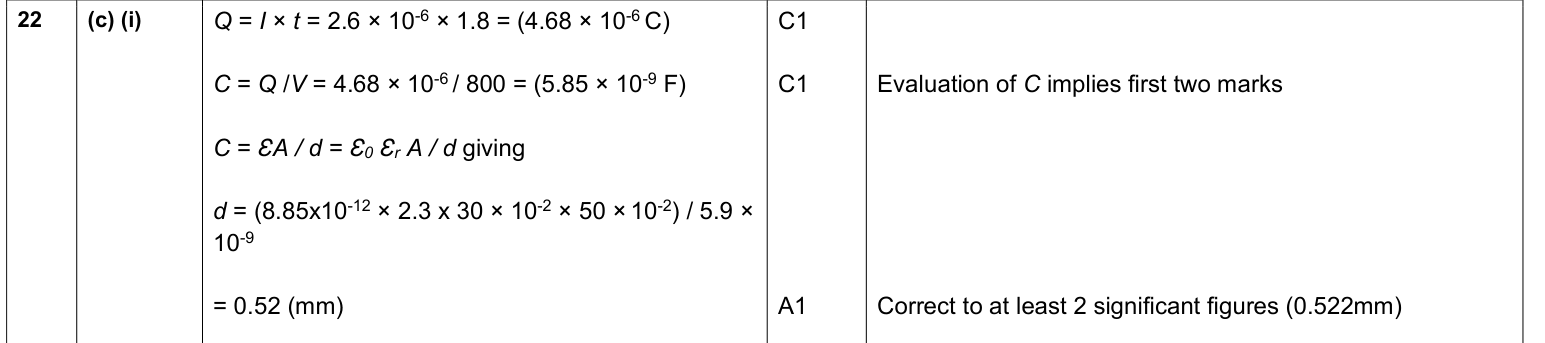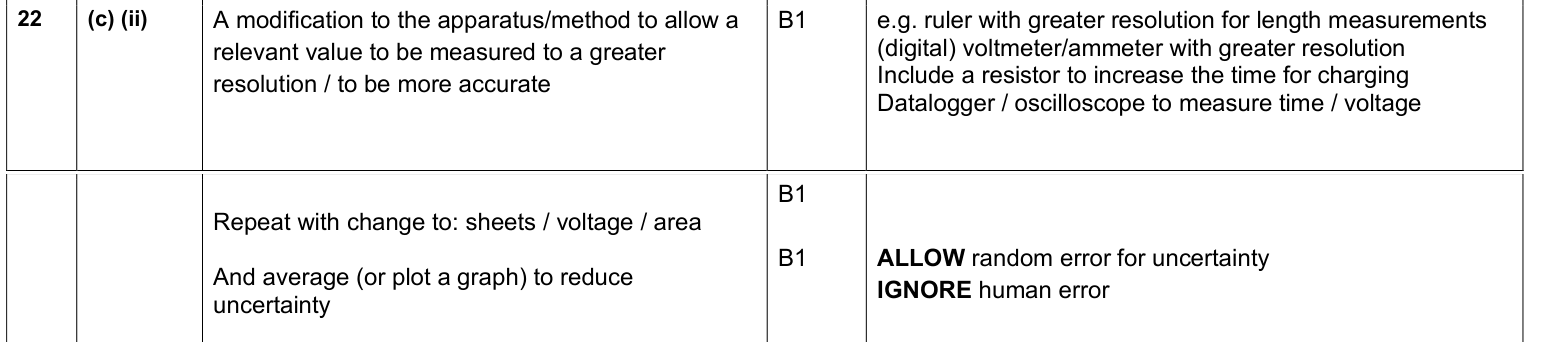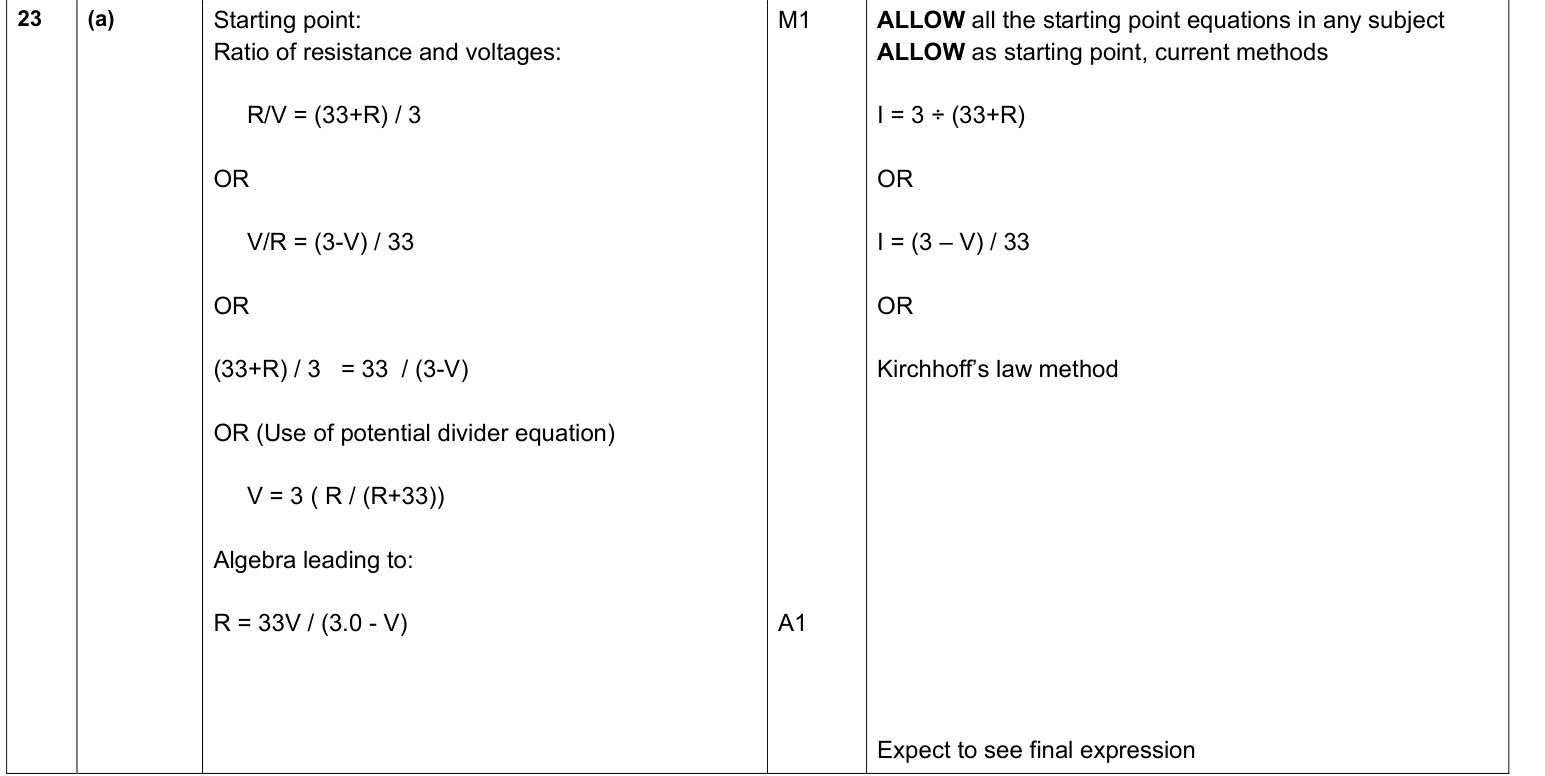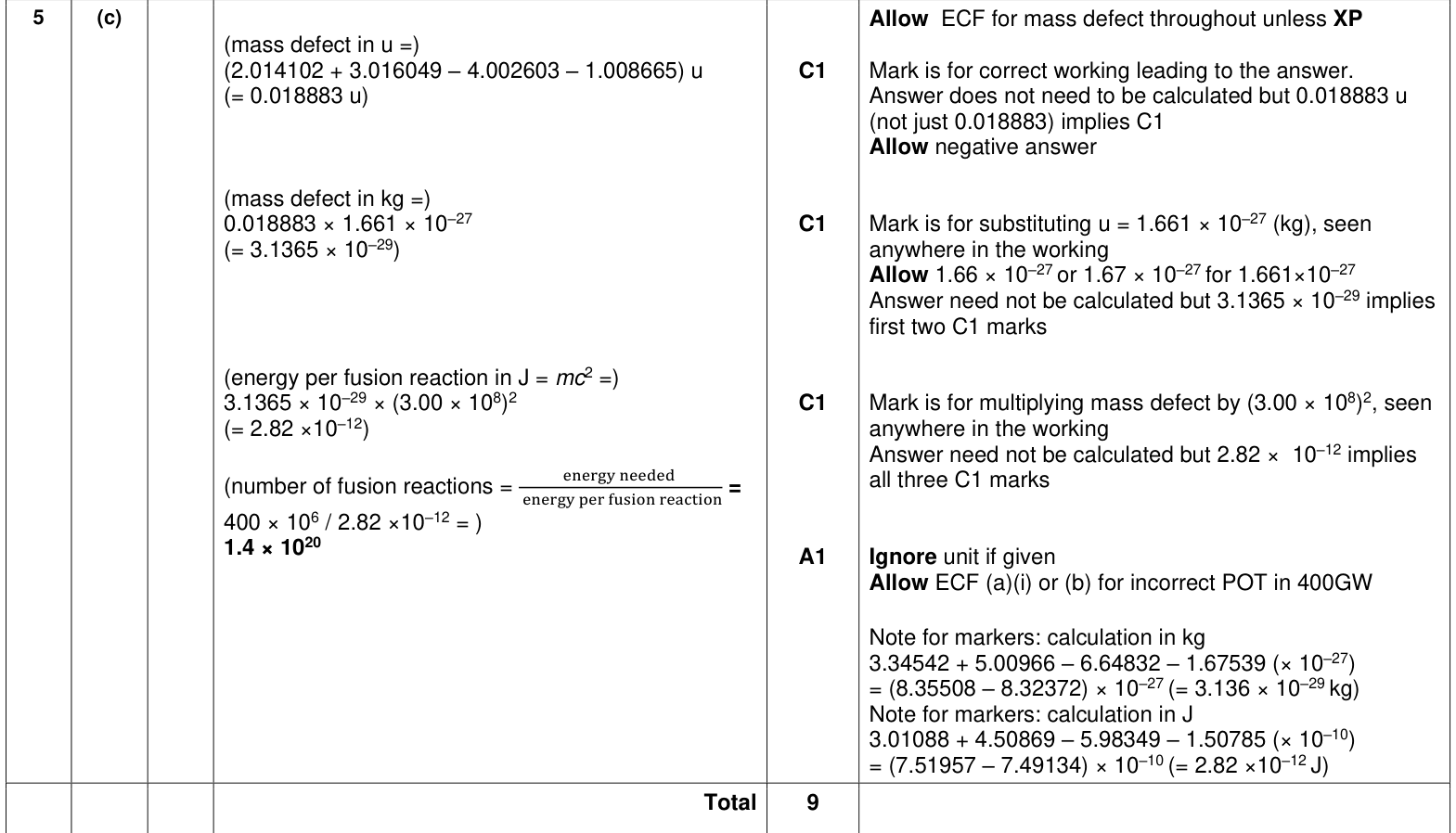
Answer
B
Mark scheme

Examiner's comment
Question 8 Question 9 This proved to be challenging for most, except for the very top-end candidates.
OCR's examiners' reports say how candidates did on each question. These are the 220 parts on current content that the reports describe as hard or poorly answered, with the examiner's comment on where answers fell short.
B
Question 8 Question 9 This proved to be challenging for most, except for the very top-end candidates.
C
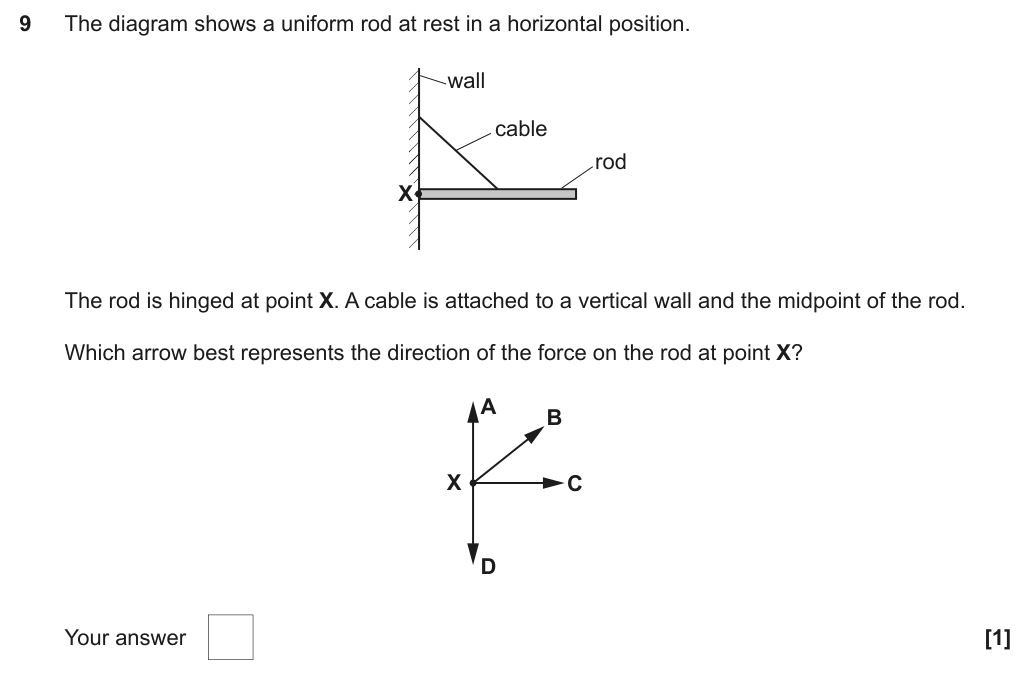
This proved to be challenging for most, except for the very top-end candidates. All the distractors were equally popular, and just over a third of the candidates got the correct answer C. Many of the scripts from the successful candidates had the term key uniform underlined or circled. The centre of gravity of the rod and the point of contact of the cable to the rod were the same. For equilibrium, the contact force from X had to pass through this same point – which only left arrow C as the correct answer.
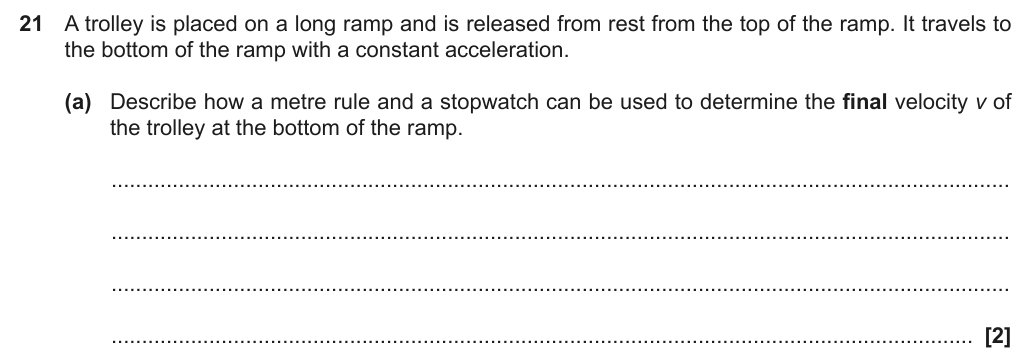
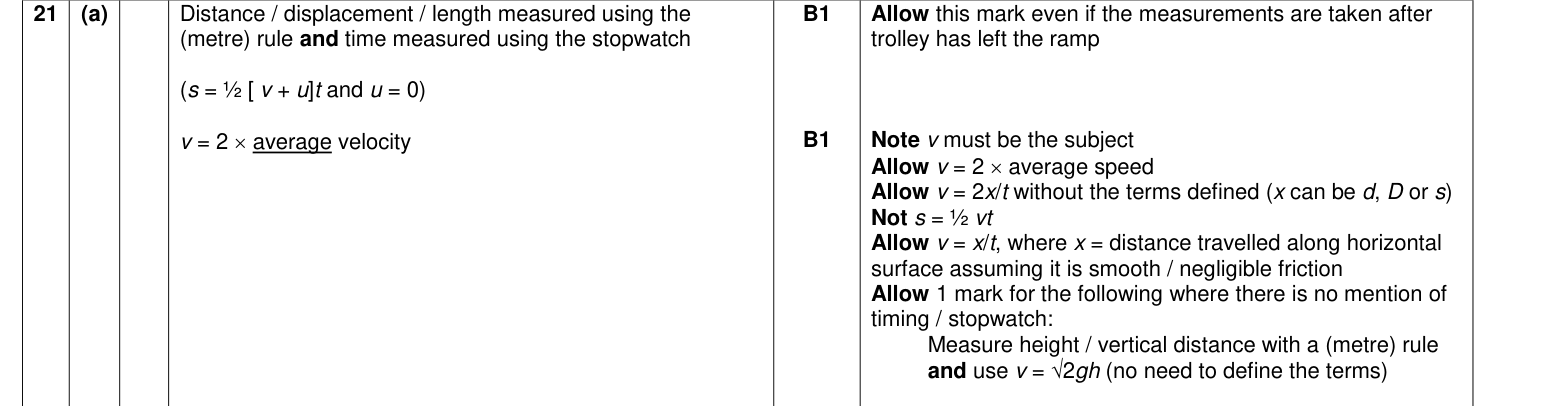
Most candidates struggled to gain full marks in this opening question. The first mark, for using a ruler to measure the length of the ramp and the stopwatch for the time taken to travel the length of the ramp, was gained by just over half of the candidates. The second mark required a clear statement that the final velocity was twice the mean velocity of the trolley. Equivalent statements were allowed. Unfortunately, many candidates opted to describe light-gates arrangements or using inappropriate equations of motion.
Skills: M2.2 Change the subject of an equation, including non-linear equations; PAG1 Investigating motion
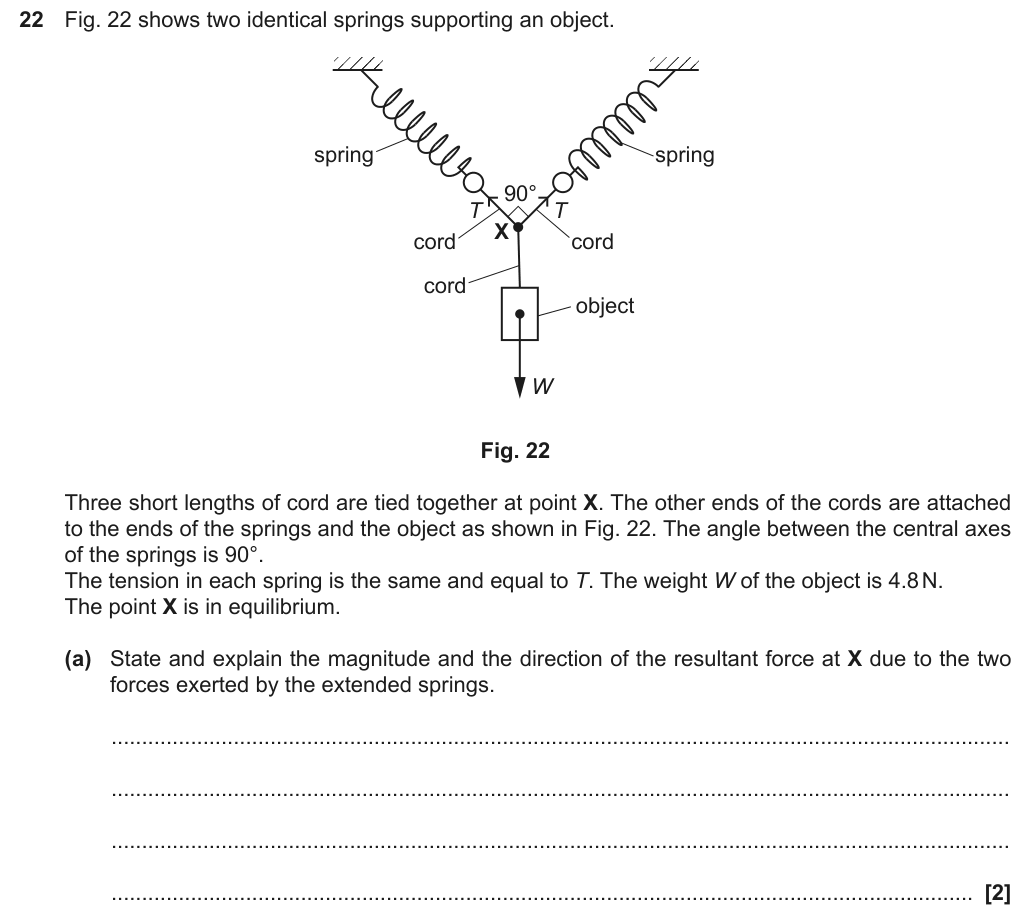
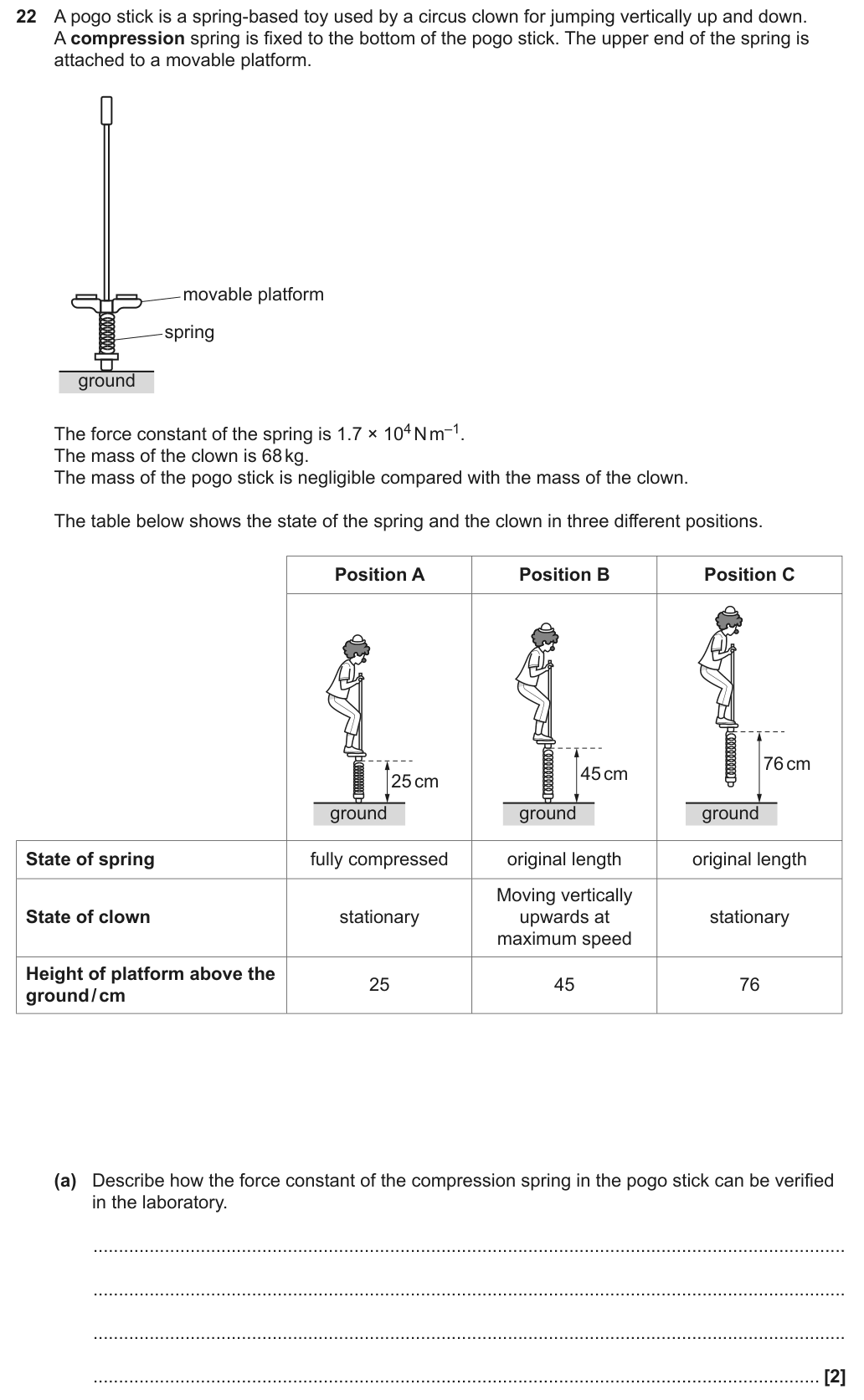
Question 22(a) Question 22(b) Question 22(c) This question was good discriminator, where the top-end candidates could demonstrate their powers of analysis.
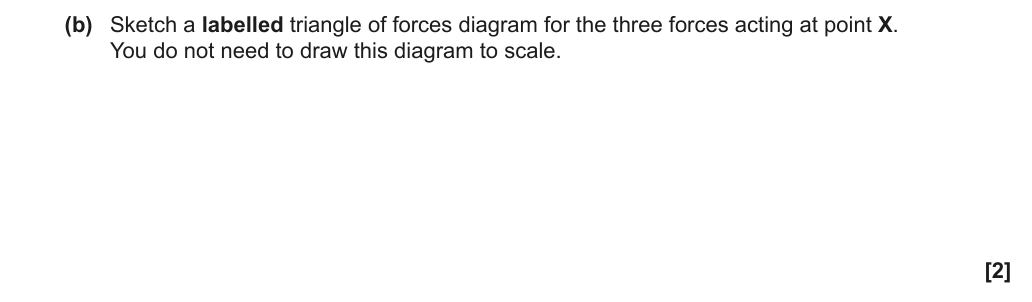
Question 22(a) Question 22(b) Question 22(c) This question was good discriminator, where the top-end candidates could demonstrate their powers of analysis.
Skills: M4.2 Visualise and represent 2D and 3D forms, including two-dimensional representations of 3D objects
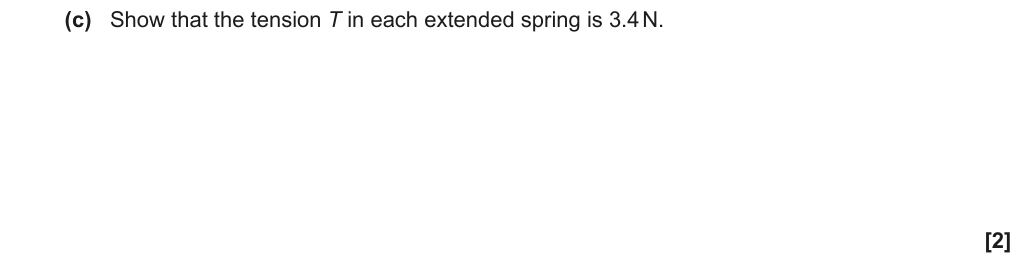
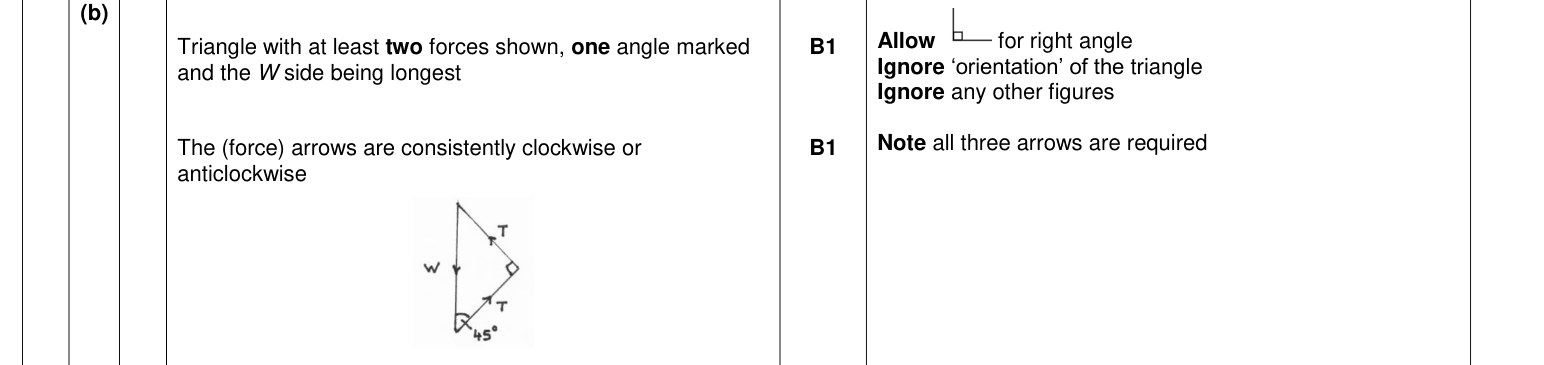
This question was good discriminator, where the top-end candidates could demonstrate their powers of analysis. The success in (c) was very much dependent on a well-annotated triangle of forces in (b). Most triangle of forces were workable but lacked detail. Missing labels and incorrect direction of the force arrows were the main misdemeanours. As expected, candidates used a range of methods to show the force in the extended spring was 3.4 N. In order of popularity, the techniques were using Pythagoras’ theorem, using trigonometry, resolving forces in the vertical direction and sine (or cosine) rule. It is sensible to show the final answer to more significant figures than required in a ‘show’ question. This exemplar illustrates a flawless answer from a top-end candidate. The triangle of forces of perfect – all labels clear and the pivotal angle 90° between the two tensions marked. The calculation in (c) makes an excellent use of this triangle to show that the force is 3.39 N and hence 3.4 N. Contrast the above excellent solution with the exemplar shown below from a grade C candidate. The triangle of forces in (b) is simply not right. However, in (c), the analysis is correct and shows another plausible method for securing the 2 marks. Again, it is good to see the penultimate value for the force given to more than two significant figures.
Skills: M0.6 Use calculators to handle sin x, cos x and tan x when x is expressed in degrees or radians; M4.4 Use Pythagoras’ theorem, and the angle sum of a triangle; M4.5 Use sin, cos and tan in physical problems
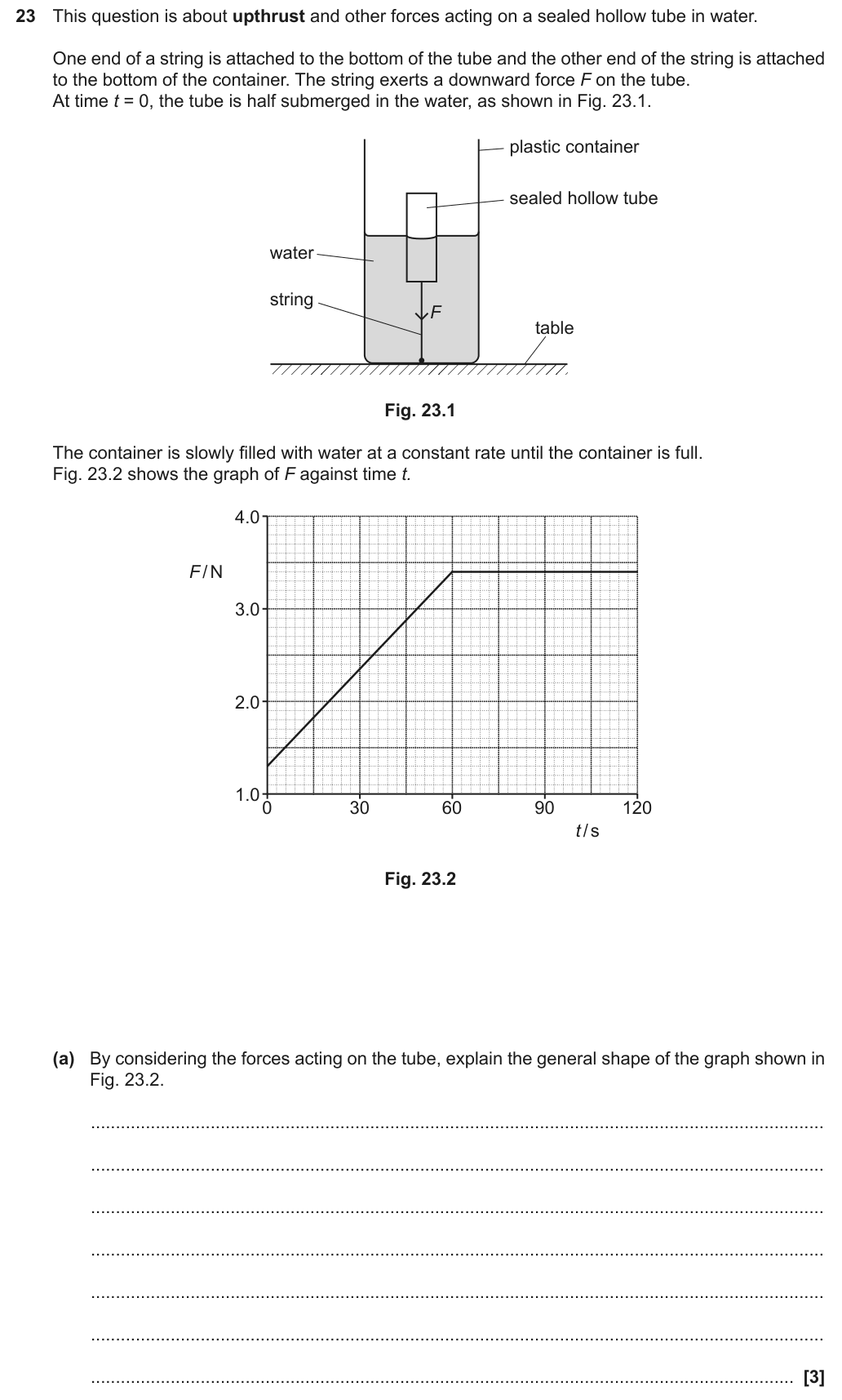
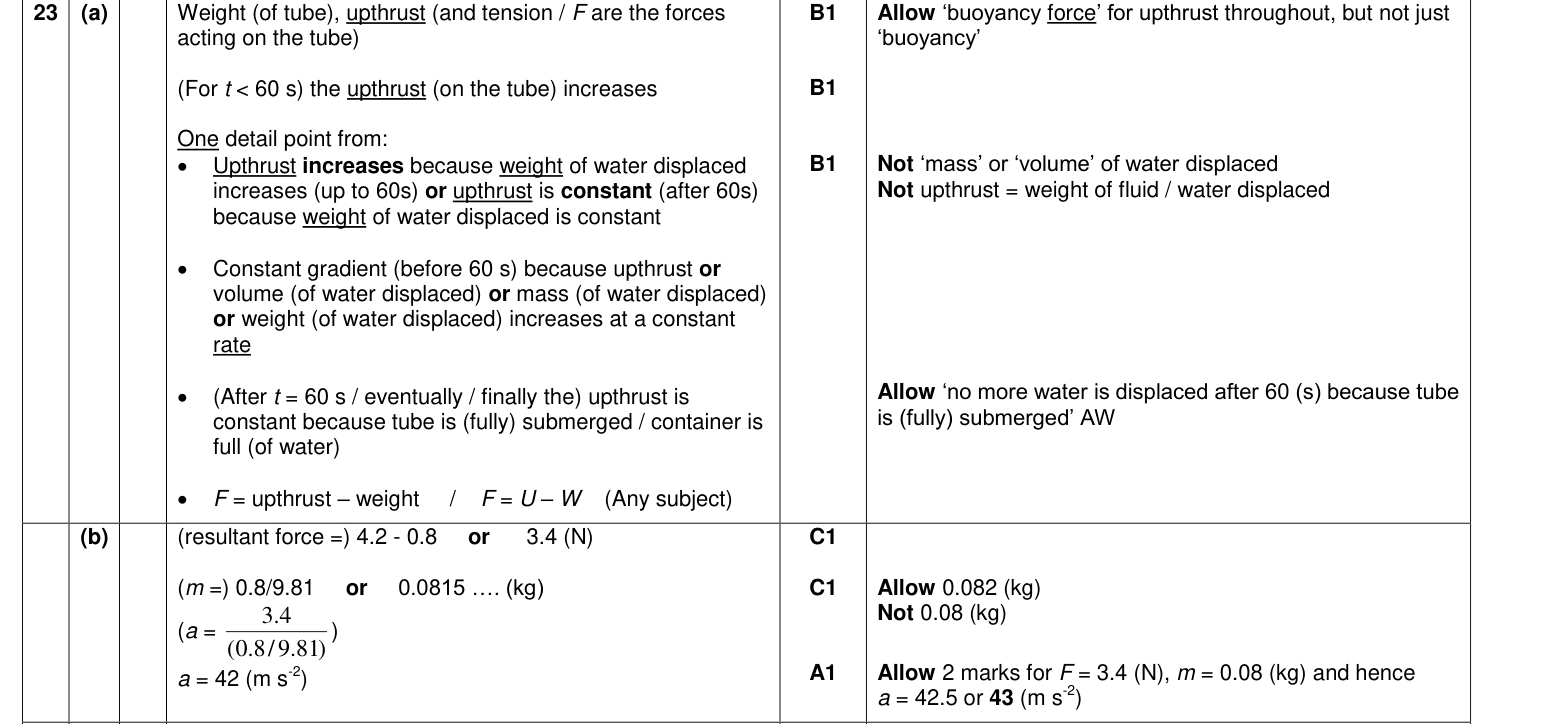
This question required understanding of upthrust and Archimedes principle. Many candidates gave explanation without mentioning any of the forces acting on the tube. Those candidates who read and focussed on the requirements of the question did better, but there were too many misconceptions and missed opportunities. The most common missed opportunities and errors were: • Not mentioning any of the two of the forces from the list of three (upthrust, tension and weight) • Stating Archimedes principle without reference to this specific question • Confusing mass and weight in the description of upthrust • Confusing the tension in the string with upthrust Key This exemplar illustrates how correct use of technical language can score full marks. Here the marks were credited for • Identifying a minimum of two forces acting on the tube (weight and upthrust) • Mentioning that upthrust increases as the water level rises • Explanation that upthrust is equal to the force on the string (tension) and weight (The last mark was the toughest mark to gain, so this candidate has shown good understanding of this difficult topic.)
Skills: M3.1 Translate information between graphical, numerical and algebraic forms
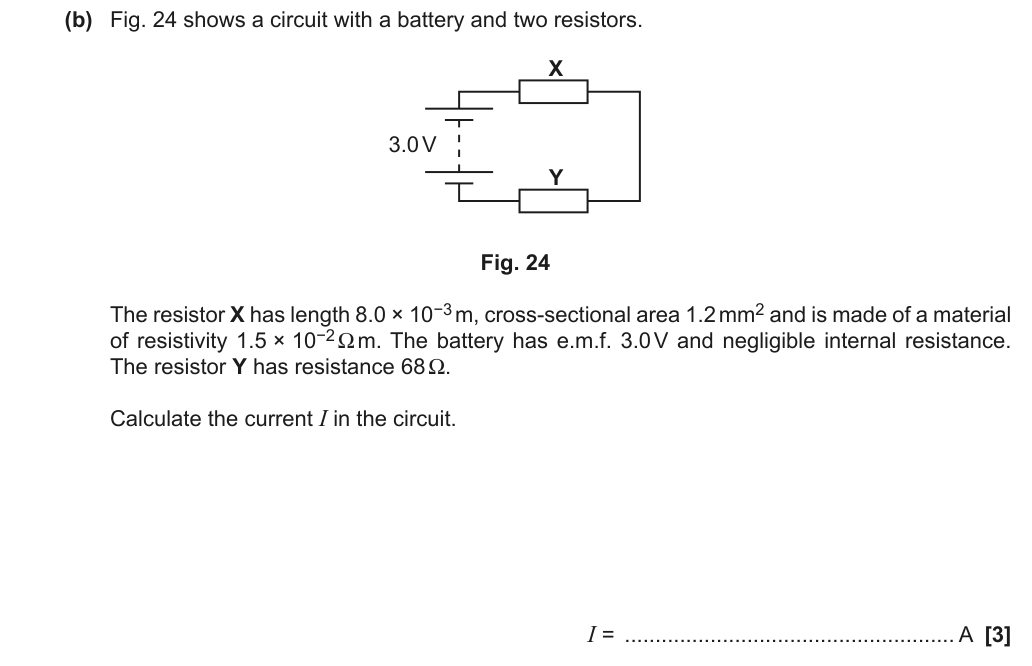
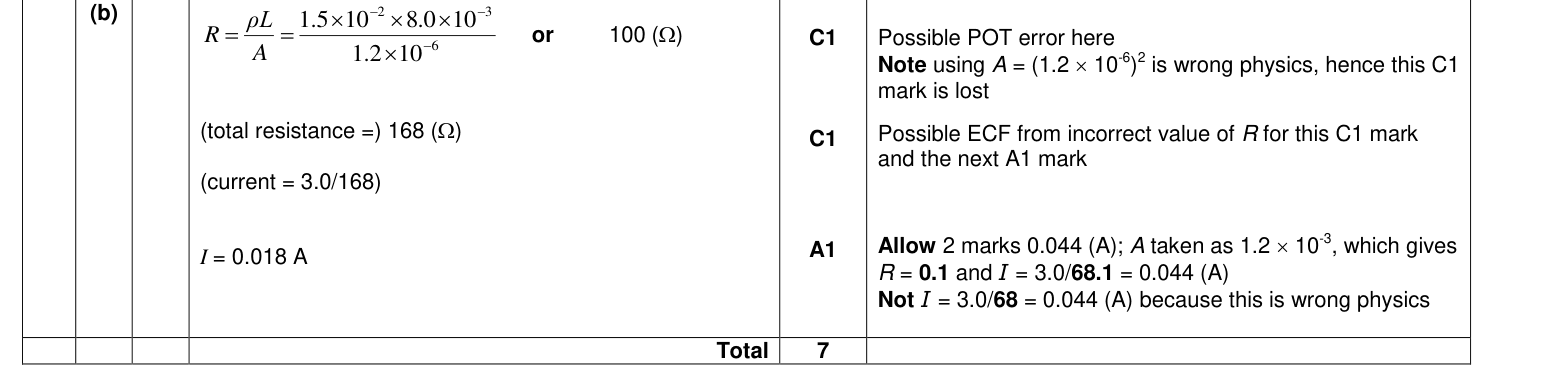
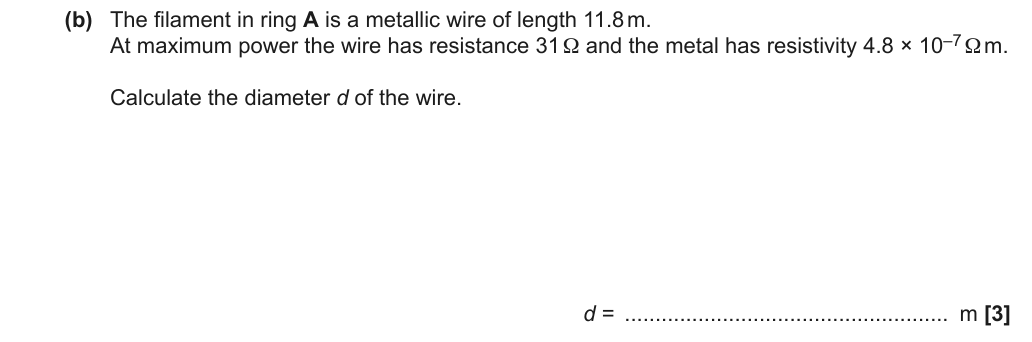
There were several challenges in this question. Success was dependent on knowledge of resistivity and series circuit. There was also the added complication of converting the 12 mm2 to 12 × 10-6 m2. The most common error was with powers of ten, with the resistance calculated as 0.1 Ω instead of 100 Ω - where 1 mm2 was being taken as 10-3 m2 rather than 10-6 m2. A significant number of candidates scored 2 marks through the error carried forward (ECF) rule. A small proportional of the candidates attempted to calculate the total resistance using the parallel resistors’ equation. This exemplar illustrates how even top-end candidates can lose a mark. The error in the powers of ten has been penalised by the examiner. This incorrect value has then been allowed through subsequent calculations. Two marks have been gained even though the final answer is incorrect. It is worth remembering the knowing your physics will always pay dividends.
Skills: M0.1 Recognise and make use of appropriate units in calculations; M0.2 Recognise and use expressions in decimal and standard form; M2.3 Substitute numerical values into algebraic equations using appropriate units for physical quantities
D
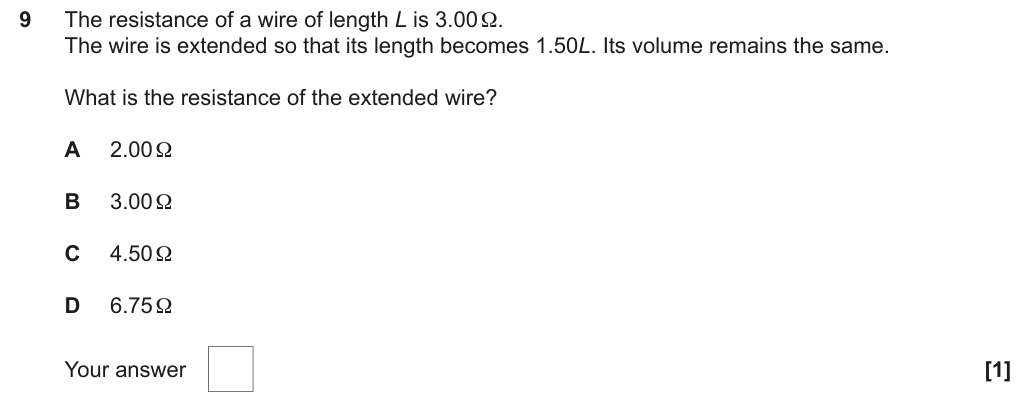
This question was about the resistance equation 𝑅𝑅= 𝐴𝐴 which appears in the Data, Formulae and Relationship Booklet. This was a good discriminator for the top-end candidates. The majority of the candidates opted for the answer C, which was simply 1.50 times the original resistance of the wire. The crucial statement that the ‘volume of the wire remains the same’ was omitted by most candidates. The volume of the wire remains constant. The cross-sectional area of the wire will decrease by a factor of 1.50 as its length increases by this same factor. Since resistance R ∝ 𝐴𝐴, this implies that the resistance of the stretched wire will increase by a factor of 1.502. This makes the resistance of the extended wire equal to 1.502 × 3.00 = 6.75 Ω. The analysis above shows how it is easy to follow incorrect logic when a single pivotal statement in the question is skimmed over.
D
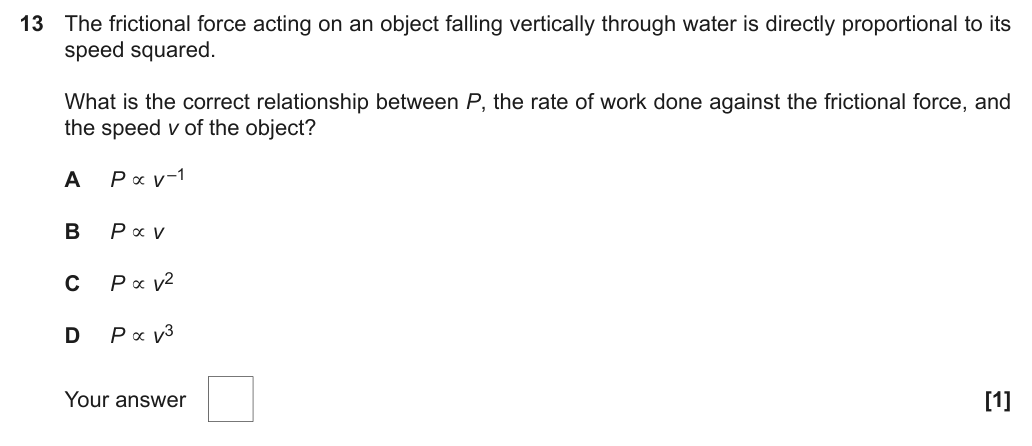
This question is based on the equation P = Fv, which also appears in the Data, Formulae and Relationship Booklet. In the question, information is given about the frictional force F, which is directly proportional to v2. Therefore, the rate of work done P must be proportional to v3; making D as the answer. Most candidates struggled with this question, with all the distractors being equally popular. Less than a quarter of the candidates, mainly from the upper quartile, scored a mark in this question. The exemplar 2 below the correct response from a candidate. This candidate demonstrates how this question can be tackled with minimal amount of work. The key equation is on the script, as is the relationship between F and v. The final answer appears in the box; a perfect technique.

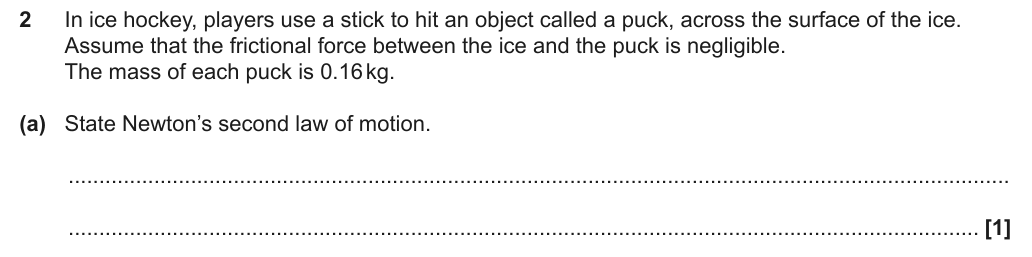
Most candidates struggled with this opening question. Only a third of the candidates picked up a mark for ‘resultant moment = 0’. A small number of candidates spoilt their answers by mentioning momentum rather than moment. A statement for the principle of moments was allowed.
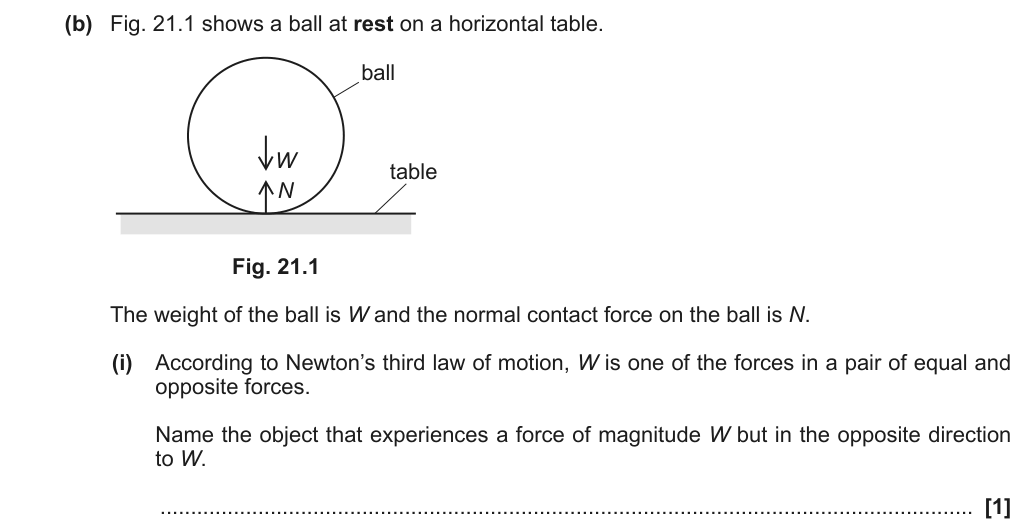
This question was poorly answered, with only the very top candidates realising that it was the Earth experiencing the force W in the opposite direction. ‘Ground’ instead of the Earth was allowed by examiners – but such answers were extremely rare. Newton’s third law remains enigmatic to many candidates. The most popular incorrect answers were ‘ball’ and ‘table’.
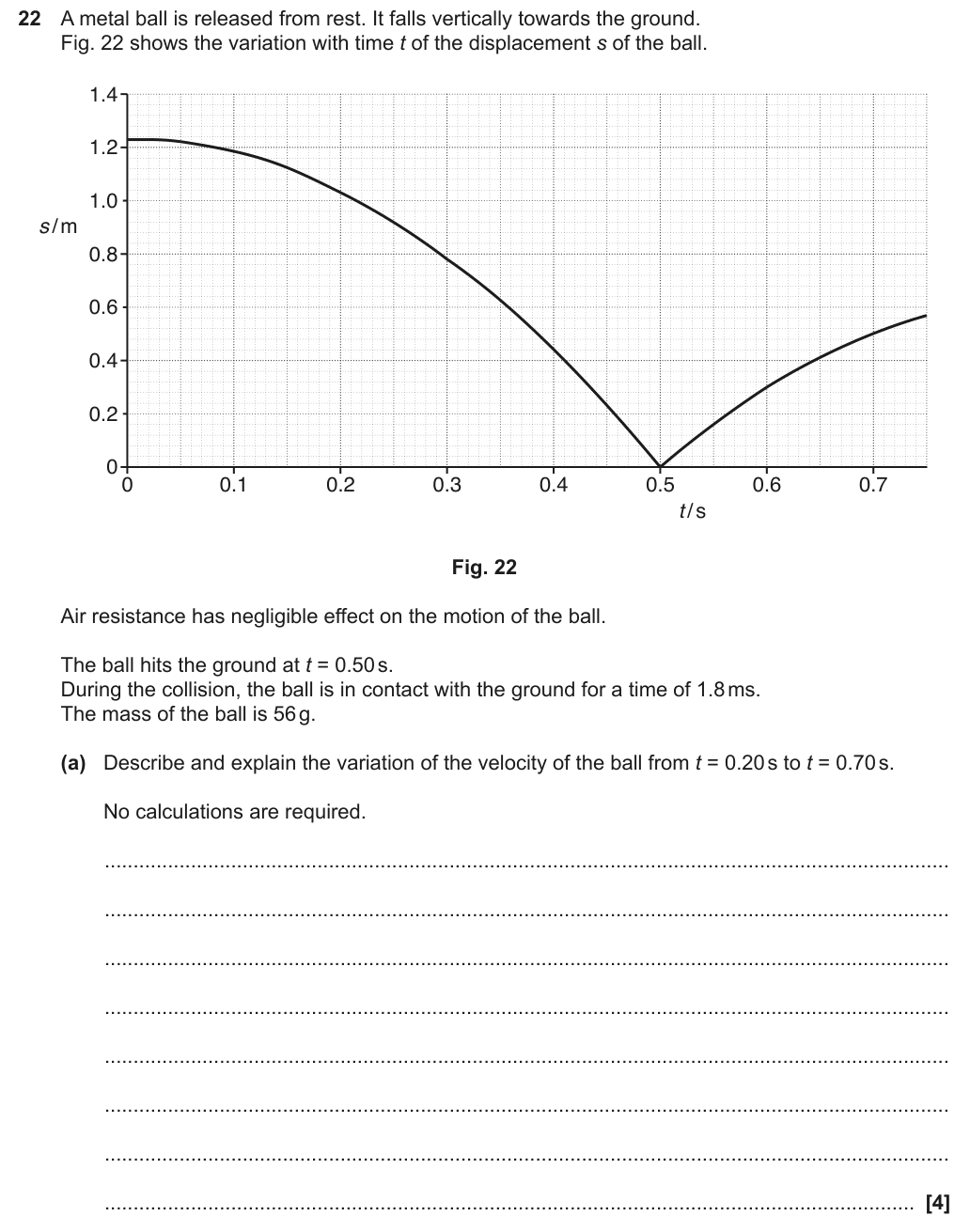
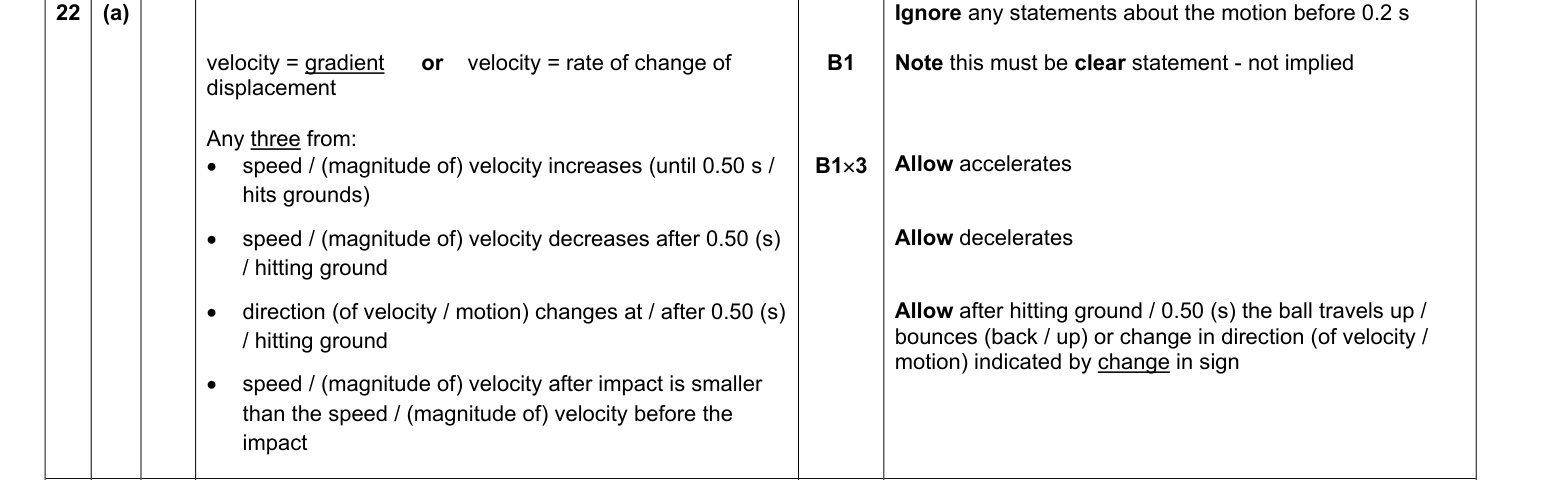
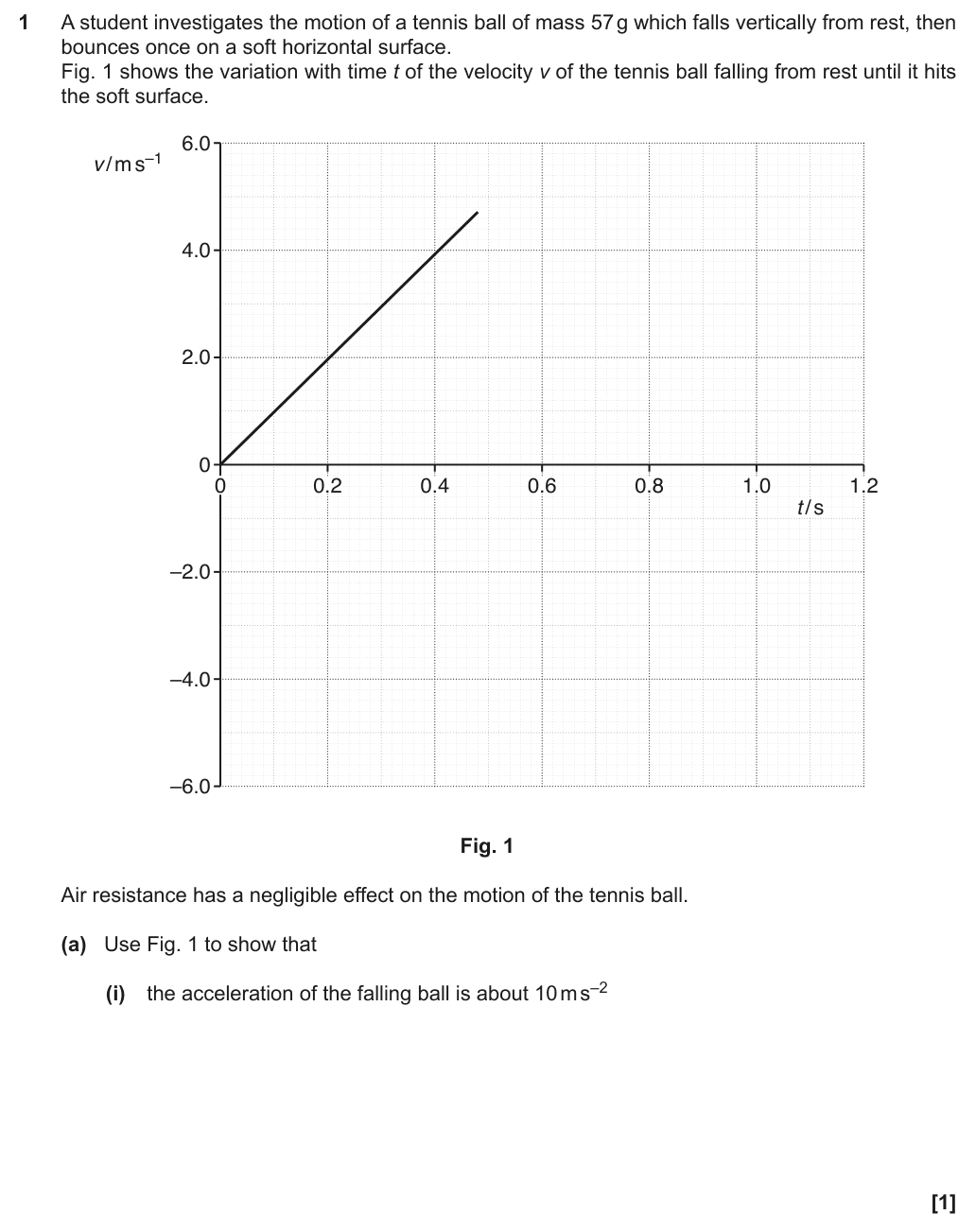
This question on displacement-time graph required clear interpretation and exposition of the physics. The question discriminated well, with the top-end candidates describing the motion of the ball in clear scientific terms. Terms such as acceleration and deceleration were used appropriately. Up to time t = 0.50 s, the ball was accelerating towards the ground – its velocity was increasing at a steady rate. The ball made impact with the ground at t = 0.50 s. The speed of the ball immediately after the impact was less than the speed just before the impact. This can be inferred from the gradient of the graph; the gradient being equal to velocity. The ball was moving away from the ground after t = 0.50 s and decelerating. It was only the very best candidate who mentioned that the gradient of the graph is equal to velocity of the ball. The two exemplars 8 and 9 show responses from top-end and low-end candidates. This is a response from a top-end candidate. The description is flawless. The last statement about the ‘change in gradient’ being equal to acceleration was ignored. It should have been rate of change in the gradient being equal to acceleration, however, the statement from the candidate was not an essential requirement. This candidate had picked up an elusive mark for mentioning that the gradient of the graph is equal to velocity. This is a response from a low-end candidate. It contains mistakes and misconceptions. The only mark obtained was for mentioning that the ball was accelerating before its impact with the ground.
Skills: M3.1 Translate information between graphical, numerical and algebraic forms
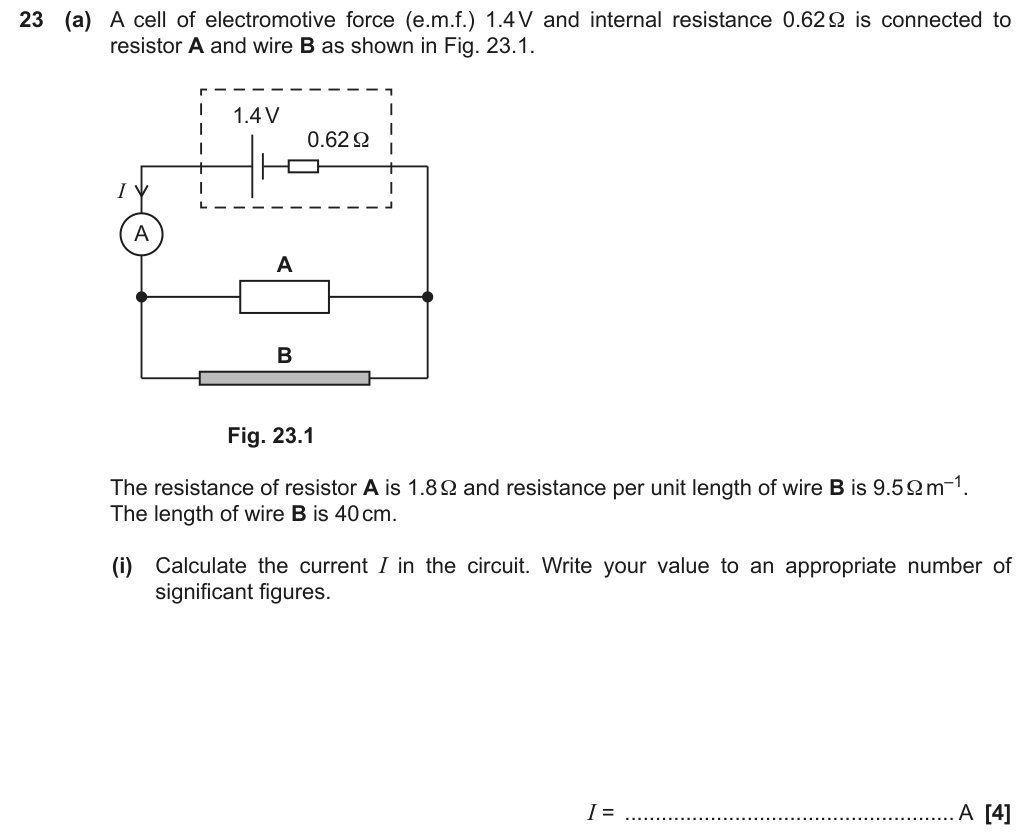
This circuit question required multiple steps to calculate the current I in the circuit. Firstly, the candidates had to determine the resistance of wire B, then sort out the parallel combination of resistors A and wire B, and eventually deal with the whole circuit which included the internal resistance of 0.62 Ω. The question discriminated well, with almost half of the candidates securing full marks. The responses were often well-structured and demonstrated skilled use of calculators. Some responses were spoilt by premature rounding of numbers, but generally, candidates were sensible in retaining numbers on their calculators for subsequent stages of the calculation. Exemplar 10 below shows an immaculate response from a middle-grade candidate. All the stages of the calculations are easy to see in this well-structured response. This candidate has not rounded any of the numbers between stages – a very admirable strategy. The final response is quoted to 2 significant figures as required.
Skills: M1.1 Use an appropriate number of significant figures; M2.3 Substitute numerical values into algebraic equations using appropriate units for physical quantities
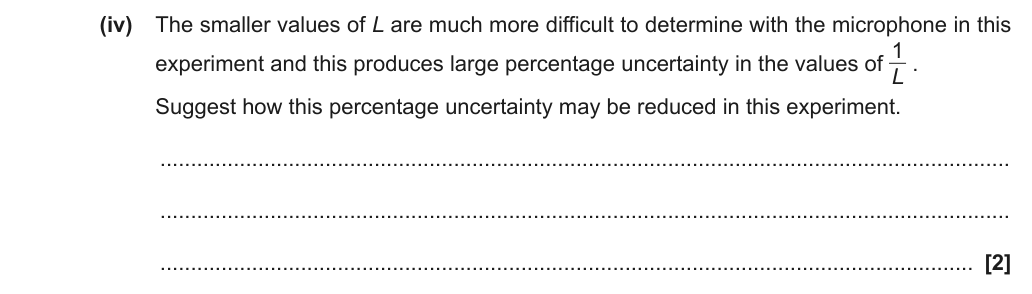
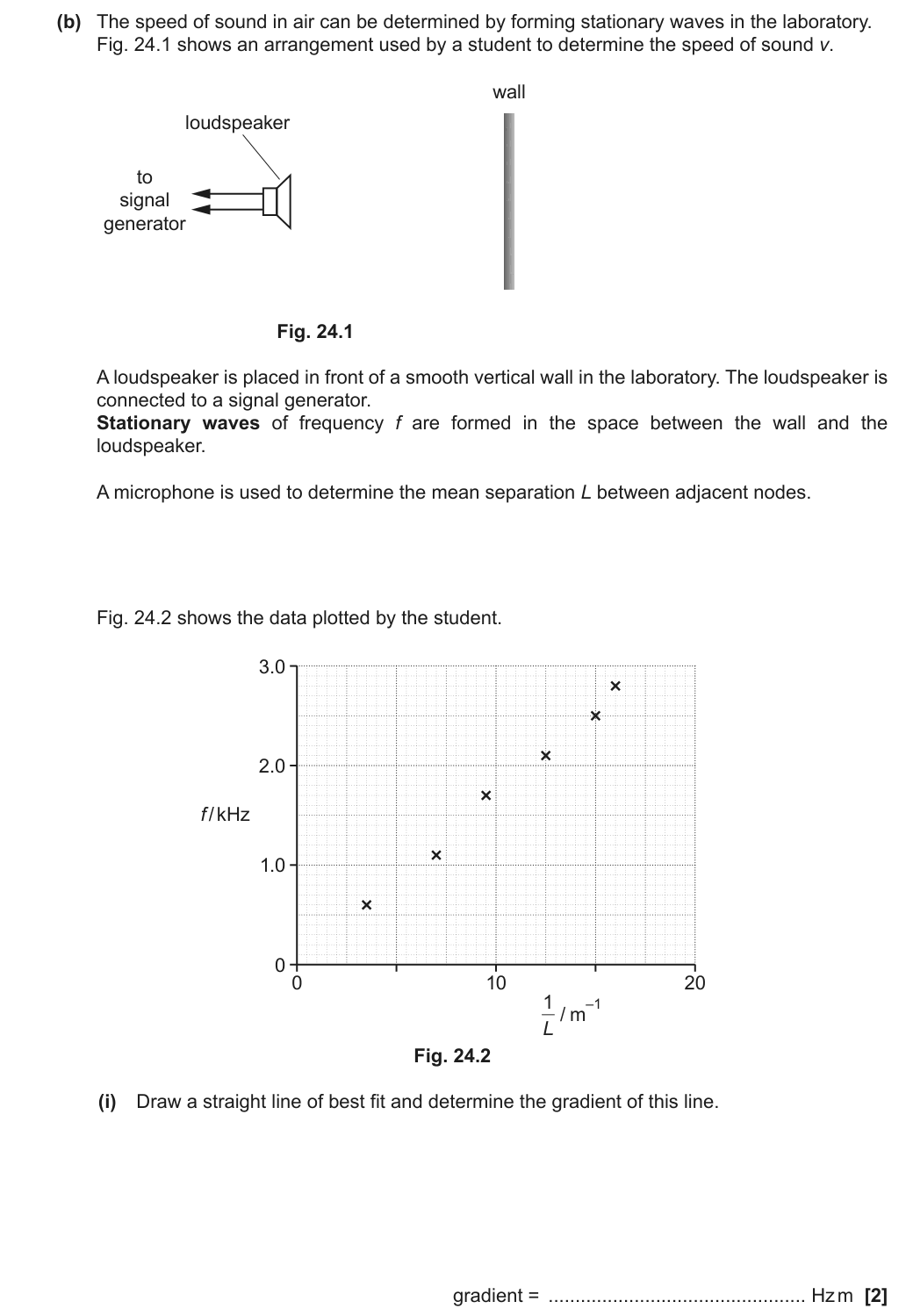
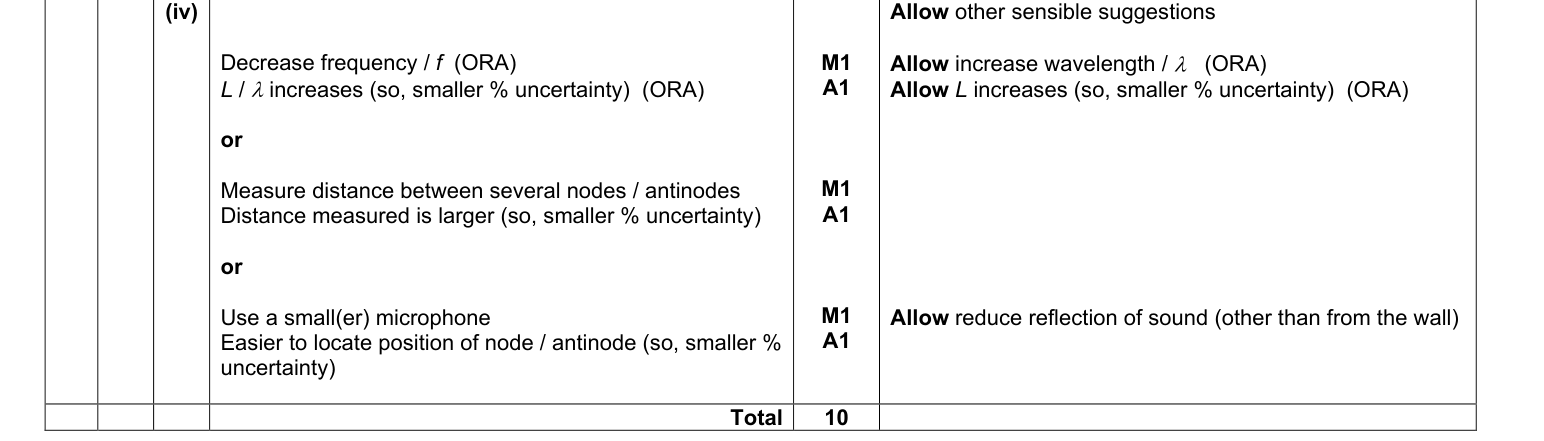
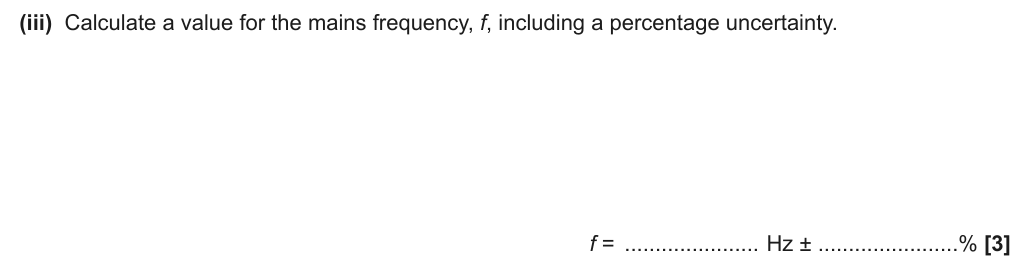
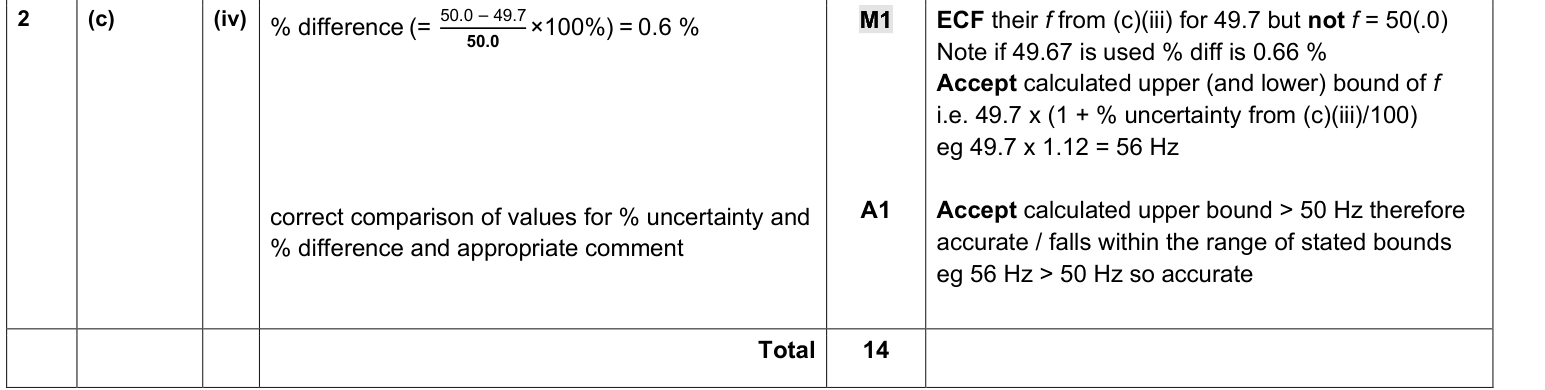
This was a low-scoring question, with many candidates focussing on averaging results. Only a small number of candidates appreciated that lower frequency would give longer inter-nodal distance L, and this resulted in smaller percentage uncertainty.
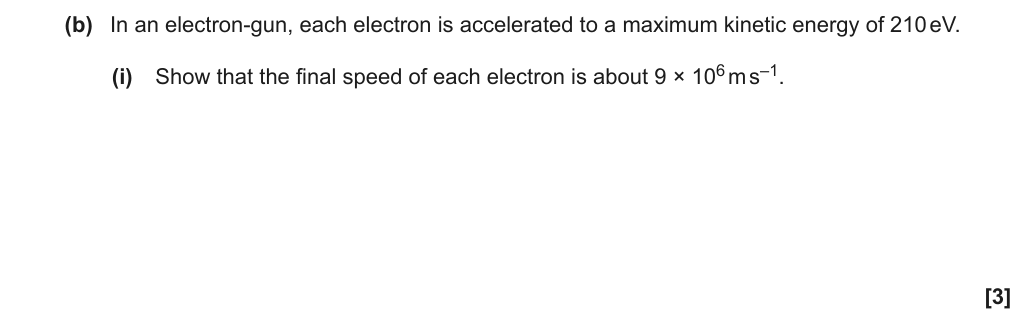
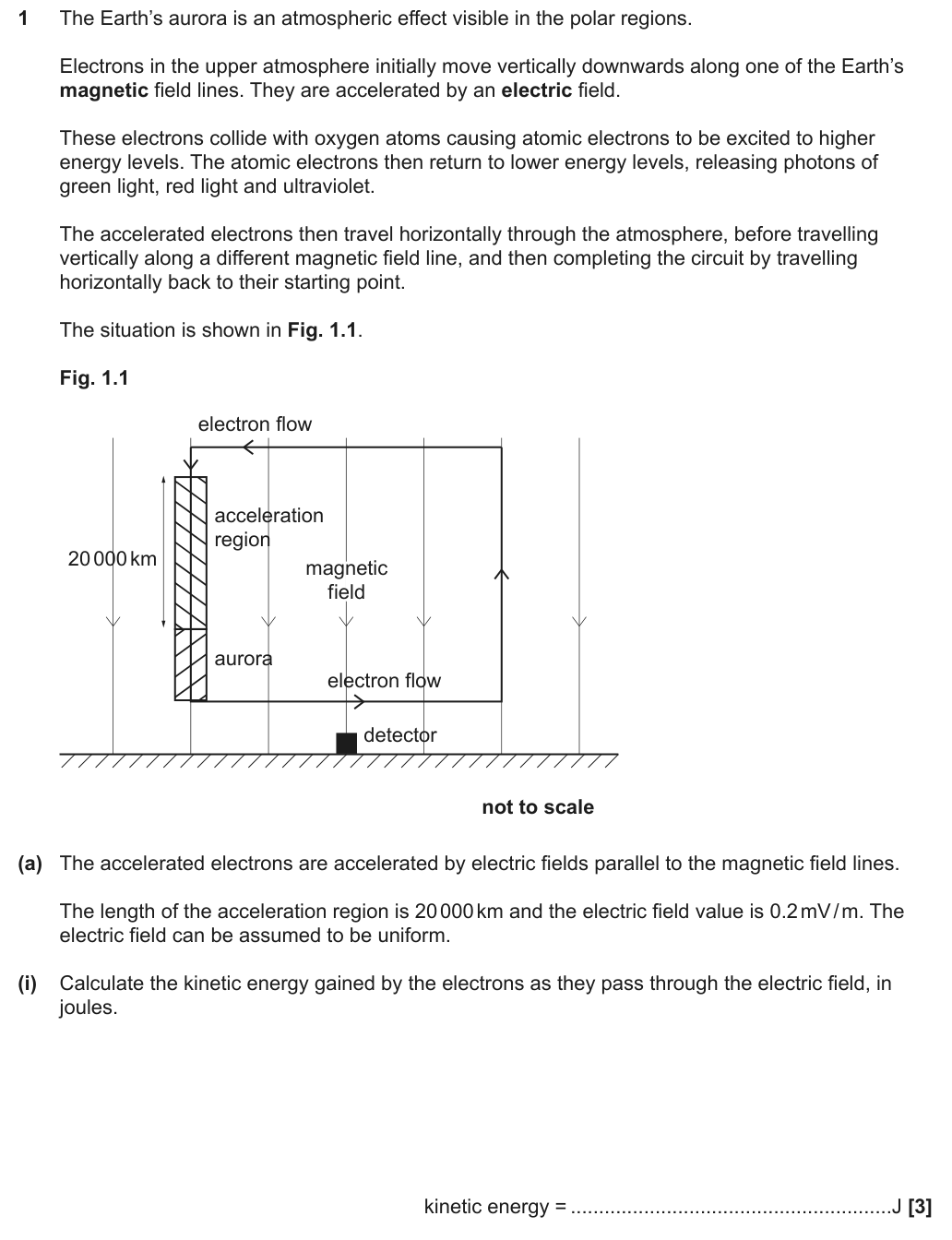
This was not a straight forward question but most candidates demonstrated excellent knowledge and application of physics here. The conversion of 210 eV was often done correctly. The K.E. equation was used successfully to show the final speed of the electrons to be about 8.6 × 10⁶ m s-1. The exemplar 11 below shows a model response from a top-end candidate. This exemplar shows a typical response produced by most of the candidates. The conversion from eV to J is very clear. The correct mass of the electron has been used to get the response of 8.6 × 10⁶ m s-1. It is good to report that very few candidates used 210 J to get the impossible response of 2.1 × 10¹⁶ m s-1.
Skills: M0.2 Recognise and use expressions in decimal and standard form; M2.2 Change the subject of an equation, including non-linear equations; M2.3 Substitute numerical values into algebraic equations using appropriate units for physical quantities
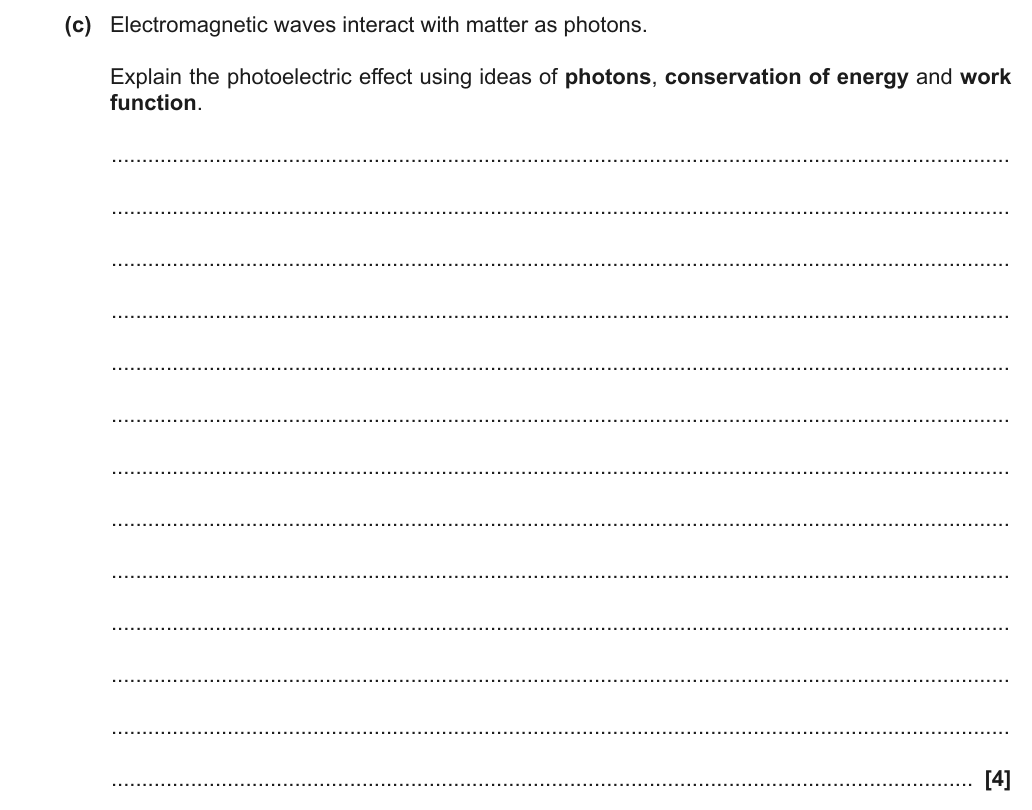
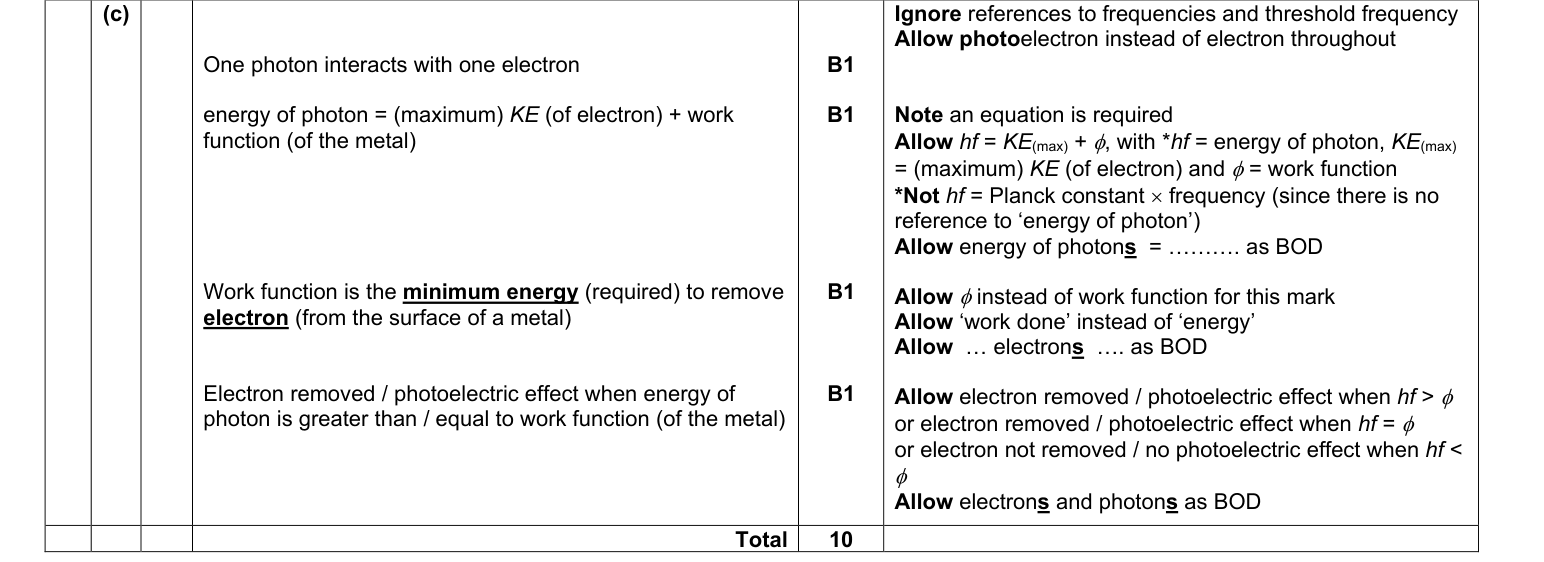
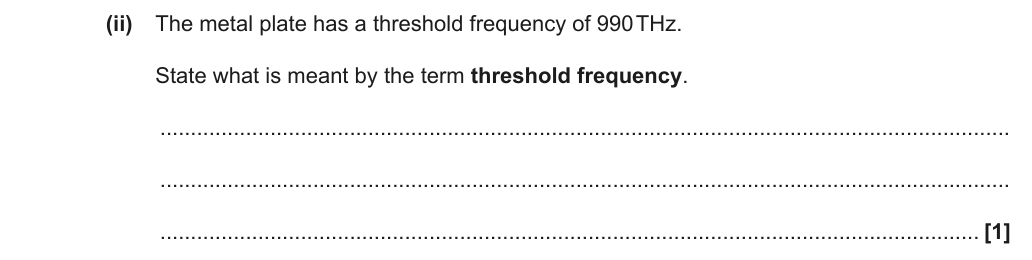
This question on the photoelectric effect provided excellent discrimination with most candidates demonstrating good knowledge of the photoelectric effect. The work function was well defined and the key idea of the one-to-one interaction between a photon and an electron was communicated well. Some candidates took work function and threshold frequency to be synonymous, and the Einstein’s photoelectric equation was quoted without much interpretation. Candidates are once again reminded that in descriptions it is important to define any terms used. Rather than just writing hf = φ + KEmax (which appears on the Data, Formulae and Relationship booklet), it would have would have been better to write energy of photon = work function of the metal + maximum kinetic energy of the electron as an alternative to annotating the formula with “where h is , f is , φ is, KEmax is ” Overall, the terms highlighted in the question helped candidates to provide focused responses. Many candidates continue to show knowledge of the quantum physics.
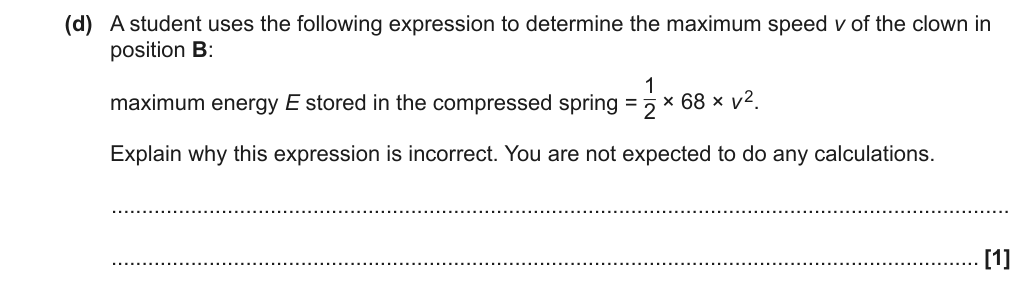
Only about 10% of candidates accessed this question correctly to be given 1 mark for responses describing energy transfers to the gravitational potential energy store of the spring. Most responses described energy transfers as energy losses to increase the thermal store of the surroundings.
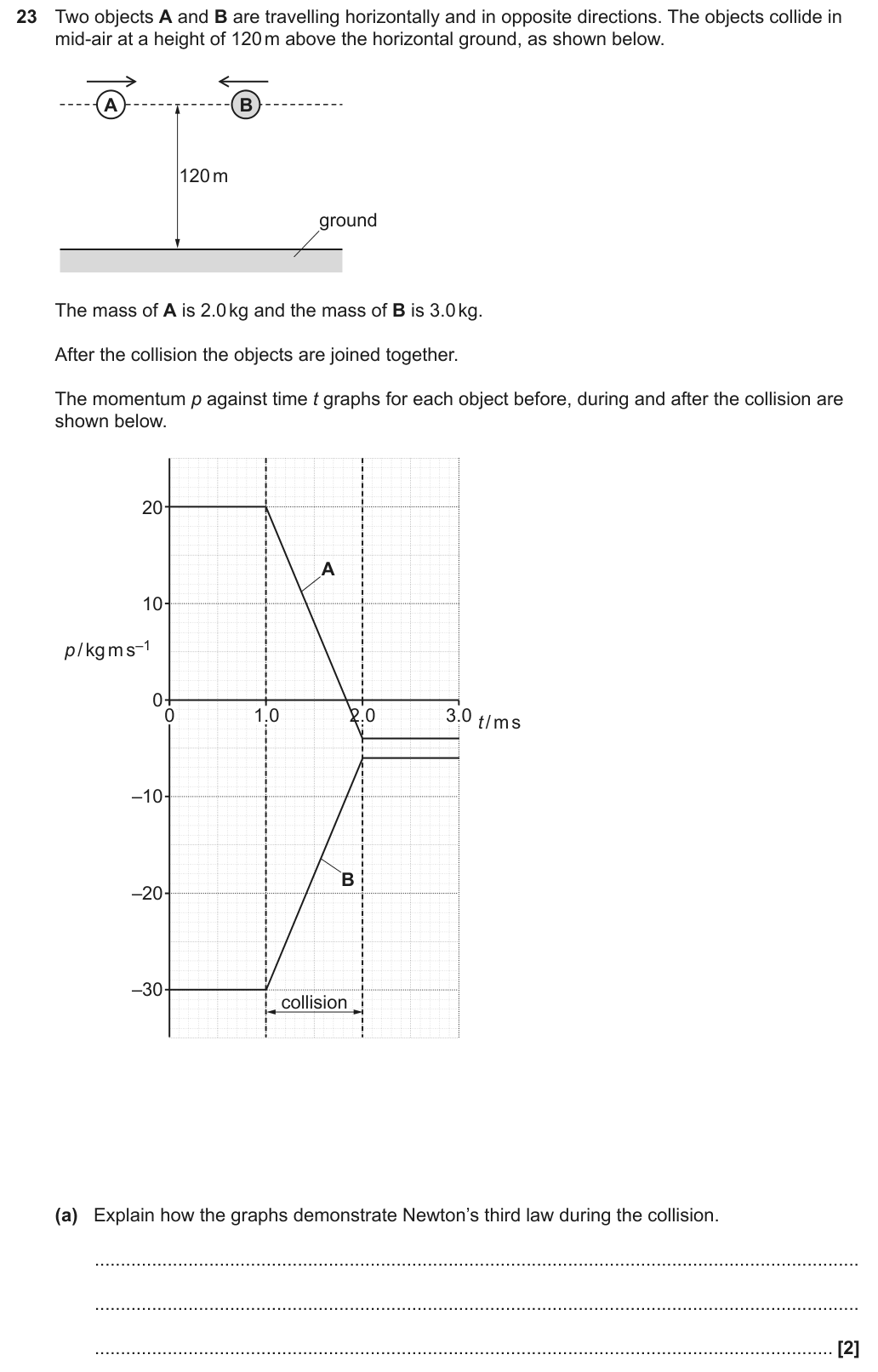
Candidates performed less well on this question as half of candidates were not given any marks. To access both marks candidates had to refer to the graph but very few candidates applied their knowledge of Newton’s Laws to determine that the gradient of the graph represented the force acting on objects A and B during the collision. Some candidates referred to the graph but only in terms of the change in momentum with no reference to time. If candidates made no reference to the graph, they could access 1 mark for giving a correct definition of Newton’s 3rd Law for the two objects but quite often the definition was vague and incomplete (see misconceptions) so no marks were given. This response demonstrates a clear understanding of Newton’s 3rd Law and that the force acting during the collision is the gradient of the graph. This exemplar demonstrates a middle range and higher end response from candidates.
Skills: M3.4 Determine the slope and intercept of a linear graph; M3.5 Calculate rate of change from a graph showing a linear relationship
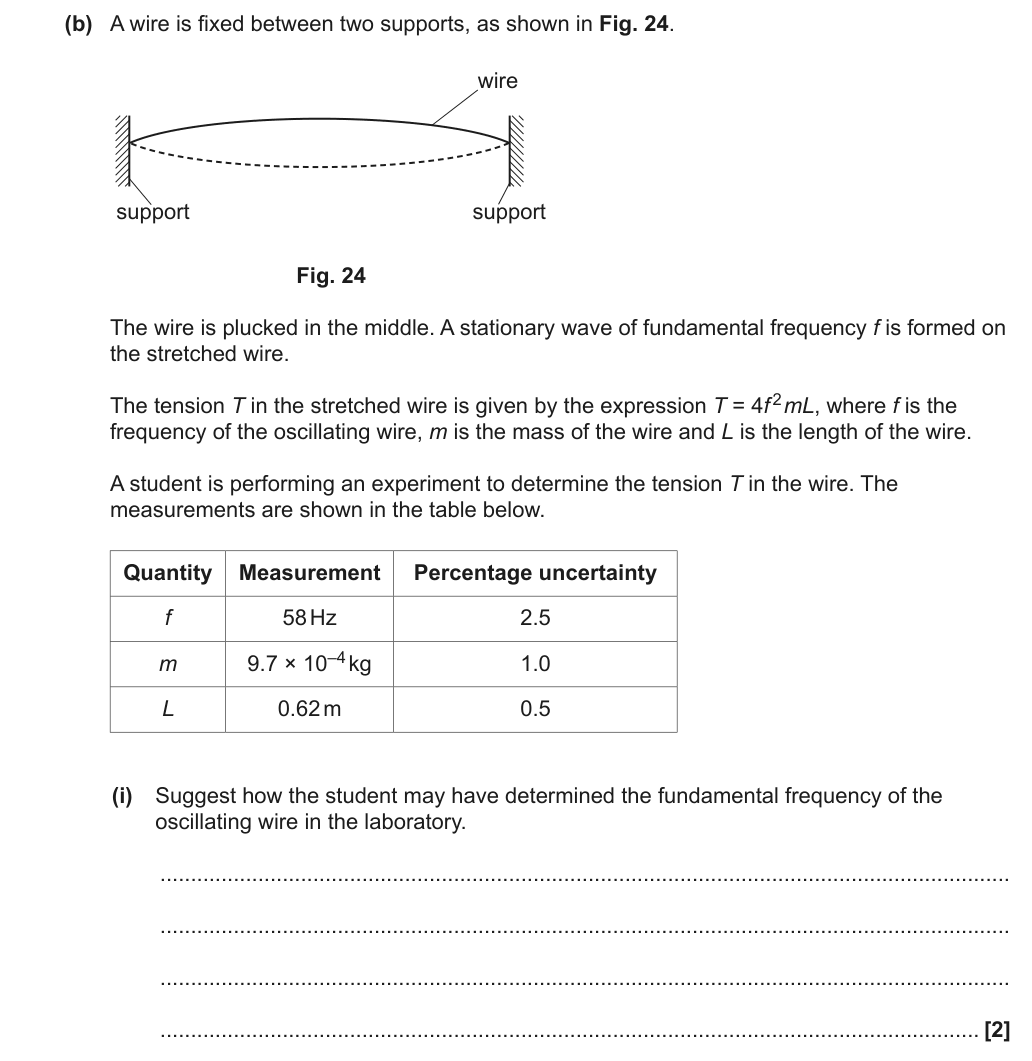
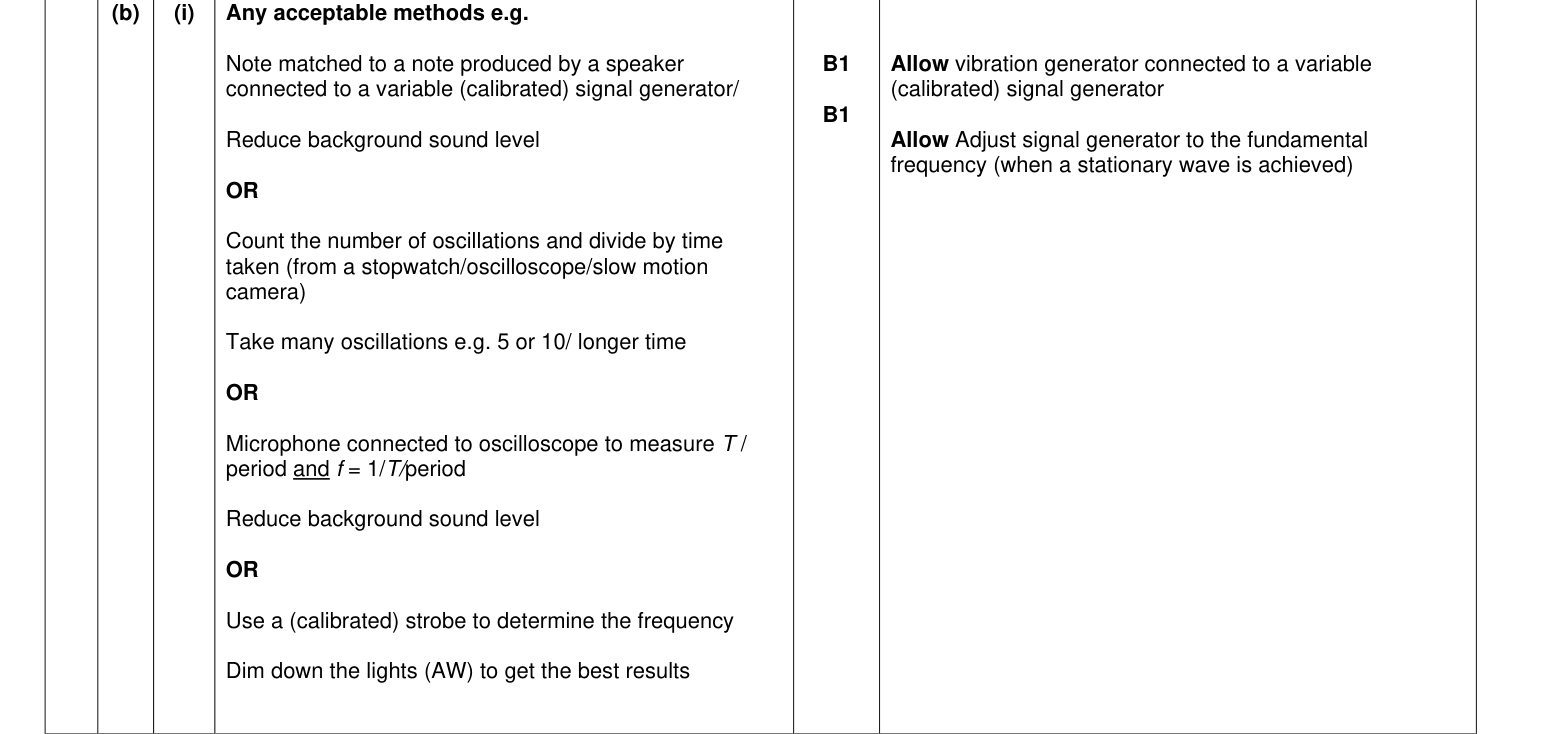
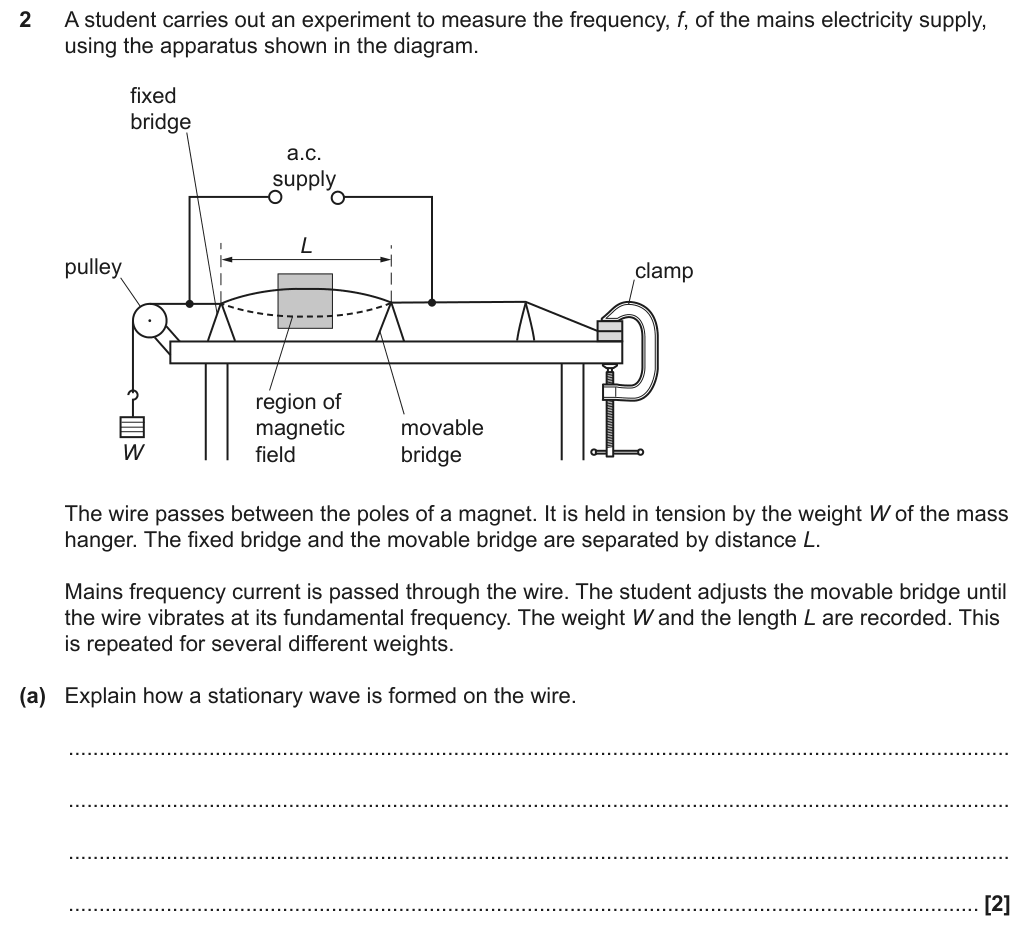
The advance information listed that practical skills would be assessed within topic 4.4 waves, but only some candidates were able to describe a simple method to determine the fundamental frequency of the oscillating wire. Marks were still given for a suitable method for determining the fundamental frequency of any oscillating wire, e.g. using a vibration generator and variable signal generator but few candidates developed their method to describe how they would obtain accurate measurements, e.g. measuring the time for 10 oscillations and then dividing by 10 to find the time period T, etc. Candidates may not have had the opportunity to carry out this practical skill independently but they should be familiar with the procedure and how measurements are taken to accurately find the fundamental frequency of a stationary wave. and understanding of the practical skills required to measure the fundamental frequency as there is no description of a method to measure the time period of a stationary wave.
Skills: PAG5 Investigating waves
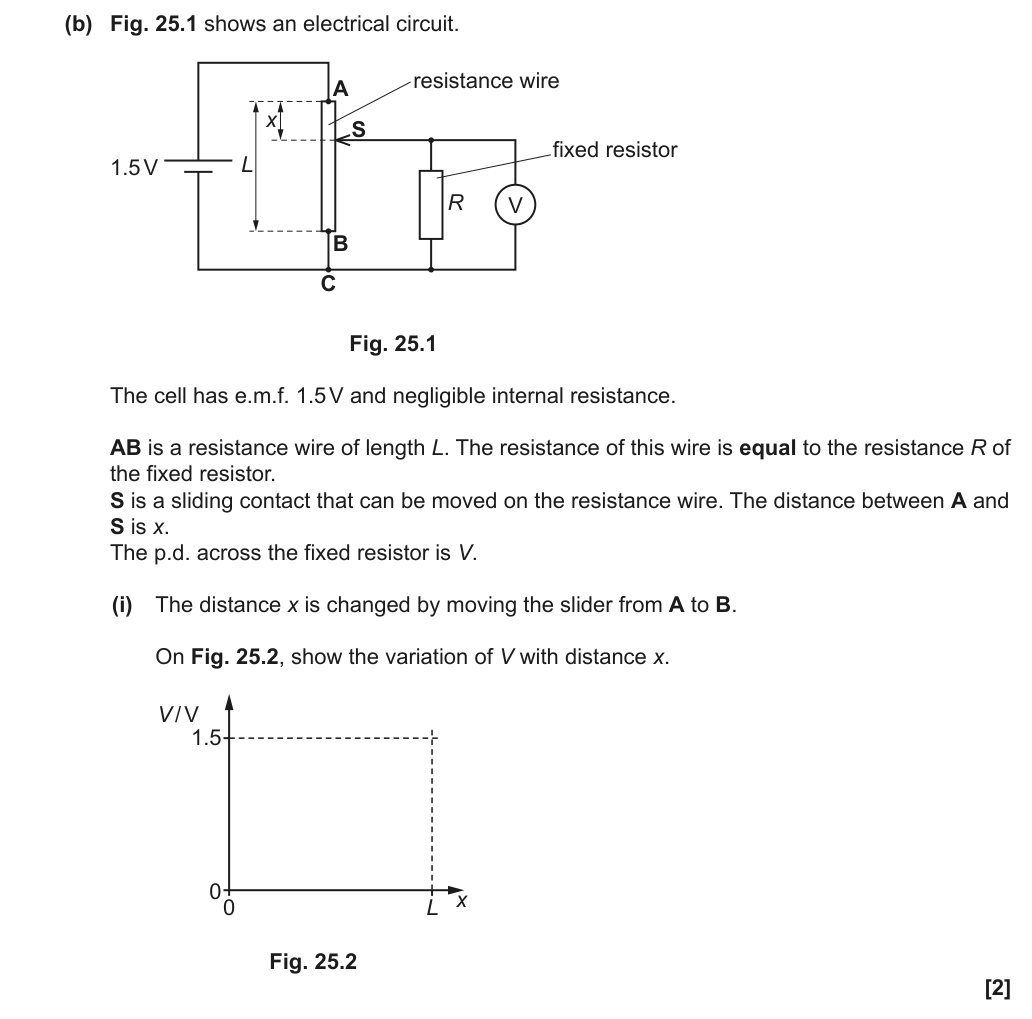
Many candidates were given no marks for this question and there was a significant number of candidates who omitted the question. Typical incorrect responses were to draw a line showing a directly proportional relationship between V and L. Very few candidates were given 2 marks for correctly showing a decreasing gradient.
Skills: M3.12 Sketch relationships which are modelled by y = k/x, y = kx², y = k/x², y = kx, y = sin x, y = cos x, y = e^(±x) and y = sin²x, y = cos²x as applied to physical relationships
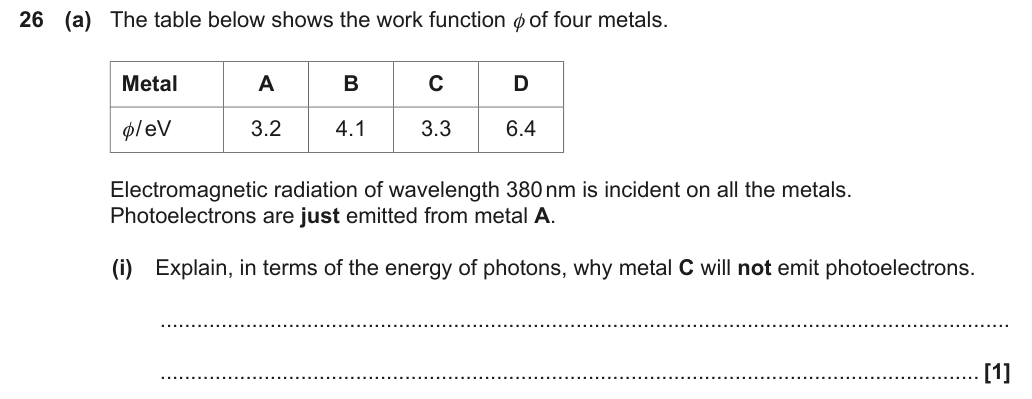
Very few candidates realised that no use of E = hc/λ was required to calculate the maximum wavelength as the work function of D was double of A so the maximum wavelength was half of 380 nm. Therefore, most candidates attempted to calculate the wavelength from the work function with a common error of not converting eV to J.
Skills: M0.3 Use ratios, fractions and percentages; M2.2 Change the subject of an equation, including non-linear equations
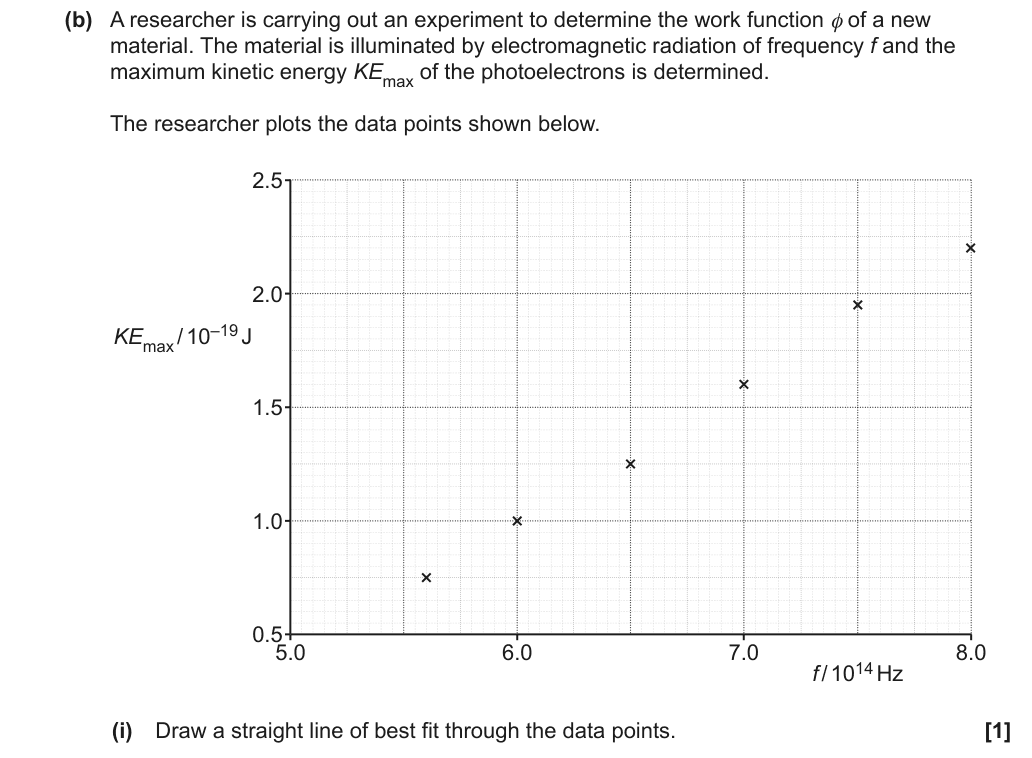
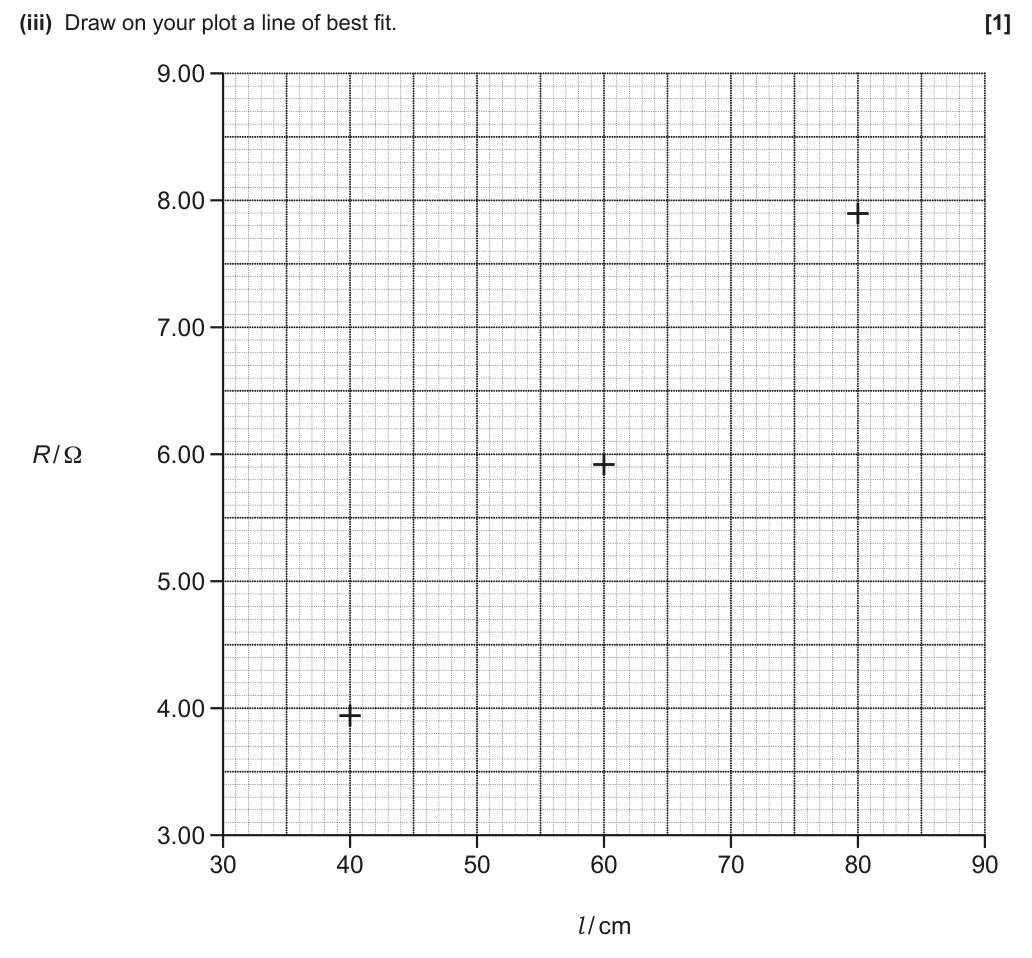
Most candidates performed well with this question as they correctly drew a line of best fit through the data points but a few candidates drew a line of best fit through the points (0.5, 5.0).
Skills: M3.2 Plot two variables from experimental or other data
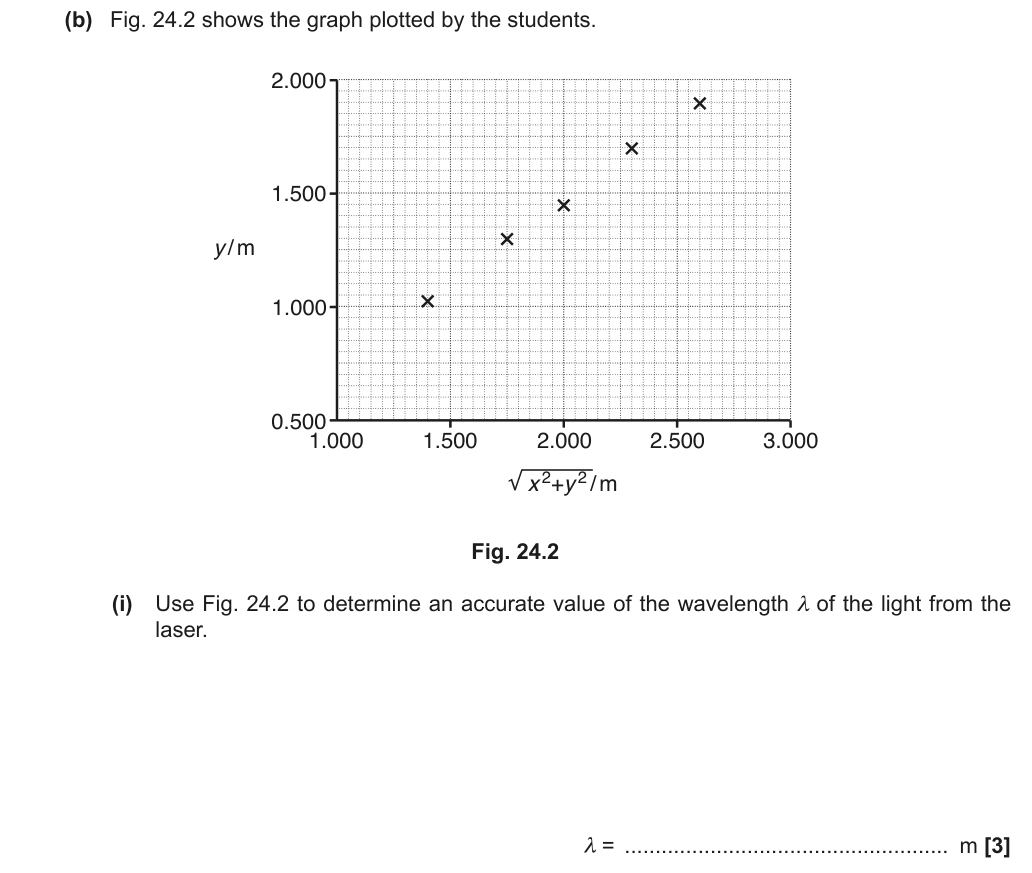
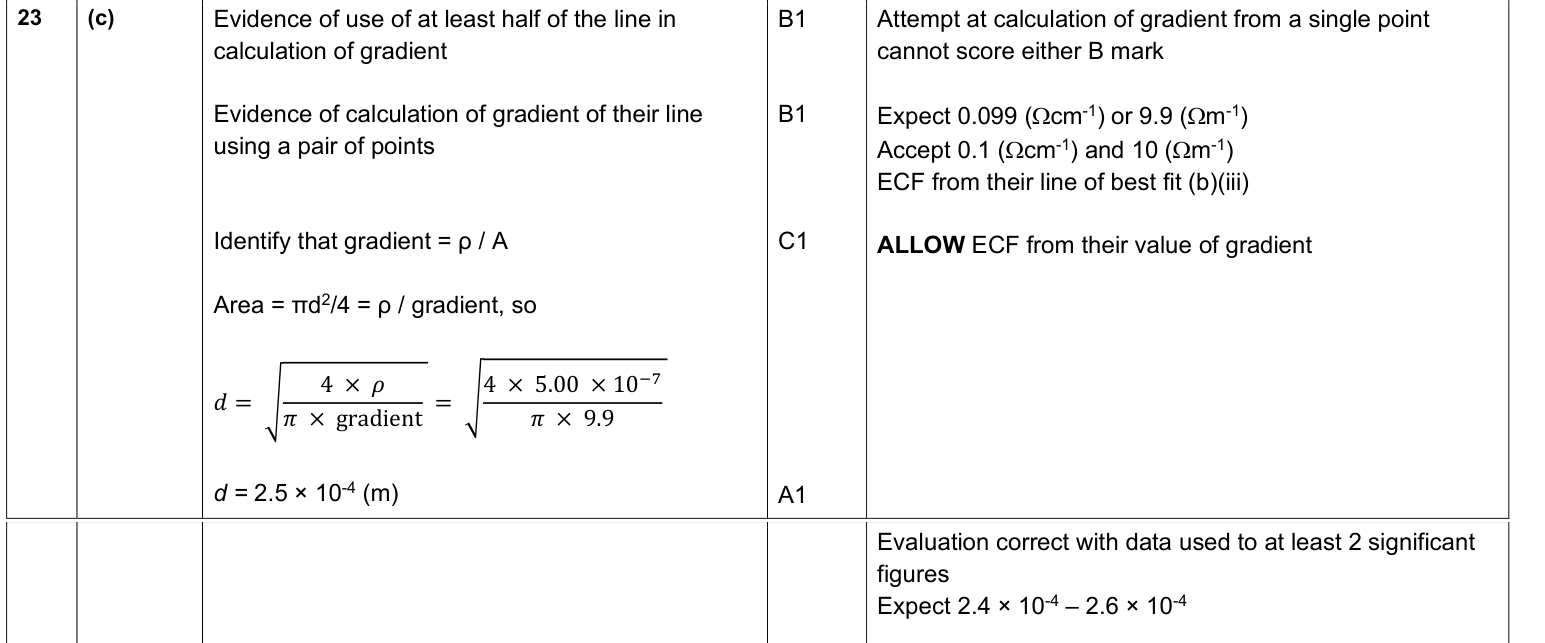
This question was assessing candidates’ skill to calculate a gradient value from the graph and use this value in an expression for the equation of a straight line to determine a value for the work function of the material which was the y-intercept, therefore few candidates correctly calculated a value within a stated range. Candidates were not given marks for using the stated value of h = 6.63 × 10⁻³⁴ J s as this did not assess the skill required by the question. Some candidates attempted to calculate a gradient value, so marks were given if they applied it in a correct expression of an equation for the straight line. If any of your students’ results are not as expected, you may wish to consider one of our post-results services. For full information about the options available visit the OCR website. We send a weekly roundup to tell you about important updates. You can also sign up for your subject specific updates. If you haven’t already, sign up here. Attend one of our popular CPD courses to hear directly from a senior assessor or drop in to a Q&A session. Most of our courses are delivered live via an online platform, so you can attend from any location. Please find details for all our courses on the relevant subject page on our website or visit OCR professional development. ExamBuilder is the question builder platform for a range of our GCSE, A Level, Cambridge Nationals and Cambridge Technicals qualifications. Find out more. ExamBuilder is free for all OCR centres with an Interchange account and gives you unlimited users per centre. We need an Interchange username to validate the identity of your centre's first user account for ExamBuilder. If you do not have an Interchange account please contact your centre administrator (usually the Exams Officer) to request a username, or nominate an existing Interchange user in your department. Review students' exam performance with our free online results analysis tool. It is available for all GCSEs, AS and A Levels and Cambridge Nationals. It allows you to: • review and run analysis reports on exam performance • analyse results at question and/or topic level • compare your centre with OCR national averages • identify trends across the centre • facilitate effective planning and delivery of courses • identify areas of the curriculum where students excel or struggle • help pinpoint strengths and weaknesses of students and teaching departments. Find out more. Post-results services Keep up-to-date OCR Professional Development Signed up for ExamBuilder?
Skills: M3.3 Understand that y = mx + c represents a linear relationship; M3.4 Determine the slope and intercept of a linear graph
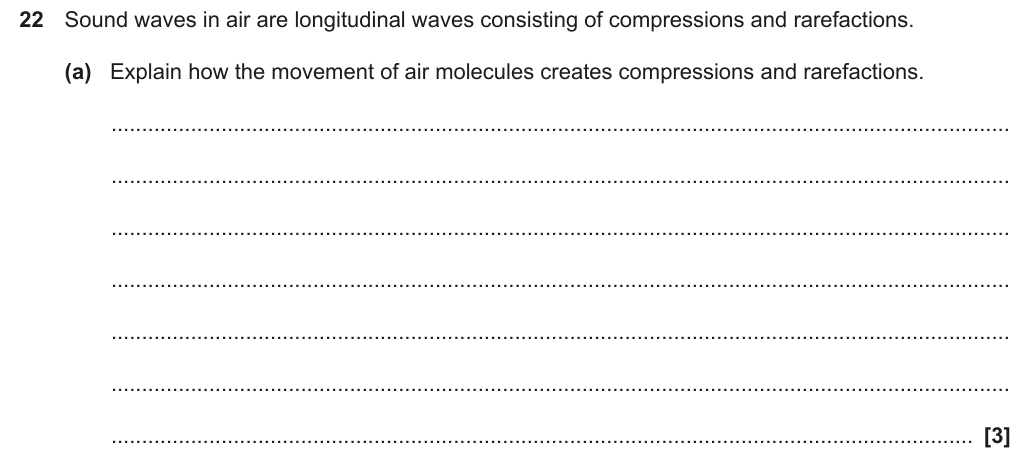
Candidates’ performance on this question was variable with about of half of candidates scoring 1 or 2 marks but few candidates achieving all 3 marks for correctly explaining the movement of air molecules in compression and rarefaction of longitudinal waves. Descriptions of the movement of particles to transfer energy as a longitudinal wave was often weak with limited use of scientific language such as oscillation and parallel. The most common mark that was given was for an explanation of how compressions and rarefactions are formed in reference to the proximity of air molecules.
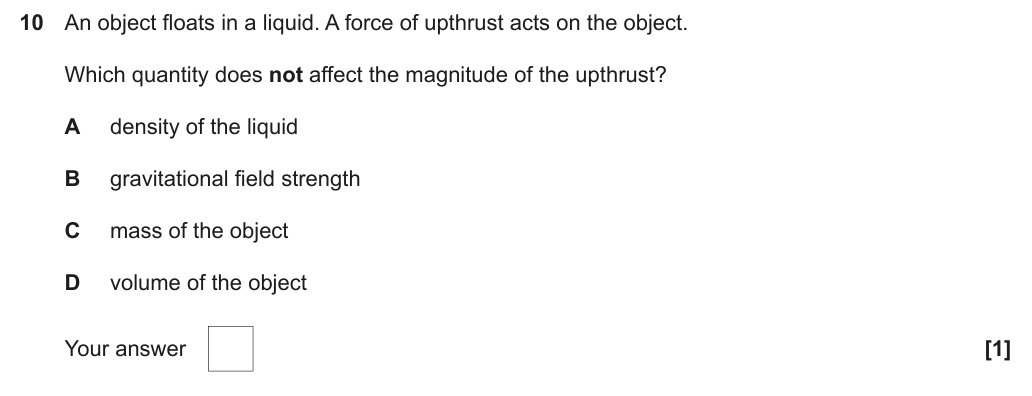
There were many incorrect answers to this question. A significant minority of candidates selected the gravitational field strength option.
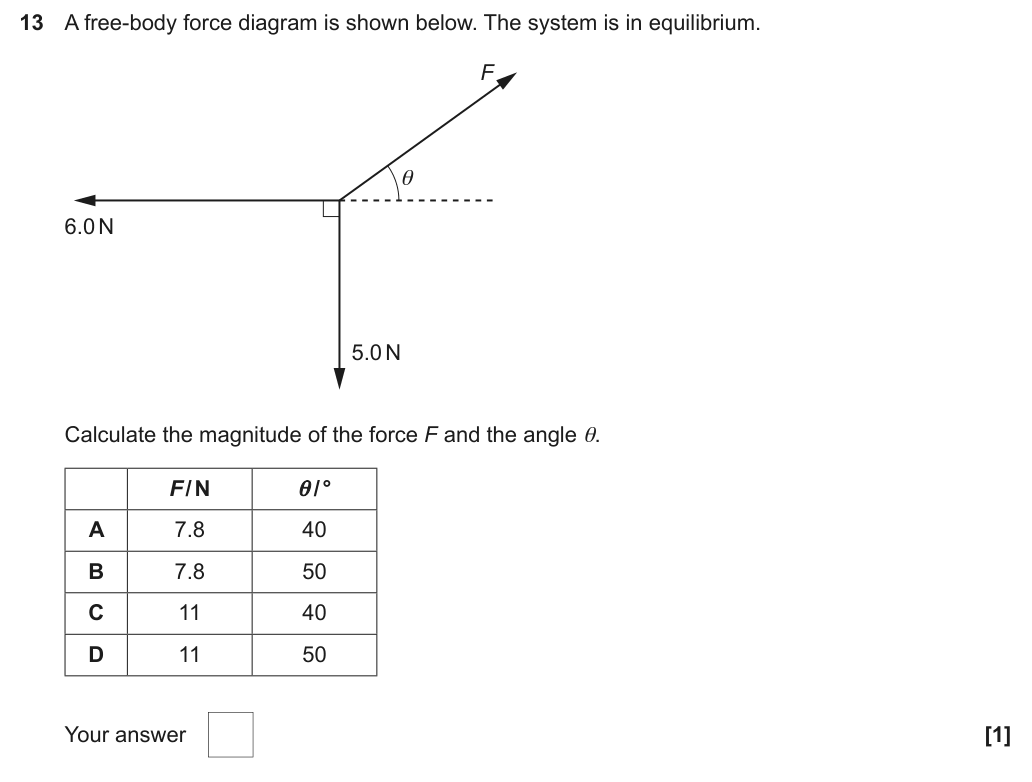
A
A few candidates incorrectly selected C – adding the two forces 5.0 N and 6.0 N to equal11 N.
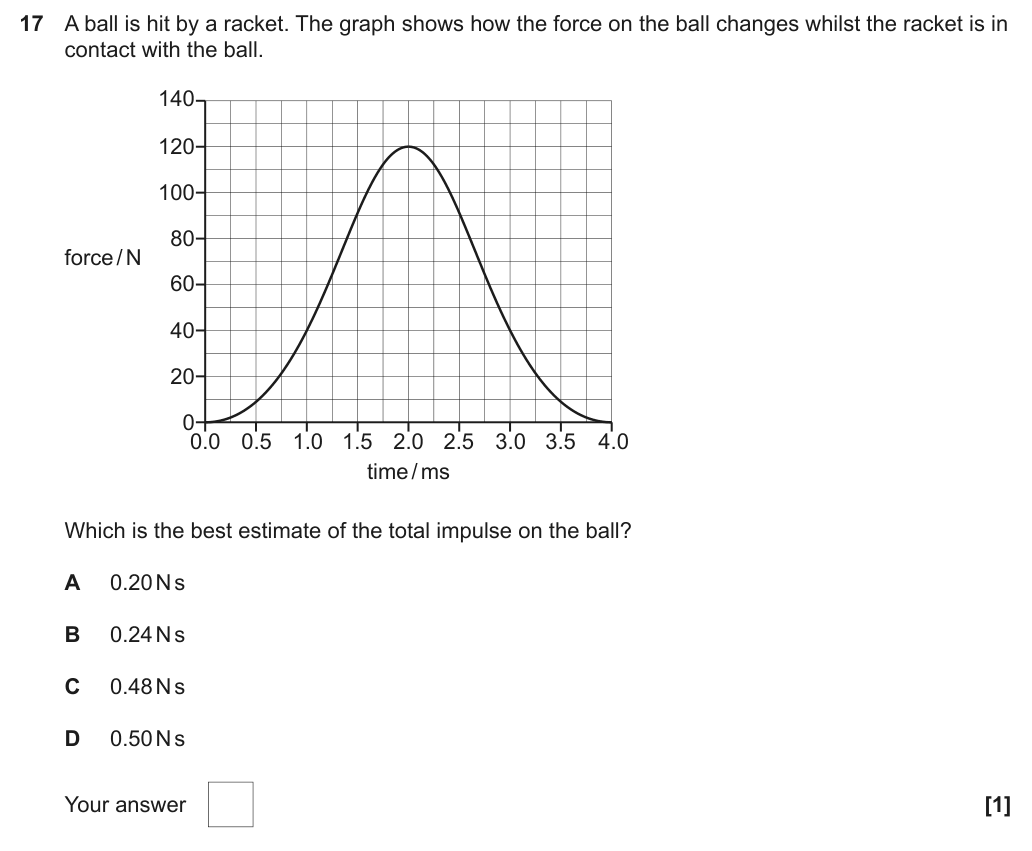
A
Candidates found this question more challenging. Some candidates realised that the total impulse was given from the area under the graph but then did not calculate the area correctly. Some clearly drew a triangle and gained an answer of 0.24 N s without allowing for the area inside the triangle. Other candidates multiplied.
Skills: M0.1 Recognise and make use of appropriate units in calculations; M3.8 Understand the possible physical significance of the area between a curve and the x axis and be able to calculate it or estimate it by graphical methods as appropriate
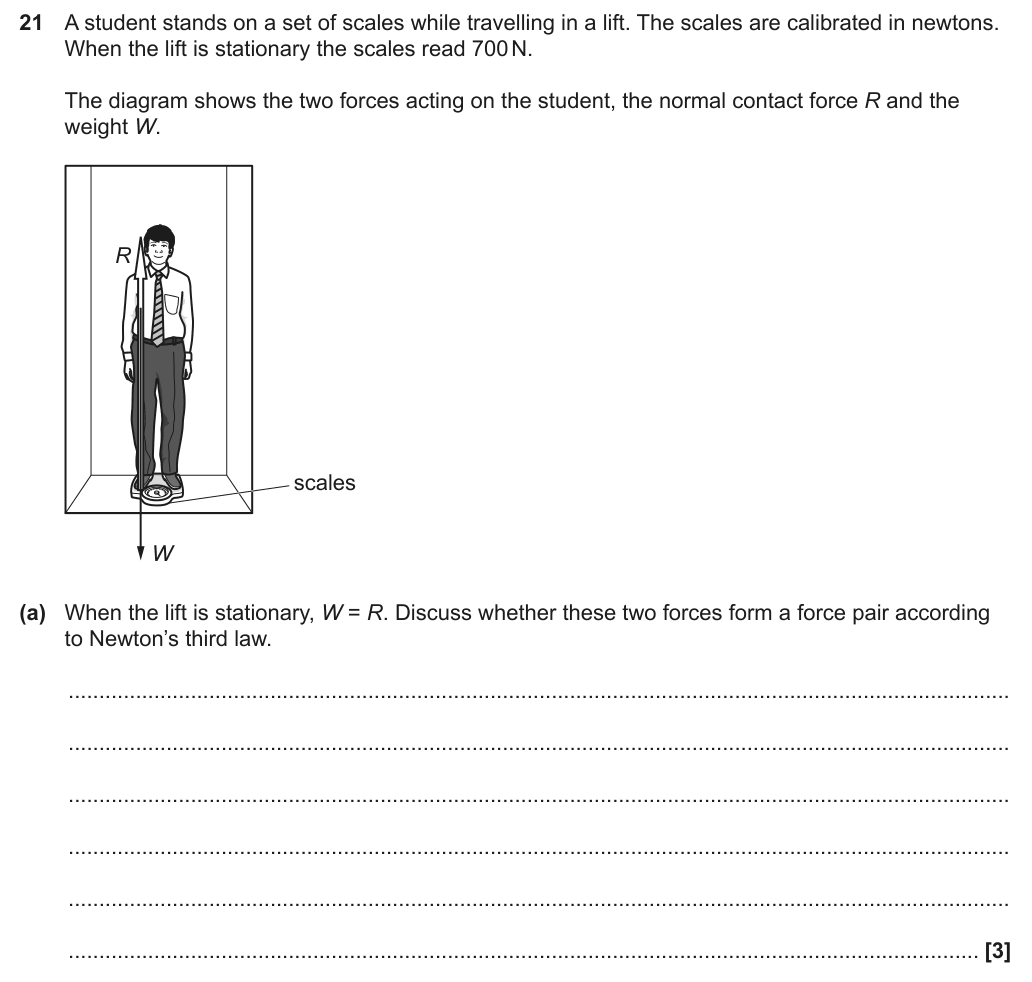
Many candidates understand the basic detail of Newton’s third law but do not appreciate the finer detail that it applies to two bodies and that the forces have to be of the same type. The states that there are two forces are acting on the student, so therefore only one body. Candidates should also have realised that the force of gravity or weight is a non-contact force and that the normal contact force is a contact force. A significant minority of candidates gave an incomplete answer where they referred to one of the two reasons as why the forces did not form a force pair without thinking about the answer space or the number of marks for the question. A few candidates did not state whether or not a force pair was formed. Candidates should be encouraged to think about the space to answer and the number of marks for each question. In this case there were 3 marks available so three distinct points should be included in their discussion.
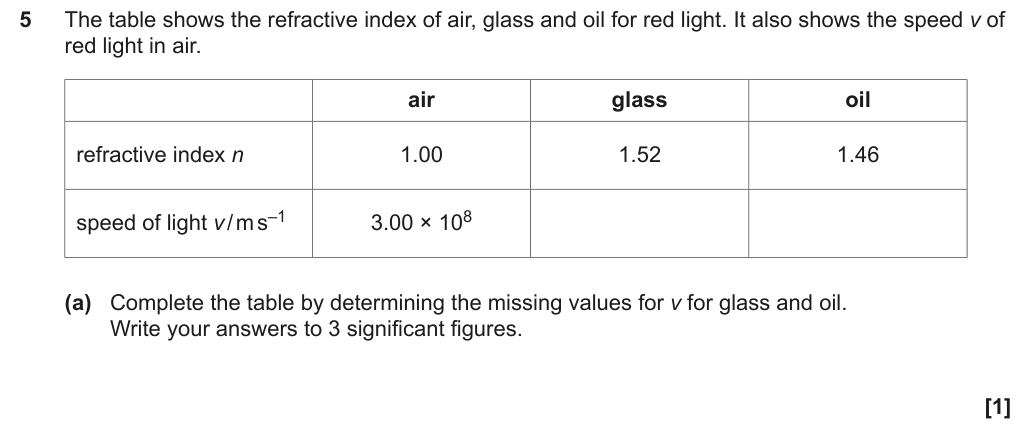
This was a challenging question in that there were many vague answers that did not state that by not cleaning the glass the refractive index could be different.

This was a challenging question designed to assess a candidate’s understanding of refractive index. Very few candidates were able to state that the frequency or wavelength of the light used. There are several vague responses in terms of the intensity of the light or temperature. However, examiners allowed the temperature of the liquid or the density of the liquid.
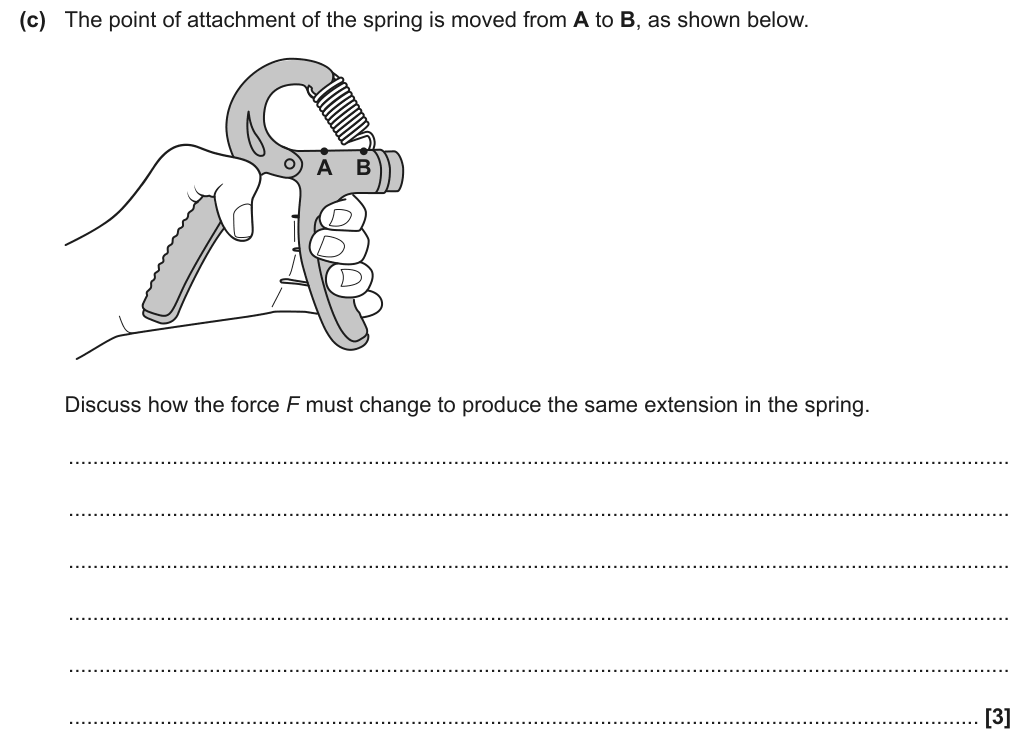
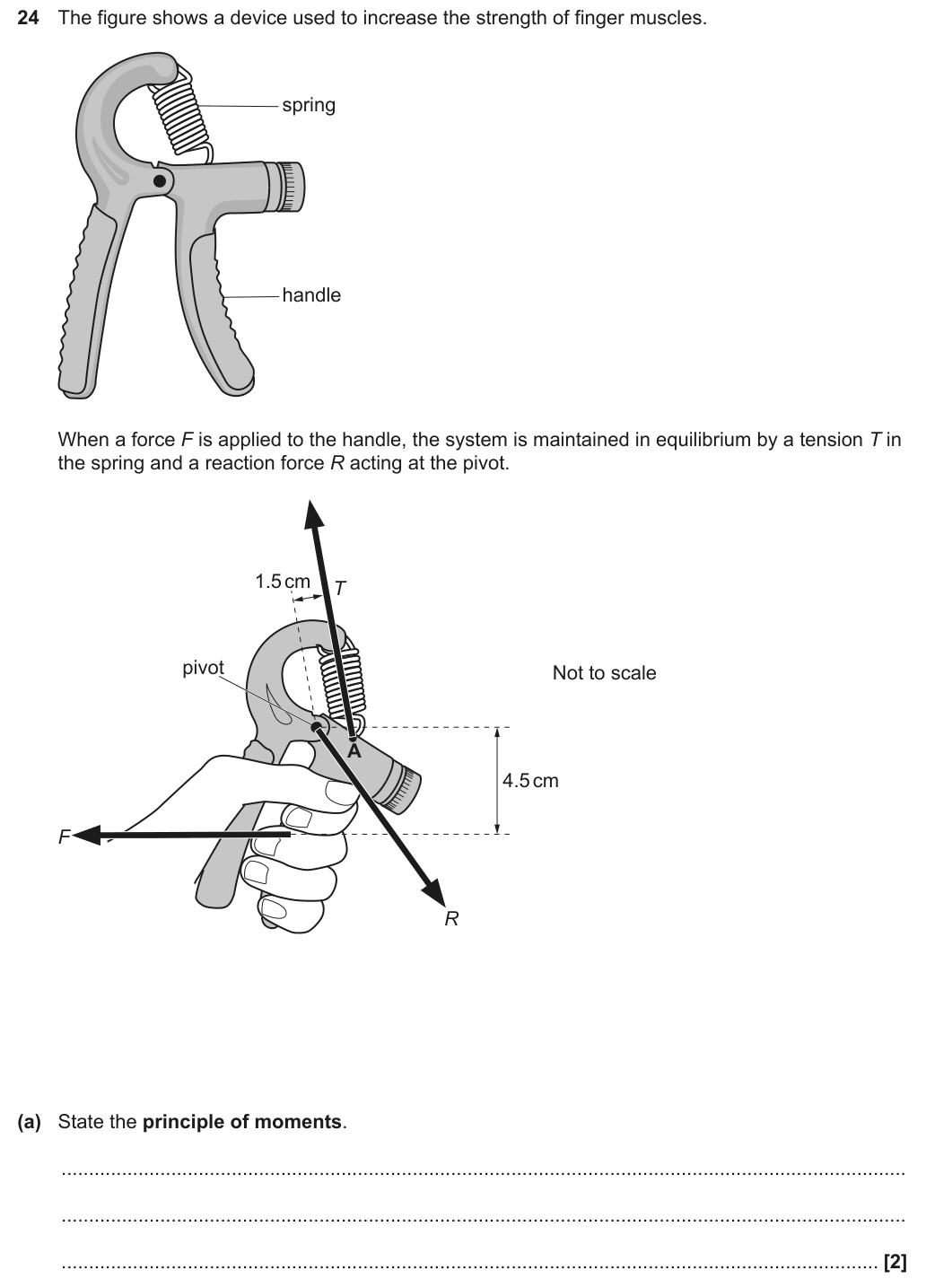
This question was challenging. Candidates needed to identify that for the extension to remain constant, the tension needed to remain the same but the perpendicular distance between the pivot and the line of action of T had increased so that the moment due to T increases. Thus, the moment for F needs to increase. Since the perpendicular distance between the pivot and the line of action of F has stayed the same, the force F must be larger. Many candidates did not refer to T remaining constant. Other candidates did not refer to perpendicular distances. This candidate has clearly explained their answer and included relevant equations. A step-by-step approach has been included and at each stage there is a clear explanation of the physics.
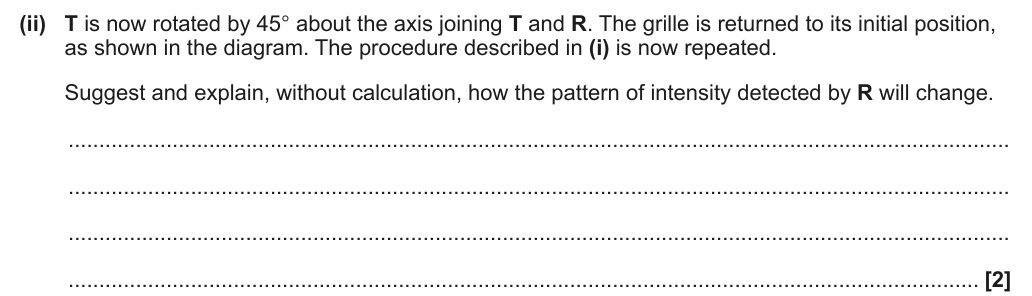
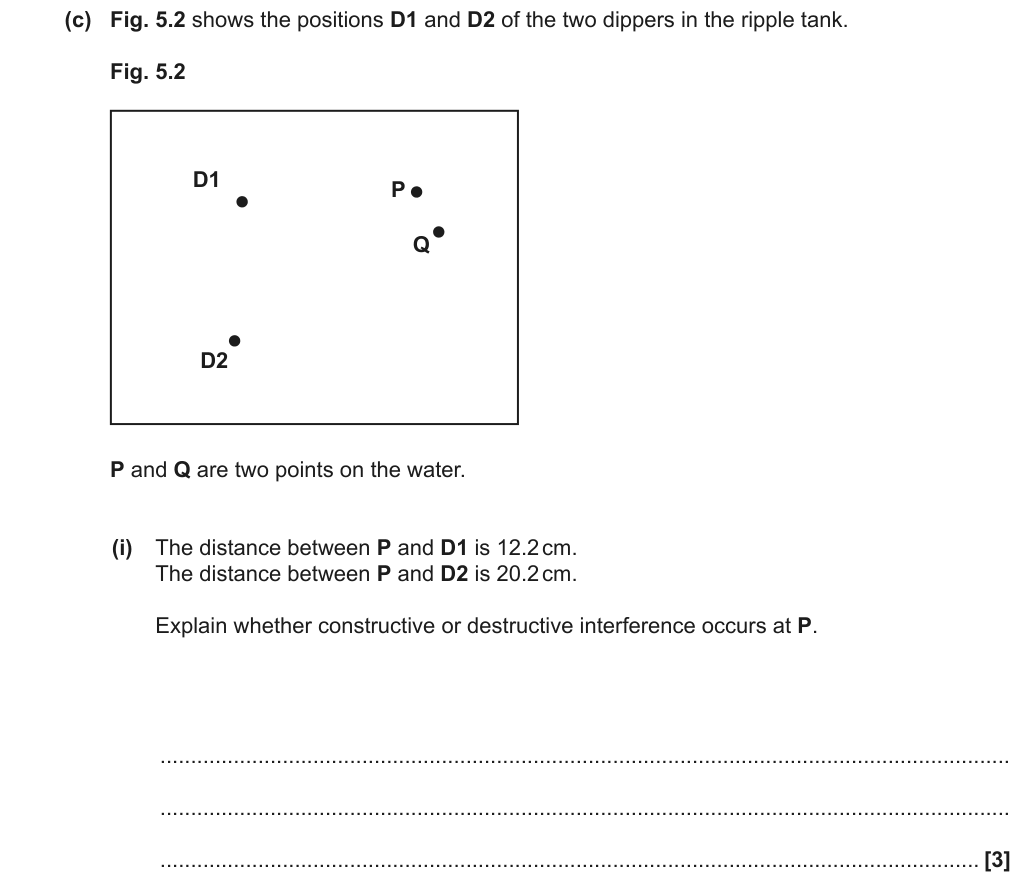
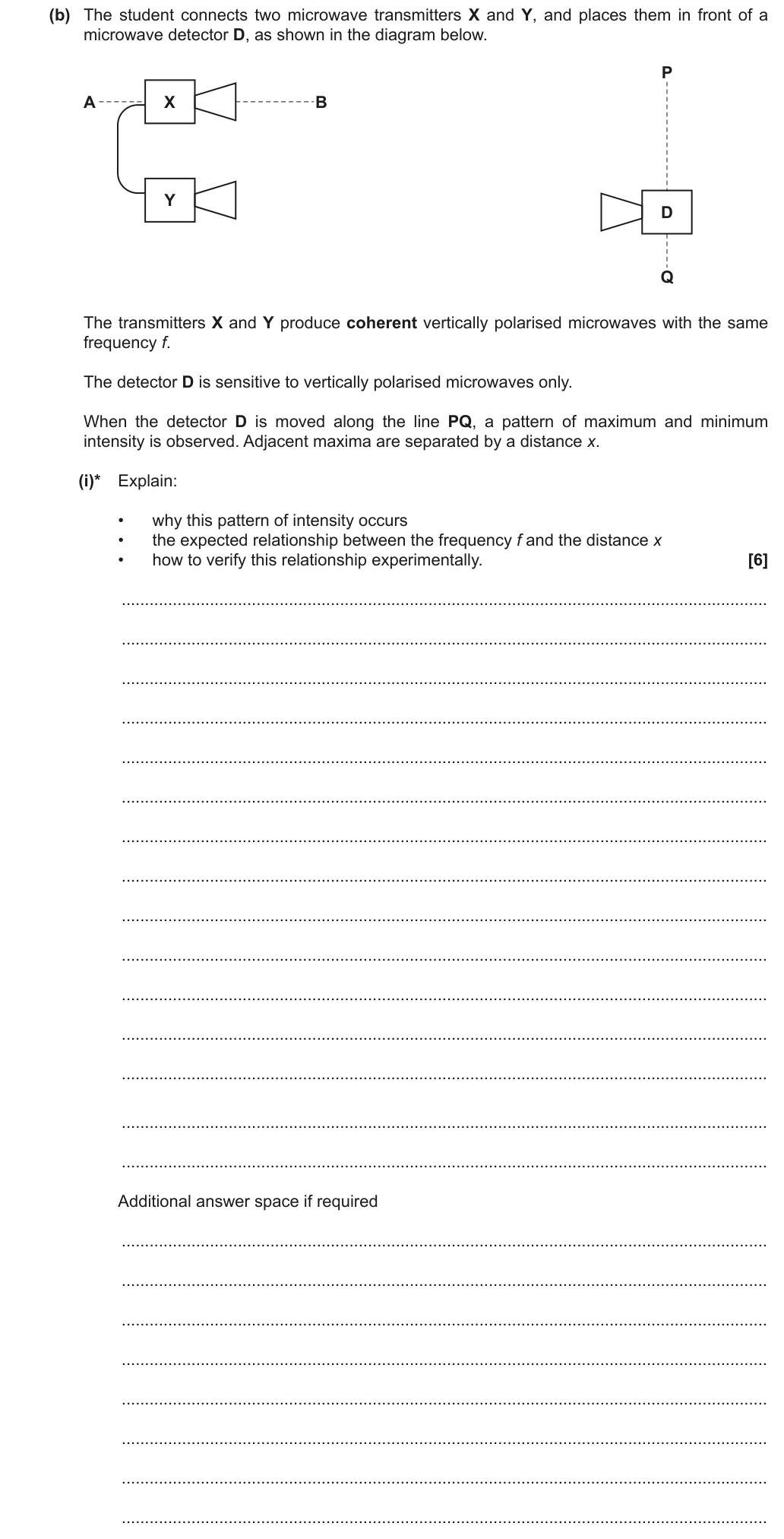
Most candidates discussed that the pattern would be shifted without realising that the maximum intensity of the pattern would be reduced. Very few candidates explained that the reason for the decrease maximum intensity was due to the detector receiving a smaller component of the transmitted wave.
Skills: PAG5 Investigating waves
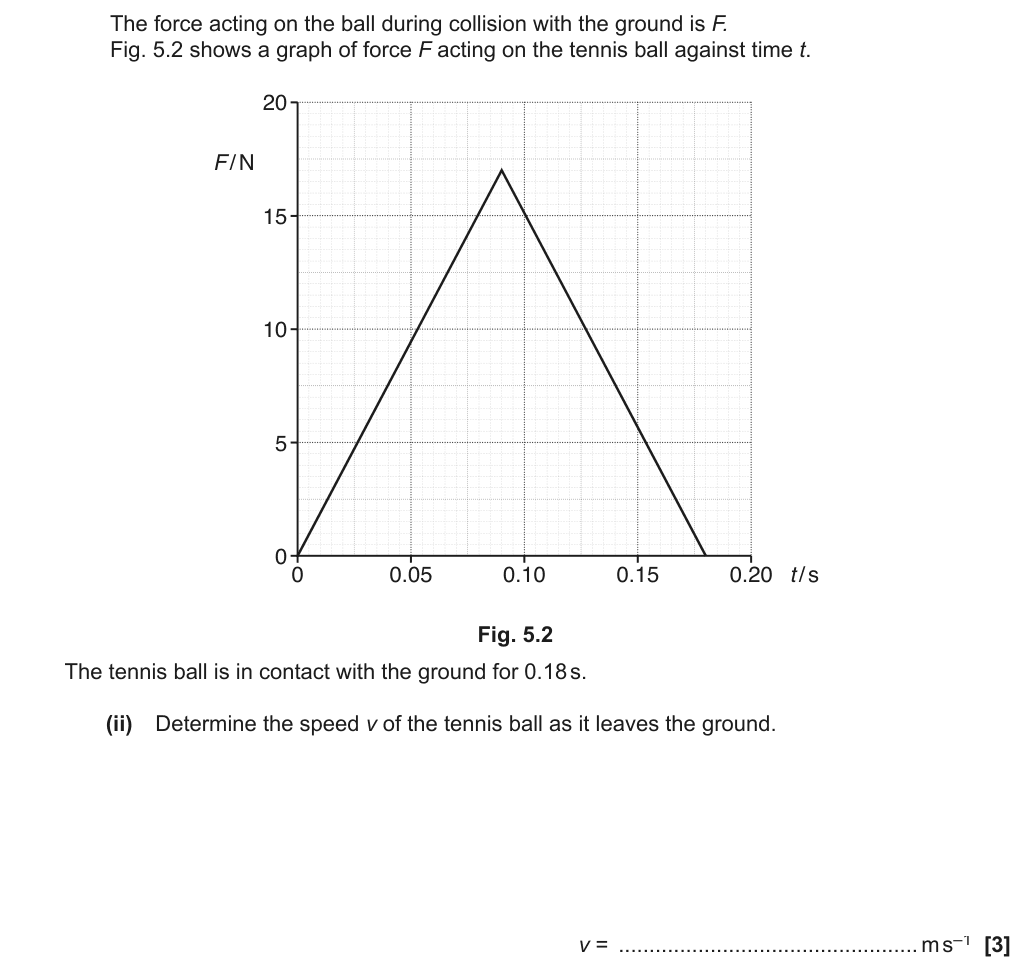
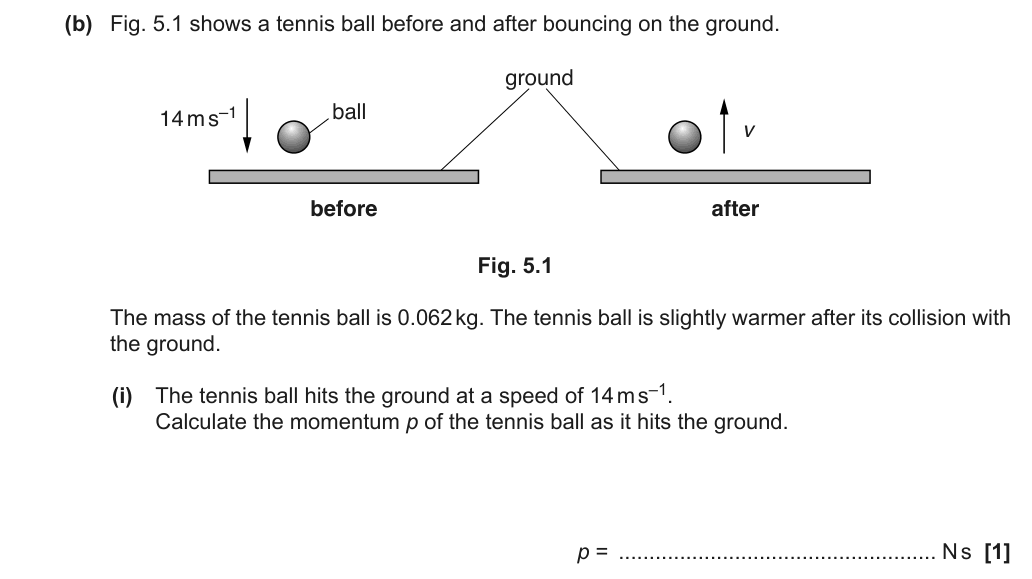
Candidates found this question difficult. Candidates needed to realise the importance of Fig. 5.2 and understand that the area under the graph was equal to the change of momentum of the ball. It is important that candidates show their working so that if the graph is misread they may still obtain credit later. Having determined the change in momentum correctly, candidates then needed to determine the momentum of the ball leaves the ground. This exemplar demonstrates that the candidate understands that the area under the graph is the impulse. The method to calculate the area is shown and although the candidate has not used the answer to (b)(i), the method in terms of the change of velocity is correct and clearly indicated.
Skills: M2.3 Substitute numerical values into algebraic equations using appropriate units for physical quantities; M3.8 Understand the possible physical significance of the area between a curve and the x axis and be able to calculate it or estimate it by graphical methods as appropriate; M4.3 Calculate areas of triangles, circumferences and areas of circles, surface areas and volumes of rectangular blocks, cylinders and spheres
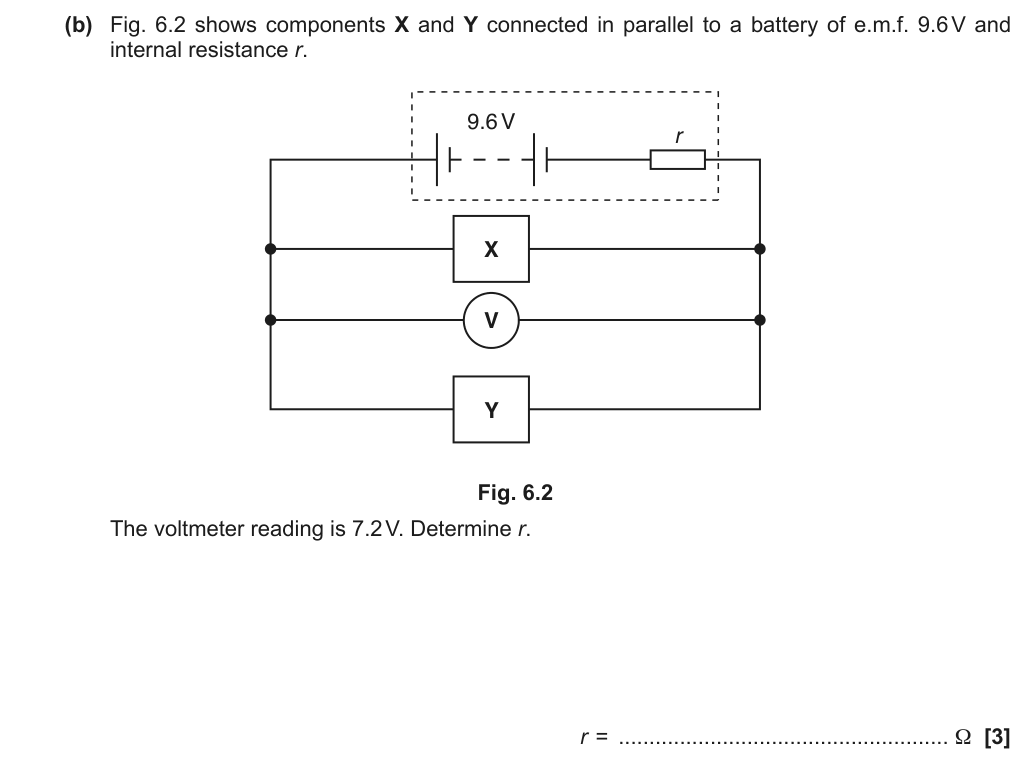
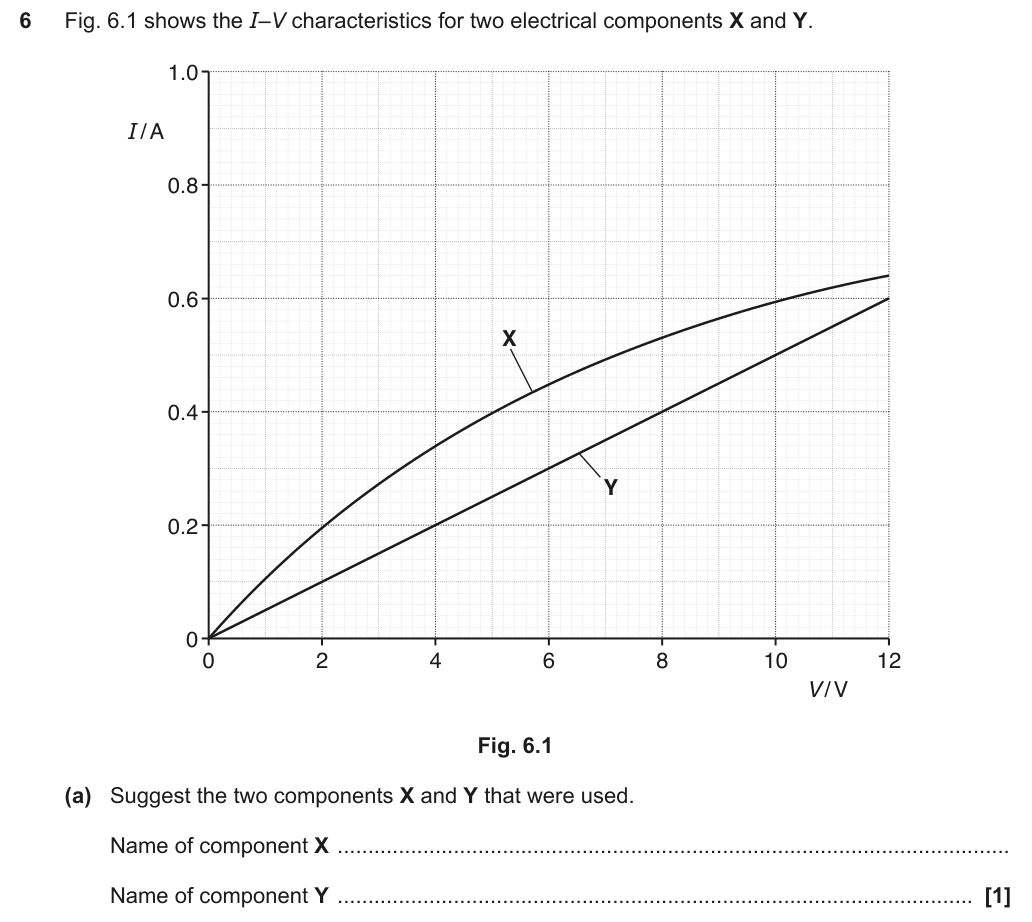
This question assessed candidates’ knowledge of internal resistance as well as their understanding of series and parallel circuits. Many candidates correctly determined that the ‘lost volts’ was 2.4 V. Unfortunately, the total current in the circuit was more difficult for candidates to determine. Candidates needed to identify that the potential difference across each component was 7.2 V and use the graphs to determine the two current values. Again, good candidates clearly show their working. The advantage would be in that an error in reading information from the graph would still allow further credit. The candidate has clearly state the method and at the top stated that Ir = 2.4 V. The candidate has then clearly read the currents for each component at a potential difference of 7.2 V to then determine the total current. There is then a correct calculation to determine the internal resistance r.
Skills: M2.2 Change the subject of an equation, including non-linear equations; M3.1 Translate information between graphical, numerical and algebraic forms
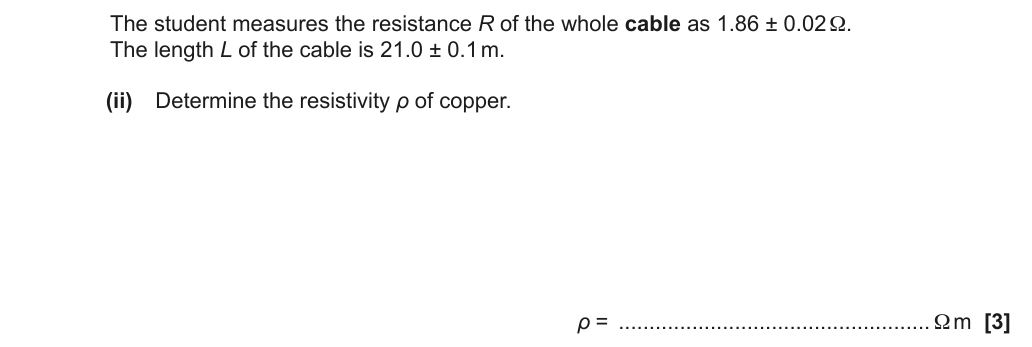
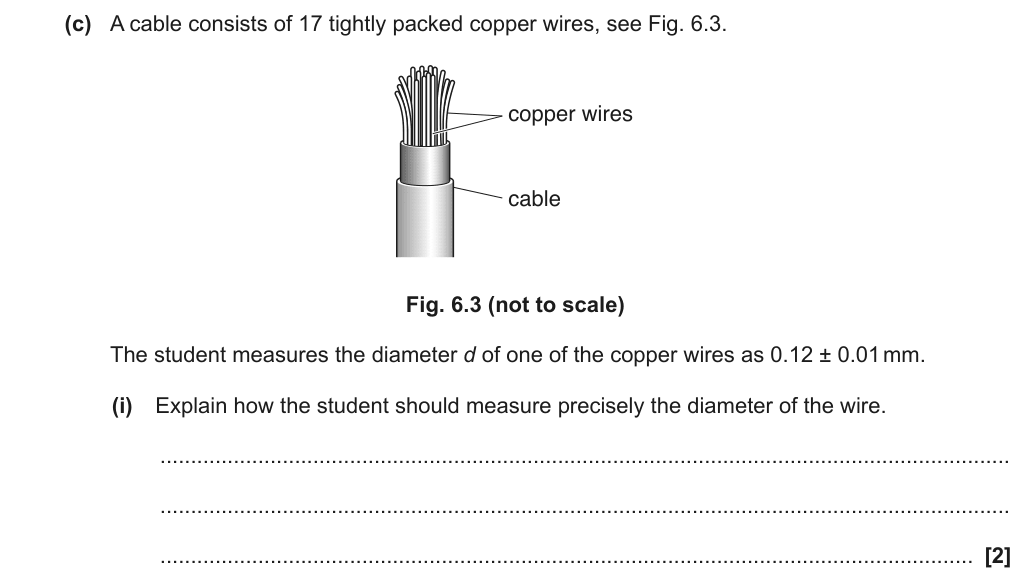
A very large number candidates did not take into account that the resistance of the cable was the resistance of 17 wires in parallel. Many candidates did not clearly show their working. Good candidates calculated the cross-sectional area of one wire and then correctly rearranged the resistivity equation from the data booklet. Some lower ability candidates had difficulty in calculating the cross-sectional area of the wire and there were often power of ten errors. This candidate has correctly approached the question by determining the total area of the copper in the cable and then correctly used the equation. Again, the equations used are clearly demonstrated.
Skills: M0.2 Recognise and use expressions in decimal and standard form; M2.2 Change the subject of an equation, including non-linear equations; M2.3 Substitute numerical values into algebraic equations using appropriate units for physical quantities; M4.3 Calculate areas of triangles, circumferences and areas of circles, surface areas and volumes of rectangular blocks, cylinders and spheres
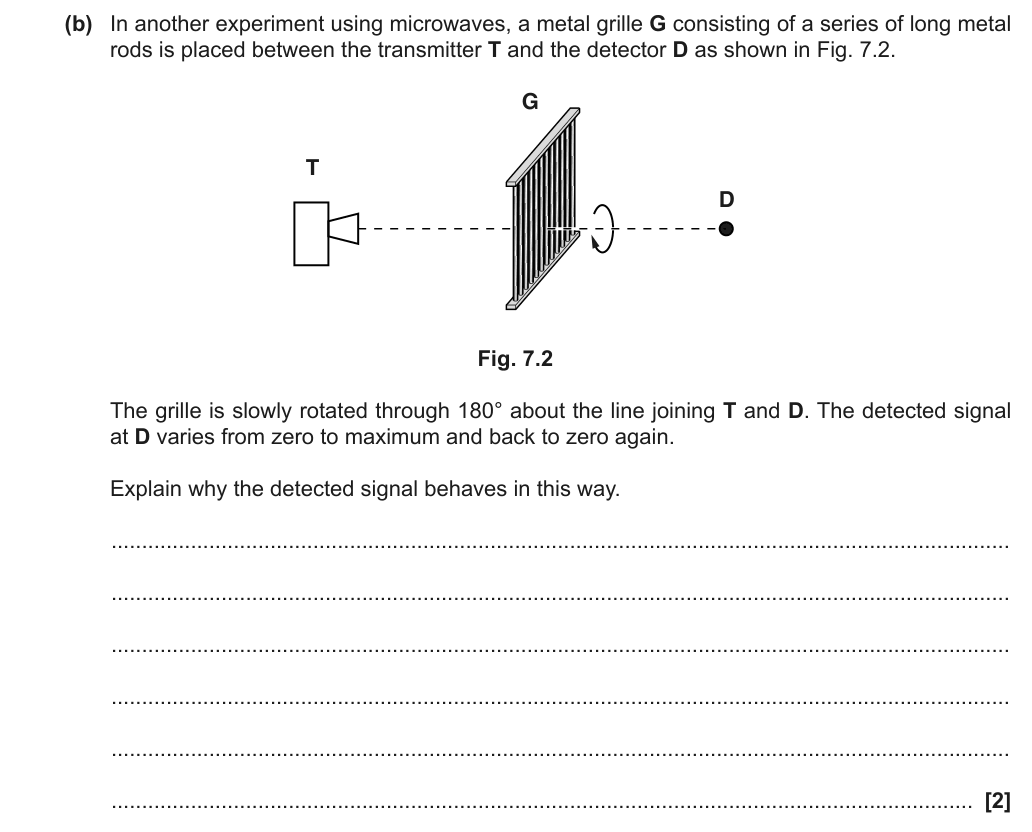
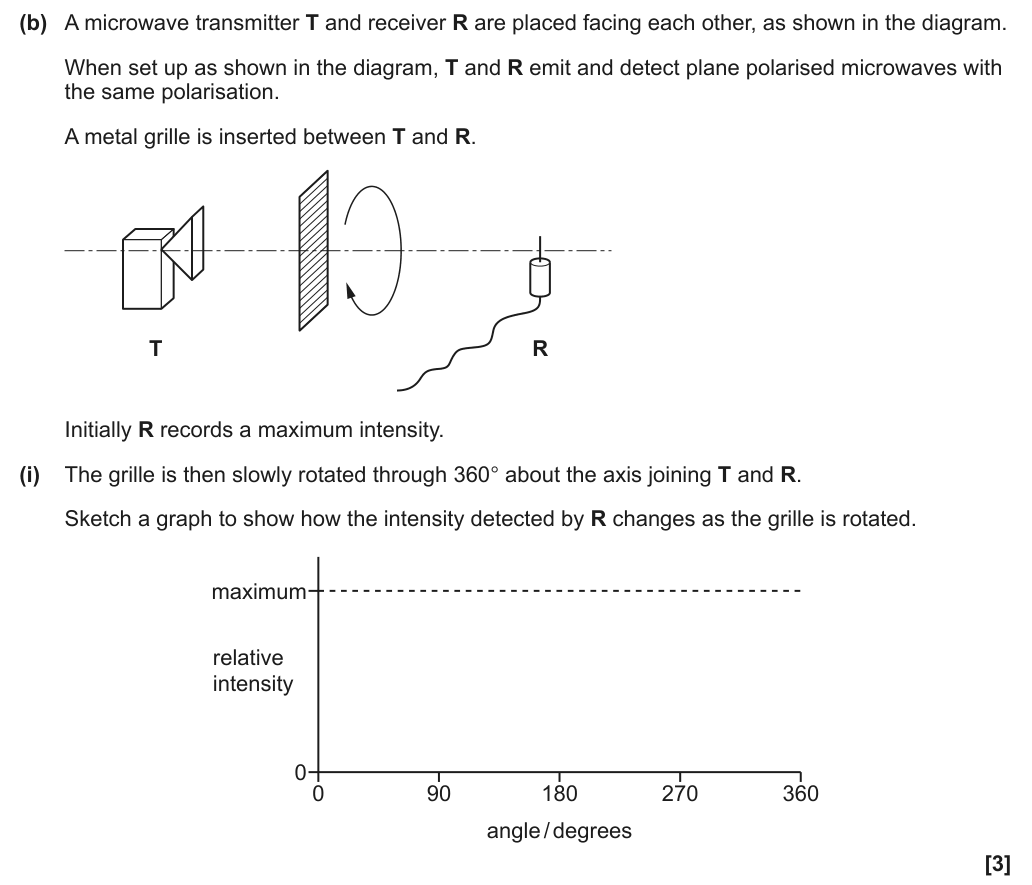
Candidates found this question difficult. Candidates often did not state that the microwaves were polarised or mistakenly thought that the grille caused the microwaves to become polarised. Candidates also did not appear to read the question carefully often thinking that the detected signal varied from a maximum initially. Some candidates quoted 𝐼𝐼= 𝐼𝐼0cos2𝜃𝜃 to help explain their answer.
Skills: PAG5 Investigating waves
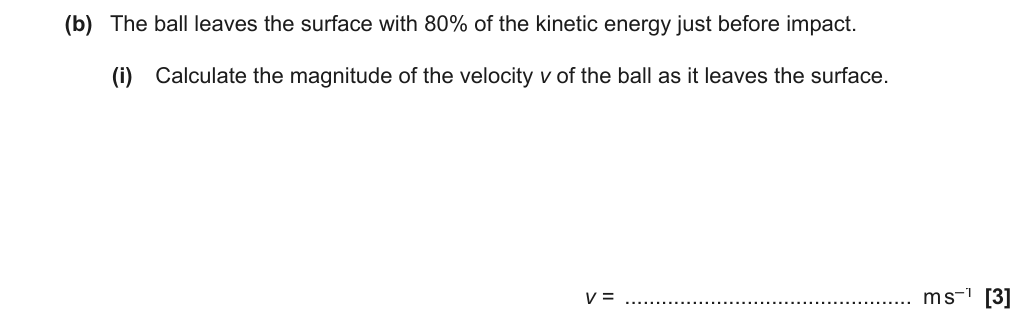
In this question, higher ability candidates initially determined the kinetic energy (0.504 J) as the ball leaves the surface, before rearranging the kinetic energy equation. A few candidates did not take the final square root.
Skills: M0.3 Use ratios, fractions and percentages; M2.2 Change the subject of an equation, including non-linear equations
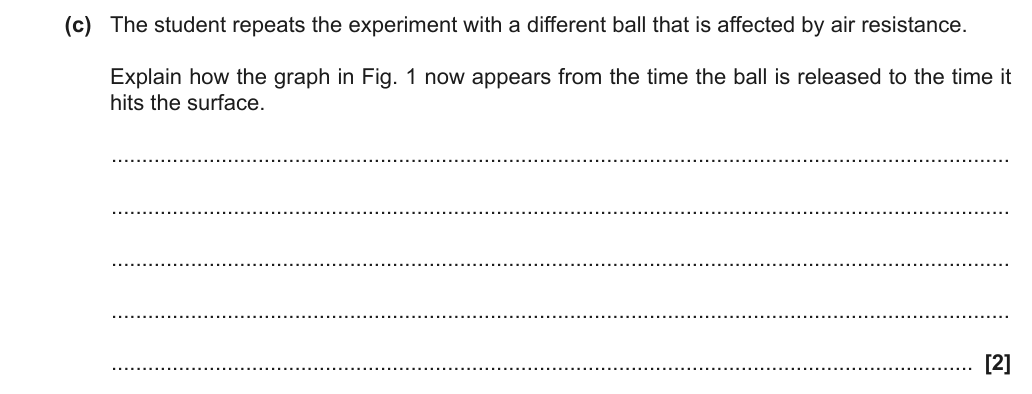
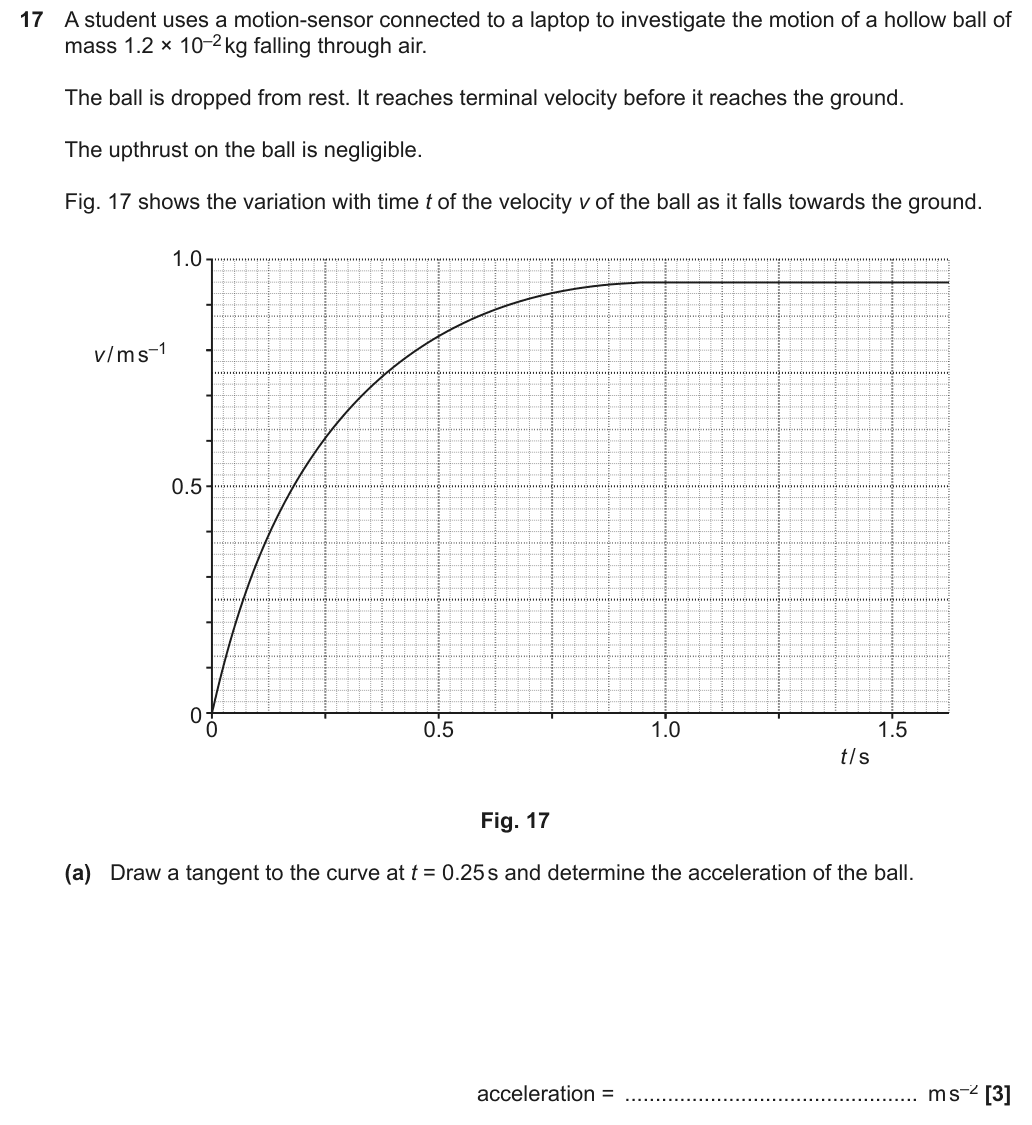
Candidates found this question challenging. Many candidates answered the question in terms of air resistance and terminal velocity. The question required candidates to explain how the graph would appear. Several candidates stated that the gradient would be smaller but did not clearly state that the gradient would decrease over time and not indicate that the line would curve. Candidates needed to also indicate that the line would indicate a lower maximum velocity at a longer time.
Skills: M3.1 Translate information between graphical, numerical and algebraic forms
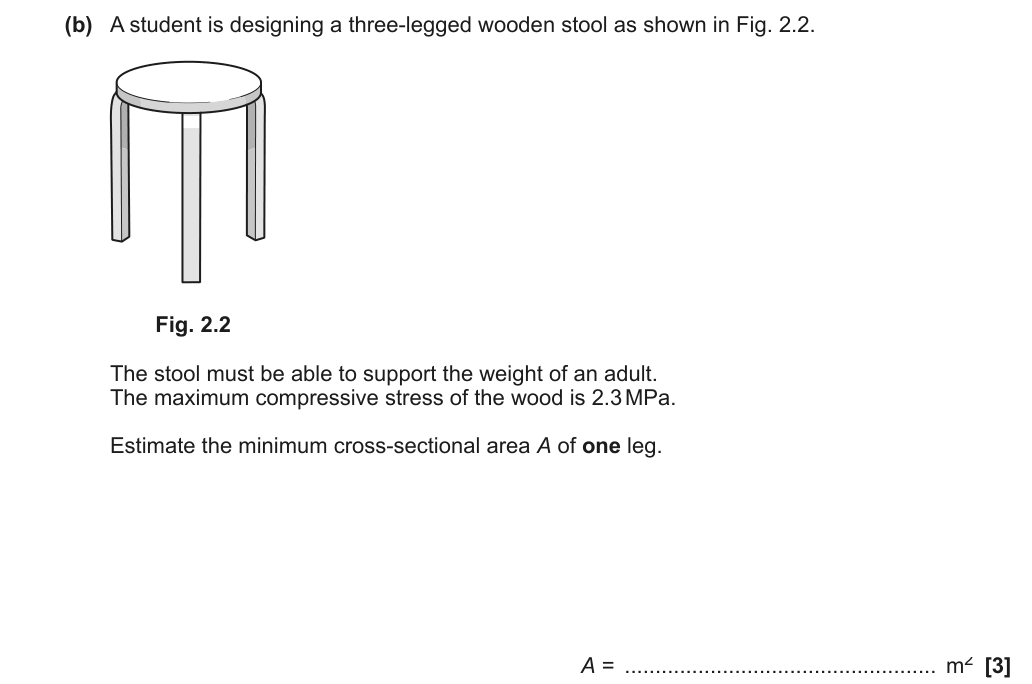
A good proportion of the candidates scored full marks on this question. Some candidates found the total area rather than the area of one leg. A few candidates assumed that the stool had four legs. This question required candidates to estimate the mass or weight of an adult. In general, in this type of question a more generous mass is sensible. Candidates who did well on this question started by stating the mass (or weight) of an adult. Examiners allowed a mass between 50 kg and 150 kg. Candidates then often worked out the total area before working out the area of one of the legs. Some candidates did not correctly understand that 2.3 MPa was equal to 2.3 × 10⁶ Pa. Some candidates incorrectly divided the stress by three. This candidate has clearly identified the average weight of an adult and then indicated how the weight of the adult is determined. The candidate has then clearly stated the equation for stress and shown their working for full marks.
Skills: M0.1 Recognise and make use of appropriate units in calculations; M0.4 Estimate results; M2.2 Change the subject of an equation, including non-linear equations
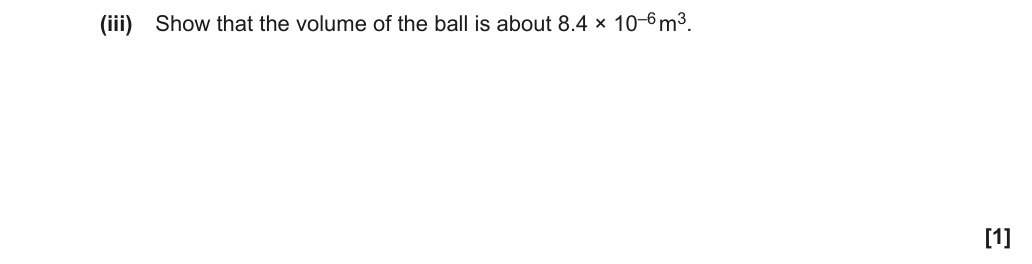
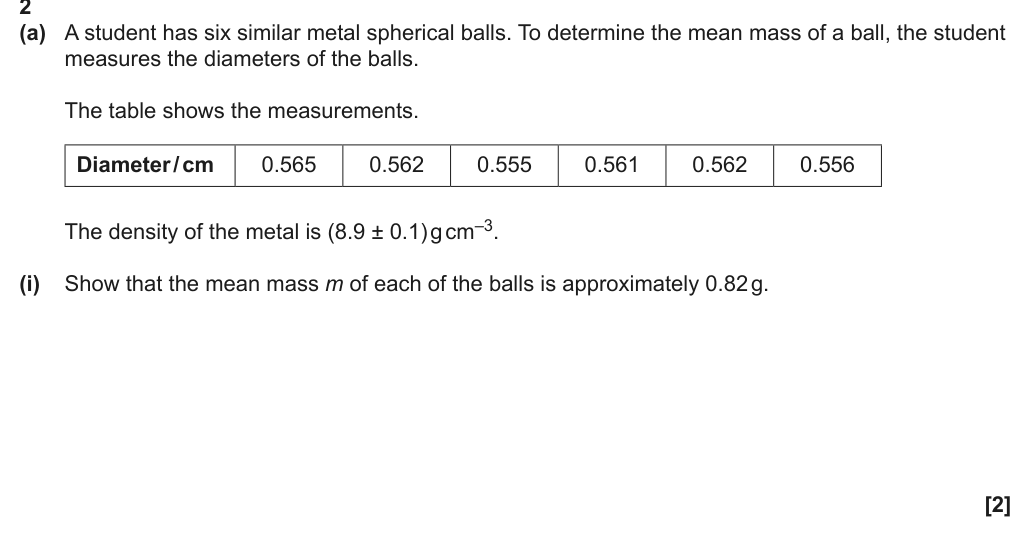
This was another “show” question. Many candidates find dealing with standard form terms in their calculator difficult. Candidates needed to show clearly the conversion of the diameter in cm to radius in m. There was some evidence of candidate just adding a 10–6 power to their answer.
Skills: M0.1 Recognise and make use of appropriate units in calculations; M4.3 Calculate areas of triangles, circumferences and areas of circles, surface areas and volumes of rectangular blocks, cylinders and spheres
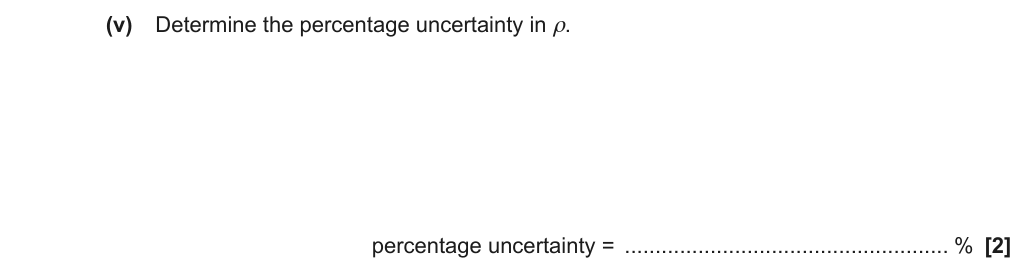
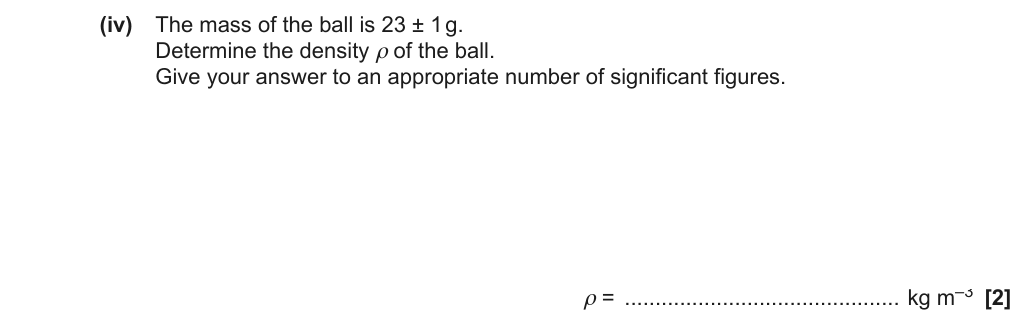
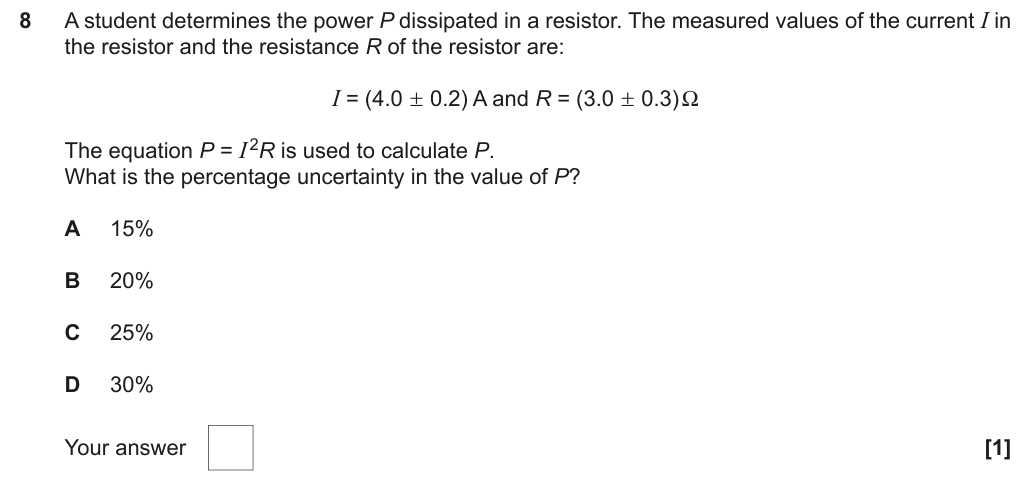
The majority of candidates were able to determine the percentage uncertainty in the mass correctly. Fewer candidates realised that the percentage uncertainty in the volume was three times the percentage uncertainty in the diameter. Candidates who did well, clearly showed their working. Some candidates tried to use a maximum/minimum method. This was a more complex method and more difficult for candidates to gain the correct answer. In this case, the maximum mass needed to be divided by the minimum volume or the minimum mass needed to be divided by the maximum volume The candidate’s answer is logically structured showing the percentage uncertainty in the mass and volume and then adding them together so gaining both marks. An answer of 14% would have been acceptable.
Skills: M0.3 Use ratios, fractions and percentages; M1.5 Identify uncertainties in measurements and use simple techniques to determine uncertainty when data are combined
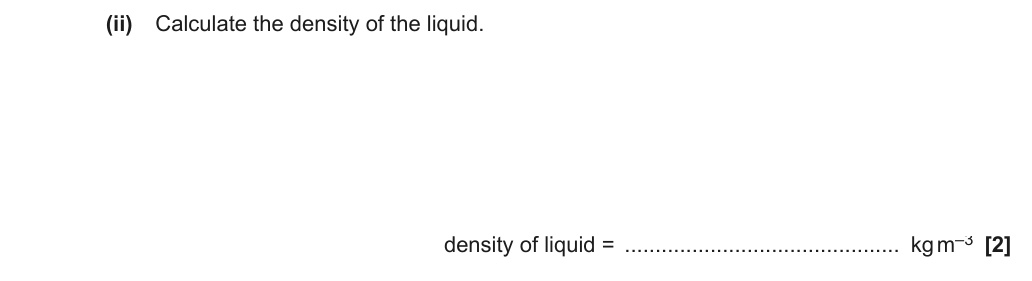
Candidates generally found this last question challenging. Some candidates who did less well, attempted to use the equation for liquid pressure. Candidates who did well again clearly showed their reasoning.
Skills: M2.2 Change the subject of an equation, including non-linear equations; M2.3 Substitute numerical values into algebraic equations using appropriate units for physical quantities
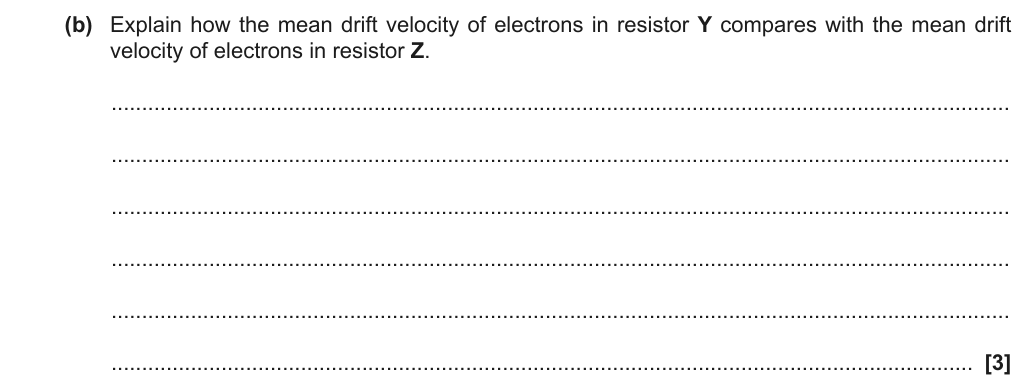
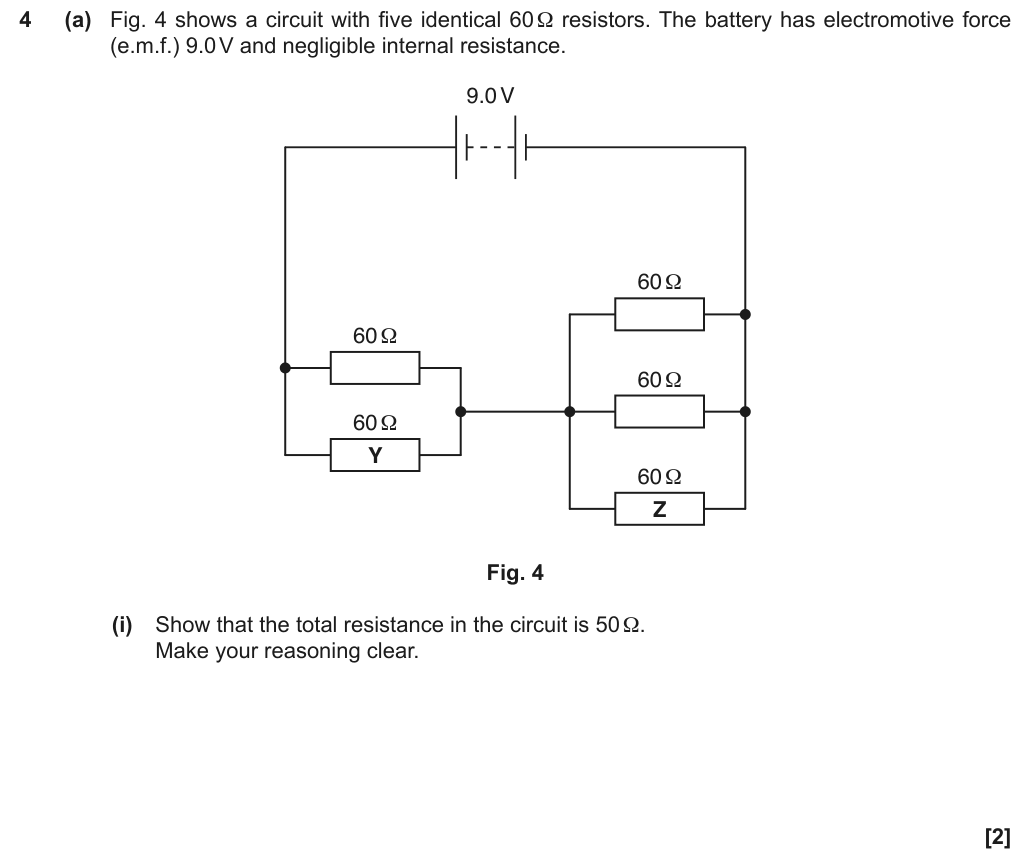
In this question, many candidates correctly quoted the equation and stated that the mean drift velocity was directly proportional to the current. The majority of the candidates realised that there was a larger current in resistor Y than resistor Z; however, few candidates realised that the current was 1.5 times larger and therefore the mean drift velocity was 1.5 times larger.
Skills: M0.3 Use ratios, fractions and percentages
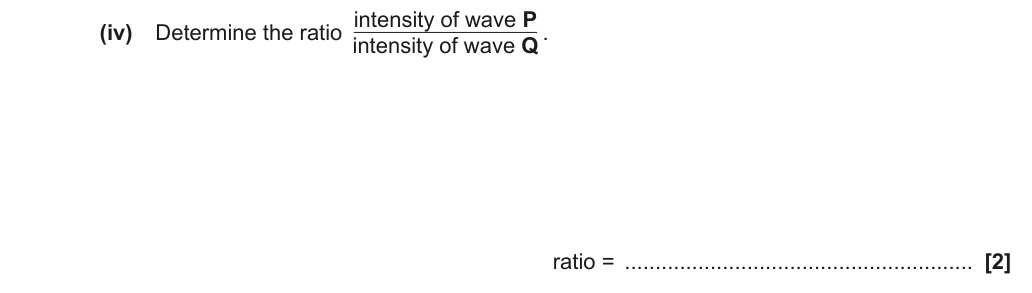
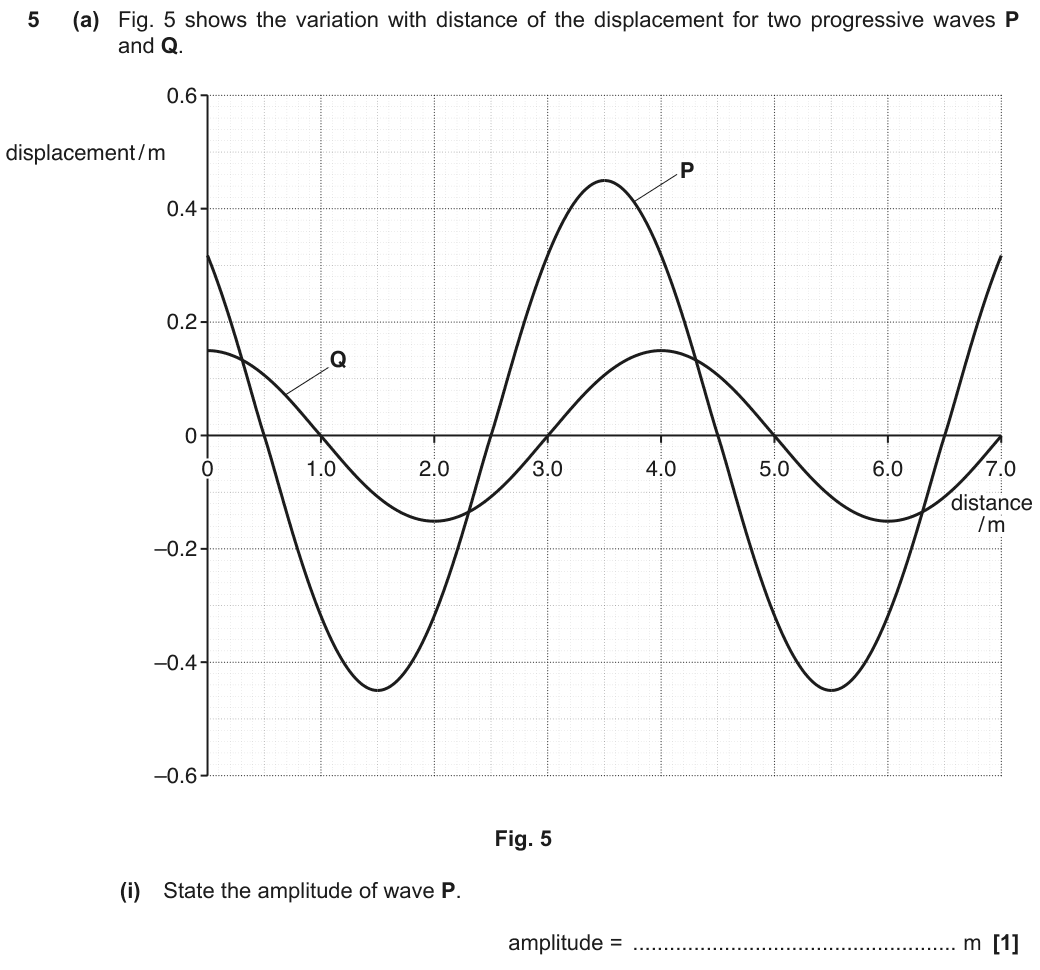
Candidates found this question challenging. They often did not realise that the intensity is proportional to the amplitude squared. It was helpful where candidates showed their working.
Skills: M0.3 Use ratios, fractions and percentages; M3.1 Translate information between graphical, numerical and algebraic forms
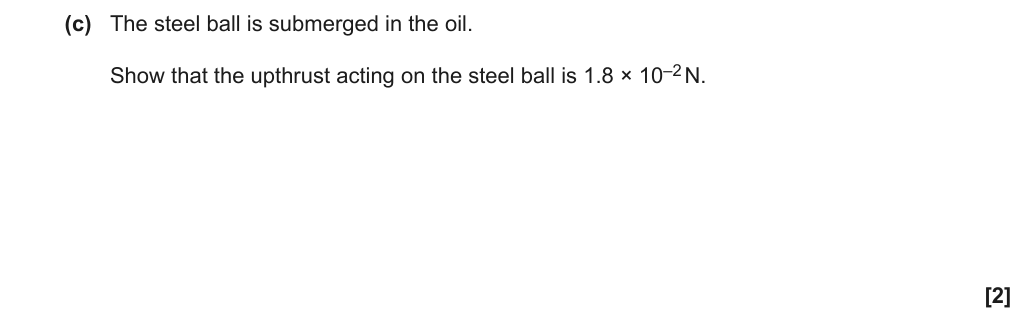
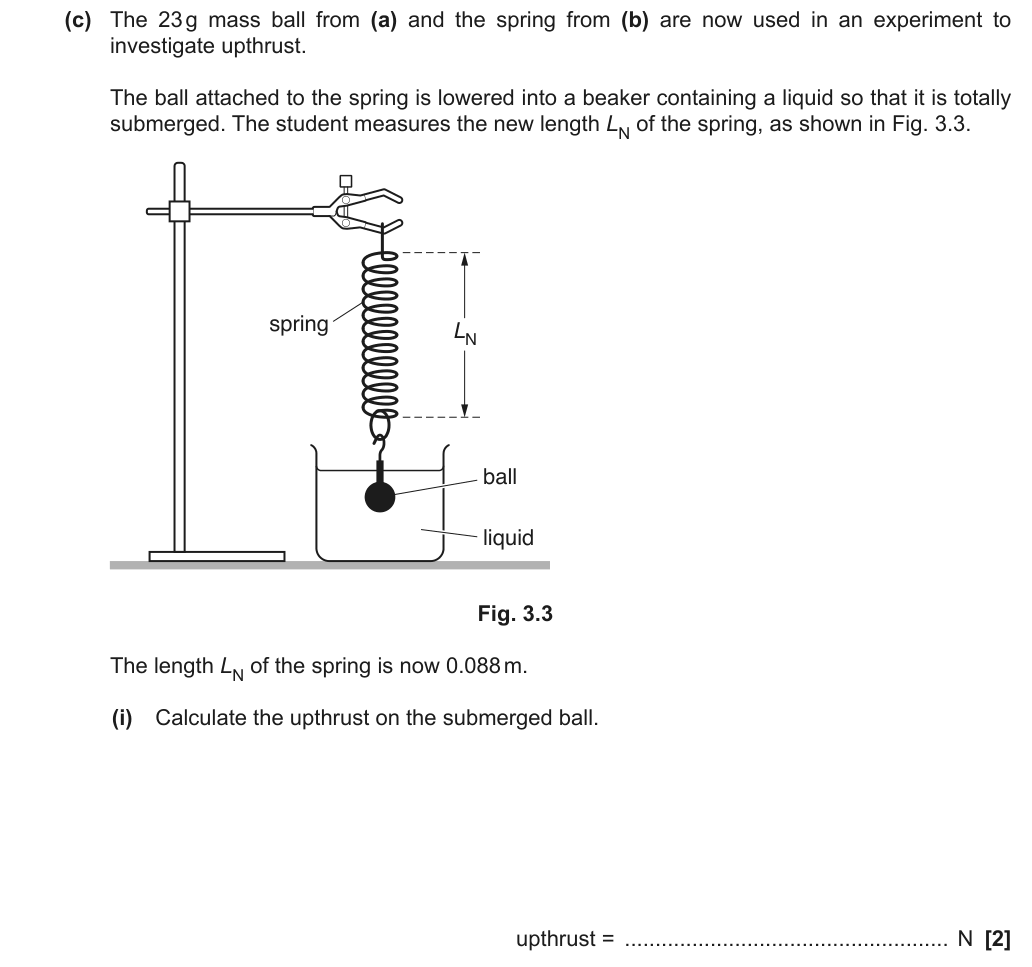
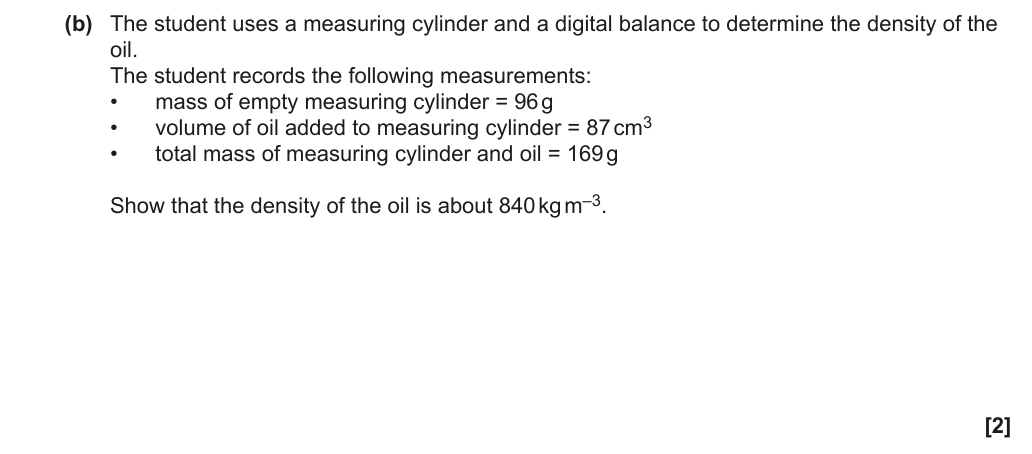
Candidates who understood that the upthrust was equal to the weight of the oil displaced scored well on this question. To score the marks it was necessary to show how the volume of the ball was calculated. Some candidates had difficulties with the powers of ten. Some candidates then went on to use one equation of density volume g while other candidates calculated the volume, then the density and then the weight. Both these methods were acceptable.
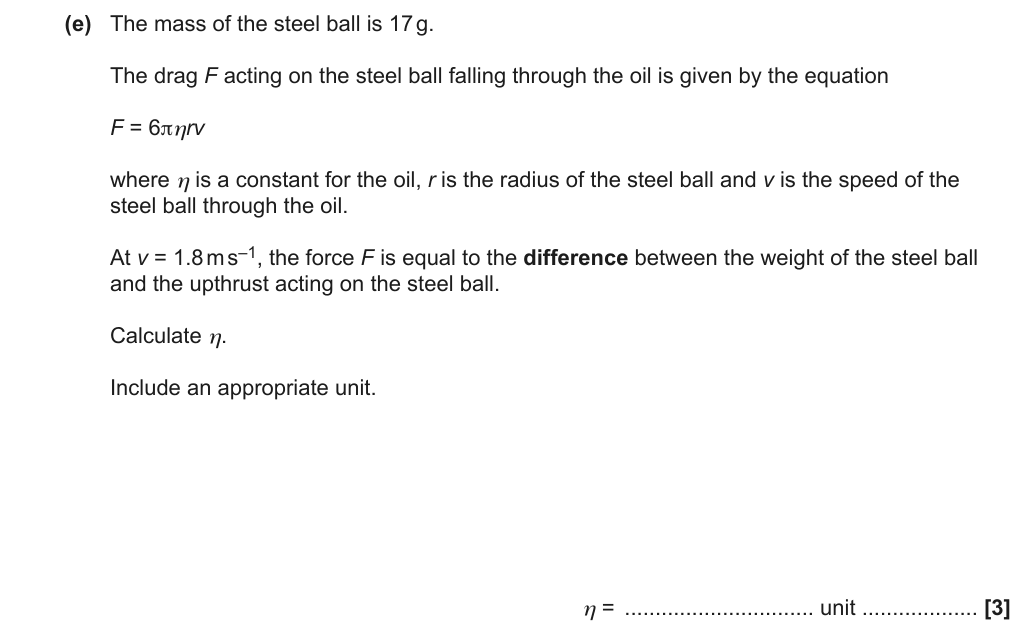
This was a challenging question and as a consequence some candidates only attempted to determine the unit. Common errors included either not allowing for the powers of ten correctly or not determining F as detailed in the question. Candidates also needed to determine the unit of . A common incorrect unit seen was N s-1 m-2.
Skills: M0.1 Recognise and make use of appropriate units in calculations; M2.2 Change the subject of an equation, including non-linear equations; M2.3 Substitute numerical values into algebraic equations using appropriate units for physical quantities
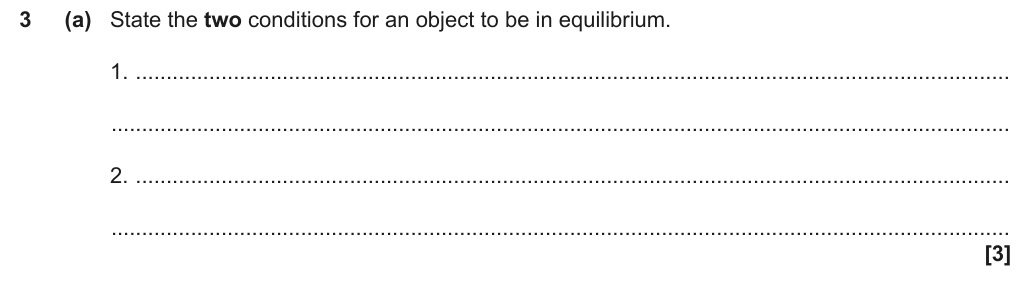
Candidates were often able to score marks for stating that the resultant force was zero (often referring to one direction, e.g., upwards) and that the resultant moment was zero. Very few candidates added the extra detail that the resultant force was zero in any direction and that the resultant moment about any point was zero. Candidates who were less successful were often vague in their use of terminology. For example, all the forces are the same without any reference to direction.
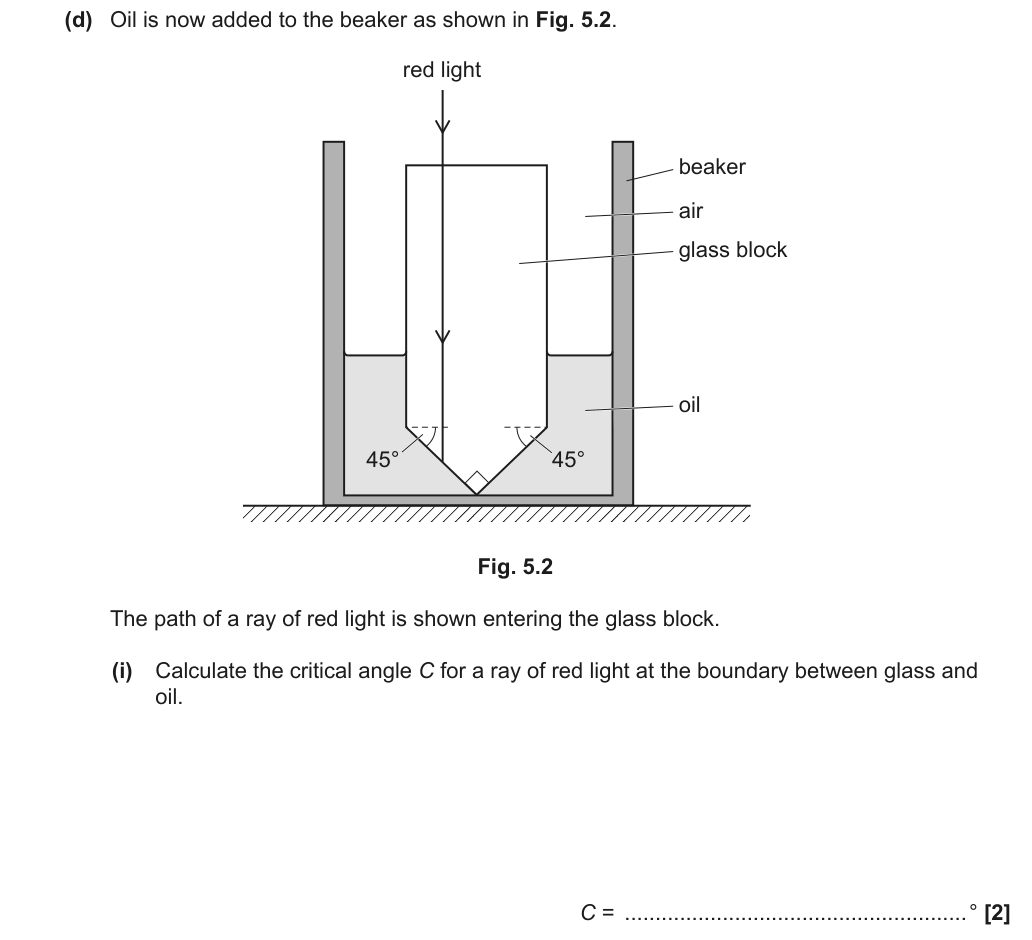
Candidates found this question challenging. Good candidates used the two refractive indexes 1.42 and 1.52 correctly. Many candidates incorrectly used an angle of 45 or 41 rather than 90. A significant number of candidates omitted this question.
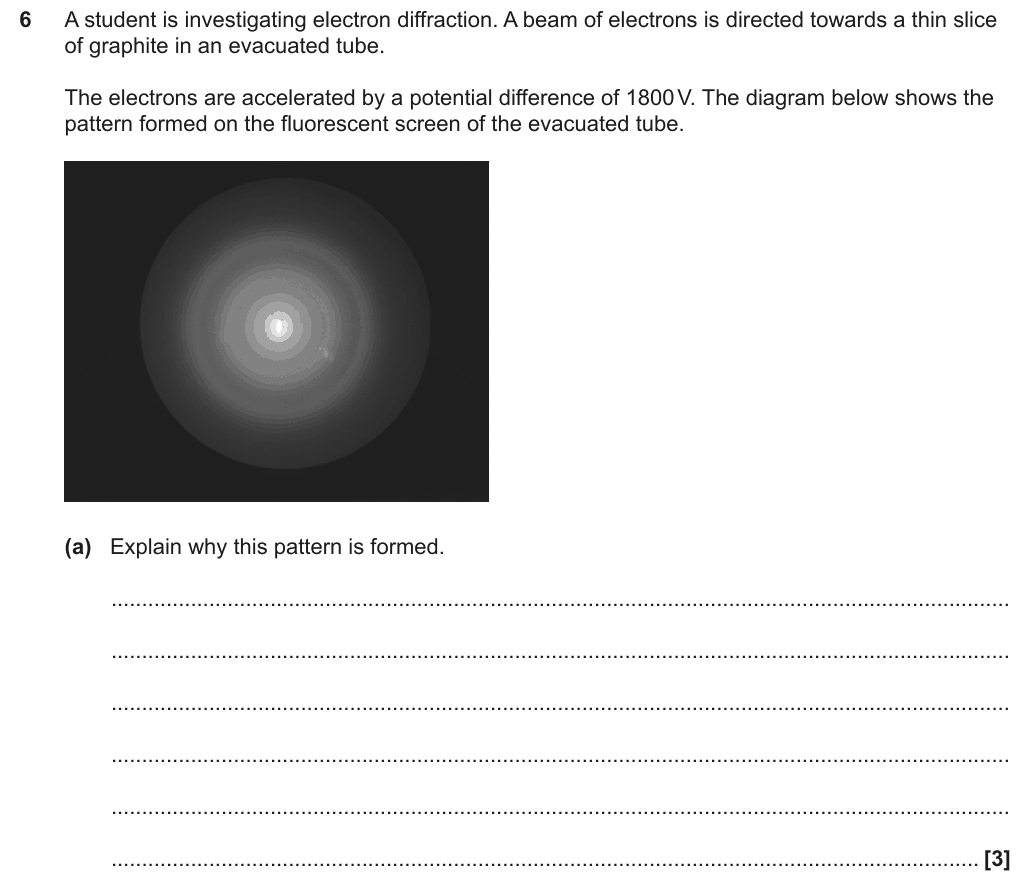
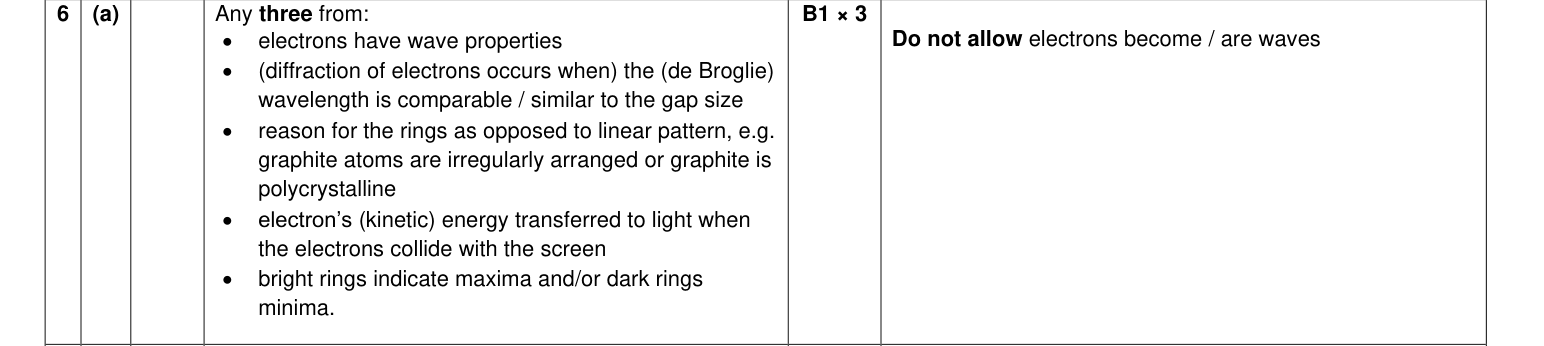
This question gave opportunities for candidates to demonstrate their knowledge and understanding of a standard experiment. To improve answers to this question candidates needed to use the terms accurately. Many candidates stated that electrons can behave as a wave, however some candidates tended to state this is the wave particle duality rather than applying it to the question. Also, a popular answer was that the diffraction of electrons occurs because the de Broglie wavelength is comparable to the spacing in graphite. Some candidates also describe why circular rings were produced in terms of the irregular arrangement of graphite and there were also bright and dark rings. Few candidates stated that the kinetic energy transferred to light when the electrons collided with the screen.
Candidates found this question challenging. Few candidates realised that the current was smaller so the heating effect would be less.
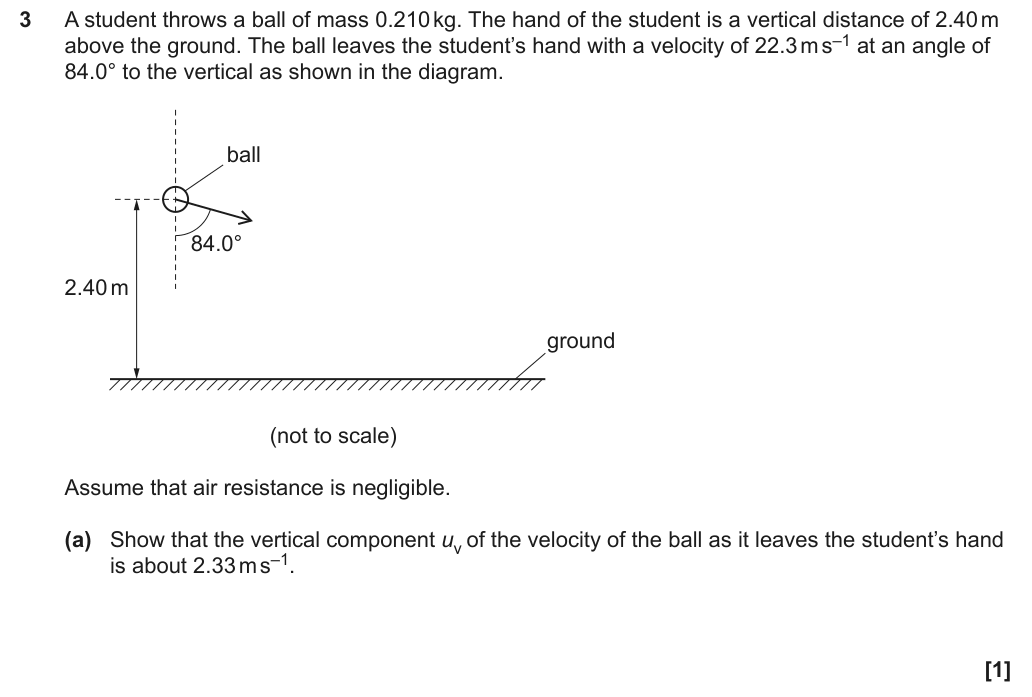
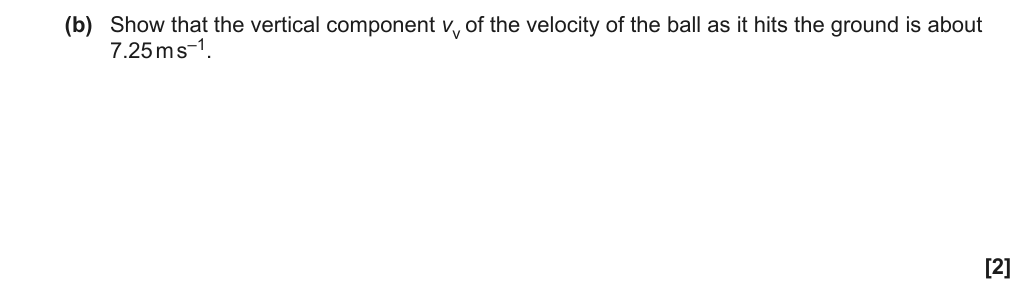
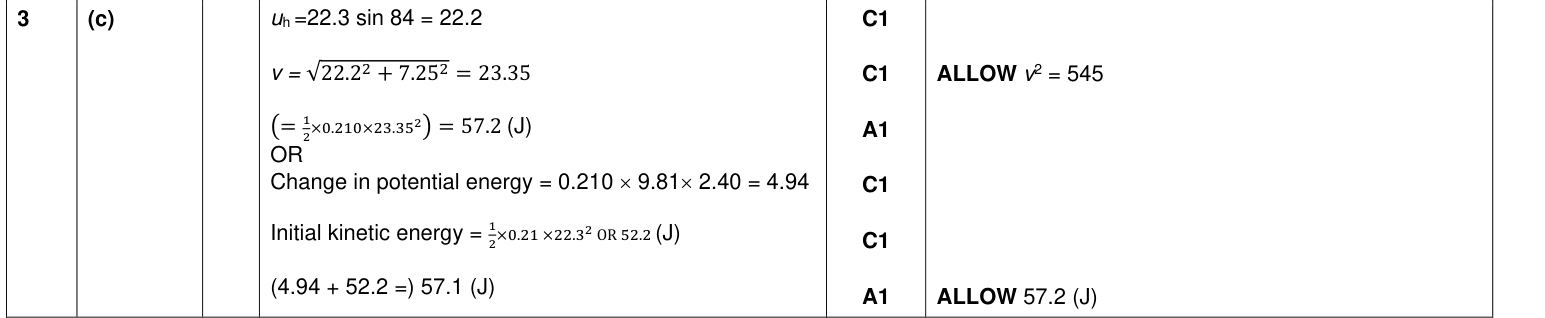
This question proved challenging to candidates. The common error was to calculate the kinetic energy using a value of 7.25 m s–1. There were two main methods of answering this question: Either: determining the horizontal component of the velocity of the ball, (which remains constant) then working out the resultant velocity of the ball as it hits the ground and then calculate the kinetic energy. Or: Calculate the change in gravitational potential energy Calculate the initial kinetic energy of the ball And then add the two values together.
Skills: M2.3 Substitute numerical values into algebraic equations using appropriate units for physical quantities; M4.4 Use Pythagoras’ theorem, and the angle sum of a triangle
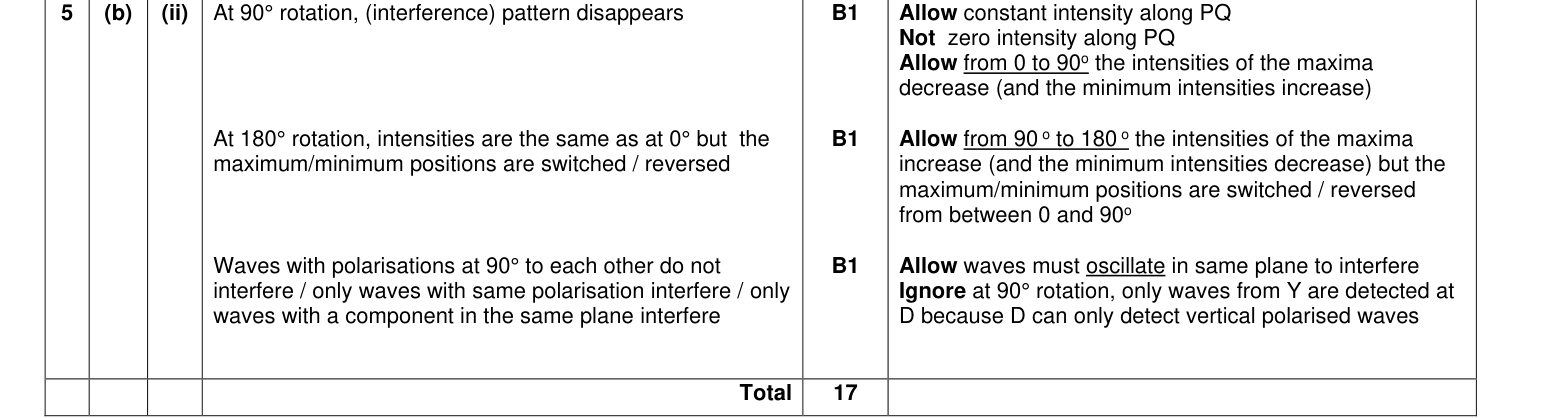
Few candidates were able to explain why the waves were plane polarised. High scoring candidates stated that the oscillations were in the vertical plane only.
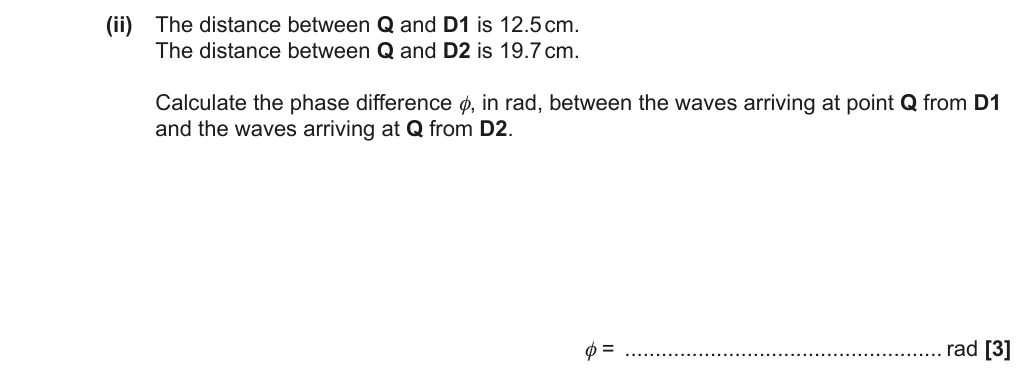
Candidates who scored well on this question showed their working clearly. Many clearly stated the path difference and determined that this path difference corresponded to 2.25 wavelengths. Some candidates struggled changing this to radians.
Skills: M0.3 Use ratios, fractions and percentages; M4.7 Understand the relationship between degrees and radians and translate from one to the other
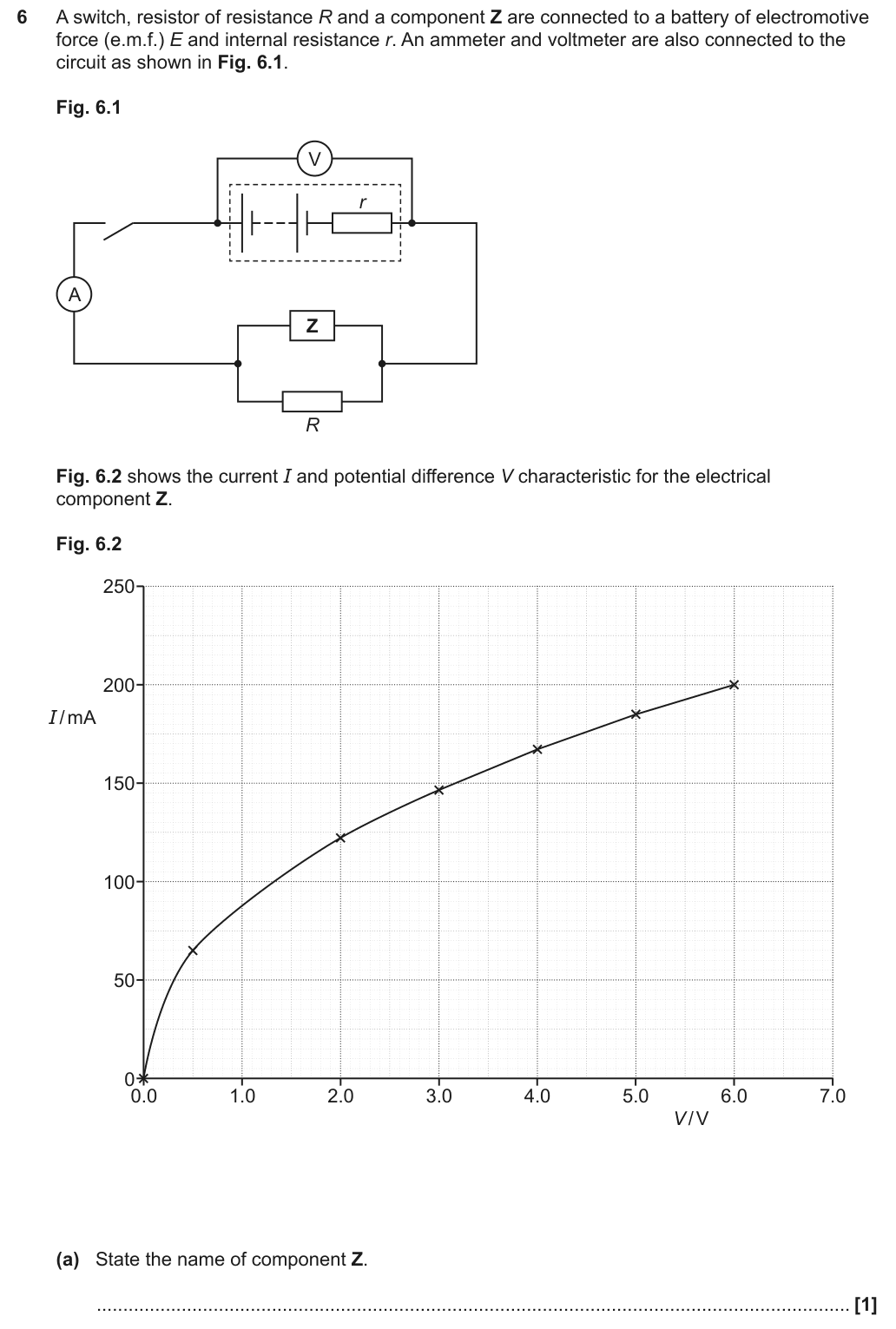
A significant minority of candidates did not score this mark. An array of answers were given. The specification is specific about the I-V characteristics that are expected to be understood by candidates.
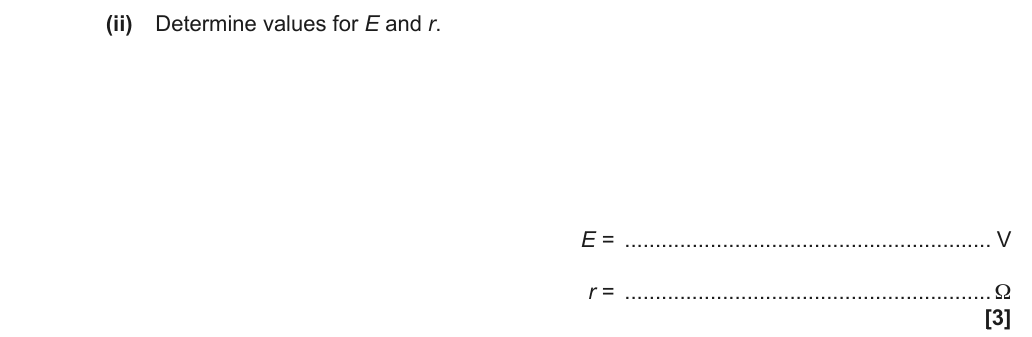
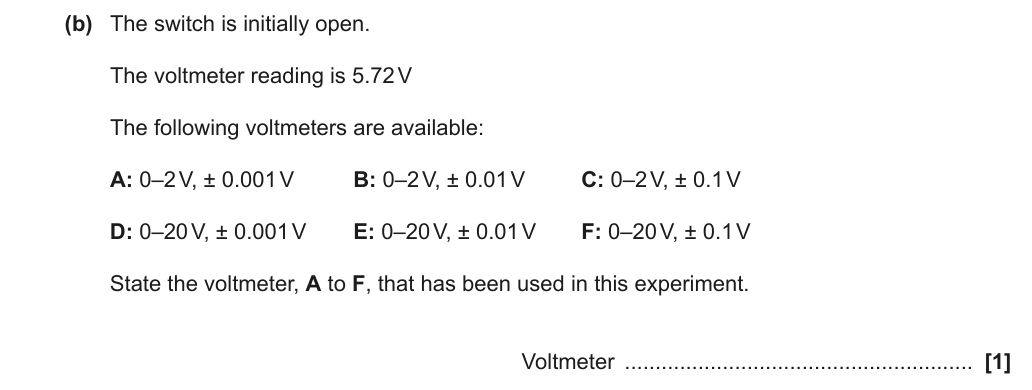
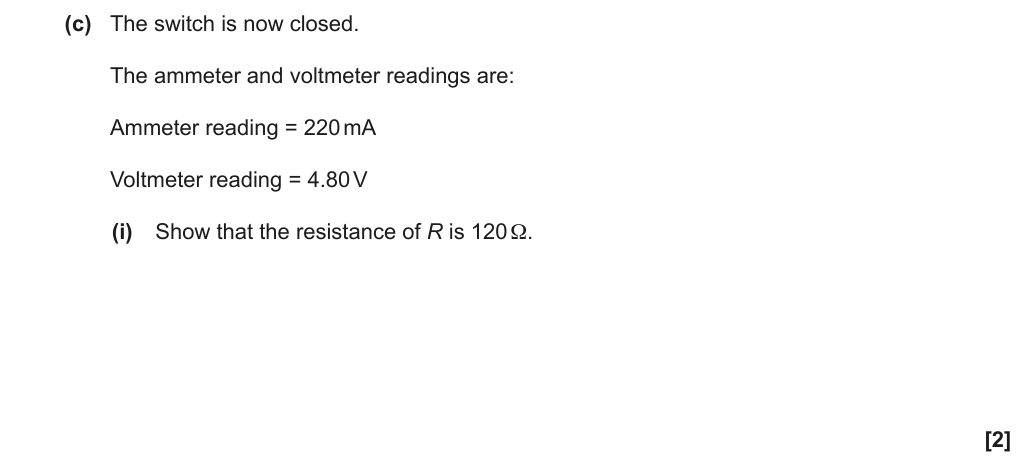
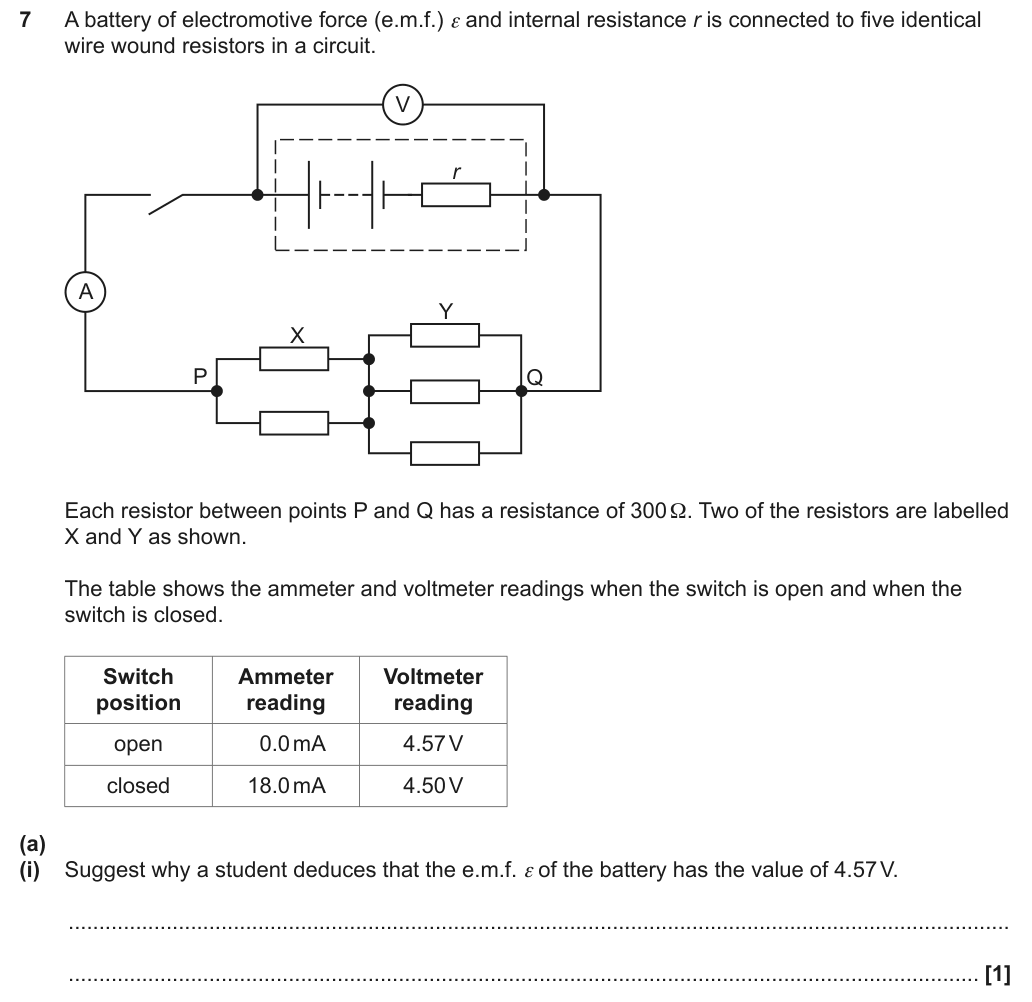
Candidates struggled with this question. Few candidates realised that when the switch was open, the voltmeter reading of 5.72 V was the terminal p.d. and equal to the e.m.f. of the battery. Some candidates did manage to determine the internal resistance without specifically stating the e.m.f.
Skills: M2.2 Change the subject of an equation, including non-linear equations
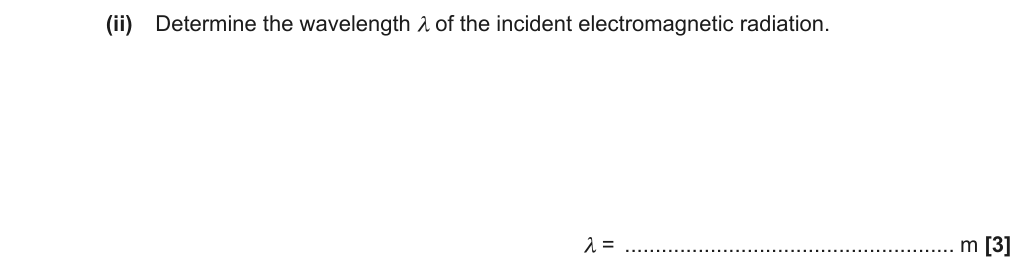
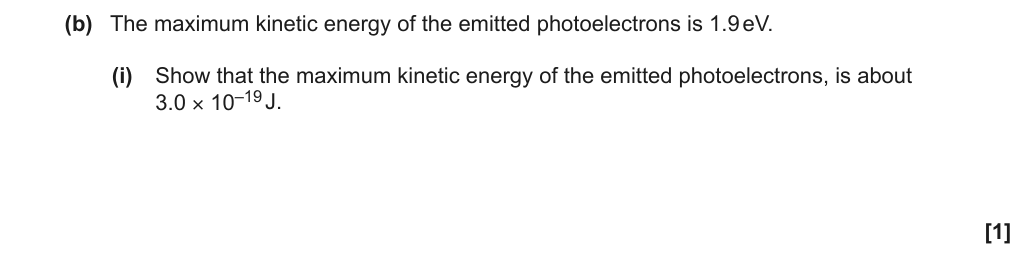
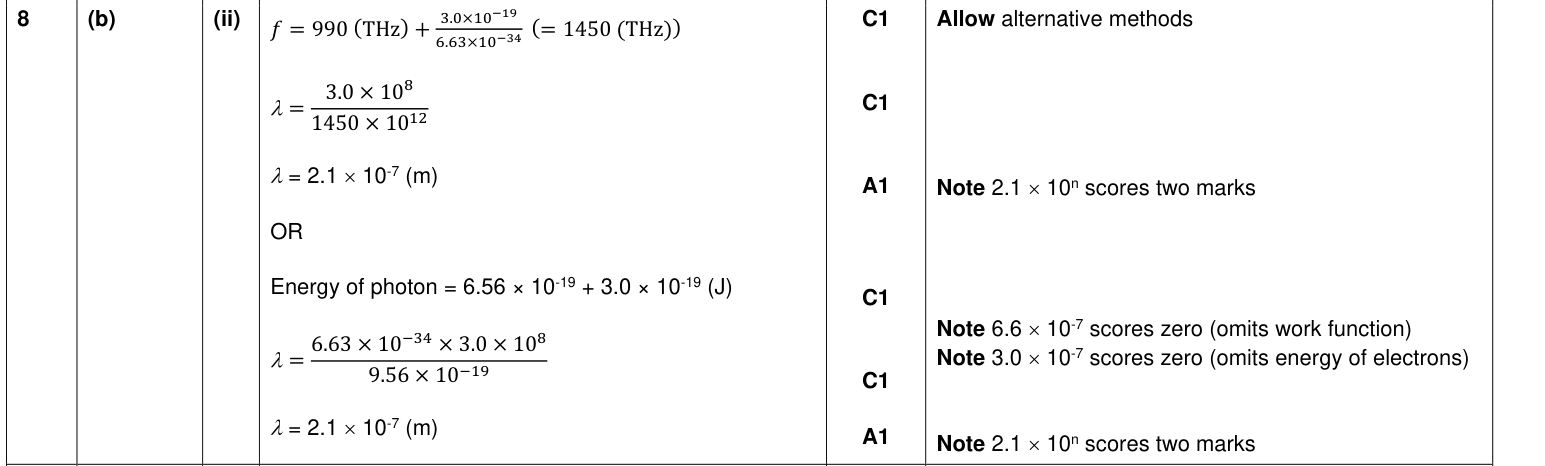
Candidates found this question challenging. The common error was to omit the work function of the metal. Other candidates determined the energy but omitted the energy of the electrons. A significant minority of candidates attempted to answer this question by determining the momentum of the electrons.
Skills: M0.2 Recognise and use expressions in decimal and standard form; M2.2 Change the subject of an equation, including non-linear equations; M2.3 Substitute numerical values into algebraic equations using appropriate units for physical quantities
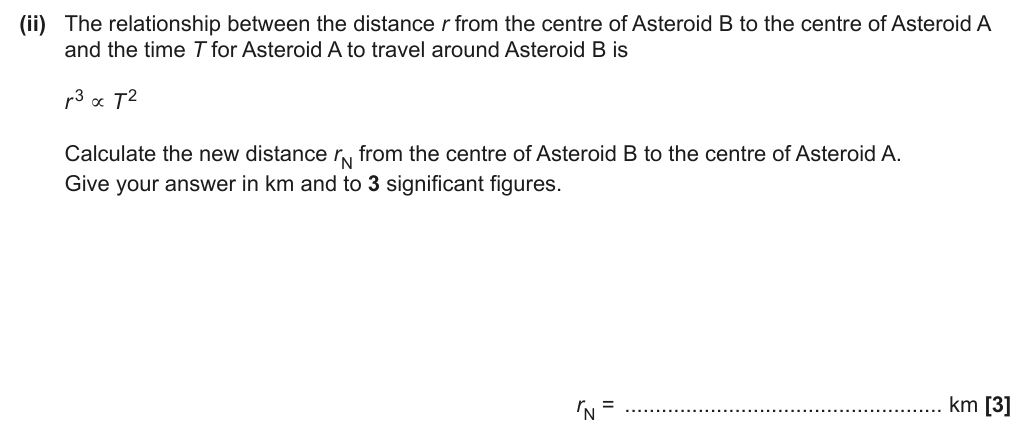
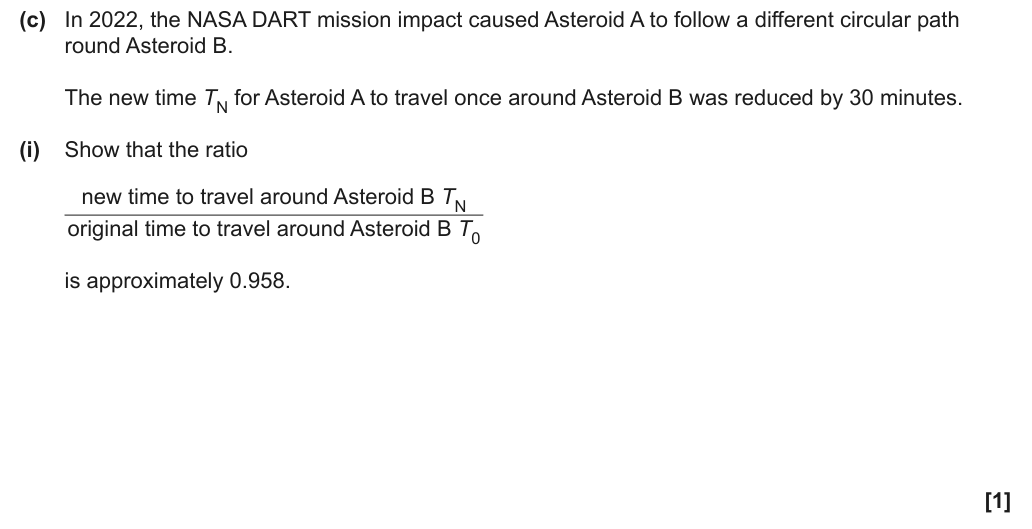
The majority of the candidates found this question challenging. Many candidates did not use the answer from Question 1 (c) (i) but did correctly use ratios perhaps by calculating the constant of proportionality to work out the correct answer. A few candidates did not correctly round their answer to 3 significant figures or gave an answer with a power of ten error.
Skills: M0.3 Use ratios, fractions and percentages; M0.5 Use calculators to find and use power, exponential and logarithmic functions; M1.1 Use an appropriate number of significant figures; M2.2 Change the subject of an equation, including non-linear equations
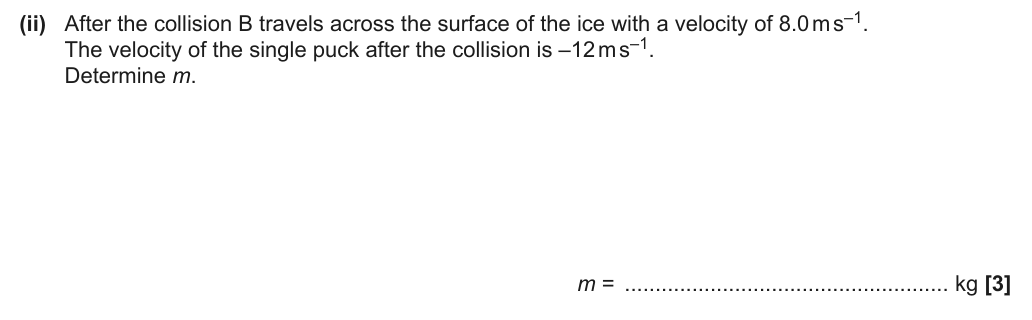
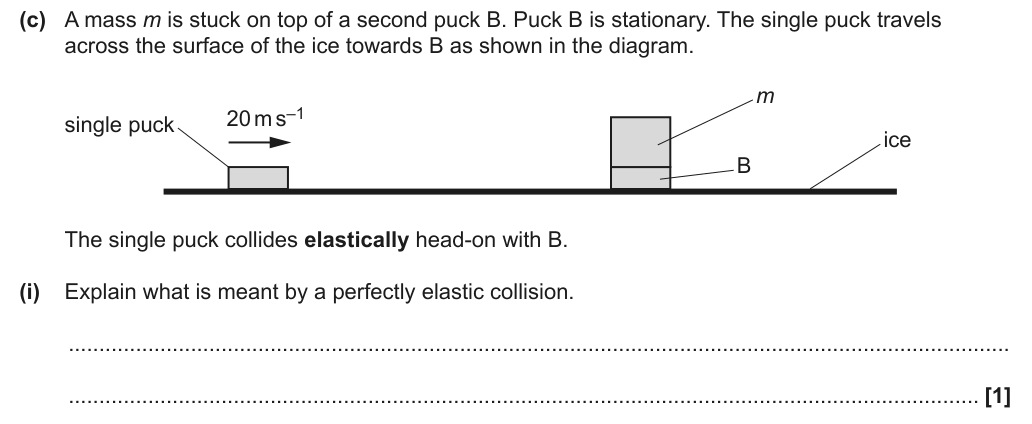
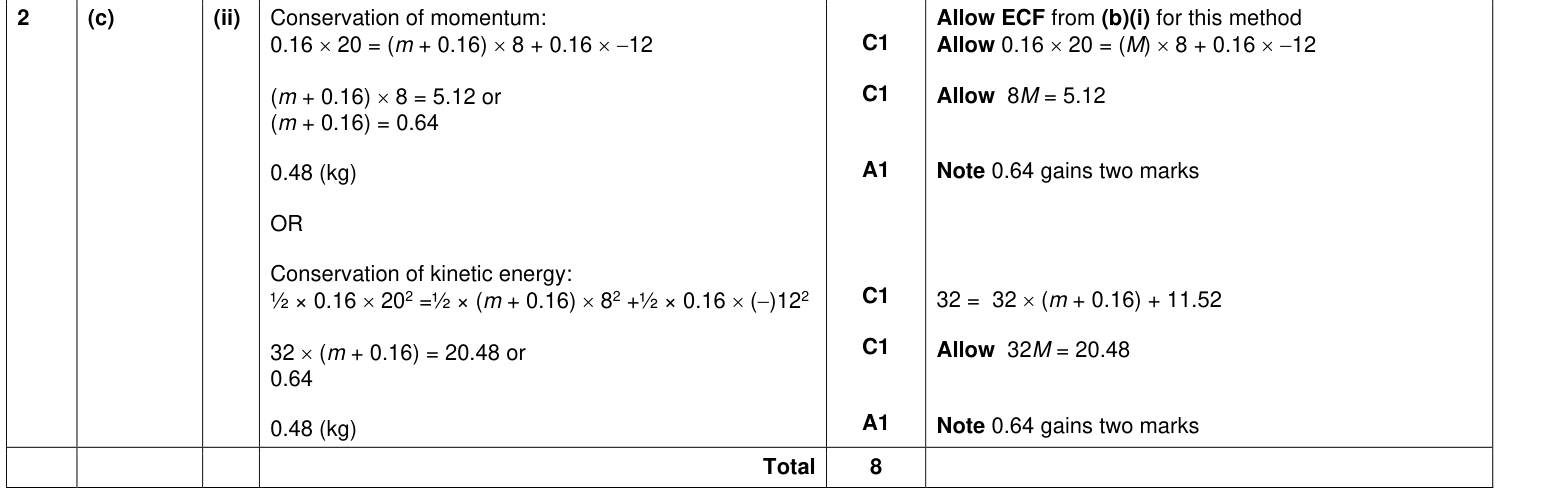
High scoring candidates generally scored well on this question. Most candidates attempted to determine m by using a conservation of momentum method. A small minority correctly used a conservation of kinetic energy method. The common error for the conservation of momentum method was to have an incorrect sign. A few candidates did not allow for the original mass of the puck.
Skills: M2.2 Change the subject of an equation, including non-linear equations; M2.4 Solve algebraic equations, including quadratic equations
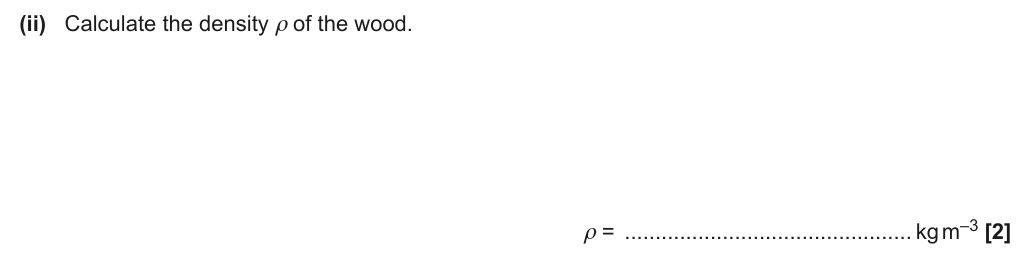
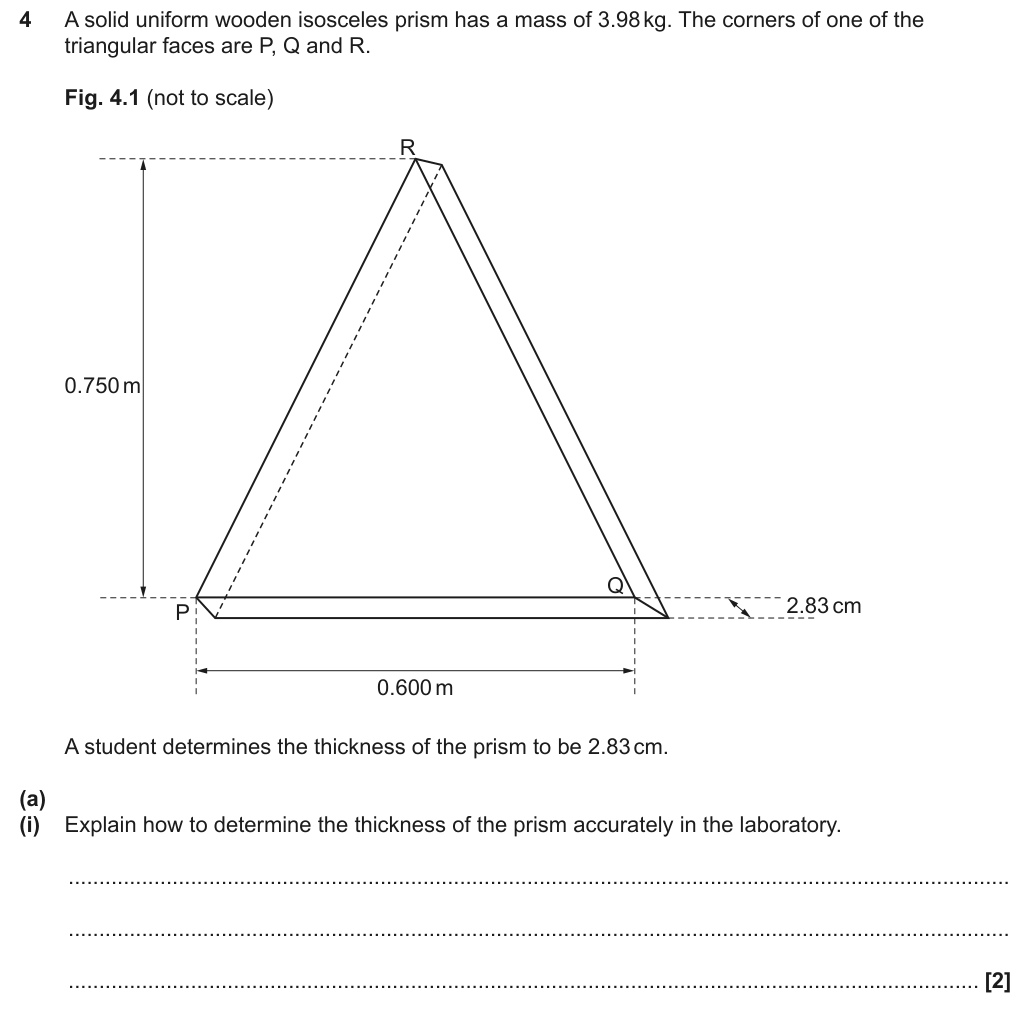
A significant minority of candidates found calculating the volume of the prism challenging. Some candidates did not allow for changing ‘cm’ to ‘m’ for the thickness.
Skills: M0.1 Recognise and make use of appropriate units in calculations; M2.3 Substitute numerical values into algebraic equations using appropriate units for physical quantities; M4.3 Calculate areas of triangles, circumferences and areas of circles, surface areas and volumes of rectangular blocks, cylinders and spheres
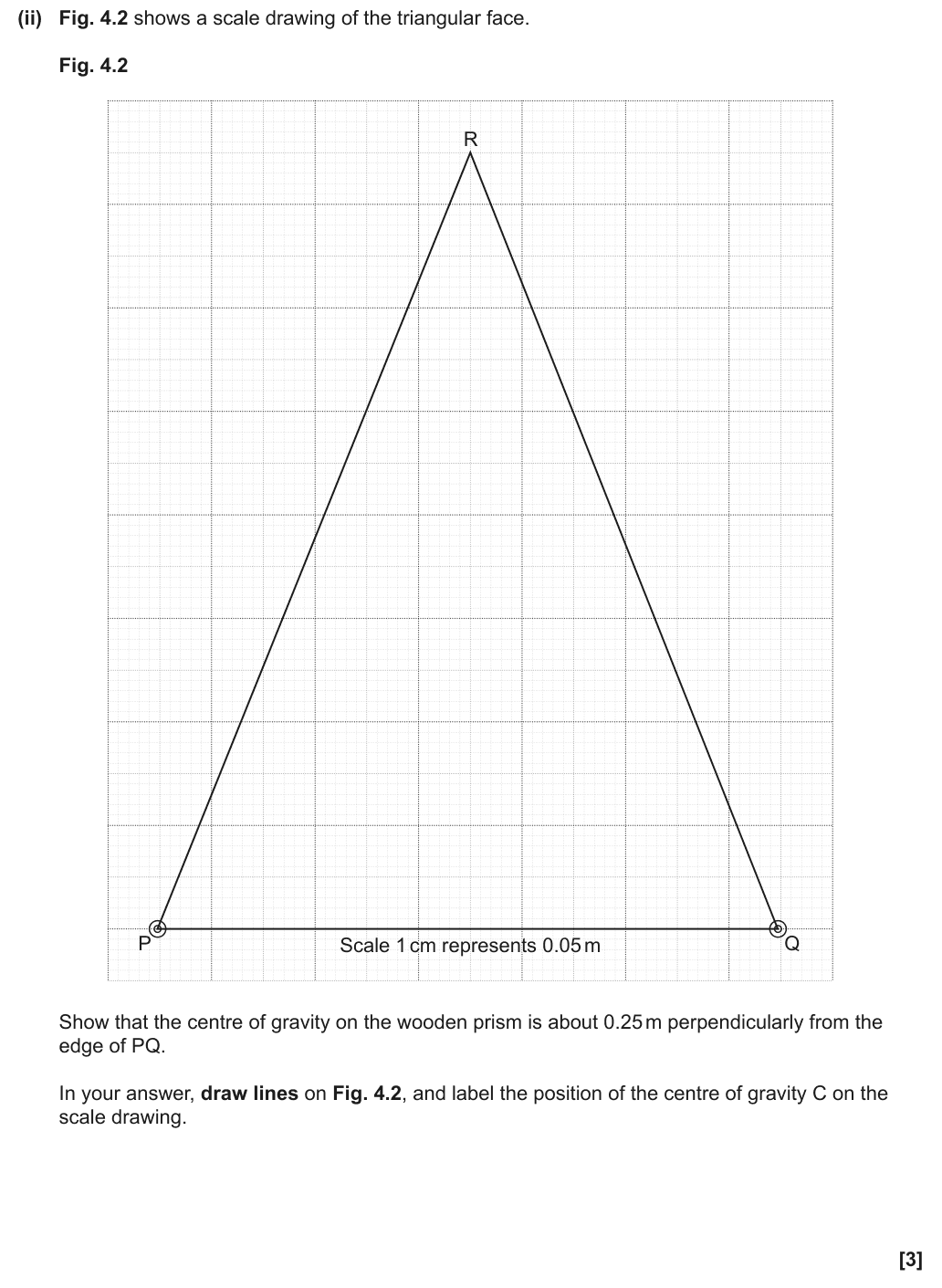
This question required candidates to show how they would obtain an answer. It appeared that many candidates incorrectly started with the answer and then marked on the diagram the position of the centre of gravity C. The majority of the candidates understood that C would lie on a straight line from the mid-point of the horizontal surface to the apex of the triangle. Few candidates drew line from the mid-points of the other two sides to the opposite corners. Few candidates used the scale to show that C was 0.25 m.
Skills: M0.3 Use ratios, fractions and percentages; M4.1 Use angles in regular 2D and 3D structures; M4.2 Visualise and represent 2D and 3D forms, including two-dimensional representations of 3D objects
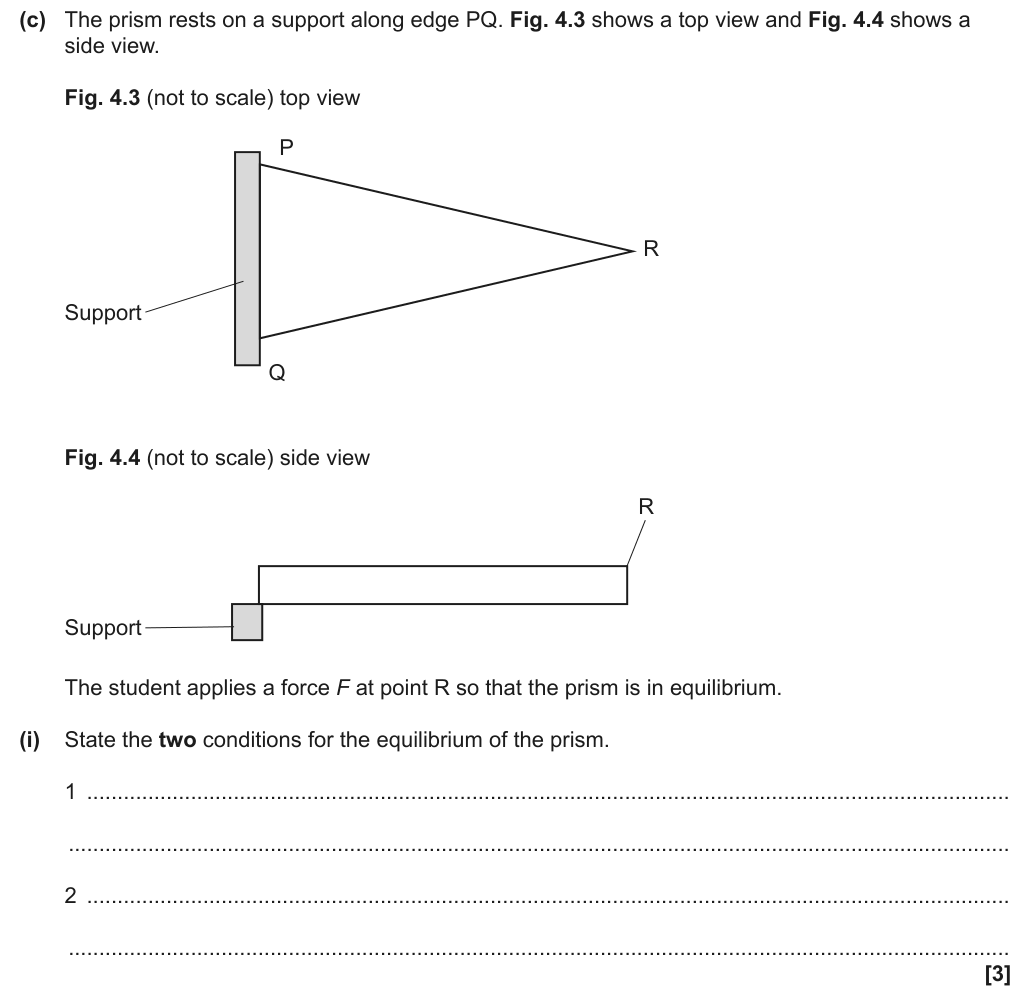
The majority of the candidates understood that resultant force was zero and that the resultant moment was also zero. Few candidates stated that the result force would be zero in any direction and the resultant moment would be zero about any point.
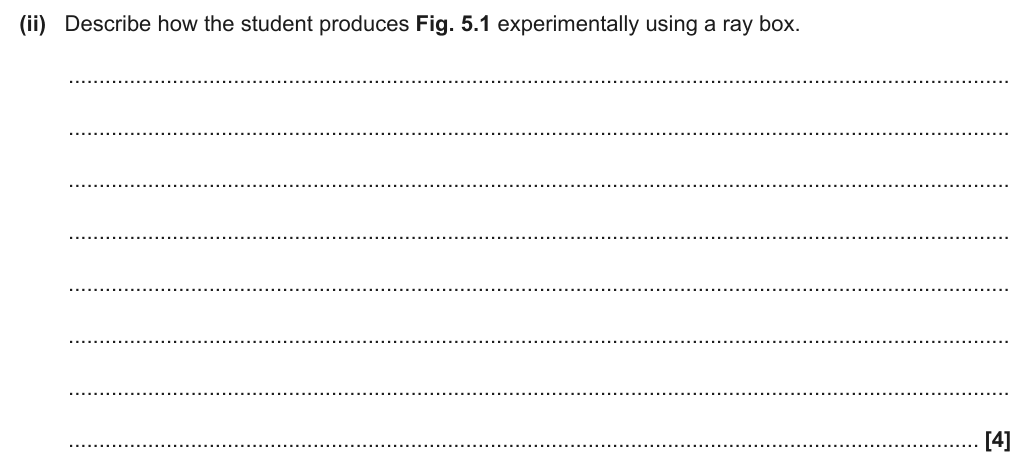
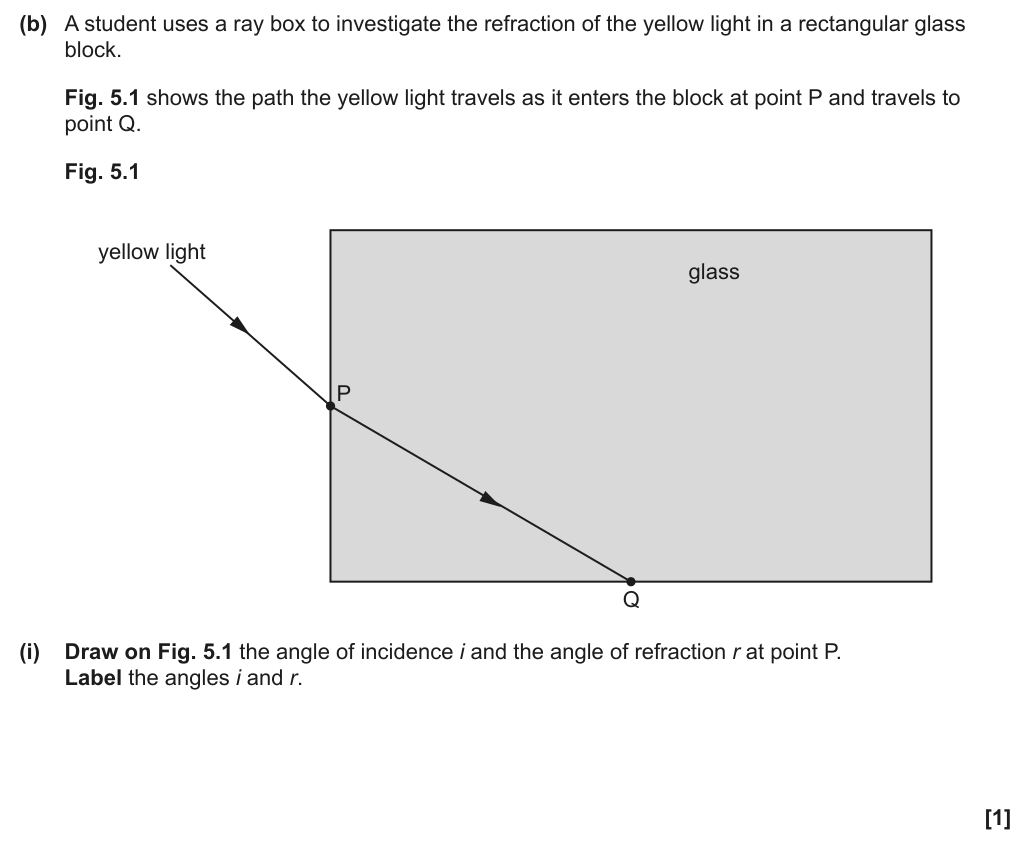
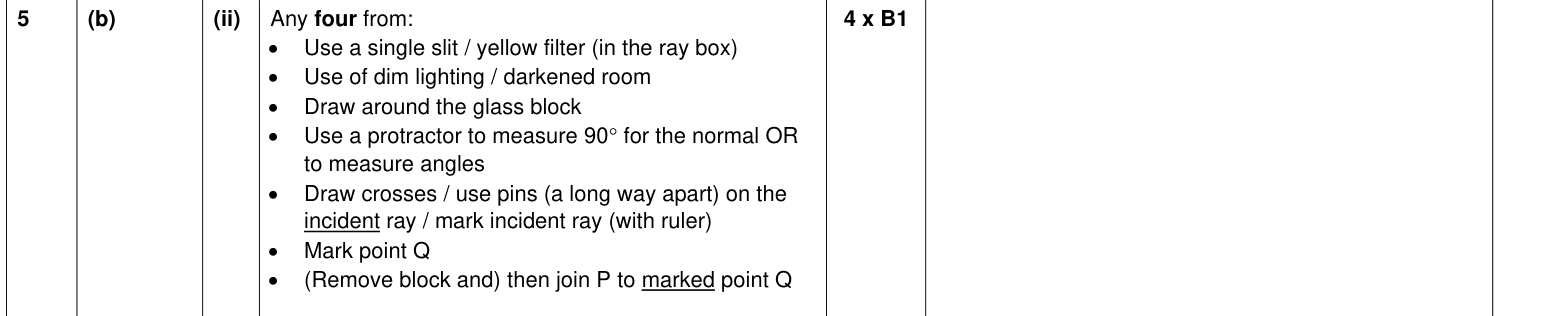
This question was designed to give candidates the opportunity of describing a practical technique. In this question, the basic set-up required a single slit and a yellow filter in the ray-box to produce the thin ray of yellow light. It is often easier to carry out this experiment in a darkened room. Few candidates gave details of how the rays would be traced and the need to draw the outline of the glass block. High scoring candidates often included detail about placing small crosses on the rays and then using a rule joining them together and removing the block to join points P and Q. Some candidates also discussed the drawing of the normal and using a protractor to measure the angles.
Skills: PAG6 Investigating quantum effects
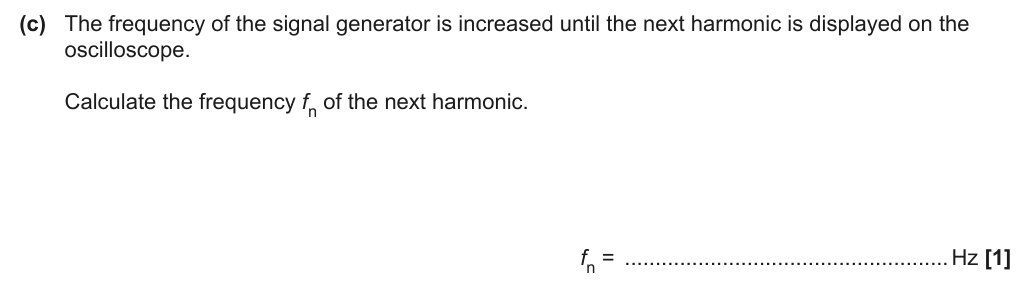
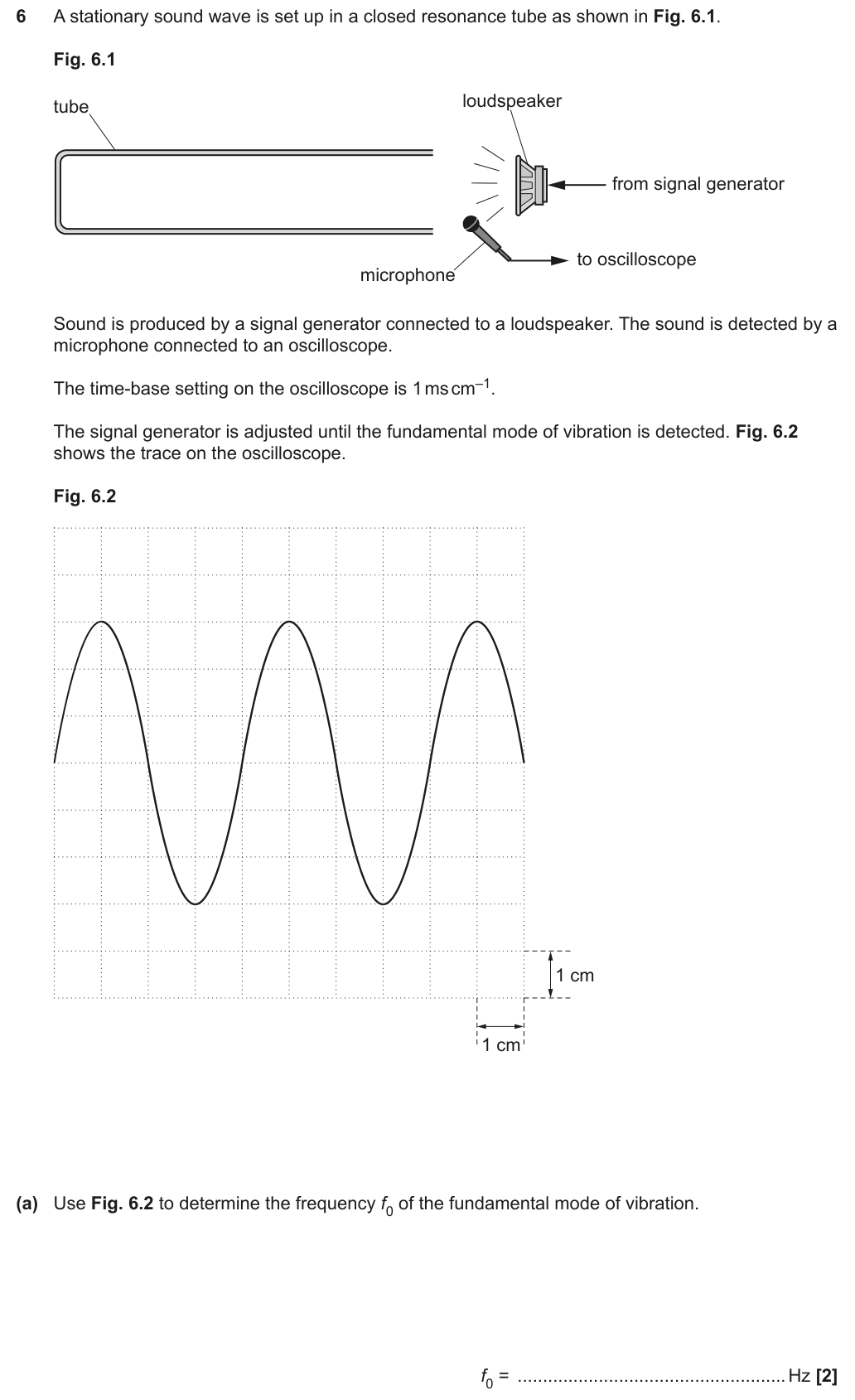
This question was challenging. A value of 500 Hz was the common incorrect answer. Other incorrect answers included candidates who thought that the frequencies decreased.
Skills: M0.3 Use ratios, fractions and percentages
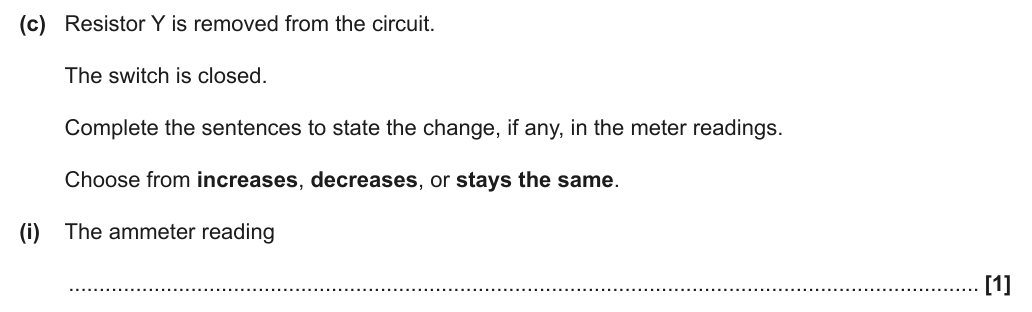
Candidates generally found this question challenging. They needed to understand that removing a resistor from a parallel combination, increased the total resistance of the circuit so that the current decreased.

This question was very challenging. Since the current has decreased, there would be less ‘lost volts’ across r so the voltmeter reading would increase. May candidates thought incorrectly that the voltmeter reading would remain the same.
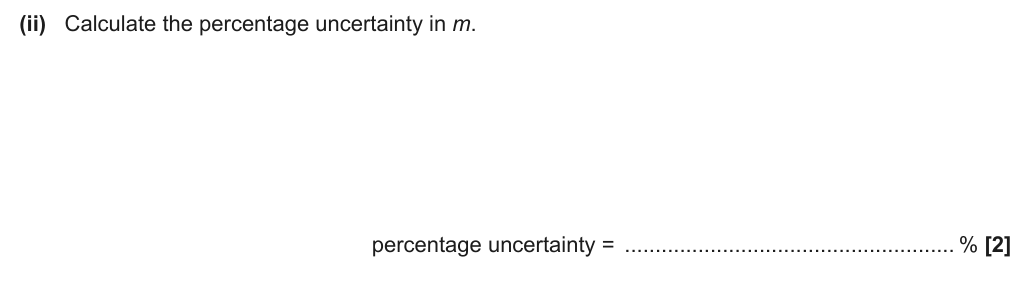
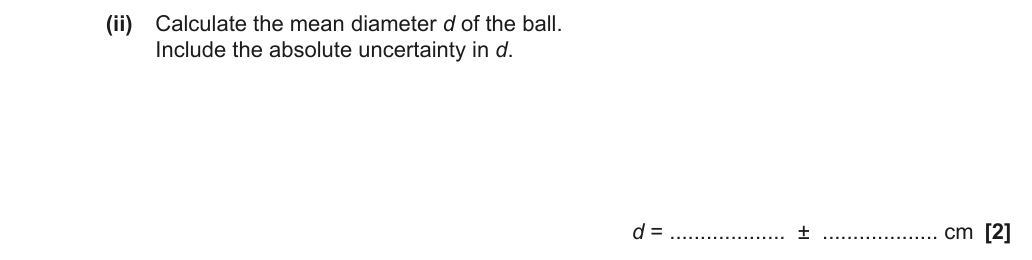
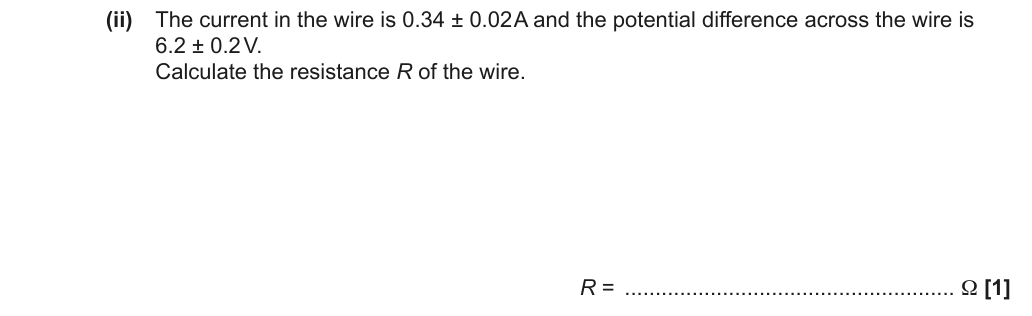
Candidates found this question challenging. Candidates needed to apply their understand of combining uncertainties. To determine the absolute uncertainty in repeated reasons, candidates needed to determine half the range of the values. Candidates also ned to understand that the percentage uncertainty in the volume was equal to three times the percentage uncertainty in the diameter. This candidate correctly determined the range (0.01) and then finds the absolute uncertainty in d (0.005). There is then a clear method shown by working out the percentage uncertainty in d 3 and adding it to the percentage uncertainty in ρ to give the correct answer of 3.8%.
Skills: M0.3 Use ratios, fractions and percentages; M1.5 Identify uncertainties in measurements and use simple techniques to determine uncertainty when data are combined
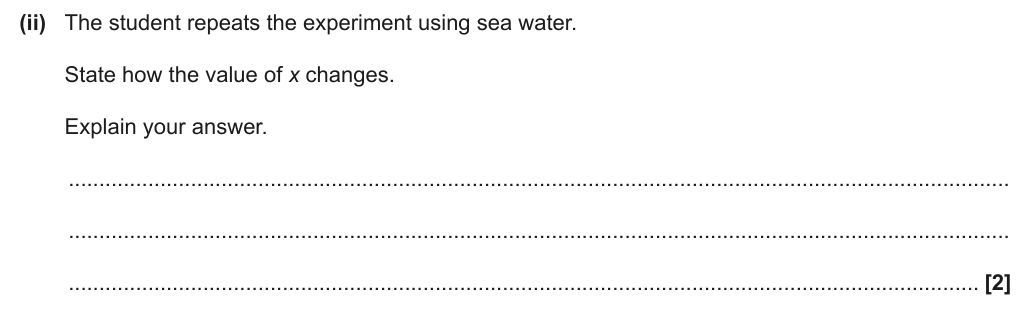
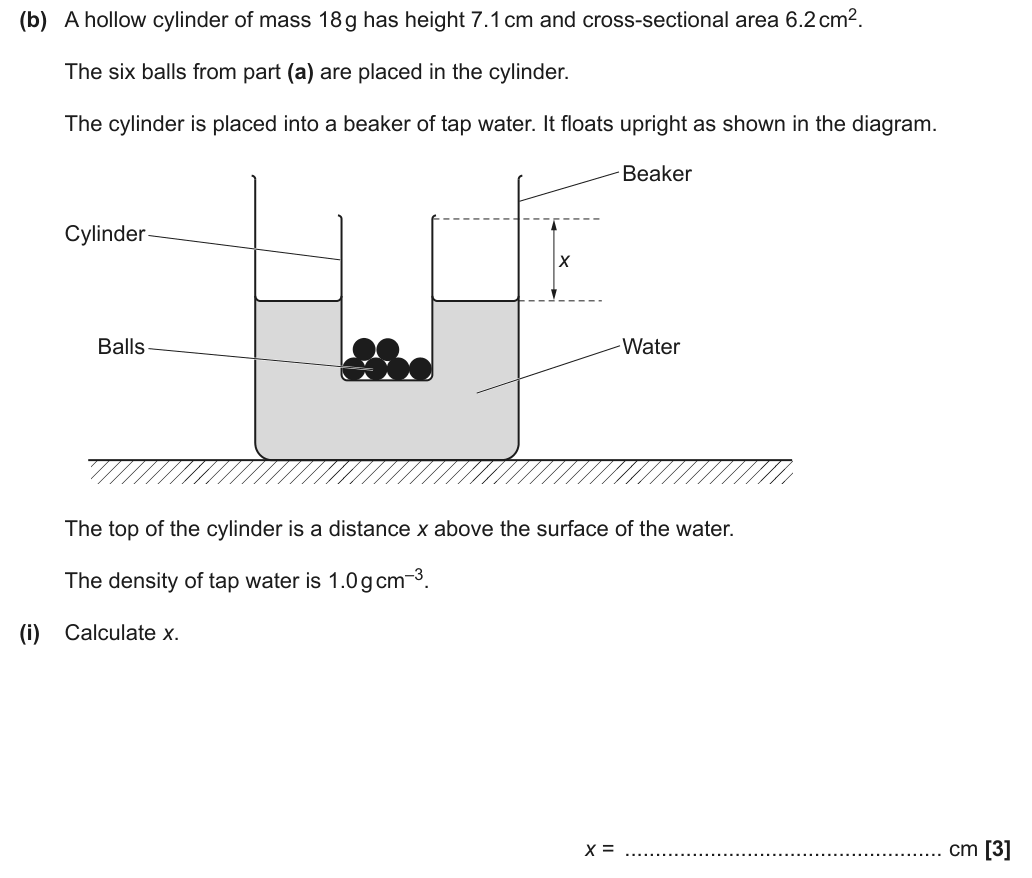
The majority of the candidates realised that the density of sea water is greater than tap water. Only a small minority of candidates successfully related this change in density to a smaller volume of sea water displaced and therefore x increases.
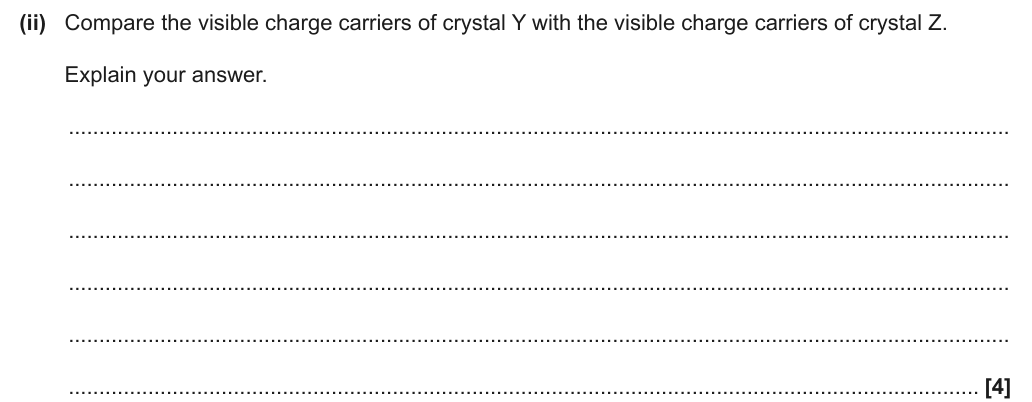
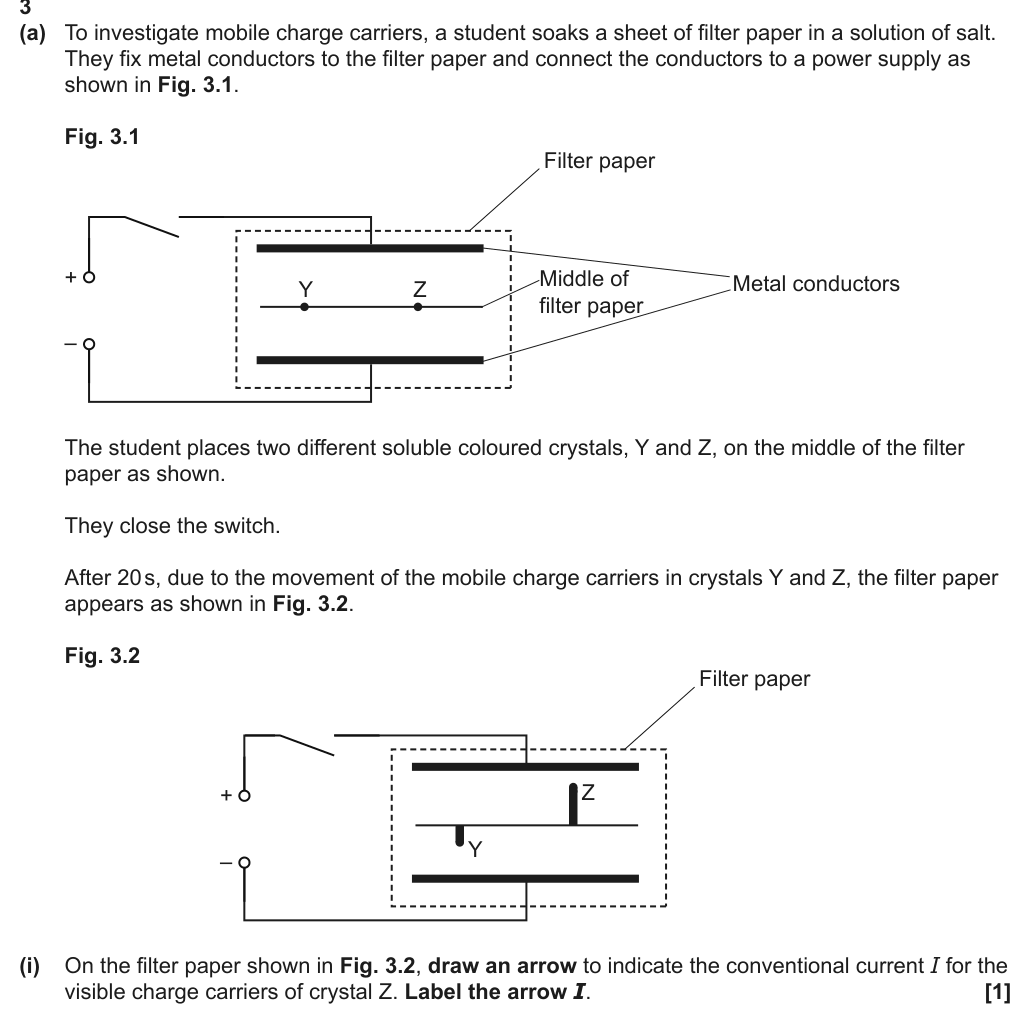
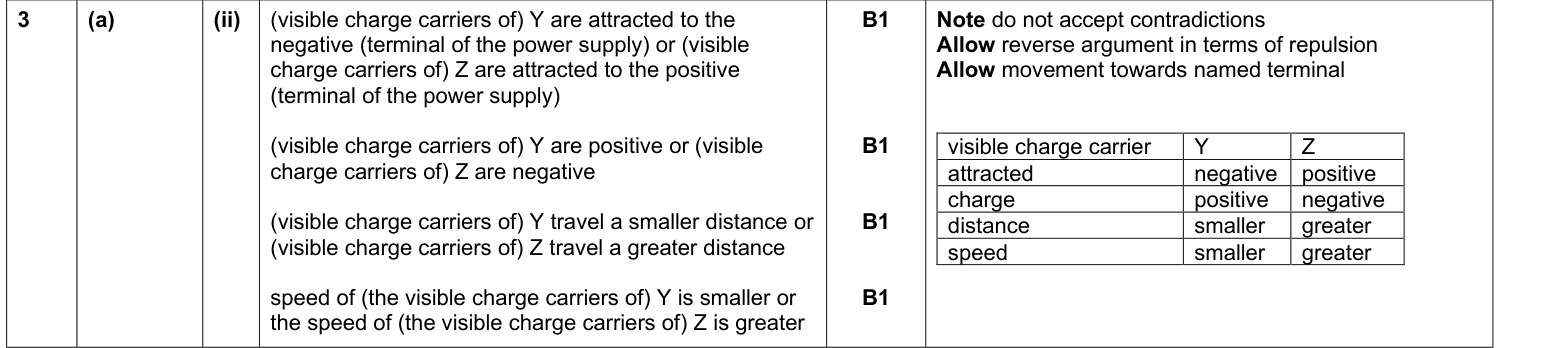
The question was based on a practical showing the movement of charge carriers. Many candidates correctly stated that since the charge carriers in Z were moving towards the positive metal conductor, these charge carriers were negative and that the charge carriers in Y were moving towards the negative metal conductor, these charge carriers were positive. Fewer candidates discussed the distance travelled by the charge carriers (in 20 s) and related this to the speed of the charge carriers. A small minority of candidates incorrectly discussed the number of charge carriers or the quantity of charge on the charge carriers – there was not enough information provided for any conclusion. In effect both crystal Y and Z also have invisible charge carriers which move in the opposite direction.
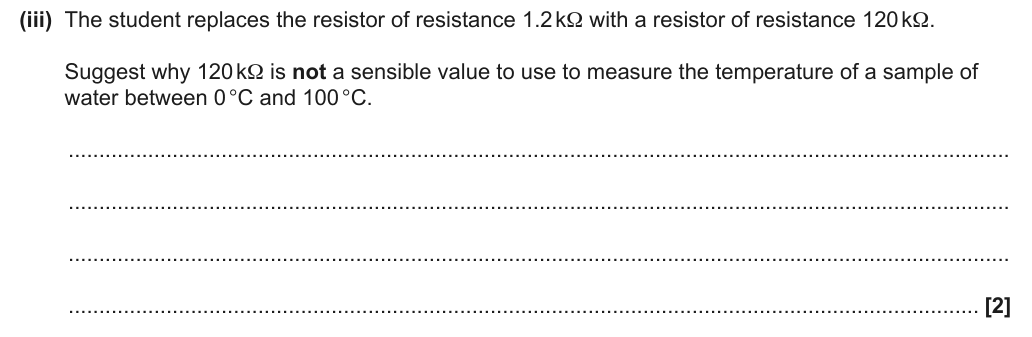
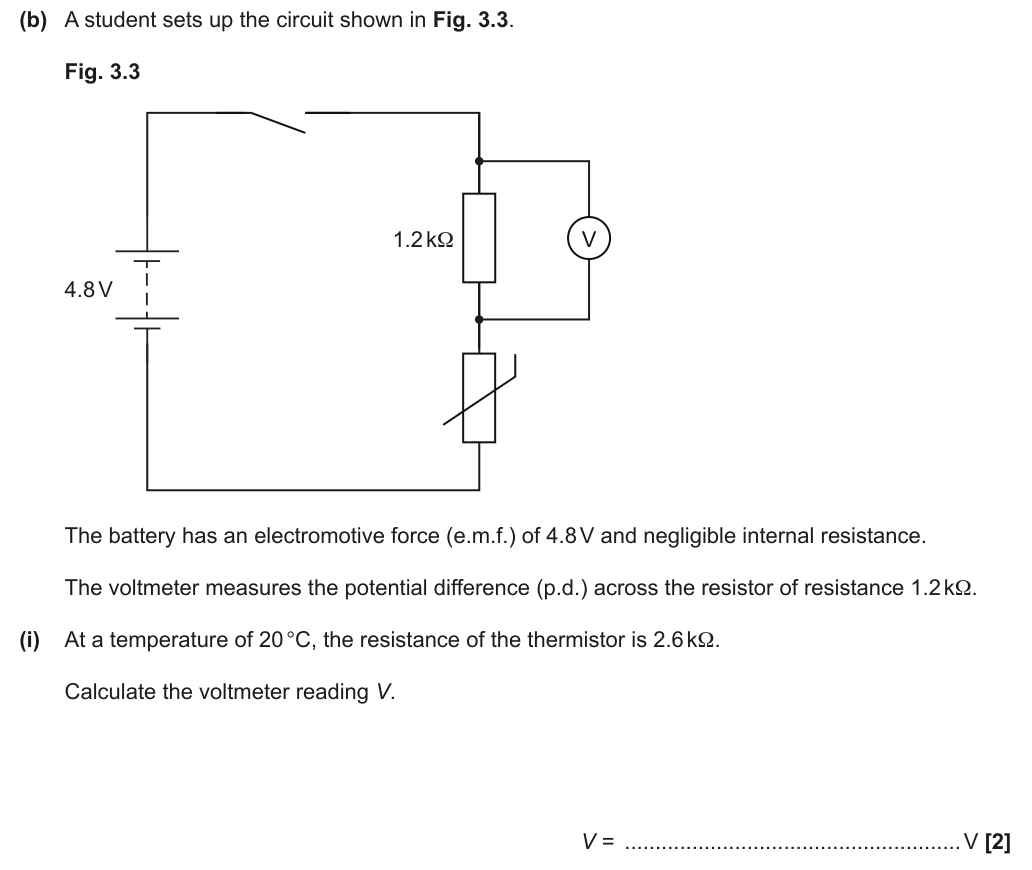
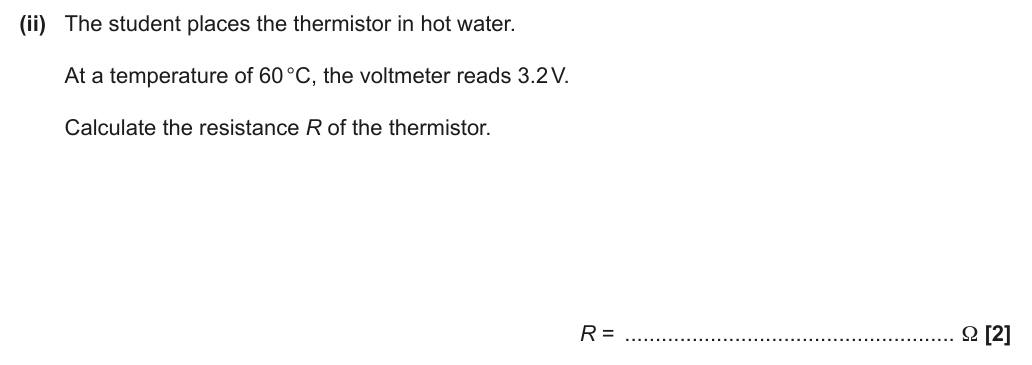
This question was challenging. Candidates needed to understand that the share of the potential difference across the fixed resistor was great and that there would be little change with temperature so the voltmeter reading would not change.
Skills: PAG4 Investigating electrical circuits
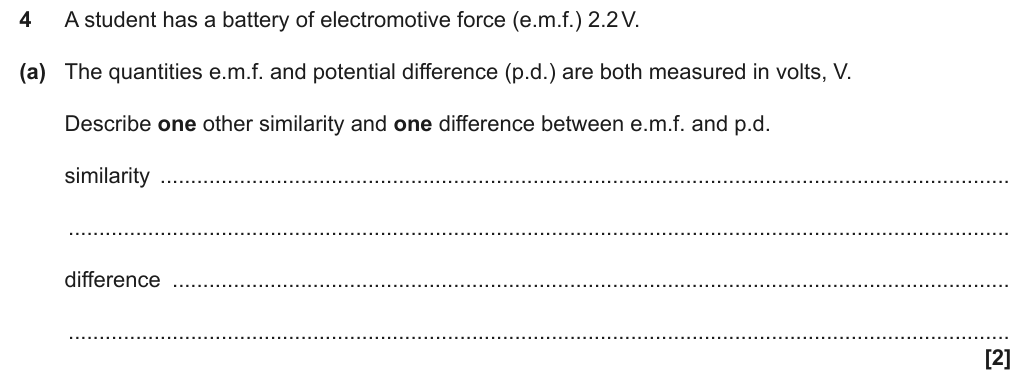
Many candidates repeated the question by stating that a similarity was that both quantities were measured in volts. Few candidates were able to state that both quantities were related to the work done per unit charge. Many candidates were able to give differences between the two quantities in terms of energy transfers or work done by charge carriers.
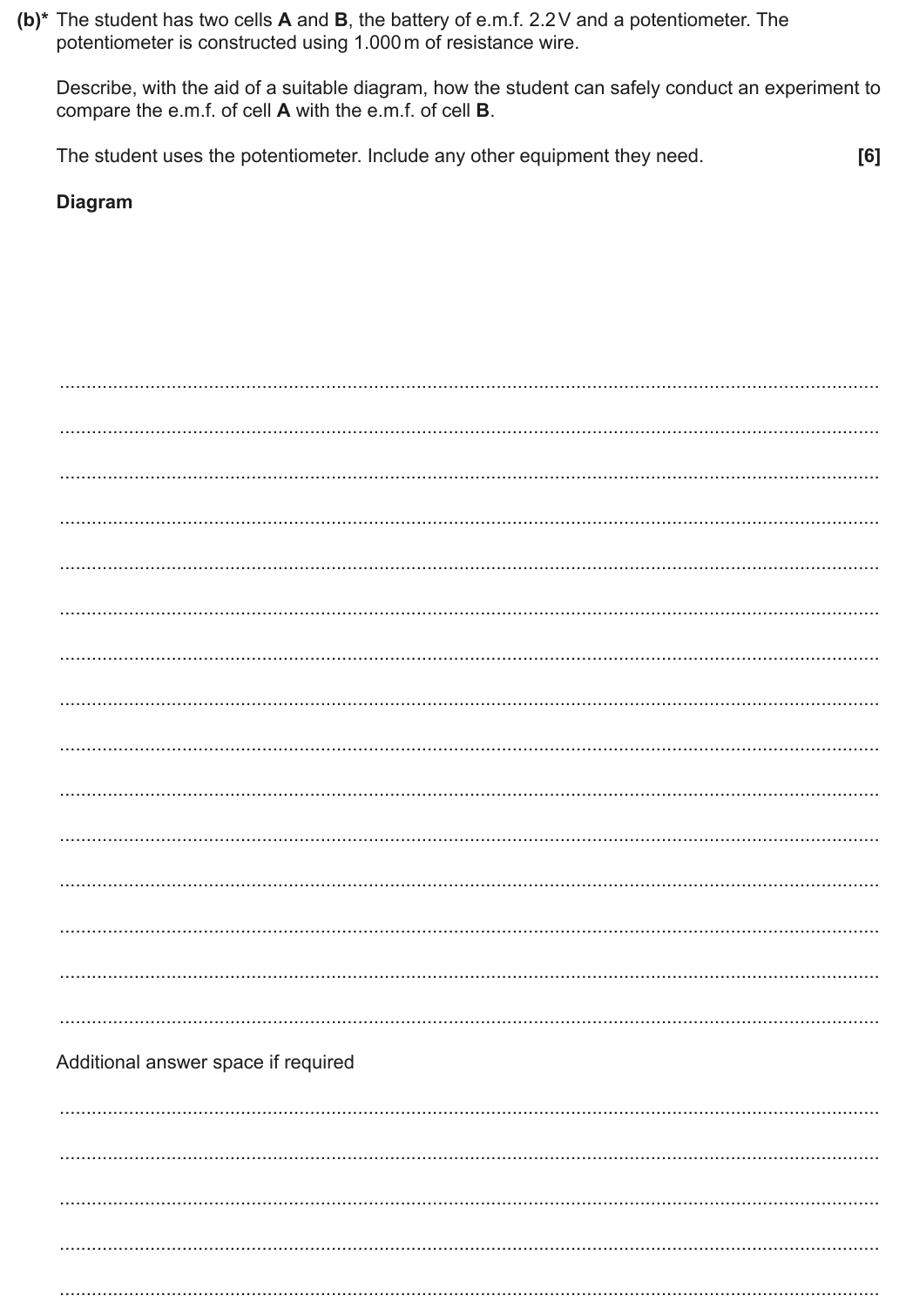
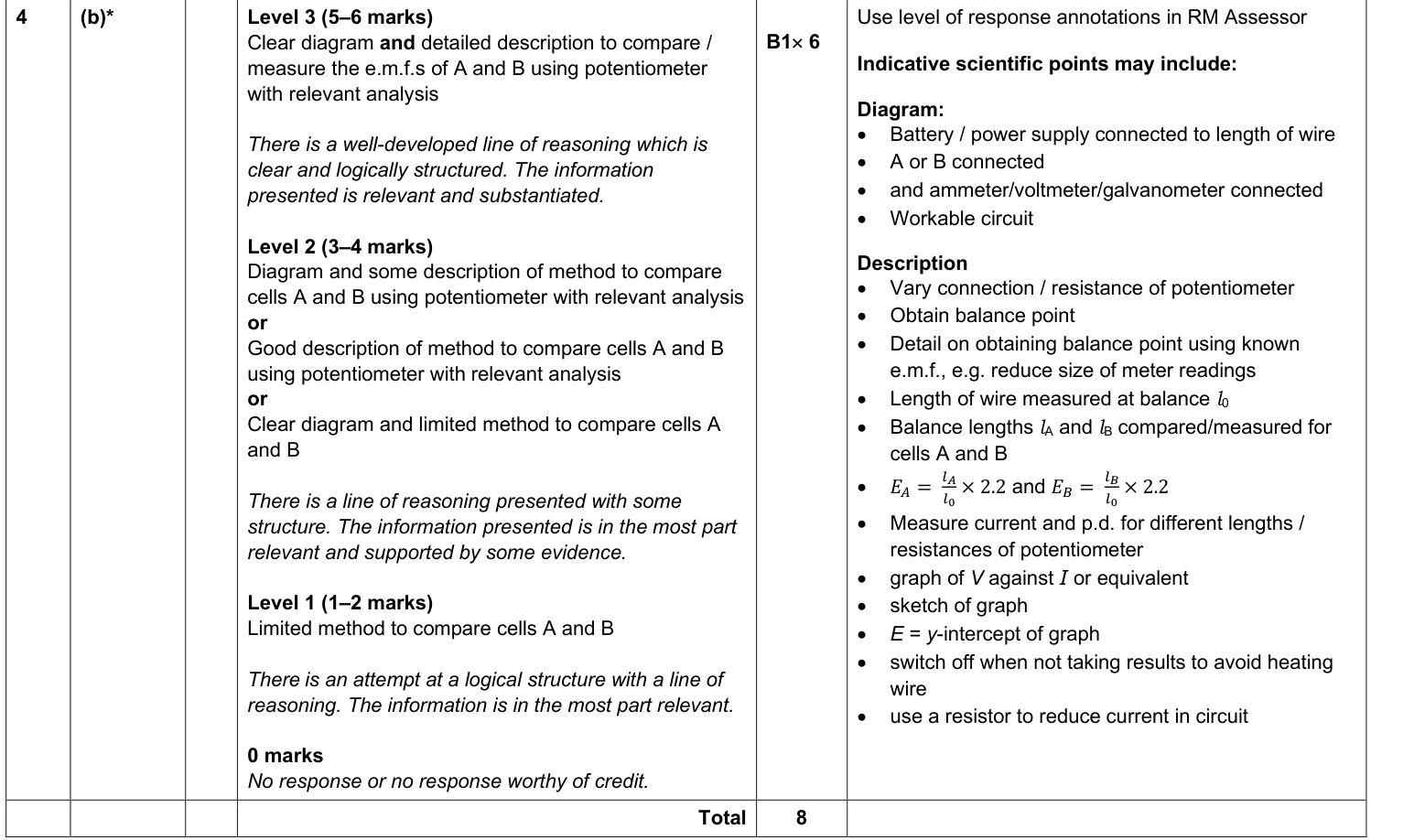
In this Level or Response question, candidates had the opportunity of describing an experiment and including how the results would be analysed. It was clear that many candidates had recalled the use of a potentiometer as a potential divider. Some low performing candidates treated the potentiometer as a device rather like an ammeter or voltmeter. High performing candidates drew a suitable circuit diagram using correct symbols and then gave a description of how the circuit would be used and how the e.m.f.s of the two cells would be compared. Few candidates discussed finding the balance point and then comparing the length of the potentiometer wire. Many candidates determined the e.m.f. using a graphical method with a range of current and potential difference readings across different lengths of the potentiometer.
Skills: M0.3 Use ratios, fractions and percentages; PAG4 Investigating electrical circuits
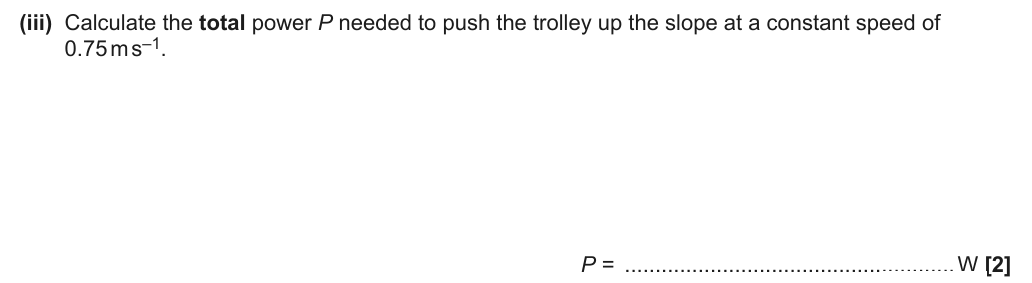
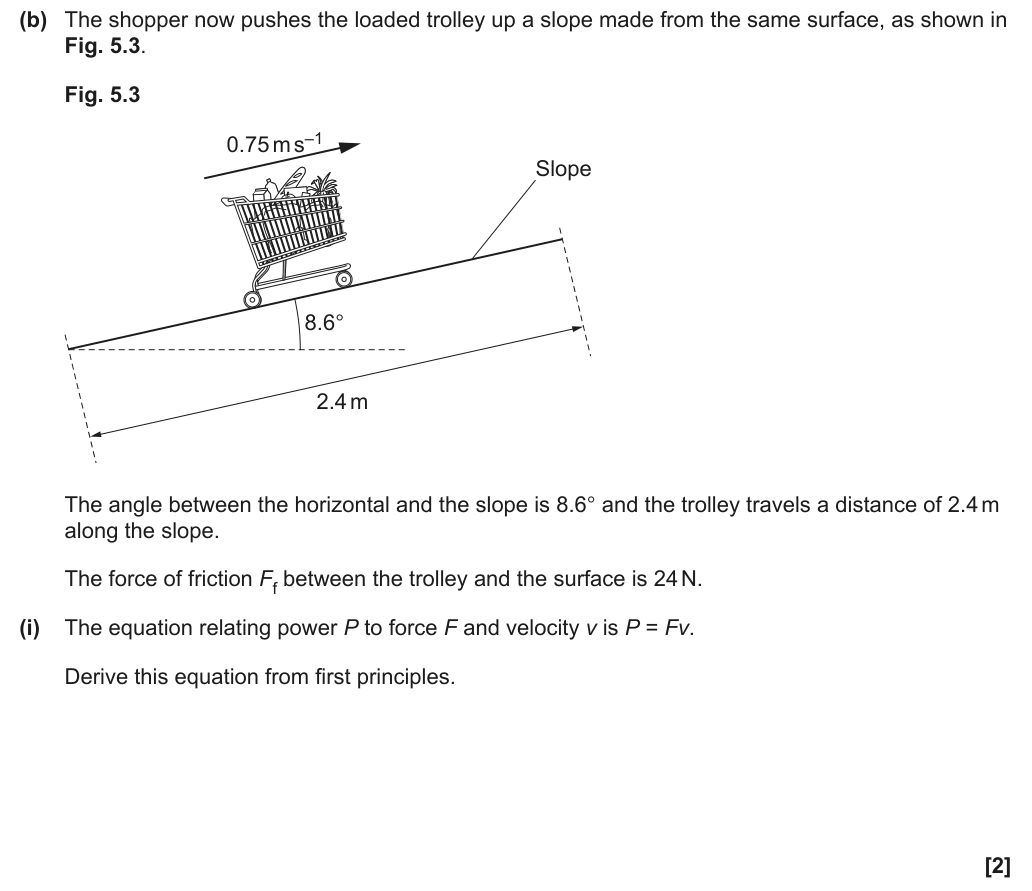
This was a challenging question. Many candidates worked out part of the force part did not add on the friction force. There were several methods, including determining the time.
Skills: M2.3 Substitute numerical values into algebraic equations using appropriate units for physical quantities
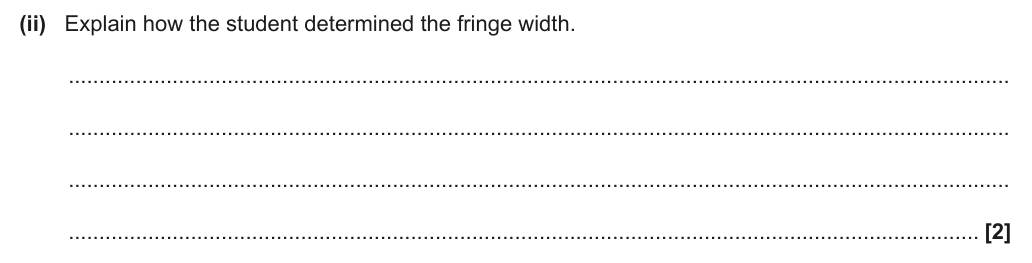
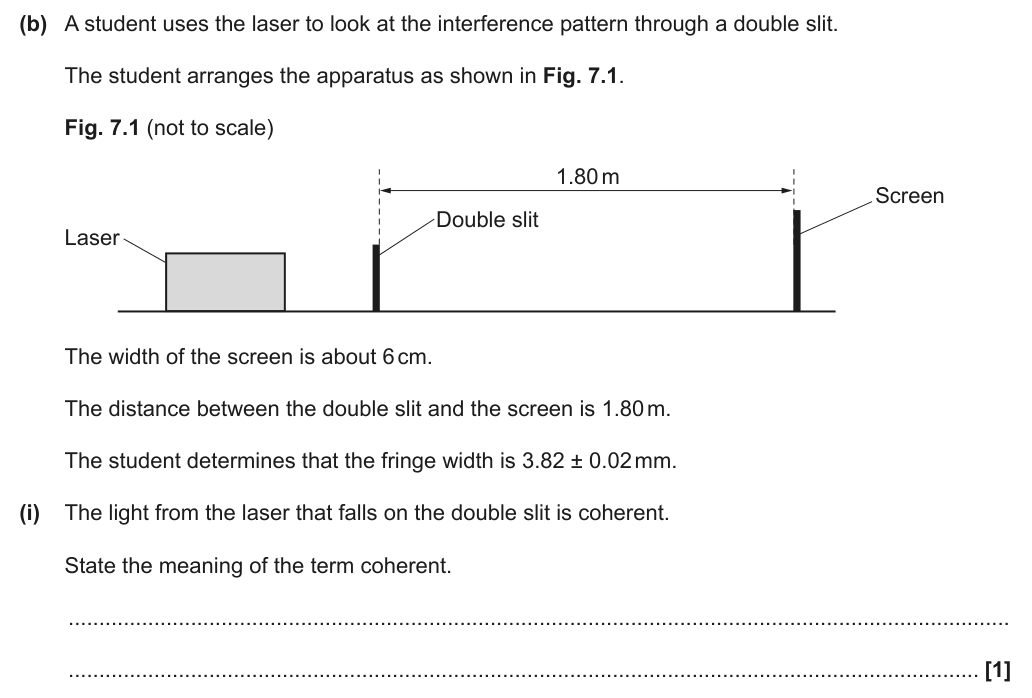
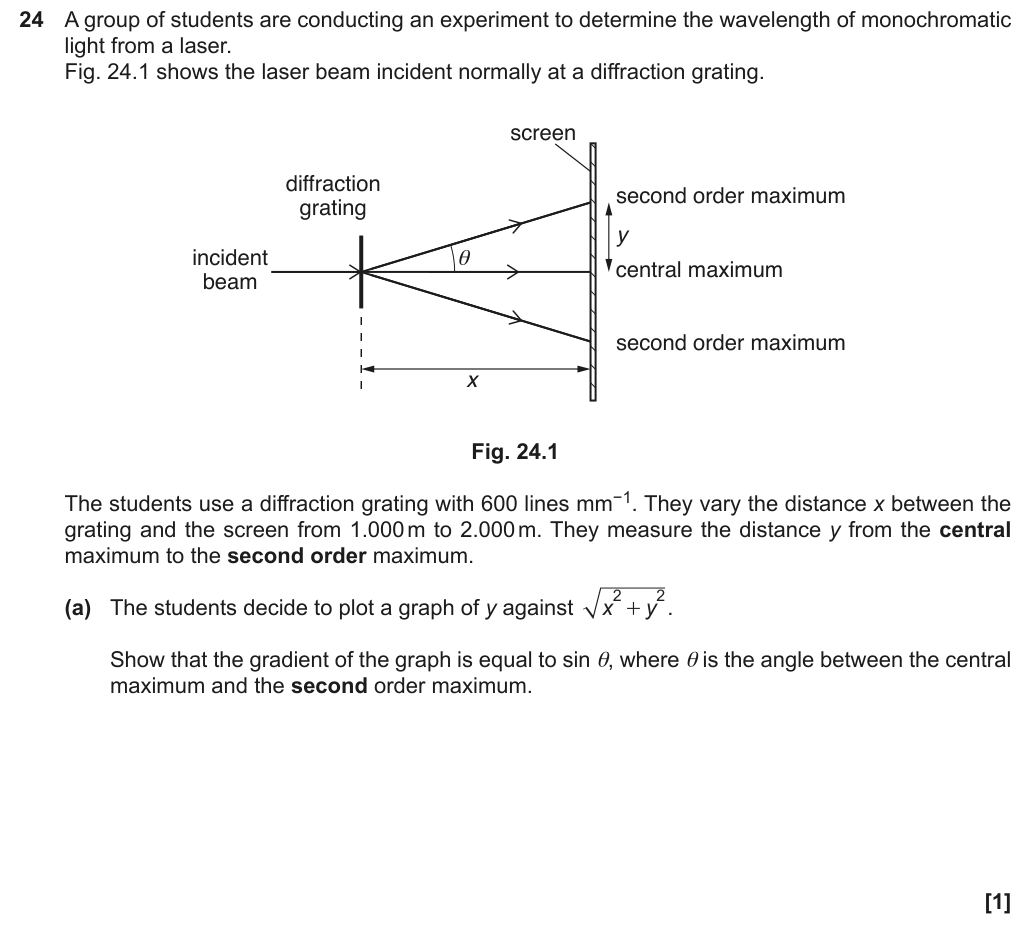
Candidates found this question challenging. Many candidates answered it in term of rearranging the equation for Young slits equation. Some candidates realised that a good method would be to measure the distance for a number n fringes and divide the distance by n. Very few candidates realised that with the fringe width determined to the nearest 0.01 mm the original distance would need to be measured with a measuring instrument of 0.1 mm resolution, i.e. callipers.
Skills: PAG5 Investigating waves
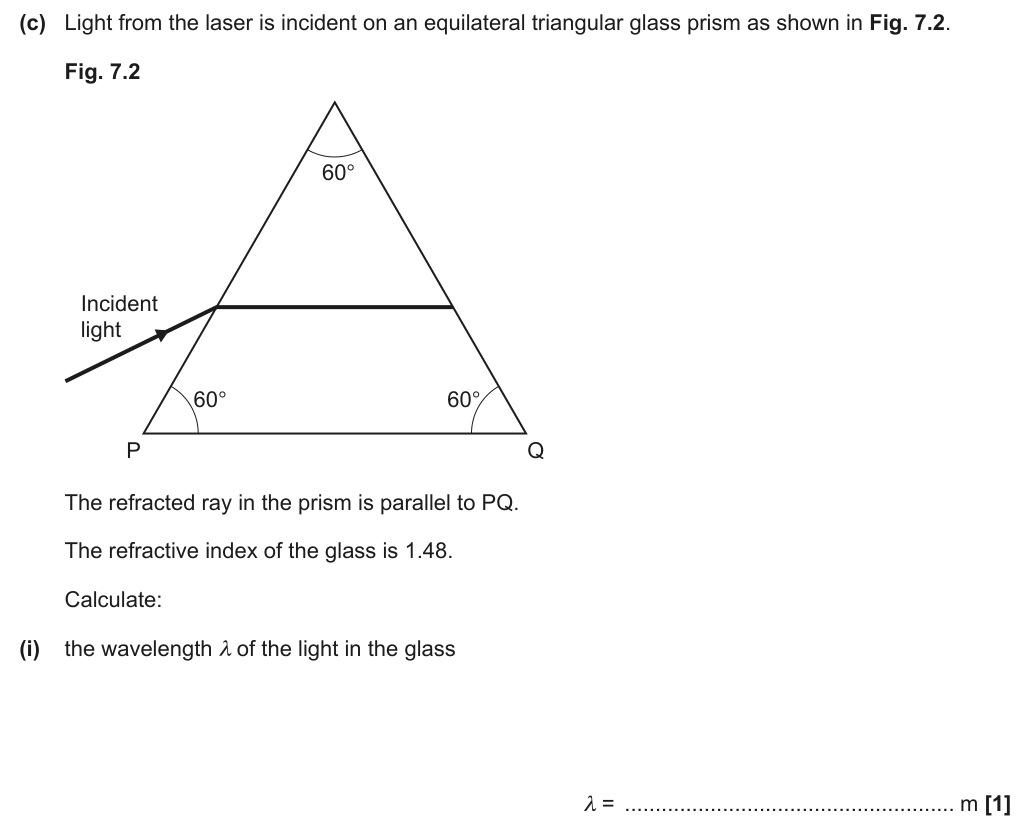
This question appeared to challenge candidates. Some candidates worked out the speed of light in glass but did not then calculate the wavelength.
Skills: M2.3 Substitute numerical values into algebraic equations using appropriate units for physical quantities
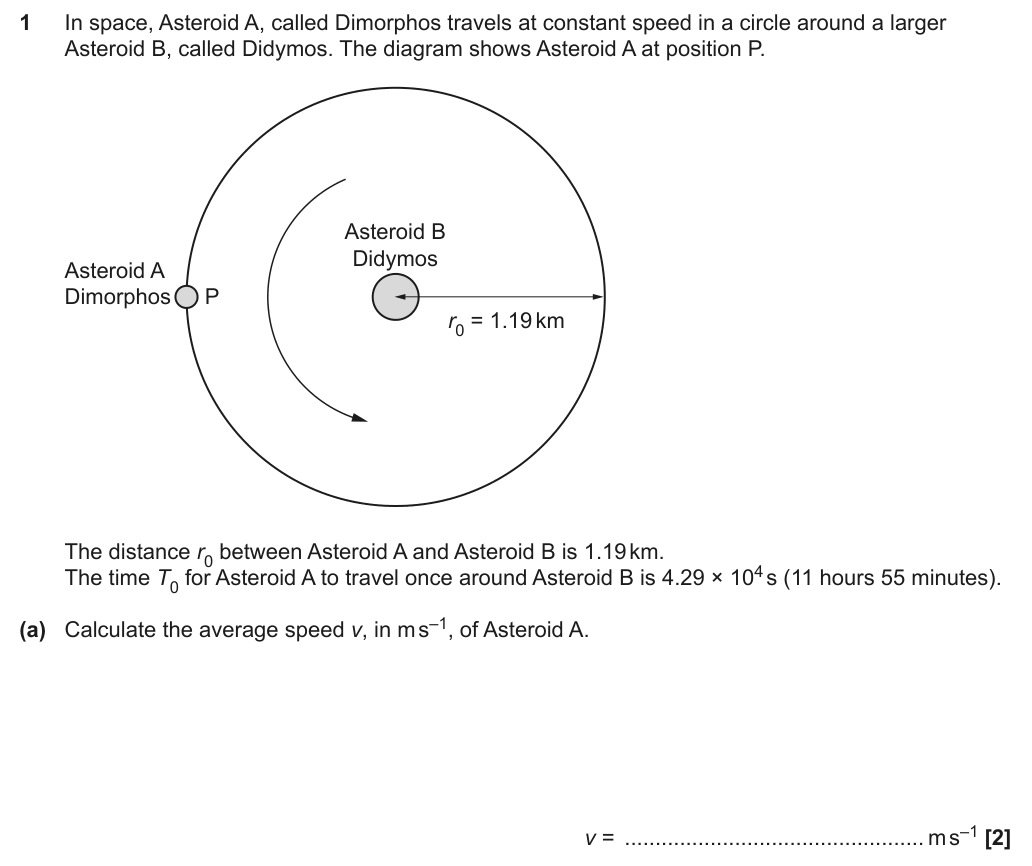
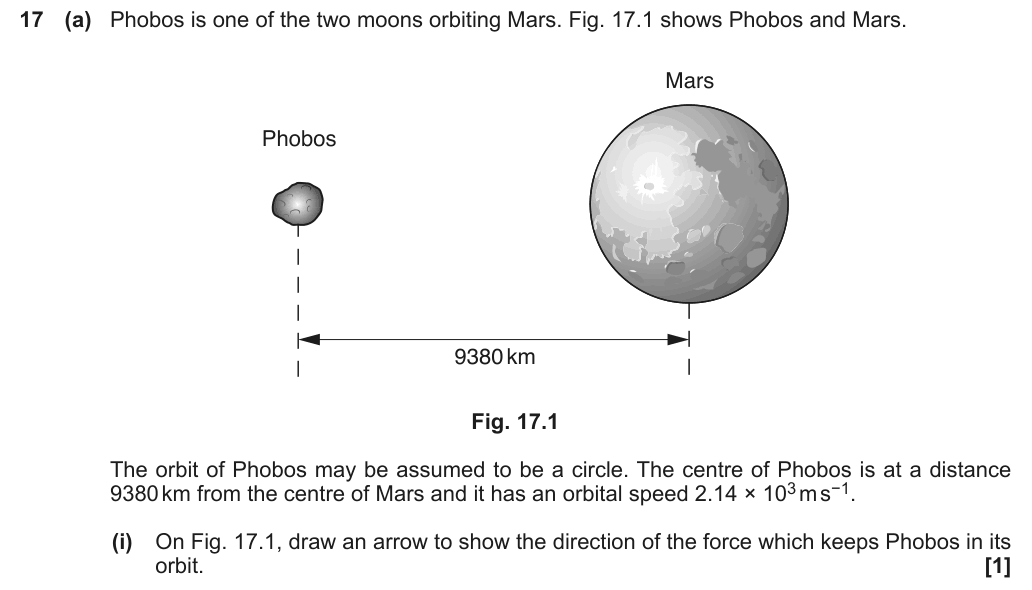
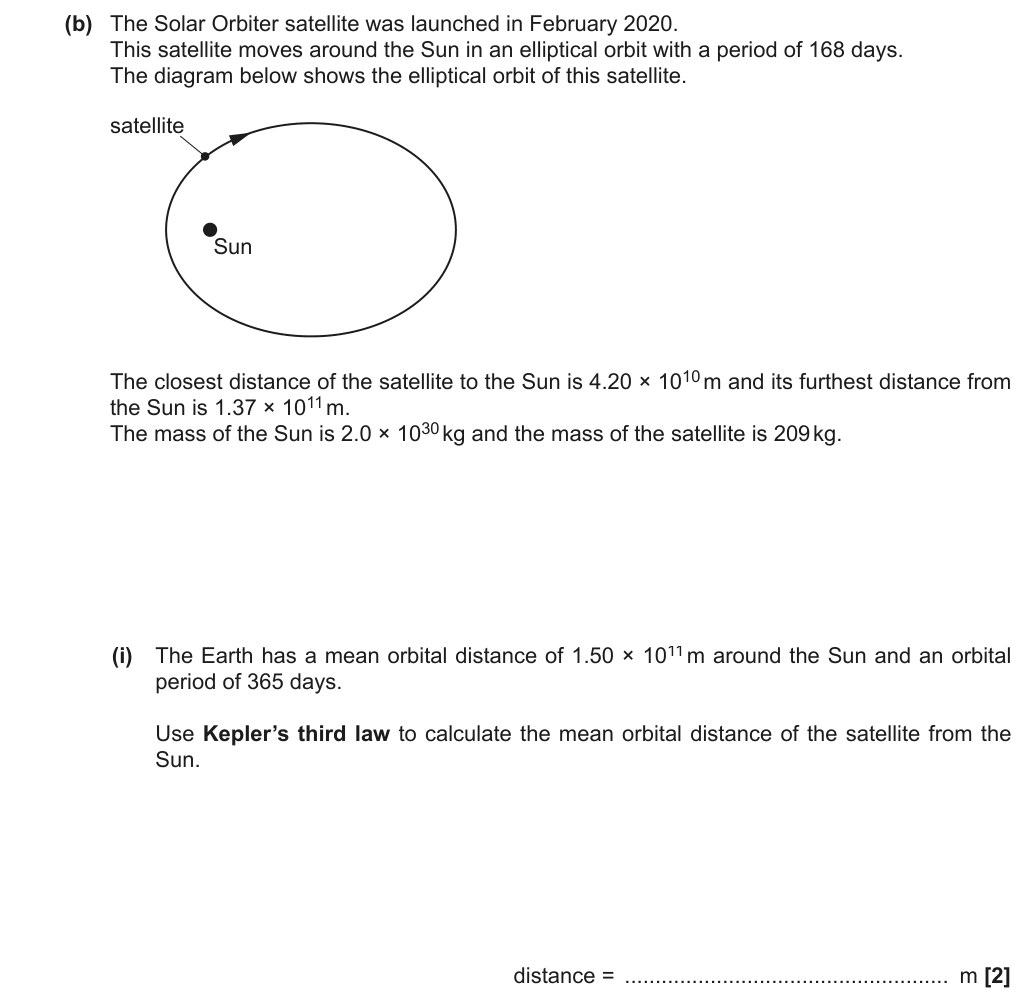
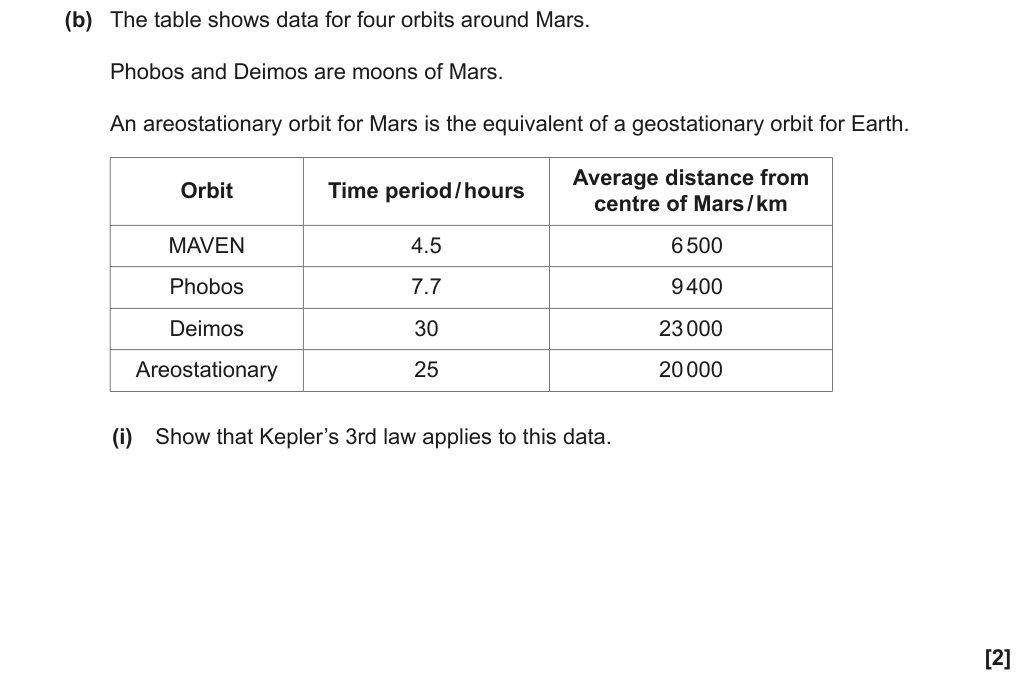
Around four fifths of candidates got this right. Those that did not either poorly converted the radius from km or used the area rather than the circumference of the orbit.
Skills: M0.1 Recognise and make use of appropriate units in calculations; M2.2 Change the subject of an equation, including non-linear equations
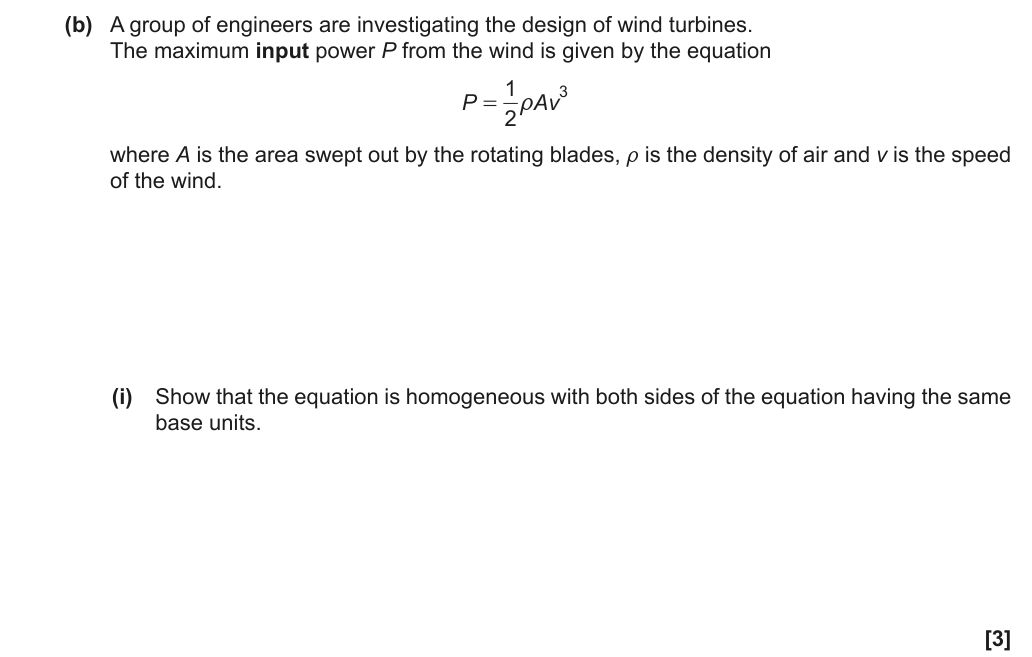
Candidates generally made an excellent attempt at this question, although for many the working was difficult to follow. In the exemplar, the candidate has made it very clear that they are considering the two sides of the equation separately and have reduced each unit to its S.I. base units as required by the question. The use of square brackets to distinguish between a quantity rather than a base unit was helpful.
Skills: M0.1 Recognise and make use of appropriate units in calculations
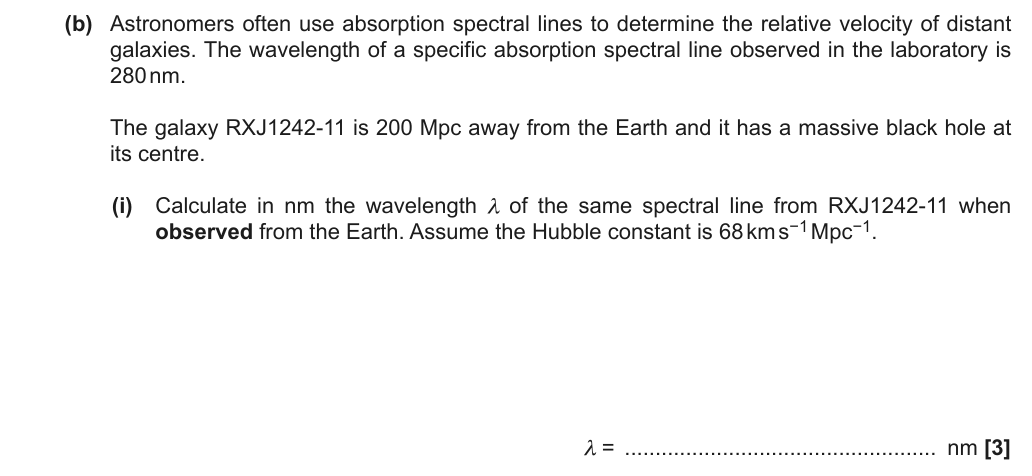
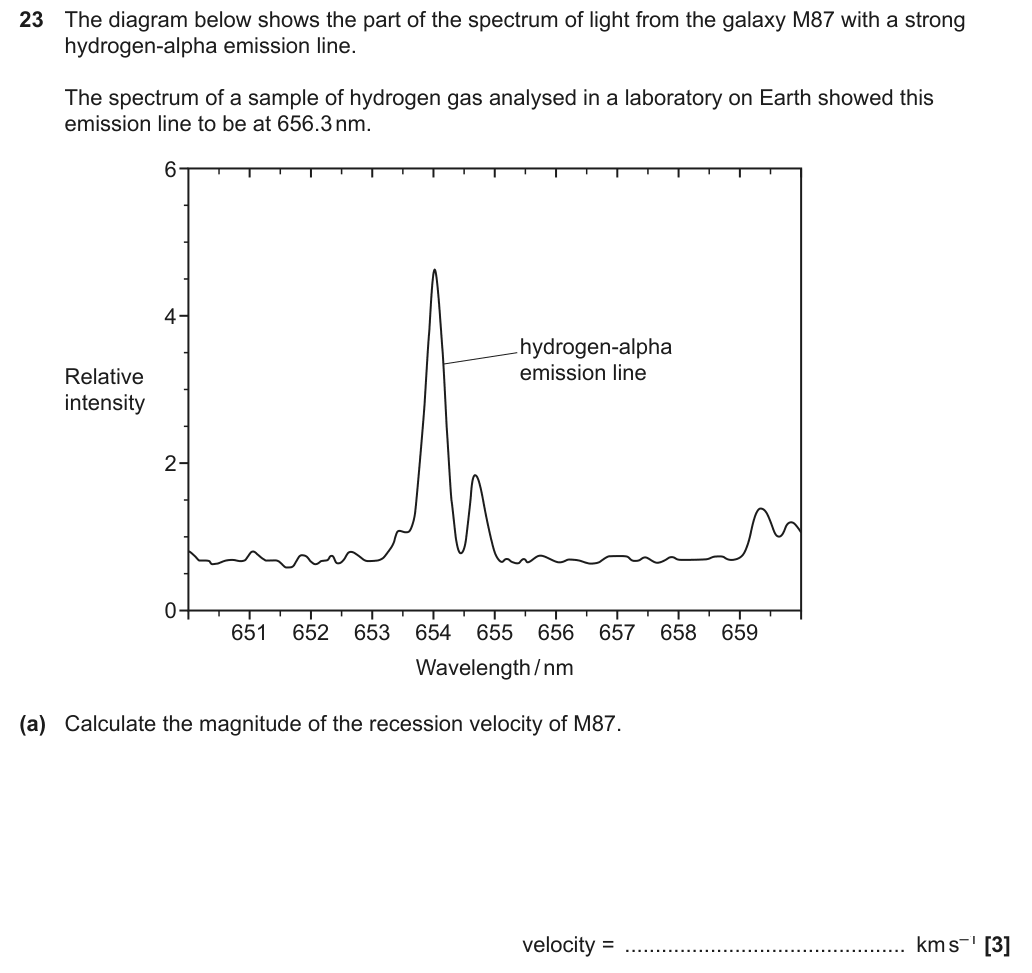
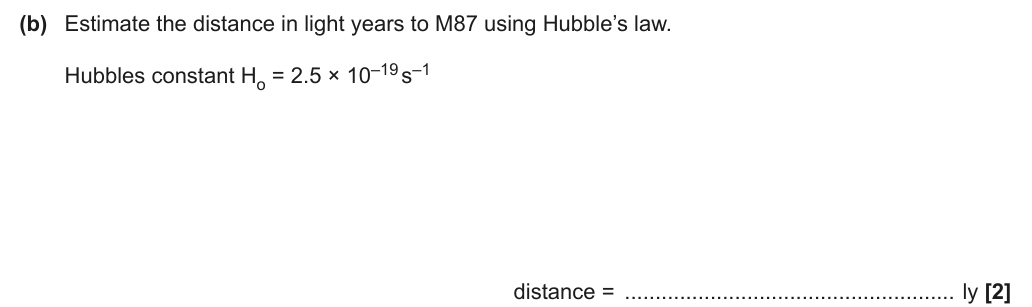
This is a more challenging question with several steps. In multiplying the distance in Mpc by the H0 as quoted, the velocity of the galaxy was 13600 km s-1. Some candidates handled the units well in this question, reaching a change in wavelength of 13 nm. If the candidate got as far as that, then approximately half then went on to add the change in wavelength correctly. The change is added as the galaxy is going away from us. This candidate has laid out the calculation very carefully. It is obvious that they have handled the idea that the speed of light is given in m s-1 and that the galaxy’s velocity is in km s-1. This gives the correct change in wavelength and eventually the correct wavelength.
Skills: M0.1 Recognise and make use of appropriate units in calculations; M2.2 Change the subject of an equation, including non-linear equations; M2.3 Substitute numerical values into algebraic equations using appropriate units for physical quantities

20 per cent of candidates did not attempt this item. Some candidates were on the right lines but very few mentioned about absolute uncertainty and that for these instruments and this graph, the absolute uncertainty was too small to view on this scale.
Skills: M1.5 Identify uncertainties in measurements and use simple techniques to determine uncertainty when data are combined; PAG5 Investigating waves
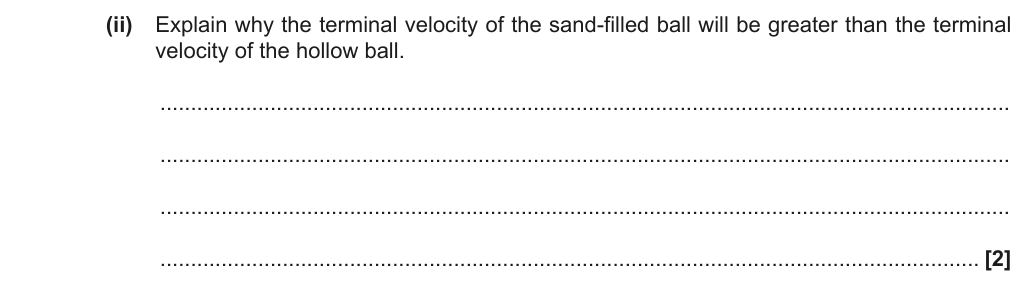
The first mark here was for the knowing that the condition for terminal velocity was required, linked to the idea of the sand-filled ball having a larger weight. The second mark was more difficult to achieve, since a clear link between increased speed and increase drag was required.
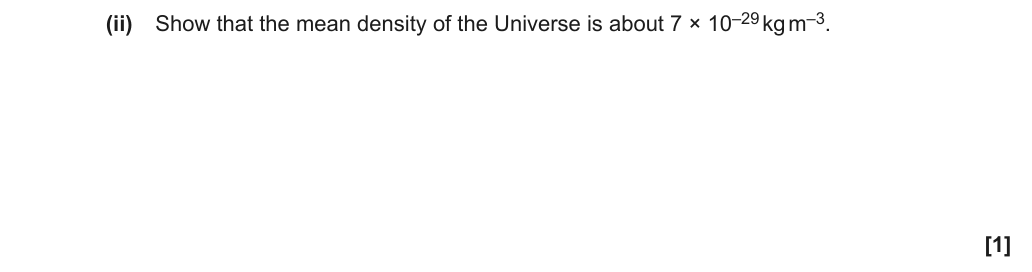
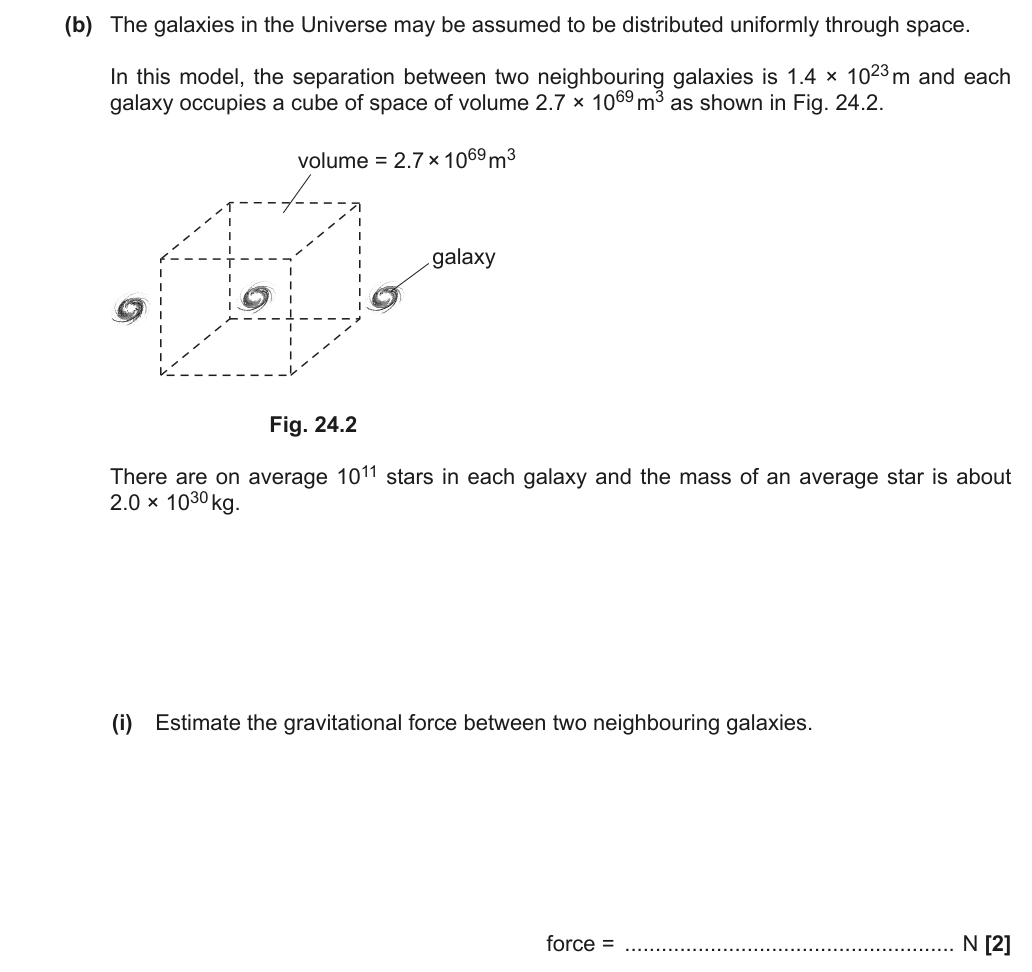
Question 24 (b) (i) While some lower level responses included an attempt to find the gravitational field strength rather than the force most selected the correct formula. Question 24 (b) (iii) This was a question about challenging the model of the universe.

This was a question about challenging the model of the universe. The model takes into account an average mass and average distance of separation, so answers that referred to a variation in masses or distances between galaxies did not score. Higher level responses included that the universe was expanding, so that the distances involved were always changing, or that dark matter was not included in the calculations. There was no indication that candidates were constrained by time in this paper.
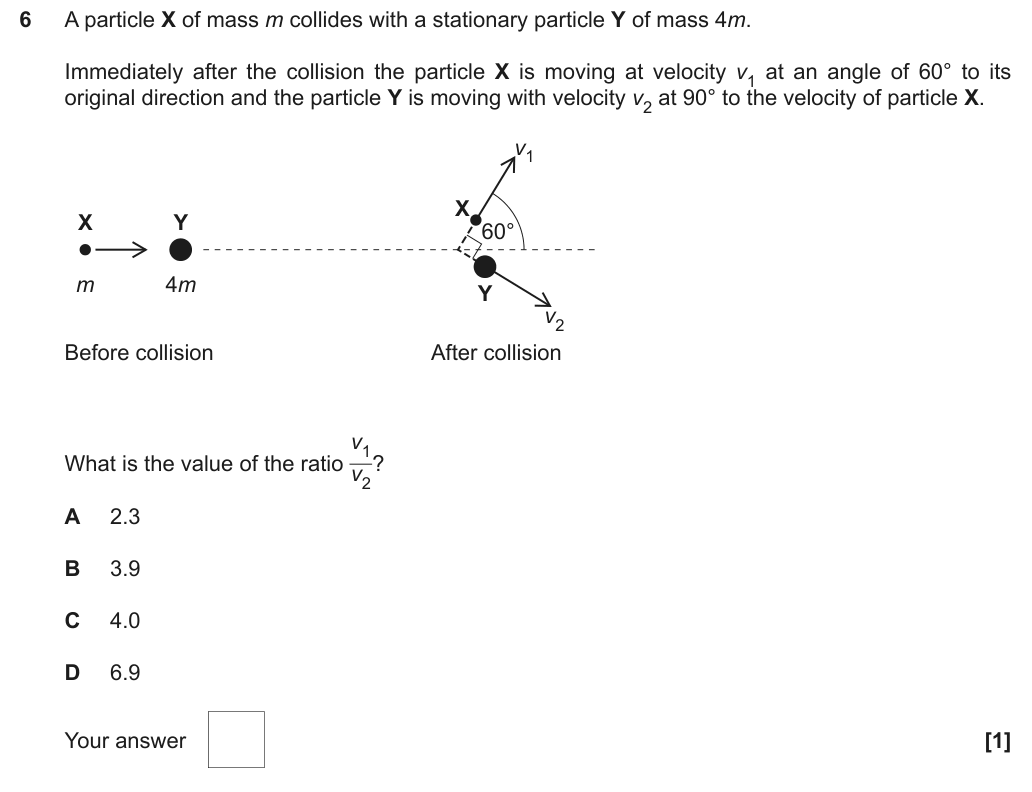
A
Candidates found this question challenging. Conservation of momentum applies both horizontally and vertically here. This means that the vertical upwards component of the momentum of X must equal the vertical downwards component of the momentum of Y. So m v1 sin(60o) = 4m v2 sin(30o). Rearranging this expression will give the correct answer of v1 / v2.
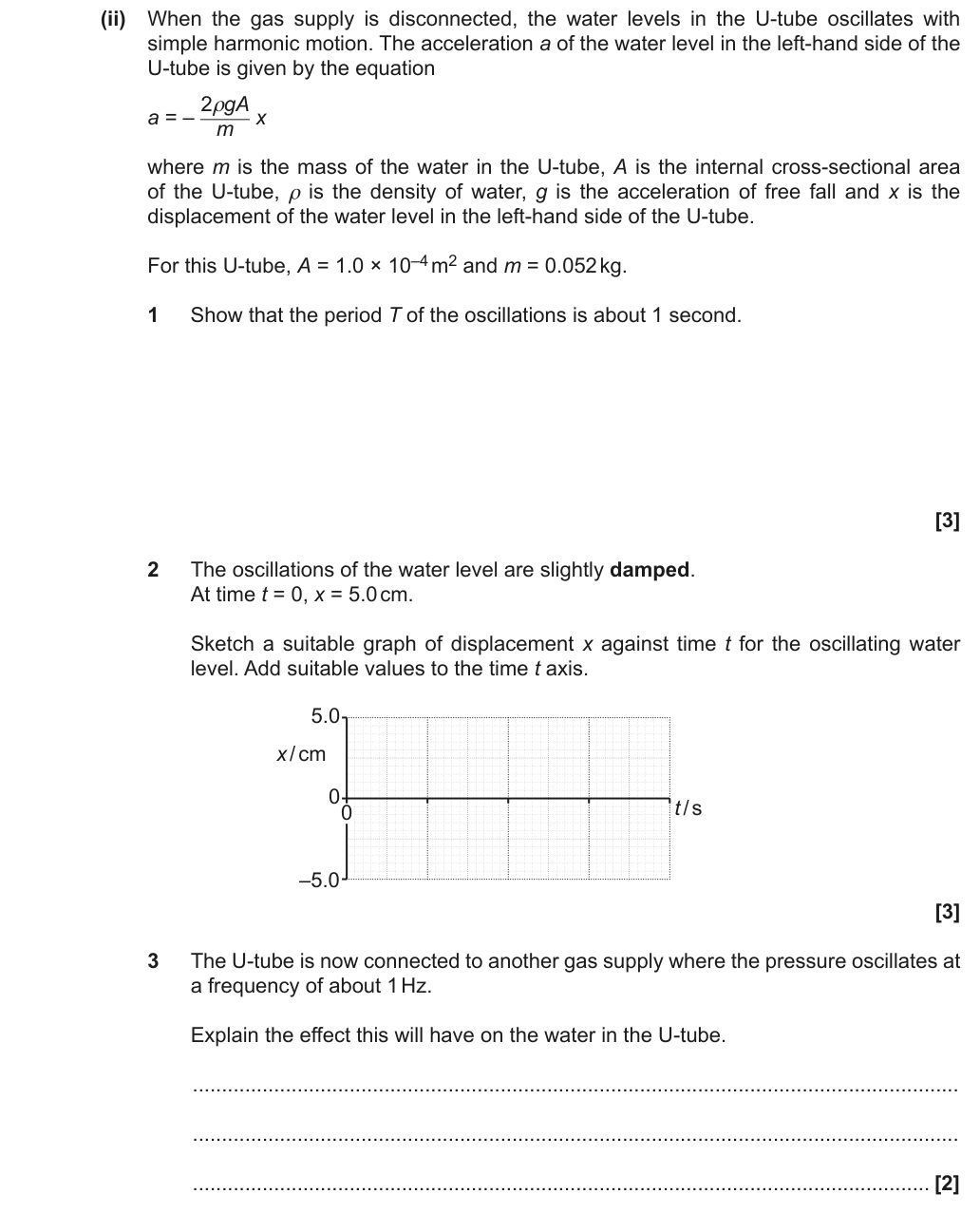
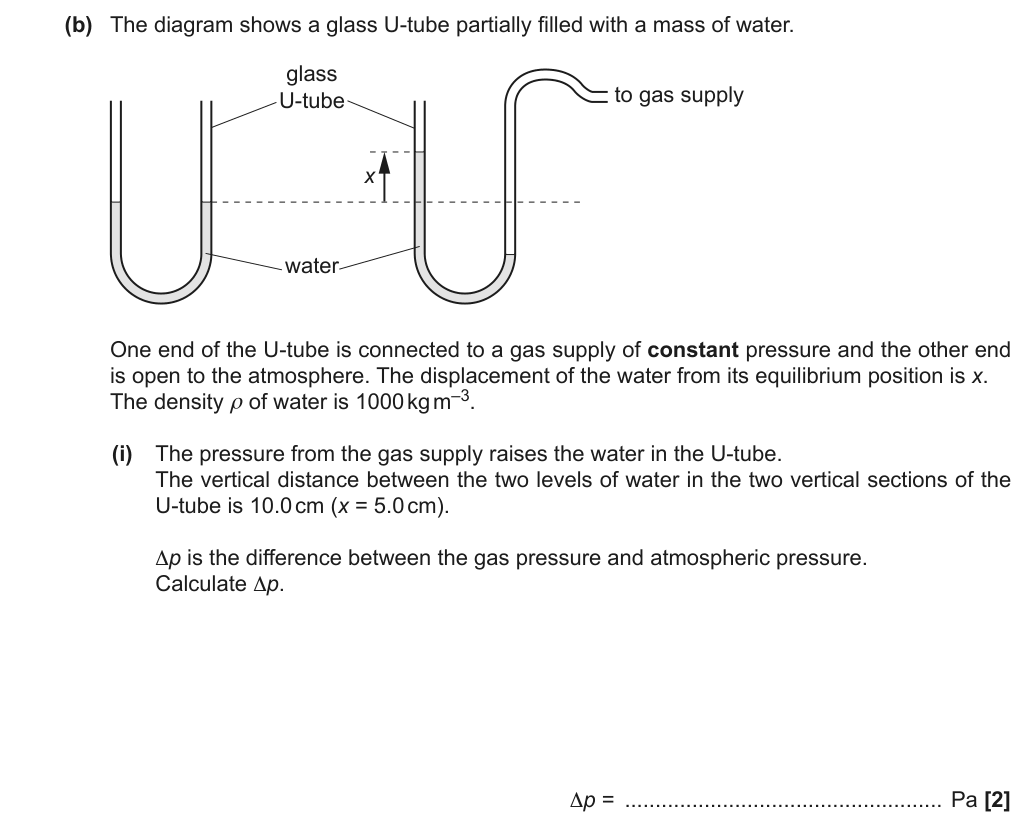
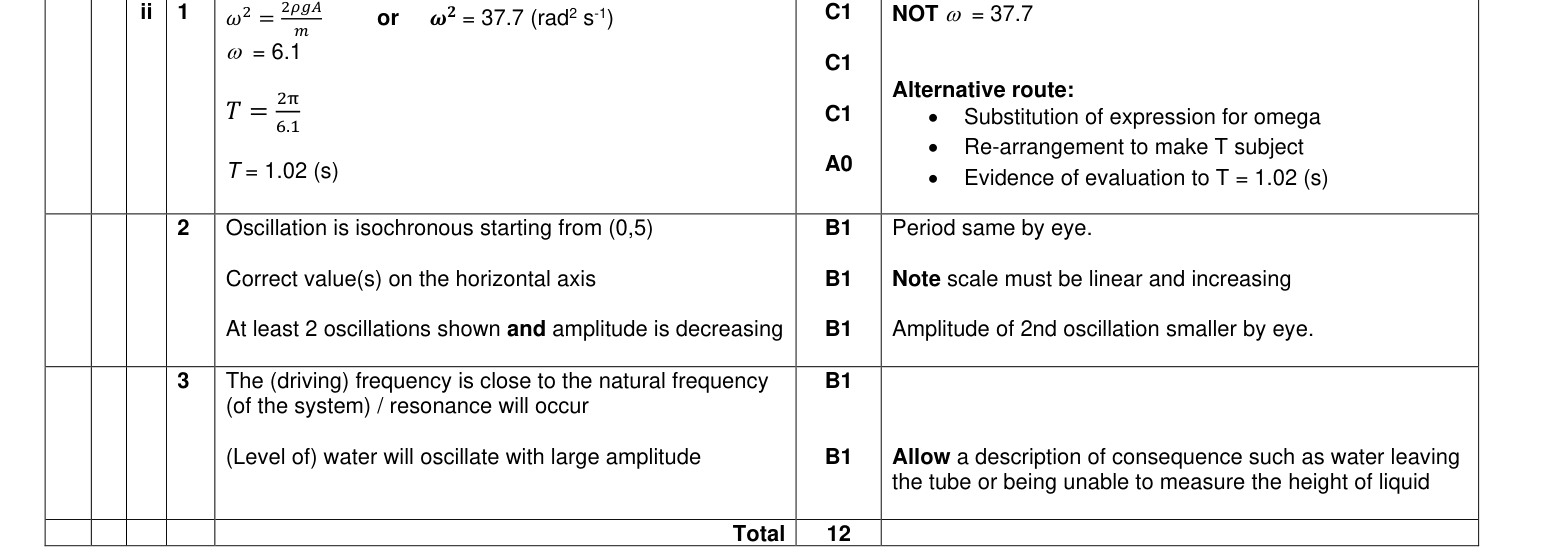
Very few candidates made the link that the gas pressure oscillating would cause a periodic force and so this would become a resonant system. The best way to describe a resonating system in this context is that the amplitude of vibrations becomes significantly larger.
Skills: M2.2 Change the subject of an equation, including non-linear equations; M2.3 Substitute numerical values into algebraic equations using appropriate units for physical quantities; M3.12 Sketch relationships which are modelled by y = k/x, y = kx², y = k/x², y = kx, y = sin x, y = cos x, y = e^(±x) and y = sin²x, y = cos²x as applied to physical relationships
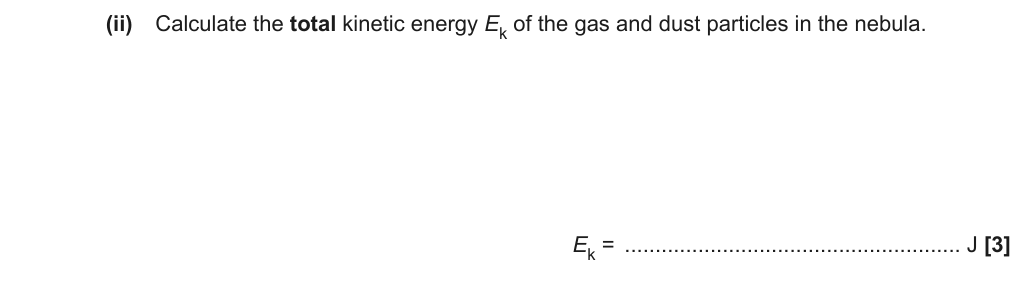
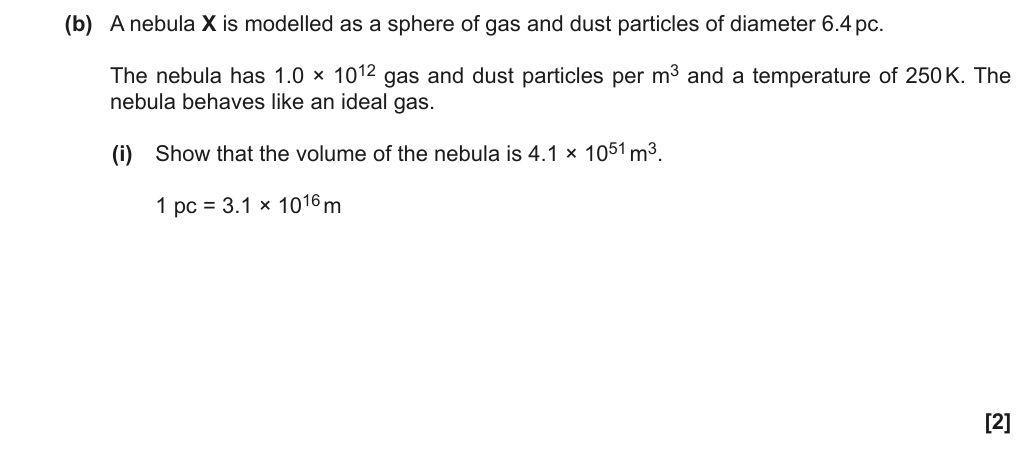
This brief yet multi-stage question proved relatively challenging. The correct approach here was to find the average kinetic energy of a single particle (using Ek = 3/2 kT ) and then multiplying this by the number of particles in the nebula. The number of particles in the nebula was found by multiplying the number density by the volume of the nebula.

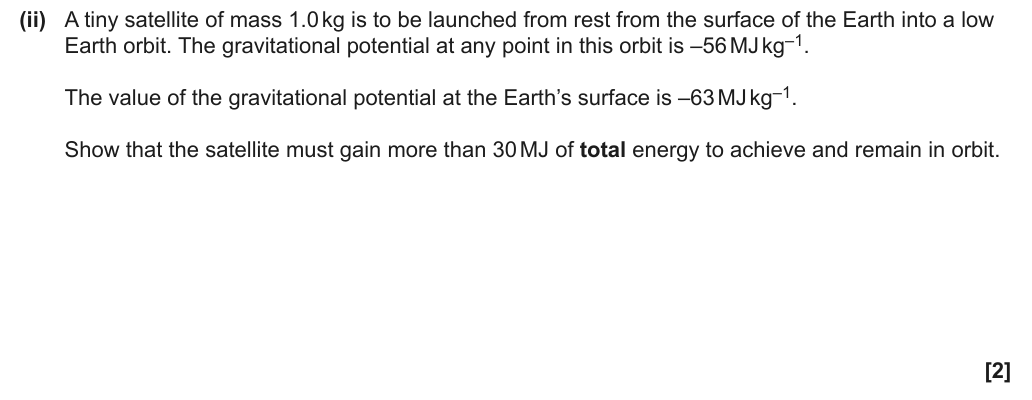
This question provides one of the ‘stretch and challenge’ marks in this paper. The idea is that the satellite needs first to climb out of the Earth’s gravitational well before it can be a satellite of the Sun. If any of your students’ results are not as expected, you may wish to consider one of our post-results services. For full information about the options available visit the OCR website. We send a weekly roundup to tell you about important updates. You can also sign up for your subject specific updates. If you haven’t already, sign up here. Attend one of our popular CPD courses to hear directly from a senior assessor or drop in to a Q&A session. Most of our courses are delivered live via an online platform, so you can attend from any location. Please find details for all our courses on the relevant subject page on our website or visit OCR professional development. ExamBuilder is the question builder platform for a range of our GCSE, A Level, Cambridge Nationals and Cambridge Technicals qualifications. Find out more. ExamBuilder is free for all OCR centres with an Interchange account and gives you unlimited users per centre. We need an Interchange username to validate the identity of your centre's first user account for ExamBuilder. If you do not have an Interchange account please contact your centre administrator (usually the Exams Officer) to request a username, or nominate an existing Interchange user in your department. Review students' exam performance with our free online results analysis tool. It is available for all GCSEs, AS and A Levels and Cambridge Nationals. It allows you to: • review and run analysis reports on exam performance • analyse results at question and/or topic level • compare your centre with OCR national averages • identify trends across the centre • facilitate effective planning and delivery of courses • identify areas of the curriculum where students excel or struggle • help pinpoint strengths and weaknesses of students and teaching departments. Find out more. Post-results services Keep up-to-date OCR Professional Development Signed up for ExamBuilder?
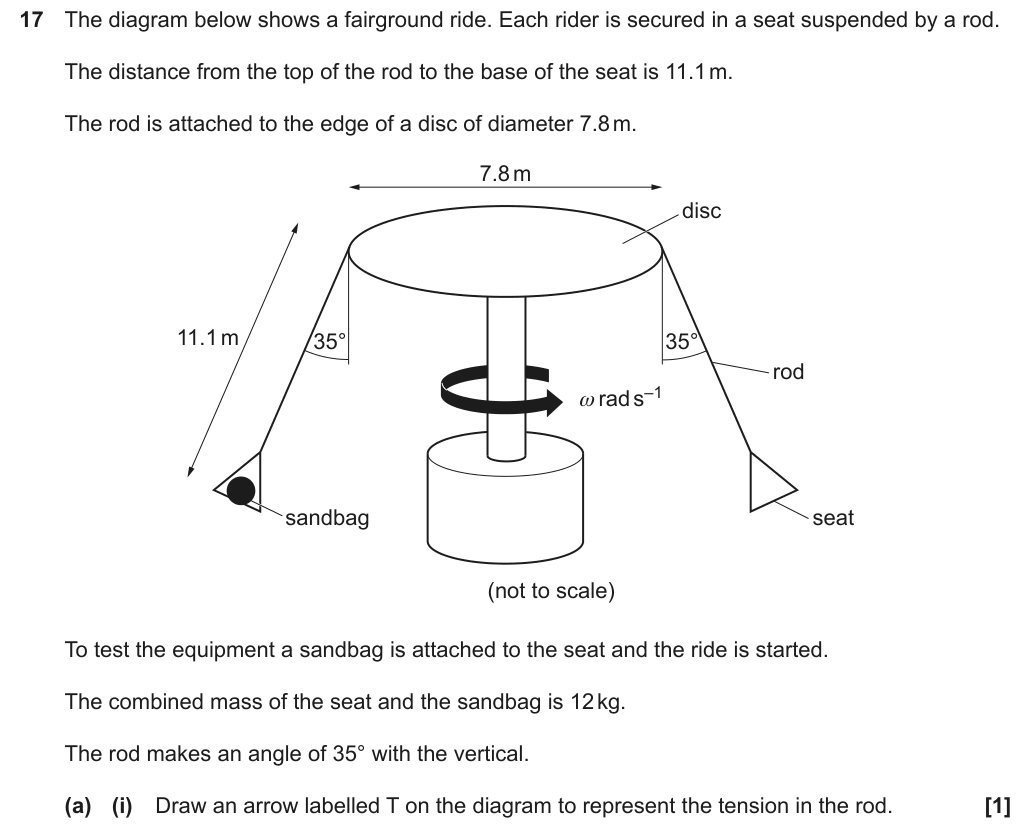
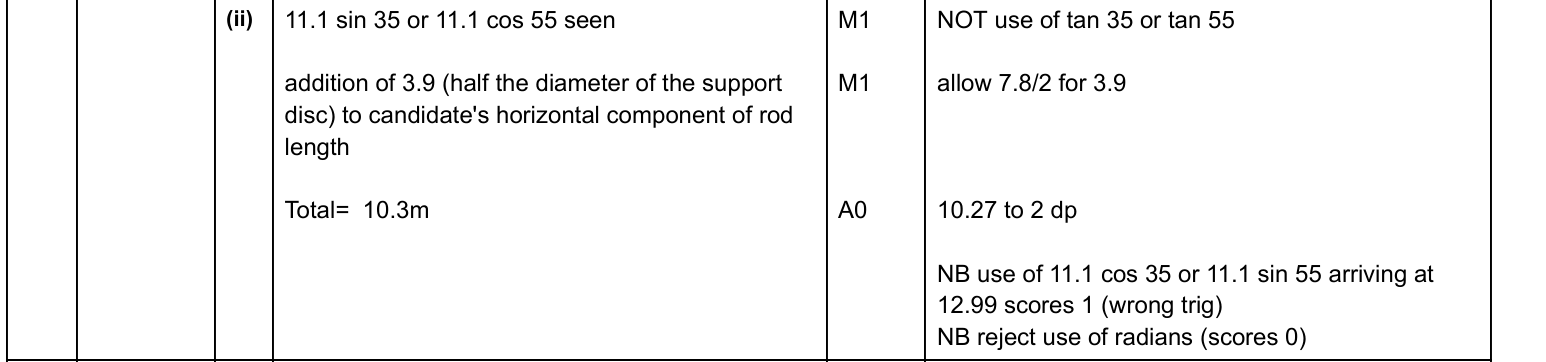
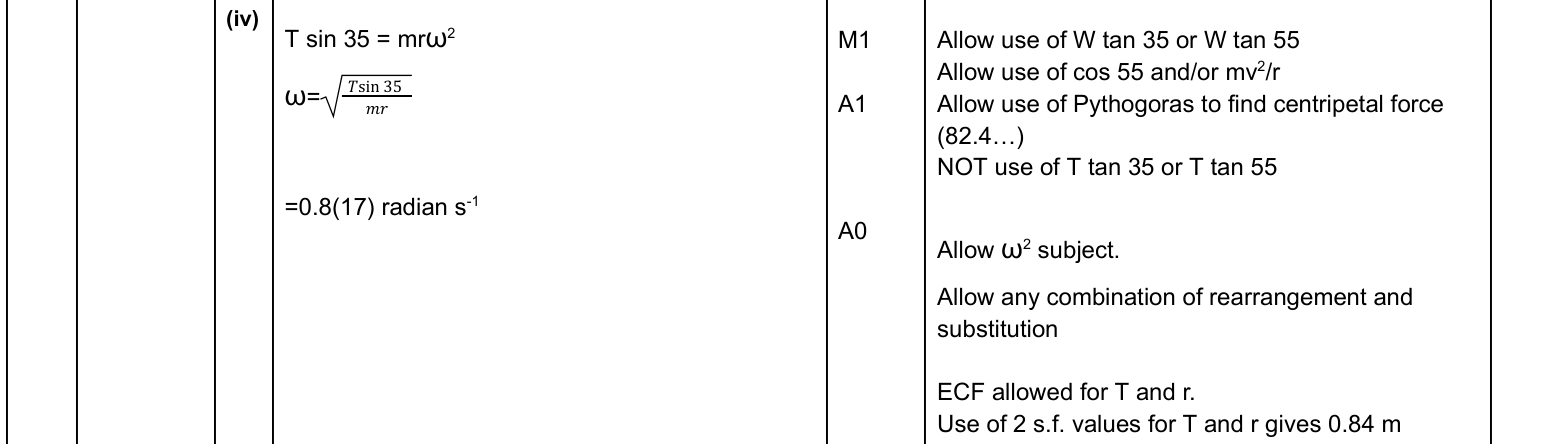
In Question 17 (a) (i) of this question, the phrase ‘tension in the rod’ can mean several different things, all of which were given in the mark scheme. Many candidates approached part (ii) with some confidence, spotting that the horizontal portion of the rod was 11.1 sin(35) and that it should be added to the radius of the disc. Parts (a) (iii) and (iv) were more challenging, requiring good knowledge of both circular motion and how to calculate components of forces. Again there were several legitimate routes to the right answer, all of which were mentioned in the mark scheme. Very logical approaches were in part (a) (iii), to equate the vertical component of the tension with the weight of the sandbag. In part (a) (iv), the quickest approach was to equate the horizontal component of the tension with the centripetal force. The data booklet provides a convenient expression for the centripetal force in terms of the angular velocity, without the need for finding the tangential velocity.
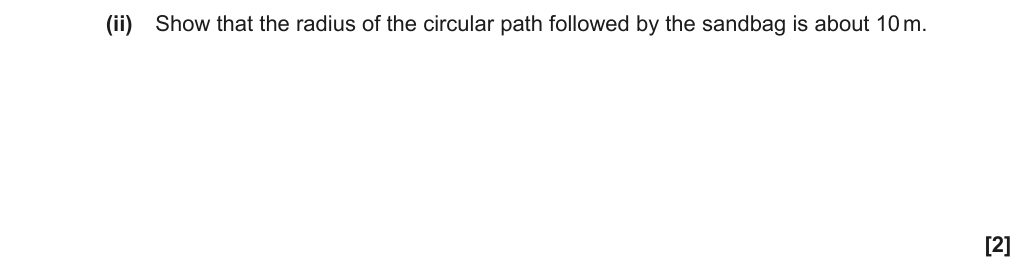
In Question 17 (a) (i) of this question, the phrase ‘tension in the rod’ can mean several different things, all of which were given in the mark scheme. Many candidates approached part (ii) with some confidence, spotting that the horizontal portion of the rod was 11.1 sin(35) and that it should be added to the radius of the disc. Parts (a) (iii) and (iv) were more challenging, requiring good knowledge of both circular motion and how to calculate components of forces. Again there were several legitimate routes to the right answer, all of which were mentioned in the mark scheme. Very logical approaches were in part (a) (iii), to equate the vertical component of the tension with the weight of the sandbag. In part (a) (iv), the quickest approach was to equate the horizontal component of the tension with the centripetal force. The data booklet provides a convenient expression for the centripetal force in terms of the angular velocity, without the need for finding the tangential velocity.
Skills: M0.6 Use calculators to handle sin x, cos x and tan x when x is expressed in degrees or radians; M4.5 Use sin, cos and tan in physical problems
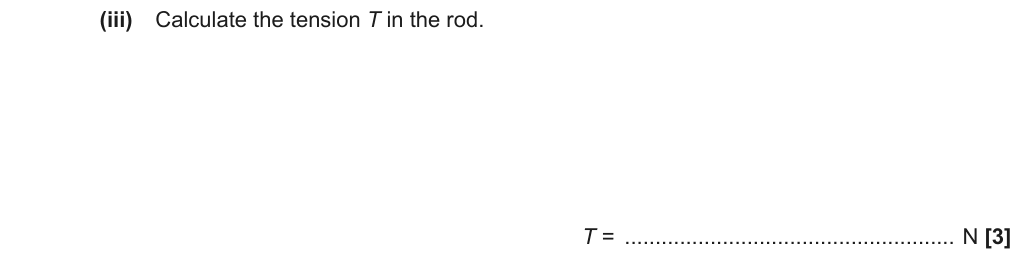
In Question 17 (a) (i) of this question, the phrase ‘tension in the rod’ can mean several different things, all of which were given in the mark scheme. Many candidates approached part (ii) with some confidence, spotting that the horizontal portion of the rod was 11.1 sin(35) and that it should be added to the radius of the disc. Parts (a) (iii) and (iv) were more challenging, requiring good knowledge of both circular motion and how to calculate components of forces. Again there were several legitimate routes to the right answer, all of which were mentioned in the mark scheme. Very logical approaches were in part (a) (iii), to equate the vertical component of the tension with the weight of the sandbag. In part (a) (iv), the quickest approach was to equate the horizontal component of the tension with the centripetal force. The data booklet provides a convenient expression for the centripetal force in terms of the angular velocity, without the need for finding the tangential velocity.
Skills: M0.6 Use calculators to handle sin x, cos x and tan x when x is expressed in degrees or radians; M2.2 Change the subject of an equation, including non-linear equations; M4.5 Use sin, cos and tan in physical problems
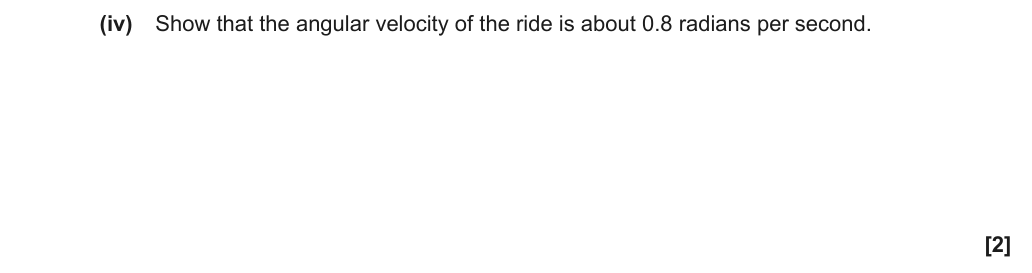
In Question 17 (a) (i) of this question, the phrase ‘tension in the rod’ can mean several different things, all of which were given in the mark scheme. Many candidates approached part (ii) with some confidence, spotting that the horizontal portion of the rod was 11.1 sin(35) and that it should be added to the radius of the disc. Parts (a) (iii) and (iv) were more challenging, requiring good knowledge of both circular motion and how to calculate components of forces. Again there were several legitimate routes to the right answer, all of which were mentioned in the mark scheme. Very logical approaches were in part (a) (iii), to equate the vertical component of the tension with the weight of the sandbag. In part (a) (iv), the quickest approach was to equate the horizontal component of the tension with the centripetal force. The data booklet provides a convenient expression for the centripetal force in terms of the angular velocity, without the need for finding the tangential velocity.
Skills: M0.6 Use calculators to handle sin x, cos x and tan x when x is expressed in degrees or radians; M2.2 Change the subject of an equation, including non-linear equations; M2.3 Substitute numerical values into algebraic equations using appropriate units for physical quantities
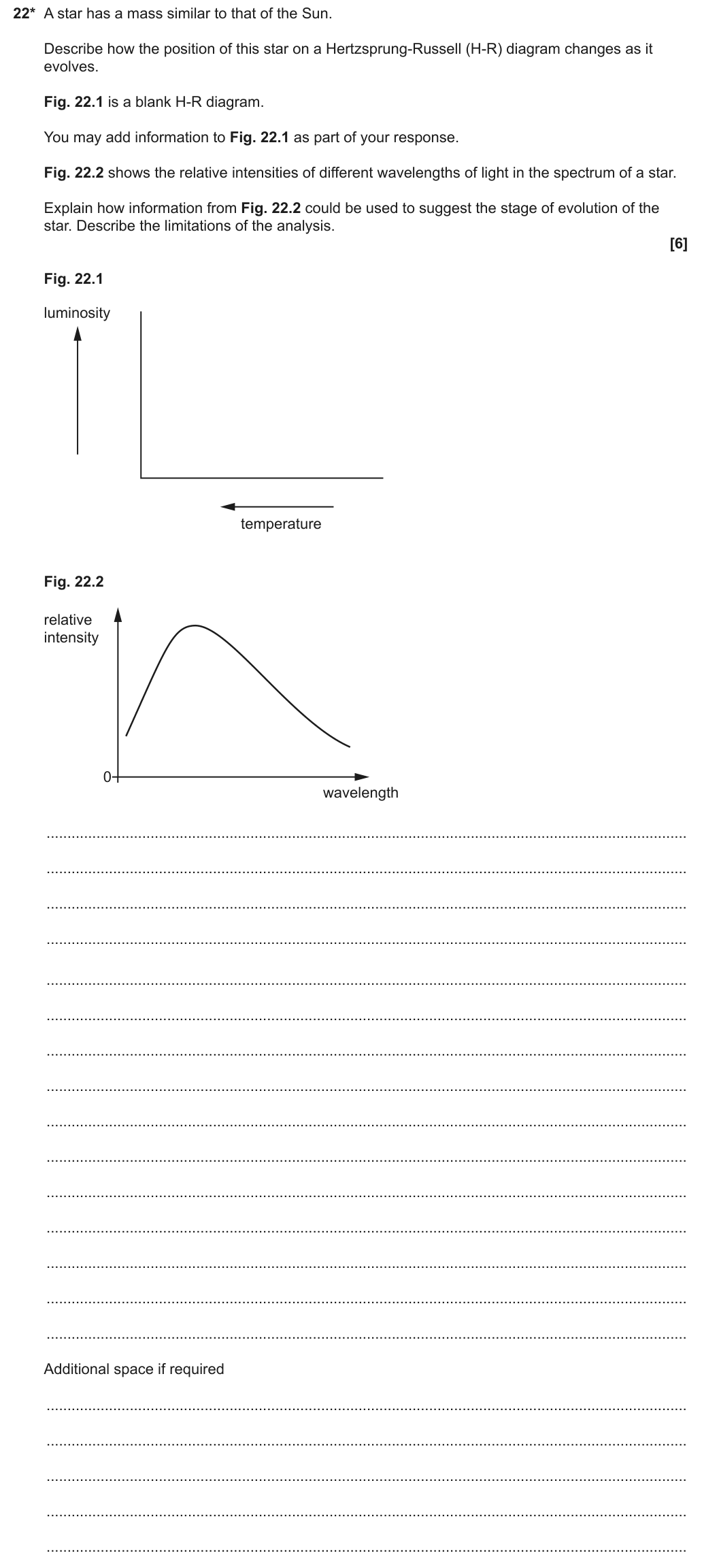
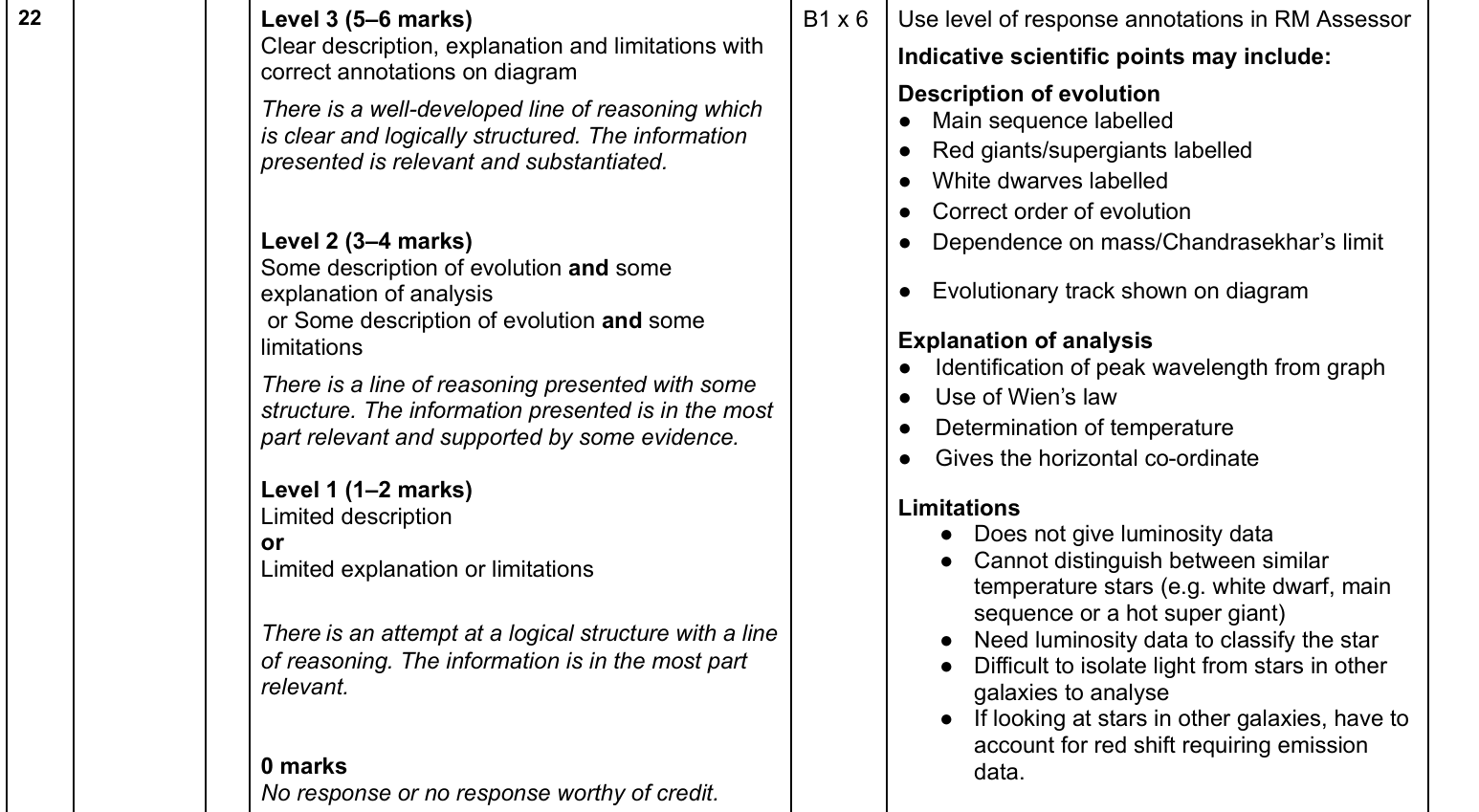
Most Level of Response (LoR) questions have multiple parts to them. The first task the candidates are asked is to describe the life of a star similar to the Sun with the added complexity of showing or describing how that affects the star’s position on the H-R diagram. Many candidates enjoyed considerable success here. Fig 22.2 proved more challenging to interpret. As there are no scales on the axes, it is difficult to say what colour this star is, however λmax is relatively low, which points in the direction of early-mid-life (yellow or yellow white). Candidates rightly suggested that Wien’s law was applicable and that as the star grew older and expanded into a red giant, the curve’s peak would move to the right. The most challenging aspect of this question is suggesting what limitations this approach has. The lack of scales has already been mentioned. The colour alone cannot uniquely define a star’s position on the H-R diagram and thus the stage of life of the star. The graph only gives a relative intensity, which means that the total output of the star, or its luminosity cannot be measured. This candidate described the life cycle of sun-like stars in great depth, completed an excellent HR diagram and in the text described the path of the star on the H-R diagram throughout its lifetime. The references in the last paragraph are what makes this response worthy of a Level 3. The candidate has answered all aspects of the question, explaining both Wien’s law and how the luminosity (and hence position on the H-R diagram) is impossible from the data presented.
Skills: M3.1 Translate information between graphical, numerical and algebraic forms
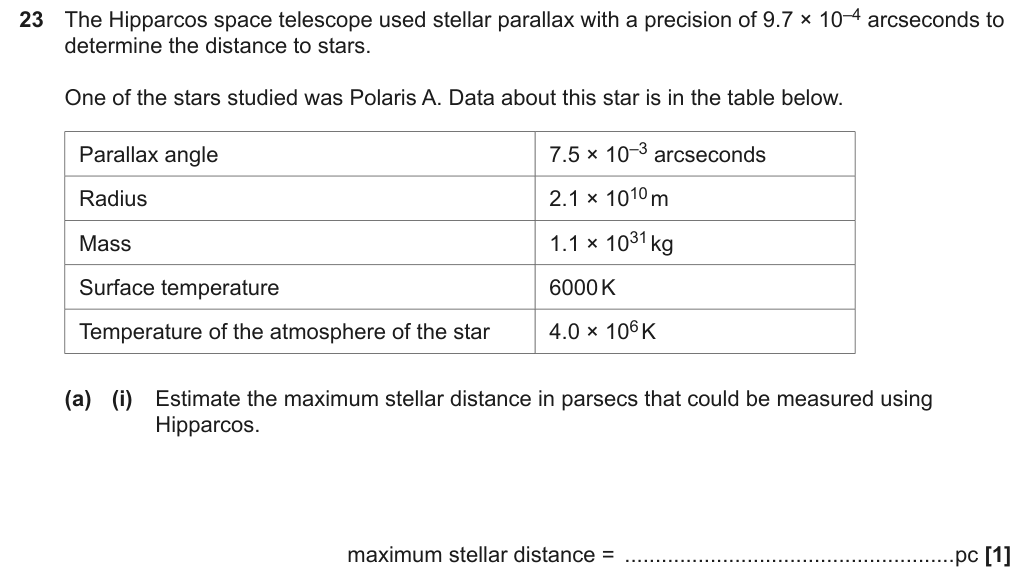
The maximum stellar distance is given by the smallest parallax Hipparcos can measure, i.e. 9.7 × 10⁻⁴ arcsec. The distance corresponding to this parallax is 1/9.7 × 10–4 = 1030 pc. To find the percentage uncertainty in the distance, candidates needed to divide the smallest detectable change in the parallax by the parallax itself. This is equivalent to the percentage uncertainty in the distance because of the reciprocal relationship of distance with parallax. Many candidates correctly determined both quantities. A minority of candidates confused the two similar sounding quantities.
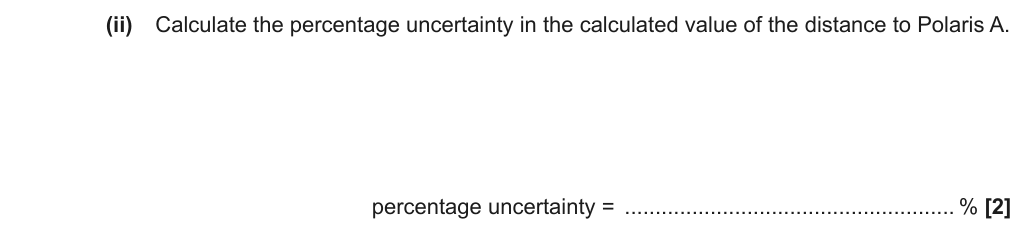
The maximum stellar distance is given by the smallest parallax Hipparcos can measure, i.e. 9.7 × 10⁻⁴ arcsec. The distance corresponding to this parallax is 1/9.7 × 10–4 = 1030 pc. To find the percentage uncertainty in the distance, candidates needed to divide the smallest detectable change in the parallax by the parallax itself. This is equivalent to the percentage uncertainty in the distance because of the reciprocal relationship of distance with parallax. Many candidates correctly determined both quantities. A minority of candidates confused the two similar sounding quantities.
Skills: M0.3 Use ratios, fractions and percentages; M1.5 Identify uncertainties in measurements and use simple techniques to determine uncertainty when data are combined
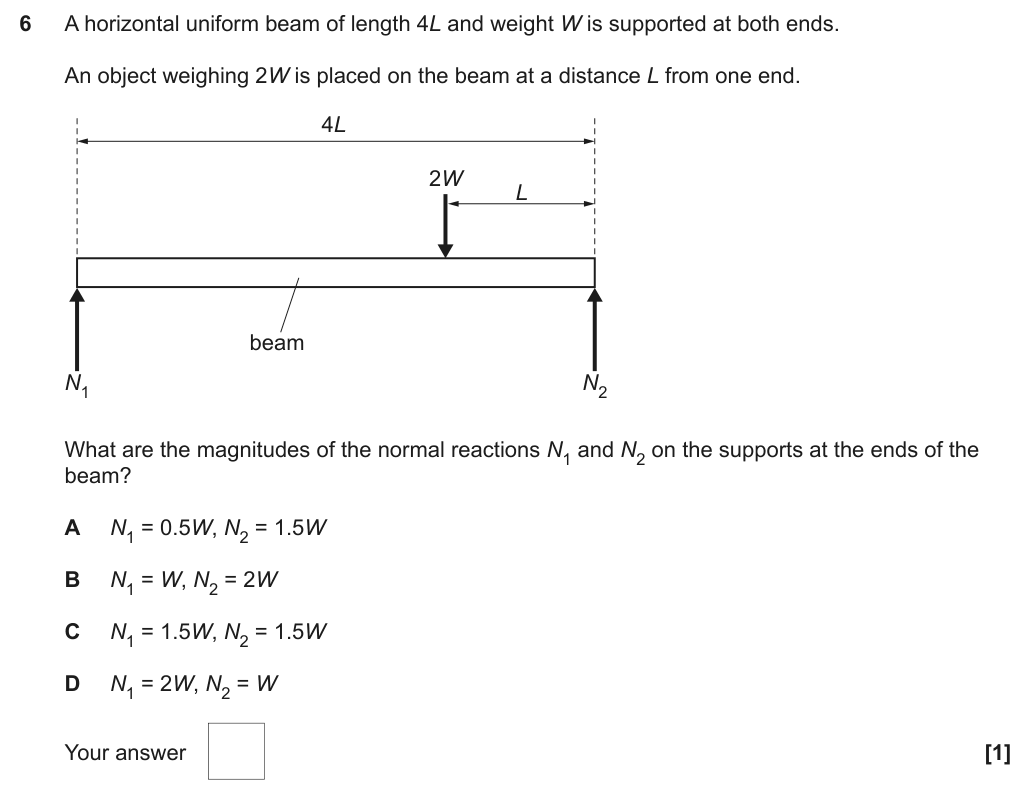
B
This question was made more challenging by not including the weight of the beam on the diagram. The correct approach is to take moments about the left hand end of the beam. Omitting the weight of the beam gives N1 = 0.5W and N2 = 1.5 W. When the weight of the beam is included, (2L x W) + (3L x 2W) = (4L x N2), giving N2 = 2 W and N1 = 2 W, i.e. option B.
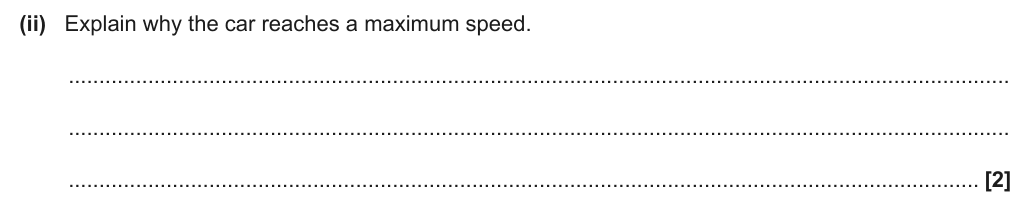
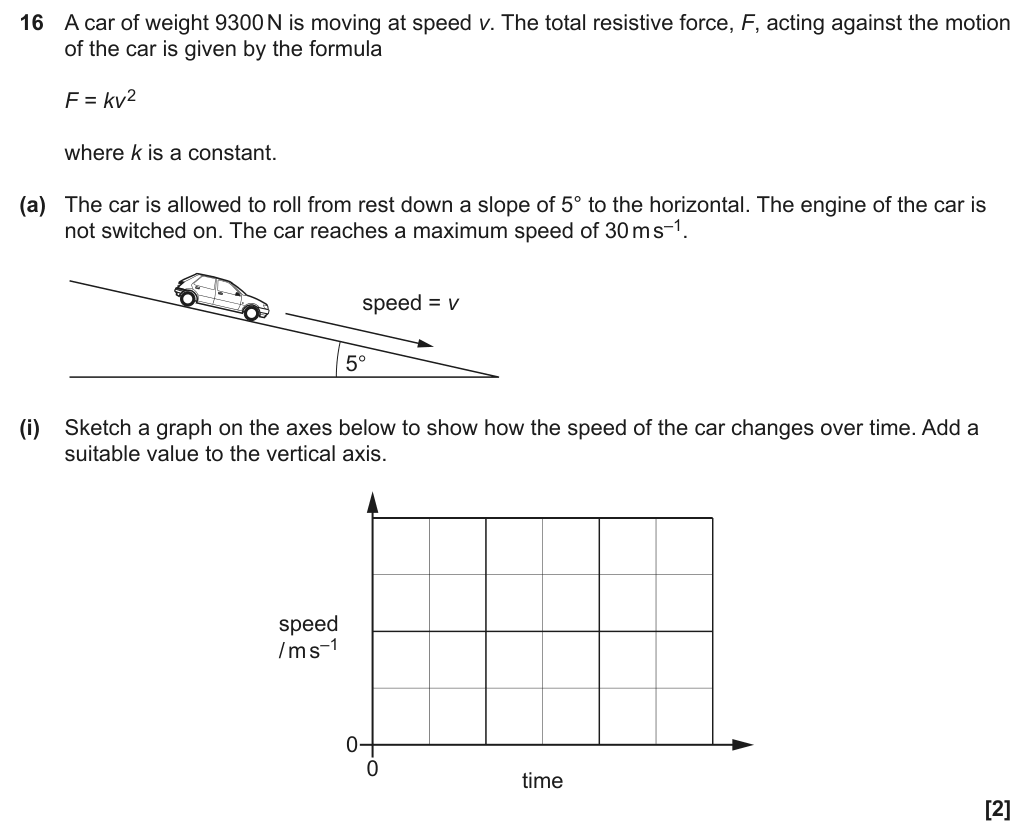
While many candidates appreciated that the car reached a maximum speed because the resultant force was zero, some contradicted this by saying that the weight = drag (as it would be in vertical motion) or something else incorrect. Far fewer candidates stated that the drag increases with speed effectively. Quoting the given expression F = kv2 was deemed insufficient. Repeating information given in the question is rarely creditworthy by itself.
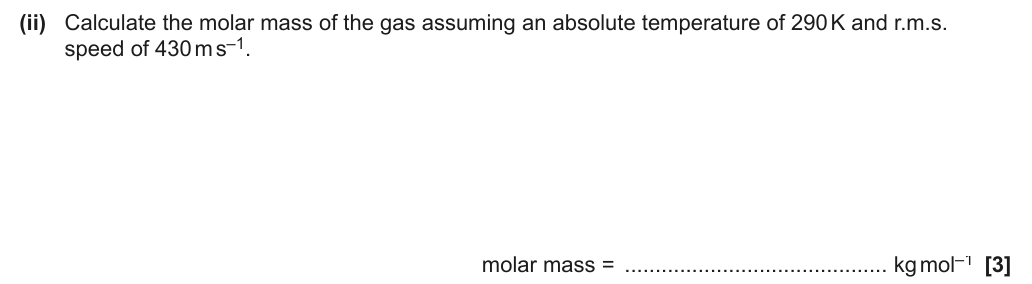
This question proved rather more challenging than the 20(a)(ii), even though the formula was included in the formula booklet. The most common error was omitting the ‘square’ on the mean-squared-speed. The conversion from the mass of a single particle to the molar mass proved challenging. Quantities and units in Physics can be of either or mixed case. In this question, n, N, m and M are all valid quantities and can be muddled easily. Also, as a check, the mass of a mole of a substance in grams is equal to the relative formula mass, i.e. one mole of iodine-128 has a mass of 128 g or 0.128 kg.
Skills: M2.2 Change the subject of an equation, including non-linear equations; M2.3 Substitute numerical values into algebraic equations using appropriate units for physical quantities
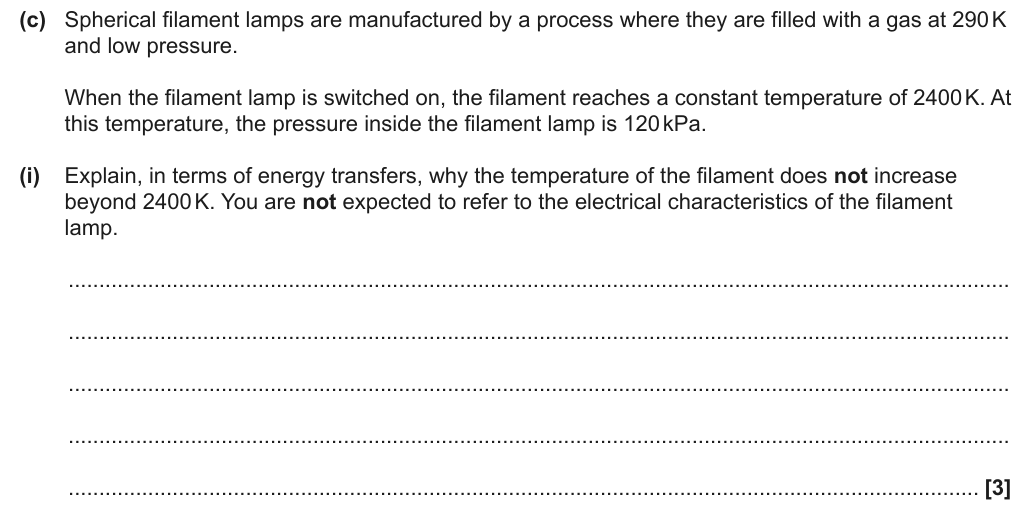
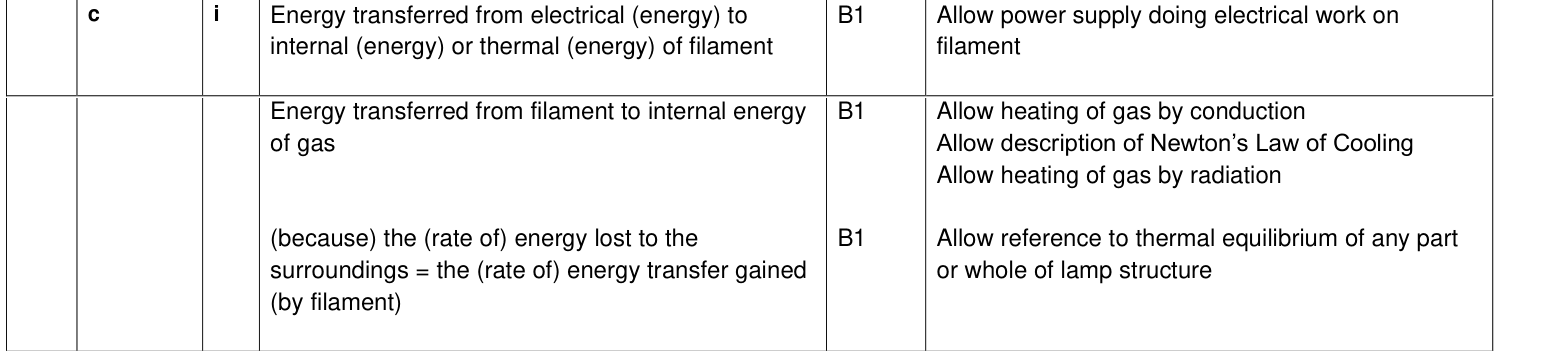
Again, the language required to suitably communicate the correct Physics was challenging here. Respones which described gas law physics had missed the point. The principal reasons why the temperature of the filament does not increase above any given temperature is that the energy in = energy out in a given time period. Further marks were for describing the energy process for supplying energy to the filament and the transfer of energy away from the filament. Quantities in Physics remain unchanged often because an idea of equilibrium or balancing two sides of an equation (see questions 16(a)(iii) or 16(b) for earlier examples). Explaining the physics of either side of that equation is often creditworthy.
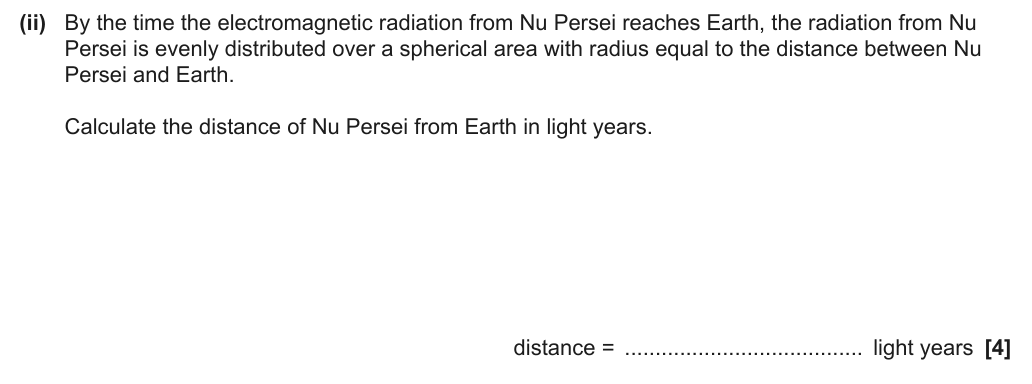
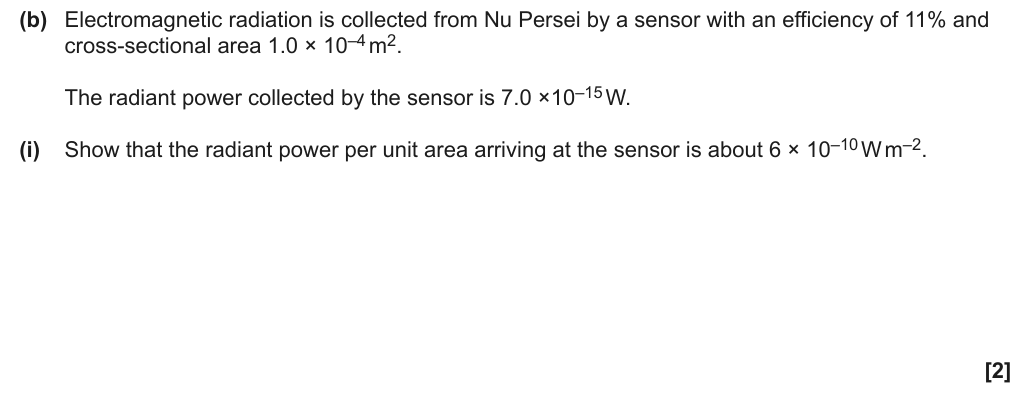
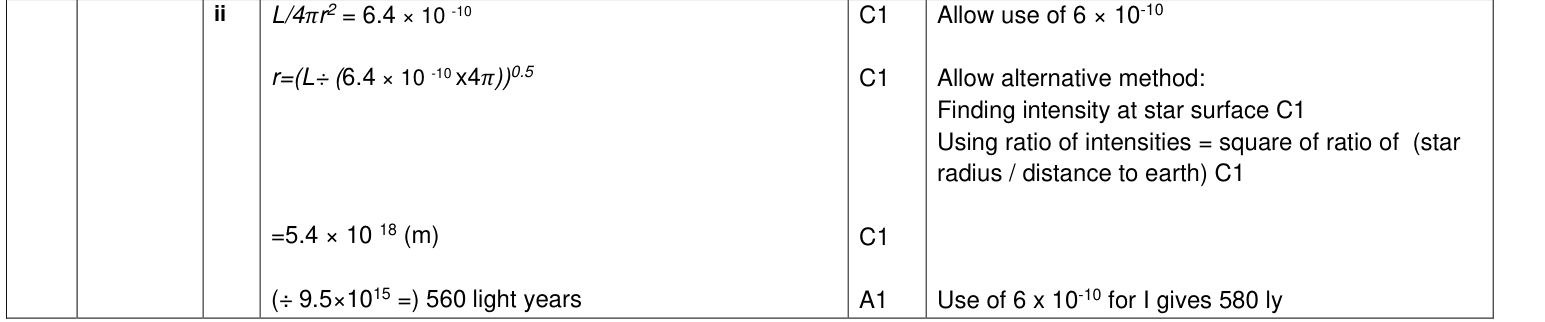
This is a challenging multi-step question. Essentially it tests understanding of the inverse-square relationship. Some candidates simply used the formula given on the formula sheet. Others did not, however successfully manipulated the data to use the inverse-square rule and/or finding the intensity of radiation leaving the surface of the star. Once the candidate arrived at the distance in metres, it was relatively simple to find the distance in light years.
Skills: M0.2 Recognise and use expressions in decimal and standard form; M2.2 Change the subject of an equation, including non-linear equations
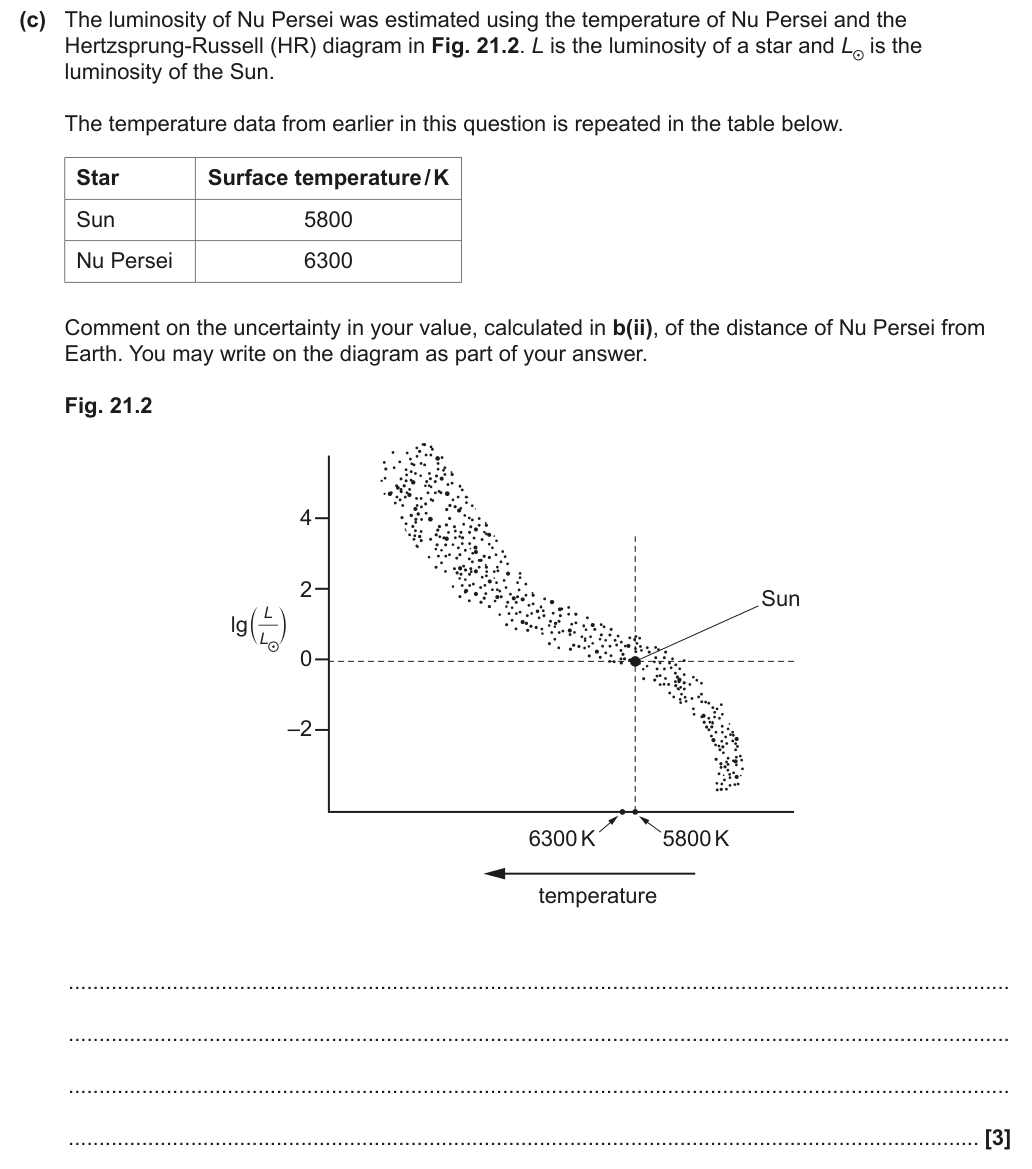
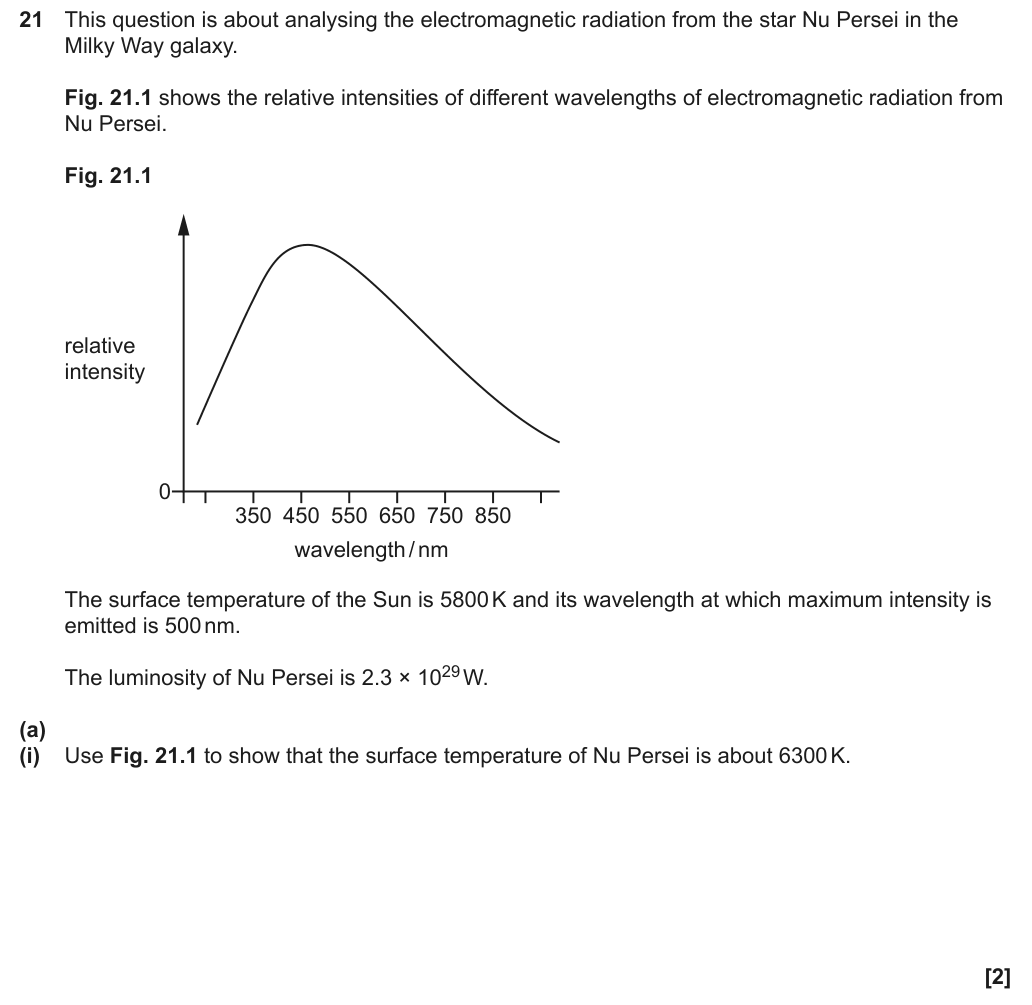
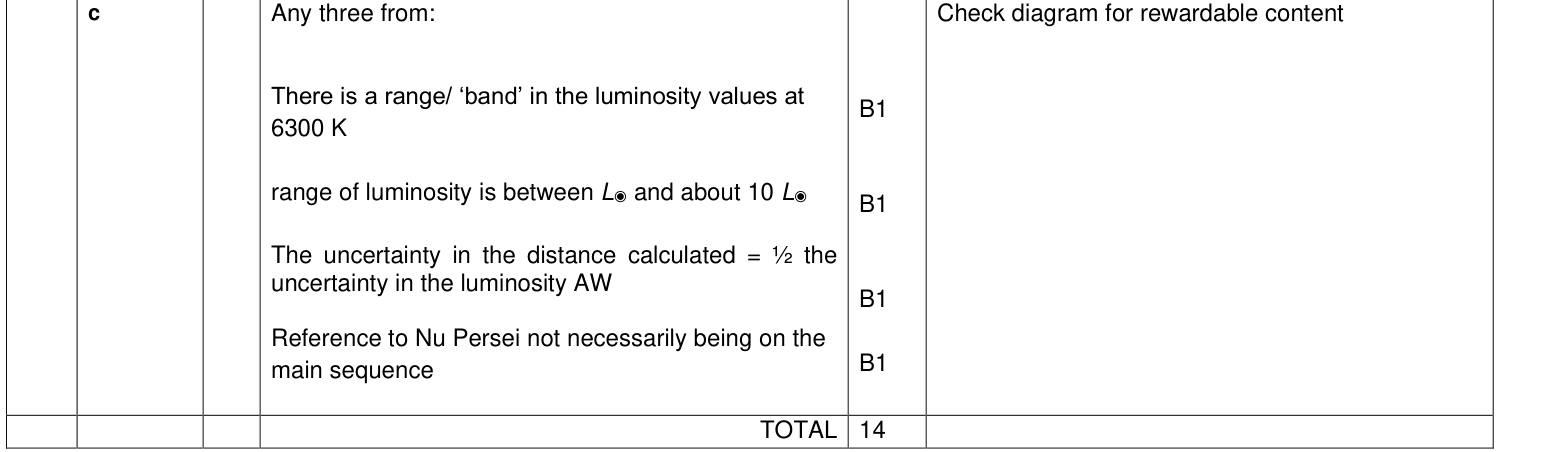
This item also proved very challenging. The key idea here is that there is a range of luminosities (the inherent power of the star) that correspond to a temperature of 6300 K, not least that the star may not be main sequence at all. These ideas are reminiscent of a question in a previous paper. After those initial ideas, the candidates needed to discuss this more quantitatively by noticing that the range of luminosities was about 10, given that the scale is logarithmic.
Skills: M1.5 Identify uncertainties in measurements and use simple techniques to determine uncertainty when data are combined; M3.10 Interpret logarithmic plots
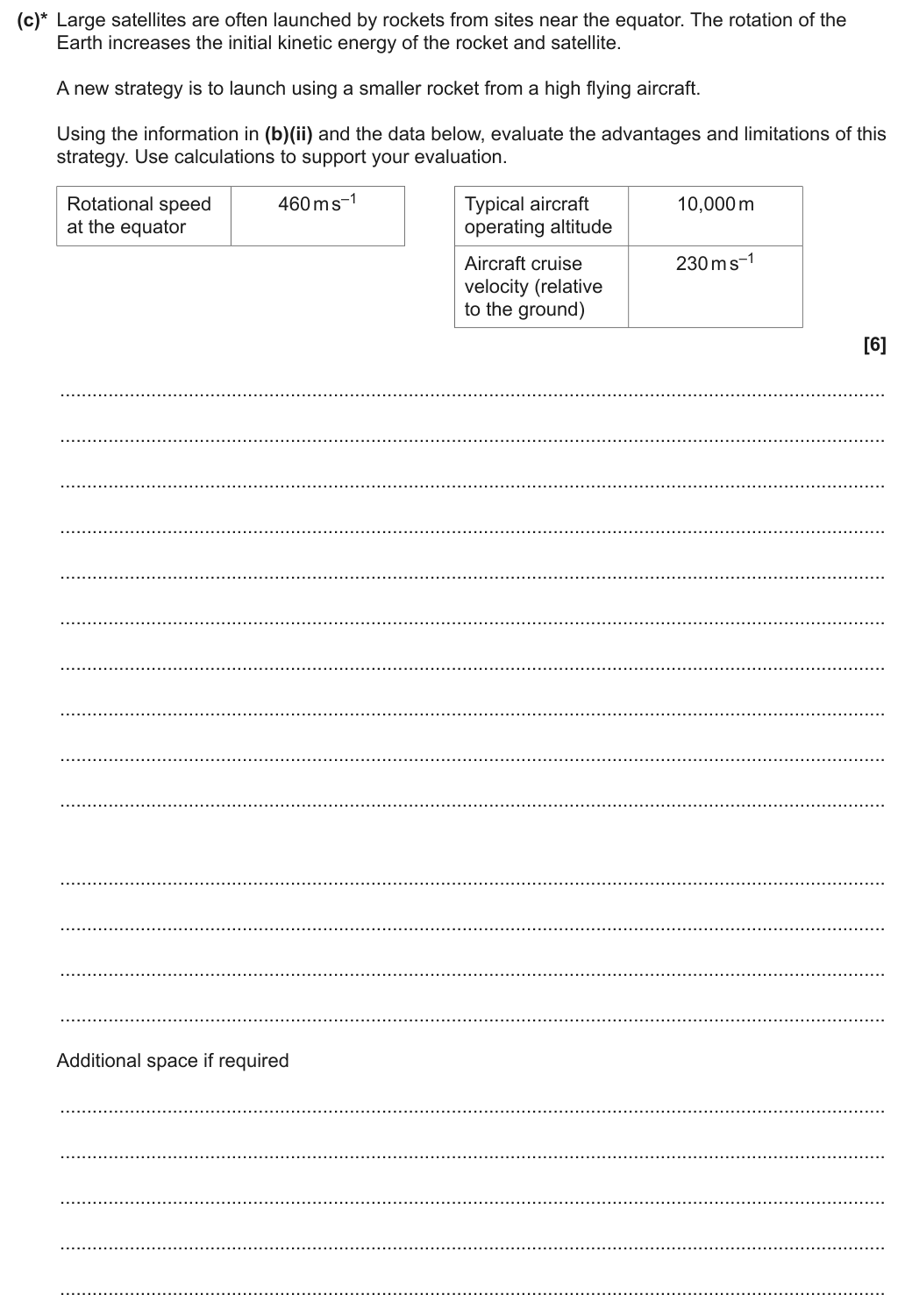
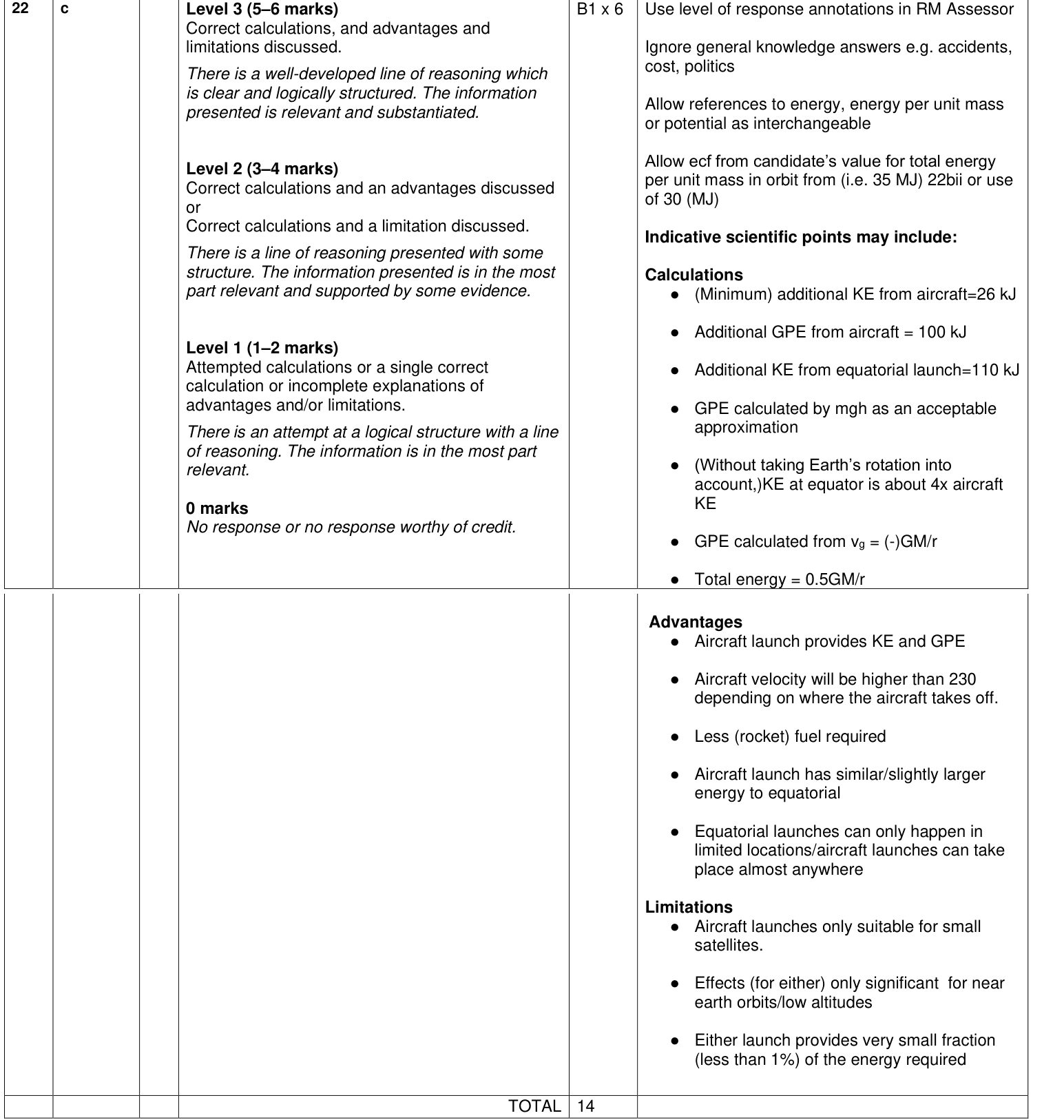
Many candidates found this difficult to access. A solely qualitative evaluation was limited to level 1 (2 marks). In Exemplar 2, the candidate has completed a small number of calculations comparing the KE the two methods would raise. There is also a statement that these differ by a factor of 4 along with an attempt at calculating the GPE advantage by launching from the aircraft rather than from the ground. Crucially, there is very little mention of limitation and no supporting calculations. Holistically speaking, therefore, there was not enough evidence to award this candidate Level 3, yet sufficient for a Level 2. In Exemplar 3, this candidate makes an excellent attempt at every portion of the question. They have taken great effort to make themselves clear with technical language. They have also performed numerous calculations to compare the GPE and KE in the two different scenarios. A further figure appears right at the bottom of the response. The candidate has correctly calculated the percentage of the overall energy required that is supplied by either method. In conclusion, the candidate has used their many correct calculations to weigh up evidence effectively in terms of the advantages and limitations.
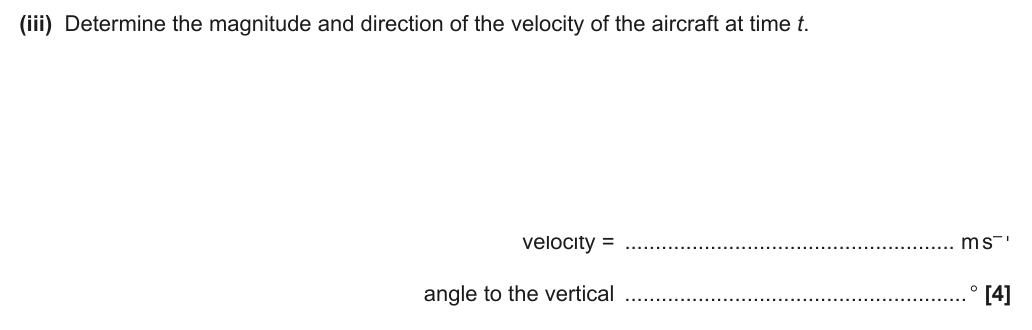
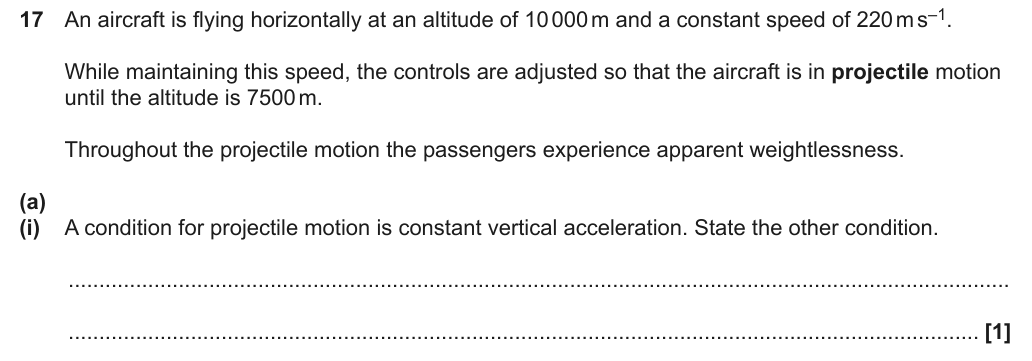
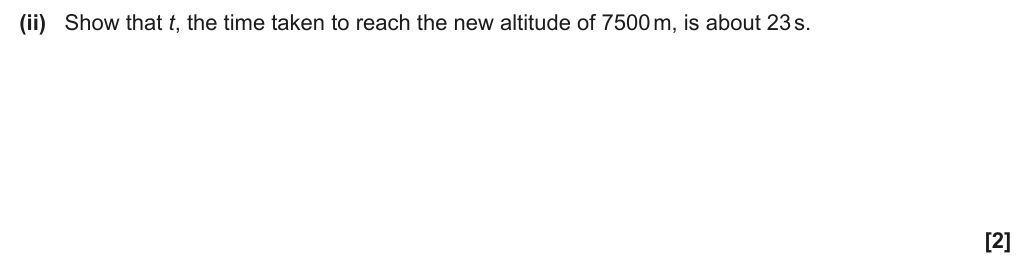
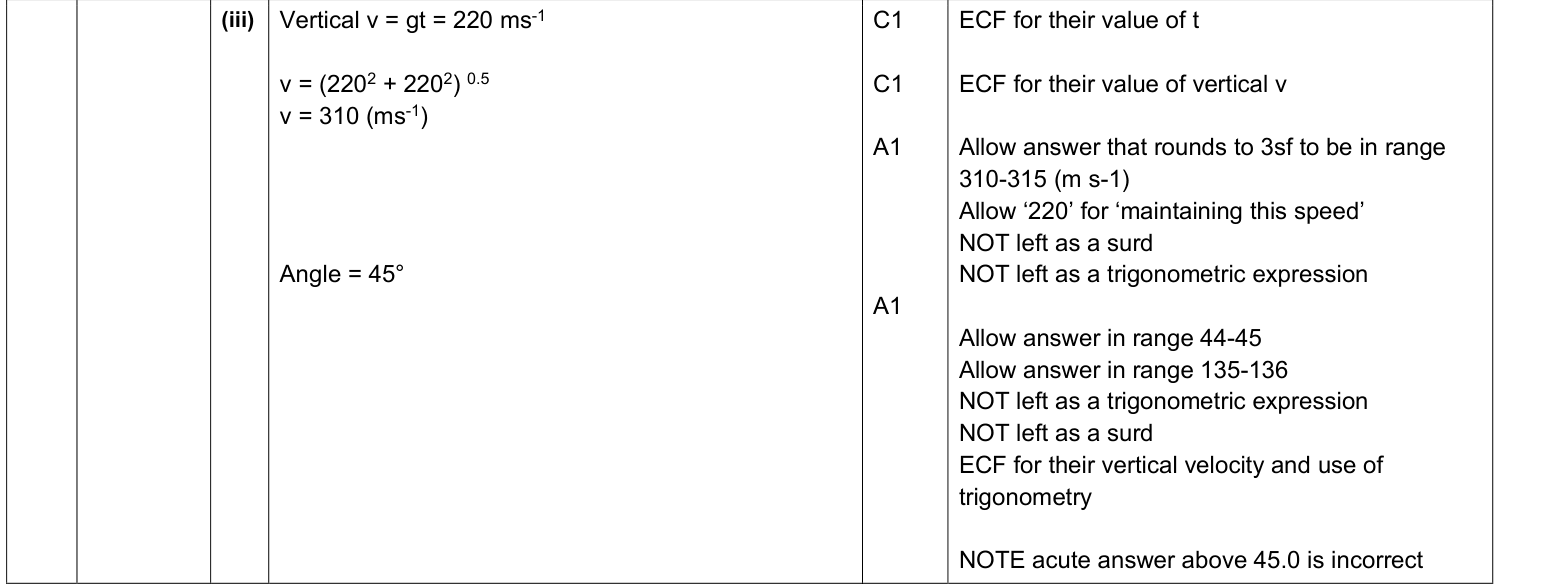
A diagram of the two components of the velocity here was not mandatory; however, it makes it clear in the mind of the candidate what they are doing. The most successful candidates drew a triangle with the two components of velocity with an angle indicated between the vertical and the resultant velocity. They were then clear about how to work out the resultant velocity (Pythagoras) and the required angle. Both acute and obtuse angles to the vertical were acceptable. Acute angles over 45 degrees indicated an error in the trigonometry and so the last mark was unavailable. Few candidates were able to correctly interpret the question’s description of ‘maintaining this speed’ to suggest that the velocity of the plane was 220 m s-1 throughout.
Skills: M0.6 Use calculators to handle sin x, cos x and tan x when x is expressed in degrees or radians; M4.4 Use Pythagoras’ theorem, and the angle sum of a triangle; M4.5 Use sin, cos and tan in physical problems
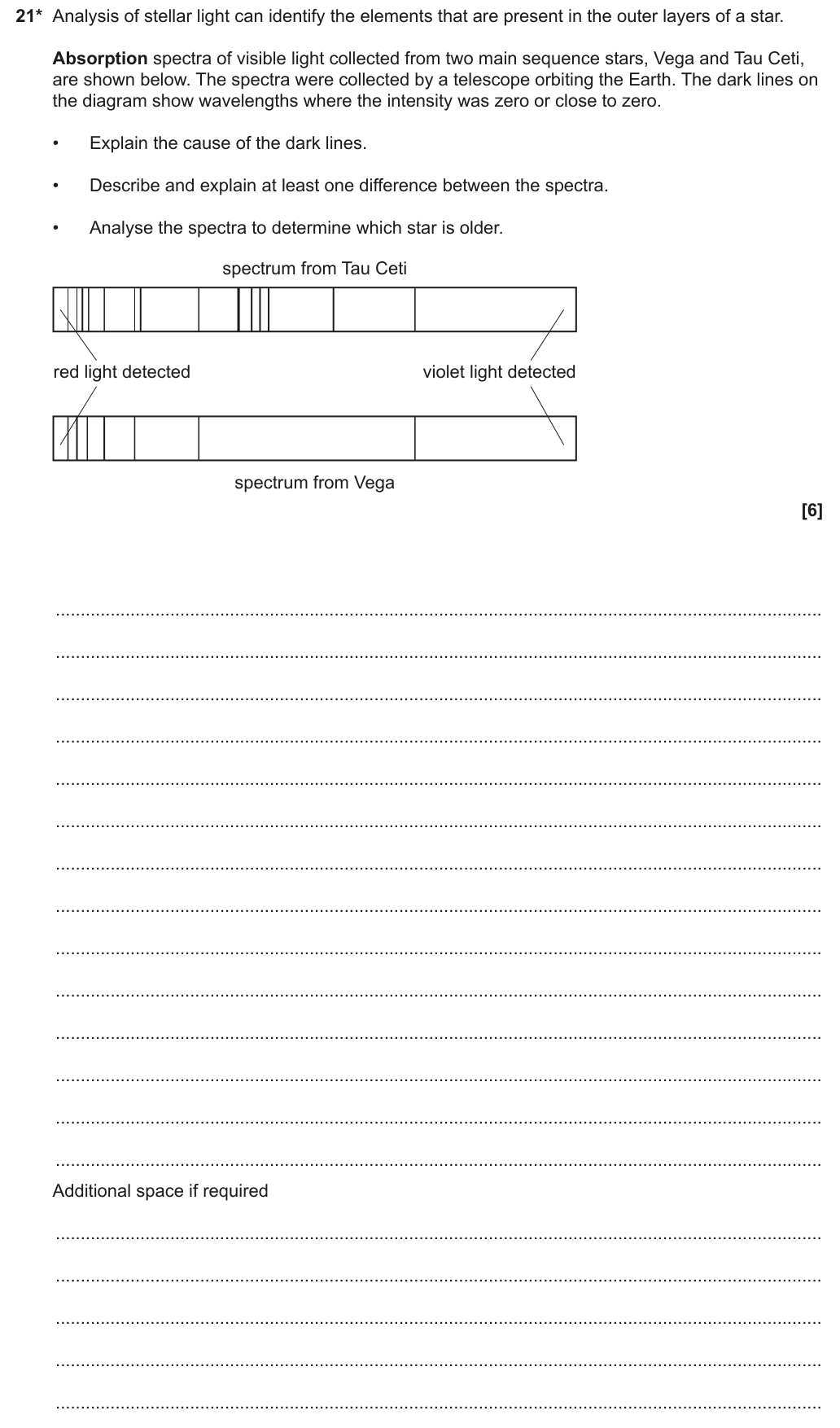
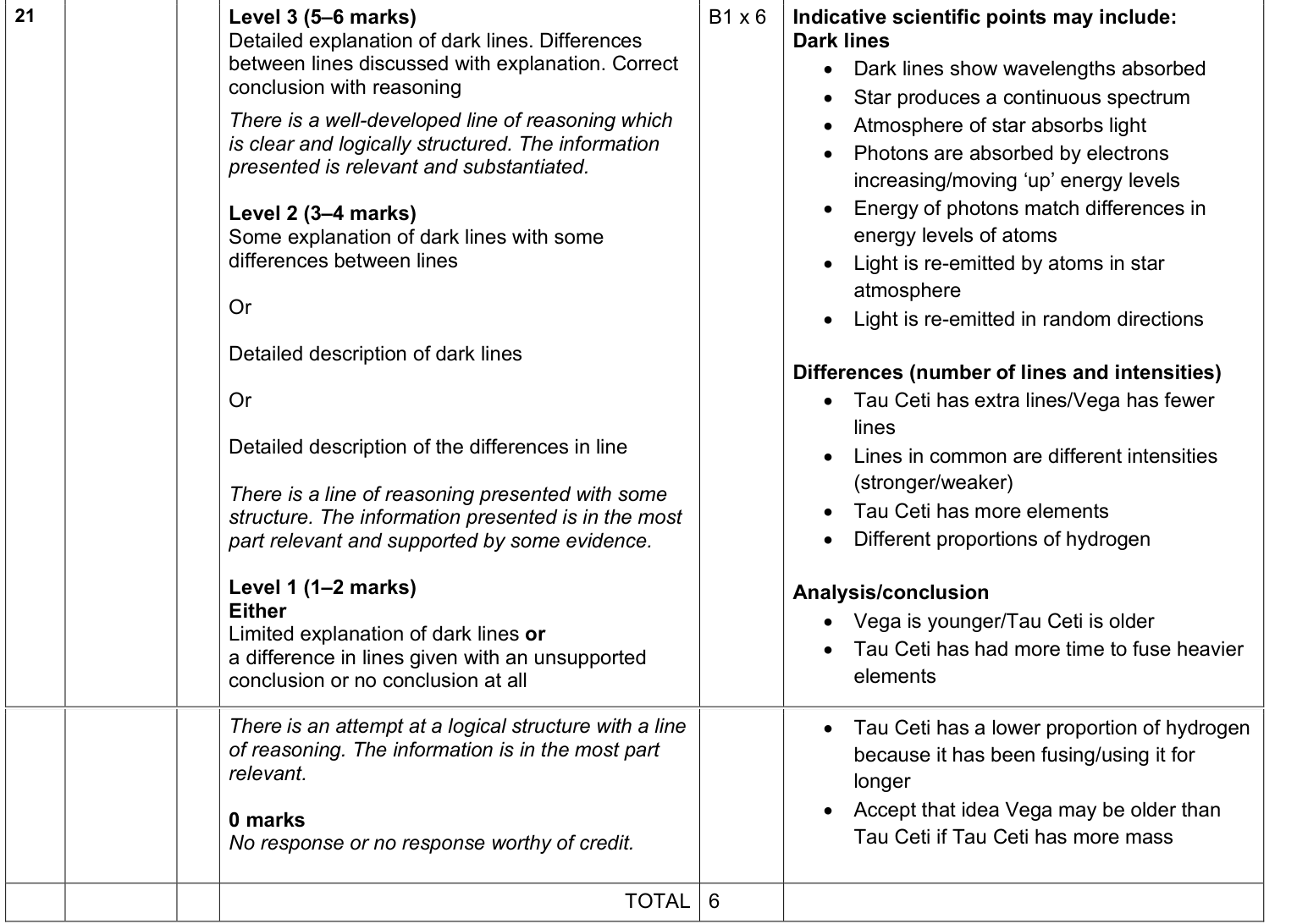
Many candidates spotted that the spectral lines from Vega exactly matched up to the corresponding lines in the spectrum from Tau Ceti. This rules out the idea that one star’s spectrum has been red shifted by more than the other, as suggested by many candidates. The principal difference is that Tau Ceti has more lines because its atmosphere has more elements in it than that of Vega. A small number of candidates also spotted that one of the lines in Tau Ceti’s spectrum is darker than the rest. Many candidates produced exceptionally detailed explanations of how absorption spectra occur. Very few attributed the spectra to such phenomena as destructive interference or something to do with the Earth’s atmosphere. The key to accessing Level 3 for this question lay in explaining why the two spectra were different. Many candidates suggested that there were more elements in the atmosphere of Tau Ceti because it had been fusing hydrogen for so long that some of those products were also fusing together to produce even heavier elements. A few candidates linked the darker line in Tau Ceti’s spectrum to a large abundance of an element that wasn’t hydrogen. The first paragraph of this response is a detailed description of how continuous light from a star can be selectively absorbed by the atmosphere of that star. The candidate doesn’t add in the details about de- excitation or of re-emission of the light in random directions; however, they have included everything up to that point. The candidate has also spotted that there are more lines for Tau Ceti than for Vega and attributes this to elements that are present in the photosphere of Tau Ceti that are not present in that of Vega. The argument about red shift is incorrect. Having said that, the candidate has gone on to mention about the fusion products other than helium and attributes this to Tau Ceti being the older star. At the end, the mention of Tau Ceti maybe being a red giant and no longer main sequence is incorrect (the question says that both stars are main sequence). On balance, this response was awarded Level 3.
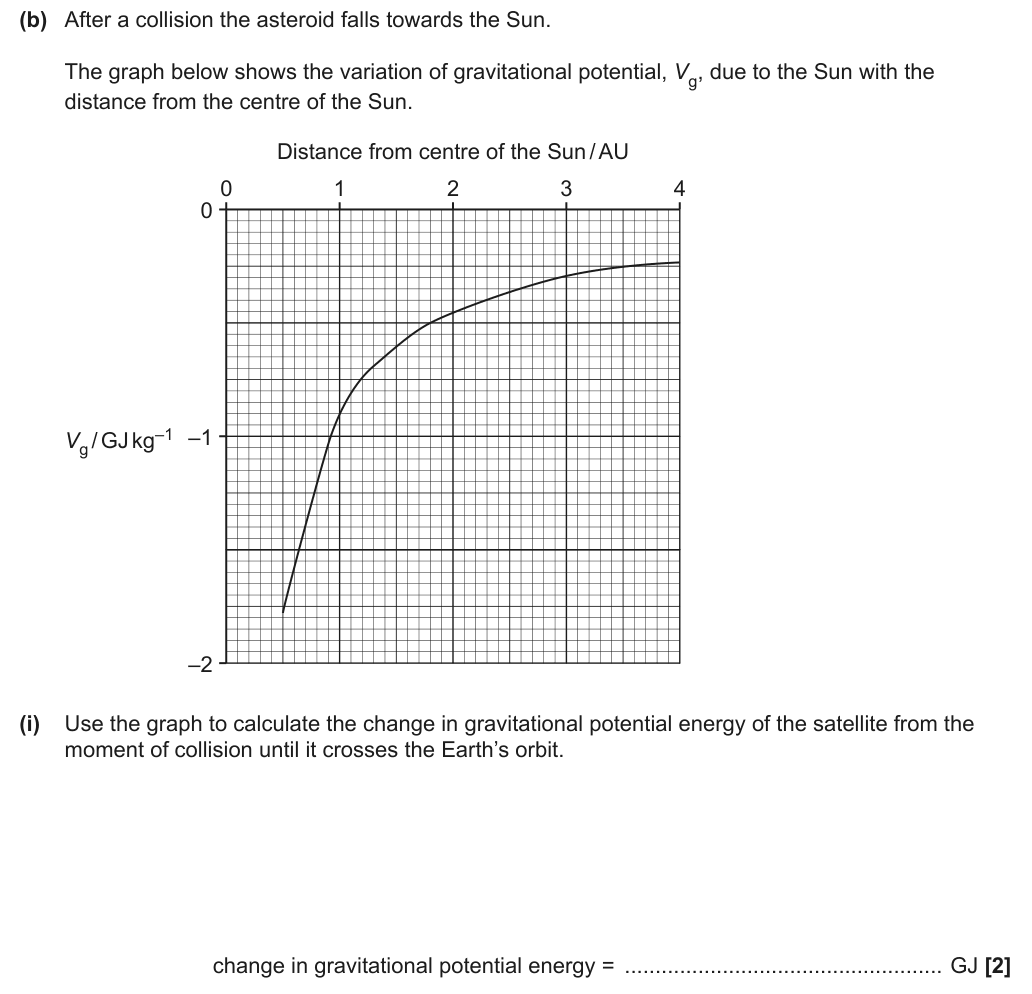
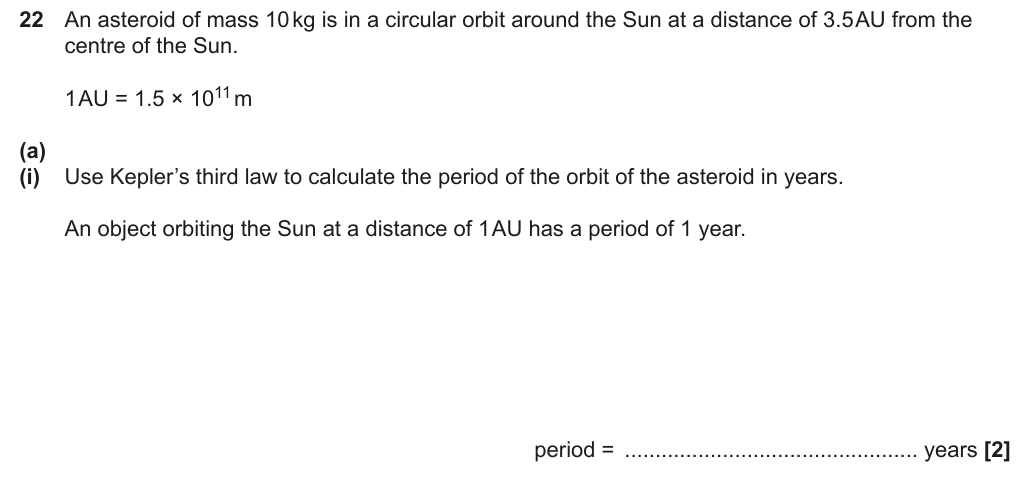
Candidates found this challenging. The graph gives the gravitational potential. The correct approach is to find the difference in the gravitational potential at 1 AU and at 3.5 AU and then multiply this difference by the mass of the satellite.
Skills: M0.1 Recognise and make use of appropriate units in calculations; M3.1 Translate information between graphical, numerical and algebraic forms
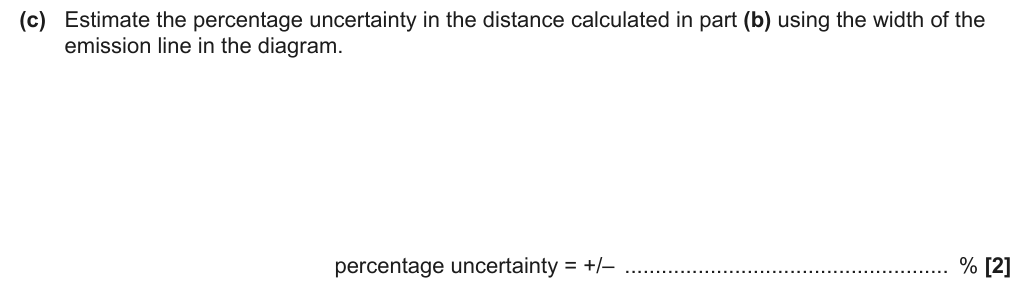
This was a challenging item. Many candidates correctly found the width of the emission line according to the scale on the diagram. Others completed this incorrectly by using mm or cm. The percentage uncertainty in the distance is the same as the percentage uncertainty in the change in wavelength. Hence the correct expression to evaluate is the ratio of the width of the line (roughly 0.8 nm but there is a significant allowable range here) to the shift in the line (2.3 nm). Many candidates did not use the shift in the line but incorrectly used either the observed or the original wavelength instead.
Skills: M1.5 Identify uncertainties in measurements and use simple techniques to determine uncertainty when data are combined; M3.1 Translate information between graphical, numerical and algebraic forms
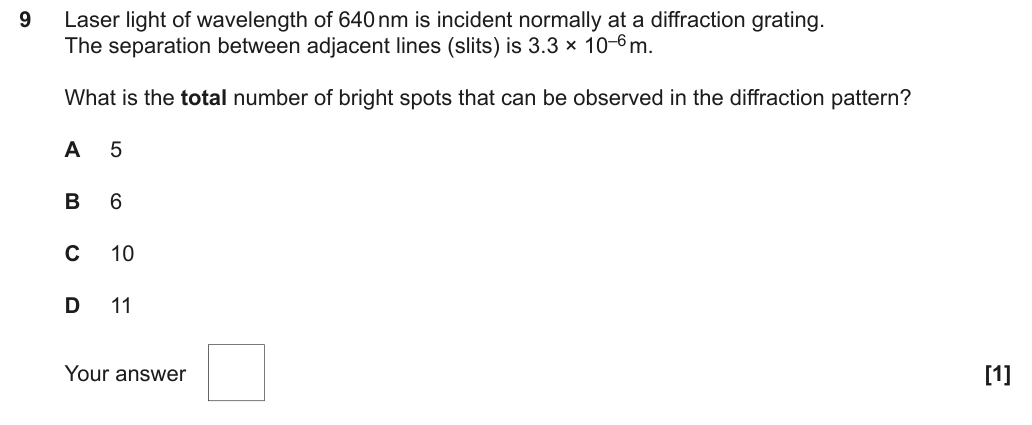
D
Candidates had particular difficulty with Question 9 and Question 10.
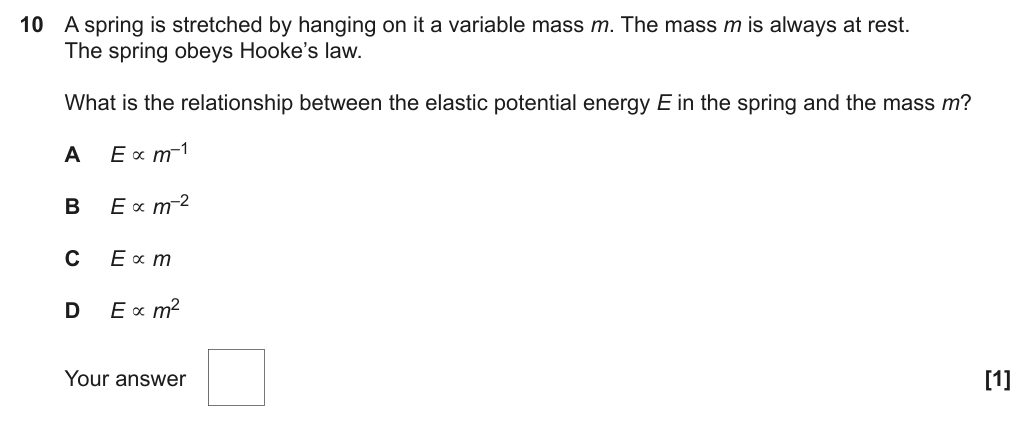
D
Candidates had particular difficulty with Question 9 and Question 10.
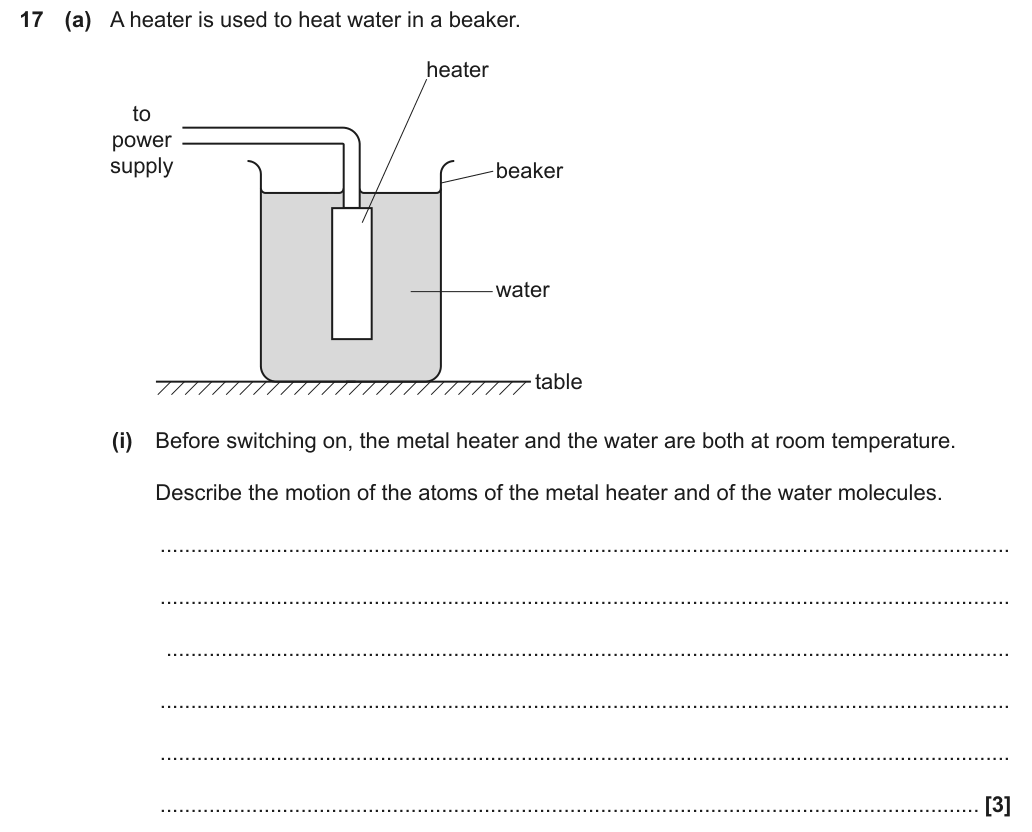
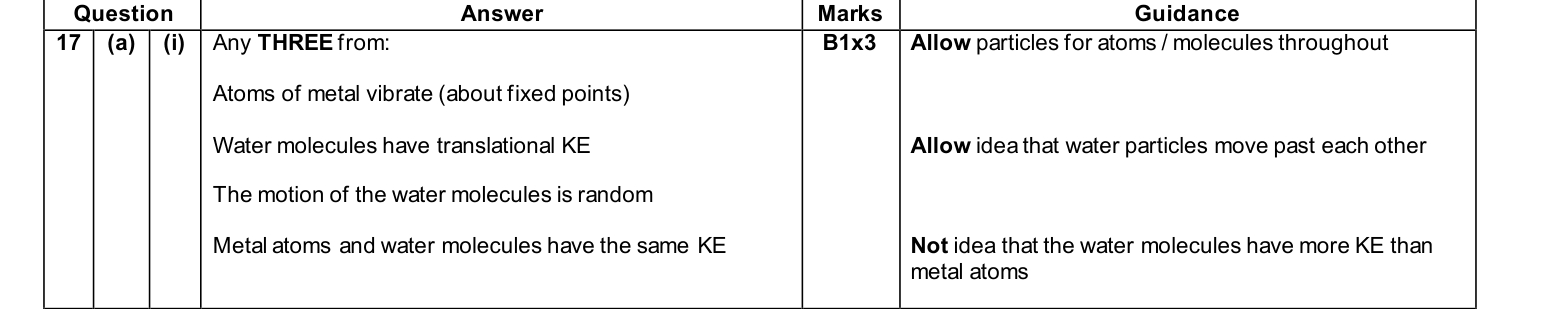
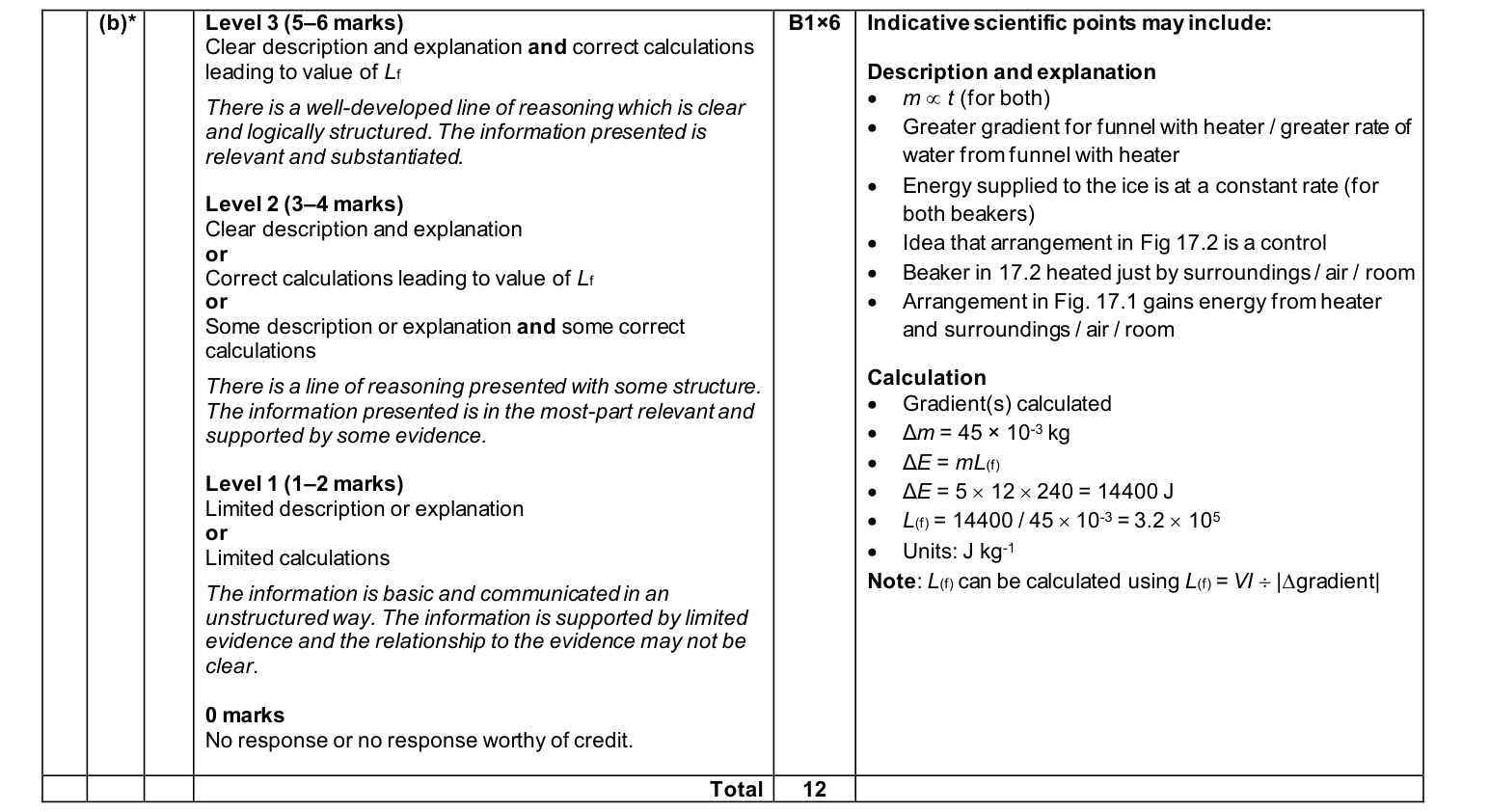
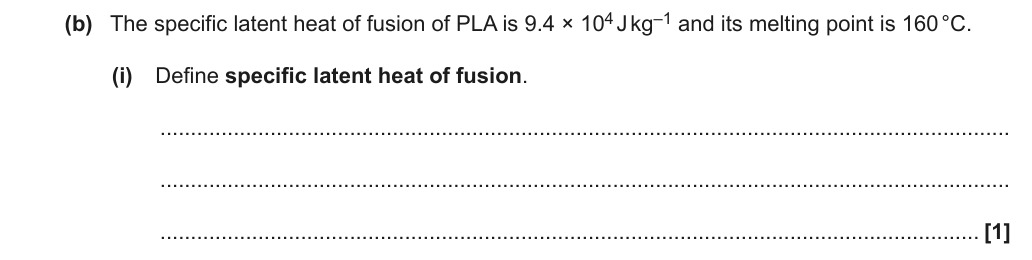
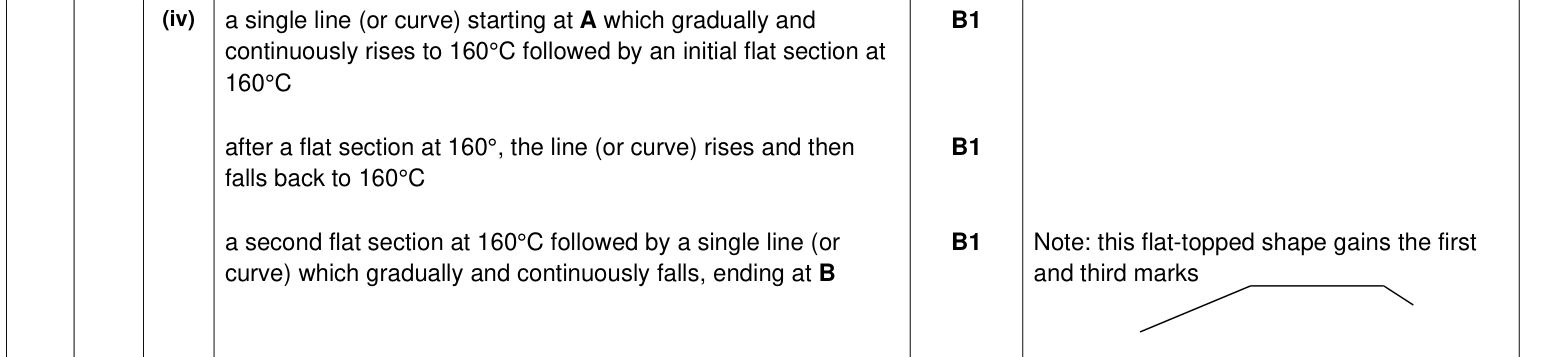
Question 17b was more challenging in this respect, as to get the correct answer for the specific latent heat, the candidate needed to understand the significance of the control apparatus.
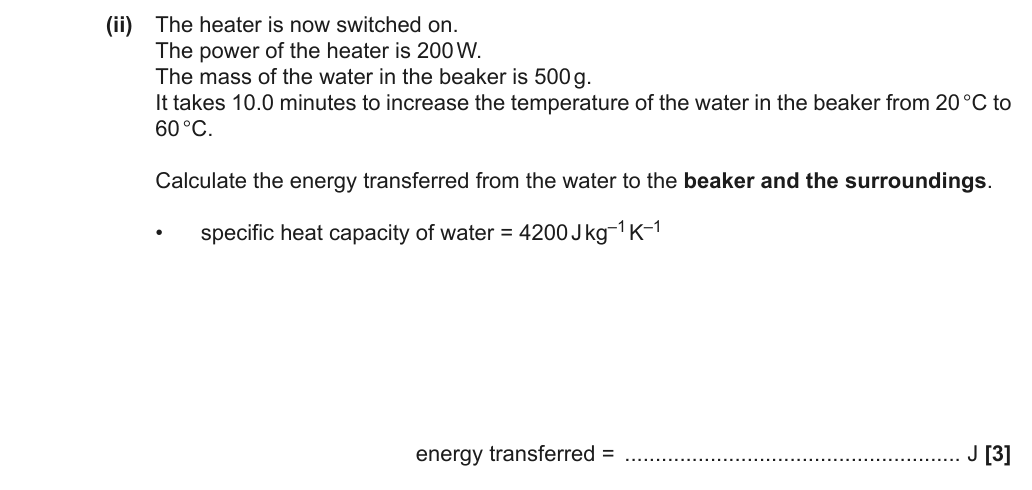
Question 17b was more challenging in this respect, as to get the correct answer for the specific latent heat, the candidate needed to understand the significance of the control apparatus.
Skills: M0.1 Recognise and make use of appropriate units in calculations; M2.3 Substitute numerical values into algebraic equations using appropriate units for physical quantities
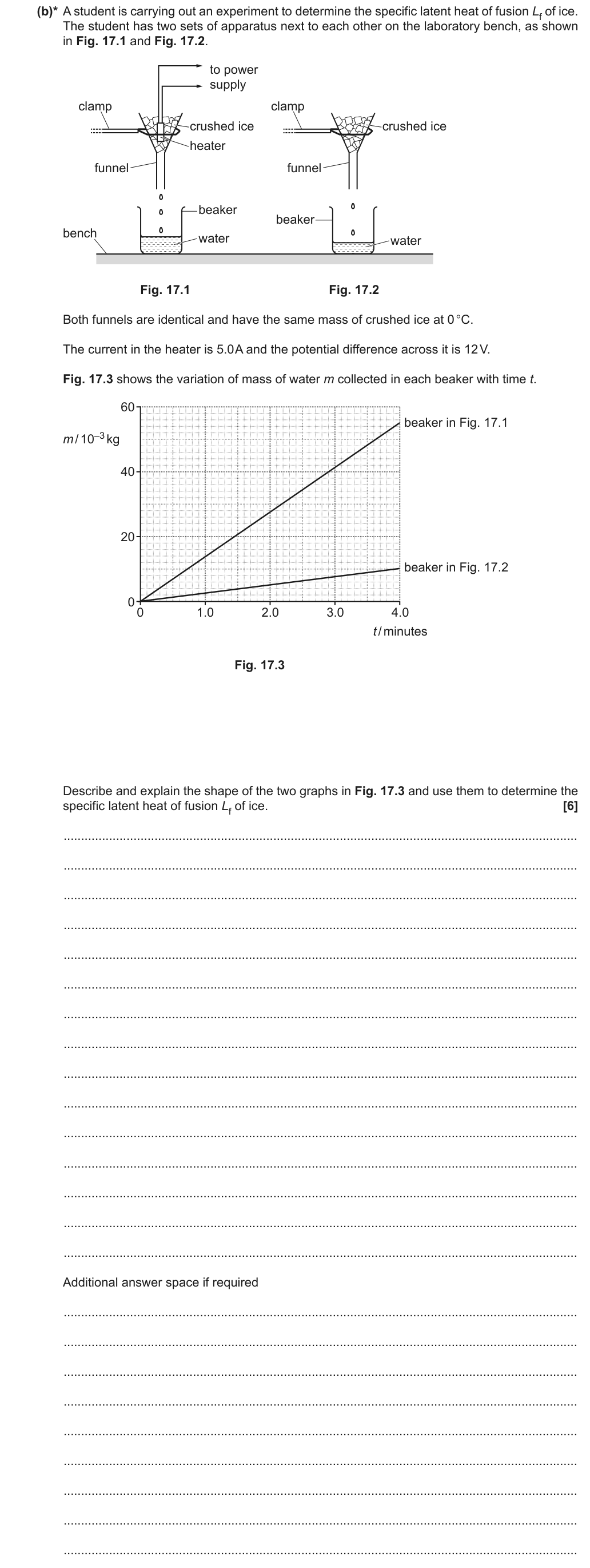
Question 17b was more challenging in this respect, as to get the correct answer for the specific latent heat, the candidate needed to understand the significance of the control apparatus.
Skills: M2.3 Substitute numerical values into algebraic equations using appropriate units for physical quantities; M3.1 Translate information between graphical, numerical and algebraic forms; M3.4 Determine the slope and intercept of a linear graph; PAG8 Investigating gases
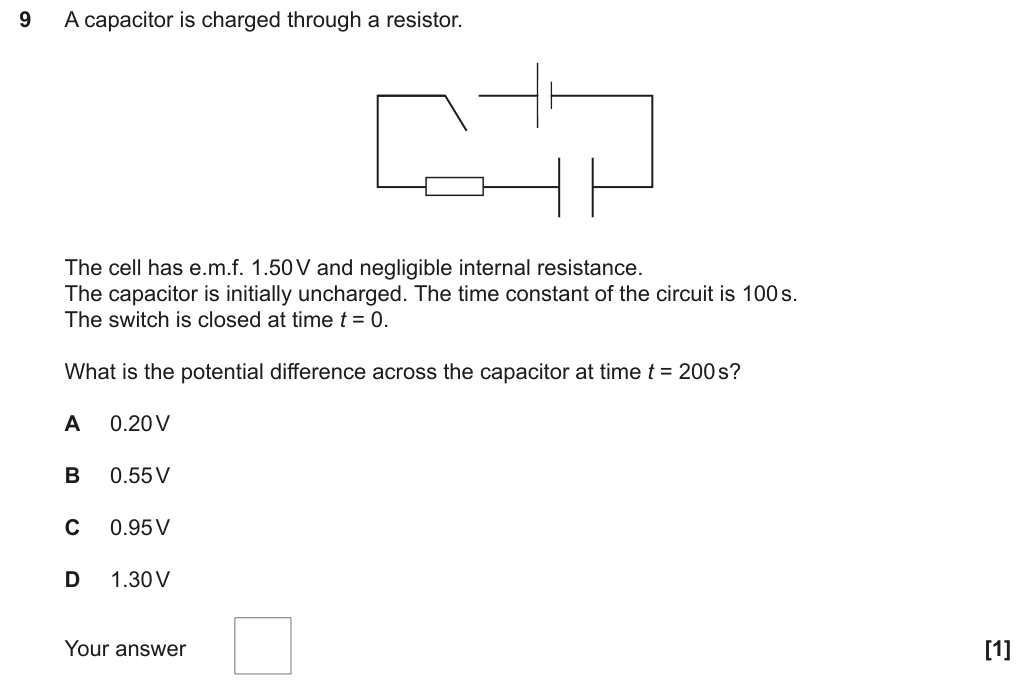
D
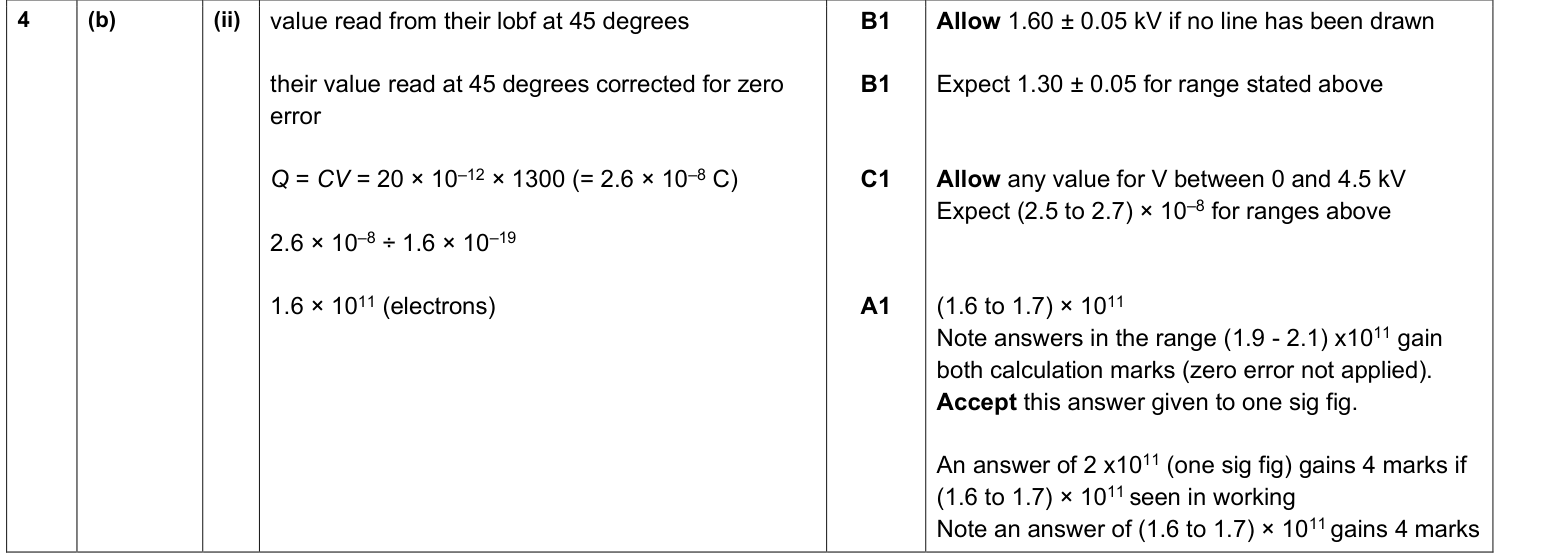
This question provided good discrimination with most to-end candidates scoring 1 mark for the correct answer D. Extracting all the information was the prerequisite for success. The potential difference across the capacitor is required. This could either be done by calculating the potential difference across the resistor (0.20 V), and then subtracting this from the e.m.f. of 1.50 V, or in one step using the equation V = V0(1 – e-t/CR). It is worth pointing out the answer 0.20 V proved to be the most popular distractor for low-scoring candidates. This exemplar illustrates the effortless strategy adopted by this A-grade candidate. The circuit diagram has been annotated with the e.m.f. of 1.50 V, and the time constant CR of 100 s has been underlined. The correct equation has been used to get 1.30 V. Compare and contrast this answer with the exemplar 3 below from a C-grade candidate. The answer calculated here of 0.2 V, is the potential difference across the resistor and not the capacitor. This candidate was one step away from getting the correct answer – this value just had to be subtracted from the e.m.f. of 1.50 V. Deciphering the question is vital, as is the analysis that follows.
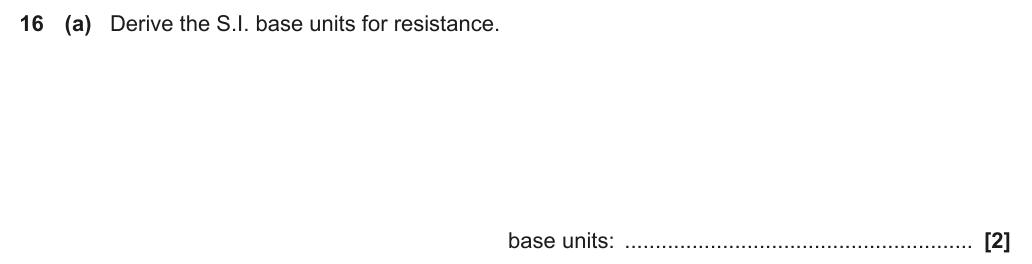
This was a challenging question, which provided the ideal opportunity for top-end candidates to use a variety of methods to get the correct S.I. base units of kg m2 A-2 s-3 for resistance. A significant number of candidates secured 1 mark for a partial answer with either charge → A s, or energy → kg m2 s-2. The rules for exponents were a bit perplexing for the low-scoring candidates. Many also misunderstood S.I. units. This exemplar illustrates a flawless answer from a top-end candidate. The equations are clear to see and follow. The units of each physical quantities are clearly identified and the appropriate S.I. units for the quantities have been successfully manipulated to give the correct answer. Compare this with the exemplar below which illustrates a common misconception. This exemplar illustrates a common error made by some candidates across the ability spectrum. The resistivity ρ in the equation for resistance has been mistaken for density (which unfortunately has the same label). There can be no credit for wrong physics. It is vital to know your equations. Key:
Skills: M0.1 Recognise and make use of appropriate units in calculations; M2.2 Change the subject of an equation, including non-linear equations
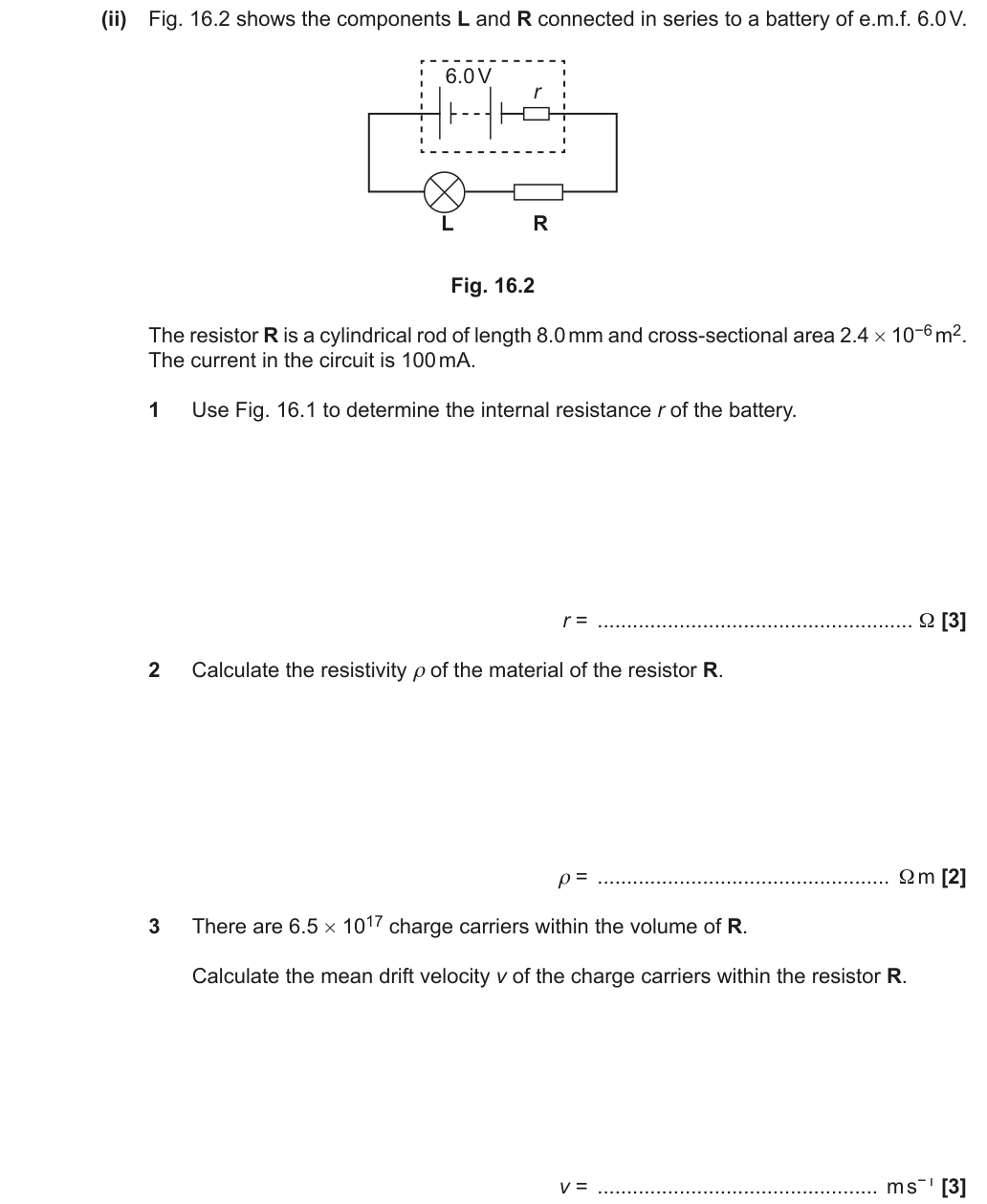
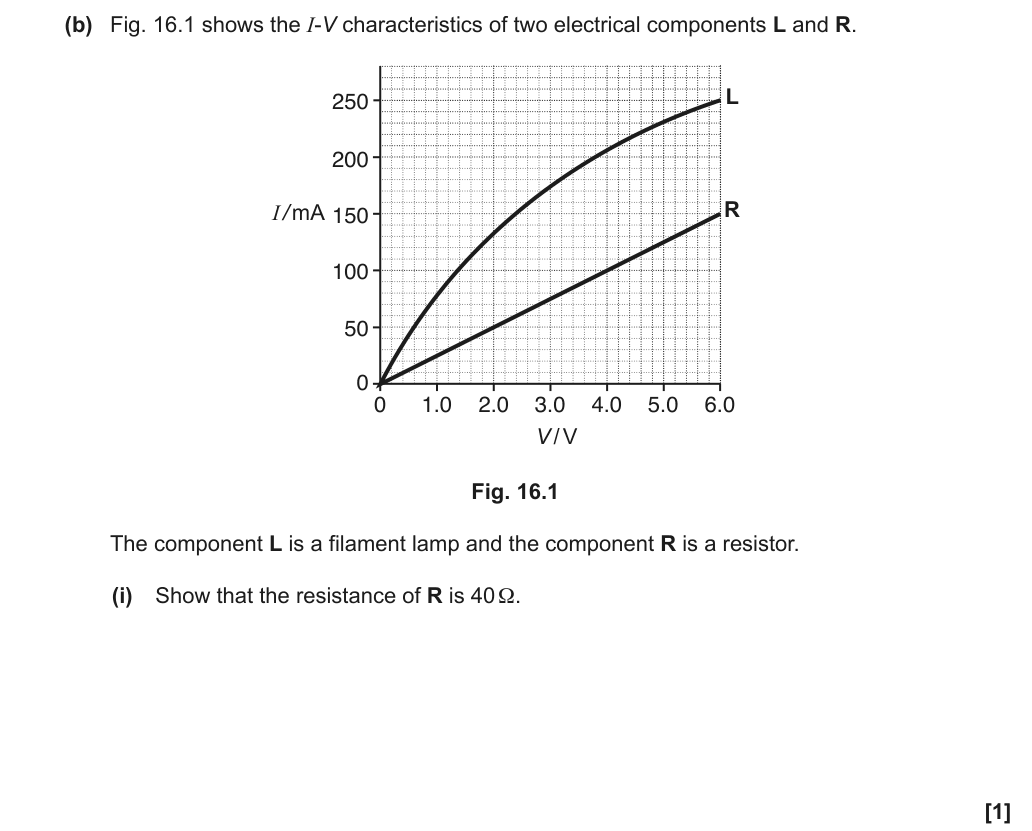
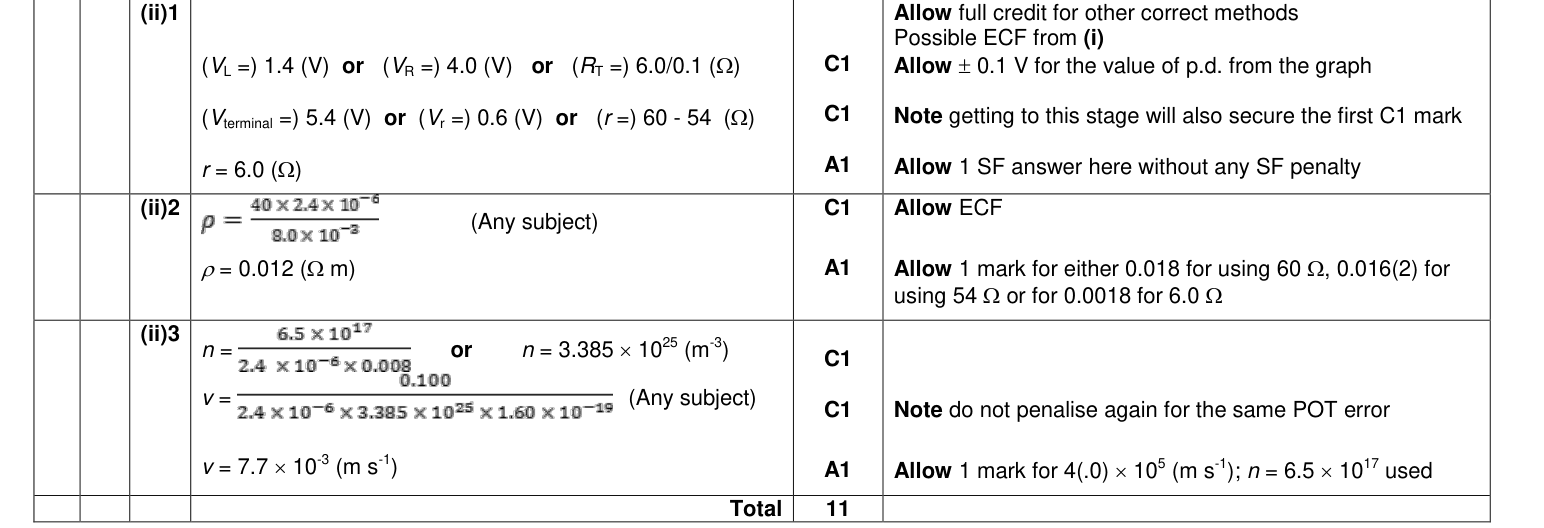
This was a discriminating question with many of the top-end candidates effortless getting the correct answer of 6.0 Ω for the internal resistance r. The most common error was omitting the resistance of the filament lamp in the calculation. This gave an incorrect value of 20 Ω for the internal resistance. Candidates doing this still managed to pick up 1 mark for the total resistance of 60 Ω. The success in this question depended on understanding the term n in the equation I = Anev given in the Data, Formulae and Relationship booklet. A significant number of candidates took n to be the total number of charge carriers within the volume of R, instead of the number of charge carriers per unit volume (number density). Those who appreciated this had no problems coping with prefixes and powers of ten. The correct answer was 7.7 × 10⁻³ m s-1. Using 6.5 × 10¹⁷ for the number density, gave an answer of 4.0 × 10⁵ m s-1; examiners credited 1 mark for this incorrect answer, mainly for the manipulating and using the equation I = Anev. This exemplar illustrates a perfect answer from a C-grade candidate. The equation has been rearranged correctly and the substitution is all correct and easy to follow. The number density n has not been calculated separately – it forms an integral part of the whole calculation. The one big benefit of this is that you do not end up with rounding errors. A decent technique demonstrated here. All correct for 3 marks.
Skills: M0.2 Recognise and use expressions in decimal and standard form; M2.2 Change the subject of an equation, including non-linear equations; M2.3 Substitute numerical values into algebraic equations using appropriate units for physical quantities; M3.1 Translate information between graphical, numerical and algebraic forms
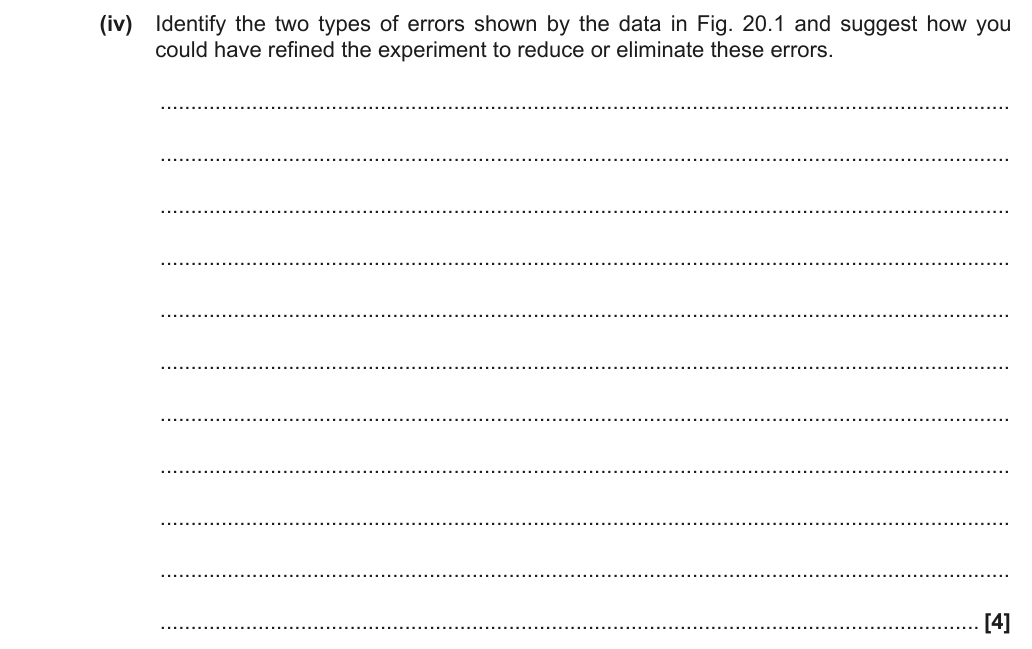
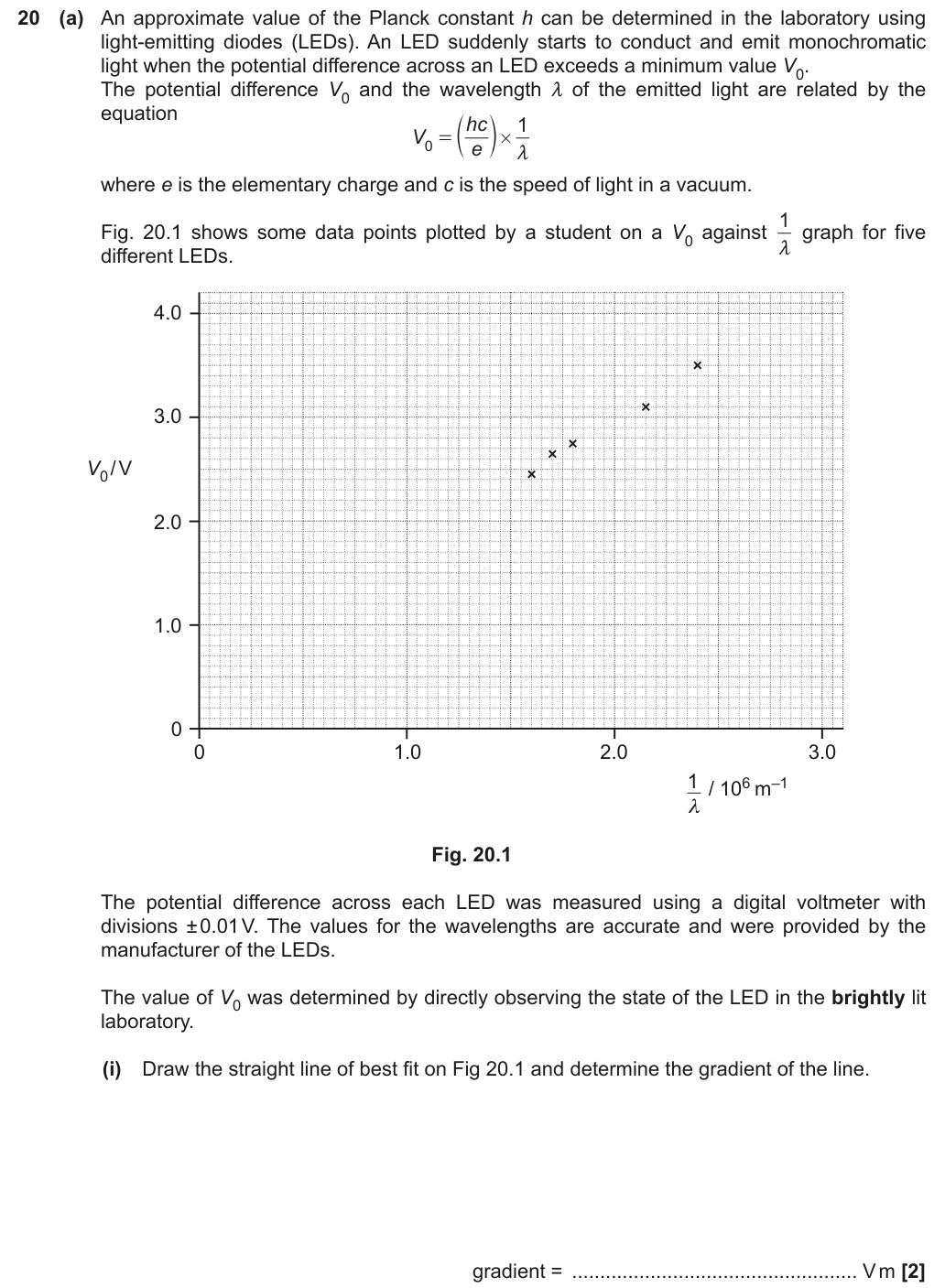
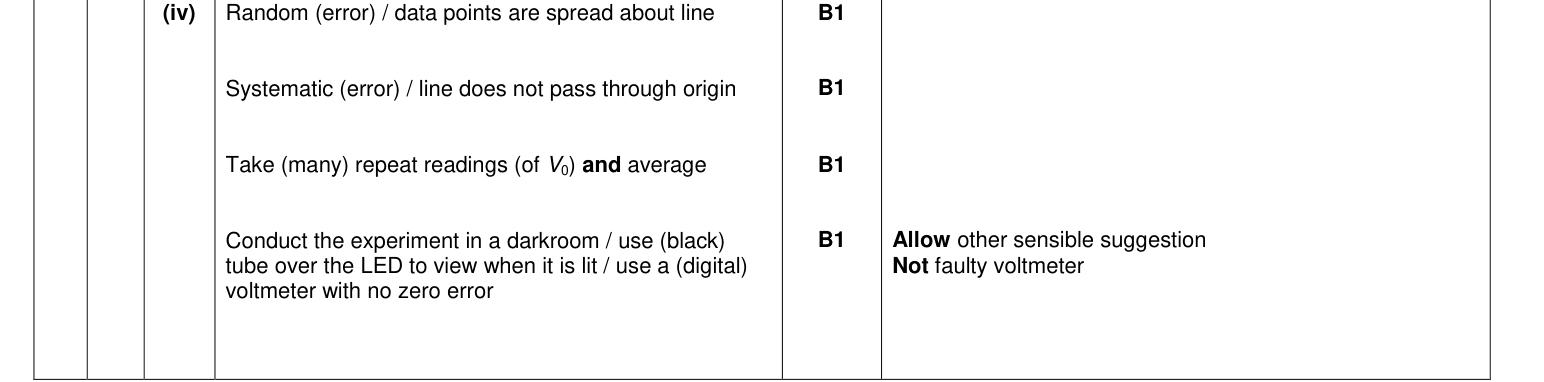
The two errors in this experiment were systematic and random errors (see learning outcome 2.2.1a in the H556 specification). Many candidates did not name these two errors, instead focussing on nebulous terms such as human error, equipment error, etc. Appropriate descriptions of these two errors were allowed. Only a small number of candidates appreciated that taking multiple readings of V0 and averaging will lead to reduction in the random error. A pleasing number of candidates realised that the main reason for the non-zero intercept (systematic error) was the ambient light and switching off the lights would improve matters. Sorting out the zero-error on the voltmeter was an acceptable alternative. Descriptions about using ‘precise instruments’ for measuring potential difference or light intensity often led to no credit.
Skills: PAG6 Investigating quantum effects
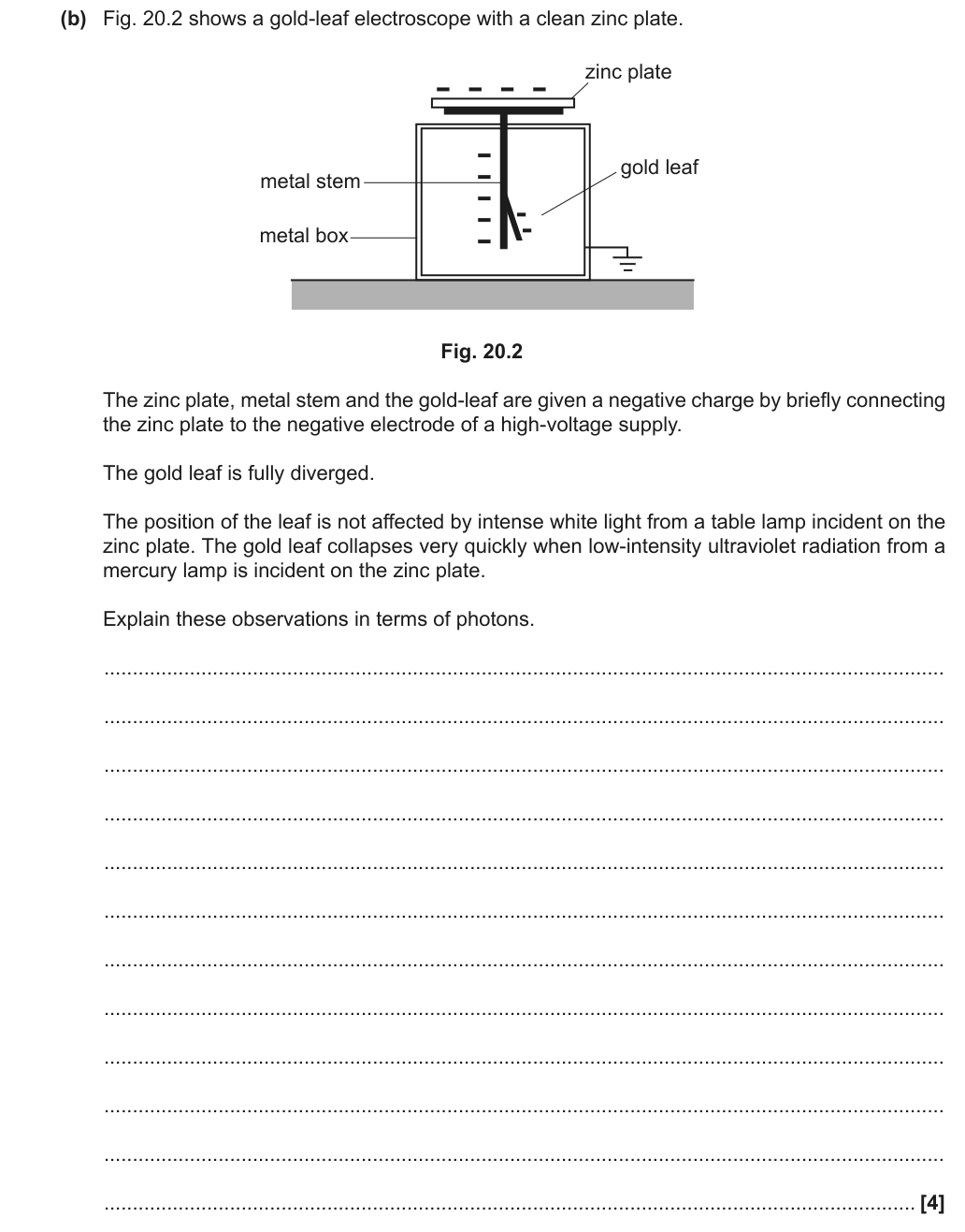
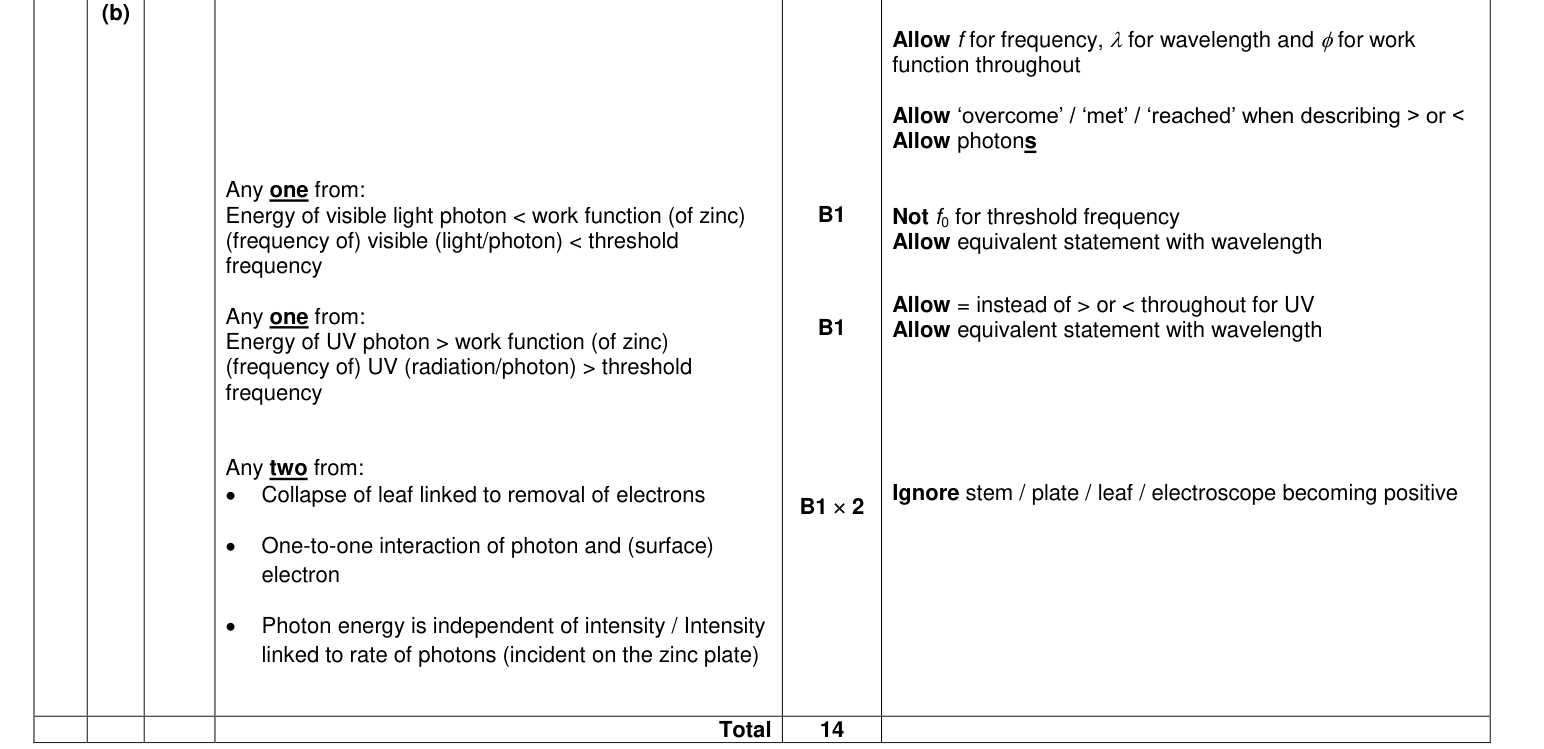
This question on the photoelectric effect was enthusiastically answered by candidates. Good discrimination enabled many of the top-end candidates to score full marks. The question was scrutinised well with many candidates explaining why the leaf fell with the ultraviolet radiation. The one-to-one interaction between UV photons and surface electrons was nicely embedded in the descriptions. Some of the candidates would have benefitted by writing their answers in bullet points. There were a few missed opportunities and misconceptions, these are outlined below: • Photons were emitted from the zinc plate (rather than electrons) • Threshold frequency and work function were properties of the photons or electrons (and not zinc) • Threshold frequency and work function were synonymous • Intensity was linked to number of photons (rather than to the rate of photons) • Referring to ‘not enough energy’ instead of work function of the metal in the description
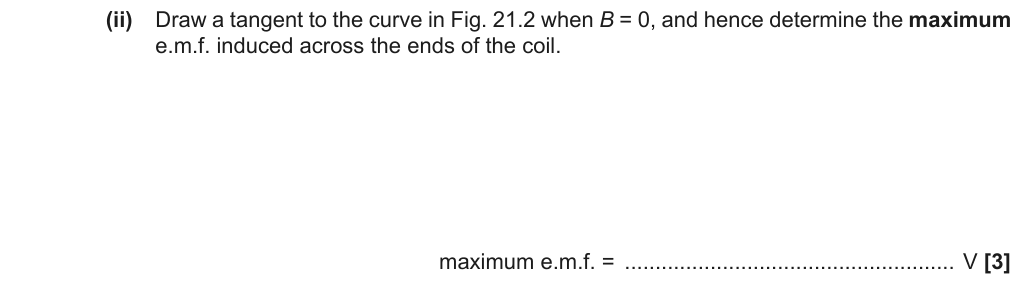
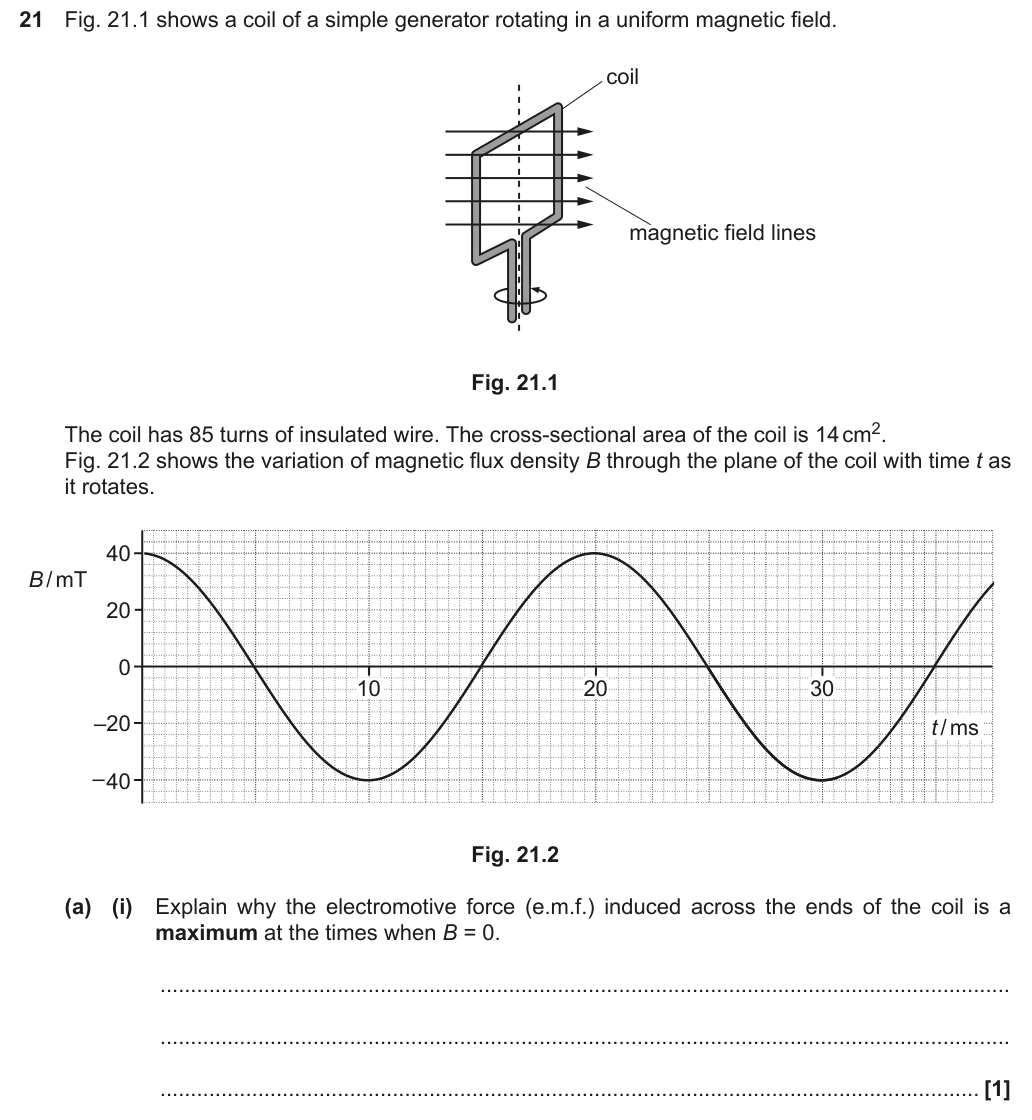
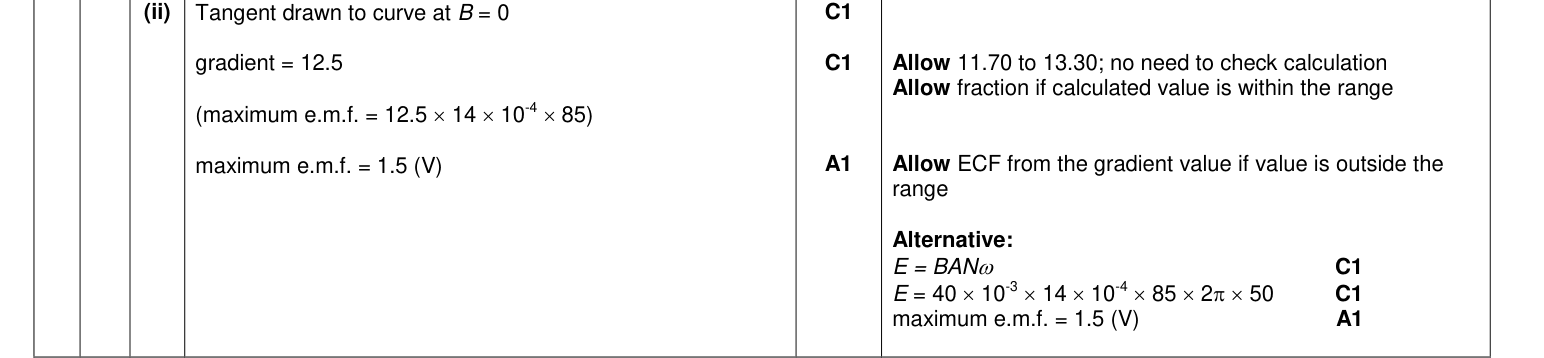
Most candidates followed the question and drew decent tangents on Fig. 21.2. Most of the tangents were acceptable, but a few either crossed the curve or had very thick pencil lines. A significant number of candidates quoted the maximum e.m.f. to be equal to the magnitude of the gradient of the tangent. Top- end candidates faced no obstacles here; the gradient was multiplied by [85 × 14 × 10-4] to give an answer around 1.5 V. Once again, a good number of candidates were picking the odd mark through error carried. Converting the cross-sectional area of 14 cm2 into 14 × 10-4 m2 was a challenge for some of the candidates in the middle and lower quartiles.
Skills: M0.1 Recognise and make use of appropriate units in calculations; M2.3 Substitute numerical values into algebraic equations using appropriate units for physical quantities; M3.6 Draw and use the slope of a tangent to a curve as a measure of rate of change
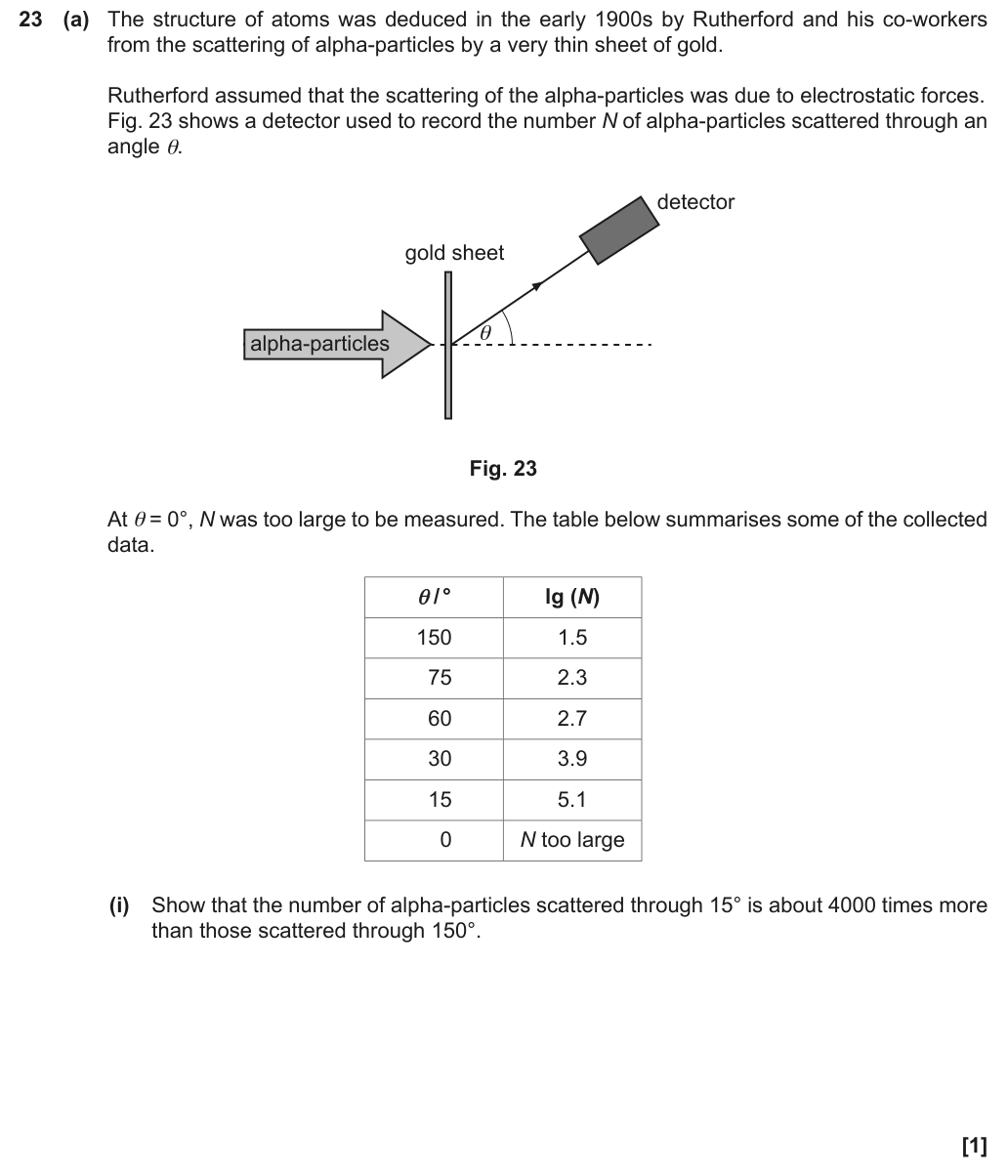
Question 23(a) Question 23(a)(ii) This question provided good discrimination.
Skills: M0.5 Use calculators to find and use power, exponential and logarithmic functions; M2.5 Use logarithms in relation to quantities that range over several orders of magnitude
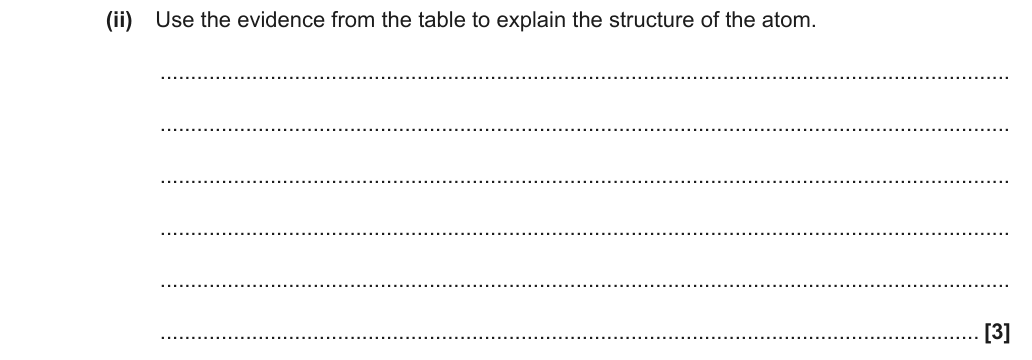
This question provided good discrimination. It is worth 3-marks, so the examiners were broadly looking for three key disparate points. The exemplar below, from a top-end candidate, illustrates a model answer. There is no ambiguity – full marks scored. It would be difficult to provide an improved answer. However, it is worth pointing out that the same ideas can also be presented in bullet-point form – three distinct points for the 3 available marks.
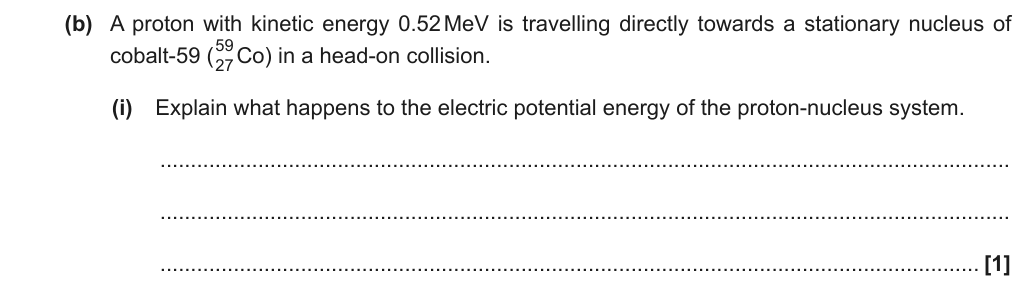
Question 23(b)(i) Question 23(b)(ii) The above question on electric potential energy provided excellent discrimination with middle and upper quartile candidates showing how to produce immaculate answers – identify the physics, write down the correct physical equation, do any necessary conversions (e.g.
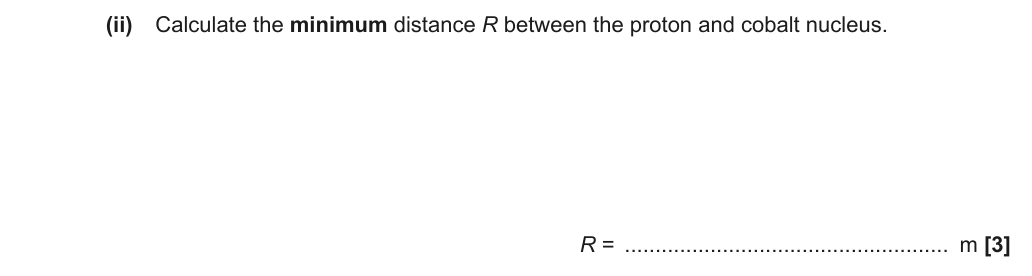
The above question on electric potential energy provided excellent discrimination with middle and upper quartile candidates showing how to produce immaculate answers – identify the physics, write down the correct physical equation, do any necessary conversions (e.g. MeV to J), rearrange the equation, substitute correctly and then write the final answer in standard form to the correct number of significant figures. About a third of the candidates scored full marks. Some of the missed opportunities or errors were: • Using an incorrect equation with the distance squared • Not correctly converting the kinetic energy 0.52 MeV into joule (J) • Using the equation r = r0A1/3 for the mean radius of a nucleus to determine the minimum distance
Skills: M0.2 Recognise and use expressions in decimal and standard form; M2.2 Change the subject of an equation, including non-linear equations; M2.3 Substitute numerical values into algebraic equations using appropriate units for physical quantities
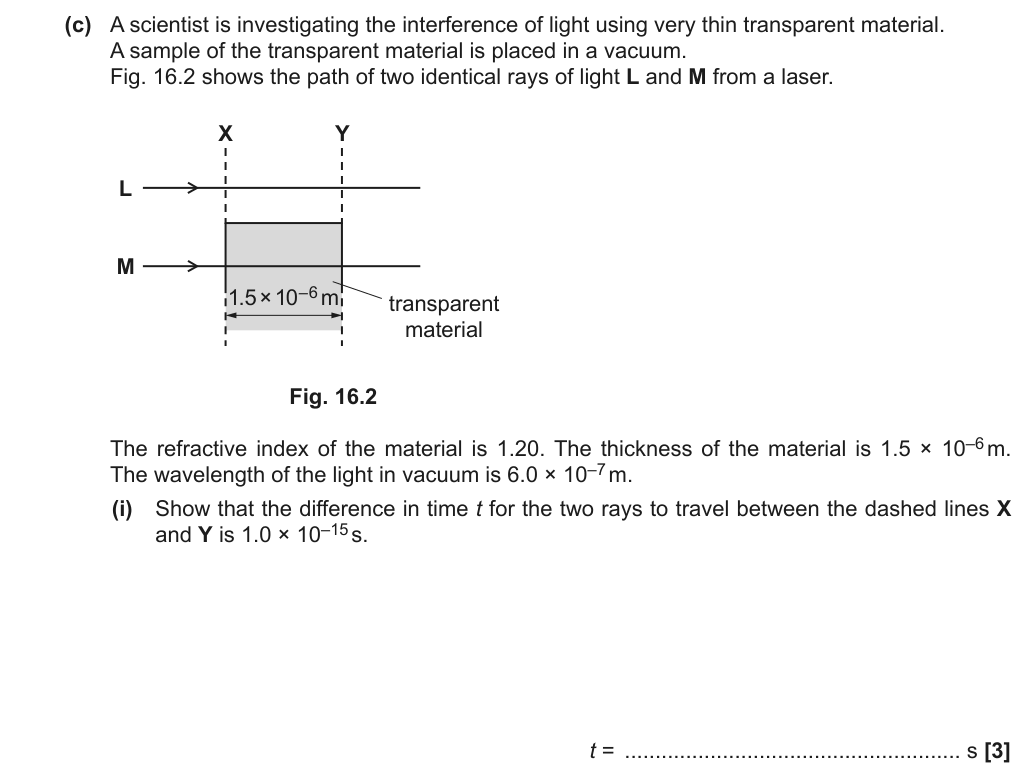
Generally, candidates answered this question extremely well and most scoring full marks In (c)(i), the solutions ranged from being well-structured to an assortment of equations and substitutions filling the entire answer space. Equations for refractive index and speed were easily used to show the answer to be 1.0 × 10⁻¹⁵ s. In (c)(ii), candidates either calculated the frequency of 5.0 × 10¹⁴ Hz and then used T = f-1 or calculated T directly using T = 3.0 × 108 = 2.0 × 10⁻¹⁵ s. (c)(iii) provided some discrimination with middle and top candidates getting the correct answer of 180°. As always, error carried forward (ECF) rules apply in calculations. This helped those candidates who got an incorrect answer of 2.4 × 10⁻¹⁵ s in (c)(ii) to score a mark for 150°.
Skills: M0.2 Recognise and use expressions in decimal and standard form; M2.2 Change the subject of an equation, including non-linear equations; M2.3 Substitute numerical values into algebraic equations using appropriate units for physical quantities
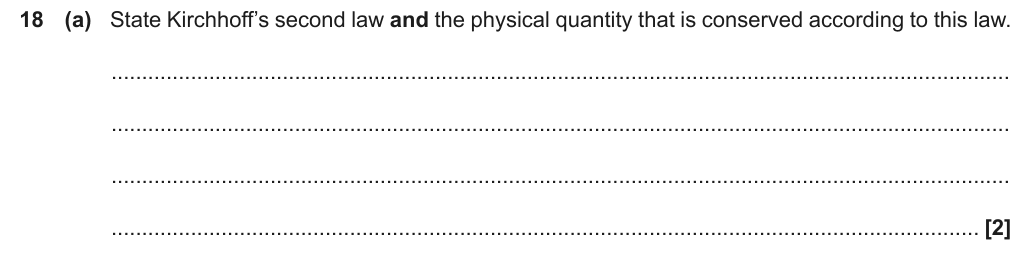
Many candidates jumbled up the first and second laws, but most candidates gave perfect answers. It was quite common to see hybrid statements such as ‘sum of e.m.f.s at a point = sum of p.d.s coming out of the same point’. Most did know that energy was conserved, but other incorrect suggestions were charge, current and voltage. The question discriminated well and rewarded those candidates that had learnt their definitions.
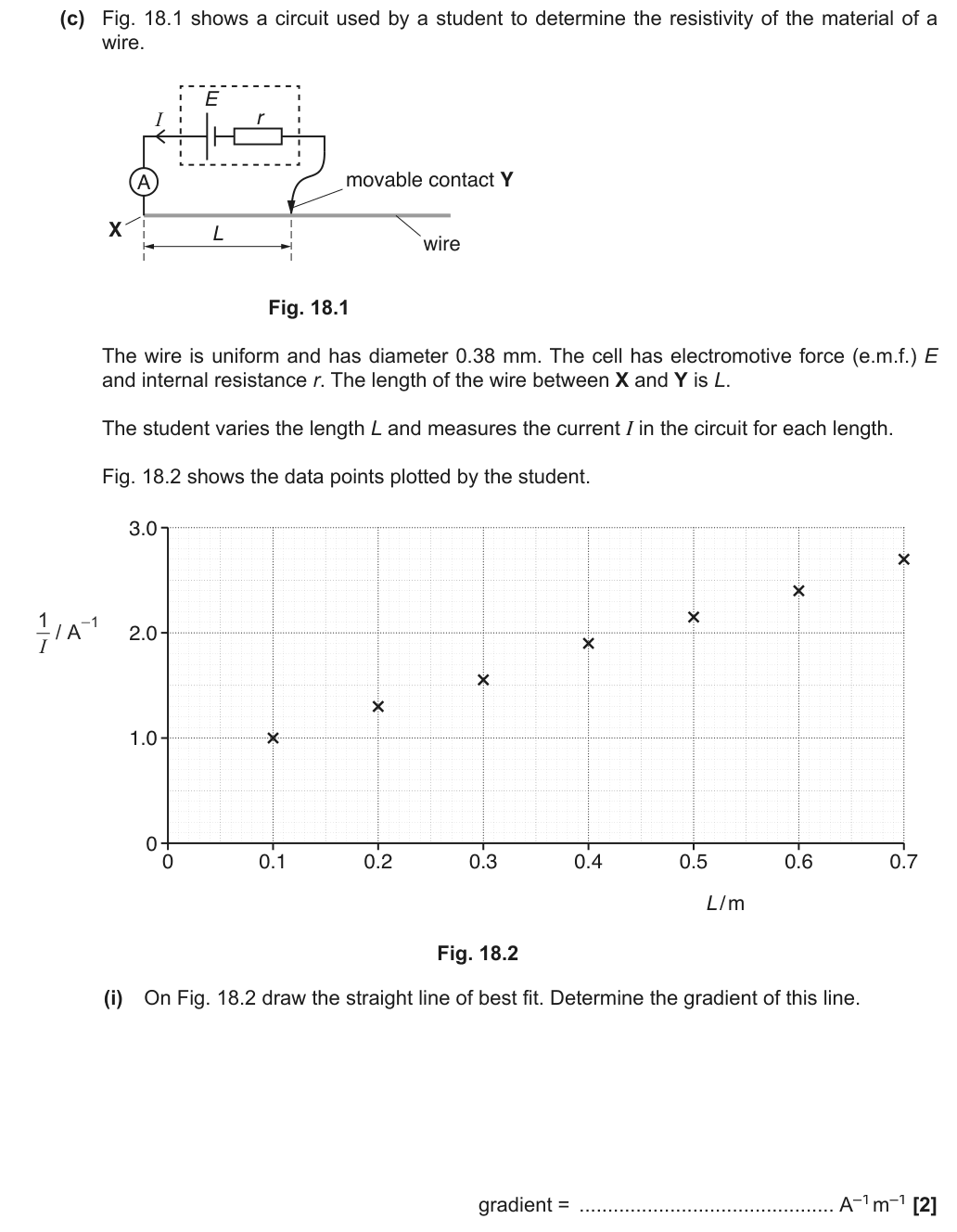
In (c)(i), the lines of best fit were generally very good, as were the gradient calculations with most candidates getting values in the range 2.60 to 3.00. Only a small number of candidates calculated the inverse of the gradient.
Skills: M3.2 Plot two variables from experimental or other data; M3.4 Determine the slope and intercept of a linear graph; PAG3 Investigating electrical properties
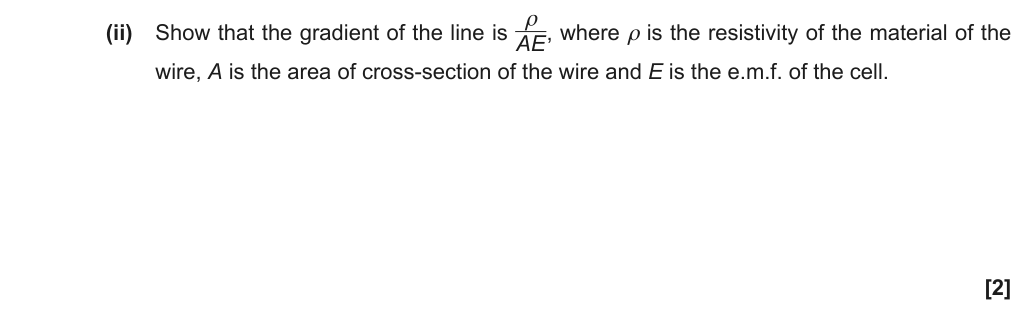
Most candidates struggled with (c)(ii). Less than 1 in 10 candidates successfully used the equations E = V + Ir and R = 𝐴𝐴 to derive the expression 𝐼𝐼= 𝐴𝐴𝐴𝐴𝐿𝐿+ 𝐸𝐸, and then identified the gradient as 𝐴𝐴𝐴𝐴 by comparison with the equation for a straight-line y = mx + c.
Skills: M2.2 Change the subject of an equation, including non-linear equations; M3.3 Understand that y = mx + c represents a linear relationship
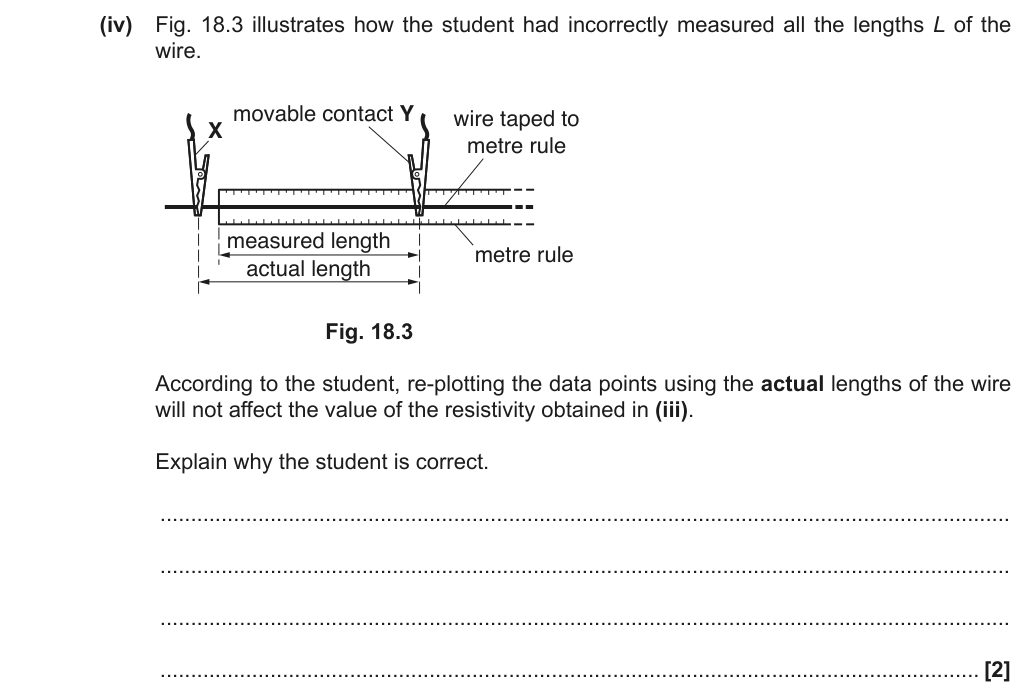
Question 18 (c) (i) In (c)(i), the lines of best fit were generally very good, as were the gradient calculations with most candidates getting values in the range 2.60 to 3.00. Question 18 (c) (ii) Most candidates struggled with (c)(ii). Question 18 (c) (iii) Most candidates in (c)(iii) did exceptionally well to calculate the resistivity using the equation for the gradient.
Skills: M3.3 Understand that y = mx + c represents a linear relationship; PAG3 Investigating electrical properties
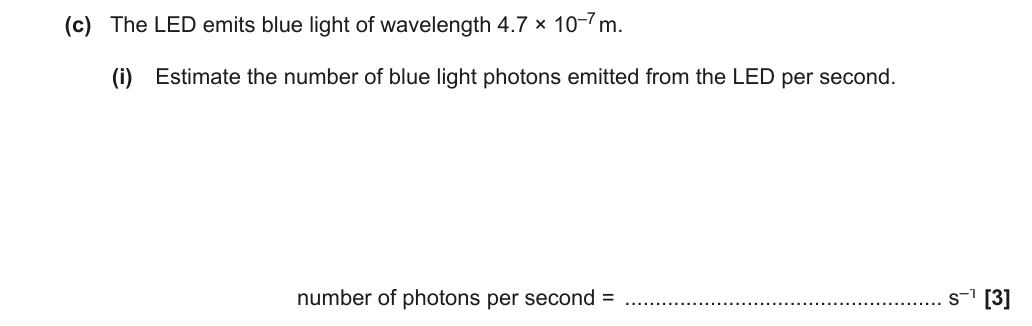
This question required knowledge of both power and energy of photons. It discriminated well with many of the top end candidates getting the correct of 5.9 × 10¹⁶ s-1. A significant number of candidates scored 1 mark for the energy of the photons. Using the power of 0.025 W in the final step of the calculation proved to be the main obstacle in this calculation. Alternative answers using the energy of a photon as 2.5 eV were allowed. This gave the rate of photons emission to be 4.0 × 10¹⁶ s-1.
Skills: M0.2 Recognise and use expressions in decimal and standard form; M2.3 Substitute numerical values into algebraic equations using appropriate units for physical quantities
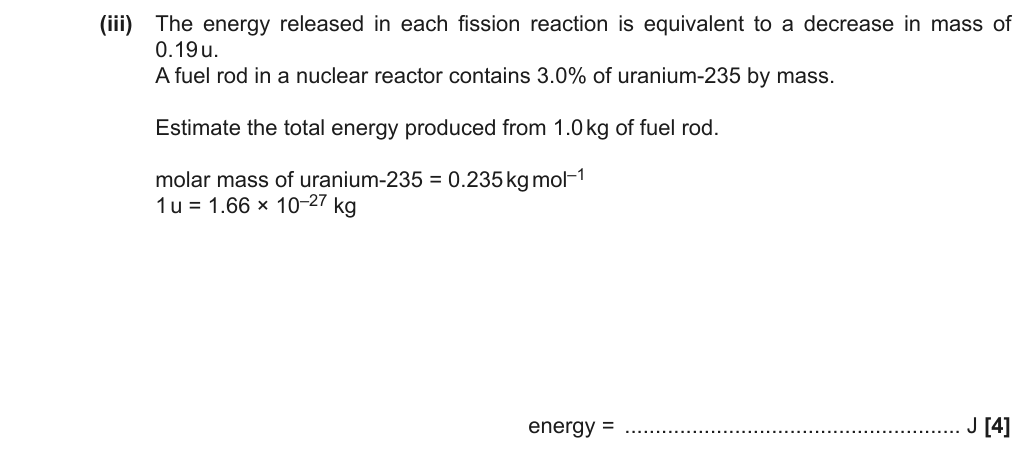
This proved to be an excellent discriminator with top end candidates showing excellent skills to get to the correct answer of 2.2 × 10¹² J. The majority of the candidates correctly converted the 0.19u into kilograms, and then successfully used Einstein’s mass-energy equation to calculate the equivalent energy of 2.8 × 10⁻¹¹ J. The main obstacle in this question was the determination of the number of uranium nuclei in the fuel rods. Avogadro constant, given in the data booklet, was either omitted or the incorrect mass used to determine the number of uranium nuclei.
Skills: M0.2 Recognise and use expressions in decimal and standard form; M0.3 Use ratios, fractions and percentages; M2.3 Substitute numerical values into algebraic equations using appropriate units for physical quantities
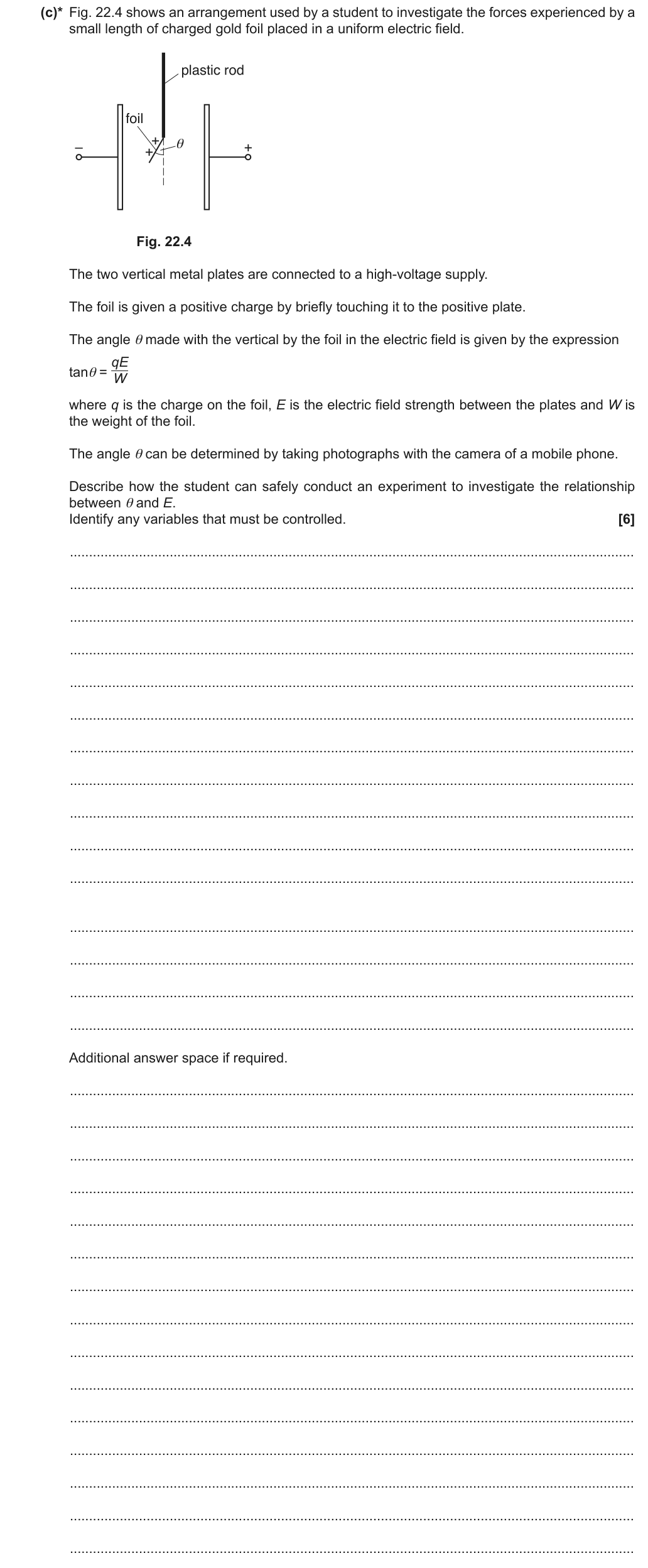
This was the second level of response (LoR) question in this paper. This too was designed to assess practical skills of planning, implementation, analysis and evaluation. The context of the question was force experienced by a charged gold foil in the uniform electric field provided by two parallel plates. Candidates were not expected to have seen such an experiment, but they were expected to use their knowledge of electric field strength and practical skills to present plausible approaches. On occasions, the experimental methods showed poor appreciation of some basic ideas. Some candidates were charging the foil using large current that allegedly would cause heating issues for the foil, while others decided to use Q = It, ammeter and a stopwatch to determine the charge on the foil – failing to appreciate that the time constant will be too small for such a technique. However, on this occasion, such over ambitious techniques were generally overlooked by examiners. As with 16d, a holistic approach to marking was used, with marks given according answers matching the descriptors for the various levels. There is no one perfect answer for this question, examiners were expecting an eclectic approach. The key things examiners were looking for were: - Methods for determining electric field strength E. - Using the right instruments for the measurements. - Plotting the correct graph to show the relationship given in the question was valid. - Correctly identifying the variables that were being controlled (kept constant). Access to higher level marks dependent on fully answering the question – and this included the last statement about control of variables. A significant number of candidates focused on the description and analysis of the data, without ever addressing the last sentence of the question. This question did discriminate well, with L1, L2 and L3 marks roughly distributed in the ratio 1:3:4.
Skills: M3.3 Understand that y = mx + c represents a linear relationship
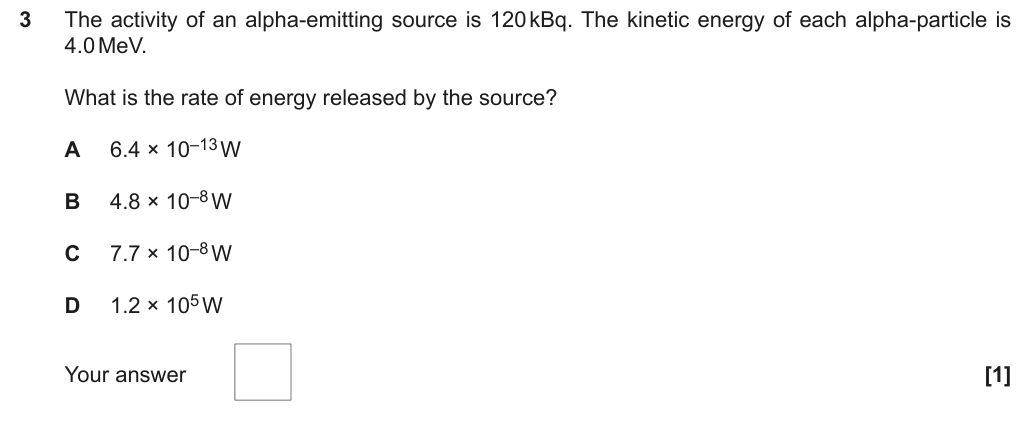
C
Although a little over two thirds of candidates selected the correct response, this question discriminated well between candidates of differing abilities. Potential errors in this question included two unit prefix conversions and the conversion between eV and joules. Incorrect responses were fairly well spread across the other distractors.
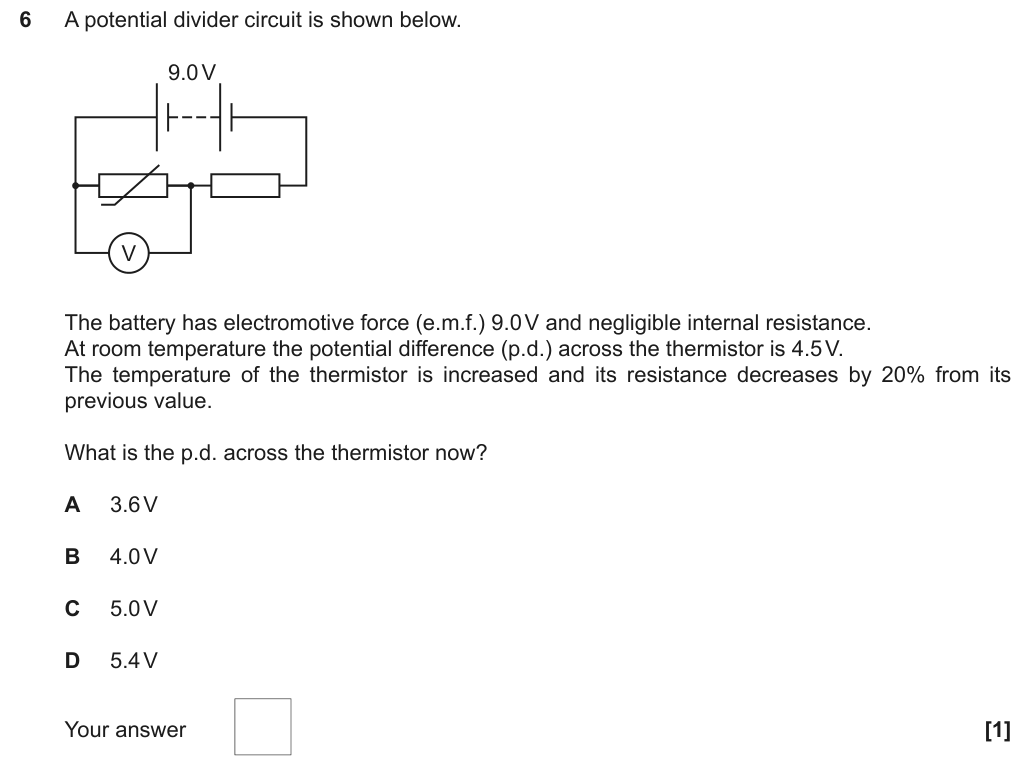
B
This proved to be a challenging question with only around a quarter of the candidates able to obtain the correct response. It was likely that written working was helpful here and many candidates set out some form of a potential divider calculation. Some did this in ratios and others made up a value for the two resistances (e.g. 10 ) which they then decreased to 8.0 for the thermistor. The incorrect responses were spread fairly evenly across the distractors, which is maybe surprising as it would be expected that candidates should have appreciated that the p.d. across the thermistor would now be less than the initial 4.5 V.
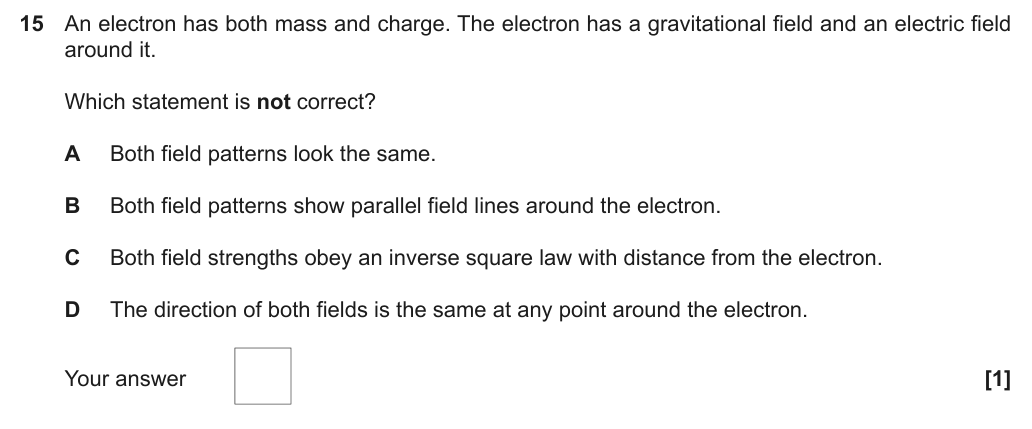
B
This was a challenging question; candidates often drew a radial field diagram as a starting point and many candidates helpfully “ticked” the correct responses to help them eliminate these from their response. It is important that candidates read the questions carefully, as it was evident that some were looking for a correct statement.

This proved to be a challenging question; it appears many candidates were unable to appreciate the progressive nature of the wave on a displacement-distance graph. By far the most common response was 0, where it is likely the candidates ignored the inclusion of time and simply gave the displacement at 1.5cm.
Skills: M3.1 Translate information between graphical, numerical and algebraic forms
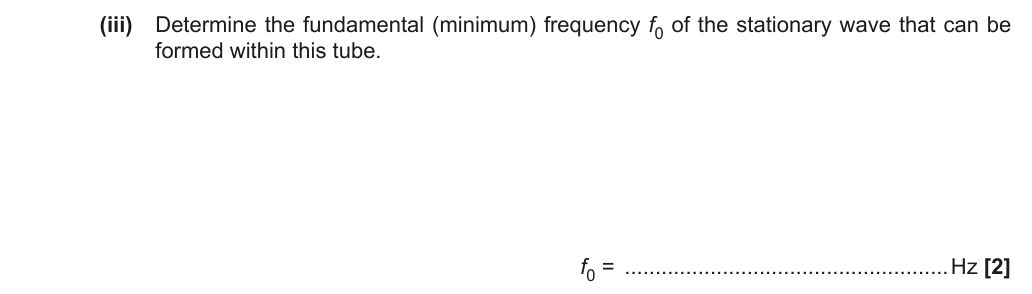
This proved to be a challenging question and only around one fifth of the candidates were able to score any marks. Most successful candidates appreciated that there were 11 quarter wavelengths of the initial wave in the tube and used this to determine the length of the tube, from which they were able to determine the fundamental wavelength and hence the frequency. There are many potential errors in this question, however a common incorrect response was 680Hz, calculated from treating the wavelength of the fundamental wave as twice the given distance of 25cm.
Skills: M0.3 Use ratios, fractions and percentages; M2.2 Change the subject of an equation, including non-linear equations
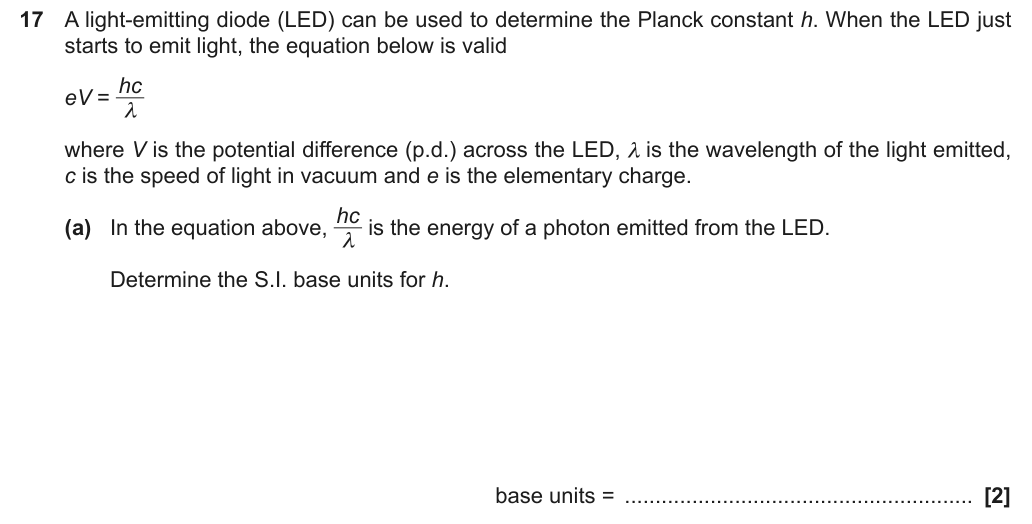
This question was done correctly by around half of the candidates. The most common method was to use an equation for energy or work to give the base units of the joule. From this, multiplying it by s would lead to the correct response. Most candidates used KE = ½ mv2 to determine the base units of the joule directly, although others used work done = force distance and force = mass acceleration. Encouragingly, there were relatively few arithmetic errors even with the negative indices. Some candidates got into difficulties attempting to use the given equation and struggled with the volt, attempting to use V = IR in a variety of ways. A very common error was to give the units simply as Js, often using h = E/c to show [J m / m s–1] gives J s. There was a clear misconception (see below) about what constitutes a base unit.
Skills: M0.1 Recognise and make use of appropriate units in calculations
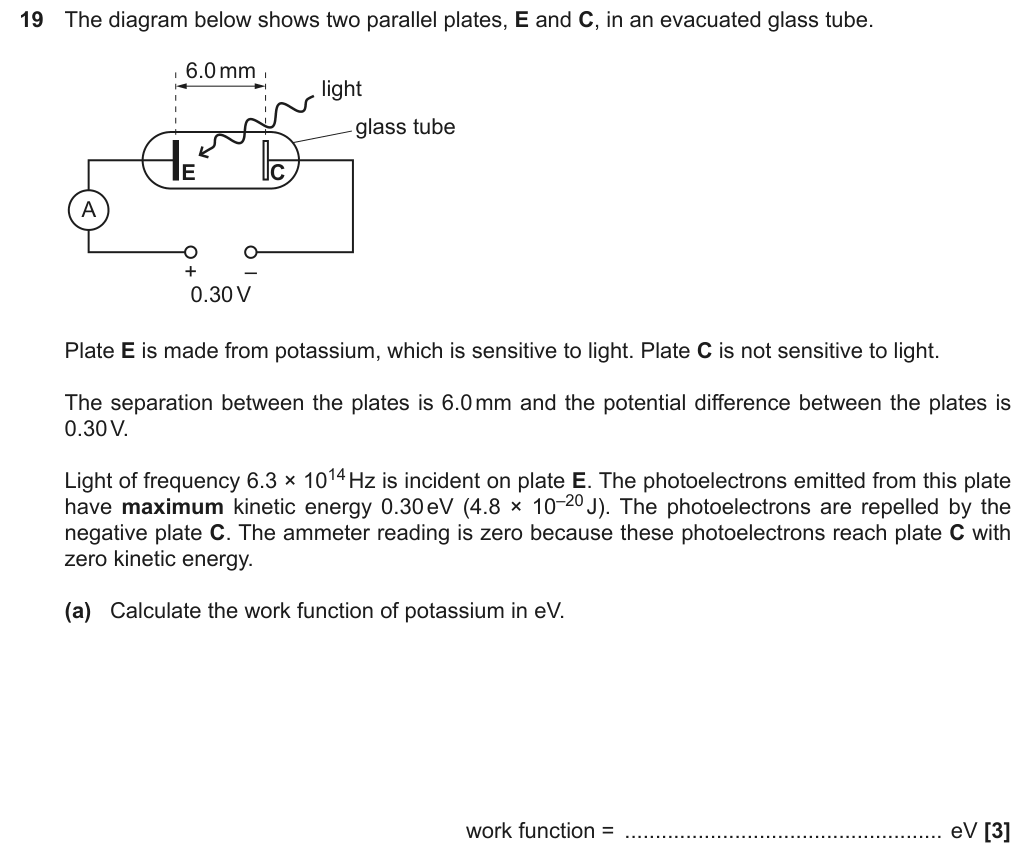
This question was successfully completed by many candidates. It was clear that the use of Einstein’s equation was well known, and the conversion to eV (generally done at the end) only caused a few candidates difficulties, mostly by multiplying their work function (in J) by e. Several candidates wrote down the answer with no working – while this will score full marks here, it is a risky tactic should an arithmetic error occur on their calculator.
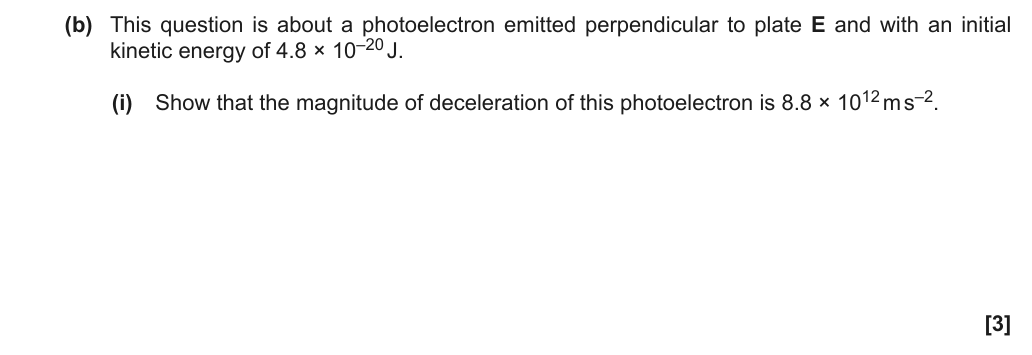
There were many different routes to showing the acceleration, and marks were given for each method or part method. No one method was seen significantly more than others, and some candidates used a variety of pathways to come to their answer. The main principle in the question (and the subsequent one) where the candidate is being asked to “show that” a given value is correct is that the examiner must be convinced that the candidate has clearly demonstrated that they have carried out the calculation and evaluated it on their calculator. The instructions which examiners used was: first marking point for providing one (or two) equations that would lead to the solution, or calculation of an intermediate value; second marking point for a full substitution into one or more equations; third marking point for using this full substitution to produce an answer to more sf than given in the question. As the second marking point was deemed to be an M mark, the full substitution needed to be seen to gain the A mark. A small number of (often higher end) candidates did not show the full substitution, often missing out the value of me in their calculation, and another common error was to not show the extra significant figure. Over half of the candidates were able to achieve full marks on this question and it generally discriminated well. Both of these are evidence that the complete calculation has taken place and that the candidate has not somehow artificially generated the required value. This advice should be viewed as “best practice” rather than a rigid set of rules. Reverse arguments are often possible where a candidate can work backwards from their given value, however this is not the advised approach.
Skills: M0.2 Recognise and use expressions in decimal and standard form; M2.3 Substitute numerical values into algebraic equations using appropriate units for physical quantities
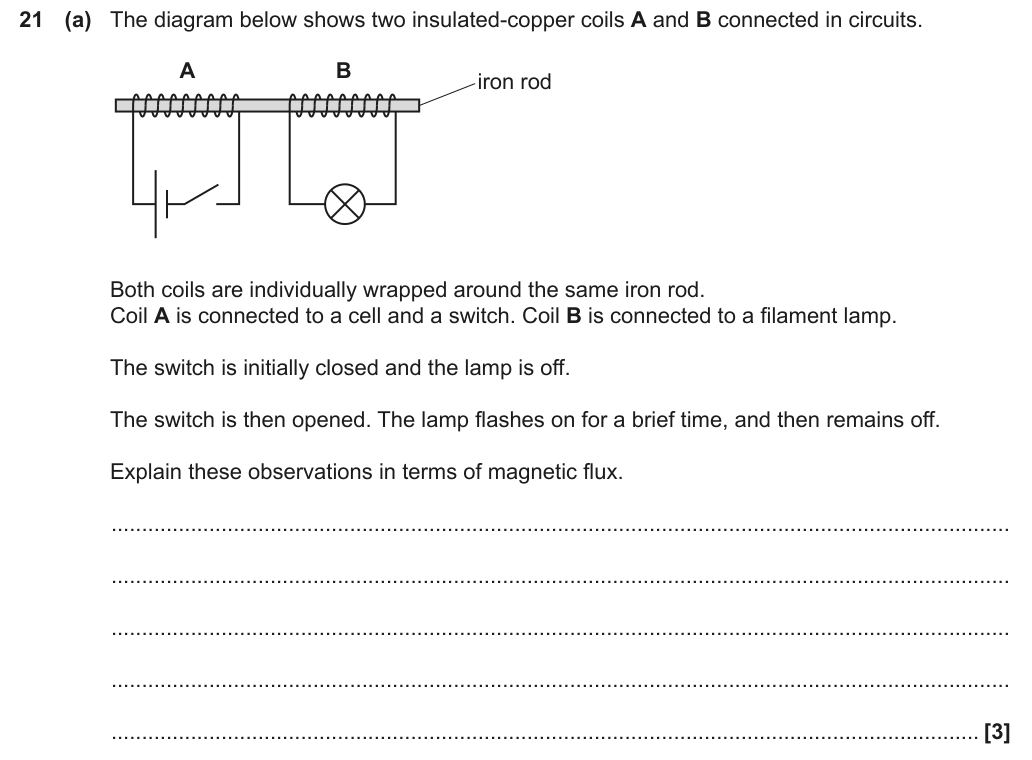
Many candidates found difficulties in appreciating what was required. A major confusion arose from a misunderstanding of the actual process, in that it was the opening of the switch which caused the lamp to light. Many knew Faraday’s law, and were able to quote it, but not able to put it correctly into the context of this question. A common error included a misunderstanding of the role of the rod. With a large number of less successful responses stating that it conducted current to the lamp. A large number of candidates did not discuss the process in the terms of magnetic flux (as was required in the question) but talked in vague terms about “magnetism”. Despite this being a challenging question, many candidates were able to score marks, and those at the top end were able to give clear and well- structured responses.

This proved to be a challenging question and only the higher end candidates were able to give a clear and correct response. The question stated, “in terms of forces” and most candidates did not explain the idea of attraction between the plates. Common incorrect responses included using E = ½ QV or using W = F d as a starting point.
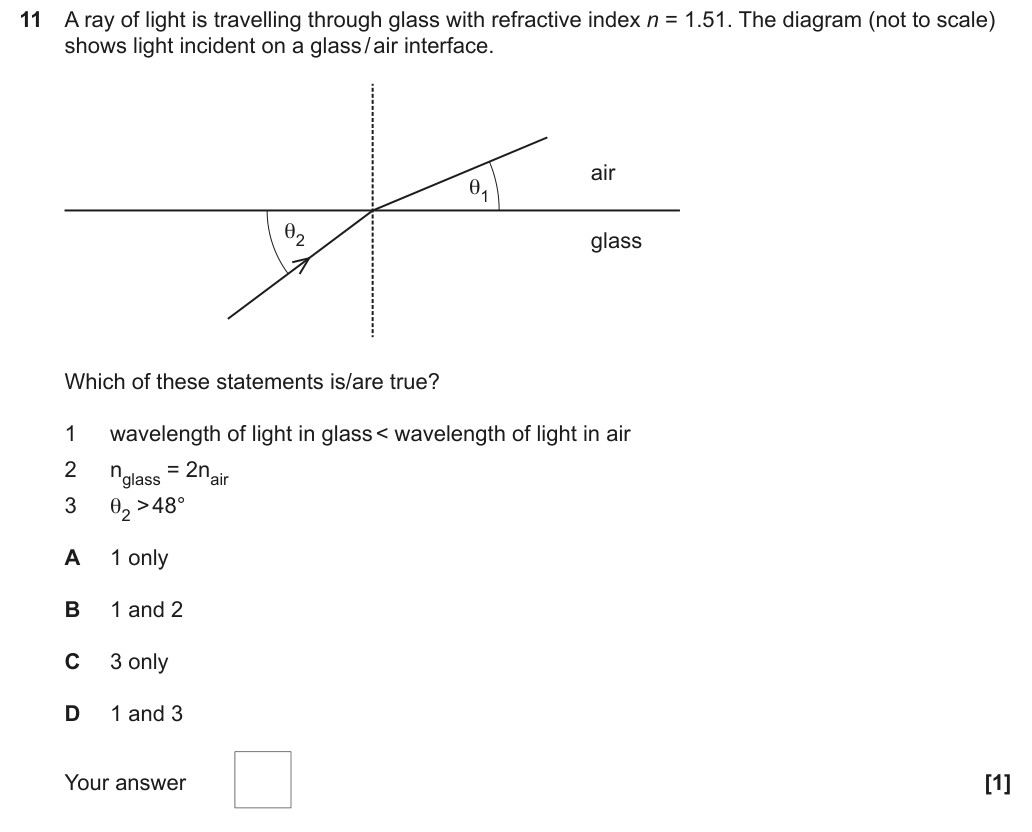
D
Around one third of candidates were able to identify the correct response; the main difficulty appeared to be that the given angle in the glass was not given relative to the normal (as is usual) and this meant that a common distractor was A.
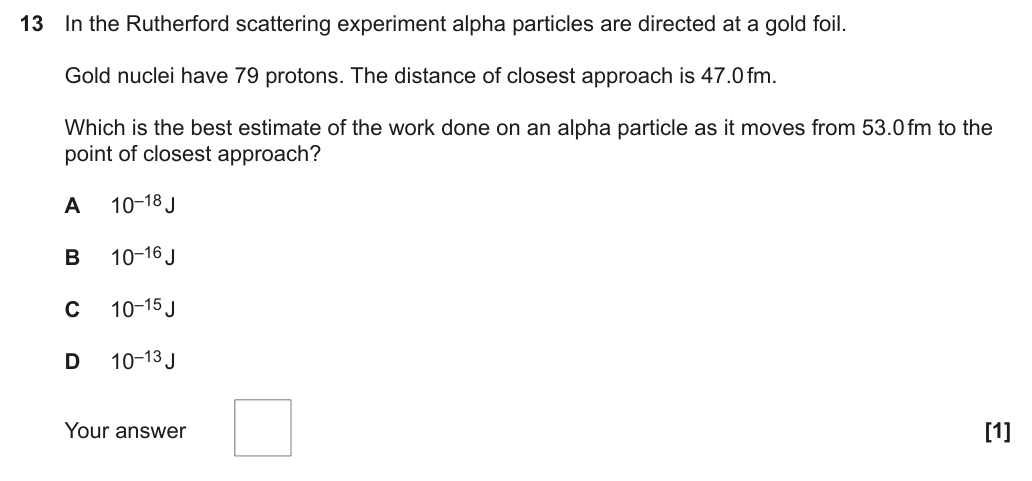
D
A little under half of the candidates were able to calculate and select the correct response. The most common incorrect response was B, although it was not entirely clear why this was the case from candidates working. A very small minority of candidates did not answer this question.
Around half of the candidates were able to achieve at least 1 mark and had a good idea that the waves must arrive in phase. Some candidates confused path difference and phase, giving statements such as ‘the phase difference is one wavelength’. Only a small number of candidates appreciated that this was a maximum two away from the central maximum and so had a path difference of 2 × wavelengths (or equivalent in phase). Many candidates who did not score gave responses in terms of superposition but gave little detail beyond the use of the terms.
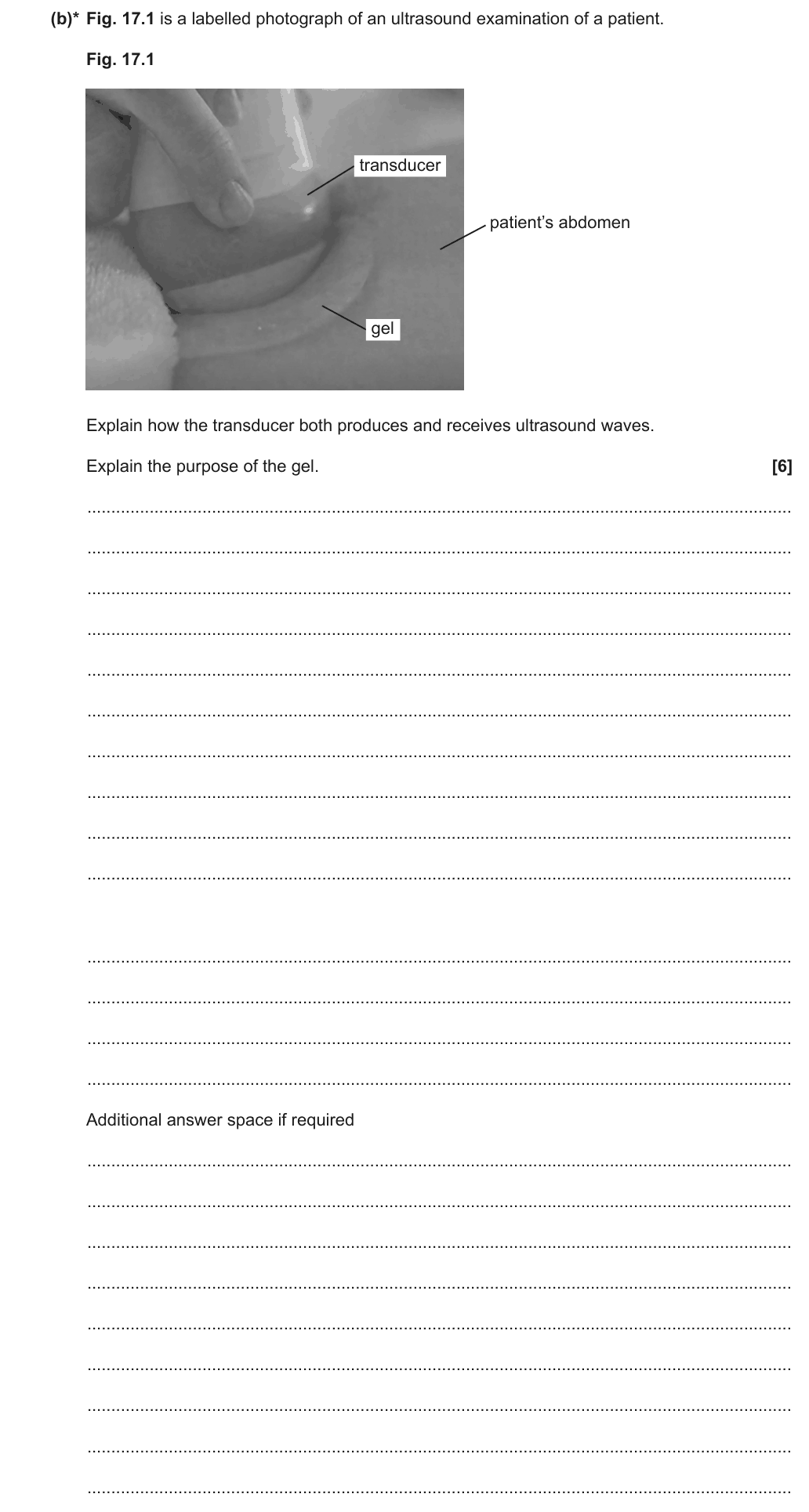
This level of response (LoR) question was designed to assess Section 6.5.3 (b), (e) and (f) of the specification. A holistic approach to marking is used, with marks given according to answers matching the descriptors for the various levels. No one answer is perfect for this question and examiners will expect a varied approach. The indicative scientific points are used as a basis; however other correct, relevant physics may also be taken into account. The nature of this question is such that it can be conveniently separated into two sections; a description of producing and receiving ultrasound by the transducer, and the purpose of the gel in this case. The key points in the production and receiving of ultrasound that examiners were looking for were: • an explanation of the piezoelectric effect • what causes it, and the effect on the crystal • how this produces the ultrasound waves • how a reverse of this will lead to its detection. The key points in the purpose of the gel were:- an explanation of acoustic impedance and an idea of what would happen if no gel were to be used – some idea of the term impedance matching and how this occurs with the gel. It was clear that many candidates had a good knowledge and understanding the use of ultrasound in this context and were able to describe this well, leading to a good number of candidates being given Level 3. The very best answers were detailed and well-structured and made every attempt to fully answer each section of the question using correct scientific terms. Many candidates wasted time and space describing how the ultrasound was reflected in the body, which is not required, or other irrelevant detail. Some drew diagrams, which can be helpful, but in this case did not really add to the text. For the most part, the description of the gel was done better than the description of production, most likely because the piezoelectric effect can be difficult to explain clearly. Candidates were not penalised for the use of incorrect values in the frequency of ultrasound here, or in any values of size (or voltage applied to) the transducer. The equation for reflection of ultrasound was given by several candidates but was not always explained to support the answer. Many strong candidates only answered one part of the question; this highlights the need to read it carefully – there will nearly always be two parts – and make sure that, as far as possible, equal weighting is given to both.
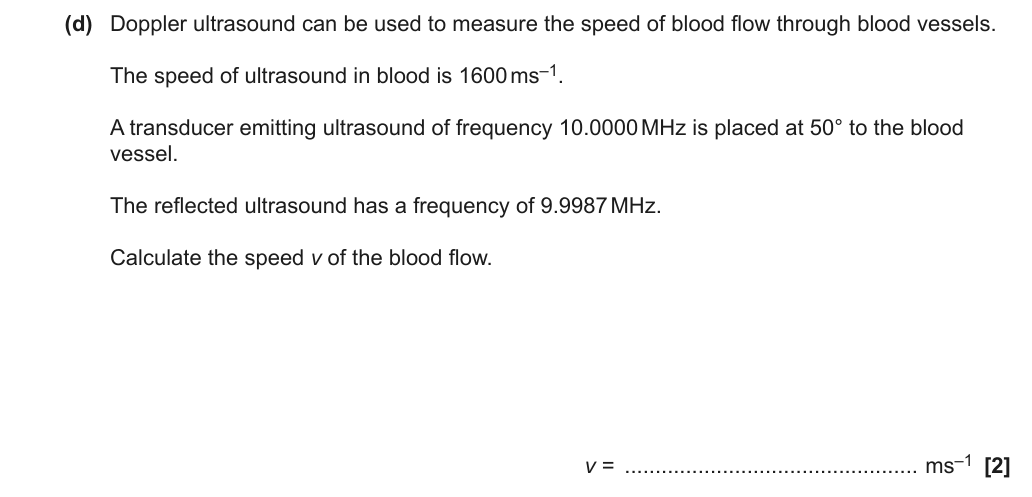
This question was correctly done by around two thirds of candidates. Although not a particularly complex calculation, there are some challenges in it. Common mistakes were using the speed of light for c, using the reflected frequency for the change of frequency, power of ten errors and using the reflected frequency in the denominator. Many candidates wrote out the formula and rearranged it for v before substituting the numbers which help with the calculation. Those who avoided this occasionally made substitution/transcription errors.
Around two thirds of candidates were able to calculate this correctly. The majority of incorrect responses were naturally when using 0.30 m as the wavelength. Relatively few candidates did not change their wavelength into metres, but a significant number were unable to rearrange the formula correctly.
Skills: M0.1 Recognise and make use of appropriate units in calculations; M2.3 Substitute numerical values into algebraic equations using appropriate units for physical quantities
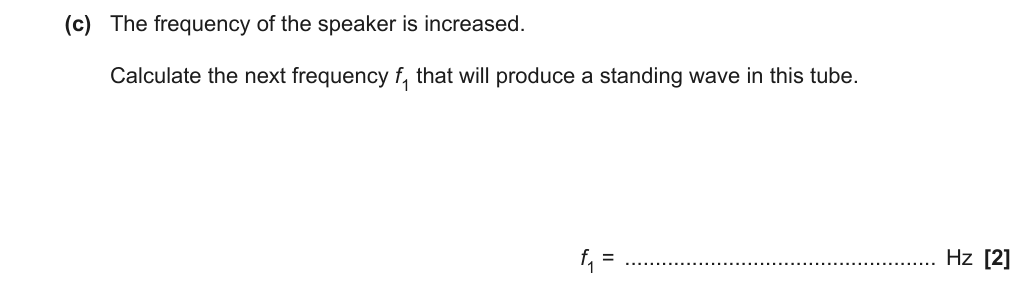
Most candidates appreciated that the wavelength would be smaller (and many drew a sketch) to produce the next frequency. However, it was difficult to score marks on this if the previous answers were incorrect. Error carried forward is often applied, but in this case major errors will compound and it is not possible to work through the candidates thinking.
Skills: M2.3 Substitute numerical values into algebraic equations using appropriate units for physical quantities
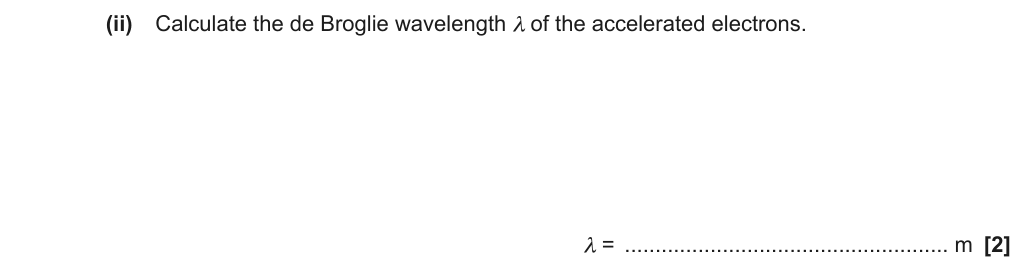
Around one half of candidates were able to correctly calculate the de Broglie wavelength. This is potentially difficult for the average candidate to carry out in a single calculation, so it is very helpful to show the working in a slightly extended calculation. Most candidates calculated the electron speed first from the kinetic energy equation and then correctly substituted it. Several candidates used the proton rest mass in place of the electron rest mass, but the majority of incorrect responses came from using the speed of light for the speed. This is a physics error which can score no marks.
Skills: M0.5 Use calculators to find and use power, exponential and logarithmic functions; M2.2 Change the subject of an equation, including non-linear equations; M2.3 Substitute numerical values into algebraic equations using appropriate units for physical quantities

While changing the value of the resistor or capacitor would increase the charging time, that would alter ‘this experiment’ and as such was not credited. In the context of this question, it is how the variation can be determined using the given values. Few candidates appreciated this, however there were significant numbers who knew that an oscilloscope could be used in place of the voltmeter.
Skills: PAG9 Investigating capacitors
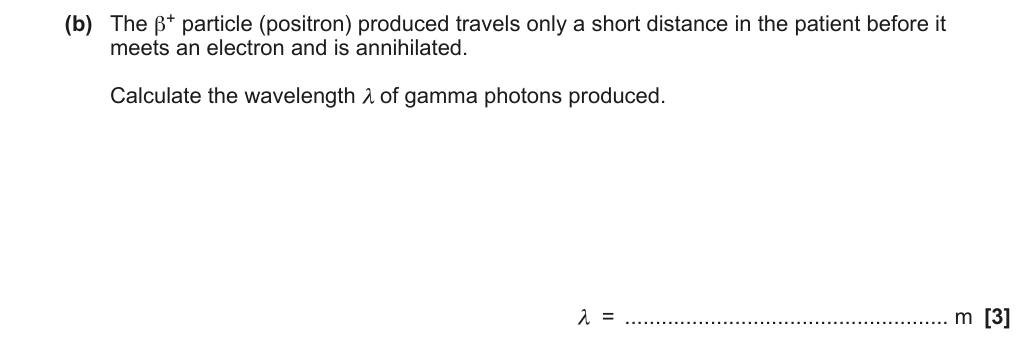
Well over half of the candidates were able to score 2 or more marks on this question. A great deal scored 2 marks due to the inclusion of a factor of two, which was then not removed (or vice versa). Some candidates used the formula for kinetic energy – which by coincidence may give the correct answer – however this was not credited, nor was the more common use of the de Broglie formula. Examiners sometimes had a difficult decision on this question, whether the response was a physics error or not, and if in doubt a candidate would be awarded the marks.
Skills: M0.2 Recognise and use expressions in decimal and standard form; M2.2 Change the subject of an equation, including non-linear equations; M2.3 Substitute numerical values into algebraic equations using appropriate units for physical quantities
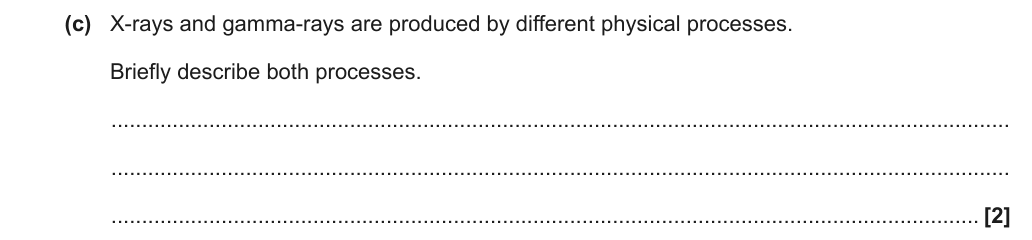
The main principle behind this question was to distinguish between the X-ray production by electrons and gamma ray production by nuclei. Fairly specific details were required for each, although a wide range of answers were accepted. This question discriminated well among the candidates with roughly equal fractions getting 0, 1 and 2 marks.
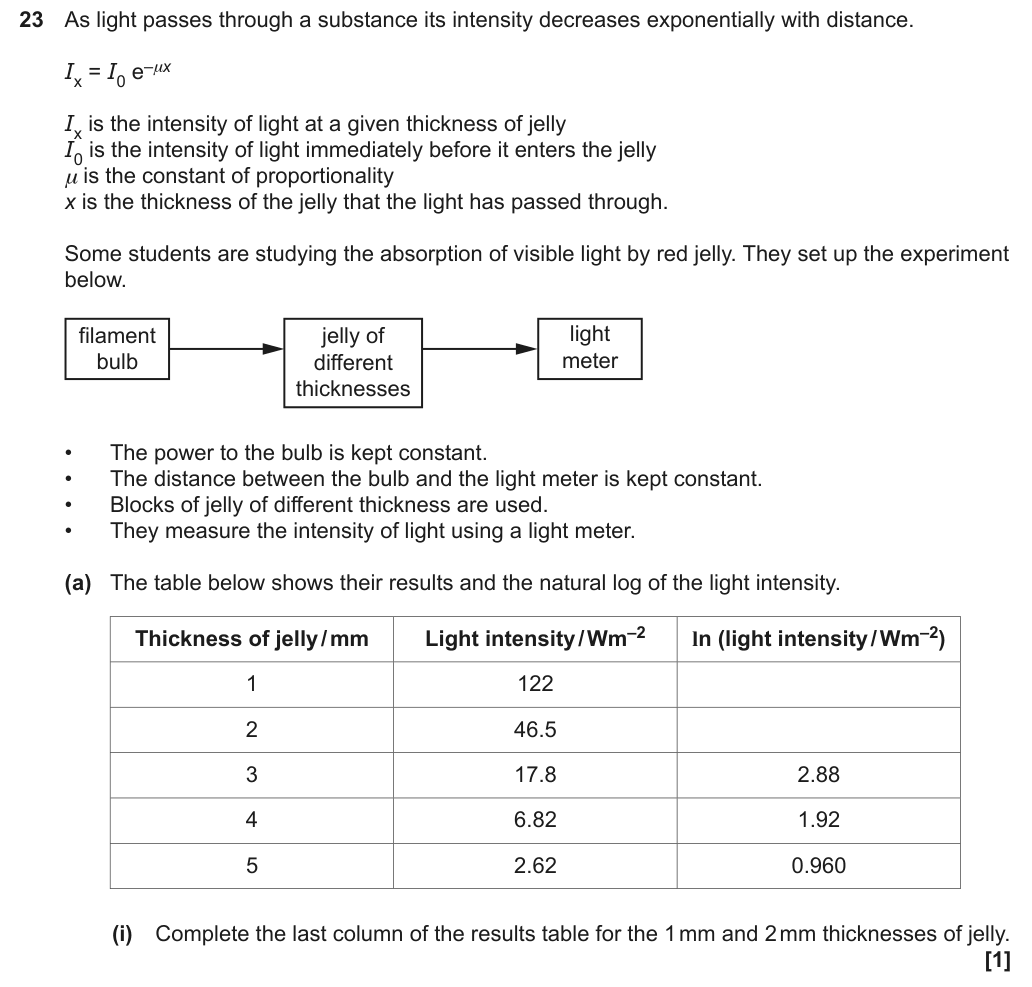
Very few candidates made calculation errors here; the main reason for not gaining marks was usually due to the number of significant figures used. As a general rule, 3sf is usually the number for a logarithmic calculation however it would also be appropriate to match the number to any data already given.
Skills: M0.5 Use calculators to find and use power, exponential and logarithmic functions; M2.5 Use logarithms in relation to quantities that range over several orders of magnitude
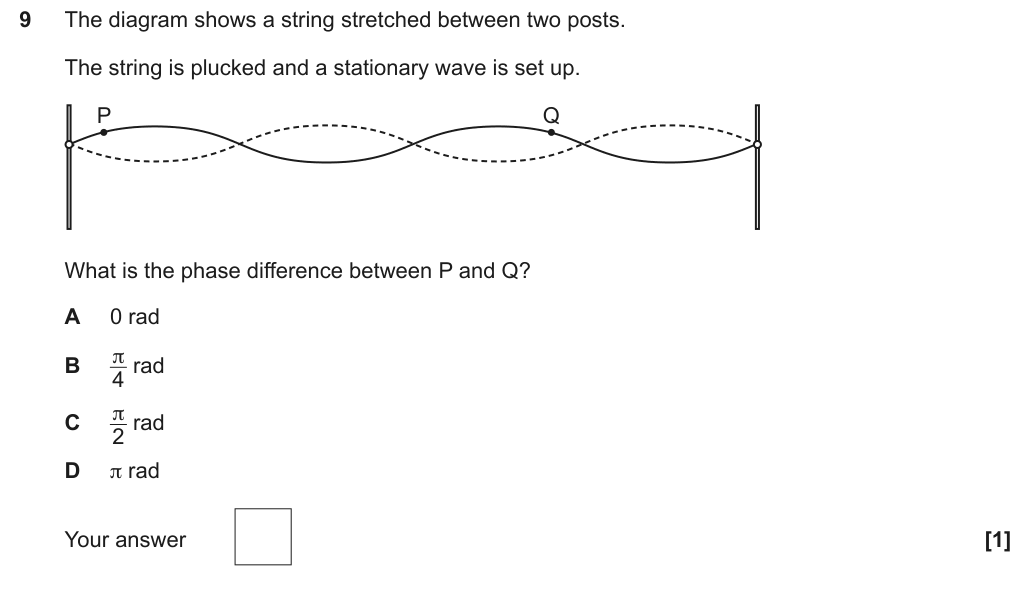
A
Relatively few candidates got this phase difference correct; it was clear from many that they thought that it was a progressive wave as they attempted to add on fractions of cycles. It may also be the case that candidates are unfamiliar with phase differences in stationary waves.
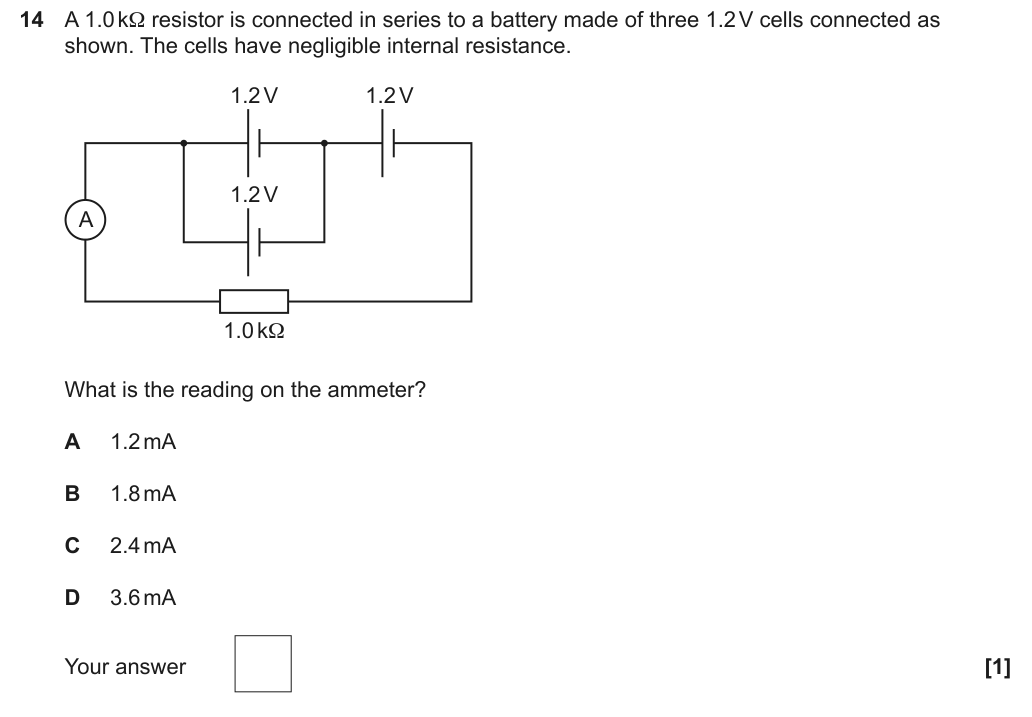
C
This question was relatively poorly answered with fewer than half of the candidates getting the correct response. B and D were the two common distractors with B treating the cells as if they were resistors, and D simply adding up the three voltages.
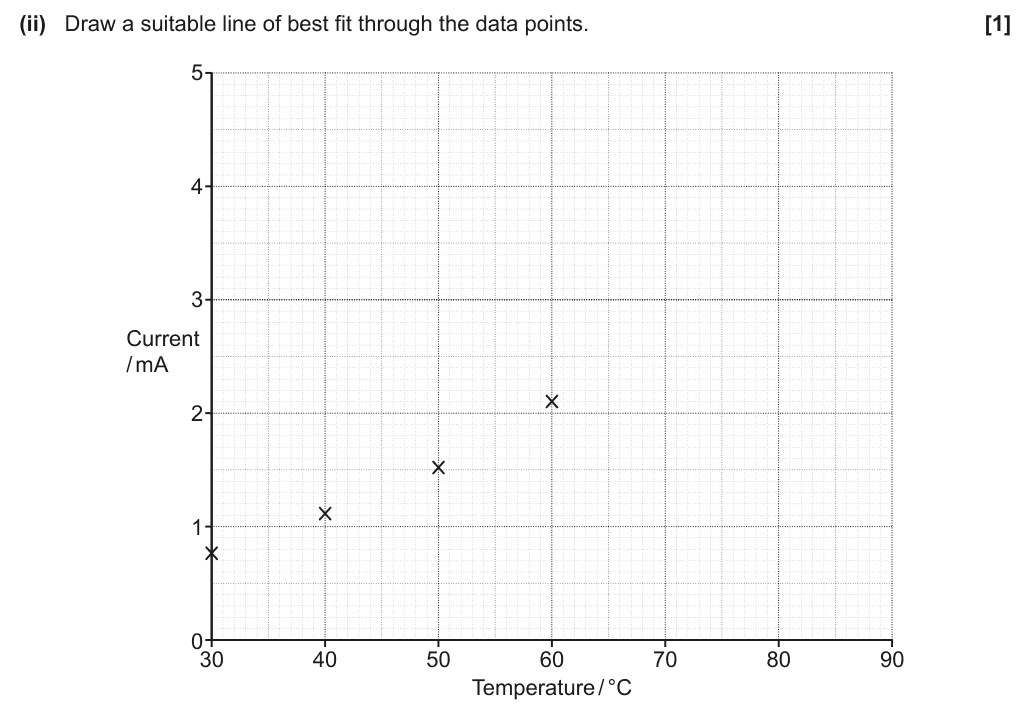
The suitable line is a curve of increasing gradient and well over half of the candidates were able to draw this carefully. There were very few lines which simply joined the points as ‘dot-to-dot’ straight lines although a considerable number drew a single straight line often through the (false) origin which should have looked clearly unsuitable. When drawing the curve it needs to pass within a single small square of each data point; several candidates drew careless lines missing data points by some distance. Candidates are also encouraged to use a sharp pencil for this line. There were a reasonable number who attempted to correct a line drawn in pencil, often making it difficult to award a mark.
Skills: M3.2 Plot two variables from experimental or other data; PAG3 Investigating electrical properties
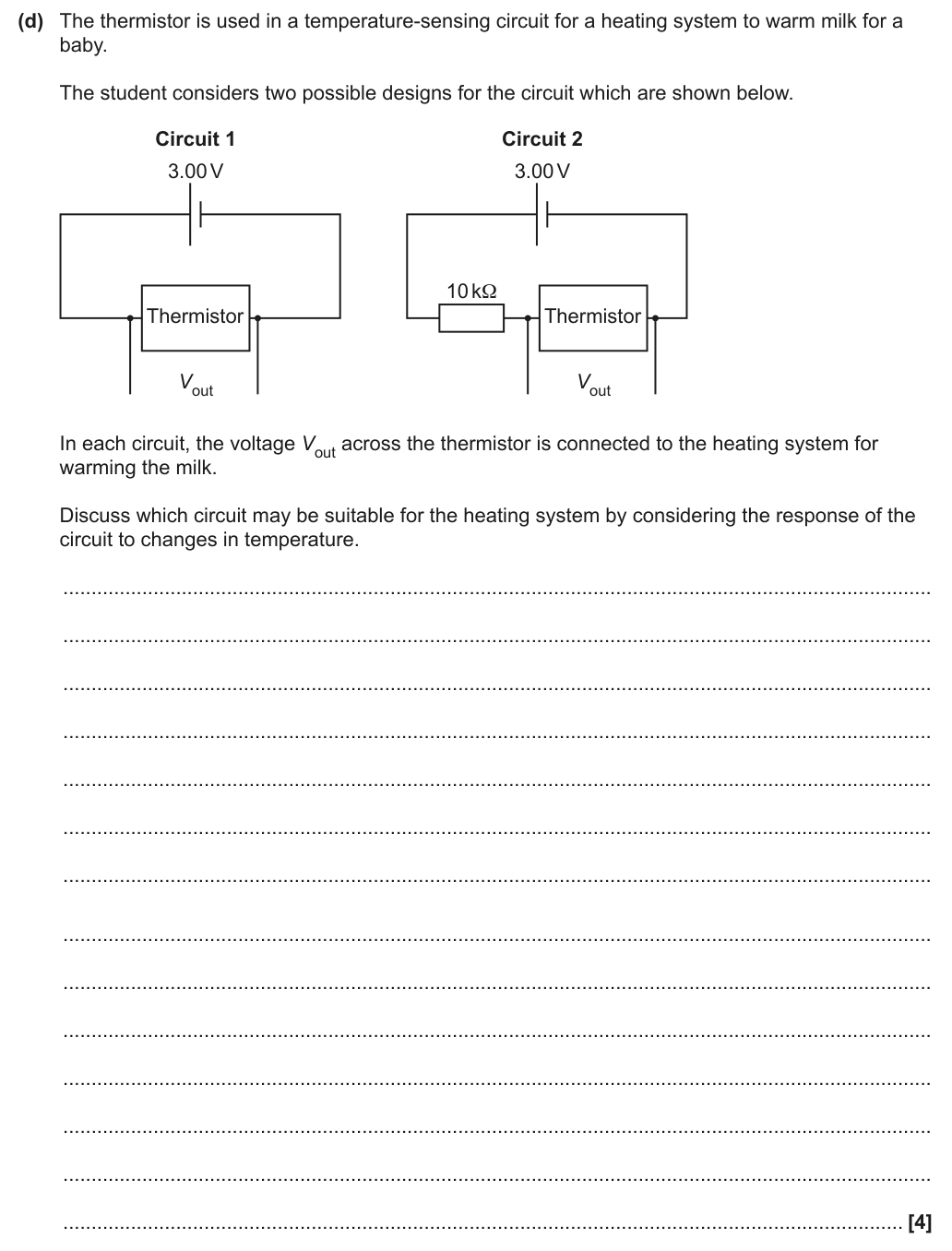
A significant number of candidates did not score on this question despite giving a response, indicating a lack of understanding of voltage in circuits. In particular, those who did not appreciate that the full voltage was across the thermistor in circuit 1 generally struggled to obtain any marks. However, there were many good descriptions of a potential divider in circuit 2 and these often went into detail about the operation of the circuit and its suitability.
Skills: PAG4 Investigating electrical circuits
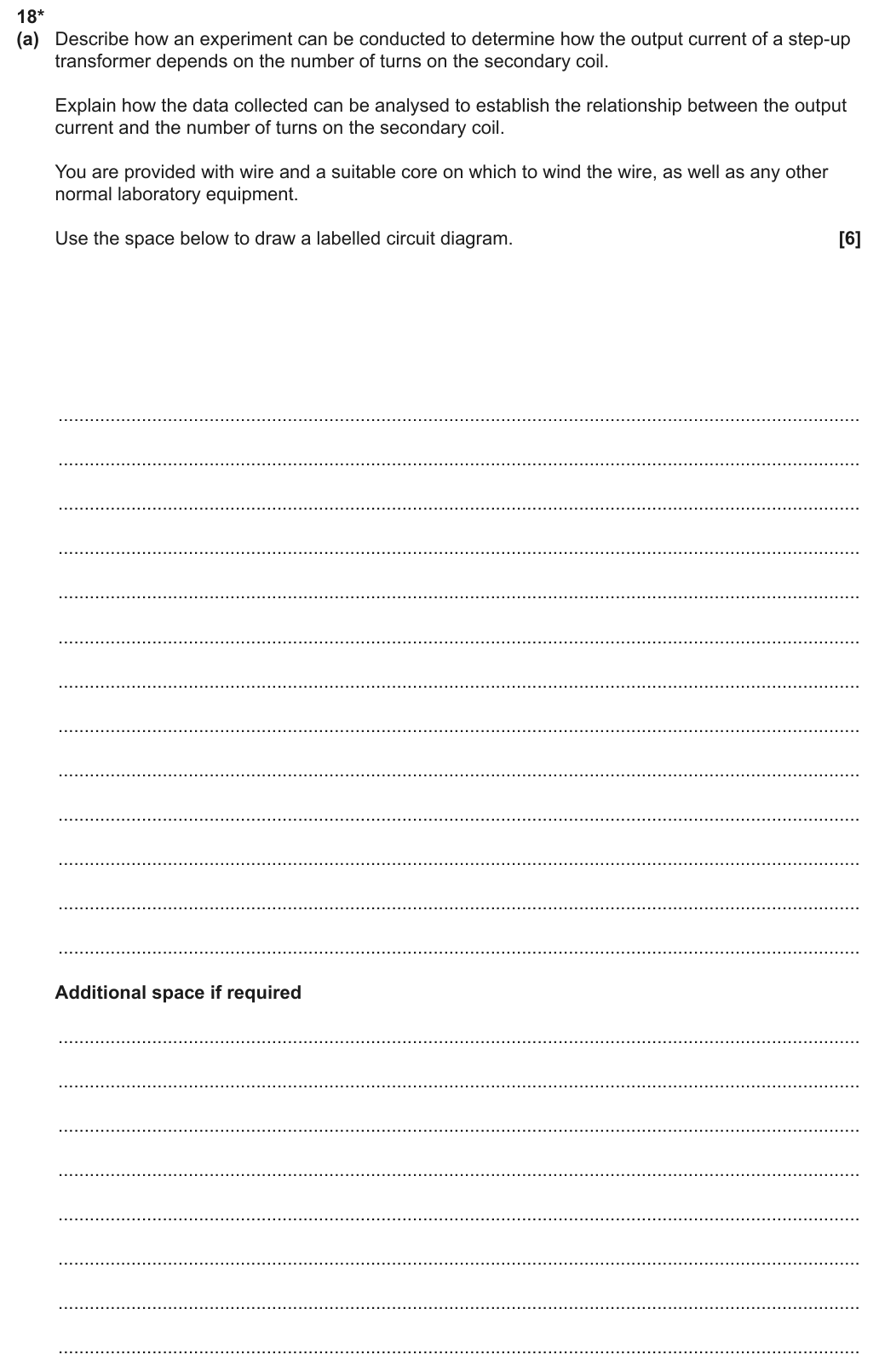
This Level of Response (LoR) question was designed to assess practical skills of planning, implementation, analysis and evaluation from Module 6 of the specification, specifically 6.3.3(f), along with HSW3 and HSW4. A holistic approach to marking is used, with marks given according to answers matching the descriptors for the various levels. No one answer is perfect for this question, and examiners were expecting a varied approach, with common themes, which would lead to a correct conclusion. The nature of the question is such that it can be conveniently separated into a description of the experiment and an analysis of it. The key points in the description that examiners were looking for were: - a suitable circuit diagram with a transformer and coils along with a supply and metres – use of an ac supply - a description of the method used, specifically controlling variables, and measuring an output – a statement or description of how the output current is to be determined – a statement of how the secondary turns is to be varied. The key points in the analysis that examiners were looking for were: - a statement of the transformer equation in terms of current and turns – a suitable arrangement of this formula to give either the dependent or independent variable as the subject – a suitable graph which would give a linear relation – an explanation of how this graph would appear. It was clear that many candidates had carried out this experiment by investigating voltage however the use of current here caused some difficulties to less successful candidates. The very best responses were detailed, with a clear diagram and well-structured making every attempt to fully answer each section. In many cases the diagram did little to add to the description, however the very best were suitable on their own. Many candidates had a single supply for both the primary and secondary turns and a significant number used a dc supply. Good responses often included the additional detail that the transformer was a step up so that there would be a larger number of turns on the secondary, often giving suitable numbers. Many candidates stated that they would plot secondary current against secondary turns and then stated that it would show inverse proportionality. It is to be explained that any relation should be shown through a straight line graph wherever possible. would be given Level 3 and 6 marks. Firstly, the diagram doesn’t have any method for measuring input current or have a load resistor, but it is clear what it represents and it also looks like it is a step-up transformer. The diagram has a dc cell symbol, but this is overridden by a statement that it is an ac supply in the text. This does not have to be treated as a contradiction, as the symbol for ac is not likely to be known. The method explains how this is to be carried out quite well and is structured in an ordered way. The analysis is brief but complete. It shows the equation that has been used, arranged in the form of y = mx + c and then stating what should be plotted and what it will show. This is an example of a perfectly good response that will achieve maximum marks without having to get every indicative point.
Skills: M3.11 Use logarithmic plots to test exponential and power law variations; M3.3 Understand that y = mx + c represents a linear relationship
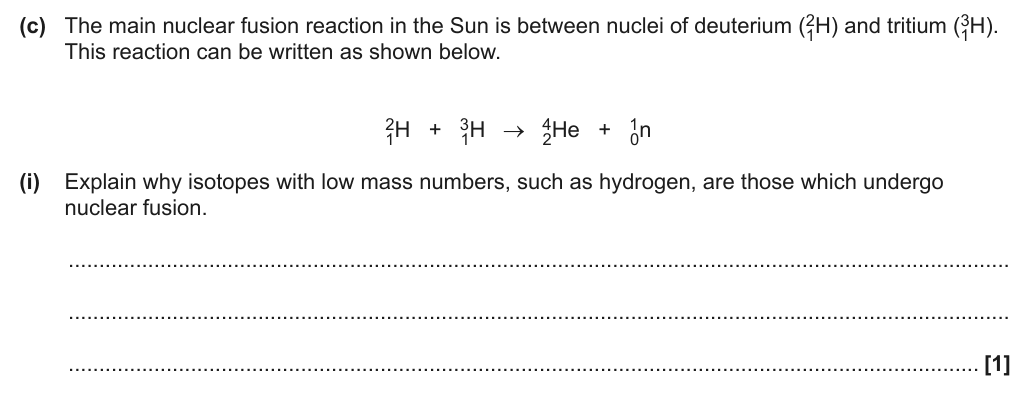
This question was quite poorly answered with few candidates appreciating the idea that an increase in binding energy per nucleon would result in energy given out. Many candidates simply restated the question, by saying low mass would join to give higher mass or stated that iron was the most stable isotope.
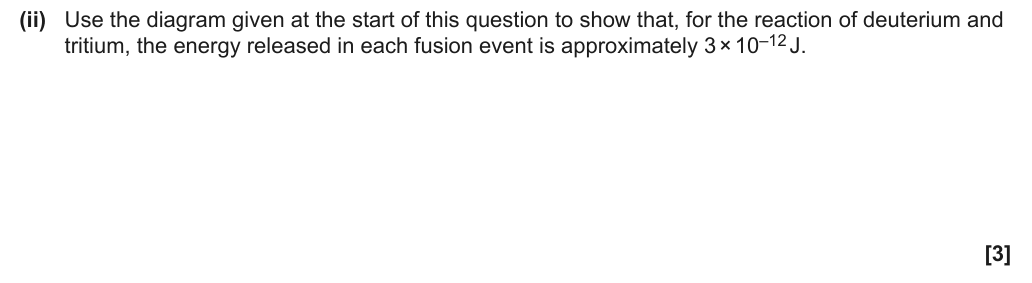
As always with a ‘show that’ question, it is vital to include as many steps as possible, the key to this question involved reading from the graph and then including the number of nucleons in the calculation. A fair number of candidates correctly read the point but did not multiply this with the nucleon number. There were relatively few misreads from the graph and the tolerance allowed some variation. Many simple (and incorrect) methods would give a value fairly close to 3 x 10-12 and so candidates would feel that they had correctly answered the question. Very few candidates struggled with the conversion from MeV to joules, although this may have been supported by having the power of ten given to them. It is also important to make sure that any value is given to a greater number of significant figures than that asked for, if appropriate. Around a third of candidates were able to obtain all 3 marks on what a potentially challenging calculation is.
Skills: M0.2 Recognise and use expressions in decimal and standard form; M2.3 Substitute numerical values into algebraic equations using appropriate units for physical quantities; M3.1 Translate information between graphical, numerical and algebraic forms
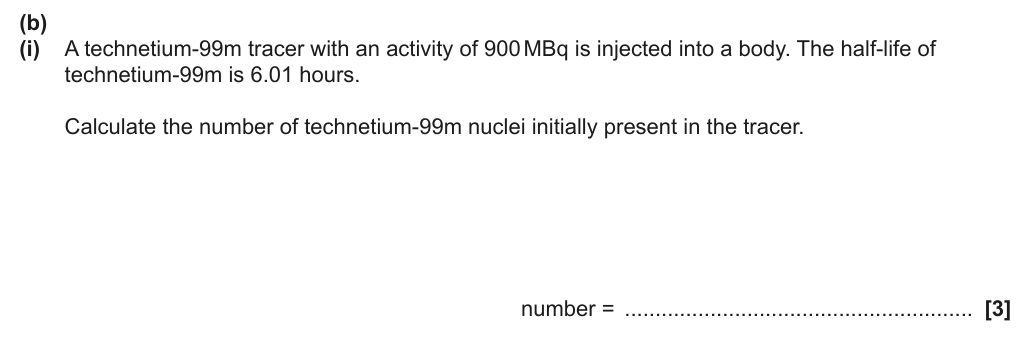
It was very encouraging to see that nearly two thirds of candidates were able to score all 3 marks on this question. Logarithms can challenge candidates but it was clear that many understood how to carry this out and were able to effectively. There were relatively few who were confused by the time units, but credit could be given even when the unit was used incorrectly.
Skills: M0.1 Recognise and make use of appropriate units in calculations; M0.2 Recognise and use expressions in decimal and standard form; M2.2 Change the subject of an equation, including non-linear equations; M2.3 Substitute numerical values into algebraic equations using appropriate units for physical quantities
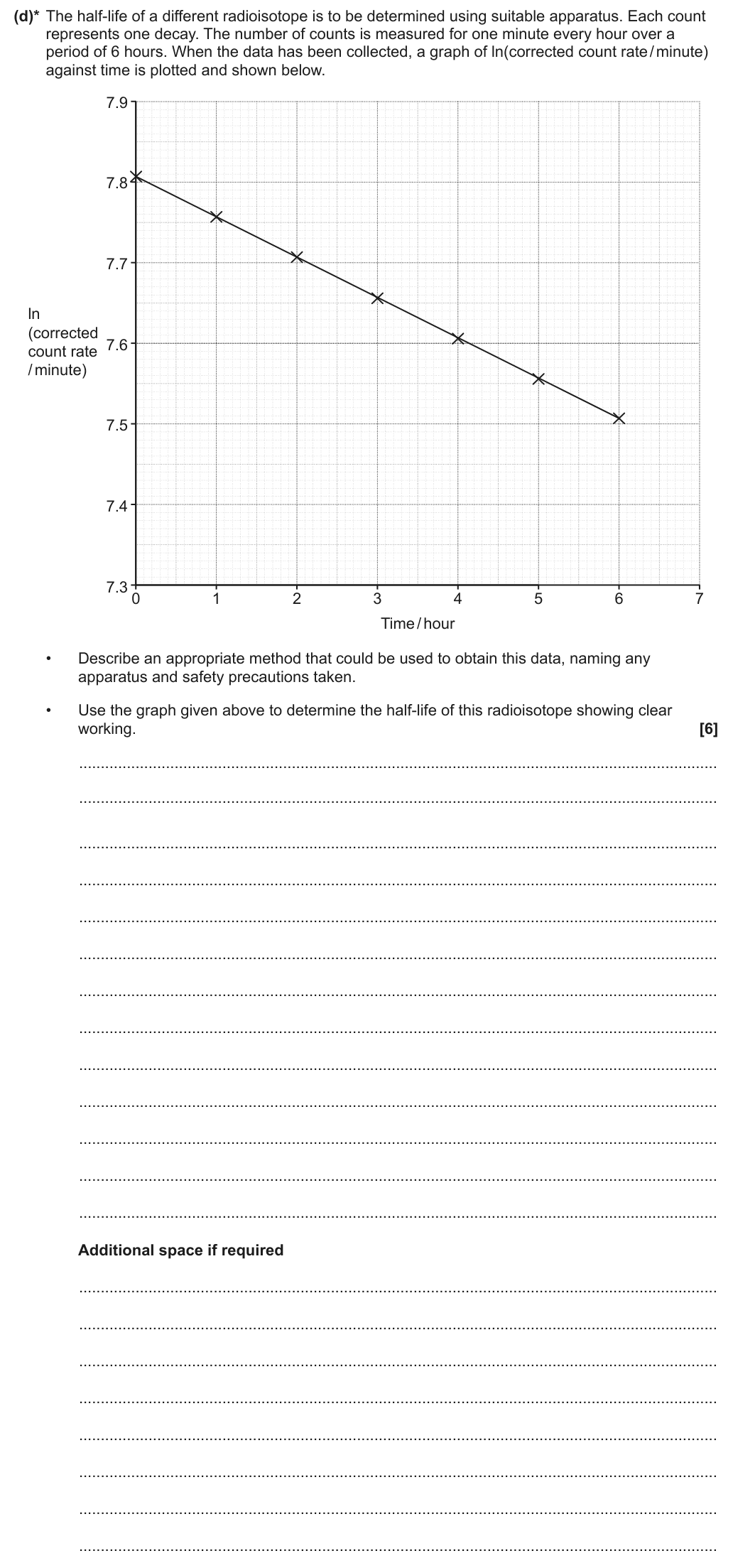
This is the second Level of Response (LoR) question in this paper, and was designed to assess nuclear and particle physics, specifically sections 6.4.3e of the specification. In particular, there are two parts (description and calculation) relating to a method and graphical data. As previous, there are no specific marking points and examiners use a ‘best-fit’ approach to the marking. Indicative scientific points are given in the mark scheme as a guidance what to expect, but not all need to be satisfied to be given full marks. Incorrect physics can be expected to be penalised, however. Candidates should always be encouraged to structure their answers carefully and in calculations aim to give explanation of each stage rather than just producing a number. The two separate sections can be separated into a description of the method for obtaining the data, and a calculation using the graph to determine the half-life. The key points in the description that examiners were looking for were: - named apparatus - measurement of background radiation – calculation of corrected count rate – safety requirements. The key points in the calculation that examiners were looking for were: - arrangement of decay equation having taken logs – demonstration that the gradient is the decay constant - calculation of the gradient – use of the gradient to determine the half-life. The descriptions of the method varied significantly. Some were extensive and detailed and others a very limited response despite being a procedure that candidates are likely to have come across. Most candidates gave a simple safety precaution, such as holding at arm’s length, but there were plenty of vague responses such as wearing coats. Not all candidates could explain how, or why, the background was taken and a fair number missed this out completely. Quite a few candidates gave extensive detail about storing the source, which although is relevant, is not the key point to the question. The analysis was done better and in general well-structured and clear. The working was set out well for the most part and it was simple to follow the candidates working. Not all gave a clear reason for how they were obtaining the half-life, but this was not fully necessary as long as the answer was correct. One common error was to take logs of the data on the y-axis rather than appreciating that they are already log values. There were not many misreads, but the nature of the data meant that any could have a significant impact on their answer and would likely be penalised. Some candidates got into difficulties with time units and attempted to convert the decay constant to s-1 without success.
Skills: M2.5 Use logarithms in relation to quantities that range over several orders of magnitude; M3.10 Interpret logarithmic plots; M3.4 Determine the slope and intercept of a linear graph; PAG7 Investigating ionising radiation
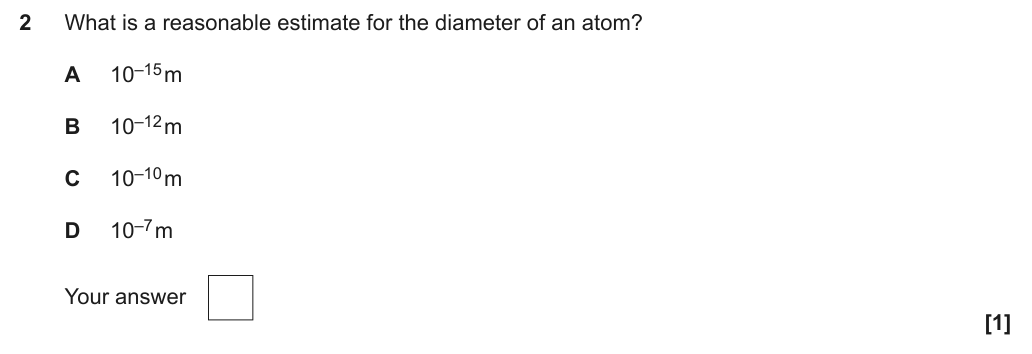
C
Only a few candidates were able to correctly identify the estimate for the diameter. Section 2.1.1 (b) of the specification requires candidates to be able to make estimates of physical quantities. B was the most common incorrect answer.
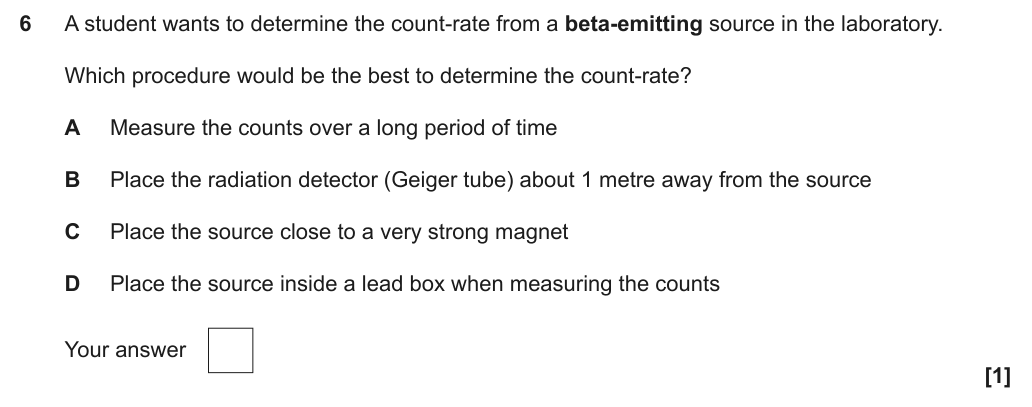
A
Correctly identifying the best procedure proved challenging for candidates. Many incorrect responses were given as B.
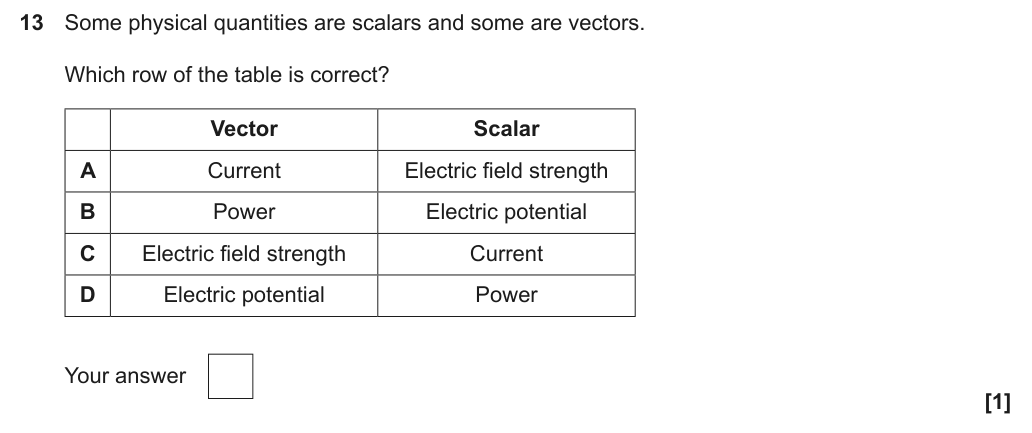
C
This was a challenging question. As is common in this style of question, candidates tick and cross those they know to be correct (or incorrect) but the inclusion of potential and field strength clearly made this more challenging. D was by far the most common incorrect response as candidates seemed to know that power was a scalar.

The main point of the rotation is to avoid overheating and so any statement about the heating of the anode would score a mark here. There were several vague responses to do with the anode wearing out and the electrons hitting evenly, in additional to a common response about the anode becoming negatively charged. The command word ‘suggest’ implies that candidates should use their knowledge to draw a possible conclusion. Only a few candidates did not attempt this question.
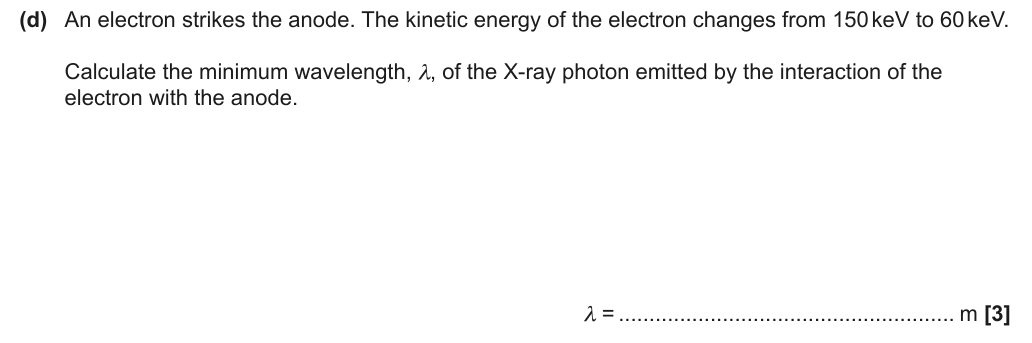
This two-step calculation was correctly carried out by nearly three quarters of candidates. Most appreciated that the change in kinetic energy was needed, and so correctly determined 90 keV as the required energy and were able to use this in determining the wavelength. Few candidates determined the frequency first and then went on to calculate the wavelength separately. Common errors included missing that the photon energy was in keV, rather than eV, and using the wrong energy. A mark was available for correct conversion of either 150 keV or 60 keV to joules, but there could be no further credit.
Skills: M0.2 Recognise and use expressions in decimal and standard form; M2.2 Change the subject of an equation, including non-linear equations; M2.3 Substitute numerical values into algebraic equations using appropriate units for physical quantities
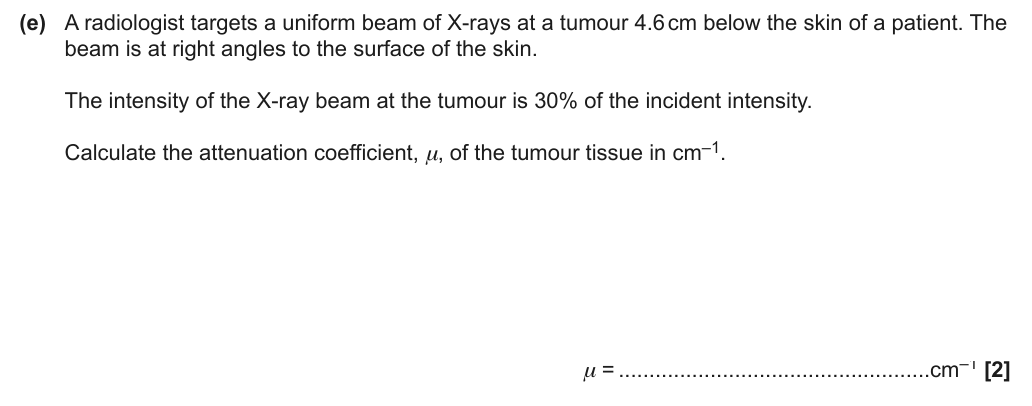
This calculation was correctly done by many candidates. The ability to manipulate the exponential and take logs caused few difficulties and candidates set out the working carefully and clearly for the most part. Several candidates tried to use a value of 70%, which could not score any marks. There was occasional confusion over the units, with candidates attempting to move in or out of cm to m.
Skills: M0.5 Use calculators to find and use power, exponential and logarithmic functions; M2.3 Substitute numerical values into algebraic equations using appropriate units for physical quantities; M2.5 Use logarithms in relation to quantities that range over several orders of magnitude
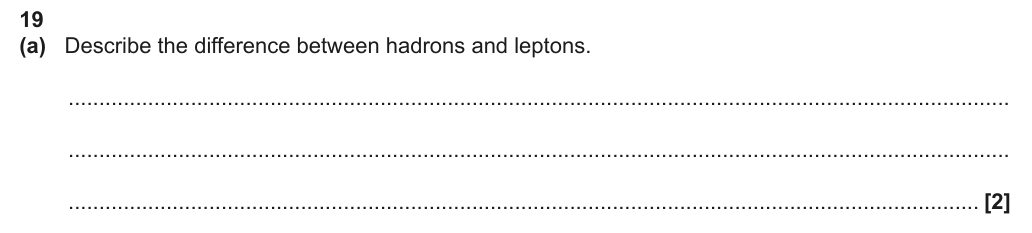
The two main answers to this were either in terms of the strong force, or in terms of the composition. Several candidates gave both of these, although a wrong answer could negate a correct one. Responses in terms of mass, charge, location, etc were ignored. A few candidates confused leptons for baryons and stated that they were formed from a quark and an antiquark
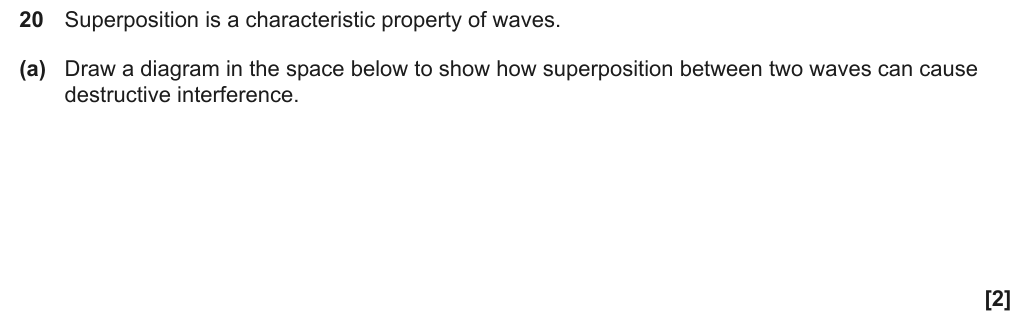
This question required the drawing of two transverse waves in antiphase, and a resultant shown with zero amplitude. Examiners need to use their professional judgement regarding the clarity of the diagrams and so annotations can help. Several candidates stated, but did not draw, the resultant and so could not be awarded the second mark. Some candidates drew the initial waves with different amplitudes and it was acceptable to draw a non-zero resultant, as long as it demonstrated destructive interference. A few candidates drew interference from circular wavefronts, but this was very unlikely to be awarded any marks.
Skills: M3.12 Sketch relationships which are modelled by y = k/x, y = kx², y = k/x², y = kx, y = sin x, y = cos x, y = e^(±x) and y = sin²x, y = cos²x as applied to physical relationships
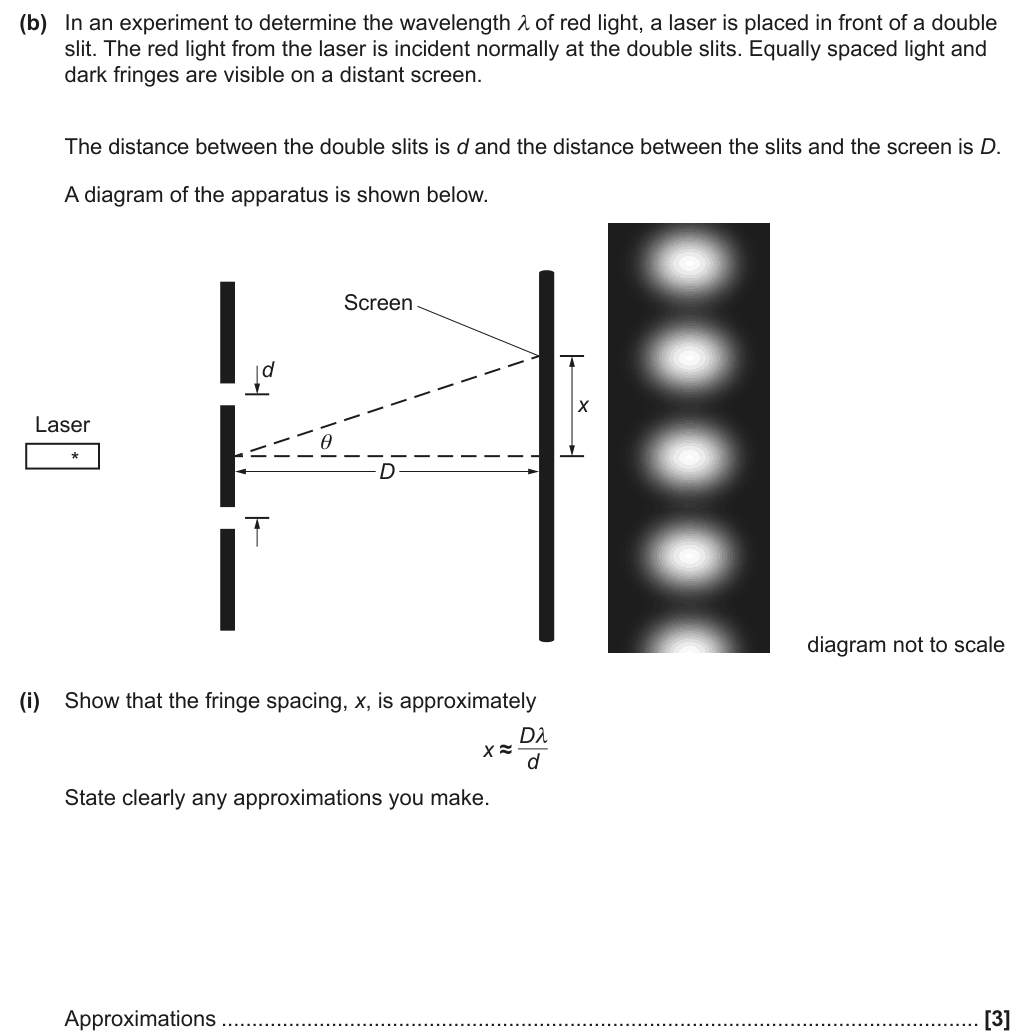
This was a challenging question, using mathematical skills and requiring candidates to apply two equations, one based on path difference and one of geometry and equate them. This is demonstrated in the exemplar that follows. The most common issue was a misapplication of geometry. The small angle approximation needed to be applied and a statement of how this was used was necessary for the approximation mark. Few candidates attempted to use Pythagoras to different degrees of success but often found the approximation difficult to express. This exemplar shows a candidate who has a clear understanding of this question and is able to set out their working clearly. On the left is the diffraction equation, which can be found in the Data, Formulae and Relationships Booklet), with n = 1 clearly identified. In the middle is the geometric expression for tan θ, and the approximation of tan θ is approximately θ This approximation is also shown in the booklet. This is also used for the sin equation, linking the two clearly and then resulting in the required expression. This gets all 3 marks, and it is evident that the candidate appreciates what they are doing at each stage.
Skills: M2.2 Change the subject of an equation, including non-linear equations; M4.5 Use sin, cos and tan in physical problems; M4.6 Use of small angle approximations including sin θ ≈ θ, tan θ ≈ θ, cos θ ≈ 1 for small θ where appropriate
Few candidates were able to clearly explain polarisation in terms of oscillation, however most candidates knew that sound waves were longitudinal and could describe this type of wave. A number of candidates used movement for oscillation and this is not clear enough.
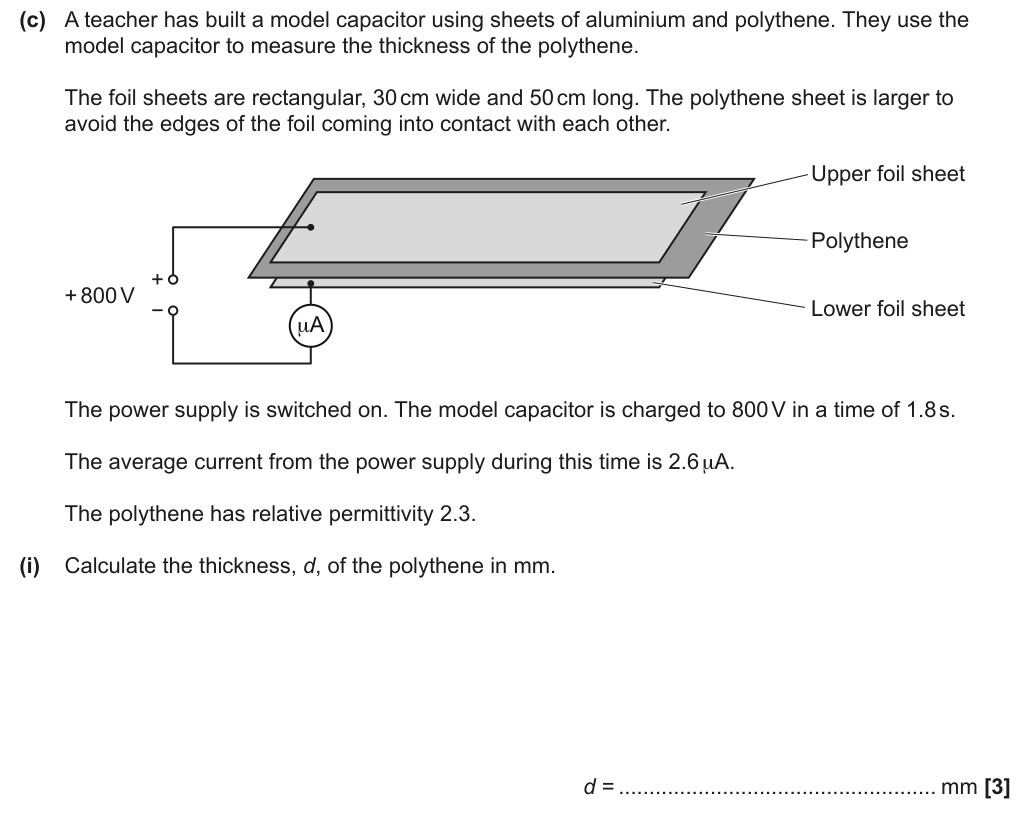
• used calculators effectively with careful consideration of unit conversions, such as in Questions 18 (d) and 22 (c) (i) • demonstrated an ability with logarithms and manipulation of exponential equations, such as in Questions 18 (e) and 19 (c) • gave suitable detail and care in responses to Level of Response questions, paying particular attention to the specifics of the question • had a clear appreciation of command words • gave appropriate use of scientific language and terms, in particular in Questions 22 (c) (ii) and 23 (d) • applied consideration of significant figures in calculations, especially in Question 21 (c) (ii). • did not attempt all of the multiple-choice questions, and this did not appear to be a timing issue • did not show suitable working in extended calculations, such as Question 21 (c) (i), which means that it was not possible to award C marks • only gave limited detail in the Level of Response questions, such as not explaining the description of both models in Question 17 • drew a poor line of best fit in Question 23 (b) (iii), assuming that the line would pass through the false origin • chose too small a range for a gradient calculation in Question 23 (c), or just used a pair of points • were unable to differentiate terms such as precision, resolution and accuracy, especially in Question 23 (d) • did not express scientific knowledge with sufficient accuracy, such as in Question 20 (c). Just under half of candidates were able to calculate the thickness correctly. The most common way was to calculate the capacitance and then use the parallel plate capacitor formula. This allowed clarity in setting up the calculation and generally resulted in the correct answer. Several candidates attempted to carry out the calculation in one go. This often resulted in an error, such as using 2.3 in place of the actual permittivity of the polythene. Another common error was to use the formula for the capacitance for a sphere. There seemed to be little difficulty in converting all the units correctly, either in the initial calculation or by converting to mm at the end. As always with this type of calculation, structuring it carefully allows for intermediate marks to be awarded should the final answer be incorrect. This exemplar shows how clear and careful setting out of a calculation can lead to C (compensatory) marks. This candidate has shown the working for (and then calculated) the charge, Q, separately on the top of the right-hand side. This gains the first mark. The candidate has then re-arranged the equation in the centre, with the capacitance in the denominator. The calculation for the capacitance is clearly shown (4.68 x 10⁻⁶ ÷ 800) which is all that is required for the second C mark. It is almost always the working that gains the C mark, not the evaluation. The evaluation is required for the A (accuracy or answer) mark, and in this case there is an error leading to an incorrect final answer. However, this good structuring of the solution leads to 2 out of the 3 marks.
Skills: M0.1 Recognise and make use of appropriate units in calculations; M2.2 Change the subject of an equation, including non-linear equations; M2.3 Substitute numerical values into algebraic equations using appropriate units for physical quantities
This question was specific in asking for accuracy and precision. Most candidates only addressed one of these aspects of the question. A simple repeat and average was not considered to be of sufficient detail. A change to the experiment was required, such as using a higher voltage. Many candidates made sensible alterations, for example adding a series resistor to increase the time as 1.8 s is relatively short. Questions of this style are often challenging for candidates; however a fair number were able to obtain 2 or more marks.
Skills: PAG9 Investigating capacitors
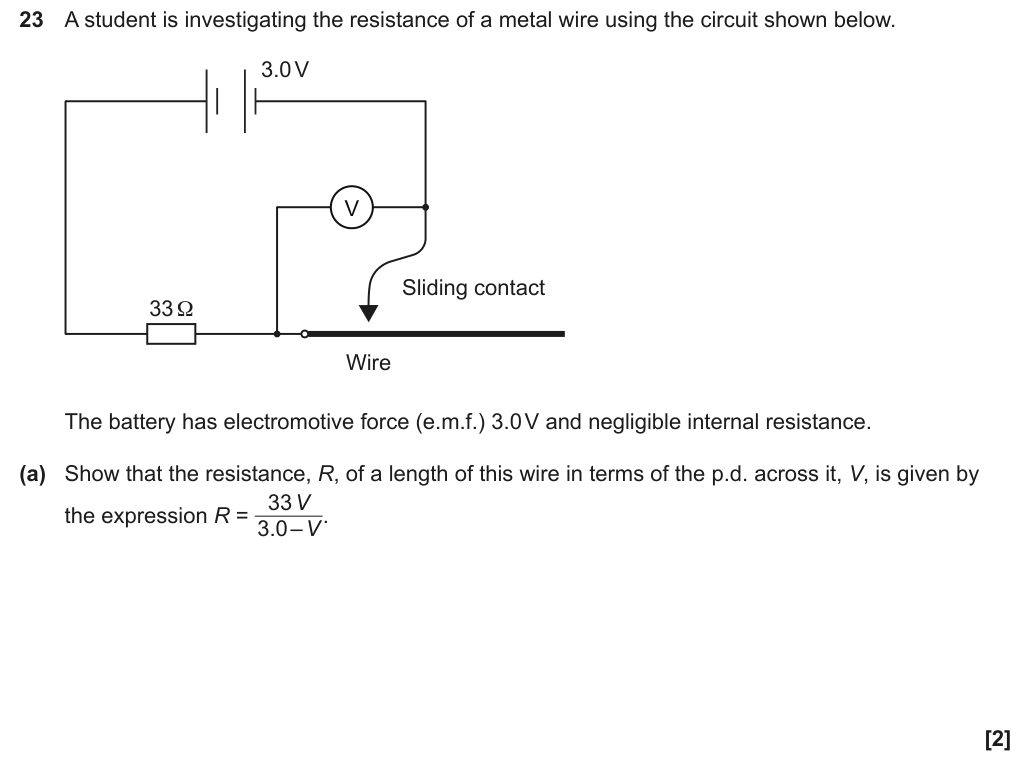
This was a challenging question and depended on the candidate’s choice of starting point. The simplest approach was to consider ratios of resistances and voltages, as long as numerical values were placed where appropriate. A majority of candidates used the potential divider as a starting point but this required a little more algebraic manipulation, as did starting with a current calculation. For the most part this calculation was completed well, although some candidates clearly could go no further with their algebra and just wrote the given expression. As always with a ‘show that’ question, it is very important to clearly show each stage.
Skills: M2.2 Change the subject of an equation, including non-linear equations
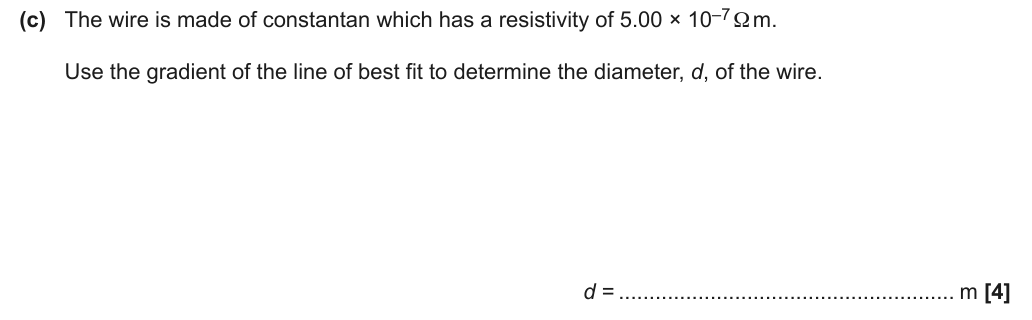
Two marks for this calculation were given for a correct method to calculate the gradient. The first mark is for using a pair of points – it was possible in this case to use points from the table as they lay so close to the line – however most candidate chose a pair by drawing lines on the graph. The second mark is for a sufficiently large range – at least half of the graph. Many candidates simply chose a single point or showed they had used (0,0) in their calculation, although they could not tell that it passed close to the origin. It was possible to still obtain an answer within the expected range even if a single point was used. For the most part, this calculation was done well, including the challenging area to diameter calculation. There was some occasional difficulty seen in converting the cm scale on the graph into the required m scale on the answer line. Overall, a little over half of the candidates were able to get all 4 marks.
Skills: M0.1 Recognise and make use of appropriate units in calculations; M3.4 Determine the slope and intercept of a linear graph; M4.3 Calculate areas of triangles, circumferences and areas of circles, surface areas and volumes of rectangular blocks, cylinders and spheres; PAG3 Investigating electrical properties
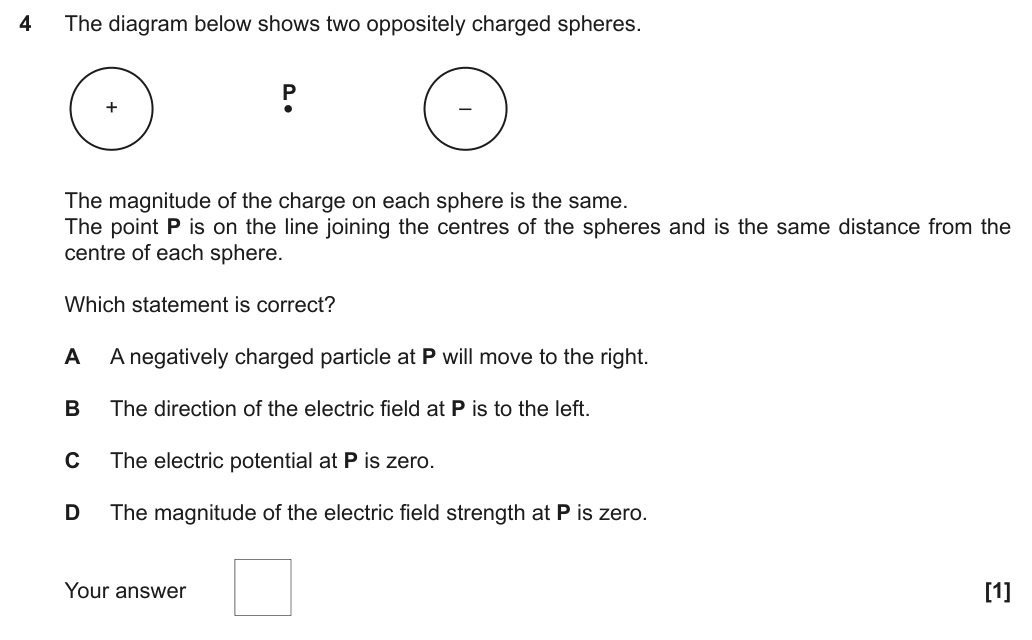
C
The correct response is C. Candidates often find the electric field questions challenging and this was again the case as this question was correctly answered by only one third of the candidates. Many candidates drew arrows on the diagram to assist them. Response D was the most common distractor; linking this to gravitational fields would produce a zero field strength at P which is likely to be the reason.
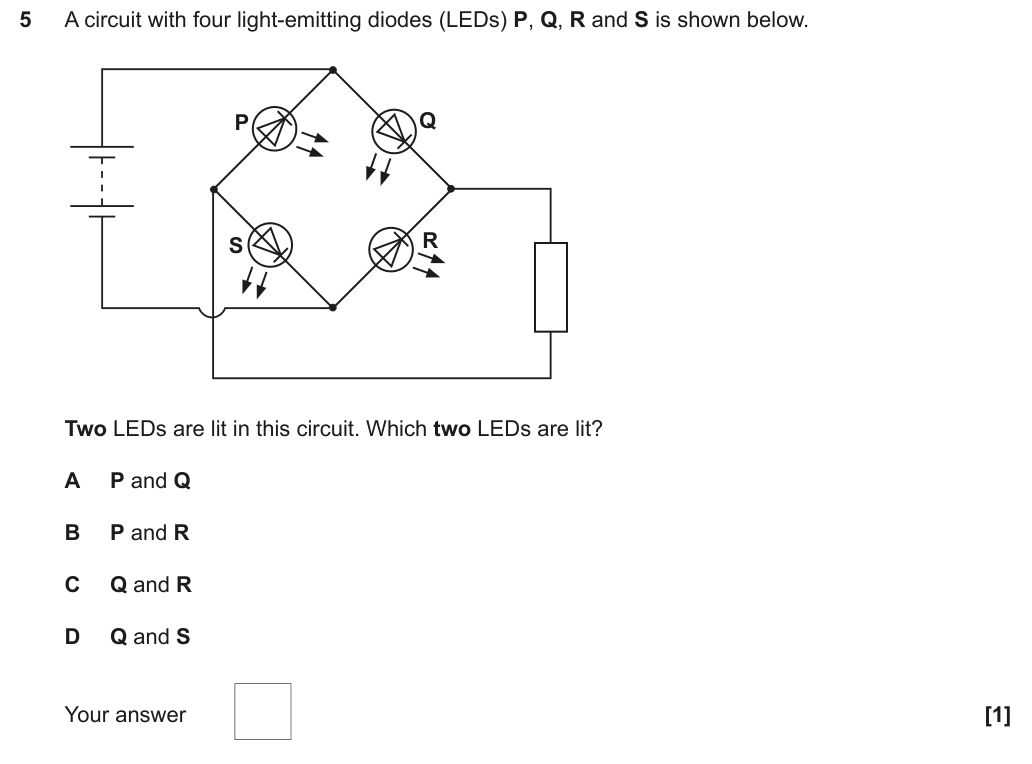
D
The correct response is D. This question also proved to be challenging as not many candidates will have come across this style of circuit before. Therefore in most cases, it will have to have been worked out from application of conventional current flow. It would likely be evident that LED Q is lit, probably accounting for the very few candidates selecting response B. Many candidates incorrectly selected response A, presumably as its polarity is the same as Q.
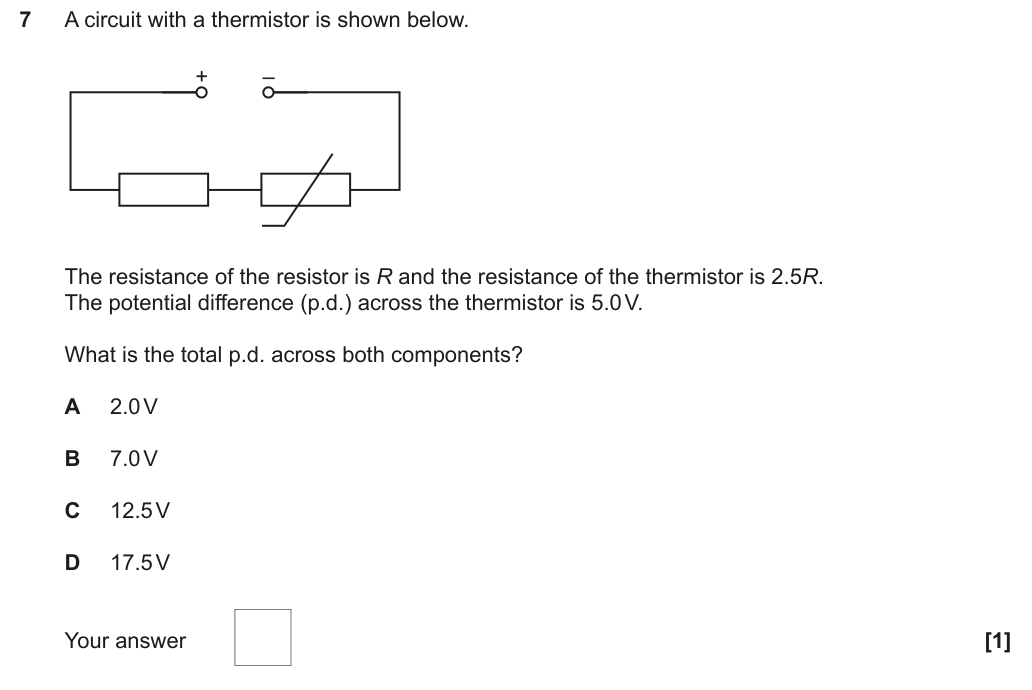
B
The correct response is B. This question was correctly answered by around two thirds of candidates. There appeared to be various routes to the correct solution; many opted to work out a current in terms of R, but the more elegant working was in terms of simple ratios which demonstrated a good understanding of p.d. in a series circuit. Encouragingly, very few candidates opted for response A, which was a p.d. below that of the thermistor alone. It should be noted that a couple of candidates put a ‘7’ in the answer box – as correct working had been shown by them, and leading to the correct numerical value this was credited by examiners. However, this cannot be guaranteed to occur in other cases and candidates are to be encouraged to put only the correct letter.
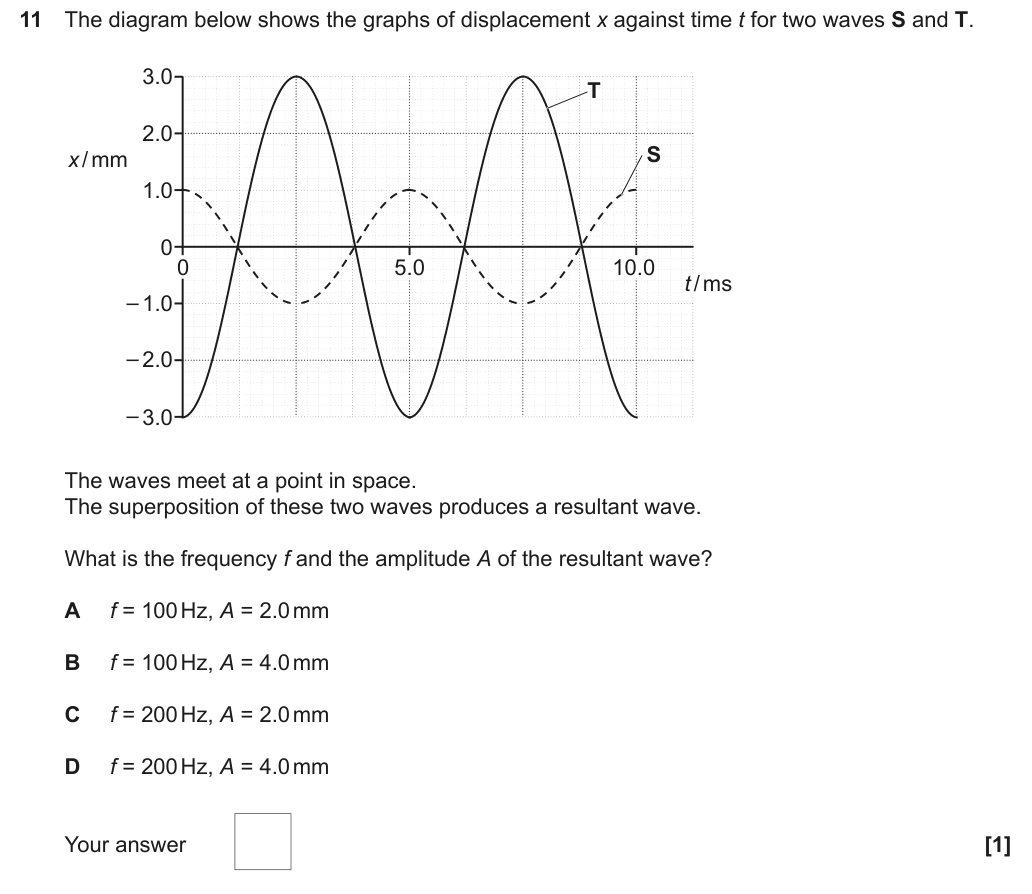
C
The correct response is C. Although not a particularly challenging question, it was encouraging to see around three quarters of entrants getting the correct solution. The most common incorrect response was A, suggesting that the idea of time period is not necessarily well understood.
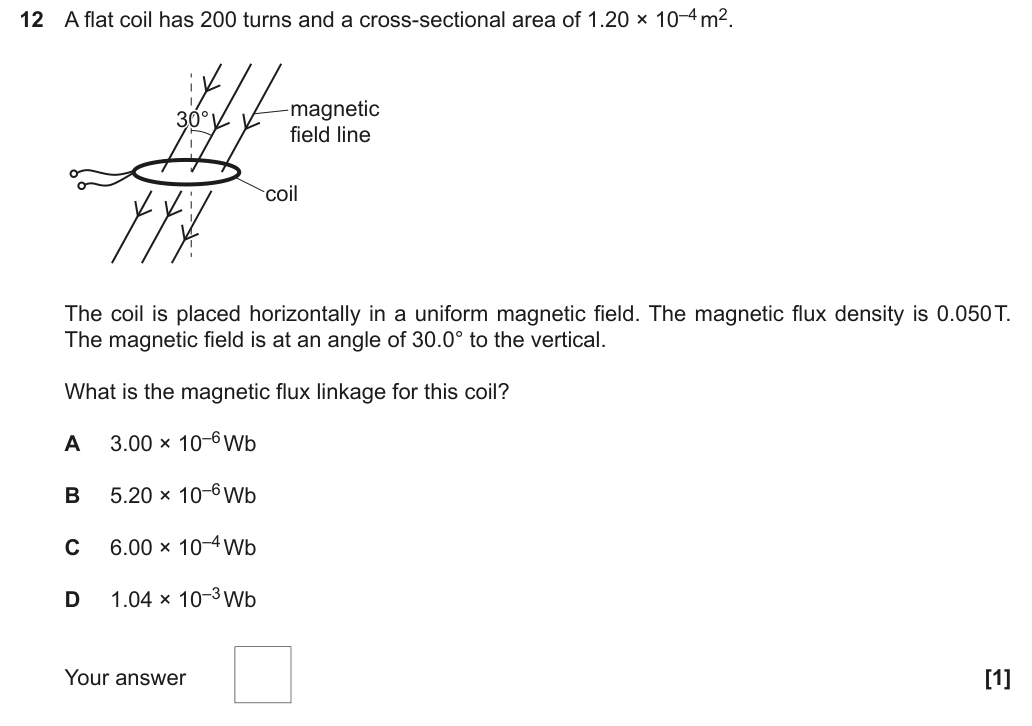
D
The correct response is D. Electromagnetism is another challenging set of concepts, resulting in a relatively low number of students obtaining the correct answer. Working showed that many of the candidates appreciated that the field needed to be resolved and were able to select the right trigonometrical function. However, by far the most common mistake was to ignore the turns and to simply calculate the flux through the coil. Whether this is a misconception or simply looking at the ‘coil’ on the diagram is unknown, however candidate should be reminded of the difference between turns and coils.
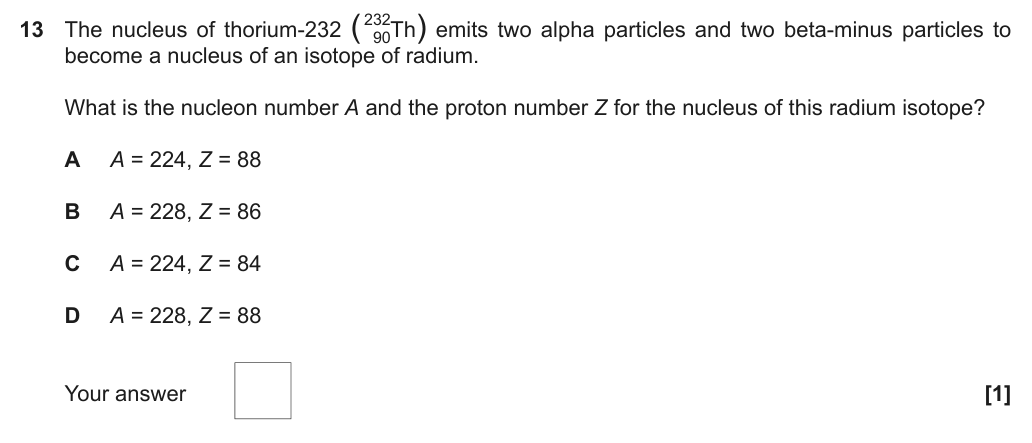
A
The correct response is A. Around half of candidates were able to select the correct response. Although it would seem appropriate to write out some simple decay sequence, many candidates showed little working here. Some were able to get the correct response (probably through mental arithmetic) but incorrect responses may simply have been down to a lack of knowledge of nuclear changes, most likely in the beta decay. Incorrect responses were spread fairly evenly among the distractors, again suggesting that this topic was not well understood.
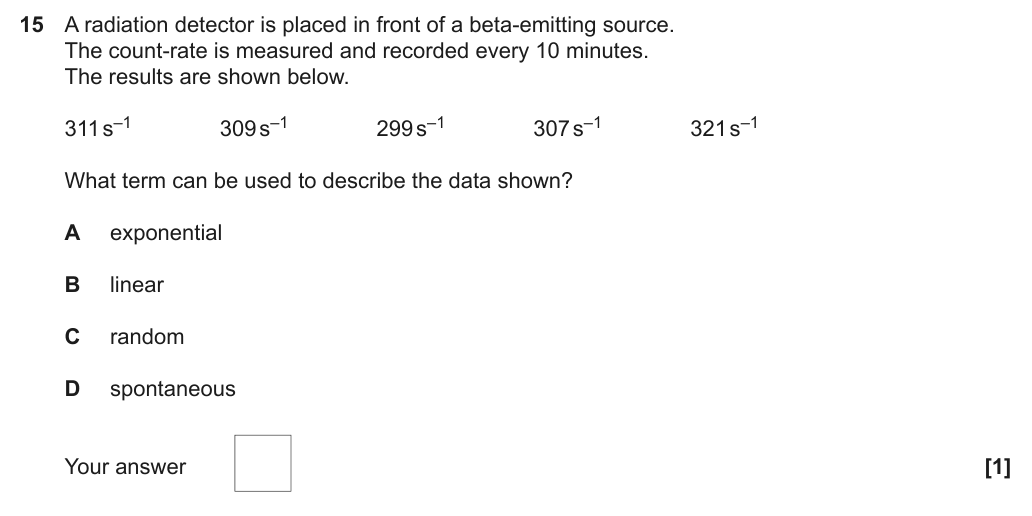
C
The correct response is C. The responses are terms used frequently when studying data, but as around only one half of the candidates were able to get the correct response, it is clear that they are not fully understood. A little perplexingly, the most common incorrect response was B, as it is difficult to see how this data could be considered linear. This does show how easy it is to assume that candidates are confident in their use of terminology, just because they are frequently used.
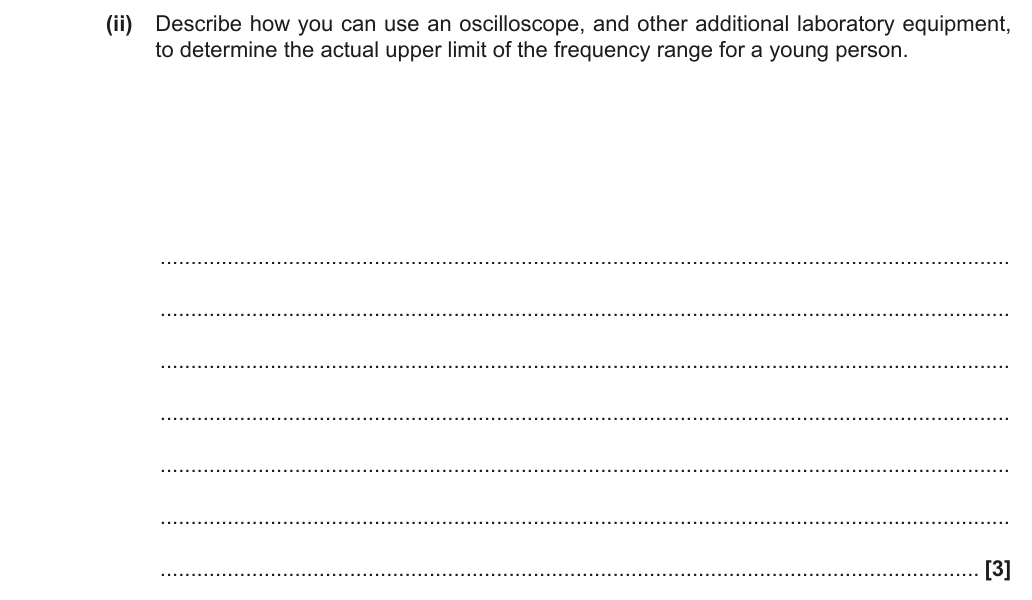
This question was poorly answered in general; very few candidates appreciated the need to use a signal generator to produce varying frequencies and seemed to think that the oscilloscope would do this. Many candidates used diagrams (yet not always labelled) to show their apparatus. Although many did appreciate that the upper limit is reached when the hearing stops, few also then went on to say how the frequency could actually be determined.
Skills: PAG5 Investigating waves
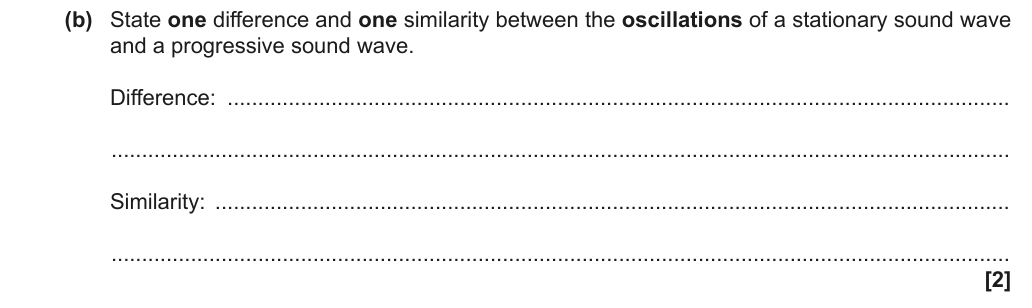
This question is clear that the differences and similarities should be based on the oscillations. Few candidates did this, but other routes could be used to gain credit. Candidates should be careful not to create lists in this style of question and simply produce a single response, as contradictions can be penalised.

This is a standard definition which candidates should be able to state. Candidates should remember that the work function is a minimum energy. There is occasionally a misconception regarding ionisation, and also some careless use of language for the removal of the electron. Words such as escape and eject are acceptable, but terms such as dislocation are not clear enough. The definition does not require the statement that it is from the surface of the metal this time, but that does not mean that it will not be required in the future. 17(b)(i) The question is clear that the response needs to be given in terms of photons and energies. Many candidates discussed threshold frequencies, and although often correct, does not answer the question. The link between photon energy and frequency needs to be clear and not just a simple dependency – the simple solution for this is to state the equation. The final marking point requires the candidate to appreciate that only one photon can be absorbed by one electron. Standalone statements such as “there is a 1:1 relation” is meaningless in this context unless qualified. Many good candidates were able to score at least 3 marks on this question and it was clear that this is a well understood aspect. There is sufficient space for a fully clear answer and candidates are always to be reminded of the need for conciseness in such a response. This is a novel development on what is a common calculation of kinetic energy and as such created some challenge for some candidates. Many were able to score the first marking point, either by converting from eV to joules, or by the calculation of the photon energy. Few candidates scored 2 or 3 marks, as generally an error such as using the speed of light for the electrons occurred. However, a good number of stronger candidates were able to achieve all 4 marks and set out their solutions clearly. It should be noted that the first 3 marks are for setting up the calculations and not the evaluations. This is to not penalise candidates too early for calculational errors and as always highlights the clear need for setting out working as well as possible.
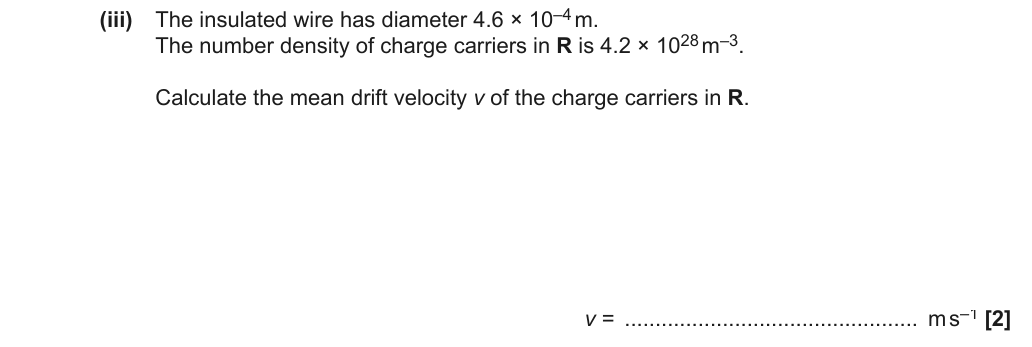
This question was well done by a large number of candidates, many of whom scored full marks by correctly following through with their value of current from the previous part. Few candidates used the diameter instead of the radius when determining the cross sectional area, and for the most part the setting out of the calculation meant that credit could be given even if arithmetic errors occurred later.
Skills: M0.2 Recognise and use expressions in decimal and standard form; M2.2 Change the subject of an equation, including non-linear equations; M2.3 Substitute numerical values into algebraic equations using appropriate units for physical quantities; M4.3 Calculate areas of triangles, circumferences and areas of circles, surface areas and volumes of rectangular blocks, cylinders and spheres
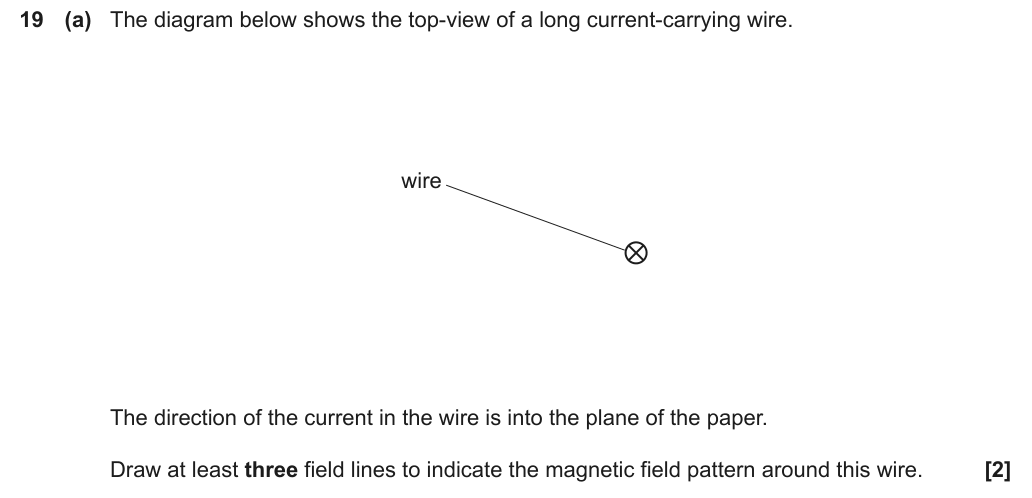
This question requires the candidates to identify the direction of the field and also to appreciate that the magnitude of the field reduces as the distance from the wire increases. Only around half were able to apply the right hand rule correctly to determine the direction, and only around 10% scored both marks. The increasing separation of the field lines with distance was poorly done for the most part. Many candidates kept the same separation, however those that may have attempted to increase this did not do with any clarity, so that parts of the circle would decrease. In general, the quality of the circles meant that it was difficult to be sure what the candidate’s intention was. Some candidates were confused by the leader line, thinking it was the wire and attempted to draw a pattern around this. The question is clear that the diagram represents a top-view.
Skills: M4.2 Visualise and represent 2D and 3D forms, including two-dimensional representations of 3D objects
This question covers part of the diagnostic methods in the diagnostic methods in medicine topic from module 6. This question is directly from the learning outcome 6.5.2(e). Candidates were expected to describe the basic principles of the PET scanner and use this to describe how to locate fluorine-18 nuclei. This question was poorly answered by many candidates and over half scored zero marks. Of that, there were a significant number who gave no response. However, there were some excellent responses that demonstrated a genuine understanding of the process. Several candidates thought that the beta-plus particles were electrons and from that point would have difficulty in making progress. The short half-life seemed to cause some confusion, and several candidates felt that this was a key part of the question. Of the candidates who explained the principles of operation clearly, some were unable to explain that it is a time difference between the arrival of the gamma rays at the detectors that is used for location.
This question was quite poorly answered, with many candidates not even mentioning the magnetic field. Few appreciated that the magnetic field needs to be placed perpendicularly to the electric field, although most could state the EQ = BQv. However, in a description, there was some confusion about the ‘fields’ being equal rather than the ‘forces’. No candidate gave a suitable description for the last mark but could access it through use of v = E/B.
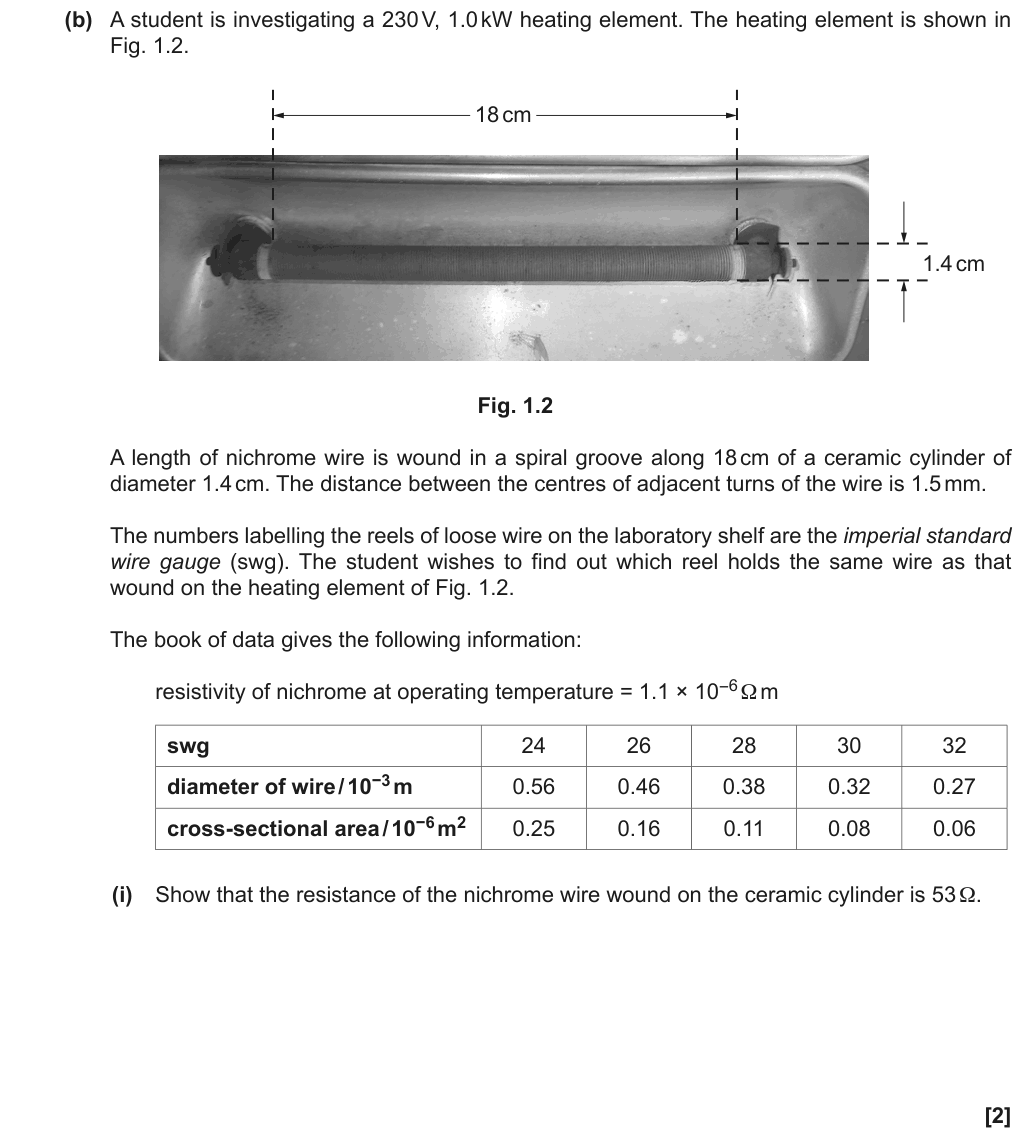
Question 1 (b) (i) Question 1 (b) (ii) Question 1 (b) (iii) The purpose of this question was to challenge the candidates to use their knowledge to solve a laboratory based practical problem.
Skills: M0.1 Recognise and make use of appropriate units in calculations; M2.2 Change the subject of an equation, including non-linear equations; M2.3 Substitute numerical values into algebraic equations using appropriate units for physical quantities
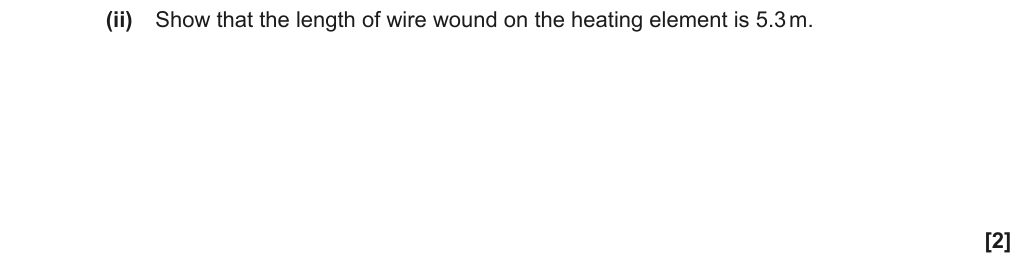
Question 1 (b) (i) Question 1 (b) (ii) Question 1 (b) (iii) The purpose of this question was to challenge the candidates to use their knowledge to solve a laboratory based practical problem.
Skills: M0.1 Recognise and make use of appropriate units in calculations; M4.3 Calculate areas of triangles, circumferences and areas of circles, surface areas and volumes of rectangular blocks, cylinders and spheres
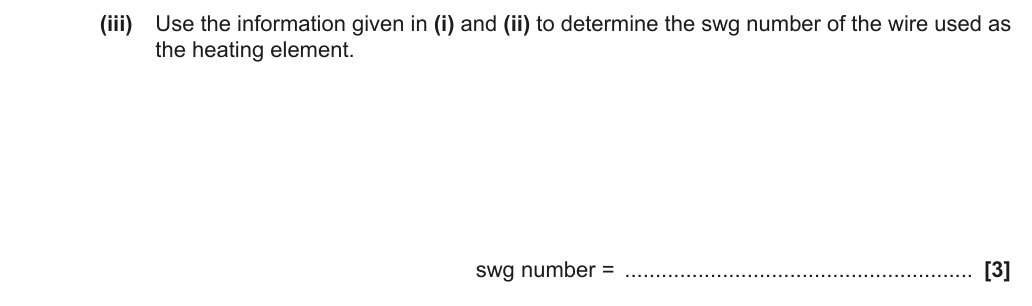
The purpose of this question was to challenge the candidates to use their knowledge to solve a laboratory based practical problem. The majority approached part (i) correctly by considering the power data for the fire element. A significant minority were drawn to the formula relating resistance and resistivity. Many of these realised that this approach was incorrect and changed to the correct approach. Here is a typical example (exemplar 2) of a script where the candidate continued to complete the whole question correctly. The rest remained at a loss and did not gain any marks for parts (ii) and (iii). In part (ii) a minority again tried the resistivity formula rather than an approach using geometry. Finally in part (iii) the resistivity formula was applied with success. The question overall proved to be a good discriminator of ability and understanding.
Skills: M0.2 Recognise and use expressions in decimal and standard form; M2.2 Change the subject of an equation, including non-linear equations; M4.3 Calculate areas of triangles, circumferences and areas of circles, surface areas and volumes of rectangular blocks, cylinders and spheres
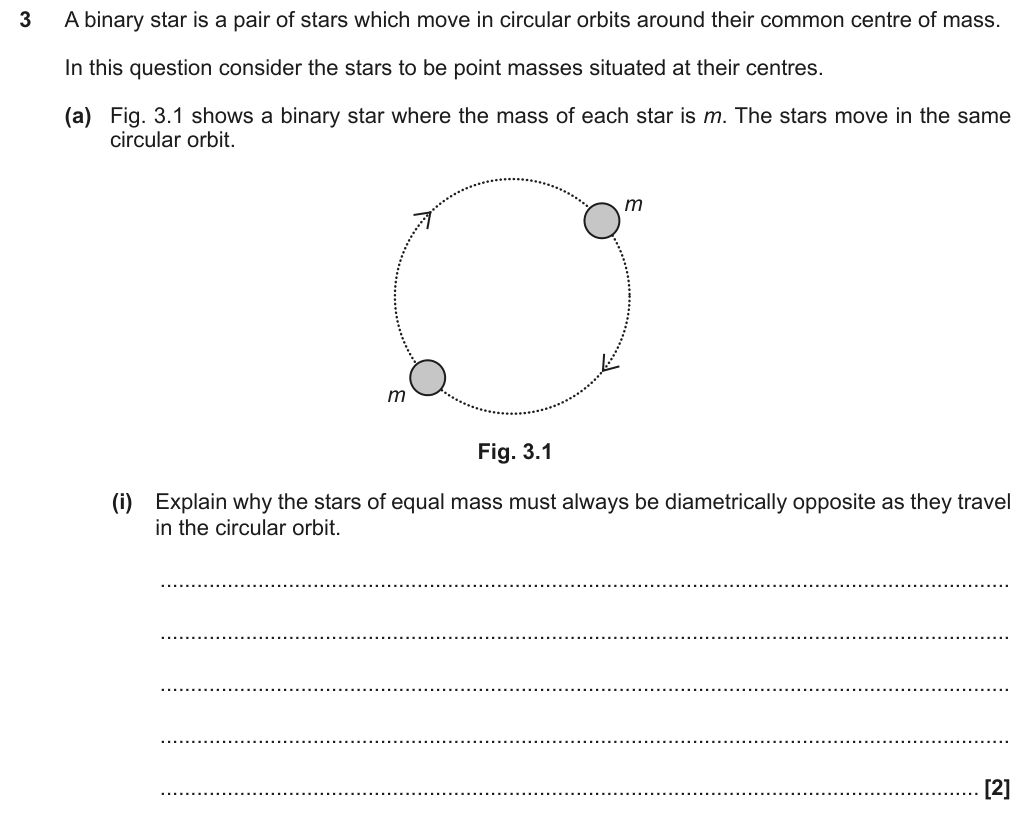
Only a minority of candidates related the gravitational force between the stars to the centripetal force required for circular motion to occur. This candidate has written the perfect answer (exemplar 5). There were two popular insufficient answers; that if the stars were not diametrically opposite they would collide and that the centre of mass of the system had to be at the centre of the orbit.
Candidates should be encouraged to draw diagrams such as part (i) as accurately as they can. Some had drawing instruments and drew accurate circles. Many drew shapes which were very far from circular, making it difficult in some examples to judge whether the candidate knew the correct path. A secondary purpose of this part was to reinforce the idea that the stars remain diametrically opposite as in part (a) (i). Many did not respond to this trigger having Kepler's laws or centripetal force requirements central in their minds. The rest stated clearly that the orbital period for the two stars had to be the same and consequently were credited both marks.
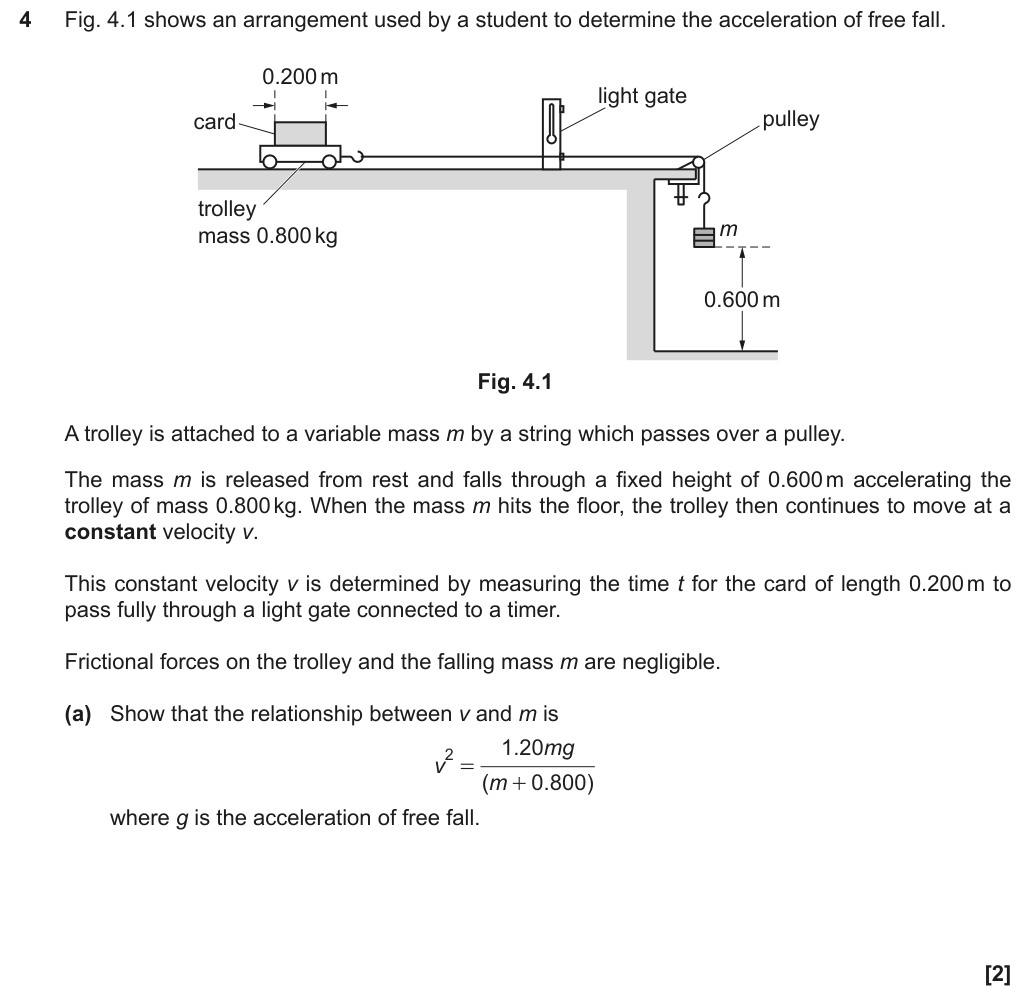
The challenge to candidates in answering this show that question was to produce a convincing proof. More chose to use constant acceleration equations and F = ma rather than loss of potential energy equates to gain in kinetic energy. The difficulty in the former method was justifying the statement F = mg = (m + 0.800) a. Most just quoted that a = mg/ (m + 0.800) which immediately gave the relationship shown in the question. The difficulty with the second method was that most candidates wrote mgh = ±½mv2 as the first line of their answer. In the next line one m became (m + 0.800) without explanation to give the required relationship. Only candidates who gave more explanation were credited the marks. The candidate who wrote this perfect answer (exemplar 7) solved the problem in the first method of solution by introducing the tension in the string (labelled T on Fig. 4.1).
Skills: M2.2 Change the subject of an equation, including non-linear equations
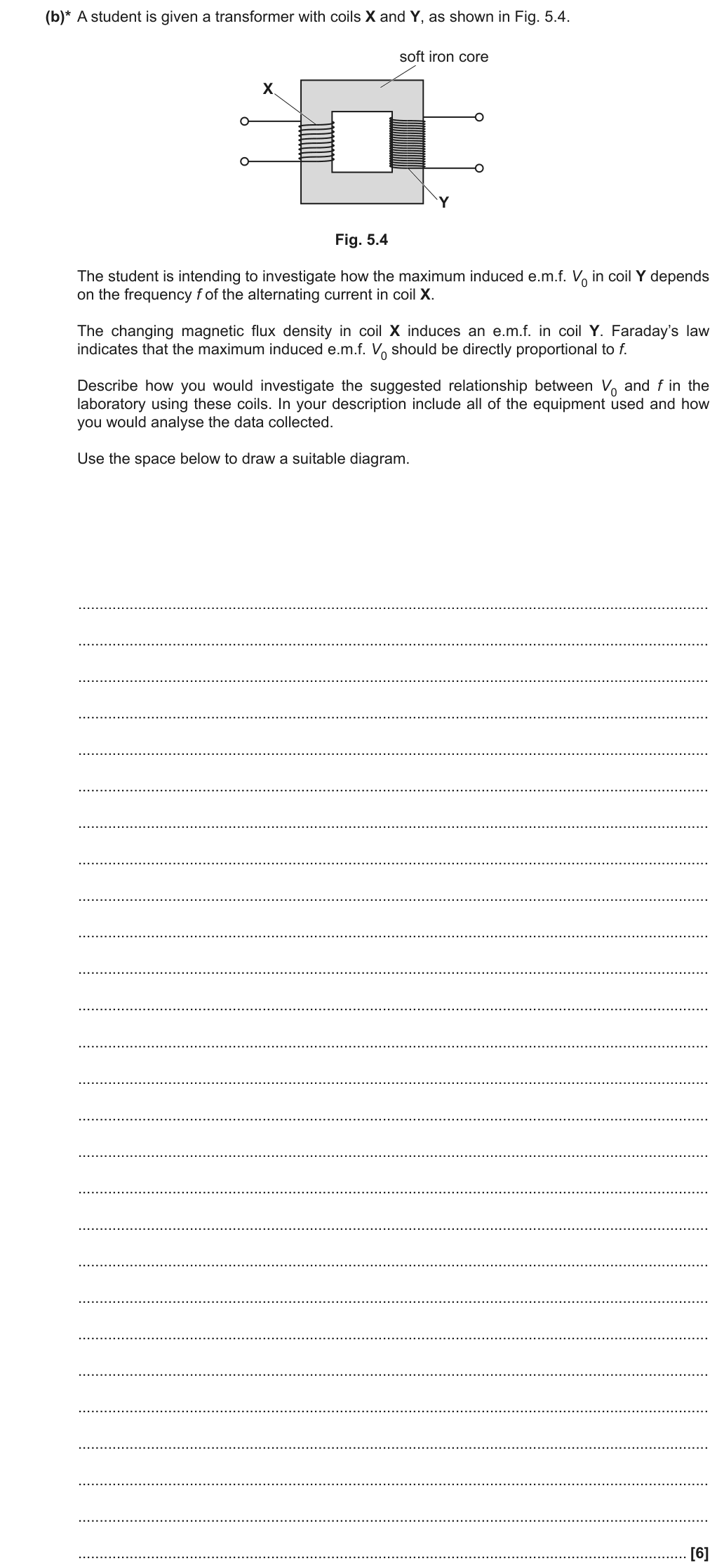
From the proposed arrangements for the investigation, it was apparent that most of the candidates were unfamiliar with the most suitable equipment for this experiment, namely a signal generator. Many improvised by using an ac supply with a variable frequency. A minority of these believed that by increasing the voltage of their power supply it would alter the frequency. Most drew a cell or battery symbol for the ac supply. Others improvised by using the rotating magnet from part (a) but had not realised the significance of the calculation in part (a)(iii) which indicated that at 24 revolutions per second the output voltage was 1.2 V. This made the suggested method of using a stop watch to find the period of rotation impracticable. Few realised that the oscilloscope as a voltmeter could measure both the output voltage and the period of the ac. The instrument was often connected in series in the primary circuit. No one realised that the input current has to be constant to provide a constant flux. Despite all of these difficulties most candidates managed to write sensible statements worthy of credit but rarely full marks. The author of the example shown (exemplar 9) has used the rotating magnet as the ac source and continued with the clues from part (a) to produce an L3 quality answer.
Skills: M3.3 Understand that y = mx + c represents a linear relationship
This question, although a simple F = ma problem, challenged many candidates. Common problems in 1(c)(ii) • using incorrect mass (either mass of bottle alone = 0.05kg, or mass of water alone = 0.3kg, or POT errors) • using upwards force from 1(c)(i) rather than resultant force in the formula F = ma. been used, but the value for the upwards force (15.4N) rather than the resultant force (15.4 – mg) has been used for F.
Skills: M0.1 Recognise and make use of appropriate units in calculations; M2.2 Change the subject of an equation, including non-linear equations; M2.3 Substitute numerical values into algebraic equations using appropriate units for physical quantities
In level of response questions like 3(c), candidates must remember to refer closely to the stem of the question when planning their extended answer to make sure that they are addressing the question asked. The challenge in this question was to design an experiment that would yield results leading to a valid conclusion. Candidates could gain full credit for investigating the efficiency of gravitational potential energy (GPE) to either: • energy conversion in the LED (power x time) or • energy stored in the capacitor (½CV2 or ½Q2/C) Candidates were then expected to describe how the efficiency would be calculated, and how they could tell whether the efficiency depended on the number of times the torch is turned or inverted, n. Many candidates were able to describe a valid graphical method, usually plotting efficiency against n, or output energy against input energy. Some candidates plotted time against number of inversions, which was able to score maximum credit provided that they clearly explained that t and n were proportional to output and input energy respectively. The best responses were those where candidates had not just stated what to plot but had gone on to describe and explain the expected shape of the graph and what its gradient would show. Common problems in 3c • investigating the energy conversion ½Q2/C to Pt • assuming the number of inversions was varied without stating it explicitly • using mgh for input energy rather than nmgh, accounting for the number of inversions • assuming that the torch would gain the same amount of charge at every inversion rather than attempting to measure the final charge after n inversions • using the formula efficiency = energy loss/input energy • making an assumption about the outcome (e.g. I would expect to get a straight line through the origin) • wrongly interpreting the graphical results they expected to get efficiency of GPE converted to electrical energy in the torch, but their response lacks the clarity and detail needed for a Level 3 response. Also, their method will not yield correct results because they have • not realised that GPE increases with the number of turns, so they need to use the formula GPE = nmgh. • not specified that the length h is the distance that the magnet falls, rather than the length of the tube. • not made clear which is the input and which the output energy in the (correct) efficiency formula. • used incorrect graphical analysis for their graph of efficiency against n. We want to discover whether efficiency depends on n, not demonstrate that efficiency increases proportionally to n, which is impossible.
Skills: M0.3 Use ratios, fractions and percentages
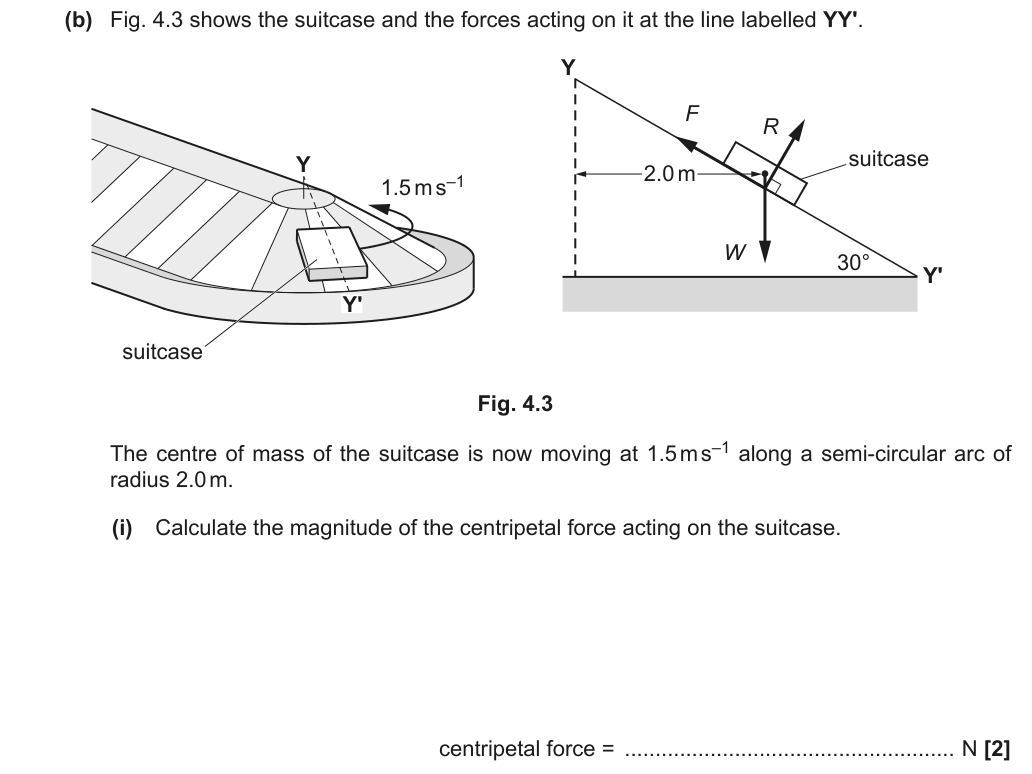
Question 4 (b) (ii) Question 4(b)(ii) proved very difficult and highlighted poor understanding of circular motion.
Skills: M2.3 Substitute numerical values into algebraic equations using appropriate units for physical quantities

Very few candidates were able to score this mark. Common problems in 6(a) • stating that the frequency of the source had changed rather than referring to an observed frequency • referring to the frequency of an ‘object’ without specifying that the object was a wave source • referring only to the movement of the source or the observer rather than describing relative motion between the two • talking about the motion of the wave rather than the wave source.
When marking a LoR question, the examiner first decides the level of response (1, 2 or 3) by considering the quality of the physics. The examiner then decides whether to award the top of the level (for a well- structured and relevant response) or the bottom of the level (for a poorly structured and mostly irrelevant response). In this LoR question, responses in Level 1 often contained insufficient key physics. The experiment described was extremely safe and painstaking but, at the end of the day, the three sources were not clearly distinguishable. Low level responses frequently included instructions on how to test for an alpha source. The magnet was often used either to pick up the sources or to attract/repel charged particles. In a typical top level response, the thickness of aluminium used to block beta (but not gamma) was specified. A perpendicular magnetic field was used to separate the charged particles and the direction of their travel was predicted using an accurate diagram and Fleming’s left hand rule. There were three possible approaches: 1. Investigate the range in air. Gamma has the largest range and beta-plus the smallest (due to annihilation). (The answer ‘both beta-plus and beta-minus have a similar range in air’ was also accepted). 2. Investigate the path through a perpendicular magnetic field. Gamma is undeflected; beta-plus and beta-minus would deflect in opposite directions. 3. Investigate the penetrative power. Since the materials and thicknesses available were not specified, it was easiest to keep increasing the thickness and density of the materials until all but one of the sources was blocked, thus identifying the gamma source. Many candidates were unable to distinguish clearly between the two beta sources because they did not understand how beta-plus and beta-minus particles would travel in a magnetic field. Many candidates erroneously thought that a magnet had a positive pole (which would attract beta-minus) and a negative pole (which would attract beta-plus). Misconceptions • A bar magnet does not have positive and negative poles – it has north and south poles • A magnet does not attract or repel charges – it exerts a force on charged particles moving at right angles to its magnetic field
Skills: PAG7 Investigating ionising radiation
Most candidates knew that the microwave background radiation originated in the Big Bang, although one common misconception was that it formed as microwaves which then spread through space. A few candidates thought that it came from black holes or supernovas. Precision in scientific language was important here. The photons themselves have not expanded or cooled since the Big Bang, and it is their wavelength that has increased / stretched / been red-shifted.
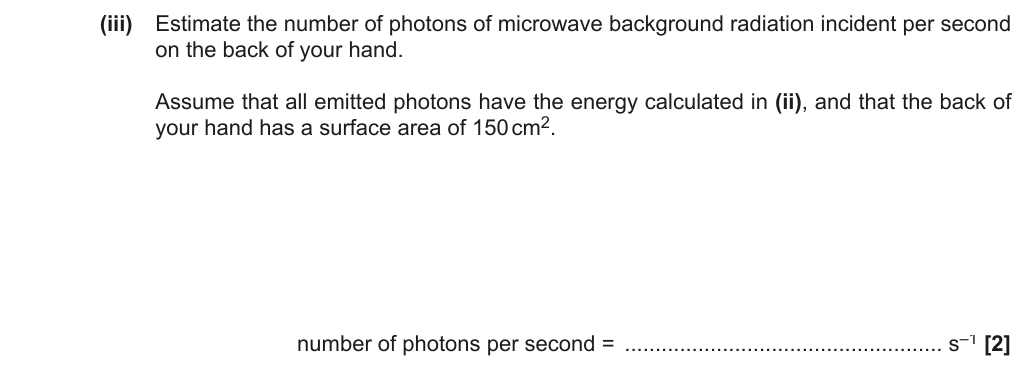
This is a complex, multi-stage calculation. A good approach was to use: number of photons per second × energy of each photon = amount of energy per second = power = intensity × area The total intensity of the microwave background radiation was given at the start of the question as 3 × 10⁻⁶ W m–2. Converting cm2 into m2 proved difficult for many.
Skills: M0.1 Recognise and make use of appropriate units in calculations; M0.2 Recognise and use expressions in decimal and standard form; M2.3 Substitute numerical values into algebraic equations using appropriate units for physical quantities
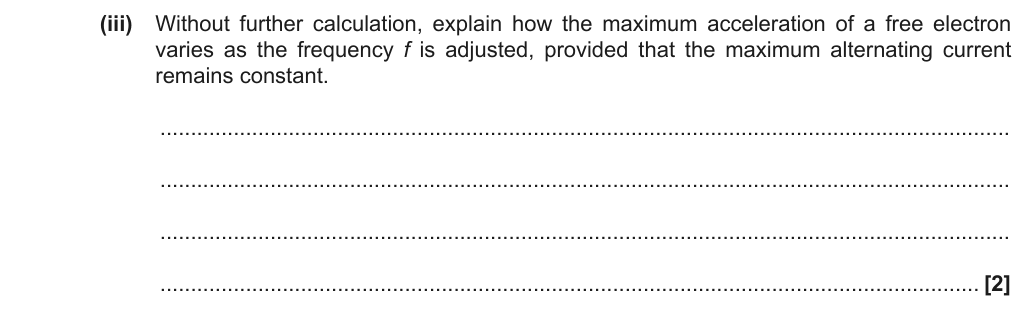
This was a difficult question; hard to visualise and involving some challenging algebra. Most candidates did not notice that the question specified the maximum acceleration of a free electron. Therefore the most common response was that a = (2πf)2x, showing that a ∝ f 2. This gained no marks. Other candidates went further and said that the maximum acceleration occurs when x = A. This means that aMAX = (2πf)2A and so aMAX ∝ f 2, since A is constant. However, the amplitude A of the oscillation is itself dependent on the frequency. If the maximum current remains constant then the maximum velocity vMAX of the electron must also remain constant. In (a)(ii), we used the fact that vMAX = 2πfA, so fA must remain constant. aMAX = (2πf)2A = (2π)2fA x f = constant × f. So we conclude that aMAX ∝ f. An easy way to see this algebraically is: aMAX = (2πf)2A and vMAX = 2πfA Therefore aMAX = (2πf) vMAX vMAX remains constant and so aMAX ∝ f
Skills: M2.2 Change the subject of an equation, including non-linear equations
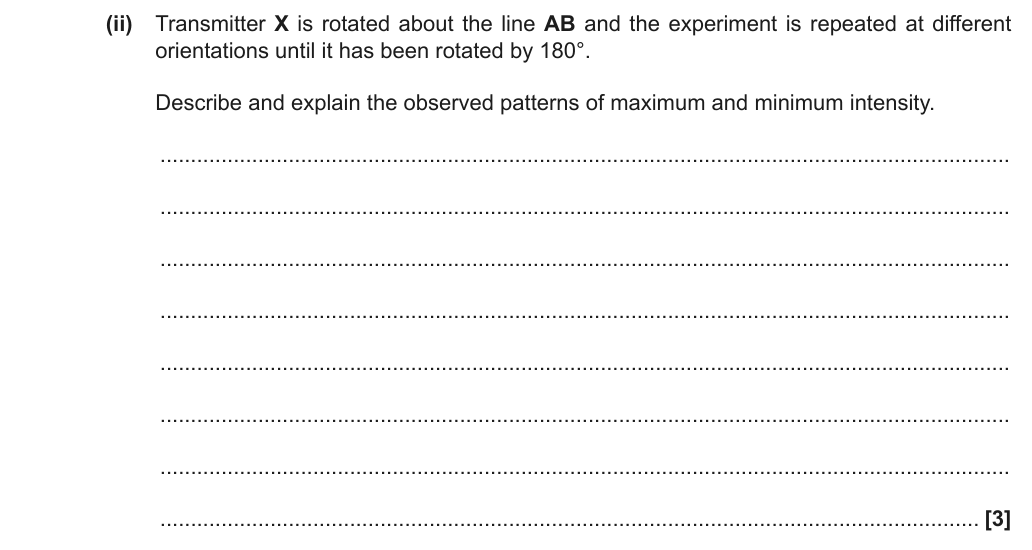
This question was misread by many candidates, who described the variation in overall intensity instead of the variation in the interference pattern. Some candidates thought that transmitter X was rotating away from Y, rather than about the AB axis. Only a few candidates correctly explained the change in pattern in terms of the change in the amount of interference between the waves from X and Y. Many said detector D was receiving less of a signal from X, rather than interference was lessening because of a reduction in the vertical component from X.
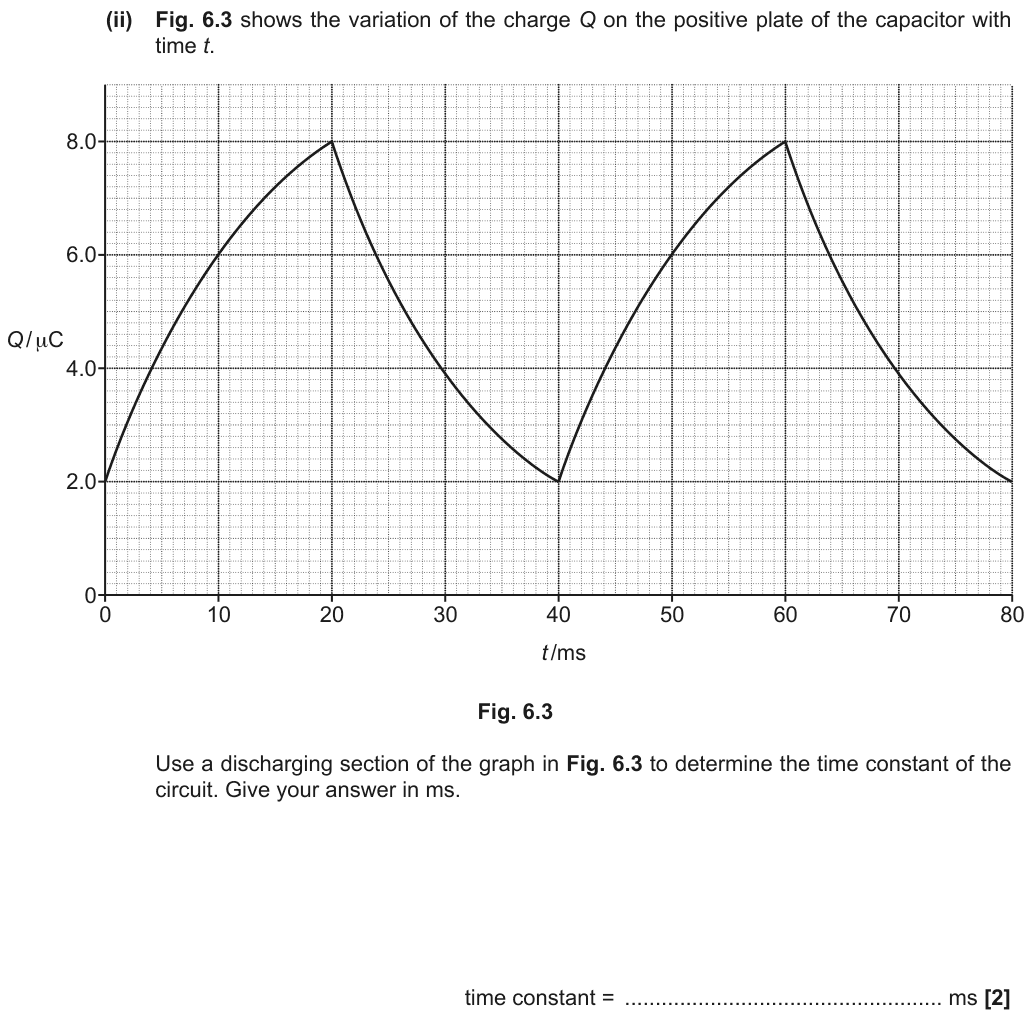
The question specifies using the discharging section of the graph. Some candidates tried to use the charging section, but this proved more difficult. Using the definition of the time constant, we need to find how long it takes for the charge to fall from any initial value to 37% (1/e) of that value. Many candidates chose 8µC for their initial value, but this is not vital. 37% of 8µC is 2.9µC. The charge is 8µC at 20ms and 2.9µC at 34ms, so the time taken is 34 – 20 = 14ms. A common alternative approach was to insert values from the graph into the equation Q = Qo e−𝑡𝑡𝐶𝐶𝐶𝐶 . This gave the same result, but sometimes resulted in a POT error because of the need to give the answer in milliseconds.
Skills: M0.5 Use calculators to find and use power, exponential and logarithmic functions; M3.1 Translate information between graphical, numerical and algebraic forms
The main difficulty here was remembering which was Kepler’s 1st Law. Many candidates described how a line between Mars and MAVEN would sweep out equal areas in equal times. Sometimes valuable time was spent describing planetary orbits before restating the salient points for MAVEN. Question1 (b) (i) The majority of candidates remembered Kepler’s 3rd Law correctly. There were a number of different approaches which could gain credit here. The main one used was to find the ratio of T2/r3 for corresponding pairs of values, showing that this ratio was approximately constant. Another common approach was calculating the constant k in T2= kr3 using the data for MAVEN and then applying it to the distance of Phobos, for example, to show that it gave the correct value for the time period. The best responses were those where candidates thought carefully about how they were going to set out their calculations, naming the orbits under consideration or tabulating their values, whereas other responses were characterised by a sprawl of figures leaving the examiner to hunt for appropriate values.
The strongest responses were given in terms of the function of MAVEN, which was to study the upper atmosphere of Mars. An areostationary orbit would be too far from Mars for this purpose, plus it would only allow MAVEN to sample one small part of its atmosphere. A common approach was to make partial statements such as ‘MAVEN would be too far away…’ and such responses were often too vague to be creditworthy. A few candidates misread the question and were obviously attempting to answer the question. ‘How do we know that MAVEN is not in an areostationary orbit?’.
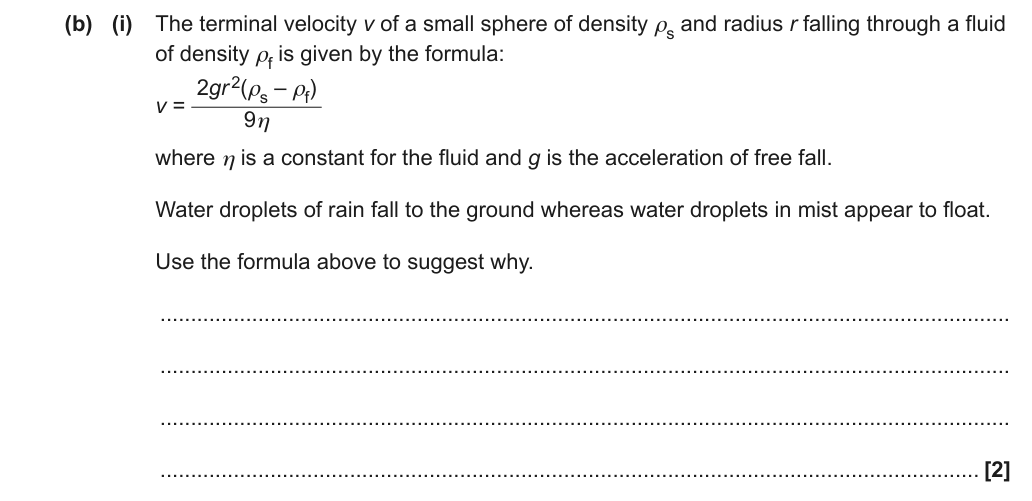
The density of water is the same in mist droplets and in rain droplets, and in both cases the droplets are falling through air. This means that the only variables in the formula are v and r2, with v being proportional to r2. Since mist droplets have a much lower terminal velocity v, this must be because they have a smaller radius than rain droplets. A reasonable suggestion using the formula, however, is that v is proportional to (ρs – ρf) and so this was given credit. Although the density of the water droplet, ρs, remains the same, some candidates argued that the air through which raindrops fall has a lower density to the water vapour through which mist droplets fall. This argument was much more popular than v proportional to r2. Unfortunately, many candidates were too vague and struggled to distinguish between water, rain, mist and air. Some thought that density of air/mist > density of water giving a negative terminal velocity, which is impossible.
Skills: M0.3 Use ratios, fractions and percentages

A few candidates lost the mark here by discussing voltage/energy across capacitors in series versus parallel without linking this idea to capacitance.
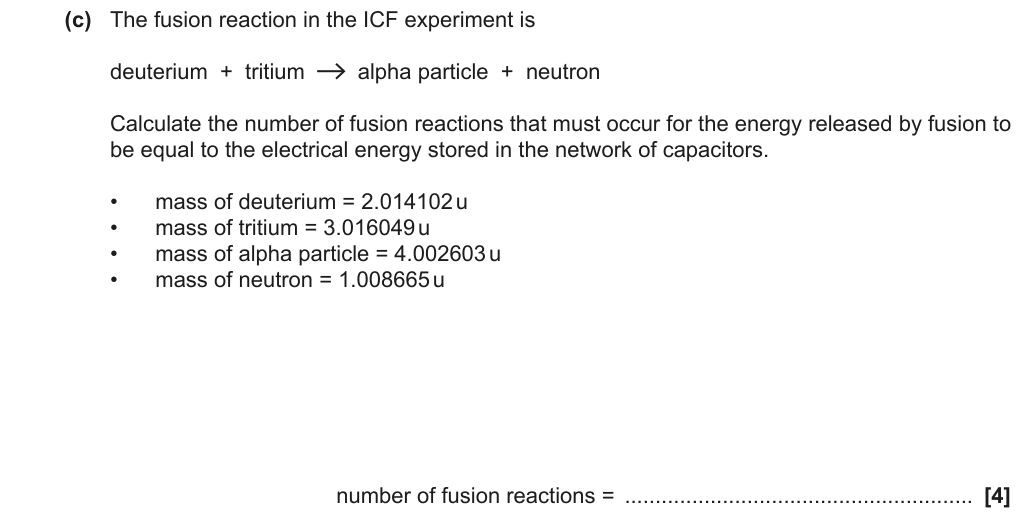
Most candidates seemed to have a very good understanding of this question, suggesting good preparation by centres. Those who dropped marks often made arithmetical errors in calculating mass defect or forgot to convert atomic mass units into kilograms. A lack of clarity in setting out mathematical procedures made some candidates’ thought processes difficult to follow.
Skills: M0.2 Recognise and use expressions in decimal and standard form; M2.3 Substitute numerical values into algebraic equations using appropriate units for physical quantities
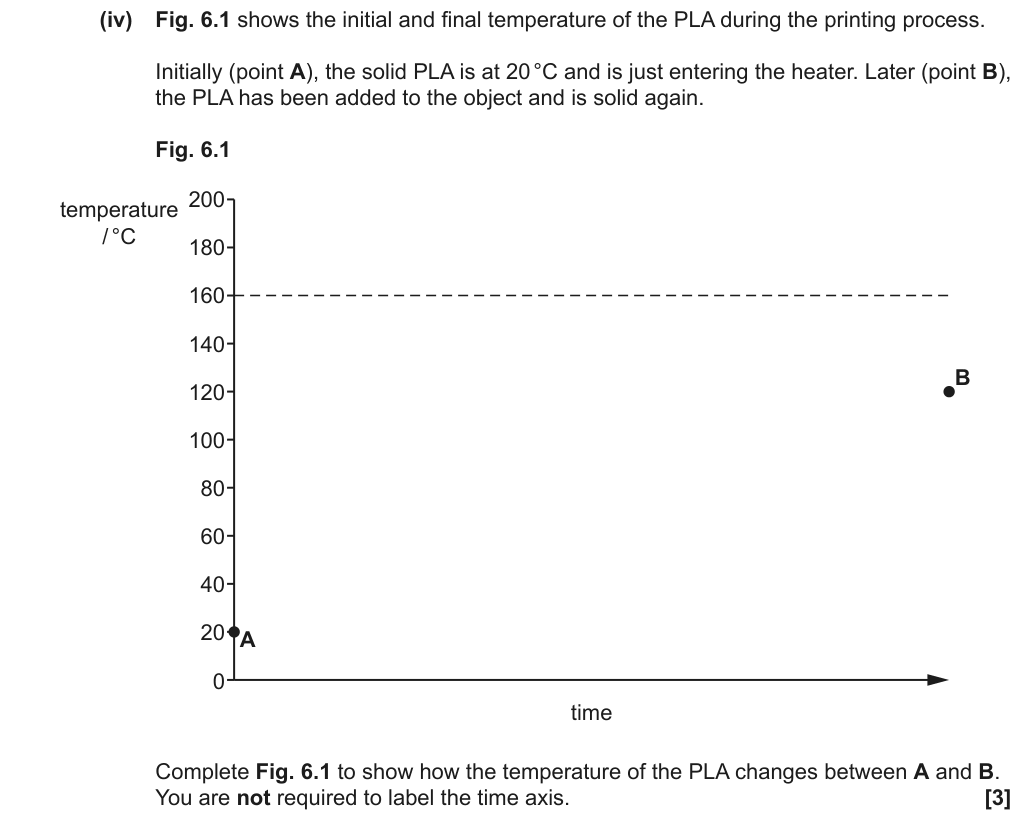
Most responses gained 2 marks for a line from point A followed by a flat section at 160 °C and then a line down to point B. A small minority of candidates also gained the 3rd mark for a ‘blip’ within the flat section, rising above 160 °C . Responses that went from A to B without a flat section at 160 °C gained no credit.
Skills: M3.12 Sketch relationships which are modelled by y = k/x, y = kx², y = k/x², y = kx, y = sin x, y = cos x, y = e^(±x) and y = sin²x, y = cos²x as applied to physical relationships
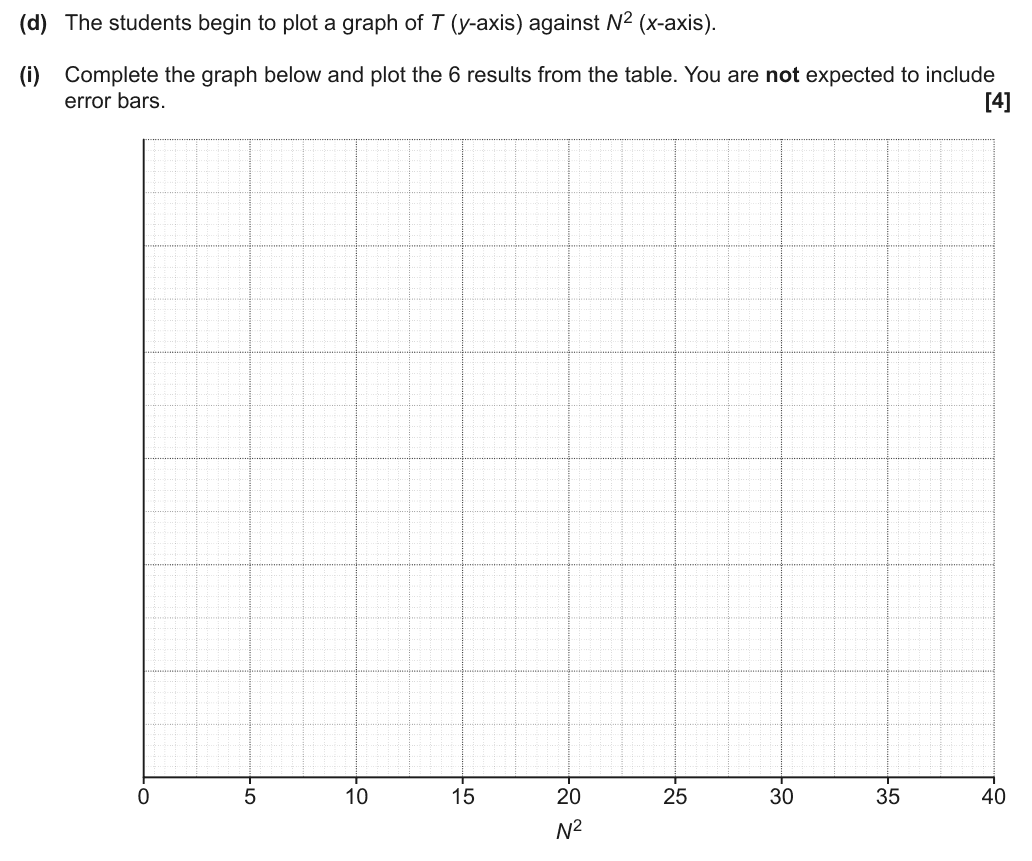
It was easy to put a scale onto this graph, and very few candidates used a non-linear scale or one with a poor choice of intervals. Some candidates, however, forgot to add units to their time axis. Most plotted the points easily, although the first point often proved tricky.
Skills: M0.5 Use calculators to find and use power, exponential and logarithmic functions; M3.2 Plot two variables from experimental or other data; PAG9 Investigating capacitors
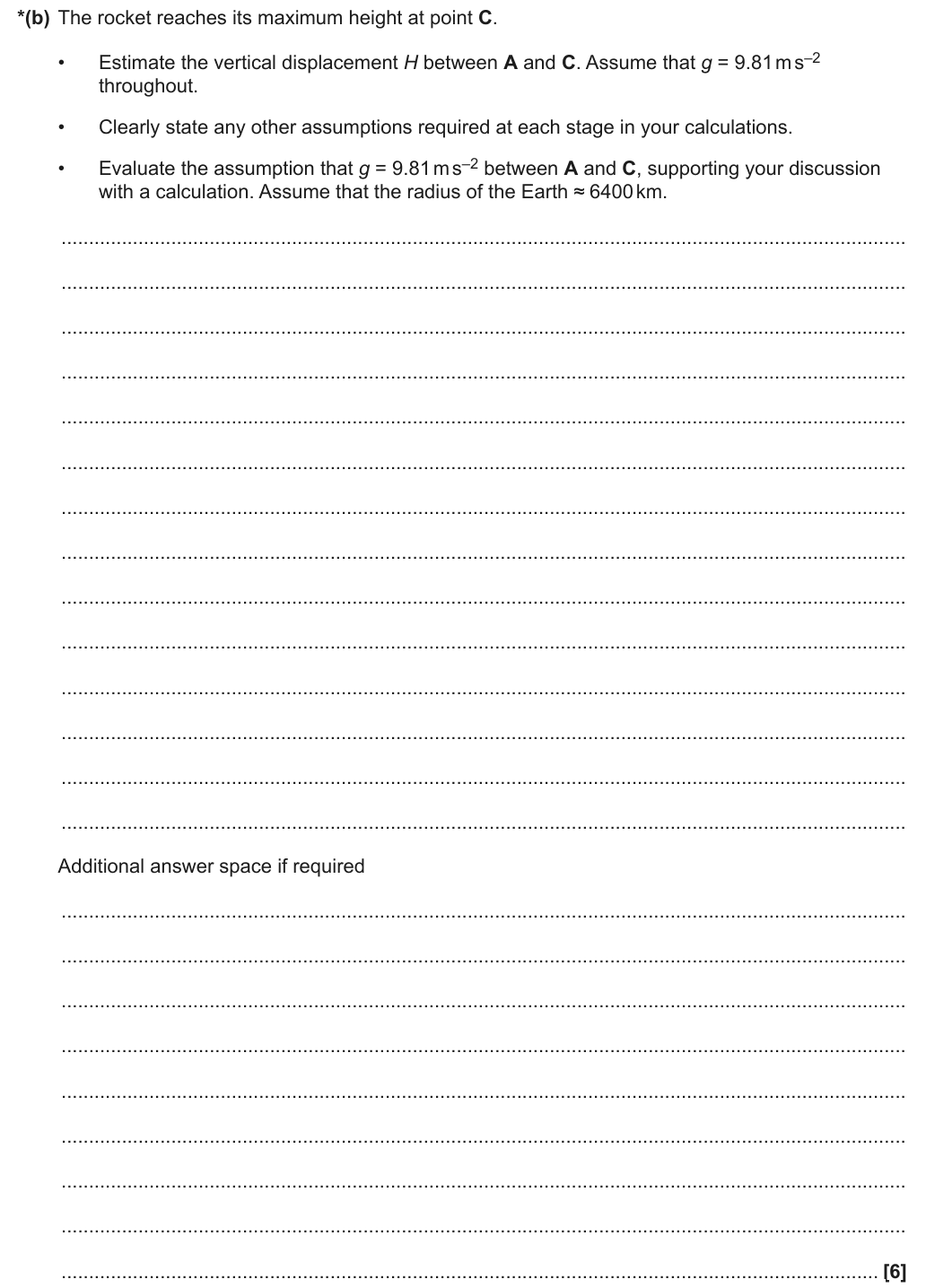
Level 3 candidates set out a correct calculation of H¸ together with the assumptions required at each stage, plus an evaluation of the assumption that g remains constant at 9.81 ms-2 throughout. Level 2 candidates missed out one or more of these three parts, usually the evaluation at the end, which they found quite difficult. Level 1 candidates were often unable to calculate H, or the value of g at height H, correctly Common problems in 3 (b) • omission of sin 75° (or using cos 75°) when calculating velocity • not converting from m to km correctly • not squaring the r term in the calculation for g they have answered each part of the question by using bullet points. Their calculations are clearly set out and so easy to follow, and their handwriting is legible. Instead of just calculating a value for g at height H, they have also given an explicit evaluation: ‘The assumption that g remains constant is not reasonable’. Other candidates went on to say that this means that the rocket would reach an even greater height.
Skills: M0.3 Use ratios, fractions and percentages; M0.6 Use calculators to handle sin x, cos x and tan x when x is expressed in degrees or radians; M2.3 Substitute numerical values into algebraic equations using appropriate units for physical quantities; M4.5 Use sin, cos and tan in physical problems
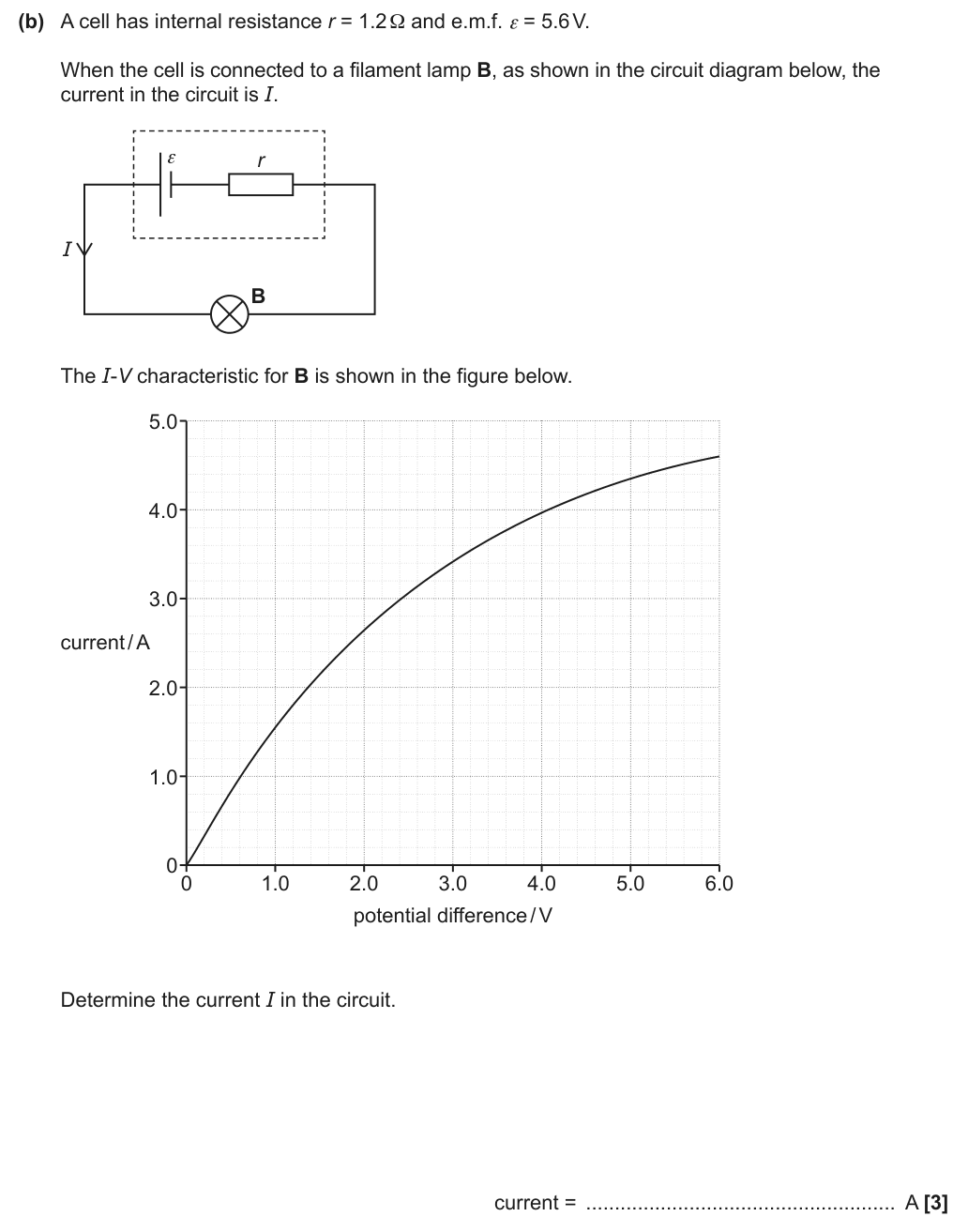
5 (b) (ii) was a question aimed at stretch and challenge level candidates with good problem-solving abilities.. Voltage V and current I are related through the formula ε = V + Ir so, given the values in the question, 5.6 = V + 1.2I. The relationship between V and I is also shown graphically. The problem is to find a pair of corresponding values for V and I which match both relationships. One way of solving this problem is to draw the relationship 5.6 = V + 1.2I onto the graph. This can be done by arranging it into a y = mx + c form i.e. I = 4.7 – 0.83V. The solution to the problem can then be found where the two lines cross, which is the point (2.2, 2.8). So, the values I = 2.8A (and V = 2.2V) fit both relationships. This method of solution is shown in Exemplar 2. An alternative method of solution is trial and improvement. Pick a point on the V-I graph; say (1.2, 1.8). Calculate ε = V + 1.2I = 1.2 + 2.16 = 3.36V. This is lower than the 5.6V we need for the emf. So, try a point higher on the graph: say (3.0, 3.4). Calculate ε = = 3.0 + 4.08 = 7.08V. This value is too high. In this way we can eventually reach the correct point at (2.2, 2.8). There are, of course, other methods of solving this problem. The majority of candidates attempted to work out the resistance of an arbitrary point on the graph (often by finding the gradient, or 1/gradient, at a tangent) and then evaluated a current using 5.6 = I(R + 1.2). If they ended up with I = 2.8A, it was usually by luck rather than by good judgment.
Skills: M2.2 Change the subject of an equation, including non-linear equations; M3.1 Translate information between graphical, numerical and algebraic forms; M3.3 Understand that y = mx + c represents a linear relationship
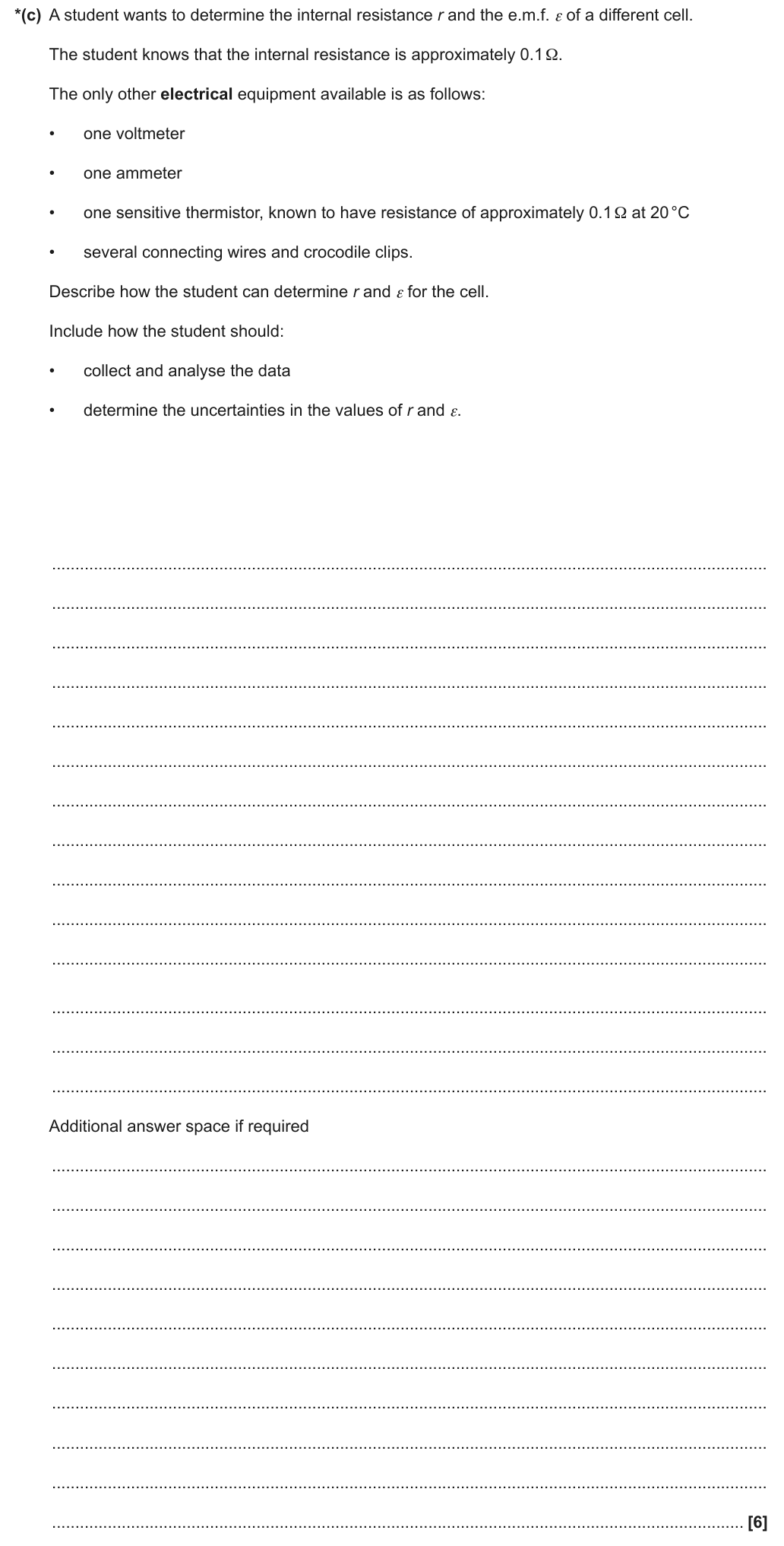
Although it was clear that many candidates had performed an experiment to determine r and ε for a cell, they were sometimes thrown by the need to use a thermistor rather than a variable resistor. Many candidates drew the symbol for a variable resistor anyway instead of a thermistor, and others put the variable resistor into the circuit alongside the thermistor. Some suggestions for varying the temperature of the thermistor were impractical. Although it would be practically difficult to take several values of V and I at exactly the same temperature, candidates were allowed to use error bars found from half the range of repeated values, rather than by using the resolution of the ammeter and voltmeter. Often candidates were rather vague when trying to describe how to determine the uncertainties; ‘Use the worst fit line’ was often all the instruction that was given.
Skills: M1.5 Identify uncertainties in measurements and use simple techniques to determine uncertainty when data are combined; M3.3 Understand that y = mx + c represents a linear relationship; M3.4 Determine the slope and intercept of a linear graph; PAG3 Investigating electrical properties
Many responses did not refer to atmospheric effects or repeated information from the stem and therefore could not gain marks. The most common correct response referred to ionisation of atoms causing lightning. Very few candidates referred to the heating effect of a current.
Few candidates gained marks on this question for correctly explaining that the magnetic flux density (only) affects the size of the force or amplitude of the wave. Most candidates simply stated that it does not affect the frequency or other quantities in the equation.
Many candidates provided over complicated responses to this question, attempting to use the experimental set up and formula stated in b(i) rather than providing a simple method to determine the quantity. A significant minority of candidates incorrectly assumed that W was the weight of the wire or conflated mass and weight in their description.
This question was challenging for a significant number of candidates. Many responses were vague and made no reference to the percentage difference or range of values. Common uncreditworthy responses were stating that the values were close or that it was accurate because values were the same to two significant figures. Some candidates calculated the percentage difference or range but then did not use this in their comparison and evaluation.
Skills: M0.3 Use ratios, fractions and percentages; M1.5 Identify uncertainties in measurements and use simple techniques to determine uncertainty when data are combined
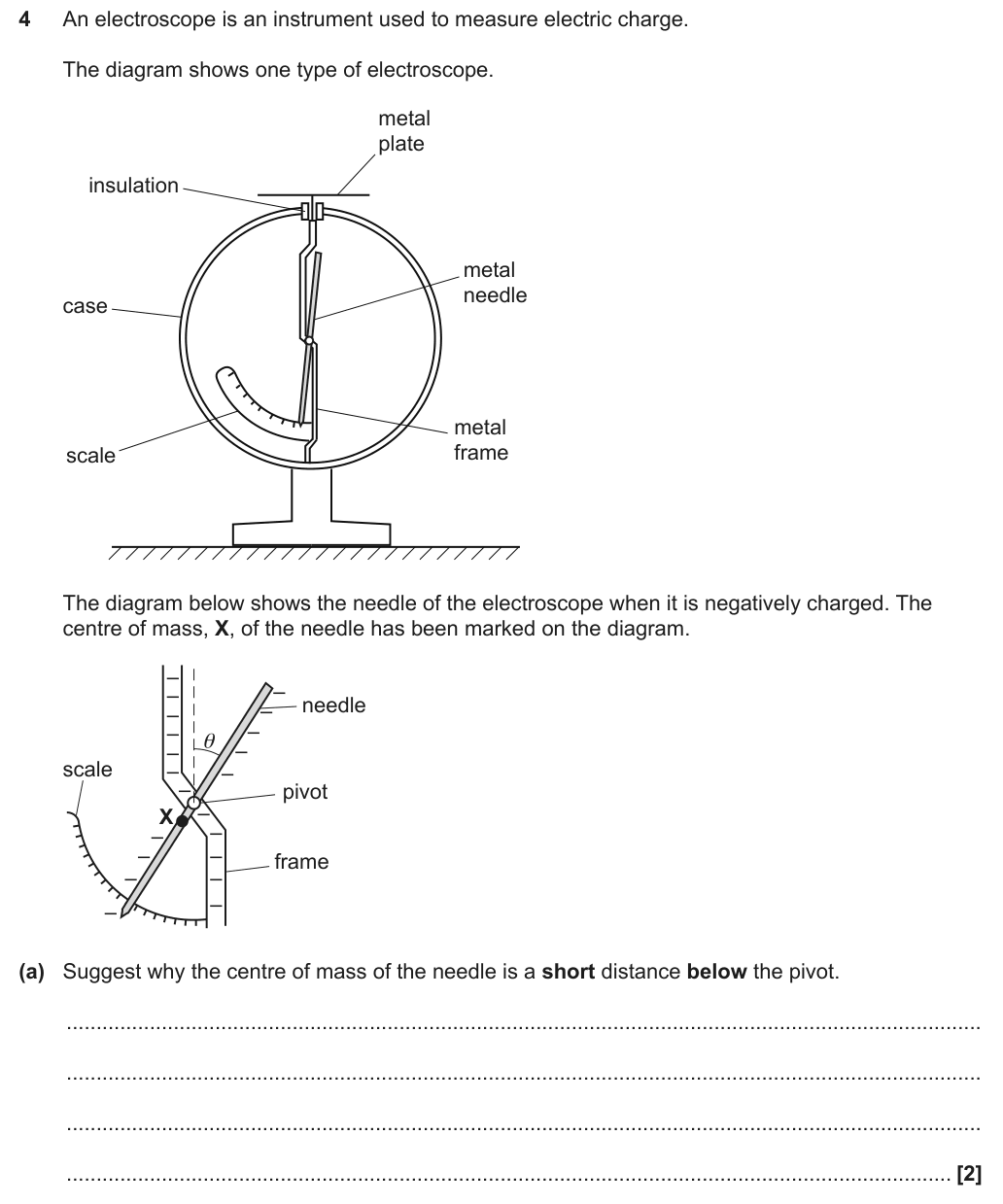
Many candidates appeared to find the context of this question difficult or gave answers which were insufficient for credit. A common insufficient response was saying that it allowed the needle to rest downwards without specifying vertically. Some candidates made good use of the diagram by referring to the labelled angle. Very few candidates attempted to discuss the sensitivity of instruments. Those that did often gave long descriptive responses rather than making using of appropriate terminology.
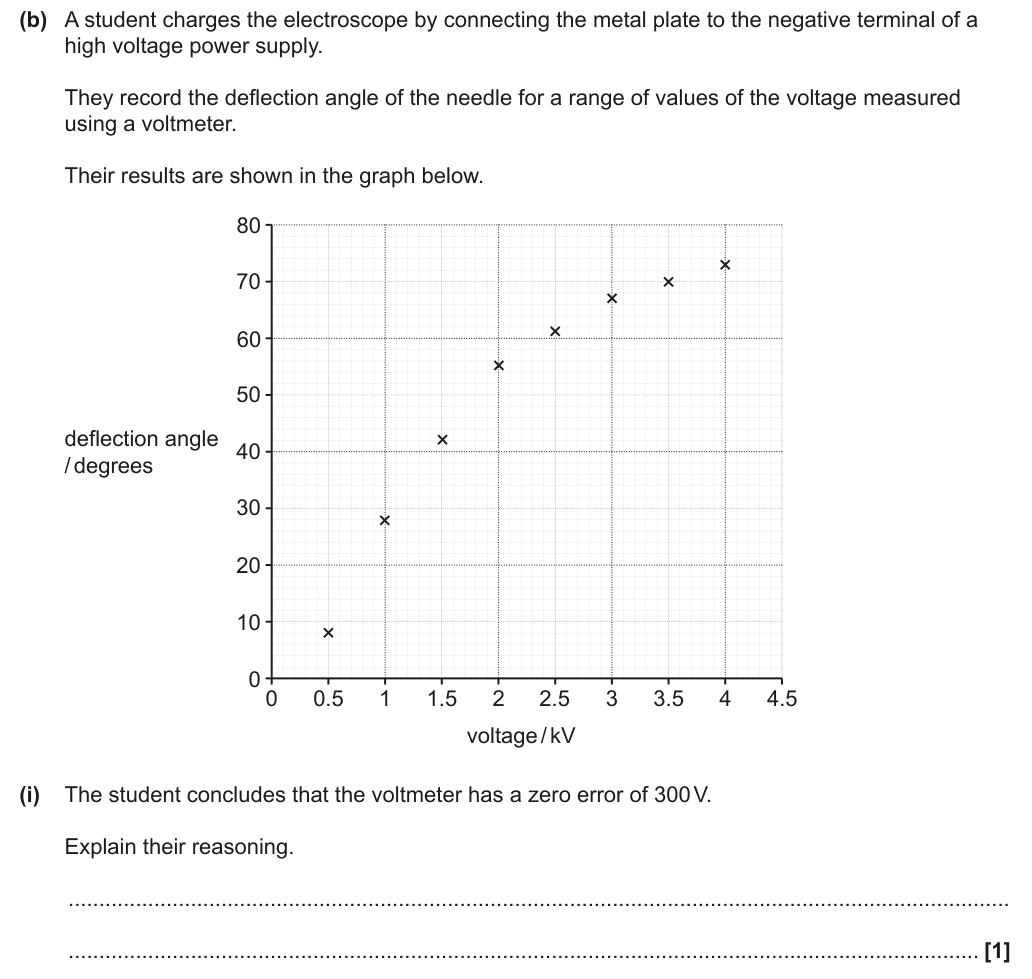
Candidates who drew the curved line of best fit usually made relevant comments allowing the mark to be gained. A minority of candidates incorrectly drew a straight line of best fit or described what a zero error would look like on a voltmeter rather than linking the graph to the conclusion. Many candidates drew no line of best fit or attempted to make it pass through the origin. Such responses usually resulted in no marks being gained as it was not possible for candidates to evidence the voltage at zero deflection. A small minority referred to no readings being taken below 0.5 kV which was not required to draw the conclusion.
Skills: M3.1 Translate information between graphical, numerical and algebraic forms; M3.2 Plot two variables from experimental or other data
Many candidates gained 3 marks for this question for correctly using the Q = VC formula with data read from the graph. Very few candidates gained all 4 marks usually for one of the reasons identified below. Common mistakes • incorrect read off for the voltage at 45° • not correcting for the zero error • using an incorrect power of ten for pF.
Skills: M0.2 Recognise and use expressions in decimal and standard form; M2.3 Substitute numerical values into algebraic equations using appropriate units for physical quantities; M3.1 Translate information between graphical, numerical and algebraic forms
Want to work through the hard ones with a tutor? Message us.