Examiner's comment
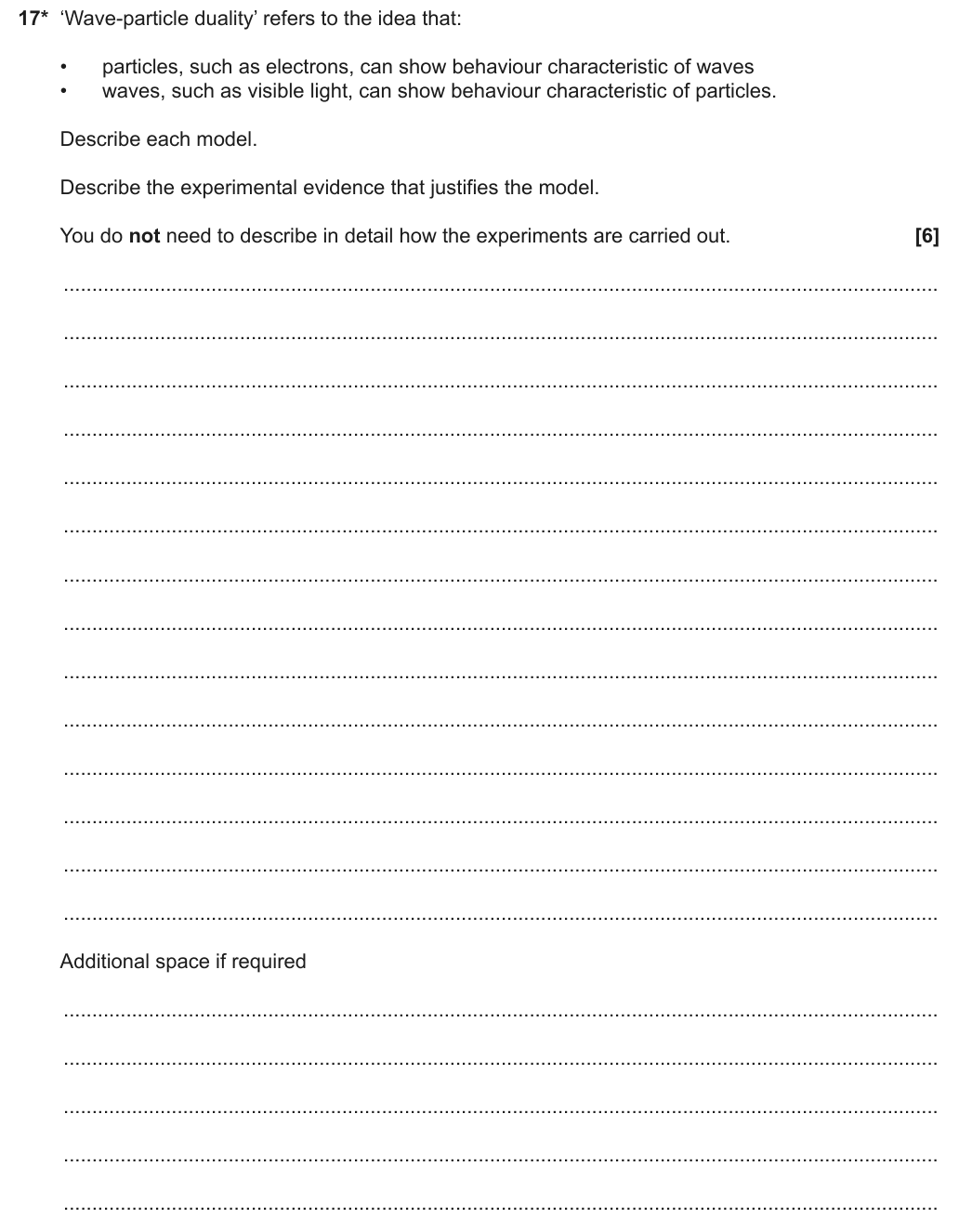
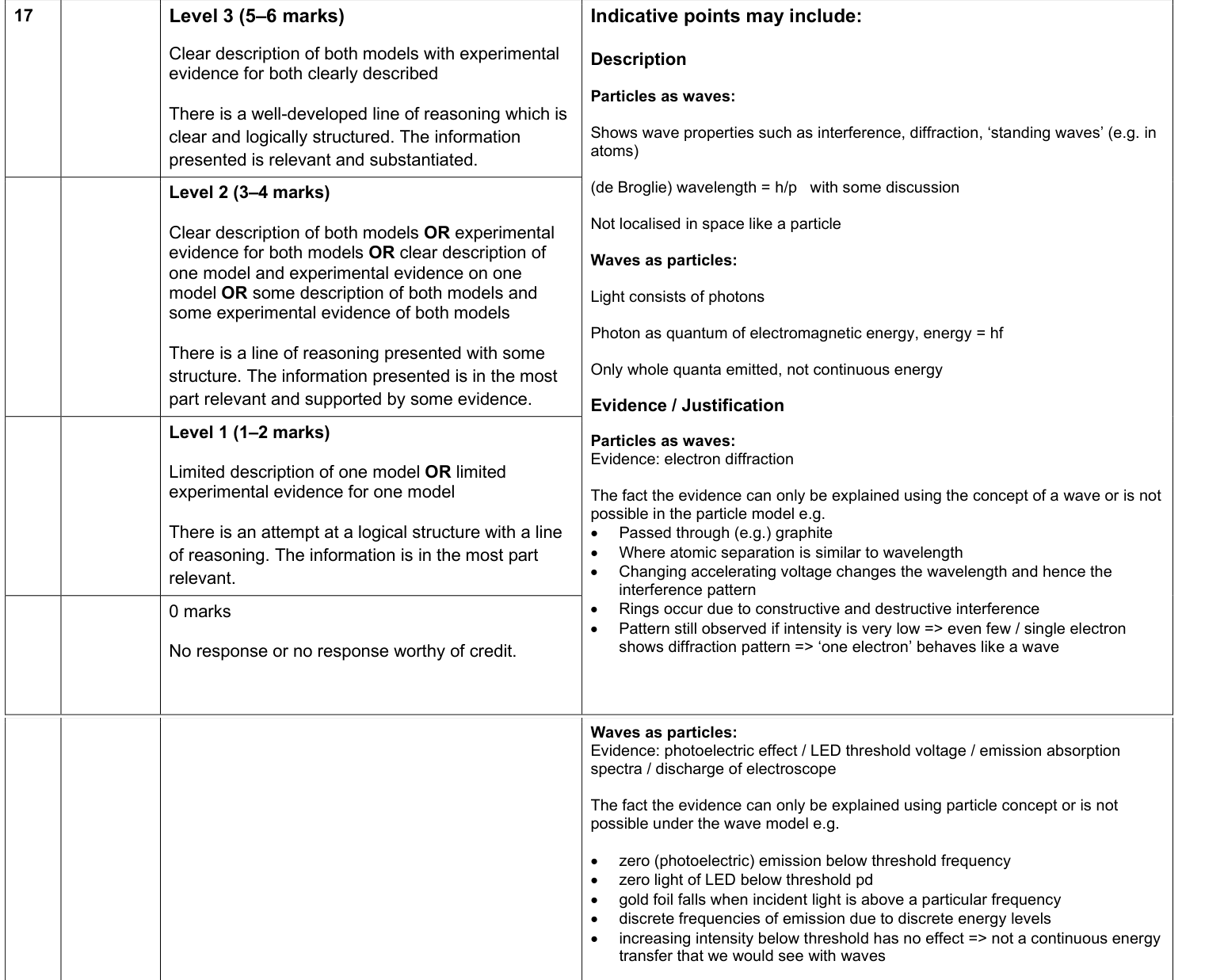
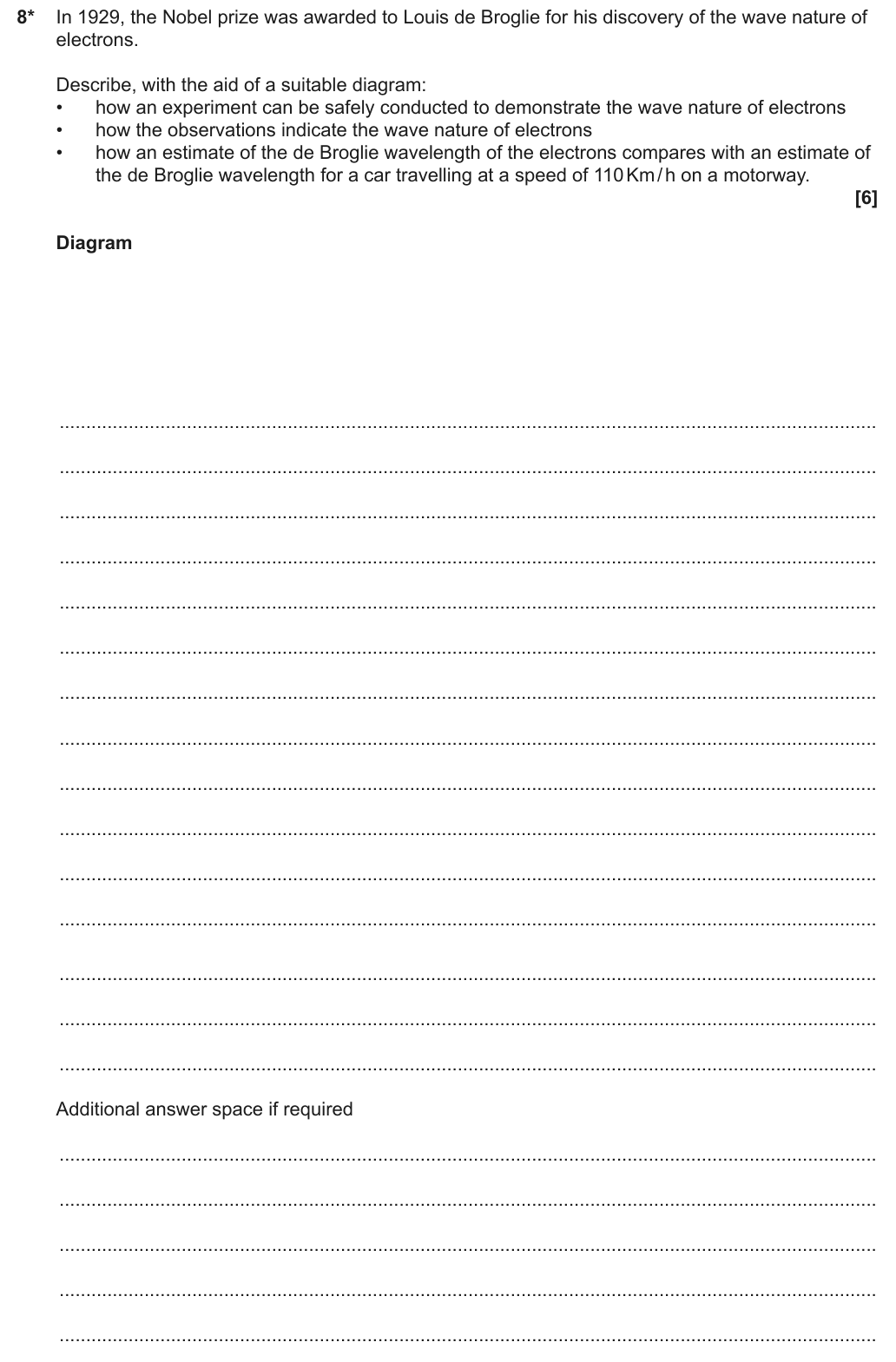
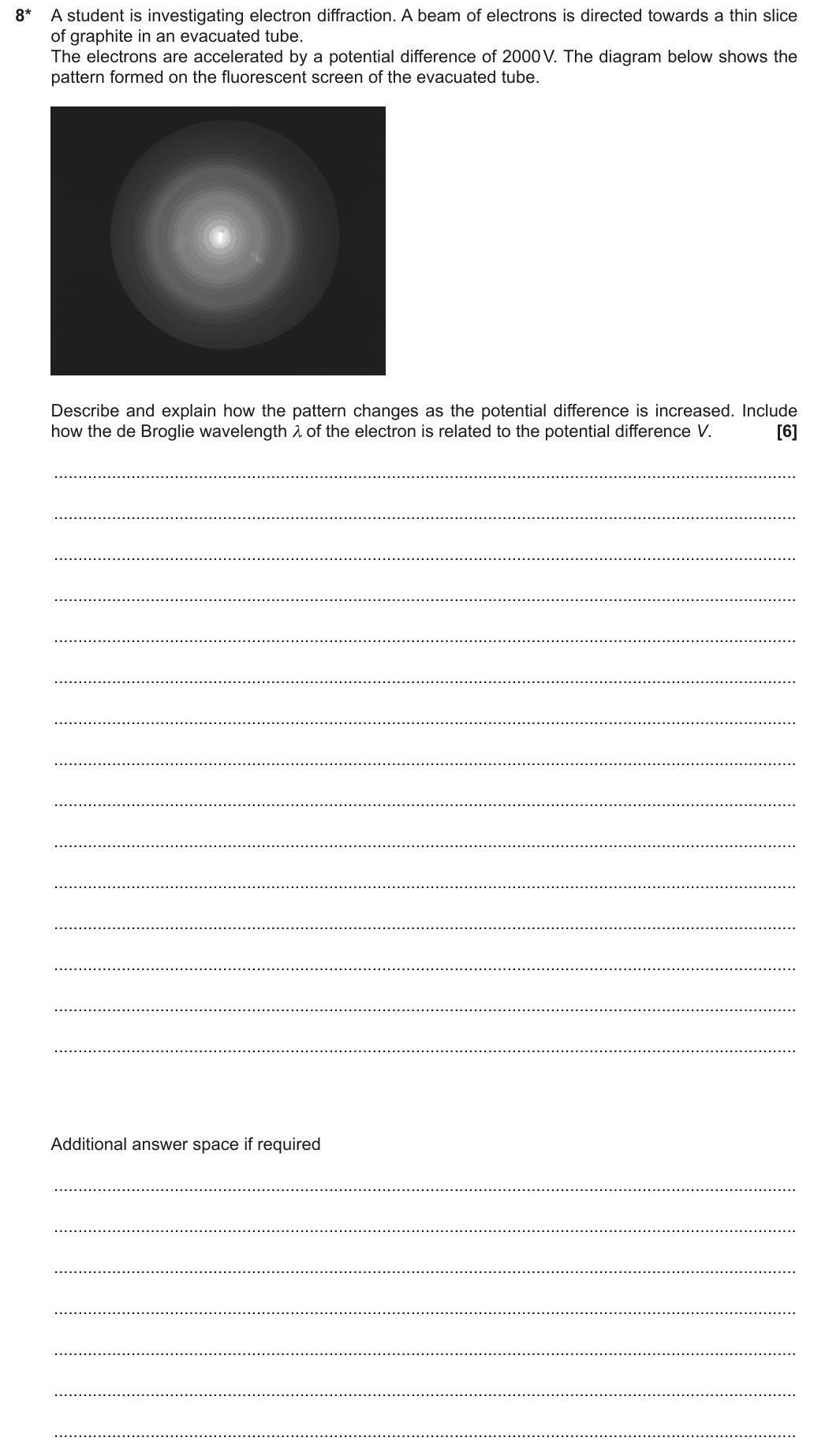
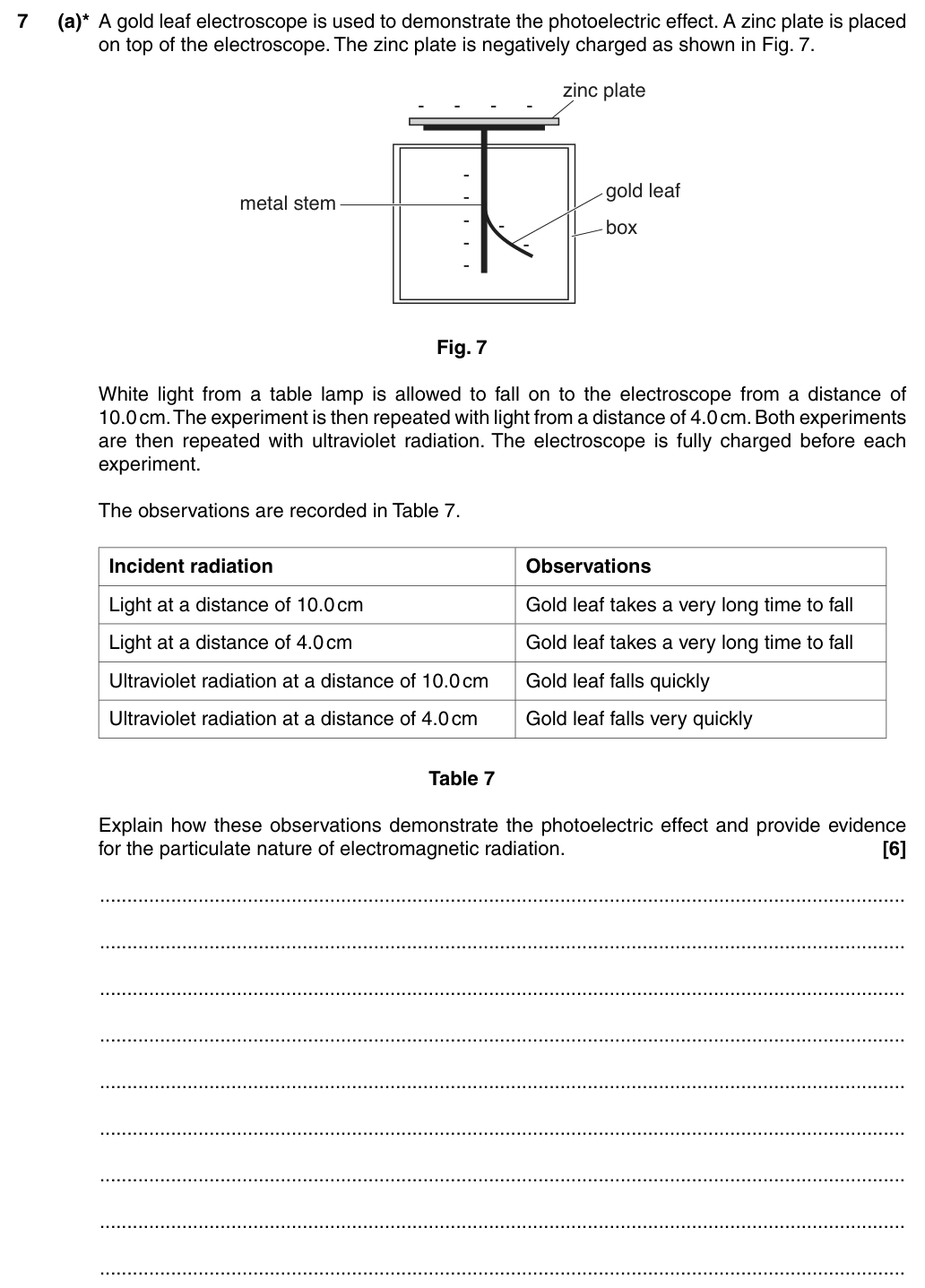
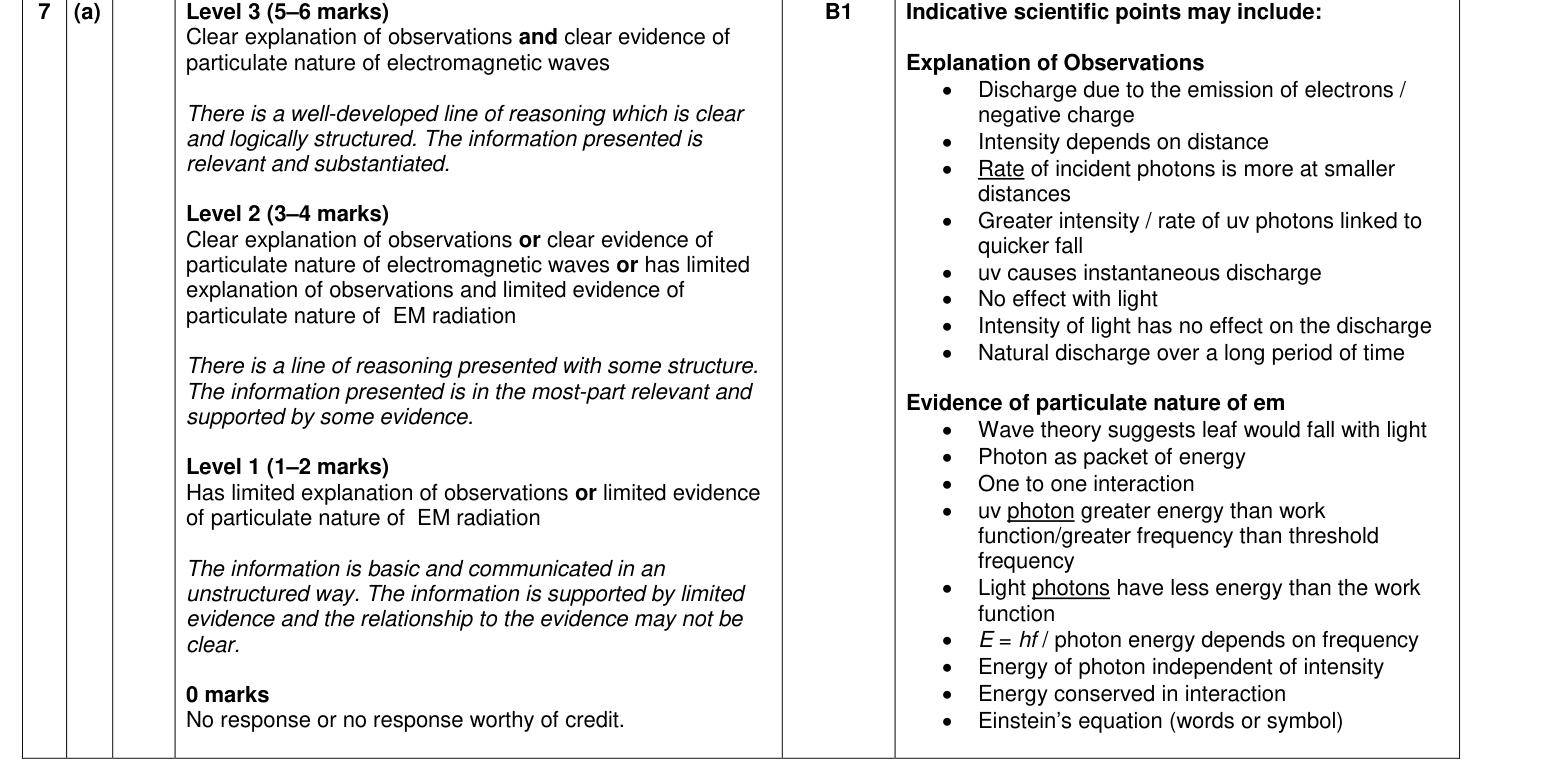
This Level of Response question was designed to assess the candidates’ knowledge of various aspects of wave-particle duality, in particular each model and experimental evidence. The key points in the description that examiners were looking for were: • a description of a model of how particles can be described as waves, and some experimental evidece to support this • a description of how waves can be described as particles, and some experimental evidence to support this. To obtain Level 3, it is important that all four aspects of this are approached. For the most part, it was clear that candidates had a general knowledge of this topic. Many were able to give some descriptions of electron diffraction and ‘the gold leaf experiment’, but not all gave sufficient detail in terms of the requirements of the question. Although not always required, it would be expected that candidates may use an equation in their description (the de Broglie relationship and E = hf) to support how the particle can be considered to act as a wave, and vice versa. More successful candidates used this in conjunction with the experimental evidence to draw their conclusions. The most common experimental evidence, which could achieve Level 3 if approached correctly, were electron diffraction through graphite and some form of the photoelectric effect. Anticipated detail for experimental evidence would be to explain how a diffraction pattern leads to the idea of waves, and with the idea of a threshold frequency. These can only be explained by use of the correct model and would support the response. Common weak points were to describe the electrons passing through a double slit, describing the interference pattern as fringes rather than concentric rings and explaining the photoelectric effect theoretically without any evidence. The question stated that there was no requirement to explain the experimental detail (as evidence was required) but several candidates used time doing so. Using the gold leaf electroscope (which many candidates had seen) is a good way to demonstrate the photoelectric effect, however there seemed to be some confusion about whether it was initially charged, and if so whether it was positive or negative, The statement ‘one to one interaction’ was common, although was often used without support and it was clearly something that had been learnt. Most candidates used the space, including the additional space, to answer this question. It is always possible to obtain a Level 3 in the given space by carefully answering the question rather than giving superfluous information and candidates are encouraged to think a little about their response before starting. This exemplar shows a good response, but not sufficient to reach Level 3. The candidate has given a fair, yet brief, description of the experimental evidence for electron diffraction, showing particles acting as waves. Similarly, the photoelectric effect is explained to some level of detail about how it demonstrates where a wave acts like a particle. There is little in terms of the descriptions of the model in either of these. There is a reference to diffraction for the wave model and use of the term ‘photon’ for the particle model. Considering the level guidance, this has some description of both model and experimental evidence so falls into Level 2. The experimental evidence has some valid details, so can be awarded the top of this level, 4 marks.