Answer
B
Mark scheme

Examiner's comment
This question was answered well. High scoring candidates often wrote an equation in the white space and substituted into their expression the data.
Every multiple-choice question: Section A of A-level Papers 1 and 2 (15 each) and Section A of AS Paper 1 (20), with the answer behind the button. Allow about a minute and a quarter each. 470 questions.
Other types: Calculation questions · Show that questions · Explain and describe questions · Graph and diagram questions · Six-mark level of response questions · Practical questions · Short-answer questions
B
This question was answered well. High scoring candidates often wrote an equation in the white space and substituted into their expression the data.
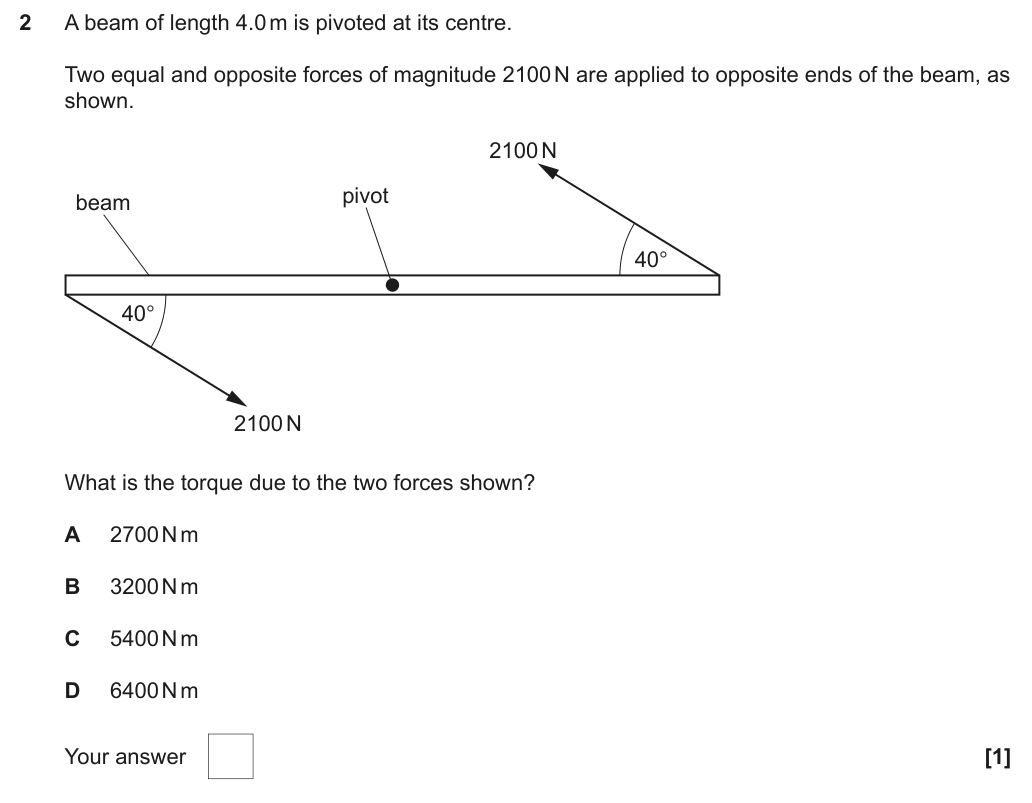
C
The majority of the candidates who did not gain the correct answer, selected answer A. These candidates correctly calculated the force but found the moment of the pivot for one of the forces rather than the torque of the two forces shown.
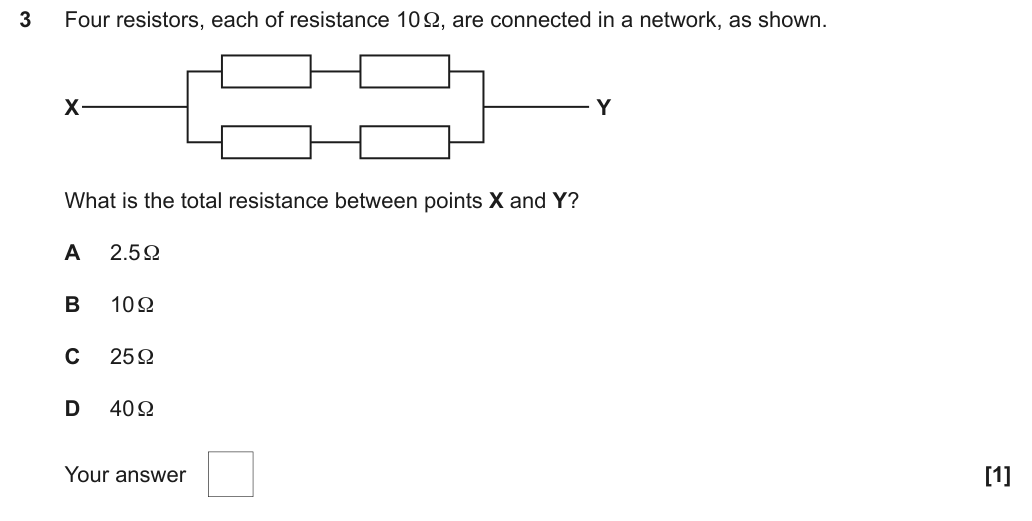
B
Most candidates correctly gave the answer as B. The common distractors for low scoring candidates were either A or D (dividing by four or multiplying by four).
B
This question was generally answered well, although across the cohort several incorrect responses were observed. These were usually either A (infra-red) or C (X-rays). Candidates should know the orders of magnitude of the wavelengths of the principal radiations of electromagnetic waves in a vacuum.
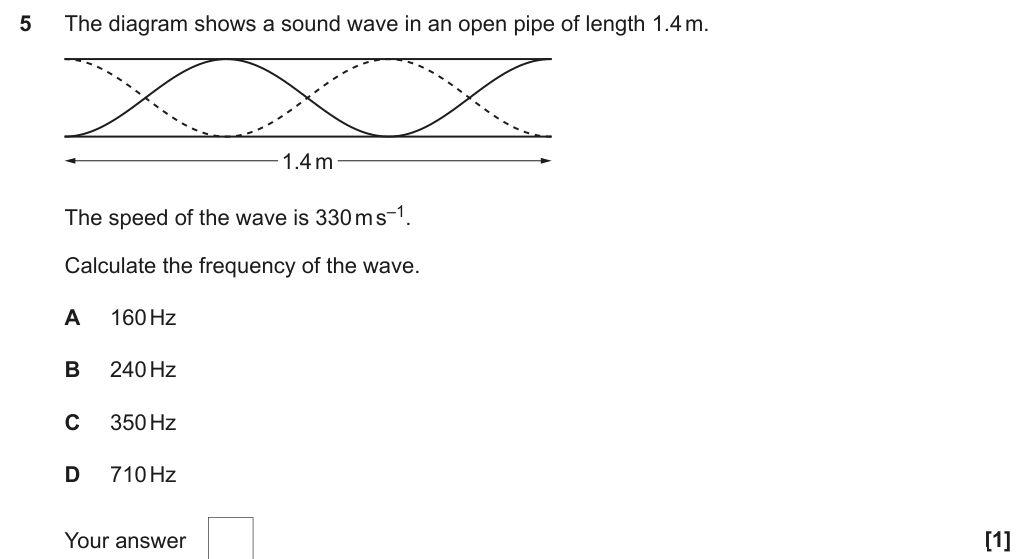
C
Most candidates correctly understood that the length of the tube was 1.5 wavelengths and gained the correct answer. Low scoring candidates often assumed that the length of the tube was equal to the wavelength and selected B as their answer.
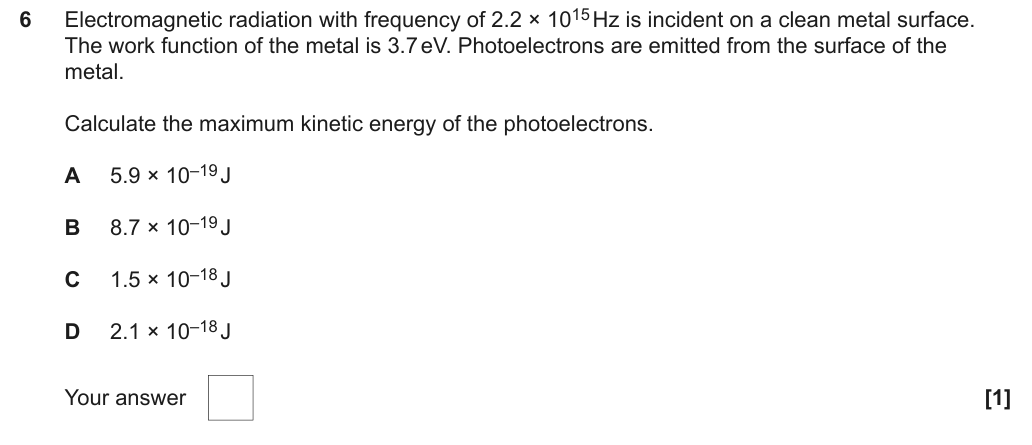
B
A common incorrect answer was A, where candidates had converted 3.7 eV to joule.
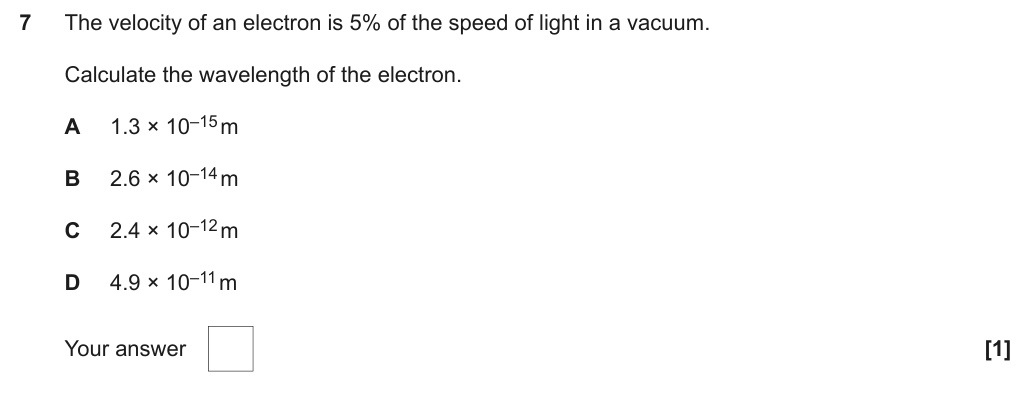
D
A range of answers were observed. High scoring candidates effectively used the white space to work out the speed of the electron and then wrote the equation and substituted the data.
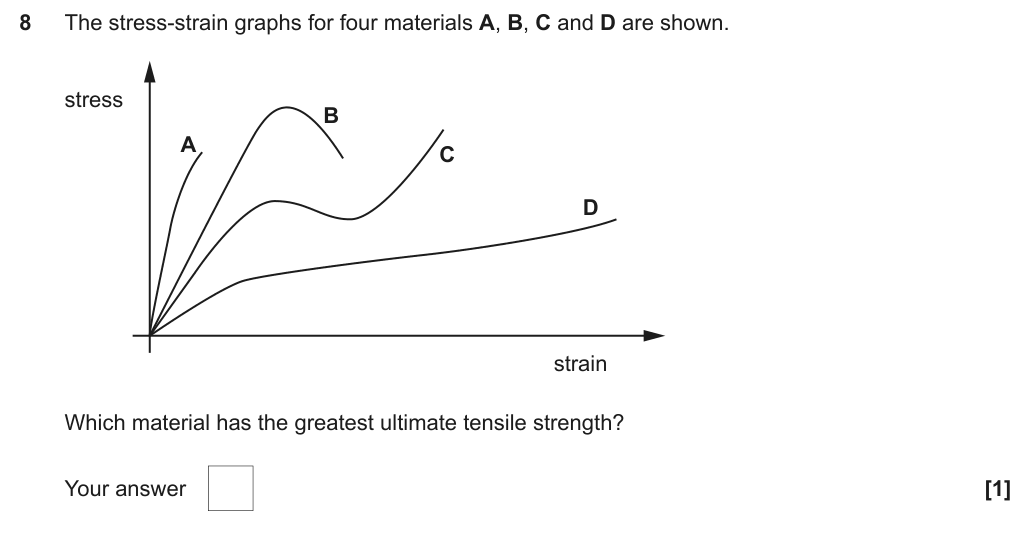
B
The majority of the candidates correctly identified B. The common distractors were C and D.
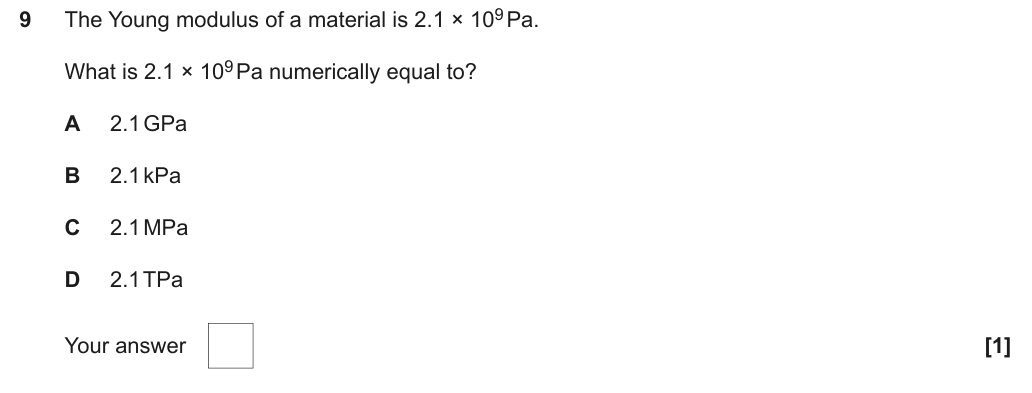
A
Where errors were made it was usually selecting D or to a lesser extent C.
Skills: M0.2 Recognise and use expressions in decimal and standard form
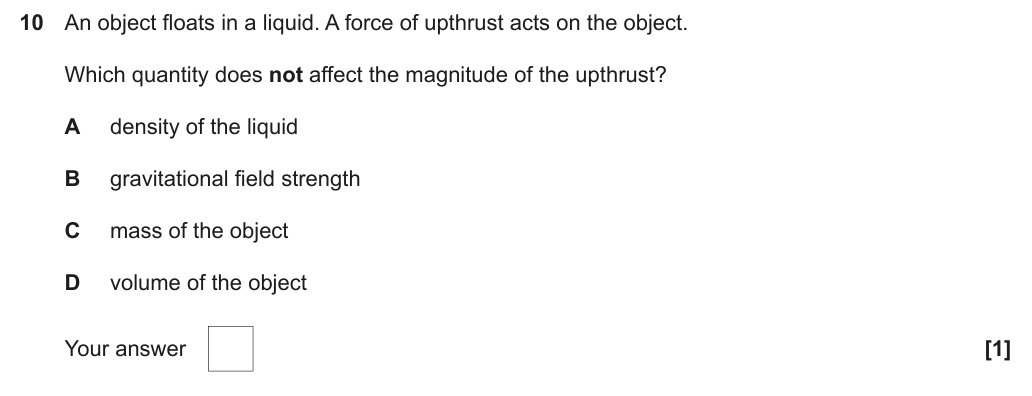
There were many incorrect answers to this question. A significant minority of candidates selected the gravitational field strength option.
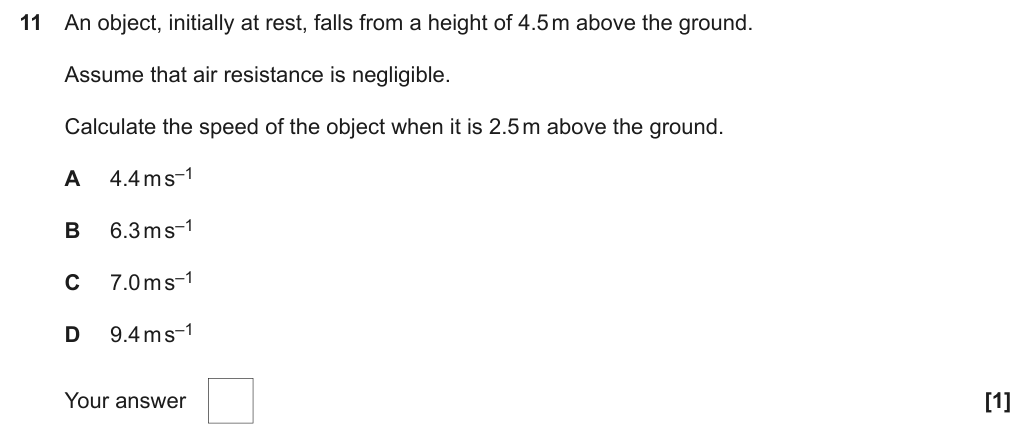
B
The majority of the candidates correctly identified B as the correct answer. The two common errors from lower scoring candidates were to choose D (ignoring the 2.5 m) or to select C where candidates had found the speed after 2.5 m rather than the speed at 2.5 m. Some candidates usefully sketched a diagram to show the arrangement of the ball falling which then enabled these candidates to identify the correct distance.
Skills: M2.3 Substitute numerical values into algebraic equations using appropriate units for physical quantities
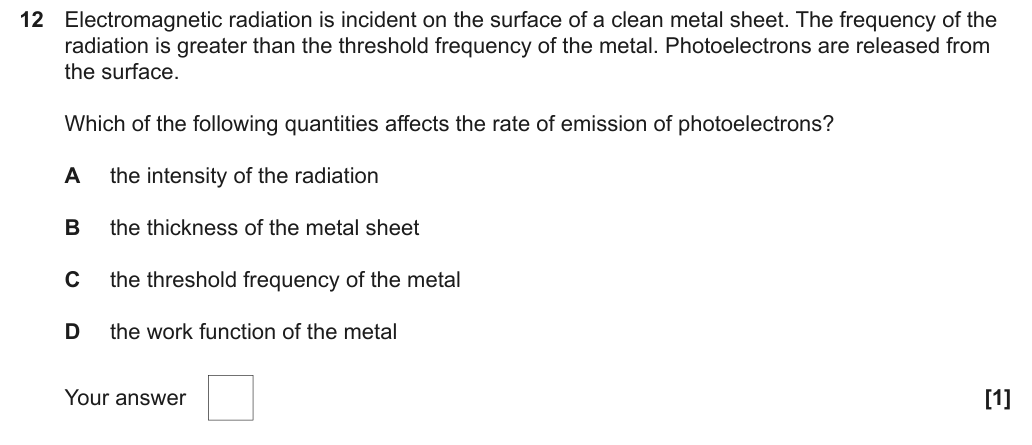
A
This question was assessing a standard learning outcome from the specification. Low scoring candidates often selected either C or D without reference to Einstein’s photelectric equation.
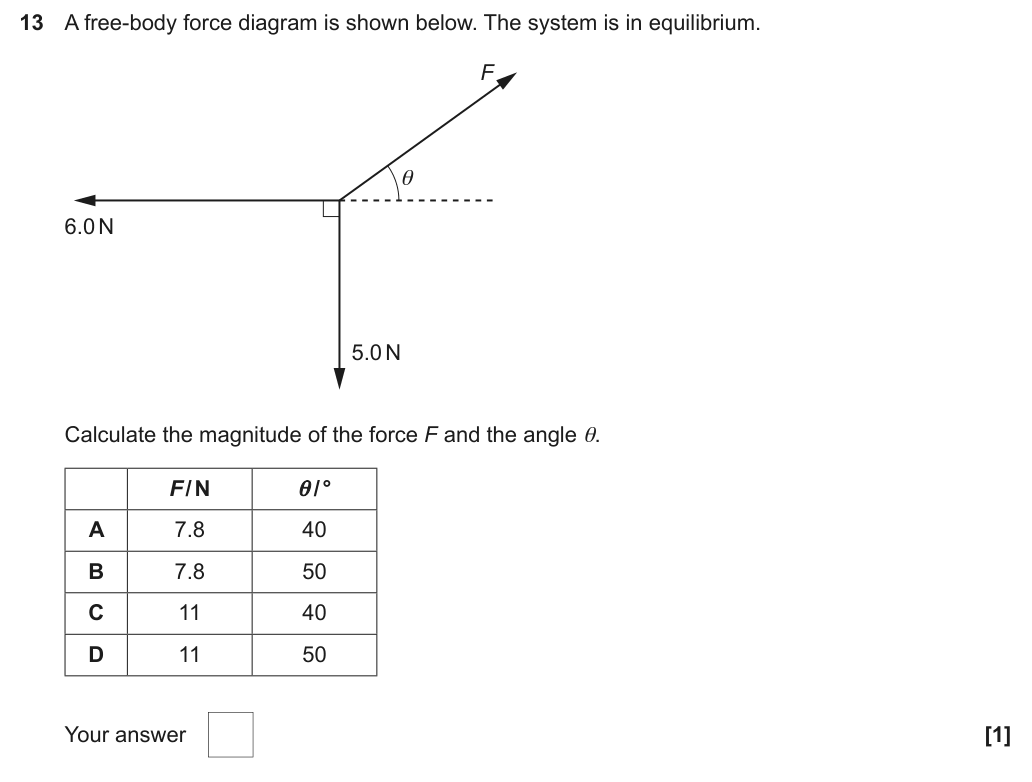
A
A few candidates incorrectly selected C – adding the two forces 5.0 N and 6.0 N to equal11 N.
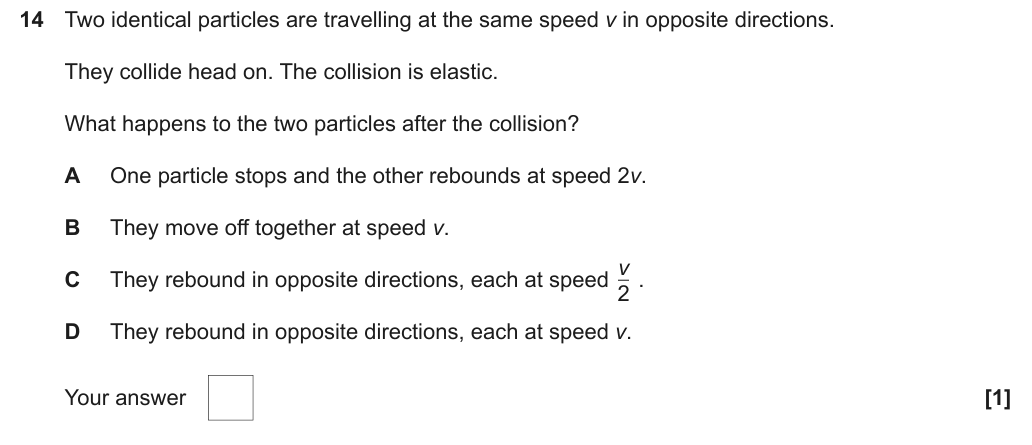
D
The question was answered well. Candidates usually correctly identified that the particles would rebound in opposite directions but the common error was to suggest the speed of the particles would be halved. If this was the case, then the kinetic energy would not be conserved.
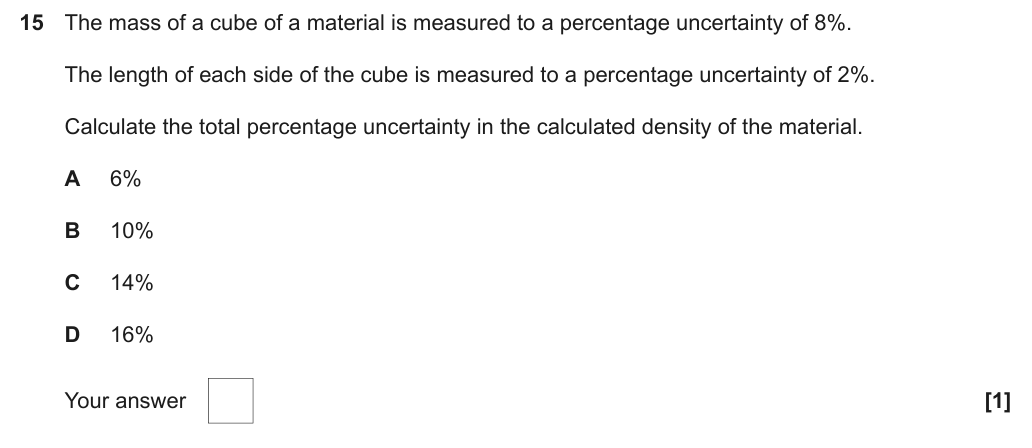
C
High scoring candidates often used the white space for their working. Often it could be seen that candidates considered that the volume of the cube was given by L3 where L is the length of one side. These candidates then wrote 3 2% = 6% before adding the 6% and the 8% to equal 14%. Common incorrect answers were B (omitting the information that the 2% referred to the length and not the volume) or D (multiplying 2% by 8%).
Skills: M1.5 Identify uncertainties in measurements and use simple techniques to determine uncertainty when data are combined
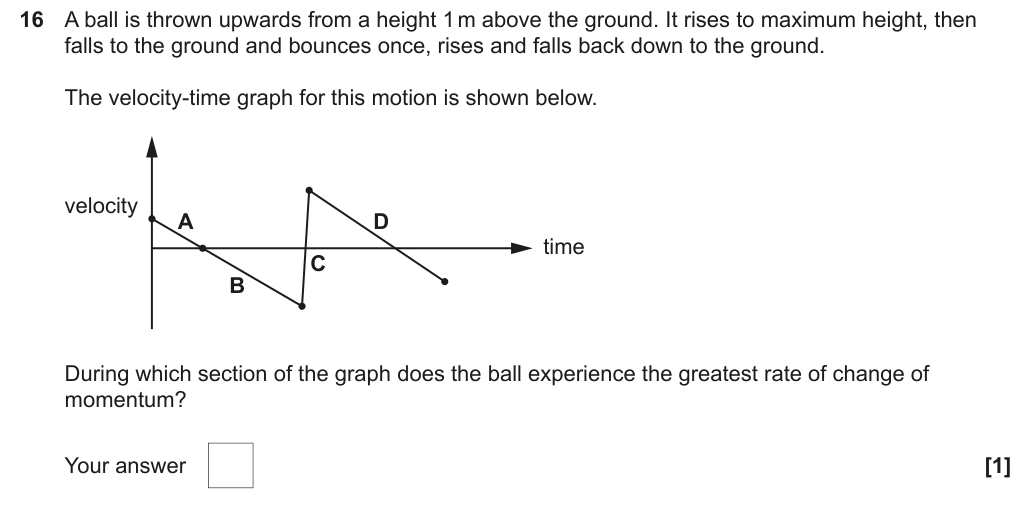
C
When this question was answered incorrectly, it was often either B or D selected.
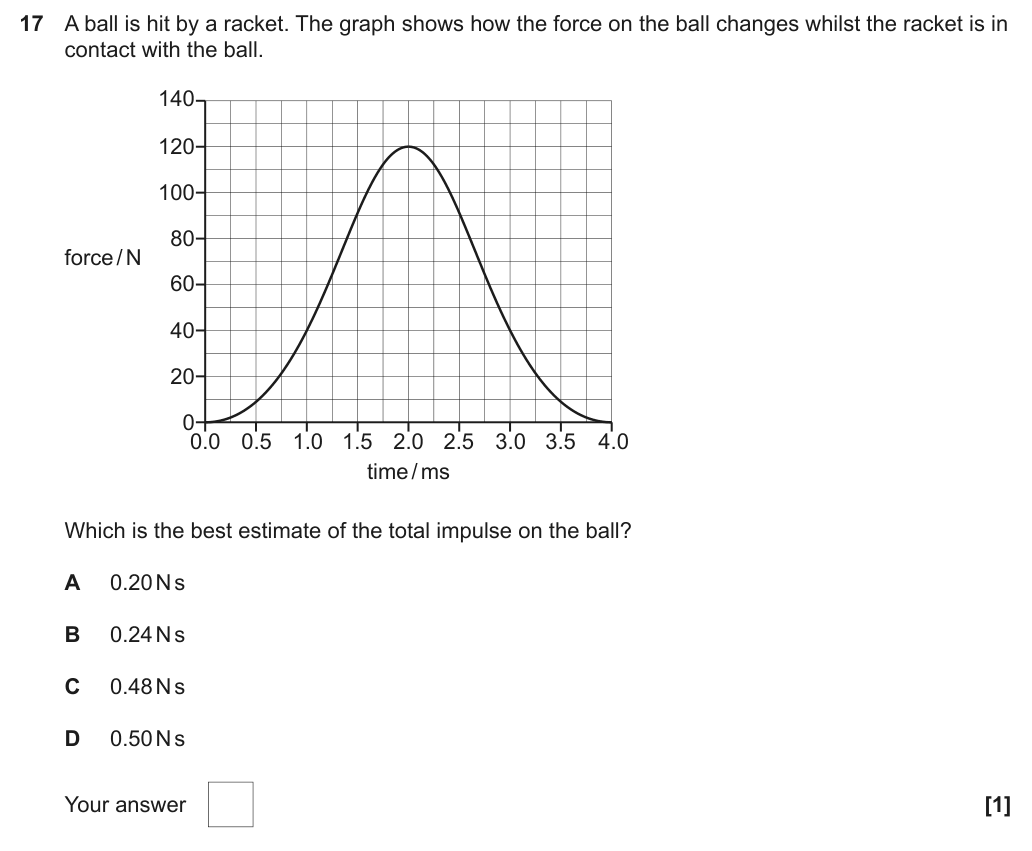
A
Candidates found this question more challenging. Some candidates realised that the total impulse was given from the area under the graph but then did not calculate the area correctly. Some clearly drew a triangle and gained an answer of 0.24 N s without allowing for the area inside the triangle. Other candidates multiplied.
Skills: M0.1 Recognise and make use of appropriate units in calculations; M3.8 Understand the possible physical significance of the area between a curve and the x axis and be able to calculate it or estimate it by graphical methods as appropriate
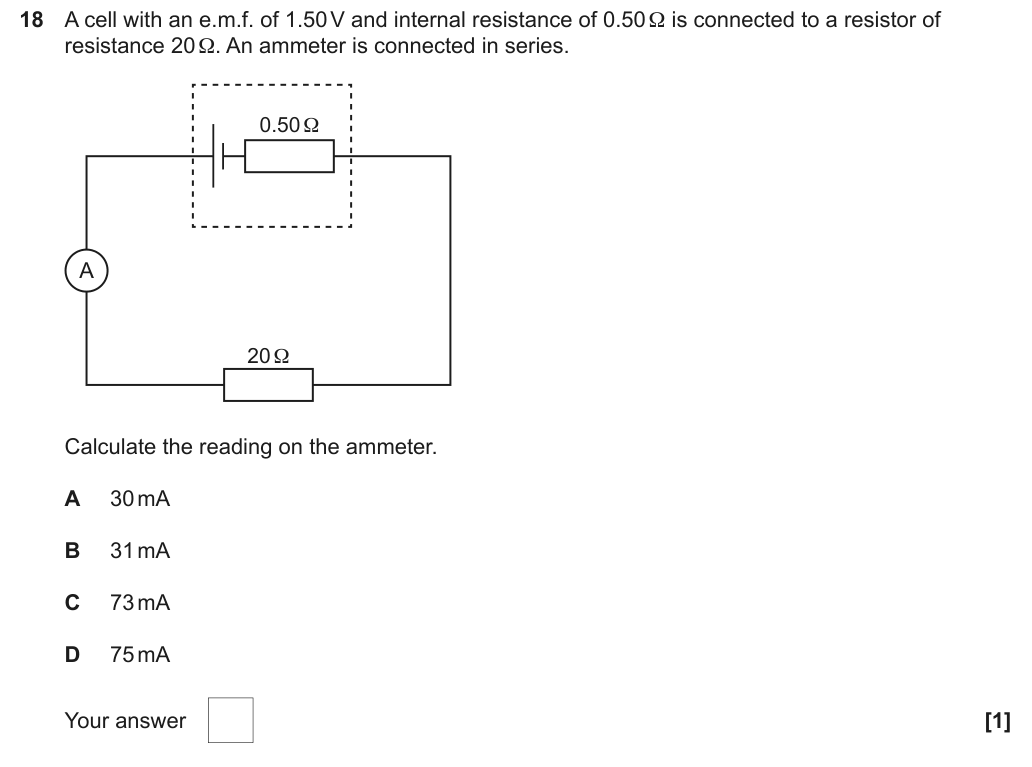
C
A significant minority of lower scoring candidates correctly calculated the total resistance of 20.5 but then incorrectly multiplied by 1.5 to give answer B.
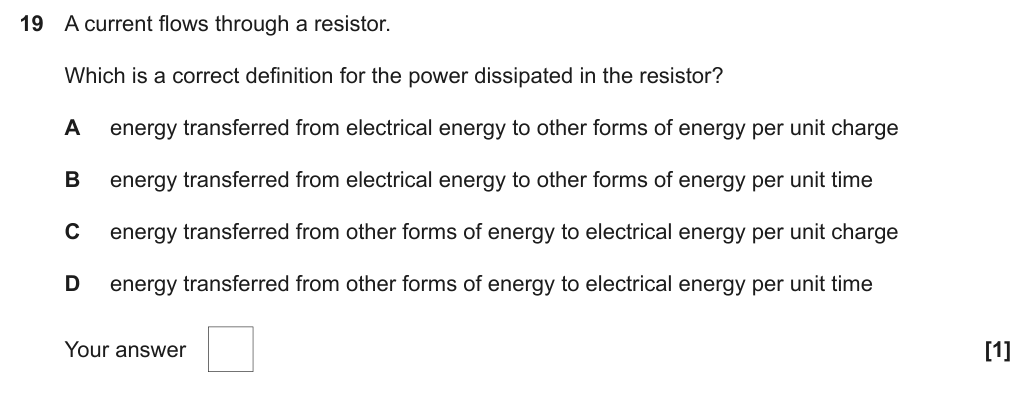
B
This question was assessing candidates’ knowledge of the definition of power. Many candidates confused the definition of power with the definition of potential difference and gave answer A.
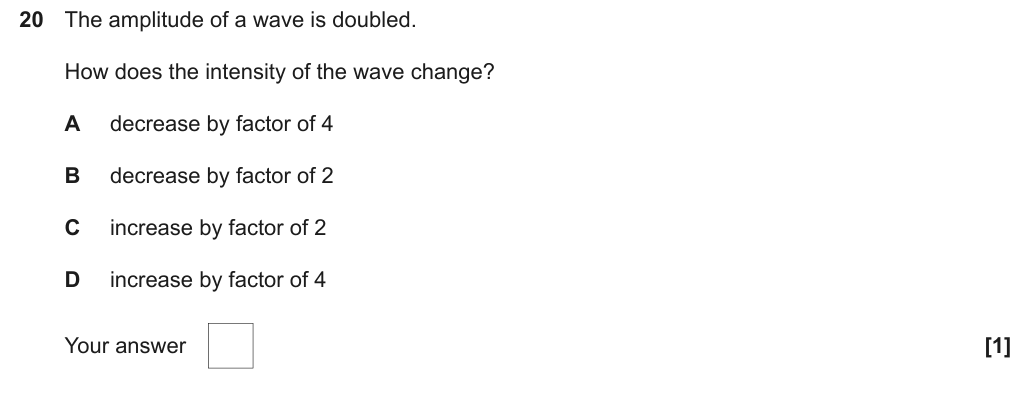
D
This question was generally answered well. The common error was selecting C (not understanding that intensity is proportional to amplitude2) or A (not understanding the direct proportion).
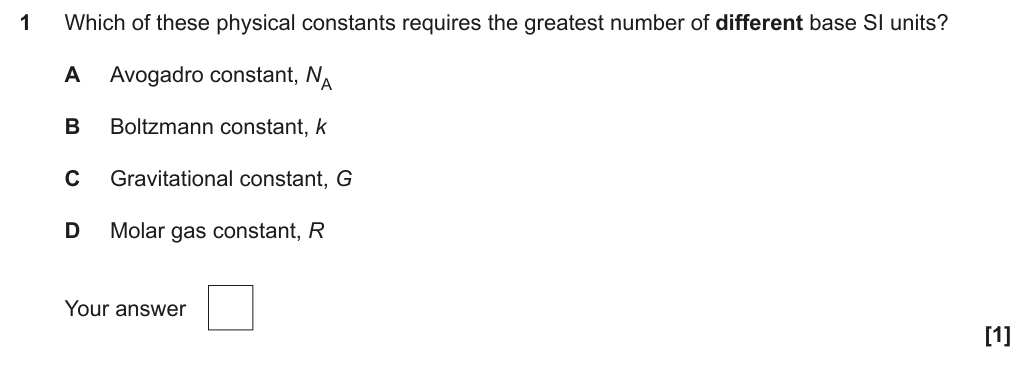
D
Candidates got the right answer often by writing relevant formulas with these constants in them and performing ‘unit algebra’.
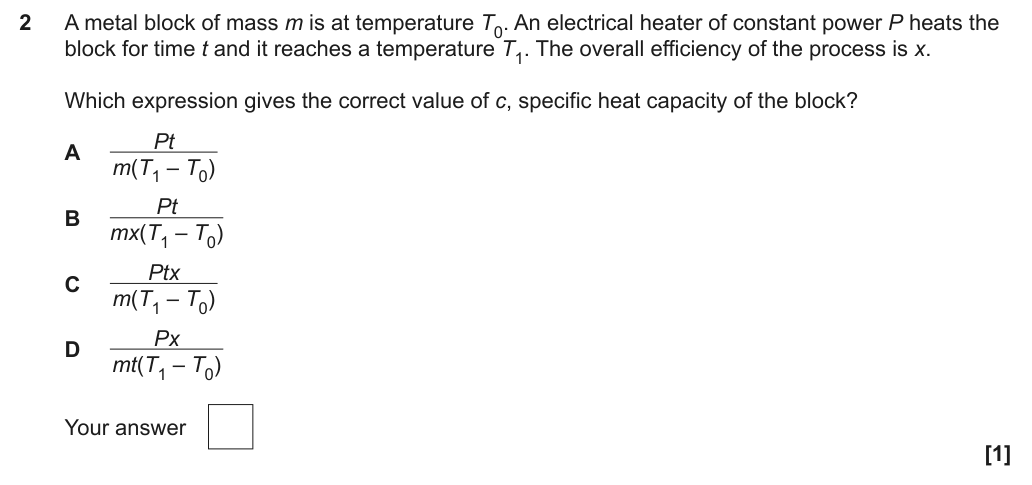
C
This question was answered successfully by the majority of candidates who rearranged and substituted accurately.
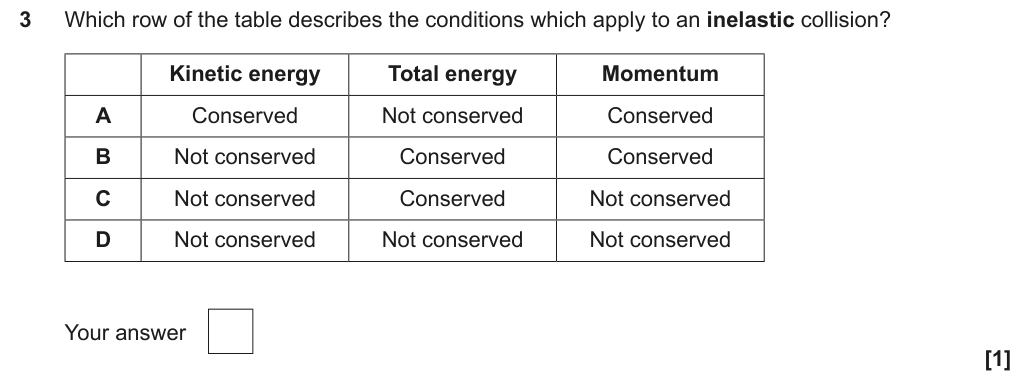
B
Total energy and momentum are always conserved in inelastic collisions (unless there is an external force, which would have been mentioned). This leaves B as the only possible answer.
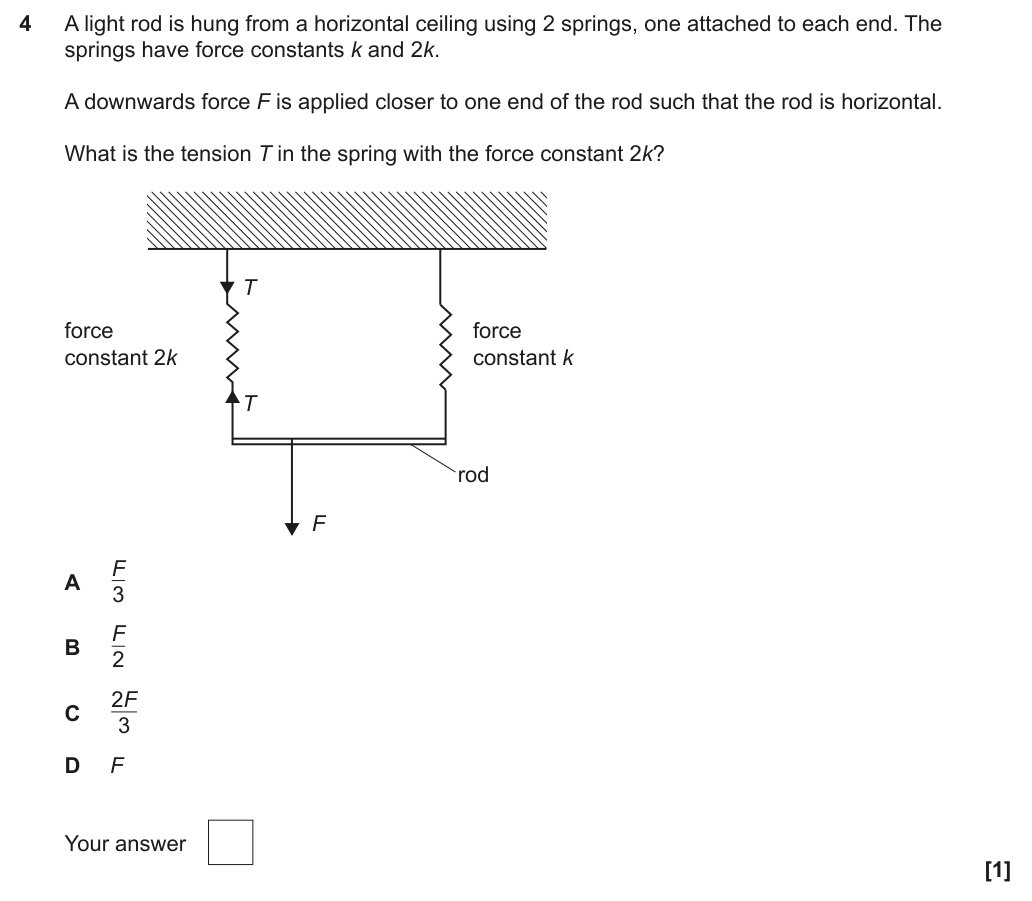
C
The rod ensures that the extension of both springs is the same. This means that the tension in the left spring must be twice the tension in the right spring. This in turn means that F must equal three times the tension of the right spring, since the sum of the two tensions must equal F. Finally, this gives the tension in the right spring as 3 and hence the tension in the left spring must be 2 3.
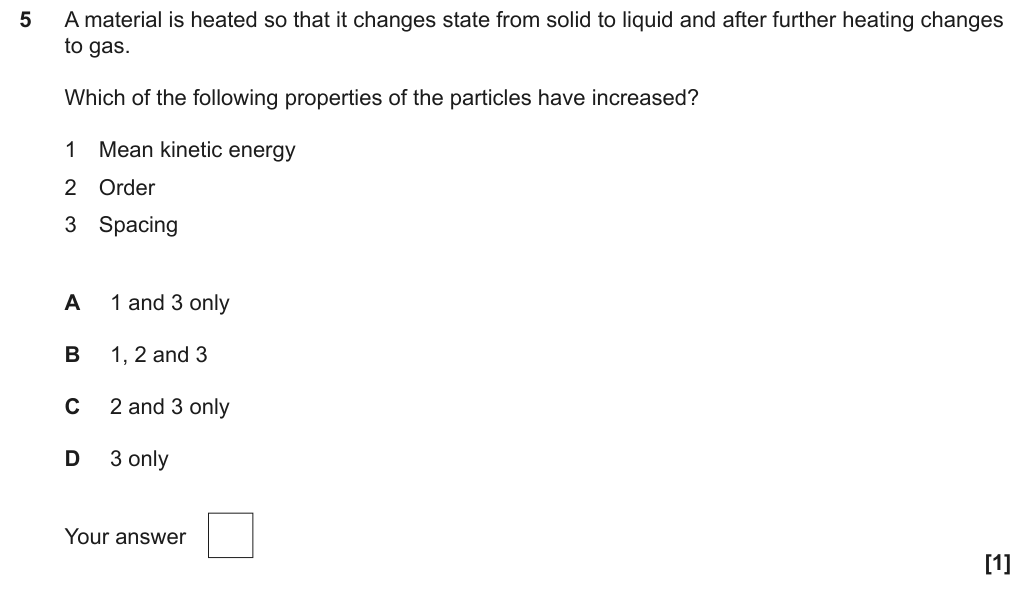
A
The heating process decreases the order, whereas the spacing and mean kinetic energy of the particles increases, giving the correct answer as A.
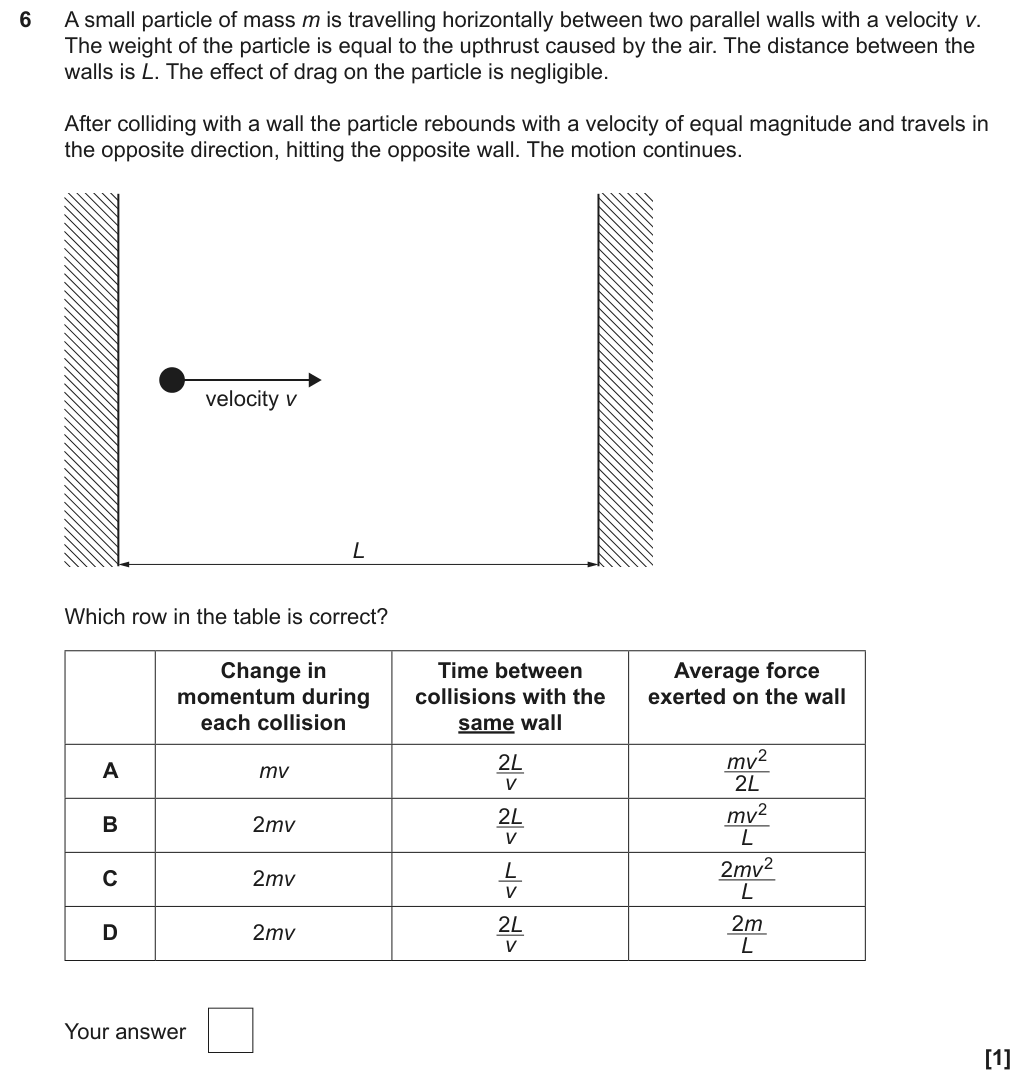
B
This question is the introduction to the derivation of the ideal gas equation. The particle changes direction after the elastic collision with the wall, so that the momentum change is 2𝑚𝑣. If the particle starts having just collided with the left wall, the time taken to return to that wall is the distance divided by the speed i.e. 2 𝑣. Average force exerted on the wall must be the change in momentum ÷ time between collisions so the final column must be calculated accordingly. The only row that satisfies this and the two previous conditions is answer B.
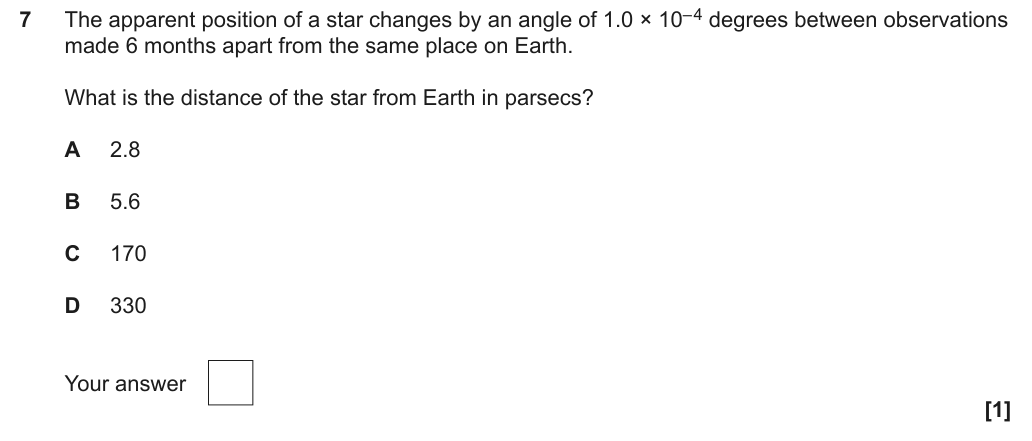
B
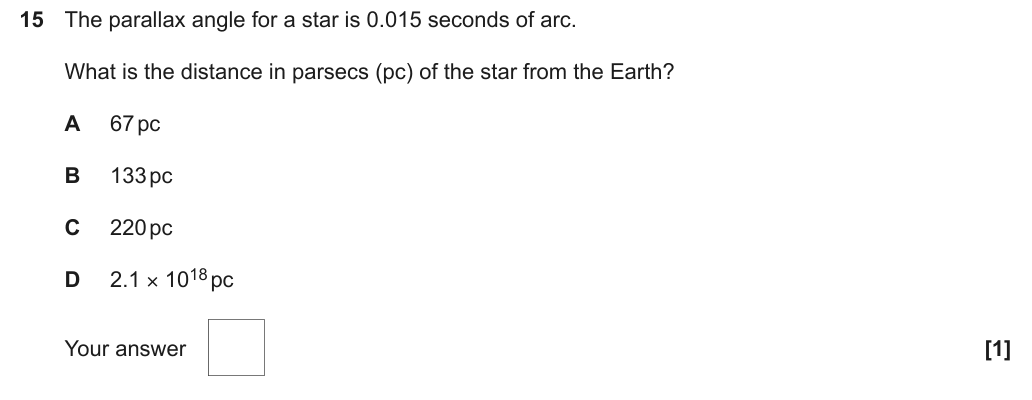
The data in the question gives a parallax angle of 0.5 × 10⁻⁴ degrees. This equates to 0.18 arcseconds. Parallax angle and distance in parsecs are inversely proportional, with 1 arcsecond giving a distance of 1 parsec. 0.18 arcseconds gives a distance of (1 ÷ 0.18) = 5.6 parsecs.
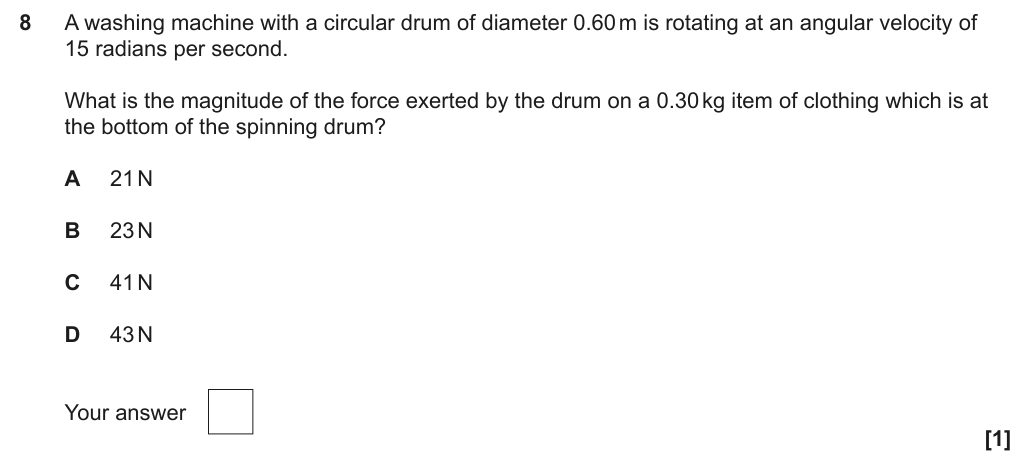
B
The data in the first sentence gives the centripetal force required to make the clothing perform circular motion i.e. 𝑚𝜔2𝑟= 20.25 N, which caused candidates to pick answer A. Those that used a radius of 0.60 m would get answer C at this point. Although, at the bottom of the drum, the centripetal force is given by the contact force from the drum – the weight of the clothing. To find the contact force, we must add the weight of the clothing (2.94 N) to the centripetal force, giving 23.2 N, i.e. answer B is correct. Those that used a radius of 0.60 m would get answer D.
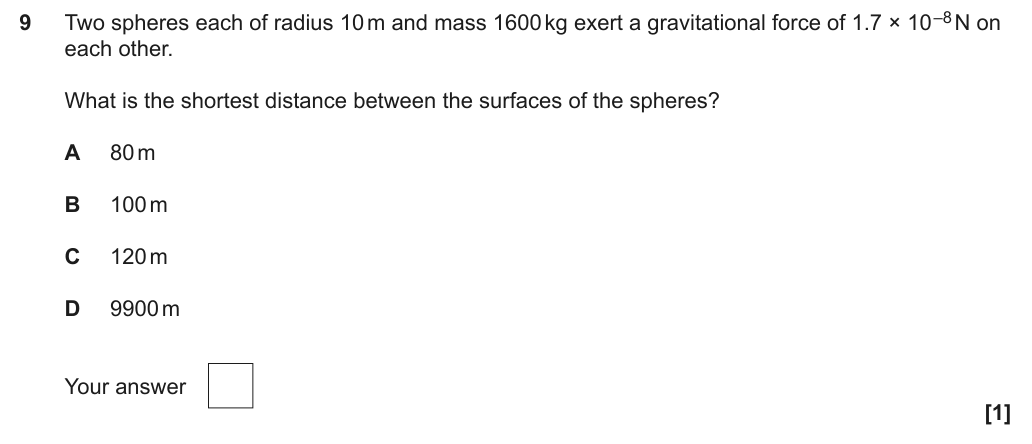
A
The key here is to use the formula for gravitational force (𝐹 = 𝑟2 ) to find the distance between the centres of the spheres. This gives 100.2 m. The question asks for the distance between the surfaces of the two spheres, which is 20 m less than the distance between their centres. Hence A is the correct answer.
C
Many students remembered that the mass of the core is the crucial factor in determining whether a super red giant evolves into a black hole.
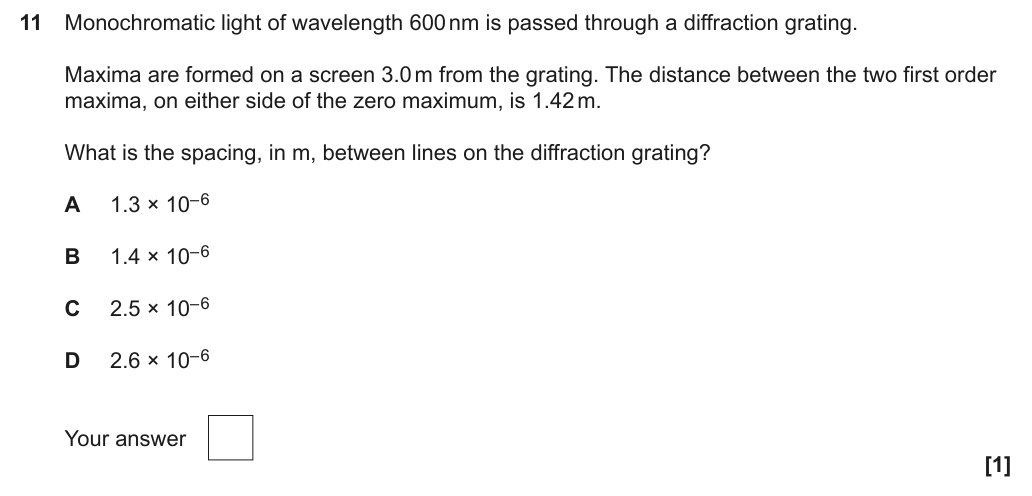
D
Candidates often confused which formula to use. Some used the two-slit formula and others, correctly, used the diffraction grating formula. Here using 𝑑𝑠𝑖𝑛𝑞 = 𝑛𝑙 is the correct approach. The question gives the distance between the two first- order maxima. This means that the distance from the centre to the first-order maximum is half of that i.e. 0.71 m. Consequently, the angle q is tan-1(0.71 ÷ 3.0) = 13.3.... degrees. Substituting in the wavelength (600 ×10-9 m) and n=1 gives d as 2.61 × 10⁻⁶ m. Therefore the answer is D.
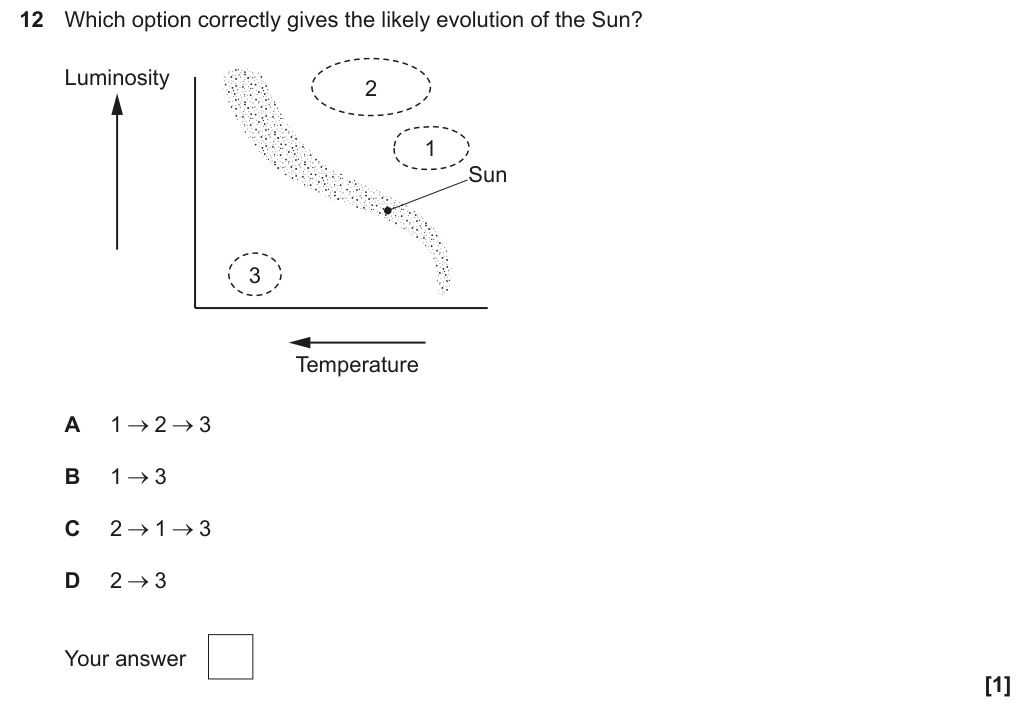
B
Most candidates remembered that the correct sequence for the Sun is main sequence, red giant, white dwarf (i.e. answer B). Any answer that includes red super giant cannot be correct.
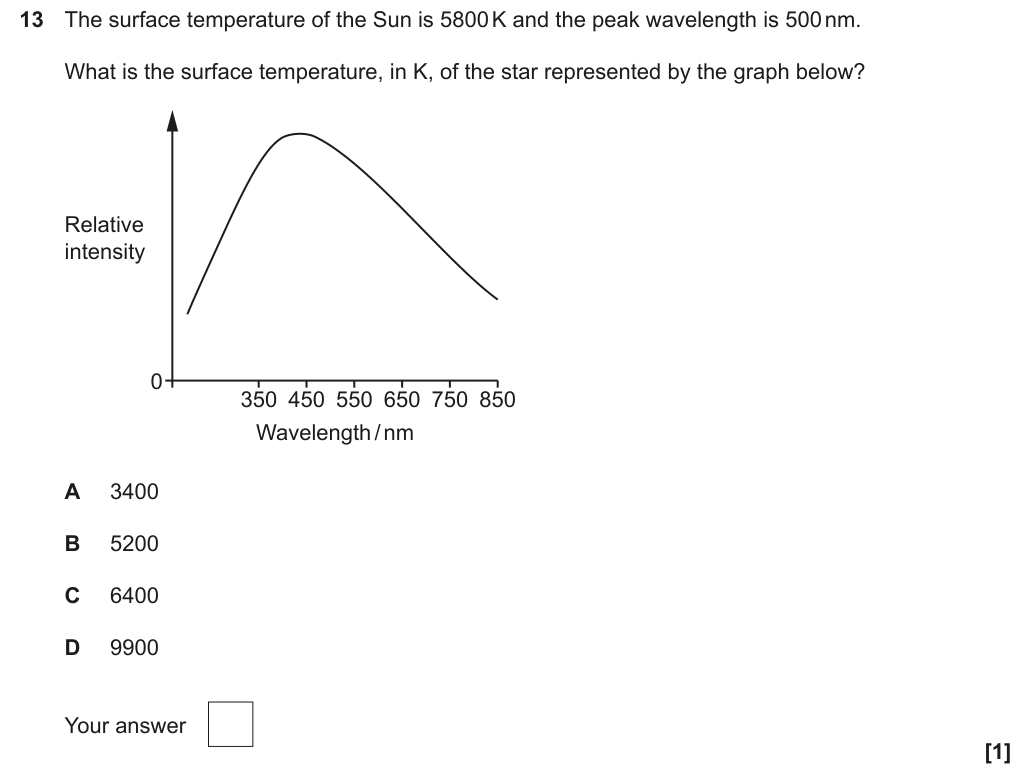
C
This question tests knowledge of Wien’s Law, 𝑙𝑚𝑎𝑥𝑇= constant. Using the given data for the Sun, the constant here is 2.9 × 10⁶ nm K. The wavelength of maximum intensity on the graph is roughly 450 nm so the temperature = 2.9 × 10⁶ ÷ 450 = 6444 K, giving the correct answer as C.
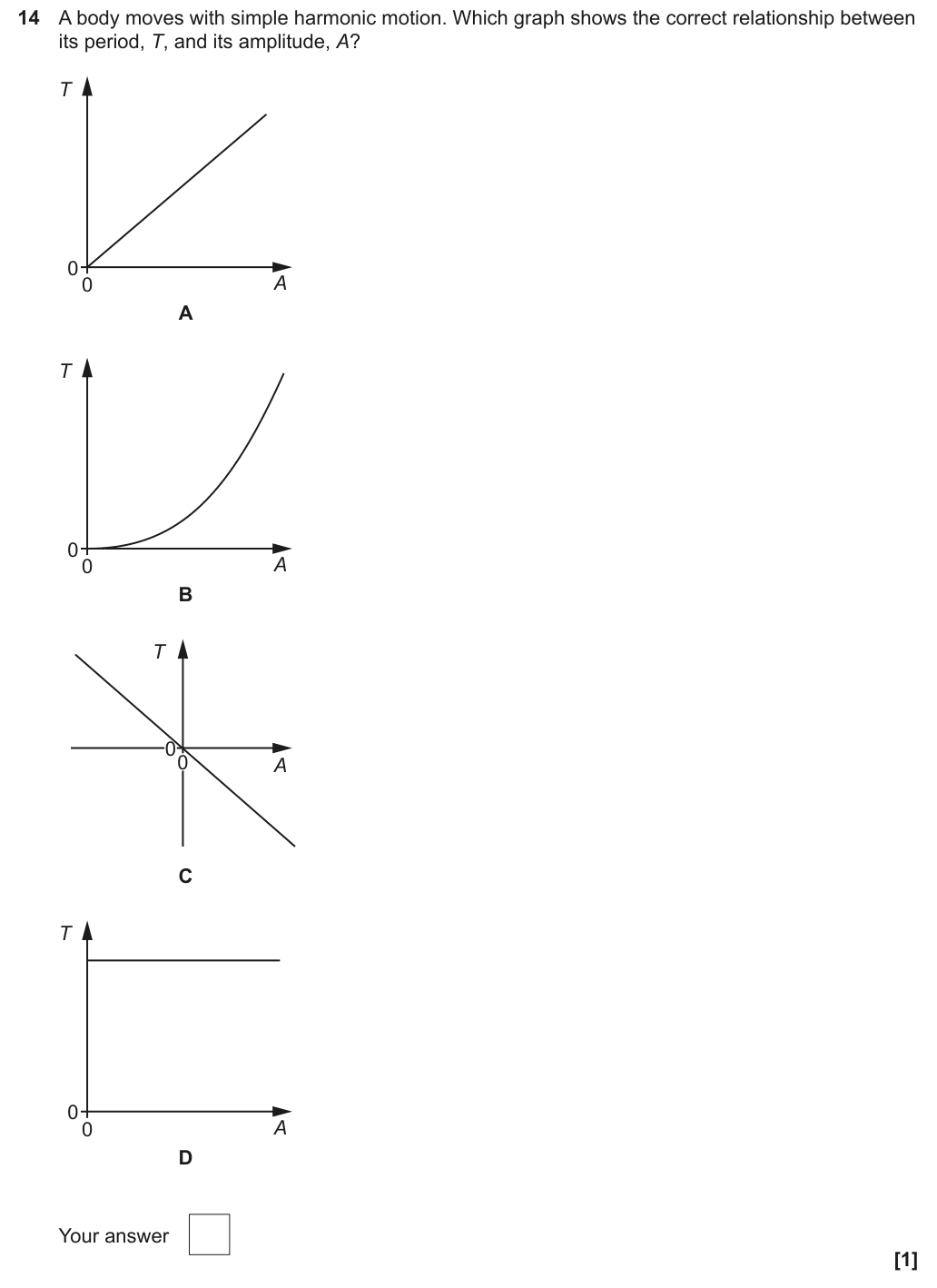
D
Any object performing simple harmonic motion is isochronous, which means that the period is independent of the amplitude of motion. The only graph that shows this is graph D.
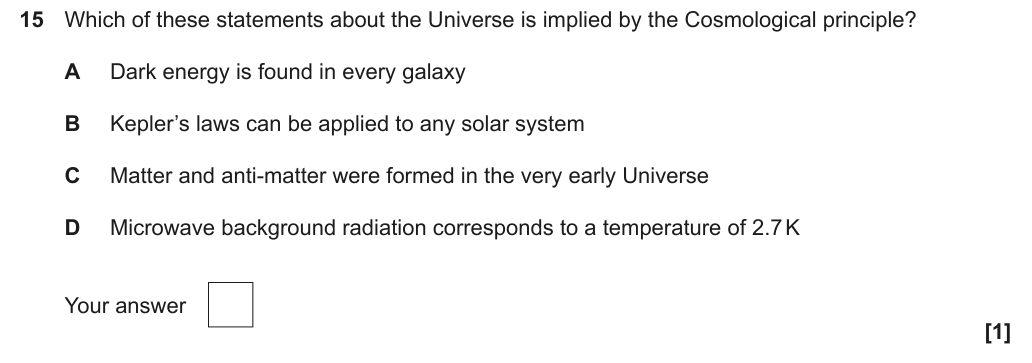
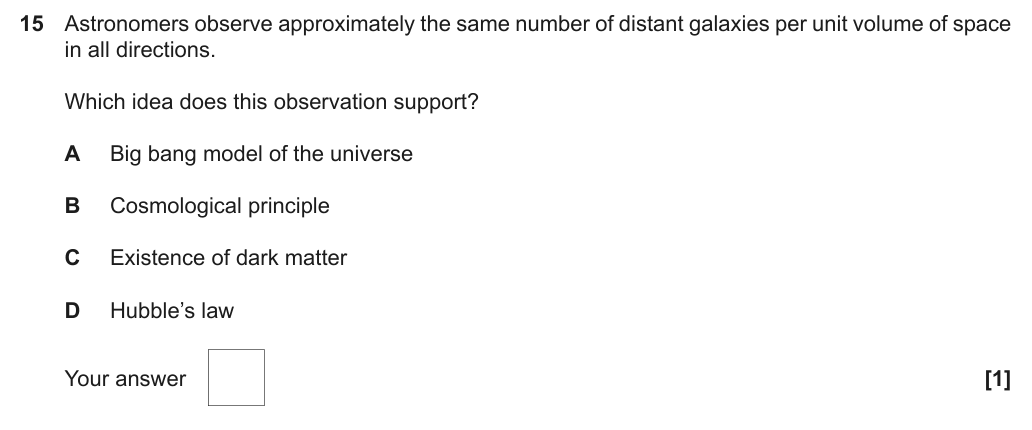
B
The Cosmological principle is that on a large scale, the universe is homogeneous (the same everywhere) and isotropic (the same in all directions). Answers A, C and D are not implied by this, although they may be true statements. Answer B is correct here.
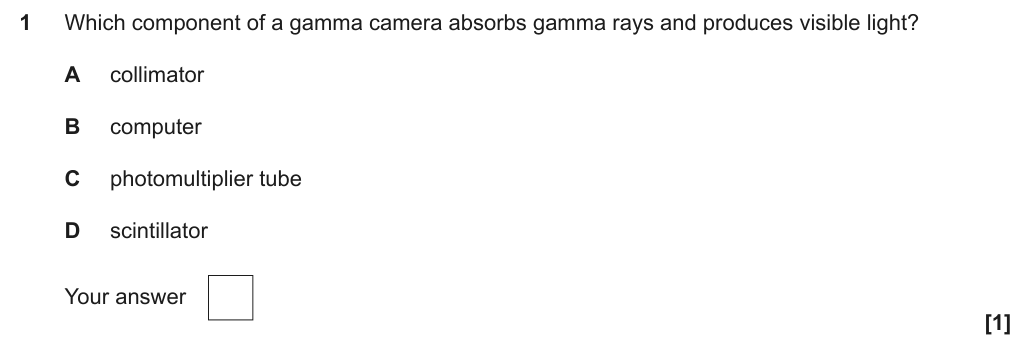
D
The majority of candidates were able to correctly recall the correct component. A proved a common distractor.
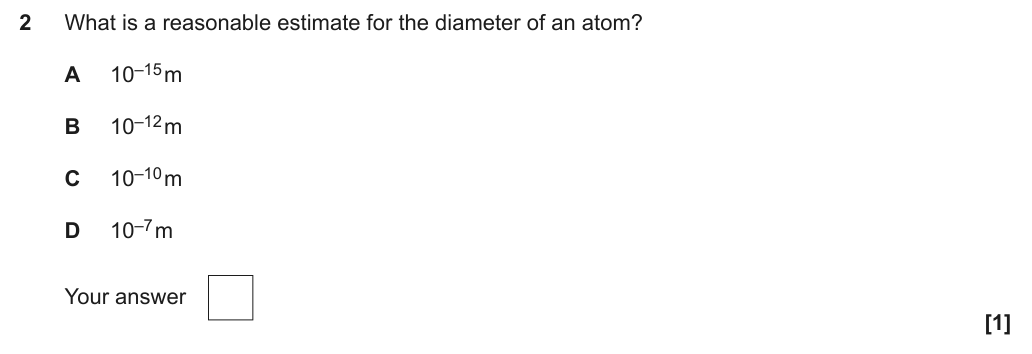
C
Only a few candidates were able to correctly identify the estimate for the diameter. Section 2.1.1 (b) of the specification requires candidates to be able to make estimates of physical quantities. B was the most common incorrect answer.
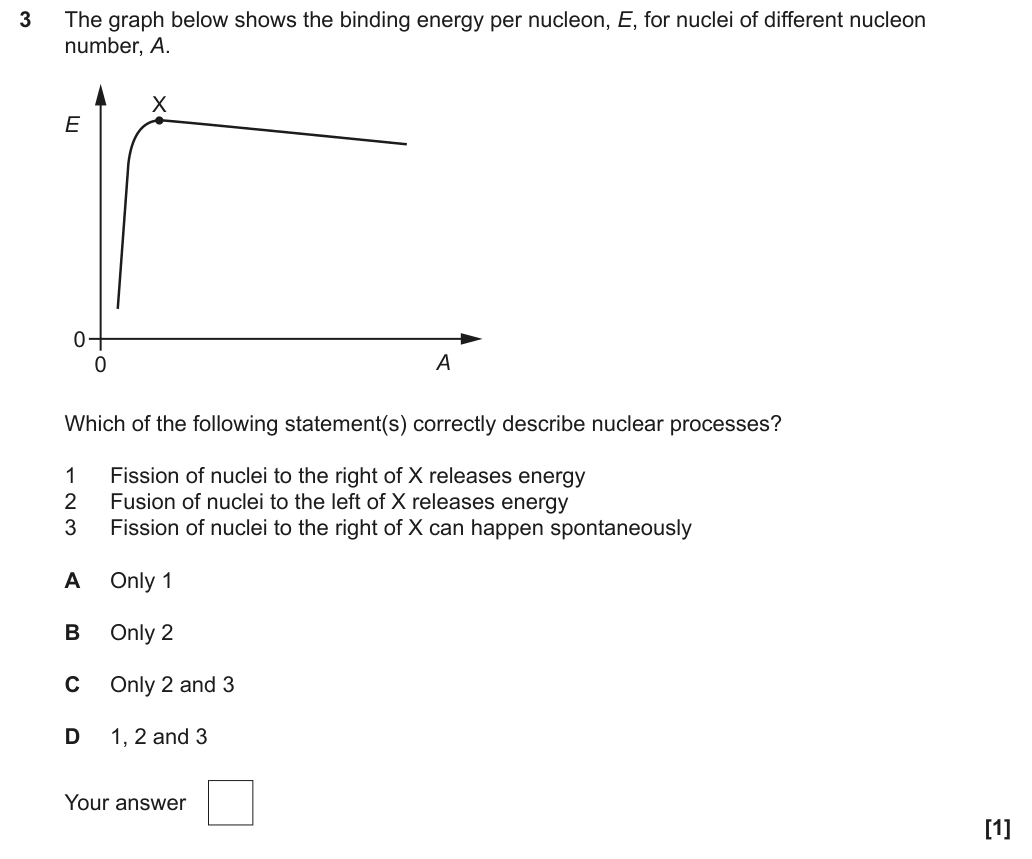
D
Most candidates were able to select the correct combination. Working by candidates often indicated that they knew that 1 and 2 were correct and so the only correct combination would be response D.
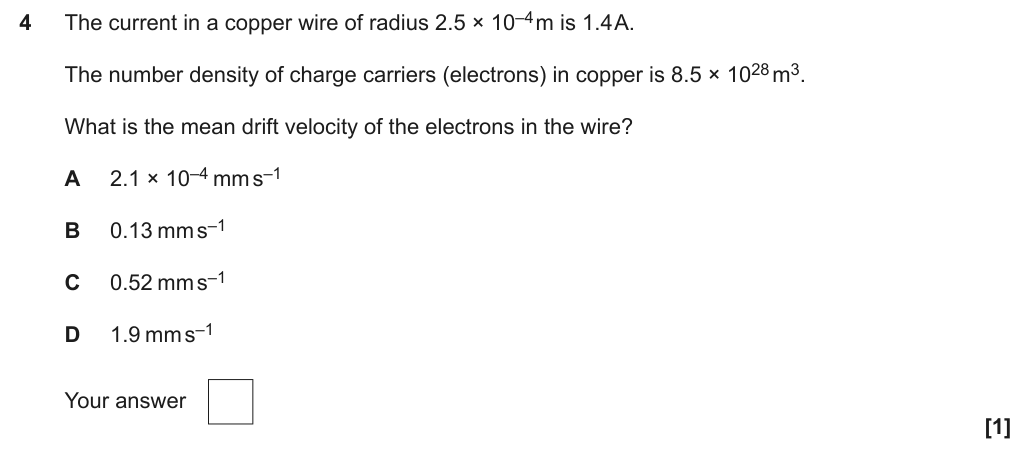
C
This relatively straightforward calculation, with no difficult unit conversions, was correctly answered by many candidates. The calculation does involve calculating the cross-sectional area, and many candidates showed this in working at the side, to support their calculation.
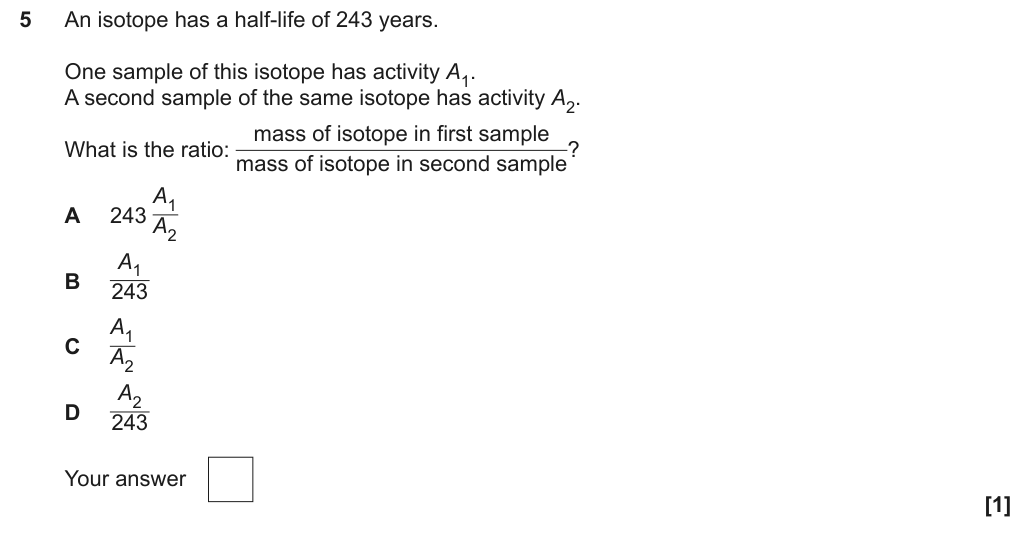
C
Most candidates were able to correctly identify the ratio. Many candidates worked the answer from first principles, clearly showing that the factor 243 would cancel in their calculation.
Skills: M0.3 Use ratios, fractions and percentages
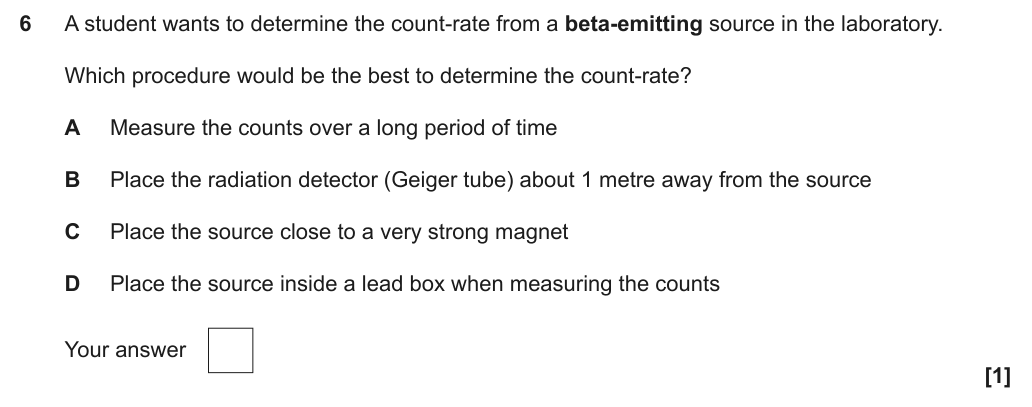
A
Correctly identifying the best procedure proved challenging for candidates. Many incorrect responses were given as B.
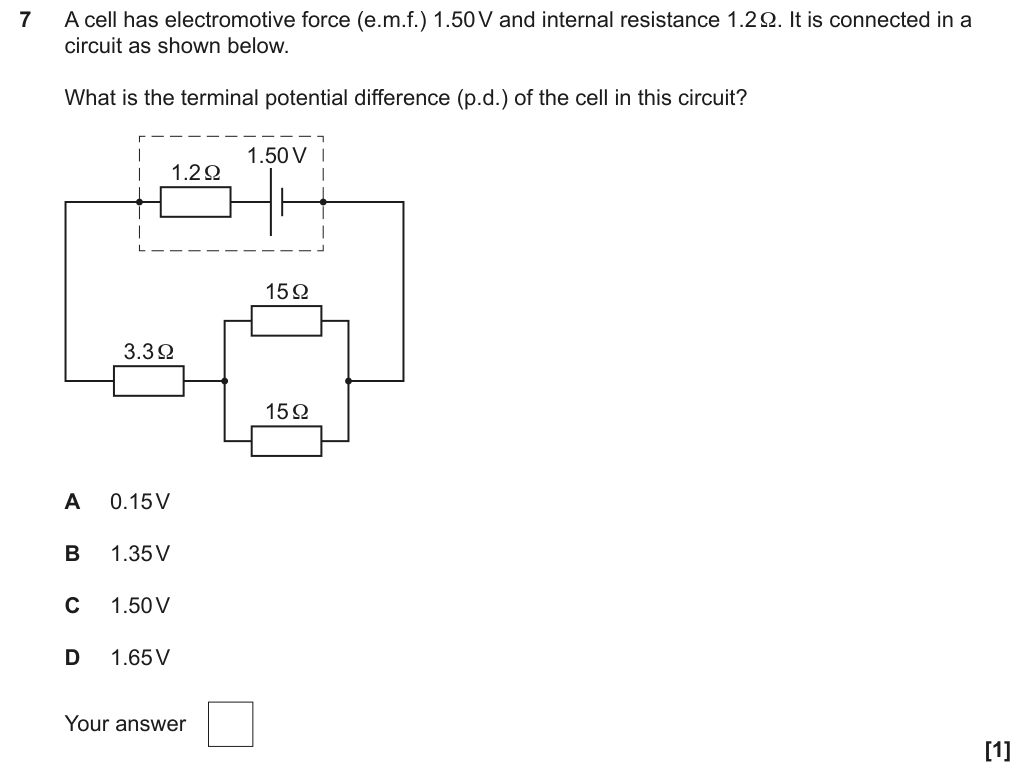
B
Most candidates were able to correctly identify the terminal p.d. Notably, many answers which did not show the correct response showed no, or little relevant, working.. Some candidates chose D, possibly showing an issue understanding of the relationship between e.m.f. and terminal p.d..
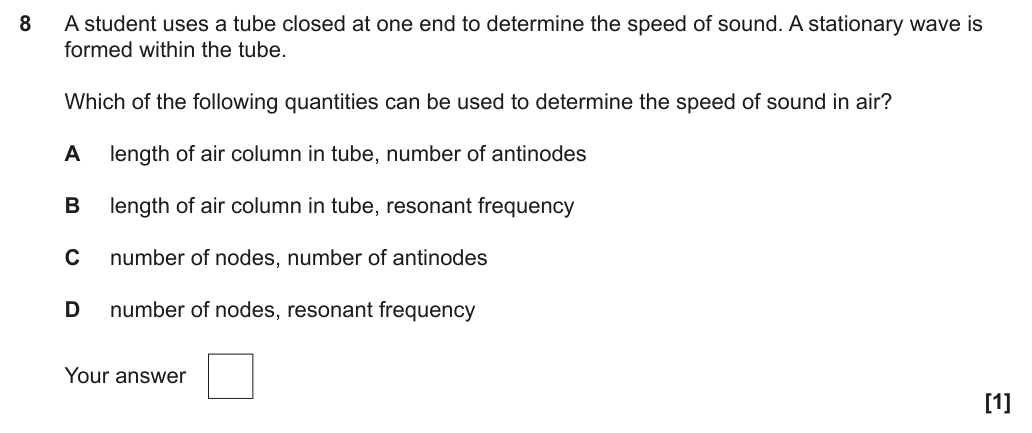
B
Most candidates gave the correct response. Many candidates drew helpful diagrams of a standing wave in a tube to help them identify relevant quantities.
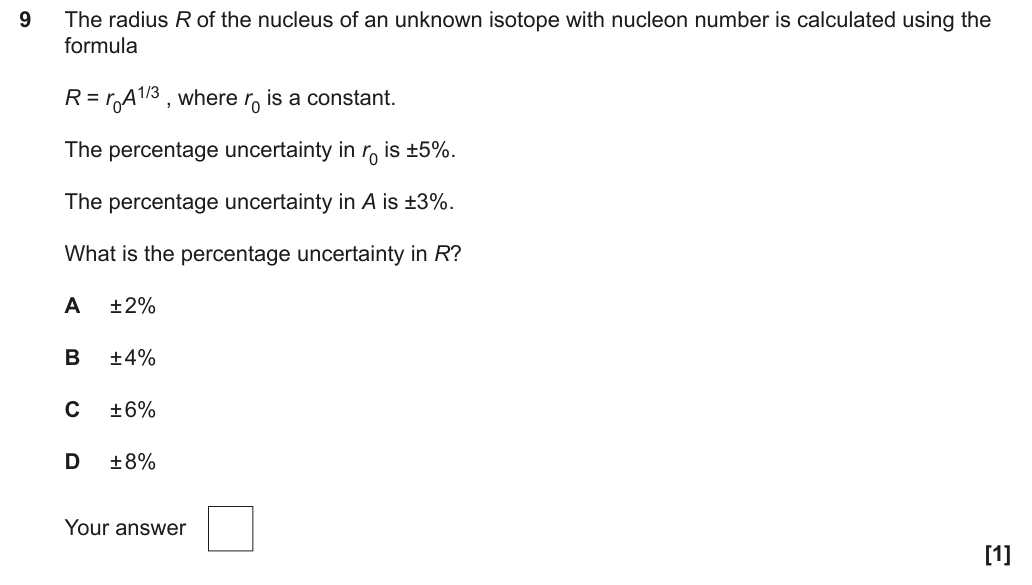
C
Most candidates were able to calculate the correct percentage uncertainty even though uncertainty questions can be challenging. Response D was the most common incorrect response.
Skills: M1.5 Identify uncertainties in measurements and use simple techniques to determine uncertainty when data are combined
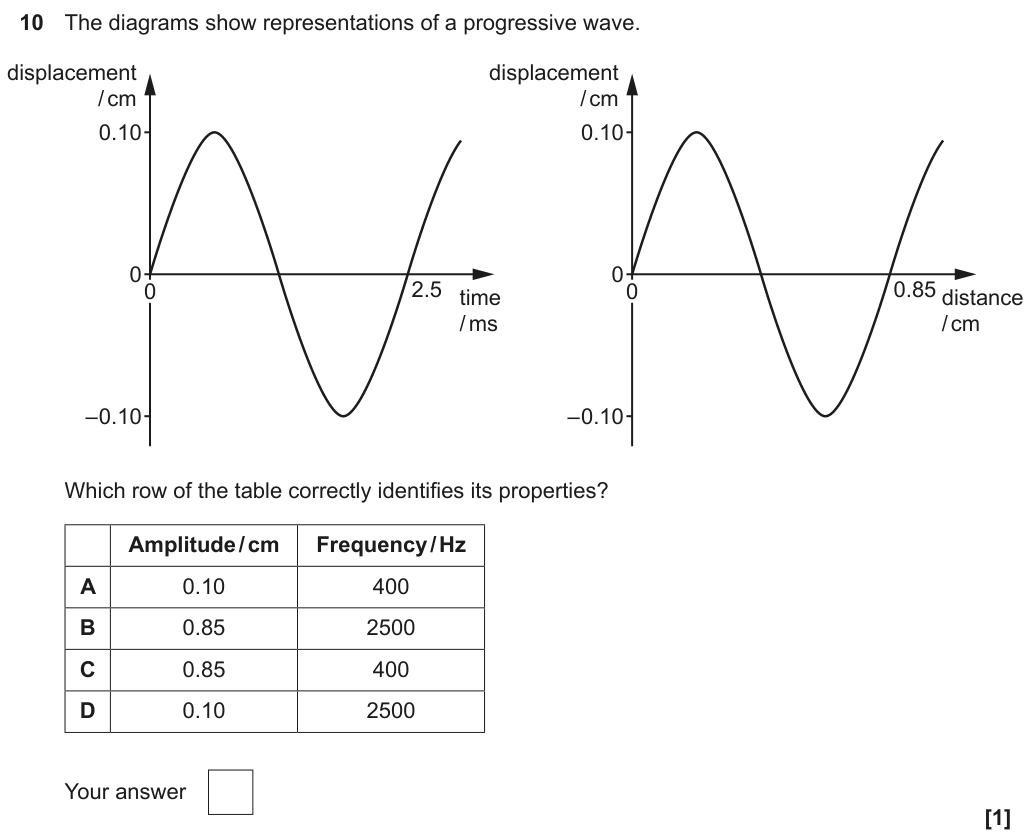
A
This relatively straightforward property of wave question was accessible to most candidates, with almost all candidates obtaining the correct answer. Candidates quite often cross incorrect responses and many put a cross against response B and C, as the correct amplitude was relatively simple to identify.
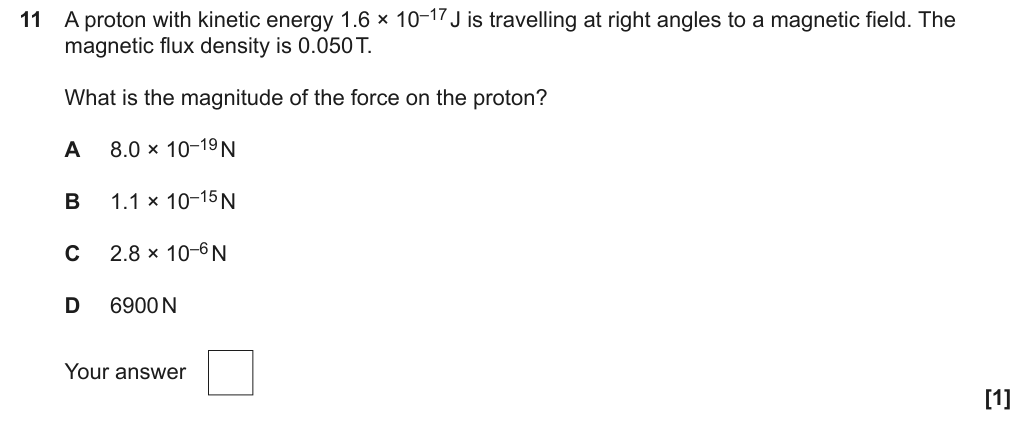
B
Many candidates were able to correctly complete this two-stage calculation. Most candidates showed clear working although several attempted to use a centripetal force equation. Many of the candidates who did not select the correct response did set up the equations correctly but seemed unable to recall the charge on the proton.
Skills: M0.2 Recognise and use expressions in decimal and standard form; M2.2 Change the subject of an equation, including non-linear equations; M2.3 Substitute numerical values into algebraic equations using appropriate units for physical quantities
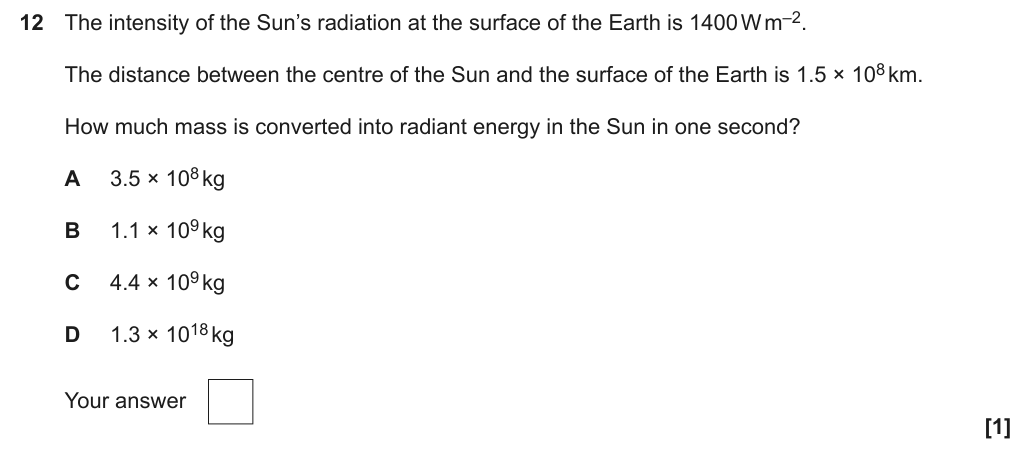
C
A little under half of candidates were able to correctly calculate the mass. While many were able to appreciate that 𝐼 = 𝐴 should be used, it was common not to be able to correctly calculate the area. A was the most popular incorrect response.
Skills: M0.1 Recognise and make use of appropriate units in calculations; M0.2 Recognise and use expressions in decimal and standard form; M4.3 Calculate areas of triangles, circumferences and areas of circles, surface areas and volumes of rectangular blocks, cylinders and spheres
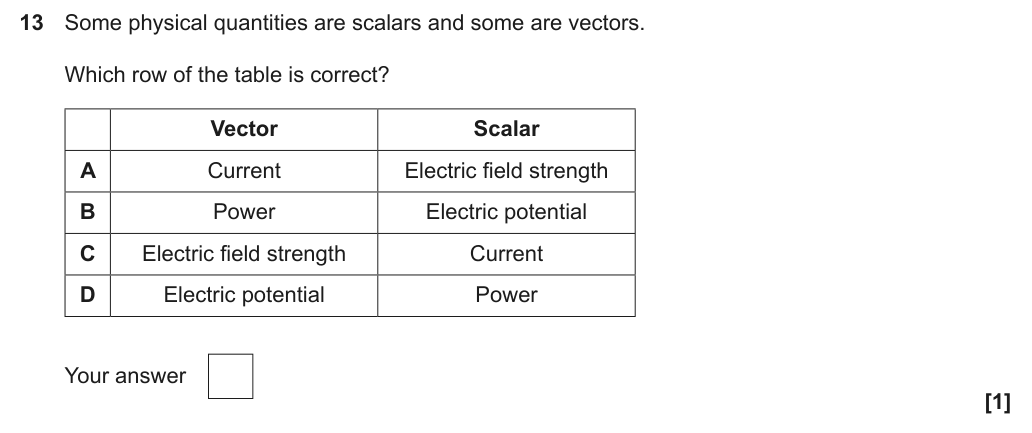
C
This was a challenging question. As is common in this style of question, candidates tick and cross those they know to be correct (or incorrect) but the inclusion of potential and field strength clearly made this more challenging. D was by far the most common incorrect response as candidates seemed to know that power was a scalar.
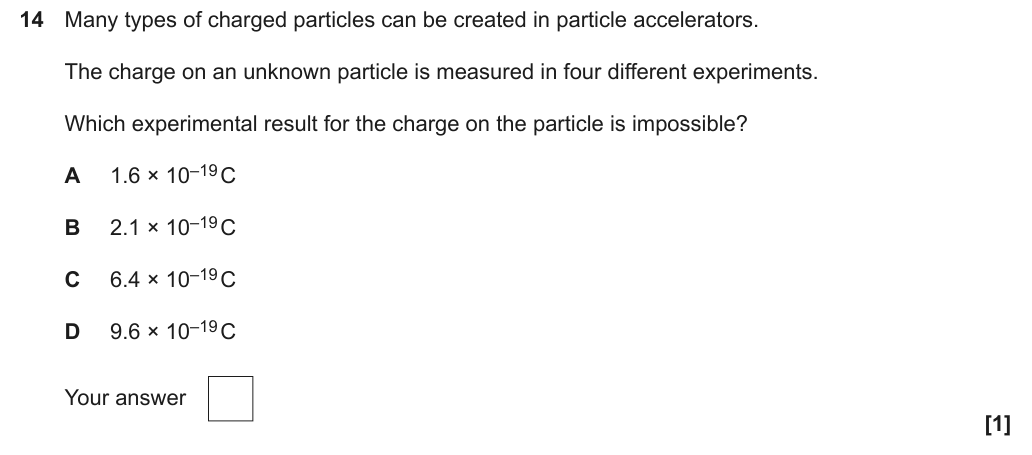
B
Most candidates appreciated that the change should be a multiple of the elementary charge and many were able to calculate the correct response. D was the most common incorrect response.
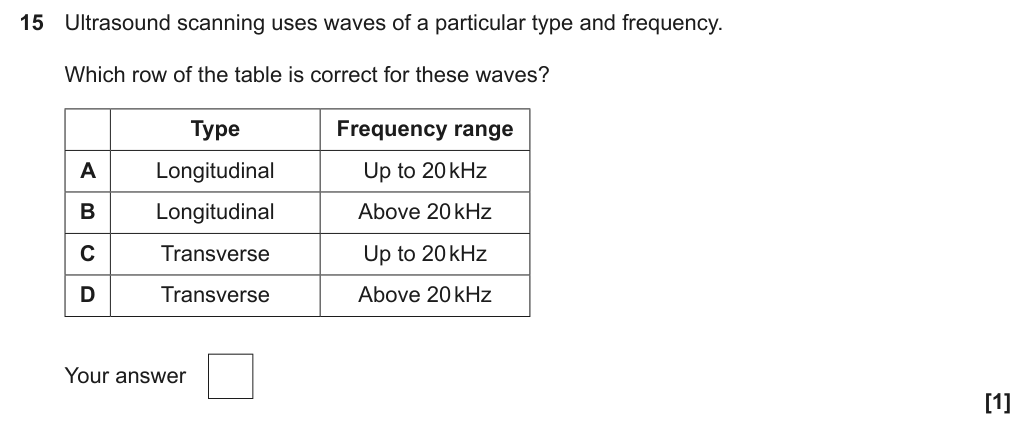
B
Many candidates were able to correctly identify the pair. The most common incorrect response was D which suggested that there is uncertainty between which type of wave ultrasound is.
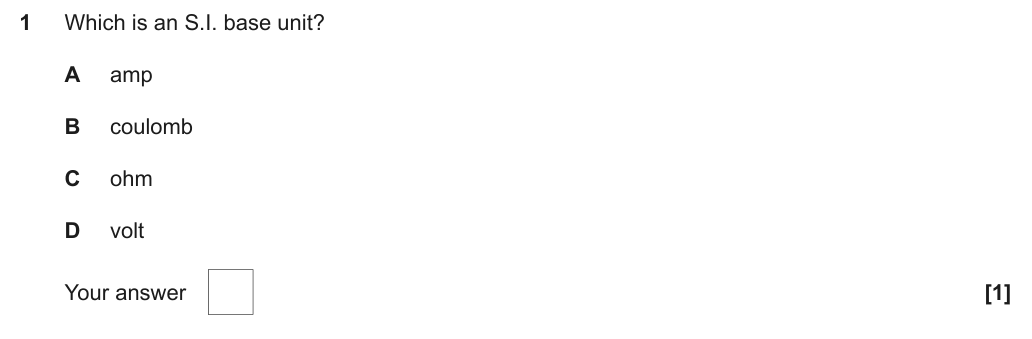
A
This should have been a straightforward starting question for all the candidates in identifying the correct S.I. base unit but only some gave the correct response of A. The most common distractor was B.
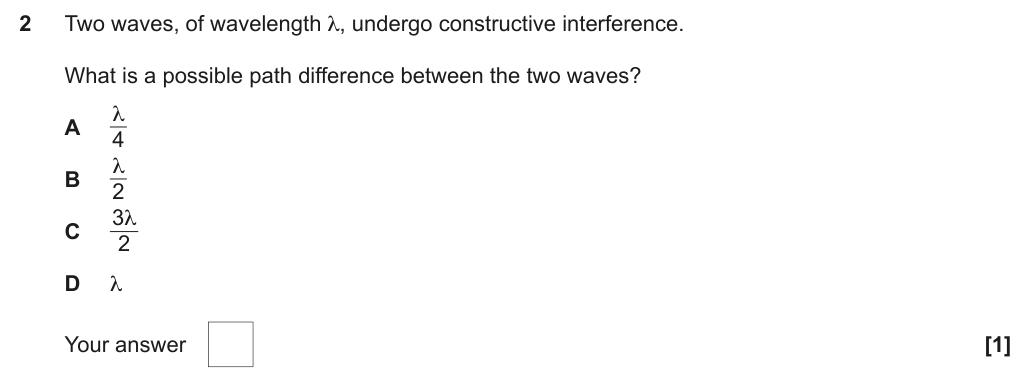
D
Overall, candidates performed well on this question as they correctly identified that the path difference for constructive interference is λ to give answer D. The most common distractor was B as some candidates confused the path difference for constructive interference with destructive interference.
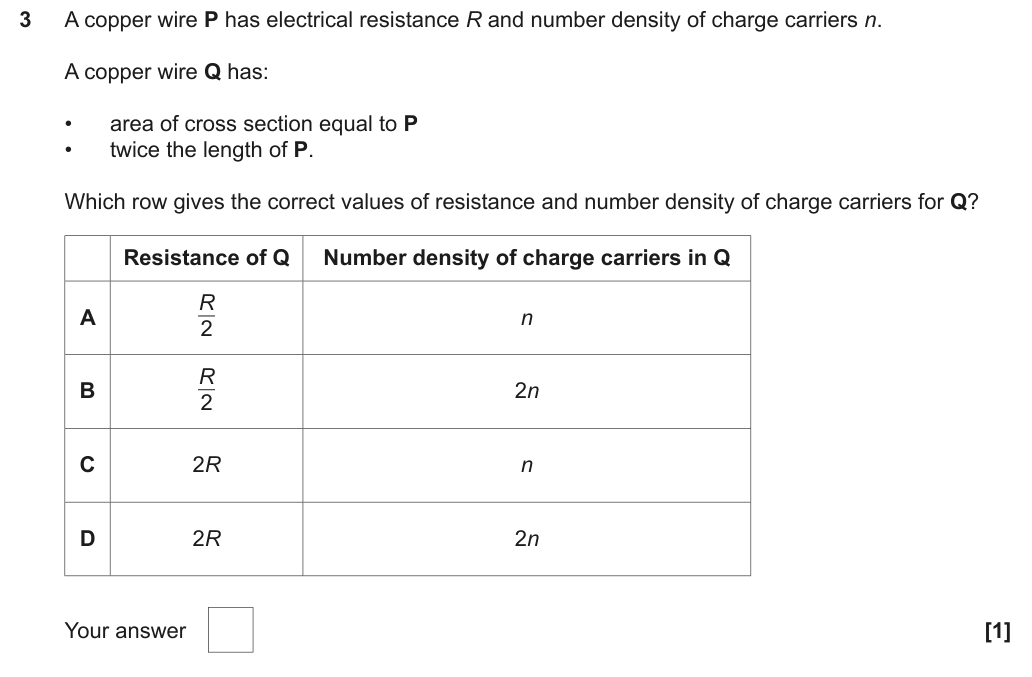
C
Overall, candidates performed well. They correctly determined that because the copper wire, Q, has an equal cross-sectional area to copper wire, P, that n (the number density of charge carriers) is the same for both wires. Most candidates determined that the resistance of Q would double in size due to the length of wire Q being twice as long, hence why the most common distractor was D.
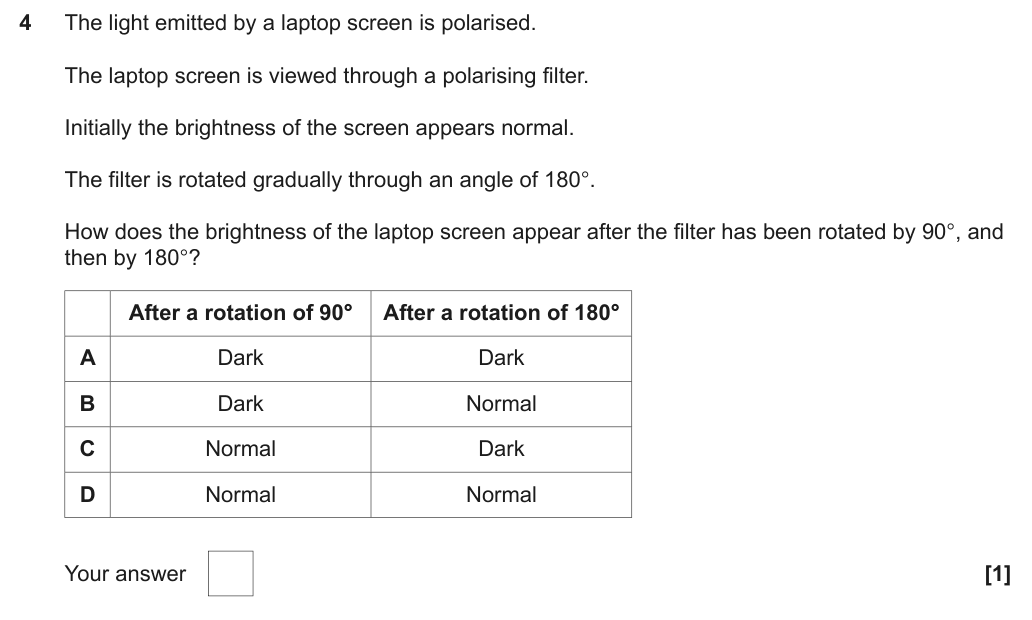
B
This question was answered well as candidates were able to apply knowledge and understanding of electromagnetic waves passing through a polarising filter to give the correct answer B.
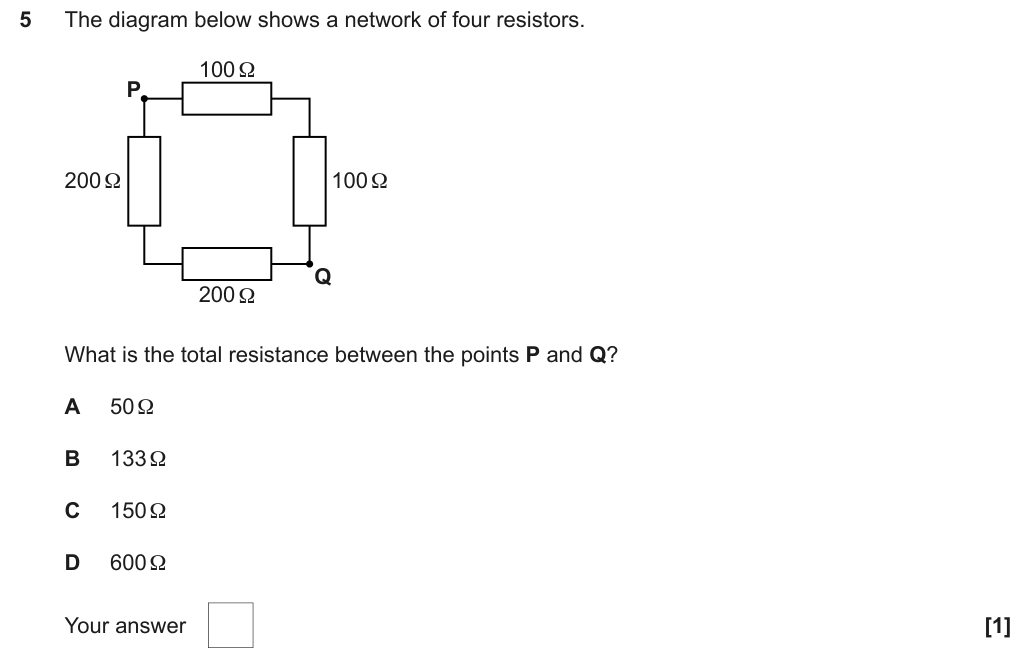
B
Overall, candidates performed well on this question as many correctly applied their understanding of resistance in series and parallel to give a total resistance between P and Q as 133 Ω. The most common distractor was D, where candidates incorrectly calculated the total resistance as the sum of each individual resistance as they did not apply understanding that each pair of resistors where in a parallel arrangement around points P and Q.
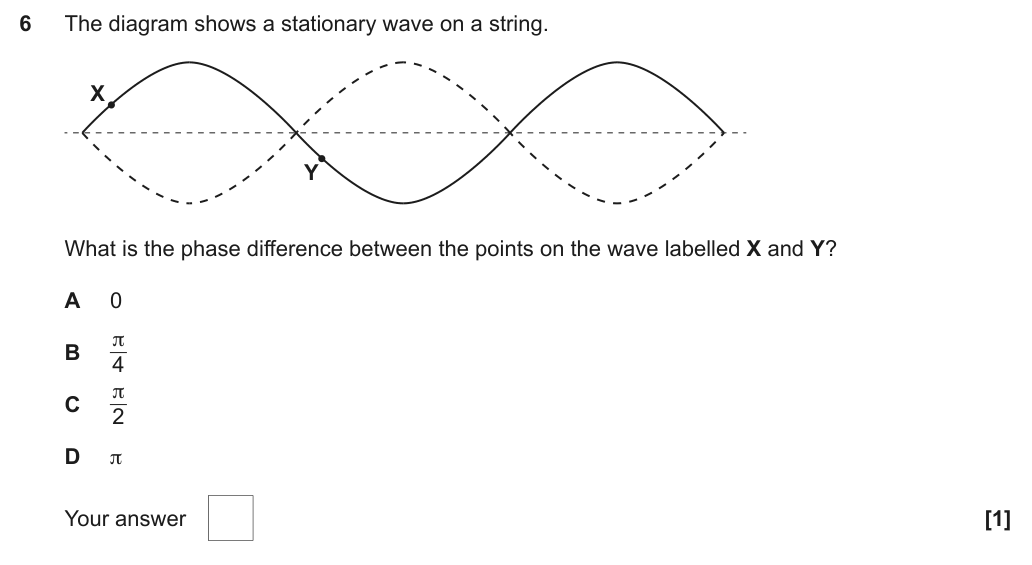
D
Many candidates correctly determined the correct phase difference as π between points X and Y as they interpretated that the fraction of the wave between points X and Y was the equivalent to λ/2. The most common distractor was C.
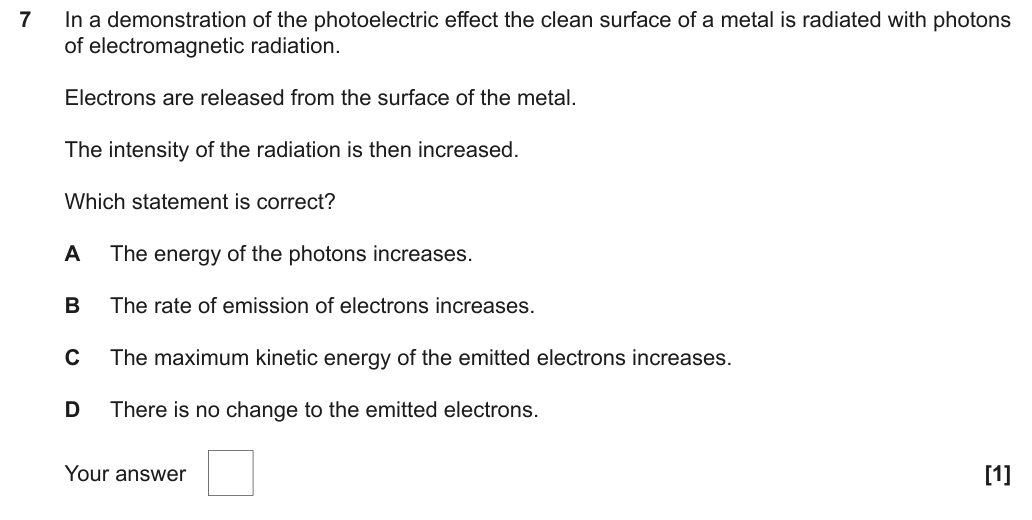
B
Candidates performed well on this question with many correctly relating an increase in intensity of radiation to an increase in the rate of emission of electrons.
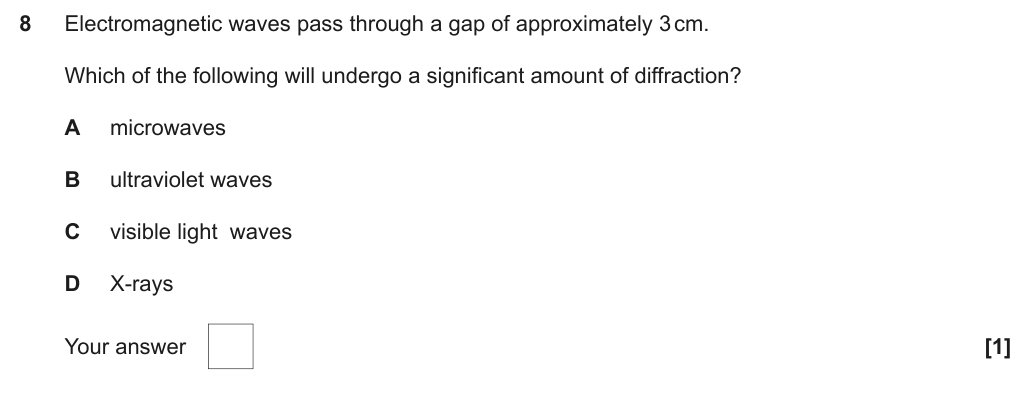
A
Candidates performed well on this question as they determined that when a wave passes through a gap with a similar size to its wavelength, it results in greater diffraction to give the response A.
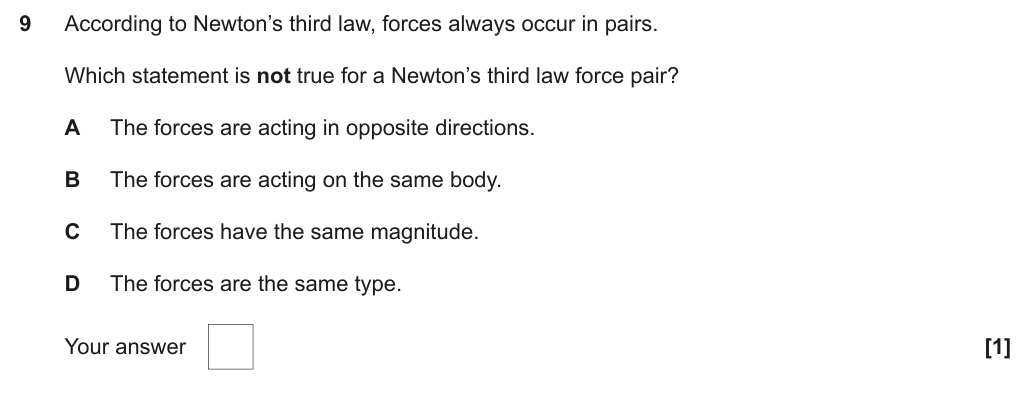
B
Many candidates correctly identified the correct response, B, by applying their understanding that an interaction pair of forces according to Newton’s third law do not act on the same body. The most common distractor answer was D.
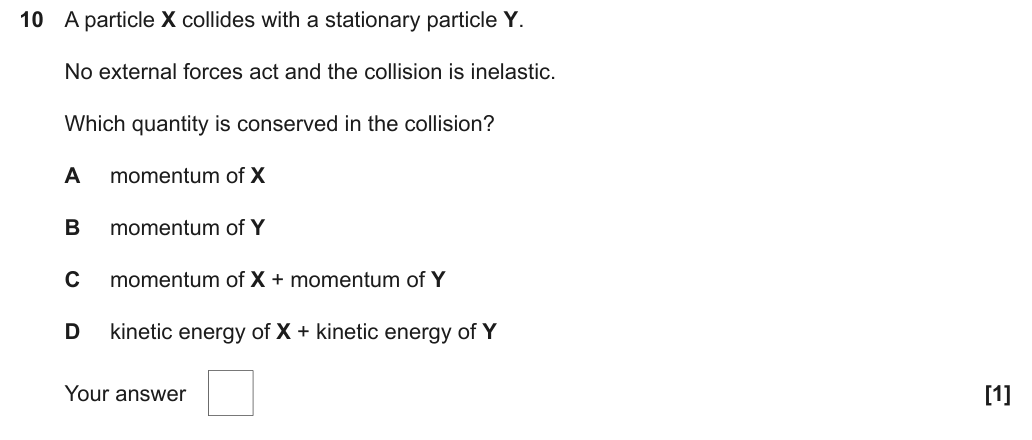
C
Many candidates correctly applied understanding of inelastic collisions that momentum is conserved, but the kinetic energy is not conserved to give the correct answer C.
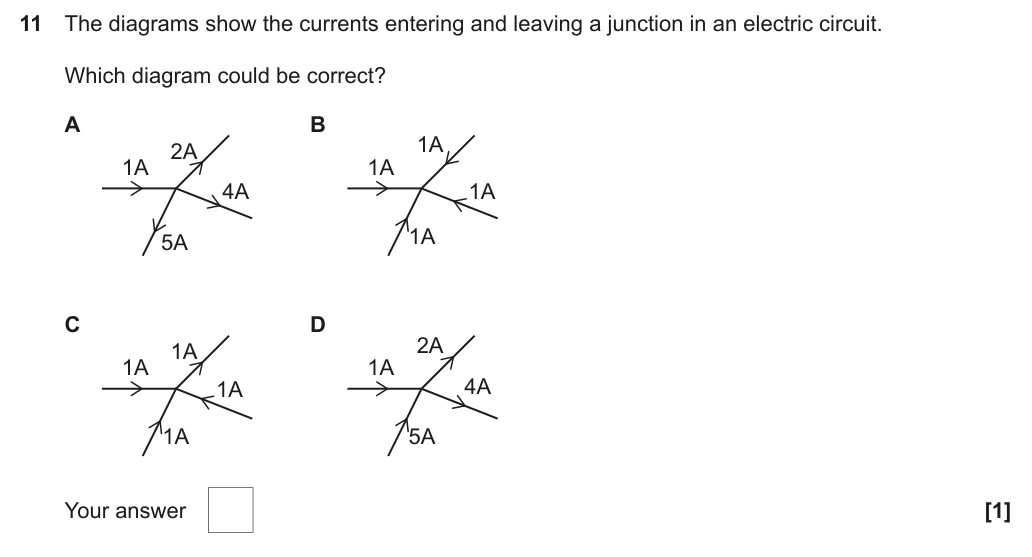
D
Candidates performed well on this question by correctly applying Kirchoff’s current law that the current flowing into a junction must be equal to the current flowing out of it to give the correct answer D.
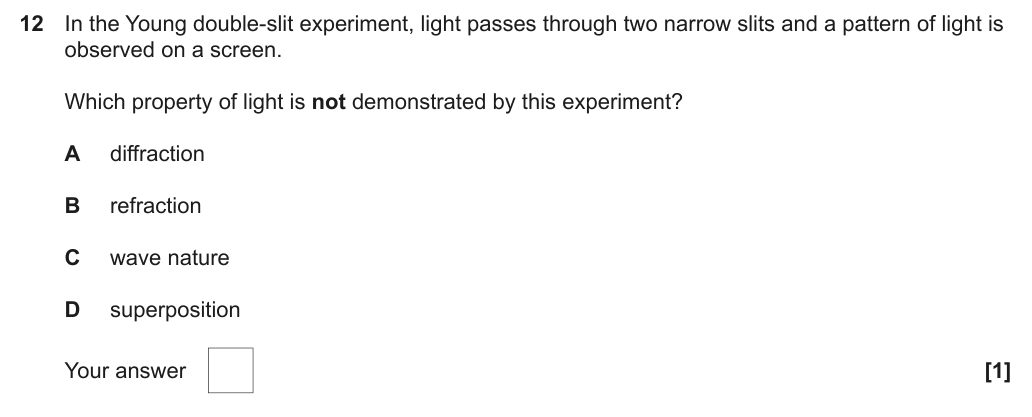
B
Candidates performed well on this question by correctly identifying that the Young’s double-slit experiment does not demonstrate the property of refraction of light to give the correct answer B.
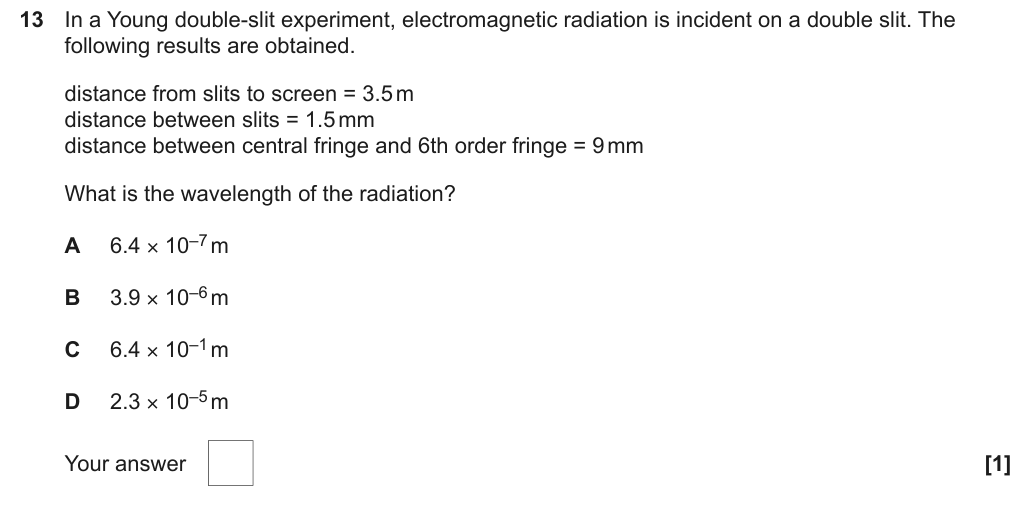
A
Some candidates correctly calculated the wavelength of radiation to be 6.4x10 -7m by determining that the fringe width was 9 mm/6 = 1.5 mm. Therefore, the most common distractor was answer B as candidates had used the value of 9 mm as the fringe width and had therefore not understood that the fringe width is the distance between successive bright fringes. Giving the answer B did demonstrate an understanding of consistent units by correctly converting mm to m.
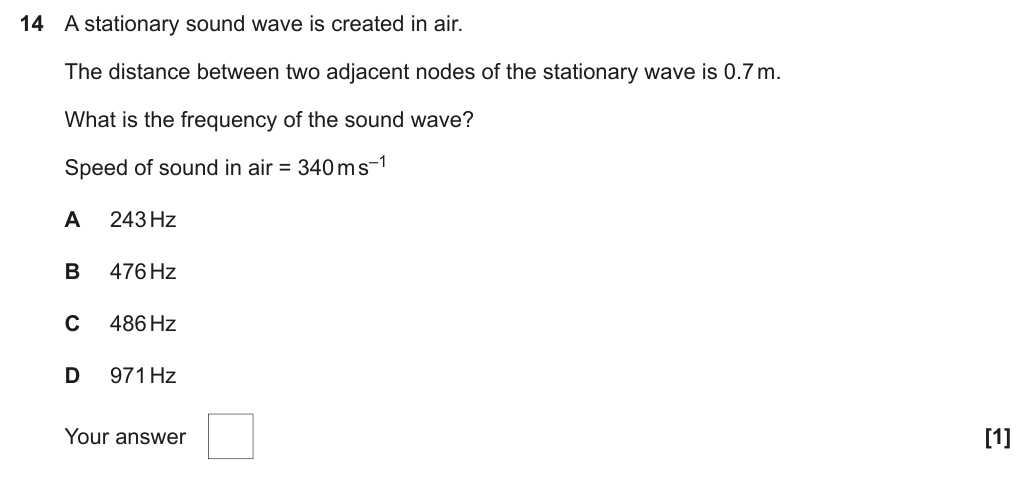
A
Candidates performed well on this question with many candidates correctly determining the wavelength of the standing wave as 1.4 m to then use this value to calculate the frequency of the wave as 243 Hz. This demonstrated understanding that the distance between adjacent nodes is λ/2 and not λ which was indicative of the most common distractor given by the answer B.
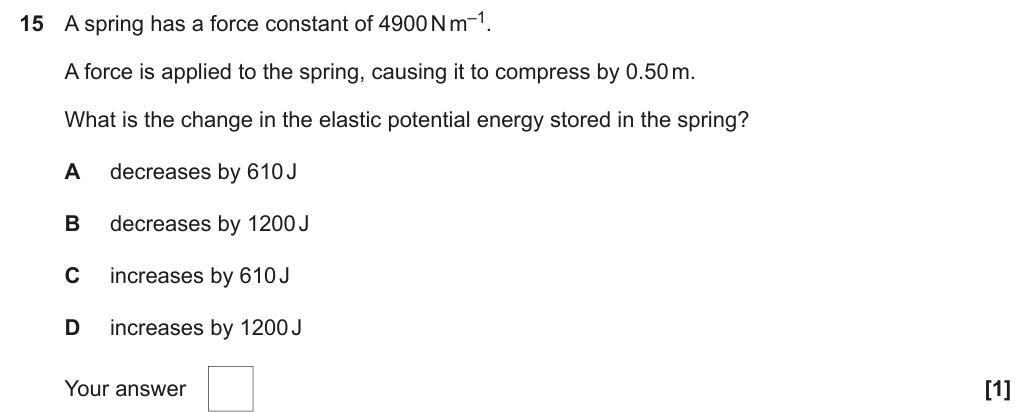
C
Overall, candidates performed well on this question with many correctly calculating the change in elastic potential energy as 610 J. The most common distractor was answer A, with candidates relating compression to a decrease in the change of elastic potential energy rather than an increase in the store of elastic potential energy.
Skills: M2.3 Substitute numerical values into algebraic equations using appropriate units for physical quantities
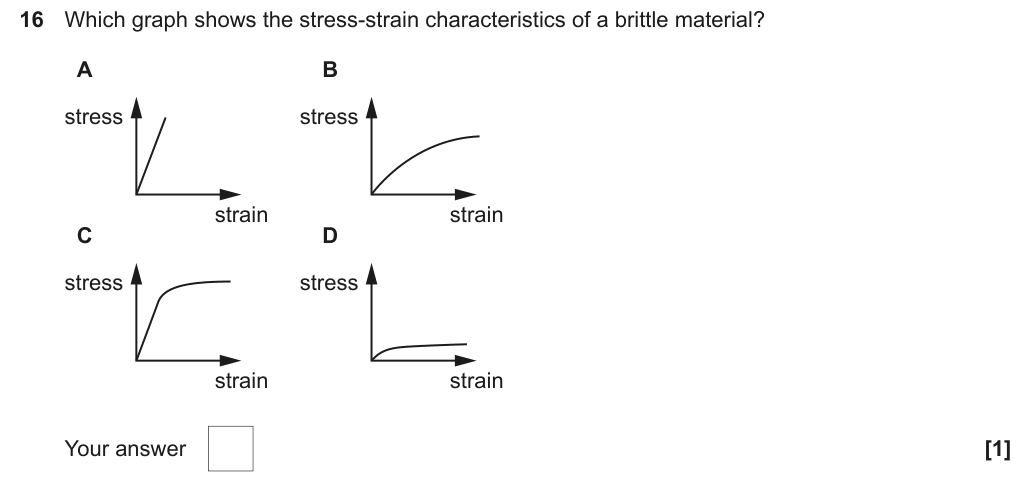
A
Candidates performed well on this question with most candidates correctly identifying graph A as most indicative of the stress-strain characteristics for a brittle material, as brittle materials exhibit minimal plastic deformation and the relationship between stress and strain is linear.
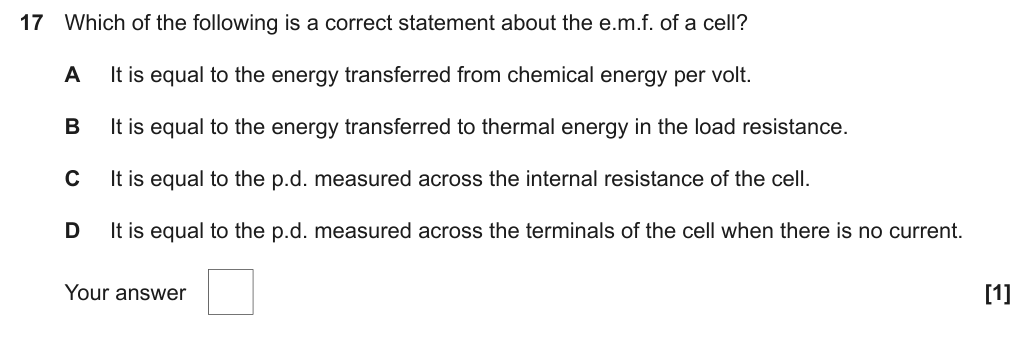
D
Some candidates correctly identified the statement defining e.m.f as answer D. The most common distractor was answer A, as candidates confused the definition of e.m.f as the energy transferred per coulomb of charge with per volt.
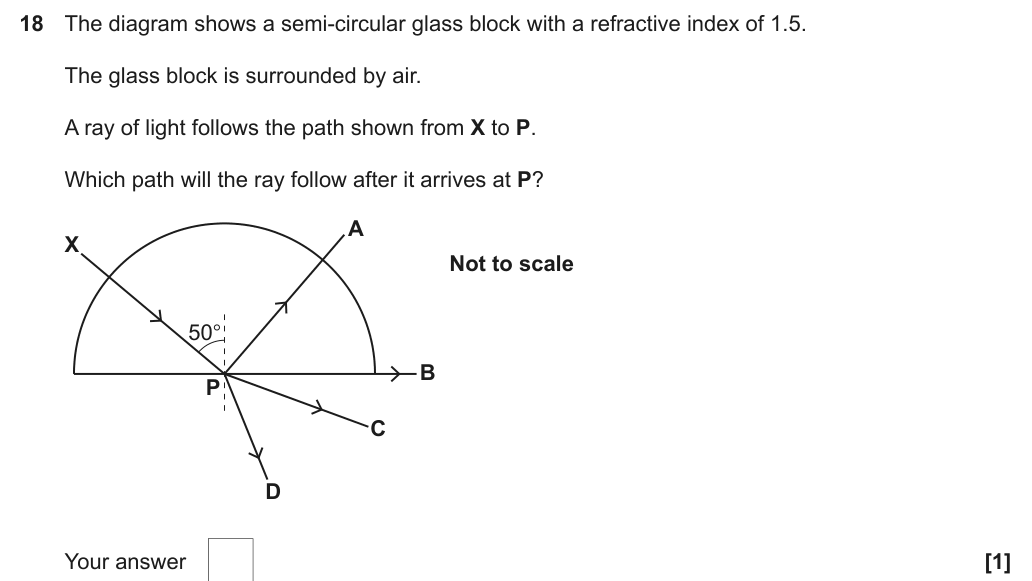
A
Some candidates correctly identified that the ray would follow path A after arriving at point P. To determine the correct path that the ray of light would follow, candidates were required to calculate the critical angle from the refractive index of the glass block to give 42°. If candidates calculated the critical angle they could determine that Total Internal Reflection would occur (as angle of incidence > critical angle) and hence that the ray would follow path A. The most common distractors were answers C and D.
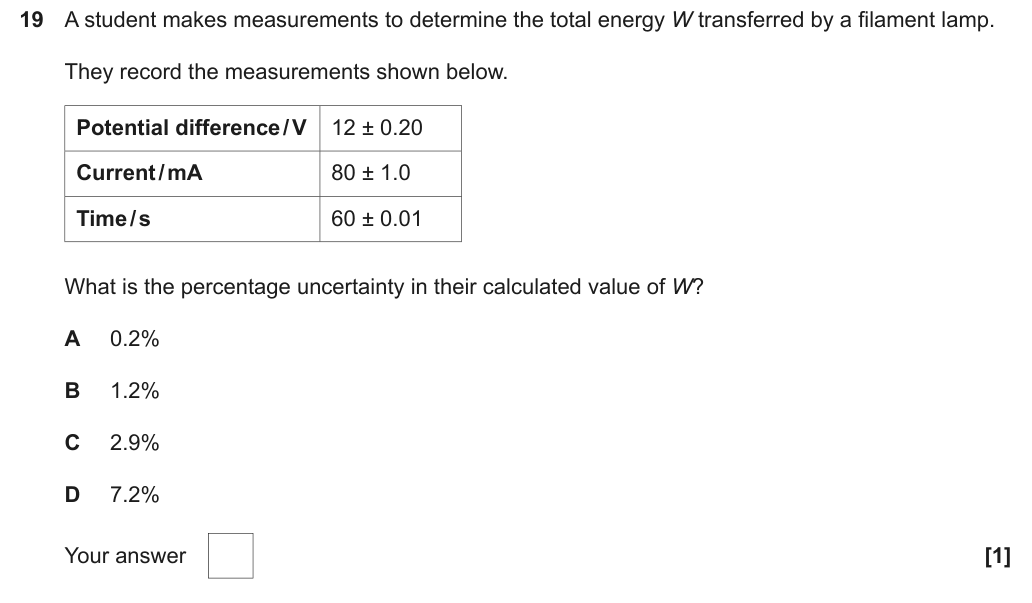
C
Candidates performed well on this question to correctly calculate the percentage uncertainty in the calculated value of W as answer C, by calculating the sum of each individual percentage uncertainty in each measurement.
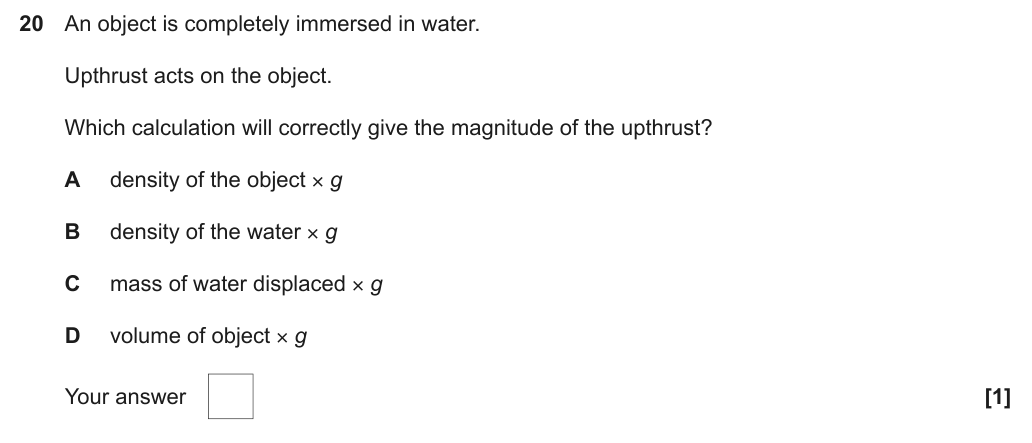
C
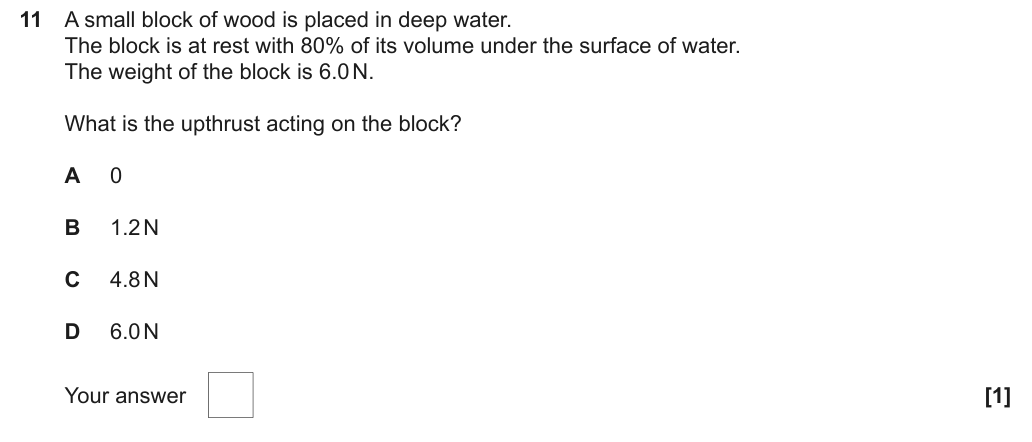
Candidates performed well on this question to correctly give that the magnitude of the upthrust of an object in a fluid is the weight of the fluid displaced by the object.
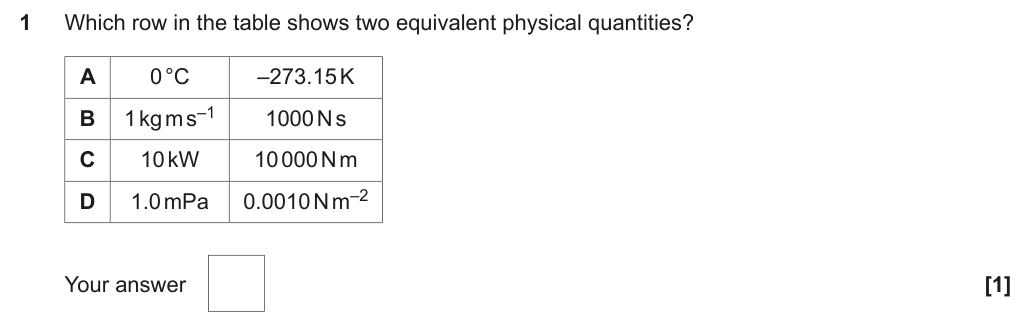
D
Option C can be eliminated here because N m is equivalent to the joule, which is not equivalent to kW, the unit of power. Option A cannot be correct as it has a negative absolute temperature. Option B cannot be correct - the units are equivalent however 1 kg m s-1 and 1 N s are equivalent.
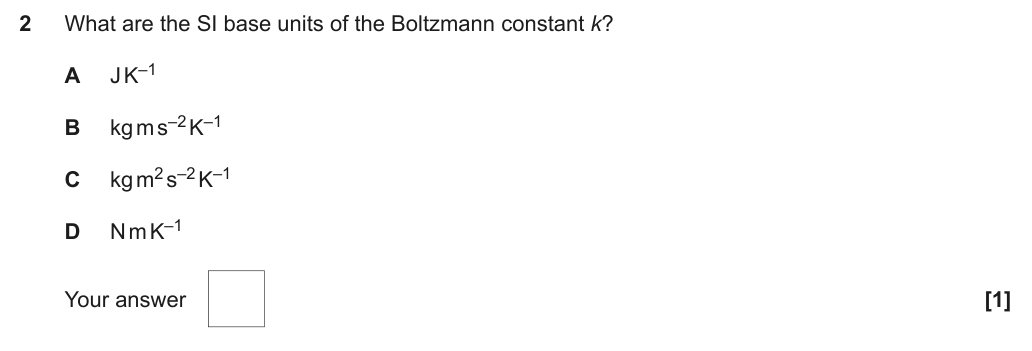
C
Neither option A nor option D can be correct since they contain units that are not base units. Option B cannot be correct as kg m s-2 is equivalent to the newton, not the joule.
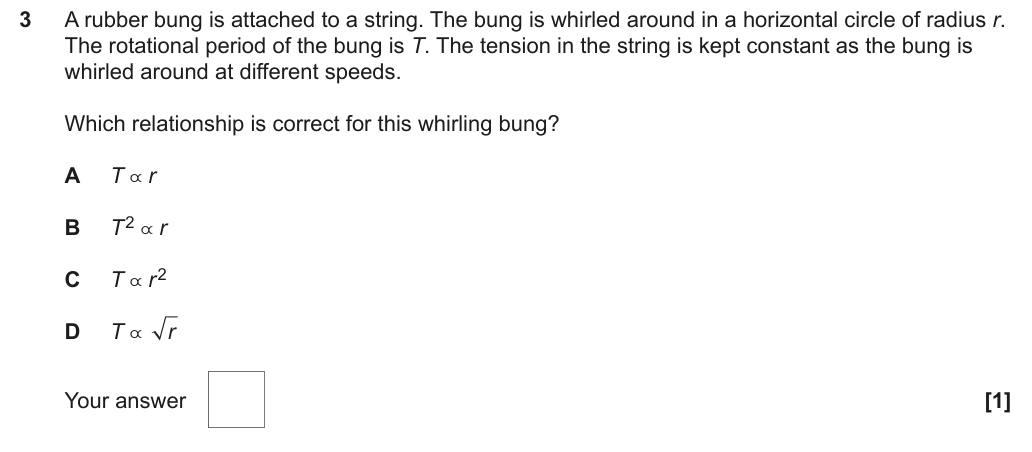
B and D
Many candidates used their knowledge of circular motion to select either option B or option D, both of which were acceptable, being mathematically equivalent.
Skills: M2.2 Change the subject of an equation, including non-linear equations
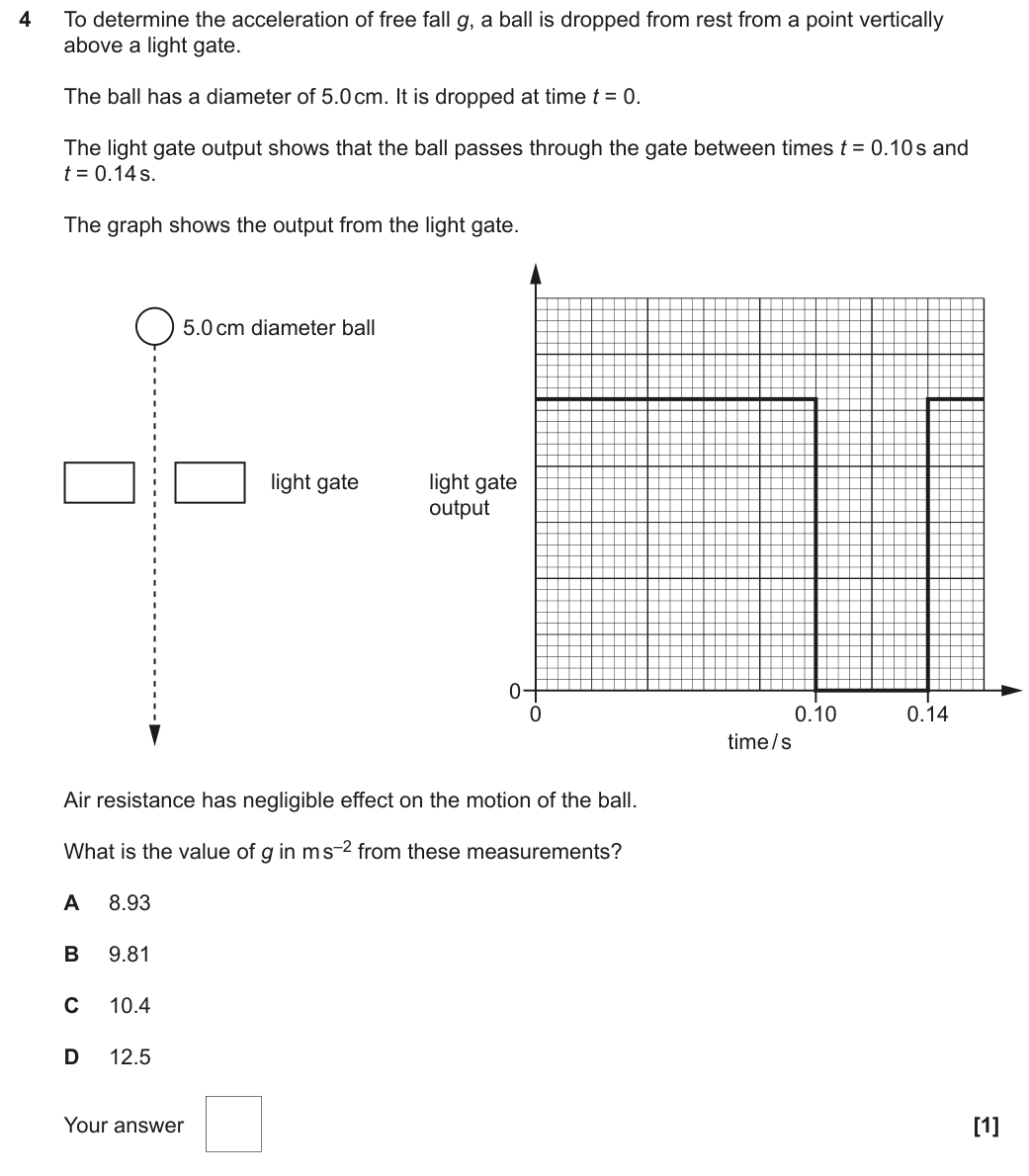
C
This question boils down to what acceleration is required for a displacement of 0.05 m between t = 0.10 s and 0.14 s. i.e. 0.05 = ½ a (0.14)2 - ½ a (0.10)2 from which the acceleration can be calculated.
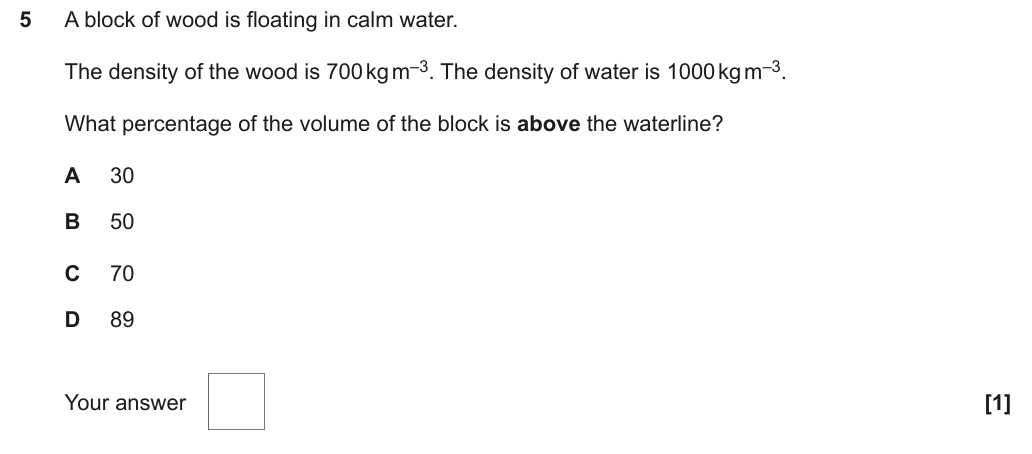
A
For the block to float, its weight (700 x V x g) must equal the weight of water displaced (1000 x k x V x g) where k is the fraction of the block under water. Equating these two expressions gives k as 0.7. The question, however, asks for the percentage of the block above the waterline, which is clearly 0.3, making A the correct answer.
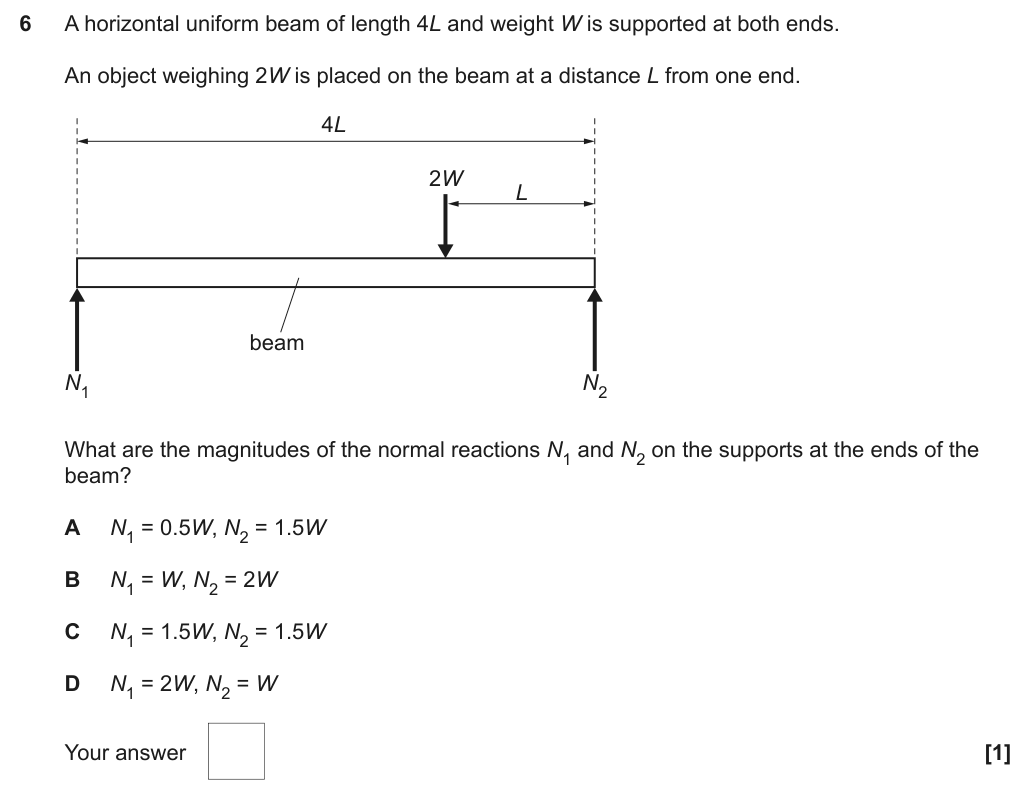
B
This question was made more challenging by not including the weight of the beam on the diagram. The correct approach is to take moments about the left hand end of the beam. Omitting the weight of the beam gives N1 = 0.5W and N2 = 1.5 W. When the weight of the beam is included, (2L x W) + (3L x 2W) = (4L x N2), giving N2 = 2 W and N1 = 2 W, i.e. option B.
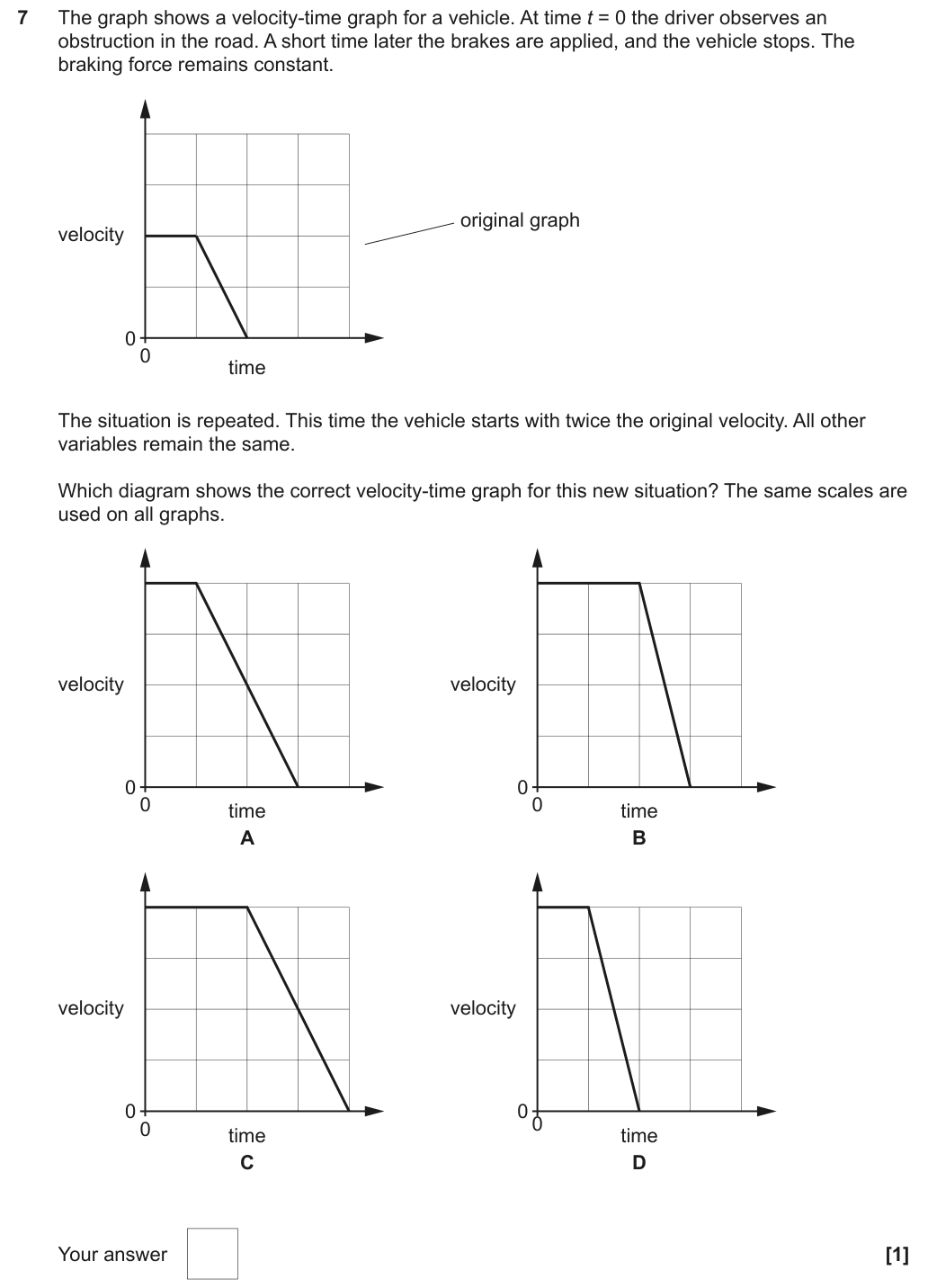
A
With all variables the same apart from the initial speed, there should only be one change to the graph, i.e. the initial speed. The gradient of the second phase should be the same, as the mass and braking force are the same. This gives option A.
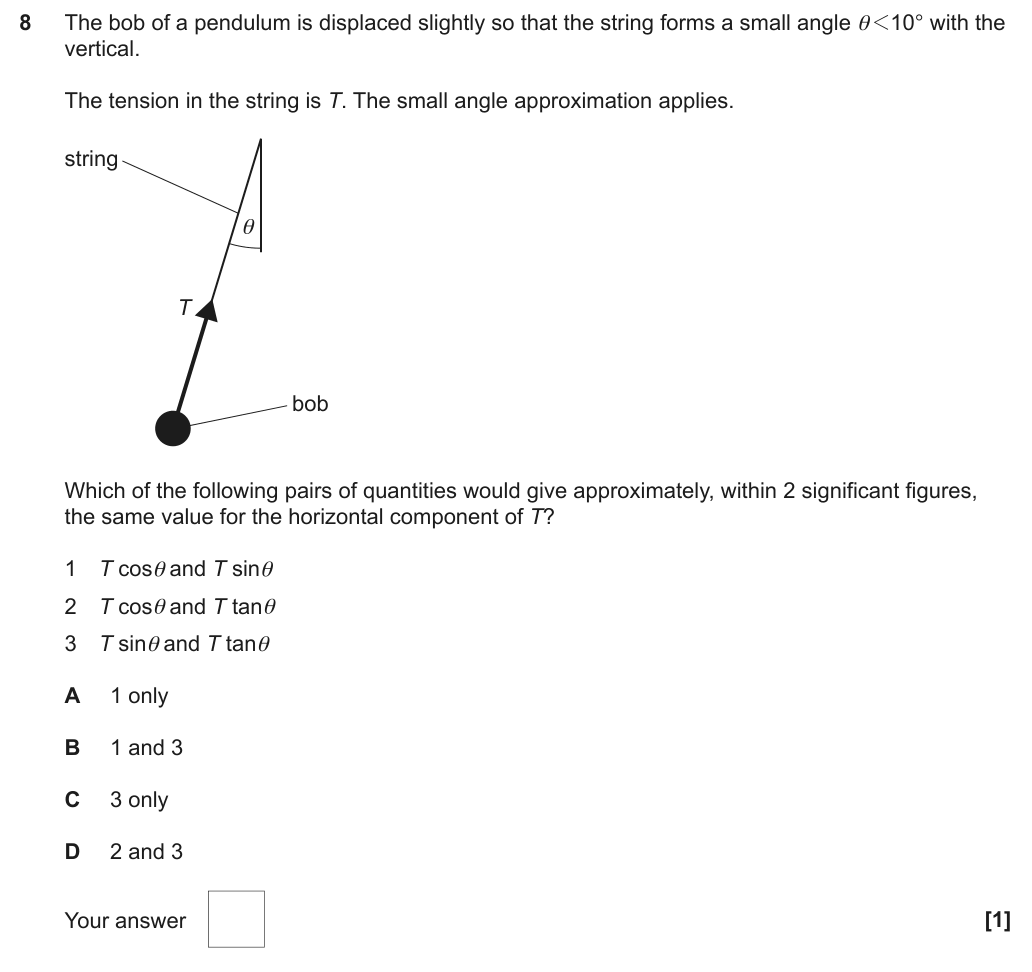
C
For small angles, sinθ and tanθ are relatively close to each other and small. cosθ, however, is close to 1, which eliminates options 1 and 2. The only correct pair is option 3, making C the correct answer.
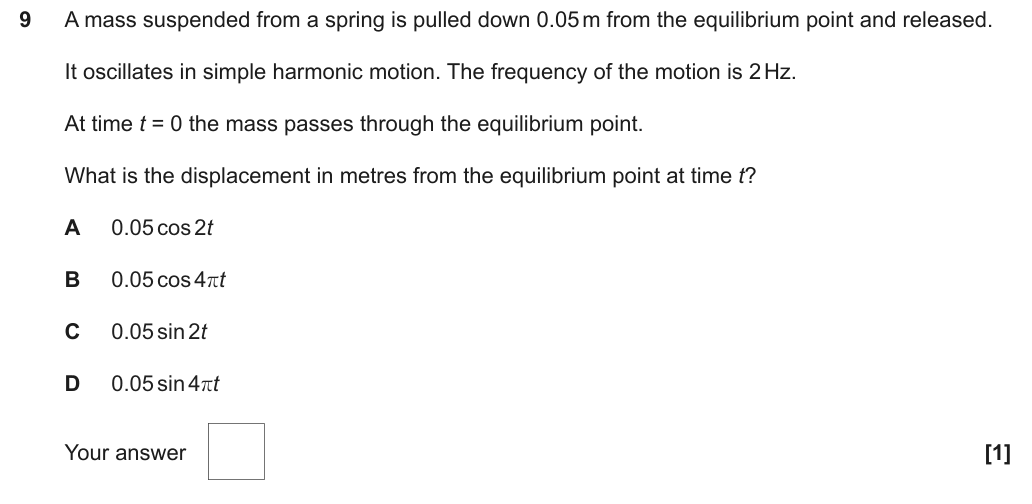
D
Many candidates missed the third line of the question which states that the mass passes through the equilibrium point when t=0. This would indicate the correct function here is sine, rather than cosine. The argument of the function here (the expression inside the brackets) must be omega-t or 2πft. f here is 2 Hz, so the correct expression is 4πt.
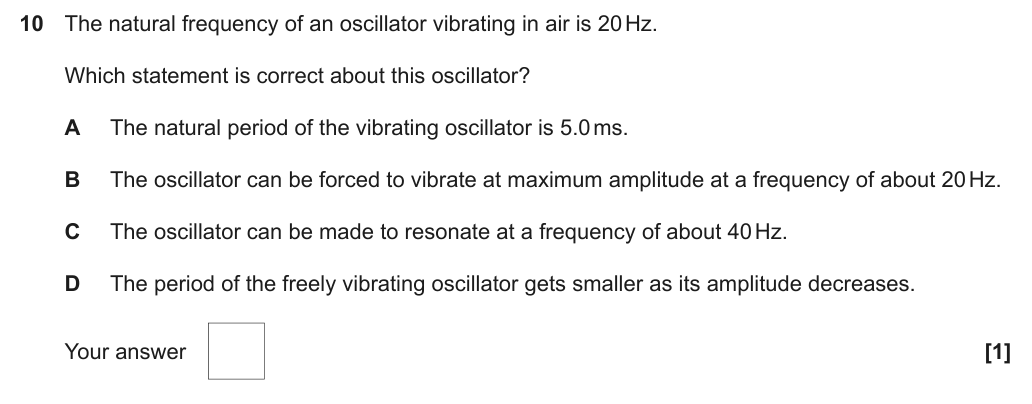
B
Option D is plainly false. Option A here is wrong by a factor of 10, as the correct period is 50 ms. Option C applies to stationary waves not in forced oscillations as in this case.
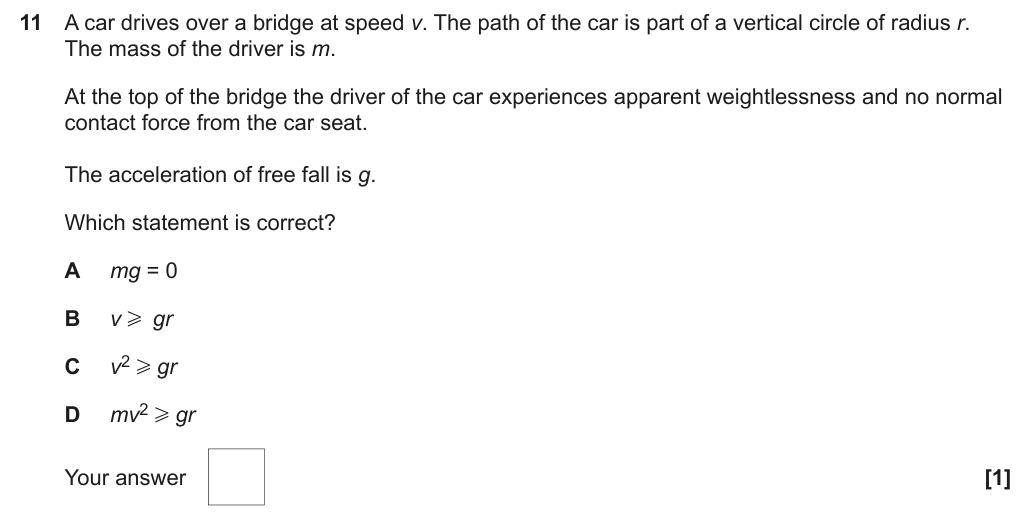
C
The condition for circular motion is that the centripetal force is equal to the resultant force. In this case, the resultant force is the weight - normal contact force so W - R = m v2 / r. The person leaves the seat when R ≤ 0. When rearranged with W = mg gives the correct answer C.
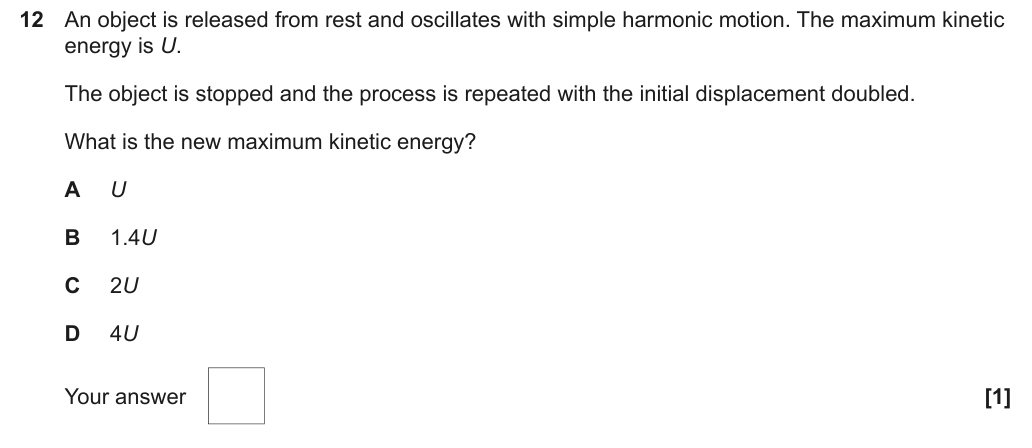
D
When the initial displacement is doubled, then the amplitude and hence maximum speed is also doubled. If the maximum speed is doubles, the maximum KE is quadrupled, since KE = ½ m v2.
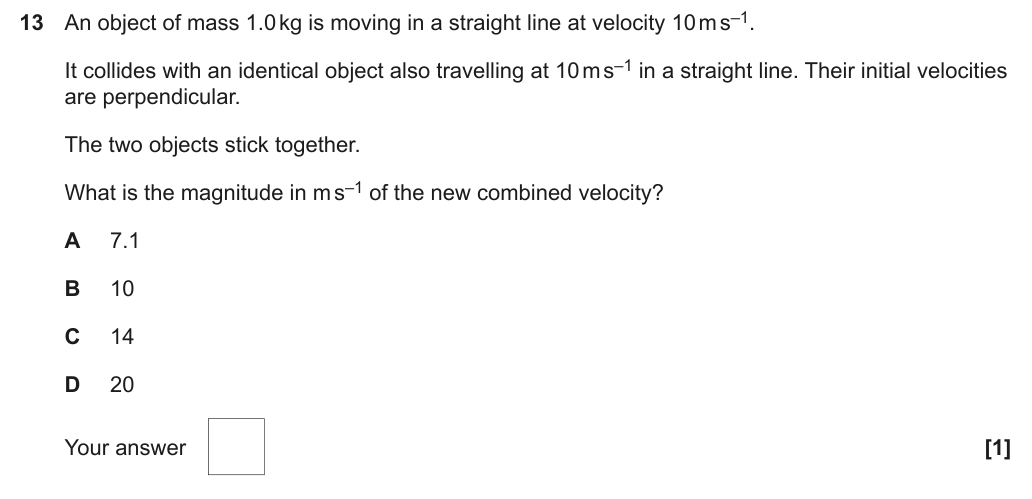
A
This is a conservation of momentum question. The momentum of each object is 10 kg m s-1. The combined momentum has two components at right angles to each other of 10 kg ms-1. The magnitude of this momentum is √ (200). To find the speed, divide this by 2.0 kg, giving 7.1 m s-1, so the answer is A.
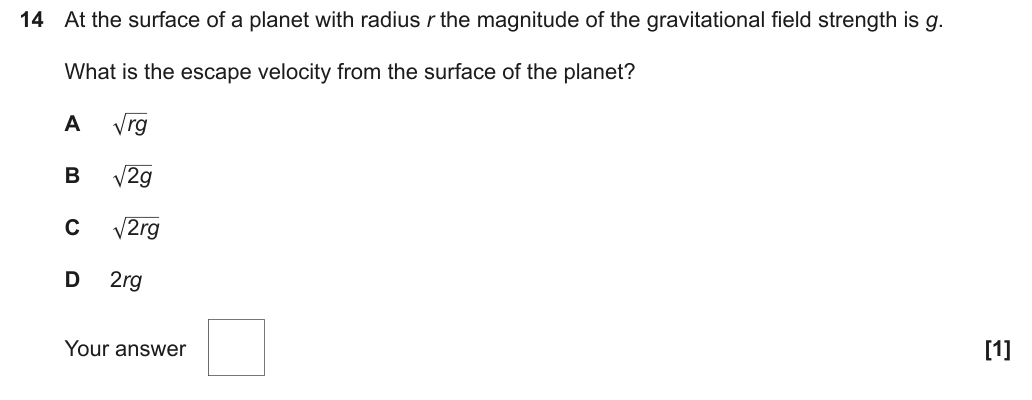
C
By considering the GPE at the planet’s surface of -GMm / r and the KE of ½ m v2, the condition for ‘escape’ is that the total energy is zero at infinity. This gives the condition GMm / r = ½ mv2. The gravitational field strength at the surface of the planet is GMm / r2 i.e. gr, giving gr = ½ mv2. When rearranged this gives answer C.
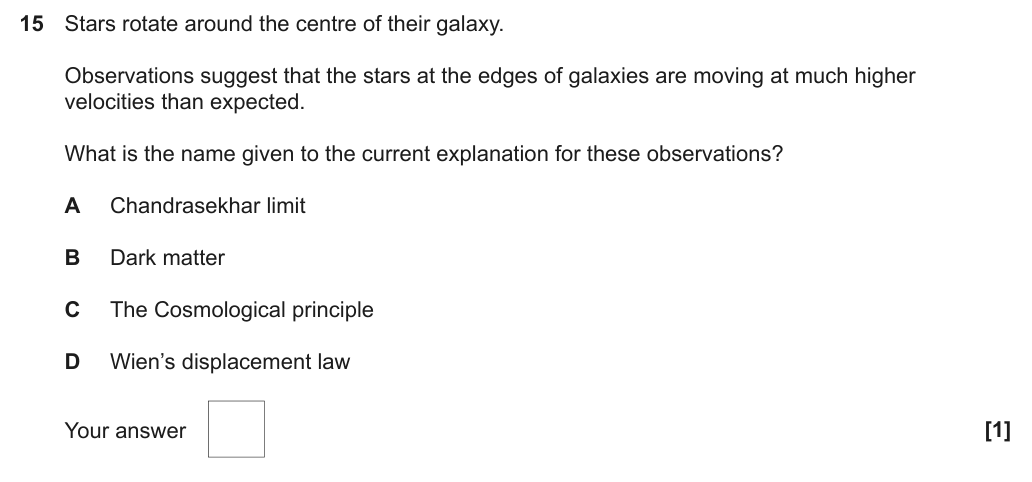
B
The Chandrasekhar limit relates to white dwarf stars and their evolution. Wien’s displacement law relates the surface temperature of a star and λmax. The Cosmological principle has nothing to do with stars’ velocity in a galaxy, hence the correct answer is B.
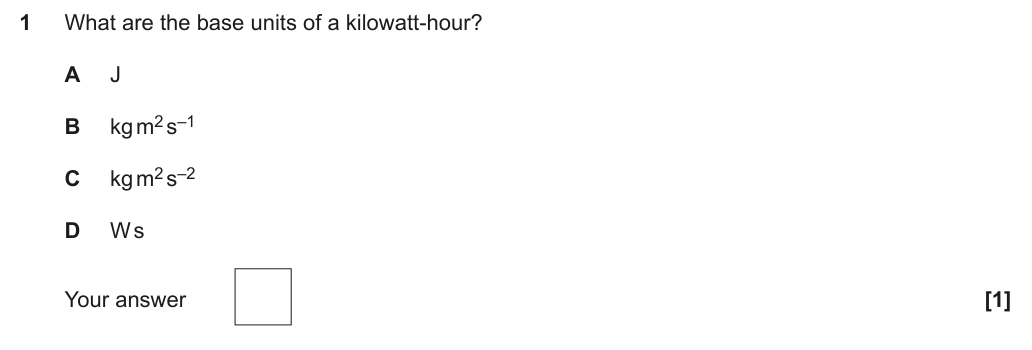
C
A little over half of candidates were able to identify the correct response. Many candidates showed working to obtain their answer. D was a common incorrect response.
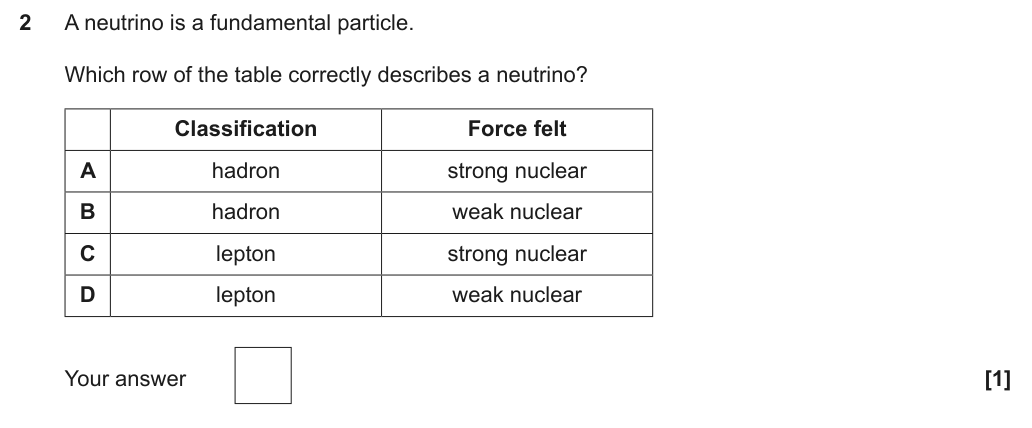
D
Most candidates were able to correctly identify the classification and force. To reduce their options, many candidates circled the correct force.
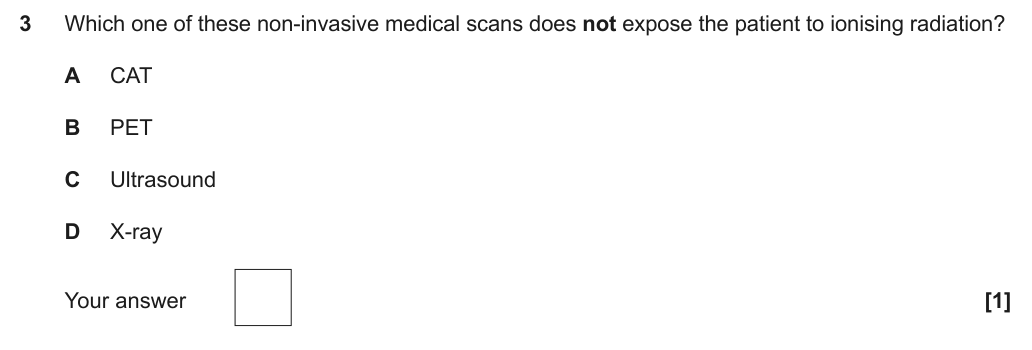
C
This question was correctly answered by most of the candidates and demonstrated a good knowledge of ionising radiations in medical applications.
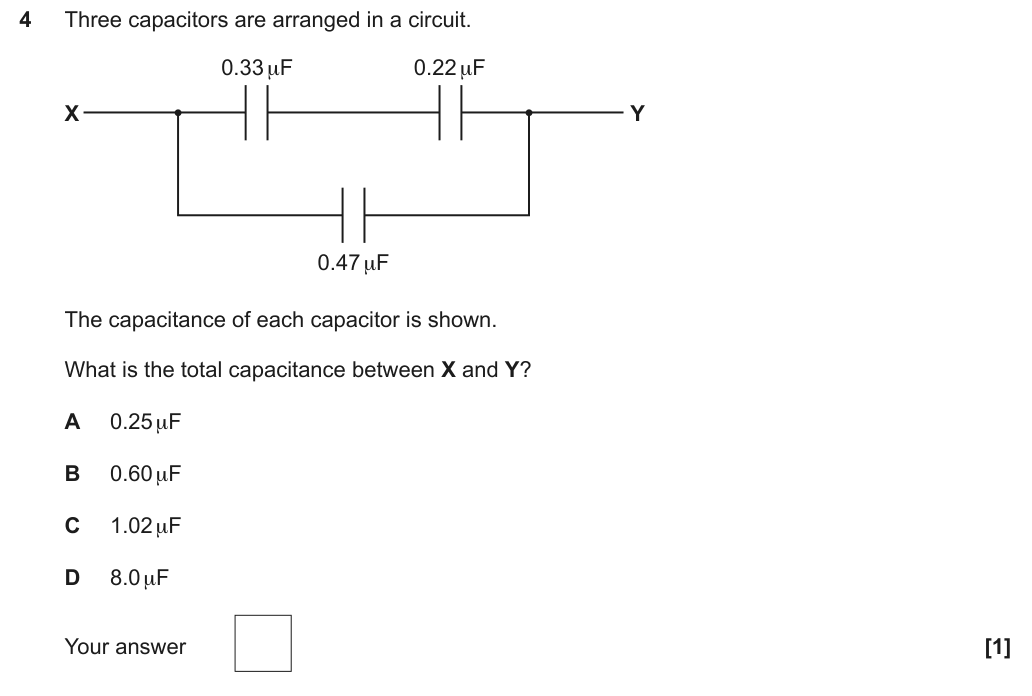
B
Most candidates were able to correctly calculate the total capacitance, and many showed working to support a correct method. A was the most common distractor, being calculated as if the capacitors were resistors.
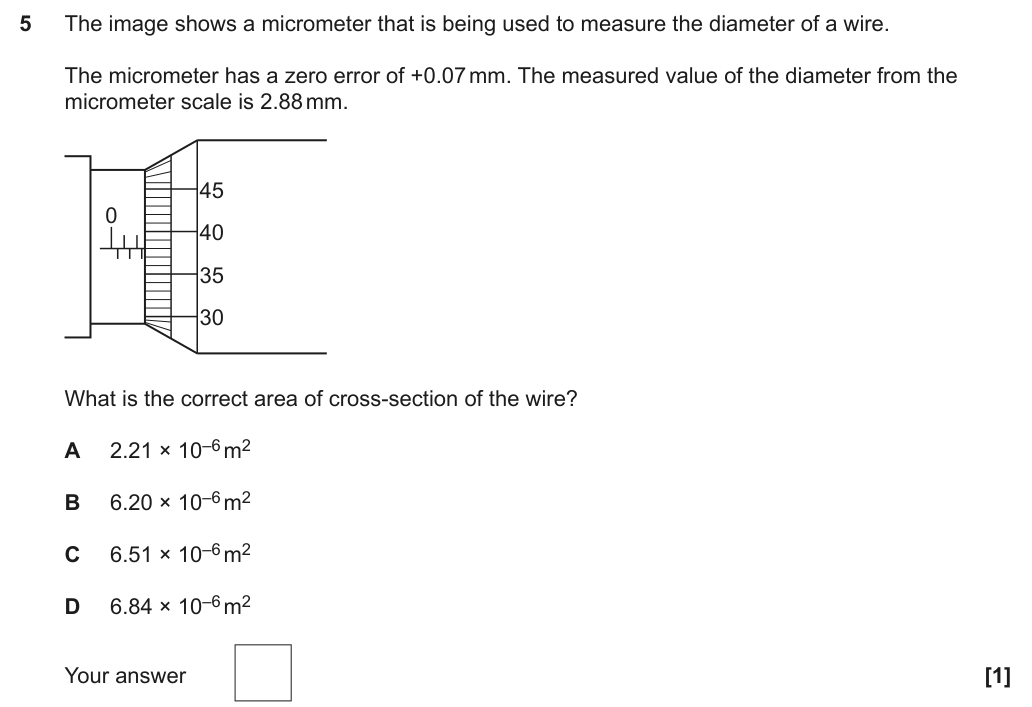
B
Around two thirds of candidates were able to correctly apply the zero error in their calculation. D was a common distractor where the zero error was added onto the micrometre reading.
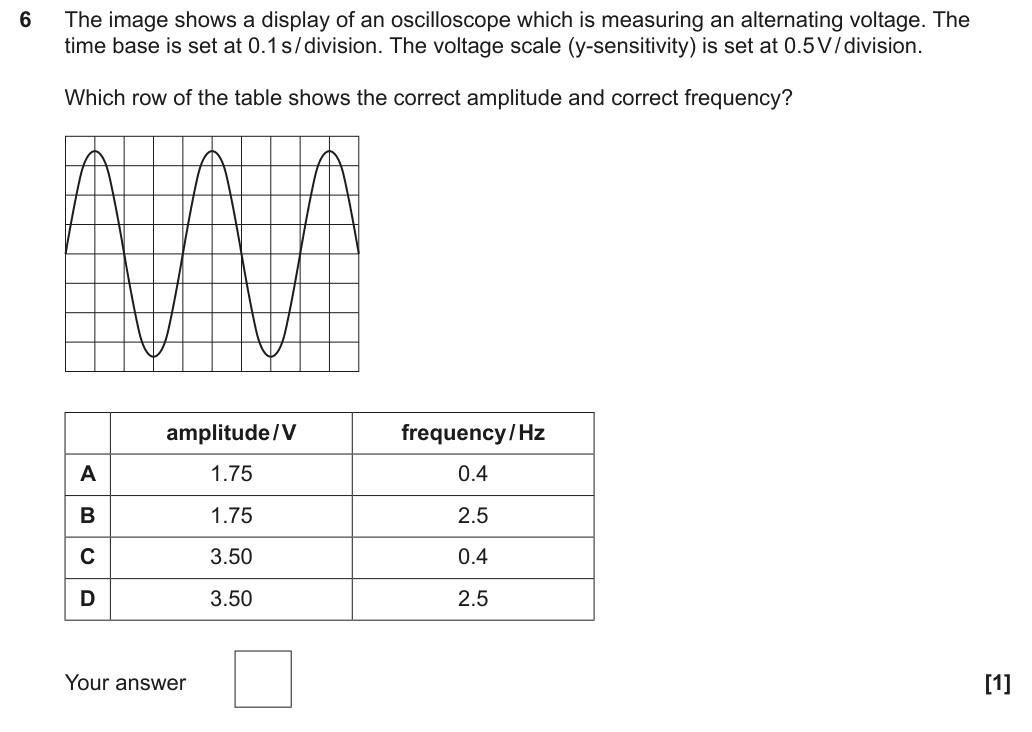
B
Most candidates were able to correctly calculate the amplitude and frequency. A was the most common distractor where candidates simply identified the time period rather than then calculate the frequency.
B
A little under half of the candidates were able to correctly identify the correct statements. A helpful approach to this type of question is to ‘tick’ the statements which the candidate is certain of, which then reduces the options available.
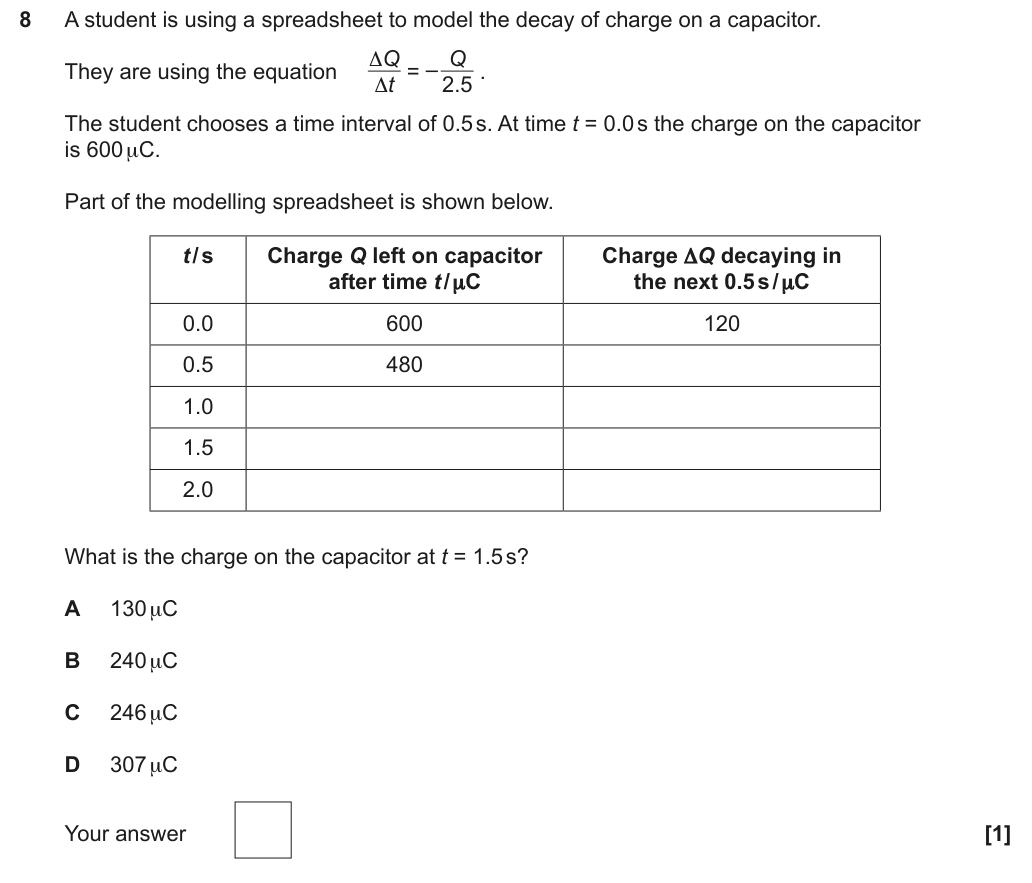
D
Most candidates were able to correctly calculate the charge. Although not a difficult calculation, there are plenty of stages and potential for error at each. Most of the candidates filled in the table at each point which would be a helpful way of keeping on track of the charge.
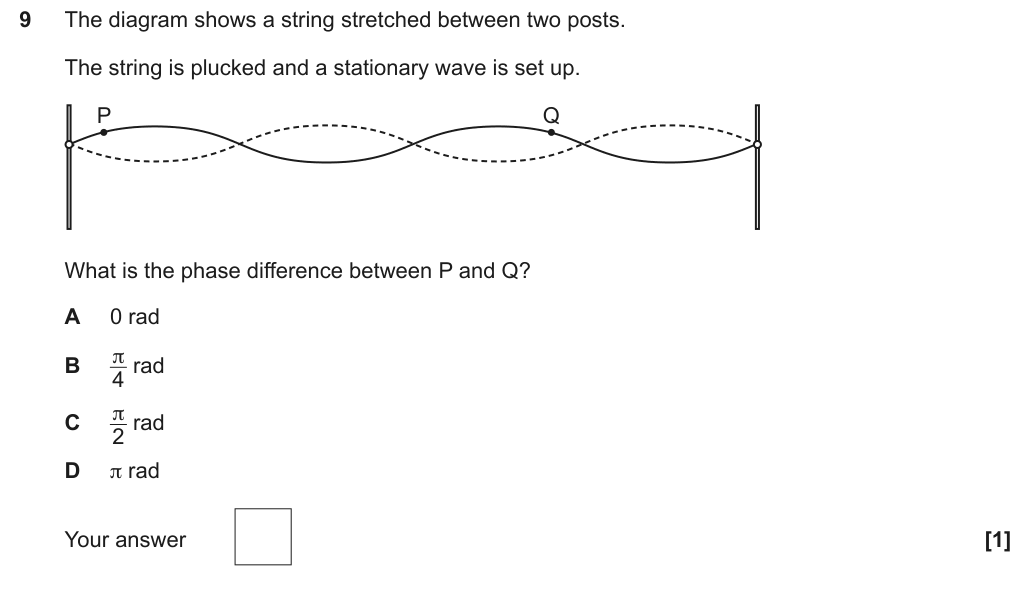
A
Relatively few candidates got this phase difference correct; it was clear from many that they thought that it was a progressive wave as they attempted to add on fractions of cycles. It may also be the case that candidates are unfamiliar with phase differences in stationary waves.
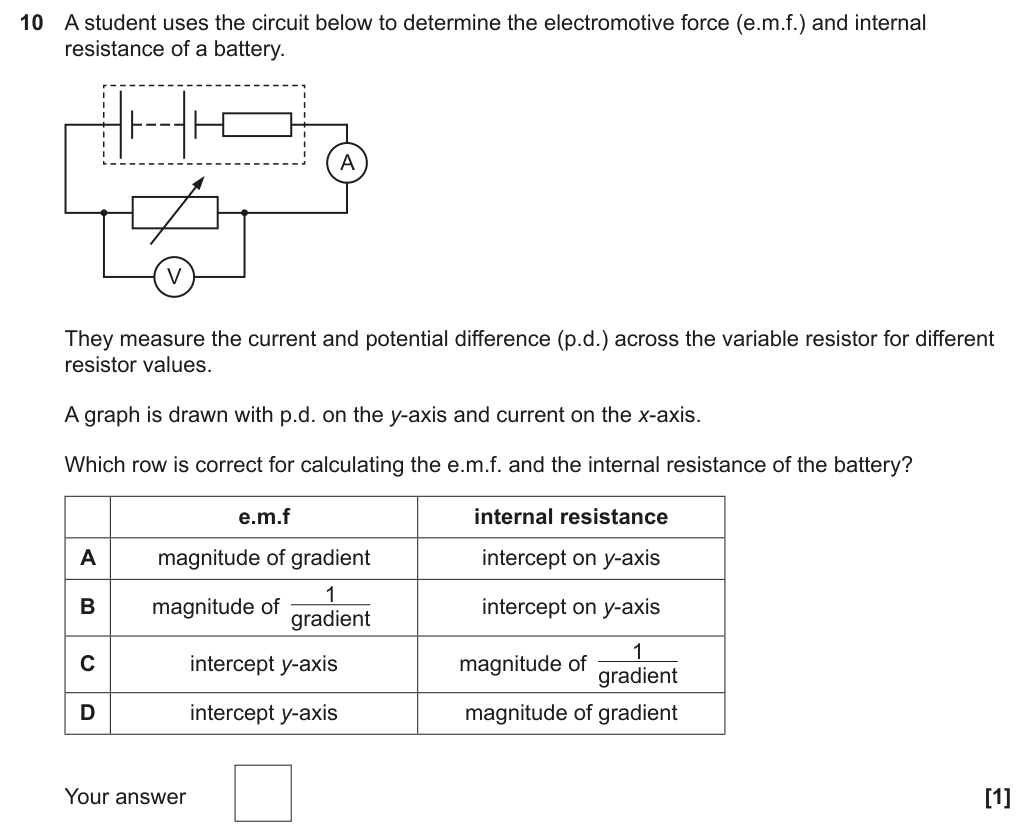
D
This was correctly answered by most candidates. They were able to identify how to obtain the emf correctly but less certain on the internal resistance, which led to C being my far the most common incorrect response.
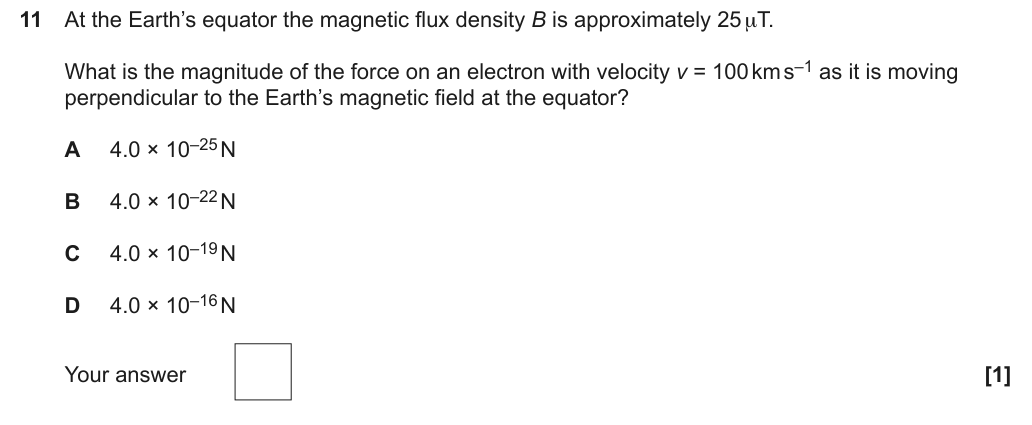
C
Most candidates were able to calculate the force, using F = BQv. The powers of ten in the various quantites appeared to have caused few problems. SThis was the multiple choice question that had the most ‘no responses’.
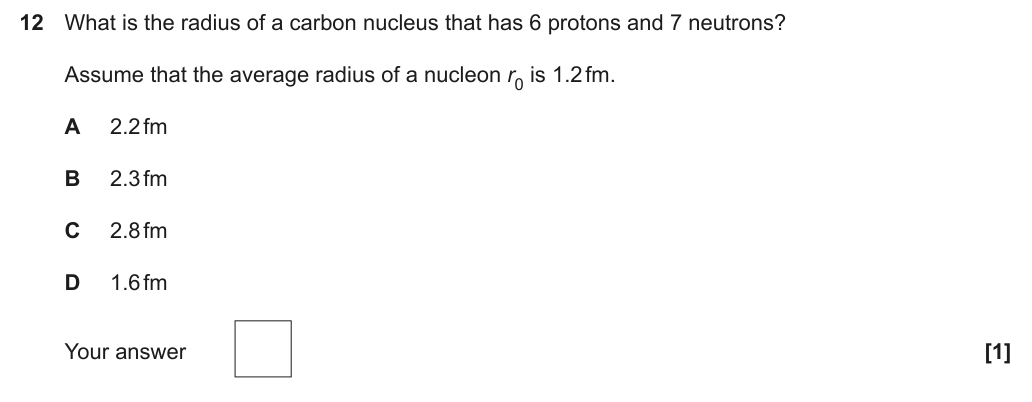
C
Most candidates were able to correctly calculate the radius and it was clear that most knew how to correctly apply the formula.
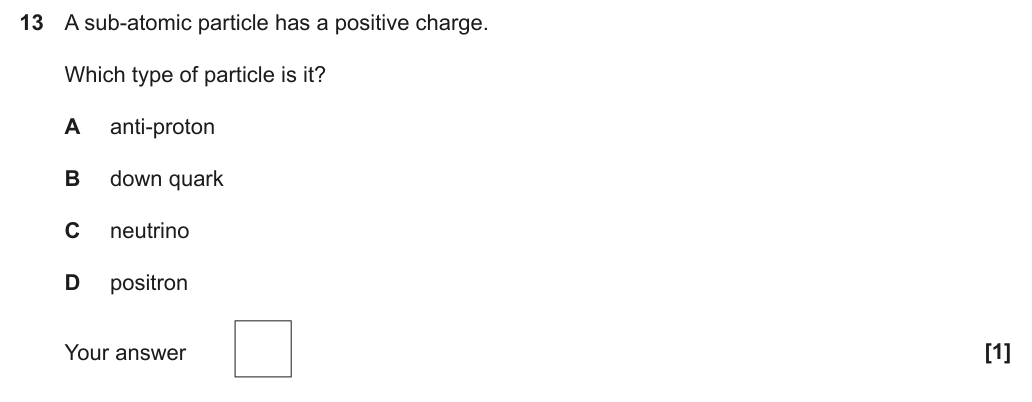
D
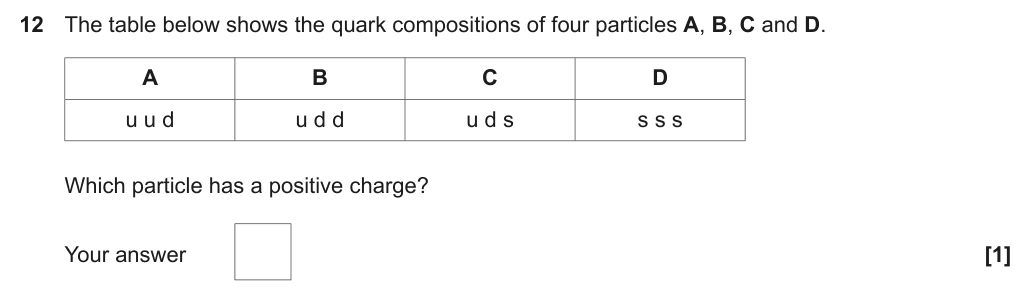
This relatively simple question was correctly answered by of the vast majority of candidates. The most common distractor was B which was presumably due to a lack of certainty of quark charges.
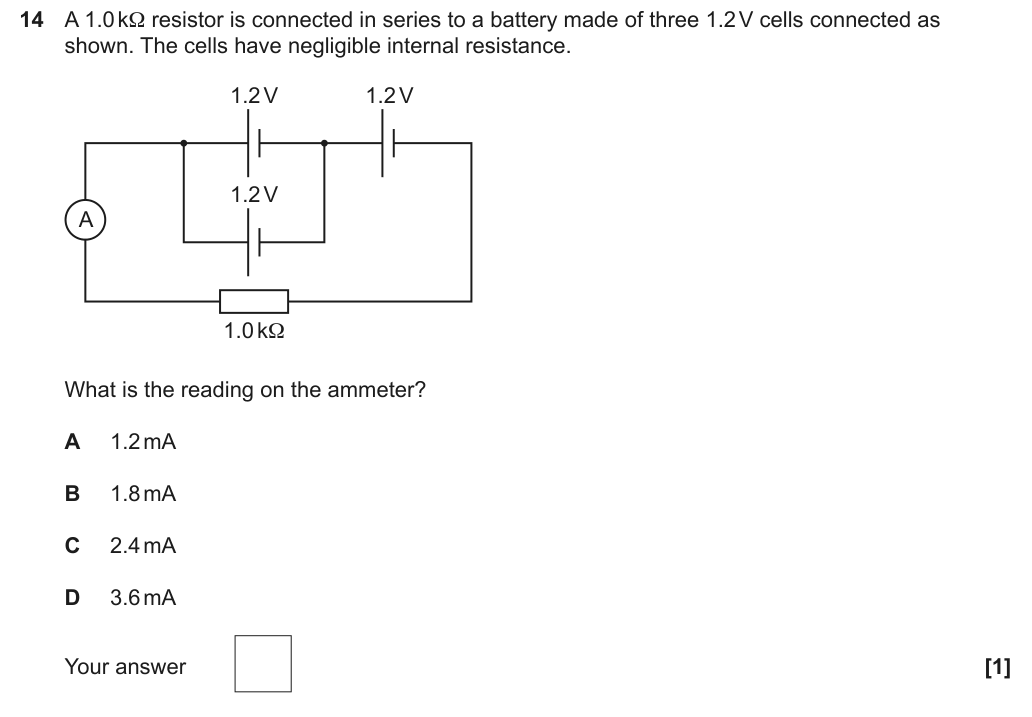
C
This question was relatively poorly answered with fewer than half of the candidates getting the correct response. B and D were the two common distractors with B treating the cells as if they were resistors, and D simply adding up the three voltages.
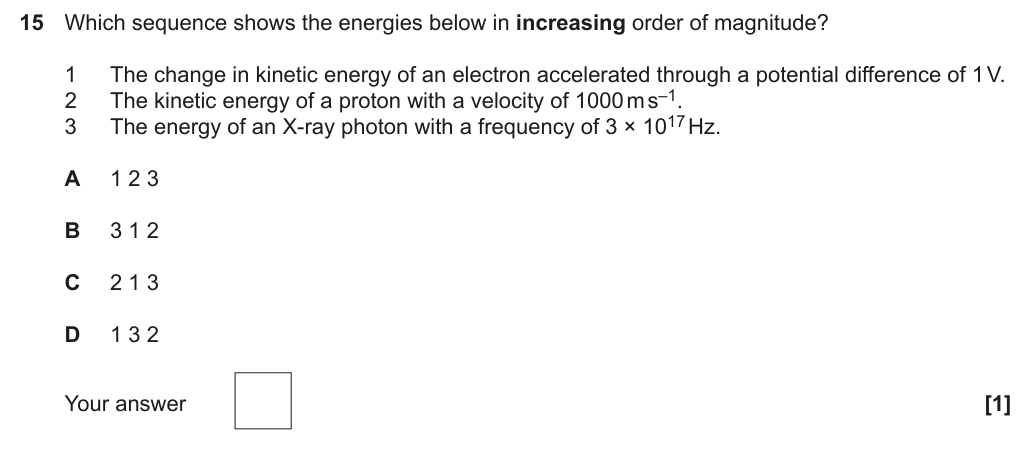
C
Approximately half of the candidates were able to correctly identify the order. Many set out the calculations to the side before putting them in rank order and this generally proved successful. Most of the incorrect responses showed little or no working, leading to the assumption that there may have been some guesswork involved.
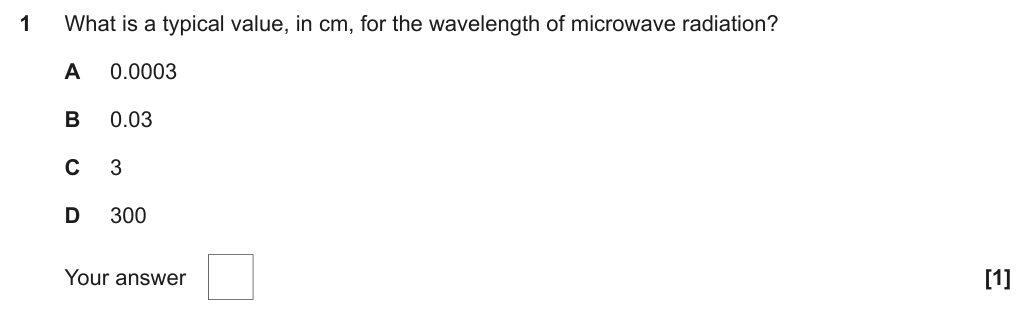
C
This should have been a straightforward starting question for all the candidates in determining the wavelength of microwaves in cm wavelength but less than half of the candidates got the correct answer C. The most common distractor was D.
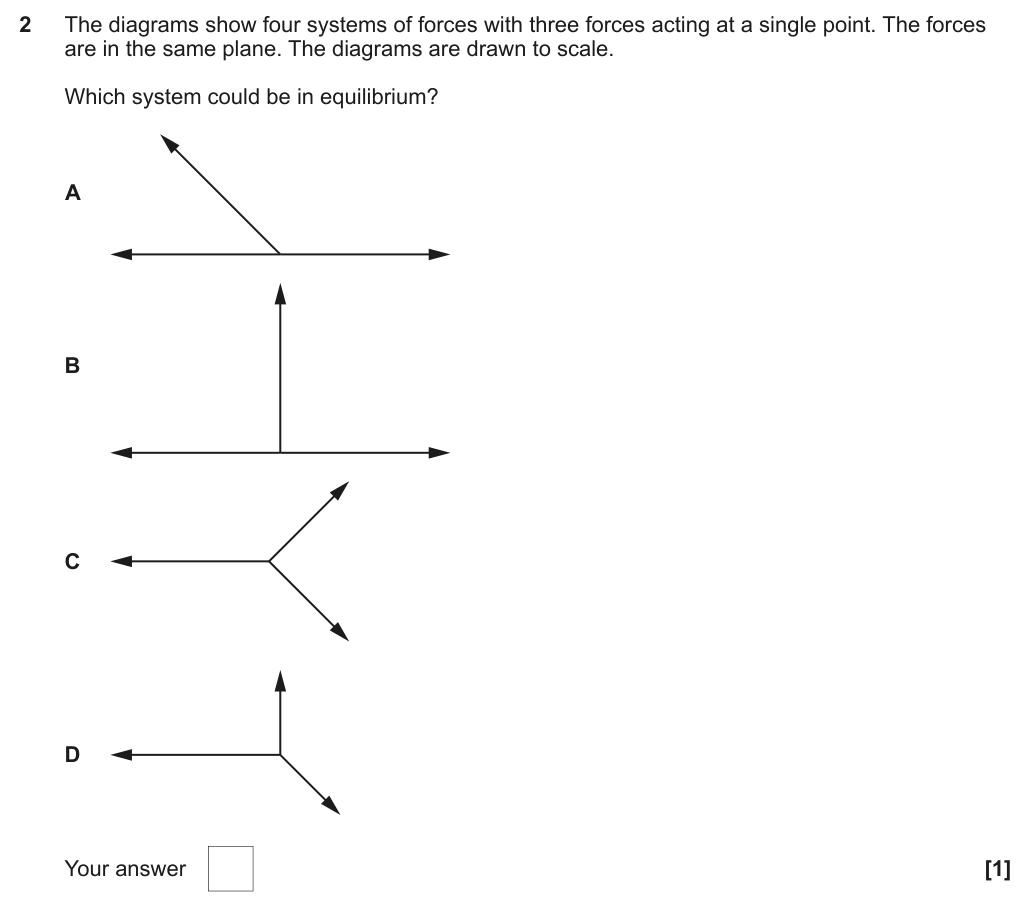
C
This question assessed candidates understanding of forces acting in a system in equilibrium with most candidates applying their knowledge of forces as vectors. This meant that most candidates answered C correctly.
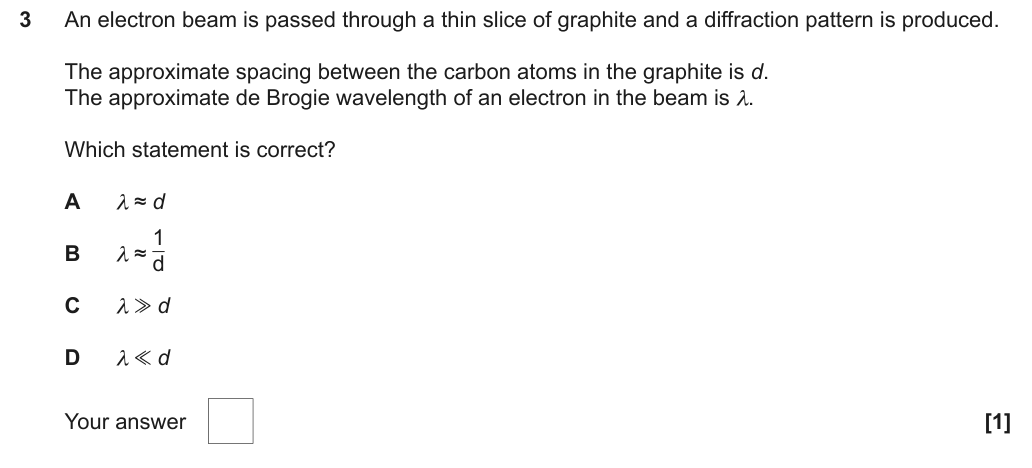
A
Just over half of candidates answered this correctly and determined that the correct conditions for a diffraction pattern to be produced was when the spacing between atoms was roughly equal to the de Broglie wavelength of an electron. The most common distractor was D.
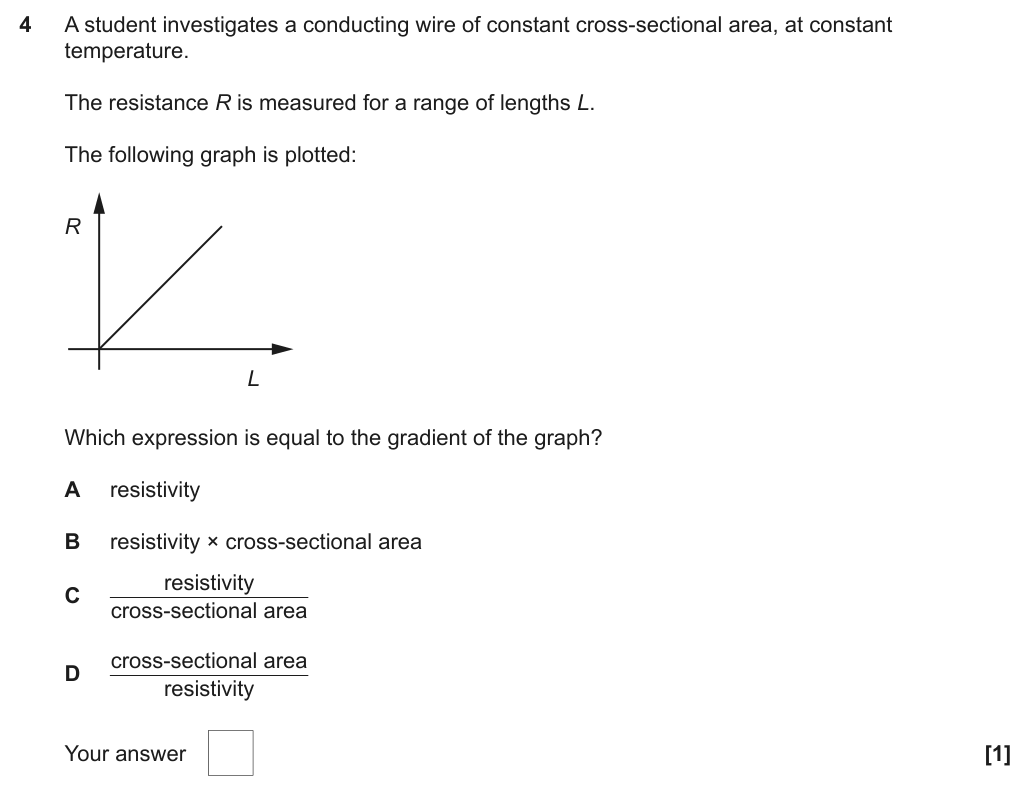
C
This question was answered well as candidates were able to determine the correct expression for the gradient by applying the equation R = ρL/A.
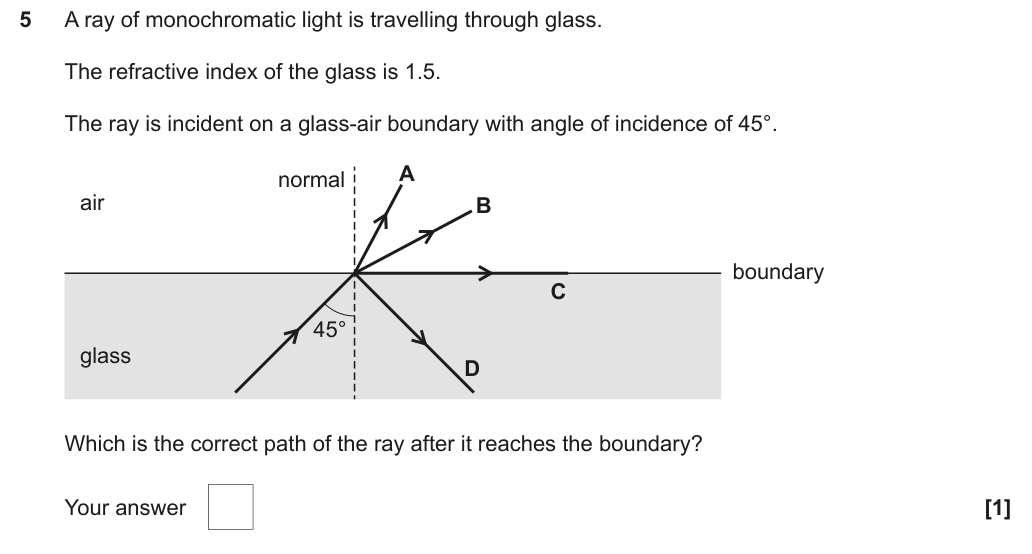
D
Less than half of candidates answered this question correctly by applying understanding of Total Internal Reflection and the use of sin C = 1/n. The most common distractor was C.
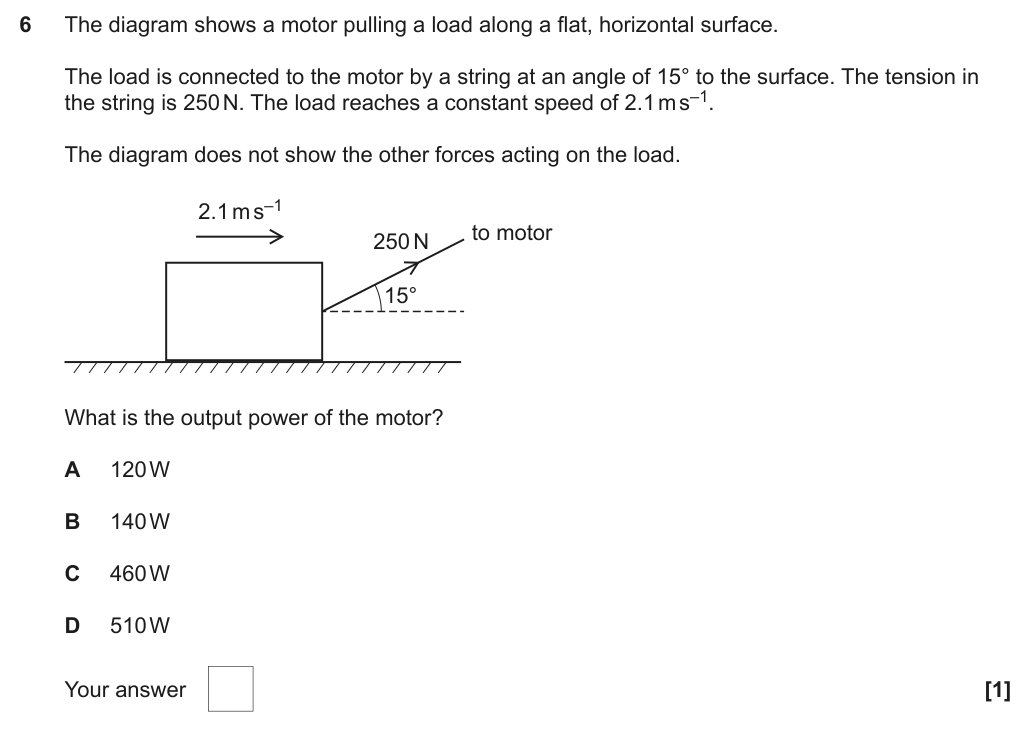
D
This question was answered well as candidates were able to calculate the correct output power by applying the equation P = Fv and resolving the 250 N to give its horizontal component.
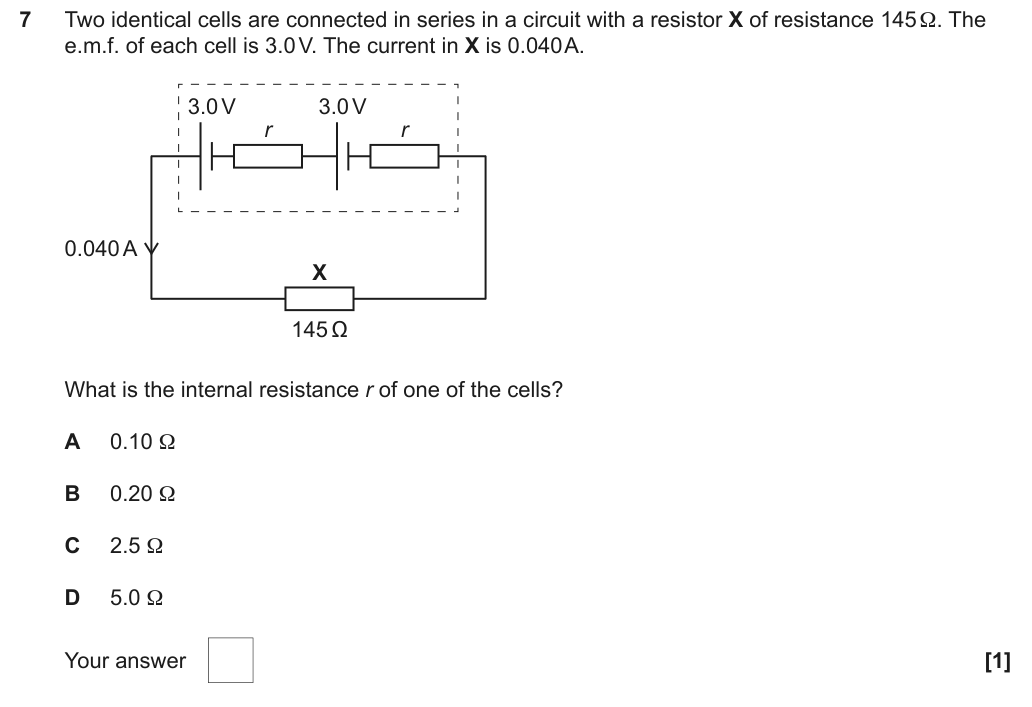
C
Most of the candidates gave the answer C by correctly applying the equation ℰ = I(R + r).
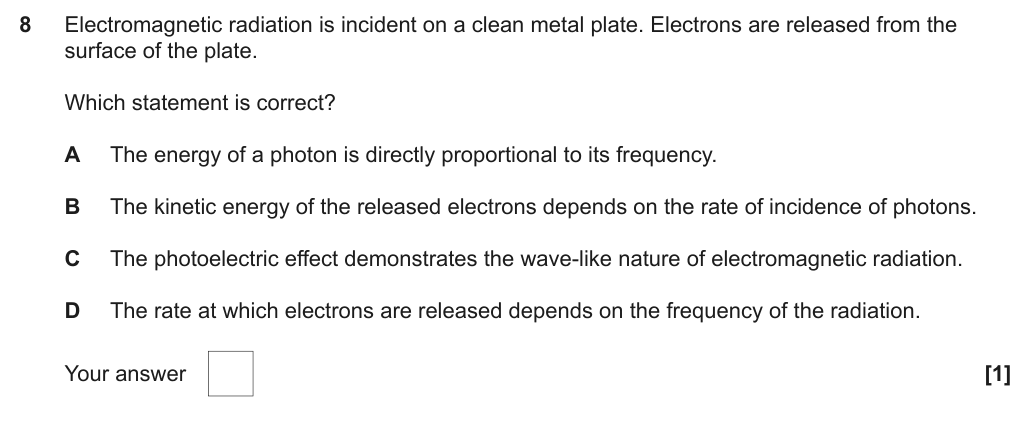
A
This question was answered well with the most candidates applying the equation E = hf to give the correct answer A.
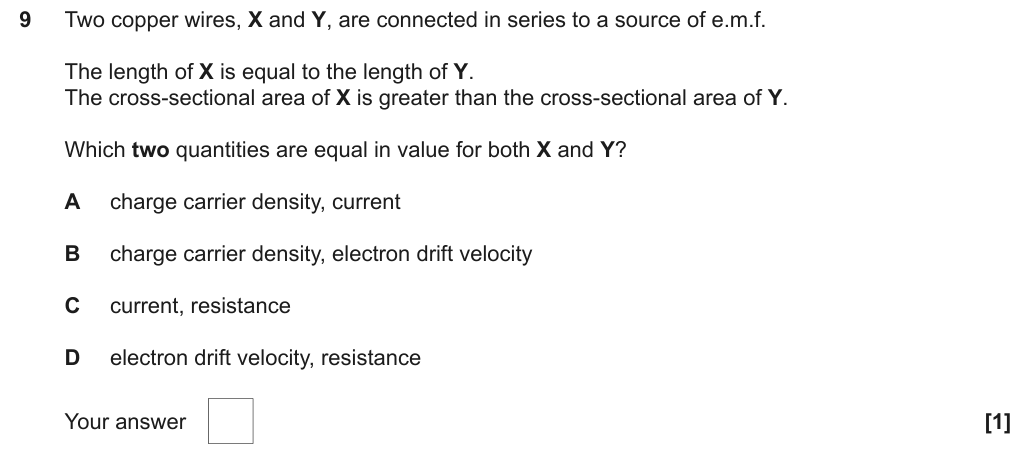
A
Only half of candidates gave the correct answer A by understanding and applying the equation I = Anev.
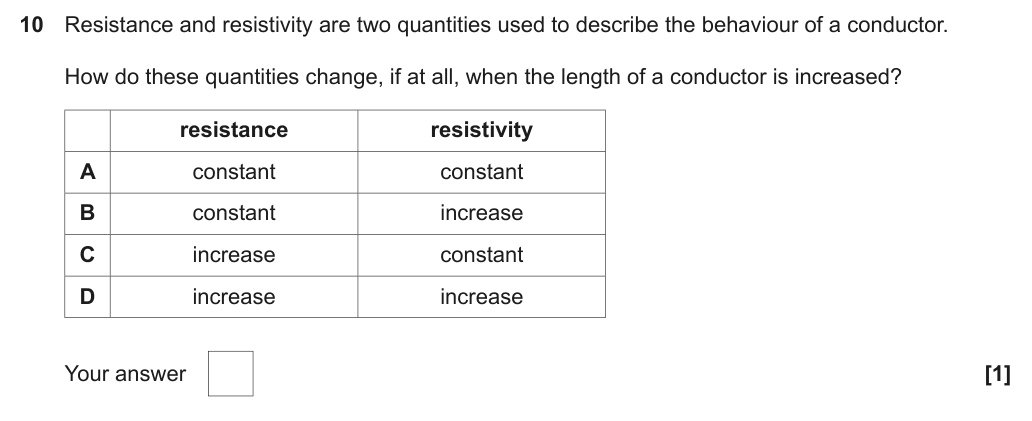
C
This question was answered well with most candidates giving the correct answer C by applying the equation R = ρL/A for a conductor.
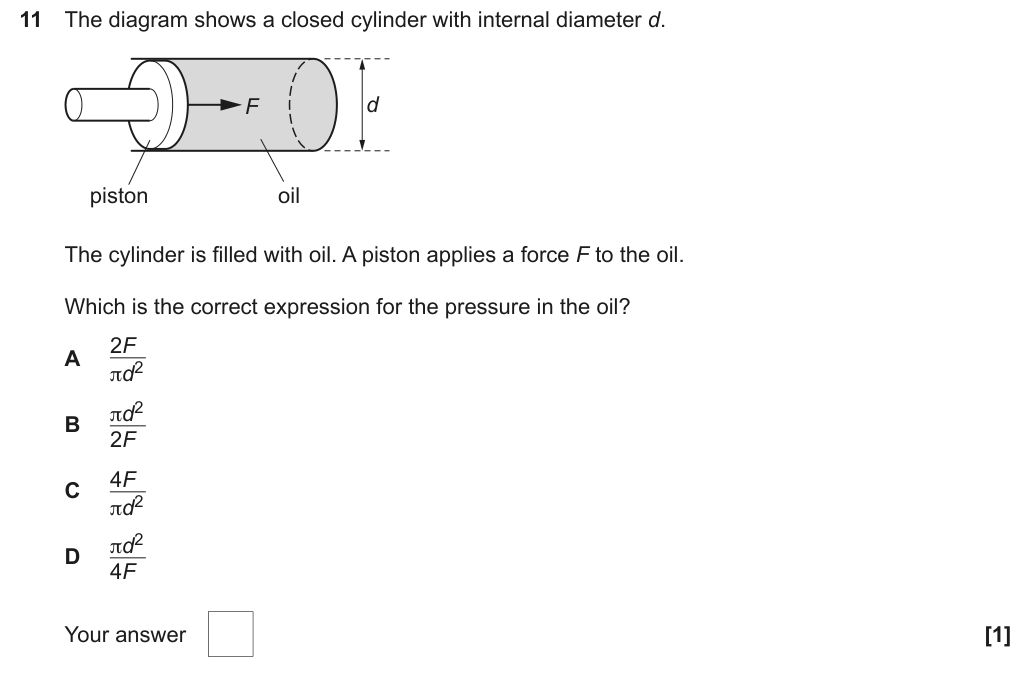
C
This question was answered well with most candidates giving the correct answer C by applying the equations P = F/A and πd2/4.
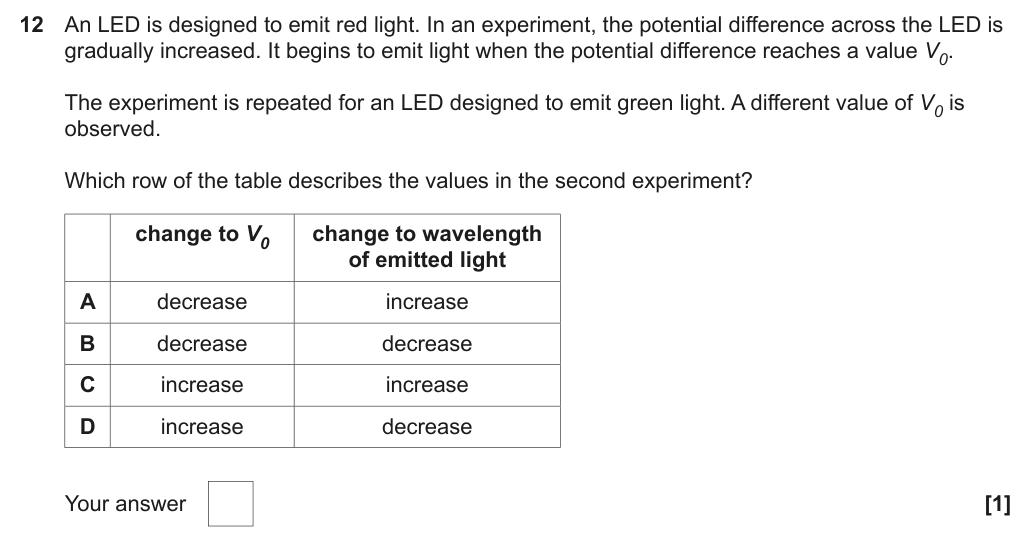
D
About half of candidates performed well on this question by determining the correct answer of D by understanding that green light has a shorter wavelength and increased energy (due to having a greater frequency) compared to red light. The most common distractors were B and C.
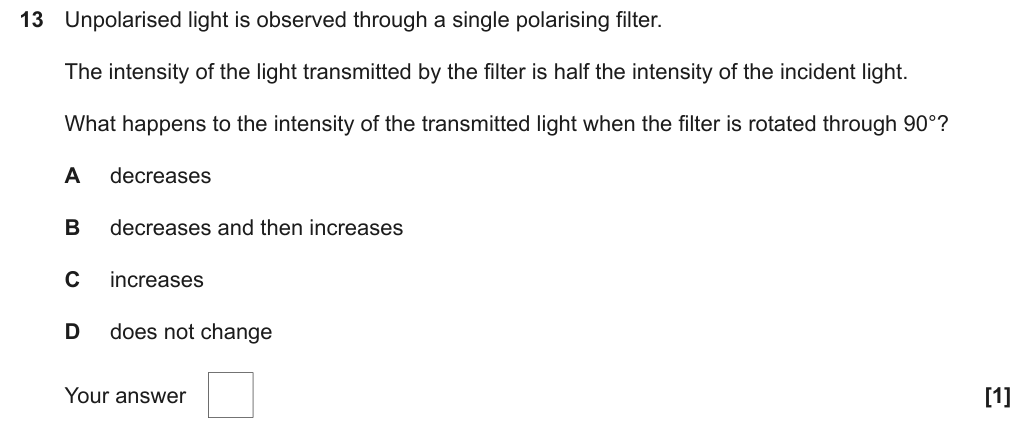
D
About half of candidates performed well on this question by determining the correct answer of D by understanding the behaviour and intensity of unpolarised light when transmitted through a polarising filter.
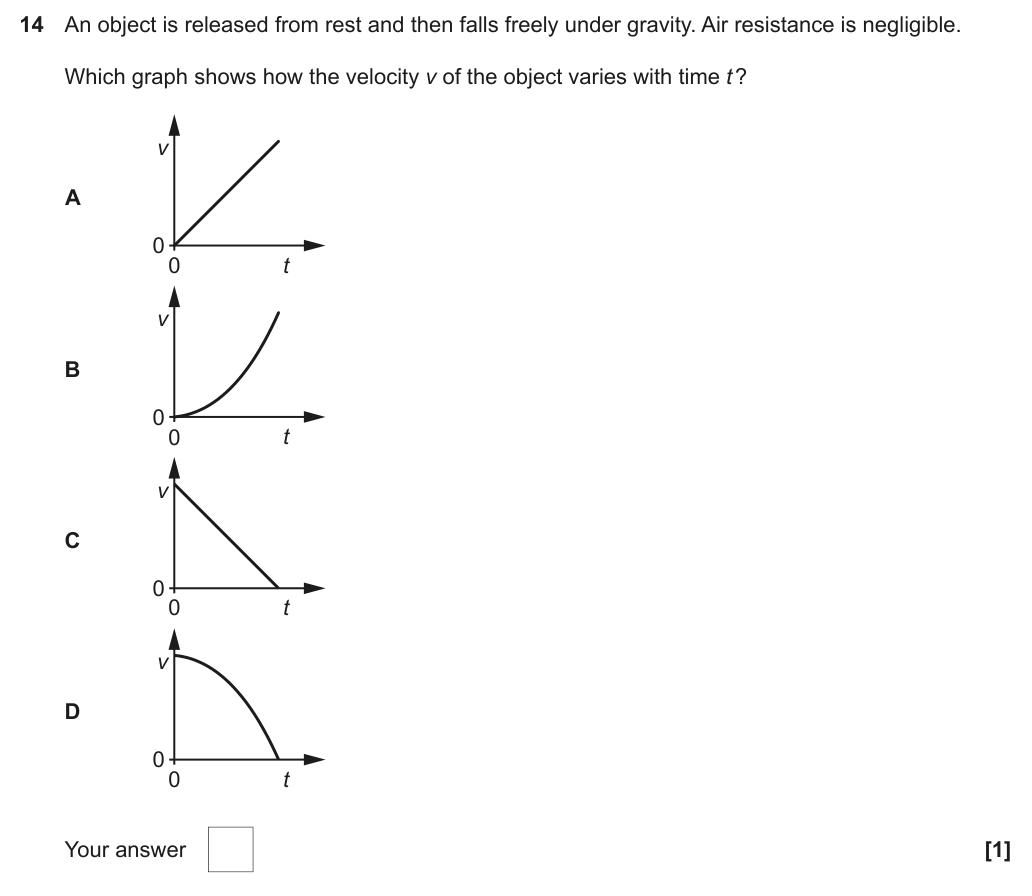
A
Just over half of the candidates correctly interpreted the graph to understand that the object was falling with constant acceleration due to gravity to give the answer A. The most common distractor was B.
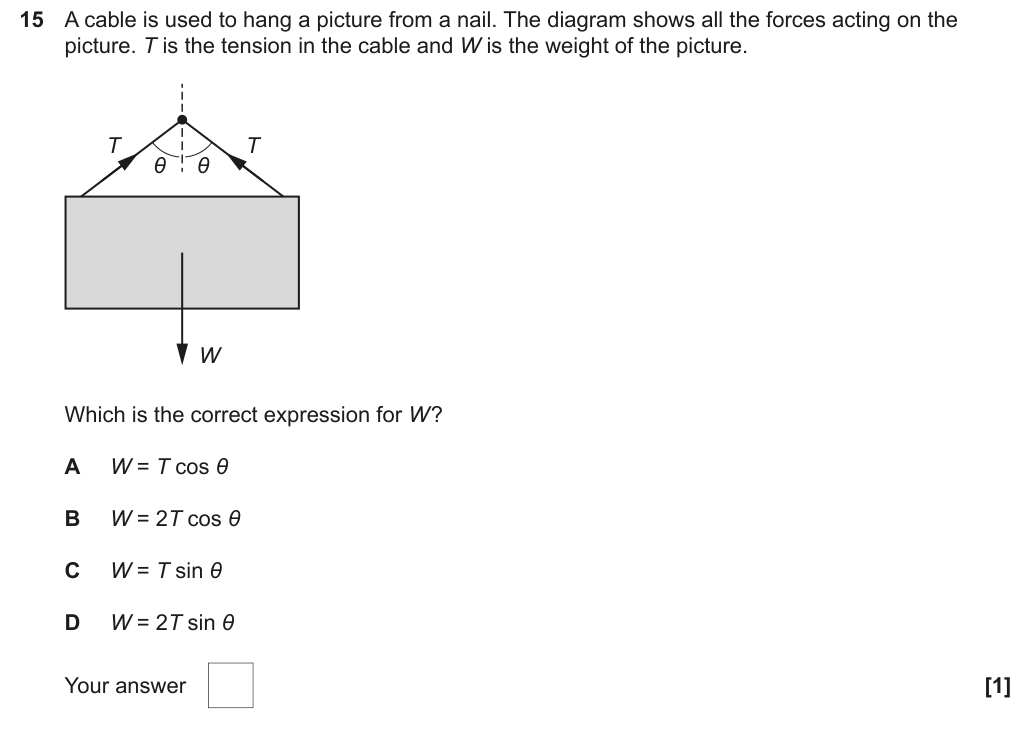
B
This question was generally answered well as most candidates correctly resolved T, tension to determine an expression for W.
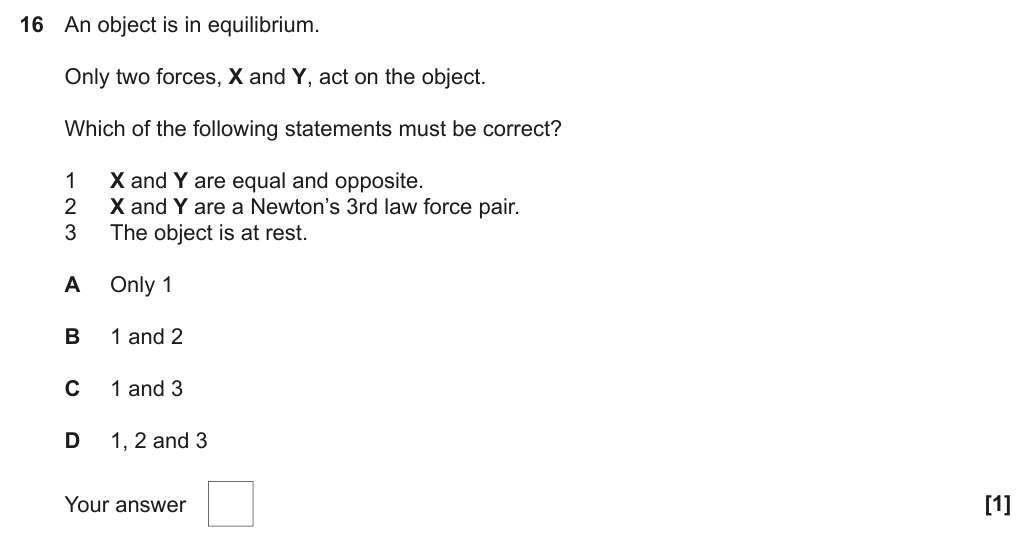
A
Candidates performed less well on this question as they either interpreted that since the forces acting on the object in equilibrium were equal and opposite the object was at rest, or that the pair of forces were an interaction pair of forces, so B and C were the most common distractors.
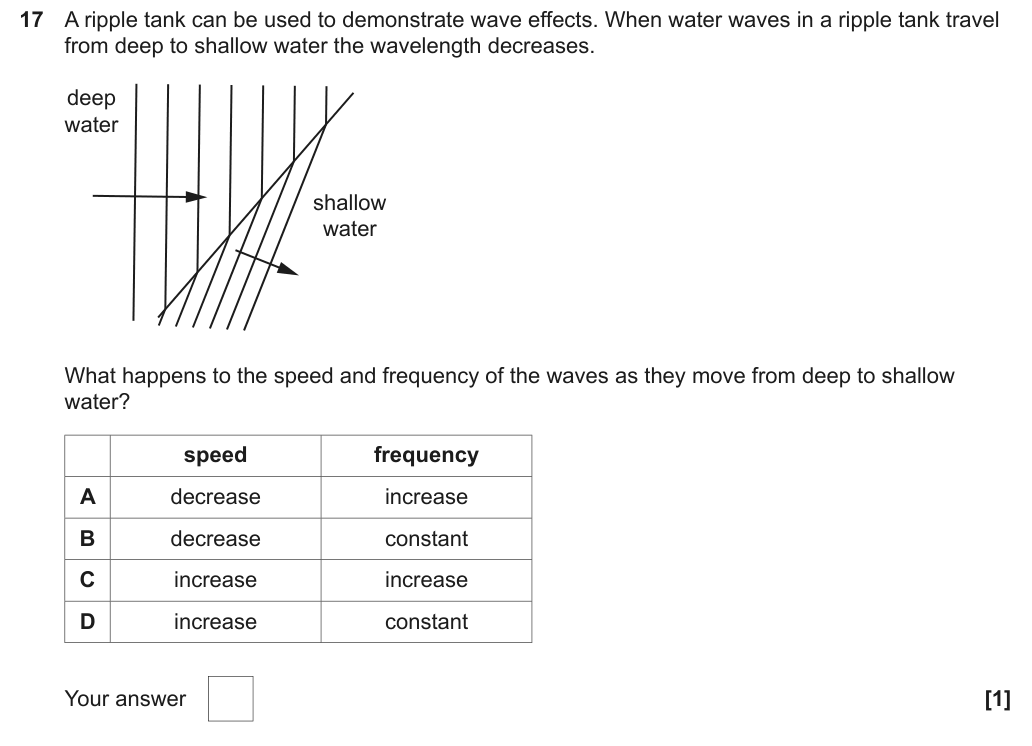
B
Only half of candidates correctly applied the behaviour of waves and understood that frequency of the waves remains constant when they travel through different media (different depths of water) and the wave speed equation to determine the correct answer B. Hence, the most common distractor was A.
Skills: PAG5 Investigating waves
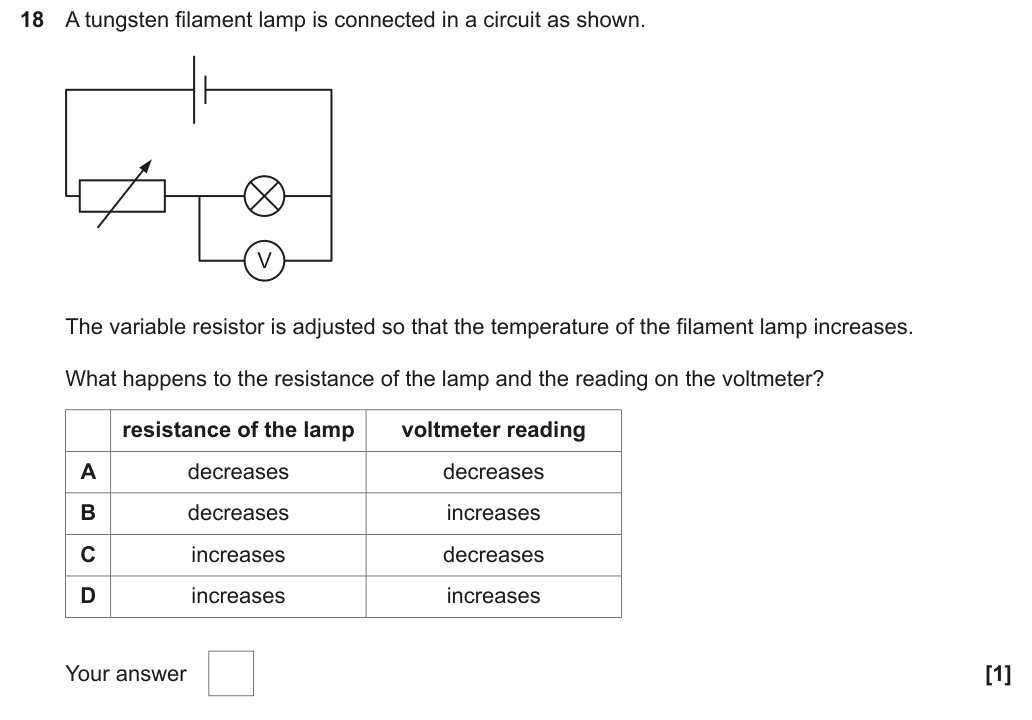
D
This question was generally answered well with most candidates correctly determining that as the temperature of the filament lamp increased so did the resistance of the filament lamp. By applying V = IR they then determined that the potential difference would also increase due to increased resistance. The most common distractor was C.
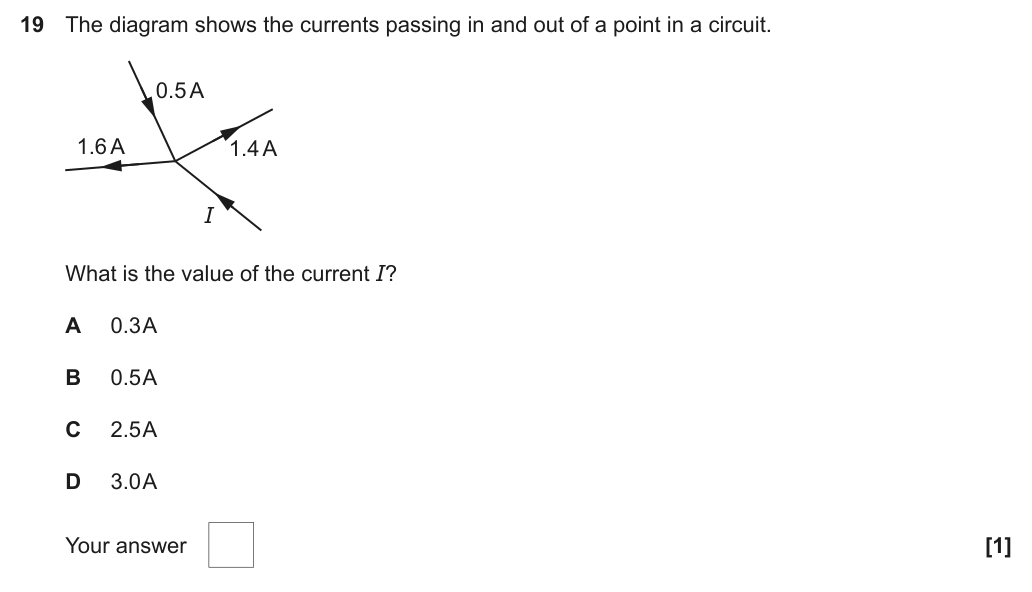
C
This question was answered well as most candidates applied Kirchhoff’s Law and that the sum of the currents entering a junction is equal to the sum of the currents out of the junction to give the correct answer of C.
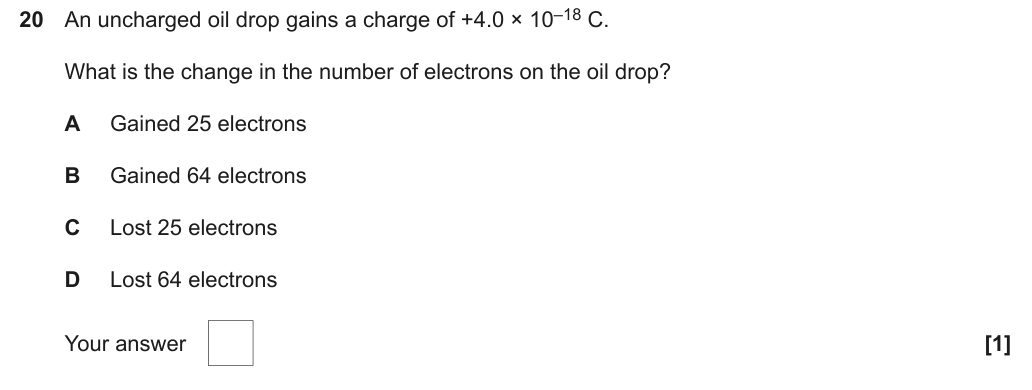
C
Most candidates correctly answered this question as they determined that the oil drop had lost electrons (since the oil drop had gained a positive charge) and used the charge of an electron to give the correct answer C. The most common distractor was D.
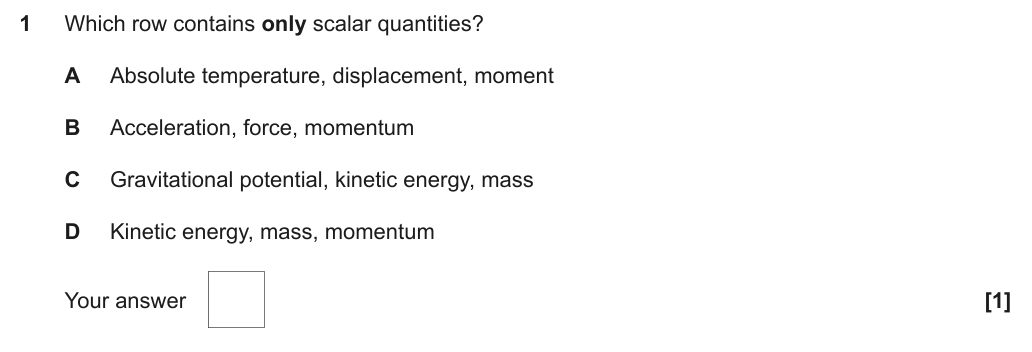
C
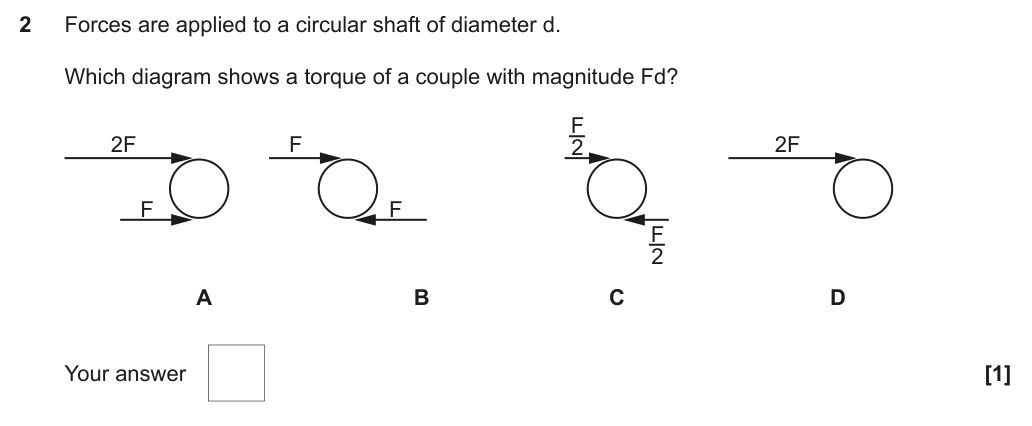
B
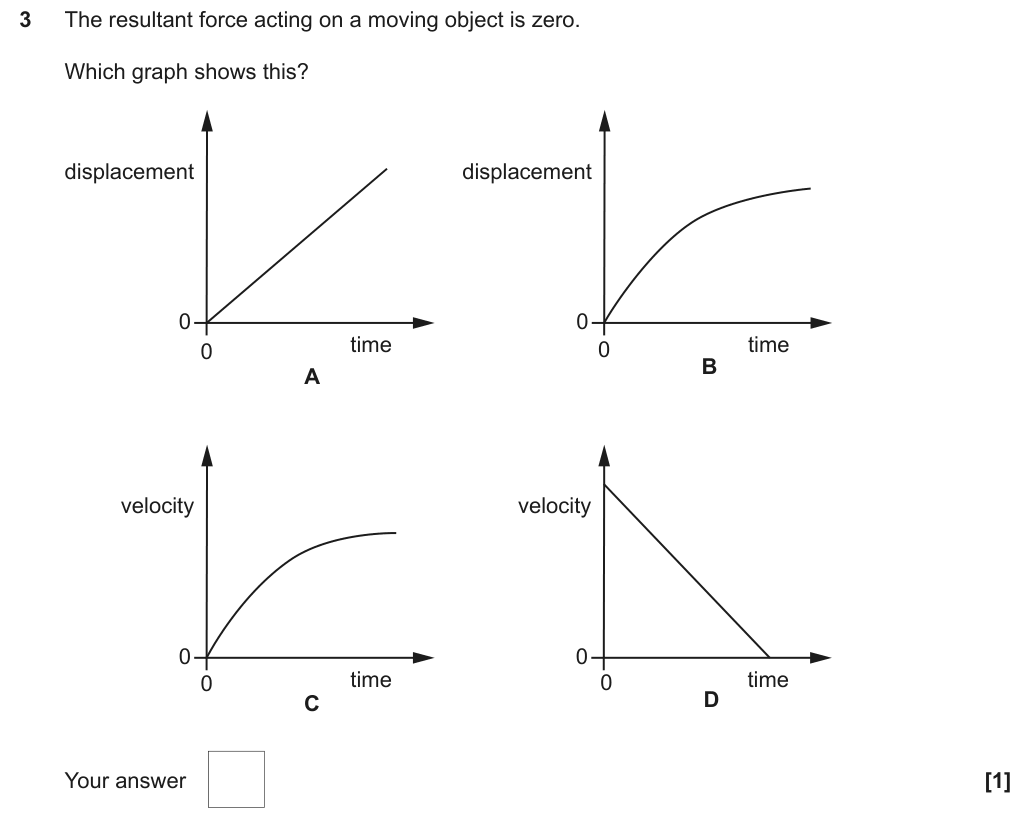
A
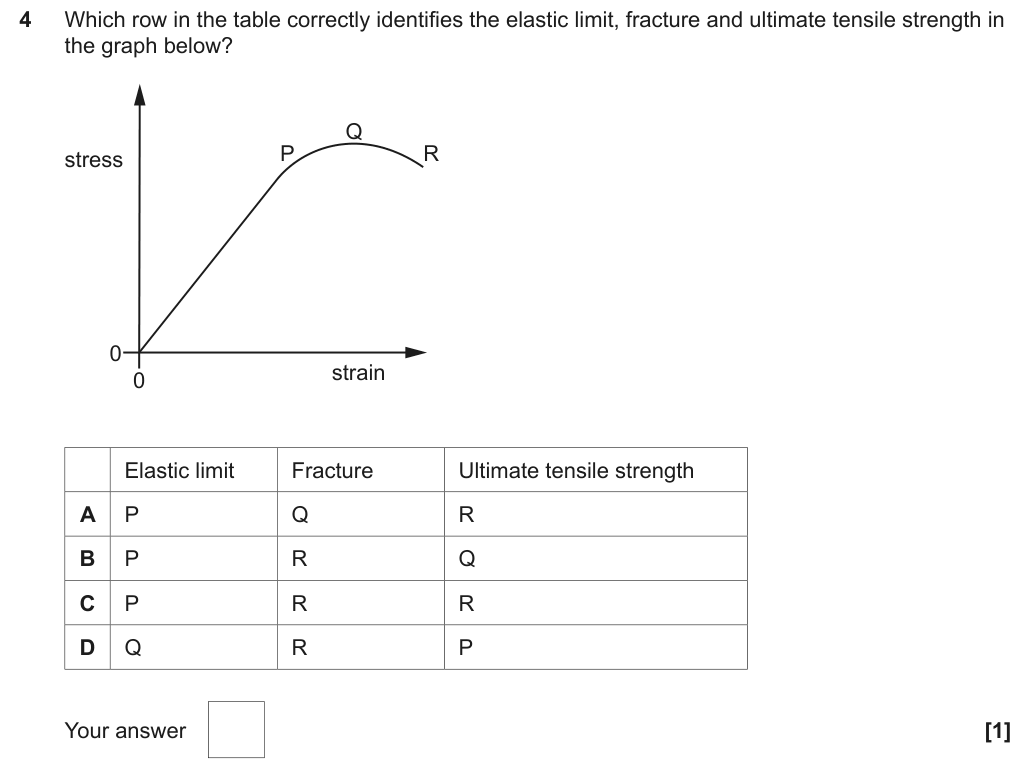
B
Most candidates deduced the correct answer by remembering that the ultimate tensile strength is given by the highest point on the graph, in this case, point Q.
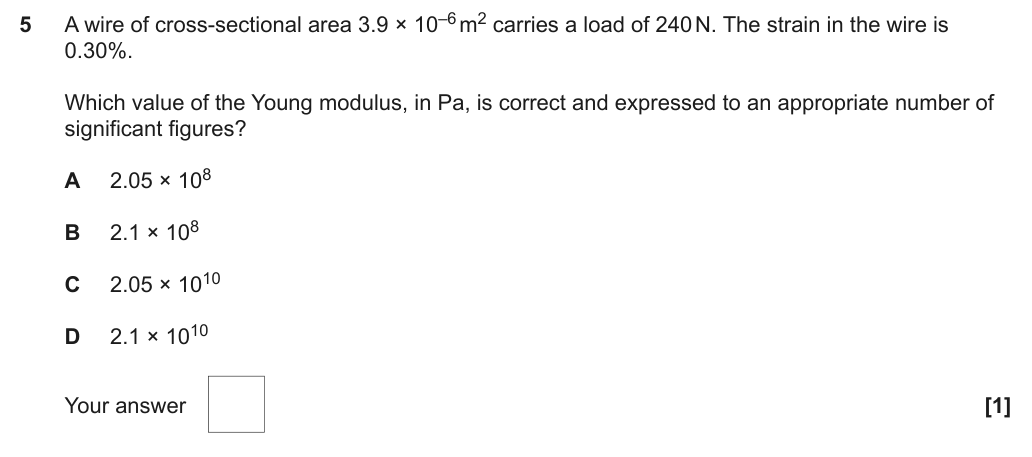
D
Just under half of all candidates got this correct. While the stress, given by force/area was straightforward to calculate, the strain was given as a percentage. This should have been converted to a decimal, i.e. 0.0030 to get the correct value of Young modulus.
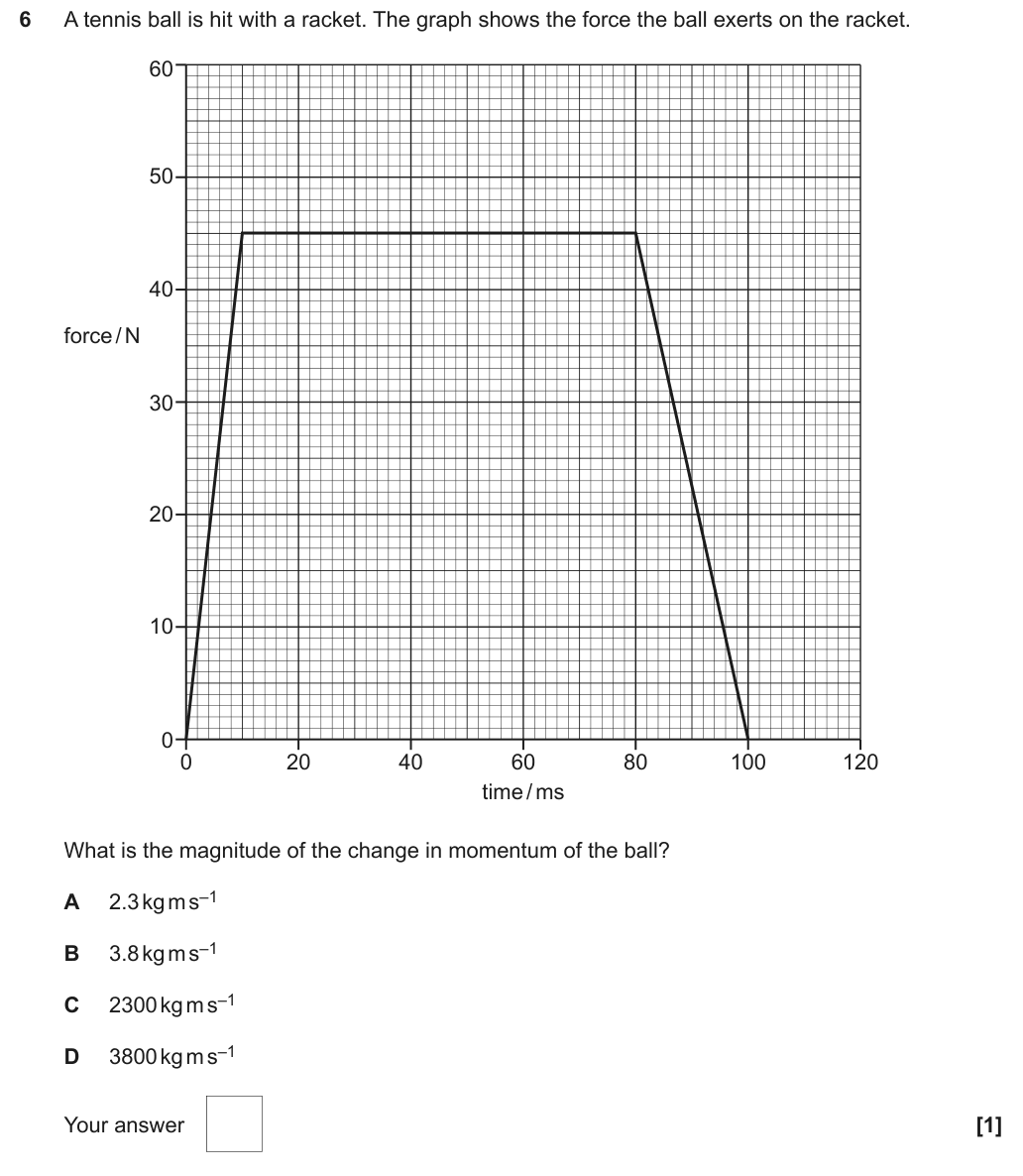
B
While virtually all candidates calculated the area of the trapezium correctly, candidates that forget that the time was measured in milliseconds picked answer D rather than the correct answer, B.
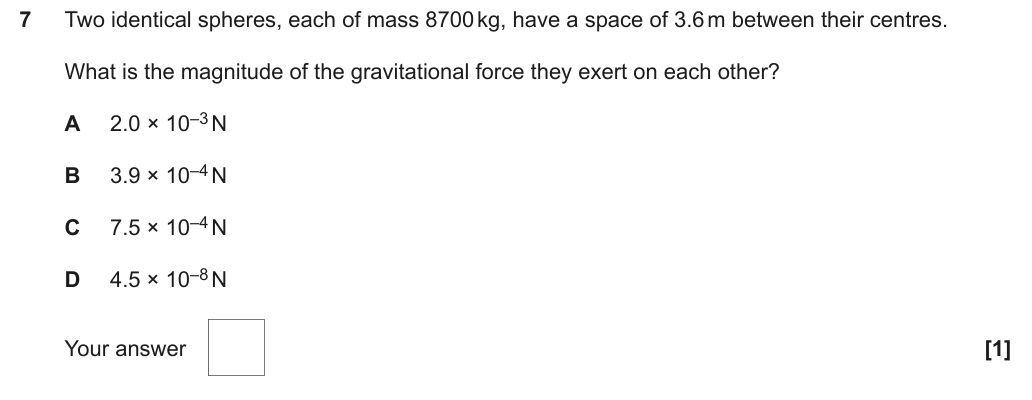
B
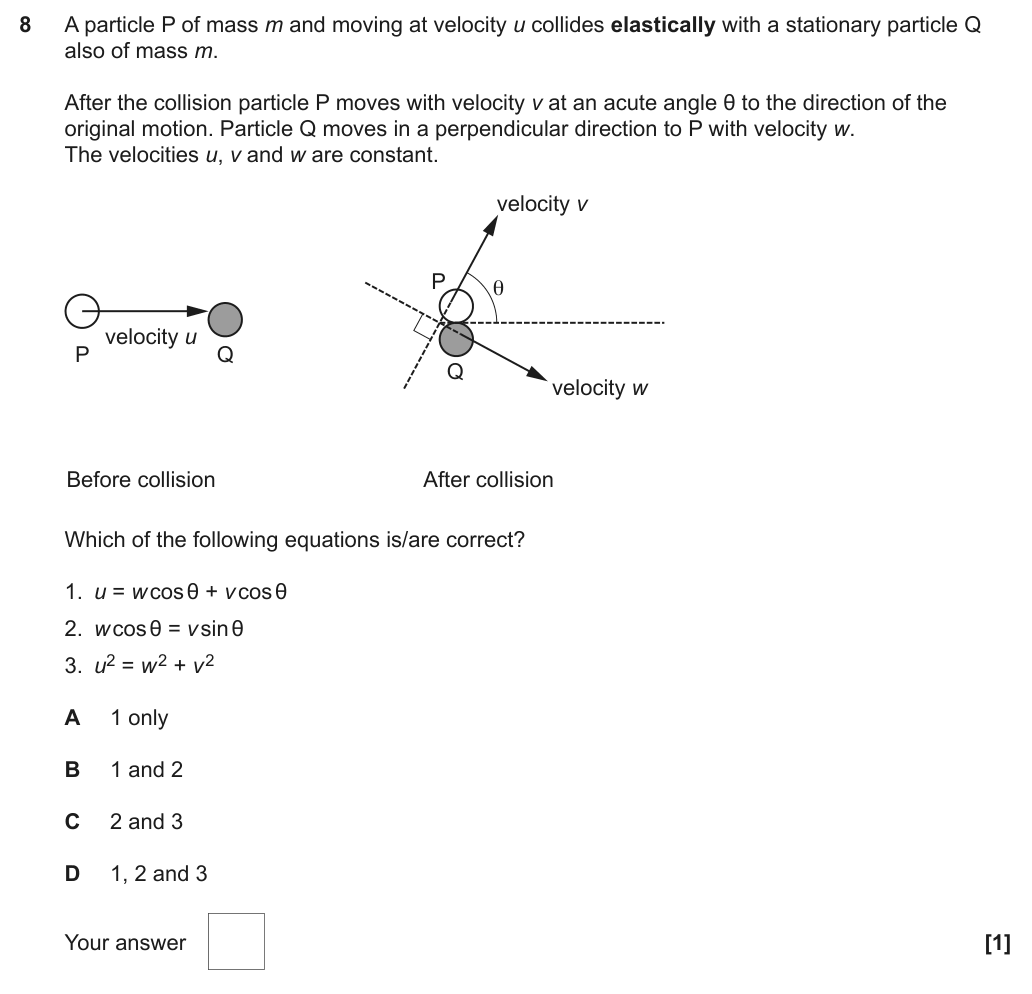
C
A good number of candidates answered this correctly. As this collision is elastic, the total kinetic energy (KE) for the collision, ½mu2 remains unchanged. The total KE after the collision is ½mv2 + ½mw2. Equating these expressions gives statement 3 as correct, eliminating answers A and B. Statement 2 must also be correct and comes from conservation of momentum at right angles to the dashed line. Looking along the dashed line, the momentum is mu before the collision. After the collision, the component of momentum along the dashed line for P is mvcosθ. The angle Q makes with the dashed line is not θ, so the component of momentum along that dashed line for Q cannot be mwcosθ. This makes statement 1 false and so the correct answer is C.
D
C
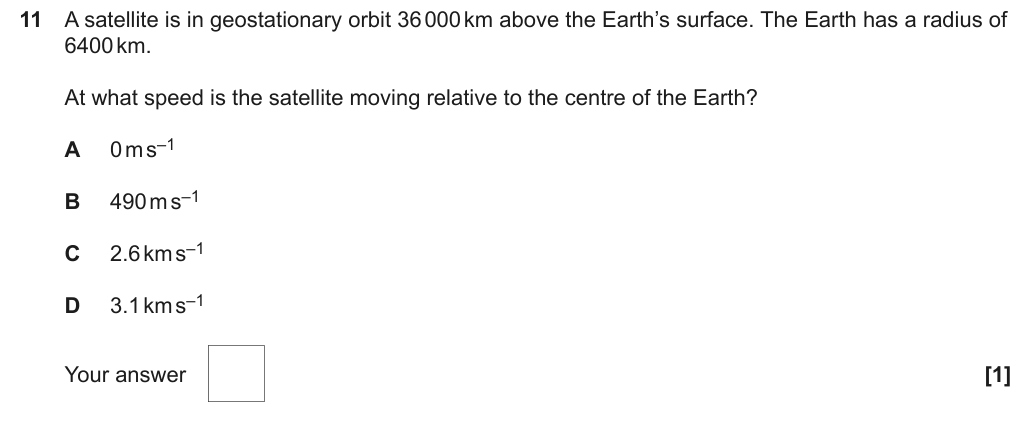
D
The question is asking for the candidate to calculate the speed of an object in a circular orbit with radius 42 400 km, i.e. 42.4 × 10⁶ m. To do this, the candidate equates the gravitational force, FG = GMm/r2. with the centripetal force required for that orbit, FC = mv2/r, where M is the mass of the Earth and m is the mass of the satellite. Rearranging gives v = √GM/r. Substituting the correct values for G, M and r will give answer D.
D
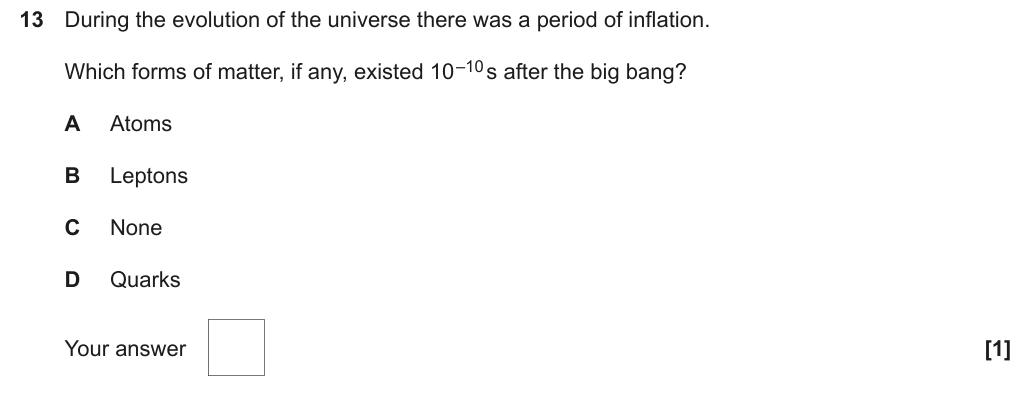
C
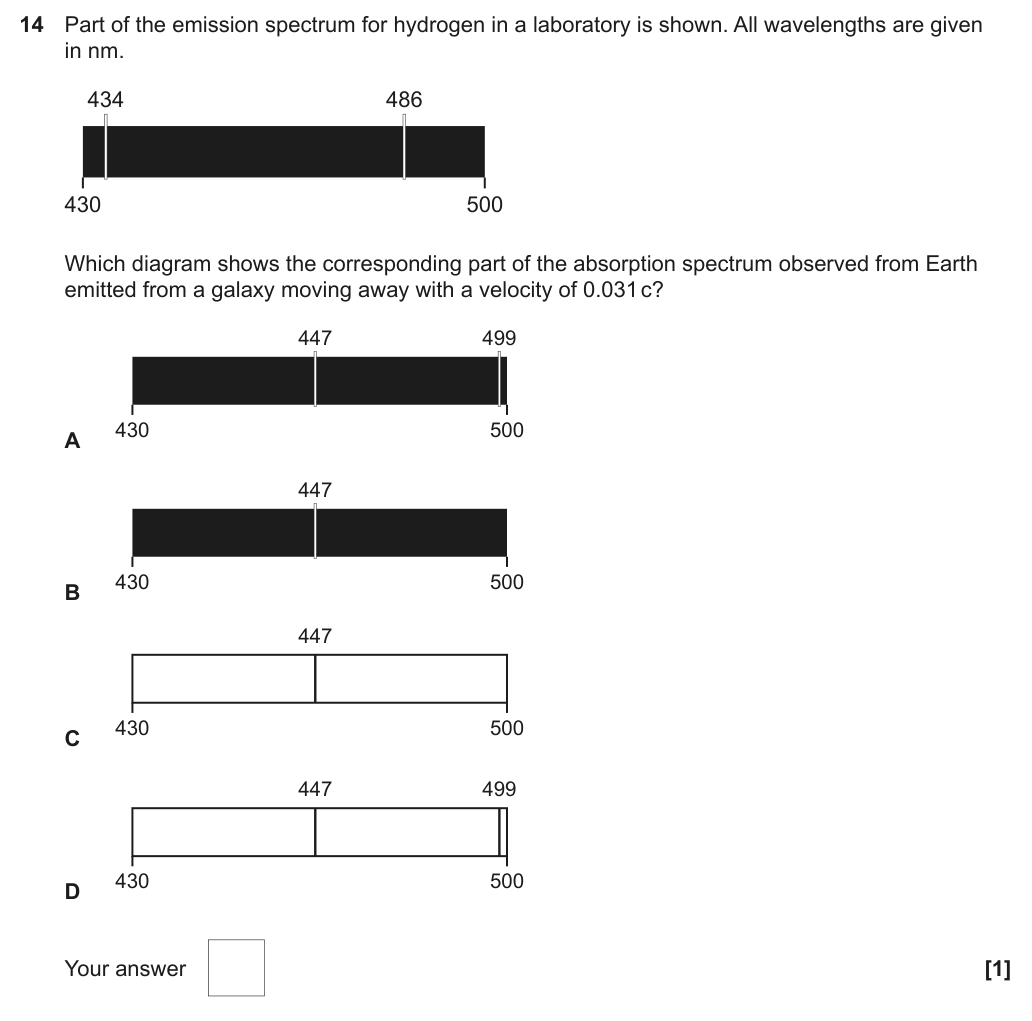
C
The spectrum in the question and those for answers A and B depict emission spectra. Spectra C and D are absorption spectra. The question asks for the absorption spectrum from distant galaxies so only answers C and D could be correct. With the recession velocity of 0.031c, both wavelengths will be increased by 3.1 percent. The laboratory wavelength of 434 nm becomes 447 nm after the redshift. The laboratory wavelength of 486 nm becomes 501 nm and so lies outside the range for these diagrams. This makes the correct answer C.
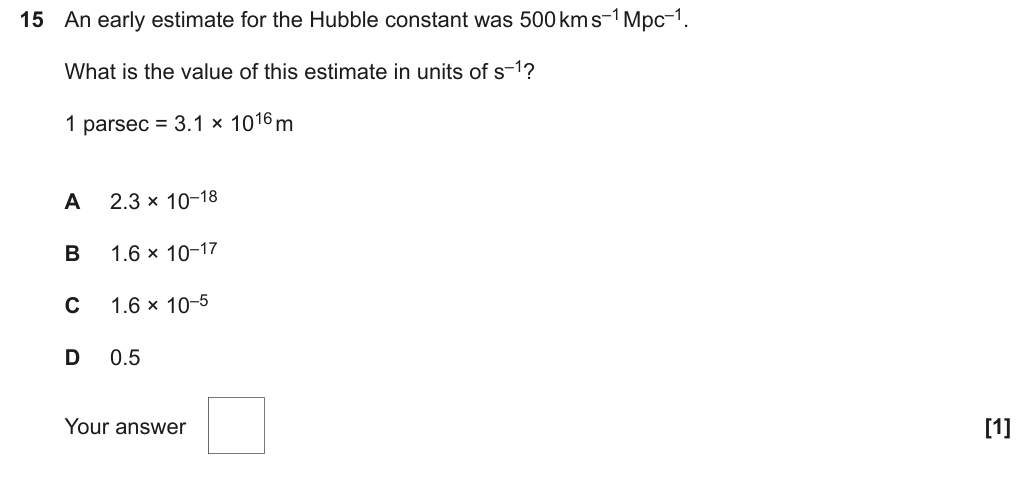
B
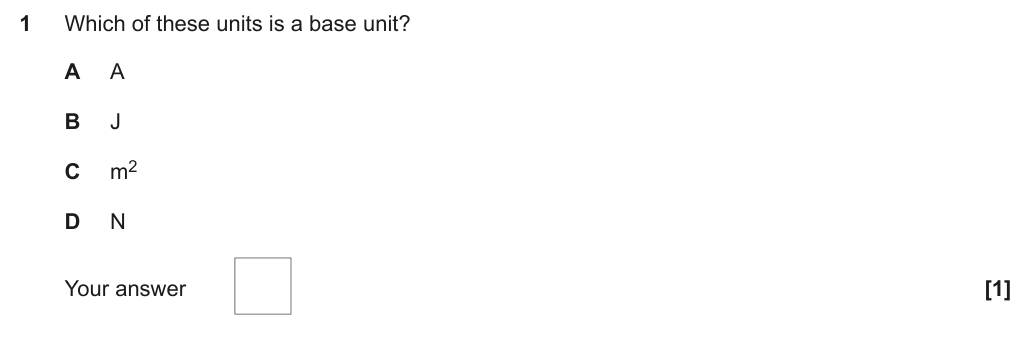
A
The majority of candidates were able to correctly recall the ampere as the correct base unit. C was a common distractor, most likely as it contains the obvious metre.
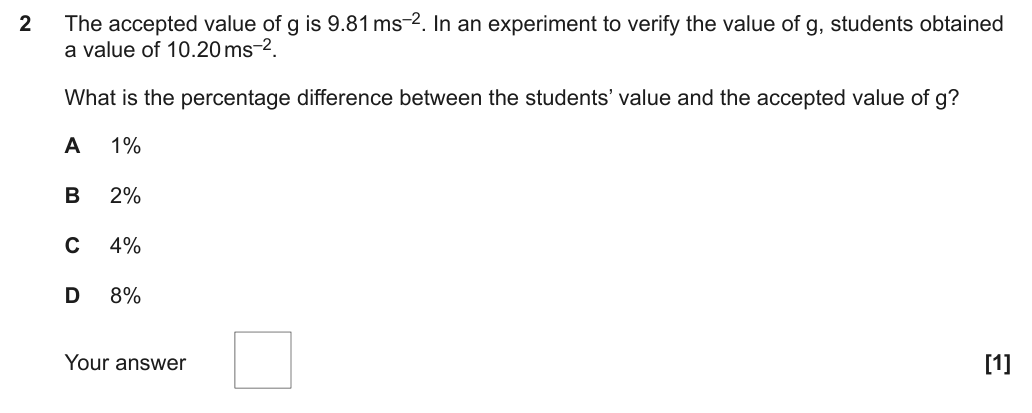
C
This question was answered correctly by the vast majority of candidates and it was encouraging to see detailed working at the side of the question.
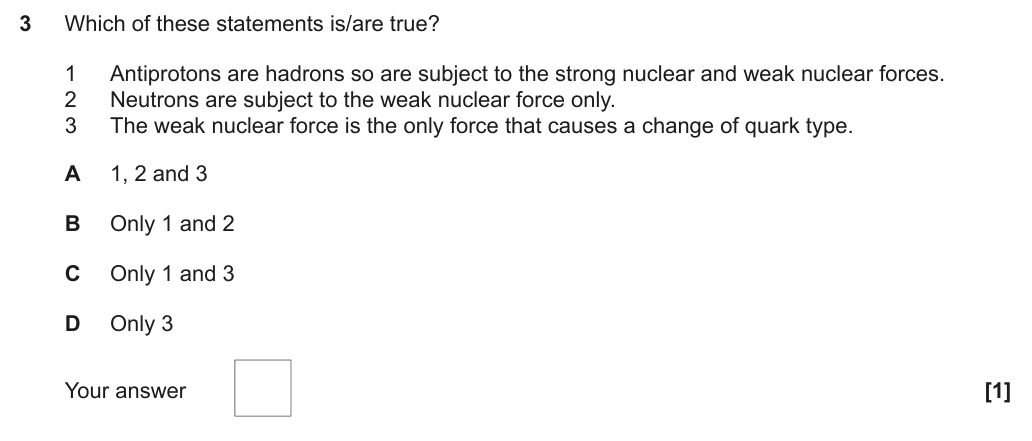
C
A good proportion of candidates were able to answer this correctly. Good practice in this style of questions is to tick the statements that the candidates are sure is correct and try a ‘best fit’. Most candidates knew statement 3 was correct and so response B was fairly uncommon as an incorrect response.
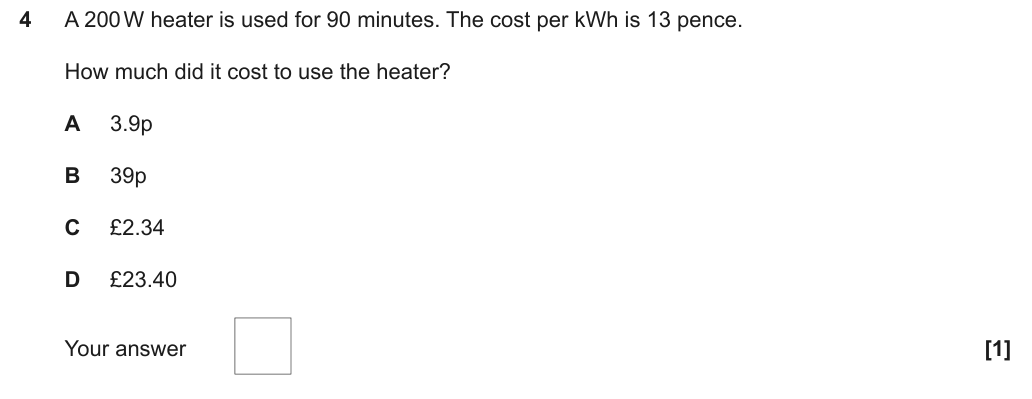
A
This relatively simple calculation was done correctly by a large majority of the candidates. It is good to see candidate’s workings on the question, as there are potential pitfalls in this. A number of candidates answered with response D, which showed a lack of appreciation of their calculation with actual costings.
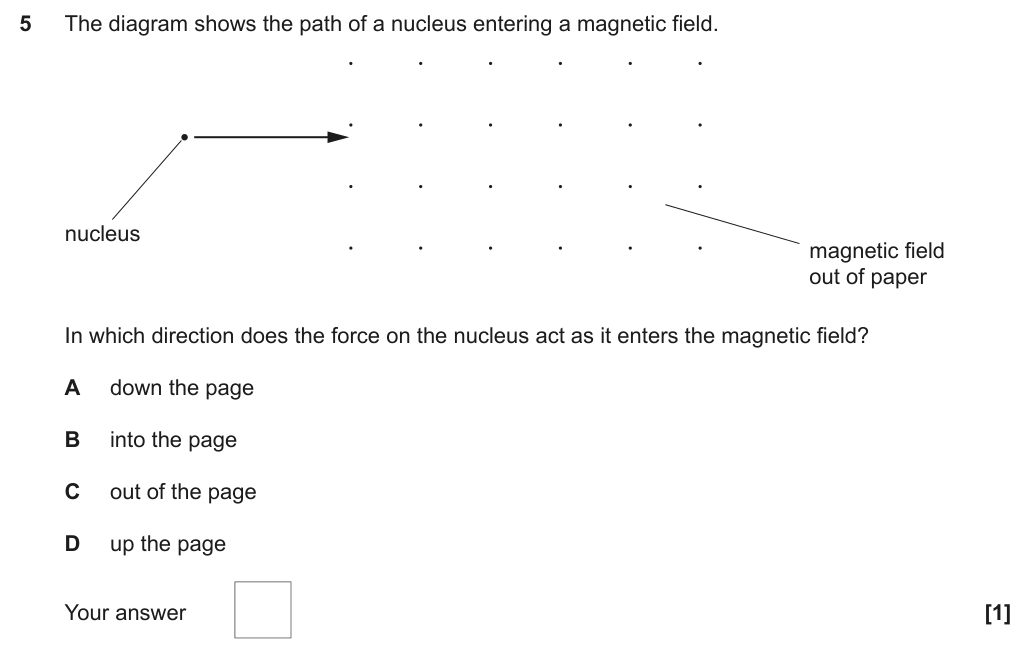
A
Just over half of the candidates correctly applied Fleming’s Left Hand Rule to obtain the correct response. Candidates should be familiar with the terms ‘into, down, out of, up’ in relation to directions in this style of question.
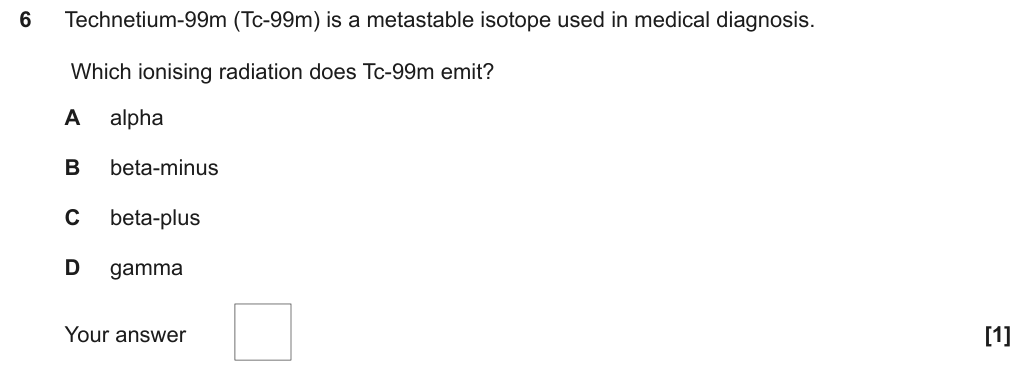
D
The majority of candidates were able to recall the correct emission, with the remaining responses being fairly well split across the other options, suggesting some guess work was involved.
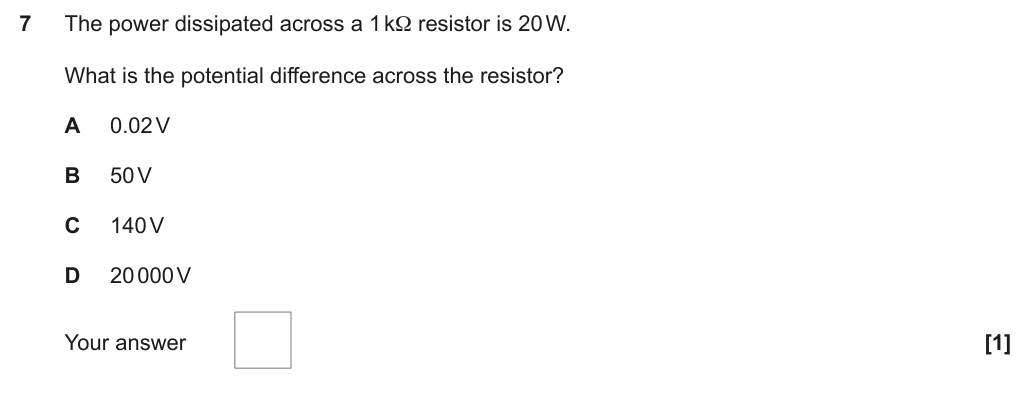
C
This is a relatively simple calculation and was answered correctly by the vast majority of candidates. Although it is quite possible to do this in one calculation on a calculator, it is always good practice to show working as it is less likely to result in a ‘power of ten’ or ‘transcription‘ error.
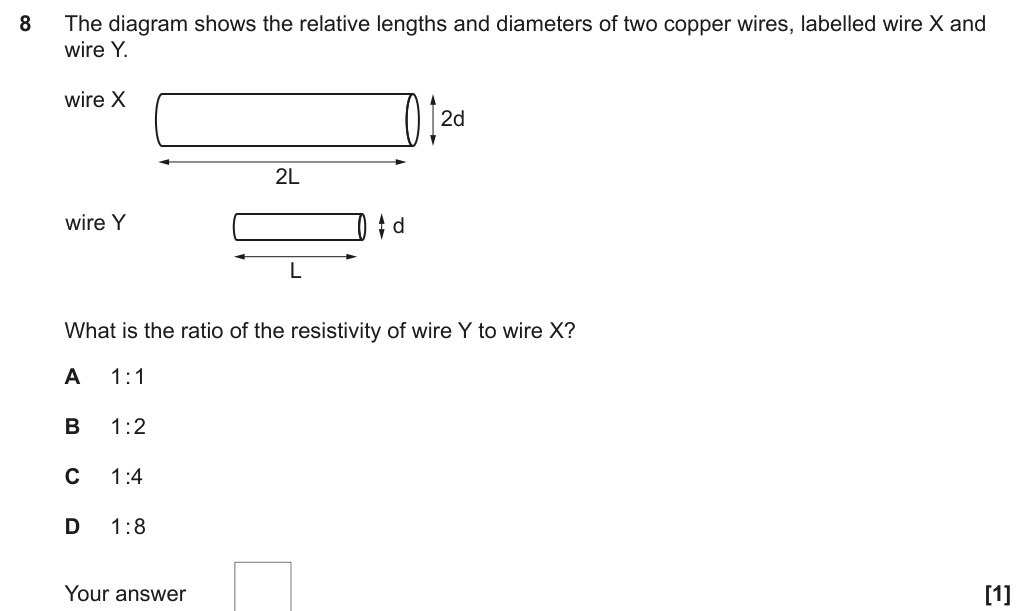
A
This question will have looked familiar to many candidates, as it involves changing dimensions of wire to calculate a value. Here, however, the question is asking about the resistivity of the wire which (given that they are both copper) remains the same. Only a little over one quarter of the candidates appreciated this; by far the majority calculated the ratio of resistances and gave the response B. This highlights the importance of reading the question carefully and not assuming that it is the same as one they have previously seen.
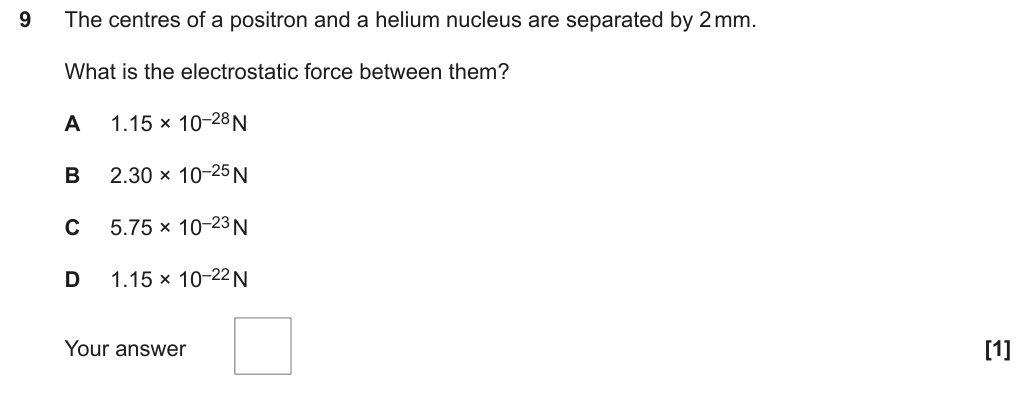
D
Around two thirds of candidates were able to correctly apply Coulomb’s law and obtain the correct response. Response C was a common distractor and this was evident for working as the charge on the helium nucleus was given as a single multiple of the fundamental charge.
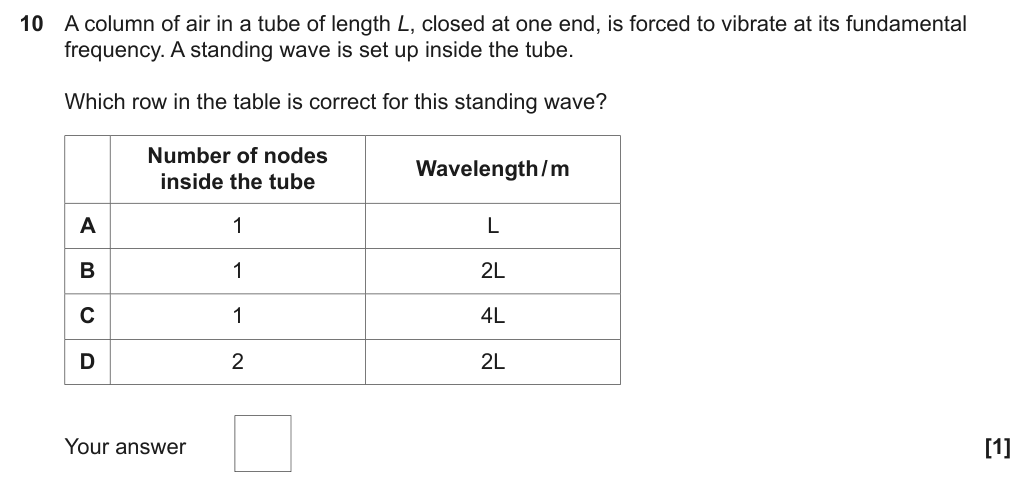
C
A large number of candidates were able to correctly identify the correct response and many drew a diagram to support their answer.
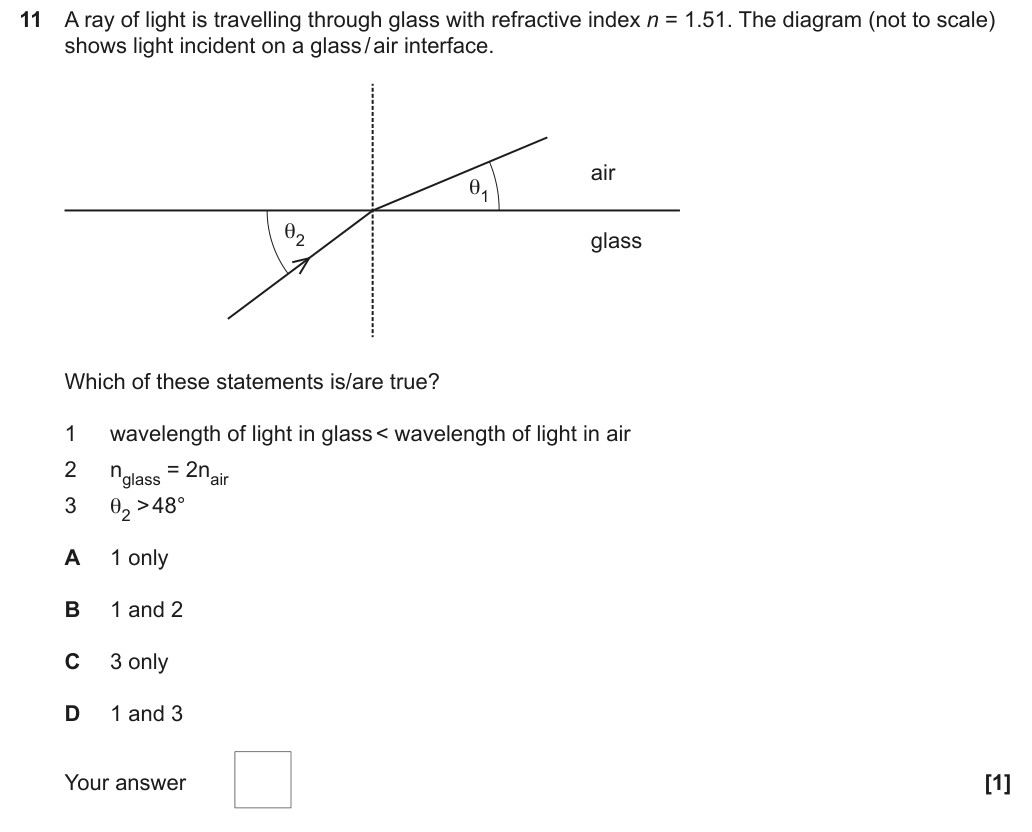
D
Around one third of candidates were able to identify the correct response; the main difficulty appeared to be that the given angle in the glass was not given relative to the normal (as is usual) and this meant that a common distractor was A.
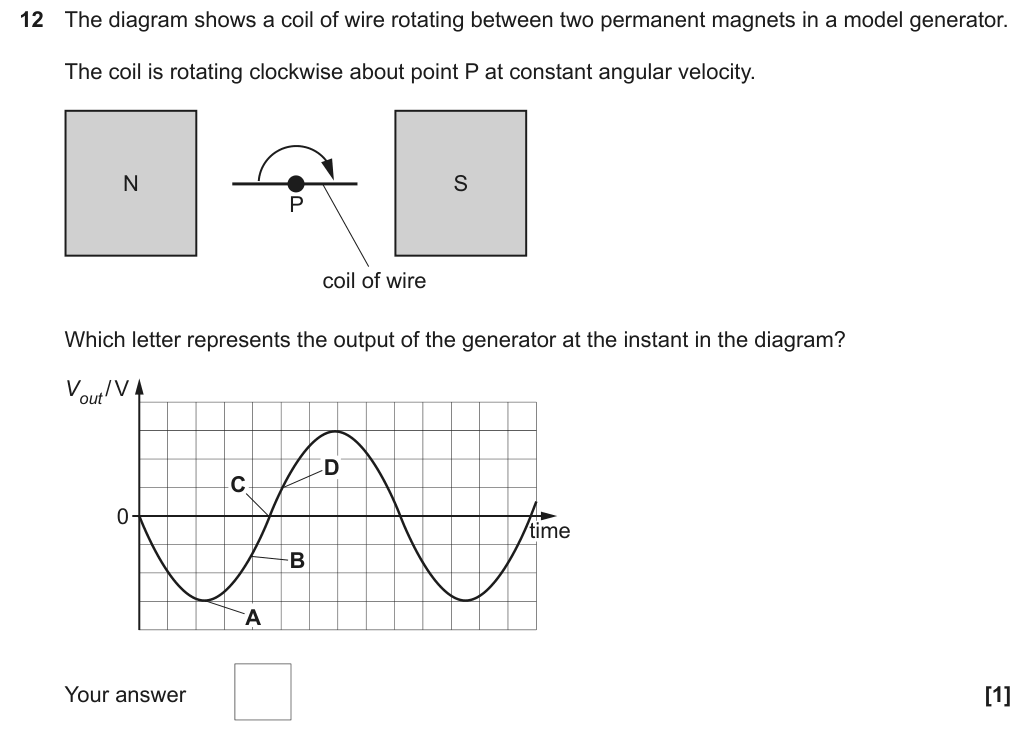
A
A majority of candidates were able to identify the correct response. The vast majority of incorrect responses were C, probably from the flux linkage at that point, rather than the rate of change of flux linkage.
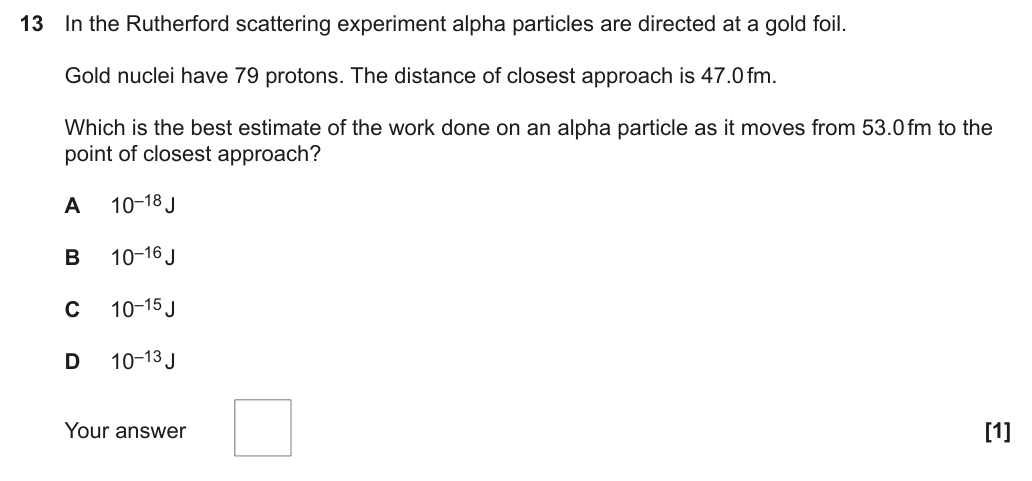
D
A little under half of the candidates were able to calculate and select the correct response. The most common incorrect response was B, although it was not entirely clear why this was the case from candidates working. A very small minority of candidates did not answer this question.
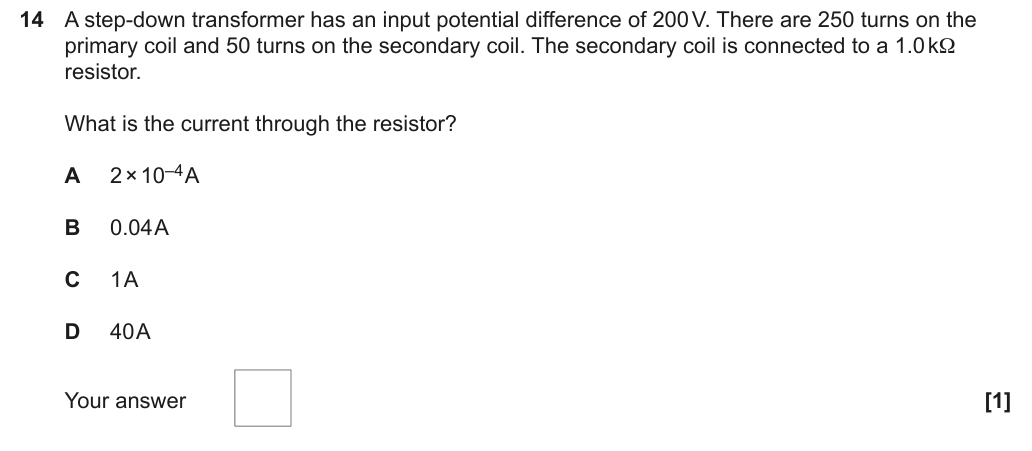
B
This question was correctly answered by a good proportion of the candidates, as it was a relatively simple two step calculation. The vast majority of incorrect responses showed little useful working, showing a lack of knowledge of transformers.
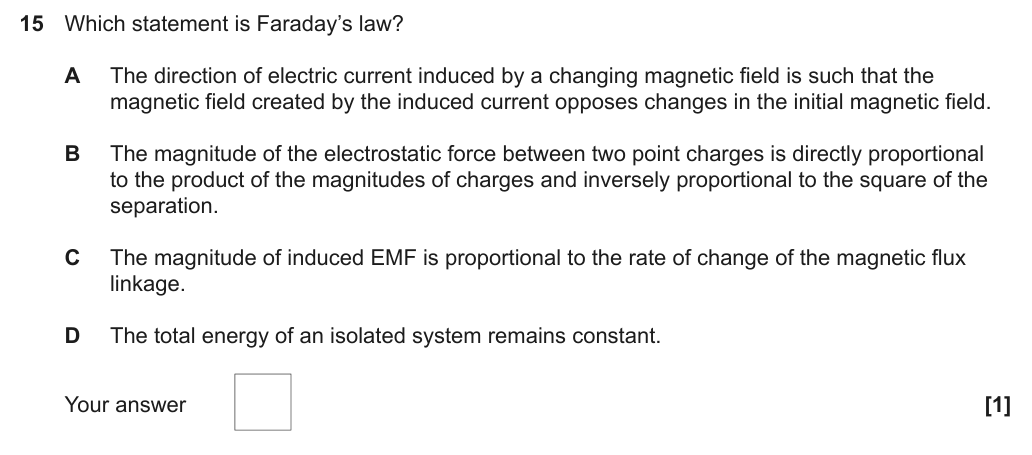
C
The majority of candidates were correctly able to identify Faraday’s law from a list of physical laws. Many candidates knew that it was related to electromagnetism and so the majority of incorrect responses were A.
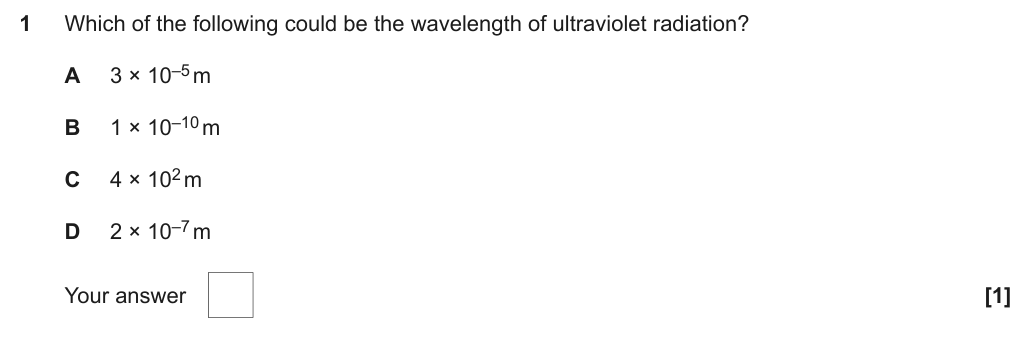
D
This should have been a straightforward starting question for all the candidates in determining a possible wavelength for ultraviolet radiation but only half of the candidates got the correct answer D. The most common distractor was B.
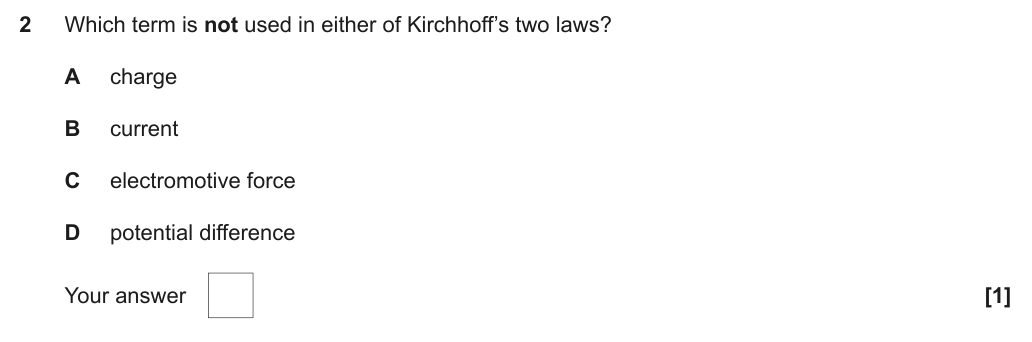
A
This question assessed candidates understanding of Kirchhoff’s two laws with most candidates applying their knowledge that current and potential difference were used in the laws. This meant that most candidates answered A correctly but C was a common distractor.
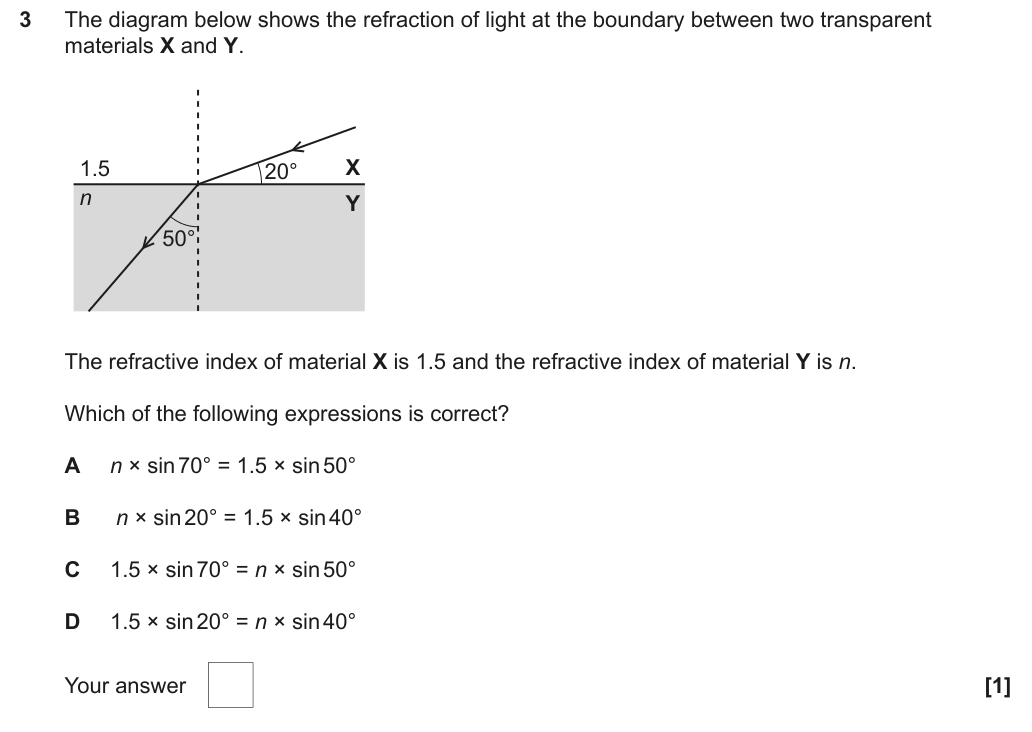
C
Most candidates identified the answer as C by correctly applying Snell’s law to the boundary of the two materials X and Y.
Skills: M4.5 Use sin, cos and tan in physical problems
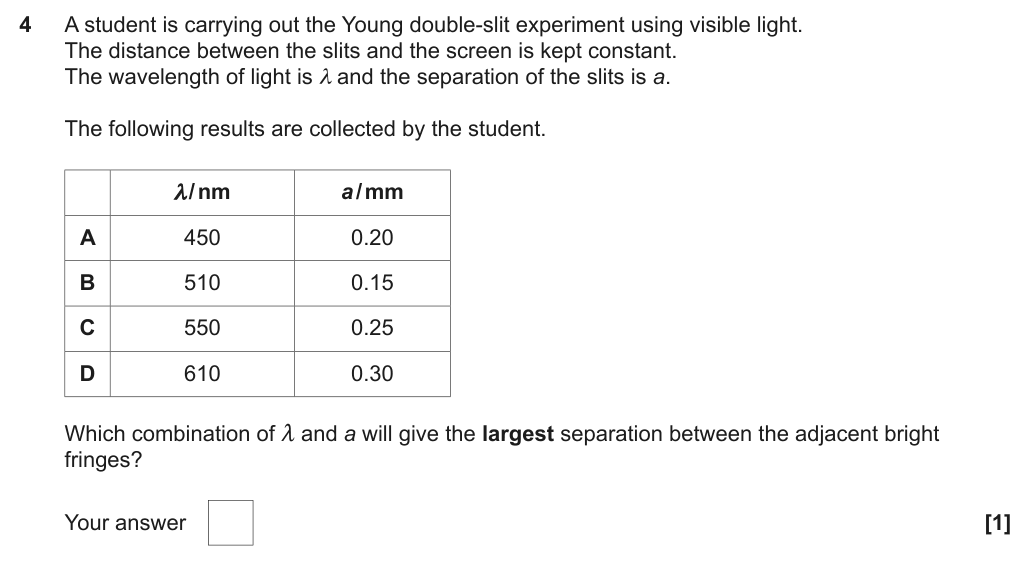
B
Most candidates identified the answer as B by correctly applying λ = a x / D and the relationship between λ, a and x when D is constant.
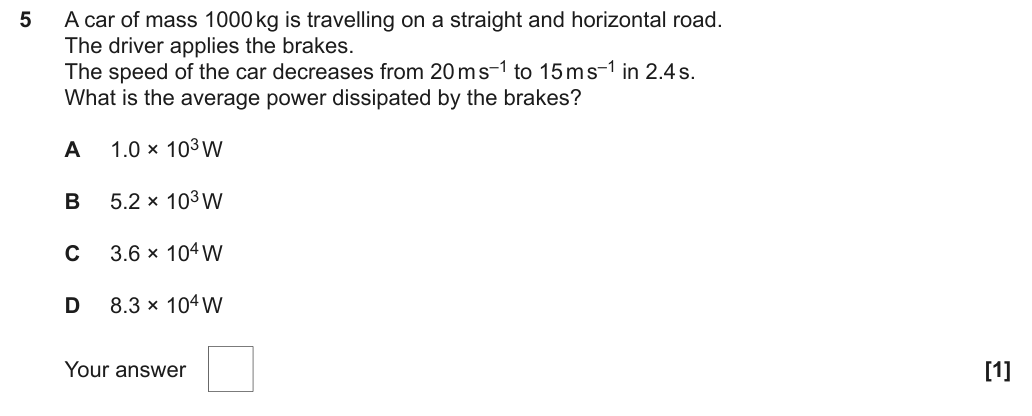
C
Candidates did not perform as well on this question with just a small majority of candidates calculating the correct answer C. If candidates did show working out it was evident that they understood that power = energy / time but they did not calculate the difference in kinetic energy to calculate the power dissipated in the time given.
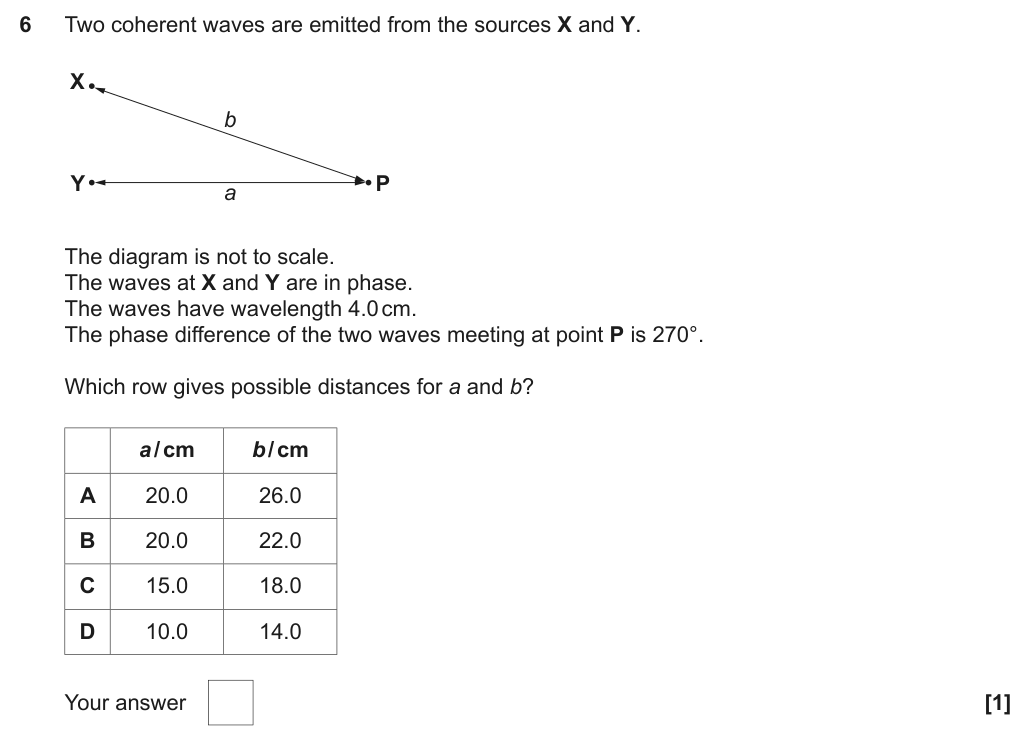
C
Candidates did not perform as well on this question with just a small majority of candidates determining the correct answer C. For A, B and D the path difference between a and b corresponds to either a whole or a half number of wavelengths so the waves must either be in phase or anti-phase.
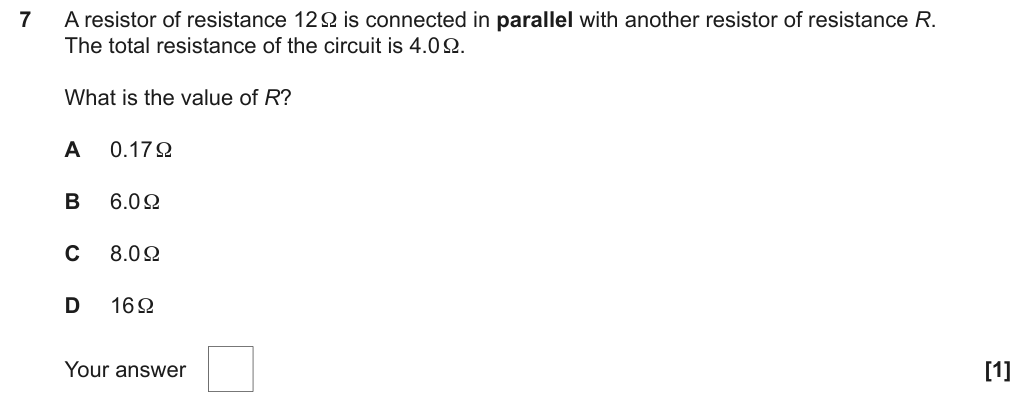
B
Candidates performed well on this question by correctly calculating the resistance R using the formula: 1 R = 1 R1 + 1 R2 + … To give the correct answer B.
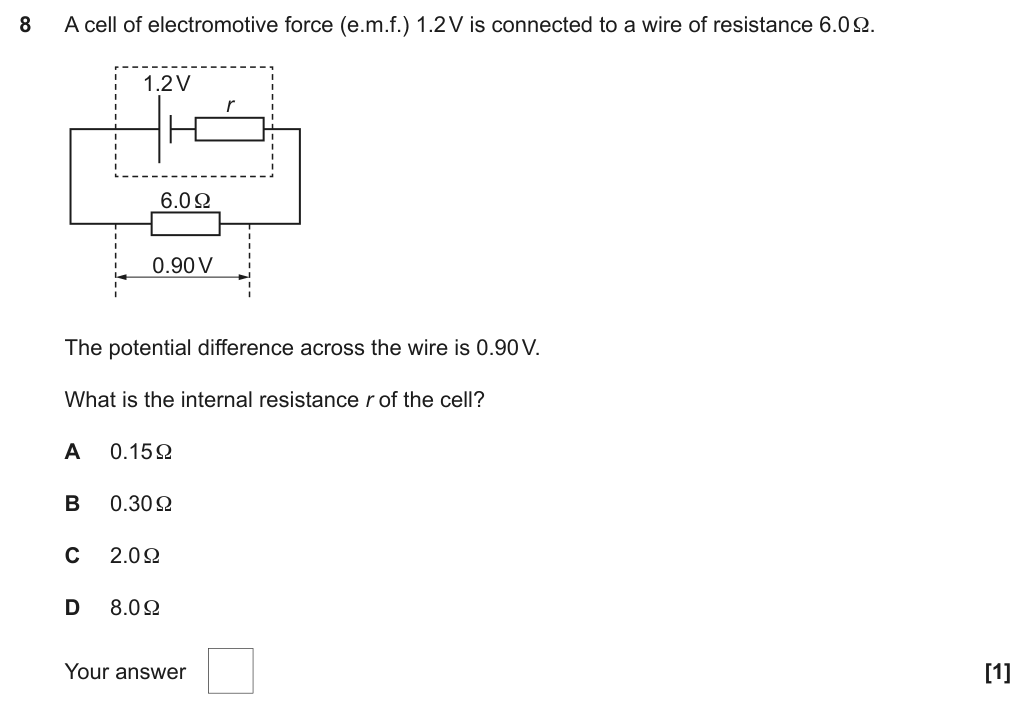
C
Most candidates performed well and correctly selected the equation; ℰ = V + Ir and applied Ohm’s Law to give the answer C. The most common distractor was answer D where candidates had correctly calculated the current but carried out the calculation for the internal resistance r = 1.2 V / 0.15 A = 8 Ω.
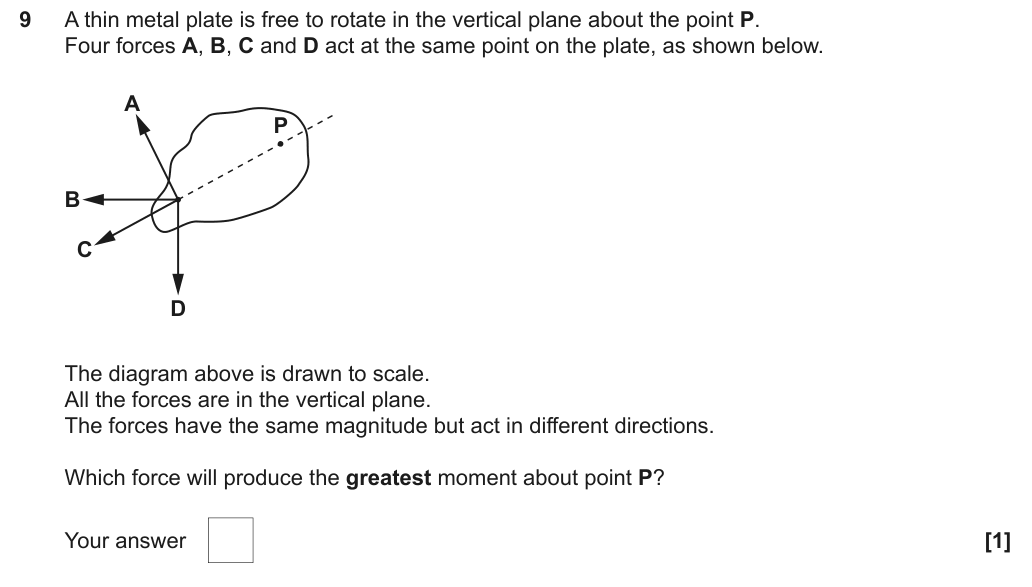
A
Most candidates performed well as they applied that the greatest moment is produced from force × perpendicular distance of the line of action of the force from P to give the correct answer A.
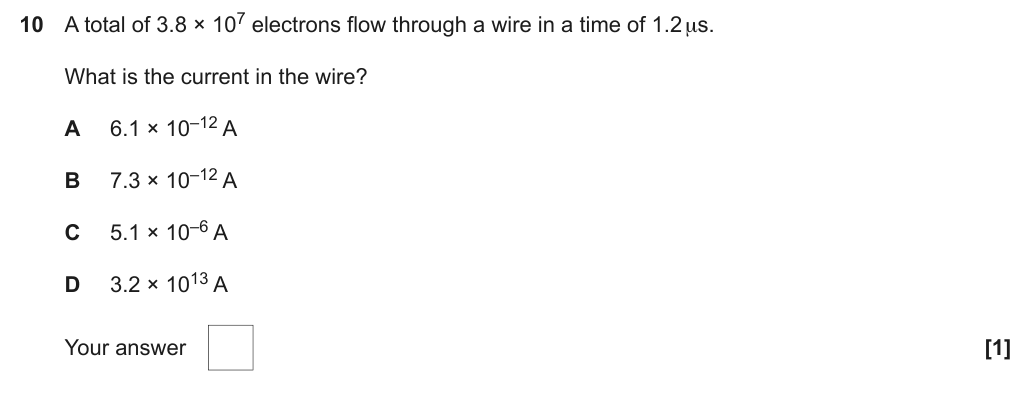
C
This question was generally answered well but candidates had to use the charge of an electron to calculate the total charge of the electrons flowing in the wire. If candidates missed this step in their working, they weren’t able to access the correct value for the current.
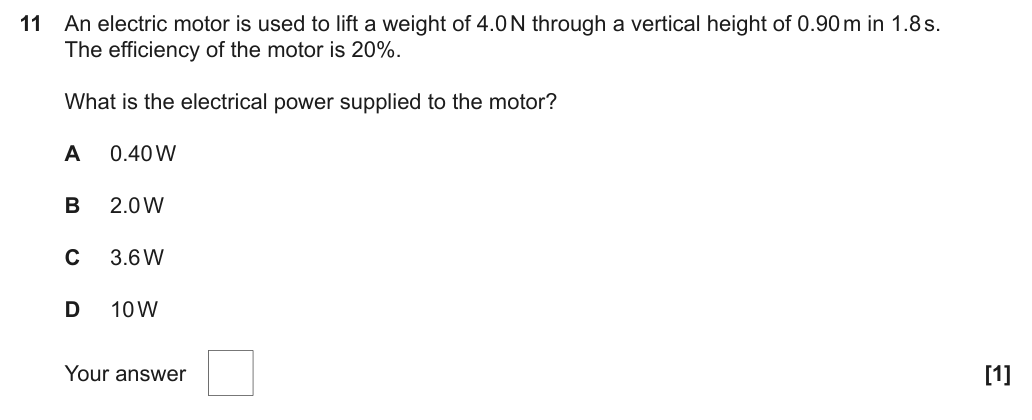
D
Only half of candidates answered this question correctly, D, with the most common distractor being answer B. This response demonstrated that they had calculated the correct work done in lifting the motor and then calculated the useful power rather than the power supplied to the motor.
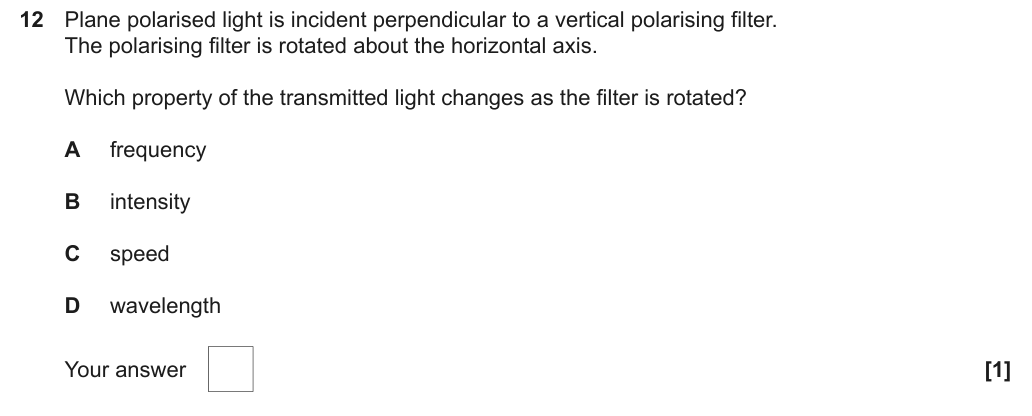
B
Most candidates answered this well as they were able to identify that the intensity was the property that changed when the polarising filter was changed which demonstrated their understanding of plane polarised light.
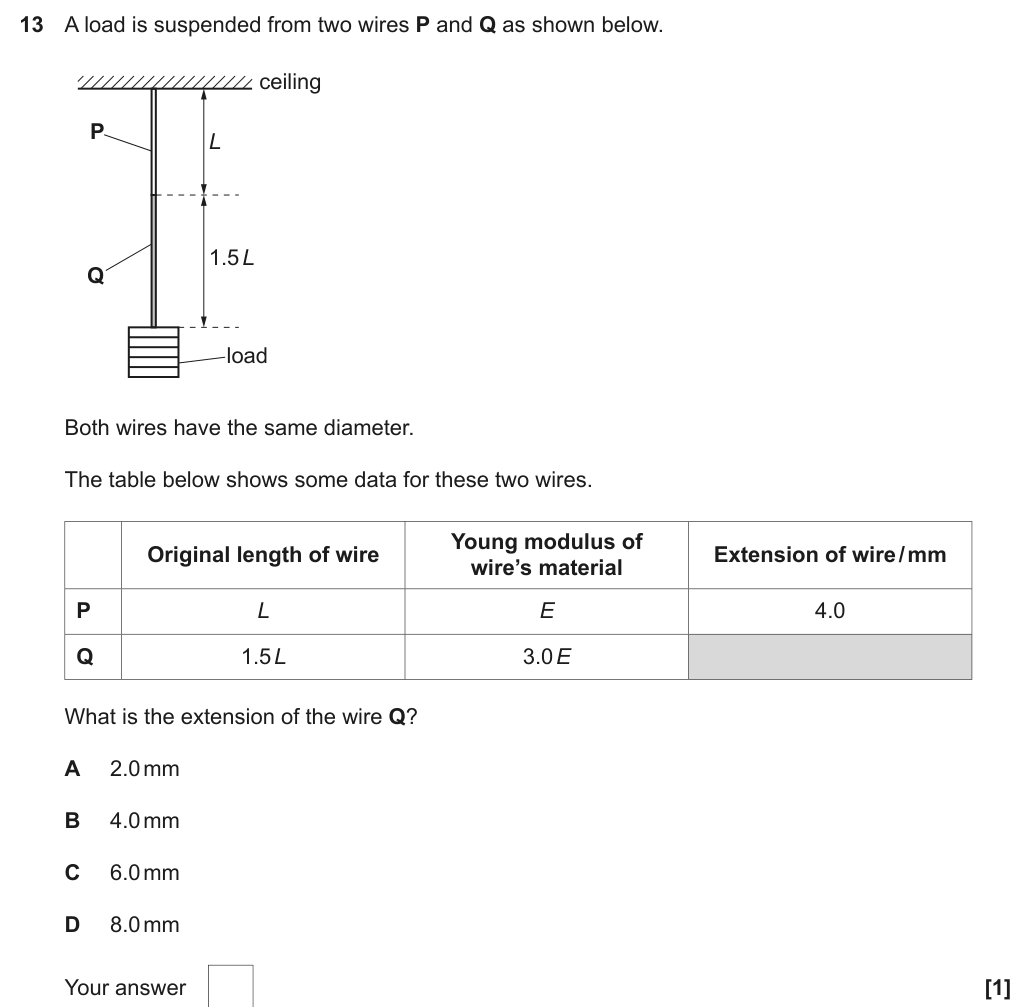
A
Candidates performed less well on this question, answer A. The most common distractor was answer D where candidates had doubled the extension rather than using and applying E = σ / ε correctly.
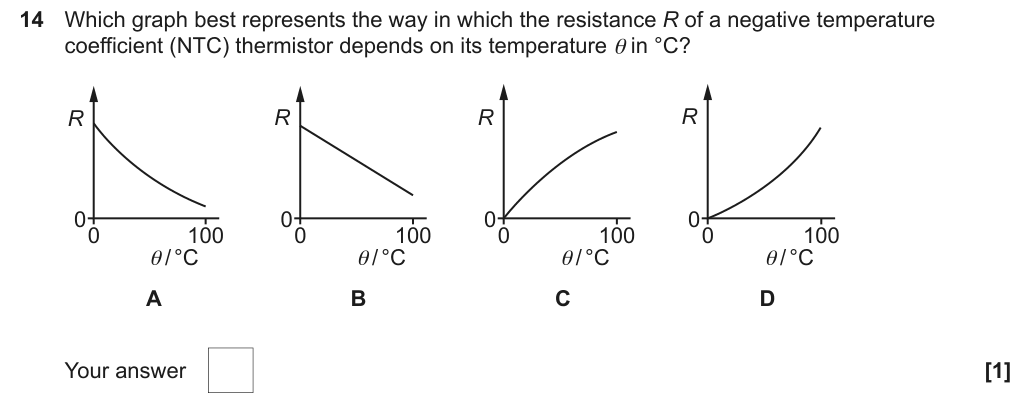
A
Generally, candidates performed well on this question as they used and applied their knowledge that resistance decreased non-linearly with temperature. The most common distractor was answer B.
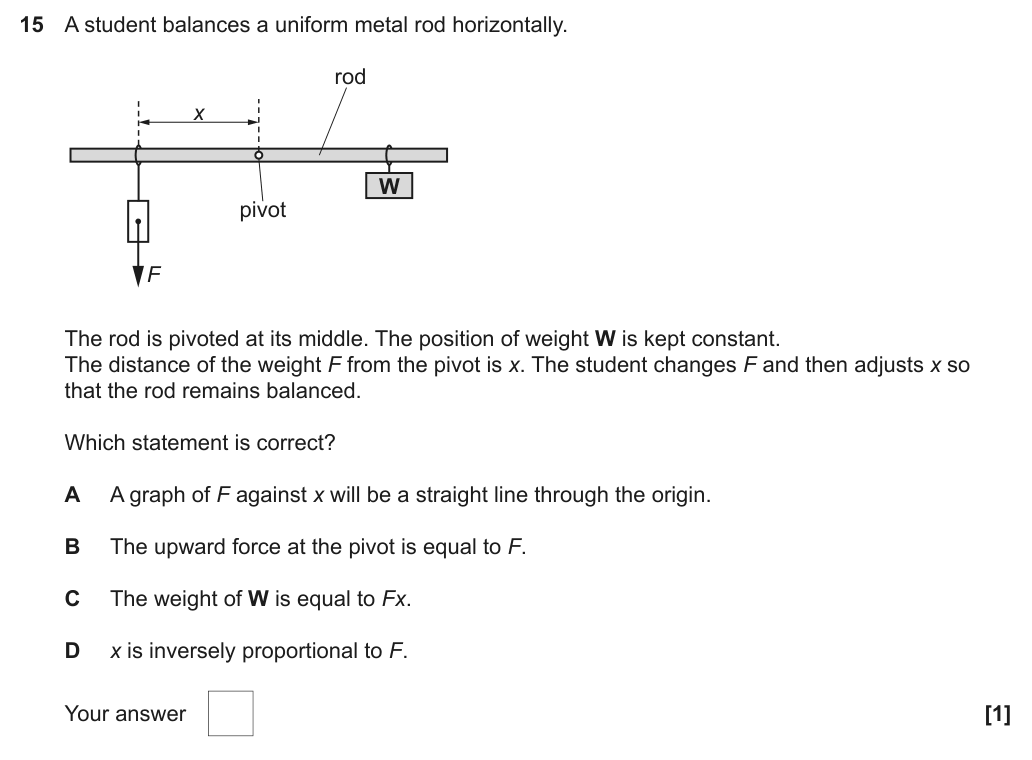
D
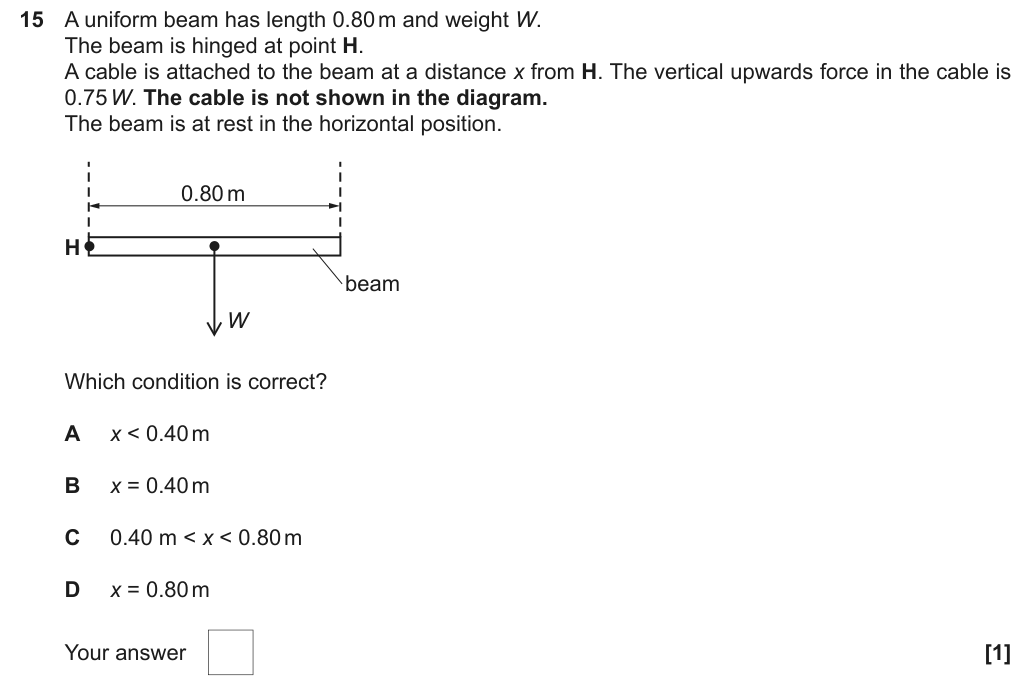
Candidates performed less well on this question. By equating moments, candidates could determine that x ∝ 1/F. The most common distractor was answer C where candidates incorrectly equated the weight of W to the moment of force F.
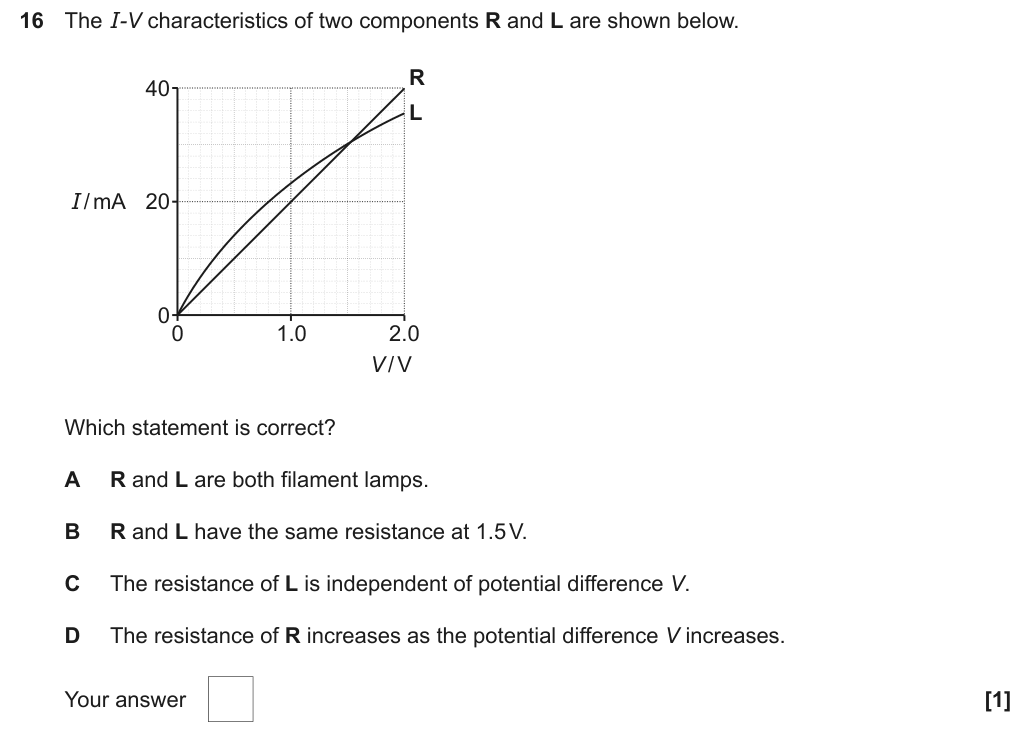
B
This question was generally answered well with candidates correctly using the I–V graph to determine that R and L had the same resistance when the two lines intersected at 1.5 V. The most common distractor was answer D.
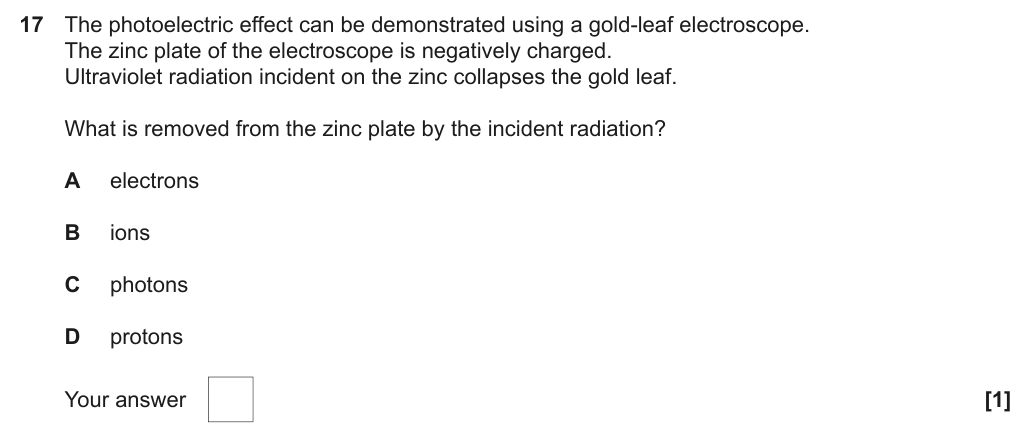
A
Candidates performed well on this question as most gave the correct answer A as they identified that electrons are removed from the zinc plate.
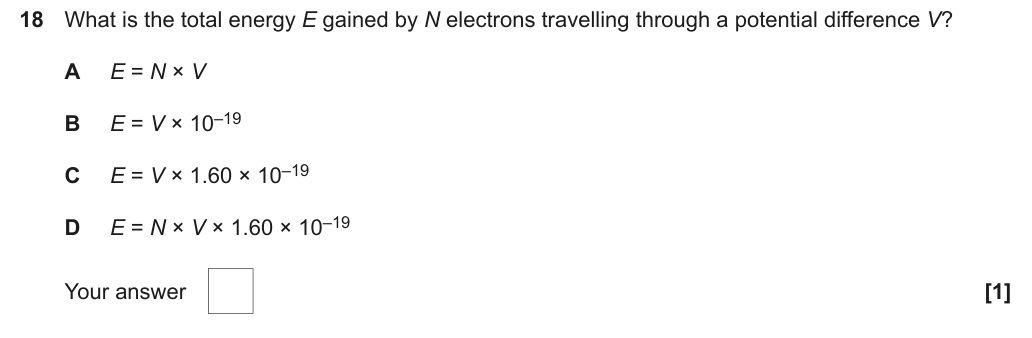
D
This question was generally answered well with candidates giving the correct answer D by selecting and applying the equation W = VQ and that the charge of one electron is 1.60 × 10⁻¹⁹ C.
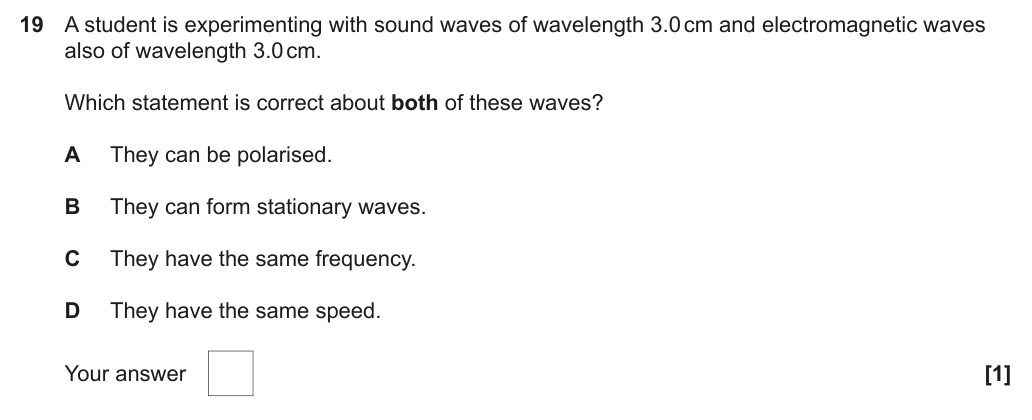
B
Candidates performed well on this question as most gave the correct answer B by recognising that sound is an example of a longitudinal wave and electromagnetic waves are an example of transverse waves but that they can both form stationary waves.
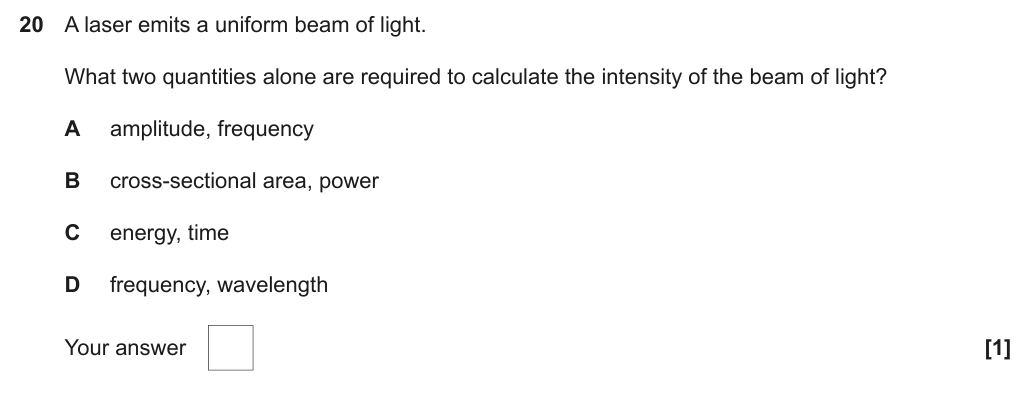
B
Candidates performed well on this question as most gave the correct answer B as they correctly selected and applied the equation I = P/A.
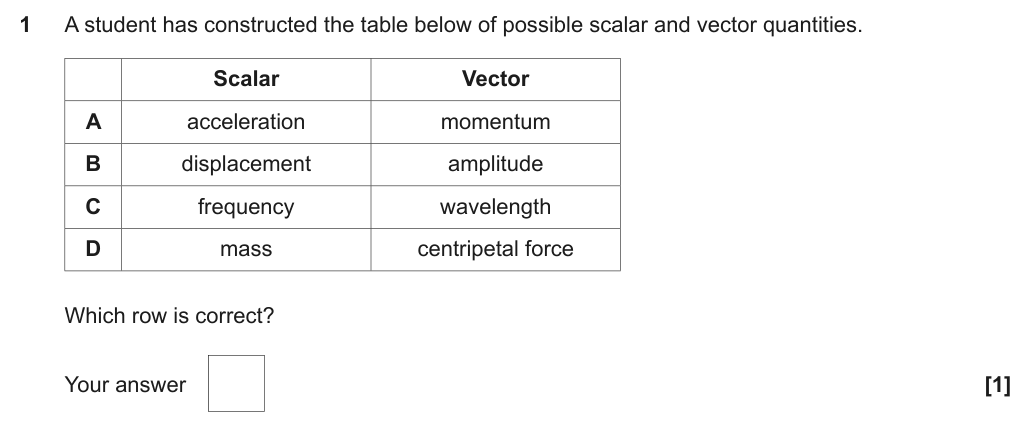
D
Most candidates got this correct by correctly identifying mass as a scalar and force as a vector. The most likely incorrect answer was C.
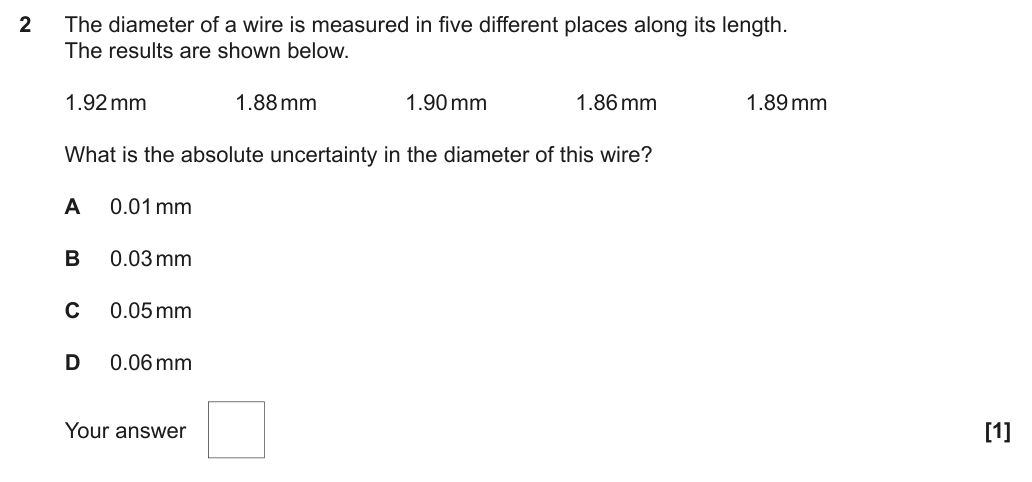
B
The candidates who got this correct spotted that the uncertainty should be calculated by finding half of the range.
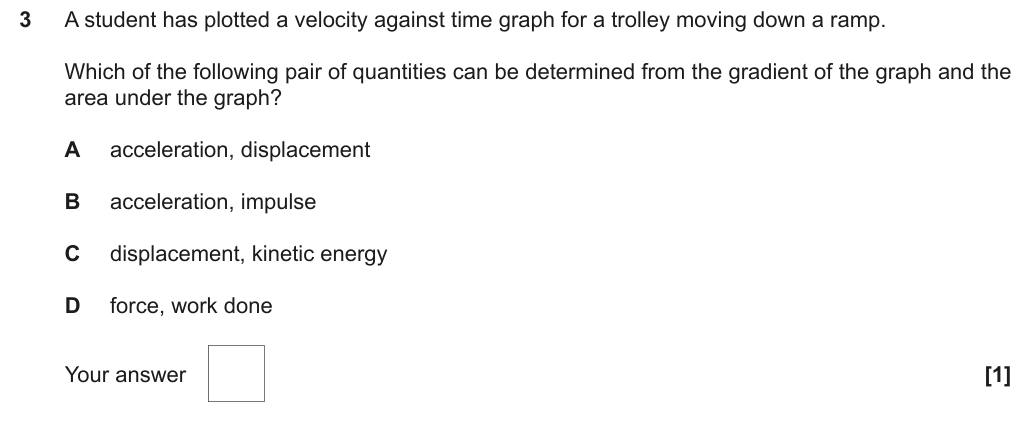
A
Candidates performed very well on Questions 3, 5, 14 and 15.
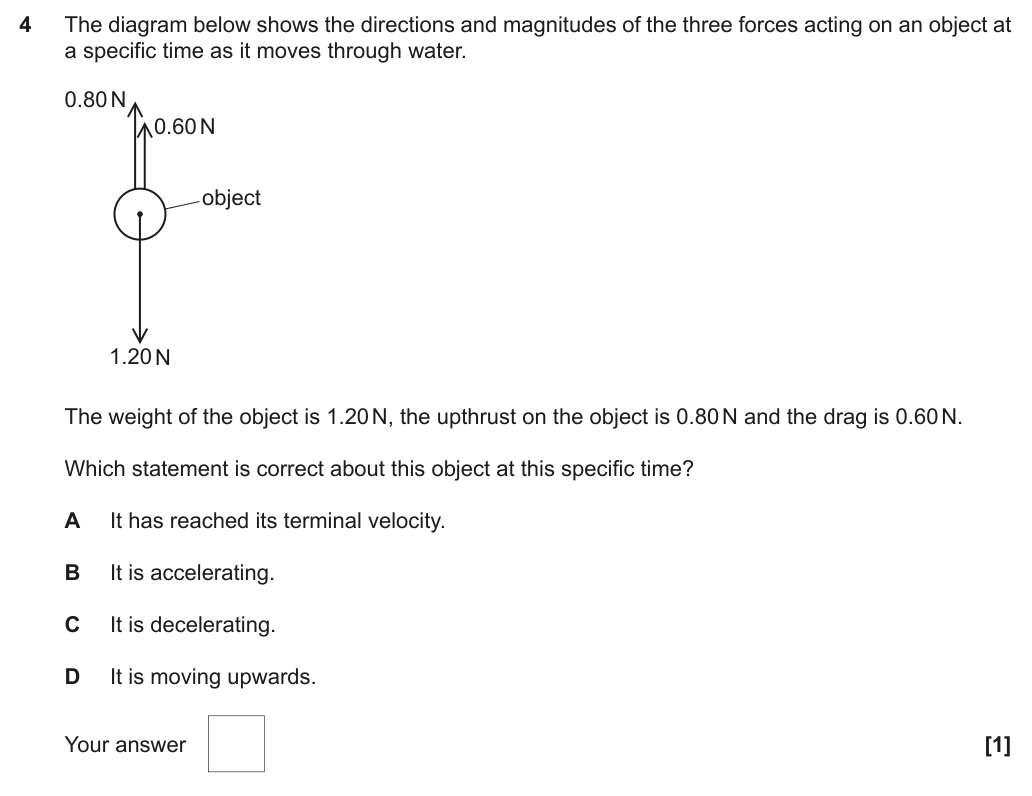
C
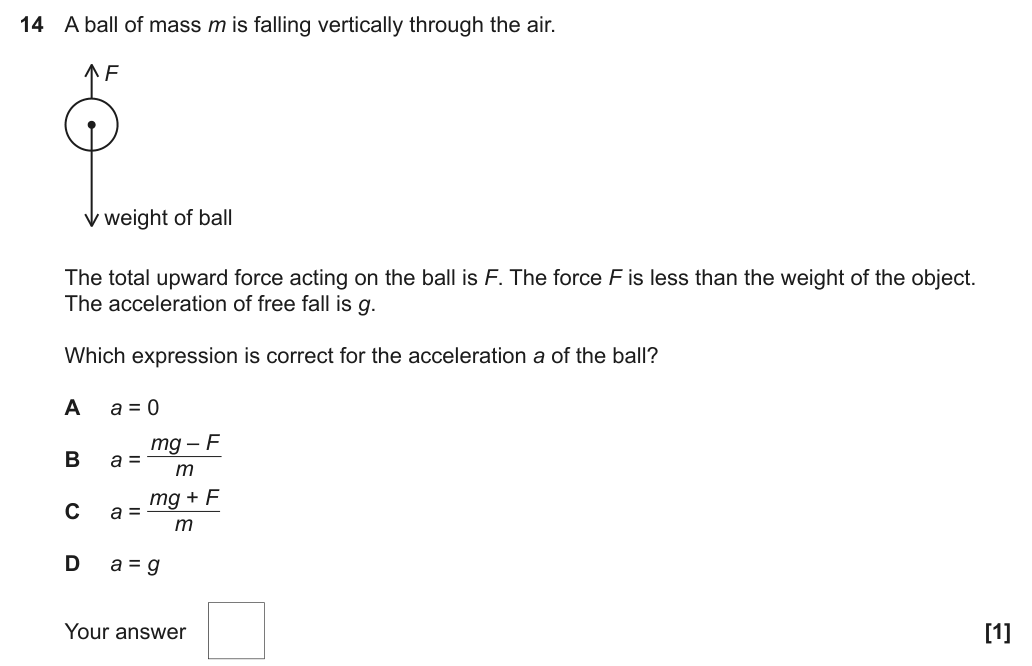
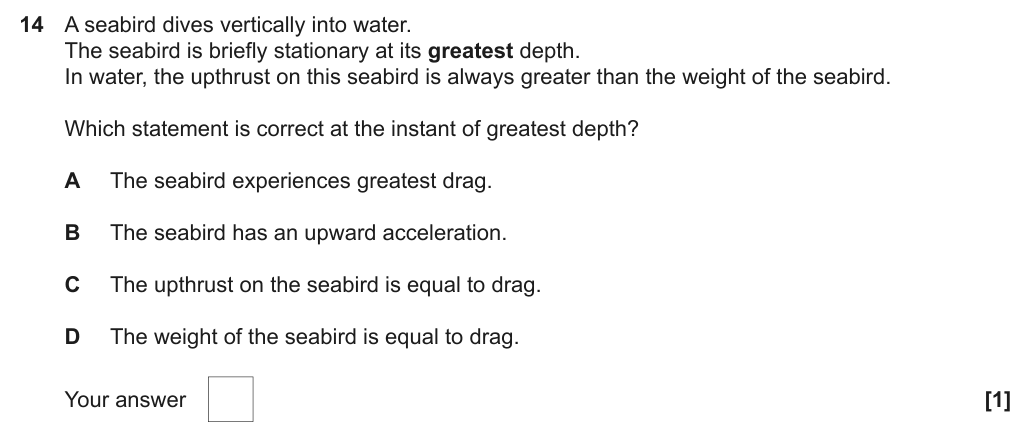
The first step with this question is to calculate the resultant force, which is 0.2 N upwards (eliminating option A). As the drag force is upwards, the direction of motion must be downwards (eliminating option D). Since the resultant is opposite to the direction of travel, this object must be decelerating.
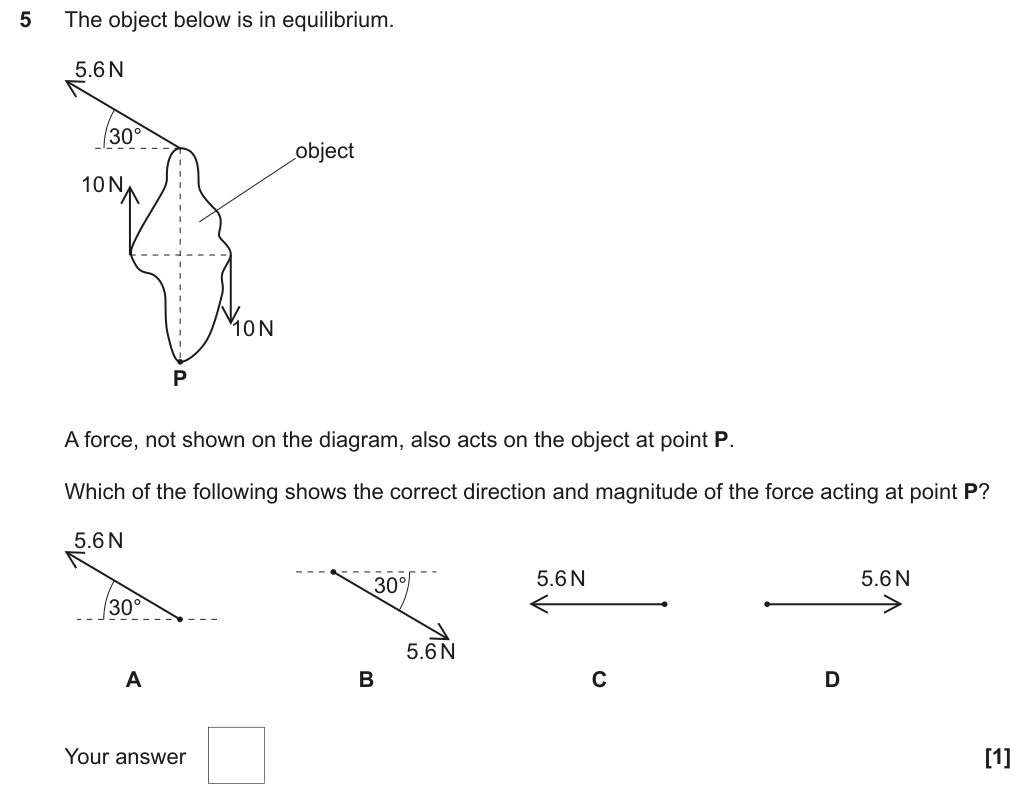
B
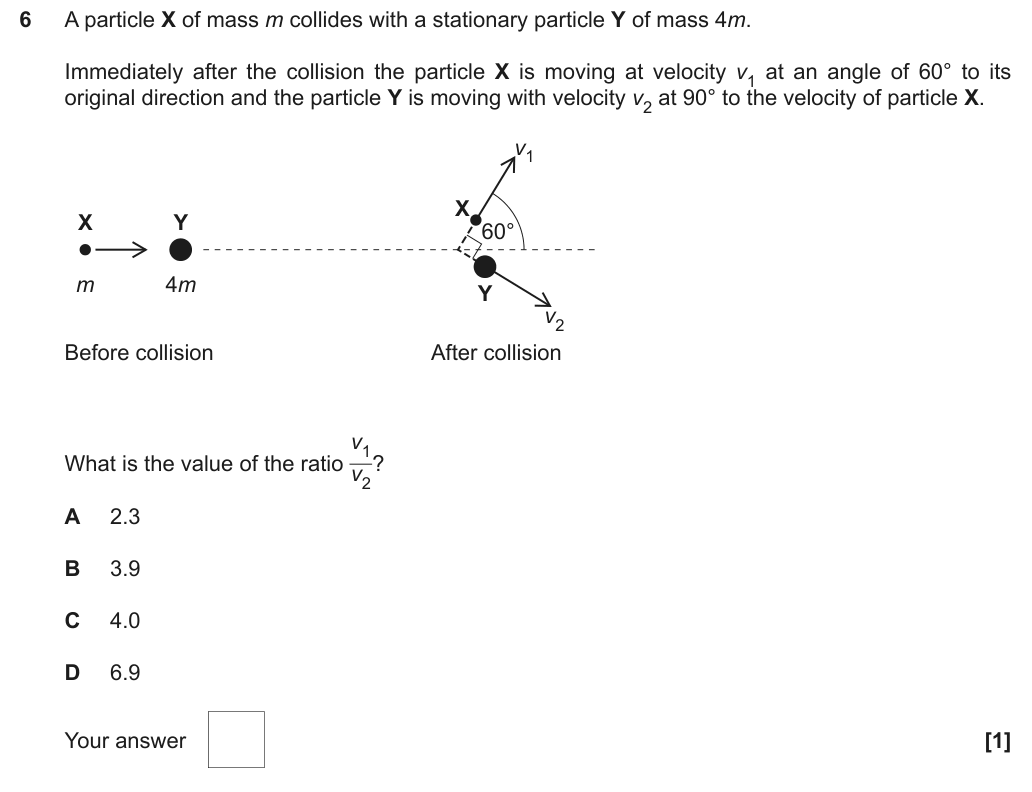
A
Candidates found this question challenging. Conservation of momentum applies both horizontally and vertically here. This means that the vertical upwards component of the momentum of X must equal the vertical downwards component of the momentum of Y. So m v1 sin(60o) = 4m v2 sin(30o). Rearranging this expression will give the correct answer of v1 / v2.
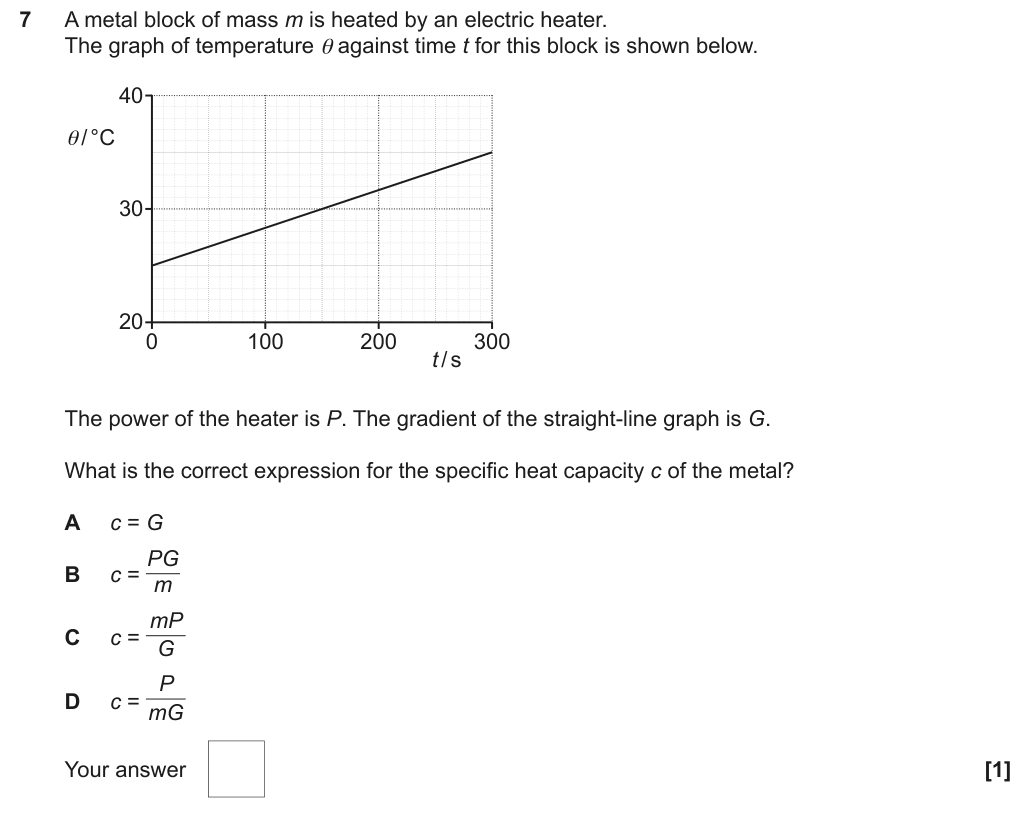
D
By thinking about the formula for specific heat capacity ( ∆E = m c ∆θ) and dividing both sides by ∆t, the equation becomes P = m c ∆θ / ∆t. ∆θ /∆t is the equivalent to the gradient, G. Rearranging this will give the correct answer.
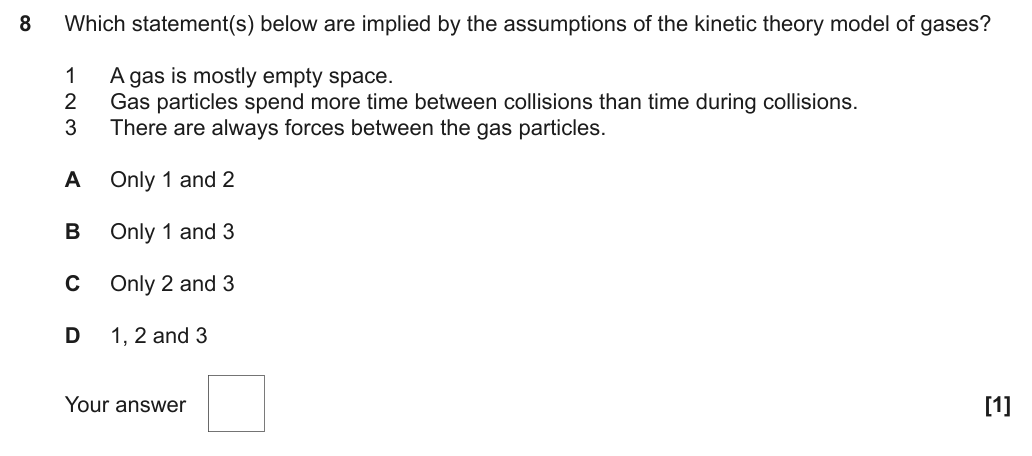
A
Three-quarters of all candidates could recall that statement three is not true, leaving only the first two statements to be implied by the assumption of the kinetic theory of gases.
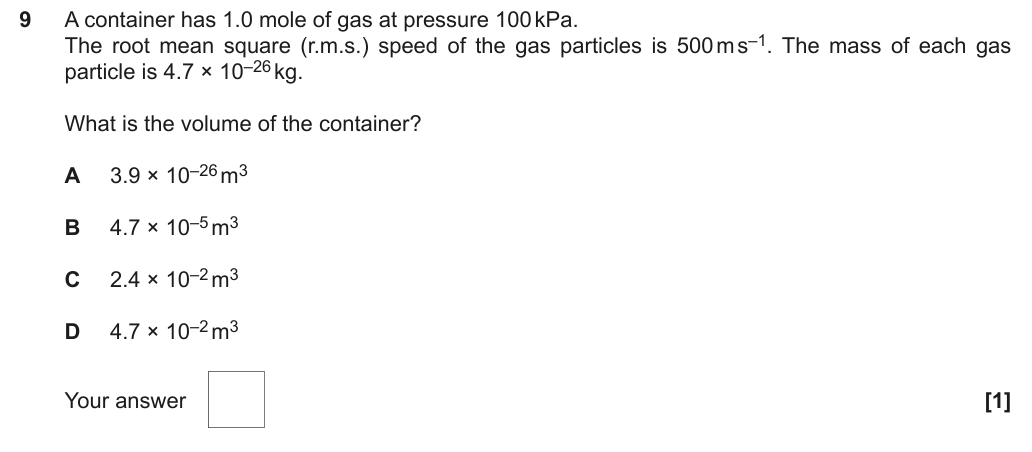
C
A sensible approach here is to use the equation p = 1/3 ρ c2 and ρ = M /V where M is the total mass of the gas. Given that there is 1.0 mole of gas, the total mass of gas is Avagadro’s number multiplied by the mass of each gas particle. By suitable rearrangement, the volume can be found.
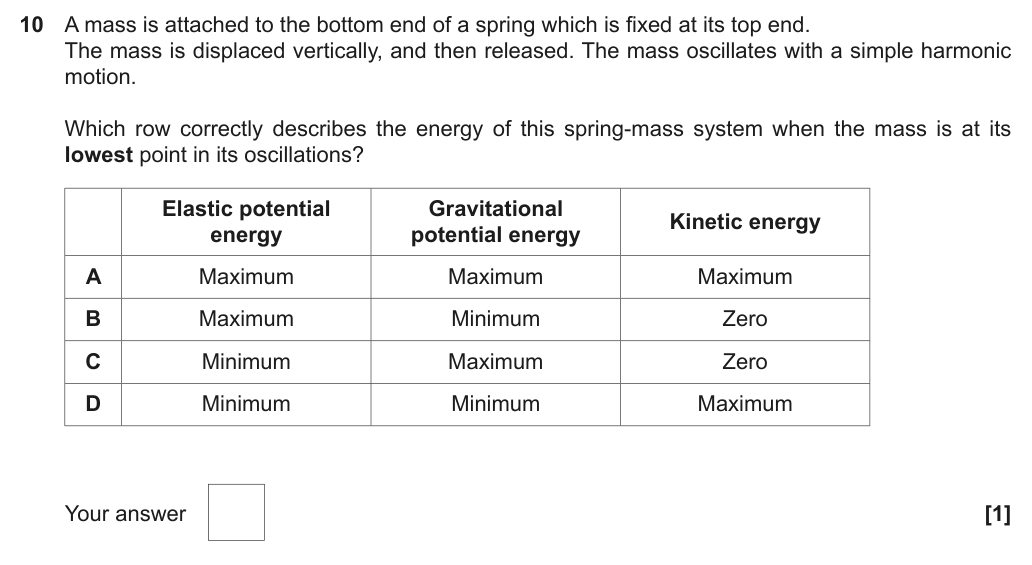
B
Most students answered this question correctly. Those that did not tended to refer to the mass at a point other than at the lowest point in its oscillations.
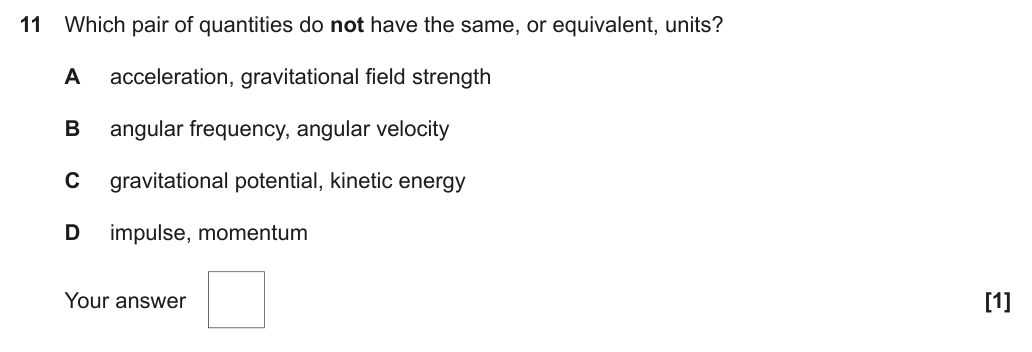
C
Most candidates suggested that angular frequency and angular velocity do not have the same or equivalent units. The correct answer is C, because gravitational potential is measured in J kg–1 and kinetic energy is measured in J.
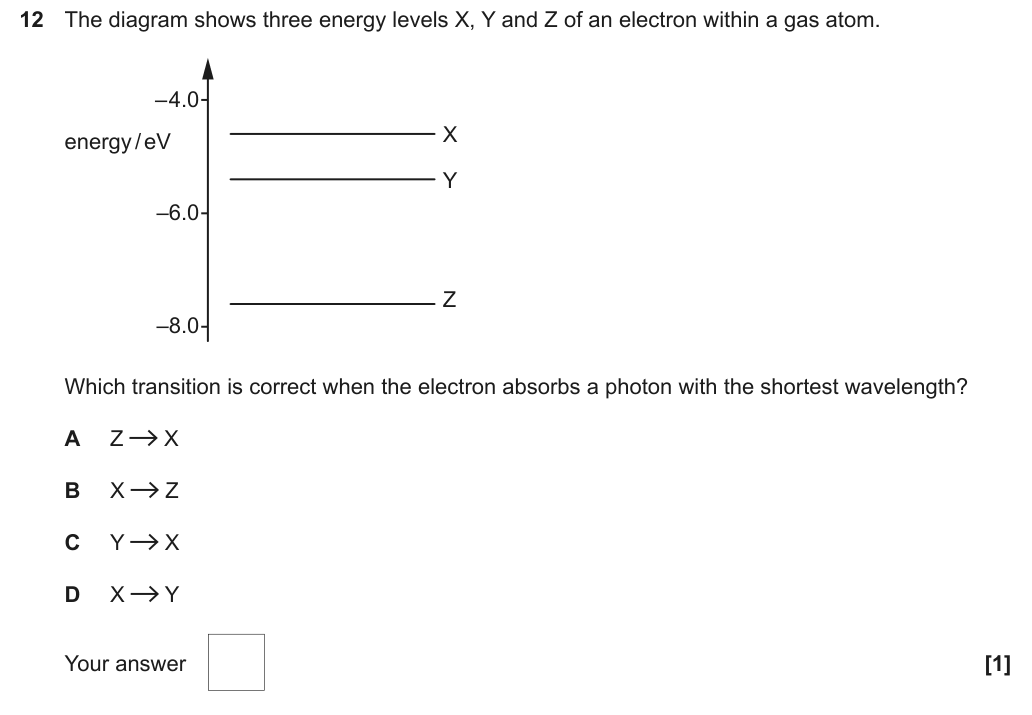
A
Approximately half of all candidates chose option B, possibly because they missed the idea of photon absorption in the question. The correct answer is A, because the electron is going up the energy scale.
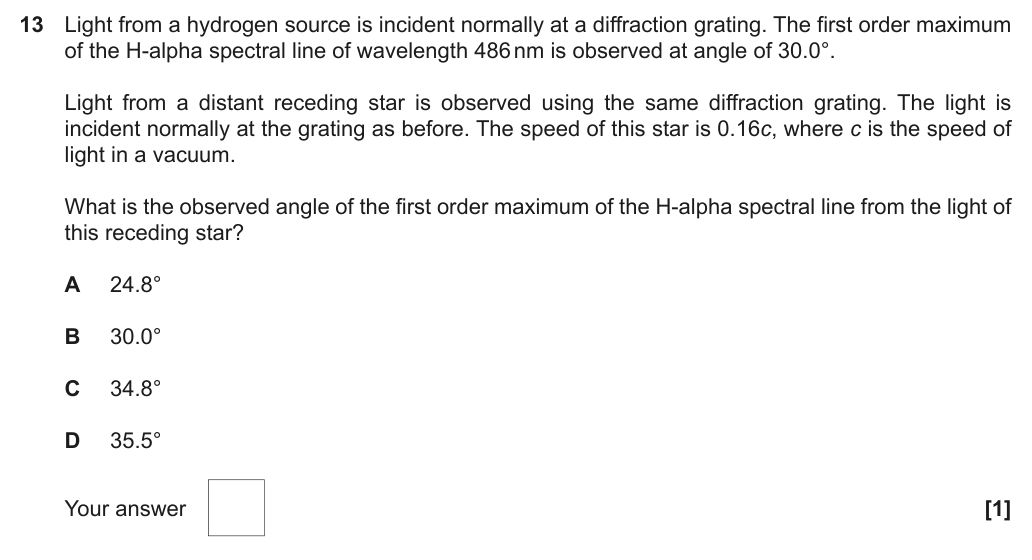
D
Candidates found this question challenging because it joins two ideas together. The first idea is that of the Doppler effect on waves from a moving source, which will increase the wavelength received by the observer. This removes options A and B. Once the new wavelength has been calculated, the corresponding angle should be calculated from the diffraction grating equation. It is worth mentioning that the correct answer and the most likely incorrect answer are too close together for the candidate to merely guess.
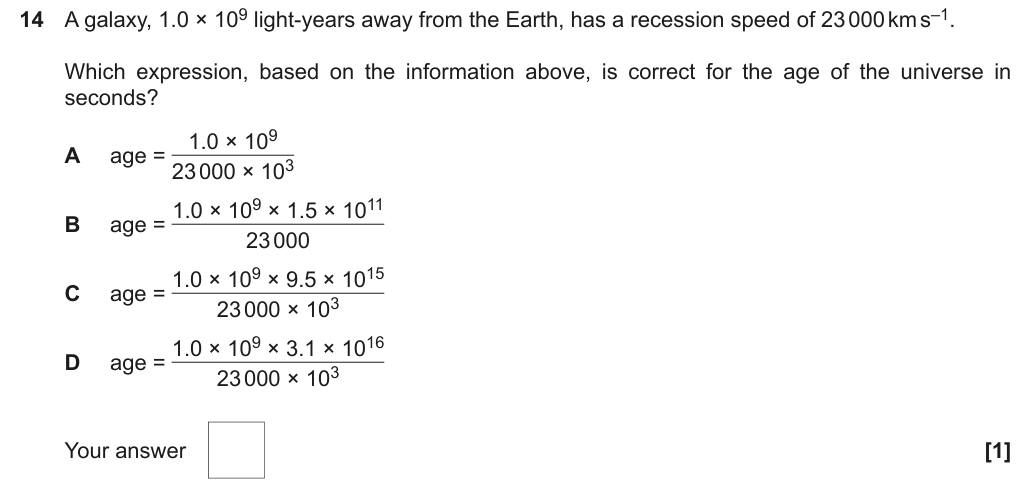
C
B
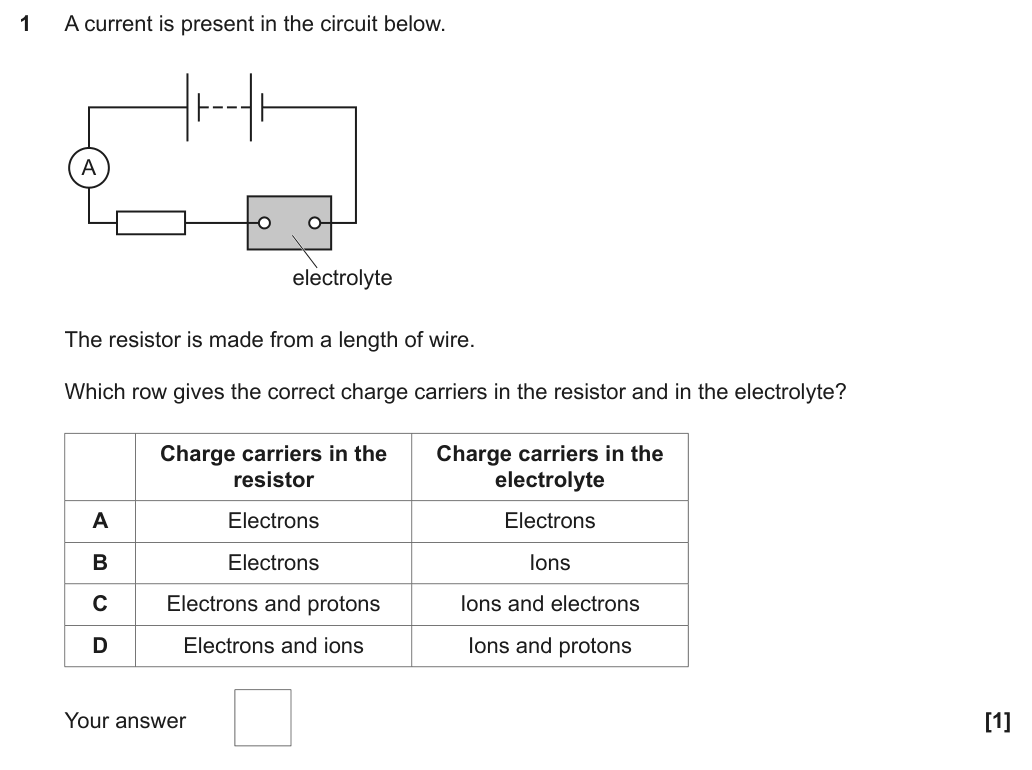
B
The vast majority of candidates were able to correctly recall the correct charge carriers in the resistor and the electrolyte. A proved to be the most common distractor, possibly as the others contained “protons”.
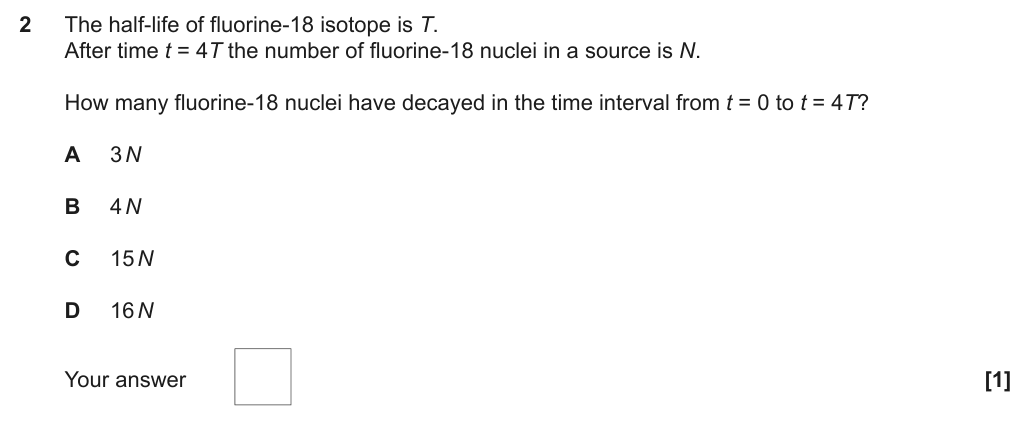
C
Only around one third of candidates were able to give the correct response of C. Many candidates showed a variety of correct working to produce the correct initial number of nuclei as 16 N, however then gave the incorrect response of D. This highlights the need to read each question carefully.
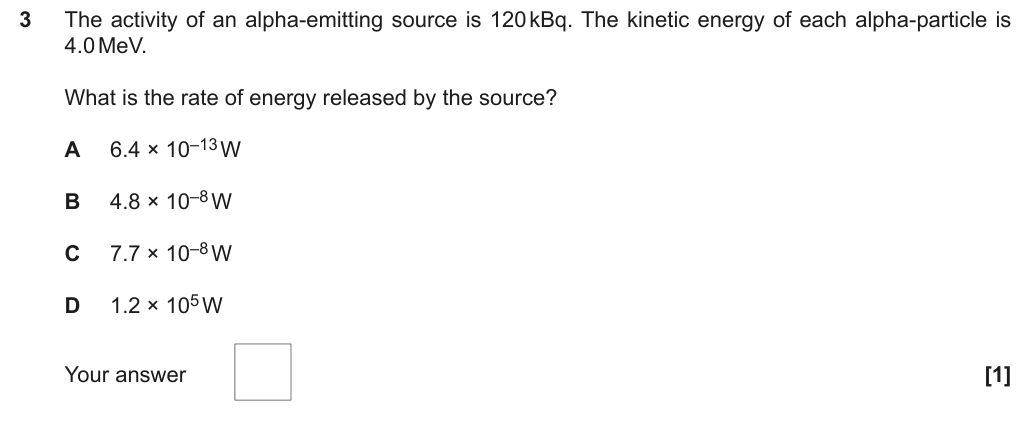
C
Although a little over two thirds of candidates selected the correct response, this question discriminated well between candidates of differing abilities. Potential errors in this question included two unit prefix conversions and the conversion between eV and joules. Incorrect responses were fairly well spread across the other distractors.
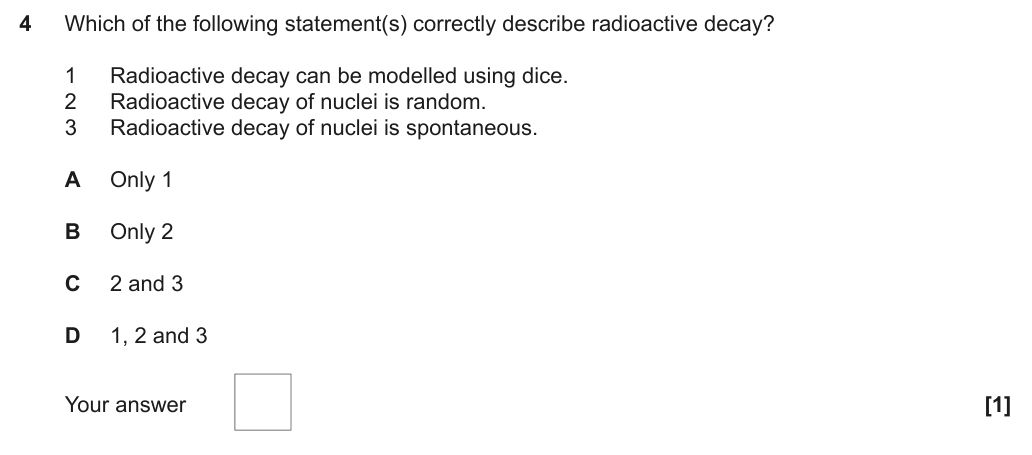
D
This question proved to be relatively straightforward with most candidates selecting the correct response. By far the most common incorrect response was C, suggesting that the idea of modelling using dice was not known, despite it being specification point 6.4.3f(ii).
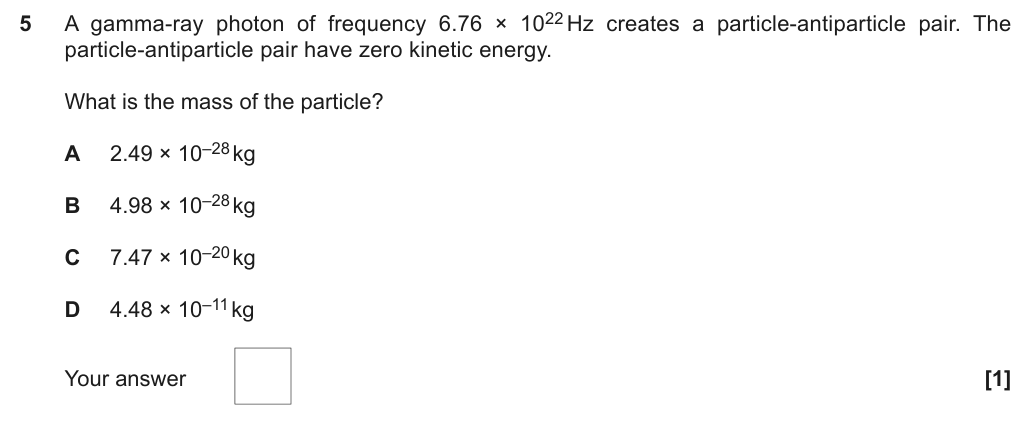
A
This question was answered correctly by approximately half of the candidates. Most showed written working, often as hf = 2mc2 or the equivalent in numerical form. B was by far the most common incorrect response, and it is clear from candidates working that the factor of 2 had simply been missed out.
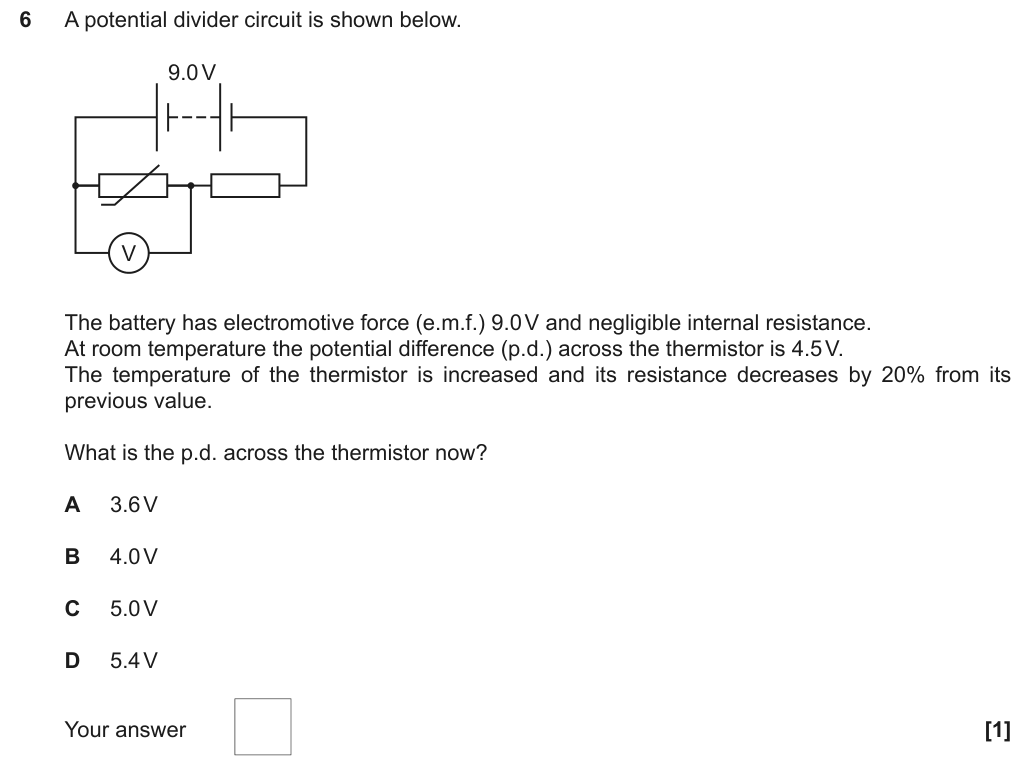
B
This proved to be a challenging question with only around a quarter of the candidates able to obtain the correct response. It was likely that written working was helpful here and many candidates set out some form of a potential divider calculation. Some did this in ratios and others made up a value for the two resistances (e.g. 10 ) which they then decreased to 8.0 for the thermistor. The incorrect responses were spread fairly evenly across the distractors, which is maybe surprising as it would be expected that candidates should have appreciated that the p.d. across the thermistor would now be less than the initial 4.5 V.
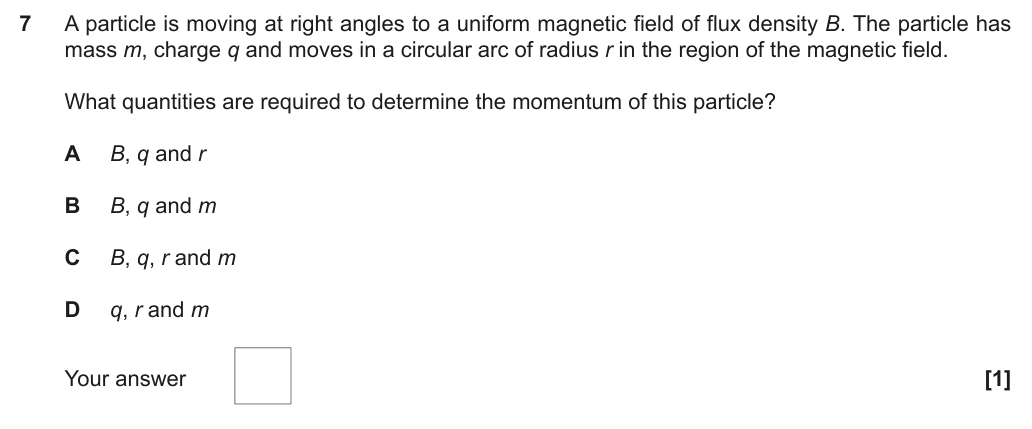
A
Most candidates who successfully answered this question showed working equating the magnetic force to the centripetal force to show that mv = rBq. Some had possibly learnt the formula r = mv/Bq as this was also a common starting point.
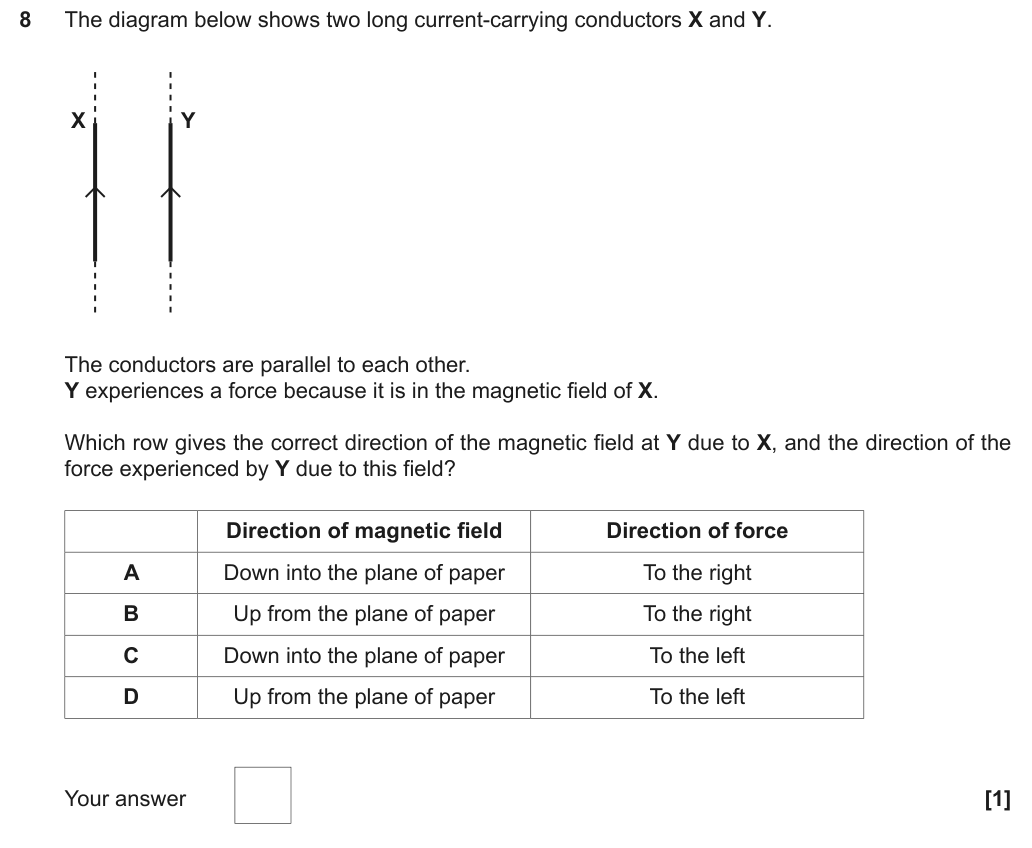
C
Most candidates appear to know that the force between the two wires would be attractive, and circled C or D as their options. A few used the diagram and the right hand rule to draw arrows to help with the direction. Both of these are good practice in this style of question. A little less than half of the candidates selected the correct response with the vast majority of incorrect responses being D.
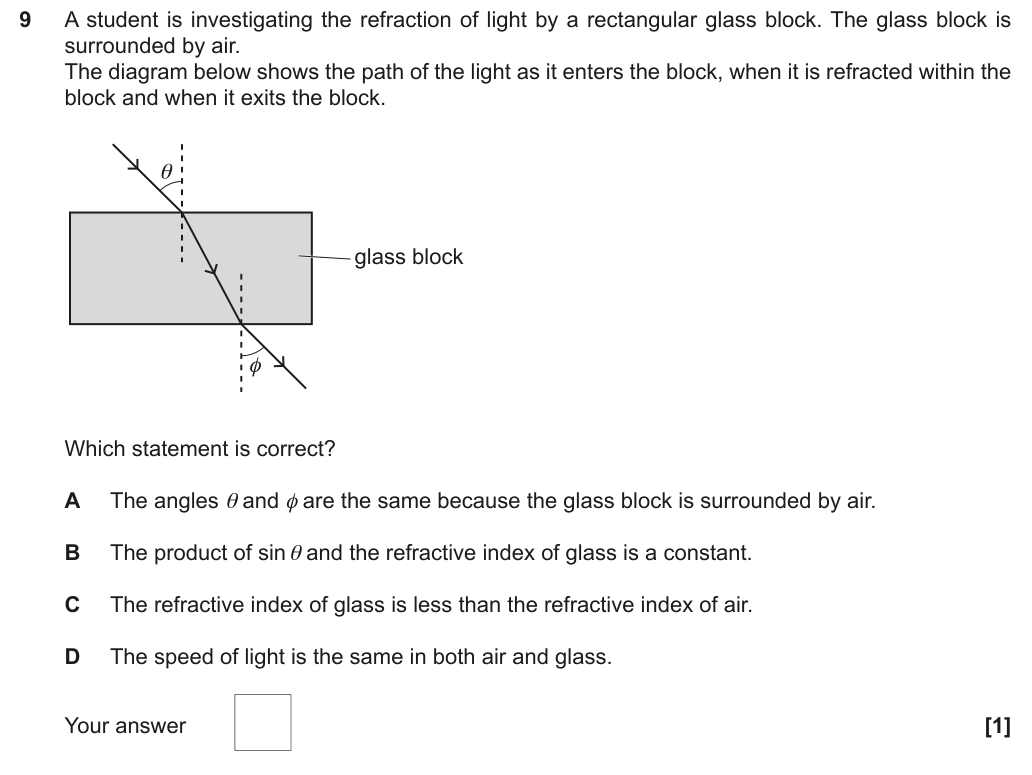
A
This question was correctly answered by the majority of candidates. The distractor B was the most common incorrect response and several candidates wrote out nsinθ = constant on their diagram.
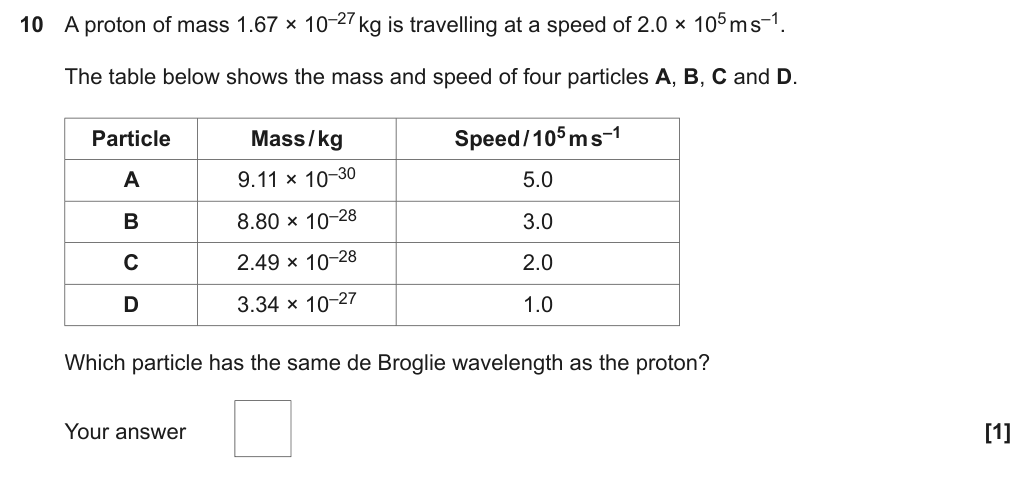
D
Many candidates were able to correctly calculate the wavelength of the two particles and show that the correct response was D. Some calculated the wavelength of all of the particles from A to D, but the most elegant solutions were done through a variety of methods to determine some ratio or constant factor.
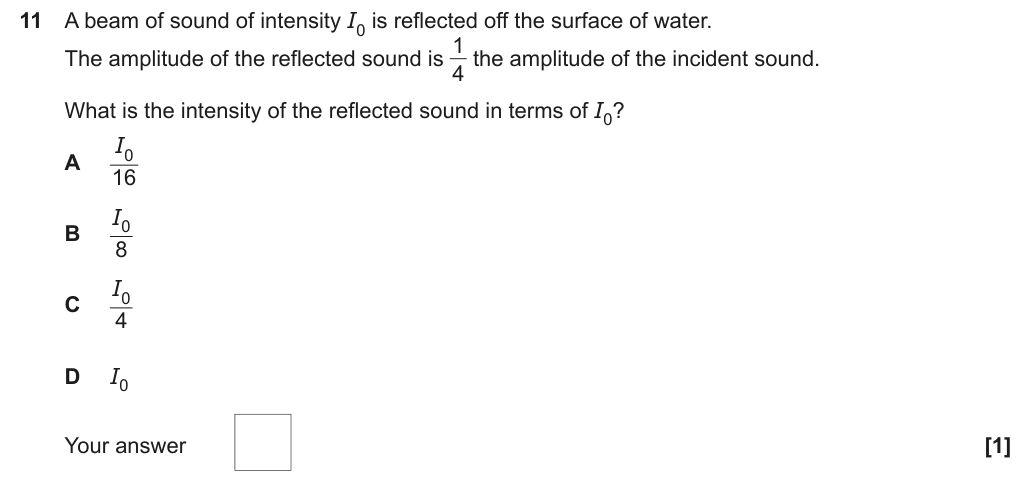
A
The vast majority of candidates were able to reach the correct response and appreciated that the intensity of a wave is proportional to the (amplitude)2 as given in the specification point 4.4.1(g). The most common incorrect response was, as expected, C.
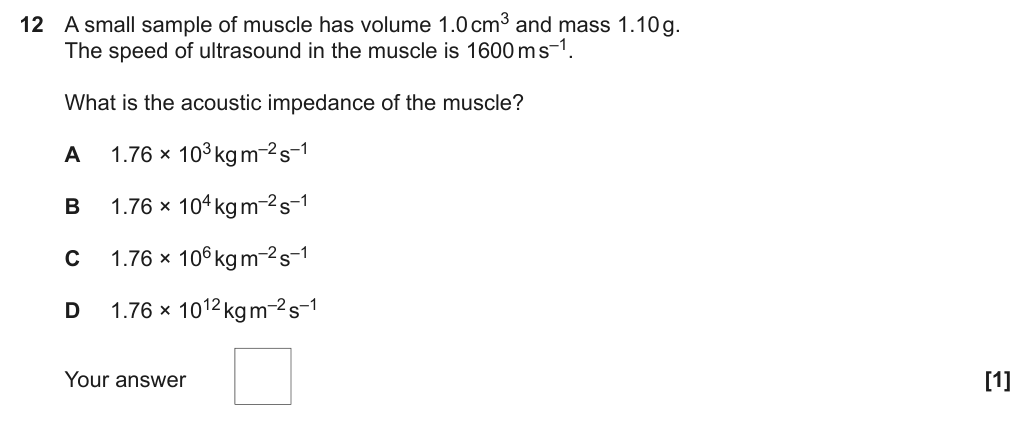
C
This question involves several stages, the most critical being the correct conversion of the volume units to m3. Very encouragingly, the majority were able to do this correctly and work through to the correct response. A was a common distractor for those who made no conversion from g and cm3.
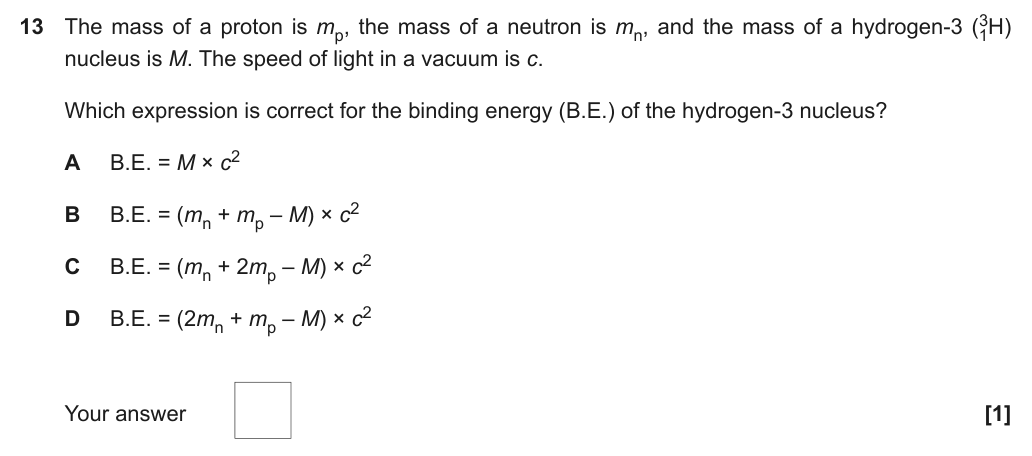
D
This question can correctly be answered by over three quarters of the candidates. Most appeared to be able to evaluate the composition of the nucleus correctly and then work forward from that. A was the most common incorrect response, presumably as less successful responses were able to recognise a variation of E = mc2.
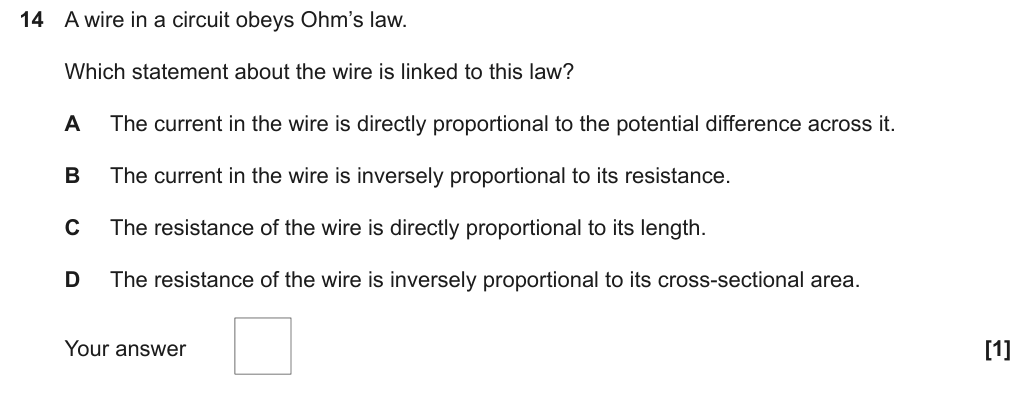
A
This question was correctly answered by a majority of candidates. Although many candidates wrote out V = IR or some other version of Ohm’s law, they seemed unable to relate this to the statements. There was evidently some uncertainty as to what Ohm’s law exactly was, and the writing of the resistivity formula inevitably led several candidates to responses C and D.
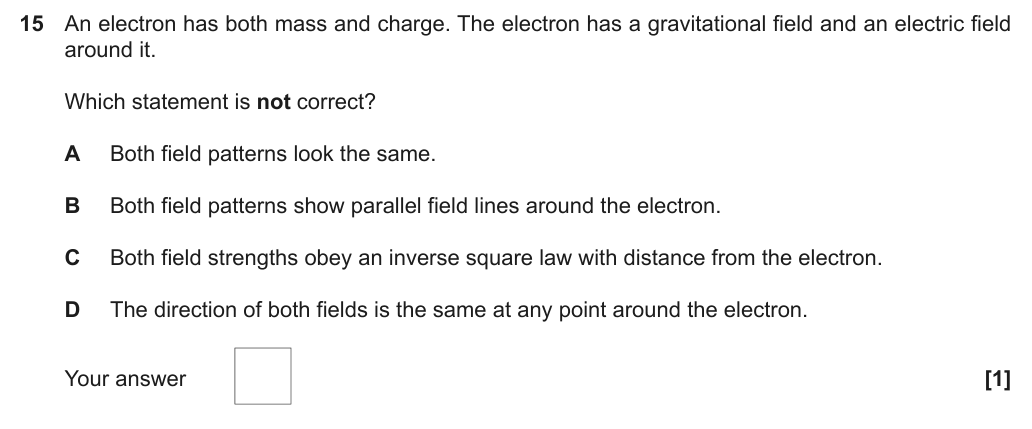
B
This was a challenging question; candidates often drew a radial field diagram as a starting point and many candidates helpfully “ticked” the correct responses to help them eliminate these from their response. It is important that candidates read the questions carefully, as it was evident that some were looking for a correct statement.
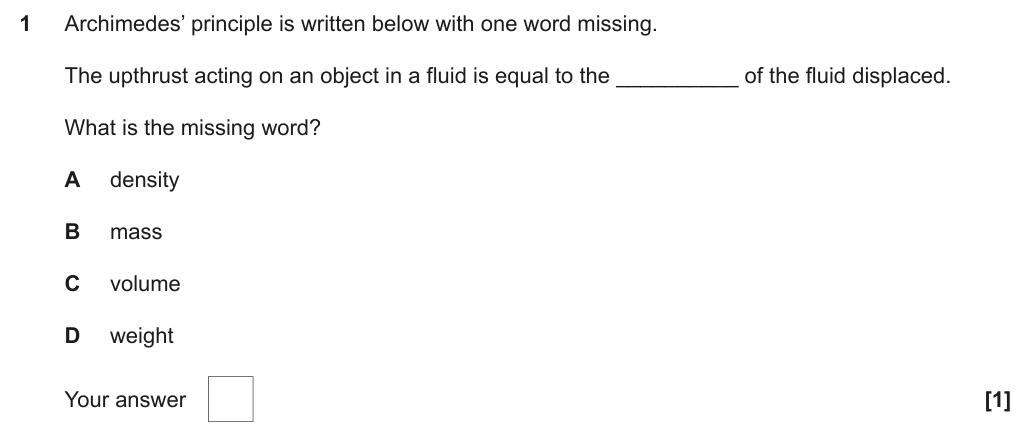
D
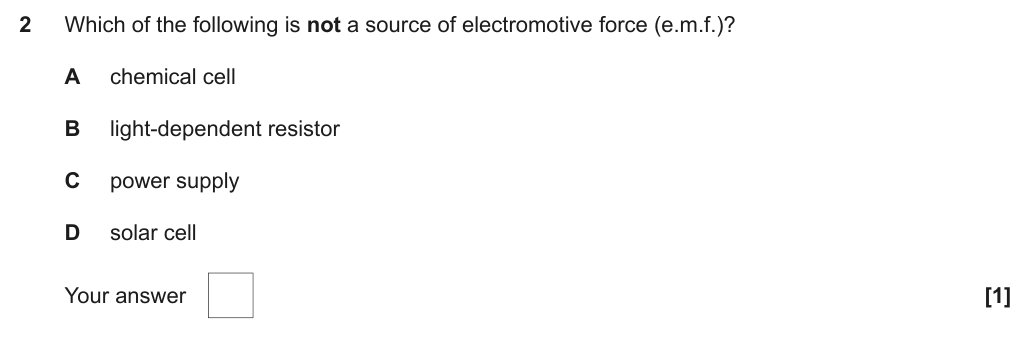
B
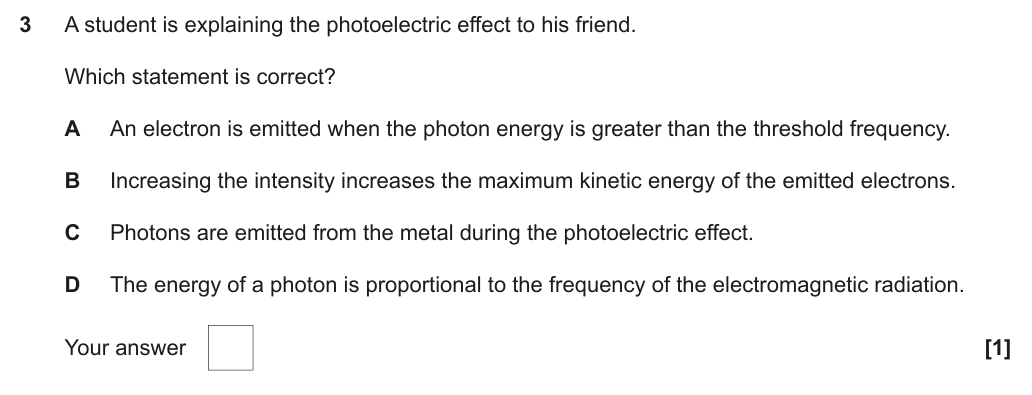
D
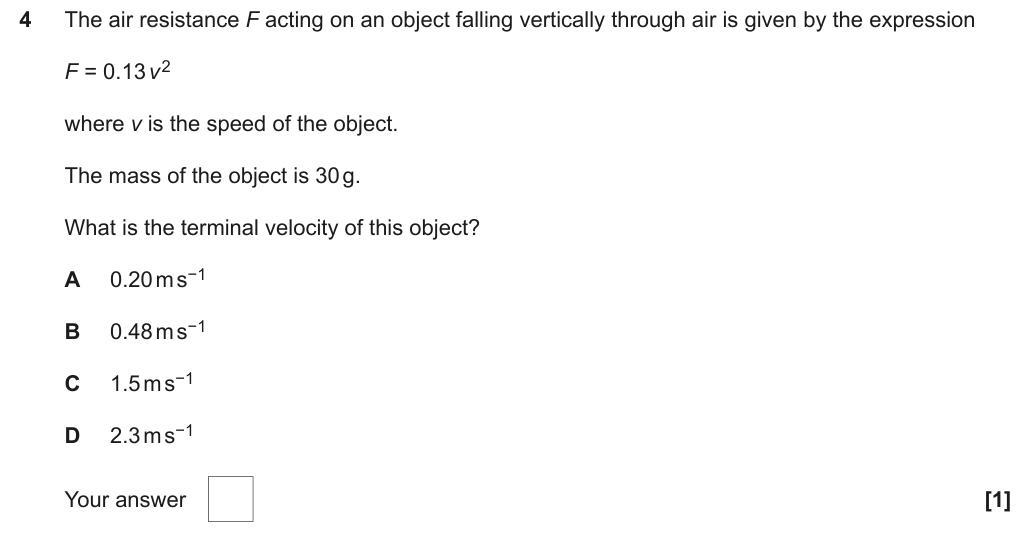
C
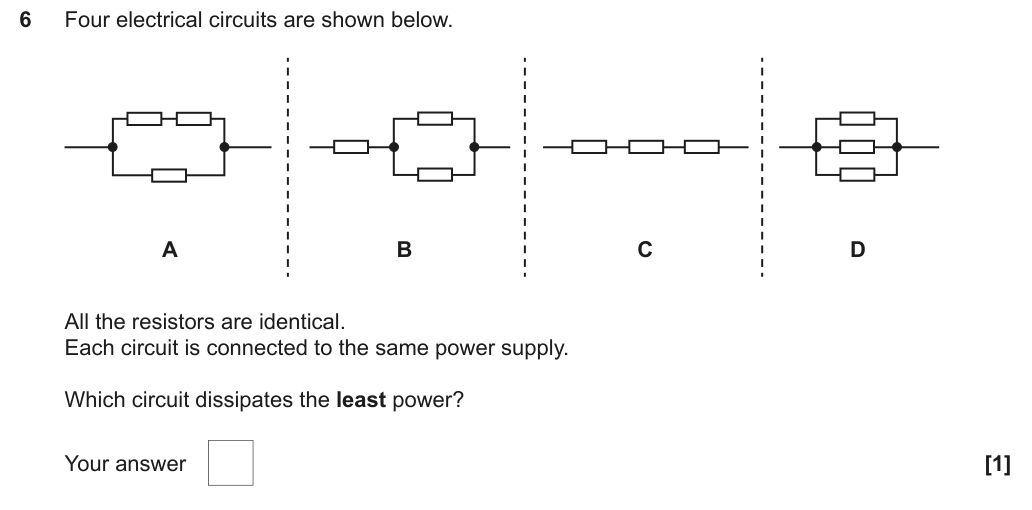
B
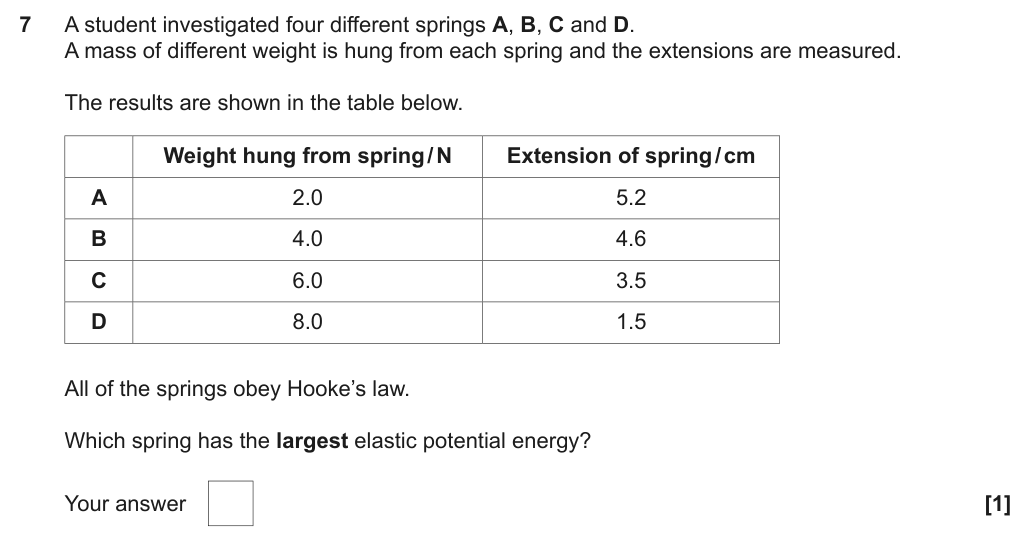
C
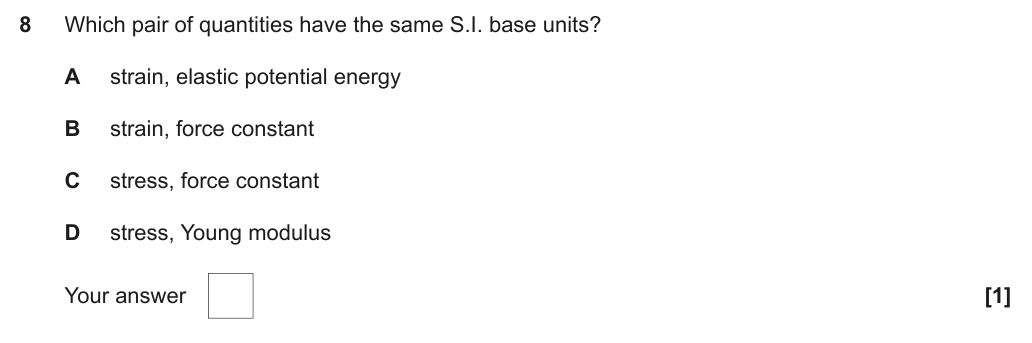
C
D
A
D
A
A
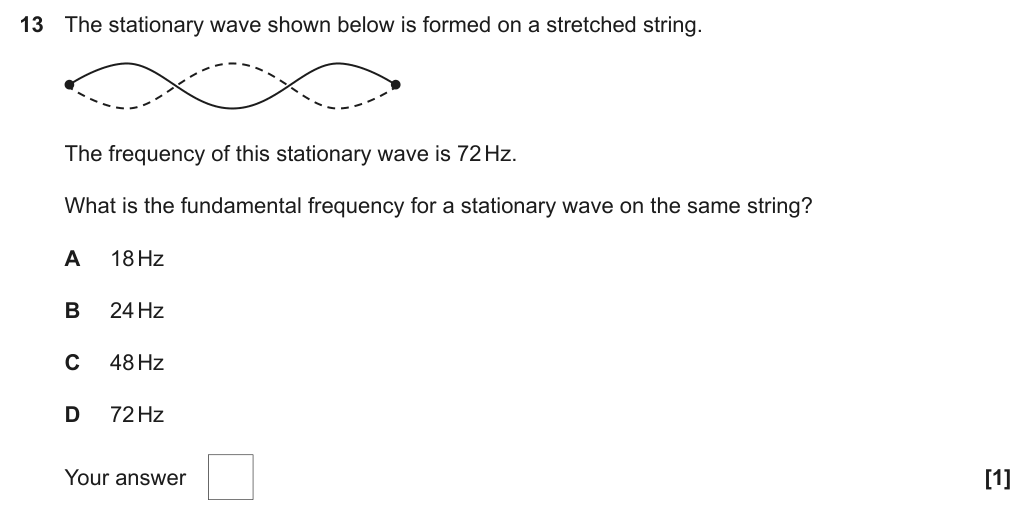
B
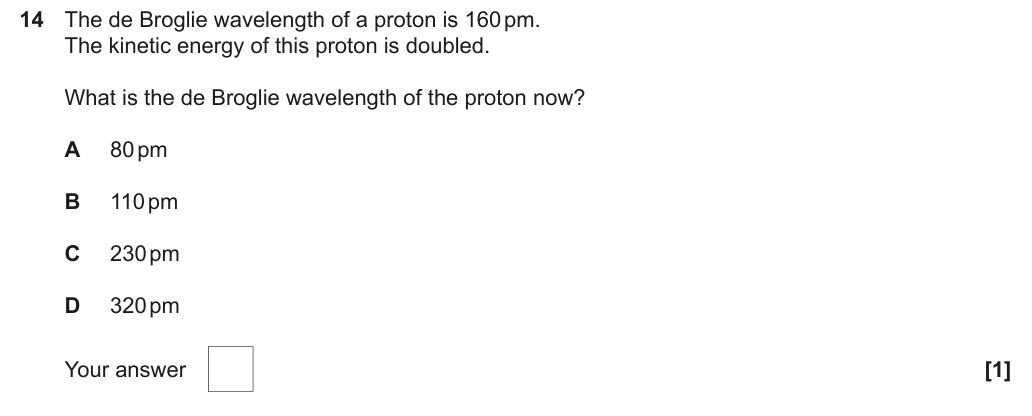
B
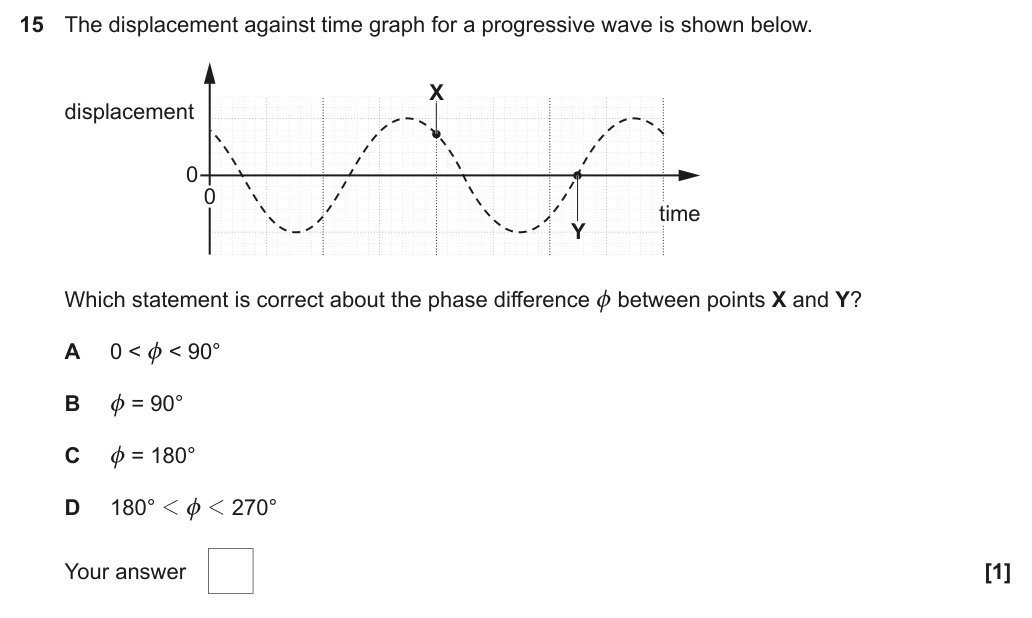
D
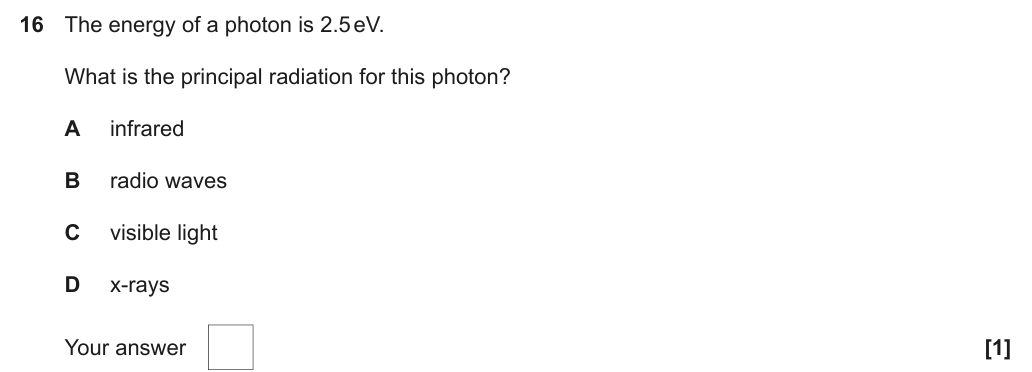
C
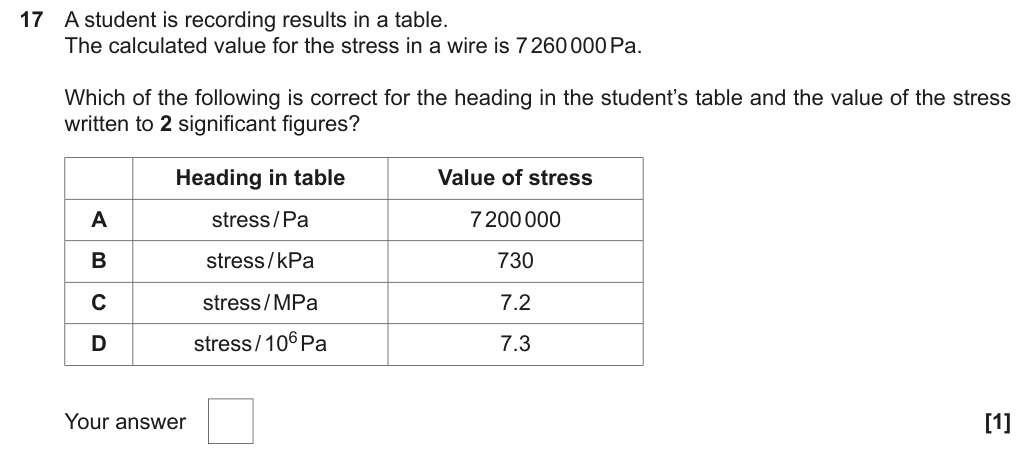
D
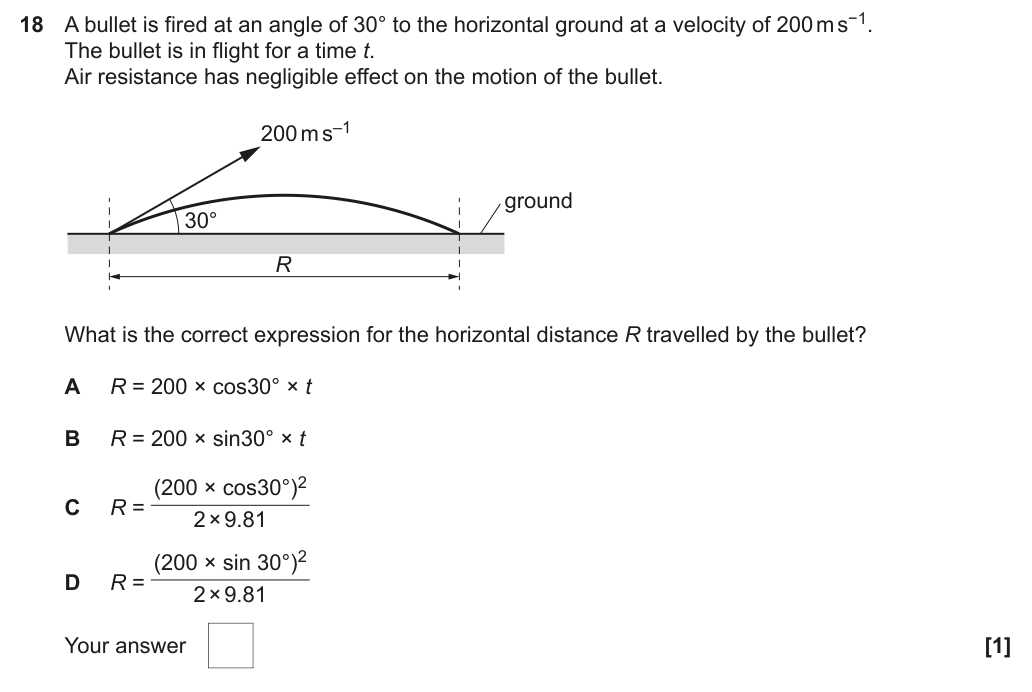
A
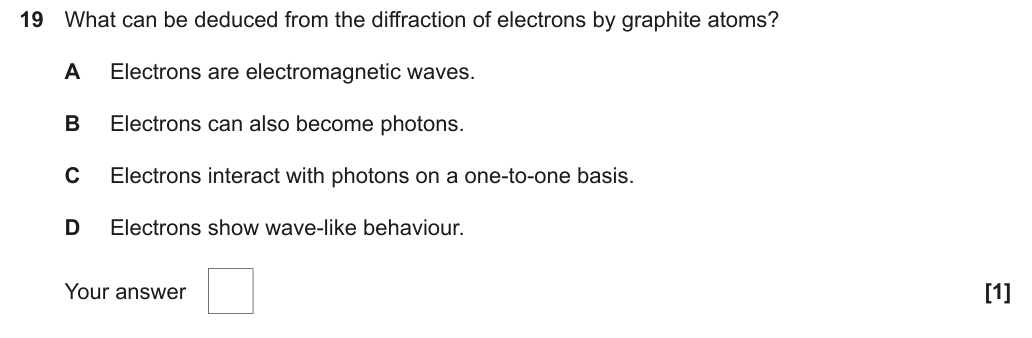
D
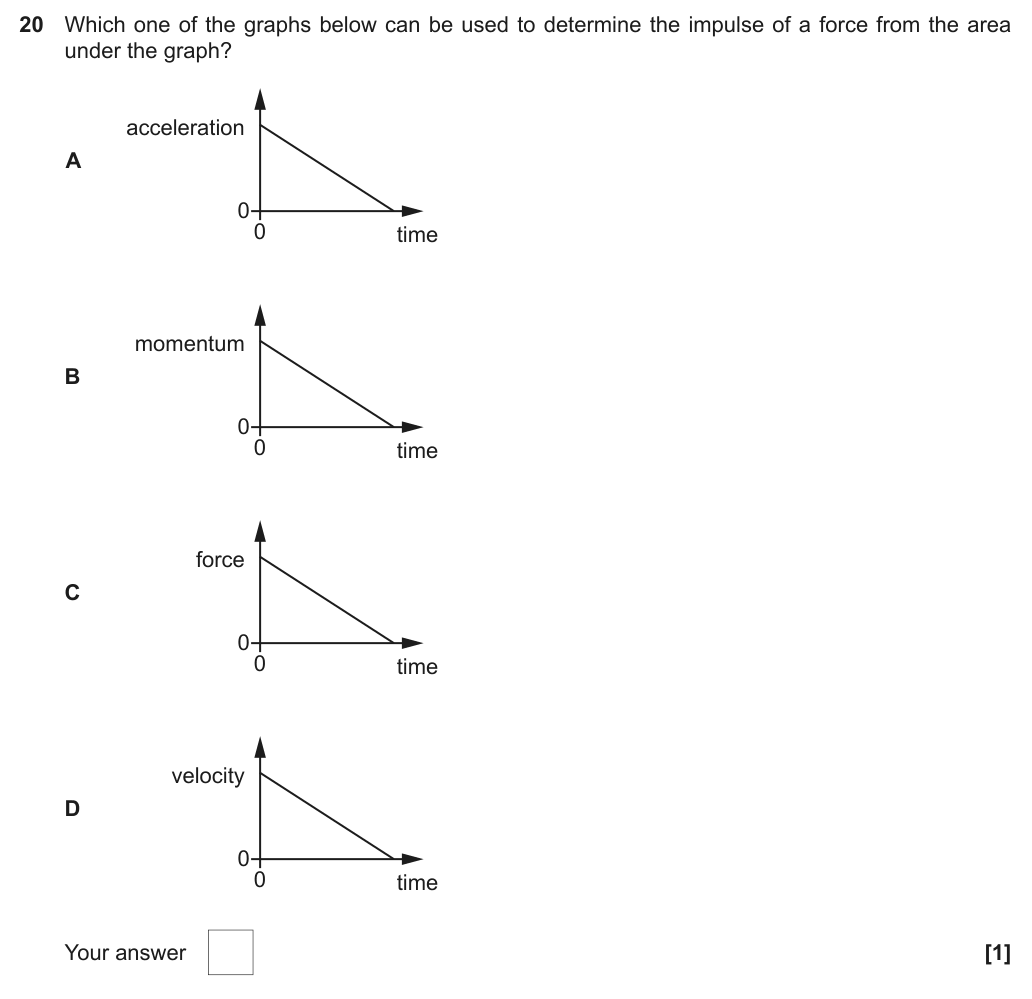
C
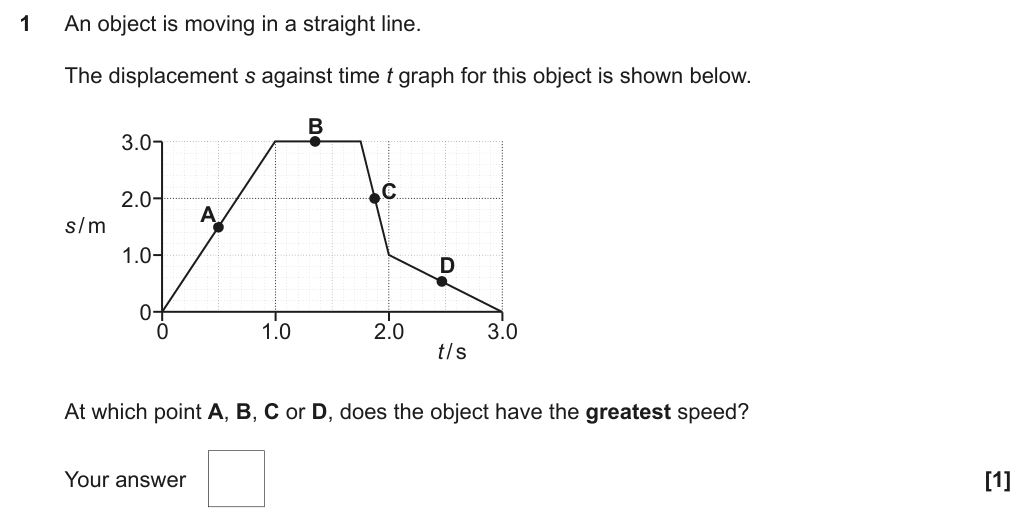
C
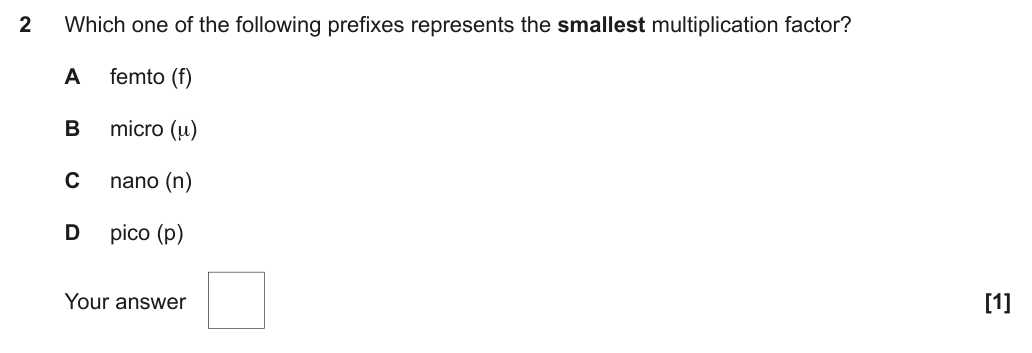
A
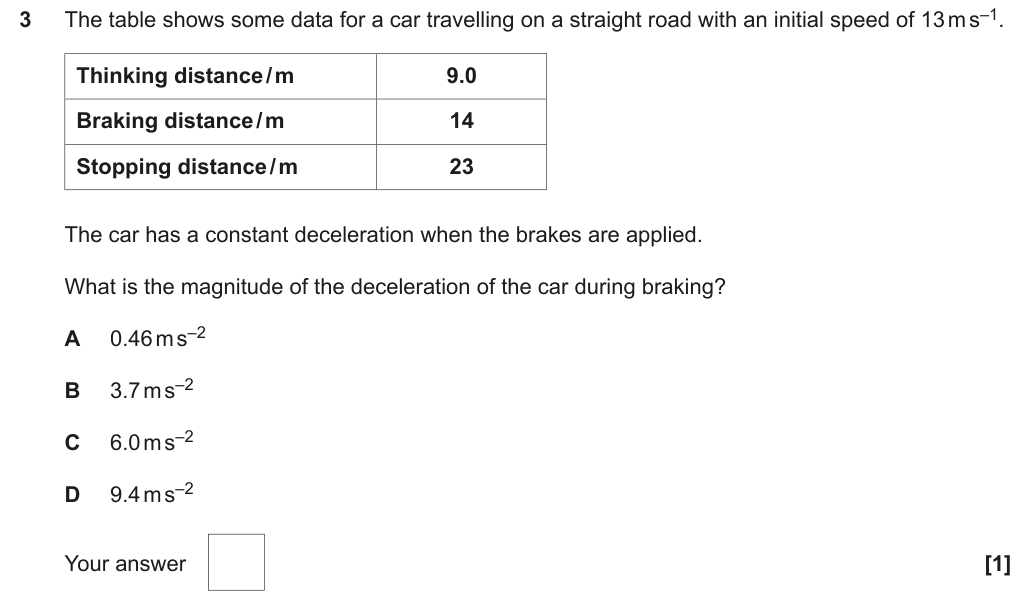
C
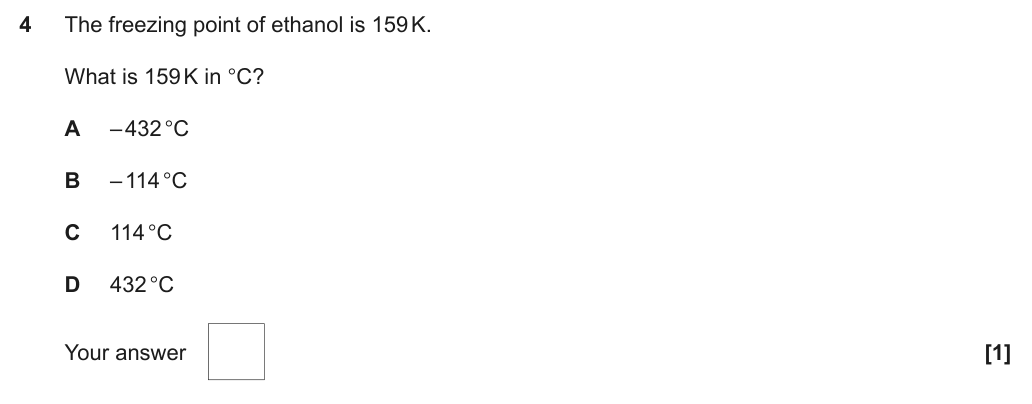
B
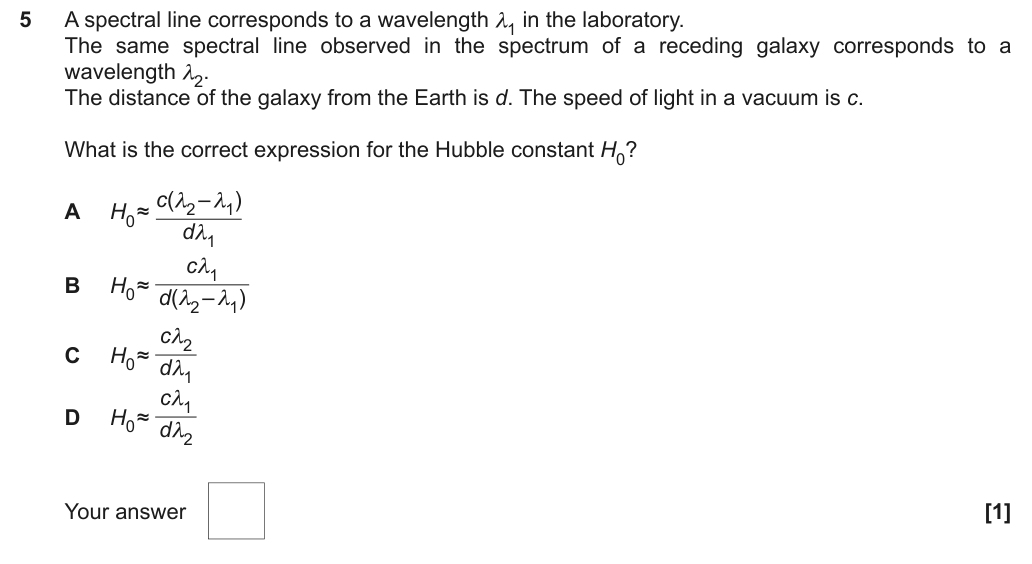
A
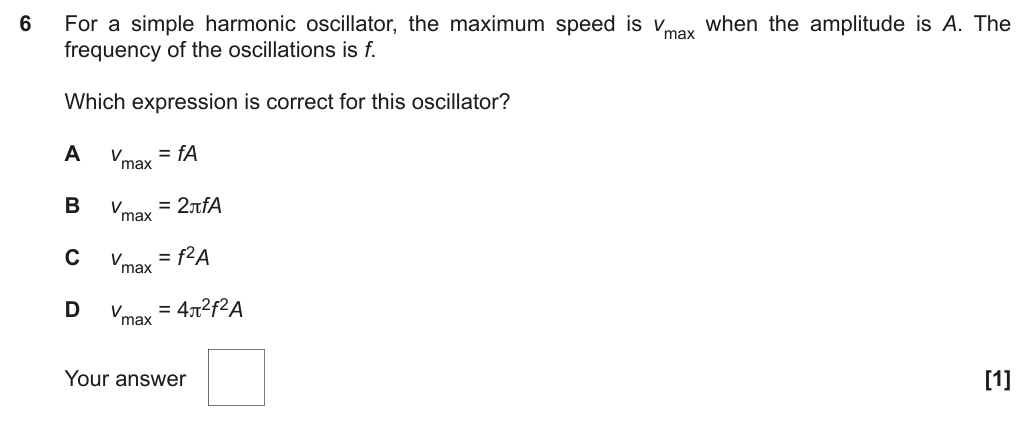
B
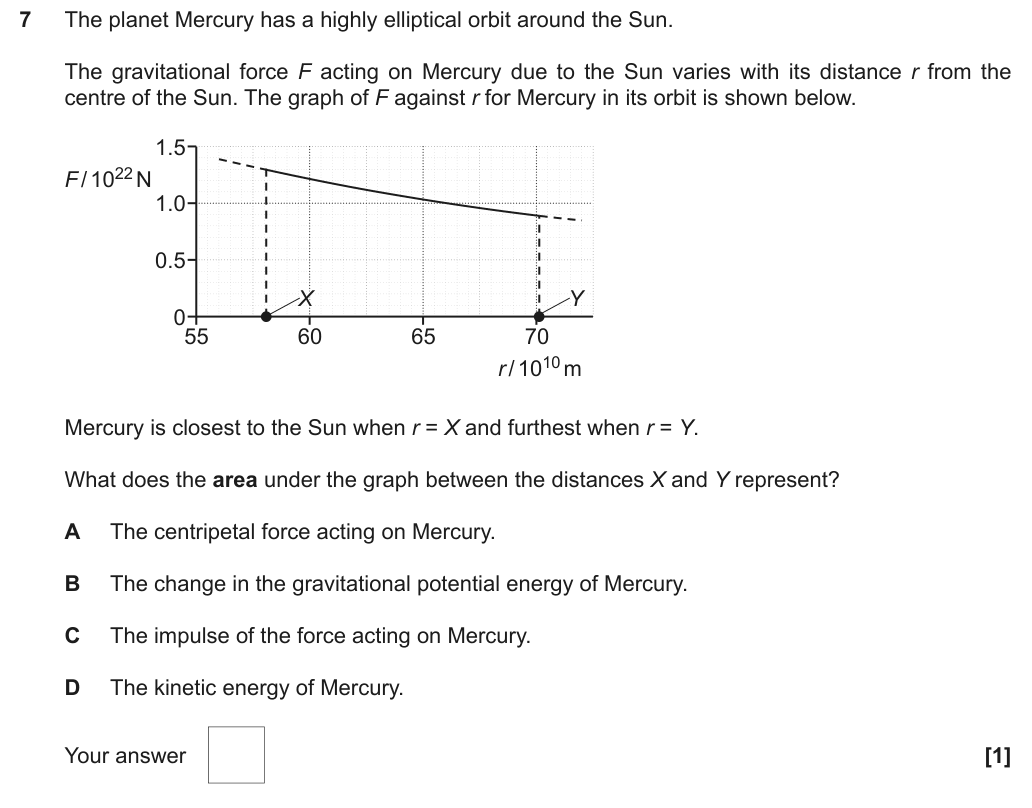
B
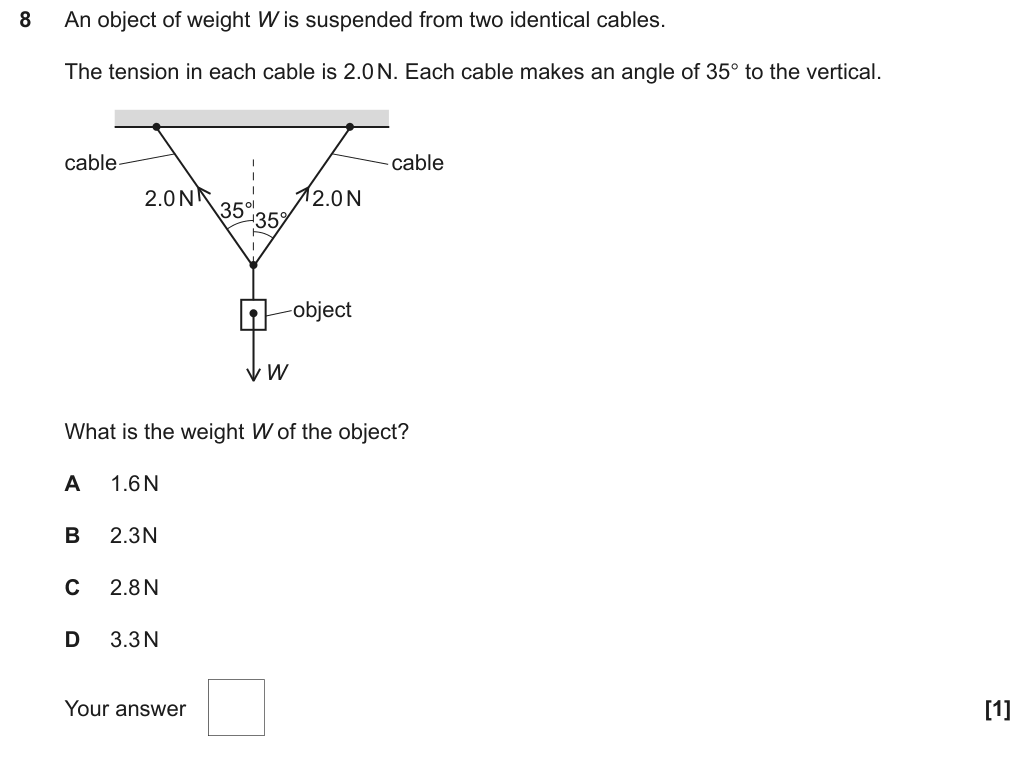
D
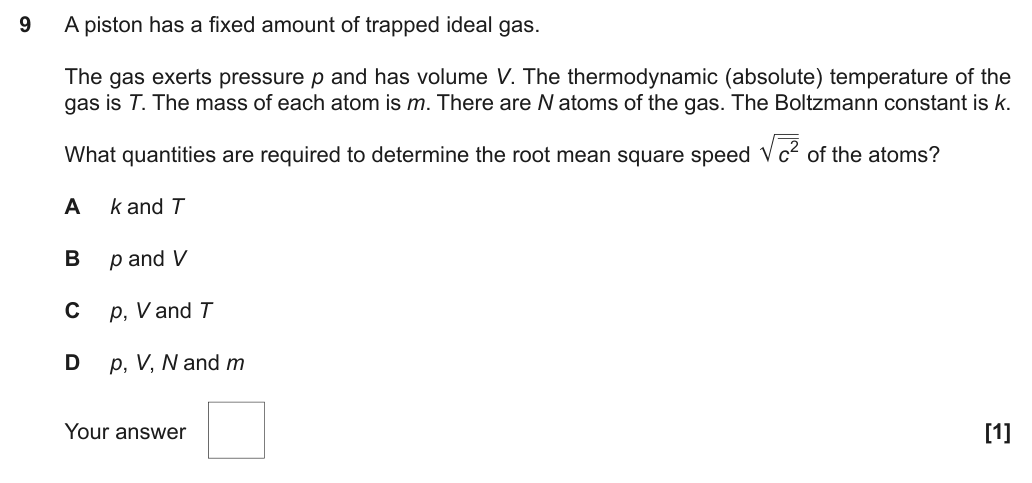
D
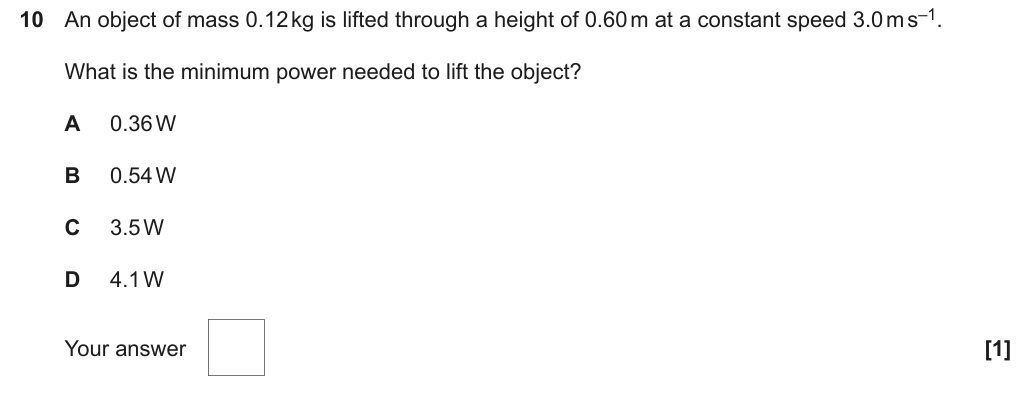
C
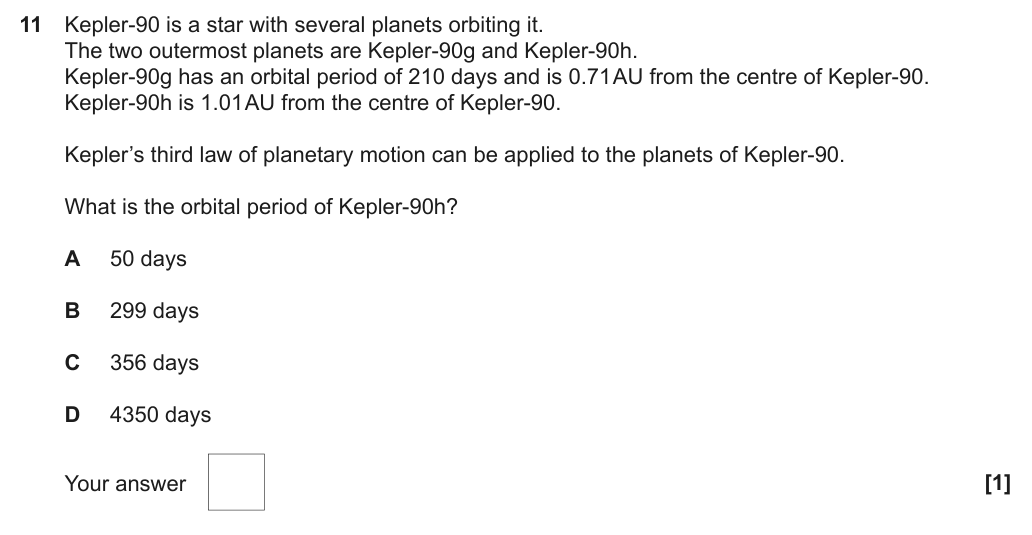
C
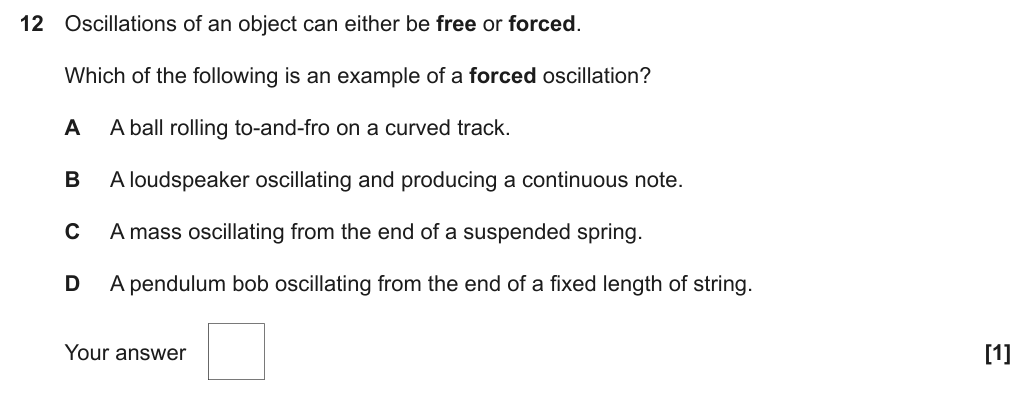
B
C
B
A
D
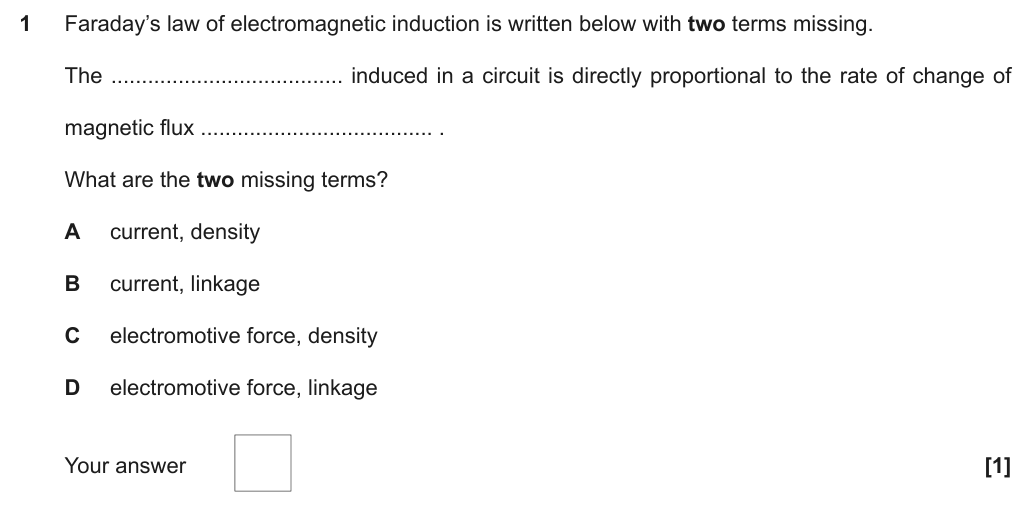
The correct response is D. This question was correctly answered by the majority of candidates, although almost all the incorrect responses were C, presumably as candidates are aware that it is the e.m.f. that is induced but less familiar with Faraday’s law in general.
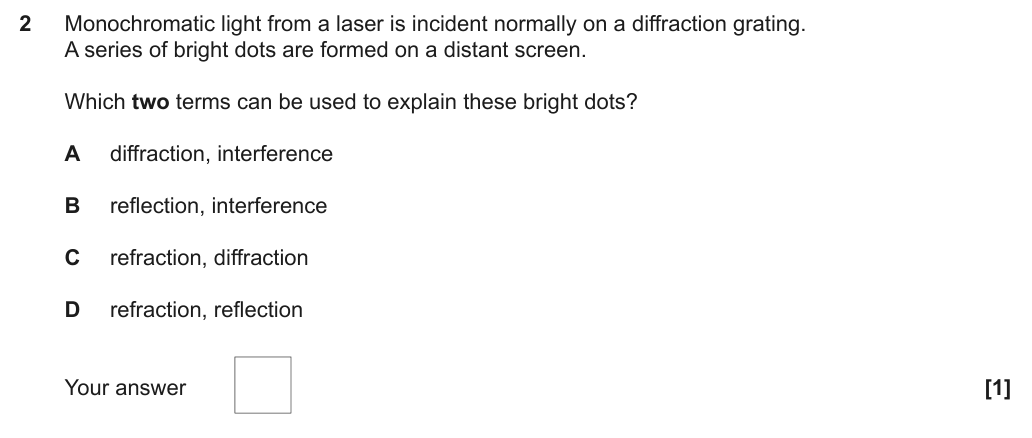
A
The correct response is A. This question was correctly answered by the vast majority of candidates, who were able to select the correct terms applicable.
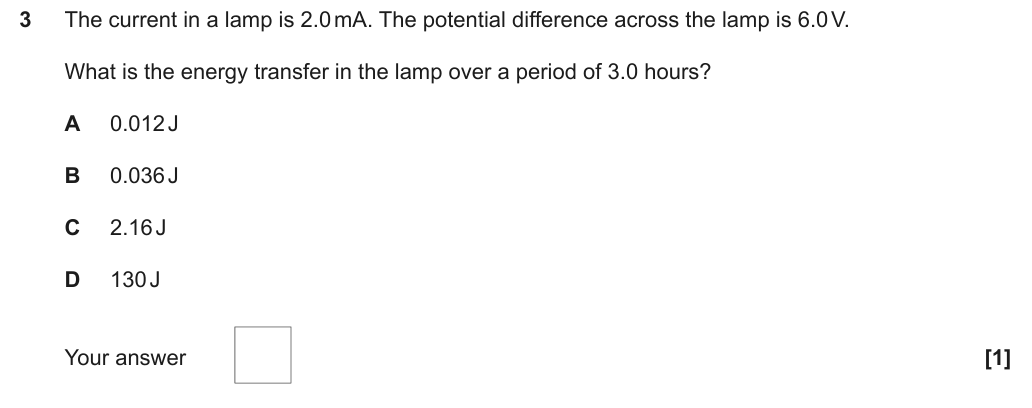
D
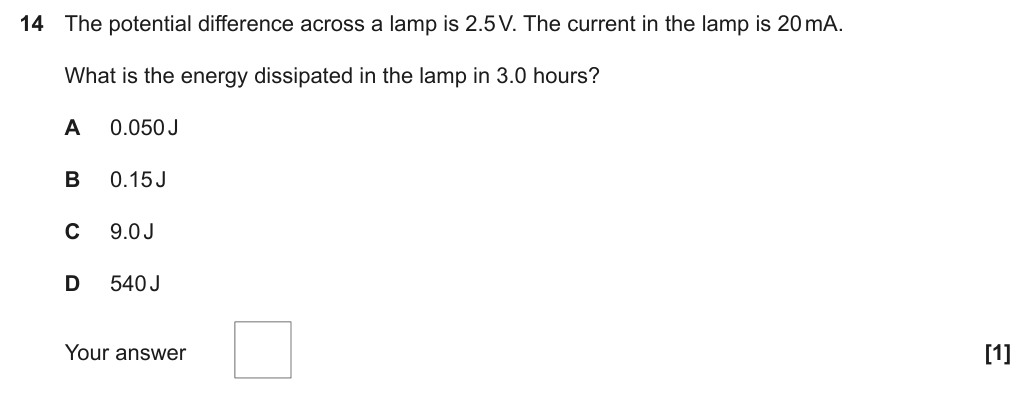
The correct response is D. It was encouraging to see that a large number of candidates were able to select the correct answer. Although a relatively straightforward calculation, it does involve two unit conversions (mA to A, and hours to seconds), which if not done would generate one of the distractors. Many candidates showed their working here as they would in a structured question and this is always helpful when the calculation involves more than one stage.
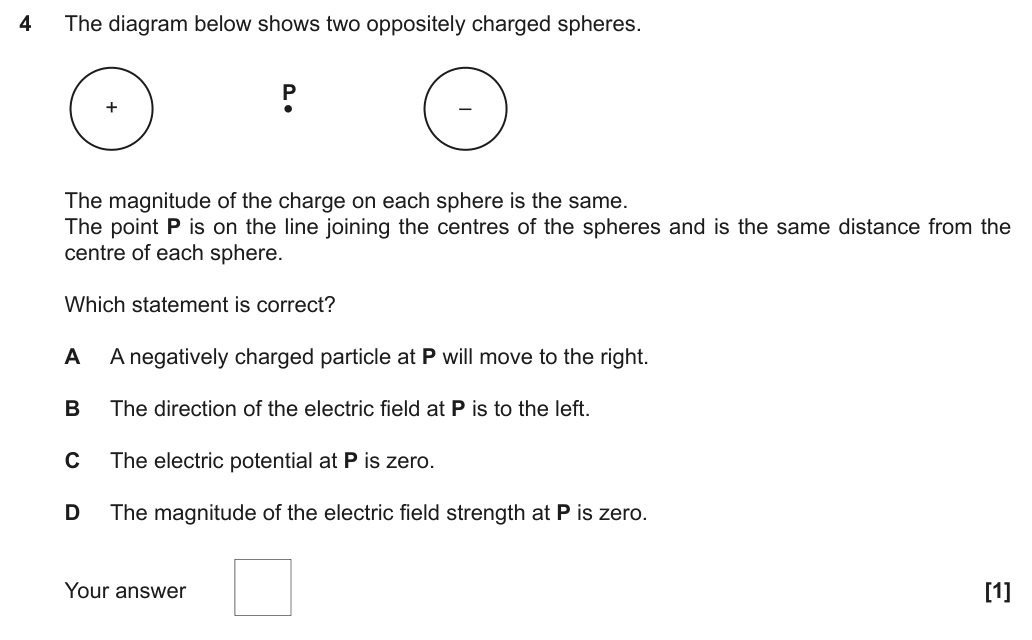
C
The correct response is C. Candidates often find the electric field questions challenging and this was again the case as this question was correctly answered by only one third of the candidates. Many candidates drew arrows on the diagram to assist them. Response D was the most common distractor; linking this to gravitational fields would produce a zero field strength at P which is likely to be the reason.
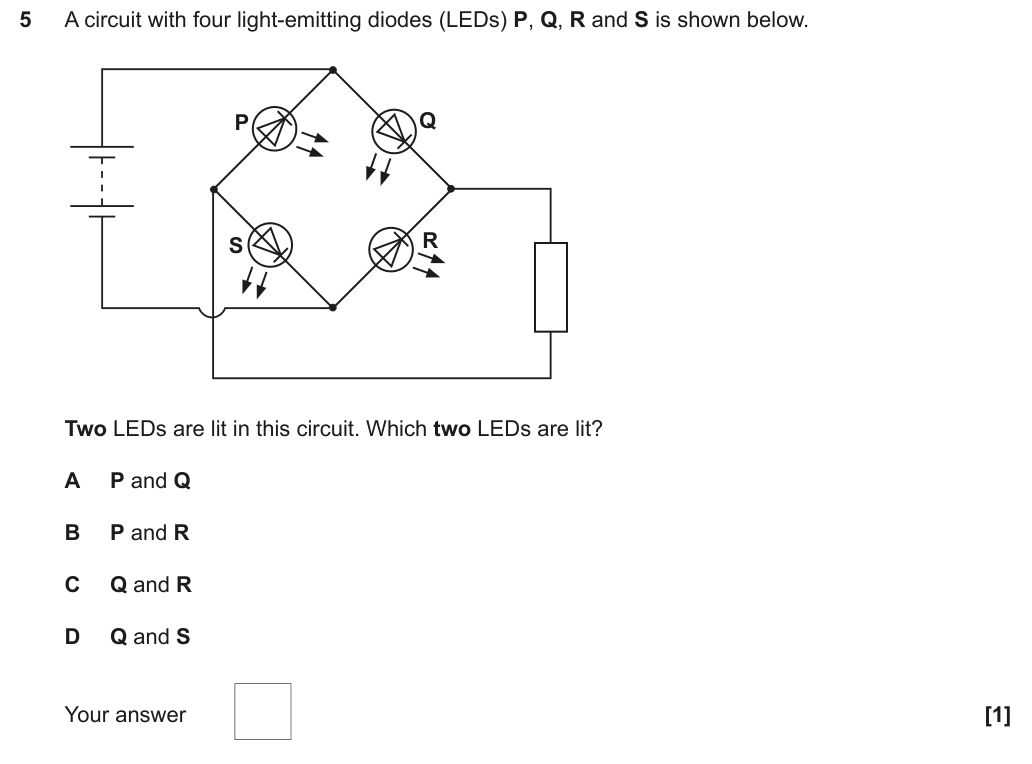
D
The correct response is D. This question also proved to be challenging as not many candidates will have come across this style of circuit before. Therefore in most cases, it will have to have been worked out from application of conventional current flow. It would likely be evident that LED Q is lit, probably accounting for the very few candidates selecting response B. Many candidates incorrectly selected response A, presumably as its polarity is the same as Q.
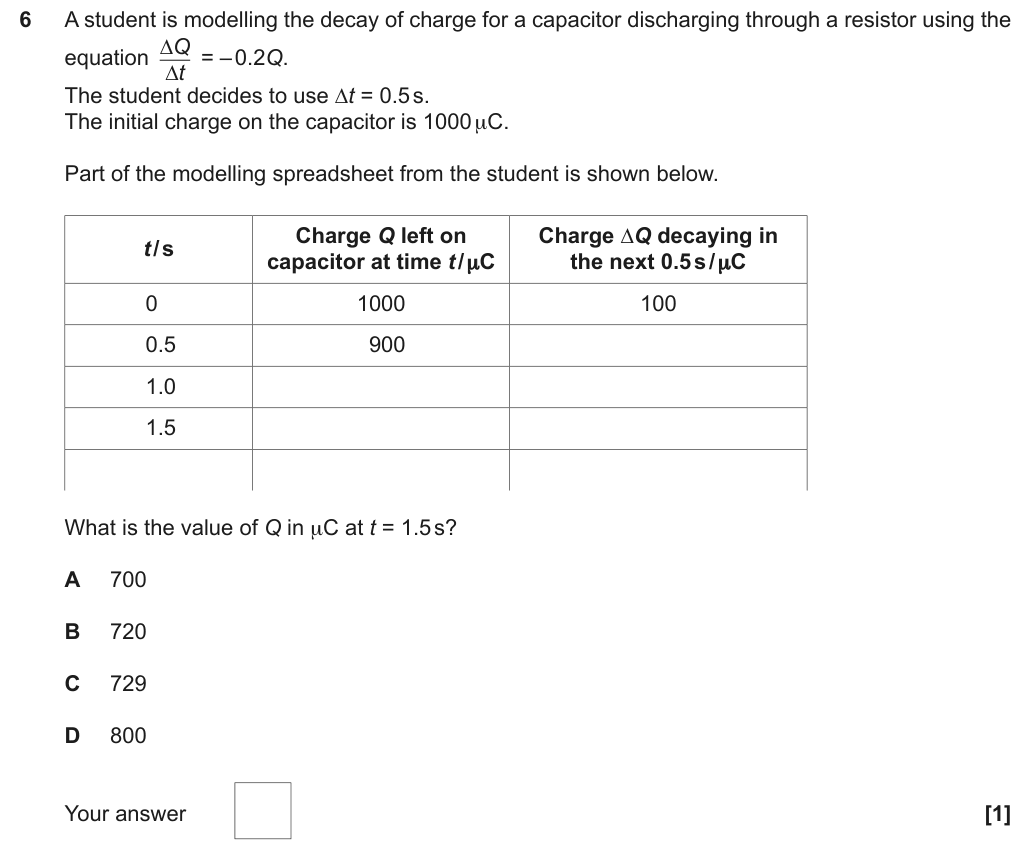
C
The correct response is C. Although this question may not have followed the traditional route for a capacitor decay, it proved to be accessible to many candidates. Several filled in the table completely which appeared to be a helpful strategy, or set up stages of the calculation alongside the question. Those that showed little or no working tended to opt for response A using a constant subtraction for each time interval.
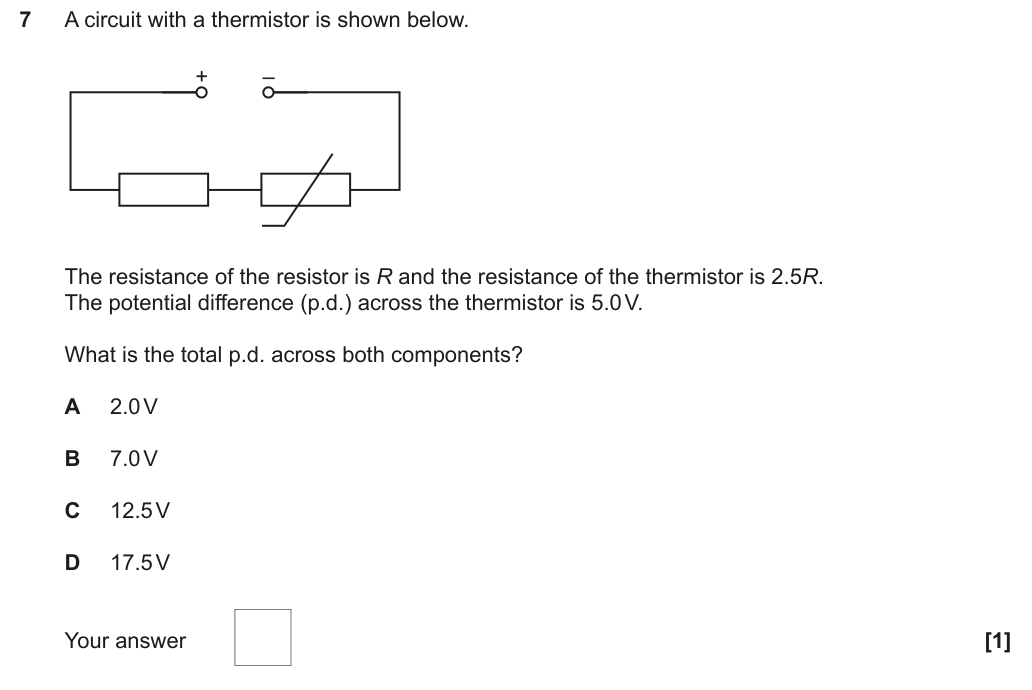
B
The correct response is B. This question was correctly answered by around two thirds of candidates. There appeared to be various routes to the correct solution; many opted to work out a current in terms of R, but the more elegant working was in terms of simple ratios which demonstrated a good understanding of p.d. in a series circuit. Encouragingly, very few candidates opted for response A, which was a p.d. below that of the thermistor alone. It should be noted that a couple of candidates put a ‘7’ in the answer box – as correct working had been shown by them, and leading to the correct numerical value this was credited by examiners. However, this cannot be guaranteed to occur in other cases and candidates are to be encouraged to put only the correct letter.
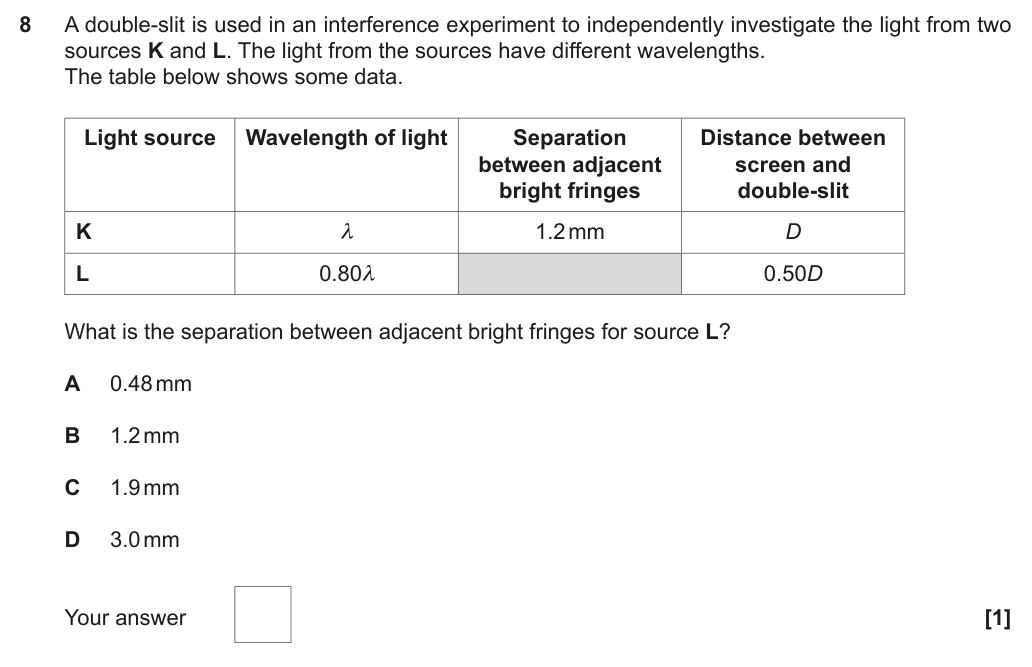
A
The correct response is A. A good number of candidates were able to correctly identify the new fringe separation. Most correctly identified the appropriate equation from the booklet and set out the solution either as ratios or by direct calculation. Quite a large fraction who achieved the correct response showed no working, suggesting that this is a relatively simple calculation probably done directly into a calculator.
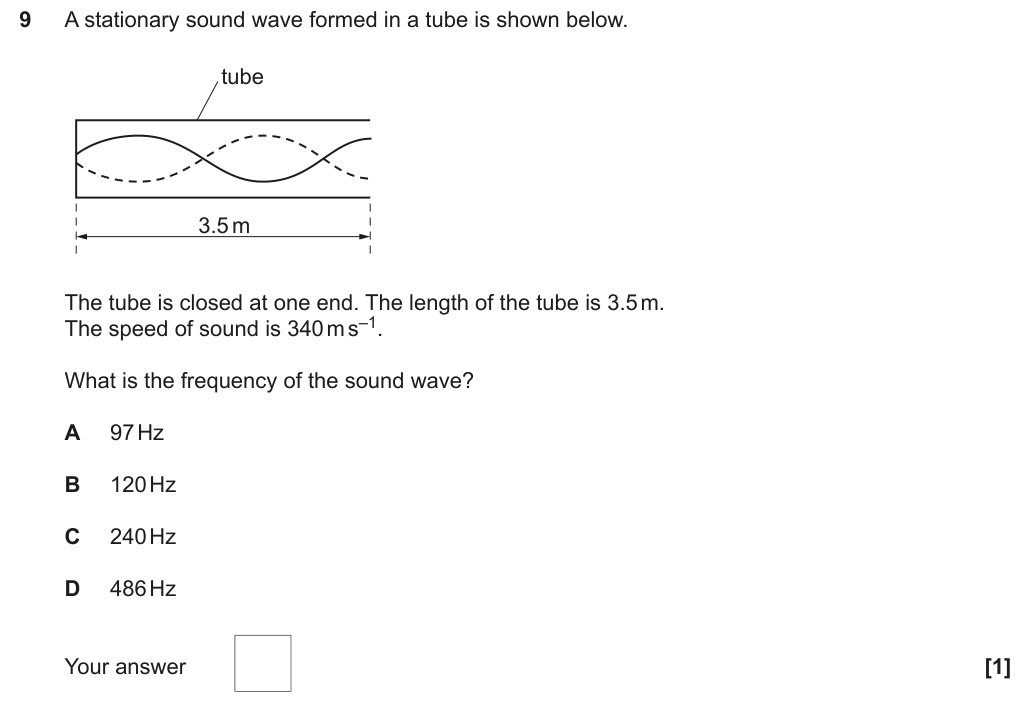
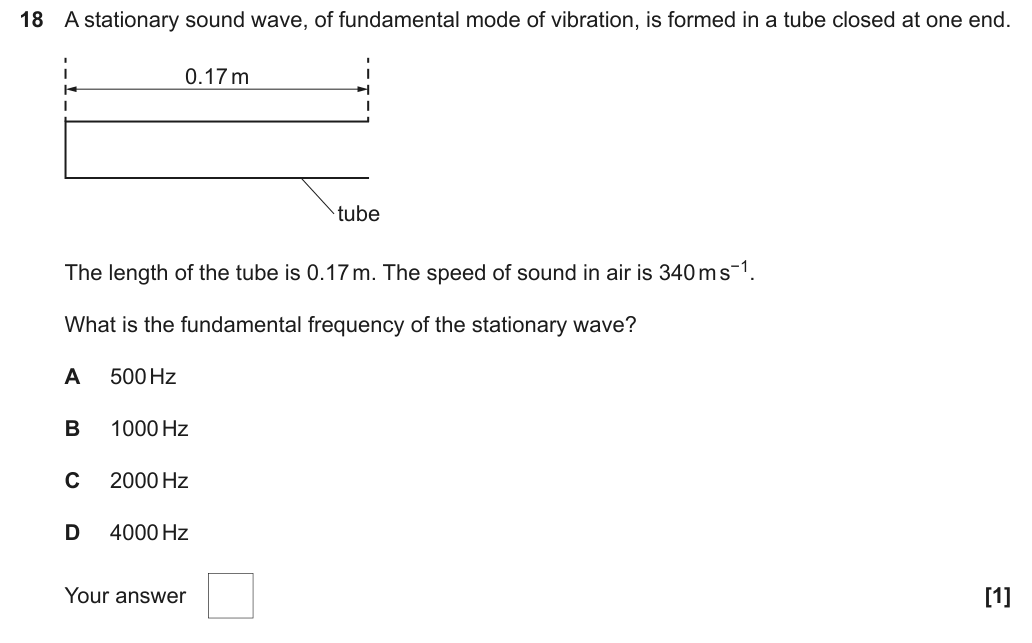
B
The correct response is B. Around two thirds of candidates were able to correctly calculate the frequency; this question relies on the candidate appreciating that there is more than one complete cycle in the tube and then evaluating the correct wavelength. It is then a straightforward calculation. As expected, most of the incorrect responses were A, where the wave equation had simply been used with the given numbers. Several candidates drew on the diagram to help in their calculation of the wavelength, although some thought that the wavelength was two thirds of the tube length, rather than four fifths.
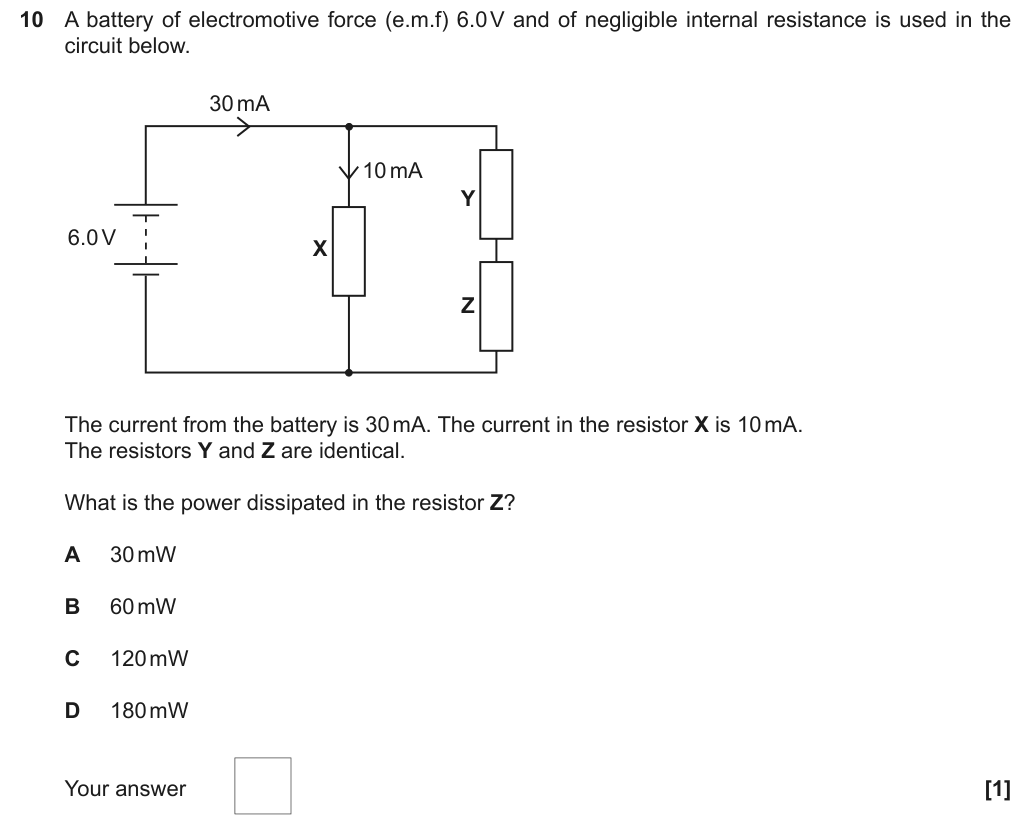
B
The correct response is B. This is another question which was correctly answered by around two thirds of the candidates. The simple solution is through determining the current through Z and the p.d. across it thereby finding the product. Working demonstrated some tortuous routes, such as calculating all the resistances, which does indicate a lack of confidence about circuit calculations. However, in many cases this did lead to the correct answer.
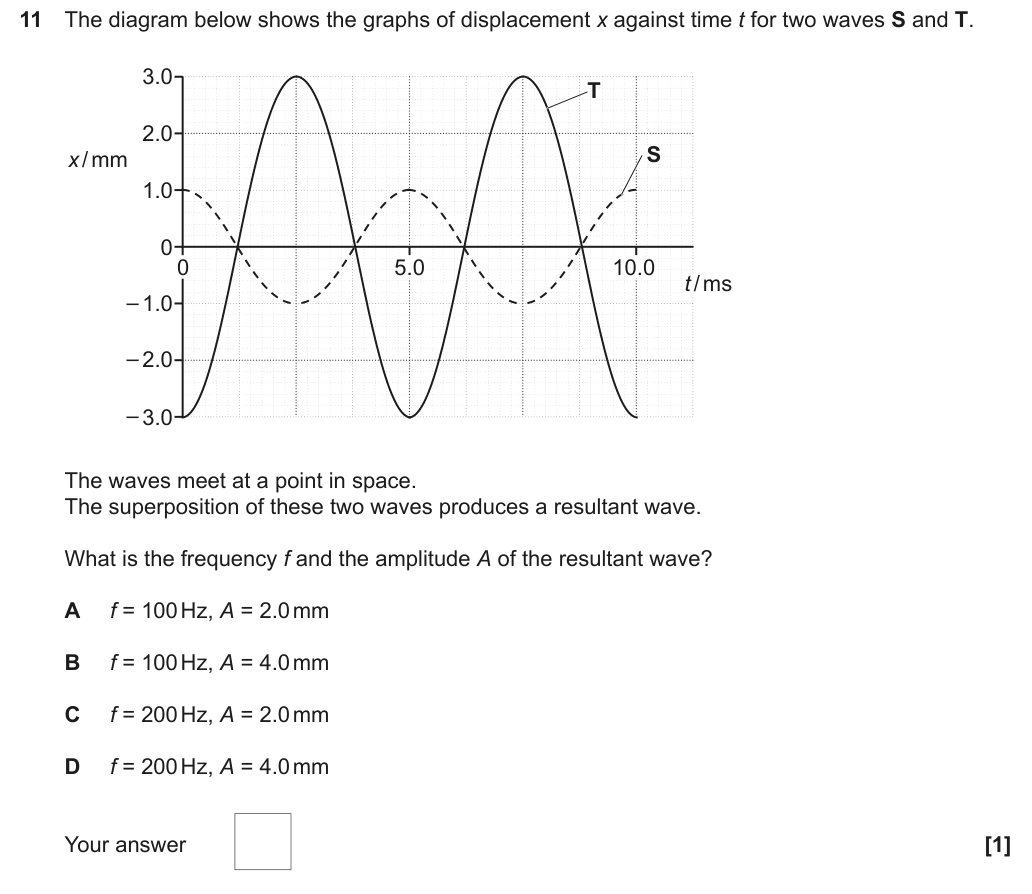
C
The correct response is C. Although not a particularly challenging question, it was encouraging to see around three quarters of entrants getting the correct solution. The most common incorrect response was A, suggesting that the idea of time period is not necessarily well understood.
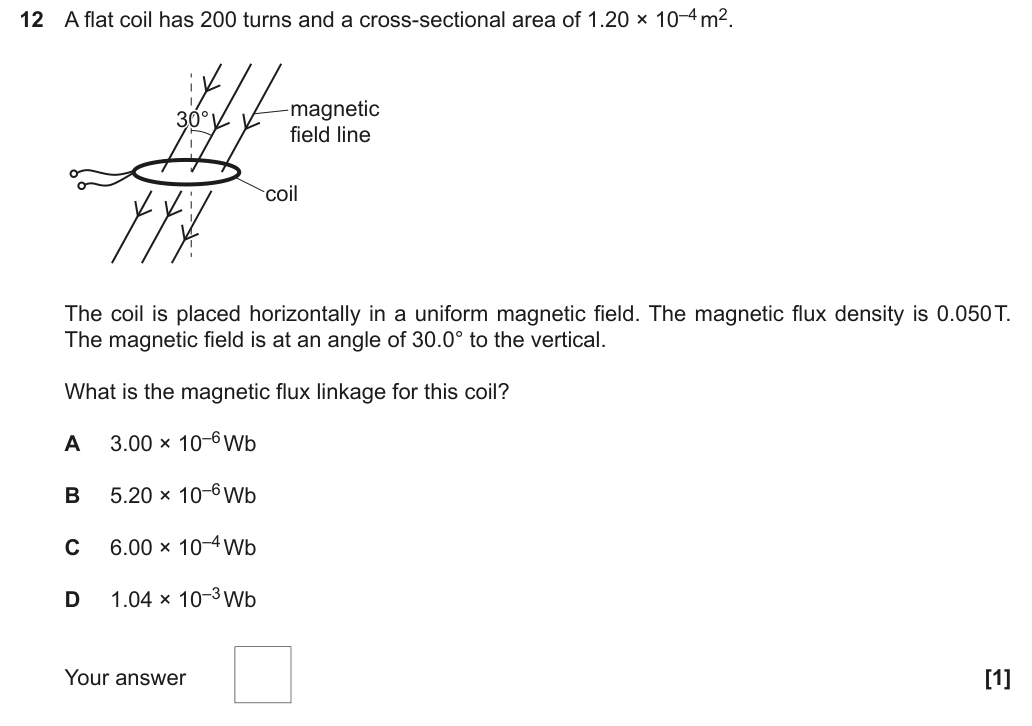
D
The correct response is D. Electromagnetism is another challenging set of concepts, resulting in a relatively low number of students obtaining the correct answer. Working showed that many of the candidates appreciated that the field needed to be resolved and were able to select the right trigonometrical function. However, by far the most common mistake was to ignore the turns and to simply calculate the flux through the coil. Whether this is a misconception or simply looking at the ‘coil’ on the diagram is unknown, however candidate should be reminded of the difference between turns and coils.
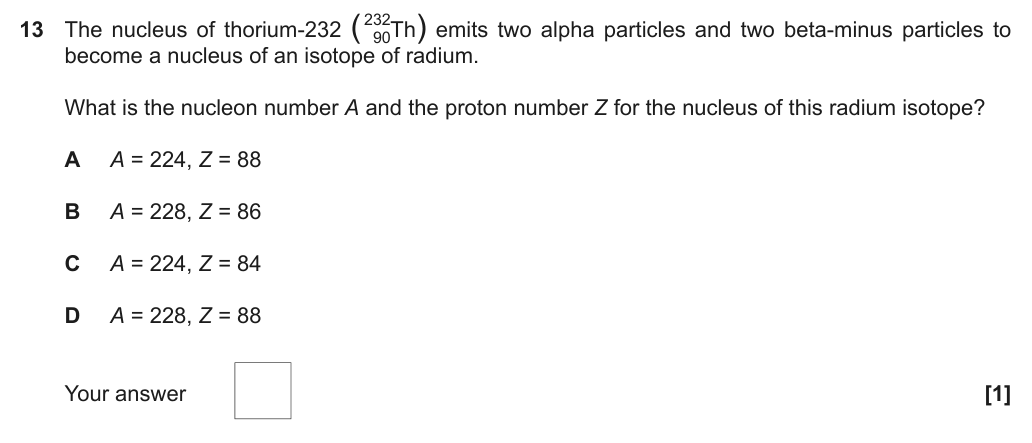
A
The correct response is A. Around half of candidates were able to select the correct response. Although it would seem appropriate to write out some simple decay sequence, many candidates showed little working here. Some were able to get the correct response (probably through mental arithmetic) but incorrect responses may simply have been down to a lack of knowledge of nuclear changes, most likely in the beta decay. Incorrect responses were spread fairly evenly among the distractors, again suggesting that this topic was not well understood.
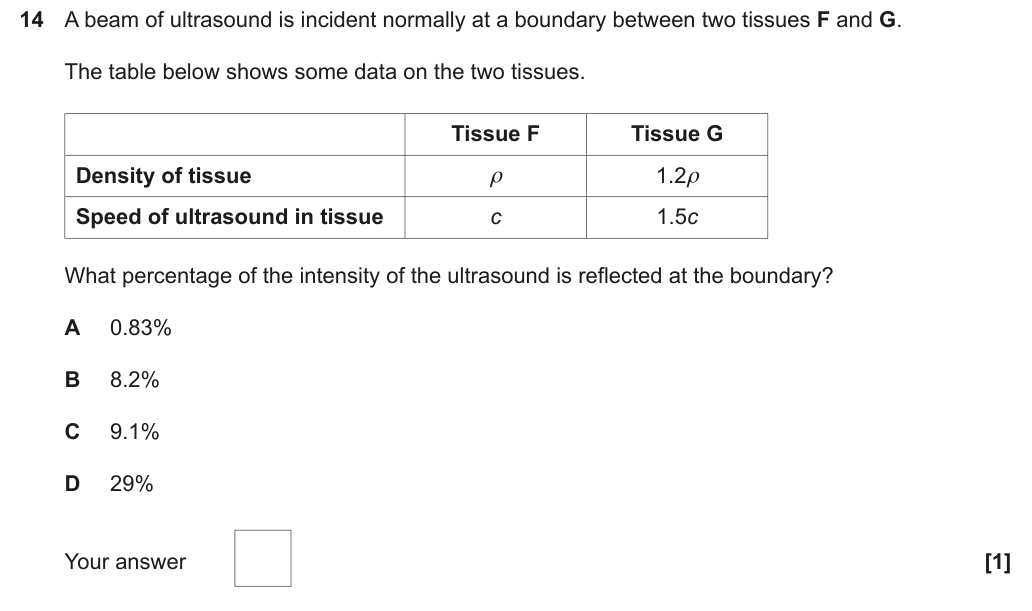
B
The correct response is B. The formula booklet is pretty essential here as the ultrasound reflection formula is one of the least memorable. Although there are a couple of stages to this calculation, most candidates were able to answer this correctly and this suggests a confidence (and perhaps suitable practice) in this topic. However, and unusually, some candidates did not provide a response to this question.
Skills: M0.3 Use ratios, fractions and percentages
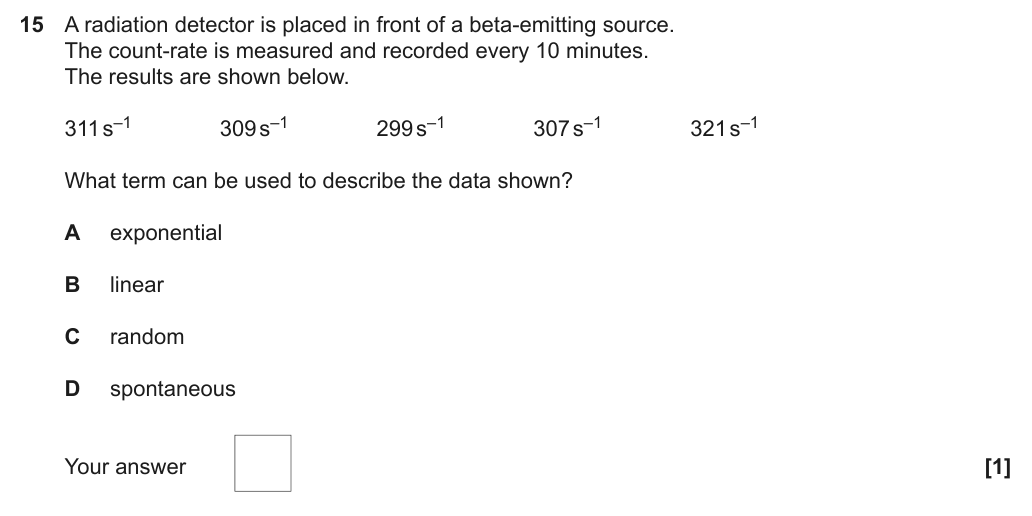
C
The correct response is C. The responses are terms used frequently when studying data, but as around only one half of the candidates were able to get the correct response, it is clear that they are not fully understood. A little perplexingly, the most common incorrect response was B, as it is difficult to see how this data could be considered linear. This does show how easy it is to assume that candidates are confident in their use of terminology, just because they are frequently used.
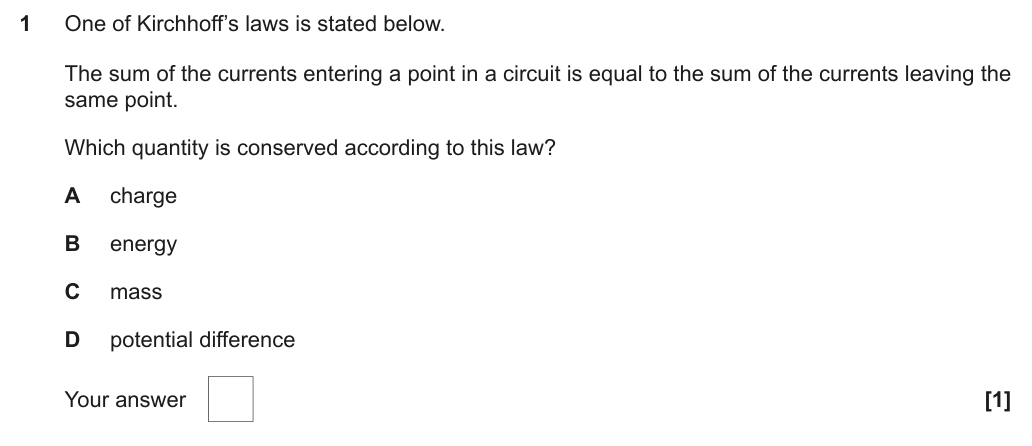
A
Comments on responses by question type Multiple choice questions Some of the questions, such as Question 1 on Kirchhoff’s first law and Question 19 on a stress-strain graph for an elastic material, are expected to be done quickly without much reasoning. Questions 1, 6, 13, 16, 17 and 19 proved to be particularly straightforward, allowing most of the candidates to demonstrate their knowledge and understanding of physics.
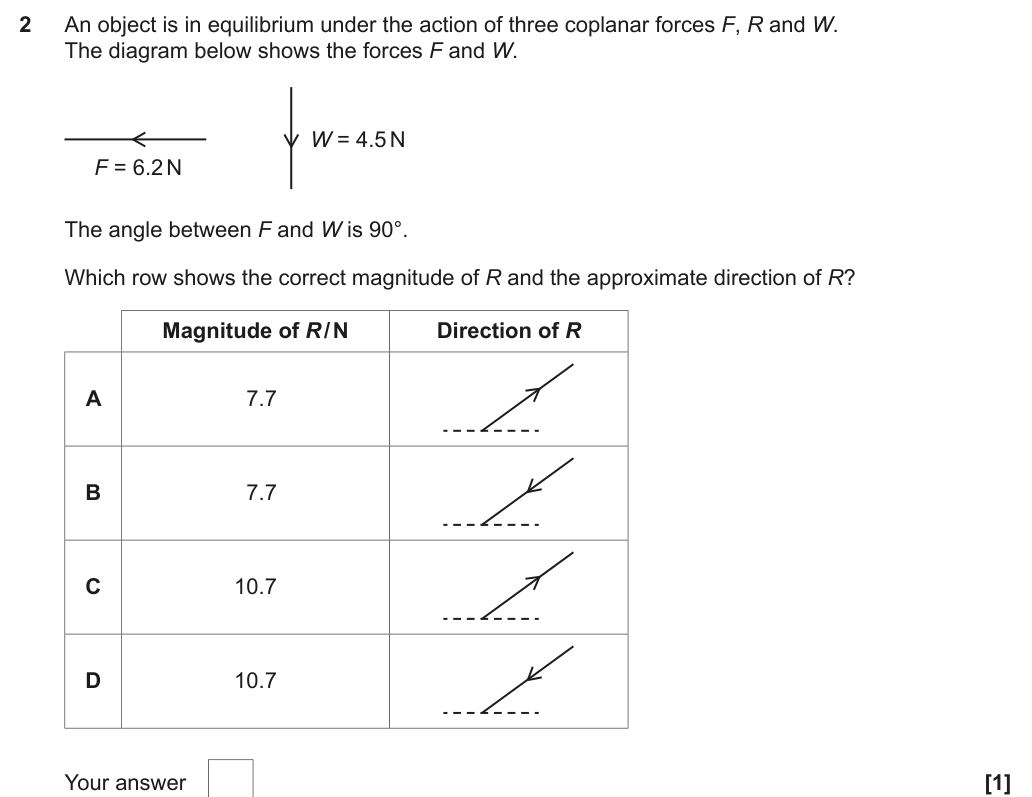
A
C
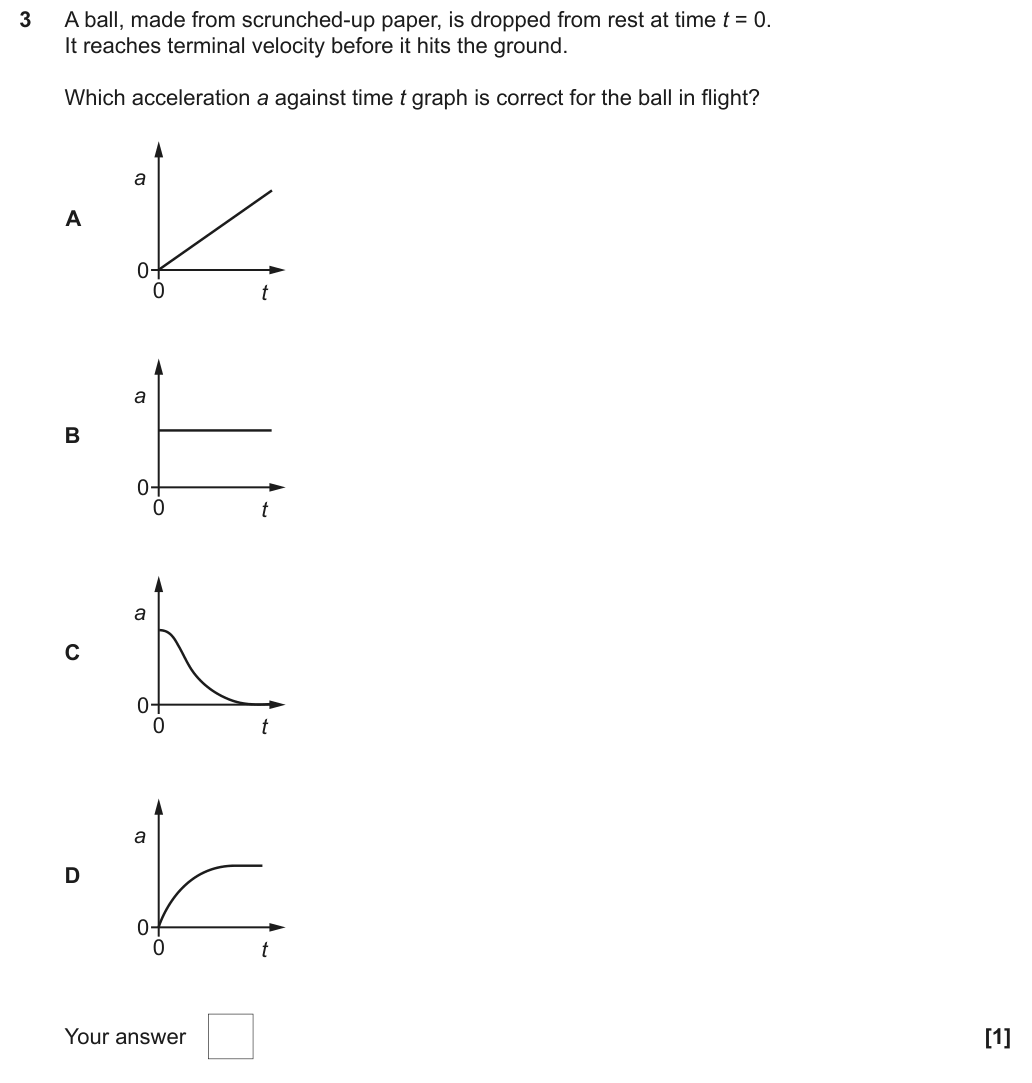
Question 3 is all about a ball of scrunched-up paper falling towards the ground.
D
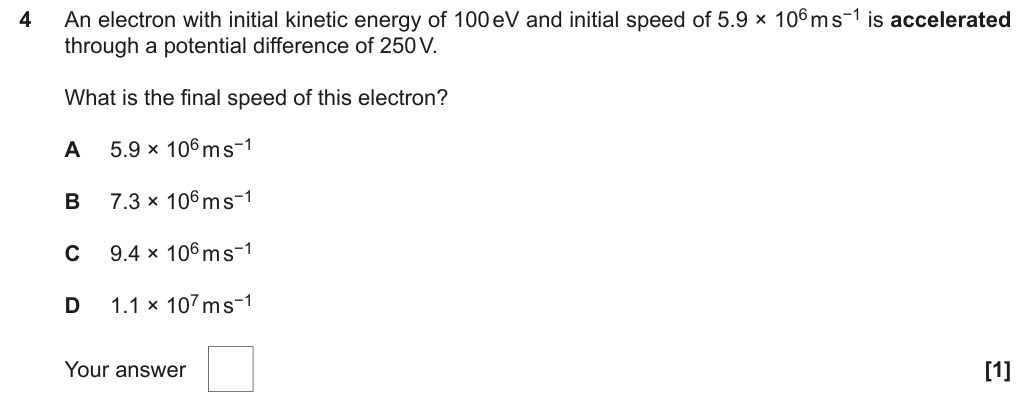
At the diametric end, Questions 4 and 14, were more challenging, and accessible only to the top-end candidates. Question 4 is all about two key ideas: KE = ½ mv2 and energy gained by the electron = Ve.
A
C
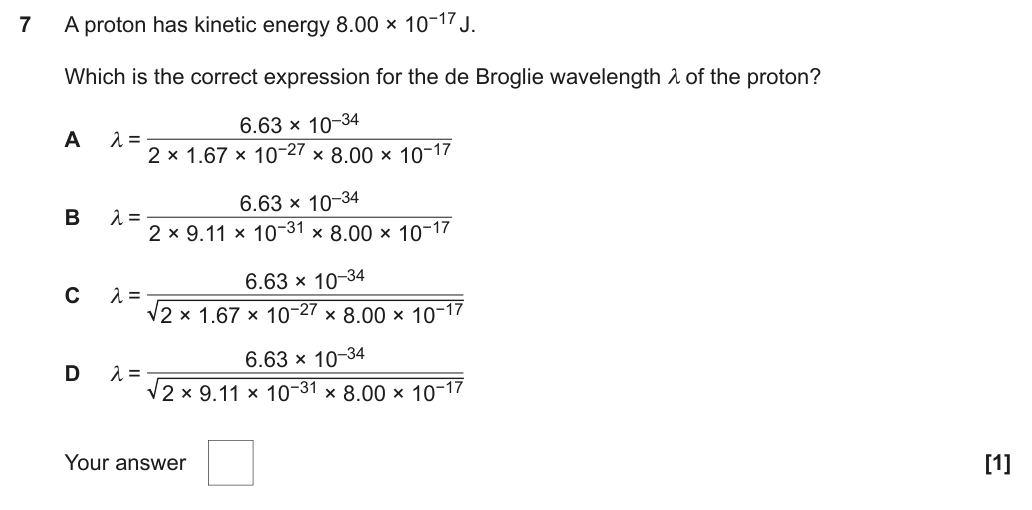
C
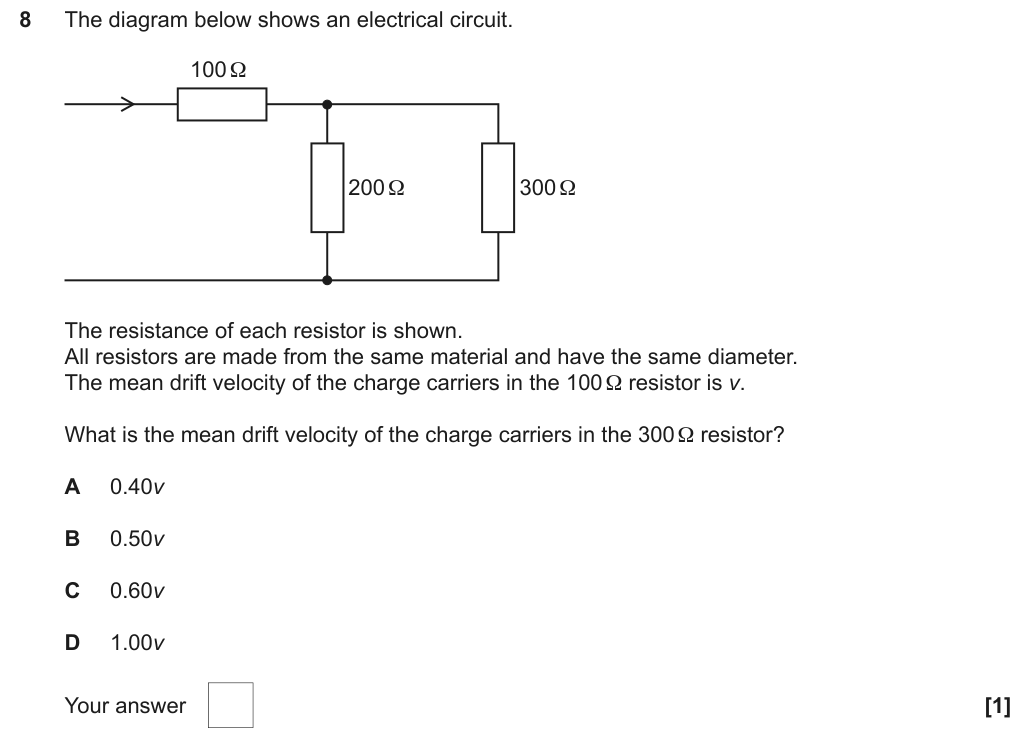
A
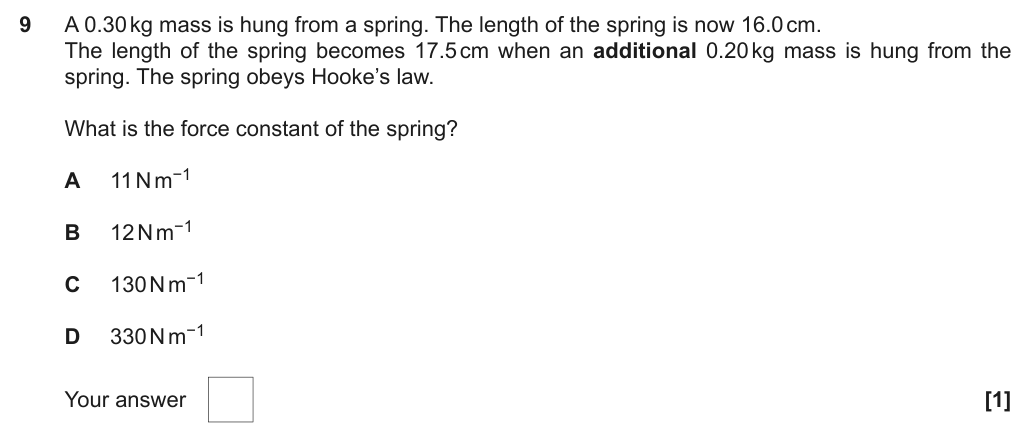
C
The same technique can be employed in Questions 9, 12, 13, 15 and 18.
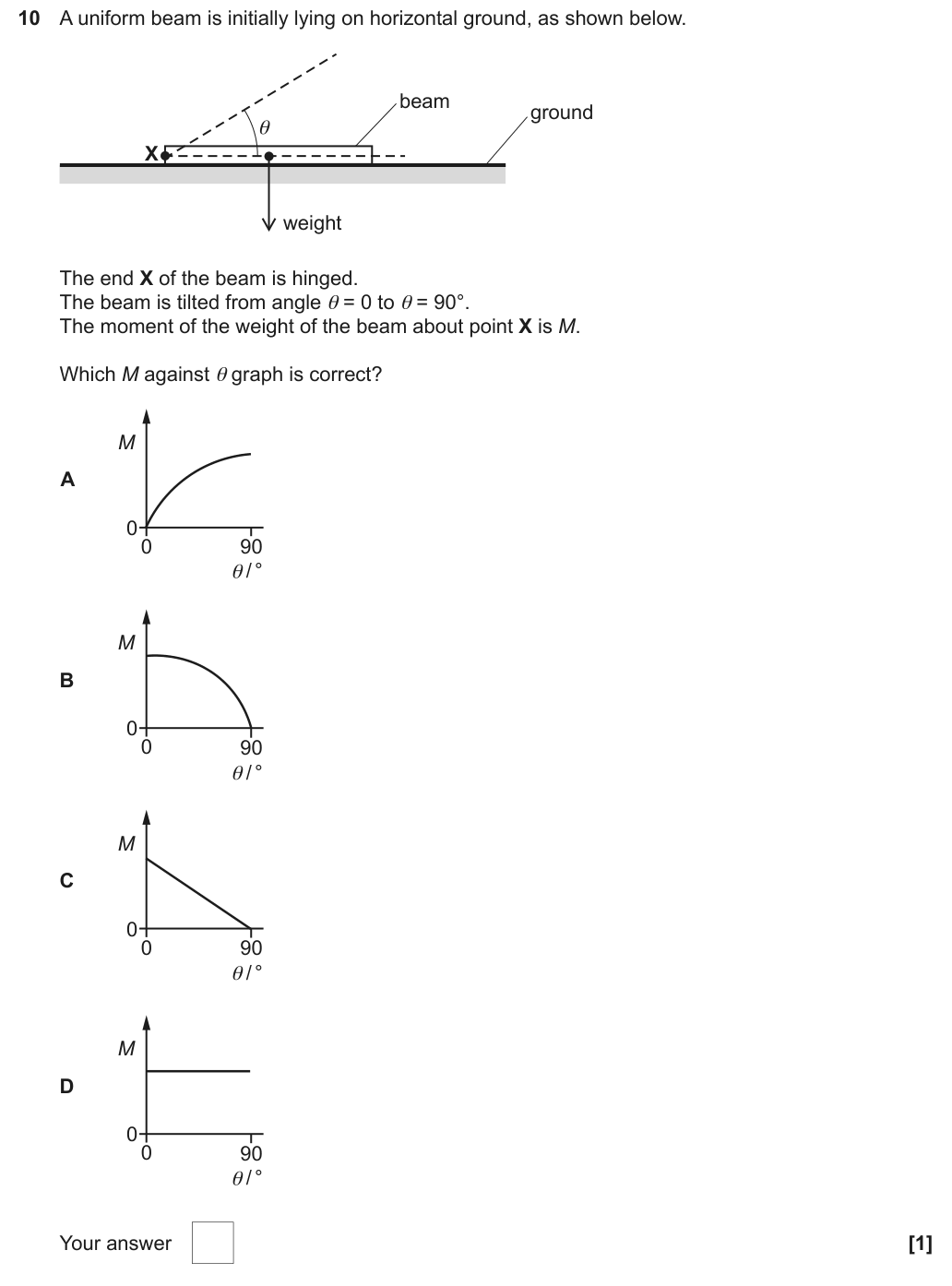
B
D
A
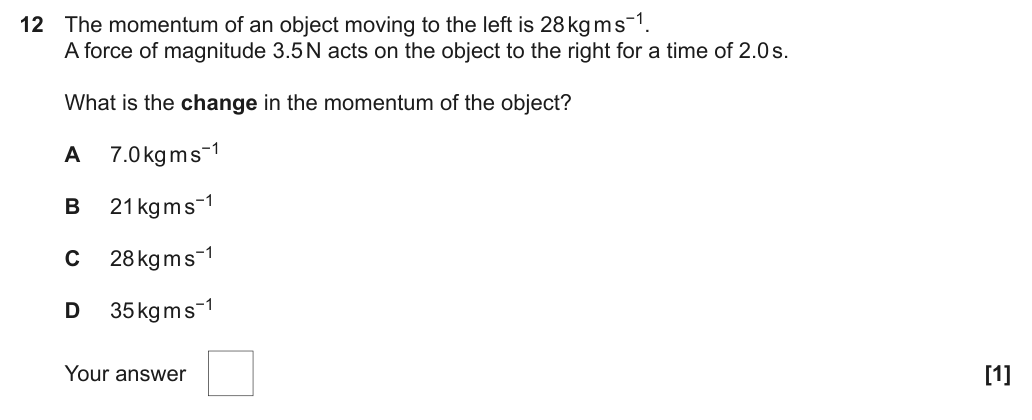
Other questions, such as Question 12 on impulse = change in momentum, requires a bit more thinking and solving time.
A
B
C
B
D
A
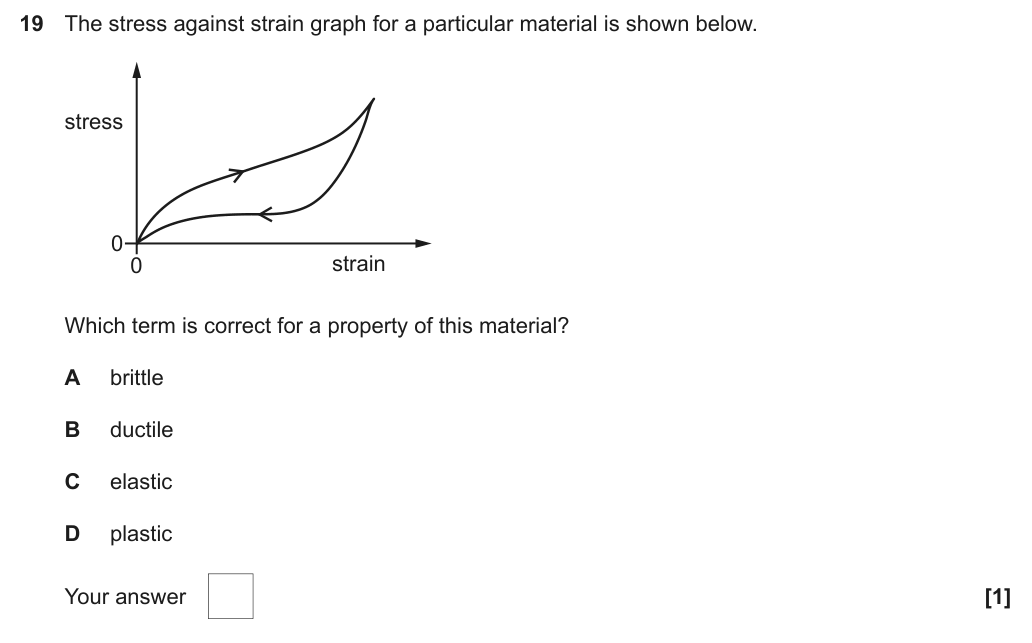
C
Comments on responses by question type Multiple choice questions Some of the questions, such as Question 1 on Kirchhoff’s first law and Question 19 on a stress-strain graph for an elastic material, are expected to be done quickly without much reasoning.
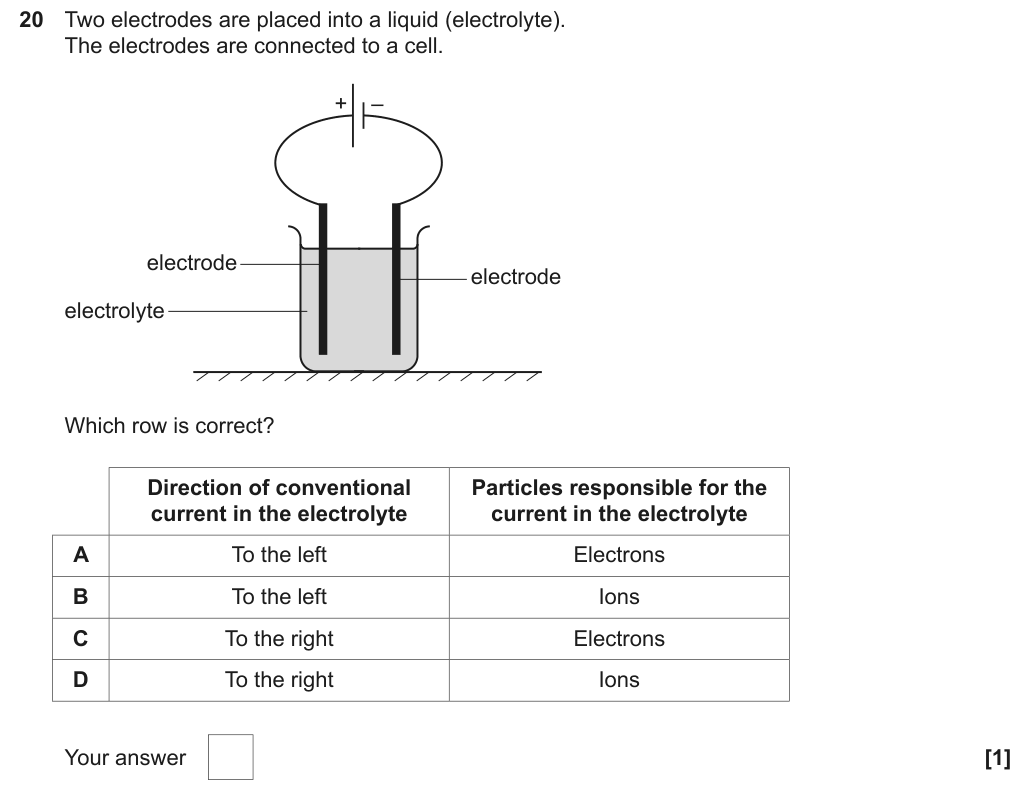
D
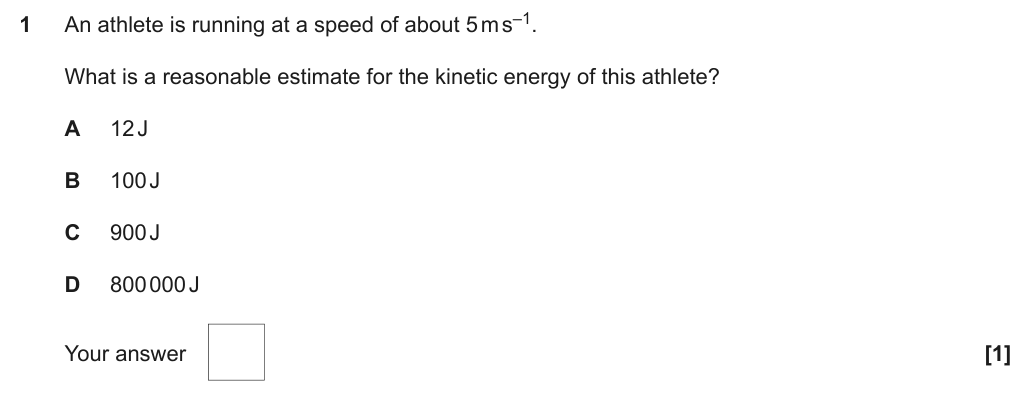
C
Candidates found Question 1, Question 2 and Question 15 very straightforward.
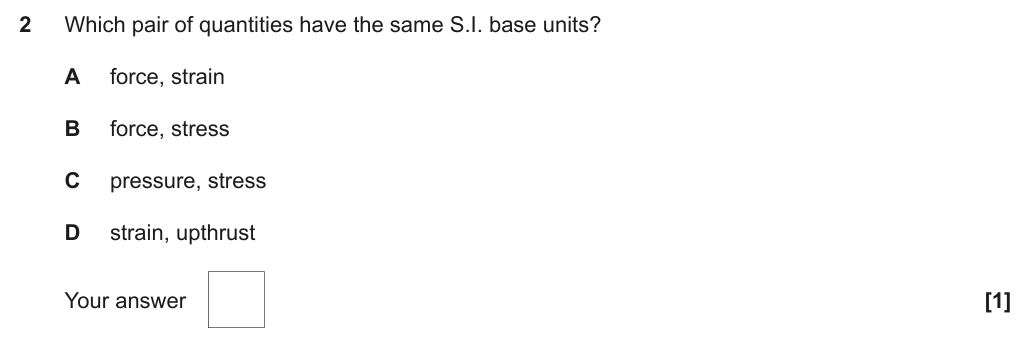
C
Candidates found Question 1, Question 2 and Question 15 very straightforward.
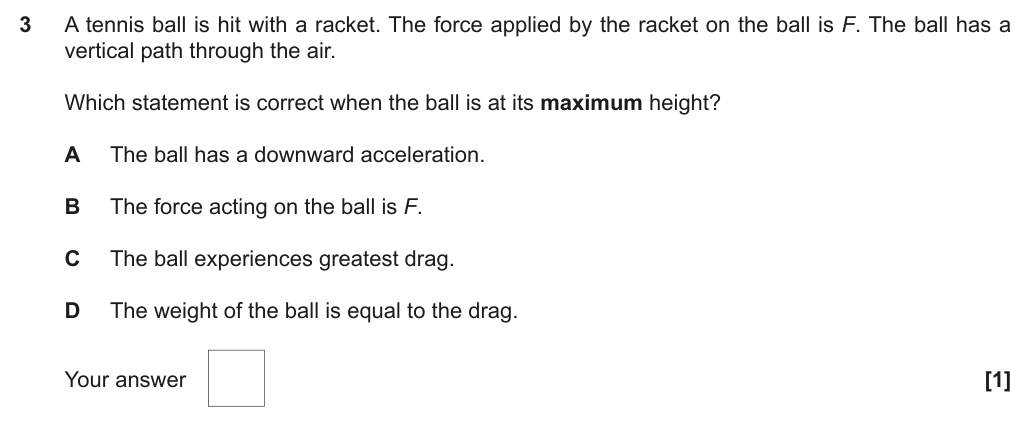
A
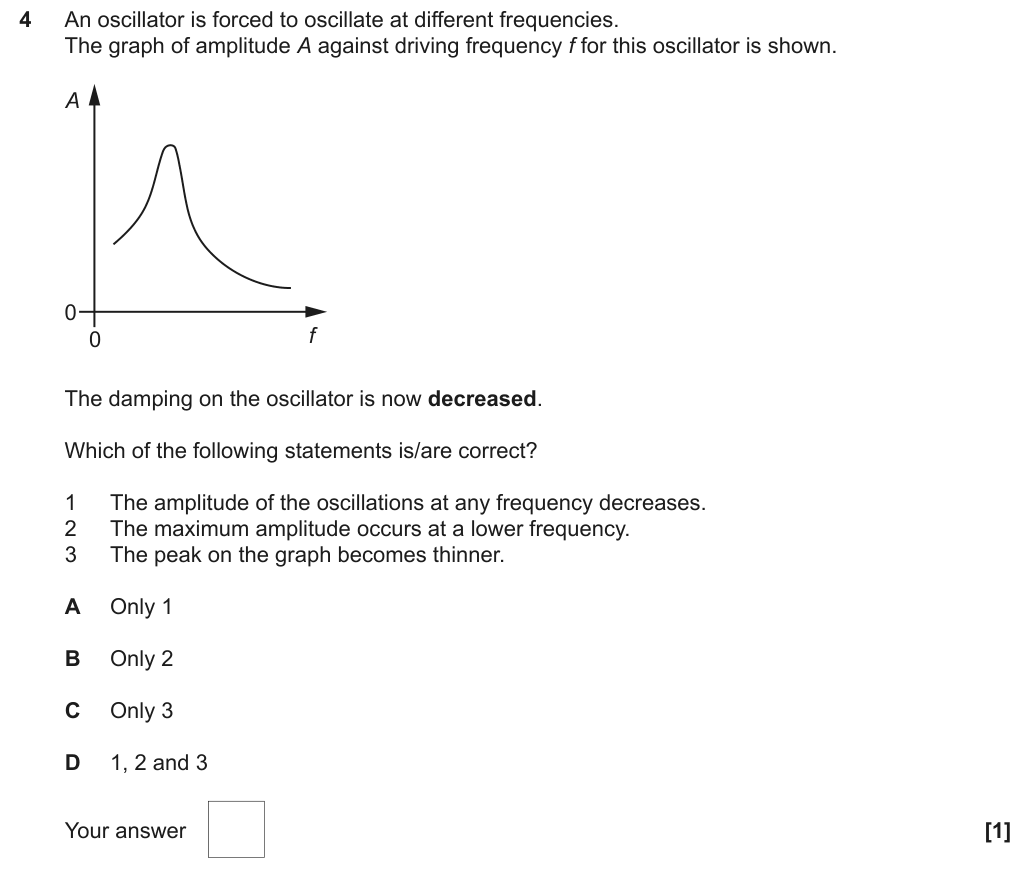
C
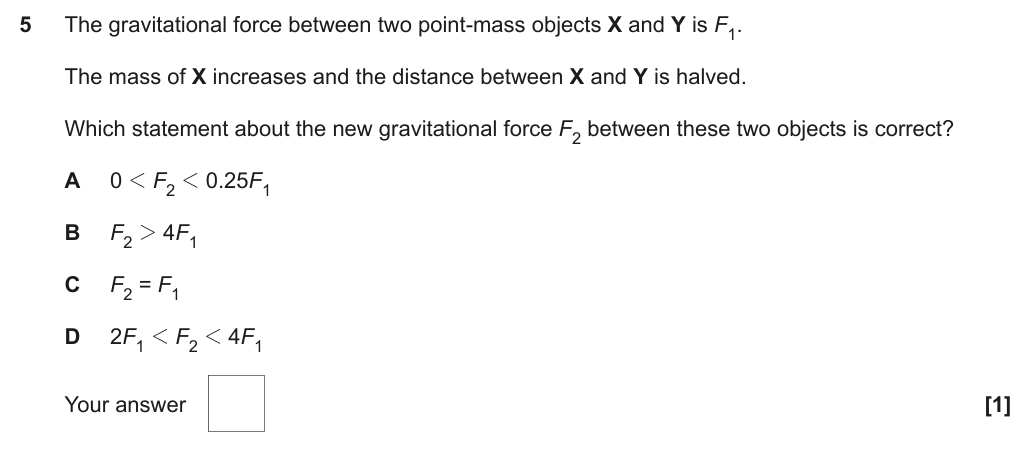
B
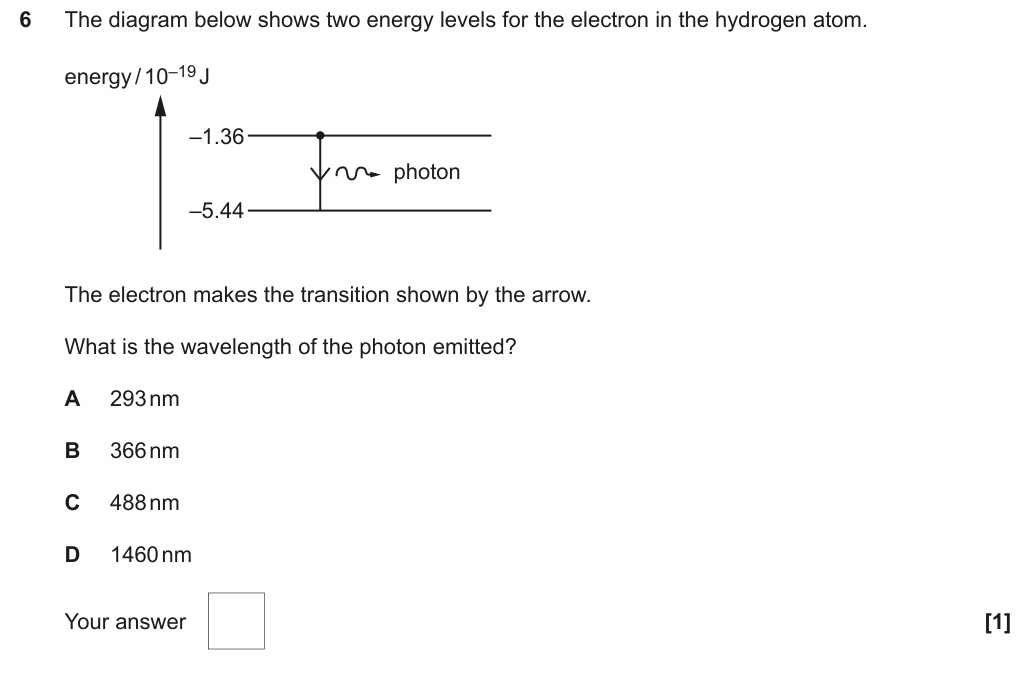
C
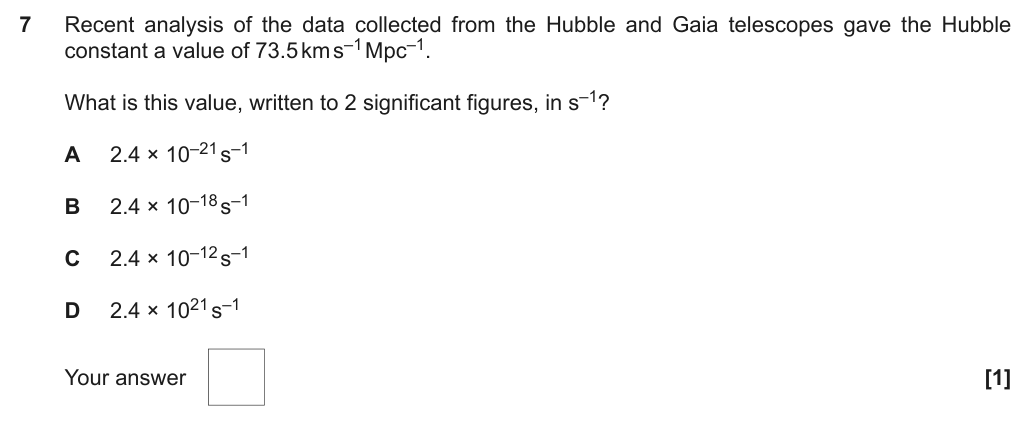
B
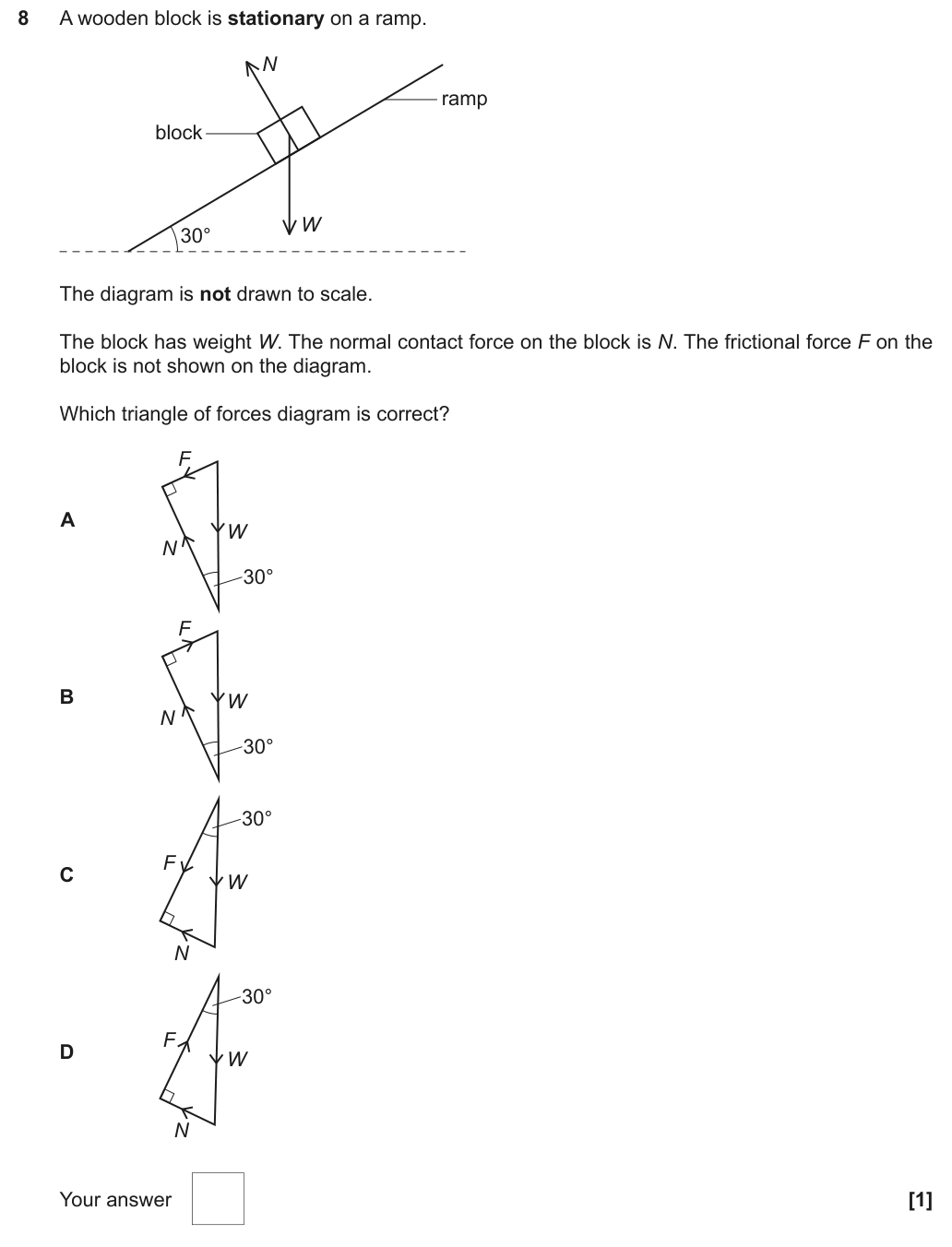
B
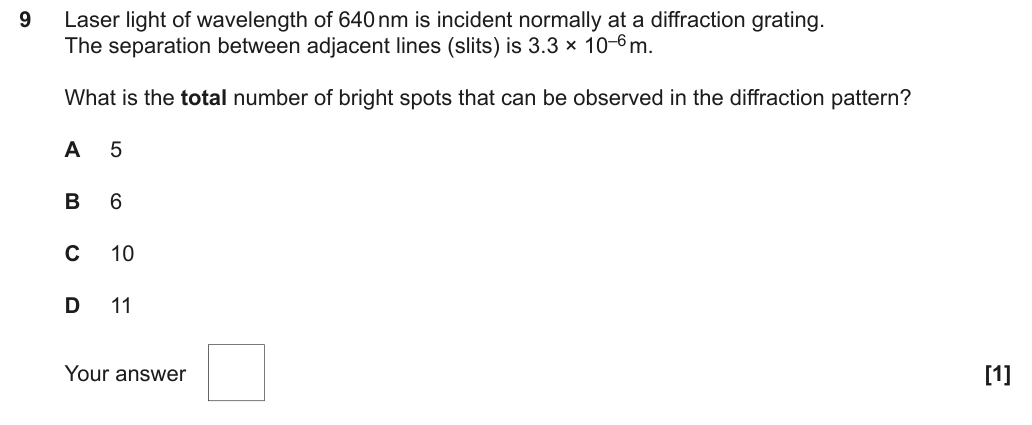
D
Candidates had particular difficulty with Question 9 and Question 10.
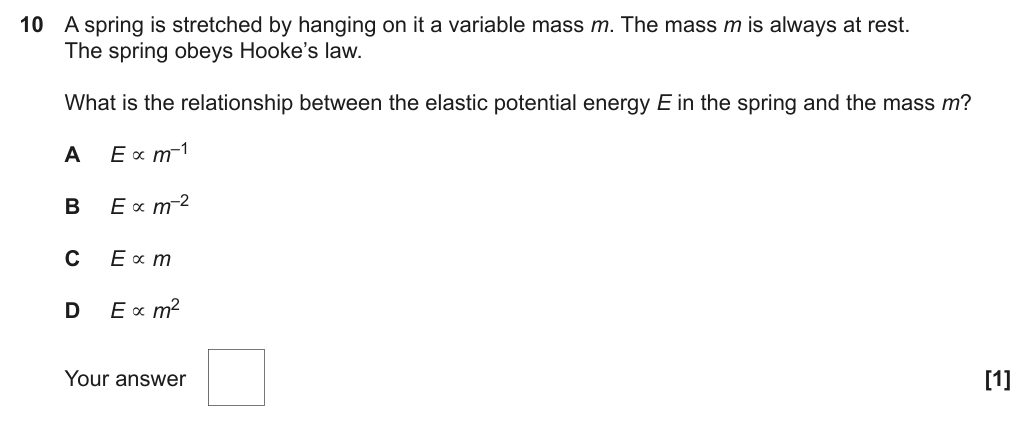
D
Candidates had particular difficulty with Question 9 and Question 10.
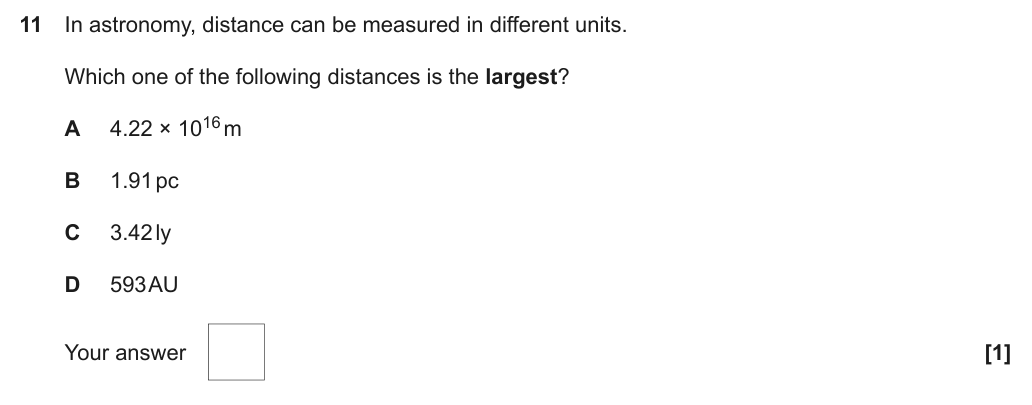
B
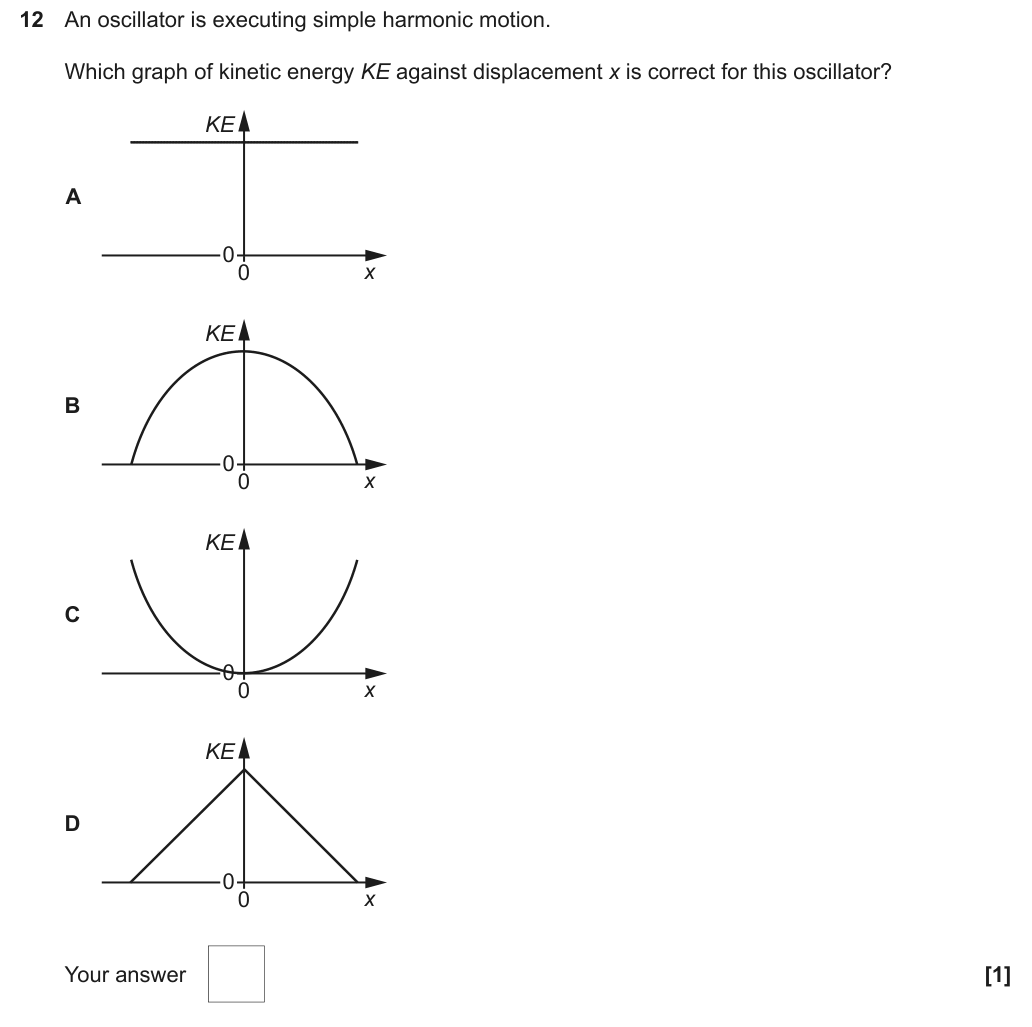
B
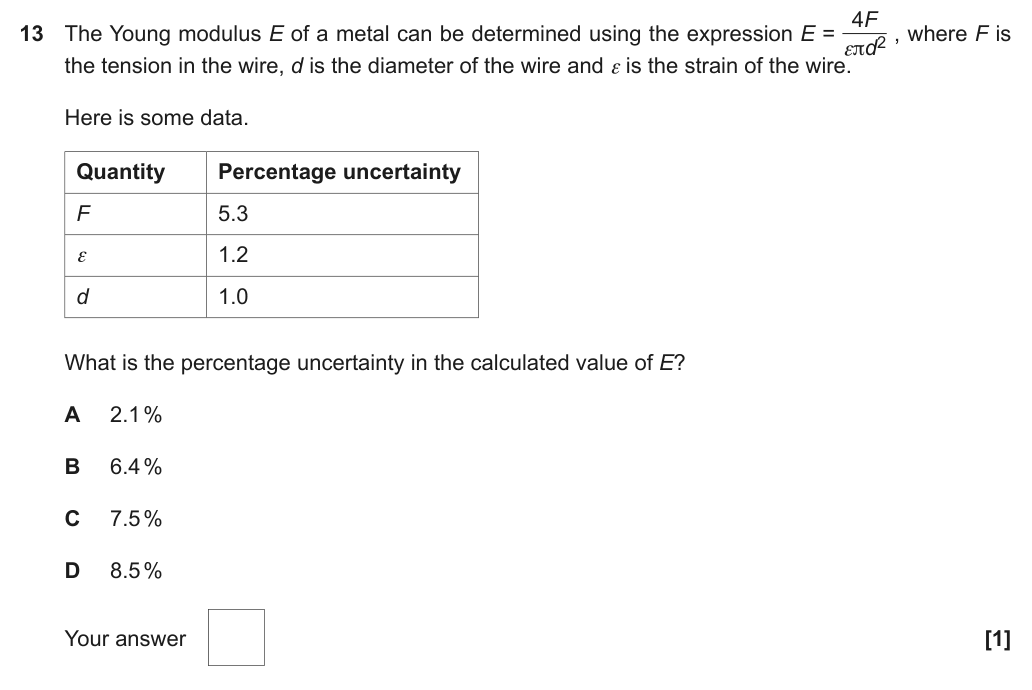
D
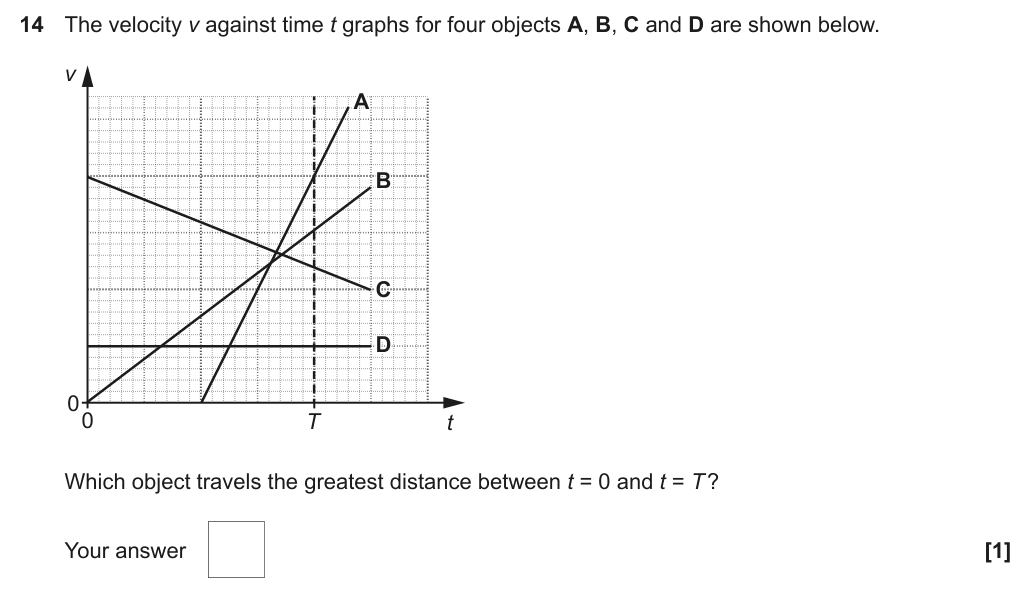
C
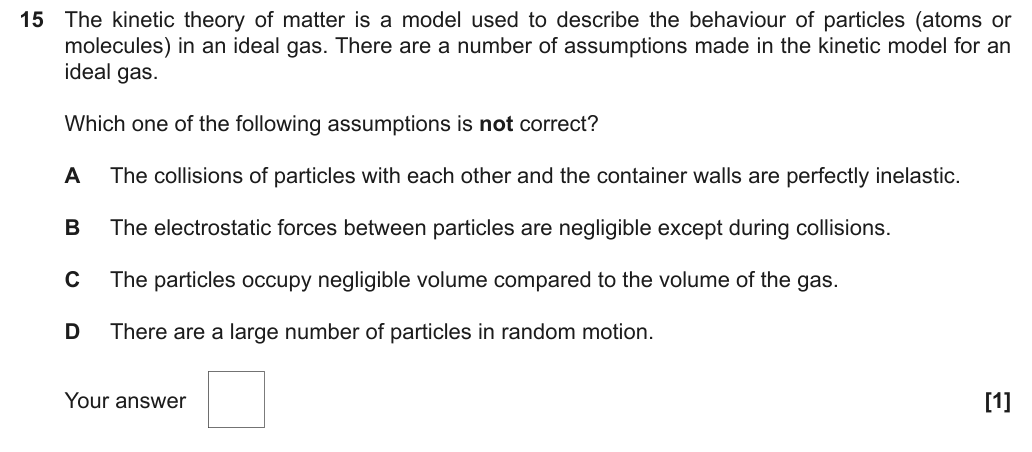
A
Candidates found Question 1, Question 2 and Question 15 very straightforward.
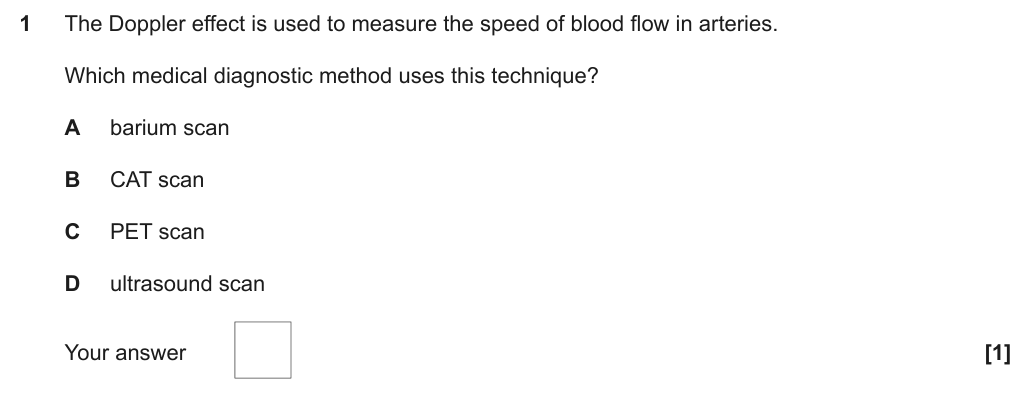
D
Comments on responses by question type Multiple choice questions Some of the questions, such as Question 1 on identifying the medical technique used to determine the speed of blood in arteries and Question 15 on the diffraction of electrons by a thin film of graphite, are expected to be done quickly without much reasoning.
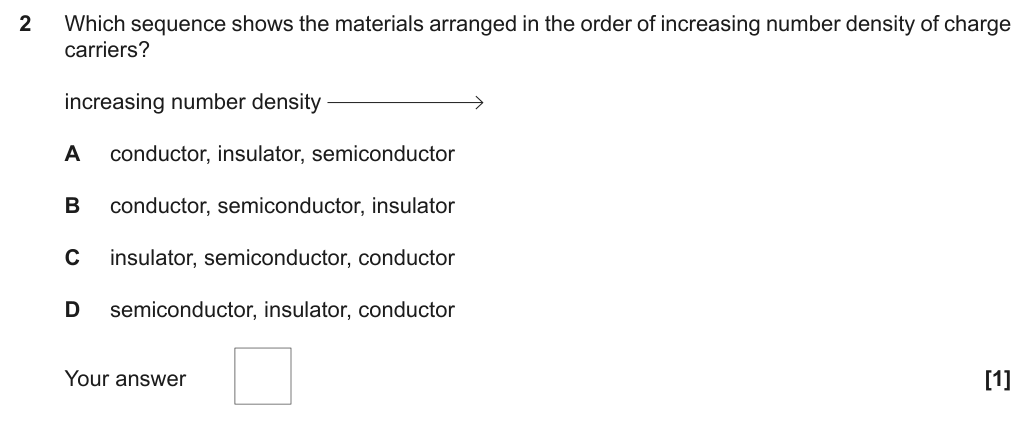
C
Questions 2, 12, 14 and 15 proved to be straightforward, allowing most of the candidates to demonstrate their knowledge and understanding of physics.
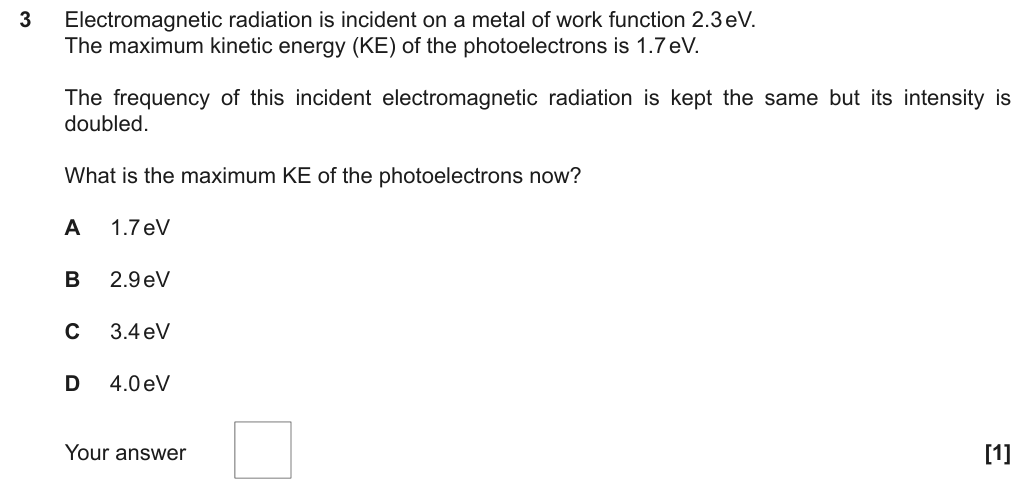
A
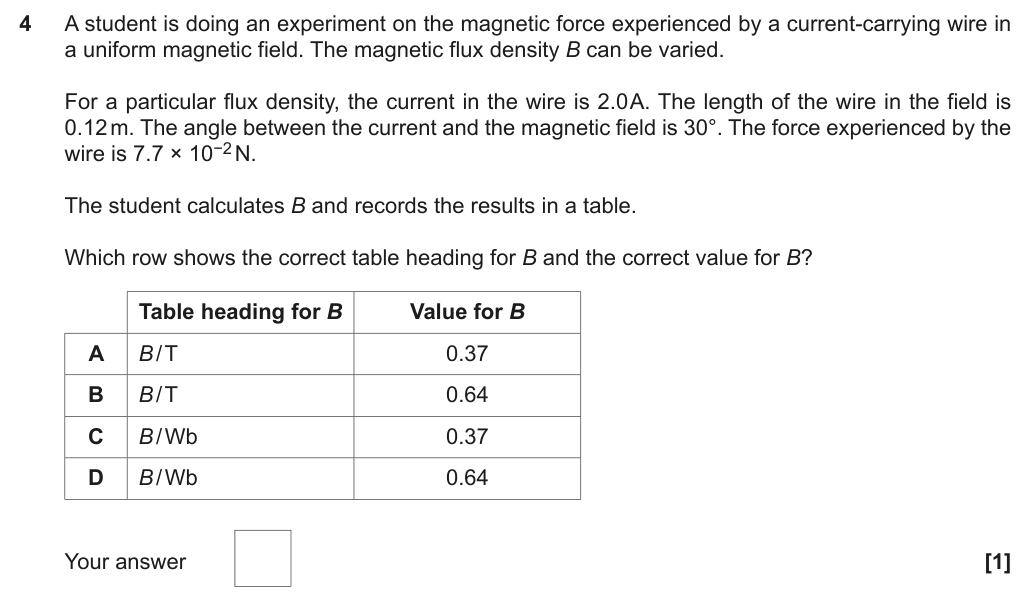
B
Questions 4, 5, 18 and 19bii • made judgements and reached conclusions based on experimental data by calculating percentage uncertainty, e.g.
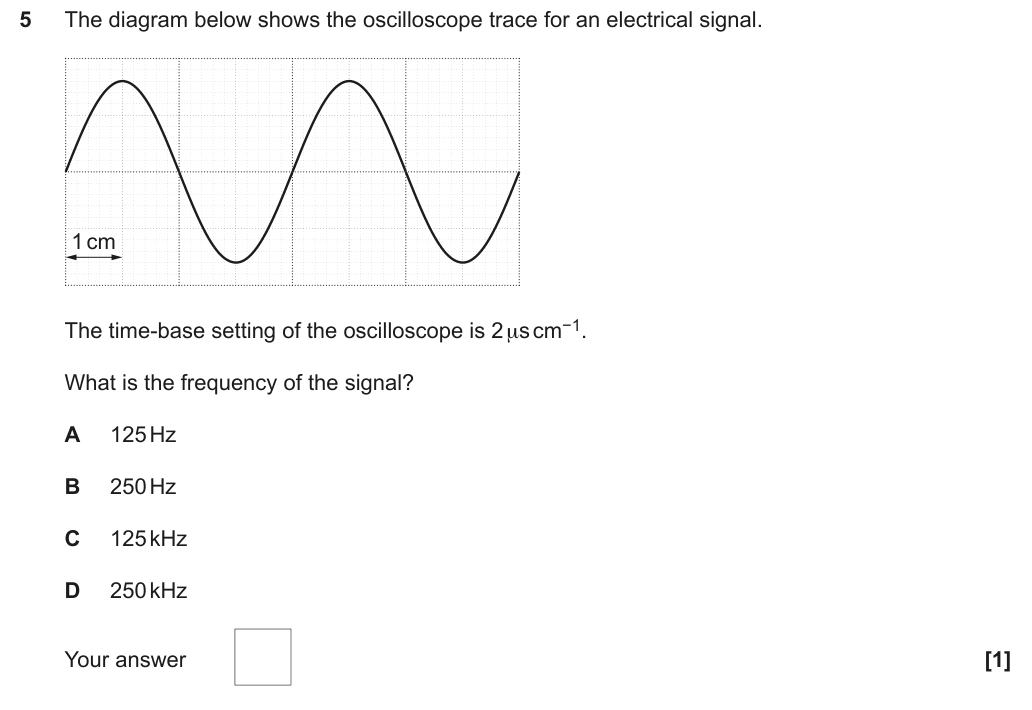
C
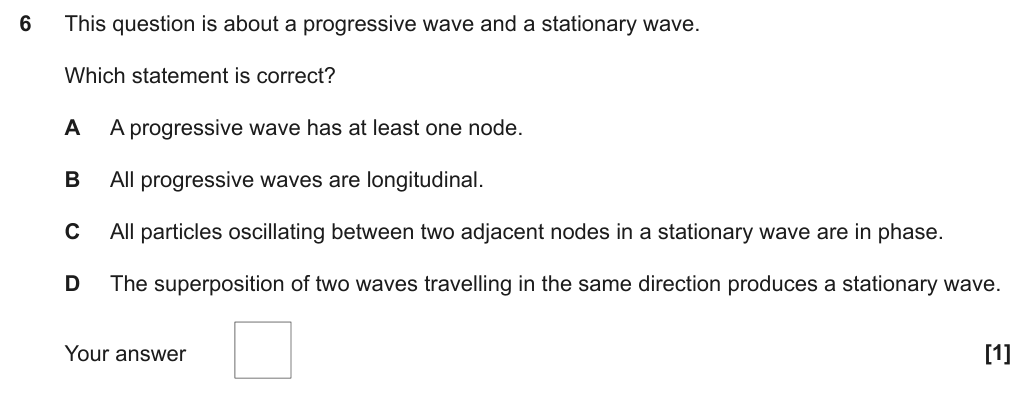
C
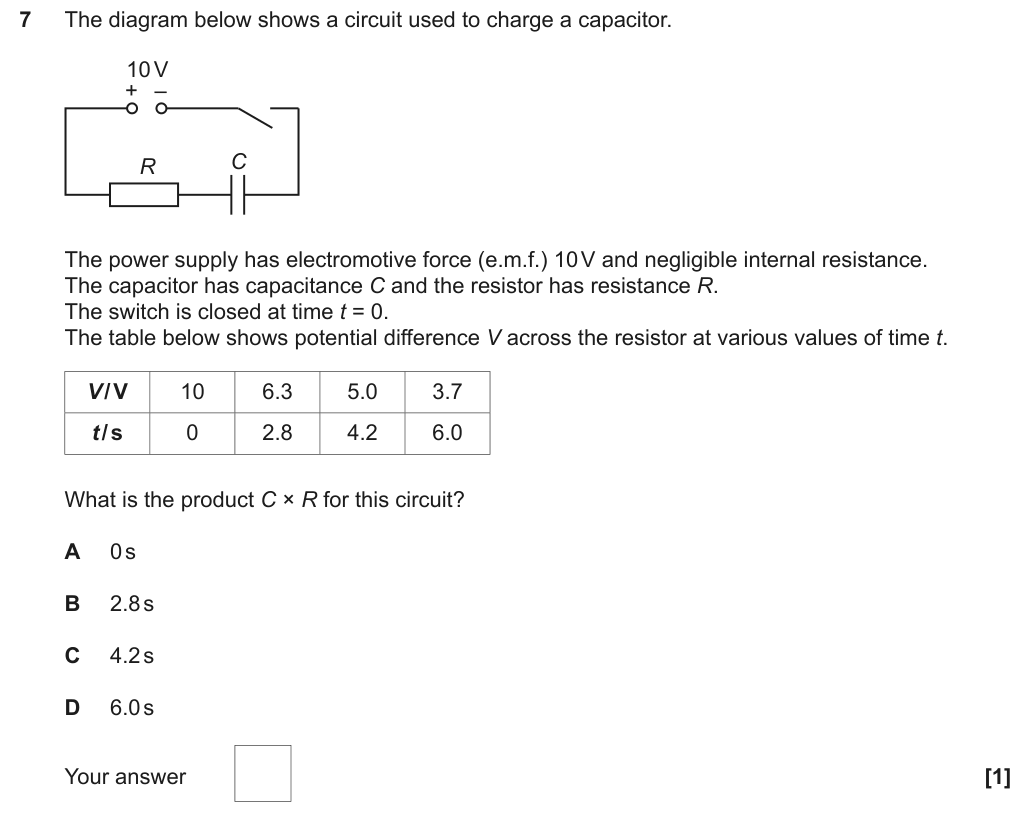
D
Questions 7, 10, 17a, 17b, 19bii3, 20cii, 21bi, 21bii, 23ai, 23b and 25b • had well-structured solutions with clear manipulation of equations, good substitution and wrote the final responses to appropriate significant figures • demonstrated good use of calculators, especially handling powers of ten • demonstrated good comprehension of command words such as describe, explain, show, etc • wrote concise physics in extended response questions, e.g. Other questions, such as Question 7 on capacitor- resistor circuit, requires a bit more thinking and solving time. Question 7 is about a capacitor charging circuit and recognising that CR is the time constant of the circuit.
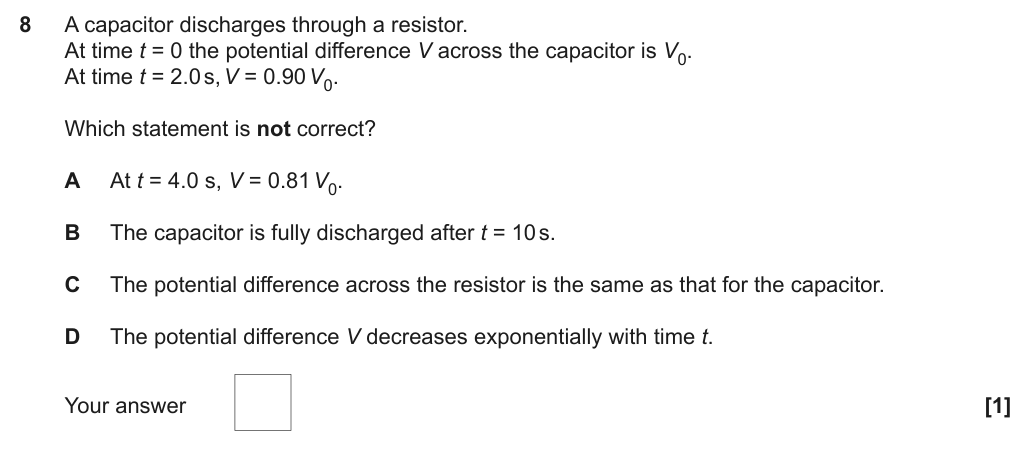
B
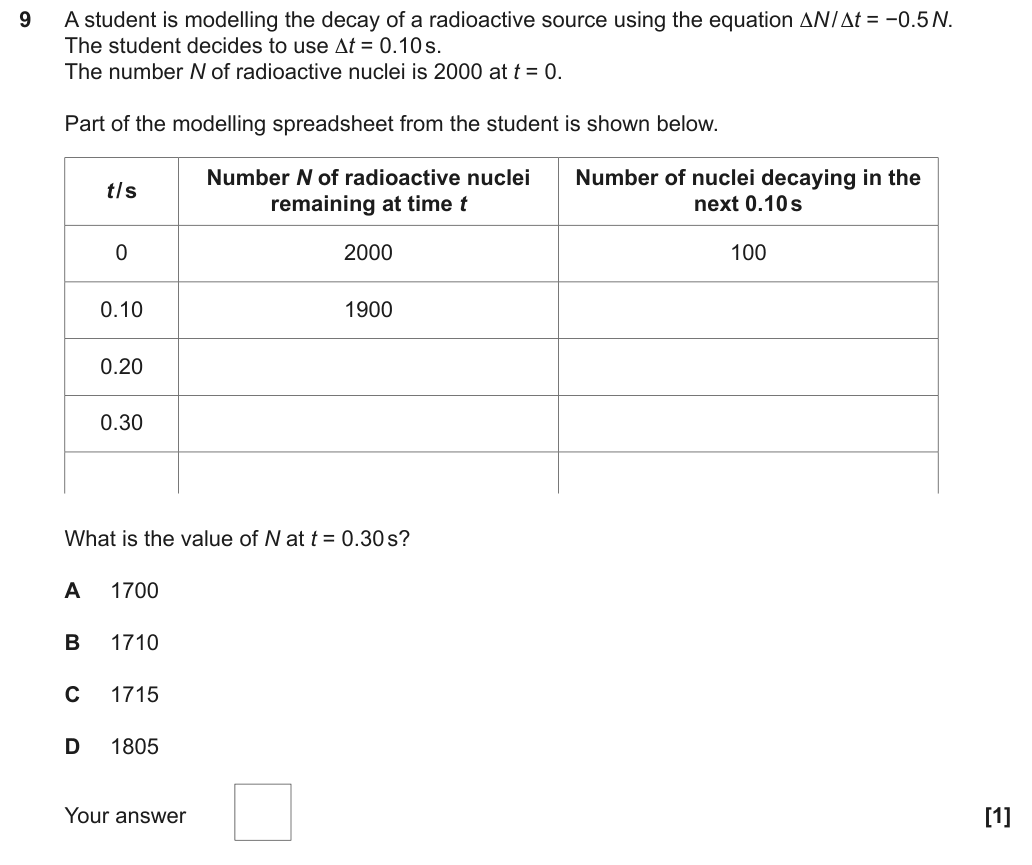
C
At the opposite end, Questions 9 and 11 were more challenging, and as such, were accessible to the top-end candidates.
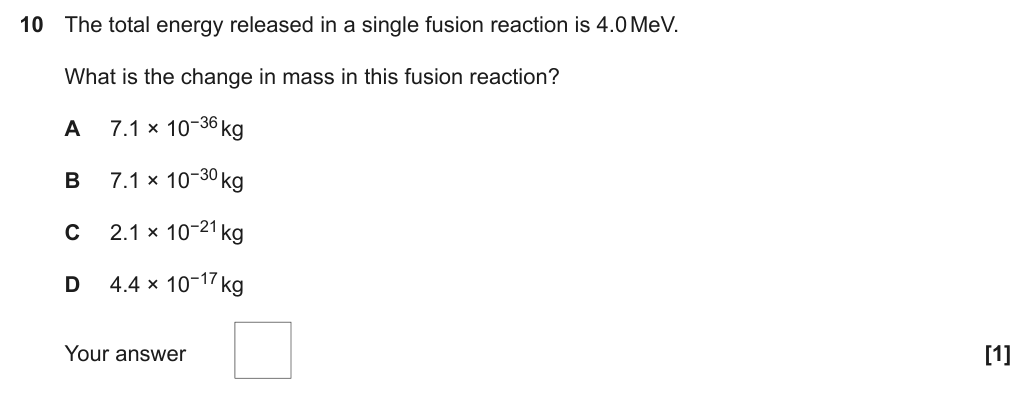
B
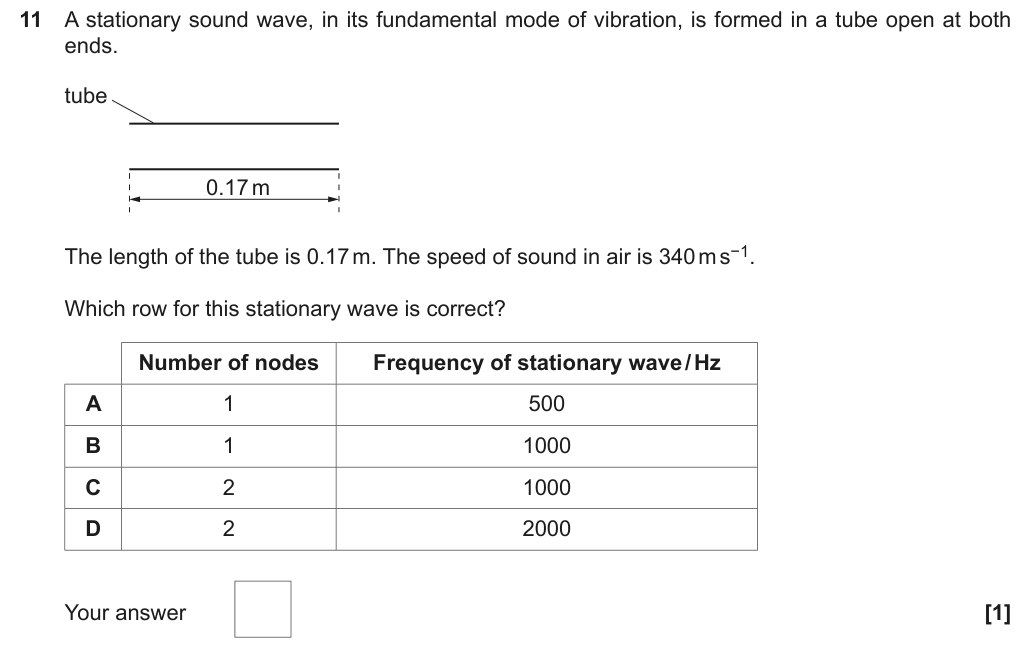
B
A
A
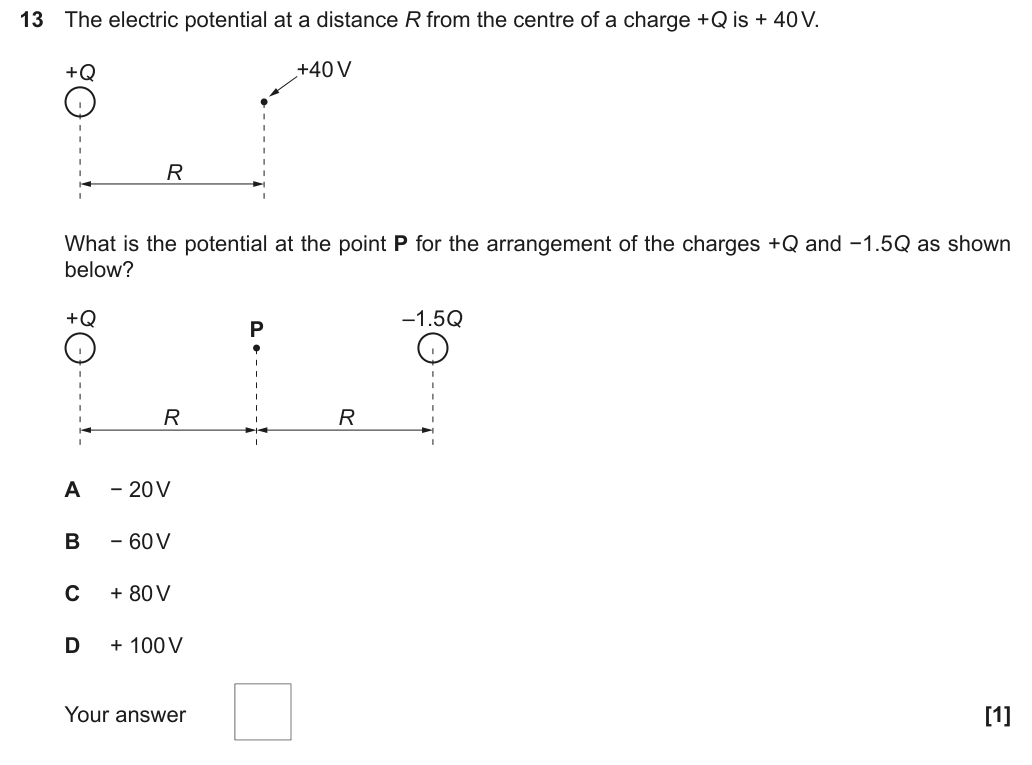
Question 13 is all about two key ideas: electric potential is inversely proportional to the distance from the centre of the charge and the scalar nature of electric potential.
D
D
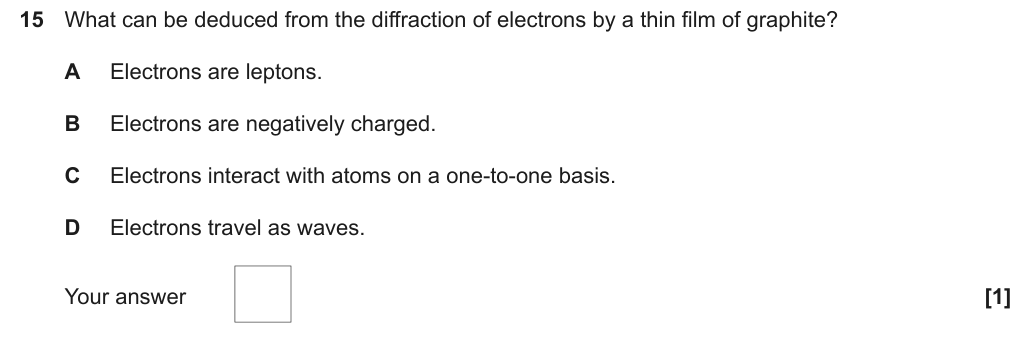
Comments on responses by question type Multiple choice questions Some of the questions, such as Question 1 on identifying the medical technique used to determine the speed of blood in arteries and Question 15 on the diffraction of electrons by a thin film of graphite, are expected to be done quickly without much reasoning.
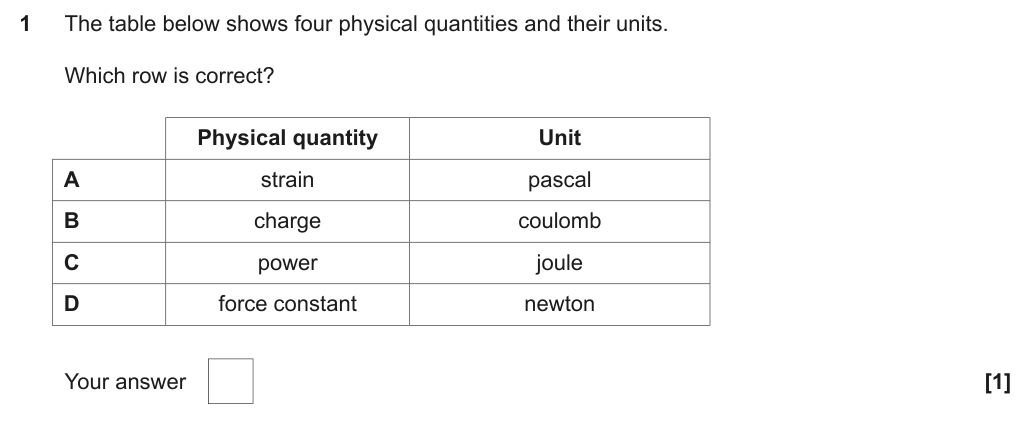
B
This was an easy starting question for all the candidates. It was testing knowledge of S.I. units used in a range of topics. The majority of the candidates got the correct answer B. The most popular distractor was D, followed closely by A.
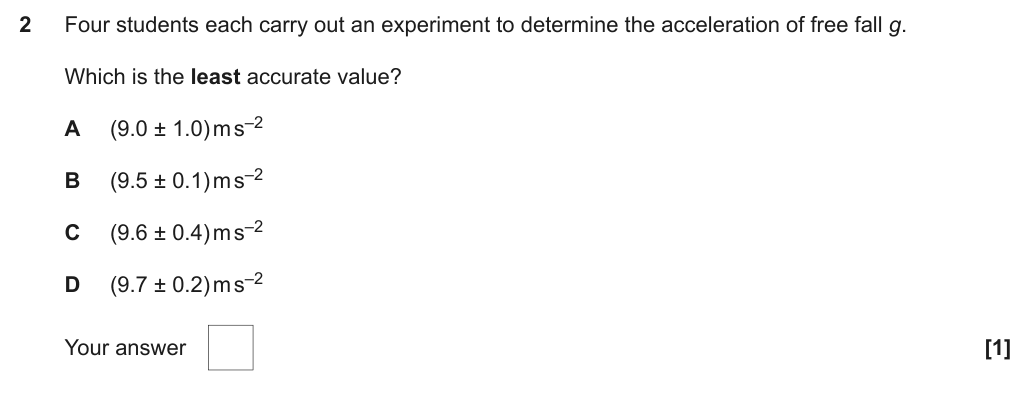
A
This question was based on understanding the term accuracy; a key concept in practical skills. The majority of the candidates got the correct answer A. The difference between the accepted value for g and the experimental value was greatest for A. The most popular distractor was B, where candidates took ‘least accurate’ to mean the value with the least percentage uncertainty. Some candidates even had the percentage uncertainties calculated for each of the options.
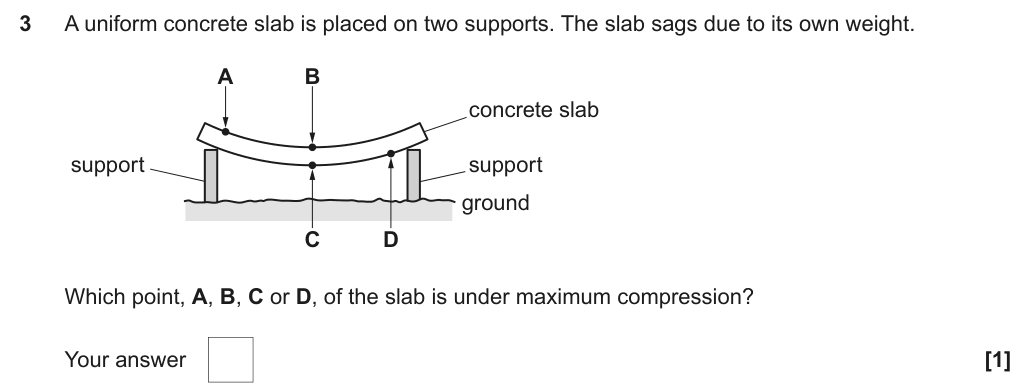
B
This question was based on the simple understanding of compression of material in the form of a concrete slab. About two thirds of the candidates opted for the correct answer B. The majority of the remaining candidates opted for C. Point C of the slab would be under maximum tension. Only a very small number of candidates, mainly from the lower quartile, went for either A or D.
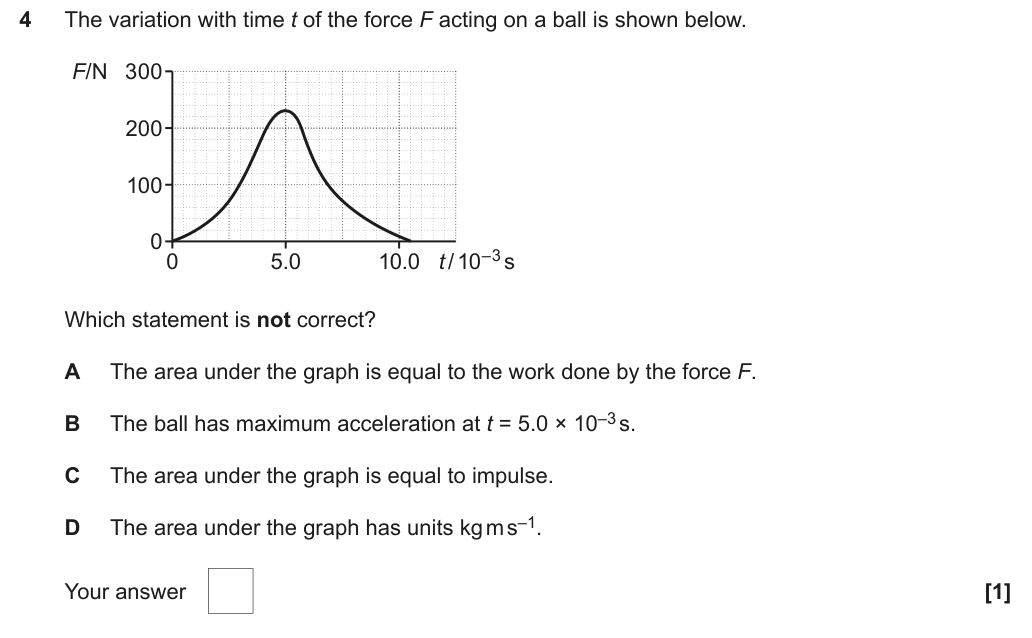
A
This question was based on a force-time graph for a ball. All the information that can be extracted from the graph. The majority of the candidates inserted A in the answer box, and secured 1 mark. All the other statements are correct. The statement B is correct, because the maximum acceleration of the ball is proportional to the maximum force. The area under a force-time graph is impulse, so statement C is correct. The area under the graph is also equal to change in momentum, therefore the area under the graph does have the unit’s kg m s-1. So, statement D is also correct. Statement A is incorrect. Work done is the area under a force-distance graph, but here the horizontal axis has time, and not distance.
D
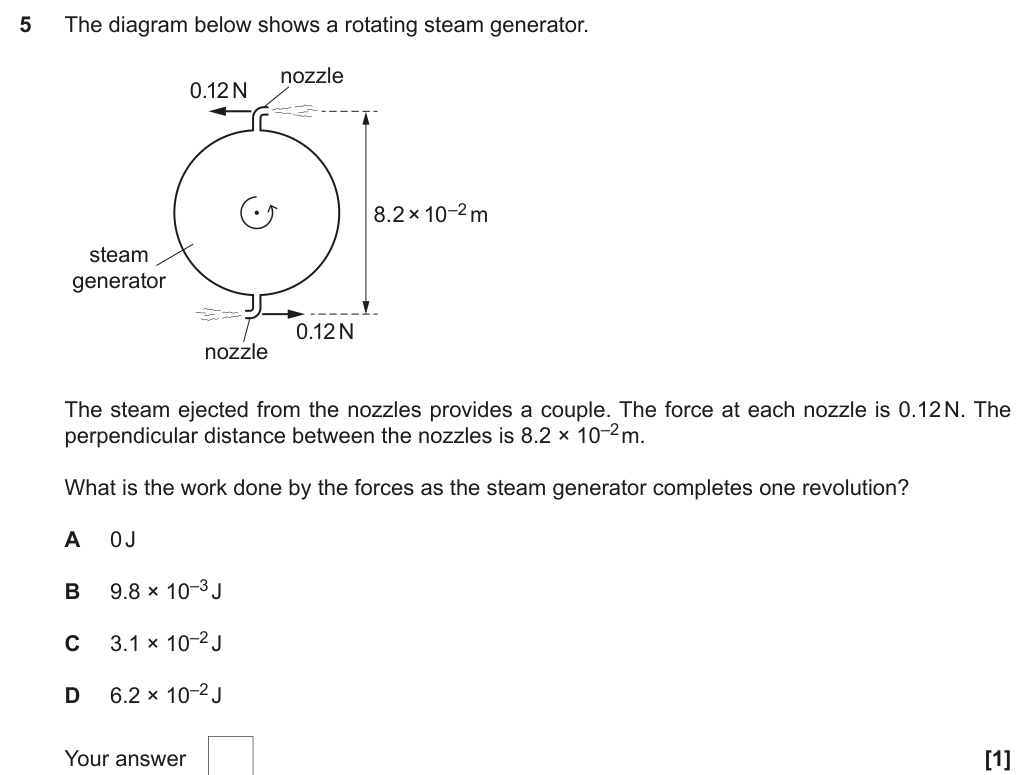
This question was based on work done by a couple, and as such proved to be quite challenging. The work done by the couple is given by the expression below: work done = 2 × work done by each force = 2 × [0.12 × π × 8.2 × 10⁻²] = 6.2 × 10⁻² J The most popular answers turned out to be either A or C. The answer C was for the work done by one of the forces. This question was only accessible to the very top-end candidates. The exemplar 1 below shows an incorrect analysis that led to B being inserted into the answer box. The candidate has either written the equation for work done, or torque of a couple. Substitution shows that the torque has been calculated. Unfortunately, the response of 9.8 × 10⁻³ J was there as one of the options. This exemplar shows that if the starting point is incorrect, it can easily lead to what looks like a promising response.
C
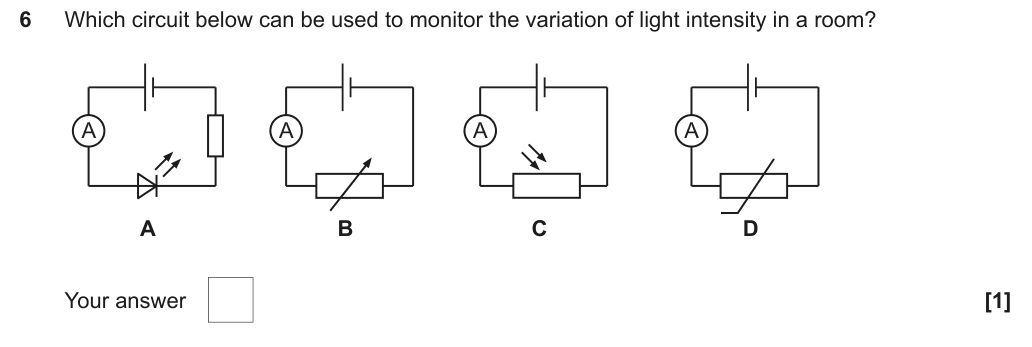
This question was based on recognising circuit symbols. This was successfully answered by the vast majority of the candidates who opted for C because of the light-dependent resistor in the circuit. The popular distractor was A. The light-emitting diode in circuit A was often mistaken for a light-dependent resistor.
C
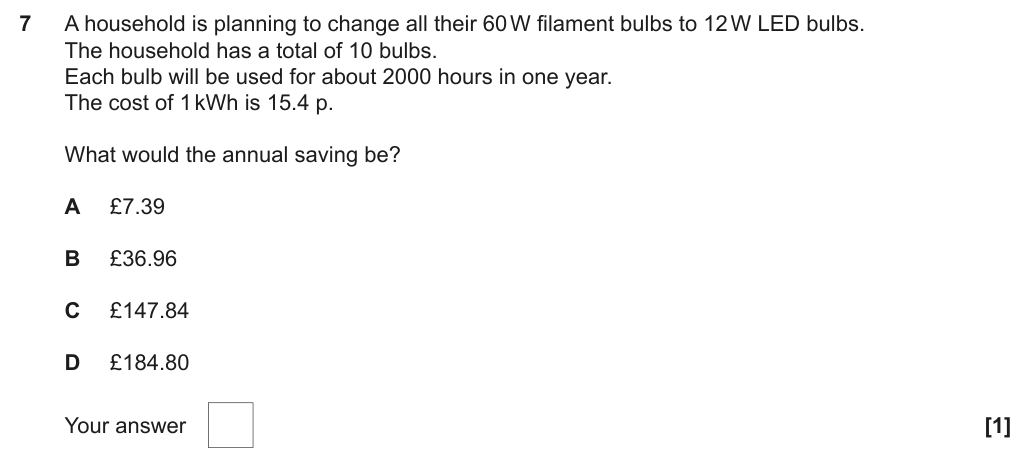
This was a tough question on the kilowatt hour, but almost all candidates picked up a mark here. On most scripts there were not much evidence of number crunching; calculations must have been done on calculators – sensible time saving strategy. Some candidates did use elaborate routes to get to the correct answer of C. The annual saving in pounds (£) is calculated as follows: annual savings = (0.060 – 0.012) × 10 × 2000 × 0.154 = £147.84 It is worth pointing out the rationale behind the distractors. A was the answer when the 2000 had been omitted from the calculation above. B was the answer for just using 12 W and finally D was the answer for just using 60 W.
C
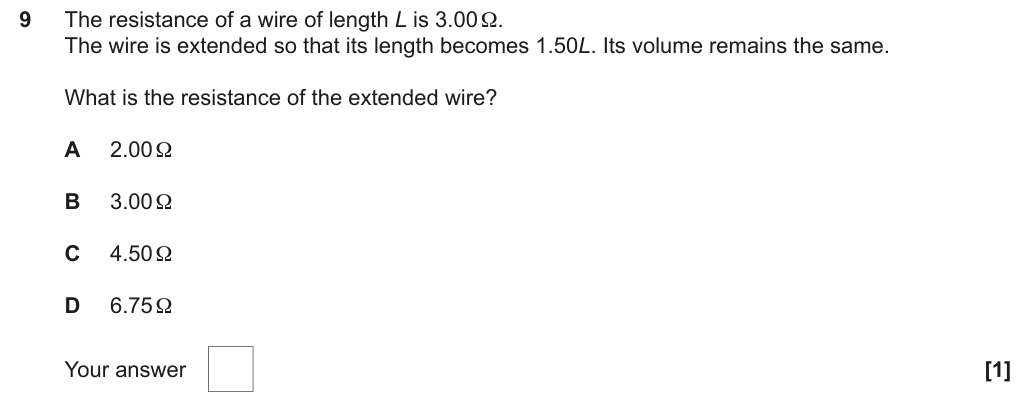
D
This question was about the resistance equation 𝑅𝑅= 𝐴𝐴 which appears in the Data, Formulae and Relationship Booklet. This was a good discriminator for the top-end candidates. The majority of the candidates opted for the answer C, which was simply 1.50 times the original resistance of the wire. The crucial statement that the ‘volume of the wire remains the same’ was omitted by most candidates. The volume of the wire remains constant. The cross-sectional area of the wire will decrease by a factor of 1.50 as its length increases by this same factor. Since resistance R ∝ 𝐴𝐴, this implies that the resistance of the stretched wire will increase by a factor of 1.502. This makes the resistance of the extended wire equal to 1.502 × 3.00 = 6.75 Ω. The analysis above shows how it is easy to follow incorrect logic when a single pivotal statement in the question is skimmed over.
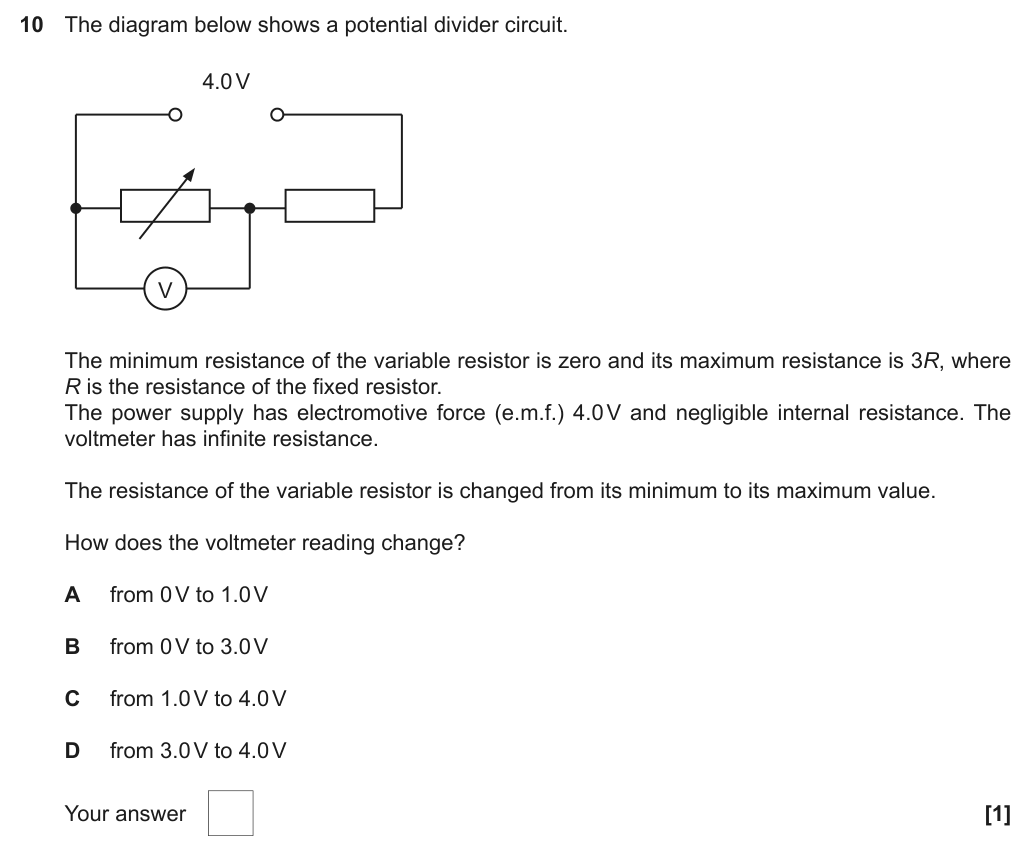
B
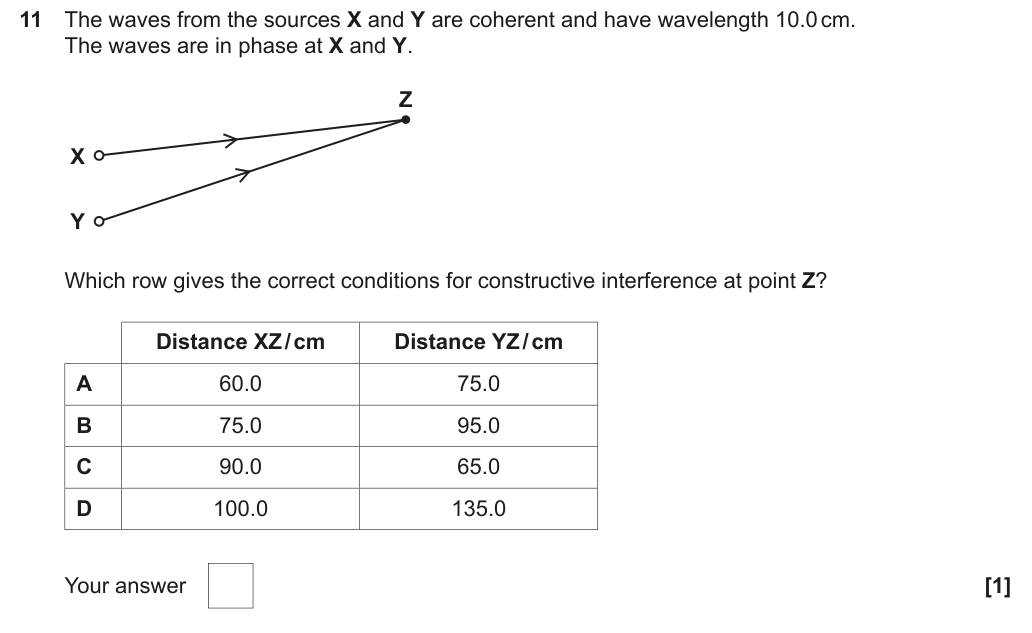
B
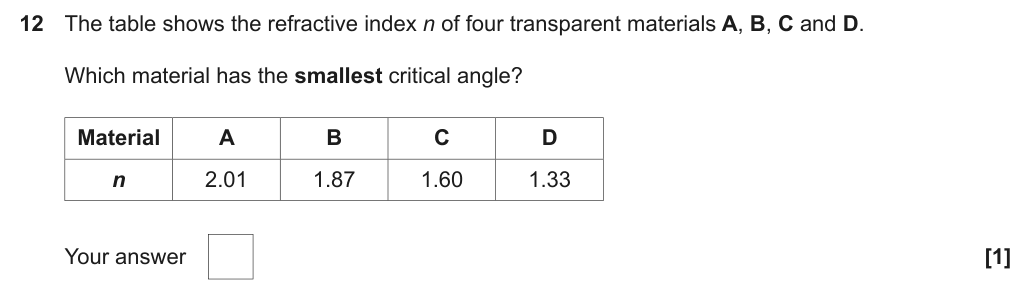
A
This question was about the critical angle and refractive index equation sinC = 1/n which appears in the Data, Formulae and Relationship Booklet. The majority of the candidates realised that the largest value of the refractive index would give the smallest critical angle. The answer had to be A. It was good to see the equation above scribbled on many of the scripts.
D
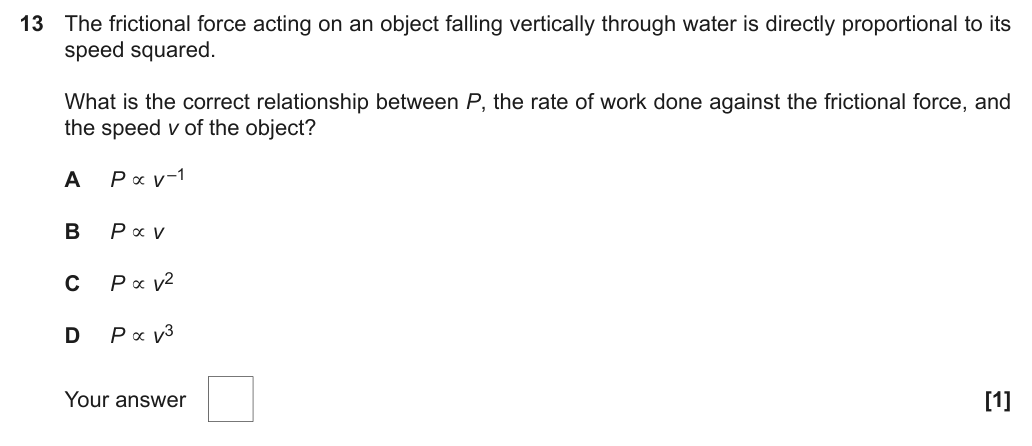
This question is based on the equation P = Fv, which also appears in the Data, Formulae and Relationship Booklet. In the question, information is given about the frictional force F, which is directly proportional to v2. Therefore, the rate of work done P must be proportional to v3; making D as the answer. Most candidates struggled with this question, with all the distractors being equally popular. Less than a quarter of the candidates, mainly from the upper quartile, scored a mark in this question. The exemplar 2 below the correct response from a candidate. This candidate demonstrates how this question can be tackled with minimal amount of work. The key equation is on the script, as is the relationship between F and v. The final answer appears in the box; a perfect technique.
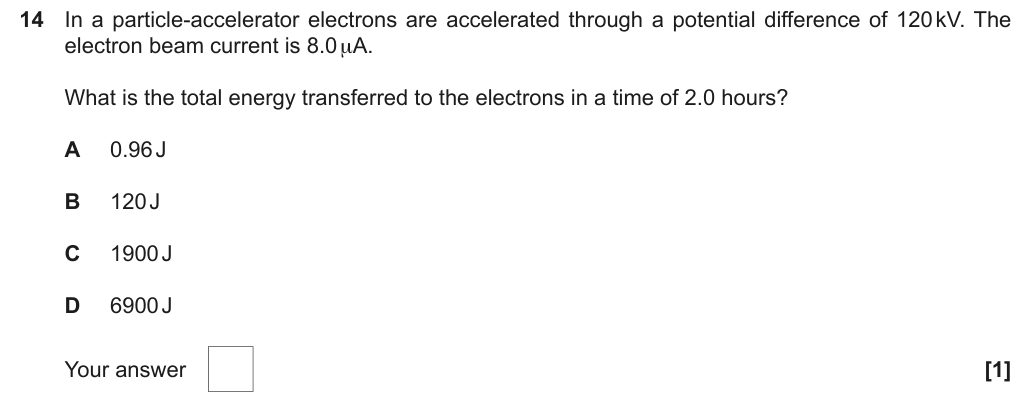
D
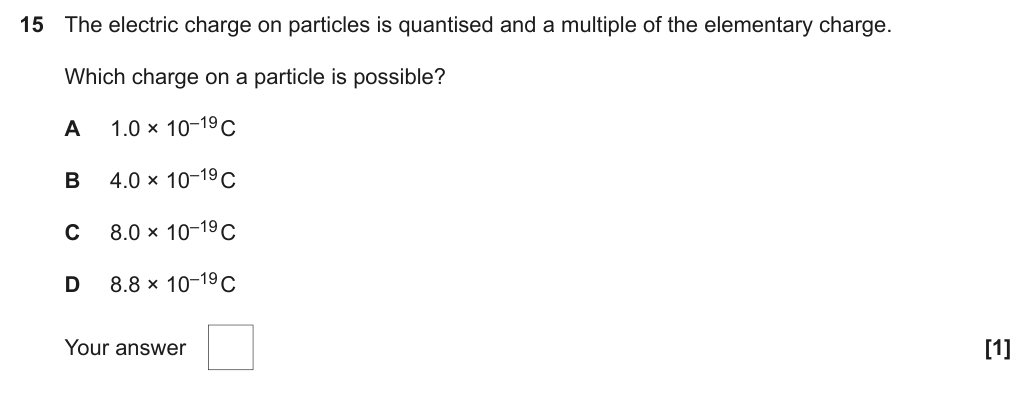
C
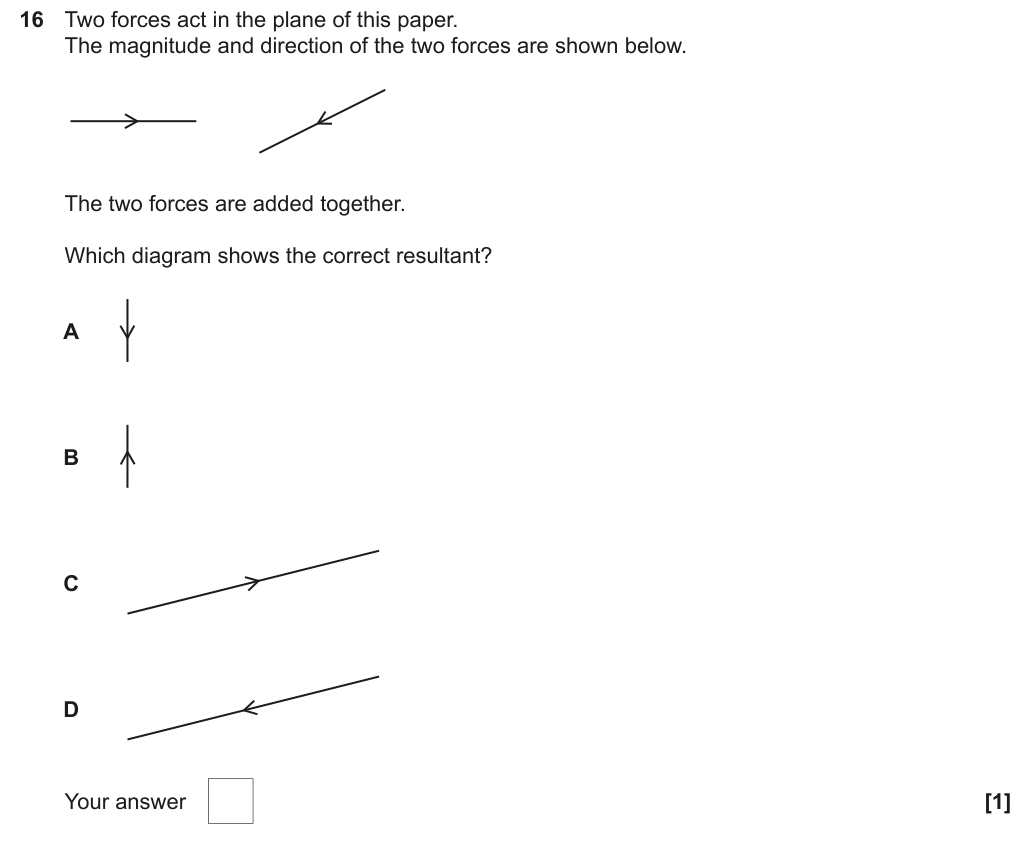
A
A
B
This question required knowledge and understanding of equations of motions. The simplest route to getting the correct answer was the equation s = ½ at2 with the displacement s = 0.102 m. About two thirds of the candidates got the correct answer B. All the other distractors were based on using incorrect values for s. For example, the answer would have been D for s = 12.7 cm. The exemplar 3 below shows a typical working for a correct answer. This exemplar illustrates relevant scribbling in a multiple choice answer can lead to the correct response. It is good to see that the candidate has focused on the correct distance of 0.102 m. The equation is there, as are the key numbers. The candidate had saved some time by finishing off the calculation on his/her calculator. A perfect technique from this candidate.
A
C
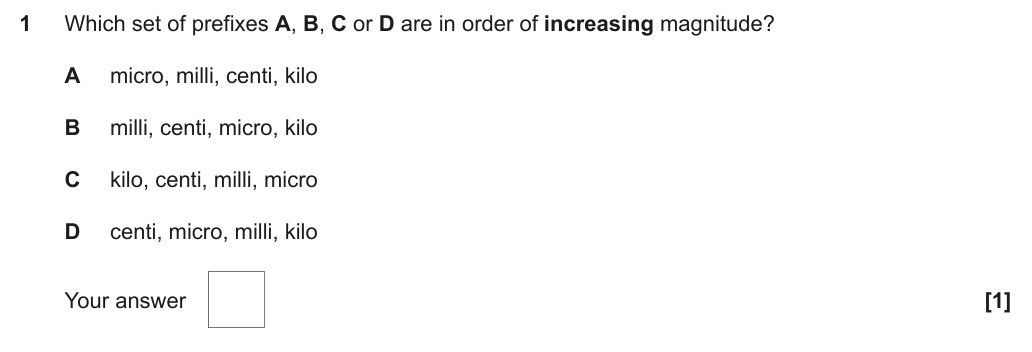
A
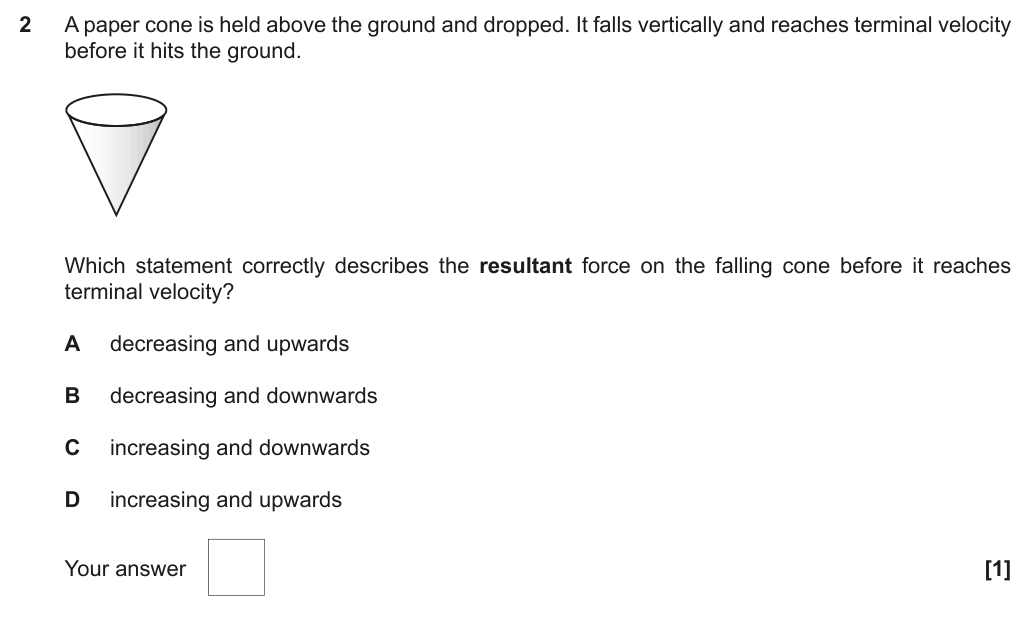
B
Before the cone reaches terminal velocity, it is still accelerating downwards so there is still a resultant force downwards. Once the cone is at terminal velocity, the resultant force must be zero. This means that the resultant force has decreased, giving the correct answer B.
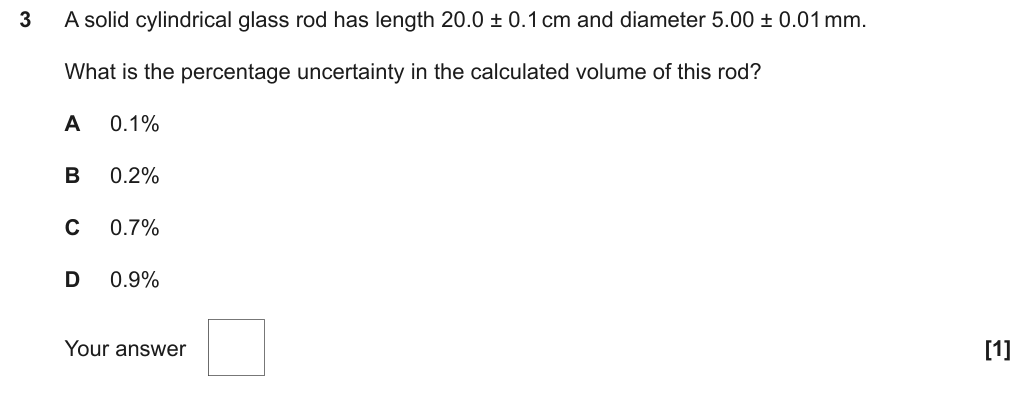
D
Most candidates understood that the percentage uncertainties, rather than the absolute uncertainties should be combined here. The percentage uncertainty in the length is 0.5% and the percentage uncertainty in the diameter is 0.2%. The most common incorrect response here was C, because this is what you get when you add the 2 percentage uncertainties. The percentage uncertainty in the diameter must be doubled, because the formula for the volume of the cylinder include diameter2. This gives the correct answer D.
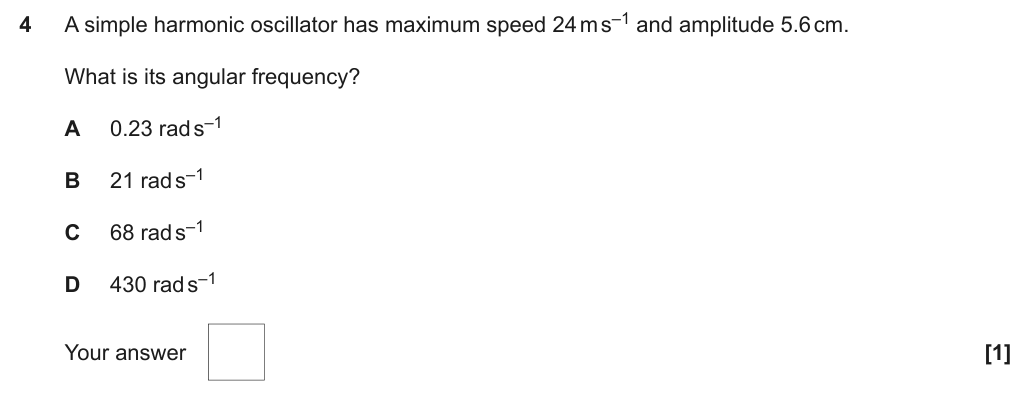
D
The correct formula here is vmax = Aω. This means that to find the angular frequency, ω, you must divide the maximum speed by the amplitude. The amplitude is given in centimetres so that needs to be converted to metres. This gives 24/0.056 = 429 rad s-1, giving the answer D.
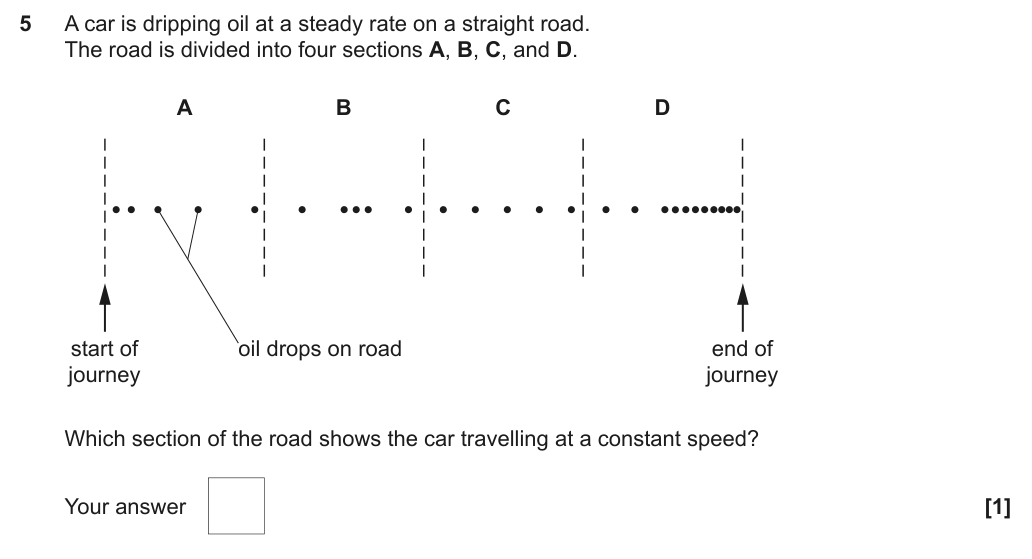
C
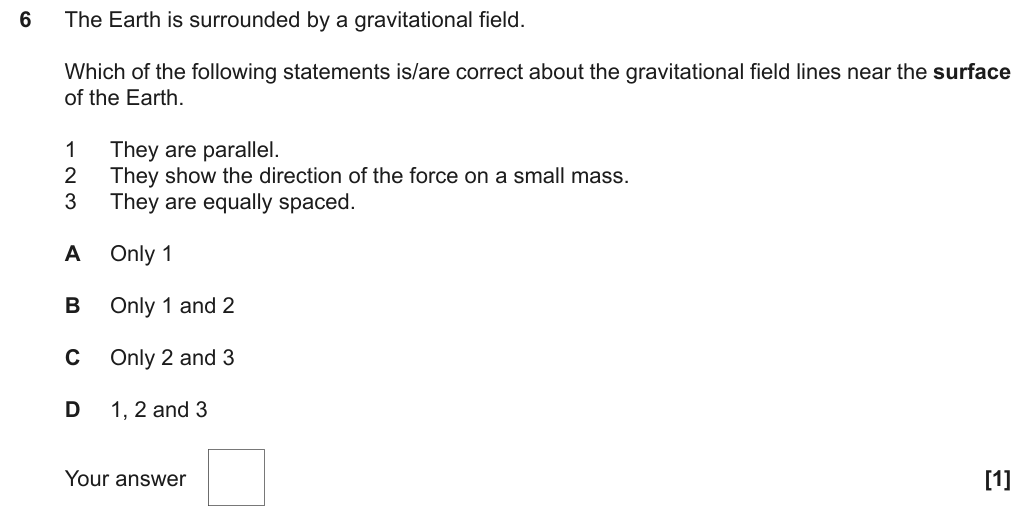
D
Near to the surface of the Earth, the gravitational field is approximately uniform. This means that they are parallel and equally spaced. Gravitational field lines in general show the direction of the force on a small mass. This makes all 3 statements are correct, giving the answer D.
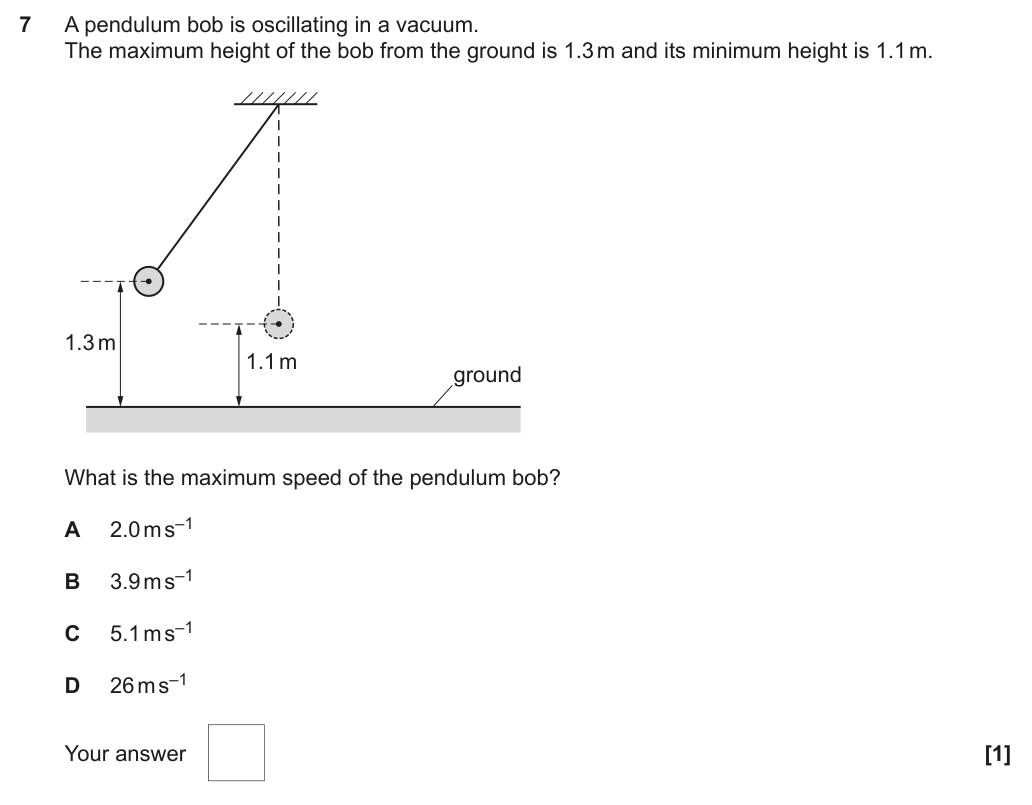
A
The key to this question is to consider the GPE lost and equate it to the KE gained. The GPE lost here = mass × 9.81 × 0.20 = ½ × mass × v2. The masses cancel (which is why the mass wasn’t given). This makes v2 = 3.924. The most common wrong answer was B, as candidates had forgotten to take the square root. The correct speed is 1.98 m s-1 giving the correct answer, A.
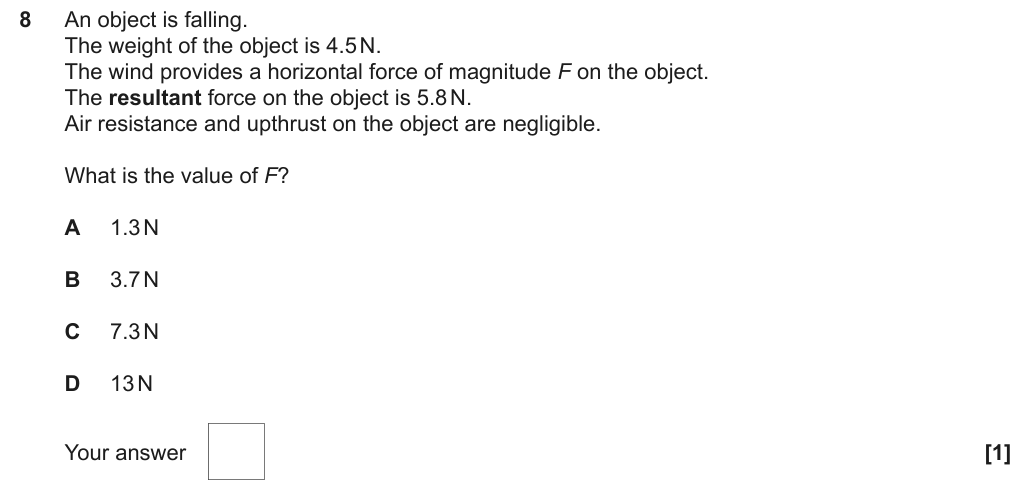
B
C
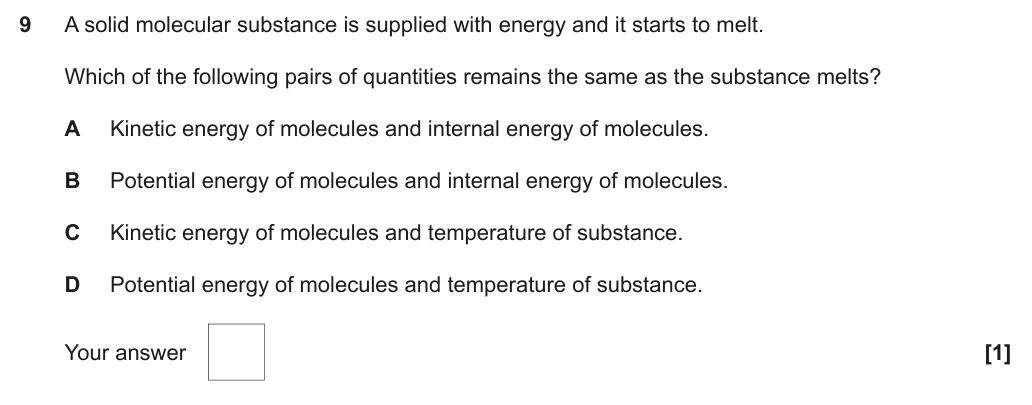
As a substance melts, the PE of the molecules increases, ruling out answers B and D. The temperature of a melting substance does not change and so the KE of the molecules cannot change, as the temperature and mean KE of molecules are directly proportional. This means that C must be correct. A cannot be correct since the internal energy is the sum of the KE and PE of the molecules. The KE is constant and the PE increases, meaning the internal energy must also increase.
C
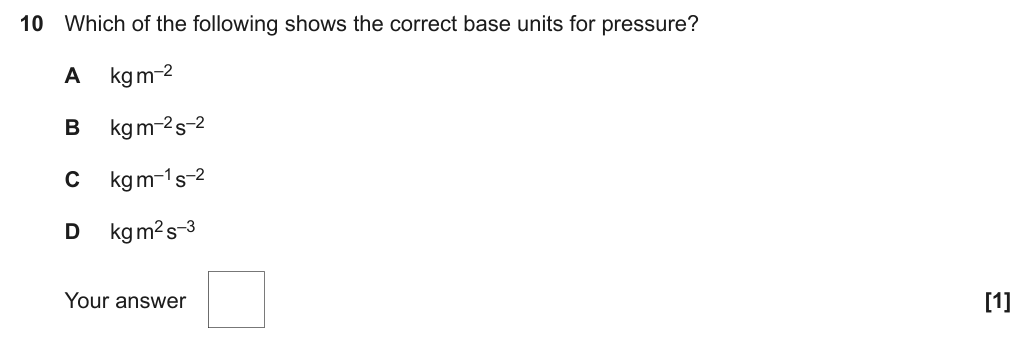
Since P = F/A, we need the units of force and area in base units. F = ma, so force has the base units of kg m s-2 . Area’s unit in base units is m2. Hence pressure has the base units kg m s-1/m2 = kg m-1 s-2, which is answer C.
B
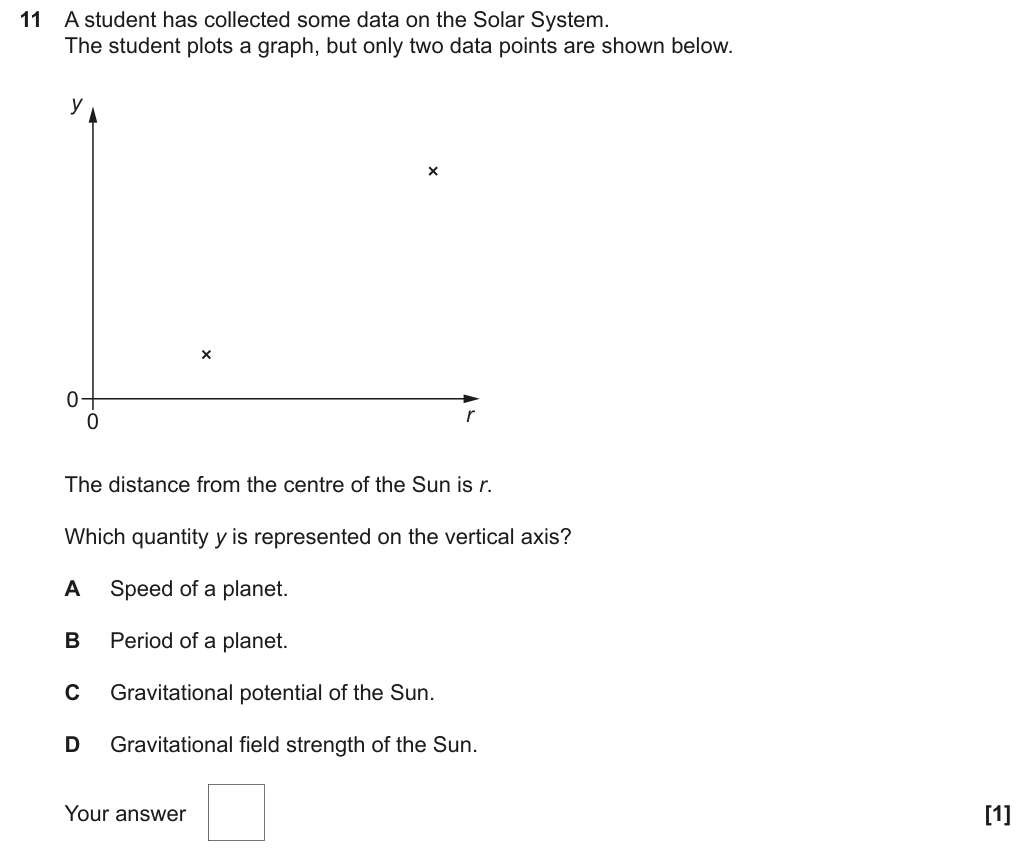
Answering this question needs knowledge of Kepler’s Third Law and the formulae for gravitational potential and gravitational field strength, all of which are given in the data, formulae and relationships booklet. This relationship cannot be gravitational potential or gravitational field strength, as quantity y increases with distance from the Sun. By equating the gravitational force on a planet with the centripetal force, it can be shown also that (orbital speed)2 and orbital radius are inversely proportional. This graph does not show an inversely proportional relationship. The formula sheet says that the square of a planet’s period is directly proportional to the cube of the planet’s orbital radius. In other words, the relationship shows that as orbital radius increases, so does the period, but not directly proportionally. This is the relationship shown on the graph, giving answer B.
D
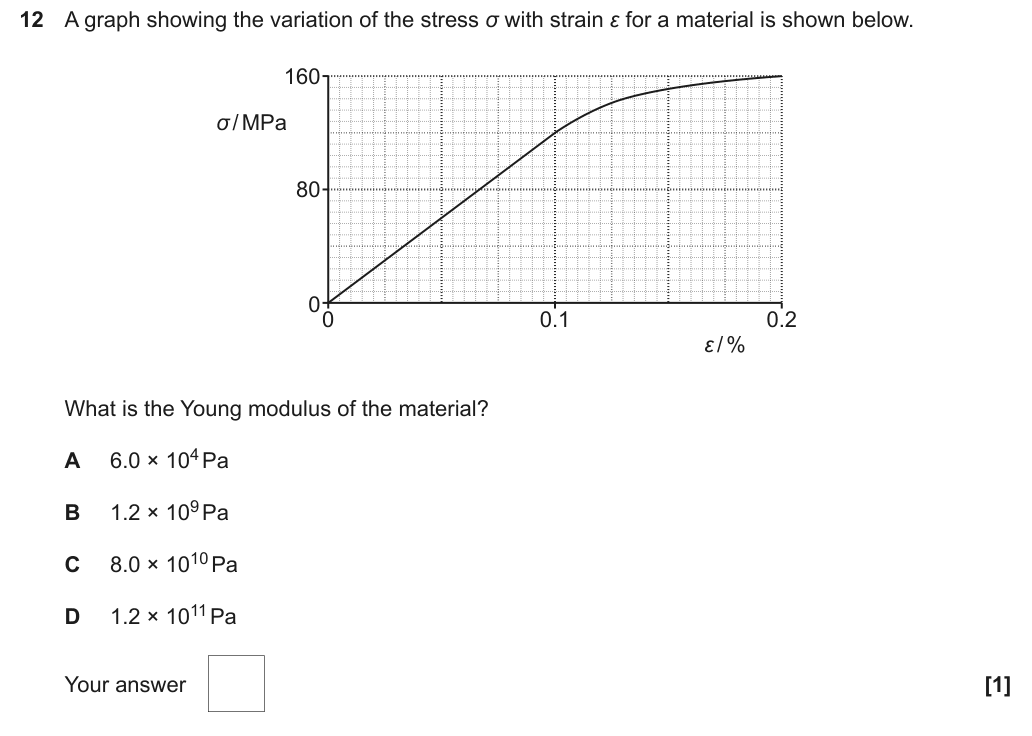
The Young modulus is found by calculating the initial gradient of the material’s stress-strain graph. The initial portion appears to be a straight line from the origin to the point (0.1, 120). The units on this graph are megapascals and %. This means the co-ordinates of the chosen point are in fact (0.1 × 10⁻², 120 × 106). Many candidates forgot to convert the strain into a decimal and left it as a percentage. Their answer was a factor of a 100 out, ie answer B. The correct answer is 120 × 106 / 0.1 × 102 = 1.2 × 10¹¹ Pa. This is answer D.
Skills: M0.1 Recognise and make use of appropriate units in calculations; M0.3 Use ratios, fractions and percentages; M3.4 Determine the slope and intercept of a linear graph
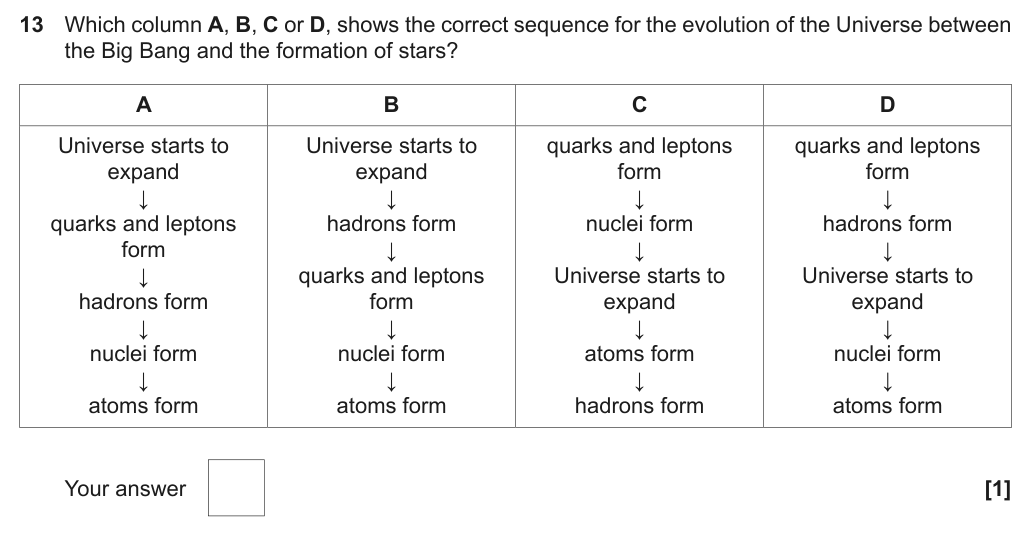
A
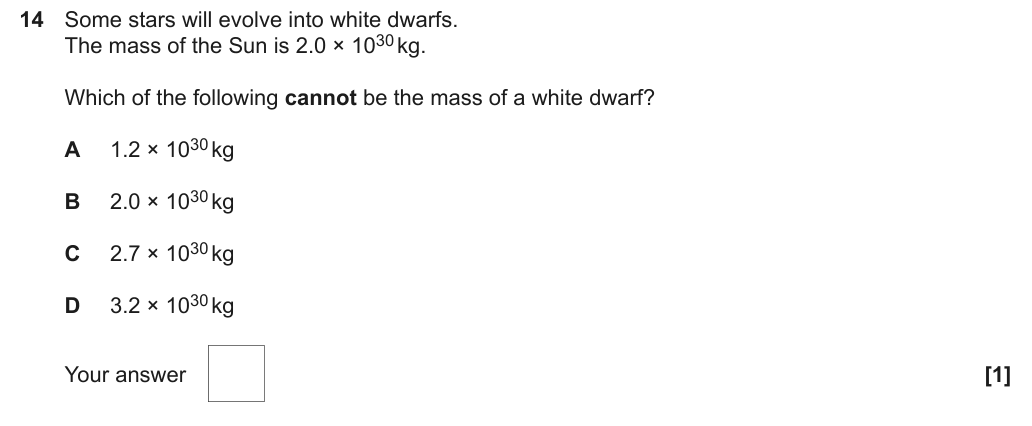
D
The Chandrasekhar limit for the mass of a white dwarf is 1.4 solar masses. The mass of the Sun is 2.0 × 1030 kg, so the mass limit for a white dwarf is 2.8 ×1030 kg. Only star D exceeds this limit, so it cannot be a white dwarf.
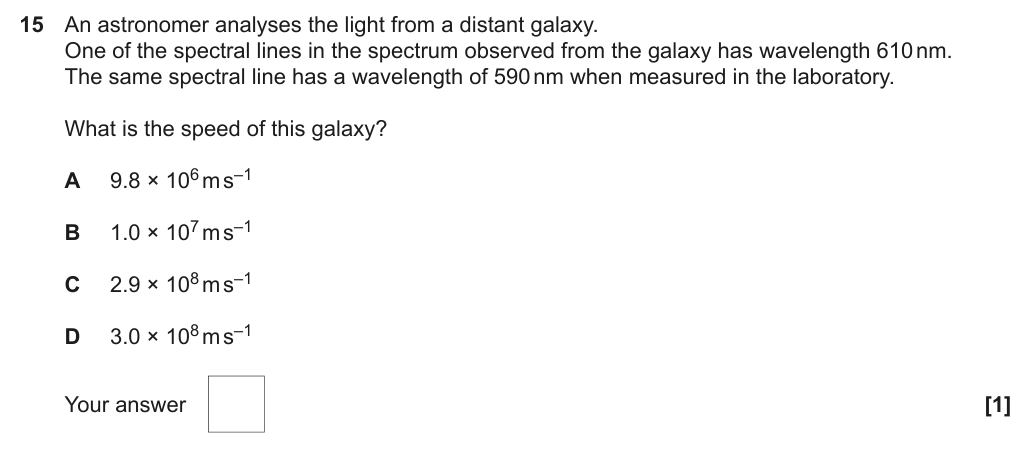
B
Option D is the speed of light, so the galaxy cannot be travelling this fast. The change in wavelength for the galaxy is 20 nm. The laboratory wavelength for this light is 590 nm. The relationship we need is that the fractional change in wavelength for light from a galaxy approximately equals the fraction of the speed of light for that galaxy. The fractional change in wavelength is 20/590 = 3.39 % 3.39% of the speed of light = 1.02 × 10⁷ m s-1, i.e. option B. Option A was the most common incorrect response, which is the speed when the change is wavelength is divided by the wavelength of light from the galaxy.
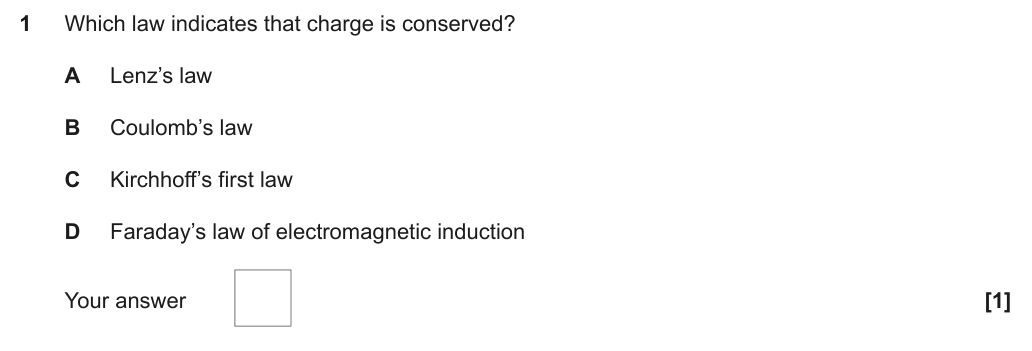
C
This was a well-answered question with most candidates correctly recalling that charge is conserved according to Kirchhoff’s first law. A significant number of candidates distracted towards B; perhaps because of the unit of charge is the coulomb.
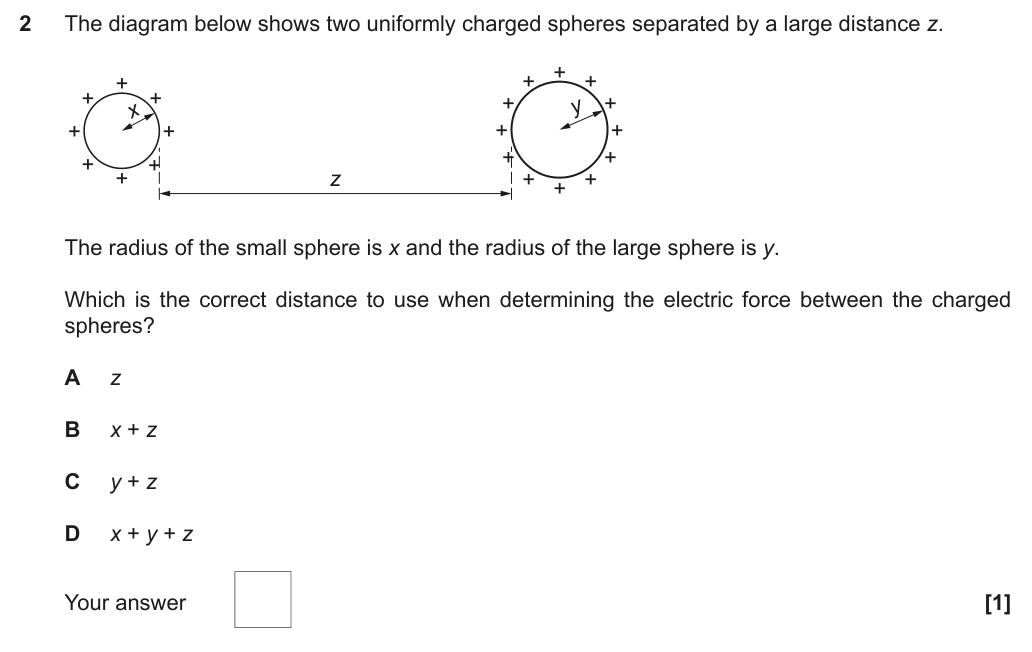
D
This question was assessing the simple learning outcome 6.2.1b from the specification – modelling a uniformly charged sphere as a point charge at its centre. The correct key is D. The most popular distractor was A with distance being measured between the two surfaces of the sphere.
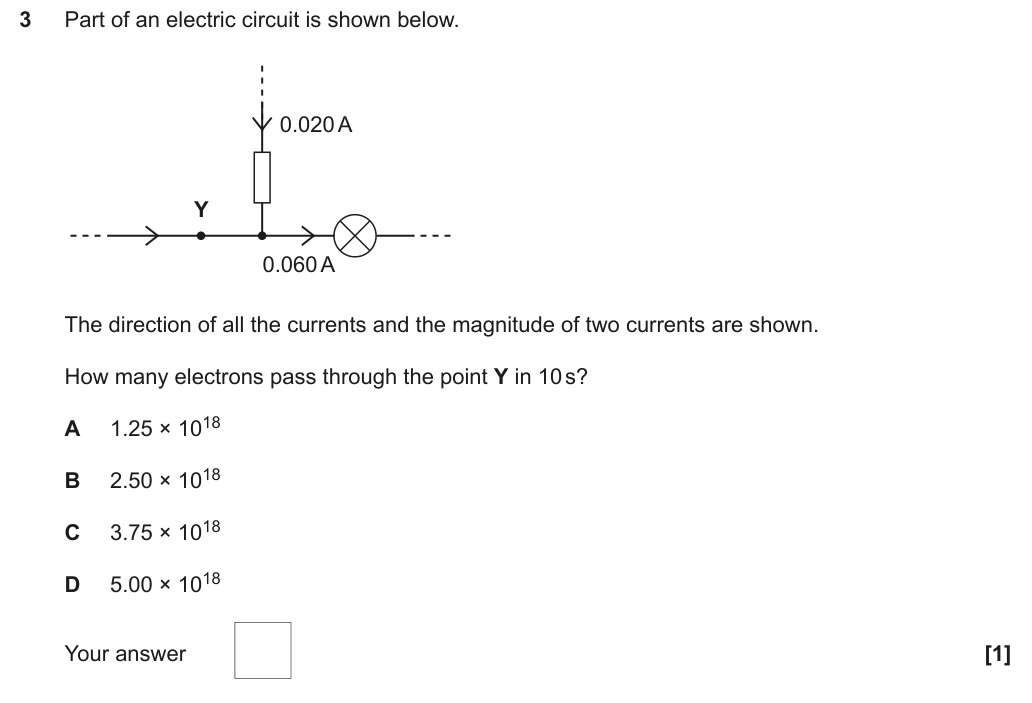
B
This was not an easy question, but most candidates did extremely well in this multi-step calculation. The directions of the currents are important. The current at Y and the current in the resistor, must add up to 0.060 A. The charge passing point Y in a time of 10 s can be calculated using ∆Q =I∆t and finally the number of electrons can be determined by dividing the charge passing through Y by the elementary charge e. Therefore number of electrons = = 2.50 × 10¹⁸ The key, correct answer, is B. The most popular distractor was C, in which a current of 0.060 A is assumed; the rest of the distractors were equally favourable. A was the answer for a current of 0.020 A and D was the answer for a current of 0.080 A. It is worth mentioning that most of the candidates just wrote down the correct answer in the box, without any calculations. On the surface, this looks reckless, but it is an excellent strategy if the numbers are being punched into the calculator correctly. The exemplar 1 below shows a typical correct answer, with numbers jotted down for visual help. The candidate has the correct current at Y. Without the 0.040 A, the answer would have led to one of the distractors. It is worth pointing out that the final step of the calculation must have been done directly on the calculator. An excellent time-saving approach.
Skills: M0.2 Recognise and use expressions in decimal and standard form; M2.3 Substitute numerical values into algebraic equations using appropriate units for physical quantities
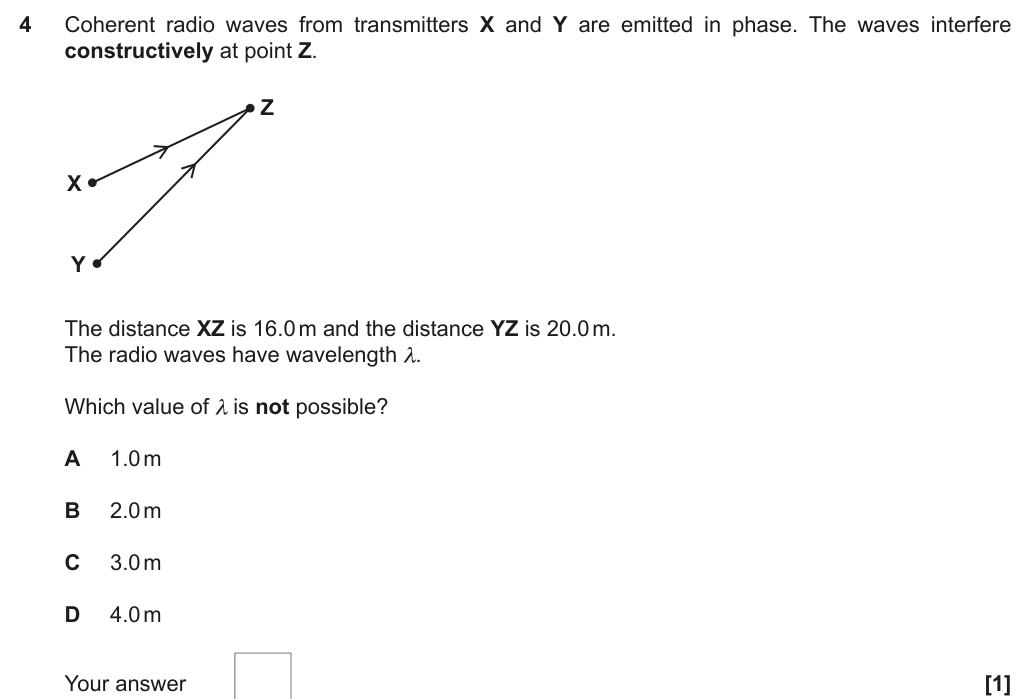
C
This question was assessing knowledge and understanding of path difference and constructive interference. The path difference is 4.0 m. With the waves in phase at X and Y, this means that the distance of 4.0 m must be equal to a multiple of wavelengths. This condition is satisfied by all but C. You cannot get 4.0 m by multiplying 3.0 m by an integer. The majority of the candidates effortlessly picked up 1 mark here.
Skills: M0.3 Use ratios, fractions and percentages
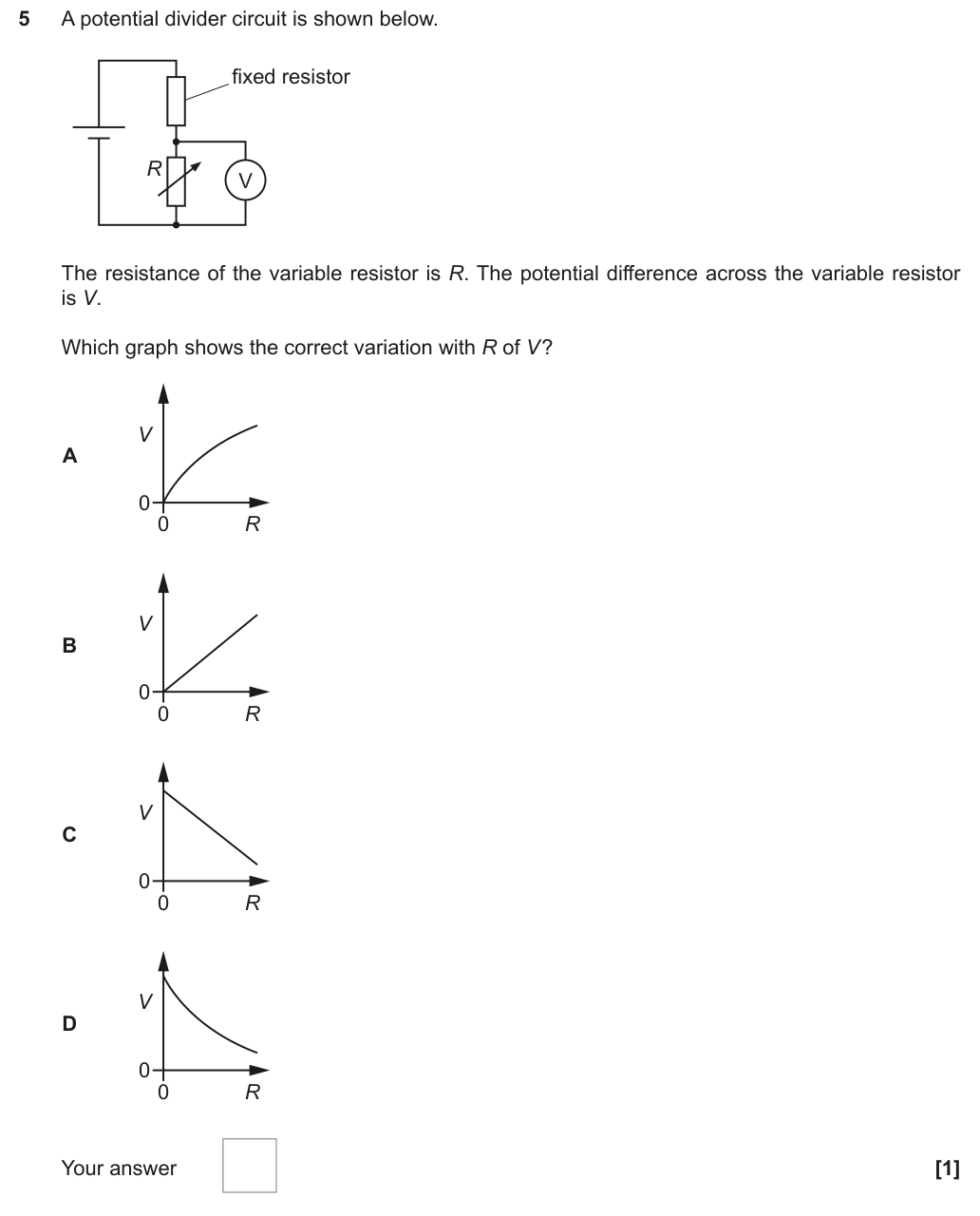
A
This is a question on a potential divider circuit and a sketch of the correct V-R graph. Unfortunately, the distractor B was a bit too strong. A is the correct sketch. When R = 0, V had to be zero too. Most candidates did write down the correct potential divider expression for V, but then did not acknowledge that V cannot be directly proportional to R – the straight-line graph through the origin could not be the correct answer. It was a choice between A or B, and by the brief reasoning above, the answer had to be A.
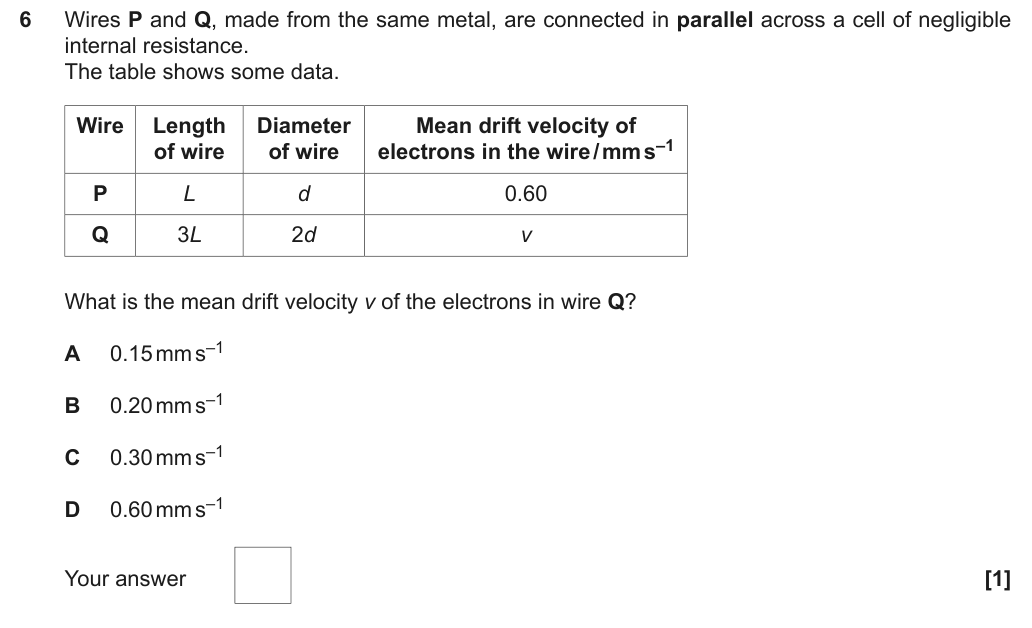
B
This was a question on combining together three important expression in the topic of electricity; V = IR, R =ρL/A and I = Anev. On top of this, there was the additional information that P and Q were in parallel and hence the potential difference across each wire was the same. The mean drift velocity v of the electrons is given by the expression 𝑣𝑣= 𝑛𝑛𝑛𝑛𝑛𝑛𝑛𝑛∝ 𝐿𝐿. The cross-sectional area A, and hence the diameter d of the wire has no effect on v. The relationship above implies that for wire Q, v = 3 × 0.60 = 0.20 mm s-1. The correct answer is B. All the distractors were equally popular. About a third of the candidates, mostly from the very top end of the ability range, were successful in this very demanding question.
Skills: M0.3 Use ratios, fractions and percentages; M2.2 Change the subject of an equation, including non-linear equations
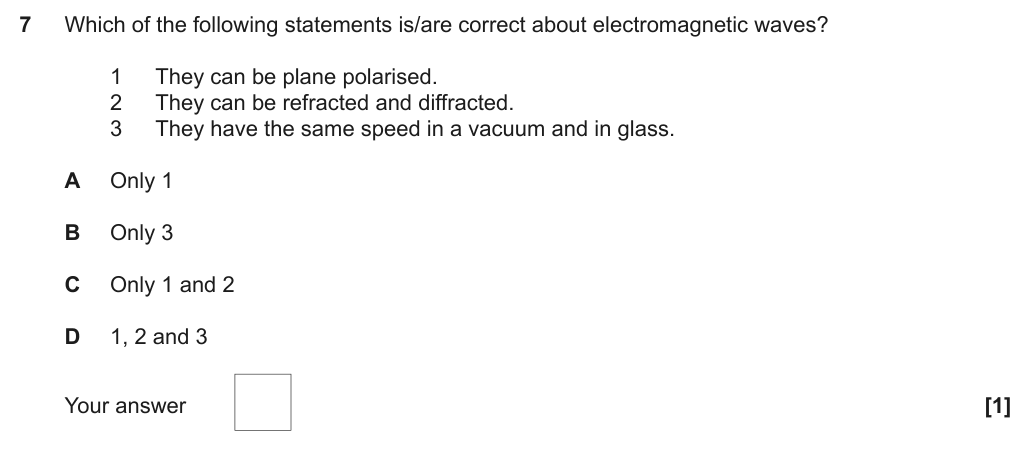
C
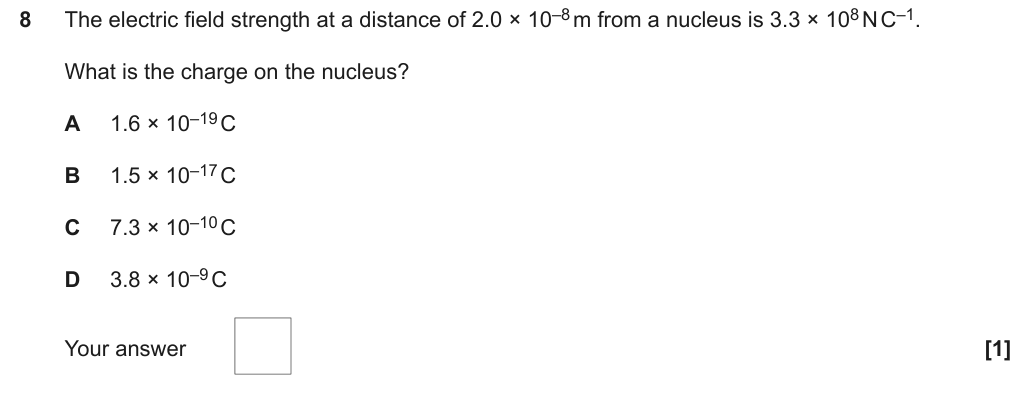
B
This question required knowledge of the equation 𝐸𝐸= 4𝜋𝜋𝜀𝜀0𝑟𝑟2, which is in the Data, Formulae and Relationship Booklet. The key, the correct answer, is B. The most common mistake made by candidates was not squaring r, or the equivalent where the electric potential V equation was used instead. This gave the incorrect answer of 7.3 × 10⁻¹⁰ C for the most recurrent distractor C. The exemplar 2 below shows a plausible method for getting to the correct answer. This middle-grade candidate has shown all the working. A significant number of candidates wrote down the correct expression, circled the key data in the question and did the rest of the work on their calculators. A variety of techniques were use.
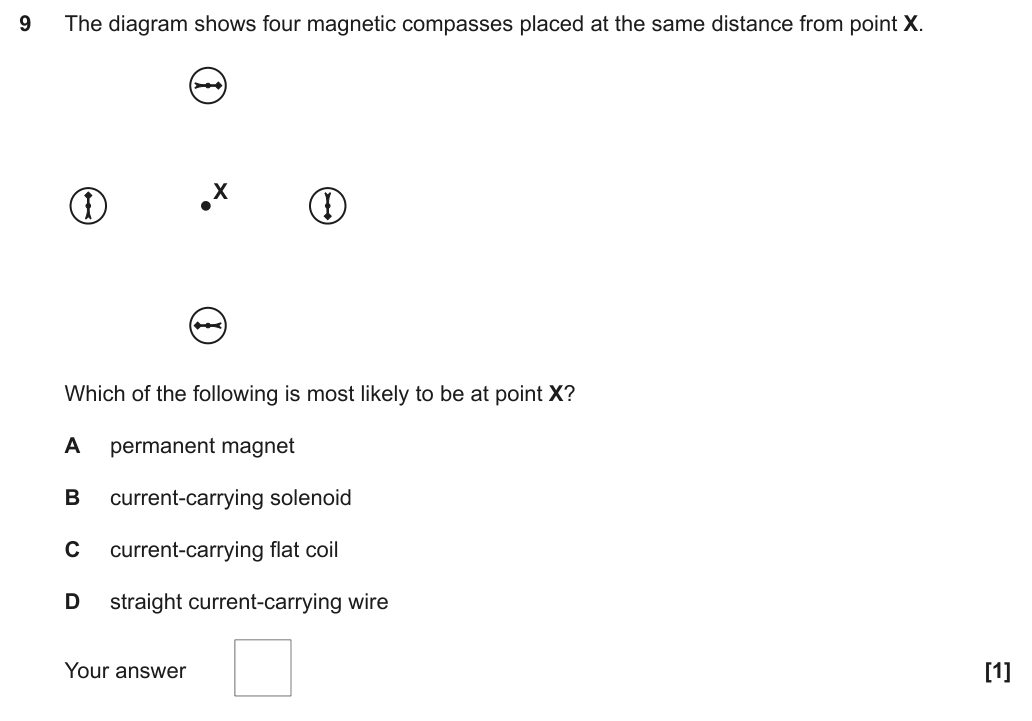
D
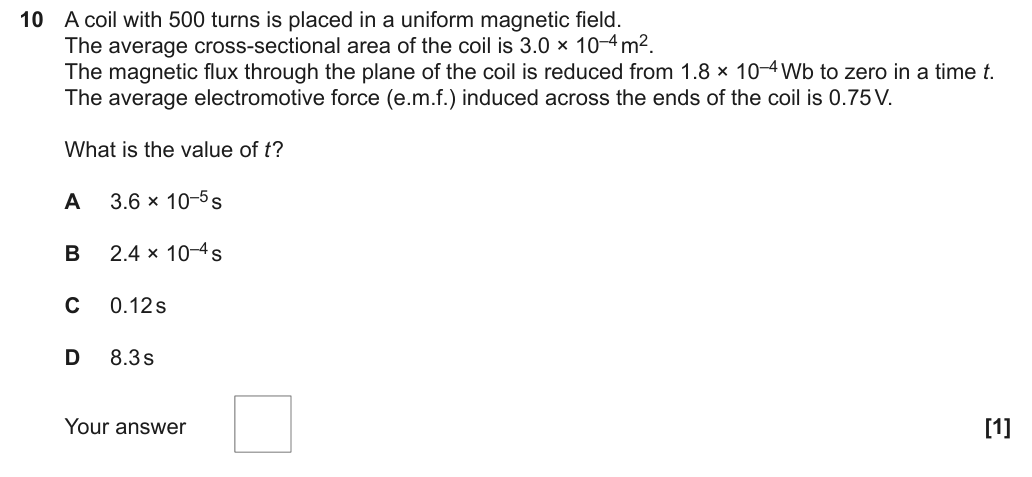
C
Skills: M2.2 Change the subject of an equation, including non-linear equations; M2.3 Substitute numerical values into algebraic equations using appropriate units for physical quantities
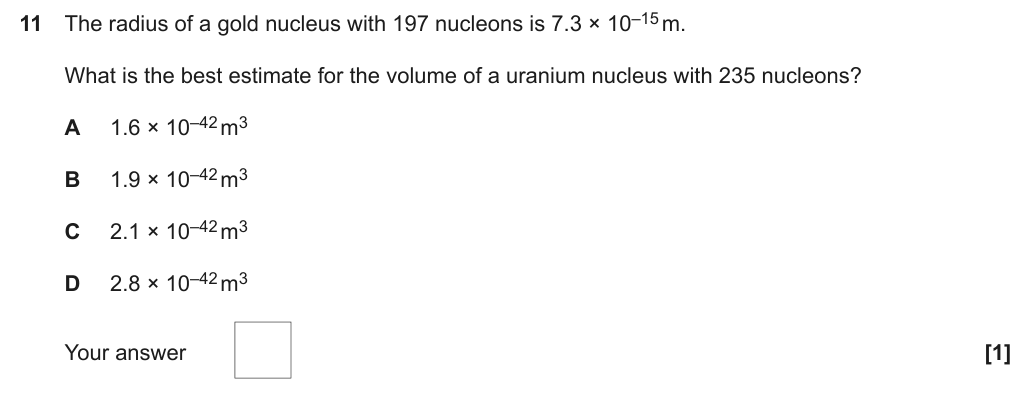
B
Skills: M0.3 Use ratios, fractions and percentages; M4.3 Calculate areas of triangles, circumferences and areas of circles, surface areas and volumes of rectangular blocks, cylinders and spheres
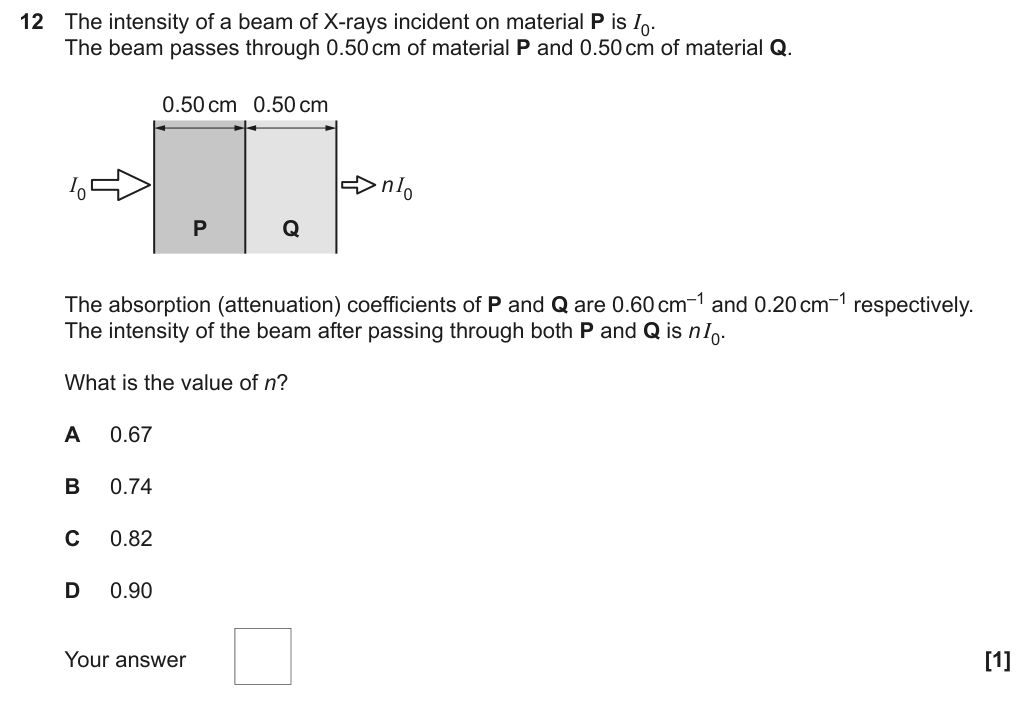
A
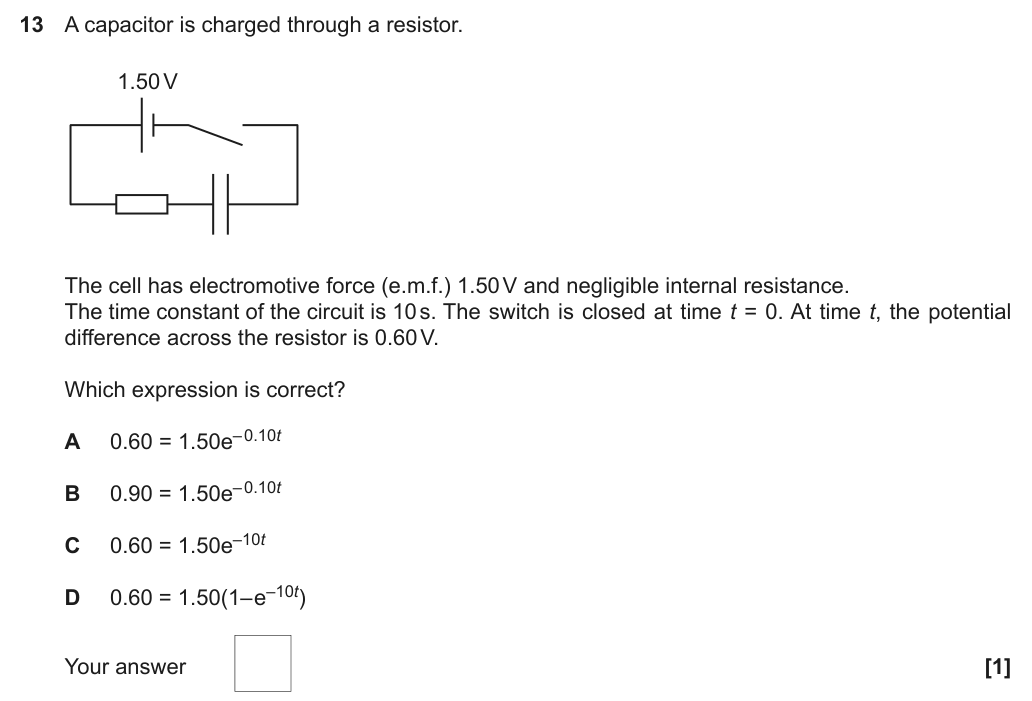
A
All the key equations for capacitor-resistor circuits are in the Data, Formulae and Relationship Booklet. As the capacitor charges, the potential difference V across the resistor will fall exponentially with respect to time. The time constant of the circuit CR is 10 s. Therefore, according to the equation V = V0e-t/CR, the correct expression after substitution will be 0.60 = 1.50e-0.10t. The correct answer is A. Just on the knowledge of time constant, neither C nor D can be the correct answers because of the ‘10’ in the expression. The choice then is between A and B; as demonstrated above, A is the answer. All the distractors were equally popular.
Skills: M0.5 Use calculators to find and use power, exponential and logarithmic functions
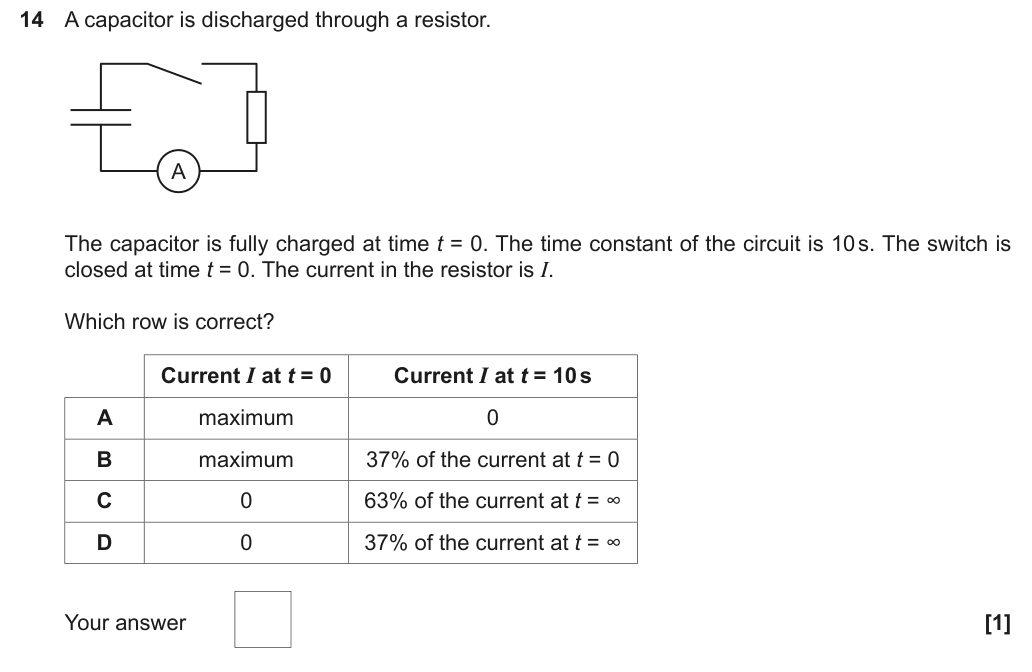
B
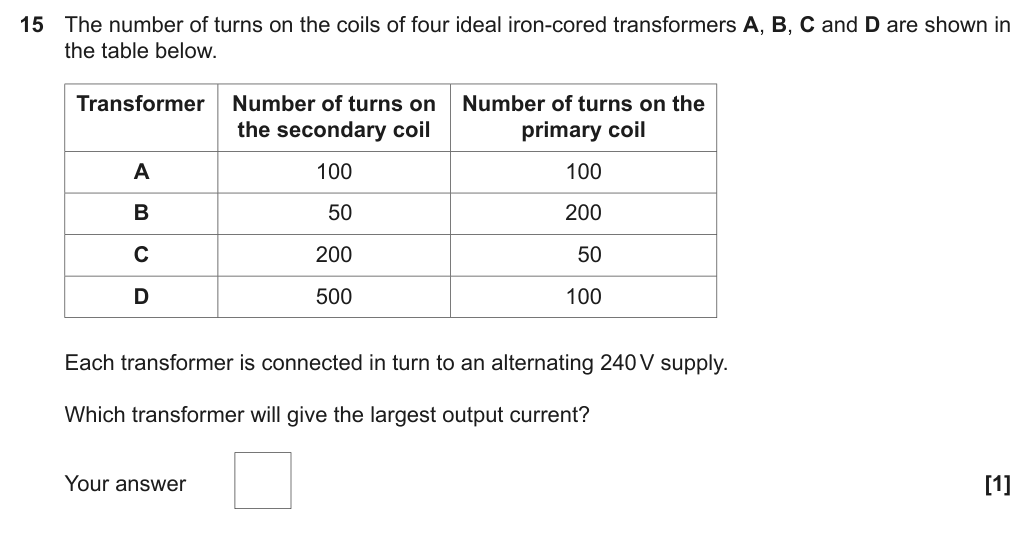
B
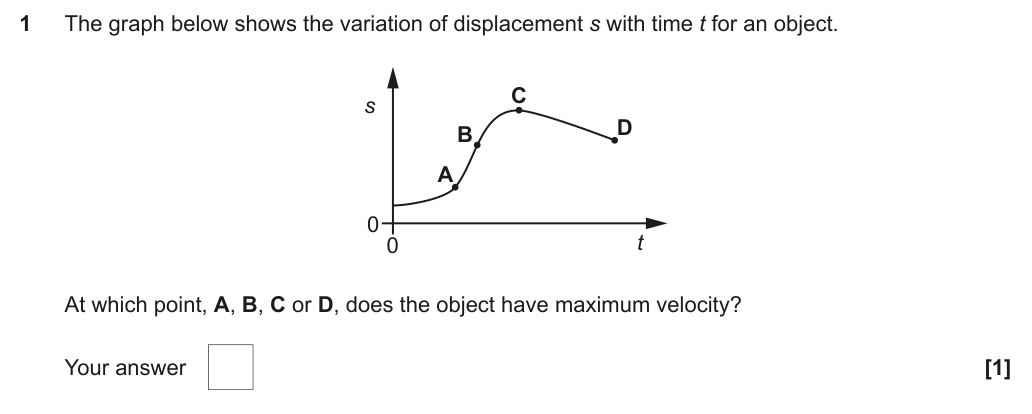
B
Questions 1, 4, 6 and 18 proved to be particularly straightforward, allowing most of the candidates to demonstrate their knowledge and understanding of physics. Question 1 Question 3 The question requires knowledge and understanding of the forces acting on the ball in flight and resultant force.
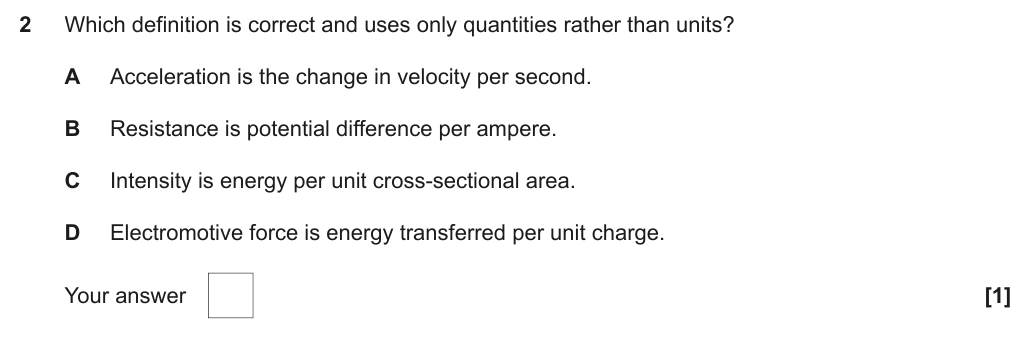
D
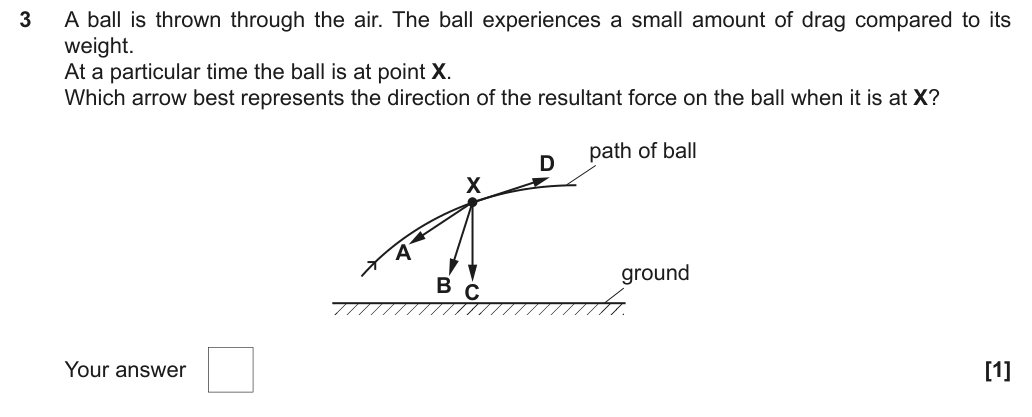
B
The question requires knowledge and understanding of the forces acting on the ball in flight and resultant force. The path of the ball is shown. At X, the ball is travelling in the direction shown by the D arrow. The drag force will be in the opposite direction. Weight is other force acting on the ball – vertically downwards. Vectorially adding the weight and the small drag will produce a resultant in the direction shown by the B arrow. The answer (key) is therefore is B. The most popular distractors were A and D. The right-hand side of the exemplar has the jottings of a candidate and it does help to visualise the problem. This would certainly not qualify as an acceptable answer in Section B, but here, it demonstrates excellent technique; a vertical line for the weight and a slanting line for the drag and both being added to give the dotted line for the resultant force. This matches the arrow B.
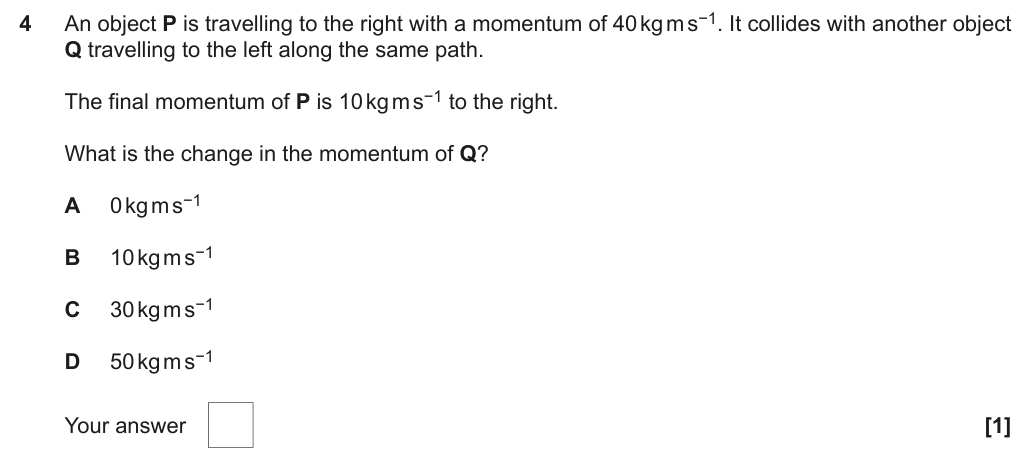
C
Question 4 Question 6 Candidates answered this question well.
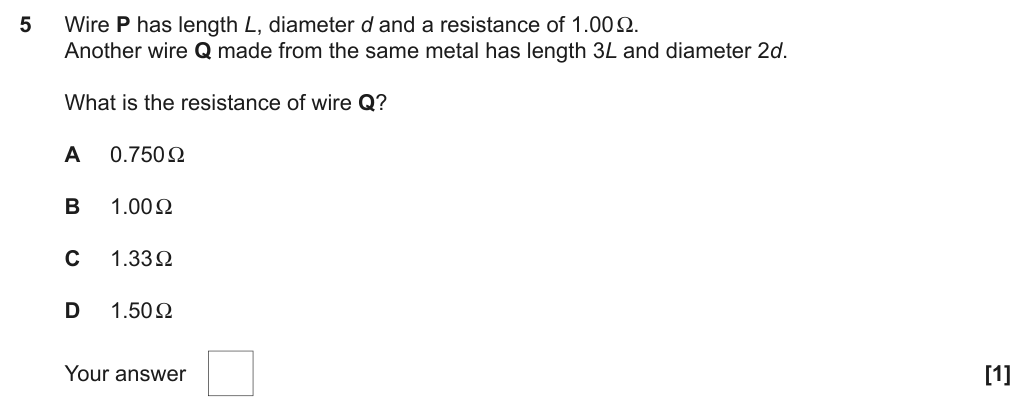
A
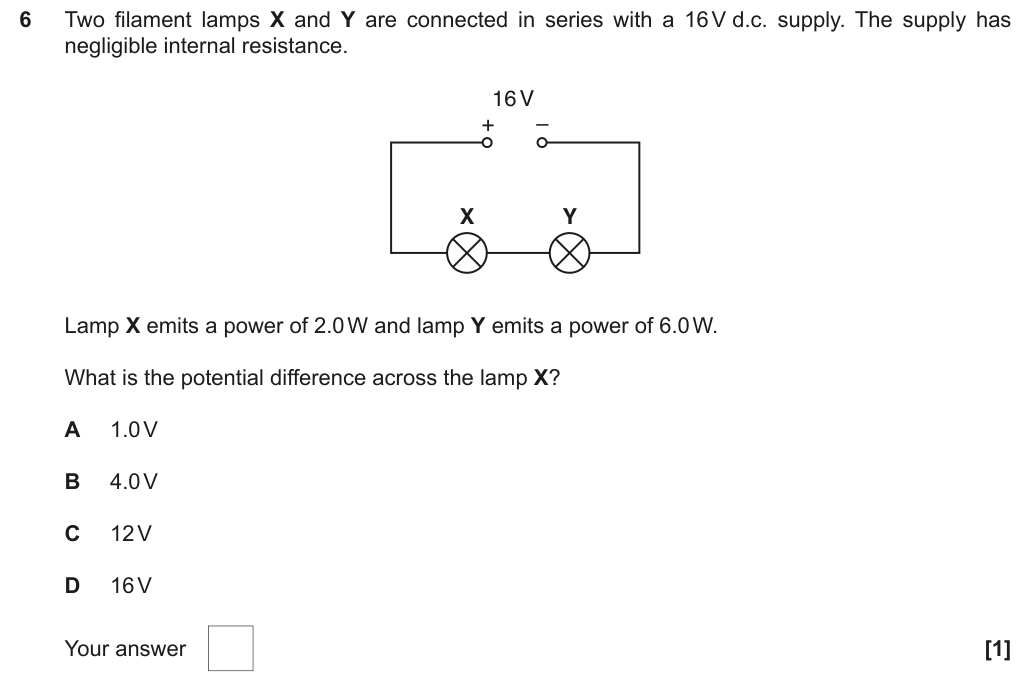
B
Candidates answered this question well. A range of techniques could be used to get to the correct answer B. This is illustrated by the two exemplars below. This shows the thought processes of a top-end candidate. The current in the series circuit is constant, hence the potential difference must be proportional to the power dissipation. These two lines is all it took for this candidate to identify the correct answer B. Here’s another equally valid technique, which may have been a bit time-consuming for this grade D candidate. The total power dissipated has been used to determine the current in the circuit. The correct value of 4.0 V across lamp X has been calculated using this current and the equation P = VI. It is worth noting the sensible approach of annotating the figure. This would have helped to steer away from the popular distractor C.
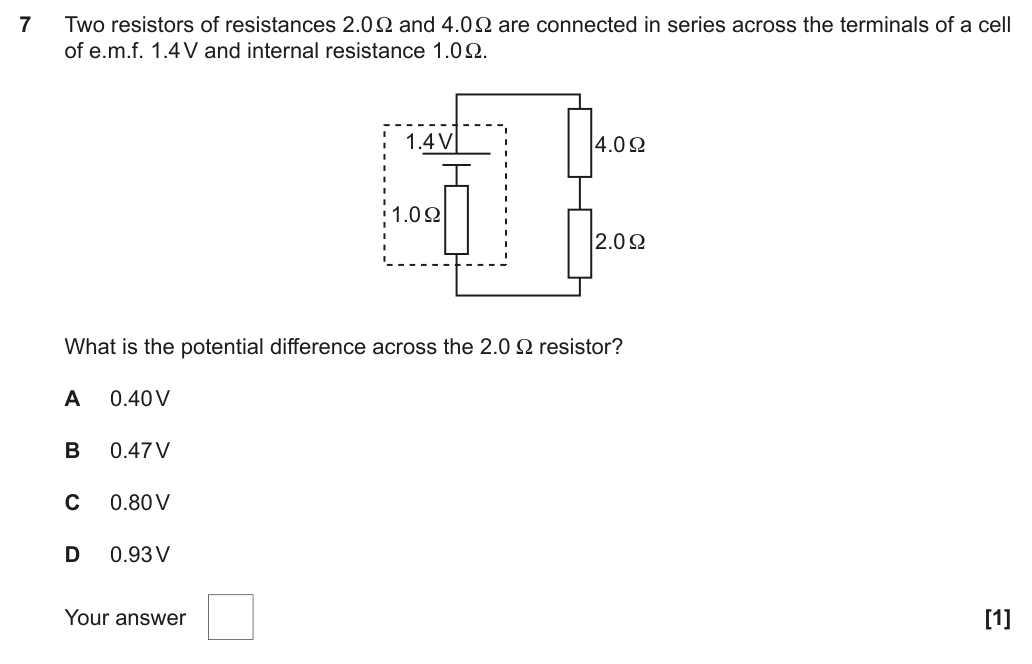
A
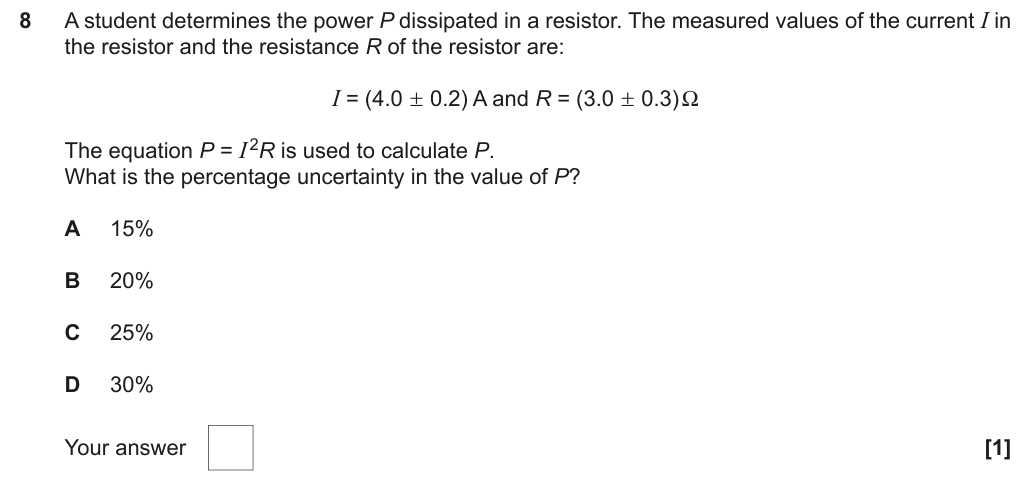
B
Question 8 Question 9 This proved to be challenging for most, except for the very top-end candidates.
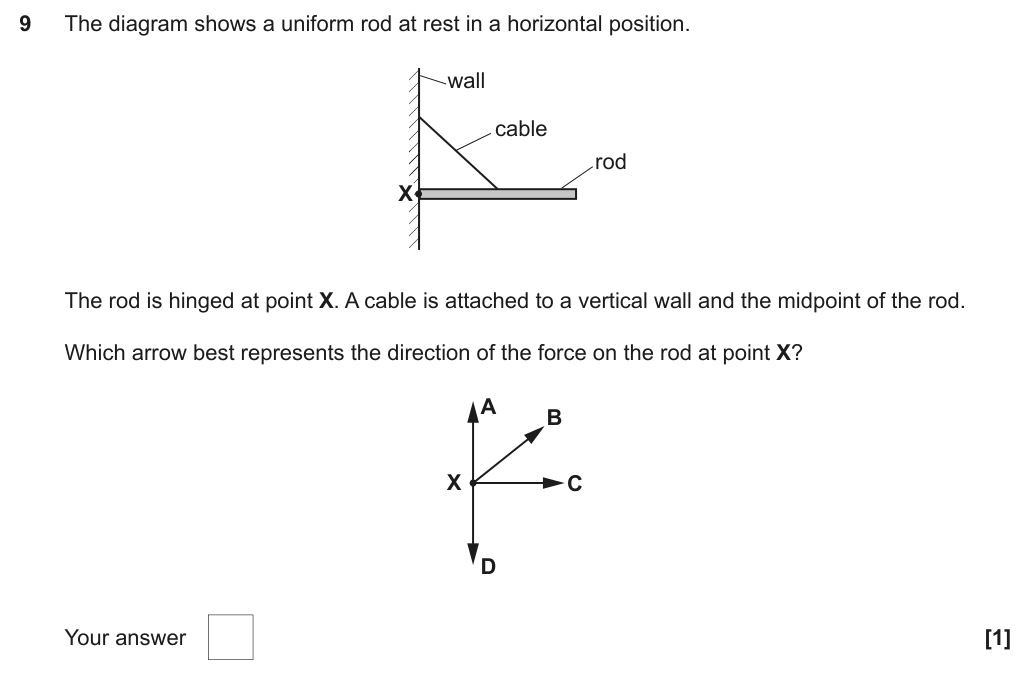
C
This proved to be challenging for most, except for the very top-end candidates. All the distractors were equally popular, and just over a third of the candidates got the correct answer C. Many of the scripts from the successful candidates had the term key uniform underlined or circled. The centre of gravity of the rod and the point of contact of the cable to the rod were the same. For equilibrium, the contact force from X had to pass through this same point – which only left arrow C as the correct answer.
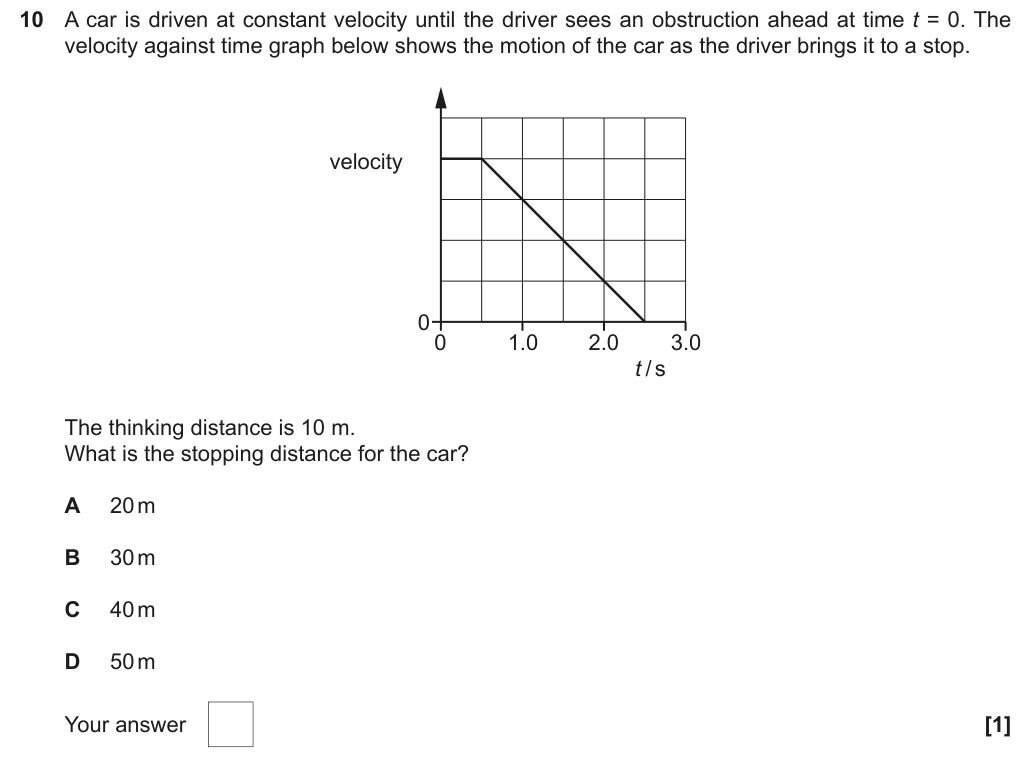
B
This question required understanding of thinking, braking and stopping distances together with an appreciation of the learning outcome 3.1.1(d). The total area under this velocity-time graph is equal to stopping distance. The area of the ‘rectangle’ is equal to thinking distance and the area of the ‘triangle’ is equal to the braking distance. The correct answer is B. The popular distractor was A, which just represented the braking distance. This exemplar illustrates how minimal work in a multiple-choice answer can produce dividends. The candidate has used the thinking distance and the ‘reaction time’ of 0.5 s to determine the initial speed of the car (20 m s-1). This has then been used to calculate the braking distance. No interim values of distances are shown, but the candidate has done all the hard work by the substitution shown and labelling the vertical axis. A model answer from this high performing candidate.
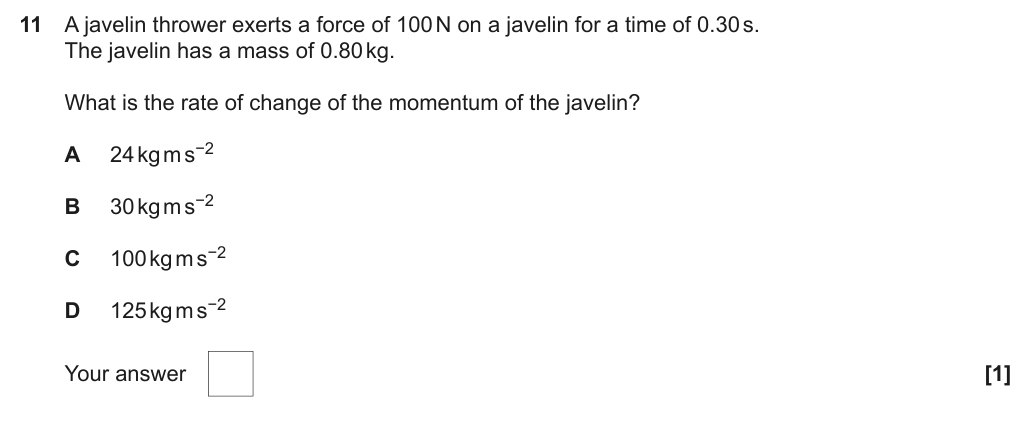
C
There was a significant amount of working shown by candidates across the ability spectrum. Most of the time, the answers put down were the distractors. This question is about Newton’s second law of motion. The force on the javelin is equal to the rate of change of its momentum. Therefore, the answer is simply C. The kg m s-2 is equivalent to the newton N.
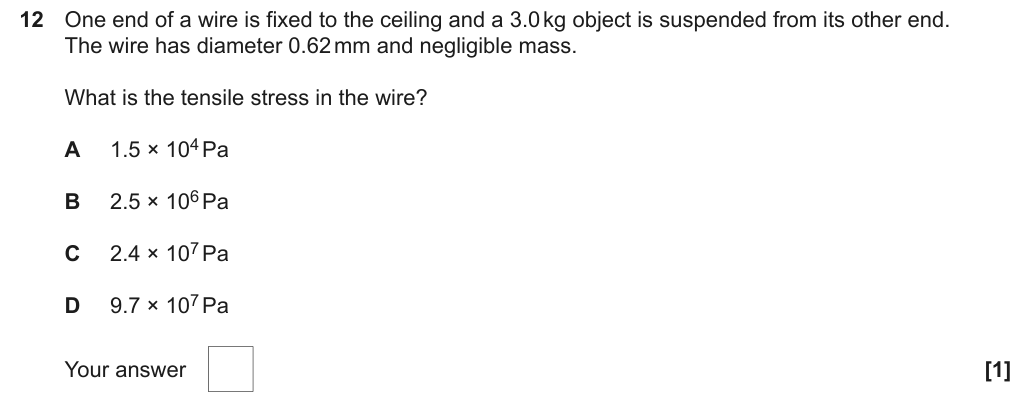
D
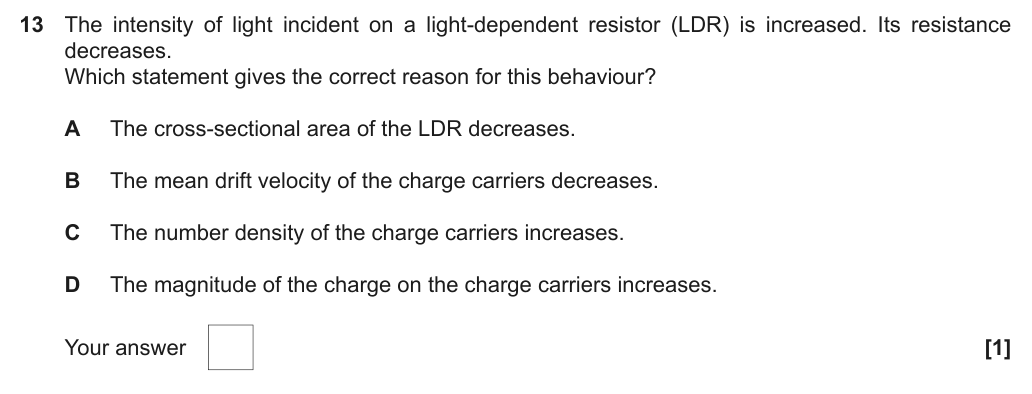
C
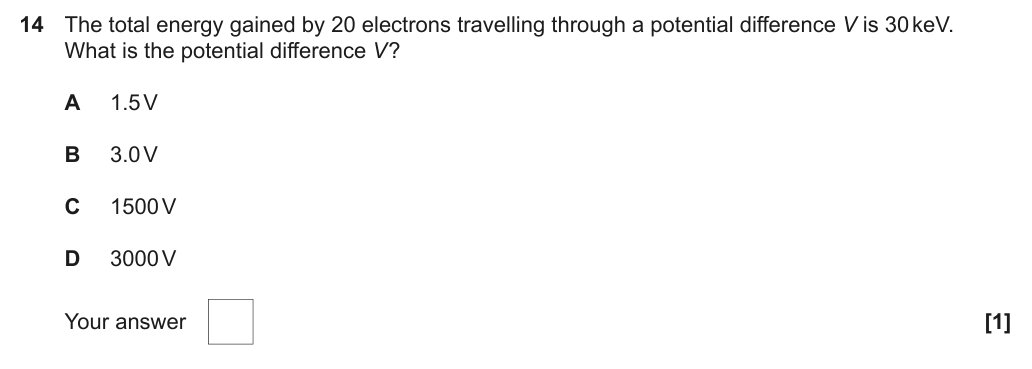
C
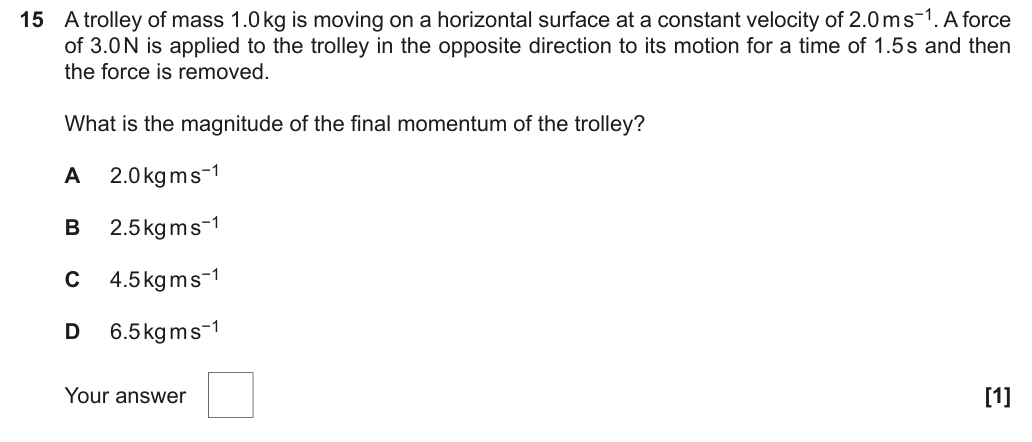
B
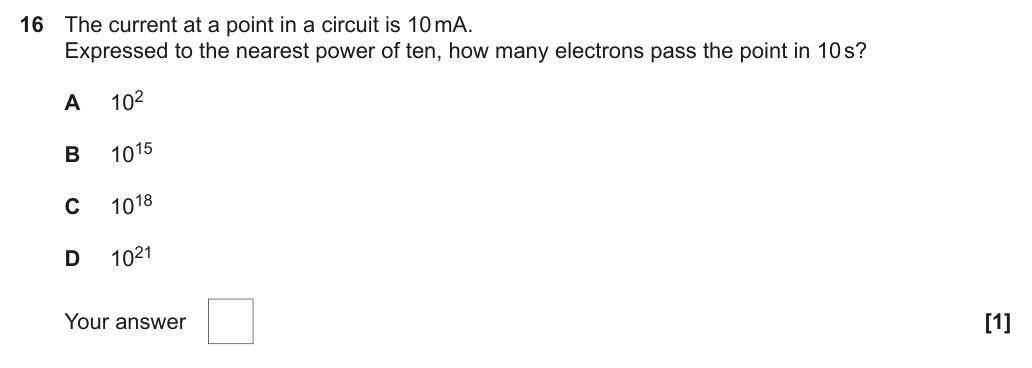
C
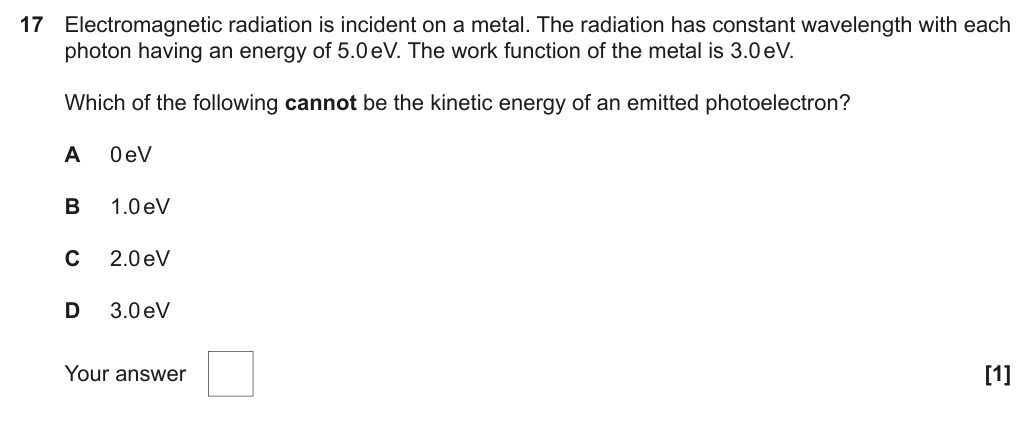
D
Slightly more than half of the candidates got the correct answer D in this question on the photoelectric equation. No detailed calculations were necessary here. The maximum kinetic energy of a photoelectron had to be 2.0 eV (difference between photon energy of 5.0 eV and the work function of the metal 3.0 eV), which made the value of 3.0 eV impossible. The most popular distractor was A.
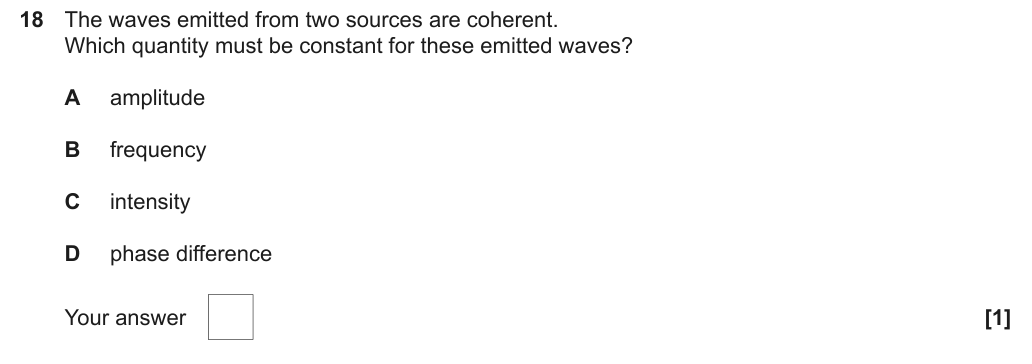
D
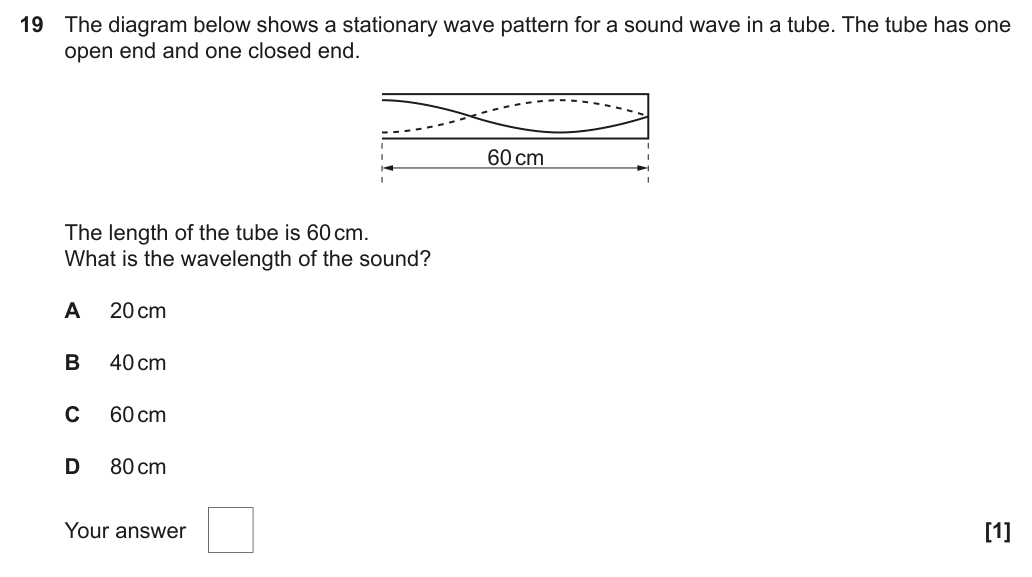
D
D
C
About three quarters of all candidates recognised that the volt is not an S.I. base unit.
B
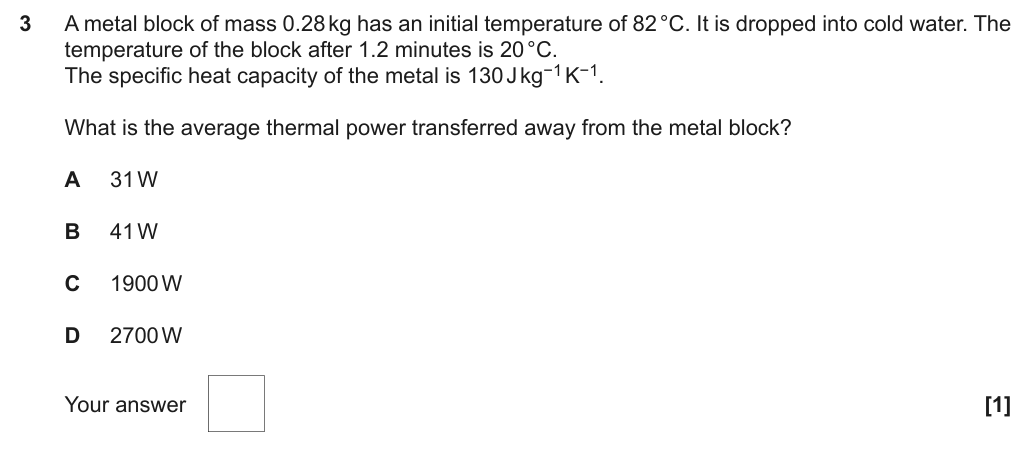
A
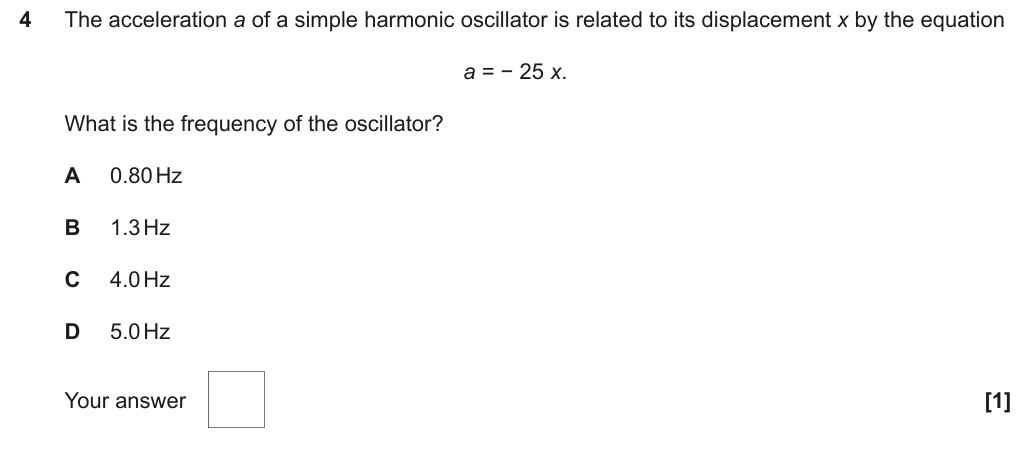
A
About three quarters of all candidates recognised that since = −𝜔𝜔2𝑥𝑥 , the angular frequency of this motion was 5. Also, since 𝜔𝜔= 2𝜋𝜋𝜋𝜋, the frequency must be equal to 5/(2𝜋𝜋) .
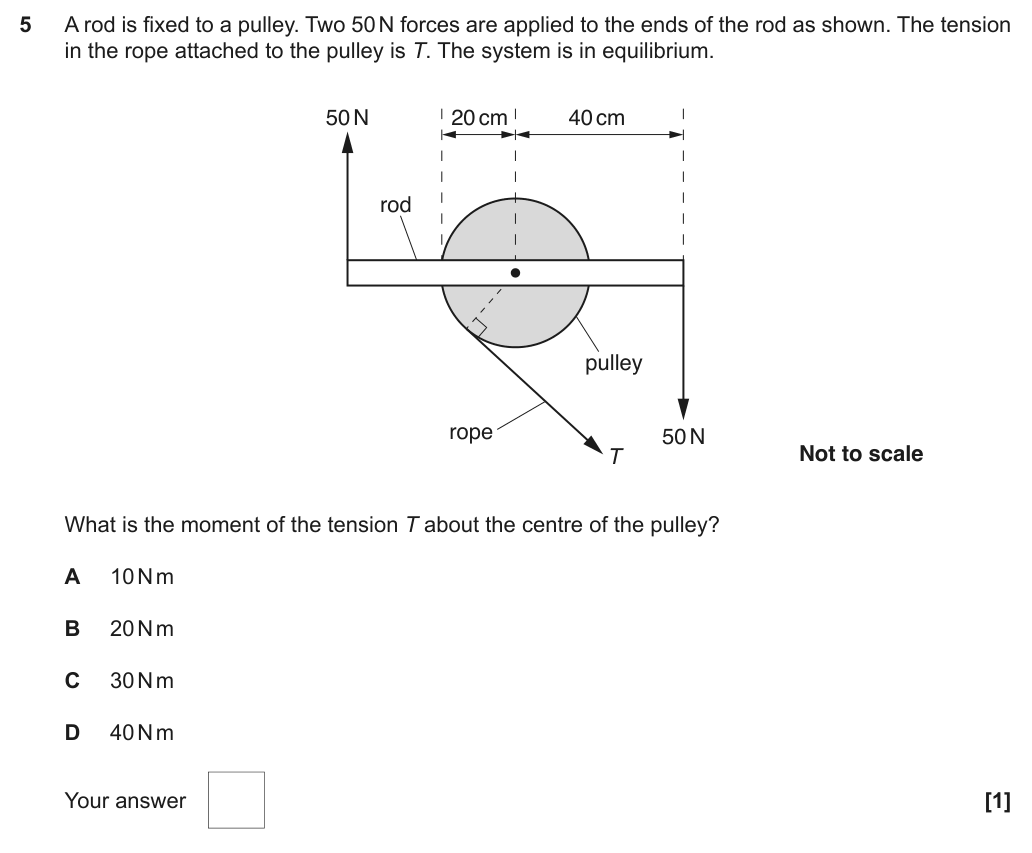
D
Examiners’ report Question 5 Please note an erratum notice was issued for this question.
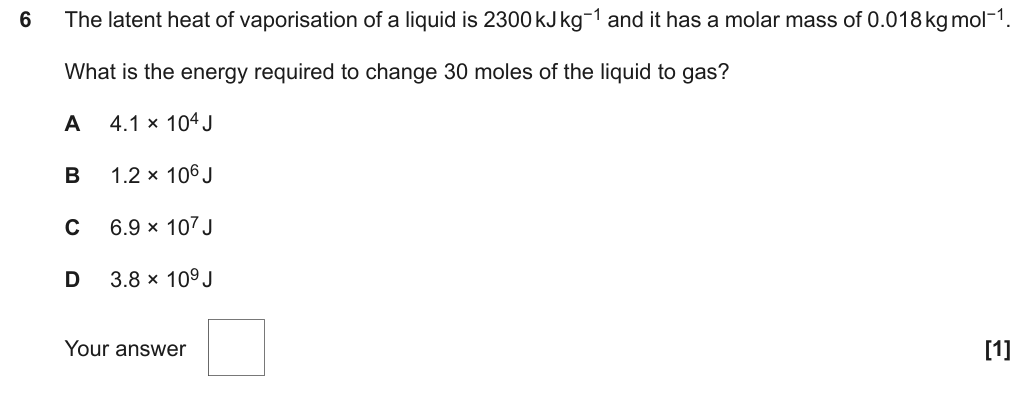
B
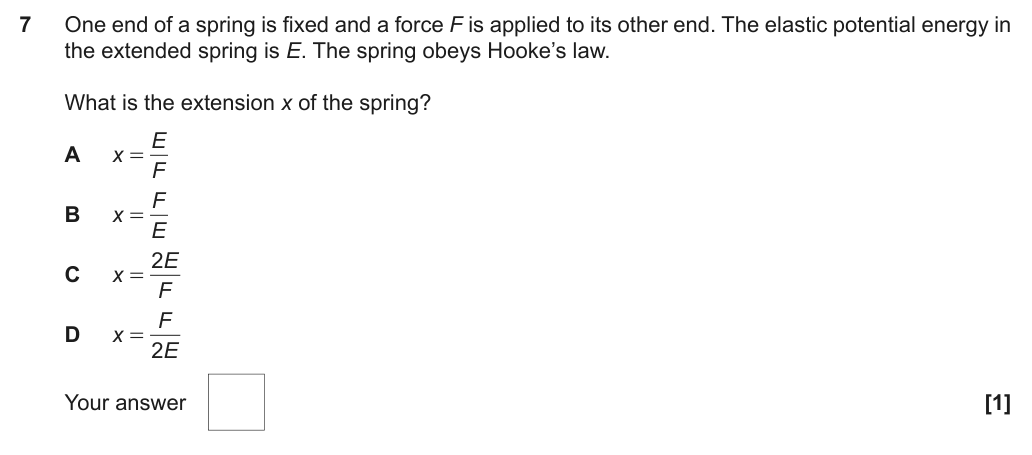
C
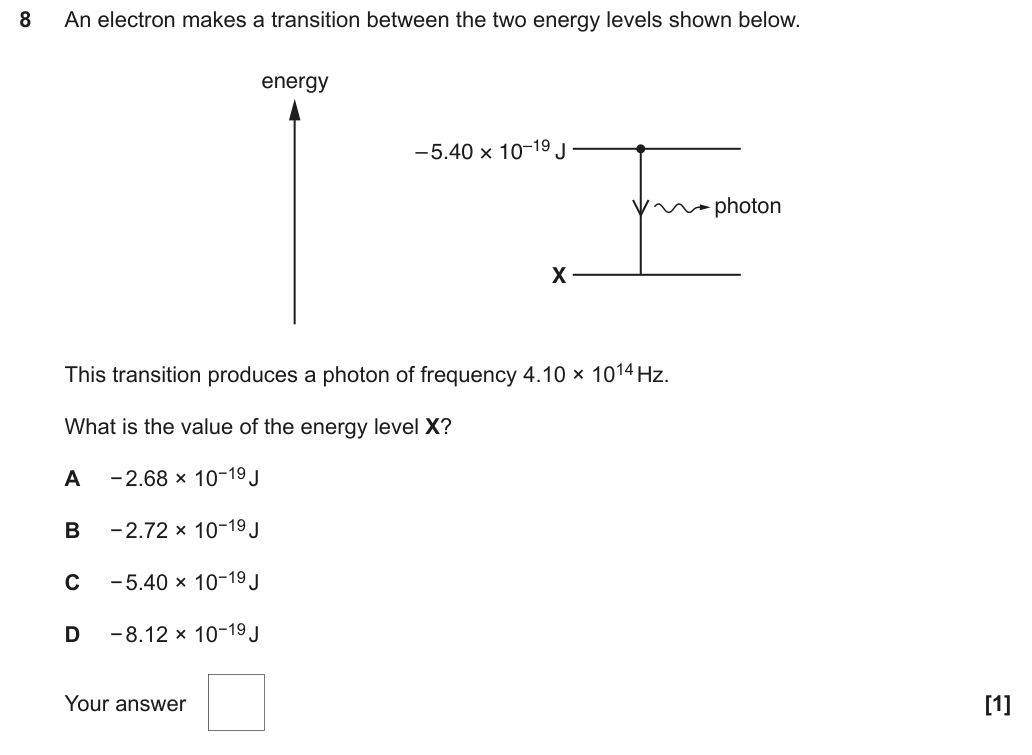
D
The key to this question is to find the energy of the photon (from E = hf) which gives 2.72 x 10⁻¹⁹ J. The energy level X is this amount of energy below -5.40 x 10⁻¹⁹ J, which can only be answer D.
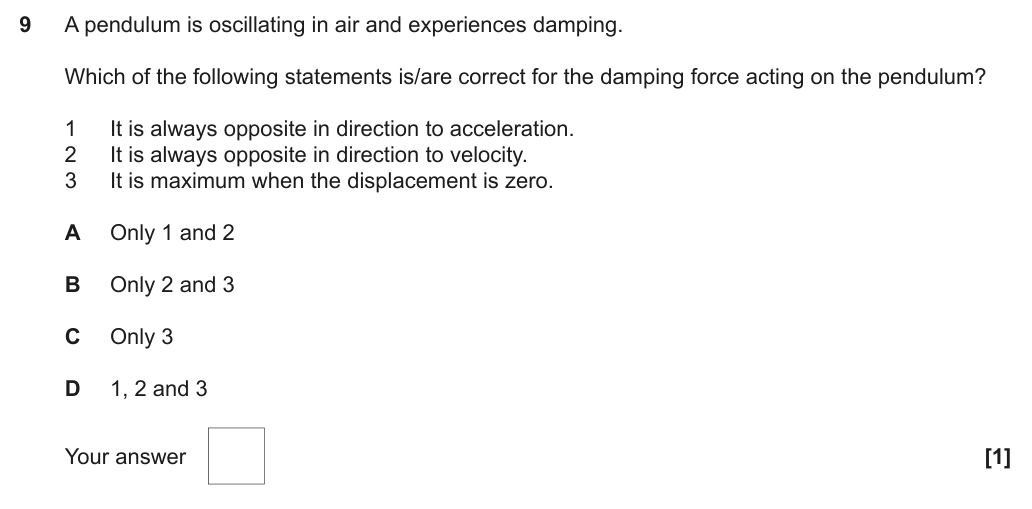
B
The damping force is always opposite in direction to velocity. If the displacement is zero, then the speed is greatest and hence the damping force is also greatest in magnitude. The damping force is not always opposite in direction to acceleration, although the displacement must be, according to the definition of SHM.
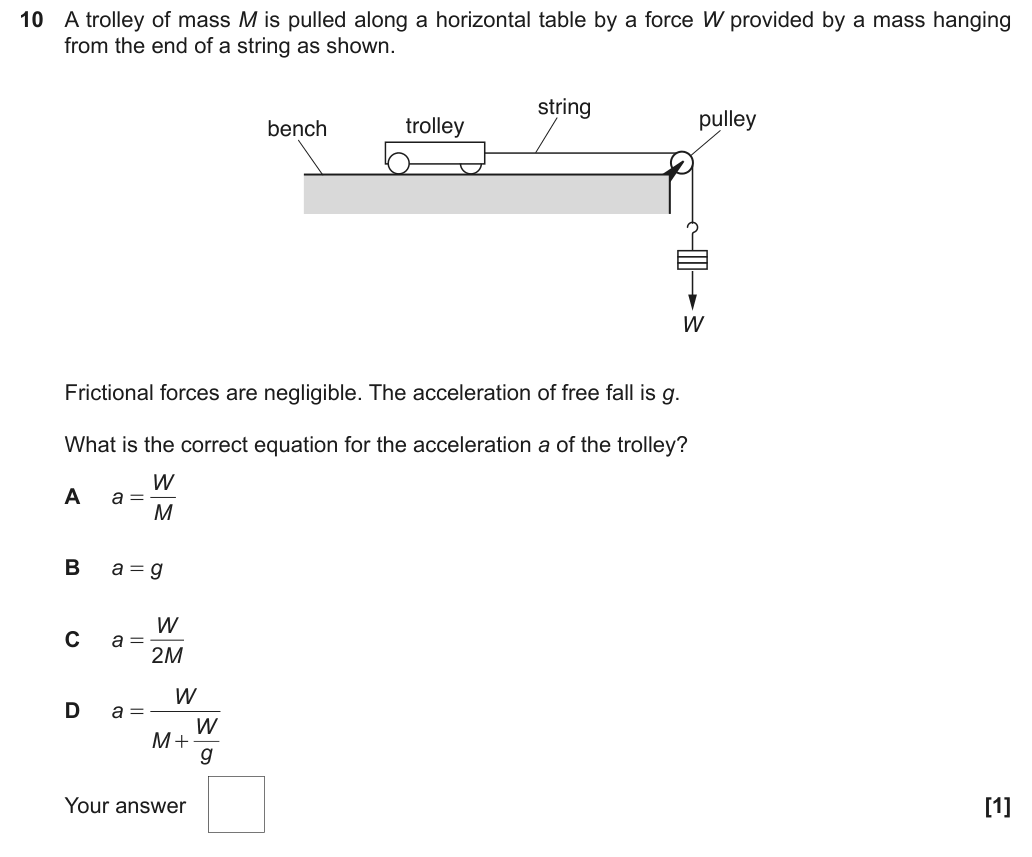
D
Most candidates did not realise that both the suspended mass and the trolley are moving with acceleration a. The resultant force along for this composite object is W and the total mass is (M + W/g), giving D as the acceleration.
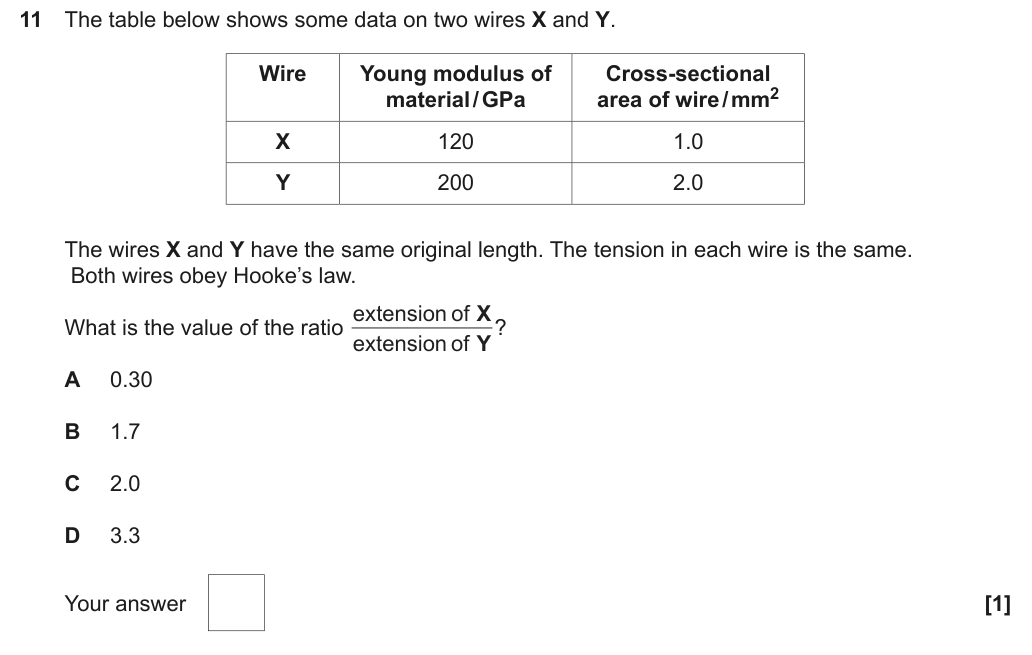
D
The tension for both wires is the same, yet wire X has half of the cross-sectional area. This means the stress for X will be twice that of Y. Strain = stress/Young modulus, so with half of the stress and (120/200) of the Young modulus, the strain for X will be 2 x (200/120) or times that of the strain for Y. The original lengths for X and Y are the same, so the extension of X will be 3.3 times that of Y.
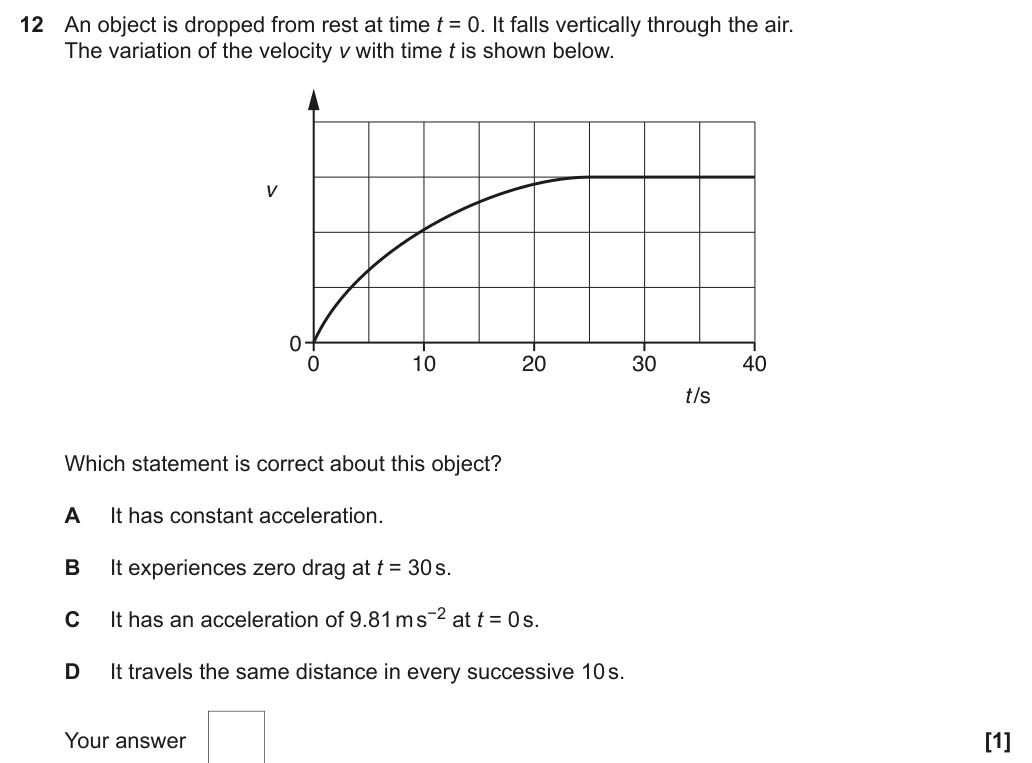
C
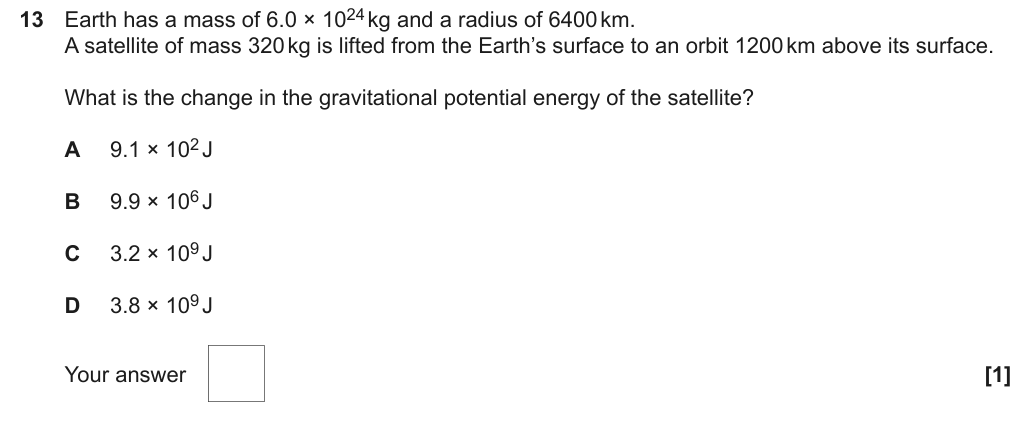
C
This question requires the candidate to calculate the gravitational potential energy when r = 6.4 x 10³ m and again when r = 7.6 x 10³ m. The difference of those two energies gives answer C. About two thirds of all candidates got this correct.
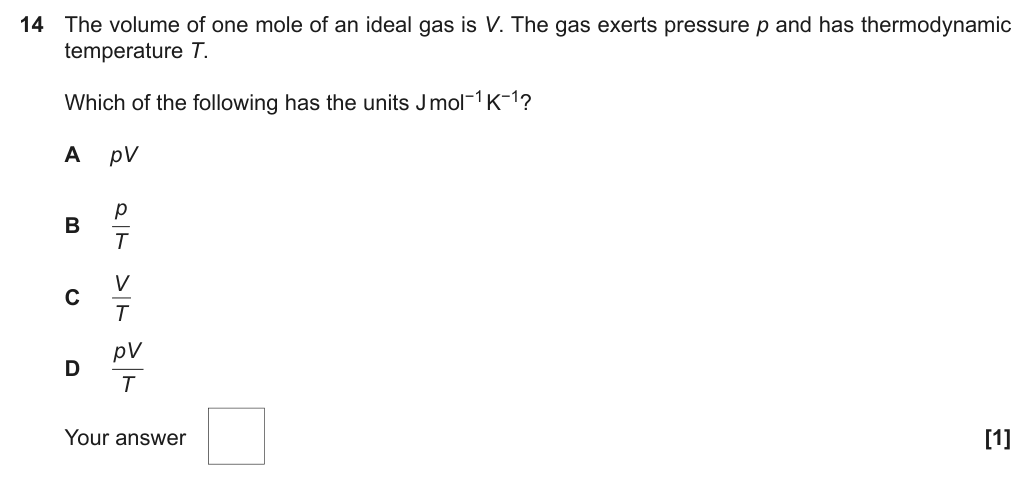
D
The unit J mol-1 K-1 is the same unit as the molar gas constant, such that pV = nRT. It follows that the unit of R must be the same as the unit of pV/T as ‘n’ has no units.
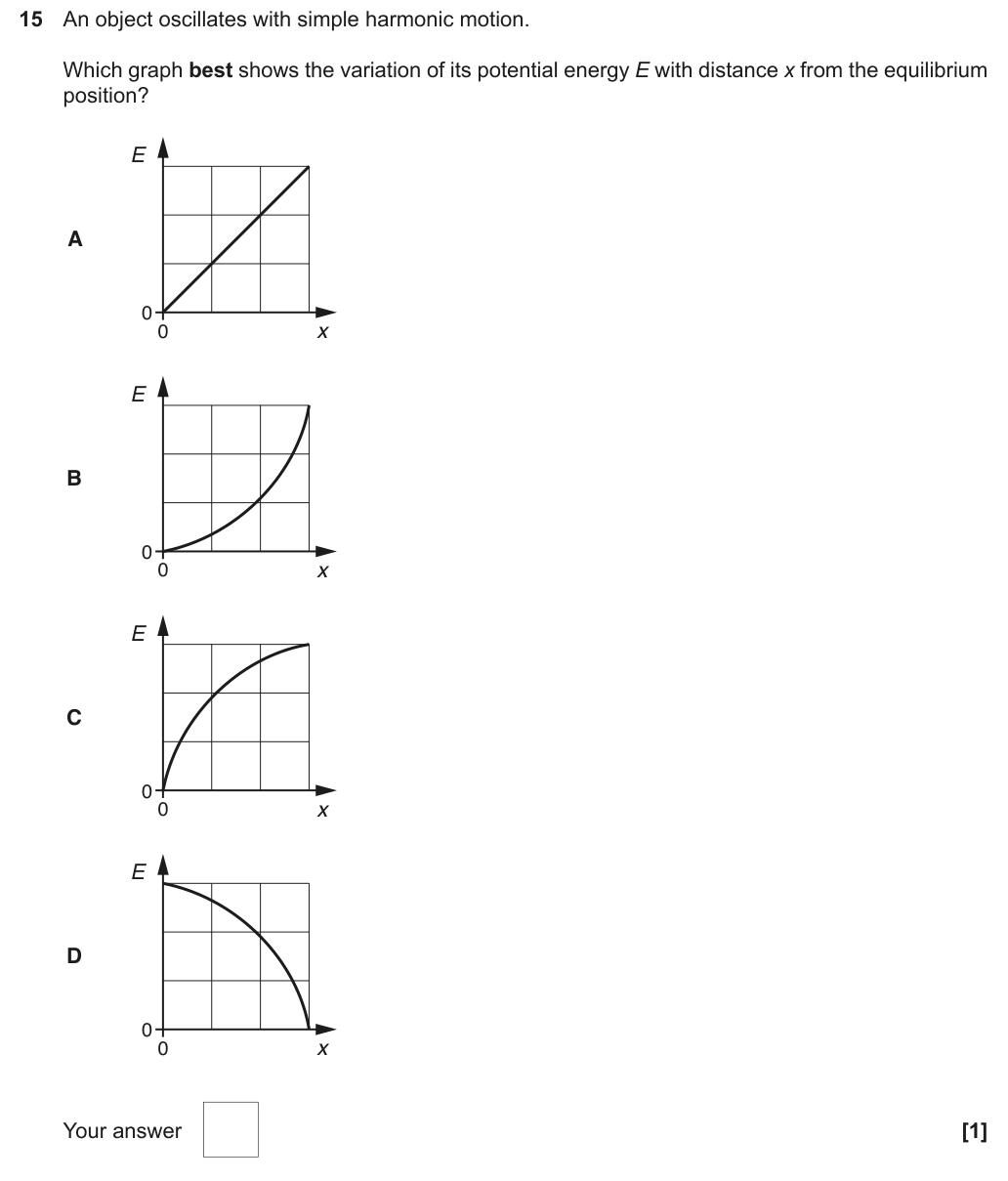
B
In SHM, when x = 0, the object is moving at its fastest and so has maximum KE. This in turn means that the PE must be minimum, eliminating option D. The speed of the object slightly away from the point where x=0 does not increase rapidly nor linearly. This only leaves option B.
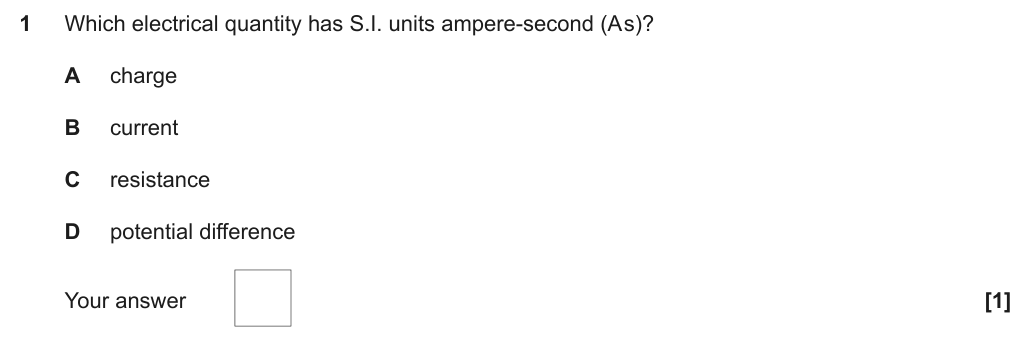
A
Questions 1, 2 and 6 proved to be particularly straightforward, allowing most of the candidates to demonstrate their knowledge and understanding of physics. Question 1 Question 2 This was a well-answered question with most candidates demonstrating excellent knowledge of resistors in series and parallel combination.
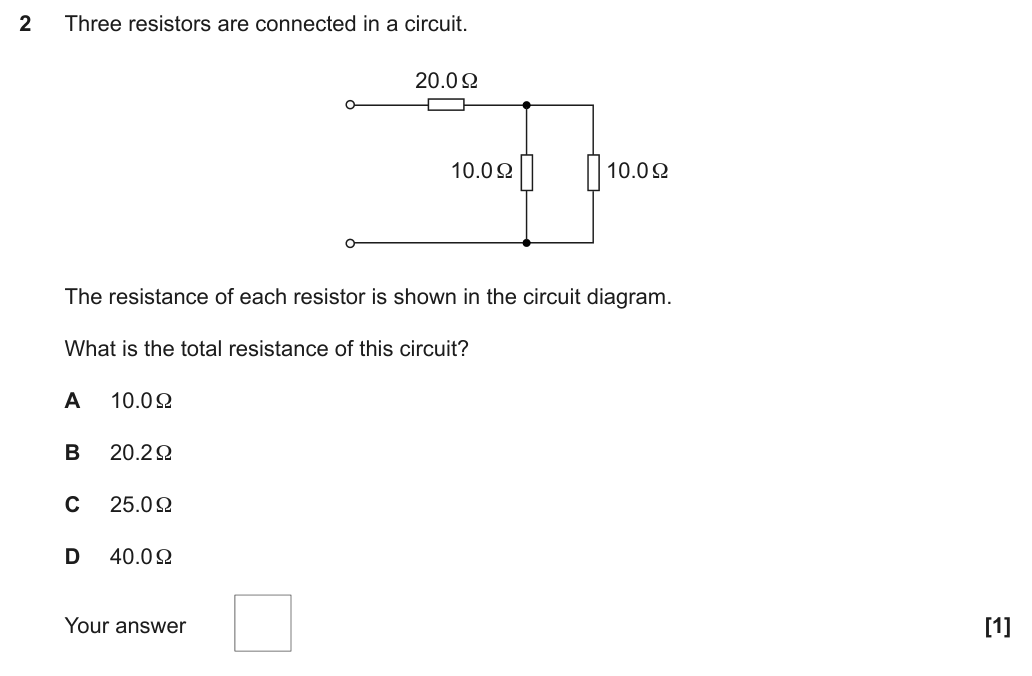
C
This was a well-answered question with most candidates demonstrating excellent knowledge of resistors in series and parallel combination. On many scripts, there was hardly any working shown. The two 10.0 Ω resistors in parallel gave a combined resistance of 5.0 Ω. This added to the series resistor of 20.0 Ω gives the correct answer of 25.0 Ω. The most popular distractor was D – where all the resistance values were simply added together.
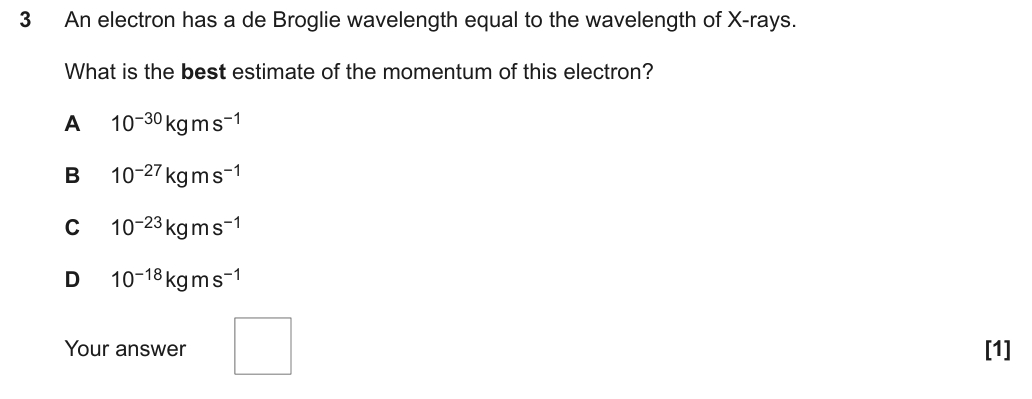
C
Question 3 Question 4 Question 6 There was an erratum issues for this question.
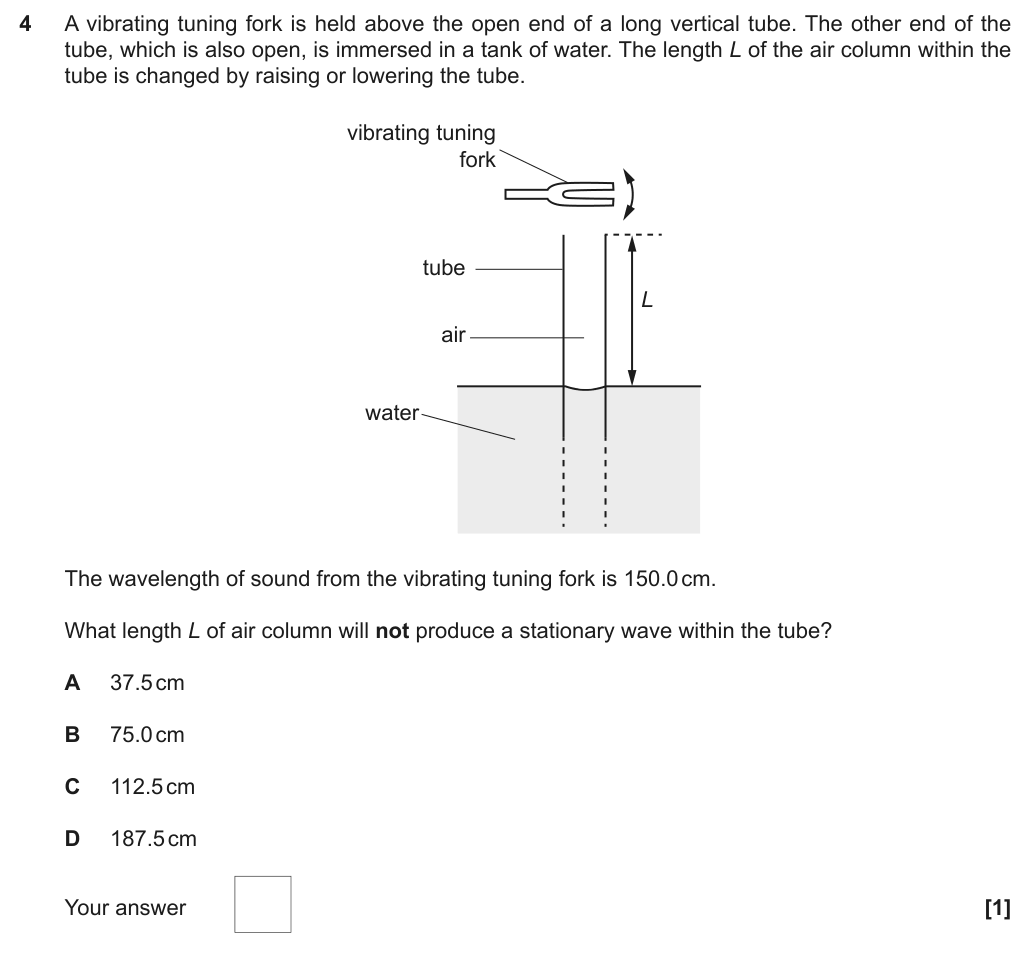
B
Question 3 Question 4 Question 6 There was an erratum issues for this question.
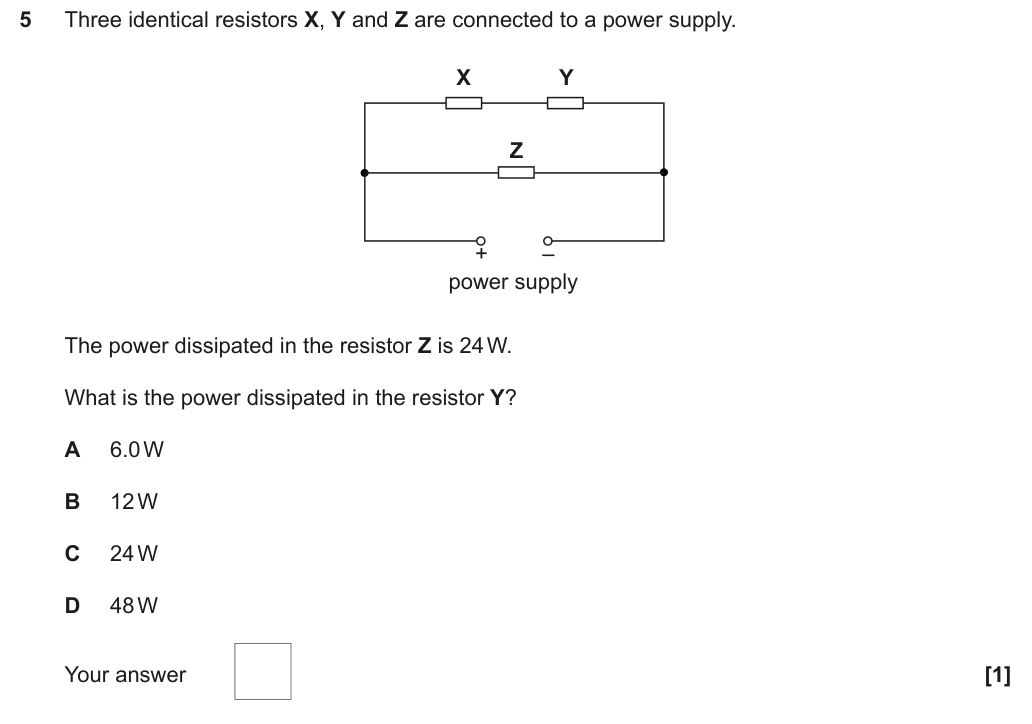
A
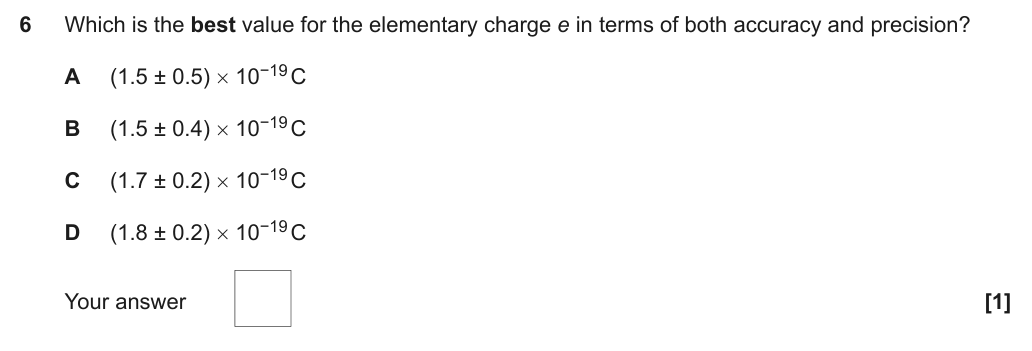
C
There was an erratum issues for this question. The term precision was replaced with uncertainty. The performance of the candidates was as expected with most opting for the correct answer C. A very small number of candidates opted for D because this value had the smallest percentage uncertainty.
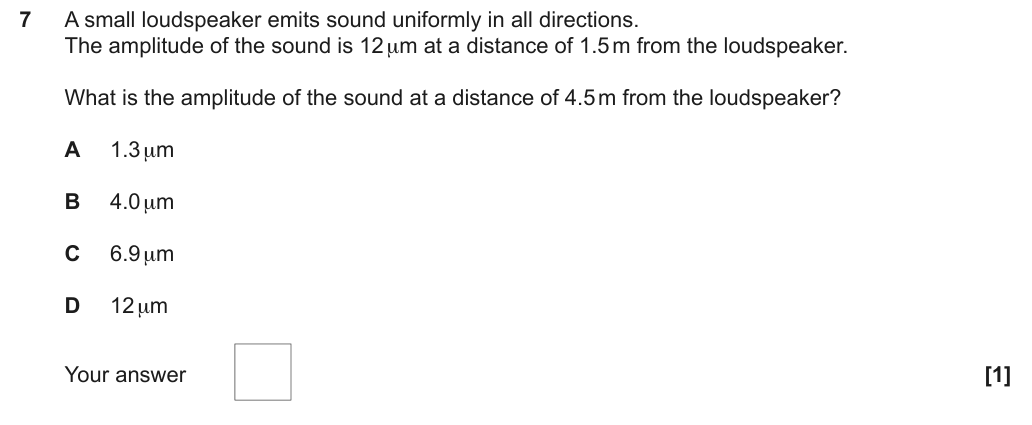
B
The emission of sound ‘uniformly in all direction’ was the clue that the intensity of the wave followed an inverse square law relationship with distance from the source. The intensity is also directly proportional to amplitude2. This meant that amplitude of the wave is inversely proportional to the distance from the source. The correct answer (key) for this question is B. The most popular distractor was C, where 12 µm was divided by √3. This exemplar illustrates the sensible strategy from a top-end candidate. The key ideas are jotted down and analysis completed: I ∝ 1/r2 and I ∝ A2, therefore A ∝ 1/r. The distance r increases by a factor of 3, therefore the amplitude will decrease by a factor of 3. This makes the answer 4.0 µm. The final sum being done either in the head or calculator – this is of little significance. What is important here is that all the important ideas have been extracted competently from the question. A commendable technique.
A
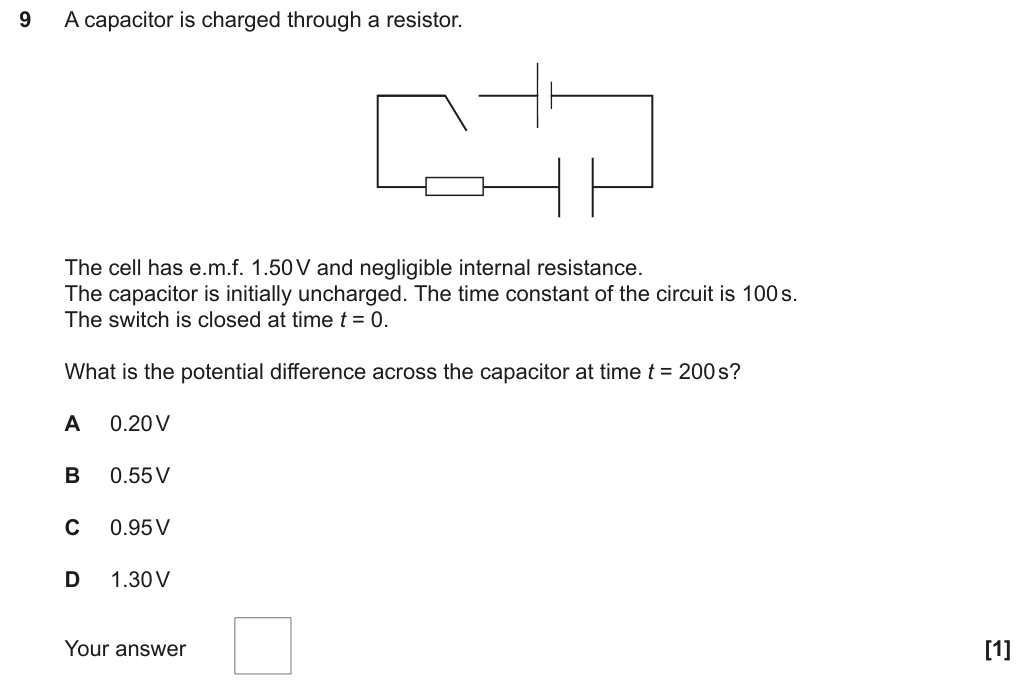
D
This question provided good discrimination with most to-end candidates scoring 1 mark for the correct answer D. Extracting all the information was the prerequisite for success. The potential difference across the capacitor is required. This could either be done by calculating the potential difference across the resistor (0.20 V), and then subtracting this from the e.m.f. of 1.50 V, or in one step using the equation V = V0(1 – e-t/CR). It is worth pointing out the answer 0.20 V proved to be the most popular distractor for low-scoring candidates. This exemplar illustrates the effortless strategy adopted by this A-grade candidate. The circuit diagram has been annotated with the e.m.f. of 1.50 V, and the time constant CR of 100 s has been underlined. The correct equation has been used to get 1.30 V. Compare and contrast this answer with the exemplar 3 below from a C-grade candidate. The answer calculated here of 0.2 V, is the potential difference across the resistor and not the capacitor. This candidate was one step away from getting the correct answer – this value just had to be subtracted from the e.m.f. of 1.50 V. Deciphering the question is vital, as is the analysis that follows.
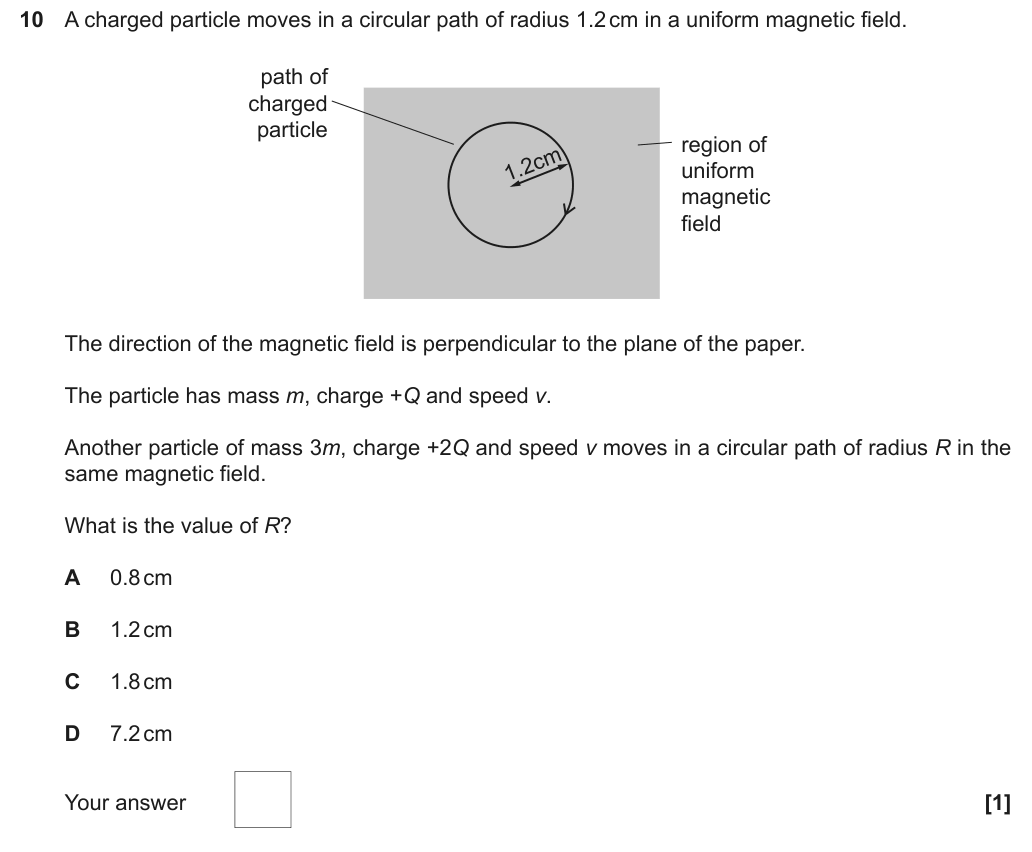
C
Question 10 Question 11 Question 15 The majority of the candidates did get the correct answer A.
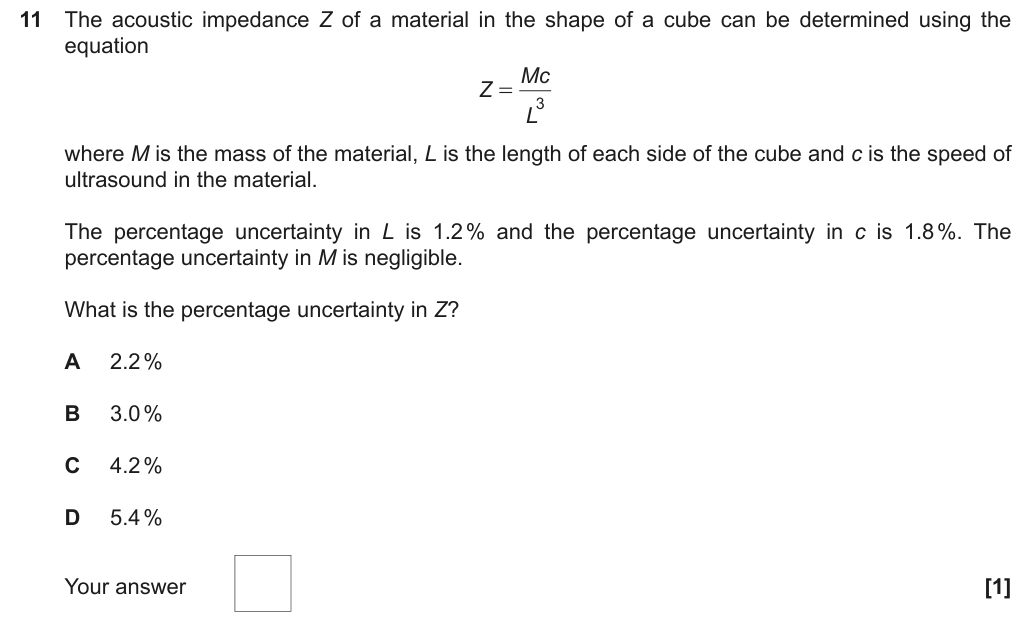
D
Question 10 Question 11 Question 15 The majority of the candidates did get the correct answer A.
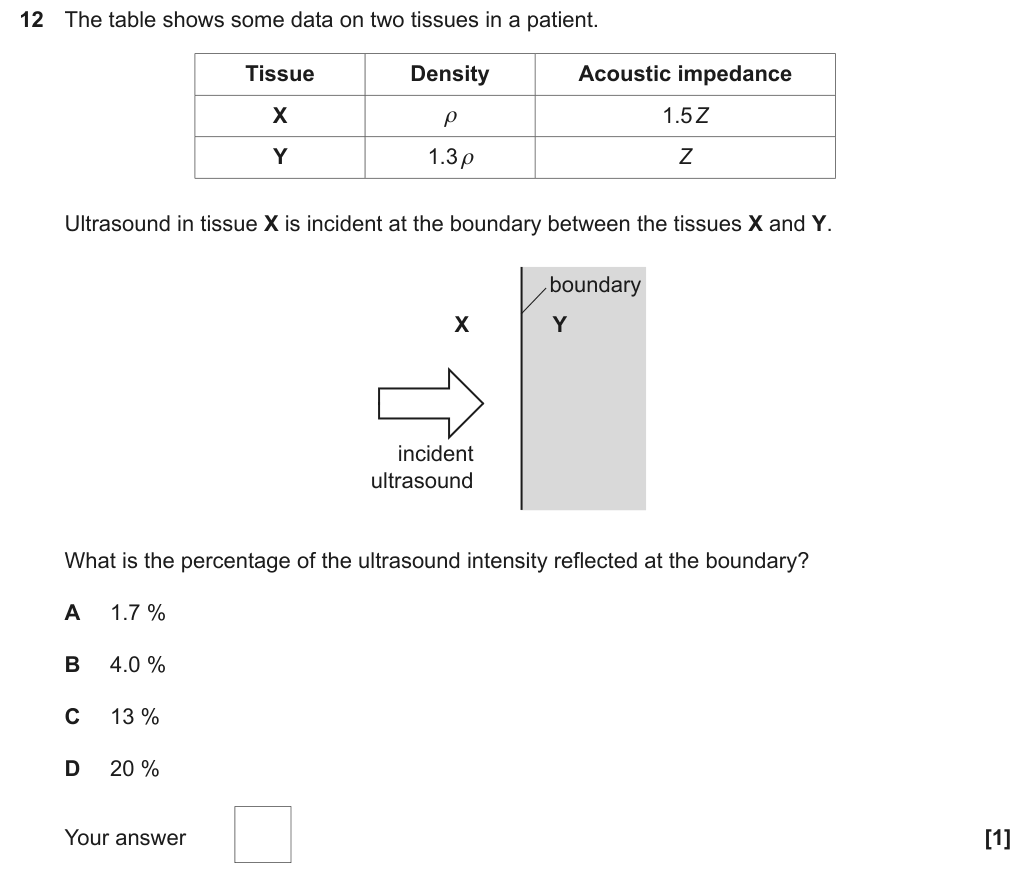
B
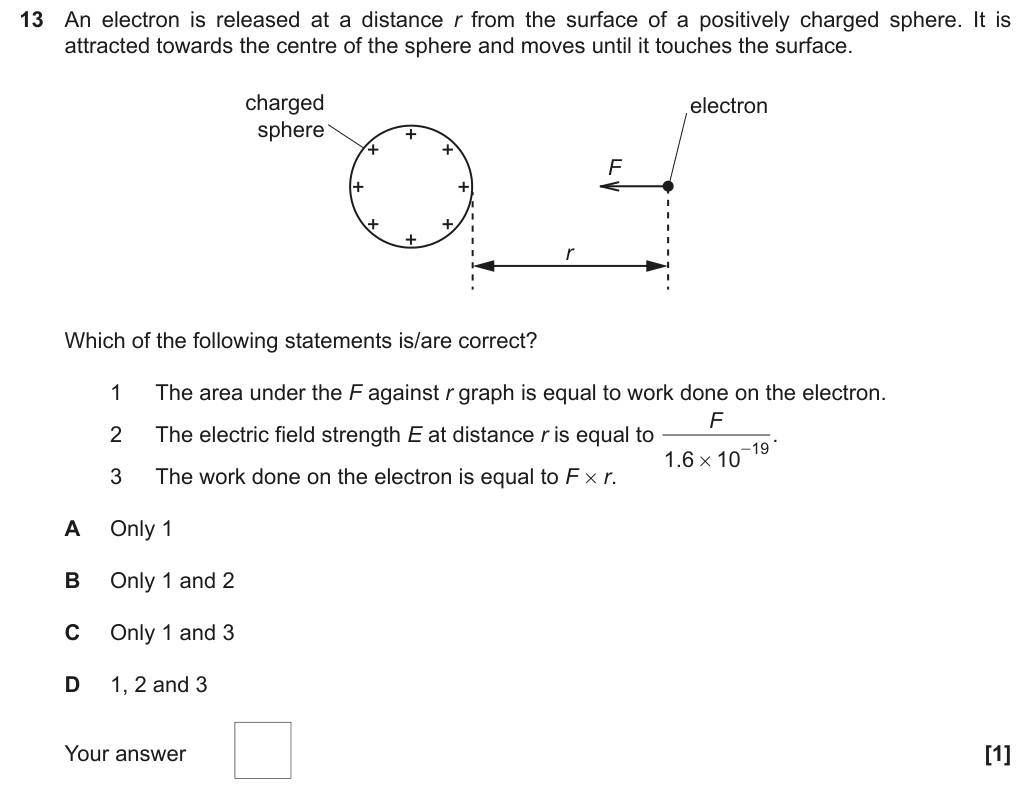
B
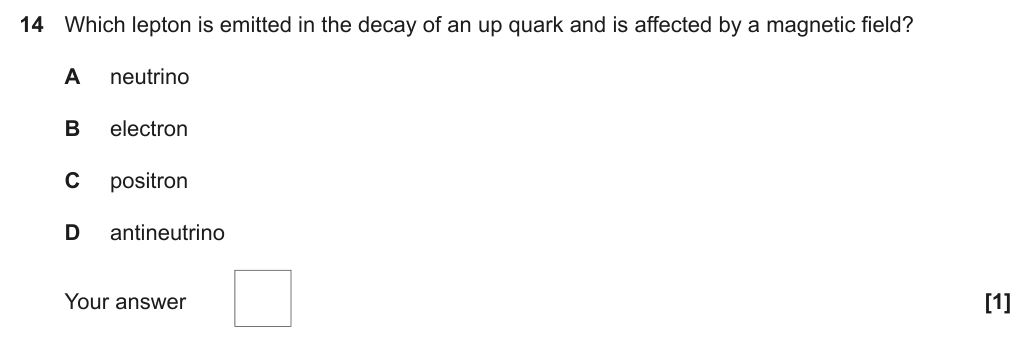
C
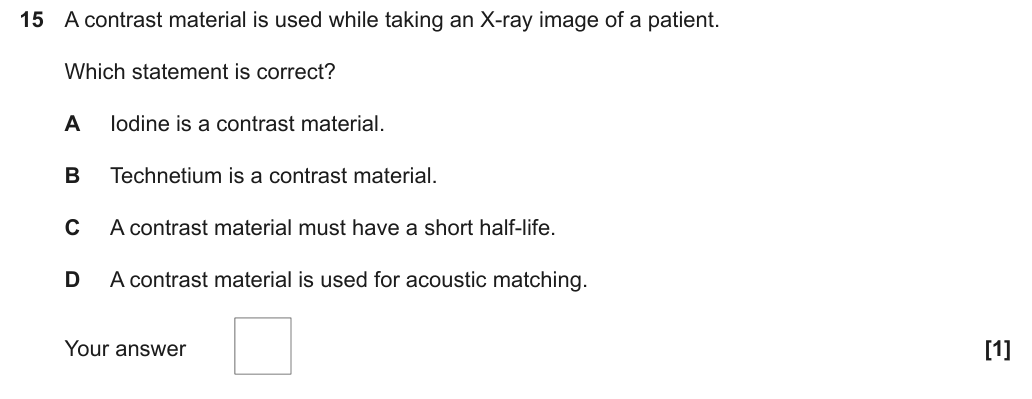
A
The majority of the candidates did get the correct answer A. A significant number of candidates opted for C, confusing contrast material with medical tracers.
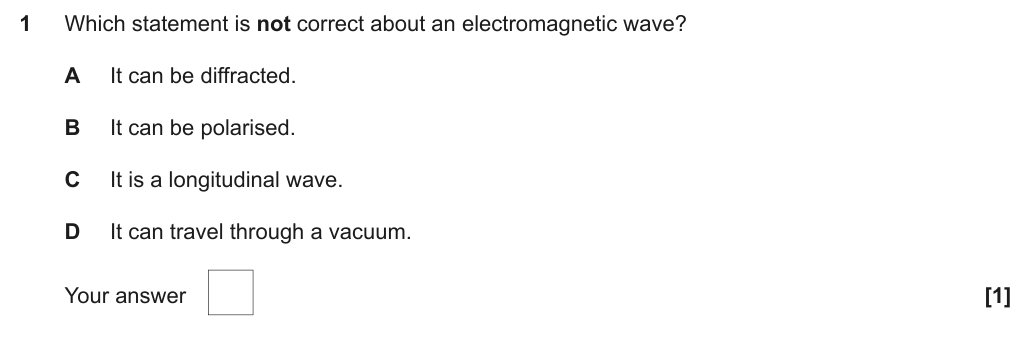
C
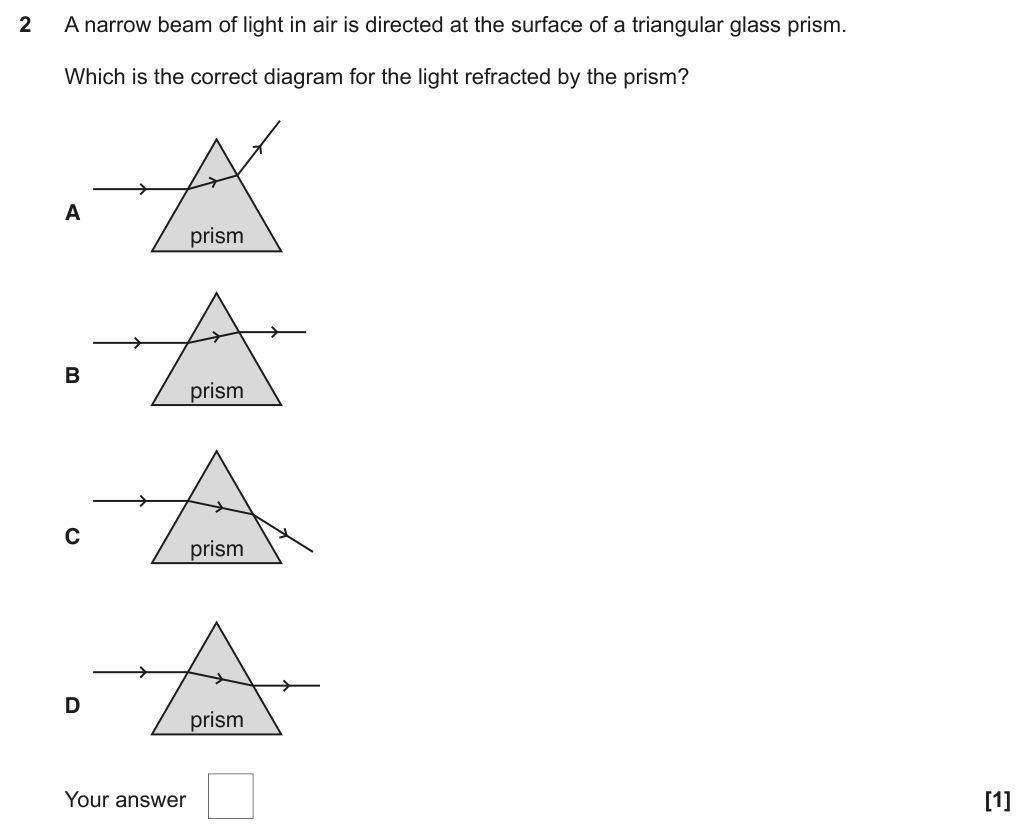
C
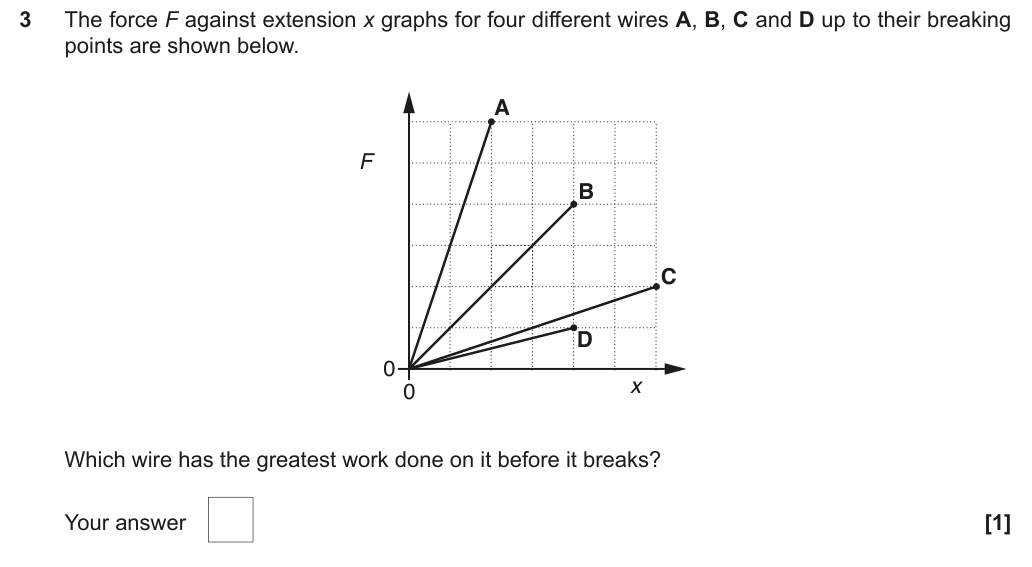
B
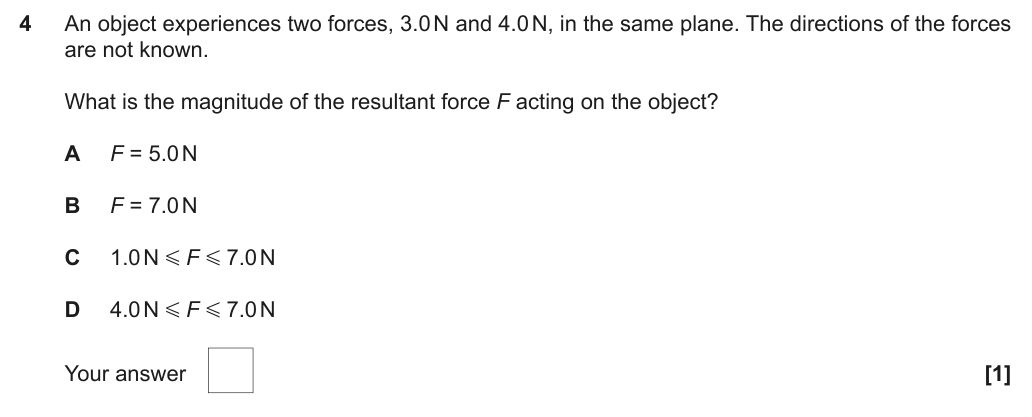
C
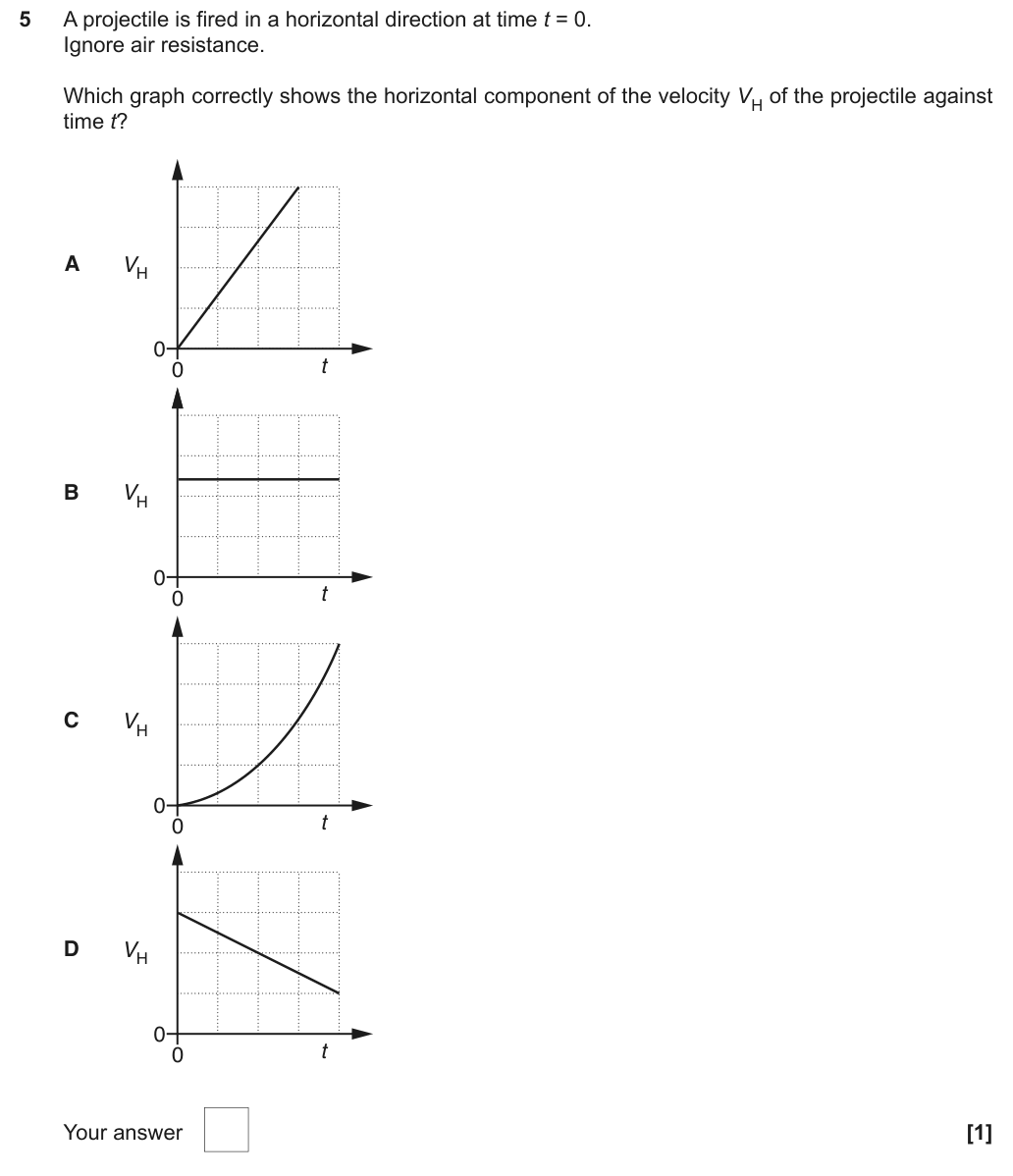
B
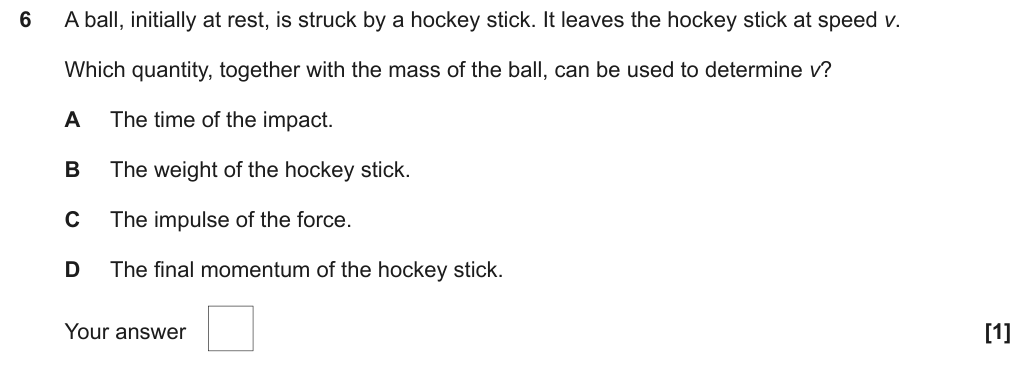
C
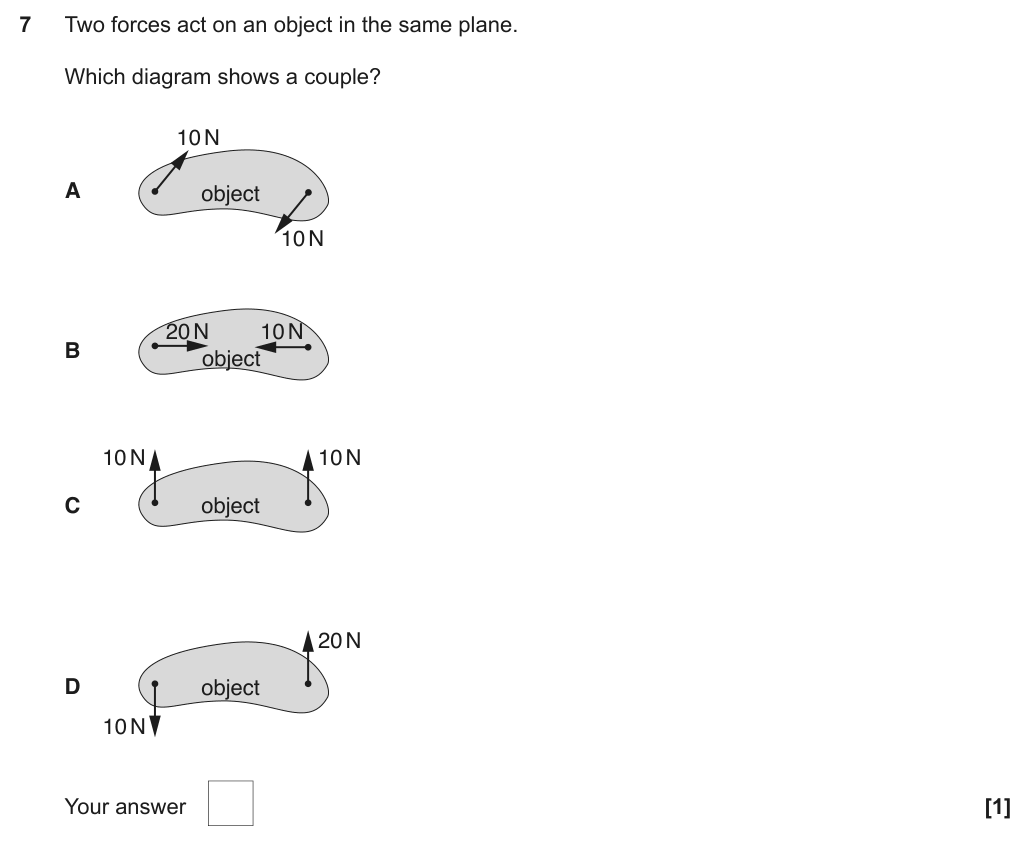
A
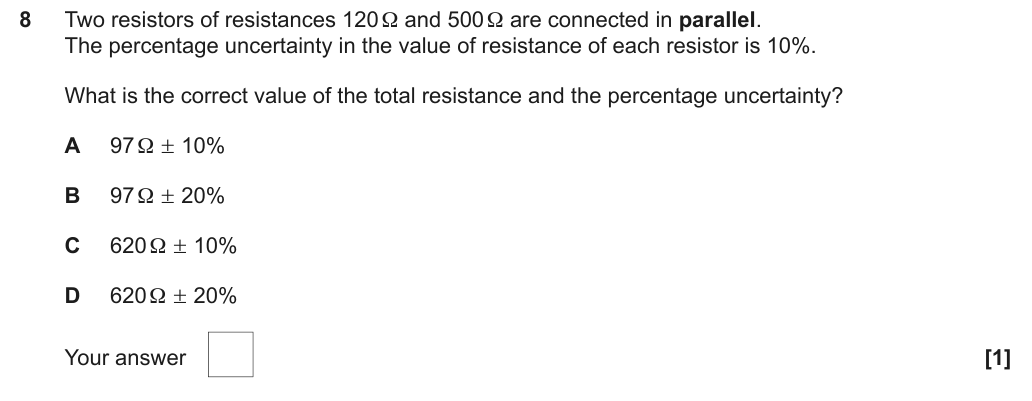
A
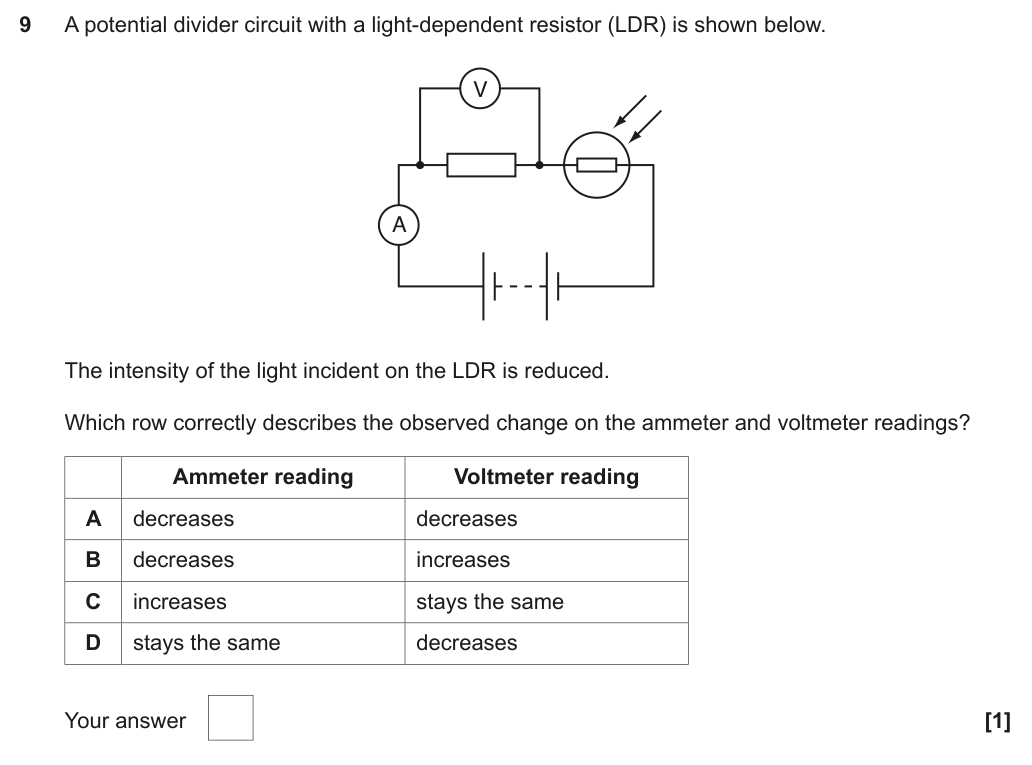
A
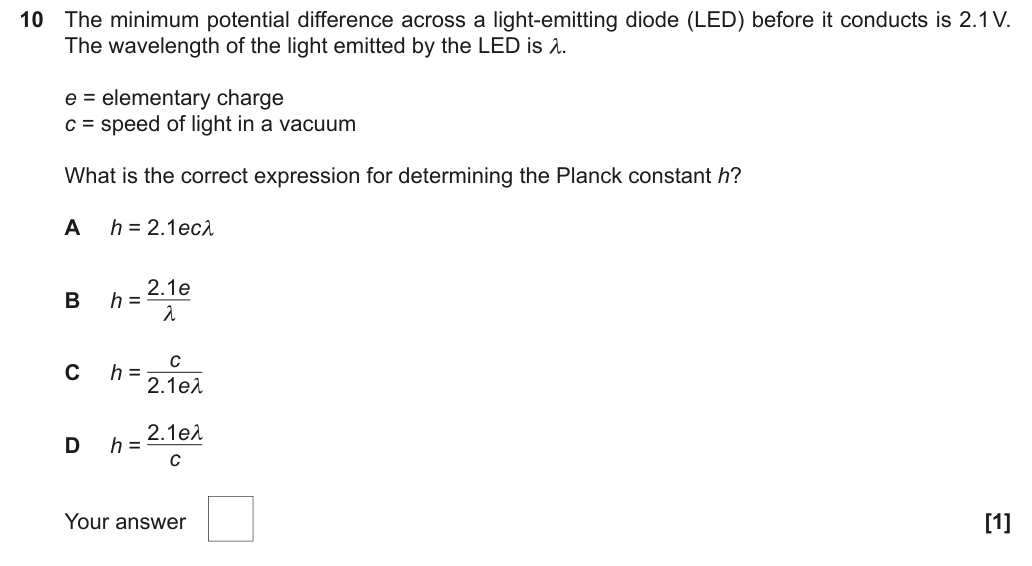
D
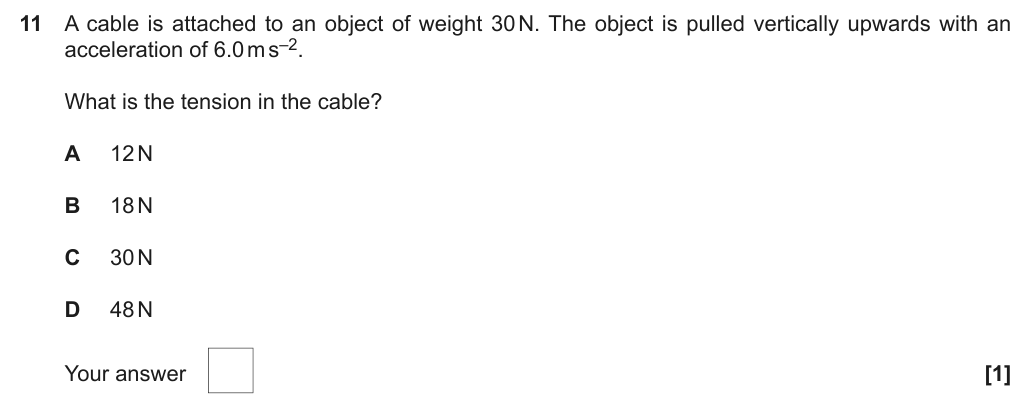
D
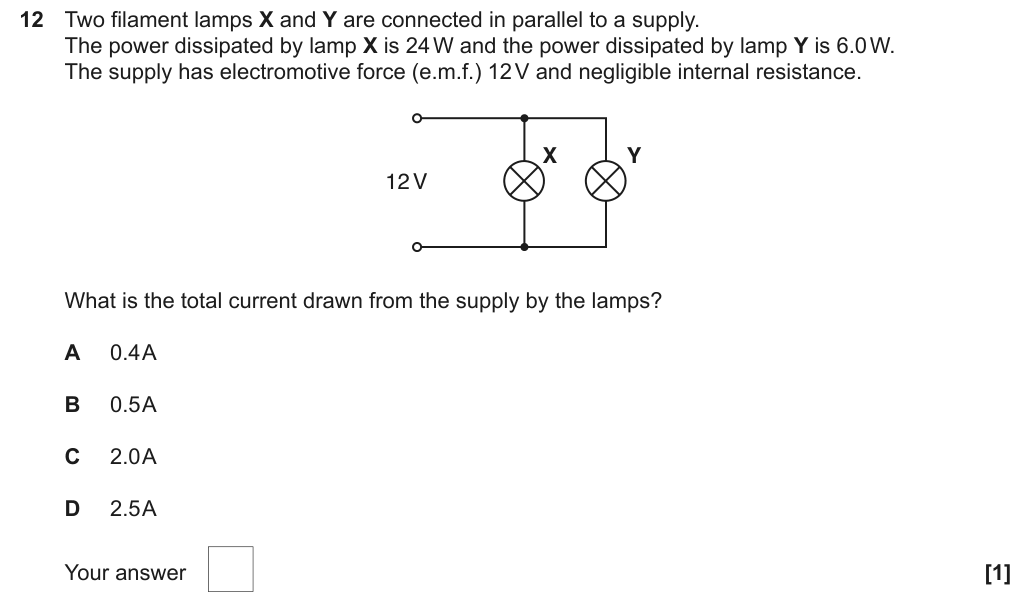
D
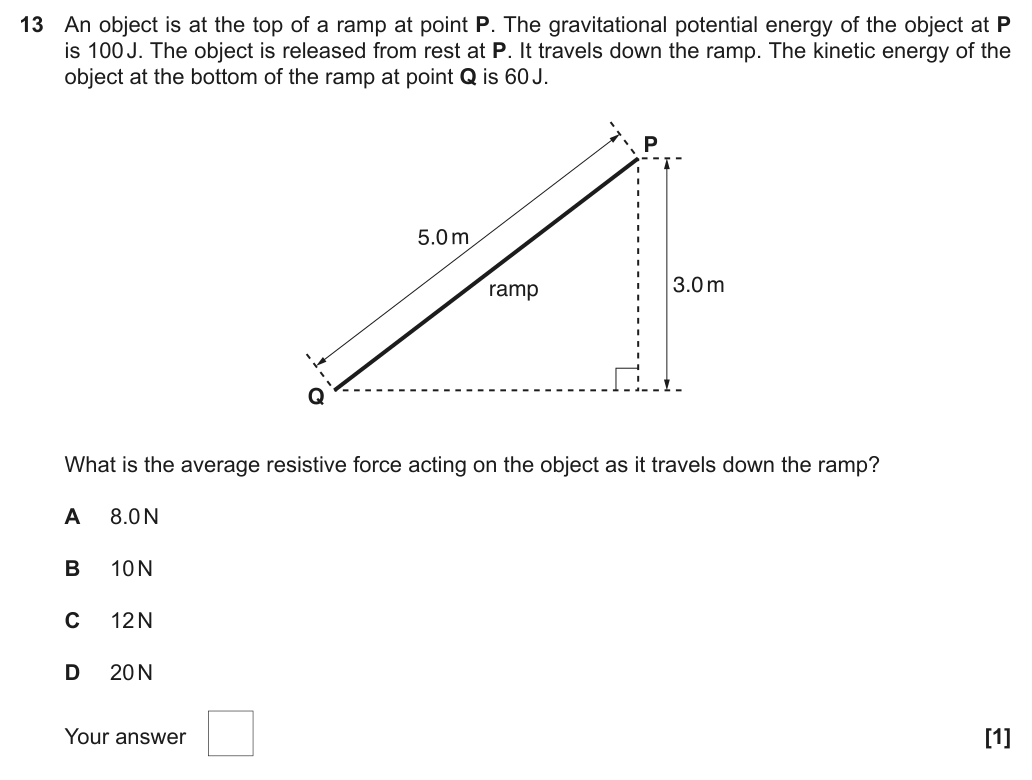
A
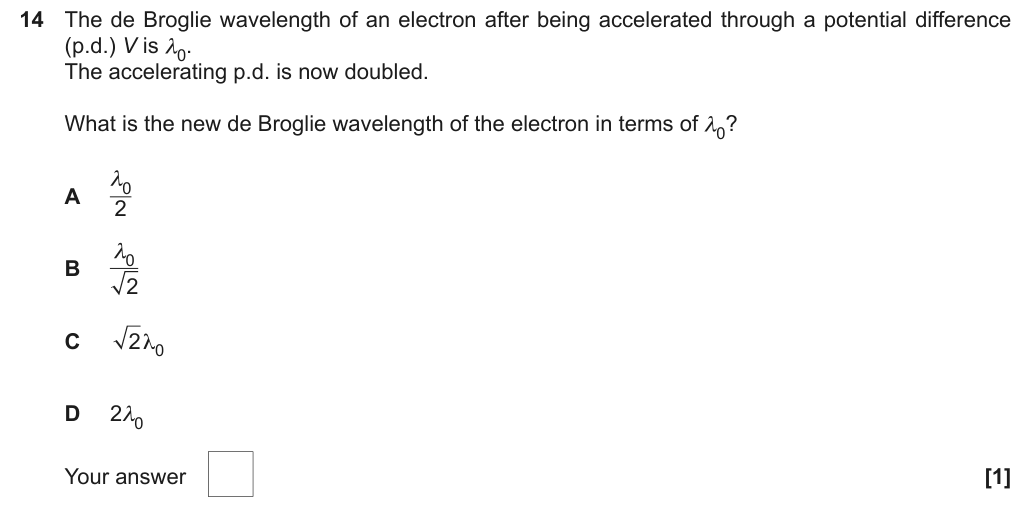
B
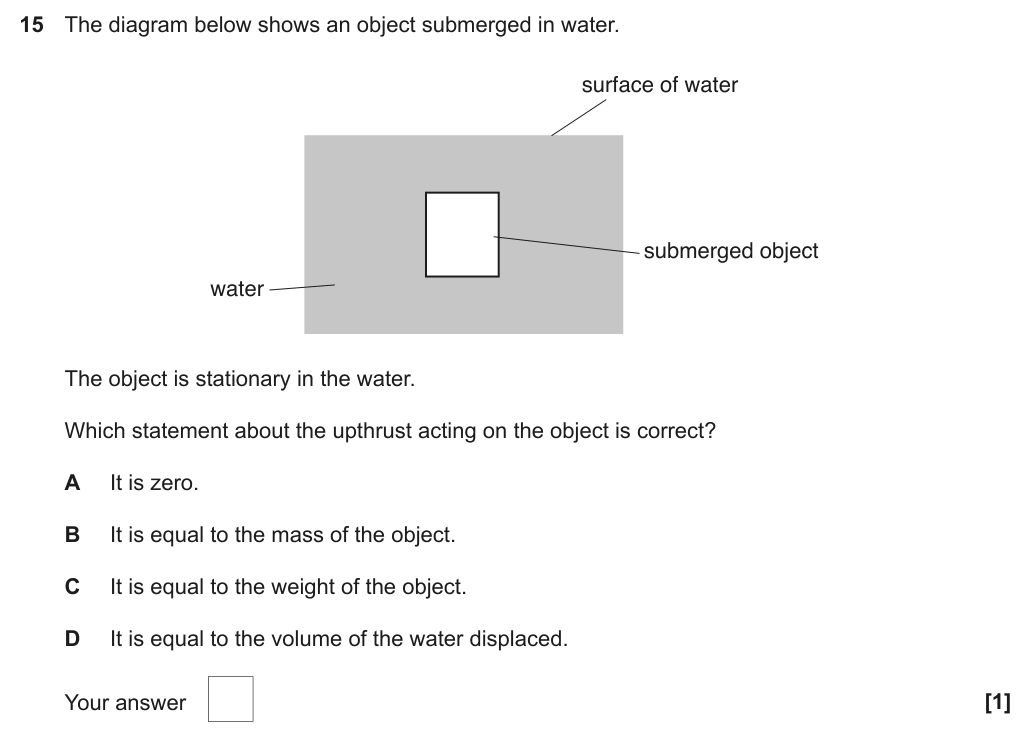
C
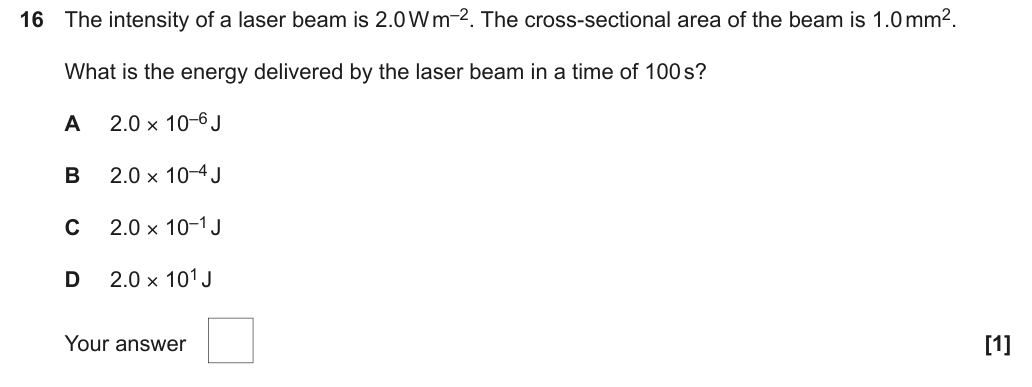
B
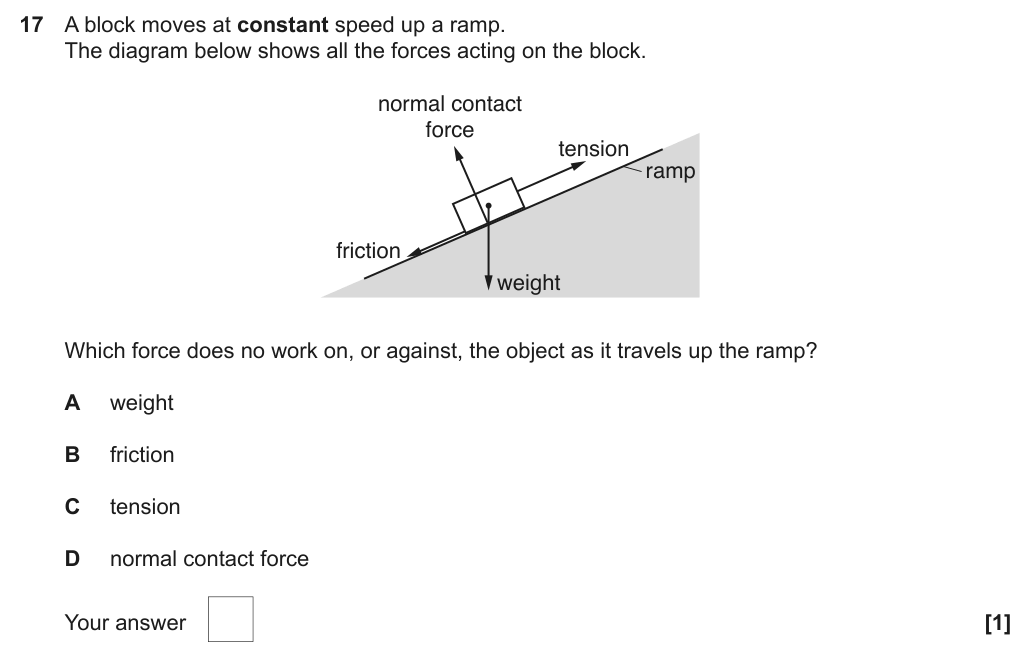
D
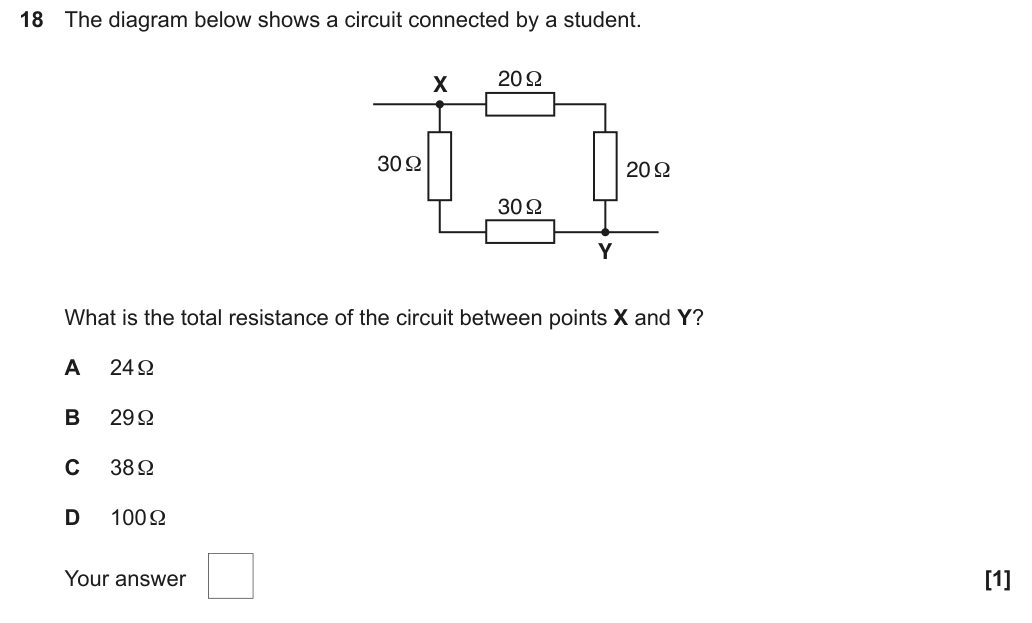
A
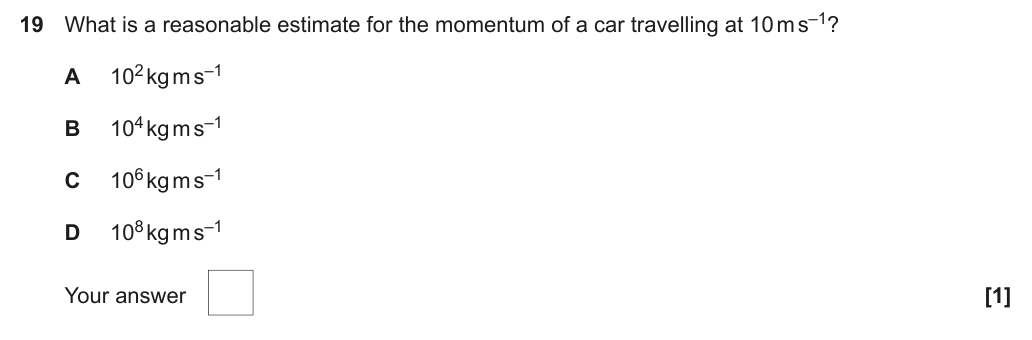
B
D
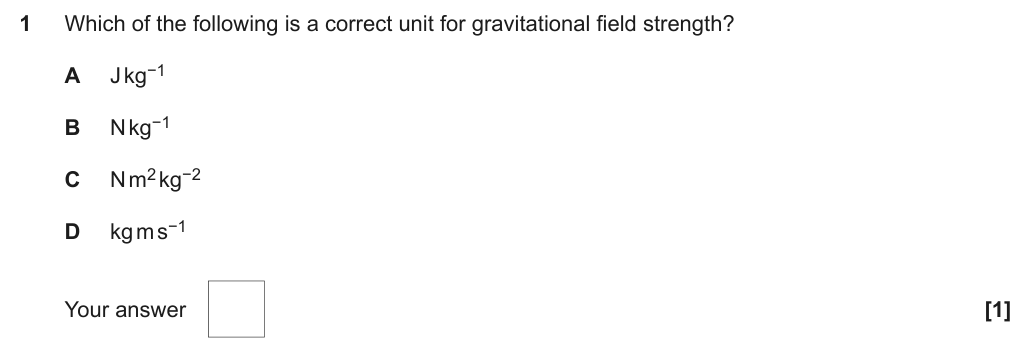
B
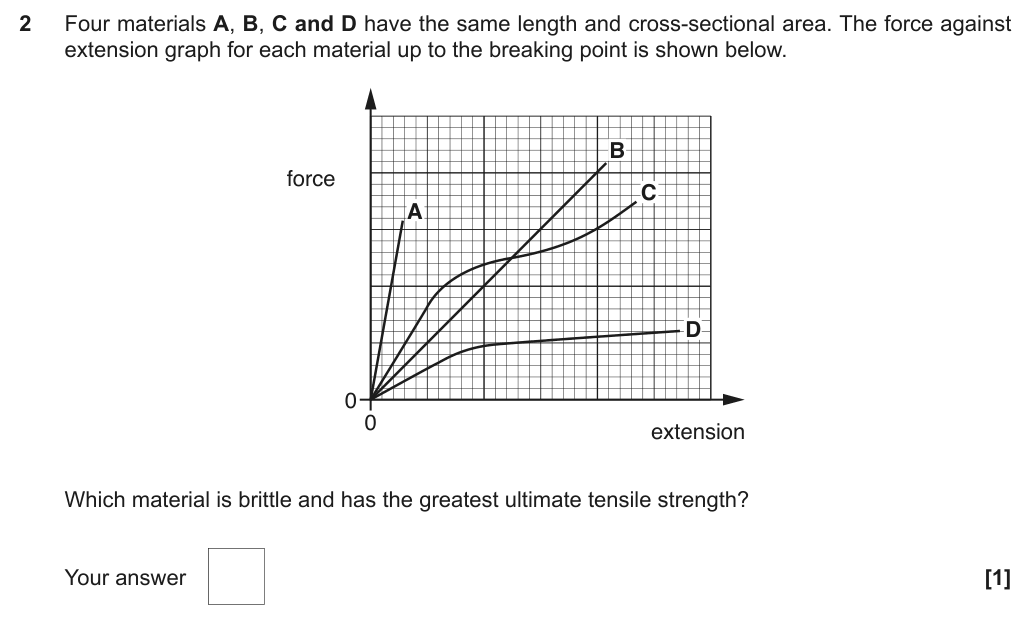
B
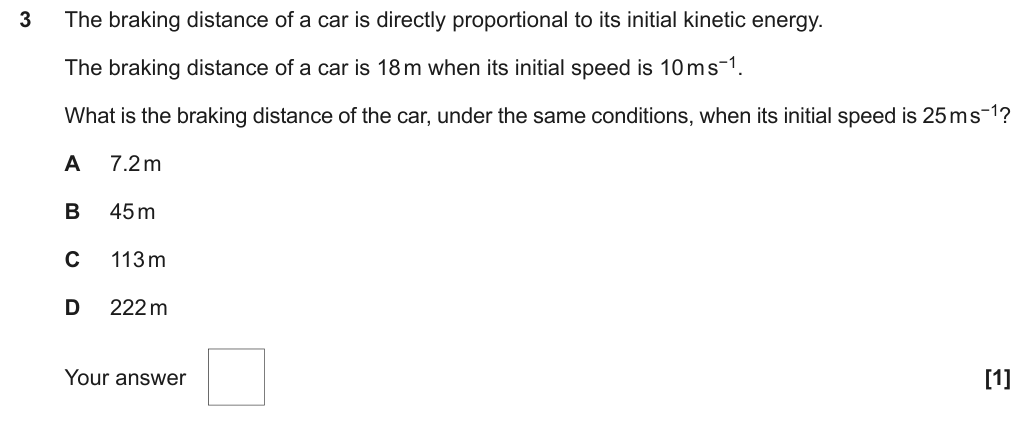
C
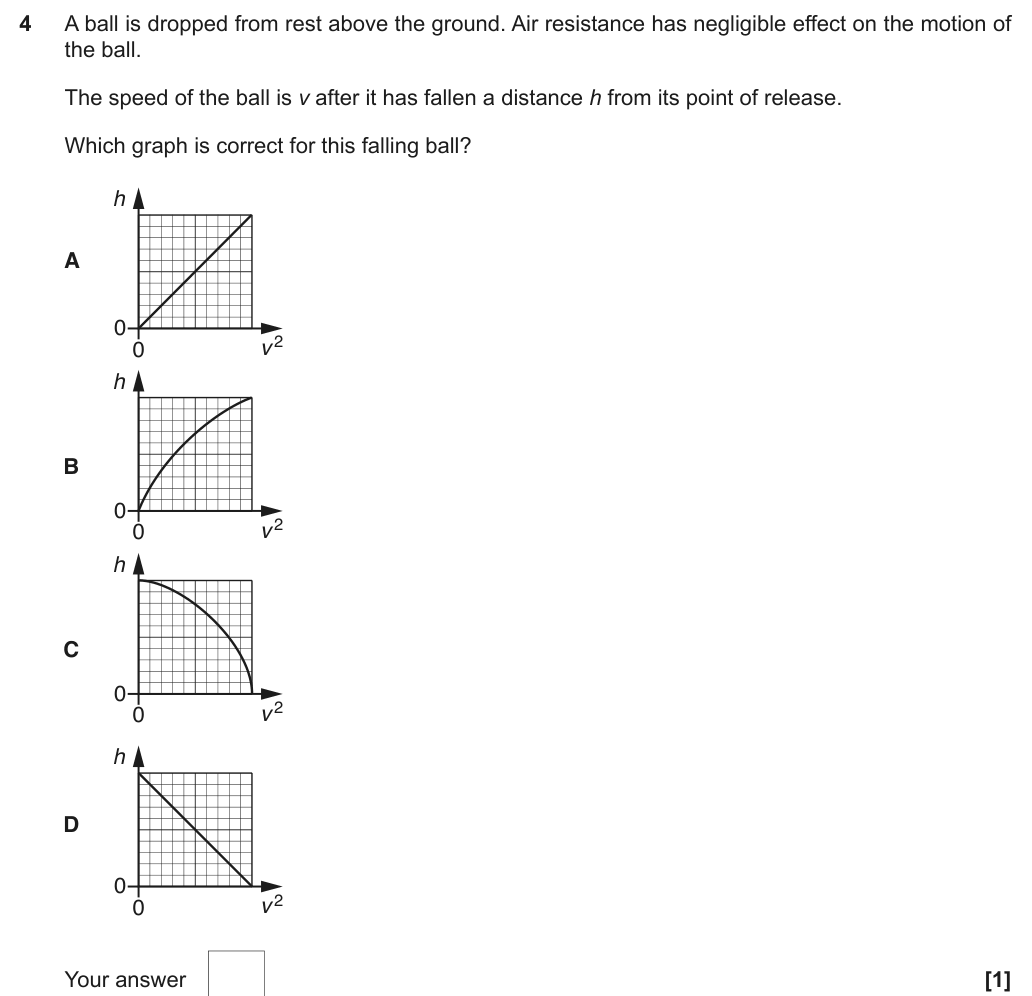
A
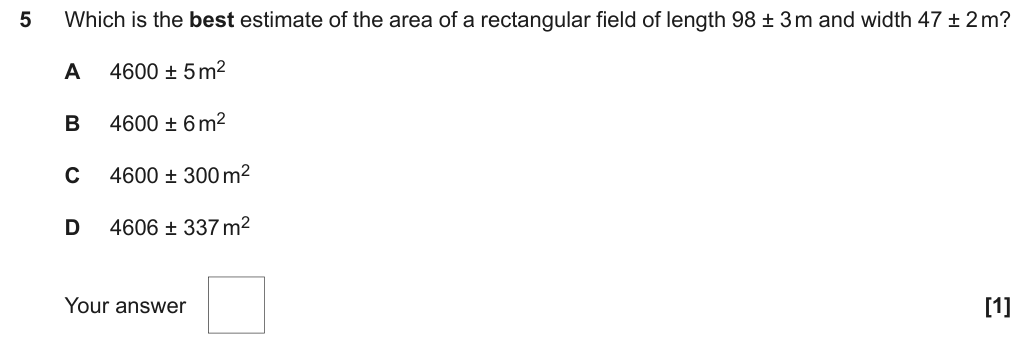
C
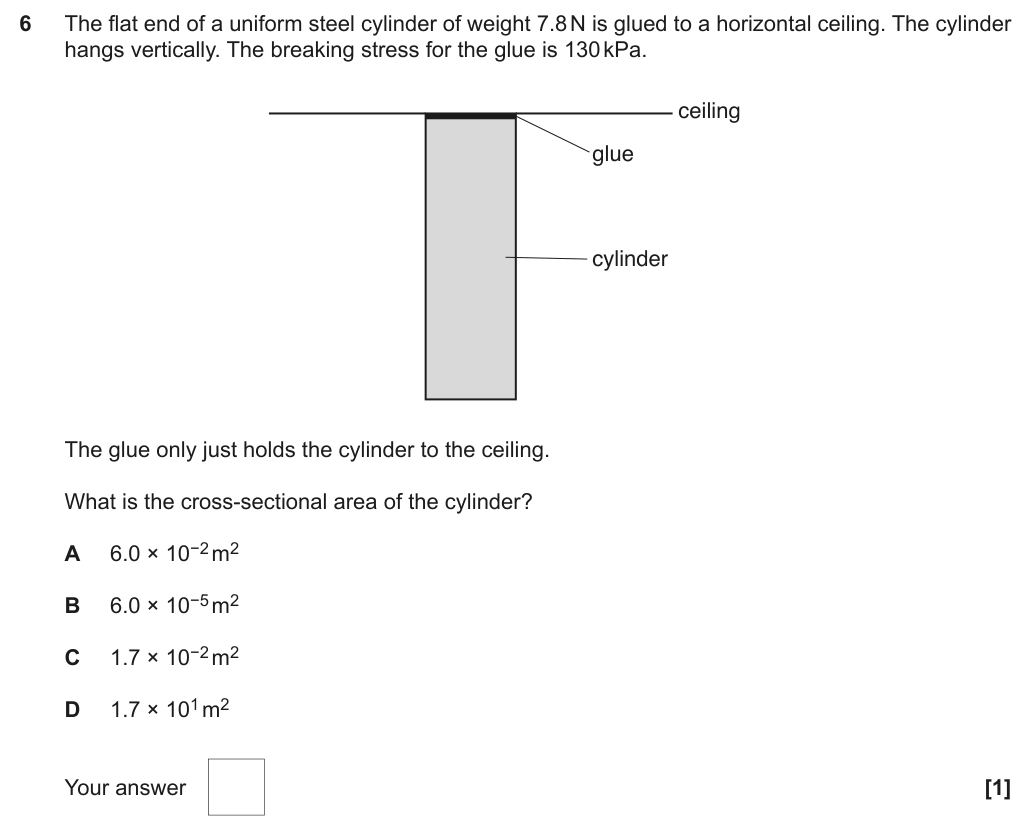
B
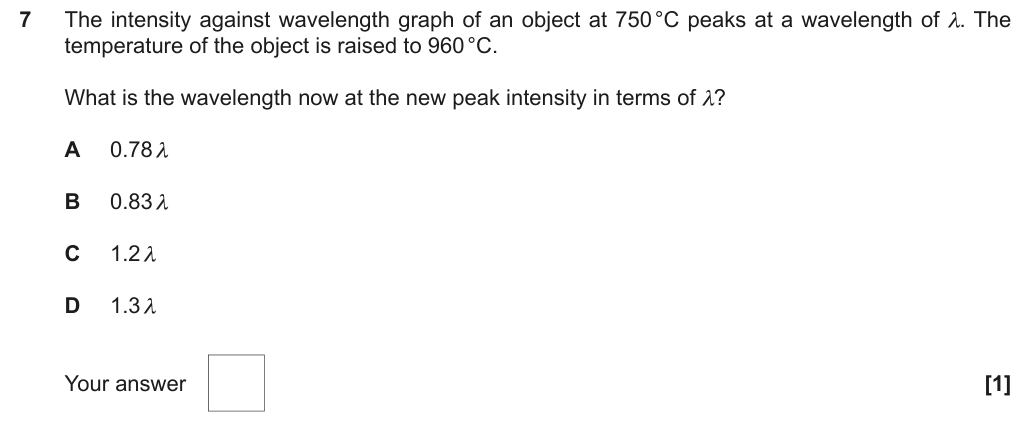
B
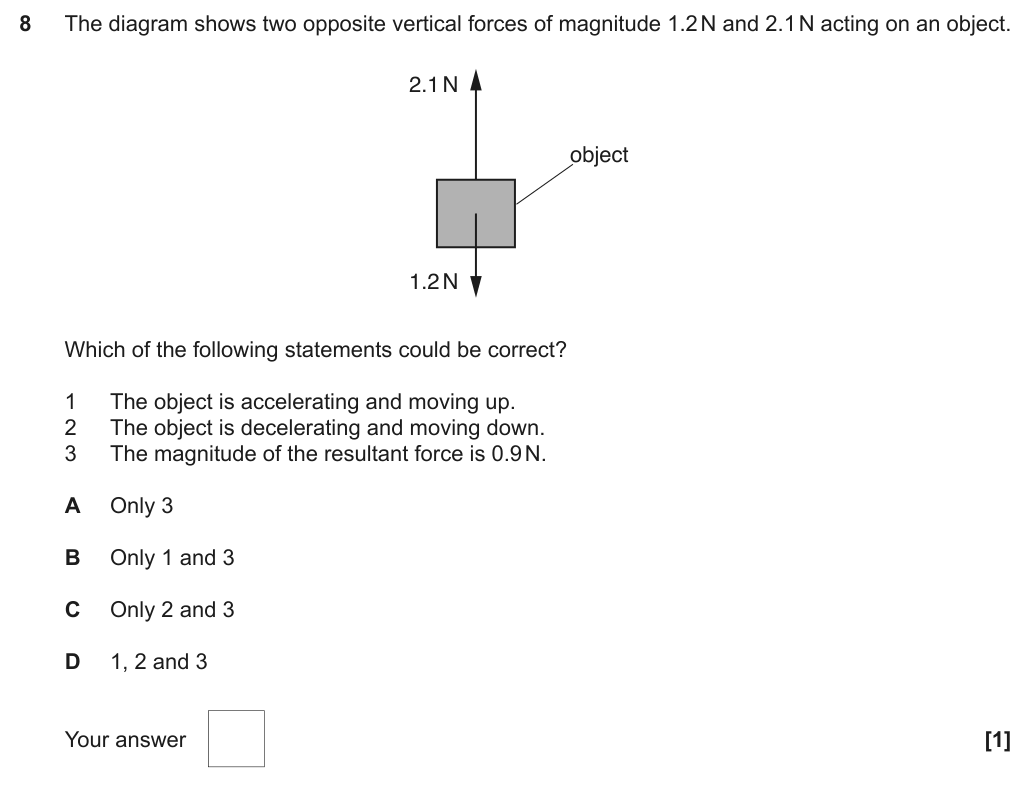
D
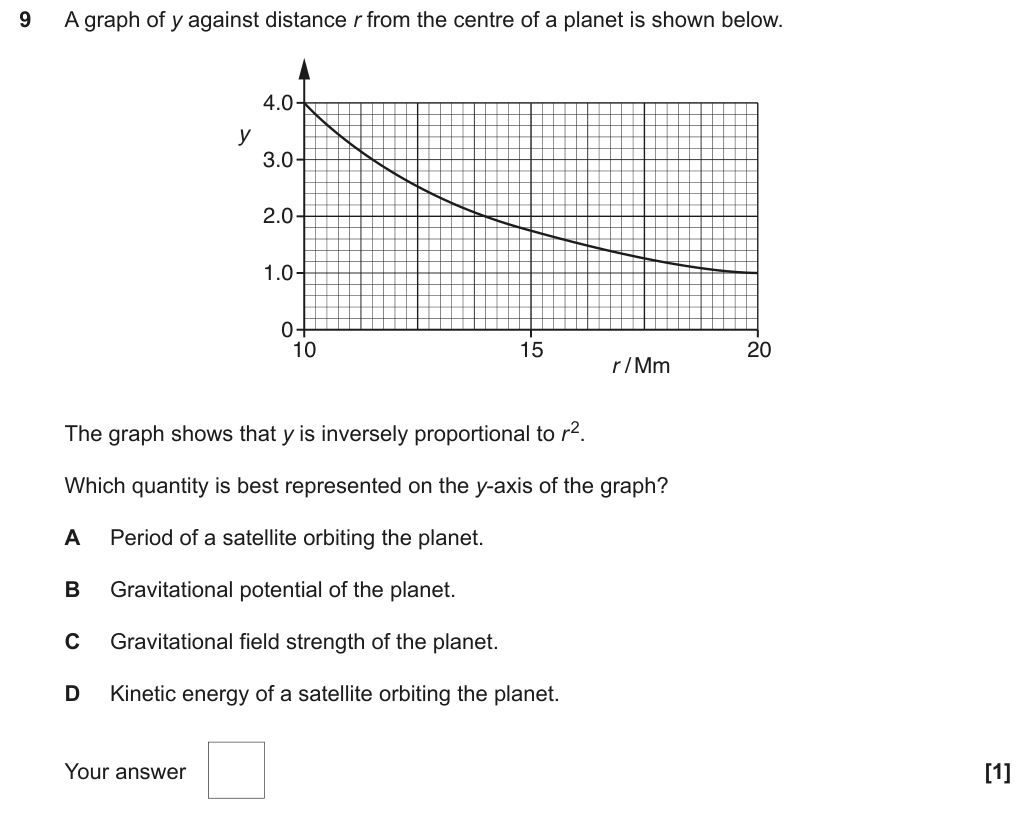
C
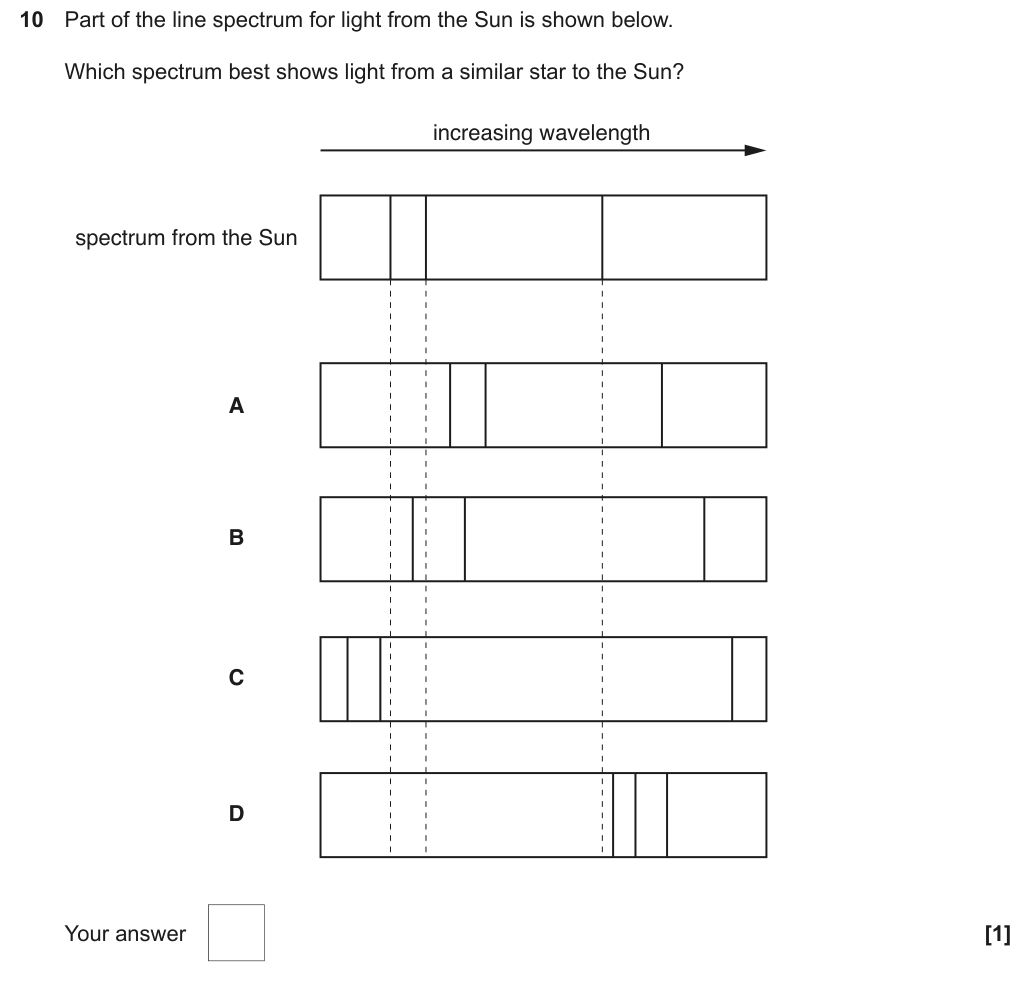
B
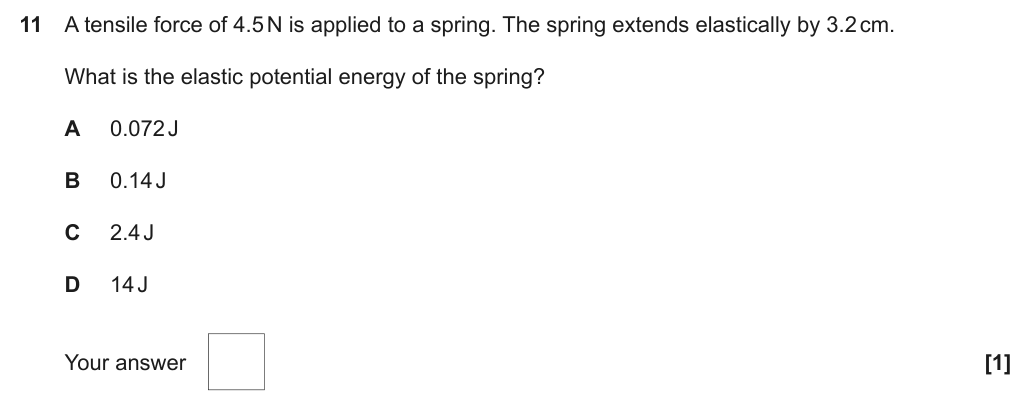
A
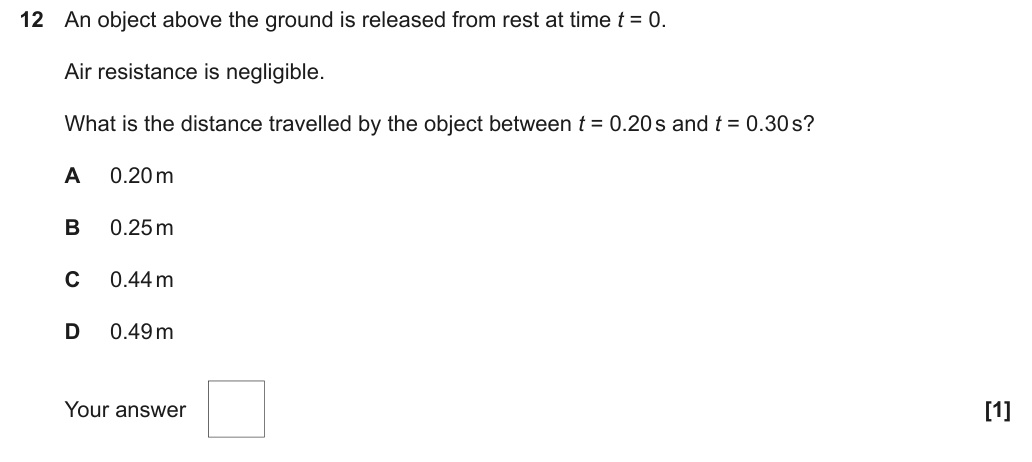
B
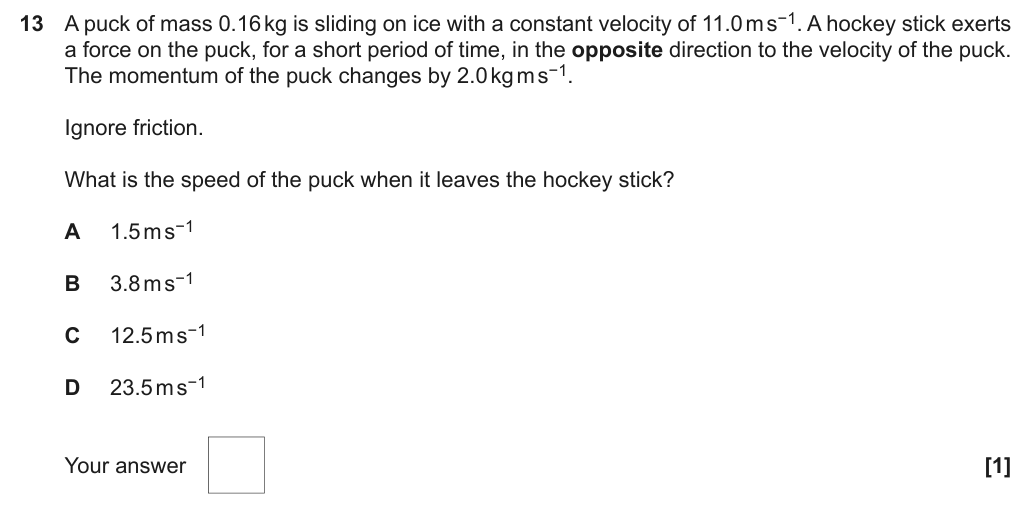
A
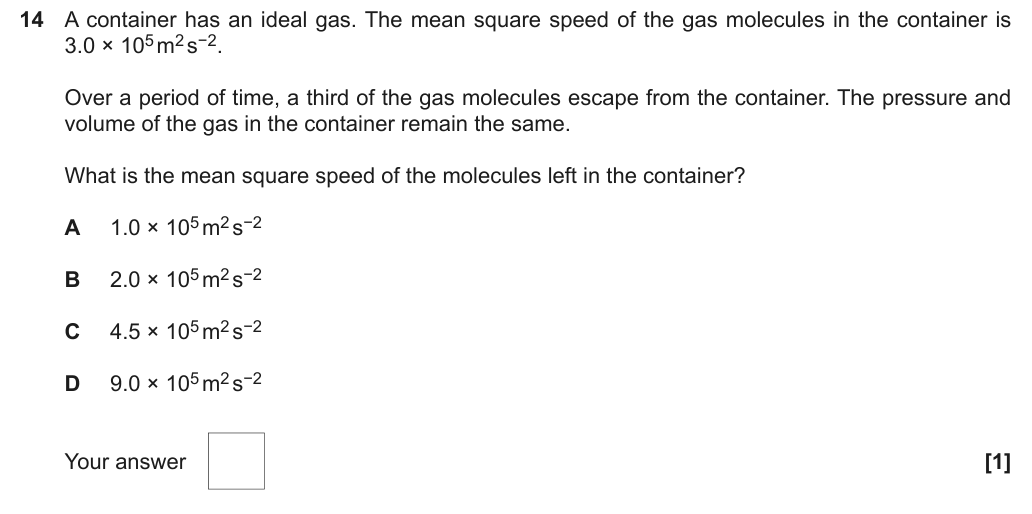
C
C
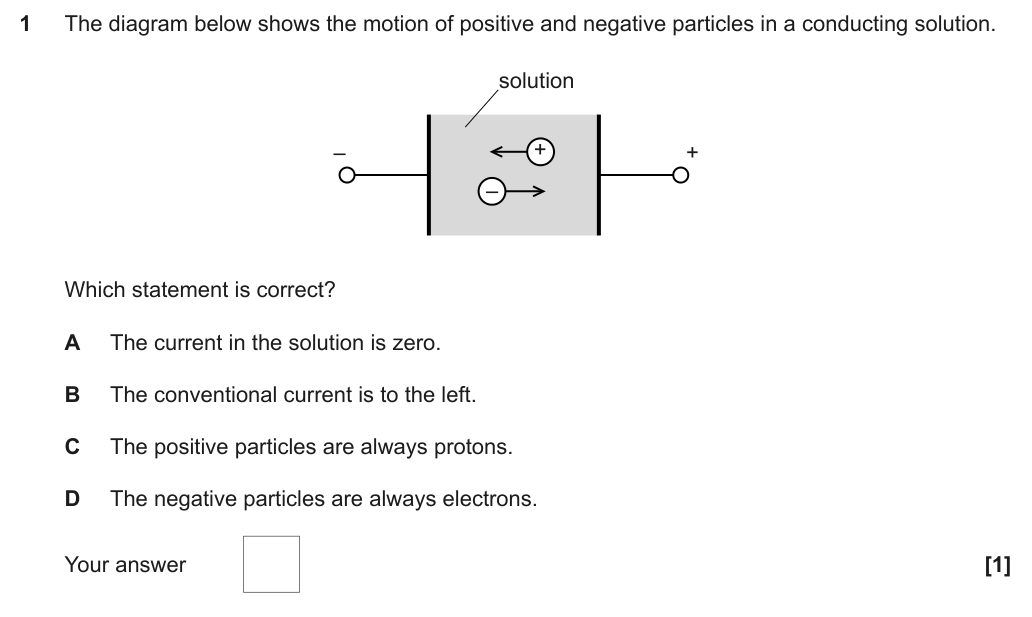
B
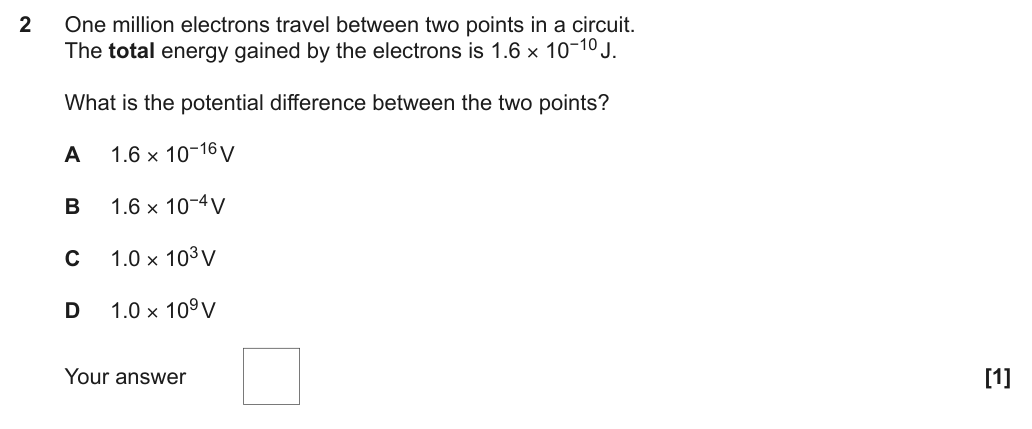
C
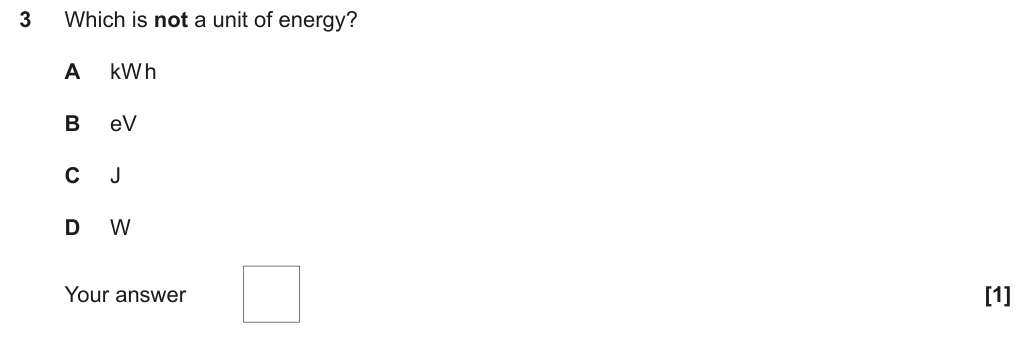
D
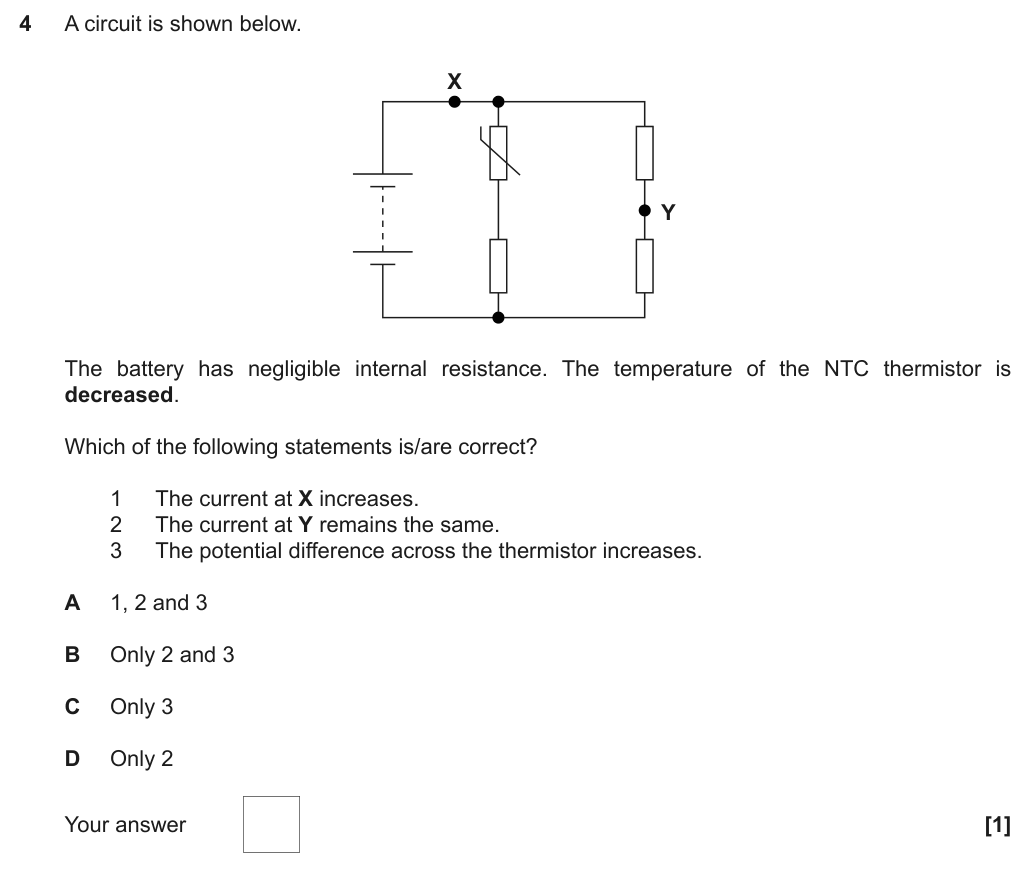
B
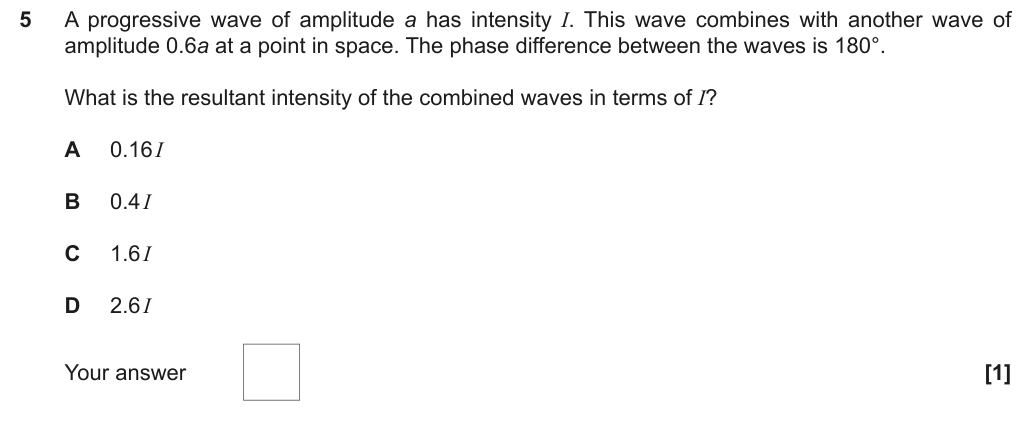
A
C
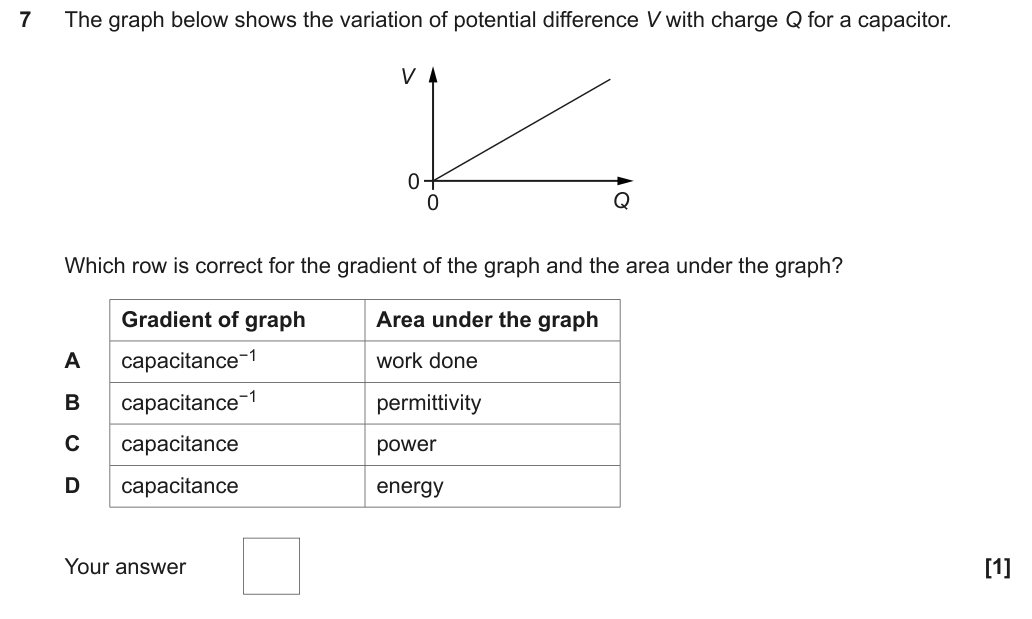
A
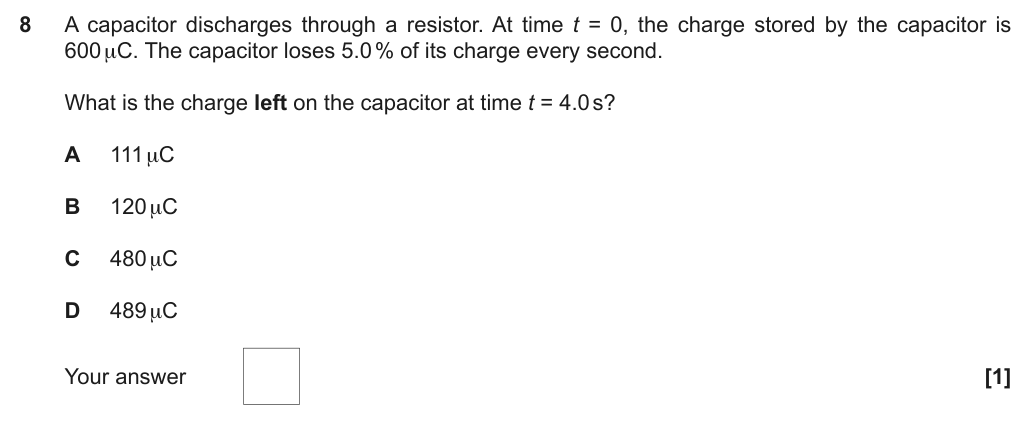
D
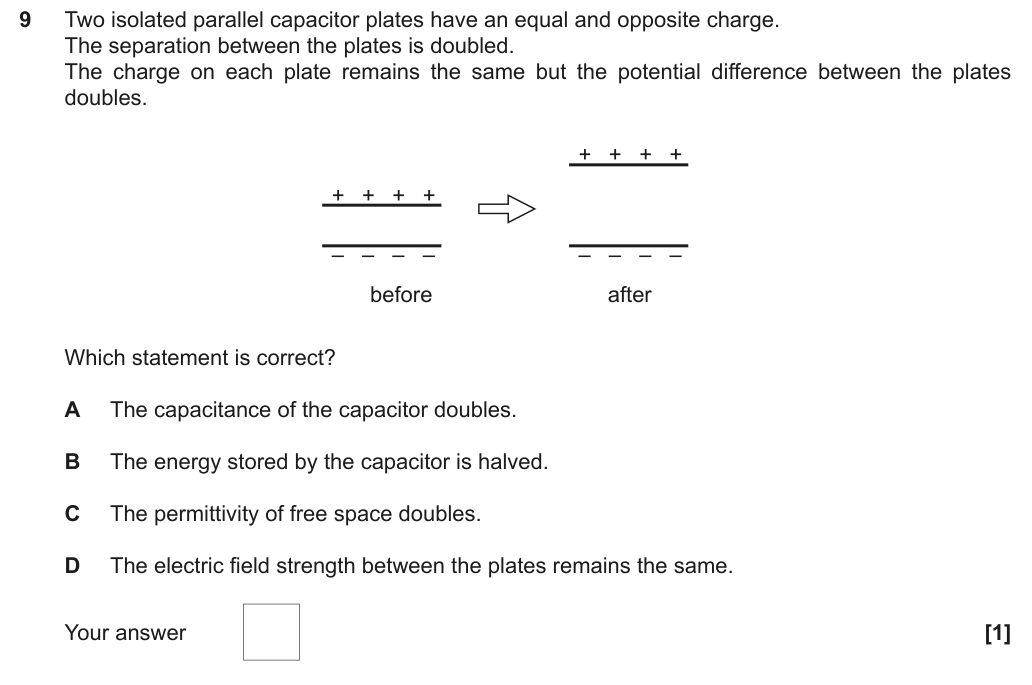
D
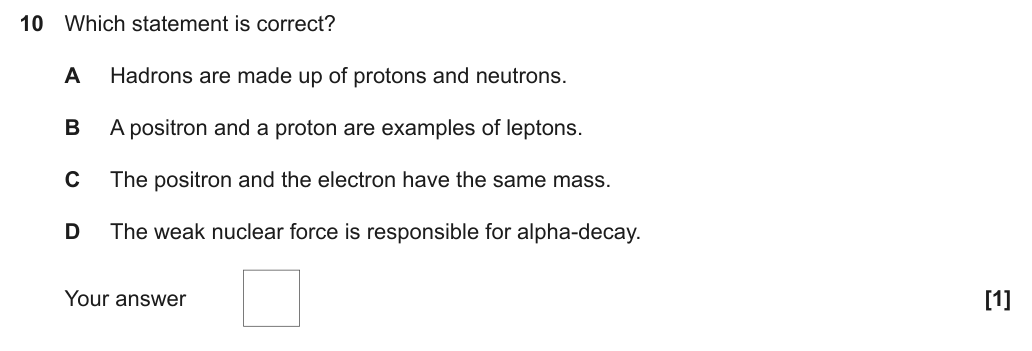
C
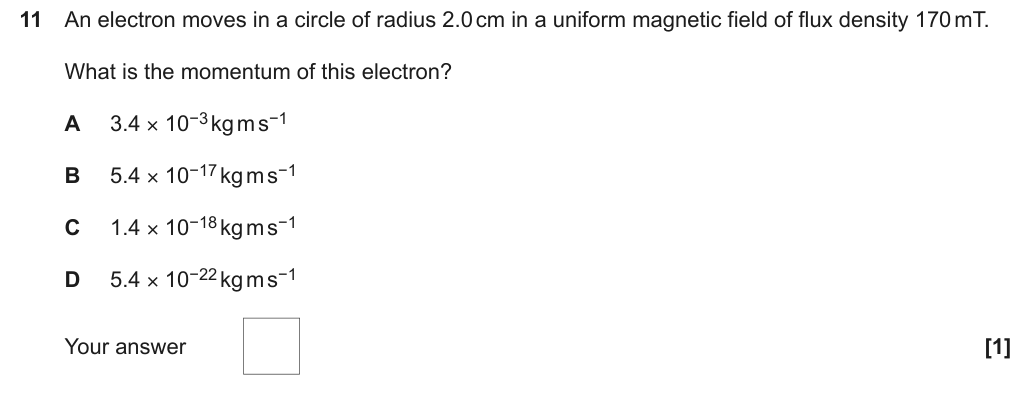
D
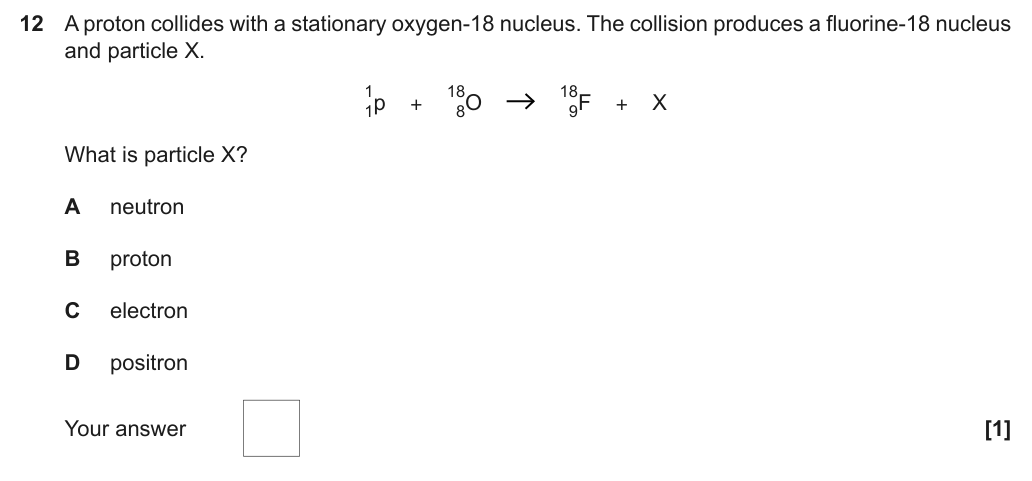
A
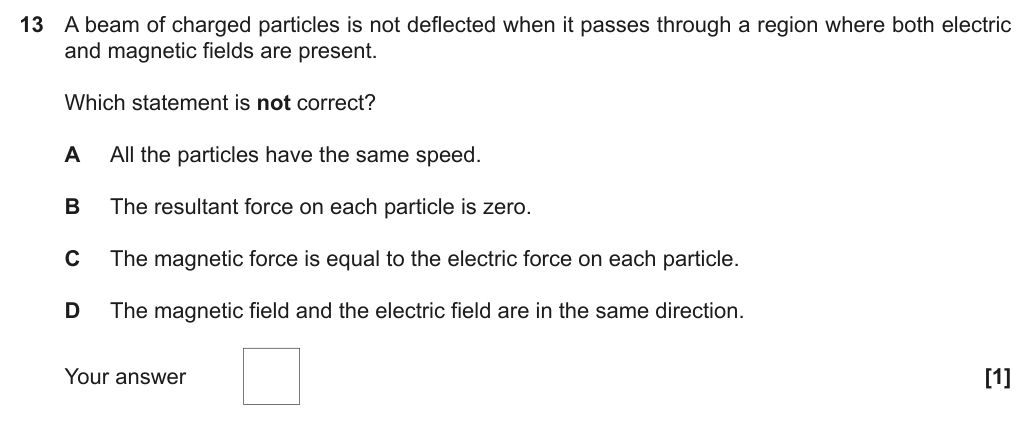
D
B
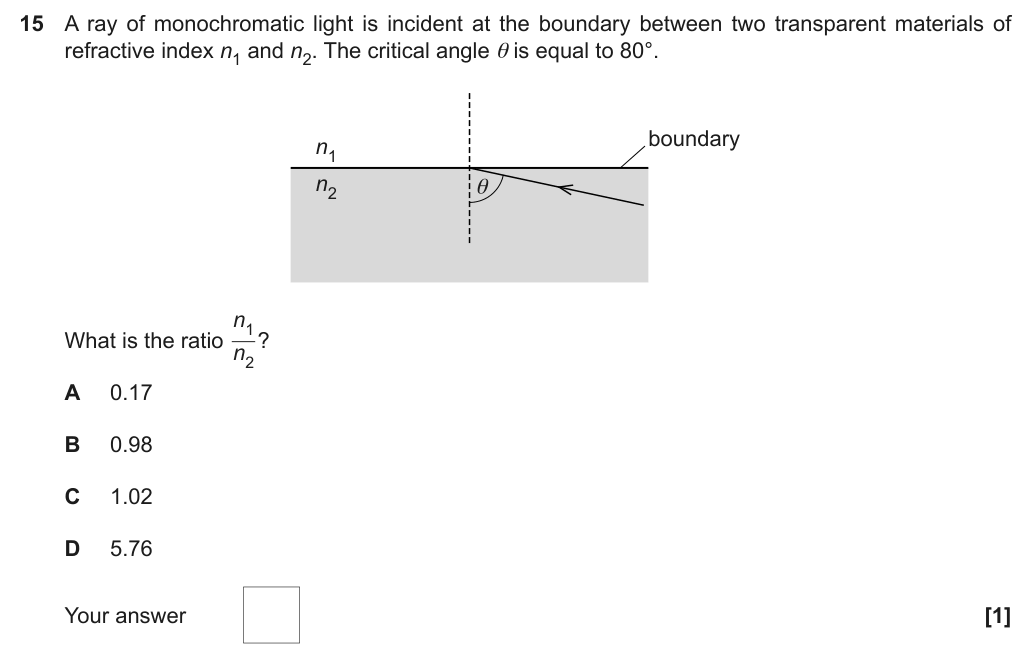
B
C
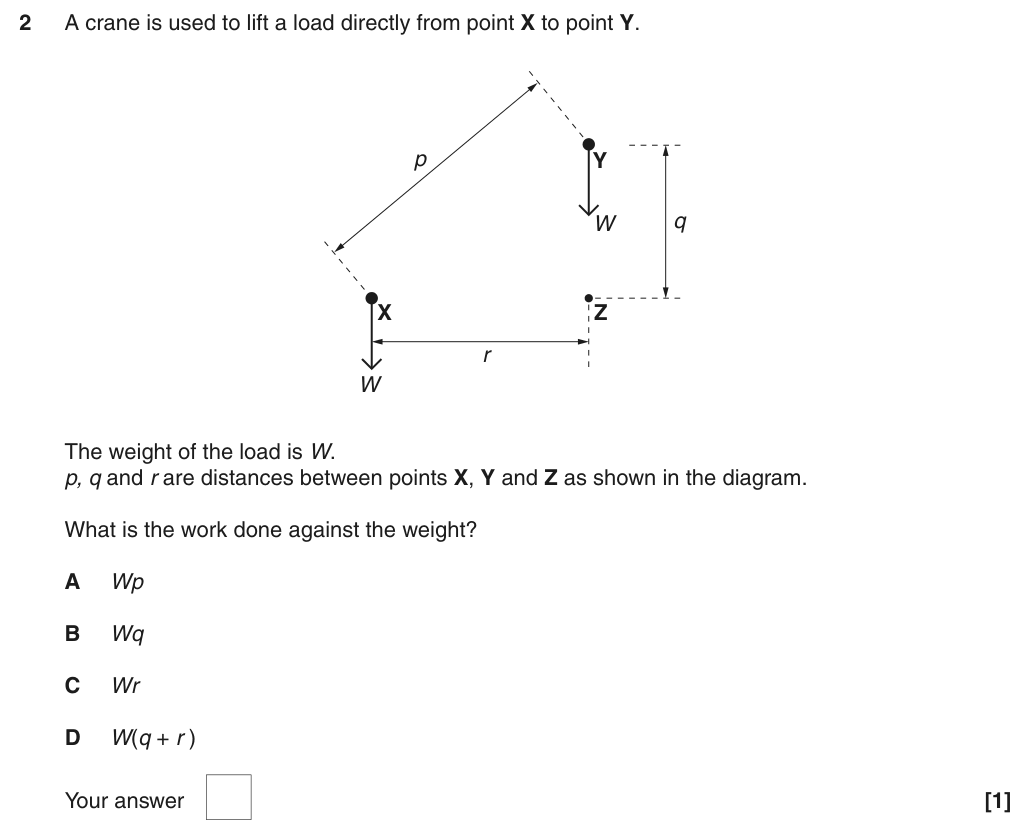
B
C
D
B
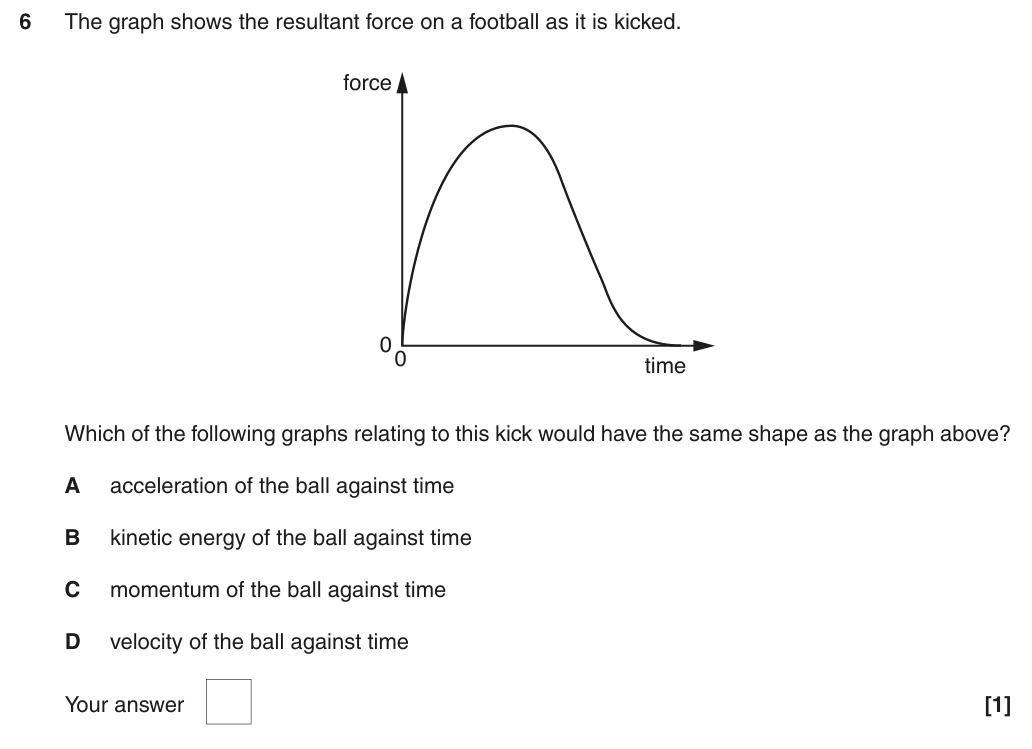
A
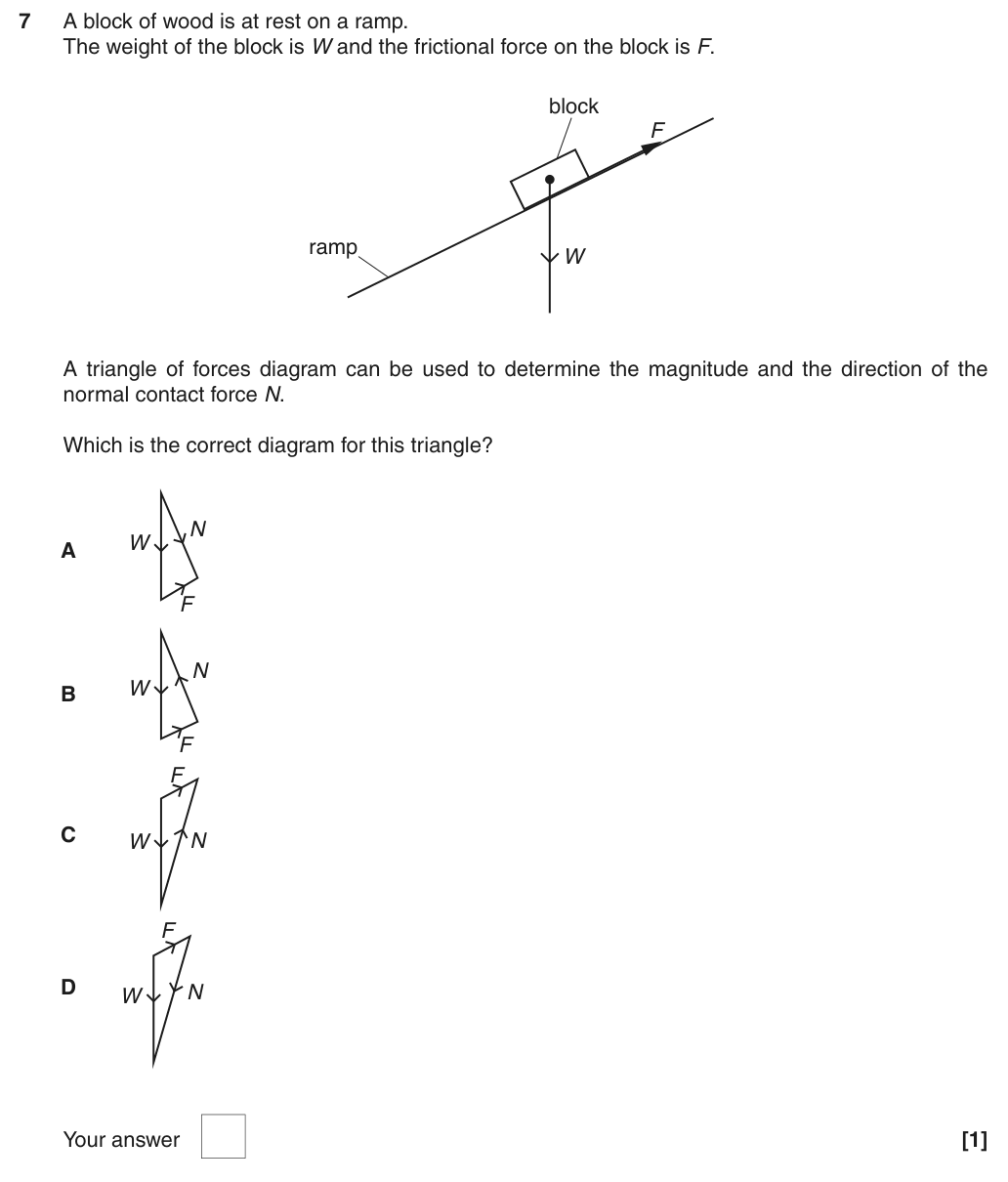
B
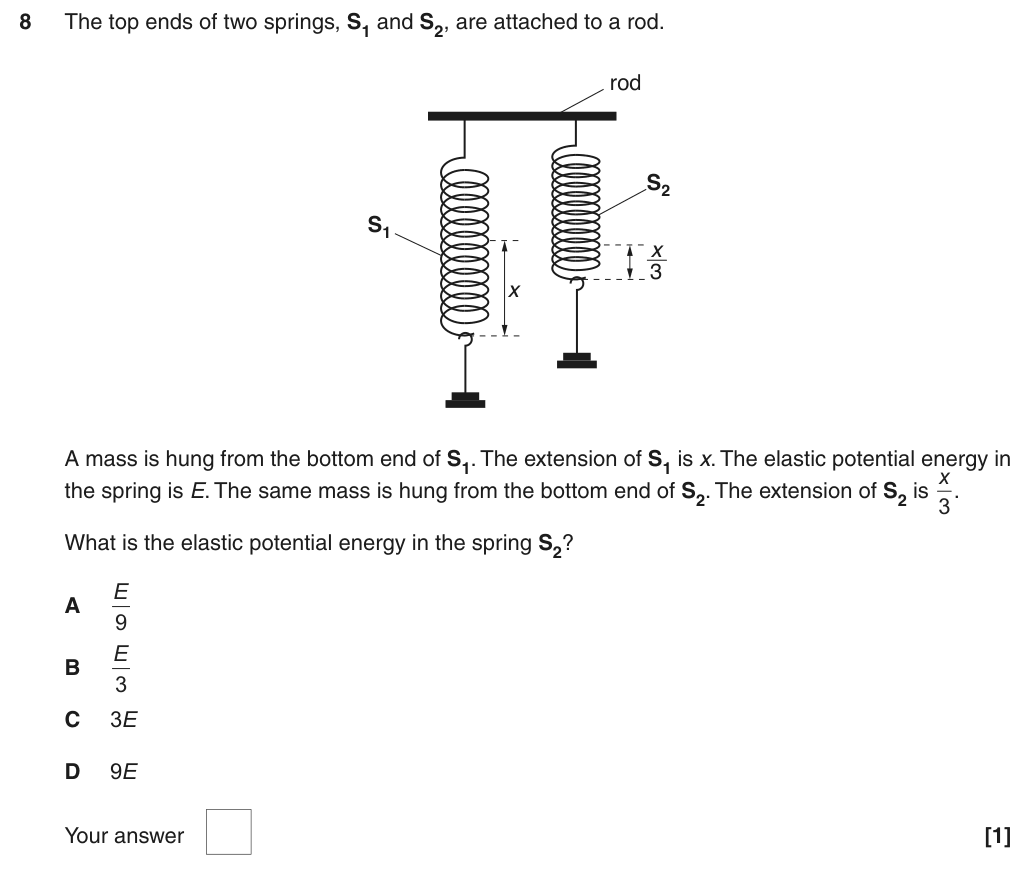
B
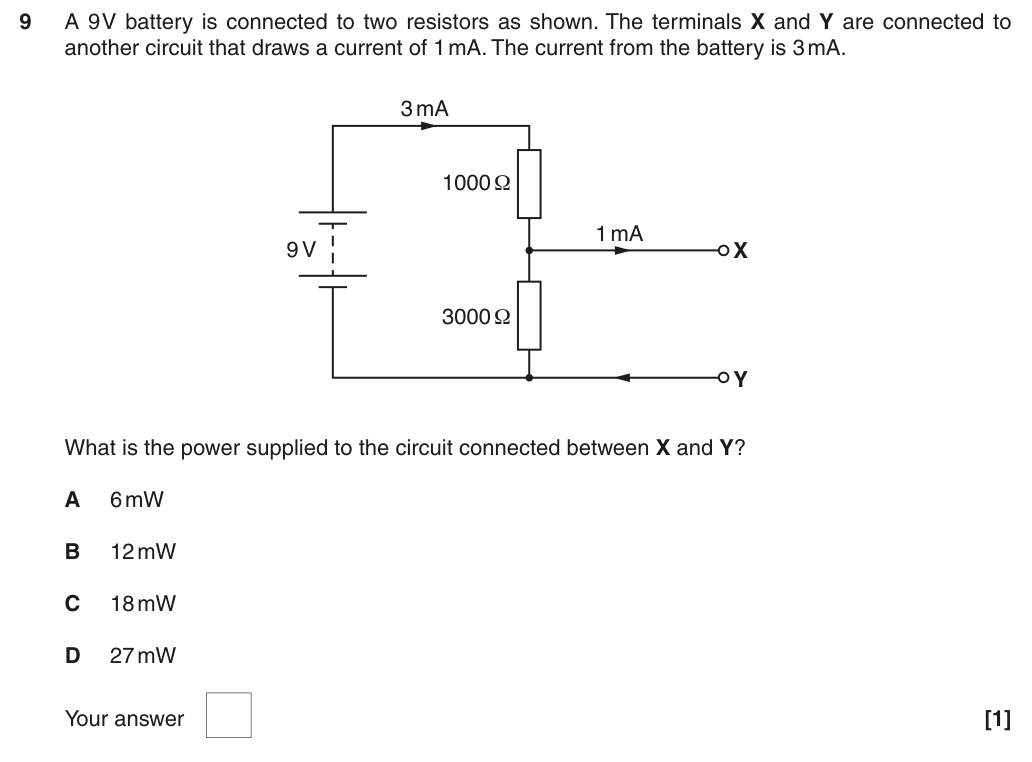
A
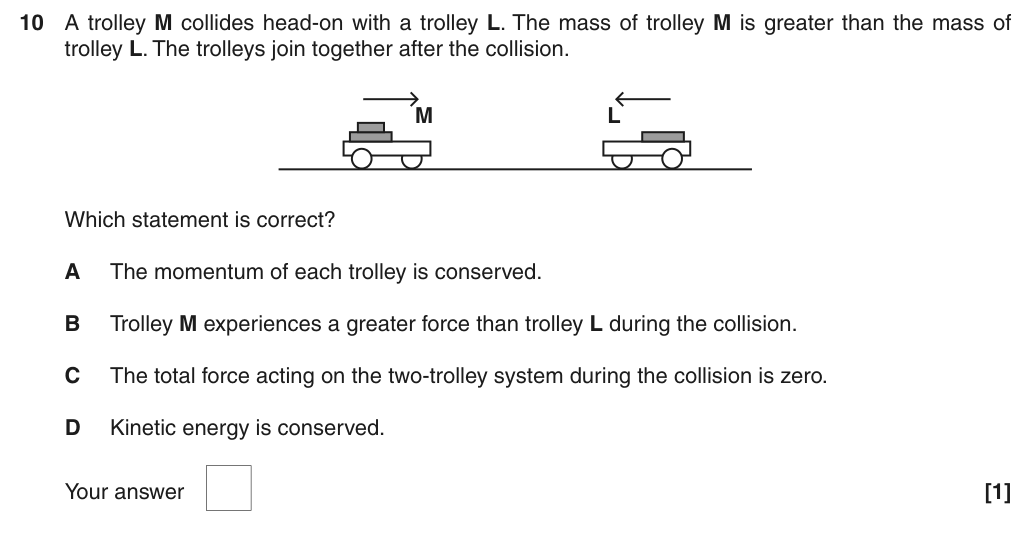
C
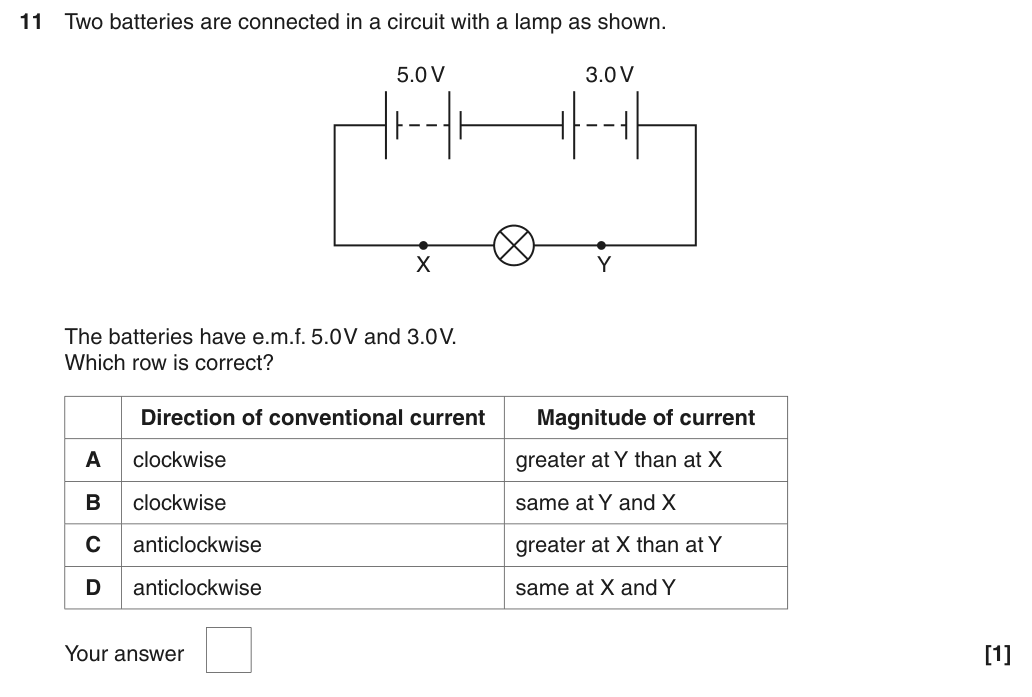
D
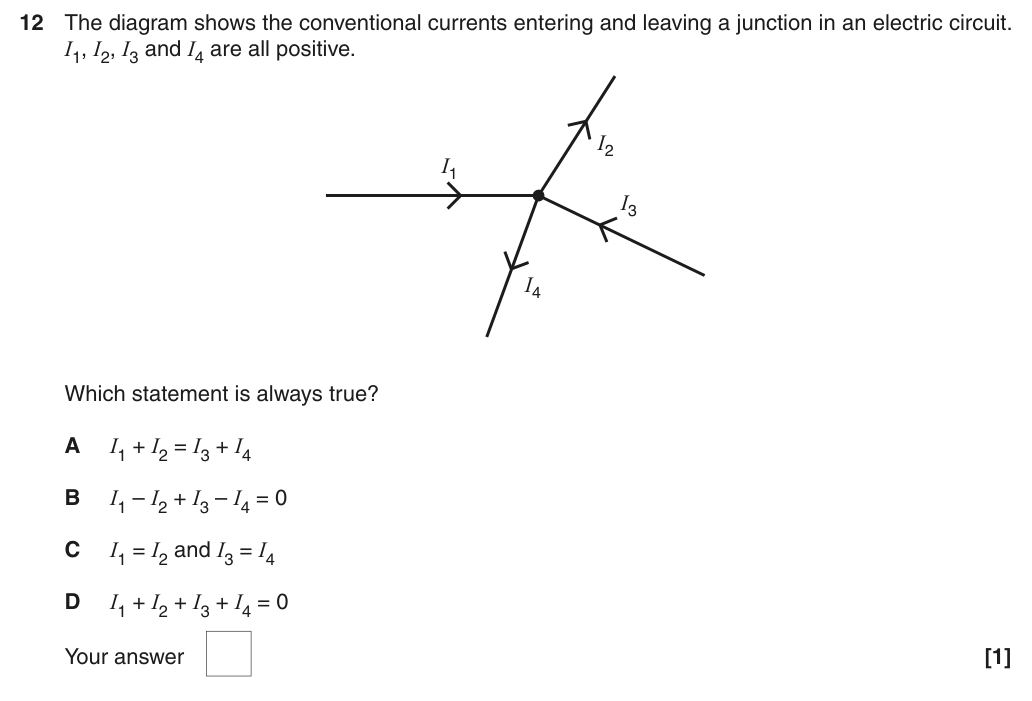
B
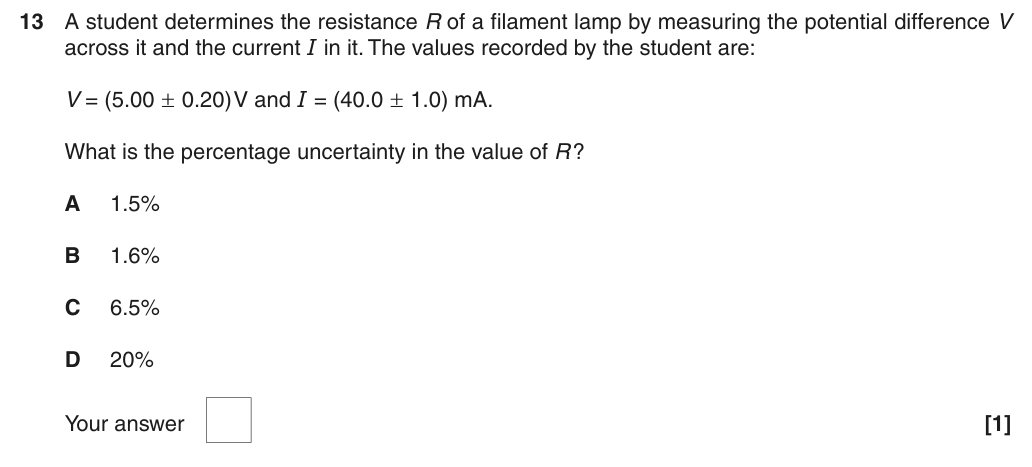
C
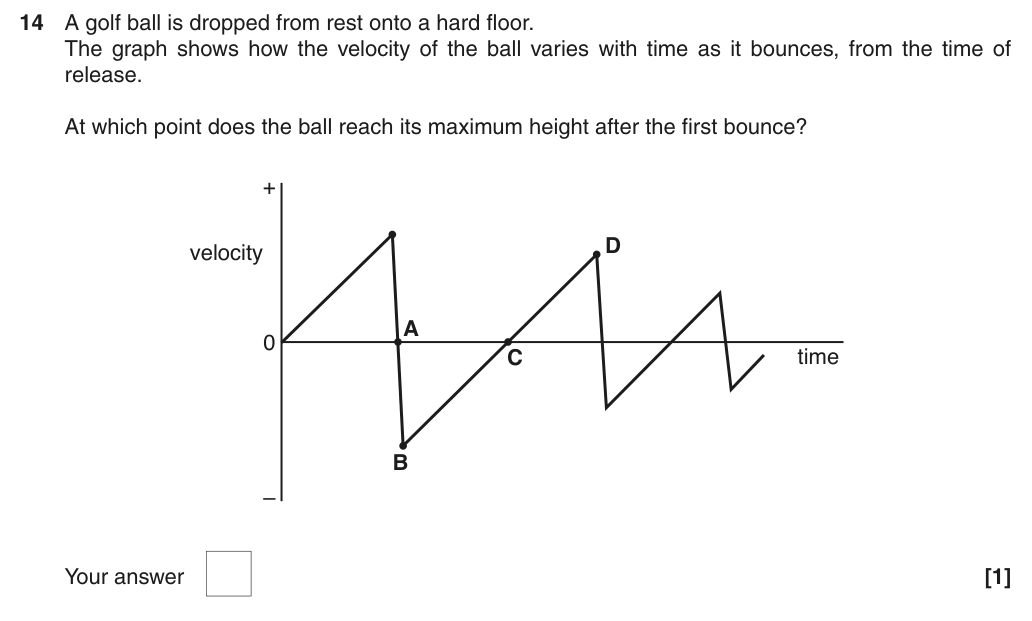
C
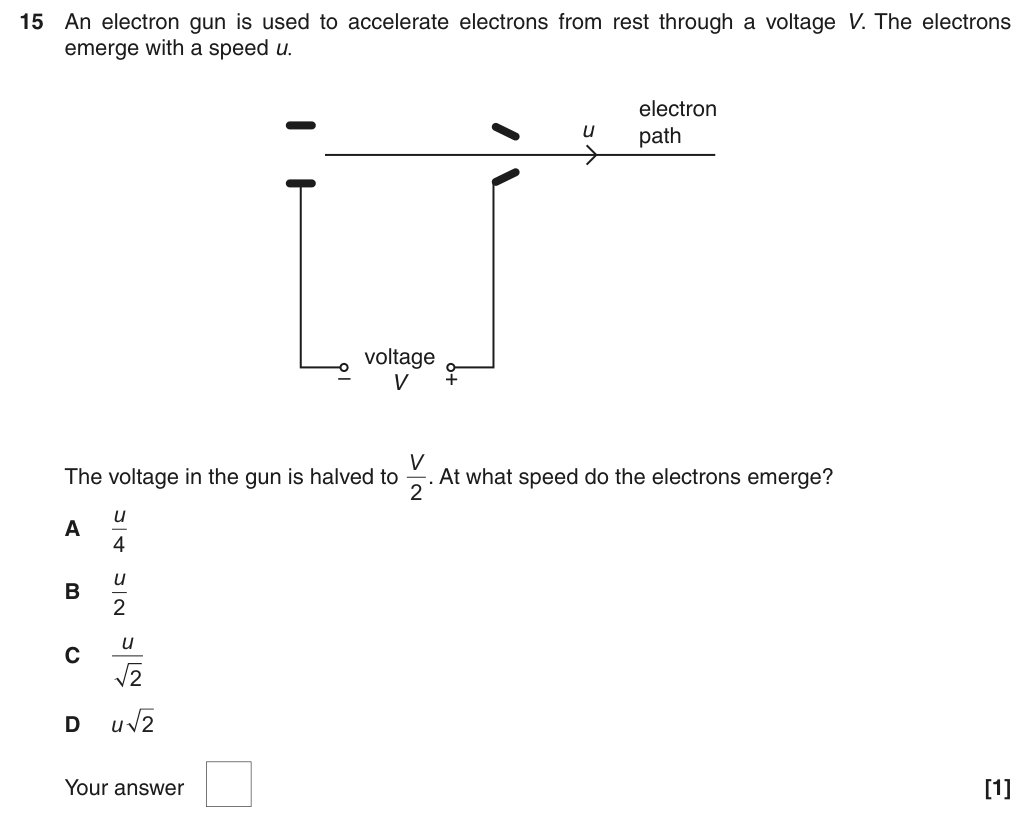
C
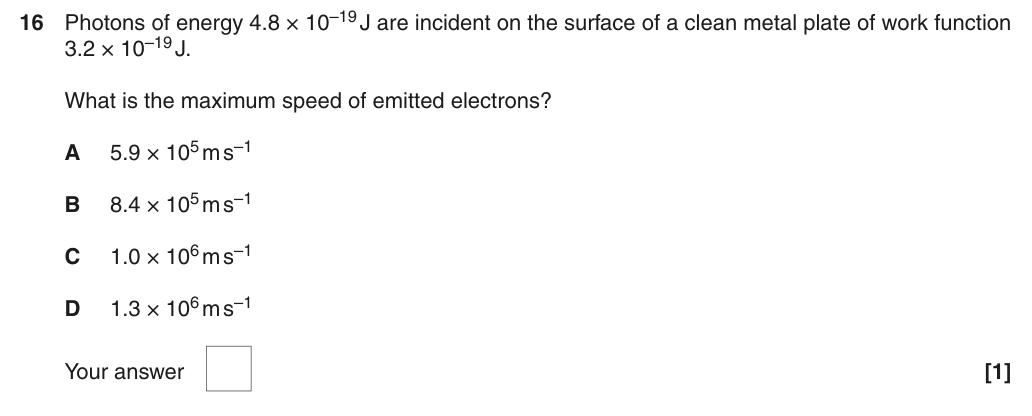
A
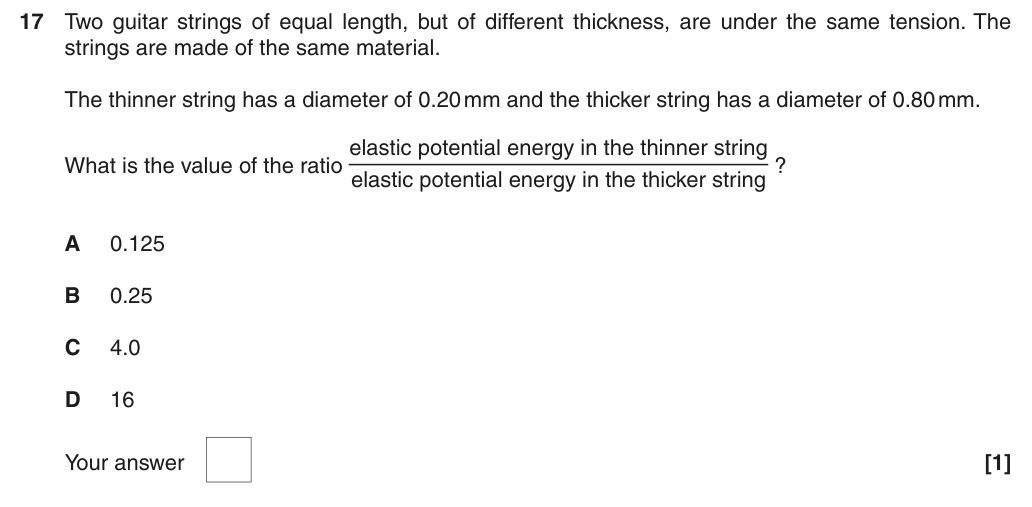
D
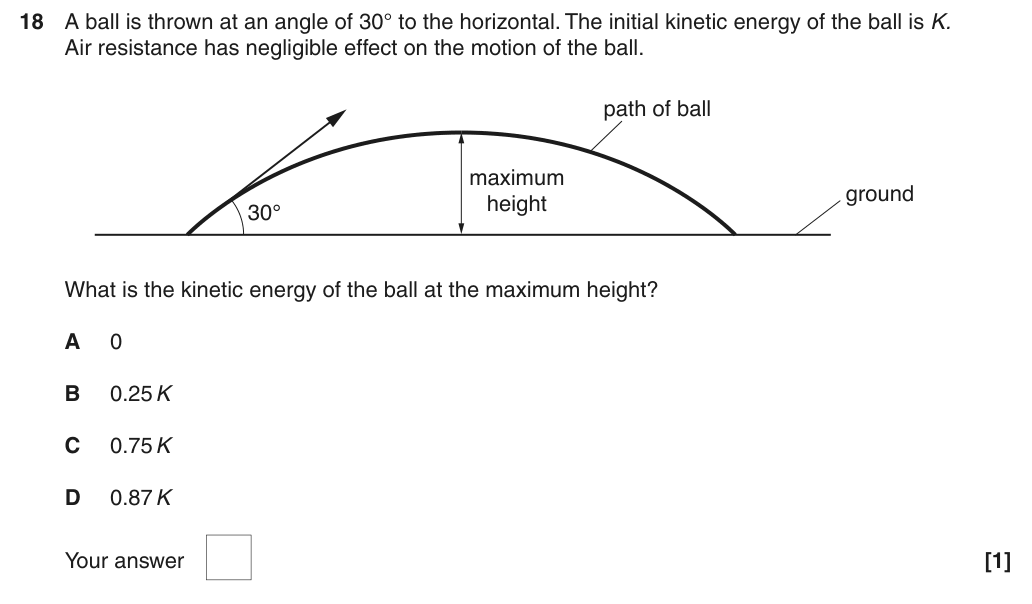
C
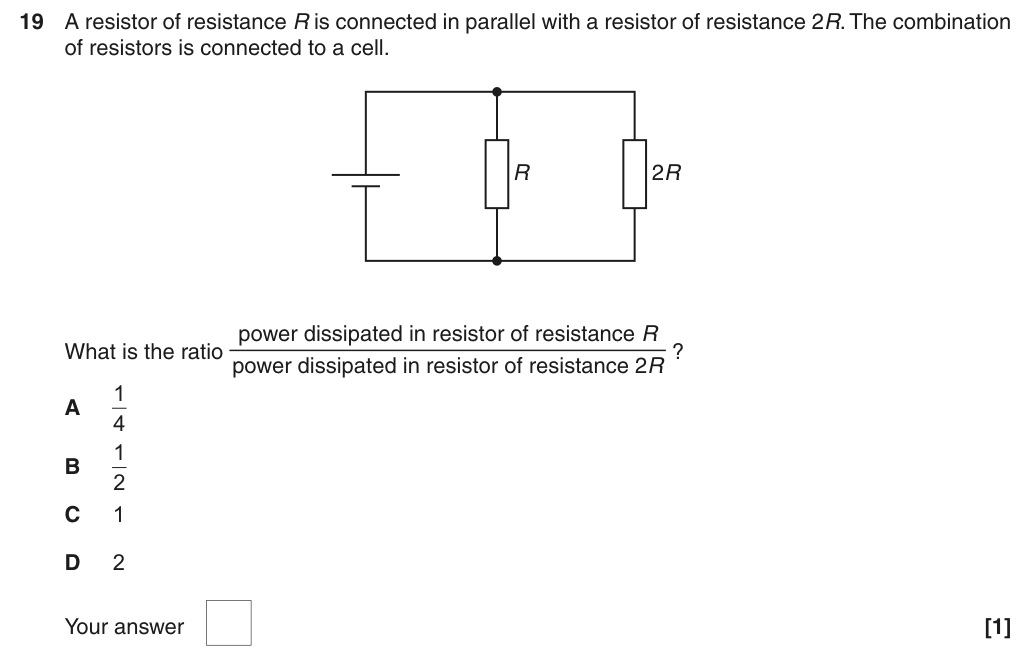
D
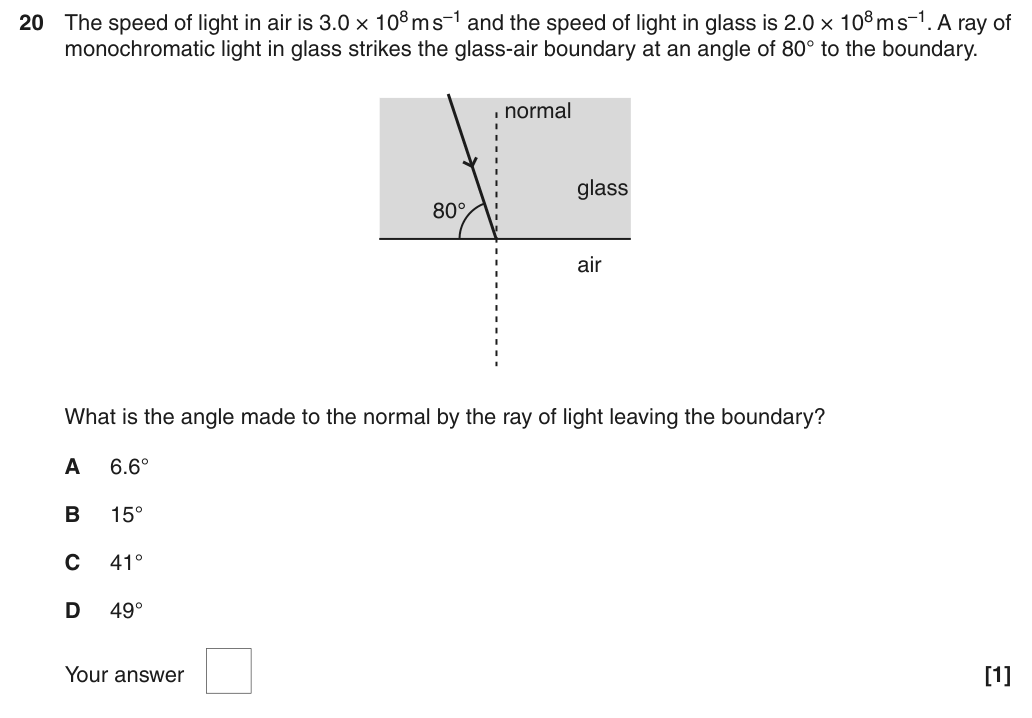
B
Skills: M0.6 Use calculators to handle sin x, cos x and tan x when x is expressed in degrees or radians; M2.3 Substitute numerical values into algebraic equations using appropriate units for physical quantities
Dropping marks on calculations, practical questions or the six-mark level of response questions? Book a trial session with a specialist OCR physics tutor.




















































































































































































































































































































































































































































































