Show that questions

You are given the answer, so the marks are all for the working: every step, and the final value to one more significant figure than the question shows. 171 questions.

Other types: Multiple-choice questions · Calculation questions · Explain and describe questions · Graph and diagram questions · Six-mark level of response questions · Practical questions · Short-answer questions

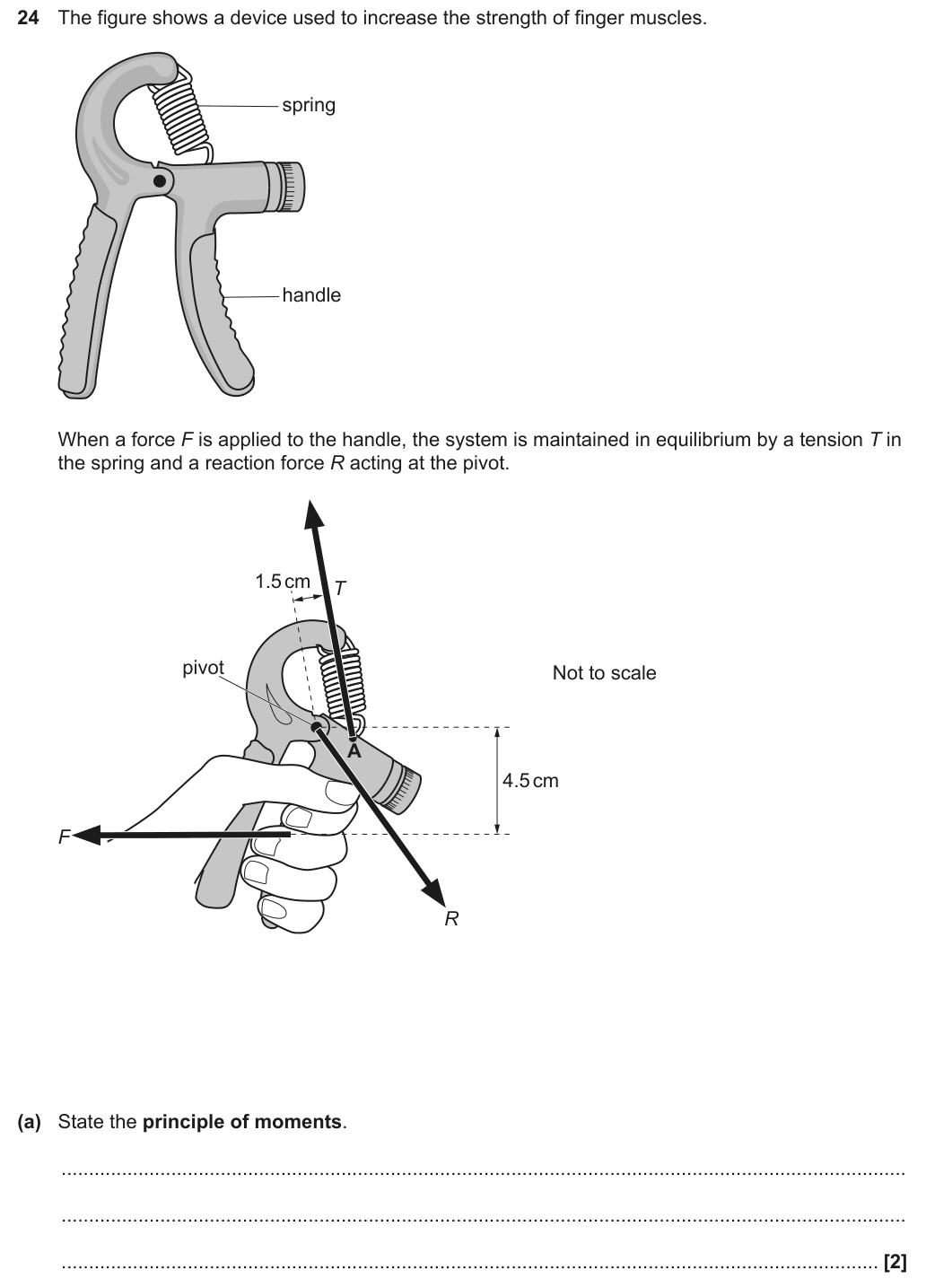
June 2025 · AS Paper 1 · Q24(b)(i) 3 marks Show that Medium equilibrium and momentssprings
Earlier part of question 24 that this part usesEarlier part of June 2025 Paper 1 question 24
(b) A force F of 340 N is applied to the handle. The spring extends by 12 mm.
The perpendicular distance from F to the pivot is 4.5 cm.
The perpendicular distance from T to the pivot is 1.5 cm.
(i) Show that the force constant k of the spring is approximately 90 000 N m–1.
[3]
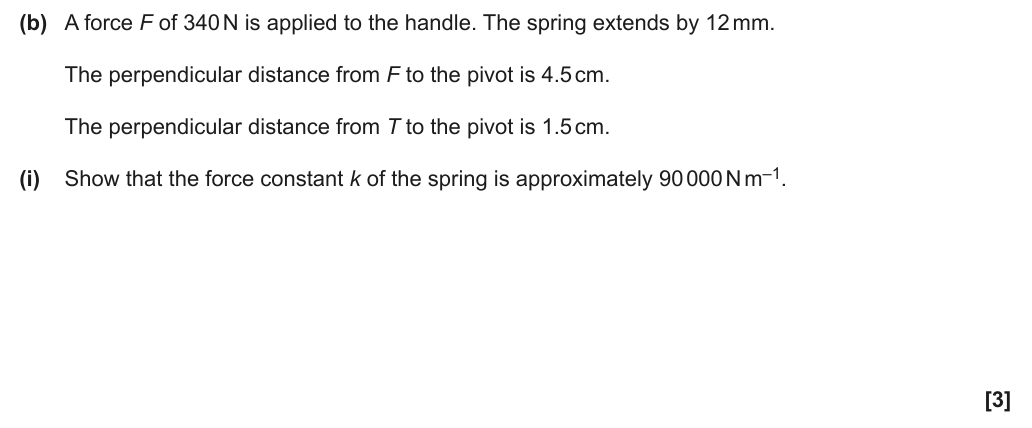
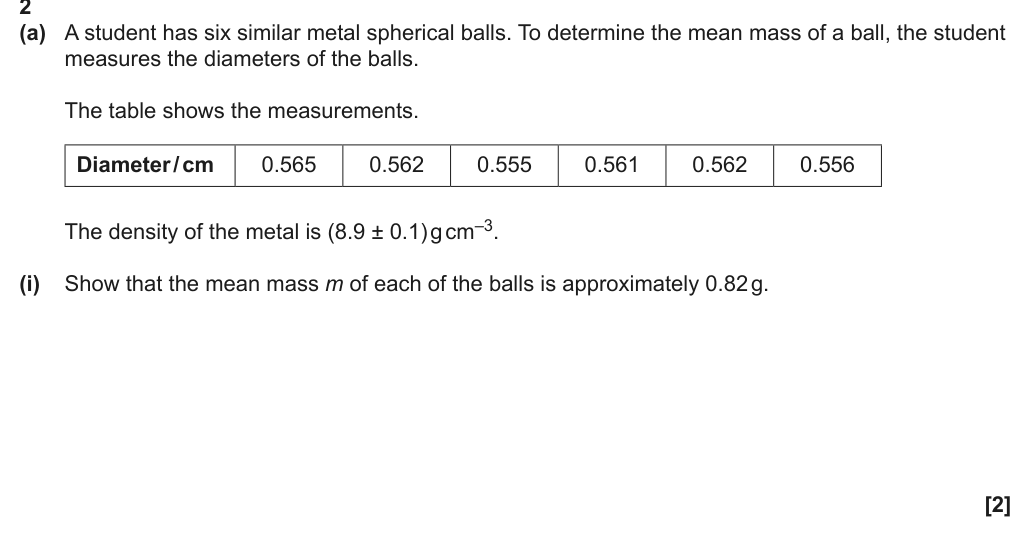
June 2025 · AS Paper 2 · Q2(a)(i) 2 marks Show that Medium density and pressurepractical skills
2
(a) A student has six similar metal spherical balls. To determine the mean mass of a ball, the student
measures the diameters of the balls.
The table shows the measurements.
Diameter / cm 0.565 0.562 0.555 0.561 0.562 0.556
The density of the metal is (8.9 ± 0.1) g cm–3.
(i) Show that the mean mass m of each of the balls is approximately 0.82 g.
[2]
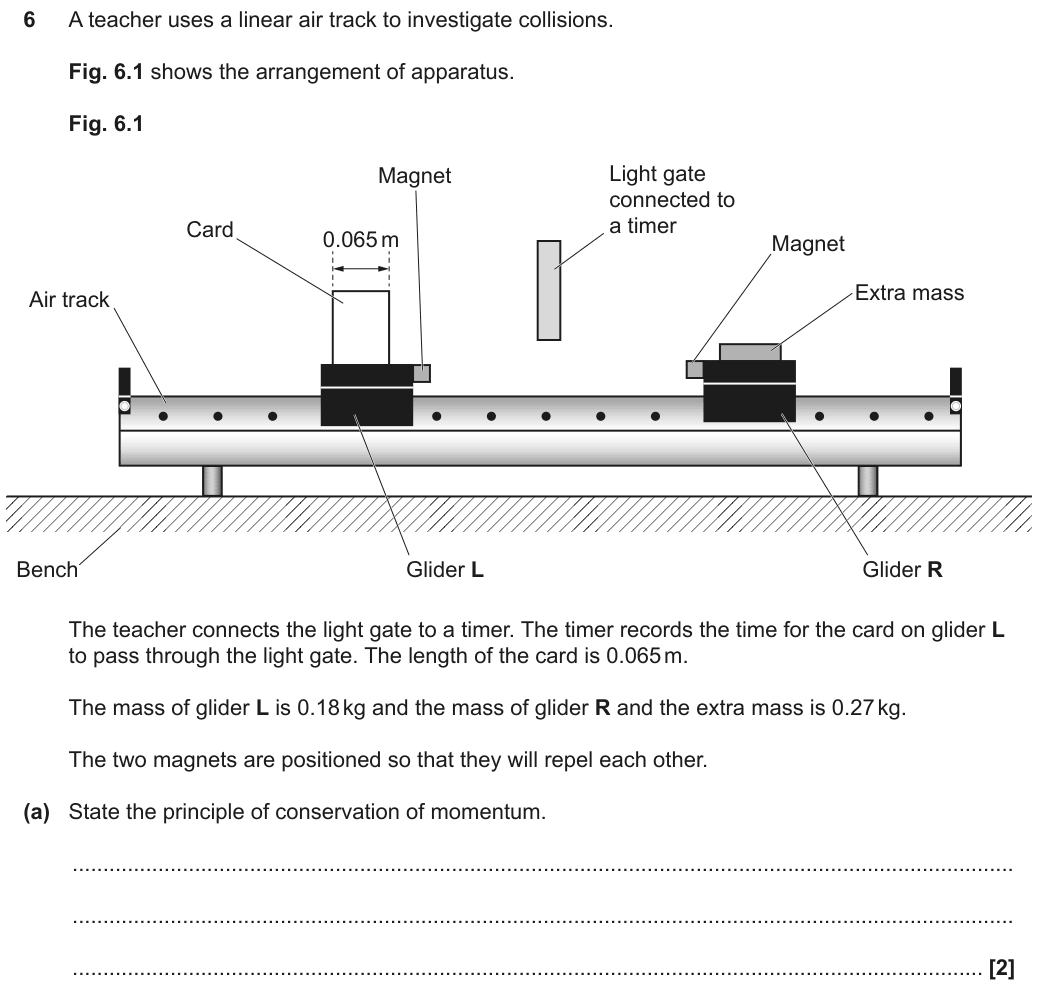
June 2025 · AS Paper 2 · Q6(b)(i) 1 mark Show that Medium newtons laws and momentumkinematics
Earlier part of question 6 that this part usesEarlier part of June 2025 Paper 2 question 6
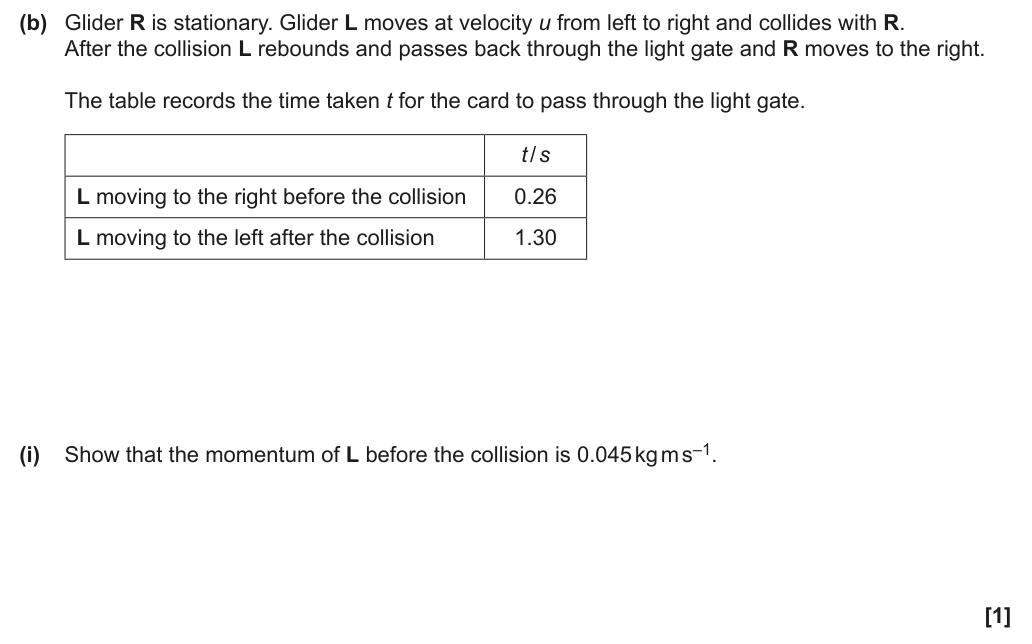
(b) Glider R is stationary. Glider L moves at velocity u from left to right and collides with R.
After the collision L rebounds and passes back through the light gate and R moves to the right.
The table records the time taken t for the card to pass through the light gate.
t / s
L moving to the right before the collision 0.26
L moving to the left after the collision 1.30
(i) Show that the momentum of L before the collision is 0.045 kg m s–1.
[1]
June 2025 · Paper 1 · Q16(a)(ii) 2 marks Show that Medium kinematics
Earlier part of question 16 that this part usesEarlier part of June 2025 Paper 1 question 16
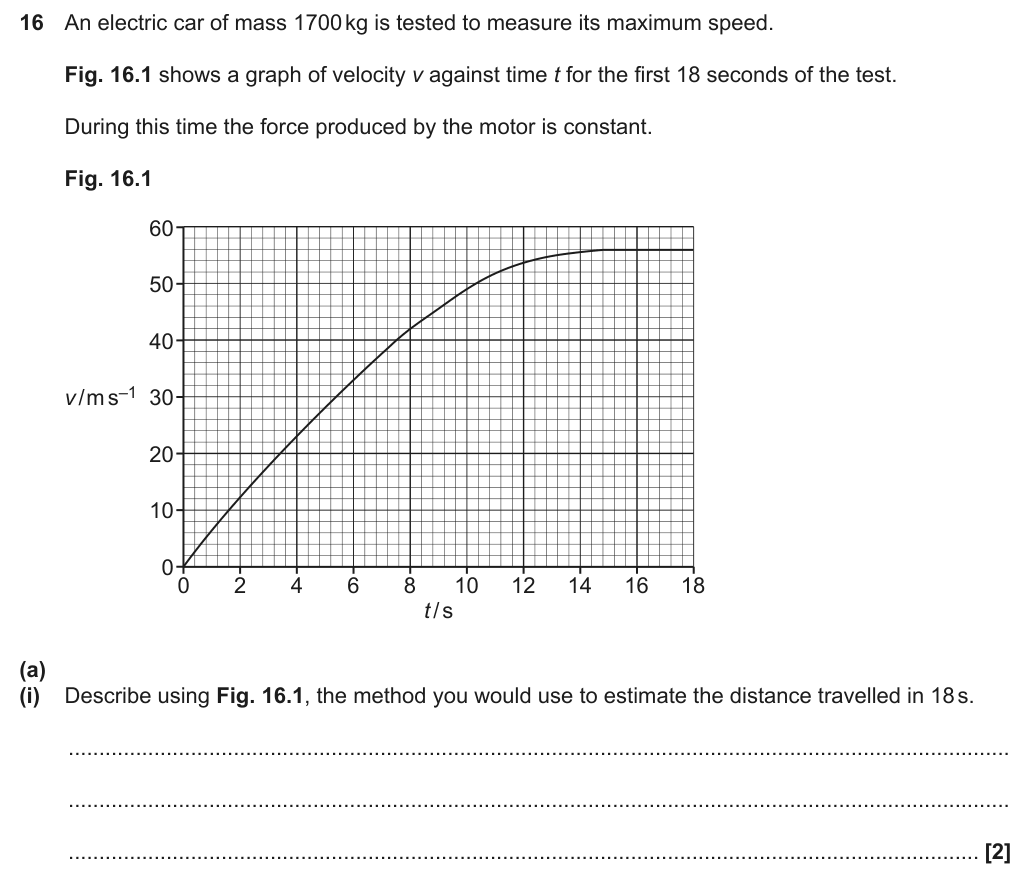
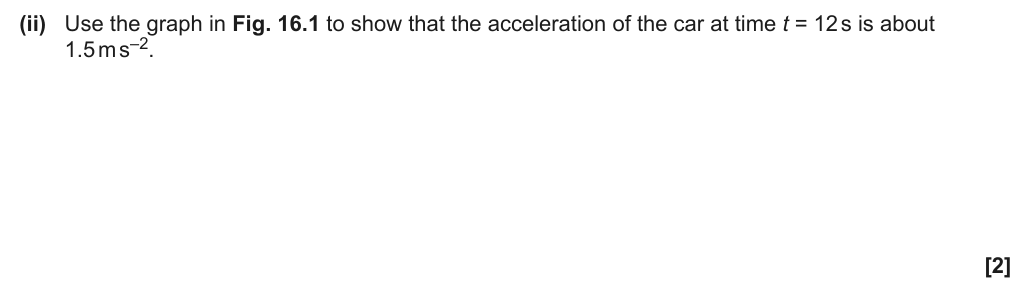
(ii) Use the graph in Fig. 16.1 to show that the acceleration of the car at time t = 12 s is about
1.5 m s–2.
[2]
June 2025 · Paper 1 · Q17(a)(ii) 2 marks Show that Medium linear motionprojectile motion
Earlier part of question 17 that this part usesEarlier part of June 2025 Paper 1 question 17
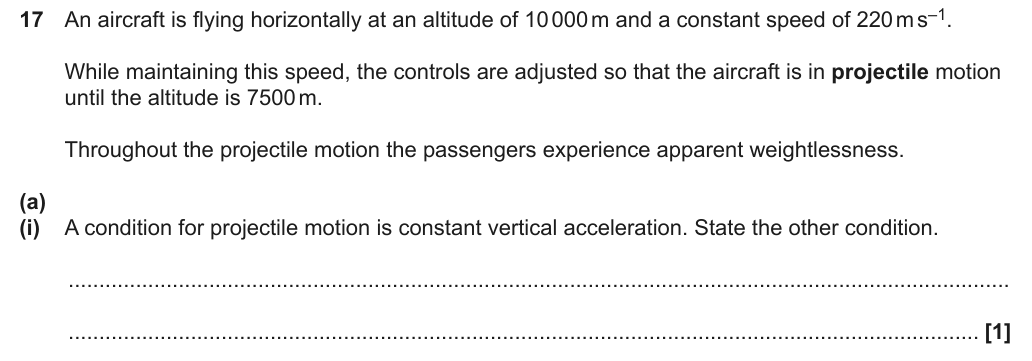
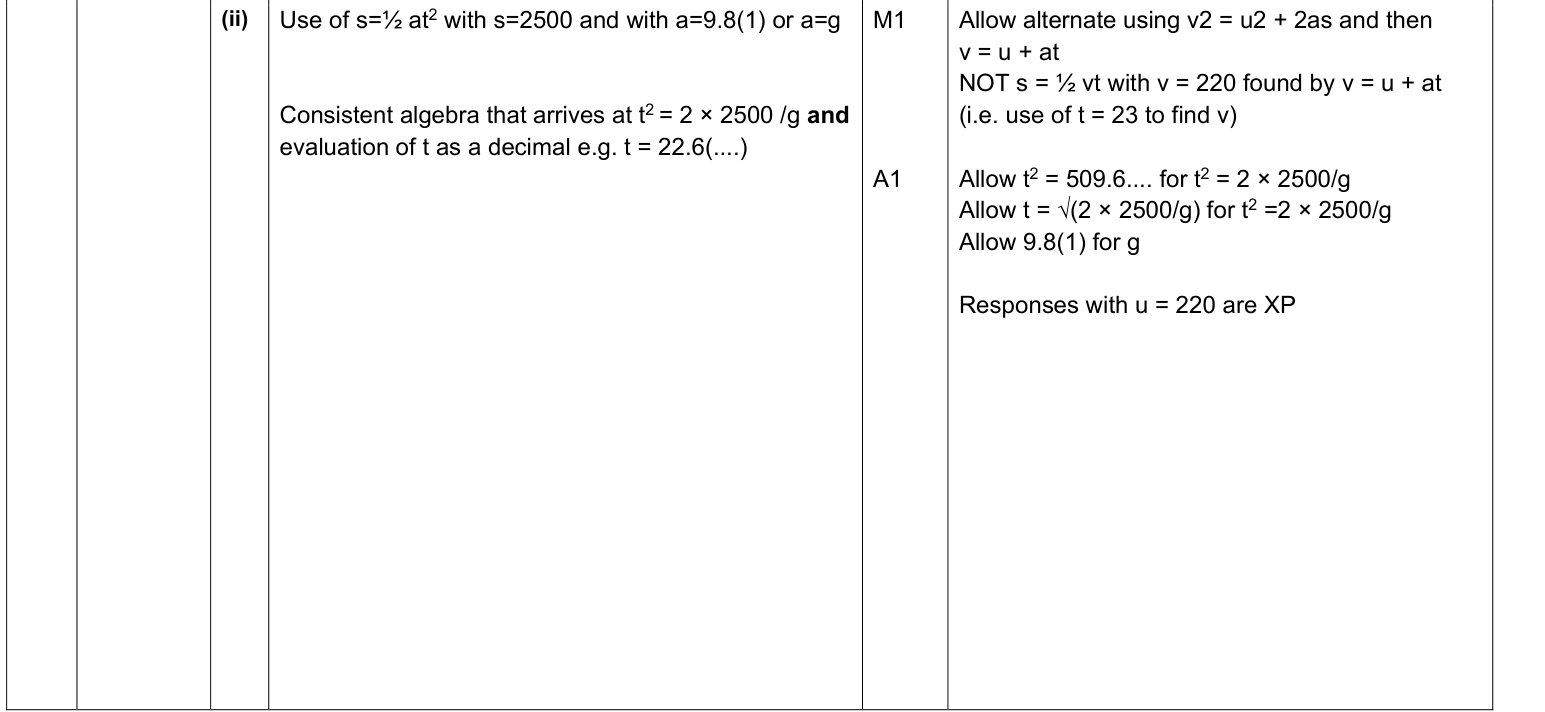
(ii) Show that t, the time taken to reach the new altitude of 7500 m, is about 23 s.
[2]
June 2025 · Paper 1 · Q17(b)(i) 2 marks Show that Medium gravitational fields
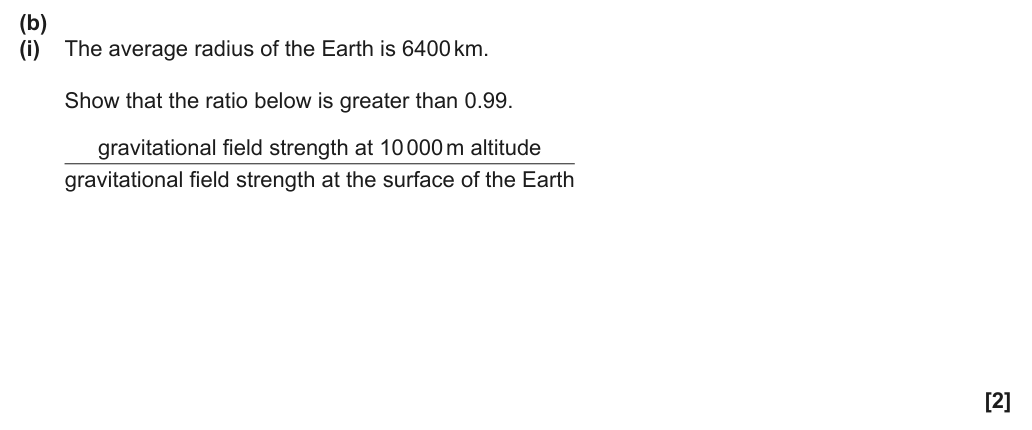
(b)
(i) The average radius of the Earth is 6400 km.
Show that the ratio below is greater than 0.99.
gravitational field strength at 10 000 m altitude
gravitational field strength at the surface of the Earth
[2]
June 2025 · Paper 1 · Q18(b)(i) 2 marks Show that Medium density and pressure
Earlier part of question 18 that this part usesEarlier part of June 2025 Paper 1 question 18
(b)
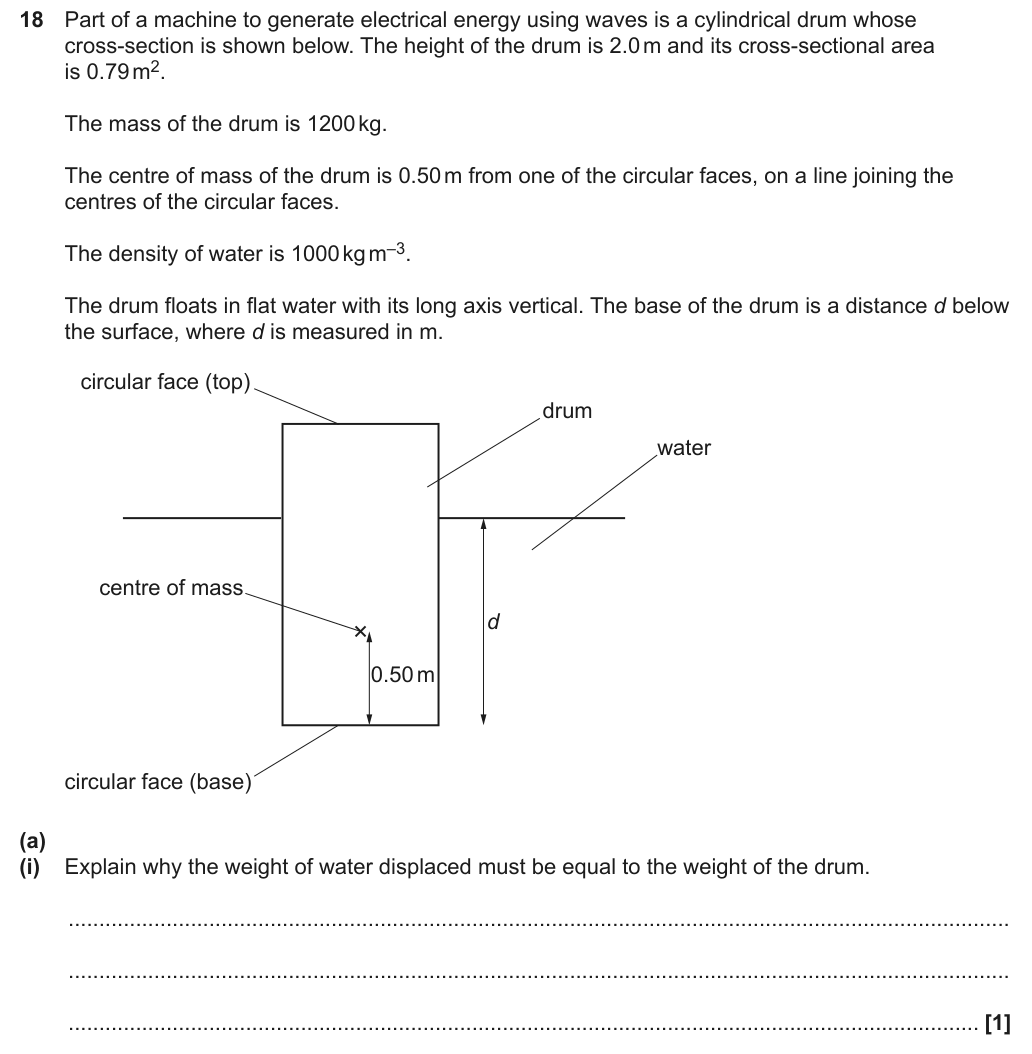
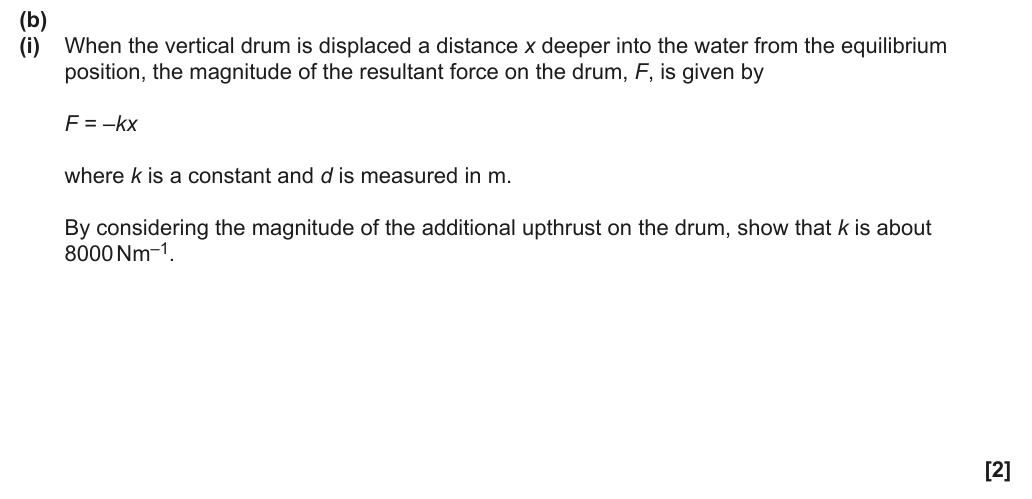
(i) When the vertical drum is displaced a distance x deeper into the water from the equilibrium
position, the magnitude of the resultant force on the drum, F, is given by
F = –kx
where k is a constant and d is measured in m.
By considering the magnitude of the additional upthrust on the drum, show that k is about
8000 Nm–1.
[2]
June 2025 · Paper 1 · Q19(c) 3 marks Show that Medium thermal physicsdensity and pressurework energy and power
Earlier part of question 19 that this part usesEarlier part of June 2025 Paper 1 question 19
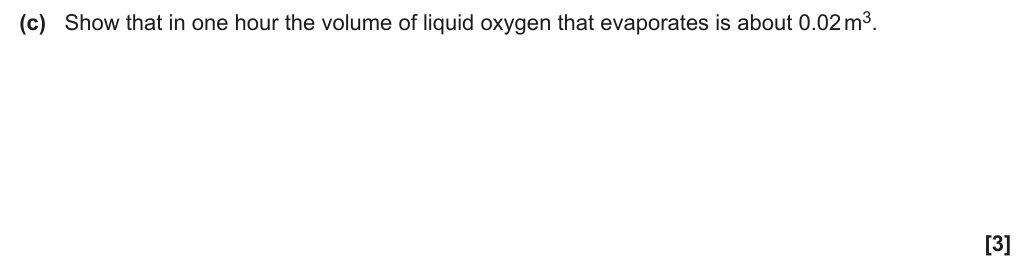
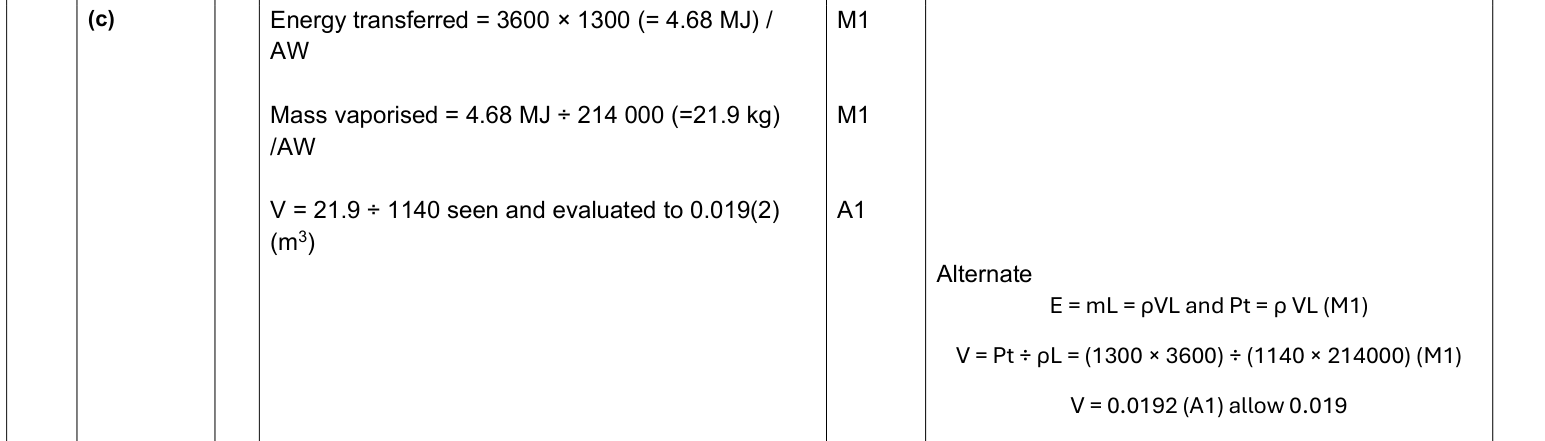
(c) Show that in one hour the volume of liquid oxygen that evaporates is about 0.02 m3.
[3]
June 2025 · Paper 2 · Q20(b)(i) 3 marks Show that Hard superposition and interference
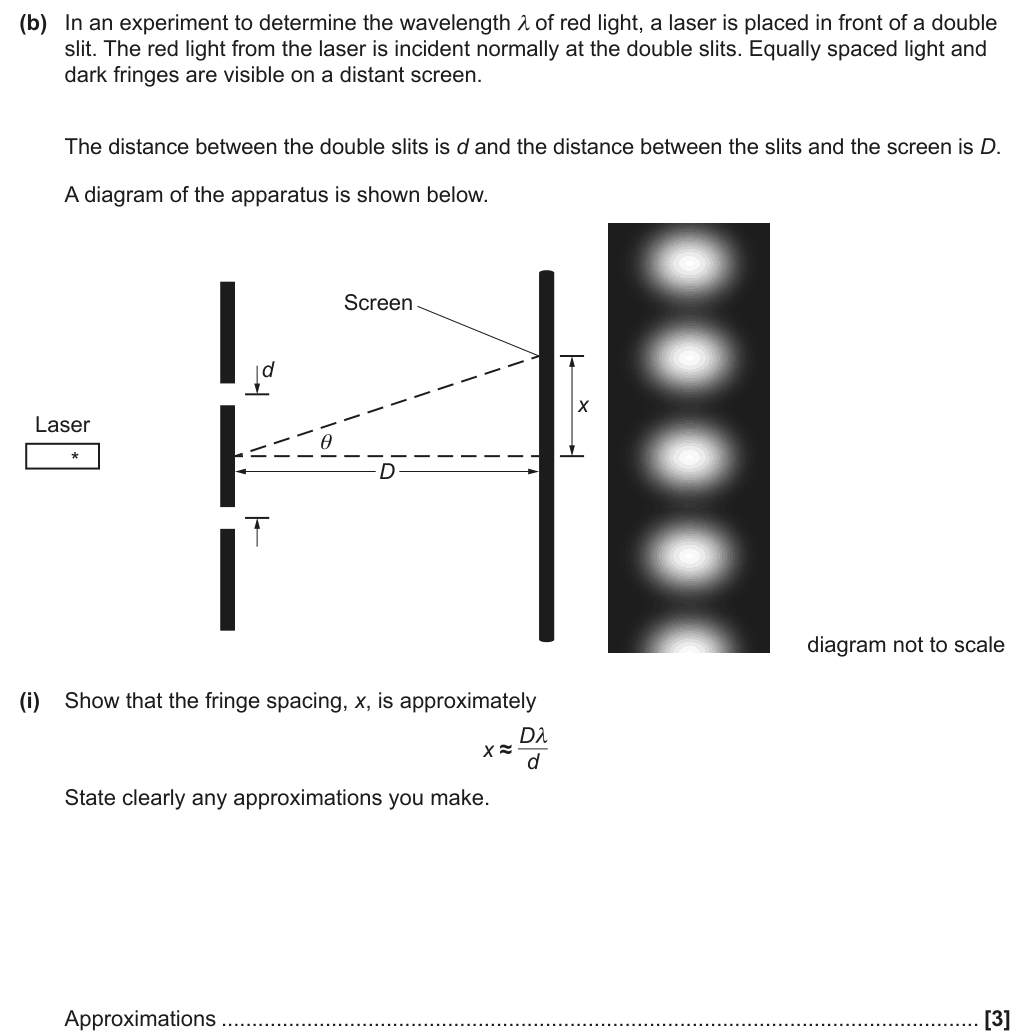
(b) In an experiment to determine the wavelength λ of red light, a laser is placed in front of a double
slit. The red light from the laser is incident normally at the double slits. Equally spaced light and
dark fringes are visible on a distant screen.
The distance between the double slits is d and the distance between the slits and the screen is D.
A diagram of the apparatus is shown below.
Screen
d
x
Laser
θ
*
D
diagram not to scale
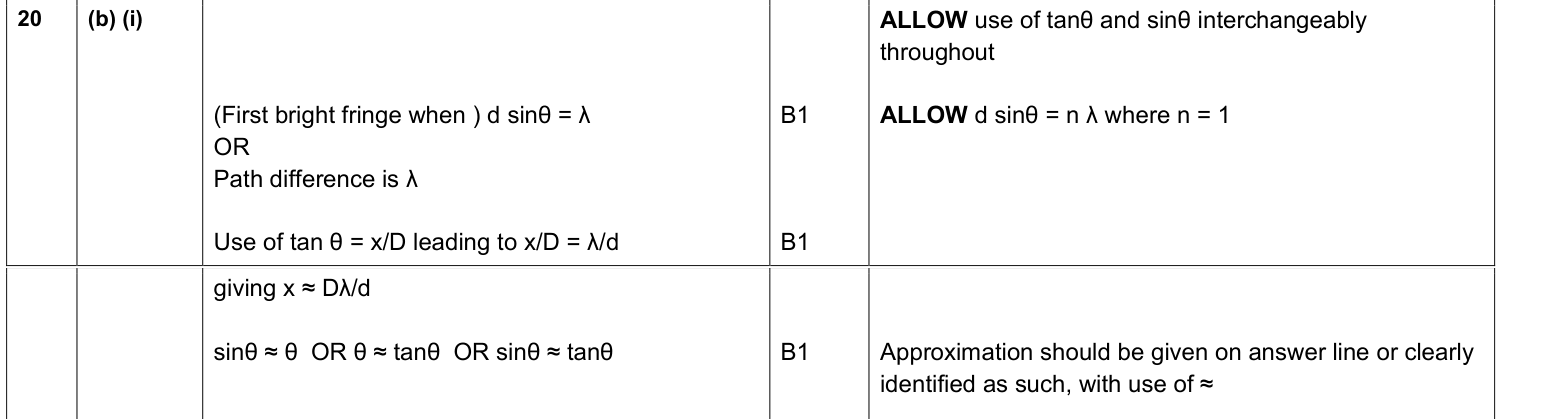
(i) Show that the fringe spacing, x, is approximately
x ≈ Dλ
d
State clearly any approximations you make.
Approximations ............................................................................................................................ [3]
June 2025 · Paper 2 · Q23(a) 2 marks Show that Hard potential dividers
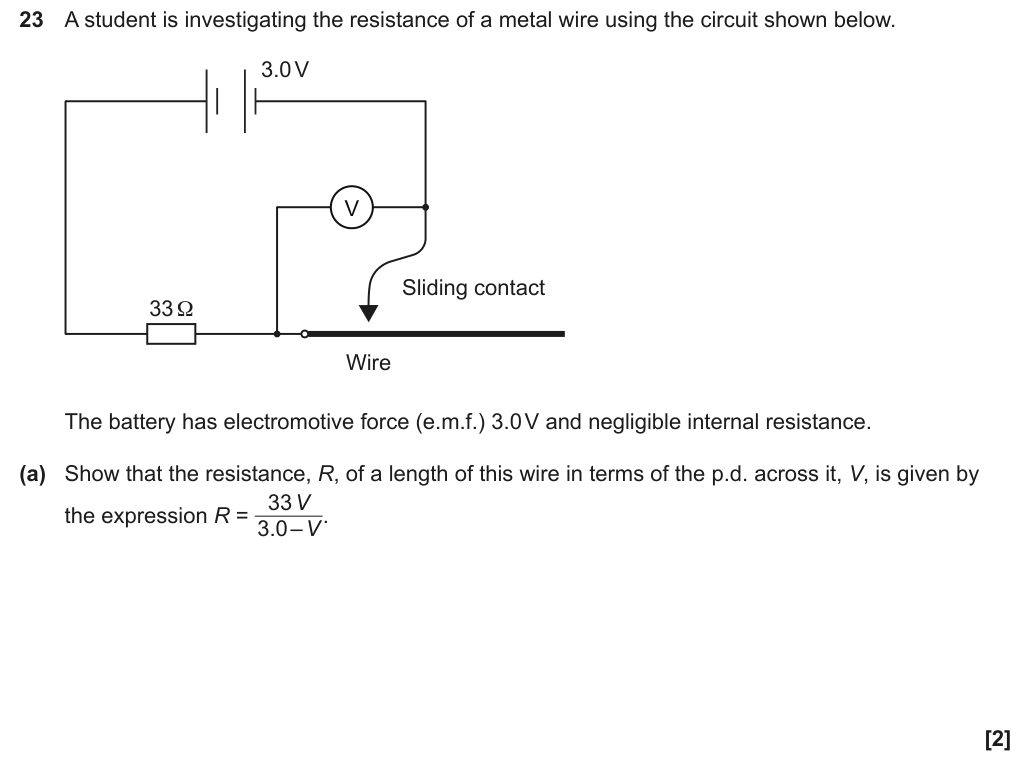
23 A student is investigating the resistance of a metal wire using the circuit shown below.
3.0 V
V
Sliding contact
33 Ω
Wire
The battery has electromotive force (e.m.f.) 3.0 V and negligible internal resistance.
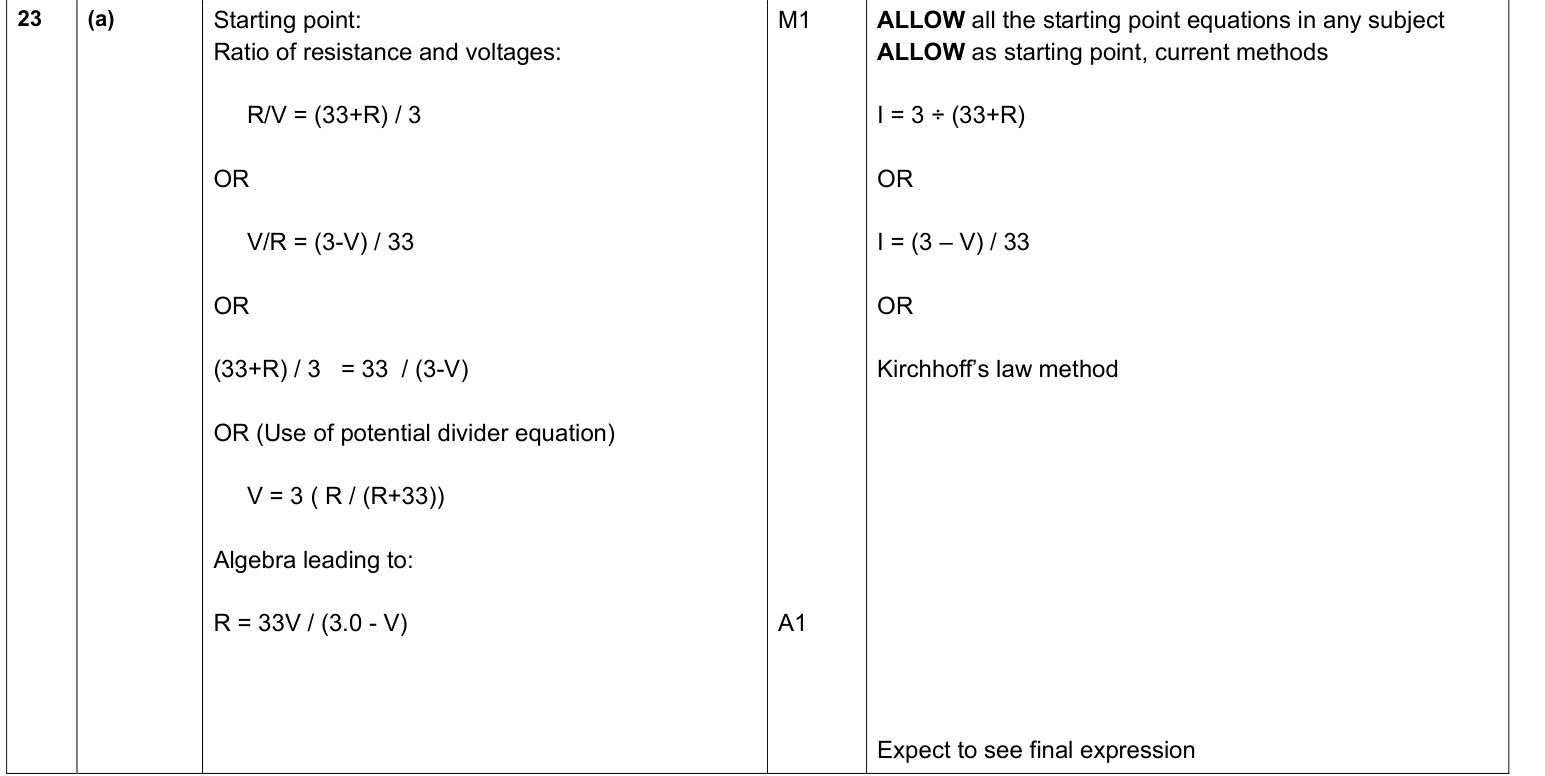
(a) Show that the resistance, R, of a length of this wire in terms of the p.d. across it, V, is given by
the expression R = 33 V
3.0 – V.
[2]
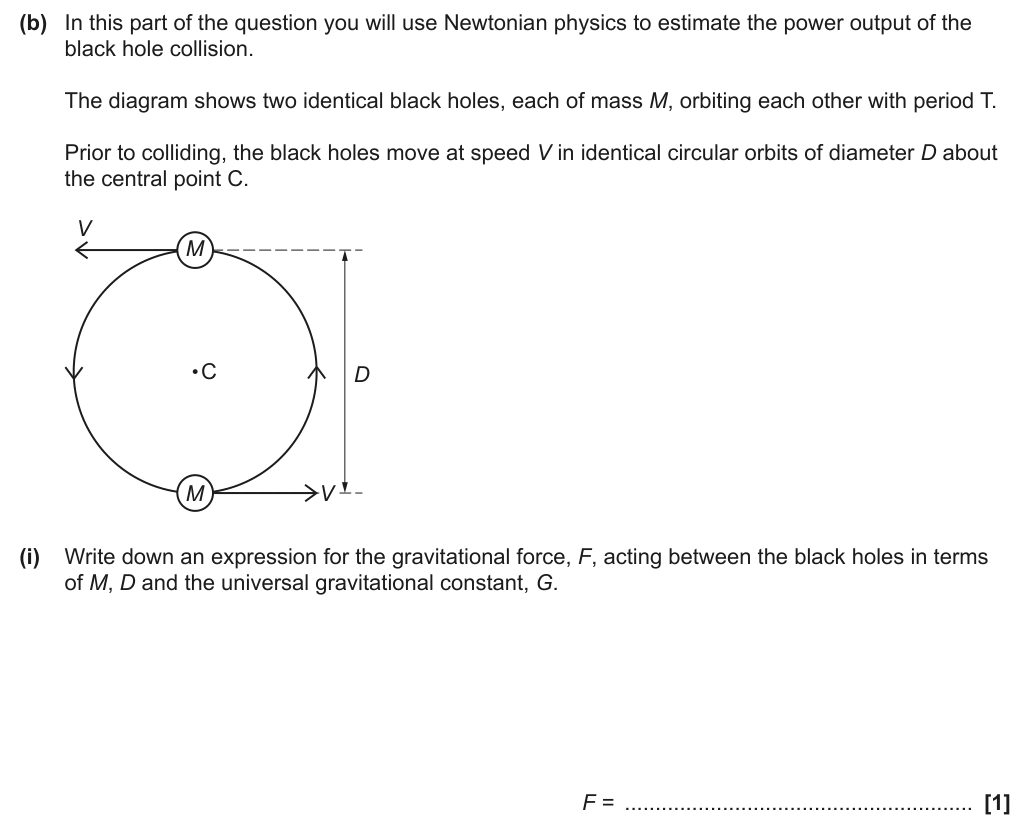
June 2025 · Paper 3 · Q6(b)(ii) 3 marks Show that Medium planetary motionwork energy and powercircular motiongravitational fields
Earlier part of question 6 that this part usesEarlier part of June 2025 Paper 3 question 6
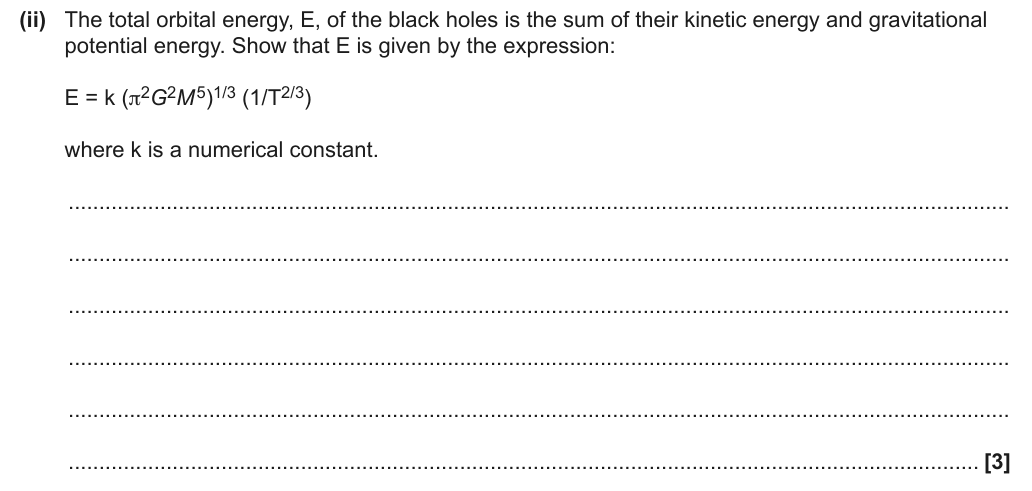
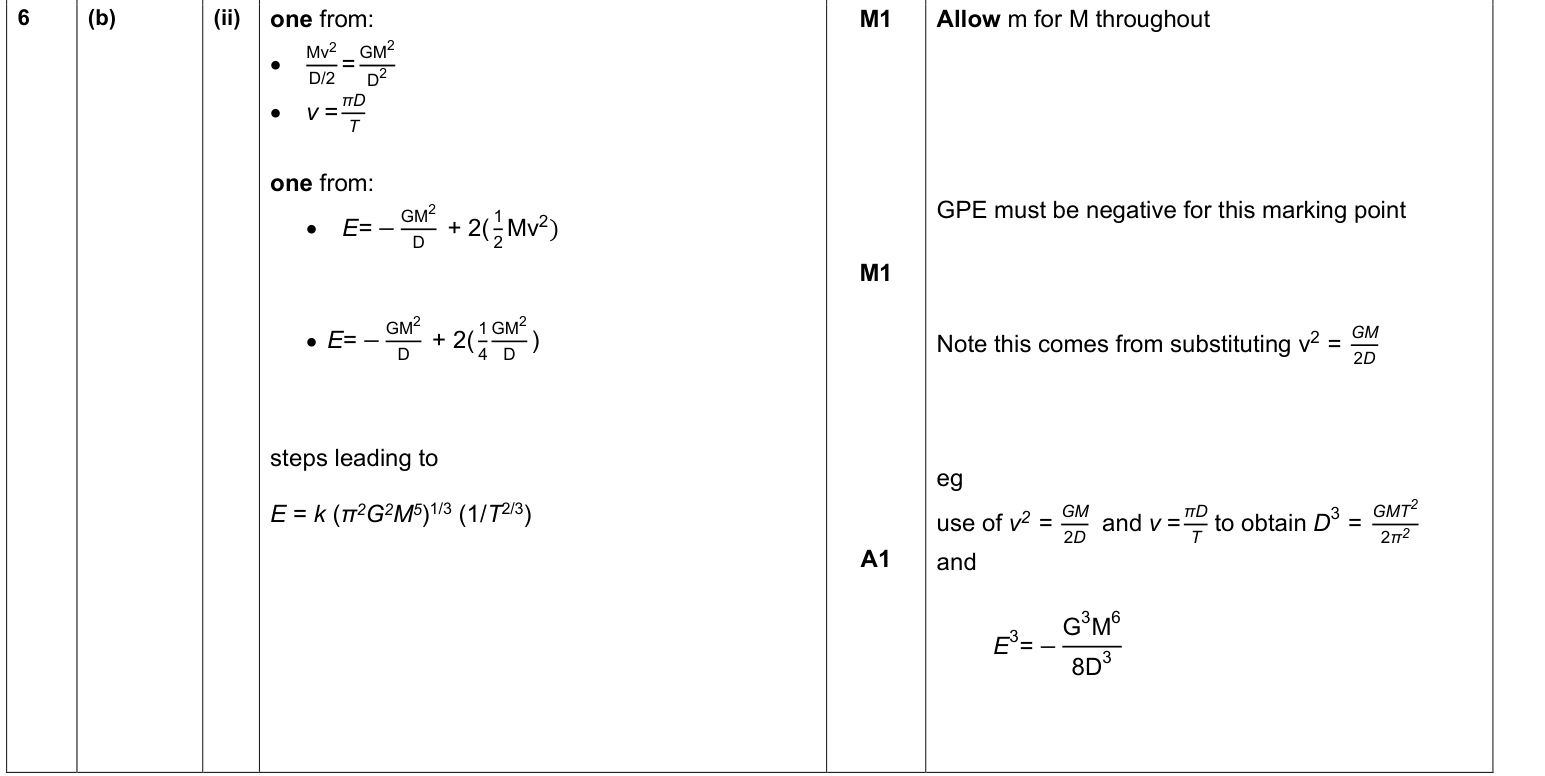
(ii) The total orbital energy, E, of the black holes is the sum of their kinetic energy and gravitational
potential energy. Show that E is given by the expression:
E = k (π2G2M 5)1/3 (1/T2/3)
where k is a numerical constant.
..........................................................................................................................................................
..........................................................................................................................................................
..........................................................................................................................................................
..........................................................................................................................................................
..........................................................................................................................................................
..................................................................................................................................................... [3]
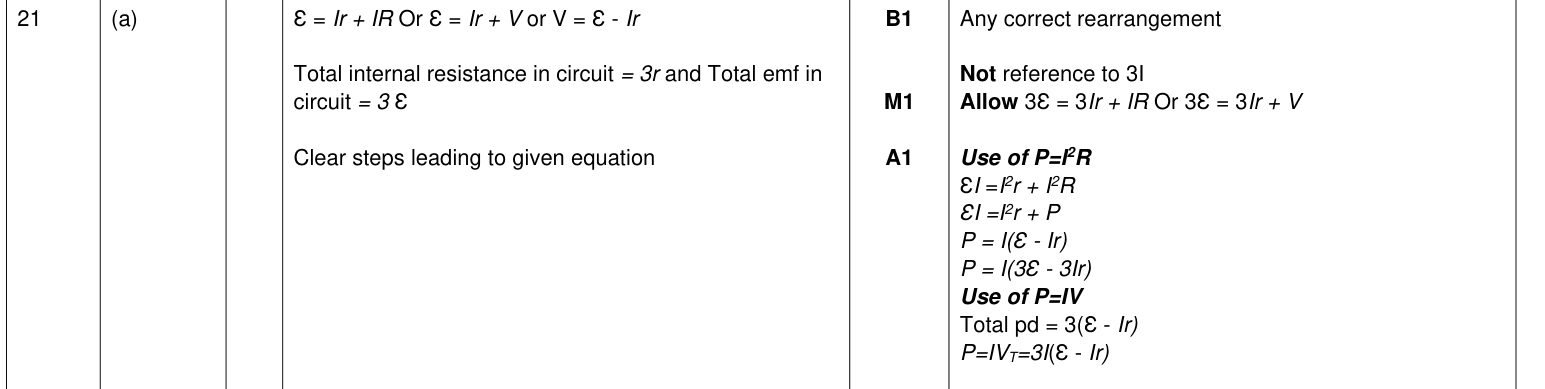
June 2024 · AS Paper 1 · Q21(a) 3 marks Show that Easy internal resistanceelectrical powerseries and parallel circuits
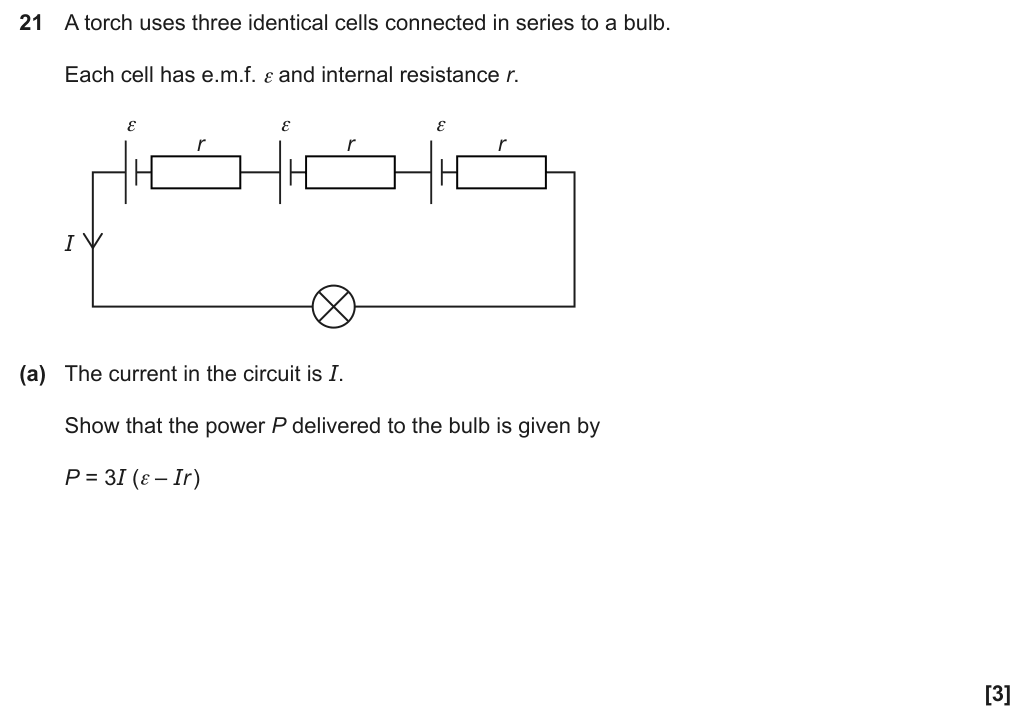
21 A torch uses three identical cells connected in series to a bulb.
Each cell has e.m.f. ε and internal resistance r.
ε ε ε
r r r
I
(a) The current in the circuit is I.
Show that the power P delivered to the bulb is given by
P = 3I (ε – Ir )
[3]
June 2024 · AS Paper 2 · Q1(c)(i) 1 mark Show that Medium practical skills
Earlier part of question 1 that this part usesEarlier part of June 2024 Paper 2 question 1
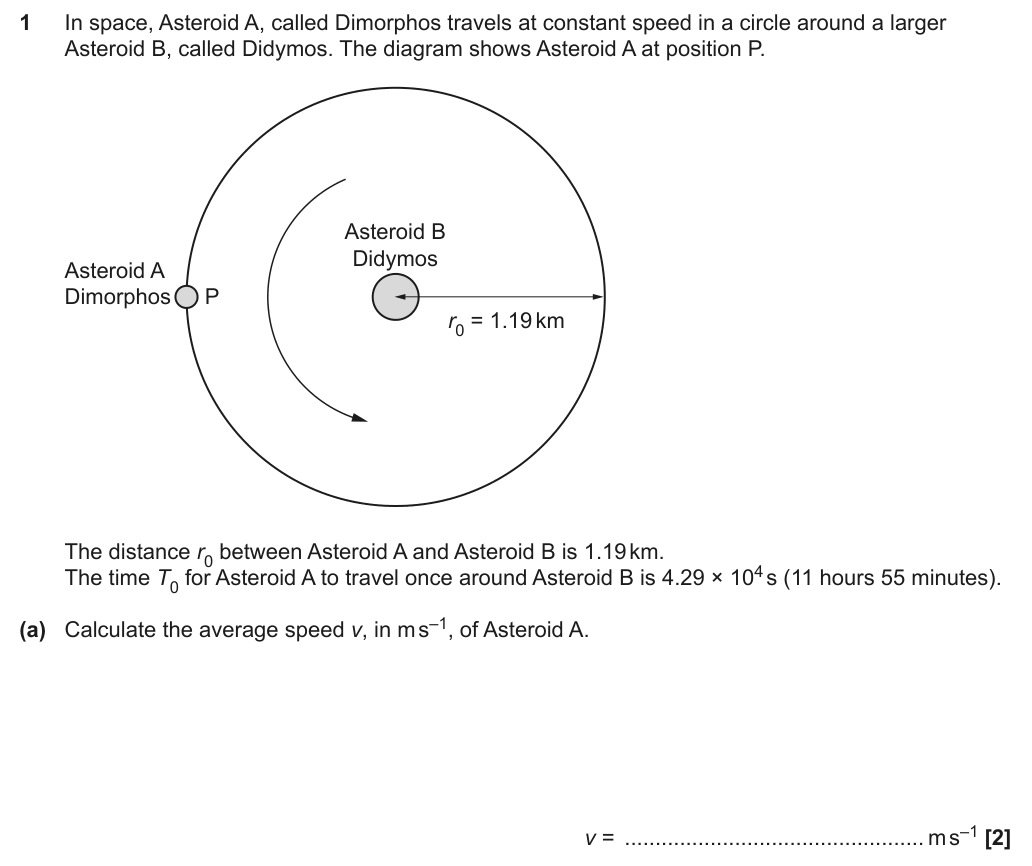
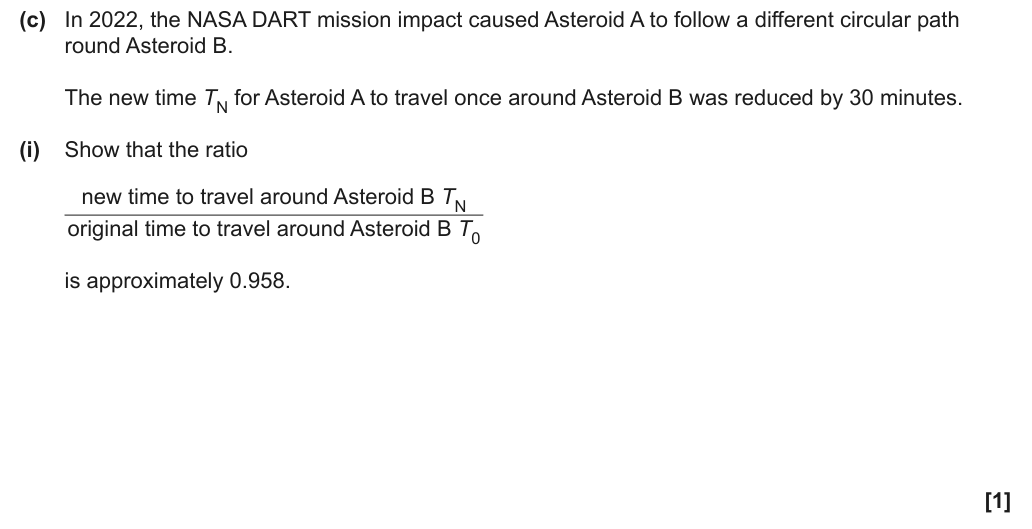
(c) In 2022, the NASA DART mission impact caused Asteroid A to follow a different circular path
round Asteroid B.
The new time TN for Asteroid A to travel once around Asteroid B was reduced by 30 minutes.
(i) Show that the ratio
new time to travel around Asteroid B TN
original time to travel around Asteroid B T0
is approximately 0.958.
[1]
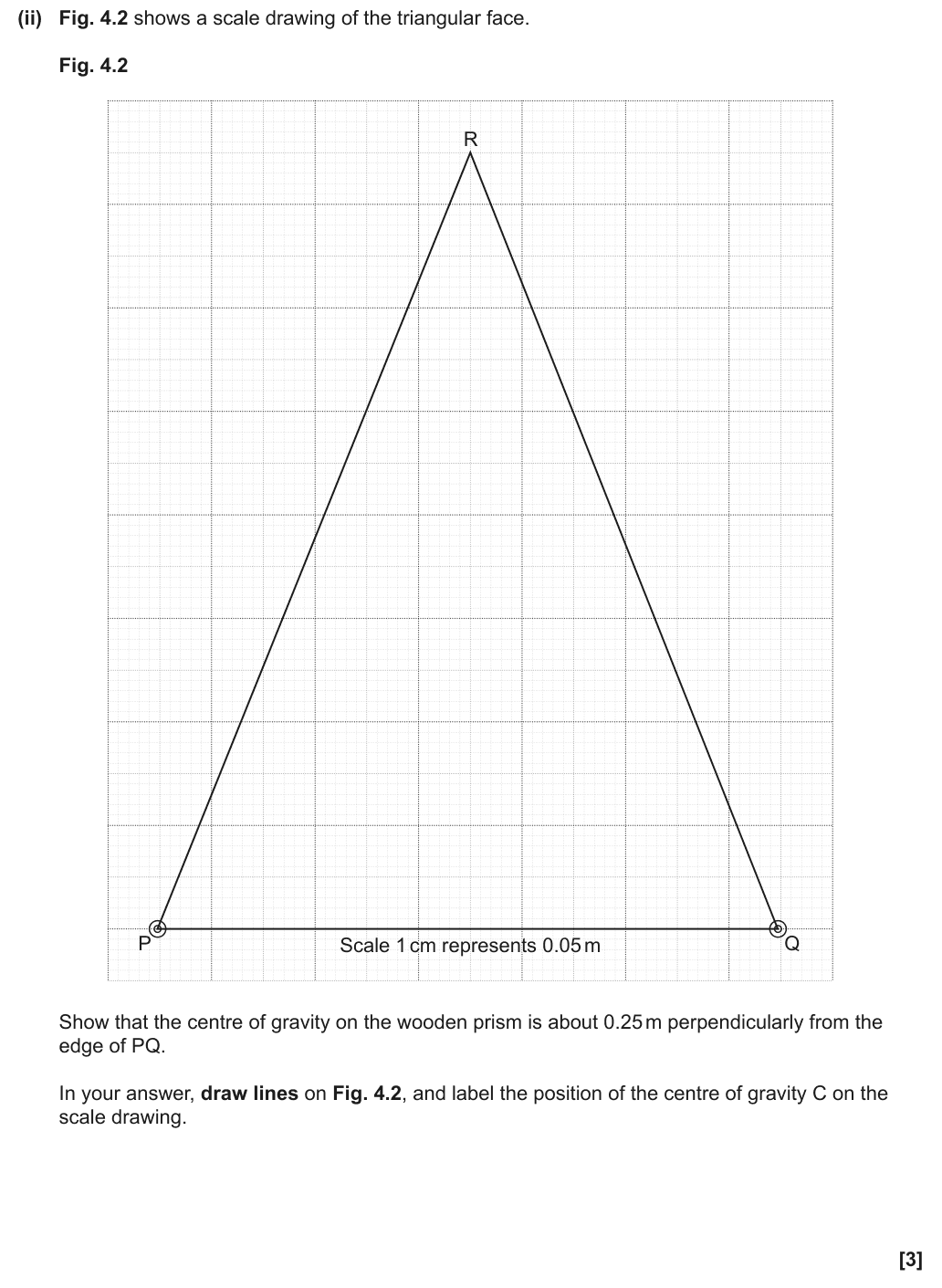
June 2024 · AS Paper 2 · Q4(b)(ii) 3 marks Show that Hard equilibrium and moments
(ii) Fig. 4.2 shows a scale drawing of the triangular face.
Fig. 4.2
R
P Scale 1 cm represents 0.05 m Scale 1 cm represents 0.05 m Q
Show that the centre of gravity on the wooden prism is about 0.25 m perpendicularly from the
edge of PQ.
In your answer, draw lines on Fig. 4.2, and label the position of the centre of gravity C on the
scale drawing.
[3]
June 2024 · AS Paper 2 · Q5(b)(iii) 1 mark Show that Medium electromagnetic waves and refraction
Earlier part of question 5 that this part usesEarlier part of June 2024 Paper 2 question 5
(iii) The angle of incidence i is 49.9°.
Show that the angle of refraction r is approximately 30°.
[1]
June 2024 · AS Paper 2 · Q5(b)(iv) 3 marks Show that Medium electromagnetic waves and refraction
Earlier parts of question 5 that this part usesEarlier part of June 2024 Paper 2 question 5Earlier part of June 2024 Paper 2 question 5Earlier part of June 2024 Paper 2 question 5
(iv) Show that total internal reflection occurs at point Q.
[3]
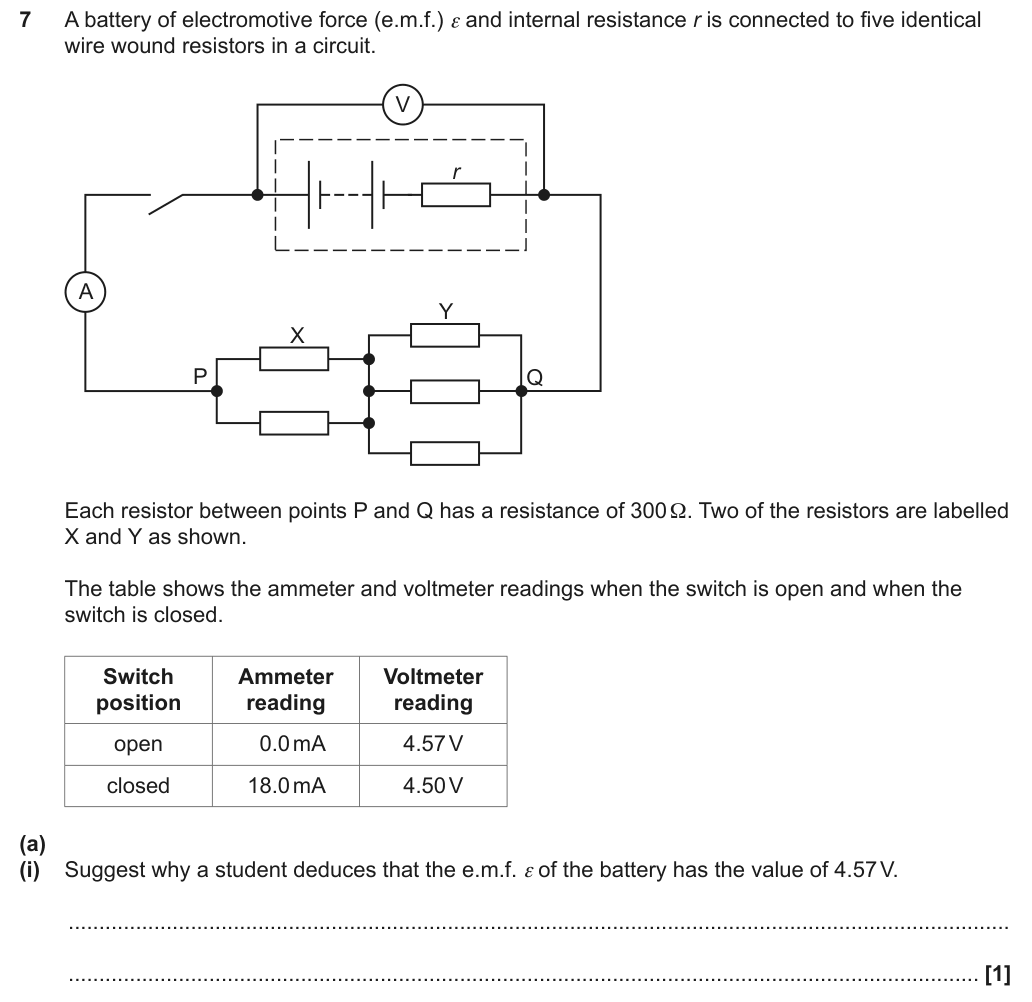
June 2024 · AS Paper 2 · Q7(a)(ii) 1 mark Show that Medium internal resistance
Earlier part of question 7 that this part usesEarlier part of June 2024 Paper 2 question 7
(ii) Show that the resistance r is approximately 3.9 Ω.
[1]
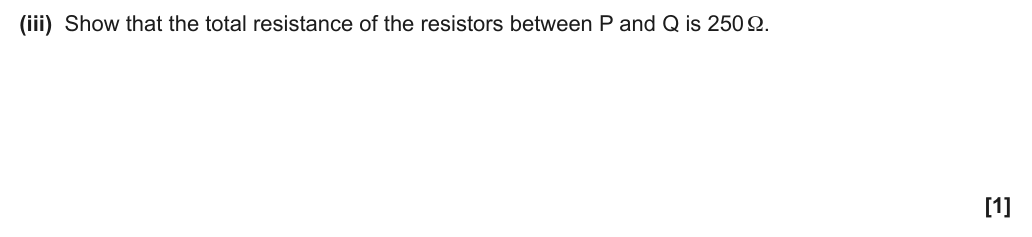
June 2024 · AS Paper 2 · Q7(a)(iii) 1 mark Show that Easy series and parallel circuits
Earlier part of question 7 that this part usesEarlier part of June 2024 Paper 2 question 7
(iii) Show that the total resistance of the resistors between P and Q is 250 Ω.
[1]
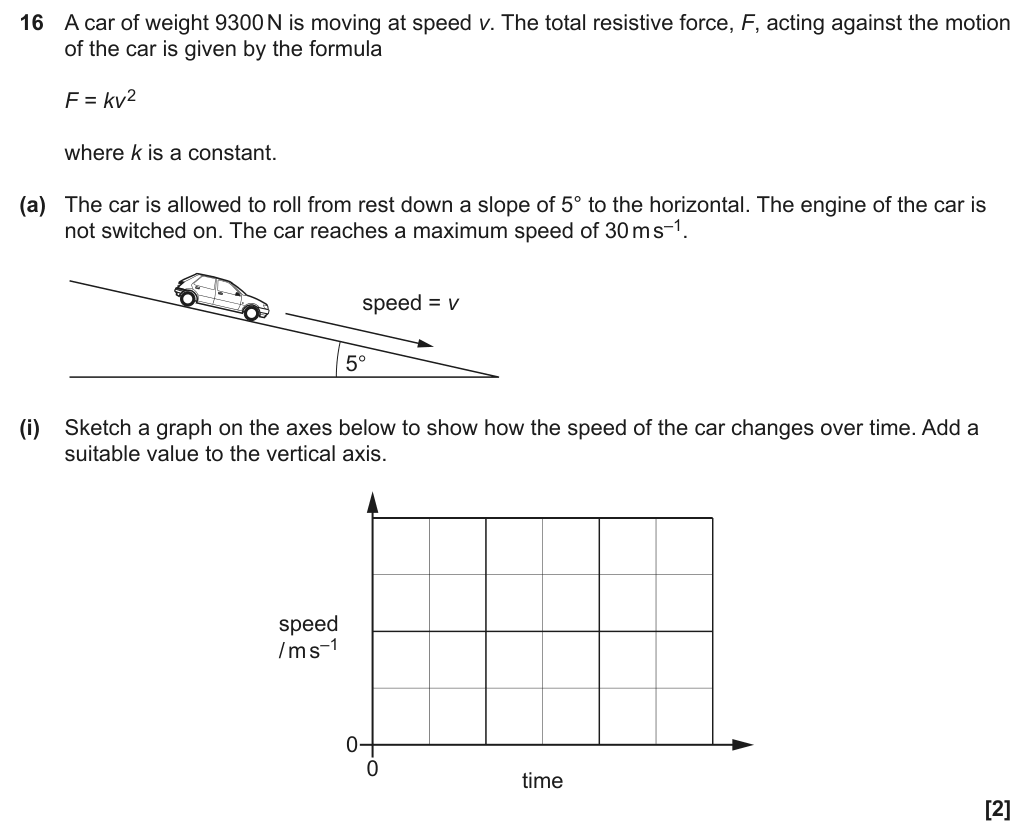
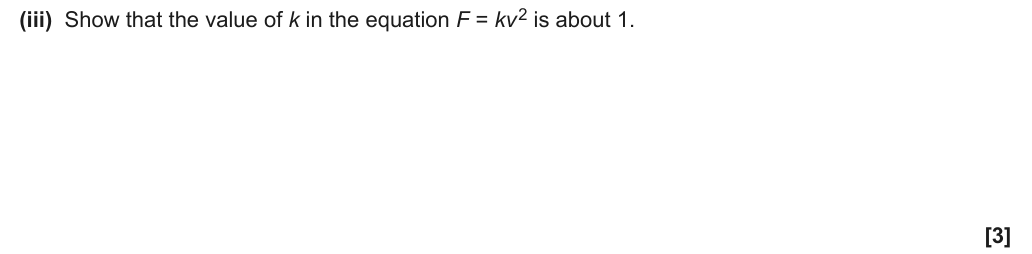
June 2024 · Paper 1 · Q16(a)(iii) 3 marks Show that Medium scalars and vectorsdynamics and terminal velocity
Earlier part of question 16 that this part usesEarlier part of June 2024 Paper 1 question 16
(iii) Show that the value of k in the equation F = kv 2 is about 1.
[3]
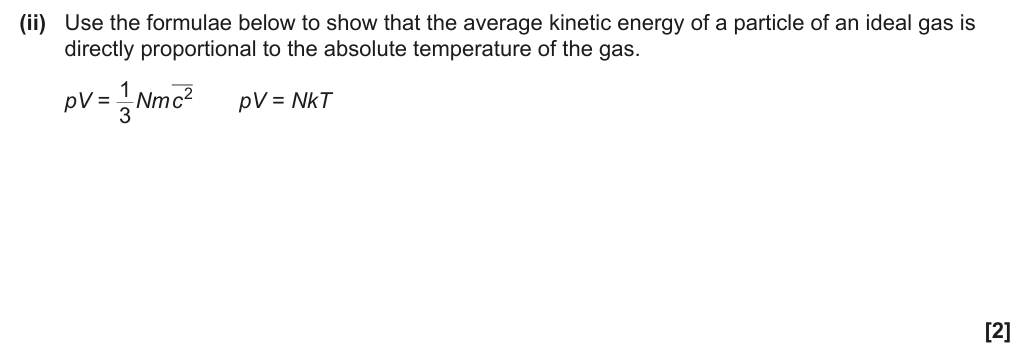
June 2024 · Paper 1 · Q20(a)(ii) 2 marks Show that Easy ideal gases
(ii) Use the formulae below to show that the average kinetic energy of a particle of an ideal gas is
directly proportional to the absolute temperature of the gas.
pV = 1
3 Nmc2  pV = NkT
[2]
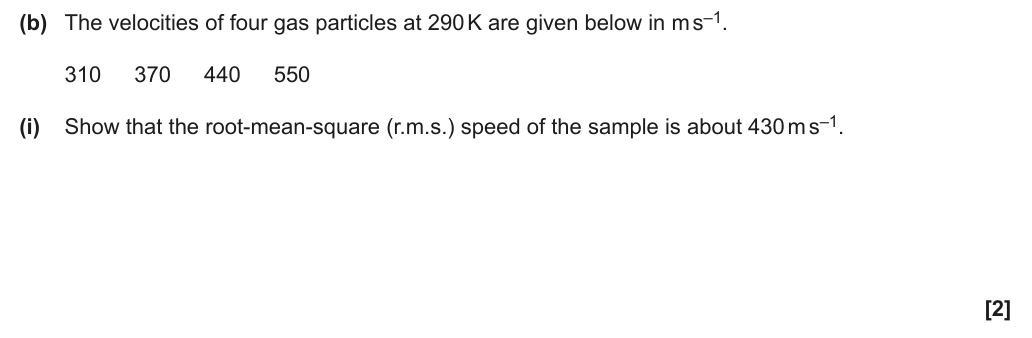
June 2024 · Paper 1 · Q20(b)(i) 2 marks Show that Medium ideal gases
(b) The velocities of four gas particles at 290 K are given below in m s–1.
310   370   440   550
(i) Show that the root-mean-square (r.m.s.) speed of the sample is about 430 m s–1.
[2]
June 2024 · Paper 1 · Q21(a)(i) 2 marks Show that Medium stars
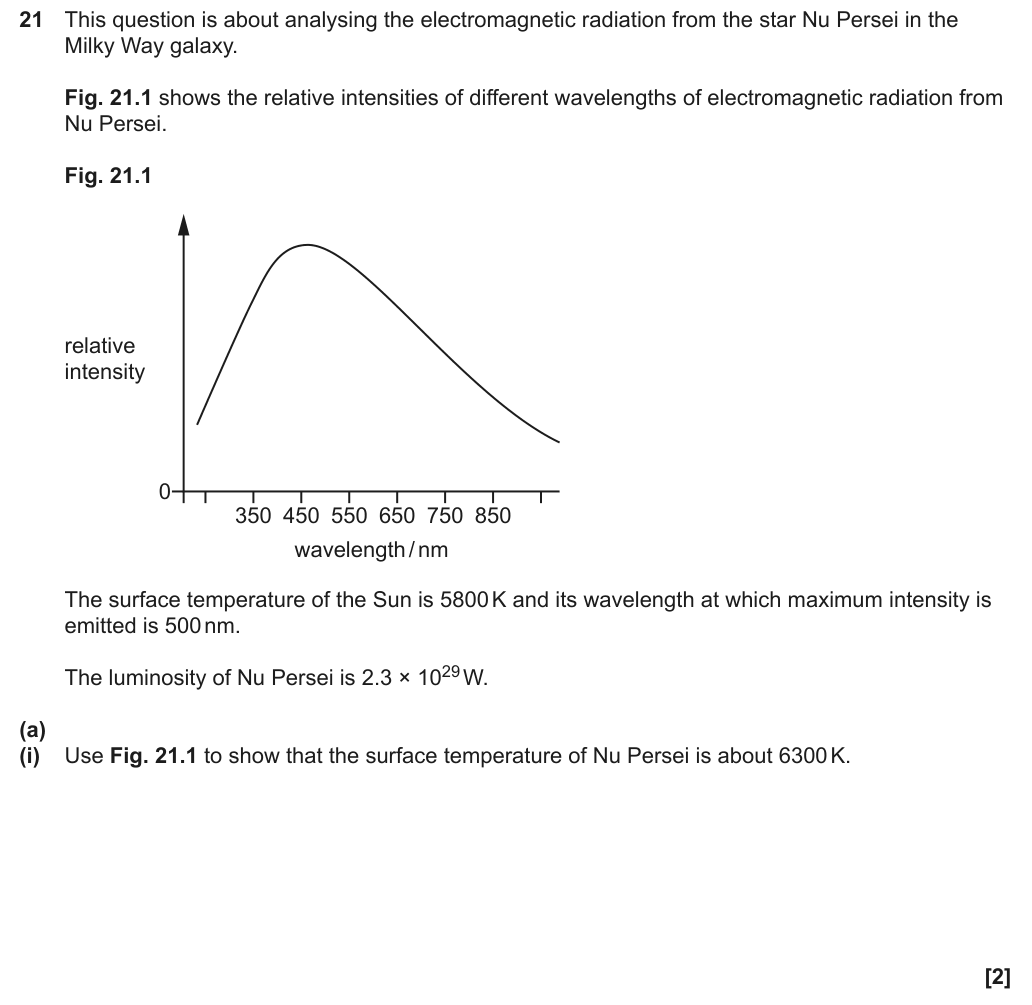
21 This question is about analysing the electromagnetic radiation from the star Nu Persei in the
Milky Way galaxy.
Fig. 21.1 shows the relative intensities of different wavelengths of electromagnetic radiation from
Nu Persei.
Fig. 21.1
relative
intensity
0
350 450 550 650 750 850
wavelength / nm
The surface temperature of the Sun is 5800 K and its wavelength at which maximum intensity is
emitted is 500 nm.
The luminosity of Nu Persei is 2.3 × 1029 W.
(a)
(i) Use Fig. 21.1 to show that the surface temperature of Nu Persei is about 6300 K.
[2]
June 2024 · Paper 1 · Q21(b)(i) 2 marks Show that Medium work energy and power
(b) Electromagnetic radiation is collected from Nu Persei by a sensor with an efficiency of 11% and
cross-sectional area 1.0 × 10⁻⁴ m2.
The radiant power collected by the sensor is 7.0 ×10⁻¹⁵ W.
(i) Show that the radiant power per unit area arriving at the sensor is about 6 × 10⁻¹⁰ W m–2.
[2]
June 2024 · Paper 1 · Q22(b)(i) 2 marks Show that Medium gravitational fieldscircular motionplanetary motion
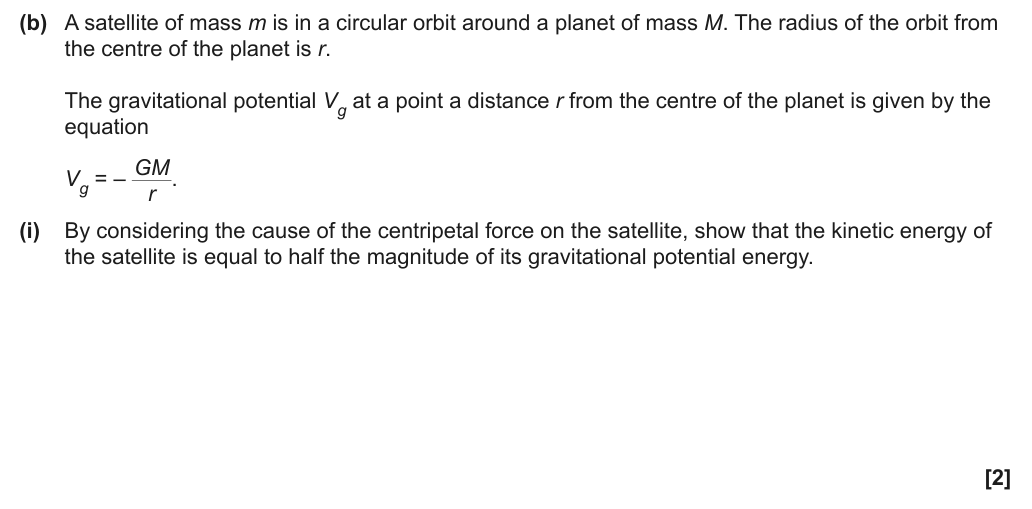
(b) A satellite of mass m is in a circular orbit around a planet of mass M. The radius of the orbit from
the centre of the planet is r.
The gravitational potential Vg at a point a distance r from the centre of the planet is given by the
equation
Vg = – GM
r .
(i) By considering the cause of the centripetal force on the satellite, show that the kinetic energy of
the satellite is equal to half the magnitude of its gravitational potential energy.
[2]
June 2024 · Paper 1 · Q22(b)(ii) 2 marks Show that Medium gravitational fields
Earlier part of question 22 that this part usesEarlier part of June 2024 Paper 1 question 22
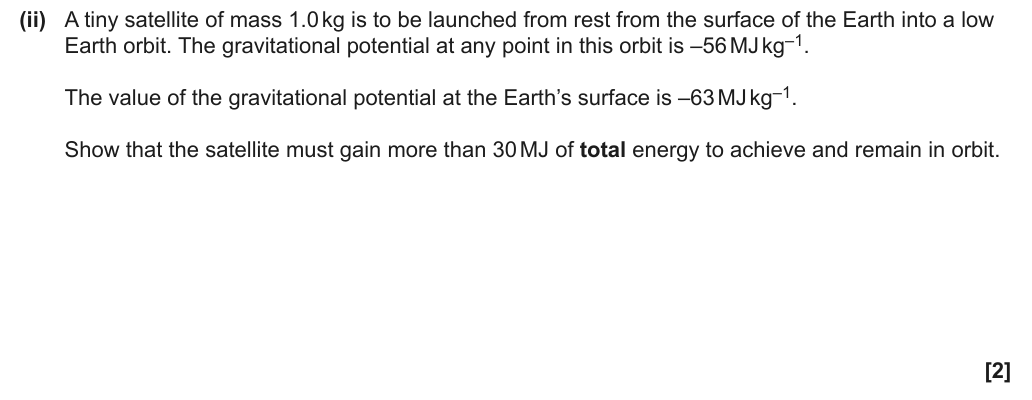
(ii) A tiny satellite of mass 1.0 kg is to be launched from rest from the surface of the Earth into a low
Earth orbit. The gravitational potential at any point in this orbit is –56 MJ kg–1.
The value of the gravitational potential at the Earth’s surface is –63 MJ kg–1.
Show that the satellite must gain more than 30 MJ of total energy to achieve and remain in orbit.
[2]
June 2024 · Paper 1 · Q23(a) 2 marks Show that Medium stars
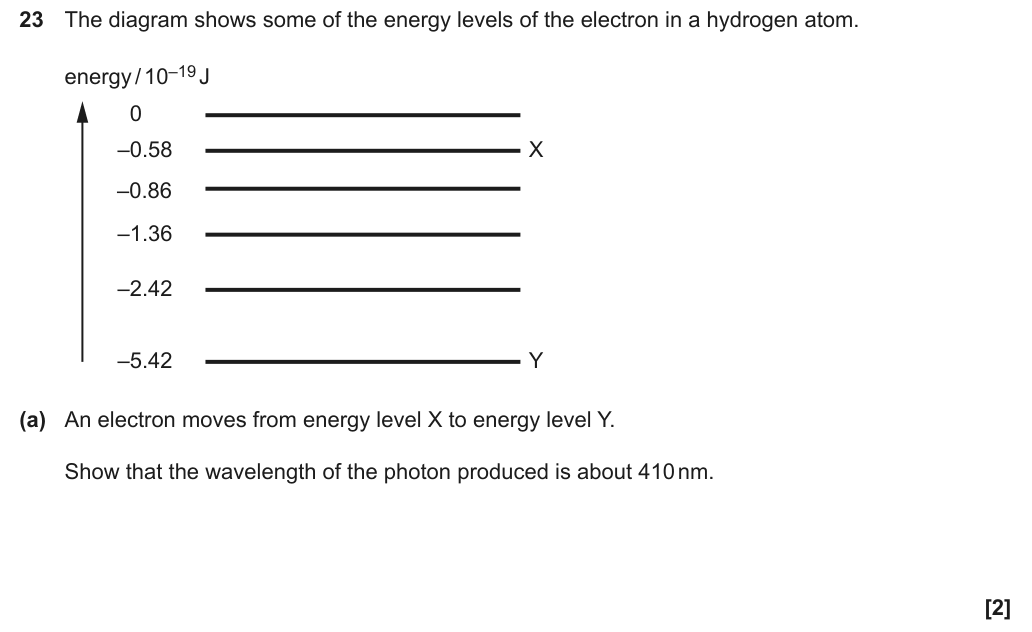
23 The diagram shows some of the energy levels of the electron in a hydrogen atom.
energy / 10–19 J
0
–0.58 X
–0.86
–1.36
–2.42
–5.42 Y
(a) An electron moves from energy level X to energy level Y.
Show that the wavelength of the photon produced is about 410 nm.
[2]
June 2024 · Paper 2 · Q18(b)(ii) 2 marks Show that Easy electromagnetic induction
Earlier part of question 18 that this part usesEarlier part of June 2024 Paper 2 question 18
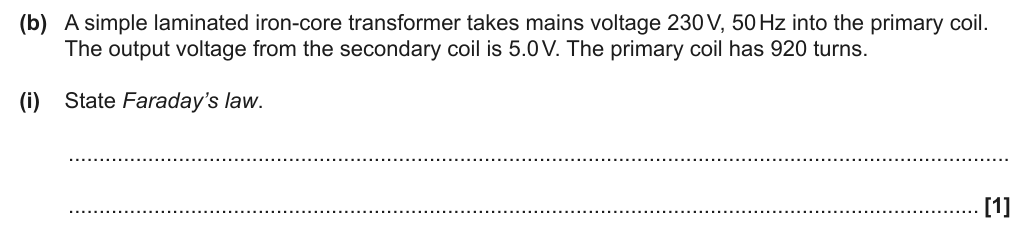
(ii) Show that the number of turns on the secondary coil is 20.
[2]
June 2024 · Paper 2 · Q19(a) 3 marks Show that Medium photons
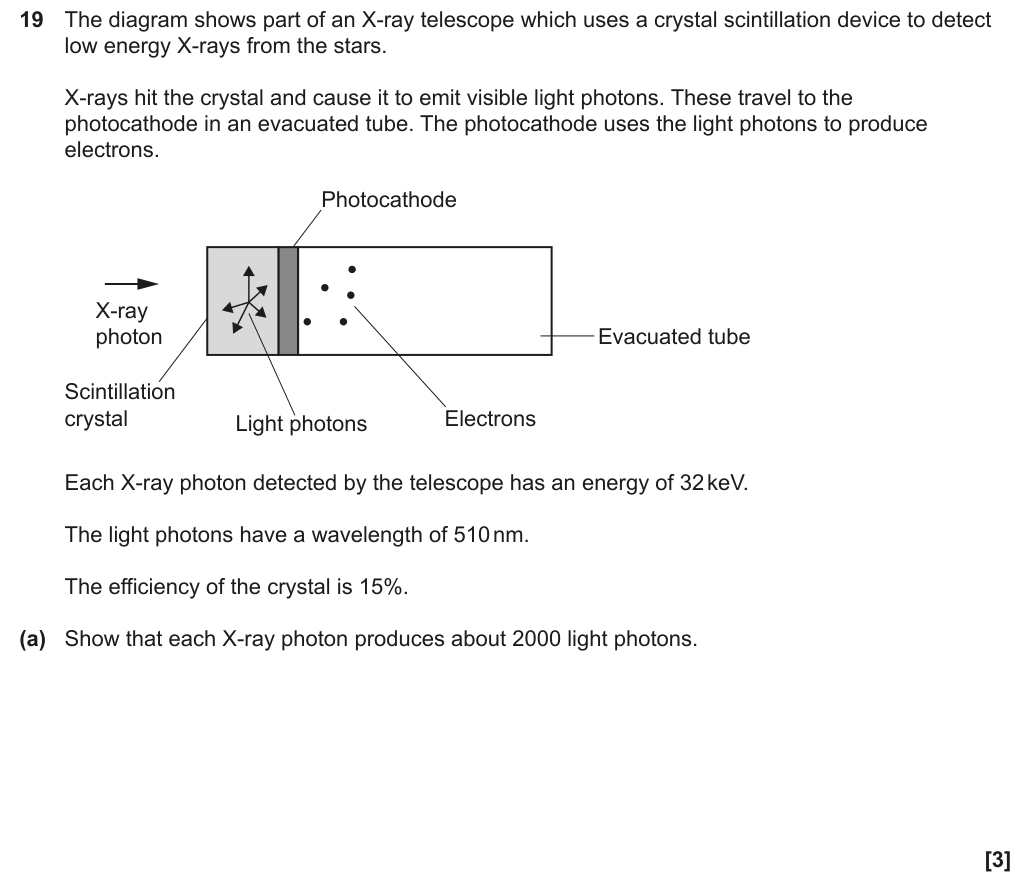
19 The diagram shows part of an X‑ray telescope which uses a crystal scintillation device to detect
low energy X‑rays from the stars.
X‑rays hit the crystal and cause it to emit visible light photons. These travel to the
photocathode in an evacuated tube. The photocathode uses the light photons to produce
electrons.
Photocathode
X-ray
photon Evacuated tube
Scintillation
crystal Light photons Electrons
Each X‑ray photon detected by the telescope has an energy of 32 keV.
The light photons have a wavelength of 510 nm.
The efficiency of the crystal is 15%.
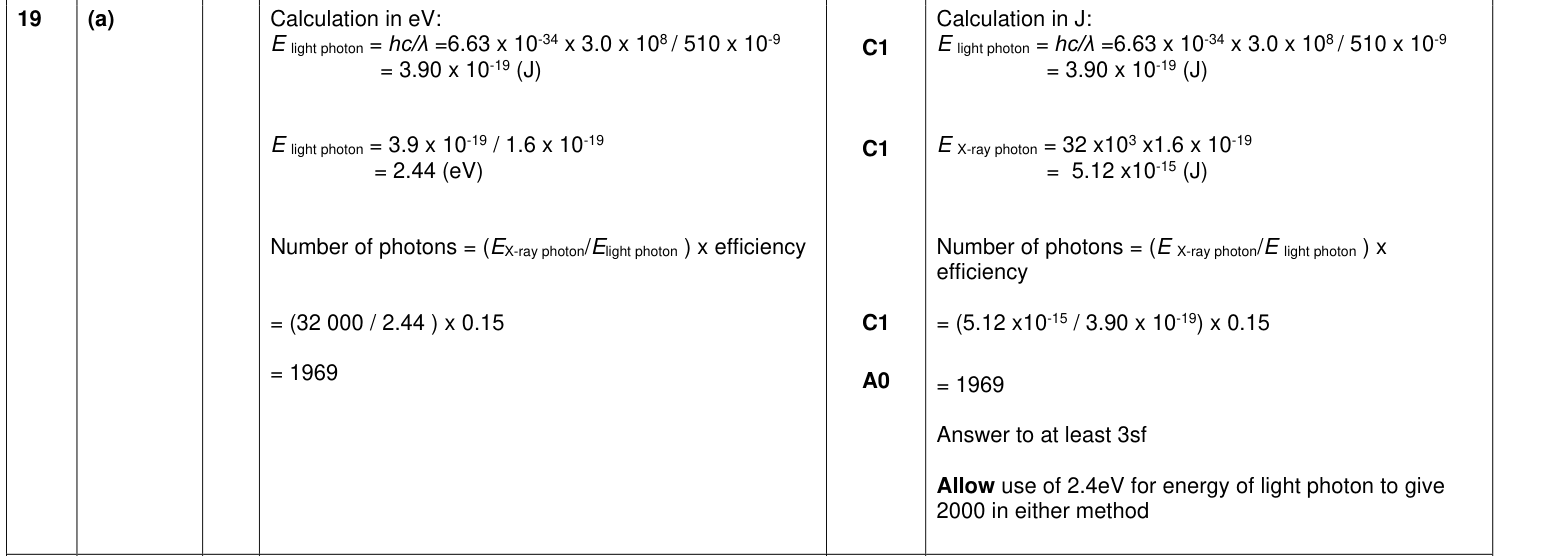
(a) Show that each X‑ray photon produces about 2000 light photons.
[3]
June 2024 · Paper 2 · Q20(c)(ii) 3 marks Show that Hard nuclear fission and fusionphotons
Earlier parts of question 20 that this part usesEarlier part of June 2024 Paper 2 question 20Earlier part of June 2024 Paper 2 question 20
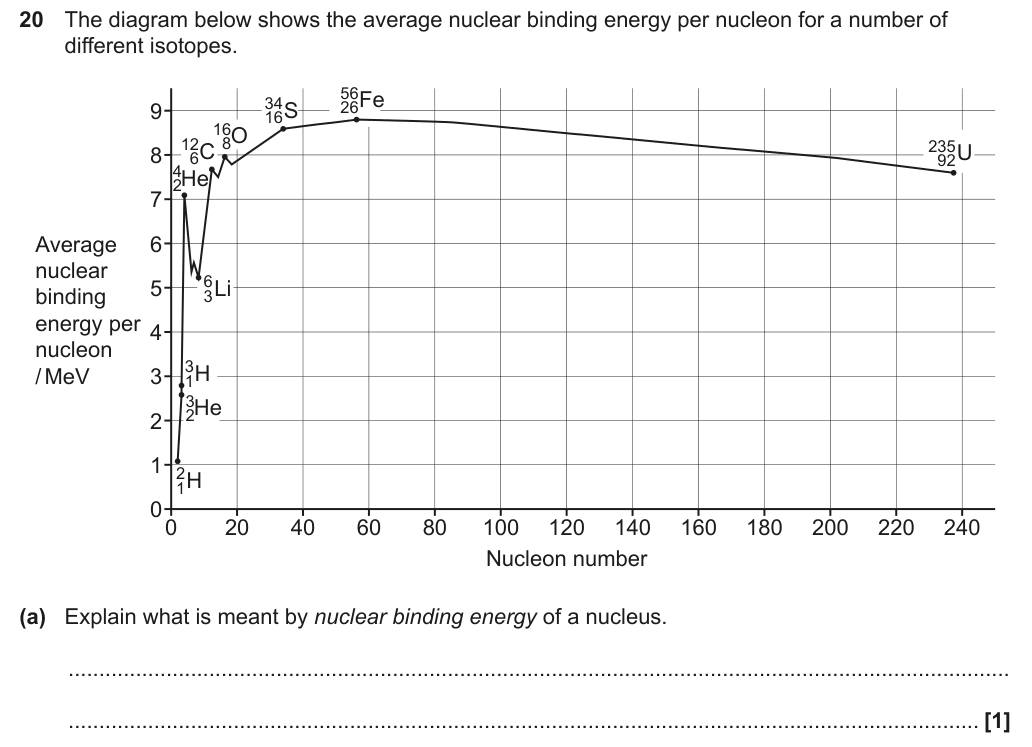
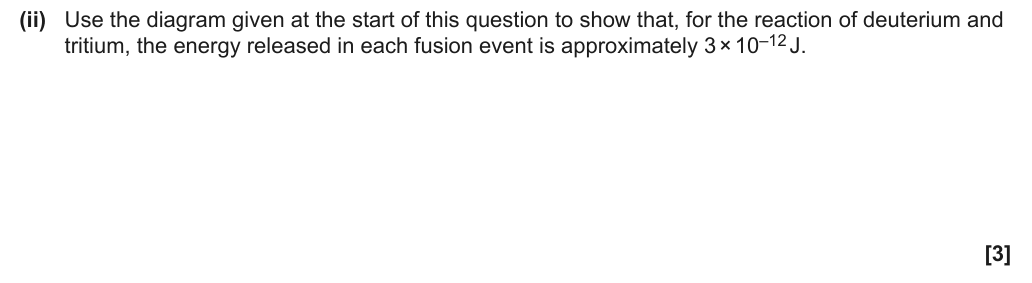
(ii) Use the diagram given at the start of this question to show that, for the reaction of deuterium and
tritium, the energy released in each fusion event is approximately 3 × 10–12 J.
[3]
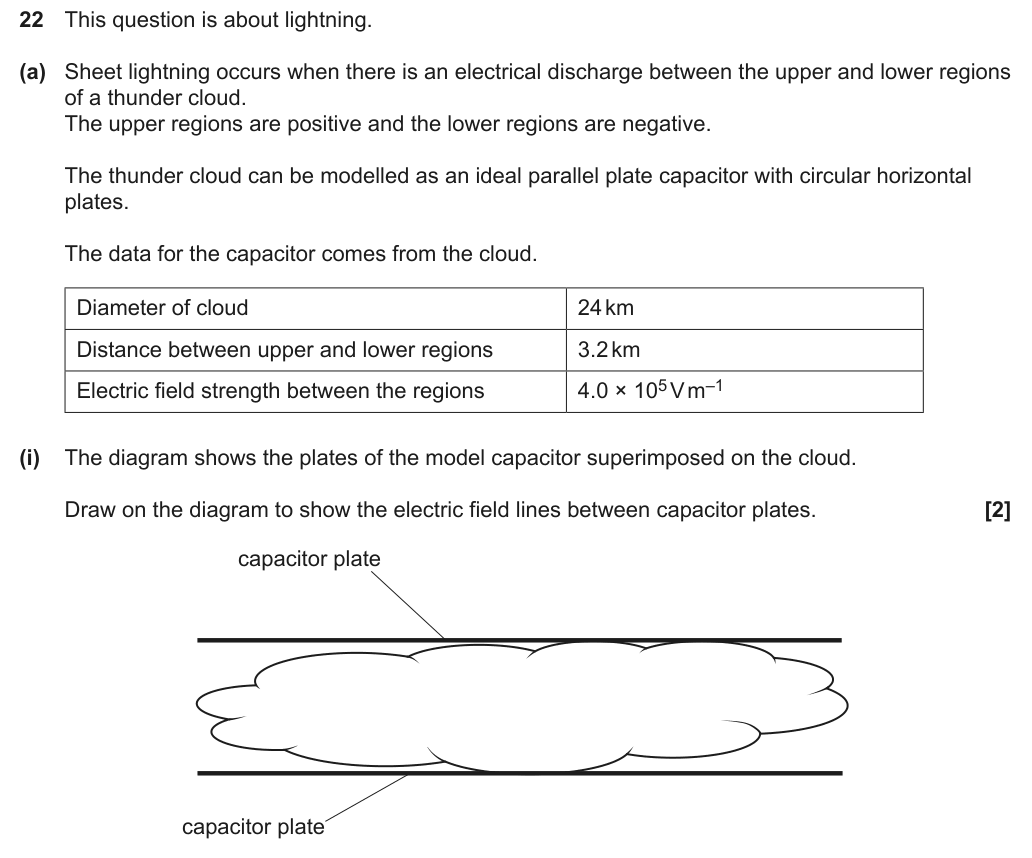
June 2024 · Paper 2 · Q22(a)(iii) 1 mark Show that Medium electric fields
Earlier part of question 22 that this part usesEarlier part of June 2024 Paper 2 question 22
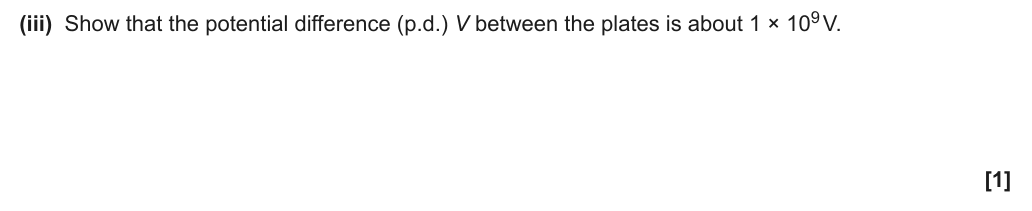
(iii) Show that the potential difference (p.d.) V between the plates is about 1 × 10⁹ V.
[1]
June 2024 · Paper 3 · Q1(a) 3 marks Show that Medium stationary waveswave motion
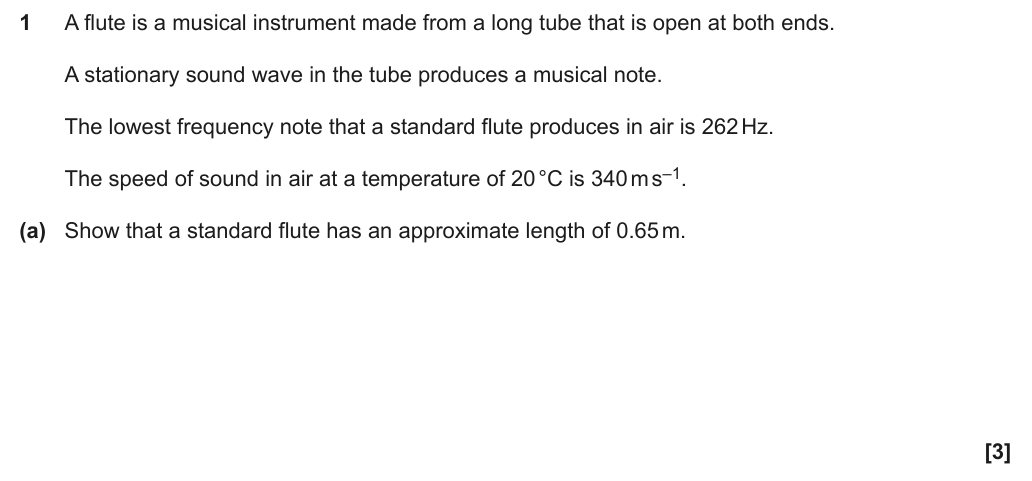
1 A flute is a musical instrument made from a long tube that is open at both ends.
A stationary sound wave in the tube produces a musical note.
The lowest frequency note that a standard flute produces in air is 262 Hz.
The speed of sound in air at a temperature of 20 °C is 340 m s–1.
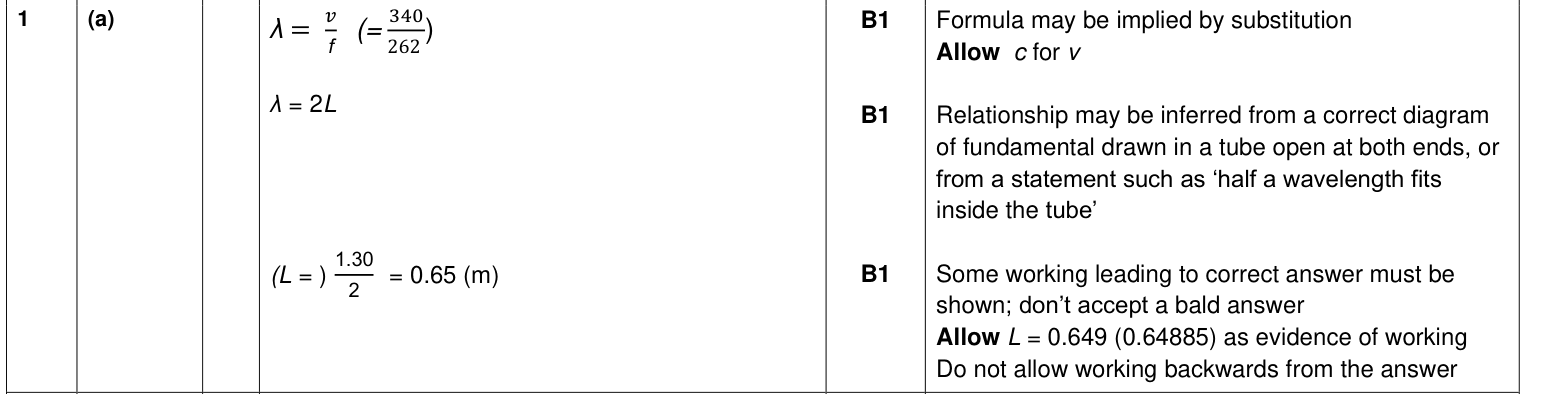
(a) Show that a standard flute has an approximate length of 0.65 m.
[3]
June 2024 · Paper 3 · Q2(a) 2 marks Show that Medium capacitorsseries and parallel circuits
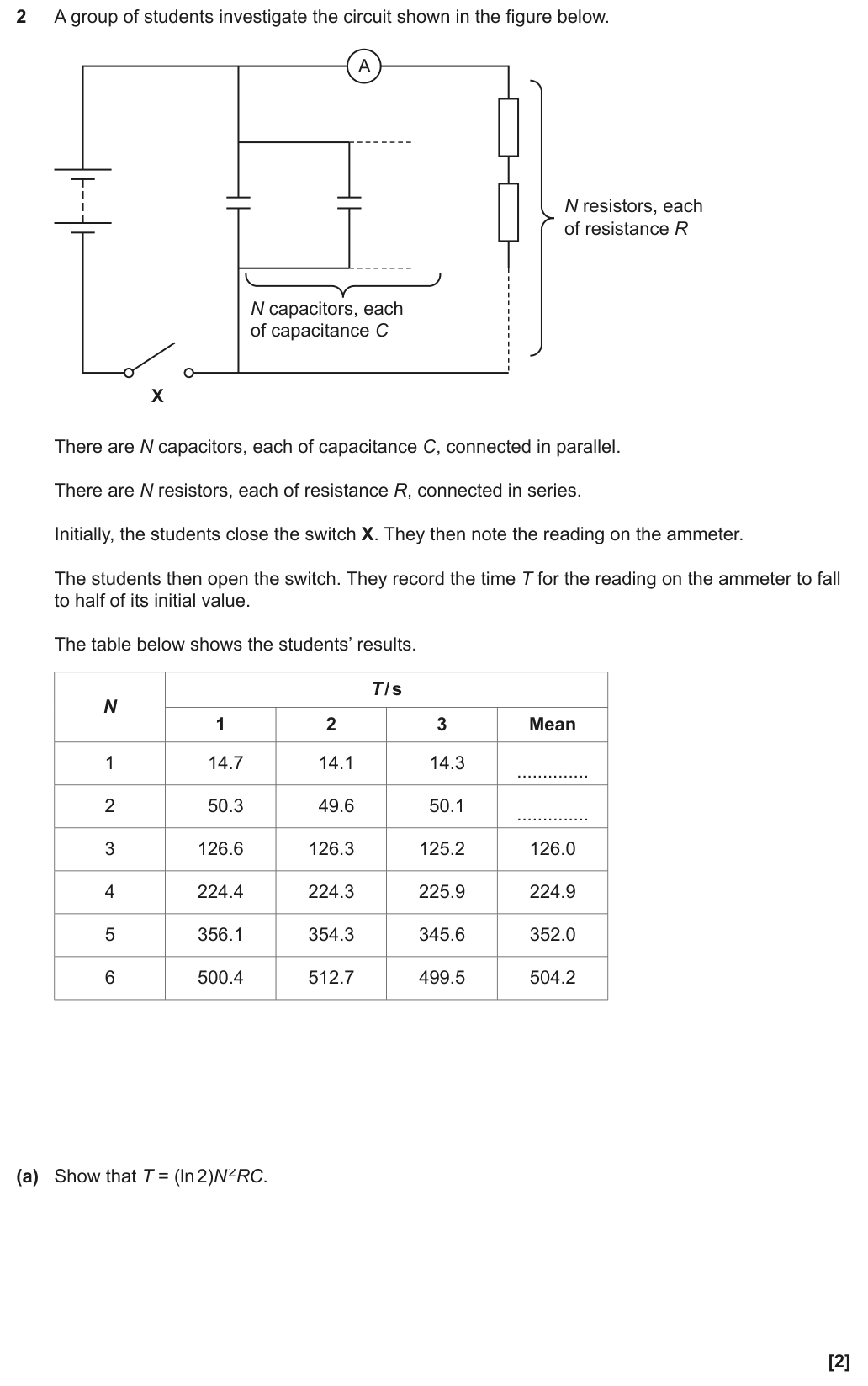
2 A group of students investigate the circuit shown in the figure below.
A
N resistors, each
of resistance R
N capacitors, each
of capacitance C
X
There are N capacitors, each of capacitance C, connected in parallel.
There are N resistors, each of resistance R, connected in series.
Initially, the students close the switch X. They then note the reading on the ammeter.
The students then open the switch. They record the time T for the reading on the ammeter to fall
to half of its initial value.
The table below shows the students’ results.
T / s
N
1 2 3 Mean
1 14.7 14.1 14.3
..............
2 50.3 49.6 50.1
..............
3 126.6 126.3 125.2 126.0
4 224.4 224.3 225.9 224.9
5 356.1 354.3 345.6 352.0
6 500.4 512.7 499.5 504.2
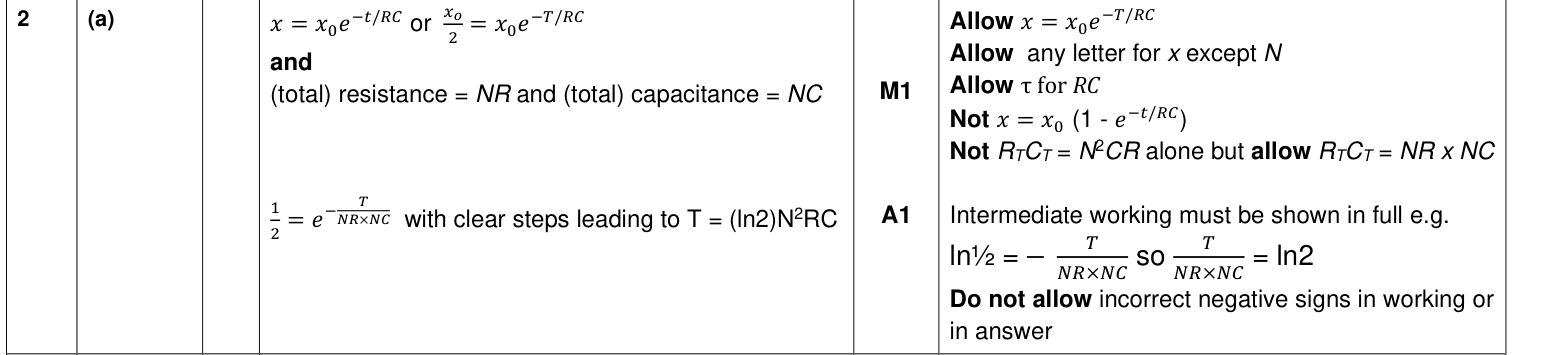
(a) Show that T = (ln 2)N 2RC.
[2]
June 2024 · Paper 3 · Q6(a) 1 mark Show that Medium electric fieldscharge and current
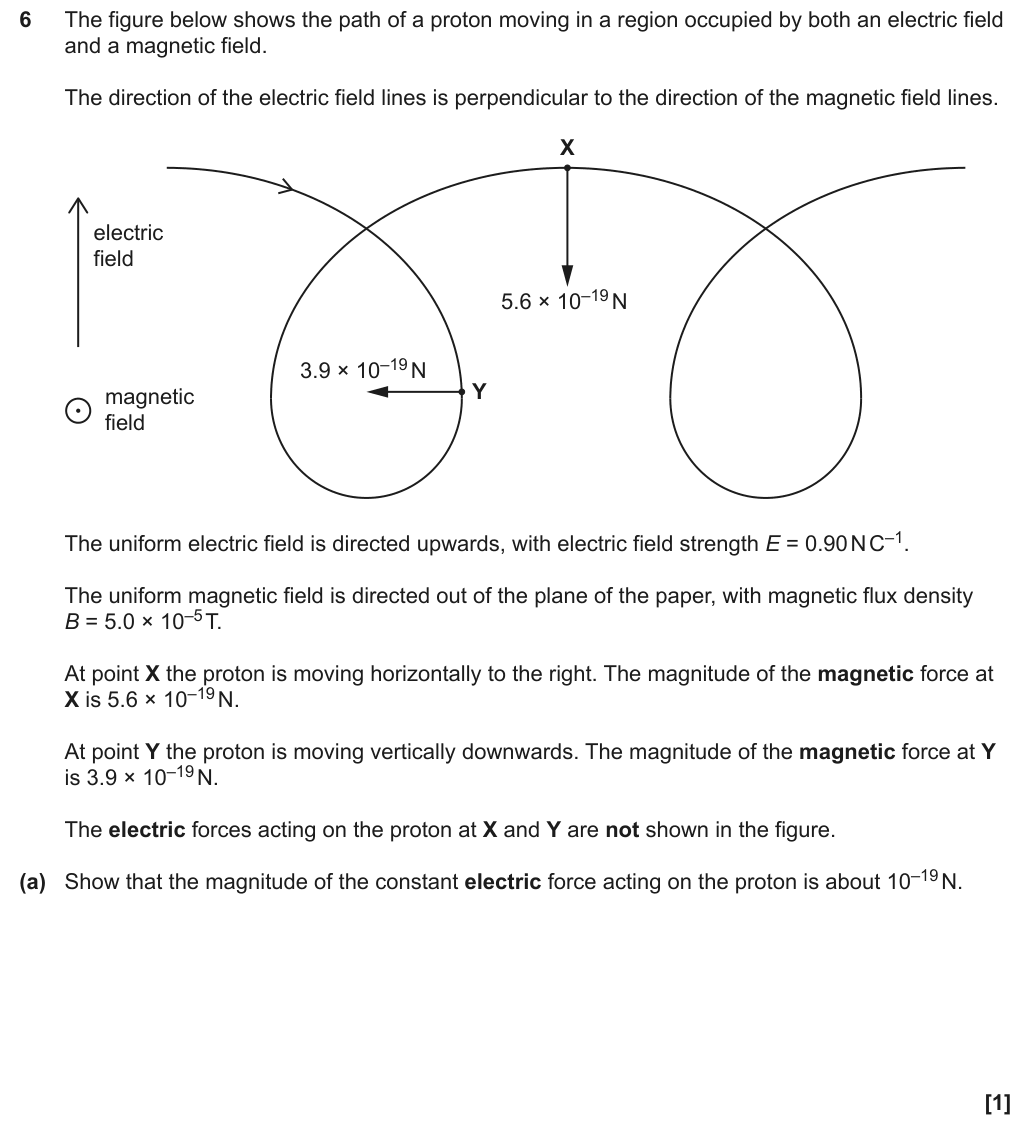
6 The figure below shows the path of a proton moving in a region occupied by both an electric field
and a magnetic field.
The direction of the electric field lines is perpendicular to the direction of the magnetic field lines.
X
electric
field
5.6 × 10⁻¹⁹ N
3.9 × 10⁻¹⁹ N
magnetic Y
field
The uniform electric field is directed upwards, with electric field strength E = 0.90 N C–1.
The uniform magnetic field is directed out of the plane of the paper, with magnetic flux density
B = 5.0 × 10⁻⁵ T.
At point X the proton is moving horizontally to the right. The magnitude of the magnetic force at
X is 5.6 × 10⁻¹⁹ N.
At point Y the proton is moving vertically downwards. The magnitude of the magnetic force at Y
is 3.9 × 10⁻¹⁹ N.
The electric forces acting on the proton at X and Y are not shown in the figure.
(a) Show that the magnitude of the constant electric force acting on the proton is about 10–19 N.
[1]
June 2023 · AS Paper 1 · Q21(c)(i) 2 marks Show that Medium materials and young modulussprings
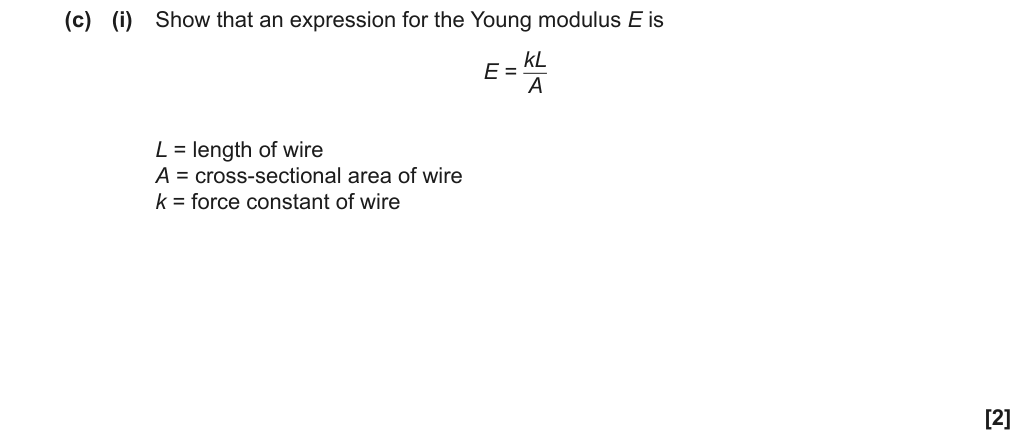
(c) (i) Show that an expression for the Young modulus E is
E = kL
A
L = length of wire
A = cross-sectional area of wire
k = force constant of wire
[2]
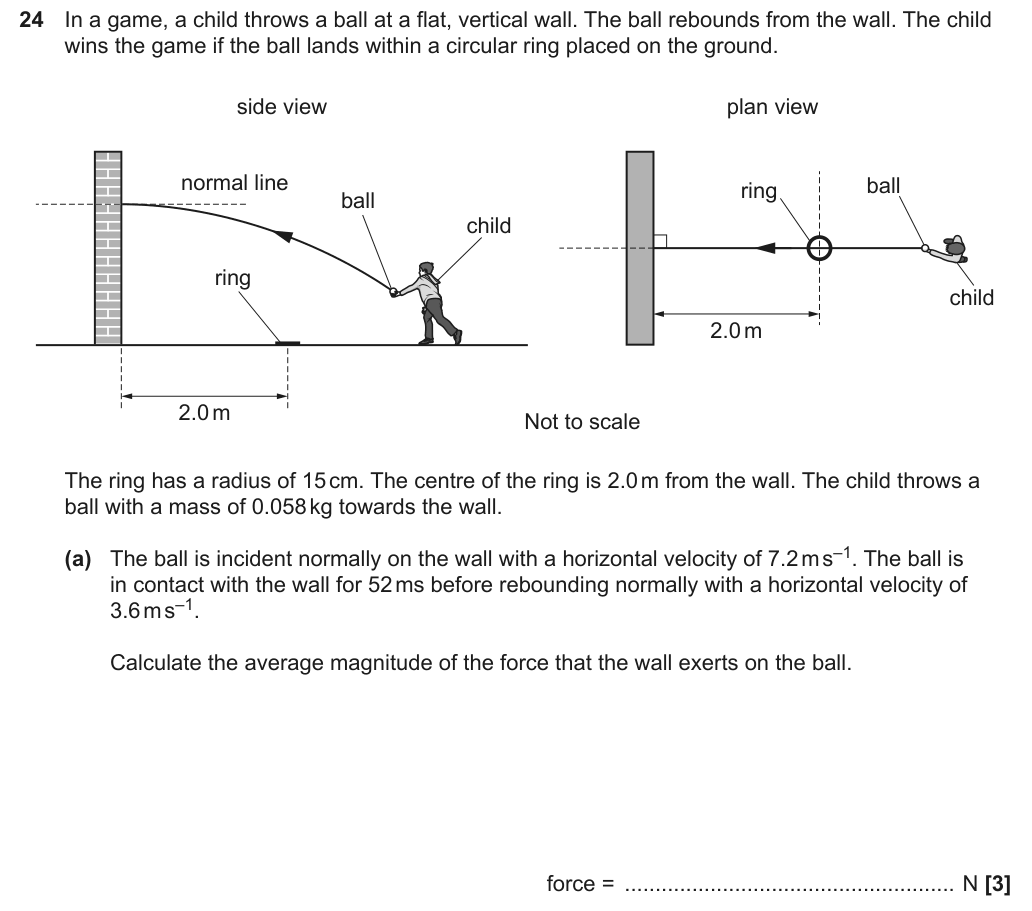
June 2023 · AS Paper 1 · Q24(b) 3 marks Show that Easy projectile motion
Earlier part of question 24 that this part usesEarlier part of June 2023 Paper 1 question 24
(b) The ball lands on the ground a time of 0.58 s after hitting the wall.
Show that the child wins the game. Air resistance can be assumed to be negligible.
[3]
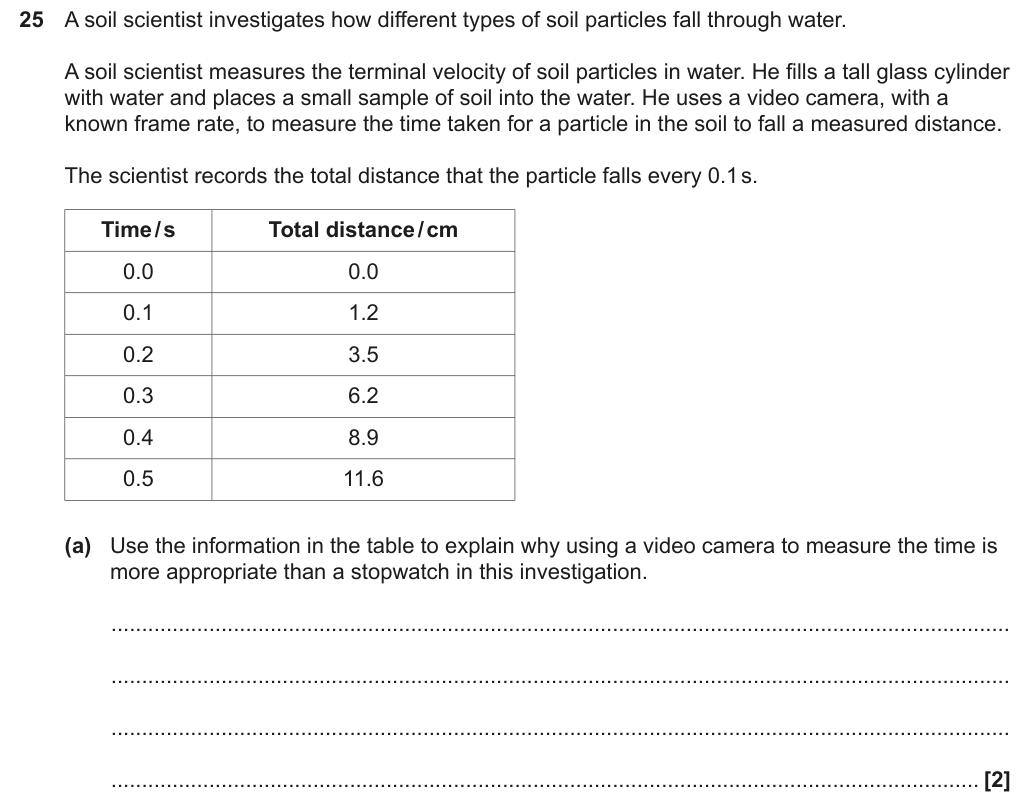
June 2023 · AS Paper 1 · Q25(c) 2 marks Show that Medium dynamics and terminal velocitypractical skillskinematics
Earlier part of question 25 that this part usesEarlier part of June 2023 Paper 1 question 25
(c) Use the scientist’s results to show that the terminal velocity is about 0.3 m s–1.
[2]
June 2023 · AS Paper 2 · Q3(a) 1 mark Show that Medium scalars and vectors
Diagram
..........................................................................................................................................................
..........................................................................................................................................................
..........................................................................................................................................................
..........................................................................................................................................................
..........................................................................................................................................................
..........................................................................................................................................................
..........................................................................................................................................................
..........................................................................................................................................................
..........................................................................................................................................................
..........................................................................................................................................................
..........................................................................................................................................................
..........................................................................................................................................................
..........................................................................................................................................................
..........................................................................................................................................................
..........................................................................................................................................................
Additional answer space if required
..........................................................................................................................................................
..........................................................................................................................................................
..........................................................................................................................................................
..........................................................................................................................................................
..........................................................................................................................................................
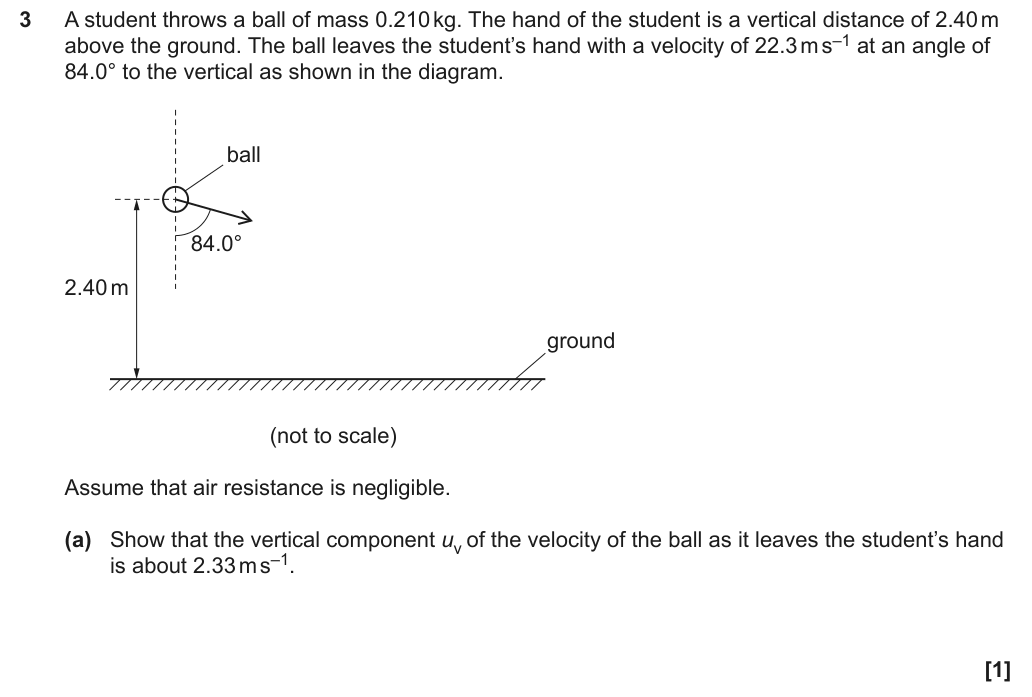
3 A student throws a ball of mass 0.210 kg. The hand of the student is a vertical distance of 2.40 m
above the ground. The ball leaves the student’s hand with a velocity of 22.3 m s–1 at an angle of
84.0° to the vertical as shown in the diagram.
ball
84.0°
2.40 m
ground
(not to scale)
Assume that air resistance is negligible.
(a) Show that the vertical component uv of the velocity of the ball as it leaves the student’s hand
is about 2.33 m s–1.
[1]
June 2023 · AS Paper 2 · Q3(b) 2 marks Show that Medium linear motionprojectile motion
Earlier part of question 3 that this part usesEarlier part of June 2023 Paper 2 question 3
(b) Show that the vertical component vv of the velocity of the ball as it hits the ground is about
7.25 m s–1.
[2]
June 2023 · AS Paper 2 · Q6(c)(i) 2 marks Show that Medium emf pd and resistancecharge and currentseries and parallel circuits
Earlier part of question 6 that this part usesEarlier part of June 2023 Paper 2 question 6
(c) The switch is now closed.
The ammeter and voltmeter readings are:
Ammeter reading = 220 mA
Voltmeter reading = 4.80 V
(i) Show that the resistance of R is 120 Ω.
[2]
June 2023 · AS Paper 2 · Q8(b)(i) 1 mark Show that Easy photons
(b) The maximum kinetic energy of the emitted photoelectrons is 1.9 eV.
(i) Show that the maximum kinetic energy of the emitted photoelectrons, is about
3.0 × 10⁻¹⁹ J.
[1]
June 2023 · Paper 1 · Q17(a)(ii) 2 marks Show that Hard scalars and vectors
Earlier part of question 17 that this part usesEarlier part of June 2023 Paper 1 question 17
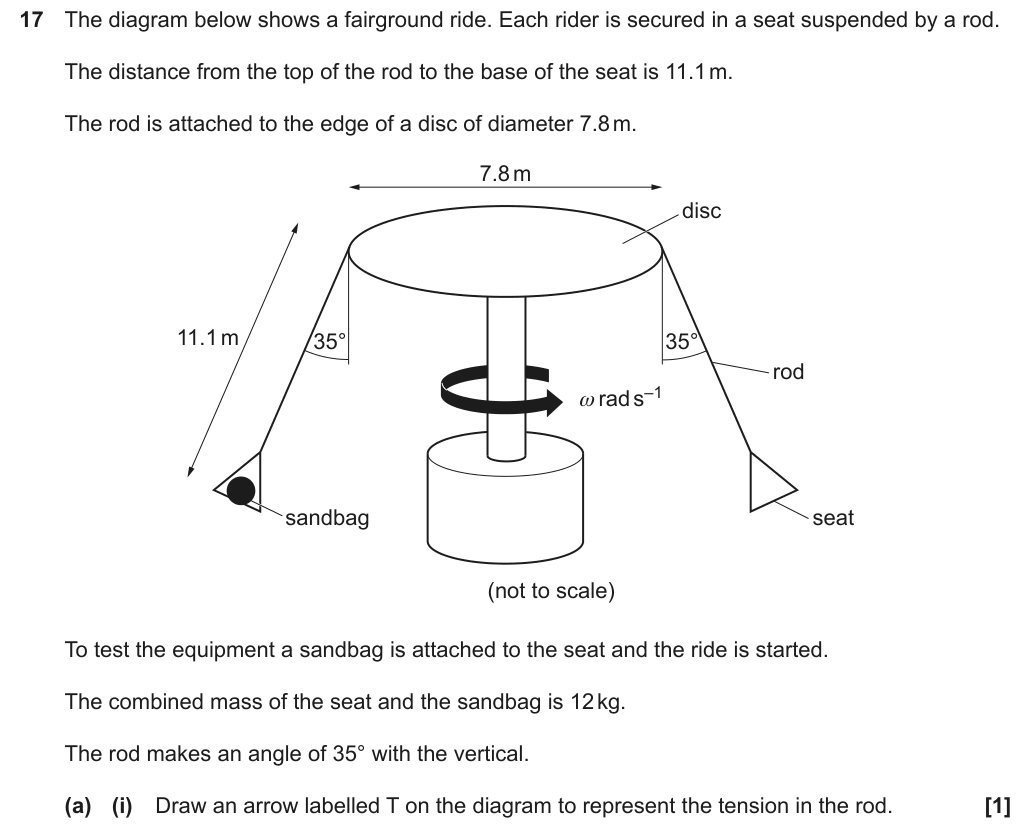
(ii) Show that the radius of the circular path followed by the sandbag is about 10 m.
[2]
June 2023 · Paper 1 · Q17(a)(iv) 2 marks Show that Hard circular motionscalars and vectors
Earlier parts of question 17 that this part usesEarlier part of June 2023 Paper 1 question 17Earlier part of June 2023 Paper 1 question 17Earlier part of June 2023 Paper 1 question 17
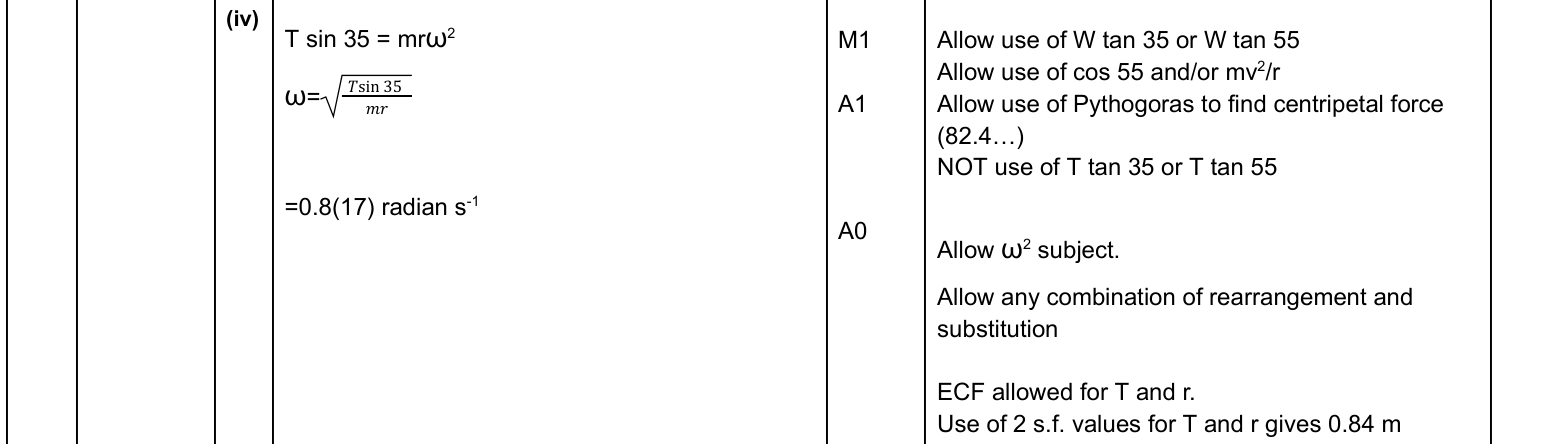
(iv) Show that the angular velocity of the ride is about 0.8 radians per second.
[2]
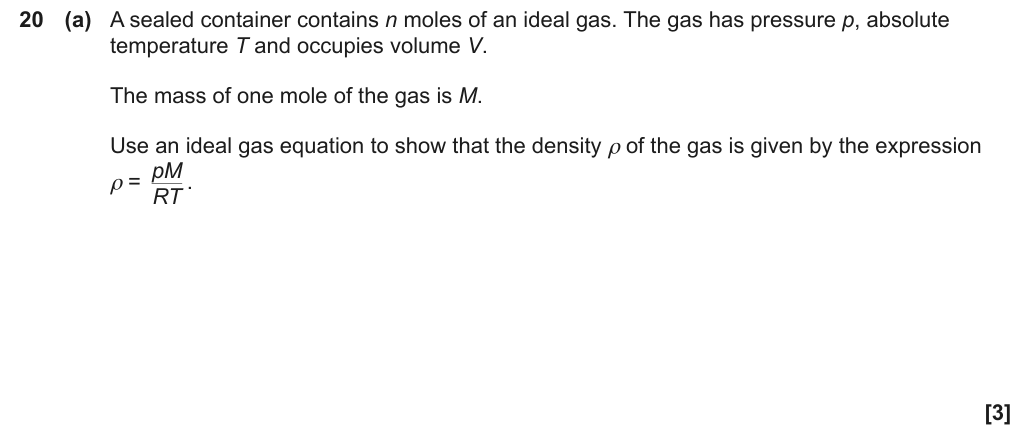
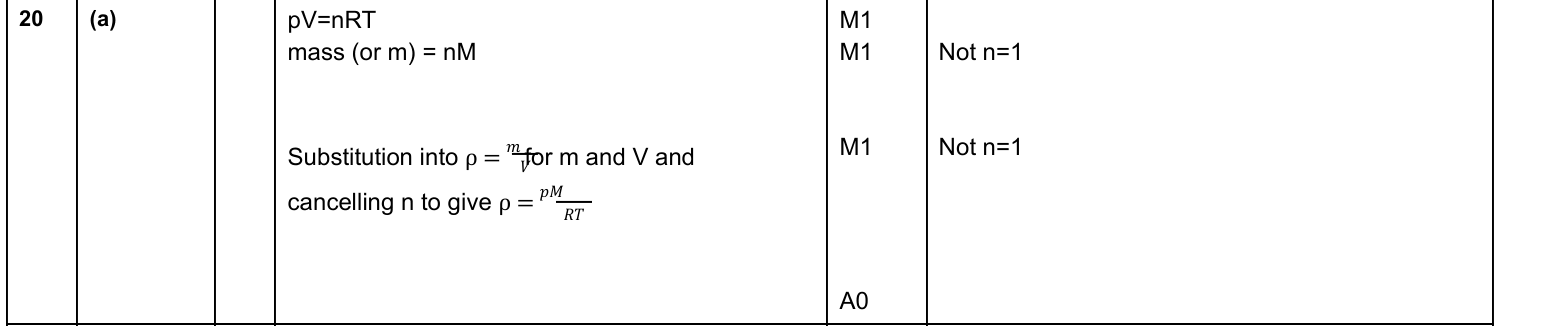
June 2023 · Paper 1 · Q20(a) 3 marks Show that Medium ideal gasesdensity and pressure
20  (a) A sealed container contains n moles of an ideal gas. The gas has pressure p, absolute
temperature T and occupies volume V.
The mass of one mole of the gas is M.
Use an ideal gas equation to show that the density ρ of the gas is given by the expression
ρ = pM
RT .
[3]
June 2023 · Paper 1 · Q20(b)(i) 1 mark Show that Easy ideal gasesthermal physics
Earlier part of question 20 that this part usesEarlier part of June 2023 Paper 1 question 20
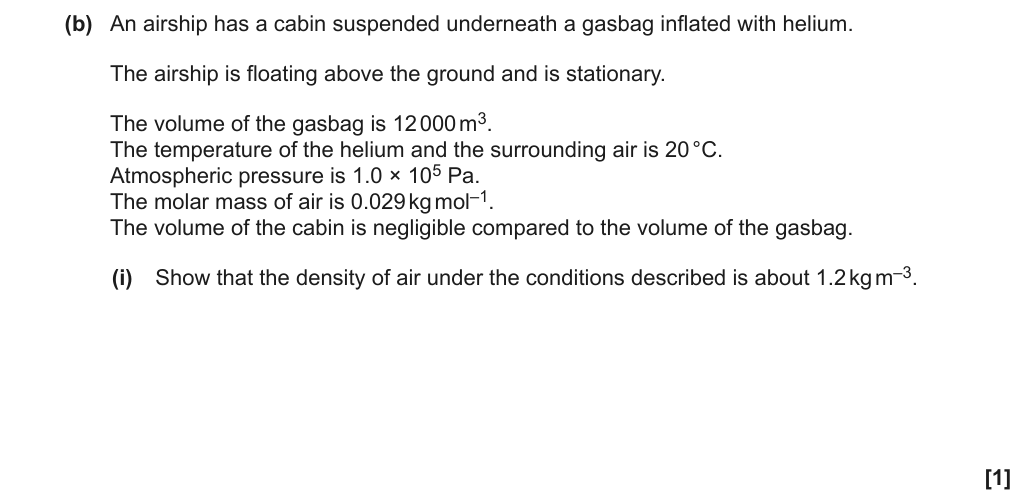
(b) An airship has a cabin suspended underneath a gasbag inflated with helium.
The airship is floating above the ground and is stationary.
The volume of the gasbag is 12 000 m3.
The temperature of the helium and the surrounding air is 20 °C.
Atmospheric pressure is 1.0 × 10⁵ Pa.
The molar mass of air is 0.029 kg mol–1.
The volume of the cabin is negligible compared to the volume of the gasbag.
(i) Show that the density of air under the conditions described is about 1.2 kg m–3.
[1]
June 2023 · Paper 1 · Q21(a)(i) 2 marks Show that Medium quantities and units
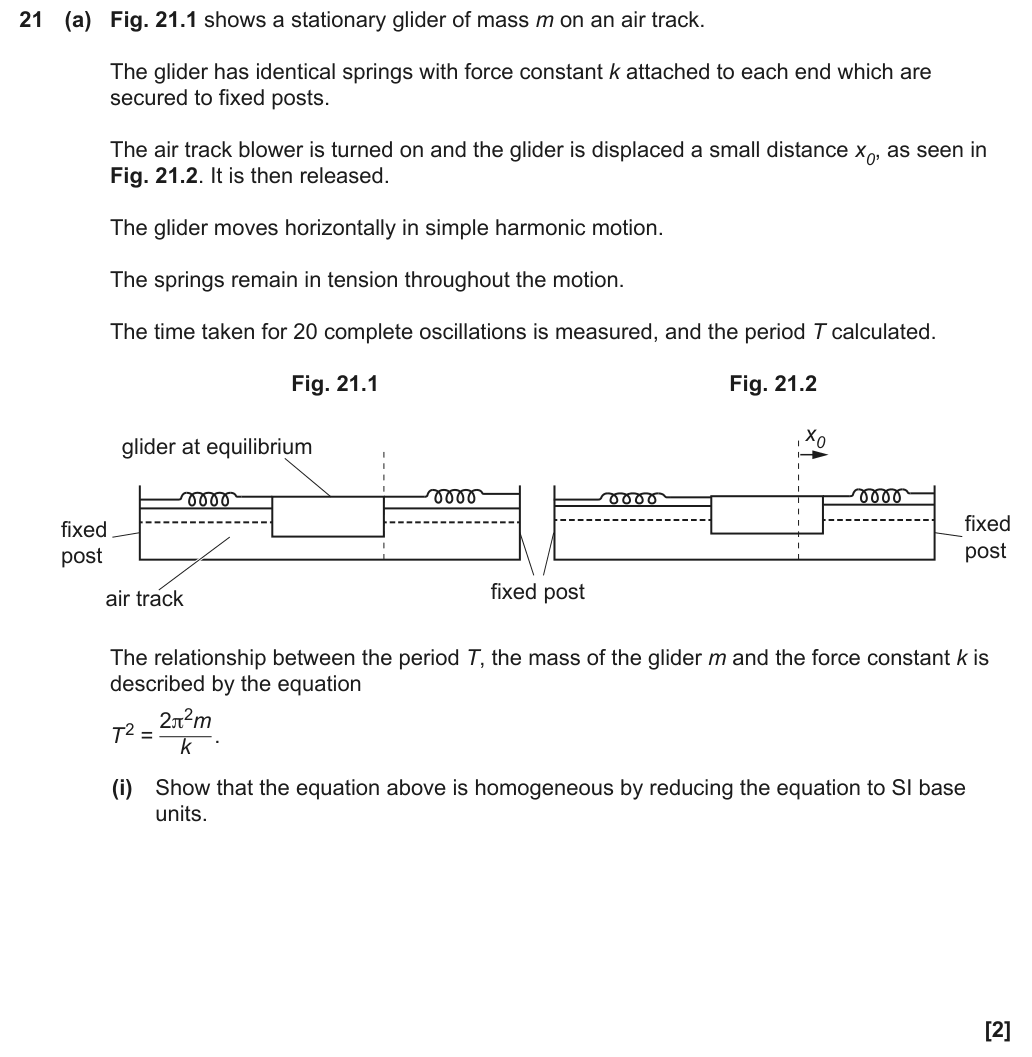
21 (a) Fig. 21.1 shows a stationary glider of mass m on an air track.
The glider has identical springs with force constant k attached to each end which are
secured to fixed posts.
The air track blower is turned on and the glider is displaced a small distance x0, as seen in
Fig. 21.2. It is then released.
The glider moves horizontally in simple harmonic motion.
The springs remain in tension throughout the motion.
The time taken for 20 complete oscillations is measured, and the period T calculated.
Fig. 21.1 Fig. 21.2
x0
glider at equilibrium
fixed fixed
post post
fixed post
air track
The relationship between the period T, the mass of the glider m and the force constant k is
described by the equation
T 2 = 2π2m
.
k
(i) Show that the equation above is homogeneous by reducing the equation to SI base
units.
[2]
June 2023 · Paper 1 · Q23(b)(i) 2 marks Show that Medium ideal gases
Earlier part of question 23 that this part usesEarlier part of June 2023 Paper 1 question 23
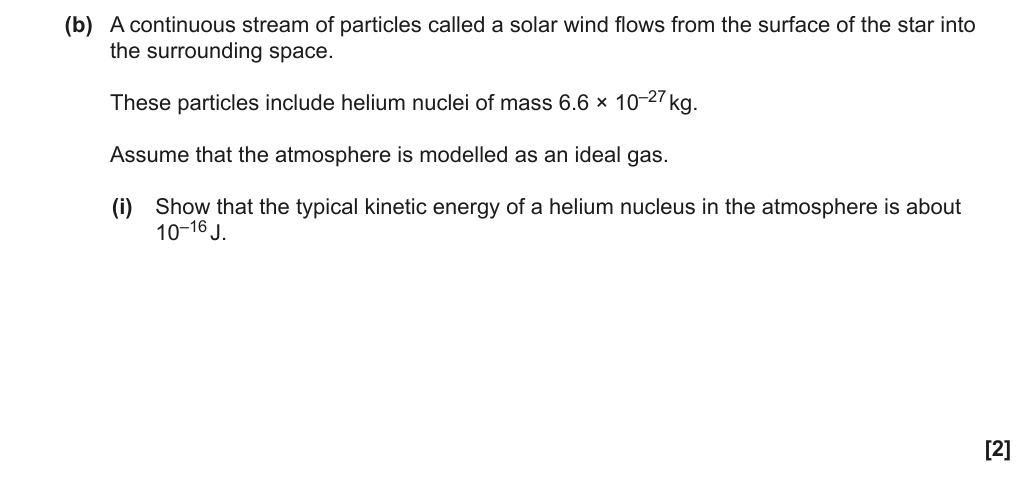
(b) A continuous stream of particles called a solar wind flows from the surface of the star into
the surrounding space.
These particles include helium nuclei of mass 6.6 × 10⁻²⁷ kg.
Assume that the atmosphere is modelled as an ideal gas.
(i) Show that the typical kinetic energy of a helium nucleus in the atmosphere is about
10–16 J.
[2]
June 2023 · Paper 3 · Q1(b)(i) 2 marks Show that Medium planetary motion
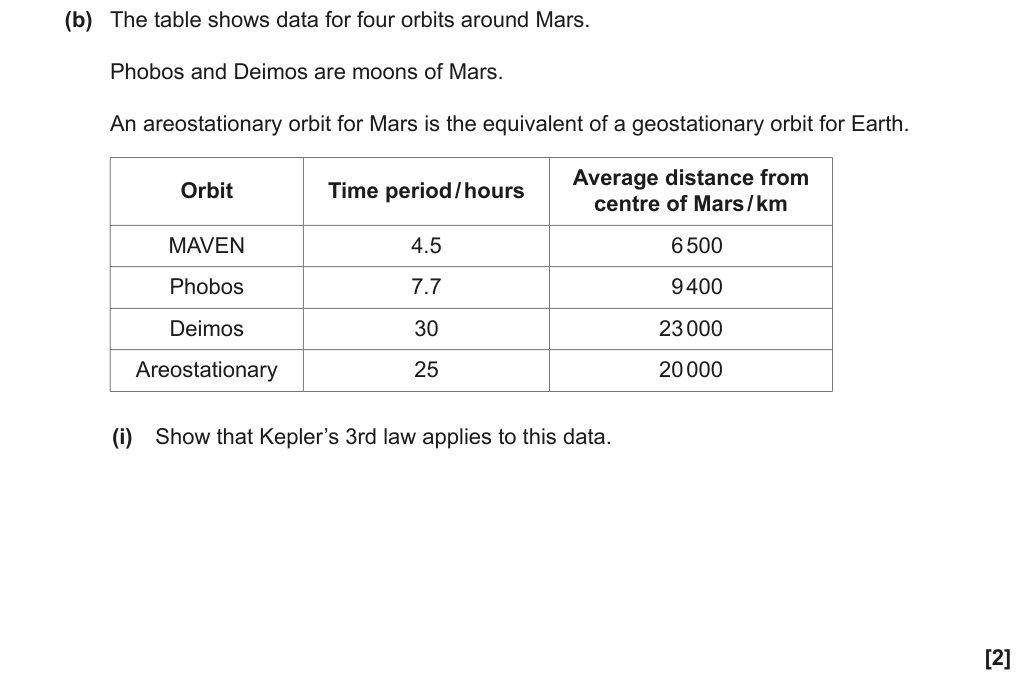
(b) The table shows data for four orbits around Mars.
Phobos and Deimos are moons of Mars.
An areostationary orbit for Mars is the equivalent of a geostationary orbit for Earth.
Average distance from
Orbit Time period / hours
centre of Mars / km
MAVEN 4.5 6 500
Phobos 7.7 9 400
Deimos 30 23 000
Areostationary 25 20 000
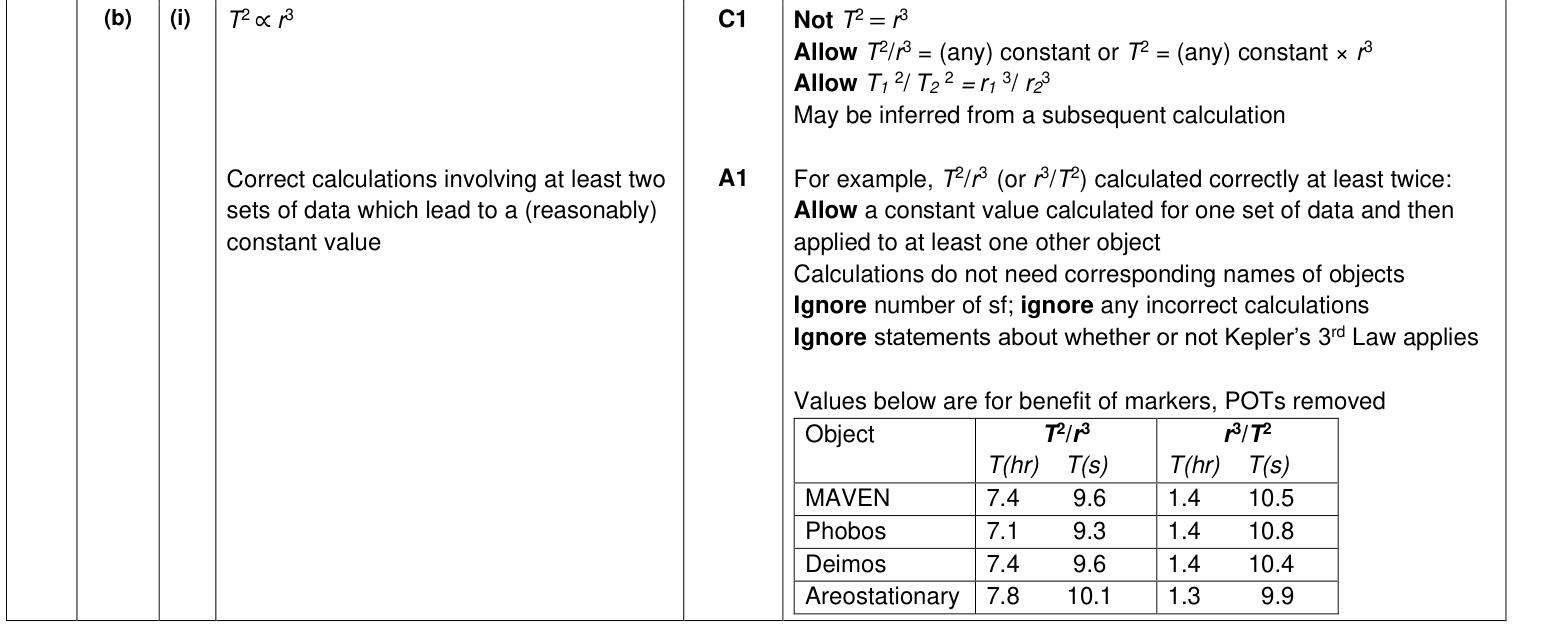
(i) Show that Kepler’s 3rd law applies to this data.
[2]
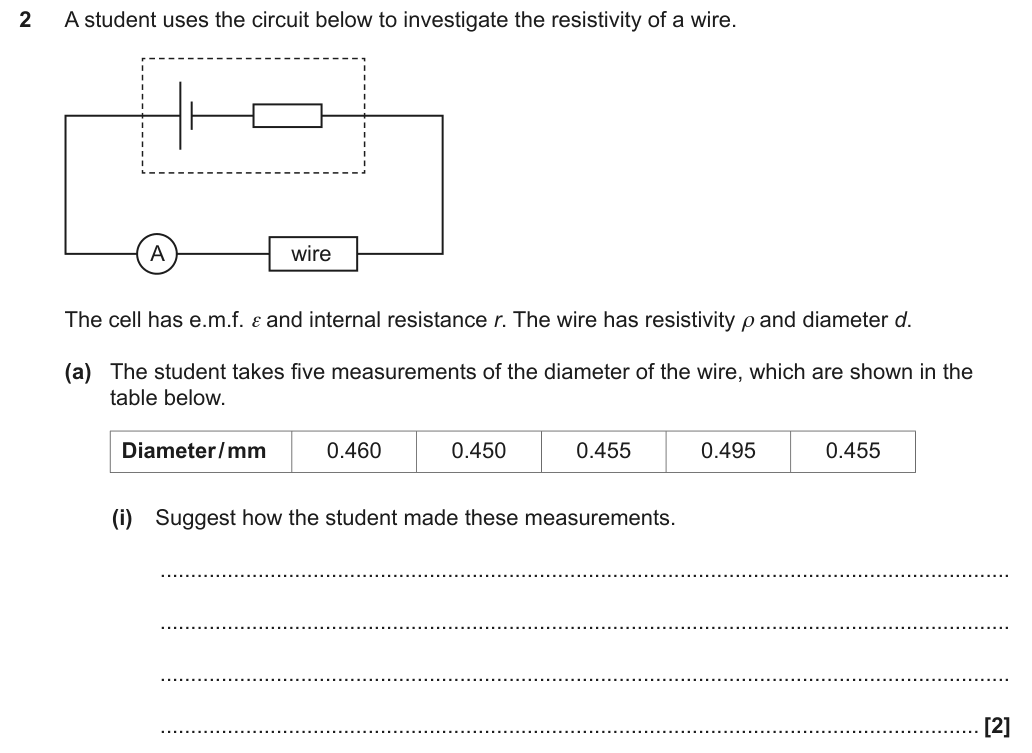
June 2023 · Paper 3 · Q2(b)(i) 3 marks Show that Medium internal resistanceresistivity
Earlier part of question 2 that this part usesEarlier part of June 2023 Paper 3 question 2
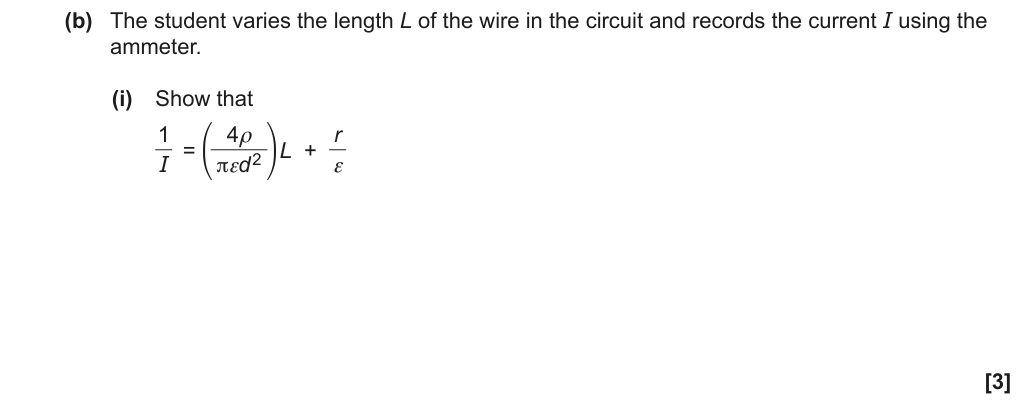
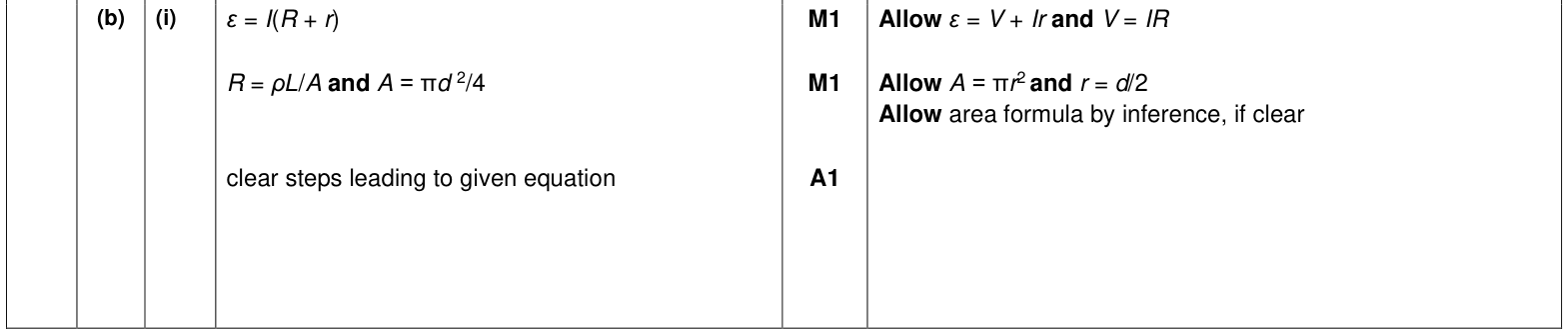
(b) The student varies the length L of the wire in the circuit and records the current I using the
ammeter.
(i) Show that
1 I  =  4ρ ⎛ πεd 2  L  +  r ⎞
⎝ ⎠ ε
[3]
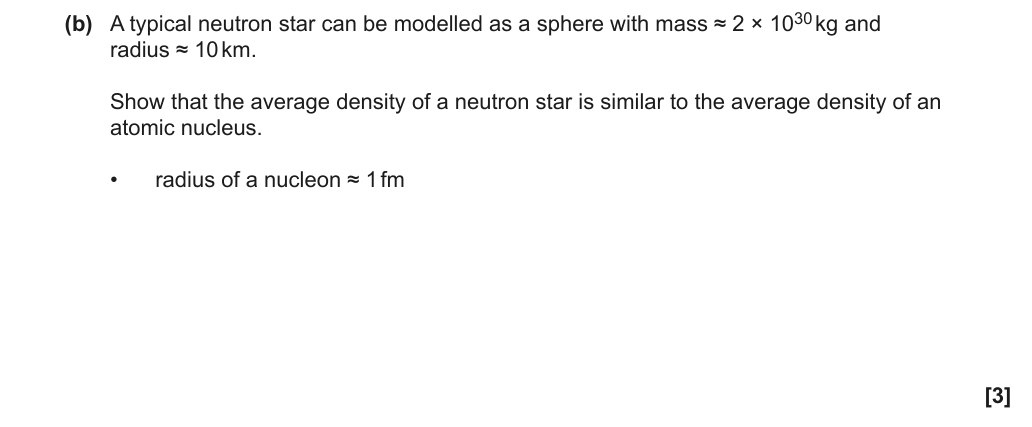
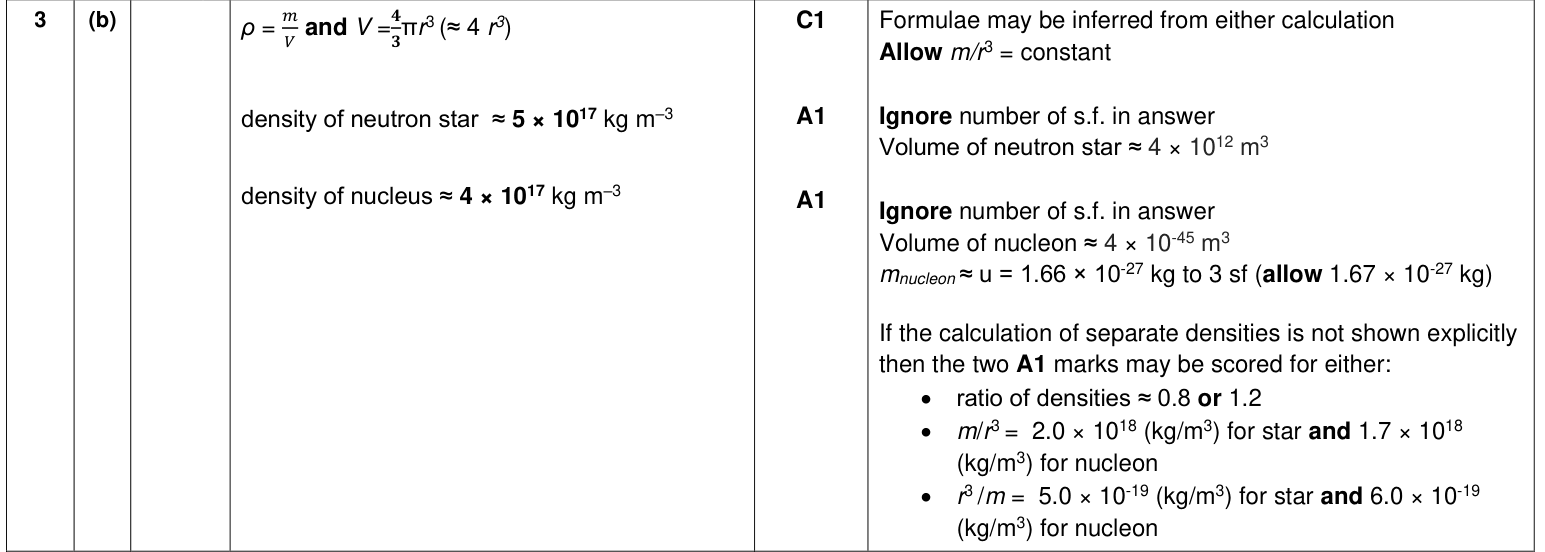
June 2023 · Paper 3 · Q3(b) 3 marks Show that Easy nuclear atom and particlesdensity and pressurestars
(b) A typical neutron star can be modelled as a sphere with mass ≈ 2 × 1030 kg and
radius ≈ 10 km.
Show that the average density of a neutron star is similar to the average density of an
atomic nucleus.
• radius of a nucleon ≈ 1 fm
[3]
June 2022 · AS Paper 1 · Q21(b)(i) 1 mark Show that Medium kinematics
Earlier part of question 21 that this part usesEarlier part of June 2022 Paper 1 question 21
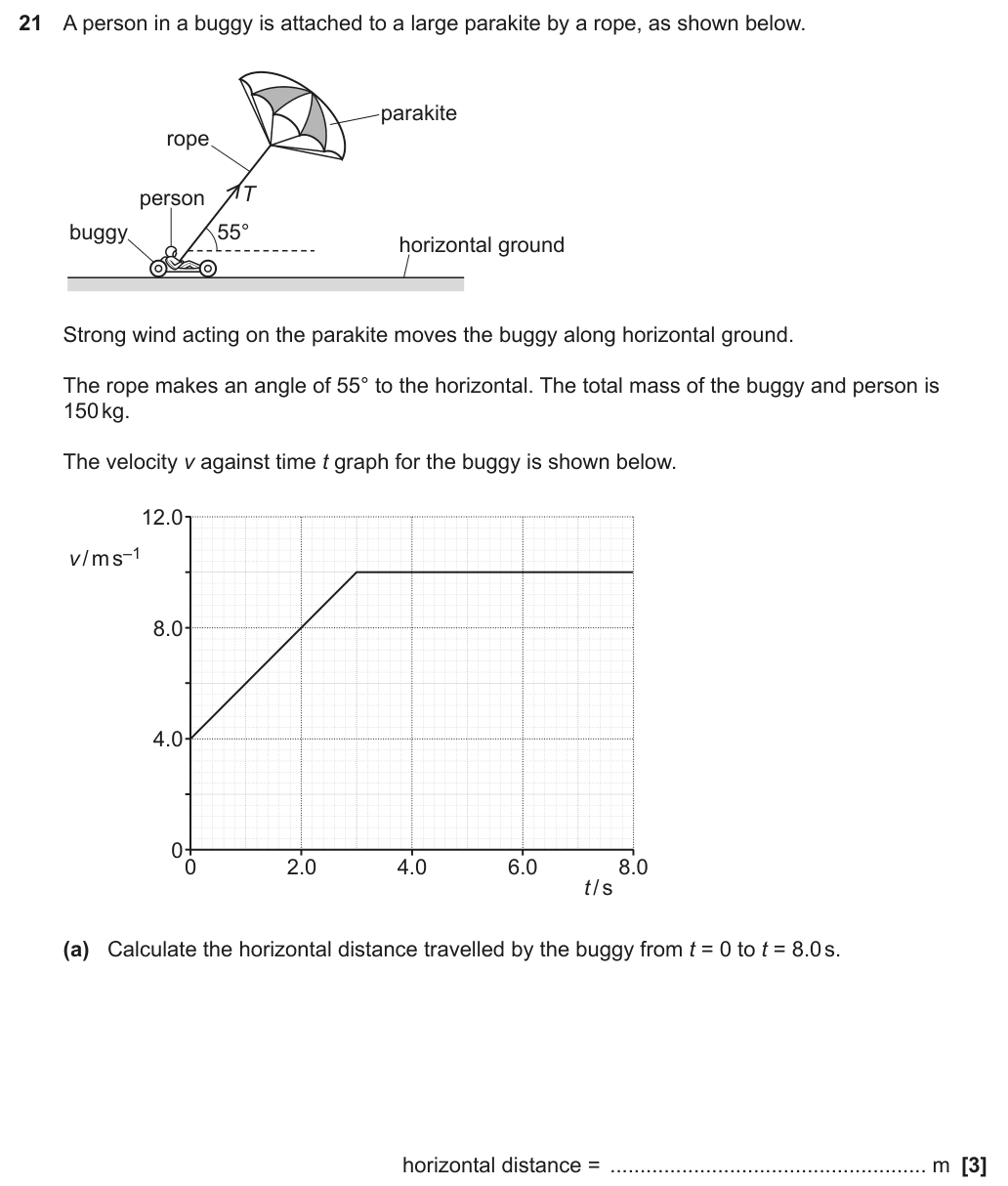
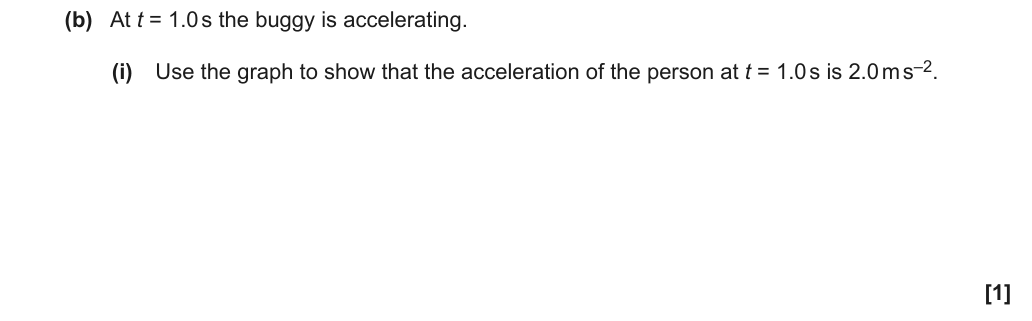
(b) At t = 1.0 s the buggy is accelerating.
(i) Use the graph to show that the acceleration of the person at t = 1.0 s is 2.0 m s–2.
[1]
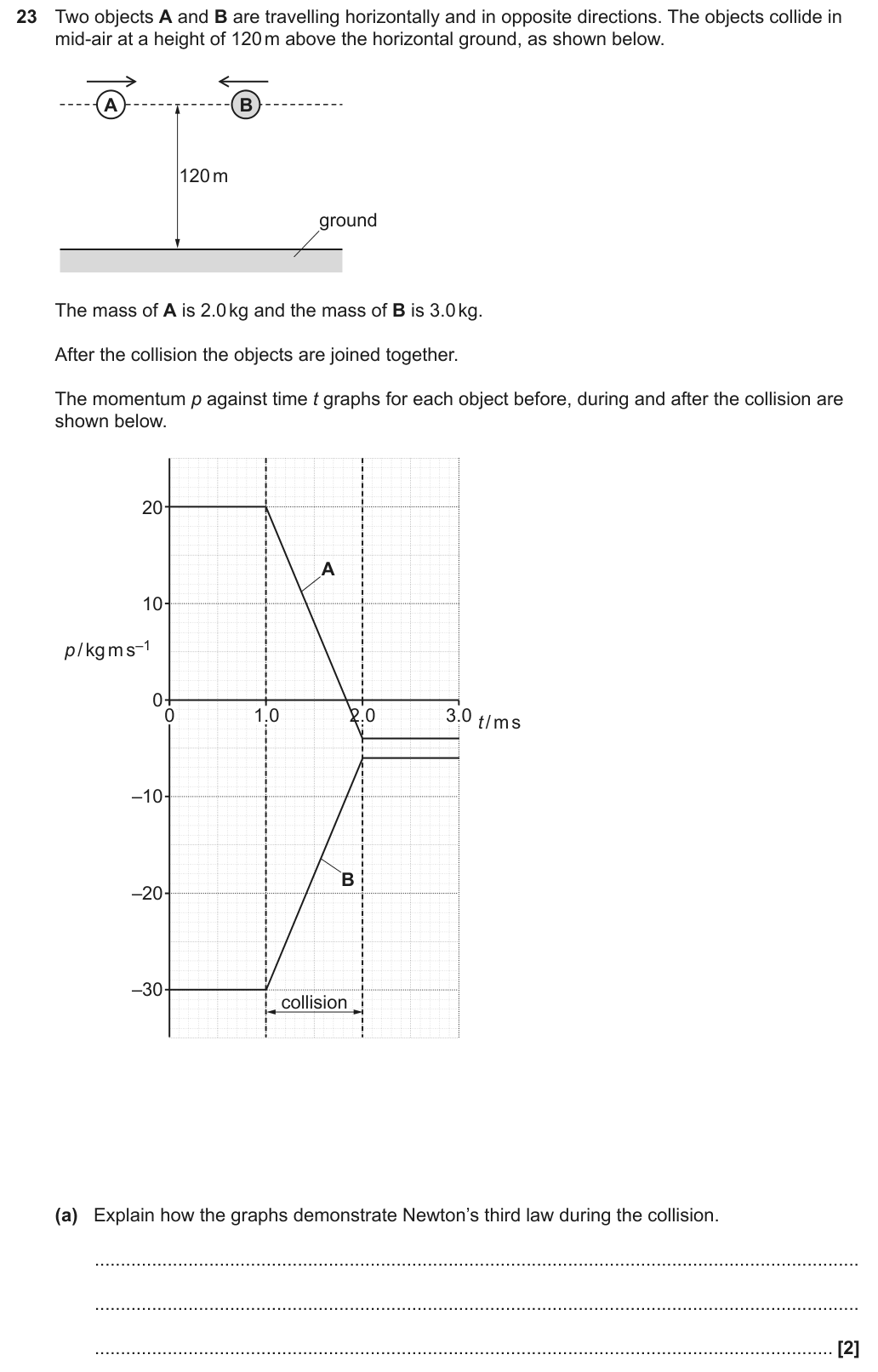
June 2022 · AS Paper 1 · Q23(b) 2 marks Show that Medium collisionsnewtons laws and momentum
Earlier part of question 23 that this part usesEarlier part of June 2022 Paper 1 question 23
(b)  Use the graphs to show that momentum is conserved in the collision.
[2]
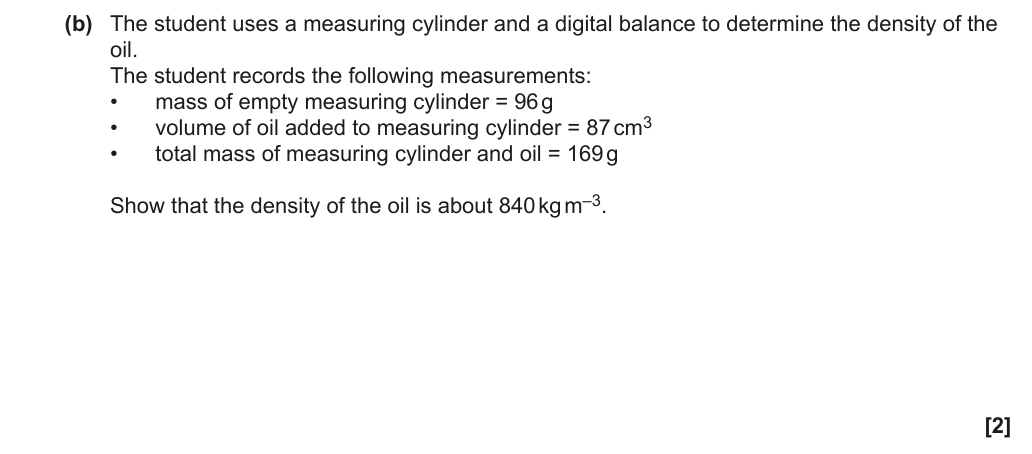
June 2022 · AS Paper 2 · Q1(b) 2 marks Show that Easy density and pressure
(b) The student uses a measuring cylinder and a digital balance to determine the density of the
oil.
The student records the following measurements:
• mass of empty measuring cylinder = 96 g
• volume of oil added to measuring cylinder = 87 cm3
• total mass of measuring cylinder and oil = 169 g
Show that the density of the oil is about 840 kg m–3.
[2]
June 2022 · AS Paper 2 · Q1(c) 2 marks Show that Hard density and pressure
Earlier parts of question 1 that this part usesEarlier part of June 2022 Paper 2 question 1Earlier part of June 2022 Paper 2 question 1
(c) The steel ball is submerged in the oil.
Show that the upthrust acting on the steel ball is 1.8 × 10⁻² N.
[2]
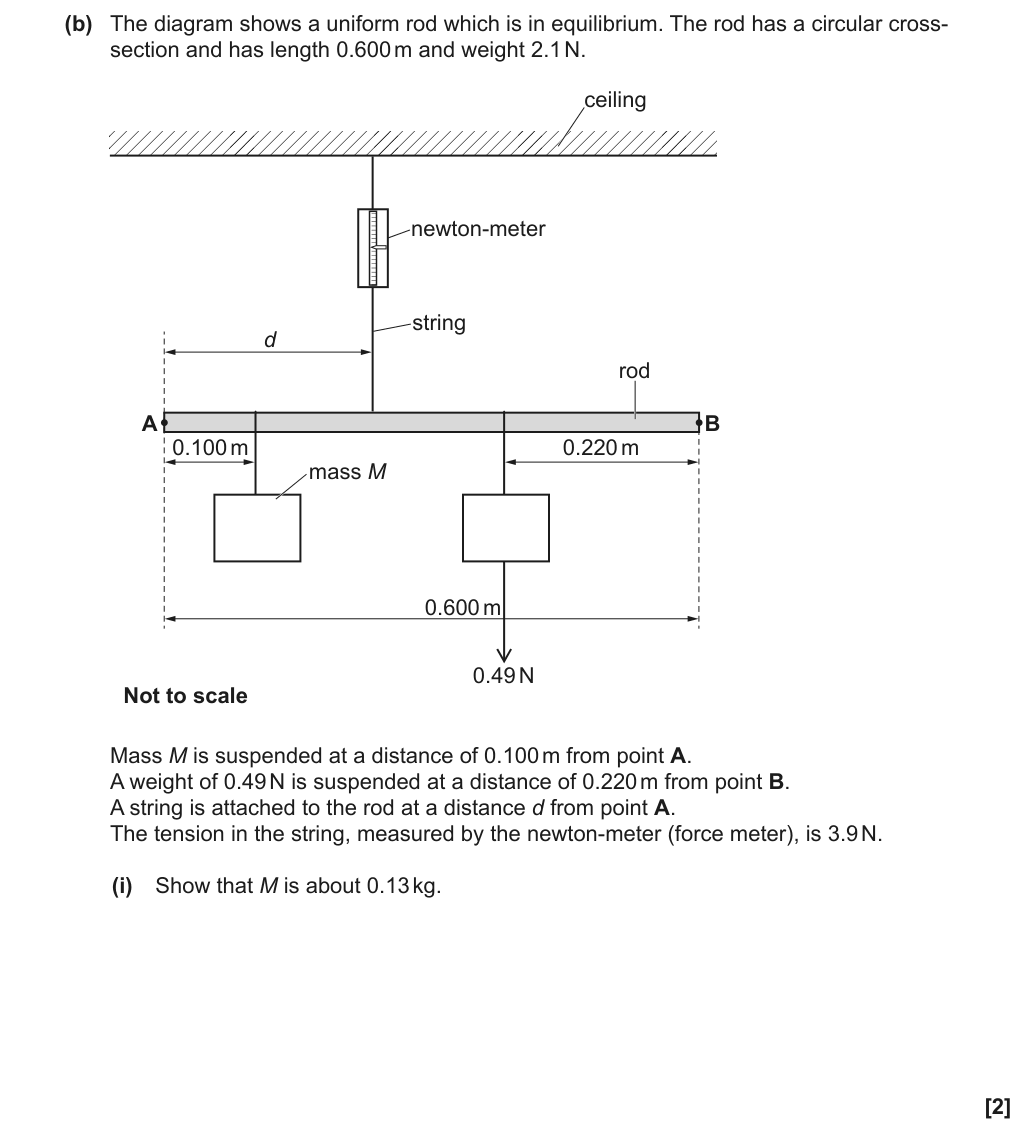
June 2022 · AS Paper 2 · Q3(b)(i) 2 marks Show that Medium equilibrium and momentsdynamics and terminal velocity
(b) The diagram shows a uniform rod which is in equilibrium. The rod has a circular cross-
section and has length 0.600 m and weight 2.1 N.
ceiling
newton-meter
string
d
rod
A B
0.100 m 0.220 m
mass M
0.600 m
0.49 N
Not to scale
Mass M is suspended at a distance of 0.100 m from point A.
A weight of 0.49 N is suspended at a distance of 0.220 m from point B.
A string is attached to the rod at a distance d from point A.
The tension in the string, measured by the newton-meter (force meter), is 3.9 N.
(i) Show that M is about 0.13 kg.
[2]
June 2022 · AS Paper 2 · Q5(b) 2 marks Show that Medium electromagnetic waves and refraction
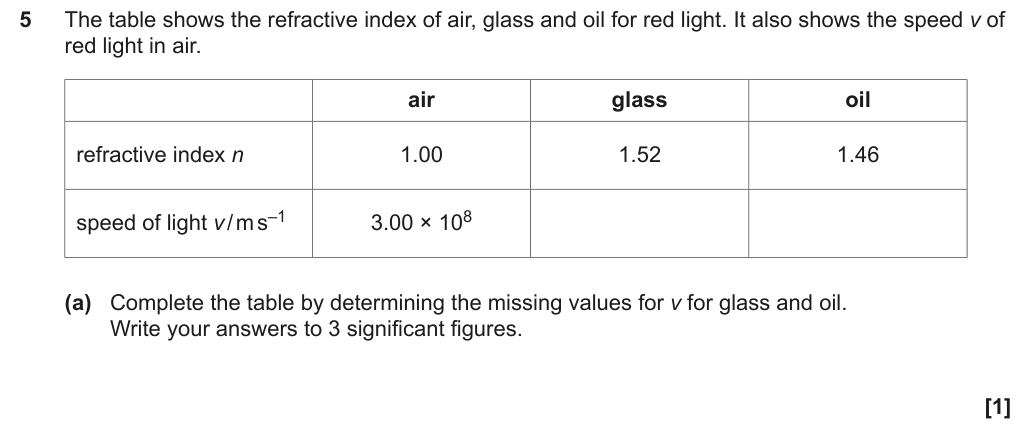
Earlier part of question 5 that this part usesEarlier part of June 2022 Paper 2 question 5
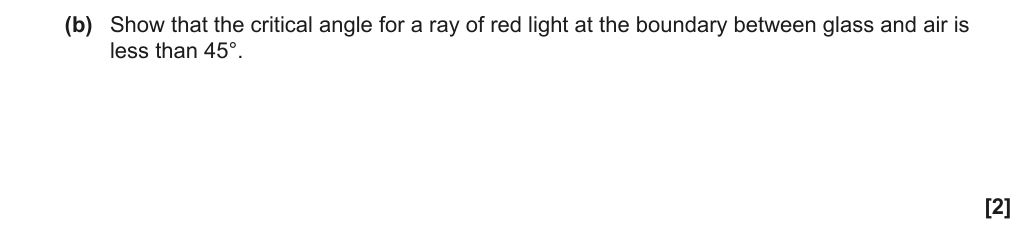
(b) Show that the critical angle for a ray of red light at the boundary between glass and air is
less than 45°.
[2]
June 2022 · AS Paper 2 · Q7(a)(i) 2 marks Show that Easy electrical power
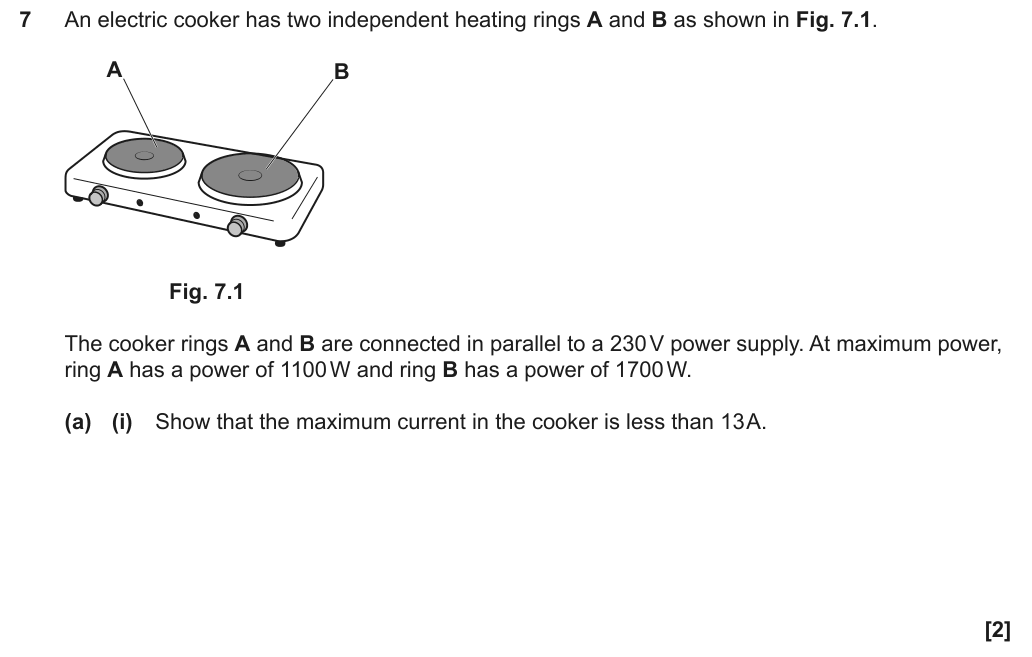
7 An electric cooker has two independent heating rings A and B as shown in Fig. 7.1.
A B
Fig. 7.1
The cooker rings A and B are connected in parallel to a 230 V power supply. At maximum power,
ring A has a power of 1100 W and ring B has a power of 1700 W.
(a) (i) Show that the maximum current in the cooker is less than 13 A.
[2]
June 2022 · Paper 1 · Q16(b)(i) 3 marks Show that Easy materials and young modulus
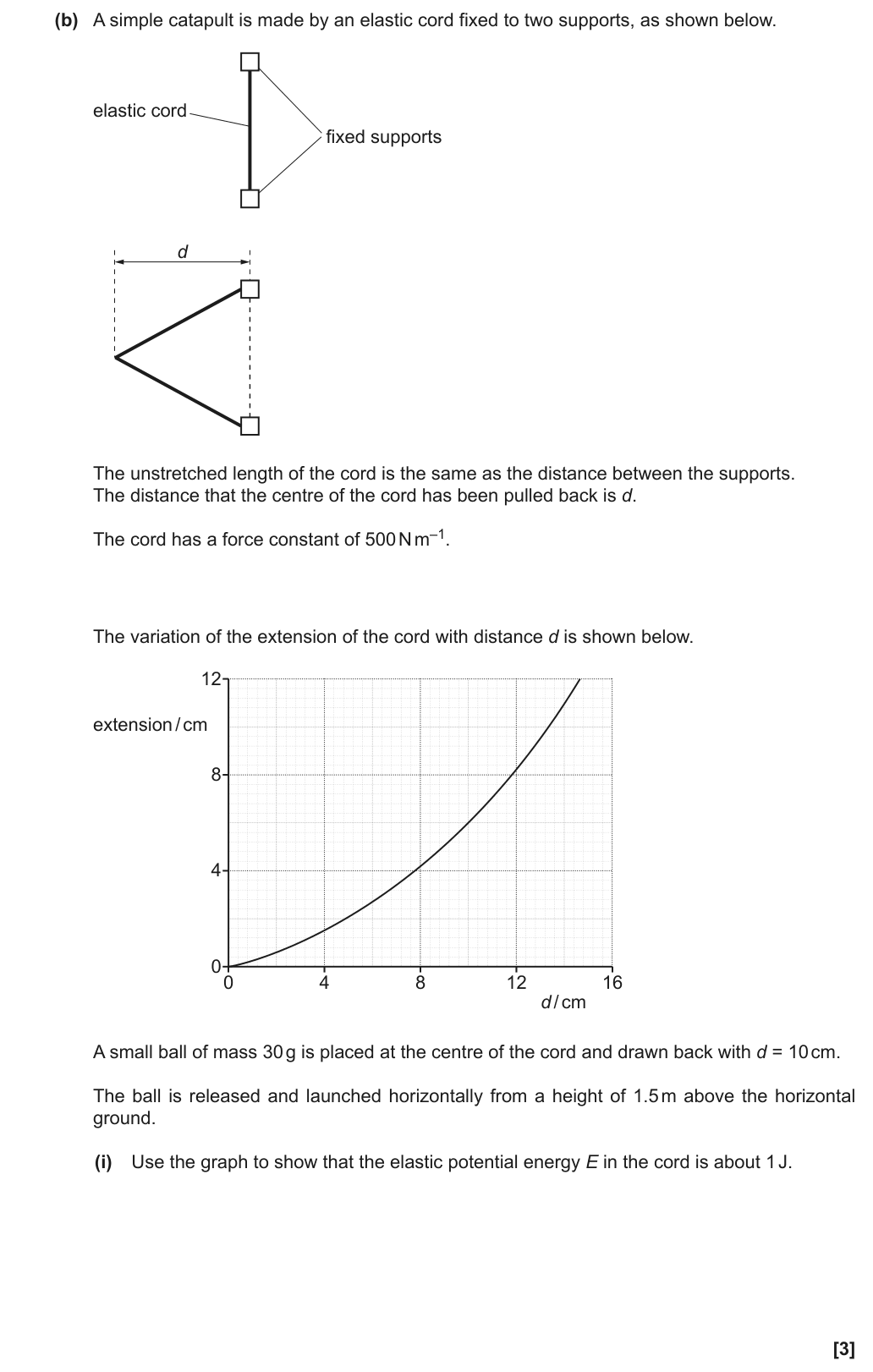
(b)  A simple catapult is made by an elastic cord fixed to two supports, as shown below.
elastic cord
fixed supports
d
The unstretched length of the cord is the same as the distance between the supports.
The distance that the centre of the cord has been pulled back is d.
The cord has a force constant of 500 N m–1.
The variation of the extension of the cord with distance d is shown below.
12
extension / cm
8
4
0
0 4 8 12 16
d / cm
A small ball of mass 30 g is placed at the centre of the cord and drawn back with d = 10 cm.
The ball is released and launched horizontally from a height of 1.5 m above the horizontal
ground.
(i)  Use the graph to show that the elastic potential energy E in the cord is about 1 J.
[3]
June 2022 · Paper 1 · Q16(b)(ii) 2 marks Show that Easy work energy and power
Earlier part of question 16 that this part usesEarlier part of June 2022 Paper 1 question 16
(ii)  Show that the maximum speed at which the ball leaves the catapult is about 8 m s–1.
[2]
June 2022 · Paper 1 · Q17(a) 1 mark Show that Medium work energy and power
17  An electric engine of mass 17 000 kg has a constant power output of 280 kW and it can reach
a maximum speed of 42 m s–1 on horizontal rails. The maximum kinetic energy of the engine is
15 MJ.
(a)  The engine is initially at rest on long horizontal rails.
Show that the minimum time taken for the engine to reach its maximum speed is about
1 minute.
[1]
June 2022 · Paper 1 · Q18(a)(i) 3 marks Show that Medium density and pressure
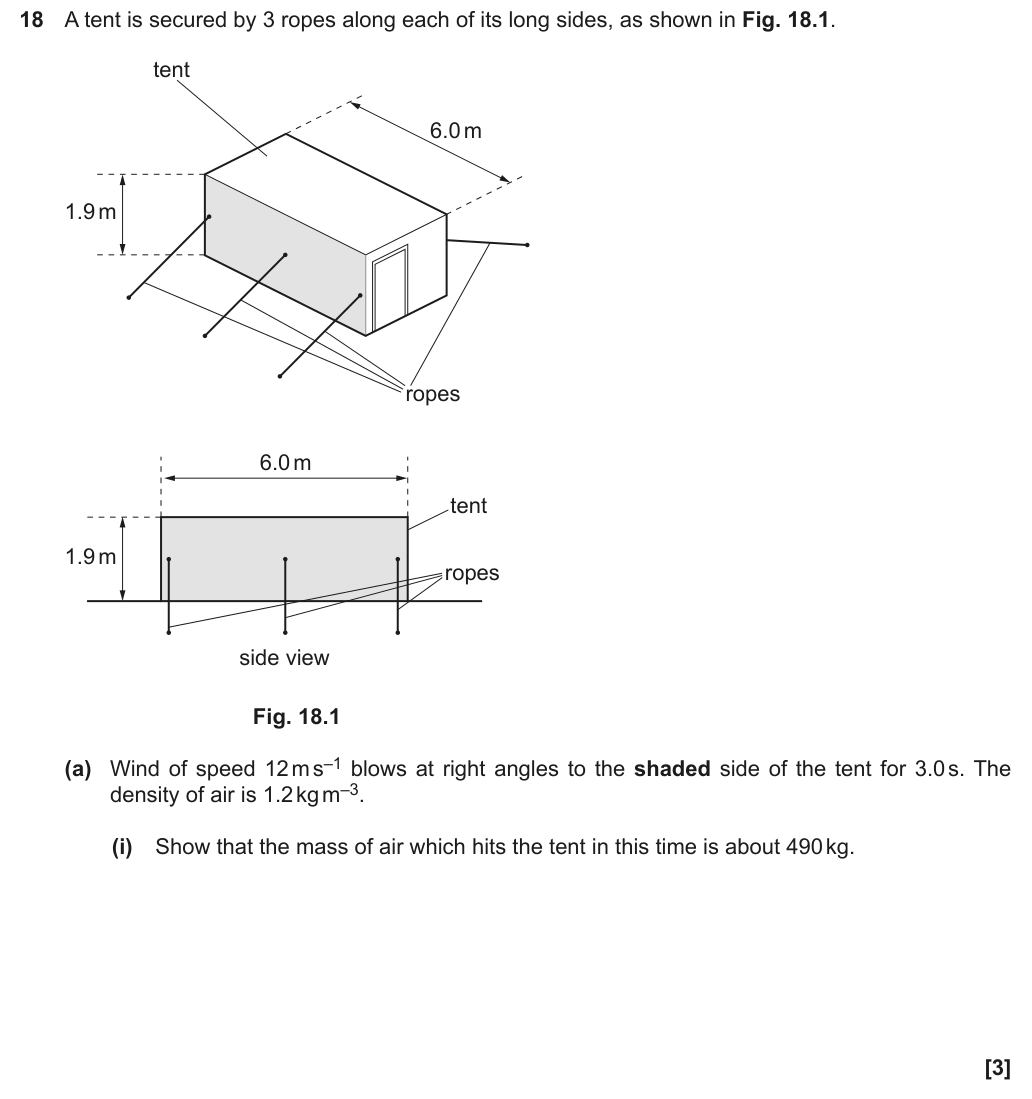
18  A tent is secured by 3 ropes along each of its long sides, as shown in Fig. 18.1.
tent
6.0 m
1.9 m
ropes
6.0 m
tent
1.9 m
ropes
side view
Fig. 18.1
(a)  Wind of speed 12 m s–1 blows at right angles to the shaded side of the tent for 3.0 s. The
density of air is 1.2 kg m–3.
(i) Show that the mass of air which hits the tent in this time is about 490 kg.
[3]
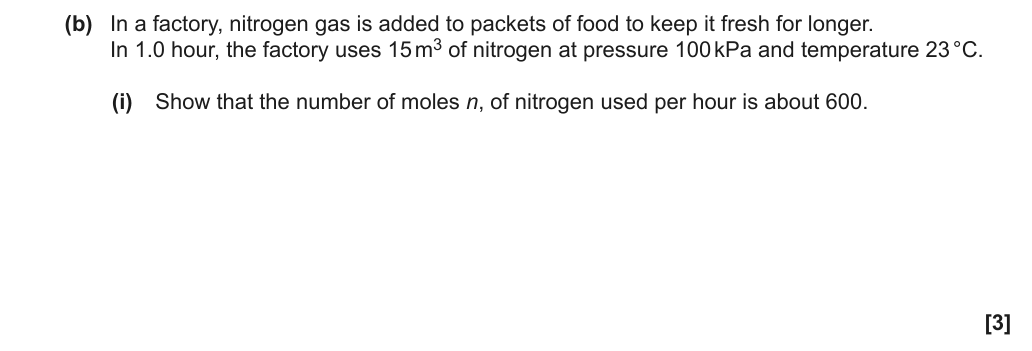
June 2022 · Paper 1 · Q19(b)(i) 3 marks Show that Easy ideal gasesthermal physics
(b)  In a factory, nitrogen gas is added to packets of food to keep it fresh for longer.
In 1.0 hour, the factory uses 15 m3 of nitrogen at pressure 100 kPa and temperature 23 °C.
(i)  Show that the number of moles n, of nitrogen used per hour is about 600.
[3]
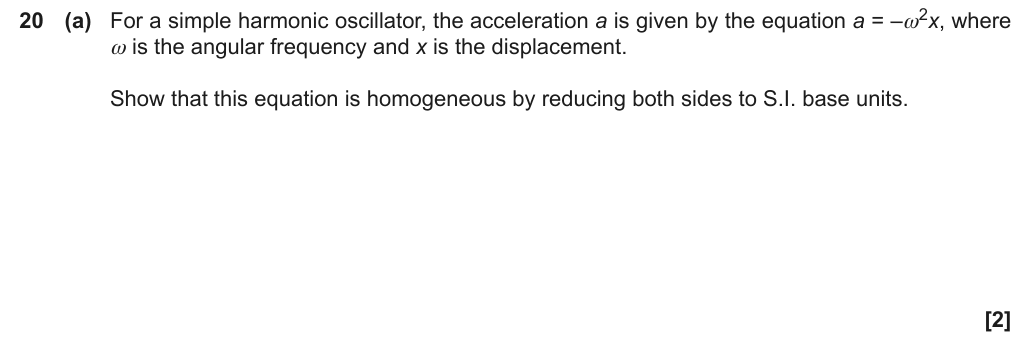
June 2022 · Paper 1 · Q20(a) 2 marks Show that Medium quantities and units
20  (a)  For a simple harmonic oscillator, the acceleration a is given by the equation a = –ω 2x, where
ω  is the angular frequency and x is the displacement.
Show that this equation is homogeneous by reducing both sides to S.I. base units.
[2]
June 2022 · Paper 1 · Q20(b)(ii) 8 marks Show that Hard simple harmonic motion
Earlier part of question 20 that this part usesEarlier part of June 2022 Paper 1 question 20
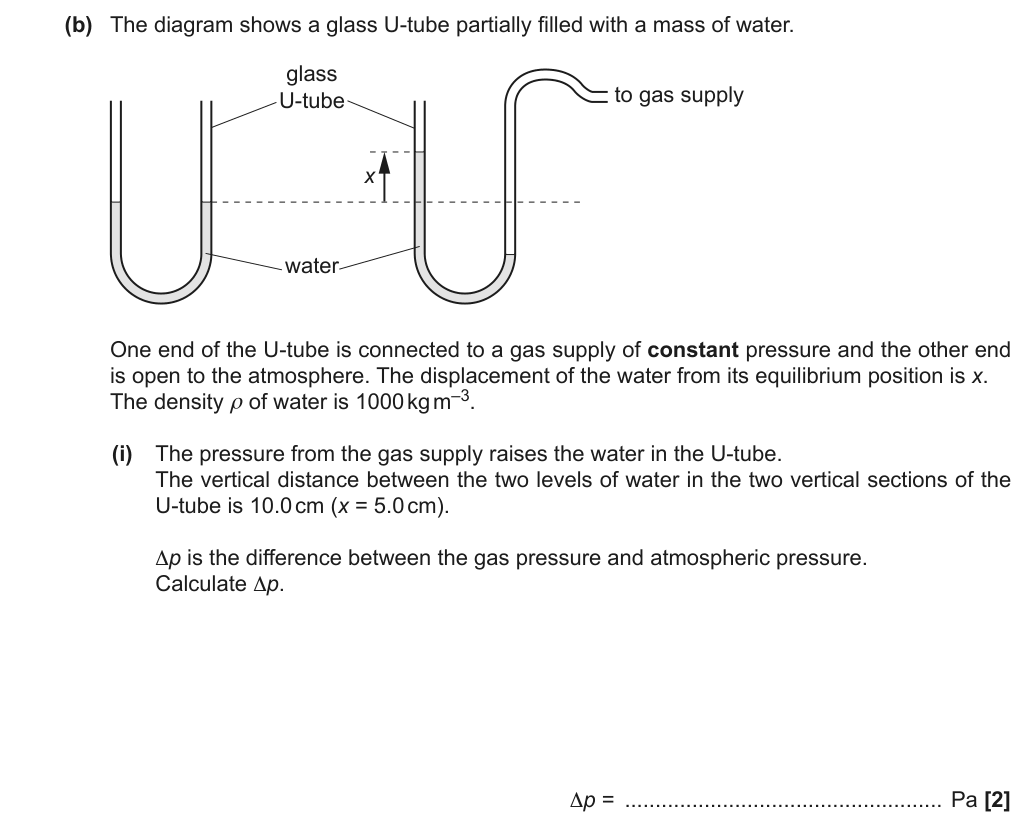
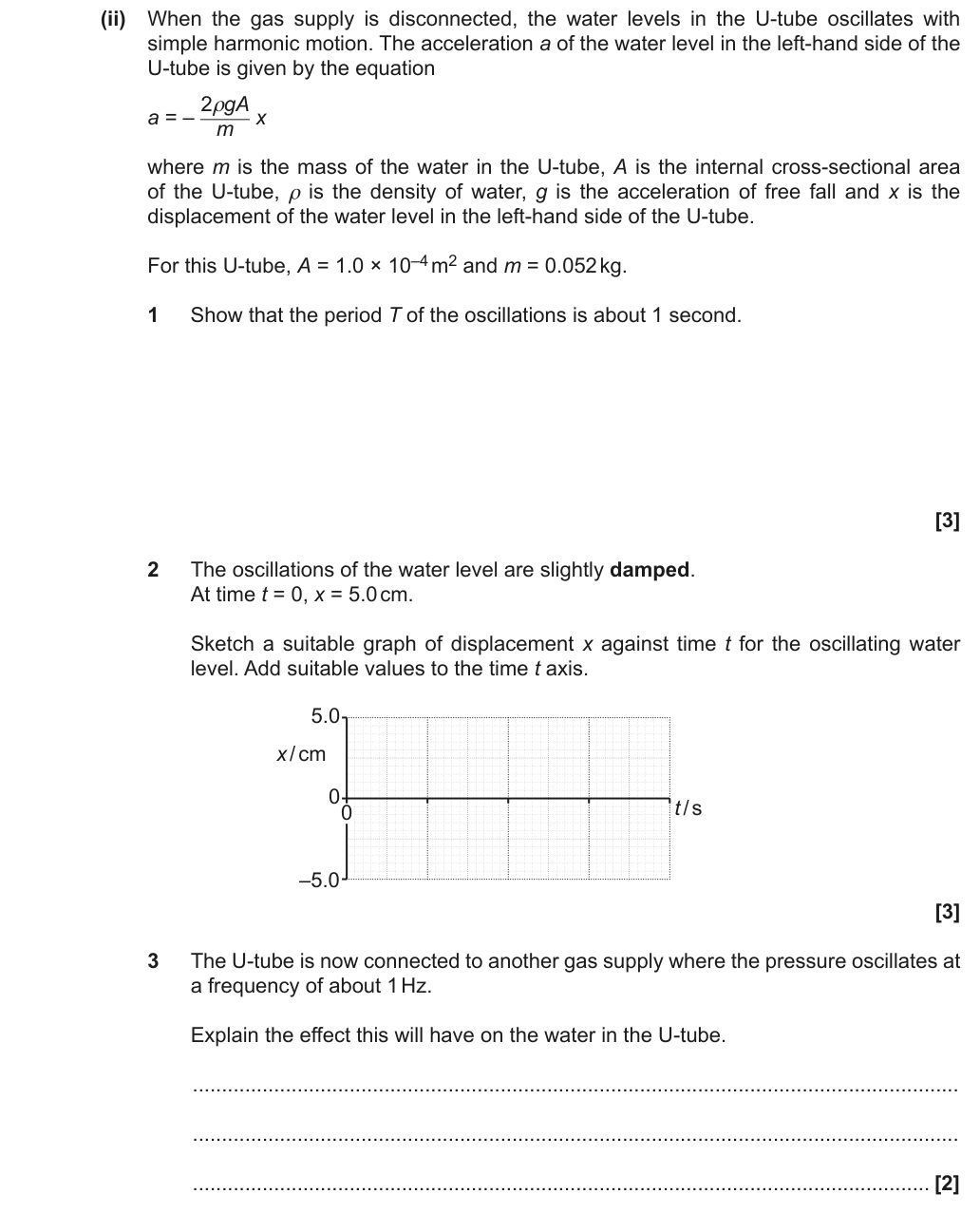
(ii) When the gas supply is disconnected, the water levels in the U-tube oscillates with
simple harmonic motion. The acceleration a of the water level in the left-hand side of the
U-tube is given by the equation
a = – 2ρgA
m x
where m is the mass of the water in the U-tube, A is the internal cross-sectional area
of the U-tube, ρ is the density of water, g is the acceleration of free fall and x is the
displacement of the water level in the left-hand side of the U-tube.
For this U-tube, A = 1.0 × 10⁻⁴ m2 and m = 0.052 kg.
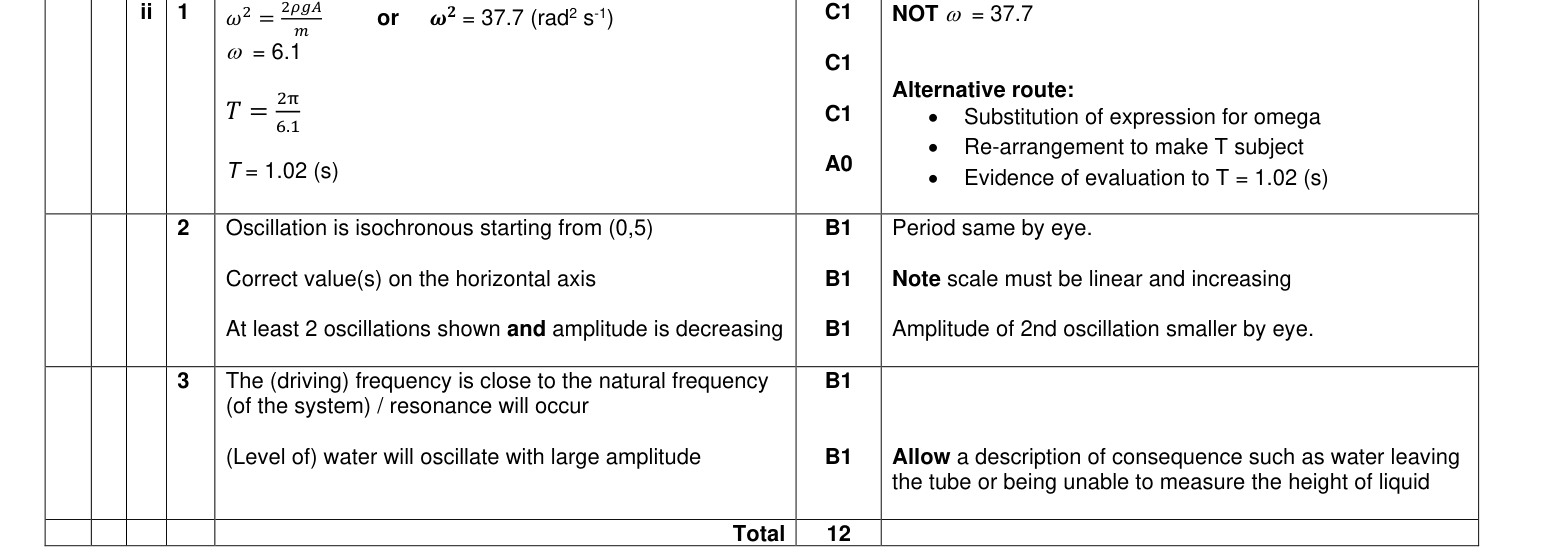
1 Show that the period T of the oscillations is about 1 second.
[3]
2 The oscillations of the water level are slightly damped.
At time t = 0, x = 5.0 cm.
Sketch a suitable graph of displacement x against time t for the oscillating water
level. Add suitable values to the time t axis.
5.0
x / cm
0
0 t / s
–5.0
[3]
3 The U-tube is now connected to another gas supply where the pressure oscillates at
a frequency of about 1 Hz.
Explain the effect this will have on the water in the U-tube.
....................................................................................................................................
....................................................................................................................................
............................................................................................................................... [2]
June 2022 · Paper 1 · Q21(b)(i) 2 marks Show that Medium cosmology
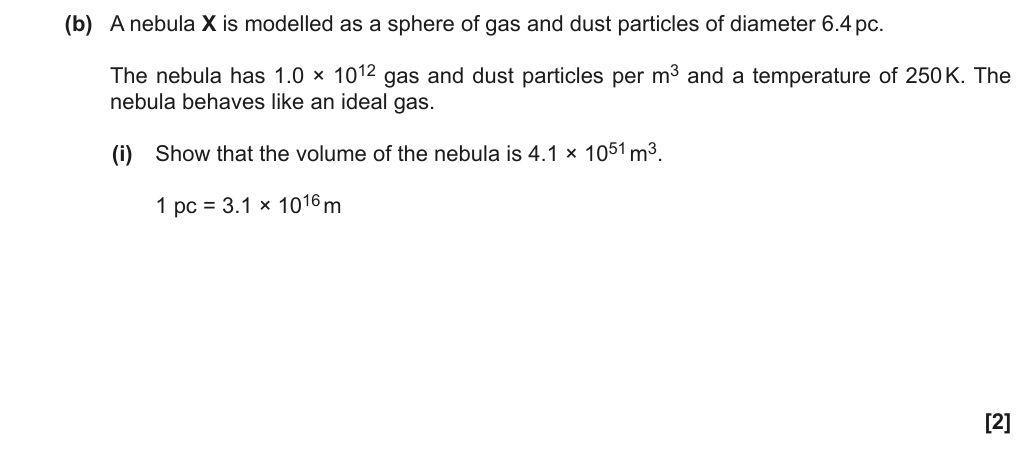
(b)  A nebula X is modelled as a sphere of gas and dust particles of diameter 6.4 pc.
The nebula has 1.0 × 10¹² gas and dust particles per m3 and a temperature of 250 K. The
nebula behaves like an ideal gas.
(i)  Show that the volume of the nebula is 4.1 × 1051 m3.
1 pc = 3.1 × 10¹⁶ m
[2]
June 2022 · Paper 1 · Q23(a) 3 marks Show that Easy planetary motioncircular motiongravitational fields
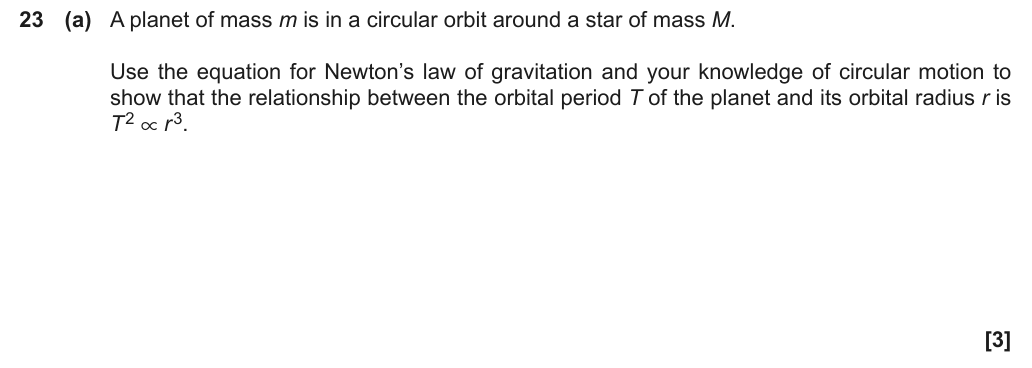
23  (a) A planet of mass m is in a circular orbit around a star of mass M.
Use the equation for Newton’s law of gravitation and your knowledge of circular motion to
show that the relationship between the orbital period T of the planet and its orbital radius r is
T 2 ? r 3.
[3]
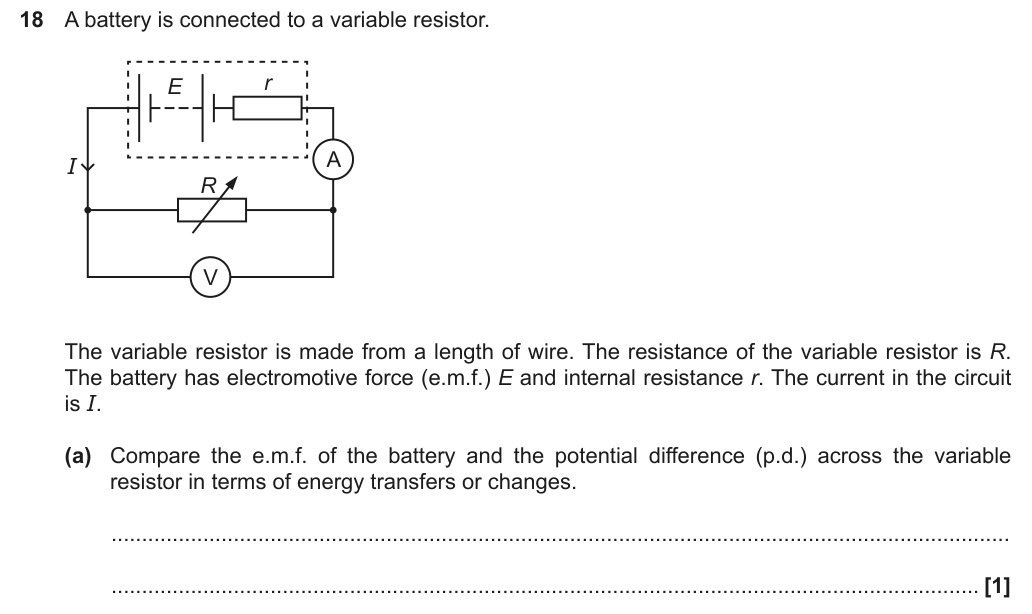
June 2022 · Paper 2 · Q18(c)(i) 2 marks Show that Medium internal resistance
Earlier part of question 18 that this part usesEarlier part of June 2022 Paper 2 question 18
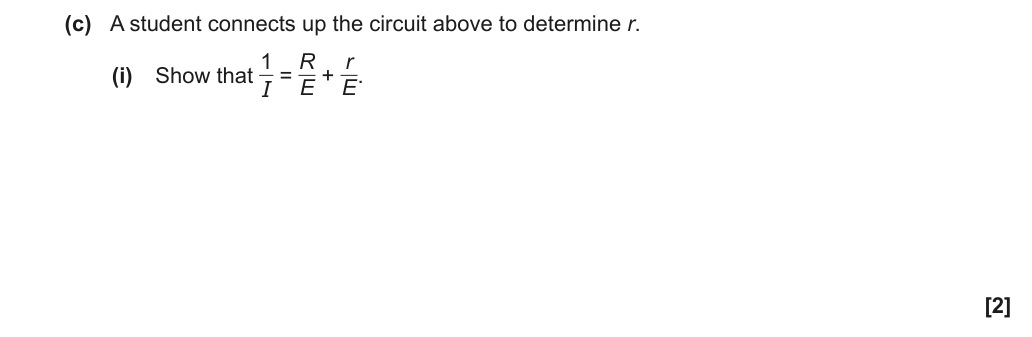
(c)  A student connects up the circuit above to determine r.
(i) Show that 1 I = R E + r
E.
[2]
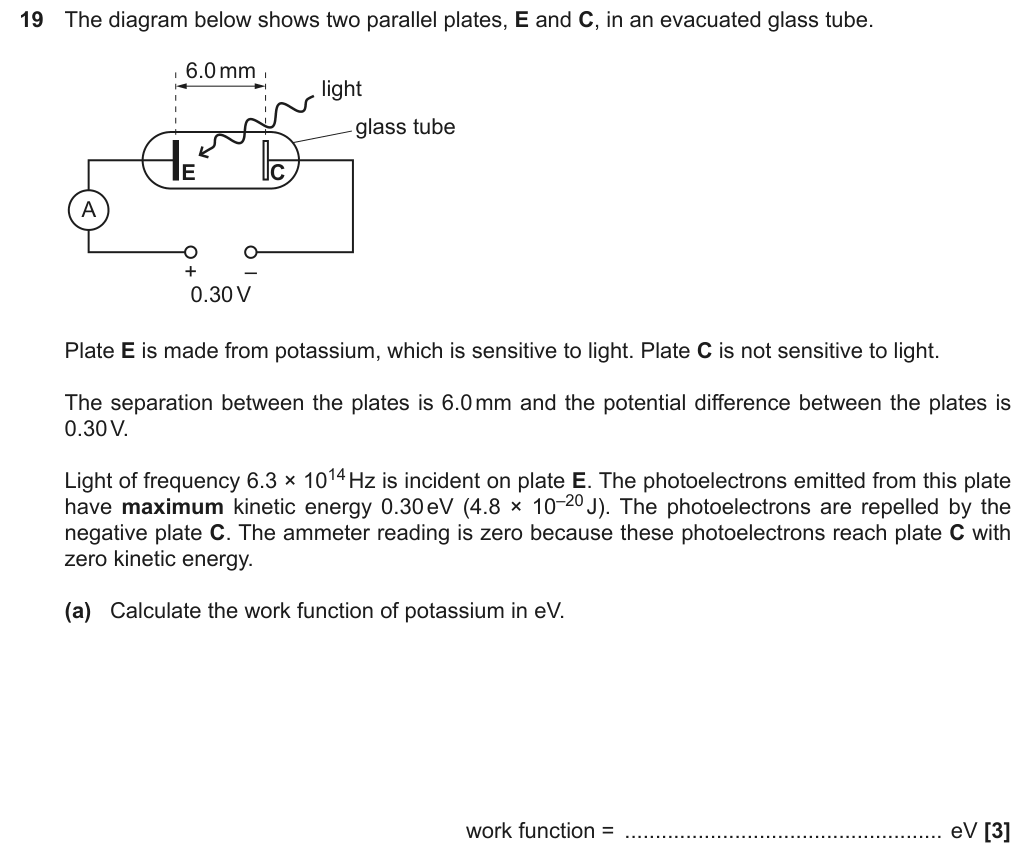
June 2022 · Paper 2 · Q19(b)(i) 3 marks Show that Hard electric fields
Earlier part of question 19 that this part usesEarlier part of June 2022 Paper 2 question 19
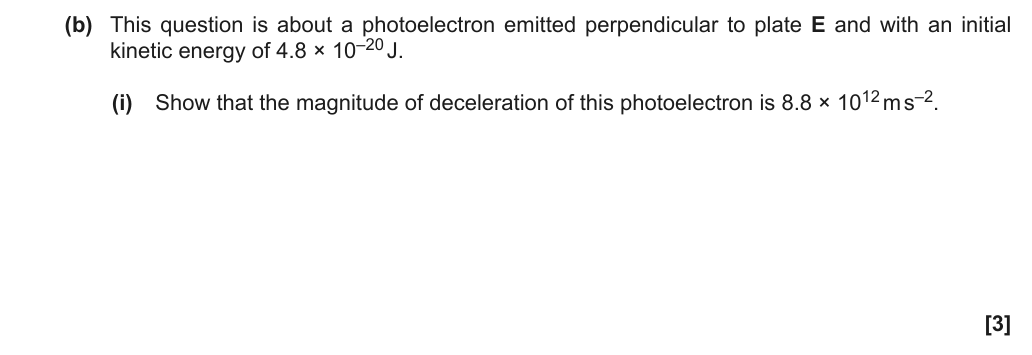
(b)  This question is about a photoelectron emitted perpendicular to plate E and with an initial
kinetic energy of 4.8 × 10⁻²⁰ J.
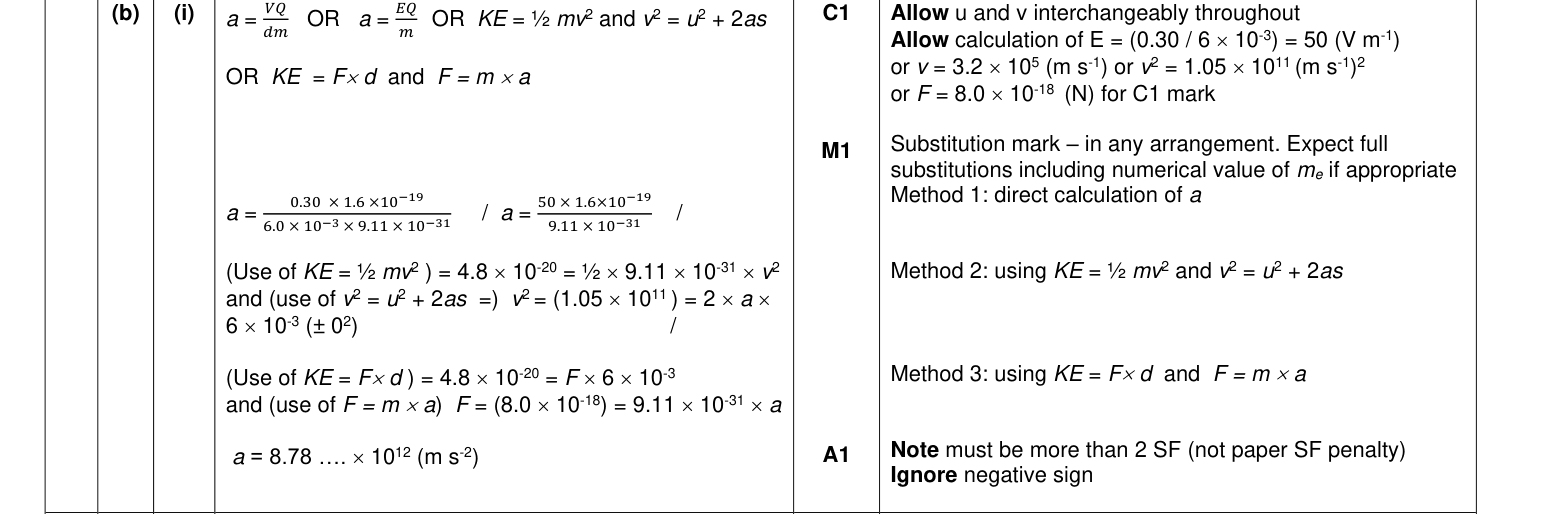
(i) Show that the magnitude of deceleration of this photoelectron is 8.8 × 10¹² m s–2.
[3]
June 2022 · Paper 2 · Q19(b)(ii) 2 marks Show that Easy emf pd and resistance
Earlier parts of question 19 that this part usesEarlier part of June 2022 Paper 2 question 19Earlier part of June 2022 Paper 2 question 19
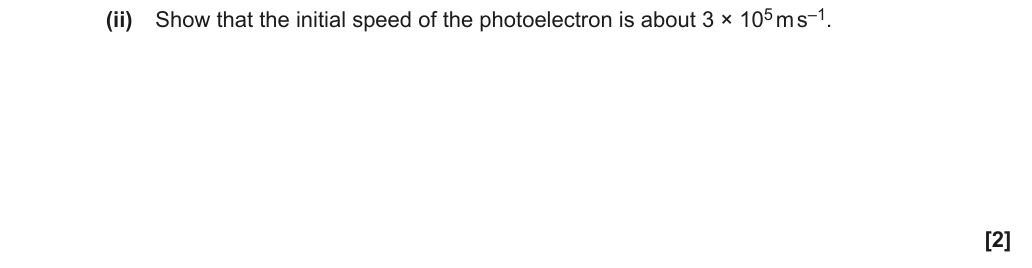
(ii)  Show that the initial speed of the photoelectron is about 3 × 10⁵ m s–1.
[2]
June 2022 · Paper 2 · Q22(b)(i) 2 marks Show that Medium capacitors
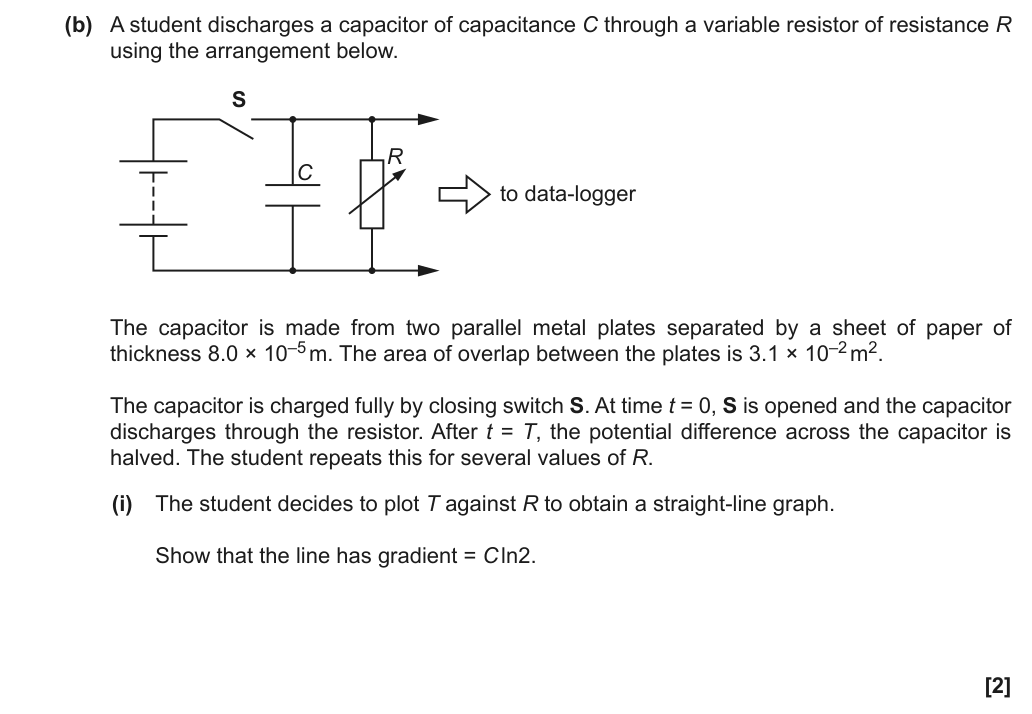
(b)  A student discharges a capacitor of capacitance C through a variable resistor of resistance R
using the arrangement below.
S
R
C
to data-logger
The capacitor is made from two parallel metal plates separated by a sheet of paper of
thickness 8.0 × 10⁻⁵ m. The area of overlap between the plates is 3.1 × 10⁻² m2.
The capacitor is charged fully by closing switch S. At time t = 0, S is opened and the capacitor
discharges through the resistor. After t = T, the potential difference across the capacitor is
halved. The student repeats this for several values of R.
(i)  The student decides to plot T against R to obtain a straight-line graph.
Show that the line has gradient = C ln2.
[2]
June 2022 · Paper 3 · Q2(b)(i) 2 marks Show that Medium practical skillssimple harmonic motion
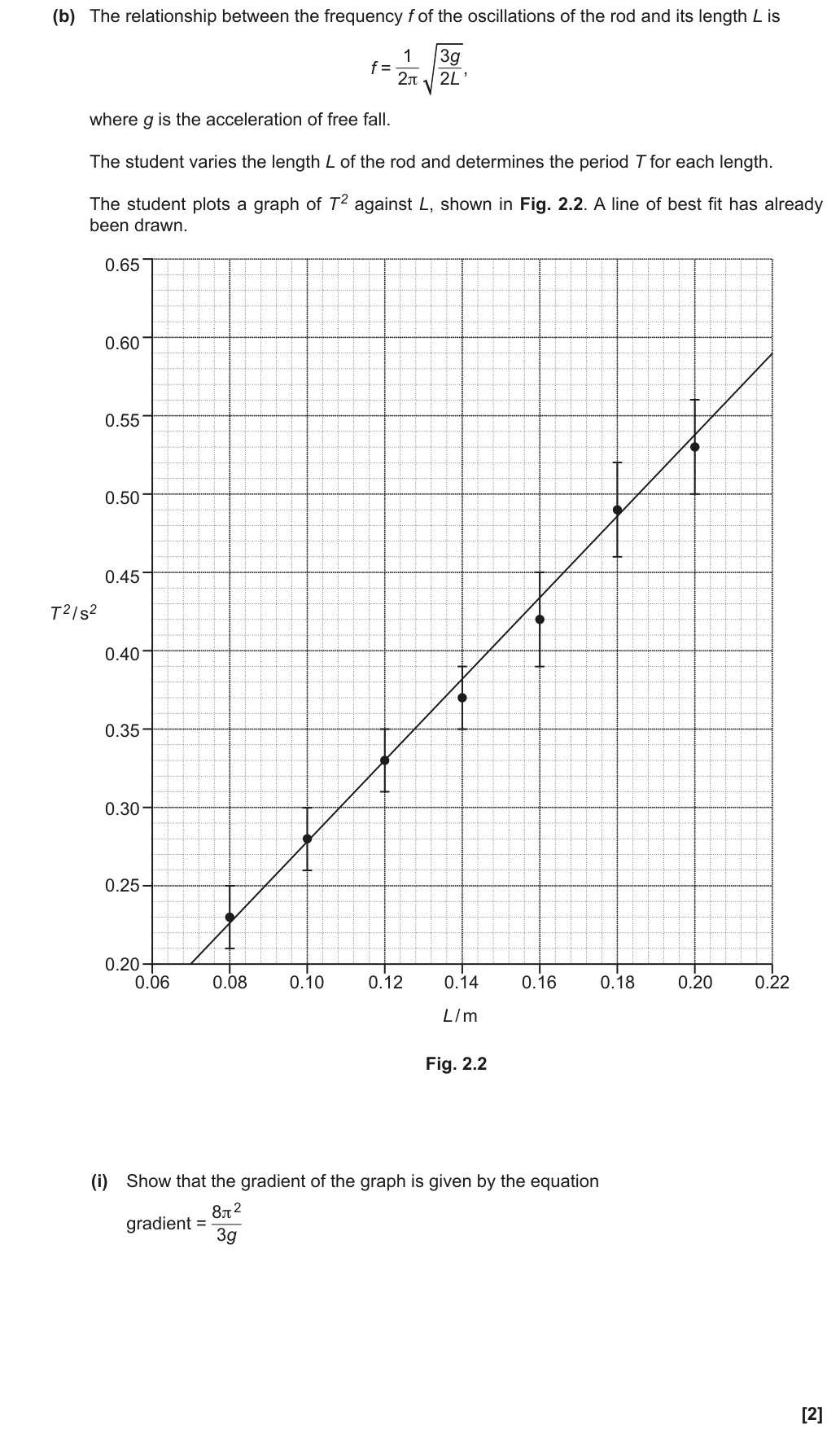
(b) The relationship between the frequency f of the oscillations of the rod and its length L is
f = 1 3g
2L ,
2π
where g is the acceleration of free fall.
The student varies the length L of the rod and determines the period T for each length.
The student plots a graph of T 2 against L, shown in Fig. 2.2. A line of best fit has already
been drawn.
0.65
0.60
0.55
0.50
0.45
T 2 / s2
0.40
0.35
0.30
0.25
0.20
0.06 0.08 0.10 0.12 0.14 0.16 0.18 0.20 0.22
L / m
Fig. 2.2
(i) Show that the gradient of the graph is given by the equation
gradient = 8π 2
3g
[2]
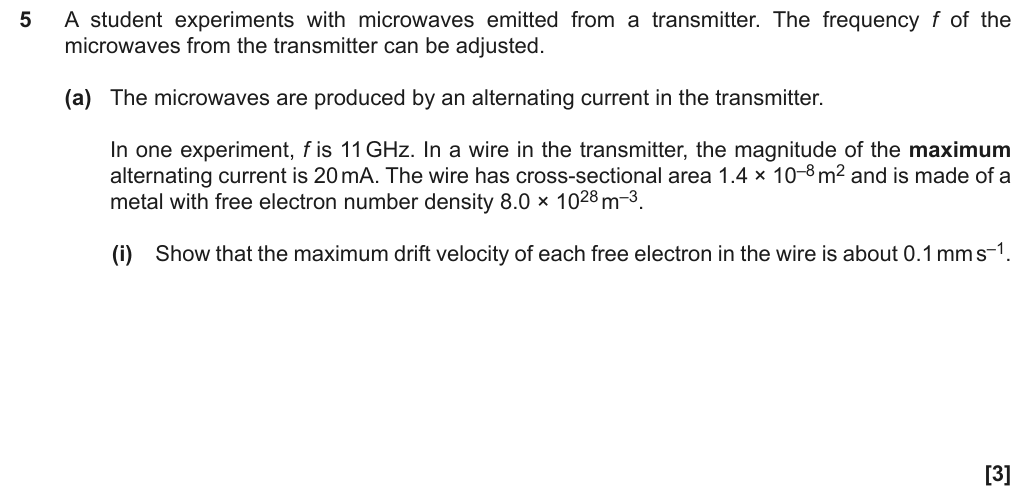
June 2022 · Paper 3 · Q5(a)(i) 3 marks Show that Medium charge and current
5 A student experiments with microwaves emitted from a transmitter. The frequency f of the
microwaves from the transmitter can be adjusted.
(a) The microwaves are produced by an alternating current in the transmitter.
In one experiment, f is 11 GHz. In a wire in the transmitter, the magnitude of the maximum
alternating current is 20 mA. The wire has cross-sectional area 1.4 × 10⁻⁸ m2 and is made of a
metal with free electron number density 8.0 × 1028 m–3.
(i) Show that the maximum drift velocity of each free electron in the wire is about 0.1 mm s–1.
[3]
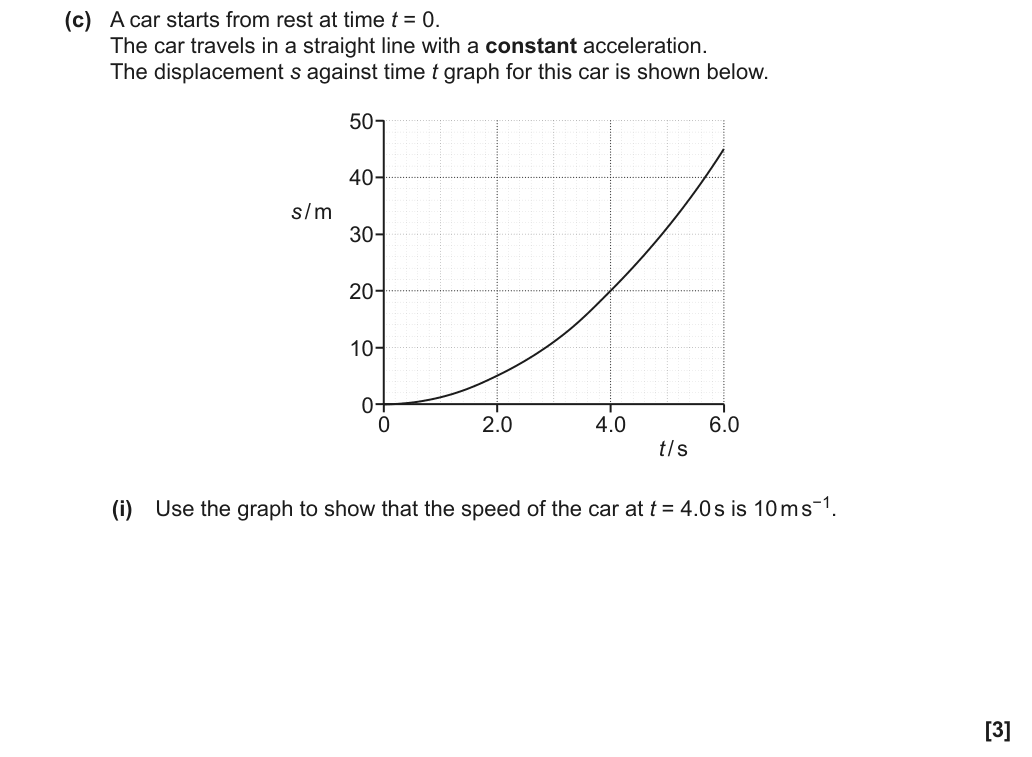
November 2021 · AS Paper 1 · Q21(c)(i) 3 marks Show that kinematicslinear motion
(c) A car starts from rest at time t = 0.
The car travels in a straight line with a constant acceleration.
The displacement s against time t graph for this car is shown below.
50
40
s / m
30
20
10
0
0 2.0 4.0 6.0
t / s
(i) Use the graph to show that the speed of the car at t = 4.0 s is 10 m s−1.
[3]
November 2021 · AS Paper 2 · Q1(b)(iii) 1 mark Show that superposition and interference
Earlier part of question 1 that this part usesEarlier part of November 2021 Paper 2 question 1
(iii) Show that the wavelength of the sound waves is 0.16 m.
[1]
November 2021 · AS Paper 2 · Q4(a)(i) 1 mark Show that quantities and units
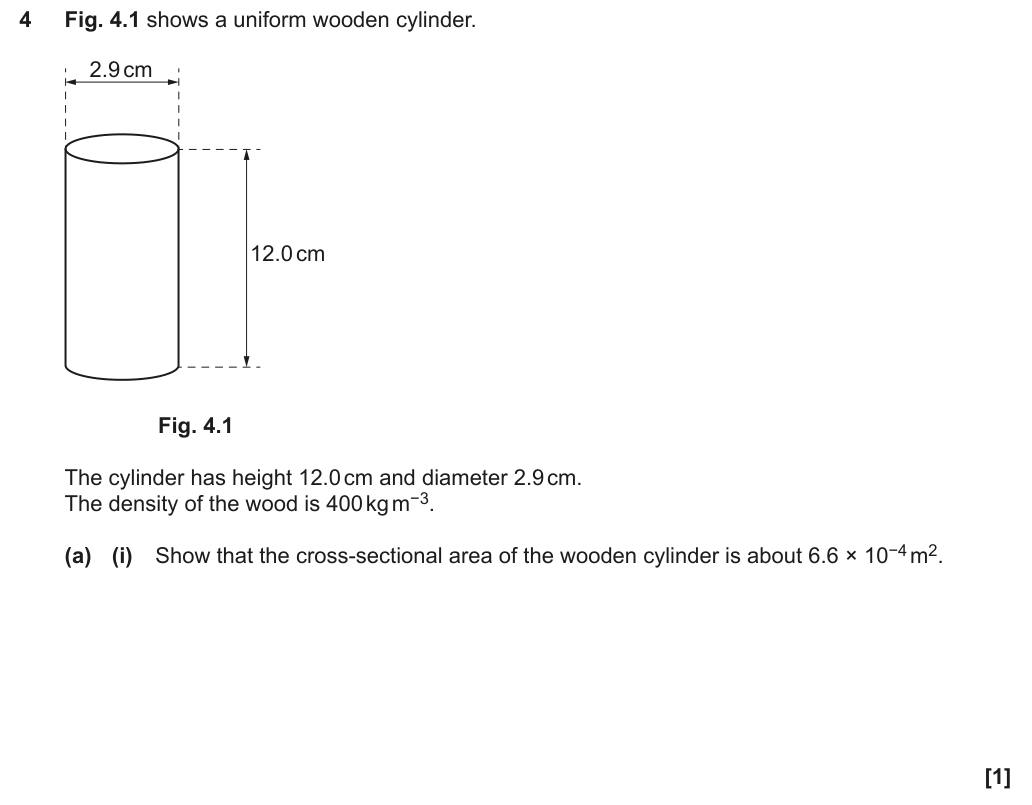
4 Fig. 4.1 shows a uniform wooden cylinder.
2.9 cm
12.0 cm
Fig. 4.1
The cylinder has height 12.0 cm and diameter 2.9 cm.
The density of the wood is 400 kg m−3.
(a) (i) Show that the cross-sectional area of the wooden cylinder is about 6.6 × 10⁻⁴ m2.
[1]
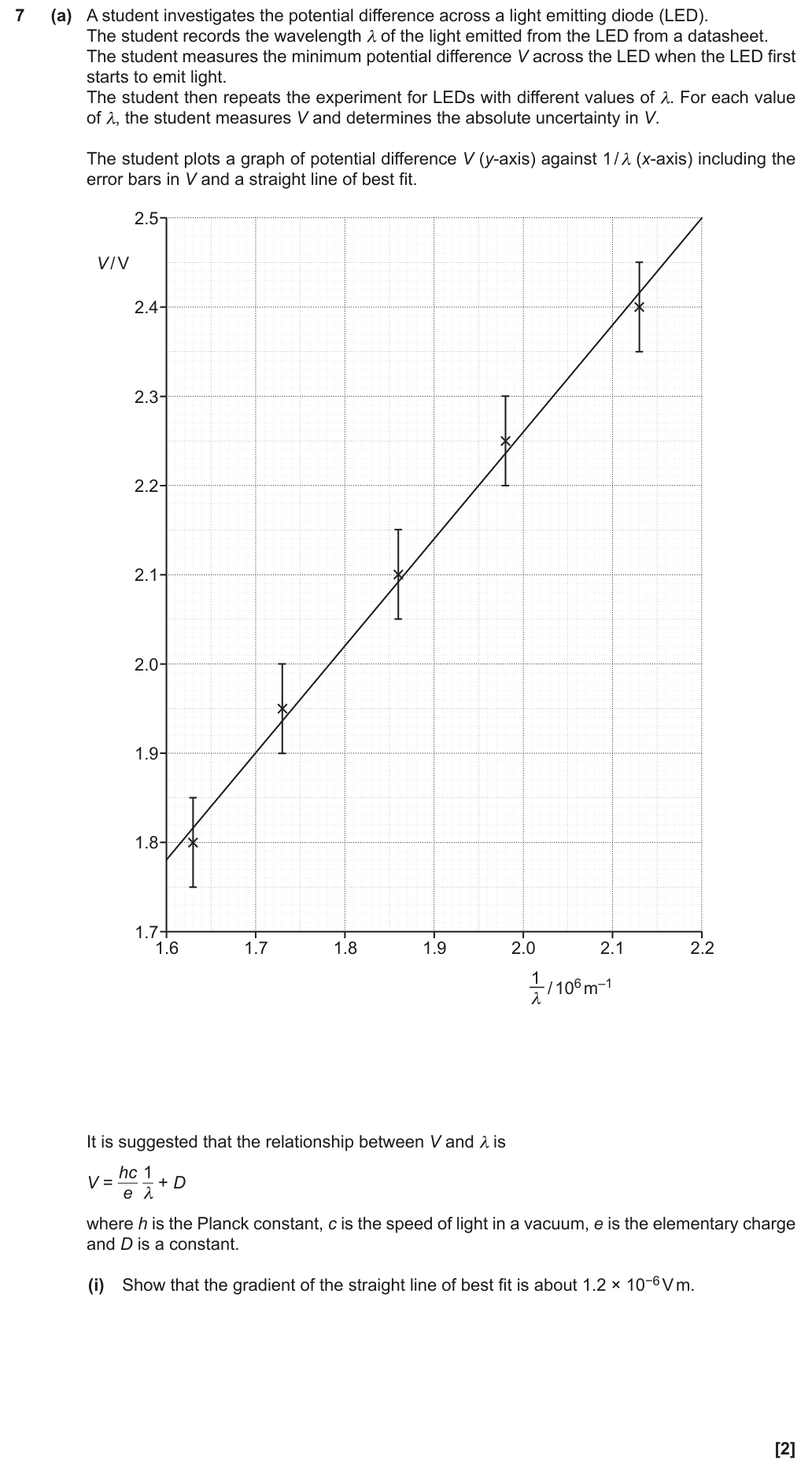
November 2021 · AS Paper 2 · Q7(a)(i) 2 marks Show that practical skills
7 (a) A student investigates the potential difference across a light emitting diode (LED).
The student records the wavelength λ of the light emitted from the LED from a datasheet.
The student measures the minimum potential difference V across the LED when the LED first
starts to emit light.
The student then repeats the experiment for LEDs with different values of λ. For each value
of λ, the student measures V and determines the absolute uncertainty in V.
The student plots a graph of potential difference V (y-axis) against 1 / λ (x-axis) including the
error bars in V and a straight line of best fit.
2.5
V / V
2.4
2.3
2.2
2.1
2.0
1.9
1.8
1.7
1.6 1.7 1.8 1.9 2.0 2.1 2.2
1
λ / 106 m–1
It is suggested that the relationship between V and λ is
V = hc 1
λ + D
e
where h is the Planck constant, c is the speed of light in a vacuum, e is the elementary charge
and D is a constant.
(i) Show that the gradient of the straight line of best fit is about 1.2 × 10⁻⁶ V m.
[2]
November 2021 · Paper 1 · Q16(a)(i) 2 marks Show that quantities and units
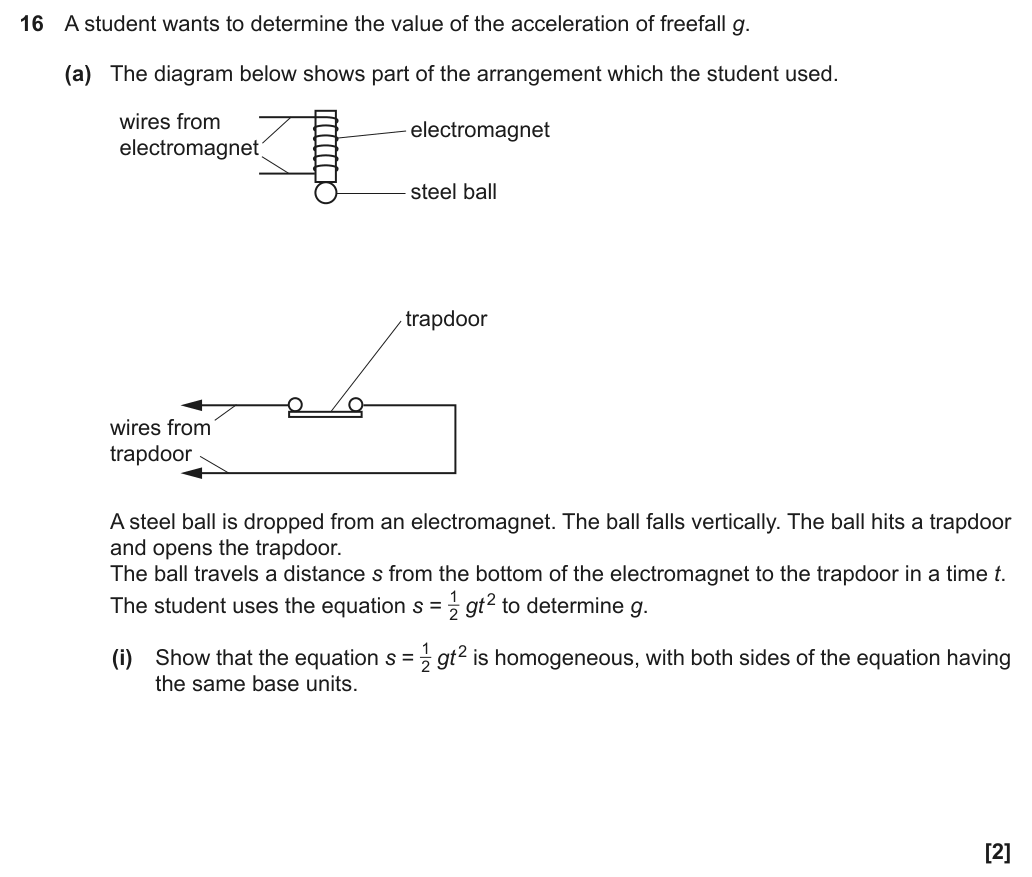
16 A student wants to determine the value of the acceleration of freefall g.
(a) The diagram below shows part of the arrangement which the student used.
wires from
electromagnet
electromagnet
steel ball
trapdoor
wires from
trapdoor
A steel ball is dropped from an electromagnet. The ball falls vertically. The ball hits a trapdoor
and opens the trapdoor.
The ball travels a distance s from the bottom of the electromagnet to the trapdoor in a time t.
The student uses the equation s = 1 2 gt 2 to determine g.
(i) Show that the equation s = 1 2 gt 2 is homogeneous, with both sides of the equation having
the same base units.
[2]
November 2021 · Paper 1 · Q19(b)(i) 3 marks Show that Medium equilibrium and momentsscalars and vectorsdynamics and terminal velocity
Earlier part of question 19 that this part usesEarlier part of November 2021 Paper 1 question 19
(b) (i) Show that the magnitude of the minimum force F which lifts the front end of the wheelie
bin (point X) off the ground is 96 N.
[3]
November 2021 · Paper 1 · Q22(a)(i) 2 marks Show that circular motionpractical skills
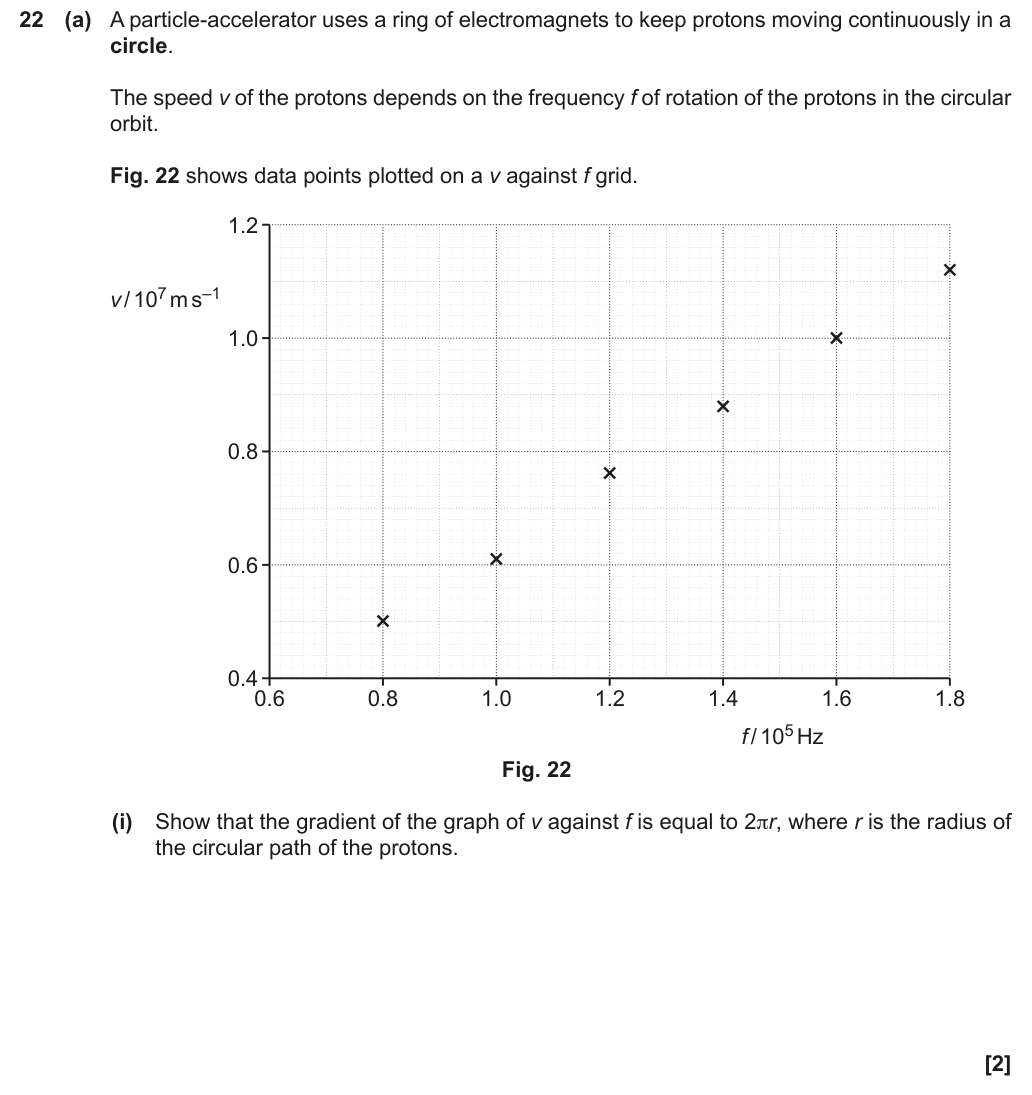
22 (a) A particle-accelerator uses a ring of electromagnets to keep protons moving continuously in a
circle.
The speed v of the protons depends on the frequency f of rotation of the protons in the circular
orbit.
Fig. 22 shows data points plotted on a v against f grid.
1.2
v / 107 m s–1
1.0
0.8
0.6
0.4
0.6 0.8 1.0 1.2 1.4 1.6 1.8
f / 105 Hz
Fig. 22
(i) Show that the gradient of the graph of v against f is equal to 2πr, where r is the radius of
the circular path of the protons.
[2]
November 2021 · Paper 1 · Q22(a)(ii) 3 marks Show that practical skillsmeasurements and uncertaintiescircular motion
Earlier part of question 22 that this part usesEarlier part of November 2021 Paper 1 question 22
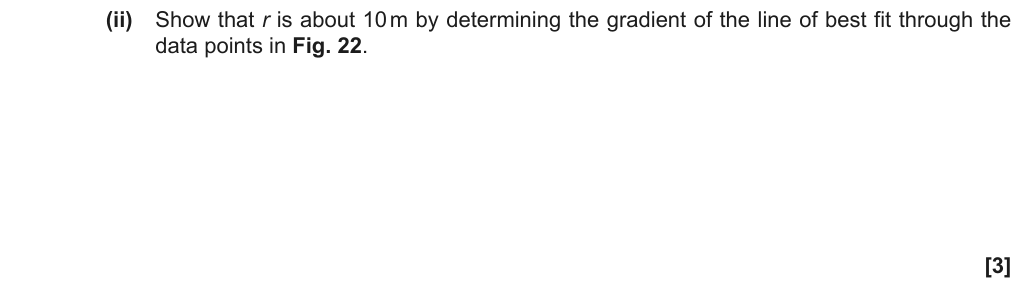
(ii) Show that r is about 10 m by determining the gradient of the line of best fit through the
data points in Fig. 22.
[3]
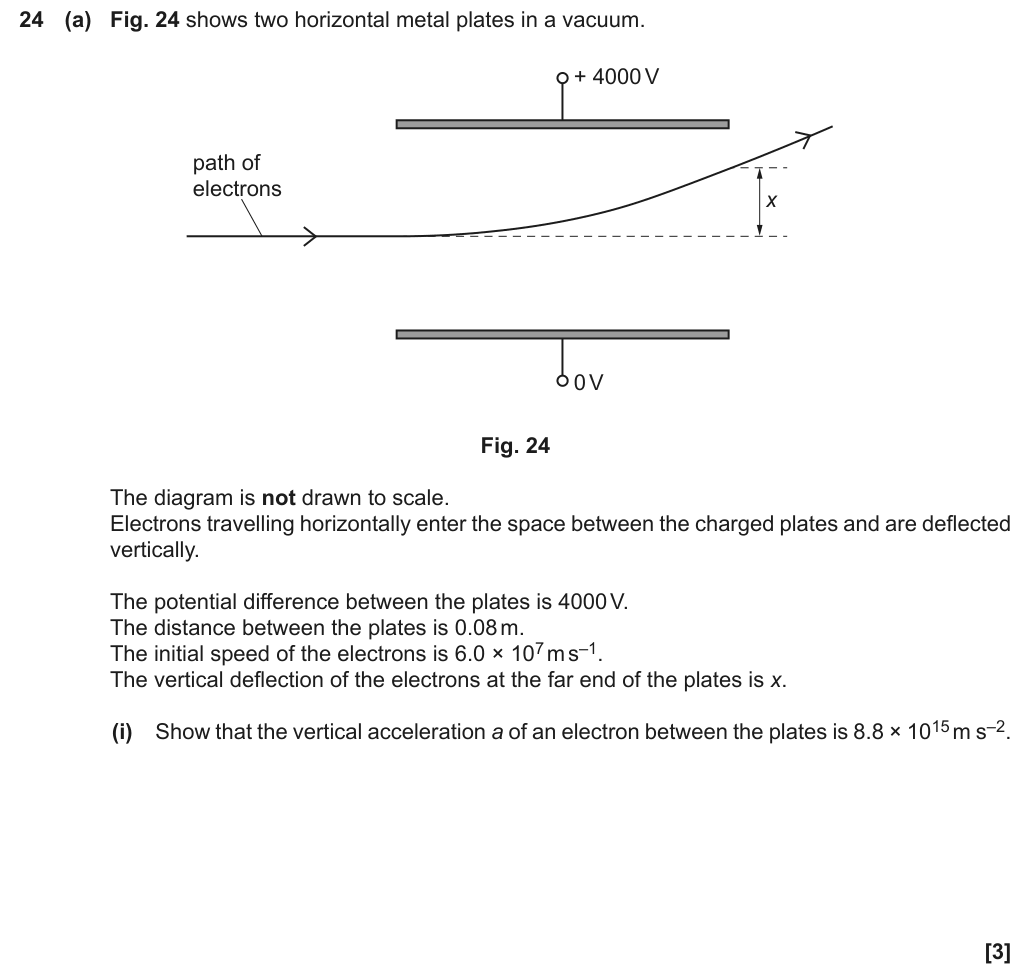
November 2021 · Paper 2 · Q24(a)(i) 3 marks Show that Medium electric fields
24 (a) Fig. 24 shows two horizontal metal plates in a vacuum.
+ 4000 V
path of
electrons
x
0 V
Fig. 24
The diagram is not drawn to scale.
Electrons travelling horizontally enter the space between the charged plates and are deflected
vertically.
The potential difference between the plates is 4000 V.
The distance between the plates is 0.08 m.
The initial speed of the electrons is 6.0 × 10⁷ m s–1.
The vertical deflection of the electrons at the far end of the plates is x.
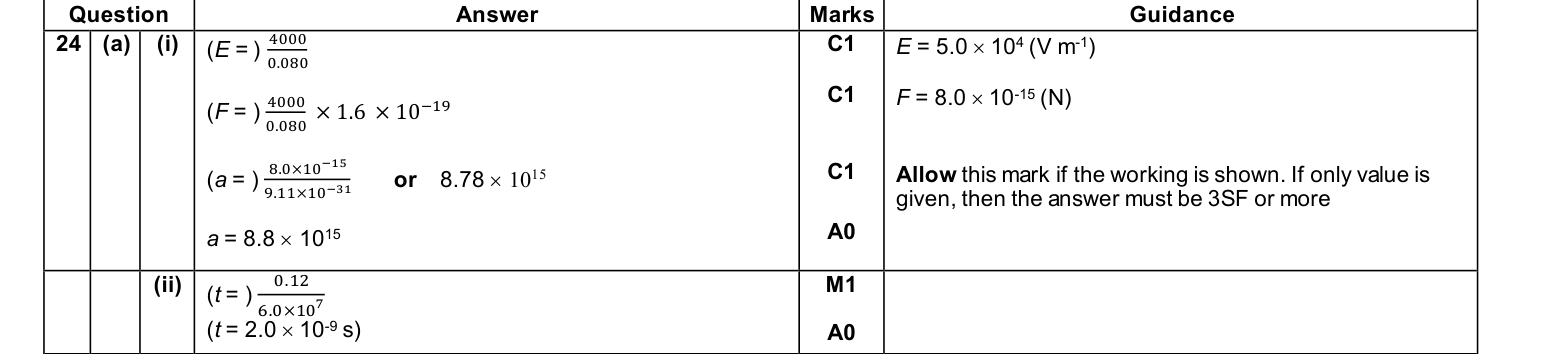
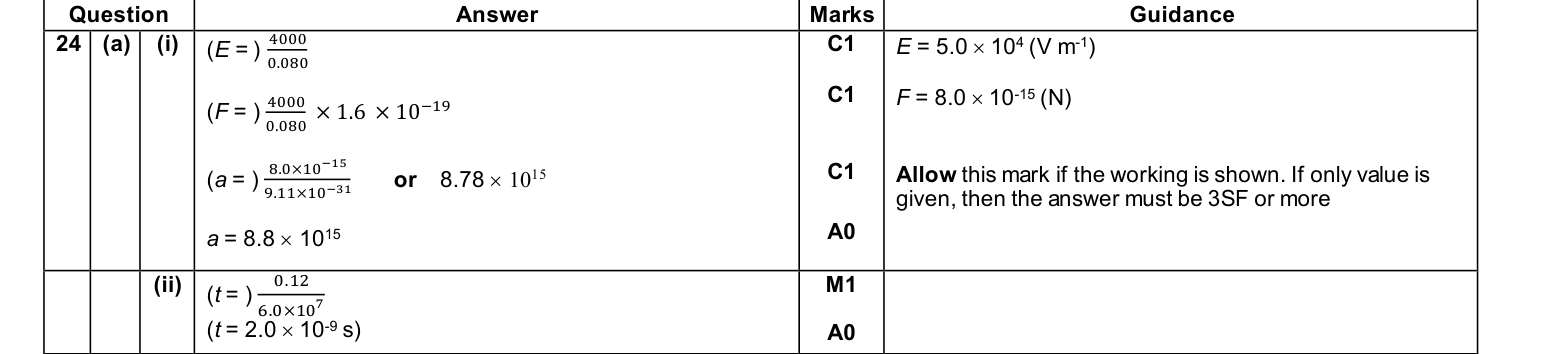
(i) Show that the vertical acceleration a of an electron between the plates is 8.8 × 10¹⁵ m s–2.
[3]
November 2021 · Paper 2 · Q24(a)(ii) 1 mark Show that Medium electric fields
Earlier part of question 24 that this part usesEarlier part of November 2021 Paper 2 question 24
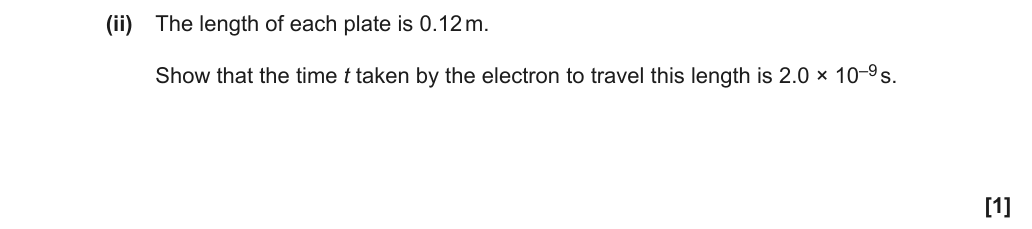
(ii) The length of each plate is 0.12 m.
Show that the time t taken by the electron to travel this length is 2.0 × 10⁻⁹ s.
[1]
November 2021 · Paper 3 · Q1(a)(i) 1 mark Show that dynamics and terminal velocity
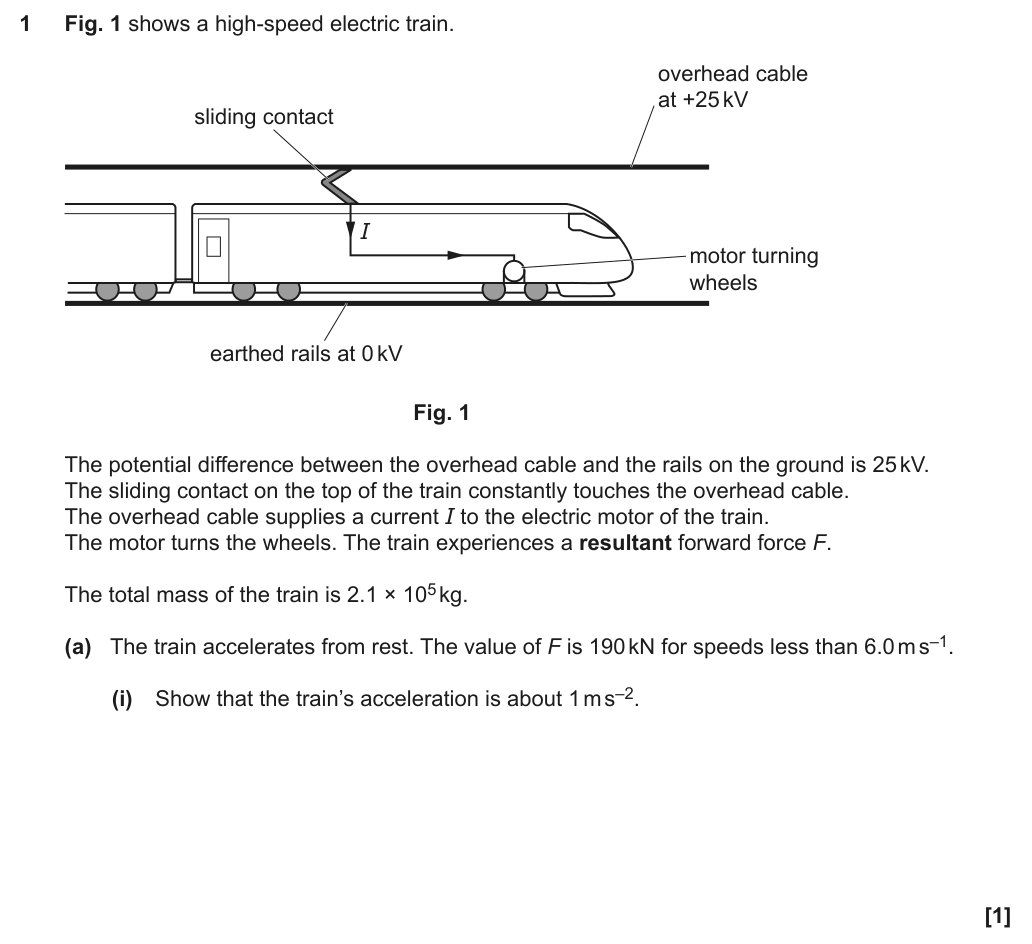
1 Fig. 1 shows a high-speed electric train.
overhead cable
at +25 kV
sliding contact
I I
motor turning
wheels
earthed rails at 0 kV
Fig. 1
The potential difference between the overhead cable and the rails on the ground is 25 kV.
The sliding contact on the top of the train constantly touches the overhead cable.
The overhead cable supplies a current I to the electric motor of the train.
The motor turns the wheels. The train experiences a resultant forward force F.
The total mass of the train is 2.1 × 10⁵ kg.
(a) The train accelerates from rest. The value of F is 190 kN for speeds less than 6.0 m s–1.
(i) Show that the train’s acceleration is about 1 m s–2.
[1]
November 2021 · Paper 3 · Q1(a)(iii) 5 marks Show that work energy and powerelectrical power
Earlier part of question 1 that this part usesEarlier part of November 2021 Paper 3 question 1
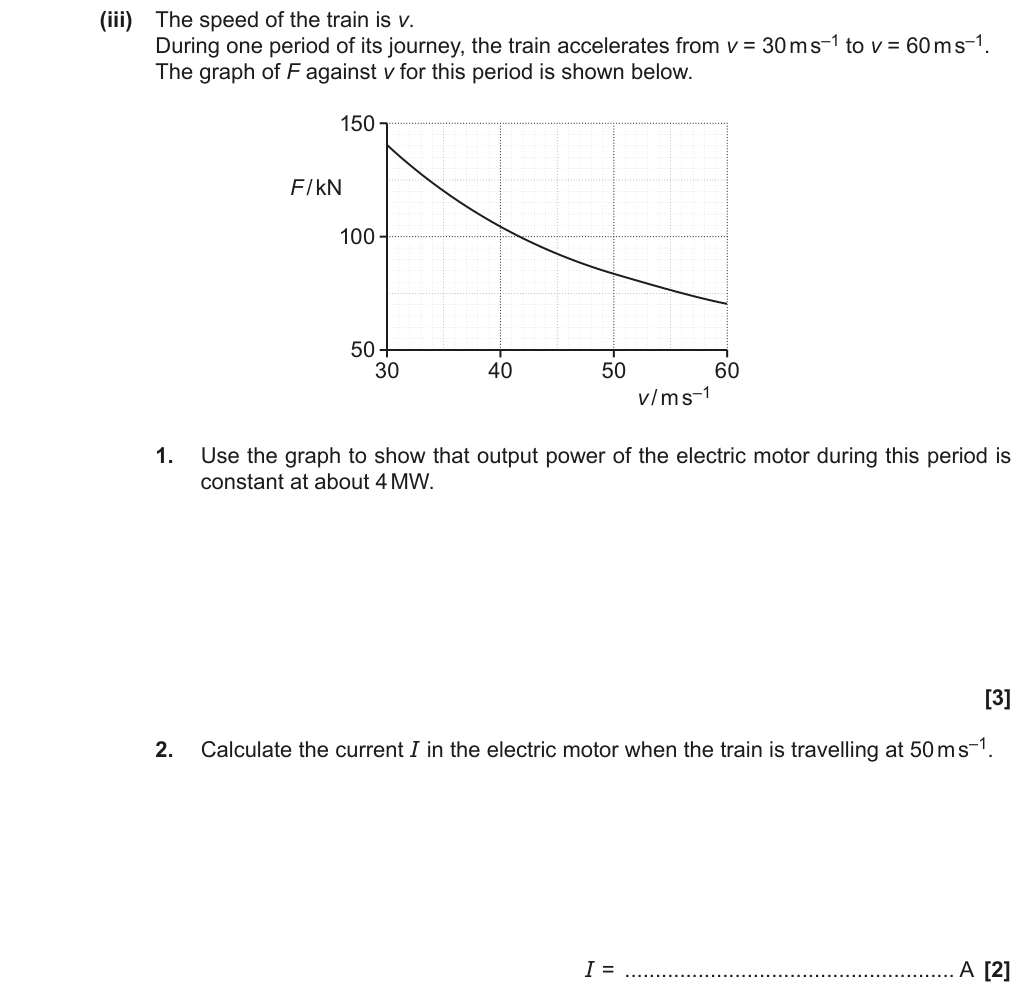
(iii) The speed of the train is v.
During one period of its journey, the train accelerates from v = 30 m s–1 to v = 60 m s–1.
The graph of F against v for this period is shown below.
150
F / kN
100
50
30 40 50 60
v / m s–1
1. Use the graph to show that output power of the electric motor during this period is
constant at about 4 MW.
[3]
2. Calculate the current I in the electric motor when the train is travelling at 50 m s–1.
I =  ...................................................... A [2]
November 2021 · Paper 3 · Q2(a)(ii) 1 mark Show that potential dividers
Earlier part of question 2 that this part usesEarlier part of November 2021 Paper 3 question 2
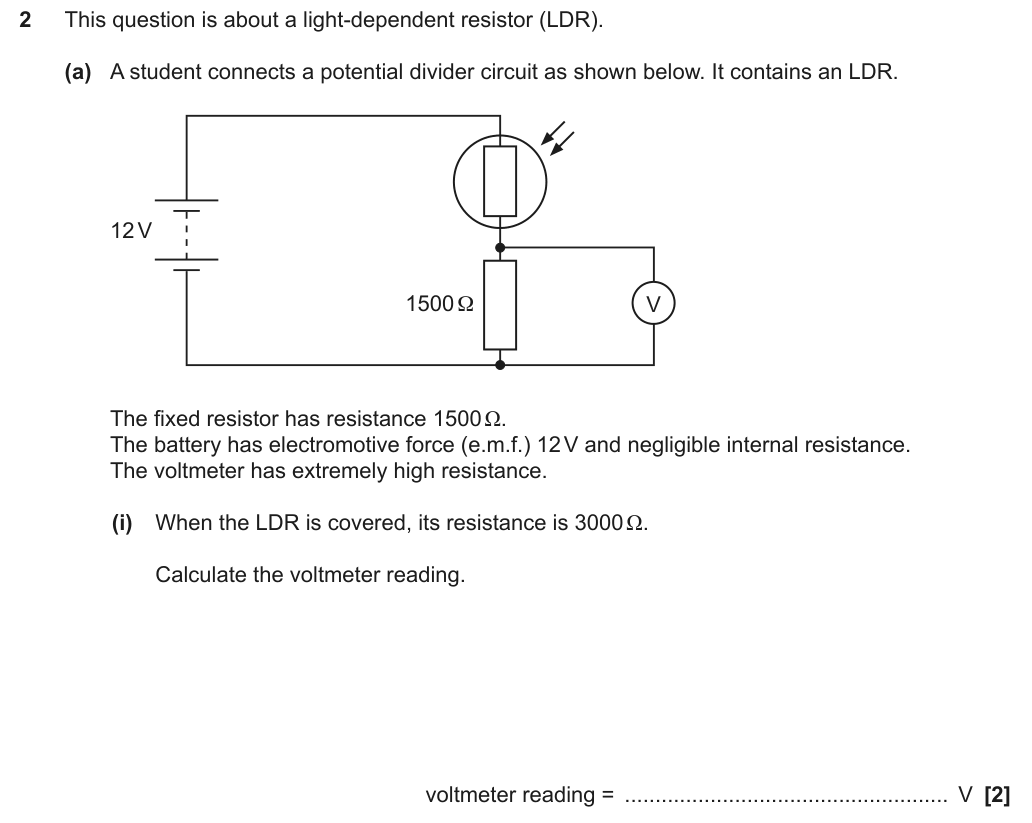
(ii) When fully illuminated, the resistance of the LDR is 100 Ω.
Show that the voltmeter reading changes by more than 7 V.
[1]
November 2021 · Paper 3 · Q3(b)(i) 2 marks Show that Medium gravitational fields
(b) The space probe has mass 810 kg. The orbital radius of the space probe is 1.5 × 10¹¹ m. The
orbital period of the space probe around the Sun is 3.16 × 10⁷ s.
The mass of the Sun is 2.0 × 1030 kg.
(i) Show that the magnitude of the gravitational potential energy of the space probe is about
7 × 10¹¹ J.
[2]
November 2021 · Paper 3 · Q3(b)(ii) 3 marks Show that Medium work energy and powercircular motionplanetary motion
Earlier part of question 3 that this part usesEarlier part of November 2021 Paper 3 question 3
(ii) Show that the kinetic energy of the space probe is half the value of your answer to (b)(i).
[3]
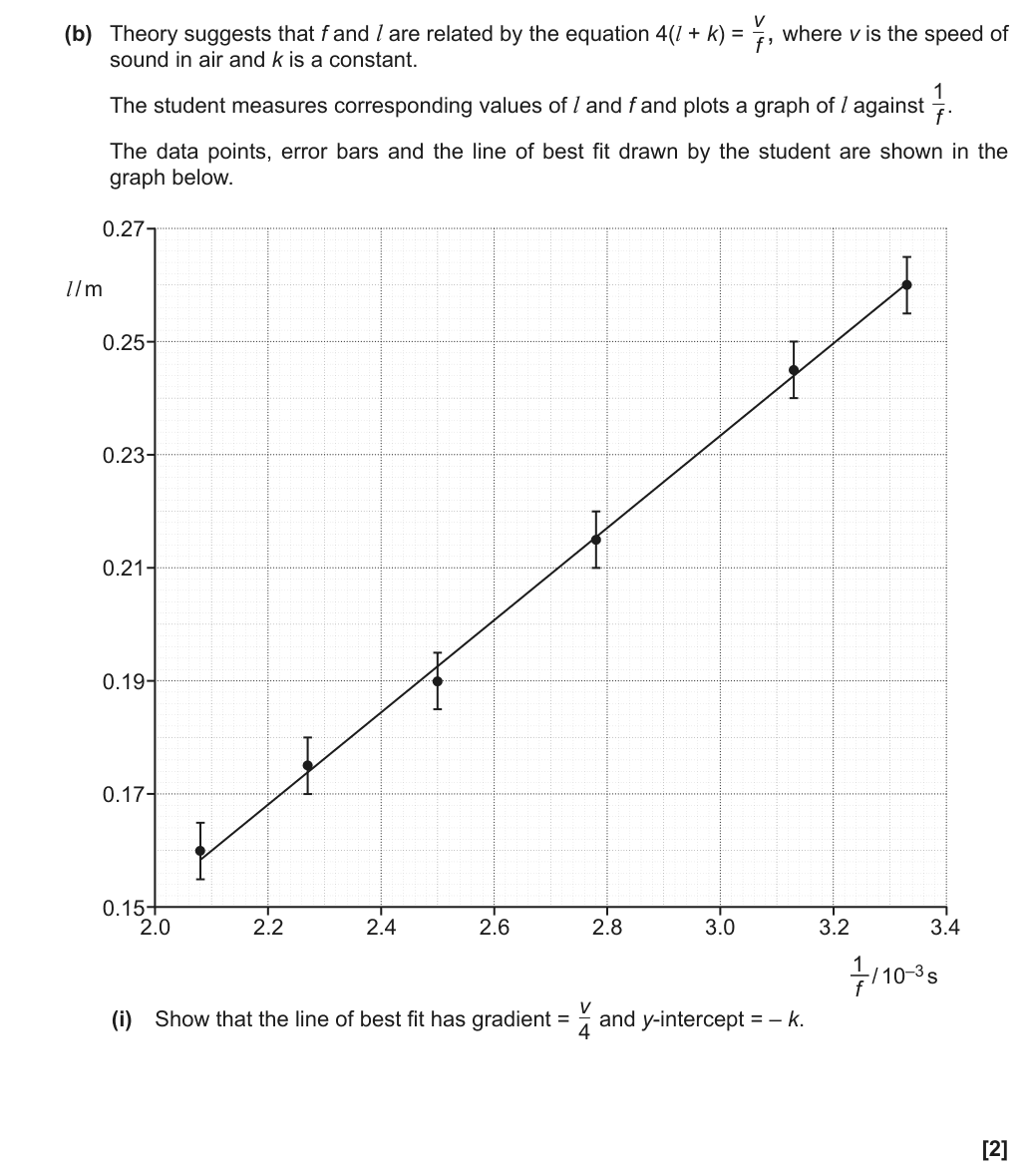
November 2021 · Paper 3 · Q5(b)(i) 2 marks Show that Medium practical skillswave motion
Earlier part of question 5 that this part usesEarlier part of November 2021 Paper 3 question 5
(b) Theory suggests that f and l are related by the e quation 4(l + k) = v
f , where v is the speed of
sound in air and k is a constant.
The student measures corresponding values of l and f and plots a graph of l against 1
f .
The data points, error bars and the line of best fit drawn by the student are shown in the
graph below.
0.27
l / m
0.25
0.23
0.21
0.19
0.17
0.15
2.0 2.2 2.4 2.6 2.8 3.0 3.2 3.4
1
f / 10–3 s
(i)  Show that the line of best fit has gradient = v
4 and y-intercept = – k.
[2]
November 2020 · AS Paper 1 · Q22(a) 2 marks Show that Medium quantities and units
22 A toy parachute is falling through air.
The air resistance F acting on the parachute is given by the expression
F = kv 2
where v is the speed of the parachute and k is a constant.
(a) The S.I. base units for F are kg m s−2.
Show that the S.I. base units for k are kg m−1.
[2]
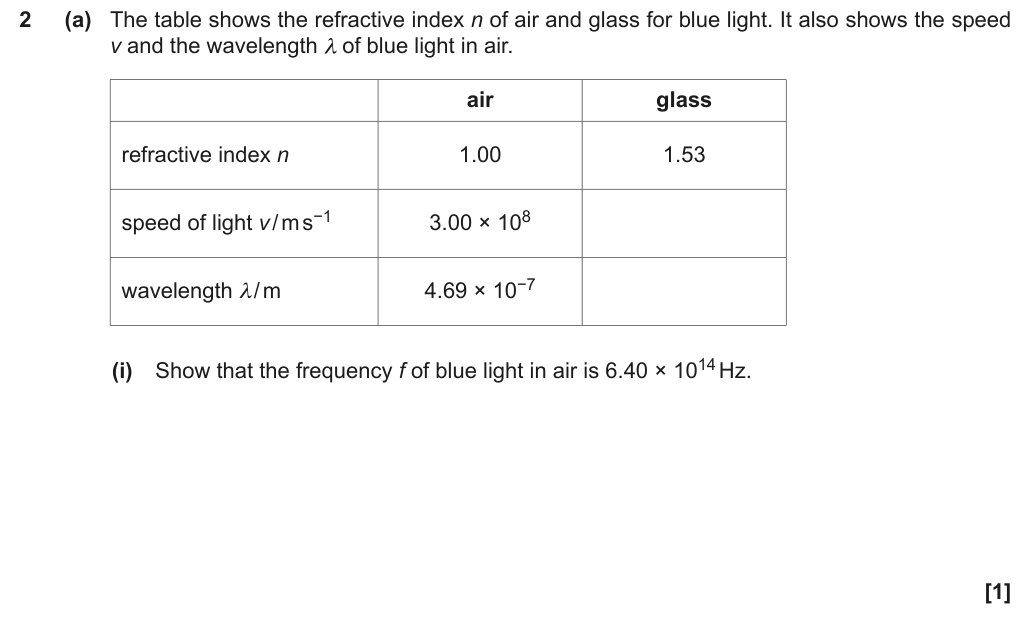
November 2020 · AS Paper 2 · Q2(a)(i) 1 mark Show that wave motion
2 (a) The table shows the refractive index n of air and glass for blue light. It also shows the speed
v and the wavelength λ of blue light in air.
air glass
refractive index n 1.00 1.53
speed of light v / m s−1 3.00 × 10⁸
wavelength λ / m 4.69 × 10⁻⁷
(i) Show that the frequency f of blue light in air is 6.40 × 10¹⁴ Hz.
[1]
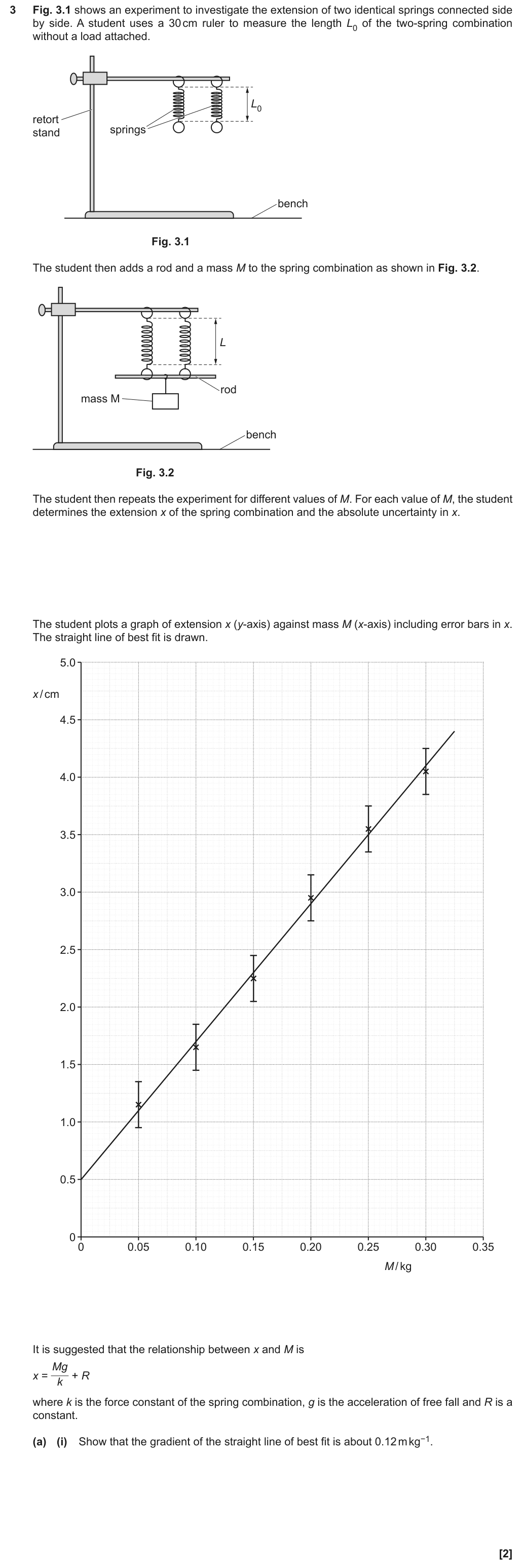
November 2020 · AS Paper 2 · Q3(a)(i) 2 marks Show that Medium practical skills
3 Fig. 3.1 shows an experiment to investigate the extension of two identical springs connected side
by side. A student uses a 30 cm ruler to measure the length L0 of the two-spring combination
without a load attached.
L0
retort
stand springs
bench
Fig. 3.1
The student then adds a rod and a mass M to the spring combination as shown in Fig. 3.2.
L
rod
mass M
bench
Fig. 3.2
The student then repeats the experiment for different values of M. For each value of M, the student
determines the extension x of the spring combination and the absolute uncertainty in x.
The student plots a graph of extension x (y-axis) against mass M (x-axis) including error bars in x.
The straight line of best fit is drawn.
5.0
x / cm
4.5
4.0
3.5
3.0
2.5
2.0
1.5
1.0
0.5
0
0 0.05 0.10 0.15 0.20 0.25 0.30 0.35
M / kg
It is suggested that the relationship between x and M is
Mg
x = k + R
where k is the force constant of the spring combination, g is the acceleration of free fall and R is a
constant.
(a) (i) Show that the gradient of the straight line of best fit is about 0.12 m kg−1.
[2]
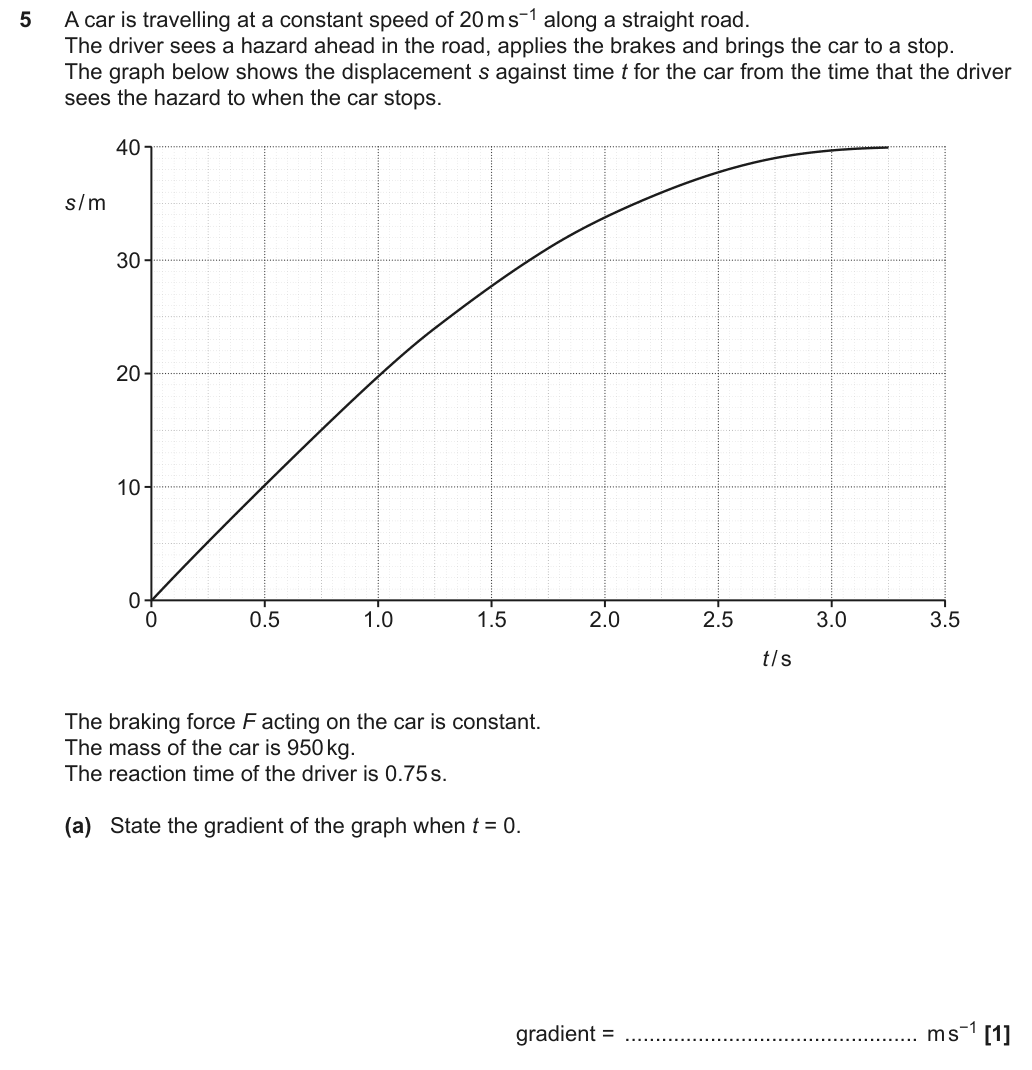
November 2020 · AS Paper 2 · Q5(c) 2 marks Show that kinematics
Earlier part of question 5 that this part usesEarlier part of November 2020 Paper 2 question 5
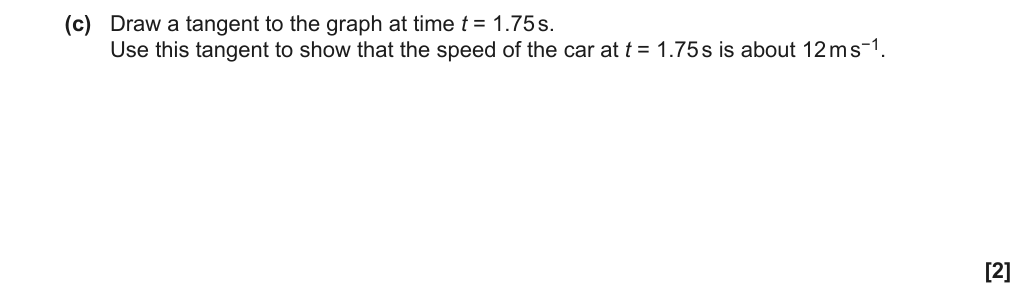
(c) Draw a tangent to the graph at time t = 1.75 s.
Use this tangent to show that the speed of the car at t = 1.75 s is about 12 m s−1.
[2]
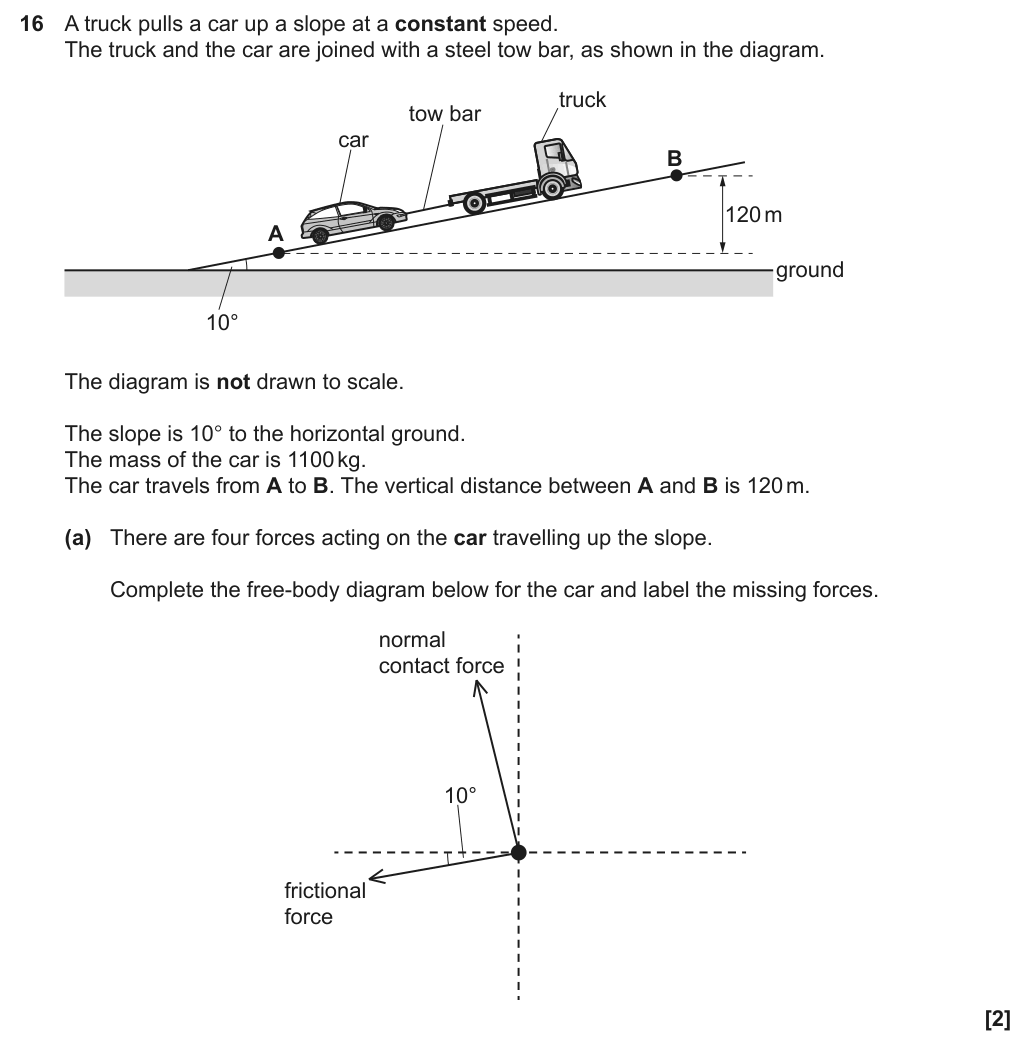
November 2020 · Paper 1 · Q16(b) 1 mark Show that scalars and vectorsdynamics and terminal velocity
Earlier part of question 16 that this part usesEarlier part of November 2020 Paper 1 question 16
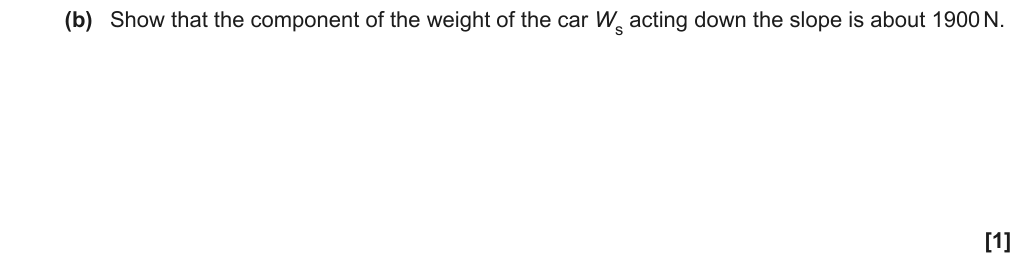
(b) Show that the component of the weight of the car Ws acting down the slope is about 1900 N.
[1]
November 2020 · Paper 1 · Q18(b) 2 marks Show that projectile motionscalars and vectorslinear motion
Earlier part of question 18 that this part usesEarlier part of November 2020 Paper 1 question 18
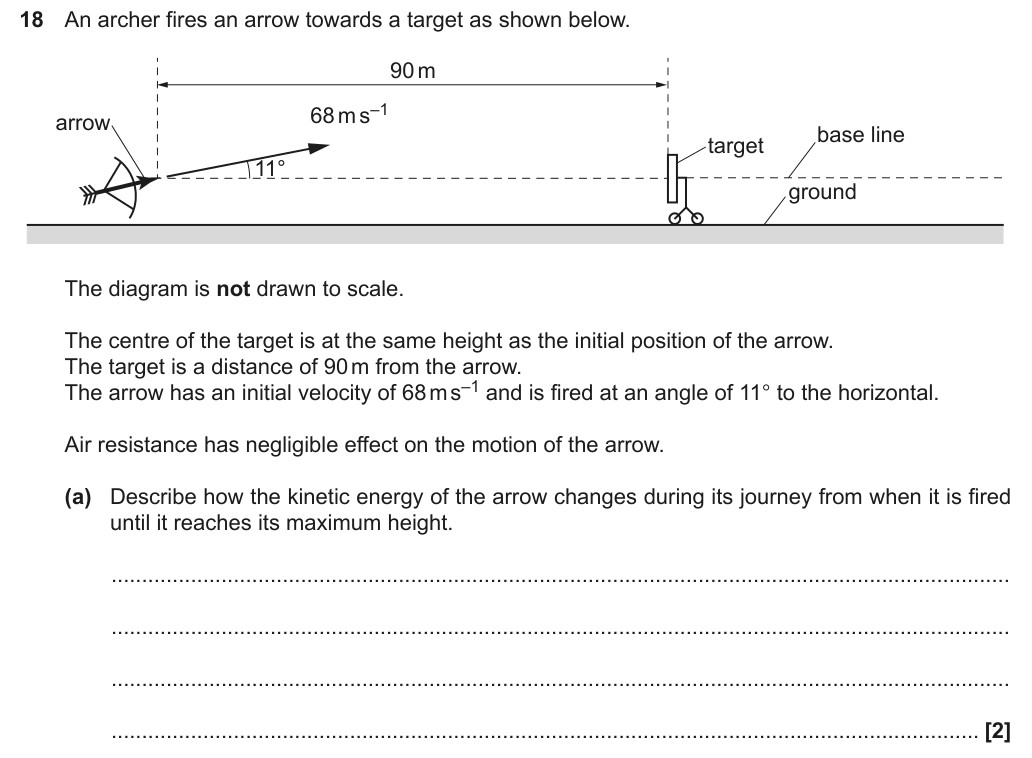
(b) Show that the time taken for the arrow to reach its maximum height is about 1.3 s.
[2]
November 2020 · Paper 1 · Q20(a) 3 marks Show that circular motion
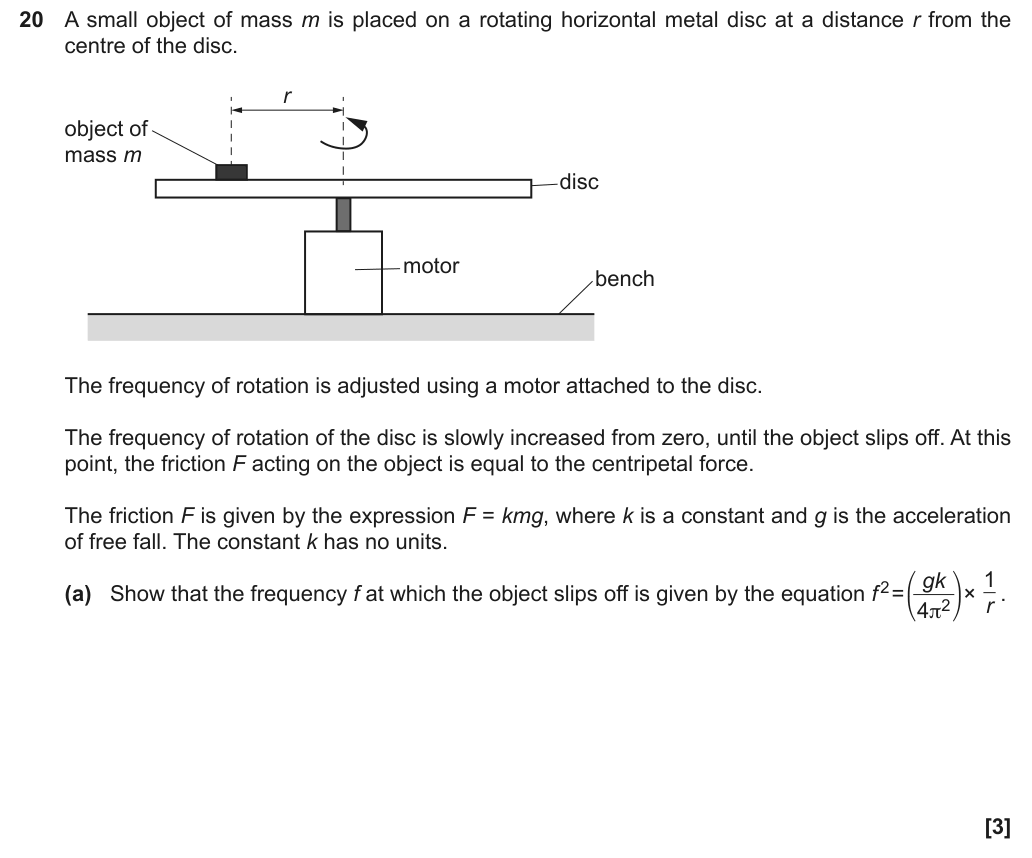
20 A small object of mass m is placed on a rotating horizontal metal disc at a distance r from the
centre of the disc.
r
object of
mass m
disc
motor
bench
The frequency of rotation is adjusted using a motor attached to the disc.
The frequency of rotation of the disc is slowly increased from zero, until the object slips off. At this
point, the friction F acting on the object is equal to the centripetal force.
The friction F is given by the expression F = kmg, where k is a constant and g is the acceleration
of free fall. The constant k has no units.
(a) Show that the frequency f at which the object slips off is given by the equation f 2 =  gk ⎛     ⎞ 4π2  × 1
r .
⎝     ⎠
[3]
November 2020 · Paper 1 · Q21(b)(ii) 3 marks Show that Medium newtons laws and momentumkinematicsideal gases
Earlier parts of question 21 that this part usesEarlier part of November 2020 Paper 1 question 21Earlier part of November 2020 Paper 1 question 21
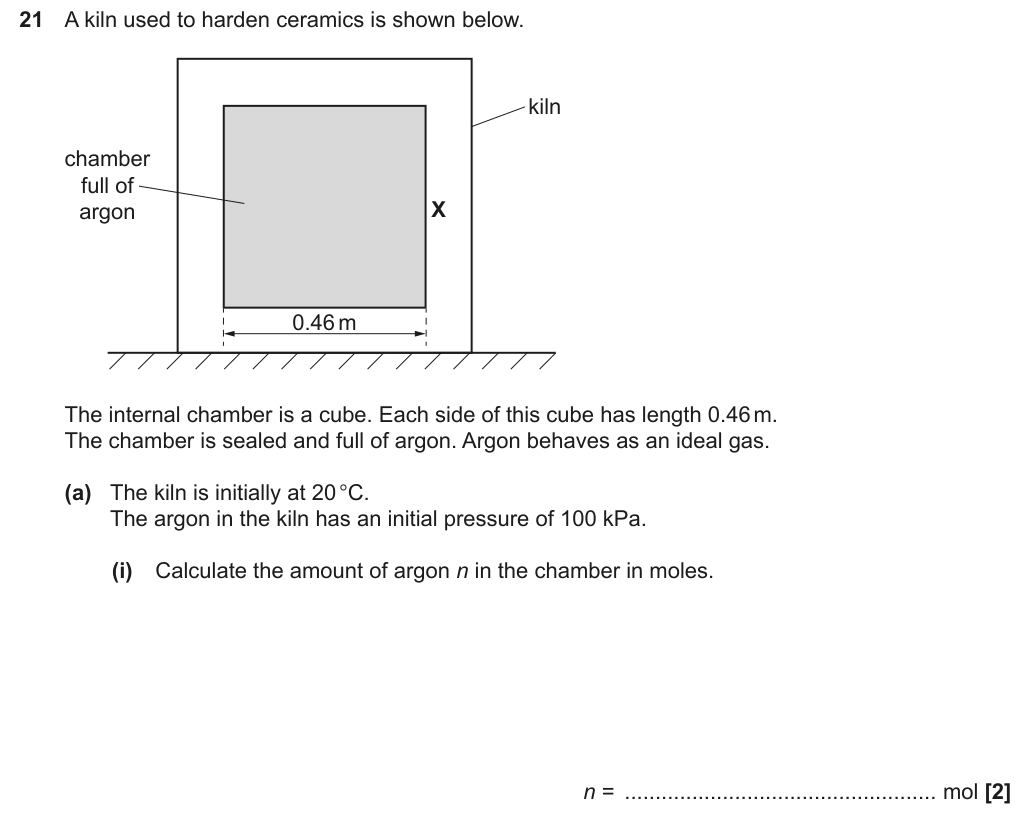
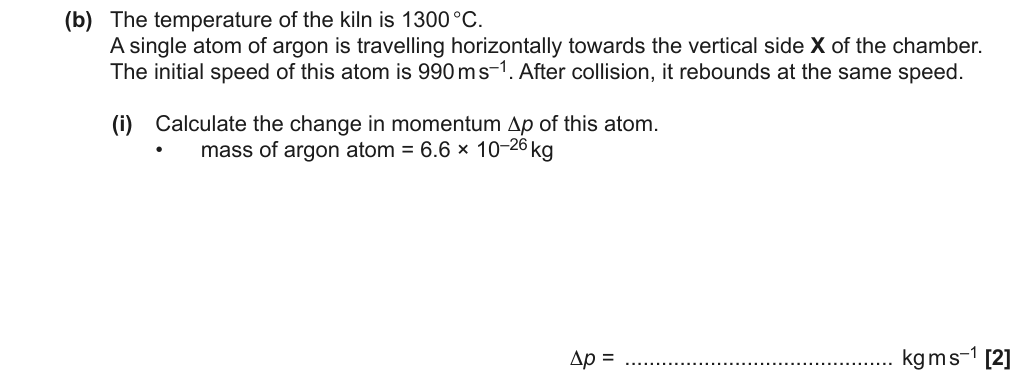
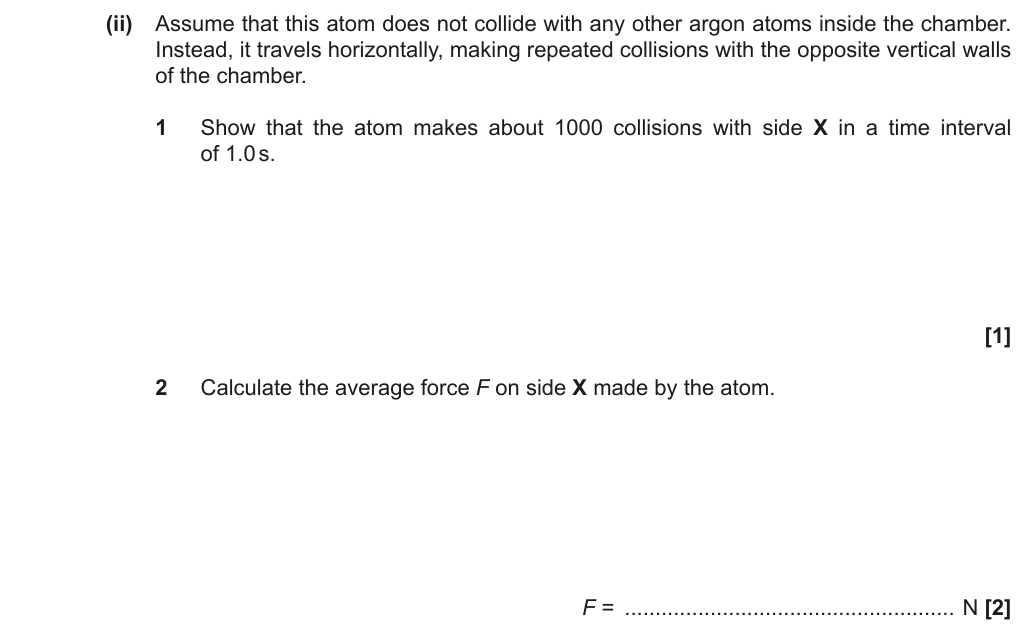
(ii) Assume that this atom does not collide with any other argon atoms inside the chamber.
Instead, it travels horizontally, making repeated collisions with the opposite vertical walls
of the chamber.
1 Show that the atom makes about 1000 collisions with side X in a time interval
of 1.0 s.
[1]
2 Calculate the average force F on side X made by the atom.
F =  ...................................................... N [2]
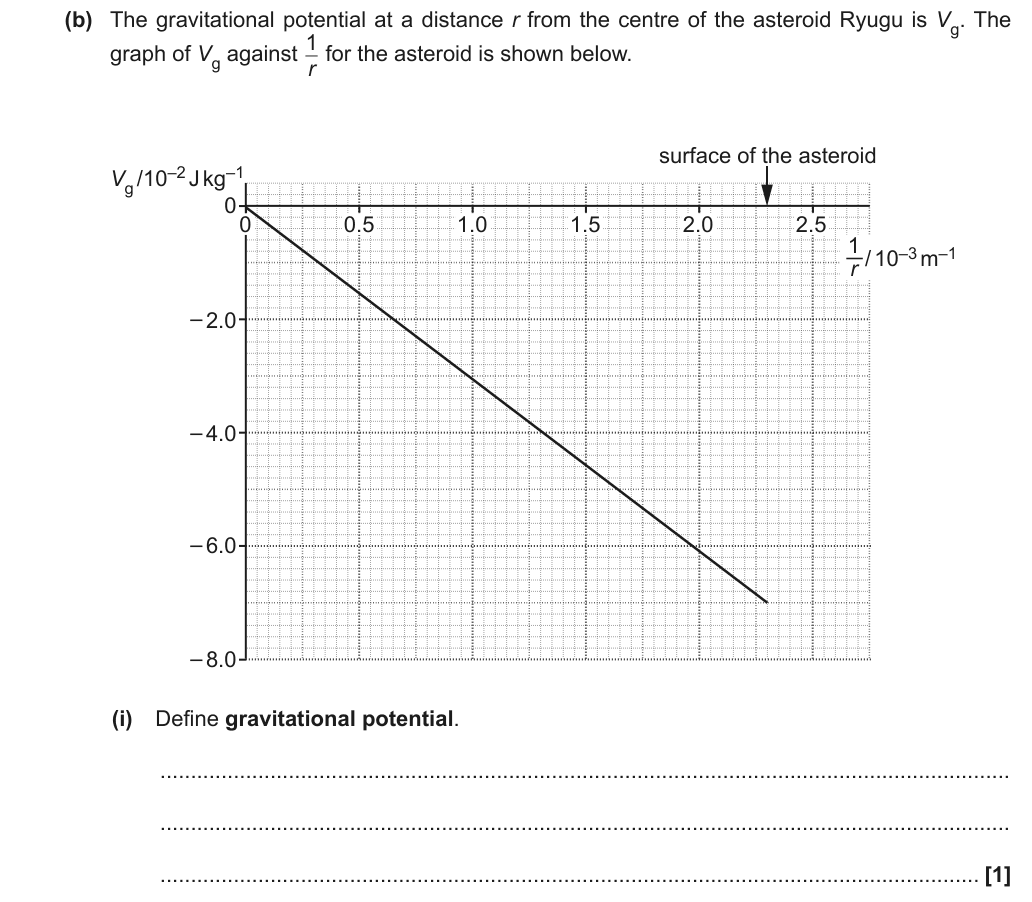
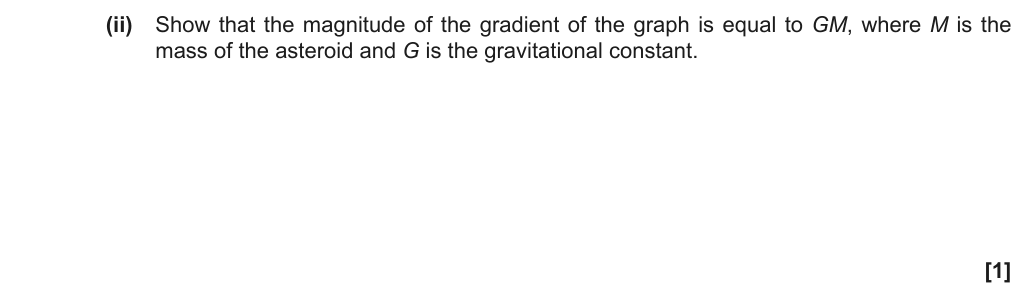
November 2020 · Paper 1 · Q23(b)(ii) 1 mark Show that Medium gravitational fields
Earlier part of question 23 that this part usesEarlier part of November 2020 Paper 1 question 23
(ii) Show that the magnitude of the gradient of the graph is equal to GM, where M is the
mass of the asteroid and G is the gravitational constant.
[1]
November 2020 · Paper 1 · Q23(b)(iii) 2 marks Show that Medium gravitational fieldspractical skills
Earlier parts of question 23 that this part usesEarlier part of November 2020 Paper 1 question 23Earlier part of November 2020 Paper 1 question 23
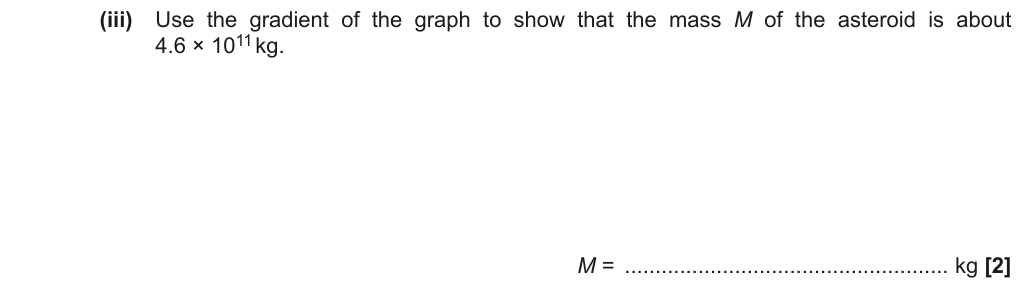
(iii) Use the gradient of the graph to show that the mass M of the asteroid is about
4.6 × 10¹¹ kg.
M =  ..................................................... kg [2]
November 2020 · Paper 1 · Q24(b)(i) 2 marks Show that Medium stars
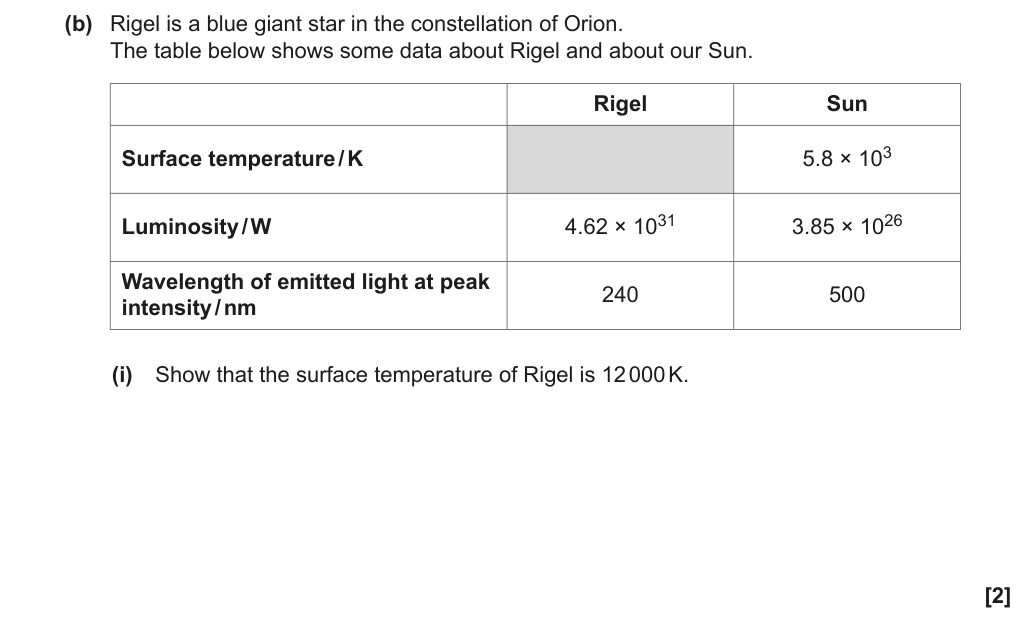
(b) Rigel is a blue giant star in the constellation of Orion.
The table below shows some data about Rigel and about our Sun.
Rigel Sun
Surface temperature / K 5.8 × 10³
Luminosity / W 4.62 × 1031 3.85 × 1026
Wavelength of emitted light at peak
240 500
intensity / nm
(i) Show that the surface temperature of Rigel is 12 000 K.
[2]
November 2020 · Paper 2 · Q19(b)(i) 2 marks Show that Medium wave particle dualityemf pd and resistance
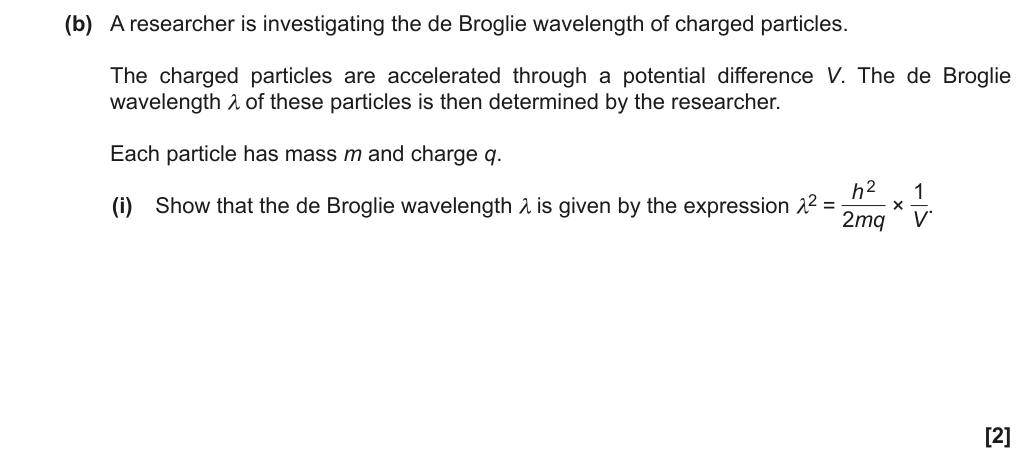
(b) A researcher is investigating the de Broglie wavelength of charged particles.
The charged particles are accelerated through a potential difference V. The de Broglie
wavelength λ of these particles is then determined by the researcher.
Each particle has mass m and charge q.
(i) Show that the de Broglie wavelength λ is given by the expression λ2 = h 2 2mq × 1
V.
[2]
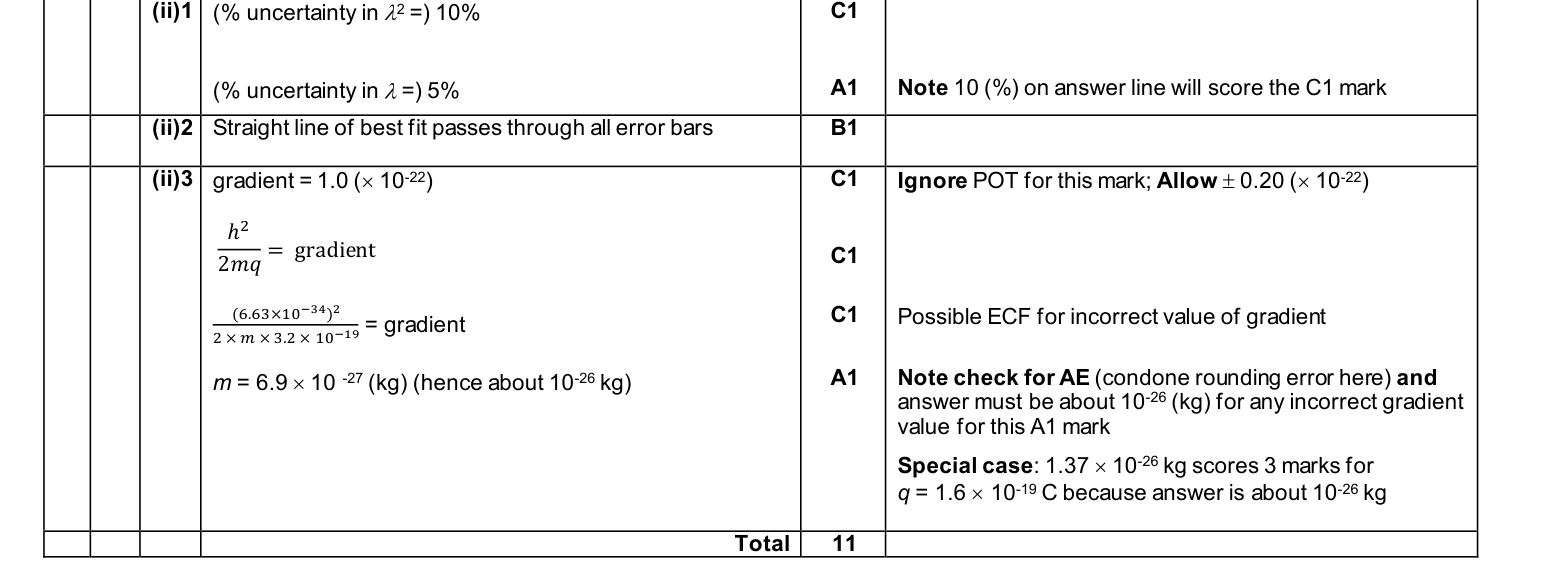
November 2020 · Paper 2 · Q19(b)(ii) 7 marks Show that Medium measurements and uncertaintiespractical skillsemf pd and resistancewave particle duality
Earlier part of question 19 that this part usesEarlier part of November 2020 Paper 2 question 19
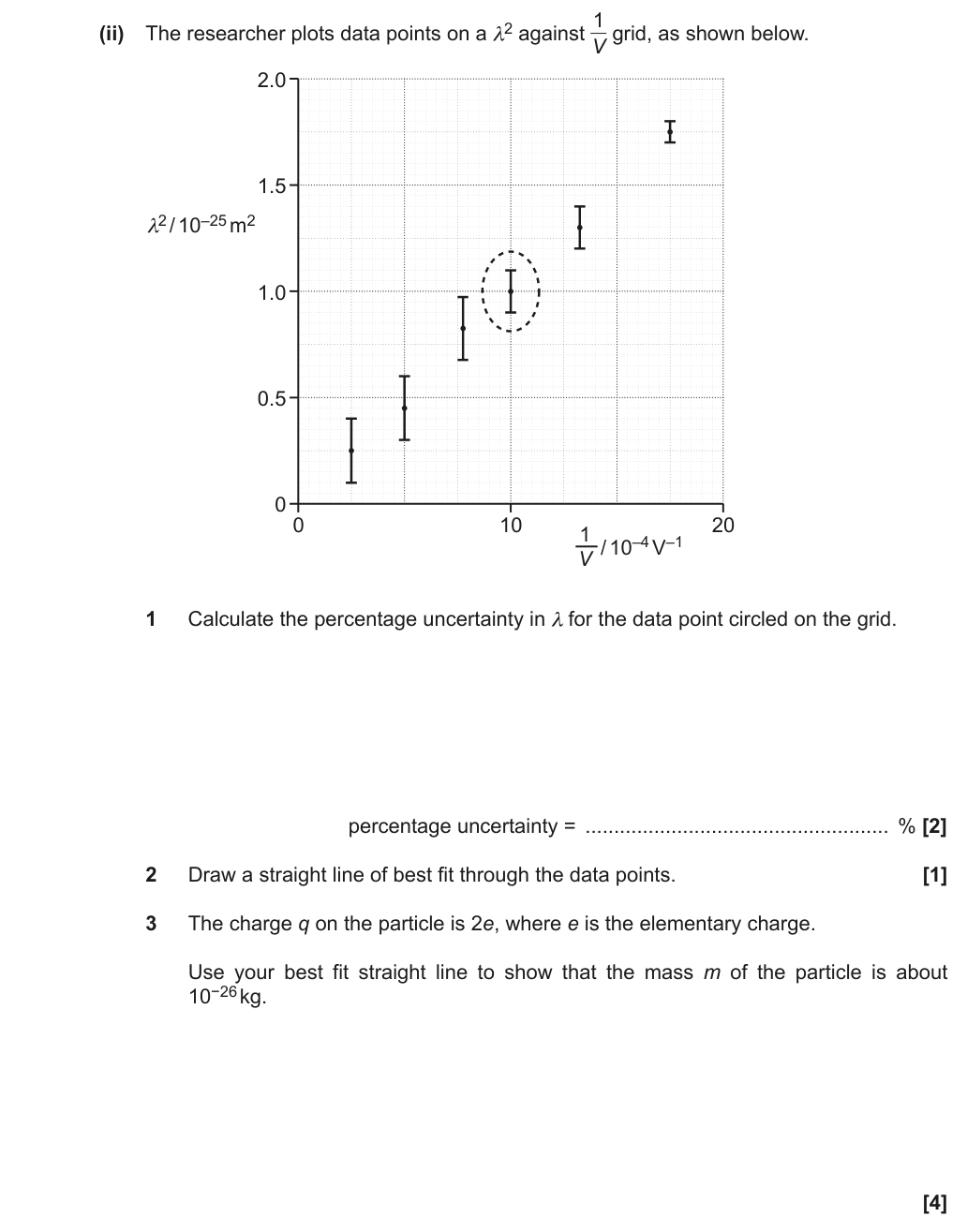
(ii) The researcher plots data points on a λ2 against 1
V grid, as shown below.
2.0
1.5
λ2 / 10–25 m2
1.0
0.5
0
0 10 20
1
/ 10–4 V–1
V
1 Calculate the percentage uncertainty in λ for the data point circled on the grid.
percentage uncertainty =  ..................................................... % [2]
2 Draw a straight line of best fit through the data points. [1]
3 The charge q on the particle is 2e, where e is the elementary charge.
Use your best fit straight line to show that the mass m of the particle is about
10−26 kg.
[4]
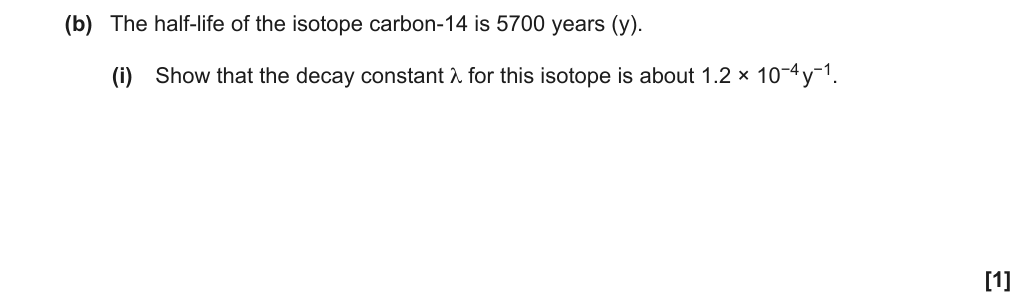
November 2020 · Paper 2 · Q21(b)(i) 1 mark Show that Medium radioactivity
(b)  The half-life of the isotope carbon-14 is 5700 years (y).
(i) Show that the decay constant λ for this isotope is about 1.2 × 10⁻⁴ y−1.
[1]
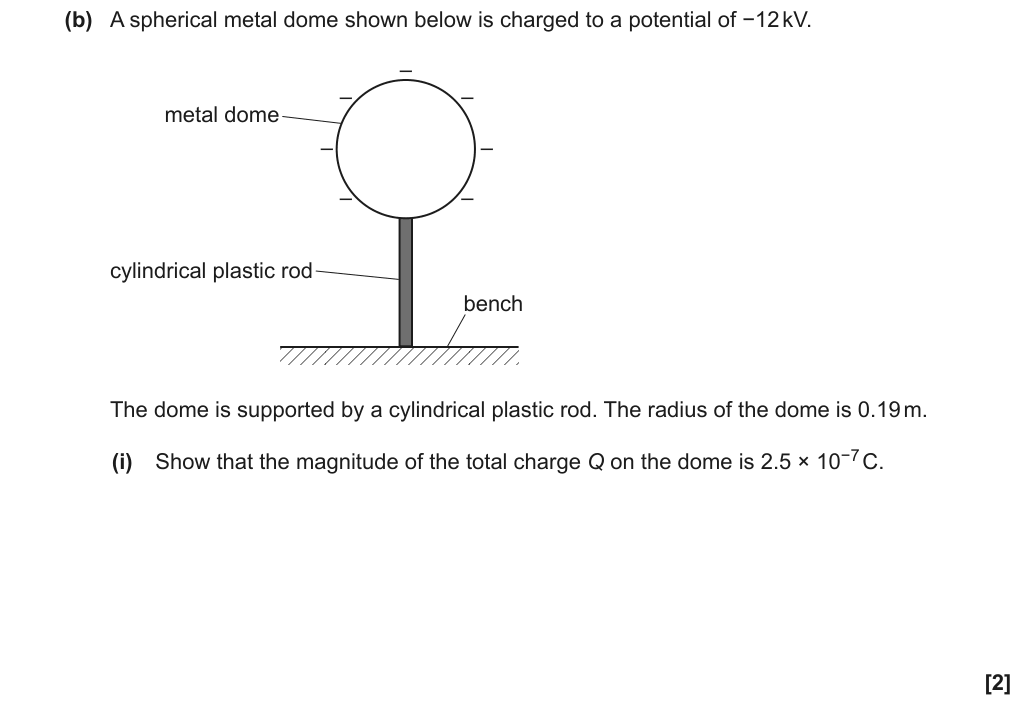
November 2020 · Paper 2 · Q23(b)(i) 2 marks Show that electric fields
(b) A spherical metal dome shown below is charged to a potential of −12 kV.
–
– –
metal dome
– –
– –
cylindrical plastic rod
bench
The dome is supported by a cylindrical plastic rod. The radius of the dome is 0.19 m.
(i) Show that the magnitude of the total charge Q on the dome is 2.5 × 10⁻⁷ C.
[2]
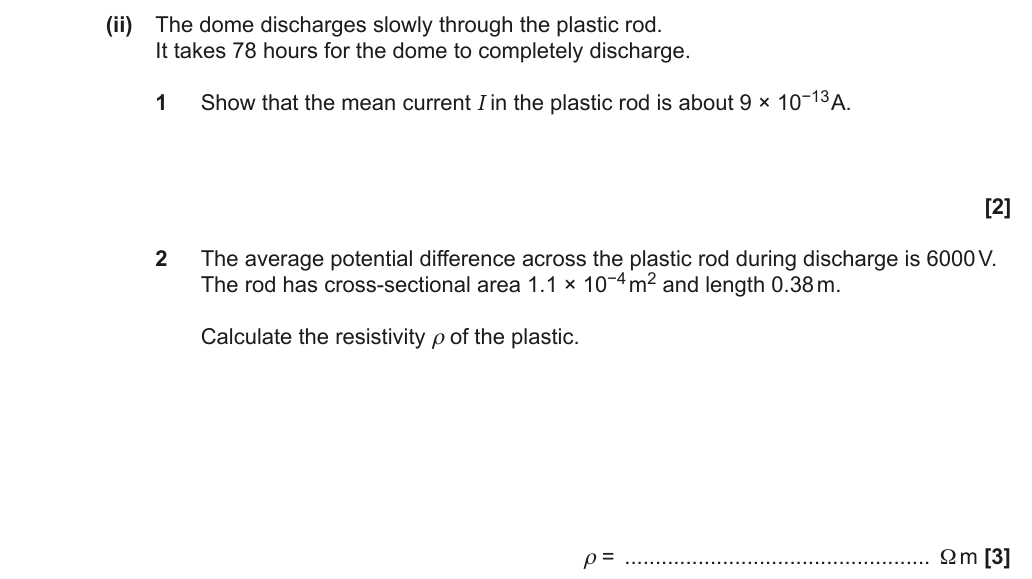
November 2020 · Paper 2 · Q23(b)(ii) 5 marks Show that charge and currentemf pd and resistanceresistivity
Earlier part of question 23 that this part usesEarlier part of November 2020 Paper 2 question 23
(ii) The dome discharges slowly through the plastic rod.
It takes 78 hours for the dome to completely discharge.
1 Show that the mean current I in the plastic rod is about 9 × 10⁻¹³ A.
[2]
2 The average potential difference across the plastic rod during discharge is 6000 V.
The rod has cross-sectional area 1.1 × 10⁻⁴ m2 and length 0.38 m.
Calculate the resistivity ρ of the plastic.
ρ =  .................................................. Ω m [3]
November 2020 · Paper 3 · Q1(a)(i) 2 marks Show that Medium electric fields
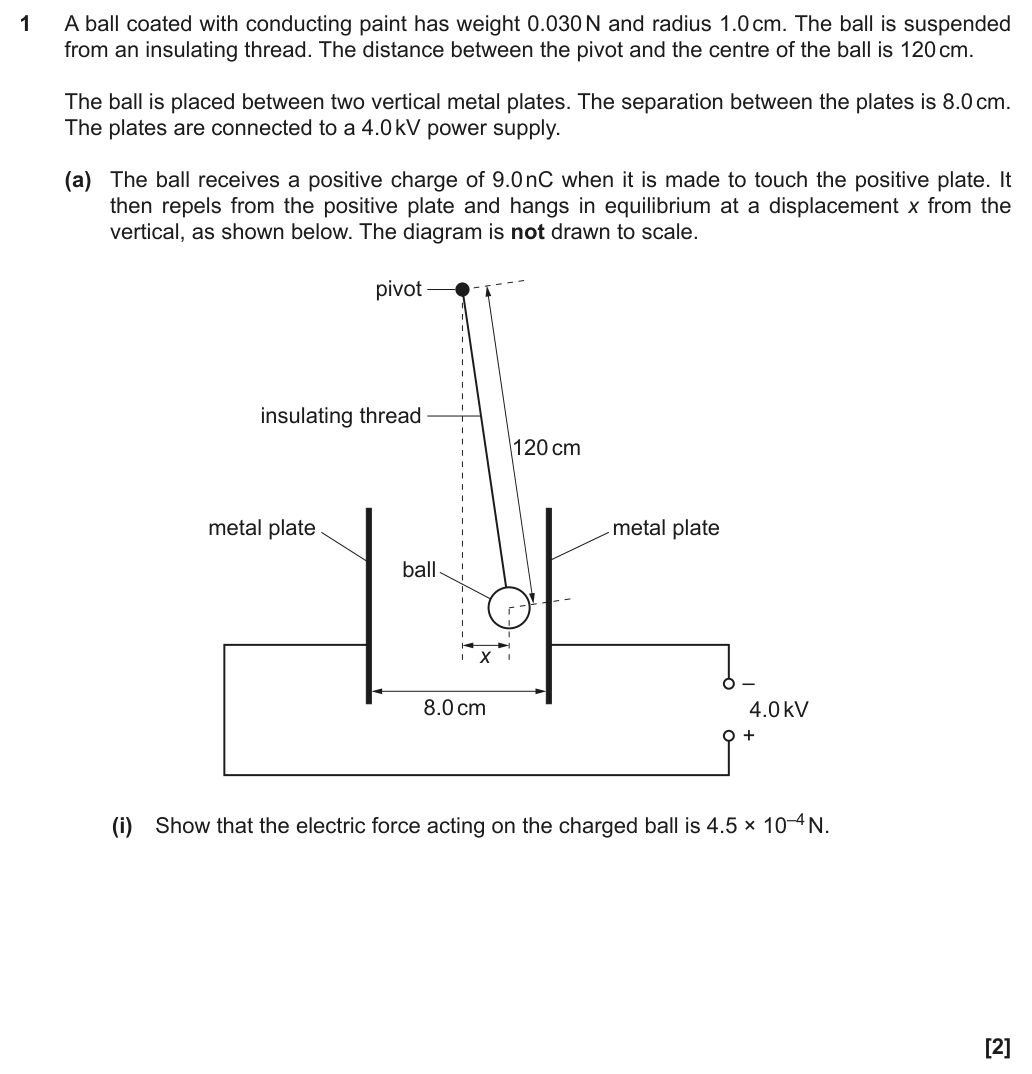
1 A ball coated with conducting paint has weight 0.030 N and radius 1.0 cm. The ball is suspended
from an insulating thread. The distance between the pivot and the centre of the ball is 120 cm.
The ball is placed between two vertical metal plates. The separation between the plates is 8.0 cm.
The plates are connected to a 4.0 kV power supply.
(a) The ball receives a positive charge of 9.0 nC when it is made to touch the positive plate. It
then repels from the positive plate and hangs in equilibrium at a displacement x from the
vertical, as shown below. The diagram is not drawn to scale.
pivot
insulating thread
120 cm
metal plate metal plate
ball
x
–
8.0 cm 4.0 kV
+
(i) Show that the electric force acting on the charged ball is 4.5 × 10⁻⁴ N.
[2]
November 2020 · Paper 3 · Q1(a)(iii) 2 marks Show that Medium equilibrium and moments
Earlier part of question 1 that this part usesEarlier part of November 2020 Paper 3 question 1
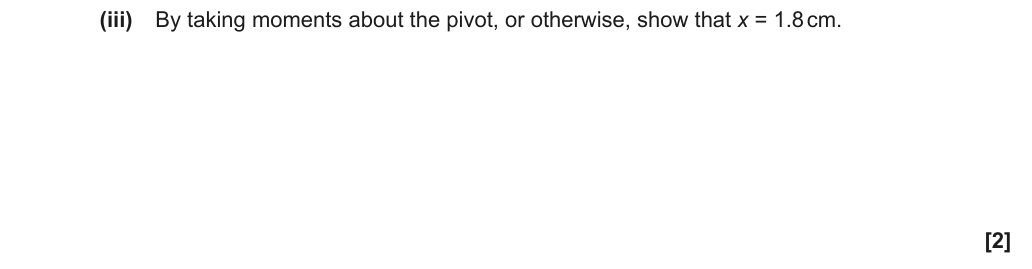
(iii) By taking moments about the pivot, or otherwise, show that x = 1.8 cm.
[2]
November 2020 · Paper 3 · Q2(a) 2 marks Show that Medium capacitorscharge and current
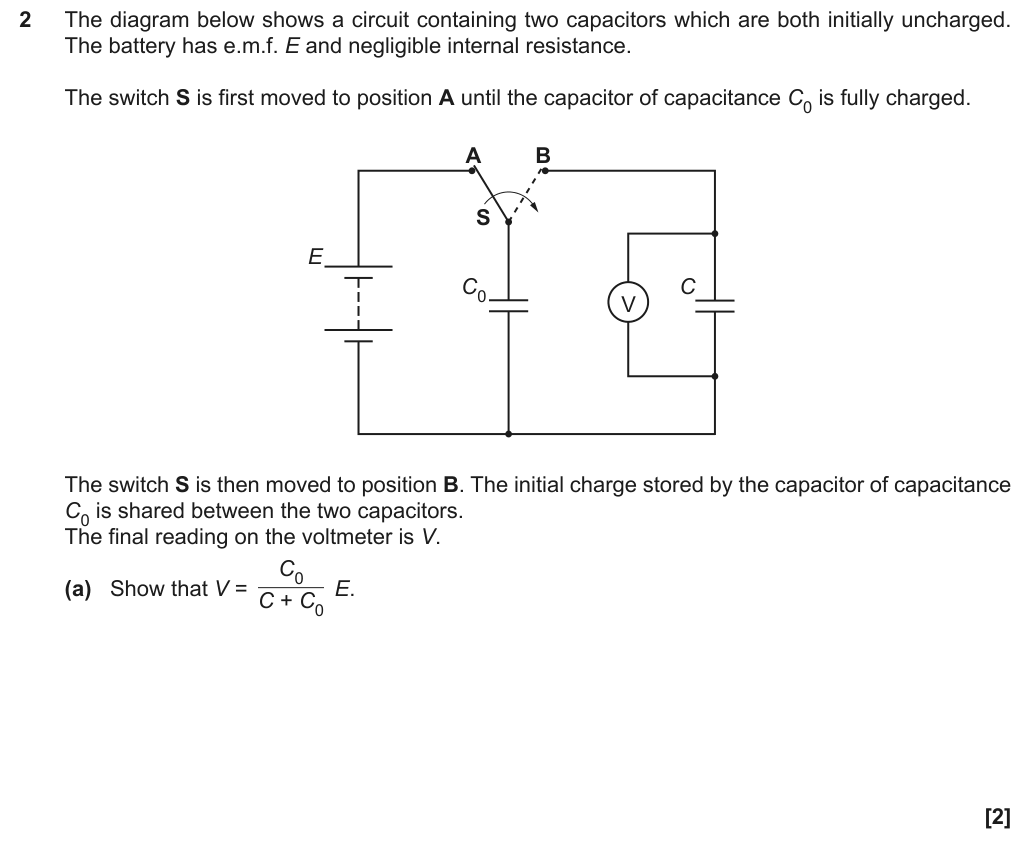
2 The diagram below shows a circuit containing two capacitors which are both initially uncharged.
The battery has e.m.f. E and negligible internal resistance.
The switch S is first moved to position A until the capacitor of capacitance C0 is fully charged.
A B
S
E
C0 C
V
The switch S is then moved to position B. The initial charge stored by the capacitor of capacitance
C0 is shared between the two capacitors.
The final reading on the voltmeter is V.
C0
(a) Show that V = E.
C + C0
[2]
November 2020 · Paper 3 · Q2(b)(i) 1 mark Show that Medium practical skills
Earlier part of question 2 that this part usesEarlier part of November 2020 Paper 3 question 2
(b) A student wants to determine the values of E and C0 by repeating the experiment above and
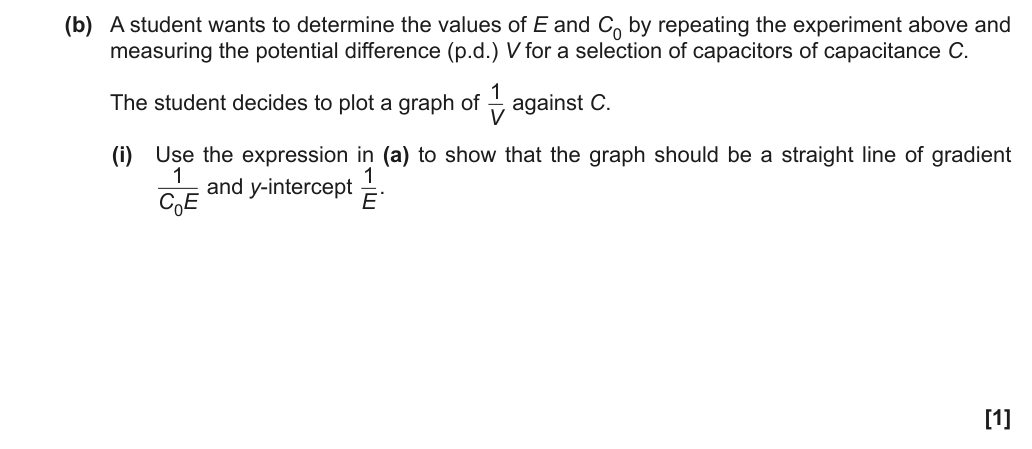
measuring the potential difference (p.d.) V for a selection of capacitors of capacitance C.
The student decides to plot a graph of 1
V against C.
(i) Use the expression in (a) to show that the graph should be a straight line of gradient
C0E and y-intercept 1 1
E.
[1]
November 2020 · Paper 3 · Q3(a)(i) 1 mark Show that Medium stars
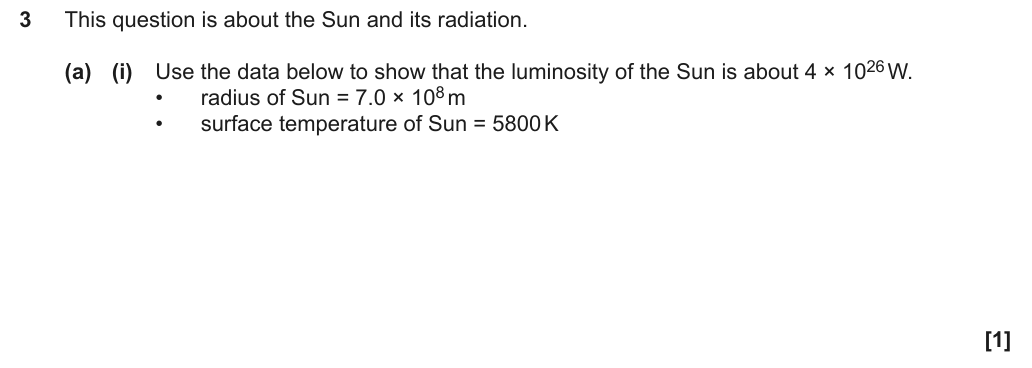
3 This question is about the Sun and its radiation.
(a) (i) Use the data below to show that the luminosity of the Sun is about 4 × 1026 W.
• radius of Sun = 7.0 × 10⁸ m
• surface temperature of Sun = 5800 K
[1]
November 2020 · Paper 3 · Q4(b)(ii) 2 marks Show that Medium circular motion
Earlier part of question 4 that this part usesEarlier part of November 2020 Paper 3 question 4
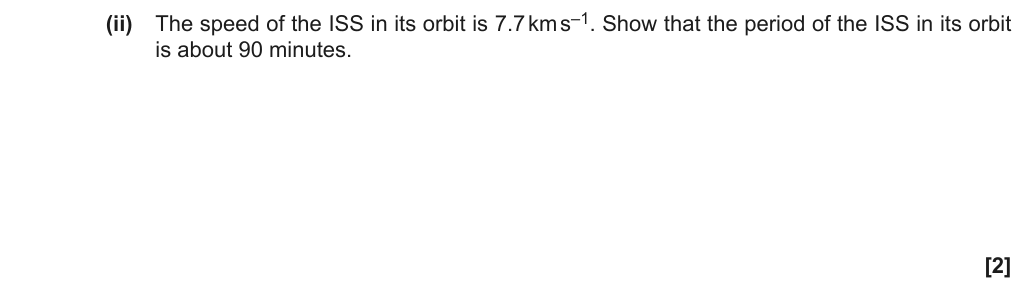
(ii) The speed of the ISS in its orbit is 7.7 km s–1. Show that the period of the ISS in its orbit
is about 90 minutes.
[2]
November 2020 · Paper 3 · Q4(c) 3 marks Show that Medium ideal gasesthermal physics
Earlier part of question 4 that this part usesEarlier part of November 2020 Paper 3 question 4
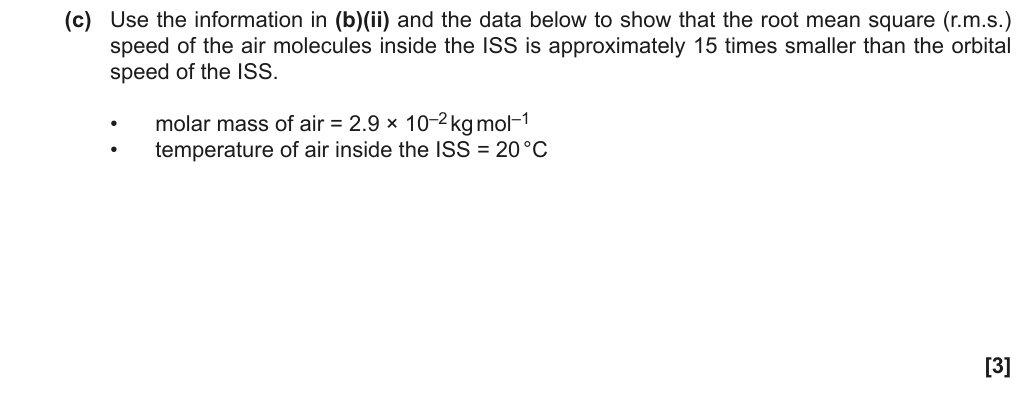
(c) Use the information in (b)(ii) and the data below to show that the root mean square (r.m.s.)
speed of the air molecules inside the ISS is approximately 15 times smaller than the orbital
speed of the ISS.
• molar mass of air = 2.9 × 10⁻² kg mol–1
• temperature of air inside the ISS = 20 °C
[3]
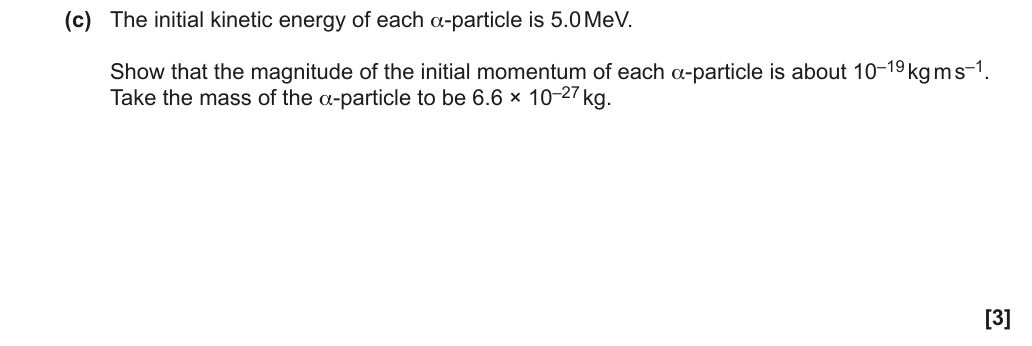
November 2020 · Paper 3 · Q6(c) 3 marks Show that Medium newtons laws and momentumwork energy and powerphotons
(c) The initial kinetic energy of each α-particle is 5.0 MeV.
Show that the magnitude of the initial momentum of each α-particle is about 10–19 kg m s–1.
Take the mass of the α-particle to be 6.6 × 10⁻²⁷ kg.
[3]
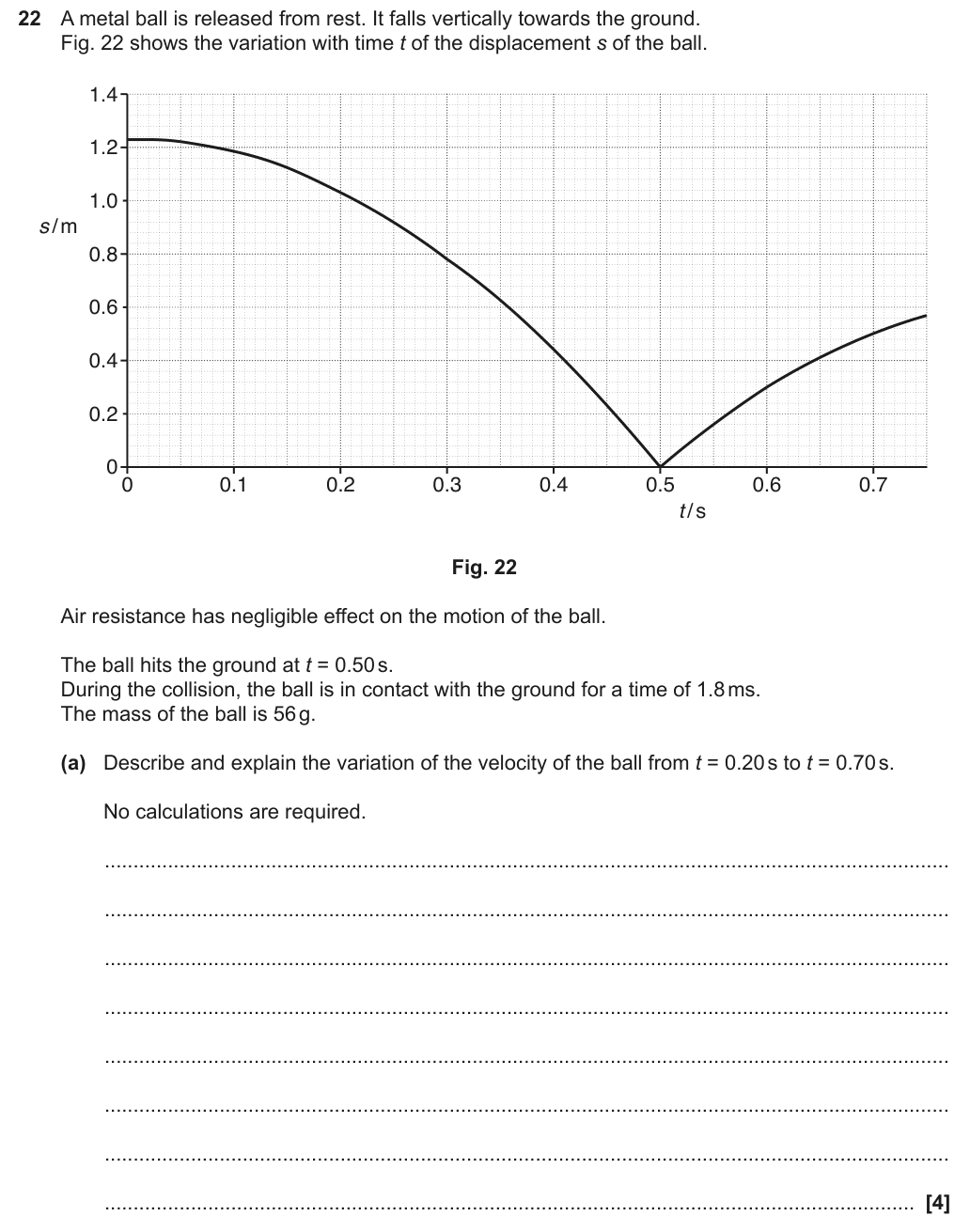
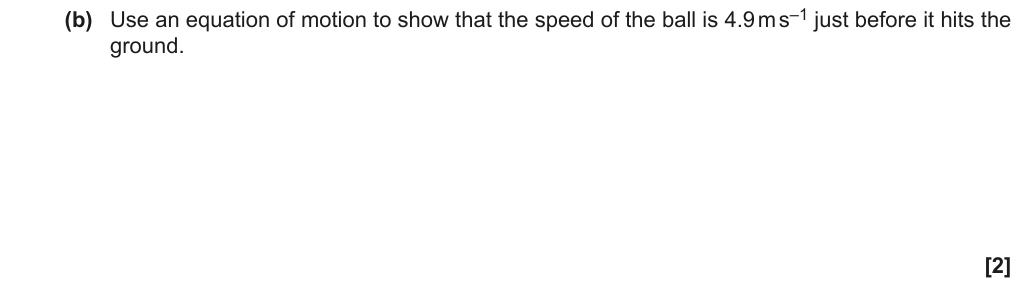
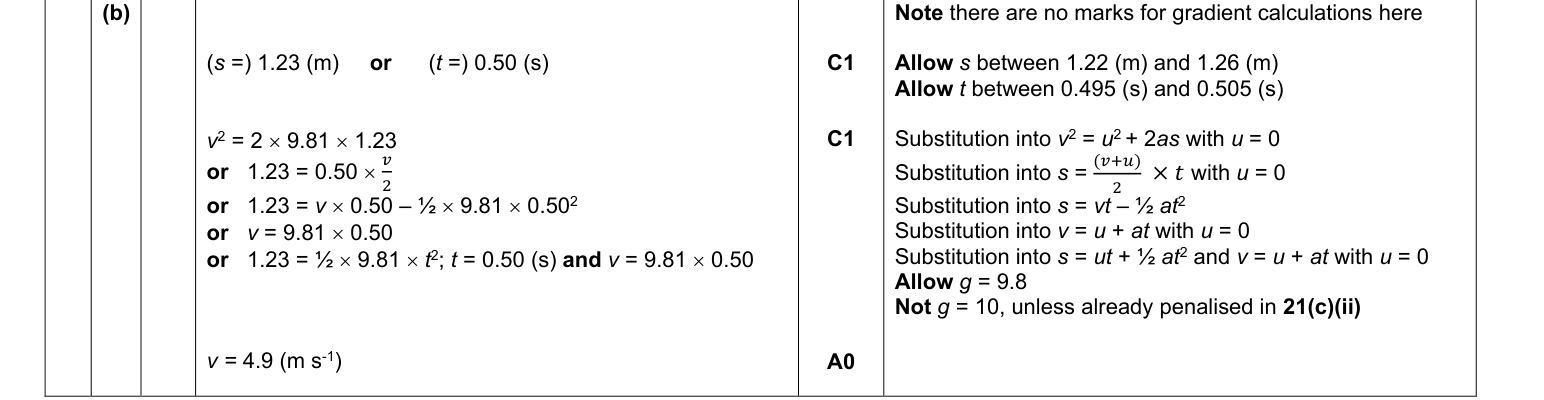
June 2019 · AS Paper 1 · Q22(b) 2 marks Show that Medium linear motion
Earlier part of question 22 that this part usesEarlier part of June 2019 Paper 1 question 22
(b) Use an equation of motion to show that the speed of the ball is 4.9 m s–1 just before it hits the
ground.
[2]
June 2019 · AS Paper 1 · Q22(c) 3 marks Show that Easy kinematics
Earlier part of question 22 that this part usesEarlier part of June 2019 Paper 1 question 22
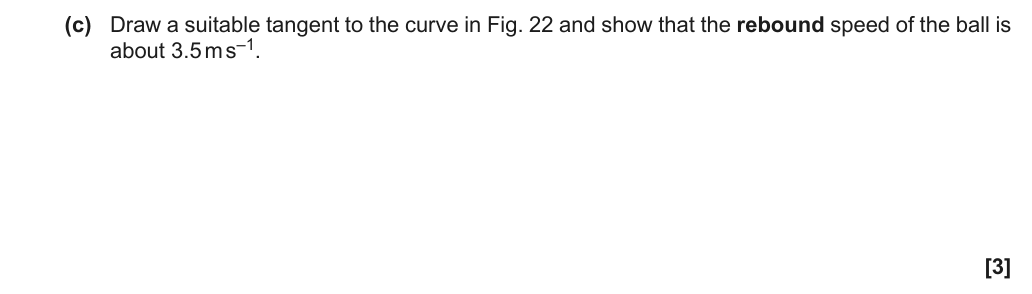
(c) Draw a suitable tangent to the curve in Fig. 22 and show that the rebound speed of the ball is
about 3.5 m s–1.
[3]
June 2019 · AS Paper 1 · Q25(b)(i) 3 marks Show that Hard photonswork energy and power
(b) In an electron-gun, each electron is accelerated to a maximum kinetic energy of 210 eV.
(i) Show that the final speed of each electron is about 9 × 10⁶ m s–1.
[3]
June 2019 · AS Paper 2 · Q1(a)(i) 1 mark Show that Medium kinematicslinear motion
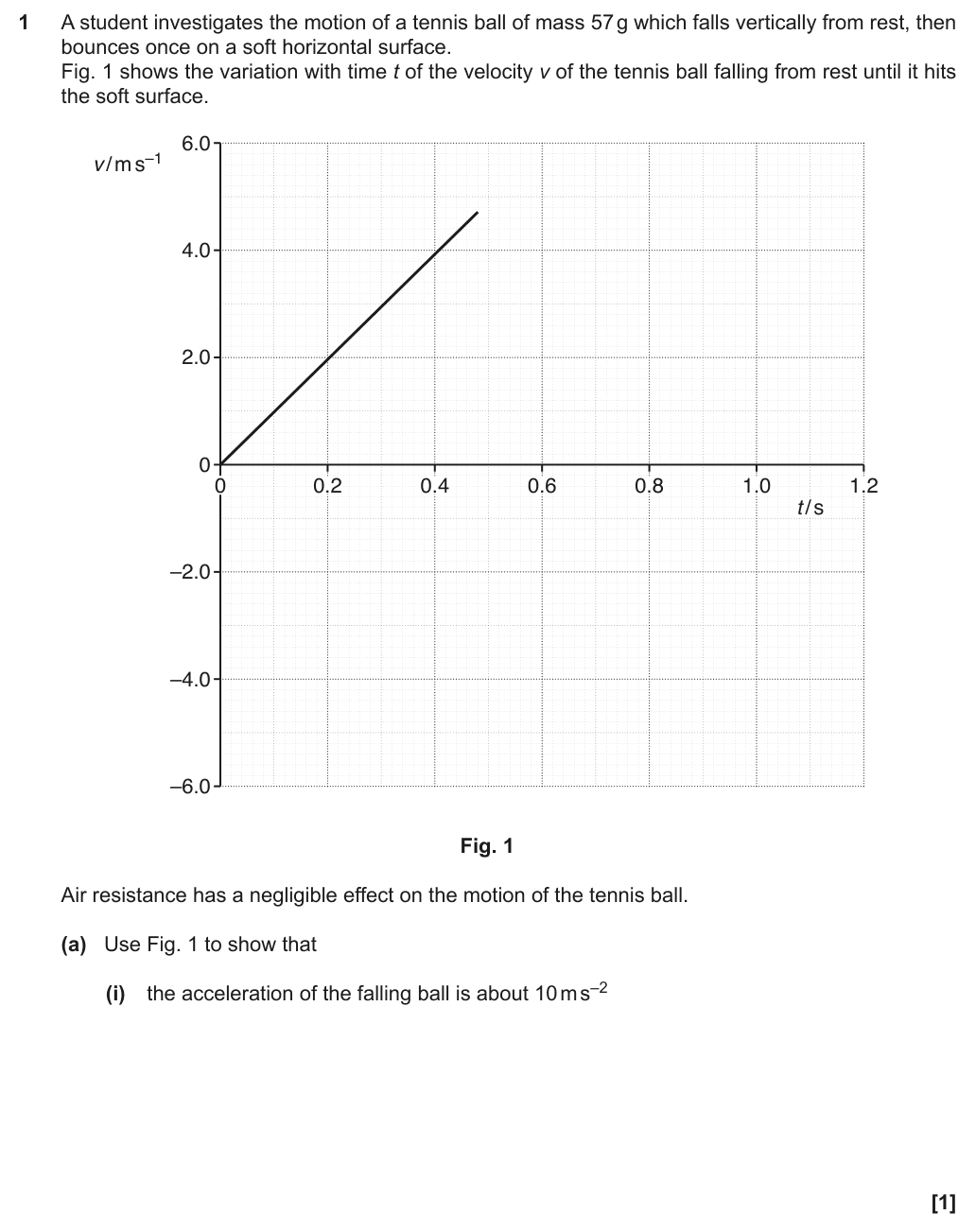
1 A student investigates the motion of a tennis ball of mass 57 g which falls vertically from rest, then
bounces once on a soft horizontal surface.
Fig. 1 shows the variation with time t of the velocity v of the tennis ball falling from rest until it hits
the soft surface.
6.0
v / m s–1
4.0
2.0
0
0 0.2 0.4 0.6 0.8 1.0 1.2
t / s
–2.0
–4.0
–6.0
Fig. 1
Air resistance has a negligible effect on the motion of the tennis ball.
(a) Use Fig. 1 to show that
(i) the acceleration of the falling ball is about 10 m s–2
[1]
June 2019 · AS Paper 2 · Q3(a)(iii) 1 mark Show that Hard practical skills
Earlier part of question 3 that this part usesEarlier part of June 2019 Paper 2 question 3
(iii) Show that the volume of the ball is about 8.4 × 10⁻⁶ m3.
[1]
June 2019 · AS Paper 2 · Q4(a)(i) 2 marks Show that Easy series and parallel circuits
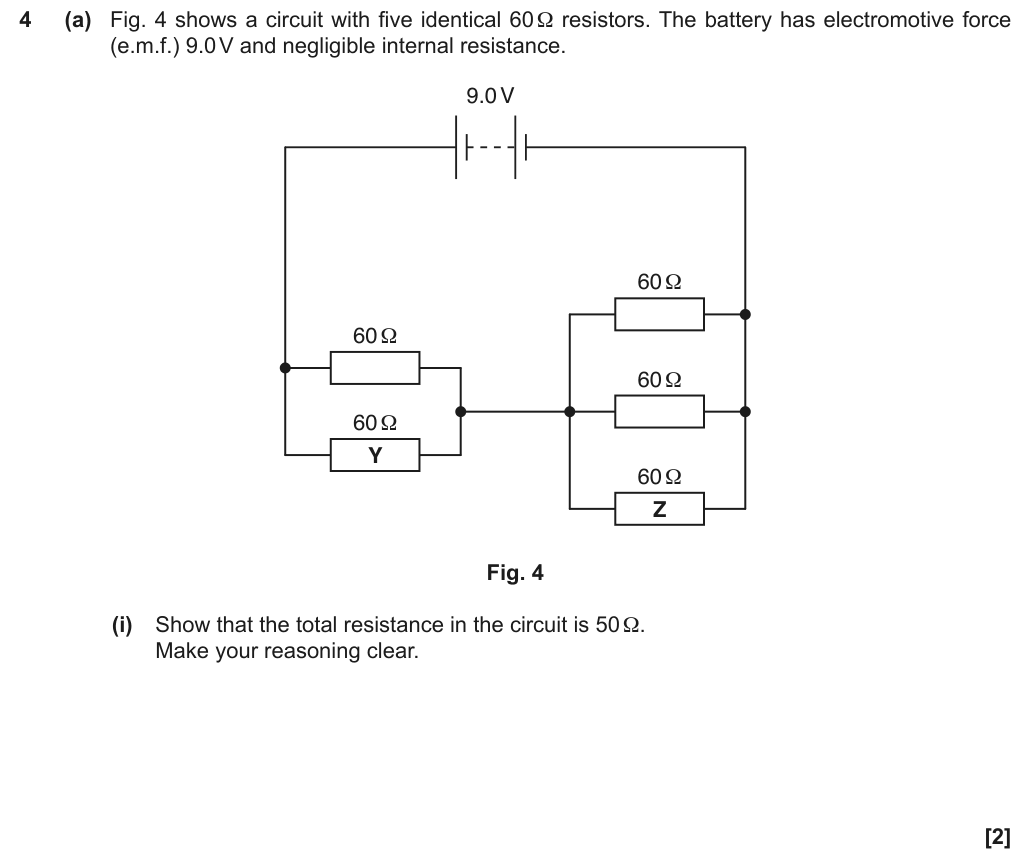
4 (a) Fig. 4 shows a circuit with five identical 60 Ω resistors. The battery has electromotive force
(e.m.f.) 9.0 V and negligible internal resistance.
9.0 V
60 Ω
60 Ω
60 Ω
60 Ω
Y
60 Ω
Z
Fig. 4
(i) Show that the total resistance in the circuit is 50 Ω.
Make your reasoning clear.
[2]
June 2019 · Paper 1 · Q18(a)(i) 3 marks Show that Medium simple harmonic motion
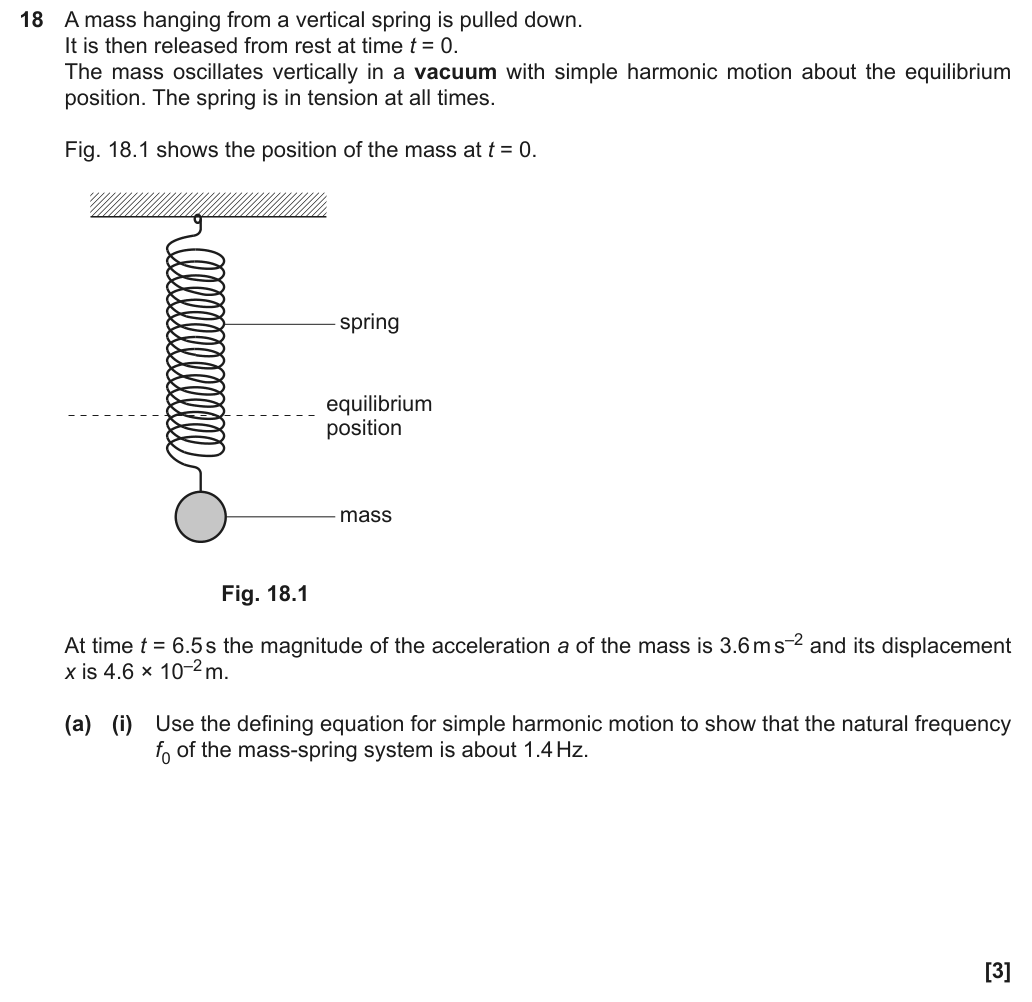
18 A mass hanging from a vertical spring is pulled down.
It is then released from rest at time t = 0.
The mass oscillates vertically in a vacuum with simple harmonic motion about the equilibrium
position. The spring is in tension at all times.
Fig. 18.1 shows the position of the mass at t = 0.
spring
equilibrium
position
mass
Fig. 18.1
At time t = 6.5 s the magnitude of the acceleration a of the mass is 3.6 m s–2 and its displacement
x is 4.6 × 10⁻² m.
(a) (i) Use the defining equation for simple harmonic motion to show that the natural frequency
f0 of the mass-spring system is about 1.4 Hz.
[3]
June 2019 · Paper 1 · Q24(a)(i) 2 marks Show that Easy cosmology
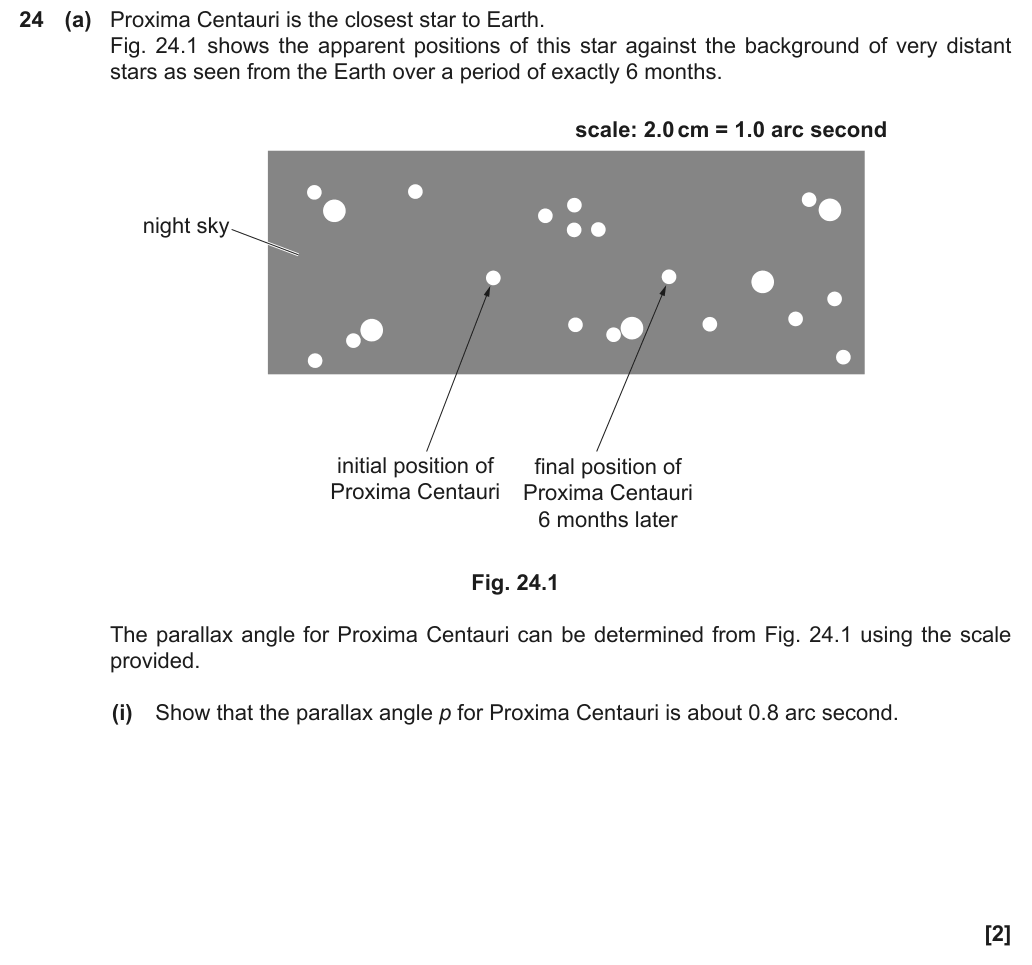
24 (a) Proxima Centauri is the closest star to Earth.
Fig. 24.1 shows the apparent positions of this star against the background of very distant
stars as seen from the Earth over a period of exactly 6 months.
scale: 2.0 cm = 1.0 arc second
night sky
initial position of final position of
Proxima Centauri Proxima Centauri
6 months later
Fig. 24.1
The parallax angle for Proxima Centauri can be determined from Fig. 24.1 using the scale
provided.
(i) Show that the parallax angle p for Proxima Centauri is about 0.8 arc second.
[2]
June 2019 · Paper 1 · Q24(b)(ii) 1 mark Show that Hard density and pressure
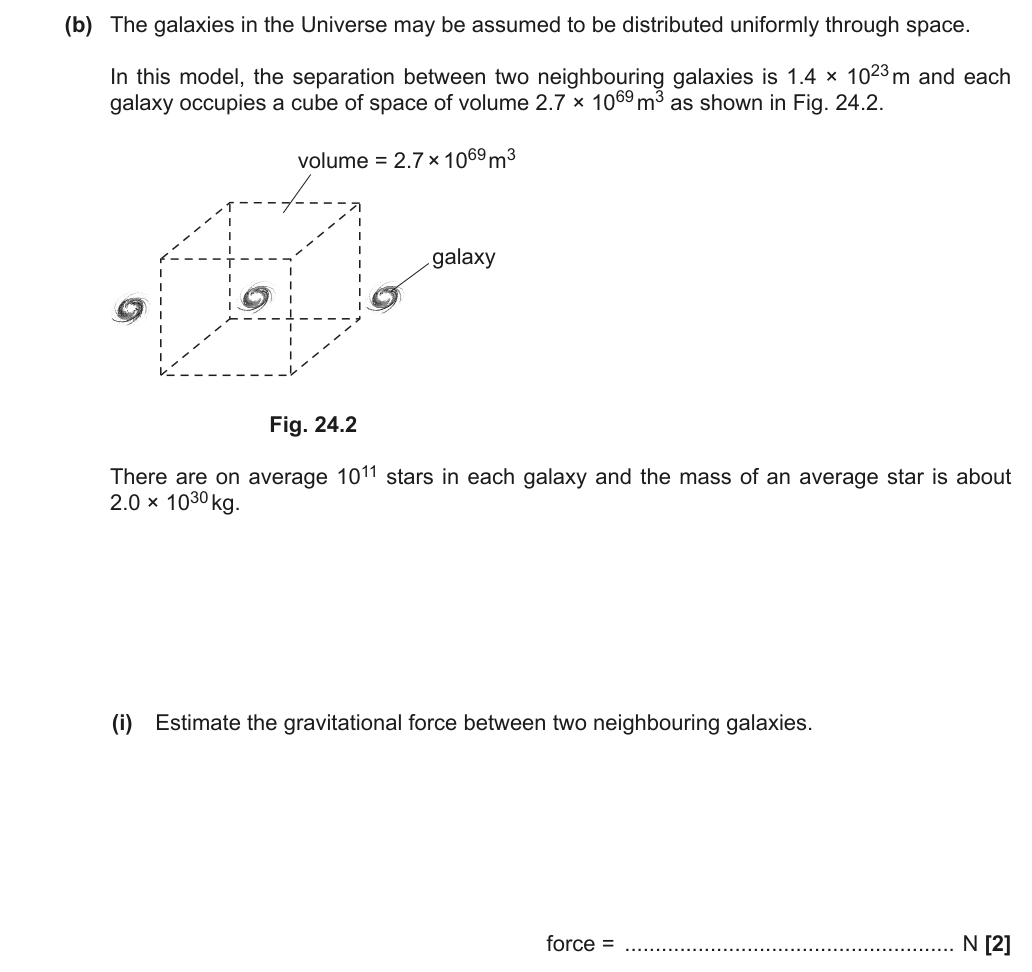
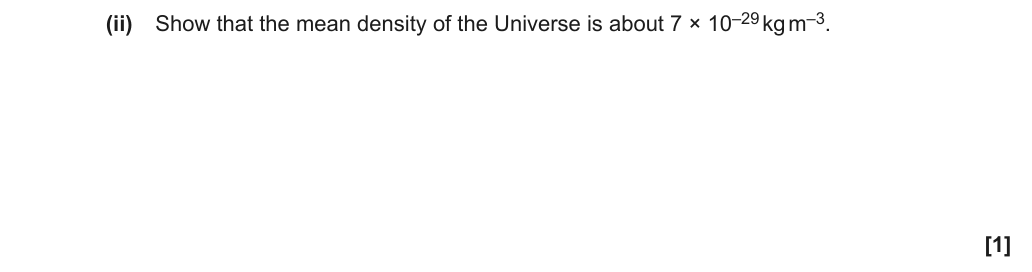
Earlier part of question 24 that this part usesEarlier part of June 2019 Paper 1 question 24
(ii) Show that the mean density of the Universe is about 7 × 10–29 kg m–3.
[1]
June 2019 · Paper 2 · Q16(b) 2 marks Show that Easy wave motion
displacement / m
0.1
00
5.0
.............................................
–0.1
Fig. 16.1
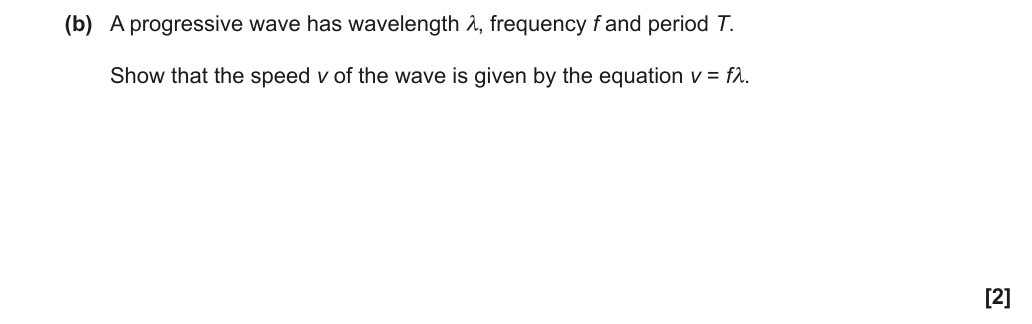
(b) A progressive wave has wavelength λ, frequency f and period T.
Show that the speed v of the wave is given by the equation v = fλ.
[2]
June 2019 · Paper 2 · Q16(c)(i) 3 marks Show that Hard electromagnetic waves and refraction
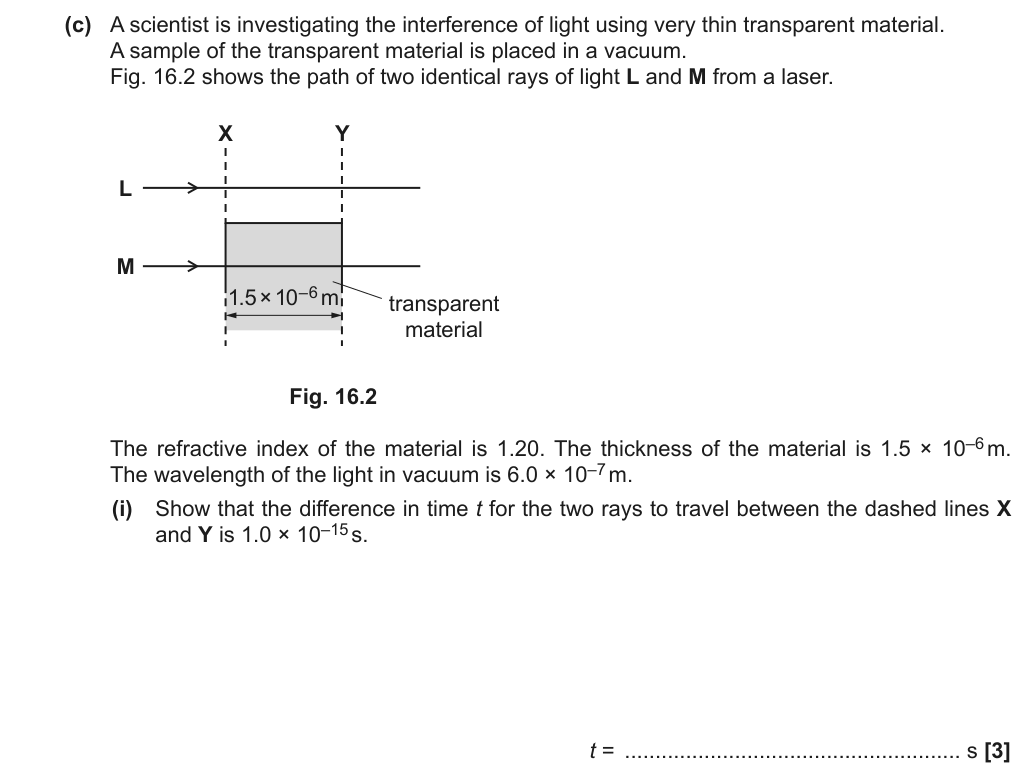
(c) A scientist is investigating the interference of light using very thin transparent material.
A sample of the transparent material is placed in a vacuum.
Fig. 16.2 shows the path of two identical rays of light L and M from a laser.
X Y
L
M
1.5 × 10⁻⁶ m transparent
material
Fig. 16.2
The refractive index of the material is 1.20. The thickness of the material is 1.5 × 10⁻⁶ m.
The wavelength of the light in vacuum is 6.0 × 10⁻⁷ m.
(i) Show that the difference in time t for the two rays to travel between the dashed lines X
and Y is 1.0 × 10⁻¹⁵ s.
t =  ....................................................... s [3]
June 2019 · Paper 2 · Q18(c)(ii) 2 marks Show that Hard internal resistancepractical skillsresistivity
Earlier part of question 18 that this part usesEarlier part of June 2019 Paper 2 question 18
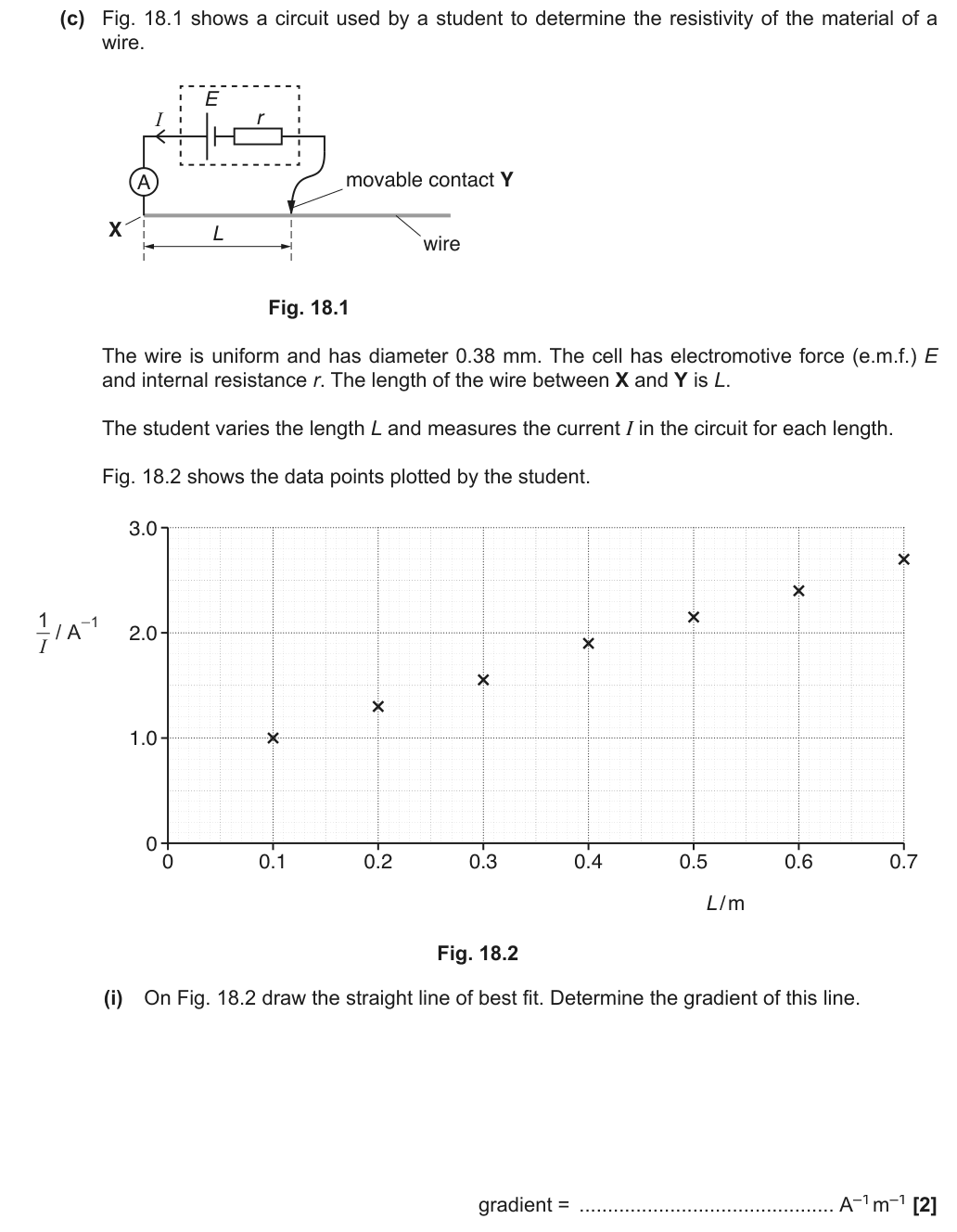
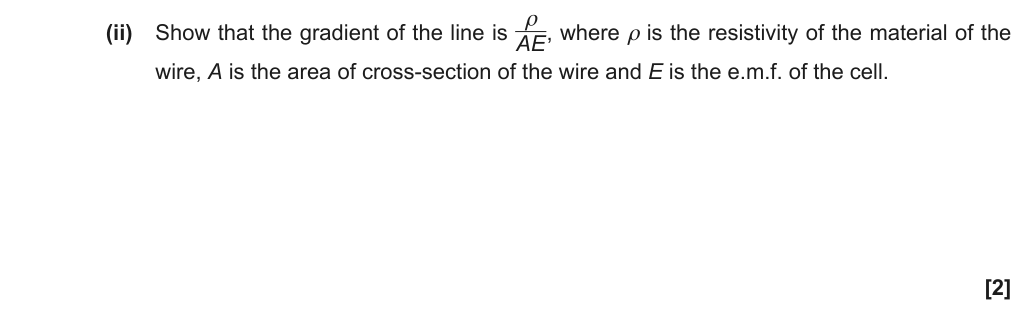
(ii) Show that the gradient of the line is ρ
AE, where ρ is the resistivity of the material of the
wire, A is the area of cross-section of the wire and E is the e.m.f. of the cell.
[2]
June 2019 · Paper 2 · Q19(a) 2 marks Show that Easy emf pd and resistance
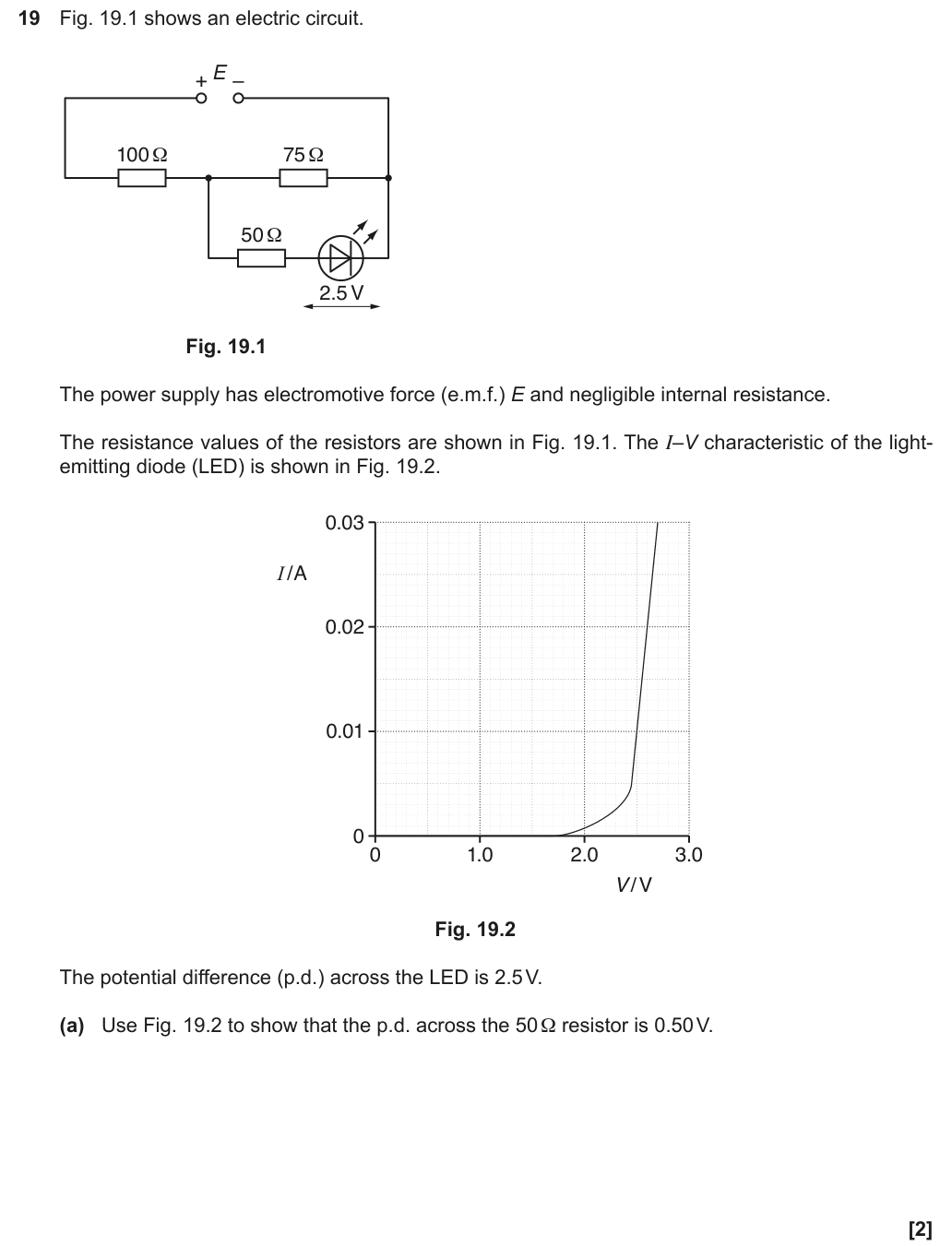
19 Fig. 19.1 shows an electric circuit.
E
+ –
100 Ω 75 Ω
50 Ω
2.5 V
Fig. 19.1
The power supply has electromotive force (e.m.f.) E and negligible internal resistance.
The resistance values of the resistors are shown in Fig. 19.1. The I–V characteristic of the light-
emitting diode (LED) is shown in Fig. 19.2.
0.03
I / A
0.02
0.01
0
0 1.0 2.0 3.0
V / V
Fig. 19.2
The potential difference (p.d.) across the LED is 2.5 V.
(a) Use Fig. 19.2 to show that the p.d. across the 50 Ω resistor is 0.50 V.
[2]
June 2019 · Paper 2 · Q22(a)(ii) 2 marks Show that Medium electric fieldscapacitors
Earlier part of question 22 that this part usesEarlier part of June 2019 Paper 2 question 22
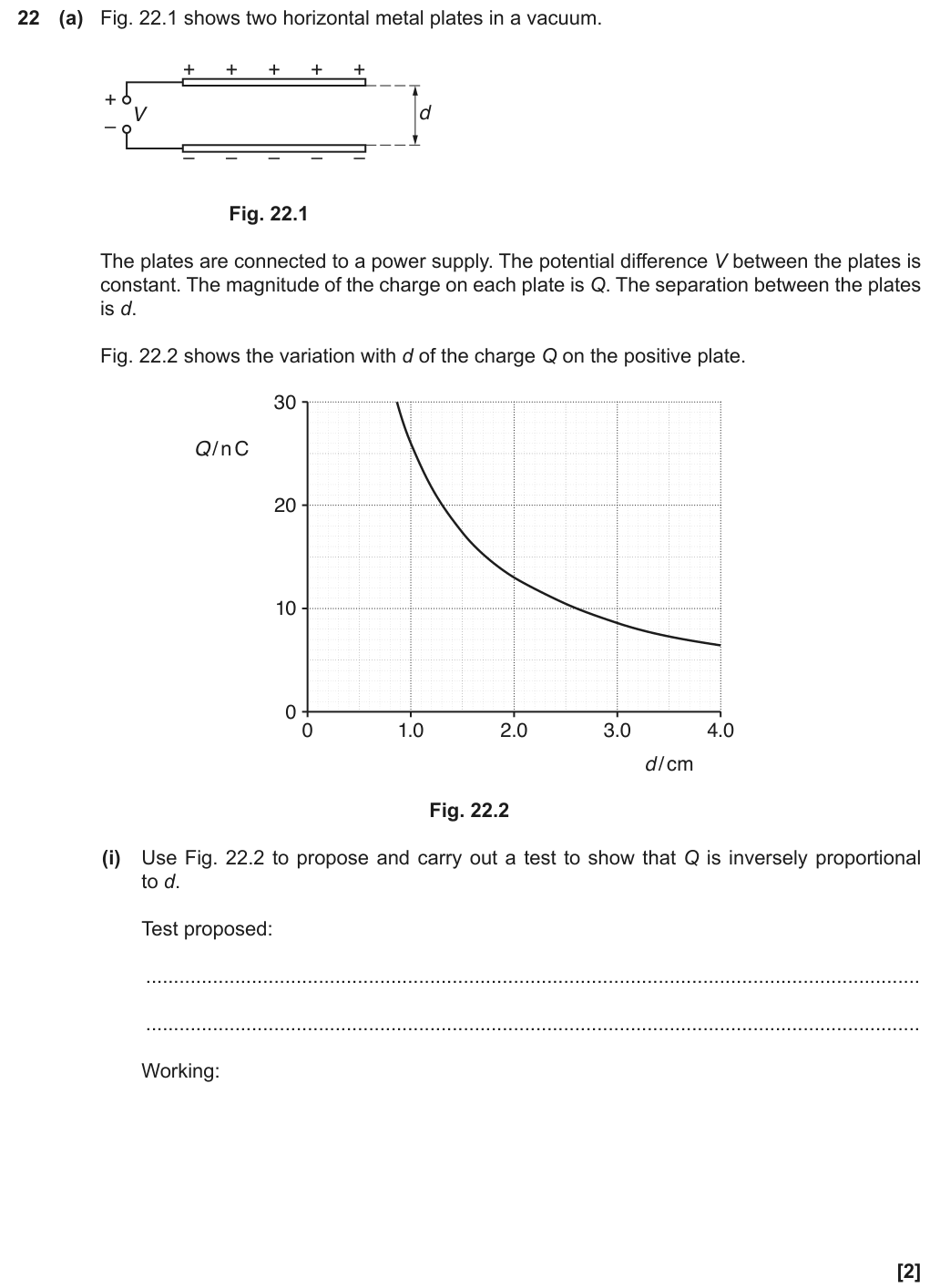
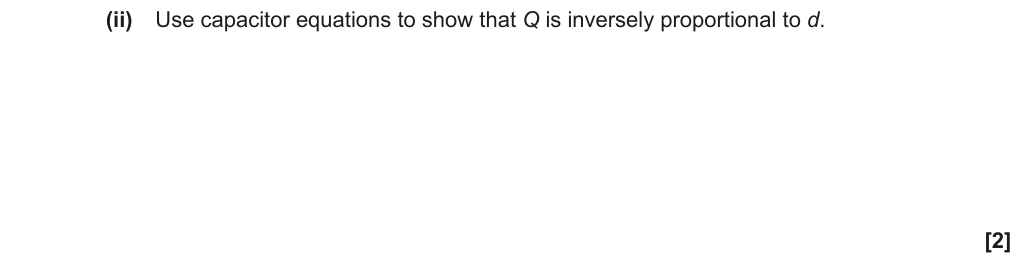
(ii) Use capacitor equations to show that Q is inversely proportional to d.
[2]
June 2019 · Paper 3 · Q1(c)(i) 2 marks Show that Medium density and pressure
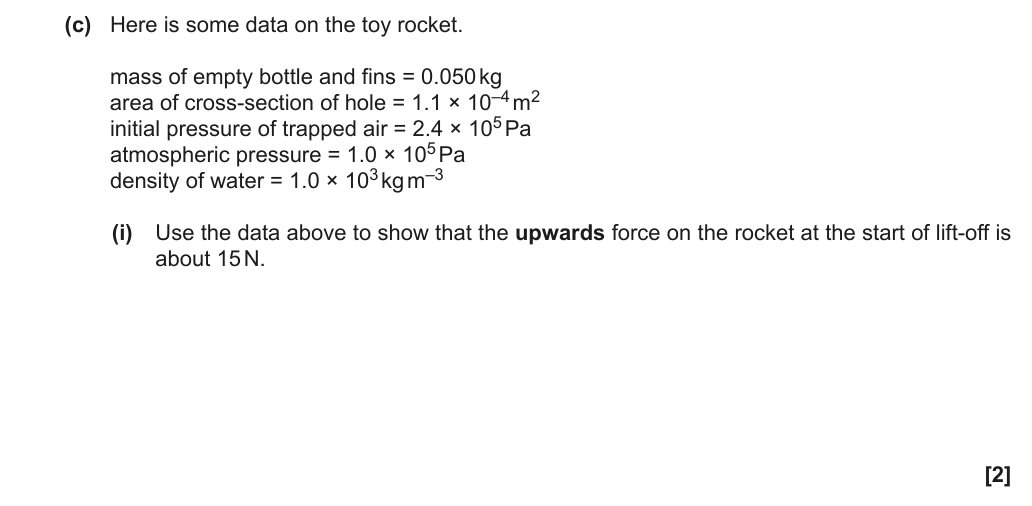
(c) Here is some data on the toy rocket.
mass of empty bottle and fins = 0.050 kg
area of cross-section of hole = 1.1 × 10⁻⁴ m2
initial pressure of trapped air = 2.4 × 10⁵ Pa
atmospheric pressure = 1.0 × 10⁵ Pa
density of water = 1.0 × 10³ kg m–3
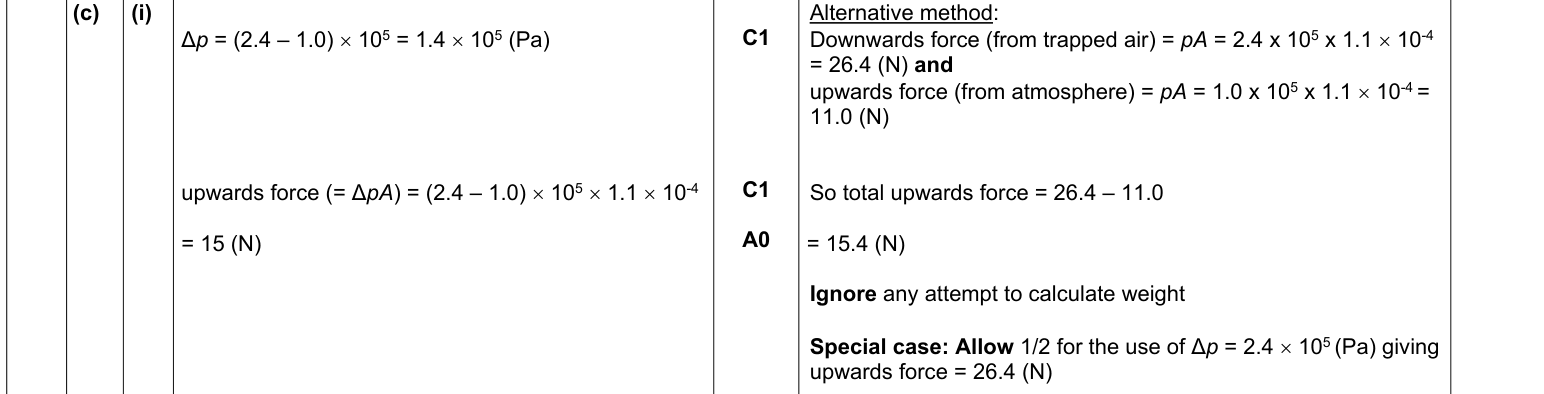
(i) Use the data above to show that the upwards force on the rocket at the start of lift-off is
about 15 N.
[2]
June 2019 · Paper 3 · Q2(b)(ii) 11 marks Show that Medium radioactivitypractical skillsmeasurements and uncertaintiesmedical imaging
Earlier part of question 2 that this part usesEarlier part of June 2019 Paper 3 question 2
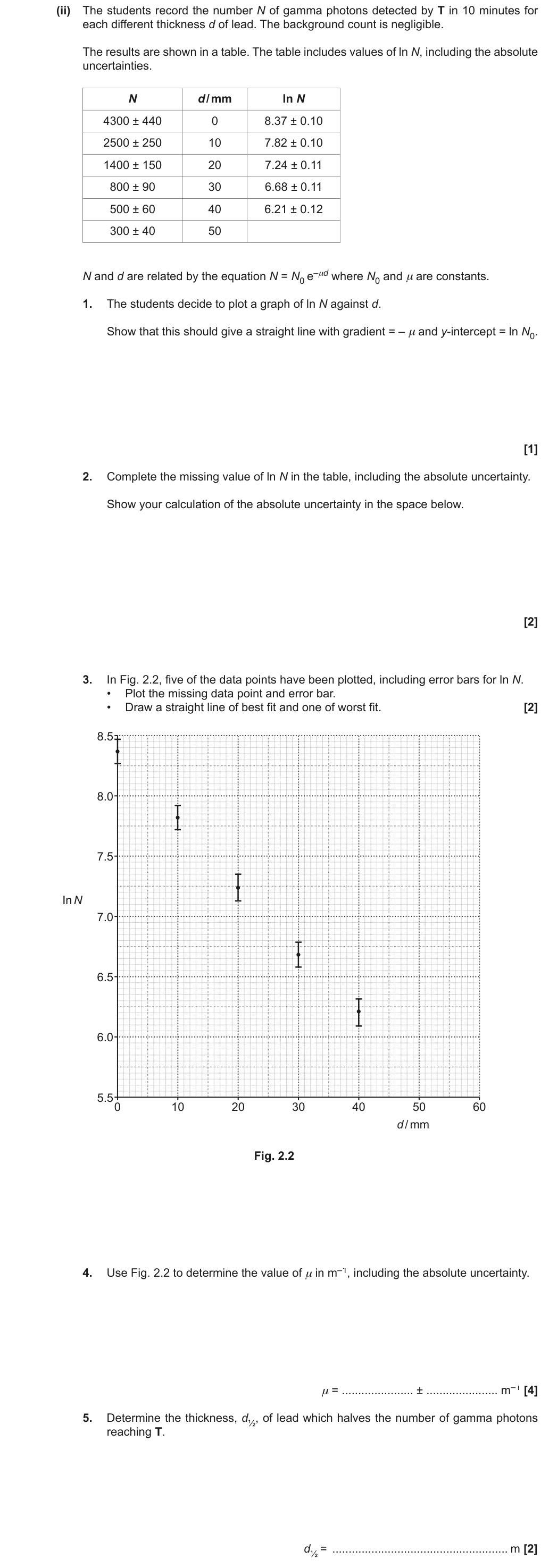
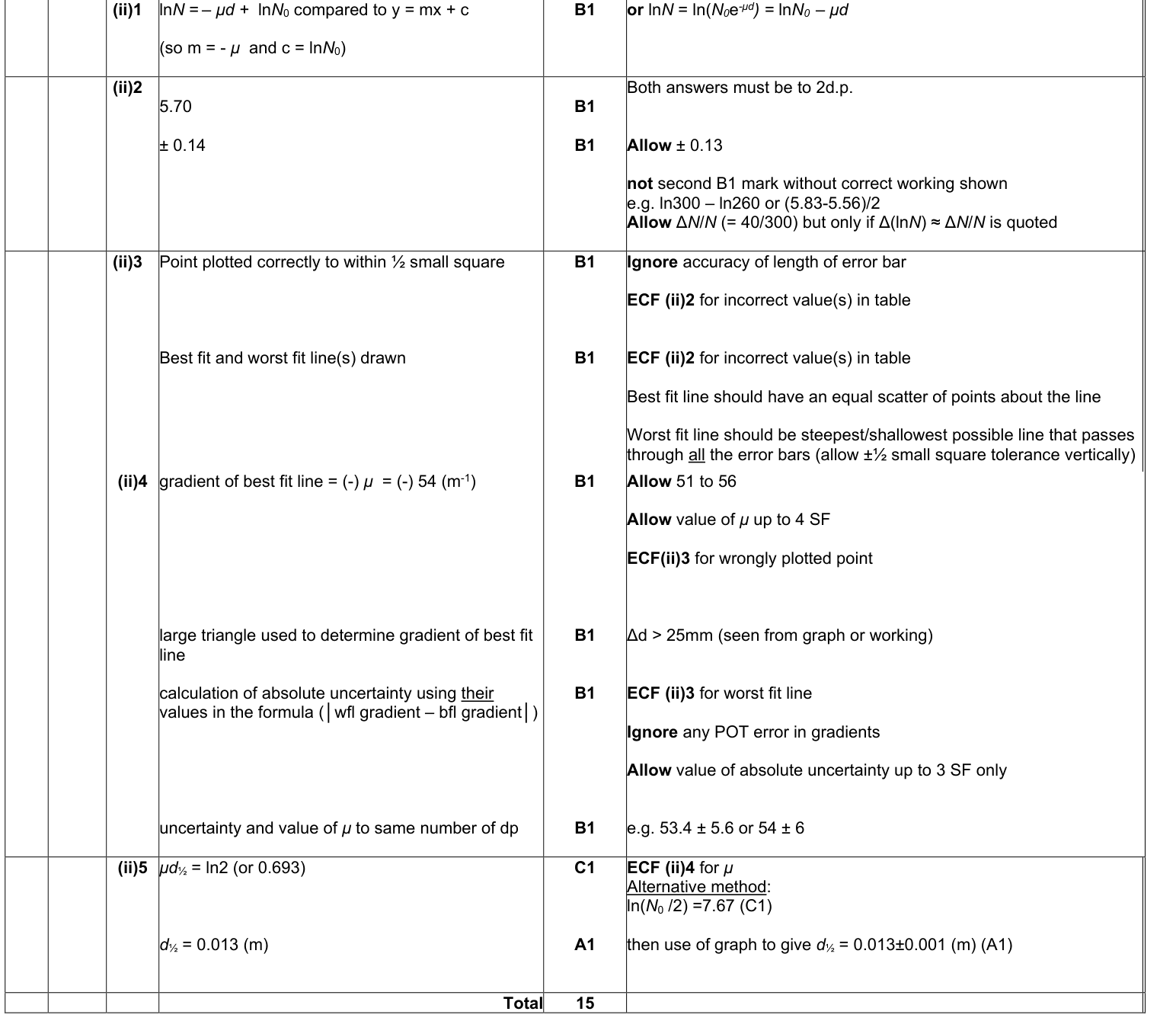
(ii) The students record the number N of gamma photons detected by T in 10 minutes for
each different thickness d of lead. The background count is negligible.
The results are shown in a table. The table includes values of ln N, including the absolute
uncertainties.
N d / mm ln N
4300 ± 440 0 8.37 ± 0.10
2500 ± 250 10 7.82 ± 0.10
1400 ± 150 20 7.24 ± 0.11
800 ± 90 30 6.68 ± 0.11
500 ± 60 40 6.21 ± 0.12
300 ± 40 50
N and d are related by the equation N = N0 e–μd where N0 and μ are constants.
1. The students decide to plot a graph of ln N against d.
Show that this should give a straight line with gradient = – μ and y-intercept = ln N0.
[1]
2. Complete the missing value of ln N in the table, including the absolute uncertainty.
Show your calculation of the absolute uncertainty in the space below.
[2]
3. In Fig. 2.2, five of the data points have been plotted, including error bars for ln N.
• Plot the missing data point and error bar.
• Draw a straight line of best fit and one of worst fit. [2]
8.5
8.0
7.5
In N
7.0
6.5
6.0
5.50
10 20 30 40 50 60
d / mm
Fig. 2.2
4. Use Fig. 2.2 to determine the value of μ in m–1, including the absolute uncertainty.
μ = ...................... ± ...................... m–1 [4]
5. Determine the thickness, d½, of lead which halves the number of gamma photons
reaching T.
d½ =  ...................................................... m [2]
June 2019 · Paper 3 · Q5(b)(i) 1 mark Show that Medium photons
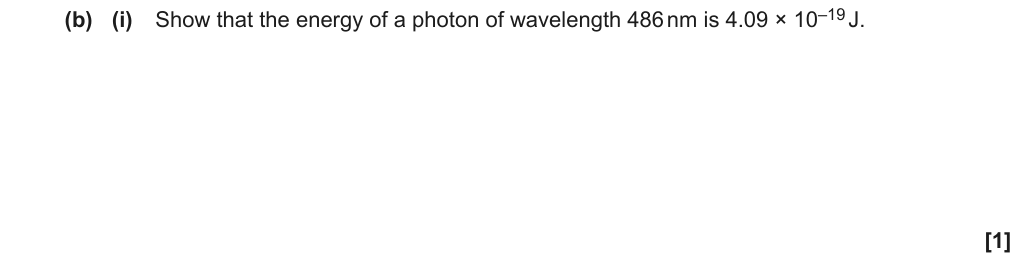
(b) (i) Show that the energy of a photon of wavelength 486 nm is 4.09 × 10⁻¹⁹ J.
[1]
June 2019 · Paper 3 · Q6(c)(i) 2 marks Show that Easy circular motion
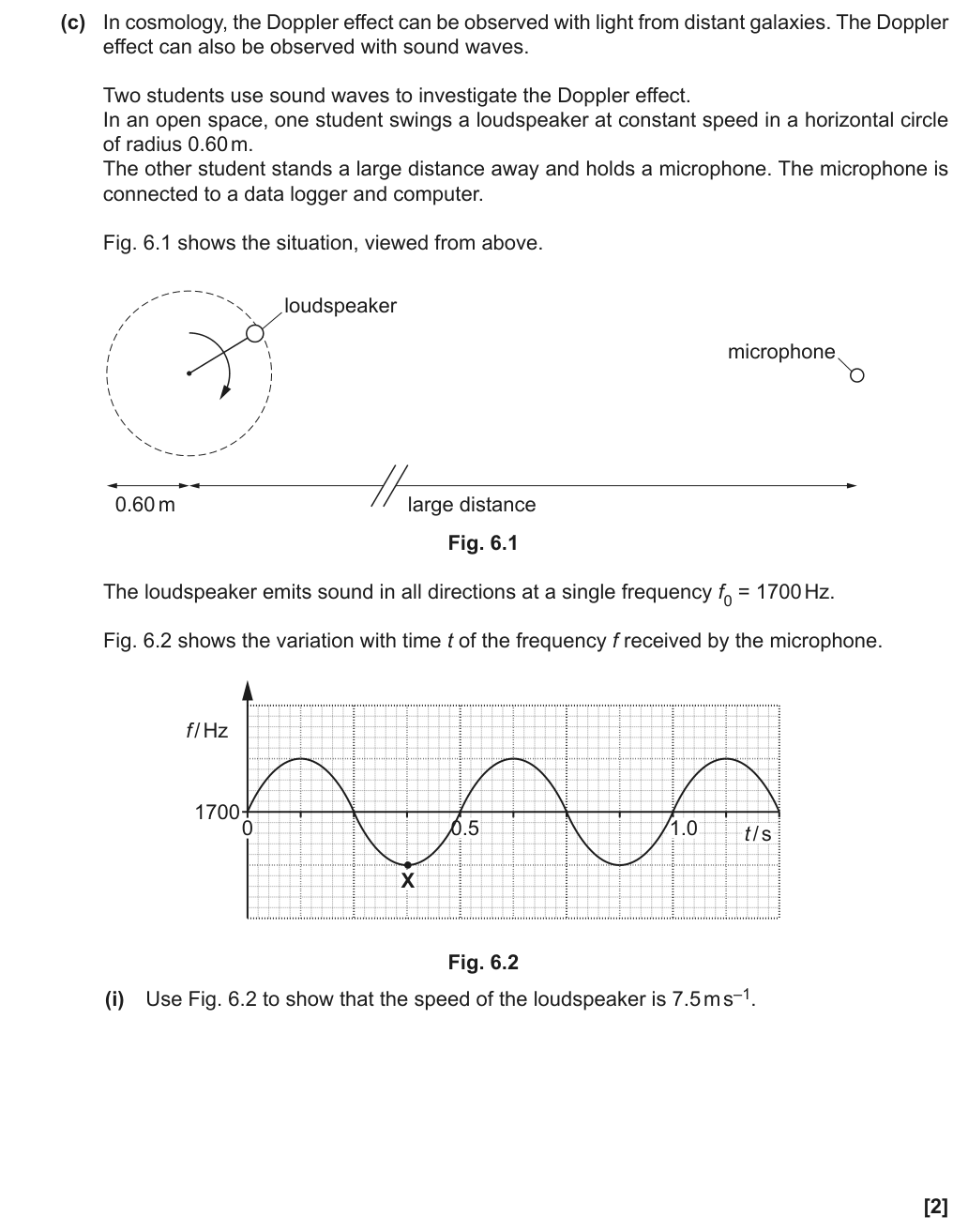
(c) In cosmology, the Doppler effect can be observed with light from distant galaxies. The Doppler
effect can also be observed with sound waves.
Two students use sound waves to investigate the Doppler effect.
In an open space, one student swings a loudspeaker at constant speed in a horizontal circle
of radius 0.60 m.
The other student stands a large distance away and holds a microphone. The microphone is
connected to a data logger and computer.
Fig. 6.1 shows the situation, viewed from above.
loudspeaker
microphone
0.60 m large distance
Fig. 6.1
The loudspeaker emits sound in all directions at a single frequency f0 = 1700 Hz.
Fig. 6.2 shows the variation with time t of the frequency f received by the microphone.
f / Hz
17000
0.5 1.0 t / s
X
Fig. 6.2
(i) Use Fig. 6.2 to show that the speed of the loudspeaker is 7.5 m s–1.
[2]
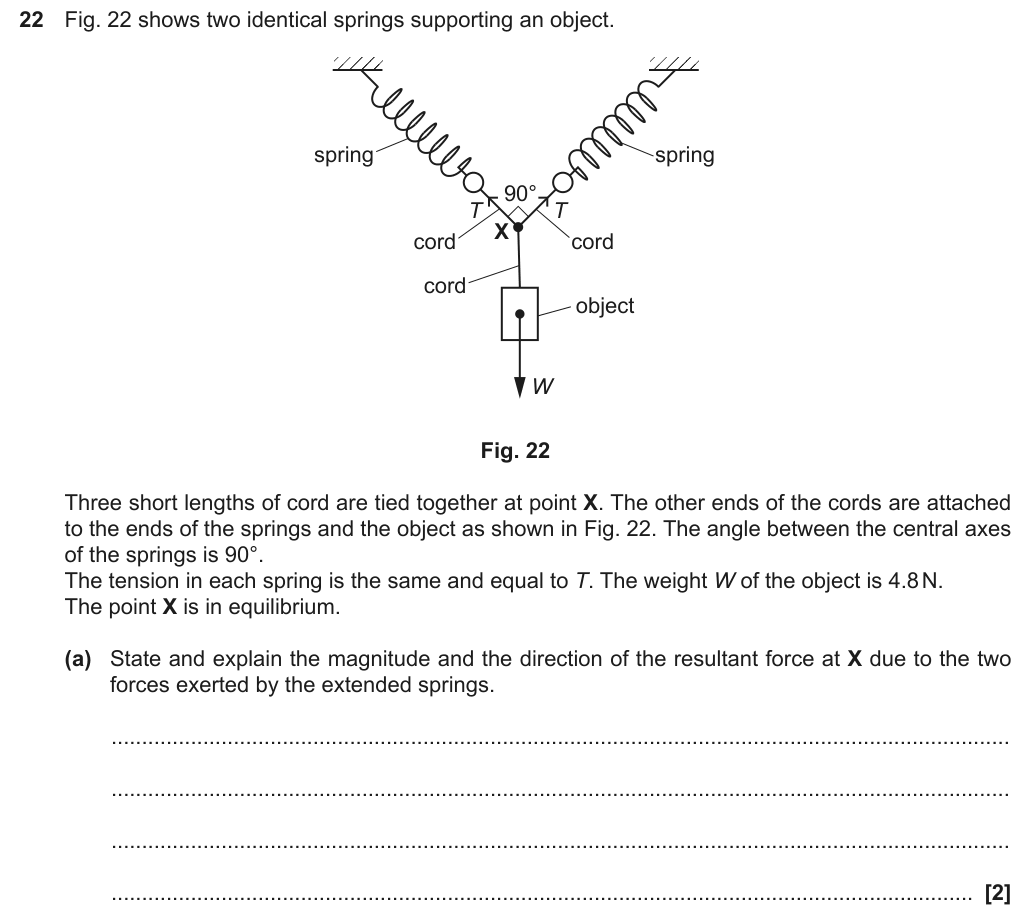
June 2018 · AS Paper 1 · Q22(c) 2 marks Show that Hard scalars and vectorsequilibrium and moments
Earlier part of question 22 that this part usesEarlier part of June 2018 Paper 1 question 22
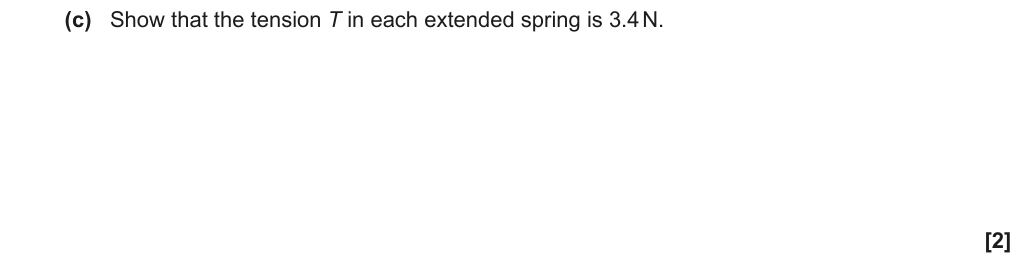
(c) Show that the tension T in each extended spring is 3.4 N.
[2]
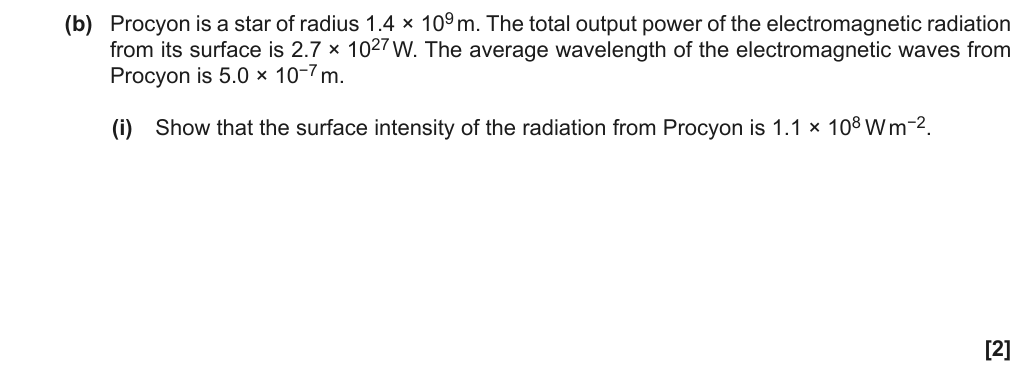
June 2018 · AS Paper 1 · Q27(b)(i) 2 marks Show that Medium wave motion
(b) Procyon is a star of radius 1.4 × 10⁹ m. The total output power of the electromagnetic radiation
from its surface is 2.7 × 1027 W. The average wavelength of the electromagnetic waves from
Procyon is 5.0 × 10⁻⁷ m.
(i) Show that the surface intensity of the radiation from Procyon is 1.1 × 10⁸  W m−2.
[2]
June 2018 · AS Paper 2 · Q3(d)(i) 1 mark Show that Medium linear motion
0.20
t 2/ s2
0.19
0.18
0.17
0.16
0.15
0.14
0.13
0.5 0.6 0.7 0.8 0.9 1.0
h / m
Fig. 3
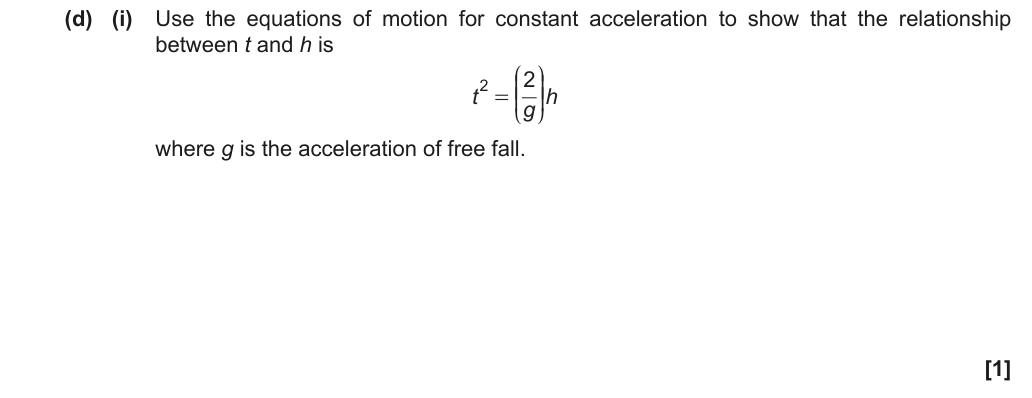
(d) (i) Use the equations of motion for constant acceleration to show that the relationship
between t and h is
J N
2
2 = KK OO
t g h
L P
where g is the acceleration of free fall.
[1]
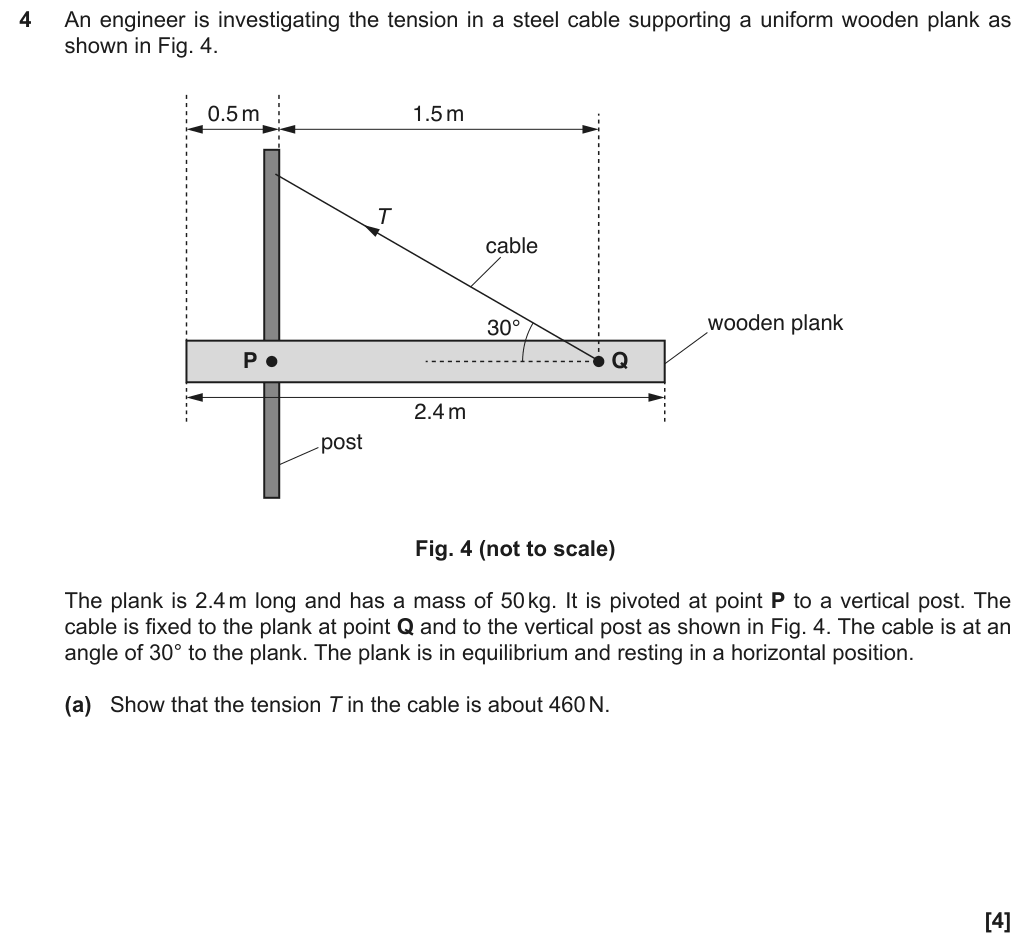
June 2018 · AS Paper 2 · Q4(a) 4 marks Show that Easy equilibrium and momentsscalars and vectorsdynamics and terminal velocity
4 An engineer is investigating the tension in a steel cable supporting a uniform wooden plank as
shown in Fig. 4.
0.5 m 1.5 m
T
cable
30° wooden plank
P Q
2.4 m
post
Fig. 4 (not to scale)
The plank is 2.4 m long and has a mass of 50 kg. It is pivoted at point P to a vertical post. The
cable is fixed to the plank at point Q and to the vertical post as shown in Fig. 4. The cable is at an
angle of 30° to the plank. The plank is in equilibrium and resting in a horizontal position.
(a) Show that the tension T in the cable is about 460 N.
[4]
June 2018 · AS Paper 2 · Q9(b)(i) 4 marks Show that Medium photoelectric effectwork energy and powerphotons
(b) Electromagnetic radiation of frequency 1.2 × 10¹⁵ Hz is incident on the surface of a negatively
charged aluminium plate. The work function of aluminium is 4.1 eV.
(i) Show that the maximum speed of the electrons emitted from the surface of the aluminium
is 5.5 × 10⁵ m s–1.
[4]
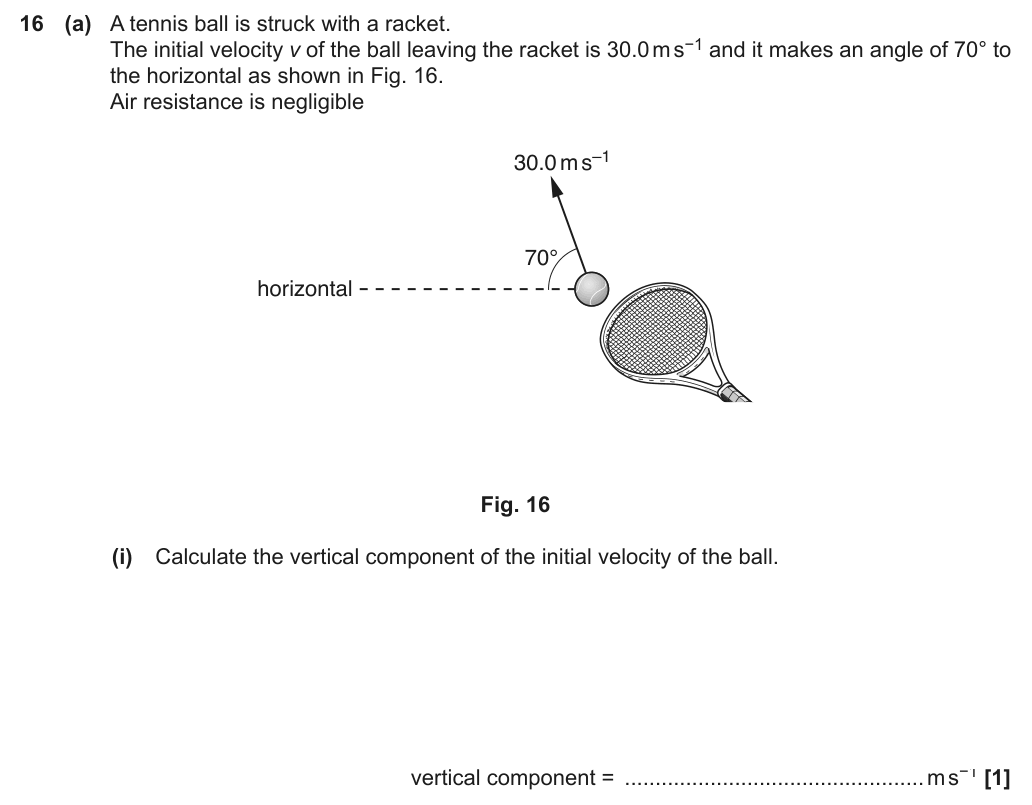
June 2018 · Paper 1 · Q16(a)(ii) 2 marks Show that Easy linear motionprojectile motion
Earlier part of question 16 that this part usesEarlier part of June 2018 Paper 1 question 16
(ii) Use your answer in (i) to show that the ball reaches a maximum height h of about 40 m.
h =  ...................................................... m [2]
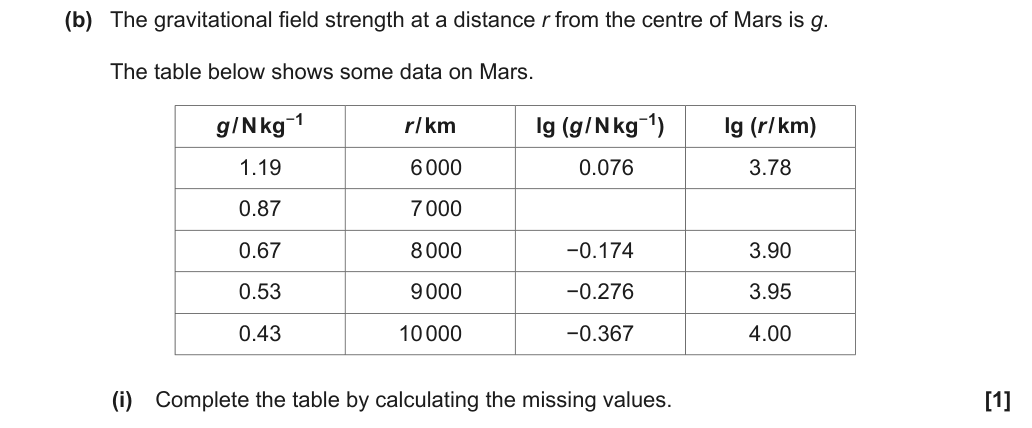
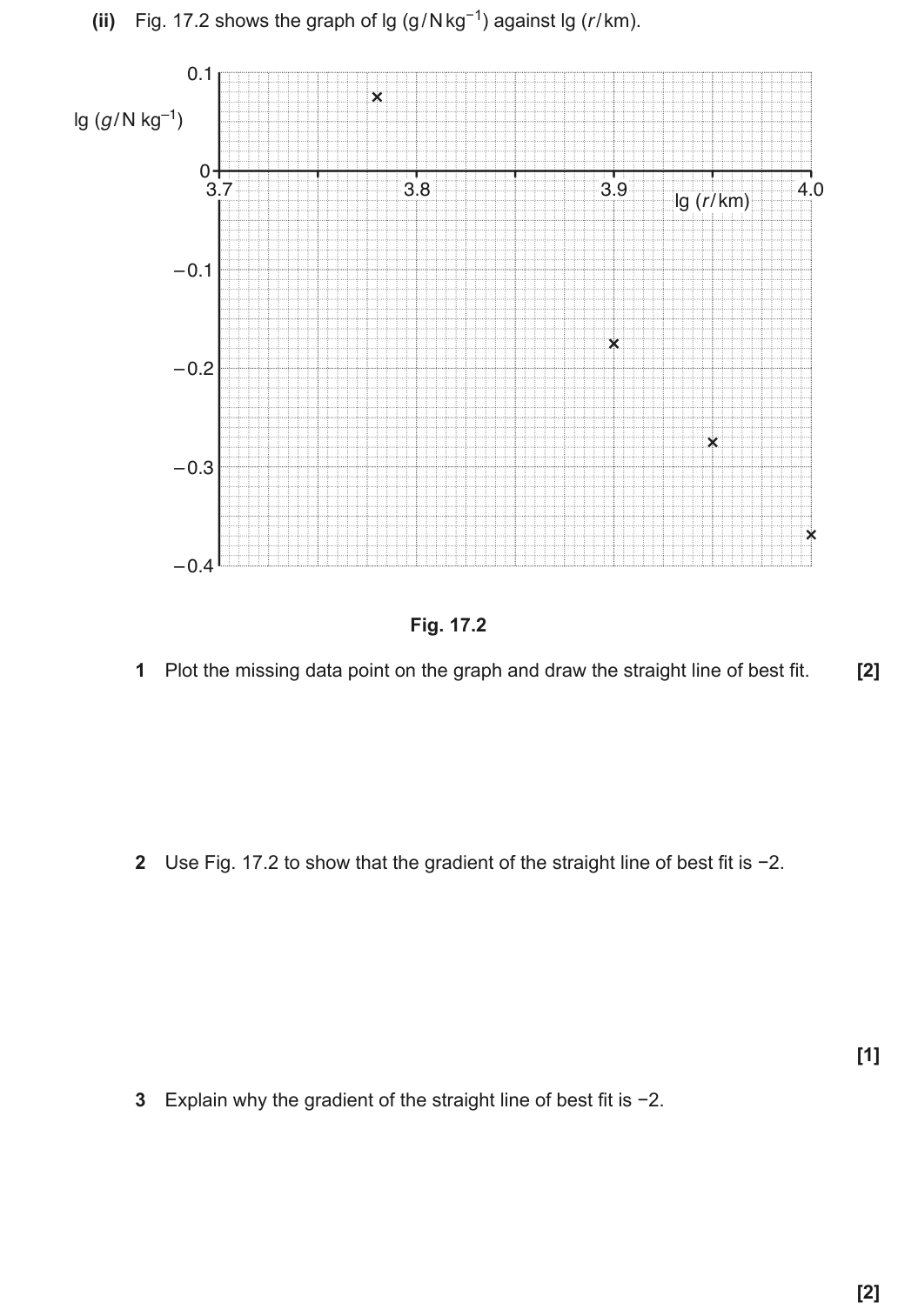
June 2018 · Paper 1 · Q17(b)(ii) 5 marks Show that Easy gravitational fieldspractical skills
Earlier part of question 17 that this part usesEarlier part of June 2018 Paper 1 question 17
(ii)  Fig. 17.2 shows the graph of lg (g / N kg−1) against lg (r / km).
0.1
lg (g / N kg–1)
0
3.7 3.8 3.9 4.0
lg (r / km)
– 0.1
– 0.2
– 0.3
– 0.4
Fig. 17.2
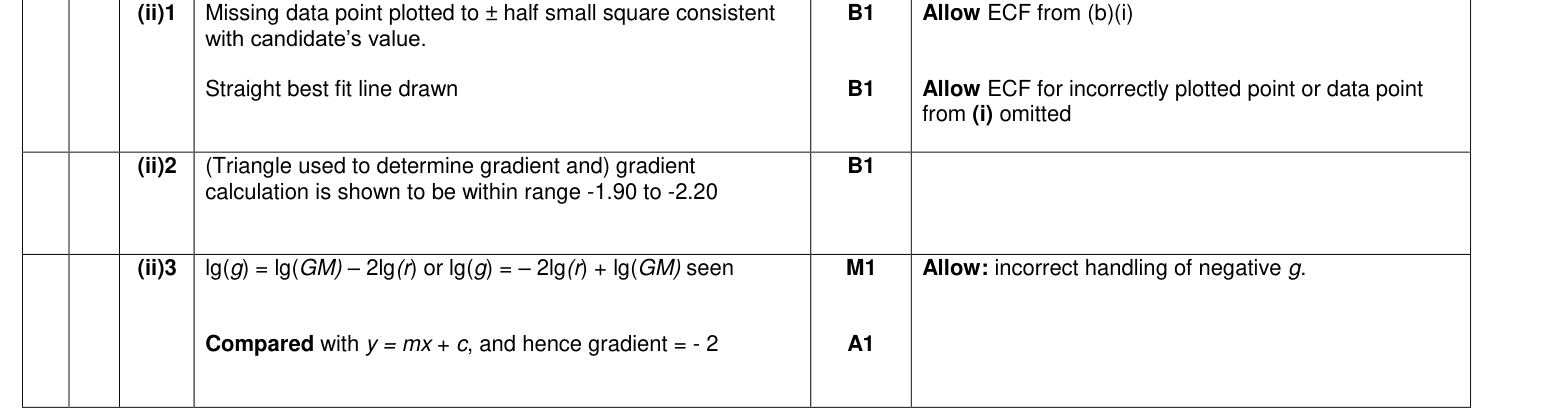
1 Plot the missing data point on the graph and draw the straight line of best fit. [2]
2 Use Fig. 17.2 to show that the gradient of the straight line of best fit is −2.
[1]
3 Explain why the gradient of the straight line of best fit is −2.
[2]
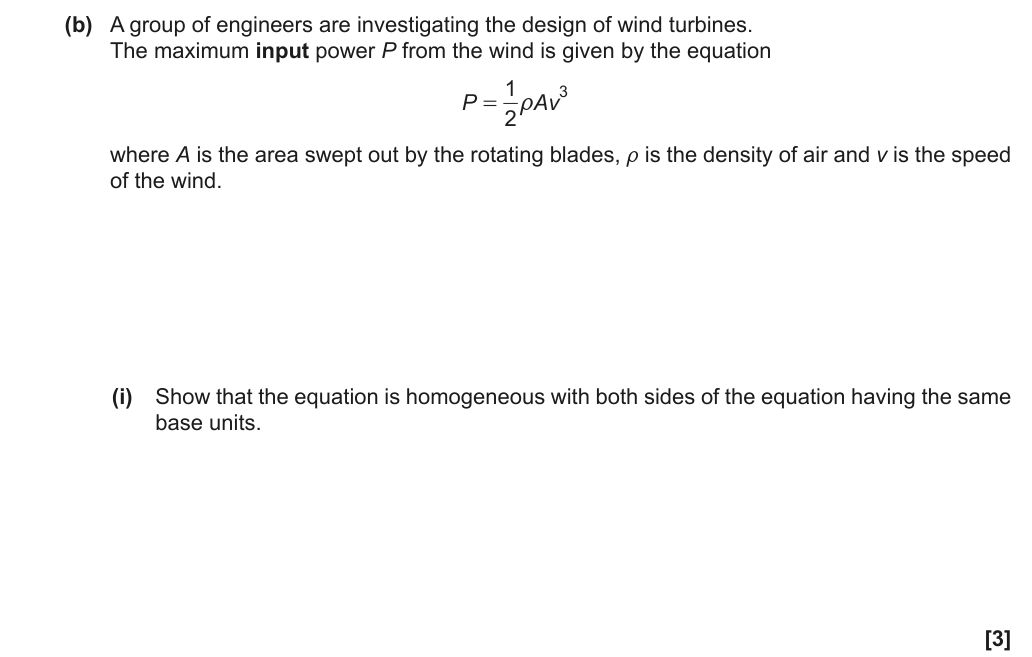
June 2018 · Paper 1 · Q18(b)(i) 3 marks Show that Hard quantities and units
(b) A group of engineers are investigating the design of wind turbines.
The maximum input power P from the wind is given by the equation
1 3
P = t A v
2
where A is the area swept out by the rotating blades, t is the density of air and v is the speed
of the wind.
(i) Show that the equation is homogeneous with both sides of the equation having the same
base units.
[3]
June 2018 · Paper 1 · Q24(a) 1 mark Show that Medium practical skillsstars
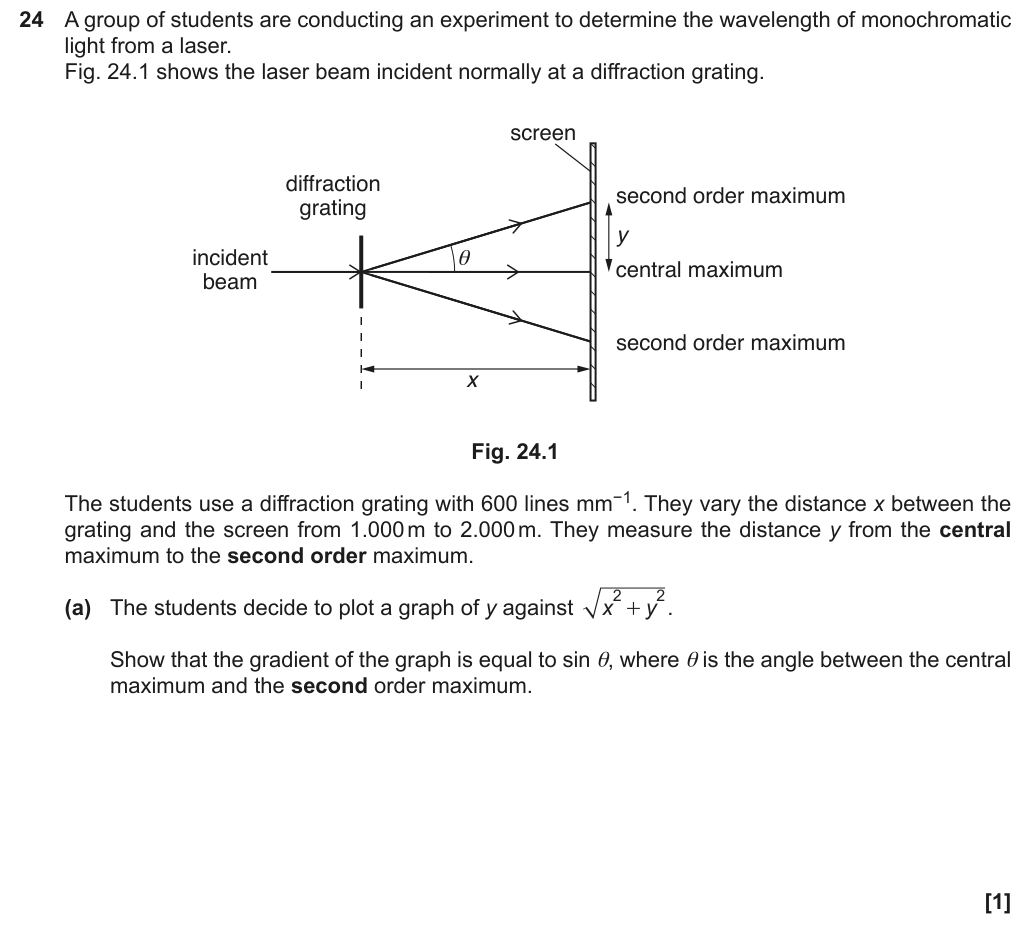
24 A group of students are conducting an experiment to determine the wavelength of monochromatic
light from a laser.
Fig. 24.1 shows the laser beam incident normally at a diffraction grating.
screen
diffraction
second order maximum
grating
y
incident θ
central maximum
beam
second order maximum
x
Fig. 24.1
The students use a diffraction grating with 600 lines mm−1. They vary the distance x between the
grating and the screen from 1.000 m to 2.000 m. They measure the distance y from the central
maximum to the second order maximum.
(a) The students decide to plot a graph of y against 2 2 .
x + y
Show that the gradient of the graph is equal to sin θ, where θ is the angle between the central
maximum and the second order maximum.
[1]
June 2018 · Paper 2 · Q16(b)(i) 1 mark Show that Medium emf pd and resistance
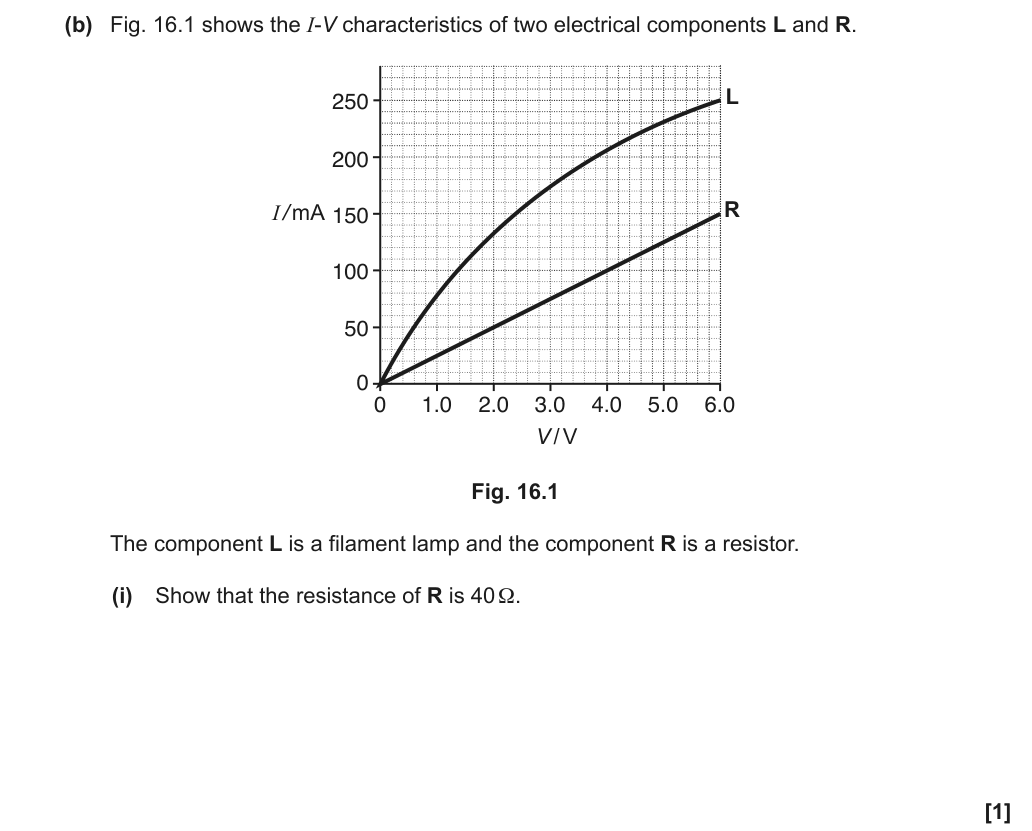
(b) Fig. 16.1 shows the I-V characteristics of two electrical components L and R.
250 L
200
I / mA 150 R
100
50
0
0 1.0 2.0 3.0 4.0 5.0 6.0
V / V
Fig. 16.1
The component L is a filament lamp and the component R is a resistor.
(i) Show that the resistance of R is 40 Ω.
[1]
June 2018 · Paper 2 · Q18(a) 3 marks Show that Easy electromagnetic waves and refraction
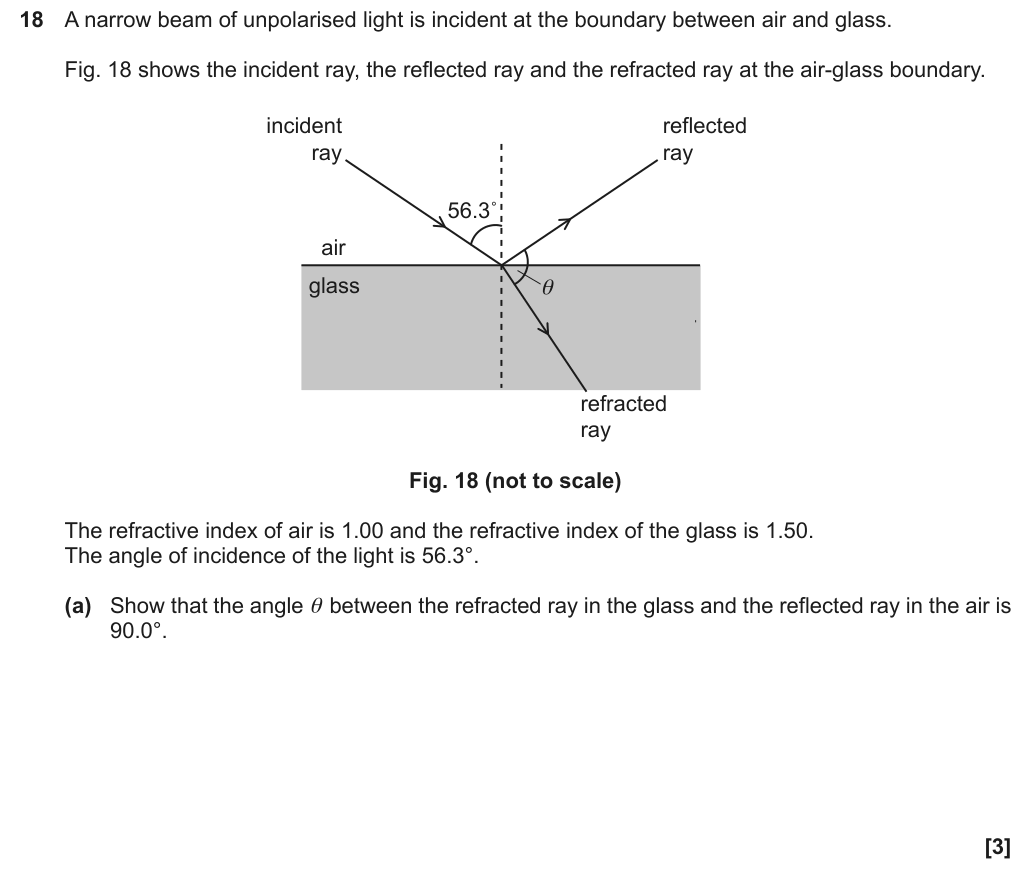
18 A narrow beam of unpolarised light is incident at the boundary between air and glass.
Fig. 18 shows the incident ray, the reflected ray and the refracted ray at the air-glass boundary.
incident reflected
ray ray
56.3˚
air
glass θ
refracted
ray
Fig. 18 (not to scale)
The refractive index of air is 1.00 and the refractive index of the glass is 1.50.
The angle of incidence of the light is 56.3°.
(a)  Show that the angle θ  between the refracted ray in the glass and the reflected ray in the air is
90.0°.
[3]
June 2018 · Paper 2 · Q22(a) 2 marks Show that Medium capacitors
22 A student wishes to determine the permittivity ε of paper using a capacitor made in the laboratory.
The capacitor consists of two large parallel aluminium plates separated by a very thin sheet of
paper.
The capacitor is initially charged to a potential difference V0 using a battery. The capacitor is then
discharged through a fixed resistor of resistance 1.0 MΩ.
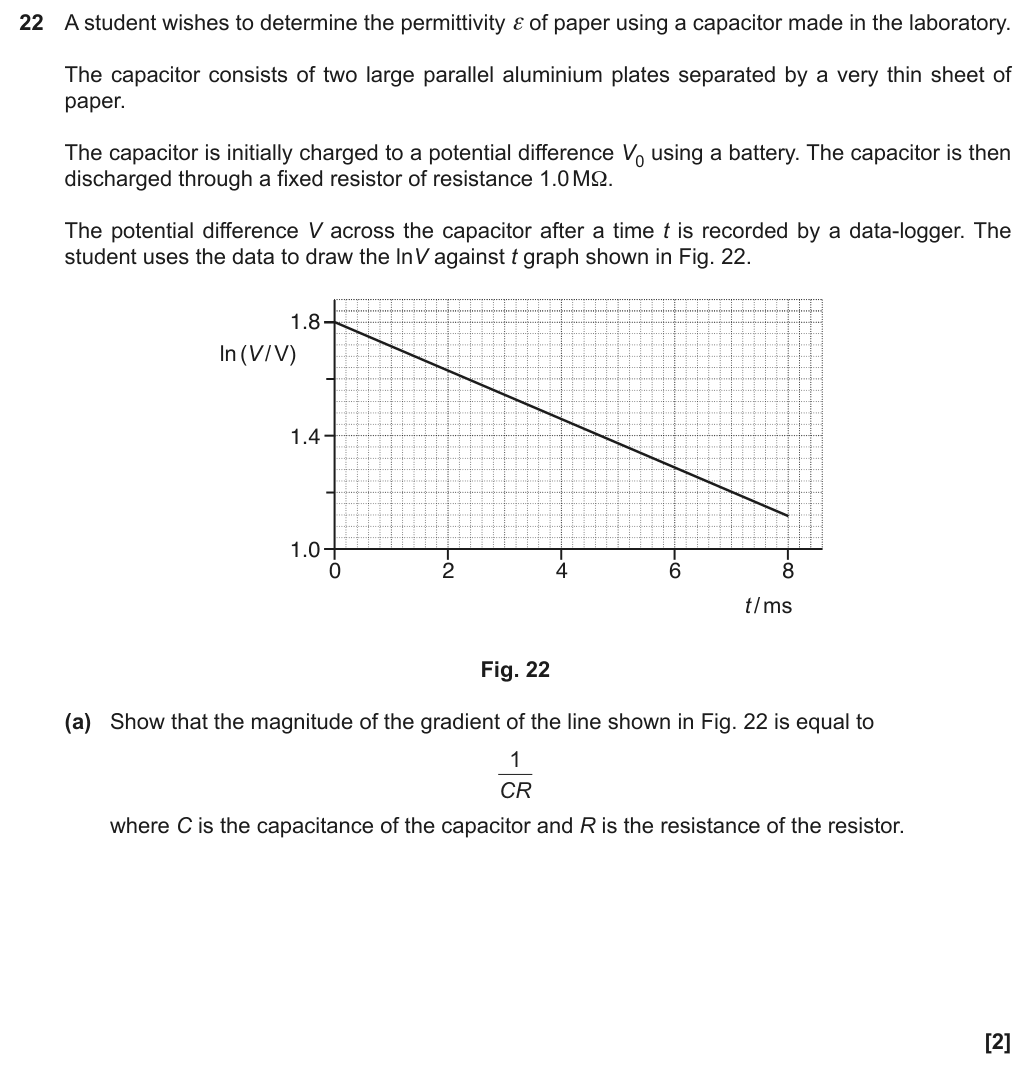
The potential difference V across the capacitor after a time t is recorded by a data-logger. The
student uses the data to draw the lnV against t graph shown in Fig. 22.
1.8
ln (V / V)
1.4
1.0
0 2 4 6 8
t / ms
Fig. 22
(a)  Show that the magnitude of the gradient of the line shown in Fig. 22 is equal to
1
CR
where C is the capacitance of the capacitor and R is the resistance of the resistor.
[2]
June 2018 · Paper 2 · Q23(a)(i) 1 mark Show that Hard practical skills
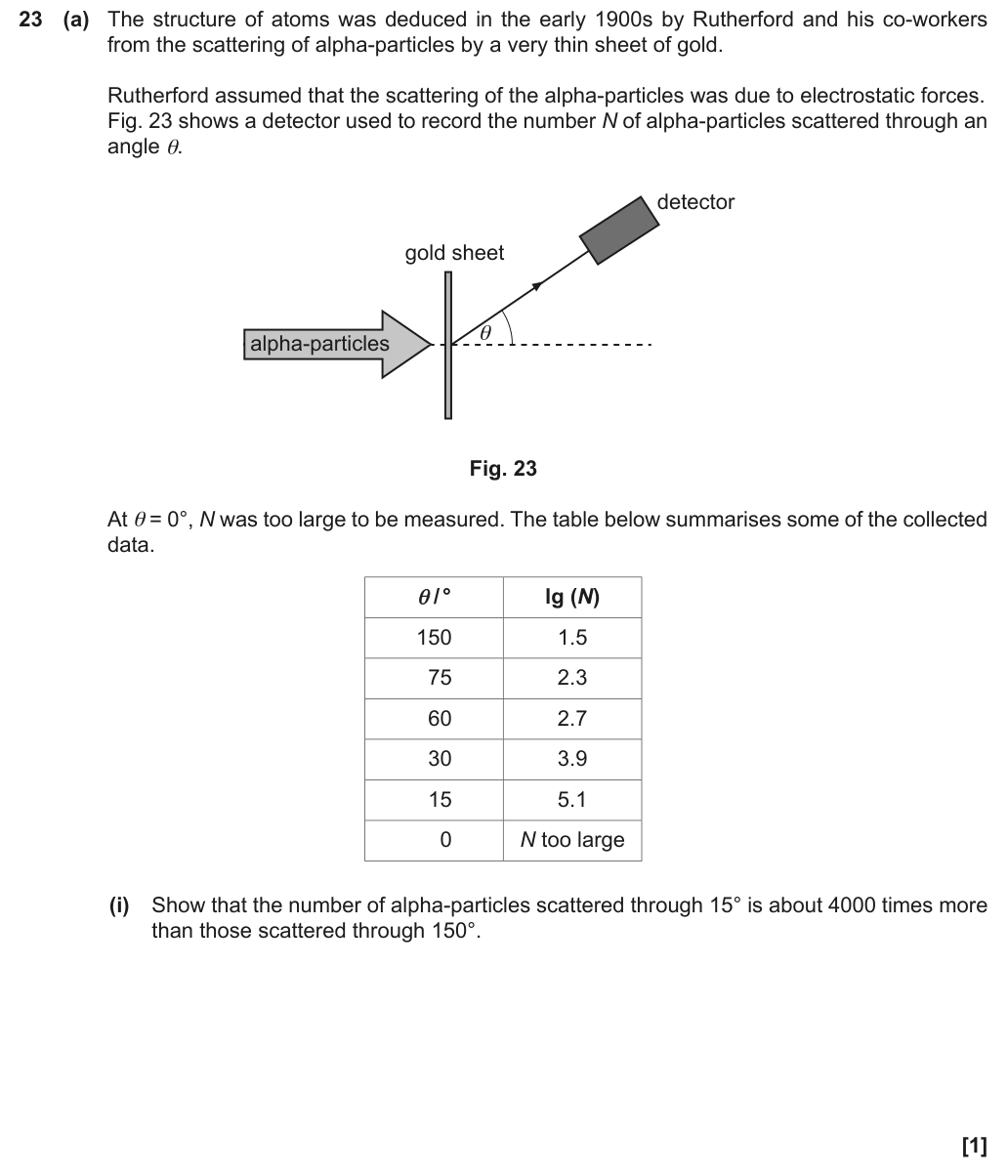
23 (a) The structure of atoms was deduced in the early 1900s by Rutherford and his co-workers
from the scattering of alpha-particles by a very thin sheet of gold.
Rutherford assumed that the scattering of the alpha-particles was due to electrostatic forces.
Fig. 23 shows a detector used to record the number N of alpha-particles scattered through an
angle θ.
detector
gold sheet
θ
alpha-particles
Fig. 23
At θ = 0°, N was too large to be measured. The table below summarises some of the collected
data.
θ  / ° lg (N)
150 1.5
75 2.3
60 2.7
30 3.9
15 5.1
0 N too large
(i) Show that the number of alpha-particles scattered through 15° is about 4000 times more
than those scattered through 150°.
[1]
June 2018 · Paper 3 · Q1(b)(i) 2 marks Show that Hard electrical power
(b) A student is investigating a 230 V, 1.0 kW heating element. The heating element is shown in
Fig. 1.2.
18 cm
1.4 cm
Fig. 1.2
A length of nichrome wire is wound in a spiral groove along 18 cm of a ceramic cylinder of
diameter 1.4 cm. The distance between the centres of adjacent turns of the wire is 1.5 mm.
The numbers labelling the reels of loose wire on the laboratory shelf are the imperial standard
wire gauge (swg). The student wishes to find out which reel holds the same wire as that
wound on the heating element of Fig. 1.2.
The book of data gives the following information:
resistivity of nichrome at operating temperature = 1.1 × 10⁻⁶ Ω m
swg 24 26 28 30 32
diameter of wire / 10−3 m 0.56 0.46 0.38 0.32 0.27
cross-sectional area / 10−6 m2 0.25 0.16 0.11 0.08 0.06
(i) Show that the resistance of the nichrome wire wound on the ceramic cylinder is 53 Ω.
[2]
June 2018 · Paper 3 · Q1(b)(ii) 2 marks Show that Hard practical skills
Earlier part of question 1 that this part usesEarlier part of June 2018 Paper 3 question 1
(ii) Show that the length of wire wound on the heating element is 5.3 m.
[2]
June 2018 · Paper 3 · Q2(c)(i) 3 marks Show that Medium simple harmonic motion
(c)  The acceleration a of the sphere is given by the equation
=-d k x n
a
m
where k is the force constant of the spring combination, x is the displacement of the sphere
and m is the mass of the sphere.
The mass of the sphere is 6.6 × 10⁵ kg. The natural frequency of the oscillations of the sphere
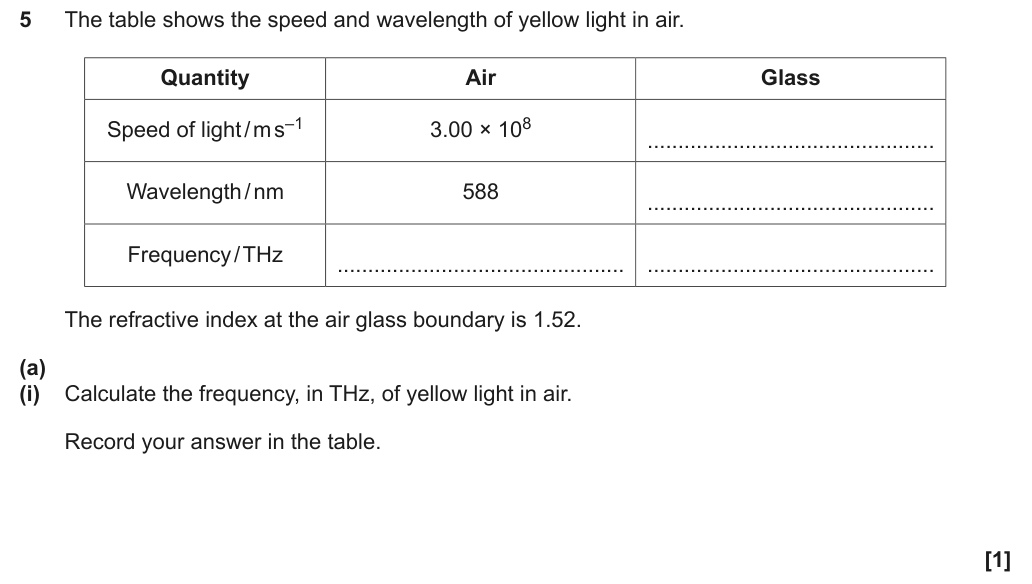
is 0.15 Hz.
(i) Show that the force constant k of the spring combination is about 6 × 10⁵ N m−1.
[3]
June 2018 · Paper 3 · Q4(a) 2 marks Show that Hard work energy and power
4 Fig. 4.1 shows an arrangement used by a student to determine the acceleration of free fall.
0.200 m
light gate
card pulley
trolley
mass 0.800 kg m
0.600 m
Fig. 4.1
A trolley is attached to a variable mass m by a string which passes over a pulley.
The mass m is released from rest and falls through a fixed height of 0.600 m accelerating the
trolley of mass 0.800 kg. When the mass m hits the floor, the trolley then continues to move at a
constant velocity v.
This constant velocity v is determined by measuring the time t for the card of length 0.200 m to
pass fully through a light gate connected to a timer.
Frictional forces on the trolley and the falling mass m are negligible.
(a)  Show that the relationship between v and m is
1 20 . mg
2 =
v
( m + 0 800 . )
where g is the acceleration of free fall.
[2]
June 2018 · Paper 3 · Q4(c)(i) 1 mark Show that Medium practical skills
Earlier part of question 4 that this part usesEarlier part of June 2018 Paper 3 question 4
5.0
4.5
v 2 / m2 s–2
4.0
3.5
3.0
2.5
2.0
0.15 0.20 0.25 0.30 0.35 0.40 0.45
m
Fig. 4.2 m + 0.800
(c) (i) Use the equation given in (a) to show that the gradient of the graph of v 2 against
m
is equal to 1.20 g.
_ i
m + 0 800 .
[1]
June 2018 · Paper 3 · Q6(b) 3 marks Show that Easy photons
(b) A high energy gamma photon passing through the scintillator crystal converts some of its
energy into visible light photons of mean wavelength 450 nm.
Show that the energy of a single photon of wavelength 450 nm is less than 3 eV.
[3]
June 2018 · Paper 3 · Q6(c)(i) 1 mark Show that Easy photoelectric effect
Earlier part of question 6 that this part usesEarlier part of June 2018 Paper 3 question 6
(c)  The photocathode is coated with potassium which has a work function of 2.3 eV. Each emitted
photoelectron is accelerated by a potential difference of 100 V between the photocathode and
a metal plate, called the first dynode.
(i) Show that the maximum kinetic energy of an emitted electron at the photocathode is
very small compared to its kinetic energy of 100 eV at the first dynode.
[1]
June 2017 · AS Paper 2 · Q1(b)(i) 1 mark Show that kinematicsquantities and units
(b) Fig. 1.1 shows a train of mass 1.9 × 10⁵ kg travelling at 61 km h−1 along a level track.
61 km h–1
Fig. 1.1
(i) Show that the train is travelling at about 17 m s−1.
[1]
June 2017 · AS Paper 2 · Q3(a)(ii) 2 marks Show that density and pressure
Earlier part of question 3 that this part usesEarlier part of June 2017 Paper 2 question 3
(ii) Show that the mass of the sphere is 0.0075 kg.
[2]
June 2017 · AS Paper 2 · Q4(a)(i) 1 mark Show that electrical power
4 Some houses are heated by “night storage heaters” which use cheap electricity between the hours
of midnight and 7.00 am.
Fig. 4.1 shows a circuit diagram of three identical 230 V, 3.5 kW storage heaters connected to a
230 V mains power supply of negligible internal resistance.
230 V
3.5 kW
3.5 kW
3.5 kW
Fig. 4.1
(a) (i) Show that the resistance of each heating element is about 15 Ω when the heater is
operating at 230 V.
[1]
June 2017 · Paper 1 · Q19(a)(i) 3 marks Show that simple harmonic motion
19 This question is about a simple pendulum made from a length of string attached to a mass (bob).
For oscillations of small amplitude, the acceleration a of the pendulum bob is related to its
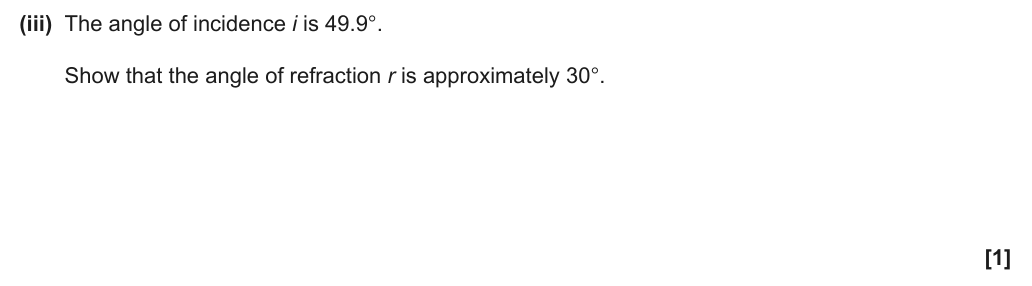
displacement x by the expression
J g N
a KK OO x
=-
L
L P
where g is the acceleration of free fall and L is the length of the pendulum.
The pendulum bob oscillates with simple harmonic motion.
(a) (i) Show that the period T of the oscillations is given by the expression

4 2
2 r
T = g L .
[3]
June 2017 · Paper 1 · Q19(c)(i) 2 marks Show that simple harmonic motion
Earlier part of question 19 that this part usesEarlier part of June 2017 Paper 1 question 19
(c) Another student conducts a similar experiment in the laboratory to investigate the small
amplitude oscillations of a pendulum of a mechanical clock. Each ‘tick’ of the clock corresponds
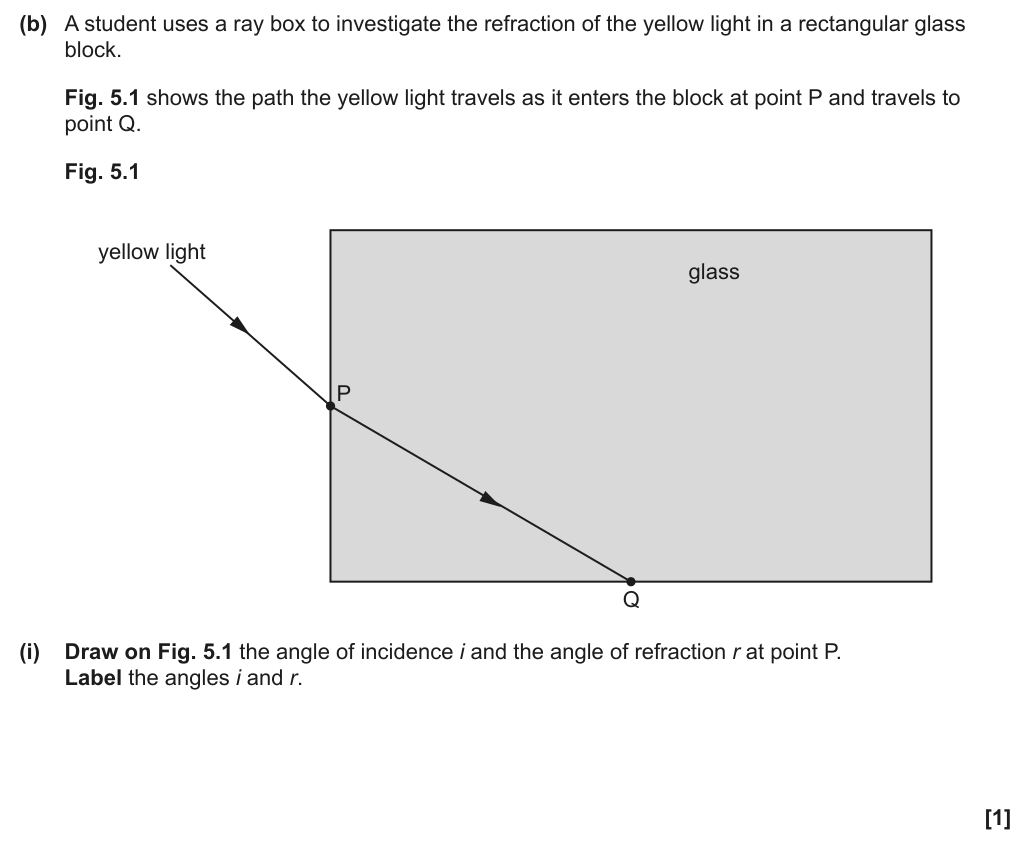
to half a period.
(i) Show that the length of the pendulum required for a tick of 1.0 s is about 1 m.
[2]
June 2017 · Paper 1 · Q23(b)(i) 2 marks Show that gravitational fields
(b) The table below shows some data for Mercury and Pluto.
Mass / kg Radius / m Mean distance from Sun / m
Mercury 3.30 × 10²³ 2.44 × 10⁶ 57.9 × 10⁹
Pluto 0.131 × 10²³ 1.19 × 10⁶ 5910 × 109
(i) Show that the escape velocity v of a gas molecule on the surface of Pluto is given by the
equation
2 GM
v =
r
where M is the mass of Pluto and r is its radius.
[2]
June 2017 · Paper 2 · Q17(b)(i) 2 marks Show that resistivityseries and parallel circuits
(b) Fig. 17 shows two resistors X and Y connected in series.
X Y
Fig. 17
The resistors are wires. Both wires have the same length L and diameter d. The material of X
has resistivity ρ and the material of Y has resistivity 2ρ.
(i) Show that the total resistance R of the wires is given by the equation
R = 12ρL
πd 2 .
[2]
June 2017 · Paper 2 · Q20(c)(i) 2 marks Show that electric fields
(c) A metal sphere is given a positive charge by connecting its surface briefly to the positive
terminal of a power supply. The electric potential at the surface of the sphere is + 5.0 kV. The
sphere has radius 1.5 cm.
(i) Show that the charge Q on the surface of the sphere is 8.3 × 10⁻⁹ C.
[2]
June 2017 · Paper 2 · Q20(c)(ii) 3 marks Show that electric fieldsscalars and vectors
Earlier part of question 20 that this part usesEarlier part of June 2017 Paper 2 question 20
(ii) Fig. 20.2 shows the charged sphere from (i) suspended from a nylon thread and placed
between two oppositely charged vertical plates.
nylon
4.0°
thread
– +
+
Fig. 20.2 (not to scale)
The weight of the sphere is 1.7 × 10⁻² N. The string makes an angle of 4.0° with the
vertical.
1. Show that the electric force on the charged sphere is 1.2 × 10⁻³ N.
[1]
2. Calculate the uniform electric field strength E between the parallel plates.
E =  ................................................ N C−1 [2]
June 2017 · Paper 3 · Q1(c) 3 marks Show that radioactivitynuclear atom and particles
a k nucleus starts the decay chain which ends with a nucleus of
(c) The uranium-238 238 92U
a k.
lead-206 206 82Pb
Show that 14 particles are emitted during this decay chain. Explain your reasoning.
[3]
June 2017 · Paper 3 · Q2(a) 3 marks Show that magnetic fieldselectric fields
2 A small thin rectangular slice of semiconducting material has width a and thickness b and carries
a current I. The current is due to the movement of electrons. Each electron has charge – e and
mean drift velocity v. A uniform magnetic field of flux density B is perpendicular to the direction of
the current and the top face of the slice as shown in Fig. 2.1.
B
a
I
b
Fig. 2.1
(a) As soon as the current is switched on, the moving electrons in the current are forced towards

the shaded rear face of the slice where they are stored. This causes the shaded faces to act
like charged parallel plates. Each electron in the current now experiences both electric and
magnetic forces. The resultant force on each electron is now zero.
Write the expressions for the electric and magnetic forces acting on each electron and use
these to show that the magnitude of the potential difference V between the shaded faces is
given by
V = Bva.
[3]
June 2017 · Paper 3 · Q3(a) 2 marks Show that capacitorspractical skills
3 A student is investigating how the discharge of a capacitor through a resistor depends on the
resistance of the resistor.
The equipment is set up as shown in Fig. 3.1.
S
V R
C
Fig. 3.1
The student charges the capacitor of capacitance C and then discharges it through a resistor of
resistance R using switch S. After a time t = 15.0 s the student records the potential difference V
across the capacitor. The student repeats this procedure for different values of R.
It is suggested that V and R are related by the equation
- t
V = V e CR
0
where V0 is the initial potential difference across the capacitor and t is the time over which the
capacitor has discharged.
1 on the x-axis to obtain
(a) The student decides to plot a graph of ln (V / V) on the y-axis against R
15 .
a straight line graph. Show that the magnitude of the gradient is equal to C
[2]
June 2017 · Paper 3 · Q6(b)(i) 2 marks Show that circular motionscalars and vectors
Earlier part of question 6 that this part usesEarlier part of June 2017 Paper 3 question 6
(b) (i) Resolve the tension T horizontally and vertically and show that the angle θ is 22°.
[2]
June 2016 · AS Paper 2 · Q3(a)(i) 1 mark Show that linear motionprojectile motion
6
3 In a hockey match a hockey ball is hit 18.0 m from the front of the goal. The ball leaves the hockey
stick with initial velocity v at an angle θ to the horizontal ground. The ball passes over the goal at a
maximum height of 2.0 m as shown in Fig. 3.
hockey goal
path of the ball
v
hockey ball 2.0 m
θ
(Not to scale)
18 m
Fig. 3
(a) The initial vertical component of the velocity of the ball is 6.3 m s−1. Air resistance has
negligible effect on the motion of the ball.
(i) Show that the time t taken for the ball to reach the maximum height is about 0.6 s.
[1]
June 2016 · AS Paper 2 · Q3(a)(ii) 1 mark Show that projectile motionkinematics
Earlier part of question 3 that this part usesEarlier part of June 2016 Paper 2 question 3
(ii) Use the answer to (a)(i) and Fig. 3 to show that the horizontal component of the velocity
of the ball as it leaves the hockey stick is about 30 m s−1.
[1]
June 2016 · AS Paper 2 · Q4(a) 3 marks Show that quantities and unitscharge and currentemf pd and resistance
8
4 (a) The unit of potential difference is the volt.
Use the equation W = VQ to show that the volt may be written in base units as kg m2 A−1 s−3.
[3]
June 2016 · AS Paper 2 · Q5(a) 1 mark Show that density and pressure
11
5 A student is investigating the resistance of a conducting putty.
(a) The density of conducting putty is 5300 kg m−3. The student has a 100 g sample of this putty.
Show that the volume V of the sample is about 1.9 × 10⁻⁵ m3.
[1]
June 2016 · AS Paper 2 · Q8(a) 3 marks Show that emf pd and resistance
18
8 Electron diffraction provides evidence for the wave-like behaviour of particles. Electrons are
diffracted by a thin slice of graphite.
In one experiment, electrons are accelerated from rest through a potential difference of 300 V.
(a) Show that the final speed v of the electrons is 1.0 × 10⁷ m s−1.
[3]

Work with an OCR physics tutor

Dropping marks on calculations, practical questions or the six-mark level of response questions? Book a trial session with a specialist OCR physics tutor.
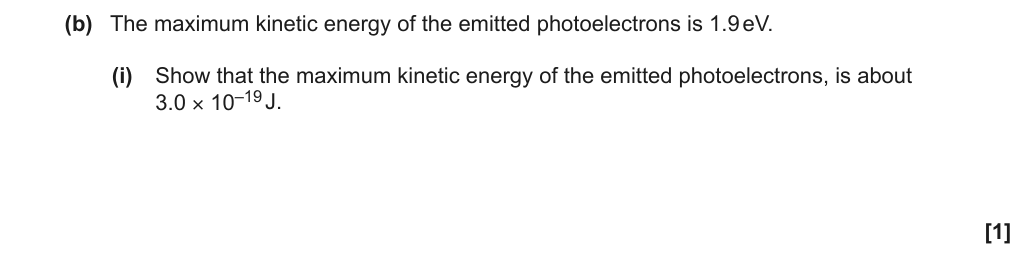
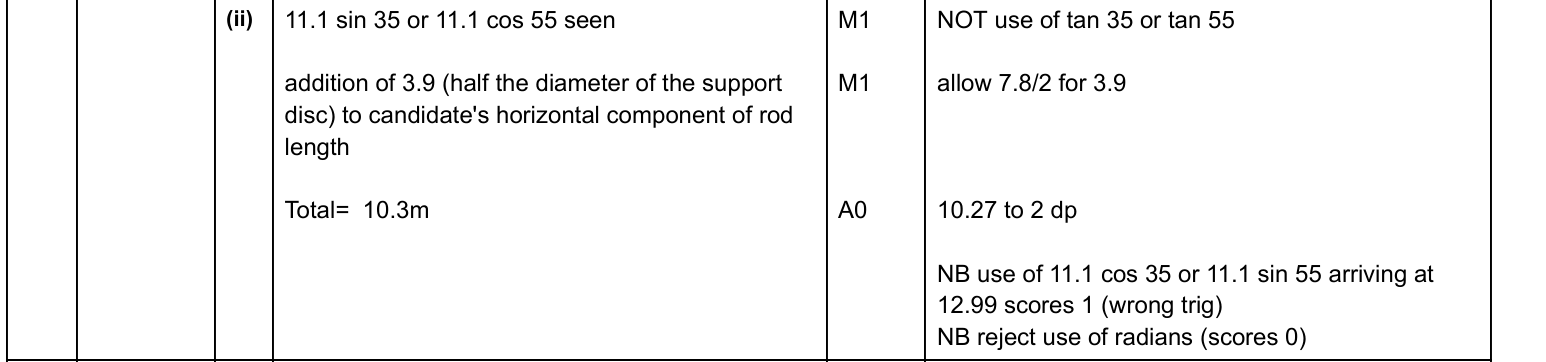
Prefer email? Send an enquiry

If you are under 18, please include a parent's contact details. Enquiries go to enquiries@physicsaleveltutor.com and are deleted once handled. All tutoring is online.