Examiner's comment
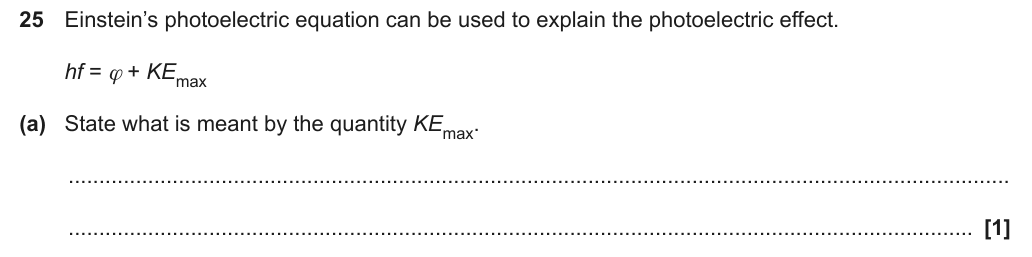
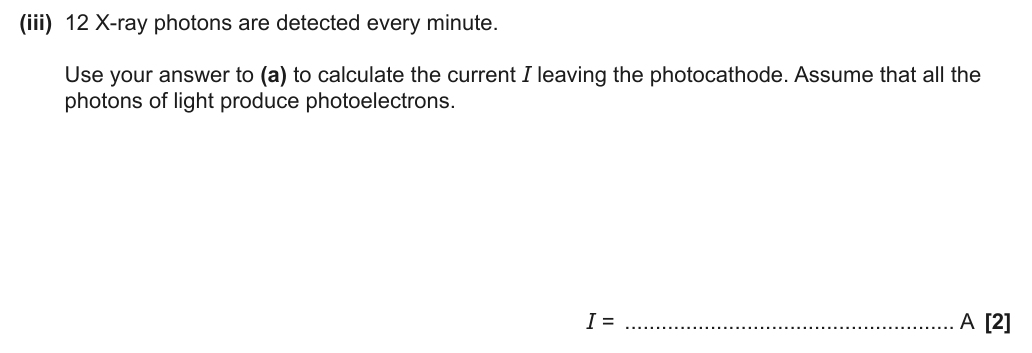
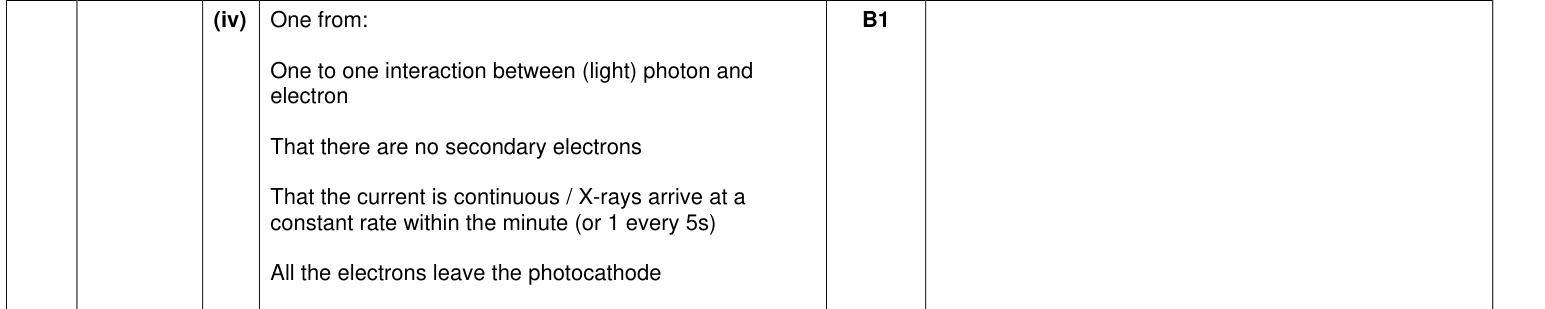
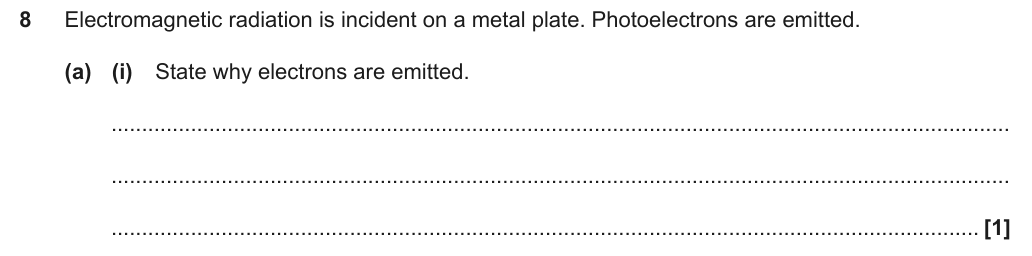
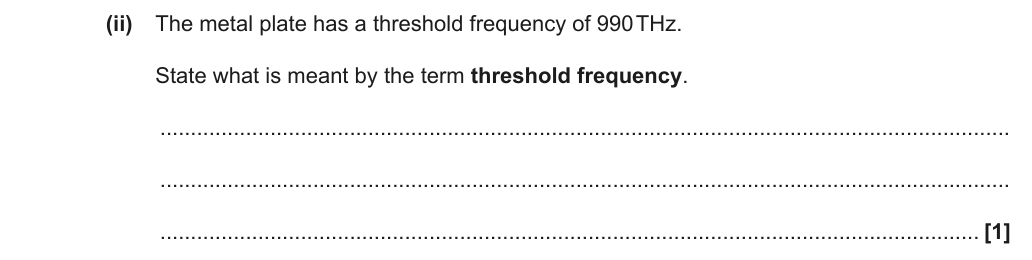
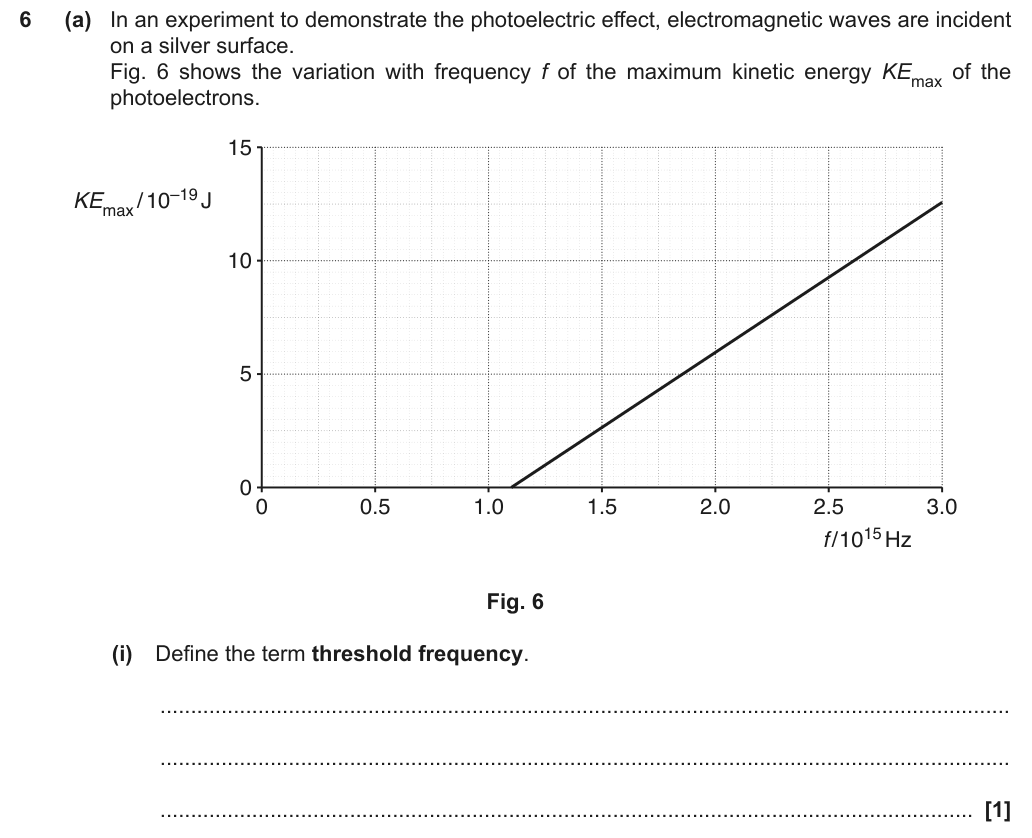
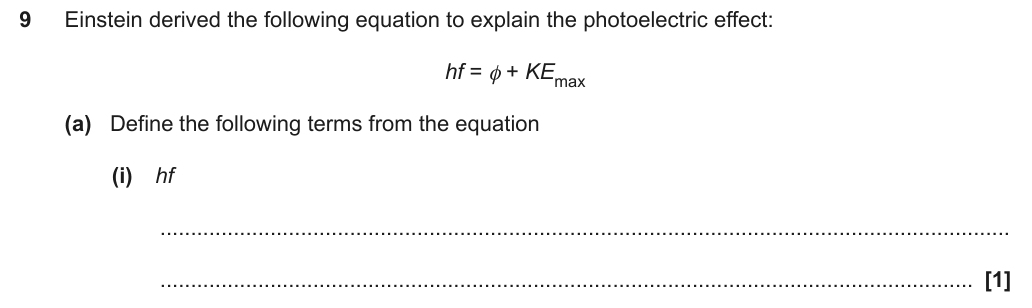
This is a standard definition which candidates should be able to state. Candidates should remember that the work function is a minimum energy. There is occasionally a misconception regarding ionisation, and also some careless use of language for the removal of the electron. Words such as escape and eject are acceptable, but terms such as dislocation are not clear enough. The definition does not require the statement that it is from the surface of the metal this time, but that does not mean that it will not be required in the future. 17(b)(i) The question is clear that the response needs to be given in terms of photons and energies. Many candidates discussed threshold frequencies, and although often correct, does not answer the question. The link between photon energy and frequency needs to be clear and not just a simple dependency – the simple solution for this is to state the equation. The final marking point requires the candidate to appreciate that only one photon can be absorbed by one electron. Standalone statements such as “there is a 1:1 relation” is meaningless in this context unless qualified. Many good candidates were able to score at least 3 marks on this question and it was clear that this is a well understood aspect. There is sufficient space for a fully clear answer and candidates are always to be reminded of the need for conciseness in such a response. This is a novel development on what is a common calculation of kinetic energy and as such created some challenge for some candidates. Many were able to score the first marking point, either by converting from eV to joules, or by the calculation of the photon energy. Few candidates scored 2 or 3 marks, as generally an error such as using the speed of light for the electrons occurred. However, a good number of stronger candidates were able to achieve all 4 marks and set out their solutions clearly. It should be noted that the first 3 marks are for setting up the calculations and not the evaluations. This is to not penalise candidates too early for calculational errors and as always highlights the clear need for setting out working as well as possible.