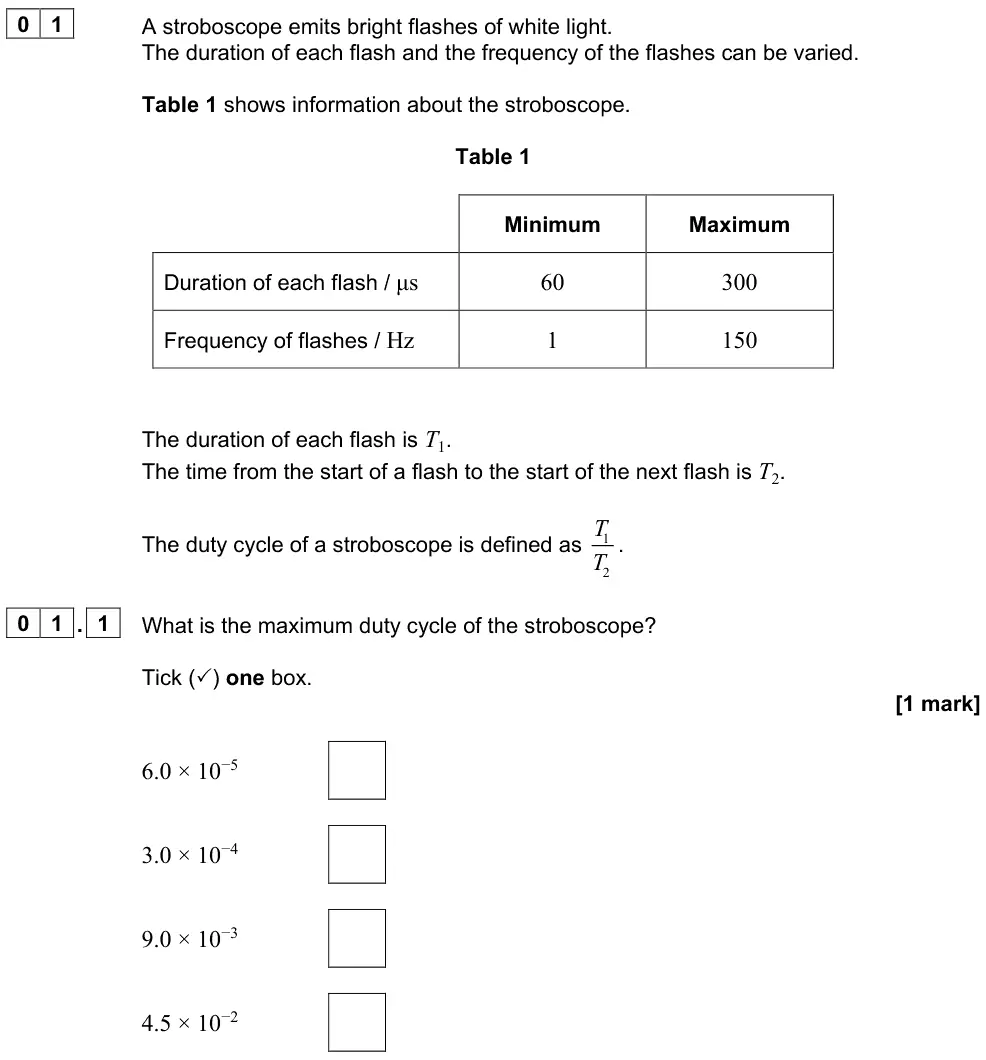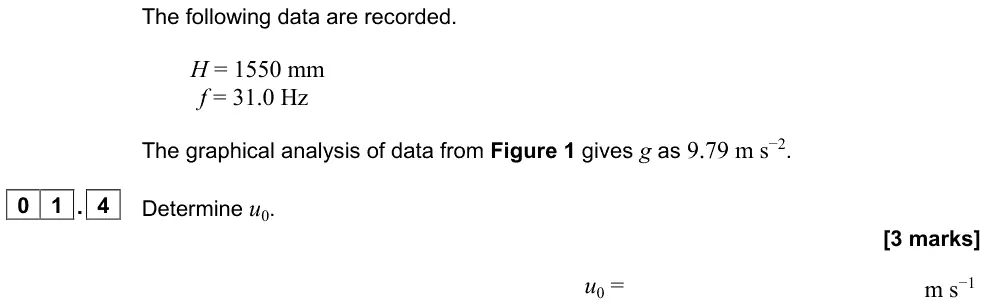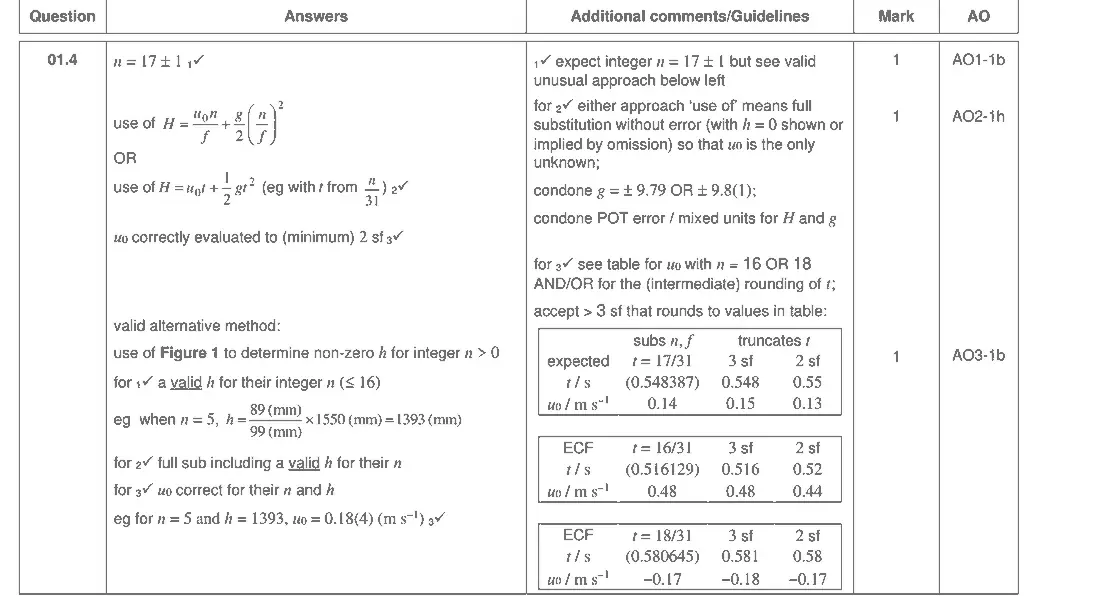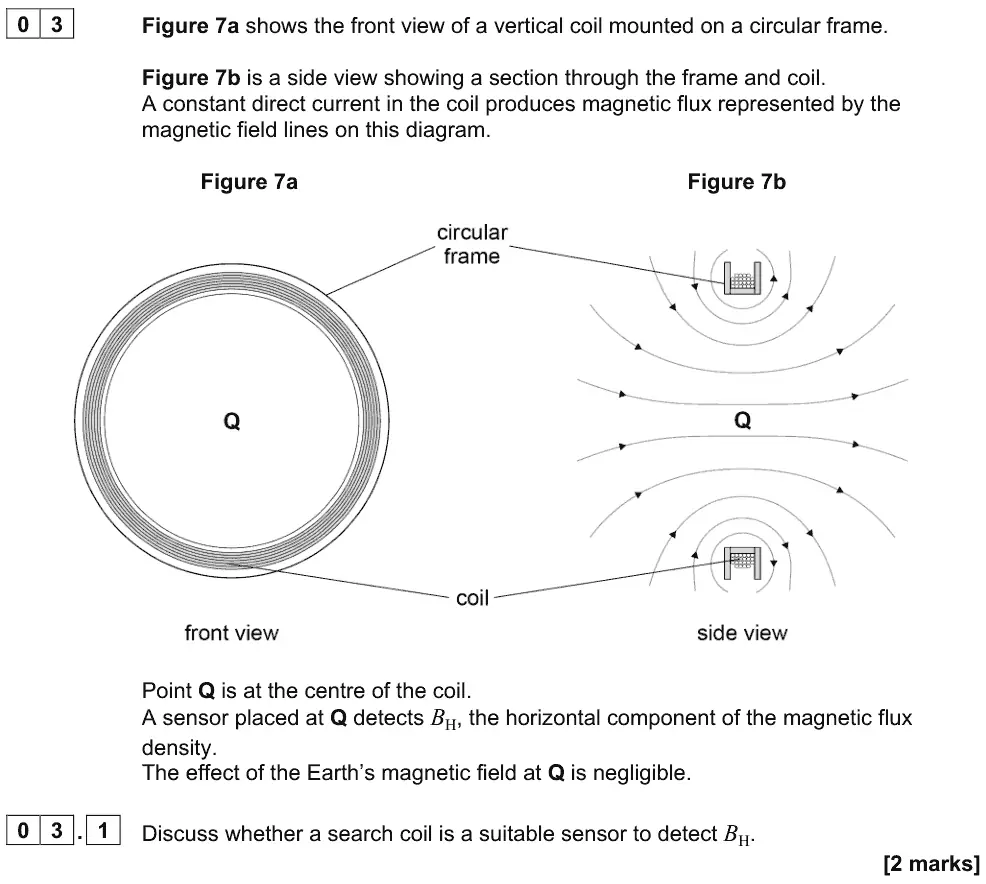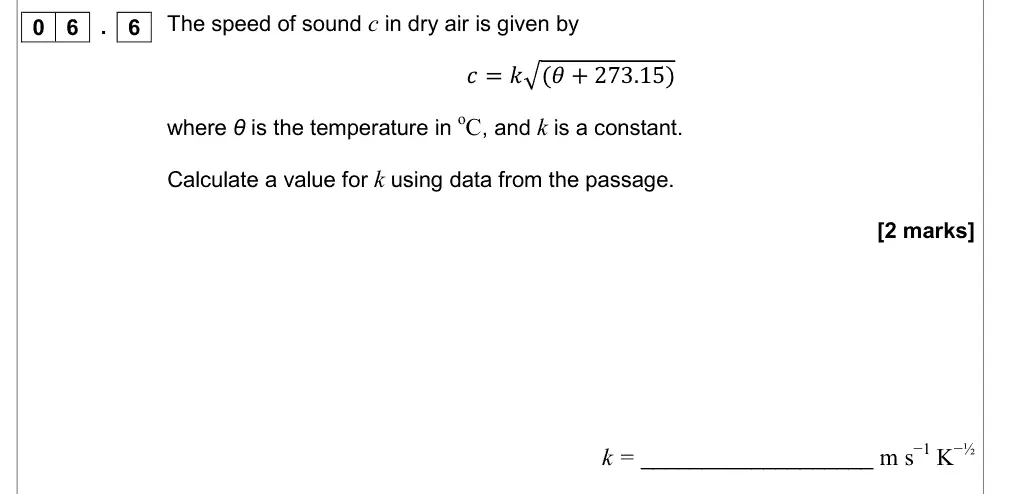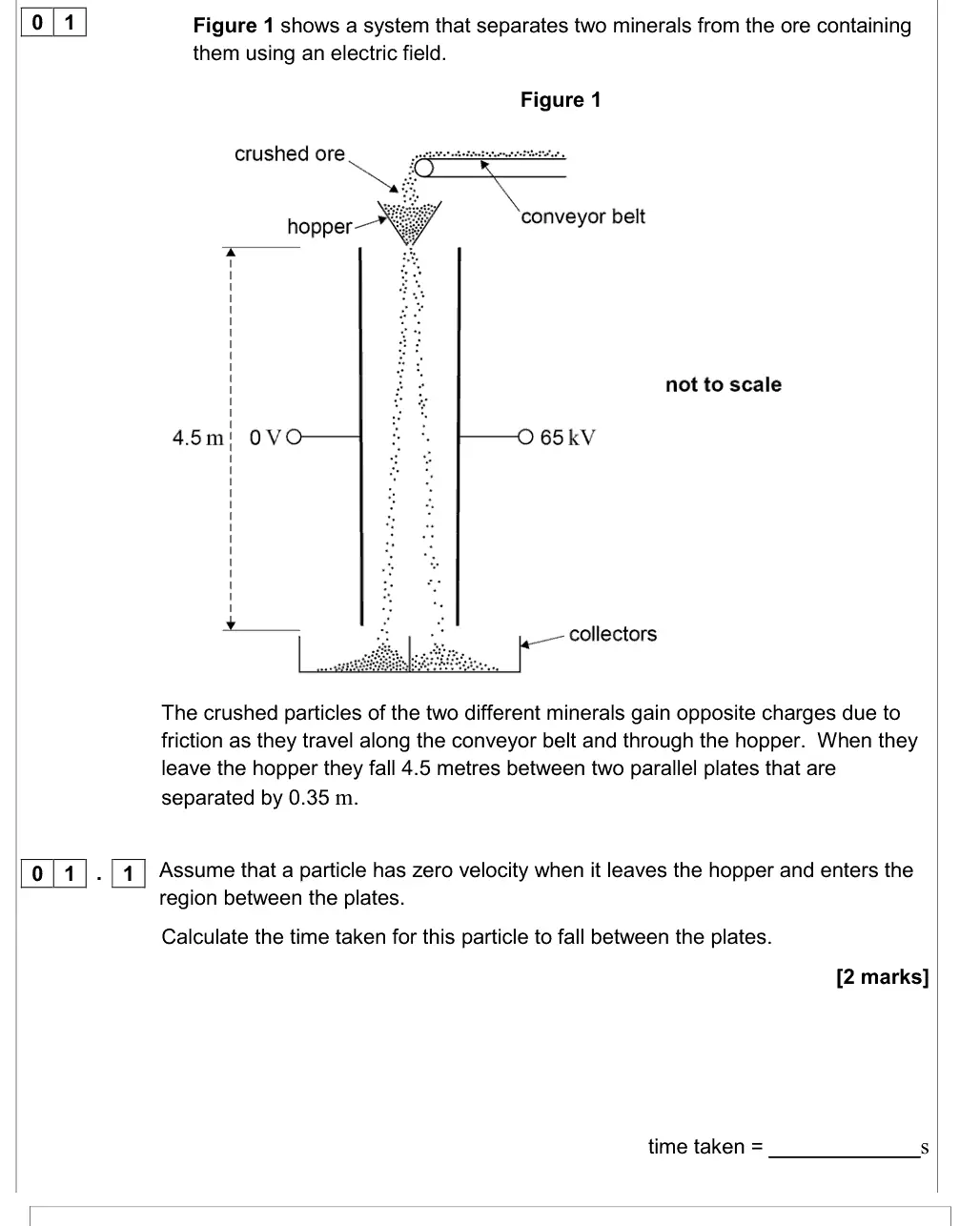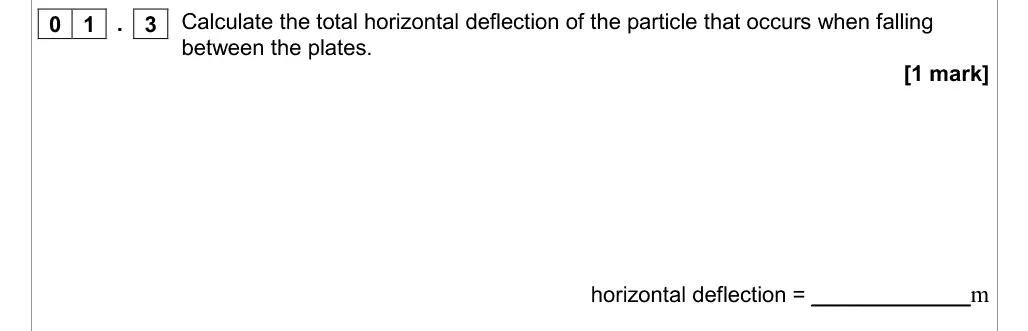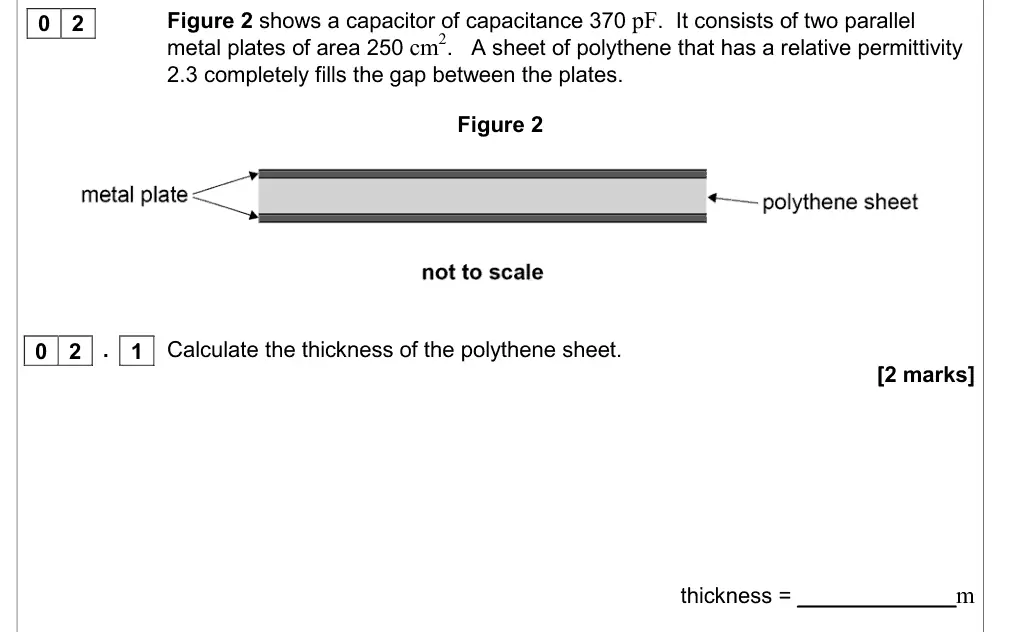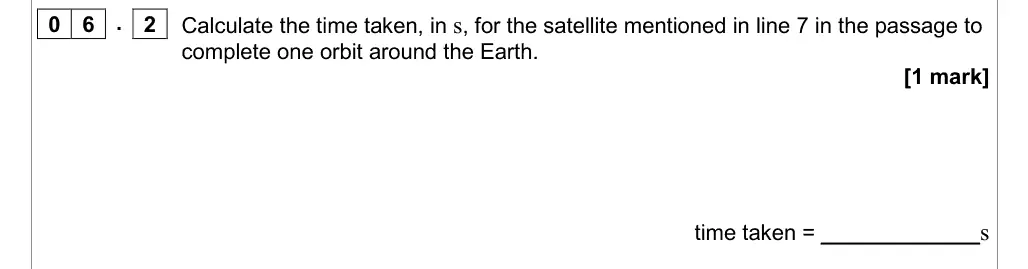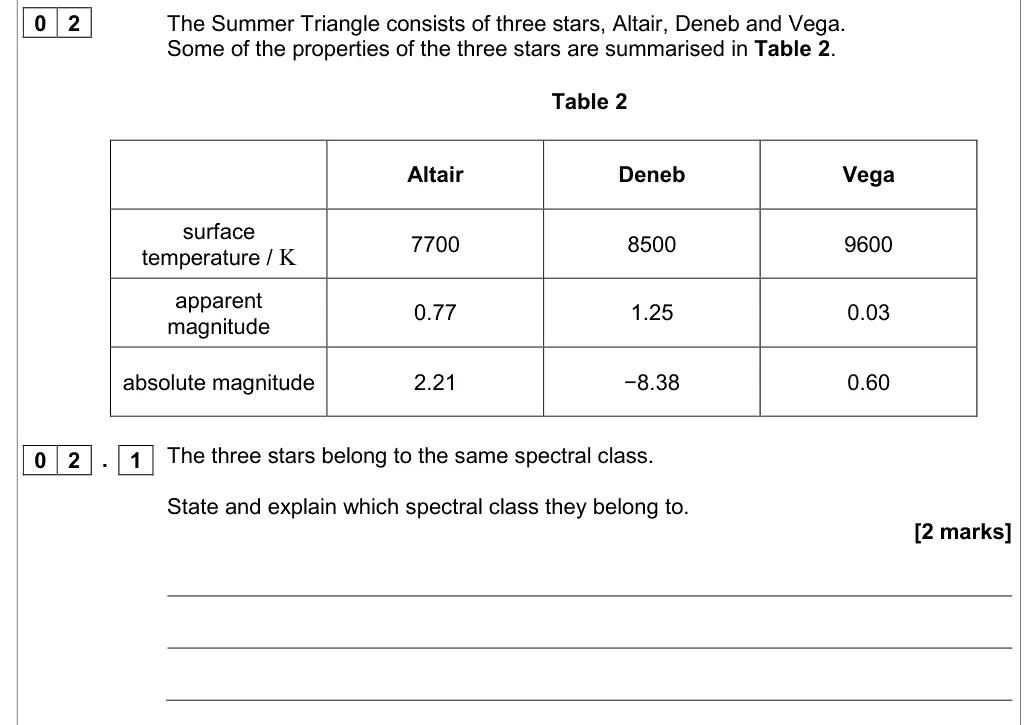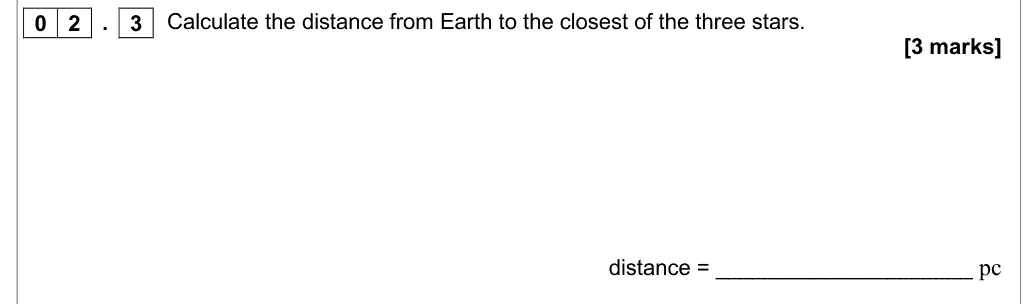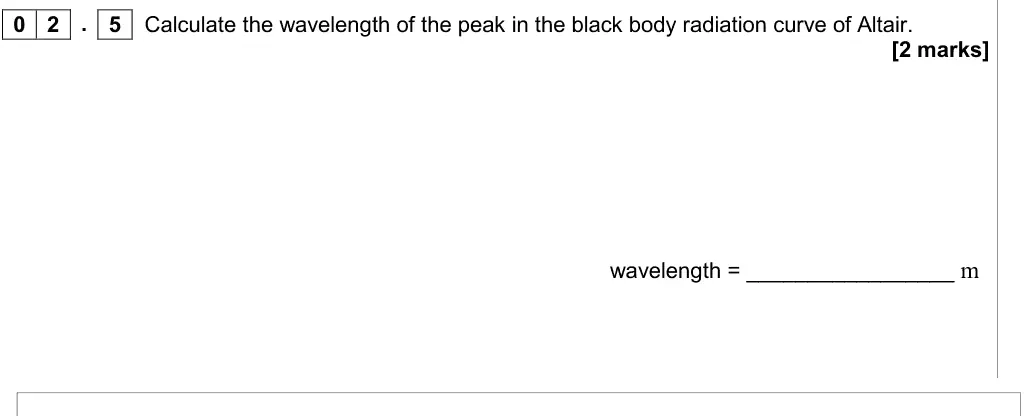
Calculation questions

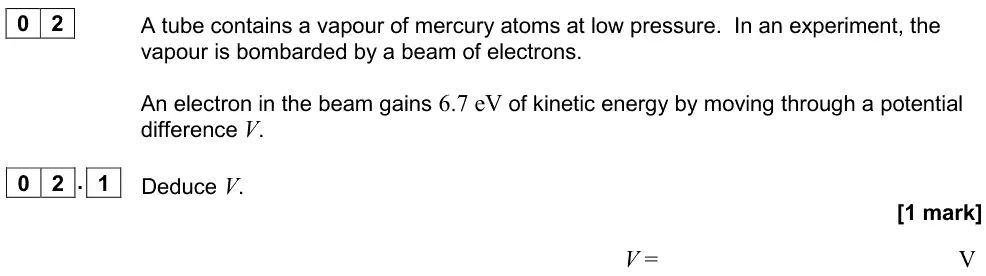
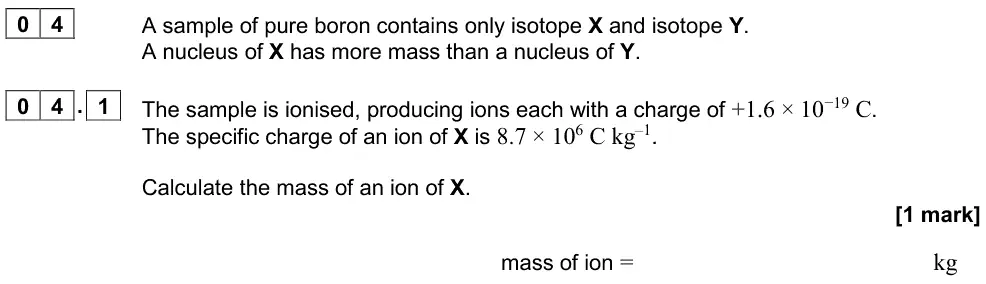
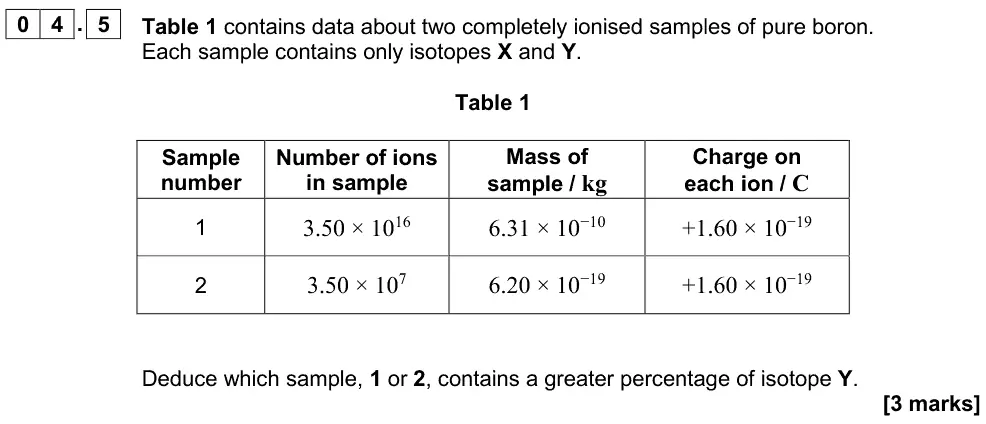
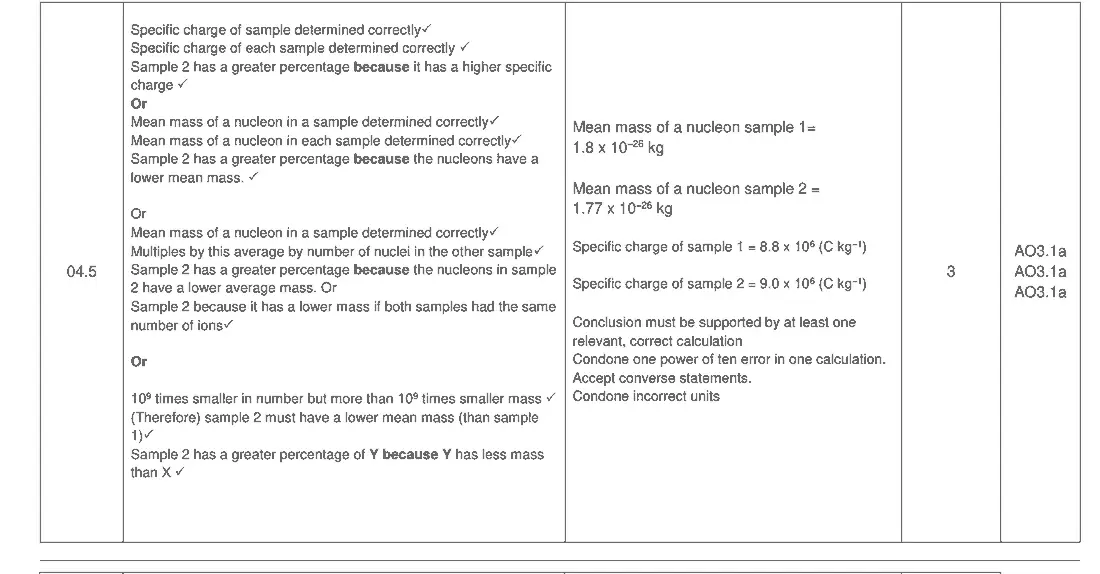
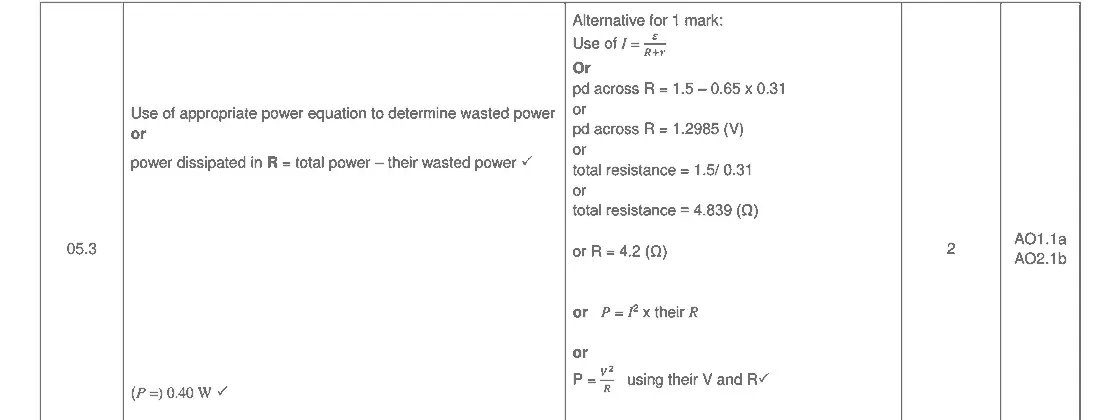
Calculate and determine questions on every topic. Write the equation, substitute with units and give the answer to a sensible number of significant figures: AQA gives method marks, and an error carried forward from an earlier part still scores. 602 questions.

Other types: Multiple-choice questions · Show that questions · Explain and describe questions · Graph and diagram questions · Six-mark extended response questions · Practical questions · Short-answer questions

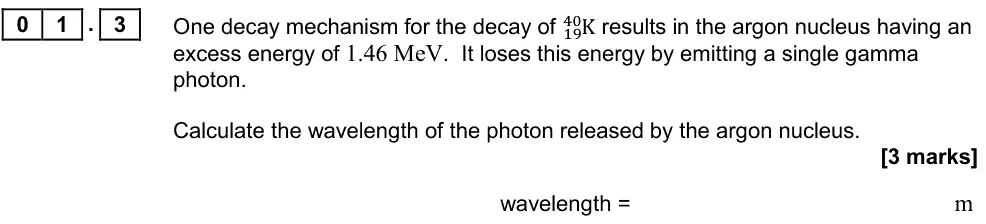
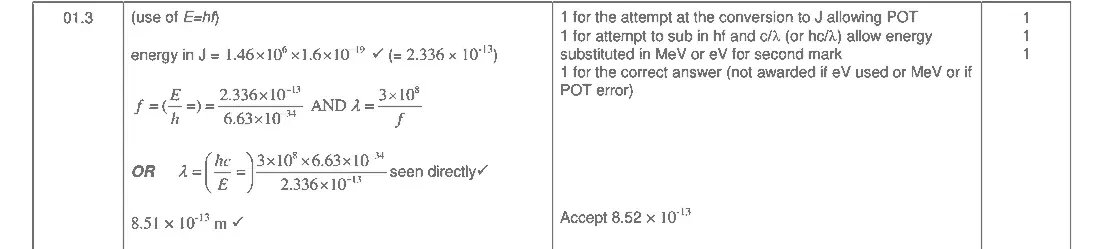
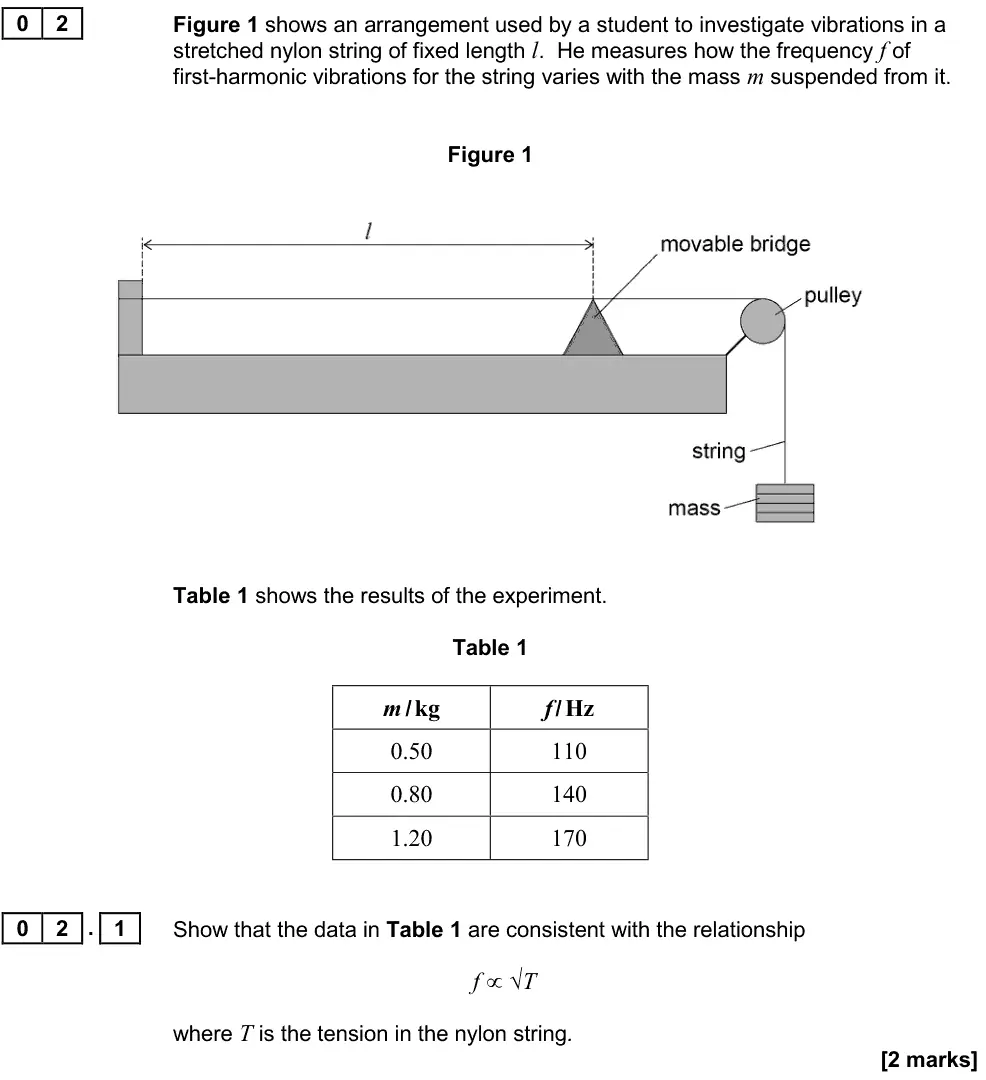
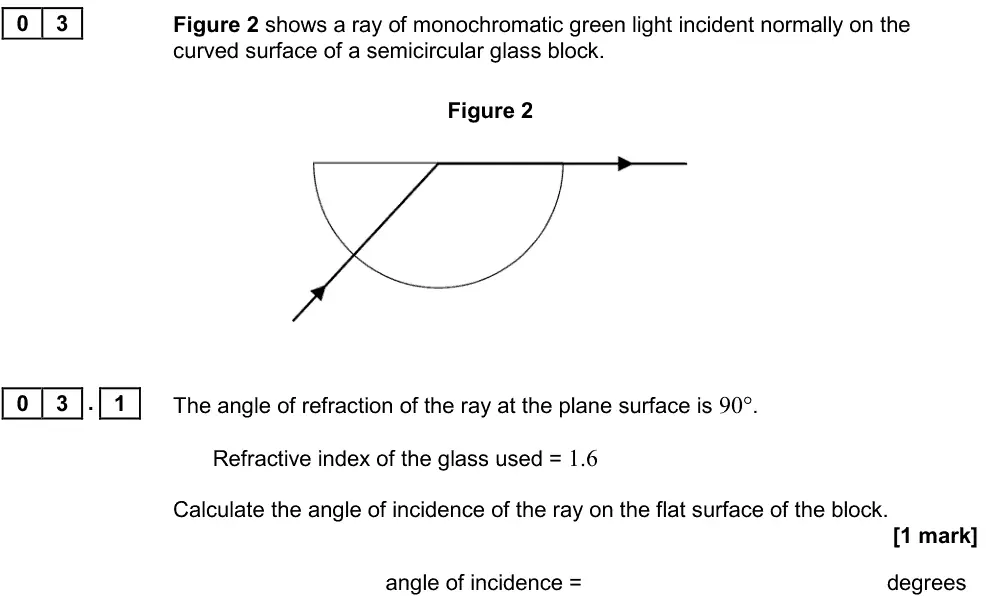
June 2025 · AS Paper 1 · Q1.1 2 marks AO1=1, AO2=1 Calculation Easy atomic structure and stable nuclei
Hydrogen has three naturally occurring isotopes.  One of these isotopes is
hydrogen-3 (
)
3H
1
.
Calculate the specific charge of a nucleus of hydrogen-3.
[2 marks]
specific charge =
C kg−1
June 2025 · AS Paper 1 · Q2.2 2 marks AO1=1, AO2=1 Calculation Easy refraction and optical fibres
Earlier part of question 2 that this part usesEarlier part of June 2025 Paper 1 question 2
The refractive index of the glass core is 1.51
The critical angle at the core–cladding boundary is 80.7°
Calculate the refractive index of the cladding.
[2 marks]
refractive index of cladding =
June 2025 · AS Paper 1 · Q2.3 2 marks AO1=1, AO2=1 Calculation Easy refraction and optical fibres
Earlier part of question 2 that this part usesEarlier part of June 2025 Paper 1 question 2
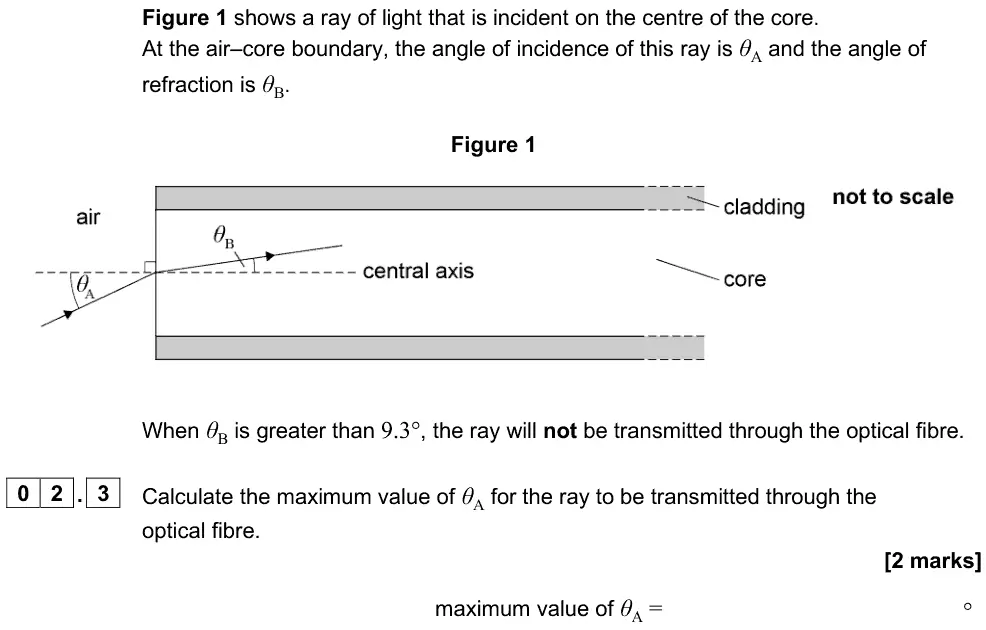
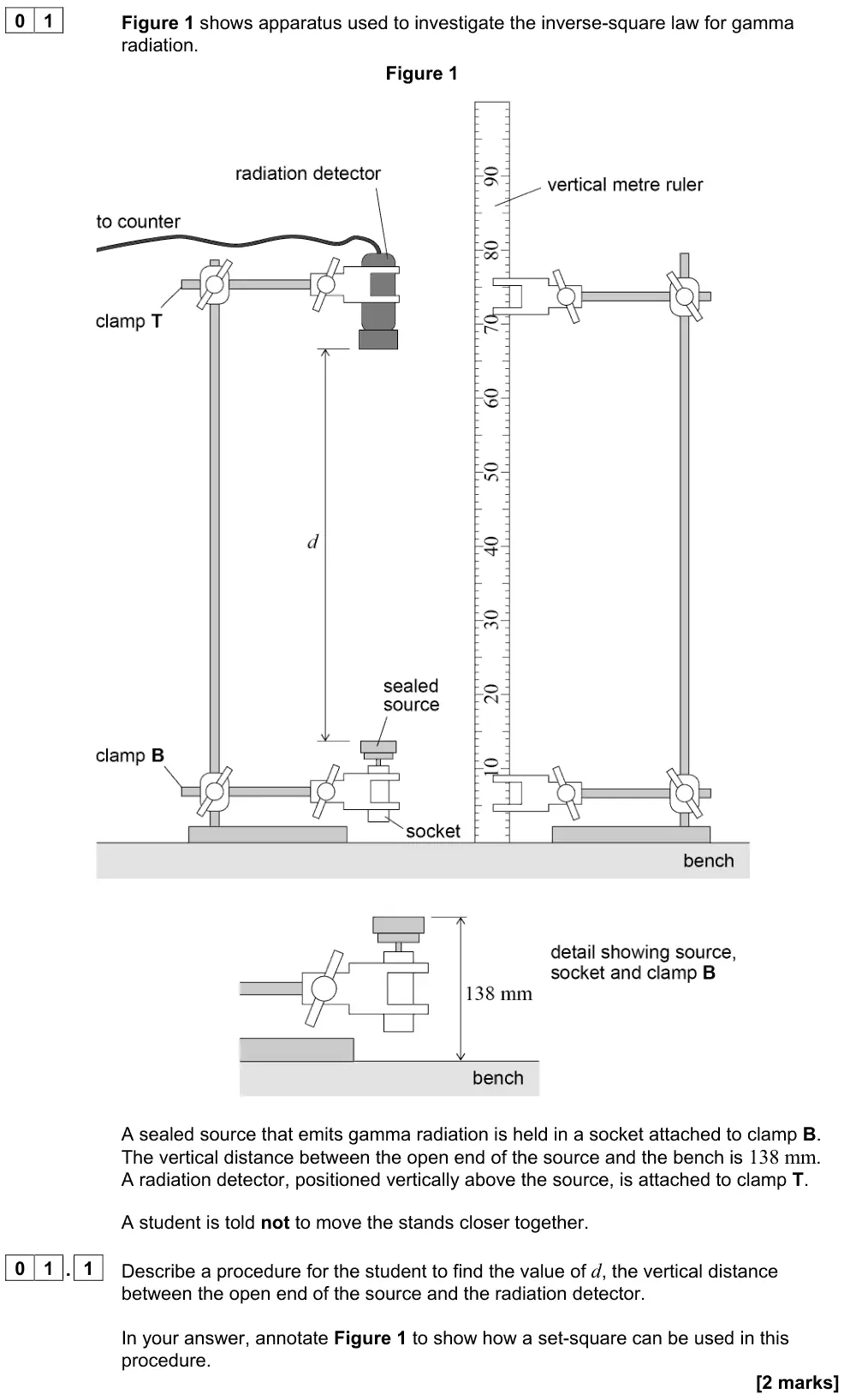
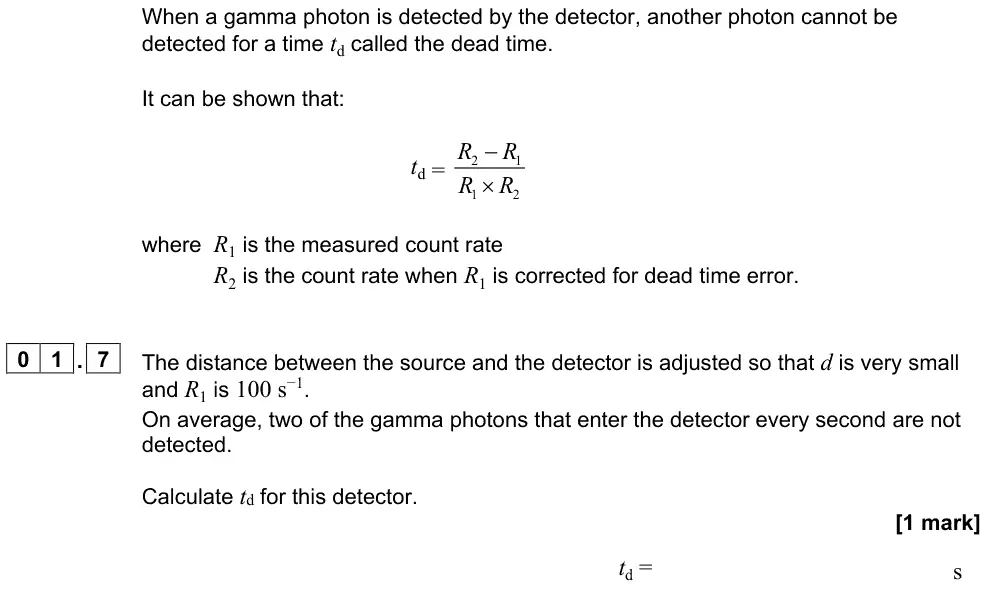
Figure 1 shows a ray of light that is incident on the centre of the core.
At the air–core boundary, the angle of incidence of this ray is θA and the angle of
refraction is θB.
Figure 1
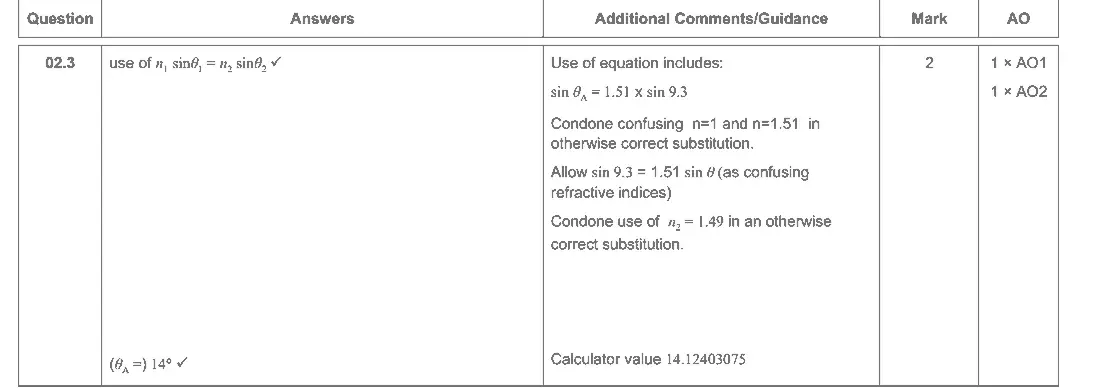
When θB is greater than 9.3°, the ray will not be transmitted through the optical fibre.
Calculate the maximum value of θA for the ray to be transmitted through the
optical fibre.
[2 marks]
maximum value of θA =
°
June 2025 · AS Paper 1 · Q2.4 3 marks AO3=3 Calculation Hard refraction and optical fibres
Earlier part of question 2 that this part usesEarlier part of June 2025 Paper 1 question 2
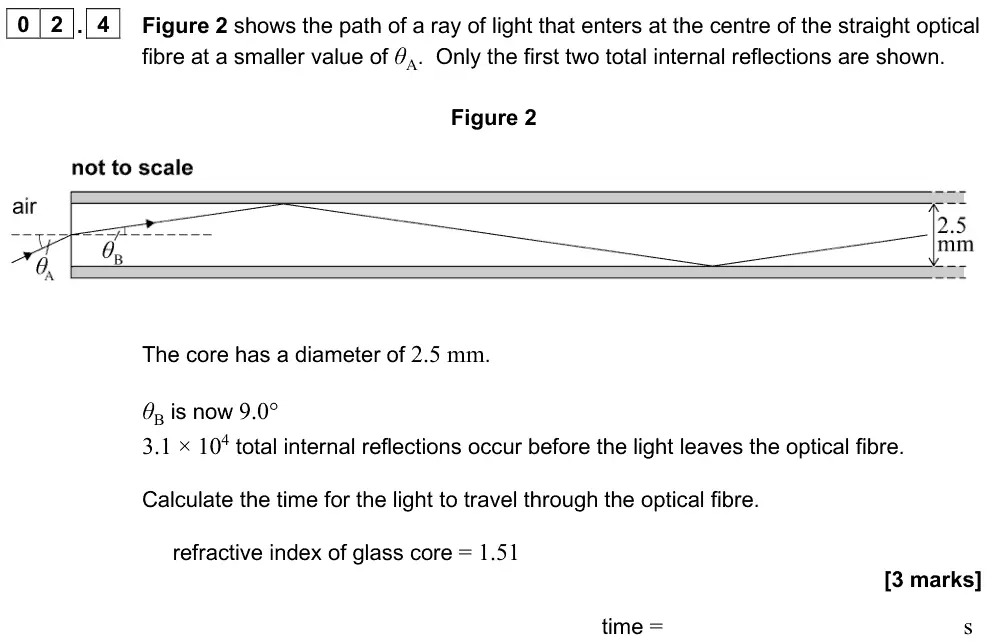
Figure 2 shows the path of a ray of light that enters at the centre of the straight optical
fibre at a smaller value of θA.  Only the first two total internal reflections are shown.
Figure 2
The core has a diameter of 2.5 mm.
θB is now 9.0°
3.1 × 10⁴ total internal reflections occur before the light leaves the optical fibre.
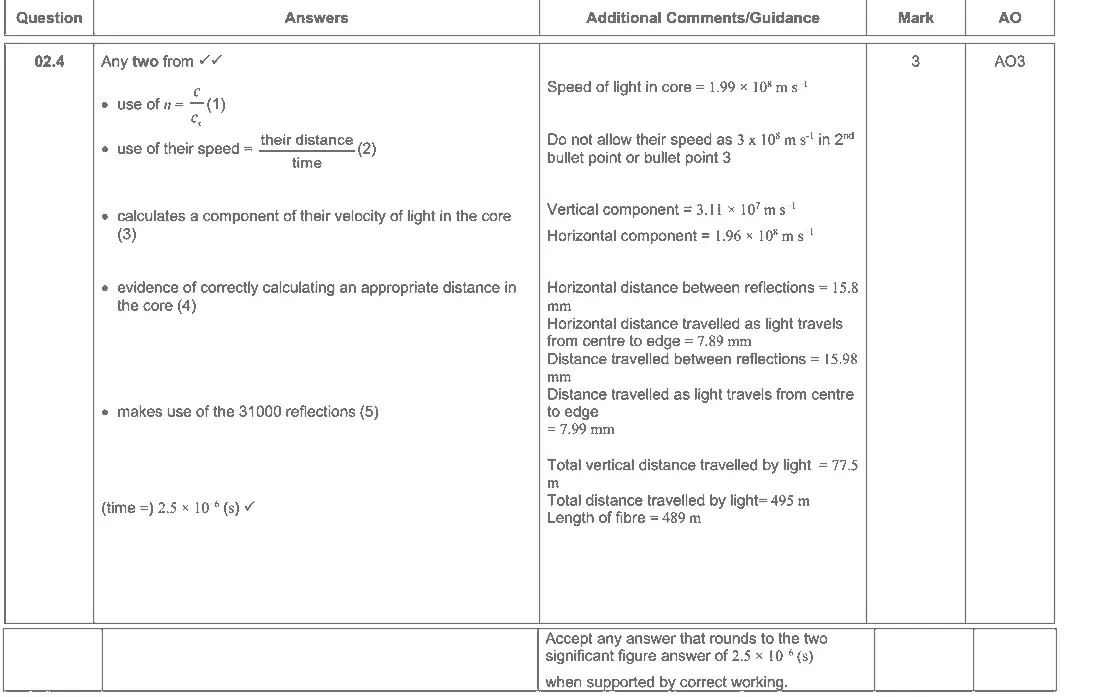
Calculate the time for the light to travel through the optical fibre.
refractive index of glass core = 1.51
[3 marks]
time =
s
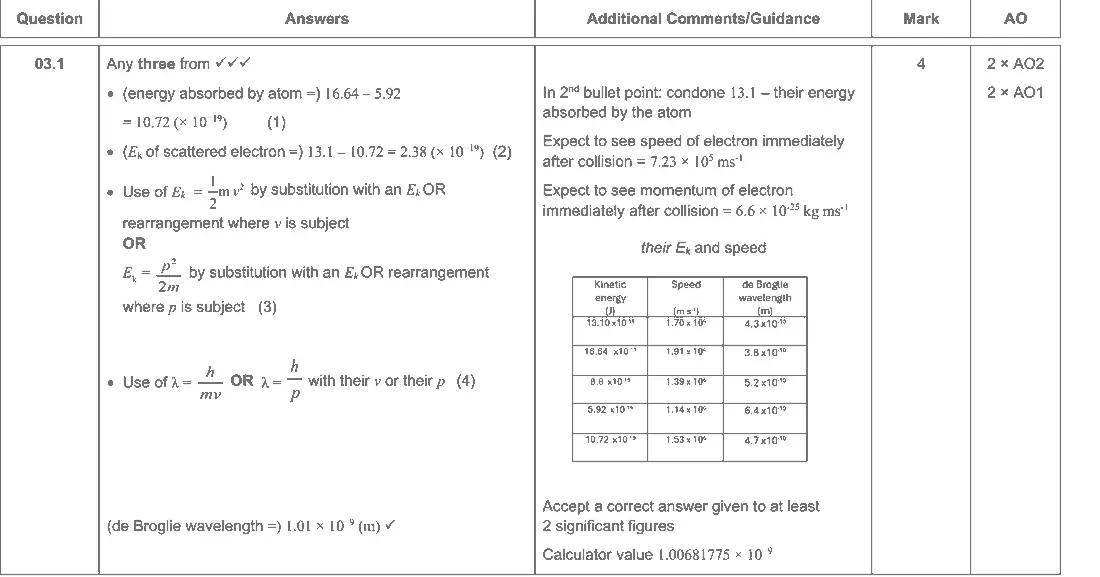
June 2025 · AS Paper 1 · Q3.1 4 marks AO1=2, AO2=2 Calculation Hard energy levels and wave particle duality
A fluorescent tube contains a low-pressure gas consisting of mercury atoms.
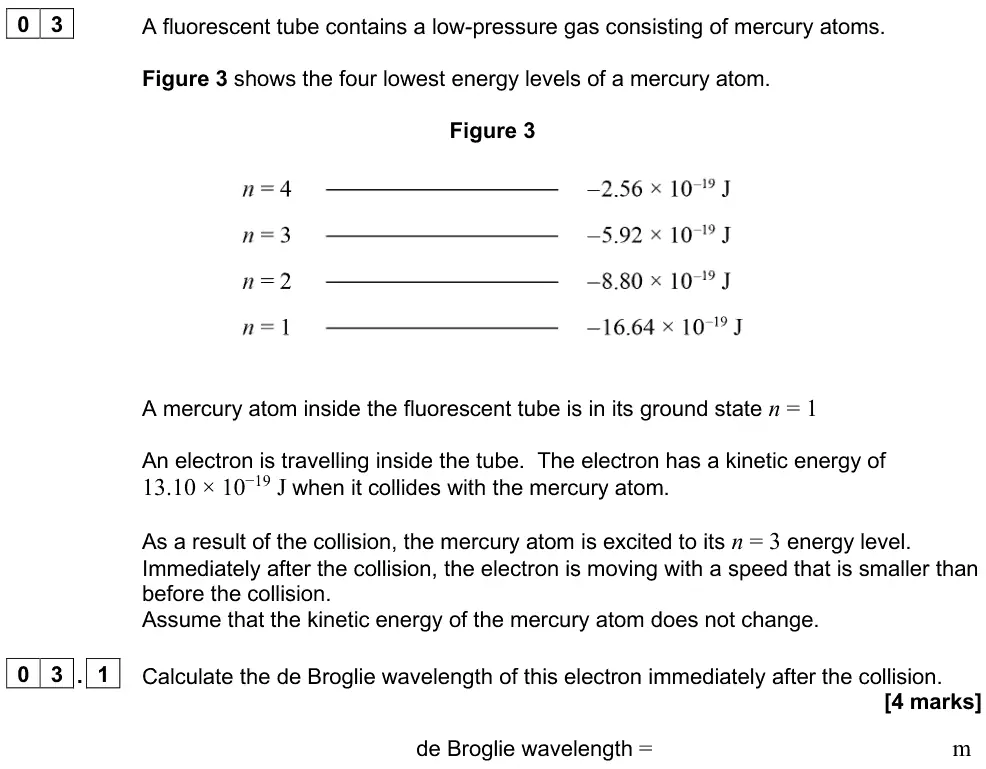
Figure 3 shows the four lowest energy levels of a mercury atom.
Figure 3
A mercury atom inside the fluorescent tube is in its ground state n = 1
An electron is travelling inside the tube.  The electron has a kinetic energy of
13.10 × 10⁻¹⁹ J when it collides with the mercury atom.
As a result of the collision, the mercury atom is excited to its n = 3 energy level.
Immediately after the collision, the electron is moving with a speed that is smaller than
before the collision.
Assume that the kinetic energy of the mercury atom does not change.
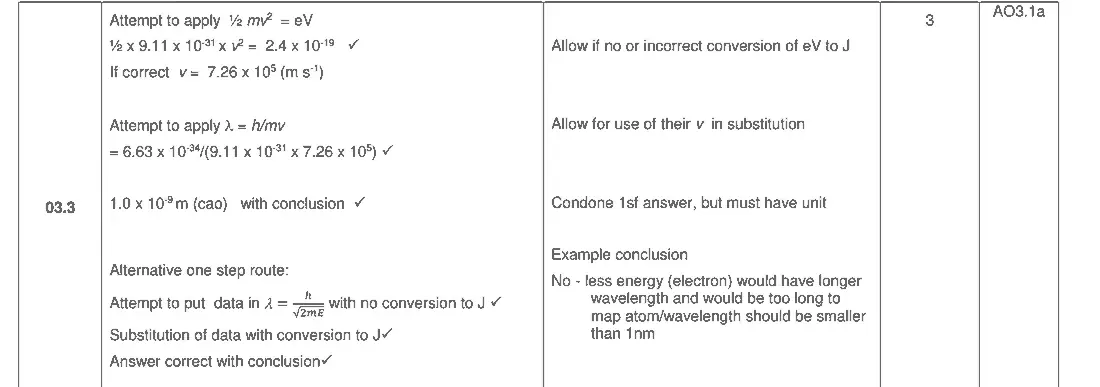
Calculate the de Broglie wavelength of this electron immediately after the collision.
[4 marks]
de Broglie wavelength =
m
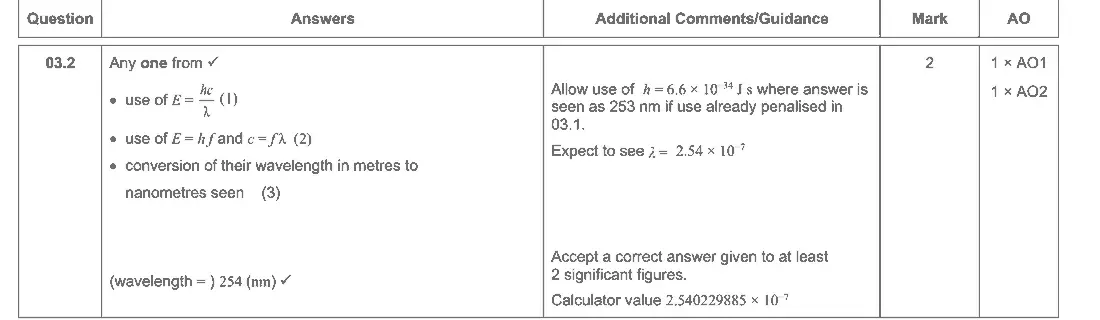
June 2025 · AS Paper 1 · Q3.2 2 marks AO1=1, AO2=1 Calculation Easy particles antiparticles and interactions
Earlier part of question 3 that this part usesEarlier part of June 2025 Paper 1 question 3
The excited mercury atoms inside the fluorescent tube can emit photons of
ultraviolet light, each of energy 7.83 × 10⁻¹⁹ J.
Calculate, in nm, the wavelength of a photon with this energy.
[2 marks]
wavelength =
nm
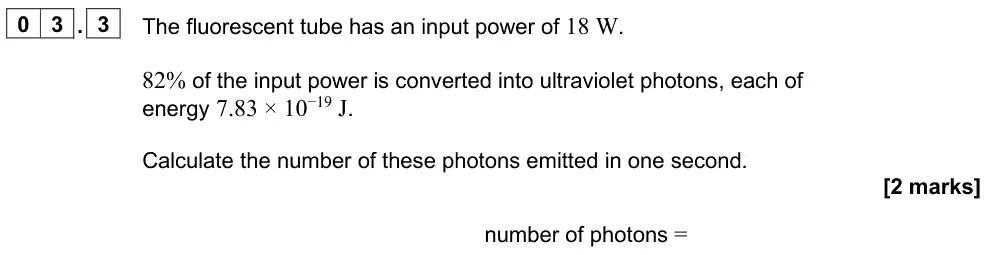
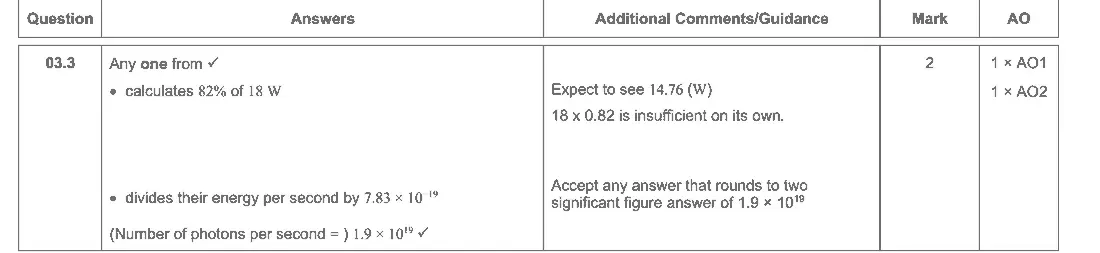
June 2025 · AS Paper 1 · Q3.3 2 marks AO1=1, AO2=1 Calculation particles antiparticles and interactionswork energy and power
Earlier part of question 3 that this part usesEarlier part of June 2025 Paper 1 question 3
The fluorescent tube has an input power of 18 W.
82% of the input power is converted into ultraviolet photons, each of
energy 7.83 × 10⁻¹⁹ J.
Calculate the number of these photons emitted in one second.
[2 marks]
number of photons =
June 2025 · AS Paper 1 · Q4.2 3 marks AO1=1, AO2=2 Calculation Easy vectors and moments
Earlier part of question 4 that this part usesEarlier part of June 2025 Paper 1 question 4
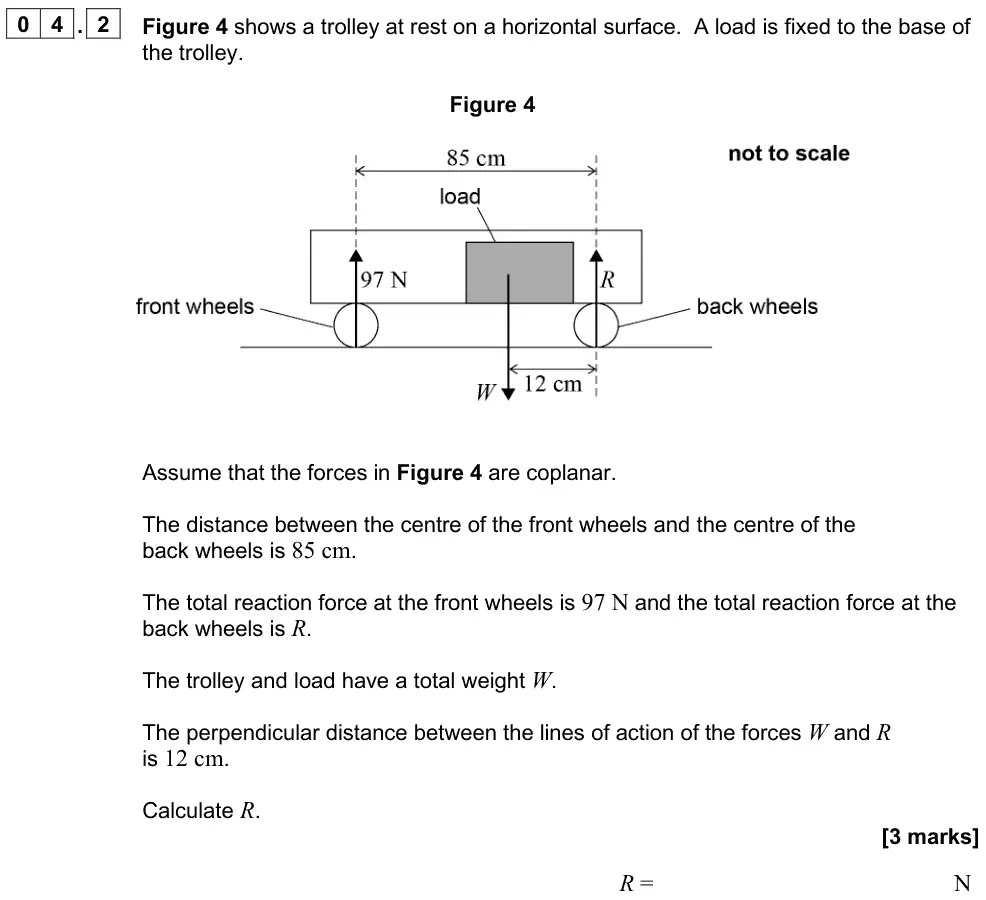
Figure 4 shows a trolley at rest on a horizontal surface.  A load is fixed to the base of
the trolley.
Figure 4
Assume that the forces in Figure 4 are coplanar.
The distance between the centre of the front wheels and the centre of the
back wheels is 85 cm.
The total reaction force at the front wheels is 97 N and the total reaction force at the
back wheels is R.
The trolley and load have a total weight W.
The perpendicular distance between the lines of action of the forces W and R
is 12 cm.
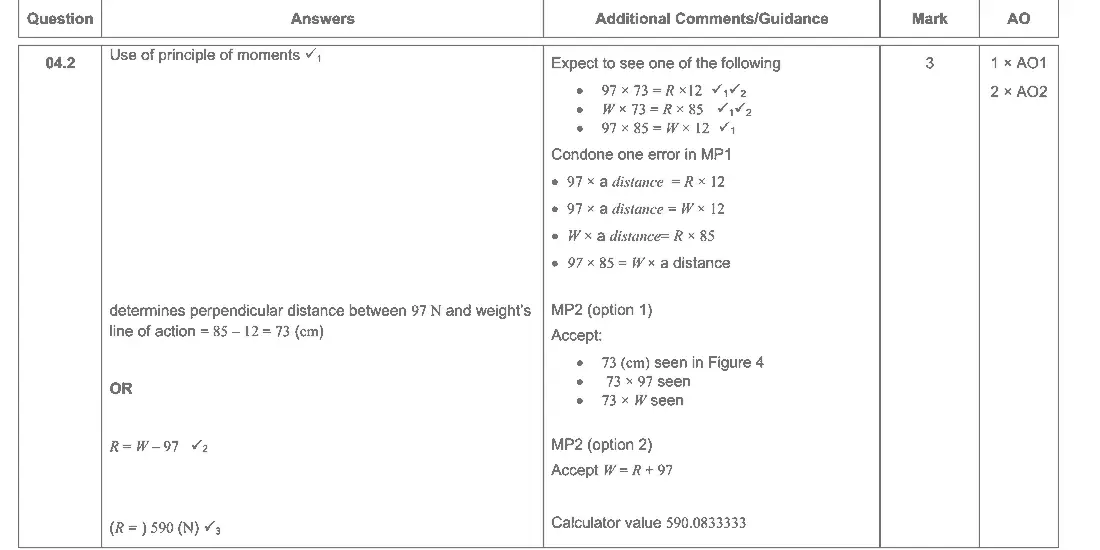
Calculate R.
[3 marks]
R =
N
June 2025 · AS Paper 1 · Q5.1 4 marks AO1=2, AO2=2 Calculation Hard materials and young modulusvectors and moments
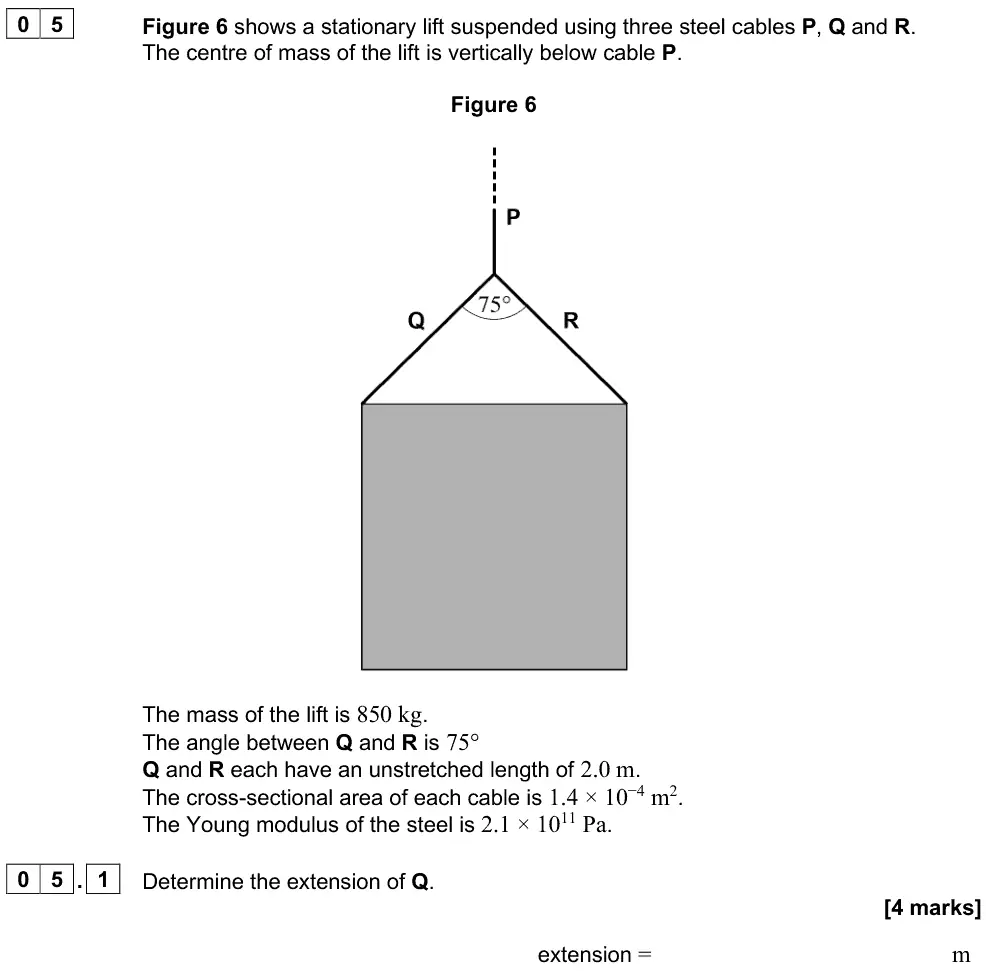
Figure 6 shows a stationary lift suspended using three steel cables P, Q and R.
The centre of mass of the lift is vertically below cable P.
Figure 6
The mass of the lift is 850 kg.
The angle between Q and R is 75°
Q and R each have an unstretched length of 2.0 m.
The cross-sectional area of each cable is 1.4 × 10⁻⁴ m2.
The Young modulus of the steel is 2.1 × 10¹¹ Pa.
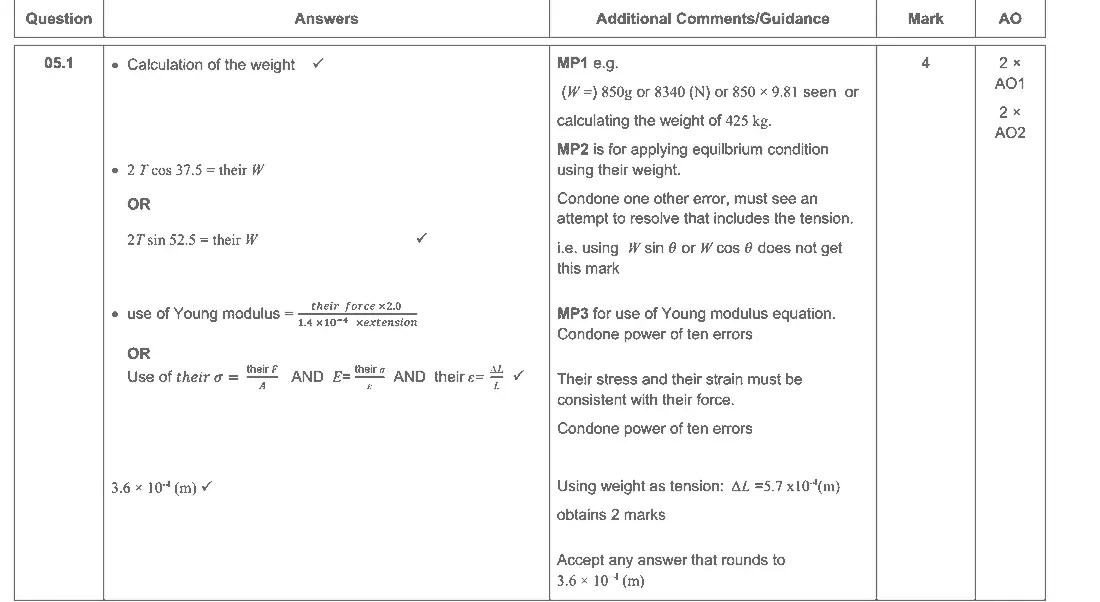
Determine the extension of Q.
[4 marks]
extension =
m
June 2025 · AS Paper 1 · Q5.2 3 marks AO1=2, AO2=1 Calculation motion and projectileswork energy and power
Earlier part of question 5 that this part usesEarlier part of June 2025 Paper 1 question 5
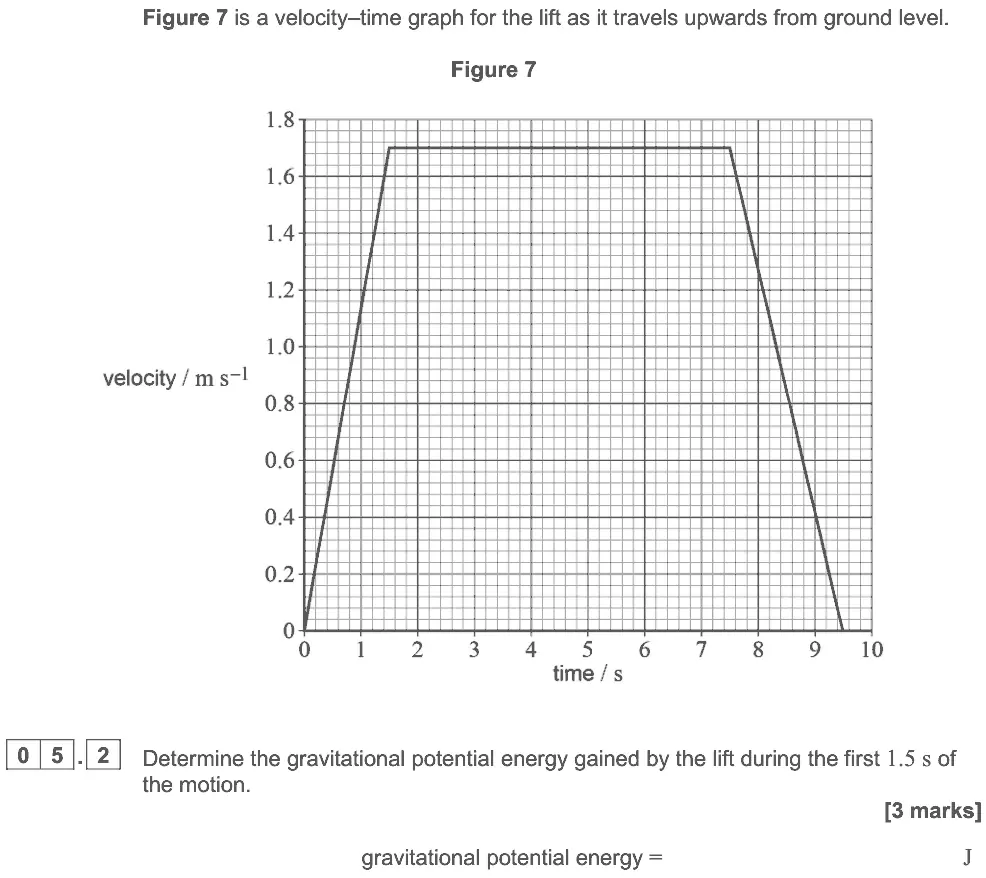
Figure 7 is a velocity–time graph for the lift as it travels upwards from ground level.
Figure 7
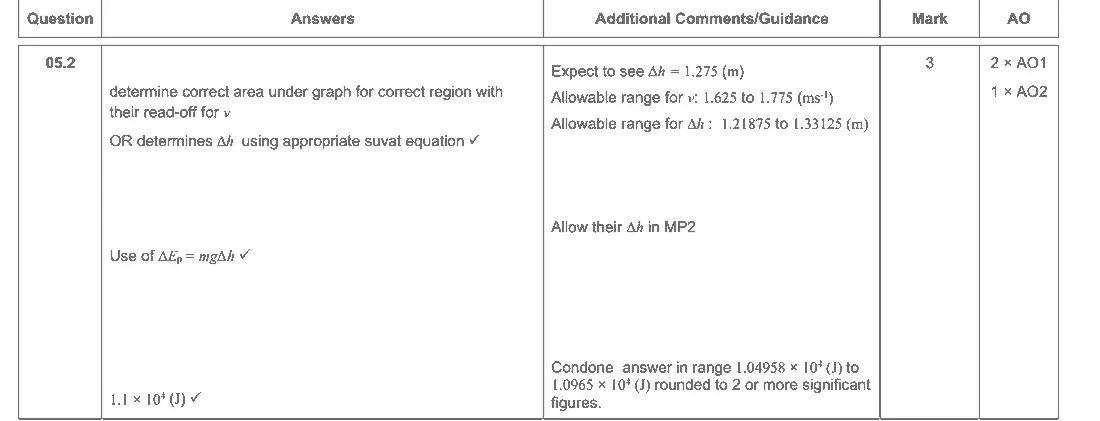
Determine the gravitational potential energy gained by the lift during the first 1.5 s of
the motion.
[3 marks]
gravitational potential energy =
J
June 2025 · AS Paper 1 · Q5.3 3 marks AO2=3 Calculation newtons laws and momentummotion and projectiles
Earlier part of question 5 that this part usesEarlier part of June 2025 Paper 1 question 5
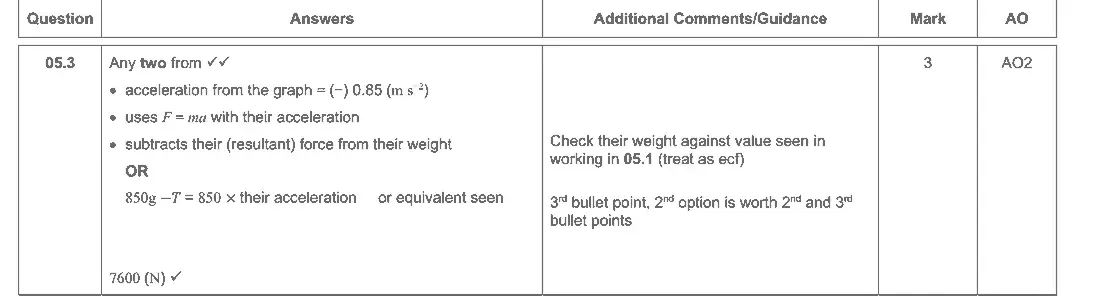
Q and R are connected to P as shown in Figure 6.
Determine the tension in P during the last 2.0 s of the motion.
[3 marks]
tension =
N
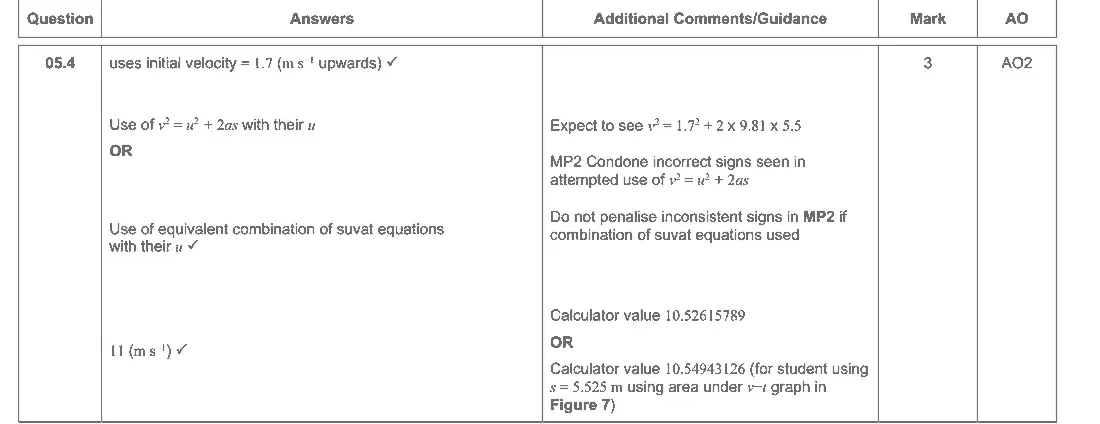
June 2025 · AS Paper 1 · Q5.4 3 marks AO2=3 Calculation Hard motion and projectiles
Earlier part of question 5 that this part usesEarlier part of June 2025 Paper 1 question 5
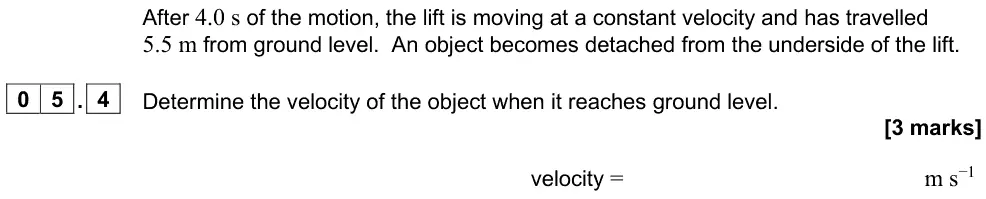
After 4.0 s of the motion, the lift is moving at a constant velocity and has travelled
5.5 m from ground level.  An object becomes detached from the underside of the lift.
Determine the velocity of the object when it reaches ground level.
[3 marks]
velocity =
m s−1
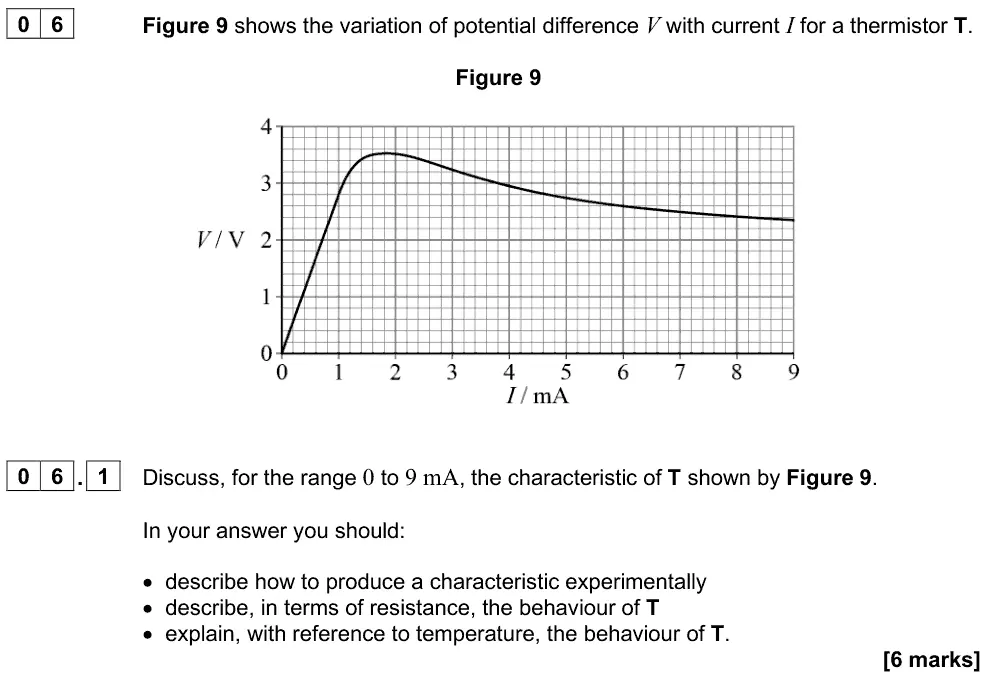
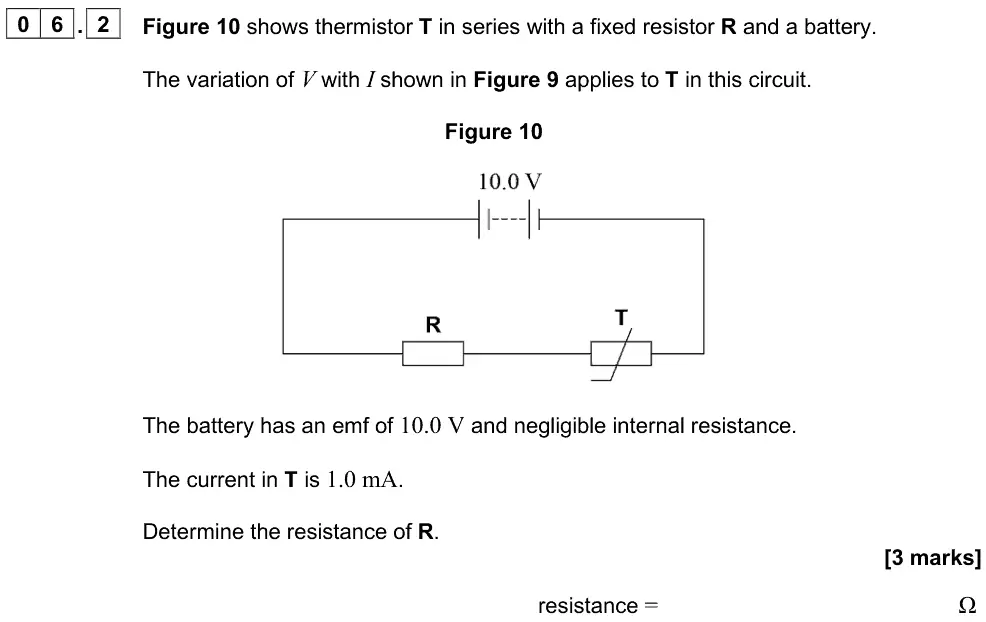
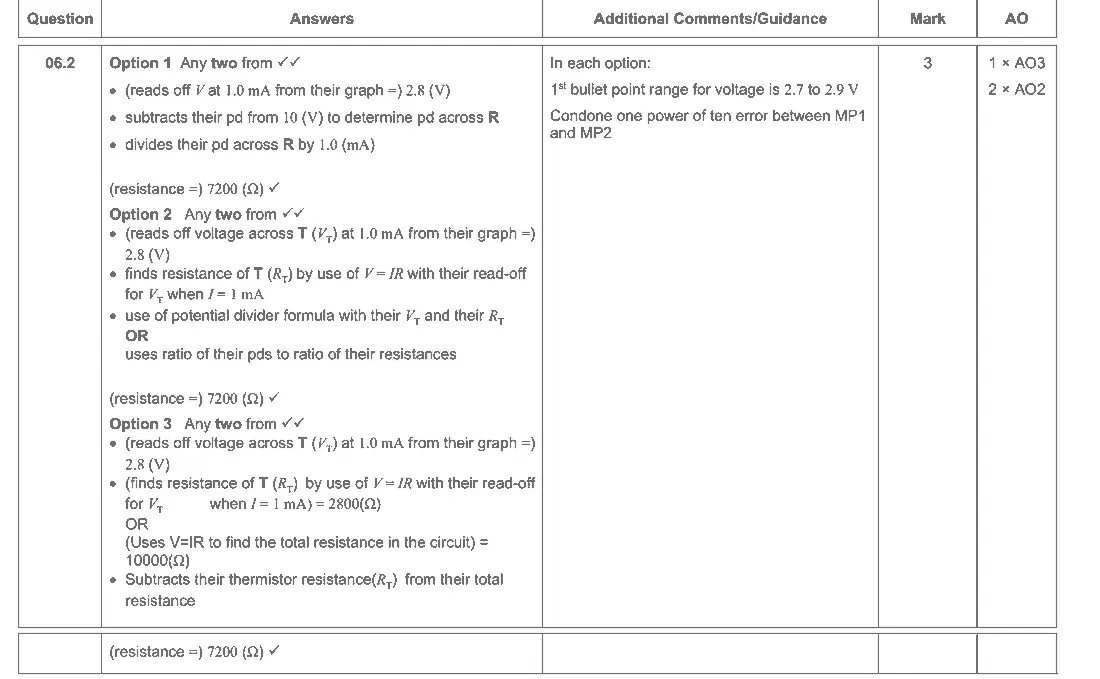
June 2025 · AS Paper 1 · Q6.2 3 marks AO2=2, AO3=1 Calculation circuits and potential dividerscurrent voltage and resistivity
Earlier part of question 6 that this part usesEarlier part of June 2025 Paper 1 question 6
Figure 10 shows thermistor T in series with a fixed resistor R and a battery.
The variation of V with I shown in Figure 9 applies to T in this circuit.
Figure 10
The battery has an emf of 10.0 V and negligible internal resistance.
The current in T is 1.0 mA.
Determine the resistance of R.
[3 marks]
resistance =
Ω
June 2025 · AS Paper 1 · Q7.2 1 mark AO1=1 Calculation photoelectric effectenergy levels and wave particle duality
Earlier part of question 7 that this part usesEarlier part of June 2025 Paper 1 question 7
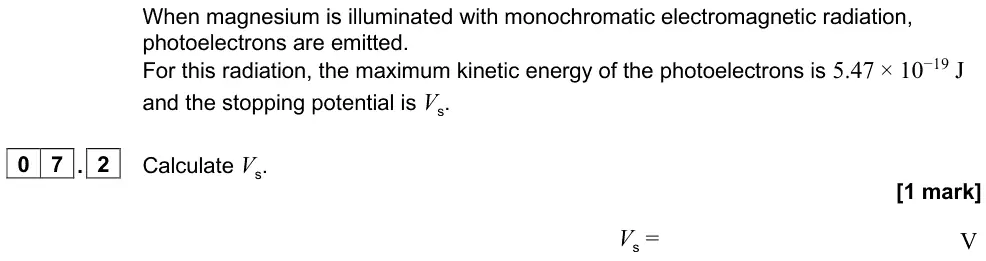
When magnesium is illuminated with monochromatic electromagnetic radiation,
photoelectrons are emitted.
For this radiation, the maximum kinetic energy of the photoelectrons is 5.47 × 10⁻¹⁹ J
and the stopping potential is Vs.
Calculate Vs.
[1 mark]
Vs =
V
June 2025 · AS Paper 1 · Q7.3 2 marks AO2=2 Calculation Easy photoelectric effect
Earlier part of question 7 that this part usesEarlier part of June 2025 Paper 1 question 7
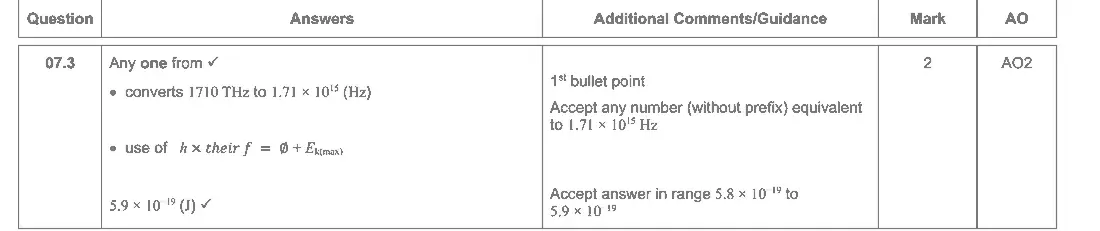
The radiation incident on the magnesium has a frequency of 1710 THz.
Calculate the work function of the magnesium.
[2 marks]
work function =
J
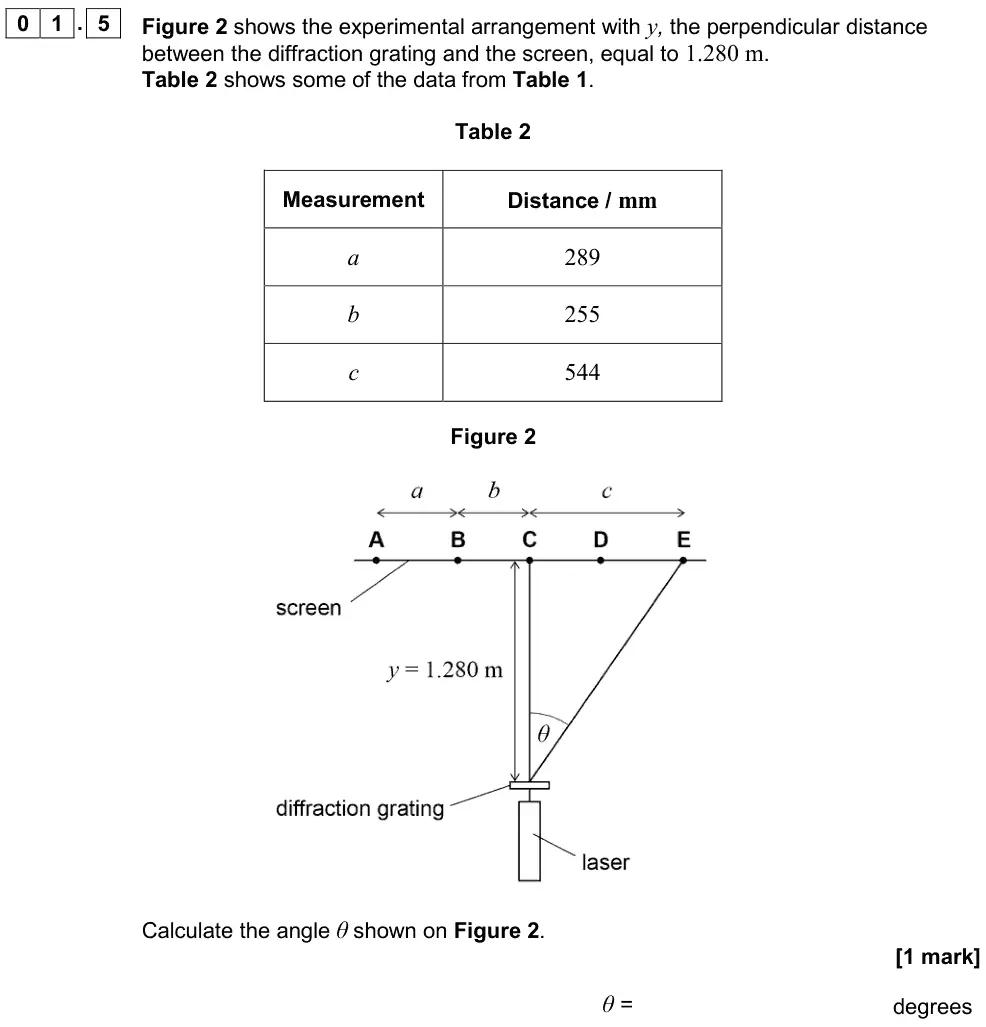
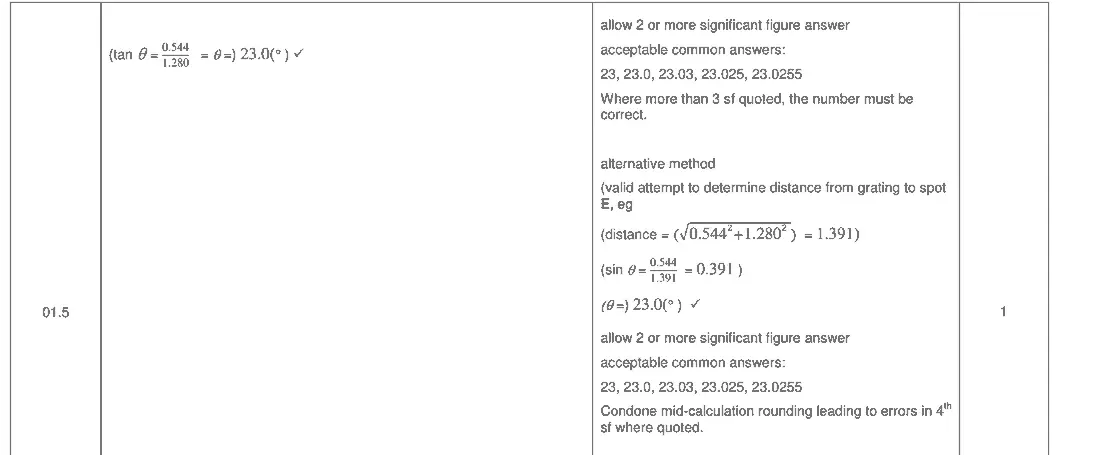
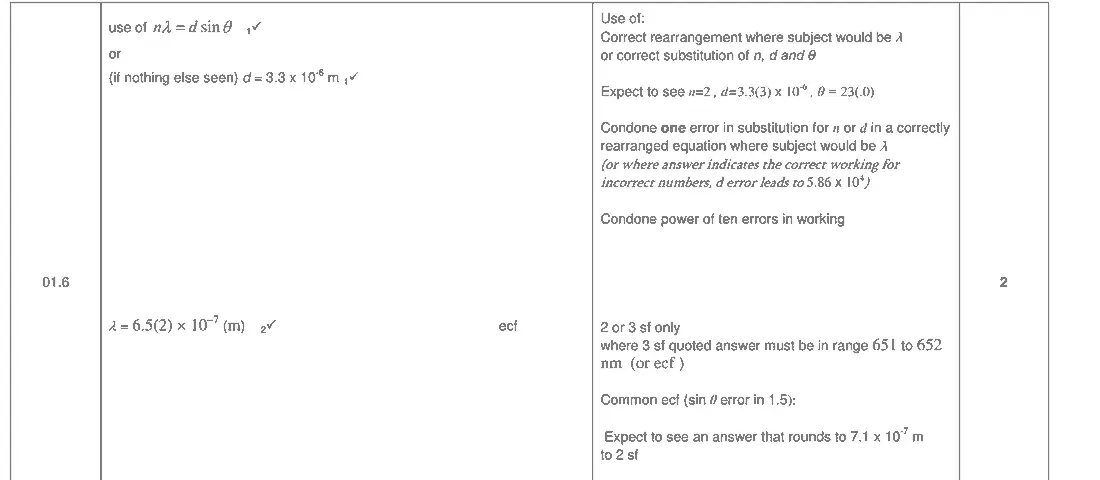
June 2025 · AS Paper 2 · Q1.3 3 marks AO2=2, AO3=1 Calculation Hard interference and diffraction
Earlier part of question 1 that this part usesEarlier part of June 2025 Paper 2 question 1
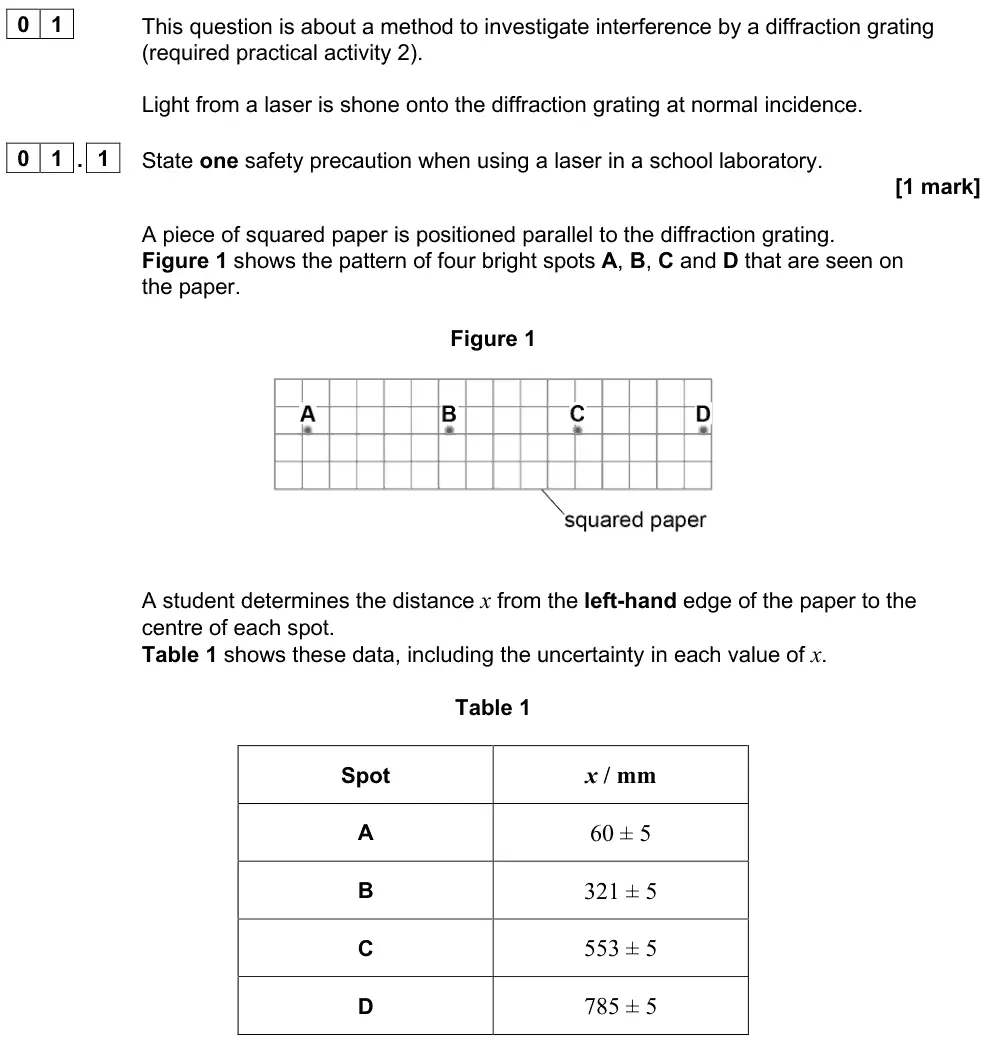
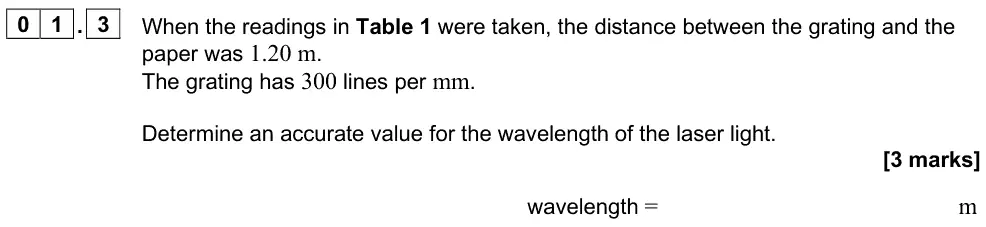
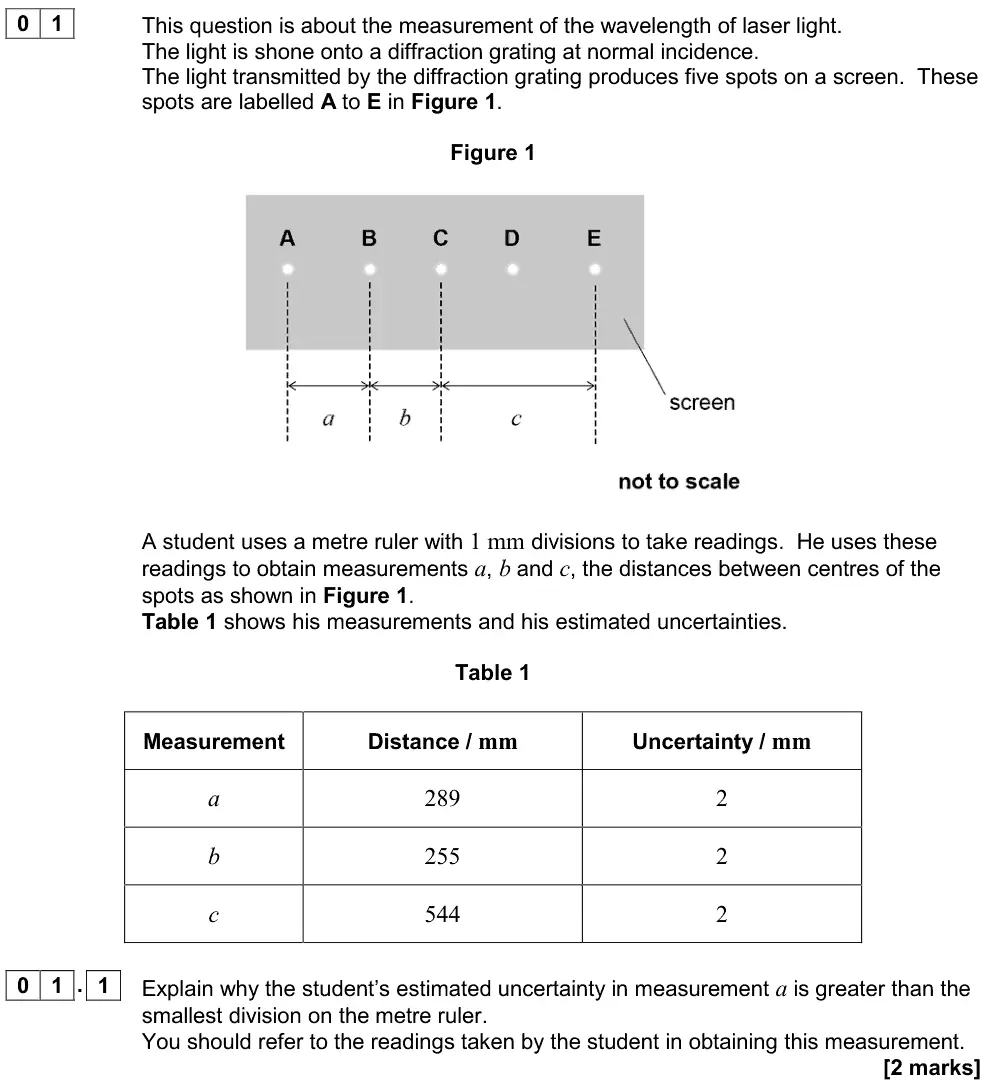
When the readings in Table 1 were taken, the distance between the grating and the
paper was 1.20 m.
The grating has 300 lines per mm.
Determine an accurate value for the wavelength of the laser light.
[3 marks]
wavelength =
m
June 2025 · AS Paper 2 · Q1.4 2 marks AO3=2 Calculation Hard interference and diffraction
Earlier part of question 1 that this part usesEarlier part of June 2025 Paper 2 question 1
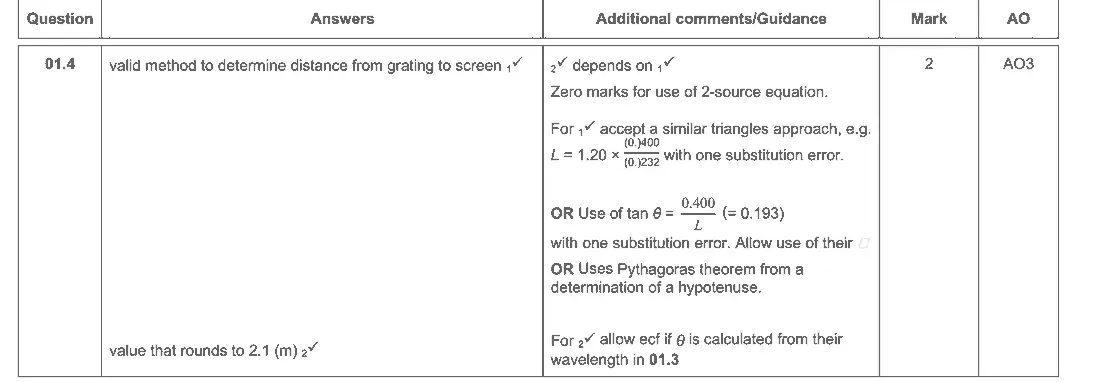
The student changes the distance between the grating and the paper so that
B and D are at the edges of the paper as shown in Figure 2.
The paper and diffraction grating remain parallel.
Figure 2
Determine the new distance between the grating and the paper.
[2 marks]
distance =
m
June 2025 · AS Paper 2 · Q3.3 2 marks AO1=1, AO2=1 Calculation Hard circuits and potential dividersemf and internal resistance
Earlier part of question 3 that this part usesEarlier part of June 2025 Paper 2 question 3
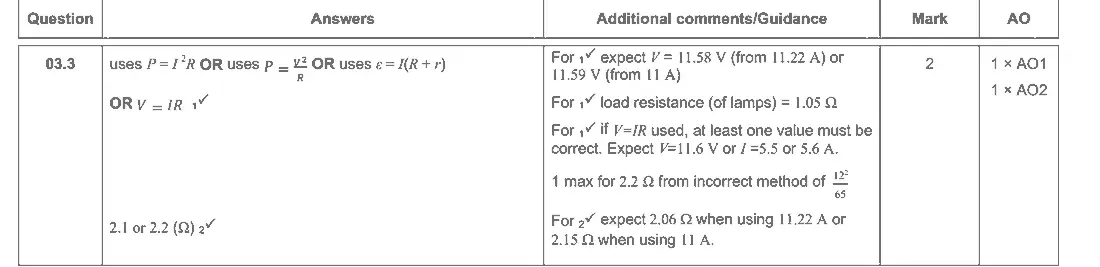
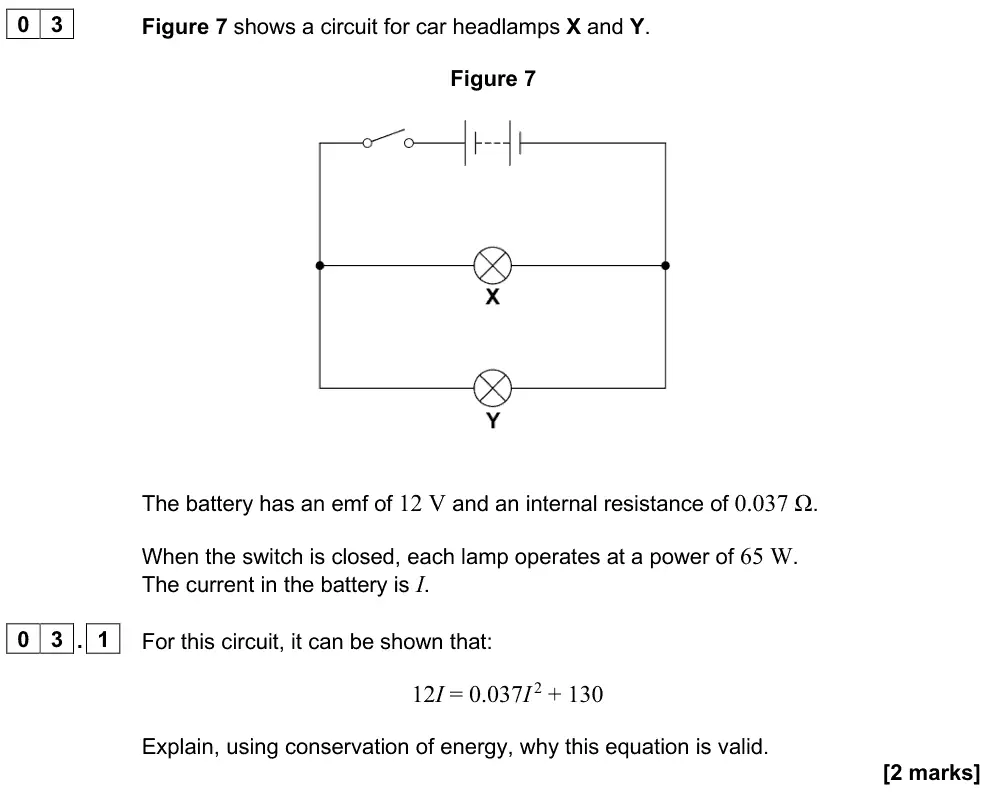
Determine the resistance of X when it operates at a power of 65 W.
[2 marks]
resistance of X =
Ω
June 2025 · AS Paper 2 · Q4.1 2 marks AO2=2 Calculation motion and projectilesvectors and moments
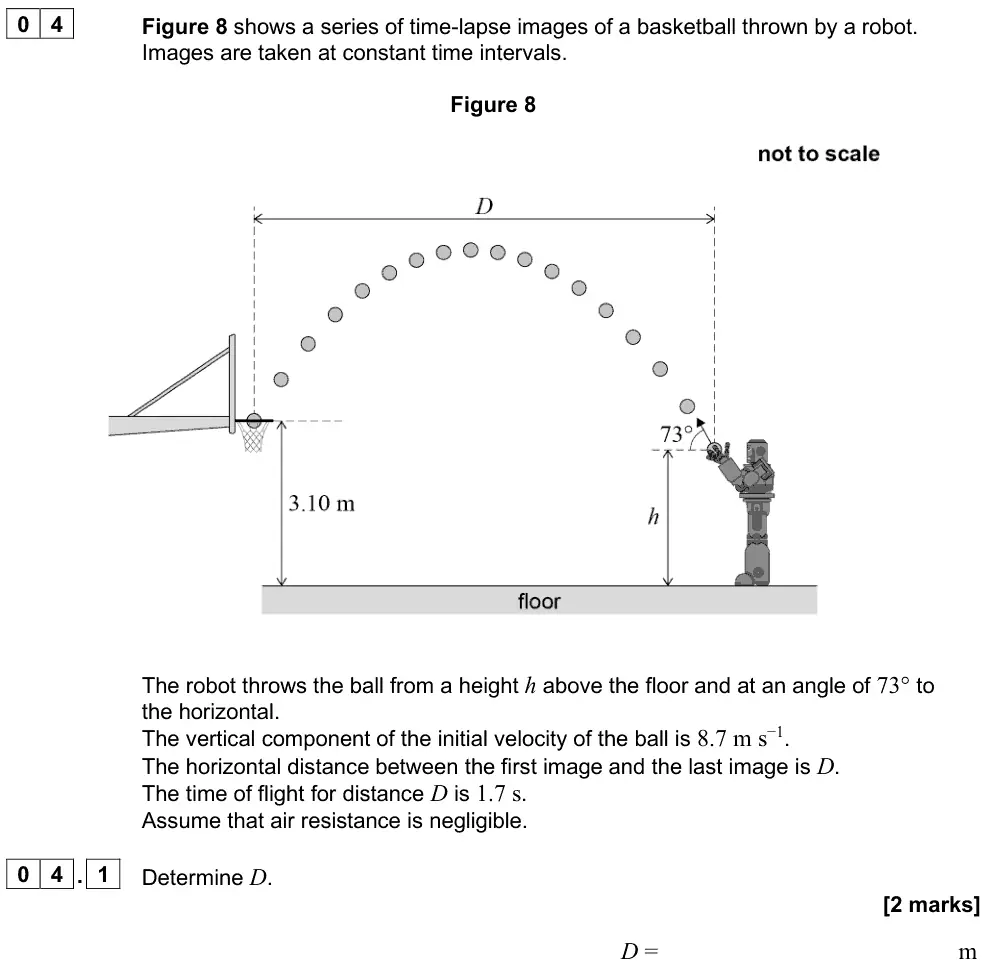
Figure 8 shows a series of time-lapse images of a basketball thrown by a robot.
Images are taken at constant time intervals.
Figure 8
The robot throws the ball from a height h above the floor and at an angle of 73° to
the horizontal.
The vertical component of the initial velocity of the ball is 8.7 m s−1.
The horizontal distance between the first image and the last image is D.
The time of flight for distance D is 1.7 s.
Assume that air resistance is negligible.
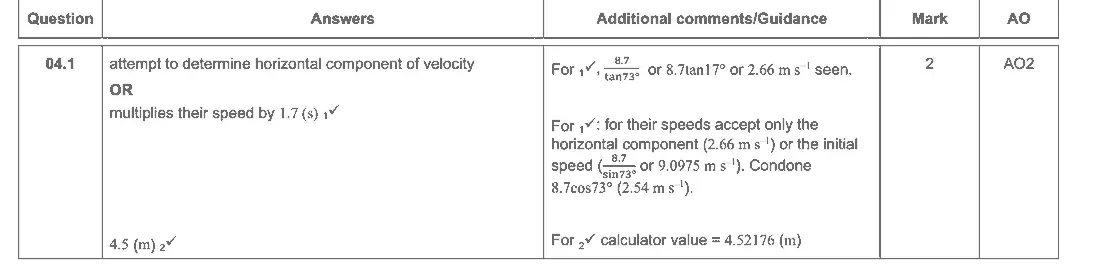
Determine D.
[2 marks]
D =
m
June 2025 · AS Paper 2 · Q4.2 3 marks AO2=3 Calculation Hard motion and projectiles
Earlier part of question 4 that this part usesEarlier part of June 2025 Paper 2 question 4
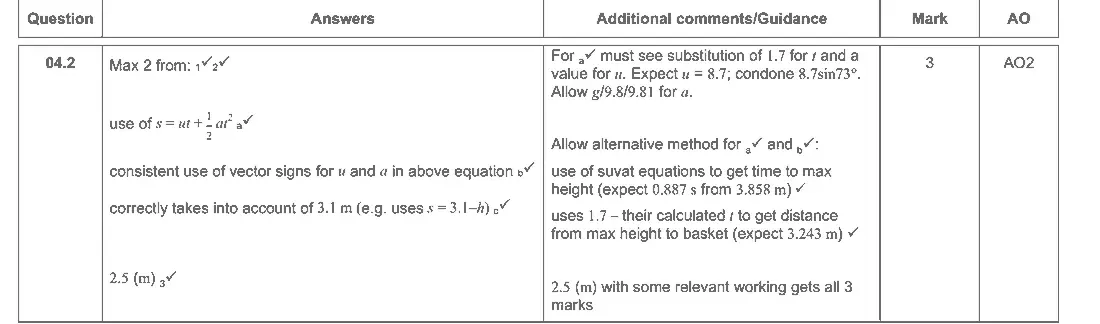
The vertical displacement of the ball from the floor in the last image is 3.10 m.
Determine h.
[3 marks]
h =
m
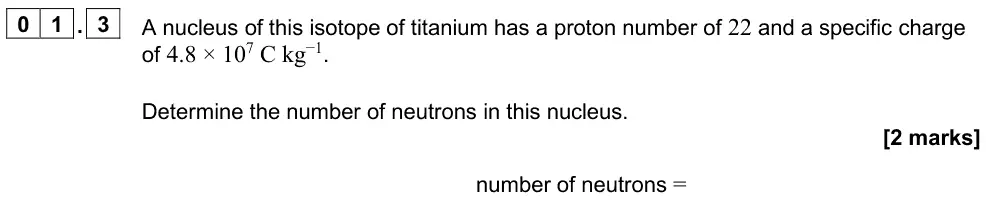
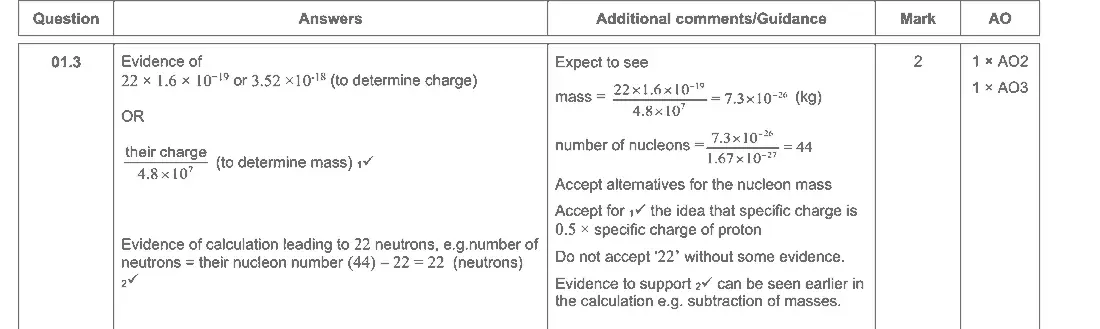
June 2025 · Paper 1 · Q1.3 2 marks AO2=1, AO3=1 Calculation Easy atomic structure and stable nuclei
Earlier part of question 1 that this part usesEarlier part of June 2025 Paper 1 question 1
A nucleus of this isotope of titanium has a proton number of 22 and a specific charge
of 4.8 × 10⁷ C kg−1.
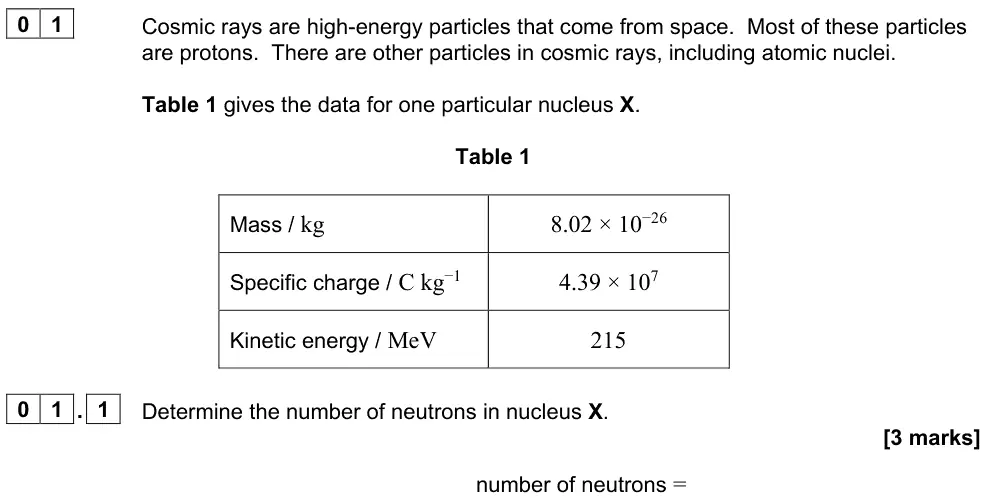
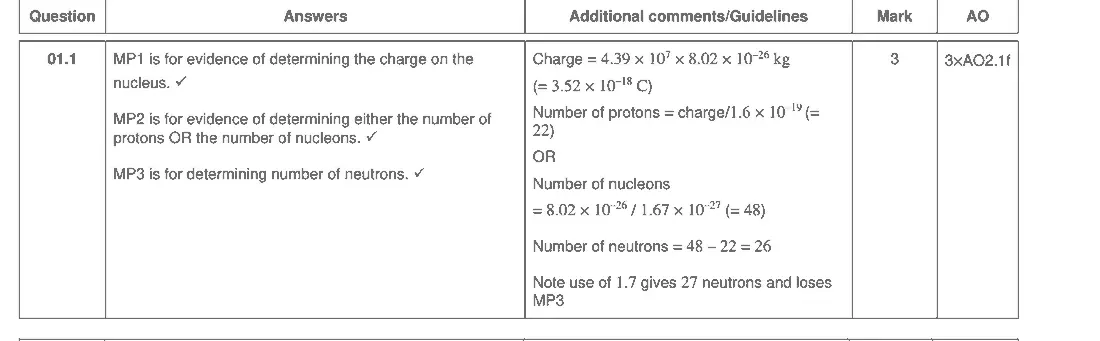
Determine the number of neutrons in this nucleus.
[2 marks]
number of neutrons =
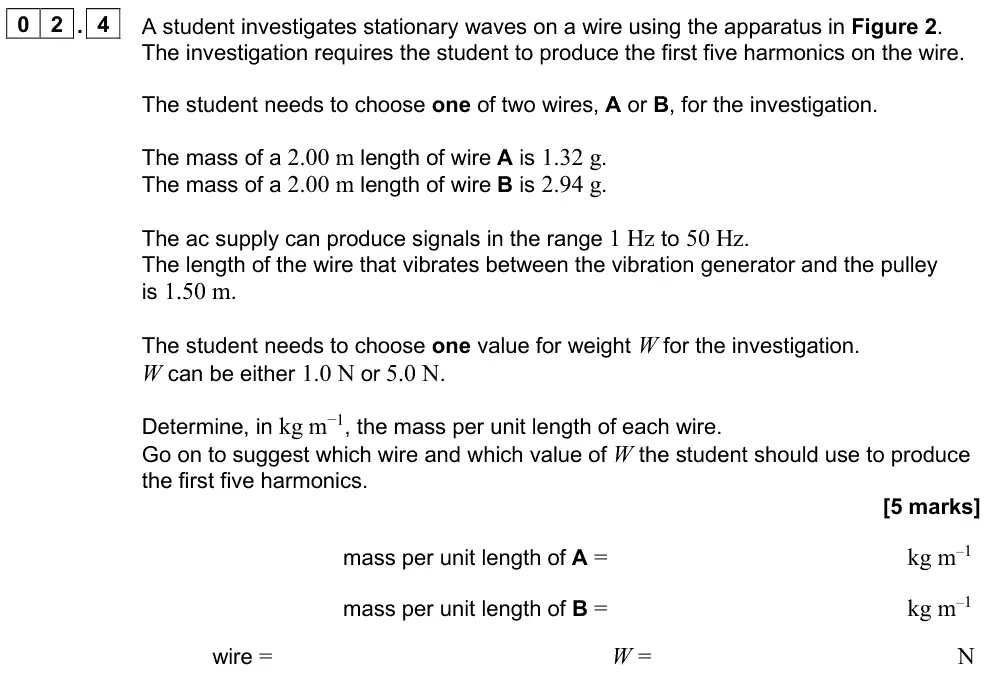
June 2025 · Paper 1 · Q2.4 5 marks AO1=1, AO3=4 Calculation stationary waves
Earlier part of question 2 that this part usesEarlier part of June 2025 Paper 1 question 2
A student investigates stationary waves on a wire using the apparatus in Figure 2.
The investigation requires the student to produce the first five harmonics on the wire.
The student needs to choose one of two wires, A or B, for the investigation.
The mass of a 2.00 m length of wire A is 1.32 g.
The mass of a 2.00 m length of wire B is 2.94 g.
The ac supply can produce signals in the range 1 Hz to 50 Hz.
The length of the wire that vibrates between the vibration generator and the pulley
is 1.50 m.
The student needs to choose one value for weight W for the investigation.
W can be either 1.0 N or 5.0 N.
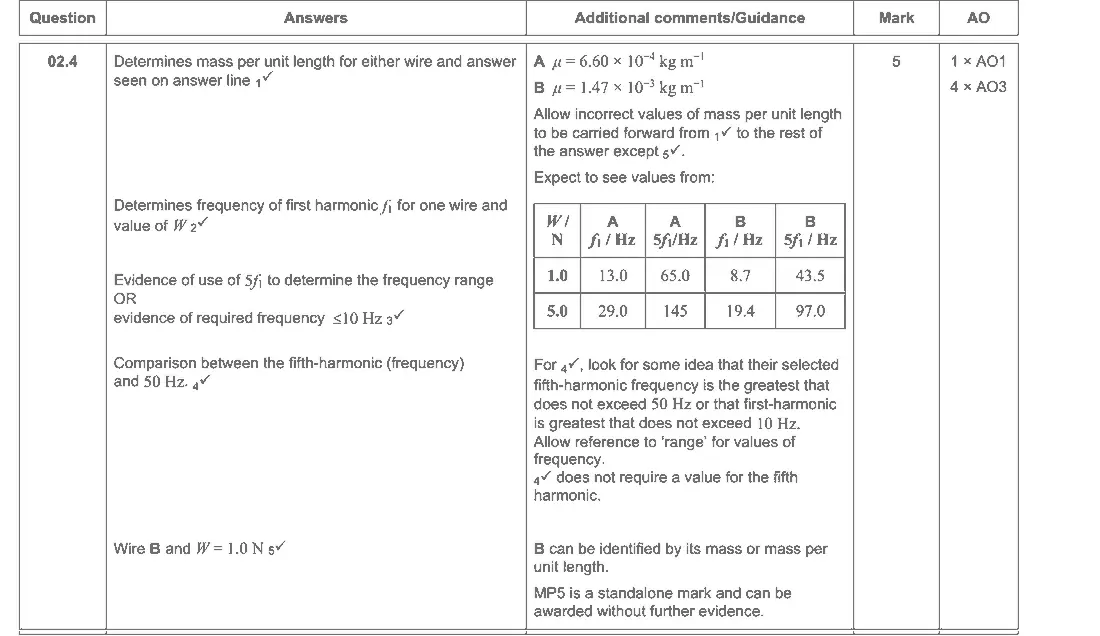
Determine, in kg m−1, the mass per unit length of each wire.
Go on to suggest which wire and which value of W the student should use to produce
the first five harmonics.
[5 marks]
mass per unit length of A =
kg m–1
mass per unit length of B =
kg m–1
wire =
W =
N
June 2025 · Paper 1 · Q4.2 3 marks AO3=3 Calculation Easy materials and young modulus
Earlier part of question 4 that this part usesEarlier part of June 2025 Paper 1 question 4
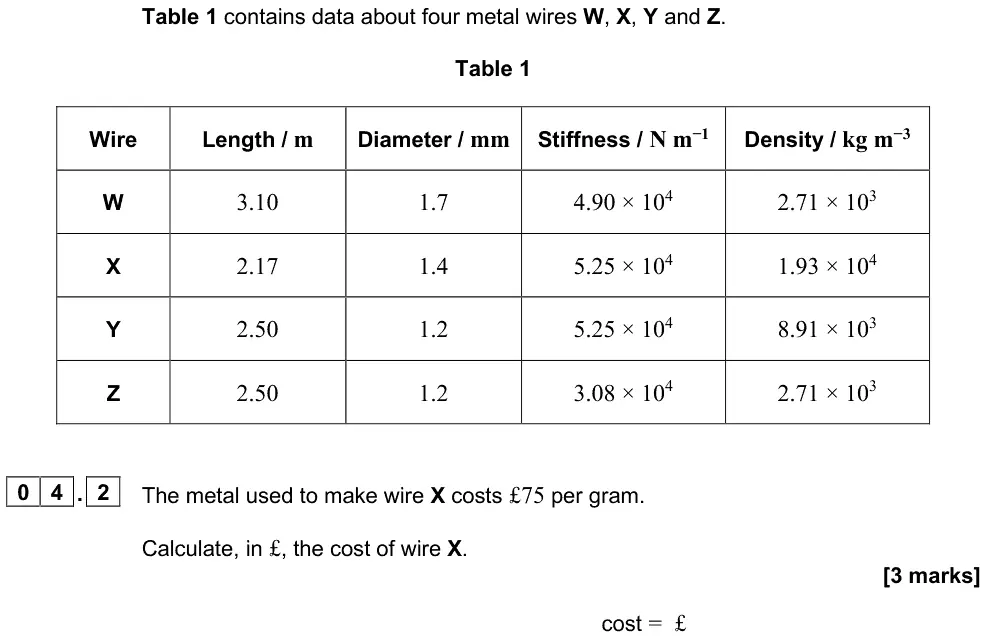
Table 1 contains data about four metal wires W, X, Y and Z.
Table 1
Wire
Length / m
Diameter / mm
Stiffness / N m−1
Density / kg m−3
W
3.10
1.7
4.90 × 10⁴
2.71 × 103
X
2.17
1.4
5.25 × 10⁴
1.93 × 10⁴
Y
2.50
1.2
5.25 × 10⁴
8.91 × 10³
Z
2.50
1.2
3.08 × 10⁴
2.71 × 10³
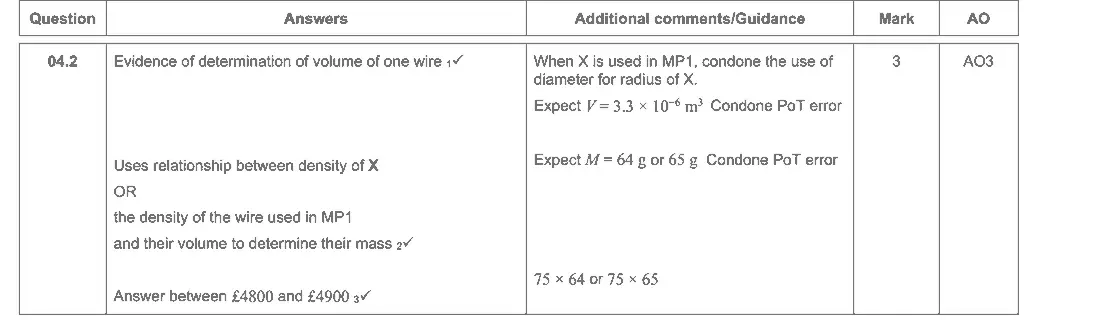
The metal used to make wire X costs £75 per gram.
Calculate, in £, the cost of wire X.
[3 marks]
cost = £
June 2025 · Paper 1 · Q5.1 1 mark AO1=1 Calculation Easy emf and internal resistance
This question is about the batteries used to store energy in electric vehicles.
Each battery is a series of modules.  Each module is an array of identical cells.
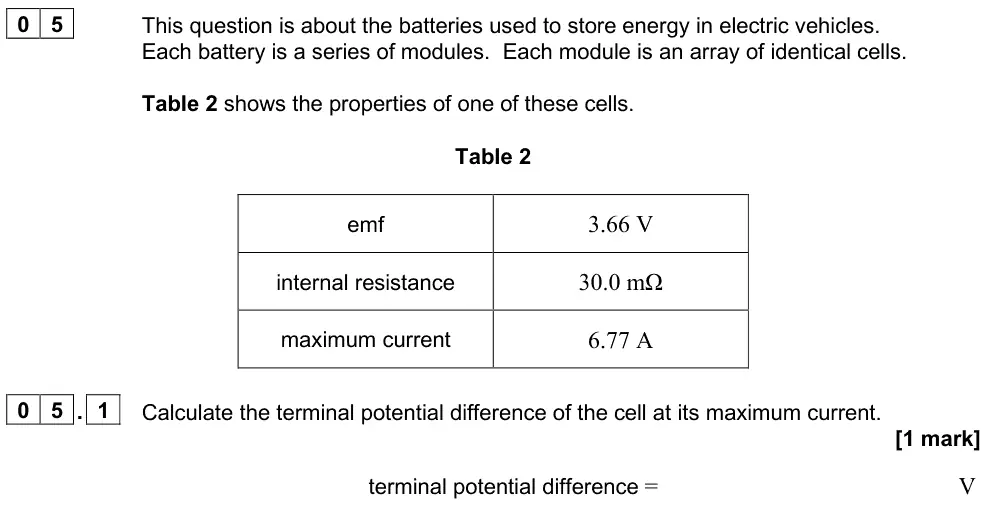
Table 2 shows the properties of one of these cells.
Table 2
emf
3.66 V
internal resistance
30.0 mΩ
maximum current
6.77 A
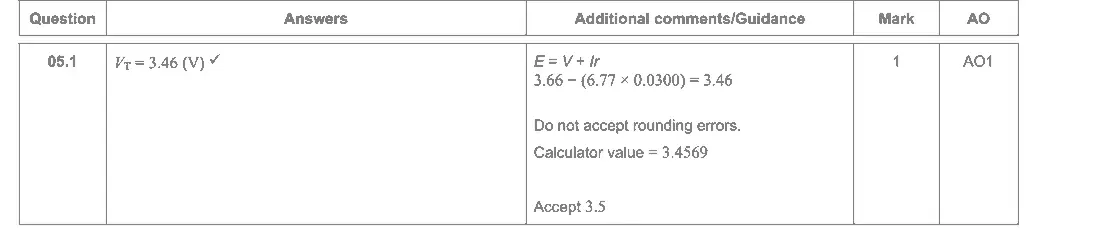
Calculate the terminal potential difference of the cell at its maximum current.
[1 mark]
terminal potential difference =
V
June 2025 · Paper 1 · Q5.2 2 marks AO1=1, AO2=1 Calculation circuits and potential dividersemf and internal resistance
Earlier part of question 5 that this part usesEarlier part of June 2025 Paper 1 question 5
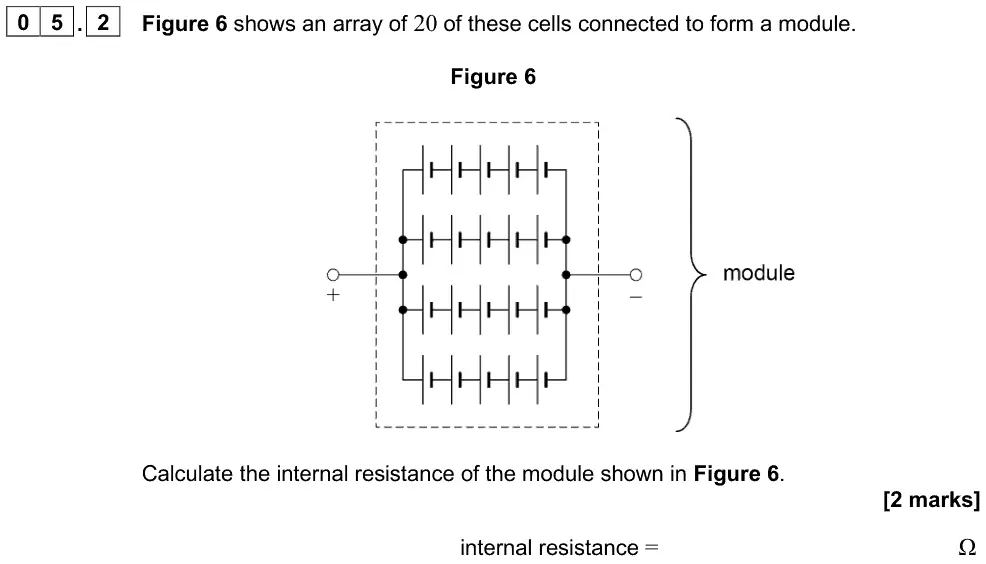
Figure 6 shows an array of 20 of these cells connected to form a module.
Figure 6
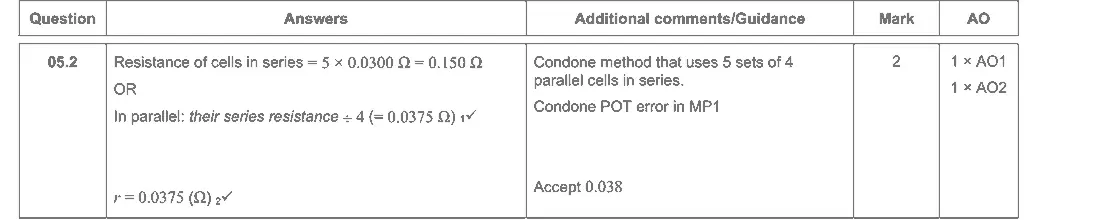
Calculate the internal resistance of the module shown in Figure 6.
[2 marks]
internal resistance =
Ω
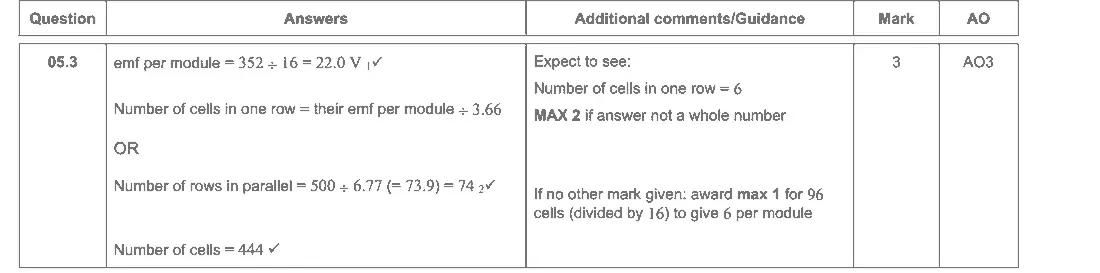
June 2025 · Paper 1 · Q5.3 3 marks AO3=3 Calculation circuits and potential dividersemf and internal resistance
Earlier part of question 5 that this part usesEarlier part of June 2025 Paper 1 question 5
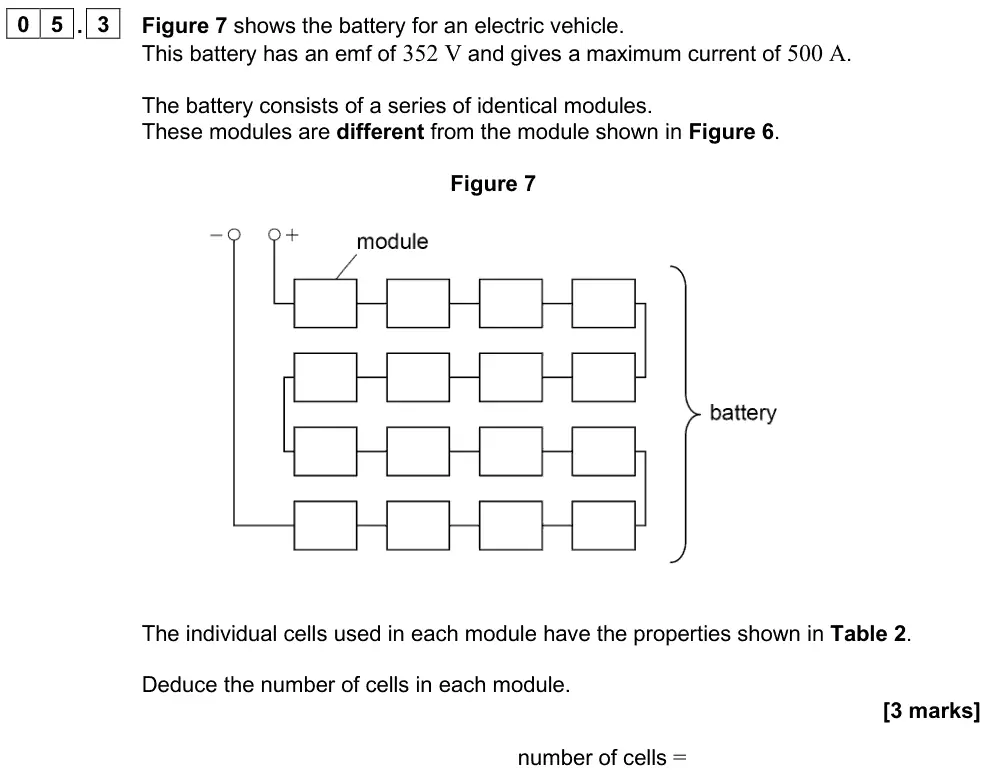
Figure 7 shows the battery for an electric vehicle.
This battery has an emf of 352 V and gives a maximum current of 500 A.
The battery consists of a series of identical modules.
These modules are different from the module shown in Figure 6.
Figure 7
The individual cells used in each module have the properties shown in Table 2.
Deduce the number of cells in each module.
[3 marks]
number of cells =
June 2025 · Paper 1 · Q6.1 2 marks AO1=1, AO2=1 Calculation Easy newtons laws and momentumwork energy and power
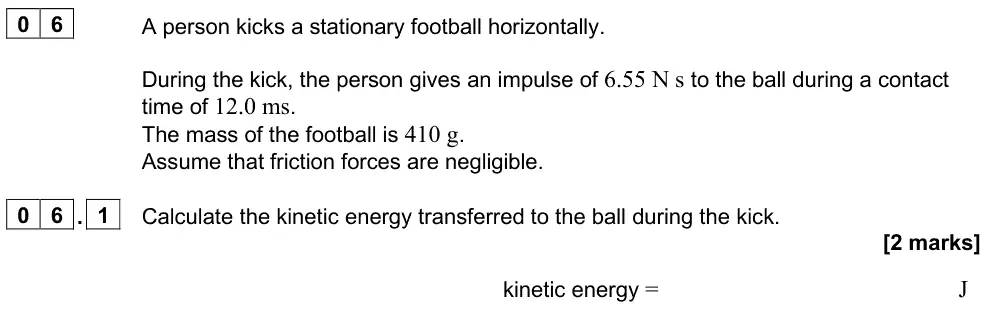
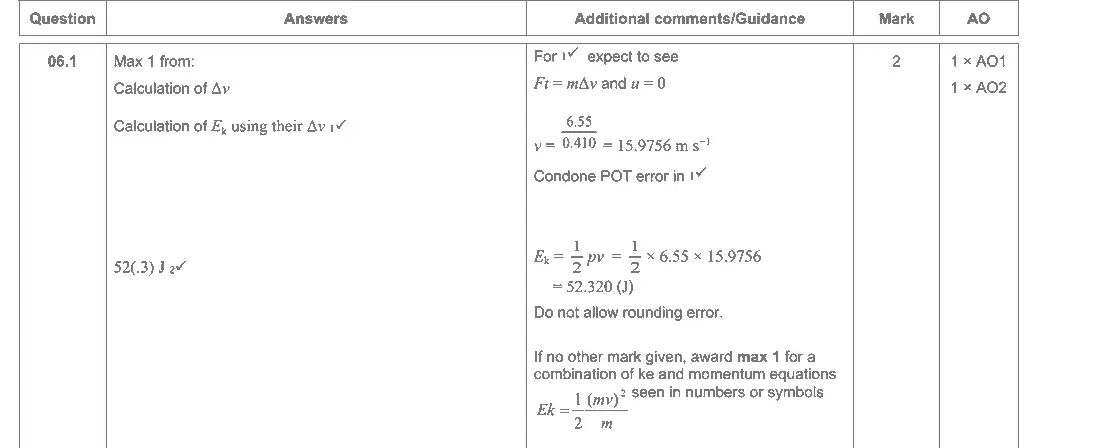
A person kicks a stationary football horizontally.
During the kick, the person gives an impulse of 6.55 N s to the ball during a contact
time of 12.0 ms.
The mass of the football is 410 g.
Assume that friction forces are negligible.
Calculate the kinetic energy transferred to the ball during the kick.
[2 marks]
kinetic energy =
J
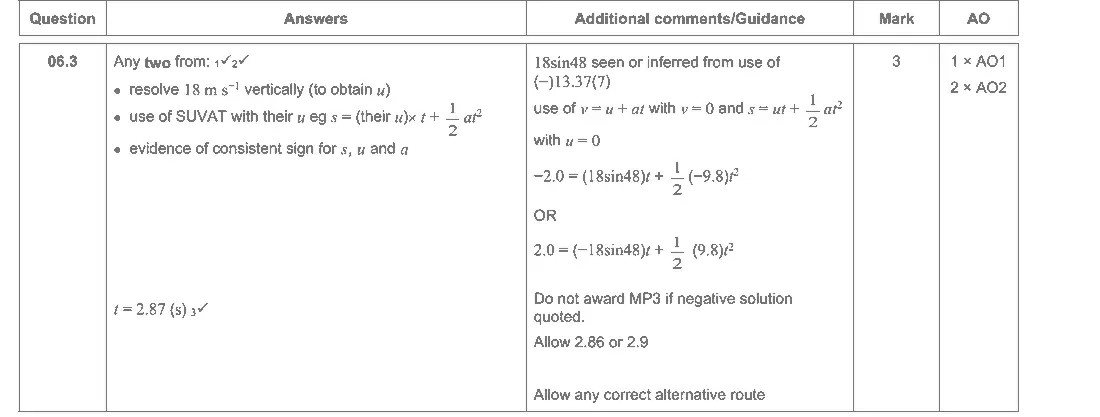
June 2025 · Paper 1 · Q6.3 3 marks AO1=1, AO2=2 Calculation motion and projectiles
Earlier part of question 6 that this part usesEarlier part of June 2025 Paper 1 question 6
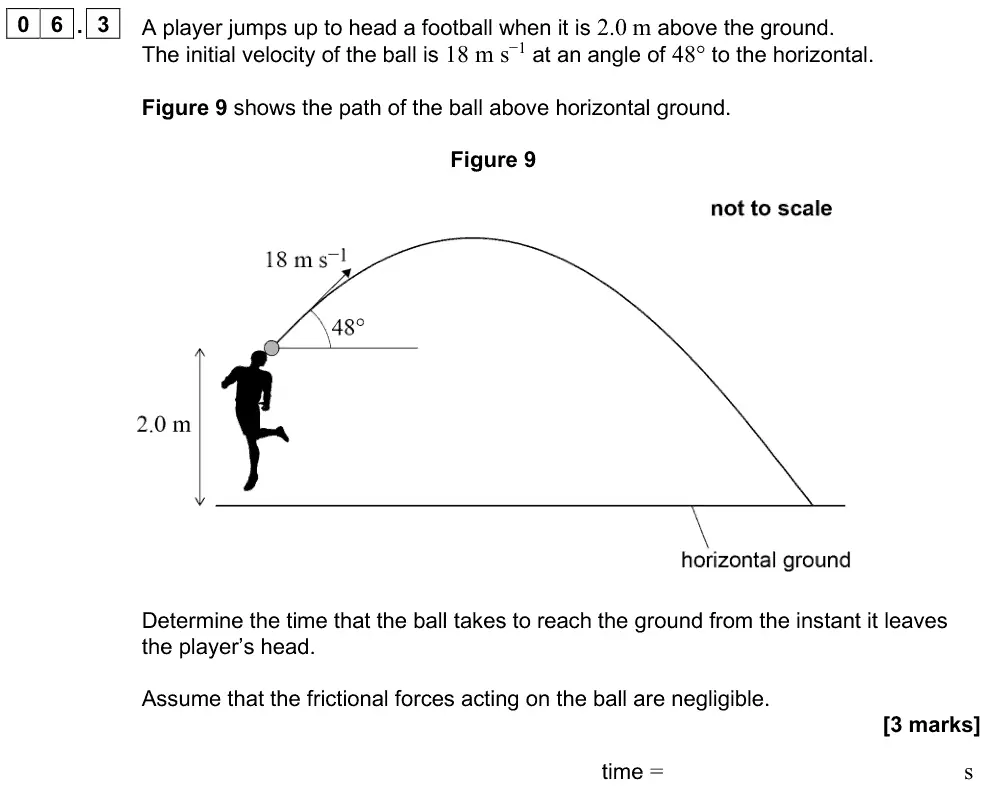
A player jumps up to head a football when it is 2.0 m above the ground.
The initial velocity of the ball is 18 m s−1 at an angle of 48° to the horizontal.
Figure 9 shows the path of the ball above horizontal ground.
Figure 9
Determine the time that the ball takes to reach the ground from the instant it leaves
the player’s head.
Assume that the frictional forces acting on the ball are negligible.
[3 marks]
time =
s
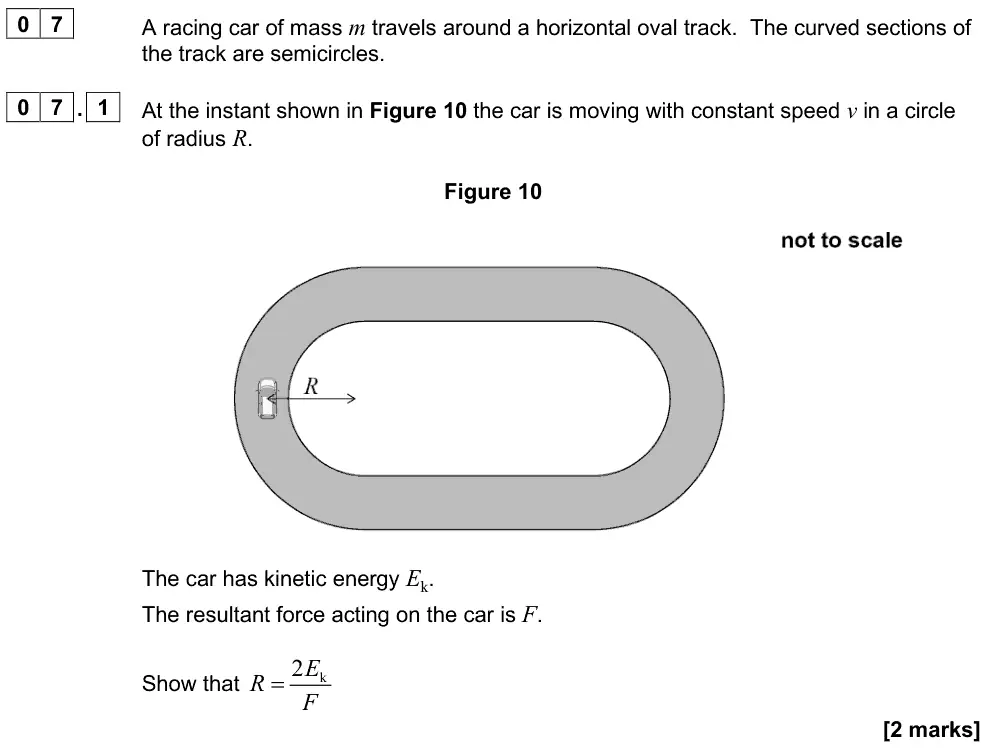
June 2025 · Paper 1 · Q7.2 1 mark AO2=1 Calculation Easy circular motion
Earlier part of question 7 that this part usesEarlier part of June 2025 Paper 1 question 7
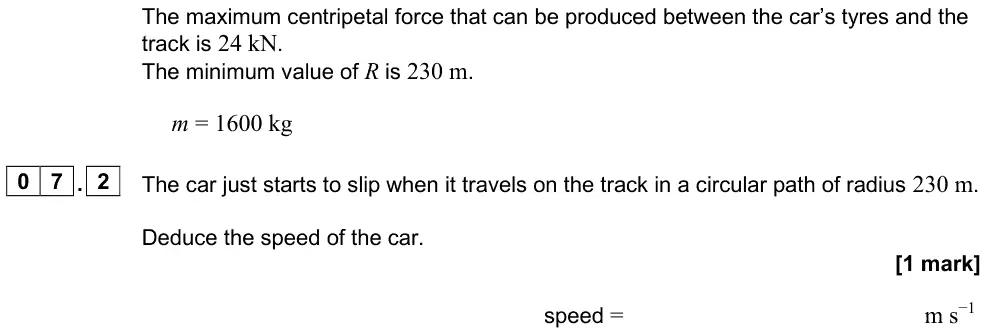
The maximum centripetal force that can be produced between the car’s tyres and the
track is 24 kN.
The minimum value of R is 230 m.
m = 1600 kg
The car just starts to slip when it travels on the track in a circular path of radius 230 m.
Deduce the speed of the car.
[1 mark]
speed =
m s−1
June 2025 · Paper 1 · Q8.1 2 marks AO2=2 Calculation Easy work energy and powercurrent voltage and resistivity
Electrons in a fluorescent tube are accelerated from rest by a potential difference
of 130 V.
Calculate the maximum speed of an electron that is accelerated from rest by this
potential difference.
[2 marks]
maximum speed =
m s−1
June 2025 · Paper 1 · Q8.4 3 marks AO1=1, AO2=2 Calculation Easy energy levels and wave particle dualityparticles antiparticles and interactions
Earlier part of question 8 that this part usesEarlier part of June 2025 Paper 1 question 8
Figure 12 shows a maximum intensity peak that occurs at wavelength λpeak.
Calculate, in eV, the energy change of an atom that produces a photon with a
wavelength λpeak.
[3 marks]
energy change =
eV
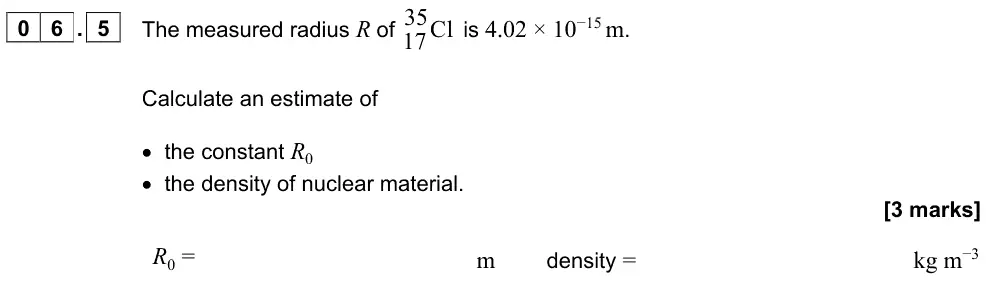
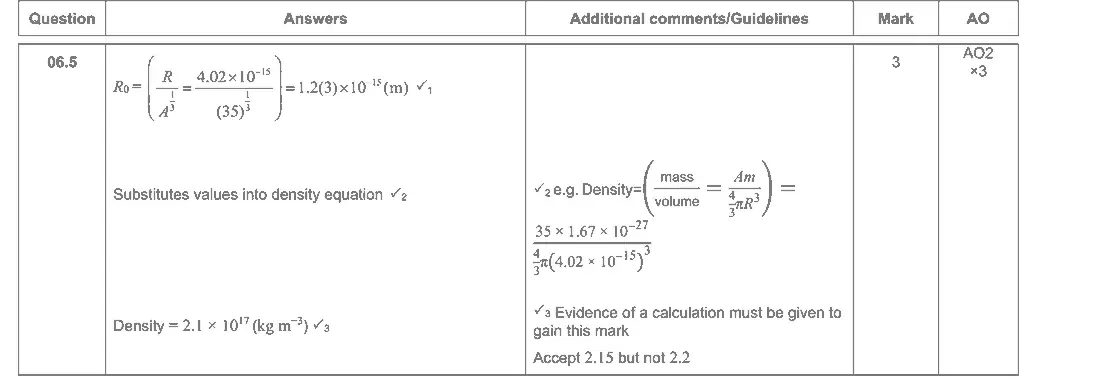
June 2025 · Paper 2 · Q1.1 3 marks AO2=3 Calculation nuclear radius
Information about the radius of a nucleus can be deduced from the closest approach
of alpha particles and from electron diffraction.
Alpha particles, each with a kinetic energy of 5.59 MeV, are fired at a thin foil made of
gold (
)
197 Au
79
atoms.
Some of the alpha particles are scattered through an angle of 180°.
Estimate the radius of a 197 Au
79
nucleus from this information.
[3 marks]
radius of nucleus =
m
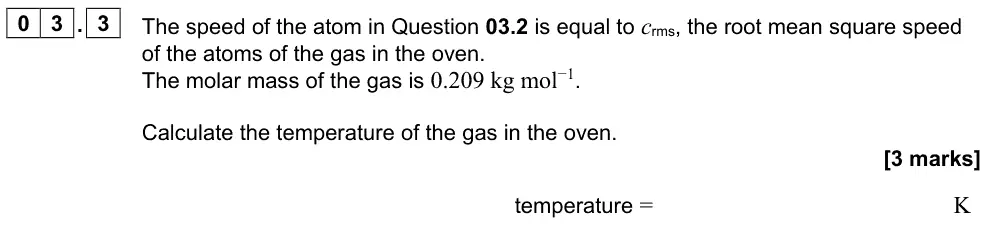
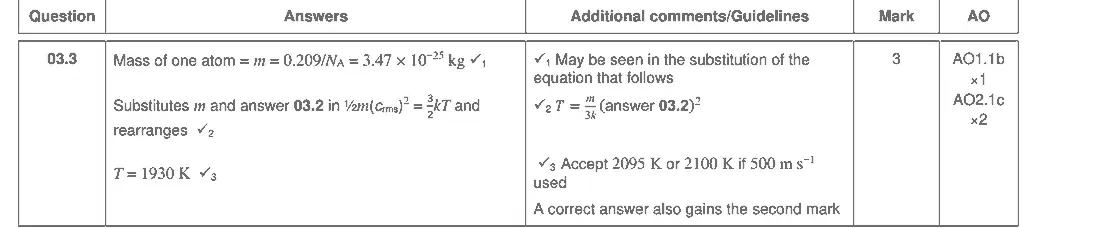
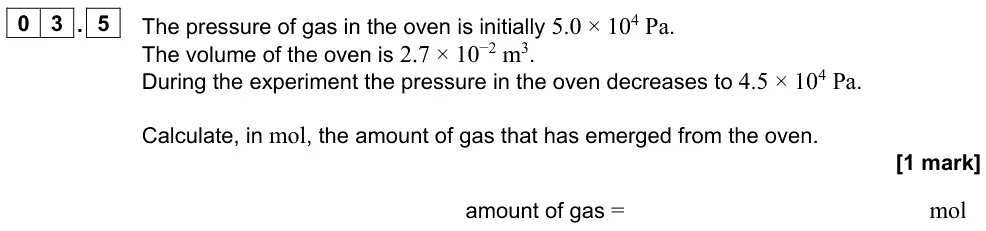
June 2025 · Paper 2 · Q2.4 1 mark AO2=1 Calculation kinetic theory
Earlier part of question 2 that this part usesEarlier part of June 2025 Paper 2 question 2
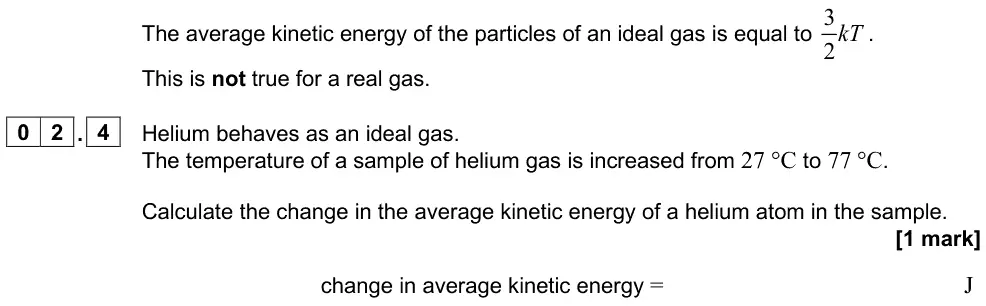
The average kinetic energy of the particles of an ideal gas is equal to 3
2kT .
This is not true for a real gas.
Helium behaves as an ideal gas.
The temperature of a sample of helium gas is increased from 27 °C to 77 °C.
Calculate the change in the average kinetic energy of a helium atom in the sample.
[1 mark]
change in average kinetic energy =
J
June 2025 · Paper 2 · Q2.5 3 marks AO3=3 Calculation kinetic theorythermal energy and ideal gases
Earlier part of question 2 that this part usesEarlier part of June 2025 Paper 2 question 2
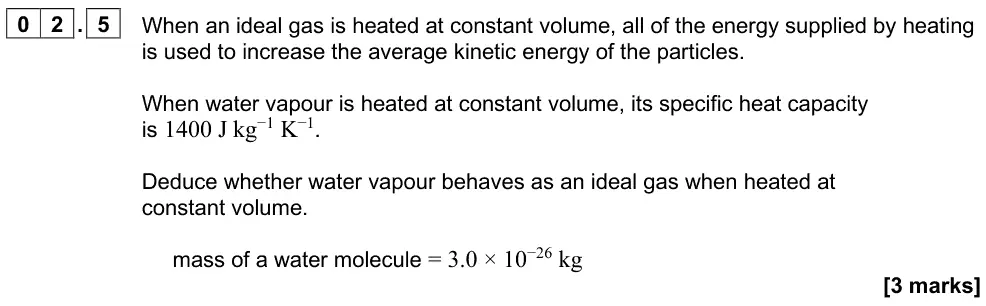
When an ideal gas is heated at constant volume, all of the energy supplied by heating
is used to increase the average kinetic energy of the particles.
When water vapour is heated at constant volume, its specific heat capacity
is 1400 J kg−1 K−1.
Deduce whether water vapour behaves as an ideal gas when heated at
constant volume.
mass of a water molecule = 3.0 × 10⁻²⁶ kg
[3 marks]
June 2025 · Paper 2 · Q3.1 2 marks AO2=2 Calculation radioactive decaymass energy and fission
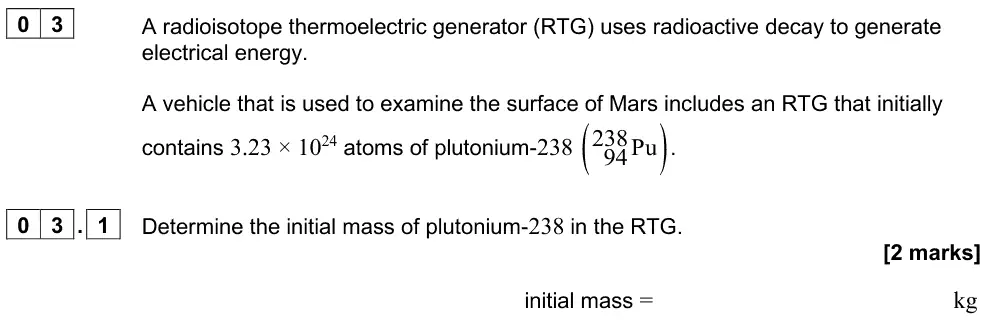
A radioisotope thermoelectric generator (RTG) uses radioactive decay to generate
electrical energy.
A vehicle that is used to examine the surface of Mars includes an RTG that initially
contains 3.23 × 1024 atoms of plutonium-238 (
)
238Pu
94
.
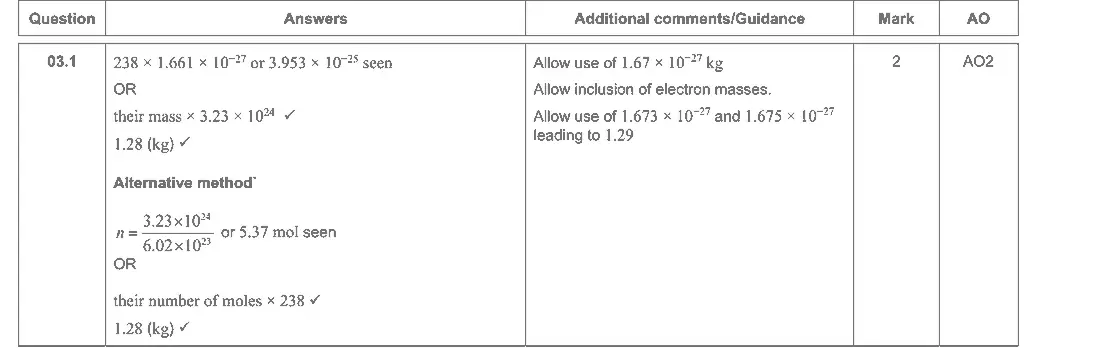
Determine the initial mass of plutonium-238 in the RTG.
[2 marks]
initial mass =
kg
June 2025 · Paper 2 · Q3.2 5 marks AO2=5 Calculation radioactive decay
Earlier part of question 3 that this part usesEarlier part of June 2025 Paper 2 question 3
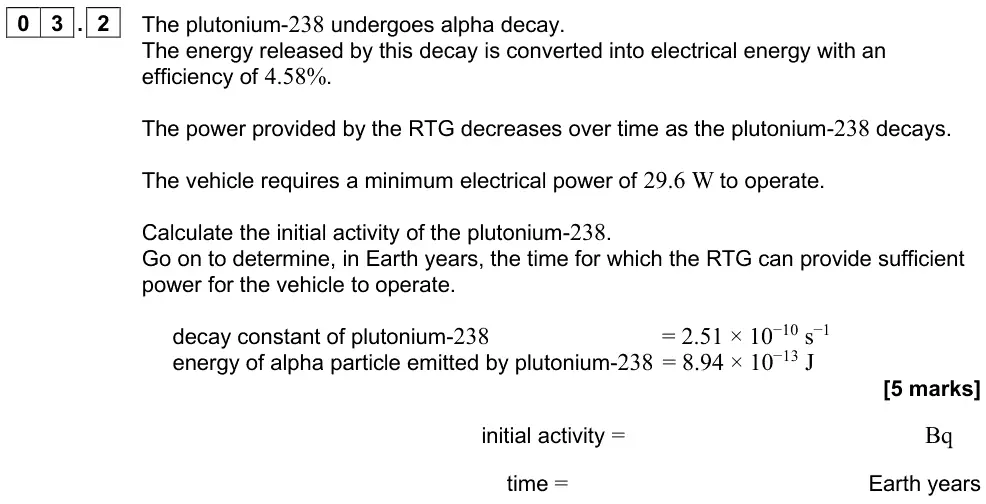
The plutonium-238 undergoes alpha decay.
The energy released by this decay is converted into electrical energy with an
efficiency of 4.58%.
The power provided by the RTG decreases over time as the plutonium-238 decays.
The vehicle requires a minimum electrical power of 29.6 W to operate.
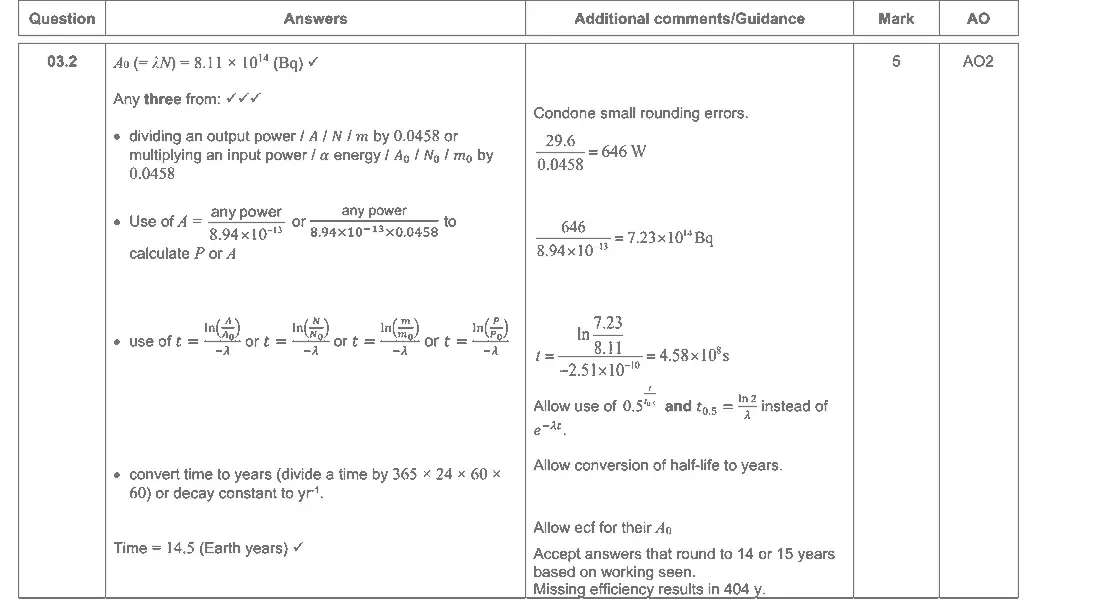
Calculate the initial activity of the plutonium-238.
Go on to determine, in Earth years, the time for which the RTG can provide sufficient
power for the vehicle to operate.
decay constant of plutonium-238                             = 2.51 × 10⁻¹⁰ s−1
energy of alpha particle emitted by plutonium-238  = 8.94 × 10⁻¹³ J
[5 marks]
initial activity =
Bq
time =
Earth years
June 2025 · Paper 2 · Q3.3 4 marks AO3=4 Calculation Easy thermal energy and ideal gases
Earlier part of question 3 that this part usesEarlier part of June 2025 Paper 2 question 3
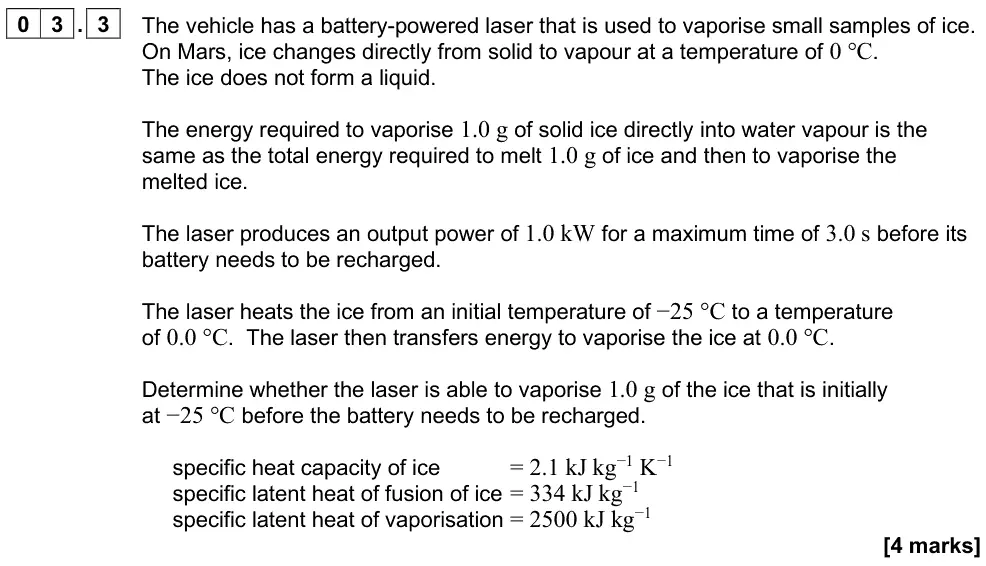
The vehicle has a battery-powered laser that is used to vaporise small samples of ice.
On Mars, ice changes directly from solid to vapour at a temperature of 0 °C.
The ice does not form a liquid.
The energy required to vaporise 1.0 g of solid ice directly into water vapour is the
same as the total energy required to melt 1.0 g of ice and then to vaporise the
melted ice.
The laser produces an output power of 1.0 kW for a maximum time of 3.0 s before its
battery needs to be recharged.
The laser heats the ice from an initial temperature of −25 °C to a temperature
of 0.0 °C.  The laser then transfers energy to vaporise the ice at 0.0 °C.
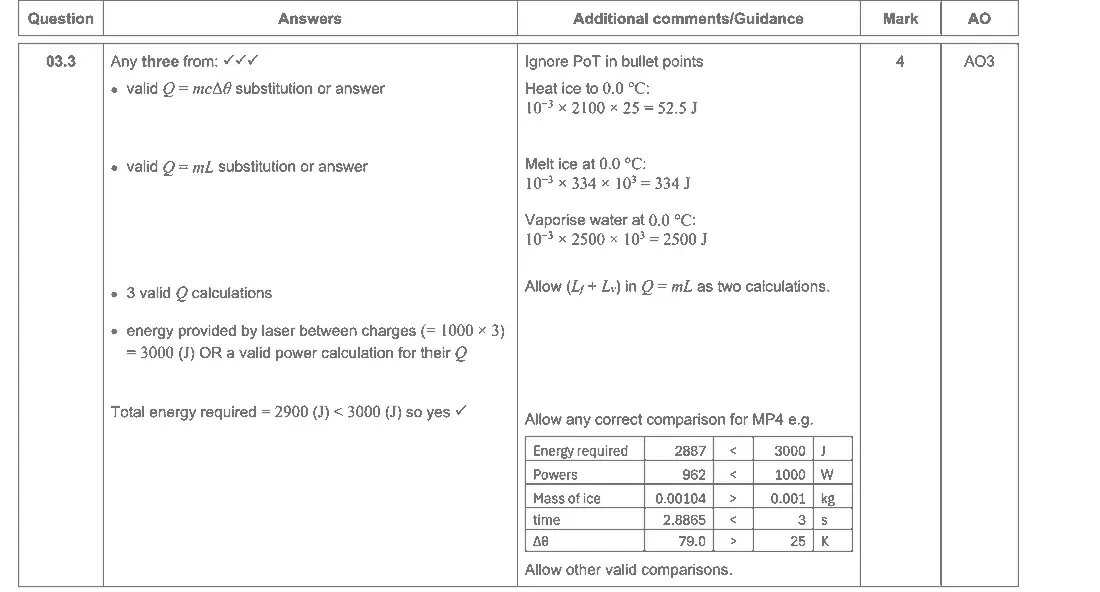
Determine whether the laser is able to vaporise 1.0 g of the ice that is initially
at −25 °C before the battery needs to be recharged.
specific heat capacity of ice            = 2.1 kJ kg−1 K−1
specific latent heat of fusion of ice  = 334 kJ kg−1
specific latent heat of vaporisation = 2500 kJ kg−1
[4 marks]
June 2025 · Paper 2 · Q4.1 3 marks AO1=3 Calculation gravitational fields
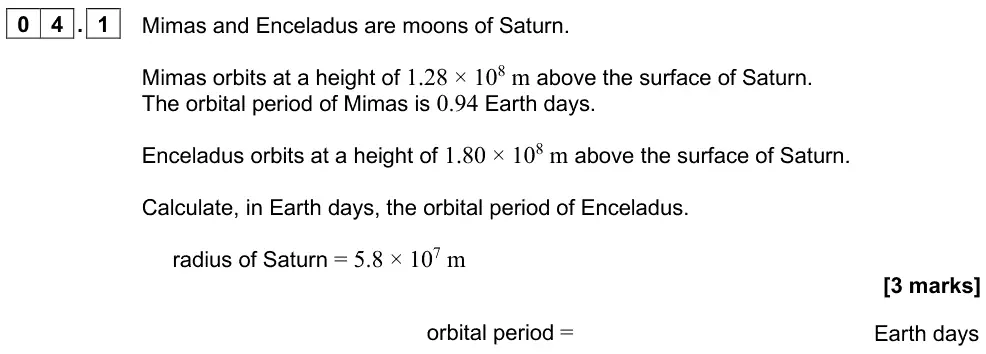
Mimas and Enceladus are moons of Saturn.
Mimas orbits at a height of 1.28 × 10⁸ m above the surface of Saturn.
The orbital period of Mimas is 0.94 Earth days.
Enceladus orbits at a height of 1.80 × 10⁸ m above the surface of Saturn.
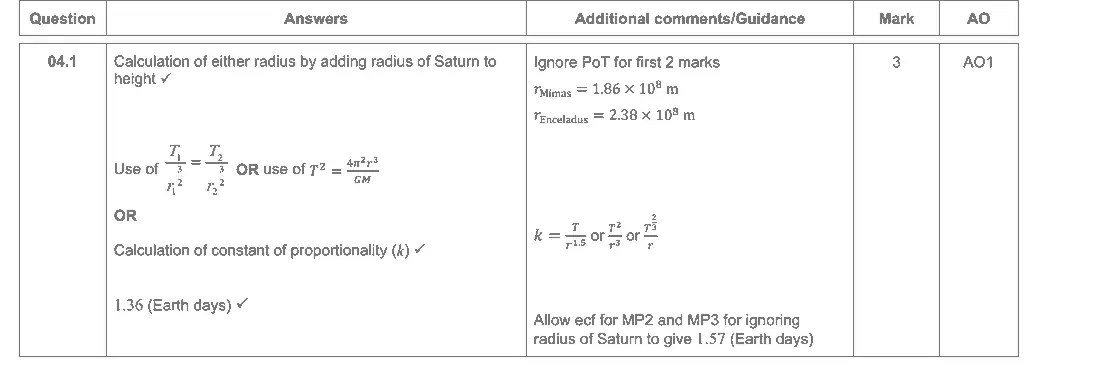
Calculate, in Earth days, the orbital period of Enceladus.
radius of Saturn = 5.8 × 10⁷ m
[3 marks]
orbital period =
Earth days
June 2025 · Paper 2 · Q4.4 3 marks AO2=3 Calculation gravitational fields
Earlier part of question 4 that this part usesEarlier part of June 2025 Paper 2 question 4
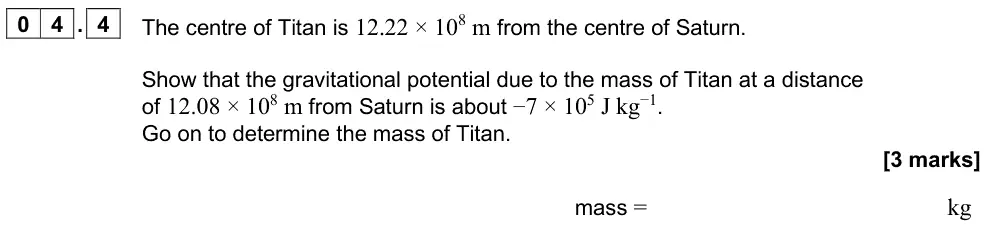
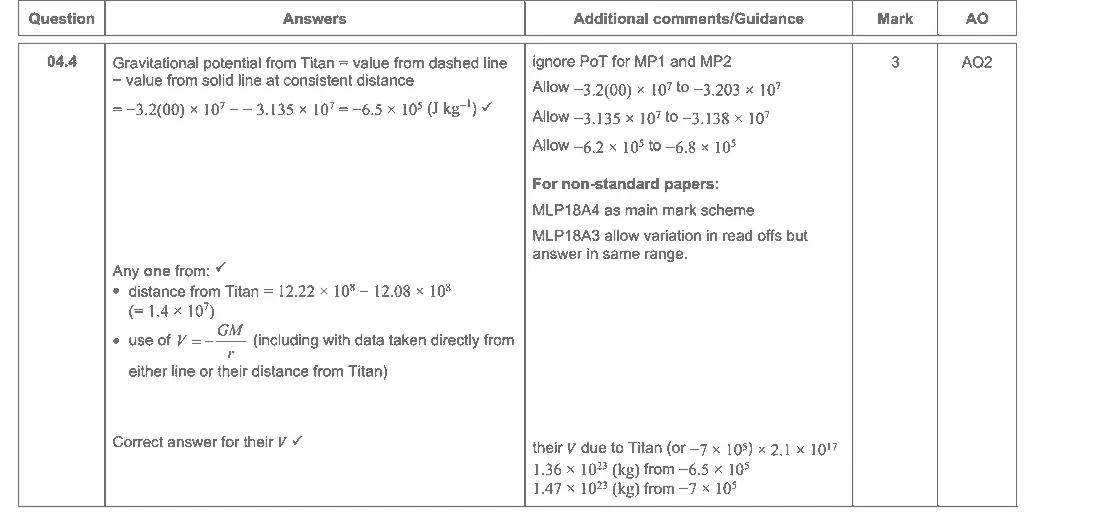
The centre of Titan is 12.22 × 10⁸ m from the centre of Saturn.
Show that the gravitational potential due to the mass of Titan at a distance
of 12.08 × 10⁸ m from Saturn is about −7 × 10⁵ J kg−1.
Go on to determine the mass of Titan.
[3 marks]
mass =
kg
June 2025 · Paper 2 · Q5.2 2 marks AO2=2 Calculation capacitors
Earlier part of question 5 that this part usesEarlier part of June 2025 Paper 2 question 5
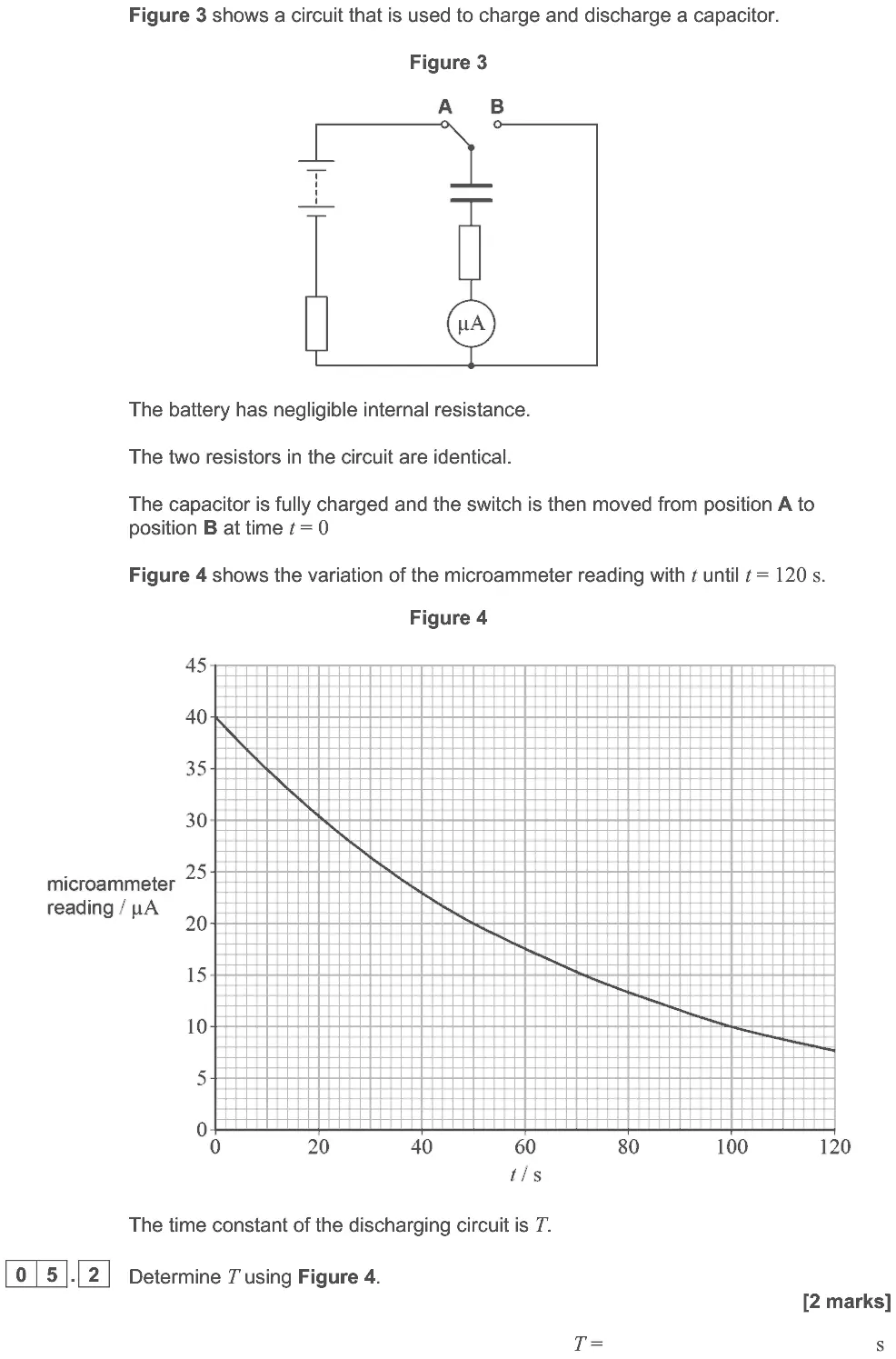
Figure 3 shows a circuit that is used to charge and discharge a capacitor.
Figure 3
The battery has negligible internal resistance.
The two resistors in the circuit are identical.
The capacitor is fully charged and the switch is then moved from position A to
position B at time t = 0
Figure 4 shows the variation of the microammeter reading with t until t = 120 s.
Figure 4
The time constant of the discharging circuit is T.
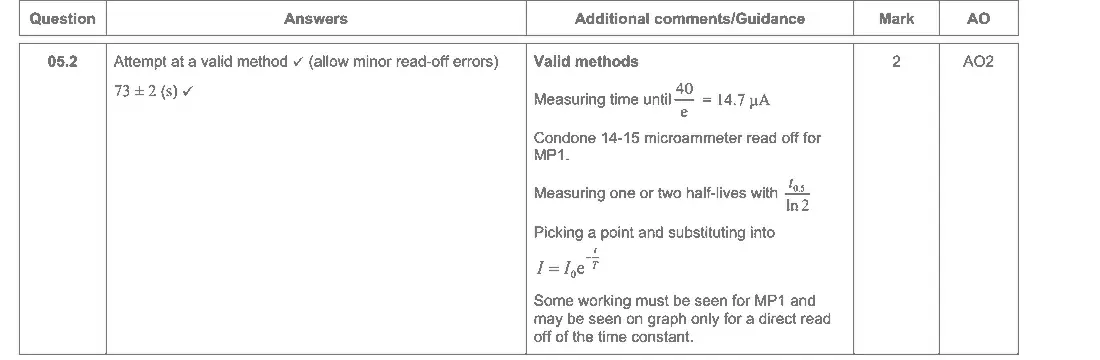
Determine T using Figure 4.
[2 marks]
T =
s
June 2025 · Paper 2 · Q5.3 2 marks AO1=1, AO2=1 Calculation capacitors
Earlier part of question 5 that this part usesEarlier part of June 2025 Paper 2 question 5
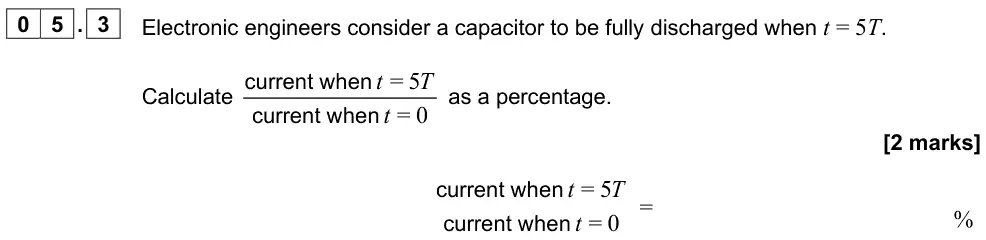
Electronic engineers consider a capacitor to be fully discharged when t = 5T.
Calculate
= 5
= 0
t
T
t
current when
current
hen
w
as a percentage.
[2 marks]
= 5
= 0
t
T
t
current when
current
hen
w
=
%
June 2025 · Paper 2 · Q6.1 3 marks AO3=3 Calculation circular motiongravitational fields
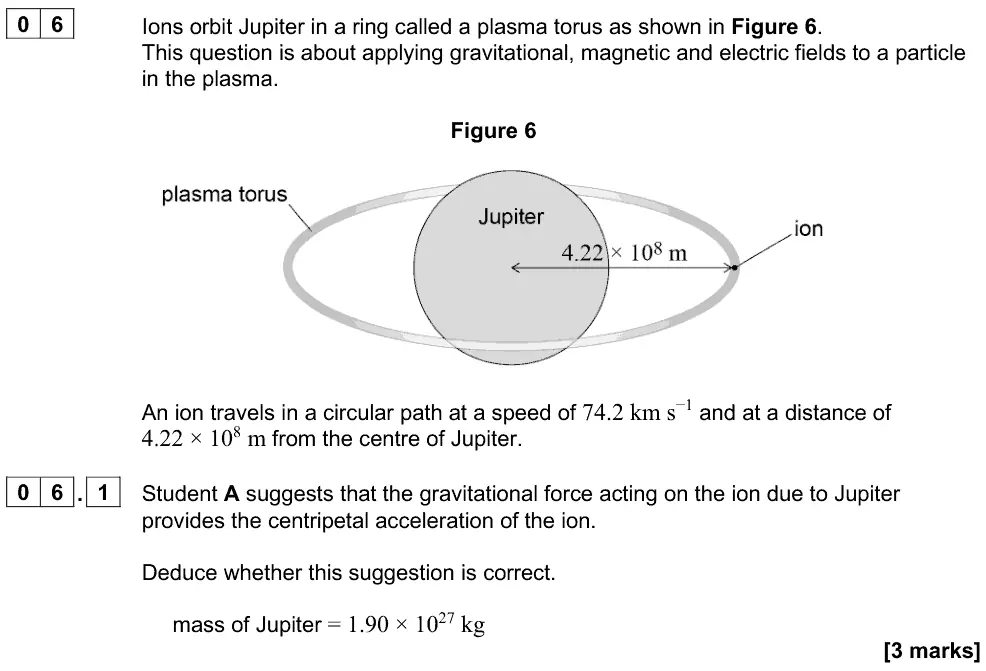
Ions orbit Jupiter in a ring called a plasma torus as shown in Figure 6.
This question is about applying gravitational, magnetic and electric fields to a particle
in the plasma.
Figure 6
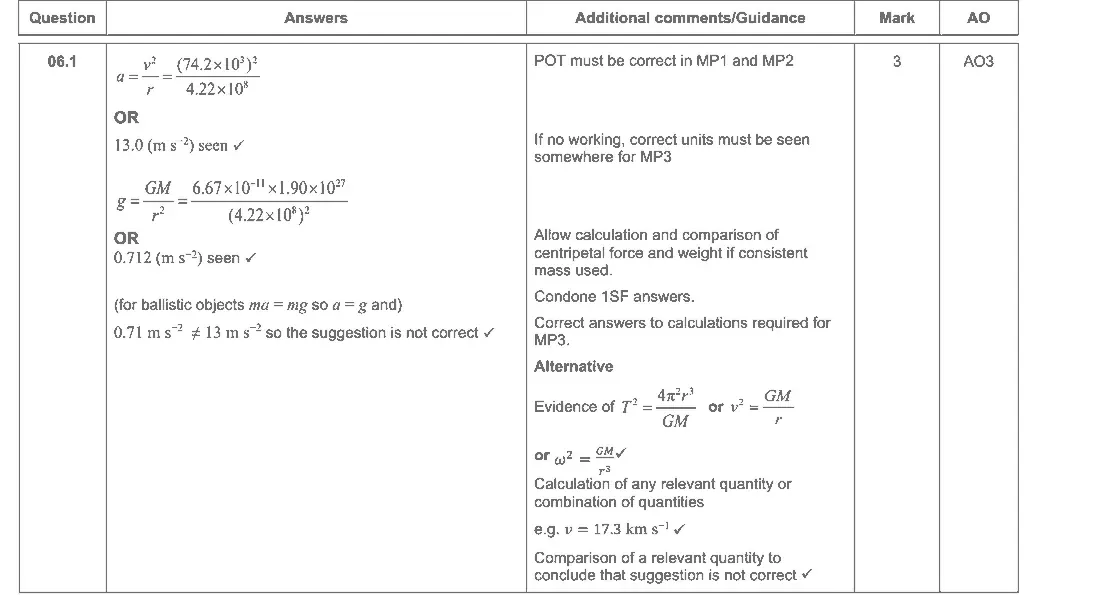
An ion travels in a circular path at a speed of 74.2 km s−1 and at a distance of
4.22 × 10⁸ m from the centre of Jupiter.
Student A suggests that the gravitational force acting on the ion due to Jupiter
provides the centripetal acceleration of the ion.
Deduce whether this suggestion is correct.
mass of Jupiter = 1.90 × 1027 kg
[3 marks]
June 2025 · Paper 2 · Q6.3 3 marks AO1=1, AO2=2 Calculation magnetic fields
Earlier part of question 6 that this part usesEarlier part of June 2025 Paper 2 question 6
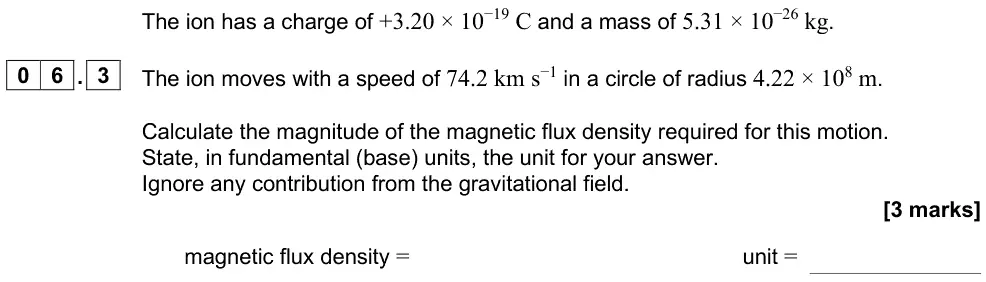
The ion has a charge of +3.20 × 10⁻¹⁹ C and a mass of 5.31 × 10⁻²⁶ kg.
The ion moves with a speed of 74.2 km s−1 in a circle of radius 4.22 × 10⁸ m.
Calculate the magnitude of the magnetic flux density required for this motion.
State, in fundamental (base) units, the unit for your answer.
Ignore any contribution from the gravitational field.
[3 marks]
magnetic flux density =
unit =
June 2025 · Paper 2 · Q6.4 3 marks AO2=3 Calculation electric fields
Earlier part of question 6 that this part usesEarlier part of June 2025 Paper 2 question 6
An electric field of strength 371 μV m−1 can also accelerate the ion.
Calculate the acceleration of the ion due to this electric field.
[3 marks]
acceleration =
m s−2
June 2025 · Paper 2 · Q6.5 3 marks AO2=3 Calculation Hard electric fieldsvectors and moments
Earlier part of question 6 that this part usesEarlier part of June 2025 Paper 2 question 6
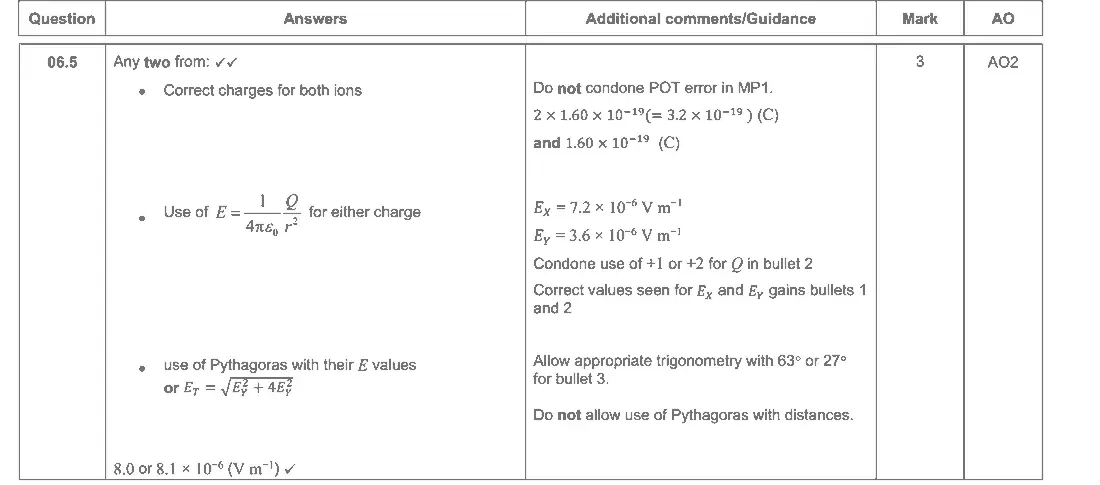
The plasma torus contains two ions X and Y as shown in Figure 8.
X has a charge of +2e.
Y has a charge of +1e.
Assume that each ion acts as a point charge.
Figure 8
Calculate the magnitude of the resultant electric field strength at point P in Figure 8
due to the two ions.
[3 marks]
resultant electric field strength =
V m−1
June 2025 · Paper 3 Section A · Q2.3 2 marks AO2=2 Calculation measurements and uncertainties
Earlier part of question 2 that this part usesEarlier part of June 2025 Paper 3 Section A question 2
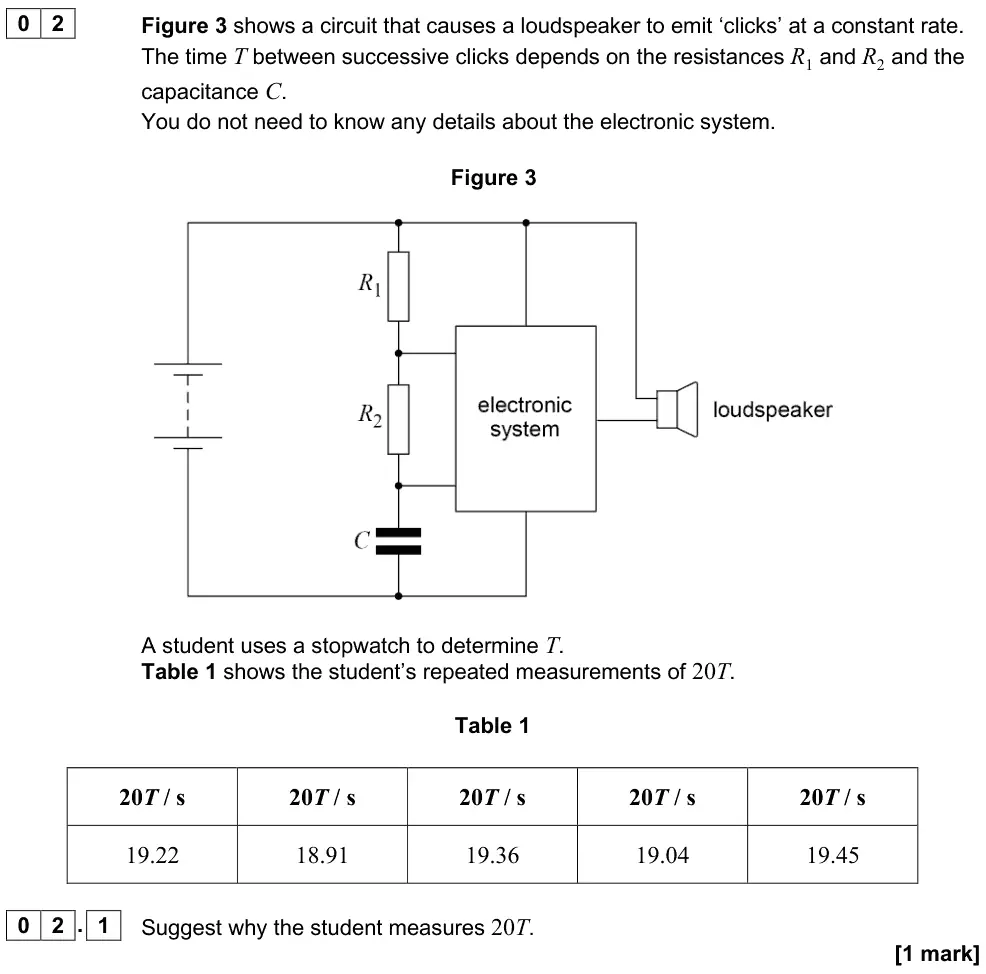
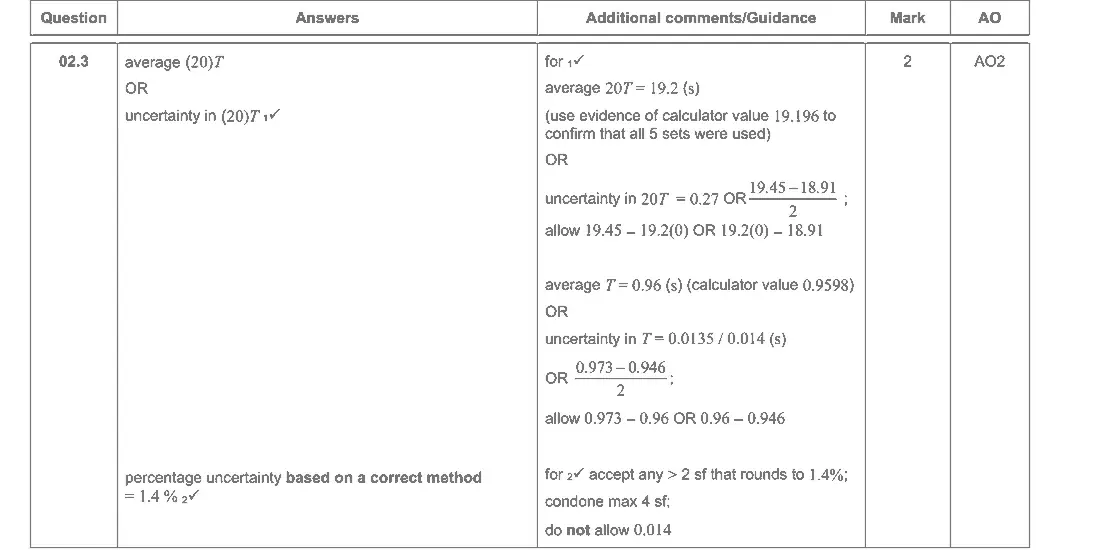
Determine the percentage uncertainty in the student’s result for T.
Assume that all the data in Table 1 are valid.
[2 marks]
percentage uncertainty in T =
%
June 2025 · Paper 3 Section A · Q4.2 3 marks AO3=3 Calculation measurements and uncertainties
Earlier part of question 4 that this part usesEarlier part of June 2025 Paper 3 Section A question 4
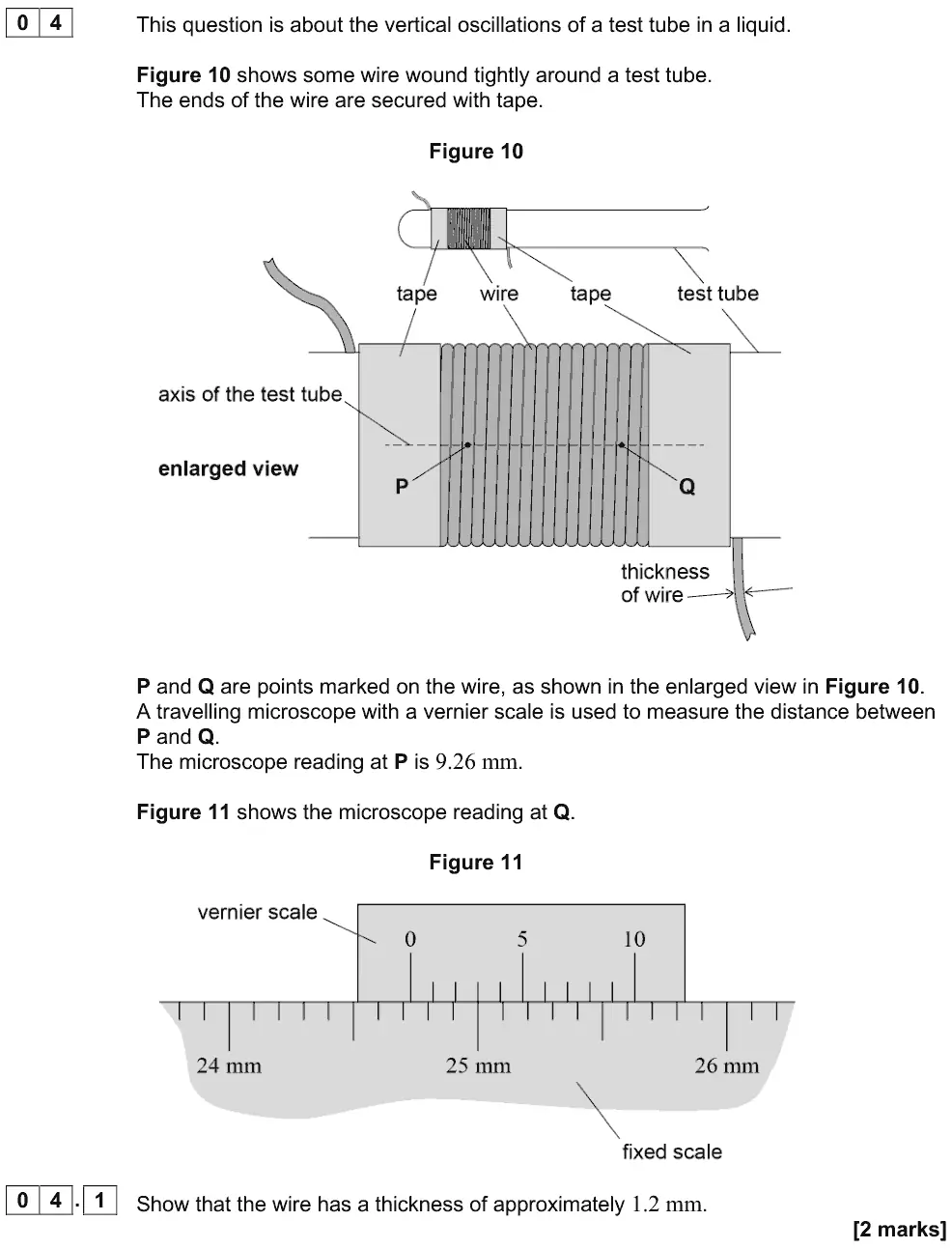
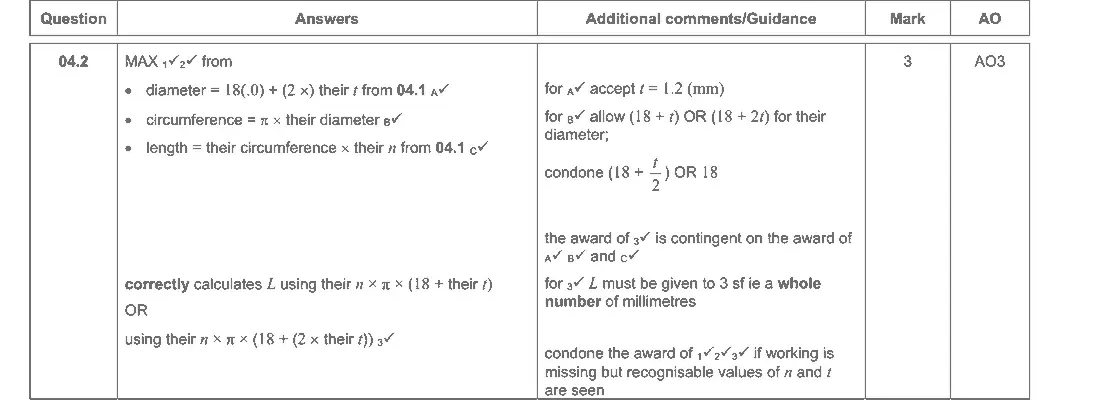
The external diameter of the test tube is 18.0 mm.
Deduce the length of wire between P and Q.
[3 marks]
length of wire =
mm
June 2025 · Paper 3 Section A · Q4.4 2 marks AO1=1, AO2=1 Calculation Easy simple harmonic motion
Earlier part of question 4 that this part usesEarlier part of June 2025 Paper 3 Section A question 4
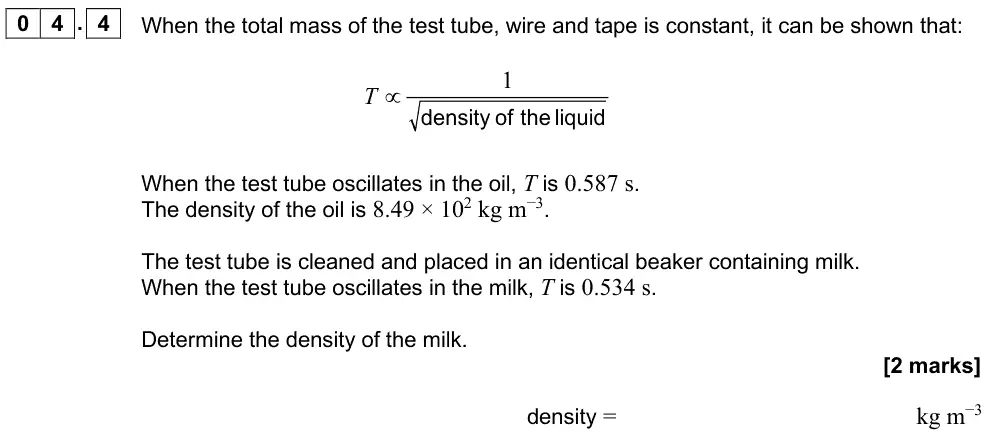
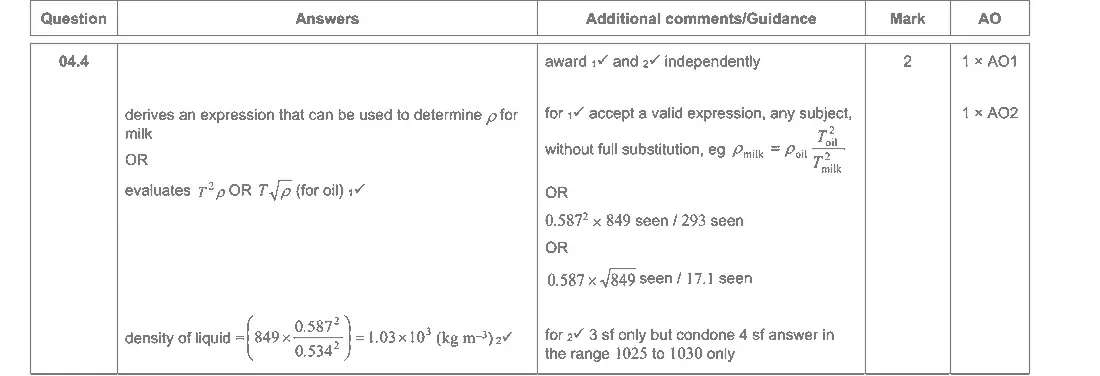
When the total mass of the test tube, wire and tape is constant, it can be shown that:
1
T ∝
density of the liquid
When the test tube oscillates in the oil, T is 0.587 s.
The density of the oil is 8.49 × 10² kg m−3.
The test tube is cleaned and placed in an identical beaker containing milk.
When the test tube oscillates in the milk, T is 0.534 s.
Determine the density of the milk.
[2 marks]
density =
kg m−3
June 2025 · Paper 3B Astrophysics · Q3.1 3 marks AO2=3 Calculation cosmology
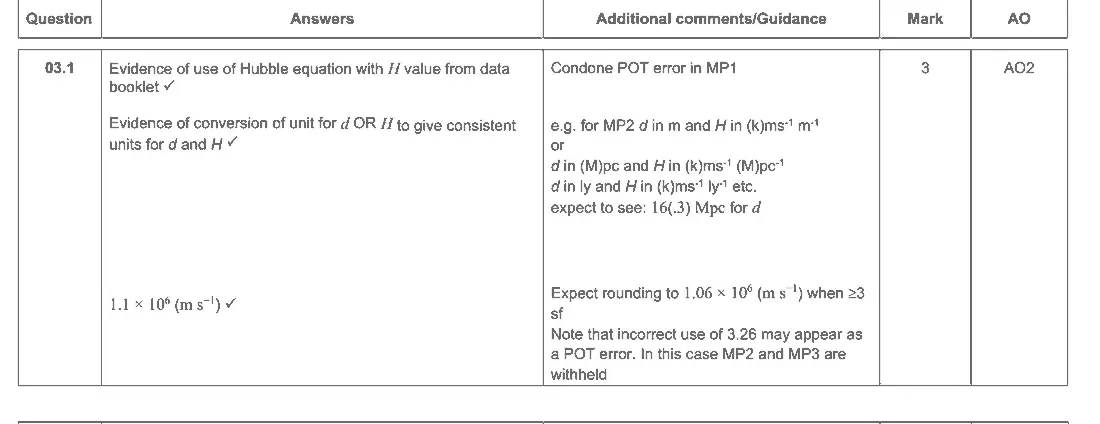
The galaxy M87 is at a distance of 5.3 × 10⁷ ly from the Earth.
Determine, in m s−1, the recessional velocity of M87 relative to the Earth.
[3 marks]
recessional velocity =
m s−1
June 2025 · Paper 3B Astrophysics · Q4.5 2 marks AO2=2 Calculation cosmology
Earlier part of question 4 that this part usesEarlier part of June 2025 Paper 3B Astrophysics question 4
Determine the angular velocity of the binary system.
[2 marks]
angular velocity =
rad s−1
June 2025 · Paper 3B Astrophysics · Q5 5 marks AO3=5 Calculation classification of stars
Early observations of the star Betelgeuse indicated that:
radius r of Betelgeuse = 700 × radius of the Sun
distance d of Betelgeuse from the Earth = 548 ly
intensity received from Betelgeuse = I.
Recent data suggest that the intensity received from Betelgeuse is actually 1.15I.
Based on these recent data, two groups of students reach different conclusions.
Group X suggest that:
• r is correct
• d is actually 530 ly.
Group Y suggest that:
• d is correct
• r is actually 750 × radius of the Sun.
Discuss for each group whether their conclusion could be correct.
Assume that the measured temperature of Betelgeuse is constant.
[5 marks]
June 2025 · Paper 3B Medical physics · Q1.3 4 marks AO2=2, AO3=2 Calculation Hard eye ear and ecg
Earlier part of question 1 that this part usesEarlier part of June 2025 Paper 3B Medical physics question 1
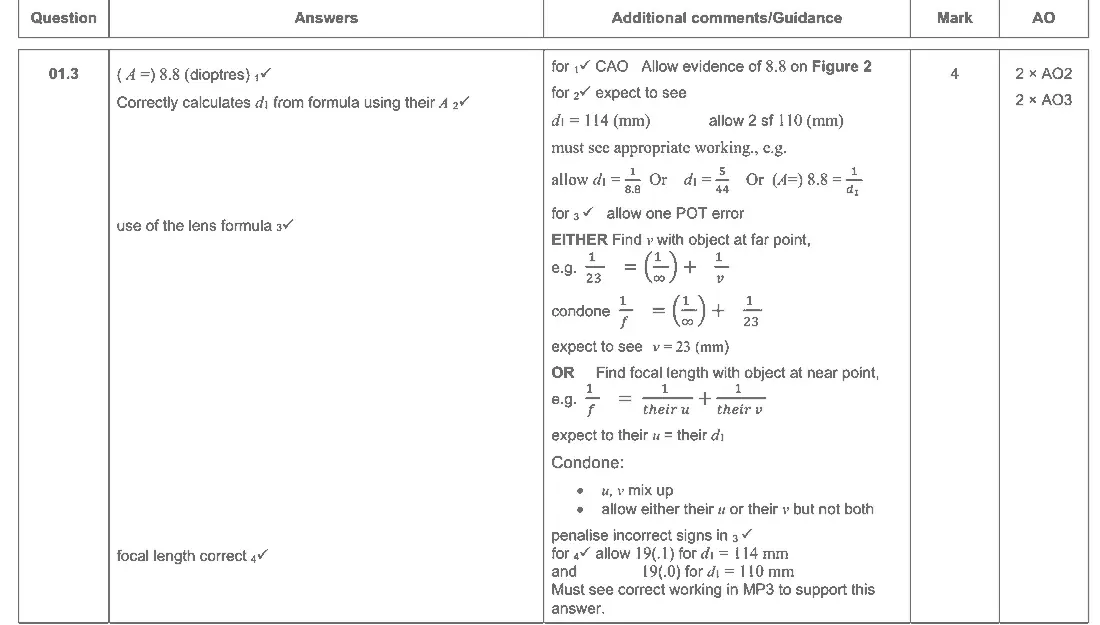
The accommodation amplitude A, in dioptres, is given by
A =
1
2
1
1
d
d
−
where
d1 is the distance, in m, from the eye to its near point
d2 is the distance, in m, from the eye to its far point.
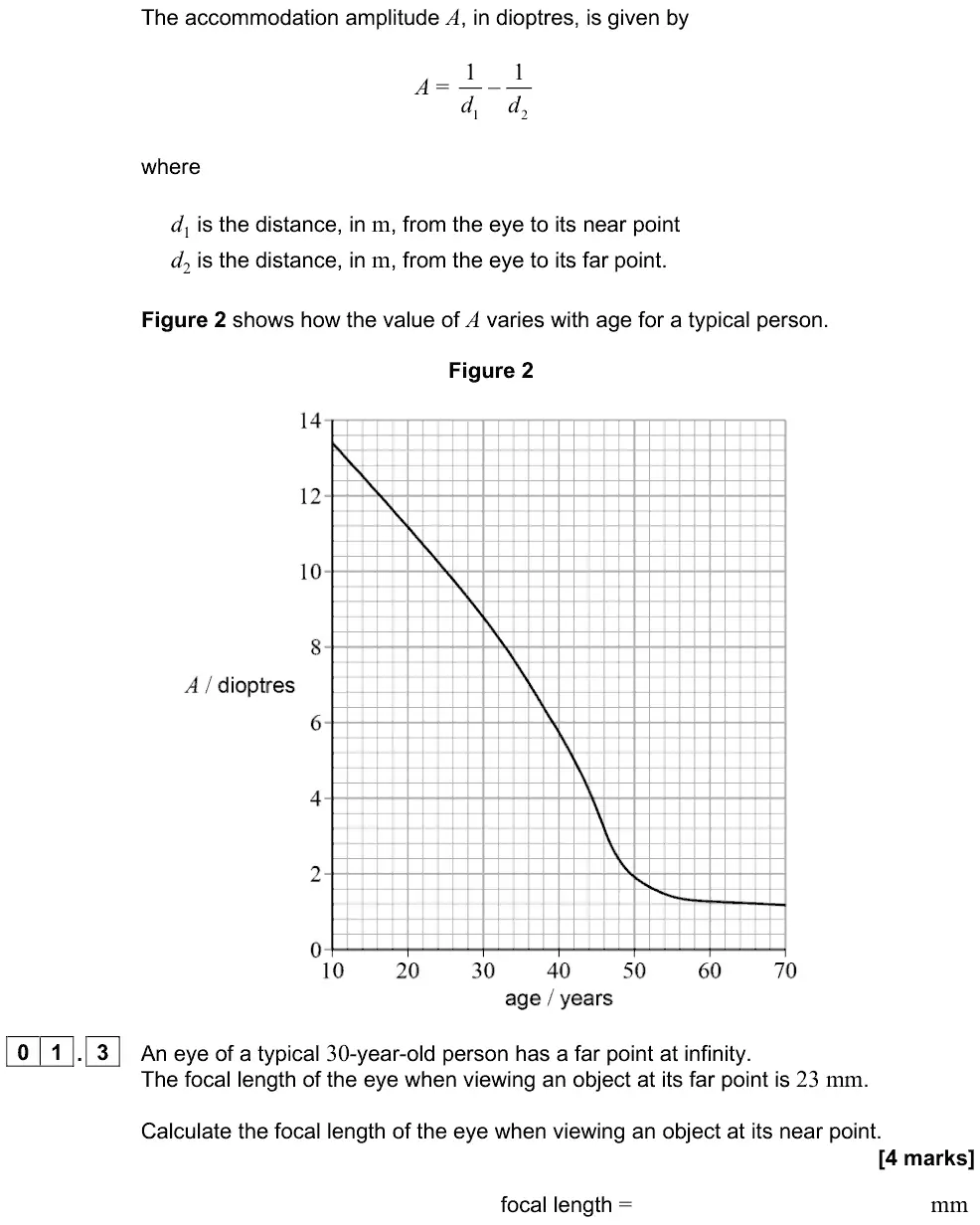
Figure 2 shows how the value of A varies with age for a typical person.
Figure 2
An eye of a typical 30-year-old person has a far point at infinity.
The focal length of the eye when viewing an object at its far point is 23 mm.
Calculate the focal length of the eye when viewing an object at its near point.
[4 marks]
focal length =
mm
June 2025 · Paper 3B Medical physics · Q2.2 3 marks AO2=1, AO3=2 Calculation Hard medical imaging
Earlier part of question 2 that this part usesEarlier part of June 2025 Paper 3B Medical physics question 2
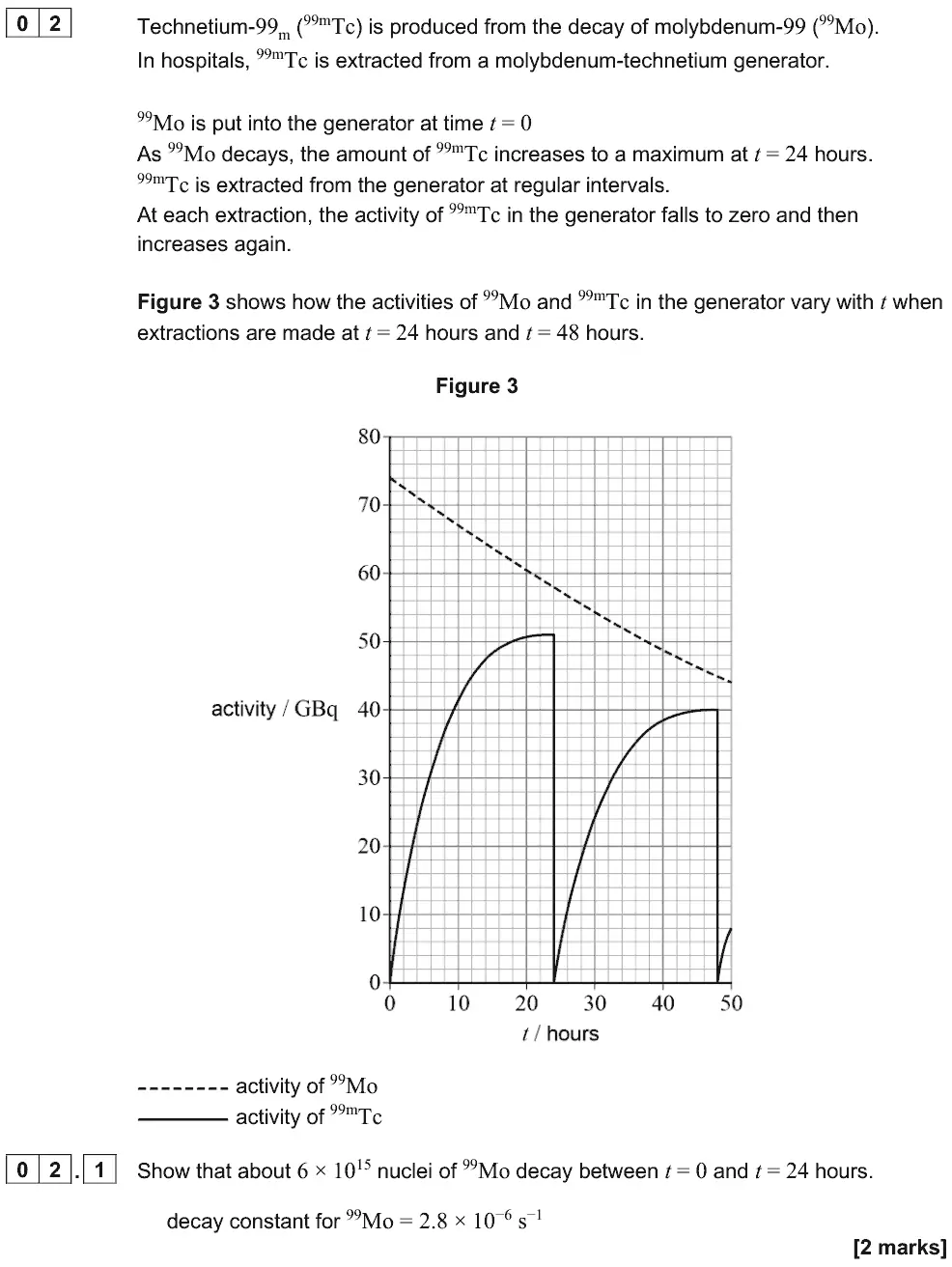
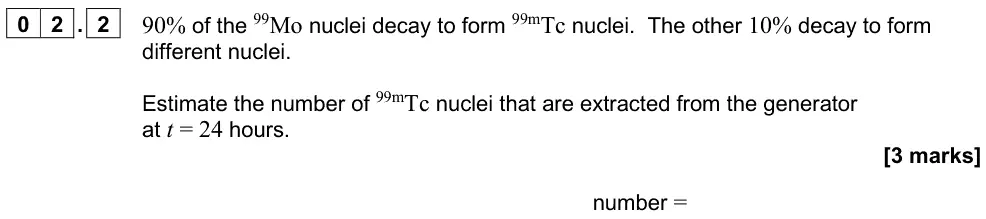
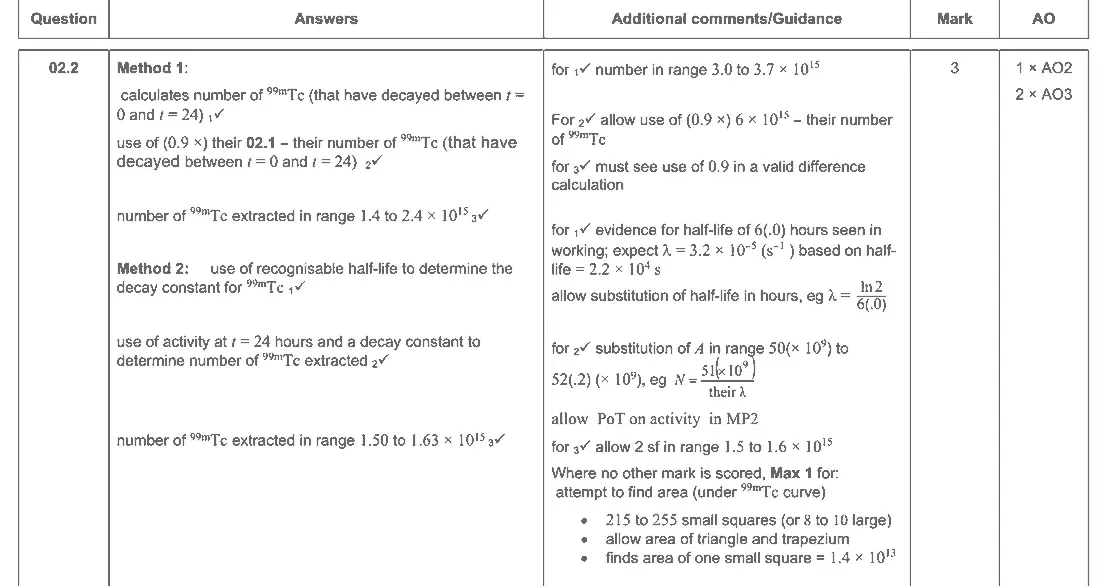
90% of the 99Mo nuclei decay to form 99mTc nuclei.  The other 10% decay to form
different nuclei.
Estimate the number of 99mTc nuclei that are extracted from the generator

at t = 24 hours.
[3 marks]
number =
June 2025 · Paper 3B Medical physics · Q3.2 3 marks AO2=3 Calculation Hard eye ear and ecg
Earlier part of question 3 that this part usesEarlier part of June 2025 Paper 3B Medical physics question 3
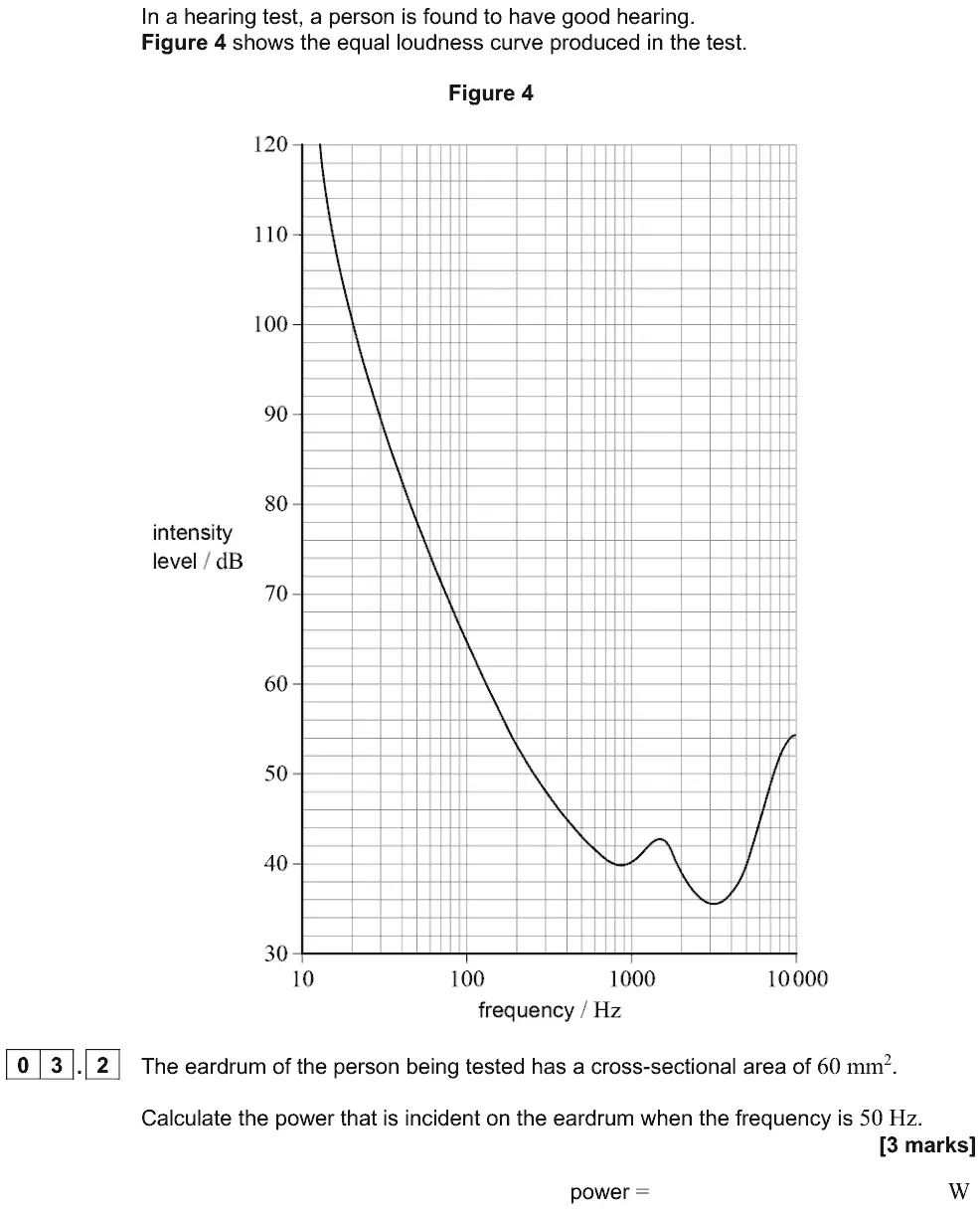
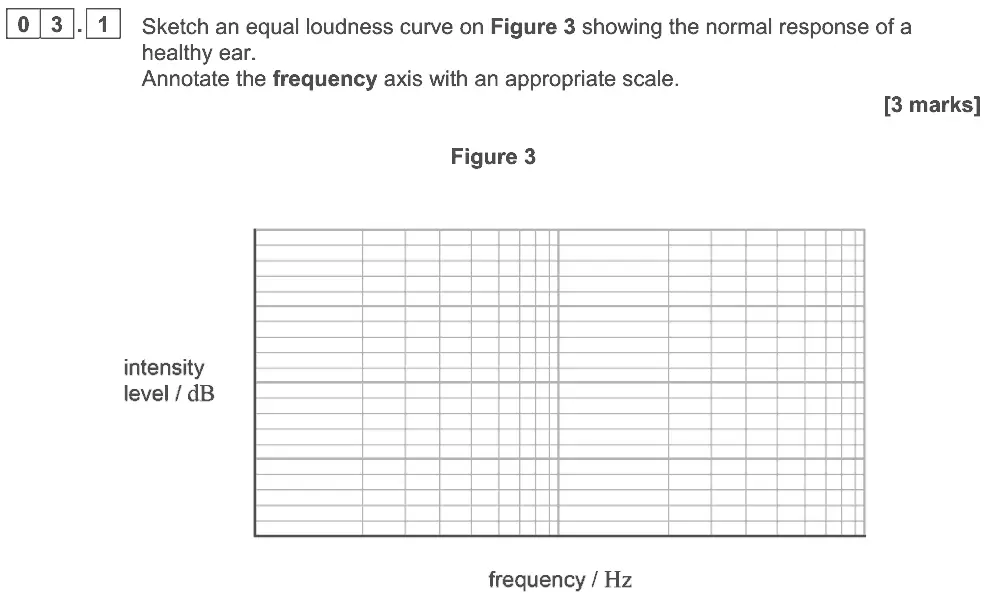
In a hearing test, a person is found to have good hearing.
Figure 4 shows the equal loudness curve produced in the test.
Figure 4
The eardrum of the person being tested has a cross-sectional area of 60 mm2.
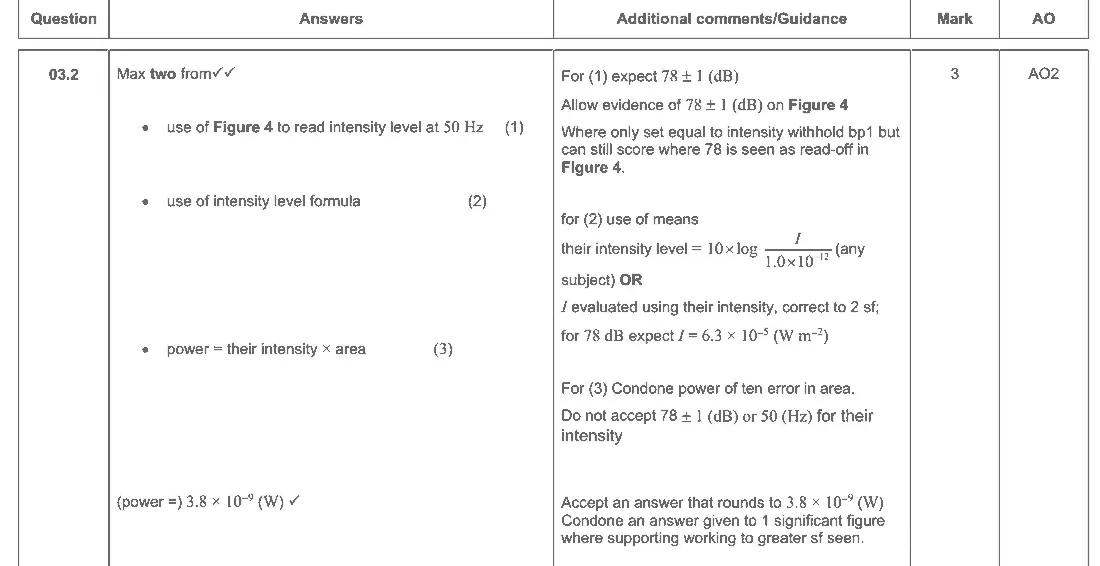
Calculate the power that is incident on the eardrum when the frequency is 50 Hz.
[3 marks]
power =
W
June 2025 · Paper 3B Medical physics · Q4.3 3 marks AO2=1, AO3=2 Calculation Hard medical imaging
Earlier part of question 4 that this part usesEarlier part of June 2025 Paper 3B Medical physics question 4
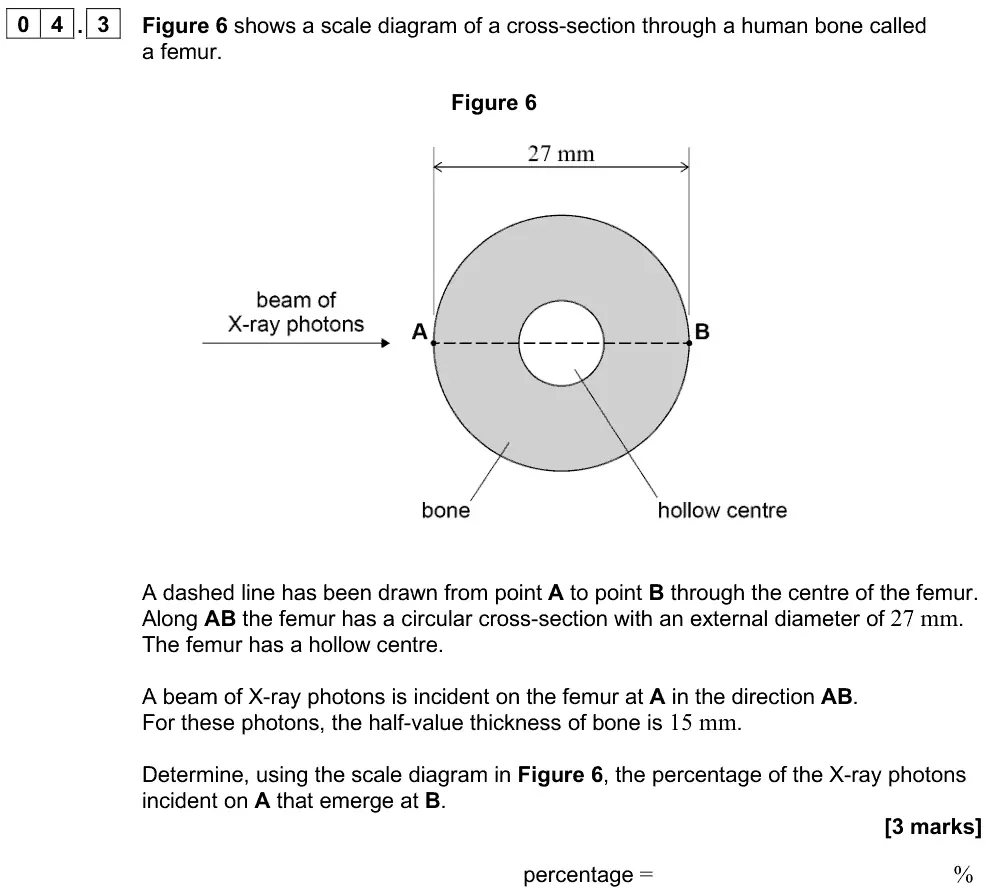
Figure 6 shows a scale diagram of a cross-section through a human bone called
a femur.
Figure 6
A dashed line has been drawn from point A to point B through the centre of the femur.
Along AB the femur has a circular cross-section with an external diameter of 27 mm.
The femur has a hollow centre.
A beam of X-ray photons is incident on the femur at A in the direction AB.
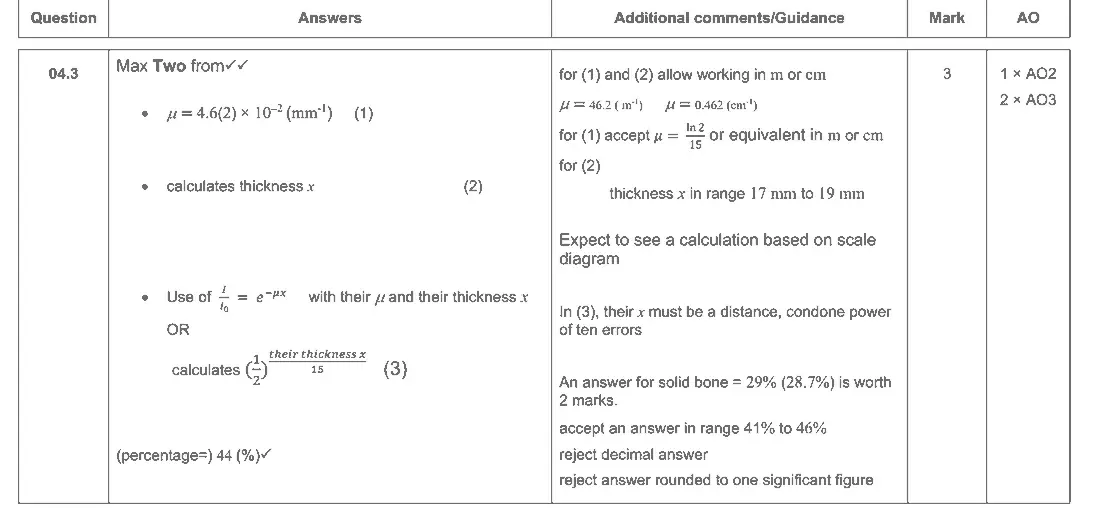
For these photons, the half-value thickness of bone is 15 mm.
Determine, using the scale diagram in Figure 6, the percentage of the X-ray photons
incident on A that emerge at B.
[3 marks]
percentage =
%
June 2025 · Paper 3B Engineering physics · Q1.1 2 marks AO2=2 Calculation Easy rotational dynamics
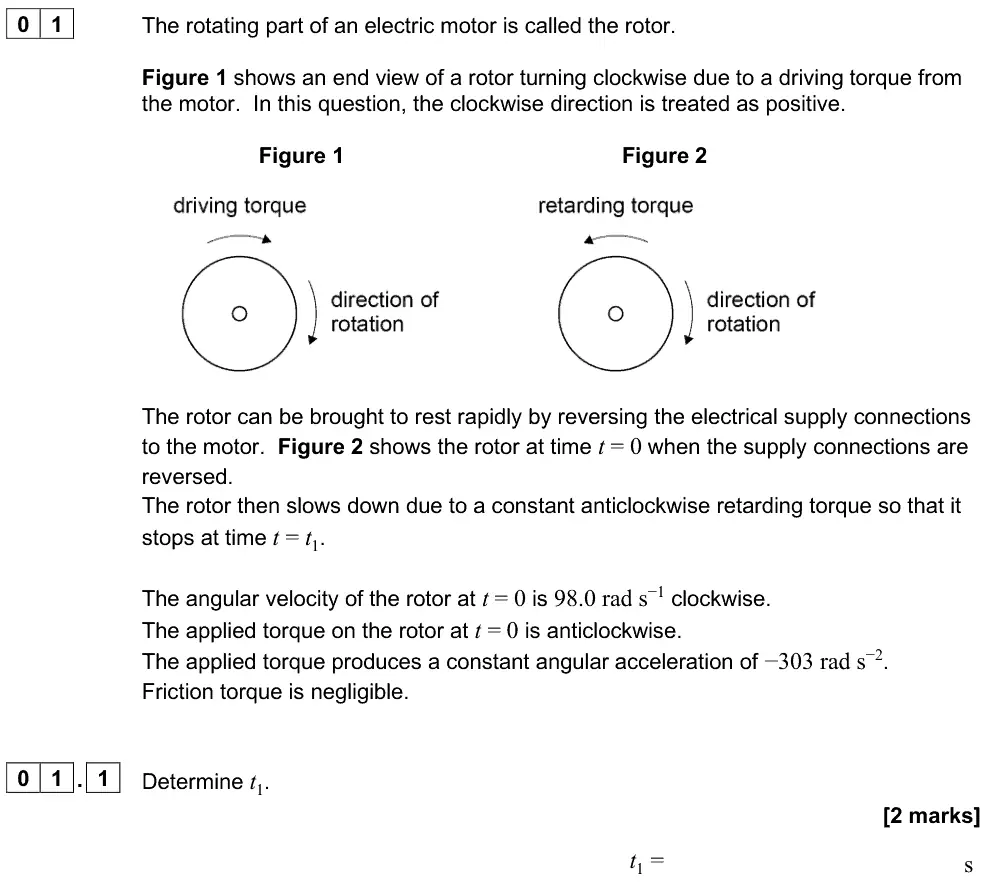
The rotating part of an electric motor is called the rotor.
Figure 1 shows an end view of a rotor turning clockwise due to a driving torque from
the motor.  In this question, the clockwise direction is treated as positive.
Figure 1
Figure 2
The rotor can be brought to rest rapidly by reversing the electrical supply connections
to the motor.  Figure 2 shows the rotor at time t = 0 when the supply connections are
reversed.
The rotor then slows down due to a constant anticlockwise retarding torque so that it
stops at time t = t1.
The angular velocity of the rotor at t = 0 is 98.0 rad s−1 clockwise.
The applied torque on the rotor at t = 0 is anticlockwise.
The applied torque produces a constant angular acceleration of −303 rad s−2.
Friction torque is negligible.
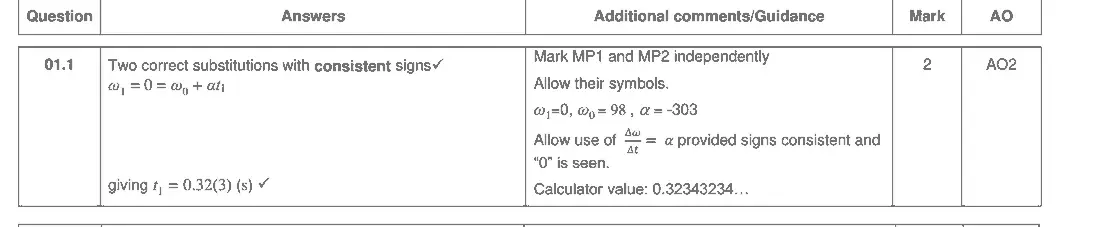
Determine t1.
[2 marks]
t1 =
s
June 2025 · Paper 3B Engineering physics · Q1.2 2 marks AO2=2 Calculation rotational dynamics
Earlier part of question 1 that this part usesEarlier part of June 2025 Paper 3B Engineering physics question 1
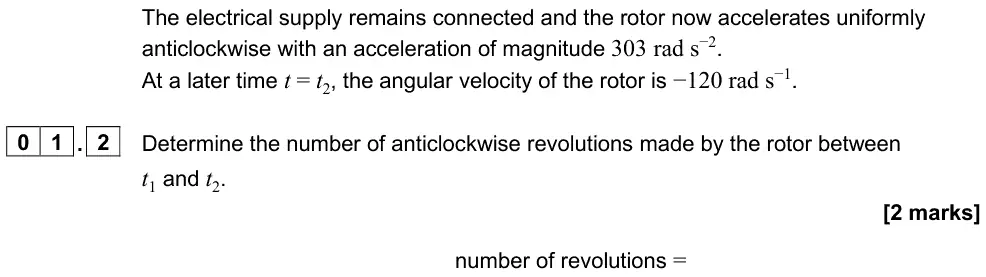
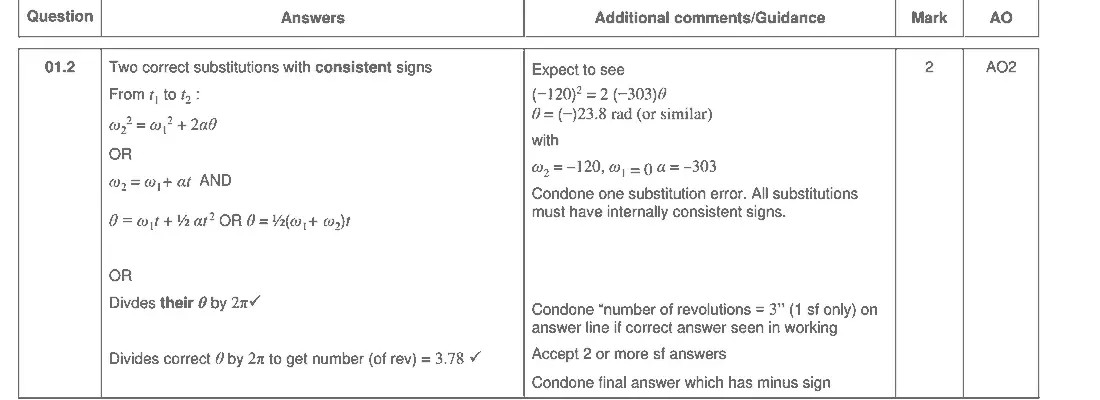
The electrical supply remains connected and the rotor now accelerates uniformly
anticlockwise with an acceleration of magnitude 303 rad s−2.
At a later time t = t2, the angular velocity of the rotor is −120 rad s−1.
Determine the number of anticlockwise revolutions made by the rotor between
t1 and t2.
[2 marks]
number of revolutions =
June 2025 · Paper 3B Engineering physics · Q1.3 1 mark AO2=1 Calculation Easy rotational dynamics
Earlier part of question 1 that this part usesEarlier part of June 2025 Paper 3B Engineering physics question 1
The moment of inertia of the rotor about the axis of rotation is 9.60 × 10⁻² kg m2.
Calculate the angular impulse on the rotor between t = 0 and t2.
[1 mark]
angular impulse =
N m s
June 2025 · Paper 3B Engineering physics · Q1.4 3 marks AO3=3 Calculation Hard rotational dynamics
Earlier part of question 1 that this part usesEarlier part of June 2025 Paper 3B Engineering physics question 1
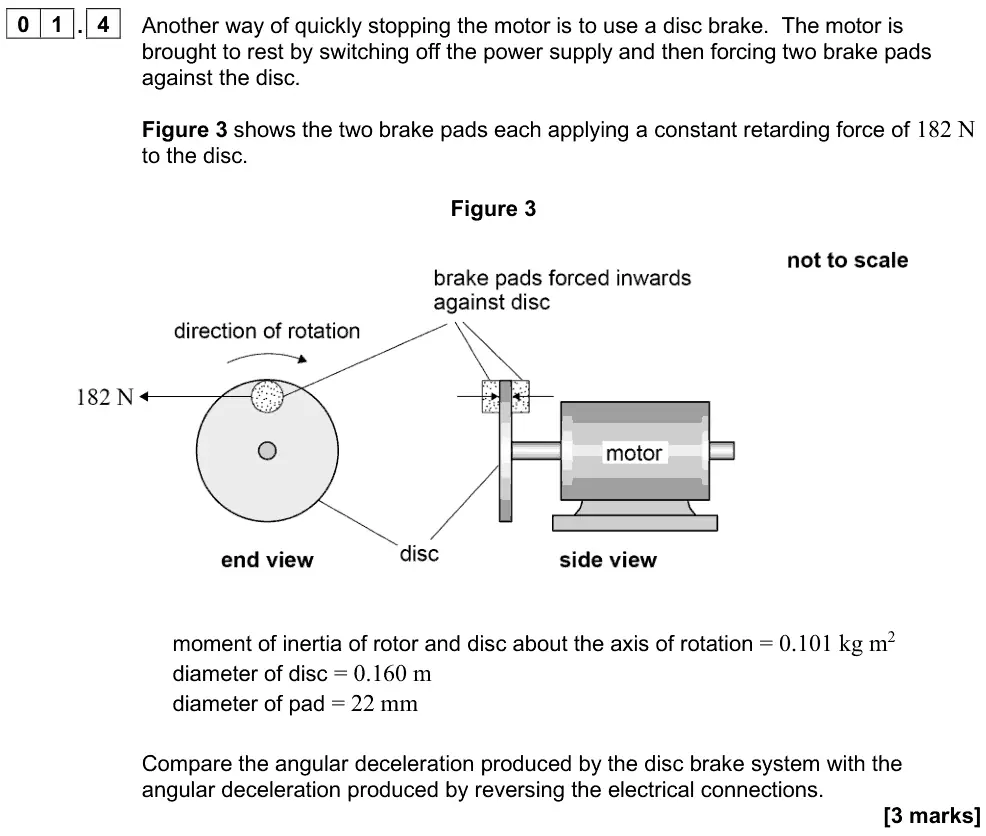
Another way of quickly stopping the motor is to use a disc brake.  The motor is
brought to rest by switching off the power supply and then forcing two brake pads
against the disc.
Figure 3 shows the two brake pads each applying a constant retarding force of 182 N
to the disc.
Figure 3
moment of inertia of rotor and disc about the axis of rotation = 0.101 kg m2
diameter of disc = 0.160 m
diameter of pad = 22 mm
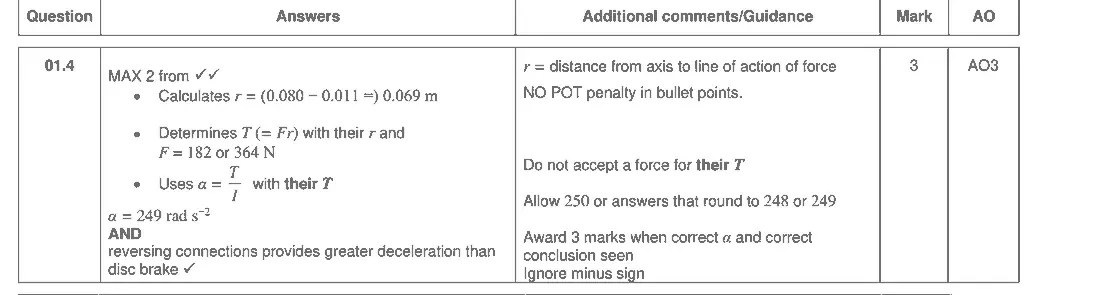
Compare the angular deceleration produced by the disc brake system with the
angular deceleration produced by reversing the electrical connections.
[3 marks]
June 2025 · Paper 3B Engineering physics · Q3.2 2 marks AO1=2 Calculation thermodynamics and engines
Earlier part of question 3 that this part usesEarlier part of June 2025 Paper 3B Engineering physics question 3
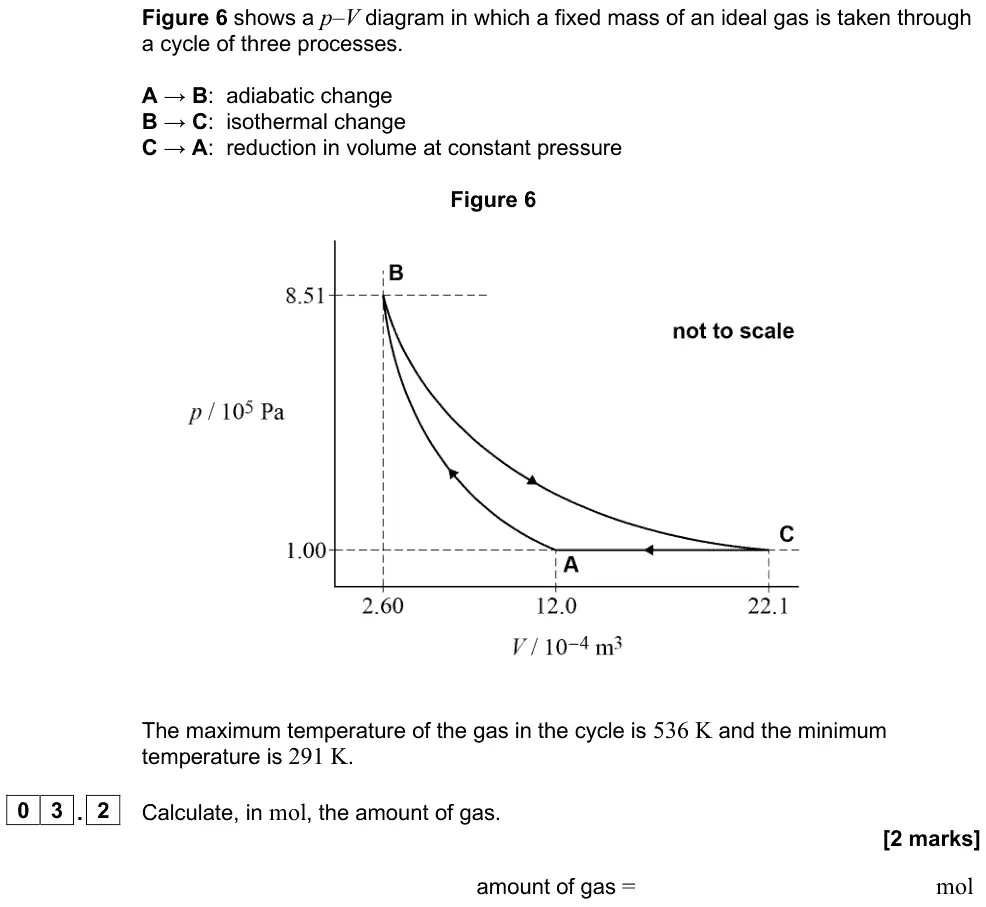
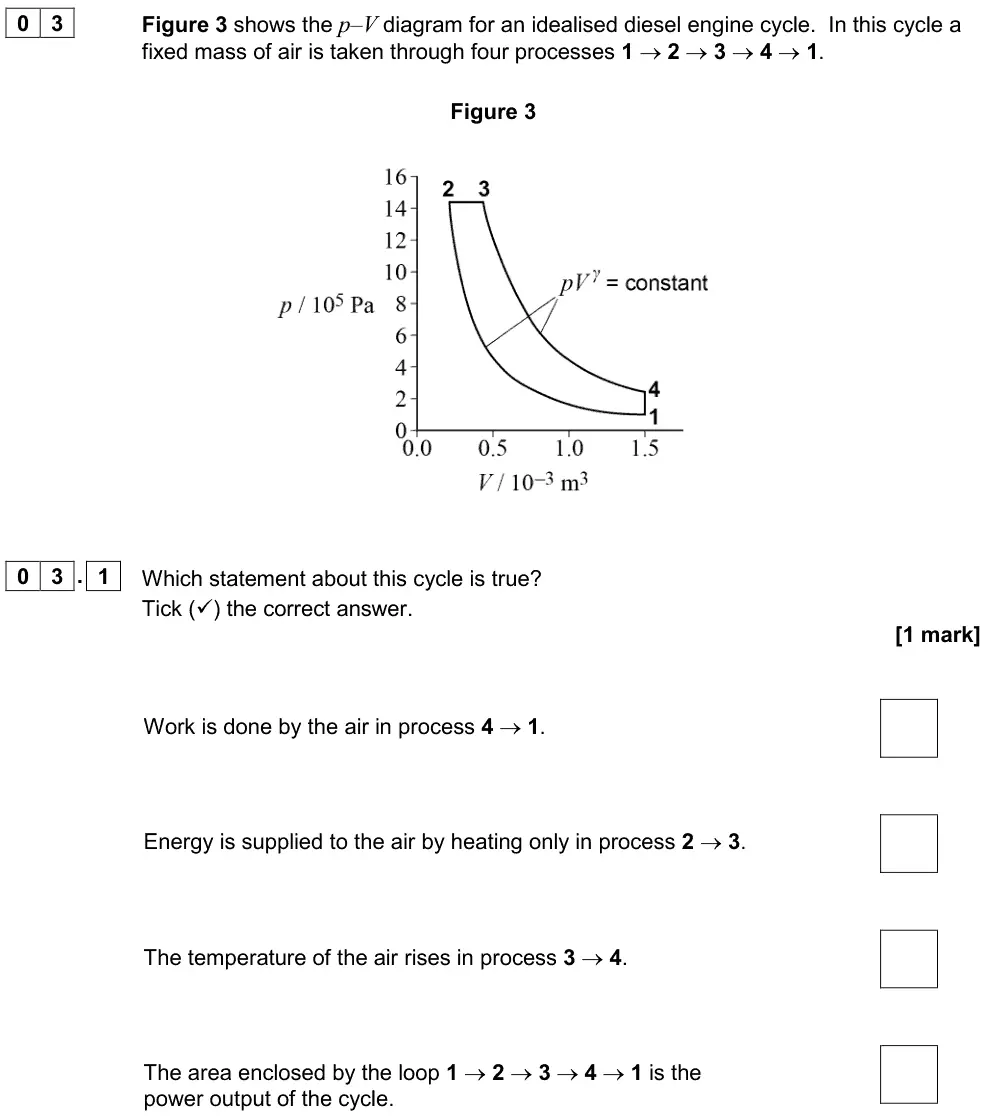
Figure 6 shows a p–V diagram in which a fixed mass of an ideal gas is taken through
a cycle of three processes.
A → B:  adiabatic change
B → C:  isothermal change
C → A:  reduction in volume at constant pressure
Figure 6
The maximum temperature of the gas in the cycle is 536 K and the minimum
temperature is 291 K.
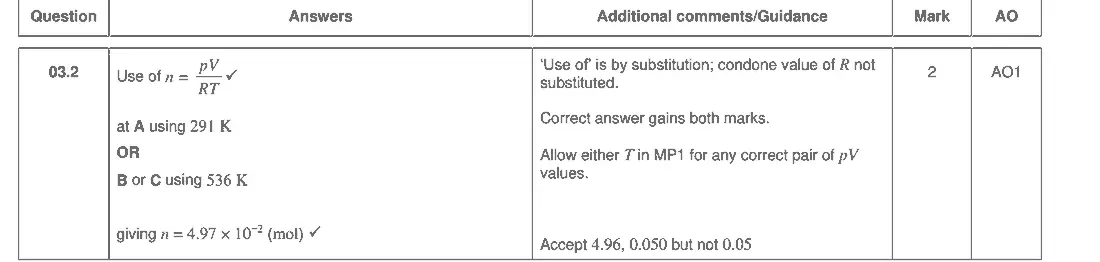
Calculate, in mol, the amount of gas.
[2 marks]
amount of gas =
mol
June 2025 · Paper 3B Engineering physics · Q3.4 3 marks AO1=1, AO2=1, AO3=1 Calculation thermodynamics and engines
Earlier part of question 3 that this part usesEarlier part of June 2025 Paper 3B Engineering physics question 3
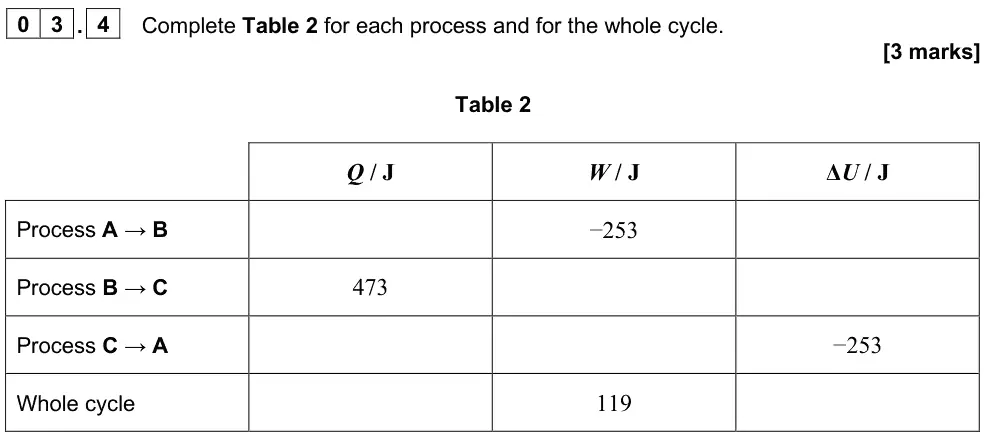
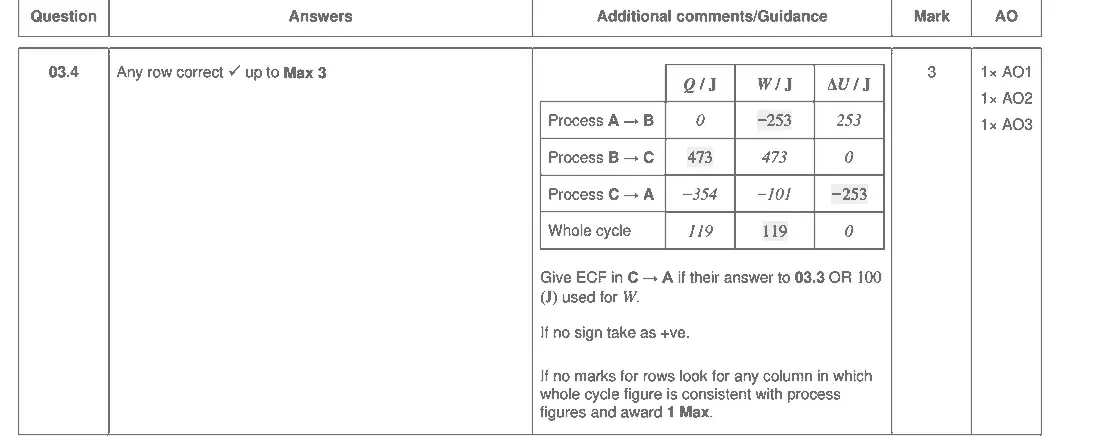
Complete Table 2 for each process and for the whole cycle.
[3 marks]
Table 2
Q / J
W / J
ΔU / J
Process A → B
−253
Process B → C
473
Process C → A
−253
Whole cycle
119
June 2025 · Paper 3B Turning points · Q1.5 3 marks AO2=3 Calculation discovery of the electron
Earlier part of question 1 that this part usesEarlier part of June 2025 Paper 3B Turning points question 1
Determine a value for the specific charge of the electron.
[3 marks]
specific charge =
C kg−1
June 2025 · Paper 3B Turning points · Q4.1 4 marks AO3=4 Calculation special relativity
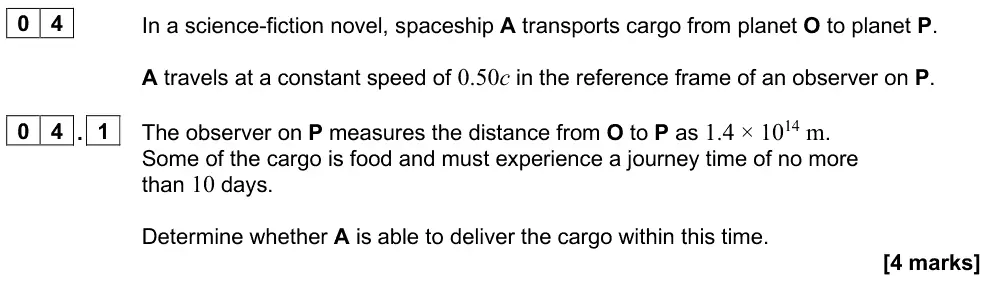
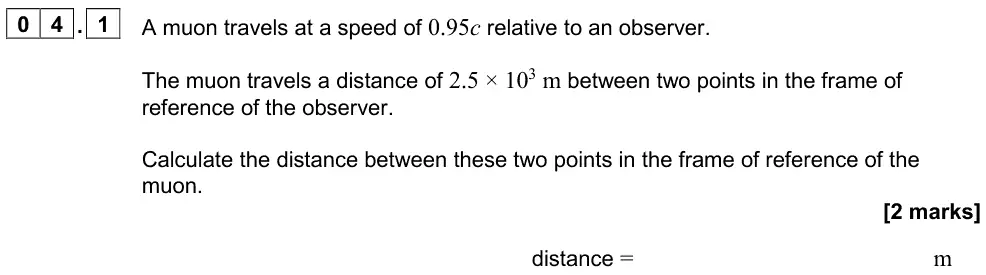
In a science-fiction novel, spaceship A transports cargo from planet O to planet P.
A travels at a constant speed of 0.50c in the reference frame of an observer on P.
The observer on P measures the distance from O to P as 1.4 × 10¹⁴ m.
Some of the cargo is food and must experience a journey time of no more
than 10 days.
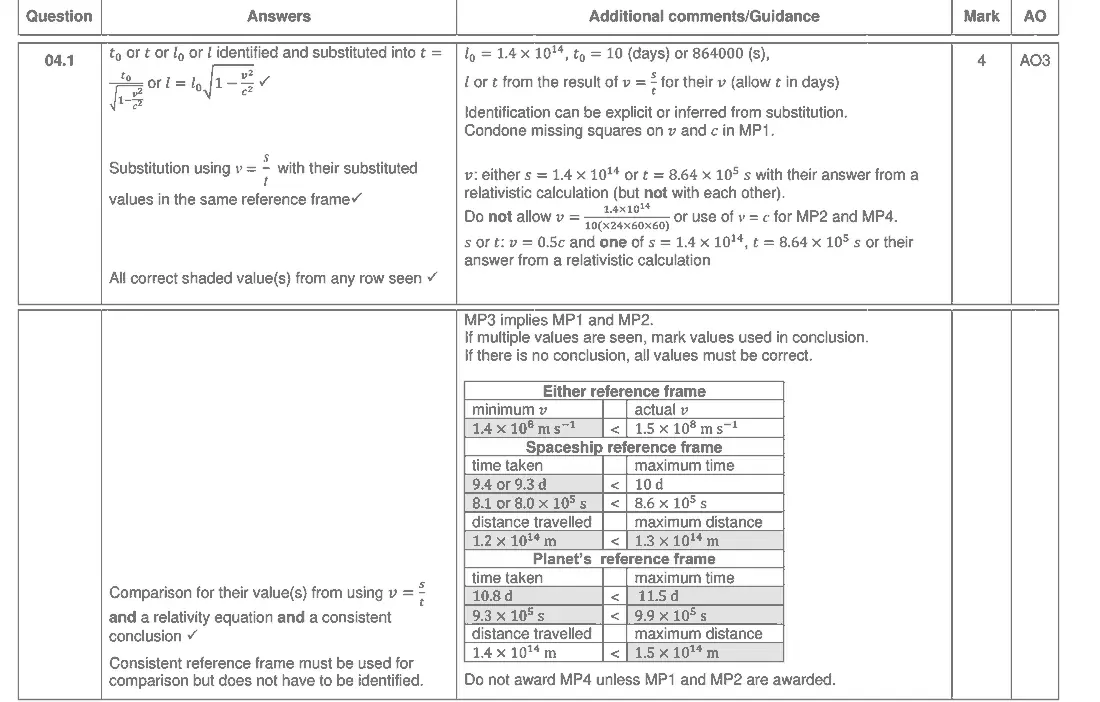
Determine whether A is able to deliver the cargo within this time.
[4 marks]
June 2025 · Paper 3B Turning points · Q4.2 4 marks AO3=4 Calculation special relativity
Earlier part of question 4 that this part usesEarlier part of June 2025 Paper 3B Turning points question 4
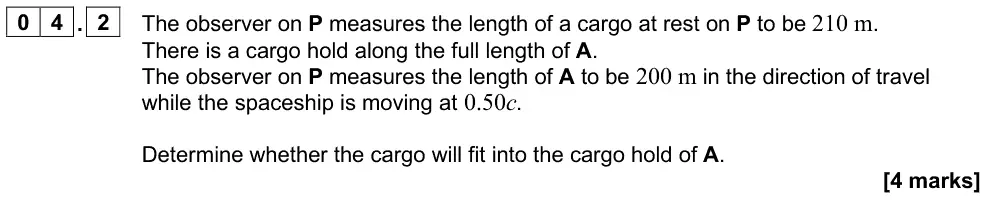
The observer on P measures the length of a cargo at rest on P to be 210 m.
There is a cargo hold along the full length of A.
The observer on P measures the length of A to be 200 m in the direction of travel
while the spaceship is moving at 0.50c.
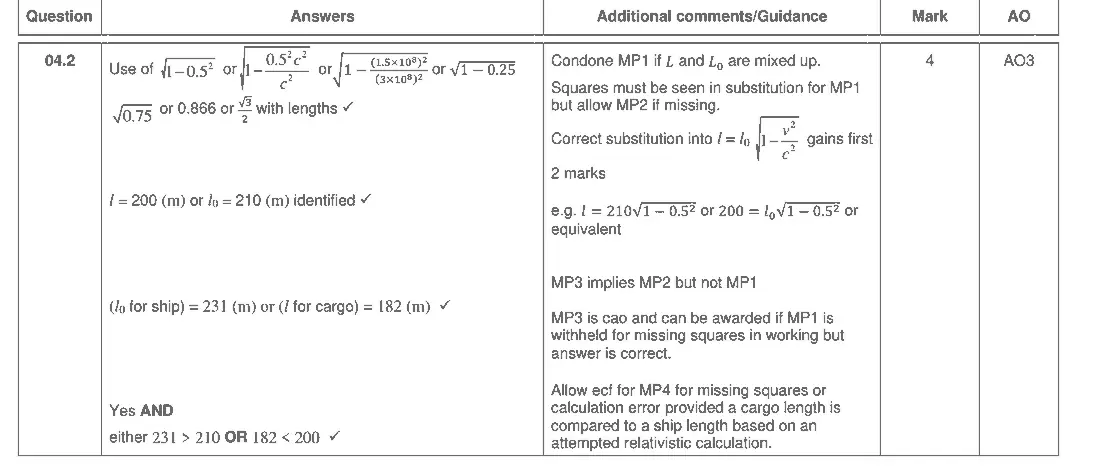
Determine whether the cargo will fit into the cargo hold of A.
[4 marks]
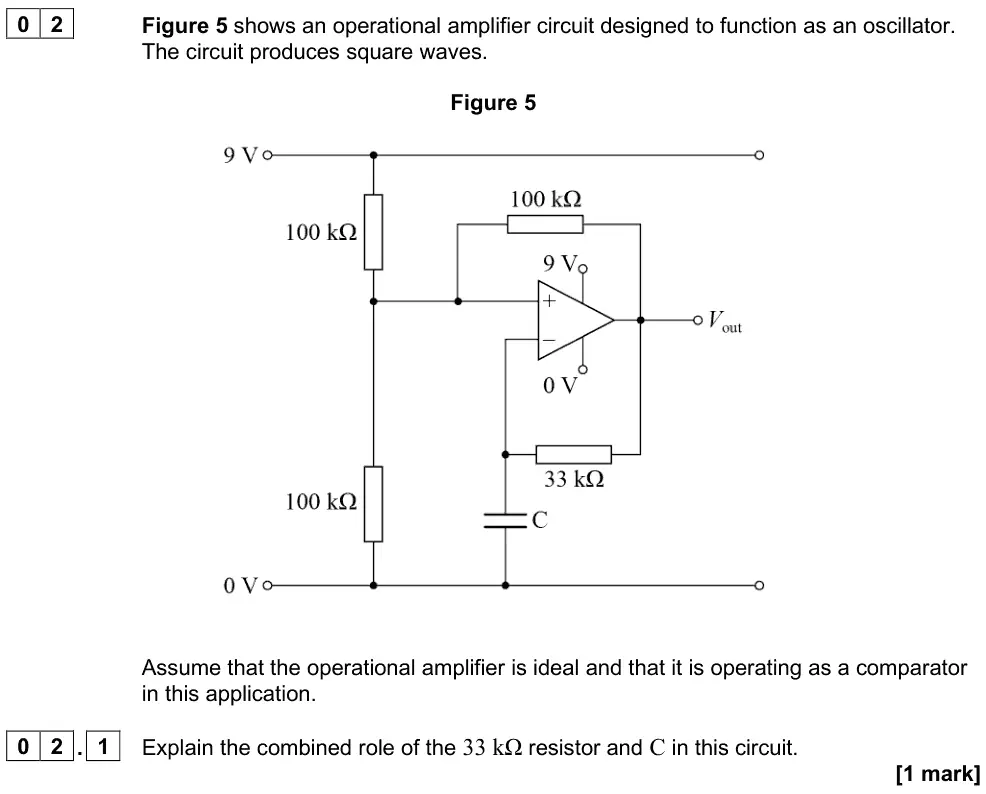
June 2025 · Paper 3B Electronics · Q2.3 3 marks AO2=2, AO3=1 Calculation operational amplifiersdigital electronics
Earlier part of question 2 that this part usesEarlier part of June 2025 Paper 3B Electronics question 2
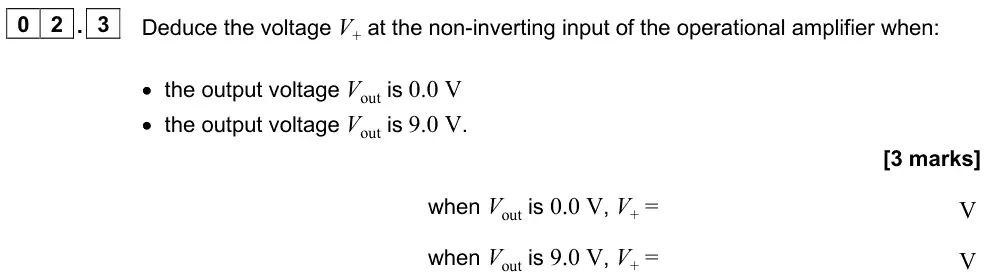
Deduce the voltage V+ at the non-inverting input of the operational amplifier when:
• the output voltage Vout is 0.0 V
• the output voltage Vout is 9.0 V.
[3 marks]
when Vout is 0.0 V, V+ =
V
when Vout is 9.0 V, V+ =
V
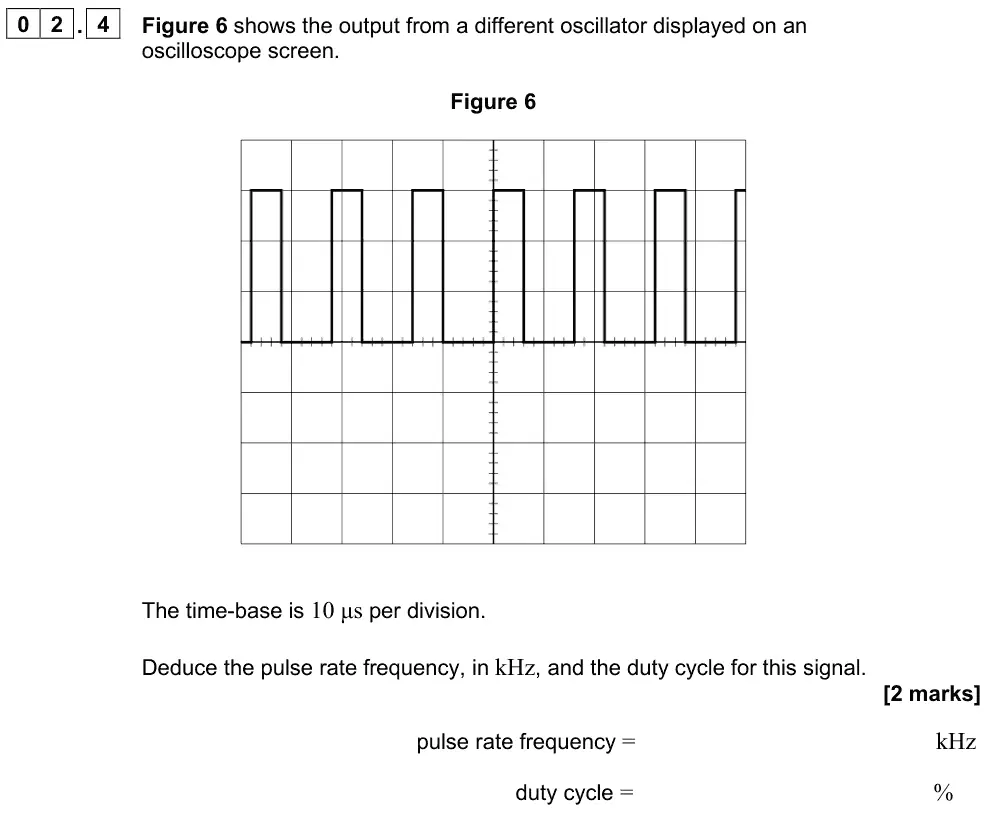
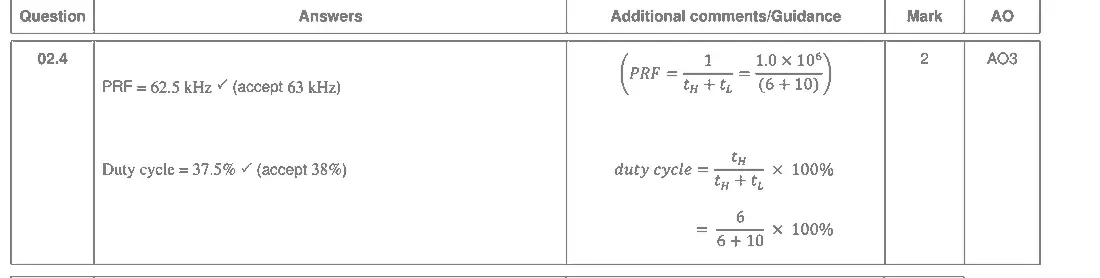
June 2025 · Paper 3B Electronics · Q2.4 2 marks AO3=2 Calculation digital electronics
Earlier part of question 2 that this part usesEarlier part of June 2025 Paper 3B Electronics question 2
Figure 6 shows the output from a different oscillator displayed on an
oscilloscope screen.
Figure 6
The time-base is 10 μs per division.
Deduce the pulse rate frequency, in kHz, and the duty cycle for this signal.
[2 marks]
pulse rate frequency =
kHz
duty cycle =
%
June 2025 · Paper 3B Electronics · Q3.4 3 marks AO3=3 Calculation operational amplifierssemiconductor devices and signals
Earlier part of question 3 that this part usesEarlier part of June 2025 Paper 3B Electronics question 3
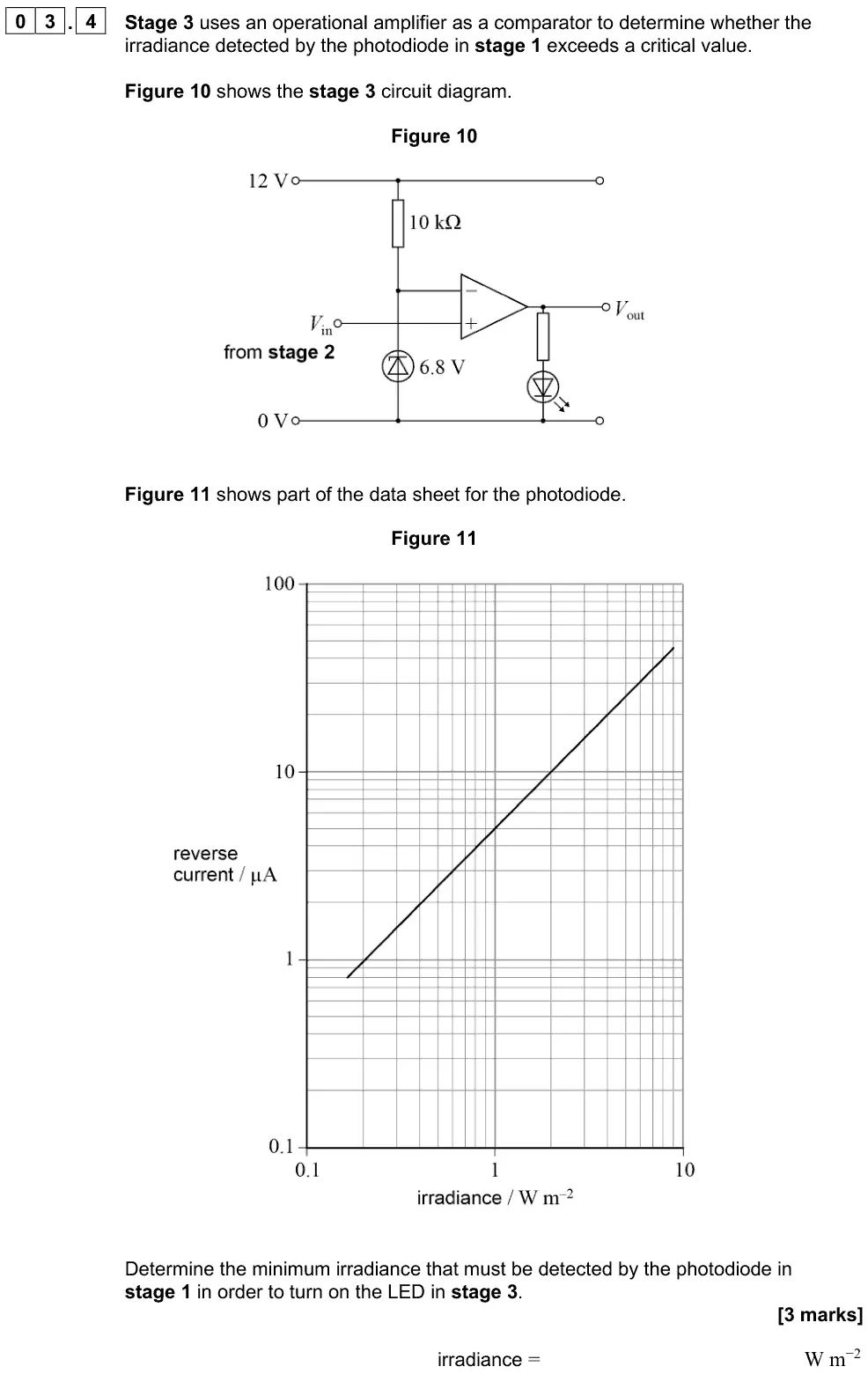
Stage 3 uses an operational amplifier as a comparator to determine whether the
irradiance detected by the photodiode in stage 1 exceeds a critical value.
Figure 10 shows the stage 3 circuit diagram.
Figure 10
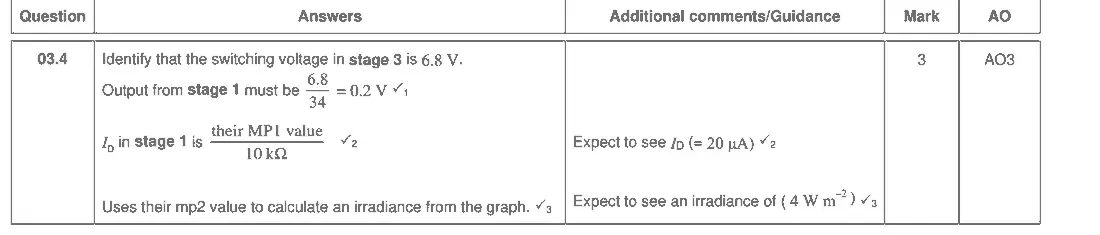
Figure 11 shows part of the data sheet for the photodiode.
Figure 11
Determine the minimum irradiance that must be detected by the photodiode in
stage 1 in order to turn on the LED in stage 3.
[3 marks]
irradiance =
W m−2
June 2024 · AS Paper 1 · Q1.2 2 marks AO1=1, AO2=1 Calculation atomic structure and stable nuclei
Earlier part of question 1 that this part usesEarlier part of June 2024 Paper 1 question 1
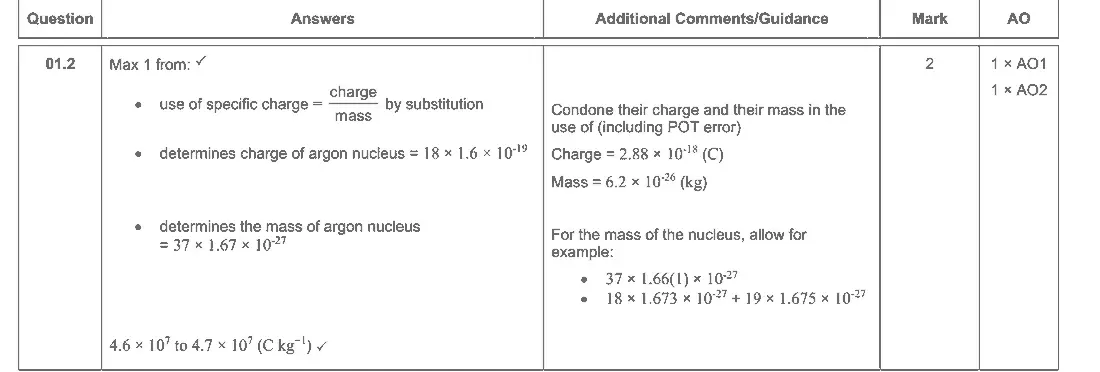
Calculate the specific charge of the argon-37 nucleus.
[2 marks]
specific charge =
C kg−1
June 2024 · AS Paper 1 · Q2.2 3 marks AO1=2, AO2=1 Calculation particles antiparticles and interactionsenergy levels and wave particle duality
Earlier part of question 2 that this part usesEarlier part of June 2024 Paper 1 question 2
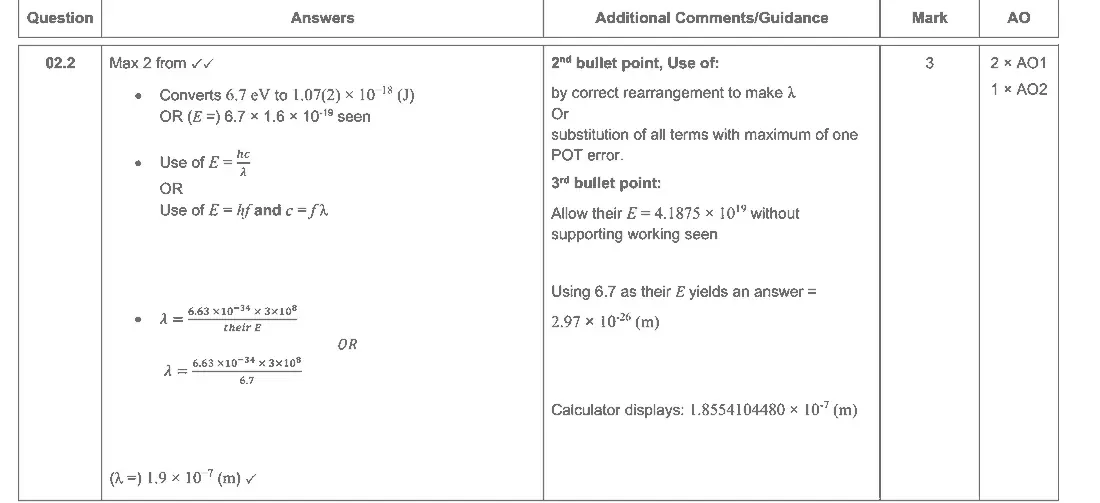
The electron collides with a mercury atom.  The atom subsequently emits a photon of
ultraviolet radiation with an energy of 6.7 eV.
Calculate the wavelength of the emitted photon of this ultraviolet radiation.
[3 marks]
wavelength =
m
June 2024 · AS Paper 1 · Q3.1 2 marks AO1=1, AO2=1 Calculation progressive waves and polarisationstationary waves
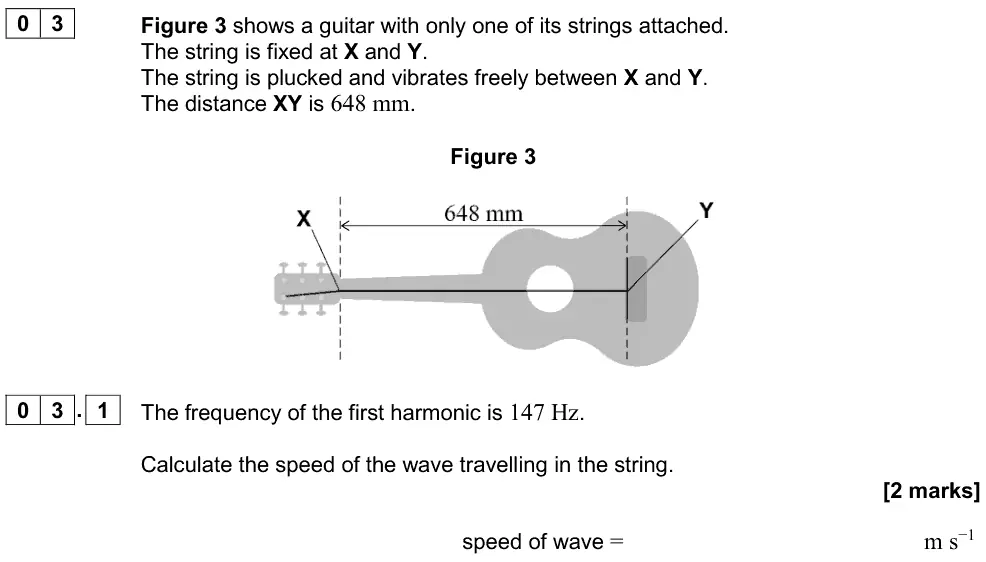
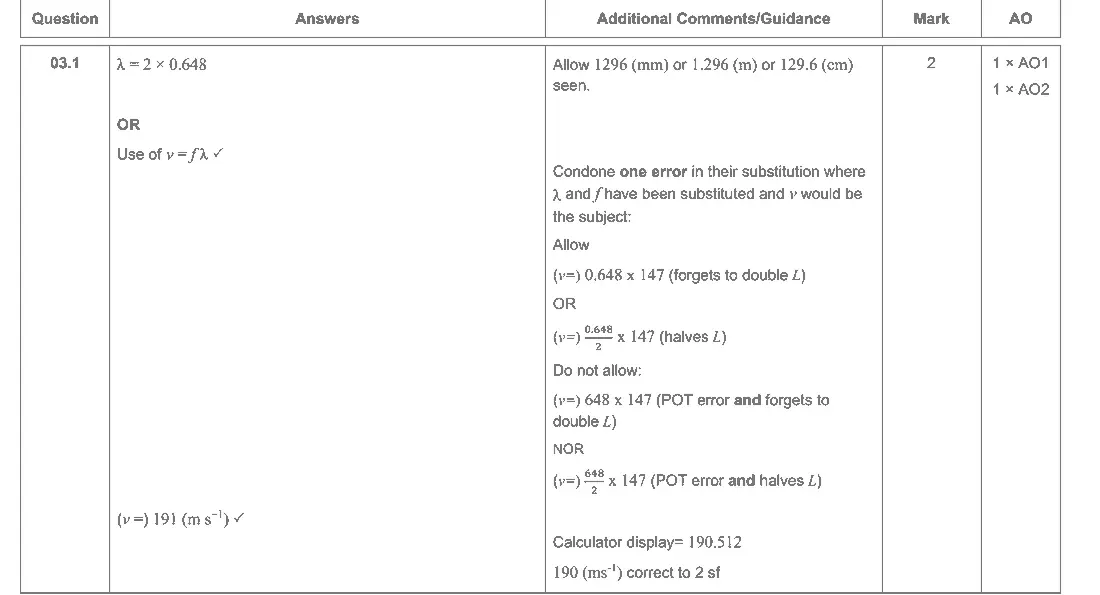
Figure 3 shows a guitar with only one of its strings attached.
The string is fixed at X and Y.
The string is plucked and vibrates freely between X and Y.
The distance XY is 648 mm.
Figure 3
The frequency of the first harmonic is 147 Hz.
Calculate the speed of the wave travelling in the string.
[2 marks]
speed of wave =
m s−1
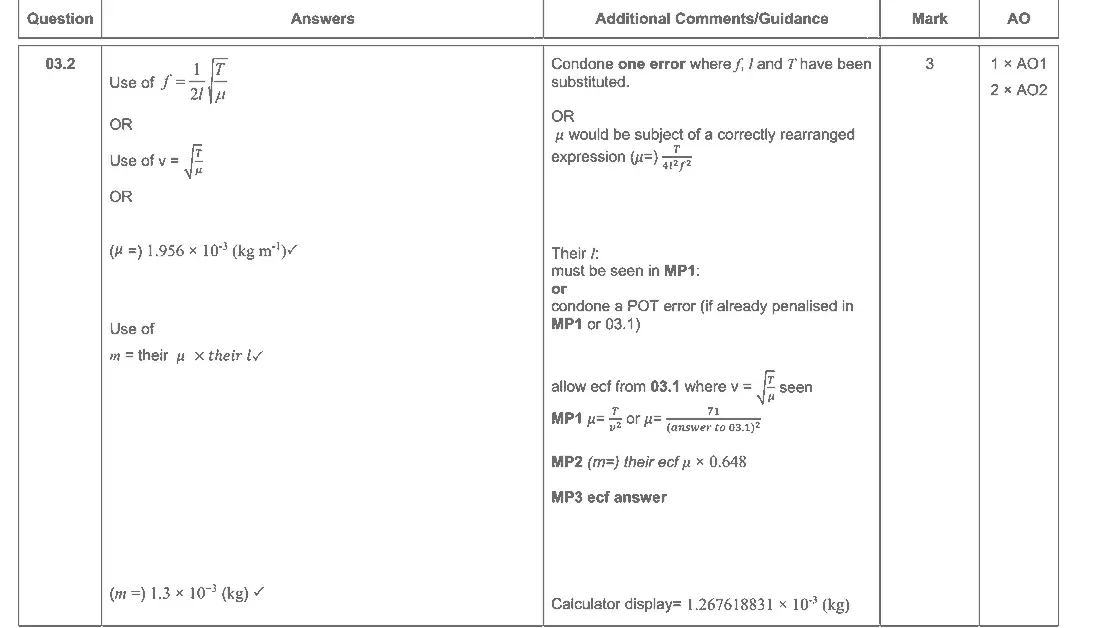
June 2024 · AS Paper 1 · Q3.2 3 marks AO1=1, AO2=2 Calculation stationary waves
Earlier part of question 3 that this part usesEarlier part of June 2024 Paper 1 question 3
The tension in the string is 71 N.
Calculate the mass of the string between X and Y.
[3 marks]
mass =
kg
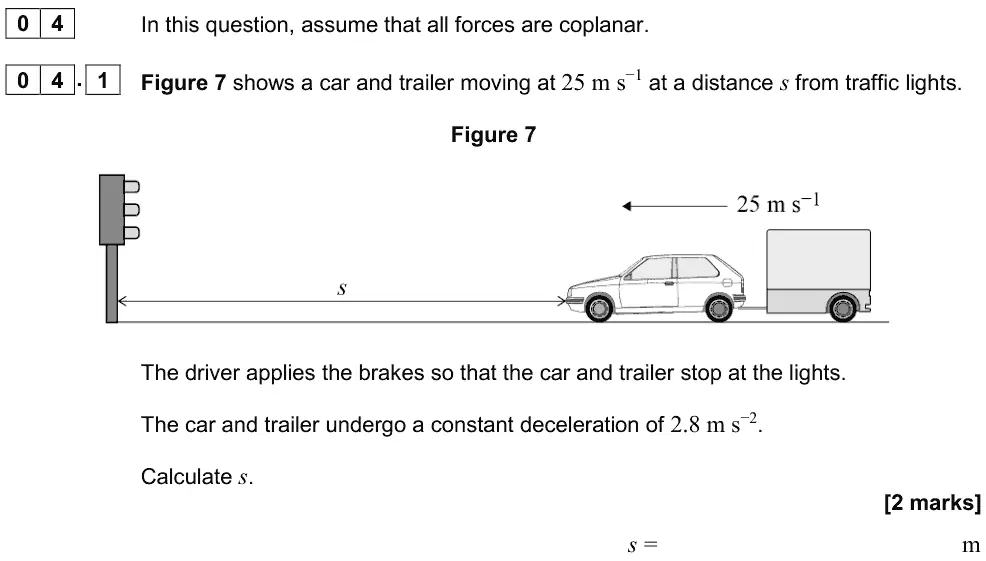
June 2024 · AS Paper 1 · Q4.1 2 marks AO1=1, AO2=1 Calculation motion and projectiles
In this question, assume that all forces are coplanar.
Figure 7 shows a car and trailer moving at 25 m s−1 at a distance s from traffic lights.
Figure 7
The driver applies the brakes so that the car and trailer stop at the lights.
The car and trailer undergo a constant deceleration of 2.8 m s−2.
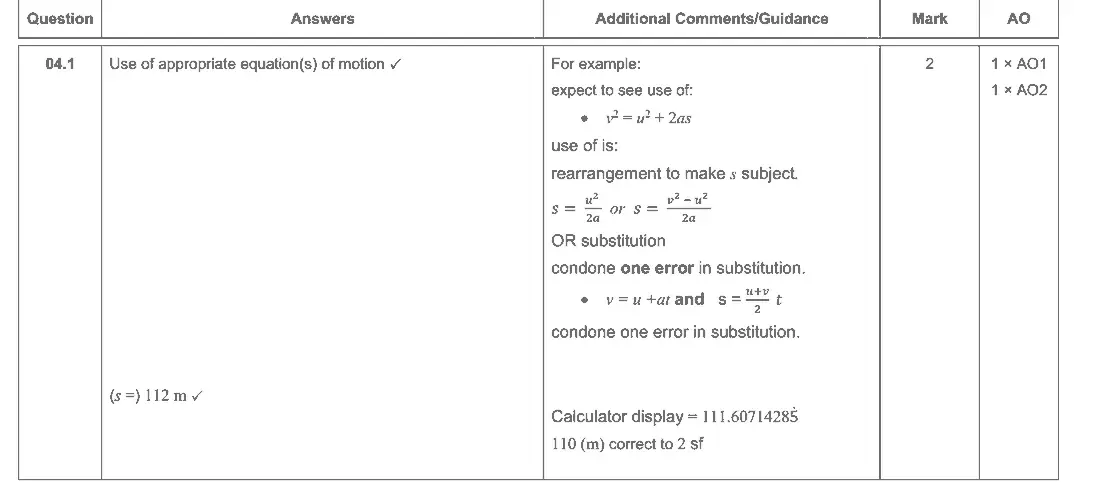
Calculate s.
[2 marks]
s =
m
June 2024 · AS Paper 1 · Q4.2 2 marks AO1=1, AO2=1 Calculation newtons laws and momentum
Earlier part of question 4 that this part usesEarlier part of June 2024 Paper 1 question 4
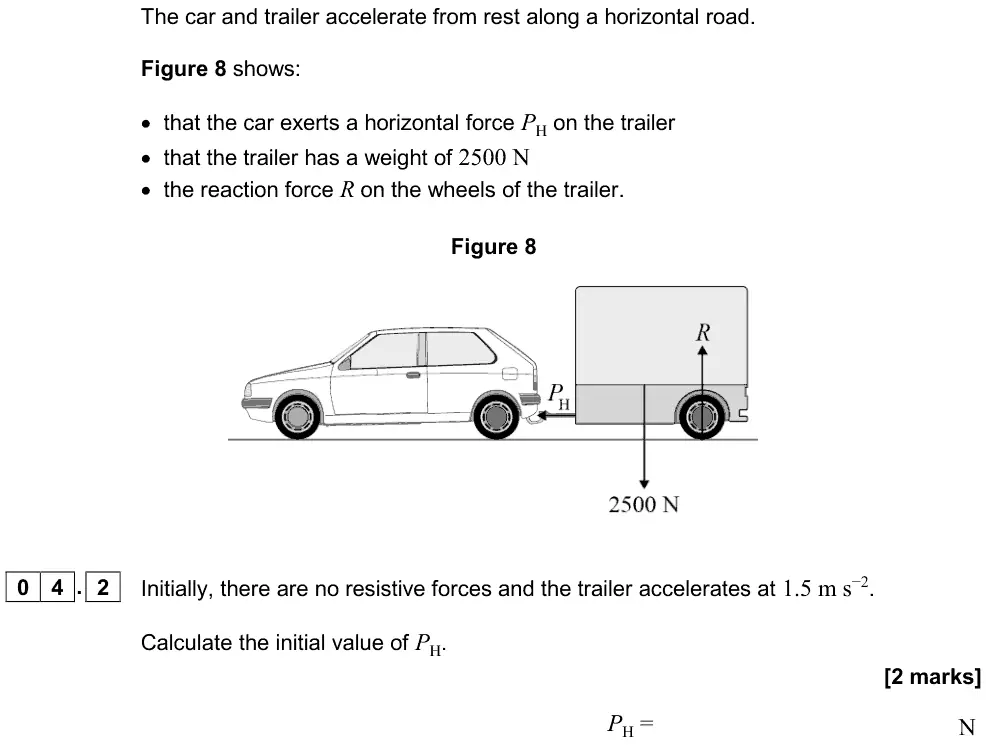
The car and trailer accelerate from rest along a horizontal road.
Figure 8 shows:
• that the car exerts a horizontal force PH on the trailer
• that the trailer has a weight of 2500 N
• the reaction force R on the wheels of the trailer.
Figure 8
Initially, there are no resistive forces and the trailer accelerates at 1.5 m s−2.
Calculate the initial value of PH.
[2 marks]
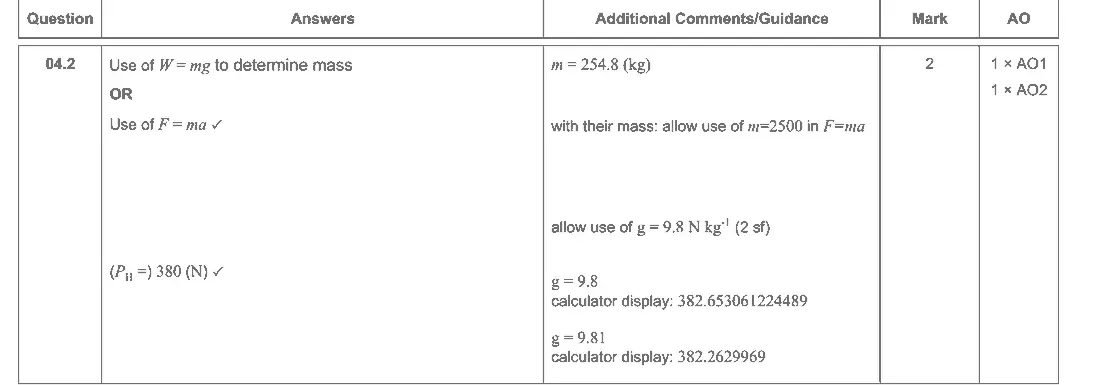
PH =
N
June 2024 · AS Paper 1 · Q4.3 3 marks AO2=2, AO3=1 Calculation vectors and moments
Earlier part of question 4 that this part usesEarlier part of June 2024 Paper 1 question 4
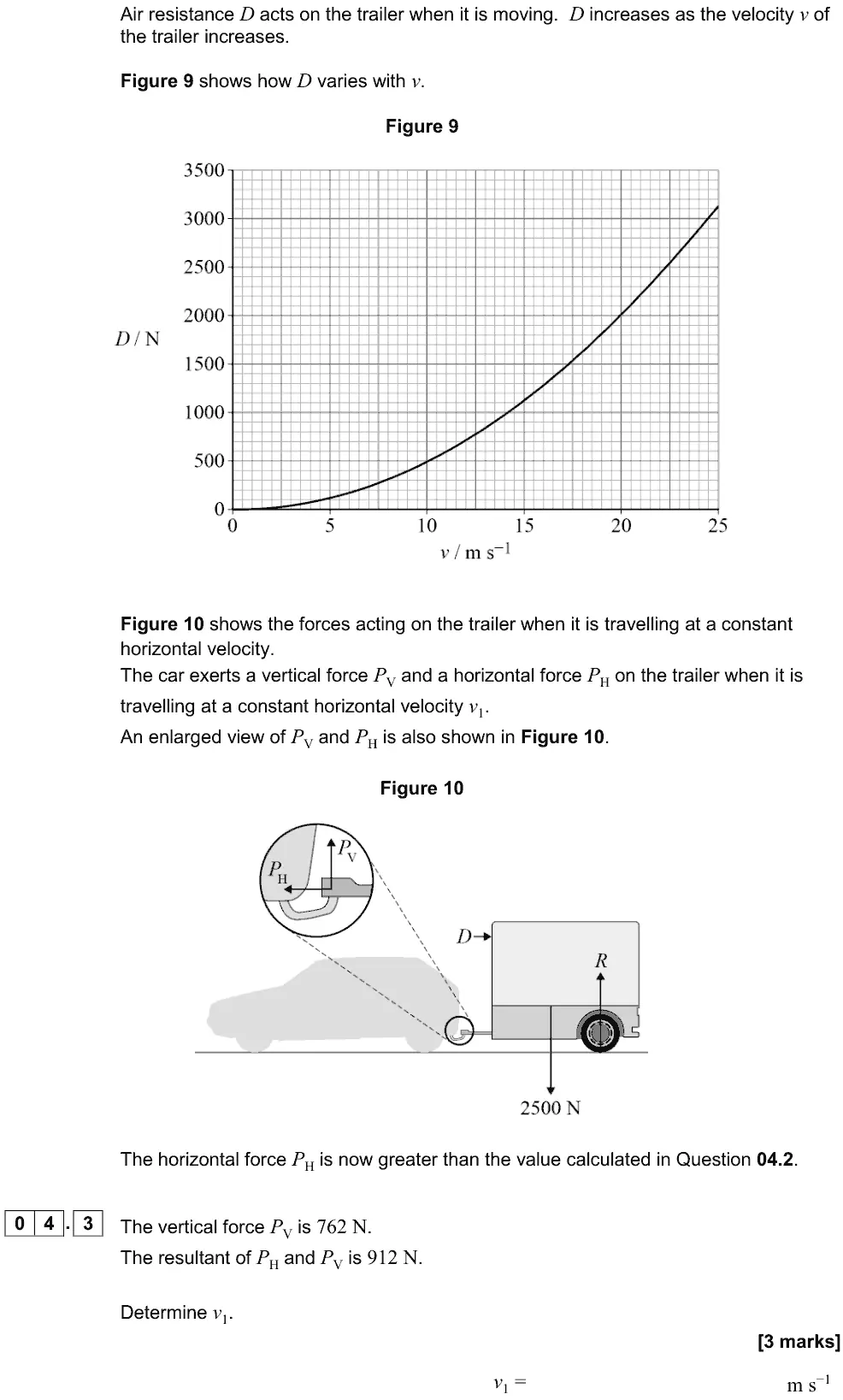
Air resistance D acts on the trailer when it is moving.  D increases as the velocity v of
the trailer increases.
Figure 9 shows how D varies with v.
Figure 9
Figure 10 shows the forces acting on the trailer when it is travelling at a constant
horizontal velocity.
The car exerts a vertical force PV and a horizontal force PH on the trailer when it is
travelling at a constant horizontal velocity v1.
An enlarged view of PV and PH is also shown in Figure 10.
Figure 10
The horizontal force PH is now greater than the value calculated in Question 04.2.
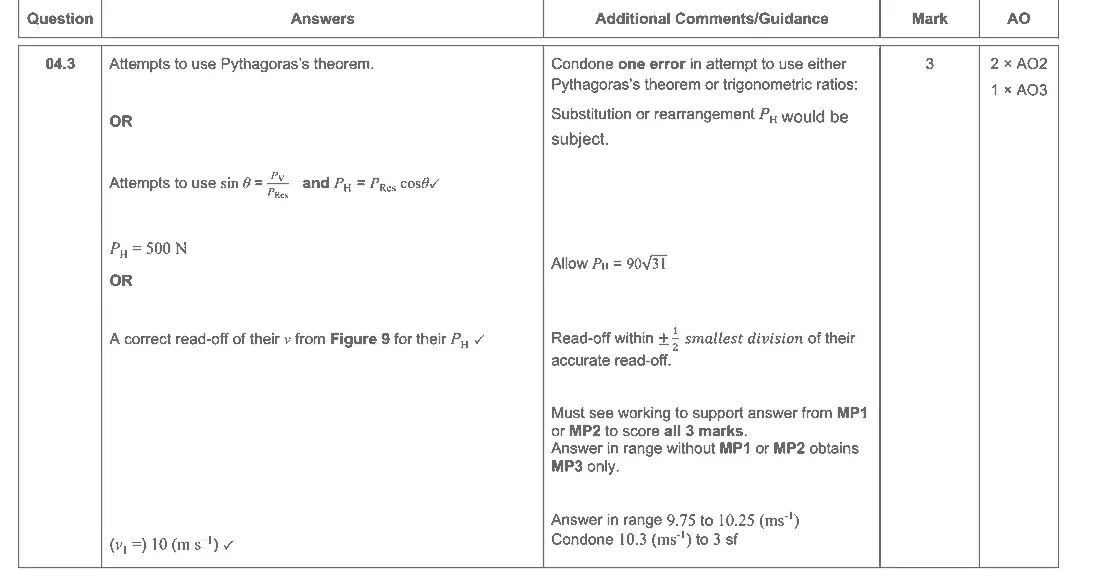
The vertical force PV is 762 N.
The resultant of PH and PV is 912 N.
Determine v1.
[3 marks]
v1 =
m s−1
June 2024 · AS Paper 1 · Q4.5 3 marks AO1=1, AO2=1, AO3=1 Calculation Hard vectors and moments
Earlier part of question 4 that this part usesEarlier part of June 2024 Paper 1 question 4
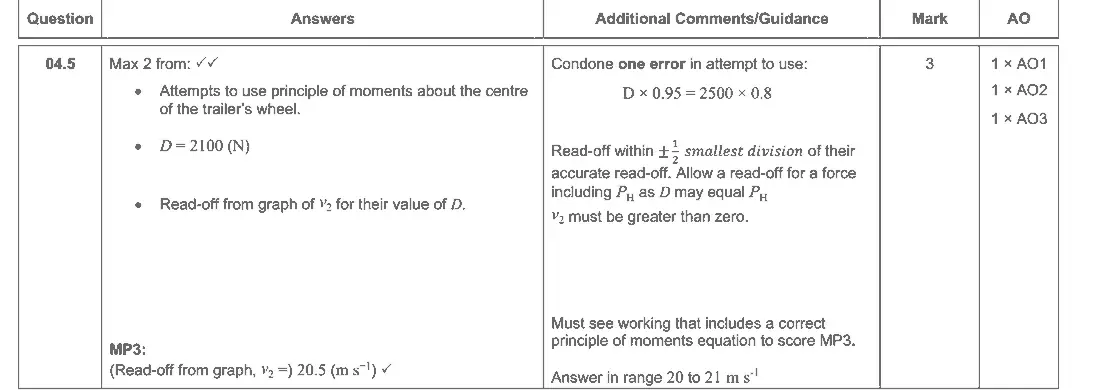
When the car and trailer travel with velocity v2, PV is zero.
Determine v2.
[3 marks]
v2 =
m s−1
June 2024 · AS Paper 1 · Q4.7 3 marks AO1=1, AO2=2 Calculation work energy and powernewtons laws and momentum
Earlier part of question 4 that this part usesEarlier part of June 2024 Paper 1 question 4
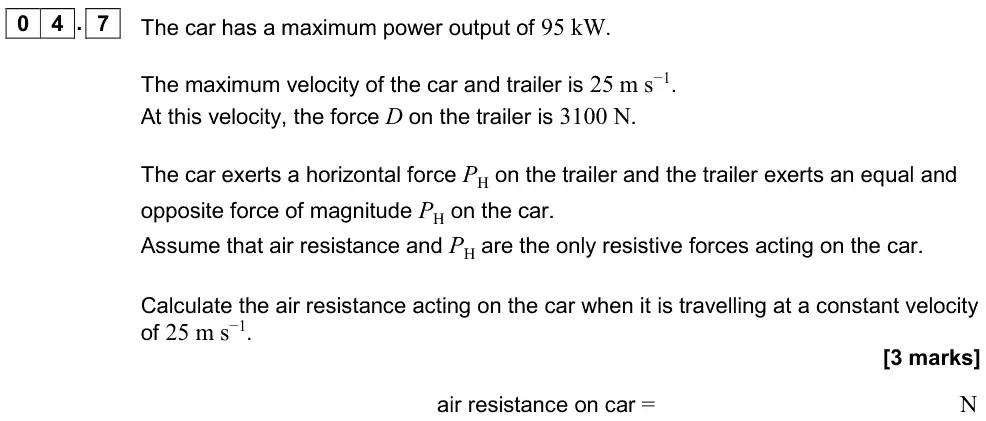
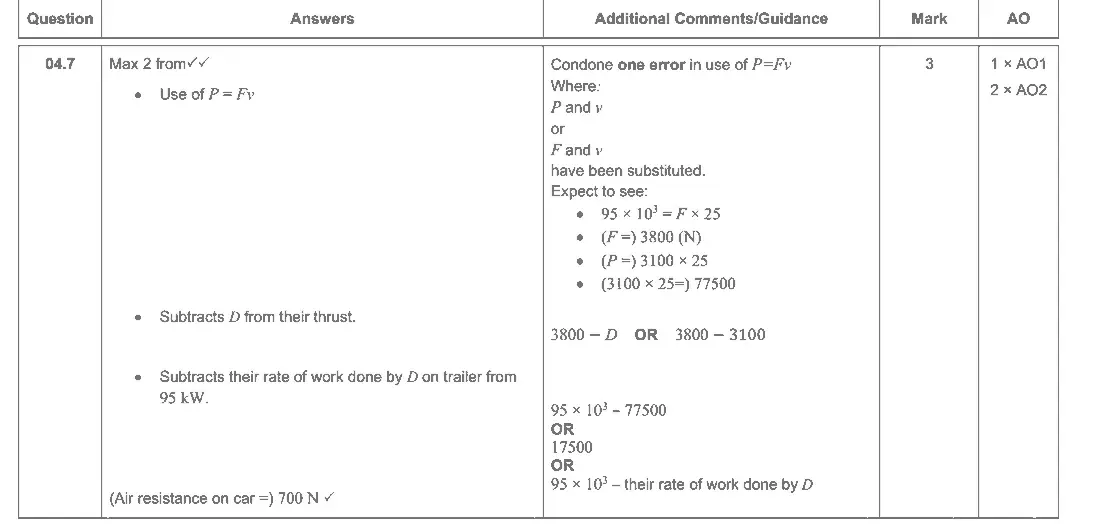
The car has a maximum power output of 95 kW.
The maximum velocity of the car and trailer is 25 m s−1.
At this velocity, the force D on the trailer is 3100 N.
The car exerts a horizontal force PH on the trailer and the trailer exerts an equal and
opposite force of magnitude PH on the car.
Assume that air resistance and PH are the only resistive forces acting on the car.
Calculate the air resistance acting on the car when it is travelling at a constant velocity
of 25 m s−1.
[3 marks]
air resistance on car =
N
June 2024 · AS Paper 1 · Q5.2 2 marks AO1=1, AO2=1 Calculation circuits and potential dividerscurrent voltage and resistivity
Earlier part of question 5 that this part usesEarlier part of June 2024 Paper 1 question 5
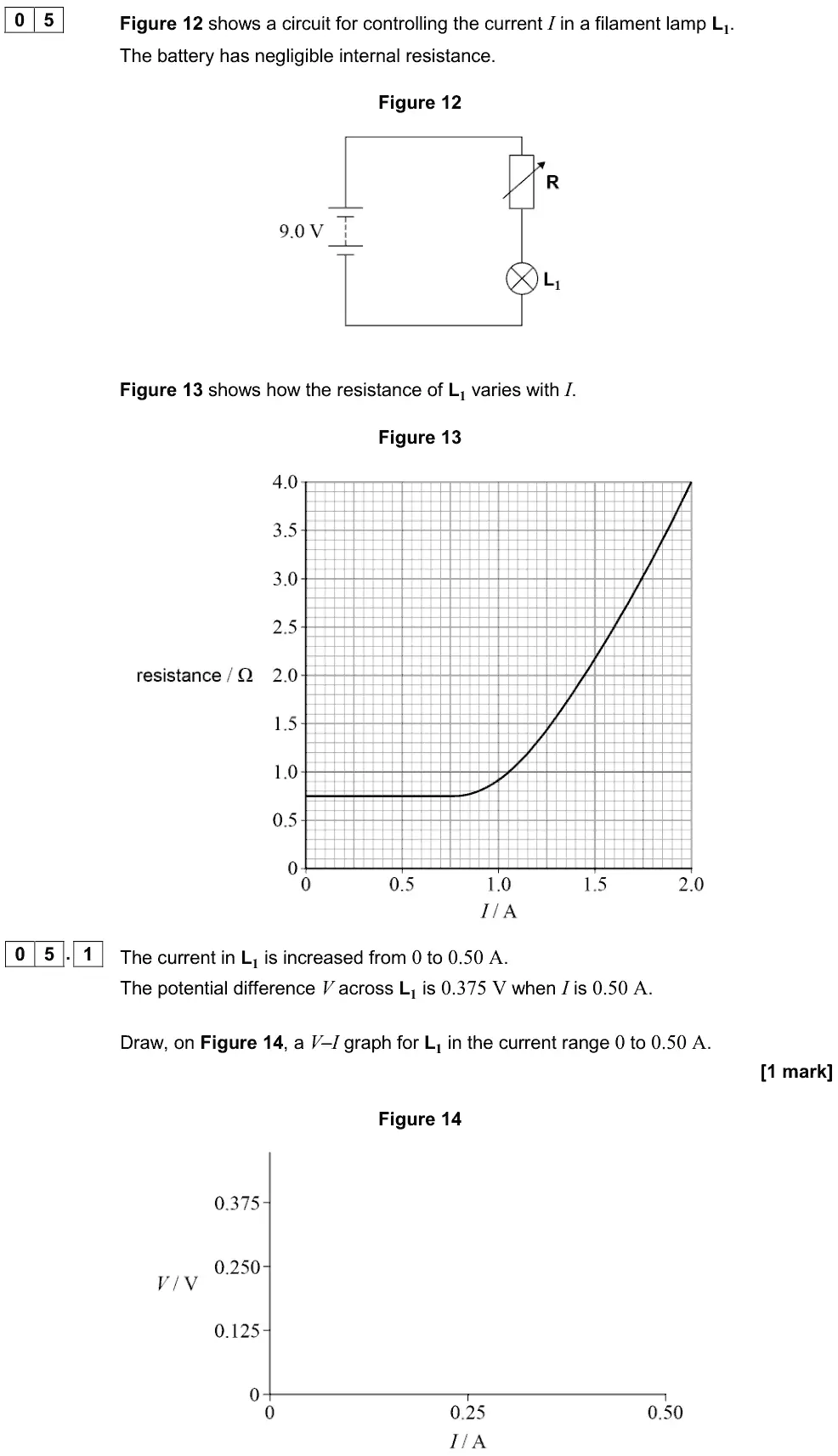
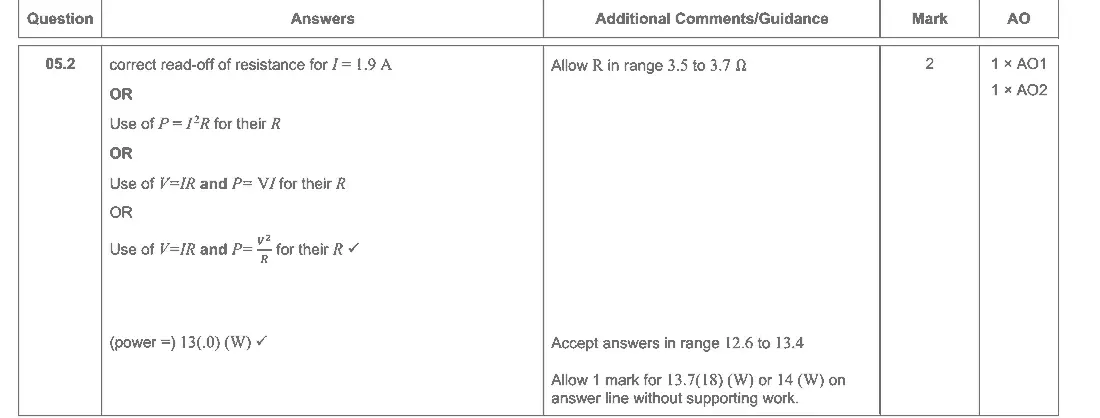
Calculate the power dissipated in L1 when I is 1.9 A.
[2 marks]
power dissipated =
W
June 2024 · AS Paper 1 · Q5.3 2 marks AO1=1, AO2=1 Calculation circuits and potential dividerscurrent voltage and resistivity
Earlier part of question 5 that this part usesEarlier part of June 2024 Paper 1 question 5
Question 5 continues on page 21
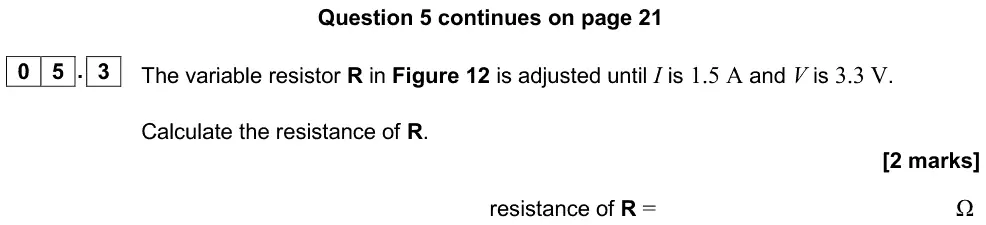
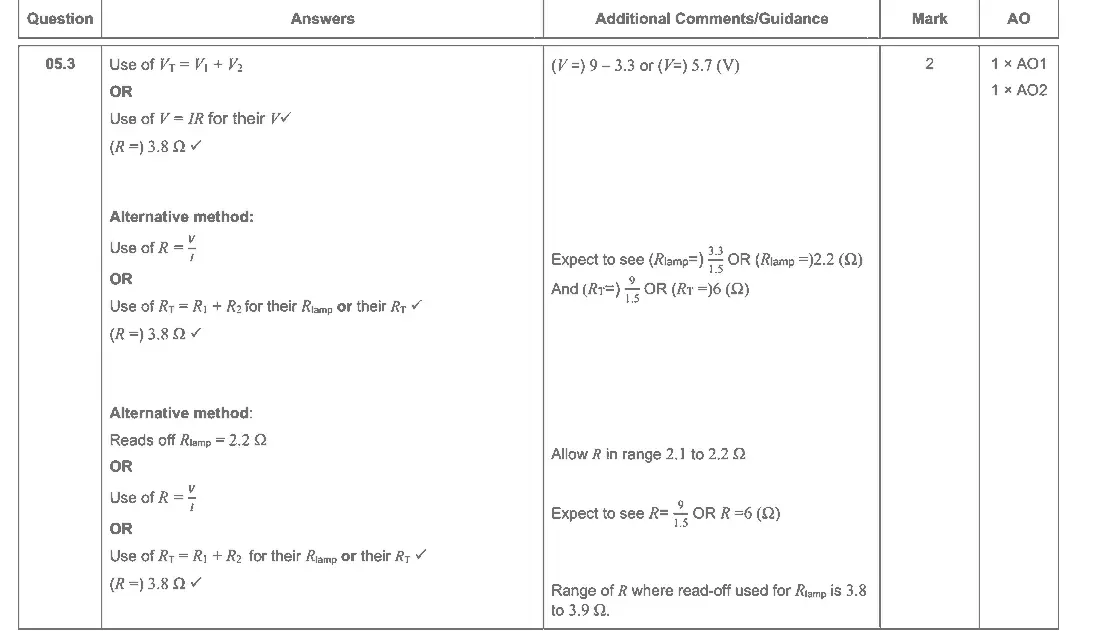
The variable resistor R in Figure 12 is adjusted until I is 1.5 A and V is 3.3 V.
Calculate the resistance of R.
[2 marks]
resistance of R =
Ω
June 2024 · AS Paper 1 · Q6.2 2 marks AO1=1, AO2=1 Calculation work energy and power
Earlier part of question 6 that this part usesEarlier part of June 2024 Paper 1 question 6
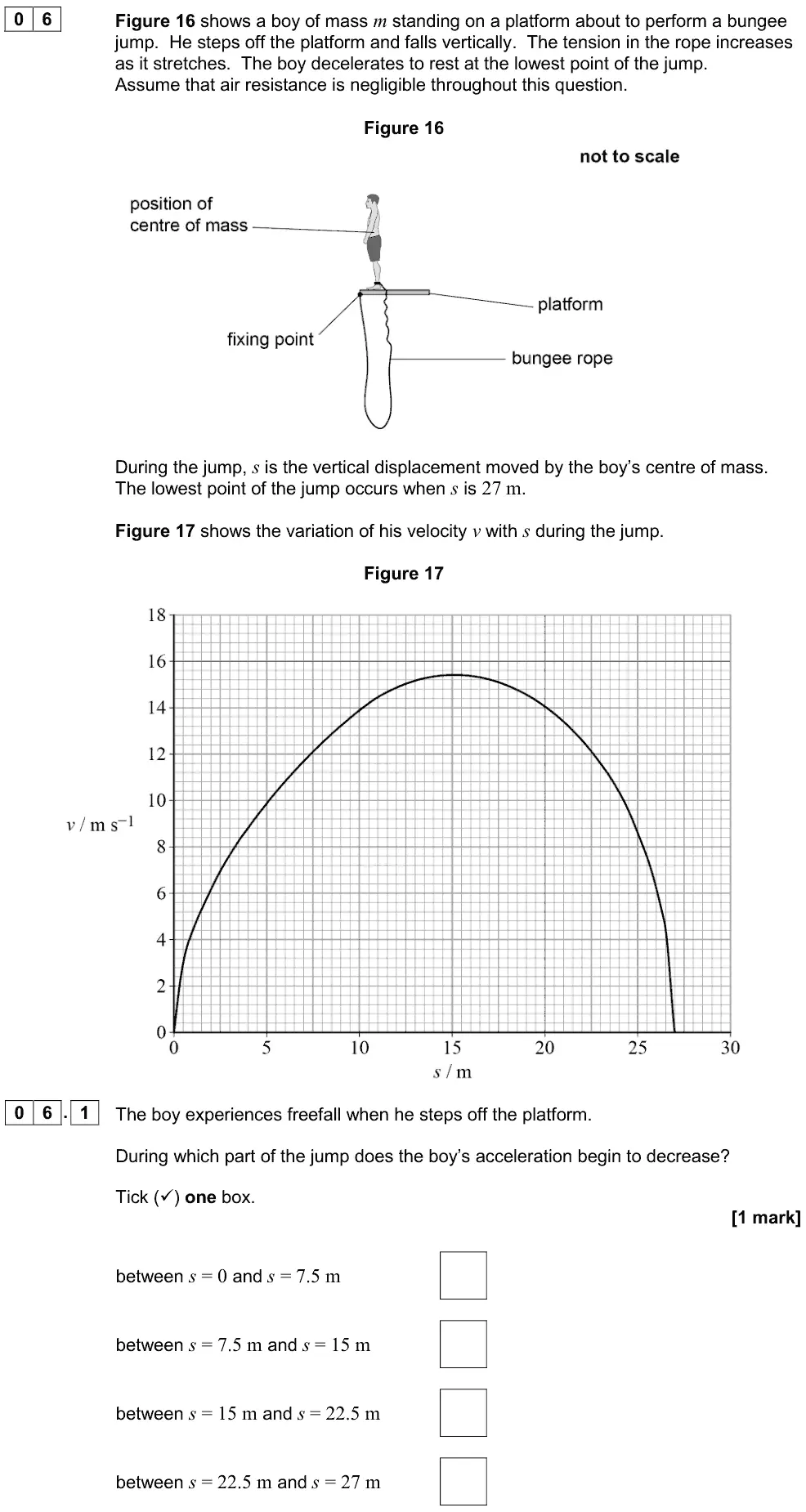
When the boy’s centre of mass has moved through a distance s of 15.0 m the change
in his gravitational potential energy is 9.56 kJ.
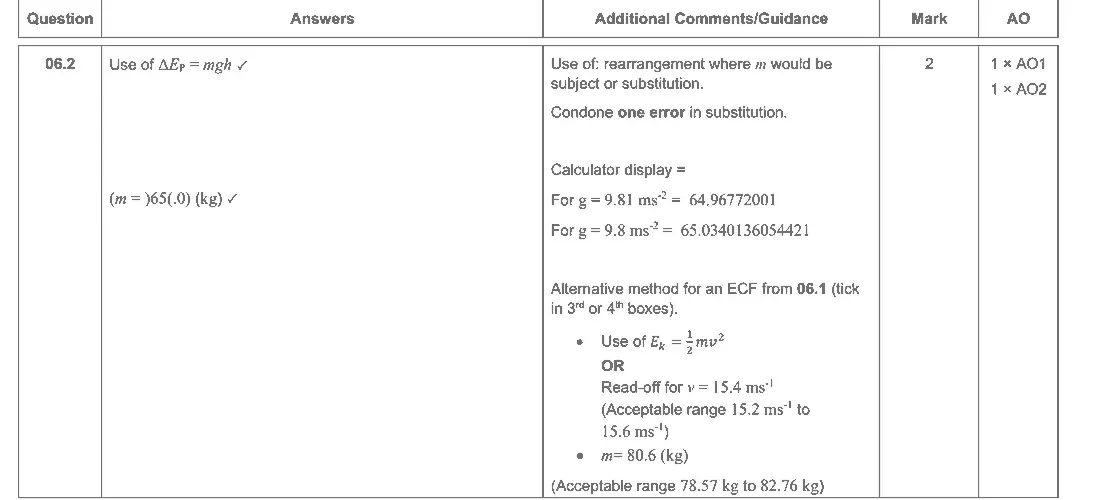
Calculate the mass m of the boy.
[2 marks]
m =
kg
June 2024 · AS Paper 1 · Q6.3 3 marks AO1=1, AO2=2 Calculation Hard materials and young moduluswork energy and power
Earlier part of question 6 that this part usesEarlier part of June 2024 Paper 1 question 6
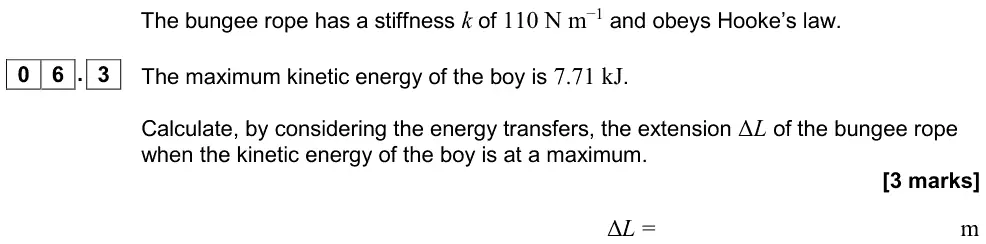
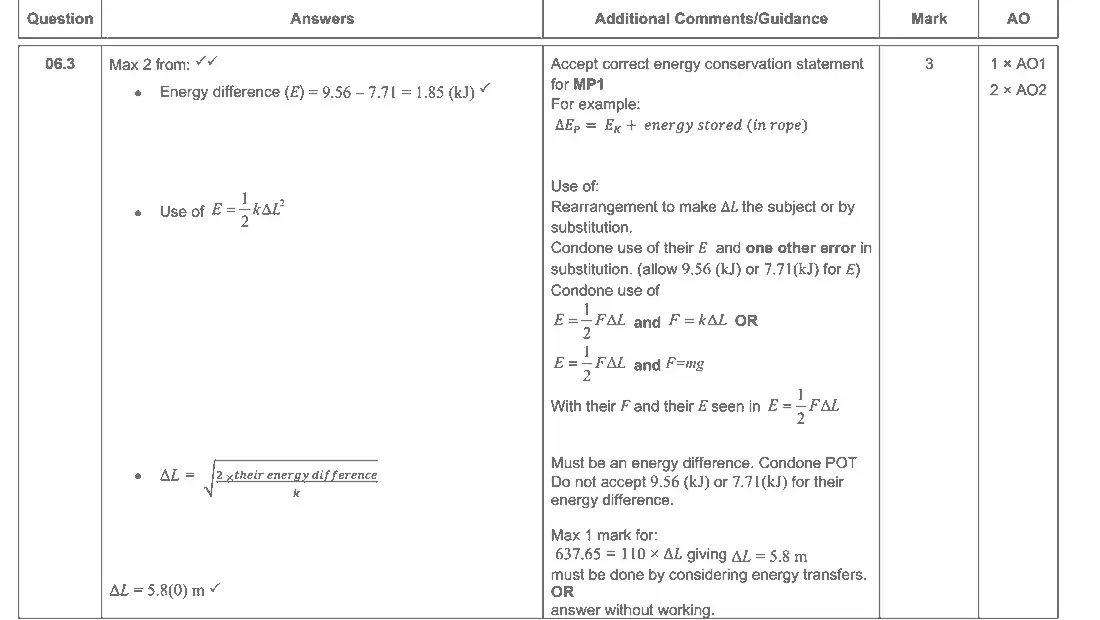
The bungee rope has a stiffness k of 110 N m−1 and obeys Hooke’s law.
The maximum kinetic energy of the boy is 7.71 kJ.
Calculate, by considering the energy transfers, the extension ΔL of the bungee rope
when the kinetic energy of the boy is at a maximum.
[3 marks]
ΔL =
m
June 2024 · AS Paper 2 · Q1.2 2 marks AO3=2 Calculation progressive waves and polarisation
Earlier part of question 1 that this part usesEarlier part of June 2024 Paper 2 question 1
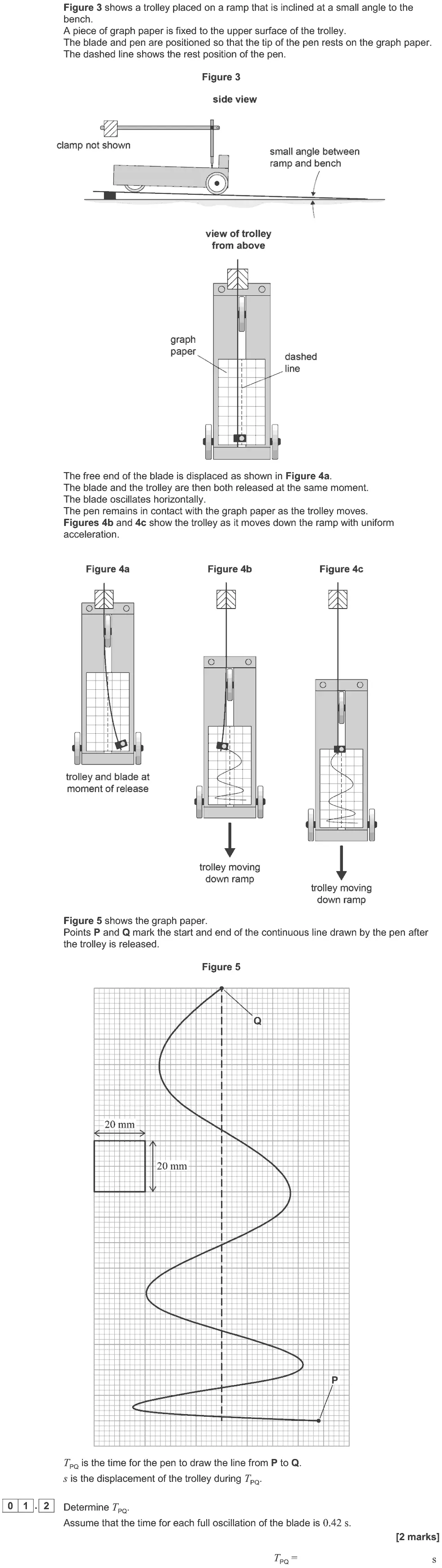
Figure 3 shows a trolley placed on a ramp that is inclined at a small angle to the
bench.
A piece of graph paper is fixed to the upper surface of the trolley.
The blade and pen are positioned so that the tip of the pen rests on the graph paper.
The dashed line shows the rest position of the pen.
Figure 3
The free end of the blade is displaced as shown in Figure 4a.
The blade and the trolley are then both released at the same moment.
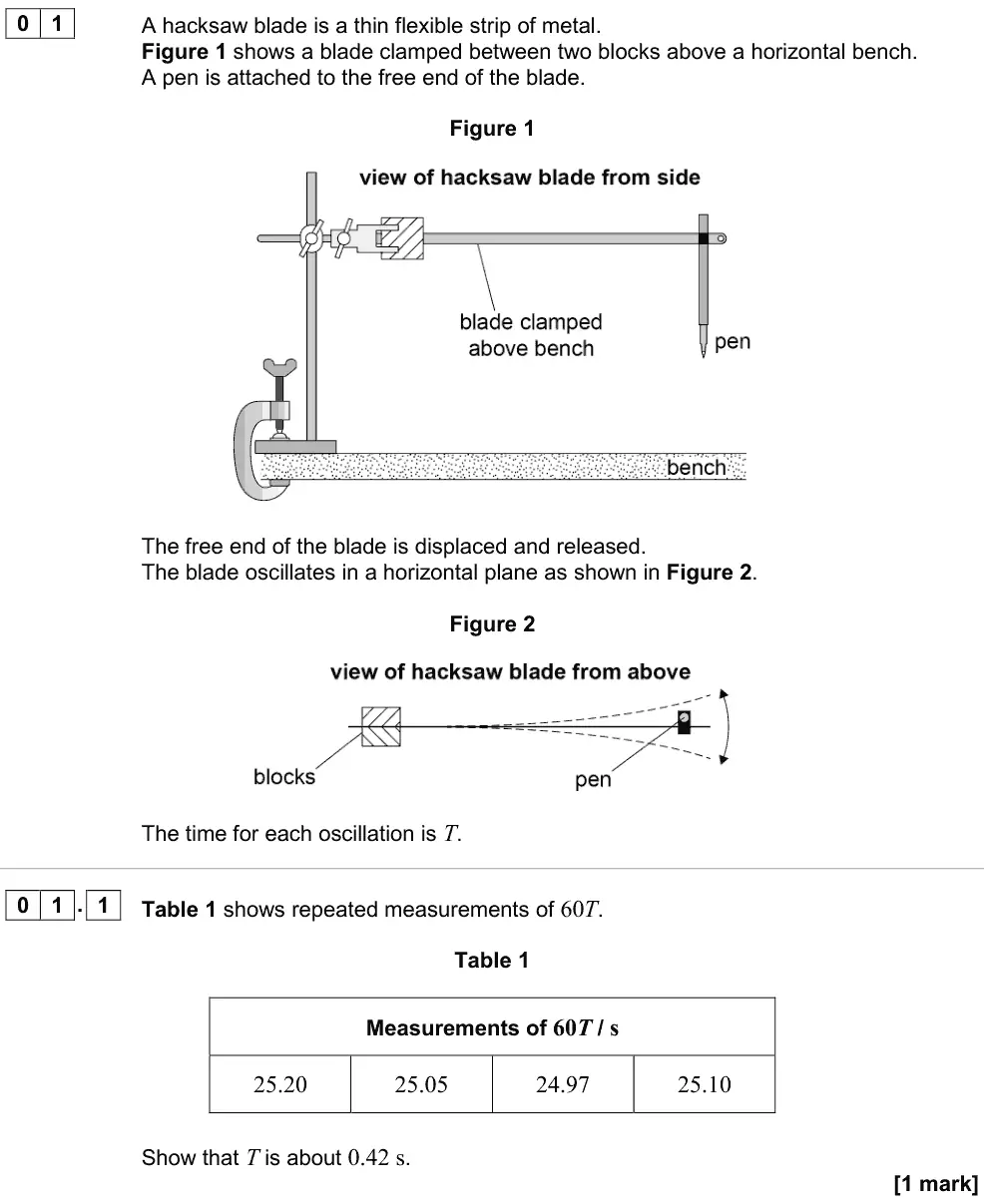
The blade oscillates horizontally.
The pen remains in contact with the graph paper as the trolley moves.
Figures 4b and 4c show the trolley as it moves down the ramp with uniform
acceleration.
Figure 5 shows the graph paper.
Points P and Q mark the start and end of the continuous line drawn by the pen after
the trolley is released.
Figure 5
TPQ is the time for the pen to draw the line from P to Q.
s is the displacement of the trolley during TPQ.
Determine TPQ.
Assume that the time for each full oscillation of the blade is 0.42 s.
[2 marks]
TPQ =
s
June 2024 · AS Paper 2 · Q1.4 2 marks AO2=2 Calculation motion and projectiles
Earlier part of question 1 that this part usesEarlier part of June 2024 Paper 2 question 1
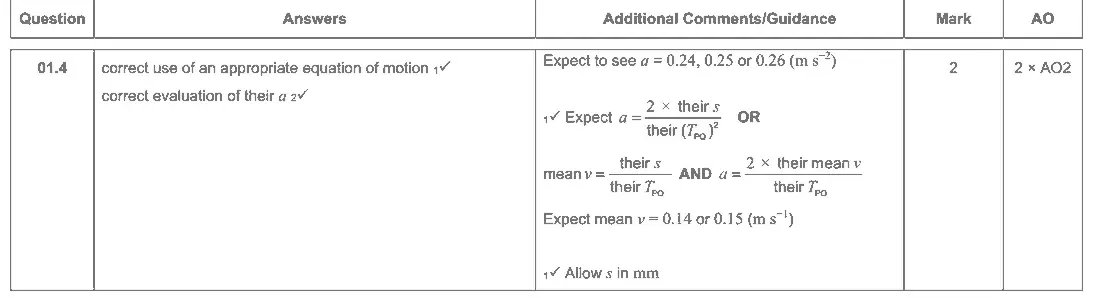
Determine the acceleration a of the trolley.
[2 marks]
a =
m s−2
June 2024 · AS Paper 2 · Q1.6 2 marks AO3=2 Calculation Hard measurements and uncertainties
Earlier part of question 1 that this part usesEarlier part of June 2024 Paper 2 question 1
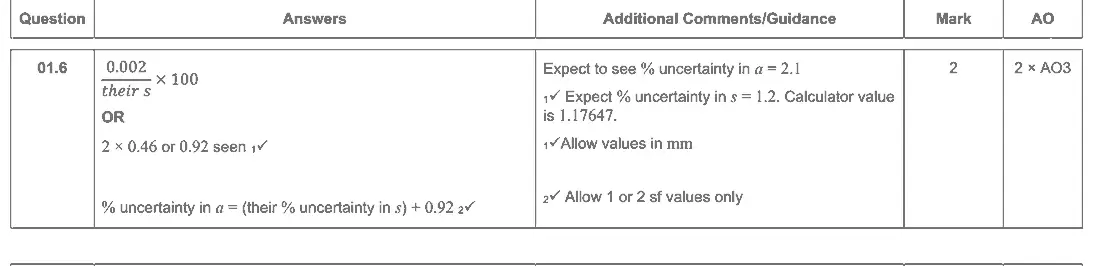
The percentage uncertainty in TPQ is 0.46%.
Determine the percentage uncertainty in your result for a.
[2 marks]
percentage uncertainty =
%
June 2024 · AS Paper 2 · Q2.1 1 mark AO2=1 Calculation measurements and uncertainties
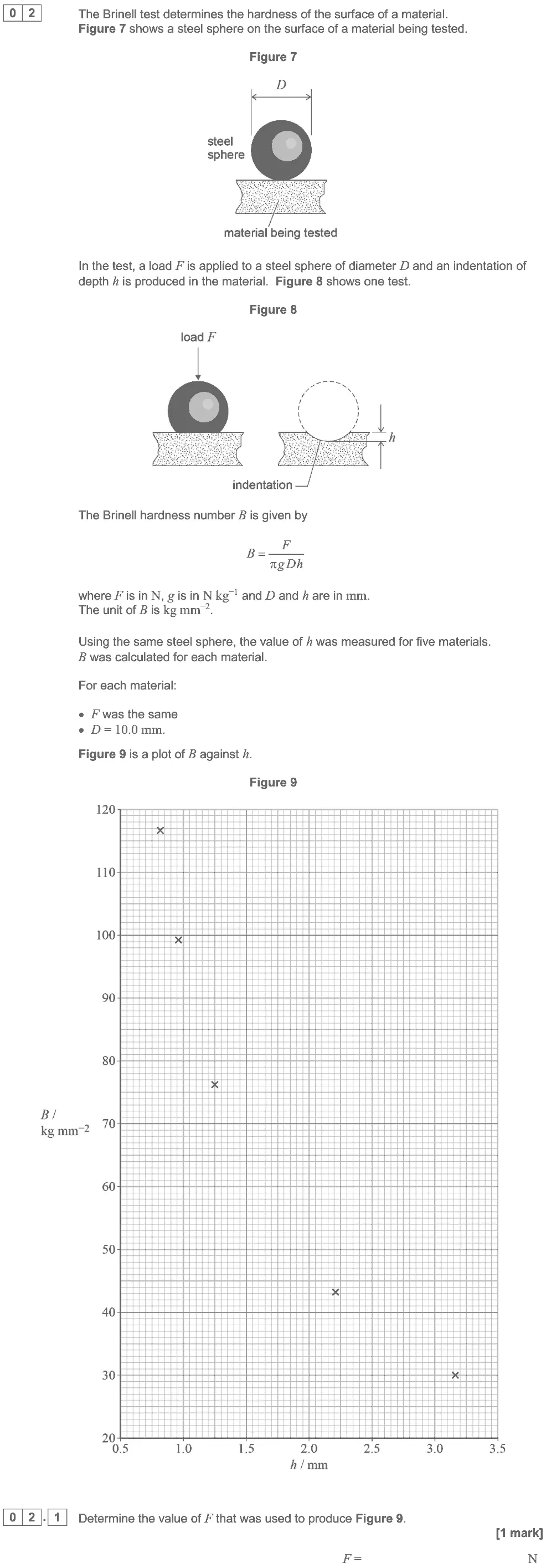
The Brinell test determines the hardness of the surface of a material.
Figure 7 shows a steel sphere on the surface of a material being tested.
Figure 7
In the test, a load F is applied to a steel sphere of diameter D and an indentation of
depth h is produced in the material.  Figure 8 shows one test.
Figure 8
The Brinell hardness number B is given by
F
B
gDh
= π
where F is in N, g is in N kg−1 and D and h are in mm.
The unit of B is kg mm−2.
Using the same steel sphere, the value of h was measured for five materials.
B was calculated for each material.
For each material:
• F was the same
• D = 10.0 mm.
Figure 9 is a plot of B against h.
Figure 9
Determine the value of F that was used to produce Figure 9.
[1 mark]
F =
N
June 2024 · AS Paper 2 · Q2.2 2 marks AO1=1, AO2=1 Calculation measurements and uncertainties
Earlier part of question 2 that this part usesEarlier part of June 2024 Paper 2 question 2
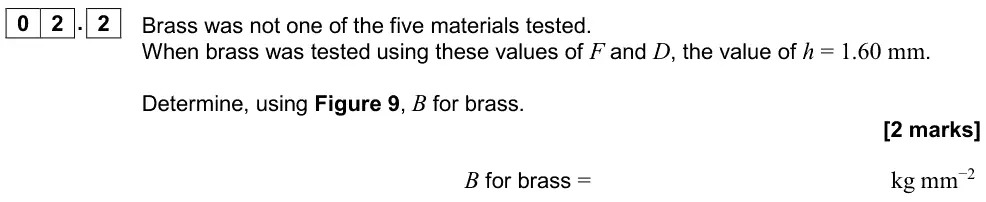
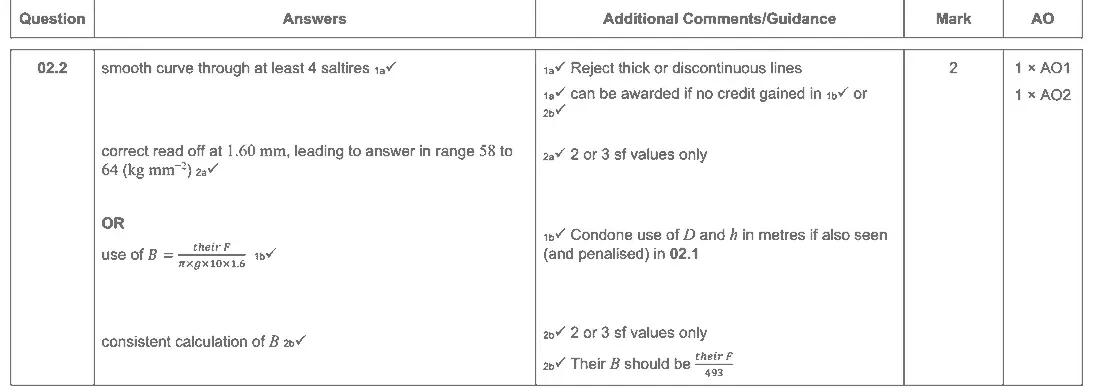
Brass was not one of the five materials tested.
When brass was tested using these values of F and D, the value of h = 1.60 mm.
Determine, using Figure 9, B for brass.
[2 marks]
B for brass =
kg mm−2
June 2024 · AS Paper 2 · Q3.1 2 marks AO2=2 Calculation materials and young modulus
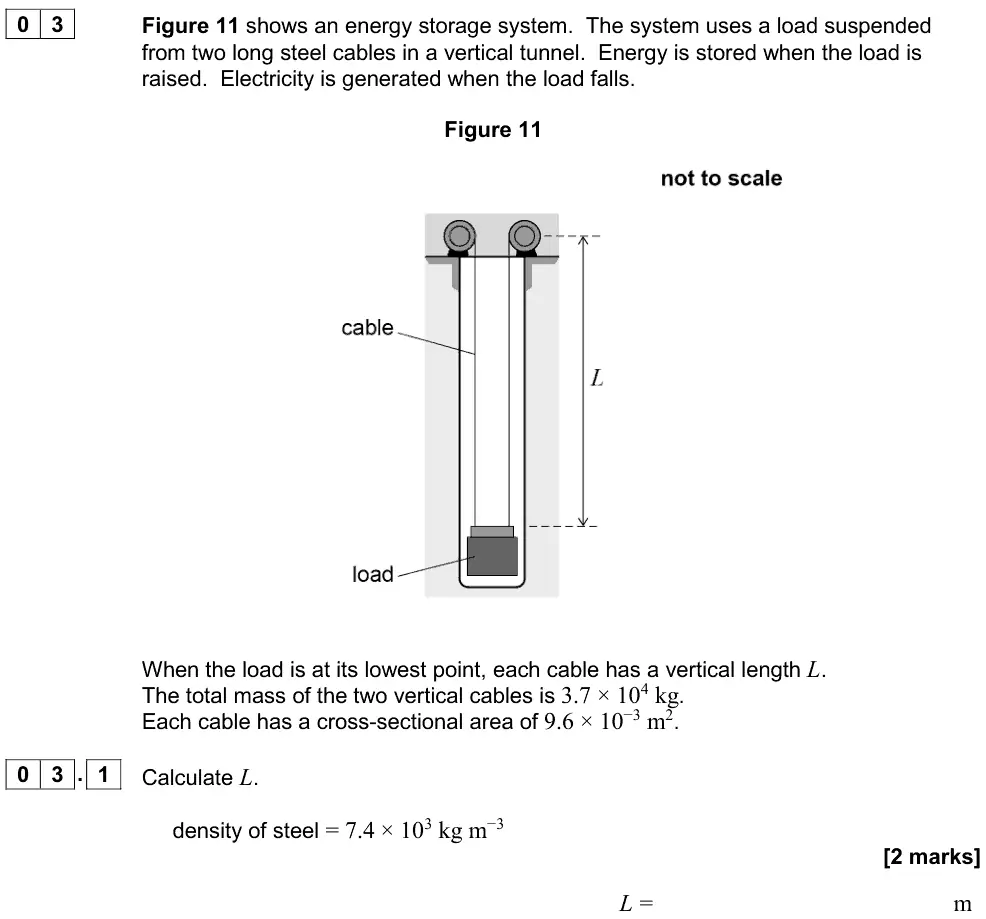
Figure 11 shows an energy storage system.  The system uses a load suspended
from two long steel cables in a vertical tunnel.  Energy is stored when the load is
raised.  Electricity is generated when the load falls.
Figure 11
When the load is at its lowest point, each cable has a vertical length L.
The total mass of the two vertical cables is 3.7 × 10⁴ kg.
Each cable has a cross-sectional area of 9.6 × 10⁻³ m2.
Calculate L.
density of steel = 7.4 × 10³ kg m−3
[2 marks]
L =
m
June 2024 · AS Paper 2 · Q3.2 4 marks AO2=4 Calculation newtons laws and momentum
Earlier part of question 3 that this part usesEarlier part of June 2024 Paper 2 question 3
The load is accelerated from its lowest point.  The mass of the load is 2.8 × 10⁵ kg.
The maximum tension in each cable is 1.6 × 10⁶ N during the acceleration.
Calculate the initial acceleration of the load.
[4 marks]
initial acceleration =
m s−2
June 2024 · AS Paper 2 · Q3.4 4 marks AO1=1, AO2=1, AO3=2 Calculation work energy and power
Earlier part of question 3 that this part usesEarlier part of June 2024 Paper 2 question 3
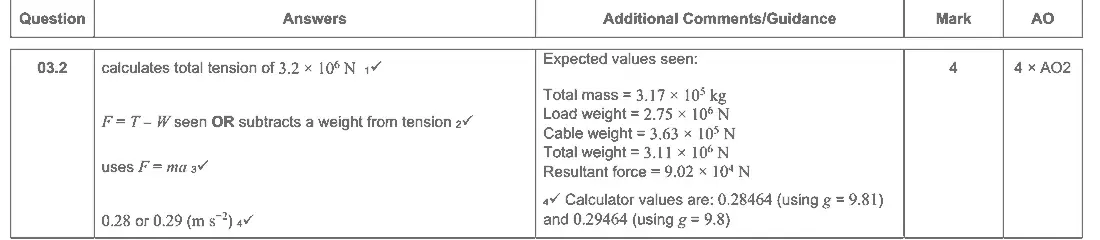
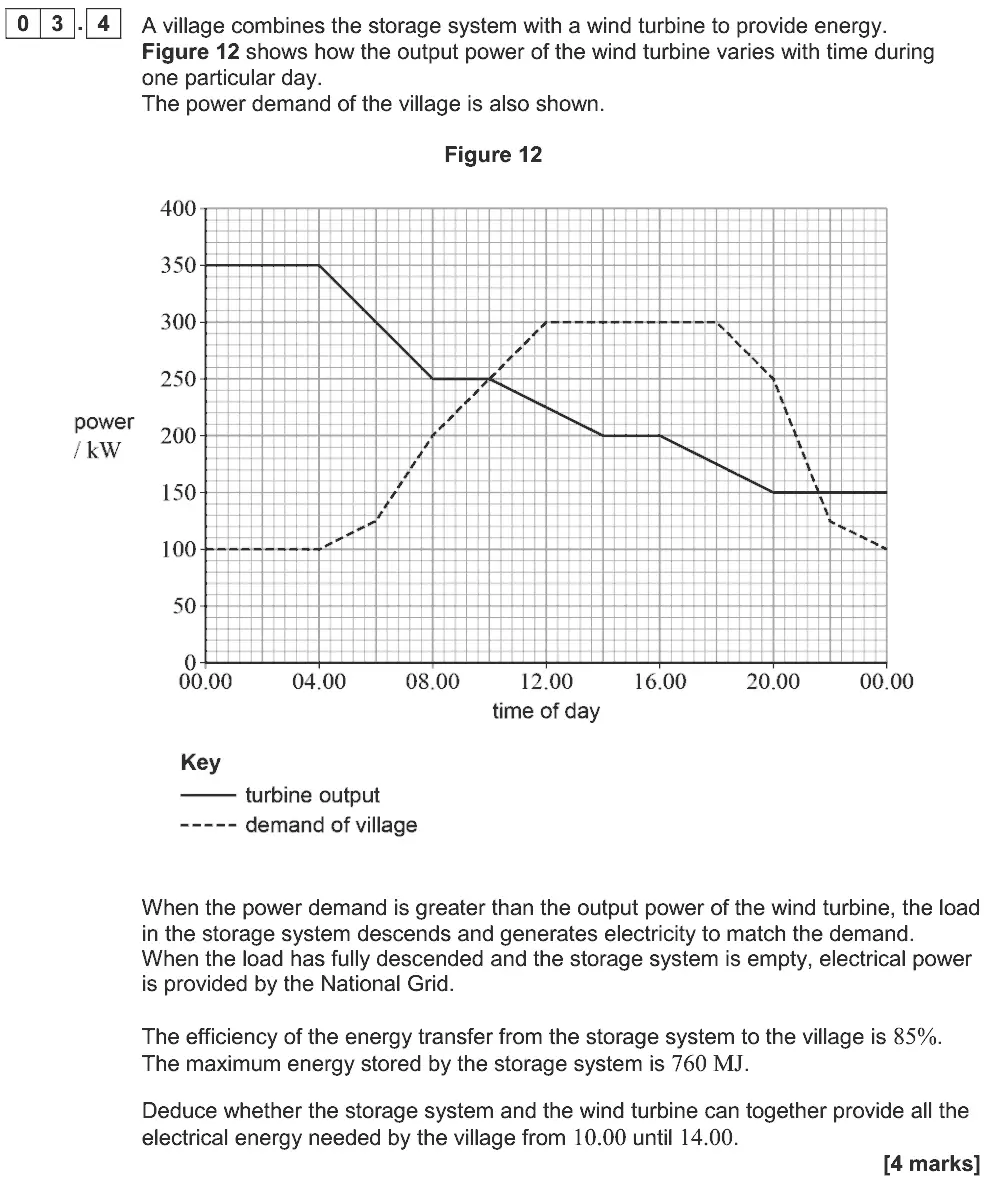
A village combines the storage system with a wind turbine to provide energy.
Figure 12 shows how the output power of the wind turbine varies with time during
one particular day.
The power demand of the village is also shown.
Figure 12
When the power demand is greater than the output power of the wind turbine, the load
in the storage system descends and generates electricity to match the demand.
When the load has fully descended and the storage system is empty, electrical power
is provided by the National Grid.
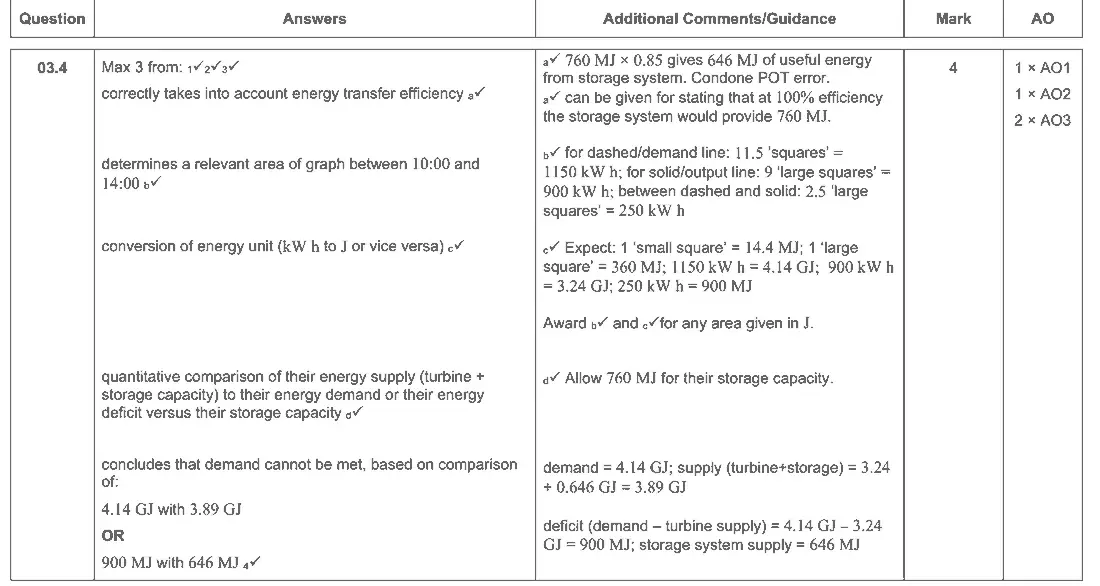
The efficiency of the energy transfer from the storage system to the village is 85%.
The maximum energy stored by the storage system is 760 MJ.
Deduce whether the storage system and the wind turbine can together provide all the
electrical energy needed by the village from 10.00 until 14.00.
[4 marks]
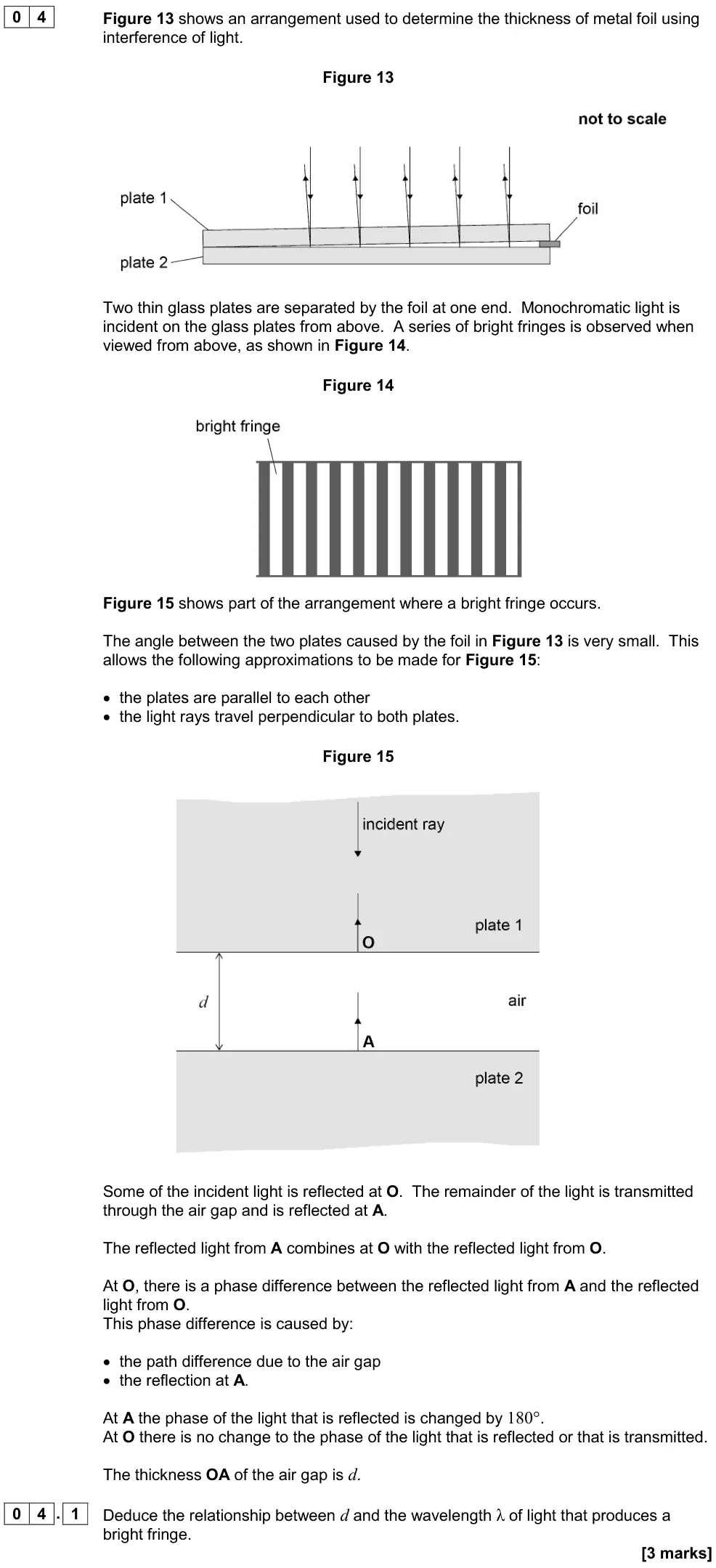
June 2024 · AS Paper 2 · Q4.2 2 marks AO2=1, AO3=1 Calculation Hard interference and diffraction
Earlier part of question 4 that this part usesEarlier part of June 2024 Paper 2 question 4
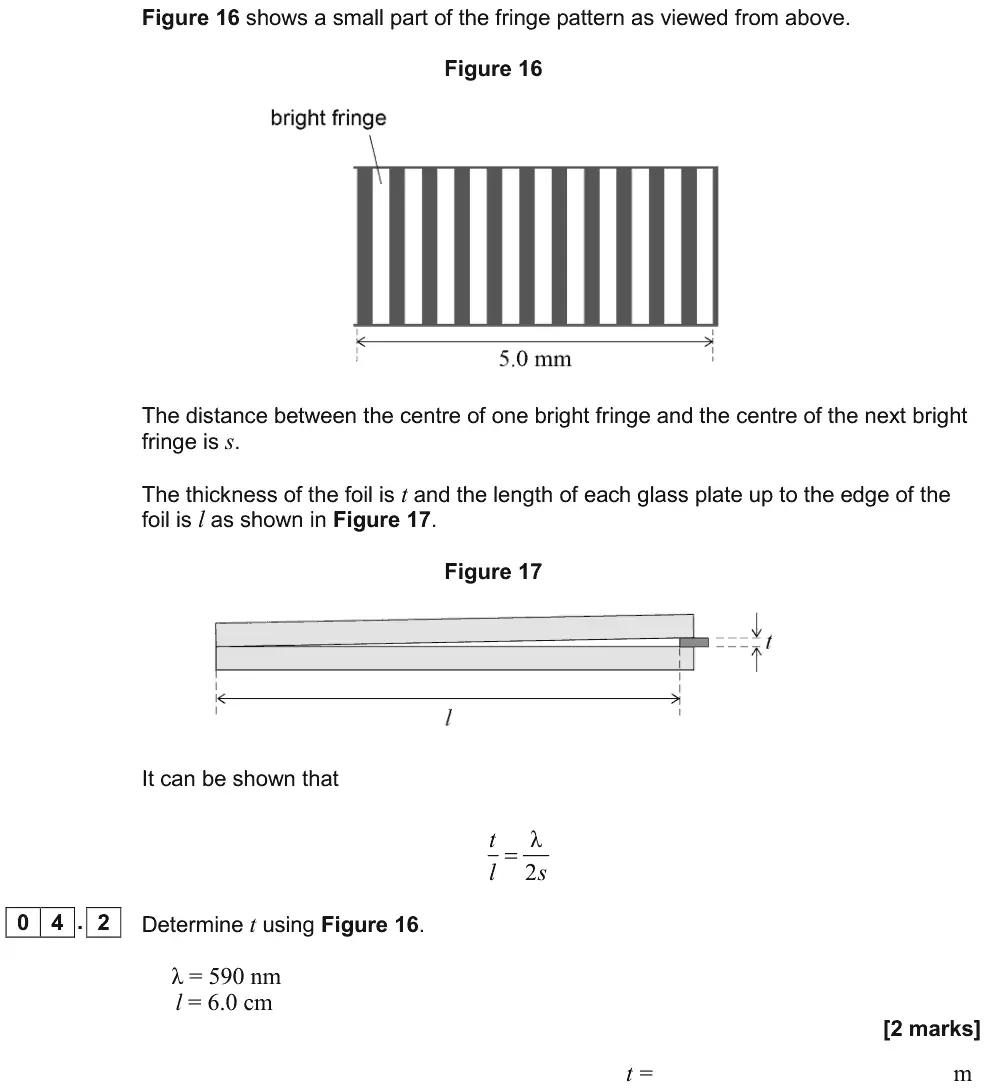
Figure 16 shows a small part of the fringe pattern as viewed from above.
Figure 16
The distance between the centre of one bright fringe and the centre of the next bright
fringe is s.
The thickness of the foil is t and the length of each glass plate up to the edge of the
foil is l as shown in Figure 17.
Figure 17
It can be shown that
λ
2
t
l
s
=
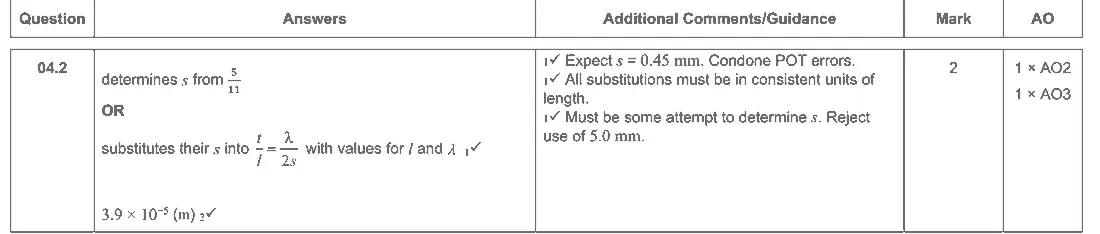
Determine t using Figure 16.
λ = 590 nm
l = 6.0 cm
[2 marks]
t =
m
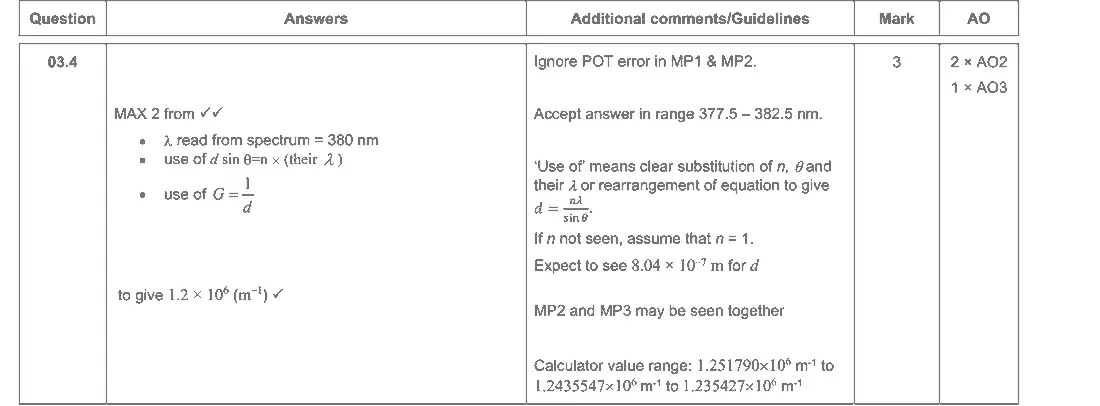
June 2024 · Paper 1 · Q3.4 3 marks AO2=2, AO3=1 Calculation interference and diffraction
Earlier part of question 3 that this part usesEarlier part of June 2024 Paper 1 question 3
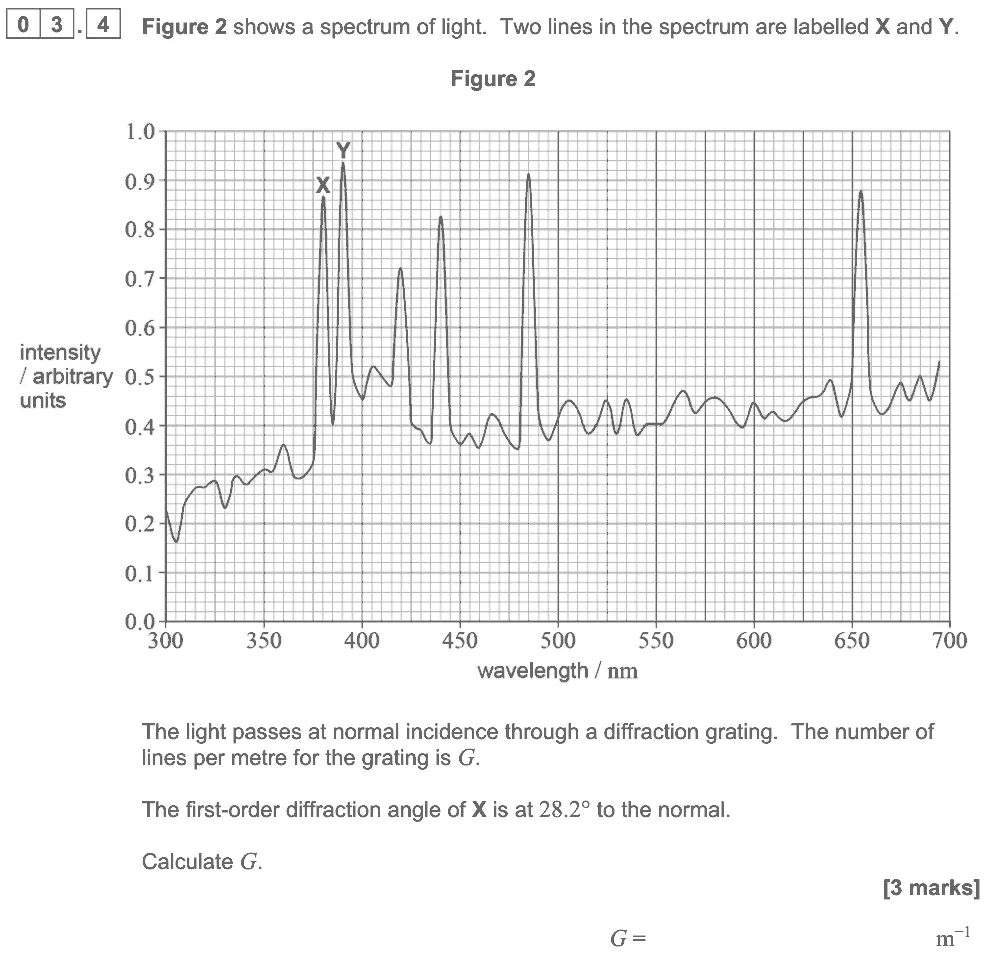
Figure 2 shows a spectrum of light.  Two lines in the spectrum are labelled X and Y.
Figure 2
The light passes at normal incidence through a diffraction grating.  The number of
lines per metre for the grating is G.
The first-order diffraction angle of X is at 28.2° to the normal.
Calculate G.
[3 marks]
G =
m−1
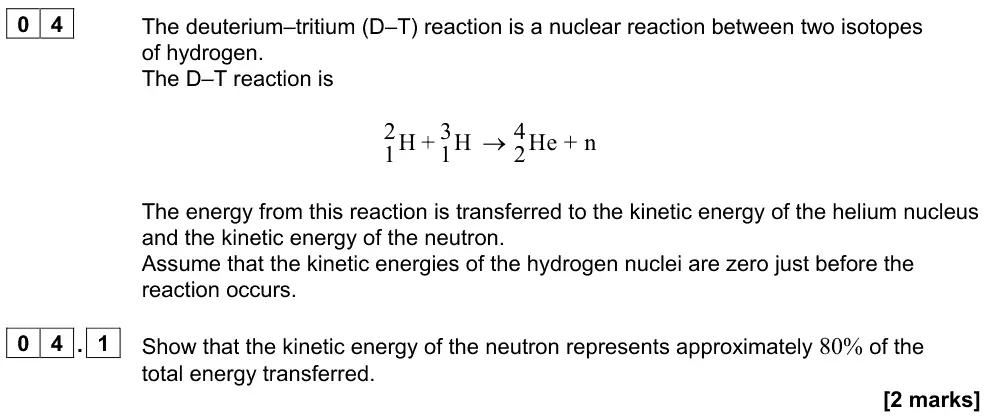
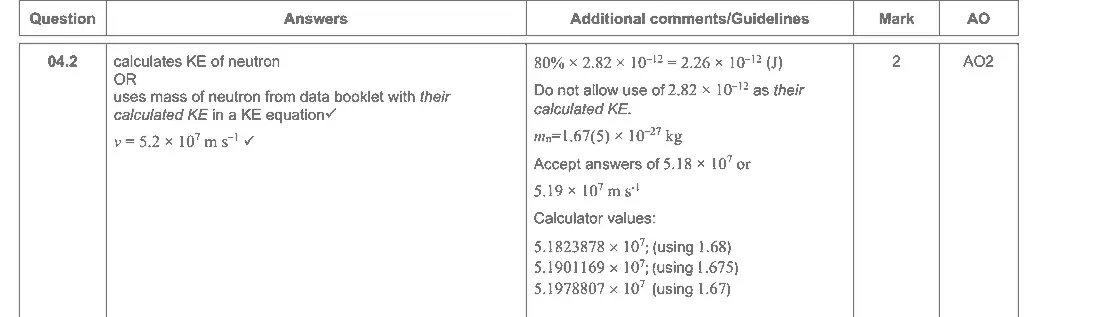
June 2024 · Paper 1 · Q4.2 2 marks AO2=2 Calculation work energy and power
Earlier part of question 4 that this part usesEarlier part of June 2024 Paper 1 question 4
The combined kinetic energy of the helium nucleus and the neutron is 2.82 × 10⁻¹² J.
Calculate the initial speed of the neutron.
[2 marks]
initial speed =
m s−1
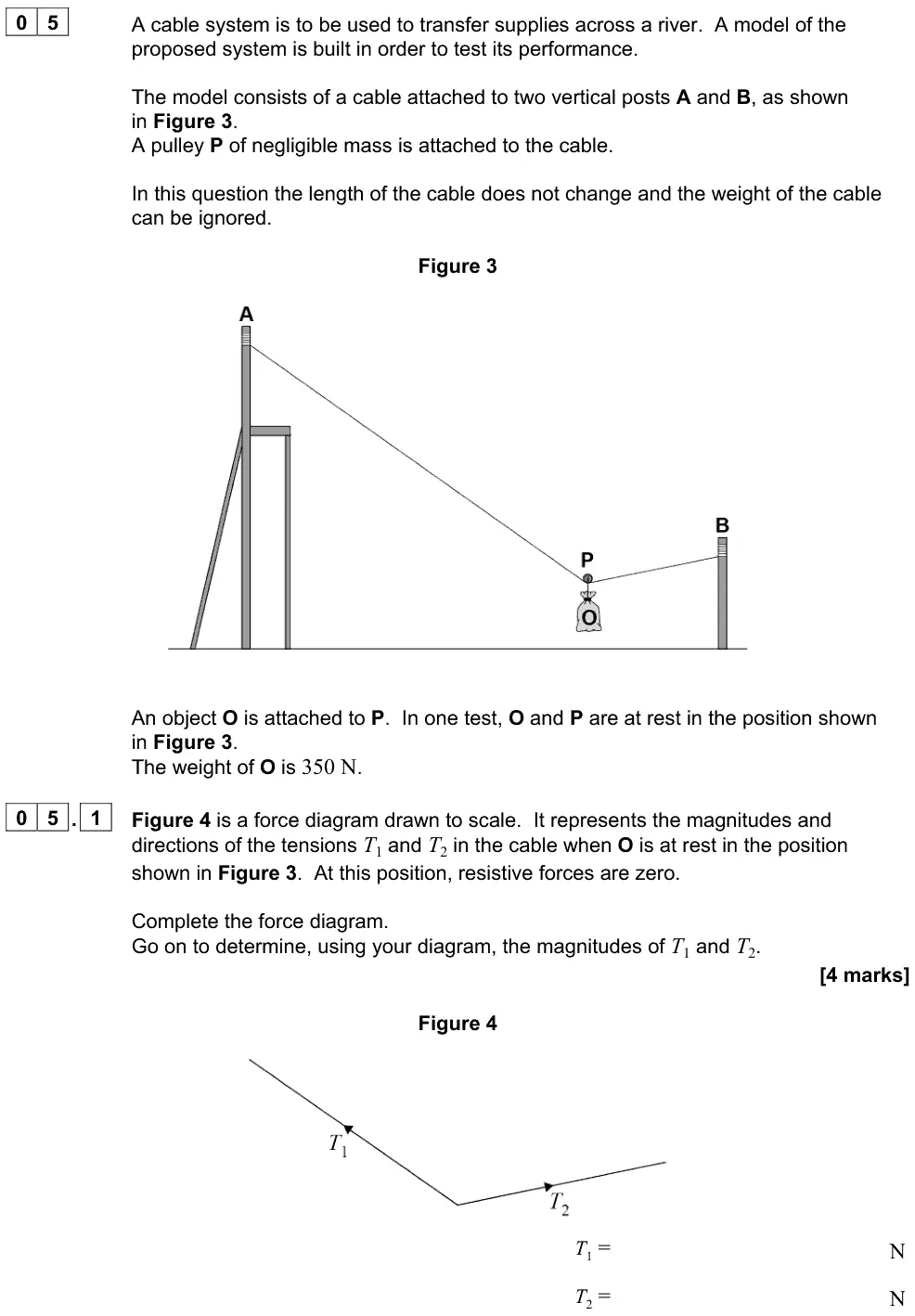
June 2024 · Paper 1 · Q5.2 5 marks AO2=5 Calculation work energy and power
Earlier part of question 5 that this part usesEarlier part of June 2024 Paper 1 question 5
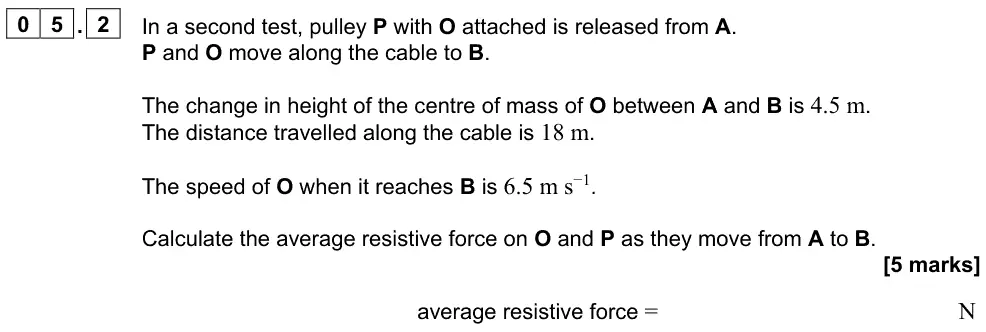
In a second test, pulley P with O attached is released from A.
P and O move along the cable to B.
The change in height of the centre of mass of O between A and B is 4.5 m.
The distance travelled along the cable is 18 m.
The speed of O when it reaches B is 6.5 m s−1.
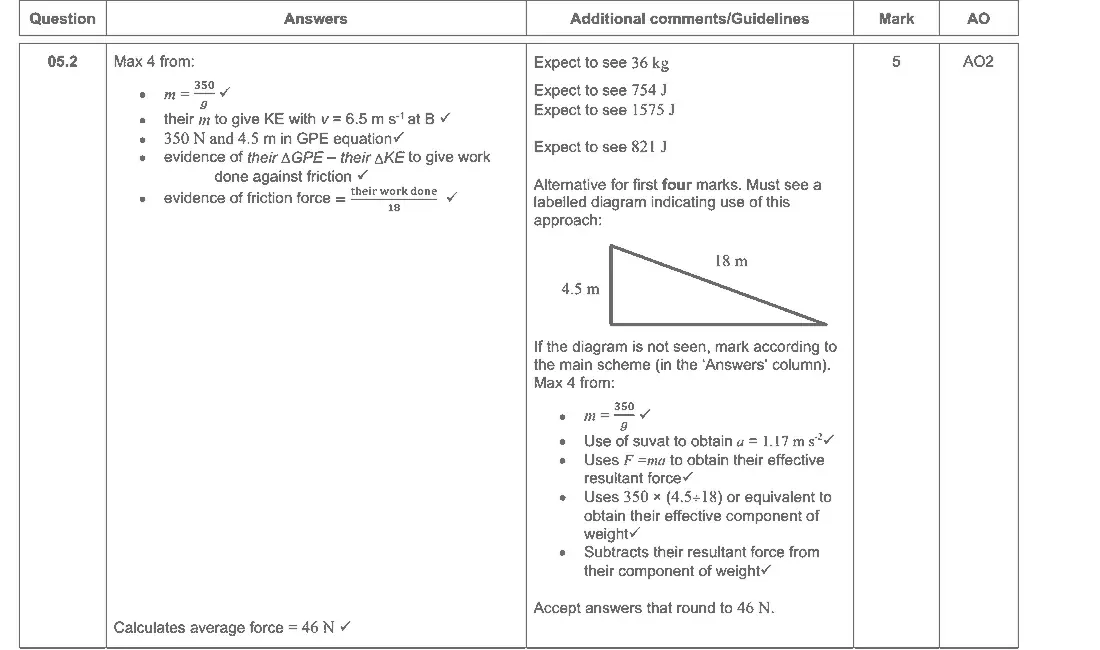
Calculate the average resistive force on O and P as they move from A to B.
[5 marks]
average resistive force =
N
June 2024 · Paper 1 · Q6.1 2 marks AO2=2 Calculation Easy circuits and potential dividerscurrent voltage and resistivity
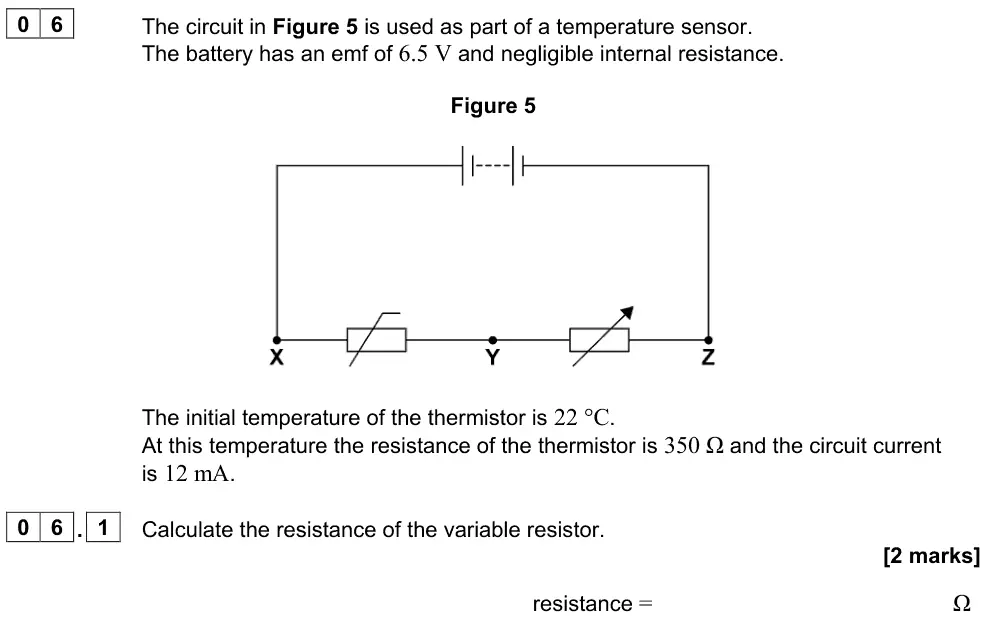
The circuit in Figure 5 is used as part of a temperature sensor.
The battery has an emf of 6.5 V and negligible internal resistance.
Figure 5
The initial temperature of the thermistor is 22 °C.
At this temperature the resistance of the thermistor is 350 Ω and the circuit current
is 12 mA.
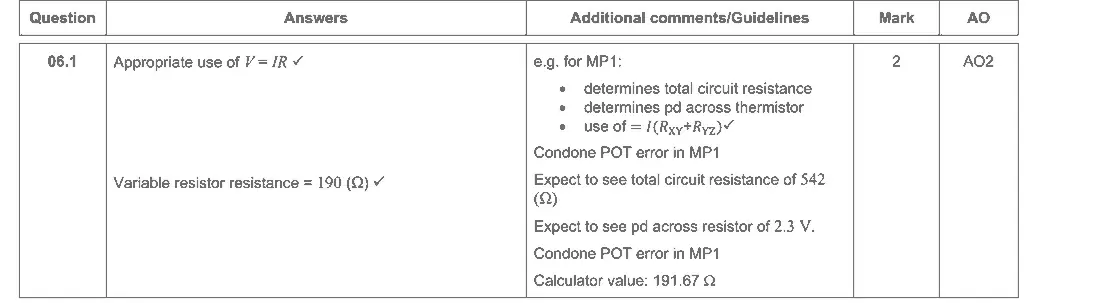
Calculate the resistance of the variable resistor.
[2 marks]
resistance =
Ω
June 2024 · Paper 1 · Q6.2 5 marks AO2=5 Calculation current voltage and resistivity
Earlier part of question 6 that this part usesEarlier part of June 2024 Paper 1 question 6
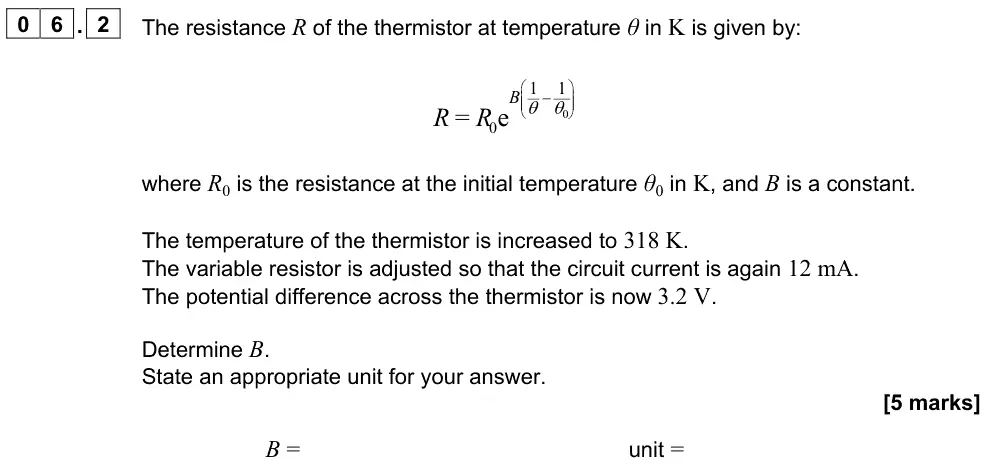
The resistance R of the thermistor at temperature θ in K is given by:
0
0
1
1
=
e
B
R
R








−
where R0 is the resistance at the initial temperature θ0 in K, and B is a constant.
The temperature of the thermistor is increased to 318 K.
The variable resistor is adjusted so that the circuit current is again 12 mA.
The potential difference across the thermistor is now 3.2 V.
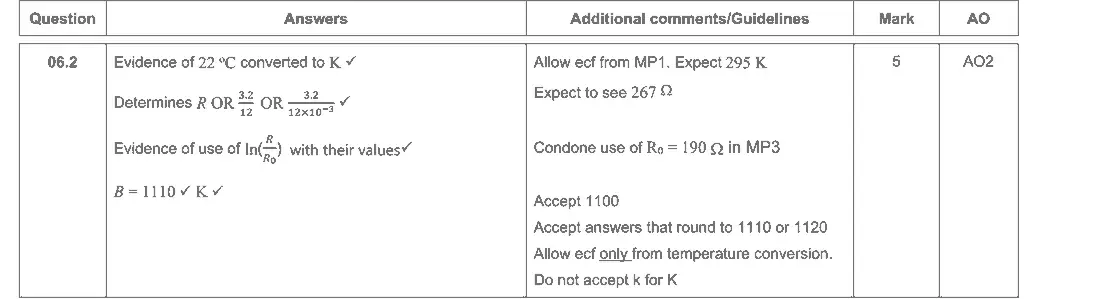
Determine B.
State an appropriate unit for your answer.
[5 marks]
B =
unit =
June 2024 · Paper 1 · Q7.2 2 marks AO3=2 Calculation Easy progressive waves and polarisationstationary waves
Earlier part of question 7 that this part usesEarlier part of June 2024 Paper 1 question 7
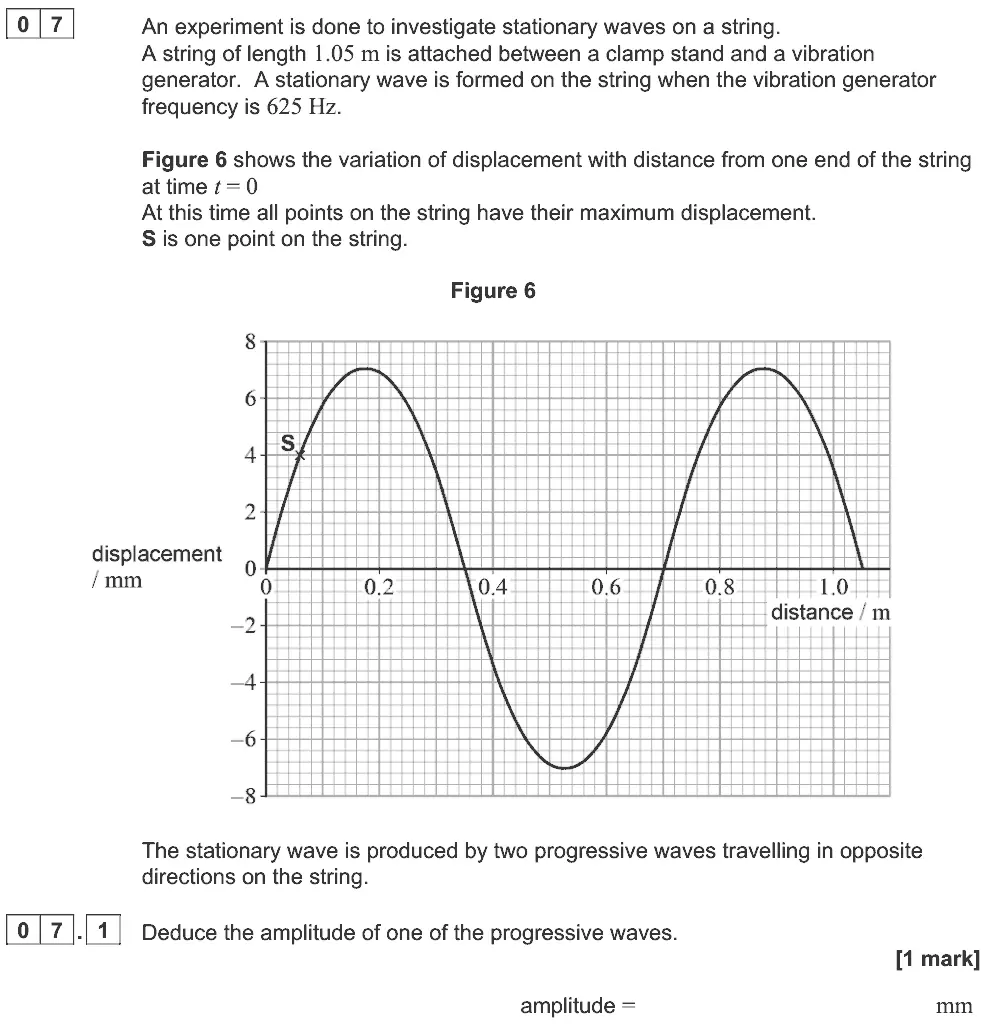
Determine, in m s−1, the speed of one of the progressive waves.
[2 marks]
speed =
m s−1
June 2024 · Paper 2 · Q1.2 3 marks AO2=3 Calculation kinetic theorythermal energy and ideal gases
Earlier part of question 1 that this part usesEarlier part of June 2024 Paper 2 question 1
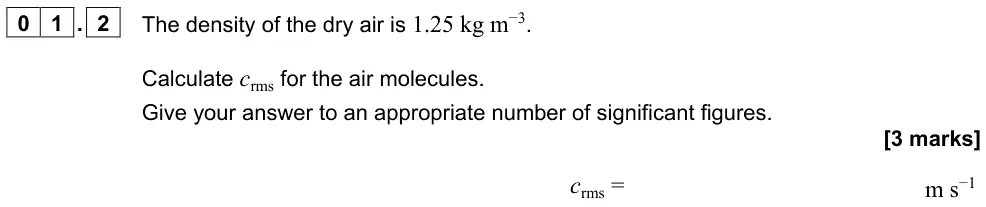
The density of the dry air is 1.25 kg m−3.
Calculate crms for the air molecules.
Give your answer to an appropriate number of significant figures.
[3 marks]
crms =
m s−1
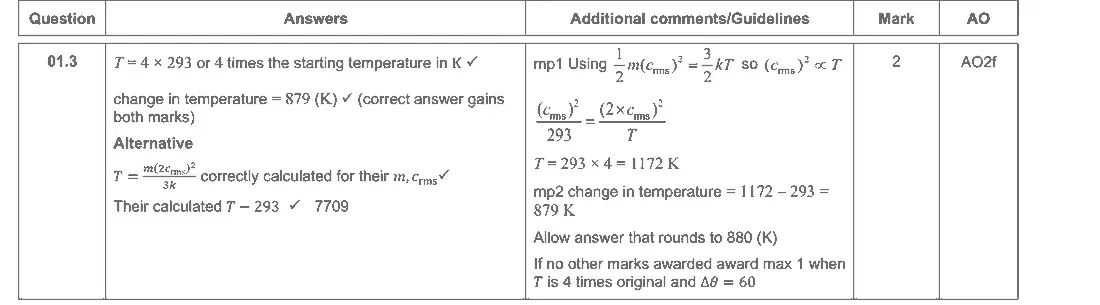
June 2024 · Paper 2 · Q1.3 2 marks AO2=2 Calculation kinetic theory
Earlier part of question 1 that this part usesEarlier part of June 2024 Paper 2 question 1
Calculate, in K, the change of temperature that will double crms for the air molecules.
[2 marks]
change of temperature =
K
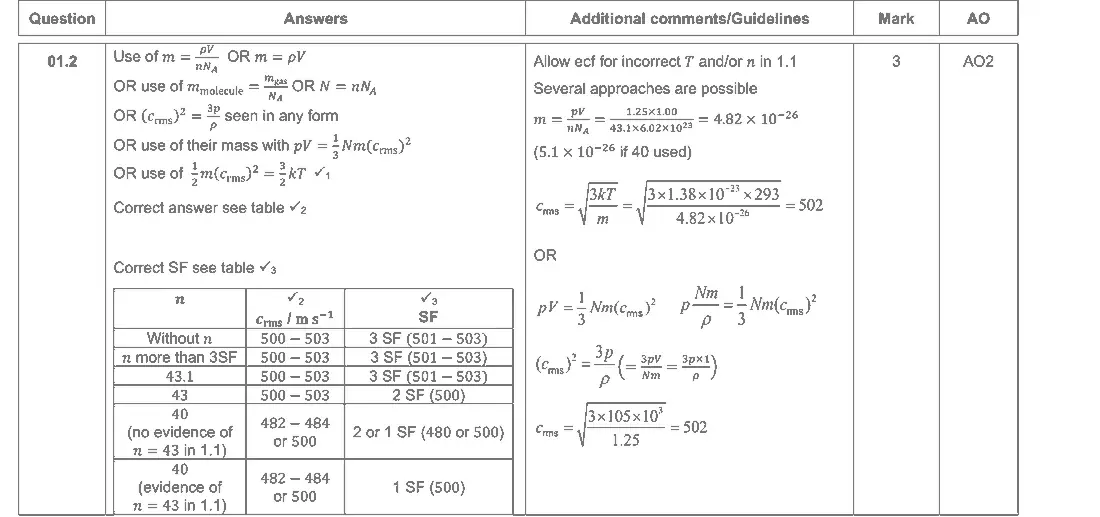
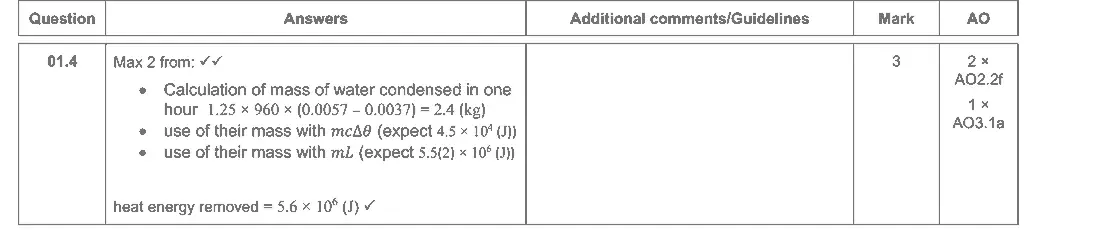
June 2024 · Paper 2 · Q1.4 3 marks AO2=2, AO3=1 Calculation thermal energy and ideal gases
Earlier part of question 1 that this part usesEarlier part of June 2024 Paper 2 question 1
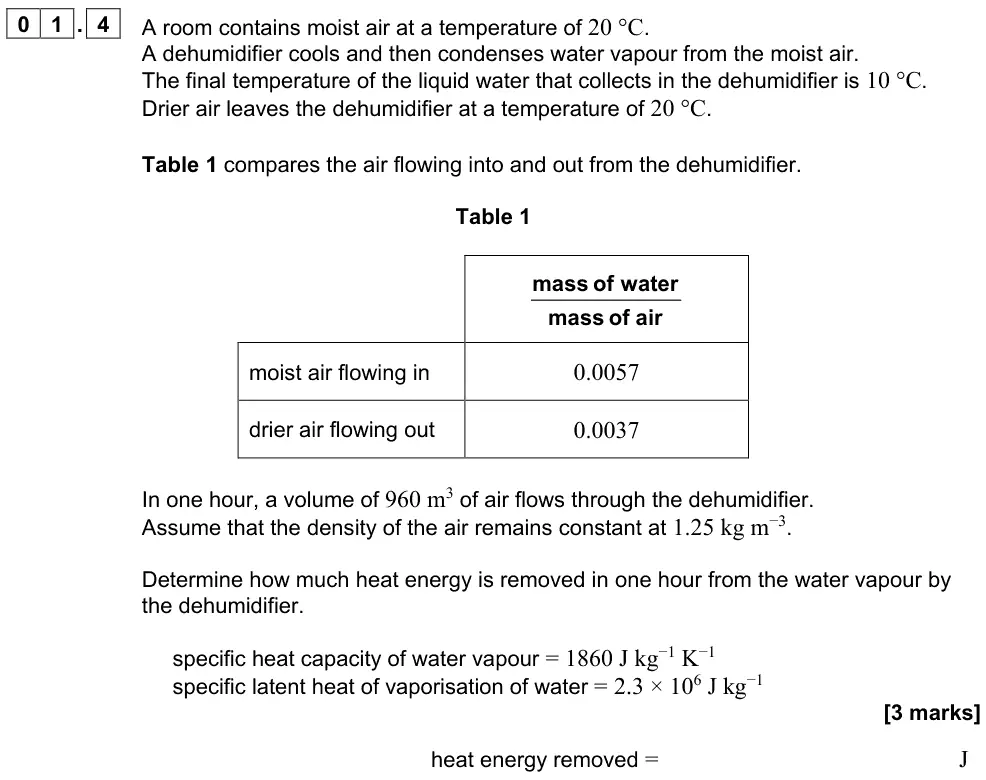
A room contains moist air at a temperature of 20 °C.
A dehumidifier cools and then condenses water vapour from the moist air.
The final temperature of the liquid water that collects in the dehumidifier is 10 °C.
Drier air leaves the dehumidifier at a temperature of 20 °C.
Table 1 compares the air flowing into and out from the dehumidifier.
Table 1
mass of water
mass of air
moist air flowing in
0.0057
drier air flowing out
0.0037
In one hour, a volume of 960 m3 of air flows through the dehumidifier.
Assume that the density of the air remains constant at 1.25 kg m−3.
Determine how much heat energy is removed in one hour from the water vapour by
the dehumidifier.
specific heat capacity of water vapour = 1860 J kg−1 K−1
specific latent heat of vaporisation of water = 2.3 × 10⁶ J kg−1
[3 marks]
heat energy removed =
J
June 2024 · Paper 2 · Q2.2 2 marks AO1=1, AO3=1 Calculation capacitors
Earlier part of question 2 that this part usesEarlier part of June 2024 Paper 2 question 2
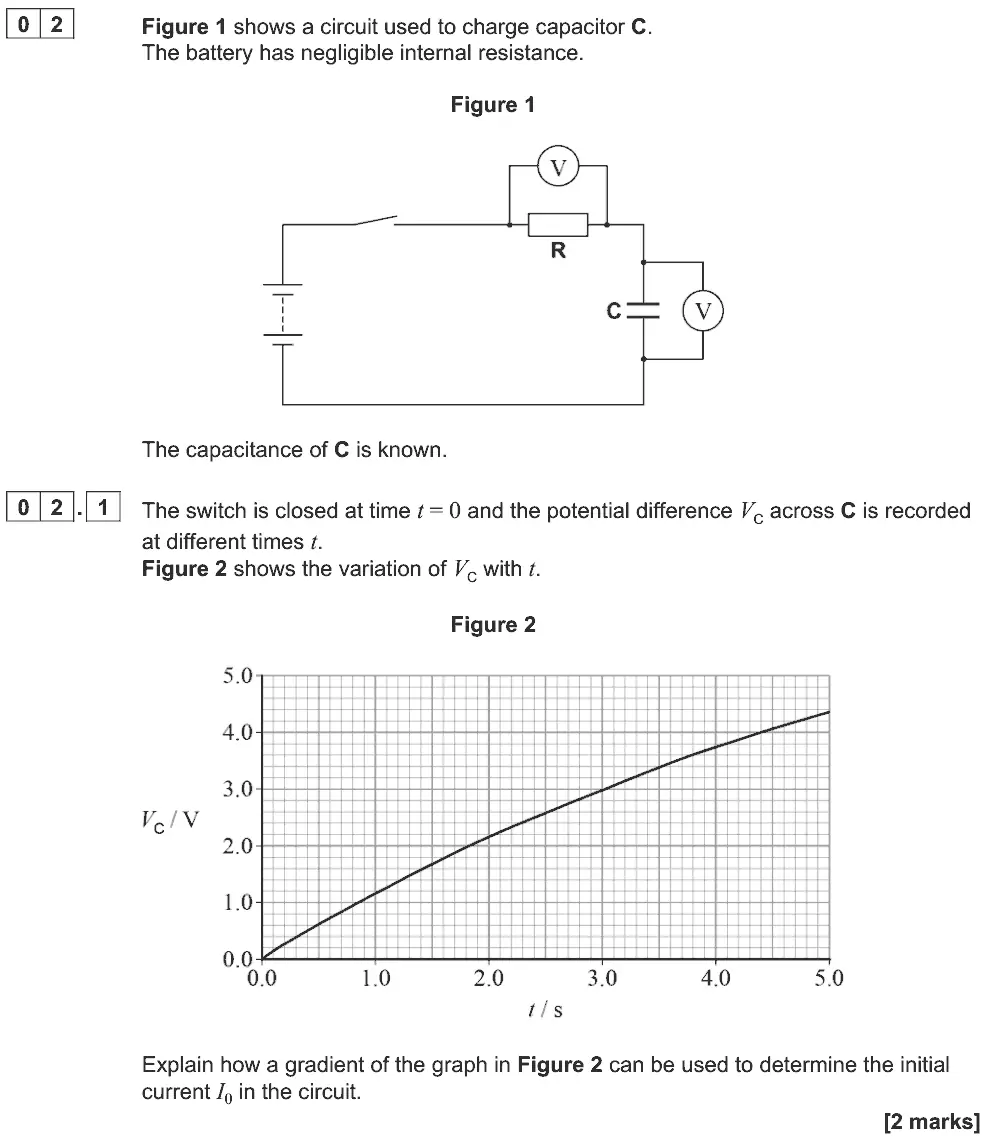
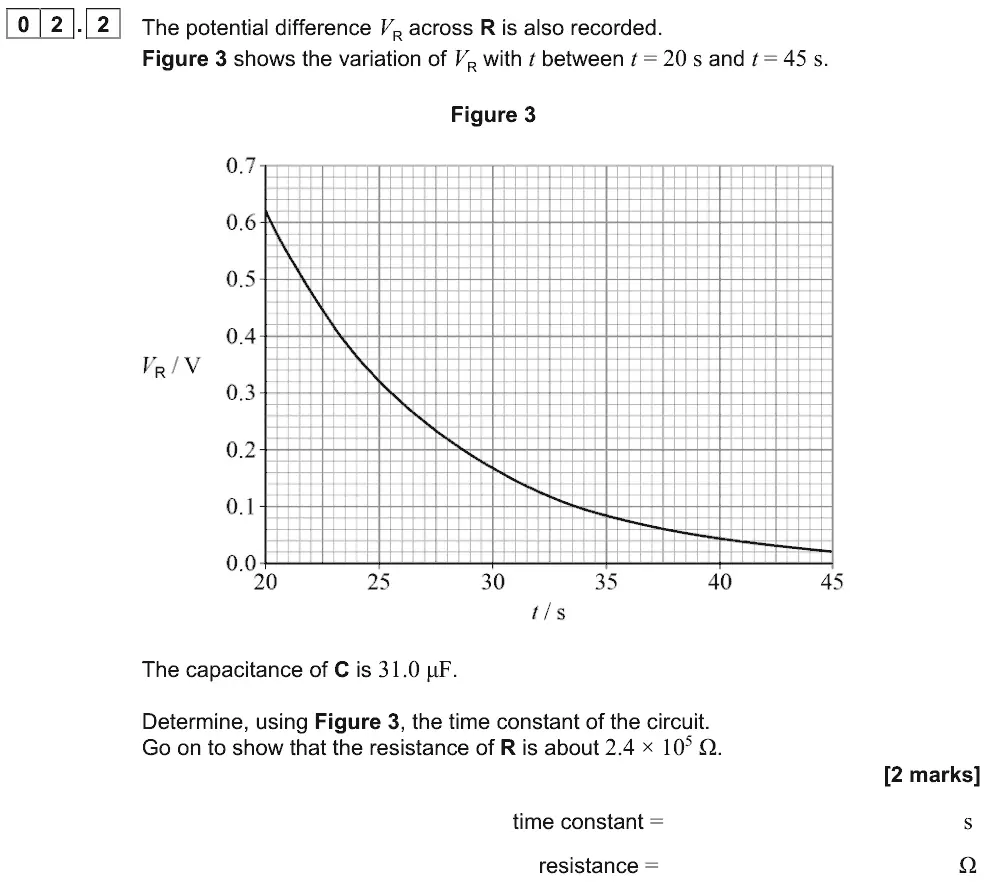
The potential difference VR across R is also recorded.
Figure 3 shows the variation of VR with t between t = 20 s and t = 45 s.
Figure 3
The capacitance of C is 31.0 μF.
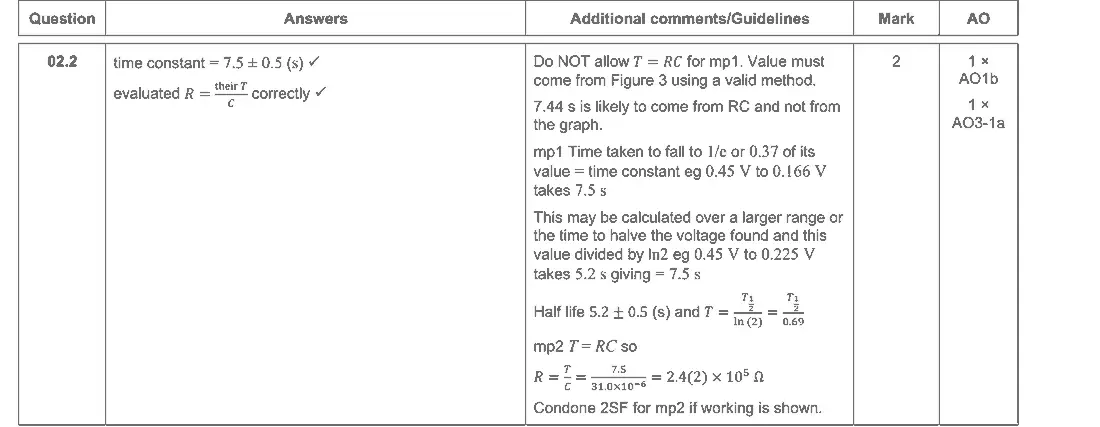
Determine, using Figure 3, the time constant of the circuit.
Go on to show that the resistance of R is about 2.4 × 10⁵ Ω.
[2 marks]
time constant =
s
resistance =
Ω
June 2024 · Paper 2 · Q2.3 3 marks AO2=1, AO3=2 Calculation capacitors
Earlier part of question 2 that this part usesEarlier part of June 2024 Paper 2 question 2
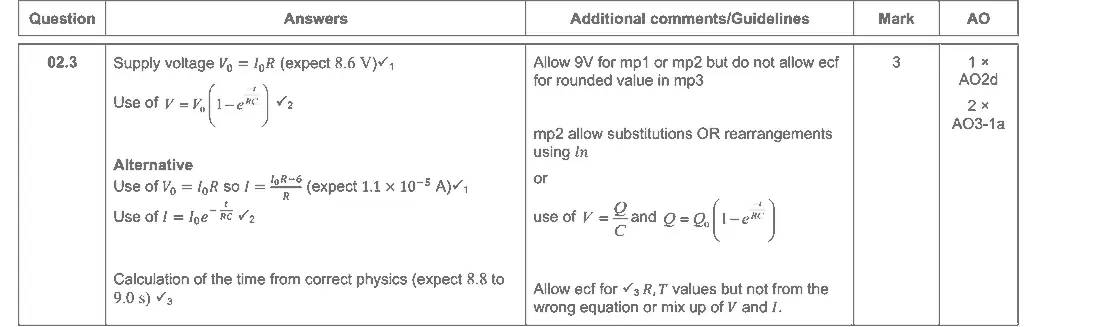
The current I0 at time t = 0 is 3.6 × 10⁻⁵ A.
Determine the time at which VC is 6.0 V.
[3 marks]
time =
s
June 2024 · Paper 2 · Q2.4 2 marks AO2=2 Calculation capacitors
Earlier part of question 2 that this part usesEarlier part of June 2024 Paper 2 question 2
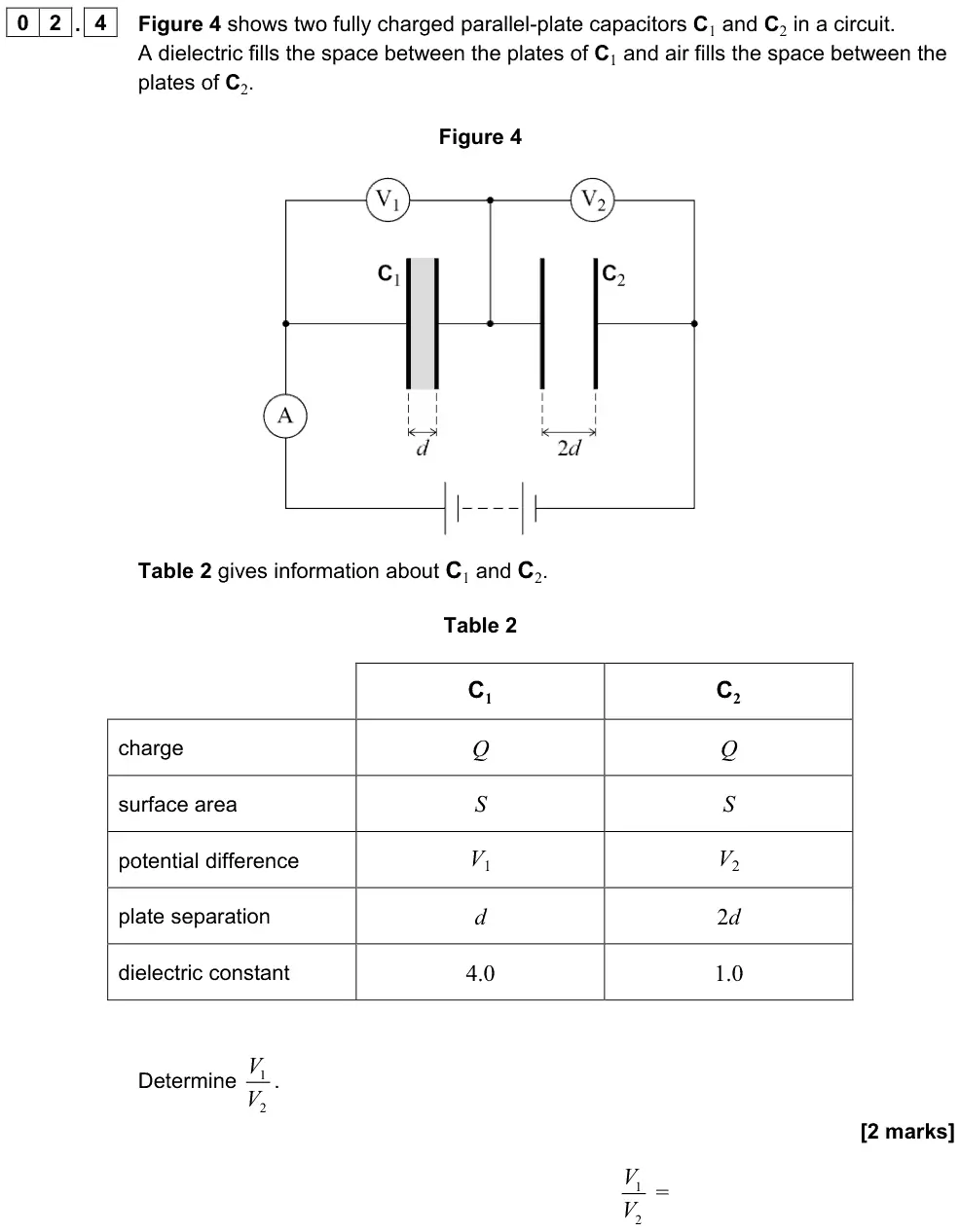
Figure 4 shows two fully charged parallel-plate capacitors C1 and C2 in a circuit.
A dielectric fills the space between the plates of C1 and air fills the space between the
plates of C2.
Figure 4
Table 2 gives information about C1 and C2.
Table 2
C1
C2
charge
Q
Q
surface area
S
S
potential difference
V1
V2
plate separation
d
2d
dielectric constant
4.0
1.0
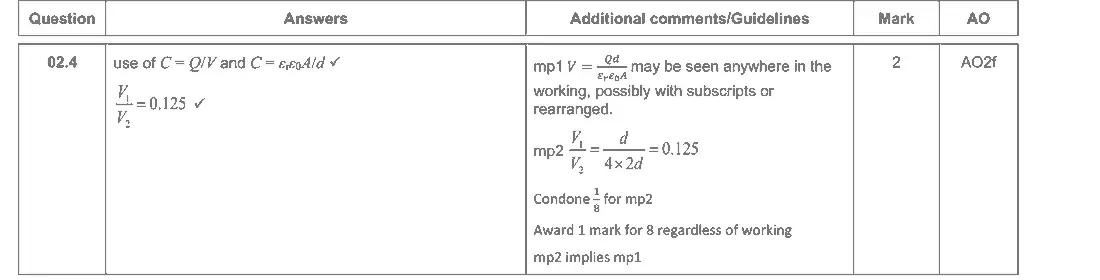
Determine
1
2
V
V
.
[2 marks]
1
2
V
V
=
June 2024 · Paper 2 · Q3.1 3 marks AO1=1, AO2=1, AO3=1 Calculation electromagnetic induction
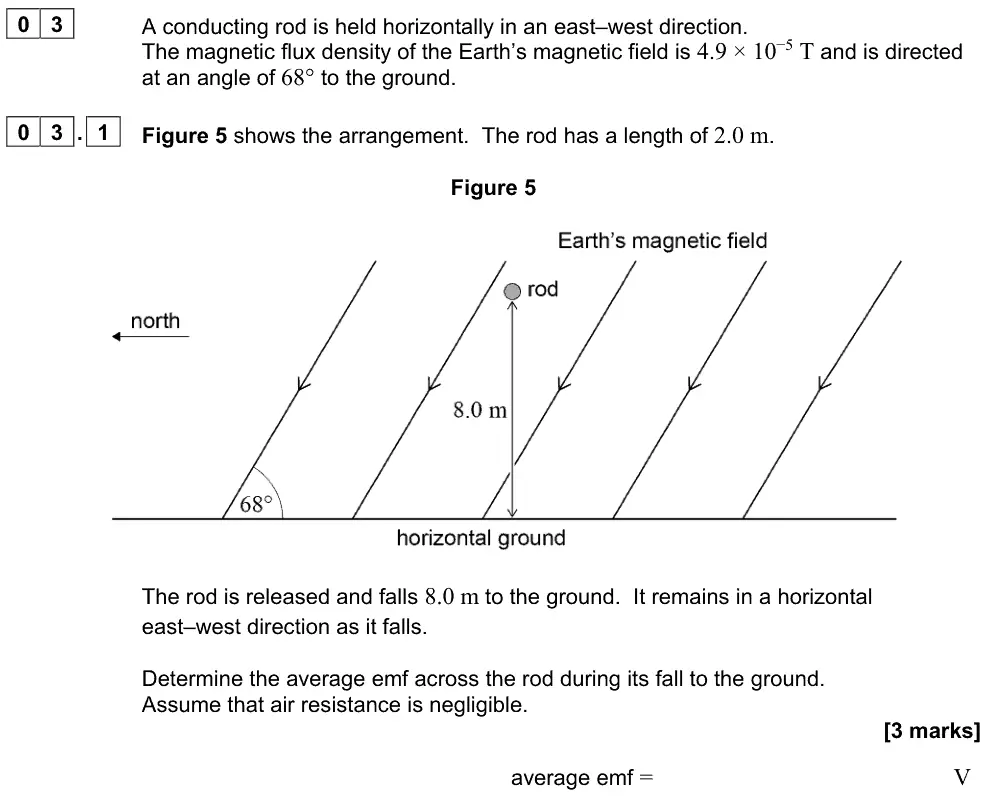
A conducting rod is held horizontally in an east–west direction.
The magnetic flux density of the Earth’s magnetic field is 4.9 × 10⁻⁵ T and is directed
at an angle of 68° to the ground.
Figure 5 shows the arrangement.  The rod has a length of 2.0 m.
Figure 5
The rod is released and falls 8.0 m to the ground.  It remains in a horizontal
east–west direction as it falls.
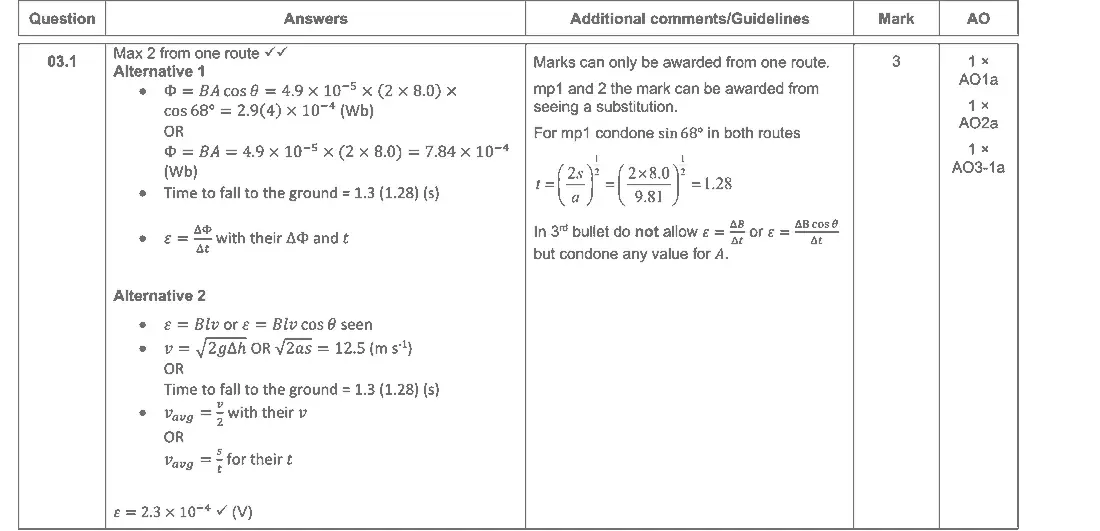
Determine the average emf across the rod during its fall to the ground.
Assume that air resistance is negligible.
[3 marks]
average emf =
V
June 2024 · Paper 2 · Q5.2 2 marks AO2=2 Calculation gravitational fields
Earlier part of question 5 that this part usesEarlier part of June 2024 Paper 2 question 5
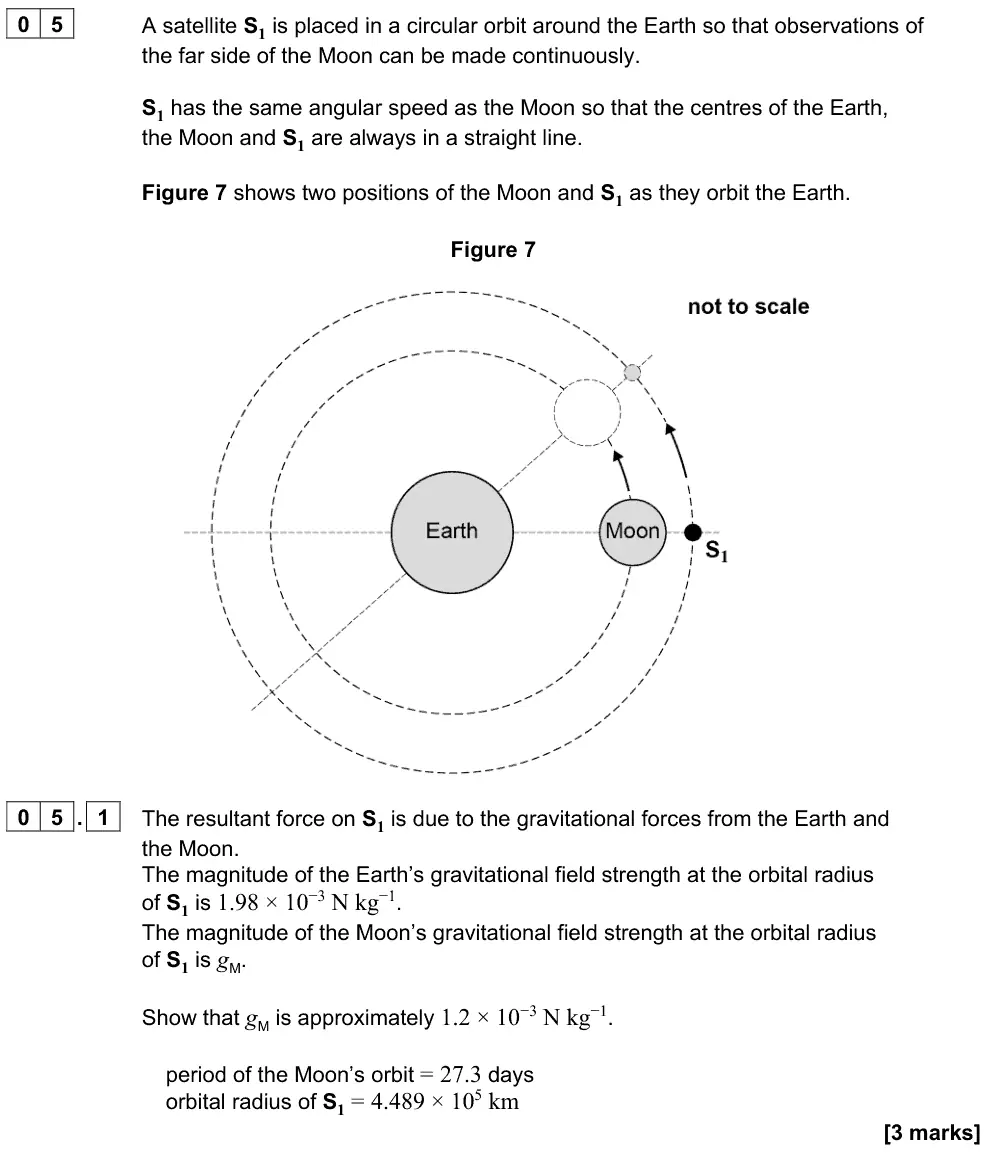
Calculate the distance from S1 to the centre of the Moon.
mass of the Moon = 7.35 × 10²² kg
[2 marks]
distance =
m
June 2024 · Paper 2 · Q6.2 4 marks AO1=2, AO2=1, AO3=1 Calculation electric fields
Earlier part of question 6 that this part usesEarlier part of June 2024 Paper 2 question 6
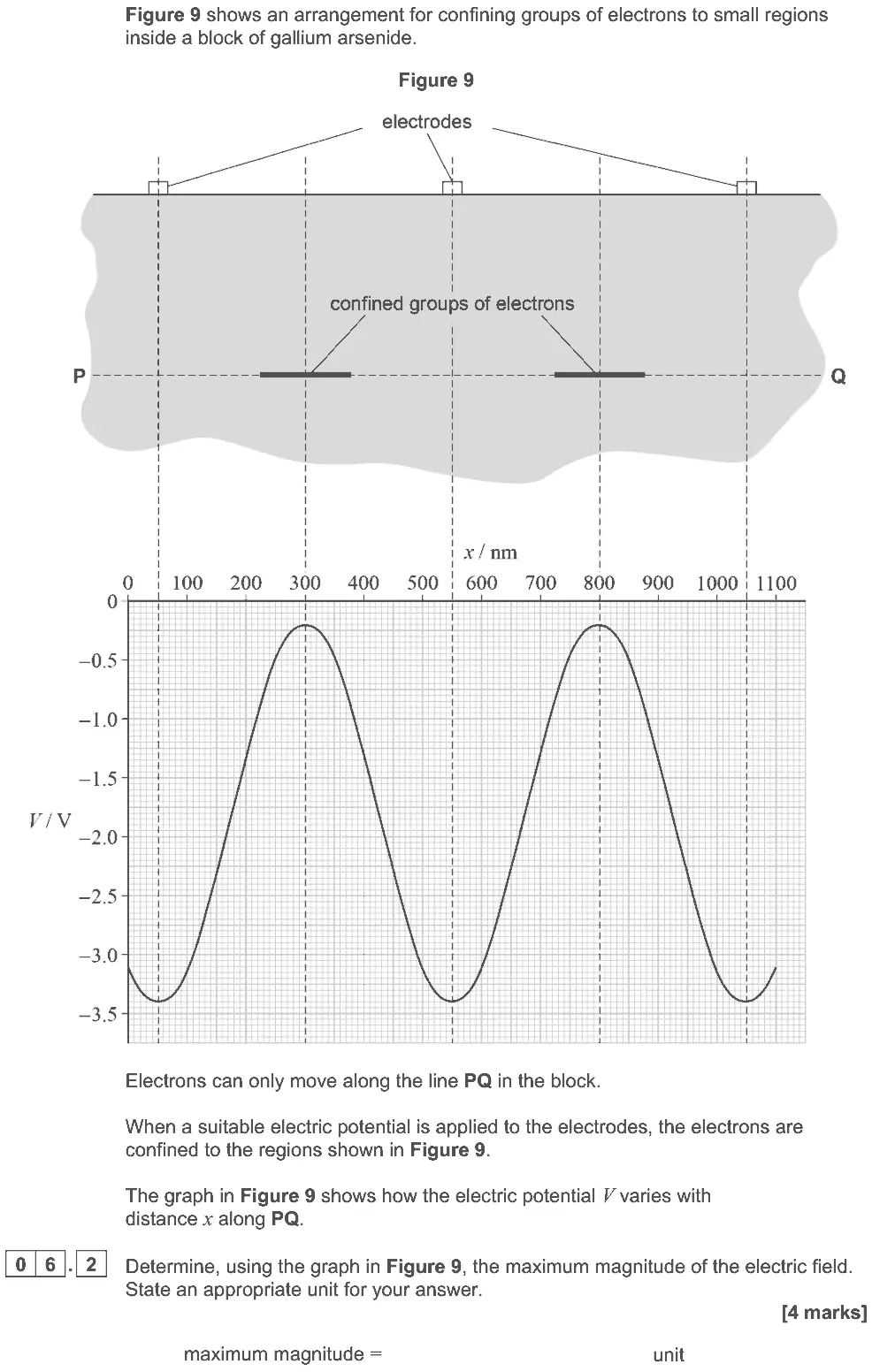
Figure 9 shows an arrangement for confining groups of electrons to small regions
inside a block of gallium arsenide.
Figure 9
Electrons can only move along the line PQ in the block.
When a suitable electric potential is applied to the electrodes, the electrons are
confined to the regions shown in Figure 9.
The graph in Figure 9 shows how the electric potential V varies with
distance x along PQ.
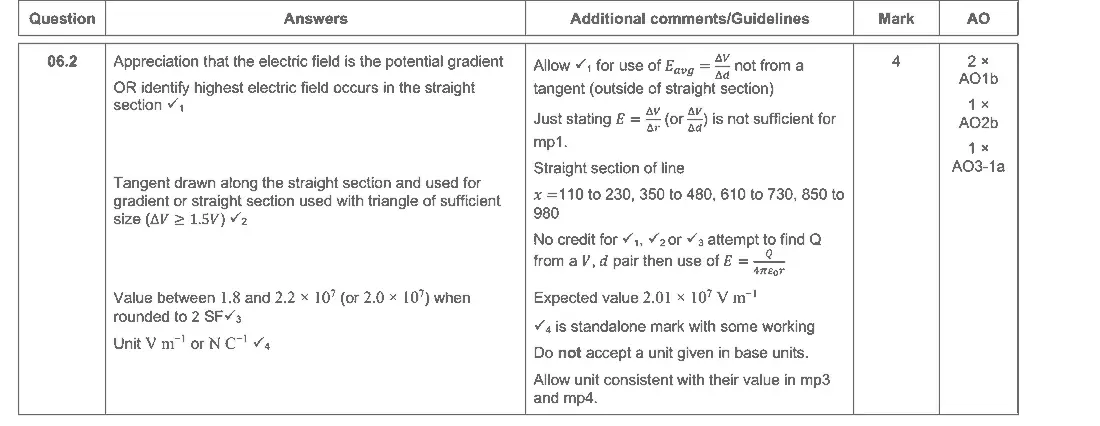
Determine, using the graph in Figure 9, the maximum magnitude of the electric field.
State an appropriate unit for your answer.
[4 marks]
maximum magnitude =
unit
June 2024 · Paper 2 · Q6.3 2 marks AO2=2 Calculation Hard electric fields
Earlier part of question 6 that this part usesEarlier part of June 2024 Paper 2 question 6
An electron at rest at x = 300 nm gains kinetic energy and moves to x = 800 nm.
Determine the minimum kinetic energy required by the electron.
[2 marks]
minimum kinetic energy =
J
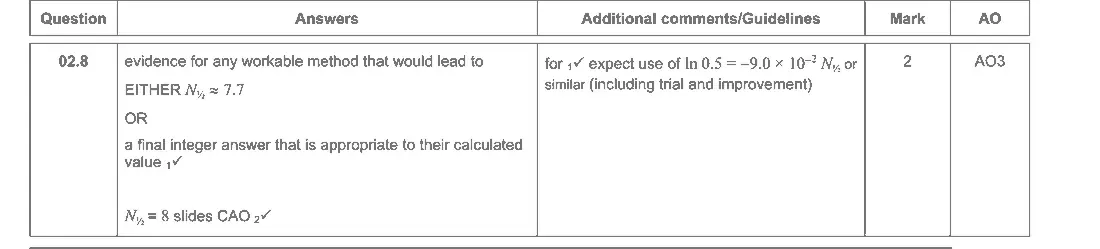
June 2024 · Paper 3 Section A · Q2.8 2 marks AO3=2 Calculation radioactive decay
Earlier part of question 2 that this part usesEarlier part of June 2024 Paper 3 Section A question 2
In an experiment μ = 9.0 × 10⁻²
Deduce the minimum number of slides needed to reduce EV by 50%.
[2 marks]
number of slides =
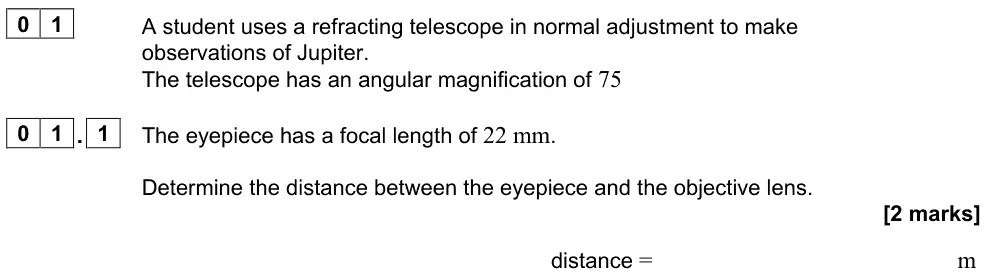
June 2024 · Paper 3B Astrophysics · Q1.1 2 marks AO2=2 Calculation telescopes
A student uses a refracting telescope in normal adjustment to make
observations of Jupiter.
The telescope has an angular magnification of 75
The eyepiece has a focal length of 22 mm.
Determine the distance between the eyepiece and the objective lens.
[2 marks]
distance =
m
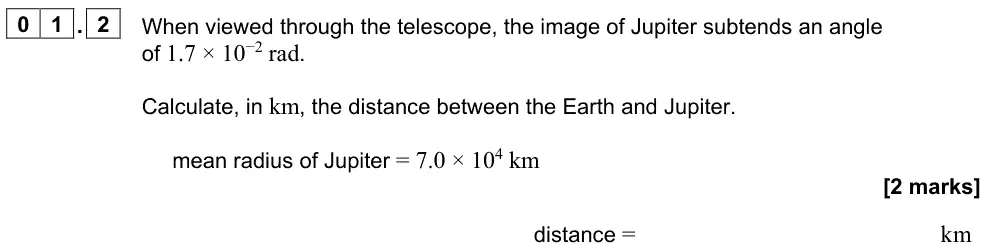
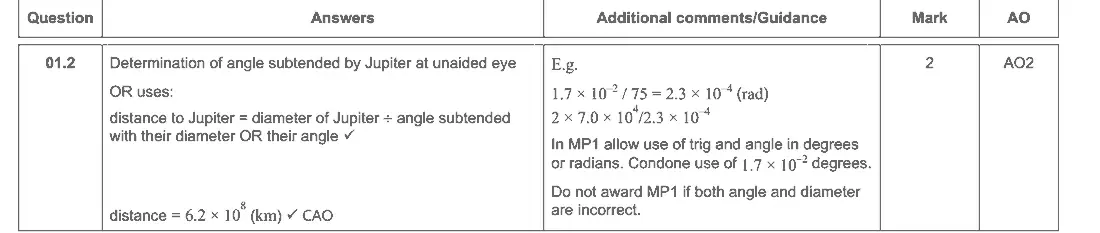
June 2024 · Paper 3B Astrophysics · Q1.2 2 marks AO2=2 Calculation telescopes
Earlier part of question 1 that this part usesEarlier part of June 2024 Paper 3B Astrophysics question 1
When viewed through the telescope, the image of Jupiter subtends an angle
of 1.7 × 10⁻² rad.
Calculate, in km, the distance between the Earth and Jupiter.
mean radius of Jupiter = 7.0 × 10⁴ km
[2 marks]
distance =
km
June 2024 · Paper 3B Astrophysics · Q2.1 2 marks AO2=2 Calculation classification of stars
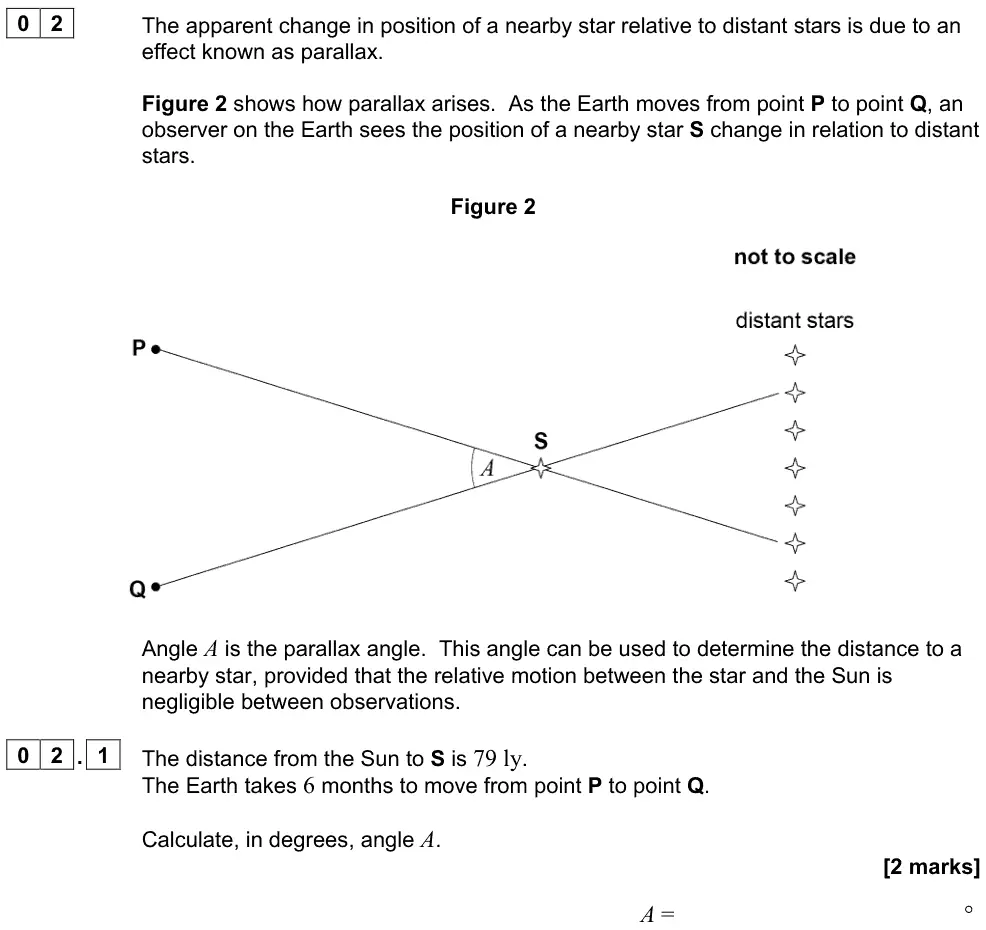
The apparent change in position of a nearby star relative to distant stars is due to an
effect known as parallax.
Figure 2 shows how parallax arises.  As the Earth moves from point P to point Q, an
observer on the Earth sees the position of a nearby star S change in relation to distant
stars.
Figure 2
Angle A is the parallax angle.  This angle can be used to determine the distance to a
nearby star, provided that the relative motion between the star and the Sun is
negligible between observations.
The distance from the Sun to S is 79 ly.
The Earth takes 6 months to move from point P to point Q.
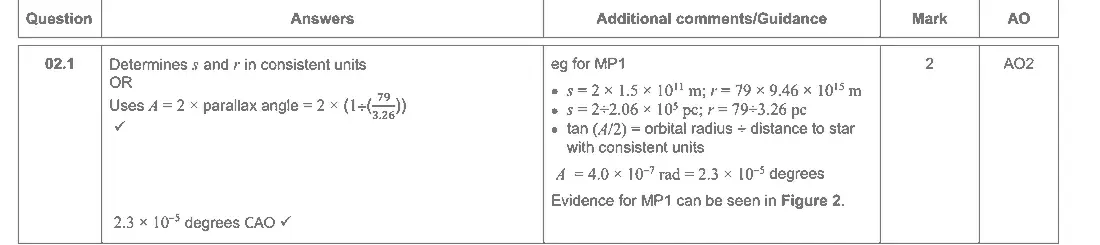
Calculate, in degrees, angle A.
[2 marks]
A =
°
June 2024 · Paper 3B Astrophysics · Q2.2 4 marks AO3=4 Calculation classification of stars
Earlier part of question 2 that this part usesEarlier part of June 2024 Paper 3B Astrophysics question 2
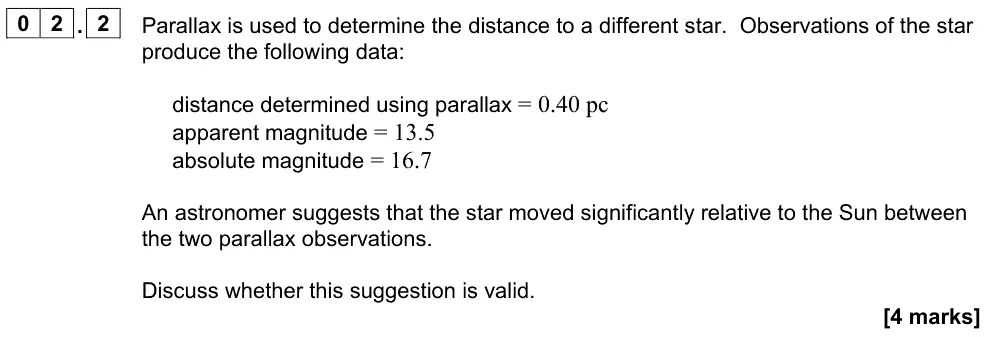
Parallax is used to determine the distance to a different star.  Observations of the star
produce the following data:
distance determined using parallax = 0.40 pc
apparent magnitude = 13.5
absolute magnitude = 16.7
An astronomer suggests that the star moved significantly relative to the Sun between
the two parallax observations.
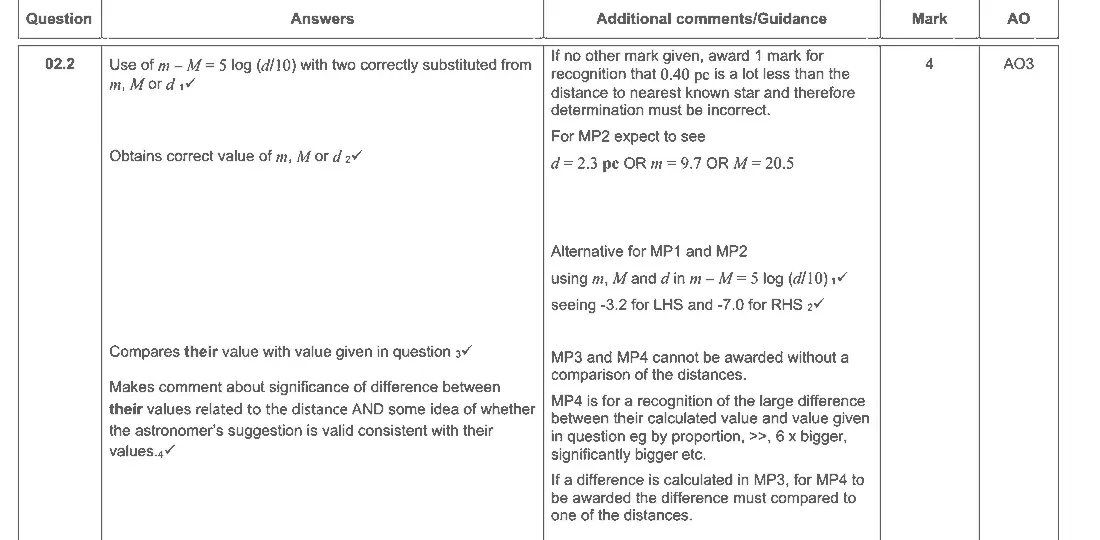
Discuss whether this suggestion is valid.
[4 marks]
June 2024 · Paper 3B Astrophysics · Q3.2 2 marks AO2=2 Calculation classification of stars
Earlier part of question 3 that this part usesEarlier part of June 2024 Paper 3B Astrophysics question 3
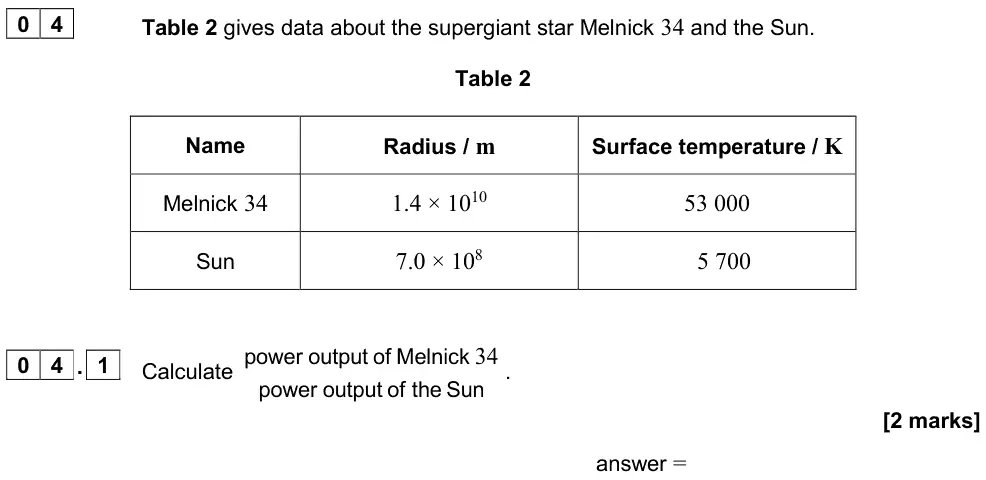
The radius of the star is 9.6 × 10⁶ m.
Calculate the power output of the star.
[2 marks]
power output =
W
June 2024 · Paper 3B Astrophysics · Q4.2 3 marks AO1=1, AO2=2 Calculation classification of stars
Earlier part of question 4 that this part usesEarlier part of June 2024 Paper 3B Astrophysics question 4
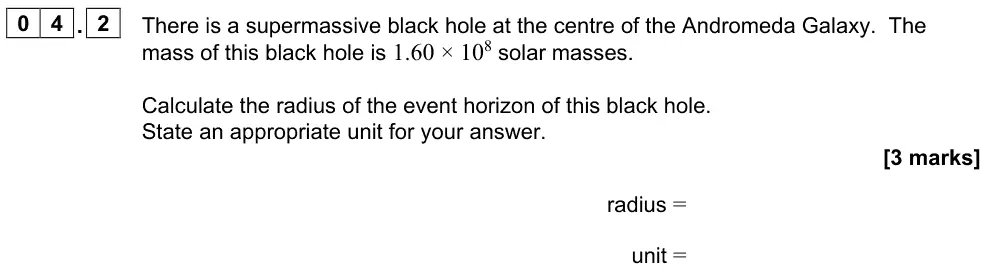
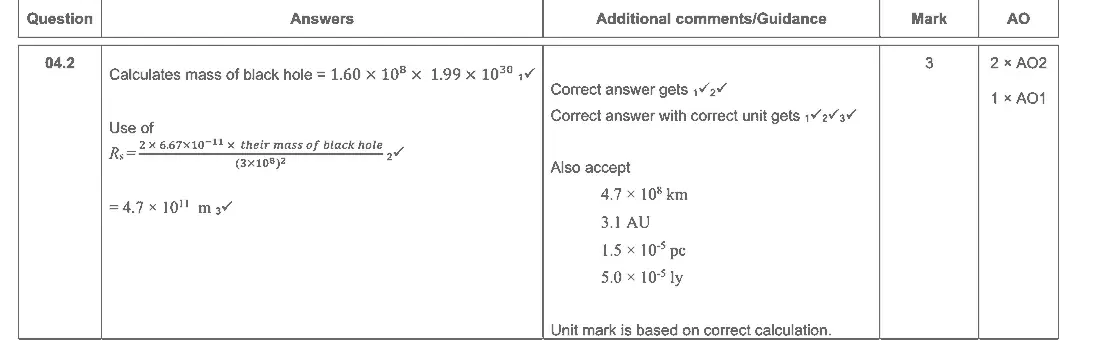
There is a supermassive black hole at the centre of the Andromeda Galaxy.  The
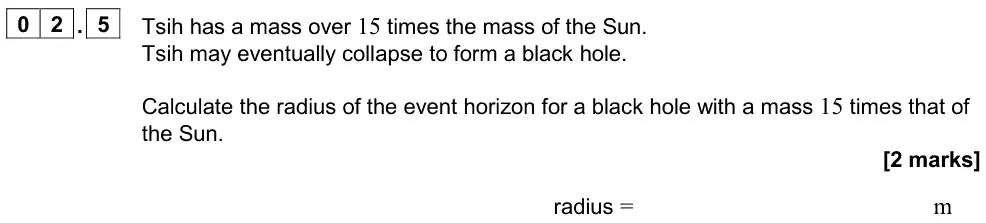
mass of this black hole is 1.60 × 10⁸ solar masses.
Calculate the radius of the event horizon of this black hole.
State an appropriate unit for your answer.
[3 marks]
radius =
unit =
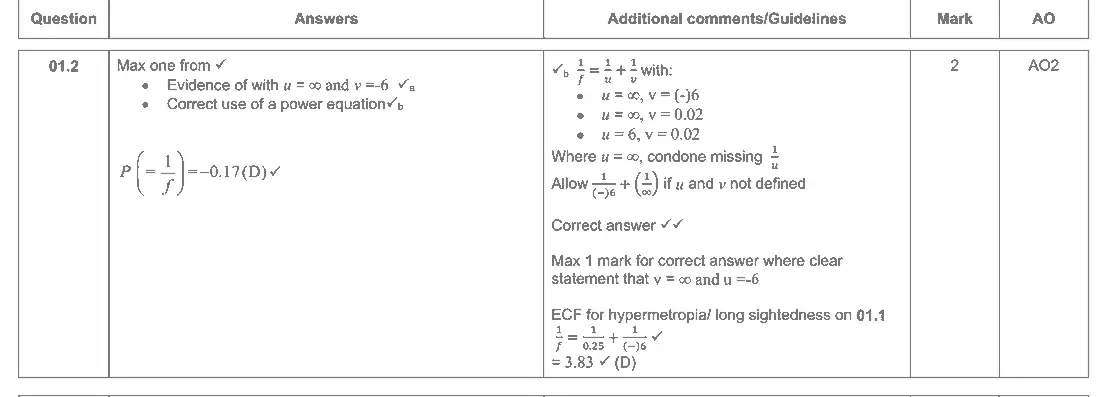
June 2024 · Paper 3B Medical physics · Q1.2 2 marks AO2=2 Calculation Hard eye ear and ecg
Earlier part of question 1 that this part usesEarlier part of June 2024 Paper 3B Medical physics question 1
Calculate the power of the correcting lens required for this eye.
[2 marks]
power =
D
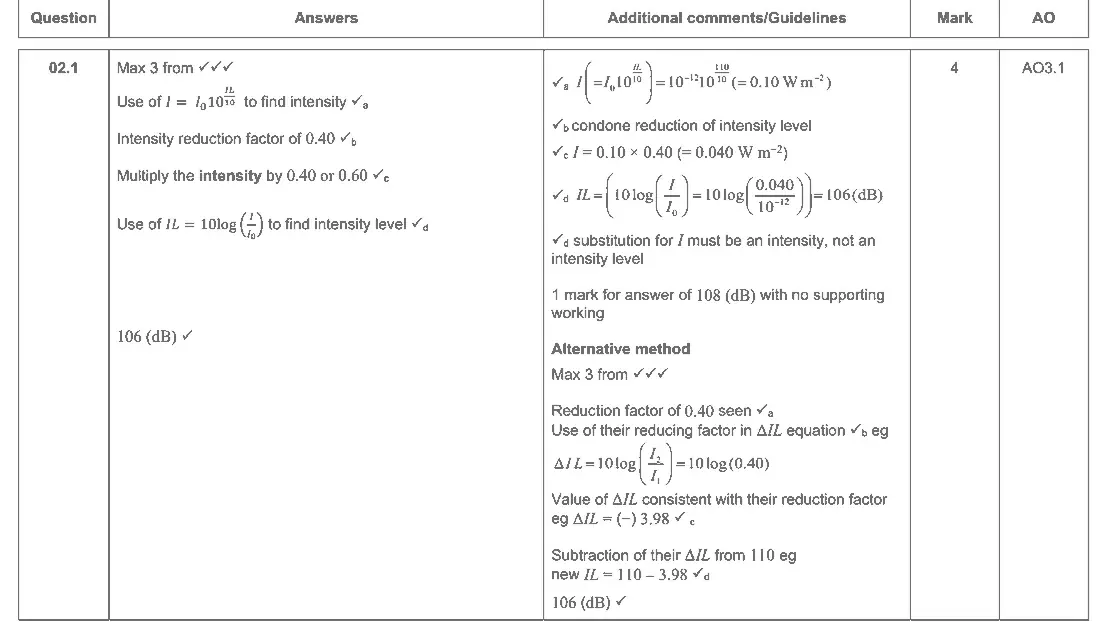
June 2024 · Paper 3B Medical physics · Q2.1 4 marks AO3=4 Calculation eye ear and ecg
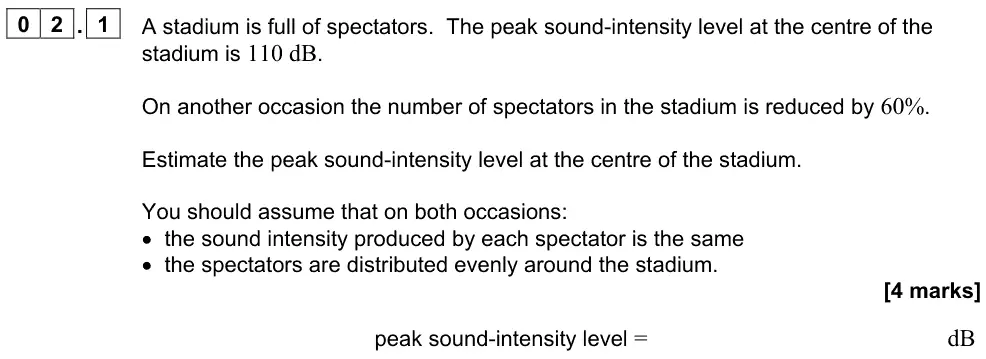
A stadium is full of spectators.  The peak sound-intensity level at the centre of the
stadium is 110 dB.
On another occasion the number of spectators in the stadium is reduced by 60%.
Estimate the peak sound-intensity level at the centre of the stadium.
You should assume that on both occasions:
• the sound intensity produced by each spectator is the same
• the spectators are distributed evenly around the stadium.
[4 marks]
peak sound-intensity level =
dB
June 2024 · Paper 3B Medical physics · Q4.2 3 marks AO2=3 Calculation medical imaging
Earlier part of question 4 that this part usesEarlier part of June 2024 Paper 3B Medical physics question 4
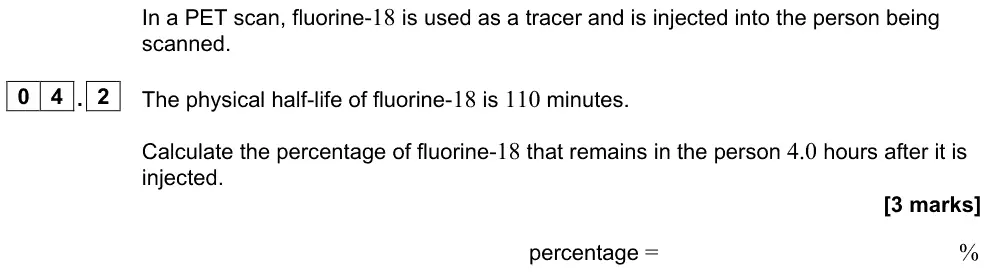
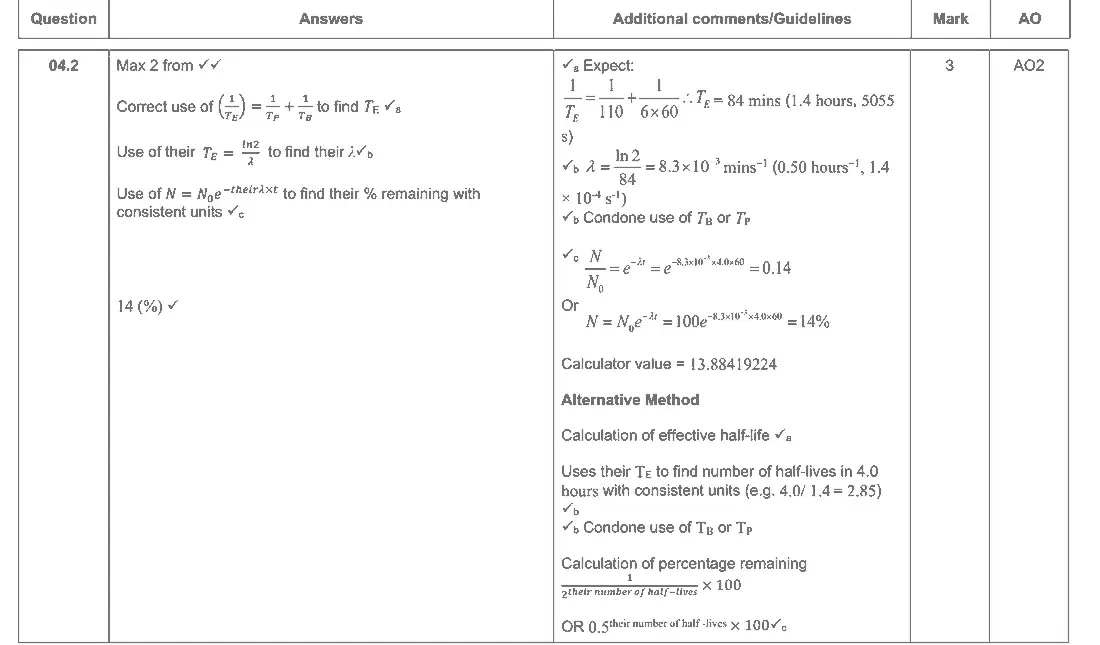
In a PET scan, fluorine-18 is used as a tracer and is injected into the person being
scanned.
The physical half-life of fluorine-18 is 110 minutes.
Calculate the percentage of fluorine-18 that remains in the person 4.0 hours after it is
injected.
[3 marks]
percentage =
%
June 2024 · Paper 3B Medical physics · Q4.4 4 marks AO1=1, AO3=3 Calculation medical imaging
Earlier part of question 4 that this part usesEarlier part of June 2024 Paper 3B Medical physics question 4
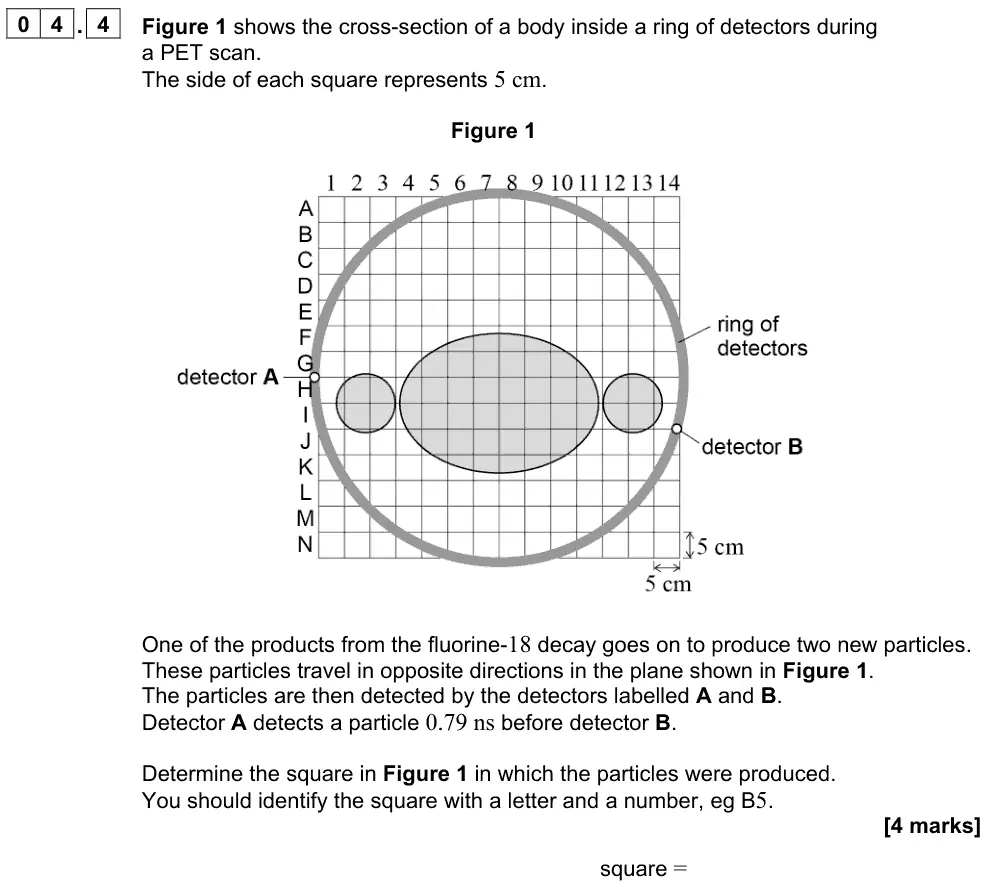
Figure 1 shows the cross-section of a body inside a ring of detectors during
a PET scan.
The side of each square represents 5 cm.
Figure 1
One of the products from the fluorine-18 decay goes on to produce two new particles.
These particles travel in opposite directions in the plane shown in Figure 1.
The particles are then detected by the detectors labelled A and B.
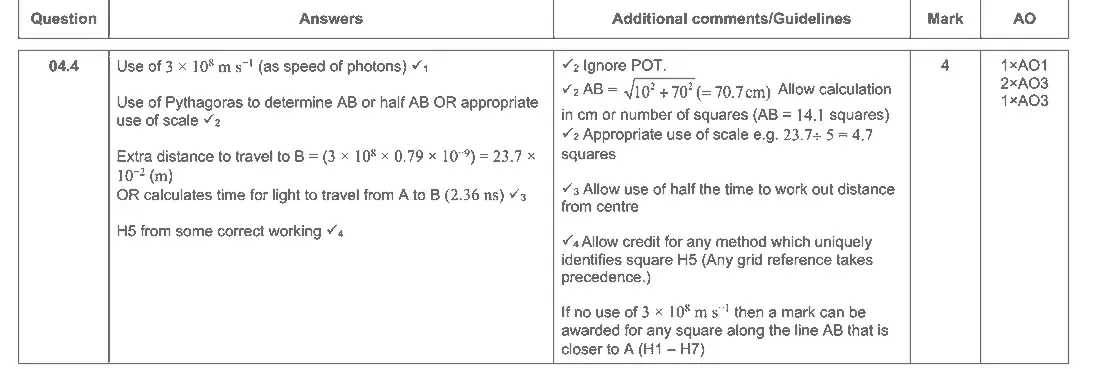
Detector A detects a particle 0.79 ns before detector B.
Determine the square in Figure 1 in which the particles were produced.
You should identify the square with a letter and a number, eg B5.
[4 marks]
square =
June 2024 · Paper 3B Medical physics · Q5.2 3 marks AO2=3 Calculation medical imaging
Earlier part of question 5 that this part usesEarlier part of June 2024 Paper 3B Medical physics question 5
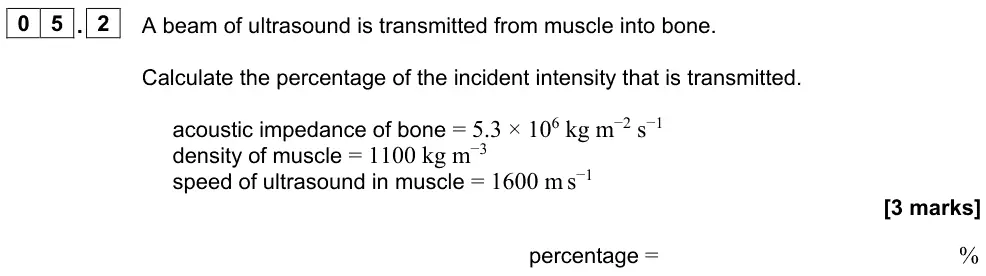
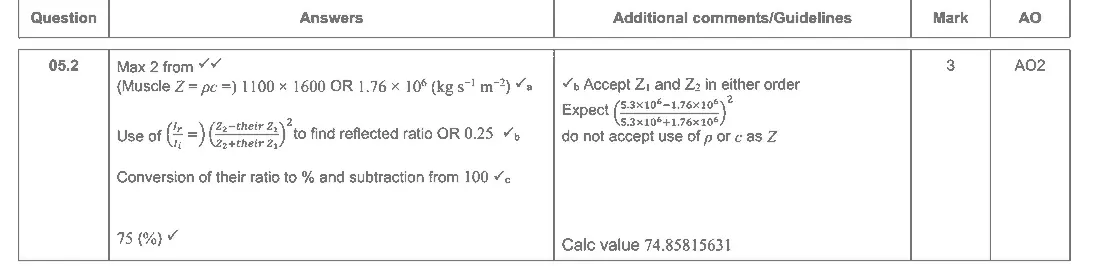
A beam of ultrasound is transmitted from muscle into bone.
Calculate the percentage of the incident intensity that is transmitted.
acoustic impedance of bone = 5.3 × 10⁶ kg m−2 s−1
density of muscle = 1100 kg m−3
speed of ultrasound in muscle = 1600 m s−1
[3 marks]
percentage =
%
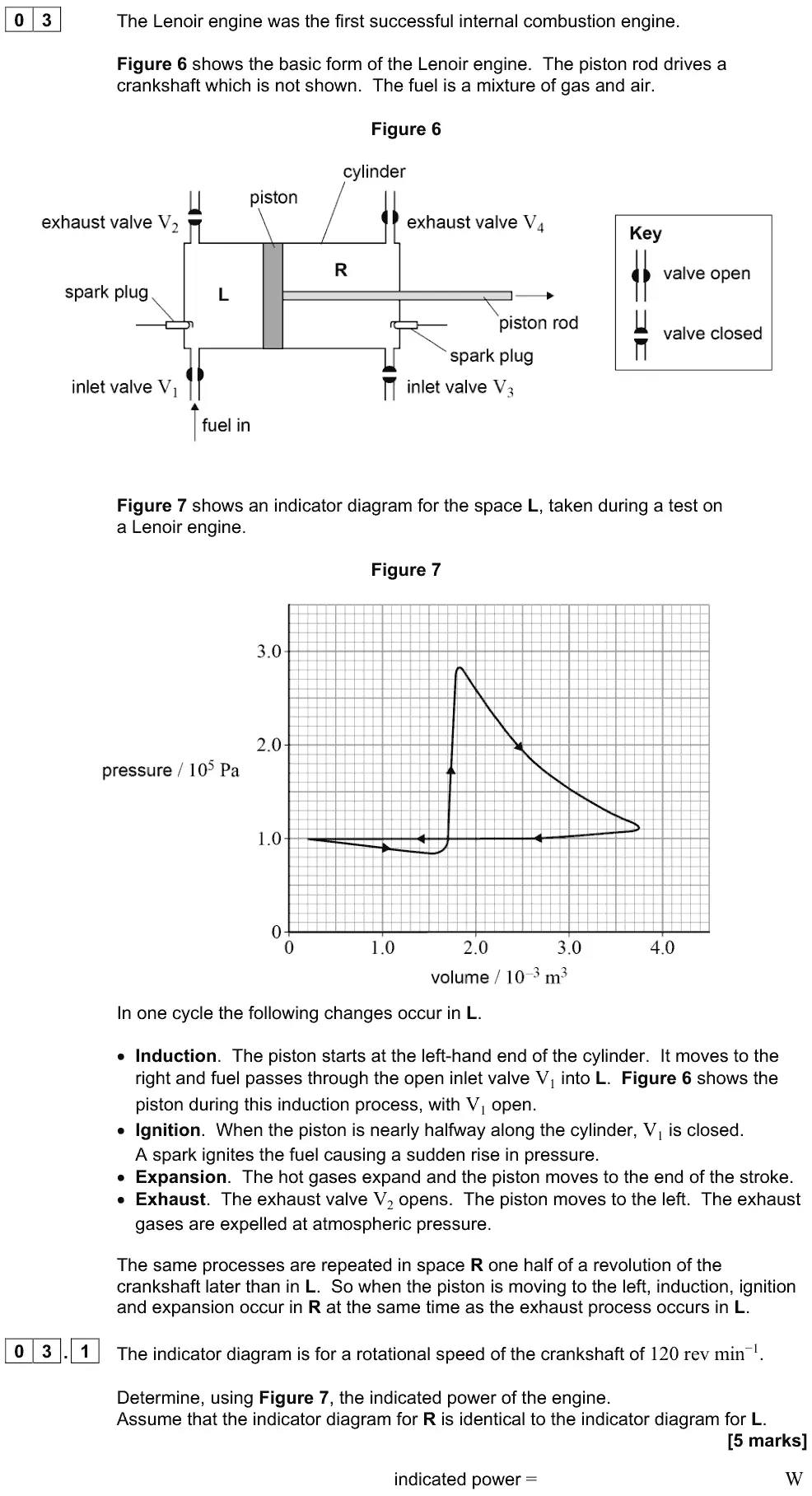
June 2024 · Paper 3B Engineering physics · Q3.1 5 marks Calculation thermodynamics and engines
The Lenoir engine was the first successful internal combustion engine.
Figure 6 shows the basic form of the Lenoir engine.  The piston rod drives a
crankshaft which is not shown.  The fuel is a mixture of gas and air.
Figure 6
Figure 7 shows an indicator diagram for the space L, taken during a test on
a Lenoir engine.
Figure 7
In one cycle the following changes occur in L.
• Induction.  The piston starts at the left-hand end of the cylinder.  It moves to the
right and fuel passes through the open inlet valve V1 into L.  Figure 6 shows the
piston during this induction process, with V1 open.
• Ignition.  When the piston is nearly halfway along the cylinder, V1 is closed.
A spark ignites the fuel causing a sudden rise in pressure.
• Expansion.  The hot gases expand and the piston moves to the end of the stroke.
• Exhaust.  The exhaust valve V2 opens.  The piston moves to the left.  The exhaust
gases are expelled at atmospheric pressure.
The same processes are repeated in space R one half of a revolution of the
crankshaft later than in L.  So when the piston is moving to the left, induction, ignition
and expansion occur in R at the same time as the exhaust process occurs in L.
The indicator diagram is for a rotational speed of the crankshaft of 120 rev min−1.
Determine, using Figure 7, the indicated power of the engine.
Assume that the indicator diagram for R is identical to the indicator diagram for L.
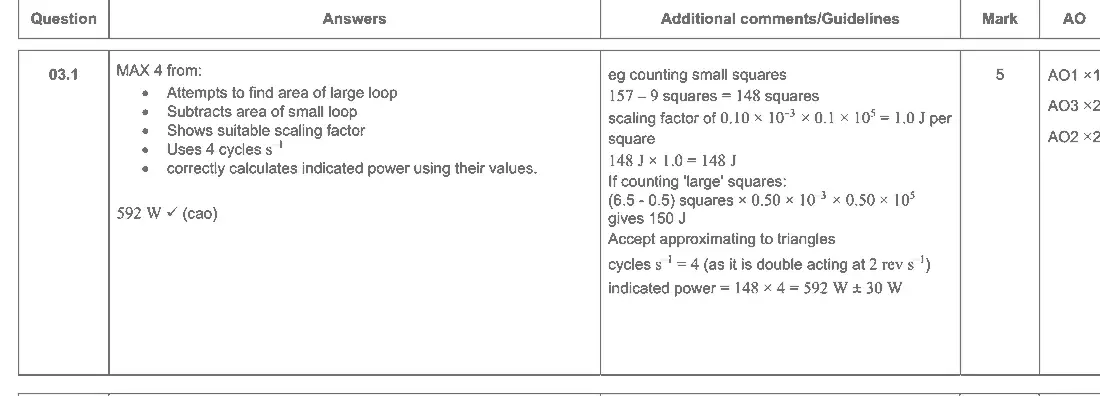
[5 marks]
indicated power =
W
June 2024 · Paper 3B Engineering physics · Q3.2 2 marks AO1=2 Calculation Easy thermodynamics and engines
Earlier part of question 3 that this part usesEarlier part of June 2024 Paper 3B Engineering physics question 3
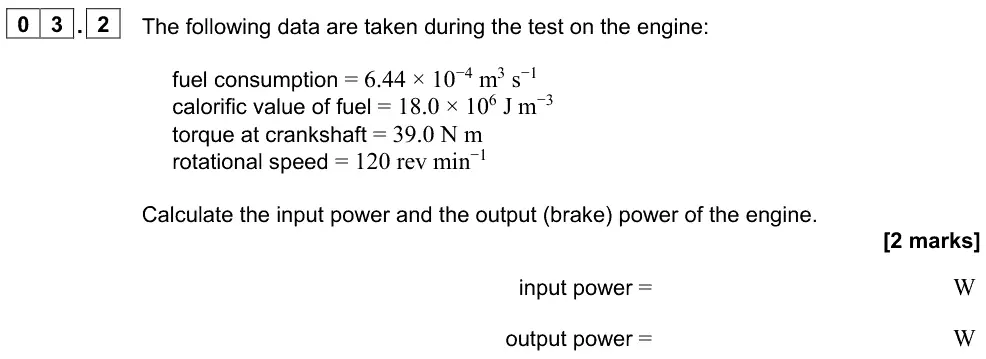
The following data are taken during the test on the engine:
fuel consumption = 6.44 × 10⁻⁴ m3 s−1
calorific value of fuel = 18.0 × 10⁶ J m−3
torque at crankshaft = 39.0 N m
rotational speed = 120 rev min−1
Calculate the input power and the output (brake) power of the engine.
[2 marks]
input power =
W
output power =
W
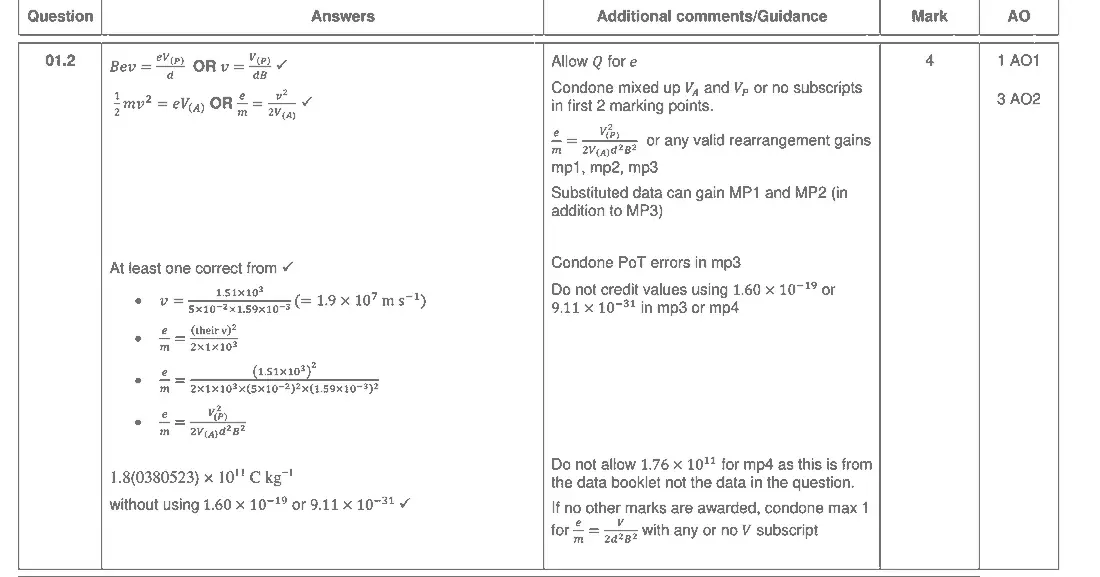
June 2024 · Paper 3B Turning points · Q1.2 4 marks Calculation discovery of the electron
Earlier part of question 1 that this part usesEarlier part of June 2024 Paper 3B Turning points question 1
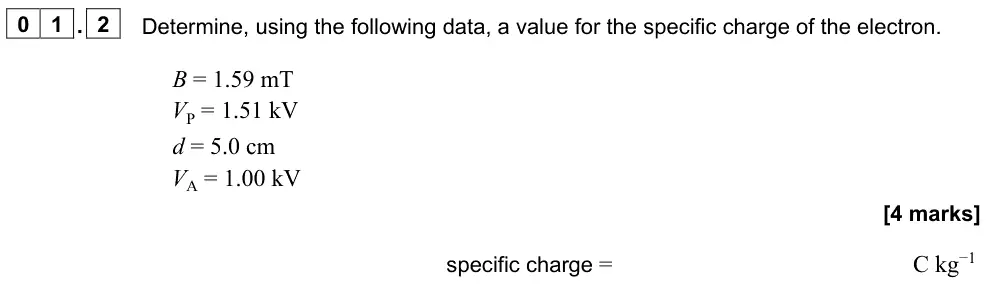
Determine, using the following data, a value for the specific charge of the electron.
B = 1.59 mT
VP = 1.51 kV
d = 5.0 cm
VA = 1.00 kV
[4 marks]
specific charge =
C kg−1
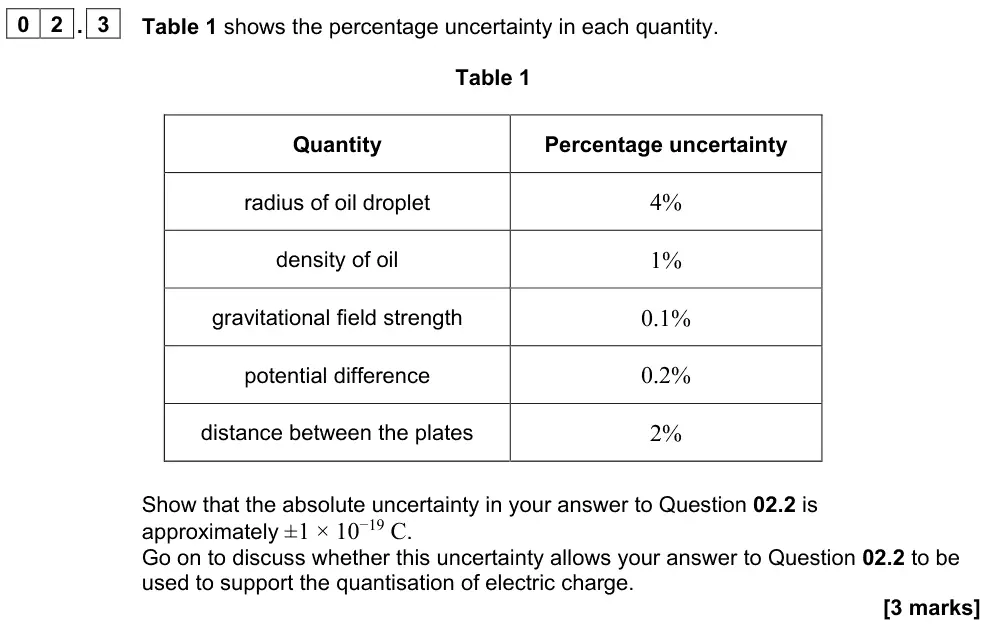
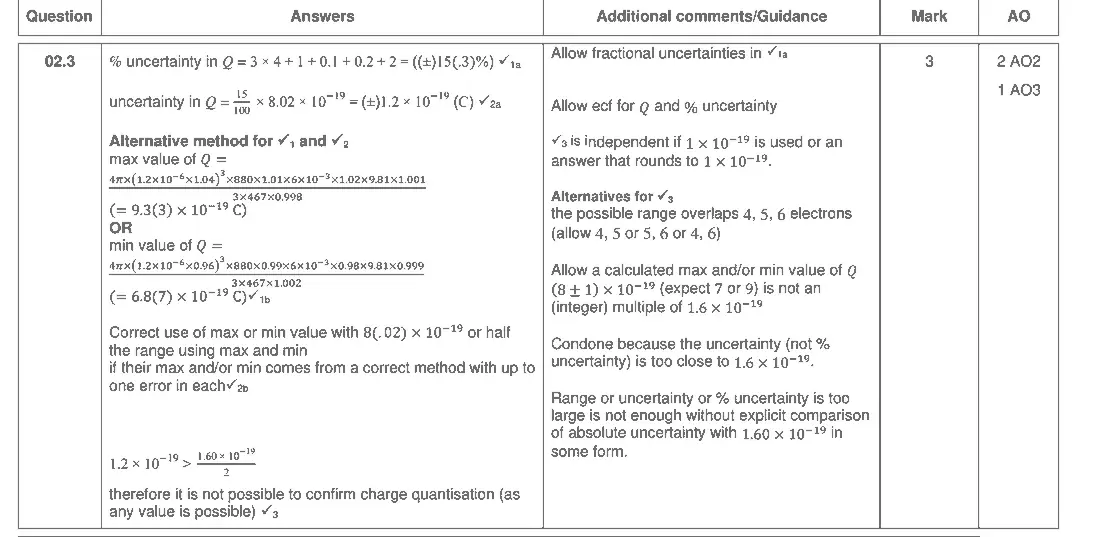
June 2024 · Paper 3B Turning points · Q2.3 3 marks Calculation measurements and uncertaintiesdiscovery of the electron
Earlier part of question 2 that this part usesEarlier part of June 2024 Paper 3B Turning points question 2
Table 1 shows the percentage uncertainty in each quantity.
Table 1
Quantity
Percentage uncertainty
radius of oil droplet
4%
density of oil
1%
gravitational field strength
0.1%
potential difference
0.2%
distance between the plates
2%
Show that the absolute uncertainty in your answer to Question 02.2 is
approximately ±1 × 10⁻¹⁹ C.
Go on to discuss whether this uncertainty allows your answer to Question 02.2 to be
used to support the quantisation of electric charge.
[3 marks]
June 2024 · Paper 3B Turning points · Q4.2 2 marks AO3=2 Calculation special relativity
Earlier part of question 4 that this part usesEarlier part of June 2024 Paper 3B Turning points question 4
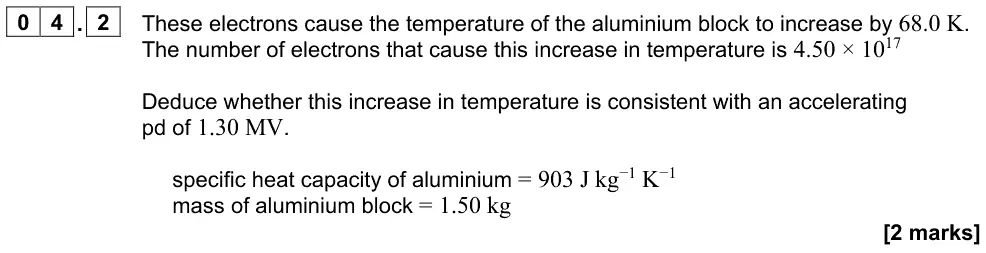
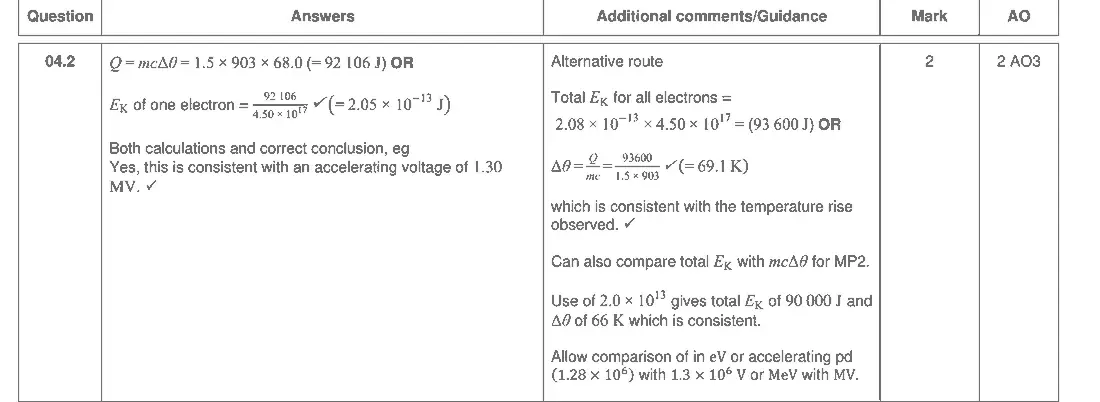
These electrons cause the temperature of the aluminium block to increase by 68.0 K.
The number of electrons that cause this increase in temperature is 4.50 × 10¹⁷
Deduce whether this increase in temperature is consistent with an accelerating
pd of 1.30 MV.
specific heat capacity of aluminium = 903 J kg−1 K−1
mass of aluminium block = 1.50 kg
[2 marks]
June 2024 · Paper 3B Turning points · Q4.3 4 marks AO3=4 Calculation special relativity
Earlier part of question 4 that this part usesEarlier part of June 2024 Paper 3B Turning points question 4
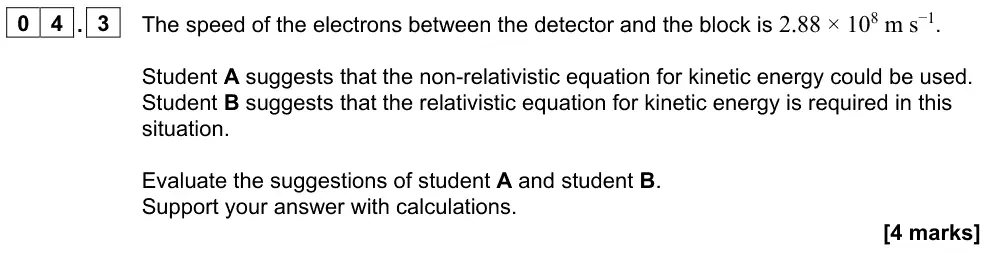
The speed of the electrons between the detector and the block is 2.88 × 10⁸ m s−1.
Student A suggests that the non-relativistic equation for kinetic energy could be used.
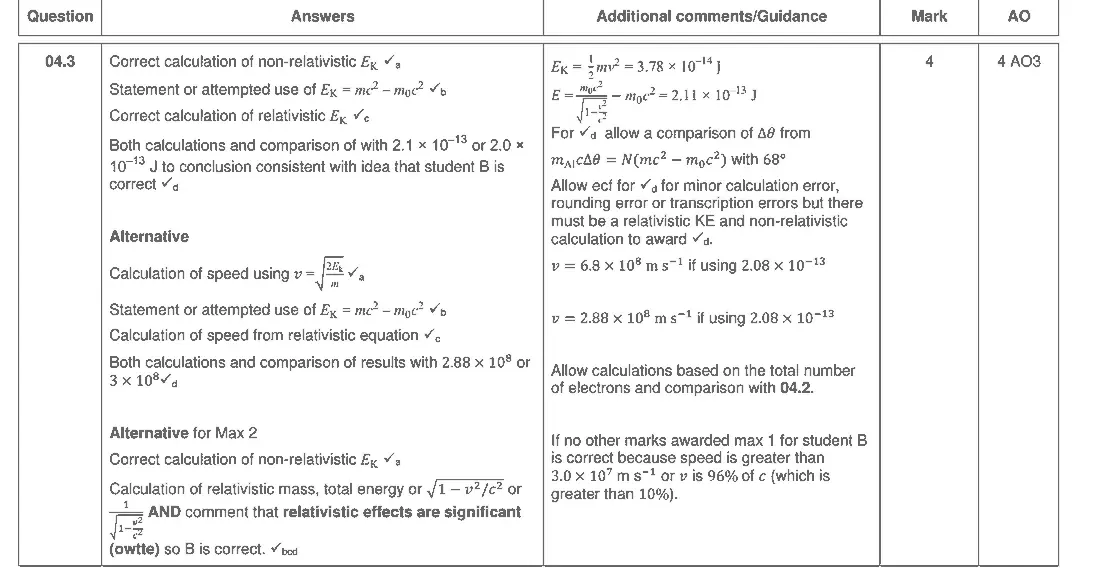
Student B suggests that the relativistic equation for kinetic energy is required in this
situation.
Evaluate the suggestions of student A and student B.
Support your answer with calculations.
[4 marks]
June 2024 · Paper 3B Electronics · Q2.1 2 marks AO2=2 Calculation semiconductor devices and signalsdata communication
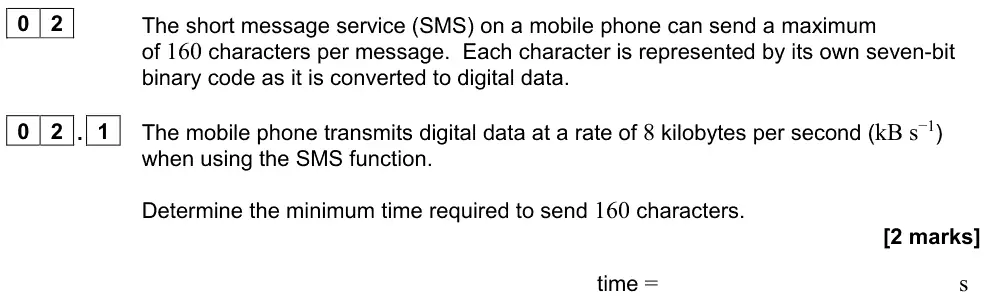
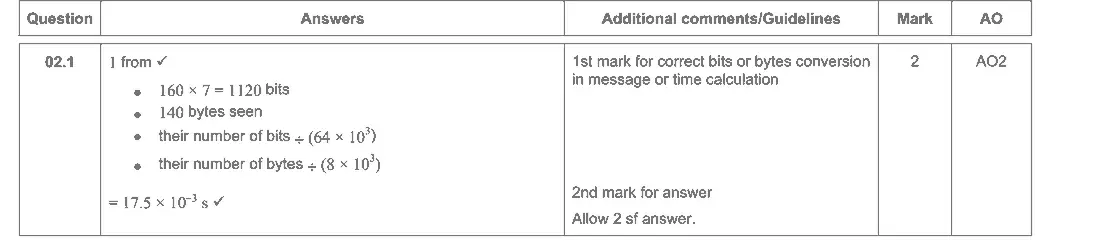
The short message service (SMS) on a mobile phone can send a maximum
of 160 characters per message.  Each character is represented by its own seven-bit
binary code as it is converted to digital data.
The mobile phone transmits digital data at a rate of 8 kilobytes per second (kB s−1)
when using the SMS function.
Determine the minimum time required to send 160 characters.
[2 marks]
time =
s
June 2024 · Paper 3B Electronics · Q3.2 3 marks AO3=3 Calculation operational amplifiers
Earlier part of question 3 that this part usesEarlier part of June 2024 Paper 3B Electronics question 3
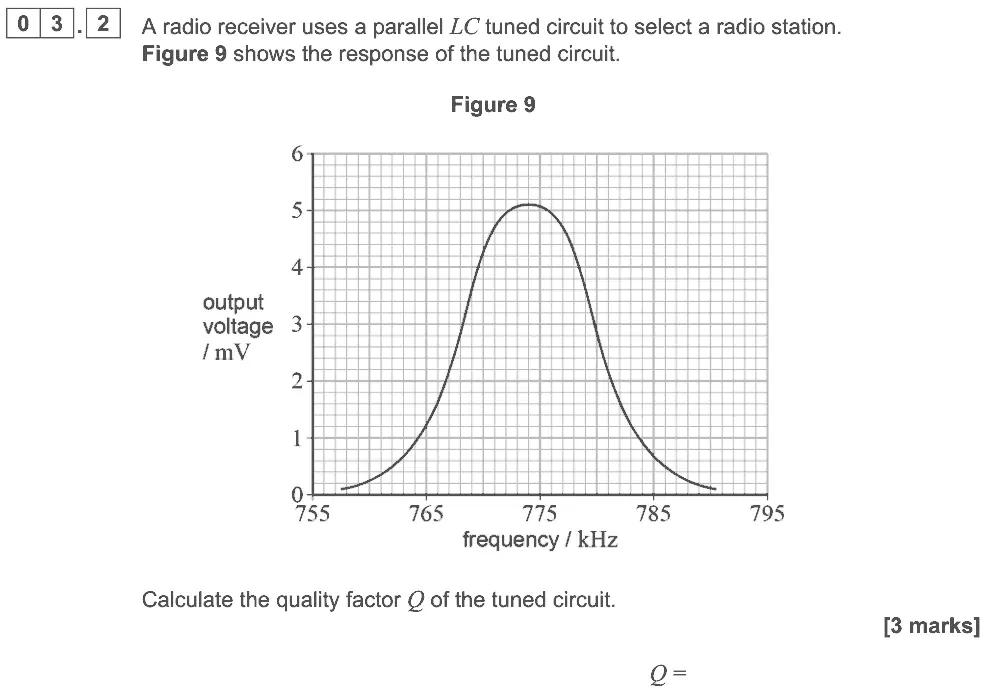
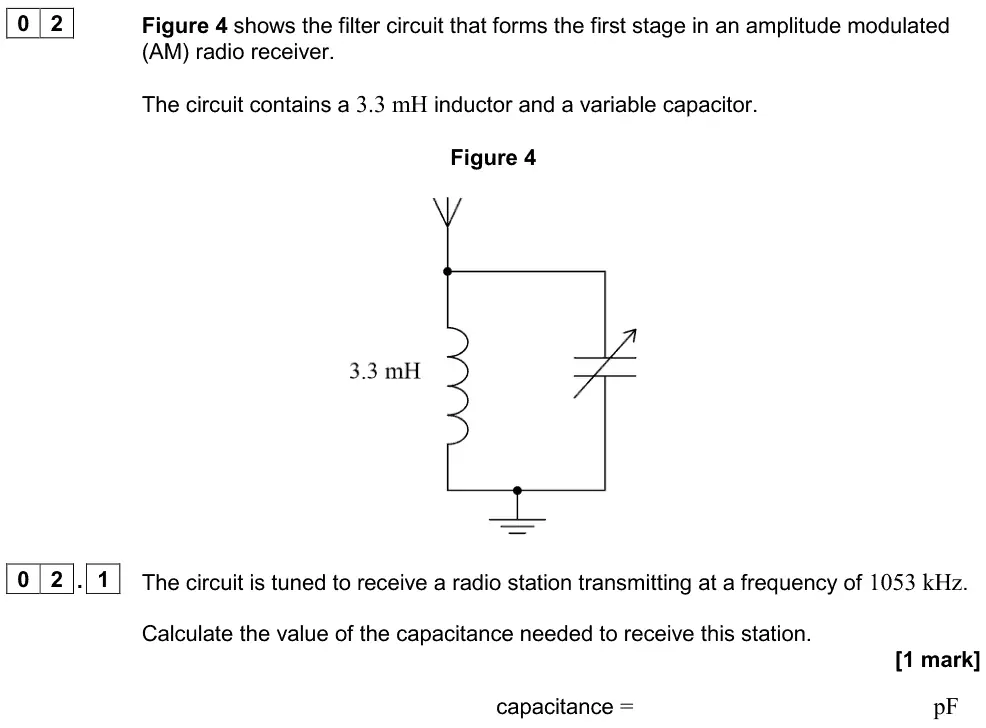
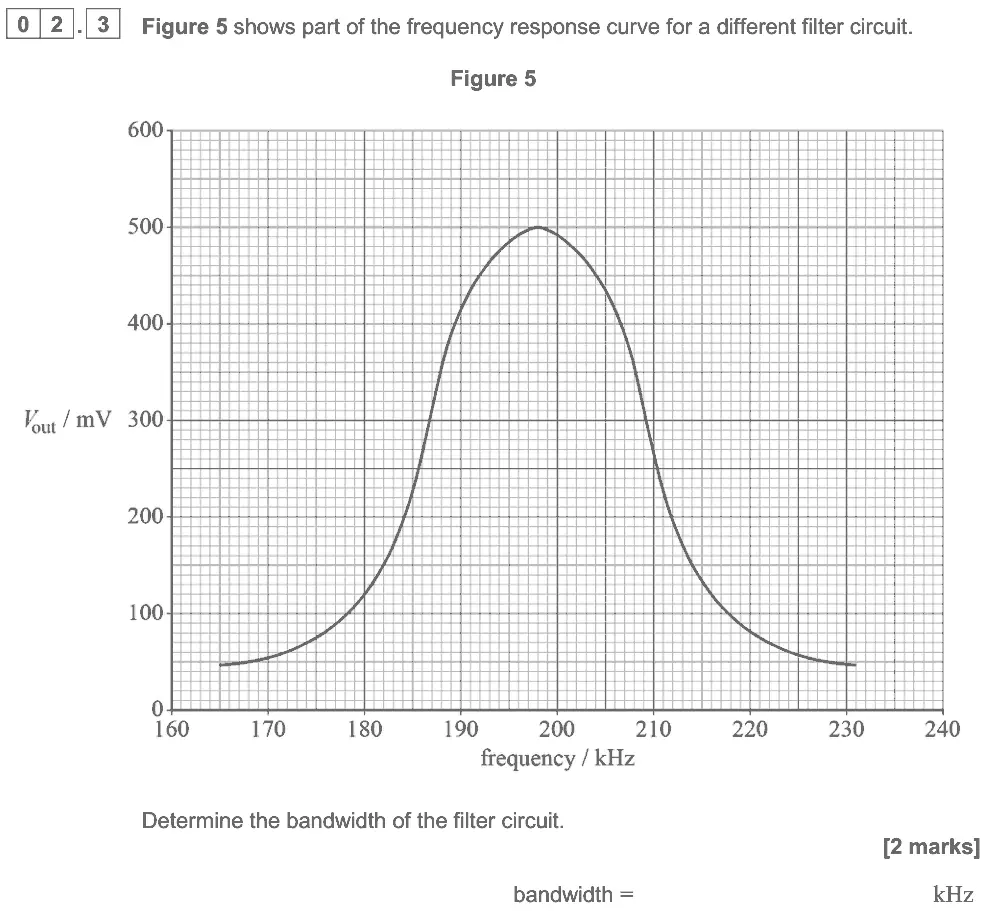
A radio receiver uses a parallel LC tuned circuit to select a radio station.
Figure 9 shows the response of the tuned circuit.
Figure 9
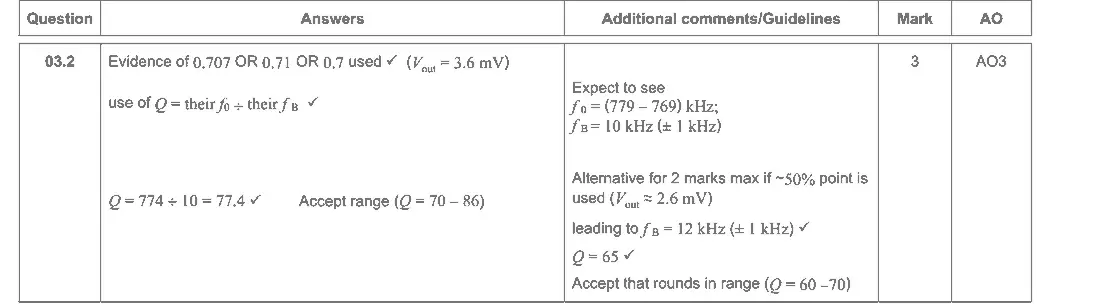
Calculate the quality factor Q of the tuned circuit.
[3 marks]
Q =
June 2024 · Paper 3B Electronics · Q3.4 1 mark AO1=1 Calculation data communication
Earlier part of question 3 that this part usesEarlier part of June 2024 Paper 3B Electronics question 3
An audio signal is transmitted on an FM music station.  The transmission has a
bandwidth of 186 kHz.  The carrier wave has a maximum frequency deviation
of 75 kHz.
Calculate the maximum frequency in the information signal.
[1 mark]
maximum frequency =
kHz
June 2024 · Paper 3B Electronics · Q4.1 2 marks AO3=2 Calculation semiconductor devices and signals
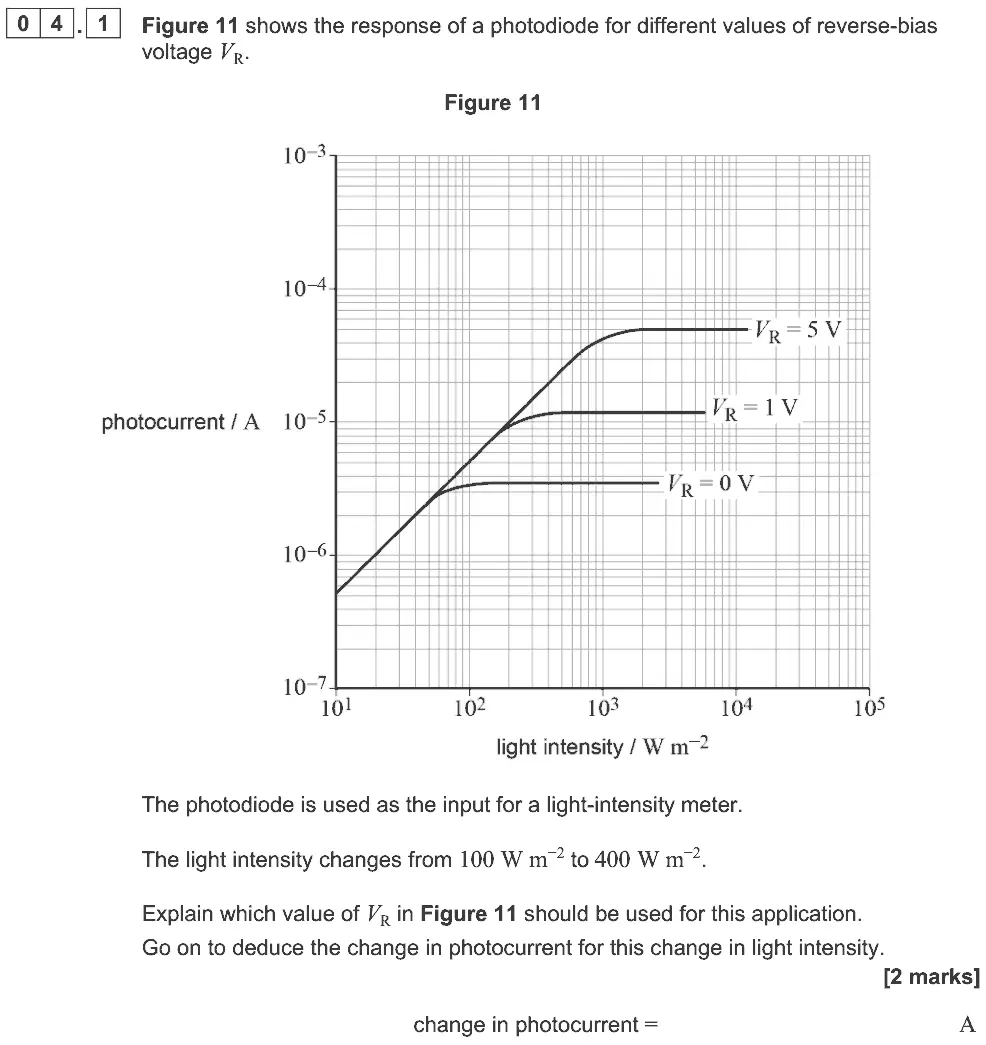
Figure 11 shows the response of a photodiode for different values of reverse-bias
voltage VR.
Figure 11
The photodiode is used as the input for a light-intensity meter.
The light intensity changes from 100 W m−2 to 400 W m−2.
Explain which value of VR in Figure 11 should be used for this application.
Go on to deduce the change in photocurrent for this change in light intensity.
[2 marks]
change in photocurrent =
A
June 2023 · AS Paper 1 · Q1.2 2 marks AO1=2 Calculation particles antiparticles and interactionsenergy levels and wave particle duality
Earlier part of question 1 that this part usesEarlier part of June 2023 Paper 1 question 1
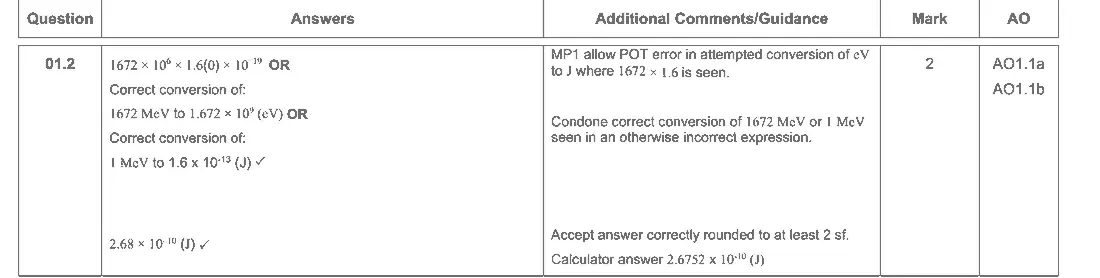
Calculate, in J, the rest energy of the Ω−.
[2 marks]
rest energy =
J
June 2023 · AS Paper 1 · Q1.5 2 marks Calculation Easy particles antiparticles and interactions
Earlier part of question 1 that this part usesEarlier part of June 2023 Paper 1 question 1
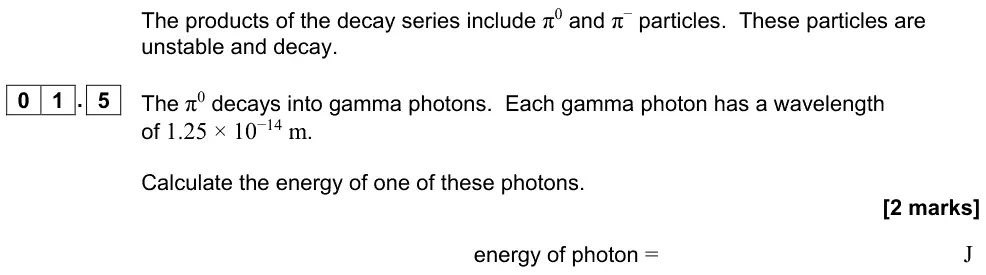
The products of the decay series include π0 and π− particles.  These particles are
unstable and decay.
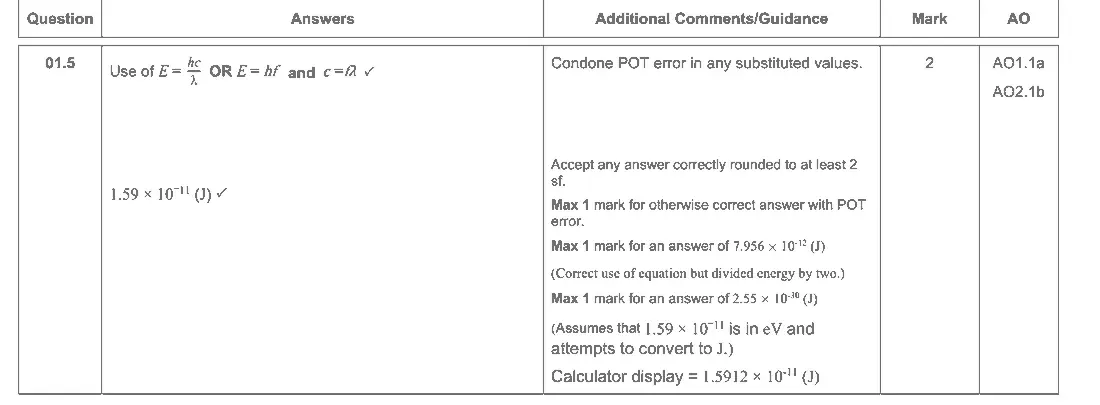
The π0 decays into gamma photons.  Each gamma photon has a wavelength
of 1.25 × 10⁻¹⁴ m.
Calculate the energy of one of these photons.
[2 marks]
energy of photon =
J
June 2023 · AS Paper 1 · Q2.2 2 marks Calculation Hard progressive waves and polarisation
Earlier part of question 2 that this part usesEarlier part of June 2023 Paper 1 question 2
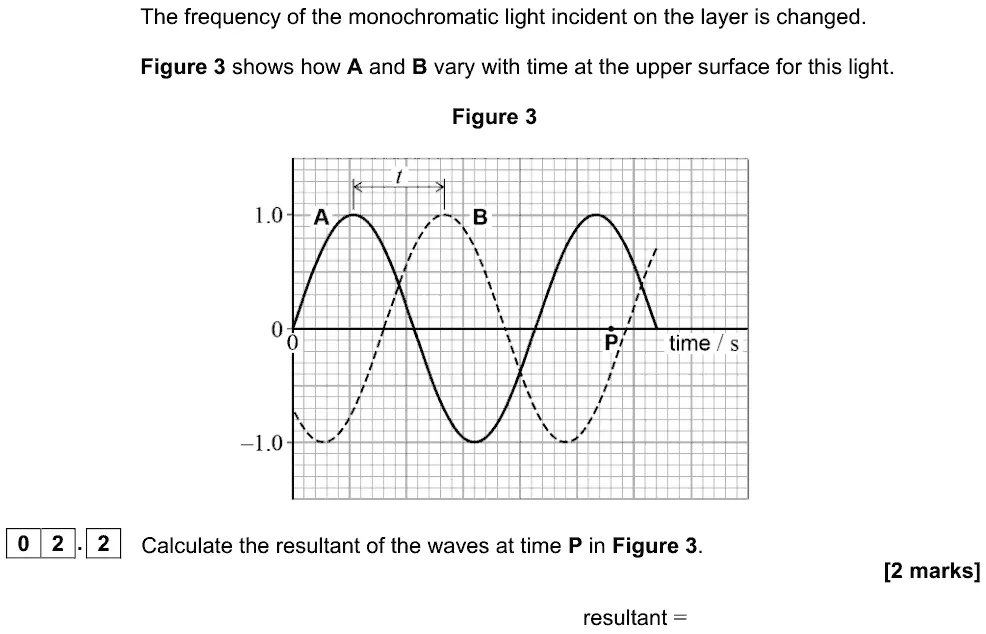
The frequency of the monochromatic light incident on the layer is changed.
Figure 3 shows how A and B vary with time at the upper surface for this light.
Figure 3
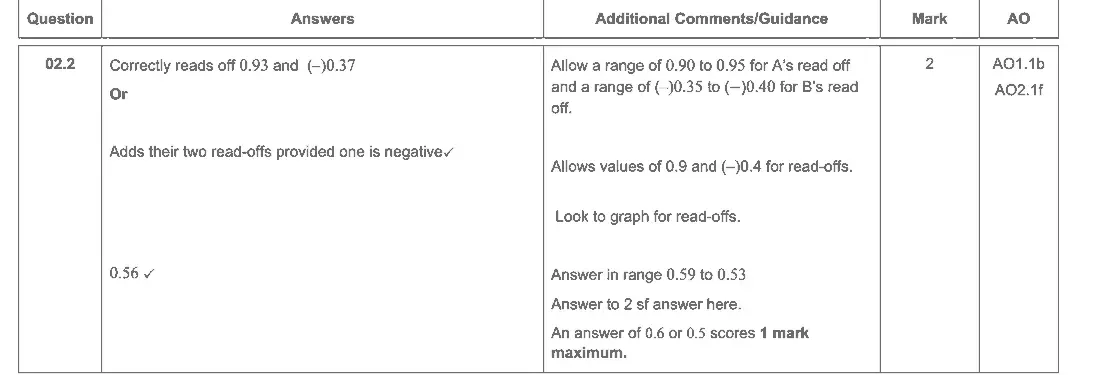
Calculate the resultant of the waves at time P in Figure 3.
[2 marks]
resultant =
June 2023 · AS Paper 1 · Q2.4 4 marks AO2=2, AO3=2 Calculation Hard refraction and optical fibresprogressive waves and polarisation
Earlier part of question 2 that this part usesEarlier part of June 2023 Paper 1 question 2
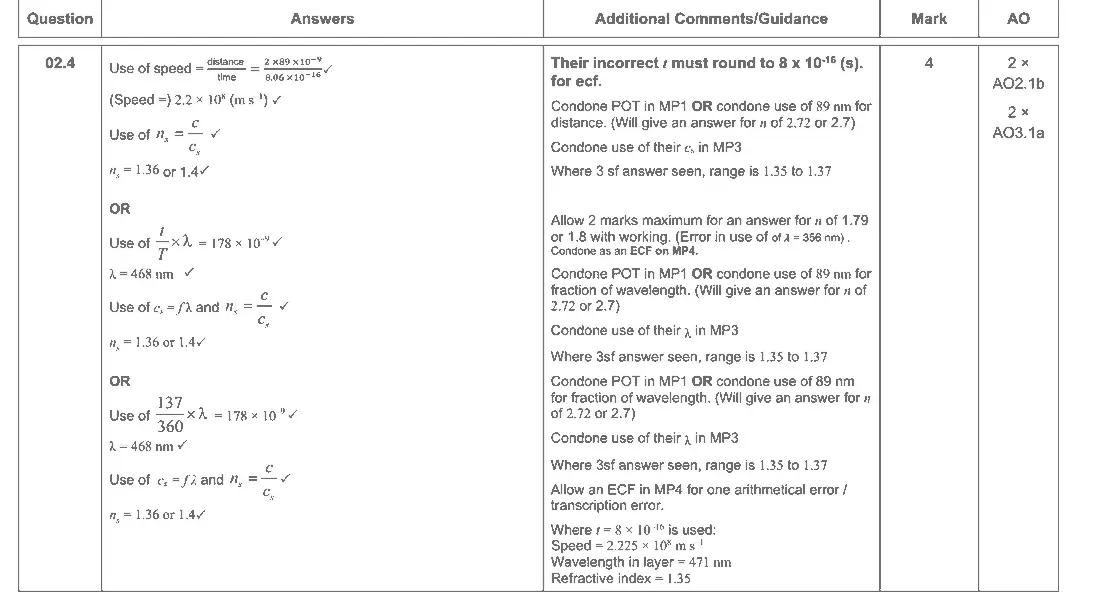
89 nm is the minimum thickness that will produce a phase difference of 137° between
A and B.
Calculate the refractive index of the material of the layer.
[4 marks]
refractive index =
June 2023 · AS Paper 1 · Q4.1 2 marks AO2=2 Calculation vectors and moments
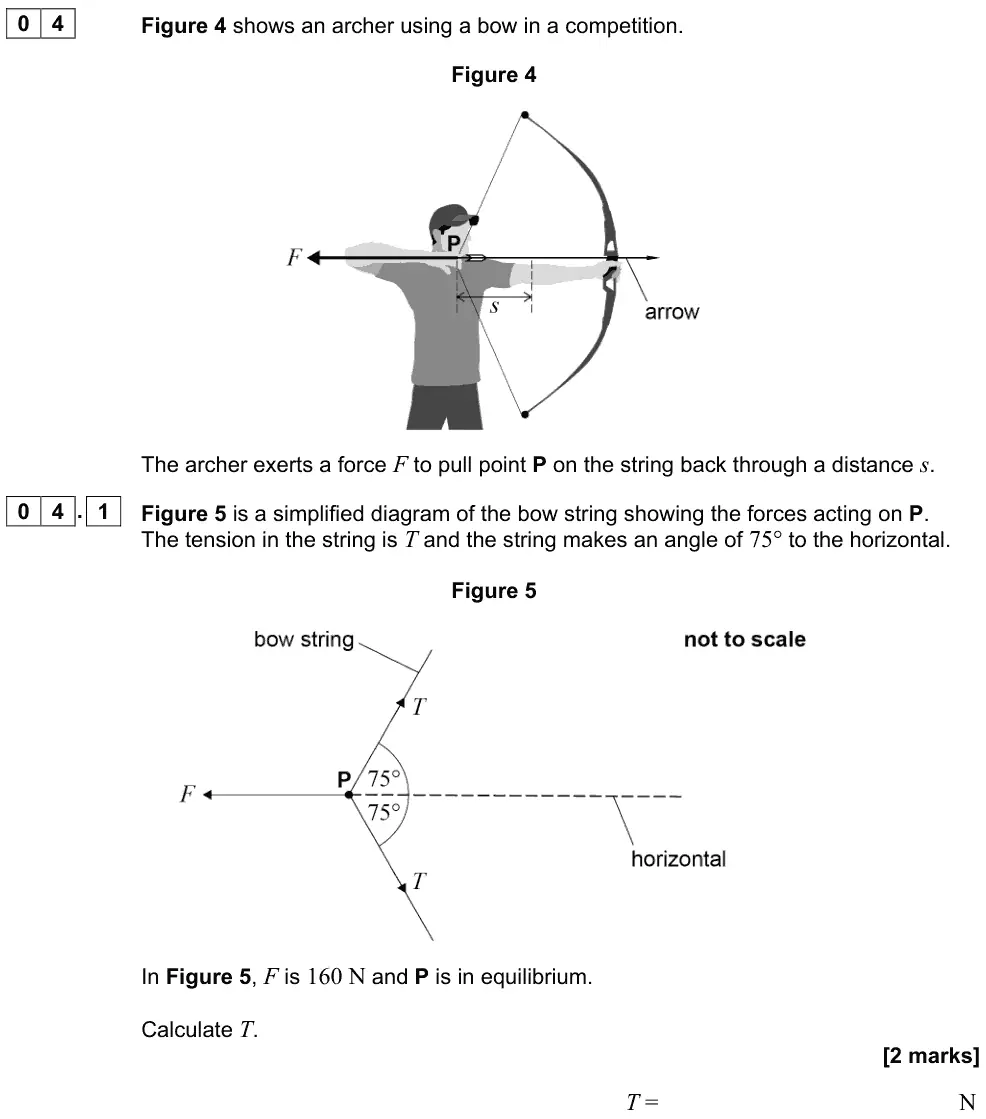
Figure 4 shows an archer using a bow in a competition.
Figure 4
The archer exerts a force F to pull point P on the string back through a distance s.
Figure 5 is a simplified diagram of the bow string showing the forces acting on P.
The tension in the string is T and the string makes an angle of 75° to the horizontal.
Figure 5
In Figure 5, F is 160 N and P is in equilibrium.
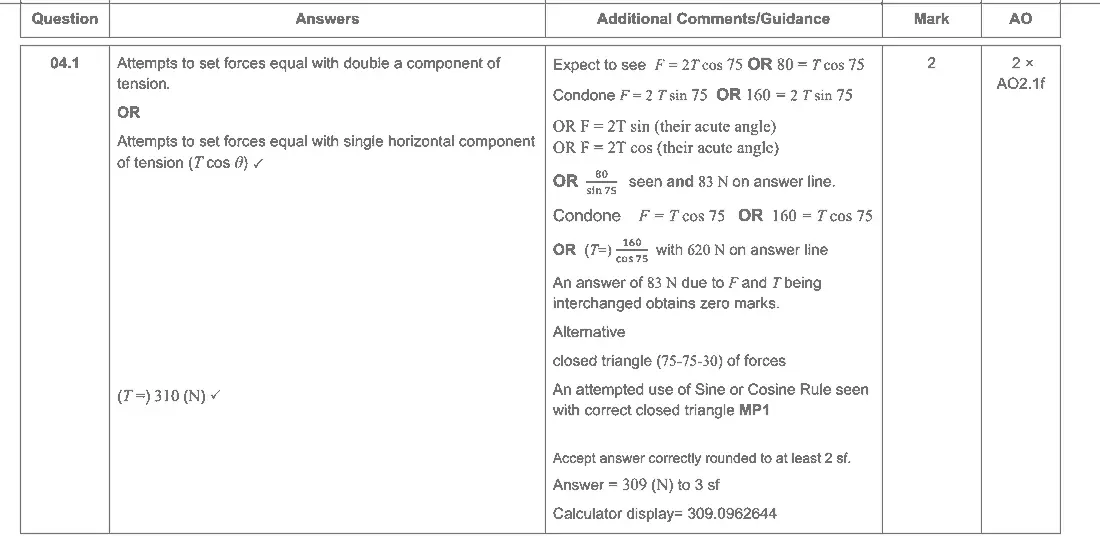
Calculate T.
[2 marks]
T =
N
June 2023 · AS Paper 1 · Q4.2 2 marks Calculation newtons laws and momentum
Earlier part of question 4 that this part usesEarlier part of June 2023 Paper 1 question 4
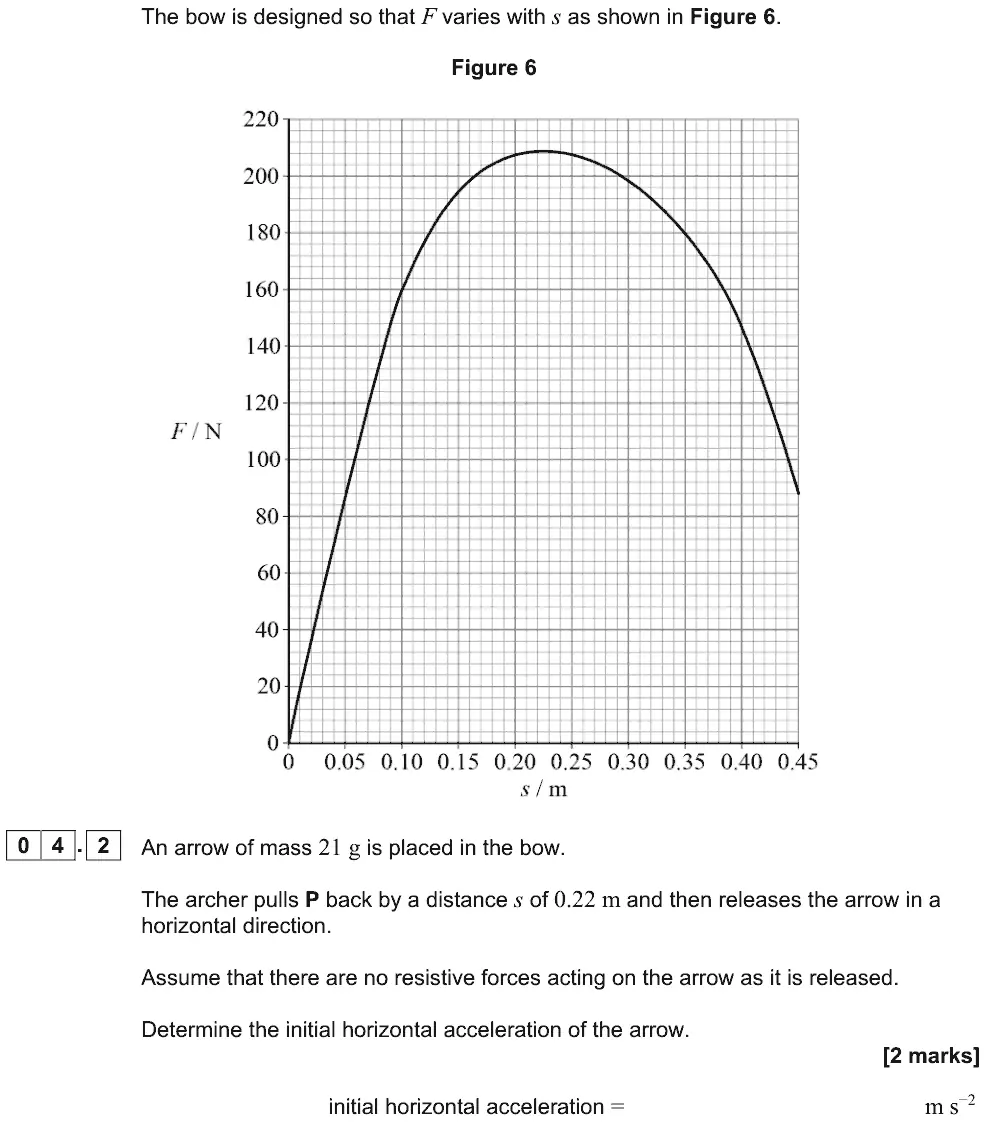
The bow is designed so that F varies with s as shown in Figure 6.
Figure 6
An arrow of mass 21 g is placed in the bow.
The archer pulls P back by a distance s of 0.22 m and then releases the arrow in a
horizontal direction.
Assume that there are no resistive forces acting on the arrow as it is released.
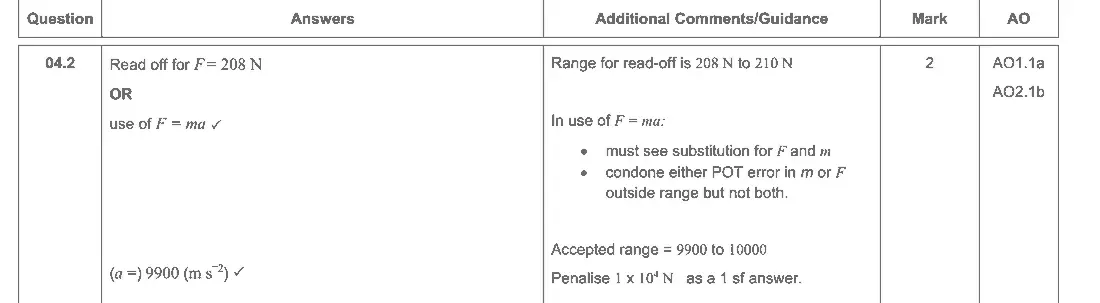
Determine the initial horizontal acceleration of the arrow.
[2 marks]
initial horizontal acceleration =
m s−2
June 2023 · AS Paper 1 · Q4.3 2 marks AO3=2 Calculation Hard work energy and powermaterials and young modulus
Earlier part of question 4 that this part usesEarlier part of June 2023 Paper 1 question 4
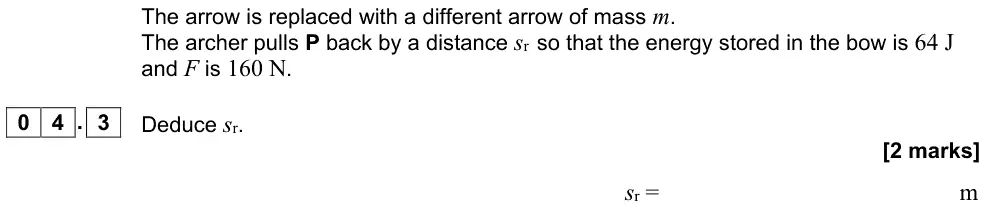
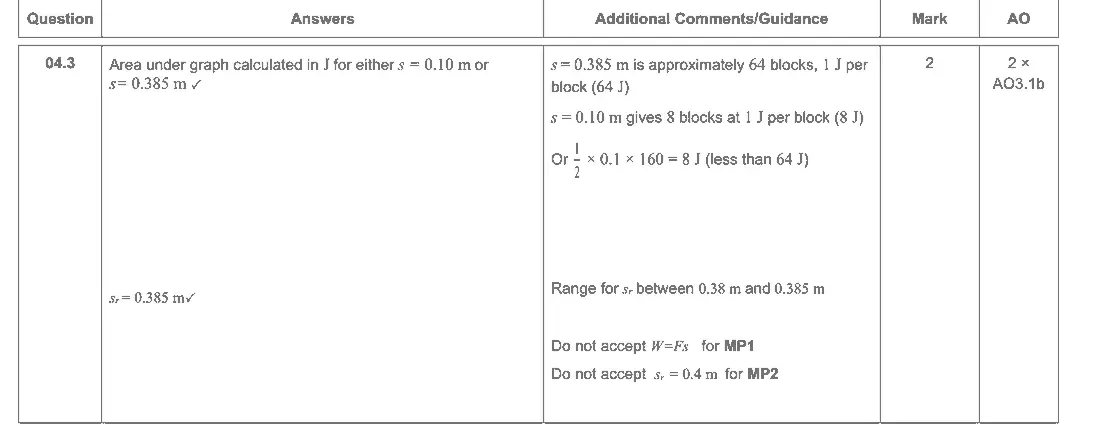
The arrow is replaced with a different arrow of mass m.
The archer pulls P back by a distance sr  so that the energy stored in the bow is 64 J
and F is 160 N.
Deduce sr.
[2 marks]
sr =
m
June 2023 · AS Paper 1 · Q4.4 3 marks Calculation work energy and power
Earlier part of question 4 that this part usesEarlier part of June 2023 Paper 1 question 4
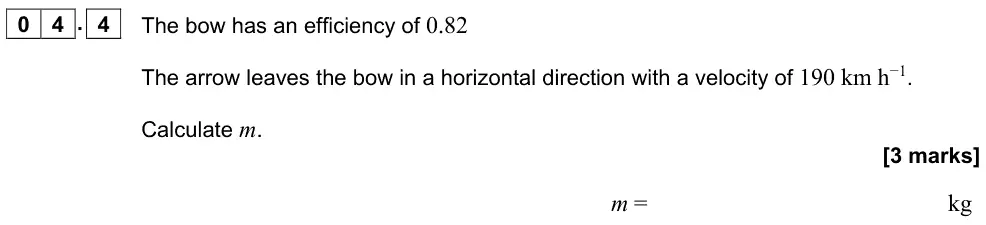
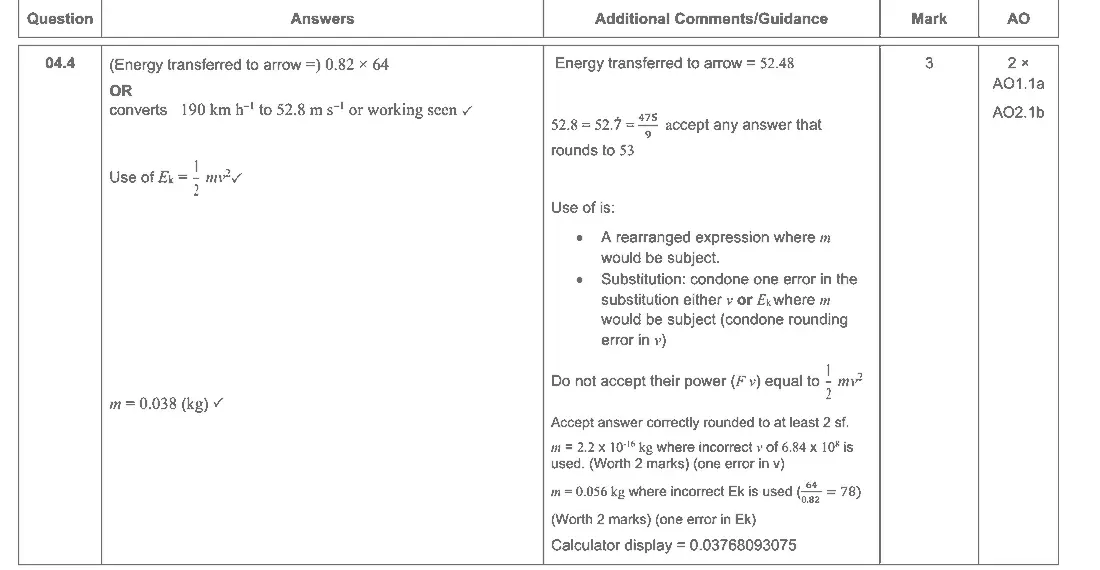
The bow has an efficiency of 0.82
The arrow leaves the bow in a horizontal direction with a velocity of 190 km h−1.
Calculate m.
[3 marks]
m =
kg
June 2023 · AS Paper 1 · Q5.2 3 marks Calculation Hard newtons laws and momentum
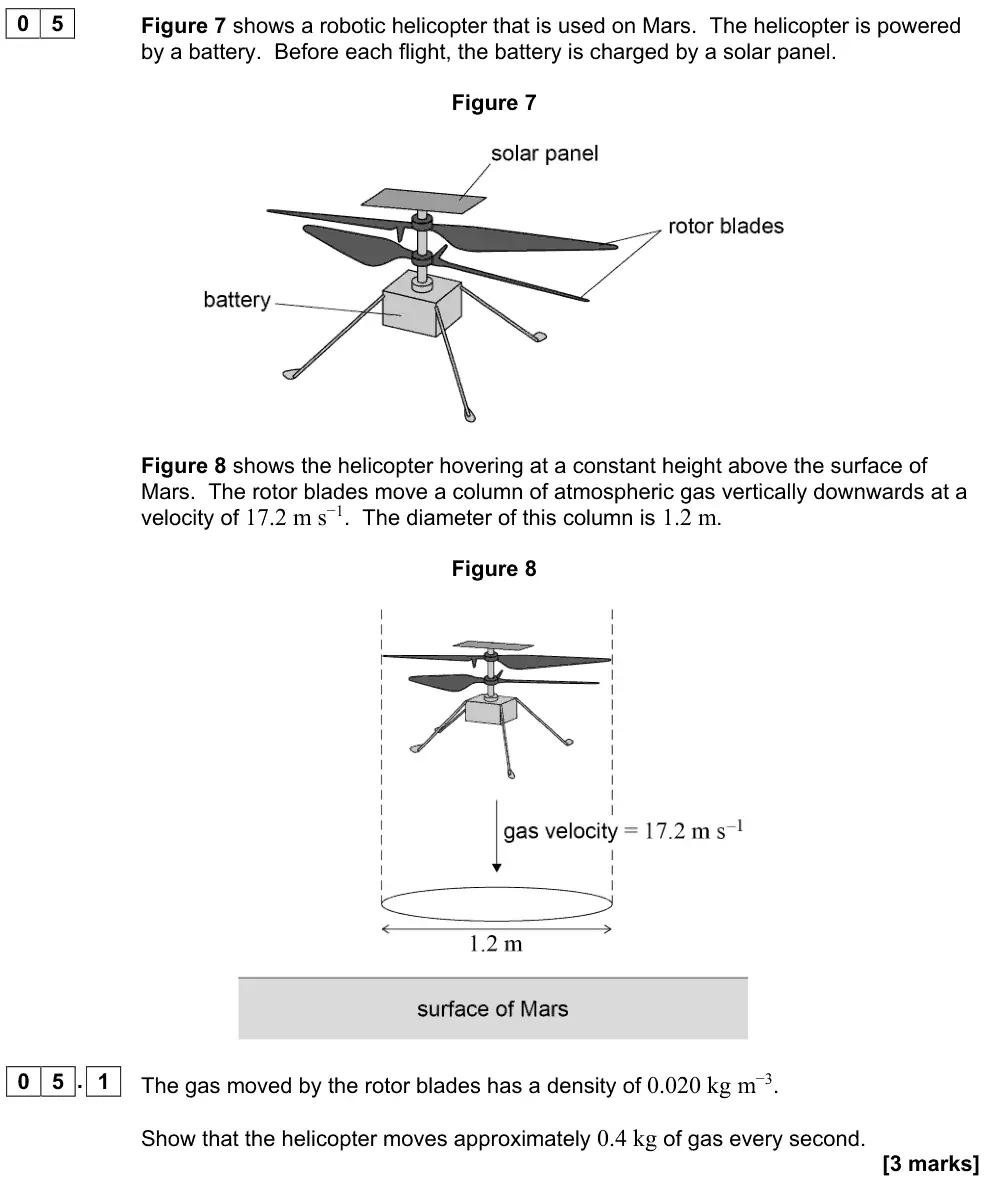
Earlier part of question 5 that this part usesEarlier part of June 2023 Paper 1 question 5
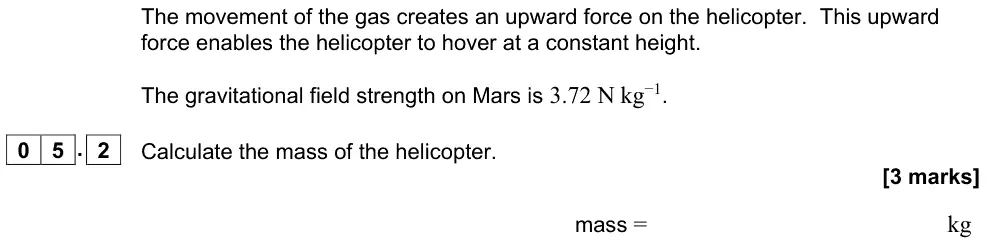
The movement of the gas creates an upward force on the helicopter.  This upward
force enables the helicopter to hover at a constant height.
The gravitational field strength on Mars is 3.72 N kg−1.
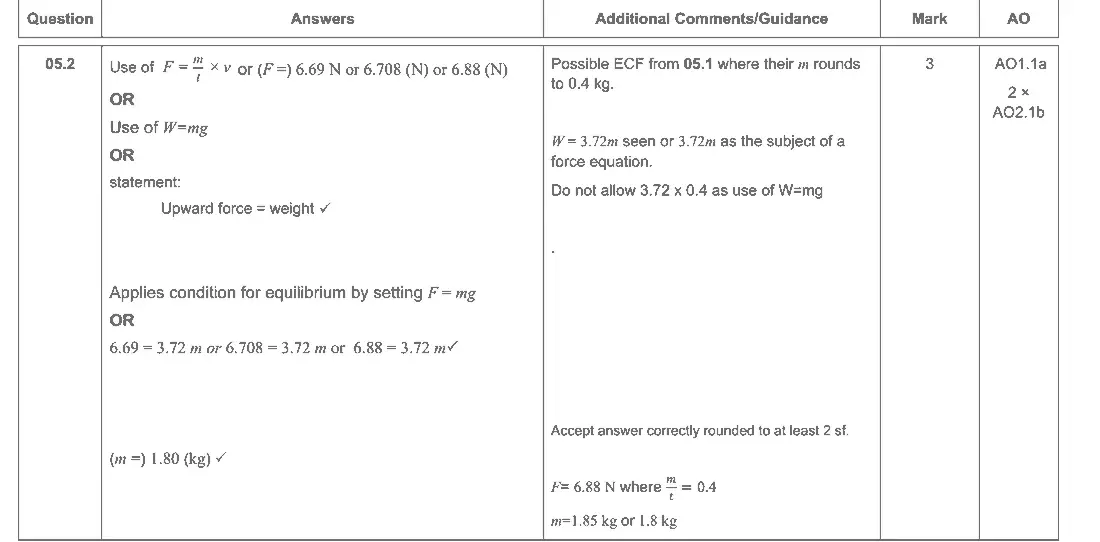
Calculate the mass of the helicopter.
[3 marks]
mass =
kg
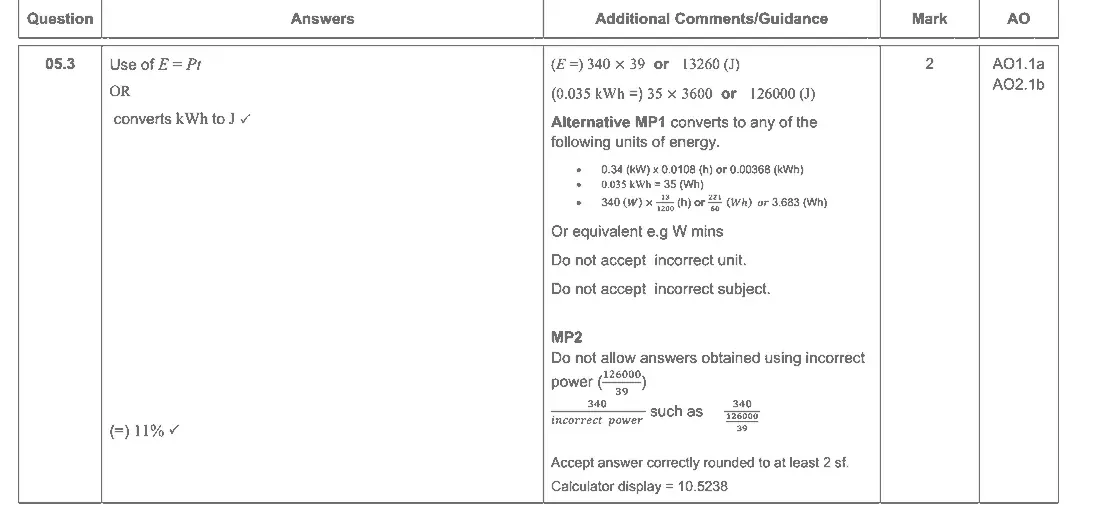
June 2023 · AS Paper 1 · Q5.3 2 marks Calculation work energy and powermeasurements and uncertainties
Earlier part of question 5 that this part usesEarlier part of June 2023 Paper 1 question 5
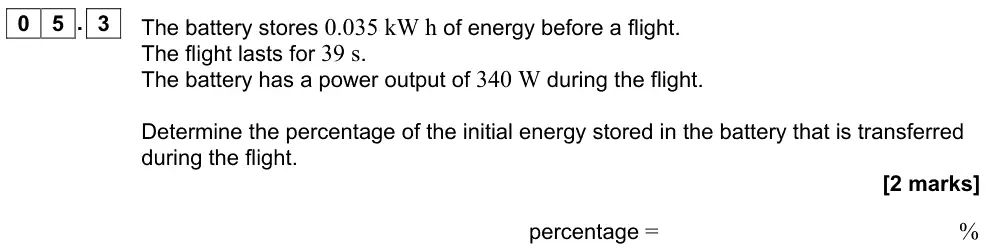
The battery stores 0.035 kW h of energy before a flight.
The flight lasts for 39 s.
The battery has a power output of 340 W during the flight.
Determine the percentage of the initial energy stored in the battery that is transferred
during the flight.
[2 marks]
percentage =
%
June 2023 · AS Paper 1 · Q5.5 2 marks Calculation motion and projectiles
Earlier part of question 5 that this part usesEarlier part of June 2023 Paper 1 question 5
Figure 9 shows a simplified side view of the helicopter moving vertically upwards with
a speed of 0.55 m s−1.
At the instant shown, the helicopter is at a height h and the blades stop rotating.
Figure 9
The gravitational field strength on Mars is 3.72 N kg−1.
The weight of the helicopter is the only force acting on it when the blades stop
rotating.  Drag forces on the helicopter are negligible as it rises to a maximum height
and then falls back to the surface.
Calculate the time taken for the helicopter to reach its maximum height from the
instant the blades stop rotating.
[2 marks]
time =
s
June 2023 · AS Paper 1 · Q5.6 2 marks Calculation motion and projectileswork energy and power
Earlier part of question 5 that this part usesEarlier part of June 2023 Paper 1 question 5
When the helicopter makes contact with the surface it has a velocity of 2.2 m s−1.
Calculate h.
[2 marks]
h =
m
June 2023 · AS Paper 1 · Q6.2 2 marks Calculation current voltage and resistivityatomic structure and stable nuclei
Earlier part of question 6 that this part usesEarlier part of June 2023 Paper 1 question 6
Figure 10 shows the circuit diagram for a battery-powered torch.
The circuit contains three identical light emitting diodes (LEDs) and a resistor R.
The current in the circuit is 44 mA.
Figure 10
Calculate the number of electrons that pass a point in the circuit in 37 minutes.
[2 marks]
number of electrons =
June 2023 · AS Paper 1 · Q6.3 3 marks Calculation Hard current voltage and resistivitycircuits and potential dividers
Earlier part of question 6 that this part usesEarlier part of June 2023 Paper 1 question 6
Figure 11 is the current–voltage characteristic for an LED used in the torch.
Figure 11
Determine the power output of one LED when the torch is on.
[3 marks]
power output =
W
June 2023 · AS Paper 1 · Q6.4 4 marks Calculation Hard emf and internal resistancecircuits and potential dividers
Earlier part of question 6 that this part usesEarlier part of June 2023 Paper 1 question 6
The battery has an emf of 12.0 V and an internal resistance of 1.5 Ω.
Determine the resistance of R in Figure 10.
[4 marks]
resistance =
Ω
June 2023 · AS Paper 2 · Q1.3 2 marks AO2=2 Calculation measurements and uncertainties
Earlier part of question 1 that this part usesEarlier part of June 2023 Paper 2 question 1
The mass per unit length μ of the metal wire is given by
2
4
μ =
ρd
π
where ρ is the density of the metal.
Values of d and μ are used to calculate ρ.
The percentage uncertainty in d is 1.2%.
The percentage uncertainty in μ is 2.0%.
Calculate the percentage uncertainty in the result for ρ.
[2 marks]
percentage uncertainty =
%
June 2023 · AS Paper 2 · Q3.3 3 marks AO1=3 Calculation vectors and moments
Earlier part of question 3 that this part usesEarlier part of June 2023 Paper 2 question 3
Figure 11 shows how x varies with M.
Figure 11
Determine, using Figure 11, the weight of the empty spoon.
[3 marks]
weight =
N
June 2023 · AS Paper 2 · Q4.2 2 marks AO2=2 Calculation Easy refraction and optical fibres
Earlier part of question 4 that this part usesEarlier part of June 2023 Paper 2 question 4
The refractometer is calibrated using a drop of liquid.
When θ = 15°, light is partially refracted at the glass–liquid boundary.
Calculate the angle of refraction at this boundary.
refractive index of glass block = 1.84
refractive index of liquid = 1.33
[2 marks]
angle of refraction =
°
June 2023 · AS Paper 2 · Q4.5 3 marks AO3=3 Calculation Hard refraction and optical fibres
Earlier part of question 4 that this part usesEarlier part of June 2023 Paper 2 question 4
The refractometer in Figure 13 is used to determine the concentration of a sugar
solution.
Figure 14 shows the variation of refractive index with concentration of sugar solution.
Figure 14
For a drop of a particular sugar solution, x = 69 mm.
Determine the percentage concentration of the sugar solution.
refractive index of glass block = 1.84
[3 marks]
percentage concentration =
June 2023 · Paper 1 · Q1.4 1 mark AO1=1 Calculation particles antiparticles and interactionsenergy levels and wave particle duality
Earlier part of question 1 that this part usesEarlier part of June 2023 Paper 1 question 1
The rest energy of a Λ0 is equal to the energy of a photon with a frequency
of 2.69 × 10²³ Hz.
Determine, in MeV, the rest energy of a Λ0.
[1 mark]
rest energy =
MeV
June 2023 · Paper 1 · Q2.1 2 marks Calculation motion and projectilesmeasurements and uncertainties
In 2021 the world land speed record was 1230 km h−1.
This was the average speed achieved by a jet-powered car in two runs.  Each run was
measured over a distance of 1.61 km.
The average speed for one of these runs was 343 m s−1.
Calculate, in s, the time taken for the car to complete the other run.
[2 marks]
time =
s
June 2023 · Paper 1 · Q2.2 2 marks Calculation work energy and power
Earlier part of question 2 that this part usesEarlier part of June 2023 Paper 1 question 2
Engineers are designing a new jet-powered car to break this record.
Figure 1 shows the variation of speed with distance for the car, as predicted by the
engineers.
Figure 1
The car reaches its maximum acceleration when it is 5600 m from the start.
At this point the mass of the car is 6.50 × 10³ kg.
Determine the kinetic energy of the car at its maximum acceleration.
[2 marks]
kinetic energy =
J
June 2023 · Paper 1 · Q2.3 4 marks Calculation work energy and power
Earlier part of question 2 that this part usesEarlier part of June 2023 Paper 1 question 2
At any point on the graph in Figure 1, the acceleration is given by:
acceleration = speed × gradient of line
When the car is at its maximum acceleration, the power input to the jet engines
is 640 MW.
Calculate the percentage of the input power used to accelerate the car at its
maximum acceleration.
[4 marks]
percentage of input power =
%
June 2023 · Paper 1 · Q2.4 2 marks AO3=2 Calculation Hard motion and projectiles
Earlier part of question 2 that this part usesEarlier part of June 2023 Paper 1 question 2
Scientists recommend that the average deceleration of the driver of the car should be
less than 3g.
Deduce whether the average deceleration is less than 3g.
[2 marks]
June 2023 · Paper 1 · Q3.3 2 marks AO2=2 Calculation circuits and potential dividersemf and internal resistance
Earlier part of question 3 that this part usesEarlier part of June 2023 Paper 1 question 3
C is set at 1
5
of the distance between A and B.  The thickness of the conducting layer
is uniform so the resistance between A and C is 25.0 Ω.
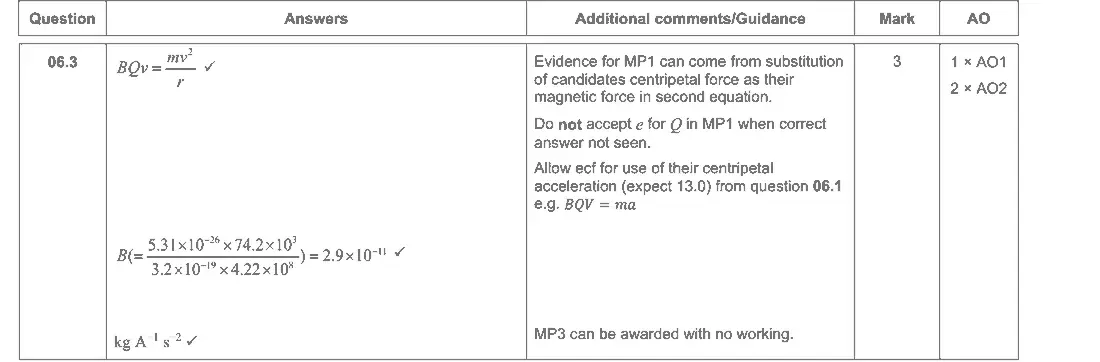
Determine the voltmeter reading at this setting.
[2 marks]
voltmeter reading =
V
June 2023 · Paper 1 · Q5.1 1 mark AO1=1 Calculation materials and young modulus
Figure 11 shows the stress–strain graph for a metal in tension up to the point at which
it fractures.
Figure 11
Determine, using Figure 11, the Young modulus of the metal.
[1 mark]
Young modulus =
Pa
June 2023 · Paper 1 · Q5.3 3 marks Calculation materials and young modulus
Earlier part of question 5 that this part usesEarlier part of June 2023 Paper 1 question 5
Figure 12 shows a uniform rigid lighting beam AB suspended from a fixed horizontal

support by two identical vertical steel wires.  A lamp is attached to the midpoint of AB.
Figure 12
The unloaded length of each steel wire was 1.20 m before it was attached to AB.
AB is horizontal.
mass of AB = 4.4 kg
mass of lamp = 16.0 kg
distance between wires = 2.00 m
diameter of each wire = 0.800 mm
Young modulus of steel = 2.10 × 10¹¹ Pa
Calculate the extension of each wire.
[3 marks]
extension =
m
June 2023 · Paper 1 · Q5.4 5 marks AO3=5 Calculation materials and young modulusvectors and moments
Earlier part of question 5 that this part usesEarlier part of June 2023 Paper 1 question 5
The right-hand steel wire is removed and replaced with an aluminium wire of
diameter 1.60 mm.  The unloaded length of the aluminium wire is the same as that of
the original steel wire.
When the lamp is at the midpoint of AB, one of the wires extends more than the other
so that AB is not horizontal.  To make AB horizontal the lamp has to be moved to a
distance x from A.  Figure 13 shows the new arrangement.
Figure 13
The Young modulus of aluminium is 7.00 × 10¹⁰ Pa.
Deduce distance x.
[5 marks]
x =
m
June 2023 · Paper 1 · Q6.2 2 marks Calculation simple harmonic motion
Earlier part of question 6 that this part usesEarlier part of June 2023 Paper 1 question 6
The time period T of the vertical oscillations is given by
= 2
l
T
g
π
The measured value of l in Figure 15 is 85 mm.
The pencil is pushed down 5.0 mm and released.
Calculate the maximum acceleration of the pencil.
[2 marks]
maximum acceleration =
m s−2
June 2023 · Paper 1 · Q6.4 3 marks AO3=3 Calculation simple harmonic motionprogressive waves and polarisation
Earlier part of question 6 that this part usesEarlier part of June 2023 Paper 1 question 6
Figure 16 shows a ship moving through continuous waves of wavelength 118 m
and velocity 14.2 m s−1.
The ship is moving steadily at 8.0 m s−1 relative to the seabed in the same direction as
the waves.
Figure 16
The natural frequency of heave oscillations of the ship is 0.13 Hz.
A crew member needs an emergency operation.  The ship’s doctor is confident that
she can do the operation if the ship remains fairly steady.
There are two options:
• stop the ship’s motors and loosely anchor the ship to the seabed
• continue to sail the ship at 8.0 m s−1 in the same direction.
Deduce which is the better option.
Support your answer with a calculation.
[3 marks]
June 2023 · Paper 2 · Q2.1 5 marks Calculation thermal energy and ideal gases
Figure 2 shows a wheel used in motorsport.  A rubber tyre is fitted around
a cylindrical metal rim.  The tyre is filled with a gas.
The dimensions shown in Figure 2 are for the volume of the gas in the tyre.
Assume that this volume remains constant throughout this question.
Figure 2
The mass of the wheel is measured when the gas in the tyre is at a pressure
of 1.01 × 10⁵ Pa.
More of the same gas is added to the tyre and the mass of the wheel is measured
again.
Table 1 shows the pressure in the tyre and the mass of the wheel before and after the
addition of the extra gas.
The gas is kept at a constant temperature of 100 °C.
Table 1
Pressure in tyre / Pa
Mass of wheel / kg
Before
1.01 × 10⁵
14.897
After
2.11 × 10⁵
14.991
Determine, in kg mol−1, the molar mass of the gas.
[5 marks]
molar mass =
kg mol−1
June 2023 · Paper 2 · Q3.3 2 marks AO2=2 Calculation gravitational fields
Earlier part of question 3 that this part usesEarlier part of June 2023 Paper 2 question 3
At the Earth’s surface,
• the gravitational field strength of the Sun is gS
• the gravitational field strength of the Earth is gE.
Calculate g
g
S
E
.
distance from the Earth to the Sun = 1.50 × 10¹¹ m
[2 marks]
g
g
S
E =
June 2023 · Paper 2 · Q3.5 4 marks Calculation gravitational fieldswork energy and power
Earlier part of question 3 that this part usesEarlier part of June 2023 Paper 2 question 3
The space probe eventually reaches a point where the gravitational influence of
the Solar System is negligible.
The probe is unpowered as it approaches an isolated interstellar body X.
The gravitational field of X changes the kinetic energy of the space probe.
Table 2 shows the distance of the space probe from the centre of mass of X and the
speed for two positions A and B of the space probe.
Table 2
Distance of space probe from
centre of mass of X / 106 m
Speed of space probe / 103 m s−1
A
6.0
1.1
B
0.17
1.3
The space probe has a mass of 4.9 × 10⁴ kg.
Calculate the mass of X.
[4 marks]
mass of X =
kg
June 2023 · Paper 2 · Q4.2 2 marks AO3=2 Calculation electric fields
Earlier part of question 4 that this part usesEarlier part of June 2023 Paper 2 question 4
An alpha particle passes through the mesh.
The alpha particle ionises an argon atom at P on Figure 5, releasing one electron.
The electron and the argon ion have no kinetic energy at P.
The electron then travels to the wire and the argon ion travels to the mesh.
Calculate the ratio
speed of electron when it reaches the wire
speed of argon ion when it reaches the mesh
.
Assume that the air has no effect on the motion of the electron or on the motion of
the argon ion.
mass of argon ion = 6.64 × 10⁻²⁶ kg
[2 marks]
ratio =
June 2023 · Paper 2 · Q5.3 3 marks AO3=3 Calculation capacitors
Earlier part of question 5 that this part usesEarlier part of June 2023 Paper 2 question 5
When the pd reaches 4.0 V the switch is immediately set to discharge the capacitor.
When the pd reaches 2.0 V the switch is immediately set to charge the capacitor.
Figure 10 shows how the pd across the capacitor varies with time.
Figure 10
Determine the value of R2.
[3 marks]
R2 =
Ω
June 2023 · Paper 2 · Q6.5 3 marks AO2=3 Calculation nuclear radius
Earlier part of question 6 that this part usesEarlier part of June 2023 Paper 2 question 6
The measured radius R of 35Cl
17
is 4.02 × 10⁻¹⁵ m.
Calculate an estimate of
• the constant R0
• the density of nuclear material.
[3 marks]
R0 =
m
density =
kg m−3
June 2023 · Paper 2 · Q7.4 3 marks AO2=3 Calculation kinetic theorymass energy and fission
Earlier part of question 7 that this part usesEarlier part of June 2023 Paper 2 question 7
In a reactor, the speed of a fast-moving neutron is reduced by a series of y random
collisions with carbon-12 nuclei.
The final kinetic energy Ef of the neutron is
Ef = E0e−by
where E0 is the initial kinetic energy of the neutron and b = 0.73
A thermal neutron has kinetic energy equivalent to that of the average particle of an
ideal gas with a temperature of 350 K.
One neutron has an initial kinetic energy of 1.0 MeV.
Calculate the minimum value of y required so that this neutron becomes a thermal
neutron.
[3 marks]
y =
June 2023 · Paper 3 Section A · Q1.4 3 marks Calculation motion and projectiles
Earlier part of question 1 that this part usesEarlier part of June 2023 Paper 3 Section A question 1
The following data are recorded.
H = 1550 mm
f = 31.0 Hz
The graphical analysis of data from Figure 1 gives g as 9.79 m s−2.
Determine u0.
[3 marks]
u0 =
m s−1
June 2023 · Paper 3 Section A · Q3.2 2 marks AO2=2 Calculation Hard electromagnetic inductionvectors and moments
Earlier part of question 3 that this part usesEarlier part of June 2023 Paper 3 Section A question 3
BH is measured at Q with the coil vertical.
The coil is now rotated about Q through 25° as shown in Figure 8.
The current in the coil does not change.
Figure 8
A new measurement of BH is made with the coil fixed in this new position.
Determine the percentage change in BH produced by this rotation of the coil.
Show your working.
[2 marks]
percentage change =
%
June 2023 · Paper 3B Astrophysics · Q1.3 2 marks AO2=2 Calculation Easy classification of stars
Earlier part of question 1 that this part usesEarlier part of June 2023 Paper 3B Astrophysics question 1
The apparent magnitude of Rigel is 0.11
Calculate, in pc, the distance from Rigel to the Earth.
[2 marks]
distance =
pc
June 2023 · Paper 3B Astrophysics · Q2.3 2 marks AO2=2 Calculation classification of stars
Earlier part of question 2 that this part usesEarlier part of June 2023 Paper 3B Astrophysics question 2
V1031 and WASP-82 are two stars in the constellation Orion.
V1031 appears 40 times brighter than WASP-82 when viewed from Earth.
The apparent magnitude of V1031 is 6.0
Calculate the apparent magnitude of WASP-82.
[2 marks]
apparent magnitude =
June 2023 · Paper 3B Astrophysics · Q2.4 2 marks AO3=2 Calculation telescopes
Earlier part of question 2 that this part usesEarlier part of June 2023 Paper 3B Astrophysics question 2
V1031 is just visible to the naked eye of an astronomer when her pupil diameter
is 7 mm.
Suggest whether she can observe WASP-82 using a telescope with an objective
diameter of 60 mm.
Support your answer with a calculation.
[2 marks]
June 2023 · Paper 3B Astrophysics · Q3.2 4 marks AO3=4 Calculation classification of starstelescopes
Earlier part of question 3 that this part usesEarlier part of June 2023 Paper 3B Astrophysics question 3
In 2019, astronomers linked several radio telescopes to produce a single telescope
called the EHT.  The resolution of the EHT is the same as the resolution that a
telescope with an aperture equal to the diameter of the Earth could achieve.
Table 2 shows data about the EHT and the Hubble telescope.
Table 2
Aperture
Operating wavelength
EHT
1.3 × 10⁷ m
1.3 mm
Hubble
2.4 m
410 nm
Galaxy M87 is 5.3 × 10⁷ light years from Earth.  The supermassive black hole at the
centre of M87 has a mass 6.5 × 10⁹ times the mass of the Sun.
The radius of the event horizon is R.
The astronomers propose to use either the EHT or the Hubble telescope to observe
stars whose distance from the centre of the black hole is less than 1000R.
Discuss, with calculations, which telescope is more suitable for this observation.
[4 marks]
June 2023 · Paper 3B Astrophysics · Q3.3 3 marks AO2=3 Calculation cosmology
Earlier part of question 3 that this part usesEarlier part of June 2023 Paper 3B Astrophysics question 3
A star is orbiting the black hole in M87.  The star is observed in the plane of its orbit.
The wavelength of a spectral line observed in the light emitted from the star varies
between a maximum and a minimum value.
maximum value observed = 374.96 nm
minimum value observed = 373.53 nm
Calculate the orbital speed of the star.
[3 marks]
orbital speed =
m s−1
June 2023 · Paper 3B Astrophysics · Q5.1 3 marks AO2=1, AO3=2 Calculation cosmology
Figure 2 shows, for some galaxies, how their recession speed v varies with
distance d from the Earth.
Figure 2
Estimate, using Figure 2, the age in seconds of the Universe.
[3 marks]
age of Universe =
s
June 2023 · Paper 3B Medical physics · Q2.1 3 marks AO3=3 Calculation eye ear and ecg
Electrophoretic screens are used in handheld electronic devices.
The screen contains individual squares known as pixels.  Pixels can be changed
independently from light to dark to create the shapes of letters and numbers.  An
external light source is needed in order to read the screen.
Figure 1 shows a letter formed by three electrophoretic screens that have different
pixel line densities.  Pixel line density is the number of pixels along a 1.0 cm length of
the screen.
Figure 1
A particular screen is designed so that two dark pixels separated by one light pixel
cannot be resolved as separate images by the eye when viewed from a distance
of 0.50 m.
Determine, in pixels per cm, the minimum pixel line density required for this screen.
typical diameter of cones in a human eye at the fovea = 1.5 μm
typical length of the human eye = 21 mm
[3 marks]
pixels per cm =
June 2023 · Paper 3B Medical physics · Q2.4 3 marks AO3=3 Calculation Hard eye ear and ecg
Earlier part of question 2 that this part usesEarlier part of June 2023 Paper 3B Medical physics question 2
Other types of screen use blue, green and red pixels to produce coloured images.
Table 1 shows the wavelength of the light emitted by each pixel when it is turned on.
Table 1
Pixel
Wavelength / nm
blue
450
green
520
red
650
On one screen, the blue pixels are turned off.
When the green pixels and the red pixels are turned on, they emit light with the same
intensity.  A human eye that has the spectral response shown in Figure 2 responds to
this light.
Determine, in nm, the single wavelength of light that will produce the same response
in the same human eye as the light emitted from the green and red pixels.
[3 marks]
wavelength =
nm
June 2023 · Paper 3B Medical physics · Q3.3 2 marks AO2=2 Calculation eye ear and ecg
Earlier part of question 3 that this part usesEarlier part of June 2023 Paper 3B Medical physics question 3
The amplitude of the pressure wave at the oval window of an ear is 20 times greater
than at the tympanic membrane.
Calculate the ratio
force on oval window
force on tympanic membrane
.
area of oval window = 5.9 × 10⁻⁶ m2
area of tympanic membrane = 7.2 × 10⁻⁵ m2
[2 marks]
ratio =
June 2023 · Paper 3B Medical physics · Q4.2 3 marks AO2=1, AO3=2 Calculation eye ear and ecg
Earlier part of question 4 that this part usesEarlier part of June 2023 Paper 3B Medical physics question 4
Another ultrasound technique is used to measure the speed of blood flow in one of the
kidney’s blood vessels.
Figure 4 shows an image formed using this technique.  It shows how the speed of
flow through the blood vessel varies with time.
Point X shows this speed at one instant of time.
Figure 4
Determine the patient’s heart rate in beats per minute.
[3 marks]
heart rate =
beats per minute
June 2023 · Paper 3B Engineering physics · Q2.3 2 marks AO2=2 Calculation Easy rotational dynamics
Earlier part of question 2 that this part usesEarlier part of June 2023 Paper 3B Engineering physics question 2
The connecting link breaks.  At this instant the angular speed of the wheel
is 13.8 rad s−1.
It takes 15.0 s for the wheel to come to rest.
The frictional torque acting at the axle bearings is 0.77 N m and is constant for all
speeds.
Calculate the moment of inertia of the wheel.
[2 marks]
moment of inertia =
kg m2
June 2023 · Paper 3B Engineering physics · Q2.4 2 marks AO2=2 Calculation Easy rotational dynamics
Earlier part of question 2 that this part usesEarlier part of June 2023 Paper 3B Engineering physics question 2
The arrangement is modified as shown in Figure 4.  The pedal, connecting link and
crank are removed and the grinding wheel is driven by an electric motor.
Figure 4
Figure 4 also shows a tool being sharpened by pressing it on the edge of the
rotating wheel.
The tool applies a tangential force F on the wheel.
A torque of 3.10 N m is needed at the axle to drive the wheel at constant angular
speed while the tool is being sharpened.
frictional torque at the axle bearings = 0.77 N m
radius of wheel = 0.24 m
Calculate F.
[2 marks]
F =
N
June 2023 · Paper 3B Engineering physics · Q2.5 3 marks AO3=3 Calculation rotational dynamics
Earlier part of question 2 that this part usesEarlier part of June 2023 Paper 3B Engineering physics question 2
Three motors E, F and G were available to drive the wheel in Figure 4.
Figure 5 shows how the torque T varies with angular speed ω for each motor.
Figure 5
The no-load speed ω0 is the angular speed of a motor when the torque applied is
zero.
The maximum power of each motor is developed at about 0.5ω0.
The required output power of the motor when a tool is being sharpened is 52 W.
The required output power of the chosen motor should be about 2
3
of its maximum
power.
Deduce which motor E, F or G was chosen for this application.
[3 marks]
June 2023 · Paper 3B Engineering physics · Q3.3 3 marks AO2=3 Calculation thermodynamics and engines
Earlier part of question 3 that this part usesEarlier part of June 2023 Paper 3B Engineering physics question 3
The initial conditions for the air are:
volume of air = 2.91 × 10⁻⁸ m3
pressure of air = 1.05 × 10⁵ Pa
temperature of air = 293 K.
During sudden braking, the air in the bubble is compressed adiabatically to a volume
of 3.19 × 10⁻⁹ m3.
Calculate the pressure and the temperature of the air immediately after the
compression.
γ for air = 1.4
[3 marks]
pressure =
Pa
temperature =
K
June 2023 · Paper 3B Engineering physics · Q5.1 1 mark AO1=1 Calculation Easy thermodynamics and engines
Figure 9 shows an ideal heat engine.
Figure 9
The engine operates between a source at a temperature of 730 K and a sink at a
temperature of 290 K.
The input power is 16.0 kW and the power rejected to the sink is 6.4 kW.
Calculate the efficiency of this engine.
[1 mark]
efficiency =
June 2023 · Paper 3B Engineering physics · Q5.2 3 marks AO3=3 Calculation Hard thermodynamics and engines
Earlier part of question 5 that this part usesEarlier part of June 2023 Paper 3B Engineering physics question 5
Figure 10 shows another system operating between the same overall temperatures
and with the same input power as the engine in Figure 9.  This system consists of
two ideal engines.
Figure 10
The sink for engine 1 forms the source for engine 2.  The temperature of the
intermediate reservoir is 510 K.
All the energy rejected by heat transfer in engine 1 provides the input energy to
engine 2.
A student suggests that the system in Figure 10 can provide more output power and
be more efficient than the engine in Figure 9.
Deduce whether the student’s suggestions are correct.
You may annotate Figures 9 and 10.
[3 marks]
June 2023 · Paper 3B Turning points · Q2.1 3 marks AO2=2, AO3=1 Calculation discovery of the electron
In an experiment to determine the electronic charge, a charged oil drop falls from rest
between two uncharged plates.
The oil drop has a weight of 1.2 × 10⁻¹⁴ N and a radius of 6.8 × 10⁻⁷ m.
Ignore the buoyancy force of the air on the oil drop.
Figure 2 shows the variation of the vertical speed of the oil drop with time.
Figure 2
Calculate the viscosity of the air between the plates.
[3 marks]
viscosity =
N s m−2
June 2023 · Paper 3B Turning points · Q2.2 3 marks AO2=2, AO3=1 Calculation discovery of the electron
Earlier part of question 2 that this part usesEarlier part of June 2023 Paper 3B Turning points question 2
During the experiment, an electric field is produced between the plates and is
adjusted until the oil drop is stationary.
The electric field strength is 18.8 kV m−1.
Discuss whether the outcome of the experiment is consistent with the accepted value
for electronic charge.
[3 marks]
June 2023 · Paper 3B Turning points · Q4.2 2 marks AO2=2 Calculation special relativity
Earlier part of question 4 that this part usesEarlier part of June 2023 Paper 3B Turning points question 4
A proton leaves a particle accelerator at point X and moves at a constant speed
towards a target at point Y.
The speed of the proton is 2.5 × 10⁸ m s−1 in the frame of reference of the target.
The distance XY in the frame of reference of the proton is 38 m.
Calculate the distance XY in the frame of reference of the target.
[2 marks]
distance XY in the frame of reference of the target =
m
June 2023 · Paper 3B Electronics · Q2.1 3 marks AO2=1, AO3=2 Calculation semiconductor devices and signals
Figure 4 shows a strain gauge that consists of a folded metal wire glued to a piece of
insulating material.
Figure 4
The resistance of the metal wire:
• increases when the gauge is stretched by forces applied as shown
• changes when there is a change in temperature.
Figure 5 shows a circuit that contains two identical strain gauges A and B.
The resistance of each strain gauge is 120.00 Ω when the strain is zero.
R1 is a 560 Ω fixed resistor.
R2 is a 100 Ω variable resistor.
R3 is a 510 Ω fixed resistor.
Assume that the voltmeter is ideal.
Figure 5
The circuit is used to measure changes in strain in a metal beam.
A is glued firmly to the metal beam.
B is placed on the beam near A but is not glued to the beam.
Initially, with the gauges under zero strain, R2 is adjusted to produce 0 V on the
voltmeter.
When the beam bends, A stretches and B remains unstretched.
The resistance of A increases to 120.06 Ω.
Calculate, in mV, the new reading on the voltmeter.
[3 marks]
reading on the voltmeter =
mV
June 2023 · Paper 3B Electronics · Q3.3 2 marks AO3=2 Calculation data communication
Earlier part of question 3 that this part usesEarlier part of June 2023 Paper 3B Electronics question 3
Commentators in Los Angeles interviewed athletes in Tokyo using Syncom 3.
The commentators found that there was a significant time delay between the end of
each question and the arrival of its reply.
This time delay was made up of:
• the total time that the signals spent travelling
• the total processing time.
The distance of the geostationary satellite from both Tokyo and Los Angeles
was 40 000 km.
The time delay was 900 ms.
Calculate, in ms, the total processing time.
[2 marks]
total processing time =
ms
June 2022 · AS Paper 1 · Q2.2 2 marks AO2=2 Calculation Hard atomic structure and stable nuclei
Earlier part of question 2 that this part usesEarlier part of June 2022 Paper 1 question 2
The gas consists of bromine molecules.  Each molecule has two bromine atoms.
The experiment finds that the bromine molecules contain 158, 160 or 162 nucleons.
Figure 1 shows the percentage of these different molecules in the sample.
Figure 1
Bromine has a proton number of 35
The two isotopes in the sample have different nucleon numbers.
Calculate the number of neutrons for the isotope that has the greater nucleon number.
[2 marks]
number of neutrons =
June 2022 · AS Paper 1 · Q3.1 2 marks AO1=1, AO2=1 Calculation progressive waves and polarisation
A satellite system is used to measure the height h of the top of an ice sheet above the
surface of the ocean.
The satellite emits two pulses A and B of infrared radiation.  A is incident on the
surface of the ocean and B is incident on the top of the ice sheet as shown
in Figure 2.
Figure 2
The frequency of the infrared radiation is 3.8 × 10¹⁴ Hz.
Each pulse has a duration of 6.0 ns.
Calculate the number of cycles in each pulse.
[2 marks]
number of cycles =
June 2022 · AS Paper 1 · Q3.2 2 marks AO2=2 Calculation Hard motion and projectiles
Earlier part of question 3 that this part usesEarlier part of June 2022 Paper 1 question 3
A and B reflect and return to the satellite.  The travel time is the time between the
emission of a pulse and its return to the satellite.
The difference in the travel times of A and B is 10.7 μs.
Calculate h.
[2 marks]
h =
m
June 2022 · AS Paper 1 · Q3.3 2 marks AO1=1, AO2=1 Calculation refraction and optical fibres
Earlier part of question 3 that this part usesEarlier part of June 2022 Paper 1 question 3
Some of the infrared radiation enters the ice sheet.
Figure 3 shows the path of infrared radiation that refracts at a sloping part of the
ice sheet.
Figure 3
Calculate the refractive index of the ice.
[2 marks]
refractive index =
June 2022 · AS Paper 1 · Q3.4 2 marks AO1=1, AO2=1 Calculation refraction and optical fibresprogressive waves and polarisation
Earlier part of question 3 that this part usesEarlier part of June 2022 Paper 1 question 3
Calculate the wavelength of the infrared radiation when it is inside the ice sheet.
[2 marks]
wavelength =
m
June 2022 · AS Paper 1 · Q4.2 3 marks AO1=1, AO2=2 Calculation Easy photoelectric effectenergy levels and wave particle duality
Earlier part of question 4 that this part usesEarlier part of June 2022 Paper 1 question 4
Charged particles are emitted from the metal plate with a maximum kinetic energy
of 1.1 eV when radiation of frequency 1.2 × 10¹⁵ Hz is incident on the plate.
Calculate, in eV, the work function of the metal.
[3 marks]
work function =
eV
June 2022 · AS Paper 1 · Q6.1 3 marks AO1=2, AO2=1 Calculation Hard vectors and moments
Figure 5 shows a worker of weight 750 N on a uniform platform.  The weight of the
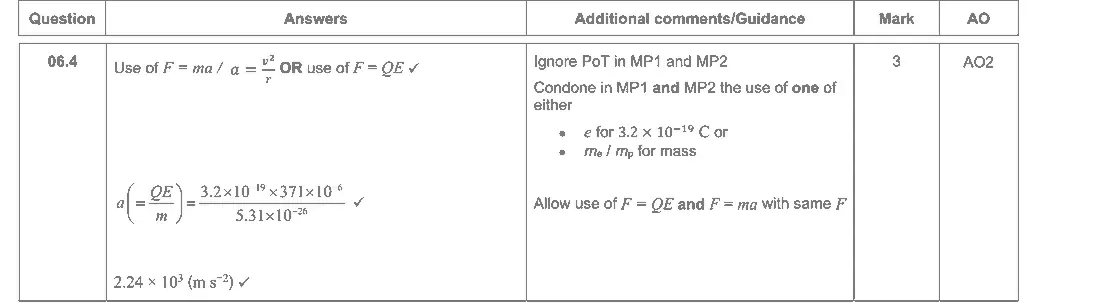
worker is acting at a horizontal distance d from end A.
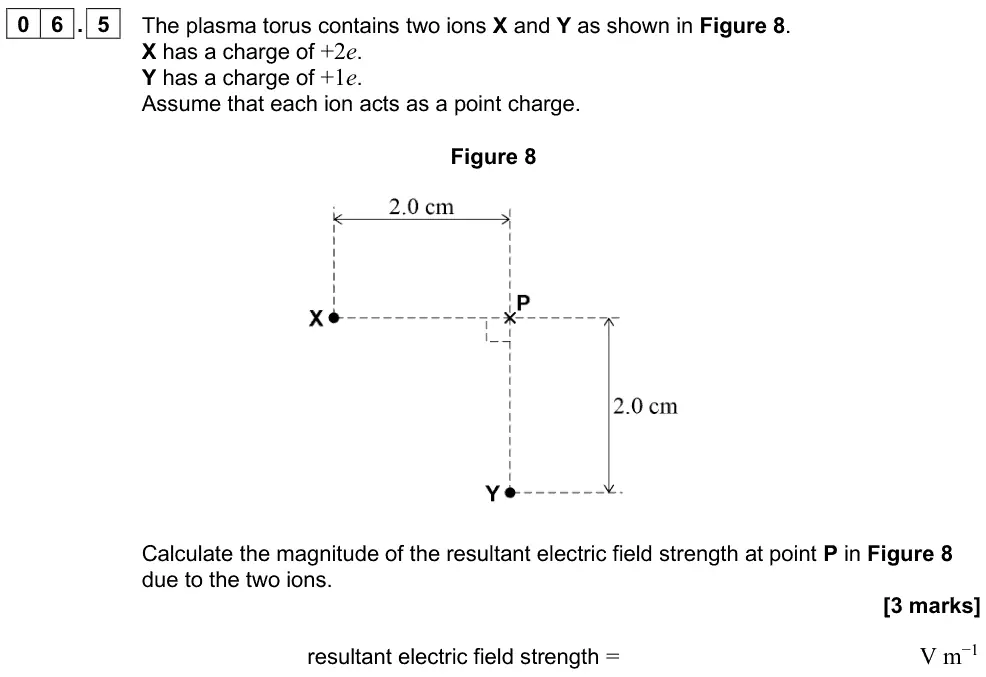
Throughout this question, assume that the platform is horizontal and that all cables
obey Hooke’s law.
Figure 5
The platform weighs 1800 N and is suspended by vertical cables P and Q.
Each cable has an unstretched length of 3.0 m.
The horizontal distance between P and Q is 3.6 m.
The worker moves to a position where the tension in the left-hand cable P is 1150 N.
Calculate d for this position.
[3 marks]
d =
m
June 2022 · AS Paper 1 · Q6.2 2 marks AO1=1, AO2=1 Calculation materials and young modulus
Earlier part of question 6 that this part usesEarlier part of June 2022 Paper 1 question 6
Figure 6 shows how the extension of P varies with d as the worker walks slowly along
the platform from A to B.
Figure 6
The worker moves to a position X where the strain in P is 6.0 × 10⁻⁵.
Determine d for position X.
[2 marks]
d =
m
June 2022 · AS Paper 1 · Q6.3 1 mark AO1=1 Calculation Easy materials and young modulus
Earlier part of question 6 that this part usesEarlier part of June 2022 Paper 1 question 6
The cable material has a Young modulus of 1.9 × 10¹¹ N m−2.
Calculate the tensile stress in P when the worker is at X.
[1 mark]
tensile stress =
N m−2
June 2022 · AS Paper 1 · Q7.2 2 marks AO1=1, AO2=1 Calculation work energy and powervectors and moments
Earlier part of question 7 that this part usesEarlier part of June 2022 Paper 1 question 7
The useful power output of the cyclist is 310 W.
The cyclist has a steady speed of 1.63 m s−1.
Assume that air resistance is negligible at this speed.
Calculate θ.
[2 marks]
θ =
°
June 2022 · AS Paper 1 · Q7.4 3 marks AO1=1, AO2=1, AO3=1 Calculation Hard motion and projectiles
Earlier part of question 7 that this part usesEarlier part of June 2022 Paper 1 question 7
The cyclist reaches the top of the hill.  She then travels back down the hill in a straight
line.  The bicycle rolls freely without the cyclist pushing the pedals or applying the
brakes.
Figure 10 shows the variation of her velocity with time as she goes down the hill.
Figure 10
Determine the acceleration of the cyclist 10.0 s after she begins to go down the hill.
[3 marks]
acceleration =
m s−2
June 2022 · AS Paper 1 · Q8.1 2 marks AO1=1, AO2=1 Calculation Hard circuits and potential dividerscurrent voltage and resistivity
Figure 11 shows a variable resistor that has a maximum resistance of 25 Ω.
A sliding contact P is mounted on a thick copper bar.  P can be set to any position
between X and Y.
Figure 11
Figure 12 shows the variable resistor being used to investigate the variation of current
with voltage for a filament lamp.
The normal operating voltage of the lamp is 12 V.
The 12 V battery has negligible internal resistance.
Figure 12
The position of P is adjusted so that the reading on the voltmeter is at its minimum
value of 0.75 V.
Calculate the resistance of the lamp when the voltmeter reading is 0.75 V.
[2 marks]
resistance =
Ω
June 2022 · AS Paper 1 · Q8.2 2 marks AO1=1, AO2=1 Calculation Easy current voltage and resistivity
Earlier part of question 8 that this part usesEarlier part of June 2022 Paper 1 question 8
Figure 13 shows the variation of current with voltage for the lamp between 2 V
and 12 V.
Figure 13
Calculate the resistance of the lamp when the voltage across the lamp is 8.0 V.
[2 marks]
resistance =
Ω
June 2022 · AS Paper 1 · Q8.4 2 marks AO1=1, AO2=1 Calculation Hard circuits and potential dividers
Earlier part of question 8 that this part usesEarlier part of June 2022 Paper 1 question 8
Figure 14 shows an alternative circuit used to investigate the variation of current with
voltage for the lamp.
Figure 14
The circuit components are the same as in Figure 12.
When the voltage across the lamp is 12 V its resistance is 6.0 Ω.
P is moved to position Y.
Calculate the total resistance of the circuit.
[2 marks]
total resistance =
Ω
June 2022 · AS Paper 1 · Q8.5 2 marks AO1=1, AO2=1 Calculation circuits and potential dividers
Earlier part of question 8 that this part usesEarlier part of June 2022 Paper 1 question 8
Calculate the power transferred by the battery when P is at position Y.
[2 marks]
power =
W
June 2022 · AS Paper 2 · Q1.3 2 marks AO3=2 Calculation motion and projectilesmeasurements and uncertainties
Earlier part of question 1 that this part usesEarlier part of June 2022 Paper 2 question 1
It can be shown that 2s = gt2.
Determine a value for g using Gmax and Gmin.
[2 marks]
g =
m s−2
June 2022 · AS Paper 2 · Q1.4 2 marks AO2=1, AO3=1 Calculation measurements and uncertainties
Earlier part of question 1 that this part usesEarlier part of June 2022 Paper 2 question 1
Determine the percentage uncertainty in your value for g.
[2 marks]
percentage uncertainty =
%
June 2022 · AS Paper 2 · Q2.2 2 marks AO3=2 Calculation circuits and potential dividersmeasurements and uncertainties
Earlier part of question 2 that this part usesEarlier part of June 2022 Paper 2 question 2
When the voltmeter reading is zero:
3
1
2
4
= R
R
R
R
where R4 is the resistance of the copper wire between P and Q.
Determine, in Ω m−1, the resistance per unit length of the copper wire.
R1 = 2.2 MΩ
R2 = 3.9 kΩ
R3 = 75 Ω
[2 marks]
resistance per unit length =
Ω m−1
June 2022 · AS Paper 2 · Q2.4 2 marks AO3=2 Calculation current voltage and resistivity
Earlier part of question 2 that this part usesEarlier part of June 2022 Paper 2 question 2
Determine the resistivity ρ of copper.
diameter d of the copper wire = 0.38 mm
[2 marks]
ρ =
Ω m
The copper wire is replaced with a constantan wire of diameter 0.38 mm.
= 30
resistivity of constantan
resistivity of copper
June 2022 · AS Paper 2 · Q2.6 1 mark AO2=1 Calculation current voltage and resistivity
Earlier part of question 2 that this part usesEarlier part of June 2022 Paper 2 question 2
Calculate, in mm, the diameter of a constantan wire that has the same resistance
per unit length as the copper wire.
[1 mark]
diameter =
mm
June 2022 · AS Paper 2 · Q3.1 2 marks AO2=2 Calculation circuits and potential dividerscurrent voltage and resistivity
A student buys a portable loudspeaker that is powered by its own internal battery.
The battery in the loudspeaker is initially uncharged.
The battery is connected to a charger that maintains a constant potential difference
of 5.0 V across the battery.  It takes 2.6 hours for the battery to become fully charged.
The average current in the battery during this time is 2.0 A.
The battery is disconnected from the charger.
The fully-charged battery operates the loudspeaker for 12 hours before it is
completely discharged.
Calculate the average output power of the battery during these 12 hours.
[2 marks]
average output power =
W
June 2022 · AS Paper 2 · Q3.5 2 marks AO2=2 Calculation interference and diffractionprogressive waves and polarisation
Earlier part of question 3 that this part usesEarlier part of June 2022 Paper 2 question 3
The speed of sound is 340 m s−1.
Determine the frequency of the sound waves.
[2 marks]
frequency =
Hz
June 2022 · AS Paper 2 · Q4.2 2 marks AO2=2 Calculation motion and projectileswork energy and power
Earlier part of question 4 that this part usesEarlier part of June 2022 Paper 2 question 4
Calculate the speed of the athlete when her right foot makes initial contact with the
platform.
[2 marks]
speed =
m s−1
June 2022 · AS Paper 2 · Q4.3 2 marks AO2=1, AO3=1 Calculation newtons laws and momentum
Earlier part of question 4 that this part usesEarlier part of June 2022 Paper 2 question 4
After her right foot makes contact with the platform, she uses her right leg to stop
moving and then push herself back up the rail.  She slides down the rail again, lands
on the platform with both feet and comes to rest.
Figure 7 shows the variation of force F on the platform with time t during the full
motion.
Figure 7
The sequence below describes what happens at the five instances A, B, C, D and E
shown in Figure 7.
A: athlete and chair are released at t = 0.00 s
B: right foot of athlete contacts the platform with leg fully extended
C: right foot loses contact with the platform
D: athlete lands on the platform with both feet
E: athlete and chair come to rest
Determine the impulse provided by the force platform between B and C.
[2 marks]
impulse =
N s
June 2022 · AS Paper 2 · Q4.4 3 marks AO2=1, AO3=2 Calculation Hard motion and projectiles
Earlier part of question 4 that this part usesEarlier part of June 2022 Paper 2 question 4
Determine the distance travelled by the athlete between C and D.
[3 marks]
distance travelled =
m
June 2022 · AS Paper 2 · Q4.5 2 marks AO2=1, AO3=1 Calculation vectors and moments
Earlier part of question 4 that this part usesEarlier part of June 2022 Paper 2 question 4
Determine, using Figure 7, the combined mass of the athlete and chair.
[2 marks]
mass =
kg
June 2022 · Paper 1 · Q1.4 3 marks AO2=2, AO3=1 Calculation energy levels and wave particle duality
Earlier part of question 1 that this part usesEarlier part of June 2022 Paper 1 question 1
Calculate, in eV, the change in energy level responsible for the spectral line labelled E
in Figure 1.
[3 marks]
change in energy level =
eV
June 2022 · Paper 1 · Q2.4 3 marks AO3=3 Calculation particles antiparticles and interactions
Earlier part of question 2 that this part usesEarlier part of June 2022 Paper 1 question 2
The positron released in this interaction is annihilated when it encounters an electron.
A pair of gamma photons is then produced.
Particle X can be absorbed by a nucleus.  This produces another gamma ray.
Table 1 contains data for three gamma photons detected during an
antineutrino–proton interaction experiment.
Table 1
Gamma photon
Photon energy / J
G1
5.0 × 10⁻¹⁴
G2
6.6 × 10⁻¹⁴
G3
1.0 × 10⁻¹³
Deduce which of the three gamma photons could have been produced by positron
annihilation.
[3 marks]
June 2022 · Paper 1 · Q3.1 3 marks AO3=3 Calculation materials and young modulus
Figure 3 shows a garden gate with a pulley system designed to close the gate.
Figure 3
The pulley system raises weight A when the gate is opened.  When the gate is
released, A falls.  The horizontal cable C passes over pulley R.  The tension in
cable C causes the gate to close.
Weight A is a solid cylinder with the following properties:
diameter = 4.8 × 10⁻² m
length
= 0.23 m
weight
= 35 N
Table 2 gives the density of three available materials.
Table 2
Material
Density / kg m–3
concrete
2.4 × 10³
iron
7.8 × 10³
brass
8.6 × 10³
Deduce which one of the three materials is used for A.
[3 marks]
June 2022 · Paper 1 · Q3.2 2 marks AO2=2 Calculation vectors and moments
Earlier part of question 3 that this part usesEarlier part of June 2022 Paper 1 question 3
Figure 4 shows the pulley arrangement when the gate is closed.
Figure 4
Pulleys P and M are frictionless so that the tension in the rope attached to A is equal
to the weight of A.
A weighs 35 N and the weight of moveable pulley M is negligible.
Calculate the tension in the horizontal cable C when the gate is closed.
[2 marks]
tension =
N
June 2022 · Paper 1 · Q3.4 2 marks AO2=2 Calculation vectors and moments
Earlier part of question 3 that this part usesEarlier part of June 2022 Paper 1 question 3
Figure 5 shows a plan view with the gate open.  The horizontal cable C passes
over pulley R and is attached to the door at D.
The angle between the door and the horizontal cable C is 12°.
The horizontal distance between the hinge and D is 0.95 m.
Figure 5
The tension in the horizontal cable C is now 41 N.
Calculate the moment of the tension about the hinge.
[2 marks]
moment =
N m
June 2022 · Paper 1 · Q4.2 3 marks AO2=3 Calculation emf and internal resistance
Earlier part of question 4 that this part usesEarlier part of June 2022 Paper 1 question 4
The terminal pd across the battery is 6.2 V.
Calculate the emf of the battery.
[3 marks]
emf =
V
June 2022 · Paper 1 · Q4.3 3 marks AO2=3 Calculation current voltage and resistivity
Earlier part of question 4 that this part usesEarlier part of June 2022 Paper 1 question 4
The student makes a variable resistor to control the brightness of the lamp.
Figure 7 shows her circuit.
Figure 7
She uses a resistance wire with a diameter of 0.19 mm to make the variable resistor.
A 5.0 m length of this wire has a resistance of 9.0 Ω.
Calculate the resistivity of the wire.
[3 marks]
resistivity =
Ω m
June 2022 · Paper 1 · Q5.1 2 marks AO1=2 Calculation circular motion
A teacher sets up a demonstration to show the relationship between circular motion
and simple harmonic motion (SHM).
She places a block on a turntable at a point 0.25 m from its centre, as shown
in Figure 9.
Figure 9
The turntable rotates with an angular speed of 1.8 rad s–1 and the block does not slip.
Calculate the time taken for the turntable to complete one revolution.
[2 marks]
time =
s
June 2022 · Paper 1 · Q5.3 2 marks AO2=2 Calculation circular motion
Earlier part of question 5 that this part usesEarlier part of June 2022 Paper 1 question 5
The mass of the block is 0.12 kg.
Calculate the magnitude of the resultant force on the block.
[2 marks]
magnitude of force =
N
June 2022 · Paper 1 · Q5.5 2 marks AO1=2 Calculation simple harmonic motion
Earlier part of question 5 that this part usesEarlier part of June 2022 Paper 1 question 5
The teacher adjusts the angular speed of the turntable so that the block completes
one rotation every 2.50 s.
She sets up a simple pendulum above the centre of the turntable so that it swings in
phase with the movement of the block.
Calculate the length of the simple pendulum.
[2 marks]
length =
m
June 2022 · Paper 2 · Q1.1 2 marks AO2=2 Calculation thermal energy and ideal gases
Figure 1 shows an electric steam iron.
Figure 1
Water from a reservoir drips onto an electrically-heated metal plate.  The water boils
and steam escapes through holes in the metal plate.
The electrical power of the heater inside the iron is 2.1 kW.
Assume that all the energy from the heater is transferred to the metal plate.
The metal plate has a mass of 1.2 kg and is initially at a temperature of 20 °C.
The heater is switched on.  After a time t the metal plate reaches its working
temperature of 125 °C.
Calculate t.
specific heat capacity of the metal = 450 J kg−1 K−1
[2 marks]
t =
s
June 2022 · Paper 2 · Q1.2 3 marks AO1=1, AO3=2 Calculation thermal energy and ideal gases
Earlier part of question 1 that this part usesEarlier part of June 2022 Paper 2 question 1
The metal plate is maintained at its working temperature.
Water at 20 °C drips continuously onto the metal plate.
Steam at 100 °C emerges continuously from the iron.
The maker claims that the iron can generate steam at a rate of 60 g min−1.
Determine whether this claim is true.
specific latent heat of vaporisation of water = 2.3 × 10⁶ J kg−1
specific heat capacity of water = 4200 J kg−1 K−1
[3 marks]
June 2022 · Paper 2 · Q2.3 3 marks AO1=1, AO2=2 Calculation kinetic theorythermal energy and ideal gases
Earlier part of question 2 that this part usesEarlier part of June 2022 Paper 2 question 2
A sealed flask of volume 0.35 m3 contains an ideal gas at a pressure of 220 kPa.
The mean kinetic energy of the gas molecules is 6.7 × 10⁻²¹ J.
Calculate the amount of gas in the container.
[3 marks]
amount of gas =
mol
June 2022 · Paper 2 · Q3.2 4 marks AO1=2, AO2=2 Calculation electric fields
Earlier part of question 3 that this part usesEarlier part of June 2022 Paper 2 question 3
Figure 3 shows how the electric potential V varies with distance r from the centre of
the sphere.
The radius of the sphere is 0.10 m.
Figure 3
The magnitude of the electric field strength E is related to V by E =
V
r
∆
∆
.
Determine, using this relationship, the magnitude of the electric field strength at a
distance 0.30 m from the centre of the sphere.
State an appropriate SI unit for your answer.
[4 marks]
electric field strength =
unit
June 2022 · Paper 2 · Q3.4 3 marks AO2=1, AO3=2 Calculation capacitors
Earlier part of question 3 that this part usesEarlier part of June 2022 Paper 2 question 3
Electrons leak away from the sphere with time and the amount of energy stored by the
sphere decreases.  At one instant, the magnitude of the electric potential of the
sphere has fallen to 1.0 × 10⁶ V.
Calculate, for this instant, the change in the energy stored by the sphere.
[3 marks]
change in energy =
J
June 2022 · Paper 2 · Q4.3 1 mark AO2=1 Calculation gravitational fields
Earlier part of question 4 that this part usesEarlier part of June 2022 Paper 2 question 4
A spherical asteroid P has a mass of 2.0 × 10²⁰ kg.
The gravitational field strength at its surface is 0.40 N kg−1.
Calculate the radius R of P.
[1 mark]
R =
m
June 2022 · Paper 2 · Q4.6 4 marks AO1=2, AO2=2 Calculation gravitational fieldsvectors and moments
Earlier part of question 4 that this part usesEarlier part of June 2022 Paper 2 question 4
Asteroid P approaches the two stars G and H.
Figure 6 shows one position of P close to H.
Figure 6
The gravitational force on P from G is 6.38 × 10¹² N.
The mass of H is 3.00 × 1025 kg and the mass of P is 2.00 × 10²⁰ kg.
The distance HP is 1.50 × 10¹¹ m.
Calculate the magnitude of the acceleration of P.
[4 marks]
magnitude of acceleration =
m s−2
June 2022 · Paper 2 · Q5.4 3 marks AO2=3 Calculation electromagnetic induction
Earlier part of question 5 that this part usesEarlier part of June 2022 Paper 2 question 5
The industrial consumers use 72 MW of power.
Transformers 1 and 2 each have an efficiency of 98% and the transmission line has
an efficiency of 94%.
Calculate the current in the 25 kV line from the power station.
[3 marks]
current =
A
June 2022 · Paper 2 · Q6.2 3 marks AO2=3 Calculation mass energy and fission
Earlier part of question 6 that this part usesEarlier part of June 2022 Paper 2 question 6
Calculate, in MeV, the binding energy for a nucleus of iron 56Fe
26
.
mass of 56Fe
26
nucleus = 9.288 × 10⁻²⁶ kg
[3 marks]
binding energy =
MeV
June 2022 · Paper 3B Astrophysics · Q1.3 2 marks AO2=2 Calculation telescopes
Earlier part of question 1 that this part usesEarlier part of June 2022 Paper 3B Astrophysics question 1
The James Lick telescope is an astronomical refracting telescope.
When in normal adjustment, the distance between the lenses of the telescope is
17.4 m and the angular magnification is 750
Calculate the focal length of the eyepiece lens.
[2 marks]
focal length =
m
June 2022 · Paper 3B Astrophysics · Q2.4 2 marks AO2=1, AO3=1 Calculation cosmology
Earlier part of question 2 that this part usesEarlier part of June 2022 Paper 3B Astrophysics question 2
Calculate the orbital radius of the primary star.
[2 marks]
orbital radius =
m
June 2022 · Paper 3B Astrophysics · Q3.3 3 marks AO2=3 Calculation classification of stars
Earlier part of question 3 that this part usesEarlier part of June 2022 Paper 3B Astrophysics question 3
Assume that the quasar and the galaxy are both viewed from the same distance.
Explain which would be the brighter object.
Go on to calculate the ratio brightness of brighter object
brightness of dimmer object
.
[3 marks]
ratio =
June 2022 · Paper 3B Astrophysics · Q3.4 3 marks AO1=1, AO2=2 Calculation classification of stars
Earlier part of question 3 that this part usesEarlier part of June 2022 Paper 3B Astrophysics question 3
The black hole at the centre of IC 1101 has a mass of 7.1 × 10¹¹ MS
where MS is the mass of the Sun.
Calculate the average density within the event horizon of the black hole.
[3 marks]
average density =
kg m−3
June 2022 · Paper 3B Medical physics · Q1.2 3 marks AO2=3 Calculation eye ear and ecg
Earlier part of question 1 that this part usesEarlier part of June 2022 Paper 3B Medical physics question 1
Calculate the magnification produced by the +4.0D lens when viewing an object
75 cm from this lens.
[3 marks]
magnification =
June 2022 · Paper 3B Medical physics · Q2.2 5 marks AO2=4, AO3=1 Calculation medical imaging
Earlier part of question 2 that this part usesEarlier part of June 2022 Paper 3B Medical physics question 2
Figure 2 shows an X-ray of a broken bone.
Figure 2
mean diameter of bone = 0.040 m
intensity of incident X-rays = 0.013 W m−2
exposure time of X-ray = 0.80 s
linear attenuation coefficient of bone = 58.3 m−1
Calculate an estimate for the X-ray energy that is absorbed by the bone.
[5 marks]
energy absorbed =
J
June 2022 · Paper 3B Medical physics · Q3.3 2 marks AO2=2 Calculation eye ear and ecg
Earlier part of question 3 that this part usesEarlier part of June 2022 Paper 3B Medical physics question 3
Calculate the intensity of a sound that produces an intensity level of 30 dB.
[2 marks]
intensity =
W m−2
June 2022 · Paper 3B Engineering physics · Q1.1 2 marks AO2=2 Calculation rotational dynamics
Figure 1 shows a fairground ride.
Figure 1
The ride consists of a rotor that rotates in a vertical circle about a horizontal axis.
The rotor has two rigid arms.  A pod containing passengers is attached to each arm.
The rotor is perfectly balanced.
The direction of rotation of the rotor is reversed at times during the ride.
Figure 2 shows the variation of the angular velocity ω of the rotor with time t during a
12 s period.
Figure 2
Determine the mean angular velocity of the rotor during the 12 s period.
[2 marks]
mean angular velocity =
rad s−1
June 2022 · Paper 3B Engineering physics · Q1.2 1 mark AO2=1 Calculation Easy rotational dynamics
Earlier part of question 1 that this part usesEarlier part of June 2022 Paper 3B Engineering physics question 1
The moment of inertia of the rotor about its axis of rotation is 2.1 × 10⁴ kg m2.
A constant frictional torque of 390 N m acts at the bearings of the rotor.
Calculate the power output of the driving mechanism during the first 2 s shown
in Figure 2.
[1 mark]
power output =
W
June 2022 · Paper 3B Engineering physics · Q1.3 3 marks AO2=3 Calculation rotational dynamics
Earlier part of question 1 that this part usesEarlier part of June 2022 Paper 3B Engineering physics question 1
Calculate the maximum torque applied by the driving mechanism to the rotor during
the 12 s period.
[3 marks]
maximum torque =
N m
June 2022 · Paper 3B Engineering physics · Q1.4 1 mark AO2=1 Calculation Easy rotational dynamics
Earlier part of question 1 that this part usesEarlier part of June 2022 Paper 3B Engineering physics question 1
Calculate the magnitude of the angular impulse on the rotor between t = 2.0 s
and t = 7.0 s.
[1 mark]
angular impulse =
N m s
June 2022 · Paper 3B Engineering physics · Q2.1 3 marks AO2=3 Calculation rotational dynamics
A moving tram is powered by energy stored in a rapidly spinning flywheel.
When the tram is at a tram stop, the flywheel is ‘charged’ by being accelerated to a
high rotational speed.
The mass of the tram, flywheel and passengers is 1.46 × 10⁴ kg.
The distance between tram stops is 500 m.
Figure 3 shows that between stops A and B the track is inclined at a constant 5.0° to
the horizontal.
Figure 3
The tram must travel 500 m along this incline on one charge of energy.
The total resistive force on the tram due to its motion is constant at 1.18 kN.
The flywheel is a solid steel disc of diameter 1.00 m.  It has a moment of inertia of
62.5 kg m2.
Calculate the minimum angular speed of the flywheel when the tram leaves stop A so
that the tram reaches stop B using only energy stored in the flywheel.
[3 marks]
minimum angular speed =
rad s−1
June 2022 · Paper 3B Engineering physics · Q3.2 2 marks AO2=2 Calculation thermodynamics and engines
Earlier part of question 3 that this part usesEarlier part of June 2022 Paper 3B Engineering physics question 3
Figure 4 shows the p–V diagram for an ideal diesel engine cycle.
Figure 4
In this cycle, air is compressed adiabatically from a pressure of 1.0 × 10⁵ Pa and
volume V1 to a pressure of 67 × 105 Pa and volume V2.
The adiabatic index γ for air = 1.4
Calculate the compression ratio V1
V2 .
[2 marks]
compression ratio =
June 2022 · Paper 3B Engineering physics · Q4.1 4 marks AO3=4 Calculation Hard thermodynamics and engines
Figure 6 shows a low-voltage solid-state thermoelectric cooling element.
The element is a square of side 40 mm and is 4 mm thick.
Figure 6
Figure 7 shows how the element is used as part of a thermoelectric refrigerator to
keep small quantities of medicine at a low temperature.
Figure 7
The manufacturer’s data for the element show that when the temperature of the hot
side is 35 °C and the temperature of the cold side is 5 °C:
• the rate at which energy is dissipated from the hot side is 65 W
• the electrical power supplied is 28 W.
It is claimed that the coefficient of performance (COP) of a thermoelectric refrigerator
is much less than the COP of an ideal refrigerator.
Discuss whether the claim is valid for the thermoelectric refrigerator in this question.
[4 marks]
June 2022 · Paper 3B Turning points · Q2.4 3 marks AO2=2, AO3=1 Calculation discovery of the electron
Earlier part of question 2 that this part usesEarlier part of June 2022 Paper 3B Turning points question 2
The following measurements are made for the droplet in Question 02.2 when it is
rising at constant speed.
V = 715 V
v2 = 1.1 × 10⁻⁴ m s−1
The separation of the plates d = 11.6 mm.
Deduce, using the equation in Question 02.3, whether the value of the charge for this
droplet is consistent with the currently accepted value of the electronic charge.
[3 marks]
June 2022 · Paper 3B Turning points · Q3.2 2 marks AO1=1, AO3=1 Calculation wave particle duality history
Earlier part of question 3 that this part usesEarlier part of June 2022 Paper 3B Turning points question 3
The experiment is attempted using a rotating wheel with 720 teeth that can be rotated
at up to 620 revolutions per minute.
The distance between W and M is 8.5 km.
Deduce whether the speed of light can be determined with this particular
arrangement.
[2 marks]
June 2022 · Paper 3B Turning points · Q4.2 3 marks AO2=3 Calculation special relativity
Earlier part of question 4 that this part usesEarlier part of June 2022 Paper 3B Turning points question 4
Calculate the speed of a particle when its kinetic energy is equal to its rest energy.
[3 marks]
speed =
m s−1
June 2022 · Paper 3B Electronics · Q3.2 2 marks AO2=1, AO3=1 Calculation data communication
Earlier part of question 3 that this part usesEarlier part of June 2022 Paper 3B Electronics question 3
Determine the frequency, in kHz, of the test tone.
[2 marks]
frequency of test tone =
kHz
June 2022 · Paper 3B Electronics · Q3.4 1 mark AO2=1 Calculation data communication
Earlier part of question 3 that this part usesEarlier part of June 2022 Paper 3B Electronics question 3
The frequency range of the FM radio band in the UK is 88 to 108 MHz.
The FM stations are allocated centre frequencies that start at 88.100 MHz and are
separated by 200 kHz.
Calculate the maximum number of stations allowed within the range.
[1 mark]
maximum number of stations =
June 2022 · Paper 3B Electronics · Q3.5 2 marks AO1=1, AO3=1 Calculation data communication
Earlier part of question 3 that this part usesEarlier part of June 2022 Paper 3B Electronics question 3
A radio station broadcasting on FM transmits a maximum audio frequency of 15 kHz
and has a frequency deviation of ± 75 kHz.
Deduce whether the radio station fits the FM bandwidth allocation in the UK.
[2 marks]
November 2021 · AS Paper 1 · Q2.4 3 marks AO3=3 Calculation interference and diffraction
Earlier part of question 2 that this part usesEarlier part of November 2021 Paper 1 question 2
The student uses the CD and laser pointer B as shown in Figure 4.  A diffraction
pattern is produced on the screen.   Laser pointer B and the CD are in fixed positions.
The laser beam is horizontal and incident normally on the CD.  The height of the
screen can be adjusted.
Figure 4
The screen has a diameter of 30 cm and is positioned behind the CD at a fixed
horizontal distance of 15 cm.
The student plans to adjust the height of the screen until she observes the greatest
number of spots.
The student predicts that, using this arrangement, the greatest number of spots on the
screen will be 3.
Determine whether the student’s prediction is correct.
[3 marks]
November 2021 · AS Paper 1 · Q3.1 1 mark AO1=1 Calculation work energy and power
Figure 5 shows a spacecraft travelling towards a comet.
The spacecraft has an array of blocks designed to capture small dust particles from
the comet’s tail.
Figure 5
To test the blocks before launch, a spherical dust particle P is fired at a right angle to
the surface of a fixed, stationary block.
P has a mass of 1.1 × 10⁻⁹ kg.  It has a speed of 5.9 × 10³ m s−1 when it hits the
surface of the block.
P comes to rest inside the block.
Calculate the work done in bringing P to rest.
[1 mark]
work done =
J
November 2021 · AS Paper 1 · Q3.2 2 marks Calculation work energy and power
Earlier part of question 3 that this part usesEarlier part of November 2021 Paper 1 question 3
P travels a distance of 2.9 cm in a straight line inside the block before coming to rest.
The resultant force on P varies as it penetrates the block.
Calculate the average force acting on P as it is brought to rest.
[2 marks]
average force =
N
November 2021 · AS Paper 1 · Q3.3 4 marks Calculation materials and young modulus
Earlier part of question 3 that this part usesEarlier part of November 2021 Paper 1 question 3
The block is rectangular with an area of cross-section of 8.0 cm2 and a thickness
of 3.0 cm.
Figure 6 shows how the density of the block varies with depth up to its maximum
thickness.
Figure 6
Calculate the mass of the block.
[4 marks]
mass =
kg
November 2021 · AS Paper 1 · Q5.1 2 marks Calculation newtons laws and momentummeasurements and uncertainties
Figure 10 shows a ship leaving a harbour at a constant velocity.
The ship moves at the same velocity as a person walking on the harbour wall
alongside the ship.
Figure 10
The momentum of the ship is approximately 1 × 10⁷ N s.
Estimate the mass of the ship.
[2 marks]
mass of ship =
kg
November 2021 · AS Paper 1 · Q6.4 2 marks AO2=2 Calculation circuits and potential dividers
Earlier part of question 6 that this part usesEarlier part of November 2021 Paper 1 question 6
The voltmeter is now connected across the battery terminals.
Calculate the power dissipated in the voltmeter.
[2 marks]
power =
W
November 2021 · AS Paper 1 · Q7.3 3 marks Calculation refraction and optical fibres
Earlier part of question 7 that this part usesEarlier part of November 2021 Paper 1 question 7
The frequency of the blue light in the pulse is 720 THz.
Calculate the speed of the blue light in the core of the optical fibre.
[3 marks]
speed =
m s−1
November 2021 · AS Paper 2 · Q1.3 2 marks AO3=2 Calculation measurements and uncertainties
Earlier part of question 1 that this part usesEarlier part of November 2021 Paper 2 question 1
The student moves D along the metre ruler towards R and observes a series of
maximum and minimum readings on the microammeter.  He identifies Q as the
position of the 8th minimum current from P.  He measures the distance PQ to
be 50.9 cm, as shown in Figure 3.
Figure 3
The absolute uncertainty in identifying any minimum current is ± 0.2 cm.
Determine the percentage uncertainty in the distance PQ.
[2 marks]
percentage uncertainty in PQ =
%
November 2021 · AS Paper 2 · Q1.4 3 marks Calculation stationary wavesprogressive waves and polarisation
Earlier part of question 1 that this part usesEarlier part of November 2021 Paper 2 question 1
Deduce the frequency of the microwaves produced by T.
[3 marks]
frequency =
Hz
November 2021 · AS Paper 2 · Q2.2 2 marks AO2=2 Calculation vectors and moments
Earlier part of question 2 that this part usesEarlier part of November 2021 Paper 2 question 2
Calculate the tension in the wire when W is 1.0 N.
[2 marks]
tension =
N
November 2021 · AS Paper 2 · Q4.3 3 marks AO2=3 Calculation newtons laws and momentum
Earlier part of question 4 that this part usesEarlier part of November 2021 Paper 2 question 4
The belt is driven by an electric motor.  When the motor is switched on, the belt and
the block accelerate uniformly from rest to a speed of 0.32 m s−1 in a time of 0.50 s.
Calculate the magnitude of the frictional force of the belt on the block during this
acceleration.
[3 marks]
frictional force =
N
November 2021 · AS Paper 2 · Q4.4 4 marks AO3=4 Calculation work energy and power
Earlier part of question 4 that this part usesEarlier part of November 2021 Paper 2 question 4
The motor is connected to a 110 V dc supply that has negligible internal resistance.
The maximum operating current in the motor is 5.0 A.
The efficiency of the motor and drive system of the conveyor is 28%.  The belt travels
at 0.32 m s−1 and is 8.0 m long.
Deduce the maximum number of blocks that can be moved on the belt at one time.
[4 marks]
maximum number of blocks =
November 2021 · Paper 1 · Q1.1 3 marks AO2=3 Calculation atomic structure and stable nuclei
Cosmic rays are high-energy particles that come from space.  Most of these particles
are protons.  There are other particles in cosmic rays, including atomic nuclei.
Table 1 gives the data for one particular nucleus X.
Table 1
Mass / kg
8.02 × 10⁻²⁶
Specific charge / C kg−1
4.39 × 10⁷
Kinetic energy / MeV
215
Determine the number of neutrons in nucleus X.
[3 marks]
number of neutrons =
November 2021 · Paper 1 · Q1.2 3 marks AO1=1, AO2=2 Calculation work energy and powerenergy levels and wave particle duality
Earlier part of question 1 that this part usesEarlier part of November 2021 Paper 1 question 1
Calculate the speed of X.
Ignore relativistic effects.
[3 marks]
speed =
m s−1
November 2021 · Paper 1 · Q2.4 3 marks AO3=3 Calculation interference and diffraction
Earlier part of question 2 that this part usesEarlier part of November 2021 Paper 1 question 2
The wavelength is known to be about 3 cm.
Deduce whether this practical arrangement is suitable for a determination of a value
for the wavelength.
[3 marks]
November 2021 · Paper 1 · Q3.1 1 mark AO1=1 Calculation refraction and optical fibres
Figure 4 shows a ray of monochromatic light incident at angle A from air onto the end
of a straight optical fibre.
This ray undergoes total internal reflection at the core−cladding boundary.  A ray that
enters the optical fibre at an angle greater than A will only be partially reflected at the
core−cladding boundary.
Figure 4
Table 2 shows some properties of the optical fibre.
Table 2
Refractive index
cladding
1.41
core
1.47
Calculate the speed of the light ray in the optical fibre.
[1 mark]
speed =
m s−1
November 2021 · Paper 1 · Q3.2 3 marks AO2=3 Calculation refraction and optical fibres
Earlier part of question 3 that this part usesEarlier part of November 2021 Paper 1 question 3
Calculate A, in degrees, for the optical fibre shown in Figure 4.
[3 marks]
A =
degrees
November 2021 · Paper 1 · Q4.4 5 marks AO3=5 Calculation materials and young modulus
Earlier part of question 4 that this part usesEarlier part of November 2021 Paper 1 question 4
The astronauts live in A and the cargo is stored in B.
When loaded,
mA = 1.32 × 10⁶ kg
mB = 3.30 × 10⁶ kg.
The spacecraft imitates the gravity of Mars where g = 3.7 m s−2.
Figure 7 shows a stress–strain curve for the metal used for the rigid rod.
Figure 7
Suggest a suitable diameter for the rod.
Justify your answer.
[5 marks]
diameter =
m
November 2021 · Paper 1 · Q5.3 4 marks Calculation motion and projectiles
Earlier part of question 5 that this part usesEarlier part of November 2021 Paper 1 question 5
There are two solutions to the equation
4.91t2 – 12.9t + 3.00 = 0
Discuss which of the two solutions is the time taken for the ball to pass over the
crossbar from when it is kicked.
In your answer you should
• state the value for t given by each solution
• explain the physical significance of the other solution.
[4 marks]
solution 1 =
s
solution 2 =
s
November 2021 · Paper 1 · Q5.4 1 mark AO3=1 Calculation motion and projectiles
Earlier part of question 5 that this part usesEarlier part of November 2021 Paper 1 question 5
Another attempt is made to kick the ball over the crossbar.  The initial velocity of the
ball is the same as in the first attempt.
This kick is made from a horizontal distance of 38 m from the posts.
Deduce whether the ball can pass over the crossbar.
[1 mark]
November 2021 · Paper 1 · Q6.2 3 marks Calculation circuits and potential dividers
Earlier part of question 6 that this part usesEarlier part of November 2021 Paper 1 question 6
The alarm sounds when the potential difference Vs across the LDR changes by more
than 25% of the power supply emf.
Discuss whether the circuit shown in Figure 12 is suitable.
Support your answer with a calculation.
[3 marks]
November 2021 · Paper 2 · Q1.3 3 marks AO2=3 Calculation capacitors
Earlier part of question 1 that this part usesEarlier part of November 2021 Paper 2 question 1
Calculate the difference between the initial energy stored by the capacitor and the
energy stored when the mica has been fully inserted.
[3 marks]
energy difference =
J
November 2021 · Paper 2 · Q2.2 2 marks AO2=2 Calculation gravitational fieldscircular motion
Earlier part of question 2 that this part usesEarlier part of November 2021 Paper 2 question 2
Calculate the orbital period of the satellite when h equals 2.02 × 10⁷ m.
[2 marks]
orbital period =
s
November 2021 · Paper 2 · Q2.4 2 marks AO1=2 Calculation gravitational fields
Earlier part of question 2 that this part usesEarlier part of November 2021 Paper 2 question 2
The satellite has a mass of 1630 kg.
Calculate the gravitational potential energy of the satellite when in the orbit in
Question 02.2.
[2 marks]
gravitational potential energy =
J
November 2021 · Paper 2 · Q3.3 3 marks Calculation kinetic theorythermal energy and ideal gases
Earlier part of question 3 that this part usesEarlier part of November 2021 Paper 2 question 3
The speed of the atom in Question 03.2 is equal to crms, the root mean square speed
of the atoms of the gas in the oven.
The molar mass of the gas is 0.209 kg mol−1.
Calculate the temperature of the gas in the oven.
[3 marks]
temperature =
K
November 2021 · Paper 2 · Q3.5 1 mark AO2=1 Calculation thermal energy and ideal gases
Earlier part of question 3 that this part usesEarlier part of November 2021 Paper 2 question 3
The pressure of gas in the oven is initially 5.0 × 10⁴ Pa.
The volume of the oven is 2.7 × 10⁻² m3.
During the experiment the pressure in the oven decreases to 4.5 × 10⁴ Pa.
Calculate, in mol, the amount of gas that has emerged from the oven.
[1 mark]
amount of gas =
mol
November 2021 · Paper 2 · Q4.3 4 marks Calculation electromagnetic induction
Earlier part of question 4 that this part usesEarlier part of November 2021 Paper 2 question 4
The search coil passes through the position where x = 0.10 m.
Deduce whether the emf can exceed 5 mV for values of x greater than 0.10 m.
[4 marks]
November 2021 · Paper 2 · Q5.4 4 marks Calculation magnetic fieldsenergy levels and wave particle duality
Earlier part of question 5 that this part usesEarlier part of November 2021 Paper 2 question 5
A hospital decides to purchase a cyclotron in order to manufacture its own radioactive
isotopes using high-speed protons.
The required minimum kinetic energy of the emerging protons is 11 MeV.
The cost of a cyclotron is approximately proportional to Ek1.5.
The cost of a 10 MeV cyclotron is about £2.3 million.
Table 1 gives information for three cyclotrons X, Y and Z.
Table 1
Cyclotron
B / T
R / m
X
1.3
0.38
Y
1.1
0.50
Z
0.5
0.60
Deduce which cyclotron X, Y or Z will satisfy the energy requirement for the lowest
cost.
Go on to determine the approximate cost of this cyclotron.
[4 marks]
cyclotron =
cost =
November 2021 · Paper 2 · Q6.2 2 marks AO2=2 Calculation mass energy and fission
Earlier part of question 6 that this part usesEarlier part of November 2021 Paper 2 question 6
During the collapse of a supermassive star, helium-3 and oxygen-17 fuse to release
energy.  The equation for this reaction is
3
17
20
He +
O
Ne
2
8
10
→
Table 2 gives data for these nuclei.
Table 2
Nucleus
Mass / u
3He
2
3.01603
17O
8
16.99913
20 Ne
10
19.99244
Calculate, in J, the energy released when this reaction occurs.
[2 marks]
energy released =
J
November 2021 · Paper 2 · Q6.3 2 marks AO2=2 Calculation electric fieldsnuclear radius
Earlier part of question 6 that this part usesEarlier part of November 2021 Paper 2 question 6
One model of nuclear fusion suggests that fusion happens when nuclei touch.
Initially the helium nucleus and oxygen nucleus are separated so that the force
between them is negligible.  They move towards each other until they fuse.  Fusion
occurs when their centres are separated by a distance of 5.1 × 10⁻¹⁵ m.
Figure 10 shows the initial positions and final positions of the nuclei.
Figure 10
Calculate the total change in electrostatic potential energy between the initial positions
and final positions of the nuclei.
[2 marks]
change in electrostatic potential energy =
J
November 2021 · Paper 3 Section A · Q1.7 1 mark AO2=1 Calculation rutherford scattering and radiation
Earlier part of question 1 that this part usesEarlier part of November 2021 Paper 3 Section A question 1
When a gamma photon is detected by the detector, another photon cannot be
detected for a time td called the dead time.
It can be shown that:
td =
2
1
1
2
R
R
R
R
−
×
where R1 is the measured count rate
R2 is the count rate when R1 is corrected for dead time error.
The distance between the source and the detector is adjusted so that d is very small
and R1 is 100 s−1.
On average, two of the gamma photons that enter the detector every second are not
detected.
Calculate td for this detector.
[1 mark]
td =
s
November 2021 · Paper 3 Section A · Q2.4 2 marks Calculation Hard particles antiparticles and interactionsenergy levels and wave particle duality
Earlier part of question 2 that this part usesEarlier part of November 2021 Paper 3 Section A question 2
It can be shown that:
A
p
hc
V
e
=
where h = the Planck constant.
Deduce a value for the Planck constant based on the data given about the LEDs.
[2 marks]
h =
J s
November 2021 · Paper 3 Section A · Q2.5 2 marks Calculation Hard circuits and potential dividerscurrent voltage and resistivity
Earlier part of question 2 that this part usesEarlier part of November 2021 Paper 3 Section A question 2
Figure 5 shows a circuit with LR connected to a resistor of resistance R.
Figure 5
The power supply has emf 6.10 V and negligible internal resistance.
The current in LR must not exceed 21.0 mA.
Deduce the minimum value of R.
[2 marks]
minimum value of R =
Ω
November 2021 · Paper 3 Section A · Q3.8 2 marks Calculation capacitorscurrent voltage and resistivity
Earlier part of question 3 that this part usesEarlier part of November 2021 Paper 3 Section A question 3
Determine the current in the voltmeter at t = 10 s.
[2 marks]
current =
A
November 2021 · Paper 3B Astrophysics · Q1.4 5 marks Calculation classification of stars
Earlier part of question 1 that this part usesEarlier part of November 2021 Paper 3B Astrophysics question 1
The astronomer suggests that the Earth-sized planet receives a similar amount of
power from Theta Carinae as the Earth does from the Sun.
The average power output of the Sun is 3.8 × 1026 W.
Determine the orbital radius of the Earth-sized planet orbiting Theta Carinae.
[5 marks]
orbital radius =
m
November 2021 · Paper 3B Astrophysics · Q2.2 3 marks AO3=3 Calculation Hard classification of stars
Earlier part of question 2 that this part usesEarlier part of November 2021 Paper 3B Astrophysics question 2
The Andromeda galaxy is approximately 7.7 × 10⁵ pc from Earth.
Deduce whether a type 1a supernova which occurred in Andromeda can be observed
from Earth with the naked eye.
[3 marks]
November 2021 · Paper 3B Astrophysics · Q4.2 4 marks Calculation cosmology
Earlier part of question 4 that this part usesEarlier part of November 2021 Paper 3B Astrophysics question 4
IC2497 has a red shift of 0.0516
Determine the distance from the Earth to IC2497.
Give an appropriate unit for your answer.
[4 marks]
distance =
unit =
November 2021 · Paper 3B Medical physics · Q1.4 4 marks AO3=4 Calculation medical imaging
Earlier part of question 1 that this part usesEarlier part of November 2021 Paper 3B Medical physics question 1
Iodine-131 is a medical tracer that can be detected using a gamma camera.
Iodine-131 has a physical half-life of 8.0 days.
A patient is injected with iodine-131 that has an initial activity of 3.2 GBq.  For this
patient, the biological half-life is 66 days.  For safety reasons, the patient cannot be
discharged from hospital until the activity due to the iodine in the patient’s body drops
to 1.1 GBq.
Determine whether the patient can be safely released from hospital after 10 days.
[4 marks]
November 2021 · Paper 3B Medical physics · Q3.1 3 marks AO2=3 Calculation eye ear and ecg
A point source of sound has a power of 17 W.
Calculate, in dB, the intensity level at a distance of 12 m from the source.
[3 marks]
intensity level =
dB
November 2021 · Paper 3B Medical physics · Q4.1 2 marks AO2=2 Calculation medical imaging
In an X-ray machine, X-rays are emitted from an emission spot on a tungsten target.
Figure 3
Figure 3 shows how a total shadow is produced in the region QR where no X-rays
from any part of the emission spot can reach the photographic plate.  Partial shadows
are formed in regions PQ and RS where X-rays from only part of the emission spot
can reach the plate.
Figure 4 shows detail of the formation of edges of the partial shadow PQ.
The bottom of the emission spot is 1.0 m vertically above the plate.
The horizontal distance across the beam is 1.0 mm at the bottom of the emission
spot.
Figure 4
To produce a sharp image of a bone, the partial shadow in region PQ must be no
more than 0.10 mm wide.
Calculate the maximum distance d between a bone and the plate.
[2 marks]
d =
m
November 2021 · Paper 3B Engineering physics · Q1.2 1 mark Calculation rotational dynamics
Earlier part of question 1 that this part usesEarlier part of November 2021 Paper 3B Engineering physics question 1
Table 1 gives some data about the gymnast in position 1 and in position 2.
Table 1
Position
Moment of inertia / kg m2
Angular speed / rad s−1
1
13.5
ω
2
4.1
14.2
Calculate the angular speed ω of the gymnast in position 1.
[1 mark]
ω =
rad s−1
November 2021 · Paper 3B Engineering physics · Q1.3 2 marks AO2=2 Calculation rotational dynamics
Earlier part of question 1 that this part usesEarlier part of November 2021 Paper 3B Engineering physics question 1
The gymnast stays in the tuck for 1.2 s.
Determine the number of complete rotations performed by the gymnast when in the
tuck during the dismount.
[2 marks]
number of complete rotations =
November 2021 · Paper 3B Engineering physics · Q2.1 3 marks AO2=3 Calculation rotational dynamics
Figure 2 shows a yo-yo made of two discs separated by a cylindrical axle.  Thin string
is wrapped tightly around the axle.
Figure 2
Initially both the free end A of the string and the yo-yo are held stationary.
With A remaining stationary, the yo-yo is now released so that it falls vertically.  As the
yo-yo falls, the string unwinds from the axle so that the yo-yo spins about its centre of
mass.
The linear velocity v of the centre of mass of the falling yo-yo is related to the angular
velocity ω by v = rω where r is the radius of the axle.
The yo-yo accelerates uniformly as it falls from rest.  The string remains taut and has
negligible thickness.
mass of yo-yo = 9.2 × 10⁻² kg
radius of axle = 5.0 × 10⁻³ m
moment of inertia of yo-yo about axis X-X = 8.6 × 10⁻⁵ kg m2
When the yo-yo has fallen a distance of 0.50 m, its linear velocity is V.
Calculate V by considering the energy transfers that occur during the fall.
[3 marks]
V =
m s−1
November 2021 · Paper 3B Engineering physics · Q2.2 3 marks AO2=3 Calculation rotational dynamics
Earlier part of question 2 that this part usesEarlier part of November 2021 Paper 3B Engineering physics question 2
The yo-yo falls further until all the string is unwound.  The yo-yo then ‘sleeps’.  This
means the yo-yo continues to rotate in a loose loop of string as shown in Figure 3.
Figure 3
The string applies a constant frictional torque of 8.3 × 10⁻⁴ N m to the axle.
The angular velocity of the yo-yo at the start of the sleep is 145 rad s−1.
Determine, in rad, the total angle turned through by the yo-yo during the first 10 s of
sleeping.
[3 marks]
angle =
rad
November 2021 · Paper 3B Engineering physics · Q4.1 5 marks Calculation thermodynamics and engines
Figure 5 shows a tool for driving nails into wood.  Only part of the tool is shown.
Figure 5
Fuel is mixed with air in the combustion chamber and is ignited by a spark.  The gas
expands rapidly and drives the piston along the cylinder.  The plunger attached to the
piston drives the nail into the wood.
Table 2 shows the average force needed to drive nails of various lengths completely
into a particular type of wood.
Table 2
Nail
Length / mm
Average force / N
A
32
250
B
38
320
C
45
370
D
50
420
E
63
560
Figure 6 shows the variation of pressure p with volume V as the gas expands on the
right-hand side of the piston when the correct nail is used.
Figure 6
The combustion chamber has a volume of 20 × 10−6 m3 and the piston moves through
a volume of 60 × 10−6 m3.
The work done by the expanding gas is just enough to drive the correct nail
completely into the wood.
Deduce which nail in Table 2 is the correct one to use in the tool.
[5 marks]
November 2021 · Paper 3B Engineering physics · Q5.2 2 marks AO1=2 Calculation thermodynamics and engines
Earlier part of question 5 that this part usesEarlier part of November 2021 Paper 3B Engineering physics question 5
An ideal heat engine has an efficiency of 0.33
The same engine works in reverse as an ideal refrigerator between the same hot and
cold spaces.
Determine the coefficient of performance COPref of the refrigerator.
[2 marks]
COPref =
November 2021 · Paper 3B Turning points · Q1.2 4 marks AO3=4 Calculation wave particle duality history
Earlier part of question 1 that this part usesEarlier part of November 2021 Paper 3B Turning points question 1
In the experiment, electrons are incident on a target made of a crystalline material.
The electron wavelengths need to be about 50% the size of an atom to produce a
diffraction pattern on the screen.
Suggest a suitable value for V2.
Support your answer with a calculation.
[4 marks]
V2 =
V
November 2021 · Paper 3B Turning points · Q2.3 4 marks AO3=4 Calculation wave particle duality history
Earlier part of question 2 that this part usesEarlier part of November 2021 Paper 3B Turning points question 2
In a different experiment Hertz used stationary waves to determine the speed of radio
waves.
Figure 4 shows an experimental arrangement similar to the arrangement Hertz used.
Figure 4
Stationary waves are produced between the fixed transmitter and the fixed metal
reflector.
In one experiment the distance between the transmitter and reflector is about 12 m
and the transmitter frequency is 75 MHz.
Deduce whether this arrangement can be used to measure the speed of
electromagnetic waves suggested by Maxwell’s equation.
[4 marks]
November 2021 · Paper 3B Turning points · Q4.2 4 marks AO2=4 Calculation special relativity
Earlier part of question 4 that this part usesEarlier part of November 2021 Paper 3B Turning points question 4
A pair of detectors is set up to measure the intensity of a parallel beam of unstable
particles.
In the reference frame of the laboratory, the detectors are separated by a distance of
45 m.  The speed of the particles in the beam is 0.97c.
The intensity of the beam at the second detector is 12.5% of the intensity at the first
detector.
Calculate the half-life of the particles in the reference frame in which they are at rest.
[4 marks]
half-life =
s
November 2021 · Paper 3B Electronics · Q1.3 2 marks Calculation semiconductor devices and signals
Earlier part of question 1 that this part usesEarlier part of November 2021 Paper 3B Electronics question 1
Figure 2 shows how the drain–source current IDS of the MOSFET varies with
drain–source voltage VDS for a range of gate–source voltages VGS.
Figure 2
The MOSFET is used as a simple switch in a filament lamp circuit.
The circuit uses power rails of 12 V and 0 V.
The resistance of the lamp is 154 Ω when operating at its full power of 0.65 W.
Deduce the minimum value of VGS needed for the lamp to operate at full power.
[2 marks]
VGS =
V
November 2021 · Paper 3B Electronics · Q1.4 3 marks Calculation semiconductor devices and signals
Earlier part of question 1 that this part usesEarlier part of November 2021 Paper 3B Electronics question 1
Figure 3 shows an individual MOSFET.  The drain–source leakage current IDSS for
this MOSFET is about 10 nA.
Figure 4 shows a microchip where millions of MOSFETs are combined to enable
complex processes to be carried out on one chip.
Figure 3
Figure 4
A mobile phone has a central processing unit (CPU) which uses a microchip similar to
the one in Figure 4.
Table 1 shows the technical specification for the mobile phone.
Table 1
Number of transistors in the CPU
8.5 × 10⁹
Battery capacity
3110 mA h
Phone time available on stand-by from one full charge
≈ 12 hours
A fully charged battery with a capacity of 1 A h allows 3600 C of charge to flow
through it before it is fully discharged.
The IDSS value for each MOSFET used in the mobile phone CPU must be different
from that measured in the individual MOSFET shown in Figure 3.
Discuss, using the data provided, the reason for this difference.
[3 marks]
November 2021 · Paper 3B Electronics · Q3.3 3 marks AO3=3 Calculation semiconductor devices and signals
Earlier part of question 3 that this part usesEarlier part of November 2021 Paper 3B Electronics question 3
The responsivity Rλ of a silicon photodiode is a measure of its sensitivity to light at a
given wavelength λ.
Rλ is defined as:
Rλ =
pI
P
where Ip is the current in the photodiode and P is the incident light power at the given
wavelength.
Figure 11 shows the spectral response graph for this photodiode.
Figure 11
Monochromatic radiation of wavelength 850 nm and power 4.0 µW is incident on the
photodiode in Figure 10.
Calculate the output voltage of the detector circuit.
[3 marks]
output voltage =
V
November 2021 · Paper 3B Electronics · Q4.2 3 marks Calculation digital electronics
Earlier part of question 4 that this part usesEarlier part of November 2021 Paper 3B Electronics question 4
An astable oscillator produces a continuous train of pulses.
Figure 13 shows the display of the pulses on an oscilloscope.
Figure 13
The oscilloscope settings are:
voltage gain = 2 V / division
time-base = 50 µs / division.
Determine the duty cycle and frequency of the signal.
[3 marks]
duty cycle =
frequency =
kHz
November 2021 · Paper 3B Electronics · Q4.3 2 marks AO2=2 Calculation digital electronics
Earlier part of question 4 that this part usesEarlier part of November 2021 Paper 3B Electronics question 4
The astable is adjusted to produce a 600 Hz test signal.
This signal is applied to the clock input of the BCD counter and to the clock input of
the Johnson decade counter.
The outputs of the BCD counter are Q0, Q1, Q2 and Q3 where Q0 is the least
significant part of the output.
The outputs of the Johnson decade counter are Q0, Q1, Q2…Q9.
Determine the frequency of the pulses available at Q2 for each counter.
[2 marks]
BCD counter:                          frequency of pulses =
Hz
Johnson decade counter:       frequency of pulses =
Hz
November 2020 · AS Paper 1 · Q2.1 3 marks Calculation work energy and power
A spacecraft entering the atmosphere of Mars must decelerate to land undamaged on
the surface.
Figure 1
Figure 1 shows the spacecraft of total mass 610 kg entering the atmosphere at a
speed of 5.5 km s−1.
Calculate the kinetic energy of the spacecraft as it enters the atmosphere.
Give your answer to an appropriate number of significant figures.
[3 marks]
kinetic energy =
J
November 2020 · AS Paper 1 · Q2.3 3 marks Calculation work energy and power
Earlier part of question 2 that this part usesEarlier part of November 2020 Paper 1 question 2
As the parachute–spacecraft system decelerates, it falls through a vertical distance
of 49 m and loses 2.2 × 10⁵ J of kinetic energy.
During this time, 3.3 × 10⁵ J of energy is transferred from the system to the
atmosphere.
The total mass of the system is 610 kg.
Calculate the acceleration due to gravity as it falls through this distance.
[3 marks]
acceleration due to gravity =
m s−2
November 2020 · AS Paper 1 · Q3.1 2 marks Calculation motion and projectiles
Figure 3 shows a golf ball at rest on a horizontal surface 1.3 m from a hole.
Figure 3
A golfer hits the ball so that it moves horizontally with an initial velocity of 1.8 m s–1.
The ball experiences a constant deceleration of 1.2 m s–2 as it travels to the hole.
Calculate the velocity of the ball when it reaches the edge of the hole.
[2 marks]
velocity =
m s–1
November 2020 · AS Paper 1 · Q3.3 2 marks Calculation motion and projectiles
Earlier part of question 3 that this part usesEarlier part of November 2020 Paper 1 question 3
The ball is travelling horizontally as it reaches X, as shown in Figure 5.
Figure 5
Assume that weight is the only force acting on the ball when it is in the air.
Calculate the time for the ball to travel to X.
[2 marks]
time =
s
November 2020 · AS Paper 1 · Q3.4 2 marks Calculation motion and projectiles
Earlier part of question 3 that this part usesEarlier part of November 2020 Paper 1 question 3
Calculate the vertical distance of X above the initial position of the ball.
[2 marks]
vertical distance =
m
November 2020 · AS Paper 1 · Q4.1 1 mark Calculation atomic structure and stable nuclei
A sample of pure boron contains only isotope X and isotope Y.
A nucleus of X has more mass than a nucleus of Y.
The sample is ionised, producing ions each with a charge of +1.6 × 10⁻¹⁹ C.
The specific charge of an ion of X is 8.7 × 10⁶ C kg–1.
Calculate the mass of an ion of X.
[1 mark]
mass of ion =
kg
November 2020 · AS Paper 1 · Q4.2 2 marks Calculation atomic structure and stable nuclei
Earlier part of question 4 that this part usesEarlier part of November 2020 Paper 1 question 4
Determine the number of nucleons in a nucleus of X.
mass of a nucleon = 1.7 × 10⁻²⁷ kg
[2 marks]
number of nucleons =
November 2020 · AS Paper 1 · Q4.5 3 marks Calculation atomic structure and stable nuclei
Earlier part of question 4 that this part usesEarlier part of November 2020 Paper 1 question 4
Table 1 contains data about two completely ionised samples of pure boron.
Each sample contains only isotopes X and Y.
Table 1
Sample
number
Number of ions
in sample
Mass of
sample / kg
Charge on
each ion / C
1
3.50 × 10¹⁶
6.31 × 10⁻¹⁰
+1.60 × 10⁻¹⁹
2
3.50 × 10⁷
6.20 × 10⁻¹⁹
+1.60 × 10⁻¹⁹
Deduce which sample, 1 or 2, contains a greater percentage of isotope Y.
[3 marks]
November 2020 · AS Paper 1 · Q5.3 2 marks Calculation emf and internal resistancecircuits and potential dividers
Earlier part of question 5 that this part usesEarlier part of November 2020 Paper 1 question 5
Calculate the energy dissipated per second in resistor R.
[2 marks]
energy dissipated per second =
J s−1
November 2020 · AS Paper 1 · Q5.4 2 marks Calculation circuits and potential dividers
Earlier part of question 5 that this part usesEarlier part of November 2020 Paper 1 question 5
The cell stores 14 kJ of energy when it is fully charged.  The cell’s emf and internal
resistance are constant as the cell is discharged.
Calculate the maximum time during which the fully-charged cell can deliver energy to
resistor R.
[2 marks]
maximum time =
s
November 2020 · AS Paper 1 · Q5.5 4 marks Calculation emf and internal resistancecircuits and potential dividers
Earlier part of question 5 that this part usesEarlier part of November 2020 Paper 1 question 5
A student uses two cells, each of emf 1.5 V and internal resistance 0.65 Ω, to operate
a lamp.  The circuit is shown in Figure 7.
Figure 7
The lamp is rated at 1.3 V, 0.80 W.
Deduce whether this circuit provides the lamp with 0.80 W of power at a potential
difference (pd) of 1.3 V.
Assume that the resistance of the lamp is constant.
[4 marks]
November 2020 · AS Paper 1 · Q6.2 2 marks Calculation progressive waves and polarisationstationary waves
Earlier part of question 6 that this part usesEarlier part of November 2020 Paper 1 question 6
The frequency of the vibration generator is increased, and a higher harmonic of the
stationary wave is formed.
Figure 9 shows the string between P and Q at an instant in time.  The dashed
horizontal line indicates the position of the string at rest when the vibration generator
is switched off.
Figure 9
The frequency of the vibration generator is 250 Hz.
Calculate the wave speed.
[2 marks]
wave speed =
m s−1
November 2020 · AS Paper 2 · Q1.3 1 mark Calculation refraction and optical fibres
Earlier part of question 1 that this part usesEarlier part of November 2020 Paper 2 question 1
The student uses a different method to determine the refractive index of the block.
She focuses a travelling microscope on some dots on a sheet of paper for each of the
three situations shown in Figure 3.
Figure 3
Table 1 shows the readings made by the student.
Table 1
R0 / mm
R1 / mm
R2 / mm
5.74
10.31
20.02
The refractive index n of the block is given by
2
0
2
1
R
R
n
R
R
−
=
−
Determine n.
[1 mark]
n =
November 2020 · AS Paper 2 · Q1.5 3 marks Calculation measurements and uncertainties
Earlier part of question 1 that this part usesEarlier part of November 2020 Paper 2 question 1
The absolute uncertainty in R2 – R1 is the same as the absolute uncertainty in R2 – R0.
Calculate the percentage uncertainty in n.
[3 marks]
percentage uncertainty in n =
%
November 2020 · AS Paper 2 · Q2.3 2 marks Calculation emf and internal resistancemeasurements and uncertainties
Earlier part of question 2 that this part usesEarlier part of November 2020 Paper 2 question 2
The maximum gradient Gmax / V A−1 of a line passing through all the error bars in
Figure 5 is –1.3
Determine, using Gmax and Gmin, the internal resistance of the cell.
[2 marks]
internal resistance =
Ω
November 2020 · AS Paper 2 · Q2.4 3 marks Calculation emf and internal resistance
Earlier part of question 2 that this part usesEarlier part of November 2020 Paper 2 question 2
The line of best fit passes through the data point (0.94, 0.37).
Determine the emf of the cell.
[3 marks]
emf =
V
November 2020 · AS Paper 2 · Q3.1 2 marks Calculation vectors and moments
Figure 6 shows a camera filming a sports event from above.  The position of the
camera is controlled by two steel cables, A and B, that pass over fixed, smooth
pulleys.
Figure 6
In Figure 6 the camera is stationary.  The tension in A is 430 N and A makes an
angle of 35° to the horizontal.  B makes an angle of 12° to the horizontal.
Calculate the tension in B.
[2 marks]
tension in B =
N
November 2020 · AS Paper 2 · Q3.2 2 marks Calculation materials and young modulus
Earlier part of question 3 that this part usesEarlier part of November 2020 Paper 2 question 3
The cross-sectional area of A is 7.0 × 10⁻⁶ m2.  The unstretched length of A is 150 m.
Calculate the extension of A when the tension in it is 430 N.
Young modulus of steel = 210 GPa
[2 marks]
extension =
m
November 2020 · AS Paper 2 · Q4.2 2 marks Calculation particles antiparticles and interactionsphotoelectric effect
Earlier part of question 4 that this part usesEarlier part of November 2020 Paper 2 question 4
A photon of light from the scintillation material enters the PMT, as shown in Figure 7.
The front of the PMT contains a thin photocathode.  The photon strikes the
photocathode to release an electron.
Figure 7
The longest wavelength of light that releases an electron from this photocathode is
630 nm.
Calculate the minimum photon energy required to remove an electron from the
photocathode.
[2 marks]
minimum photon energy =
J
November 2020 · AS Paper 2 · Q4.3 2 marks Calculation current voltage and resistivitycircuits and potential dividers
Earlier part of question 4 that this part usesEarlier part of November 2020 Paper 2 question 4
The PMT consists of an evacuated glass tube containing the photocathode, an anode
and three metal electrodes, as shown in Figure 8.
Figure 8
The electrodes, anode and photocathode are connected to a potential divider
consisting of four identical resistors R.  The emf of the electrical supply is 3.0 kV.
The potential difference between the photocathode and the first electrode accelerates
the electron along the path shown in Figure 8.
Calculate, in J, the maximum kinetic energy transferred to the electron when it
accelerates from the photocathode to the first electrode.
[2 marks]
maximum kinetic energy =
J
November 2020 · AS Paper 2 · Q4.4 4 marks Calculation current voltage and resistivity
Earlier part of question 4 that this part usesEarlier part of November 2020 Paper 2 question 4
The electron hits the first electrode and causes the release of several electrons.
Figure 9 shows how a series of accelerations and collisions produces a large number
of electrons.  These electrons hit the anode and produce a pulse of current in an
ammeter.
Figure 9
Figure 10 shows the variation of current in the ammeter with time due to this pulse.
Figure 10
Determine the number of electrons that flow through the ammeter.
[4 marks]
number of electrons =
November 2020 · Paper 1 · Q2.2 2 marks Calculation current voltage and resistivity
Earlier part of question 2 that this part usesEarlier part of November 2020 Paper 1 question 2
The apparatus in Figure 1 is used with a monochromatic light source of constant
intensity.  Measurements are made to investigate how the current I in the
microammeter varies with positive and negative values of the potential difference V of
the variable voltage supply.
Figure 2 shows how the results of the investigation can be used to find the stopping
potential.
Figure 2
Determine the number of photoelectrons per second leaving the photoemissive
surface when the current is a maximum.
[2 marks]
number of photoelectrons per second =
November 2020 · Paper 1 · Q3.4 1 mark Calculation progressive waves and polarisationinterference and diffraction
Earlier part of question 3 that this part usesEarlier part of November 2020 Paper 1 question 3
The frequency of the sound wave is 2960 Hz.
Calculate the speed of sound from the student’s data.
[1 mark]
speed of sound =
m s−1
November 2020 · Paper 1 · Q4.1 3 marks Calculation motion and projectiles
A pair of cameras is used on a motorway to help determine the average speed of
vehicles travelling between the two cameras.
Figure 5 shows the speed–time graph for a car moving between the two cameras.
Figure 5
The speed limit for the motorway between the two cameras is 22 m s−1.
Determine whether the average speed of the car exceeded this speed limit.
[3 marks]
November 2020 · Paper 1 · Q4.2 2 marks Calculation motion and projectiles
Earlier part of question 4 that this part usesEarlier part of November 2020 Paper 1 question 4
Markings called chevrons are used on motorways.
The chevron separation is designed to give a driver time to respond to any change in
speed of the car in front.  The driver is advised to keep a minimum distance d behind
the car in front, as shown in Figure 6.
Figure 6
Government research suggests that the typical time for a driver to respond is between
1.6 s and 2.0 s.
Suggest a value for d where the speed limit is 31 m s−1.
[2 marks]
d =
m
November 2020 · Paper 1 · Q4.3 4 marks Calculation newtons laws and momentummotion and projectiles
Earlier part of question 4 that this part usesEarlier part of November 2020 Paper 1 question 4
The chevron separation is based on the response time, not on the time taken for a car
to stop.
The brakes of a car are applied when its speed is 31 m s−1 and the car comes to rest.
The total mass of the car is 1200 kg.
The average braking force acting on the car is 6.8 kN.
Calculate the time taken for the braking force to stop the car and the distance
travelled by the car in this time.
[4 marks]
time =
s
distance =
m
November 2020 · Paper 1 · Q4.5 4 marks Calculation circular motionvectors and moments
Earlier part of question 4 that this part usesEarlier part of November 2020 Paper 1 question 4
At bends on motorways the road is sloped so that a car is less likely to slide out of its
lane when travelling at a high speed.
Figure 7 shows a car of mass 1200 kg travelling around a curve of radius 200 m.
The motorway is sloped at an angle of 5.0°.
Figure 8 shows the weight W and reaction force N acting on the car.  The advisory
speed for the bend is chosen so that the friction force down the slope is zero.
Figure 7
Figure 8
Suggest an appropriate advisory speed for this section of the motorway.
[4 marks]
advisory speed =
m s−1
November 2020 · Paper 1 · Q5.2 2 marks Calculation circuits and potential dividers
Earlier part of question 5 that this part usesEarlier part of November 2020 Paper 1 question 5
Initially the power supply is connected to the lamps using two short copper wires of
negligible resistance.
Calculate the current in the power supply.
[2 marks]
current =
A
November 2020 · Paper 1 · Q5.4 4 marks Calculation circuits and potential dividers
Earlier part of question 5 that this part usesEarlier part of November 2020 Paper 1 question 5
The demonstration is intended to show that the lamps are significantly dimmer when
connected using the long constantan wires than when using the short copper wires.
Discuss whether the demonstration achieves this.
Support your answer with suitable calculations.
[4 marks]
November 2020 · Paper 2 · Q1.5 3 marks Calculation thermal energy and ideal gaseswork energy and power
Earlier part of question 1 that this part usesEarlier part of November 2020 Paper 2 question 1
The sample has a mass of 0.25 kg.
Determine the specific heat capacity of M when in the liquid state.
State an appropriate SI unit for your answer.
[3 marks]
specific heat capacity =
unit =
November 2020 · Paper 2 · Q1.6 2 marks Calculation thermal energy and ideal gaseswork energy and power
Earlier part of question 1 that this part usesEarlier part of November 2020 Paper 2 question 1
Table 1 shows the specific latent heats of fusion l for elements that are liquid at
similar temperatures to M.
Table 1
Element
Caesium
Gallium
Mercury
Rubidium
l / kJ kg−1
16
80
11
26
M is known to be one of the elements in Table 1.
Identify M.
[2 marks]
M =
November 2020 · Paper 2 · Q2.2 2 marks Calculation gravitational fields
Earlier part of question 2 that this part usesEarlier part of November 2020 Paper 2 question 2
Table 2 gives data for two of the moons of the planet Uranus.
Table 2
Name
T / days
r / m
Miranda
1.41
1.29 × 10⁸
Umbriel
4.14
X
Calculate the orbital radius X of Umbriel.
[2 marks]
orbital radius =
m
November 2020 · Paper 2 · Q2.3 3 marks AO2=3 Calculation gravitational fields
Earlier part of question 2 that this part usesEarlier part of November 2020 Paper 2 question 2
Calculate the mass of Uranus.
[3 marks]
mass =
kg
November 2020 · Paper 2 · Q2.4 3 marks Calculation gravitational fields
Earlier part of question 2 that this part usesEarlier part of November 2020 Paper 2 question 2
Table 3 gives data for three more moons of Uranus.
Table 3
Name
Mass / kg
Diameter / m
Ariel
1.27 × 10²¹
1.16 × 10⁶
Oberon
3.03 × 10²¹
1.52 × 10⁶
Titania
3.49 × 10²¹
1.58 × 10⁶
Deduce which moon in Table 3 has the greatest escape velocity for an object on its
surface.
Assume the effect of Uranus is negligible.
[3 marks]
November 2020 · Paper 2 · Q2.5 3 marks AO2=3 Calculation gravitational fieldswork energy and power
Earlier part of question 2 that this part usesEarlier part of November 2020 Paper 2 question 2
A spring mechanism can project an object vertically to a maximum height of 1.0 m
from the surface of the Earth.
Determine whether the same mechanism could project the same object vertically to a
maximum height greater than 100 m when placed on the surface of Ariel.
[3 marks]
November 2020 · Paper 2 · Q3.2 2 marks Calculation magnetic fieldselectric fields
Earlier part of question 3 that this part usesEarlier part of November 2020 Paper 2 question 3
Lithium ions travelling at 1.5 × 10⁵ m s−1 pass through the small aperture.
Calculate E.
B = 0.12 T
[2 marks]
E =
V m−1
November 2020 · Paper 2 · Q3.4 2 marks AO1=2 Calculation magnetic fields
Earlier part of question 3 that this part usesEarlier part of November 2020 Paper 2 question 3
The ions of different mass are deflected and strike the detector surface at different
distances from the small aperture as shown in Figure 4.
A singly-charged lithium ion ( Li
3
6
+) passes through the small aperture.
Calculate the distance between the small aperture and the point where this ion strikes
the detector surface.
v = 1.5 × 10⁵ m s−1
B = 0.12 T
mass of Li
3
6
+ ion = 1.0 × 10⁻²⁶ kg
[2 marks]
distance =
m
November 2020 · Paper 2 · Q3.5 3 marks Calculation Hard electric fieldswork energy and power
Earlier part of question 3 that this part usesEarlier part of November 2020 Paper 2 question 3
Figure 5 shows a different type of mass spectrometer working with lithium ions.
Figure 5
A stationary Li+
3
7
ion in the lithium sample is at the mid-point between the parallel
electrodes.  The Li+
3
7
ion accelerates towards aperture P.
Determine the speed of the ion when it emerges through aperture P.
mass of Li
3
7
+ ion = 1.2 × 10⁻²⁶ kg
[3 marks]
speed =
m s−1
November 2020 · Paper 2 · Q4.1 1 mark AO1=1 Calculation electromagnetic induction
Figure 6 shows an oscilloscope connected across resistor R which is in series with an
ac supply.  The supply provides a sinusoidal output of peak voltage 15 V.
Figure 6
Calculate the rms voltage of the supply.
[1 mark]
rms voltage =
V
November 2020 · Paper 2 · Q4.4 1 mark AO2=1 Calculation electromagnetic induction
Earlier part of question 4 that this part usesEarlier part of November 2020 Paper 2 question 4
The ac supply shown in Figure 6 is replaced with a square-wave generator operating
between 0 and +15 V.
Figure 8 shows the trace of the new waveform displayed on the oscilloscope.
The time-base is set to 5.0 × 10⁻⁴ s div−1.
Figure 8
Calculate the frequency of the square waves.
[1 mark]
frequency =
Hz
November 2020 · Paper 2 · Q5.4 3 marks Calculation electric fieldsnuclear radius
Earlier part of question 5 that this part usesEarlier part of November 2020 Paper 2 question 5
Alpha particle 4 comes to rest at a distance of 5.5 × 10⁻¹⁴ m from the centre of the
Au
79
197
nucleus.
Calculate the speed of alpha particle 4 when it is at a large distance from the nucleus.
Ignore relativistic effects.
mass of alpha particle = 6.8 × 10⁻²⁷ kg
[3 marks]
speed =
m s−1
November 2020 · Paper 2 · Q5.5 2 marks Calculation nuclear radius
Earlier part of question 5 that this part usesEarlier part of November 2020 Paper 2 question 5
The nuclear radius of
Au
79
197
is 6.98 × 10⁻¹⁵ m.
Calculate the nuclear radius of
Ag
47
107
.
[2 marks]
radius =
m
November 2020 · Paper 2 · Q6.3 1 mark Calculation radioactive decaymass energy and fission
Earlier part of question 6 that this part usesEarlier part of November 2020 Paper 2 question 6
A thermal nuclear reactor requires a minimum of 3.0% of its uranium mass to be
U-235
The ratio of U-235 to U-238 in the ore has changed over time.
2.00 × 10⁹ years ago, the sample in Question 06.2 contained 52 g of U-235
Deduce whether the sample had a high enough U-235 content to be used in a reactor
2.00 × 10⁹ years ago.
[1 mark]
November 2020 · Paper 3 Section A · Q3.5 4 marks AO3=4 Calculation Hard emf and internal resistancecircuits and potential dividers
Earlier part of question 3 that this part usesEarlier part of November 2020 Paper 3 Section A question 3
Deduce, for the circuit shown in Figure 13,
• the potential difference (pd) across the power supply
• r.
[4 marks]
pd =
V
r =
Ω
November 2020 · Paper 3B Astrophysics · Q1.2 3 marks AO3=3 Calculation telescopes
Earlier part of question 1 that this part usesEarlier part of November 2020 Paper 3B Astrophysics question 1
A spacecraft passes Pluto at a distance of 12 500 km.  The telescope on board has
an aperture of diameter 0.21 m and operates at a wavelength of 450 nm.
Discuss whether this telescope is suitable for studying a crater with a diameter of
approximately 1 km on Pluto.
[3 marks]
November 2020 · Paper 3B Astrophysics · Q1.3 2 marks AO2=2 Calculation telescopes
Earlier part of question 1 that this part usesEarlier part of November 2020 Paper 3B Astrophysics question 1
The Hubble telescope has an aperture of diameter 2.4 m.
Compare the collecting power of the Hubble telescope with the telescope on the
spacecraft in Question 01.2.
[2 marks]
November 2020 · Paper 3B Astrophysics · Q2.4 3 marks AO2=3 Calculation classification of stars
Earlier part of question 2 that this part usesEarlier part of November 2020 Paper 3B Astrophysics question 2
Calculate the absolute magnitude of Schedar.
[3 marks]
absolute magnitude =
November 2020 · Paper 3B Astrophysics · Q2.5 2 marks AO2=2 Calculation classification of stars
Earlier part of question 2 that this part usesEarlier part of November 2020 Paper 3B Astrophysics question 2
Tsih has a mass over 15 times the mass of the Sun.
Tsih may eventually collapse to form a black hole.
Calculate the radius of the event horizon for a black hole with a mass 15 times that of
the Sun.
[2 marks]
radius =
m
November 2020 · Paper 3B Astrophysics · Q4.1 2 marks AO2=2 Calculation classification of stars
Table 2 gives data about the supergiant star Melnick 34 and the Sun.
Table 2
Name
Radius / m
Surface temperature / K
Melnick 34
1.4 × 10¹⁰
53 000
Sun
7.0 × 10⁸
5 700
Calculate
34
power output of Melnick
power output of the Sun
.
[2 marks]
answer =
November 2020 · Paper 3B Medical physics · Q2.2 3 marks AO2=3 Calculation eye ear and ecg
Earlier part of question 2 that this part usesEarlier part of November 2020 Paper 3B Medical physics question 2
The ear’s tympanic membrane can be assumed to be a circle of diameter 1.0 cm.
Calculate the area, in m2, of the oval window.
[3 marks]
area =
m2
November 2020 · Paper 3B Medical physics · Q3.1 4 marks AO3=4 Calculation medical imaging
X-ray photons can be used to treat cancerous tumours in radiotherapy.
Some photons are absorbed by healthy tissue before they reach the tumour.
Photons with a range of energies are generated in an X-ray machine.
Table 1 shows the linear attenuation coefficient of brain tissue for photons of energy
100 keV and 500 keV.
Table 1
Energy / keV
Linear attenuation coefficient
of brain tissue / cm−1
100
0.15
500
0.087
Deduce whether photons of energy 100 keV or 500 keV are better for treating a brain
tumour at a depth of 11 cm.
[4 marks]
November 2020 · Paper 3B Medical physics · Q4.2 1 mark AO2=1 Calculation medical imaging
Earlier part of question 4 that this part usesEarlier part of November 2020 Paper 3B Medical physics question 4
Ultrasound of frequency 1.0 MHz is used to scan a person’s liver.
Estimate the resolution of the scan.
speed of sound in liver tissue = 1600 m s−1
[1 mark]
resolution =
mm
November 2020 · Paper 3B Medical physics · Q4.3 4 marks AO2=4 Calculation medical imaging
Earlier part of question 4 that this part usesEarlier part of November 2020 Paper 3B Medical physics question 4
Ultrasound travels from a transducer through the chest wall to an air pocket inside the
lung.  From the air pocket, the ultrasound is then incident on lung tissue.
Calculate the percentage of the incident ultrasound intensity that is transmitted into
the lung tissue.
speed of sound in lung tissue = 1580 m s−1
density of lung tissue = 1075 kg m−3
speed of sound in air = 330 m s−1
density of air = 1.3 kg m−3
[4 marks]
percentage =
%
November 2020 · Paper 3B Engineering physics · Q2.3 3 marks AO3=3 Calculation rotational dynamics
Earlier part of question 2 that this part usesEarlier part of November 2020 Paper 3B Engineering physics question 2
Table 2 gives information about two clutches, C and D.
C and D provide different constant frictional torques during slipping at the clutch discs.
Table 2
Clutch
Frictional torque during slipping / N m
C
600
D
320
The slipping time is to be kept between 1.0 s and 2.0 s with the same initial conditions
shown in Table 1, and the same final common angular speed.
Deduce whether either or both clutches allow this.
[3 marks]
November 2020 · Paper 3B Engineering physics · Q4.2 3 marks AO2=3 Calculation thermodynamics and engines
Earlier part of question 4 that this part usesEarlier part of November 2020 Paper 3B Engineering physics question 4
When irregular particles are packed, air gaps are left between the particles.
The true volume of a quantity of irregular particles must be determined using a
method that does not include the volume of the air spaces between them.
The apparatus shown in Figure 5 is used by an agricultural engineer to measure the
true volume of some grains.
Figure 5
The volume of air in the syringe is 1.00 × 10⁻⁴ m3.
The volume of the empty container and connecting pipe is 2.80 × 10⁻⁴ m3.
Grains of total true volume V are now placed in the container and the lid is screwed
on.
The pressure inside both the syringe and the container is 1.01 × 10⁵ Pa.
The plunger is slowly pushed fully into the cylinder of the syringe, compressing the air
isothermally.
The pressure increases to 1.83 × 10⁵ Pa.
Determine V.
[3 marks]
V =
m3
November 2020 · Paper 3B Engineering physics · Q5.2 4 marks Calculation thermodynamics and engines
Earlier part of question 5 that this part usesEarlier part of November 2020 Paper 3B Engineering physics question 5
A company plans to build a geothermal power station in a region where there is hot
rock deep below the surface.  The scheme is shown in Figure 7.
Figure 7
In the heat exchanger, energy from the hot rock is used to produce steam at 175 °C.
The steam passes through a turbine that drives an electric generator.
The exhaust steam is used to heat nearby greenhouses where it condenses before
returning to the heat exchanger.
The lowest temperature in the turbine cycle is 30 °C.
The company claims that when the electrical power output is 2.9 MW, the power
station will provide 6.4 MW for heating the greenhouses.
Deduce whether this claim is likely to be true.
Treat the power station as an ideal heat engine which obeys the second law of
thermodynamics.
[4 marks]
November 2020 · Paper 3B Turning points · Q3.3 3 marks Calculation wave particle duality history
Earlier part of question 3 that this part usesEarlier part of November 2020 Paper 3B Turning points question 3
The smallest size of objects that the STM can resolve is similar to the de Broglie
wavelength of the tunnelling electrons.
Deduce whether electrons with kinetic energies less than 1.5 eV are suitable to map
the surface in Figure 3.
[3 marks]
November 2020 · Paper 3B Turning points · Q4.1 2 marks Calculation special relativity
A muon travels at a speed of 0.95c relative to an observer.
The muon travels a distance of 2.5 × 10³ m between two points in the frame of
reference of the observer.
Calculate the distance between these two points in the frame of reference of the
muon.
[2 marks]
distance =
m
November 2020 · Paper 3B Electronics · Q2.1 1 mark AO1=1 Calculation operational amplifiers
Figure 4 shows the filter circuit that forms the first stage in an amplitude modulated
(AM) radio receiver.
The circuit contains a 3.3 mH inductor and a variable capacitor.
Figure 4
The circuit is tuned to receive a radio station transmitting at a frequency of 1053 kHz.
Calculate the value of the capacitance needed to receive this station.
[1 mark]
capacitance =
pF
November 2020 · Paper 3B Electronics · Q2.3 2 marks AO2=2 Calculation operational amplifiers
Earlier part of question 2 that this part usesEarlier part of November 2020 Paper 3B Electronics question 2
Figure 5 shows part of the frequency response curve for a different filter circuit.
Figure 5
Determine the bandwidth of the filter circuit.
[2 marks]
bandwidth =
kHz
November 2020 · Paper 3B Electronics · Q2.4 1 mark AO1=1 Calculation operational amplifiers
Earlier part of question 2 that this part usesEarlier part of November 2020 Paper 3B Electronics question 2
Calculate the Q factor of the filter circuit in Question 02.3.
[1 mark]
Q factor =
November 2020 · Paper 3B Electronics · Q3.2 1 mark AO1=1 Calculation semiconductor devices and signals
Earlier part of question 3 that this part usesEarlier part of November 2020 Paper 3B Electronics question 3
Calculate the number of quantisation levels available on a 16-bit encoding system.
[1 mark]
number of quantisation levels =
November 2020 · Paper 3B Electronics · Q3.3 2 marks AO2=2 Calculation semiconductor devices and signalsdata communication
Earlier part of question 3 that this part usesEarlier part of November 2020 Paper 3B Electronics question 3
A recorded piece of stereo music lasts for 3.5 minutes.
Calculate the size, in megabytes, of the digital file needed to store this recording.
[2 marks]
file size =
megabytes
June 2019 · AS Paper 1 · Q1.1 2 marks Calculation Easy atomic structure and stable nuclei
Deuterium is an isotope of hydrogen.  Its nucleus contains one proton and one
neutron.
Calculate the specific charge of the deuterium nucleus.
[2 marks]
specific charge =
C kg−1
June 2019 · AS Paper 1 · Q2.1 3 marks Calculation Easy circuits and potential dividerscurrent voltage and resistivity
A battery of emf 7.4 V and negligible internal resistance is used to power a heating
element inside a glove.  The heating element has a resistance of 3.7 Ω.
The designers state that the battery can produce a current of 2.0 A in the heating
element for 240 minutes.
Calculate the energy dissipated in the heating element in this time.
[3 marks]
energy dissipated =
J
June 2019 · AS Paper 1 · Q2.2 2 marks Calculation current voltage and resistivity
Earlier part of question 2 that this part usesEarlier part of June 2019 Paper 1 question 2
The length of the heating element needed is about 0.85 m.
The designer considers using a carbon fibre tape for the heating element.
Table 1 gives information for the carbon fibre tape.
Table 1
Cross-sectional area / m2
Resistivity / Ω m
4.9 × 10⁻⁶
2.0 × 10⁻⁵
Deduce whether the carbon fibre tape is suitable for making the heating element for
the glove.
[2 marks]
June 2019 · AS Paper 1 · Q2.3 4 marks Calculation current voltage and resistivitycircuits and potential dividers
Earlier part of question 2 that this part usesEarlier part of June 2019 Paper 1 question 2
A light emitting diode (LED) is used to indicate that the switch in the glove is closed,
as shown in Figure 1.  Resistor R limits the current in the LED.
Figure 1
Figure 2 shows part of the characteristic graph for the LED.
Figure 2
The circuit is designed so that the potential difference across the LED is 2.2 V when
the switch is closed.
Calculate the resistance of R.
[4 marks]
resistance =
Ω
June 2019 · AS Paper 1 · Q3.2 2 marks Calculation Easy newtons laws and momentum
Earlier part of question 3 that this part usesEarlier part of June 2019 Paper 1 question 3
Calculate the initial acceleration of the loaded cage when the clamp is released.
[2 marks]
acceleration =
m s–2
June 2019 · AS Paper 1 · Q3.4 3 marks Calculation Hard materials and young moduluswork energy and power
Earlier part of question 3 that this part usesEarlier part of June 2019 Paper 1 question 3
The designers of the ride claim that the loaded cage will reach a height of 50 m
above Q.
Deduce whether this claim is justified.
[3 marks]
June 2019 · AS Paper 1 · Q3.5 3 marks Calculation work energy and powermeasurements and uncertainties
Earlier part of question 3 that this part usesEarlier part of June 2019 Paper 1 question 3
The designers also claim that the loaded cage reaches a maximum speed of at least
90 km h−1.
Calculate, in J, the kinetic energy of the loaded cage when it travels at 90 km h−1.
[3 marks]
kinetic energy =
J
June 2019 · AS Paper 1 · Q4.2 3 marks Calculation refraction and optical fibres
Earlier part of question 4 that this part usesEarlier part of June 2019 Paper 1 question 4
Calculate the speed of the laser light in the water.
Give your answer to an appropriate number of significant figures.
[3 marks]
speed =
m s–1
June 2019 · AS Paper 1 · Q4.3 1 mark Calculation Easy refraction and optical fibres
Earlier part of question 4 that this part usesEarlier part of June 2019 Paper 1 question 4
Calculate the critical angle for the water−air boundary.
[1 mark]
critical angle =
degrees
June 2019 · AS Paper 1 · Q5.3 4 marks Calculation Hard vectors and moments
Earlier part of question 5 that this part usesEarlier part of June 2019 Paper 1 question 5
The student hangs a mass of weight W on the ruler between A and B, as shown in
Figure 9.
He adjusts the supports so that A and B are again vertical and the ruler is horizontal.
The mass hangs at a distance d from A.
Figure 9
The reading on A is 0.82 N and the reading on B is 0.62 N.
Determine
• W
• d.
[4 marks]
W =
N
d =
m
June 2019 · AS Paper 1 · Q6.3 3 marks Calculation particles antiparticles and interactions
Earlier part of question 6 that this part usesEarlier part of June 2019 Paper 1 question 6
The particles in antihydrogen can be made by pair production.
Calculate the total minimum energy, in J, needed to produce the particles in one atom
of antihydrogen.
[3 marks]
energy =
J
June 2019 · AS Paper 2 · Q1.2 2 marks Calculation measurements and uncertainties
Earlier part of question 1 that this part usesEarlier part of June 2019 Paper 2 question 1
The distance between the centres of spots A and C and the distance between the
centres of spots C and E are equal.
That is:
a + b = c
Calculate the percentage uncertainty in the sum of a and b.
[2 marks]
percentage uncertainty =
June 2019 · AS Paper 2 · Q1.5 1 mark Calculation interference and diffraction
Earlier part of question 1 that this part usesEarlier part of June 2019 Paper 2 question 1
Figure 2 shows the experimental arrangement with y, the perpendicular distance
between the diffraction grating and the screen, equal to 1.280 m.
Table 2 shows some of the data from Table 1.
Table 2
Measurement
Distance / mm
a
289
b
255
c
544
Figure 2
Calculate the angle θ shown on Figure 2.
[1 mark]
θ =
degrees
June 2019 · AS Paper 2 · Q1.6 2 marks Calculation interference and diffraction
Earlier part of question 1 that this part usesEarlier part of June 2019 Paper 2 question 1
Spot E is the second-order maximum.
The diffraction grating has 3.00 × 10⁵ lines per metre.
Calculate the wavelength of the laser light.
[2 marks]
wavelength =
m
June 2019 · AS Paper 2 · Q2.3 2 marks Calculation current voltage and resistivity
Earlier part of question 2 that this part usesEarlier part of June 2019 Paper 2 question 2
When R obeys Ohm’s law it has a resistance of 22.2 Ω.
Determine the percentage increase in the resistance of R from its 22.2 Ω value to its
value when the current is 550 × 10–3 A.
[2 marks]
percentage increase =
June 2019 · AS Paper 2 · Q3.2 2 marks Calculation particles antiparticles and interactionsenergy levels and wave particle duality
Earlier part of question 3 that this part usesEarlier part of June 2019 Paper 2 question 3
The positron interacts with an electron, resulting in annihilation.  As a result, gamma
photons are produced.
The energy of each gamma photon is 0.52 MeV.
Calculate the momentum, in N s, of one of the gamma photons produced in this
annihilation.
[2 marks]
momentum =
N s
June 2019 · AS Paper 2 · Q3.5 2 marks Calculation motion and projectiles
Earlier part of question 3 that this part usesEarlier part of June 2019 Paper 2 question 3
Figure 6 shows a stream of photons of light, emitted from the Sun, incident on a solar
sail.  A solar sail is an experimental spacecraft that uses photons of light to accelerate
it.
Figure 6
Figure 7 shows the velocity–time graph for the solar sail.
Figure 7
Calculate the acceleration, in m s–2, of the solar sail.
[2 marks]
acceleration =
m s–2
June 2019 · AS Paper 2 · Q4.1 3 marks Calculation circuits and potential dividerscurrent voltage and resistivity
This question is about the initial motion of a boat and trailer when pulled up a ramp as
shown in Figure 8.
Figure 8
The boat and trailer are pulled by a motor which is connected to a 24 V battery of
negligible internal resistance.
The motor is switched on at time t = 0
Figure 9 shows how the current in the motor’s circuit varies with time.
Figure 9
Determine the total energy input by the 24 V battery to the motor in the first 200 ms.
[3 marks]
total energy input =
J
June 2019 · AS Paper 2 · Q4.2 3 marks Calculation work energy and power
Earlier part of question 4 that this part usesEarlier part of June 2019 Paper 2 question 4
The boat and trailer are initially at rest.  In the first 200 ms the boat and trailer are
raised through a vertical height of 3.3 × 10⁻² m and the speed increases to 0.85 m s–1.
Assume that all the useful energy output by the motor is transferred into kinetic energy
and gravitational potential energy of the boat and trailer.
The boat and trailer have a total mass of 180 kg.
Determine the average efficiency of the motor during these first 200 ms.
[3 marks]
average efficiency =
June 2019 · Paper 1 · Q3.3 2 marks Calculation interference and diffraction
Earlier part of question 3 that this part usesEarlier part of June 2019 Paper 1 question 3
A diffraction grating is placed between the red filter and the screen.  The diffraction
grating has 500 lines per millimetre.  Light is incident normally on the grating.
Figure 4 shows the arrangement.
Figure 4
The wavelength of the red light is 650 nm.
Calculate the angle  between a first-order maximum and the central maximum.
[2 marks]
=
degrees
June 2019 · Paper 1 · Q4.2 5 marks Calculation vectors and moments
Earlier part of question 4 that this part usesEarlier part of June 2019 Paper 1 question 4
The stones in the counterweight have a total mass of 610 kg and the projectile weighs
250 N.
Calculate the tension in the rope.
[5 marks]
tension =
N
June 2019 · Paper 1 · Q4.3 2 marks Calculation motion and projectiles
Earlier part of question 4 that this part usesEarlier part of June 2019 Paper 1 question 4
When the rope is cut, the counterweight rotates clockwise.  When the beam is vertical
it is prevented from rotating further.  The projectile is then released horizontally with a
velocity of 18 m s–1, as shown in Figure 6.
The projectile is released at a height of 7.5 m above ground level.
Figure 6
The range of the catapult is the horizontal distance between the point where the
projectile is released to the point where it lands.
Calculate the range.
Ignore air resistance.
[2 marks]
range =
m
June 2019 · Paper 1 · Q5.2 3 marks Calculation newtons laws and momentumvectors and moments
Earlier part of question 5 that this part usesEarlier part of June 2019 Paper 1 question 5
The test vehicle hits a steel safety barrier at an angle of 20°, as shown in Figure 7.
Figure 7
Calculate the component of the momentum of the test vehicle in a direction
along the line of the safety barrier.
Give an appropriate unit for your answer.
[3 marks]
momentum =
unit
June 2019 · Paper 1 · Q5.4 3 marks Calculation work energy and powernewtons laws and momentum
Earlier part of question 5 that this part usesEarlier part of June 2019 Paper 1 question 5
The steel safety barrier deforms during the collision.  For the barrier to pass the test,
the test vehicle should not move more than 1.5 m towards the other carriageway.
The barrier can apply an average force of 60 kN at right angles to the
carriageway.
Deduce whether the safety barrier will pass the test.
[3 marks]
June 2019 · Paper 1 · Q6.2 3 marks Calculation simple harmonic motion
Earlier part of question 6 that this part usesEarlier part of June 2019 Paper 1 question 6
Calculate the maximum acceleration of P.
[3 marks]
acceleration =
m s–2
June 2019 · Paper 2 · Q1.1 5 marks Calculation thermal energy and ideal gases
Figure 1 shows a perfectly insulated cylinder containing 0.050 kg of liquid nitrogen at
a temperature of 70 K.
A heater transfers energy at a constant rate of 12 W to the nitrogen.
A piston maintains the pressure at 1.0 × 10⁵ Pa during the heating process.
Figure 1
The nitrogen is heated from 70 K and is completely turned into a gas after 890 s.
Calculate the specific heat capacity of liquid nitrogen.
Give an appropriate unit for your answer.
specific latent heat of vaporisation of nitrogen = 2.0 × 10⁵ J kg−1
boiling point of nitrogen = 77 K
[5 marks]
specific heat capacity =
unit =
June 2019 · Paper 2 · Q1.2 4 marks Calculation thermal energy and ideal gasesmaterials and young modulus
Earlier part of question 1 that this part usesEarlier part of June 2019 Paper 2 question 1
The work done by the nitrogen in the cylinder when expanding due to a change of
state is X.
The energy required to change the state of the nitrogen from a liquid to a gas is Y.
Deduce which is greater, X or Y.
density of liquid nitrogen at its boiling temperature = 810 kg m−3
density of nitrogen gas at its boiling temperature = 3.8 kg m−3
[4 marks]
June 2019 · Paper 2 · Q2.3 3 marks Calculation Hard kinetic theorythermal energy and ideal gases
Earlier part of question 2 that this part usesEarlier part of June 2019 Paper 2 question 2
A mixture of argon atoms and helium atoms is in a cylinder enclosed with a piston.
The mixture is at a temperature of 310 K.
Calculate the root mean square speed (crms) of the argon atoms in the mixture.
molar mass of argon = 4.0 × 10⁻² kg mol−1
[3 marks]
crms =
m s−1
June 2019 · Paper 2 · Q3.3 4 marks Calculation gravitational fields
Earlier part of question 3 that this part usesEarlier part of June 2019 Paper 2 question 3
Calculate, using Figure 2, the escape velocity at the surface of the Moon.
radius of Moon = 1.74 × 10⁶ m
[4 marks]
escape velocity =
m s−1
June 2019 · Paper 2 · Q4.1 3 marks Calculation Easy capacitorselectric fields
Figure 3 shows an arrangement used to investigate the repulsive forces between two
identical charged conducting spheres.
The spheres are suspended by non-conducting thread.
Figure 3
Each sphere has a mass of 3.2 × 10⁻³ kg and a radius of 20 mm.
The distance d is 40 mm.
The capacitance of a sphere of radius r is 4πε0r.
Each sphere is charged by connecting it briefly to the positive terminal of a
high-voltage supply, the other terminal of which is at 0 V.
After this has been done the charge on each sphere is 52 nC.
Calculate the potential of one of the spheres.
[3 marks]
potential =
V
June 2019 · Paper 2 · Q4.5 2 marks Calculation vectors and moments
Earlier part of question 4 that this part usesEarlier part of June 2019 Paper 2 question 4
A student measures the angle θ when the apparatus in Figure 3 is at equilibrium.
The student records θ as 7°.
Discuss whether this measurement is consistent with the other data in this
investigation.
[2 marks]
June 2019 · Paper 2 · Q4.6 2 marks Calculation electric fieldsgravitational fields
Earlier part of question 4 that this part usesEarlier part of June 2019 Paper 2 question 4
The student says that the gravitational force between the two spheres has no
significant effect on the angle at which the spheres are in equilibrium.
Deduce with a calculation whether this statement is valid.
[2 marks]
June 2019 · Paper 2 · Q5.1 2 marks Calculation Easy electromagnetic induction
A square coil of wire is rotating at a constant angular speed about a horizontal axis.
Figure 4 shows the coil at one instant when the normal to the plane of the coil is at
30° to a magnetic field.
Figure 4
The area of the coil is 5.0 × 10⁻⁴ m2 and the flux density of the uniform magnetic field
is 2.5 × 10⁻² T.
The maximum flux linkage of the coil during its rotation is 1.5 × 10⁻³ Wb turns.
Calculate the number of turns in the coil.
[2 marks]
number of turns =
June 2019 · Paper 2 · Q5.2 1 mark Calculation electromagnetic induction
Earlier part of question 5 that this part usesEarlier part of June 2019 Paper 2 question 5
Calculate the flux linkage of the coil at the instant shown in Figure 4.
[1 mark]
flux linkage =
Wb turns
June 2019 · Paper 2 · Q5.3 2 marks Calculation electromagnetic induction
Earlier part of question 5 that this part usesEarlier part of June 2019 Paper 2 question 5
The coil forms part of an electrical generator.  Figure 5 shows the emf generated by
the coil.
Figure 5
Calculate the peak value of the emf generated.
[2 marks]
emf =
V
June 2019 · Paper 2 · Q6.2 2 marks Calculation mass energy and fission
Earlier part of question 6 that this part usesEarlier part of June 2019 Paper 2 question 6
As a result of a collision with an atom of a particular moderator, a neutron loses 63%
of its kinetic energy.
A neutron has an initial kinetic energy of 2.0 MeV.
Calculate the kinetic energy of the neutron after five collisions.
[2 marks]
kinetic energy =
eV
June 2019 · Paper 2 · Q6.4 3 marks Calculation Easy mass energy and fission
Earlier part of question 6 that this part usesEarlier part of June 2019 Paper 2 question 6
One fission process which can occur in a thermal nuclear reactor is represented by
the equation
U
92
235 + n
0
1 =
Xe
54
142
+ Sr
38
90
+ 4 n
0
1
Calculate in MeV the energy released in this fission process.
mass of 235
92U
mass of 142
54Xe
mass of 90
38Sr
mass of 1
0n
= 235.044 u
= 141.930 u
= 89.908 u
= 1.0087 u
[3 marks]
energy released =
MeV
June 2019 · Paper 3 Section A · Q2.6 1 mark Calculation radioactive decay
Earlier part of question 2 that this part usesEarlier part of June 2019 Paper 3 Section A question 2
T1 2⁄ is the time for y to decrease by 50%, as shown in Figure 11.
Figure 11
Determine T1 2
⁄ .
[1 mark]
T1 2⁄
=
s
June 2019 · Paper 3 Section A · Q3.3 1 mark Calculation Easy progressive waves and polarisation
Earlier part of question 3 that this part usesEarlier part of June 2019 Paper 3 Section A question 3
The stationary wave is formed by two waves of frequency f and wavelength
travelling with speed c in opposite directions.
Determine c.
[1 mark]
c =
m s−1
June 2019 · Paper 3 Section A · Q3.4 2 marks Calculation stationary waves
Earlier part of question 3 that this part usesEarlier part of June 2019 Paper 3 Section A question 3
Determine, in kg m−1, the mass per unit length of the wire.
[2 marks]
mass per unit length =
kg m−1
June 2019 · Paper 3 Section A · Q3.7 3 marks Calculation materials and young modulus
Earlier part of question 3 that this part usesEarlier part of June 2019 Paper 3 Section A question 3
Determine the density of the rod.
The mass per unit length of the rod is 3.54 × 10⁻³ kg m−1.
[3 marks]
density =
kg m−3
June 2019 · Paper 3B Astrophysics · Q2.5 3 marks Calculation Easy classification of stars
Earlier part of question 2 that this part usesEarlier part of June 2019 Paper 3B Astrophysics question 2
Calculate the distance from the Earth to Procyon.
Give an appropriate unit for your answer.
[3 marks]
distance =
unit
June 2019 · Paper 3B Astrophysics · Q4.1 3 marks Calculation cosmology
Table 3 contains information about two galaxies.
Table 3
Galaxy
Red shift, z
Distance from Earth / ly
NGC 936
4.8 × 10⁻³
6.8 × 10⁷
NGC 3379
3.0 × 10⁻³
3.2 × 10⁷
Discuss whether these data are consistent with Hubble’s Law.
[3 marks]
June 2019 · Paper 3B Medical physics · Q1.3 5 marks Calculation eye ear and ecg
Earlier part of question 1 that this part usesEarlier part of June 2019 Paper 3B Medical physics question 1
An optician considers the use of three different lenses, A, B and C, for use by the
driver when driving.
Power of A =   ─2.18D
Power of B =   ─1.77D
Power of C =   +1.95D
Deduce which lens is suitable.
Support your answer with calculations.
[5 marks]
June 2019 · Paper 3B Medical physics · Q2.1 2 marks Calculation eye ear and ecg
Three customers, P, Q and R, are sitting in a café listening to music from a
loudspeaker.
Customer P is 11 m from the loudspeaker.  At the position of customer P, the sound
intensity is 3.4 × 10⁻⁸ W m–2.
Customer P moves to a distance of 7.0 m from the loudspeaker.
Calculate the sound intensity at the new position of customer P.
Assume that the loudspeaker is a point source.
[2 marks]
sound intensity =
W m–2
June 2019 · Paper 3B Medical physics · Q2.2 2 marks Calculation eye ear and ecg
Earlier part of question 2 that this part usesEarlier part of June 2019 Paper 3B Medical physics question 2
The sound intensity level is 65 dB at the position of customer Q and 42 dB at the
position of customer R.
Calculate the ratio sound intensity at the position of Q
sound intensity at the position of R .
[2 marks]
ratio =
June 2019 · Paper 3B Medical physics · Q4.1 3 marks Calculation medical imaging
Ultrasound is commonly used in medical procedures.
An ultrasound A-scan is used to find the length l of an eye as shown in Figure 6.
Figure 7 shows the simplified A-scan for the eye.  A short pulse of ultrasound is
transmitted at time t = 0
The average speed of ultrasound in the eye = 1560 m s−1.
Figure 6
Figure 7
Calculate l.
[3 marks]
l =
m
June 2019 · Paper 3B Engineering physics · Q1.1 2 marks Calculation Easy rotational dynamics
The fly-press shown in Figure 1 is used by a jeweller to punch shapes out of a thin
metal sheet.
Figure 1
The frame holds a screw and punch.  Two arms are attached to the screw, each
loaded with a heavy steel ball.  The screw is driven downwards when the arms are
rotated.
Kinetic energy is stored in the rotating parts: the balls, arms, screw and punch.  This
energy is used to punch the shape out of the metal sheet.
When the punch reaches the metal sheet, the rotational speed of the arms is
2.9 rev s−1.  At this speed the rotational kinetic energy of the rotating parts is 10.3 J.
Calculate the moment of inertia of the rotating parts about the axis of rotation.
[2 marks]
moment of inertia =
kg m2
June 2019 · Paper 3B Engineering physics · Q1.3 3 marks Calculation Easy rotational dynamics
Earlier part of question 1 that this part usesEarlier part of June 2019 Paper 3B Engineering physics question 1
During the punching of the metal sheet, the rotating parts of the fly-press are brought
uniformly to rest from an initial rotational speed of 2.9 rev s−1 in a time of 89 ms.
Determine
• the angular deceleration
• the angle turned through by the rotating parts.
[3 marks]
angular deceleration =
rad s−2
angle =
rad
June 2019 · Paper 3B Engineering physics · Q3.5 3 marks Calculation Hard thermodynamics and engines
Earlier part of question 3 that this part usesEarlier part of June 2019 Paper 3B Engineering physics question 3
It is claimed that the efficiency of this engine cycle is the same as the maximum
theoretical efficiency of a heat engine operating between the same temperatures.
Deduce whether this claim is true.
[3 marks]
June 2019 · Paper 3B Engineering physics · Q4.2 3 marks Calculation thermodynamics and engines
Earlier part of question 4 that this part usesEarlier part of June 2019 Paper 3B Engineering physics question 4
The cold space of the heat pump is the room in which the tumble-dryer is placed.
The hot space is the air in the tumble-dryer and is at a temperature of 160 °C.
A heat pump tumble-dryer can be placed in a kitchen at a temperature of 20 °C, or in
a garage at around 5 °C.
Deduce which place would result in lower running costs for the tumble-dryer.
Support your answer with calculations.
[3 marks]
June 2019 · Paper 3B Turning points · Q3.2 2 marks Calculation wave particle duality history
Earlier part of question 3 that this part usesEarlier part of June 2019 Paper 3B Turning points question 3
The voltmeter in Figure 3 shows a reading of 3.5 kV.
Determine whether this voltmeter reading is consistent with a de Broglie wavelength
for the electrons in the beam of about 0.02 nm.
[2 marks]
June 2019 · Paper 3B Turning points · Q4.1 2 marks Calculation special relativity
Table 1 shows data of speed v and kinetic energy Ek for electrons from a modern
version of the Bertozzi experiment.
Table 1
v / 108 m s−1
Ek / MeV
2.60
0.5
2.73
0.7
2.88
1.3
2.96
2.6
2.99
5.8
Classical mechanics predicts that Ek ∝ v2.
Deduce whether the data in Table 1 are consistent with this prediction.
[2 marks]
June 2019 · Paper 3B Turning points · Q4.3 3 marks Calculation special relativity
Earlier part of question 4 that this part usesEarlier part of June 2019 Paper 3B Turning points question 4
Calculate, in J, the kinetic energy of one electron travelling at a speed of 0.95c.
[3 marks]
kinetic energy =
J
June 2019 · Paper 3B Electronics · Q1.4 3 marks Calculation circuits and potential dividers
Earlier part of question 1 that this part usesEarlier part of June 2019 Paper 3B Electronics question 1
The potential difference across the green LED is 2.1 V when it is lit.  The current
through it should not exceed 9 mA.
All logic gate outputs are:
logic low = 0 V
logic high = 9 V.
The student suggests that a resistor of resistance 720 Ω and a tolerance of ±5%
should be used for R.
Deduce whether the student’s suggestion would be suitable.
[3 marks]
June 2019 · Paper 3B Electronics · Q2.2 2 marks Calculation operational amplifiers
Earlier part of question 2 that this part usesEarlier part of June 2019 Paper 3B Electronics question 2
The circuit shown in Figure 4 is tested by making the following connections:
• input A is connected to an audio signal of amplitude 150 mV
• input B is connected to 0 V.
Calculate the amplitude of the output voltage.
[2 marks]
output voltage =
V
June 2019 · Paper 3B Electronics · Q3.2 3 marks Calculation semiconductor devices and signals
Earlier part of question 3 that this part usesEarlier part of June 2019 Paper 3B Electronics question 3
Figure 9 shows a Hall effect sensor being used as a tachometer to monitor the
rotational speed of the drive shaft of an electric motor.
Figure 9
The output of the Hall effect sensor is connected to an oscilloscope.  When the vane
is between the magnet and the Hall effect sensor, the output of the Hall effect sensor
is low.
The trace produced on the oscilloscope is shown in Figure 10.
Figure 10
The time-base on the oscilloscope is set to 5 ms / div.
Calculate the number of complete revolutions of the drive shaft in one second.
[3 marks]
number of complete revolutions =
June 2019 · Paper 3B Electronics · Q4.3 2 marks Calculation semiconductor devices and signals
Earlier part of question 4 that this part usesEarlier part of June 2019 Paper 3B Electronics question 4
Deduce whether a 100 Ω, 0.13 W resistor is suitable for R in Figure 12.
[2 marks]
June 2018 · AS Paper 1 · Q2.1 2 marks Calculation work energy and power
Figure 1 shows a truck moving freely down a ramp inclined at an angle to the
horizontal.
Figure 1
The truck starts from rest at the top of the ramp and reaches point A.  Friction and air
resistance are negligible.
As the truck moves down the ramp to point A, its centre of mass has a total vertical
displacement of 8.0 m
Calculate the speed of the truck at point A.
[2 marks]
speed =
m s−1
June 2018 · AS Paper 1 · Q3.3 3 marks Calculation photoelectric effectenergy levels and wave particle duality
Earlier part of question 3 that this part usesEarlier part of June 2018 Paper 1 question 3
The surface of a sample of caesium is exposed to photons emitted in each of the
three transitions shown in Figure 3.
The threshold frequency of caesium is 5.1 × 10¹⁴ Hz
Determine whether any of these transitions would produce photons that would cause
electrons to be emitted from the surface of caesium.
[3 marks]
June 2018 · AS Paper 1 · Q3.4 3 marks Calculation photoelectric effectenergy levels and wave particle duality
Earlier part of question 3 that this part usesEarlier part of June 2018 Paper 1 question 3
Photons each with energy 12.1 eV are incident on the surface of the caesium sample.
Calculate the maximum speed of electrons emitted from the caesium.
[3 marks]
maximum speed =
m s−1
June 2018 · AS Paper 1 · Q4.4 4 marks Calculation vectors and moments
Earlier part of question 4 that this part usesEarlier part of June 2018 Paper 1 question 4
The weight of the beam is 12 000 N
Calculate the tension T1 in cable AB and the tension T2 in cable AC.
[4 marks]
T1 =
N
T2 =
N
June 2018 · AS Paper 1 · Q4.5 3 marks Calculation materials and young modulus
Earlier part of question 4 that this part usesEarlier part of June 2018 Paper 1 question 4
The steel cable from the crane has a circular cross-section of diameter 1.5 × 10⁻²
m
The cable is 12 m long.
Calculate the extension of the cable caused by the weight of the beam.  You can
assume that the weights of all cables are negligible.
Young modulus of steel = 2.0 × 10¹¹
Pa
[3 marks]
extension =
m
June 2018 · AS Paper 1 · Q5.1 2 marks Calculation Easy materials and young modulus
Calculate the weight of an ice cube that has volume 4.0 × 10⁻⁶ m3
density of ice = 920 kg m–3
[2 marks]
weight =
N
June 2018 · AS Paper 1 · Q5.2 1 mark Calculation materials and young modulus
Earlier part of question 5 that this part usesEarlier part of June 2018 Paper 1 question 5
Figure 5 shows the ice cube floating in a beaker of water.
Figure 5
When the ice cube is placed in the beaker, it displaces a volume of water causing the
water level to rise.
The weight of water displaced is equal to the weight of the ice cube.
Calculate the volume of water displaced by the ice cube.
density of water = 1000 kg m–3
[1 mark]
volume =
m3
June 2018 · AS Paper 1 · Q5.3 3 marks Calculation Hard materials and young modulus
Earlier part of question 5 that this part usesEarlier part of June 2018 Paper 1 question 5
The ice cube in Figure 5 is replaced by another cube also with volume 4.0 × 10⁻⁶ m3
This cube is made of ice containing a small piece of iron.
The mass of water now displaced is 3.9 × 10⁻³ kg
Calculate the volume of the piece of iron.
density of iron = 7800 kg m–3
[3 marks]
volume =
m3
June 2018 · AS Paper 1 · Q6.1 4 marks Calculation Hard circuits and potential dividers
A student connects four lamps A, B, C and D in the circuit shown in Figure 6.
The battery has an emf of 9.0 V and negligible internal resistance.
Figure 6
Table 1 shows the operating conditions for the lamps when they are at normal
brightness.
Table 1
Lamps
Operating voltage / V
Power / W
A and C
6.0
6.0
B and D
3.5
4.1
The student observes that two of the lamps are at their normal brightness.
Assume that any changes in resistance of the lamps are negligible.
Determine which two lamps are at their normal brightness.
Use calculations to support your answer.
[4 marks]
June 2018 · AS Paper 1 · Q6.3 3 marks Calculation circuits and potential dividers
Earlier part of question 6 that this part usesEarlier part of June 2018 Paper 1 question 6
Lamp B in Figure 7 fails so that it no longer conducts.  This change does not affect
the resistance of the other lamps.
Deduce the effect on the current in the battery.
Use calculations to support your answer.
[3 marks]
June 2018 · AS Paper 2 · Q1.1 3 marks Calculation Hard motion and projectiles
Figure 1 shows the apparatus used by a student in an experiment to measure the
acceleration due to gravity, g.
Figure 1
In the experiment:
• a block is used to raise one end of the air track as shown in Figure 1
• an air-track glider is released from rest near the raised end of the air track and
passes through the first light gate and then through the second light gate
• a piece of card of length d fitted to the air-track glider interrupts a light beam as the
air-track glider passes through each light gate
• a data logger records the time taken by the piece of card to pass through each light
gate and also the time for the piece of card to travel from one light gate to the other.
Table 1 gives measurements made with the light gates as shown in Figure 1.
Table 1
Time to pass through
first light gate / s
Time to pass through
second light gate / s
Time to travel from first
to second light gate / s
0.50
0.40
1.19
The length d of the piece of card is 10.0 cm
Assume there is negligible change in velocity while the air-track glider passes through
a light gate.
Determine the acceleration a of the air-track glider.
[3 marks]
a =
m s−2
June 2018 · AS Paper 2 · Q1.4 1 mark Calculation motion and projectiles
Earlier part of question 1 that this part usesEarlier part of June 2018 Paper 2 question 1
It can be shown that, for the apparatus used by the student, g is equal to         where h
is the thickness of each block used in the experiment.
The student obtains a value for g of 9.8 m s–2
Calculate h.
[1 mark]
h =
m
2G
h
June 2018 · AS Paper 2 · Q2.3 3 marks Calculation measurements and uncertainties
Earlier part of question 2 that this part usesEarlier part of June 2018 Paper 2 question 2
Figure 6 shows the reading on the calipers when the thickness t of magnet B is
measured.
Figure 6
The readings that correspond to the dimensions of magnet B are shown in Figures 4,
5 and 6.
Calculate the volume of magnet B.
[3 marks]
volume  =
m3
June 2018 · AS Paper 2 · Q3.2 2 marks Calculation Hard work energy and power
Earlier part of question 3 that this part usesEarlier part of June 2018 Paper 2 question 3
The alpha particles travel through air in straight lines with a range of 3.5 cm
Calculate the average force exerted on an alpha particle as it is stopped by the air.
[2 marks]
average force =
N
June 2018 · AS Paper 2 · Q3.3 3 marks Calculation Hard energy levels and wave particle duality
Earlier part of question 3 that this part usesEarlier part of June 2018 Paper 2 question 3
An alpha particle transfers all its kinetic energy to air molecules and produces
5.1 × 10⁴ ions per centimetre over its range of 3.5 cm
Calculate the average ionisation energy, in eV, of a molecule of air.
[3 marks]
ionisation energy =
eV
June 2018 · AS Paper 2 · Q3.4 2 marks Calculation current voltage and resistivity
Earlier part of question 3 that this part usesEarlier part of June 2018 Paper 2 question 3
A spark counter consists of a wire gauze separated from a metal wire by a small air
gap.  A power supply with an output of 4500 V is connected in series with a 5.0 MΩ
resistor and the spark counter as shown in Figure 8.  When the radioactive source is
moved close to the wire gauze, sparking is seen in the air gap.
Figure 8
Sparks are produced when alpha particles produce ionisation in the air gap.
One ionisation event produces a current of 0.85 mA for a time of 1.2 ns
Calculate the number of charge carriers that pass a point in the connecting cable
during this ionisation event.
[2 marks]
number of charge carriers =
June 2018 · AS Paper 2 · Q4.1 3 marks Calculation refraction and optical fibres
Figure 9 shows an incident ray of light being partially reflected at the boundary
between glass A and glass B.  The refractive index nA of glass A is 1.461
The speed of light in glass B is 3.252% less than the speed of light in glass A.
Figure 9
Calculate the refractive index nB of glass B.
Give your answer to an appropriate number of significant figures.
speed of light in a vacuum = 2.998 × 10⁸ m s−1
[3 marks]
nB  =
June 2018 · Paper 1 · Q1.1 3 marks Calculation Hard motion and projectilesnewtons laws and momentum
Horizontal escape lanes made of loose gravel have been constructed at the side of
some roads on steep hills so that vehicles can stop safely when their brakes fail.
Figure 1 shows an engineer’s prediction of how the speed of an unpowered vehicle of
mass 1.8 × 10⁴ kg will vary with time as the vehicle comes to rest in an escape lane.
Figure 1
Determine the force decelerating the vehicle 2.0 s after entering the escape lane.
[3 marks]
force decelerating the vehicle =
N
June 2018 · Paper 1 · Q1.2 3 marks Calculation Hard motion and projectiles
Earlier part of question 1 that this part usesEarlier part of June 2018 Paper 1 question 1
Deduce whether a lane of length 85 m is long enough to stop the vehicle, assuming
that the engineer’s graph is correct.
[3 marks]
June 2018 · Paper 1 · Q1.4 3 marks Calculation Hard work energy and power
Earlier part of question 1 that this part usesEarlier part of June 2018 Paper 1 question 1
An alternative to an escape lane containing gravel is an escape lane that consists of a
ramp.  An escape ramp is a straight road with a concrete surface that has a constant
upward gradient.
One escape ramp makes an angle of 25° to the horizontal and is 85 m long.
Deduce whether this escape ramp is sufficient to stop the vehicle.
Assume that any frictional forces and air resistance that decelerate the vehicle are
negligible.
[3 marks]
June 2018 · Paper 1 · Q2.2 2 marks Calculation Easy energy levels and wave particle duality
Earlier part of question 2 that this part usesEarlier part of June 2018 Paper 1 question 2
Calculate a value for the Planck constant suggested by the data in Table 1.
[2 marks]
Planck constant =
J s
June 2018 · Paper 1 · Q3.3 1 mark Calculation progressive waves and polarisationstationary waves
Earlier part of question 3 that this part usesEarlier part of June 2018 Paper 1 question 3
Determine the speed at which waves travel along the string in question 03.2 when it
vibrates with a first-harmonic frequency of 370 Hz
[1 mark]
speed of waves =
m s–1
June 2018 · Paper 1 · Q3.4 4 marks Calculation stationary wavesmaterials and young modulus
Earlier part of question 3 that this part usesEarlier part of June 2018 Paper 1 question 3
Figure 6 shows how the tension in the string in question 03.2 varies with the
extension of the string.
Figure 6
The string with its initial tension of 25 N is vibrating at a frequency of 370 Hz
The diameter of the circular peg is 7.02 mm
Determine the higher frequency that is produced when the string is stretched by
rotating the tuning peg through an angle of 75°
Assume that there is no change in the diameter of the string.
[4 marks]
frequency =
Hz
June 2018 · Paper 1 · Q4.1 3 marks Calculation current voltage and resistivity
Figure 7 shows a circuit designed by a student to monitor temperature changes.
Figure 7
The supply has negligible internal resistance and the thermistor has a resistance of
750 Ω at room temperature.  The student wants the output potential difference (pd) at
room temperature to be 5.0 V
The 0.25 kΩ resistor is made of 50 turns of wire that is wound around a
non-conducting cylinder of diameter 8.0 mm
Resistivity of the wire = 4.2 × 10⁻⁷ Ω m
Determine the area of cross-section of the wire that has been used for the resistor.
[3 marks]
area of cross-section  =
m2
June 2018 · Paper 1 · Q4.2 2 marks Calculation Hard circuits and potential dividers
Earlier part of question 4 that this part usesEarlier part of June 2018 Paper 1 question 4
The student selects a resistor rated at 0.36 W for the 0.25 kΩ resistor in Figure 7.
Determine whether this resistor is suitable.
[2 marks]
June 2018 · Paper 1 · Q4.3 5 marks Calculation Hard circuits and potential dividers
Earlier part of question 4 that this part usesEarlier part of June 2018 Paper 1 question 4
Determine the value of R that the student should select.
Give your answer to an appropriate number of significant figures.
[5 marks]
value of R  =
Ω
June 2018 · Paper 1 · Q5.2 3 marks Calculation circular motionvectors and moments
Earlier part of question 5 that this part usesEarlier part of June 2018 Paper 1 question 5
Determine the tension in each rope that supports the acrobats.
[3 marks]
tension =
N
June 2018 · Paper 1 · Q6.3 2 marks Calculation newtons laws and momentum
Earlier part of question 6 that this part usesEarlier part of June 2018 Paper 1 question 6
Calculate the impulse that acts on each truck during the collision.
Give an appropriate unit for your answer.
[2 marks]
impulse =
unit
June 2018 · Paper 2 · Q1.2 3 marks Calculation Easy thermal energy and ideal gaseswork energy and power
Earlier part of question 1 that this part usesEarlier part of June 2018 Paper 2 question 1
Figure 1 shows how the temperature of the water is maintained in a hot tub.
Figure 1
The hot tub system has a volume of 4.5 m3 and is filled with water at a temperature of
28 °C
The heater transfers thermal energy to the water at a rate of 2.7 kW while a pump
circulates the water.
Assume that no heat is transferred to the surroundings.
Calculate the rise in water temperature that the heater could produce in 1.0 hour.
density of water = 1000 kg m–3
specific heat capacity of water = 4200 J kg–1 K–1
[3 marks]
temperature rise =
K
June 2018 · Paper 2 · Q2.2 3 marks Calculation electric fields
Earlier part of question 2 that this part usesEarlier part of June 2018 Paper 2 question 2
Figure 2 shows a point charge of +46 µC placed 120 mm from a point charge Q.
Figure 2
Position P is on the line joining the charges at a distance 66 mm from charge Q.
The resultant electric field strength at position P is zero.
Calculate the charge Q.
[3 marks]
Q =
C
June 2018 · Paper 2 · Q3.2 1 mark Calculation Easy capacitors
Earlier part of question 3 that this part usesEarlier part of June 2018 Paper 2 question 3
The charging of a 370 µF capacitor is investigated using the circuit shown in Figure 4.
Both meters in the circuit are ideal.
Figure 4
The power supply of emf 9.8 V has a negligible internal resistance.  The capacitor is
initially uncharged.  When the switch is closed at time t = 0 charge begins to flow
through resistor R.  The time constant of the charging circuit is 1.0 s
Calculate the resistance of R.
[1 mark]
resistance of R =
Ω
June 2018 · Paper 2 · Q3.4 1 mark Calculation capacitors
Earlier part of question 3 that this part usesEarlier part of June 2018 Paper 2 question 3
Calculate the time taken for the charging current to fall to half its initial value.
[1 mark]
time =
s
June 2018 · Paper 2 · Q3.5 3 marks Calculation capacitors
Earlier part of question 3 that this part usesEarlier part of June 2018 Paper 2 question 3
Calculate the time taken for the charge on the capacitor to reach 3.0 mC
[3 marks]
time =
s
June 2018 · Paper 2 · Q4.4 2 marks Calculation Easy electromagnetic induction
Earlier part of question 4 that this part usesEarlier part of June 2018 Paper 2 question 4
Figure 7 shows an arrangement for investigating induced emf.
Figure 7
As shown, the uniform vertical magnetic field is confined to the gap between the poles
of the magnet.  The plane of the square coil is horizontal and is made of conducting
wire.  The coil consists of a single turn and is attached by flexible wire to an
oscilloscope.
The oscilloscope gives a reading of 2.9 × 10⁻⁴ V when the coil is moved at uniform
speed from position G outside the field to position H inside the field, as shown in
Figure 8.
Figure 8
Length of side of square coil = 32 mm
Magnetic flux density of uniform magnetic field = 0.38 T
Calculate the time taken to move the coil from position G to position H.
[2 marks]
time =
s
June 2018 · Paper 2 · Q4.5 2 marks Calculation electromagnetic induction
Earlier part of question 4 that this part usesEarlier part of June 2018 Paper 2 question 4
The square coil is rotated through 360° at a constant angular speed about the
horizontal axis shown in Figure 9.
Figure 9
Calculate the angular speed of the coil when the maximum reading on the
oscilloscope is 5.1 mV
[2 marks]
angular speed =
rad s–1
June 2018 · Paper 2 · Q6.4 1 mark Calculation Easy radioactive decay
Earlier part of question 6 that this part usesEarlier part of June 2018 Paper 2 question 6
The age of the Moon has been estimated from rock samples containing rubidium (Rb)
and strontium (Sr), brought back from Moon landings.
Rb
37
87
decays to Sr
38
87
with a radioactive decay constant of 1.42 × 10⁻¹¹ year–1
Calculate, in years, the half-life of Rb
37
87
.
[1 mark]
half-life =
years
June 2018 · Paper 2 · Q6.5 3 marks Calculation radioactive decay
Earlier part of question 6 that this part usesEarlier part of June 2018 Paper 2 question 6
A sample of Moon rock contains 1.23 mg of Rb
37
87
.
Calculate the mass, in g, of Rb
37
87
that the rock sample contained when it was
formed 4.47 × 10⁹ years ago.
Give your answer to an appropriate number of significant figures.
[3 marks]
mass =
g
June 2018 · Paper 2 · Q6.6 3 marks Calculation radioactive decay
Earlier part of question 6 that this part usesEarlier part of June 2018 Paper 2 question 6
Calculate the activity of a sample of Rb
37
87
of mass 1.23 mg
Give an appropriate unit for your answer.
[3 marks]
activity =
unit
June 2018 · Paper 3B Astrophysics · Q1.1 2 marks Calculation Easy telescopes
The Griffith Observatory in Los Angeles includes an astronomical refracting telescope
(Griffith telescope) with an objective lens of diameter 305 mm and focal length 5.03 m
Calculate the wavelength of light for which the Griffith telescope has a minimum
angular resolution of 1.8 × 10⁻⁶ rad
[2 marks]
wavelength =
m
June 2018 · Paper 3B Astrophysics · Q1.2 3 marks Calculation Easy telescopes
Earlier part of question 1 that this part usesEarlier part of June 2018 Paper 3B Astrophysics question 1
The Griffith telescope is used to observe two point objects which subtend an angle of
1.8 × 10⁻⁶ rad at the unaided eye.
The typical human eye has a minimum angular resolution of approximately
3.2 × 10⁻⁴ rad
Calculate the focal length of the eyepiece lens so that an observer can just resolve the
two objects when observing them through the Griffith telescope.
[3 marks]
focal length =
m
June 2018 · Paper 3B Astrophysics · Q1.3 3 marks Calculation Hard telescopes
Earlier part of question 1 that this part usesEarlier part of June 2018 Paper 3B Astrophysics question 1
The asteroid Apophis has a diameter of 325 m
It has been calculated that, in 2029, its distance of closest approach to the Earth’s
surface will be 3.0 × 10⁴ km
The Griffith telescope may be used to view Apophis using the eyepiece calculated in
question 01.2
Deduce whether this telescope is suitable to obtain a detailed view of Apophis.
Support your answer with a calculation.
[3 marks]
June 2018 · Paper 3B Astrophysics · Q3.2 4 marks Calculation cosmology
Earlier part of question 3 that this part usesEarlier part of June 2018 Paper 3B Astrophysics question 3
At a distance of 5.81 × 10⁸ light year, Markarian-231 is the closest known quasar to
the Earth. The red shift z of Markarian-231 is 0.0415
Use these data to estimate an age, in seconds, of the Universe.
[4 marks]
age =
s
June 2018 · Paper 3B Astrophysics · Q3.3 3 marks Calculation Hard cosmologyclassification of stars
Earlier part of question 3 that this part usesEarlier part of June 2018 Paper 3B Astrophysics question 3
A typical quasar is believed to be approximately the size of the solar system, with a
power output similar to that of a thousand galaxies.
Estimate, with reference to the inverse-square law, how much further the most distant
visible quasar is likely to be compared to the most distant visible galaxy.
[3 marks]
June 2018 · Paper 3B Medical physics · Q2.1 4 marks Calculation Hard eye ear and ecg
The fovea in a typical human eye consists of cones which have an average diameter
of 1.5 × 10⁻⁶ m
An eye looks directly at two point sources of light which are 12 mm apart at a distance
of 61 m from the centre of the eye lens.  The fovea is at the centre of the retina a
distance of 21 mm behind the centre of the eye lens.
Deduce whether the eye would be able to resolve the two images formed at the fovea.
[4 marks]
June 2018 · Paper 3B Medical physics · Q4.2 4 marks Calculation eye ear and ecg
Earlier part of question 4 that this part usesEarlier part of June 2018 Paper 3B Medical physics question 4
Mesh barriers are set up to keep pedestrians at a safe distance from a noisy drill.
The maximum noise level which pedestrians should be subjected to is 110 dB
The drill emits sound with a power of 7.8 W and acts as a point source.
The mesh barriers are set up a distance of 2.0 m from the drill.
Discuss whether this will keep pedestrians at a safe distance from the sound source.
[4 marks]
June 2018 · Paper 3B Medical physics · Q5.3 4 marks Calculation medical imaging
Earlier part of question 5 that this part usesEarlier part of June 2018 Paper 3B Medical physics question 5
The half-value thickness of lead for 500 keV X-rays is 4.2 × 10⁻³ m
Calculate the mass attenuation coefficient of lead for 500 keV X-rays.
State an appropriate unit for your answer.
density of lead = 1.1 × 10⁴ kg m−3
[4 marks]
mass attenuation coefficient =
unit
June 2018 · Paper 3B Engineering physics · Q1.4 3 marks Calculation Easy rotational dynamics
Earlier part of question 1 that this part usesEarlier part of June 2018 Paper 3B Engineering physics question 1
The satellite is initially rotating at 1.3 rad s−1 with the telescopic arms fully extended.
When fully retracted the instrument pods are at a radius of 0.74 m from the axis.
The satellite contains sensitive equipment that may be damaged if the rotational
speed exceeds 4.2 rad s−1
Deduce whether the arms can be retracted fully without the satellite exceeding its
maximum permitted angular speed.
[3 marks]
June 2018 · Paper 3B Engineering physics · Q2.3 3 marks Calculation rotational dynamics
Earlier part of question 2 that this part usesEarlier part of June 2018 Paper 3B Engineering physics question 2
The student goes on to determine the moment of inertia of the flywheel.
The magnet is removed and the flywheel is made to spin.  Measurements show that
the flywheel makes 573 rotations as its angular speed reduces uniformly from
25.0 rad s–1 to zero.  Assume the frictional torque at the bearings is constant and the
same as in question 02.2.
Determine the moment of inertia of the flywheel about its axis of rotation.
[3 marks]
moment of inertia =
kg m2
June 2018 · Paper 3B Engineering physics · Q3.2 5 marks Calculation Hard thermodynamics and engines
Earlier part of question 3 that this part usesEarlier part of June 2018 Paper 3B Engineering physics question 3
The cycle in Figure 3 may be modified by allowing the air to continue to expand
adiabatically from state 4 until it is at atmospheric pressure at state 5.
Figure 4 shows the modified cycle.
Figure 4
The expansion stroke 3 → 5 is now longer than the compression stroke 1 → 2.
Process 5 → 1 takes place at constant pressure.
It has been claimed that, compared to the cycle in Figure 3, the modified cycle of
Figure 4 gives
A an increase in work done per cycle of 130 J
B an increase in efficiency of more than 15%
Deduce whether these claims are true.
[5 marks]
Claim A
Claim B
June 2018 · Paper 3B Engineering physics · Q3.4 2 marks Calculation Hard thermodynamics and engines
Earlier part of question 3 that this part usesEarlier part of June 2018 Paper 3B Engineering physics question 3
For the air in process 5 → 1 in Figure 4, ΔU = –374 J
Calculate the energy that must be removed by cooling for process 5 → 1.
[2 marks]
energy removed by cooling =
J
June 2018 · Paper 3B Engineering physics · Q3.5 3 marks Calculation thermodynamics and engines
Earlier part of question 3 that this part usesEarlier part of June 2018 Paper 3B Engineering physics question 3
0.060 mol of air is taken through the cycle.
Determine the maximum temperature in the cycle.
[3 marks]
maximum temperature =
K
June 2018 · Paper 3B Turning points · Q1.3 2 marks Calculation discovery of the electron
Earlier part of question 1 that this part usesEarlier part of June 2018 Paper 3B Turning points question 1
Using data from Table 1, calculate a value for the specific charge of the electron.
Give your answer to an appropriate number of significant figures.
[2 marks]
specific charge of the electron =
C kg–1
June 2018 · Paper 3B Turning points · Q2.2 2 marks Calculation Hard wave particle duality history
Earlier part of question 2 that this part usesEarlier part of June 2018 Paper 3B Turning points question 2
Maxwell derived the equation                        for the speed c of electromagnetic waves,
where
0 is the permeability of free space and 𝜀𝜀0 is the permittivity of free space.
Explain, using a suitable calculation, why this equation led to the conclusion that light
is an electromagnetic wave.
[2 marks]
c =
June 2018 · Paper 3B Turning points · Q3.1 3 marks Calculation wave particle duality history
Figure 5 shows a vacuum photocell in which a metal surface is illuminated by
electromagnetic radiation of a single wavelength.  Electrons emitted from the metal
surface are collected by terminal T in the photocell.  This results in a photocurrent, I,
which is measured by the microammeter.
Figure 5
The potential divider is adjusted until the photocurrent is zero.
The potential difference shown on the voltmeter is 0.50 V
The work function of the metal surface is 6.2 eV
Calculate the wavelength, in nm, of the electromagnetic radiation incident on the
metal surface.
[3 marks]
wavelength =
nm
June 2018 · Paper 3B Turning points · Q4.4 4 marks Calculation special relativity
Earlier part of question 4 that this part usesEarlier part of June 2018 Paper 3B Turning points question 4
One consequence of the special theory of relativity is length contraction.
Experimental evidence for length contraction is provided by the decay of muons
produced in the atmosphere by cosmic rays.
Figure 7 shows how the percentage of the number of muons remaining in a sample
changes with time as measured by an observer in a frame of reference that is
stationary relative to the muons.
Figure 7
In a particular experiment, muons moving with a velocity 0.990c travel a distance of
1310 m through the atmosphere to a detector.
Determine the percentage of muons that reach the detector.
[4 marks]
percentage =
%
June 2018 · Paper 3B Electronics · Q2.1 1 mark Calculation Easy operational amplifiers
An ultrasound sensor produces an output that needs to be amplified to 3.0 V
The amplifier used has a voltage gain of 40
Calculate the input voltage Vin to the amplifier from the sensor.
[1 mark]
Vin =
V
June 2018 · Paper 3B Electronics · Q2.3 2 marks Calculation Easy operational amplifiers
Earlier part of question 2 that this part usesEarlier part of June 2018 Paper 3B Electronics question 2
Determine, using resistors selected from the list below, how the voltage gain of 40 can
be achieved by the non-inverting amplifier of Figure 3.
1 kΩ
3.6 kΩ
10 kΩ
39 kΩ
150 kΩ
[2 marks]
Rin =
kΩ
Rf =
kΩ
June 2018 · Paper 3B Electronics · Q2.4 2 marks Calculation Hard operational amplifiers
Earlier part of question 2 that this part usesEarlier part of June 2018 Paper 3B Electronics question 2
The ultrasound frequency detected by the sensor is 50 kHz
For this operational amplifier
gain × bandwidth = 1.0 MHz
Discuss whether this operational amplifier is suitable for amplifying the sensor’s output
voltage.
[2 marks]
June 2018 · Paper 3B Electronics · Q3.5 3 marks Calculation Hard data communication
Earlier part of question 3 that this part usesEarlier part of June 2018 Paper 3B Electronics question 3
Approximately 20 radio stations use amplitude modulation (AM) to broadcast to
people living in the London area.  Another 35 AM stations broadcast to people outside
the London area.  However, these broadcasts can still be received in London.
The allocated frequency spectrum for all these broadcasts is in the range 540 kHz to
1600 kHz
Suggest whether all these stations can broadcast hi-fi music using the full audio
frequency of 20 kHz
[3 marks]
June 2018 · Paper 3B Electronics · Q4.1 1 mark Calculation Easy digital electronics
Figure 6 shows an astable circuit based on a NOT logic gate.  The symbol in the
centre of the logic gate means that the output Vo changes at two different input values
of Vc depending on whether the input voltage is rising or falling.
Figure 6
The pulse repetition frequency (PRF) for this particular circuit is given by:
Calculate the PRF in kHz
[1 mark]
PRF =
kHz
1
1.4 RC
June 2018 · Paper 3B Electronics · Q4.3 2 marks Calculation digital electronics
Earlier part of question 4 that this part usesEarlier part of June 2018 Paper 3B Electronics question 4
The circuit in Figure 6 can be modified by the addition of a resistor to vary the PRF.
The astable is to be modified so that it produces a frequency 4 times that of the
original.
Calculate the value of the resistor that should be added to the circuit and explain
where in the circuit this additional resistor should be placed.
[2 marks]
value of resistor =
kΩ
June 2018 · Paper 3B Electronics · Q4.4 2 marks Calculation Hard digital electronics
Earlier part of question 4 that this part usesEarlier part of June 2018 Paper 3B Electronics question 4
In another astable, two resistors (R1 and R2) and a capacitor C form a timing chain to
control the mark and space times for a square wave produced at the output of the
integrated circuit (IC) shown in Figure 8.
Figure 8
The charging time for the capacitor C is:
tC = 0.7 × (R1 + R2) × C
The discharging time for the capacitor C is: tD = 0.7 × R2 × C
Calculate, in kΩ, values for R1 and R2 needed to produce a 5 kHz signal with 75%
duty cycle given that the capacitor C has a value of 10 nF
[2 marks]
R1 =
kΩ
R2 =
kΩ
June 2017 · AS Paper 1 · Q2.2 1 mark Calculation current voltage and resistivity
Earlier part of question 2 that this part usesEarlier part of June 2017 Paper 1 question 2
Determine the resistance of the resistor.
[1 mark]
resistance =
Ω
June 2017 · AS Paper 1 · Q2.3 3 marks Calculation circuits and potential dividerscurrent voltage and resistivity
Earlier part of question 2 that this part usesEarlier part of June 2017 Paper 1 question 2
The resistor and the filament lamp are connected in series with a supply of
variable emf and negligible internal resistance.
Determine the emf that produces a current of 0.18 A in the circuit.
[3 marks]
emf =
V
June 2017 · AS Paper 1 · Q2.4 3 marks Calculation circuits and potential dividers
Earlier part of question 2 that this part usesEarlier part of June 2017 Paper 1 question 2
The resistor and filament lamp are now connected in parallel.
Determine the resistance of the parallel combination when the emf of the supply is
adjusted to be 4.0 V.
[3 marks]
resistance =
Ω
June 2017 · AS Paper 1 · Q2.5 3 marks Calculation current voltage and resistivity
Earlier part of question 2 that this part usesEarlier part of June 2017 Paper 1 question 2
The resistance of the filament lamp at its working temperature is 14 Ω.
The filament has a length of 0.36 m and a diameter of 32 µm.
Calculate the resistivity of the metal that is used for the filament when the lamp is
at its working temperature.
Give an appropriate unit for your answer.
[3 marks]
resistivity =
unit
June 2017 · AS Paper 1 · Q3.2 2 marks Calculation work energy and power
Earlier part of question 3 that this part usesEarlier part of June 2017 Paper 1 question 3
During the journey, forces due to friction and air resistance act on the wheelchair
and its user.
Assume that all the energy available in the battery is used to move the wheelchair
and its user during the journey.
Calculate the total mean resistive force that acts on the wheelchair and its user.
[2 marks]
total mean resistive force =
N
June 2017 · AS Paper 1 · Q3.3 1 mark Calculation vectors and moments
Earlier part of question 3 that this part usesEarlier part of June 2017 Paper 1 question 3
Figure 3 shows the wheelchair and its user travelling up a hill.  The hill makes an
angle of 4.5° to the horizontal.
Figure 3
Calculate the force that gravity exerts on the wheelchair and its user parallel to the
slope.
[1 mark]
force parallel to the slope =
N
June 2017 · AS Paper 1 · Q3.4 2 marks Calculation work energy and powernewtons laws and momentum
Earlier part of question 3 that this part usesEarlier part of June 2017 Paper 1 question 3
Calculate the maximum speed of the wheelchair and its user when travelling up
this hill when the power output of the battery is 100 W.
Assume that the resistive forces due to friction and air resistance are the same as
in question 03.2.
[2 marks]
maximum speed =
m s–1
June 2017 · AS Paper 1 · Q4.2 3 marks Calculation interference and diffractionprogressive waves and polarisation
Earlier part of question 4 that this part usesEarlier part of June 2017 Paper 1 question 4
Determine the frequency of the microwaves that are transmitted.
[3 marks]
frequency =
Hz
June 2017 · AS Paper 1 · Q5.2 1 mark Calculation vectors and moments
Earlier part of question 5 that this part usesEarlier part of June 2017 Paper 1 question 5
The cables that support each mast are at an angle of 65° to the horizontal.
Calculate the tension in each supporting cable so that there is no resultant
horizontal force on either mast.
[1 mark]
tension =
N
June 2017 · AS Paper 1 · Q5.4 1 mark Calculation materials and young modulus
Earlier part of question 5 that this part usesEarlier part of June 2017 Paper 1 question 5
Calculate the mass of a 1.0 m length of the aerial wire.
Density of copper = 8900 kg m–3
[1 mark]
mass =
kg
June 2017 · AS Paper 1 · Q5.5 2 marks Calculation stationary waves
Earlier part of question 5 that this part usesEarlier part of June 2017 Paper 1 question 5
Calculate the frequency of the wave when the third harmonic is formed on the
aerial wire.
[2 marks]
frequency =
Hz
June 2017 · AS Paper 1 · Q7.1 3 marks Calculation energy levels and wave particle dualityparticles antiparticles and interactions
In a discharge tube a high potential difference is applied across hydrogen gas
contained in the tube.  This causes the hydrogen gas to emit light that can be used
to produce the visible line spectrum shown in Figure 8.
Figure 8
The visible line spectrum in Figure 8 has been used to predict some of the
electron energy levels in a hydrogen atom.
The energy levels predicted from the visible line spectrum are those between
0 and –3.40 eV in the energy level diagram.
Some of the predicted energy levels are shown in Figure 9.
Figure 9
Calculate the energy, in eV, of a photon of light that has the lowest frequency in
the visible hydrogen spectrum shown in Figure 8.
[3 marks]
energy of photon =
eV
June 2017 · AS Paper 2 · Q3.2 2 marks Calculation progressive waves and polarisation
Earlier part of question 3 that this part usesEarlier part of June 2017 Paper 2 question 3
Determine the phase difference, in rad, between the incident and reflected waves
shown in Figure 9.
[2 marks]
phase difference =
rad
June 2017 · AS Paper 2 · Q3.3 3 marks Calculation motion and projectiles
Earlier part of question 3 that this part usesEarlier part of June 2017 Paper 2 question 3
A maximum is detected each time the mirror travels a distance equal to half a
wavelength of the light.
In one measurement 2.37 × 10⁵ maxima are recorded as the mirror is released
from rest and falls for 0.120 s.
Using an appropriate equation of motion, calculate the acceleration due to gravity
that the gravimeter computes from these data.
State your answer to 3 significant figures.
wavelength of the light = 600 nm
[3 marks]
acceleration due to gravity =
m s–2
June 2017 · AS Paper 2 · Q3.4 2 marks Calculation motion and projectiles
Earlier part of question 3 that this part usesEarlier part of June 2017 Paper 2 question 3
Figure 10 is a graph that the gravimeter could produce to show how the distance
travelled by the mirror varies with time as it falls.
Figure 10
Determine the gradient of the line when the time is 0.12 s.
[2 marks]
gradient =
June 2017 · AS Paper 2 · Q4.1 2 marks Calculation atomic structure and stable nuclei
Figure 11 represents an ion propulsion unit used on a spacecraft launched in
1998.
Atoms of xenon-131 (
X
54
131 e) were injected from a storage tank into a chamber
where they became ionised due to collisions with electrons.
A negatively charged grid attracted the xenon ions, accelerating them out of the
back of the ion propulsion unit and causing the spacecraft to be propelled forward.
Figure 11
The mass of a Xe+ ion is 2.18 × 10⁻²⁵ kg.
Calculate the specific charge of a Xe+ ion.
Give an appropriate unit for your answer.
[2 marks]
specific charge =
unit
June 2017 · AS Paper 2 · Q4.2 1 mark Calculation energy levels and wave particle duality
Earlier part of question 4 that this part usesEarlier part of June 2017 Paper 2 question 4
The storage tank contained 79 kg of xenon.  When the ion propulsion unit was
switched on it had an average power output of 2.1 kW.
Each xenon ion gained 1300 eV of energy as it was accelerated and ejected out of
the propulsion unit.
Calculate the energy, in J, gained by each xenon ion.
[1 mark]
energy =
J
June 2017 · AS Paper 2 · Q4.3 3 marks Calculation work energy and powerenergy levels and wave particle duality
Earlier part of question 4 that this part usesEarlier part of June 2017 Paper 2 question 4
Determine the length of time the ion propulsion unit operated before all of the
79 kg of xenon was used up.
mass of xenon atom = 2.18 × 10⁻²⁵ kg
[3 marks]
time =
s
June 2017 · Paper 1 · Q1.3 3 marks Calculation Easy particles antiparticles and interactionsenergy levels and wave particle duality
Earlier part of question 1 that this part usesEarlier part of June 2017 Paper 1 question 1
One decay mechanism for the decay of
K
19
40 results in the argon nucleus having an
excess energy of 1.46 MeV.  It loses this energy by emitting a single gamma
photon.
Calculate the wavelength of the photon released by the argon nucleus.
[3 marks]
wavelength =
m
June 2017 · Paper 1 · Q2.2 3 marks Calculation stationary wavesmaterials and young modulus
Earlier part of question 2 that this part usesEarlier part of June 2017 Paper 1 question 2
The nylon string used has a density of 1150 kg m–3 and a uniform diameter of
5.0 × 10⁻⁴ m.
Determine the length l of the string used.
[3 marks]
l  =
m
June 2017 · Paper 1 · Q3.1 1 mark Calculation refraction and optical fibres
Figure 2 shows a ray of monochromatic green light incident normally on the
curved surface of a semicircular glass block.
Figure 2
The angle of refraction of the ray at the plane surface is 90°.
Refractive index of the glass used = 1.6
Calculate the angle of incidence of the ray on the flat surface of the block.
[1 mark]
angle of incidence =
degrees
June 2017 · Paper 1 · Q3.2 2 marks Calculation refraction and optical fibres
Earlier part of question 3 that this part usesEarlier part of June 2017 Paper 1 question 3
A thin film of liquid is placed on the flat surface of the glass block as shown in
Figure 3.
Figure 3
The angle of incidence is changed so that the angle of refraction of the green light
ray at the glass–liquid interface is again 90°. The angle of incidence is now 58°.
Calculate the refractive index of the liquid.
[2 marks]
refractive index =
June 2017 · Paper 1 · Q4.2 4 marks Calculation emf and internal resistancecircuits and potential dividers
Earlier part of question 4 that this part usesEarlier part of June 2017 Paper 1 question 4
To operate effectively the lamp in the road sign needs a minimum current of
75 mA. At this current the resistance of the filament lamp is 6.0 Ω.
The engineer proposes to try the two circuits shown in Figure 5 and Figure 6.
Figure 5
Figure 6
Deduce, using calculations, whether the circuits in Figure 5 and Figure 6 are
suitable for this application.
[4 marks]
June 2017 · Paper 1 · Q4.3 3 marks Calculation work energy and powercircuits and potential dividers
Earlier part of question 4 that this part usesEarlier part of June 2017 Paper 1 question 4
Solar cells convert solar energy to useful electrical energy in the road sign with an
efficiency of 4.0%.
The solar-cell supply used by the engineer has a total surface area of 32 cm2.
Calculate the minimum intensity, in W m–2, of the sunlight needed to provide the
minimum current of 75 mA to the road sign when it has a resistance of 6.0 Ω.
[3 marks]
intensity =
W m–2
vertical wall. The ladder is at an angle of 60° to the ground.
June 2017 · Paper 1 · Q5.3 2 marks Calculation vectors and moments
Earlier part of question 5 that this part usesEarlier part of June 2017 Paper 1 question 5
The ladder is 8.0 m long and weighs 390 N.
Calculate the magnitude of the resultant force from the wall on the ladder.
[2 marks]
resultant force =
N
June 2017 · Paper 1 · Q6.4 3 marks Calculation motion and projectilesnewtons laws and momentum
Earlier part of question 6 that this part usesEarlier part of June 2017 Paper 1 question 6
In practice, for safety reasons there is a friction brake in the pulley that provides a
resistive force to reduce the acceleration to 25% of the maximum possible
acceleration.
The distance travelled for each journey down the ramp is 9.0 m.
The following data apply to the arrangement.
Mass of a trolley M               =  95 kg
Mass of a concrete block m = 30 kg
Calculate the time taken for a loaded trolley to travel down the ramp.
[3 marks]
time =
s
June 2017 · Paper 1 · Q6.5 2 marks Calculation motion and projectiles
Earlier part of question 6 that this part usesEarlier part of June 2017 Paper 1 question 6
It takes 12 s to remove the blocks from the lower trolley and reload the upper
trolley.
Calculate the number of blocks that can be transferred to the lower level in
30 minutes.
[2 marks]
number =
June 2017 · Paper 1 · Q7.1 4 marks Calculation simple harmonic motion
A student is investigating forced vertical oscillations in springs.
Two springs, A and B, are suspended from a horizontal metal rod that is attached
to a vibration generator.  The stiffness of A is k, and the stiffness of B is 3k.
Two equal masses are suspended from the springs as shown in Figure 10.
Figure 10
The vibration generator is connected to a signal generator.  The signal generator
is used to vary the frequency of vibration of the metal rod.  When the signal
generator is set at 2.0 Hz, the mass attached to spring A oscillates with a
maximum amplitude of 2.5 × 10⁻² m and has a maximum kinetic energy of 54 mJ.
Deduce the spring constant k for spring A and the mass m suspended from it.
[4 marks]
k =
N m–1
m =
kg
June 2017 · Paper 1 · Q7.2 2 marks Calculation simple harmonic motion
Earlier part of question 7 that this part usesEarlier part of June 2017 Paper 1 question 7
Calculate the frequency at which the mass attached to spring B oscillates with
maximum amplitude.
[2 marks]
frequency =
Hz
June 2017 · Paper 2 · Q1.2 2 marks Calculation thermal energy and ideal gases
Earlier part of question 1 that this part usesEarlier part of June 2017 Paper 2 question 1
Figure 1 shows how the pressure changes with volume for a fixed mass of an
ideal gas.
At A the temperature of the gas is 27 oC. The gas then undergoes two changes,
one from A to B and then one from B to C.
Figure 1
Calculate the number of gas molecules trapped in the cylinder using information
from the initial situation at A.
[2 marks]
number of molecules =
June 2017 · Paper 2 · Q1.3 2 marks Calculation thermal energy and ideal gases
Earlier part of question 1 that this part usesEarlier part of June 2017 Paper 2 question 1
Calculate, in K, the change in temperature of the gas during the compression that
occurs between A and B.
[2 marks]
change in temperature =
K
June 2017 · Paper 2 · Q1.4 2 marks Calculation thermal energy and ideal gases
Earlier part of question 1 that this part usesEarlier part of June 2017 Paper 2 question 1
Deduce whether the temperature of the gas changes during the compression from
B to C.
[2 marks]
June 2017 · Paper 2 · Q1.5 3 marks Calculation Hard thermal energy and ideal gases
Earlier part of question 1 that this part usesEarlier part of June 2017 Paper 2 question 1
Compare the work done on the gas during the change from A to B with that
from B to C on Figure 1.
[3 marks]
June 2017 · Paper 2 · Q2.4 2 marks Calculation magnetic fields
Earlier part of question 2 that this part usesEarlier part of June 2017 Paper 2 question 2
The magnets are 5.00 cm long. When the current in the wire is 3.43 A the reading
on the electronic balance is 0.620 g.
Assume the field is uniform and is zero beyond the length of the magnets.
Calculate the magnetic flux density between the magnets.
[2 marks]
magnetic flux density =
T
June 2017 · Paper 2 · Q3.3 2 marks Calculation magnetic fields
Earlier part of question 3 that this part usesEarlier part of June 2017 Paper 2 question 3
The maximum radius of the path followed by the proton is 0.55 m and the
magnetic flux density of the uniform field is 0.44 T.
Ignore any relativistic effects.
Calculate the maximum speed of a proton when it leaves the cyclotron.
[2 marks]
maximum speed =
m s–1
June 2017 · Paper 2 · Q5.1 3 marks Calculation mass energy and fission
27
59
.
nuclear mass of  Co
27
59
= 58.93320 u
[3 marks]
binding energy  =
MeV
June 2017 · Paper 2 · Q5.2 2 marks Calculation radioactive decayenergy levels and wave particle duality
Earlier part of question 5 that this part usesEarlier part of June 2017 Paper 2 question 5
A nucleus of iron Fe-59 decays into a stable nucleus of cobalt Co-59.  It decays
by β− emission followed by the emission of γ-radiation as the Co-59 nucleus
de-excites into its ground state.
The total energy released when the Fe-59 nucleus decays is 2.52 × 10⁻¹³ J.
The Fe-59 nucleus can decay to one of three excited states of the cobalt-59
nucleus as shown in Figure 5.  The energies of the excited states are shown
relative to the ground state.
Figure 5
Calculate the maximum possible kinetic energy, in MeV, of the β− particle
emitted when the Fe-59 nucleus decays into an excited state that has energy
above the ground state.
[2 marks]
maximum kinetic energy =
MeV
June 2017 · Paper 2 · Q5.4 3 marks Calculation radioactive decayparticles antiparticles and interactions
Earlier part of question 5 that this part usesEarlier part of June 2017 Paper 2 question 5
Calculate the longest wavelength of the emitted γ-radiation.
[3 marks]
longest wavelength =
m
June 2017 · Paper 2 · Q7.2 2 marks Calculation gravitational fields
Earlier part of question 7 that this part usesEarlier part of June 2017 Paper 2 question 7
Pluto is a dwarf planet. The mean orbital radius of Pluto around the Sun is
5.91 × 10⁹ km compared to a mean orbital radius of 1.50 × 10⁸ km for the Earth.
Calculate in years the orbital period of Pluto.
[2 marks]
orbital period of Pluto =
yr
June 2017 · Paper 2 · Q7.3 3 marks Calculation gravitational fields
Earlier part of question 7 that this part usesEarlier part of June 2017 Paper 2 question 7
A small mass released from rest just above the surface of Pluto has an
acceleration of 0.617 m s−2.
Assume Pluto has no atmosphere that could provide any resistance to motion.
Calculate the mass of Pluto.
Give your answer to an appropriate number of significant figures.
radius of Pluto = 1.19 × 10⁶ m
[3 marks]
mass of Pluto =
kg
June 2017 · Paper 2 · Q7.4 3 marks Calculation gravitational fields
Earlier part of question 7 that this part usesEarlier part of June 2017 Paper 2 question 7
Figure 8 shows the variation in gravitational potential with distance from the centre
of Pluto for points at and above its surface.
Figure 8
A meteorite hits Pluto and ejects a lump of ice from the surface that travels
vertically at an initial speed of 1400 m s−1.
Determine whether this lump of ice can escape from Pluto.
[3 marks]
June 2017 · Paper 3B Astrophysics · Q2.1 3 marks Calculation telescopes
The Kielder Observatory in Northumberland includes two optical telescopes
attached to the same mount, so that they can be used to view the same object.
Some of the properties of these telescopes are summarised in Table 1.
Table 1
Telescope
Type
Objective diameter/mm
A
refractor
70
B
reflector
400
The telescopes are used to view the same object.
Suggest which telescope in Table 1 produces the brighter image.
Support your answer with a suitable calculation.
[3 marks]
June 2017 · Paper 3B Astrophysics · Q3.3 2 marks Calculation classification of stars
Earlier part of question 3 that this part usesEarlier part of June 2017 Paper 3B Astrophysics question 3
One of the four stars has the peak in its black-body radiation curve at a
wavelength of 1.0 µm.
Calculate the corresponding temperature for this curve.
[2 marks]
temperature =
K
June 2017 · Paper 3B Astrophysics · Q3.6 3 marks Calculation classification of stars
Earlier part of question 3 that this part usesEarlier part of June 2017 Paper 3B Astrophysics question 3
Determine the absolute magnitude of Sarin.
[3 marks]
absolute magnitude =
June 2017 · Paper 3B Medical physics · Q1.2 3 marks Calculation eye ear and ecg
Earlier part of question 1 that this part usesEarlier part of June 2017 Paper 3B Medical physics question 1
An object is placed 24 cm from the spectacle lens.
Calculate the distance of the image formed from the spectacle lens.
Give your answer to a suitable number of significant figures.
[3 marks]
image distance =
cm
June 2017 · Paper 3B Medical physics · Q2.3 4 marks Calculation medical imaging
Earlier part of question 2 that this part usesEarlier part of June 2017 Paper 3B Medical physics question 2
When ultrasound travels across a boundary from blood to the wall of the aorta
there is a decrease in acoustic impedance across the boundary. This results in
0.0625% of the intensity of the incident ultrasound being reflected at the boundary.
Calculate the acoustic impedance of the aorta wall tissue.
acoustic impedance of blood = 1.64 × 10⁶ kg m−2 s−1
[4 marks]
acoustic impedance of aorta wall tissue =
kg m−2 s−1
June 2017 · Paper 3B Medical physics · Q3.5 2 marks Calculation medical imaging
Earlier part of question 3 that this part usesEarlier part of June 2017 Paper 3B Medical physics question 3
Figure 1 shows the head of a patient that is 0.2 m across, placed centrally
between two of the many detectors in a PET scanner.
Figure 1
To determine the position where the gamma photons are produced between the
detectors, the scanner measures the short interval of time ∆t between the
triggering of the first detector and the triggering of the second detector.
Discuss, for the detector positions shown in Figure 1, the range of the values of ∆t
that the scanner must measure to perform a PET scan on the head.
Assume that the speed of the gamma photons in the head is 3 × 10⁸ m s−1.
[2 marks]
June 2017 · Paper 3B Engineering physics · Q1.3 2 marks Calculation rotational dynamics
Earlier part of question 1 that this part usesEarlier part of June 2017 Paper 3B Engineering physics question 1
Figure 2 shows the variation of angular speed of the jib as it turns through an
angle of 4.7 rad (270°) in a total time of 95 s.  The trolley and load remain at a
distance of 35 m from the axis.
Figure 2
Calculate the maximum angular speed ωmax of the jib.
[2 marks]
maximum angular speed =
rad s–1
June 2017 · Paper 3B Engineering physics · Q2.1 1 mark Calculation rotational dynamics
Figure 3 shows the basic principle of operation of a hand-operated salad spinner
used to dry washed salads.
Figure 3
The salad is placed in the basket and the lid is attached.
When handle A is turned the basket and its contents spin rapidly.  Water on the
salad is driven through holes in the basket into the stationary water collecting
bowl. The pivot for gear B is fixed to the lid. This pivot and the lid do not move.
When gear B rotates, gear C also rotates but at a greater angular speed.  Gear C
is fixed to the basket and rotates it.
A force of 6.0 N is applied to handle A as shown.  Handle A is at a radius of
36 mm from its centre of rotation.
Calculate the input torque.
[1 mark]
torque =
N m
June 2017 · Paper 3B Engineering physics · Q2.3 2 marks Calculation rotational dynamics
Earlier part of question 2 that this part usesEarlier part of June 2017 Paper 3B Engineering physics question 2
It takes 2.1 s for the empty basket to reach an angular speed of 76 rad s–1.
The torque on gear C is a constant 0.054 N m during this time. Frictional losses
are negligible.
Calculate the moment of inertia of the basket about its axis of rotation.
[2 marks]
moment of inertia =
kg m2
June 2017 · Paper 3B Engineering physics · Q3.1 4 marks Calculation thermodynamics and engines
Figure 4 shows a gas strut supporting the lid of a trailer.
A fixed mass of nitrogen gas is sealed into the cylinder of the strut.
The gas is initially at a pressure of 1.2 × 10⁶ Pa, a volume of 9.0 × 10⁻⁵ m3 and a
temperature of 290 K.
When the lid is closed quickly the gas is compressed rapidly to a final volume of
6.8 × 10⁻⁵ m3.
Calculate the pressure and temperature of the gas at the end of the compression
assuming the compression to be an adiabatic process.
adiabatic index γ for nitrogen = 1.4
[4 marks]
pressure =
Pa
temperature =
K
June 2017 · Paper 3B Engineering physics · Q5.2 3 marks Calculation Hard thermodynamics and engines
Earlier part of question 5 that this part usesEarlier part of June 2017 Paper 3B Engineering physics question 5
An ideal refrigerator operates between a cold space at a temperature of  ̶ 1 °C and
a hot space at a temperature of 70 °C.
Calculate the input power to the refrigerator if the rate of transfer of energy to the
hot space is 100 W.
[3 marks]
input power =
W
June 2017 · Paper 3B Turning points · Q2.2 2 marks Calculation wave particle duality history
Earlier part of question 2 that this part usesEarlier part of June 2017 Paper 3B Turning points question 2
Table 1 shows data from Fizeau’s experiment at the instant when observation B is
made.
Table 1
d, distance from M to W
8.6 km
f, number of wheel revolutions per second
12
n, number of teeth in the wheel
720
It can be shown that the speed of light c is given by the equation
c = 4dnf
Discuss whether the data in Table 1 are consistent with the present accepted
value for the speed of light.
[2 marks]
June 2017 · Paper 3B Turning points · Q3.2 3 marks Calculation wave particle duality history
Earlier part of question 3 that this part usesEarlier part of June 2017 Paper 3B Turning points question 3
The electrons in a particular TEM have a kinetic energy of 4.1 × 10⁻¹⁶ J.
Relativistic effects are negligible for this electron energy.
Suggest, with a calculation, whether the images of individual atoms can, in
principle, be resolved in this TEM.
[3 marks]
June 2017 · Paper 3B Turning points · Q4.1 4 marks Calculation special relativity
A student models a spacecraft journey that takes one year. The spacecraft travels
directly away from an observer at a speed of 1.2 × 10⁷ m s−1.  The student predicts
that a clock stationary relative to the observer will record a time several days
longer than an identical clock on the spacecraft.
Comment on the student’s prediction. Support your answer with a time dilation
calculation.
[4 marks]
June 2017 · Paper 3B Turning points · Q5 3 marks Calculation special relativity
Cosmic rays detected on a spacecraft are protons with a total energy of
3.7 × 10⁹ eV.
Calculate the velocity of the protons as a fraction of the speed of light.
[3 marks]
proton velocity =
c
June 2017 · Paper 3B Electronics · Q1.4 1 mark Calculation operational amplifiers
Earlier part of question 1 that this part usesEarlier part of June 2017 Paper 3B Electronics question 1
Figure 2 shows the inverting amplifier modified to make a summing amplifier that
is to form part of a two-channel audio mixer.
Calculate the voltage gain produced by channel 1.
[1 mark]
voltage gain (channel 1)  =
June 2017 · Paper 3B Electronics · Q1.5 2 marks Calculation operational amplifiers
Earlier part of question 1 that this part usesEarlier part of June 2017 Paper 3B Electronics question 1
The mixer is tested using the input signals to channels 1 and 2 with the amplitudes
shown in Figure 2.
Calculate the amplitude of the output voltage Vout produced in the test.
[2 marks]
Vout  =
V
June 2017 · Paper 3B Electronics · Q3.1 2 marks Calculation operational amplifiers
Figure 8 shows the first-stage filter circuit for a simple AM receiver. The circuit can
be adjusted to resonate at 910 kHz so that it can receive a particular radio station.
Figure 8
Calculate the value of the capacitance when the circuit resonates at a frequency
of 910 kHz.
[2 marks]
capacitance =
pF
June 2017 · Paper 3B Electronics · Q4.4 1 mark Calculation semiconductor devices and signals
Earlier part of question 4 that this part usesEarlier part of June 2017 Paper 3B Electronics question 4
Calculate the voltage at point X in the circuit shown in Figure 10 for the light level
in question 04.3.
[1 mark]
voltage  =
V
June 2016 · AS Paper 1 · Q1.3 1 mark Calculation newtons laws and momentum
Earlier part of question 1 that this part usesEarlier part of June 2016 Paper 1 question 1
In one second a mass of 210 kg of air enters at A.  The speed of this mass of air
increases by 570 m s–1 as it passes through the engine.
Calculate the force that the air exerts on the engine.
[1 mark]
force =  N
June 2016 · AS Paper 1 · Q1.5 1 mark Calculation newtons laws and momentum
Earlier part of question 1 that this part usesEarlier part of June 2016 Paper 1 question 1
The total horizontal decelerating force exerted on the deflector plates of the jet
engines is 190 kN.
Calculate the deceleration of the aircraft when it has a mass of 7.0 × 10⁴ kg.
[1 mark]
deceleration =  m s–2
June 2016 · AS Paper 1 · Q1.6 2 marks Calculation motion and projectiles
Earlier part of question 1 that this part usesEarlier part of June 2016 Paper 1 question 1
The aircraft lands on the runway travelling at a speed of 68 m s–1 with the
deflector plates acting.
Calculate the distance the aircraft travels along the runway until it comes to rest.
You may assume that the decelerating force acting on the jet engines remains
constant.
[2 marks]
distance =  m
June 2016 · AS Paper 1 · Q2.3 5 marks Calculation stationary wavesprogressive waves and polarisation
Earlier part of question 2 that this part usesEarlier part of June 2016 Paper 1 question 2
Calculate, by making suitable measurements on Figure 4, the frequency of the
microwaves used by the oven.
[5 marks]
frequency  =  Hz
June 2016 · AS Paper 1 · Q3.3 3 marks Calculation materials and young modulus
Earlier part of question 3 that this part usesEarlier part of June 2016 Paper 1 question 3
A cylindrical specimen of material A under test has a diameter of 1.5 × 10⁻⁴ m
and a breaking stress of 1.3 GPa.
Calculate the tensile force acting on the specimen at its breaking point.
[3 marks]
tensile force =  N
June 2016 · AS Paper 1 · Q4.1 3 marks Calculation Easy current voltage and resistivity
A wire probe is used to measure the rate of corrosion in a pipe carrying a
corrosive liquid.  The probe is made from the same metal as the pipe.  Figure 6
shows the probe.  The rate of corrosion of the wire in the probe is the same as in
the pipe.
The wire in an unused probe has a resistance of 0.070 Ω and a length of 0.50 m.
Calculate the diameter of the wire.
[3 marks]
resistivity of metal in the wire = 9.7 × 10⁻⁸ Ω m
diameter =  m
June 2016 · AS Paper 1 · Q4.2 1 mark Calculation circuits and potential dividers
Earlier part of question 4 that this part usesEarlier part of June 2016 Paper 1 question 4
In order to measure the resistance of a used working probe, it is connected in
the circuit shown in Figure 7.
When R3 is adjusted to a particular value the current in the cell is 0.66 A.
Calculate the total resistance of the circuit.
You may assume that the cell has a negligible internal resistance.
[1 mark]
resistance =  Ω
June 2016 · AS Paper 1 · Q4.3 1 mark Calculation circuits and potential dividers
Earlier part of question 4 that this part usesEarlier part of June 2016 Paper 1 question 4
The resistance of R2 is 22 Ω and the resistance of R3 is 1.2 Ω.
Calculate the current in R3.
[1 mark]
current =  A
June 2016 · AS Paper 1 · Q4.4 3 marks Calculation circuits and potential dividers
Earlier part of question 4 that this part usesEarlier part of June 2016 Paper 1 question 4
Calculate the resistance of the probe when the resistance of R1 is 2.4 Ω.
[3 marks]
resistance =  Ω
June 2016 · AS Paper 1 · Q4.5 2 marks Calculation current voltage and resistivity
Earlier part of question 4 that this part usesEarlier part of June 2016 Paper 1 question 4
Calculate the percentage change in the diameter of the probe when its
resistance increases by 1.6 %.
[2 marks]
percentage change =  %
June 2016 · AS Paper 1 · Q5.3 3 marks Calculation Easy photoelectric effect
Earlier part of question 5 that this part usesEarlier part of June 2016 Paper 1 question 5
A student investigates the properties of the photocell.  The student uses a
source of electromagnetic radiation of fixed frequency and observes that there is
a current in the external circuit.
The student then connects a variable voltage supply so the positive terminal is
connected to the electrode with a photoemissive surface and the negative
terminal is connected to the wire electrode.  As the student increases the supply
voltage, the current decreases and eventually becomes zero. The minimum
voltage at which this happens is called the stopping potential. The student’s new
circuit is shown in Figure 9.
The photoemissive surface has a work function of 2.1 eV. The frequency of the
electromagnetic radiation the student uses is 7.23 × 10¹⁴ Hz.
Calculate the maximum kinetic energy, in J, of the electrons emitted from the
photoemissive surface.
[3 marks]
maximum kinetic energy =  J
June 2016 · AS Paper 1 · Q5.4 1 mark Calculation photoelectric effect
Earlier part of question 5 that this part usesEarlier part of June 2016 Paper 1 question 5
Use your answer from Question 5.3 to calculate the stopping potential for the
photoemissive surface.
[1 mark]
stopping potential =  V
June 2016 · AS Paper 1 · Q6.3 4 marks Calculation particles antiparticles and interactions
Earlier part of question 6 that this part usesEarlier part of June 2016 Paper 1 question 6
Calculate, using data from the passage, the maximum frequency of the photons
2
4
nucleus.
[4 marks]
frequency =  Hz
June 2016 · AS Paper 2 · Q3.2 3 marks Calculation vectors and moments
Earlier part of question 3 that this part usesEarlier part of June 2016 Paper 2 question 3
The distance from the surface of the ball to the pivot is 12.0 cm, as shown in
Figure 8.
Calculate the moment of the weight of the ball about the pivot when the rod is
horizontal. Give an appropriate unit for your answer.
[3 marks]
moment =   unit =
June 2016 · AS Paper 2 · Q3.3 3 marks Calculation vectors and momentsmaterials and young modulus
Earlier part of question 3 that this part usesEarlier part of June 2016 Paper 2 question 3
The spring is attached at a distance of 8.0 cm from the pivot and the spring has
a stiffness of 100 N m–1.
Calculate the extension of the spring when the rod is horizontal and the spring is
vertical. You may assume the mass of the pen and the mass of the rod are
negligible.
[3 marks]
extension =  m
June 2016 · AS Paper 2 · Q4.2 1 mark Calculation work energy and power
Earlier part of question 4 that this part usesEarlier part of June 2016 Paper 2 question 4
Only 6% of the energy from the decay is used to generate electricity.
Calculate the rate at which energy is transferred from the decay of
plutonium-238 on Curiosity.
[1 mark]
rate of energy transfer =  W
June 2016 · AS Paper 2 · Q4.3 1 mark Calculation circuits and potential dividers
Earlier part of question 4 that this part usesEarlier part of June 2016 Paper 2 question 4
The RTG has a constant output voltage of 32 V.
Calculate the current when the output power is 100 W.
[1 mark]
current =  A
June 2016 · AS Paper 2 · Q4.4 2 marks Calculation circuits and potential dividers
Earlier part of question 4 that this part usesEarlier part of June 2016 Paper 2 question 4
Calculate the maximum number of components, each of resistance 45 Ω, that
can be connected in parallel across the RTG before the maximum output power
is reached.
[2 marks]
number of components =
June 2016 · AS Paper 2 · Q4.5 2 marks Calculation work energy and powermeasurements and uncertainties
Earlier part of question 4 that this part usesEarlier part of June 2016 Paper 2 question 4
The alternative to using an RTG is to use a solar panel.
A typical solar panel installation on a house roof in the UK provides about
1000 kW h of electricity each year.
Calculate the average electrical power output of the installation.
[2 marks]
average power output =  W
Specimen set 1 · Paper 1 · Q2.5 3 marks Calculation materials and young modulus
Earlier part of question 2 that this part usesEarlier part of Specimen set 1 Paper 1 question 2
The metal wire is used to make a cable of diameter 6.0 mm. The Young modulus
of metal of the cable is 2.0 × 10¹¹ Pa.
Calculate the force necessary to produce a strain of 0.20% in the cable.
[3 marks]
force =  kN
Specimen set 1 · Paper 1 · Q2.6 3 marks Calculation newtons laws and momentum
Earlier part of question 2 that this part usesEarlier part of Specimen set 1 Paper 1 question 2
The cable is used in a crane to lift a mass of 600 kg.
Determine the maximum acceleration with which the mass can be lifted if the
strain in the cable is not to exceed 0.20%.
[3 marks]
Specimen set 1 · Paper 1 · Q3.3 2 marks Calculation circuits and potential dividerscurrent voltage and resistivity
Earlier part of question 3 that this part usesEarlier part of Specimen set 1 Paper 1 question 3
Determine the current I2.
[2 marks]
current =                                         A
Specimen set 1 · Paper 1 · Q4.1 4 marks Calculation newtons laws and momentumwork energy and power
The speed of an air rifle pellet is measured by firing it into a wooden block
suspended from a rigid support.
The wooden block can swing freely at the end of a light inextensible string as
shown in Figure 3.
Figure 3
A pellet of mass 8.80 g strikes a stationary wooden block and is completely
embedded in it.  The centre of mass of the block rises by 0.63 m.  The wooden
block has a mass of 450 g.
Determine the speed of the pellet when it strikes the wooden block.
[4 marks]
speed =                                     m s−1
Specimen set 1 · Paper 1 · Q6.2 1 mark Calculation motion and projectiles
Earlier part of question 6 that this part usesEarlier part of Specimen set 1 Paper 1 question 6
Using Gassendi’s value for the speed of sound (line 6), calculate the time between
seeing the flash of a gun and hearing its bang over a distance of 2.5 km.
[1 mark]
time =
s
Specimen set 1 · Paper 1 · Q6.6 2 marks Calculation measurements and uncertainties
Earlier part of question 6 that this part usesEarlier part of Specimen set 1 Paper 1 question 6
The speed of sound c in dry air is given by
𝑐= 𝑘ඥ(𝜃+ 273.15)
where θ is the temperature in oC, and k is a constant.
Calculate a value for k using data from the passage.
[2 marks]
k =  m s−1 K−½
Specimen set 1 · Paper 2 · Q1.1 2 marks Calculation motion and projectiles
Figure 1 shows a system that separates two minerals from the ore containing
them using an electric field.
Figure 1
The crushed particles of the two different minerals gain opposite charges due to
friction as they travel along the conveyor belt and through the hopper.  When they
leave the hopper they fall 4.5 metres between two parallel plates that are
separated by 0.35 m.
Assume that a particle has zero velocity when it leaves the hopper and enters the
region between the plates.
Calculate the time taken for this particle to fall between the plates.
[2 marks]
time taken = s
Specimen set 1 · Paper 2 · Q1.3 1 mark Calculation motion and projectiles
Earlier part of question 1 that this part usesEarlier part of Specimen set 1 Paper 2 question 1
Calculate the total horizontal deflection of the particle that occurs when falling
between the plates.
[1 mark]
horizontal deflection = m
Specimen set 1 · Paper 2 · Q2.1 2 marks Calculation capacitors
Figure 2 shows a capacitor of capacitance 370 pF.  It consists of two parallel
metal plates of area 250 cm2.   A sheet of polythene that has a relative permittivity
2.3 completely fills the gap between the plates.
Figure 2
Calculate the thickness of the polythene sheet.
[2 marks]
thickness = m
Specimen set 1 · Paper 2 · Q2.3 2 marks Calculation capacitors
Earlier part of question 2 that this part usesEarlier part of Specimen set 1 Paper 2 question 2
Calculate the energy that is now stored by the capacitor.
[2 marks]
energy stored = µJ
Specimen set 1 · Paper 2 · Q3.3 6 marks Calculation thermal energy and ideal gases
Earlier part of question 3 that this part usesEarlier part of Specimen set 1 Paper 2 question 3
The ‘laws of football’ require the ball to have a circumference between 680 mm
and 700 mm. The pressure of the air in the ball is required to be between
0.60 × 10⁵ Pa and 1.10 × 10⁵ Pa above atmospheric pressure.
A ball is inflated when the atmospheric pressure is 1.00 × 10⁵ Pa and the
temperature is 17 °C.   When inflated the mass of air inside the ball is 11.4 g and
the circumference of the ball is 690 mm.
Assume that air behaves as an ideal gas and that the thickness of the material
used for the ball is negligible.
Deduce if the inflated ball satisfies the law of football about the pressure.
molar mass of air = 29 g mol−1
[6 marks]
Specimen set 1 · Paper 2 · Q4.3 3 marks Calculation radioactive decay
Earlier part of question 4 that this part usesEarlier part of Specimen set 1 Paper 2 question 4
She waits for 3.5 h to allow the injected solution to mix thoroughly with the liquid
in the flask.  She then extracts 15 cm3 of the liquid from the flask and measures
its activity which is found to be 3600 Bq.
Calculate the total activity of the sodium-24 in the flask after 3.5 h and hence
determine the volume of liquid in the flask.
[3 marks]
Specimen set 1 · Paper 2 · Q5.2 3 marks Calculation electromagnetic induction
Earlier part of question 5 that this part usesEarlier part of Specimen set 1 Paper 2 question 5
An ‘Earth inductor’ consists of a 500 turn coil.  Figure 4 and Figure 5 shows it set
up to measure the horizontal component of the Earth’s magnetic field.  When the
coil is rotated an induced emf is produced.
Figure 4
Figure 5
The mean diameter of the turns on the coil is 35 cm.  Figure 6 shows the output
recorded for the variation of potential difference V with time t when the coil is
rotated at 1.5 revolutions per second.
Figure 6
Determine the flux density, BH, of the horizontal component of the Earth’s
magnetic field.
[3 marks]
horizontal component of flux density = T
Specimen set 1 · Paper 2 · Q6.2 1 mark Calculation circular motion
Earlier part of question 6 that this part usesEarlier part of Specimen set 1 Paper 2 question 6
Calculate the time taken, in s, for the satellite mentioned in line 7 in the passage to
complete one orbit around the Earth.
[1 mark]
time taken = s
Specimen set 1 · Paper 3B Astrophysics · Q2.3 3 marks Calculation classification of stars
Earlier part of question 2 that this part usesEarlier part of Specimen set 1 Paper 3B Astrophysics question 2
Calculate the distance from Earth to the closest of the three stars.
[3 marks]
distance =  pc
Specimen set 1 · Paper 3B Astrophysics · Q2.5 2 marks Calculation classification of stars
Earlier part of question 2 that this part usesEarlier part of Specimen set 1 Paper 3B Astrophysics question 2
Calculate the wavelength of the peak in the black body radiation curve of Altair.
[2 marks]
wavelength =  m
Specimen set 1 · Paper 3B Astrophysics · Q3.3 2 marks Calculation classification of stars
Earlier part of question 3 that this part usesEarlier part of Specimen set 1 Paper 3B Astrophysics question 3
To become a black hole it is likely that the core would have to have a mass at least
twice that of the Sun.
Calculate the Schwarzschild radius of a black hole with a mass twice that of the Sun.
[2 marks]
radius =  m
Specimen set 1 · Paper 3B Medical physics · Q1.4 2 marks Calculation eye ear and ecg
Earlier part of question 1 that this part usesEarlier part of Specimen set 1 Paper 3B Medical physics question 1
A diverging lens of focal length −0.33 m is used to view a real object placed 0.25 m
from the lens.
Calculate the distance from the lens to the image.
[2 marks]
distance from lens to image =  m
Specimen set 1 · Paper 3B Medical physics · Q2.3 3 marks Calculation eye ear and ecg
Earlier part of question 2 that this part usesEarlier part of Specimen set 1 Paper 3B Medical physics question 2
A sound intensity meter, set to the dB scale, is placed near to a source of sound.  The
intensity level reading on the sound meter is 82 dB.
Calculate in, W m−2, the intensity of the sound at the meter.
[3 marks]
intensity =  W m−2
Specimen set 1 · Paper 3B Medical physics · Q2.4 2 marks Calculation eye ear and ecg
Earlier part of question 2 that this part usesEarlier part of Specimen set 1 Paper 3B Medical physics question 2
The sound intensity meter is 2.0 m from the source which is emitting sound equally in
all directions.
Calculate the power emitted by the source.
[2 marks]
power =   W
Specimen set 1 · Paper 3B Medical physics · Q4.2 4 marks Calculation medical imaging
Earlier part of question 4 that this part usesEarlier part of Specimen set 1 Paper 3B Medical physics question 4
The physical half-life of a radionuclide is 20 days.  The nuclide was administered to a
patient.  Initially the corrected count rate at the patient’s body was 2700 counts s−1.
Five days later, the corrected count rate at the same place on the patient was
1200 counts s−1.
Calculate the biological half-life of the nuclide.
[4 marks]
biological half-life =  days
Specimen set 1 · Paper 3B Engineering physics · Q1.3 2 marks Calculation rotational dynamics
Earlier part of question 1 that this part usesEarlier part of Specimen set 1 Paper 3B Engineering physics question 1
Calculate the angular momentum of the satellite when it is rotating at 5.2 rad s−1 with
the solar panels folded.  State an appropriate unit for your answer.
[2 marks]
angular momentum =  unit
Specimen set 1 · Paper 3B Engineering physics · Q1.4 2 marks Calculation rotational dynamics
Earlier part of question 1 that this part usesEarlier part of Specimen set 1 Paper 3B Engineering physics question 1
Calculate the angular speed of the satellite after the solar panels have been fully
extended.
[2 marks]
angular speed =  rad s−1
Specimen set 1 · Paper 3B Engineering physics · Q2.3 2 marks Calculation rotational dynamics
Earlier part of question 2 that this part usesEarlier part of Specimen set 1 Paper 3B Engineering physics question 2
When the mass hits the floor the thread is released from the wheel.
Calculate the angle turned through by the wheel before it comes to rest after the
thread is released.
[2 marks]
angle =                  __ rad
Specimen set 1 · Paper 3B Engineering physics · Q3.3 4 marks Calculation thermodynamics and engines
Earlier part of question 3 that this part usesEarlier part of Specimen set 1 Paper 3B Engineering physics question 3
Figure 6 shows the actual indicator diagram for the air motor.
The motor was running at 20 cycles per second when the indicator diagram was
recorded.
Determine the indicated power of the motor.
[4 marks]
power =   W
Specimen set 1 · Paper 3B Turning points · Q1.3 2 marks Calculation discovery of the electron
Earlier part of question 1 that this part usesEarlier part of Specimen set 1 Paper 3B Turning points question 1
A potential difference (pd) is applied across the plates and is adjusted until
the droplet is held stationary.  The two horizontal parallel metal plates are
15.0 mm apart.  The mass of the droplet is 3.4 × 10⁻¹⁵ kg.
The droplet is held stationary when the pd across the plates is 1560 V.
Calculate the charge of the oil droplet.
[2 marks]
charge =  C
Specimen set 1 · Paper 3B Turning points · Q2.3 4 marks Calculation wave particle duality historydiscovery of the electron
Earlier part of question 2 that this part usesEarlier part of Specimen set 1 Paper 3B Turning points question 2
The potential difference between the filament wire and the metal plate is
4800 V.
Calculate the de Broglie wavelength of the electrons in the beam.
[4 marks]
wavelength =  m
Specimen set 1 · Paper 3B Turning points · Q4.3 1 mark Calculation special relativity
Earlier part of question 4 that this part usesEarlier part of Specimen set 1 Paper 3B Turning points question 4
Two detectors are measured to be 34 m apart by an observer in a stationary
frame of reference.   Α beam of π mesons travel in a straight line at a speed
of  0.95 c  past the two detectors, as shown in Figure 5.
Figure 5
Calculate the time taken, in the frame of reference of the observer, for a
π meson to travel between the two detectors.
[1 mark]
time =
Specimen set 1 · Paper 3B Turning points · Q4.4 5 marks Calculation special relativity
Earlier part of question 4 that this part usesEarlier part of Specimen set 1 Paper 3B Turning points question 4
π mesons are unstable and decay with a half-life of 18 ns.
It is found in experiments that approximately 75% of the π mesons that pass
the first detector decay before reaching the second detector.
Show how this provides evidence to support the theory of special relativity.  In
your answer compare the percentage expected by the laboratory observer
with and without application of the theory of special relativity.
[5 marks]
Specimen set 1 · Paper 3B Electronics · Q1.3 2 marks Calculation semiconductor devices and signals
Earlier part of question 1 that this part usesEarlier part of Specimen set 1 Paper 3B Electronics question 1
The circuit is tested by immersing the copper strips in the water, and bringing them
closer together until the alarm sounds.
Vth for the MOSFET in Figure 1 is 2.4 V.
Determine the resistance of the water between the copper strips when the alarm
sounds.
[2 marks]
resistance =  MΩ
Specimen set 1 · Paper 3B Electronics · Q2.2 1 mark Calculation data communication
Earlier part of question 2 that this part usesEarlier part of Specimen set 1 Paper 3B Electronics question 2
A radio wave has an unmodulated frequency of 120 kHz. It is amplitude
modulated by a signal from an audio transducer of frequency 2.2 kHz.
Calculate the bandwidth of the modulated wave.
[1 mark]
bandwidth =  kHz
Specimen set 1 · Paper 3B Electronics · Q3.2 2 marks Calculation operational amplifiers
Earlier part of question 3 that this part usesEarlier part of Specimen set 1 Paper 3B Electronics question 3
The temperature sensor produces a signal that changes by 10 mV for every
degree Celsius change in temperature.  The signal is 0 mV when the temperature
of the sensor is 0 °C.
The value of Ri is 22 kΩ and the value of Rf is 270 kΩ.
Calculate the output voltage VOUT of the circuit in Figure 2 when the sensor is at a
temperature of 50 ºC.
[2 marks]
VOUT = V
Specimen set 1 · Paper 3B Electronics · Q4.1 2 marks Calculation operational amplifiers
An engineer uses copper cable to connect an intercom system between her office
and workshop.  The signals have to travel a long distance and she finds that
interference (hum) from the mains supply is a problem.
She reduces the interference using a filter tuned to the frequency of the mains
supply.  The mains frequency is 50 Hz.
Figure 4 shows her solution which is based on a parallel L–C resonant circuit.
Figure 4
The engineer uses a 2.0 H inductor.
Calculate the required value for C for the filter to operate at 50 Hz.
[2 marks]
capacitance = F
Specimen set 1 · Paper 3B Electronics · Q4.2 1 mark Calculation operational amplifiers
Earlier part of question 4 that this part usesEarlier part of Specimen set 1 Paper 3B Electronics question 4
Figure 5 is the response curve for the inductor-capacitor circuit which shows how
the pd V across the inductor-capacitor circuit varies with frequency.
Figure 5
Calculate, from the graph, the Q factor of the inductor-capacitor circuit.
[1 mark]
Q factor =

Work with an AQA physics tutor

Dropping marks on calculations, required practicals or the six-markers? Book a trial session with a specialist AQA physics tutor.

Prefer email? Send an enquiry

If you are under 18, please include a parent's contact details. Enquiries go to enquiries@physicsaleveltutor.com and are deleted once handled. All tutoring is online.