Explain and describe questions

Explain, describe and discuss questions worth two to four marks. Each mark is a separate physics point, so plan one point per mark. 422 questions.

Other types: Multiple-choice questions · Calculation questions · Show that questions · Graph and diagram questions · Six-mark extended response questions · Practical questions · Short-answer questions

June 2025 · AS Paper 1 · Q1.2 2 marks AO1=1, AO2=1 Explanation atomic structure and stable nuclei
Earlier part of question 1 that this part usesEarlier part of June 2025 Paper 1 question 1
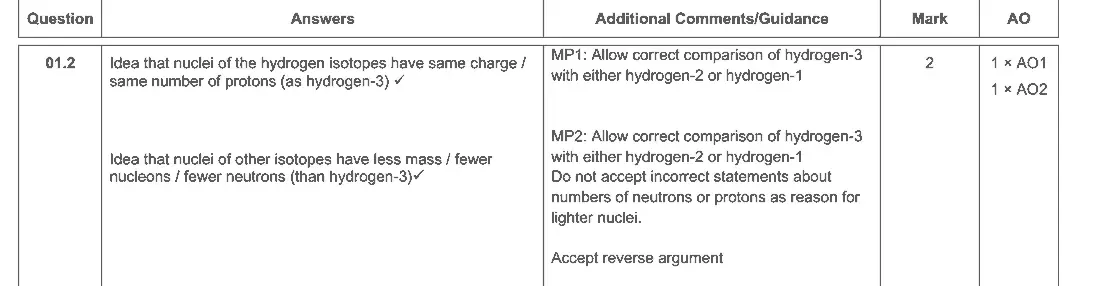
The specific charge of the hydrogen-3 nucleus is less than the specific charges of the
nuclei of the other two isotopes.
Suggest why.
[2 marks]
June 2025 · AS Paper 1 · Q1.3 3 marks AO3=3 Explanation classification of particles and quarks
Earlier part of question 1 that this part usesEarlier part of June 2025 Paper 1 question 1
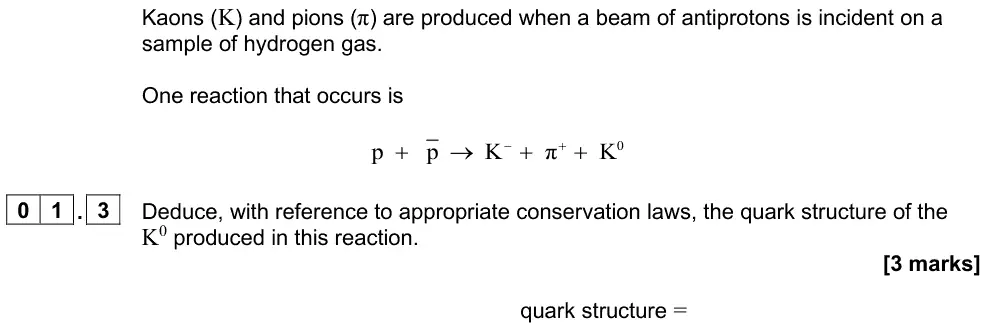
Kaons (K) and pions (π) are produced when a beam of antiprotons is incident on a
sample of hydrogen gas.
One reaction that occurs is
0
p
p
K
π
K
−
+
+
→
+
+
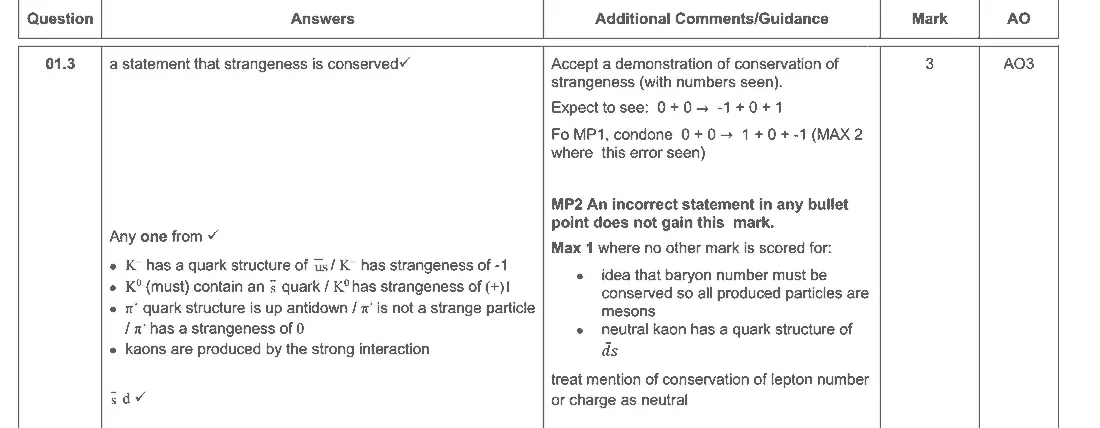
Deduce, with reference to appropriate conservation laws, the quark structure of the
K0 produced in this reaction.
[3 marks]
quark structure =
June 2025 · AS Paper 1 · Q3.4 4 marks AO1=2, AO3=2 Explanation Hard energy levels and wave particle duality
Earlier part of question 3 that this part usesEarlier part of June 2025 Paper 1 question 3
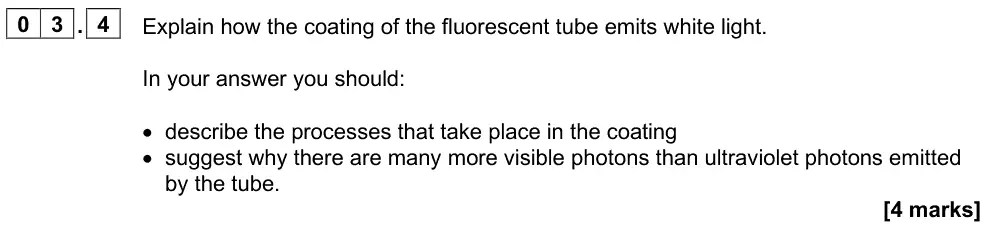
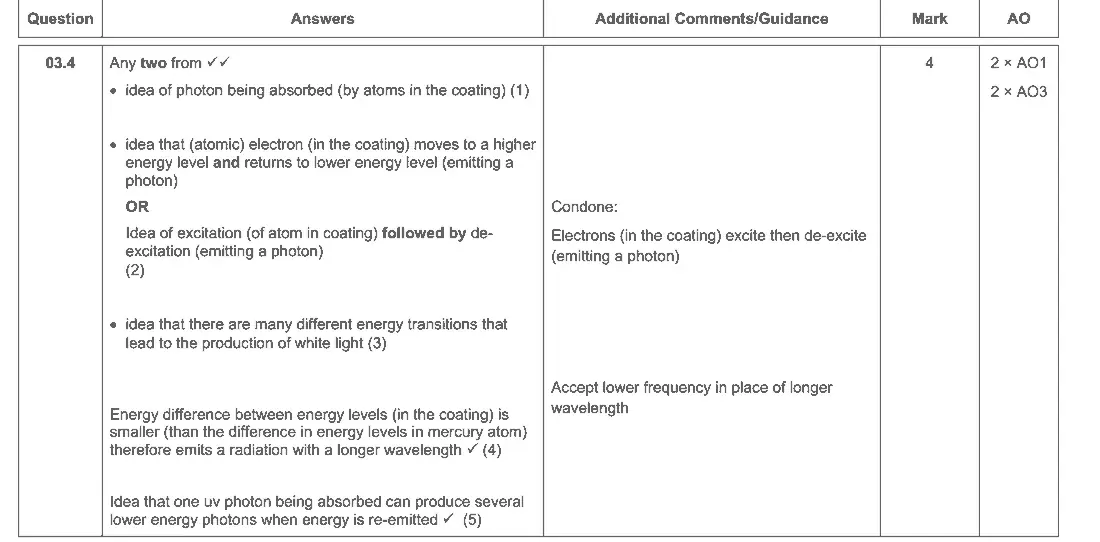
Explain how the coating of the fluorescent tube emits white light.
In your answer you should:
• describe the processes that take place in the coating
• suggest why there are many more visible photons than ultraviolet photons emitted
by the tube.
[4 marks]
June 2025 · AS Paper 1 · Q4.4 3 marks AO2=1, AO3=2 Explanation vectors and moments
Earlier part of question 4 that this part usesEarlier part of June 2025 Paper 1 question 4
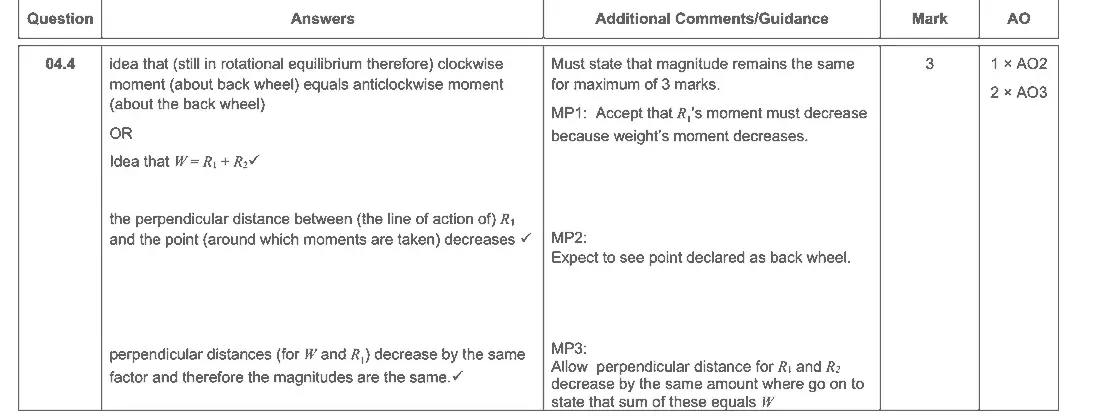
Deduce how the magnitude of R1 in Figure 5 compares with the value of 97 N
in Figure 4.
[3 marks]
June 2025 · AS Paper 2 · Q3.1 2 marks AO1=1, AO2=1 Explanation emf and internal resistancecircuits and potential dividers
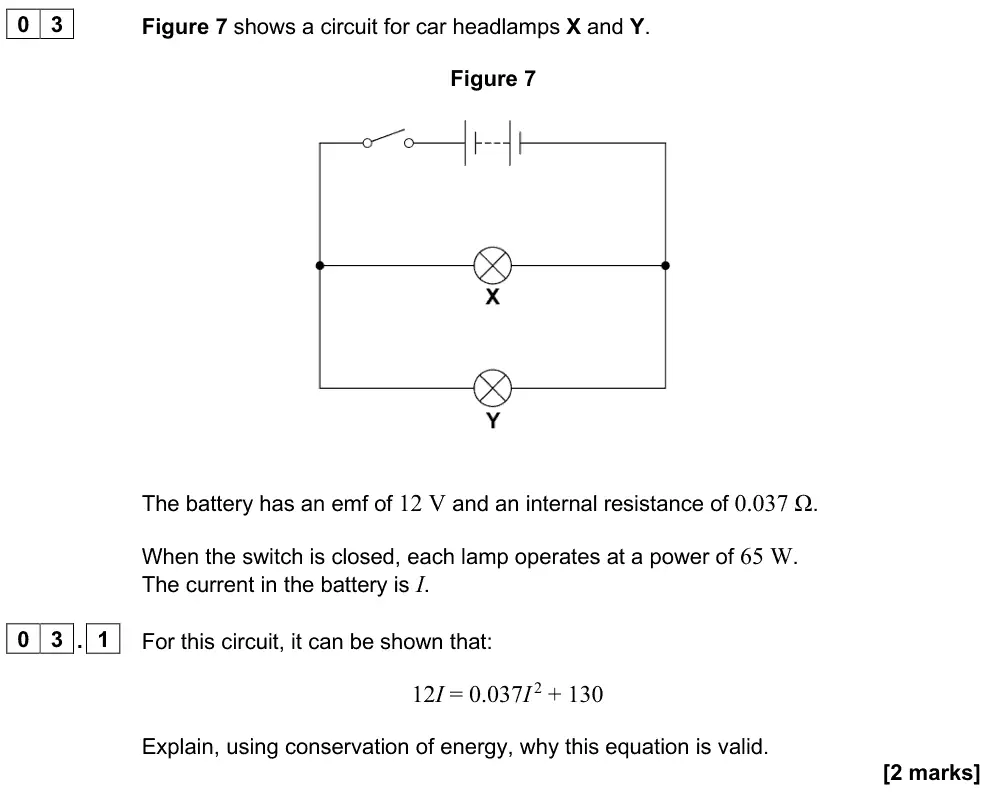
Figure 7 shows a circuit for car headlamps X and Y.
Figure 7
The battery has an emf of 12 V and an internal resistance of 0.037 Ω.
When the switch is closed, each lamp operates at a power of 65 W.
The current in the battery is I.
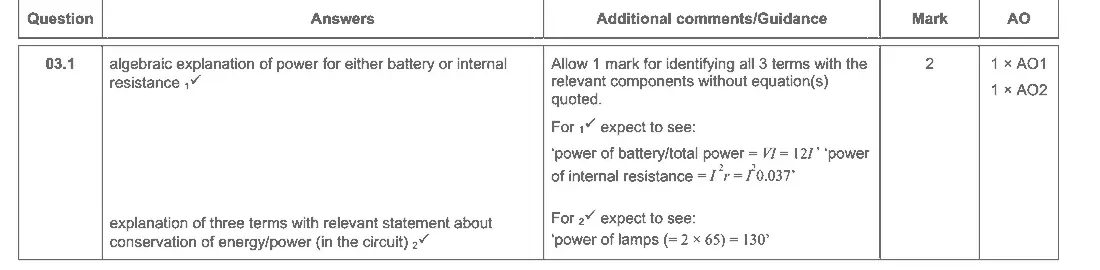
For this circuit, it can be shown that:
12I = 0.037I 2 + 130
Explain, using conservation of energy, why this equation is valid.
[2 marks]
June 2025 · AS Paper 2 · Q3.4 4 marks AO3=4 Explanation Hard emf and internal resistancecurrent voltage and resistivity
Earlier part of question 3 that this part usesEarlier part of June 2025 Paper 2 question 3
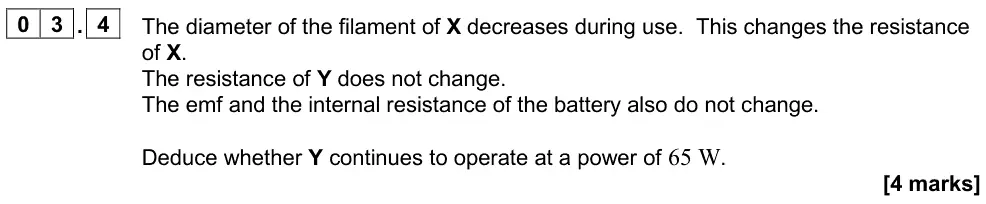
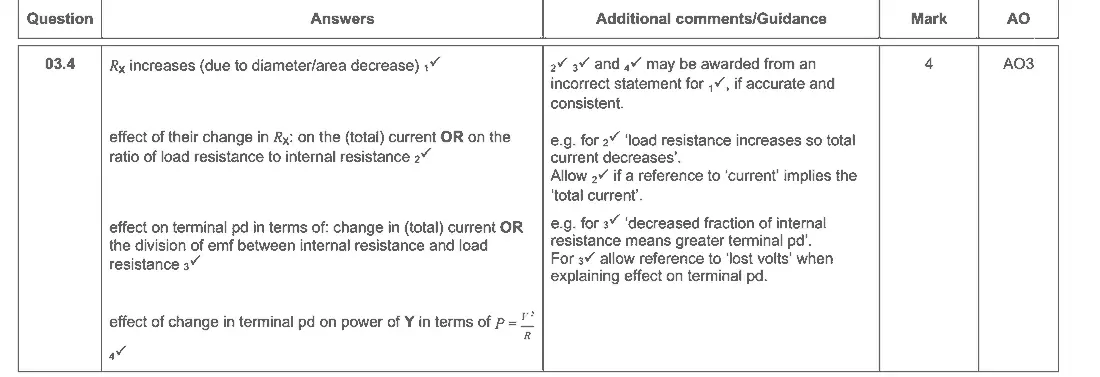
The diameter of the filament of X decreases during use.  This changes the resistance
of X.
The resistance of Y does not change.
The emf and the internal resistance of the battery also do not change.
Deduce whether Y continues to operate at a power of 65 W.
[4 marks]
June 2025 · AS Paper 2 · Q4.3 2 marks AO3=2 Explanation motion and projectilesvectors and moments
Earlier part of question 4 that this part usesEarlier part of June 2025 Paper 2 question 4
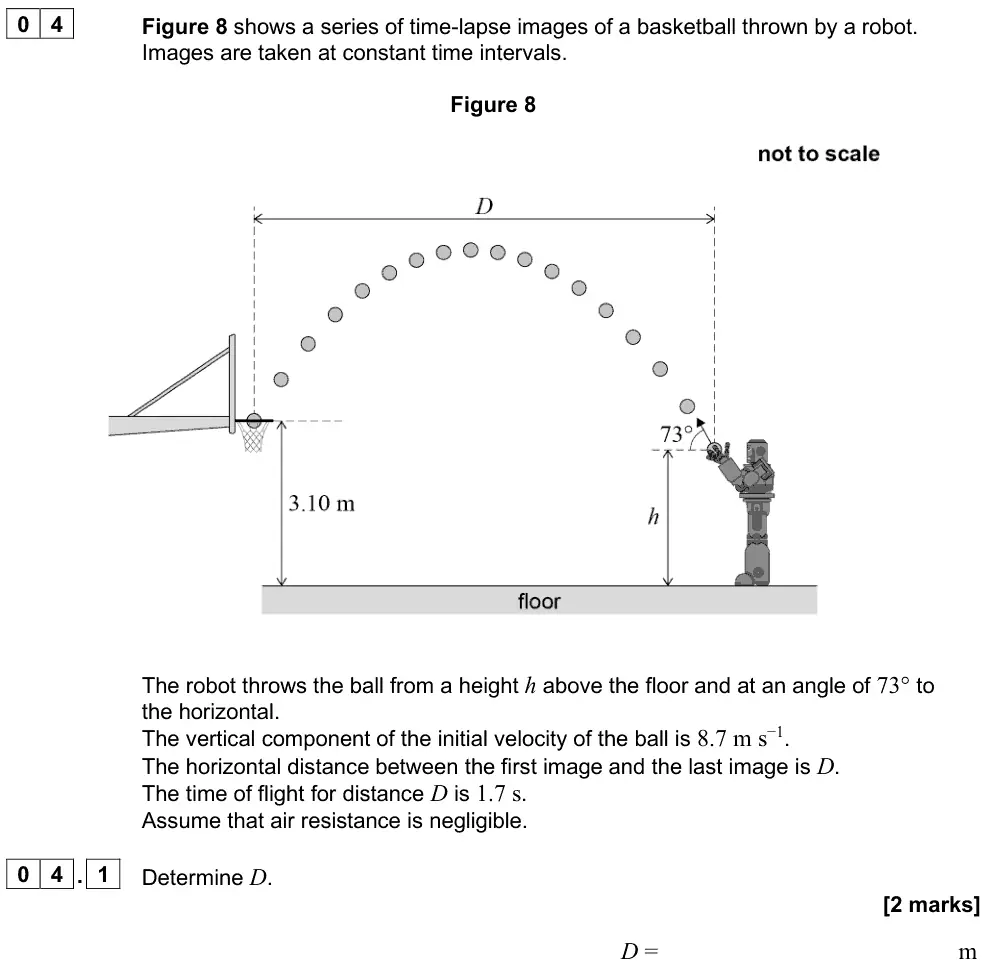
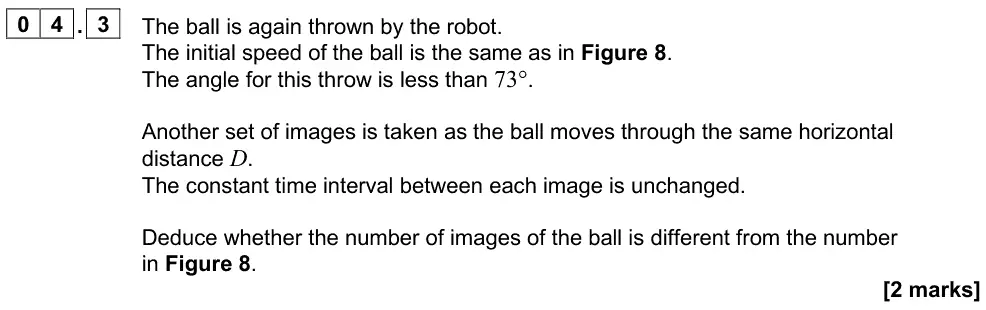
The ball is again thrown by the robot.
The initial speed of the ball is the same as in Figure 8.
The angle for this throw is less than 73°.
Another set of images is taken as the ball moves through the same horizontal
distance D.
The constant time interval between each image is unchanged.
Deduce whether the number of images of the ball is different from the number
in Figure 8.
[2 marks]
June 2025 · AS Paper 2 · Q4.4 3 marks AO1=1, AO2=2 Explanation motion and projectiles
Earlier part of question 4 that this part usesEarlier part of June 2025 Paper 2 question 4
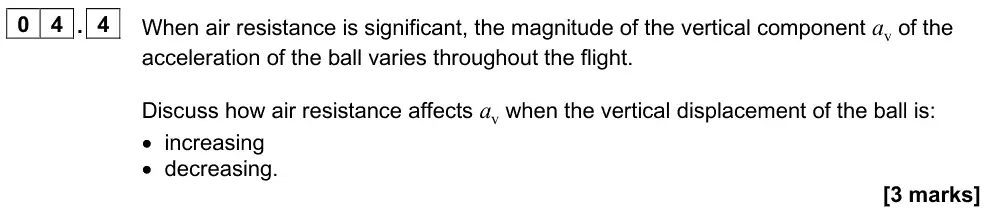
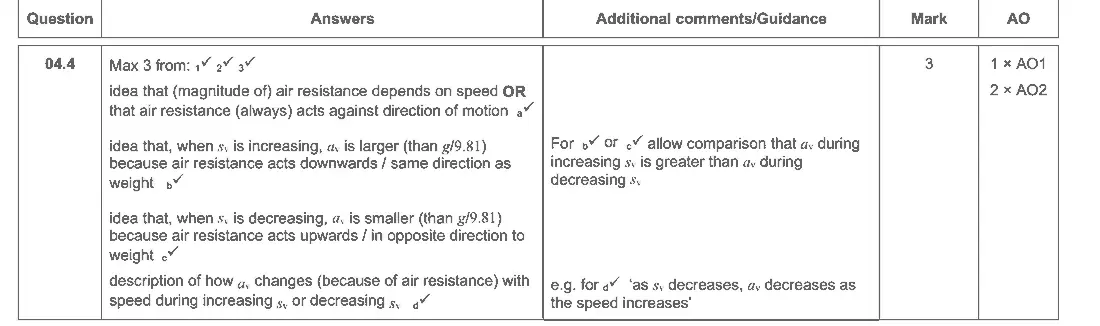
When air resistance is significant, the magnitude of the vertical component av of the
acceleration of the ball varies throughout the flight.
Discuss how air resistance affects av when the vertical displacement of the ball is:
• increasing
• decreasing.
[3 marks]
June 2025 · Paper 1 · Q1.2 1 mark AO3=1 Explanation particles antiparticles and interactions
Earlier part of question 1 that this part usesEarlier part of June 2025 Paper 1 question 1
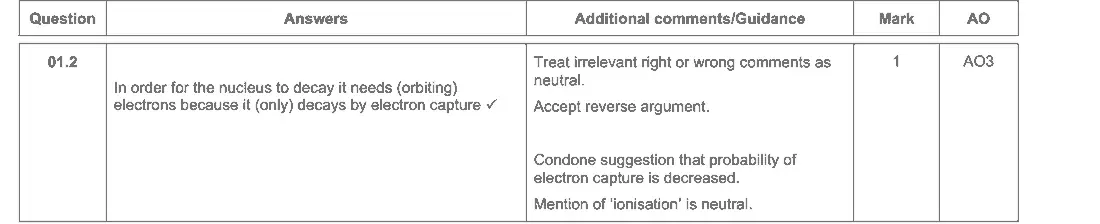
In some circumstances, a nucleus of this isotope can exist with no orbiting electrons.
Explain why a neutral atom of this isotope is less stable than a nucleus that has no
orbiting electrons.
[1 mark]
June 2025 · Paper 1 · Q2.2 1 mark AO1=1 Explanation stationary waves
Earlier part of question 2 that this part usesEarlier part of June 2025 Paper 1 question 2
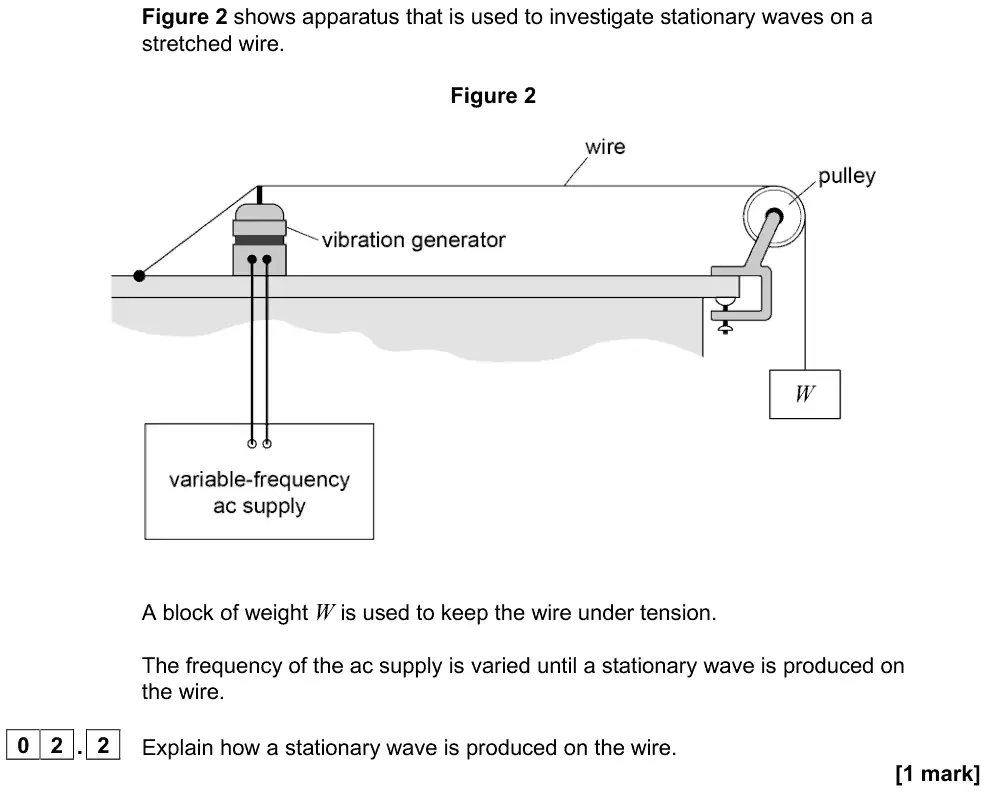
Figure 2 shows apparatus that is used to investigate stationary waves on a
stretched wire.
Figure 2
A block of weight W is used to keep the wire under tension.
The frequency of the ac supply is varied until a stationary wave is produced on
the wire.
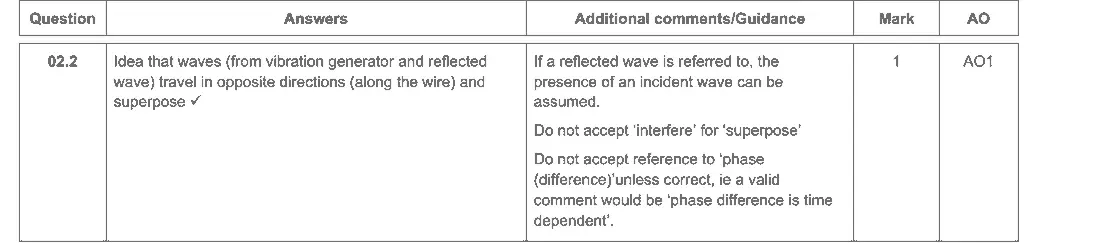
Explain how a stationary wave is produced on the wire.
[1 mark]
June 2025 · Paper 1 · Q2.3 2 marks AO2=2 Explanation stationary wavesprogressive waves and polarisation
Earlier part of question 2 that this part usesEarlier part of June 2025 Paper 1 question 2
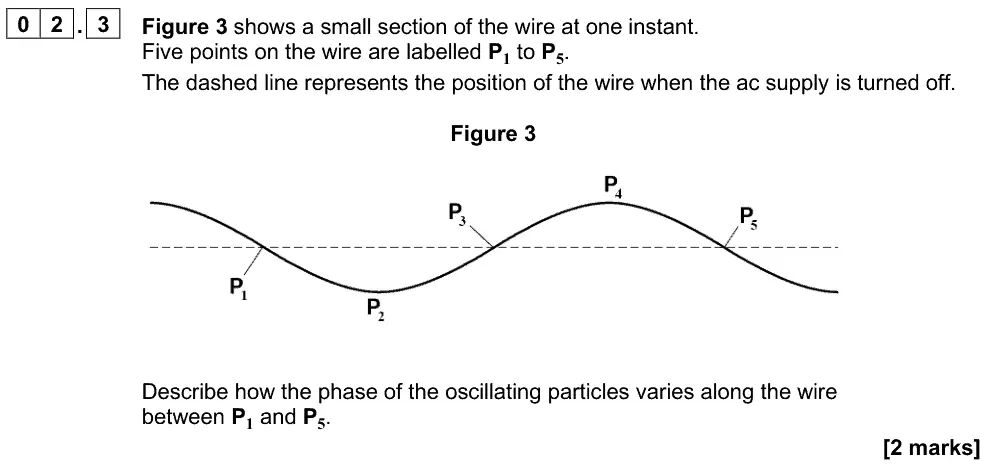
Figure 3 shows a small section of the wire at one instant.
Five points on the wire are labelled P1 to P5.
The dashed line represents the position of the wire when the ac supply is turned off.
Figure 3
Describe how the phase of the oscillating particles varies along the wire
between P1 and P5.
[2 marks]
June 2025 · Paper 1 · Q7.5 2 marks AO3=2 Explanation circular motionvectors and moments
Earlier part of question 7 that this part usesEarlier part of June 2025 Paper 1 question 7
A car has a greater maximum speed on a sloped track than on a horizontal track of
the same radius.
Explain why.
[2 marks]
June 2025 · Paper 1 · Q8.3 2 marks AO1=1, AO3=1 Explanation energy levels and wave particle duality
Earlier part of question 8 that this part usesEarlier part of June 2025 Paper 1 question 8
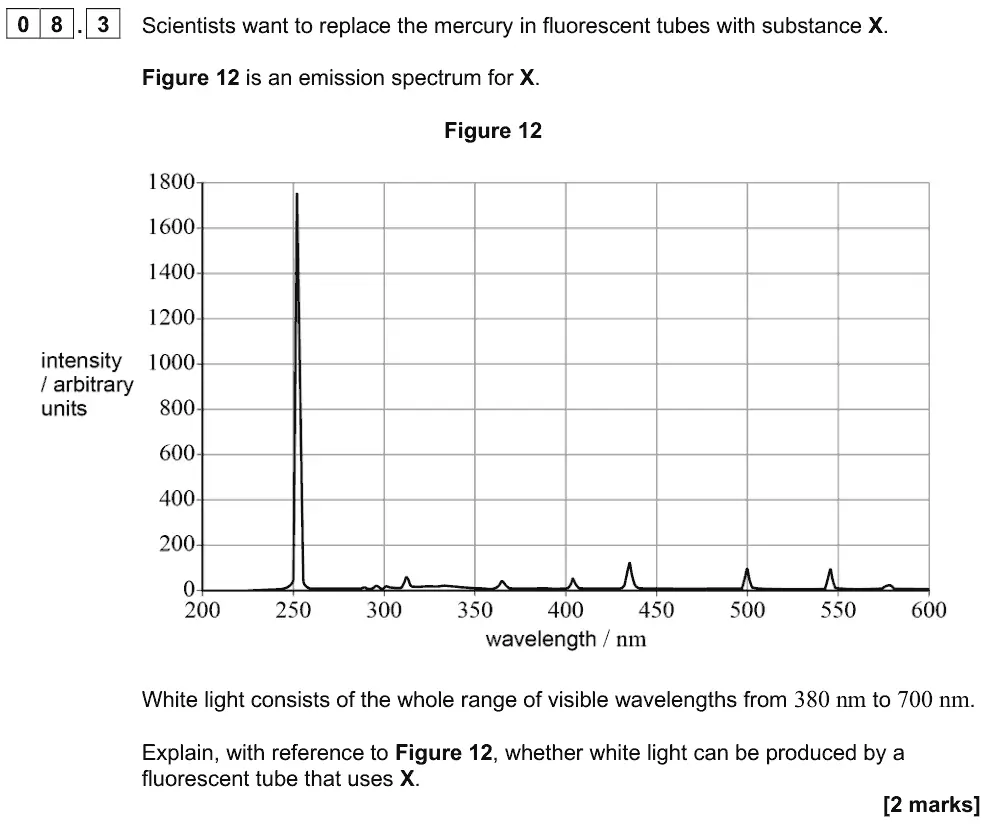
Scientists want to replace the mercury in fluorescent tubes with substance X.
Figure 12 is an emission spectrum for X.
Figure 12
White light consists of the whole range of visible wavelengths from 380 nm to 700 nm.
Explain, with reference to Figure 12, whether white light can be produced by a
fluorescent tube that uses X.
[2 marks]
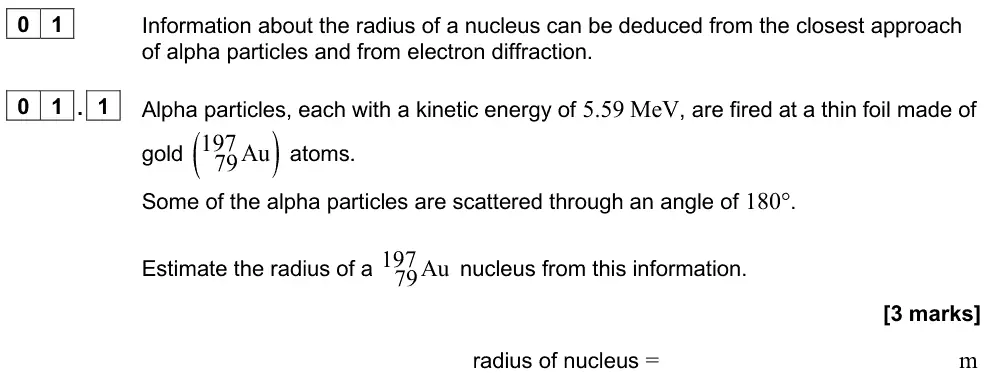
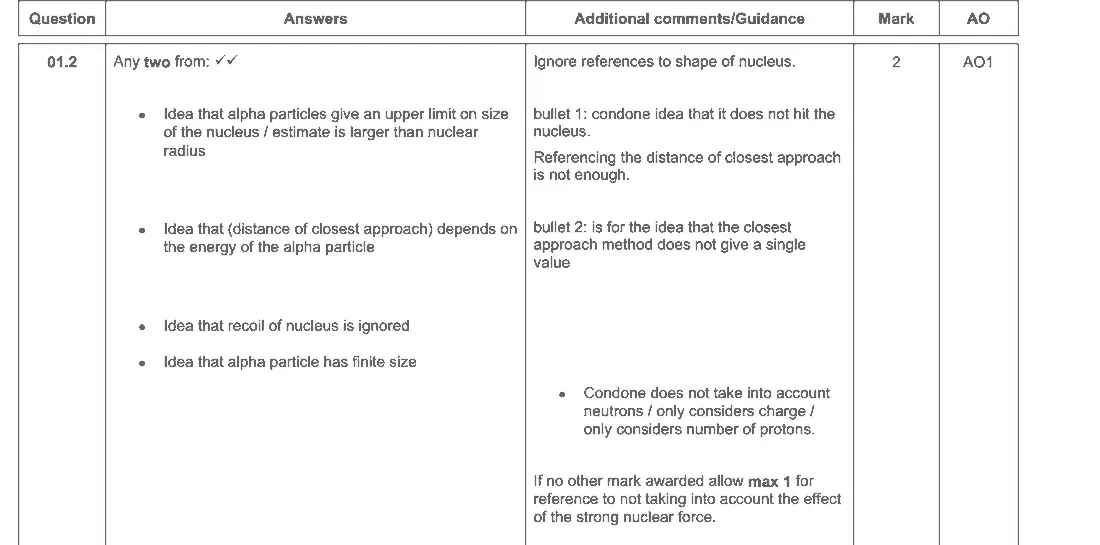
June 2025 · Paper 2 · Q1.2 2 marks AO1=2 Explanation nuclear radius
Earlier part of question 1 that this part usesEarlier part of June 2025 Paper 2 question 1
Explain why your answer to Question 01.1 is an estimate.
[2 marks]
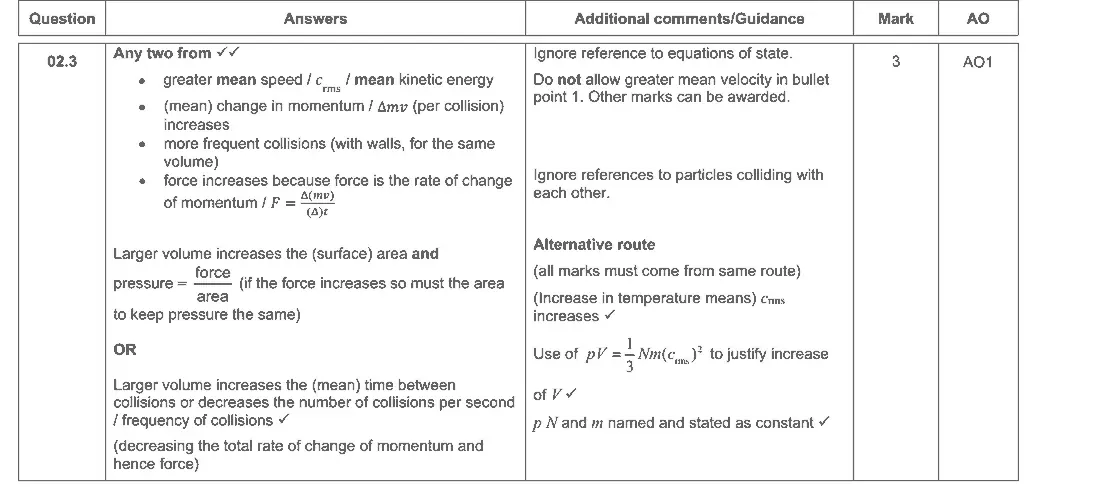
June 2025 · Paper 2 · Q2.3 3 marks AO1=3 Explanation kinetic theory
Earlier part of question 2 that this part usesEarlier part of June 2025 Paper 2 question 2
When the temperature of a fixed mass of an ideal gas increases at constant pressure,
the gas must expand.
Explain this expansion using the kinetic theory model.
[3 marks]
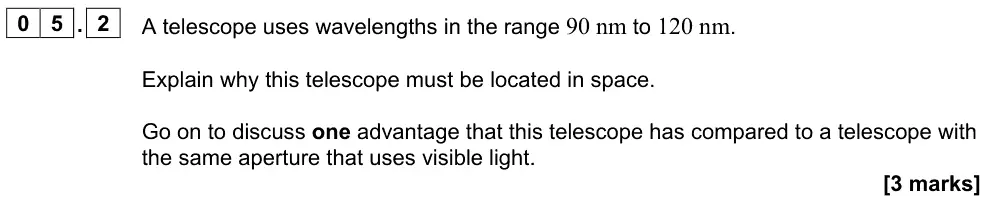
June 2025 · Paper 3B Astrophysics · Q2.3 2 marks AO1=2 Explanation telescopes
Earlier part of question 2 that this part usesEarlier part of June 2025 Paper 3B Astrophysics question 2
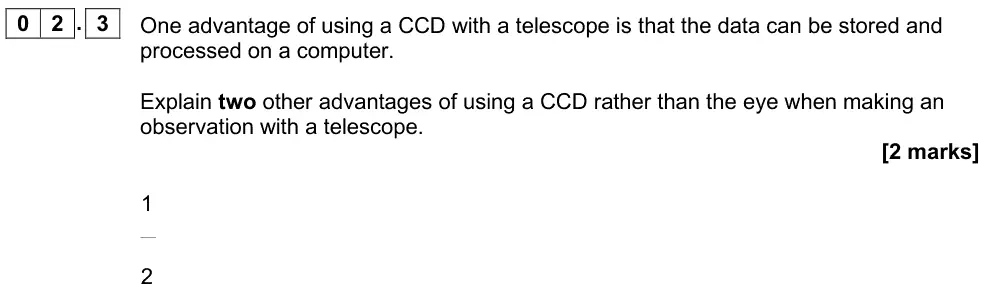
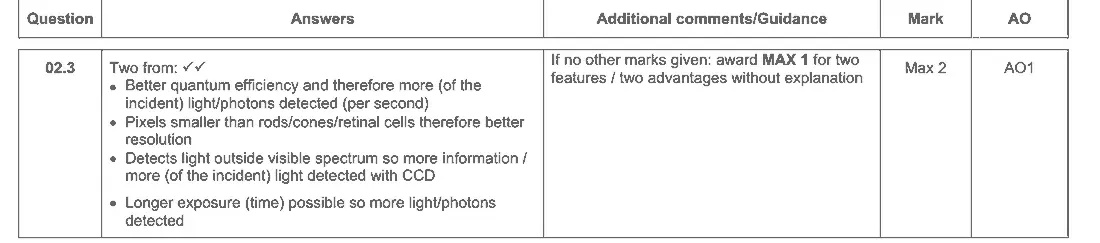
One advantage of using a CCD with a telescope is that the data can be stored and
processed on a computer.
Explain two other advantages of using a CCD rather than the eye when making an
observation with a telescope.
[2 marks]
1
2
June 2025 · Paper 3B Astrophysics · Q4.4 3 marks AO3=3 Explanation cosmology
Earlier part of question 4 that this part usesEarlier part of June 2025 Paper 3B Astrophysics question 4
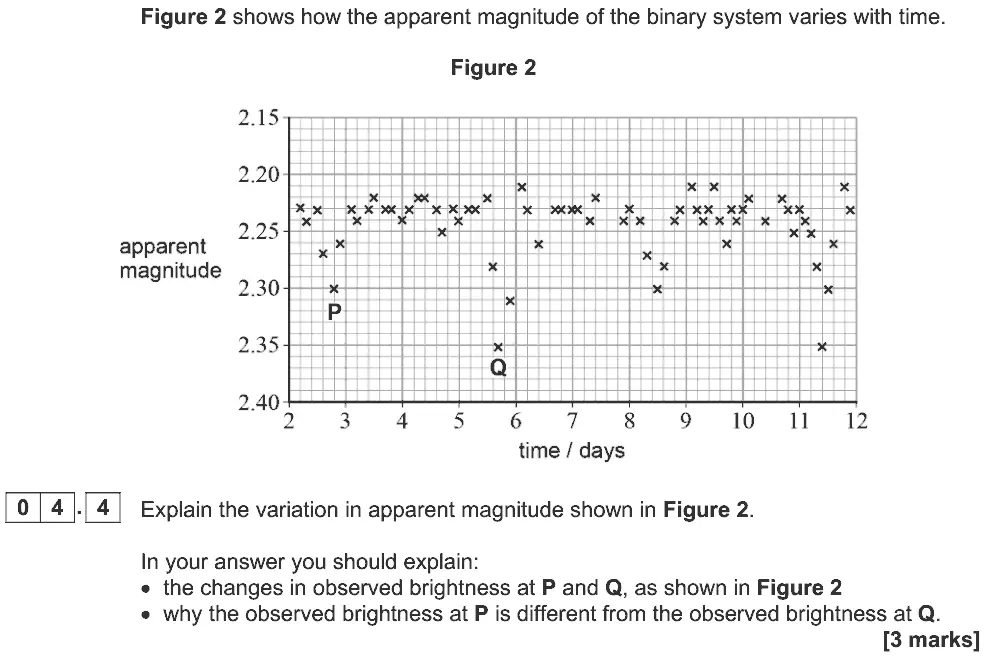
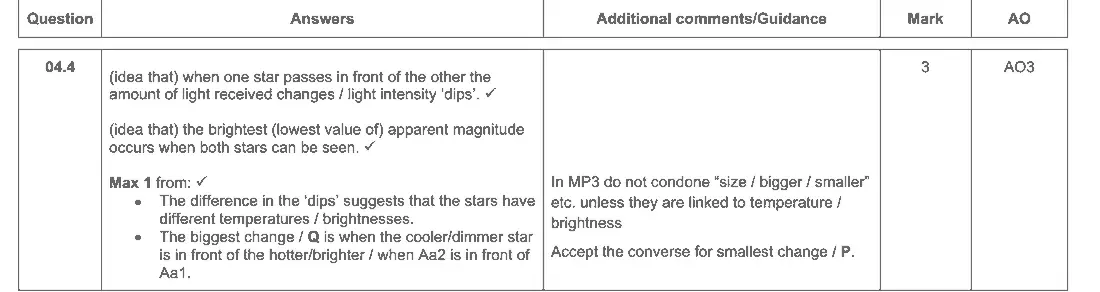
Figure 2 shows how the apparent magnitude of the binary system varies with time.
Figure 2
Explain the variation in apparent magnitude shown in Figure 2.
In your answer you should explain:
• the changes in observed brightness at P and Q, as shown in Figure 2
• why the observed brightness at P is different from the observed brightness at Q.
[3 marks]
June 2025 · Paper 3B Medical physics · Q1.4 2 marks AO1=1, AO3=1 Explanation eye ear and ecg
Earlier part of question 1 that this part usesEarlier part of June 2025 Paper 3B Medical physics question 1
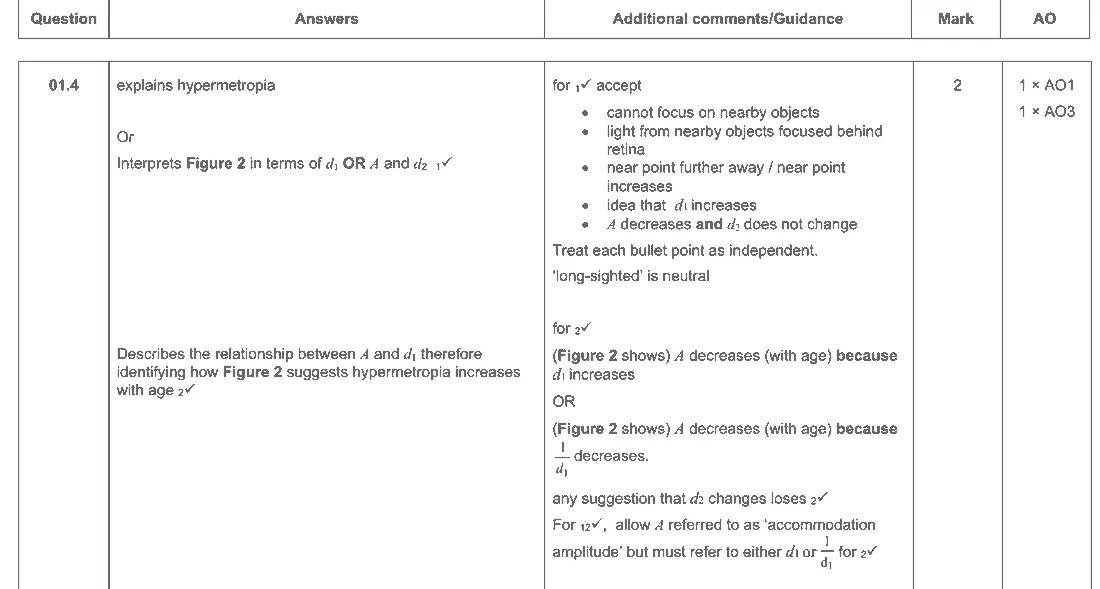
For a typical person, the far point remains at infinity as the person’s age increases.
Some studies suggest that hypermetropia increases with age.
Explain how Figure 2 supports this suggestion.
[2 marks]
June 2025 · Paper 3B Medical physics · Q4.1 2 marks AO1=2 Explanation Hard medical imaging
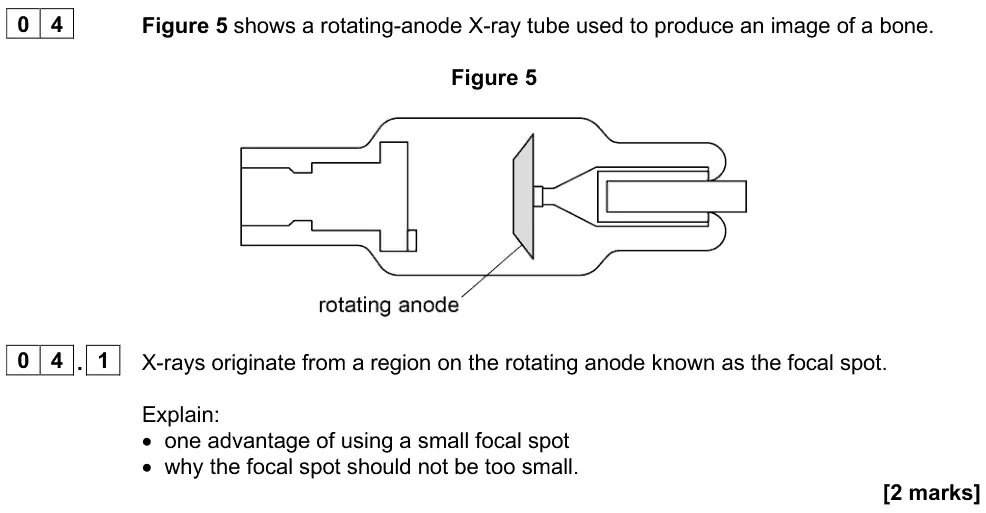
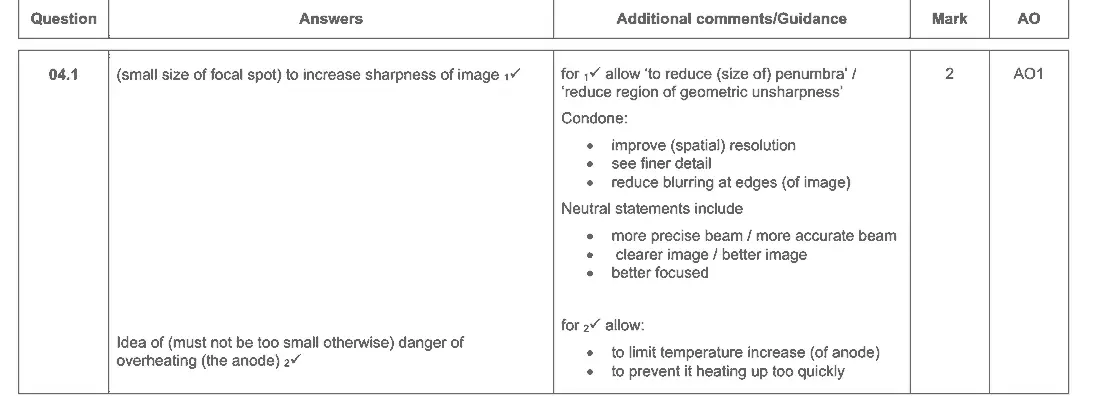
Figure 5 shows a rotating-anode X-ray tube used to produce an image of a bone.
Figure 5
X-rays originate from a region on the rotating anode known as the focal spot.
Explain:
• one advantage of using a small focal spot
• why the focal spot should not be too small.
[2 marks]
June 2025 · Paper 3B Medical physics · Q4.2 3 marks AO1=3 Explanation medical imaging
Earlier part of question 4 that this part usesEarlier part of June 2025 Paper 3B Medical physics question 4
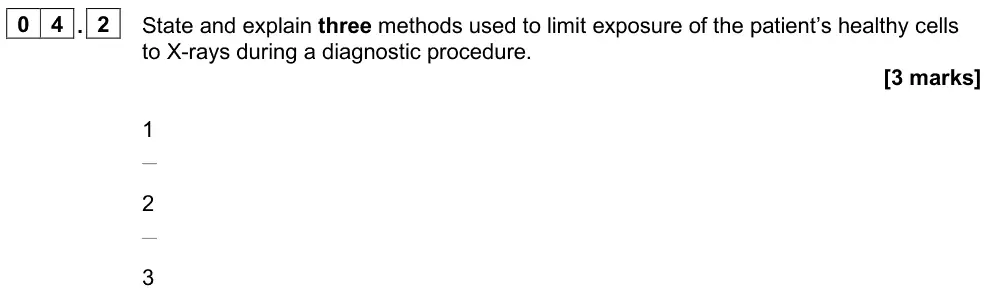
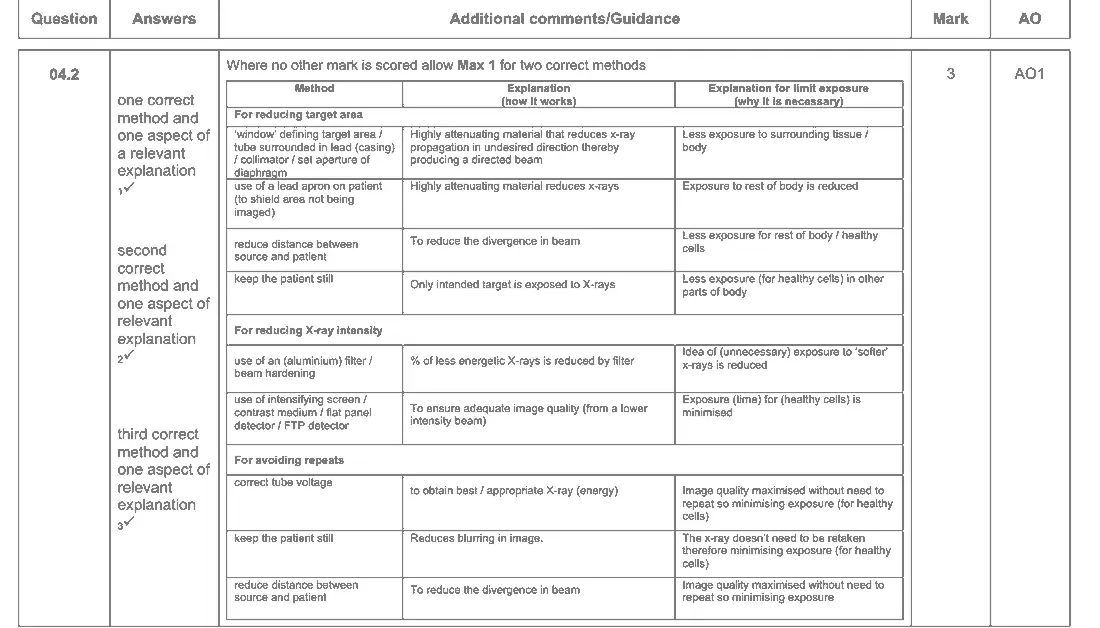
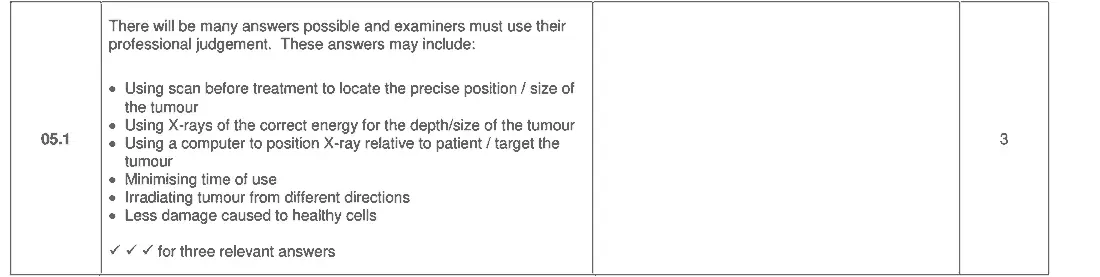
State and explain three methods used to limit exposure of the patient’s healthy cells
to X-rays during a diagnostic procedure.
[3 marks]
1
2
3
June 2025 · Paper 3B Engineering physics · Q2.3 3 marks AO2=2, AO3=1 Explanation rotational dynamics
Earlier part of question 2 that this part usesEarlier part of June 2025 Paper 3B Engineering physics question 2
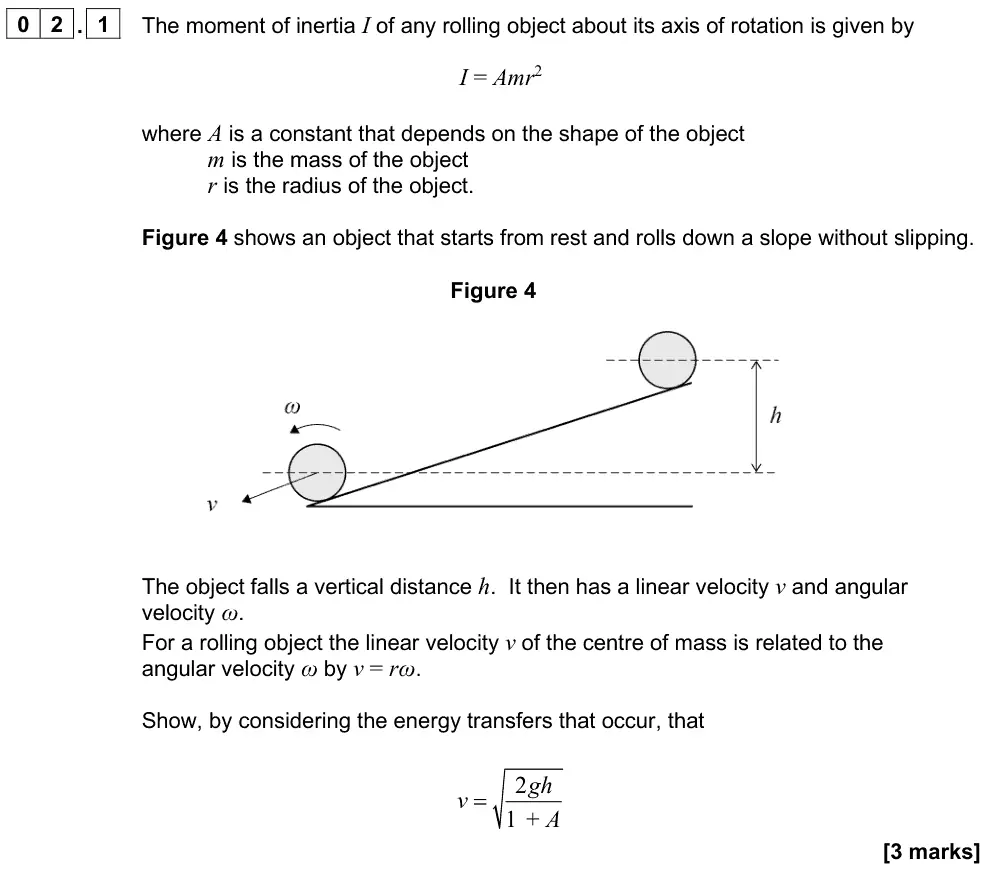
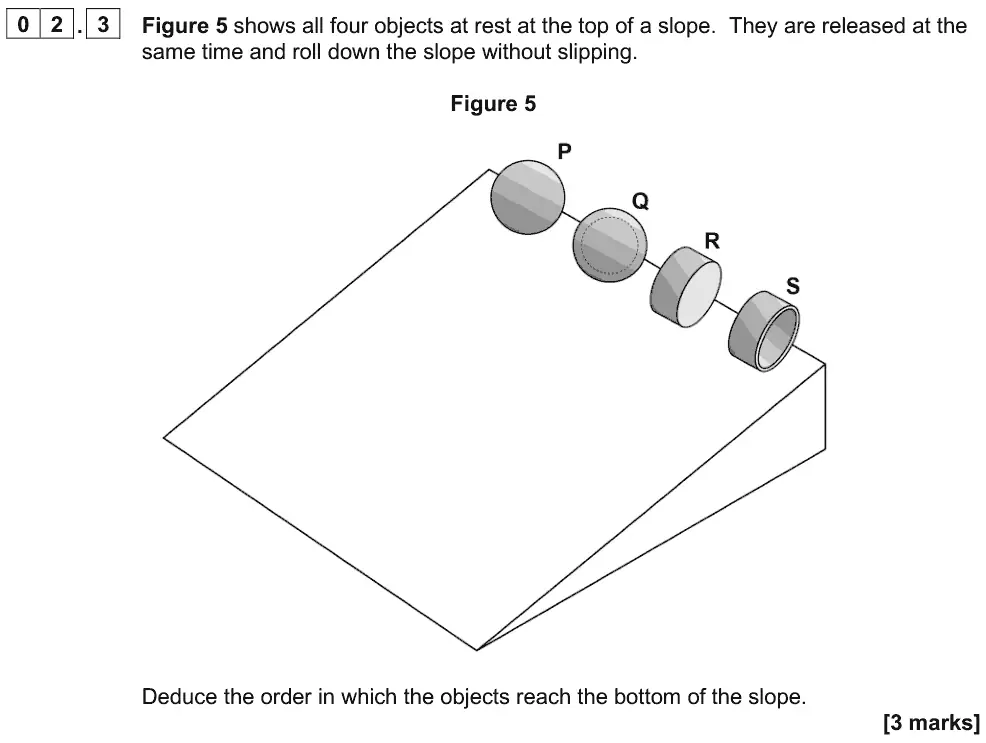
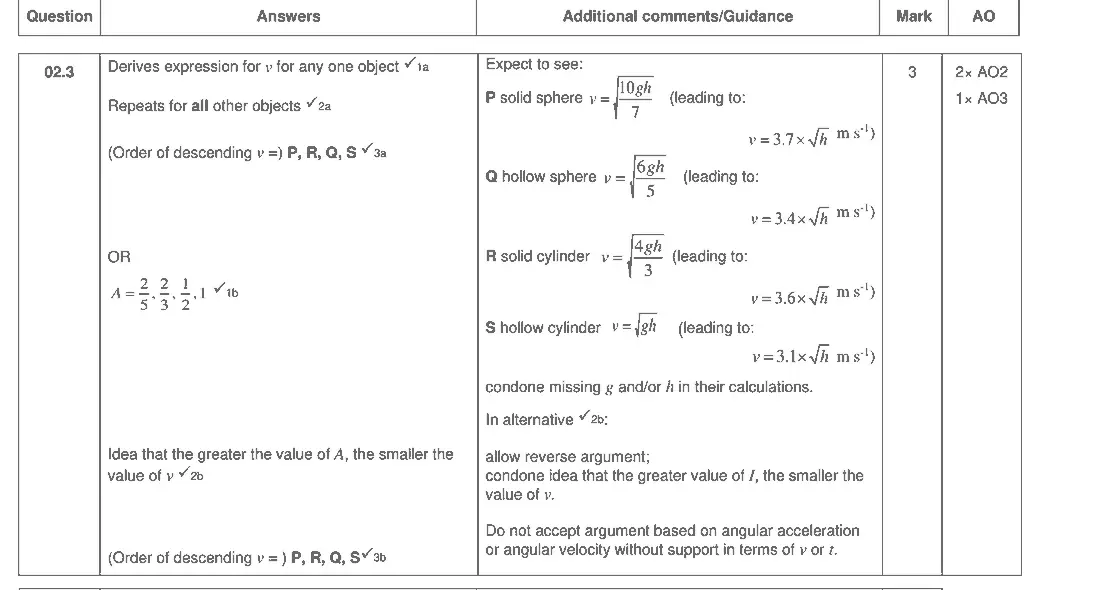
Figure 5 shows all four objects at rest at the top of a slope.  They are released at the
same time and roll down the slope without slipping.
Figure 5
Deduce the order in which the objects reach the bottom of the slope.
[3 marks]
June 2025 · Paper 3B Engineering physics · Q3.5 2 marks AO1=1, AO3=1 Explanation thermodynamics and engines
Earlier part of question 3 that this part usesEarlier part of June 2025 Paper 3B Engineering physics question 3
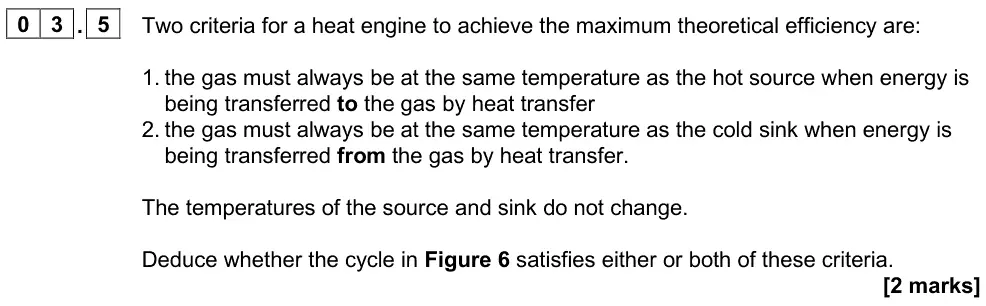
Two criteria for a heat engine to achieve the maximum theoretical efficiency are:
1. the gas must always be at the same temperature as the hot source when energy is
being transferred to the gas by heat transfer
2. the gas must always be at the same temperature as the cold sink when energy is
being transferred from the gas by heat transfer.
The temperatures of the source and sink do not change.
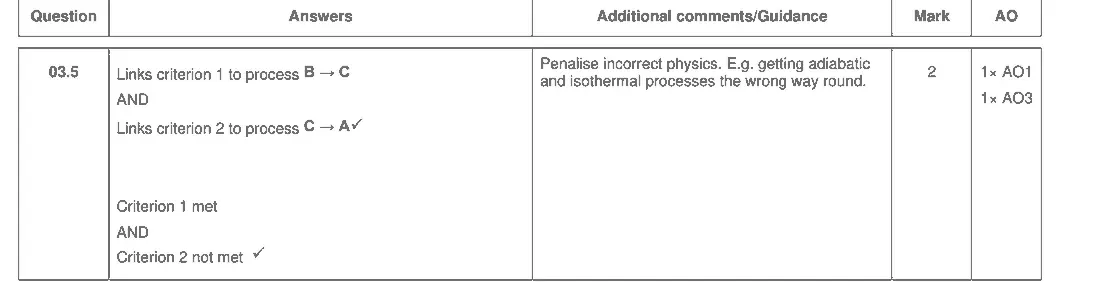
Deduce whether the cycle in Figure 6 satisfies either or both of these criteria.
[2 marks]
June 2025 · Paper 3B Engineering physics · Q4.2 3 marks AO1=1, AO3=2 Explanation thermodynamics and engines
Earlier part of question 4 that this part usesEarlier part of June 2025 Paper 3B Engineering physics question 4
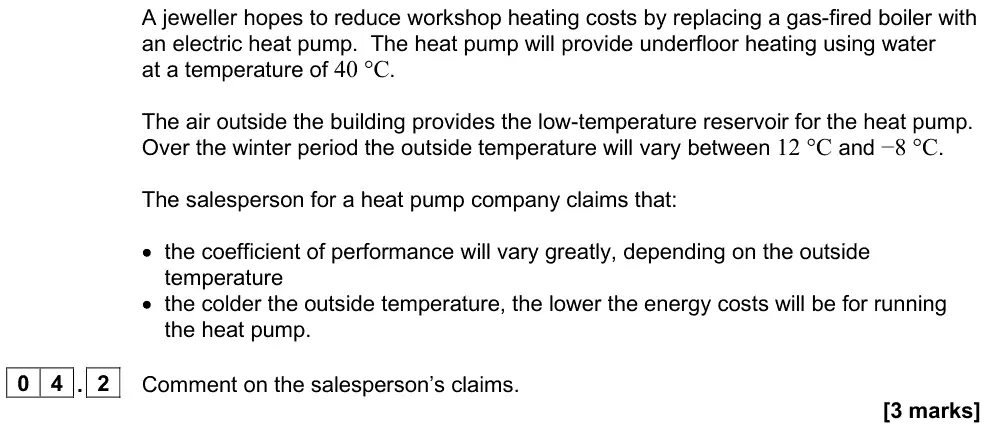
A jeweller hopes to reduce workshop heating costs by replacing a gas-fired boiler with
an electric heat pump.  The heat pump will provide underfloor heating using water

at a temperature of 40 °C.
The air outside the building provides the low-temperature reservoir for the heat pump.
Over the winter period the outside temperature will vary between 12 °C and −8 °C.
The salesperson for a heat pump company claims that:
• the coefficient of performance will vary greatly, depending on the outside
temperature
• the colder the outside temperature, the lower the energy costs will be for running
the heat pump.
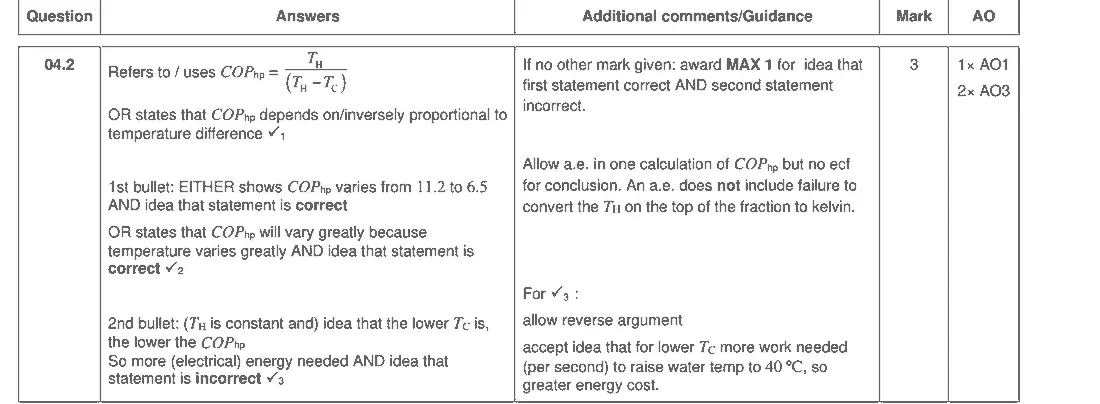
Comment on the salesperson’s claims.
[3 marks]
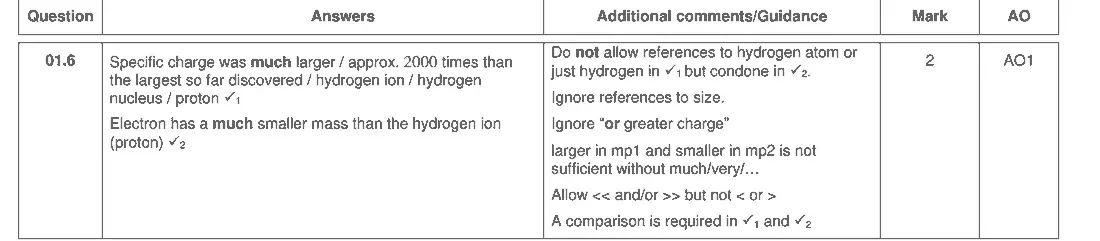
June 2025 · Paper 3B Turning points · Q1.6 2 marks AO1=2 Explanation discovery of the electron
Earlier part of question 1 that this part usesEarlier part of June 2025 Paper 3B Turning points question 1
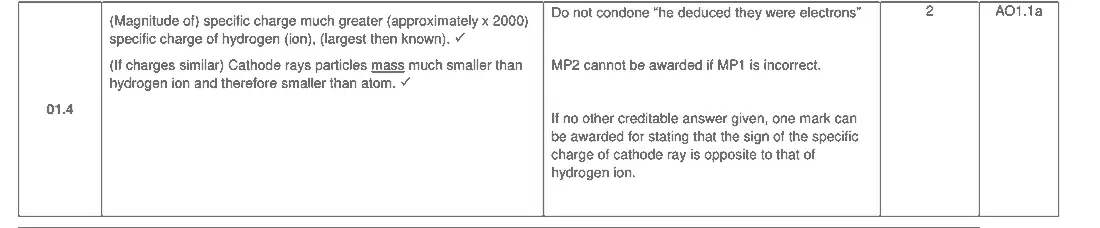
Explain the significance of the result of Thomson’s determination.
[2 marks]
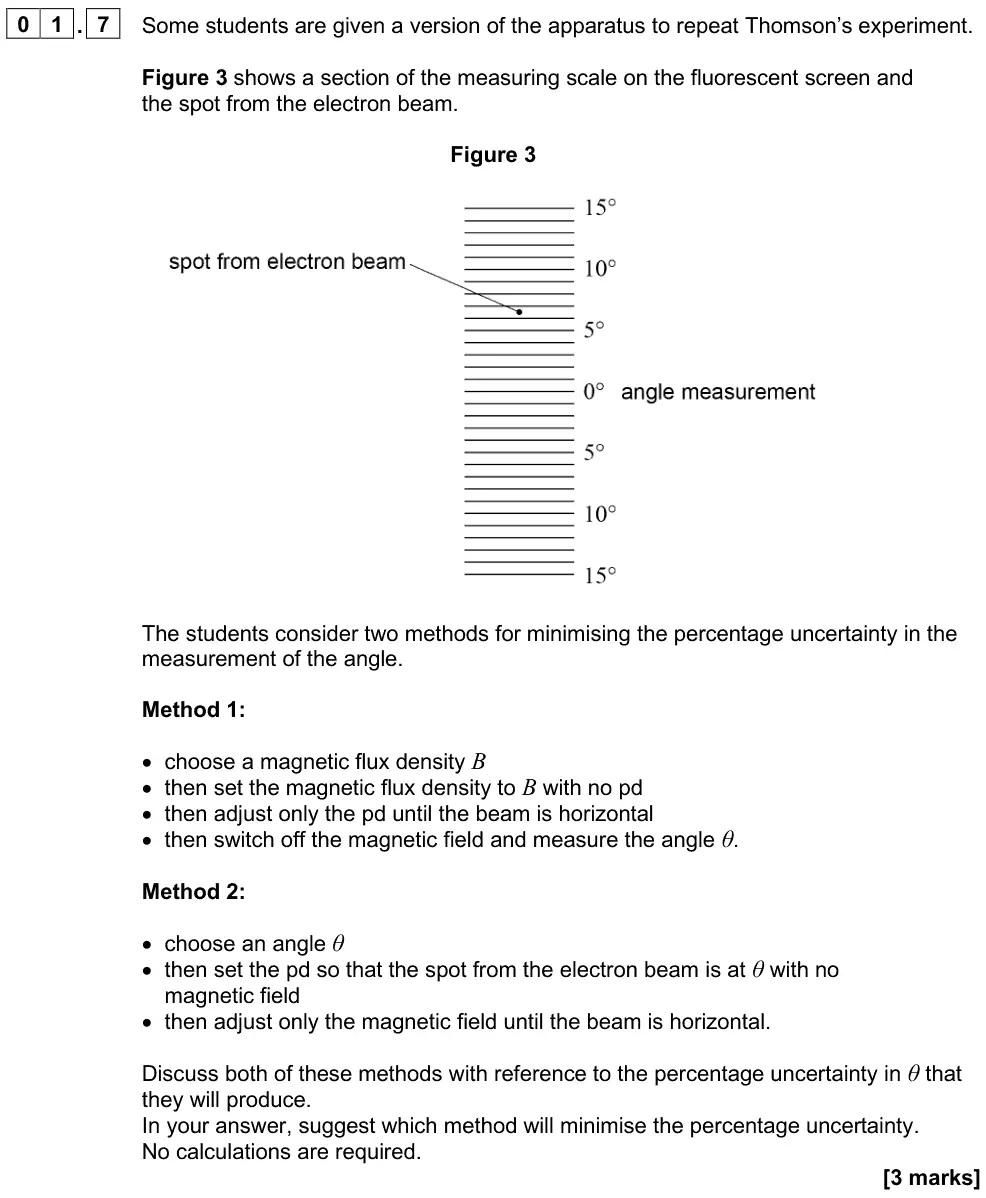
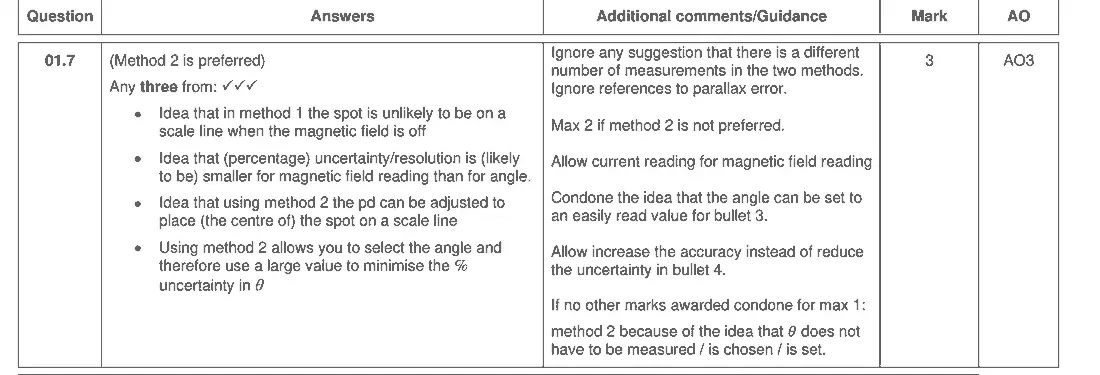
June 2025 · Paper 3B Turning points · Q1.7 3 marks AO3=3 Explanation Hard measurements and uncertainties
Earlier part of question 1 that this part usesEarlier part of June 2025 Paper 3B Turning points question 1
Some students are given a version of the apparatus to repeat Thomson’s experiment.
Figure 3 shows a section of the measuring scale on the fluorescent screen and
the spot from the electron beam.
Figure 3
The students consider two methods for minimising the percentage uncertainty in the
measurement of the angle.
Method 1:
• choose a magnetic flux density B
• then set the magnetic flux density to B with no pd
• then adjust only the pd until the beam is horizontal
• then switch off the magnetic field and measure the angle θ.
Method 2:
• choose an angle θ
• then set the pd so that the spot from the electron beam is at θ with no
magnetic field
• then adjust only the magnetic field until the beam is horizontal.
Discuss both of these methods with reference to the percentage uncertainty in θ that
they will produce.
In your answer, suggest which method will minimise the percentage uncertainty.
No calculations are required.
[3 marks]
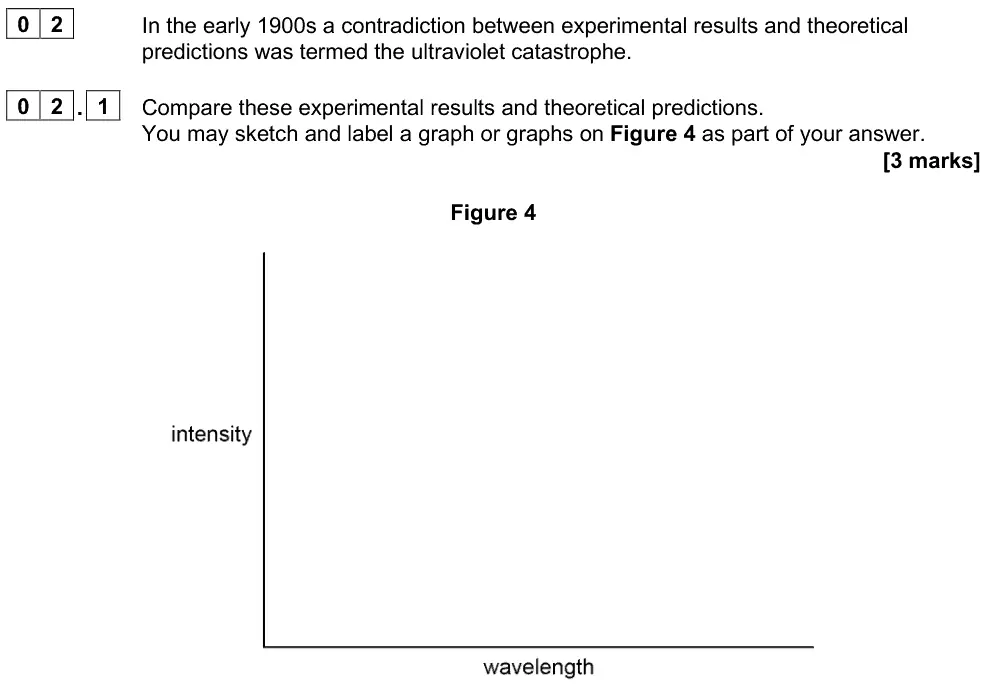
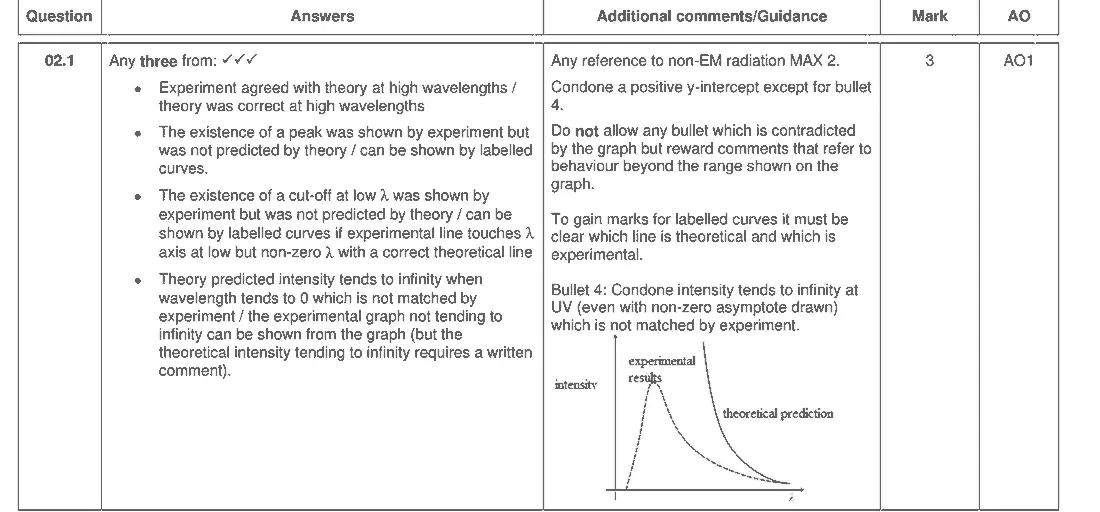
June 2025 · Paper 3B Turning points · Q2.1 3 marks AO1=3 Explanation wave particle duality history
In the early 1900s a contradiction between experimental results and theoretical
predictions was termed the ultraviolet catastrophe.
Compare these experimental results and theoretical predictions.
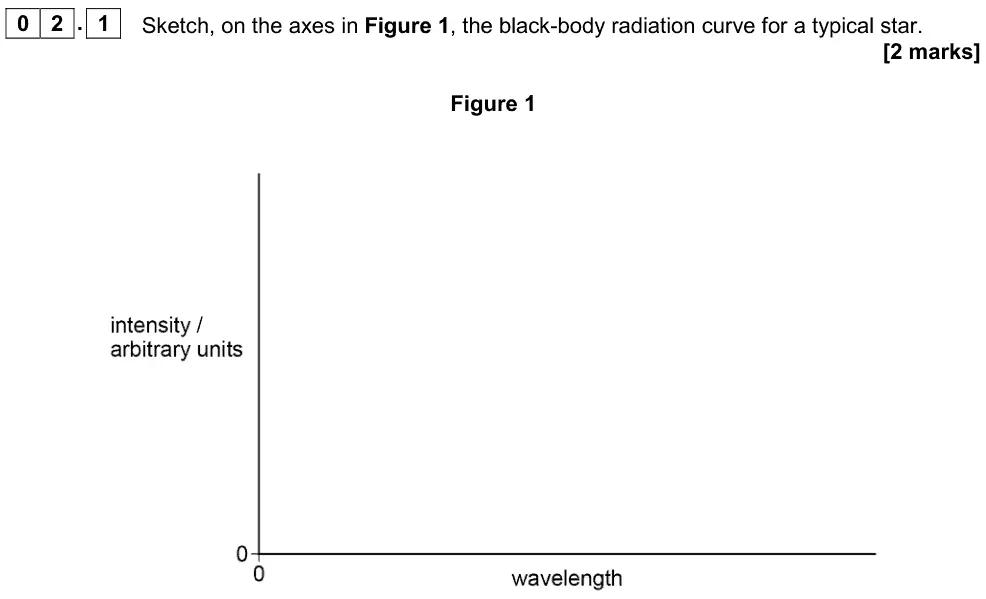
You may sketch and label a graph or graphs on Figure 4 as part of your answer.
[3 marks]
Figure 4
June 2025 · Paper 3B Electronics · Q4.1 2 marks AO1=2 Explanation data communication
State what is meant by a carrier wave within a radio transmission system.
Go on to explain how the carrier wave is used in this system.
[2 marks]
June 2025 · Paper 3B Electronics · Q4.2 2 marks AO1=2 Explanation operational amplifiers
Earlier part of question 4 that this part usesEarlier part of June 2025 Paper 3B Electronics question 4
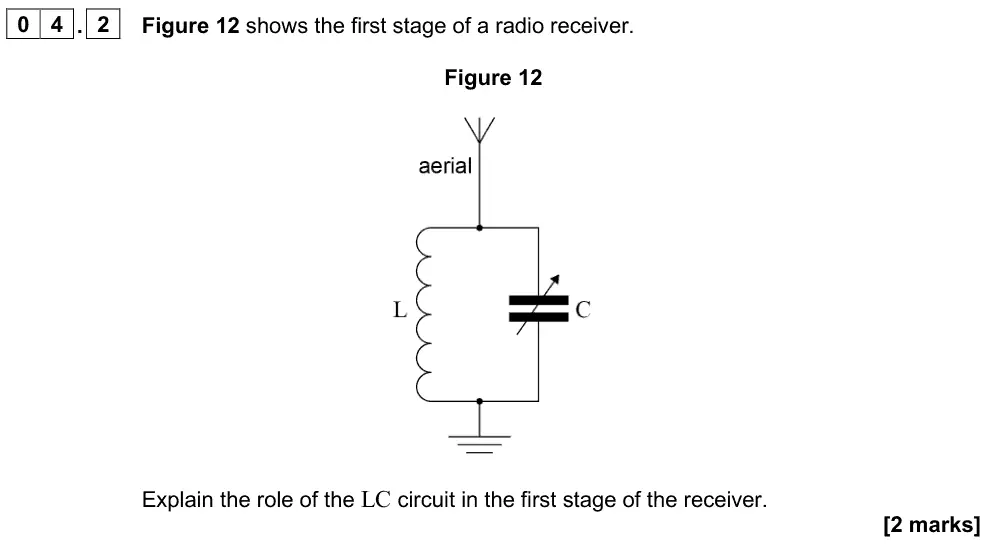
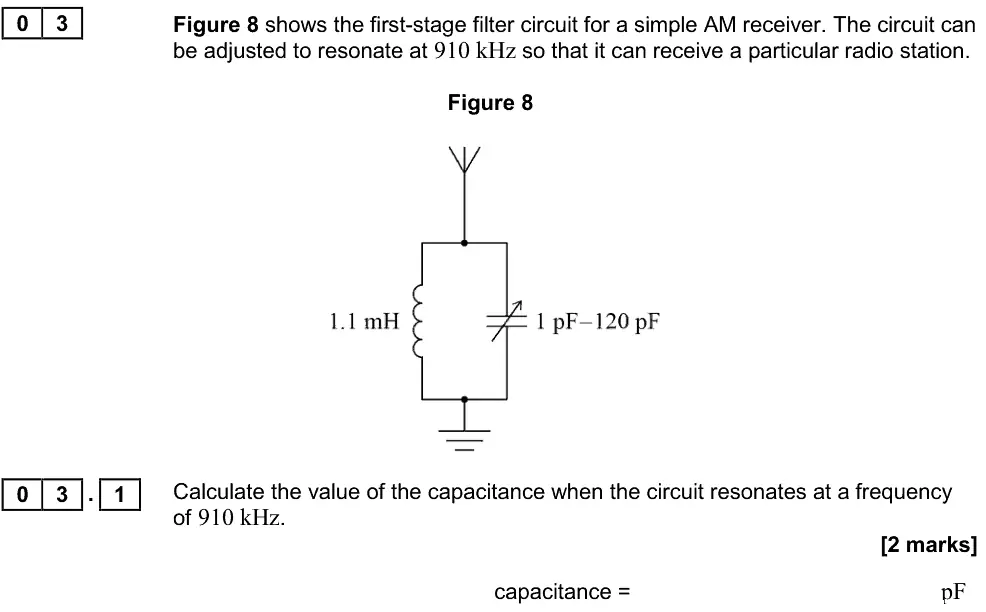
Figure 12 shows the first stage of a radio receiver.
Figure 12
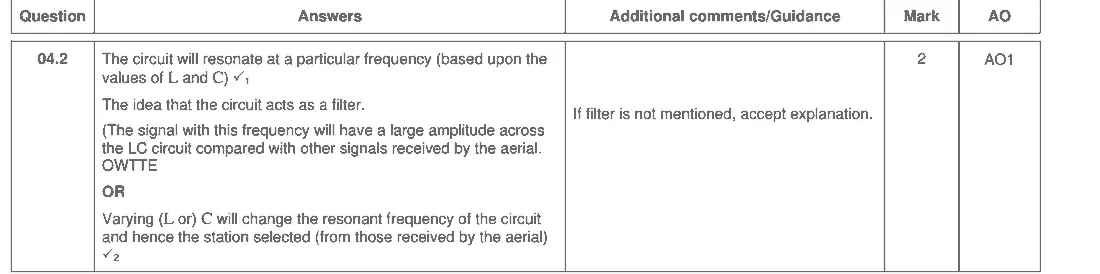
Explain the role of the LC circuit in the first stage of the receiver.
[2 marks]
June 2025 · Paper 3B Electronics · Q4.3 2 marks AO3=2 Explanation operational amplifiers
Earlier part of question 4 that this part usesEarlier part of June 2025 Paper 3B Electronics question 4
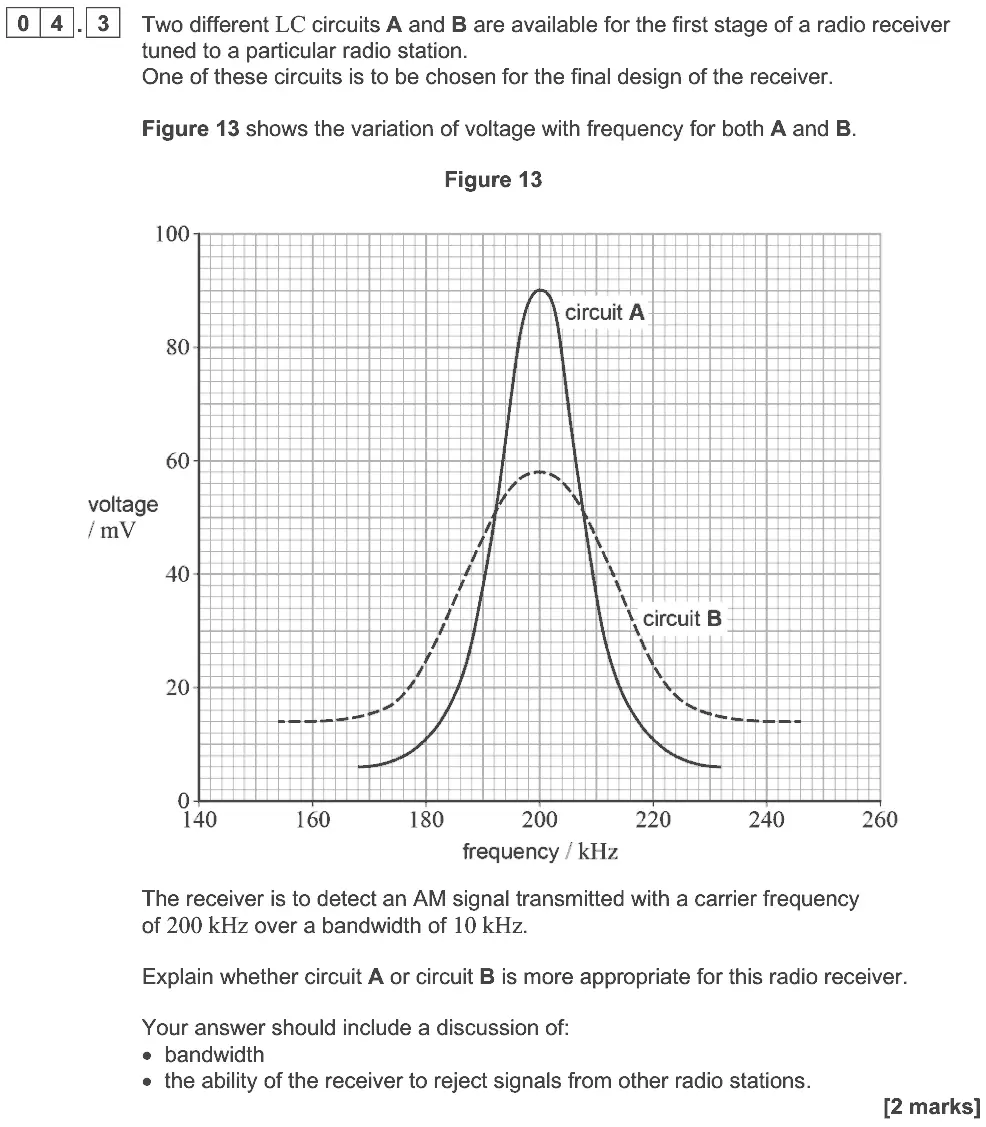
Two different LC circuits A and B are available for the first stage of a radio receiver
tuned to a particular radio station.
One of these circuits is to be chosen for the final design of the receiver.
Figure 13 shows the variation of voltage with frequency for both A and B.
Figure 13
The receiver is to detect an AM signal transmitted with a carrier frequency
of 200 kHz over a bandwidth of 10 kHz.
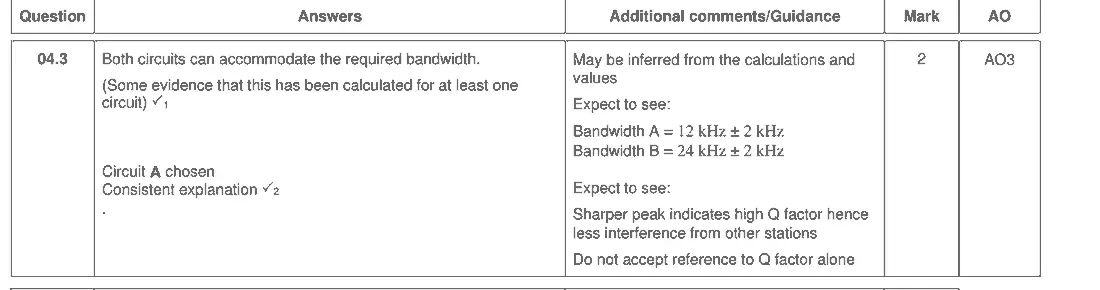
Explain whether circuit A or circuit B is more appropriate for this radio receiver.
Your answer should include a discussion of:
• bandwidth
• the ability of the receiver to reject signals from other radio stations.
[2 marks]
June 2024 · AS Paper 1 · Q1.1 2 marks AO2=2 Explanation classification of particles and quarks
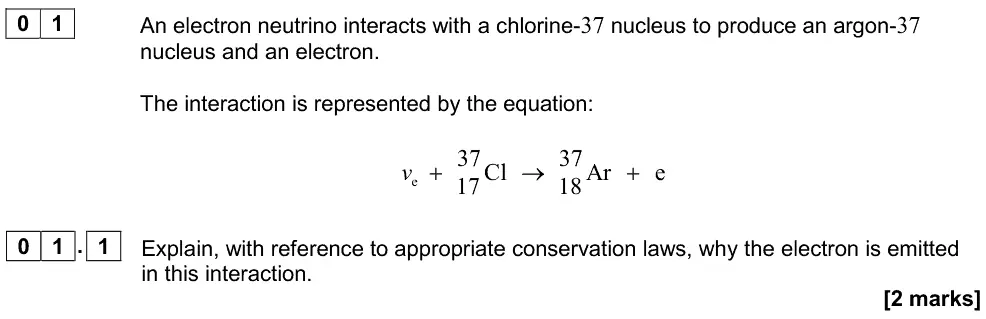
An electron neutrino interacts with a chlorine-37 nucleus to produce an argon-37
nucleus and an electron.
The interaction is represented by the equation:
e
37
37
Cl
Ar       e
17
18
v +
→
+
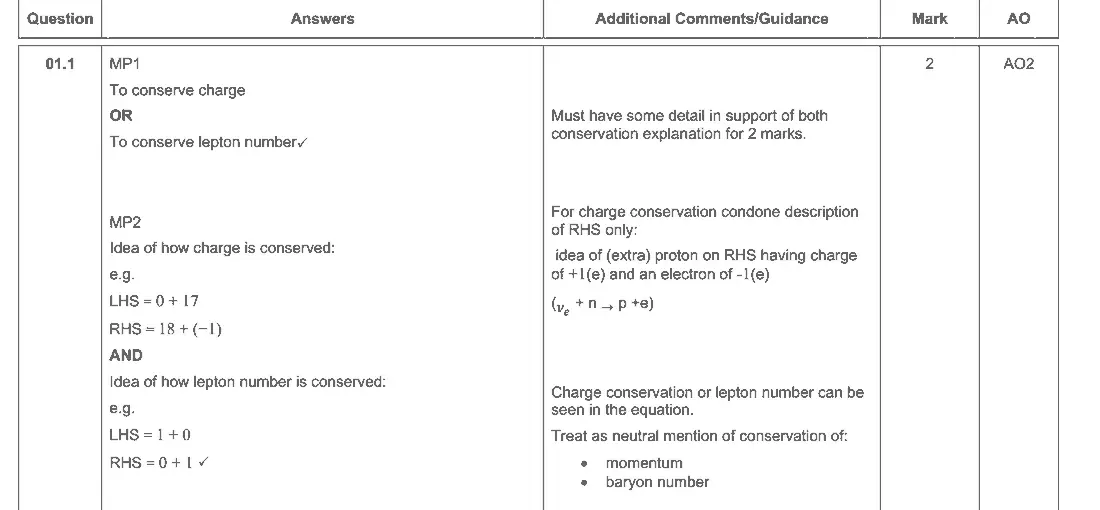
Explain, with reference to appropriate conservation laws, why the electron is emitted
in this interaction.
[2 marks]
June 2024 · AS Paper 1 · Q1.3 4 marks AO3=4 Explanation particles antiparticles and interactionsclassification of particles and quarks
Earlier part of question 1 that this part usesEarlier part of June 2024 Paper 1 question 1
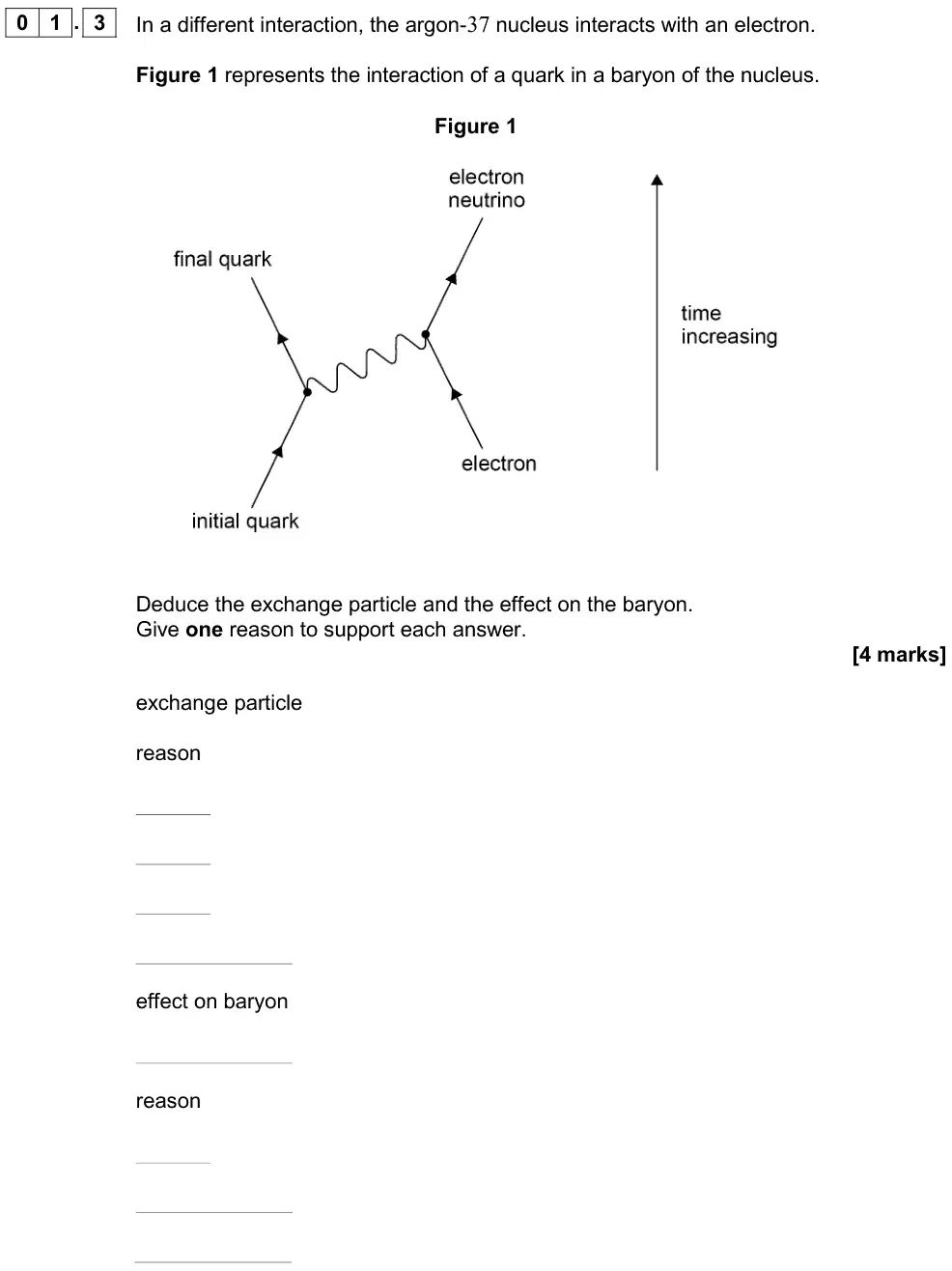
In a different interaction, the argon-37 nucleus interacts with an electron.
Figure 1 represents the interaction of a quark in a baryon of the nucleus.
Figure 1
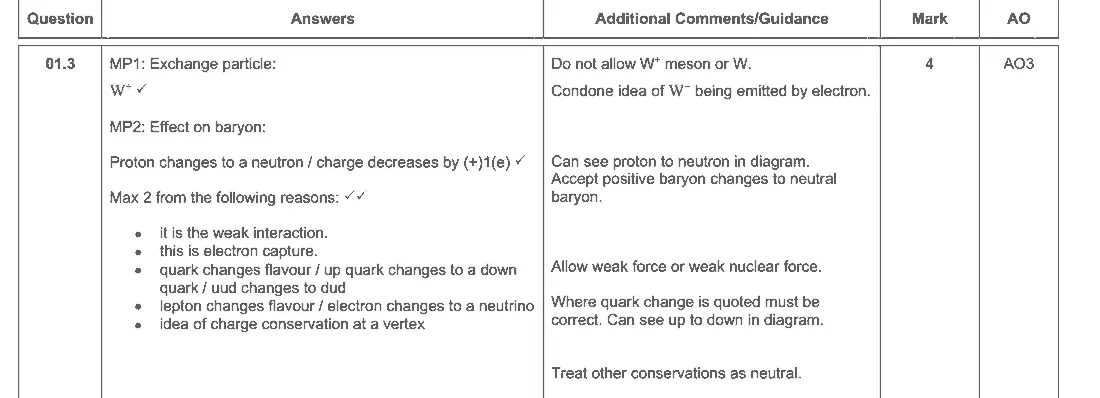
Deduce the exchange particle and the effect on the baryon.
Give one reason to support each answer.
[4 marks]
exchange particle
reason
effect on baryon
reason
June 2024 · AS Paper 1 · Q2.3 4 marks AO2=2, AO3=2 Explanation energy levels and wave particle duality
Earlier part of question 2 that this part usesEarlier part of June 2024 Paper 1 question 2
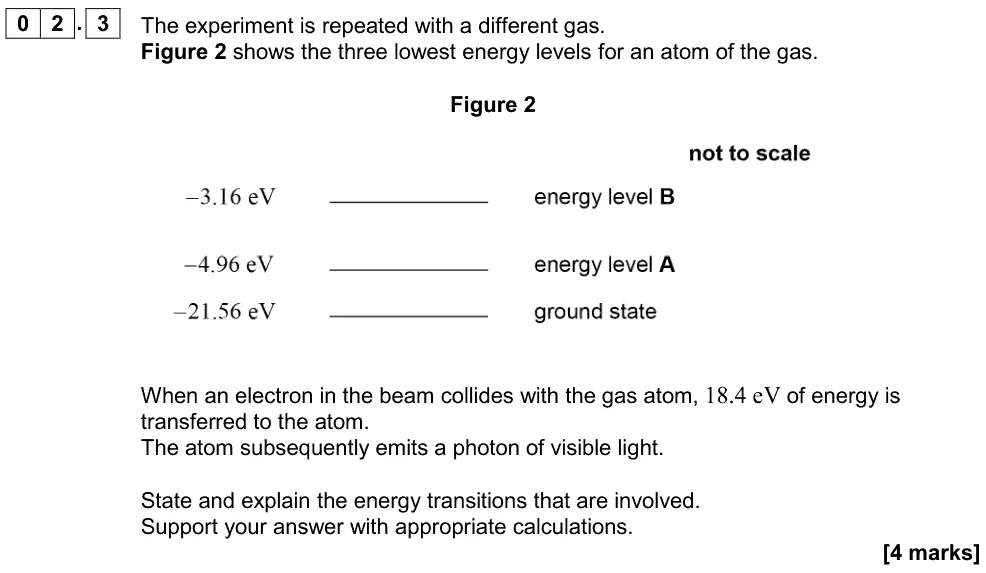
The experiment is repeated with a different gas.
Figure 2 shows the three lowest energy levels for an atom of the gas.
Figure 2
When an electron in the beam collides with the gas atom, 18.4 eV of energy is
transferred to the atom.
The atom subsequently emits a photon of visible light.
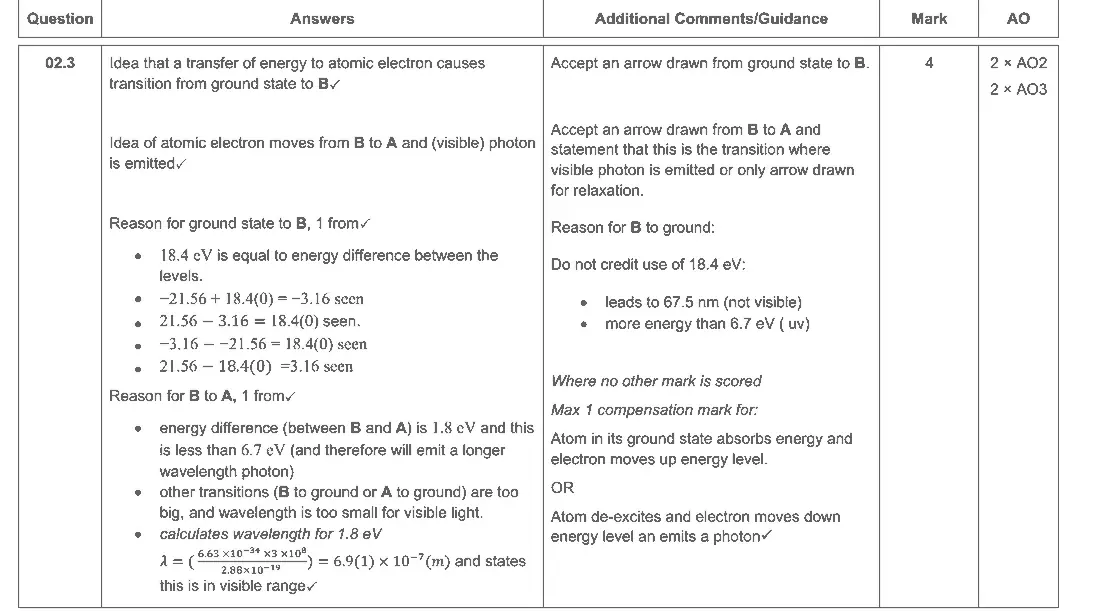
State and explain the energy transitions that are involved.
Support your answer with appropriate calculations.
[4 marks]
June 2024 · AS Paper 1 · Q3.4 3 marks AO3=3 Explanation stationary waves
Earlier part of question 3 that this part usesEarlier part of June 2024 Paper 1 question 3
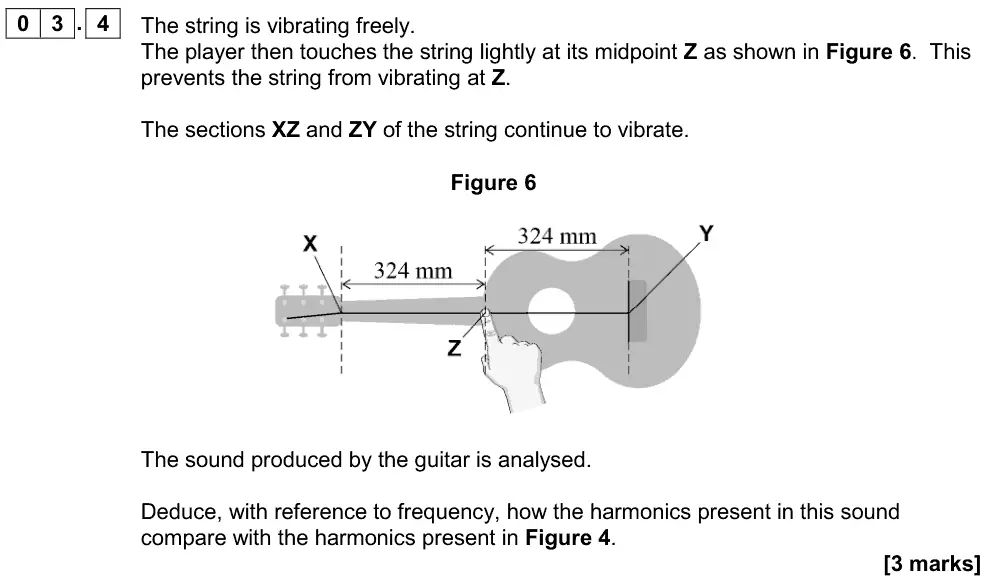
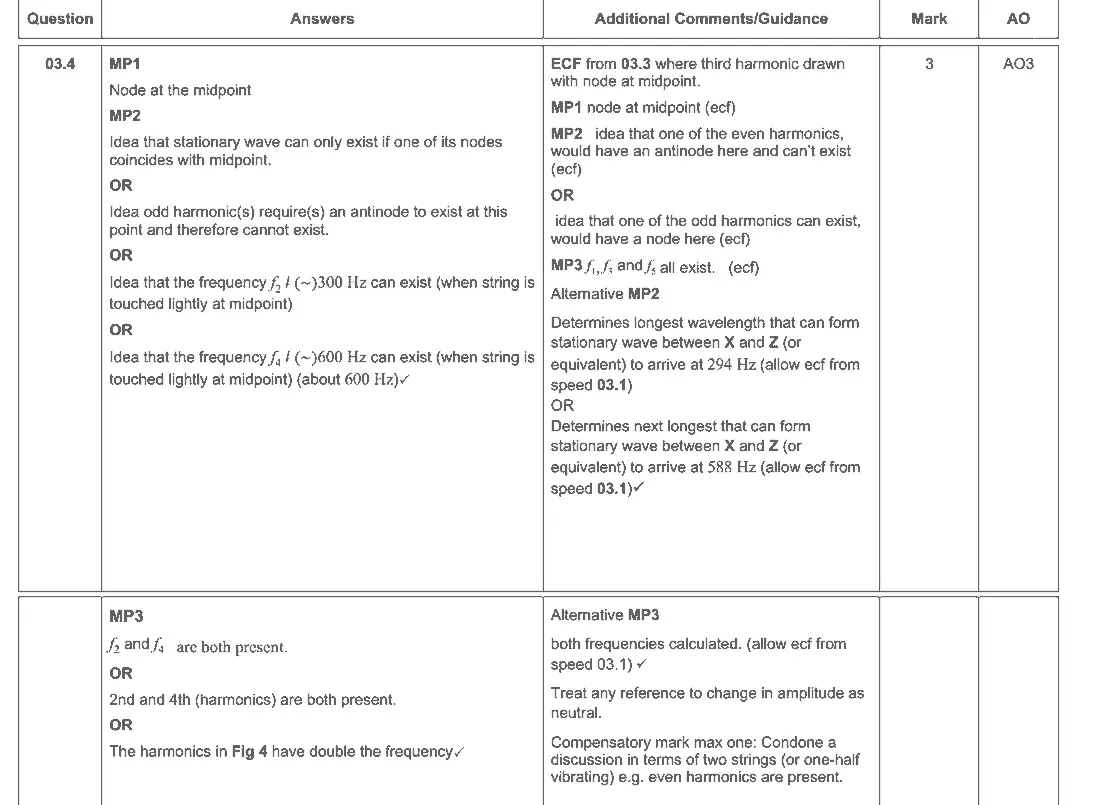
The string is vibrating freely.
The player then touches the string lightly at its midpoint Z as shown in Figure 6.  This
prevents the string from vibrating at Z.
The sections XZ and ZY of the string continue to vibrate.
Figure 6
The sound produced by the guitar is analysed.
Deduce, with reference to frequency, how the harmonics present in this sound
compare with the harmonics present in Figure 4.
[3 marks]
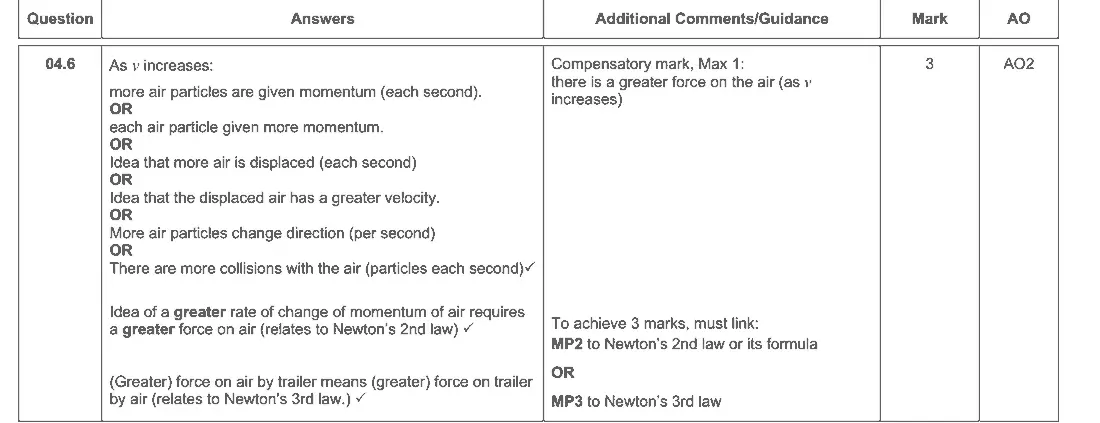
June 2024 · AS Paper 1 · Q4.6 3 marks AO2=3 Explanation newtons laws and momentum
Earlier part of question 4 that this part usesEarlier part of June 2024 Paper 1 question 4
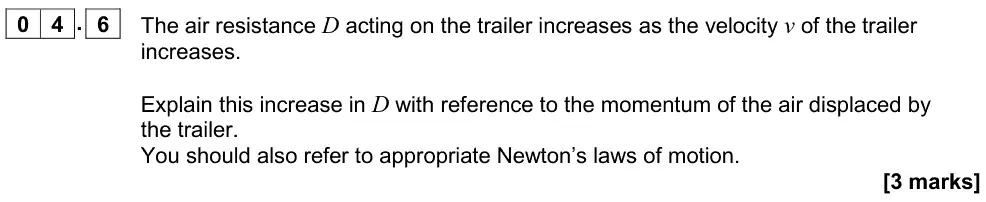
The air resistance D acting on the trailer increases as the velocity v of the trailer
increases.
Explain this increase in D with reference to the momentum of the air displaced by
the trailer.
You should also refer to appropriate Newton’s laws of motion.
[3 marks]
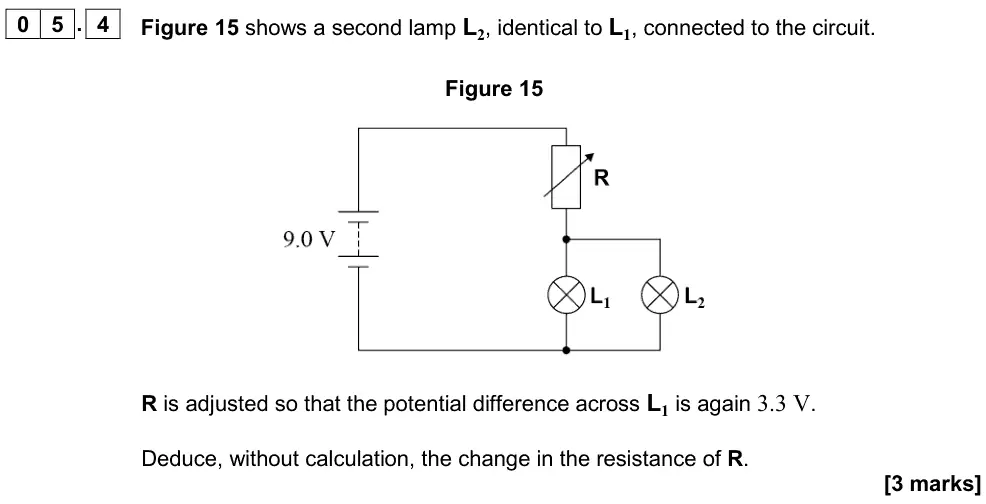
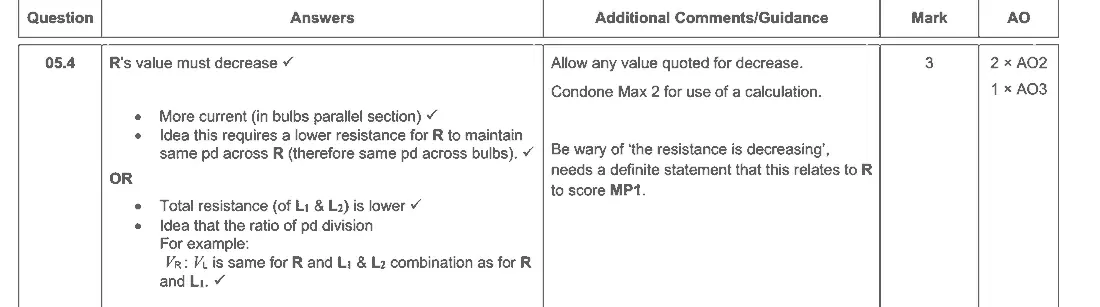
June 2024 · AS Paper 1 · Q5.4 3 marks AO2=2, AO3=1 Explanation circuits and potential dividers
Earlier part of question 5 that this part usesEarlier part of June 2024 Paper 1 question 5
Figure 15 shows a second lamp L2, identical to L1, connected to the circuit.
Figure 15
R is adjusted so that the potential difference across L1 is again 3.3 V.
Deduce, without calculation, the change in the resistance of R.
[3 marks]
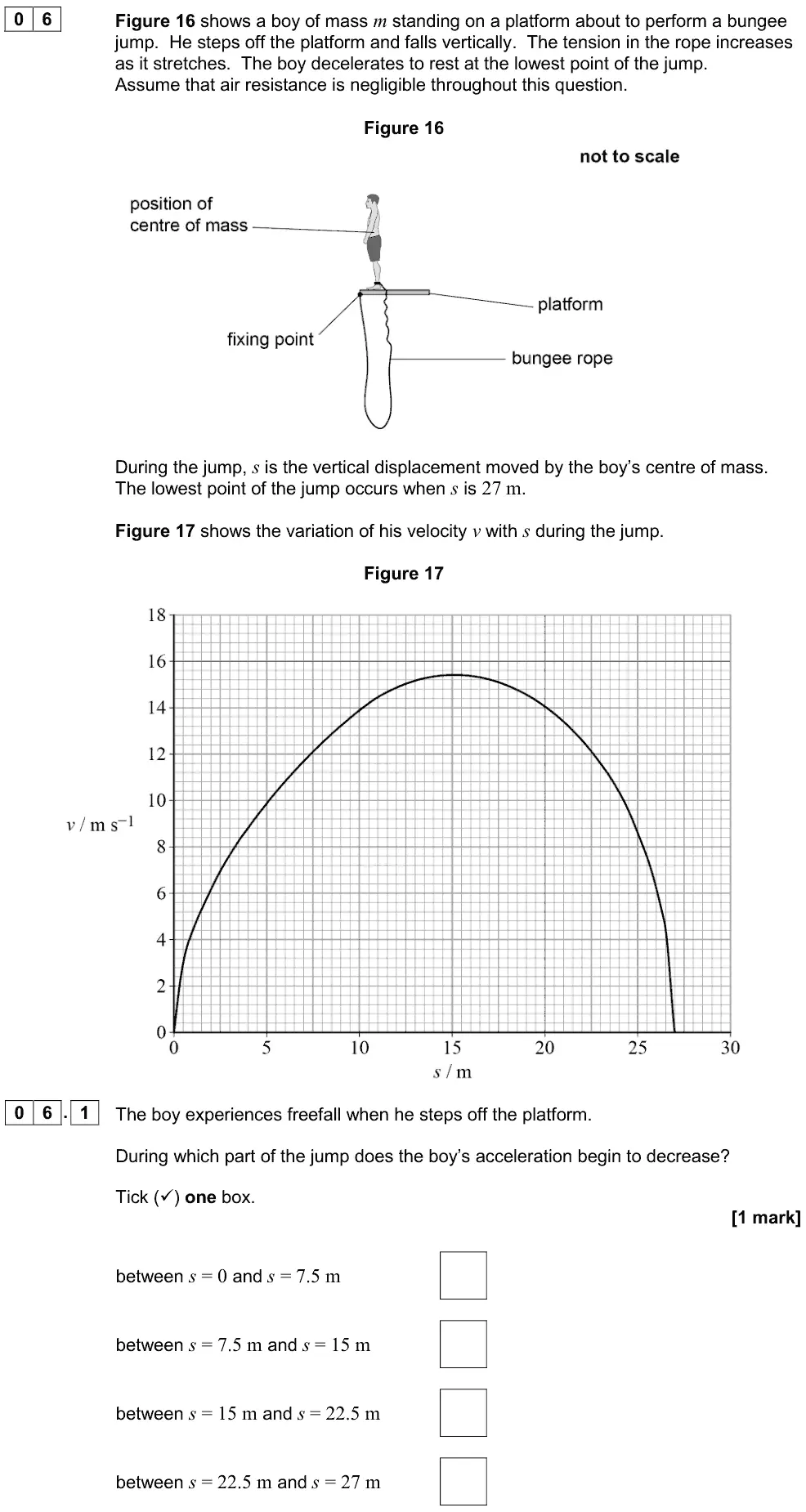
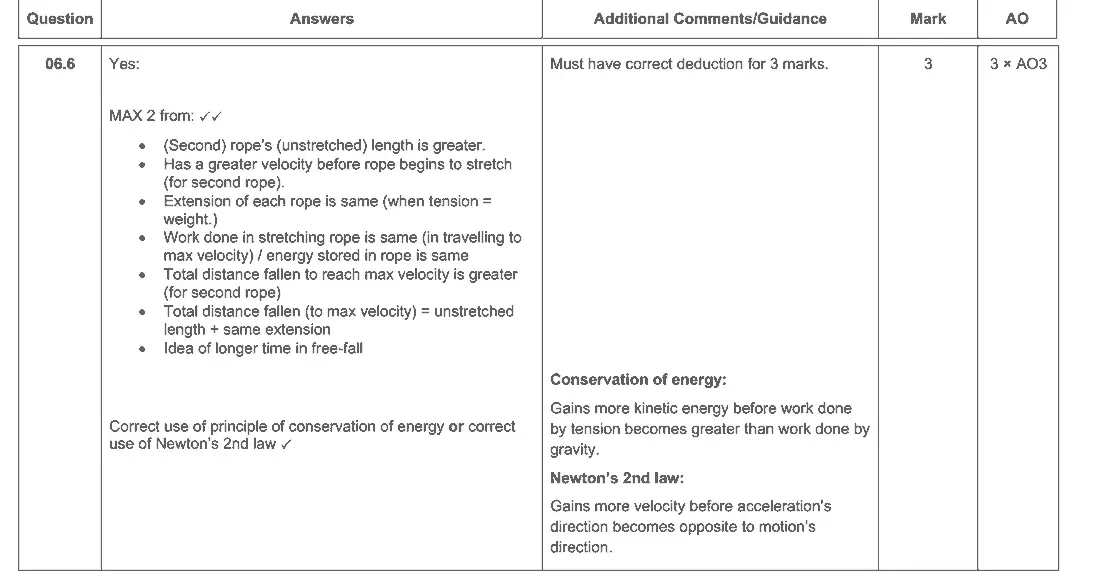
June 2024 · AS Paper 1 · Q6.6 3 marks AO3=3 Explanation materials and young moduluswork energy and power
Earlier part of question 6 that this part usesEarlier part of June 2024 Paper 1 question 6
Deduce whether the boy’s maximum velocity is increased when using the
second rope.
[3 marks]
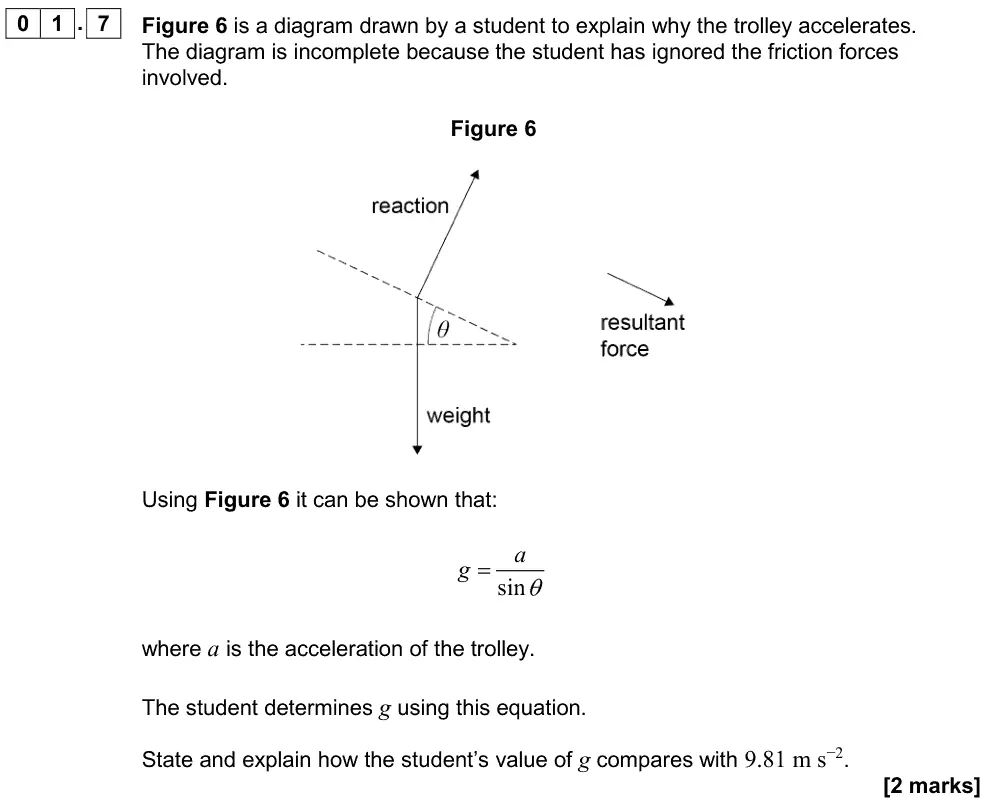
June 2024 · AS Paper 2 · Q1.7 2 marks AO3=2 Explanation newtons laws and momentumvectors and moments
Earlier part of question 1 that this part usesEarlier part of June 2024 Paper 2 question 1
Figure 6 is a diagram drawn by a student to explain why the trolley accelerates.
The diagram is incomplete because the student has ignored the friction forces
involved.
Figure 6
Using Figure 6 it can be shown that:
sin
a
g =
where a is the acceleration of the trolley.
The student determines g using this equation.
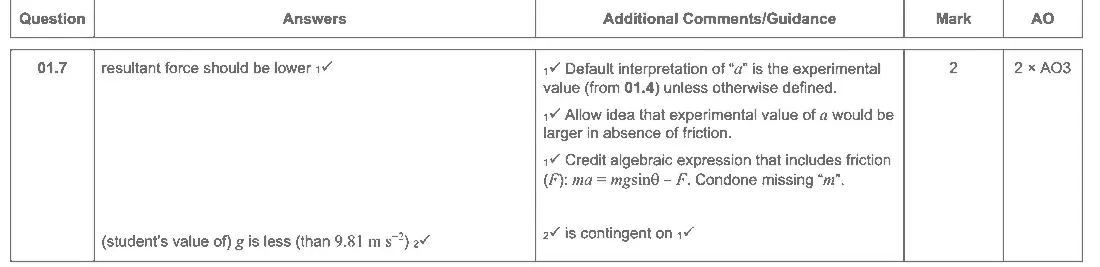
State and explain how the student’s value of g compares with 9.81 m s−2.
[2 marks]
June 2024 · AS Paper 2 · Q2.3 2 marks AO3=2 Explanation measurements and uncertainties
Earlier part of question 2 that this part usesEarlier part of June 2024 Paper 2 question 2
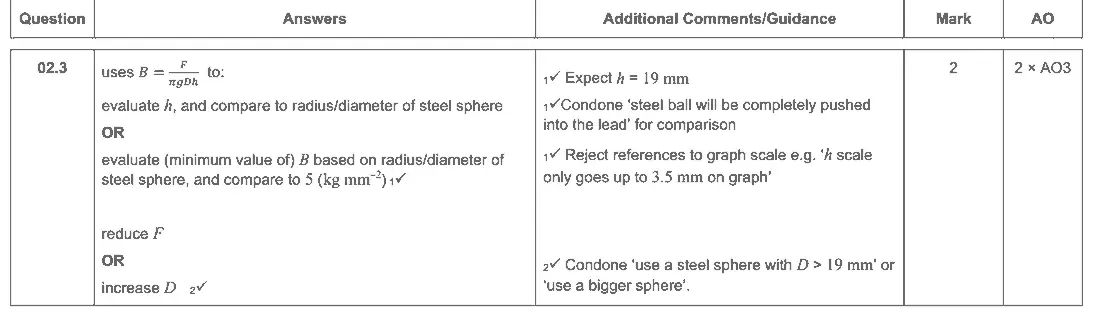
B for lead is about 5 kg mm−2.
Show that this result cannot be obtained with the steel sphere and the value of F used
to produce Figure 9.
Go on to suggest how the test can be modified to determine B for lead.
[2 marks]
June 2024 · AS Paper 2 · Q3.3 2 marks AO3=2 Explanation materials and young modulus
Earlier part of question 3 that this part usesEarlier part of June 2024 Paper 2 question 3
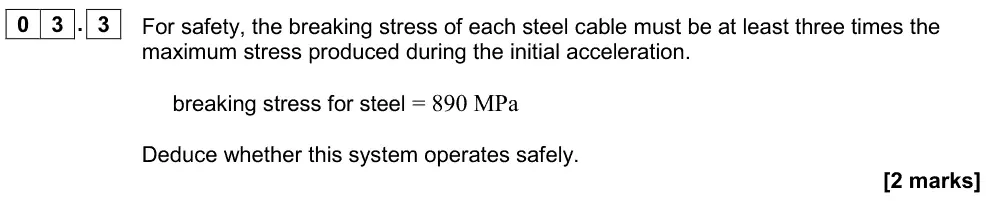
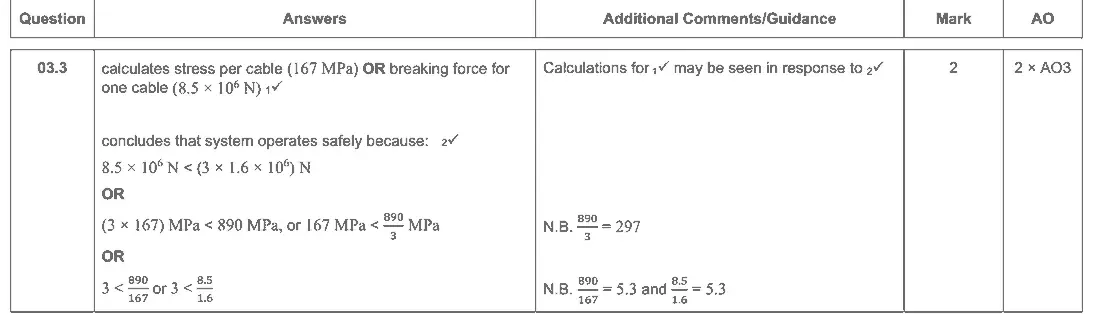
For safety, the breaking stress of each steel cable must be at least three times the
maximum stress produced during the initial acceleration.
breaking stress for steel = 890 MPa
Deduce whether this system operates safely.
[2 marks]
June 2024 · AS Paper 2 · Q4.1 3 marks AO2=2, AO3=1 Explanation interference and diffractionprogressive waves and polarisation
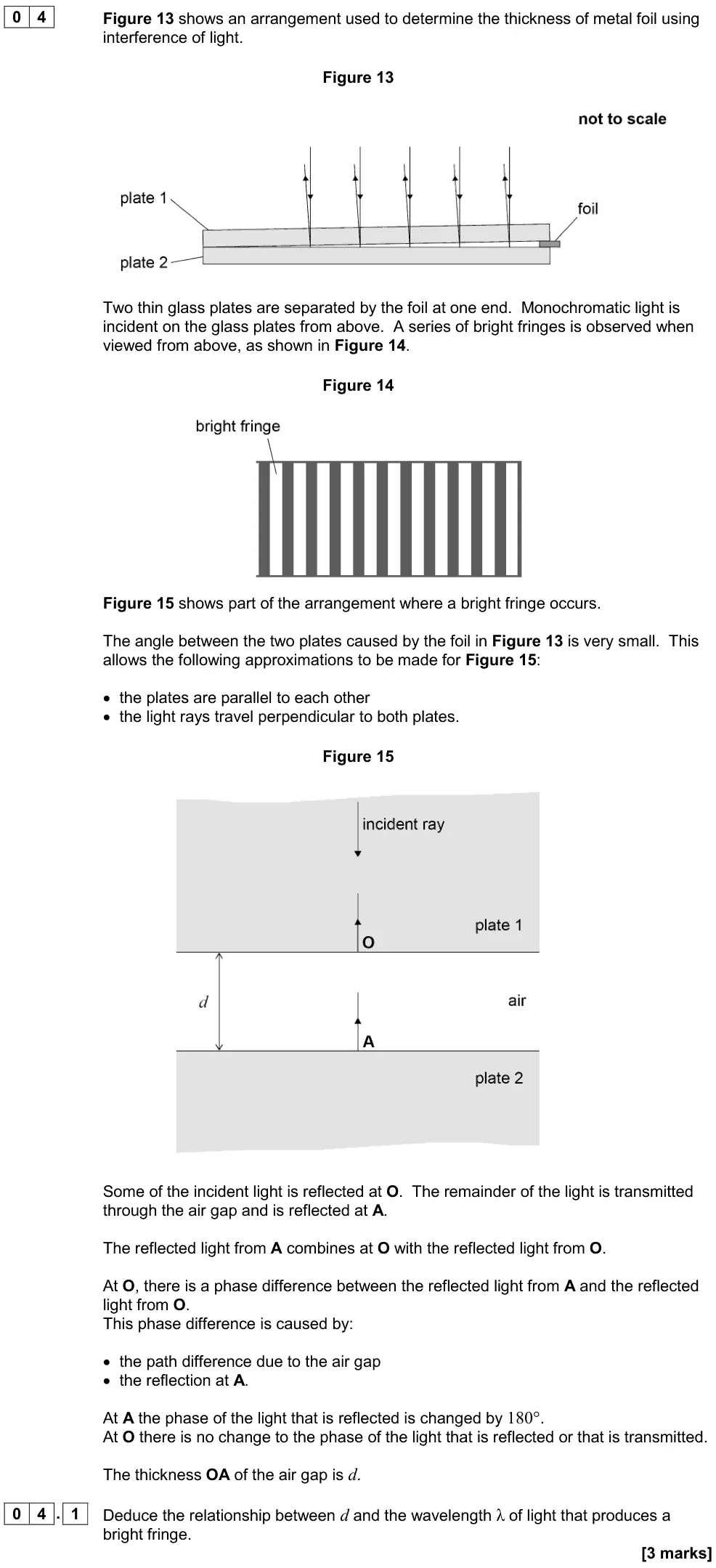
Figure 13 shows an arrangement used to determine the thickness of metal foil using
interference of light.
Figure 13
Two thin glass plates are separated by the foil at one end.  Monochromatic light is
incident on the glass plates from above.  A series of bright fringes is observed when
viewed from above, as shown in Figure 14.
Figure 14
Figure 15 shows part of the arrangement where a bright fringe occurs.
The angle between the two plates caused by the foil in Figure 13 is very small.  This
allows the following approximations to be made for Figure 15:
• the plates are parallel to each other
• the light rays travel perpendicular to both plates.
Figure 15
Some of the incident light is reflected at O.  The remainder of the light is transmitted
through the air gap and is reflected at A.
The reflected light from A combines at O with the reflected light from O.
At O, there is a phase difference between the reflected light from A and the reflected
light from O.
This phase difference is caused by:
• the path difference due to the air gap
• the reflection at A.
At A the phase of the light that is reflected is changed by 180°.
At O there is no change to the phase of the light that is reflected or that is transmitted.
The thickness OA of the air gap is d.
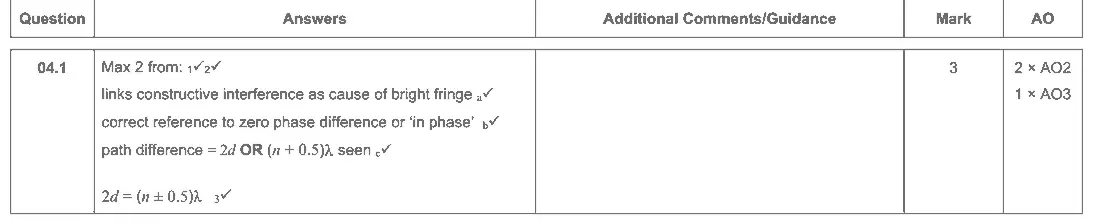
Deduce the relationship between d and the wavelength λ of light that produces a
bright fringe.
[3 marks]
June 2024 · AS Paper 2 · Q4.3 3 marks AO1=1, AO2=1, AO3=1 Explanation refraction and optical fibresprogressive waves and polarisation
Earlier part of question 4 that this part usesEarlier part of June 2024 Paper 2 question 4
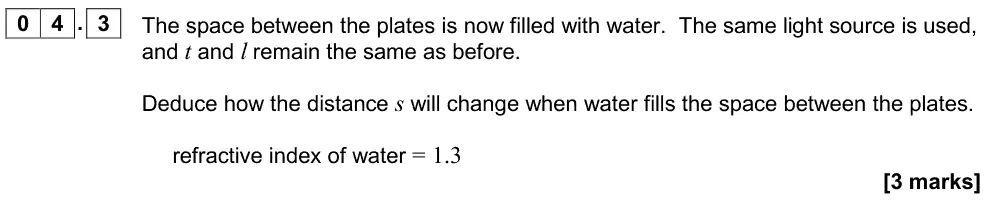
The space between the plates is now filled with water.  The same light source is used,
and t and l remain the same as before.
Deduce how the distance s will change when water fills the space between the plates.
refractive index of water = 1.3
[3 marks]
June 2024 · Paper 1 · Q1.3 2 marks AO1=2 Explanation particles antiparticles and interactions
Earlier part of question 1 that this part usesEarlier part of June 2024 Paper 1 question 1
Explain which of the fundamental interactions is responsible for the decay of the
neutron.
[2 marks]
June 2024 · Paper 1 · Q1.4 3 marks AO1=3 Explanation particles antiparticles and interactions
Earlier part of question 1 that this part usesEarlier part of June 2024 Paper 1 question 1
The forces between two moving electrons cause their paths to change.
Explain, using the concept of exchange particles, why the electron paths change.
[3 marks]
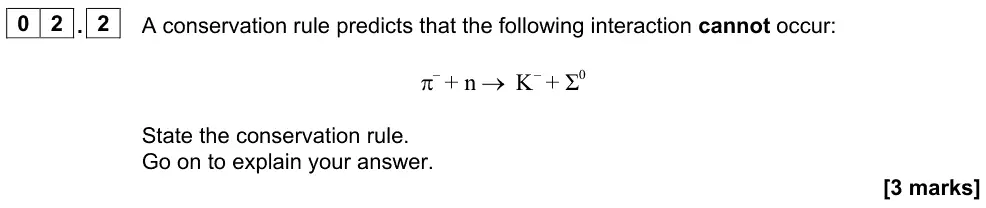
June 2024 · Paper 1 · Q2.2 3 marks AO3=3 Explanation classification of particles and quarks
Earlier part of question 2 that this part usesEarlier part of June 2024 Paper 1 question 2
A conservation rule predicts that the following interaction cannot occur:
0
+ n
Σ
+
−
−
π
→Κ
State the conservation rule.
Go on to explain your answer.
[3 marks]
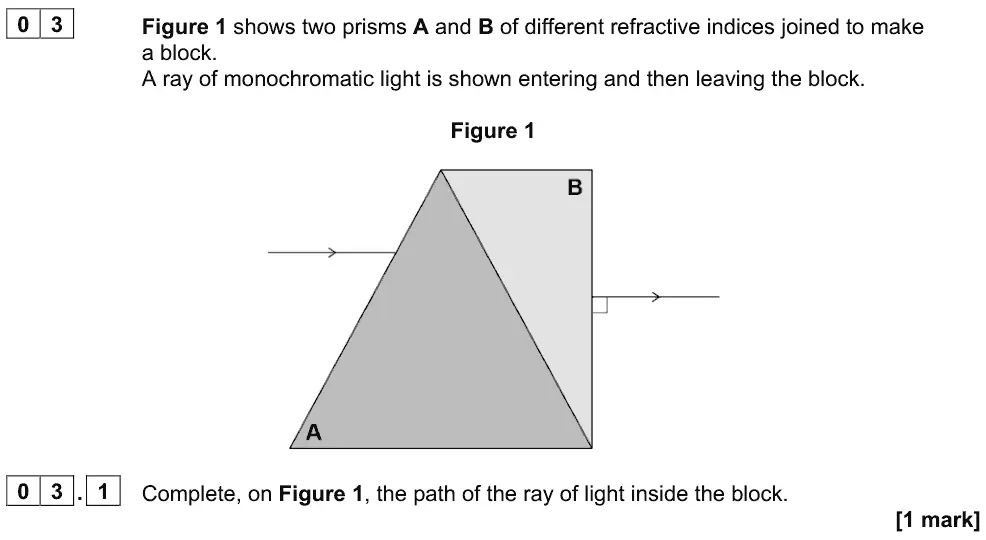
June 2024 · Paper 1 · Q3.2 2 marks AO3=2 Explanation refraction and optical fibres
Earlier part of question 3 that this part usesEarlier part of June 2024 Paper 1 question 3
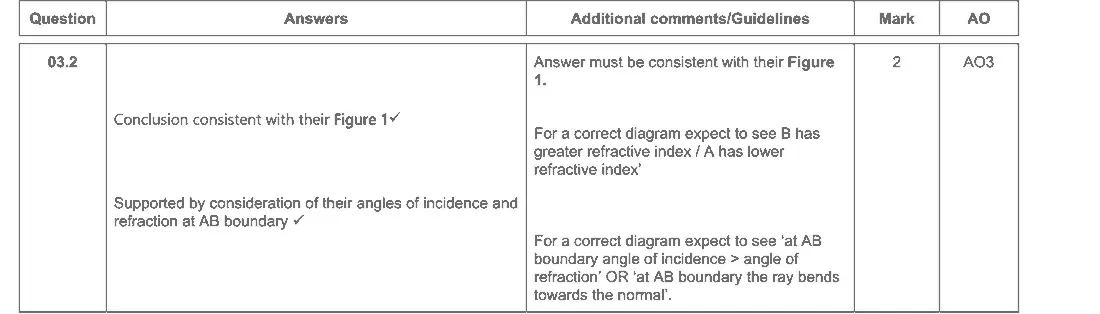
Deduce which prism, A or B, has the greater refractive index.
[2 marks]
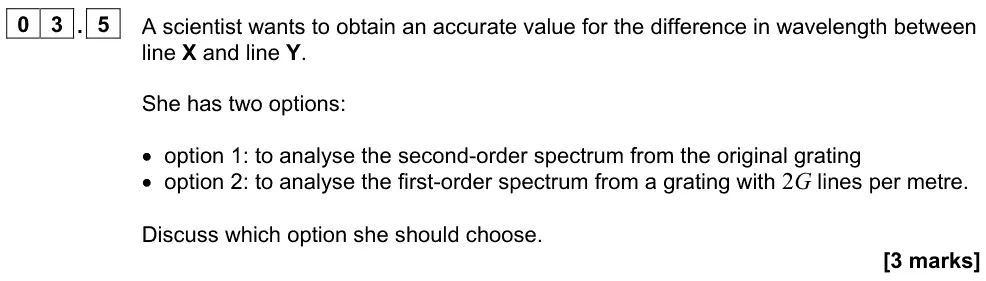
June 2024 · Paper 1 · Q3.5 3 marks AO3=3 Explanation interference and diffraction
Earlier part of question 3 that this part usesEarlier part of June 2024 Paper 1 question 3
A scientist wants to obtain an accurate value for the difference in wavelength between
line X and line Y.
She has two options:
• option 1: to analyse the second-order spectrum from the original grating
• option 2: to analyse the first-order spectrum from a grating with 2G lines per metre.
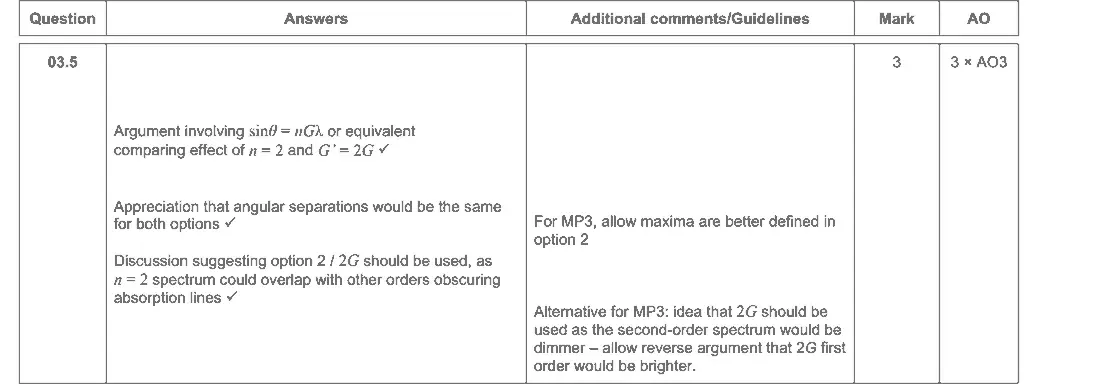
Discuss which option she should choose.
[3 marks]
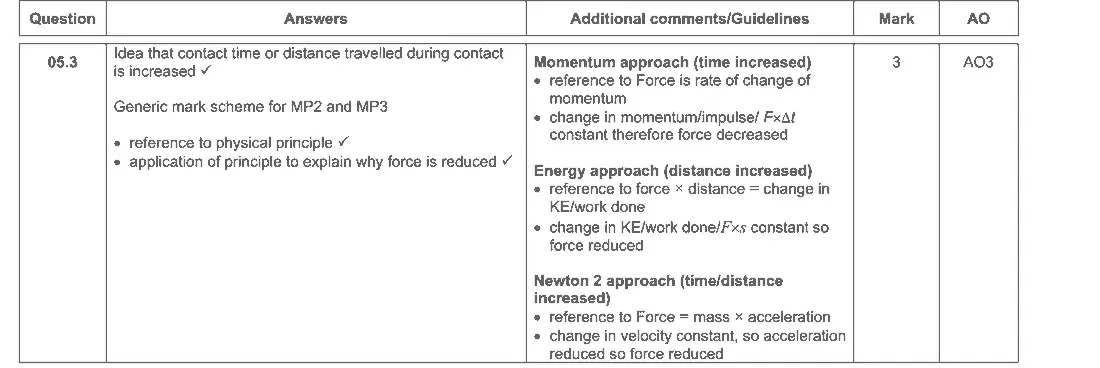
June 2024 · Paper 1 · Q5.3 3 marks AO3=3 Explanation newtons laws and momentum
Earlier part of question 5 that this part usesEarlier part of June 2024 Paper 1 question 5
O contains a fragile item packed in suitable material.
Explain how the material can prevent damage to the fragile item when O stops
suddenly at B.
[3 marks]
June 2024 · Paper 1 · Q6.3 2 marks AO3=2 Explanation current voltage and resistivity
Earlier part of question 6 that this part usesEarlier part of June 2024 Paper 1 question 6
Explain why the current in the thermistor needs to be controlled.
[2 marks]
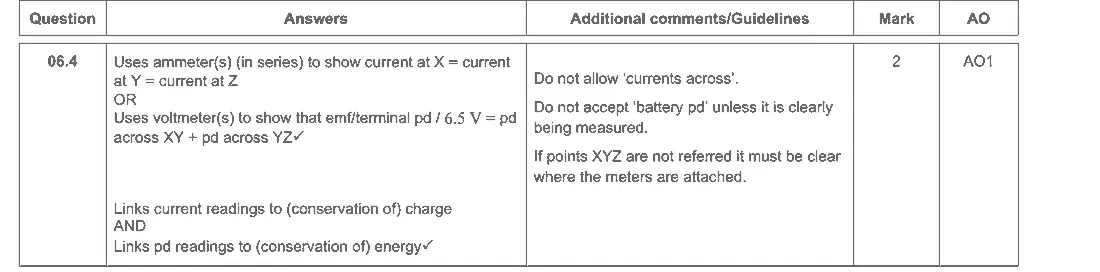
June 2024 · Paper 1 · Q6.4 2 marks AO1=2 Explanation circuits and potential dividers
Earlier part of question 6 that this part usesEarlier part of June 2024 Paper 1 question 6
Explain how ammeters and voltmeters can be used in the circuit in Figure 5 to
demonstrate the conservation of charge and the conservation of energy.
Refer to points X, Y and Z in your answer.
[2 marks]
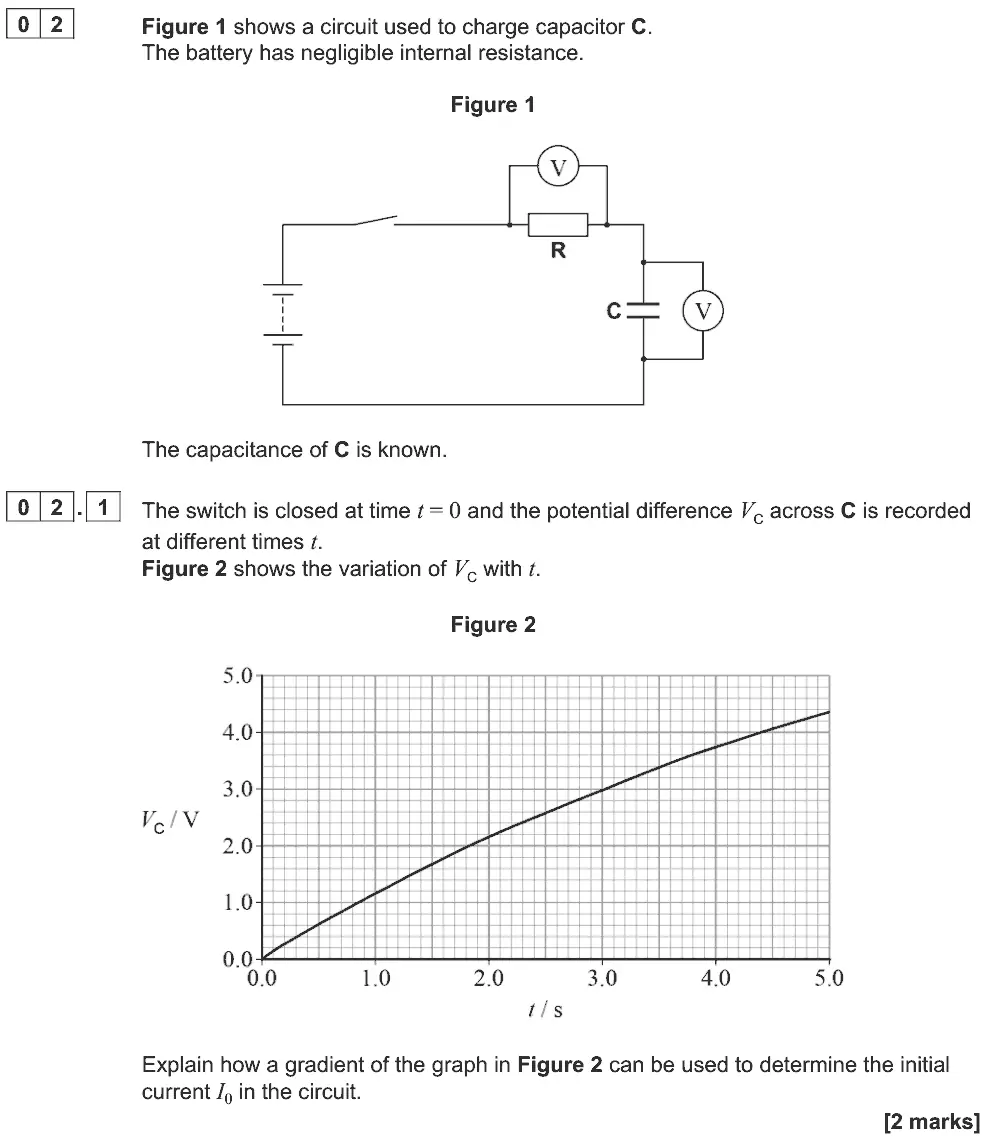
June 2024 · Paper 2 · Q2.1 2 marks AO2=2 Explanation capacitors
Figure 1 shows a circuit used to charge capacitor C.
The battery has negligible internal resistance.
Figure 1
The capacitance of C is known.
The switch is closed at time t = 0 and the potential difference VC across C is recorded
at different times t.
Figure 2 shows the variation of VC with t.
Figure 2
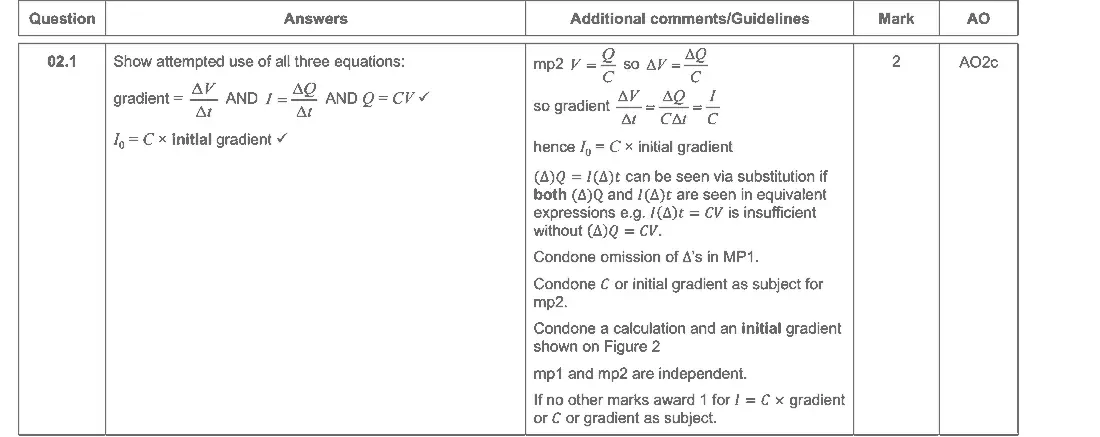
Explain how a gradient of the graph in Figure 2 can be used to determine the initial
current I0 in the circuit.
[2 marks]
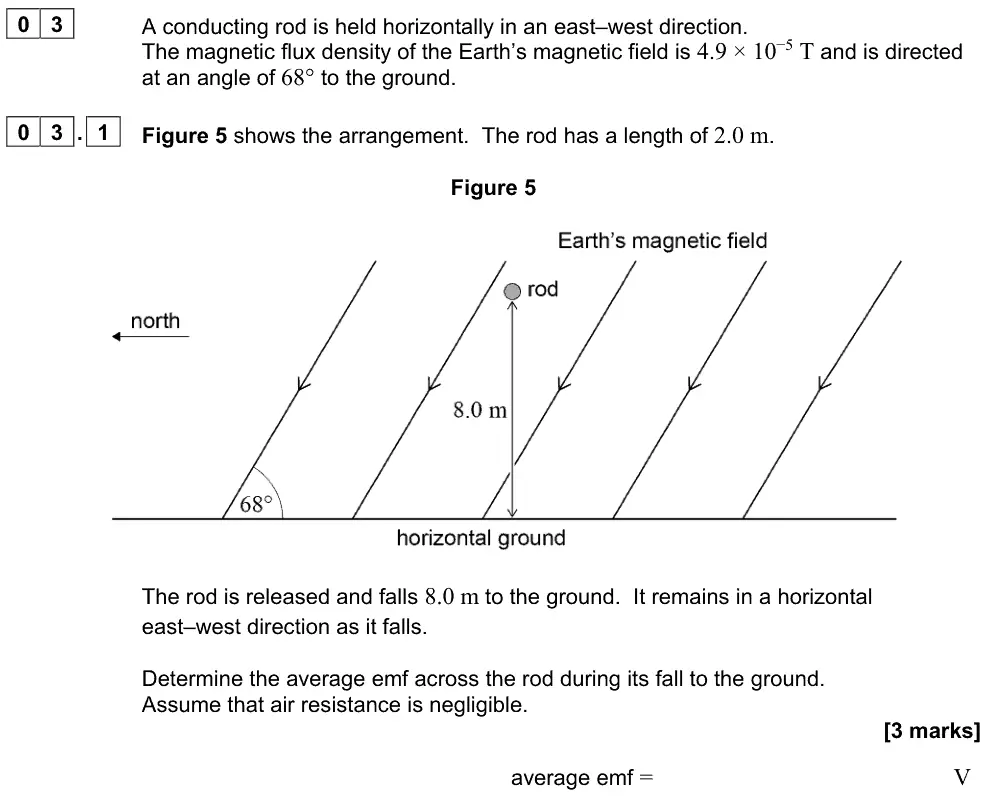
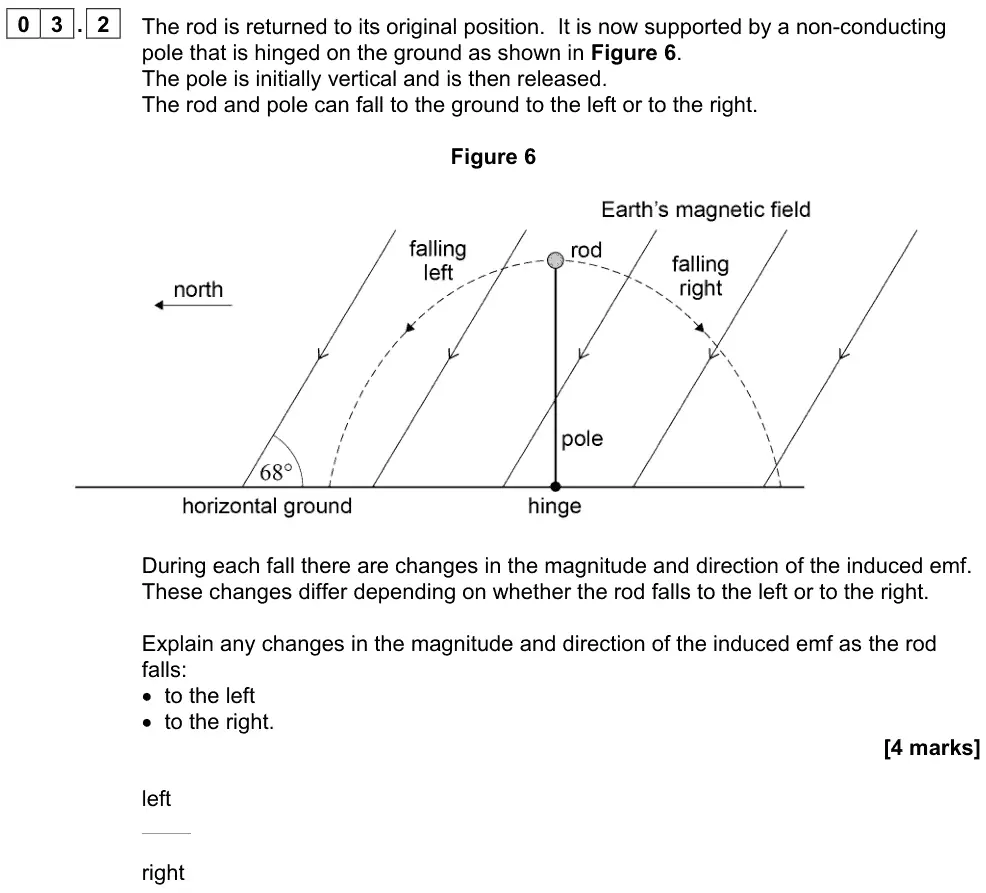
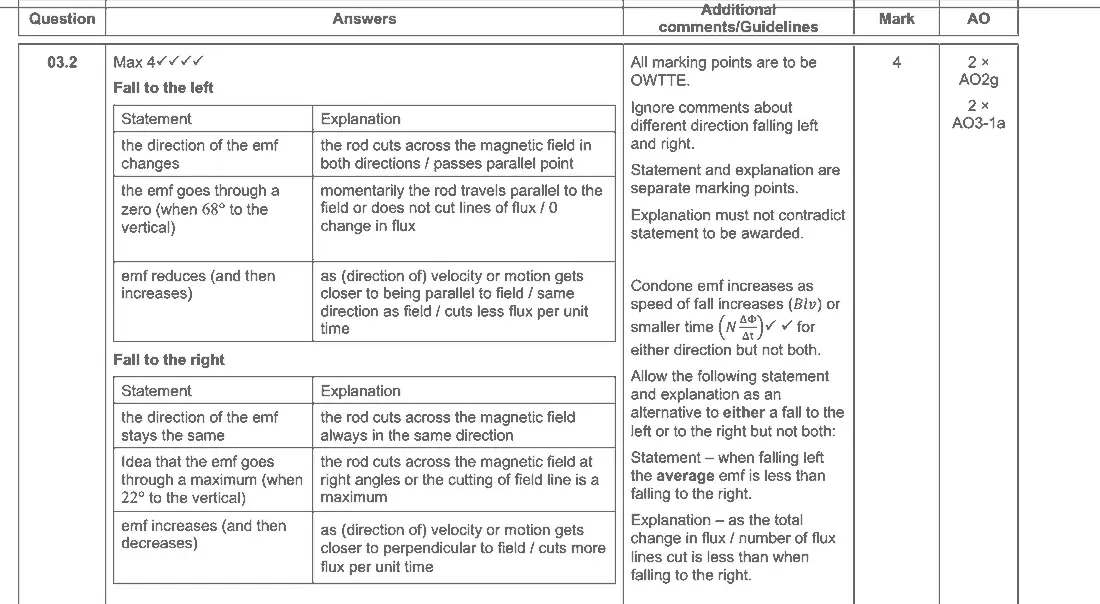
June 2024 · Paper 2 · Q3.2 4 marks AO2=2, AO3=2 Explanation electromagnetic induction
Earlier part of question 3 that this part usesEarlier part of June 2024 Paper 2 question 3
The rod is returned to its original position.  It is now supported by a non-conducting
pole that is hinged on the ground as shown in Figure 6.
The pole is initially vertical and is then released.
The rod and pole can fall to the ground to the left or to the right.
Figure 6
During each fall there are changes in the magnitude and direction of the induced emf.
These changes differ depending on whether the rod falls to the left or to the right.
Explain any changes in the magnitude and direction of the induced emf as the rod
falls:
• to the left
• to the right.
[4 marks]
left
right
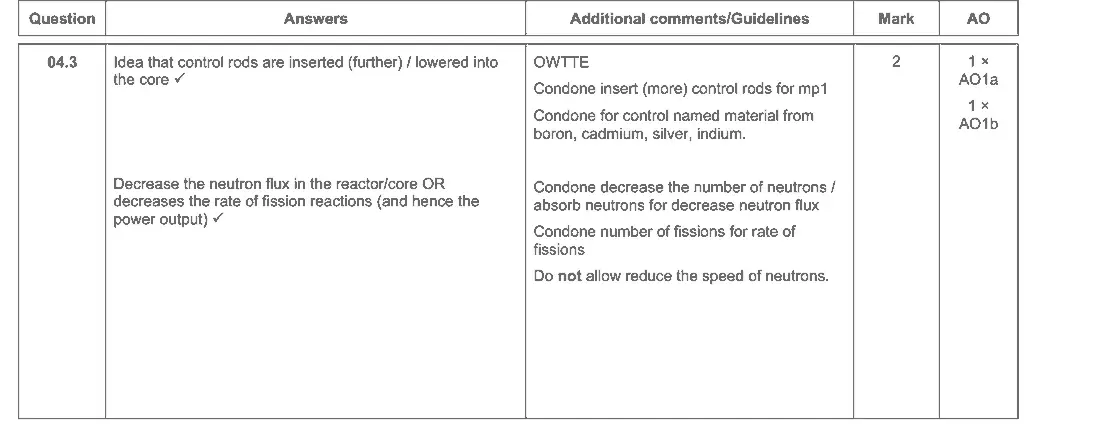
June 2024 · Paper 2 · Q4.3 2 marks AO1=2 Explanation mass energy and fission
Earlier part of question 4 that this part usesEarlier part of June 2024 Paper 2 question 4
Explain how the power output of a thermal nuclear reactor is decreased.
[2 marks]
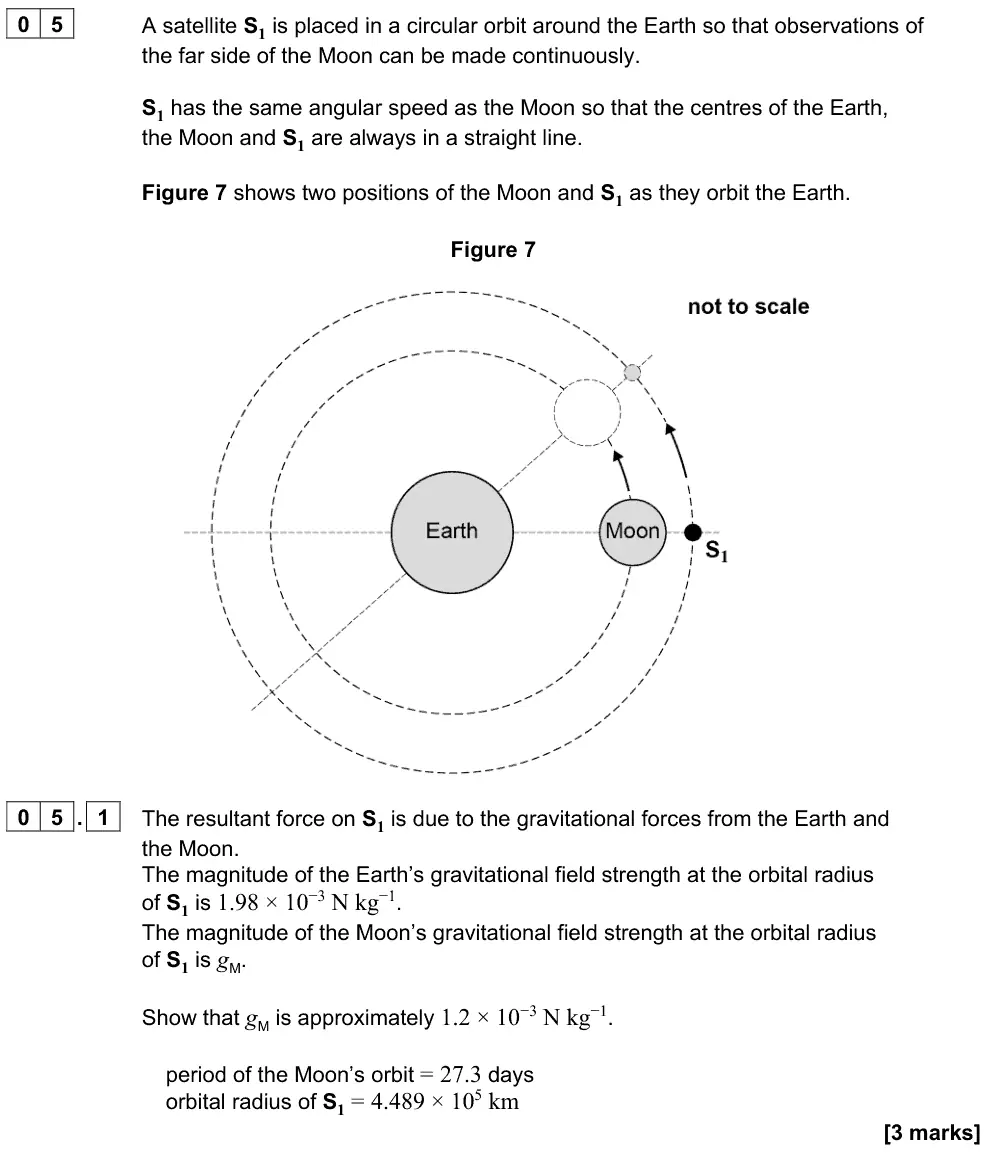
June 2024 · Paper 2 · Q5.3 3 marks AO2=3 Explanation gravitational fieldscircular motion
Earlier part of question 5 that this part usesEarlier part of June 2024 Paper 2 question 5
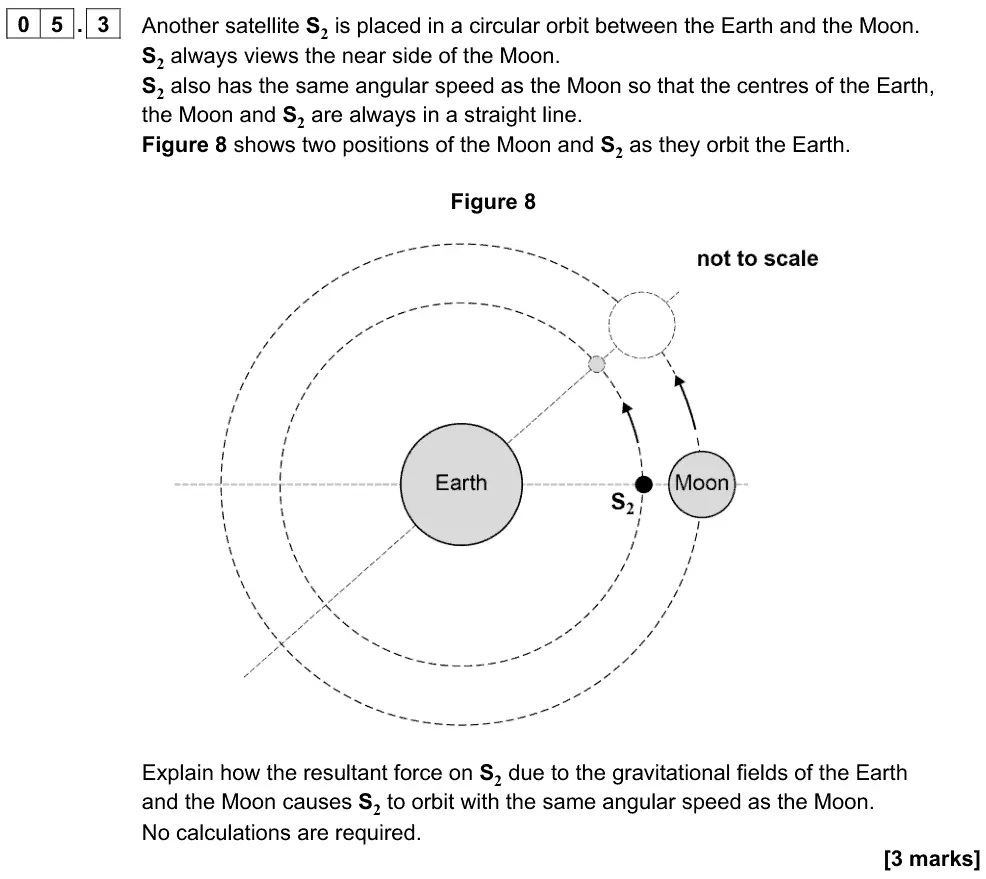
Another satellite S2 is placed in a circular orbit between the Earth and the Moon.
S2 always views the near side of the Moon.
S2 also has the same angular speed as the Moon so that the centres of the Earth,
the Moon and S2 are always in a straight line.
Figure 8 shows two positions of the Moon and S2 as they orbit the Earth.
Figure 8
Explain how the resultant force on S2 due to the gravitational fields of the Earth
and the Moon causes S2 to orbit with the same angular speed as the Moon.
No calculations are required.
[3 marks]
June 2024 · Paper 2 · Q6.1 3 marks AO1=3 Explanation electric fields
The electric potential at a point in an electric field is −4.0 V.
Explain what is meant by this statement.
[3 marks]
June 2024 · Paper 2 · Q6.4 3 marks AO3=3 Explanation electric fields
Earlier part of question 6 that this part usesEarlier part of June 2024 Paper 2 question 6
One of the confined electrons is at x = 350 nm.
Discuss the subsequent motion of this electron due to the variation in electric potential
shown in Figure 9.
Assume that the electron starts from rest.
[3 marks]
June 2024 · Paper 2 · Q7.3 2 marks AO1=1, AO3=1 Explanation rutherford scattering and radiationmass energy and fission
Earlier part of question 7 that this part usesEarlier part of June 2024 Paper 2 question 7
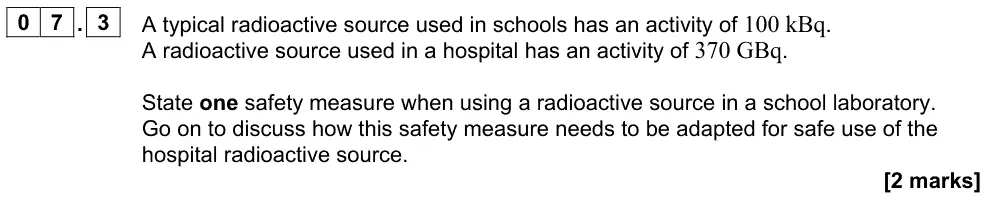
A typical radioactive source used in schools has an activity of 100 kBq.
A radioactive source used in a hospital has an activity of 370 GBq.
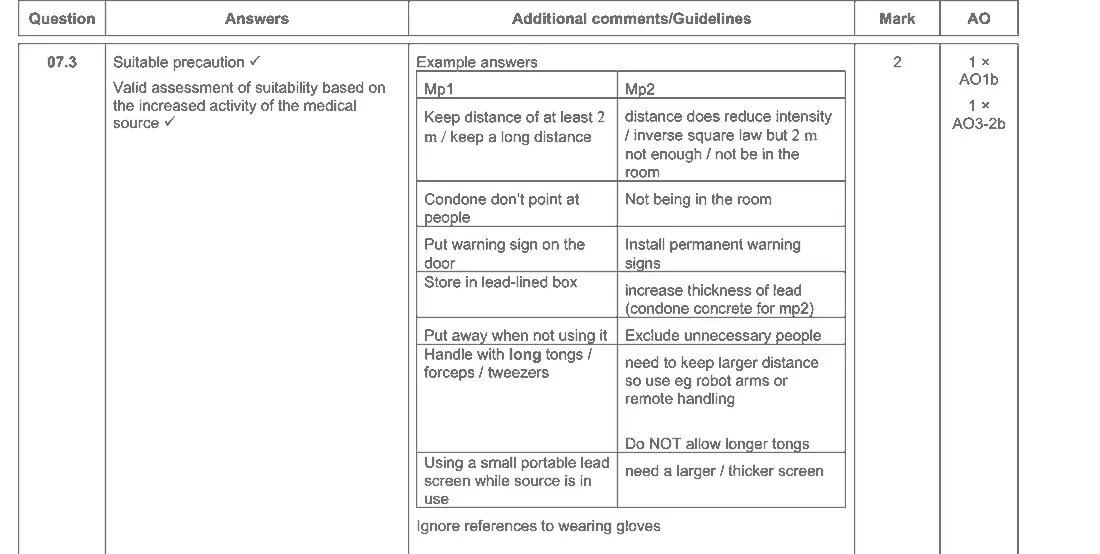
State one safety measure when using a radioactive source in a school laboratory.
Go on to discuss how this safety measure needs to be adapted for safe use of the
hospital radioactive source.
[2 marks]
June 2024 · Paper 2 · Q7.4 2 marks AO1=2 Explanation rutherford scattering and radiation
Earlier part of question 7 that this part usesEarlier part of June 2024 Paper 2 question 7
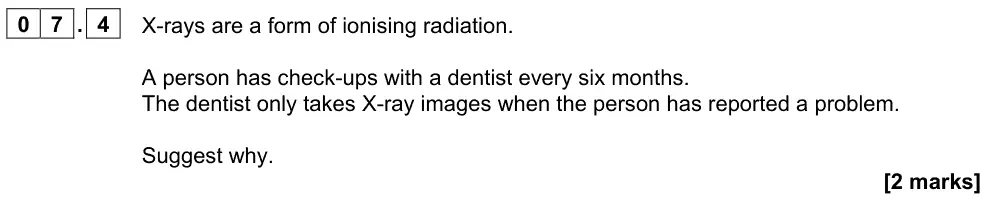
X-rays are a form of ionising radiation.
A person has check-ups with a dentist every six months.
The dentist only takes X-ray images when the person has reported a problem.
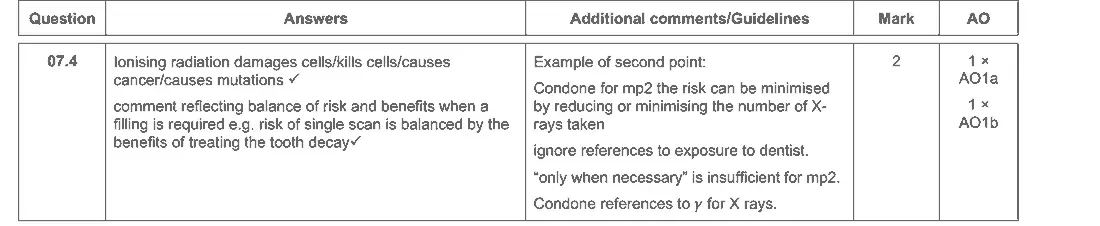
Suggest why.
[2 marks]
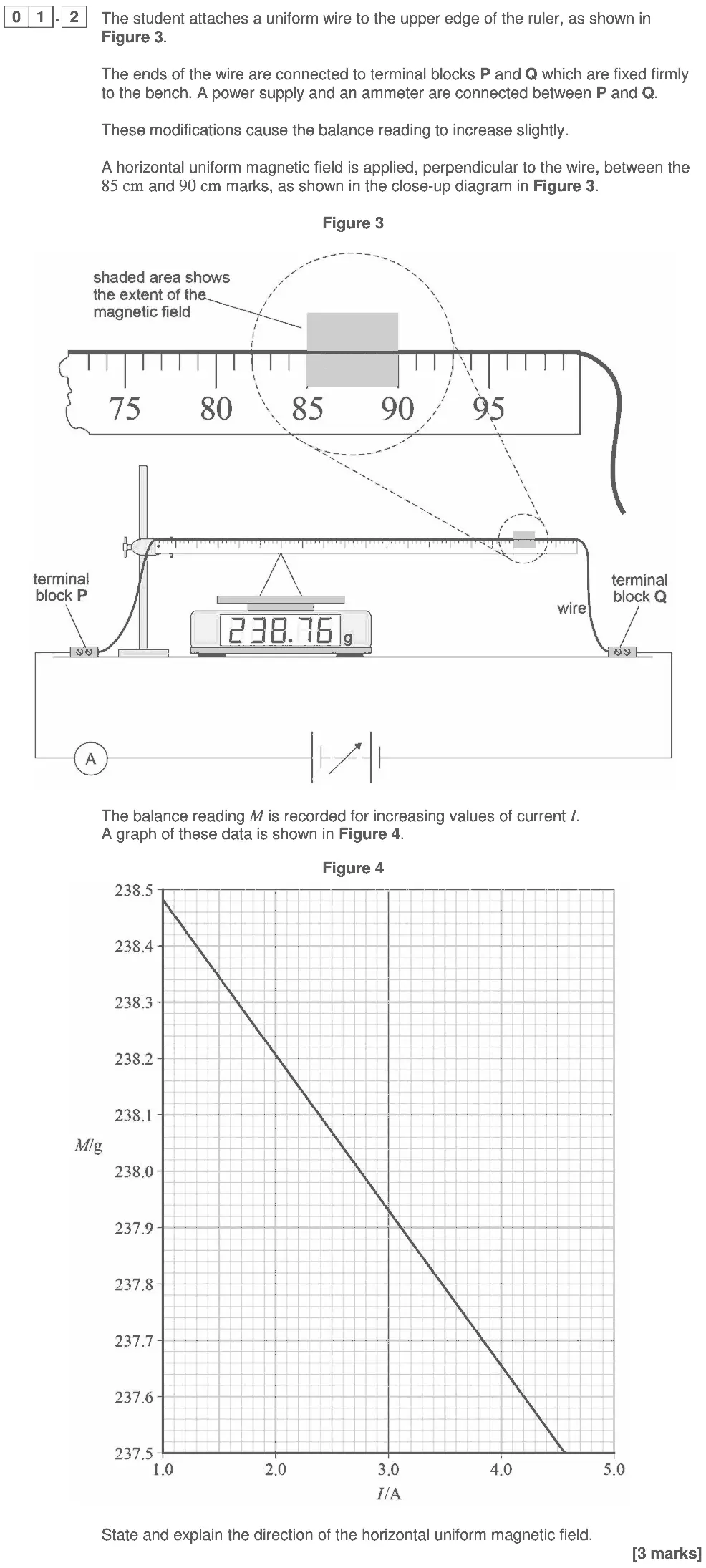
June 2024 · Paper 3 Section A · Q3.2 3 marks AO1=1, AO3=2 Explanation magnetic fieldsnewtons laws and momentum
Earlier part of question 3 that this part usesEarlier part of June 2024 Paper 3 Section A question 3
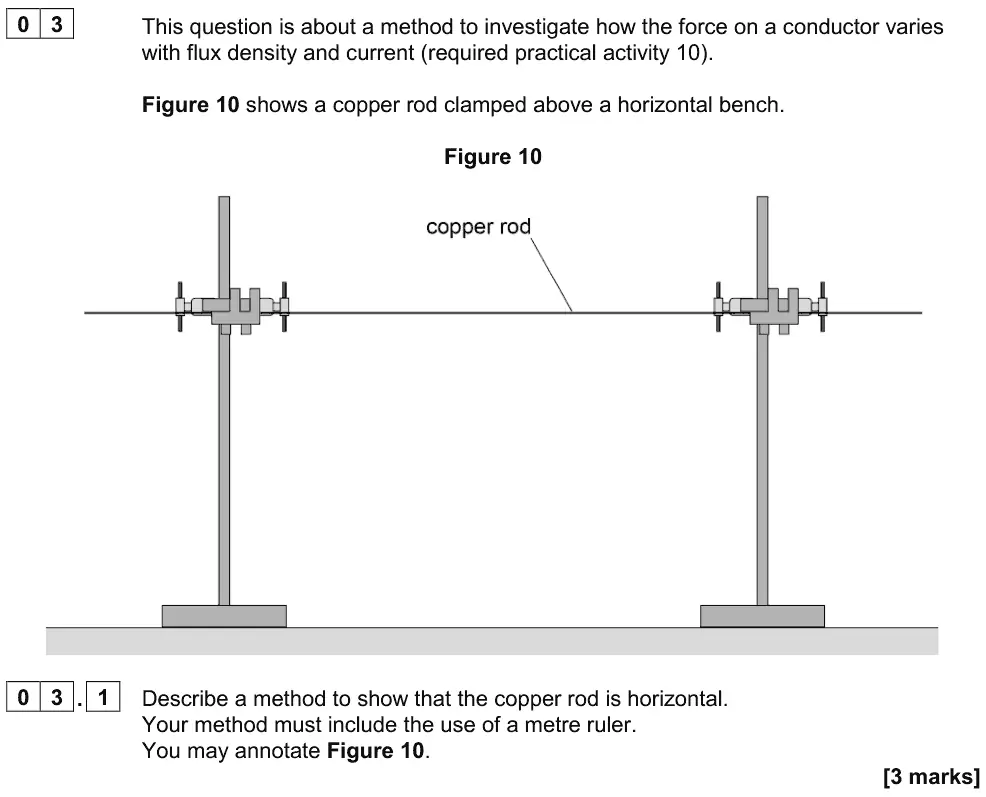
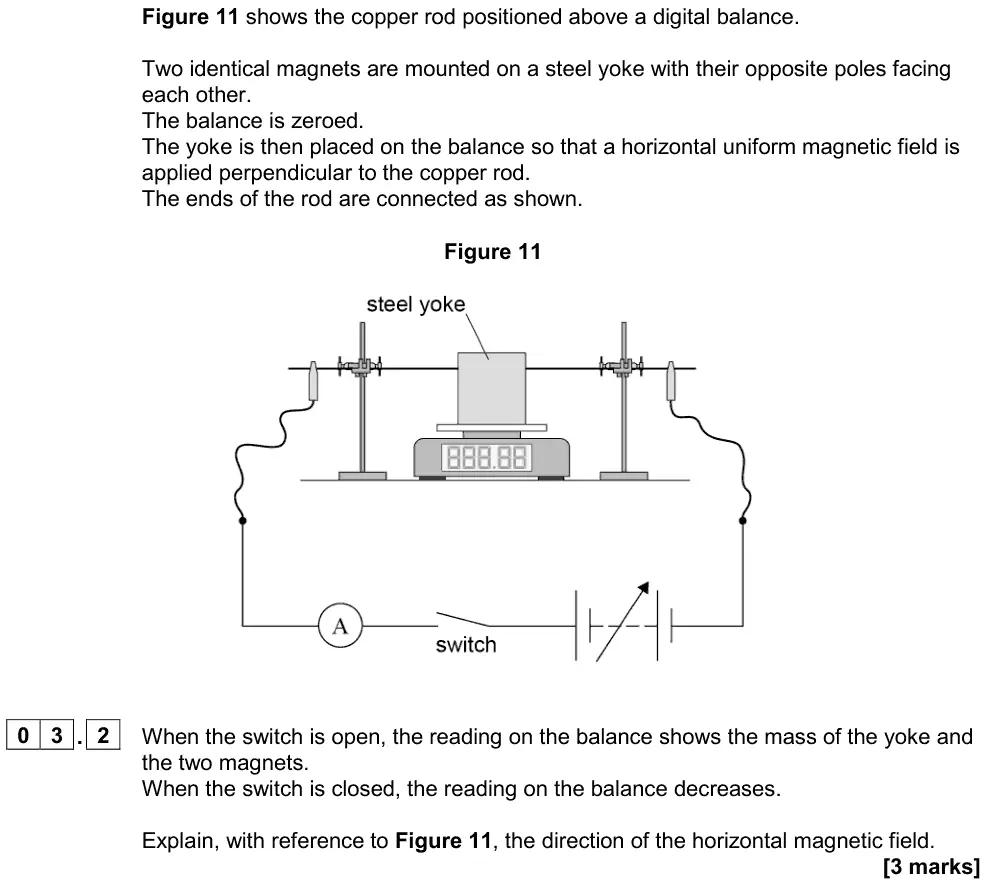
Figure 11 shows the copper rod positioned above a digital balance.
Two identical magnets are mounted on a steel yoke with their opposite poles facing
each other.
The balance is zeroed.
The yoke is then placed on the balance so that a horizontal uniform magnetic field is
applied perpendicular to the copper rod.
The ends of the rod are connected as shown.
Figure 11
When the switch is open, the reading on the balance shows the mass of the yoke and
the two magnets.
When the switch is closed, the reading on the balance decreases.
Explain, with reference to Figure 11, the direction of the horizontal magnetic field.
[3 marks]
June 2024 · Paper 3B Astrophysics · Q1.3 3 marks AO1=1, AO3=2 Explanation telescopes
Earlier part of question 1 that this part usesEarlier part of June 2024 Paper 3B Astrophysics question 1
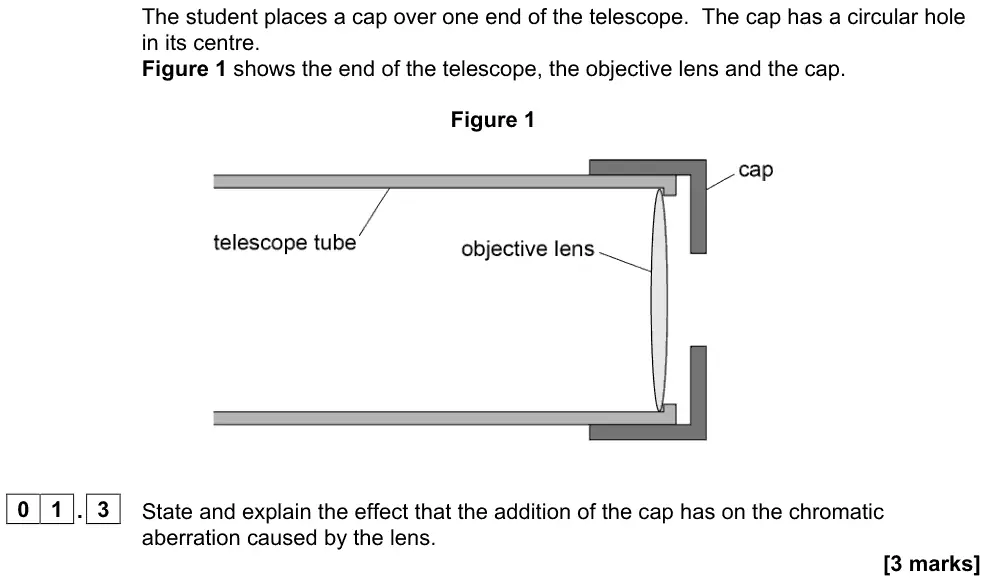
The student places a cap over one end of the telescope.  The cap has a circular hole
in its centre.
Figure 1 shows the end of the telescope, the objective lens and the cap.
Figure 1
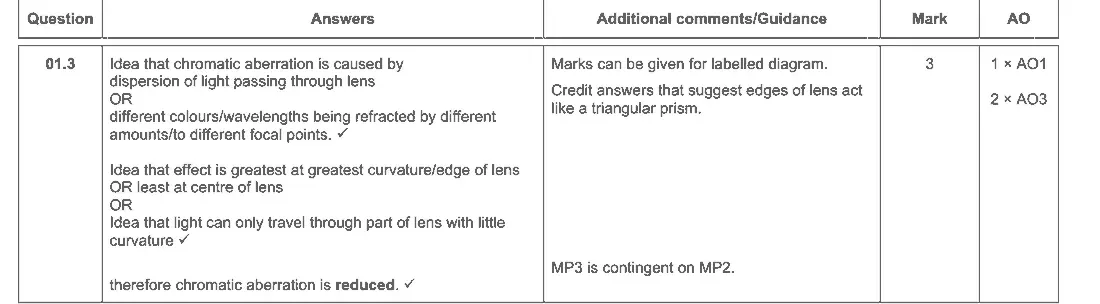
State and explain the effect that the addition of the cap has on the chromatic
aberration caused by the lens.
[3 marks]
June 2024 · Paper 3B Astrophysics · Q1.4 4 marks AO3=4 Explanation telescopes
Earlier part of question 1 that this part usesEarlier part of June 2024 Paper 3B Astrophysics question 1
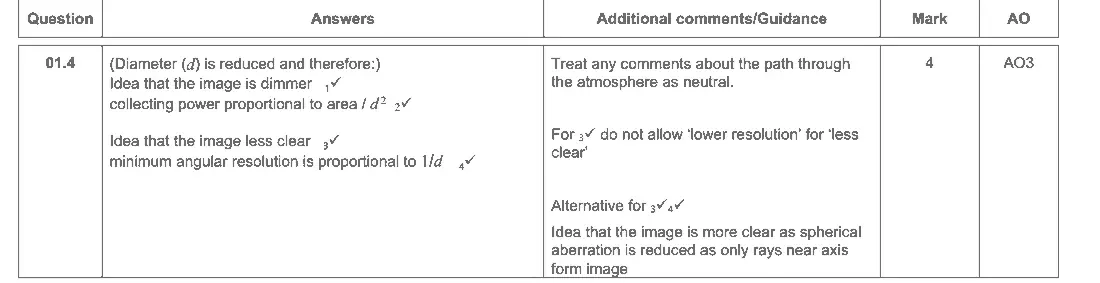
Explain two other effects that the addition of the cap has on the image of Jupiter.
[4 marks]
1
2
June 2024 · Paper 3B Astrophysics · Q3.4 2 marks AO3=2 Explanation classification of stars
Earlier part of question 3 that this part usesEarlier part of June 2024 Paper 3B Astrophysics question 3
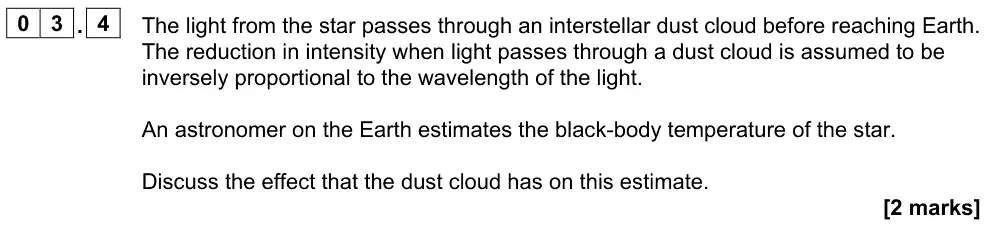
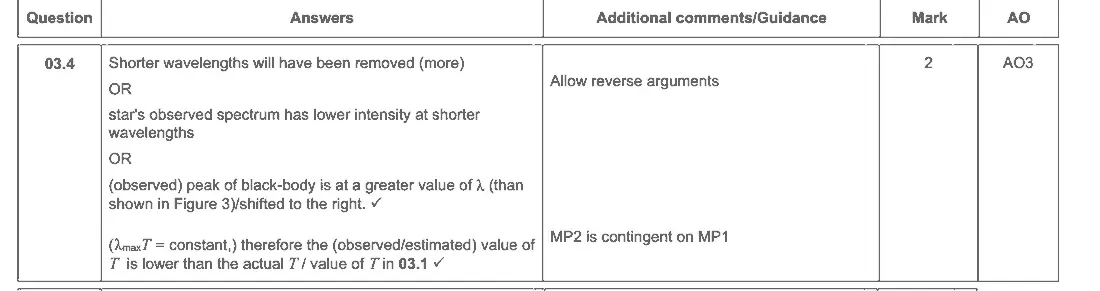
The light from the star passes through an interstellar dust cloud before reaching Earth.
The reduction in intensity when light passes through a dust cloud is assumed to be
inversely proportional to the wavelength of the light.
An astronomer on the Earth estimates the black-body temperature of the star.
Discuss the effect that the dust cloud has on this estimate.
[2 marks]
June 2024 · Paper 3B Astrophysics · Q4.1 2 marks AO3=2 Explanation cosmology
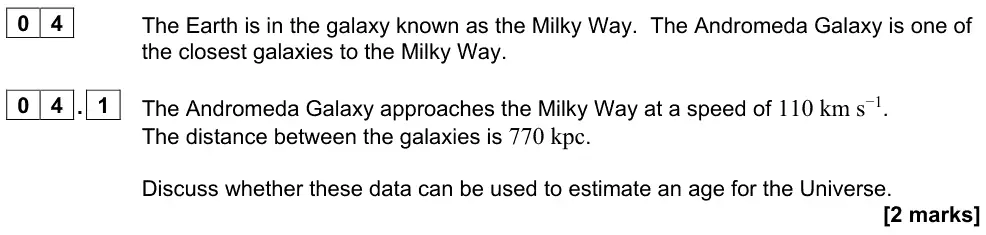
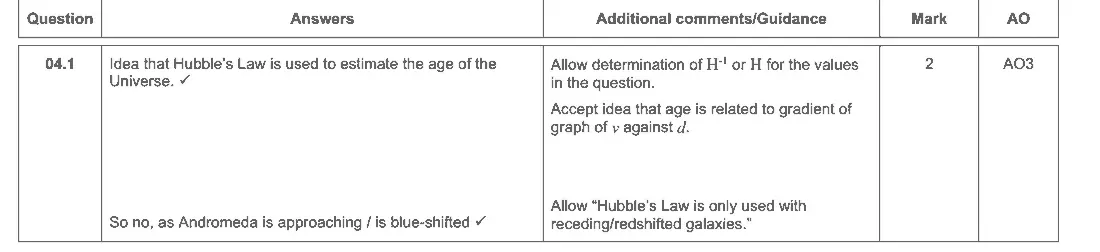
The Earth is in the galaxy known as the Milky Way.  The Andromeda Galaxy is one of
the closest galaxies to the Milky Way.
The Andromeda Galaxy approaches the Milky Way at a speed of 110 km s−1.
The distance between the galaxies is 770 kpc.
Discuss whether these data can be used to estimate an age for the Universe.
[2 marks]
June 2024 · Paper 3B Medical physics · Q3.1 4 marks AO1=2, AO3=2 Explanation medical imaging
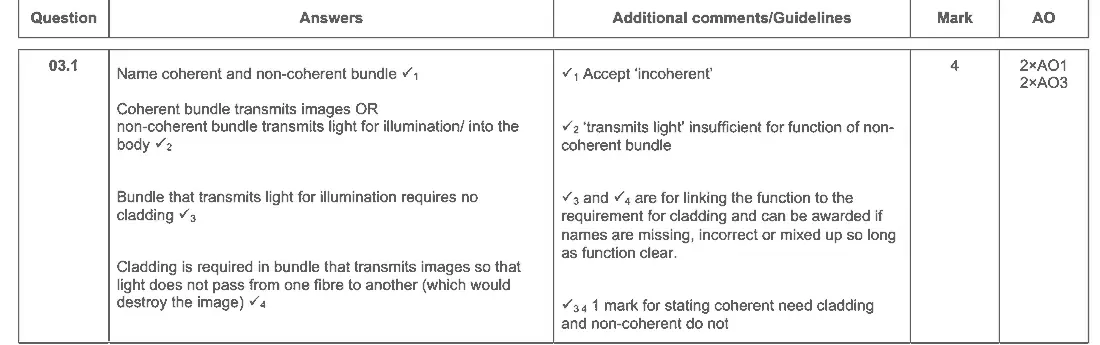
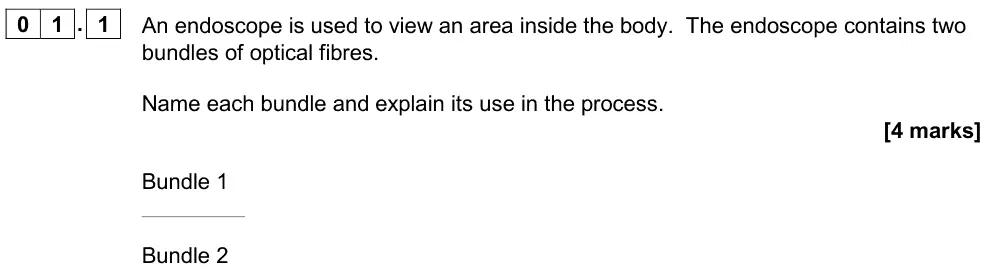
Name the two types of optical fibre bundle used in an endoscope.
Go on to discuss whether the optical fibres in either of these bundles require cladding.
[4 marks]
June 2024 · Paper 3B Engineering physics · Q1.1 3 marks Explanation rotational dynamics
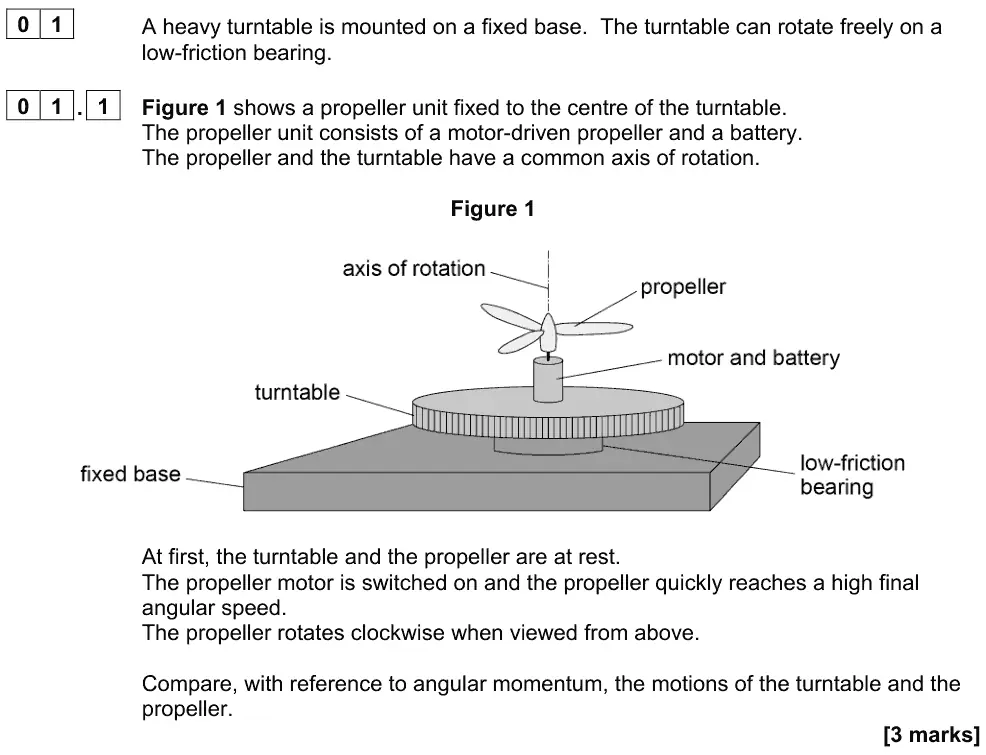
A heavy turntable is mounted on a fixed base.  The turntable can rotate freely on a
low-friction bearing.
Figure 1 shows a propeller unit fixed to the centre of the turntable.
The propeller unit consists of a motor-driven propeller and a battery.
The propeller and the turntable have a common axis of rotation.
Figure 1
At first, the turntable and the propeller are at rest.
The propeller motor is switched on and the propeller quickly reaches a high final
angular speed.
The propeller rotates clockwise when viewed from above.
Compare, with reference to angular momentum, the motions of the turntable and the
propeller.
[3 marks]
June 2024 · Paper 3B Engineering physics · Q2.3 2 marks AO3=2 Explanation Hard rotational dynamics
Earlier part of question 2 that this part usesEarlier part of June 2024 Paper 3B Engineering physics question 2
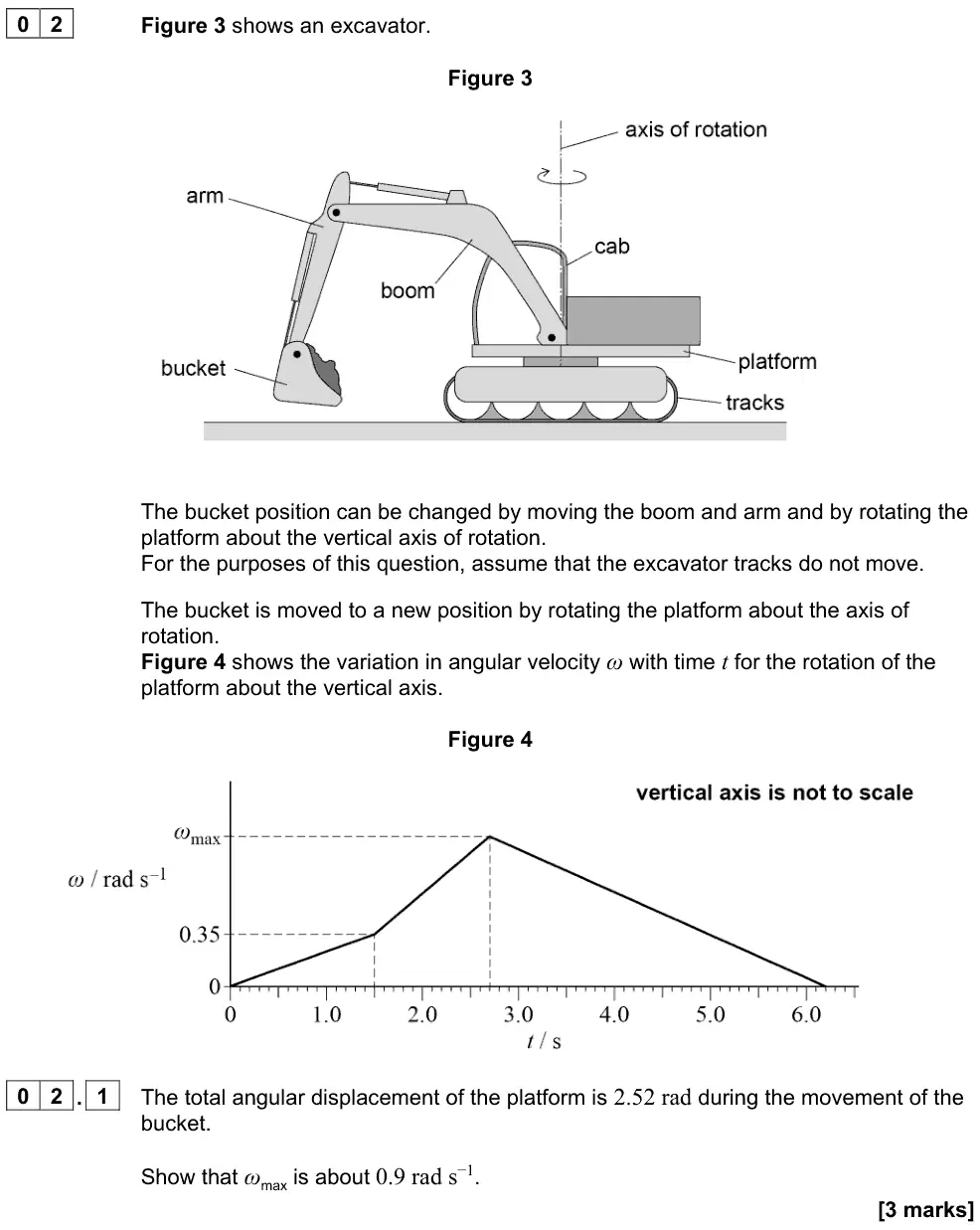
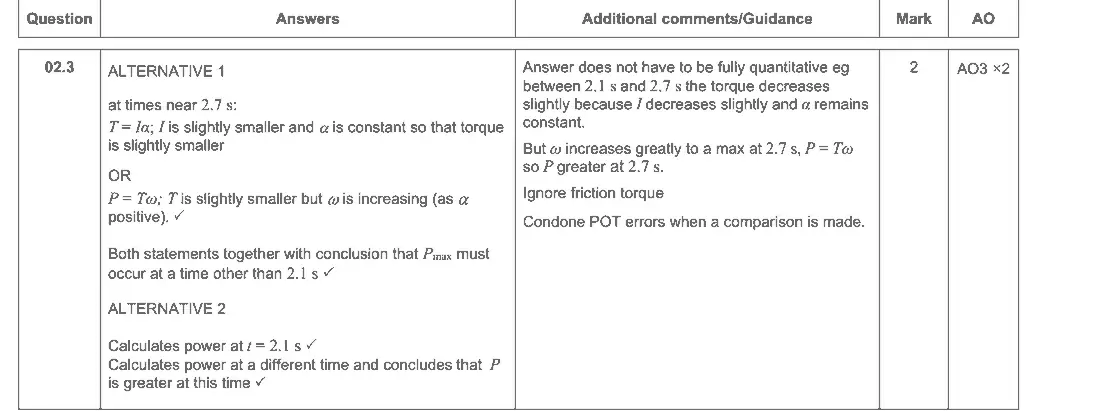
Deduce whether the maximum power applied to the platform occurs at the same time
of 2.1 s.
[2 marks]
June 2024 · Paper 3B Engineering physics · Q4.2 3 marks Explanation Hard thermodynamics and engines
Earlier part of question 4 that this part usesEarlier part of June 2024 Paper 3B Engineering physics question 4
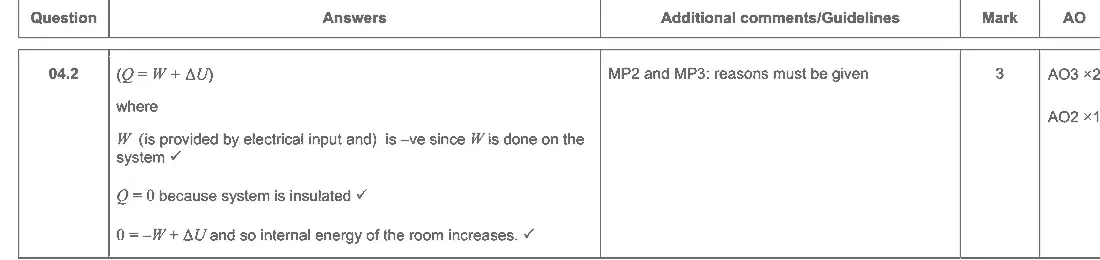
A system consists of a perfectly insulated room containing only an empty refrigerator.
The refrigerator is connected to the mains electricity and the refrigerator door is open.
Deduce, by applying the first law of thermodynamics, whether the internal energy of
the room increases, decreases or stays the same.
[3 marks]
June 2024 · Paper 3B Engineering physics · Q4.4 2 marks AO1=2 Explanation thermodynamics and engines
Earlier part of question 4 that this part usesEarlier part of June 2024 Paper 3B Engineering physics question 4
Explain why the maximum theoretical efficiency of an ideal heat engine must be less
than 100%.
[2 marks]
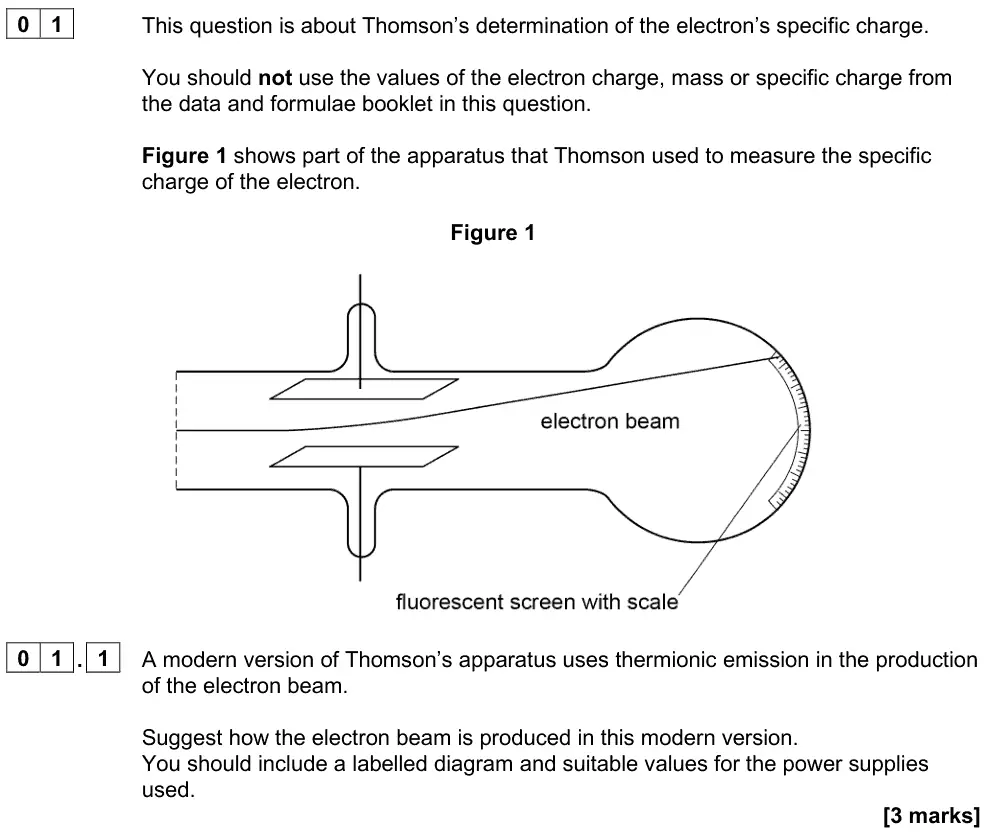
June 2024 · Paper 3B Turning points · Q1.1 2 marks AO2=2 Explanation discovery of the electron
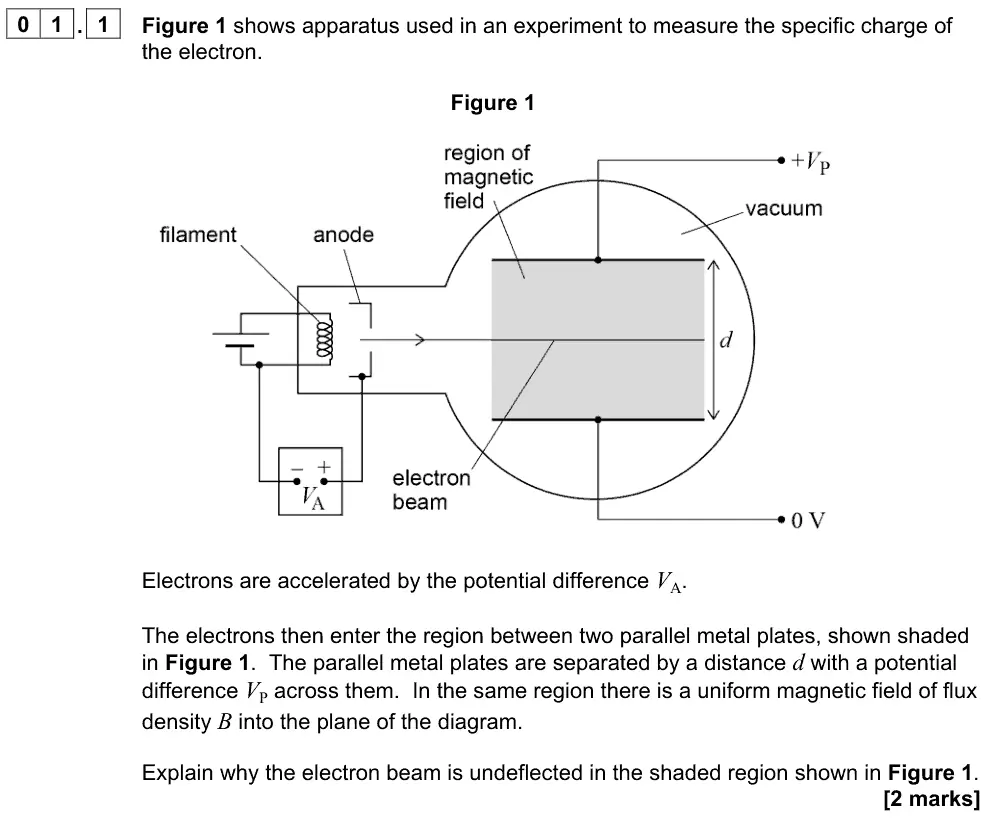
Figure 1 shows apparatus used in an experiment to measure the specific charge of
the electron.
Figure 1
Electrons are accelerated by the potential difference VA.
The electrons then enter the region between two parallel metal plates, shown shaded
in Figure 1.  The parallel metal plates are separated by a distance d with a potential
difference VP across them.  In the same region there is a uniform magnetic field of flux
density B into the plane of the diagram.
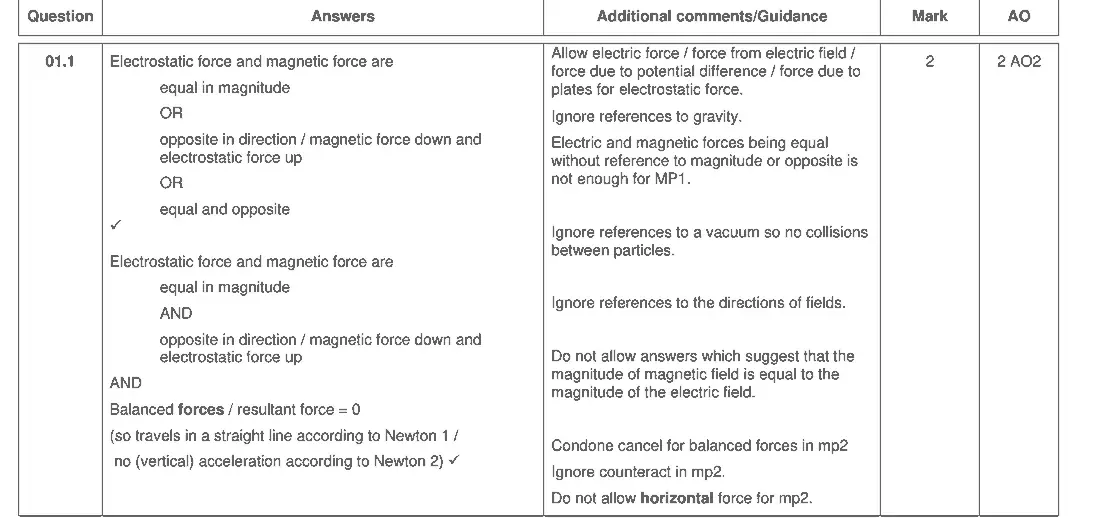
Explain why the electron beam is undeflected in the shaded region shown in Figure 1.
[2 marks]
June 2024 · Paper 3B Turning points · Q3 5 marks AO1=5 Explanation wave particle duality history
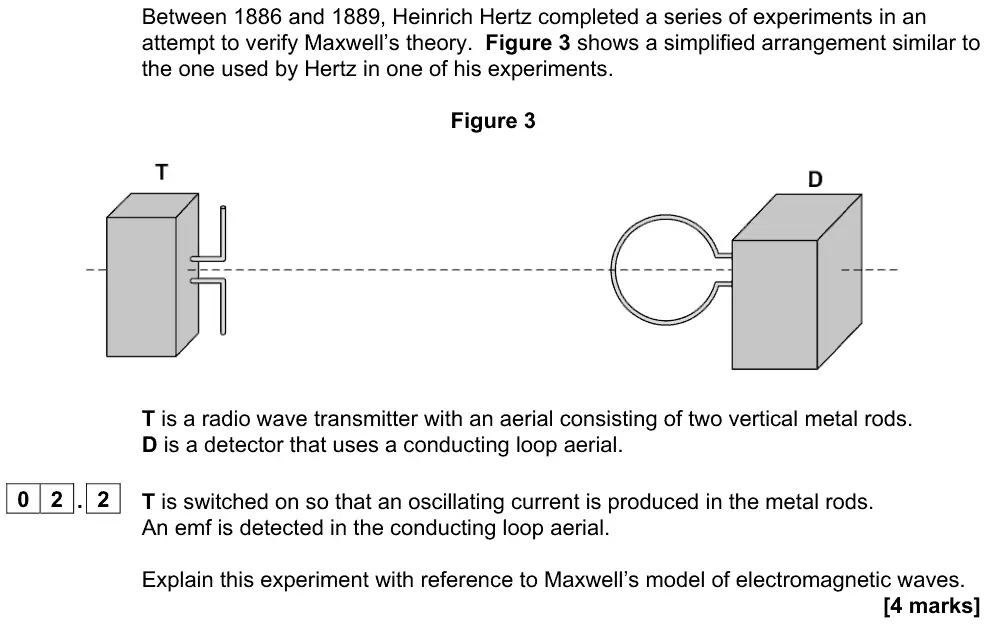
Hertz did an experiment to determine the speed of radio waves.
Describe this experiment.
In your answer you should:
• include a labelled diagram
• state the measurements that were taken
• describe how the data were used to determine the speed of radio waves.
[5 marks]
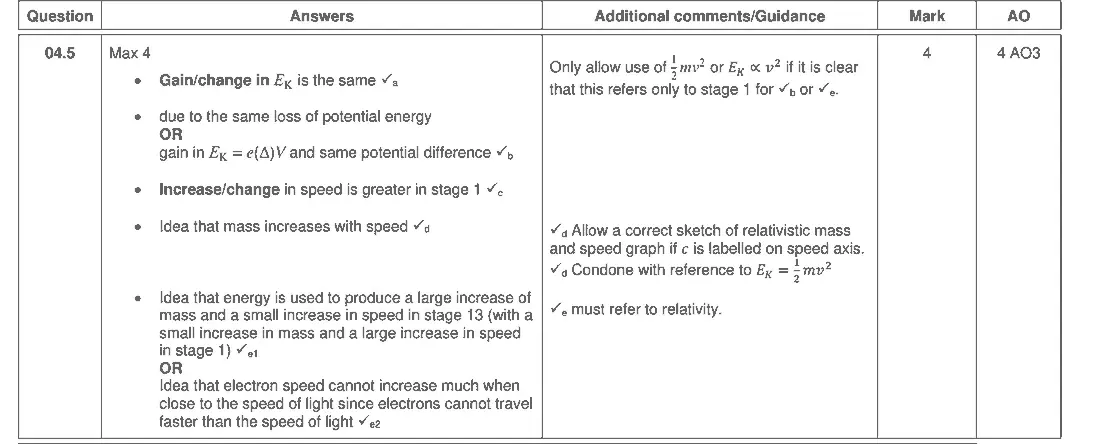
June 2024 · Paper 3B Turning points · Q4.5 4 marks AO3=4 Explanation special relativity
Earlier part of question 4 that this part usesEarlier part of June 2024 Paper 3B Turning points question 4
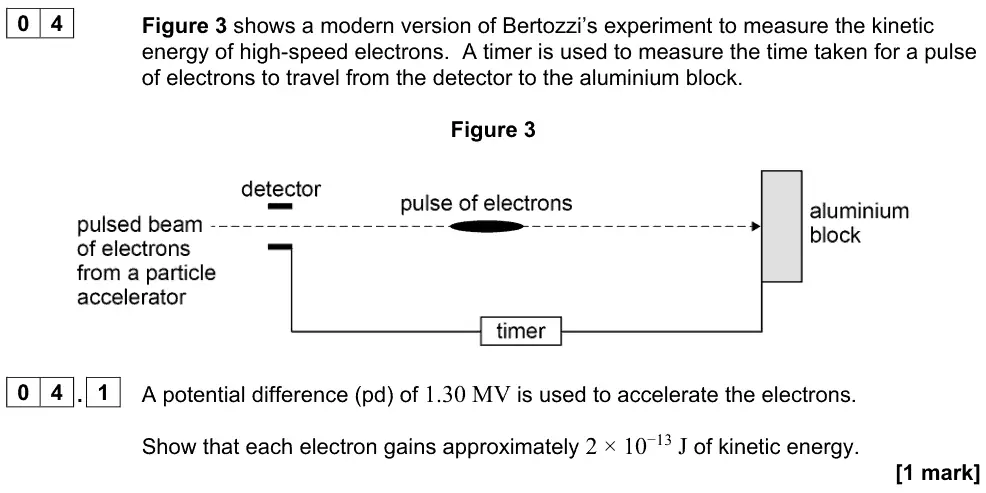
The electrons in Figure 3 were accelerated from rest in 13 stages.
In each stage the electrons were accelerated by a pd of 100 kV.
As a result, an electron increases its speed and kinetic energy during each stage.
Compare, for an electron,
• its increase in speed for the first stage with that for the last stage
• its increase in kinetic energy for the first stage with that for the last stage.
Justify your answer.
No further calculations are required.
[4 marks]
June 2024 · Paper 3B Electronics · Q1.1 2 marks AO2=2 Explanation digital electronics
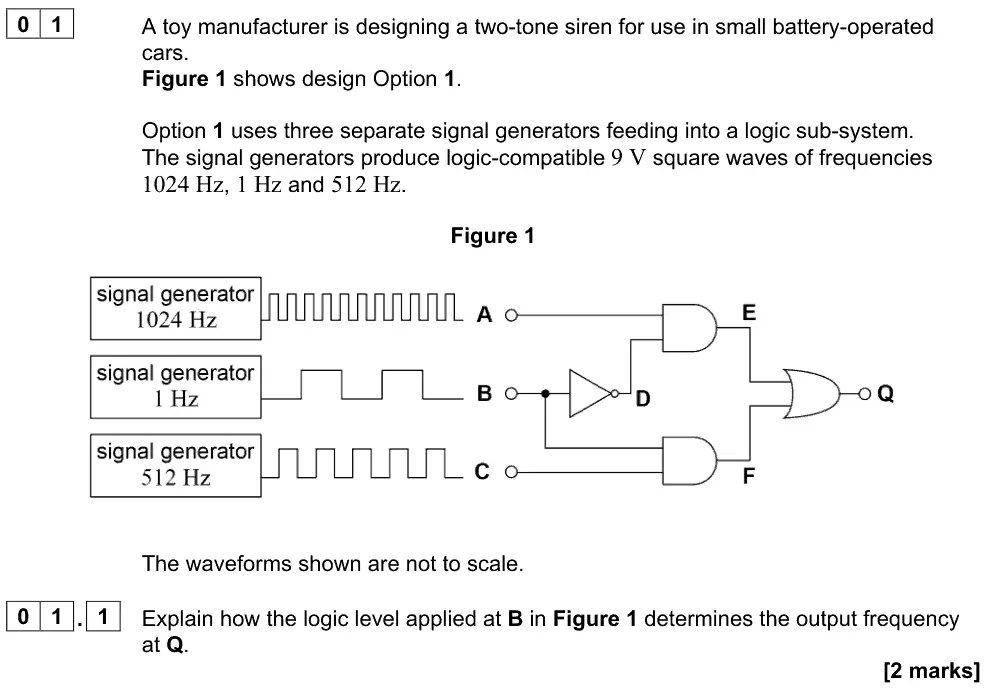
A toy manufacturer is designing a two-tone siren for use in small battery-operated
cars.
Figure 1 shows design Option 1.
Option 1 uses three separate signal generators feeding into a logic sub-system.
The signal generators produce logic-compatible 9 V square waves of frequencies
1024 Hz, 1 Hz and 512 Hz.
Figure 1
The waveforms shown are not to scale.
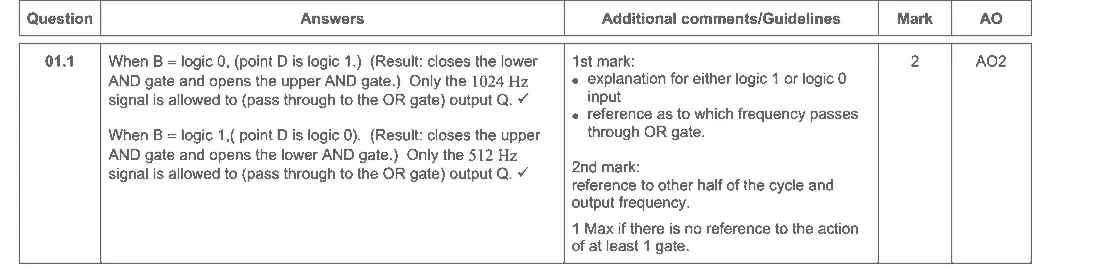
Explain how the logic level applied at B in Figure 1 determines the output frequency
at Q.
[2 marks]
June 2024 · Paper 3B Electronics · Q1.5 2 marks AO3=2 Explanation digital electronics
Earlier part of question 1 that this part usesEarlier part of June 2024 Paper 3B Electronics question 1
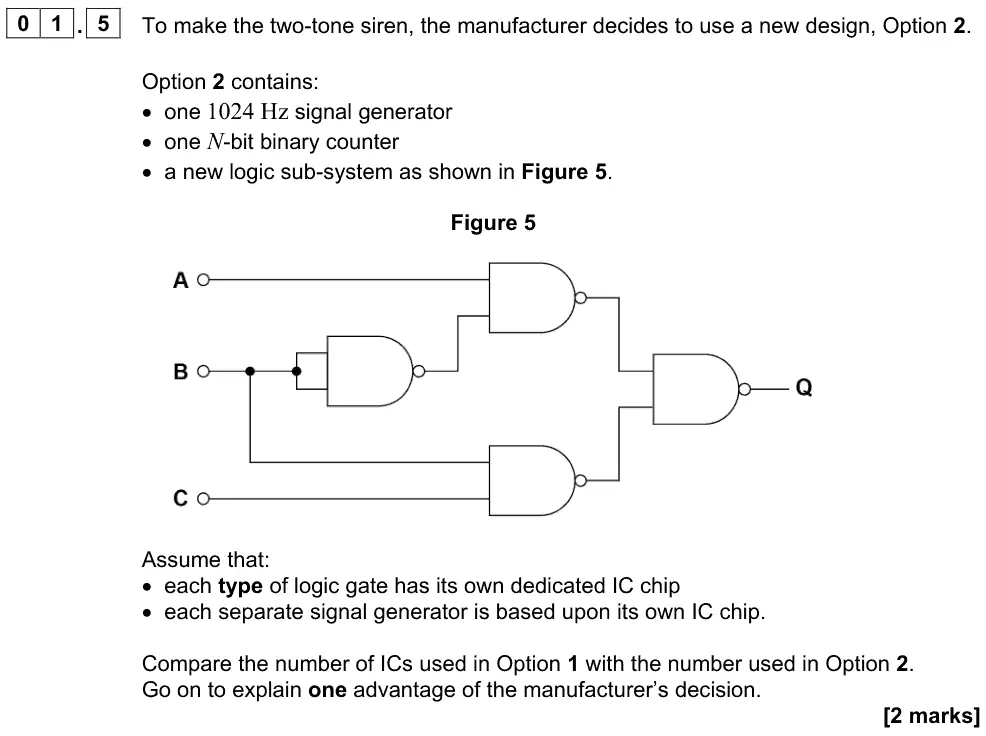
To make the two-tone siren, the manufacturer decides to use a new design, Option 2.
Option 2 contains:
• one 1024 Hz signal generator
• one N-bit binary counter
• a new logic sub-system as shown in Figure 5.
Figure 5
Assume that:
• each type of logic gate has its own dedicated IC chip
• each separate signal generator is based upon its own IC chip.
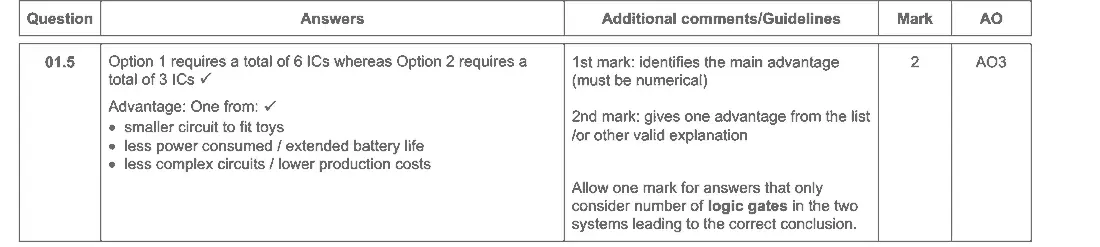
Compare the number of ICs used in Option 1 with the number used in Option 2.
Go on to explain one advantage of the manufacturer’s decision.
[2 marks]
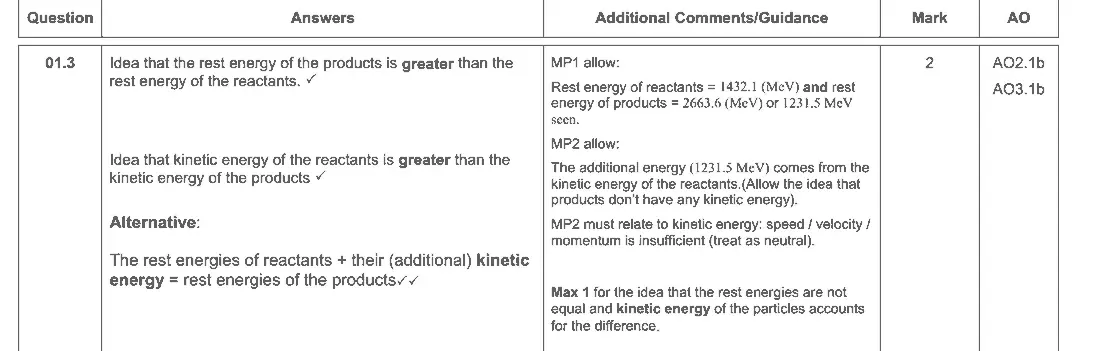
June 2023 · AS Paper 1 · Q1.3 2 marks Explanation classification of particles and quarksparticles antiparticles and interactions
Earlier part of question 1 that this part usesEarlier part of June 2023 Paper 1 question 1
Suggest how energy is conserved in this interaction.
Refer to the rest energies of the particles in Table 1.
[2 marks]
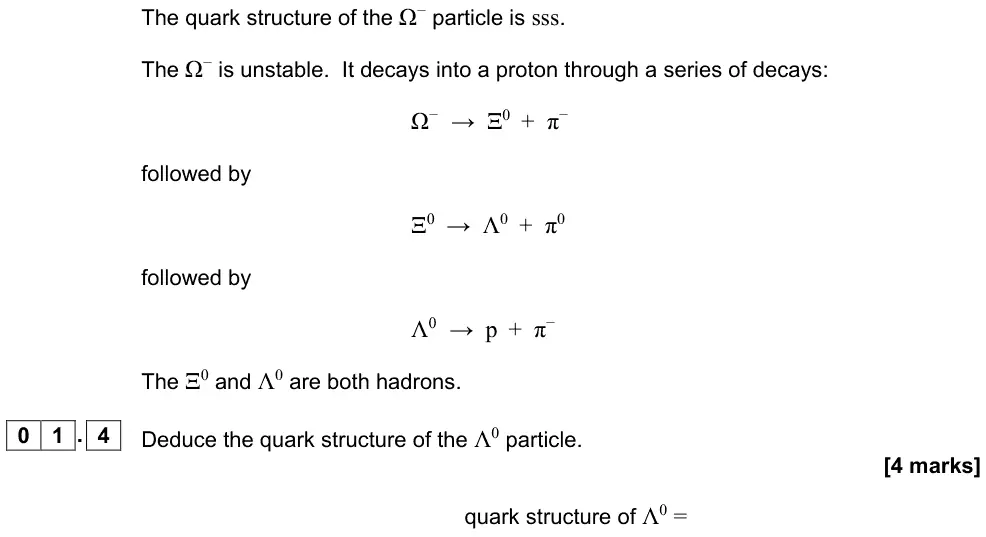
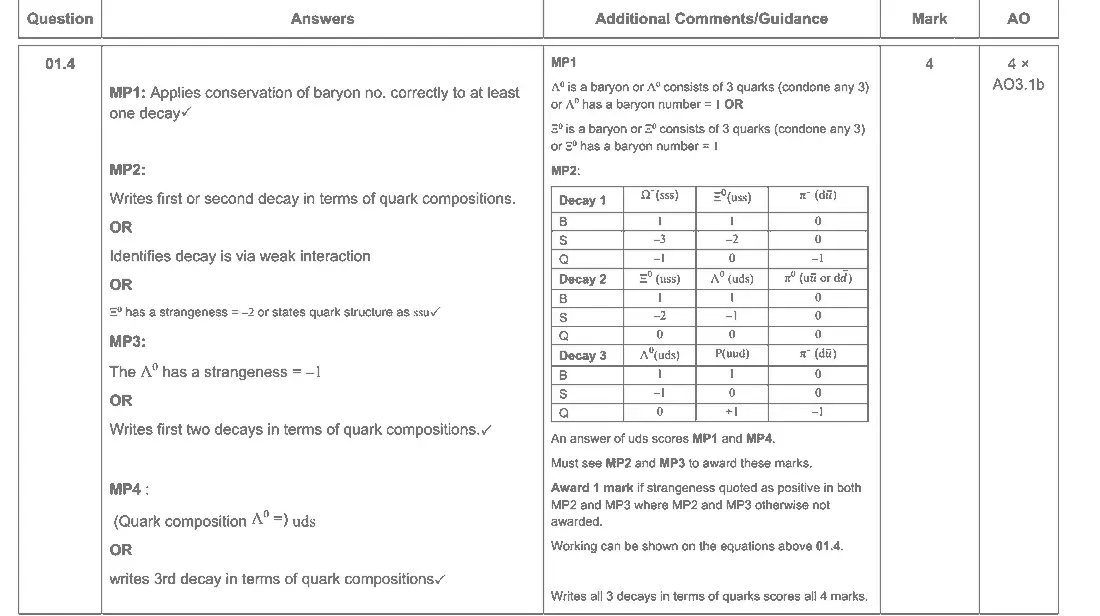
June 2023 · AS Paper 1 · Q1.4 4 marks AO3=4 Explanation Hard classification of particles and quarks
Earlier part of question 1 that this part usesEarlier part of June 2023 Paper 1 question 1
The quark structure of the Ω− particle is sss.
The Ω− is unstable.  It decays into a proton through a series of decays:
Ω−  →  Ξ0  +  π−
followed by
Ξ0  →  Λ0  +  π0
followed by
Λ0  →  p  +  π−
The Ξ0 and Λ0 are both hadrons.
Deduce the quark structure of the Λ0 particle.
[4 marks]
quark structure of Λ0 =
June 2023 · AS Paper 1 · Q2.1 3 marks AO2=3 Explanation Hard progressive waves and polarisation
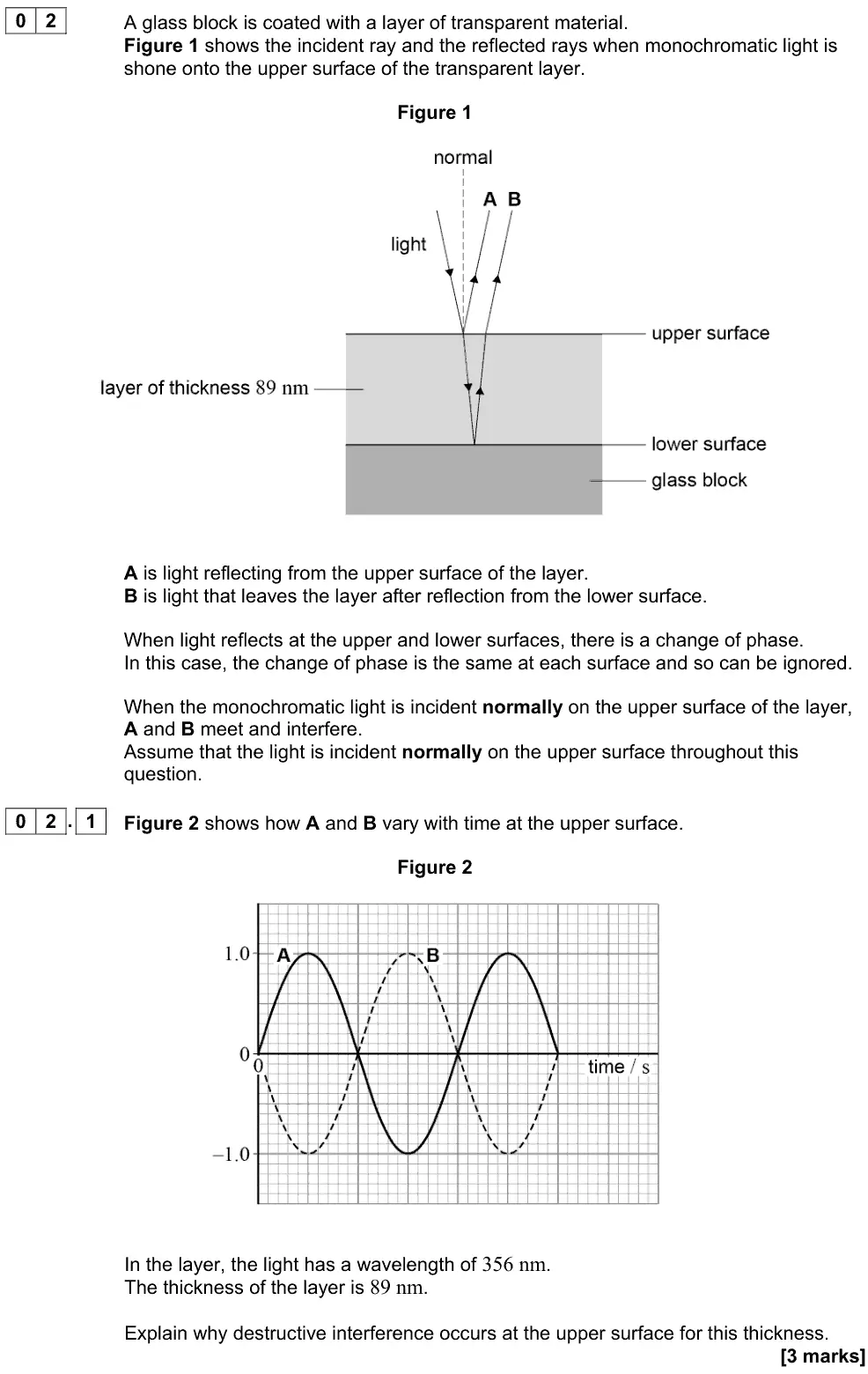
A glass block is coated with a layer of transparent material.
Figure 1 shows the incident ray and the reflected rays when monochromatic light is
shone onto the upper surface of the transparent layer.
Figure 1
A is light reflecting from the upper surface of the layer.
B is light that leaves the layer after reflection from the lower surface.
When light reflects at the upper and lower surfaces, there is a change of phase.
In this case, the change of phase is the same at each surface and so can be ignored.
When the monochromatic light is incident normally on the upper surface of the layer,
A and B meet and interfere.
Assume that the light is incident normally on the upper surface throughout this
question.
Figure 2 shows how A and B vary with time at the upper surface.
Figure 2
In the layer, the light has a wavelength of 356 nm.
The thickness of the layer is 89 nm.
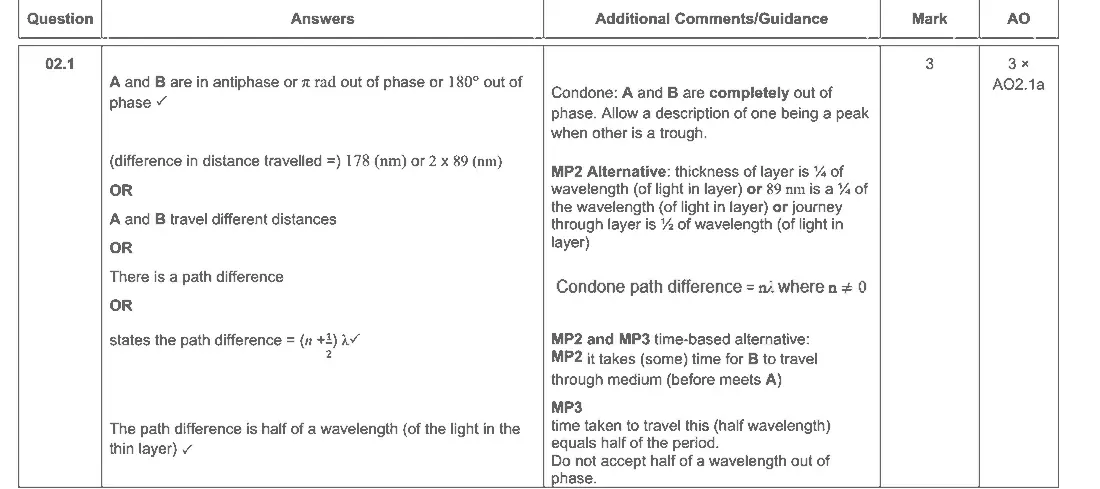
Explain why destructive interference occurs at the upper surface for this thickness.
[3 marks]
June 2023 · AS Paper 1 · Q5.4 3 marks AO3=3 Explanation Hard work energy and powernewtons laws and momentum
Earlier part of question 5 that this part usesEarlier part of June 2023 Paper 1 question 5
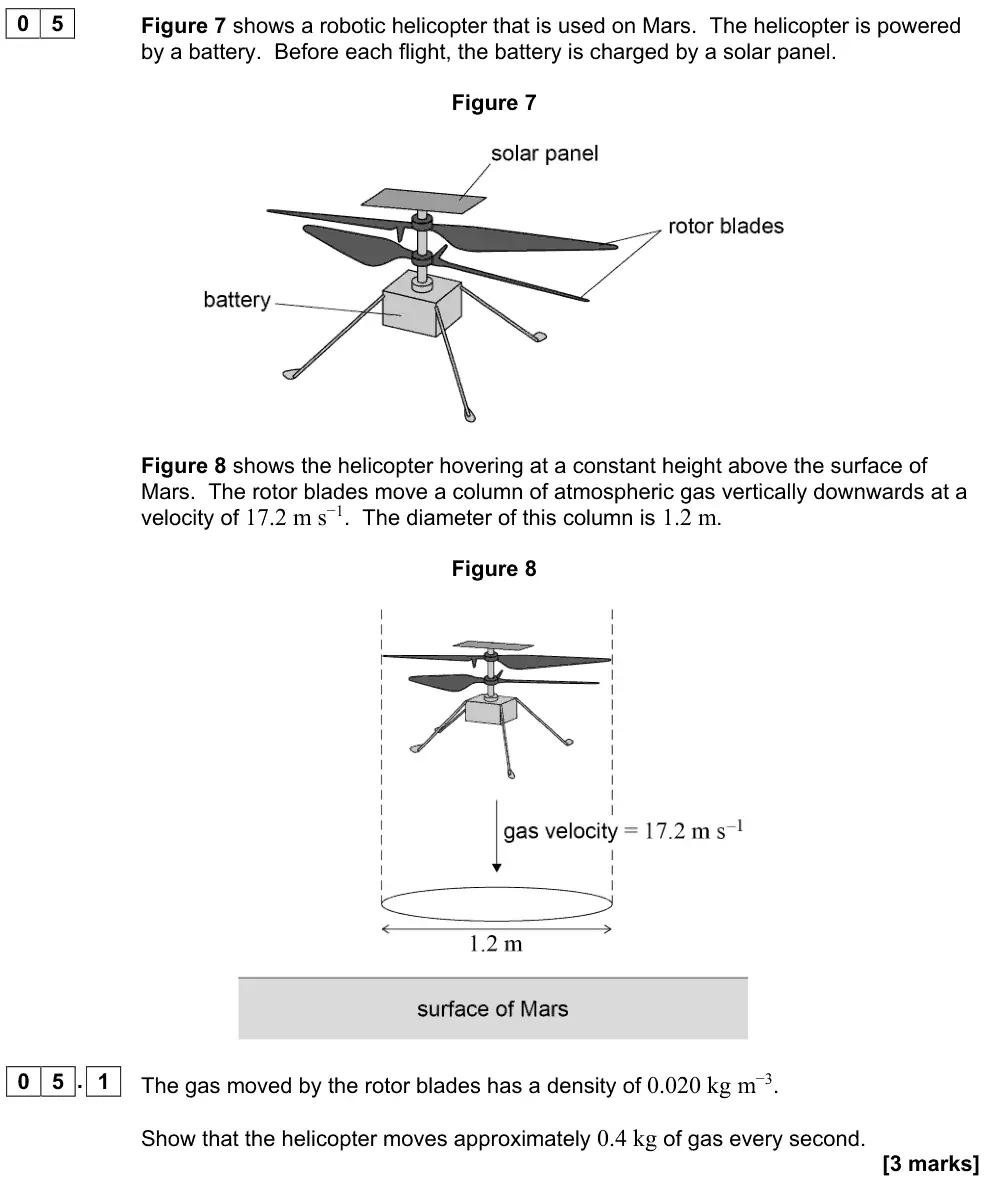
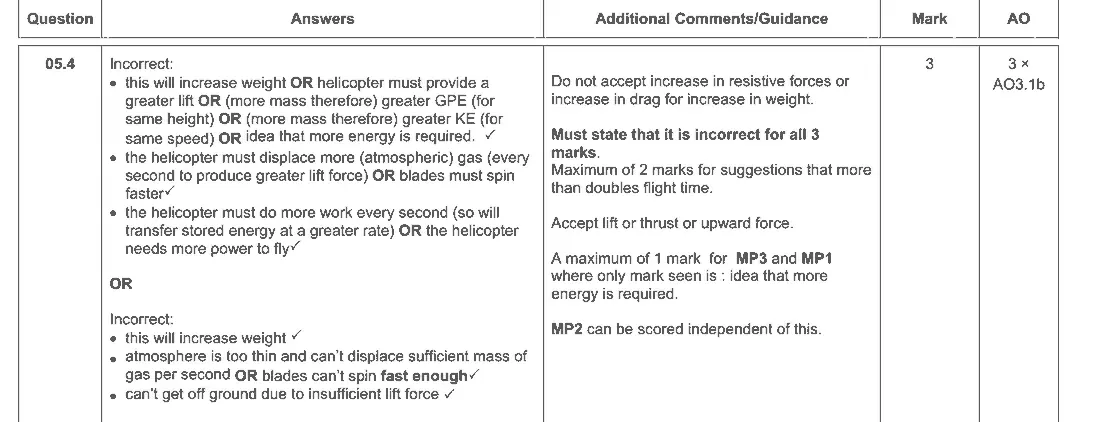
The helicopter has a maximum flight time of a few minutes due to the limited amount
of energy stored in the battery.  The battery accounts for about 15% of the helicopter’s
mass.
A student suggests that adding another identical battery that doubles the energy
available to the helicopter would double its flight time.
Deduce without calculation whether the student’s suggestion is correct.
[3 marks]
June 2023 · AS Paper 1 · Q5.7 2 marks Explanation newtons laws and momentummotion and projectiles
Earlier part of question 5 that this part usesEarlier part of June 2023 Paper 1 question 5
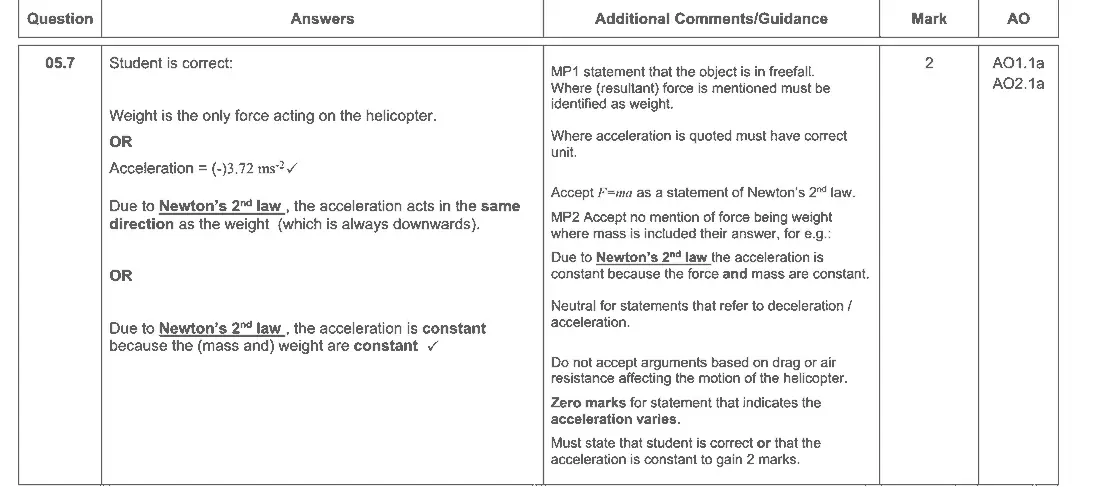
A student suggests that the acceleration of the helicopter is constant from the instant
the blades stop rotating until the helicopter makes contact with the surface.
Discuss this suggestion with reference to an appropriate Newton’s law of motion.
[2 marks]
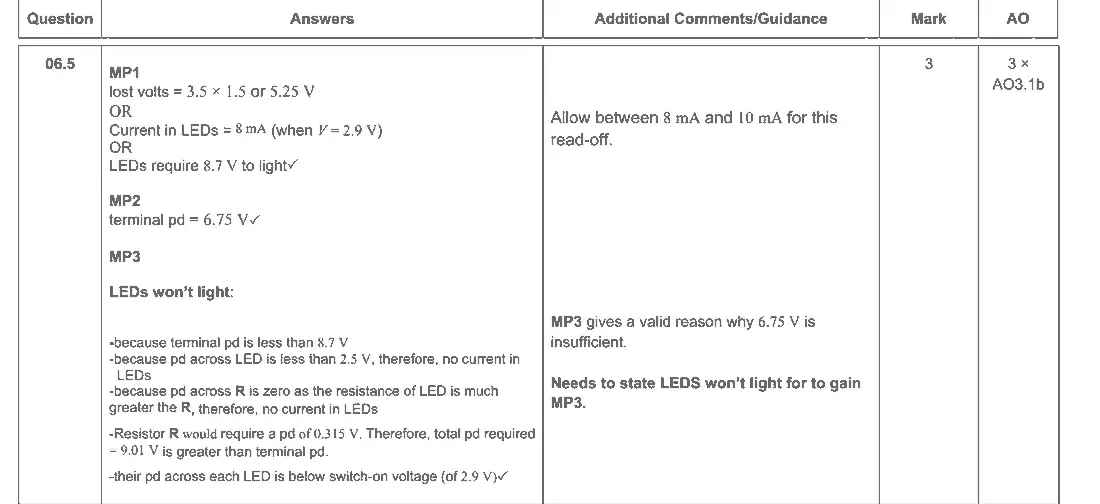
June 2023 · AS Paper 1 · Q6.5 3 marks AO3=3 Explanation Hard emf and internal resistance
Earlier part of question 6 that this part usesEarlier part of June 2023 Paper 1 question 6
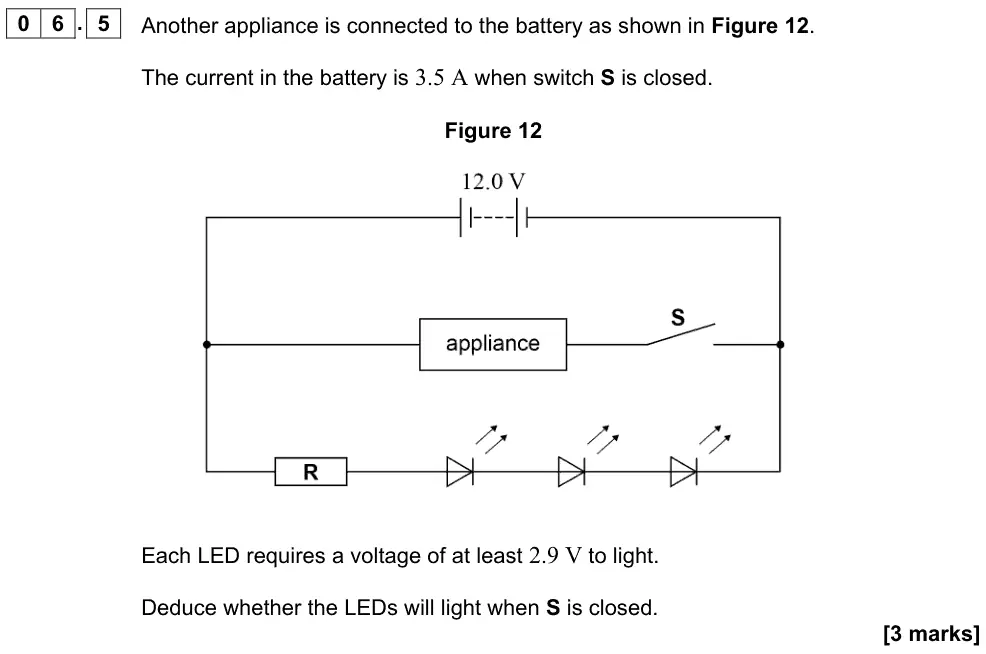
Another appliance is connected to the battery as shown in Figure 12.
The current in the battery is 3.5 A when switch S is closed.
Figure 12
Each LED requires a voltage of at least 2.9 V to light.
Deduce whether the LEDs will light when S is closed.
[3 marks]
June 2023 · AS Paper 2 · Q1.6 2 marks AO3=2 Explanation stationary waves
Earlier part of question 1 that this part usesEarlier part of June 2023 Paper 2 question 1
Another student repeats the experiment with the mass of M doubled.
Explain how this student’s plotted data compare with Figure 3.
[2 marks]
June 2023 · AS Paper 2 · Q3.1 2 marks AO1=2 Explanation vectors and moments
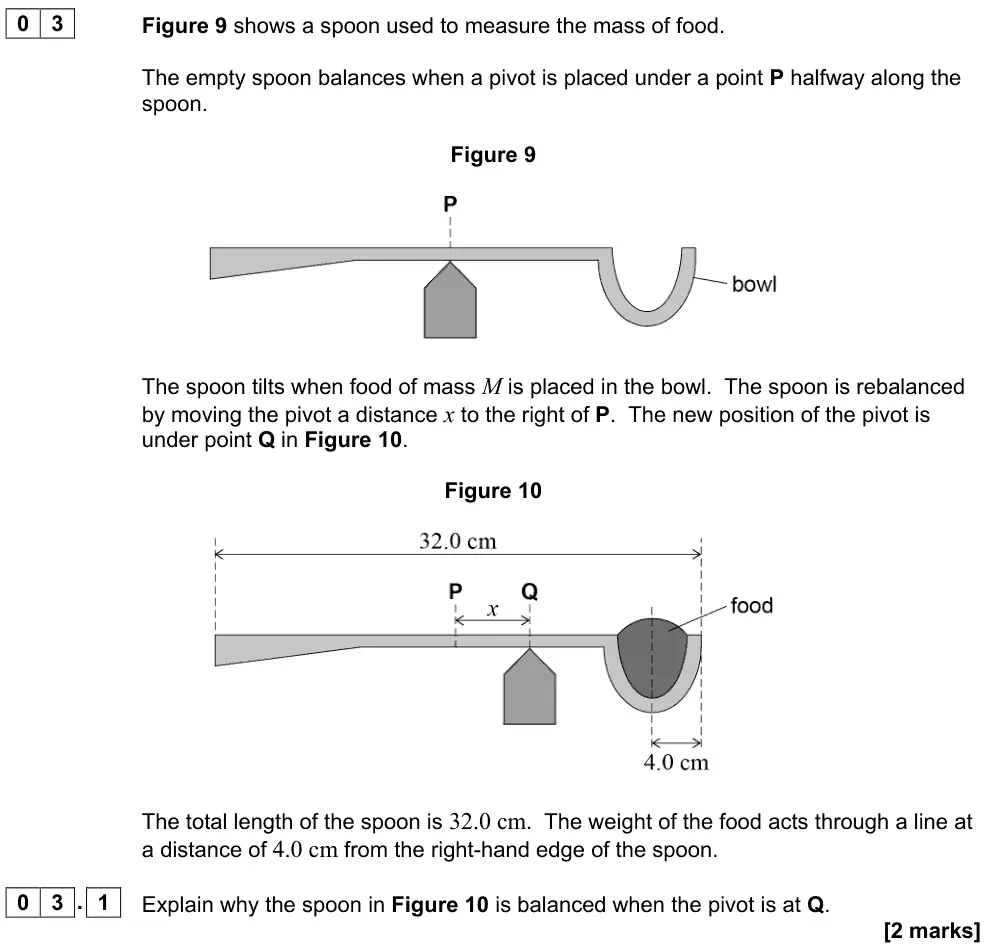
Figure 9 shows a spoon used to measure the mass of food.
The empty spoon balances when a pivot is placed under a point P halfway along the
spoon.
Figure 9
The spoon tilts when food of mass M is placed in the bowl.  The spoon is rebalanced
by moving the pivot a distance x to the right of P.  The new position of the pivot is
under point Q in Figure 10.
Figure 10
The total length of the spoon is 32.0 cm.  The weight of the food acts through a line at
a distance of 4.0 cm from the right-hand edge of the spoon.
Explain why the spoon in Figure 10 is balanced when the pivot is at Q.
[2 marks]
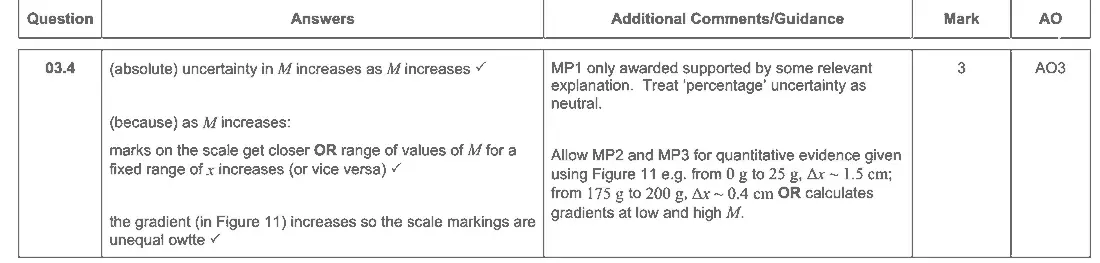
June 2023 · AS Paper 2 · Q3.4 3 marks AO3=3 Explanation measurements and uncertainties
Earlier part of question 3 that this part usesEarlier part of June 2023 Paper 2 question 3
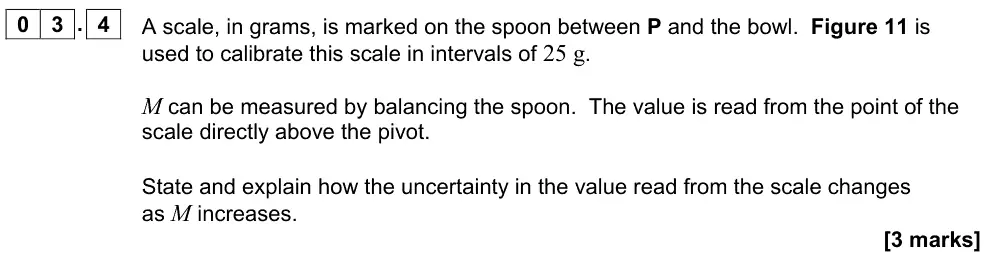
A scale, in grams, is marked on the spoon between P and the bowl.  Figure 11 is
used to calibrate this scale in intervals of 25 g.
M can be measured by balancing the spoon.  The value is read from the point of the
scale directly above the pivot.
State and explain how the uncertainty in the value read from the scale changes
as M increases.
[3 marks]
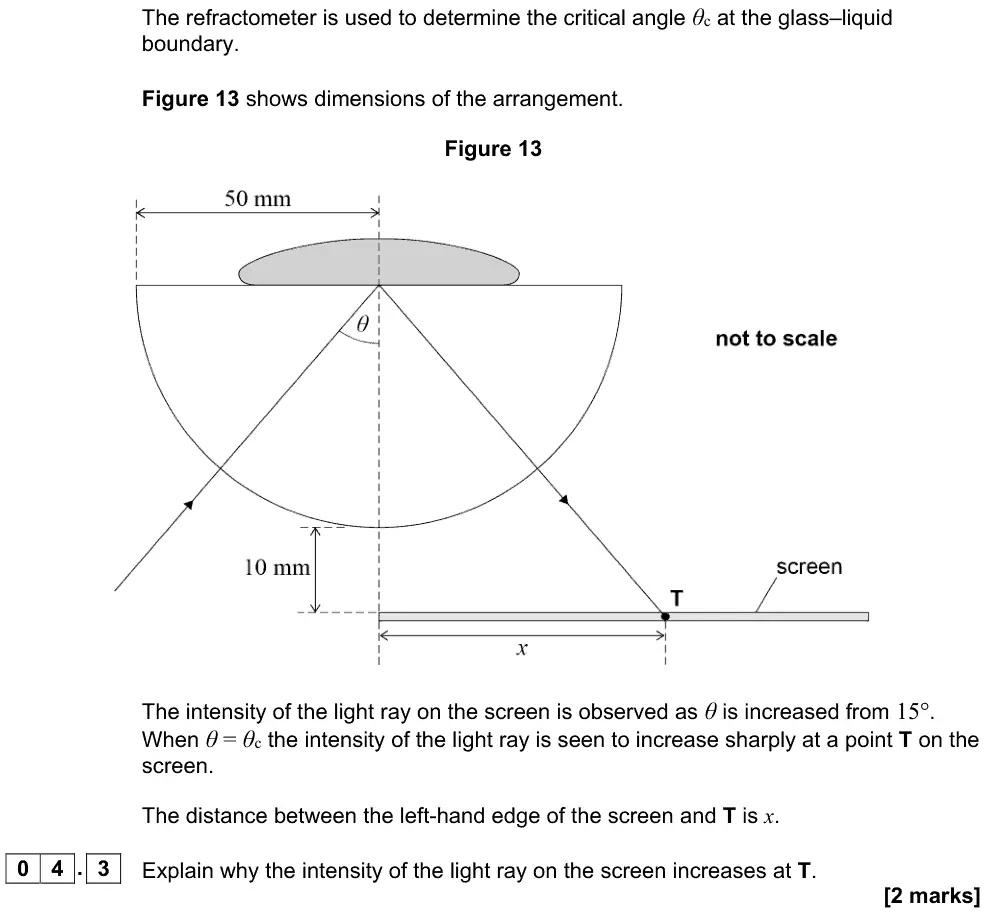
June 2023 · AS Paper 2 · Q4.3 2 marks AO2=2 Explanation refraction and optical fibres
Earlier part of question 4 that this part usesEarlier part of June 2023 Paper 2 question 4
The refractometer is used to determine the critical angle θc at the glass–liquid
boundary.
Figure 13 shows dimensions of the arrangement.
Figure 13
The intensity of the light ray on the screen is observed as θ is increased from 15°.
When θ = θc the intensity of the light ray is seen to increase sharply at a point T on the
screen.
The distance between the left-hand edge of the screen and T is x.
Explain why the intensity of the light ray on the screen increases at T.
[2 marks]
June 2023 · AS Paper 2 · Q4.4 2 marks AO2=2 Explanation refraction and optical fibres
Earlier part of question 4 that this part usesEarlier part of June 2023 Paper 2 question 4
The liquid is replaced with a drop of sugar solution.
The refractive index of the sugar solution is greater than 1.33
Deduce how this change affects the position at which the sharp increase in intensity is
observed on the screen.
[2 marks]
June 2023 · Paper 1 · Q1.2 2 marks AO1=2 Explanation classification of particles and quarks
Earlier part of question 1 that this part usesEarlier part of June 2023 Paper 1 question 1
State and explain which interaction is involved in this decay.
[2 marks]
June 2023 · Paper 1 · Q3.1 2 marks AO1=2 Explanation circuits and potential dividersemf and internal resistance
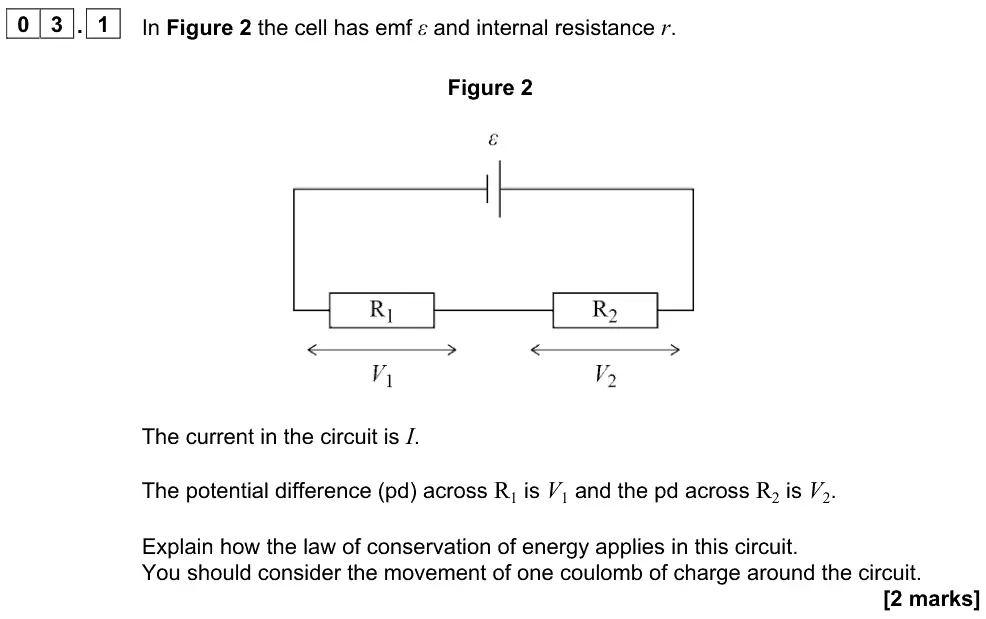
In Figure 2 the cell has emf ε and internal resistance r.
Figure 2
The current in the circuit is I.
The potential difference (pd) across R1 is V1 and the pd across R2 is V2.
Explain how the law of conservation of energy applies in this circuit.
You should consider the movement of one coulomb of charge around the circuit.
[2 marks]
June 2023 · Paper 1 · Q4.2 2 marks Explanation refraction and optical fibres
Earlier part of question 4 that this part usesEarlier part of June 2023 Paper 1 question 4
Explain why the ray emerges parallel to the incident ray.
[2 marks]
June 2023 · Paper 1 · Q4.5 4 marks AO3=4 Explanation refraction and optical fibres
Earlier part of question 4 that this part usesEarlier part of June 2023 Paper 1 question 4
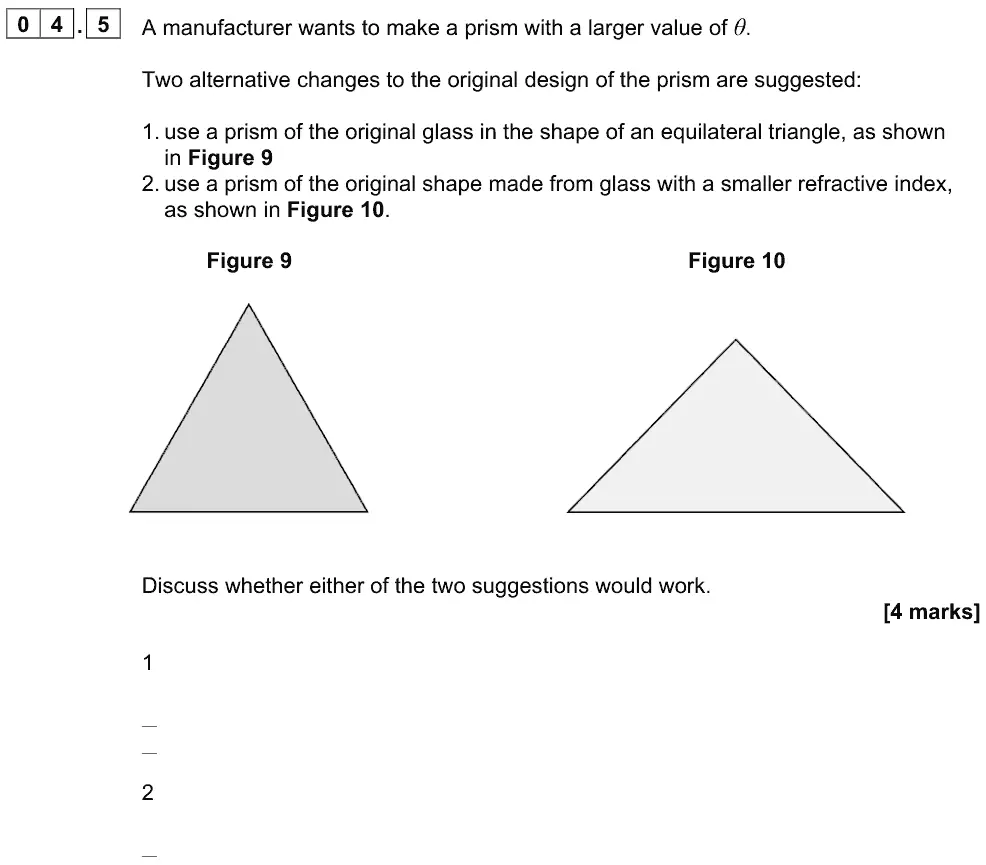
A manufacturer wants to make a prism with a larger value of θ.
Two alternative changes to the original design of the prism are suggested:
1. use a prism of the original glass in the shape of an equilateral triangle, as shown
in Figure 9
2. use a prism of the original shape made from glass with a smaller refractive index,
as shown in Figure 10.
Figure 9
Figure 10
Discuss whether either of the two suggestions would work.
[4 marks]
1
2
June 2023 · Paper 2 · Q1.2 1 mark AO1=1 Explanation kinetic theorynewtons laws and momentum
Earlier part of question 1 that this part usesEarlier part of June 2023 Paper 2 question 1
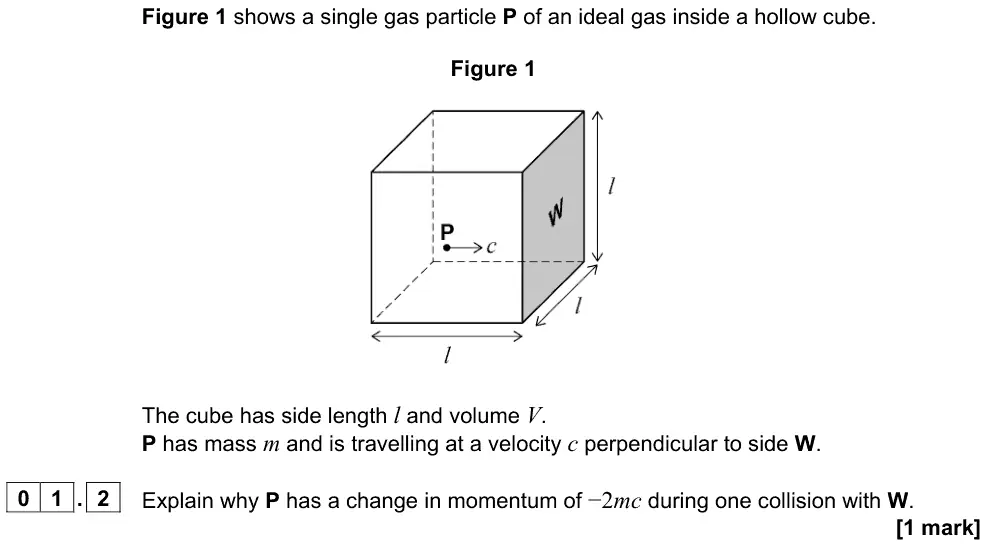
Figure 1 shows a single gas particle P of an ideal gas inside a hollow cube.
Figure 1
The cube has side length l and volume V.
P has mass m and is travelling at a velocity c perpendicular to side W.
Explain why P has a change in momentum of −2mc during one collision with W.
[1 mark]
June 2023 · Paper 2 · Q1.4 2 marks AO1=2 Explanation kinetic theorynewtons laws and momentum
Earlier part of question 1 that this part usesEarlier part of June 2023 Paper 2 question 1
Deduce an expression, in terms of m, c and V, for the contribution of P to the
pressure exerted on W.
Refer to appropriate Newton’s laws of motion.
[2 marks]
June 2023 · Paper 2 · Q2.2 2 marks AO2=2 Explanation thermal energy and ideal gaseskinetic theory
Earlier part of question 2 that this part usesEarlier part of June 2023 Paper 2 question 2
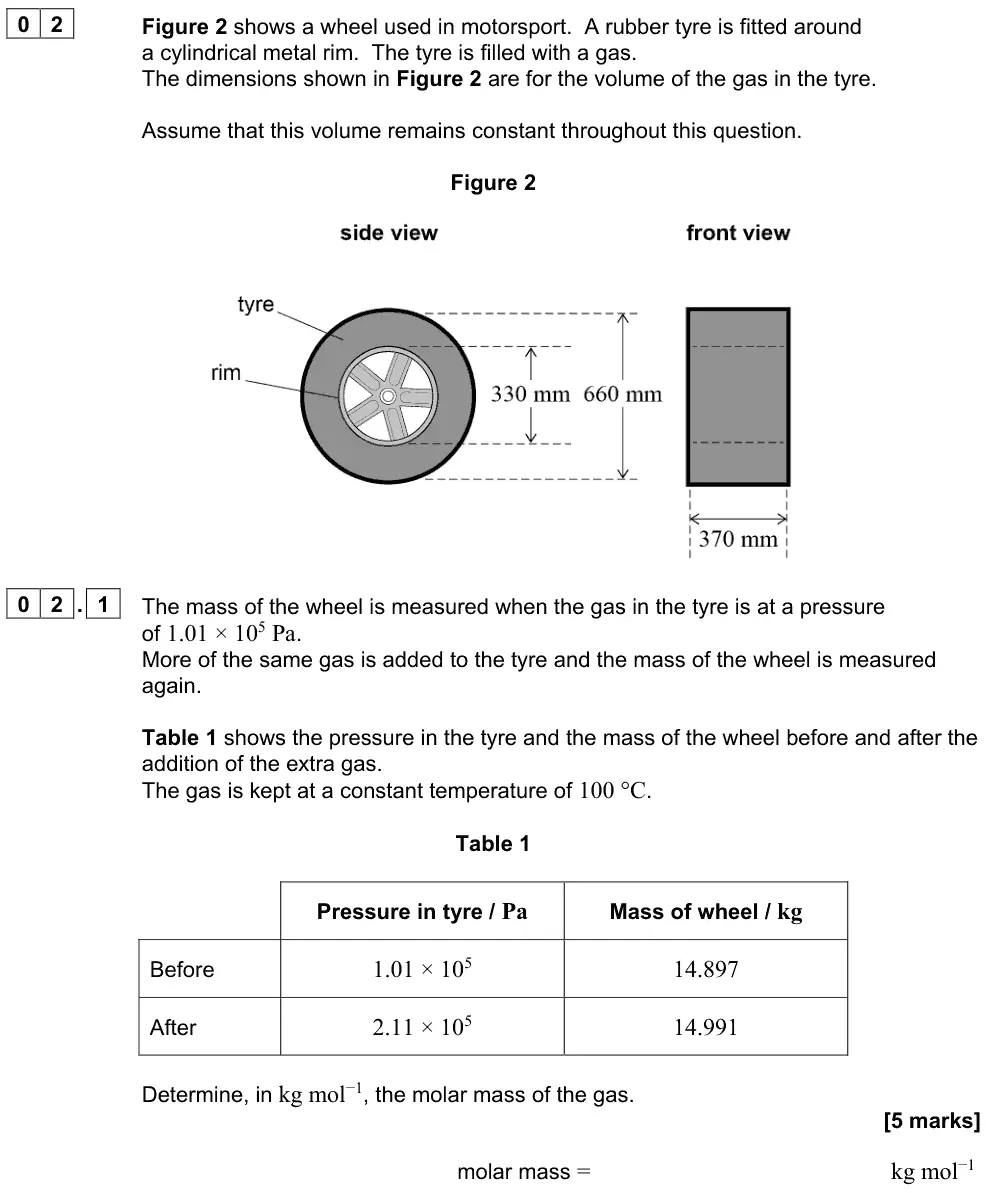
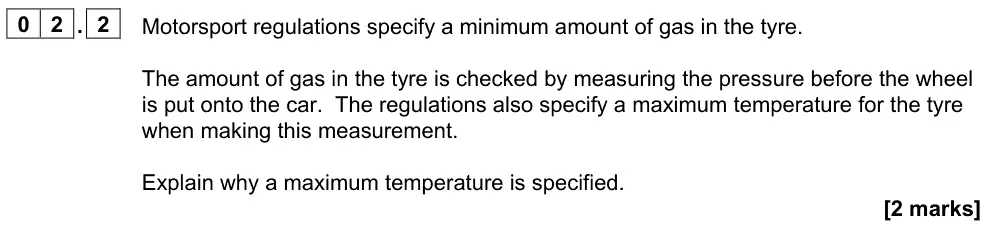
Motorsport regulations specify a minimum amount of gas in the tyre.
The amount of gas in the tyre is checked by measuring the pressure before the wheel
is put onto the car.  The regulations also specify a maximum temperature for the tyre
when making this measurement.
Explain why a maximum temperature is specified.
[2 marks]
June 2023 · Paper 2 · Q3.4 1 mark AO2=1 Explanation gravitational fields
Earlier part of question 3 that this part usesEarlier part of June 2023 Paper 2 question 3
Explain why gS is more important than gE in predicting the motion of the space probe
as it escapes from the Solar System.
[1 mark]
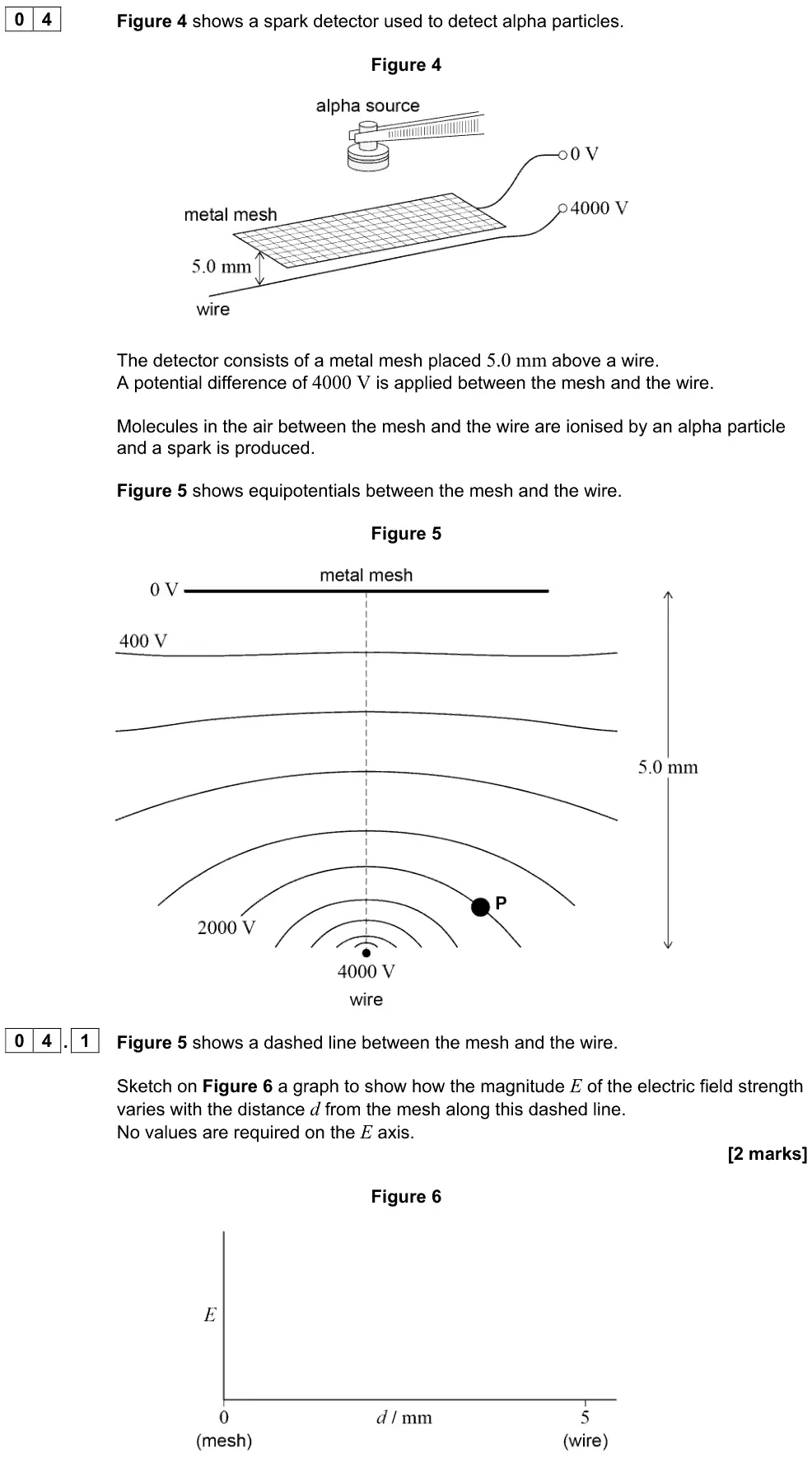
June 2023 · Paper 2 · Q4.3 1 mark AO3=1 Explanation electric fields
Earlier part of question 4 that this part usesEarlier part of June 2023 Paper 2 question 4
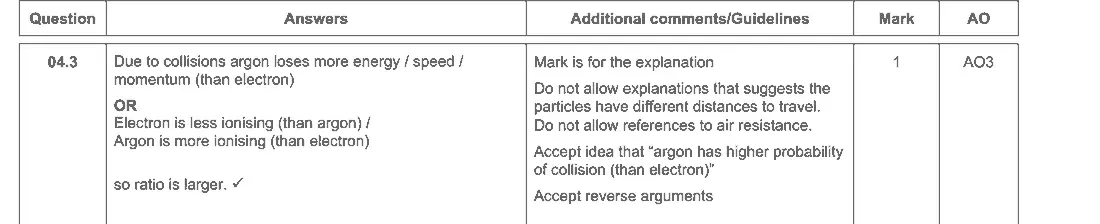
In practice, the air does affect the motion of the electron and the motion of the
argon ion.
Suggest how the presence of air between the mesh and the wire changes the ratio in
Question 04.2.
No numerical detail is required.
[1 mark]
June 2023 · Paper 2 · Q7.5 2 marks AO2=2 Explanation mass energy and fission
Earlier part of question 7 that this part usesEarlier part of June 2023 Paper 2 question 7
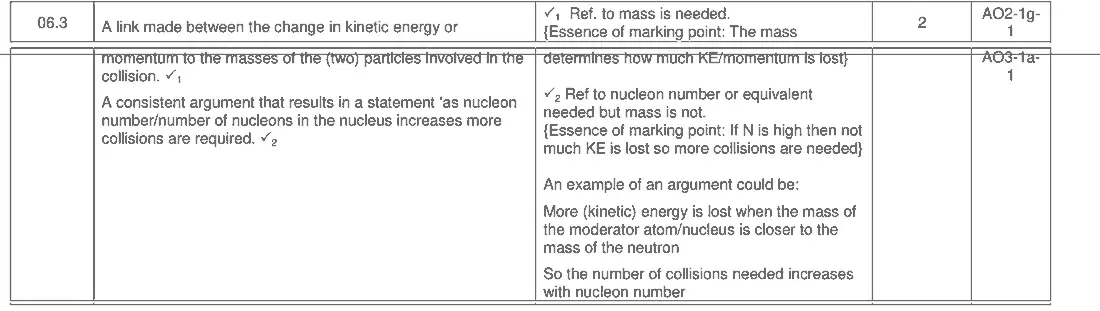
Explain, with reference to Figure 15, why elements with a small nucleon number are
preferred as moderator materials.
[2 marks]
June 2023 · Paper 3 Section A · Q3.1 2 marks Explanation electromagnetic induction
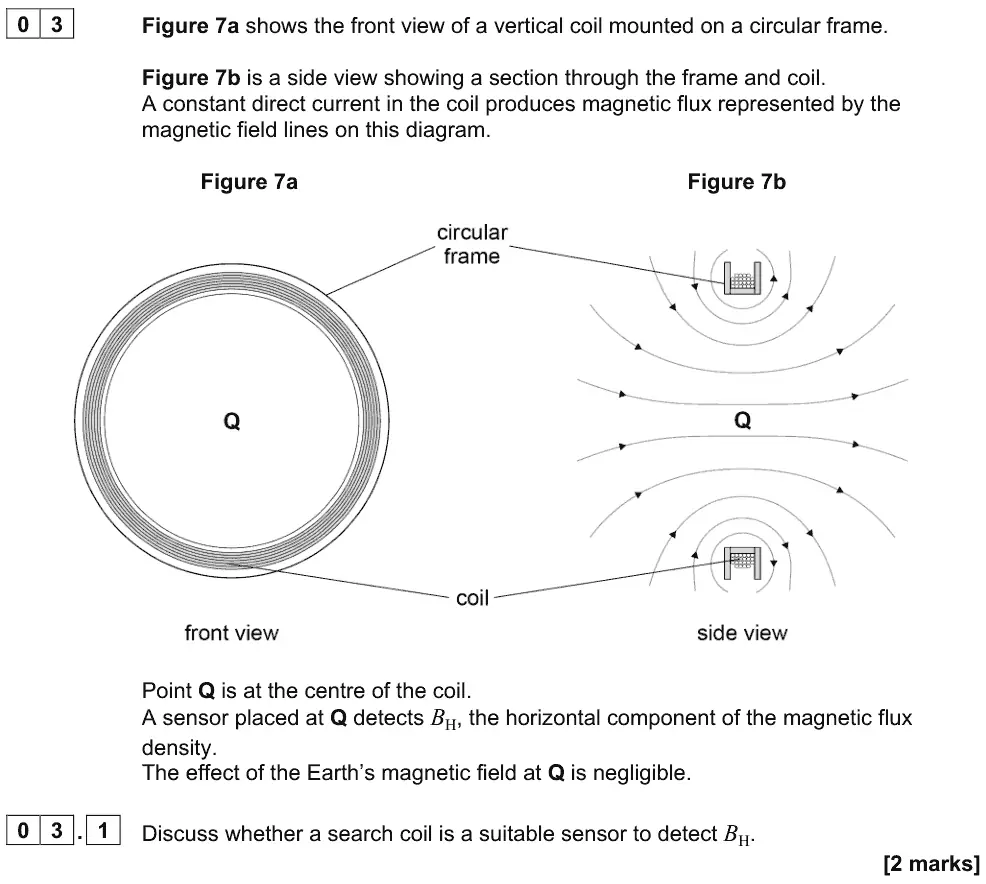
Figure 7a shows the front view of a vertical coil mounted on a circular frame.
Figure 7b is a side view showing a section through the frame and coil.
A constant direct current in the coil produces magnetic flux represented by the
magnetic field lines on this diagram.
Figure 7a
Figure 7b
Point Q is at the centre of the coil.
A sensor placed at Q detects BH, the horizontal component of the magnetic flux
density.
The effect of the Earth’s magnetic field at Q is negligible.
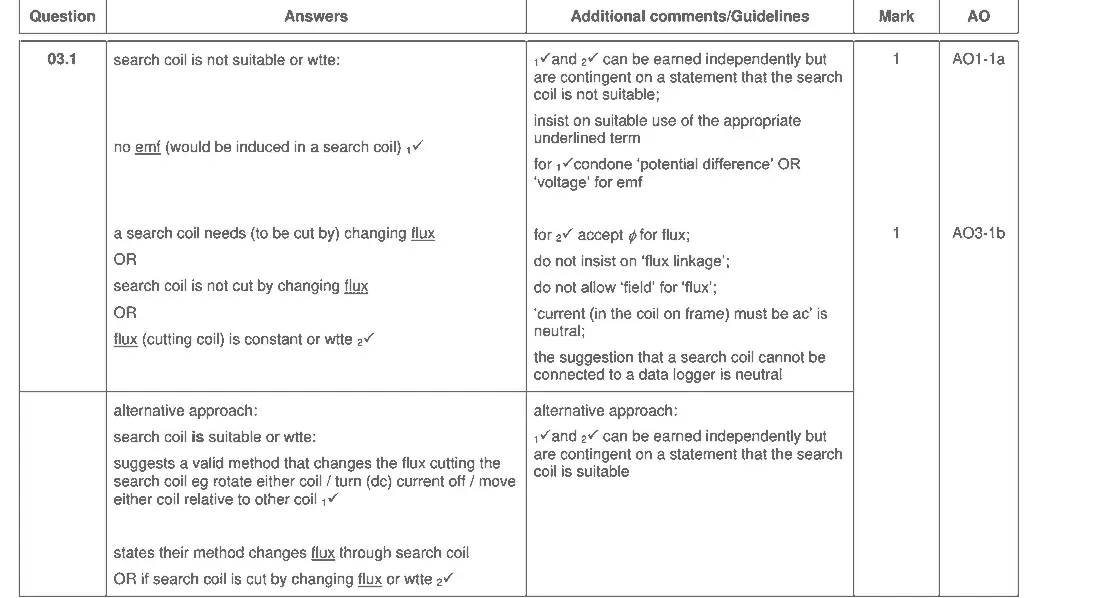
Discuss whether a search coil is a suitable sensor to detect BH.
[2 marks]
June 2023 · Paper 3B Astrophysics · Q1.5 2 marks AO2=1, AO3=1 Explanation classification of stars
Earlier part of question 1 that this part usesEarlier part of June 2023 Paper 3B Astrophysics question 1
One stage in the evolution of Rigel includes the emission of a gamma ray burst.
Outline the circumstances during which a gamma ray burst will be emitted by Rigel.
[2 marks]
June 2023 · Paper 3B Astrophysics · Q2.5 3 marks AO1=3 Explanation telescopes
Earlier part of question 2 that this part usesEarlier part of June 2023 Paper 3B Astrophysics question 2
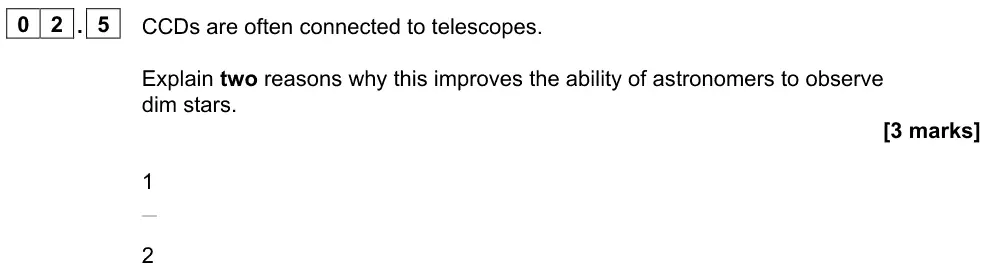
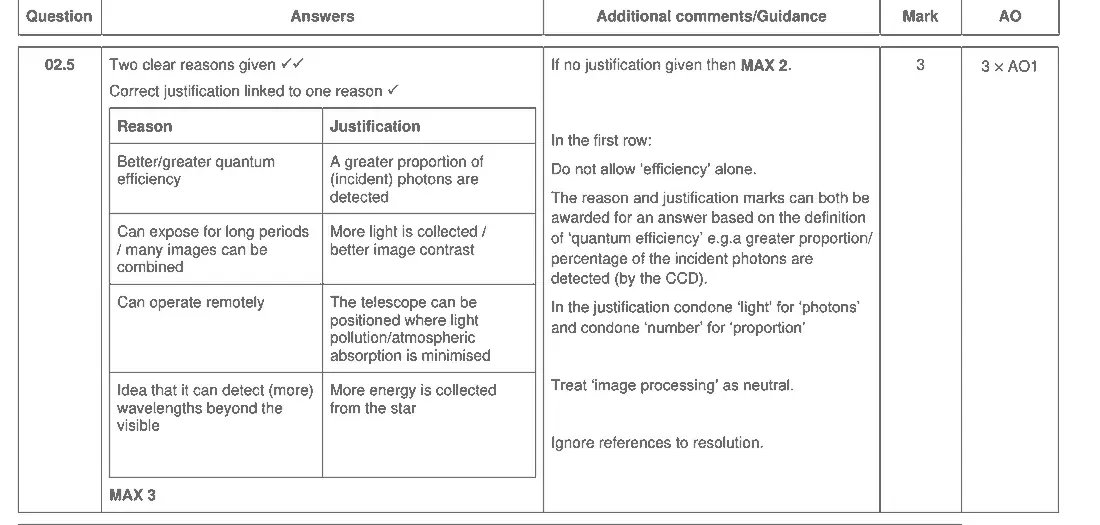
CCDs are often connected to telescopes.
Explain two reasons why this improves the ability of astronomers to observe
dim stars.
[3 marks]
1
2
June 2023 · Paper 3B Medical physics · Q1 2 marks AO1=2 Explanation medical imaging
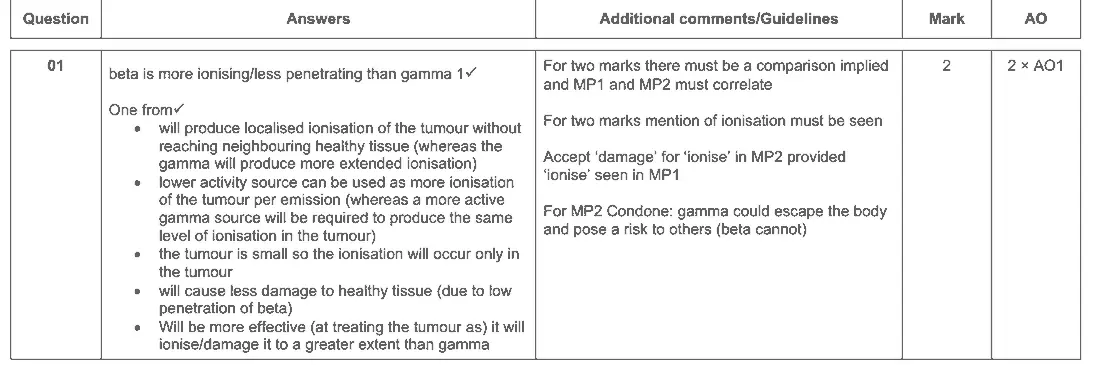
Brachytherapy is used to treat small tumours.  In this technique a sealed radioactive
source is placed inside a patient’s body next to the tumour.
Explain one advantage of using beta radiation rather than gamma radiation in
brachytherapy.
[2 marks]
June 2023 · Paper 3B Medical physics · Q2.2 3 marks AO2=3 Explanation eye ear and ecg
Earlier part of question 2 that this part usesEarlier part of June 2023 Paper 3B Medical physics question 2
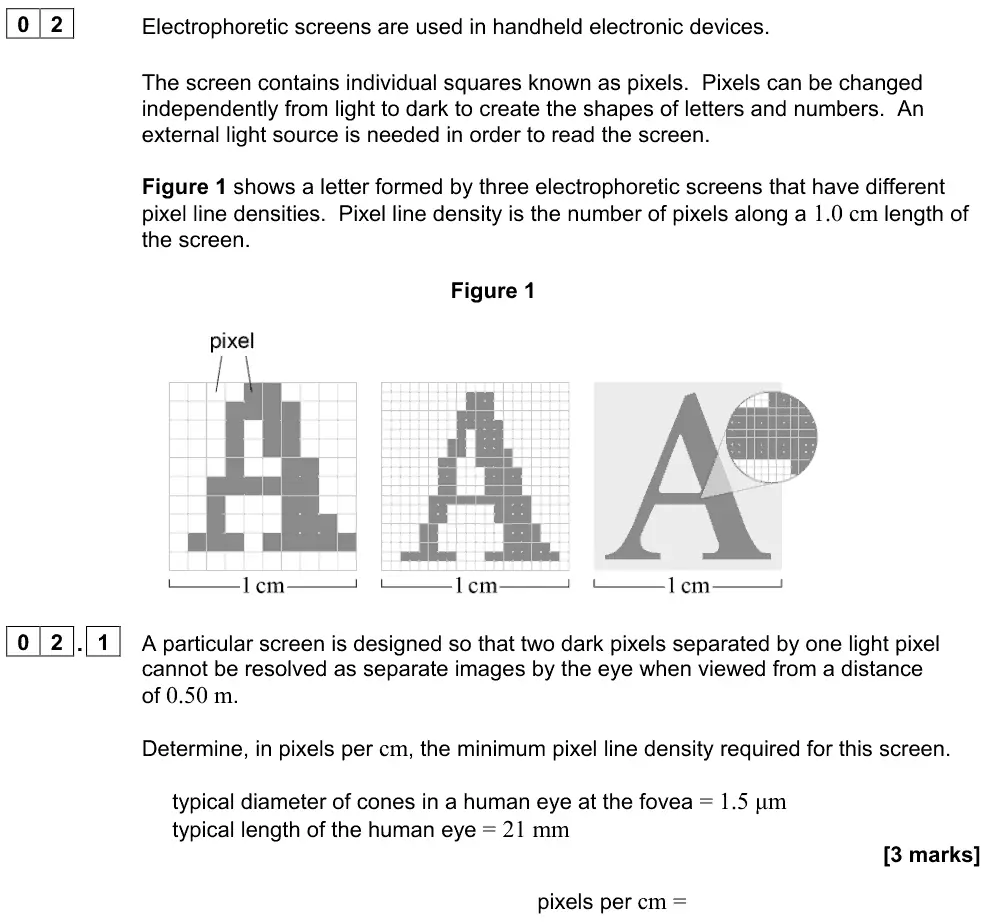
On a different electrophoretic screen, two dark pixels separated by one light pixel can
just be resolved at a particular distance when the external light source is bright.
Explain why these pixels cannot be resolved at the same distance when the intensity
of the external light source is reduced.
[3 marks]
June 2023 · Paper 3B Engineering physics · Q1.2 2 marks AO1=2 Explanation Hard rotational dynamics
Earlier part of question 1 that this part usesEarlier part of June 2023 Paper 3B Engineering physics question 1
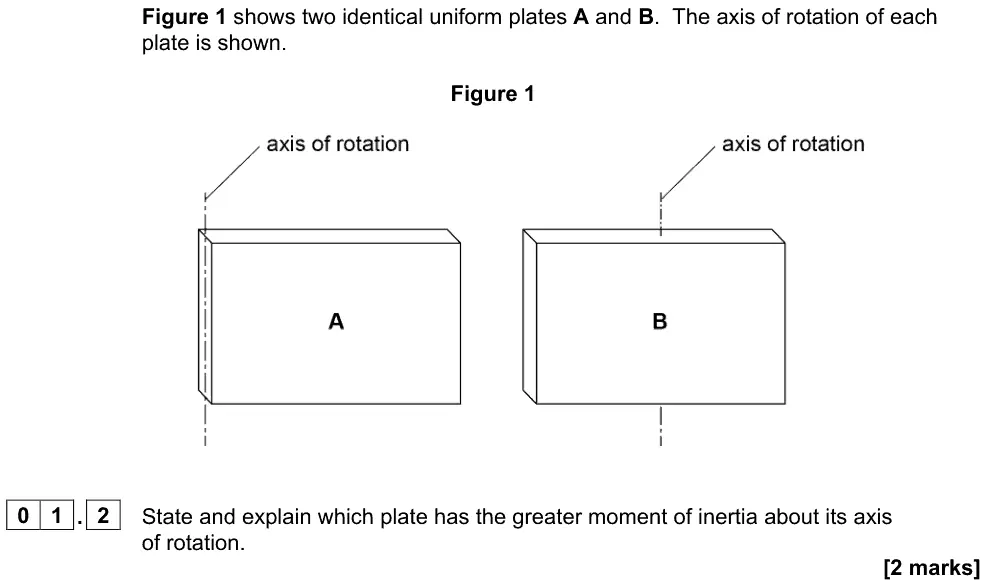
Figure 1 shows two identical uniform plates A and B.  The axis of rotation of each
plate is shown.
Figure 1
State and explain which plate has the greater moment of inertia about its axis
of rotation.
[2 marks]
June 2023 · Paper 3B Engineering physics · Q2.1 2 marks AO2=2 Explanation rotational dynamics
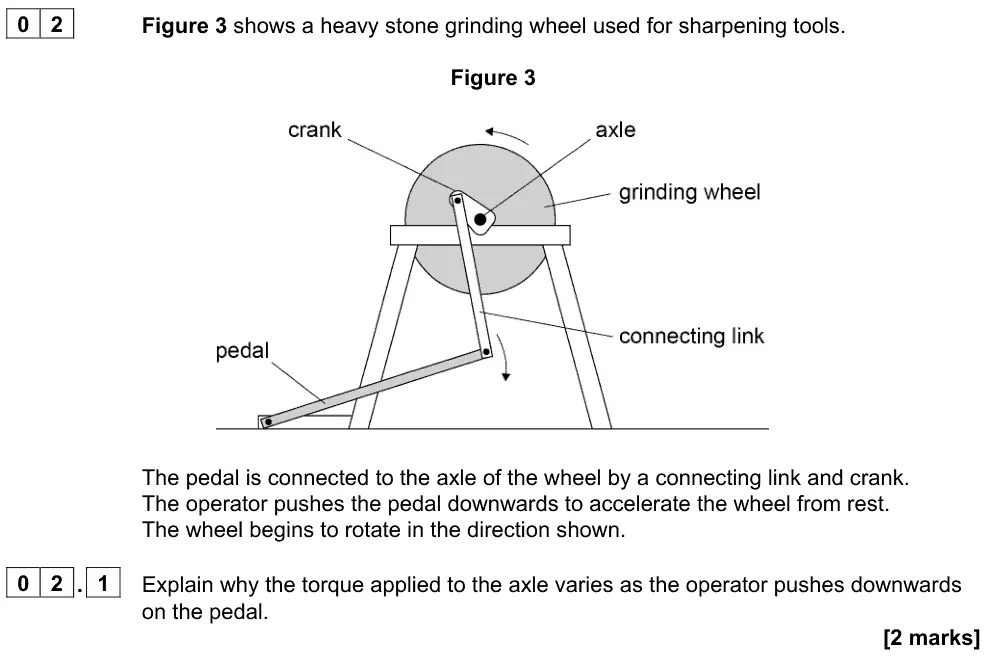
Figure 3 shows a heavy stone grinding wheel used for sharpening tools.
Figure 3
The pedal is connected to the axle of the wheel by a connecting link and crank.
The operator pushes the pedal downwards to accelerate the wheel from rest.
The wheel begins to rotate in the direction shown.
Explain why the torque applied to the axle varies as the operator pushes downwards
on the pedal.
[2 marks]
June 2023 · Paper 3B Engineering physics · Q2.2 2 marks AO2=2 Explanation Hard rotational dynamics
Earlier part of question 2 that this part usesEarlier part of June 2023 Paper 3B Engineering physics question 2
The wheel is rotating at a high angular speed.  The operator is told not to use the
pedal to stop the rotation of the wheel suddenly.
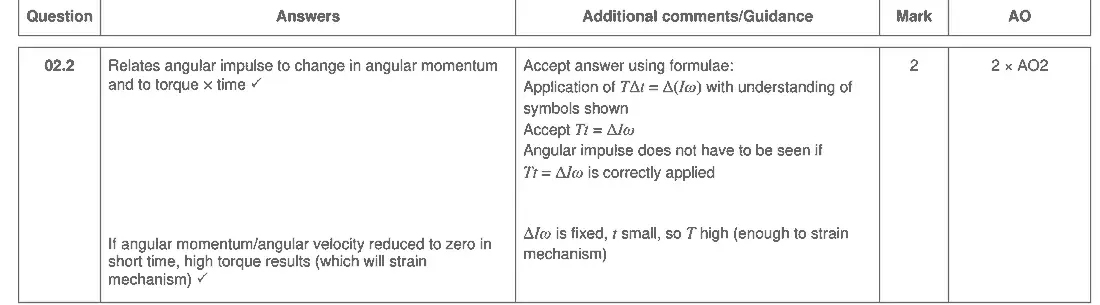
Explain, with reference to angular impulse, why a sudden stop is likely to damage
the mechanism.
[2 marks]
June 2023 · Paper 3B Engineering physics · Q3.4 2 marks AO3=2 Explanation Hard thermodynamics and engines
Earlier part of question 3 that this part usesEarlier part of June 2023 Paper 3B Engineering physics question 3
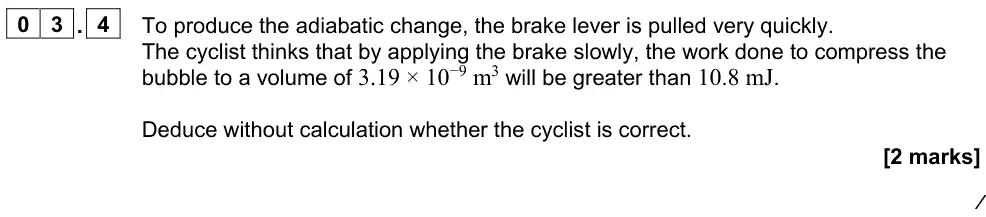
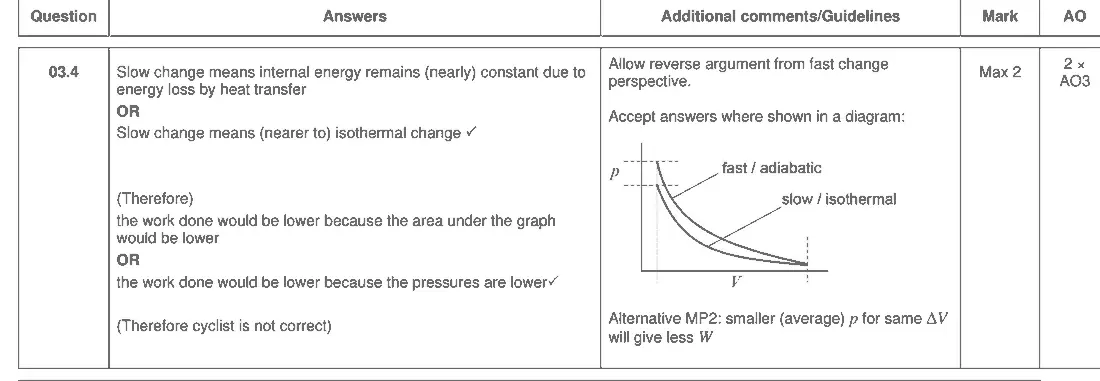
To produce the adiabatic change, the brake lever is pulled very quickly.
The cyclist thinks that by applying the brake slowly, the work done to compress the
bubble to a volume of 3.19 × 10⁻⁹ m3 will be greater than 10.8 mJ.
Deduce without calculation whether the cyclist is correct.
[2 marks]
June 2023 · Paper 3B Turning points · Q1.3 3 marks AO3=3 Explanation wave particle duality history
Earlier part of question 1 that this part usesEarlier part of June 2023 Paper 3B Turning points question 1
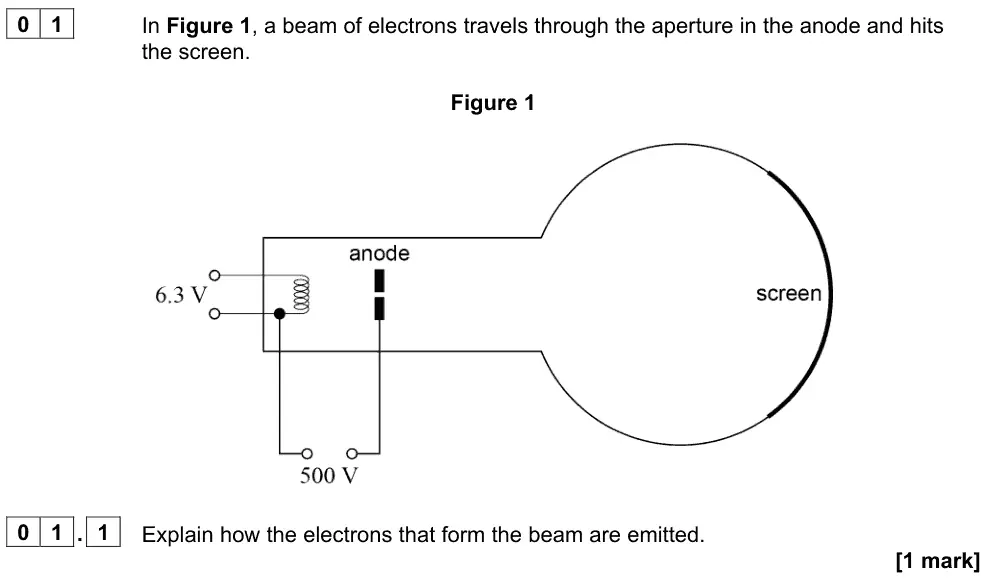
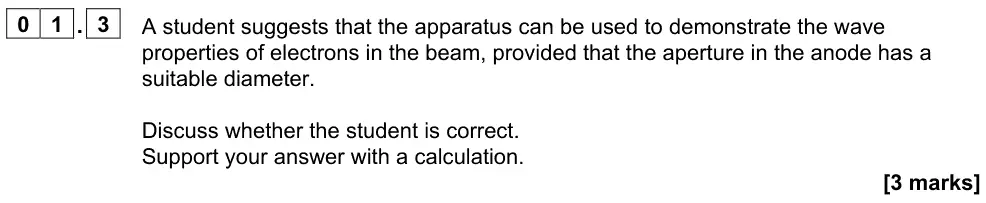
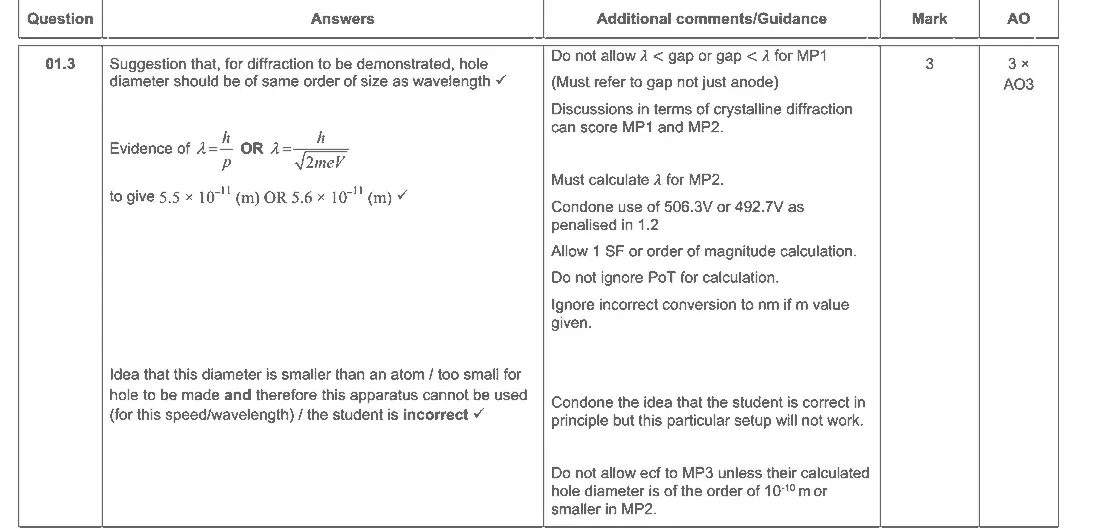
A student suggests that the apparatus can be used to demonstrate the wave
properties of electrons in the beam, provided that the aperture in the anode has a
suitable diameter.
Discuss whether the student is correct.
Support your answer with a calculation.
[3 marks]
June 2023 · Paper 3B Turning points · Q3.3 3 marks AO1=2, AO2=1 Explanation wave particle duality history
Earlier part of question 3 that this part usesEarlier part of June 2023 Paper 3B Turning points question 3
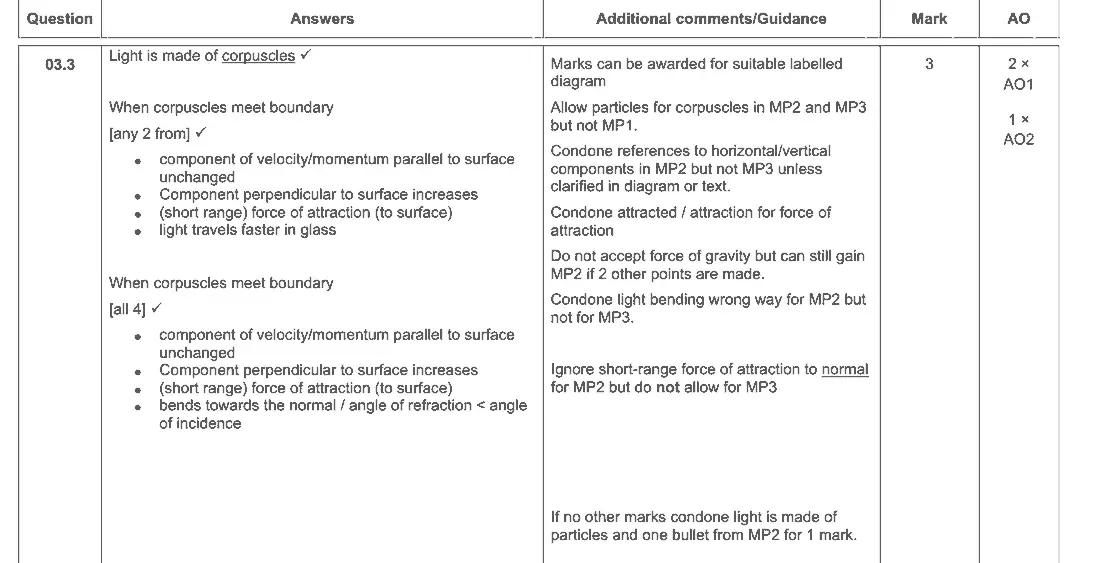
Another theory of the nature of light was proposed by Isaac Newton.
Describe how Newton’s theory was used to explain the refraction of light as it
moves from air into glass.
[3 marks]
June 2023 · Paper 3B Turning points · Q3.4 3 marks AO1=2, AO3=1 Explanation wave particle duality history
Earlier part of question 3 that this part usesEarlier part of June 2023 Paper 3B Turning points question 3
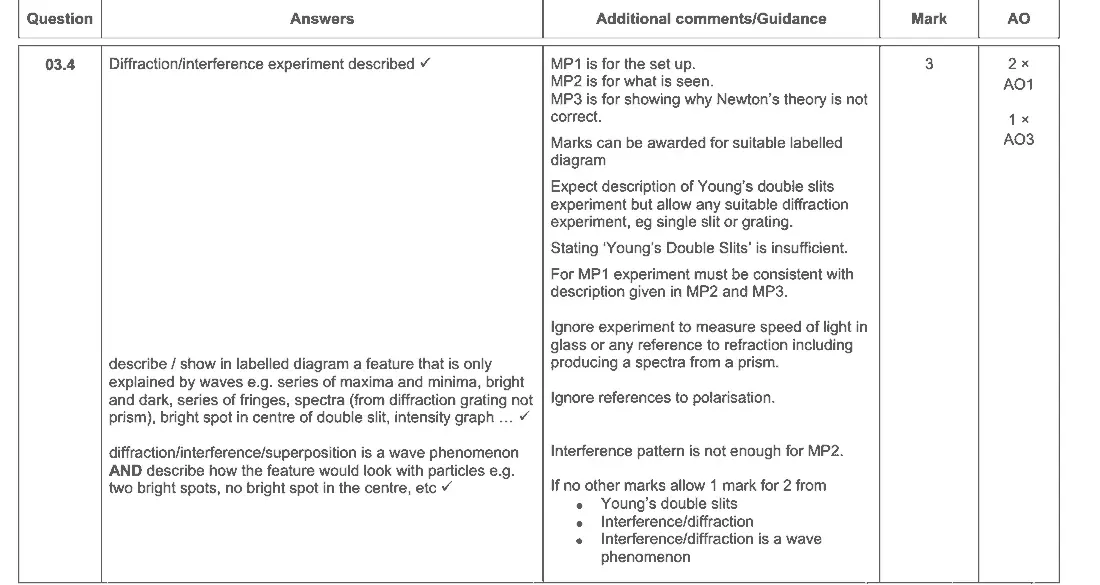
Describe a demonstration using visible light that can be performed in a school
laboratory to show that Newton’s theory is not correct.
[3 marks]
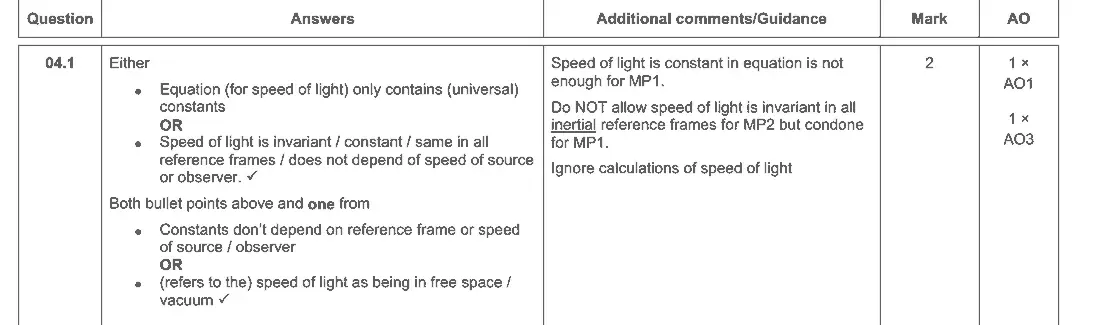
June 2023 · Paper 3B Turning points · Q4.1 2 marks AO1=1, AO3=1 Explanation special relativitywave particle duality history
Einstein developed his theory of special relativity from two postulates.  One postulate
states that physical laws have the same form in all inertial frames.
State the other postulate and explain how it is consistent with the equation:
c =
0 0
1
[2 marks]
June 2023 · Paper 3B Electronics · Q2.2 2 marks AO2=2 Explanation semiconductor devices and signals
Earlier part of question 2 that this part usesEarlier part of June 2023 Paper 3B Electronics question 2
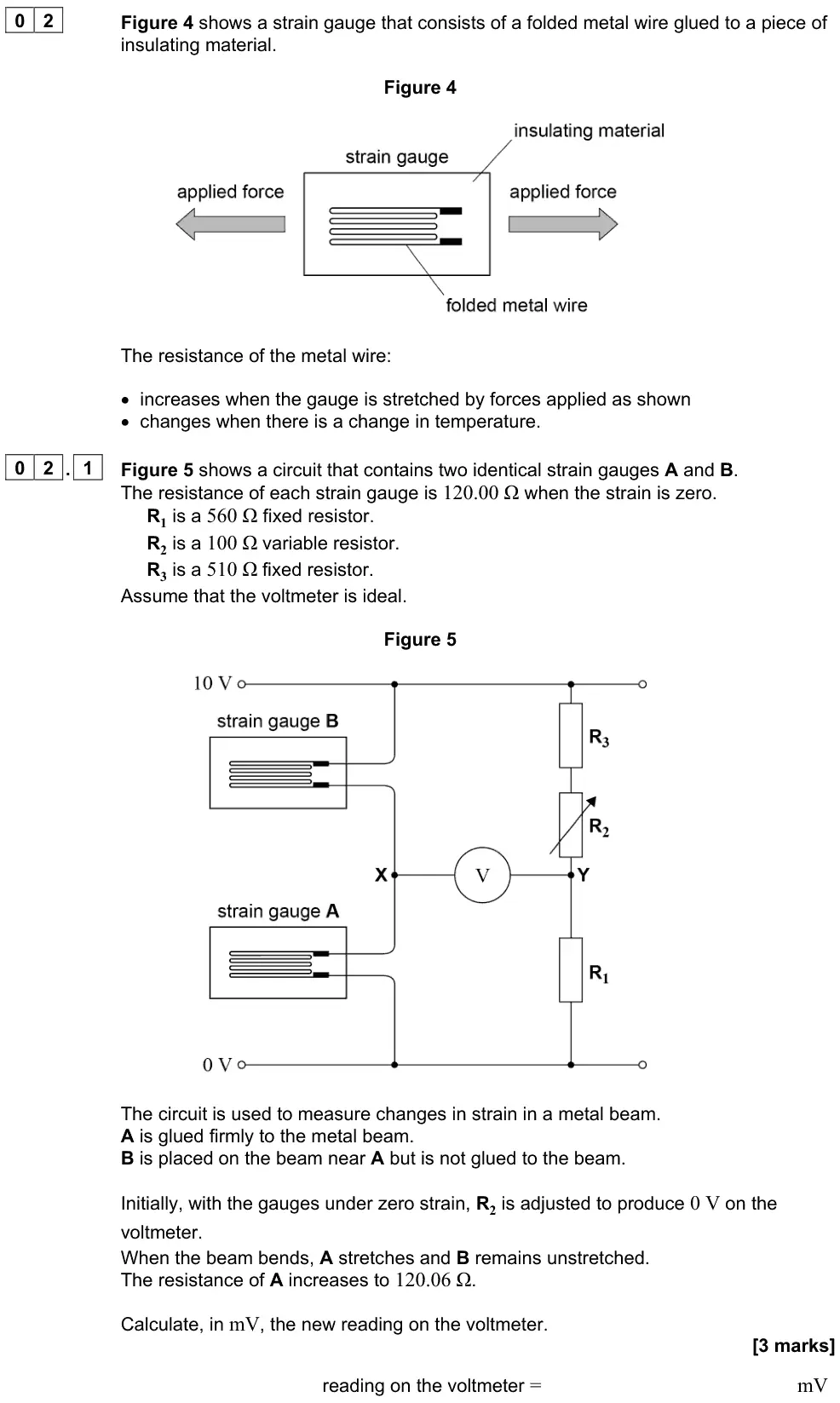
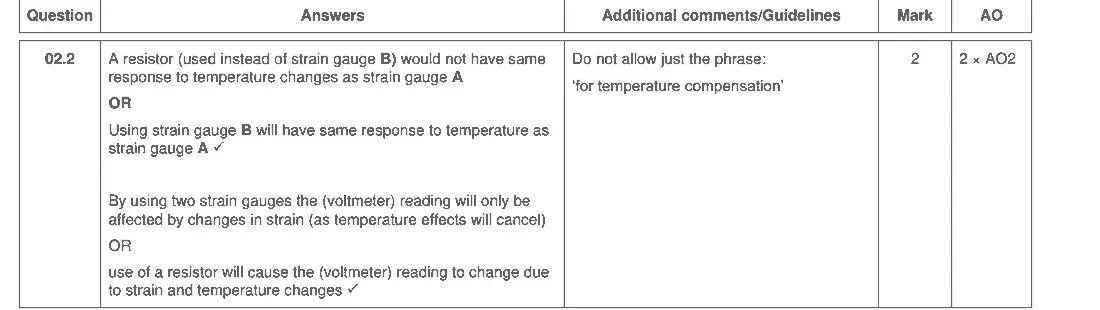
Explain the advantage of using strain gauge B rather than a 120.00 Ω resistor in the
circuit.
[2 marks]
June 2023 · Paper 3B Electronics · Q3.4 2 marks AO1=1, AO2=1 Explanation data communication
Earlier part of question 3 that this part usesEarlier part of June 2023 Paper 3B Electronics question 3
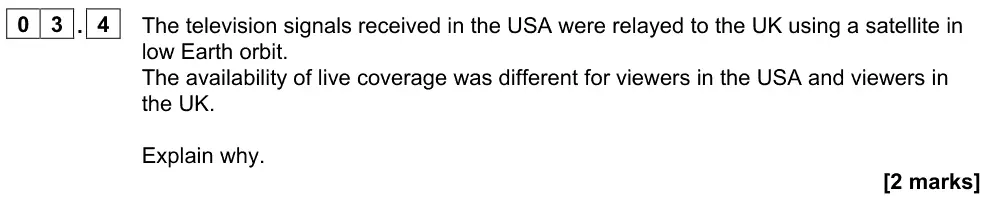
The television signals received in the USA were relayed to the UK using a satellite in
low Earth orbit.
The availability of live coverage was different for viewers in the USA and viewers in
the UK.
Explain why.
[2 marks]
June 2023 · Paper 3B Electronics · Q3.5 2 marks AO1=1, AO2=1 Explanation data communication
Earlier part of question 3 that this part usesEarlier part of June 2023 Paper 3B Electronics question 3
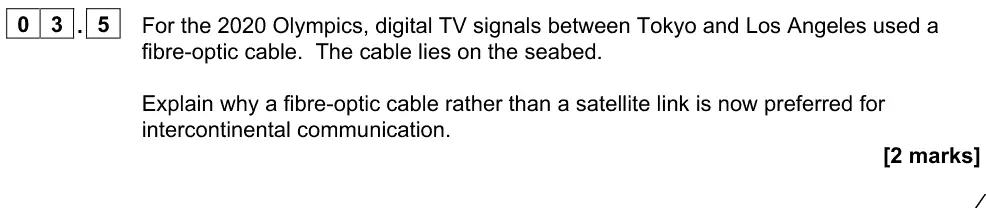
For the 2020 Olympics, digital TV signals between Tokyo and Los Angeles used a
fibre-optic cable.  The cable lies on the seabed.
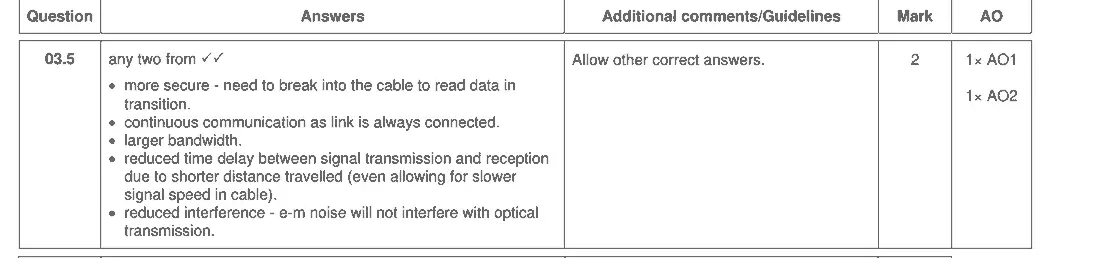
Explain why a fibre-optic cable rather than a satellite link is now preferred for
intercontinental communication.
[2 marks]
June 2023 · Paper 3B Electronics · Q4.3 2 marks AO2=1, AO3=1 Explanation operational amplifiers
Earlier part of question 4 that this part usesEarlier part of June 2023 Paper 3B Electronics question 4
The value of Rf in the feedback loop in Figure 9 is increased.
State and explain the effect of this change on the bandwidth of the inverting amplifier.
[2 marks]
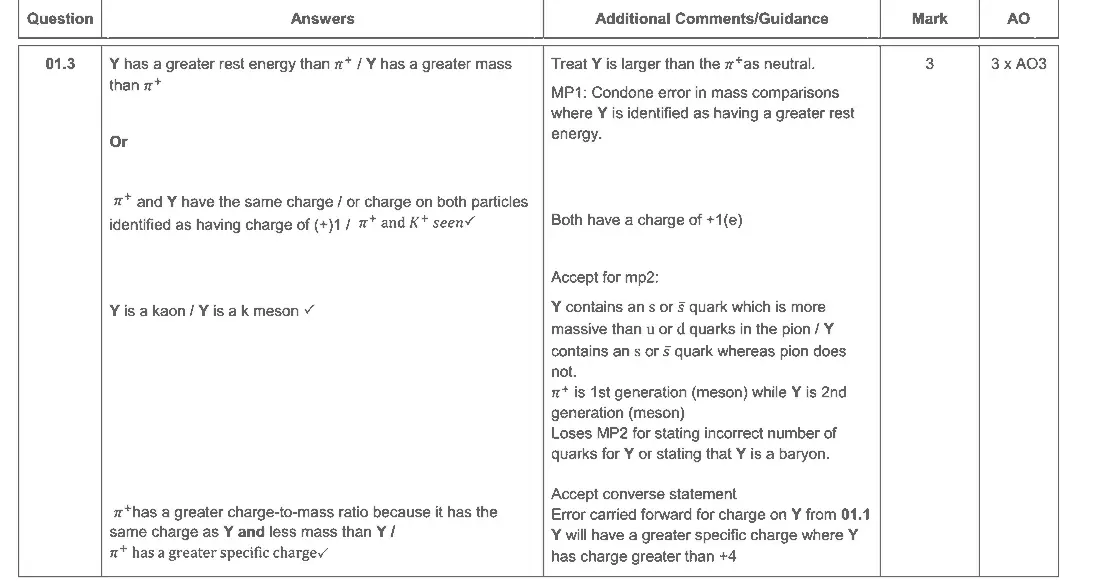
June 2022 · AS Paper 1 · Q1.3 3 marks AO3=3 Explanation Hard atomic structure and stable nucleiclassification of particles and quarks
Earlier part of question 1 that this part usesEarlier part of June 2022 Paper 1 question 1
Deduce which particle, π+ or Y, has the greater charge-to-mass ratio.
Justify your conclusion.
[3 marks]
June 2022 · AS Paper 1 · Q2.1 2 marks AO1=1, AO2=1 Explanation energy levels and wave particle duality
A sample of bromine gas contains a mixture of two isotopes.  An experiment is done
to find the percentage of each isotope in this sample.
In the experiment, the gas is ionised by a beam of electrons.
Explain how the beam of electrons causes a particle of the gas to have a charge
of +1e.
[2 marks]
June 2022 · AS Paper 1 · Q2.3 2 marks AO3=2 Explanation Hard atomic structure and stable nuclei
Earlier part of question 2 that this part usesEarlier part of June 2022 Paper 1 question 2
Deduce the percentage of each isotope in the gas.
Justify your conclusion.
[2 marks]
June 2022 · AS Paper 1 · Q5.1 2 marks AO3=2 Explanation energy levels and wave particle duality
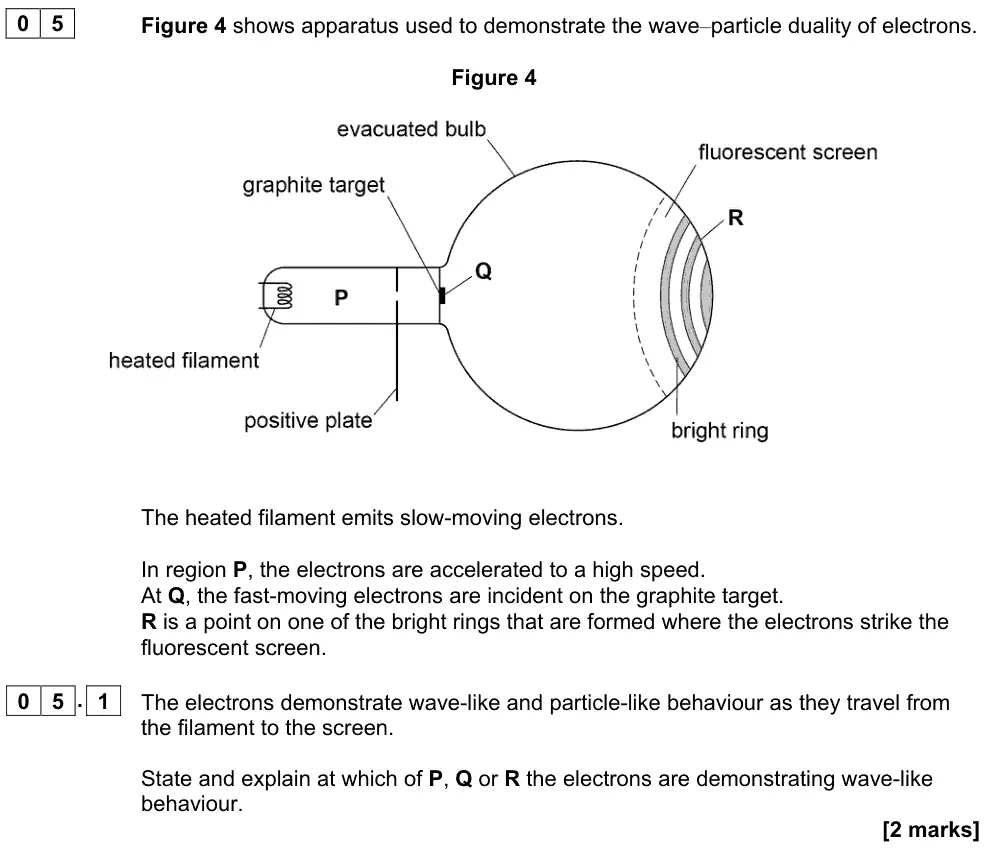
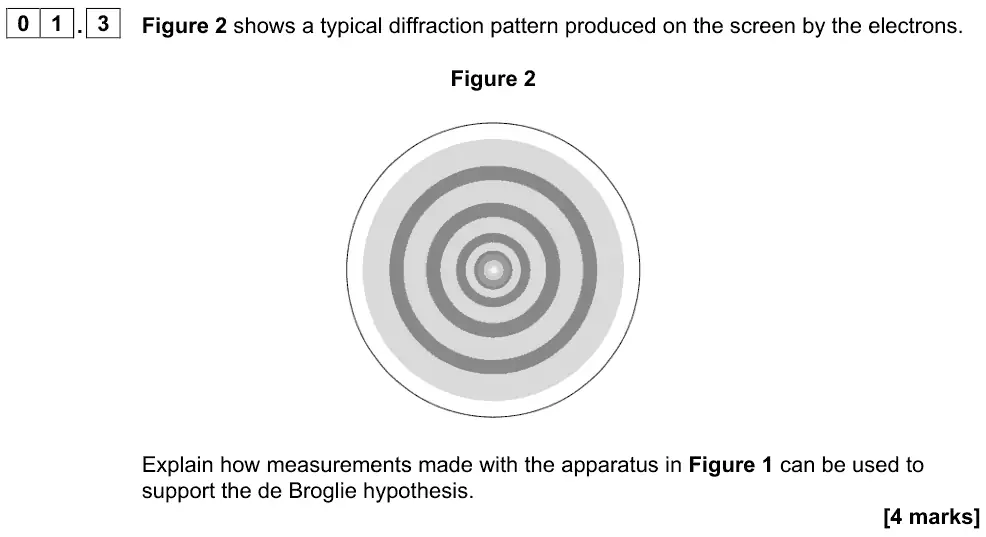
Figure 4 shows apparatus used to demonstrate the wave–particle duality of electrons.
Figure 4
The heated filament emits slow-moving electrons.
In region P, the electrons are accelerated to a high speed.
At Q, the fast-moving electrons are incident on the graphite target.
R is a point on one of the bright rings that are formed where the electrons strike the
fluorescent screen.
The electrons demonstrate wave-like and particle-like behaviour as they travel from
the filament to the screen.
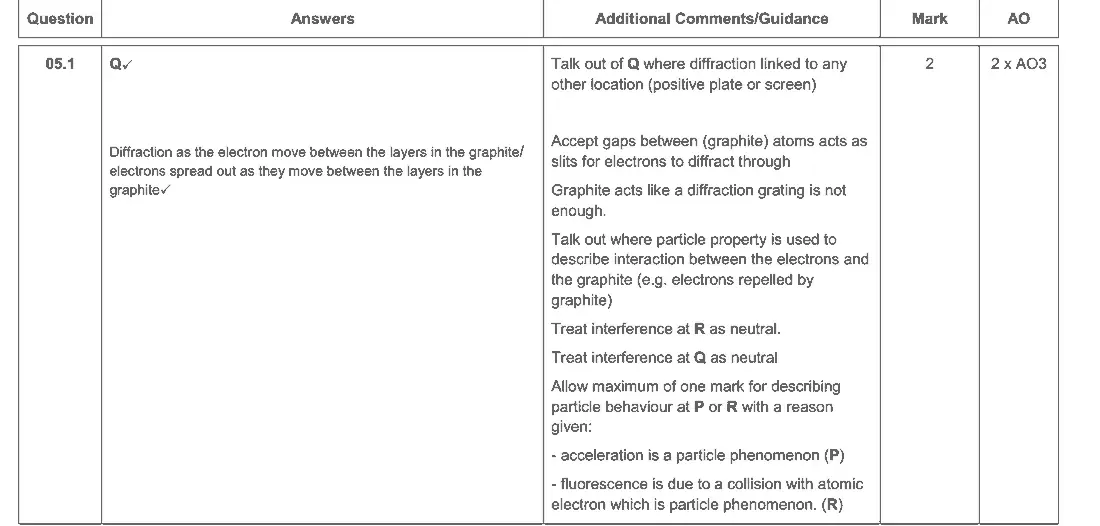
State and explain at which of P, Q or R the electrons are demonstrating wave-like
behaviour.
[2 marks]
June 2022 · AS Paper 1 · Q5.2 3 marks AO2=3 Explanation energy levels and wave particle duality
Earlier part of question 5 that this part usesEarlier part of June 2022 Paper 1 question 5
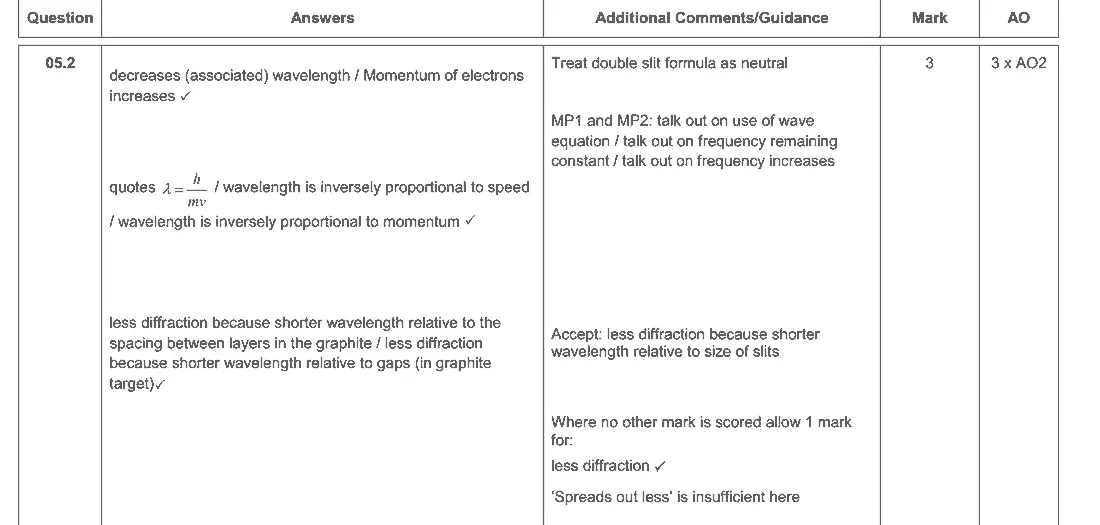
The apparatus is adjusted so that the electrons are incident on the graphite target with
a greater speed.
Explain why the bright rings formed on the screen now have a smaller diameter.
[3 marks]
June 2022 · AS Paper 1 · Q7.3 3 marks AO3=3 Explanation Hard work energy and powervectors and moments
Earlier part of question 7 that this part usesEarlier part of June 2022 Paper 1 question 7
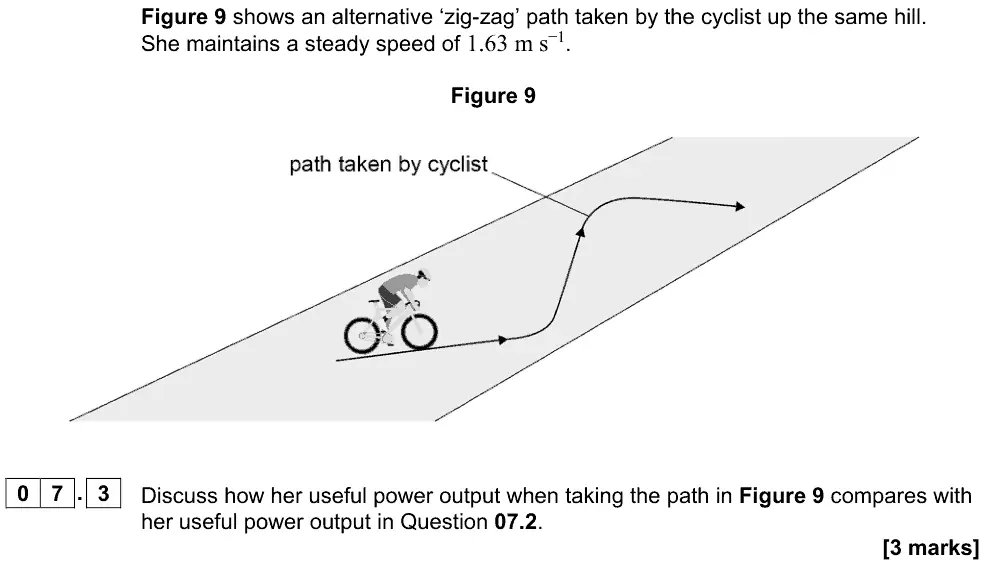
Figure 9 shows an alternative ‘zig-zag’ path taken by the cyclist up the same hill.
She maintains a steady speed of 1.63 m s−1.
Figure 9
Discuss how her useful power output when taking the path in Figure 9 compares with
her useful power output in Question 07.2.
[3 marks]
June 2022 · AS Paper 1 · Q7.5 4 marks AO1=1, AO2=3 Explanation Hard work energy and powermotion and projectiles
Earlier part of question 7 that this part usesEarlier part of June 2022 Paper 1 question 7
Energy transfers occur as the cyclist travels down the hill.
Outline how these energy transfers explain the shape of the graph in Figure 10.
[4 marks]
June 2022 · AS Paper 1 · Q8.3 3 marks AO1=3 Explanation current voltage and resistivity
Earlier part of question 8 that this part usesEarlier part of June 2022 Paper 1 question 8
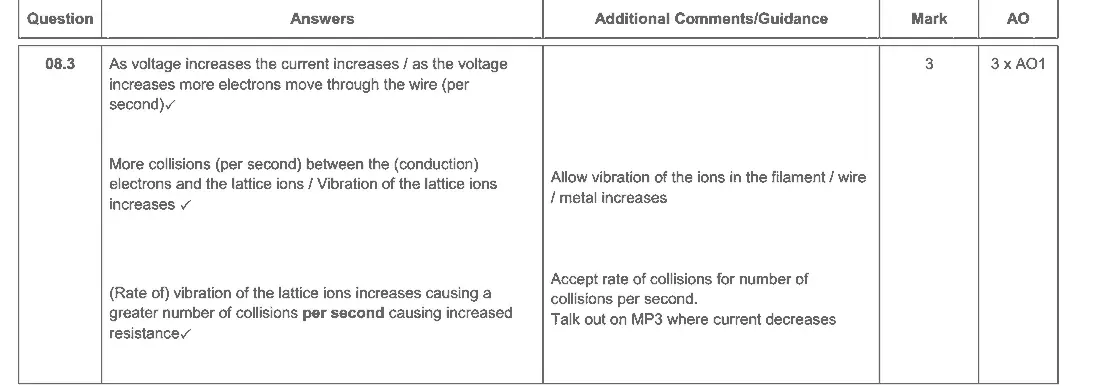
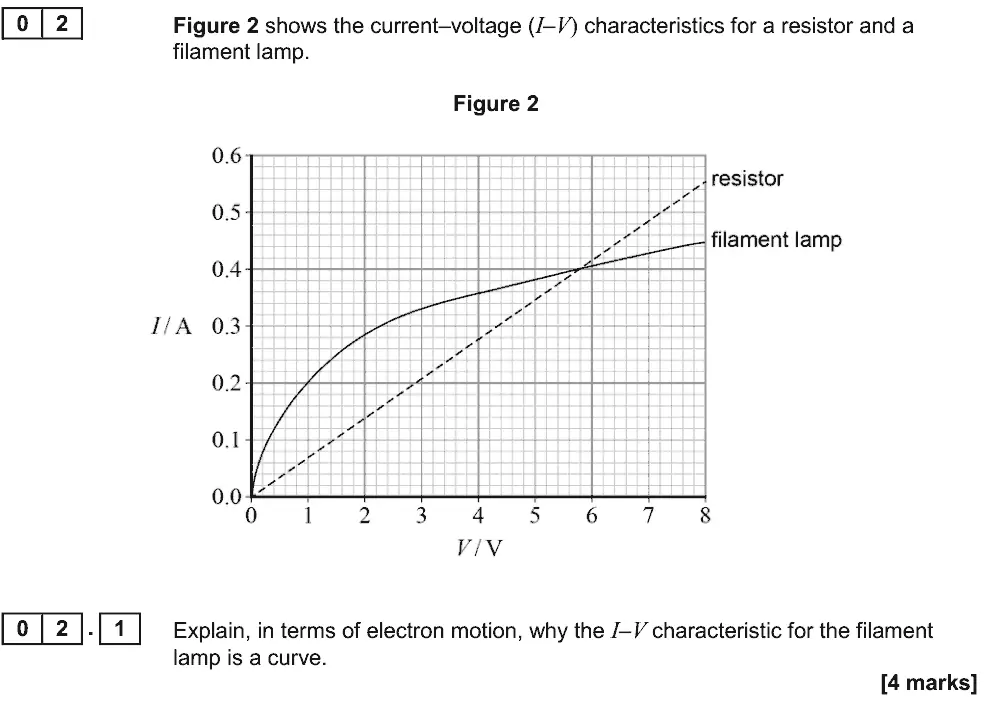
Explain, in terms of electron movement, why the resistance of the filament lamp
changes as the voltage changes as shown in Figure 13.
[3 marks]
June 2022 · AS Paper 1 · Q8.6 3 marks AO3=3 Explanation Hard circuits and potential dividers
Earlier part of question 8 that this part usesEarlier part of June 2022 Paper 1 question 8
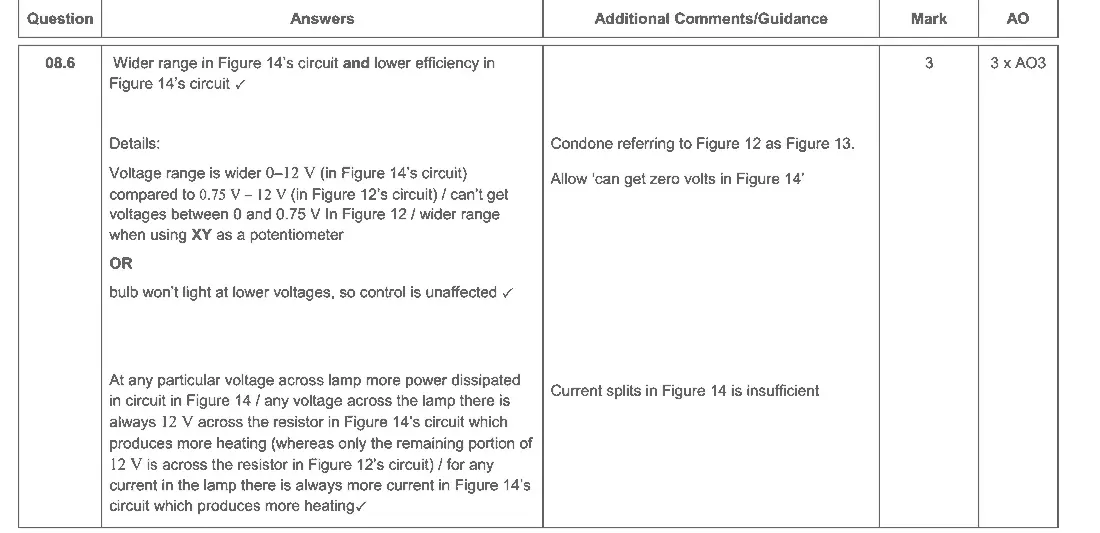
A student wants to control the brightness of the lamp.
He gives two reasons why the circuit in Figure 14 is better than the circuit in
Figure 12 for controlling the brightness.  The two reasons are:
• the Figure 14 circuit can achieve a greater range of voltages across the lamp
• the Figure 14 circuit is more efficient at transferring energy to the lamp.
Discuss, without calculation, whether either of these two reasons is correct.
[3 marks]
June 2022 · AS Paper 2 · Q2.5 1 mark AO3=1 Explanation Hard circuits and potential dividerscurrent voltage and resistivity
Earlier part of question 2 that this part usesEarlier part of June 2022 Paper 2 question 2
Suggest one change to the circuit to make the voltmeter read zero for the same value
of x as in Question 02.1.
[1 mark]
June 2022 · Paper 1 · Q1.2 2 marks AO2=1, AO3=1 Explanation particles antiparticles and interactionsclassification of particles and quarks
Earlier part of question 1 that this part usesEarlier part of June 2022 Paper 1 question 1
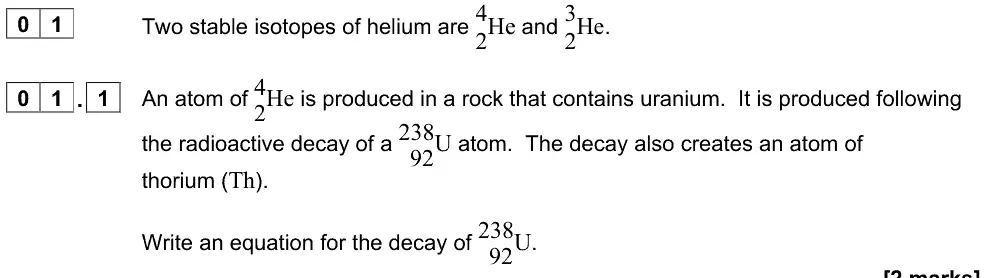
238
92U →
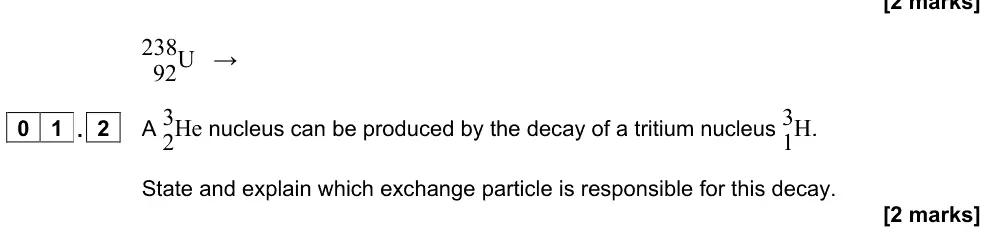
A 3
2He nucleus can be produced by the decay of a tritium nucleus 3
1H.
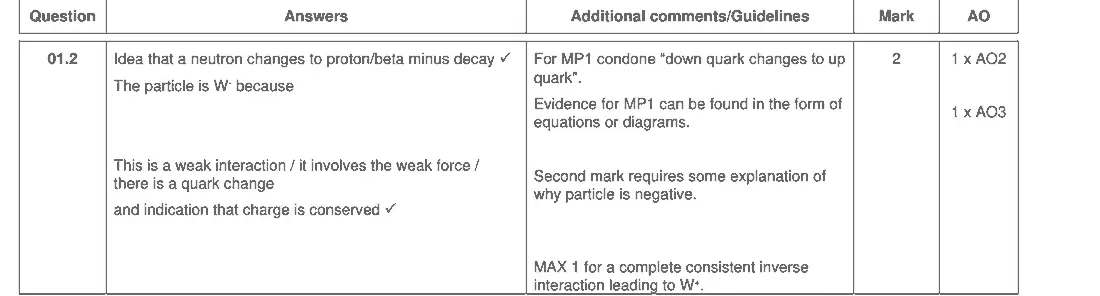
State and explain which exchange particle is responsible for this decay.
[2 marks]
June 2022 · Paper 1 · Q1.3 2 marks AO3=2 Explanation energy levels and wave particle duality
Earlier part of question 1 that this part usesEarlier part of June 2022 Paper 1 question 1
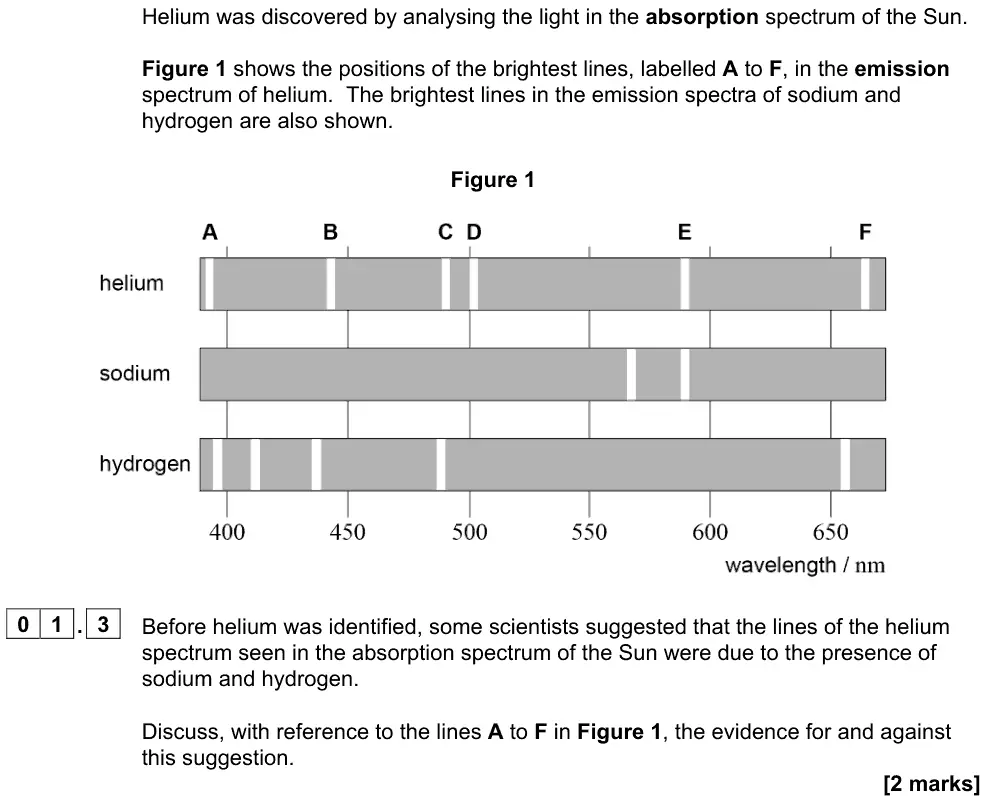
Helium was discovered by analysing the light in the absorption spectrum of the Sun.
Figure 1 shows the positions of the brightest lines, labelled A to F, in the emission
spectrum of helium.  The brightest lines in the emission spectra of sodium and
hydrogen are also shown.
Figure 1
Before helium was identified, some scientists suggested that the lines of the helium
spectrum seen in the absorption spectrum of the Sun were due to the presence of
sodium and hydrogen.
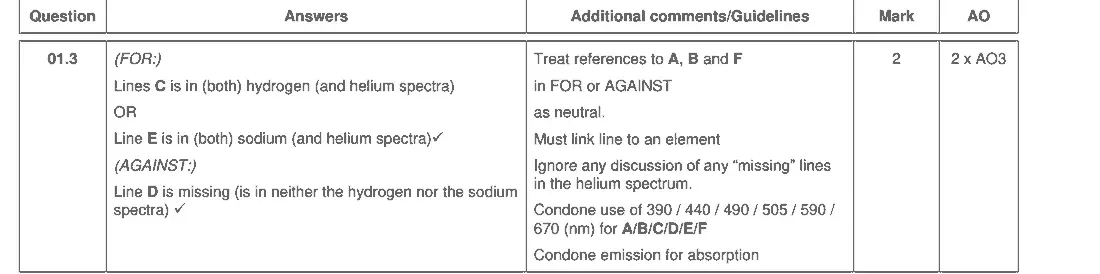
Discuss, with reference to the lines A to F in Figure 1, the evidence for and against
this suggestion.
[2 marks]
June 2022 · Paper 1 · Q1.5 3 marks AO1=3 Explanation energy levels and wave particle duality
Earlier part of question 1 that this part usesEarlier part of June 2022 Paper 1 question 1
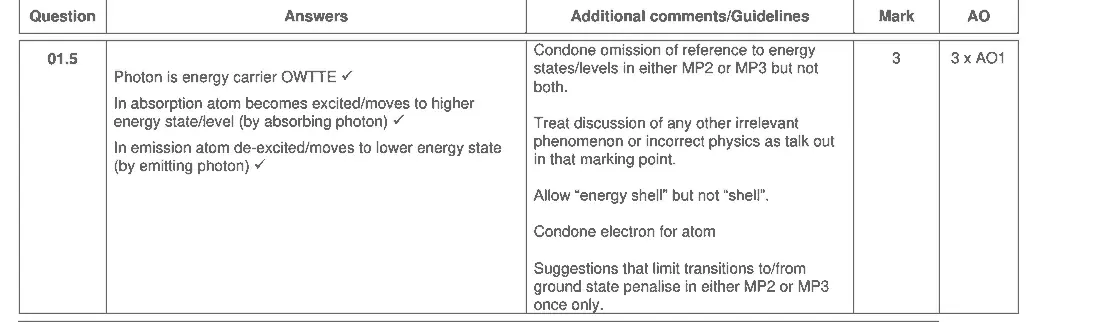
Explain, with reference to the processes within an atom, the difference between an
emission spectrum and an absorption spectrum.
[3 marks]
June 2022 · Paper 1 · Q2.2 2 marks AO1=2 Explanation atomic structure and stable nuclei
Earlier part of question 2 that this part usesEarlier part of June 2022 Paper 1 question 2
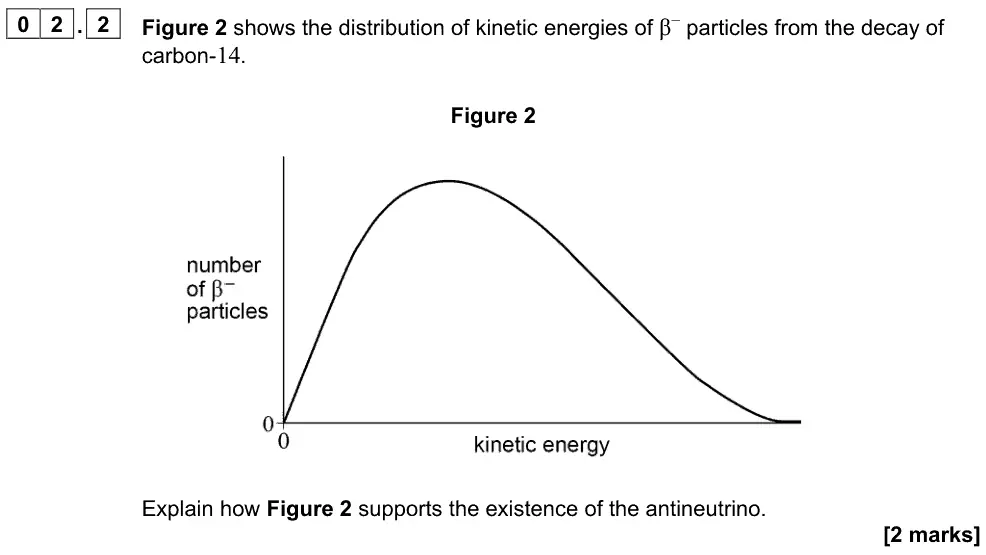
Figure 2 shows the distribution of kinetic energies of β− particles from the decay of
carbon-14.
Figure 2
Explain how Figure 2 supports the existence of the antineutrino.
[2 marks]
June 2022 · Paper 1 · Q3.3 2 marks AO2=2 Explanation vectors and moments
Earlier part of question 3 that this part usesEarlier part of June 2022 Paper 1 question 3
Pulley M is pulled to the left as the gate is opened.
Explain why this increases the tension in the horizontal cable C.
[2 marks]
June 2022 · Paper 1 · Q3.5 4 marks AO3=4 Explanation vectors and moments
Earlier part of question 3 that this part usesEarlier part of June 2022 Paper 1 question 3
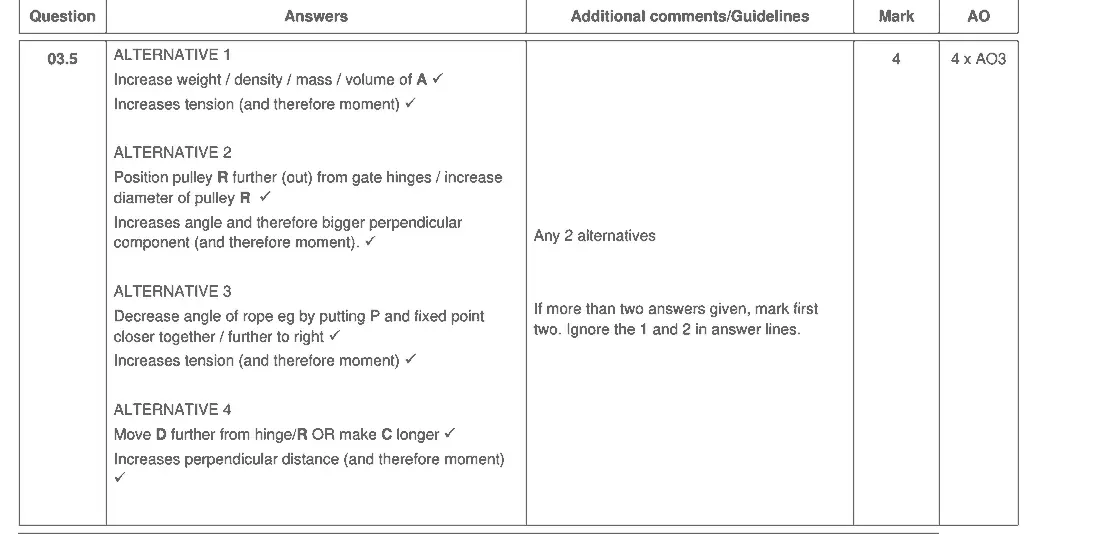
The same system is attached to an identical gate with stiffer hinges.  Now the system
does not supply a sufficiently large moment to close the gate.
Discuss two independent changes to the design to increase the moment about the
hinges due to horizontal cable C.
[4 marks]
1
2
June 2022 · Paper 1 · Q4.4 2 marks AO3=2 Explanation circuits and potential dividerscurrent voltage and resistivity
Earlier part of question 4 that this part usesEarlier part of June 2022 Paper 1 question 4
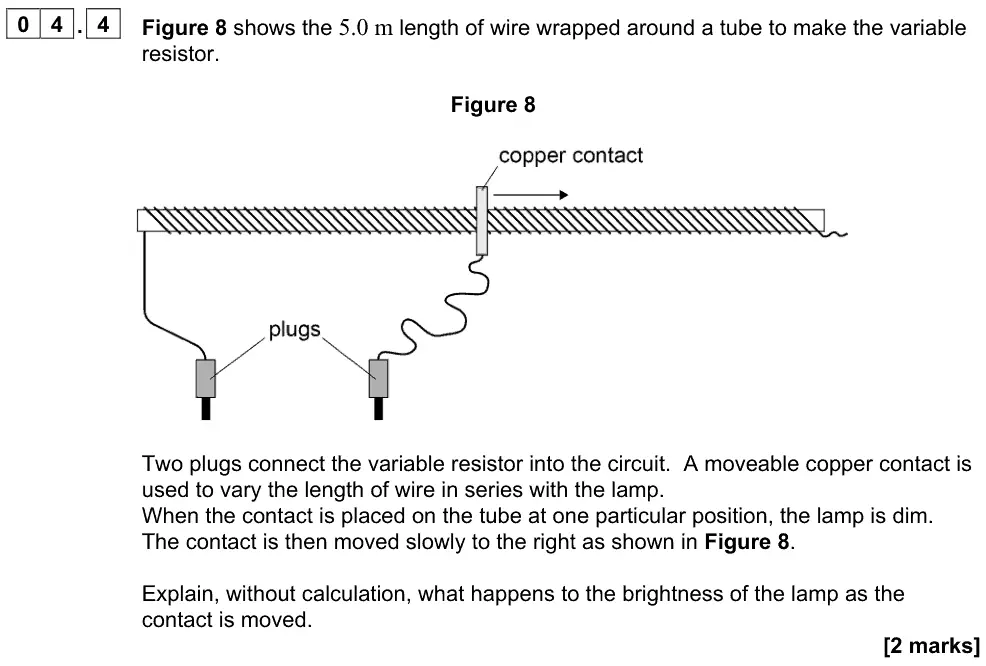
Figure 8 shows the 5.0 m length of wire wrapped around a tube to make the variable
resistor.
Figure 8
Two plugs connect the variable resistor into the circuit.  A moveable copper contact is
used to vary the length of wire in series with the lamp.
When the contact is placed on the tube at one particular position, the lamp is dim.
The contact is then moved slowly to the right as shown in Figure 8.
Explain, without calculation, what happens to the brightness of the lamp as the
contact is moved.
[2 marks]
June 2022 · Paper 1 · Q4.5 2 marks AO3=2 Explanation emf and internal resistance
Earlier part of question 4 that this part usesEarlier part of June 2022 Paper 1 question 4
The student now makes a different circuit by connecting the variable resistor
in parallel with the lamp.
The contact is returned to its original position on the tube as shown in Figure 8 and
the lamp is dim.  The contact is again slowly moved to the right.
Explain, without calculation, what happens to the brightness of the lamp as the
contact is moved.
[2 marks]
June 2022 · Paper 1 · Q5.4 2 marks AO1=2 Explanation newtons laws and momentumcircular motion
Earlier part of question 5 that this part usesEarlier part of June 2022 Paper 1 question 5
Describe, with reference to one of Newton’s laws of motion, the evidence that a
resultant force is acting on the block.
[2 marks]
June 2022 · Paper 1 · Q5.6 2 marks AO3=2 Explanation simple harmonic motion
Earlier part of question 5 that this part usesEarlier part of June 2022 Paper 1 question 5
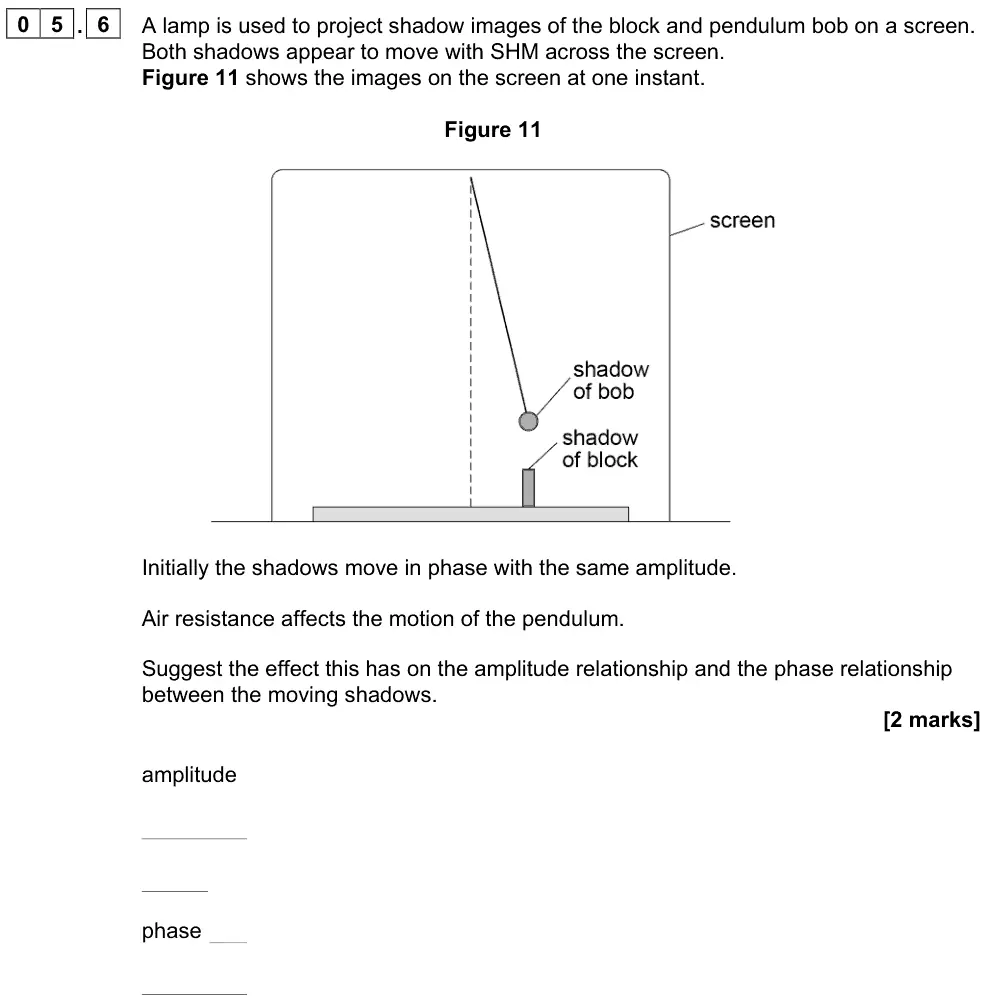
A lamp is used to project shadow images of the block and pendulum bob on a screen.
Both shadows appear to move with SHM across the screen.
Figure 11 shows the images on the screen at one instant.
Figure 11
Initially the shadows move in phase with the same amplitude.
Air resistance affects the motion of the pendulum.
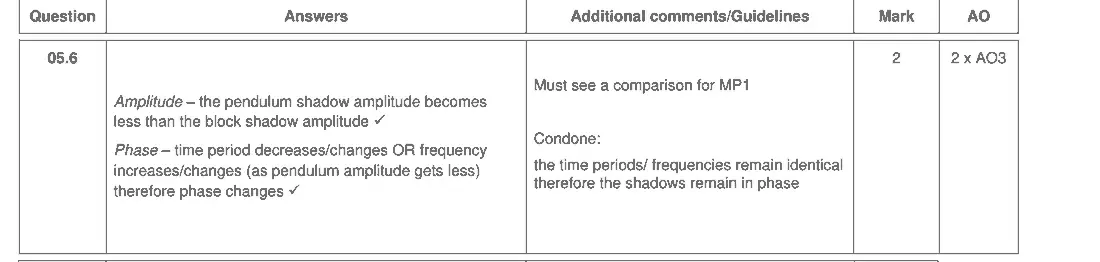
Suggest the effect this has on the amplitude relationship and the phase relationship
between the moving shadows.
[2 marks]
amplitude
phase
June 2022 · Paper 2 · Q2.2 3 marks AO2=3 Explanation kinetic theorynewtons laws and momentum
Earlier part of question 2 that this part usesEarlier part of June 2022 Paper 2 question 2
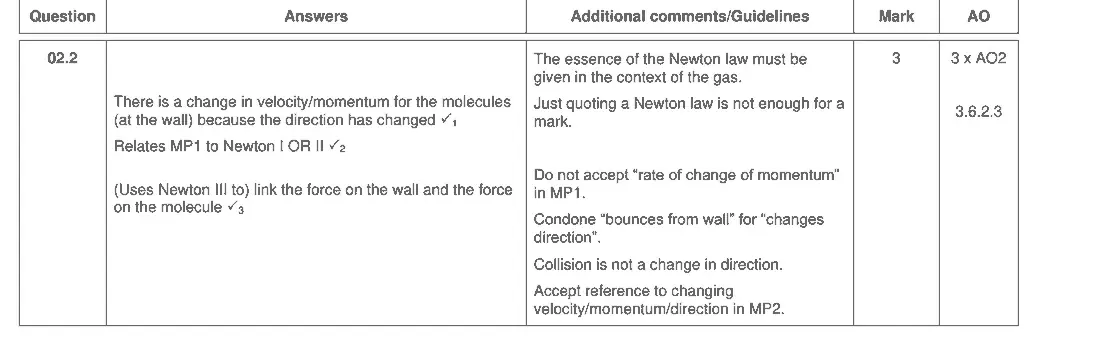
Explain why molecules of a gas exert a force on the walls of a container.
Refer to Newton’s laws of motion in your answer.
[3 marks]
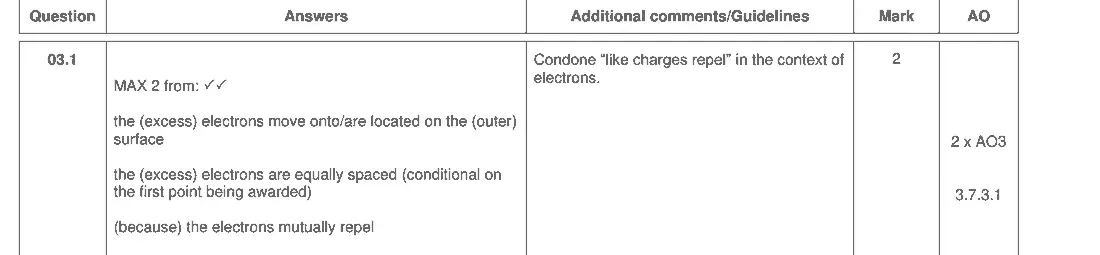
June 2022 · Paper 2 · Q3.1 2 marks AO3=2 Explanation Hard electric fields
An isolated solid conducting sphere is initially uncharged.
Electrons are then transferred to the sphere.
State and explain the location of the excess electrons.
[2 marks]
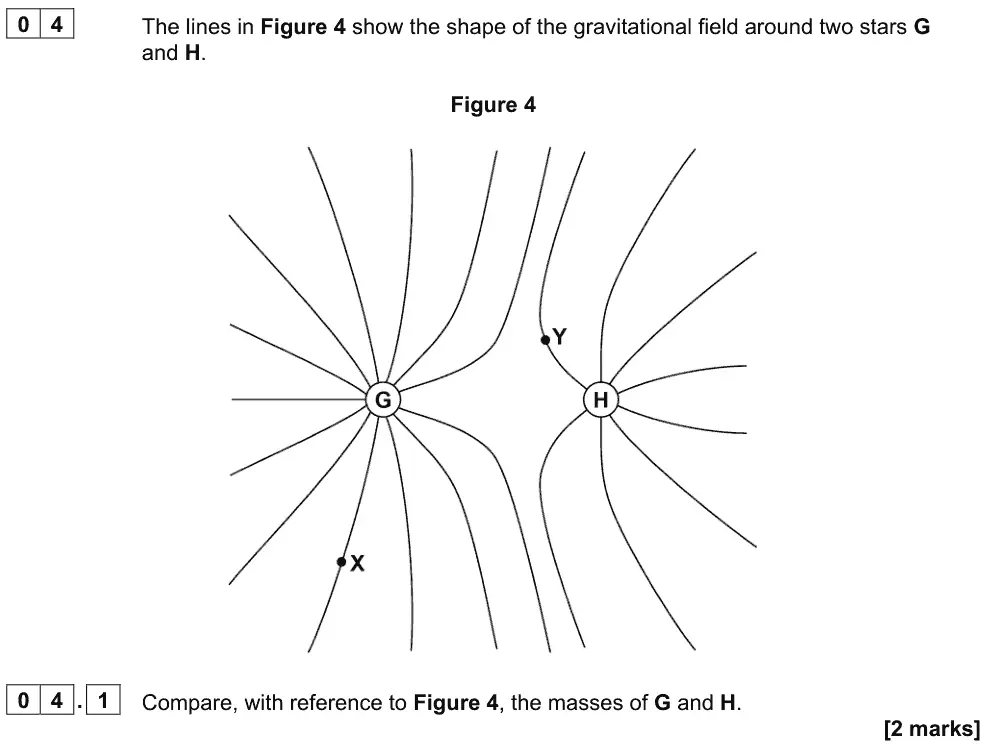
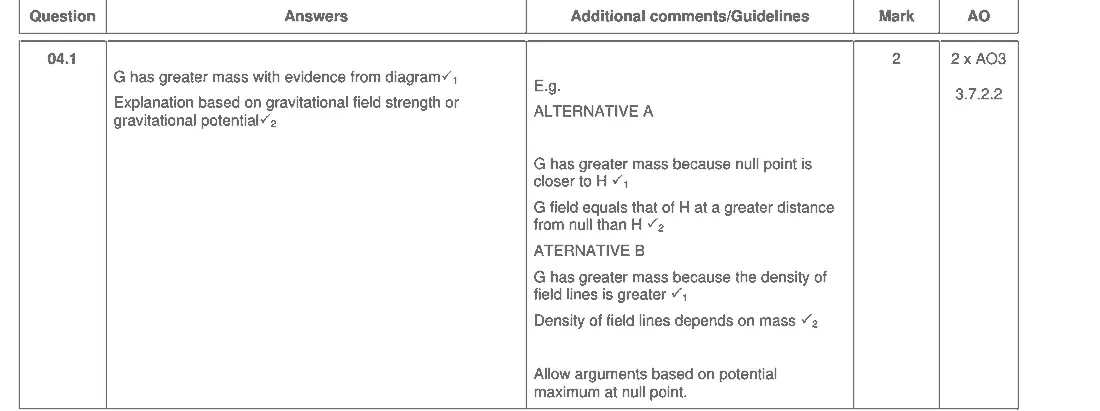
June 2022 · Paper 2 · Q4.1 2 marks AO3=2 Explanation gravitational fields
The lines in Figure 4 show the shape of the gravitational field around two stars G
and H.
Figure 4
Compare, with reference to Figure 4, the masses of G and H.
[2 marks]
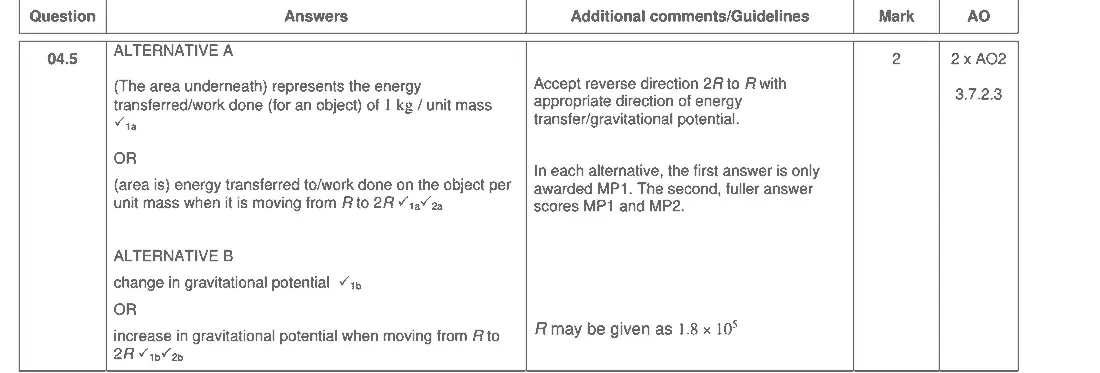
June 2022 · Paper 2 · Q4.5 2 marks AO2=2 Explanation gravitational fields
Earlier part of question 4 that this part usesEarlier part of June 2022 Paper 2 question 4
Explain what is represented by the area under the graph between r = R and r = 2R on
Figure 5.
[2 marks]
June 2022 · Paper 2 · Q4.7 1 mark AO3=1 Explanation circular motiongravitational fields
Earlier part of question 4 that this part usesEarlier part of June 2022 Paper 2 question 4
Explain why P cannot have a circular orbit around H.
[1 mark]
June 2022 · Paper 2 · Q5.1 3 marks AO1=3 Explanation electromagnetic induction
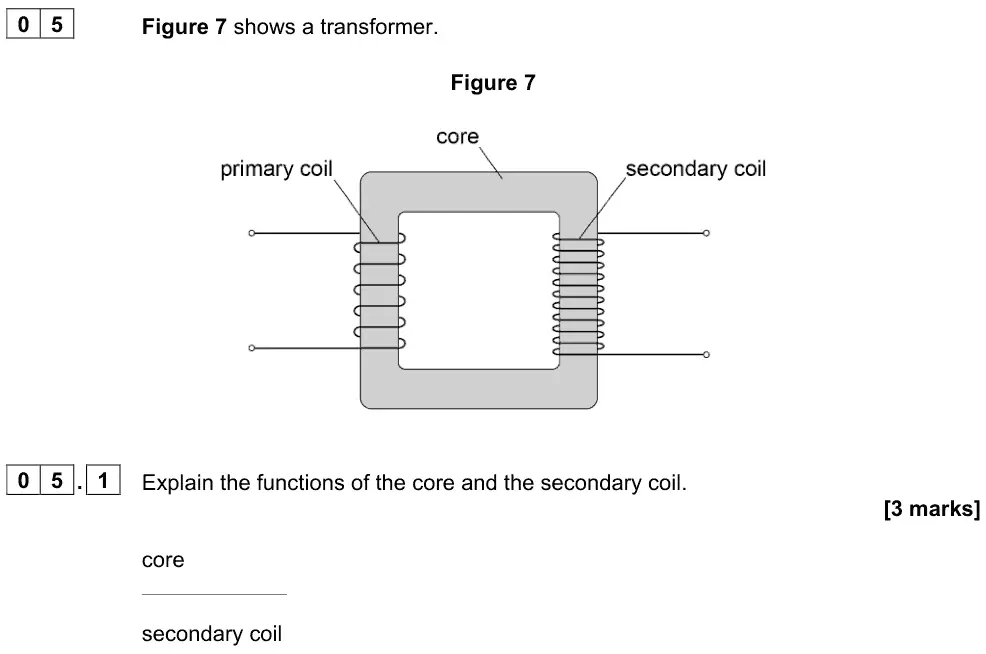
Figure 7 shows a transformer.
Figure 7
Explain the functions of the core and the secondary coil.
[3 marks]
core
secondary coil
June 2022 · Paper 2 · Q5.2 3 marks AO1=1, AO3=2 Explanation electromagnetic induction
Earlier part of question 5 that this part usesEarlier part of June 2022 Paper 2 question 5
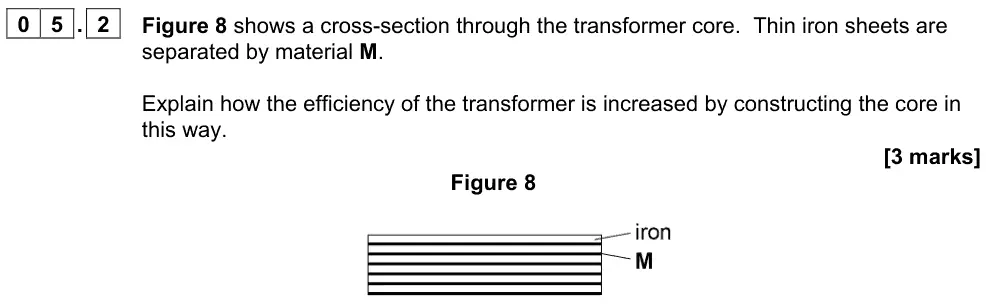
Figure 8 shows a cross-section through the transformer core.  Thin iron sheets are
separated by material M.
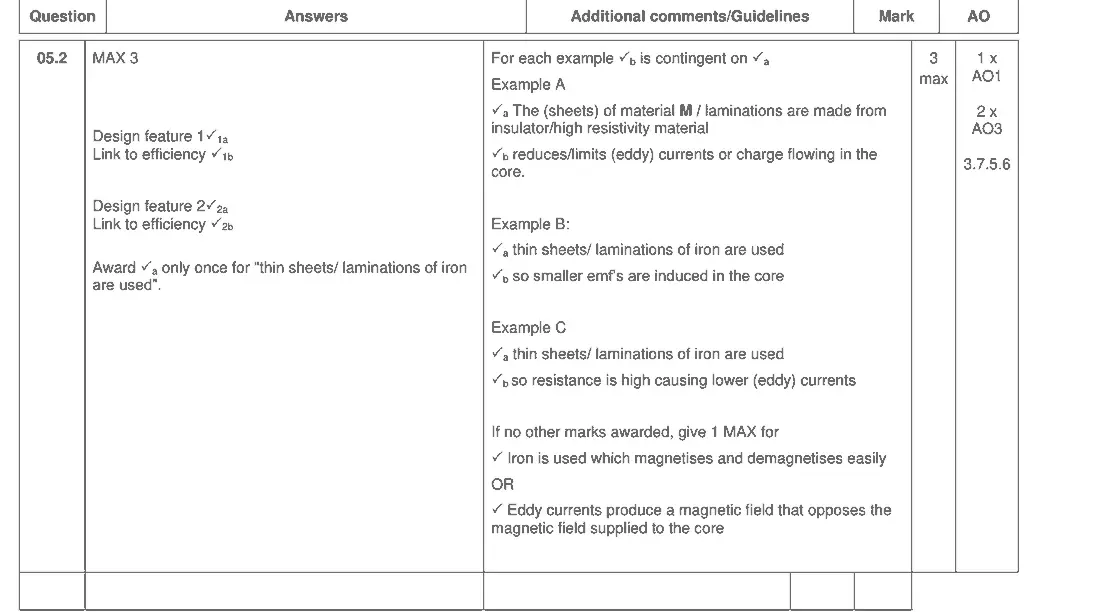
Explain how the efficiency of the transformer is increased by constructing the core in
this way.
[3 marks]
Figure 8
June 2022 · Paper 2 · Q5.3 2 marks AO1=1, AO3=1 Explanation electromagnetic induction
Earlier part of question 5 that this part usesEarlier part of June 2022 Paper 2 question 5
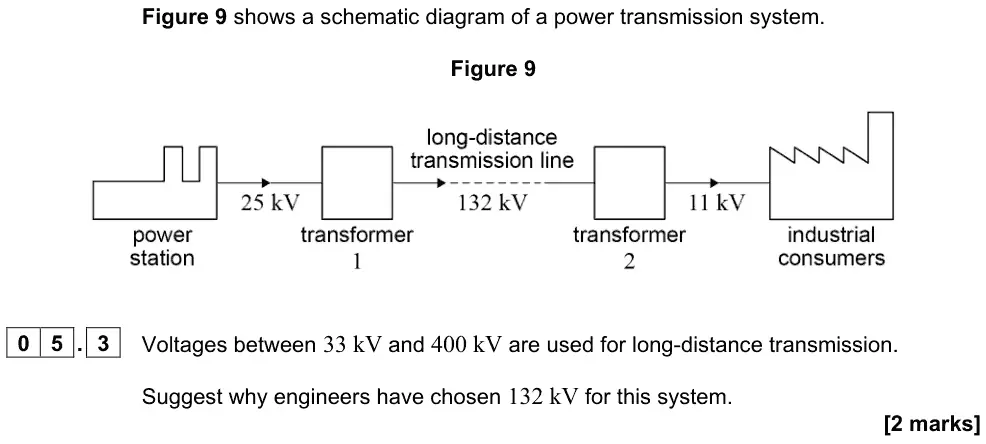
Figure 9 shows a schematic diagram of a power transmission system.
Figure 9
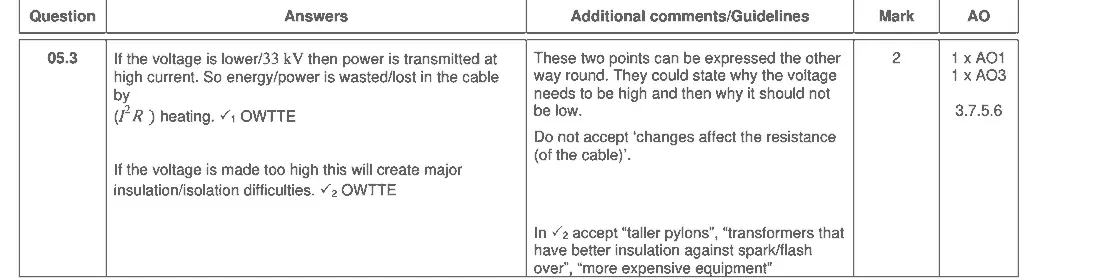
Voltages between 33 kV and 400 kV are used for long-distance transmission.
Suggest why engineers have chosen 132 kV for this system.
[2 marks]
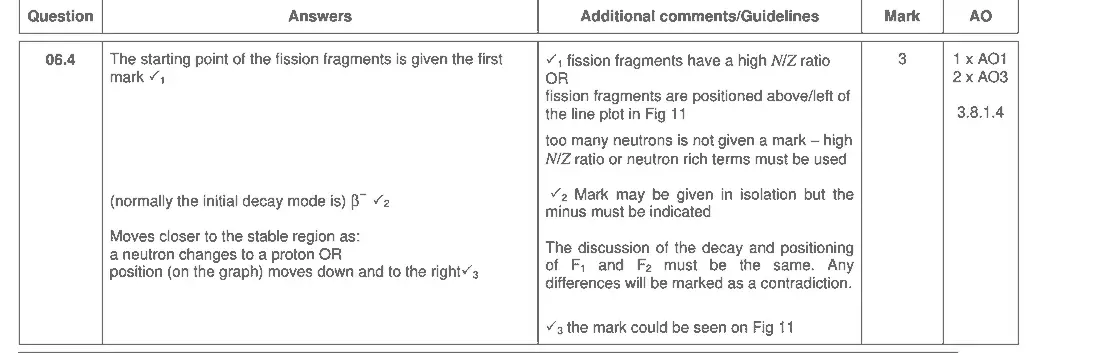
June 2022 · Paper 2 · Q6.4 3 marks AO1=1, AO3=2 Explanation radioactive decay
Earlier part of question 6 that this part usesEarlier part of June 2022 Paper 2 question 6
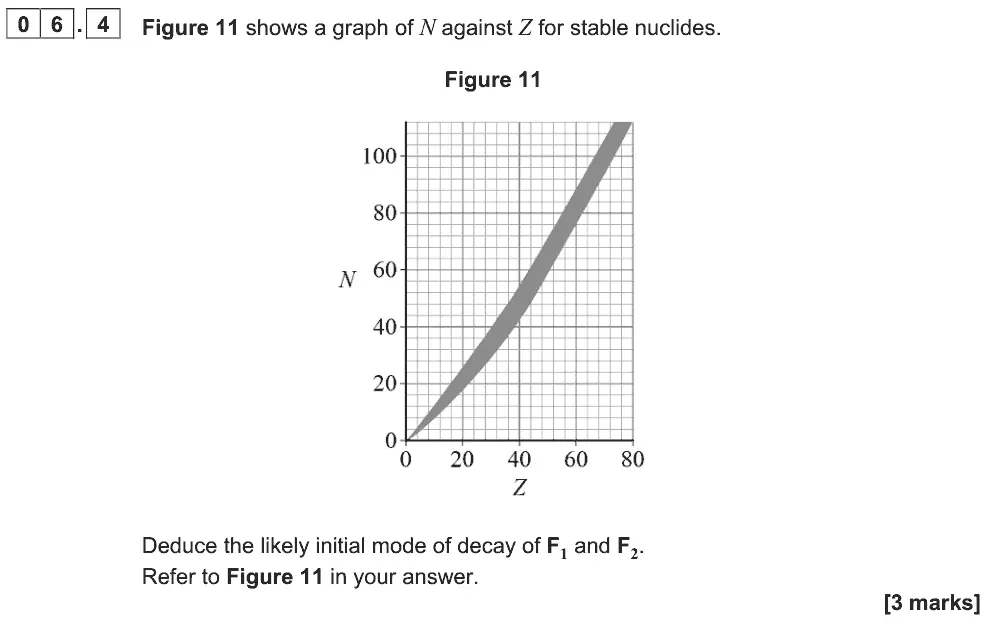
Figure 11 shows a graph of N against Z for stable nuclides.
Figure 11
Deduce the likely initial mode of decay of F1 and F2.
Refer to Figure 11 in your answer.
[3 marks]
June 2022 · Paper 3 Section A · Q4.2 3 marks AO3=3 Explanation thermal energy and ideal gasesnewtons laws and momentum
Earlier part of question 4 that this part usesEarlier part of June 2022 Paper 3 Section A question 4
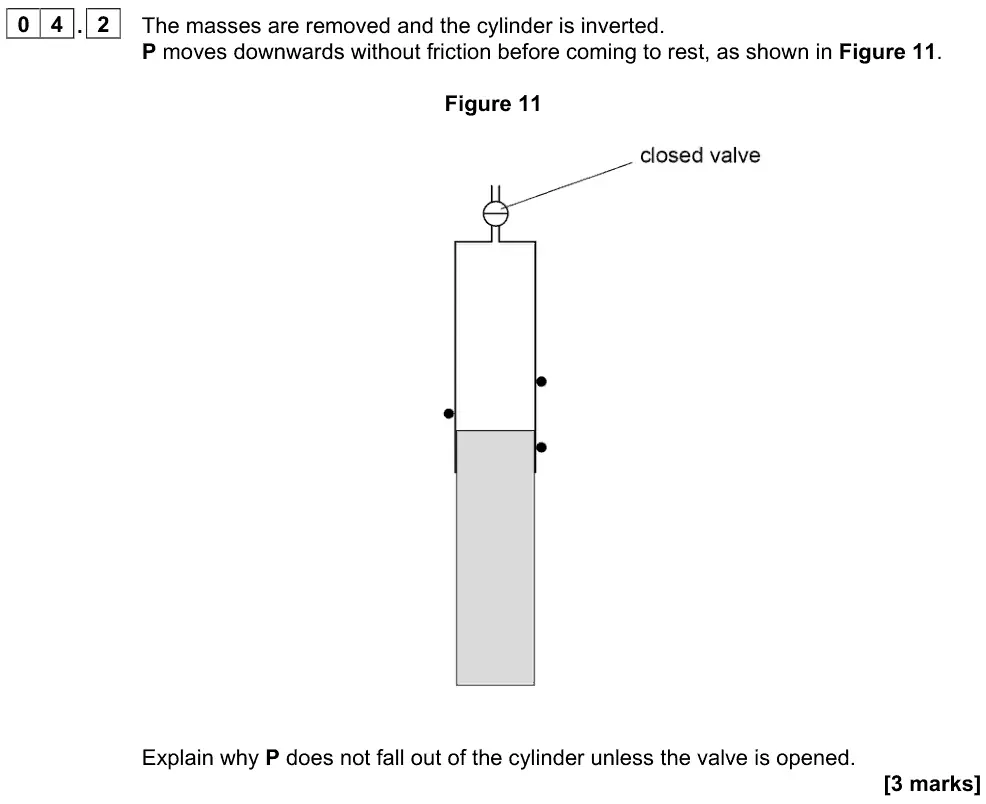
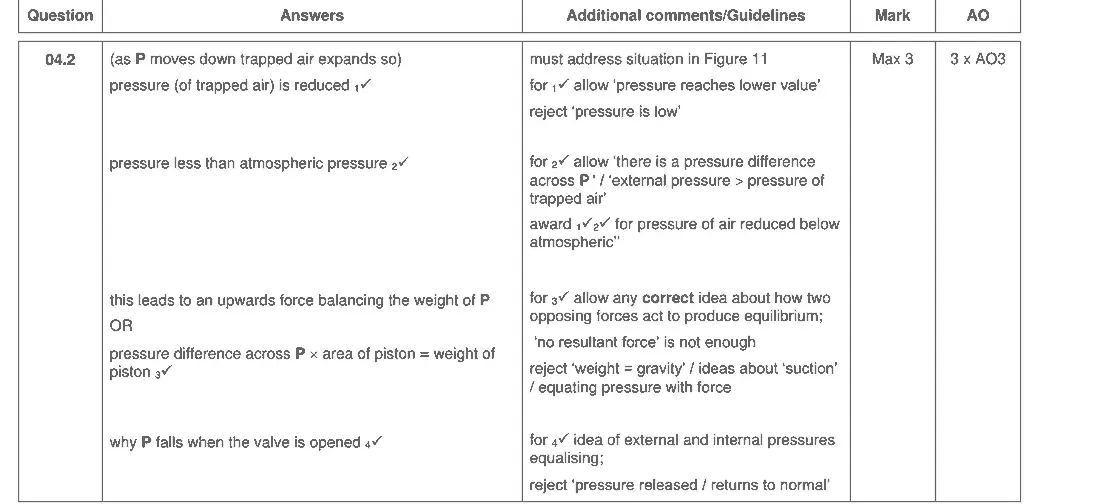
The masses are removed and the cylinder is inverted.
P moves downwards without friction before coming to rest, as shown in Figure 11.
Figure 11
Explain why P does not fall out of the cylinder unless the valve is opened.
[3 marks]
June 2022 · Paper 3B Astrophysics · Q1.4 3 marks AO3=3 Explanation telescopes
Earlier part of question 1 that this part usesEarlier part of June 2022 Paper 3B Astrophysics question 1
The James Lick telescope can be used to identify binary stars.
Two techniques are available using this telescope:
• using a processed image from a CCD, and
• direct observation using the naked eye.
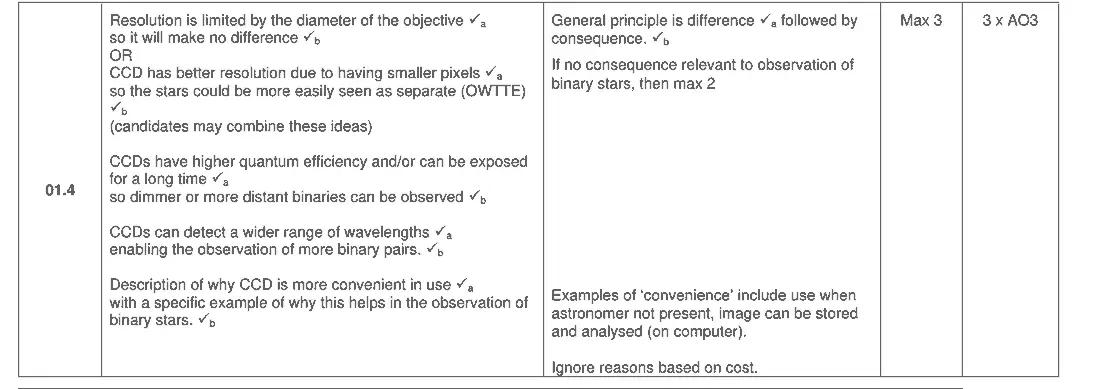
Compare the use of a CCD with the use of the naked eye to observe binary stars with
this telescope.
[3 marks]
June 2022 · Paper 3B Astrophysics · Q2.1 2 marks AO2=1, AO3=1 Explanation cosmology
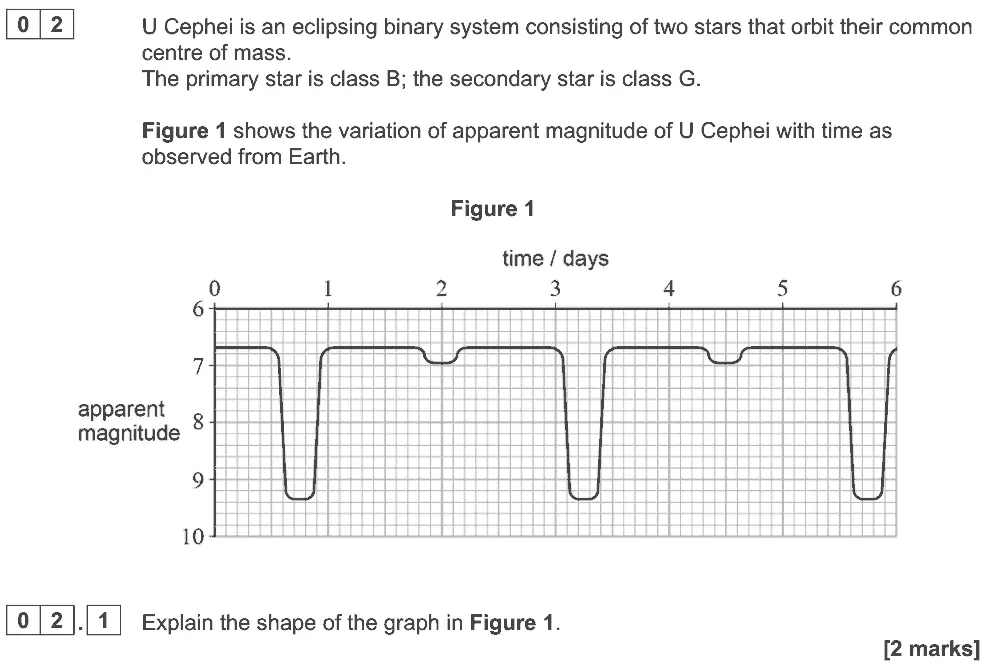
U Cephei is an eclipsing binary system consisting of two stars that orbit their common
centre of mass.
The primary star is class B; the secondary star is class G.
Figure 1 shows the variation of apparent magnitude of U Cephei with time as
observed from Earth.
Figure 1
Explain the shape of the graph in Figure 1.
[2 marks]
June 2022 · Paper 3B Astrophysics · Q2.6 2 marks AO3=2 Explanation classification of starscosmology
Earlier part of question 2 that this part usesEarlier part of June 2022 Paper 3B Astrophysics question 2
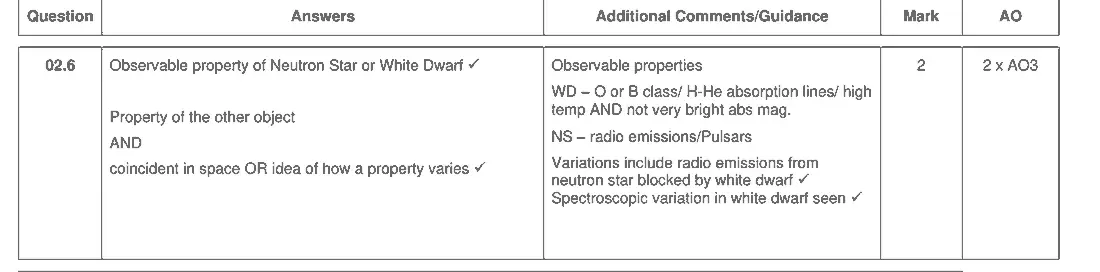
A different eclipsing binary star system is thought to consist of a white dwarf star and
a neutron star.
Discuss how astronomers could confirm this.
[2 marks]
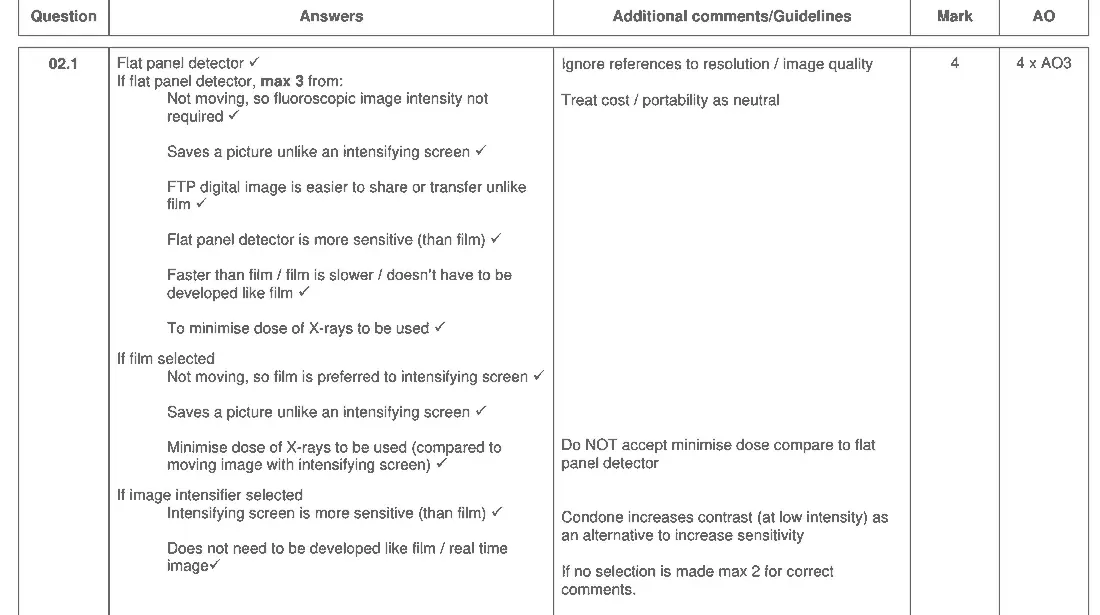
June 2022 · Paper 3B Medical physics · Q2.1 4 marks AO3=4 Explanation medical imaging
An X-ray image is to be made of a broken bone.
The image can be formed on
• photographic film
• a flat panel (FTP) detector or
• an intensifying screen using fluoroscopic image intensification.
State and explain which one of these detection methods should be used in this
situation.
Go on to discuss why the other two methods are less suitable.
[4 marks]
June 2022 · Paper 3B Engineering physics · Q3.3 2 marks AO1=2 Explanation Hard thermodynamics and engines
Earlier part of question 3 that this part usesEarlier part of June 2022 Paper 3B Engineering physics question 3
Explain why the compression ratio for a diesel engine must be greater than the
compression ratio for a petrol engine.
[2 marks]
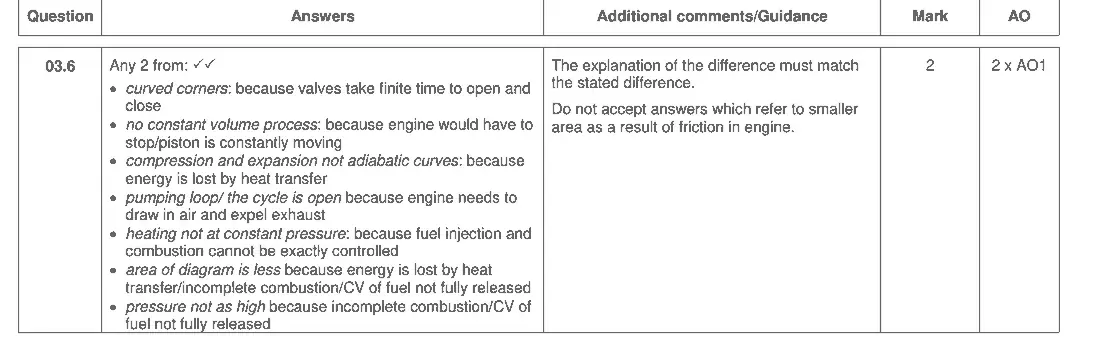
June 2022 · Paper 3B Engineering physics · Q3.6 2 marks AO1=2 Explanation thermodynamics and engines
Earlier part of question 3 that this part usesEarlier part of June 2022 Paper 3B Engineering physics question 3
Explain two differences between the ideal cycle and the indicator diagram for the real
engine.
[2 marks]
1
2
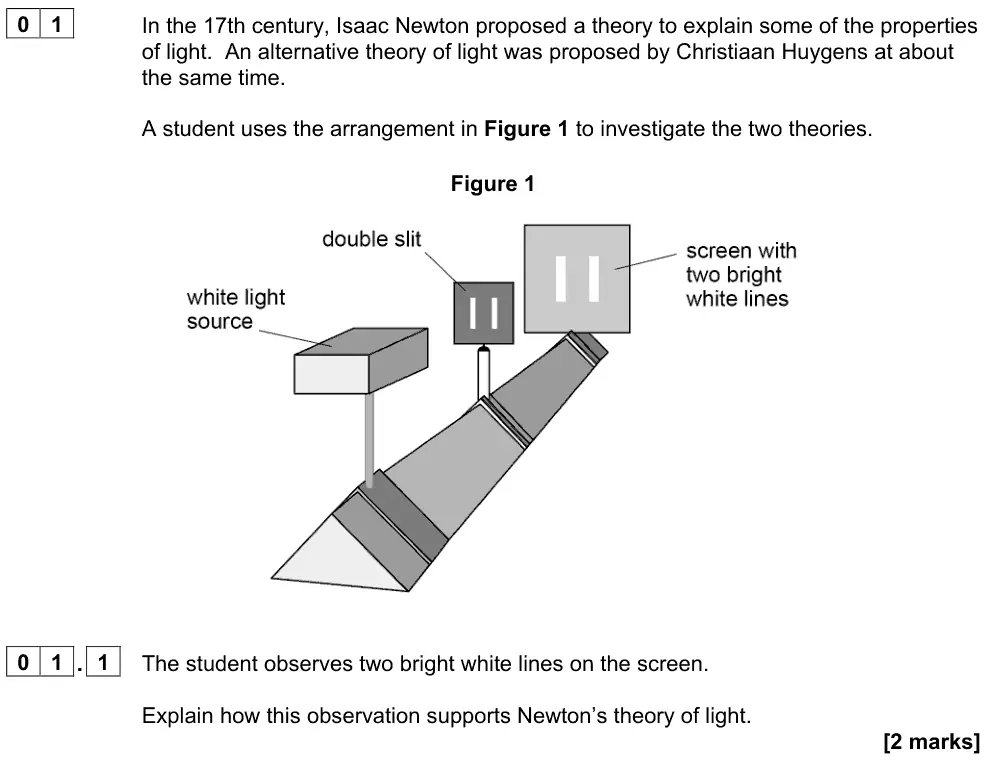
June 2022 · Paper 3B Turning points · Q1.1 2 marks AO1=1, AO2=1 Explanation wave particle duality history
In the 17th century, Isaac Newton proposed a theory to explain some of the properties
of light.  An alternative theory of light was proposed by Christiaan Huygens at about
the same time.
A student uses the arrangement in Figure 1 to investigate the two theories.
Figure 1
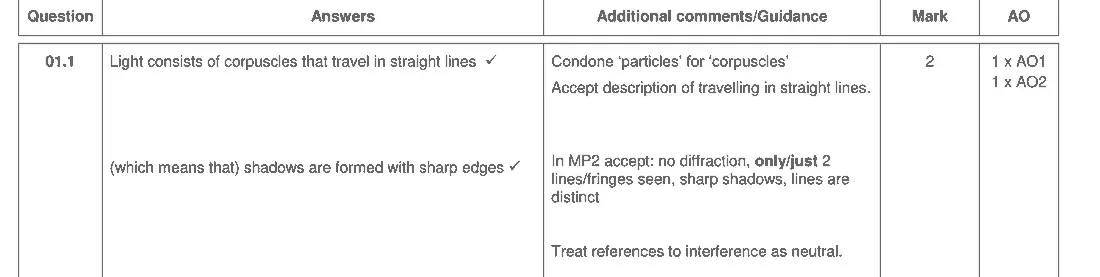
The student observes two bright white lines on the screen.
Explain how this observation supports Newton’s theory of light.
[2 marks]
June 2022 · Paper 3B Turning points · Q1.3 3 marks AO2=1, AO3=2 Explanation wave particle duality history
Earlier part of question 1 that this part usesEarlier part of June 2022 Paper 3B Turning points question 1
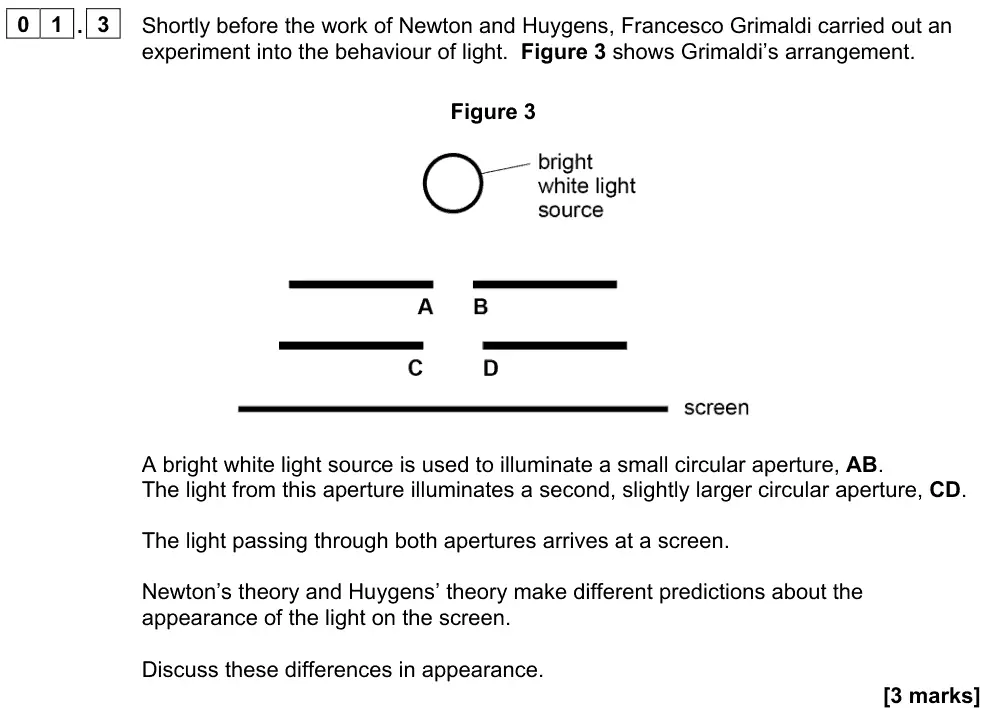
Shortly before the work of Newton and Huygens, Francesco Grimaldi carried out an
experiment into the behaviour of light.  Figure 3 shows Grimaldi’s arrangement.
Figure 3
A bright white light source is used to illuminate a small circular aperture, AB.
The light from this aperture illuminates a second, slightly larger circular aperture, CD.
The light passing through both apertures arrives at a screen.
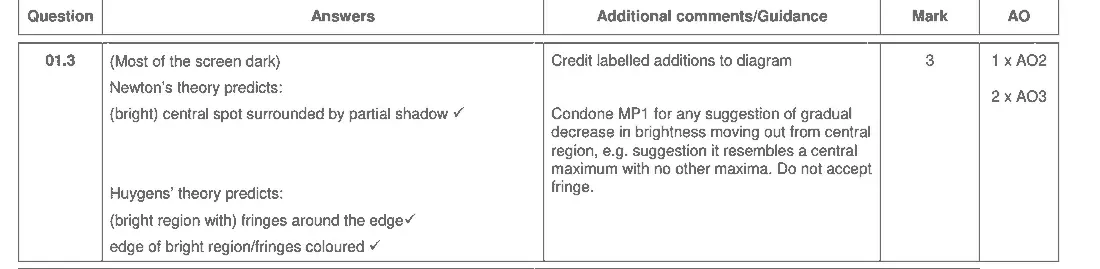
Newton’s theory and Huygens’ theory make different predictions about the
appearance of the light on the screen.
Discuss these differences in appearance.
[3 marks]
June 2022 · Paper 3B Turning points · Q2.5 3 marks AO3=3 Explanation discovery of the electron
Earlier part of question 2 that this part usesEarlier part of June 2022 Paper 3B Turning points question 2
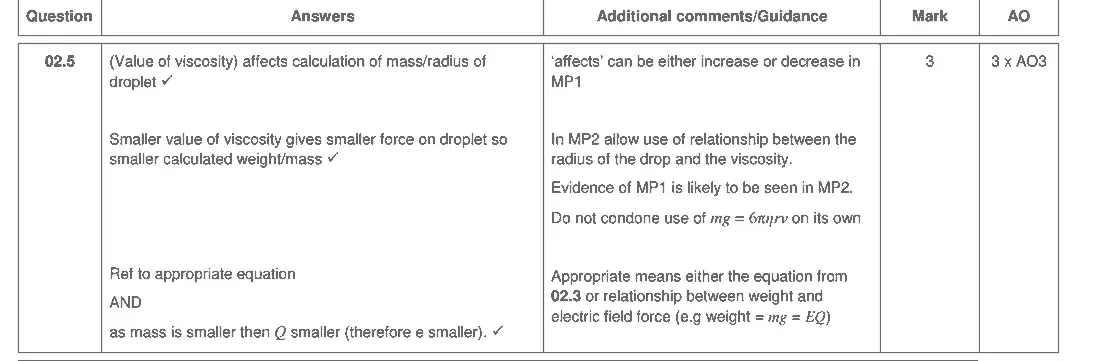
After Millikan published his results, it was found that he had used a value for the
viscosity of air that was smaller than the actual value.
Discuss the effect this error had on Millikan’s value of the electronic charge.
[3 marks]
June 2022 · Paper 3B Turning points · Q4.3 2 marks AO3=2 Explanation special relativity
Earlier part of question 4 that this part usesEarlier part of June 2022 Paper 3B Turning points question 4
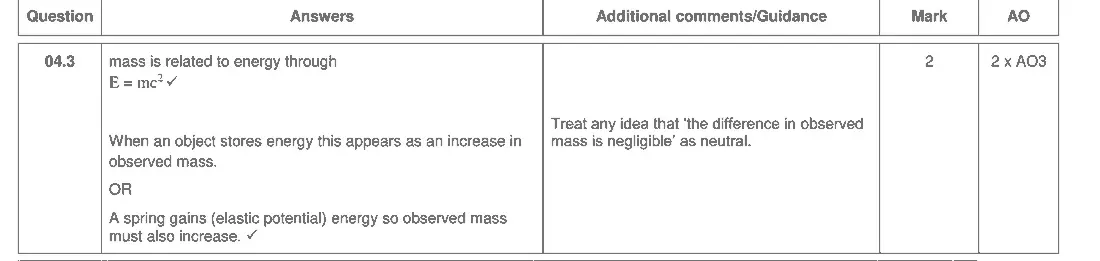
Discuss the change in the observed mass of a spring when it is stretched.
[2 marks]
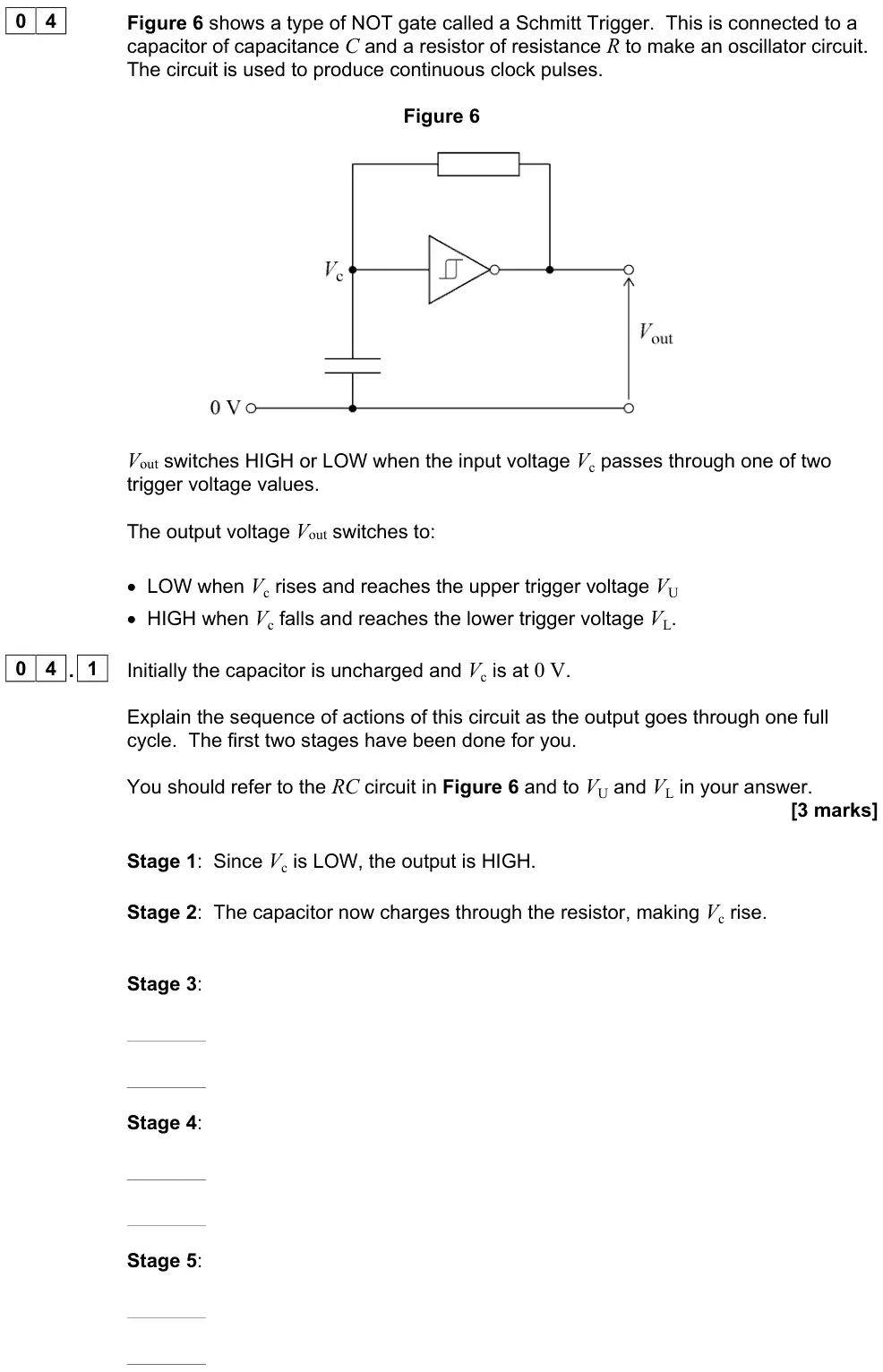
June 2022 · Paper 3B Electronics · Q4.1 3 marks AO2=3 Explanation digital electronics
Figure 6 shows a type of NOT gate called a Schmitt Trigger.  This is connected to a
capacitor of capacitance C and a resistor of resistance R to make an oscillator circuit.
The circuit is used to produce continuous clock pulses.
Figure 6
Vout switches HIGH or LOW when the input voltage Vc passes through one of two
trigger voltage values.
The output voltage Vout switches to:
• LOW when Vc rises and reaches the upper trigger voltage VU
• HIGH when Vc falls and reaches the lower trigger voltage VL.
Initially the capacitor is uncharged and Vc is at 0 V.
Explain the sequence of actions of this circuit as the output goes through one full
cycle.  The first two stages have been done for you.
You should refer to the RC circuit in Figure 6 and to VU and VL in your answer.
[3 marks]
Stage 1:  Since Vc is LOW, the output is HIGH.
Stage 2:  The capacitor now charges through the resistor, making Vc rise.
Stage 3:
Stage 4:
Stage 5:
June 2022 · Paper 3B Electronics · Q4.2 4 marks AO3=4 Explanation digital electronics
Earlier part of question 4 that this part usesEarlier part of June 2022 Paper 3B Electronics question 4
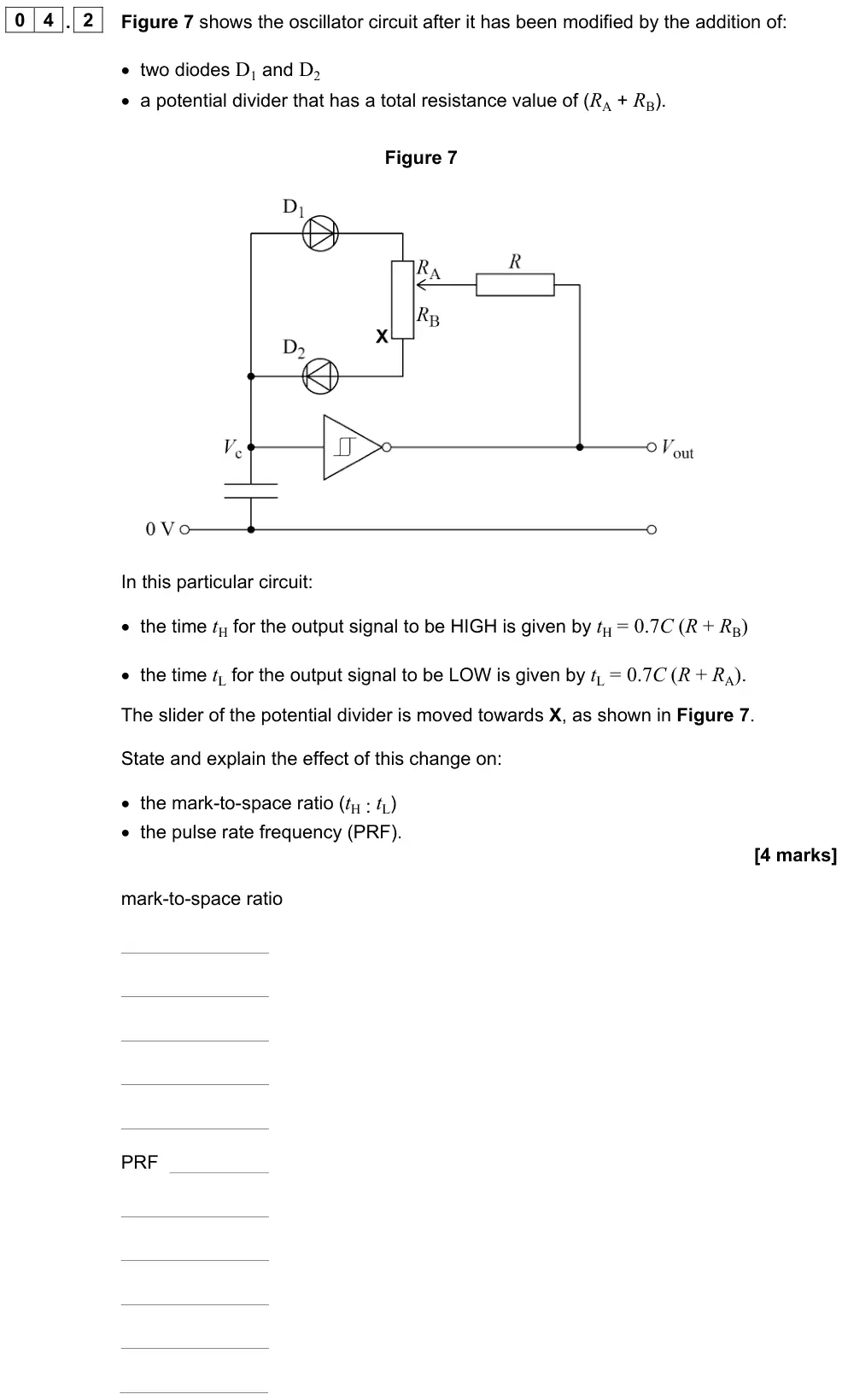
Figure 7 shows the oscillator circuit after it has been modified by the addition of:
• two diodes D1 and D2
• a potential divider that has a total resistance value of (RA + RB).
Figure 7
In this particular circuit:
• the time tH for the output signal to be HIGH is given by tH = 0.7C (R + RB)
• the time tL for the output signal to be LOW is given by tL = 0.7C (R + RA).
The slider of the potential divider is moved towards X, as shown in Figure 7.
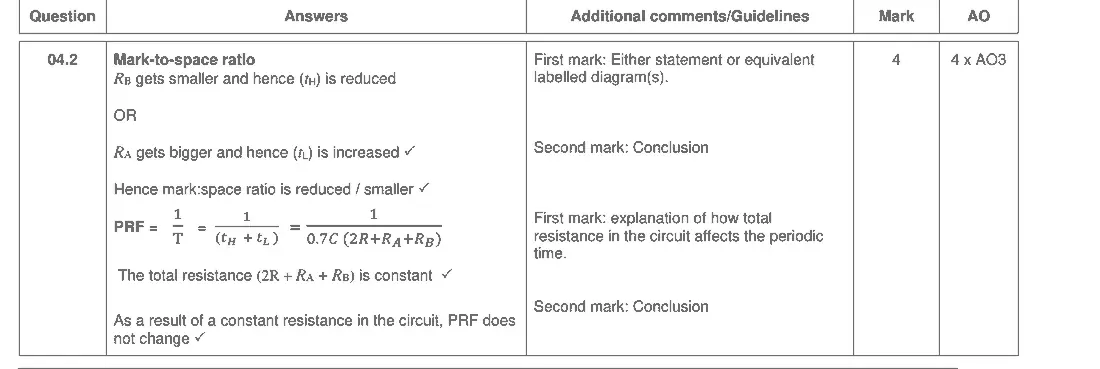
State and explain the effect of this change on:
• the mark-to-space ratio (tH : tL)
• the pulse rate frequency (PRF).
[4 marks]
mark-to-space ratio
PRF
November 2021 · AS Paper 1 · Q1.2 2 marks AO2=2 Explanation atomic structure and stable nucleiclassification of particles and quarks
Earlier part of question 1 that this part usesEarlier part of November 2021 Paper 1 question 1
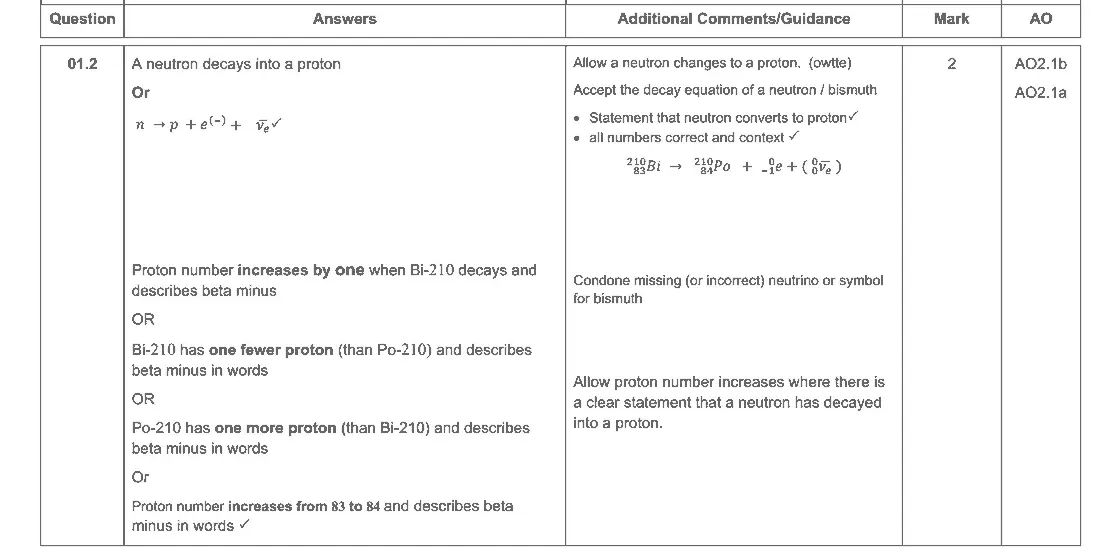
A polonium-210 nucleus is formed when a stationary nucleus of bismuth-210 decays.
A beta-minus (β−) particle is emitted in this decay.
Outline, with reference to β− decay, why bismuth-210 and polonium-210 have different
proton numbers.
[2 marks]
November 2021 · AS Paper 1 · Q1.3 2 marks AO1=2 Explanation atomic structure and stable nuclei
Earlier part of question 1 that this part usesEarlier part of November 2021 Paper 1 question 1
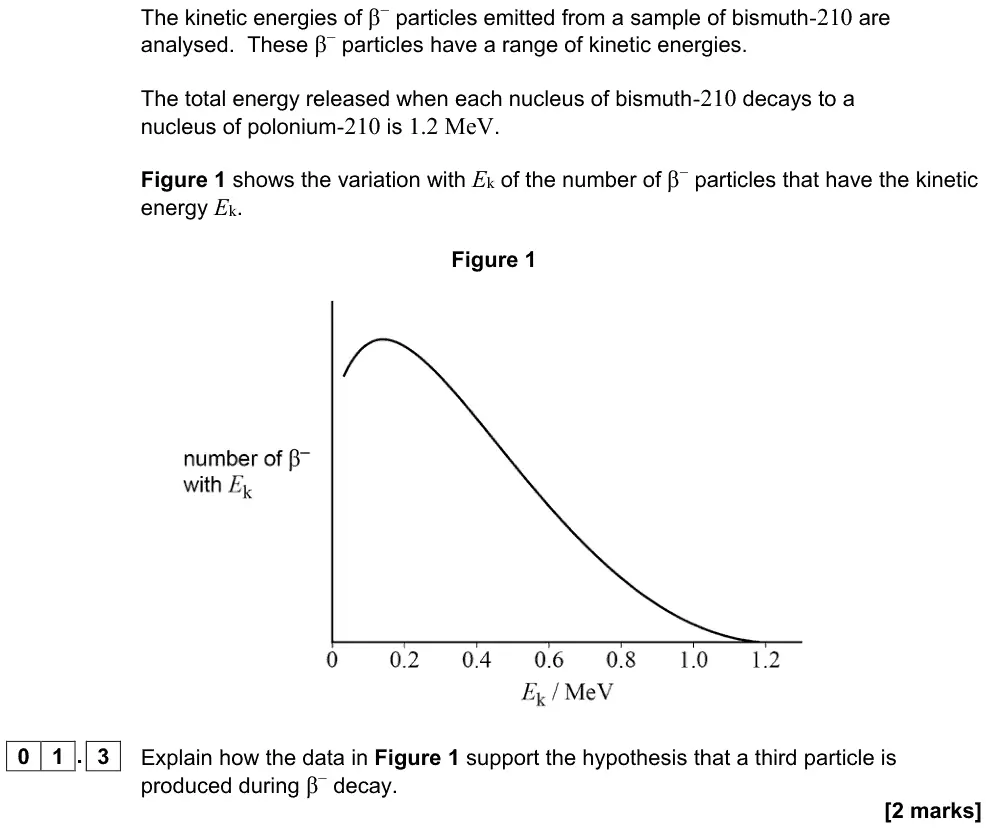
The kinetic energies of β− particles emitted from a sample of bismuth-210 are
analysed.  These β− particles have a range of kinetic energies.
The total energy released when each nucleus of bismuth-210 decays to a
nucleus of polonium-210 is 1.2 MeV.
Figure 1 shows the variation with Ek of the number of β− particles that have the kinetic
energy Ek.
Figure 1
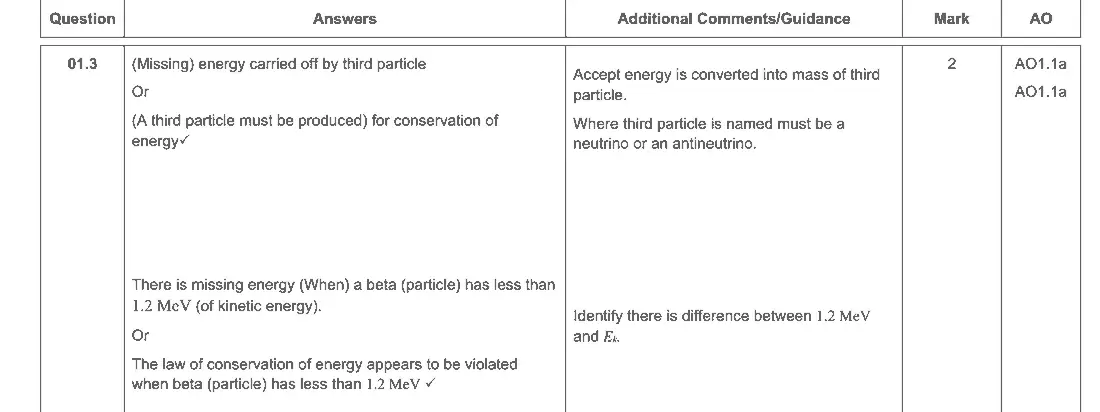
Explain how the data in Figure 1 support the hypothesis that a third particle is
produced during β− decay.
[2 marks]
November 2021 · AS Paper 1 · Q1.4 2 marks Explanation classification of particles and quarks
Earlier part of question 1 that this part usesEarlier part of November 2021 Paper 1 question 1
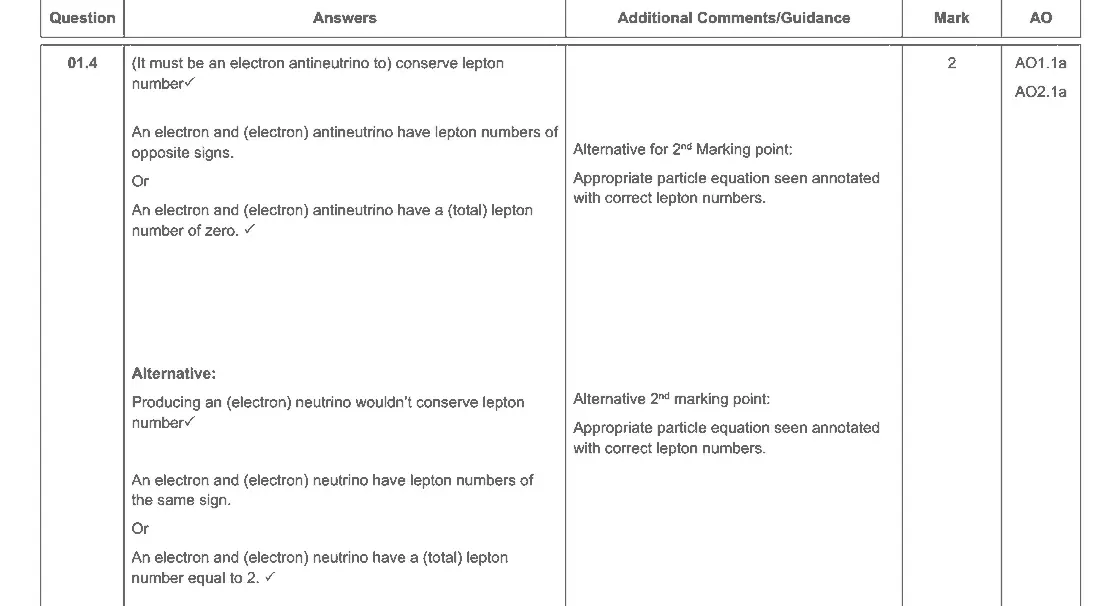
This third particle is an electron antineutrino.
Explain why an electron antineutrino, rather than an electron neutrino, is produced
during β− decay.
[2 marks]
November 2021 · AS Paper 1 · Q1.6 3 marks Explanation particles antiparticles and interactions
Earlier part of question 1 that this part usesEarlier part of November 2021 Paper 1 question 1
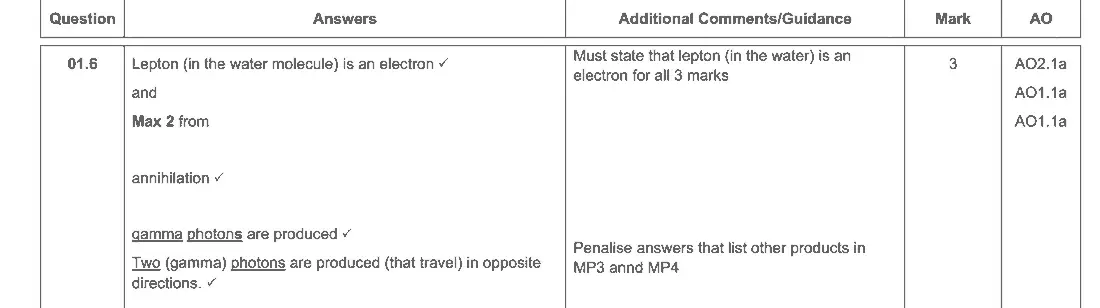
The positron produced in the interaction in Figure 2 slows down and collides with a
lepton in a molecule of water.
Describe the process that occurs when the positron collides with this lepton.
In your answer you should identify the lepton in the molecule of water.
[3 marks]
November 2021 · AS Paper 1 · Q1.7 3 marks AO3=3 Explanation particles antiparticles and interactions
Earlier part of question 1 that this part usesEarlier part of November 2021 Paper 1 question 1
The range of the electromagnetic interaction is infinite.
Table 1 gives the range of the strong nuclear interaction and the range of the weak
nuclear interaction.
Table 1
Interaction
Range / m
strong nuclear
10−15
weak nuclear
10−18
Deduce whether the positron or the electron antineutrino is likely to travel the shorter
distance in the tank of water before interacting.
[3 marks]
November 2021 · AS Paper 1 · Q2.2 3 marks AO2=3 Explanation interference and diffraction
Earlier part of question 2 that this part usesEarlier part of November 2021 Paper 1 question 2
Explain how light from the diffraction grating forms a maximum on the screen.
[3 marks]
November 2021 · AS Paper 1 · Q3.4 3 marks AO3=3 Explanation work energy and power
Earlier part of question 3 that this part usesEarlier part of November 2021 Paper 1 question 3
In another test, a spherical particle Q is fired at a right angle to the surface of an
identical block.
Q has the same mass as P and is travelling at the same speed as P when it strikes
the surface of the block.
Q is made from a less dense material than P.
Compare the distance travelled by Q with that travelled by P as they are brought to
rest.
[3 marks]
November 2021 · AS Paper 1 · Q4.2 3 marks AO3=3 Explanation vectors and moments
Earlier part of question 4 that this part usesEarlier part of November 2021 Paper 1 question 4
The athlete now moves the pole to a horizontal position.  The pole is held stationary in
this position.
The athlete’s right hand applies a force S vertically downwards at X as shown
in Figure 9.  The athlete’s left hand applies a force V at Y.
Figure 9
Discuss the differences between the magnitudes and directions of force U in Figure 7
and force V applied at Y in Figure 9.
[3 marks]
November 2021 · AS Paper 1 · Q5.2 4 marks AO2=4 Explanation newtons laws and momentum
Earlier part of question 5 that this part usesEarlier part of November 2021 Paper 1 question 5
Figure 11 shows the direction of the thrust exerted by the ship’s propeller as the
propeller rotates.  The ship’s engine makes the propeller rotate.  When more water is
accelerated, more work is done by the engine.
Figure 11
Explain, using Newton’s laws of motion, how the thrust of the propeller on the water
enables the ship to maintain a constant momentum.
[4 marks]
November 2021 · AS Paper 1 · Q5.3 3 marks AO3=3 Explanation work energy and powernewtons laws and momentum
Earlier part of question 5 that this part usesEarlier part of November 2021 Paper 1 question 5
Figure 12 shows the bottom of the hull with a drag reduction system in operation.
Air bubbles are introduced into the water below the hull.  This reduces the work done
per second against the drag on the hull at any given speed.
However, when the air bubbles reach the propeller they decrease the mass of water
being accelerated by the propeller every second.  This decreases the thrust produced
by the propeller at a given speed of rotation.
Figure 12
The system enables the ship to save fuel while maintaining the same momentum.
Explain why the system delivers this fuel saving.
In your answer, consider the effects of the introduction of the system on
• the thrust
• the drag on the hull.
[3 marks]
November 2021 · AS Paper 1 · Q6.5 2 marks AO2=2 Explanation circuits and potential dividerscurrent voltage and resistivity
Earlier part of question 6 that this part usesEarlier part of November 2021 Paper 1 question 6
The voltmeter is now connected across the 640 Ω resistor as shown in Figure 14.
Figure 14
The reading on the voltmeter is 2.10 V.
When the voltmeter was connected across the 320 Ω resistor, as shown in Figure 13,
the reading on the voltmeter was 1.05 V.
Explain why the sum of these voltmeter readings does not equal the emf of the
battery.
[2 marks]
November 2021 · AS Paper 1 · Q7.4 2 marks Explanation refraction and optical fibres
Earlier part of question 7 that this part usesEarlier part of November 2021 Paper 1 question 7
Two pulses of monochromatic light are incident normally on the air−core boundary.
They then travel along the central axis of the core.
One pulse consists of blue light; the other consists of red light.
Explain, with reference to refractive index, why the pulse of red light has a shorter
transit time than the pulse of blue light.
[2 marks]
November 2021 · AS Paper 2 · Q5.2 3 marks AO3=3 Explanation particles antiparticles and interactions
Earlier part of question 5 that this part usesEarlier part of November 2021 Paper 2 question 5
A different LED emits red light with a wavelength of 660 nm.
Figure 12 shows how the rate of photon emission varies with current up to the
maximum operating current of this LED.
Figure 12
A student claims that the red LED can have twice the power output of the blue LED.
Deduce whether the student’s claim is correct.
[3 marks]
November 2021 · Paper 1 · Q1.3 2 marks AO1=2 Explanation classification of particles and quarks
Earlier part of question 1 that this part usesEarlier part of November 2021 Paper 1 question 1
A pion (π+) and a kaon (K+) are produced when cosmic rays interact with the upper
atmosphere.
The π+ decays to produce a positron and an electron neutrino.
Show how the conservation laws apply to this decay.
[2 marks]
November 2021 · Paper 1 · Q1.4 2 marks AO1=2 Explanation classification of particles and quarks
Earlier part of question 1 that this part usesEarlier part of November 2021 Paper 1 question 1
The K+ decays to produce an anti-muon and a muon neutrino.
Explain how strangeness applies in this decay.
[2 marks]
November 2021 · Paper 1 · Q2.1 3 marks AO1=3 Explanation progressive waves and polarisation
Figure 1 shows apparatus used to investigate the properties of microwaves.
The microwaves from the transmitter T are vertically polarised and have a wavelength
of about 3 cm.
The microwaves are detected at the receiver by a vertical metal rod R.
Figure 1
Explain how the apparatus can be used to demonstrate that the waves from T are
vertically polarised.
[3 marks]
November 2021 · Paper 1 · Q2.2 4 marks AO3=4 Explanation interference and diffraction
Earlier part of question 2 that this part usesEarlier part of November 2021 Paper 1 question 2
Figures 2a and 2b show T and R and two different positions of a metal plate M that
reflects microwaves.  M is vertical and parallel to the direct transmission from T to R.
Figure 2a
Figure 2b
In an experiment, T and R are about two metres apart.  M is moved slowly towards X.
Figure 2a shows the initial position of M.
Figure 2b shows M when it has been moved a few centimetres.
The arrowed lines show the path of waves that reach R directly and the path of waves
that reach R by reflection from M.
Explain what happens to the signal detected by R as M is moved slowly towards X.
[4 marks]
November 2021 · Paper 1 · Q4.1 2 marks AO2=2 Explanation circular motion
Figure 6 shows a rotating spacecraft that is proposed to carry astronauts to Mars.
Figure 6
The spacecraft consists of two parts A and B connected by a rigid cylindrical rod.
When the spacecraft is travelling, A and B rotate at a constant angular speed about
their common centre of mass O.
L is the distance between the centre of mass of A and the centre of mass of B.
rA is the distance from O to the centre of mass of A.
As the spacecraft rotates, a force that imitates the effect of gravity acts on an
astronaut who is in contact with the floor.
Explain why.
[2 marks]
November 2021 · Paper 1 · Q4.3 2 marks AO3=2 Explanation circular motion
Earlier part of question 4 that this part usesEarlier part of November 2021 Paper 1 question 4
In this spacecraft mA < mB.
Deduce whether the centre of mass of A or the centre of mass of B rotates with a
greater linear speed.
[2 marks]
November 2021 · Paper 1 · Q5.5 5 marks Explanation motion and projectiles
Earlier part of question 5 that this part usesEarlier part of November 2021 Paper 1 question 5
Figure 10 shows the variations with time of the vertical velocity of a ball with and
without air resistance.
Figure 10
Discuss the features of the motion of the ball shown by the two graphs.
In your answer you should refer to
• the gradients of the graphs
• the area between each line and the time axis.
[5 marks]
November 2021 · Paper 2 · Q1.2 3 marks AO1=3 Explanation capacitors
Earlier part of question 1 that this part usesEarlier part of November 2021 Paper 2 question 1
Mica is made up of polar molecules.  As the mica is inserted, the capacitance of the
capacitor changes.
Explain how the polar molecules cause this change in capacitance.
[3 marks]
November 2021 · Paper 2 · Q1.5 3 marks AO3=3 Explanation capacitors
Earlier part of question 1 that this part usesEarlier part of November 2021 Paper 2 question 1
In one situation, the variable capacitor is too large for the available space.
The same maximum capacitance is required using plates that have half the diameter
of the original capacitor.
Explain, with numerical detail, two ways in which this can be achieved.
[3 marks]
1
2
November 2021 · Paper 2 · Q2.3 2 marks Explanation gravitational fieldscircular motion
Earlier part of question 2 that this part usesEarlier part of November 2021 Paper 2 question 2
Figure 3 shows the orbital plane of the satellite inclined at an angle to the equator.
X, Y and Z are locations on the Earth.
X is at the North Pole, Y is on a high mountain and Z is on the equator.
Figure 3
The satellite is to be launched from one of the locations.
State and explain which launch site X, Y or Z minimises the amount of fuel required
to send the satellite into its orbit.
[2 marks]
November 2021 · Paper 2 · Q2.5 2 marks AO2=2 Explanation gravitational fields
Earlier part of question 2 that this part usesEarlier part of November 2021 Paper 2 question 2
A different satellite is in a higher circular orbit.
Explain how the linear speed of this satellite compares with the linear speed of the
satellite in Question 02.1.
[2 marks]
November 2021 · Paper 2 · Q3.4 2 marks Explanation kinetic theory
Earlier part of question 3 that this part usesEarlier part of November 2021 Paper 2 question 3
The oven temperature is kept constant during the experiment but the pressure in the
oven decreases as atoms leave through the exit hole.
Explain, using the kinetic theory, why the pressure decreases.
[2 marks]
November 2021 · Paper 2 · Q3.6 2 marks AO3=2 Explanation kinetic theory
Earlier part of question 3 that this part usesEarlier part of November 2021 Paper 2 question 3
Atoms enter the drum every time S passes the exit hole.  The detector darkens at the
point where an atom strikes it.
After a time, the detector is removed from the drum.
Figure 6 shows the appearance of the detector.
Figure 6
A new detector is placed in the drum and the experiment is repeated with a new
sample of the same gas at a higher temperature.
Describe and explain the appearance of this detector when the experiment is
repeated.
[2 marks]
November 2021 · Paper 2 · Q4.2 2 marks Explanation electromagnetic induction
Earlier part of question 4 that this part usesEarlier part of November 2021 Paper 2 question 4
The search coil is now moved at a constant speed of 0.80 m s−1 along the axis so that
x is increasing.  An emf is induced across the terminals of the search coil.
Explain what happens to the value of the emf as the search coil moves.
[2 marks]
November 2021 · Paper 2 · Q5.1 2 marks AO1=2 Explanation magnetic fields
Figure 9 shows a cyclotron.  A proton is released from rest and is accelerated each
time it reaches the gap between two horizontal ‘dees’ D1 and D2.  Between these
accelerations the proton moves at constant speed.  A vertical magnetic field of flux
density B acts over the dees so that the proton follows a semicircular path in each
dee.
The dees are connected to an alternating potential difference (pd).
This pd is adjusted so that the proton is always accelerated by the peak electric field
as it crosses the gap between the dees.
Figure 9
Explain why the proton travels in a semicircular path in a dee.
[2 marks]
November 2021 · Paper 2 · Q6.1 2 marks AO1=2 Explanation mass energy and fission
Explain, in terms of binding energy, why energy can be released when two nuclei
undergo nuclear fusion.
[2 marks]
November 2021 · Paper 2 · Q6.4 3 marks Explanation electric fieldsnuclear radius
Earlier part of question 6 that this part usesEarlier part of November 2021 Paper 2 question 6
3He
2
can undergo fusion reactions with either 34S
16
or 17O
8
at the same temperature
in a star.
The nucleus has properties that depend on its proton number and its nucleon number.
These properties affect the fusion reaction.
Discuss, for this star, how these properties affect the rate of fusion of 34S
16
with 3He
2
compared to the rate of fusion of 17O
8
with 3He
2
.
[3 marks]
November 2021 · Paper 3 Section A · Q1.8 2 marks AO1=2 Explanation radioactive decay
Earlier part of question 1 that this part usesEarlier part of November 2021 Paper 3 Section A question 1
A student says that if 100 gamma photons enter a detector in one second and
td is 0.01 s, all the photons should be detected.
Explain, with reference to the nature of radioactive decay, why this idea is not correct.
[2 marks]
November 2021 · Paper 3B Astrophysics · Q1.3 2 marks Explanation cosmology
Earlier part of question 1 that this part usesEarlier part of November 2021 Paper 3B Astrophysics question 1
An astronomer suggests that an Earth-sized planet orbits Theta Carinae.
Explain one difficulty with using the transit method to detect this planet.
[2 marks]
November 2021 · Paper 3B Astrophysics · Q4.1 2 marks AO2=2 Explanation cosmology
IC2497 is a galaxy that contained a quasar.  It is believed that the quasar stopped
emitting radiation several thousand years ago.
Suggest why the quasar stopped emitting radiation.
[2 marks]
November 2021 · Paper 3B Astrophysics · Q5.1 2 marks AO1=2 Explanation telescopes
Explain what is meant by the Rayleigh criterion.
[2 marks]
November 2021 · Paper 3B Astrophysics · Q5.2 3 marks Explanation telescopes
Earlier part of question 5 that this part usesEarlier part of November 2021 Paper 3B Astrophysics question 5
A telescope uses wavelengths in the range 90 nm to 120 nm.
Explain why this telescope must be located in space.
Go on to discuss one advantage that this telescope has compared to a telescope with
the same aperture that uses visible light.
[3 marks]
November 2021 · Paper 3B Astrophysics · Q5.3 3 marks AO3=3 Explanation telescopes
Earlier part of question 5 that this part usesEarlier part of November 2021 Paper 3B Astrophysics question 5
Table 1 shows information about two telescopes.
Table 1
Telescope
Diameter / m
Dish shape
Arecibo
305
spherical
Lovell
76
parabolic
Each telescope detects radio waves with a wavelength of 21 cm.
Compare the performances of the telescopes in Table 1 when both are used to
observe the same faint radio objects.
[3 marks]
November 2021 · Paper 3B Medical physics · Q1.1 4 marks AO1=4 Explanation medical imaging
A hospital uses the radioactive isotope technetium-99m as a tracer.  Technetium-99m
is produced using a Molybdenum-Technetium generator on site at the hospital.
Explain why the value of the half-life of technetium-99m:
• makes it suitable for use as a tracer
• means that it must be produced in a generator on site.
[4 marks]
November 2021 · Paper 3B Medical physics · Q1.2 4 marks AO1=4 Explanation medical imaging
Earlier part of question 1 that this part usesEarlier part of November 2021 Paper 3B Medical physics question 1
Technetium-99m emits only gamma rays.
Explain why this makes technetium-99m suitable for use as a tracer.
[4 marks]
November 2021 · Paper 3B Medical physics · Q1.3 3 marks AO1=3 Explanation medical imaging
Earlier part of question 1 that this part usesEarlier part of November 2021 Paper 3B Medical physics question 1
A gamma camera can be used to form images when using a tracer.  Figure 1 shows
a photomultiplier tube from a gamma camera.
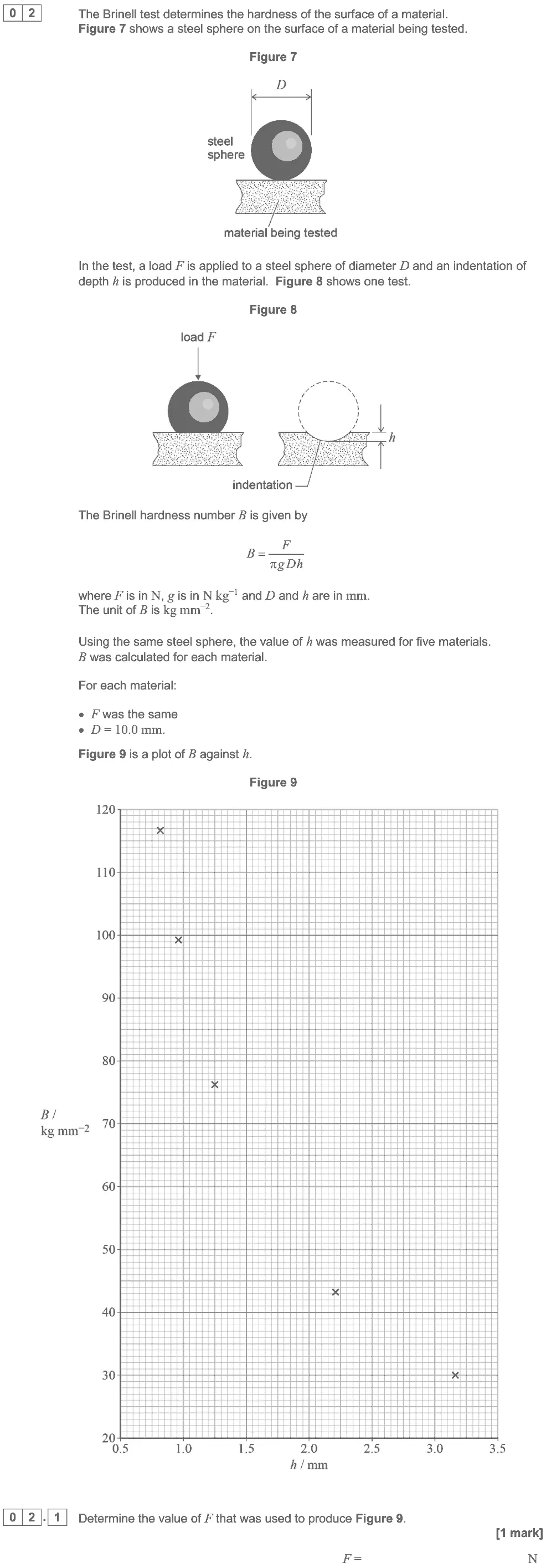
Figure 1
At the crystal scintillator, each photon of gamma radiation leads to the emission of
one visible light photon.

Describe how the current produced by the photocathode is amplified in the
photomultiplier tube.
[3 marks]
November 2021 · Paper 3B Medical physics · Q2 4 marks AO3=4 Explanation medical imaging
Figure 2 shows scanned images of three different human heads.
Each image used one of the following scanning techniques:
• magnetic resonance (MR)
• CT
• ultrasound
• PET.
Figure 2
A
B
C
Identify the scanning technique used for each image.
Go on to explain how the features of each image enabled you to identify the type of
scan.
[4 marks]
A: Scanning technique
Explanation
B: Scanning technique
Explanation
C: Scanning technique
Explanation
November 2021 · Paper 3B Medical physics · Q3.2 2 marks AO2=2 Explanation eye ear and ecg
Earlier part of question 3 that this part usesEarlier part of November 2021 Paper 3B Medical physics question 3
The frequency of a sound is increased from 3.0 kHz to 8.0 kHz with no change in
intensity.
One change in the sound perceived by a person with normal hearing is an increase in
pitch.
Explain one other change to the sound perceived by the person as the frequency is
increased from 3.0 kHz.
[2 marks]
November 2021 · Paper 3B Medical physics · Q4.2 2 marks AO3=2 Explanation medical imaging
Earlier part of question 4 that this part usesEarlier part of November 2021 Paper 3B Medical physics question 4
Discuss whether an X-ray image of a chest or an X-ray image of a hand is likely to be
sharper when exposed to the same X-ray source.
[2 marks]
November 2021 · Paper 3B Engineering physics · Q1.1 3 marks AO1=3 Explanation rotational dynamics
A gymnast dismounts from an exercise in which he swings on a high bar.  The
gymnast rotates in the air before landing.
Figure 1 shows the gymnast in three positions during the dismount.
Figure 1
The arrows show the direction of rotation of the gymnast.
In position 1 the gymnast has just let go of the bar.  His body is fully extended.
Position 2 shows the rotating gymnast a short time later.  His knees have been
brought close to his chest into a ‘tuck’.
Position 3 is at the end of the dismount as the gymnast lands on the mat.  His body is
once again fully extended.
Explain why the moment of inertia about the axis of rotation decreases when his
knees are moved towards his chest.
Go on to explain the effect this has on his angular speed.
[3 marks]
November 2021 · Paper 3B Engineering physics · Q1.4 4 marks AO3=4 Explanation rotational dynamics
Earlier part of question 1 that this part usesEarlier part of November 2021 Paper 3B Engineering physics question 1
The gymnast repeats the exercise.  The height of the bar remains unchanged.
State and explain two actions the gymnast can take to complete more rotations during
the dismount.
[4 marks]
1
2
November 2021 · Paper 3B Engineering physics · Q3.2 2 marks Explanation thermodynamics and enginesrotational dynamics
Earlier part of question 3 that this part usesEarlier part of November 2021 Paper 3B Engineering physics question 3
Explain why it is not advisable to run this engine at speeds above 7000 rev min−1.
Refer to Figure 4 in your answer.
[2 marks]
November 2021 · Paper 3B Engineering physics · Q4.2 3 marks Explanation thermodynamics and engines
Earlier part of question 4 that this part usesEarlier part of November 2021 Paper 3B Engineering physics question 4
After a nail has been used, another nail takes its place automatically.  The tool can
drive up to 180 nails per minute.
Discuss why the expansion cannot be isothermal.
[3 marks]
November 2021 · Paper 3B Turning points · Q1.1 4 marks AO1=2, AO2=2 Explanation discovery of the electron
Figure 1 shows the apparatus used in an experiment to investigate electron diffraction
and the de Broglie hypothesis.
Figure 1
Explain how high-speed electrons are produced in the apparatus in Figure 1.
In your answer you should:
• name parts A and B
• discuss the purposes of potential differences V1 and V2.
[4 marks]
November 2021 · Paper 3B Turning points · Q1.3 4 marks AO2=1, AO3=3 Explanation wave particle duality history
Earlier part of question 1 that this part usesEarlier part of November 2021 Paper 3B Turning points question 1
Figure 2 shows a typical diffraction pattern produced on the screen by the electrons.
Figure 2
Explain how measurements made with the apparatus in Figure 1 can be used to
support the de Broglie hypothesis.
[4 marks]
November 2021 · Paper 3B Turning points · Q2.2 4 marks AO1=1, AO2=3 Explanation wave particle duality history
Earlier part of question 2 that this part usesEarlier part of November 2021 Paper 3B Turning points question 2
Between 1886 and 1889, Heinrich Hertz completed a series of experiments in an
attempt to verify Maxwell’s theory.  Figure 3 shows a simplified arrangement similar to
the one used by Hertz in one of his experiments.
Figure 3
T is a radio wave transmitter with an aerial consisting of two vertical metal rods.
D is a detector that uses a conducting loop aerial.
T is switched on so that an oscillating current is produced in the metal rods.
An emf is detected in the conducting loop aerial.
Explain this experiment with reference to Maxwell’s model of electromagnetic waves.
[4 marks]
November 2020 · AS Paper 1 · Q2.2 4 marks Explanation newtons laws and momentum
Earlier part of question 2 that this part usesEarlier part of November 2020 Paper 1 question 2
A parachute opens during the spacecraft’s descent through the atmosphere.
Figure 2 shows the parachute–spacecraft system, with the open parachute displacing
the atmospheric gas.  This causes the system to decelerate.
Figure 2
Explain, with reference to Newton’s laws of motion, why displacing the atmospheric
gas causes a force on the system and why this force causes the system to
decelerate.
[4 marks]
November 2020 · AS Paper 1 · Q2.4 3 marks Explanation newtons laws and momentum
Earlier part of question 2 that this part usesEarlier part of November 2020 Paper 1 question 2
Dust from the surface of Mars can enter the atmosphere.  This increases the density
of the atmosphere significantly.
Deduce how an increase in dust content will affect the deceleration of the system.
[3 marks]
November 2020 · AS Paper 1 · Q3.6 2 marks Explanation motion and projectilesvectors and moments
Earlier part of question 3 that this part usesEarlier part of November 2020 Paper 1 question 3
Explain your reason for selecting this trajectory.
[2 marks]
November 2020 · AS Paper 1 · Q4.4 2 marks Explanation atomic structure and stable nuclei
Earlier part of question 4 that this part usesEarlier part of November 2020 Paper 1 question 4
Ions of Y have the same charge as ions of X.
State and explain how the specific charge of an ion of X compares with that of an
ion of Y.
[2 marks]
November 2020 · AS Paper 1 · Q5.6 3 marks Explanation circuits and potential dividersemf and internal resistance
Earlier part of question 5 that this part usesEarlier part of November 2020 Paper 1 question 5
The lamp operates at normal brightness across a pd range of 1.3 V to 1.5 V.
State and explain how more of these cells can be added to the circuit to make the
lamp light at normal brightness for a longer time.
No further calculations are required.
[3 marks]
November 2020 · AS Paper 1 · Q6.6 3 marks Explanation stationary waves
Earlier part of question 6 that this part usesEarlier part of November 2020 Paper 1 question 6
The frequency of the vibration generator is reduced until the first harmonic is observed
in the string, as shown in Figure 13.
Figure 13
The string in Figure 13 is replaced with one that has 9 times the mass per unit length
of the original string.  All other conditions are kept constant, including the frequency of
the vibration generator and the tension in the string.
Deduce the harmonic observed.
[3 marks]
November 2020 · AS Paper 2 · Q3.3 3 marks Explanation vectors and moments
Earlier part of question 3 that this part usesEarlier part of November 2020 Paper 2 question 3
The camera is moved horizontally to the right to a new stationary position.
The tension in A is now different from that in Figure 6.
Deduce whether the tension in A has increased or decreased.
[3 marks]
November 2020 · AS Paper 2 · Q3.4 3 marks Explanation refraction and optical fibres
Earlier part of question 3 that this part usesEarlier part of November 2020 Paper 2 question 3
The camera’s signal is transmitted as a series of pulses through an optical fibre.
Table 2 shows data for two optical fibres X and Y.  Both optical fibres are identical
except for their core diameter.
Table 2
Optical fibre
Core diameter / μm
X
8
Y
50
Deduce which fibre allows a greater pulse transmission rate.
[3 marks]
November 2020 · AS Paper 2 · Q4.1 2 marks Explanation energy levels and wave particle duality
Scintillation counters are used to detect beta particles.  A scintillation counter consists
of a scintillation material and a photomultiplier tube (PMT).
Beta particles collide with atoms in the scintillation material, which emits photons of
light as a result.
Explain how photons are produced by collisions between beta particles and atoms.
[2 marks]
November 2020 · Paper 1 · Q1.1 2 marks Explanation classification of particles and quarks
Determine whether the following reaction is a possible decay for the neutral pion π0.
π0  →  e−  +  μ+  +
ev
[2 marks]
November 2020 · Paper 1 · Q1.3 2 marks Explanation classification of particles and quarks
Earlier part of question 1 that this part usesEarlier part of November 2020 Paper 1 question 1
A student suggests that the kaon K0 and the anti-kaon K0
Discuss whether this suggestion is correct.
[2 marks]
November 2020 · Paper 1 · Q1.4 4 marks Explanation classification of particles and quarks
Earlier part of question 1 that this part usesEarlier part of November 2020 Paper 1 question 1
The nucleus is held together by a force.  It was predicted that a particle exists that is
responsible for this force.  The particle itself must experience this force.
The particle would have a rest energy between that of an electron and half that of a
nucleon.
Discuss whether a kaon, a muon and a pion each have the properties of the predicted
particle.
Information about these three particles is in the Data and Formulae Booklet.
[4 marks]
November 2020 · Paper 1 · Q2.1 2 marks Explanation photoelectric effect
Figure 1 shows an arrangement used to investigate the photoelectric effect.
Figure 1
A current is measured on the microammeter only when electromagnetic radiation with
a frequency greater than a certain value is incident on the photoemissive surface.
Explain why the frequency of the electromagnetic radiation must be greater than a
certain value.
[2 marks]
November 2020 · Paper 1 · Q2.3 2 marks Explanation photoelectric effect
Earlier part of question 2 that this part usesEarlier part of November 2020 Paper 1 question 2
Explain why I reaches a constant value for positive values of V.
[2 marks]
November 2020 · Paper 1 · Q2.4 3 marks Explanation photoelectric effect
Earlier part of question 2 that this part usesEarlier part of November 2020 Paper 1 question 2
Explain why I decreases as the value of V becomes more negative.
[3 marks]
November 2020 · Paper 1 · Q2.5 3 marks Explanation photoelectric effect
Earlier part of question 2 that this part usesEarlier part of November 2020 Paper 1 question 2
The investigation is repeated with a different photoemissive surface that has a smaller
value of the work function.  The source of electromagnetic radiation is unchanged.
Discuss the effect that this change in surface has on the value of the stopping
potential.
[3 marks]
November 2020 · Paper 1 · Q3.1 2 marks Explanation interference and diffraction
A student investigates the interference of sound waves using two loudspeakers,
P and Q, connected to a signal generator (oscillator).  Each loudspeaker acts as a
point source of sound.
Figure 3 shows the arrangement.
Figure 3
Point O is the midpoint between P and Q.
Explain why the two loudspeakers are coherent sources of sound waves.
[2 marks]
November 2020 · Paper 1 · Q3.2 3 marks Explanation interference and diffraction
Earlier part of question 3 that this part usesEarlier part of November 2020 Paper 1 question 3
The student faces the two loudspeakers at point A.  Point A is at equal distances from
P and Q.
He then moves to point B, at right angles to the line OA, still facing the two
loudspeakers.
As his head moves from A to B the amplitude of the sound wave he hears decreases
and then increases.  The amplitude starts to decrease again as he moves beyond B.
Explain why the variation in amplitude occurs as he moves from A to B.
[3 marks]
November 2020 · Paper 1 · Q3.5 3 marks Explanation interference and diffractionprogressive waves and polarisation
Earlier part of question 3 that this part usesEarlier part of November 2020 Paper 1 question 3
The student moves his head to point C as shown in Figure 4.  The emitted frequency
of the sound from the loudspeakers is then gradually decreased.
Figure 4
Discuss the effect that this decrease in frequency has on the amplitude of the sound
wave heard by the student.
[3 marks]
November 2020 · Paper 1 · Q5.5 3 marks Explanation current voltage and resistivity
Earlier part of question 5 that this part usesEarlier part of November 2020 Paper 1 question 5
Scientists and engineers are investigating the use of superconductors in electrical
transmission.
Discuss one advantage and one difficulty when using superconductors in electrical
transmission over long distances.
[3 marks]
Advantage
Difficulty
November 2020 · Paper 2 · Q3.6 2 marks Explanation electric fieldsnewtons laws and momentum
Earlier part of question 3 that this part usesEarlier part of November 2020 Paper 2 question 3
Li
3
6
+ and Li
3
7
+ ions are produced in the sample simultaneously and travel a distance L
from aperture P to the detector.
For each type of ion, the time interval between production and detection is measured.
Discuss how the masses of the ions can be deduced from the measurement of these
time intervals.
[2 marks]
November 2020 · Paper 2 · Q4.6 2 marks AO3=2 Explanation electromagnetic inductionmeasurements and uncertainties
Earlier part of question 4 that this part usesEarlier part of November 2020 Paper 2 question 4
State and explain a change to one control setting on the oscilloscope that would
reduce the uncertainty in the value of the time constant.
[2 marks]
November 2020 · Paper 2 · Q5.3 2 marks Explanation rutherford scattering and radiation
Earlier part of question 5 that this part usesEarlier part of November 2020 Paper 2 question 5
Suggest one of the alpha particles in Figure 11 which may be deflected downwards
with a scattering angle of 90°
Justify your answer.
[2 marks]
alpha particle number =
November 2020 · Paper 2 · Q6.1 3 marks AO2=3 Explanation mass energy and fission
A thermal nuclear reactor uses enriched uranium as its fuel.
This is fuel in which the ratio of U-235 to U-238 has been artificially increased from
that found in naturally-occurring ore.
Describe what happens when neutrons interact with U-235 and U-238 nuclei in a
thermal nuclear reactor.
[3 marks]
November 2020 · Paper 3B Astrophysics · Q1.4 3 marks AO3=3 Explanation telescopes
Earlier part of question 1 that this part usesEarlier part of November 2020 Paper 3B Astrophysics question 1
An astrophysicist had to decide whether to use a reflecting telescope or a refracting
telescope on the spacecraft in Question 01.2.
Discuss which type of telescope to use.
[3 marks]
November 2020 · Paper 3B Astrophysics · Q2.2 4 marks AO1=1, AO2=1, AO3=2 Explanation classification of stars
Earlier part of question 2 that this part usesEarlier part of November 2020 Paper 3B Astrophysics question 2
Figure 1 shows the intensity received at Earth from two of the stars, plotted against
wavelength.
The effect of absorption by the Earth’s atmosphere is not shown.
Figure 1
Discuss what information can be found from Figure 1 about the temperature and
colour of these stars.
Support your answer with suitable calculations.
[4 marks]
November 2020 · Paper 3B Astrophysics · Q4.2 2 marks AO3=2 Explanation classification of stars
Earlier part of question 4 that this part usesEarlier part of November 2020 Paper 3B Astrophysics question 4
Discuss why the evolution of a supergiant star in the local part of our galaxy could be
dangerous for life on Earth.
[2 marks]
November 2020 · Paper 3B Medical physics · Q1.1 5 marks AO1=5 Explanation eye ear and ecg
State and explain two differences between the perceived image of a brightly coloured
object in bright light and the perceived image of the same object when viewed in very
dark conditions.
In your answer you should refer to the visual receptors in the eye.
[5 marks]
Difference 1
Difference 2
November 2020 · Paper 3B Medical physics · Q1.3 3 marks AO3=3 Explanation eye ear and ecg
Earlier part of question 1 that this part usesEarlier part of November 2020 Paper 3B Medical physics question 1
Discuss why it was necessary to wear the eye patch for 45 minutes before entering
the ship.
[3 marks]
November 2020 · Paper 3B Medical physics · Q3.2 2 marks AO3=2 Explanation medical imaging
Earlier part of question 3 that this part usesEarlier part of November 2020 Paper 3B Medical physics question 3
Metal filters are used in X-ray machines to limit the damage to healthy tissues.
Table 2 gives data for possible filter materials.
Table 2
Energy / keV
Linear attenuation coefficient / cm−1
Aluminium
Copper
100
0.44
3.8
500
0.23
0.73
Discuss whether it would be better to use aluminium or copper to filter the X-rays
in Question 03.1.
No calculations are required.
[2 marks]
November 2020 · Paper 3B Medical physics · Q3.3 2 marks AO1=2 Explanation medical imaging
Earlier part of question 3 that this part usesEarlier part of November 2020 Paper 3B Medical physics question 3
State and explain one other method used to limit exposure of healthy cells during
X-ray radiotherapy.
[2 marks]
Method
Explanation
November 2020 · Paper 3B Medical physics · Q4.4 2 marks AO3=2 Explanation medical imaging
Earlier part of question 4 that this part usesEarlier part of November 2020 Paper 3B Medical physics question 4
Discuss whether an ultrasound scan would be suitable to investigate a tumour inside
a lung.
[2 marks]
November 2020 · Paper 3B Engineering physics · Q1.3 3 marks AO3=3 Explanation rotational dynamics
Earlier part of question 1 that this part usesEarlier part of November 2020 Paper 3B Engineering physics question 1
The student repeats the experiment using a spoked pulley of the same mass and
radius, as shown in Figure 2.
Figure 2
Compare the acceleration of the load in this experiment with its acceleration in the
previous experiment.
A calculation is not required.
[3 marks]
November 2020 · Paper 3B Engineering physics · Q4.4 2 marks AO1=2 Explanation thermodynamics and engines
Earlier part of question 4 that this part usesEarlier part of November 2020 Paper 3B Engineering physics question 4
Explain why the compression of a gas can be considered to be an isothermal change
when the gas is compressed very slowly.
[2 marks]
November 2020 · Paper 3B Engineering physics · Q5.1 2 marks AO1=2 Explanation thermodynamics and engines
Explain how the second law of thermodynamics predicts that a heat engine can never
be 100% efficient.
[2 marks]
November 2020 · Paper 3B Turning points · Q1.1 2 marks Explanation discovery of the electron
Figure 1 shows a diagram of a discharge tube used by JJ Thomson to investigate
cathode rays.
Figure 1
The direction XY is horizontal and at right angles to the axis of the tube.
When correct connections are made to a high-voltage power supply, a cathode ray is
produced.  The cathode ray hits the centre of the fluorescent screen.
Describe how a cathode ray is produced in the discharge tube in Figure 1.
[2 marks]
November 2020 · Paper 3B Turning points · Q1.3 3 marks Explanation discovery of the electron
Earlier part of question 1 that this part usesEarlier part of November 2020 Paper 3B Turning points question 1
Changes are made to the apparatus so that the particles in the cathode ray travel with
a greater speed as they pass between plates P and Q.
Explain how the cathode ray is restored to its original path by adjusting:
• only the electric field strength between P and Q
• only the magnetic flux density.
[3 marks]
electric field strength only
magnetic flux density only
November 2020 · Paper 3B Turning points · Q1.4 2 marks Explanation discovery of the electron
Earlier part of question 1 that this part usesEarlier part of November 2020 Paper 3B Turning points question 1
Using the apparatus in Figure 1, Thomson determined the specific charge of the
particles in the cathode rays.  Thomson compared this result with the specific charge
of the hydrogen ion.
Discuss the significance of Thomson’s results for the particles in cathode rays, when
compared with the specific charge of the hydrogen ion.
[2 marks]
November 2020 · Paper 3B Turning points · Q3.1 2 marks Explanation wave particle duality history
The scanning tunnelling microscope (STM) uses a process called quantum tunnelling.
Explain what is meant by quantum tunnelling of an electron in an STM.
You may include a diagram as part of your answer.
[2 marks]
November 2020 · Paper 3B Turning points · Q3.2 3 marks Explanation wave particle duality history
Earlier part of question 3 that this part usesEarlier part of November 2020 Paper 3B Turning points question 3
An STM is used to map the positions of the atoms between points A and B on the
surface of a sample.
Figure 3 shows some of the features of the operation of an STM.
Figure 3
The STM in Figure 3 is in constant-current mode.
Describe how the STM creates a map of the positions of one row of atoms on the
surface of the sample from A to B.
[3 marks]
November 2020 · Paper 3B Turning points · Q4.3 3 marks Explanation special relativity
Earlier part of question 4 that this part usesEarlier part of November 2020 Paper 3B Turning points question 4
As the muons travel through the atmosphere, their speeds are reduced by interaction
with the particles in the air.
Discuss, with reference to relativity, the effect that this reduction of speed has on the
rate of detection of the muons on the surface of the Earth.
[3 marks]
November 2020 · Paper 3B Electronics · Q3.1 2 marks AO1=2 Explanation semiconductor devices and signals
Pulse code modulation (PCM) is used to encode live music as an uncompressed
digital audio file.
Sampling of the analogue signal is carried out at 44.1 kHz.
A 16-bit system is used to encode each of the two channels that make up the stereo
signal.
Explain why the sampling frequency used is suitable for this task.
[2 marks]
November 2020 · Paper 3B Electronics · Q3.4 2 marks AO3=2 Explanation data communication
Earlier part of question 3 that this part usesEarlier part of November 2020 Paper 3B Electronics question 3
The music file is used by a call centre to play as background music while a phone call
is on hold.  However, the telephone network is designed to use a bandwidth of
0.3 kHz – 3.4 kHz.
Compare the quality of the music heard by the telephone caller with that of the original
file heard when played directly from a compact disc.
[2 marks]
November 2020 · Paper 3B Electronics · Q4.3 2 marks AO3=2 Explanation operational amplifiers
Earlier part of question 4 that this part usesEarlier part of November 2020 Paper 3B Electronics question 4
The intensity of radiation incident on the photodiode remains at 3.0 W m−2.
Deduce whether the light-emitting diode (LED) in Figure 6 is on or off.
[2 marks]
June 2019 · AS Paper 1 · Q1.3 3 marks Explanation atomic structure and stable nuclei
Earlier part of question 1 that this part usesEarlier part of June 2019 Paper 1 question 1
The deuterium nucleus is stable.
Describe how the variation of the strong nuclear force with distance contributes to the
stability of the deuterium nucleus.
[3 marks]
June 2019 · AS Paper 1 · Q1.4 3 marks Explanation atomic structure and stable nucleiparticles antiparticles and interactions
Earlier part of question 1 that this part usesEarlier part of June 2019 Paper 1 question 1
Tritium is an isotope of hydrogen.  Its nucleus contains one proton and two neutrons.
Tritium undergoes radioactive decay.
Three modes of radioactive decay are
• alpha decay
• beta minus (β−) decay
• electron capture.
Deduce which of these modes could produce the nucleus of another element when
the tritium nucleus decays.
[3 marks]
June 2019 · AS Paper 1 · Q4.1 2 marks Explanation refraction and optical fibres
In 1870 John Tyndall sent a beam of light along a stream of water.
Figure 4 shows a modern version of Tyndall’s experiment using a laser beam.
Water has a refractive index of 1.33
Figure 4
Explain why the laser beam stays inside the stream of water.
[2 marks]
June 2019 · AS Paper 1 · Q5.2 2 marks Explanation Hard vectors and moments
Earlier part of question 5 that this part usesEarlier part of June 2019 Paper 1 question 5
The student suggests that the forces exerted on the ruler by A and B act as a couple.
Discuss whether his suggestion is correct.
[2 marks]
June 2019 · AS Paper 1 · Q5.4 2 marks Explanation vectors and moments
Earlier part of question 5 that this part usesEarlier part of June 2019 Paper 1 question 5
A second student sets up the same apparatus as shown in Figure 9.
She suspends the mass in the same position on the ruler as in question 05.3.
She moves the supports to make A and B vertical but does not make the ruler
horizontal.
Discuss whether the readings on A and B taken by this student are different to those
in question 05.3.
[2 marks]
June 2019 · AS Paper 1 · Q6.4 3 marks Explanation energy levels and wave particle duality
Earlier part of question 6 that this part usesEarlier part of June 2019 Paper 1 question 6
Line emission spectra of hydrogen and antihydrogen have been compared.
Explain in terms of energy changes how line emission spectra are produced.
[3 marks]
June 2019 · AS Paper 2 · Q3.1 2 marks Explanation classification of particles and quarksparticles antiparticles and interactions
This question is about two applications of photon energy and momentum:
positron emission tomography (PET) and a solar sail.
The momentum of a photon is
photon energy
speed of light in a vacuum
In preparing for a PET scan of a patient’s brain, a small sample of a substance
containing unstable nuclei is injected into the patient.
A positron is emitted when one of the unstable nuclei undergoes β+decay.
Explain how the change in quark character in β+decay affects the number of neutrons
and the number of protons in the unstable nucleus.
[2 marks]
June 2019 · AS Paper 2 · Q3.4 2 marks Explanation particles antiparticles and interactionsnewtons laws and momentum
Earlier part of question 3 that this part usesEarlier part of June 2019 Paper 2 question 3
Explain your answer to question 03.3.
[2 marks]
June 2019 · AS Paper 2 · Q3.6 2 marks Explanation newtons laws and momentum
Earlier part of question 3 that this part usesEarlier part of June 2019 Paper 2 question 3
The reflectance of a surface is proportional to the percentage of incident photons that
are reflected off the surface.
Explain the effect of increasing the reflectance of the solar sail on the acceleration.
Assume gravity has negligible effect on the solar sail.
[2 marks]
June 2019 · AS Paper 2 · Q4.3 3 marks Explanation current voltage and resistivity
Earlier part of question 4 that this part usesEarlier part of June 2019 Paper 2 question 4
Either of the circuits shown in Figure 10a and Figure 10b could be used to reduce
the initial current surge.
Figure 10a                                                 Figure 10b
The thermistor and the fixed resistor have the same resistance when they are at the
temperature of the surroundings.
When the surge has ended, the boat and trailer continue to move at a constant speed
to the top of the ramp.
Explain, with reference to the properties of the thermistor and the fixed resistor, why
using the thermistor is preferable to using the fixed resistor.
[3 marks]
June 2019 · Paper 1 · Q1.4 3 marks Explanation particles antiparticles and interactionsatomic structure and stable nuclei
Earlier part of question 1 that this part usesEarlier part of June 2019 Paper 1 question 1
Internal conversion is a process in which a nucleus in an excited state can release its
excess energy.  In internal conversion all of the excess energy is transferred from the
nucleus to an orbital electron through the electromagnetic force.  This orbital electron
is ejected from the atom.
The tellurium nucleus formed in question 01.3 is in an excited state and can undergo
internal conversion.
Discuss three differences between internal conversion and beta (β–) decay.
[3 marks]
1
2
3
June 2019 · Paper 1 · Q2.3 2 marks Explanation refraction and optical fibres
Earlier part of question 2 that this part usesEarlier part of June 2019 Paper 1 question 2
The refractive index of the windscreen glass is 1.52
Explain why the ray follows the path shown inside the windscreen glass in Figure 1.
Support your answer with a suitable calculation.
[2 marks]
June 2019 · Paper 1 · Q2.4 2 marks Explanation refraction and optical fibres
Earlier part of question 2 that this part usesEarlier part of June 2019 Paper 1 question 2
When it starts to rain, water droplets form on the outside of the windscreen as shown
in Figure 2.
Figure 2
The refractive index of water is 1.33
Explain why the presence of water at A causes the intensity of the light at the detector
to decrease.
Support your answer with a suitable calculation.
[2 marks]
June 2019 · Paper 1 · Q2.5 2 marks Explanation refraction and optical fibres
Earlier part of question 2 that this part usesEarlier part of June 2019 Paper 1 question 2
The refractive index of the windscreen glass can vary by a few per cent across the
thickness of the glass.
Discuss how this variation may affect the path of the ray through the windscreen
glass.
[2 marks]
June 2019 · Paper 1 · Q2.6 2 marks Explanation refraction and optical fibres
Earlier part of question 2 that this part usesEarlier part of June 2019 Paper 1 question 2
A different design has the LED and the detector further apart.  The ray undergoes
more reflections inside the windscreen glass before reaching the detector.
Discuss two ways in which this different design affects the sensitivity of the sensor to
the presence of water droplets.
[2 marks]
1
2
June 2019 · Paper 1 · Q3.4 2 marks Explanation interference and diffraction
Earlier part of question 3 that this part usesEarlier part of June 2019 Paper 1 question 3
In practice, the filter transmits red light with wavelengths in the range 600 nm to
700 nm.
Suggest how this affects the appearance of the maxima.
[2 marks]
June 2019 · Paper 1 · Q4.1 2 marks Explanation vectors and moments
Figure 5 shows a simplified catapult used to hurl projectiles a long way.
Figure 5
The counterweight is a wooden box full of stones attached to one end of the beam.
The projectile, usually a large rock, is in a sling hanging vertically from the other end
of the beam.  The weight of the sling is negligible.
The beam is held horizontal by a rope attached to the frame.
The catapult is designed so that the weight of the beam and the weight of the empty
wooden box have no effect on the tension in the rope.
Suggest how the pivot position achieves this.
[2 marks]
June 2019 · Paper 1 · Q4.4 3 marks Explanation motion and projectiles
Earlier part of question 4 that this part usesEarlier part of June 2019 Paper 1 question 4
In another release, the sling is adjusted so that a projectile of the same mass is
released just before the wooden beam is vertical.  The projectile is not released
horizontally.
Discuss the effect this change has on the range of the catapult.
[3 marks]
June 2019 · Paper 1 · Q5.5 2 marks Explanation newtons laws and momentum
Earlier part of question 5 that this part usesEarlier part of June 2019 Paper 1 question 5
A different safety barrier uses a solid concrete wall which does not deform.
The same standard test is carried out on a concrete wall.
Discuss which type of barrier would cause less damage to the dummies in the
test.
[2 marks]
June 2019 · Paper 1 · Q7.1 2 marks Explanation emf and internal resistance
Figure 9 shows a practical circuit in which a variable resistor is used to control the
brightness of a lamp.  The voltmeter reading is monitored as the variable resistor is
adjusted to make the lamp brighter.
Figure 9
Explain why the reading on the voltmeter decreases as the brightness of the lamp
increases.
[2 marks]
June 2019 · Paper 1 · Q7.2 2 marks Explanation emf and internal resistancecircuits and potential dividers
Earlier part of question 7 that this part usesEarlier part of June 2019 Paper 1 question 7
The variable resistor is adjusted so that the lamp is at its brightest.  The reading V1 on
the voltmeter is noted.  A second identical cell is then connected in parallel with the
cell in Figure 9.  The new reading V2 on the voltmeter is noted.
Explain why V2 is greater than V1.
[2 marks]
June 2019 · Paper 2 · Q2.5 3 marks Explanation kinetic theory
Earlier part of question 2 that this part usesEarlier part of June 2019 Paper 2 question 2
Explain, in terms of the kinetic theory model, why a pressure is exerted by the gas on
the piston.
[3 marks]
June 2019 · Paper 2 · Q2.6 3 marks Explanation kinetic theory
Earlier part of question 2 that this part usesEarlier part of June 2019 Paper 2 question 2
The mixture of gases in the cylinder stays the same.
Explain, using the kinetic theory model, two changes that can be made independently
to reduce the pressure exerted by the gas.
[3 marks]
June 2019 · Paper 2 · Q6.3 2 marks Explanation mass energy and fission
Earlier part of question 6 that this part usesEarlier part of June 2019 Paper 2 question 6
The kinetic energy of a neutron in a thermal nuclear reactor is reduced from about
2 MeV to about 1 eV.
Explain why the number of collisions needed to do this depends on the nucleon
number of the moderator atoms.
[2 marks]
June 2019 · Paper 3B Astrophysics · Q2.1 3 marks Explanation classification of stars
Table 2 shows some properties of the four brightest stars in the constellation
Canis Minor.
Table 2
Name
Apparent
magnitude
Absolute
magnitude
Spectral class
Gamma A
4.46
–0.50
K
Gomeisa
2.89
–0.70
B
HD 66141
4.39
–0.13
K
Procyon
0.34
2.65
F
Discuss, with reference to the Hipparcos scale, why many star maps show only two
stars in the constellation Canis Minor.
[3 marks]
June 2019 · Paper 3B Astrophysics · Q2.2 2 marks Explanation classification of stars
Earlier part of question 2 that this part usesEarlier part of June 2019 Paper 3B Astrophysics question 2
State and explain which star in Table 2 has the most prominent Hydrogen Balmer
absorption lines.
[2 marks]
June 2019 · Paper 3B Astrophysics · Q2.3 3 marks Explanation classification of stars
Earlier part of question 2 that this part usesEarlier part of June 2019 Paper 3B Astrophysics question 2
Deduce which star, Gamma A or HD 66141, has the larger diameter.
[3 marks]
June 2019 · Paper 3B Astrophysics · Q2.4 2 marks Explanation cosmology
Earlier part of question 2 that this part usesEarlier part of June 2019 Paper 3B Astrophysics question 2
Astronomers recently used the radial velocity method to discover an exoplanet orbiting
HD 66141.
Describe the main features of the radial velocity method in the detection of planets.
[2 marks]
June 2019 · Paper 3B Astrophysics · Q3.5 3 marks Explanation classification of stars
Earlier part of question 3 that this part usesEarlier part of June 2019 Paper 3B Astrophysics question 3
A star much more massive than the Sun may become a supernova and then a black
hole.
Discuss whether supernovae and black holes can be placed on the HR diagram in
Figure 2.
[3 marks]
June 2019 · Paper 3B Astrophysics · Q4.2 2 marks Explanation Hard cosmology
Earlier part of question 4 that this part usesEarlier part of June 2019 Paper 3B Astrophysics question 4
Quasars are the most distant measurable objects.
Discuss one problem associated with the determination of the distance from the Earth
to a quasar.
[2 marks]
June 2019 · Paper 3B Medical physics · Q2.3 2 marks Explanation eye ear and ecg
Earlier part of question 2 that this part usesEarlier part of June 2019 Paper 3B Medical physics question 2
Customer Q perceives the loudness of the sound differently to customer R.
Discuss whether the use of intensity level or intensity is more appropriate to compare
the perceived loudness.
[2 marks]
June 2019 · Paper 3B Medical physics · Q2.4 3 marks Explanation eye ear and ecg
Earlier part of question 2 that this part usesEarlier part of June 2019 Paper 3B Medical physics question 2
Customers P, Q and R move to the same distance from the loudspeaker.
Customer P is 80 years old and has hearing loss due to her age.
Customer Q is 35 years old and has hearing loss due to working in an extremely noisy
environment.
Customer R is 35 years old and has no hearing loss.
The hearing defects of P and Q affect their perception of the music being played.
Describe how their perceptions are different from that of R.
[3 marks]
June 2019 · Paper 3B Medical physics · Q3.1 4 marks Explanation medical imaging
Figure 3 shows the X-ray spectrum produced in a medical X-ray machine at a
particular anode potential difference (pd).
Figure 3
In an X-ray tube, electrons collide with a tungsten target.
Explain how the continuous spectrum and the characteristic spectra are produced by
these electron collisions.
[4 marks]
Continuous spectrum
Characteristic spectra
June 2019 · Paper 3B Engineering physics · Q1.2 2 marks Explanation rotational dynamics
Earlier part of question 1 that this part usesEarlier part of June 2019 Paper 3B Engineering physics question 1
The total mass of the screw, punch and arms is the same as the total mass of the two
balls.
Explain why the moment of inertia of the screw, punch and arms about the axis of
rotation is much smaller than the moment of inertia of the steel balls about the same
axis.
[2 marks]
June 2019 · Paper 3B Engineering physics · Q1.4 3 marks Explanation Hard rotational dynamics
Earlier part of question 1 that this part usesEarlier part of June 2019 Paper 3B Engineering physics question 1
For thicker or stiffer metal sheets the rotational kinetic energy at 2.9 rev s−1 is not
enough to punch out the shape.
The distance from the axis of rotation to the centre of each ball is y.
The radius of each ball is R.
The stored energy can be increased by
either
• increasing y by 15% without changing R
or
• increasing R by 15% without changing y.
Deduce which of these would produce the greater increase in stored energy.
[3 marks]
June 2019 · Paper 3B Engineering physics · Q3.4 2 marks Explanation thermodynamics and engines
Earlier part of question 3 that this part usesEarlier part of June 2019 Paper 3B Engineering physics question 3
Explain why W is equal to Q in process A → B and in process C → D.
[2 marks]
June 2019 · Paper 3B Engineering physics · Q3.6 2 marks Explanation Hard thermodynamics and engines
Earlier part of question 3 that this part usesEarlier part of June 2019 Paper 3B Engineering physics question 3
Discuss one problem that would be faced by an engineer designing a real engine
based on this cycle.
[2 marks]
June 2019 · Paper 3B Engineering physics · Q4.1 2 marks Explanation Hard thermodynamics and engines
Tumble-dryers blow hot air over wet clothes that are moving in a rotating drum.
Conventional tumble-dryers heat the air in the drum electrically; other dryers use a
heat pump to heat the air.
A typical conventional tumble-dryer uses about 0.6 kW h per kg of clothes.
A heat pump tumble-dryer uses about 0.25 kW h per kg.
Explain why the heat pump tumble-dryer uses less electrical energy than the
conventional tumble-dryer to dry the same load.
[2 marks]
June 2019 · Paper 3B Turning points · Q1.3 3 marks Explanation discovery of the electron
Earlier part of question 1 that this part usesEarlier part of June 2019 Paper 3B Turning points question 1
The potential difference between the plates is restored to its initial value and the
droplet becomes stationary.
The charge on the droplet is −4.8 × 10⁻¹⁹ C.
A student suggests that, if the droplet splits into two spheres of equal size, both
spheres would remain stationary.
Deduce whether this suggestion is correct.
[3 marks]
June 2019 · Paper 3B Turning points · Q3.3 4 marks Explanation wave particle duality history
Earlier part of question 3 that this part usesEarlier part of June 2019 Paper 3B Turning points question 3
The experiment is repeated using a similar arrangement to that shown in Figure 3.
Figure 4 shows the diffraction patterns from the two experiments.
Figure 4
first experiment               second experiment
State and explain two independent changes that could be made to the arrangement in
Figure 3 to produce the result shown for the second experiment in Figure 4.
[4 marks]
First change
Second change
June 2019 · Paper 3B Turning points · Q4.2 4 marks Explanation special relativity
Earlier part of question 4 that this part usesEarlier part of June 2019 Paper 3B Turning points question 4
Discuss how Einstein’s theory of special relativity explains the data in Table 1.
[4 marks]
June 2019 · Paper 3B Electronics · Q2.3 3 marks Explanation operational amplifiers
Earlier part of question 2 that this part usesEarlier part of June 2019 Paper 3B Electronics question 2
A microphone converts a sound wave into the voltage signal labelled signal 1 in
Figure 5.  At the same time the microphone produces a second signal, labelled
signal 2.  Signal 2 is the inversion of signal 1.
These two signals travel along two separate wires in the same cable.
Figure 5
Figure 6 shows some electrical noise that has been picked up and added to the
signals as they travel through the cable from the microphone to the operational
amplifier circuit in Figure 4.
Figure 6
The connections made in question 02.2 are removed.
Signal 1 is connected to input A and signal 2 is connected to input B.
Explain how the operational amplifier circuit affects the noise and strength of the
output signal.
[3 marks]
June 2019 · Paper 3B Electronics · Q3.1 3 marks Explanation Hard semiconductor devices and signals
Figure 7 shows a system to monitor a tank filling with liquid in which a magnet is
mounted on a float.
Figure 7
The Hall effect sensor produces an output voltage V.  V depends on the distance d
between the sensor and the magnet.
When V reaches a certain value, the flow of liquid to the tank is switched off.
The magnet may be arranged with either the north (N) or south (S) pole facing the
sensor.
Figure 8 shows how the magnitude of V varies with d for the two possible
arrangements of the magnet.
Figure 8
Compare the advantages of the two arrangements for monitoring the movement of the
magnet towards the Hall effect sensor.
In your answer you should compare:
• the sensitivity of the system
• the range of d over which the system is useful.
You may ignore any effect from the Earth’s magnetic field.
[3 marks]
June 2019 · Paper 3B Electronics · Q4.4 2 marks Explanation operational amplifierssemiconductor devices and signals
Earlier part of question 4 that this part usesEarlier part of June 2019 Paper 3B Electronics question 4
The circuit in Figure 12 is rebuilt and the position of R is swapped with the position of
the Zener diode.
Explain how this affects the light intensity at which W changes.
[2 marks]
June 2018 · AS Paper 1 · Q1.1 3 marks Explanation atomic structure and stable nucleiclassification of particles and quarks
Describe the interaction that is responsible for keeping protons and neutrons together
in a stable nucleus.
You should include details of the properties of the interaction in your answer.
[3 marks]
June 2018 · AS Paper 1 · Q1.2 3 marks Explanation Hard classification of particles and quarksatomic structure and stable nuclei
Earlier part of question 1 that this part usesEarlier part of June 2018 Paper 1 question 1
Nuclei can decay by alpha decay and by beta decay.
In alpha decay only one particle is emitted but in beta decay there are two emitted
particles.
Explain how baryon number is conserved in alpha and beta decay.
[3 marks]
June 2018 · AS Paper 1 · Q2.2 3 marks Explanation Hard vectors and momentsnewtons laws and momentum
Earlier part of question 2 that this part usesEarlier part of June 2018 Paper 1 question 2
Figure 2 shows the truck moving down a ramp with a varying slope.
Figure 2
The truck starts from rest and moves freely down the ramp.  It reaches point C and
then moves along the horizontal runway to D.  Friction and air resistance are
negligible.
Discuss how the acceleration of the truck in Figure 2 differs from the acceleration of
the truck in Figure 1.
[3 marks]
June 2018 · AS Paper 1 · Q2.4 3 marks Explanation Hard newtons laws and momentum
Earlier part of question 2 that this part usesEarlier part of June 2018 Paper 1 question 2
The horizontal runway in Figure 2 has negligible friction and air resistance.  As the
truck moves along the runway, it starts to rain.  The rain falls vertically and water
collects in the truck.
Discuss whether there are any changes in the momentum of the truck and collected
water.
[3 marks]
June 2018 · AS Paper 1 · Q3.2 3 marks Explanation energy levels and wave particle duality
Earlier part of question 3 that this part usesEarlier part of June 2018 Paper 1 question 3
Two ways to excite a hydrogen atom are by collision with a free electron or by the
absorption of a photon.
Explain why, for a particular transition, the photon must have an exact amount of
energy whereas the free electron only needs a minimum amount of kinetic energy.
[3 marks]
June 2018 · AS Paper 1 · Q4.3 2 marks Explanation Hard vectors and moments
Earlier part of question 4 that this part usesEarlier part of June 2018 Paper 1 question 4
Explain why the centre of mass of the beam in Figure 4 must be vertically below A.
[2 marks]
June 2018 · AS Paper 1 · Q6.2 3 marks Explanation Hard circuits and potential dividers
Earlier part of question 6 that this part usesEarlier part of June 2018 Paper 1 question 6
The student connects another lamp E in the circuit as shown in Figure 7.
Lamp E is identical to lamps A and C.
Figure 7
Explain what the student would observe regarding the brightness of the lamps.
Refer to potential differences across lamp E in your answer.
[3 marks]
June 2018 · AS Paper 1 · Q7.2 4 marks Explanation interference and diffraction
Earlier part of question 7 that this part usesEarlier part of June 2018 Paper 1 question 7
A filter transmits only green light of wavelength  and red light of wavelength 1.2
This filter is placed between the light source and the single slit.
Describe the interference pattern now seen on the white screen.
Use a calculation to support your answer.
[4 marks]
June 2018 · AS Paper 2 · Q3.5 3 marks Explanation Hard circuits and potential dividers
Earlier part of question 3 that this part usesEarlier part of June 2018 Paper 2 question 3
The radioactive source was positioned 10 cm above the wire gauze before being
moved slowly towards the wire gauze leading to the ionisation event in question 03.4.
Discuss how the potential difference across the air gap varied as the radioactive
source was moved over this distance.
Assume the power supply has negligible internal resistance.
[3 marks]
June 2018 · AS Paper 2 · Q4.2 3 marks Explanation Hard materials and young modulusnewtons laws and momentum
Earlier part of question 4 that this part usesEarlier part of June 2018 Paper 2 question 4
Figure 10 shows a cross-sectional view of an optical fibre strain gauge.
Figure 10
A maximum intensity of the reflected light is produced due to superposition of the light
reflected from each of the regions with increased refractive index in the core.
This maximum intensity occurs at a particular wavelength λR.
Figure 11 shows the relationship between λR and the strain in the optical fibre.
Figure 11
A cable is used to raise and lower a lift.  An engineer fixes the optical fibre strain
gauge to the cable to monitor changes of the strain in the cable.
The lift is initially at rest and then accelerates downwards for a short time before
reaching a constant velocity.
Discuss how the value of λR changes.
[3 marks]
June 2018 · AS Paper 2 · Q4.3 2 marks Explanation materials and young modulus
Earlier part of question 4 that this part usesEarlier part of June 2018 Paper 2 question 4
Figure 12 shows the relationship between λR and the strain in two optical fibre strain
gauges P and Q. The engineer wishes to measure small accelerations in another lift.
She can choose to fix either optical fibre strain gauge P or optical fibre strain gauge Q
to the lift’s cable.
Figure 12
Explain which gauge the engineer should select.
[2 marks]
June 2018 · Paper 1 · Q1.3 2 marks Explanation Hard work energy and power
Earlier part of question 1 that this part usesEarlier part of June 2018 Paper 1 question 1
Discuss the energy transfers that take place when a vehicle is decelerated in an
escape lane.
[2 marks]
June 2018 · Paper 1 · Q1.5 1 mark Explanation motion and projectiles
Earlier part of question 1 that this part usesEarlier part of June 2018 Paper 1 question 1
Discuss whether an escape lane containing gravel or an escape ramp would provide
the safer experience for the driver of the vehicle as it comes to rest.
[1 mark]
wavelength  of an electron varies with its velocity v.
June 2018 · Paper 1 · Q2.3 3 marks Explanation energy levels and wave particle duality
Earlier part of question 2 that this part usesEarlier part of June 2018 Paper 1 question 2
Figure 2 shows the side view of an electron diffraction tube used to demonstrate the
wave properties of an electron.
Figure 2
An electron beam is incident on a thin graphite target that behaves like the slits in a
diffraction grating experiment.  After passing through the graphite target the electrons
strike a fluorescent screen.
Figure 3 shows the appearance of the fluorescent screen when the electrons are
incident on it.
Figure 3
Explain how the pattern produced on the screen supports the idea that the electron
beam is behaving as a wave rather than as a stream of particles.
[3 marks]
June 2018 · Paper 1 · Q2.4 3 marks Explanation energy levels and wave particle duality
Earlier part of question 2 that this part usesEarlier part of June 2018 Paper 1 question 2
Explain how the emission of light from the fluorescent screen shows that the electrons
incident on it are behaving as particles.
[3 marks]
June 2018 · Paper 1 · Q3.1 3 marks Explanation stationary waves
Figure 4 shows the structure of a violin and Figure 5 shows a close-up image of the
tuning pegs.
Figure 4
Figure 5
The strings are fixed at end A.  The strings pass over a bridge and the other ends of
the strings are wound around tuning pegs that have a circular cross-section.  The
tension in the strings can be increased or decreased by rotating the tuning pegs.
Explain how a stationary wave is produced when a stretched string is plucked.
[3 marks]
June 2018 · Paper 1 · Q4.4 2 marks Explanation current voltage and resistivitycircuits and potential dividers
Earlier part of question 4 that this part usesEarlier part of June 2018 Paper 1 question 4
State and explain the effect on the output pd of increasing the temperature of the
thermistor.
[2 marks]
June 2018 · Paper 1 · Q5.3 3 marks Explanation circular motionvectors and moments
Earlier part of question 5 that this part usesEarlier part of June 2018 Paper 1 question 5
Discuss the consequences for the forces acting on the pole when one acrobat has a
much greater mass than the other.
[3 marks]
June 2018 · Paper 1 · Q6.4 2 marks Explanation newtons laws and momentum
Earlier part of question 6 that this part usesEarlier part of June 2018 Paper 1 question 6
Explain, without doing a calculation, how the motion of the trucks immediately after the
collision would be different for a collision that is perfectly elastic.
[2 marks]
June 2018 · Paper 2 · Q1.3 2 marks Explanation Hard thermal energy and ideal gases
Earlier part of question 1 that this part usesEarlier part of June 2018 Paper 2 question 1
The pump can circulate the water at different speeds.
When working at higher speeds the rise in temperature is greater.
Explain why.
Again assume that no heat is transferred to the surroundings.
[2 marks]
June 2018 · Paper 2 · Q2.3 2 marks Explanation electric fields
Earlier part of question 2 that this part usesEarlier part of June 2018 Paper 2 question 2
Explain, without calculation, whether net work must be done in moving a proton from
infinity to position P in Figure 2.
[2 marks]
June 2018 · Paper 2 · Q2.4 2 marks Explanation electric fieldsnewtons laws and momentum
Earlier part of question 2 that this part usesEarlier part of June 2018 Paper 2 question 2
A small rubber ball coated with a conducting paint carries a positive charge.
The ball is suspended in equilibrium from a vertical wall by an uncharged
non-conducting thread of negligible mass.  The wall is positively charged and
produces a horizontal uniform electric field perpendicular to the wall along the whole
of its length.
Figure 3 shows that the thread makes an angle of 30° to the wall.
Figure 3
The thread breaks.
Explain the motion of the ball.
[2 marks]
June 2018 · Paper 2 · Q4.3 2 marks Explanation Hard electromagnetic induction
Earlier part of question 4 that this part usesEarlier part of June 2018 Paper 2 question 4
During the demonstration an induced current is detected by the ammeter.  The
induced current is in the direction E to F.
Explain how this demonstrates Lenz’s law.
[2 marks]
June 2018 · Paper 2 · Q7.2 4 marks Explanation atomic structure and stable nucleiradioactive decay
Earlier part of question 7 that this part usesEarlier part of June 2018 Paper 2 question 7
A nucleus of the stable isotope
Pb
82
208
has more neutrons than protons.
Explain why there is this imbalance between proton and neutron numbers by referring
to the forces that operate within the nucleus.  Your explanation should include the
range of the forces and which particles are affected by the forces.
[4 marks]
June 2018 · Paper 2 · Q7.4 2 marks Explanation Hard radioactive decayenergy levels and wave particle duality
Earlier part of question 7 that this part usesEarlier part of June 2018 Paper 2 question 7
The thallium nucleus is formed in an excited state.  Electromagnetic radiation is
emitted from the thallium atom following its formation.
Explain the origin and location of two sources of this radiation.
[2 marks]
Source 1
Source 2
June 2018 · Paper 2 · Q7.5 2 marks Explanation radioactive decayrutherford scattering and radiation
Earlier part of question 7 that this part usesEarlier part of June 2018 Paper 2 question 7
Other nuclides also emit electromagnetic radiation.
Explain why the metastable form of the isotope of technetium Tc
43
99
is a radioactive
source suitable for use in medical diagnosis.
[2 marks]
June 2018 · Paper 3 Section A · Q1.2 3 marks Explanation magnetic fields
Earlier part of question 1 that this part usesEarlier part of June 2018 Paper 3 Section A question 1
The student attaches a uniform wire to the upper edge of the ruler, as shown in
Figure 3.
The ends of the wire are connected to terminal blocks P and Q which are fixed firmly
to the bench. A power supply and an ammeter are connected between P and Q.
These modifications cause the balance reading to increase slightly.
A horizontal uniform magnetic field is applied, perpendicular to the wire, between the
85 cm and 90 cm marks, as shown in the close-up diagram in Figure 3.
Figure 3
The balance reading M is recorded for increasing values of current I.
A graph of these data is shown in Figure 4.
Figure 4
State and explain the direction of the horizontal uniform magnetic field.
[3 marks]
June 2018 · Paper 3 Section A · Q3.1 2 marks Explanation Hard thermal energy and ideal gases
This question is about an experiment to estimate absolute zero.
Figures 9a to 9d show the stages in the procedure carried out by a student.
An empty flask fitted with a tube and an open valve is placed in water bath H containing
hot water. The air inside the flask is allowed to come into thermal equilibrium with the
water.
The valve is then closed, trapping a certain volume of air, as shown in Figure 9a.
Figure 9a
The flask is inverted and placed in water bath C in which the water is at room
temperature.
The air inside the flask is again allowed to come into thermal equilibrium with the water,
as shown in Figure 9b.
Figure 9b
The valve is opened and some water enters the flask, as shown in Figure 9c.
Figure 9c
The depth of the inverted flask is adjusted until the level of water inside the flask is the
same as the level in the water bath.
The valve is then closed, trapping the air and the water inside the flask, as shown in
Figure 9d.
Figure 9d
Explain why the volume of the air in the flask in Figure 9c is less than the volume of
the air in the flask in Figure 9d.
[2 marks]
June 2018 · Paper 3 Section A · Q3.2 2 marks Explanation Hard thermal energy and ideal gases
Earlier part of question 3 that this part usesEarlier part of June 2018 Paper 3 Section A question 3
Explain why Charles’s Law can be applied to compare the air in the flask in Figure 9a
with the air in the flask in Figure 9d.
[2 marks]
June 2018 · Paper 3B Astrophysics · Q2.2 3 marks Explanation classification of stars
Earlier part of question 2 that this part usesEarlier part of June 2018 Paper 3B Astrophysics question 2
Explain, with reference to the SI units involved, how the curve you have drawn can be
used to determine the black-body temperature of the star.
[3 marks]
June 2018 · Paper 3B Astrophysics · Q4.1 3 marks Explanation Hard cosmology
Evidence to support the Big Bang theory comes from cosmological microwave
background radiation and the relative abundance of hydrogen and helium in the
Universe.
Explain what is meant by cosmological microwave background radiation and how its
existence supports the Big Bang theory.
[3 marks]
June 2018 · Paper 3B Astrophysics · Q4.2 3 marks Explanation Hard cosmology
Earlier part of question 4 that this part usesEarlier part of June 2018 Paper 3B Astrophysics question 4
Explain how the relative abundance of hydrogen and helium supports the Big Bang
theory.
[3 marks]
June 2018 · Paper 3B Medical physics · Q1.1 4 marks Explanation Hard medical imaging
An endoscope is used to view an area inside the body.  The endoscope contains two
bundles of optical fibres.
Name each bundle and explain its use in the process.
[4 marks]
Bundle 1
Bundle 2
June 2018 · Paper 3B Medical physics · Q4.1 4 marks Explanation eye ear and ecg
A source of constant output power is used to generate a sound which is measured
using a sound meter.
The dashed line in Figure 3 shows the intensity level curve over a range of
frequencies with the meter set to the dB setting.
Figure 3
A student sketches a curve, over the same frequency range, which he thinks would be
obtained when the meter is changed to the dBA setting.  The curve drawn by the
student is shown as the solid line in Figure 3.
Discuss whether the dBA curve drawn is correct.
[4 marks]
June 2018 · Paper 3B Medical physics · Q5.1 3 marks Explanation medical imaging
High-energy X-rays are used in the treatment of a cancer tumour inside a patient’s
body.  The patient is given a series of scans before the treatment is started.
Discuss how these scans are used to help provide the best and safest treatment for
the patient when using the high-energy X-rays.
[3 marks]
June 2018 · Paper 3B Engineering physics · Q1.3 3 marks Explanation Easy rotational dynamics
Earlier part of question 1 that this part usesEarlier part of June 2018 Paper 3B Engineering physics question 1
The satellite is initially rotating slowly about its axis with the arms fully extended.  The
arms are slowly retracted so that the instrument pods move closer to the body of the
satellite.
State and explain the change in the angular speed of the satellite as the arms are
retracted.
[3 marks]
June 2018 · Paper 3B Turning points · Q1.1 3 marks Explanation discovery of the electron
Figure 1 shows apparatus which can be used to determine the specific charge of an
electron.
Figure 1
Electrons are emitted from the filament and accelerated by a potential difference
between the filament and anode to produce a beam.  The beam is deflected into a
circular path by applying a magnetic field perpendicular to the plane of the diagram.
Describe the process that releases the electrons emitted at the filament.
[3 marks]
June 2018 · Paper 3B Turning points · Q1.4 2 marks Explanation discovery of the electron
Earlier part of question 1 that this part usesEarlier part of June 2018 Paper 3B Turning points question 1
At the time when Thomson measured the specific charge of the particles in cathode
rays, the largest specific charge known was that of the hydrogen ion.
State how Thomson’s result for the specific charge of each particle within a cathode
ray compared with that for the hydrogen ion and explain what he concluded about the
nature of the particles.
[2 marks]
June 2018 · Paper 3B Turning points · Q3.2 3 marks Explanation wave particle duality history
Earlier part of question 3 that this part usesEarlier part of June 2018 Paper 3B Turning points question 3
The intensity of the electromagnetic radiation is increased.  No adjustment is made to
the potential divider.
The classical wave model and the photon model make different predictions about the
effect on the photocurrent.
Explain the effect on the photocurrent that each model predicts and how experimental
observations confirm the photon model.
[3 marks]
June 2018 · Paper 3B Turning points · Q3.3 2 marks Explanation Hard wave particle duality history
Earlier part of question 3 that this part usesEarlier part of June 2018 Paper 3B Turning points question 3
The potential divider in Figure 5 is returned to its original position so that a
photocurrent is detected by the microammeter.
The potential divider is then adjusted to increase the potential difference shown on the
voltmeter.
Explain why the photocurrent decreases when this adjustment to the potential divider
is made.
[2 marks]
June 2018 · Paper 3B Electronics · Q1.3 2 marks Explanation digital electronics
Earlier part of question 1 that this part usesEarlier part of June 2018 Paper 3B Electronics question 1
B
A
C
D
E
F
Q
0
0
1
0
0
0
1
1
1
1
1
0
0
0
1
1
1
0
0
0
Figure 2 shows a different logic circuit that produces the same logic output as that of
Figure 1.
Figure 2
A manufacturer wants to produce a system that uses this logic function, but is
undecided as to which circuit to use.
Suggest, giving reasons, two benefits of using the logic circuit in Figure 2 compared
to the logic circuit in Figure 1.
[2 marks]
June 2017 · AS Paper 1 · Q2.1 4 marks Explanation current voltage and resistivity
Figure 2 shows the current–voltage (I–V) characteristics for a resistor and a
filament lamp.
Figure 2
Explain, in terms of electron motion, why the I–V characteristic for the filament
lamp is a curve.
[4 marks]
June 2017 · AS Paper 1 · Q3.5 4 marks Explanation motion and projectileswork energy and power
Earlier part of question 3 that this part usesEarlier part of June 2017 Paper 1 question 3
Explain how and why the maximum range of the wheelchair on level ground is
affected by
• the mass of the user
• the speed at which the wheelchair travels.
[4 marks]
Effect of mass
Effect of speed
June 2017 · AS Paper 1 · Q4.1 3 marks Explanation interference and diffraction
Figure 4 shows an arrangement used to investigate double slit interference using
microwaves.  Figure 5 shows the view from above.
Figure 4
Figure 5
The microwaves from the transmitter are polarised.  These waves are detected by
the aerial in the microwave receiver (probe).  The aerial is a vertical metal rod.
The receiver is moved along the dotted line AE.  As it is moved, maximum and
minimum signals are detected.  Maximum signals are first detected at points B and
C.  The next maximum signal is detected at the position D shown in Figure 5.
Figure 5 shows the distances between each of the two slits, S1 and S2, and the
microwave receiver when the aerial is in position D.
S1D is 0.723 m and S2D is 0.667 m.
Explain why the signal strength falls to a minimum between B and C, and between
C and D.
[3 marks]
June 2017 · AS Paper 1 · Q4.3 2 marks Explanation interference and diffraction
Earlier part of question 4 that this part usesEarlier part of June 2017 Paper 1 question 4
The intensity of the waves passing through each slit is the same.
Explain why the minimum intensity between C and D is not zero.
[2 marks]
June 2017 · AS Paper 1 · Q4.4 3 marks Explanation progressive waves and polarisation
Earlier part of question 4 that this part usesEarlier part of June 2017 Paper 1 question 4
The vertical aerial is placed at position B and is rotated slowly through 90° until it
lies along the direction AE.
State and explain the effect on the signal strength as it is rotated.
[3 marks]
June 2017 · AS Paper 1 · Q5.3 4 marks Explanation stationary waves
Earlier part of question 5 that this part usesEarlier part of June 2017 Paper 1 question 5
When wind blows, stationary waves can be formed on the aerial wire.
Explain how stationary waves are produced and why only waves of specific
frequencies can form on the aerial wire.
[4 marks]
June 2017 · AS Paper 1 · Q5.7 2 marks Explanation materials and young modulus
Earlier part of question 5 that this part usesEarlier part of June 2017 Paper 1 question 5
High winds produce large amplitudes of vibration of the aerial wire.
Explain why the wire may sag when the high wind stops.
[2 marks]
June 2017 · AS Paper 2 · Q4.4 3 marks Explanation newtons laws and momentum
Earlier part of question 4 that this part usesEarlier part of June 2017 Paper 2 question 4
Ion propulsion units could use helium ions instead of xenon ions.
An ion of helium-4 (He+) has a much higher specific charge than an ion of
xenon-131 (Xe+).  Both ions would gain 1300 eV of kinetic energy in being
accelerated and ejected from an ion propulsion unit.
Suggest whether helium ions or xenon ions are better to use as a propellant in
future space programmes.  In your answer you should compare the relative
speeds and momentum changes of the ions.
[3 marks]
June 2017 · Paper 1 · Q1.4 3 marks Explanation atomic structure and stable nuclei
Earlier part of question 1 that this part usesEarlier part of June 2017 Paper 1 question 1
The potassium isotope can also decay by a second decay process to form a
calcium-40 nuclide (
Ca
20
40
).
Suggest how the emissions from a nucleus of decaying potassium can be used to
confirm which decay process is occurring.
[3 marks]
June 2017 · Paper 1 · Q2.3 2 marks Explanation stationary waves
Earlier part of question 2 that this part usesEarlier part of June 2017 Paper 1 question 2
The student uses the relationship in question 02.1 to predict frequencies for
tensions that are much larger than those used in the original experiment.
Explain how the actual frequencies produced would be different from those that
the student predicts.
[2 marks]
June 2017 · Paper 1 · Q3.3 3 marks Explanation refraction and optical fibres
Earlier part of question 3 that this part usesEarlier part of June 2017 Paper 1 question 3
The source of green light is changed for one that contains only red and blue light.
For any material red light has a lower refractive index than green light, and blue
light has a higher refractive index than green light.  The angle of incidence at the
glass–liquid interface remains at 58°.
Describe and explain the paths followed by the red and blue rays immediately after
the light is incident on the glass–liquid interface.
[3 marks]
June 2017 · Paper 1 · Q4.1 2 marks Explanation emf and internal resistance
An engineer wants to use solar cells to provide energy for a filament lamp in a
road sign.
The engineer first investigates the emf and internal resistance of a solar cell under
typical operating conditions.
The engineer determines how the potential difference across the solar cell varies
with current.  The results are shown in the graph in Figure 4.
Figure 4
The engineer uses the graph to deduce that when operating in typical conditions
a single solar cell produces an emf of 0.70 V and has an internal resistance of
8.0 Ω.
Explain how the engineer uses the graph to obtain the values for the emf and
internal resistance of the solar cell.
[2 marks]
June 2017 · Paper 1 · Q5.4 3 marks Explanation vectors and moments
Earlier part of question 5 that this part usesEarlier part of June 2017 Paper 1 question 5
Suggest the changes to the forces acting on the ladder that occur when someone
climbs the ladder.
[3 marks]
June 2017 · Paper 1 · Q6.3 2 marks Explanation newtons laws and momentum
Earlier part of question 6 that this part usesEarlier part of June 2017 Paper 1 question 6
Compare the momentum of loaded trolley A as it moves downwards with the
momentum of loaded trolley B.
[2 marks]
June 2017 · Paper 1 · Q7.3 4 marks Explanation simple harmonic motion
Earlier part of question 7 that this part usesEarlier part of June 2017 Paper 1 question 7
Figure 11 shows how the amplitude of the oscillations of the mass varies with
frequency for spring A.
Figure 11
The investigation is repeated with the mass attached to spring B immersed in a
beaker of oil.
A graph of the variation of the amplitude with frequency for spring B is different
from the graph in Figure 11.
Explain two differences in the graph for spring B.
[4 marks]
Difference 1
Difference 2
June 2017 · Paper 2 · Q3.1 1 mark Explanation magnetic fields
A cyclotron has two D-shaped regions where the magnetic flux density is constant.
The D-shaped regions are separated by a small gap.
An alternating electric field between the D-shaped regions accelerates charged
particles. The magnetic field causes the charged particles to follow a circular path.
Figure 4 shows the path followed by a proton that starts from O.
Figure 4
Explain why it is not possible for the magnetic field to alter the speed of a proton
while it is in one of the D-shaped regions.
[1 mark]
June 2017 · Paper 2 · Q4.3 3 marks Explanation mass energy and fission
Earlier part of question 4 that this part usesEarlier part of June 2017 Paper 2 question 4
A slow-moving neutron is in collision with a nucleus of an atom of the fuel which
causes fission.
Describe what happens in the process.
[3 marks]
June 2017 · Paper 2 · Q6.2 2 marks Explanation gravitational fields
Earlier part of question 6 that this part usesEarlier part of June 2017 Paper 2 question 6
Figure 6 shows the gravitational field above a small horizontal region on the
surface of the Earth.
Figure 6
Suggest why the field lines converge over a small area at K.
[2 marks]
June 2017 · Paper 2 · Q6.3 2 marks Explanation gravitational fields
Earlier part of question 6 that this part usesEarlier part of June 2017 Paper 2 question 6
A ball travelling at constant speed passes position J moving towards position K in
Figure 6.
Assume friction is negligible.
Explain any change in the speed of the ball as it approaches K.
[2 marks]
June 2017 · Paper 3 Section A · Q1.2 1 mark Explanation interference and diffraction
Earlier part of question 1 that this part usesEarlier part of June 2017 Paper 3 Section A question 1
Explain why the minimum reading is not zero when the distance x is measured.
[1 mark]
June 2017 · Paper 3B Astrophysics · Q2.2 2 marks Explanation telescopes
Earlier part of question 2 that this part usesEarlier part of June 2017 Paper 3B Astrophysics question 2
The minimum angular resolution of a telescope can be determined using the
Rayleigh criterion.
Explain what is meant by the Rayleigh criterion.
[2 marks]
June 2017 · Paper 3B Astrophysics · Q2.3 2 marks Explanation telescopes
Earlier part of question 2 that this part usesEarlier part of June 2017 Paper 3B Astrophysics question 2
Discuss which of the two telescopes in Table 1 would be better at resolving the
images of two objects that are close together.
[2 marks]
June 2017 · Paper 3B Astrophysics · Q3.2 3 marks Explanation classification of stars
Earlier part of question 3 that this part usesEarlier part of June 2017 Paper 3B Astrophysics question 3
Deduce which star is larger, Kornephoros or Rutilicus.
[3 marks]
June 2017 · Paper 3B Astrophysics · Q4.3 3 marks Explanation classification of stars
Earlier part of question 4 that this part usesEarlier part of June 2017 Paper 3B Astrophysics question 4
Measurements of type 1a supernovae in 1999 led to a controversy concerning the
behaviour of the Universe.
Describe this controversy and how the measurements led to it.
[3 mark]
June 2017 · Paper 3B Medical physics · Q1.1 2 marks Explanation eye ear and ecg
A person suffers from hypermetropia (long sight).
Use of a spectacle lens of power +2.0D allows the person to just see clearly an
object placed 24 cm away from the eye.
Explain why the unaided defective eye cannot form a clearly focused image of the
object placed 24 cm from the eye.
[2 marks]
June 2017 · Paper 3B Medical physics · Q2.2 2 marks Explanation medical imaging
Earlier part of question 2 that this part usesEarlier part of June 2017 Paper 3B Medical physics question 2
The blood vessel called the aorta passes through the abdomen. A second patient
with a suspected fault in the wall of the aorta can be given an ultrasound scan or
an X-ray of the abdomen.
Suggest, with reasons, which is the better procedure for investigating this
suspected fault.
[2 marks]
June 2017 · Paper 3B Medical physics · Q3.3 3 marks Explanation medical imaging
Earlier part of question 3 that this part usesEarlier part of June 2017 Paper 3B Medical physics question 3
Discuss what might be a suitable length of time for the patient to relax between
injecting the radionuclide and moving the patient into the PET scanner.
[3 marks]
June 2017 · Paper 3B Medical physics · Q3.4 2 marks Explanation medical imagingparticles antiparticles and interactions
Earlier part of question 3 that this part usesEarlier part of June 2017 Paper 3B Medical physics question 3
The decay of the radionuclide results in the emission of a positron. Two of the
detectors, directly opposite to each other, are triggered as they each receive a
gamma photon.
Explain the process in which the gamma photons are created.
[2 marks]
June 2017 · Paper 3B Medical physics · Q4.2 3 marks Explanation eye ear and ecg
Earlier part of question 4 that this part usesEarlier part of June 2017 Paper 3B Medical physics question 4
Figure 3 shows a faulty ECG trace which was obtained for another healthy
person.
Figure 3
Discuss three possible reasons why this faulty trace was obtained.
[3 marks]
June 2017 · Paper 3B Engineering physics · Q1.4 3 marks Explanation rotational dynamics
Earlier part of question 1 that this part usesEarlier part of June 2017 Paper 3B Engineering physics question 1
At time X in Figure 2 the motor that is driving the jib is disengaged.  A constant
braking torque is then applied to bring the jib to a standstill from its maximum
angular speed.
The crane driver repeats the movement of the jib with the same load at 35 m from
the axis of rotation. Up to time X the motion is the same as before. From time X
the trolley is driven at a steady speed away from the axis as the jib continues to
rotate until the jib comes to a standstill.
Assume the braking torque remains the same as before.
Discuss how the motion of the trolley affects the time taken for the jib to come to a
standstill.
[3 marks]
June 2017 · Paper 3B Engineering physics · Q2.2 2 marks Explanation Hard rotational dynamics
Earlier part of question 2 that this part usesEarlier part of June 2017 Paper 3B Engineering physics question 2
Gear C rotates four times for every one revolution of gear B.
Deduce whether it is possible for the torque on gear C to be greater than
one quarter of the input torque.
[2 marks]
June 2017 · Paper 3B Engineering physics · Q2.4 3 marks Explanation rotational dynamics
Earlier part of question 2 that this part usesEarlier part of June 2017 Paper 3B Engineering physics question 2
The gears are made from polymer (plastic).  An early version of this salad spinner
suffered from damaged gear teeth.
Explain with reference to angular impulse why a great force is put on the gear
teeth if the user tries to stop the loaded basket too quickly using the handle.
[3 marks]
June 2017 · Paper 3B Engineering physics · Q3.2 2 marks Explanation Hard thermodynamics and engines
Earlier part of question 3 that this part usesEarlier part of June 2017 Paper 3B Engineering physics question 3
Explain why the rapid compression of the gas can be assumed to be an adiabatic
process.
[2 marks]
June 2017 · Paper 3B Engineering physics · Q3.3 3 marks Explanation thermodynamics and engines
Earlier part of question 3 that this part usesEarlier part of June 2017 Paper 3B Engineering physics question 3
When the lid is closed slowly, the compression can be assumed to be isothermal.
The gas can be compressed either isothermally or adiabatically from the same
initial conditions to the same final volume.
Compare without calculation the work done in each process.
[3 marks]
June 2017 · Paper 3B Turning points · Q1.1 2 marks Explanation discovery of the electron
Figure 1 shows a gas discharge tube devised by William Crookes in one of his
investigations.
When a large potential difference is applied between the cathode and anode the
paddle wheel is seen to rotate and travel along the rail towards the anode.
Figure 1
Explain how this experiment led Crookes to conclude that cathode rays are
particles and that these particles caused the movement of the paddle.
[2 marks]
June 2017 · Paper 3B Turning points · Q1.2 3 marks Explanation discovery of the electron
Earlier part of question 1 that this part usesEarlier part of June 2017 Paper 3B Turning points question 1
Later experiments showed that cathode rays are electrons in motion.
Explain how cathode rays are produced in a gas discharge tube.
[3 marks]
June 2017 · Paper 3B Turning points · Q1.3 2 marks Explanation discovery of the electron
Earlier part of question 1 that this part usesEarlier part of June 2017 Paper 3B Turning points question 1
In a particular gas discharge tube, air molecules inside the tube are absorbed by
the walls of the tube.
Suggest the effect that this absorption may have on the motion of the paddle
wheel.
Give a reason for your answer.
[2 marks]
June 2017 · Paper 3B Turning points · Q2.4 3 marks Explanation wave particle duality history
Earlier part of question 2 that this part usesEarlier part of June 2017 Paper 3B Turning points question 2
Explain how the nature of light is implied by Maxwell’s theory of electromagnetic
waves and Fizeau’s result.
[3 marks]
June 2017 · Paper 3B Turning points · Q4.2 2 marks Explanation special relativity
Earlier part of question 4 that this part usesEarlier part of June 2017 Paper 3B Turning points question 4
In practice, the gravitational field of the Sun affects the motion of the spacecraft
and it does not travel directly away from the Earth throughout the journey.
Explain why this means that the theory of special relativity cannot be applied to the
journey.
[2 marks]
June 2017 · Paper 3B Electronics · Q1.3 2 marks Explanation operational amplifiers
Earlier part of question 1 that this part usesEarlier part of June 2017 Paper 3B Electronics question 1
Derive the expression for the inverting amplifier gain
[2 marks]
Vout
V in
= − Rf
Rin
June 2017 · Paper 3B Electronics · Q3.3 2 marks Explanation operational amplifiers
Earlier part of question 3 that this part usesEarlier part of June 2017 Paper 3B Electronics question 3
The Q-factor for the practical tuning circuit has a smaller value than the ideal one
assumed in question 03.2.
Discuss the changes the listener might notice when tuning to this station due to
the practical Q-factor being smaller.
[2 marks]
June 2017 · Paper 3B Electronics · Q4.5 2 marks Explanation operational amplifiers
Earlier part of question 4 that this part usesEarlier part of June 2017 Paper 3B Electronics question 4
The 10 kΩ linear potential divider shown in Figure 10 is set to give 1.75 V at
point Y.
Assume that the operational amplifier has ideal characteristics.
Deduce whether the output LED would be switched ON or OFF when the current
through the photodiode is 0.10 mA.
[2 marks]
June 2016 · AS Paper 1 · Q1.2 3 marks Explanation newtons laws and momentum
Earlier part of question 1 that this part usesEarlier part of June 2016 Paper 1 question 1
Explain, using appropriate laws of motion, why the air exerts a force on the
engine in the forward direction.
[3 marks]
June 2016 · AS Paper 1 · Q1.4 2 marks Explanation newtons laws and momentumvectors and moments
Earlier part of question 1 that this part usesEarlier part of June 2016 Paper 1 question 1
When an aircraft lands, its jet engines exert a decelerating force on the aircraft
by making use of deflector plates. These cause the air leaving the engines to be
deflected at an angle to the direction the aircraft is travelling as shown in
Figure 2.
Figure 2
The speed of the air leaving B is the same as the speed of the deflected air.
Explain why the momentum of the air changes.
[2 marks]
June 2016 · AS Paper 1 · Q1.7 2 marks Explanation newtons laws and momentum
Earlier part of question 1 that this part usesEarlier part of June 2016 Paper 1 question 1
Suggest why in practice the decelerating force provided by the deflector plates
may not remain constant.
[2 marks]
June 2016 · AS Paper 1 · Q2.1 2 marks Explanation stationary waves
Figure 3 is a diagram of a microwave oven.
A student wants to use the stationary waves formed in the microwave oven to
measure the frequency of the microwaves emitted by the transmitter.
Suggest how stationary waves are formed in the microwave oven.
[2 marks]
June 2016 · AS Paper 1 · Q2.2 2 marks Explanation stationary waves
Earlier part of question 2 that this part usesEarlier part of June 2016 Paper 1 question 2
The student removes the turntable and places a bar of chocolate on the floor of
the oven.  He then switches the oven on for about one minute.  When the
chocolate is removed the student observes that there are three small patches of
melted chocolate with unmelted chocolate between them.  Figure 4 is a full-
sized diagram of the chocolate bar.
Suggest why the chocolate only melts in the positions shown.
[2 marks]
June 2016 · AS Paper 1 · Q4.6 2 marks Explanation emf and internal resistance
Earlier part of question 4 that this part usesEarlier part of June 2016 Paper 1 question 4
A voltmeter is connected between points A and B in the circuit and R3 stays at
1.2 Ω.
Explain, without calculation, why the reading on the voltmeter does not change
when the cell in the circuit is replaced with another cell of the same emf but a
significant internal resistance.
[2 marks]
June 2016 · AS Paper 1 · Q5.1 3 marks Explanation photoelectric effect
Figure 8 shows a photocell which uses the photoelectric effect to provide a
current in an external circuit.
Electromagnetic radiation is incident on the photoemissive surface.
Explain why there is a current only if the frequency of the electromagnetic
radiation is above a certain value.
[3 marks]
June 2016 · AS Paper 1 · Q5.2 2 marks Explanation photoelectric effect
Earlier part of question 5 that this part usesEarlier part of June 2016 Paper 1 question 5
State and explain the effect on the current when the intensity of the
electromagnetic radiation is increased.
[2 marks]
June 2016 · AS Paper 1 · Q5.5 3 marks Explanation photoelectric effect
Earlier part of question 5 that this part usesEarlier part of June 2016 Paper 1 question 5
The student increases the frequency of the electromagnetic radiation.
Explain the effect this has on the stopping potential.
[3 marks]
4
June 2016 · AS Paper 1 · Q6.2 2 marks Explanation particles antiparticles and interactionsclassification of particles and quarks
Earlier part of question 6 that this part usesEarlier part of June 2016 Paper 1 question 6
Explain why two photons are formed instead of a single photon when a helium
nucleus annihilates with the anti-helium nucleus.
[2 marks]
June 2016 · AS Paper 2 · Q3.4 2 marks Explanation newtons laws and momentum
Earlier part of question 3 that this part usesEarlier part of June 2016 Paper 2 question 3
Before an earthquake occurs, the line being drawn on the graph paper is
horizontal.
Explain what happens to the line on the graph paper when an earthquake is
detected and the frame of the seismometer accelerates rapidly downwards.
[2 marks]
Specimen set 1 · Paper 1 · Q1.2 2 marks Explanation atomic structure and stable nuclei
Earlier part of question 1 that this part usesEarlier part of Specimen set 1 Paper 1 question 1
Americium-241 is produced in nuclear reactors through the decay of
plutonium,
Pu
94
241
State the decay process responsible for the production of americium-241.  Explain
your answer.
[2 marks]
Specimen set 1 · Paper 1 · Q1.5 2 marks Explanation atomic structure and stable nuclei
Earlier part of question 1 that this part usesEarlier part of Specimen set 1 Paper 1 question 1
A friend who has not studied physics suggests that a smoke detector containing
radioactive material should not be sold.
Use your knowledge of physics to explain why a smoke detector containing
americium-241 does not provide any risk to the user.
[2 marks]
Specimen set 1 · Paper 1 · Q2.2 3 marks Explanation materials and young modulus
Earlier part of question 2 that this part usesEarlier part of Specimen set 1 Paper 1 question 2
Outline how the student can use these results and other measurements to
determine the Young modulus of the wire.
[3 marks]
Specimen set 1 · Paper 1 · Q2.4 2 marks Explanation materials and young modulus
Earlier part of question 2 that this part usesEarlier part of Specimen set 1 Paper 1 question 2
Explain why the graph has the shape you have drawn.
[2 marks]
Specimen set 1 · Paper 1 · Q2.7 3 marks Explanation materials and young modulusnewtons laws and momentum
Earlier part of question 2 that this part usesEarlier part of Specimen set 1 Paper 1 question 2
An engineer redesigns the crane to lift a 1200 kg load at the same maximum
acceleration.
Discuss the changes that could be made to the cable of the crane to achieve this,
without exceeding 0.20% strain.
[3 marks]
Turn to page 8 for the next question
Specimen set 1 · Paper 1 · Q3.4 3 marks Explanation circuits and potential dividers
Earlier part of question 3 that this part usesEarlier part of Specimen set 1 Paper 1 question 3
State and explain what happens to the potential difference across R2 as the
resistance of R1 is gradually increased from zero.
[3 marks]
Specimen set 1 · Paper 1 · Q4.2 4 marks Explanation newtons laws and momentum
Earlier part of question 4 that this part usesEarlier part of Specimen set 1 Paper 1 question 4
The wooden block is replaced by a steel block of the same mass.
The experiment is repeated with the steel block and an identical pellet.  The pellet
rebounds after striking the block.
Discuss how the height the steel block reaches compares with the height of 0.63 m
reached by the wooden block.  In your answer compare the energy and
momentum changes that occur in the two experiments.
[4 marks]
Specimen set 1 · Paper 1 · Q4.3 2 marks Explanation newtons laws and momentum
Earlier part of question 4 that this part usesEarlier part of Specimen set 1 Paper 1 question 4
Discuss which experiment is likely to give the more accurate value for the velocity
of the pellet.
[2 marks]
Specimen set 1 · Paper 1 · Q5.1 3 marks Explanation refraction and optical fibres
Describe the structure of a step-index optical fibre outlining the purpose of the core
and the cladding.
[3 marks]
Specimen set 1 · Paper 1 · Q5.2 2 marks Explanation refraction and optical fibres
Earlier part of question 5 that this part usesEarlier part of Specimen set 1 Paper 1 question 5
A signal is to be transmitted along an optical fibre of length 1200 m.  The signal
consists of a square pulse of white light and this is transmitted along the centre of
a fibre. The maximum and minimum wavelengths of the light are shown in Table 1.
Table 1
Colour
Refractive index of fibre
Wavelength / nm
Blue
1.467
425
Red
1.459
660
Explain how the difference in refractive index results in a change in the pulse of
white light by the time it leaves the fibre.
[2 marks]
Specimen set 1 · Paper 1 · Q5.3 2 marks Explanation refraction and optical fibres
Earlier part of question 5 that this part usesEarlier part of Specimen set 1 Paper 1 question 5
Discuss two changes that could be made to reduce the effect described in
part 5.2.
[2 marks]
Specimen set 1 · Paper 1 · Q6.3 1 mark Explanation motion and projectiles
Earlier part of question 6 that this part usesEarlier part of Specimen set 1 Paper 1 question 6
Explain why it was necessary to assume that ‘compared with the speed of sound,
the speed of light is infinite’ (line 5).
[1 mark]
Specimen set 1 · Paper 1 · Q6.4 2 marks Explanation progressive waves and polarisation
Earlier part of question 6 that this part usesEarlier part of Specimen set 1 Paper 1 question 6
Explain one observation that could have led Gassendi to conclude that ‘the speed
of sound does not depend on frequency’ (line 7).
[2 marks]
Specimen set 1 · Paper 2 · Q1.4 2 marks Explanation newtons laws and momentummotion and projectiles
Earlier part of question 1 that this part usesEarlier part of Specimen set 1 Paper 2 question 1
Explain why the time to fall vertically between the plates is independent of the
mass of a particle.
[2 marks]
Specimen set 1 · Paper 2 · Q1.5 4 marks Explanation electric fieldsatomic structure and stable nuclei
Earlier part of question 1 that this part usesEarlier part of Specimen set 1 Paper 2 question 1
State and explain two reasons, why the horizontal acceleration of a particle is
different for each particle.
[4 marks]
Turn to page 6 for the next question
Specimen set 1 · Paper 2 · Q2.4 2 marks Explanation capacitors
Earlier part of question 2 that this part usesEarlier part of Specimen set 1 Paper 2 question 2
Explain why there is an increase in the energy stored by the capacitor when the
polythene sheet is pulled out from between the plates.
[2 marks]
Specimen set 1 · Paper 2 · Q3.2 3 marks Explanation kinetic theory
Earlier part of question 3 that this part usesEarlier part of Specimen set 1 Paper 2 question 3
Use the kinetic theory of gases to explain why the pressure inside a football
increases when the temperature of the air inside it rises.  Assume that the volume
of the ball remains constant.
[3 marks]
Specimen set 1 · Paper 2 · Q5.1 4 marks Explanation electromagnetic induction
Figure 3 shows an arrangement for investigating electromagnetic induction.
Figure 3
When the switch is closed there is a current in the coil in circuit X.  The current is
in a clockwise direction as viewed from position P.
Circuit Y is viewed from position P.
Explain how Lenz’s law predicts the direction of the induced current when the
switch is opened and again when it is closed.
[4 marks]
Specimen set 1 · Paper 2 · Q6.5 4 marks Explanation gravitational fieldsrutherford scattering and radiation
Earlier part of question 6 that this part usesEarlier part of Specimen set 1 Paper 2 question 6
The same satellite is moved into a higher orbit.
Discuss, with reasons, how this affects the signal strength and contact time for the
receiver at the South Pole.
[4 marks]
Specimen set 1 · Paper 3B Astrophysics · Q2.4 3 marks Explanation classification of stars
Earlier part of question 2 that this part usesEarlier part of Specimen set 1 Paper 3B Astrophysics question 2
Deduce which of the three stars is the largest.
[3 marks]
Specimen set 1 · Paper 3B Astrophysics · Q3.4 2 marks Explanation classification of stars
Earlier part of question 3 that this part usesEarlier part of Specimen set 1 Paper 3B Astrophysics question 3
Some scientists are concerned about the consequences for the Earth of a supernova
occurring in a nearby part of the galaxy.
Explain the cause of this concern.
[2 marks]
Specimen set 1 · Paper 3B Astrophysics · Q4.2 2 marks Explanation cosmology
Earlier part of question 4 that this part usesEarlier part of Specimen set 1 Paper 3B Astrophysics question 4
The initial discovery of the planet was made using the radial velocity method which
involved measuring a Doppler shift in the spectrum of the star.
Explain how an orbiting planet causes a Doppler shift in the spectrum of a star.
[2 marks]
Specimen set 1 · Paper 3B Medical physics · Q2.2 3 marks Explanation eye ear and ecg
Earlier part of question 2 that this part usesEarlier part of Specimen set 1 Paper 3B Medical physics question 2
Explain how the components of the ear act to amplify the pressure changes due to the
sound wave.
[3 marks]
Specimen set 1 · Paper 3B Medical physics · Q4.1 2 marks Explanation medical imaging
Explain why the effective half-life of a radionuclide in a biological system is always less
than the physical half-life.
[2 marks]
Specimen set 1 · Paper 3B Medical physics · Q4.3 4 marks Explanation medical imaging
Earlier part of question 4 that this part usesEarlier part of Specimen set 1 Paper 3B Medical physics question 4
Table 1 gives the properties of two radionuclides.
Table 1
Technetium 99 m
Iodine 131
emitted radiation
gamma
beta− and gamma
half-life / hours
6.0
190
energy of gamma ray / keV
140
610
By considering information in Table 1 suggest which of these nuclides is more
suitable for use as a tracer in medical diagnosis.
[4 marks]
Specimen set 1 · Paper 3B Engineering physics · Q1.2 3 marks Explanation rotational dynamics
Earlier part of question 1 that this part usesEarlier part of Specimen set 1 Paper 3B Engineering physics question 1
The total mass of the satellite is 390 kg and the solar panels each have a mass of
16 kg.
State what is meant by moment of inertia and explain why extending the solar panels
changes the moment of inertia of the satellite by a large factor.
[3 marks]
Specimen set 1 · Paper 3B Engineering physics · Q3.1 3 marks Explanation thermodynamics and engines
A single-cylinder air motor running on compressed air has the theoretical indicator
diagram shown in Figure 4.
•
From B to C the high-pressure air pushes a piston down a cylinder, doing
work.
•
At C, a valve cuts off the supply of air and the air in the motor expands
adiabatically to D, pushing the piston further down the cylinder.
•
At D an exhaust valve opens and from D to E to A the air is exhausted to the
surrounding atmosphere as the piston moves up the cylinder.
•
At A the exhaust valve closes and the inlet valve opens connecting the cylinder
to the supply of compressed air.
Use the first law of thermodynamics to explain why the temperature falls during the
adiabatic change between C and D.
[3 marks]
Specimen set 1 · Paper 3B Engineering physics · Q4.2 5 marks Explanation thermodynamics and engines
Earlier part of question 4 that this part usesEarlier part of Specimen set 1 Paper 3B Engineering physics question 4
The company makes the following two claims about the performance of the plant:

Claim 1 When consuming biogas of calorific value 55.5 MJ m−3 at the rate of
5.00×10⁻³ m3 s−1, the electrical power output will be 210 kW.

Claim 2 At the same time the engine will provide heating for greenhouses at
the rate of at least 55.0 kW.
Discuss the extent to which the company’s claims are justified.
[5 marks]
Specimen set 1 · Paper 3B Turning points · Q1.4 3 marks Explanation discovery of the electron
Earlier part of question 1 that this part usesEarlier part of Specimen set 1 Paper 3B Turning points question 1
A student carries out Millikan’s oil drop experiment and obtains the following
results for the charges on the oil drops that were investigated.
−9.6 x 10⁻¹⁹  C           −12.8 x 10⁻¹⁹ C            −6.4 x 10⁻¹⁹ C
Discuss the extent to which the student’s results support Millikan’s
conclusion and how the student’s conclusion should be different.
[3 marks]
Specimen set 1 · Paper 3B Turning points · Q2.4 3 marks Explanation wave particle duality history
Earlier part of question 2 that this part usesEarlier part of Specimen set 1 Paper 3B Turning points question 2
The beam is directed at a thin metal foil between the metal plate and a
fluorescent screen at the end of the tube, as shown in Figure 3.
The electrons that pass through the metal foil cause a pattern of concentric
rings on the screen.
Figure 3
The potential difference between the filament and the metal plate is
increased.  State and explain the effect this has on the diameter of the rings.
[3 marks]
travel at a speed of  ට
Specimen set 1 · Paper 3B Turning points · Q3.1 2 marks Explanation wave particle duality history
Maxwell’s theory suggested the existence of electromagnetic waves that
1
εoµo
.
Hertz later discovered radio waves and performed experiments to investigate
their properties.
Figure 4 shows a radio wave transmitter and a detector.  The wave is
transmitted by a dipole aerial.  The detector consists of a metal loop
connected to a meter.
Figure 4
Explain how the detection of the wave by the loop demonstrates the magnetic
nature of the radio waves.
[2 marks]
Specimen set 1 · Paper 3B Electronics · Q1.1 2 marks Explanation semiconductor devices and signals
MOSFETs are commonly used in circuits where low power consumption is
important to extend battery life.
State and explain the property of MOSFET devices that makes them useful in
these circuits.
[2 marks]
Specimen set 1 · Paper 3B Electronics · Q1.2 2 marks Explanation semiconductor devices and signals
Earlier part of question 1 that this part usesEarlier part of Specimen set 1 Paper 3B Electronics question 1
Figure 1 shows an N-channel enhancement mode MOSFET, being used as part
of a circuit for the water level alarm in a garden pond.
When the gap between the copper strips is filled with water the MOSFET turns on
and the alarm sounds.
Figure 1
Explain the reason for the 1 MΩ resistor in this application.
[2 marks]
Specimen set 1 · Paper 3B Electronics · Q2.4 2 marks Explanation data communication
Earlier part of question 2 that this part usesEarlier part of Specimen set 1 Paper 3B Electronics question 2
State and explain one advantage of transmitting digital signals using frequency
modulation (fm) rather than amplitude modulation (am).
[2 marks]
Specimen set 1 · Paper 3B Electronics · Q3.1 2 marks Explanation operational amplifiers
Figure 2 shows a circuit that includes an ideal operational amplifier.  A student
uses this circuit to amplify the signal from the sensor before further processing by
the system.
Figure 2
Point X in Figure 2 is said to be a virtual earth.
Explain the meaning of the term virtual earth in this type of circuit.
[2 marks]
Specimen set 1 · Paper 3B Electronics · Q3.3 2 marks Explanation operational amplifiers
Earlier part of question 3 that this part usesEarlier part of Specimen set 1 Paper 3B Electronics question 3
The circuit is powered by a -15 V - 0 - +15 V supply.  Explain why this circuit will
not detect temperatures above 122 ºC.
[2 marks]
Specimen set 1 · Paper 3B Electronics · Q3.4 3 marks Explanation operational amplifiers
Earlier part of question 3 that this part usesEarlier part of Specimen set 1 Paper 3B Electronics question 3
A student suggests a modification to the circuit in Figure 2 to form a difference
amplifier circuit for a thermostat.  The modified circuit is shown in Figure 3.
Figure 3
The output controls a circuit that switches the heater off when the output is
positive.
Explain how this circuit operates so that the heater switches off when the
temperature reaches a pre-determined level.
[3 marks]
Specimen set 1 · Paper 3B Electronics · Q4.3 2 marks Explanation operational amplifiers
Earlier part of question 4 that this part usesEarlier part of Specimen set 1 Paper 3B Electronics question 4
The inductor is replaced to one that has an inductance of 8.0 H and a lower
resistance than that of the original inductor.   The capacitor is not changed.
Describe how this change affects the response curve of the inductor-capacitor
circuit.
[2 marks]

Work with an AQA physics tutor

Dropping marks on calculations, required practicals or the six-markers? Book a trial session with a specialist AQA physics tutor.

Prefer email? Send an enquiry

If you are under 18, please include a parent's contact details. Enquiries go to enquiries@physicsaleveltutor.com and are deleted once handled. All tutoring is online.